Relics can move mountains, so history relays. They cure the sick, promise success, enable whole kingdoms to win wars.
A fragment of byssus lies in a small chest and its very existence underlines the life of Christ and the meaning behind the Holy Church. Its power can only be wondered at.
It is the kind of relic which inspires heroic deeds and . . . murder.
An elderly nun and a returned crusader are all that stands between the world’s most sanctified relic and a Templar knight who craves it for his own purpose.
From Constantinople to Caen, from Venice to Viviers, from Rome to Rouen, relics are traded like pepper and frankincense, silk and silver, lapis and alum. Sold to the highest bidder.
Who then should pay the highest price of all for a fragment of aged cloth?
Is the highest price surely . . . and inevitably . . . death?
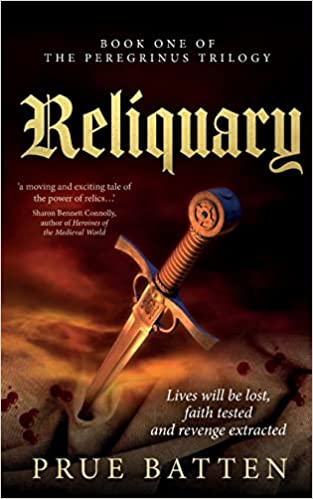
My first thought on looking at Reliquary by Prue Batten was what a gorgeous cover!
As to the book, it was fabulous!
I loved Reliquary!
Reliquary brings together a disparate group of heroes with one aim – to get a newly acquired relic safely to its destination, which is a small, impoverished convent in France. It is a moving and exciting tale of the power of relics and friendship in Europe in the aftermath of the Third Crusade.
Faced by powerful enemies, including the weather, and set in the aftermath of the Third Crusade, Reliquary is a gripping tale, replete with action, adventure and intrigue. The clever plotline is enacted by wonderful, flawed characters with whom the reader cannot help but to feel an affinity. Prue Batten has written a marvellous, gripping tale of a comradeship forged against the avaricious greed of the rich and powerful.
Beautiful imagery.
‘We need a relic.’
‘Pardon,’ the Obedientiary put down her mug of watered wine and stared at the Prioress.
‘We need a relic,’ the Prioress replied. Younger than the Obedientiary, she had blue eyes. One could almost say guileless, had it not been for the veil of iron behind the heavenly colour. The Obedientiary had observed those eyes harden to molten steel, and as strong, many times. Especially when senior prelates had visited the priory with the express purpose of wanting it closed because of its small population and lack of fame and fortune. As the Prioress spoke now, her eyes darkened – a tint reminiscent of the forge as the smithy honed blades for those who sought to arm themselves.
‘Something to bring the pilgrims,’ she continued, rubbing the worn edge of the table as if the smooth rhythm might settle the uneven nature of her thoughts. ‘In short, to bring us monies. We are only a few leagues away from the Chemin de Compostelle…’
In fact, the Obedientiary knew this. The Via Arena, beloved of pilgrims, passed through Jumeaux, following the river that trickled and sometimes flowed, not far from Esteil.
‘I cannot fight off these crows of canons for much longer. I have been communicating with Mother Abbess at Fontevrault and she agrees that we must find a way to improve Esteil’s fortunes. In between times, she has said she will do what she can, but in my view it will be little, perhaps nothing.’
Esteil was situated within Fontevrault’s purview. Occasionally, the mother house dispensed funds to smaller houses in distress. It also kept a weather eye on the spiritual well being of the houses, but most small convents were expected to contribute to the continuance – temporal and spiritual. Survival of the fittest, thought the Obedientiary.
Outside, the wood pigeons cooed and the hens that lay smooth brown eggs pecked and clucked as if they understood the Prioress’s concerns. Someone walked past in clogs, the beat of their steps on the stones of the cloister the only sound apart from the birds. Perhaps the midday meal was done and the sisters were beginning to file out of the refectory to attend to their yard duties – the physic garden, the provender garden, the hens or the orchard. Or perhaps some of their small number were copying in the scriptorium, or stitching within the solar. Right now, the Obedientiary should be there, checking that her three stitching novices had begun their afternoon’s work on a cope while there was any sort of light.
‘And what is our value, Mère Gisela?’ she asked. ‘Are we any better or worse than other such small houses like ourselves? How do we argue our value when we are less than twenty sisters?’
‘Indeed, and despite what we do every day, what we accomplish in the scriptorium and with our threads, it is apparently not enough.’ The Prioress sighed and rubbed at the smooth skin of her hands. One folding over the other, rubbing this way, rubbing that as if her young bones ached. ‘God help us. Despite the quality of our scribes and the skill of our needlewomen, such work is not enough to plead our cause. Which is why I say we need a relic.’
Prue Batten’s wonderful array of characters, from the non-worldly Sister Cecile to the war-weary Henri de Montbrisson, and their band of friends and allies, help to make Reliquary a truly memorable novel.
For any fan of medieval historical fiction, Reliquary is a tale not to be missed. It is one of those books that will have you reading ‘just one more chapter’ long into the early hours. A thoroughly enjoyable historical fiction thriller – it will have you on the edge of your seat from beginning to end.
Prue Batten has crafted a novel that draws the reader in and keeps a hold of them until the very end. It is impossible to put down!
And the best thing about Reliquary? It is the first in a new series – and I can’t wait to read more!
Signed, dedicated copies of all my books are available, please get in touch by completing the contact me form.
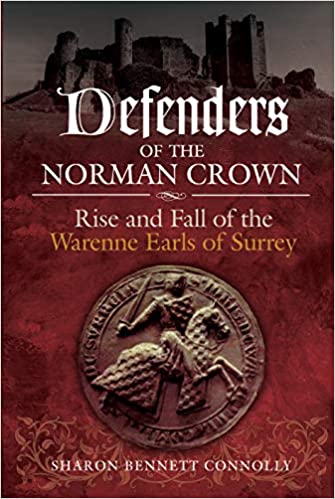
Defenders of the Norman Crown: The Rise and Fall of the Warenne Earls of Surrey tells the fascinating story of the Warenne dynasty, of the successes and failures of one of the most powerful families in England, from its origins in Normandy, through the Conquest, Magna Carta, the wars and marriages that led to its ultimate demise in the reign of Edward III. Defenders of the Norman Crown: Rise and Fall of the Warenne Earls of Surrey is now available from Pen & Sword Books, Amazon in the UK and US and Book Depository.
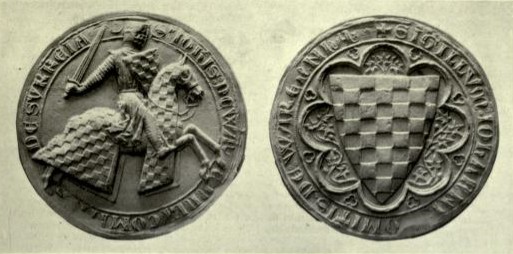
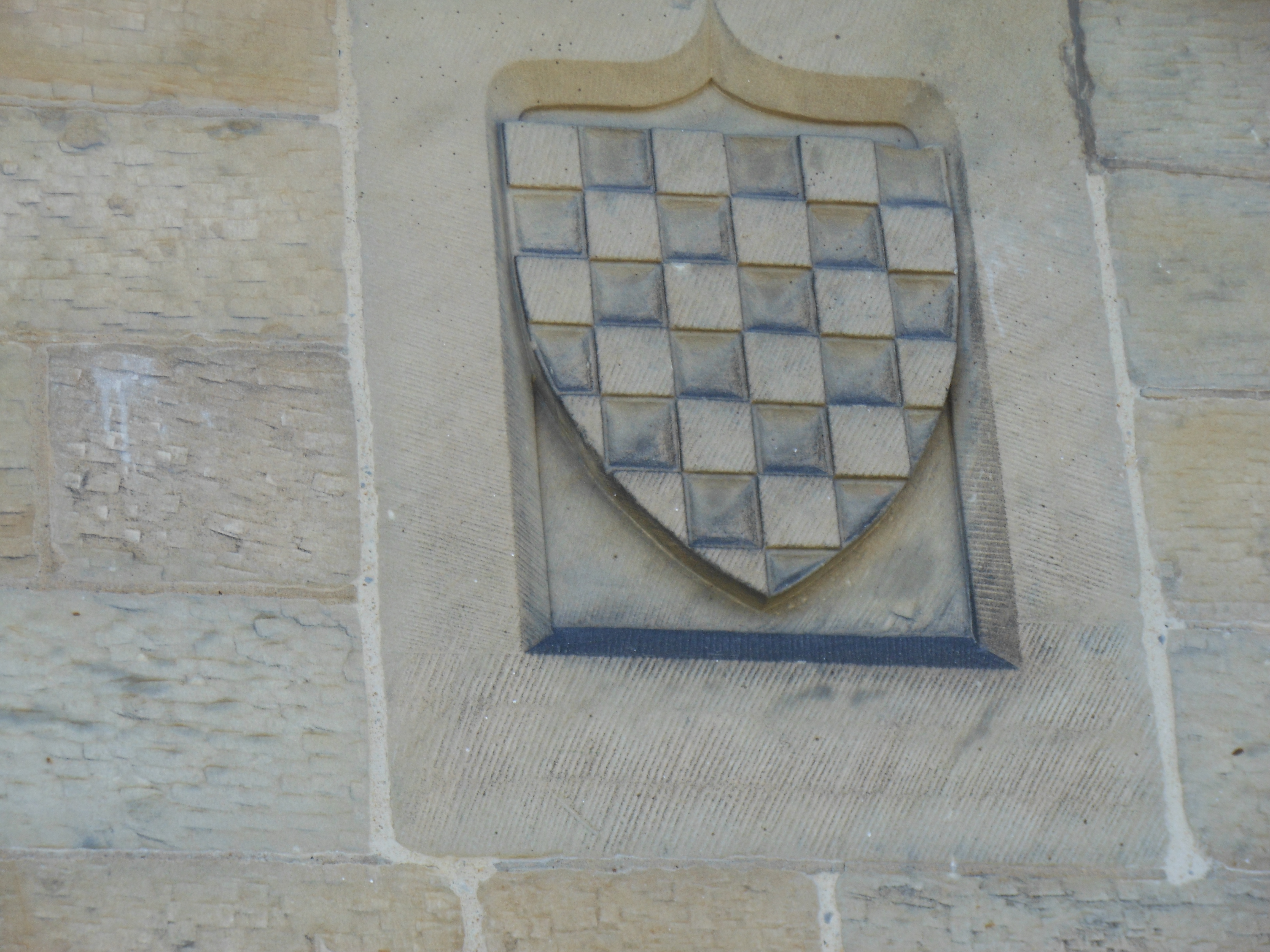
Coat of arms of the Warenne earls of Surrey, in the Gundrada Chapel of Trinity Church, Southover
When looking at a particular period or event in history, it can be easy to assume that it was all-consuming for those involved. The rest of the world blurs into the background as a country is consumed by war. Or does it? Even in medieval times, countries were not unaffected by the others around them. I almost got swept into the idea that the period known in English history as the Anarchy was a time when people thought of little else but who should be king – or queen. Even those fighting in the war were not so blinkered. Nor ignorant of events outside of England’s borders.
Did you know, for instance, that not one, but two, contingents of crusaders left England’s shores in the midst of the Anarchy? One force was headed to Portugal, and the other to the Holy Land, to join the Second Crusade. One of those crusaders was William de Warenne, 3rd Earl of Warenne and Surrey.
William (III) de Warenne was the son of William (II) de Warenne, 2nd Earl of Warenne and Surrey, and Isabel de Vermandois, a granddaughter of King Henry I of France. William was born in 1119, a year after his parents’ marriage. He was the eldest of five children. His two brothers, Reginald and Ralph, appear frequently in his story, suggesting a close family bond. Of his sisters, Ada married Prince Henry of Scotland, and was the mother of two Scottish kings, Malcolm IV and William the Lion. Gundreda de Warenne married Roger de Beaumont, Earl of Warwick, who was a cousin of Gundreda’s half-brothers, the famous Beaumont twins, Waleran and Robert.
Waleran and Robert de Beaumont were the eldest sons of Isabel de Vermandois by her first husband, Robert de Beaumont, Count of Meulan and Earl of Leicester. Isabel had nine children with her first husband and five more with Earl Warenne. Interestingly, the two families appear to have got on rather well together. William (III) can often be found in the company of one or both of his older, twin, half-brothers, such as at the deathbed of Henry I, at Lyons-la-Forêt in 1135; William was there alongside his father, the second earl, and his brothers Waleran and Robert de Beaumont.
Following his father’s death in 1138, William (III) inherited the lands and titles of the earl of Warenne and Surrey. As such, he was heavily involved in that period of history known as the Anarchy, the contest between King Stephen and Empress Matilda for England’s crown. As his father had done, the 3rd earl supported King Stephen, fighting at both the First Battle of Lincoln and the siege of Winchester in 1141. By the late 1140s, although the conflict between Stephen and Matilda was still unresolved, Earl Warenne and his half-brother, Waleran de Beaumont, appear to have wanted to get away from the constant unrest of the cousins’ war and looked to join a more noble enterprise.
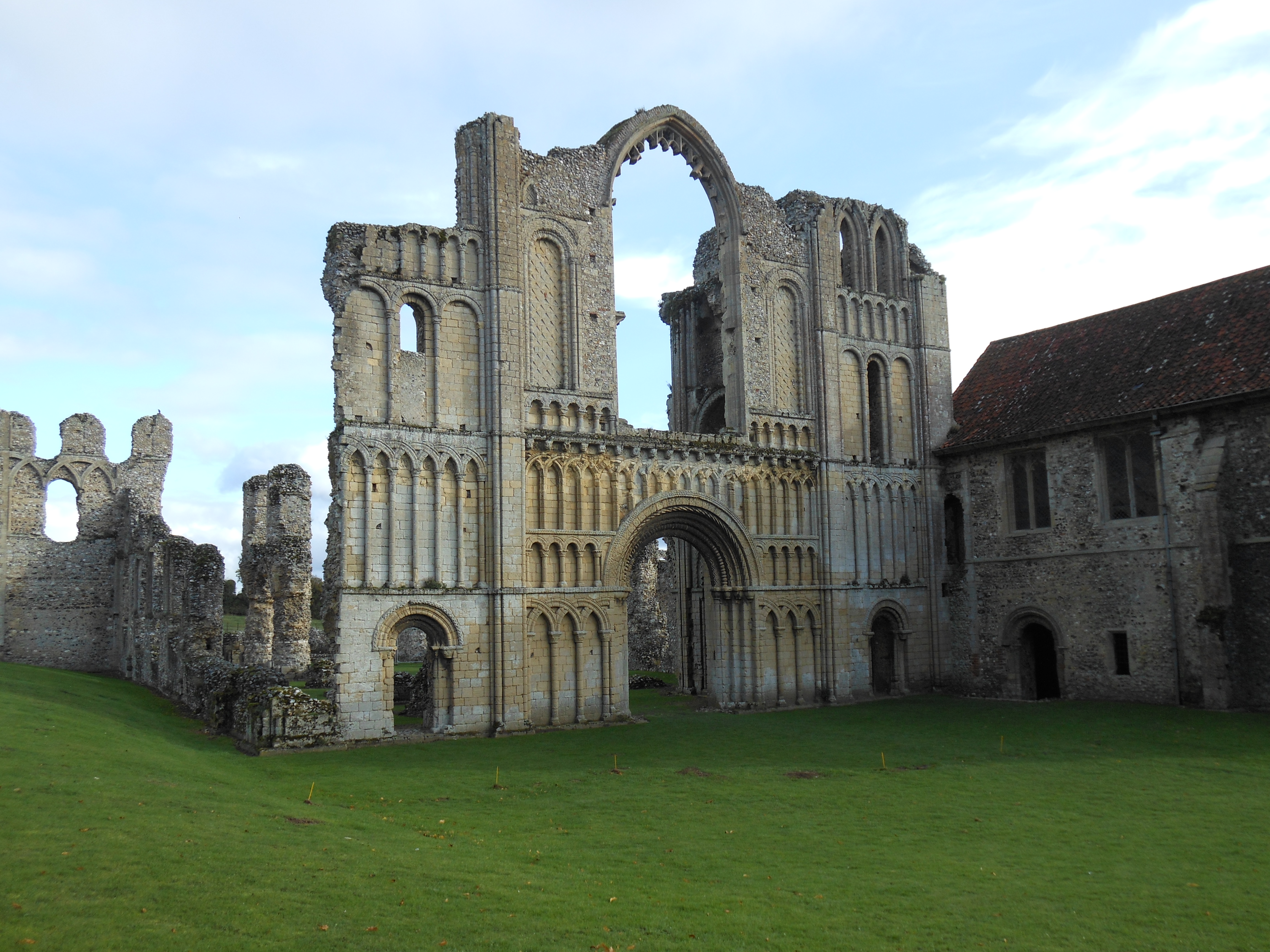
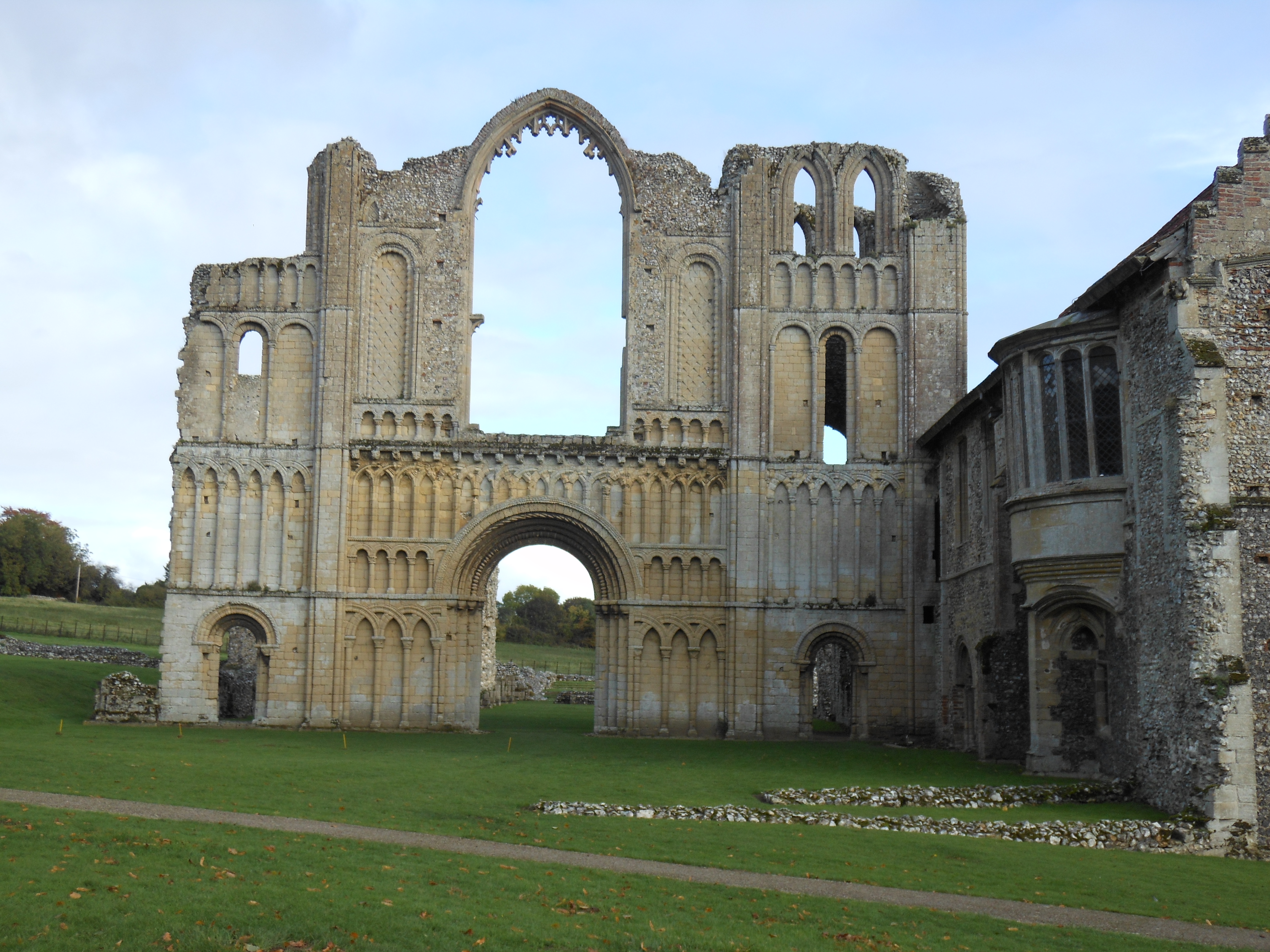
Castle Acre Priory, Norfolk
On 24 March 1146, Palm Sunday, near Vézélay, and perhaps motivated by the example of his royal cousin, Louis VII of France, William de Warenne took the cross and committed himself to the Second Crusade. From this moment on, the earl’s time was taken up with preparations for the expedition and making arrangements to ensure the security and administration of his earldom during his absence. Among others, he confirmed grants to Castle Acre Priory of the land of Thexton in Norfolk which Osmoda de Candos had given with the consent of her husband Philip: William’s brother Reginald is named in the charter and his brother Ralph, as well as his wife, Countess Ela, are all listed among the witnesses. He also confirmed a gift made to his brother Reginald whereby William son of Philip, gave his land of Harpley in Norfolk. During the winter of 1146–47, the earl granted to the monks of Castle Acre, a confirmation of any acquisitions which they might make, ‘from my fee of whatever tenancy within my tenseria [authority], whether by way of gift or purchase.’1
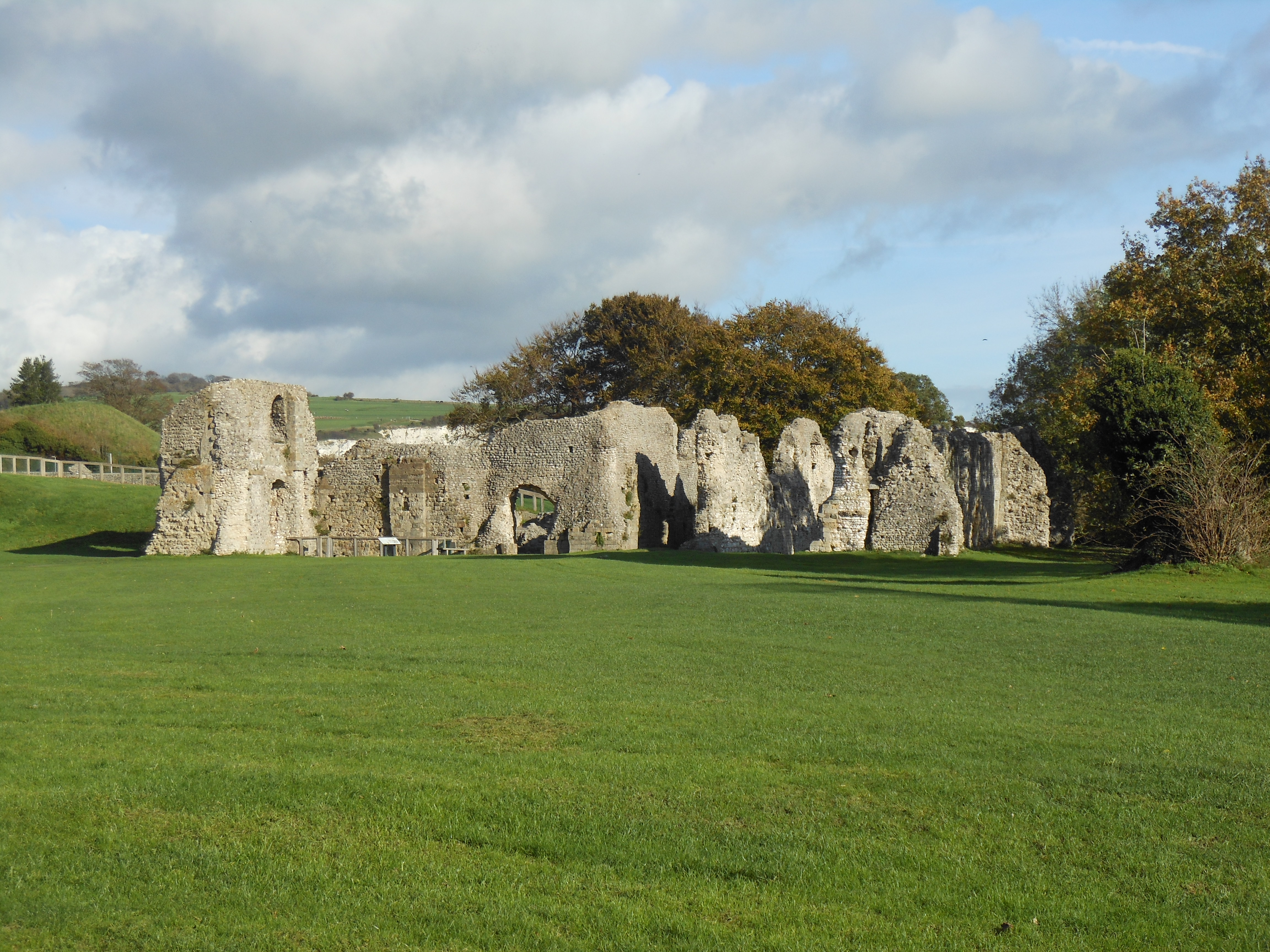
In 1147, before leaving England’s shores, the earl, his family and leading magnates congregated at Lewes Priory for the dedication of the new priory church. Most of the royal court were present, as were Ralph and Reginald de Warenne, the earl’s brothers; four leading church prelates attended, including Theobald, Archbishop of Canterbury and Henry of Blois, Bishop of Winchester as well as the bishops of Rochester and Bath. Also present were the abbots of Reading and Battle, the prior of Canterbury and William d’Aubigny, Earl of Sussex. Earl Warenne appears to have used the occasion to set his affairs in order and guarantee the security of his earldom during his absence.
St Pancras Priory, Lewes
The most significant charter issued on this occasion added to the endowment of Lewes’ priory church and promised that the earl would pay the taxes that the priory would ordinarily owe to the king. In it, the earl confirmed
‘all its lands of his fee, undertaking to acquit it of danegeld and all other services due to the king; and gift of tithe of corn, etc., from all his demesne lands and a full tenth penny of all his rents in England. He issued the charter when he caused the priory church to be dedicated and endowed it with the tenth penny of his rents, giving it seisin thereof by hair from his own head and that of Ralph de Warenne his brother, cut with a knife by Henry, bishop of Winchester, before the altar.’2
The locks of hair of Earl William and his brother Ralph, ceremoniously cut off by Bishop Henry before the altar, would afterwards have been placed on the altar, alongside the knife used in the ceremony, and may have later been ‘filed’ within the charter when it was sealed. This is the last reference to Ralph de Warenne that I could find in the historical record. Given that only Ralph and William stored locks of their hair, and not Reginald, who we know stayed in England, I think it possible that Ralph accompanied his older brother on crusade.
His affairs in order, the earldom was placed under the supervision of his very capable brother, Reginald de Warenne. The pope stipulated that church sanctions should not be invoked, ‘in respect of those men whom our beloved son Stephen the illustrious king of the English or his adversaries disinherited on the occasion of the war held for the realm before they took the cross.’3 In a time of continued civil war, this guaranteed protection of a crusader’s lands was a necessity. Earl William was now able to depart on crusade, secure in the knowledge that the family and lands he left behind were well protected from anyone wishing to take advantage of his absence:
At Whitsuntide Lewis [Louis], king of France, and Theodorie, earl of Flanders, and the count of St Egidius, with an immense multitude from every part of France, and numbers of the English, assumed the cross and journeyed to Jerusalem, intending to expel the Infidels who had taken the city of Rohen. A still greater number accompanied Conrad, emperor of Germany; and both armies passed through the territories of the emperor of Constantinople, who afterwards betrayed them.
Henry of Huntingdon
Louis VII, King of France
There were, in fact, two crusades that departed England’s shores in 1147. Some of the crusaders, an Anglo-Flemish force, went to Portugal and successfully captured Lisbon from the Muslims. Earl William de Warenne and his older half-brother, Waleran de Beaumont, joined their cousin King Louis VII of France and set out for the Holy Land. Taking the overland route, they followed in the footsteps of the German emperor, Conrad III, who had left Germany in May and arrived in Constantinople in September. Louis, accompanied by his wife Eleanor of Aquitaine, arrived in Constantinople with his army on 4 October. Tensions ran high from the start. On initially hearing of the proposed crusade, Byzantine emperor Manuel Comnenus, afraid of losing local trading connections, made a truce with the Turkish sultan of Rum in 1146 to protect Constantinople’s Asian lands from attack. To the Western crusaders, this was more proof of the apostasy of the Eastern church. The more fervent of Louis’ followers accused Emperor Manuel of treason and urged Louis to attack the emperor. Louis, on the other hand, was persuaded to appease the emperor by his less volatile advisers and the king promised to restore any imperial lands they may capture.
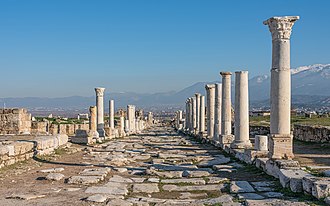
The German and French contingents met at Nicaea in November, with the Germans having already suffered a defeat at Dorylaeum on 25 October, after taking the inland route towards the kingdom of Jerusalem. The two armies, now combined, set off on the coastal route, following the path of the first crusaders’ advance into Philadelphia in Lydia. By the time they reached Ephesus, Conrad was seriously ill and returned to Constantinople to recover. The French king and his army continued on to Antioch; marching through difficult terrain in mid-winter proved particularly harrowing. The Seljuk Turks waited for the crusaders on the banks of the river Meander, but Louis’ army forced their way through. On 6 January 1148, they reached Laodicea and from there marched into the mountains that separate the Phrygia of the Pisidia. It was here that the army met with disaster.
As they crossed Mount Cadmus, the vanguard advanced too far ahead under the leadership of Geoffrey de Rançon, thus becoming detached from the main body of the army. As the vanguard progressed across Mount Cadmus, the French column followed behind, secure in the knowledge that the vanguard occupied the high ground to their front. William de Warenne was in the king’s bodyguard, towards the rear of the column, as they advanced. When the Turks appeared, the French broke their ranks and rushed upon them with swords drawn; the disorder in the ranks handing the advantage to their enemy. Retreating, the French found themselves in a narrow gorge, with a steep precipice on one side and crags on the other. Horses, men and baggage were forced over the precipice by the advancing Turks. Louis VII’s biographer, Odo de Deuil, related the events:
“…the king, who had been left behind in peril with certain of his nobles, since he was not accompanied by common soldiers or serjeants with bows (for he had not fortified himself for crossing the pass, which by common agreement he was to cross the next day), careless of his own life and with the desire of freeing the dying mob, pushed through the rear-guard and courageously checked the butchery of his middle division. He boldly assaulted the infidel, who outnumbered him a hundred times and whom the position aided a great deal; for there no horse could stand, I shall not say gallop, but barely stand, and the slower attack which resulted in the weakened knights’ thrust when wounding the enemy. On the slippery slope our men brandished their spears with all of their own might, but without the added force of their horses, and from the safe shelter of rocks and trees the Turks shot arrows. Freed by the knights’ efforts, the mob fled, carrying their own packs or leading the sumpter animals, and exposed the king and comrades to death in their stead….During the engagement the king lost his small but renowned royal guard; keeping a stout heart; however, he nimbly and bravely scaled a rock by making use of tree roots which God had provided for his safety. The enemy climbed after, in order to capture him, and the more distant rabble shot arrows at him. But by the will of God his cuirass protected him from the arrows, and to keep from being captured he defended the crag with his bloody sword, cutting off heads and hands of many opponents in the process…”
Odo of Deuil, De Profectione Ludovici VII in Orientem
Laodicea
King Louis’ bodyguard was cut down in the fighting and William de Warenne was among the fallen. Louis himself was able to escape the carnage, standing alone against a number of attackers. As the night drew in, the king and survivors were able to take advantage of the darkness to reunite with the vanguard, which had believed the king lost. In one of his letters to Abbot Sugar, King Louis wrote of the disaster on Mount Cadmus, explaining how he had been separated from the vanguard and his escort had been cut down, with the loss of his cousin, William de Warenne. He was too upset to give any more details and Mount Cadmus remains a battle of which very little is known beyond the basic details.
“Nearby the baggage train was still crossing the pass, because the closer packed it was, the slower it fled over the crags. When he came upon it, the king, who was on foot, secured a horse and accompanied the men through the evening, which had already fallen. At that time breathless cohorts of knights from the camp met him and groaned when they saw him alone, bloody, and tired, for, without asking, they knew what had happened and mourned inconsolably for the missing royal escort, which numbered about forty (to wit, the count of Warenne and his brother Evrard of Breteuil, Manasses of Bulles and Gautier of Montjay and others; but I shall not record the names of all, lest I be considered unnecessarily wordy.)”
Odo of Deuil, De Profectione Ludovici VII in Orientem
Despite the heavy losses, King Louis’ crusade continued, reuniting with the German contingent between March and June 1148. They failed to take Edessa and were forced to withdraw from Damascus after a week of heavy fighting, when fresh Muslim forces arrived. The crusade ended in failure and the French king, who blamed Emperor Manuel Comnenus for the fiasco, accepted the aid of Manuel’s enemy Roger of Sicily, who sent ships to take the French forces home. Of the English forces, while William de Warenne was lost at Mount Cadmus, his brother Waleran de Beaumont, Count of Meulan and Earl of Worcester, made it back to England’s shores, narrowly surviving a shipwreck along the way; he founded a monastery in gratitude. Of the two Anglo-Norman bishops who accompanied the crusade, Roger of Chester died at Antioch and was buried there, whereas Arnulf of Lisieux, who had served as one of the leading diplomats, returned but with his reputation faded.
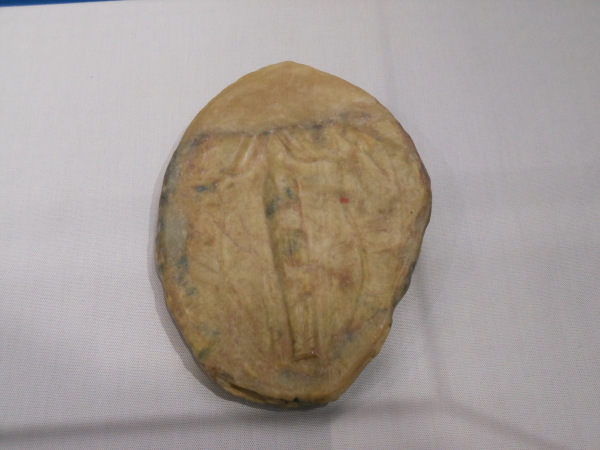
Seal of Isabel de Warenne, Countess of Surrey
Perhaps it was always on the cards that the 3rd Earl Warenne’s unspectacular military career would end with his death in battle. He was only 28 years old and had held the earldom for just over nine years. The earl had been a stalwart supporter of King Stephen, not once wavering in his allegiance, despite his failures in Normandy and at Lincoln early on in his career. He had done extensive work on the family’s property at Castle Acre, reinforcing the castle and replanning the town, building the ramparts that now surround it. William de Warenne had been a generous benefactor to the church, especially the Warenne foundations at Lewes and Castle Acre.
Even in his absence on crusade, the earl was still technically in charge; his brother, Reginald, issued a number of charters, each with the proviso that ‘if Jesus Christ brought back the earl [from the crusade] he would cause him to confirm it’ or ‘do his best to obtain the earl’s confirmation.’4
The death of William de Warenne, 3rd Earl of Warenne and Surrey brought an end to the senior male line that had been founded with the creation of the earldom for William (I) de Warenne in 1088. The earl was survived by his wife, Ela de Talvas, still a young woman, and his daughter, Isabel de Warenne, a child probably no more than 10 years of age. Isabel was now the richest heiress in England and married to King Stephen‘s youngest son, William of Blois. The earl’s estates were left in the capable hands of his youngest brother, Reginald de Warenne, Baron of Wormegay, who would watch over them for his niece and her young husband.
Notes:
1 Edmund King, King Stephen; 2 Farrer, William and Charles Travis Clay, editors, Early Yorkshire Charters, Volume 8: The Honour of Warenne; 3Epistolae Pontificum Romanorum ineditae quoted in Edmund King, King Stephen; 4 Farrer, William and Charles Travis Clay, editors, Early Yorkshire Charters, Volume 8: The Honour of Warenne; Odo of Deuil, De Profectione Ludovici VII in Orientem, magnacharta.com.
Sources:
Robert Batlett, England Under the Norman and Angevin Kings; Dan Jones, The Plantagenets; Donald Matthew, King Stephen; Medieval Lands Project on the Earls of Surrey, Conisbrough Castle; Farrer, William and Charles Travis Clay, editors, Early Yorkshire Charters, Volume 8: The Honour of Warenne; Morris, Marc King John: Treachery, Tyranny and the Road to Magna Carta; Church, Stephen, King John: England, Magna Carta and the Making of a Tyrant; doncasterhistory.co.uk; A History of the County of Sussex: Volume 2 edited by William Page; W.H. Blaauw, On the Early History of Lewes Priory, and its Seals, with extracts from a MS. Chronicle, Sussex Archaeological Collections; Rev. John Watson, Memoirs of the Ancient Earls of Warren and Surrey, and Their Descendants to the Present Time, Volume I; Odo of Deuil, De Profectione Ludovici VII in Orientem; magnacharta.com; Cokayne, G.E., The Complete Peerage, Vol. XII; Henry of Huntingdon, The Chronicle of Henry of Huntingdon.
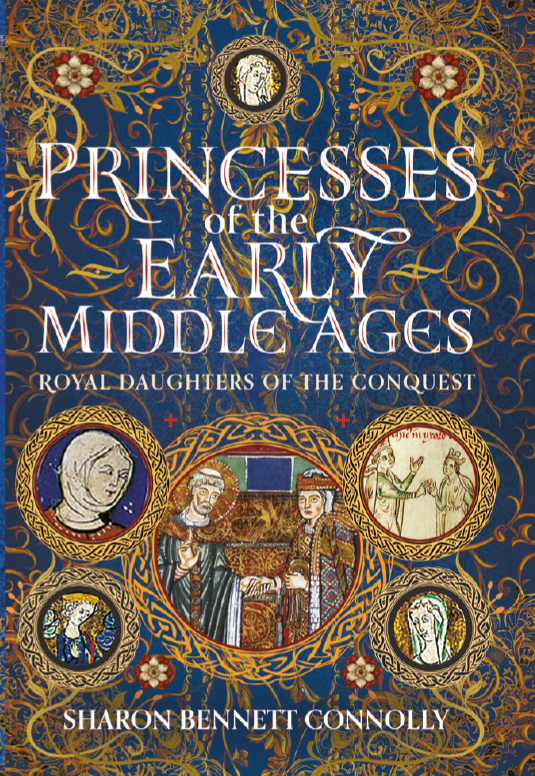
Coming 30 March 2026: Princesses of the Early Middle Ages
Daughters of kings were often used to seal treaty alliances and forge peace with England’s enemies. Princesses of the Early Middle Ages: Royal Daughters of the Conquest explores the lives of these young women, how they followed the stereotype, and how they sometimes managed to escape it. It will look at the world they lived in, and how their lives and marriages were affected by political necessity and the events of the time. Princesses of the Early Middle Ages will also examine how these girls, who were often political pawns, were able to control their own lives and fates. Whilst they were expected to obey their parents in their marriage choices, several princesses were able to exert their own influence on these choices, with some outright refusing the husbands offered to them.
Their stories are touching, inspiring and, at times, heartbreaking.
Princesses of the Early Middle Ages: Royal Daughters of the Conquest is now available for pre-order from Pen & Sword and Amazon.
Also by Sharon Bennett Connolly:
Scotland’s history is dramatic, violent and bloody and Scotland’s Medieval Queens have seen it all. This is the story of Scotland through their eyes. Available now from Amazon and Pen and Sword Books. Heroines of the Tudor World tells the stories of the most remarkable women from European history in the time of the Tudor dynasty, 1485-1603. These are the women who ruled, the women who founded dynasties, the women who fought for religious freedom, their families and love. Heroines of the Tudor World is now available from Amberley Publishing and Amazon UK.Women of the Anarchy demonstrates how Empress Matilda and Matilda of Boulogne, unable to wield a sword themselves, were prime movers in this time of conflict and lawlessness. It shows how their strengths, weaknesses, and personal ambitions swung the fortunes of war one way – and then the other. Available from Bookshop.org, Amberley Publishing and Amazon UK. King John’s Right-Hand Lady: The Story of Nicholaa de la Haye is the story of a truly remarkable lady, the hereditary constable of Lincoln Castle and the first woman in England to be appointed sheriff in her own right. Available from all good bookshops Pen & Sword Books, bookshop.org and Amazon.
Alternate Endings: An anthology of historical fiction short stories including Long Live the King… which is my take what might have happened had King John not died in October 1216. Available in paperback and kindle from Amazon.
Podcast:
Have a listen to theA Slice of Medieval podcast, which I co-host with Historical fiction novelist Derek Birks. Derek and I welcome guests, such as Ian Mortimer, Bernard Cornwell, Elizabeth Chadwick and Scott Mariani, and discuss a wide range of topics in medieval history, from significant events to the personalities involved.
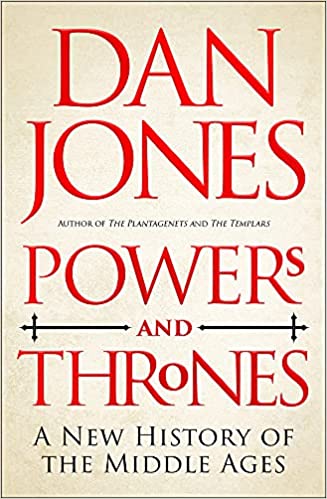
Dan Jones’s epic new history tells nothing less than the story of how the world we know today came to be built. It is a thousand-year adventure that moves from the ruins of the once-mighty city of Rome, sacked by barbarians in AD 410, to the first contacts between the old and new worlds in the sixteenth century. It shows how, from a state of crisis and collapse, the West was rebuilt and came to dominate the entire globe. The book identifies three key themes that underpinned the success of the West: commerce, conquest and Christianity.
Across 16 chapters, blending Dan Jones’s trademark gripping narrative style with authoritative analysis, Powers and Thrones shows how, at each stage in this story, successive western powers thrived by attracting – or stealing – the most valuable resources, ideas and people from the rest of the world. It casts new light on iconic locations – Rome, Paris, Venice, Constantinople – and it features some of history’s most famous and notorious men and women.
This is a book written about – and for – an age of profound change, and it asks the biggest questions about the West both then and now. Where did we come from? What made us? Where do we go from here?
Well, isn’t this an epic undertaking. The history of the Middle Ages, across Europe and into the four corners of the world (except Australia because it still hadn’t been discovered) – in 16 chapters, 633 pages and about 25 hours of reading. And it is awesome!
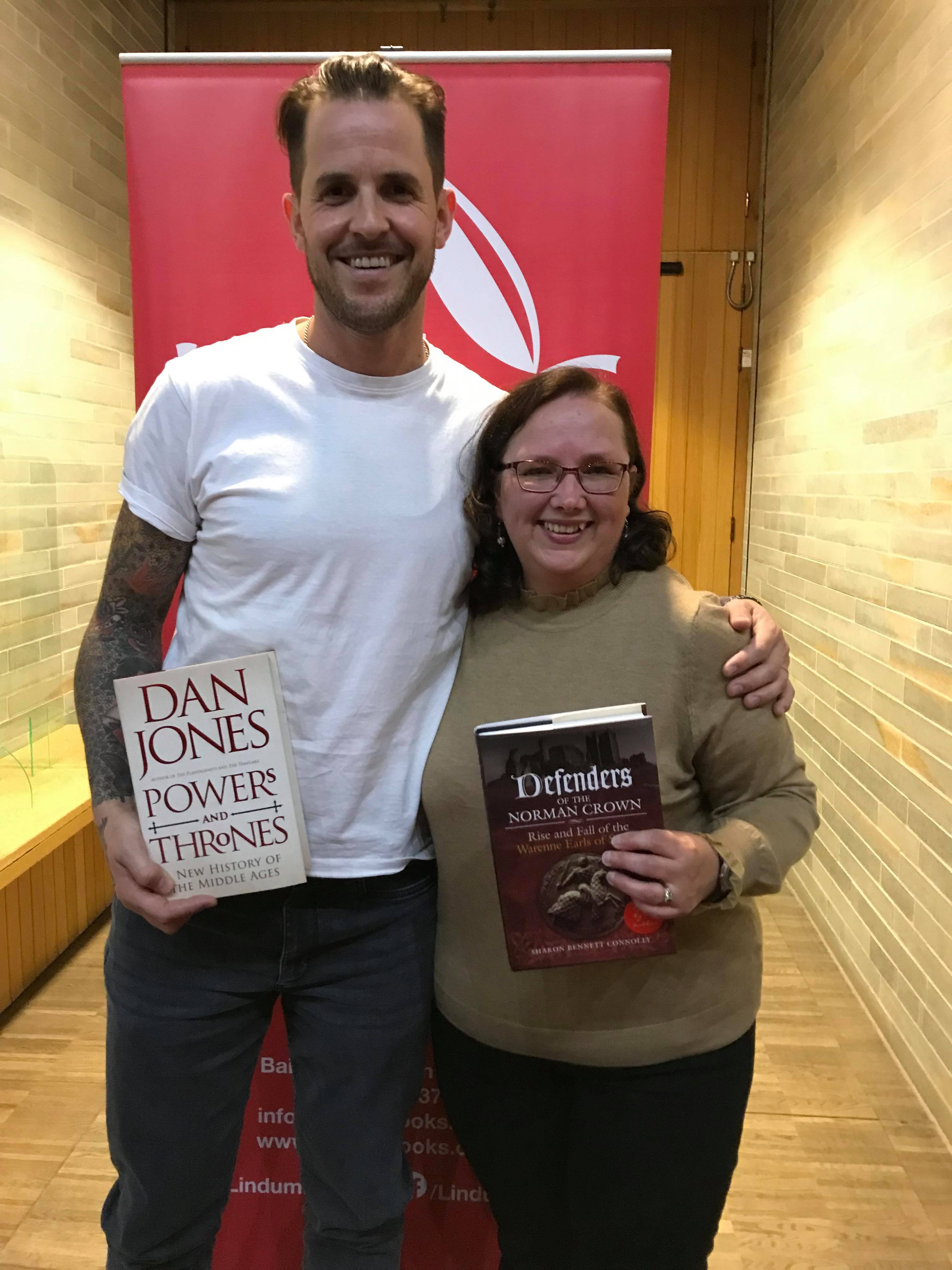
I couldn’t read this book at a leisurely pace because I was actually scheduled to interview Dan Jones on 29 September, for Lindum Books in Lincoln and I desperately wanted to make sure I had read the whole thing beforehand. So, I had 10 days to read it and I am quite proud of myself that I managed it. I put all other books aside and concentrated on this, hoping it would keep my attention. I was a little worried. It is a long book and covers such a wide historical arena. Could it keep my interest? Well, the simple answer is YES!
Powers and Thrones by Dan Jones is a thoroughly enthralling read encompassing over a thousand years of history, from the Sack of Rome in 410AD to the sack of Rome in 1527. Writing the story of the entire medieval era was a massive undertaking that Dan said he wanted to do, both as his 10th book and to mark his 40th birthday. And it is, indeed, a magnum opus to be proud of. Powers and Thrones is a perfectly balanced book, giving just enough attention to each area of interest and geographical location, going from Rome, to Byzantium and on to the rise of Islam, Dan Jones manages to cover the significant events and influences that drove change and development through the entire Middle Ages.
Powers and Thrones demonstrates how climate change, disease, technology and ideology were often the forces behind change. For example, the Guttenberg Press was revolutionary in every way, allowing the mass production of books, pamphlets and the dissemination of knowledge to a far-wider audience. It was the medieval equivalent to our social media, both in its reach and influence, and Dan Jones highlights how significant it was in Europe’s emergence from the medieval era, with its impact on learning, communication and – perhaps above all – religion.
For those alert to signs hidden in the fabric of the world, the Roman Empire’s collapse in the west was announced by a series of omens. In Antioch, dogs howled like wolves, night-birds let out hideous shrieks and people muttered that the emperor should be burned alive. In Thrace, a dead man lay in the road and fixed passers-by with a unnerving, lifelike glare, until after a few days the corpse suddenly disappeared. And in the city of Rome itself, citizens persisted in going to the theatre: an egregious and insanely sinful pastime, which, according to one Christian writer, practically invited the wrath of the Almighty. Human beings have been superstitious in all ages and we are especially good at adducing portents when we have the benefit of hindsight. Hence the opinion of the historian Ammianus Marcellinus, who looked back on the end of the fourth century into which he was born and reflected that this was a time when fortune’s wheel, ‘which is perpetually alternating prosperity and adversity’, was turning fast.
In the 370s, when Rome’s fatal malady set in, the Roman state – monarchy, republic and empire – had existed for more than a millennium. Yet within little more than one hundred years, by the end of the fifth century AD, every province west of the Balkans had slipped from Roman control. In the ancient heartlands of empire, Roman institutions, tax systems and trade networks were falling apart. The physical signs of Roma elite culture – palatial villas, cheap imported consumer goods, hot running water – were fading from everyday life. The Eternal City had been sacked several times, the western crown had passed between a succession of dimwits, usurpers, tyrants and children, until eventually it had been abolished; and territory that formerly comprised the core of a powerful mega-state had been parcelled among peoples whom the proud-hearted citizens of Rome’s imperial heyday had previously scorned as savages and subhumans. These were the ‘barbarians’: a derogatory word which encompassed a huge range of people from itinerant nomadic tribes quite new to the west and ignorant or dismissive of Roman mores, through to longstanding near-neighbours, whose lives were heavily influenced by Roman-ness, but who had not been able to share in the fruits of citizenship.
With Dan Jones at The Collection, Lincoln
What makes this book special is the way Dan Jones manages to make Powers and Thrones relevant to today. Writing it in the midst of a pandemic certainly must have helped to give Dan a sense of history all around him and he alludes to this in the book. When interviewing him, Dan told me that living through Covid gave him a better understanding of the plague years of 14th century Europe, of the fear and panic that must have consumed people. And by referring to modern-day equivalents, such as world leaders, the pandemic and the rise of social media, Dan is able to draw the reader in and make medieval history relevant in the modern age.
Dan Jones does not shy away from the harsh questions, either, examining the development and morals of slavery, the reasoning behind the crusades and the rise of Protestantism. What may surprise readers is the facts this book is essentially Euro-centric – it made me realise how Anglo-centric my study of history has been over the years. By focusing on change and development in mainland Europe, whilst encompassing England and the British Isles in various guises where appropriate, it gives the reader a whole new outlook on the medieval era, whilst also demonstrates how events in Europe – even back then – could influence events in England, Scotland, Wales and Ireland. Powers and Thrones highlights the driving forces of change, whether it was people, ideas or technology, and demonstrates how such change effected Europe in general and individuals in particular, whether it was the empire of Charlemagne, the rise of monasticism, or even the development of the humble stirrup that led to the emergence of the knightly class.
In Powers and Thrones, Dan Jones combines a narrative of international events with case studies that focus on individual people, organisations and movements. By highlighting such diverse subjects as Empress Theodora, the rise of Islam, El Cid and the magnificent Lincoln Cathedral, the author manages to personalise what might otherwise have been a wide, sweeping narrative. The Warennes also get a mention in the involvement of William de Warenne, the 1st Earl, and his wife, Gundrada, in founding the first Cluniac priory in England, St Pancras Priory in Lewes, Sussex. From my personal point of view, it is fabulous that Dan Jones chose to include Empress Theodora so prominently – a woman who rose from extremely humble roots to become Empress of Byzantium and a woman who was influential in holding that empire together, especially in adroitly soothing religious dissension. It is impossible to get everything from 1,000 years of history in one book, but by showing the big picture, whilst highlighting particular events, ideas, buildings or people, Dan Jones manages to provide a fascinating narrative that is fast-paced and engaging without being overwhelming.
Powers and Thrones is, quite simply, an amazing book. It is chock full of little snippets of information that you may never have known, it relates medieval events to our modern day equivalents, such as the Black Death to Covid. Such references to the modern era could easily have backfired, but they serve to make the book more accessible and entertaining and not a little amusing. The moments of light-heartedness often provide an extra depth to the reading experience and make the book accessible to every reader.
Powers and Thrones was certainly an ambitious project, but in the hour-long interview I had with Dan Jones, he spoke about every aspect of it with passion and enthusiasm an that same passion and enthusiasm comes across throughout the book. The book is a pleasure to read and would be a welcome addition to any bookshelf.
Powers and Thrones by Dan Jones is available from Amazon and Bookshop.org.
My Books
Signed, dedicated copies of all my books are available, please get in touch by completing the contact me form.
Defenders of the Norman Crown: The Rise and Fall of the Warenne Earls of Surrey tells the fascinating story of the Warenne dynasty, of the successes and failures of one of the most powerful families in England, from its origins in Normandy, through the Conquest, Magna Carta, the wars and marriages that led to its ultimate demise in the reign of Edward III. Defenders of the Norman Crown: Rise and Fall of the Warenne Earls of Surrey is now available from Pen & Sword Books, Amazon in the UK and US and Book Depository.
William de Warenne, 1st Earl of Warenne and Surrey, Trinity Church, Southover
The Warenne earls of Surrey were a fascinating family, right at the heart of English history and politics for almost 300 years, from the time of the Norman Conquest to the reign of Edward III. They held lands throughout England, acted as justiciars, sheriffs and generals – and yet, few people know their story.
But who were they?
William I de Warenne was rewarded for his support of King William II in the 1088 rebellion with the earldom of Surrey. However, the earls thereafter were as often referred to as the earls of Warenne – or the familial Earl Warenne, rather than earls of Surrey. The earldoms of Sussex and Strathearn (Scotland) were later added to these titles. As they appear to have preferred the simple familial title of Earl Warenne, that is how I have chosen to refer to them, except when establishing their titles. The Warenne’s extensive lands were spread over 13 counties and spanned the country from Lewes on the south coast to their castles of Conisbrough and Sandal in Yorkshire, with their family powerbase in East Anglia, where they built a magnificent priory, castle and medieval village at Castle Acre.
Wakefield, including Sandal Castle, appears to have come into the hands of the Warenne family at some point before 1121, during the tenure of the 2nd Earl Warenne. It is possible that they were acquired possibly in an exchange of lands with William Meschin, who had taken control of the Warenne holdings of Kimbolton in Huntingdonshire and Dean in Bedfordshire some time before 1130.
The family mausoleum was at St Pancras Priory in Lewes, founded by the first earl and his wife, Gundrada. It is the burial place of all but two subsequent earls and numerous other family members, as well as several earls of Arundel and their countesses.
For almost 300 years the Warenne earls of Surrey were some of the most influential men in the country, but the family died out rather ingloriously, with the seventh – and last – earl’s marital difficulties. Despite a prestigious marriage to a granddaughter of the king of England, John de Warenne, 7th Earl Warenne, died with no legitimate son to succeed him, though he had numerous acknowledged illegitimate children to whom he had given the family name.
Gundrada de Warenne, wife of the 1st earl
The first Warenne earl, William de Warenne, Earl of Warenne and Surrey, came to England with William the Conqueror’s invasion force and fought at the Battle of Hastings in 1066. As a younger son, he had little hope of an inheritance and had acquired his fortune and reputation fighting for the duke of Normandy, making his name as a young man at the 1054 Battle of Mortemer.
The Warennes were at the heart of English history and politics from the time of the Conquest to the death of John de Warenne, the 7th and last earl in 1347
So who were the Warenne earls?
Briefly,
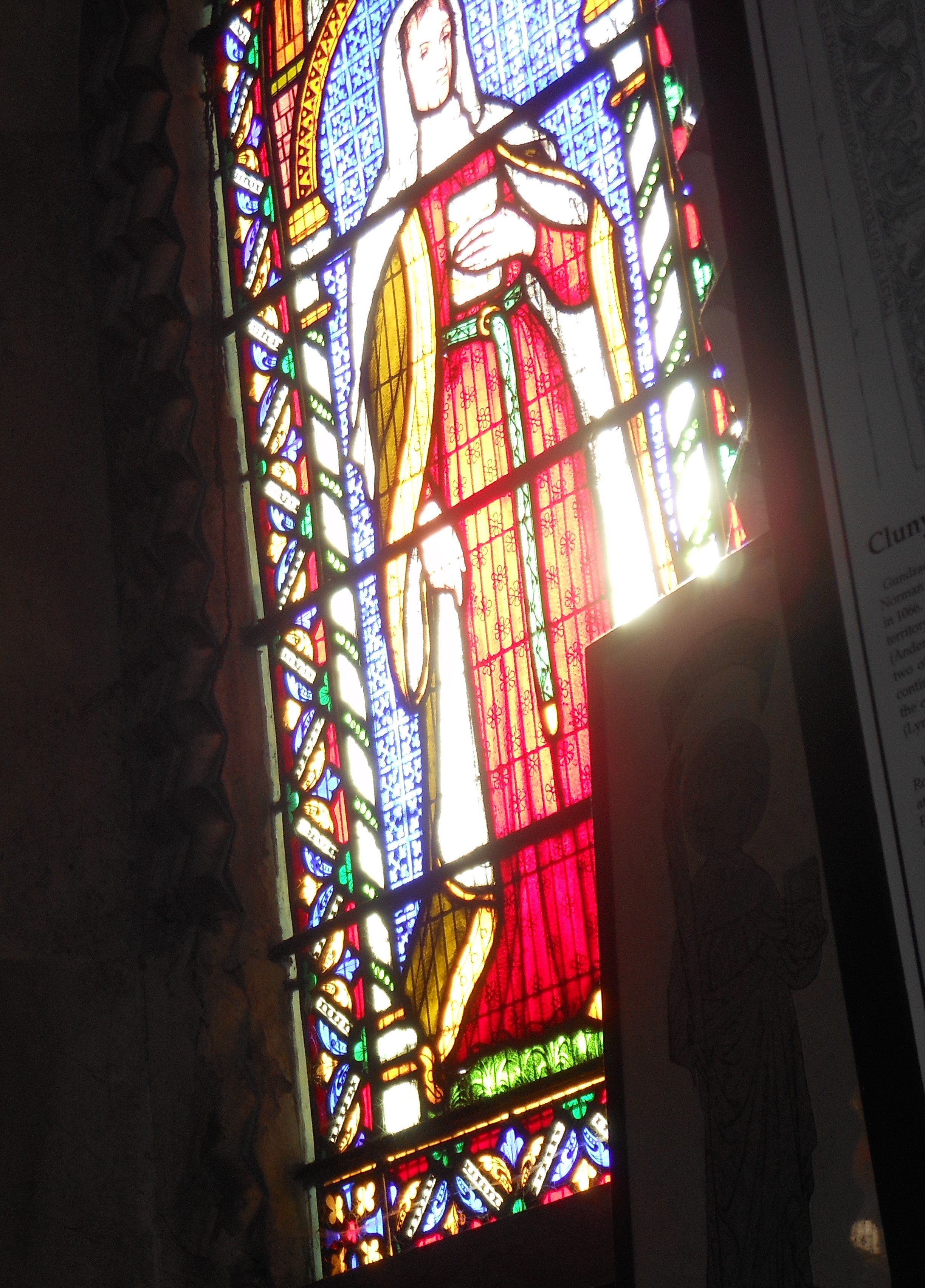
William de Warenne was a distant cousin of William the Conqueror and fought at the Battle of Hastings. William was a trusted advisor and companion of King William I and was appointed justiciar in England during the king’s absences in Normandy. He pursued a personal feud against English freedom fighter, Hereward the Wake, after Hereward murdered his brother-in-law, Frederic. William was created Earl of Surrey by King William II, just weeks before his death in 1088, having been fatally wounded at the siege of Pevensey. William and his wife, Gundrada, founded the first Cluniac priory in England, St Pancras, at Lewes in Sussex. It would become the family mausoleum. William and Gundrada’s coffins were found in the 19th century, when the railway line was being laid, and are now interred in the Gundrada Chapel of Trinity Church, Southover.
The Warenne coat of arms, adopted by William de Warenne, 2nd Earl of Warenne and Surrey
He was succeeded by his oldest son, William II de Warenne (it was a popular name) who was earl for 50 years. This William had an awkward relationship with Henry I – William was thwarted in love by Henry when they both set their sights on the same woman, Matilda of Scotland. William supported Robert Curthose’s claim for the throne against Henry, but was persuaded to abandon the duke of Normandy in favour of the king of England after the former’s failed attempt to invade England led to Earl Warenne’s lands being confiscated by King Henry. From that moment on Earl Warenne was loyal to Henry and gave a rousing speech in favour of King Henry before the 1119 Battle of Bremule. He married Isabel de Vermandois, granddaughter of King Henry I of France and widow of Robert, Earl of Leicester. The relationship caused some scandal as one chronicler suggests Isabel and William ran away together, before Isabel’s first husband was dead. William’s royal ambitions would be realised when his daughter, Ada de Warenne, married Prince Henry of Scotland in 1139; William’s grandsons, Malcolm IV and William the Lion, both succeeded to the Scottish throne.
The 3rd earl fought on the wrong side (in my opinion) during the Anarchy; he supported King Stephen, rather than Empress Matilda. Also named William, he and his forces were ignominiously routed at the 1141 Battle of Lincoln, leaving King Stephen to be captured by Earl Robert of Gloucester. Earl Warenne redeemed himself by capturing the same Earl Robert during the Rout of Winchester in the summer of 1141, thus facilitating and exchange of commanders that saw King Stephen’s release from imprisonment at Bristol Castle. Perhaps growing tired of the constant civil war, in 1147 the earl left on the Second Crusade with his half-brother, Waleran de Beaumont, Count of Meulan, led by the brothers’ second cousin, Louis VII, and his wife, Eleanor of Aquitaine. Earl William was killed at the age of 28 at the Battle of Mount Cadmus in January 1148, leaving the earldom to his young daughter, Isabel.
Seal of Isabel de Warenne, 4th Countess of Warenne and Surrey in her own right
The 4th earl. Now this is where the subsequent numbering of earls gets confusing. There were two 4th earls, though some history books count them as the 4th and 5th earls. The earldom actually belonged to Isabel. Isabel de Warenne was 4th Countess of Warenne and Surrey in her own right. Her first husband, William of Blois (the first 4th earl), was the youngest son of King Stephen and her second husband, Hamelin Plantagenet (the second 4th earl), was the illegitimate half-brother of King Henry II; a thoroughly modern Hamelin changed his name from Plantagenet to de Warenne on marrying Isabel. The first marriage produced no children, which was a stroke of luck for Henry II, as William of Blois could have founded a royal dynasty to rival the mighty Plantagenets. The second marriage proved more fruitful, with three daughters and a son. Hamelin was a loyal supporter of his brother, Henry II, and nephews, Richard I and King John – despite the fact John seduced one of Hamelin’s daughters, fathering an illegitimate child with her. Hamelin also built the magnificent keep at Conisbrough Castle, South Yorkshire.
Their son, William de Warenne, the 5th Earl, was first cousin to both King Richard I and King John. He probably grew up in Normandy, and served with King Richard in France in the 1190s. William played an active role in English politics, negotiating with the rebels on John’s behalf in Spring 1215, attempting to avert civil war. He was a signatory of the Magna Carta in 1215 and again on its reissue in 1225; he was one of the few surviving earls to have witnessed both issues of the charter. He did side with the rebel barons and their French allies, for a time, but returned to the fold following King John’s death in October 1216. He then helped to negotiate the peace, in September 1217, which saw the French Prince Louis give up his claim to England and return home. He married Matilda Marshal, daughter of the great William Marshal, Earl of Pembroke and regent of England for the first few years of Henry III’s reign. The couple had two children; their daughter, Isabel d’Aubigny, Countess of Arundel, became famous for berating King Henry III over the appropriation of a wardship that was rightfully hers.
Seal of John de Warenne, 6th Earl of Warenne and Surrey
John de Warenne, the 6th earl, was the longest serving earl of them all, holding the title for 64 years. His father died when he was 8 years old. Henry III became his brother-in-law when he married the king’s half-sister, Alice de Lusignan, daughter of Queen Isabella of Angouleme and her second husband, Hugh X de Lusignan. The marriage was a happy one and, as far as we can tell, the couple truly loved each other; following Alice’s death in childbirth, John did not take another wife. John de Warenne fought in the Second Barons’ War and was a close associate of the future king, Edward I. He was at the Battle of Lewes in 1264, fighting for King Henry III against Simon de Montfort, but escaped to the continent when the battle was lost. John was probably at Evesham for the defeat and death of Simon de Montfort, though his presence is not recorded; he was certainly with Henry III’s son, Edward, in the days before the battle. His daughter, Isabella, was married to John Balliol, King of Scots, and the mother of Edward Balliol, who pursued his own claim to the Scottish throne in the 1330s. John was guardian of Scotland for a time and lost the Battle of Stirling to William Wallace in 1298. John de Warenne was a brutal man with a sense of humour; he once claimed the rights to all the rabbit warrens in Surrey – because it was his name! His son, William de Warenne, had died during a tournament in 1286, so when John died in 1304, aged 72, he was succeeded by his 18-year-old grandson, John II de Warenne.
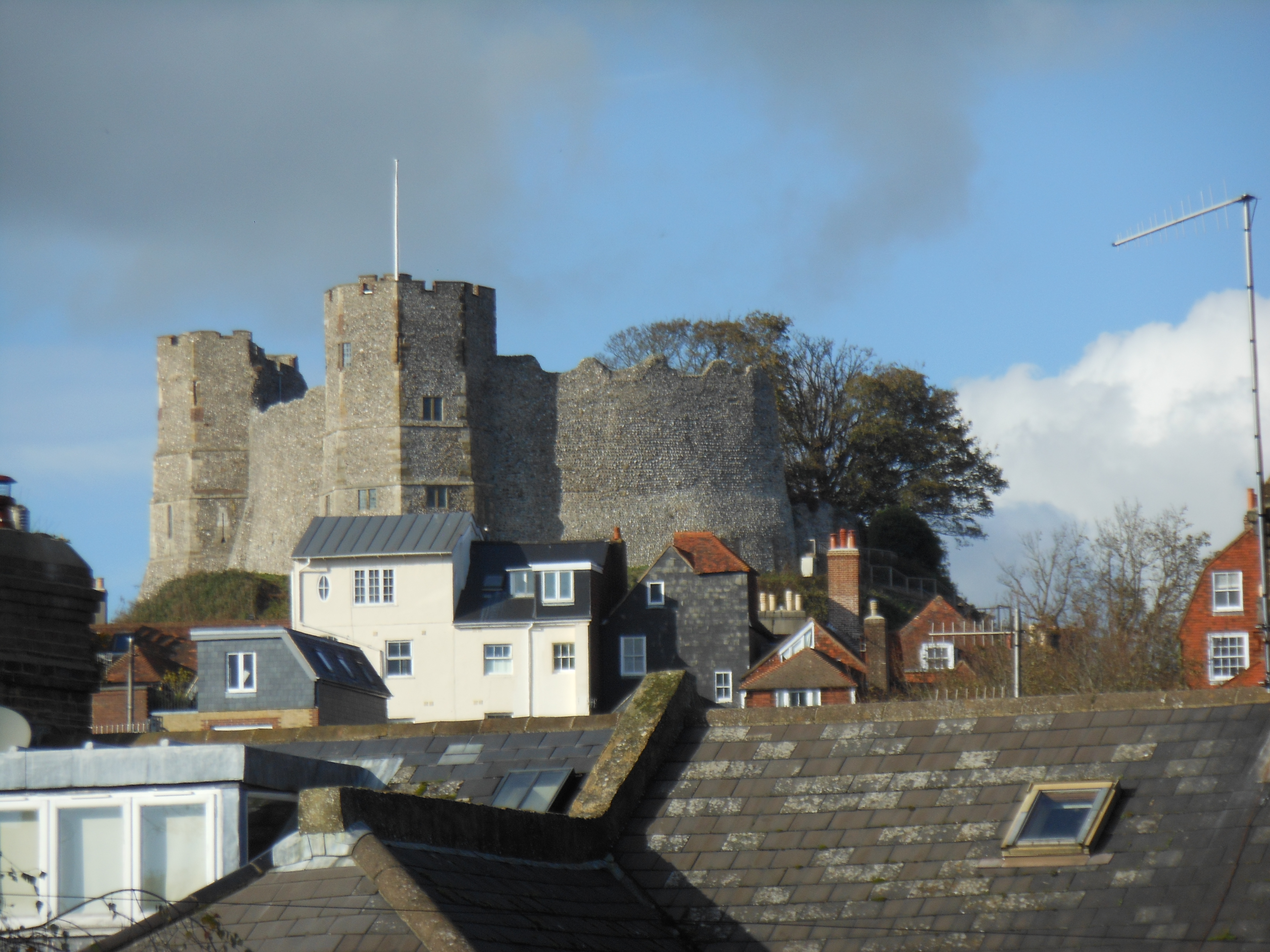
Lewes Castle, Sussex, seat of the earls of Warenne and Surrey
John II de Warenne, the 7th and last earl of Warenne and Surrey, spent most of his adult life trying to divorce his wife, Jeanne de Bar (Joan of Bar), a granddaughter of King Edward I, in order to marry his mistress. He made various claims to try and effect a divorce, including that he had had an affair with his wife’s aunt, Mary of Woodstock, who had been a nun from the age of 7. John was embroiled in a private – but very public – feud with Thomas of Lancaster, Edward II’s most powerful vassal, and even went so far as kidnapping Lancaster’s wife, Alice de Lacey. In retaliation, Lancaster seized the Warenne castles of Conisbrough and Sandal, both being close to his own castle of Pontefract. The castles were only restored to John after Lancaster’s execution following his defeat at the Battle of Boroughbridge, in 1322. John was involved in many of the events that shaped the reign of Edward II, though he did not fight in the 1314 English defeat by the Scots at the Battle of Bannockburn. He supported Edward II to the end – almost, only adding his to support to Isabella of France and the future Edward III, when he saw that the king’s cause was hopeless. He died in 1347 at Conisbrough, still married to Jeanne de Bar and with no legitimate heir to succeed him. The earldom passed to his nephew, Richard FitzAlan, Earl of Arundel, but the Yorkshire lands, including Conisbrough and Sandal castles, passed to the crown and were given to Edward III’s fourth surviving son, Edmund of Langley, 1st Duke of York.
Castle Acre Priory, Norfolk, one of the Cluniac monasteries founded by the Warenne earls
And that is just a – very – brief summary of the earls.
The Warenne family has a fascinating history, standing at the heart of English politics for the better part of 3 centuries. They had a family bond that is not always found amongst the aristocracy, with brothers and sisters helping and supporting each other and working for the benefit of their family. Strategic marriages forged links with the greatest families in England, Scotland and France; their family connections spanned the greatest noble houses, from the Marshals, the FitzAlans, the Lusignans, the d’Aubignys and Percys to the Scottish, French and English royal families.
One family, over 8 generations, the Warennes were at the centre of 300 years of English history.
*
Selected Sources:
Elisabeth Van Houts, Hereward and Flanders (article), Anglo-Saxon England vol. 28; A History of the County of Sussex: Volume 2 edited by William Page; W.H. Blaauw, On the Early History of Lewes Priory, and its Seals, with extracts from a MS. Chronicle, Sussex Archaeological Collections; Edward Impey, Castle Acre Priory and Castle, English Heritage; Warenne, Gundrada de (d.1085) (article) by C.P. Lewis, Oxforddnb.com; Elisabeth M.C. Van Houts and Rosalind C. Love (eds and trans), The Warenne (Hyde) Chronicle; Jeffrey James, The Bastard’s Sons: Robert, William and Henry of Normandy; Early Yorkshire Charters Volume 8 Edited by William Farrer and Charles Travis Clay; Rev. John Watson, Memoirs of the Ancient Earls of Warren and Surrey, and Their Descendants to the Present Time, Volume I; Alfred S. Ellis, Biographical Notes on the Yorkshire Tenants Named in Domesday Book (article); C.P. Lewis, Warenne, William de, first Earl of Surrey [Earl Warenne] (d. 1088) (article), Oxforddnb.com; The Oxford Companion to British History Edited by John Cannon; The Plantagenets, the Kings who Made England by Dan Jones; History Today Companion to British History Edited by Juliet Gardiner and Neil Wenborn; Brewer’s British Royalty by David Williamson; Britain’s Royal Families, the Complete Genealogy by Alison Weir; Conisbrough Castle Giudebook by Steven Brindle and Agnieszka Sadraei; The Mammoth Book of British Kings and Queens by Mike Ashley; The Plantagenets, the Kings that made Britain by Derek Wilson; royaldescent.net; F. Royston Fairbank, ‘The Last Earl of Warenne and Surrey, and the Distribution of his Possessions’, The Yorkshire Archaeological Journal, vol. XIX; Scott L. Waugh, ‘Warenne, John de, seventh earl of Surrey earl of Surrey and Sussex, Earl Warenne’, ODNB; ‘Annals written by a certain monk of Lewes, from the birth of Christ to the year 1312’ quoted in Blaauw, On the Early History of Lewes Priory; Kelcey Wilson-Lee, Daughters of Chivalry: The Forgotten Children of Edward I; Katheryn Warner, Philippa of Hainault: Mother of the English Nation
*
My Books:
Signed, dedicated copies of all my books are available through my online store.
Out now: Scotland’s Medieval Queens
Scotland’s history is dramatic, violent and bloody. Being England’s northern neighbour has never been easy. Scotland’s queens have had to deal with war, murder, imprisonment, political rivalries and open betrayal. They have loved and lost, raised kings and queens, ruled and died for Scotland. From St Margaret, who became one of the patron saints of Scotland, to Elizabeth de Burgh and the dramatic story of the Scottish Wars of Independence, to the love story and tragedy of Joan Beaufort, to Margaret of Denmark and the dawn of the Renaissance, Scotland’s Medieval Queens have seen it all. This is the story of Scotland through their eyes.
‘Scotland’s Medieval Queens gives a thorough grounding in the history of the women who ruled Scotland at the side of its kings, often in the shadows, but just as interesting in their lives beyond the spotlight. It’s not a subject that has been widely covered, and Sharon is a pioneer in bringing that information into accessible history.’ Elizabeth Chadwick (New York Times bestselling author)
Heroines of the Tudor World tells the stories of the most remarkable women from European history in the time of the Tudor dynasty, 1485-1603. These are the women who ruled, the women who founded dynasties, the women who fought for religious freedom, their families and love. Heroines of the Tudor World is now available from Amberley Publishing and Amazon UK.Women of the Anarchy demonstrates how Empress Matilda and Matilda of Boulogne, unable to wield a sword themselves, were prime movers in this time of conflict and lawlessness. It shows how their strengths, weaknesses, and personal ambitions swung the fortunes of war one way – and then the other. Available from Bookshop.org, Amberley Publishing and Amazon UK. King John’s Right-Hand Lady: The Story of Nicholaa de la Haye is the story of a truly remarkable lady, the hereditary constable of Lincoln Castle and the first woman in England to be appointed sheriff in her own right. Available from all good bookshops Pen & Sword Books, bookshop.org and Amazon.
Alternate Endings: An anthology of historical fiction short stories including Long Live the King… which is my take what might have happened had King John not died in October 1216. Available in paperback and kindle from Amazon.
Podcast:
Have a listen to theA Slice of Medieval podcast, which I co-host with Historical fiction novelist Derek Birks. Derek and I welcome guests, such as Bernard Cornwell and Michael Jecks, and discuss a wide range of topics in medieval history, from significant events to the personalities involved.
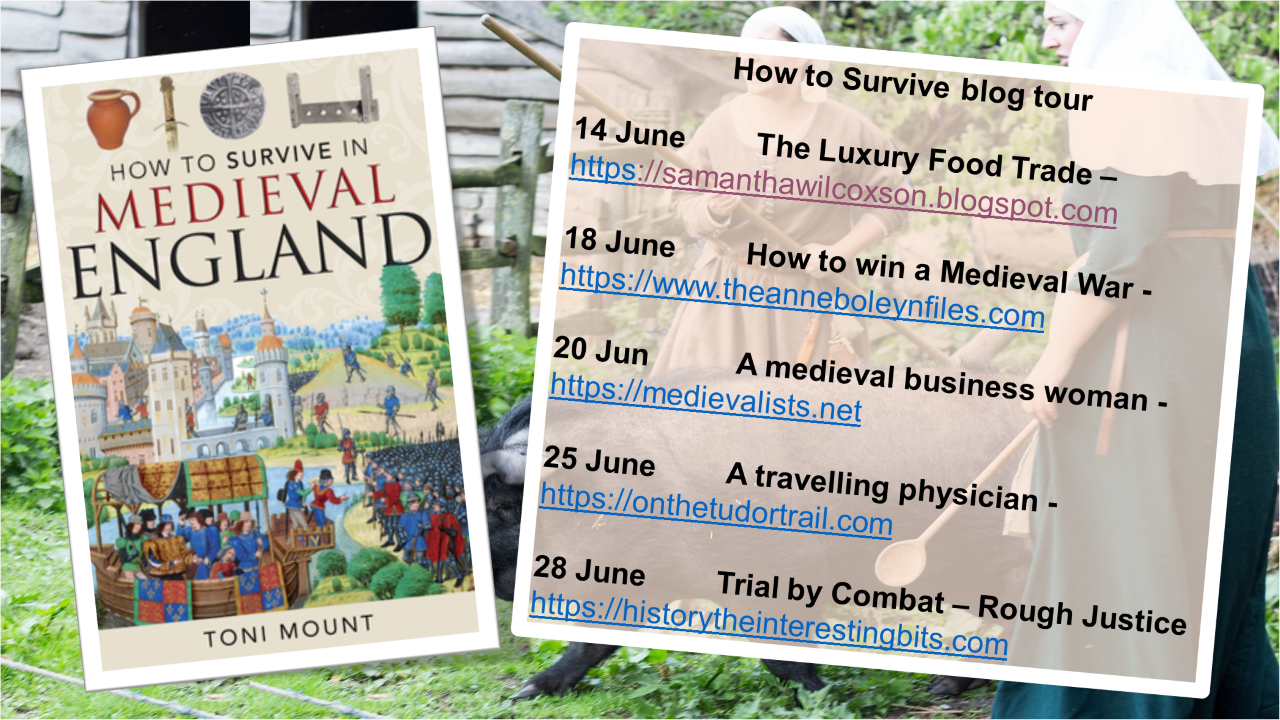
It is an absolute pleasure to welcome author and historian Toni Mount back to the blog, with an article based on her research for her latest non-fiction book, How to Survive in Medieval England. Toni has a wonderful way with words to the extent that her books – fiction and non-fiction alike – are a pure pleasure to read.
So, without further ado, it is over to Toni:
Trial by Combat – Rough Justice
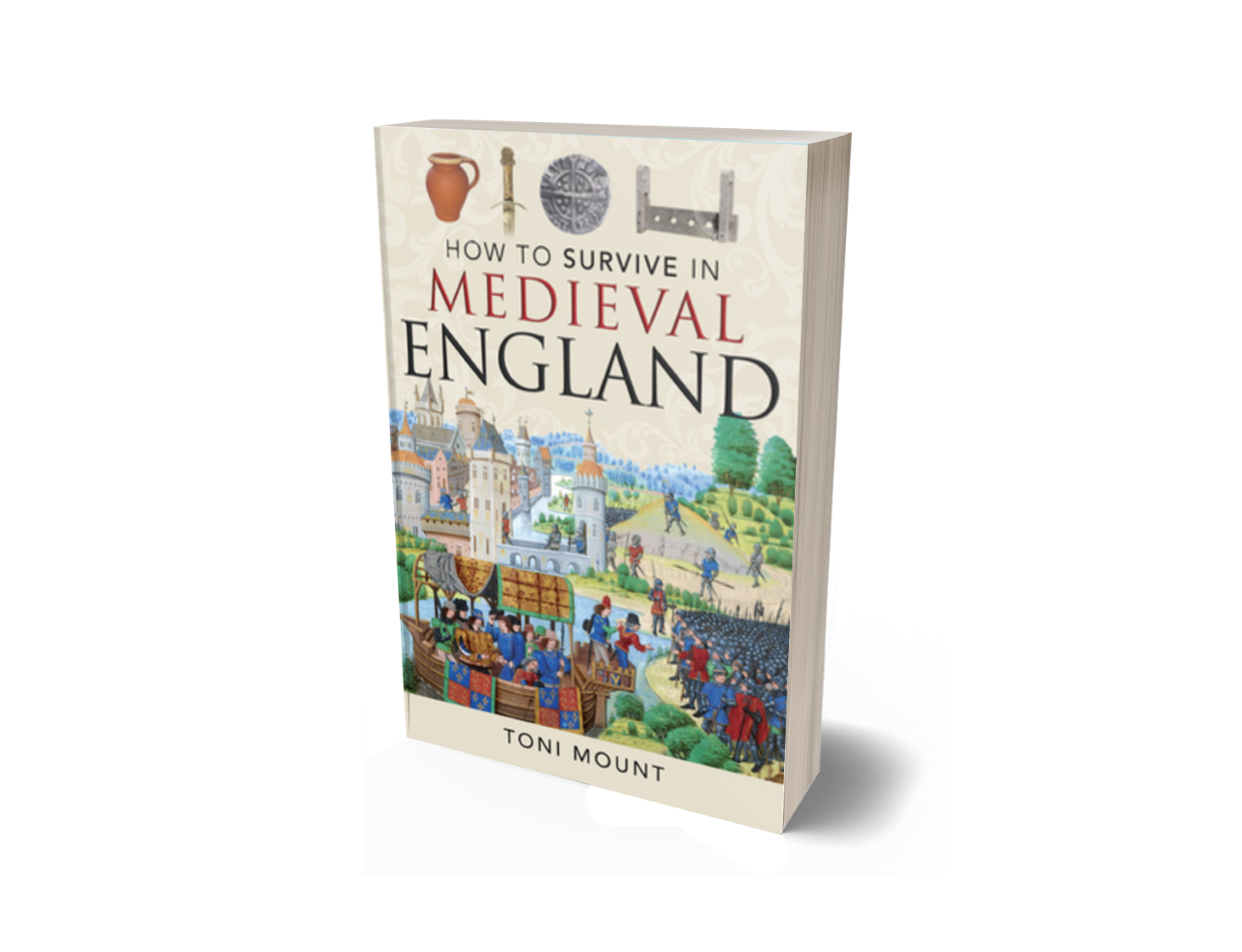
My new book, How to Survive in Medieval England, published by Pen & Sword, is a guide to travelling in history: what to expect, how to dress, how to stay safe and what to look for on the menu.
If you were able to go back in time to medieval England, so much would be very different and so many things missing – all technology, from engines to the Internet. All work would be done by hand. In medieval England, the law sometimes works quite differently from the way we expect today. Trial by Ordeal was a means of deciding who was innocent and who was guilty. A suspect or the accused would be taken to a church and with a priest presiding, subjected to one of a number of horrific acts.
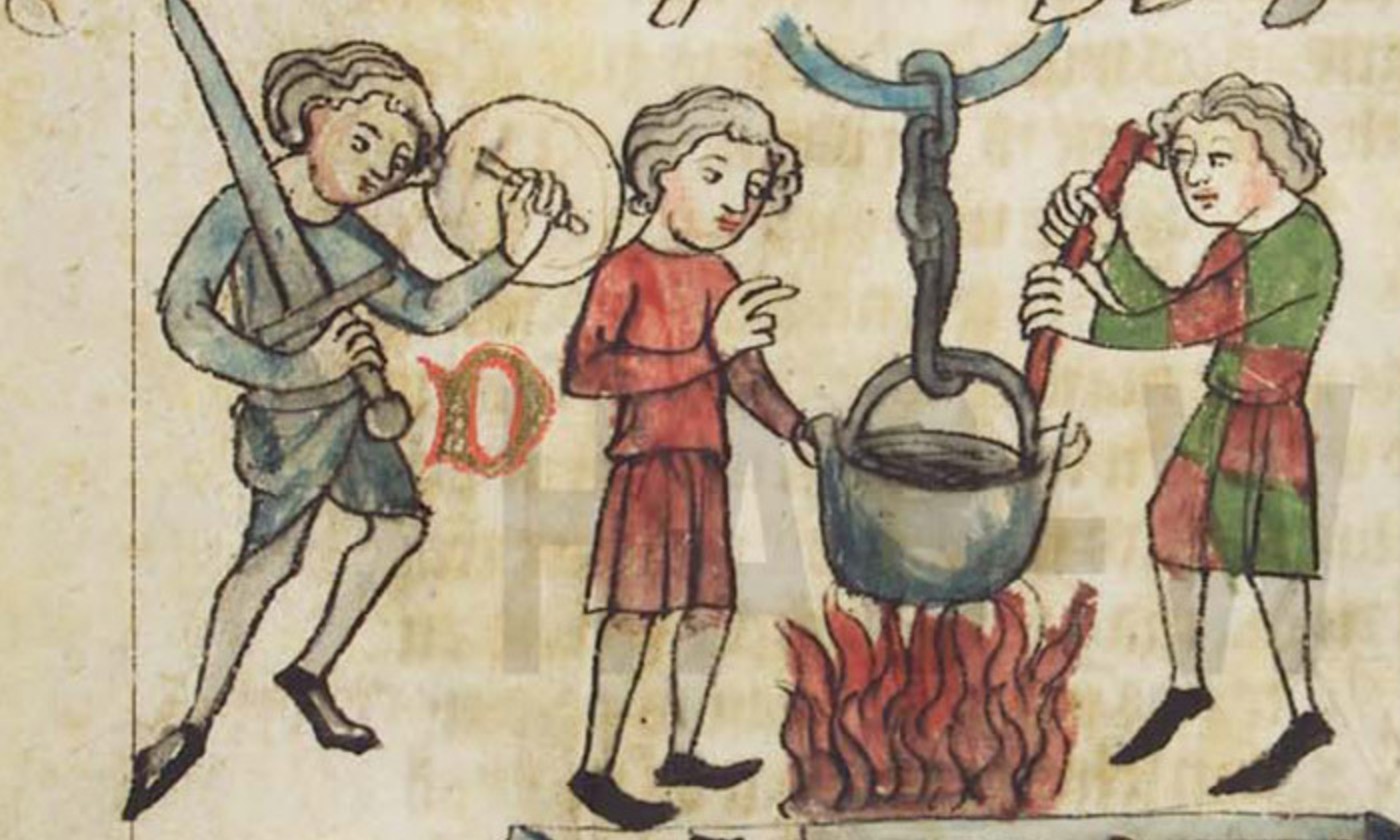
Trial by Fire – a priest (centre) blesses the ordeal as the accused (left) takes the red-hot iron in hand. [Readers may note the accused wears ‘motley’ – parti-coloured cloth – a sure sign of untrustworthiness.’
A favourite was Trial by Fire. In this case, a piece of iron was heated to red-hot in a brazier and the accused had to remove the metal from the fire – by hand! His burns would be bandaged and left for a week. When inspected by the priest at the end of seven days, if they were healing well this was God’s decision and the accused was innocent. But if the burns were septic and weeping, that was also God’s doing and proved the accused was guilty because God was not on his side.
Trial by Water could be similar with the accused having to plunge his hand into a cauldron of boiling water. Or, an alternative Ordeal by Water involved throwing the accused into a pond or river, though this one always seems most unfair to me. If the accused sank and, therefore, probably drowned, he was innocent because the water, having been blessed by a priest, ‘accepted’ him. If he floated, he was guilty because the blessed water refused him. In which case, he would be hanged, so he died either way.
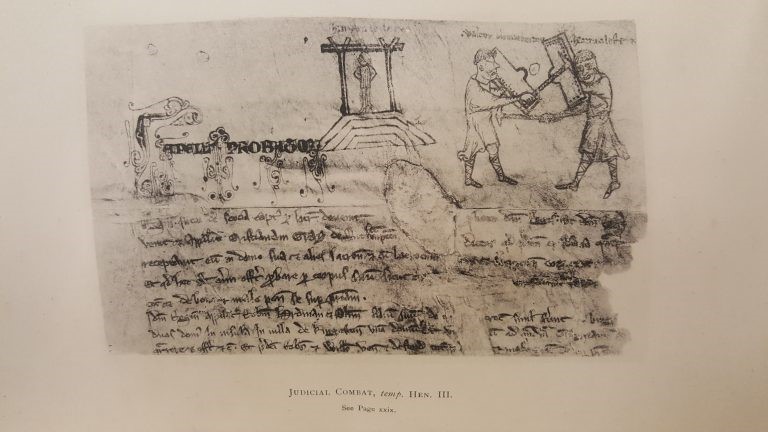
Another method was Trial by Combat in which the accuser and the accused fought it out with weapons. God would cause whoever was telling the truth to win the battle.
In 1249, a gang of thieves was terrorising Winchester, Salisbury and Guildford, specialising in stealing expensive clothing and shoes. The gang was often violent and, although folk in the area knew who they were, they were too scared to accuse them.
In my new book, I include some imagined interviews with real people of the time as a means of telling about true aspects or incidents in their lives. Let’s speak to Walter Blowberme, a member of this notorious gang of thieves:
‘Now Walter, you were caught in the act, I believe, and admitted your crimes. Tell us what you did.’
‘Well, see, we stoled all this valuable stuff, didn’t we? Good cloth, shoes, some jewellery and silver cups. Made a fine profit ’til I got caught, filching a gold brooch. I knewed this meant a date wi’ the hangman for me so I told the sheriff I’d be an approver.’
‘What is an approver?’
‘You don’t know? What a dim-wit. It means my life’ll be spared if I telled the court the names of ten others involved in the crimes. I didn’t want t’ do it, ’cos they was my mates but a man has t’ lookout for hisself.’
‘So you snitched on your fellows. What happened then?’
‘I named six fellows from Guildford who was all members of the gang. They was all arrested, tried and condemned. I didn’t feel too bad about them ’cos I never liked most of ’em, except Tom. It was a shame about him. But I still needed another four fellows convicted to save my own neck, so I accused three from Hampshire. They wasn’t in the gang; just fellows I knowed and didn’t like much. They was found not guilty and released so I had t’ name four others as gang members. It’s a good thing I know so many folk and don’t like none of ’em. These four was nasty bits o’ work, I can tell you, but when the sheriff tried to take ’em, three managed to escape. But because they never turned up in court, they was found guilty anyway. The fourth fellow, Hamo Stare – my sister’s husband what I never liked – was brung to trial but things was so complicated, the judge offered Hamo a trial by ordeal.’
‘I thought trial by ordeal was made illegal by the Church?’
‘Don’t ask me; I’m not the judge. Anyhow, Hamo chosed trial by combat and I, as his accuser, had to be his opponent. We had wooden clubs and shields and fighted ’til we was both bloody but Hamo gave in first. The judge declared God had gived me most strength, so I must have spoke truly against Hamo. Hamo was hanged – good riddance – and I’d managed to get ten fellows convicted, so my life was spared but I got banished from the district forever ’cos I admitted being guilty of so many crimes.’
‘But you didn’t mend your ways, Walter?’
‘Nay. Couldn’t resist some silver bits, could I? I comed t’ London and just six months later I got caught, thieving a chalice and candlesticks from St Mary-le-Bow church.’
‘And this time there is no second chance for you, is there, Walter?’
‘Nay. This time it’s the gallows for me. T’morrow. Pray for me soul, won’t you?’
Judicial tests and ordeals had been abolished at an important Lateran Council meeting, held by the pope in 1215, stating that churchmen may ‘neither pronounce nor execute a sentence of death. Nor may they act as judges in extreme criminal cases, or take part in matters connected with.’ This meant trial by ordeal no longer had God’s sanction – a priest had to be present as His representative – since it was God who determined the outcome. However, obviously, such trials must have continued for at least another thirty years.
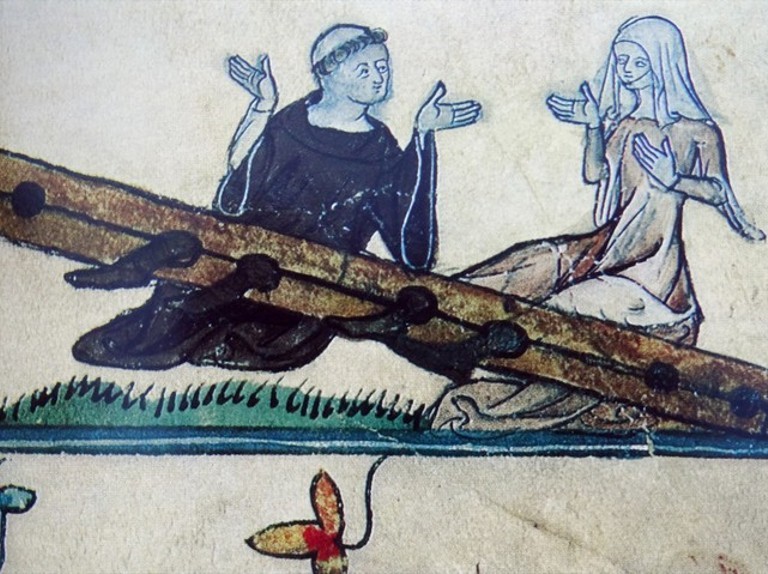
A naughty priest in the stocks along with his mistress – churchmen’s punishments were not so bad. [https://www.historyextra.com/period/medieval/monks-sex-drink-gamble-history-pope/]
Churchmen could no longer sit in judgement but neither could they be tried in a state court. They had to be tried in church courts by their fellow clerics and a death sentence could never be past, even for murder. So, in medieval England, if anyone could prove they were a man of the cloth, or a nun, then they could, literally, get away with murder. Here’s how: only trained clerics can read Latin; so if the accused can read the Bible – always in Latin – he must be a churchman. To prove a person can read, the same passage is always required to be read aloud from the Bible: ‘Oh loving and kind God, have mercy. Have pity upon my transgressions.’ (Psalm 51, Verse 1.) This meant that any forward-thinking criminal learned this verse by heart, in Latin, even if he couldn’t read a word. It saved the necks of so many miscreants, it was known as the ‘Neck-Verse’ and got a great number of very guilty people out of trouble.
Readers can find out far more about medieval lives, meet some of the characters involved and get a ‘taste’ of the food of the time in How to Survive in Medieval England, my new book from Pen & Sword, published on 30th June 2021 and available for pre-order now on Amazon.
About the book:
How to Survive in Medieval England by Toni Mount Pen & Sword History (30 Jun. 2021)
Imagine you were transported back to Medieval England and had to start a new life – without mobile phones, ipads, or social media. When transport meant walking or, if you’re lucky, horse-back; how will you know where you are or what to do? Where will you live? What is there to eat? What shall you wear and how can you communicate? Who can you turn to if you fall ill or are mugged in the street,? All these questions and many more are answered in this new guide book. How to Survive in Medieval England is a handy self-help guide with tips and suggestions to make your visit to the Middle Ages much more fun. Learn the rules so you don’t get into trouble or show your ignorance in embarrassing situations and read interviews with the stars of the day, from a celebrity chef to King Richard III himself. Have an exciting visit but be sure to keep this book to hand.
About the Author
Toni Mount is a history teacher and a best-selling author of historical non-fiction and fiction. She’s a member of the Richard III Society’s Research Committee, a regular speaker to groups and societies and belongs to the Crime Writers’ Association. She writes regularly for Tudor Life magazine, has written several online courses for http://www.MedievalCourses.com and created the Sebastian Foxley series of medieval murder mysteries. Toni has a First class honours degree in history, a Masters Degree in Medieval History, a Diploma in English Literature with Creative Writing, a Diploma in European Humanities and a PGCE. She lives in Kent, England with her husband and has two grown-up sons.
Defenders of the Norman Crown: The Rise and Fall of the Warenne Earls of Surrey tells the fascinating story of the Warenne dynasty, of the successes and failures of one of the most powerful families in England, from its origins in Normandy, through the Conquest, Magna Carta, the wars and marriages that led to its ultimate demise in the reign of Edward III.
Today it is a pleasure to welcome author Monika E Simon back to the blog, with an article looking at the origins of the Lovell family. Monika’s book, From Robber Barons to Courtiers: The Changing World of the Lovells of Titchmarsh, will be released on 30 June. Over to Monika:
How to make your fortune and get your name into the history books?
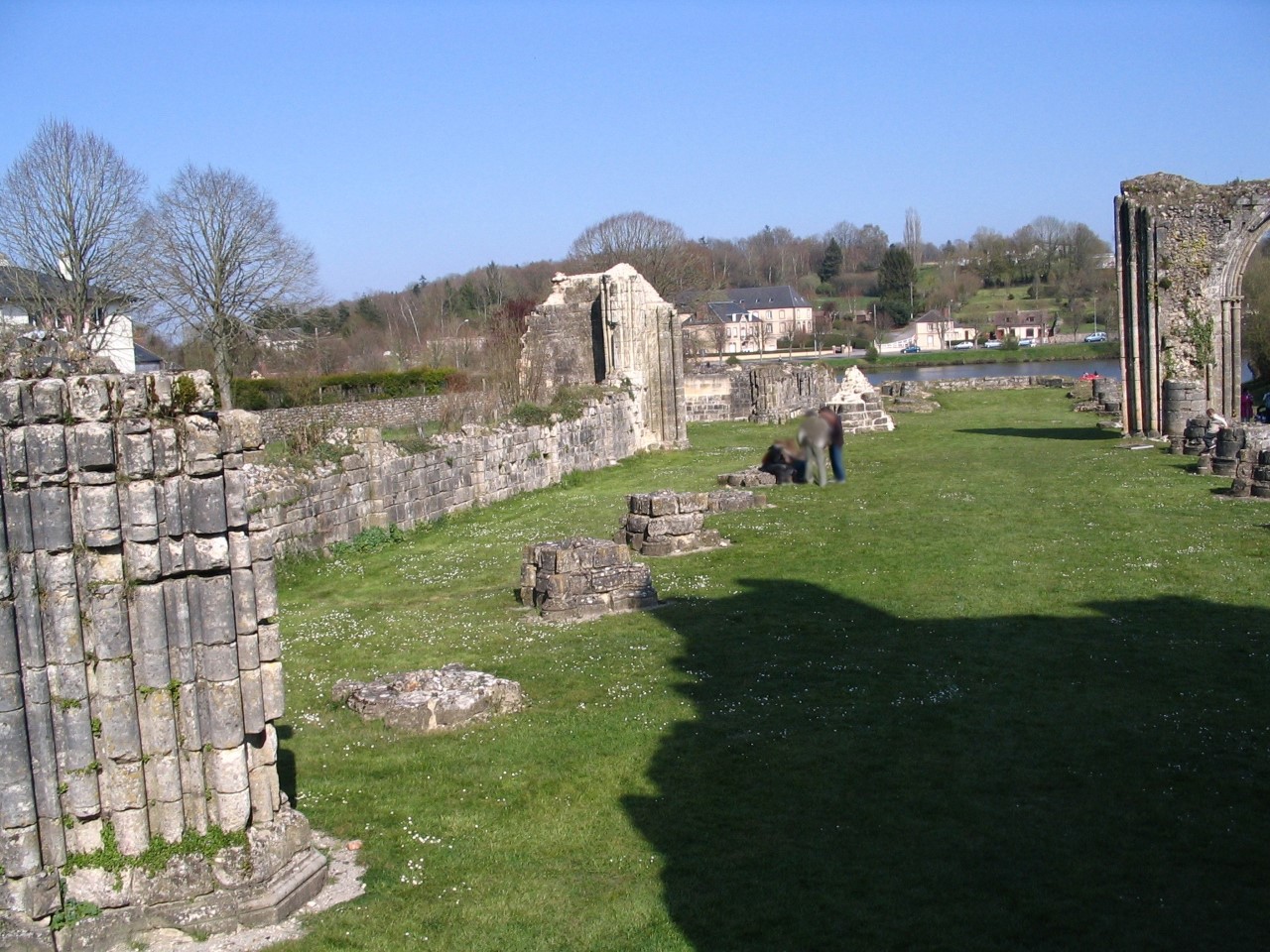
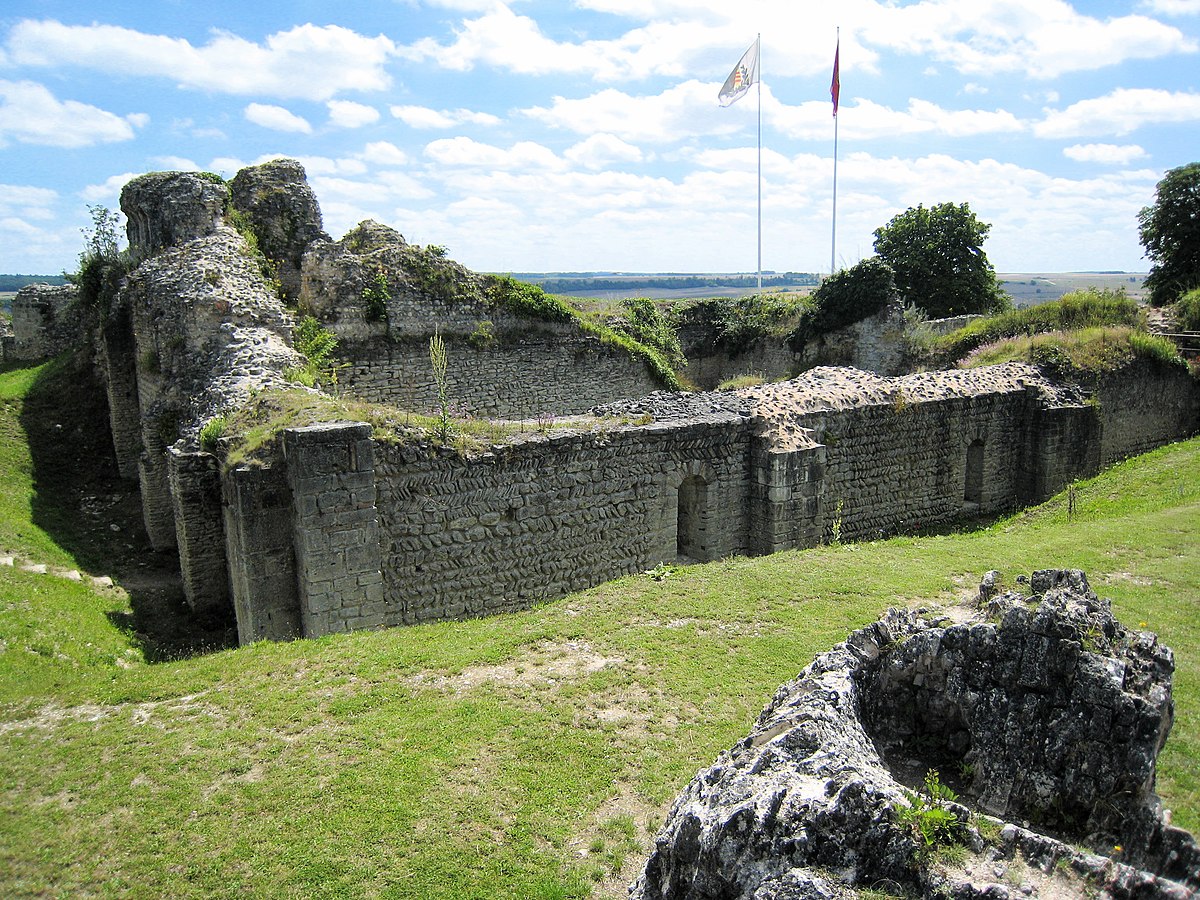
The ruins of the Abbay of Saint-Evroult-Notre-Dame-du-Bois, Orne
In my last blogs I have talked about events from the last century of the history of the Lovell of Titchmarsh. Today I am going back to their very beginnings of this English noble family. So far back in fact that they had not arrived in England and were not called Lovell. At the time, the second half of the eleventh century, the ancestors of the family were obscure minor lords at the Norman French border about whom we know nothing beyond their names and a few details about lands they possessed or office they held. This all changed with Ascelin Goël, who was, as the Complete Peerage puts it, ‘undoubtedly the true founder of the family fortunes.’ He turned his family from an minor nobles into powerful border lords.
How did Ascelin Goël achieved this? Not as the reward for faithful service to his lord, but through rebellion and violence. His behaviour was outrageous enough, even in a time not short on violent men, for the chronicler Orderic Vitalis to write about Ascelin Goël’s deeds in his Ecclesiastical History.
For many events, this chronicle is the only source. Fortunately, Orderic Vitalis was exceptionally well placed to know what he was writing about. He was a monk at the monastery of St Evroult (Dept. Orne, Normandy) and in the latter part of his chronicle he describes events that happened in his own lifetime and often not very far from where he lived. His Ecclesiastical History is, as J.O. Prestwich writes ‘of exceptional value for the history of the Anglo-Norman world’. The way he orders the events in his chronicle is, however, not without severe drawbacks, as he was ‘remarkably careless of chronology’ (Prestwich again). The confusing structure means that the events in which Ascelin Goël was involved in are described in different parts of the chronicle and it is often difficult or impossible to be certain what happened when. Since Orderic Vitalis is mostly the only source existing it is also not possible to check his report or fill in any information his chronicle omits to mention. Nonetheless it is possible to reconstruct the story and draw some probably conclusions.
Ascelin Goël was the eldest son of Robert d’Ivry and Hildeburge de Gallardon. Both of his parents entered religious houses towards the end of their lives and Hildeburge de Gallardon acquired a reputation for heir piety. A brief description of her life, the Vita Domine Hildeburgis, was written, perhaps as a first step to have her canonized. There is however no evidence that this was pursued any further.
Ascelin Goël’s father Robert d’Ivry held land around Bréval and Ivry on both sides of the French Norman border. He was castellan of the border Castle of Ivry (in modern-day Ivry-la-Bataille, Dept. Eure) in 1059. Robert’s mother was probably Aubrée, daughter of Hugh, Bishop of Bayeux and therefore granddaughter of Ralph, Count of Bayeux and his wife Aubrée. According to Orderic Vitalis it was Aubrée who had the architect Lanfred build the Castle of Ivry. If Ascelin Goël’s grandmother was indeed Aubrée, daughter of Hugh, Bishop of Bayeux, he was for one indirectly related to the ducal family, as Aubrée’s grandfather Ralph Count of Bayeux was a half-brother of Richard I of Normandy. It would also mean that Ascelin Goël was related to William de Breteuil, his lord and great opponent, as William’s grandmother Emma was a sister of bishop Hugh. Moreover, Ascelin’s descend from the woman who built the Castle of Ivry would give him a hereditary claim on the castle.
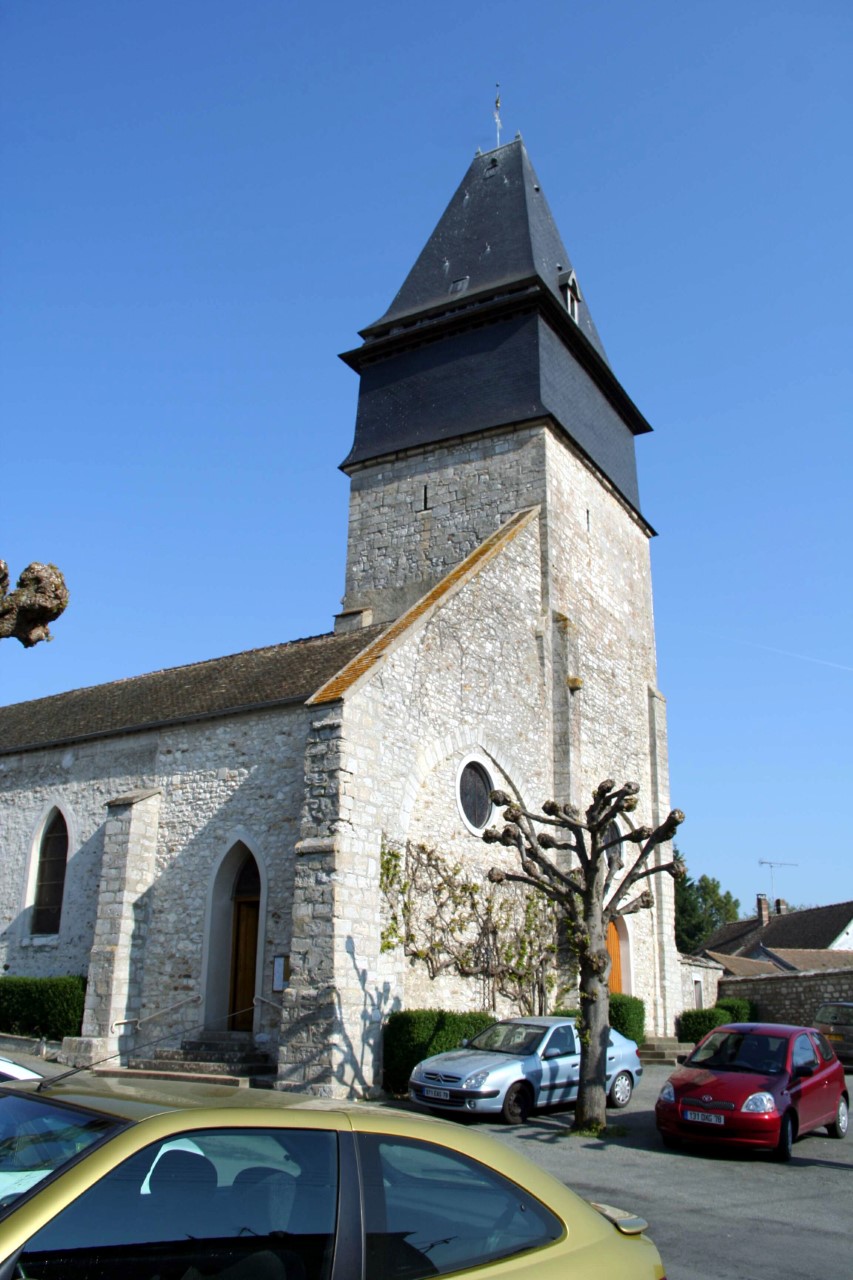
Église Notre-Dame-de-la-Trinité in Bréval
Ascelin Goël had in fact set his sight on the Castle of Ivry, a mighty border fortress and possibly the model for the White Tower in London. At the time, castles were centres of power and much coveted by the nobility. Particularly desirable were the castles that guarded the borders of England against Wales and Normandy against France. Possessing one of these border castles gave the owner both power and an unusual amount of freedom, especially if they were held them in their own right and not as castellans appointed by their king or duke. Many noblemen used any means, fair or foul to gain full control of one or more of these castles. They used any opportunity to achieve this goal, and in 1087, after the death of William the Conqueror, the nobles en masse expelled the royal garrisons from their castles.
Until then the Castle of Ivry had been in the hand of the dukes of Normandy. William the Conqueror had appointed Roger Beaumont as the castellan, probably after Robert d’Ivry had joined a religious community. When Robert Curthose became Duke he granted the castle to William de Breteuil, who was one of his long-standing supporters. To appease Roger Beaumont, Robert Curthose gave him the Castle of Brionne as compensation.
William de Breteuil was a grandson of Osbern, the steward of duke Robert the Magnificent. He had not inherited all the lands of his father William fitz Osbern, but enough to become one of the most powerful nobleman in Normandy. After gaining possession of Ivry he made Ascelin Goël castellan of the castle. As it turned out, Ascelin Goël was not satisfied with merely holding the castle for another lord. Two years after becoming castellan of Ivry, he took control of the castle, presumably by expelling William de Breteuil’s men and replacing them with his own.
An interesting aspect of this conflict is that Ascelin Goël took on not only his lord but also a nobleman who was so much more powerful than he himself was. Ascelin Goël was only a minor border lord whose man residence was in Bréval (Dept. Yvelines). Here he had built a strong castle that he had filled ‘with cruel bandits to the ruin of many’, according to Orderic Vitalis.
After gaining control of Ivry, Ascelin Goël handed it over to Duke Robert. It is possible that he hoped his hereditary claim to the castle would move Robert Curthose to grant it to him. If that was the case, he was mistaken, as Robert Curthose sold it back to William de Breteuil.
Unsurprisingly, William de Breteuil was far from pleased with his castellan and deprived Ascelin Goël not only of his castellanship but of all the lands Ascelin had held off him.
For Ascelin Goël this was a setback but he did not give up. In 1091, he was able to capture William de Breteuil, with the help of Richard of Montfort and household troops of King Philip I of France. William de Breteuil now found himself incarcerated for three months at Bréval and subjected to various forms of torture. Once, Orderic Vitalis writes, Ascelin Goël had his prisoners exposed to the freezing wind clad only with wet shirts until these were frozen solid. After three months of imprisonment, William’s release was secured by a truce arranged by several noblemen. He had to pay a heavy price for his freedom. He had to give the Castle of Ivry to Ascelin Goël and pay a hefty ransom in money, horses, arms and ‘other things’. Additionally, William de Breteuil had to give Ascelin his illegitimate daughter Isabel as his wife. – Needless to say, what Isabel thought of this was not recorded.
However, Ascelin Goël was not able to enjoy possessing Ivry for long. The year after his release William de Breteuil first tried to retake Ivry. He failed and barely escaped being recaptured by Ascelin Goël, who again tortured the prisoners he had taken. The next year William de Breteuil was better prepared. With the support of Robert Curthose and King Philip of France, both of whom he had to pay for their help, he tried again to take Ivry back. He had also gained the support of the experienced warrior Robert de Bellême who led the siege of Ascelin Goël’s Castle of Bréval. Ascelin was able to withstand the siege for two months but eventually had to surrender and hand the Castle of Ivry back to William de Breteuil.
The ruins of the Castle of Ivry
Having lost Ivry again, Ascelin Goël seems to have realised that for now he had no chance to hold the castle permanently against William de Breteuil. With Isabel de Breteuil as his wife, Ascelin Goël also had a better claim to inherit the castle after William de Breteuil’s death. William had no legitimate children, only an illegitimate daughter Isabel and an illegitimate son Eustace. As inheritance law was not yet strictly settled in this time, Isabel, Eustace, and several more distant relations could claim William de Breteuil’s lands or part of them after his death.
When William de Breteuil died on 12 January 1203, Ascelin Goël was in fact one of them men fought Eustace de Breteuil for possession of William de Breteuil’s lands. The two most prominent claimants were William Gael, a nephew of William de Breteuil, and a more distant relative the Burgundian Reginald de Grancey. Eustace had previously gained the goodwill of Henry I of England by supporting him in driving Robert de Bêlleme out of England and had married Henry I’s illegitimate daughter Juliana. Moreover, the Norman nobility largely supported Eustace, ‘because’, as Orderic Vitalis explains, ‘they chose to be ruled by a fellow countryman who was a bastard rather than by a legitimate Breton or Burgundian’.
Ascelin Goël is usually mentioned in this conflict, but he is not regarded as a rival claimant to the Breteuil in inheritance. However, Orderic Vitalis singles him out particularly. He writes that Henry I promised to support Eustace ‘against Goel and all his other enemies’. To me it seems significant that it is Ascelin Goël rather than Reginald de Grancey whom Orderic names as Eustace principal enemy.
To solve this crisis, Henry I sent his chief advisor Robert Beaumont, Count of Meulan to Normandy. Robert Beaumont soon had a personal reason to find a solution, as Ascelin Goël kidnapped John, a citizen from Meulan, when he was on his way back from a meeting with Robert Beaumont. John de Meulan was imprisoned in Bréval and for four months Robert Beaumont was unable to rescue him. Eventually Robert Beaumont was able to arrange a peace between all parties. Orderic Vitalis reports that he betrothed his baby daughter Emma to Amaury de Montfort, which appeased not only Amaury himself but also his uncle William, Count of Évreux, Ralph of Conches, Eustace de Breteuil, and Ascelin Goël. Orderic Vitalis does not mention any specific concessions made to Ascelin Goël. Later evidence suggests that Ascelin Goël gained what he had strived to gain for more than ten years: the Castle of Ivry. A charter of 1115 calls Ascelin Goël ‘Goelli de Ibriaco’, Goël of Ivry, and at no other time Ascelin Goël was in the position to achieve this concession from Eustace de Breteuil.
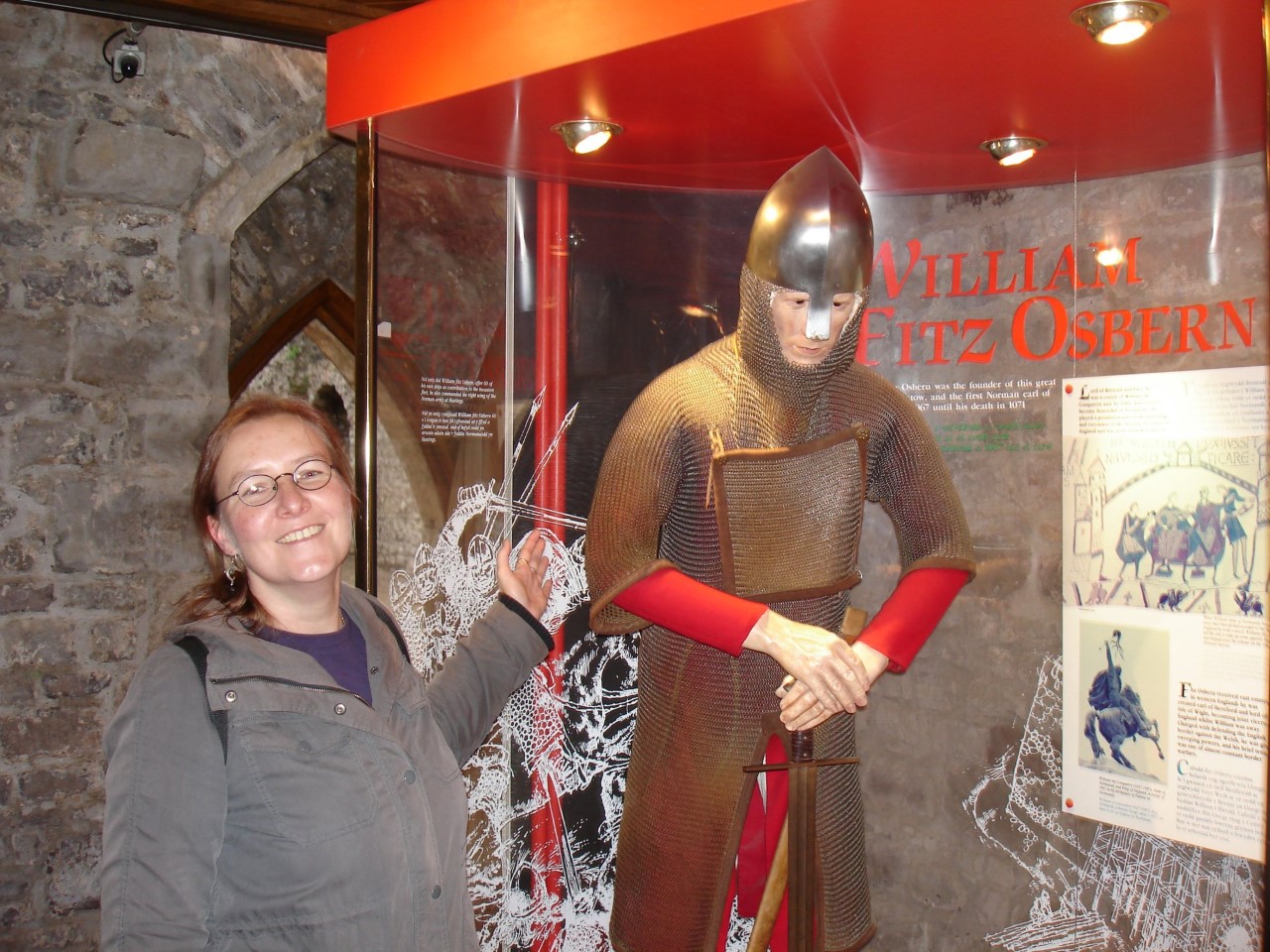
William fitz Osbern and the author at Chepstow Castle, 2007 (Kirsty Hartsiotis)
From this time on, Ascelin Goël kept his peace until his death between 1116 and 1119. At least he refrained from engaging in feuds with his powerful neighbours. Orderic Vitalis writes that he and his sons continued to plague the region with their violence and cruelty.
To answer the question I have asked at the beginning of this blog: How did one make one’s fortune and got one’s name into the history books? Ascelin Goël’s answer was by rebellion and violence. His disregard from the bonds of feudal lordship, his cruelty and ruthlessness ensured him a place in Orderic Vitalis’s Ecclesiastical History and from there in history books to the present day. He also probably gained the Castle of Ivry and became a much more powerful lord than his father and grandfather had been.
Though Robert Goël, Ascelin Goël’s eldest son, did not inherit the Castle of Ivry, he did inherit his ruthless streak and tactical skill. He joined the rebellion against Henry I in 1118 but was the first rebel to make his peace with the king in 1119. In return and ‘to guarantee his loyalty’, to quote Orderic Vitalis one last time, Henry I granted Robert Goël the Castle of Ivry. Robert Goël’s younger brother, William Lovell I, inherited the castle after his brother’s death in or shortly before 1123.
Images:
Courtesy of Wikimedia Commons except William fitz Osbern and the author at Chepstow Castle, 2007 which is courtesy of Kirsty Hartsiotis
About the author:
Monika E. Simon studied Medieval History, Ancient History, and English Linguistics and Middle English Literature at the Ludwig-Maximilians-Universität, Munich, from which she received an MA. She wrote her DPhil thesis about the Lovells of Titchmarsh at the University of York. She lives and works in Munich.
Defenders of the Norman Crown: The Rise and Fall of the Warenne Earls of Surrey tells the fascinating story of the Warenne dynasty, of the successes and failures of one of the most powerful families in England, from its origins in Normandy, through the Conquest, Magna Carta, the wars and marriages that led to its ultimate demise in the reign of Edward III.
1 family. 8 earls. 300 years of English history!
Defenders of the Norman Crown: Rise and Fall of the Warenne Earls of Surreywill be released in the UK on 31 May and in the US on 6 August. And it is now available for pre-order from Pen & Sword Books, Amazon in the UK and US and Book Depository.
In the reign of Edward I, when asked Quo Warranto ‘by what warrant he held his lands’ John de Warenne, the 6th earl of Surrey, is said to have drawn a rusty sword, claiming “My ancestors came with William the Bastard, and conquered their lands with the sword, and I will defend them with the sword against anyone wishing to seize them”
John’s ancestor, William de Warenne, 1st Earl of Surrey, fought for William the Conqueror at the Battle of Hastings in 1066. He was rewarded with enough land to make him one of the richest men of all time.
In his search for a royal bride, the 2nd earl kidnapped the wife of a fellow baron.
The 3rd earl died on crusade, fighting for his royal cousin, Louis VII of France…
For three centuries, the Warennes were at the heart of English politics at the highest level, until one unhappy marriage brought an end to the dynasty. The family moved in the highest circles, married into royalty and were not immune to scandal. Defenders of the Norman Crown tells the fascinating story of the Warenne dynasty, of the successes and failures of one of the most powerful families in England, from its origins in Normandy, through the Conquest, Magna Carta, the wars and marriages that led to its ultimate demise in the reign of Edward III.
It’s finally here!
My fourth non-fiction book, Defenders of the Norman Crown: Rise and Fall of the Warenne Earls of Surrey, comes out today in hardback in the UK – it will be released in the US and elsewhere on 6 August. Telling the remarkable story of the Earls of Warenne and Surrey, and their family, from the time of the Norman Conquest to the reign of Edward III, Defenders of the Norman Crown follows a family right at the heart of Anglo-Norman England.
1 family. 8 earls. 300 years of English history!
And here’s what early reviewers are saying:
“Sharon Bennett Connolly has written an evocative narrative, highlighting the role the Warenne earls of Surrey played in the nation’s history. Her meticulous research is evident in every page, making the book both a reference guide and an immensely enjoyable read.“
Kristie Dean, author of On the Trail of the Yorks and The World of Richard III
Another great read from Pen & Sword. I’m vaguely familiar with this family, so reading a book specifically about their history from inception to the end of it, was very interesting. It’s definitely one I’d like to have on my shelf to reference again in the future.
NetGalley, Caidyn Young
Warenne coat of arms
5 out of 5 stars
An impressive and long overdue publication about the earls of Surrey, the Warenne (Varenne in Normandy) and their steadfast contributions and deep loyalties to the English Crown from the heyday of the Norman Conquest and the battlefield of Hastings to the glorious reign of Edward III. Ms. Bennett Connolly has given us a solidly researched portrait of a medieval family and its successful longevity during the three long and troublesome centuries that followed the Norman establishment on the throne and the roles played by its successive and prominent members in the shadows of the crown. A colorful tapestry through all the ups and downs of medieval England, its monarchical shenanigans and its military and political restlessness. Highly recommended to anyone interested in English and European medieval history.
NetGalley, jean luc estrella
Oh my goodness, Sharon Bennett Connolly has done it again! This was the perfect romp through a medieval family! Honor, scandal, marriages, and intrigue all play into the Warrene family lines. Beginning with William of Normandy, and going down through the Wars of the Roses, this book will read as an action-packed, give me all the information book!
I loved this one! The Warrene family was very prominent throughout the medieval history of England, and this book will dive into their past, and share everything that you could ever want to know about this ambitious family.
And if you would like to hear a little more about the Warenne earls, I presented the David Hey Memorial Lecture in 2020 as part of the Doncaster Local Heritage Festival. The lecture, Warenne: The Earls of Surrey and Conisbrough Castle, is still available to watch on YouTube.
Rebecca Hill, NetGalley
And …
To survive during the reigns of the Norman and Plantagenet Kings of England, one must understand where their loyalty and trust lied. Did they follow the crown or did they take a risk and follow those who opposed the person who wore the crown? For one family, there was no question who they were loyal to, which was the crown. The Warenne Earls of Surrey served the Kings of England from William the Conqueror to Edward III, gaining titles, prestige, and marriages that would cement their names in history books. They survived some of the most turbulent times in English history even if they did have a few scandals in their illustrious history. In Sharon Bennett Connolly’s latest non-fiction adventure, “Defenders of the Norman Crown: The Rose and Fall of the Warenne Earls of Surrey ”, she explores this family’s history that spanned over three centuries.
I would like to thank Pen and Sword Books and NetGalley for sending me a copy of this book. I have been a fan of Sharon Bennett Connolly’s books for a while now, so when I heard about this title, I knew I wanted to read it. I was going in a bit blind since I have never heard of the Warenne Earls of Surrey, but that is part of the fun of studying a new aspect of history.
The first Earl of Surrey, William de Warenne began this family’s tradition of royal loyalty as he joined William the Conqueror on his journey to England and fought alongside him to establish Norman rule at the Battle of Hastings. William’s descendants would be involved in some of the most important events of the time, from the crusades to the 1st and 2nd Baron’s Wars and the sealing of the Magna Carta. At some points, the earls would briefly switch sides if they thought the king was not in the best interest of the country, but they remained at the heart of English politics and worked hard to help guide the king and the country to become stronger.
What made the Warennes a tour de force when it came to noble families was their ability to marry well, except for the final earl and his scandalous relationships. The second earl desired to marry into the royal family, which did not happen, but his daughter, Ada de Warenne would marry William the Lion, King of Scotland. One of the daughters of Hamlin and Isabel de Warenne would be the mistress of King John and would give birth to his illegitimate son Richard of Chilham. The only woman of the family who inherited the earldom of Surrey, Isabel de Warenne, was married twice and so both of her husbands, William of Blois and Hamelin of Anjou, are considered the 4th earl of Surrey.
Connolly does a wonderful job explaining each story in de Warenne’s long history, including the minor branches of the family. I was able to understand the difference between family members who shared the same first name, (like William, John, and Isabel) but I know that others might have struggled with this aspect. I think it would have been helpful if Connolly had included either a family tree or a list of family members of the de Warennes at the beginning of this book to help readers who did struggle.
I found this particular title fascinating. The de Warenne’s were a family that proved loyalty to the crown and good marriages went a long way to cement one’s legacy in medieval England. Connolly proved that she has a passion for bringing obscure noble families to the spotlight through her impeccable research. If you want a nonfiction book of a noble family full of loyalty, love, and action, you should check out “Defenders of the Norman Crown: The Rise and Fall of the Warenne Earls of Surrey” by Sharon Bennett Connolly.
Last year, I presented the David Hey Memorial Lecture for Doncaster Heritage Festival, entitled Warenne: The Earls of Surrey and Conisbrough Castle. Just press play on the link below if you would like to watch and hear a little more about the Warennes.
If you would like a signed, dedicated copy of Defenders of the Norman Crown: Rise and Fall of the Warenne Earls of Surrey, or any of my books, please get in touch by completing the contact me form.
Online Book Launch Event
Defenders of the Norman Crown online Book Launch!I am going to do a Zoom online talk to celebrate the launch of Defenders of the Norman Crown: Rise and Fall of the Warenne Earls of Surrey.It will be on Saturday 5th June from 7pm UK time, with a talk followed by a Q&A. Bring your own wine and cake!
If you would like to join me (please do!) then just pm me with your email address and I will send you an invite. If you would like to come along, please get in touch via theCONTACT MEform and I will send you an invite. Can’t wait to tell you all about Defenders of the Norman Crown and the Warenne earls of Surrey.
For many years, although William Longespée’s father was known, the identity of his mother was very much in question. William Longespée was the son of Henry II, king of England, and it was thought that his mother was a common harlot, called Ikenai. In that case, he would have been a full brother of another of Henry’s illegitimate sons, Geoffrey, Archbishop of York. There were also theories that his mother was Rosamund Clifford, famed in ballads as ‘the Fair Rosamund’. However, it is now considered beyond doubt that his mother was, in fact, Ida de Tosney, wife of Roger Bigod, Earl of Norfolk, from a relationship she had with the king before her marriage.
Coat of arms of William Longespée, 3rd Earl of Salisbury
There are two extant pieces of evidence supporting this. The first is a charter in the cartulary of Bradenstoke Priory, made by William Longespée, in which he refers explicitly to his mother as ‘Countess Ida, my mother’. There is also a prisoner roll from after the Battle of Bouvines, in which a fellow captive, one the sons of Ida and the earl of Norfolk, Ralph Bigod, is listed as ‘Ralph Bigod, brother [halfbrother] of the earl of Salisbury’. Ralph was a younger son of Earl Roger and Ida and had been fighting under Longespée’s command in the battle in which both were taken prisoner.
Ida was probably the daughter of Roger (III) de Tosney, a powerful Anglo-Norman lord, and his wife, also called Ida. She was made a royal ward after her father’s death and became mistress of King Henry II sometime afterwards. She gave the king one son, William Longespée, who was born around 1176, making him ten years younger than the king’s youngest legitimate son, John. Around Christmas 1181, Ida was married to Roger Bigod, Earl of Norfolk and through his mother’s Norfolk family, Longespée had four half-brothers, Hugh, William, Ralph and Roger and two half-sisters, Mary and Margery.
Despite the misunderstandings over his mother, the identity of William Longespée’s father was never in doubt. He was Henry II’s son and acknowledged by his father; as an illegitimate son of Henry II, William Longespée’s fortune and position in society were inextricably linked with the fortunes of his royal half-brothers, King Richard I and King John, both of whom he served. Longespée adopted the coat of arms of his paternal grandfather, Geoffrey Plantagenet, Count of Anjou, of azure, six leoncels rampant or [gold], to emphasise his descent from the Angevin counts.
The moniker of Longespée (also Lungespée or Longsword) harkens back to his Norman forebear and namesake William Longsword, second Duke of Normandy (reigned 928–942), from whom he was descended through his father, the king. Little is known of Longespée’s childhood, upbringing or education, though a letter of 1220 that Longespée sent to Hubert de Burgh reminds the justiciar that they were raised together, probably fostered in a noble household. In 1188, Longespée had been given the manor of Appleby in Lincolnshire by his father, but he did not come into prominence until the reign of his half-brother Richard I.
It was King Richard who arranged Longespée’s marriage to the rich heiress Ela of Salisbury. Ela’s father, William, Earl of Salisbury, had carried the sceptre at Richard I’s coronation, in 1194 he had served as high sheriff of Somerset and Dorset and in 1195 campaigned with King Richard in Normandy. In the same year, he was one of the four earls who supported the canopy of state at Richard’s second coronation, and attended the great council, called by the king, at Nottingham. He died in 1196, leaving his only child, Ela, as his sole heir. Ela became Countess of Salisbury in her own right, and the most prized heiress in England.
On her father’s death, Ela’s wardship passed into the hands of the king himself, Richard I, the Lionheart. The king saw Ela as the opportunity to reward his loyal, but illegitimate, half-brother, William Longespée, by offering him her hand in marriage; the Salisbury lands being seen as a suitable reward for a king’s son, especially one born out of wedlock. They would give Longespée a power base in England. Ela and Longespée were married in the same year her father died, 1196. At the time of his marriage to Ela, Longespée was in his early twenties, while his bride was not yet 10 years old, although she would not have been expected to consummate the marriage until she was 14 or 15, and they would not have lived as husband and wife until Ela was at least 12 years old, the church’s legal age of marriage for a girl.
Ela’s new husband was an experienced soldier and statesman and would be able to protect Ela, her lands and interests. William acquired the title Earl of Salisbury by right of his wife and took over the management of the vast Salisbury estates.
Salisbury Cathedral
William (I) Longespée had an impressive military and political career during the reigns of his half-brothers. He first served in Normandy with Richard between 1196 and 1198, attesting several charters for his brother at Château Gaillard, and taking part in the campaigns against King Philip II of France, gaining essential military experience. He took part in John’s coronation on 27 May 1199 and was frequently with John thereafter. The half-brothers appear to have enjoyed a very cordial relationship; the court rolls record them gaming together and John granting Longespée numerous royal favours, from gifts of wine to an annual pension. By 1201 Longespée, along with William Marshal and Geoffrey fitz Peter, Earl of Essex ‘were seen by John at this stage in his reign as the main props to his rule, and lavish gifts followed.’1
Although Longespée’s marriage to Ela of Salisbury gave him rank and prestige, it was not a wealthy earldom. The barony commanded fifty-six knights’ fees and gave the earl custody of the royal fortress of Salisbury, but Longespée had no castle of his own. He was made sheriff of Wiltshire on 3 separate occasions, 1199–1202, 1203–1207 and 1213–1226, but was never granted the position as a hereditary right by the king. As sheriff, it was Longespée’s task to hunt down the famous outlaw Fulk Fitzwarin, whom he besieged in Stanley Abbey in 1202. When Fitzwarin and his band of about 30 men were pardoned in 1203, Longespée was among those who secured the pardon from the king. During his career, William was also entrusted with several important diplomatic missions. In 1202 he negotiated a treaty with Sancho VII of Navarre and in 1204 he and William Marshal escorted the Welsh prince Llywelyn to the king at Worcester. He was also sent to Scotland on a diplomatic mission to King William the Lion in 1205 and was with John at York in November 1206 when the two kings met. The earl was also involved in the election of his nephew, Otto, as German emperor, heading an embassy to the princes of Germany which resulted in Otto’s coronation.
William Longespée’s most prominent role during the reign of King John, however, was as a military leader. He was a commander of considerable ability. In August 1202 he had fought alongside William Marshal and William de Warenne, Earl of Surrey, hounding the retreating forces of King Philip of France. The French king had withdrawn from the siege of Arques following news of John’s victory over his nephew, Arthur, at Mirebeau. Longespée and his lightly-armed fellow earls, however, narrowly escaped capture from a counterattack led by William de Barres. Following the fall of Normandy, Longespée was given command of Gascony in May 1204. In September of the same year he was also given custody of Dover castle and made warden of the Cinque Ports; he retained both offices until May 1206. In 1208 Longespée was appointed warden of the Welsh Marches and in 1210 he joined King John on the Irish expedition which had been prompted by William de Braose fleeing to Ireland to escape John’s persecution. In 1213 he allied with the counts of Holland and Boulogne, led an expeditionary force to the aid of Count Ferrand of Flanders against King Philip II and on 30 May he achieved a significant naval victory when his forces destroyed the French fleet off the Flemish coast near Damme, burning many enemy ships and capturing others. The victory forced King Philip to abandon plans for an invasion of England.
In 1214 William Longespée commanded an army in northern France for the king, while John was campaigning in Poitou. He managed to recover most of the lands lost by the count of Flanders and,, in July of the same year, he commanded the right-wing of the allied army at the Battle of Bouvines, alongside Renaud de Dammartin, Count of Boulogne. William fought bravely but was captured, after being clubbed on the head by Philippe, the bishop of Beauvais. According to the Histoire de Guillaume le Maréchal the battle had been fought against the earl’s advice, and if it were not for Longespée’s own heroic actions, Emperor Otto would have been taken prisoner or, worse, killed. The battle was a military disaster for the English forces in France and ended John’s hopes of recovering his Continental possessions. William Longespée was held prisoner for almost a year. He was eventually ransomed and exchanged in March 1215, for John’s prisoner, Robert, son of the count of Dreux, who had been captured at Nantes in 1214.
William Longespée was back in England by May 1215 and appointed to examine the state of royal castles. However, England was reaching crisis point by this time, with the rebellion of the barons gathering pace. Although unable to prevent rebels from gaining control of London, he was effective against the rebels in Devon, forcing them to abandon Exeter. He was named among those barons who had advised John to grant Magna Carta, though whether he was actually present at Runnymede, when the charter was sealed, is unknown. He was granted lands from the royal demesne in August 1215 in compensation for the loss of Trowbridge, which had been returned to Henry de Bohun, one of the twenty-five barons appointed to the committee to oversee the enforcement of the terms of Magna Carta. Also in 1215, following the fall of Rochester, Longespée was given the task of containing the rebels in London, while John led the rest of his forces north. Alongside Faulkes de Bréauté and Savaric de Mauléon, he led a punitive chevauchée through Essex, Hertfordshire, Middlesex, Cambridgeshire and Huntingdonshire. However, in the early weeks of 1216, when Walter Buc’s Brabançon mercenaries ravaged the Isle of Ely, it was Longespée who protected the women from their worst excesses.
Longespée was still supporting John when Louis, the Dauphin, landed on 21 May 1216; however, Louis’ rapid advance through the southern counties, and the fall of Winchester in June 1216, led the earl of Salisbury to submit and ally with Louis. He remained in opposition to his half-brother for the rest of John’s life. Unfounded rumours, recorded by William the Breton, suggested that Longespée’s desertion of John was caused by the king’s seduction of Ela while the earl was a prisoner of war in France. It seems more likely that, like so many others, he saw John’s cause as lost and decided to cut his own losses. With Longespée’s defection, and that of William de Warenne, Earl of Surrey, John’s support was severely diminished and in retaliation, John ordered his brother’s lands seized in August 1216.
Battle of Lincoln 1217, from Matthew Paris
Despite the death of King John in October 1216, Longespée remained with Louis and even called for Hubert de Burgh to surrender Dover to the French. However, when Louis returned to France in March 1217, to gather reinforcements, Longespée submitted to the king, swearing loyalty to his 9-year-old nephew, Henry III. He was also absolved of the sentence of excommunication which had been passed on all those who had defected to Louis. Along with Longespée, William Marshal’s eldest son, William (II), and a hundred other men from Wiltshire and the south-west, returned to the king’s peace. Longespée was now instrumental in driving the French from England and defeating the remaining rebel barons. He was part of William Marshal’s army at the Battle of Lincoln Fair on 20 May 1217, when Lincoln Castle and its formidable castellan, Nicholaa de la Haye, were finally relieved following a months-long siege by the French under the Comte de Perche.
We know nothing of William and Ela’s married life, although it appears to have been a happy one. The couple had at least eight children together, if not more; 4 boys and 4 girls. Of their 3 youngest boys, Richard became a canon at the newly built Salisbury Cathedral, Stephen became seneschal of Gascony and justiciar of Ireland, and their youngest son, Nicholas, was elected bishop of Salisbury in 1291; he was consecrated at Canterbury by Archbishop John Pecham on 16 March 1292. Already in his sixties, Nicholas died on 18 May 1297. In 1216, the oldest son, William II Longespée, fourth Earl of Salisbury, was granted marriage by King John to Idonea, granddaughter and sole heiress of the formidable Nicholaa de la Haye. Both children were very young when the grant was made, with Idonea being, possibly, no older than 8, the youngest age that a betrothal was sanctioned by the church, though she could not be married until the age of 12. John ordered that:
Effigy from William Longespée’s tomb
The sheriffs of Oxford and of Berkshire are commanded that they cause William, Earl of Salisbury, to have the right of marriage of the daughter of Richard de Canville, born of Eustacia, who was the daughter of Gilbert Basset and wife of the said Richard, for William his first-born son by his wife Ela, Countess of Salisbury, with all the inheritance belonging to the said Richard’s daughter from her mother in their Bailiwicks. Witness myself, at Reigate, the twenty second day of April.
Letter from King John, 22 April 1216
This order may be the source of Nicholaa de la Haye’s later wranglings with Salisbury. Although it states that Salisbury should take possession of Idonea’s inheritance from her mother, the earl may have assumed – or presumed – to take all of Idonea’s inheritance into his custody, regardless of the fact Nicholaa was still very much alive at this time. It also suggests that Richard de Canville, Idonea’s father, may have already been deceased, despite most mentions of him have him dying in the first quarter of 1217. Otherwise, she would have still been in her father’s custody. Salisbury and Nicholaa de la Haye would spend several years in legal disputes over the inheritance of Nicholaa’s Lincolnshire holdings, and tried repeatedly to take Lincoln Castle from her. William (II) Longespée went on crusade with Richard, Earl of Cornwall, in 1240–1 and later led the English contingent in the Seventh Crusade led by Louis IX of France. His company formed part of the doomed vanguard, which was overwhelmed at Mansourah in Egypt on 8 February 1250. William’s body was buried in Acre, but his effigy lies atop an empty tomb in Salisbury Cathedral. His mother, Ela, is said to have experienced a vision of her son’s last moments at the time of his death.
Of William and Ela’s 4 daughters, Petronilla died unmarried, possibly having become a nun. Isabella married William de Vescy, Lord of Alnwick, and had children before her death in 1244. Another daughter, named Ela after her mother, married firstly Thomas de Beaumont, Earl of Warwick and, secondly, Phillip Basset; sadly, she had no children by either husband. A fourth daughter, Ida, married Walter fitzRobert; her second marriage was to William de Beauchamp, Baron Bedford, by whom she had 6 children.
As a couple, William Longespée and Ela were great patrons of the church, laying the 4th and 5th foundation stones for the new Salisbury Cathedral in 1220. William de Warenne, Earl of Surrey and a cousin to Ela – Ela’s father was half-brother to William’s mother, Countess Isabel de Warenne – also laid a foundation stone. In the first half of the 1220s, Longespée played an influential role in the minority government of Henry III and also served in Gascony to secure the last remaining Continental possessions of the English king. In 1225 he was shipwrecked off the coast of Brittany and a rumour spread that he was dead. While he spent months recovering at the island monastery of Ré, Hubert de Burgh, first Earl of Kent and widower of Isabella of Gloucester, proposed a marriage between Ela and his nephew, Reimund. Ela, however, would not even consider it, insisting that she knew William was alive and that, even if he were dead, she would never presume to marry below her status. It has been suggested that she used clause 8 of Magna Carta to support her rejection of the offer:
‘No widow is to be distrained to marry while she wishes to live without a husband.’
Clause 8, 1215 Magna Carta
Tomb of William Longespée, Salisbury Cathedral
As it turned out, William Longespée was, indeed, still alive and he eventually returned to England and his wife; after landing in Cornwall, he made his way to Salisbury. From Salisbury he went to Marlborough to complain to the king that Reimund had tried to marry Ela whilst he was still alive. According to the Annals and antiquities of Lacock Abbey, Reimund was present at Longespée’s audience with the king, confessed his wrongdoing and offered to make reparations, thus restoring peace.
Unfortunately, Longespée never seems to have recovered fully from his injuries and died at the royal castle of Salisbury shortly after his return home, on 7 March 1226, amid rumours of being poisoned by Hubert de Burgh or his nephew. He was buried in a splendid tomb in Salisbury Cathedral.
Although the earldom of Salisbury still belonged to his wife, his son, William (II) Longespée was sometimes called Earl of Salisbury, but never legally bore the title as he died before his mother. Ela did not marry again. On her husband’s death, she was forced to relinquish her custody of the royal castle at Salisbury, although she did eventually buy it back. More importantly, she was allowed to take over her husband’s role as sheriff of Wiltshire, which he had held 3 times in his career and continuously from 1213 until his death in 1226. Ela herself served twice as sheriff of Wiltshire from 1227 until 1228 and again from 1231 to 1237.
Ela of Salisbury outlived both her eldest son and grandson. She was succeeded as Countess of Salisbury by her great-granddaughter, Margaret, who was the daughter of William III Longespée. Just over 10 years after she was widowed, Ela entered her own foundation of Lacock Priory in 1237 and became the first Abbess when it was upgraded to an Abbey in 1239. As Abbess, Ela was able to secure many rights and privileges for the abbey and its village. She obtained a copy of the 1225 issue of Magna Carta, which had been given to her husband for him to distribute around Wiltshire. She remained Abbess for 20 years, resigning in 1259. Ela remained at the abbey, however, and died there on 24th August, 1261.
*
Footnotes:
1David Crouch, William Marshal
Images courtesy of Wikipedia.
Sources:
finerollshenry3.org.uk; Oxforddnb.com; magnacarta800th.com; Church, Stephen, King John: England, Magna Carta and the Making of a Tyrant; Danziger, Danny and John Gillingham, 1215: The Year of Magna Carta; Crouch, David, William Marshal; Matthew Paris, Robert de Reading and others, Flores Historiarum, volume III; Robert Bartlett England Under the Norman and Angevin Kings 1075-1225; Dan Jones The Plantagenets; the Kings who Made England; Maurice Ashley The Life and Times of King John; Roy Strong The Story of Britain; Oxford Companion to British History; Mike Ashley British Kings & Queens; David Williamson Brewer’s British Royalty; Rich Price King John’s Letters Facebook page; Elizabeth Hallam, editor, The Plantagenet Chronicles; Donald Matthew, King Stephen; Medieval Lands Project on the Earls of Surrey, Conisbrough Castle; Farrer, William and Charles Travis Clay, editors, Early Yorkshire Charters, Volume 8: The Honour of Warenne; Rev. John Watson, Memoirs of the Ancient Earls of Warren and Surrey and their Descendants to the Present Time; Morris, Marc King John: Treachery, Tyranny and the Road to Magna Carta; doncasterhistory.co.uk.
*
My books
Signed, dedicated copies of all my books are available through my online bookshop.
Out now: Scotland’s Medieval Queens
Scotland’s history is dramatic, violent and bloody. Being England’s northern neighbour has never been easy. Scotland’s queens have had to deal with war, murder, imprisonment, political rivalries and open betrayal. They have loved and lost, raised kings and queens, ruled and died for Scotland. From St Margaret, who became one of the patron saints of Scotland, to Elizabeth de Burgh and the dramatic story of the Scottish Wars of Independence, to the love story and tragedy of Joan Beaufort, to Margaret of Denmark and the dawn of the Renaissance, Scotland’s Medieval Queens have seen it all. This is the story of Scotland through their eyes.
‘Scotland’s Medieval Queens gives a thorough grounding in the history of the women who ruled Scotland at the side of its kings, often in the shadows, but just as interesting in their lives beyond the spotlight. It’s not a subject that has been widely covered, and Sharon is a pioneer in bringing that information into accessible history.’ Elizabeth Chadwick (New York Times bestselling author)
Heroines of the Tudor World tells the stories of the most remarkable women from European history in the time of the Tudor dynasty, 1485-1603. These are the women who ruled, the women who founded dynasties, the women who fought for religious freedom, their families and love. Heroines of the Tudor World is now available for pre-order from Amberley Publishing and Amazon UK.Women of the Anarchy demonstrates how Empress Matilda and Matilda of Boulogne, unable to wield a sword themselves, were prime movers in this time of conflict and lawlessness. It shows how their strengths, weaknesses, and personal ambitions swung the fortunes of war one way – and then the other. Available from Bookshop.org, Amberley Publishing and Amazon UK. King John’s Right-Hand Lady: The Story of Nicholaa de la Haye is the story of a truly remarkable lady, the hereditary constable of Lincoln Castle and the first woman in England to be appointed sheriff in her own right. Available from all good bookshops Pen & Sword Books, bookshop.org and Amazon.
Alternate Endings: An anthology of historical fiction short stories including Long Live the King… which is my take what might have happened had King John not died in October 1216. Available in paperback and kindle from Amazon.
Podcast:
Have a listen to theA Slice of Medieval podcast, which I co-host with Historical fiction novelist Derek Birks. Derek and I welcome guests, such as Bernard Cornwell and discuss a wide range of topics in medieval history, from significant events to the personalities involved.
Defenders of the Norman Crown: Rise and Fall of the Warenne Earls of Surrey is now available for pre-order.
In the reign of Edward I, when asked Quo Warranto? – by what warrant he held his lands – John de Warenne, the 6th earl of Warenne and Surrey, is said to have drawn a rusty sword, claiming ‘My ancestors came with William the Bastard, and conquered their lands with the sword, and I will defend them with the sword against anyone wishing to seize them.’
John’s ancestor, William de Warenne, 1st Earl of Surrey, fought for William the Conqueror at the Battle of Hastings in 1066. He was rewarded with enough land to make him one of the richest men of all time. In his search for a royal bride, the 2nd earl kidnapped the wife of a fellow baron. The 3rd earl died on crusade, fighting for his royal cousin, Louis VII of France…
For three centuries, the Warennes were at the heart of English politics at the highest level, until one unhappy marriage brought an end to the dynasty. The family moved in the most influential circles, married into royalty and were not immune to scandal.
Defenders of the Norman Crown tells the fascinating story of the Warenne dynasty, of the successes and failures of one of the most powerful families in England, from its origins in Normandy, through the Conquest, Magna Carta, the wars and marriages that led to its ultimate demise in the reign of Edward III.
As a child, I regularly visited Conisbrough Castle. I have fond memories of summer picnics in the outer bailey, rolling down the hills and sneaking past the man in his little hut to get into the inner bailey without paying (sorry about that).
Conisbrough Castle
In those days the history of the castle mainly focused on the fact it was the inspiration for the Saxon stronghold of the eponymous hero’s father in Sir Walter Scott’s novel, Ivanhoe. Scott is said to have been driving by in a carriage, on his way to Scotland, when he saw the castle and decided it was the perfect setting for a Saxon lord’s home – quite ironic, considering the fact it had been a Norman stronghold since the Conquest, although it had previously belonged to the unfortunate King Harold II, defeated and killed at the Battle of Hastings.
As a tour guide at the castle in the 1990s, I developed a fascination for the family that had once owned Conisbrough Castle and built the magnificent hexagonal keep: the Warenne earls of Surrey. The last Warenne earl died 674 years ago and the castle became a royal castle shortly after. However, for almost 300 years, from the Norman Conquest to 1347, Conisbrough Castle was part of the vast Warenne demesne. The extensive Warenne lands spanned the country from Lewes on the south coast to their castles of Conisbrough and Sandal in Yorkshire, with their family powerbase in East Anglia, where they built a magnificent priory, castle and medieval village at Castle Acre. The family mausoleum was at St Pancras Priory in Lewes, founded by the first earl and his wife, Gundrada, burial place of all but two subsequent earls and numerous other family members.
St Pancras Priory, Lewes
The Warennes were at the heart of English history and politics from the time of the Conquest to their demise. The Warenne story is one of drama, tragedy, glory and ambition that was consigned to history with the death of John II de Warenne, the seventh and last Earl of Warenne, Surrey, Sussex and Strathearn. The dynasty founded by William and Gundrada in the turmoil of the Norman Conquest, would continue to serve the Crown until John’s death in 1347.
To tell the Warenne story has been a personal ambition for a long time; I cannot wait for you to read the story of this incredible family.
Defenders of the Norman Crown: Rise and Fall of the Warenne Earls of Surrey
Defenders of the Norman Crown: Rise and Fall of the Warenne Earls of Surrey will be released in the UK on 31 May and in the US on 6 August. And it is now available for pre-order from Pen & Sword Books, Amazon in the UK and US and Book Depository.
This month I will be joining forces with the Nottinghamshire Local History Association to present a talk on the Ladies of Magna Carta. Focusing on the roles, influences and experiences played by the women of the great baronial families of England in 1215 and beyond, I will be looking at the entire scope of the subject whilst paying acknowledgement of the place of Nottinghamshire in the story of the birth of this most famous document.
It’s Tuesday 16th February, at 7pm GMT and is available worldwide.
It’s free.
And it’s online.
If you would like to join me, simply click here to book your ticket.
About Ladies of Magna Carta:
Magna Carta clause 39: No man shall be taken, imprisoned, outlawed, banished or in any way destroyed, nor will we proceed against or prosecute him, except by the lawful judgement of his peers or by the law of the land.
This clause in Magna Carta was in response to the appalling imprisonment and starvation of Matilda de Braose, the wife of one of King John’s barons. Matilda was not the only woman who influenced, or was influenced by, the 1215 Charter of Liberties, now known as Magna Carta. Women from many of the great families of England were affected by the far-reaching legacy of Magna Carta, from their experiences in the civil war and as hostages, to calling on its use to protect their property and rights as widows.
Ladies of Magna Carta looks into the relationships – through marriage and blood – of the various noble families and how they were affected by the Barons’ Wars, Magna Carta and its aftermath; the bonds that were formed and those that were broken. Including the royal families of England and Scotland, the Marshals, the Warennes, the Braoses and more, Ladies of Magna Carta_focuses on the roles played by the women of the great families whose influences and experiences have reached far beyond the thirteenth century.
To book your ticket for the 16th February Ladies of Magna Carta free online talk in association with Nottinghamshire Local History Association, click here.