My dear friend and fellow author, Tony Riches, has a new book out! Tony is one of those authors who actively encourages his fellow author. He was one of the first people to offer to review my book, Heroines of the Medieval World, even before I had finished writing it. Even today, as I was congratulating him on the release of his new book, Tony was sharing posts on social media, celebrating the paperback publication of my own Heroines of the Tudor World. He will never know how much his support and encouragement has meant to me me over the last 10 years. Which is why it so great for me to be able to give a little of that back, by inviting Tony to talk about his new book. And it is the start of what promises to be a fabulous new series.
For the last few years, Tony has been concentrating on the Tudors with books such as Drake – Tudor Corsair and his fabulous Brandon Trilogy. Tony’s recent 6-part Elizabethan Series highlighted the likes of Robert Devereux, Earl of Essex and Bess Throckmorton. An accomplished historical fiction writer, Tony has a way of bringing the past to life, recreating the lives and experiences of the people of the past with his extensive research ensuring authenticity.
WithQueen Anna, the first book in his new Stuart Queens Trilogy, Tony is continuing his established ability to retell the history in a thoroughly entertaining and engaging manner.
So, what is the story behind Queen Anna? Over to Tony….
Anna of Denmark
Sketch for a portrait of the architect Inigo Jones, created by Anthony van Dyck around 1632. (Wikimedia Commons)
While researching my new book, ‘Queen Anna’, about the life of Anna of Denmark, I realised the significance of her unlikely relationship with Inigo Jones, the son of clothworker from Smithfield, London. Together, they led an artistic renaissance that transformed the ‘masque’ into an important diplomatic spectacle, laid the foundations of British classical architecture, and influenced the public perception of the Stuart dynasty.
Anna arrived in England after the death of Queen Elizabeth I in 1603 as queen consort of King James VI and I, she brought with her a bold, artistic sensibility that redefined the Jacobean court. Anna employed Inigo Jones as her stage designer, and found he was a visionary artist and aspiring architect who would become her ultimate creative partner.
Stagecraft and Spectacular Masques
Queen Anna was passionate about the court masque, extravagant theatrical spectacles combining poetry, music, dancing, and elaborate set design. Collaborating with playwright Ben Jonson, who probably recommended Inigo Jones as a set designer, Queen Anna transformed these performances into dazzling displays of royal majesty.
For landmark productions like The Masque of Blackness (1605) and The Masque of Queens (1609), Anna commissioned the works and took centre stage as a performer, ordering the late queen’s priceless gowns to be adapted as costumes. Inigo Jones brought her theatrical visions to life using innovative stagecraft he’d discovered while working in Italy.
He designed exotic, glittering costumes and introduced innovative, movable scenery, perspective stage sets, and hidden machinery that amazed the court. Through these masques, Anna asserted her independence and cultural authority, and Inigo Jones established himself as the master of illusion in England.
Redefining Royal Spaces: Denmark House
Masque costume “A Star” by Inigo Jones (Wikimedia Commons)
As their creative alliance deepened, Queen Anna entrusted self-trained architect Inigo Jones with grander architectural commissions. In the 1610s, Anna made Somerset House on the Strand her primary London residence and renamed it Denmark House to honour her Danish heritage.
She appointed Inigo Jones, by then appointed the Surveyor of the King’s Works, to modernise and remodel the aging Tudor mansion. Jones introduced classical renaissance ideas, remodelling the courtly apartments, designing a grand new cabinet room, and creating a sophisticated, continental venue where Anna hosted foreign ambassadors, literary figures, and intellectuals.
The Masterpiece: The Queen’s House at Greenwich
Anna’s most enduring legacy with Inigo Jones came in 1616, when she commissioned him to design a private pavilion at Greenwich. The site presented an unusual challenge, as the main road between Deptford and Woolwich cut directly through the royal grounds.
Inigo Jones devised an elegant, symmetrical ‘H’-shaped villa that bridged over the bustling road, connecting the royal gardens to the palace grounds. Inspired by the Italian Palladian style Jones had studied abroad, the Queen’s House featured white stonework and harmonious proportions.
Their Legacy
The Queen’s House at Greenwich (Wikimedia Commons)
Queen Anna never saw her Greenwich palace completed. She fell ill and passed away in March 1619, leaving the building half-finished. Construction stalled for over a decade until work resumed under Queen Henrietta Maria, who saw Jones’s grand design realised in the 1630s.
The partnership between Anna of Denmark and Inigo Jones transformed English art and architecture. Anna provided the dynamic patronage, European ambition, and financial
backing, while Inigo Jones supplied the artistic and architectural genius. Together, they pushed Jacobean court culture into a brilliant new era and began a renaissance which endures to this day.
About the Book:
A crown won in the eye of a storm. A queen who refuses to be broken…
Princess Anna of Denmark sails for Scotland to marry King James VI, but storms ravage her fleet, igniting a deadly obsession with witchcraft in her new home. Arriving in a strange and paranoid court, Anna finds her new husband’s bed is a treacherous place.
Surrounded by whispering courtiers and shifting alliances, Anna refuses to remain a passive pawn. When the court takes her children to raise them away from her, the young queen draws her line in the sand. From the windswept castles of Scotland to the glittering, dangerous English court, Anna is restored to her rightful place in history.
Buy Queen Anna
About the Author:
Tony Riches is a full-time UK author of historical fiction. He lives with his wife in Pembrokeshire, West Wales and is a specialist in the lives of the early Tudors. As well as his Elizabethan series, Tony’s historical fiction novels include the best-selling Tudor trilogy and his Elizabethan series. For more information about Tony’s books please visit his website tonyriches.com and his blog, The Writing Desk and find him on Facebook, Instagram, Bluesky and Twitter @tonyriches.
Signed, dedicated copies of all my books are available through my online bookshop or the Contact Me page.
New releases in 2026:
New Hardbacks
‘My daughter wanted me to treat her more like a princess. So, I married her to a stranger to strengthen the alliance with Poland!’
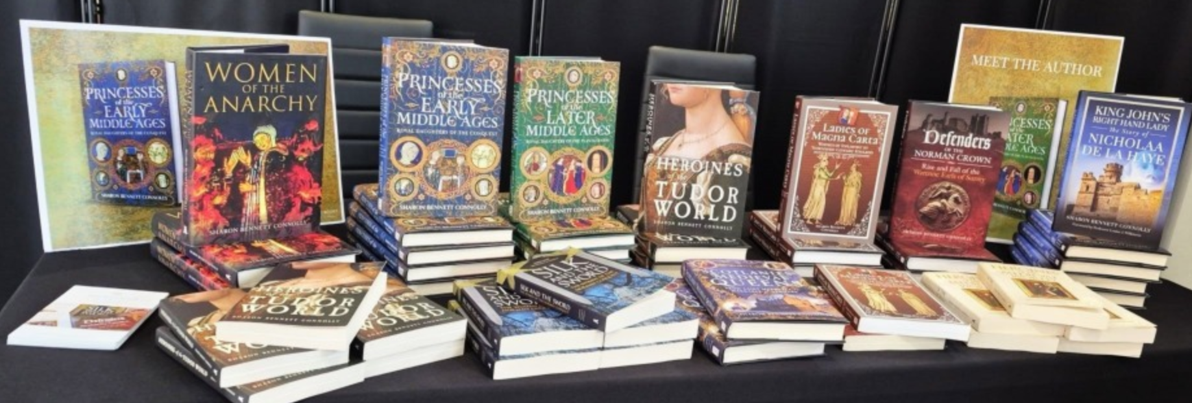
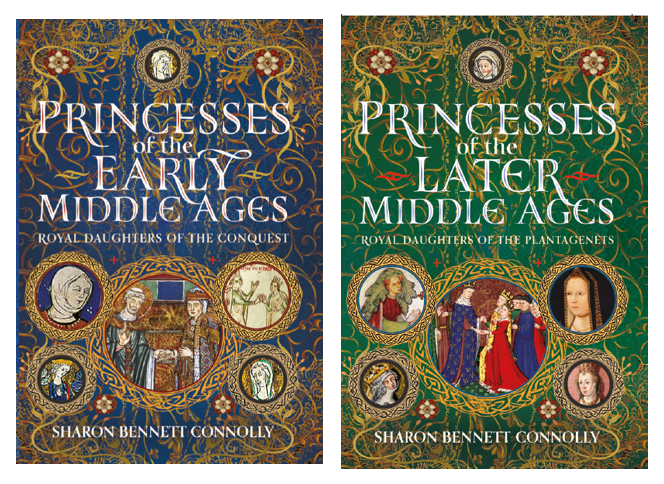
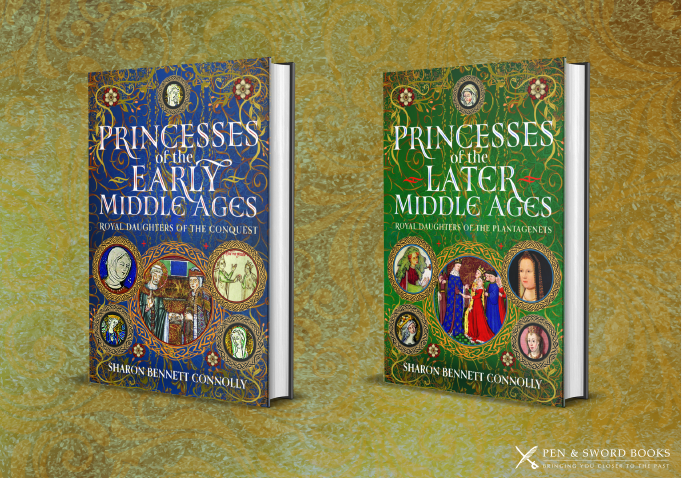
Princesses of the Early Middle Ages: Royal Daughters of the Conquest and Princesses of the Later Middle Ages: Royal Daughters of the Plantagenets tell the stories of England’s royal daughters from 1066 to the rise of the Tudors, from the last Anglo-Saxon princesses to the fall of the House of York.
Were they really pampered pawns sent off to marriages on the Continent, out of sight and out of mind?
Perhaps, there was different story, where a foreign marriage does not mean eternal exile, but a purpose in life, where a princess is a diplomat, an ambassador for England in her new country.
Where she is the bond between allies – most of the time.
Their stories are touching, inspiring and, at times, heartbreaking...
Heidi Malagisi: ‘This is another excellent book by Sharon Bennett Connolly. Extremely well researched and relatively easy to follow along, which is a great thing because there are so many Matildas and Eleanors in this book.‘
Tony Riches: “I challenge anyone with an interest in medieval Britain to not find something they will learn from this book.”
Anna Belfrage: “I just love how [Sharon] presents this huge cast of real life people in a casual, chatty tone that has me expecting the various female protagonists to suddenly pop their head up and add their own commentary.“
OUT NOW! The momentous events of 1066, the story of invasion, battle and conquest, are well known. But what of the women? Silk and the Sword: The Women of the Norman Conquest traces the fortunes of the women who had a significant role to play during the Norman Conquest – wives, lovers, sisters, mothers, leaders. These are lives full of drama, pathos and sometimes mystery: Edith and Gytha searching the battlefield of Hastings for the body of Harold, his lover and mother united in their grief for the fallen king. Who was Ælfgyva, the lady of the Bayeux Tapestry, portrayed with a naked man at her feet?
Janina Ramirez said it’s ‘Excellent’!
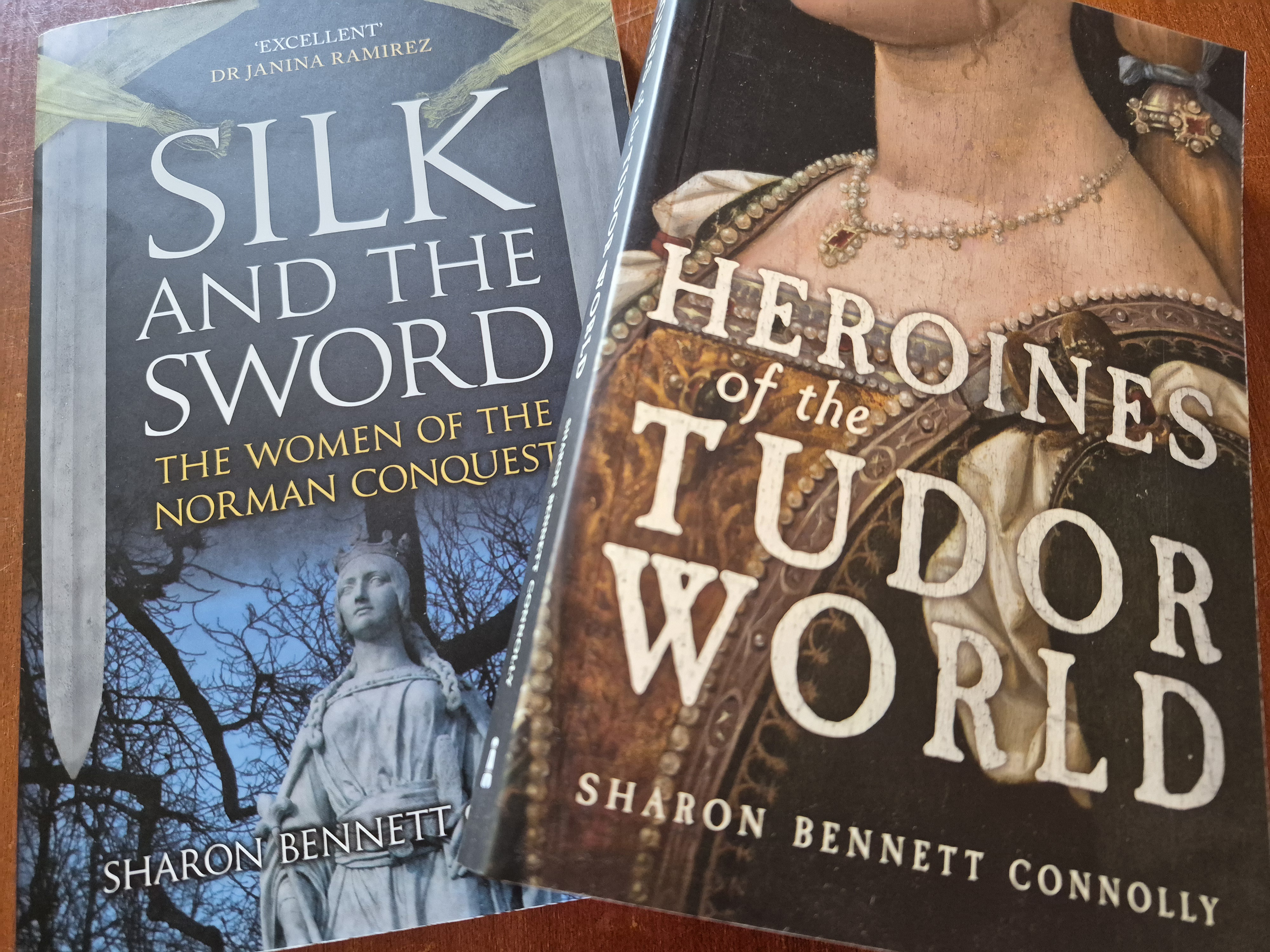
COMING 15 July 2026: Heroines of the Tudor World focuses on the women who lived through the Renaissance and Reformation, examining the threats and challenges they faced and how they overcame them. These are the women who ruled, the women who founded dynasties, the women who fought for religious freedom, their families and love. These are the women who made a difference, who influenced countries, kings and the Reformation.
Derek Birks: ‘An excellent account of the changing roles of women in Tudor society.’
Annie Whitehead: ‘What a treat this book was to read. Bennett Connolly has an easy, conversation style of writing which welcomes you from the opening pages and draws you into her story.‘
Also by Sharon Bennett Connolly:
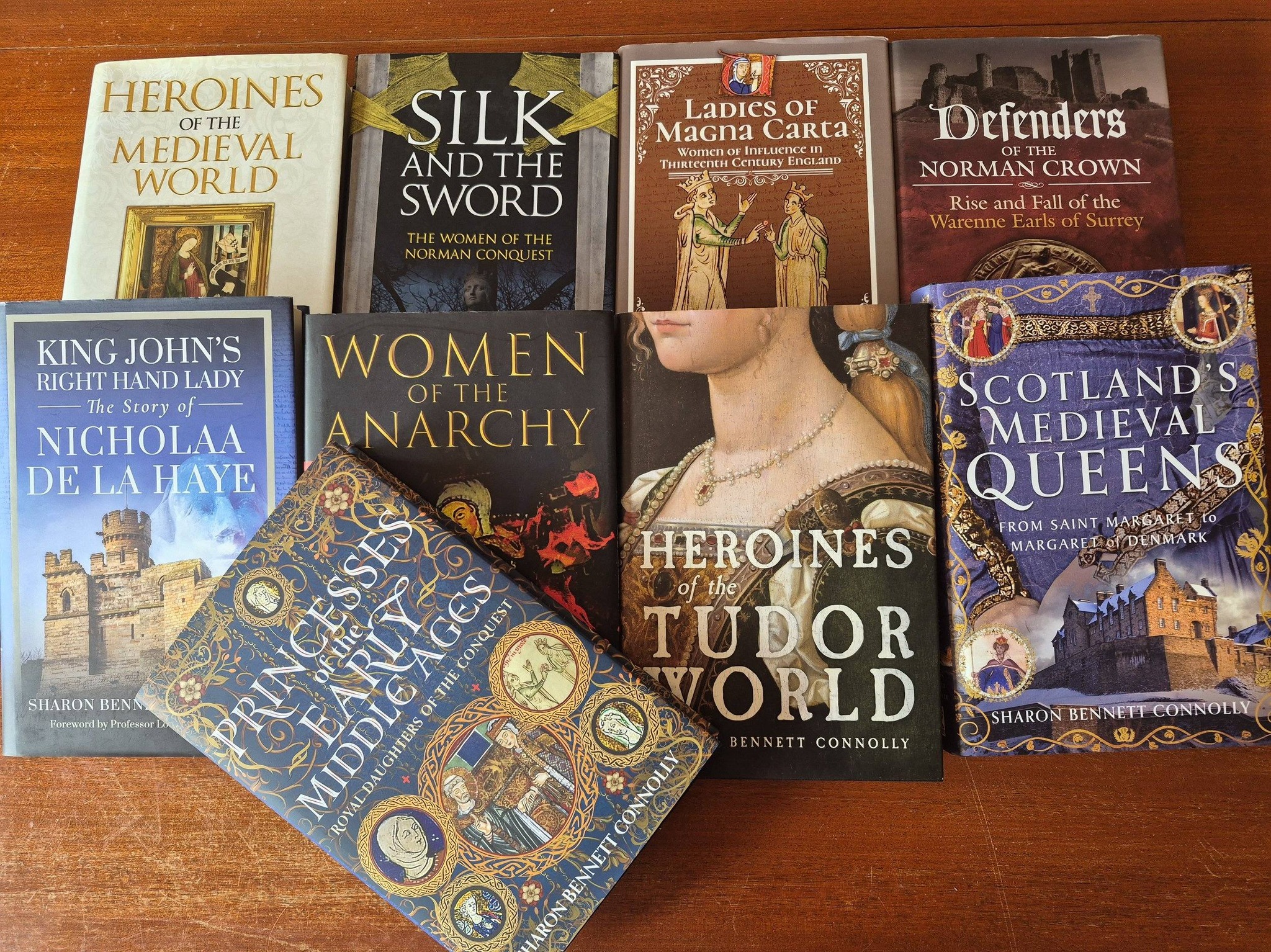
Heroines of the Medieval World; Silk and the Sword: The Women of the Norman Conquest; Ladies of Magna Carta: Women of Influence in Thirteenth Century England; Defenders of the Norman Crown: Rise and Fall of the Warenne Earls of Surrey; King John’s Right Hand Lady: The Story of Nicholaa de la Haye; Women of the Anarchy; Heroines of the Tudor World; Scotland’s Medieval Queens: From St Margaret to Margaret of Denmark; Princesses of the Early Middle Ages: Royal Daughters of the Conquest (March 2026); Princesses of the Later Middle Ages; Royal Daughters of the Plantagenets (August 2026)
Alternate Endings: An anthology of historical fiction short stories including Long Live the King… which is my take what might have happened had King John not died in October 1216. Available in paperback and kindle from Amazon.
Have a listen to theA Slice of Medieval podcast, which I co-host with Historical fiction novelist Derek Birks. Derek and I welcome guests, such as Ian Mortimer, Bernard Cornwell, Elizabeth Chadwick and Scott Mariani, and discuss a wide range of topics in medieval history, from significant events to the personalities involved.
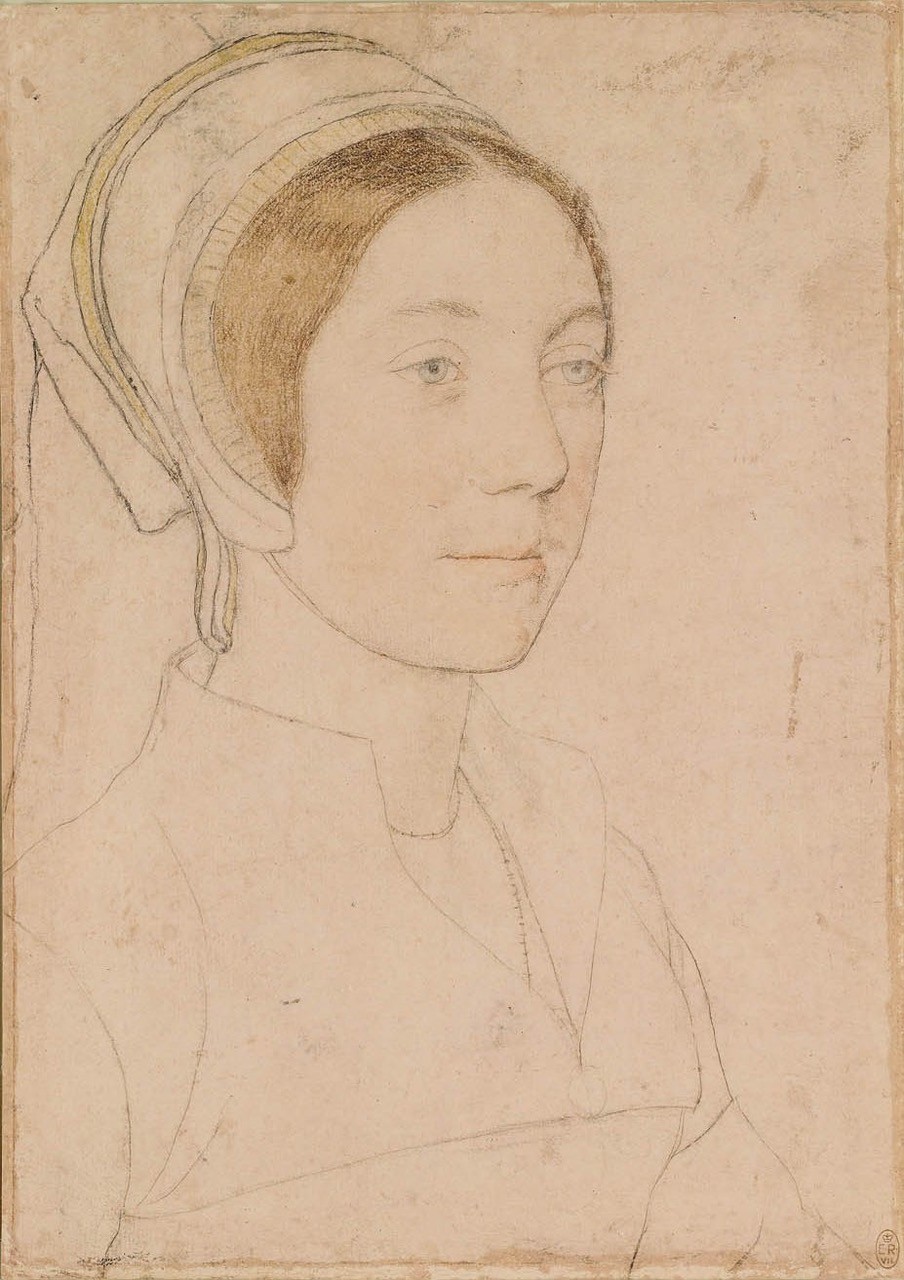
Unknown Woman, often identified as Jane Boleyn Hans Holbein the Younger
Jane Boleyn, née Parker, the infamous Lady Rochford – The Perfect Scapegoat
Jane Boleyn, Lady Rochford is generally regarded as one of the key witnesses if not the key witness in the court case against Anne Boleyn. Jane was married to Anne’s brother George Boleyn. As Anne’s sister-in-law and with her own husband, George Boleyn accused of having had an affair with his sister Anne, Jane’s betrayal is seen as a particular heinous crime. Jane is also accused to have been the source of this accusation of incest against her husband and her sister-in-law.
In an article on Jane’s father for example, James P. Carley declares ‘Morley’s daughter Jane, was principal witness against her husband, George Boleyn, Lord Rochford, at the time of his trial in 1536.’
However, most historians agree that the charges against Anne Boleyn, her brother, and the others accused were trumped up to rid Henry VIII of his wife. Eric Ives for example states, ‘Under analysis, the case presented by the Crown in May 1536 collapses’. If the outcome of the trial and the guilty verdicts were a forgone conclusion, surely it made absolutely no difference who had said or may have said what during or before the trials?
Let me first introduce you to Jane Boleyn, née Parker.
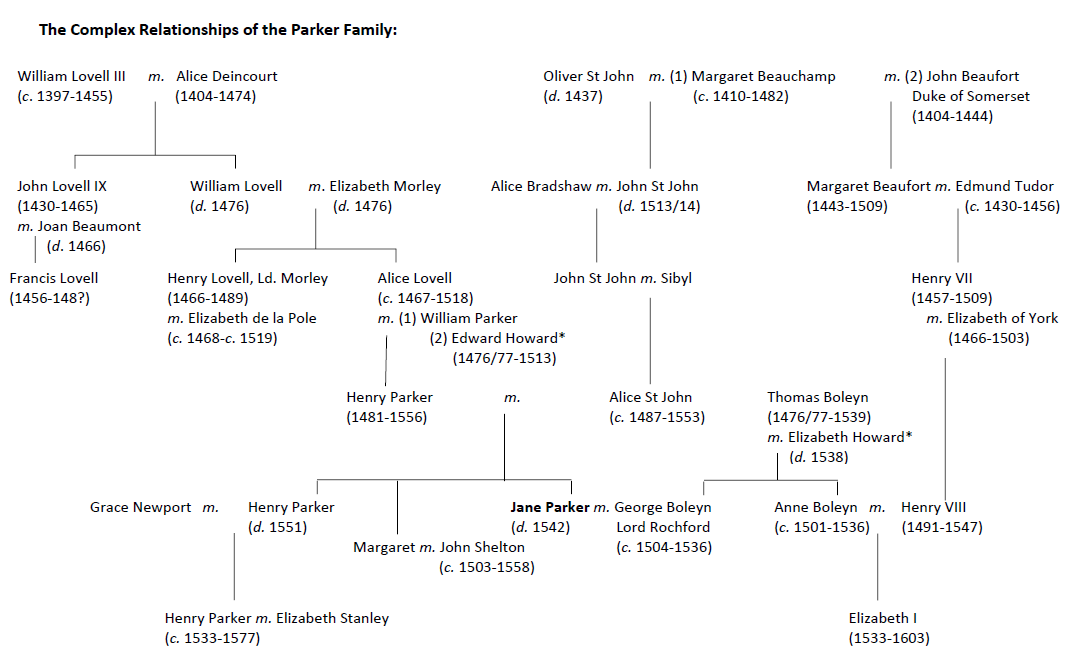
Jane was the daughter of Henry Parker, Lord Morley, and his wife Alice St John. Alice was the daughter of Margaret Beaufort’s half-brother John St John. The match was almost certainly arranged by Margaret Beaufort in whose household Henry Parker had served from a young age. During this time Margaret Beaufort became his patroness. She supported him financially and looked after his wife Alice and their children when Henry was away. Margaret Beaufort was also a major influence on his religious beliefs.
Henry was summoned to parliament as Lord Morley after the death of his mother Alice Parker, née Lovell, in 1518. He never made a particular name for himself at court and never held important office. Richard Starkey calls him ‘an unimportant backwoodsman’ but I think ‘hard-working backbencher’ is a more apt description. He assiduously attended parliament, great ceremonial events, and state trials. That he never achieved higher office may be simply due to a lack of ambition or a personal choice to not risk his life. After all he witnessed how many of the men holding high office during Henry VIII’s reign ended their lives on the scaffold.
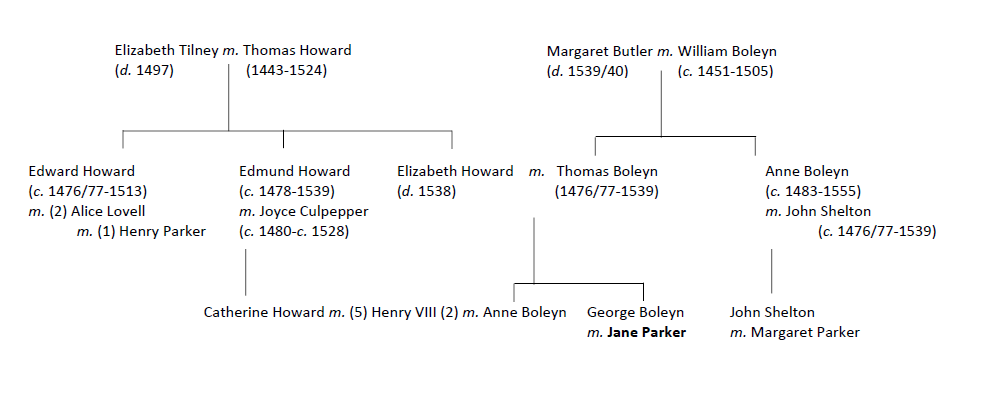
Henry Parker and his wife Alice had five children, two sons, Henry and Francis, and three daughters, Jane, Margaret, and Elizabeth. In the 1520s, Henry and his wife Alice arranged marriages for their three elder children. Henry, the eldest son and heir, was married to Grace Newport, heiress of her father John Newport. Jane married George Boleyn around 1526. In 1530, Margaret married Sir John Shelton the Younger, the son of Sir John Shelton the Elder and his wife Anne Boleyn, the aunt of Queen Anne.
The Boleyn family were neighbours of the Parkers, as were the Howard Dukes of Norfolk. Henry Parker’s mother, Alice Parker had married as her second husband Edward Howard, whose sister Elizabeth was married to Thomas Boleyn. Thomas Boleyn’s father William had been one of the executors of the will of Alice Parker’s brother Henry Lovell, Lord Morley. Alice had been the heir to her brother Henry Lovell and had become very wealthy when she inherited the part of his estates that were not held in tail male. Henry Lovell had been married to Elizabeth de la Pole, daughter of John de la Pole, duke of Suffolk, and Elizabeth, the sister of Edward IV and Richard III. Both Henry and Alice were cousins of Francis Lovell, Viscount Lovell (see Genealogies).
The complex relationships of the Parker family
This confusing profusion of relationships is typical for the higher nobility. The families tried to marry their children to spouses of the same rank, and since the higher nobility was a small group, a multitude of relationships between families was the inevitable result.
The families of Jane and her husband George were not only neighbours in Essex, the two knew each other from court as well. George Boleyn had become a royal page in 1516, and Jane had become one of the ladies of Queen Catherine of Aragon in 1520. The relationship between Jane and her husband was therefore both personal and professional. Jane’s husband George also shared his father-in-law’s interest in literature and translations. In fact, George Boleyn’s translation of ‘The Pistellis and Gospelles for the LII Sondayes of the Yere’ has been attributed to Henry Parker until recently.
To be chosen as a lady of the queen, a young woman had to be of noble birth, attractive, and well-mannered. Jane must have possessed all these qualities. She must also have been skilled in dancing and performing as in 1522 she was among those court ladies who participated a particularly grand pageant for the imperial envoys Jacques de Castres and Charles Poupet de Lacheaulx. Henry VIII’s sister was one of the other ladies as was Jane’s future sister-in-law Anne Boleyn.
In the following years, as Henry VIII became enthralled by Anne Boleyn, Jane and her husband George prospered at court. George became a Squire of the Chamber and was given numerous grants. He received the courtesy title of Viscount, when his father Thomas became Earl of Wiltshire in 1529.
Jane continued to be chosen for active parts in the court’s festivities. In 1532 she was chosen to be one of the six ladies to accompany Anne Boleyn in a dance with the French king Francis I, Henry VIII, and assorted courtiers. In the procession to Anne’s coronation the following year, Jane rode immediately behind Anne. Her brother Henry had been created a Knight of the Bath on the evening before the coronation.
All seemed well both inside the Boleyn family and in the marriage of Henry VIII and Anne Boleyn. But in 1536 this changed dramatically: Anne and her family fell from grace spectacularly. She, her brother George, Henry Norris, and others were arrested, accused of adultery, and executed for treason. Prior to this trial a considerable number of men and women were questions about the allegations. Jane, as Anne’s sister-in-law and lady-in-waiting was naturally also interrogated.
Signature of Jane, Lady Rochford
Even though most historians consider the charges against Anne Boleyn and the other accused as fictional, most, myself included (Both in my book and in my previous guest post), have debated all available clues, hints and the few concrete statements existing to proof or disproof Jane’s guilt. All her prior and subsequent actions are judged, depending on whether she is considered guilty or innocent of the charge of betraying her husband and sister-in-law.
Since Jane was only one of a large number of people, including Anne Boleyn herself and her brother George, who were questioned about the events at court and whose answers were used during the trial, why was it Jane and not one of the many other people involved in this affair that has been singled out as the despicable traitor? After all, Lady Wingfield was named by judge John Spelman as the source of the behaviour of Anne Boleyn.
Having pondered this question for quite a while now I have developed my own theory about this question.
After Anne Boleyn’s daughter Elizabeth became queen, Anne’s reputation had to be cleared of any suggestion of scandal and extramarital adventures. It was equally inadvisable to put the blame instead on Elizabeth’s father Henry VIII. To protect her right to be queen of England, the reputation of both her parents needed to be above reproach.
But somebody had to be blamed for Anne Boleyn’s death and, as it turned out, Anne’s sister-in-law Jane made the perfect scapegoat.
Jane had no children and no other family in a position to defend her reputation. Her brother Henry was dead and his son, another Henry, was a devout Catholic. This made him suspicious from the start. He first supported Queen Elizabeth who visited him in Great Hallingbury in 1561. However, later in the decade, he refused to subscribe to the Act of Uniformity. He was also linked to the rising of noble earls and fled England in 1570. He died in exile in 1577.
The Howard family
Additionally, Jane’s own reputation was already ruined. She had been executed alongside Henry VIII’s fifth queen Katherine Howard in 1542. There was no reason to clear childless Katherine Howard’s reputation. Any endeavour to do so would have been much more difficult if not impossible.
While Anne Boleyn was accused of infidelity and incest to remove her for political reason, Katherine Howard certainly had been unfaithful to her husband, even if her clandestine meetings with her paramour Thomas Culpepper did involve nothing more serious than talking and a chaste kiss on the hand as the two claimed. Jane had been present at the meetings as a chaperone of sorts, though she claimed that she had not heard or seen what happened between the queen and Thomas Culpepper as she sat too far away and moreover during at least one of the meetings, she had fallen asleep. Jane did state that she thought Katherine and Thomas had been lovers.
Who of the three, Katherine Howard, Jane Boleyn, or Thomas Culpepper, had been the main instigator of these meetings was and is still debated. Naturally, all three tried to play down their own role and blame the others. Thomas Culpepper used the time-honoured excuse that he had been helpless against the wily ways of the two women. Katherine claimed that Jane had been encouraging her and that it had been her lady-in-waiting who wanted her to befriend Thomas in the first place. It had also been Jane who searched out the places where they could meet Thomas. Jane insisted that she had only followed the orders of the queen.
In the end, all three participated in illicit meetings and they all should have known what would happen if they were found out. The execution of Anne Boleyn and her alleged lovers was only a few years in the past.
In his biography of Anne Boleyn Eric Ives wonders ‘whether the incrimination of Lady Rochford in the crimes of Katherine Howard may not have owed something to revenge’. There was, however, no need to incriminate Jane Boleyn in any way, she did so herself by her actions.
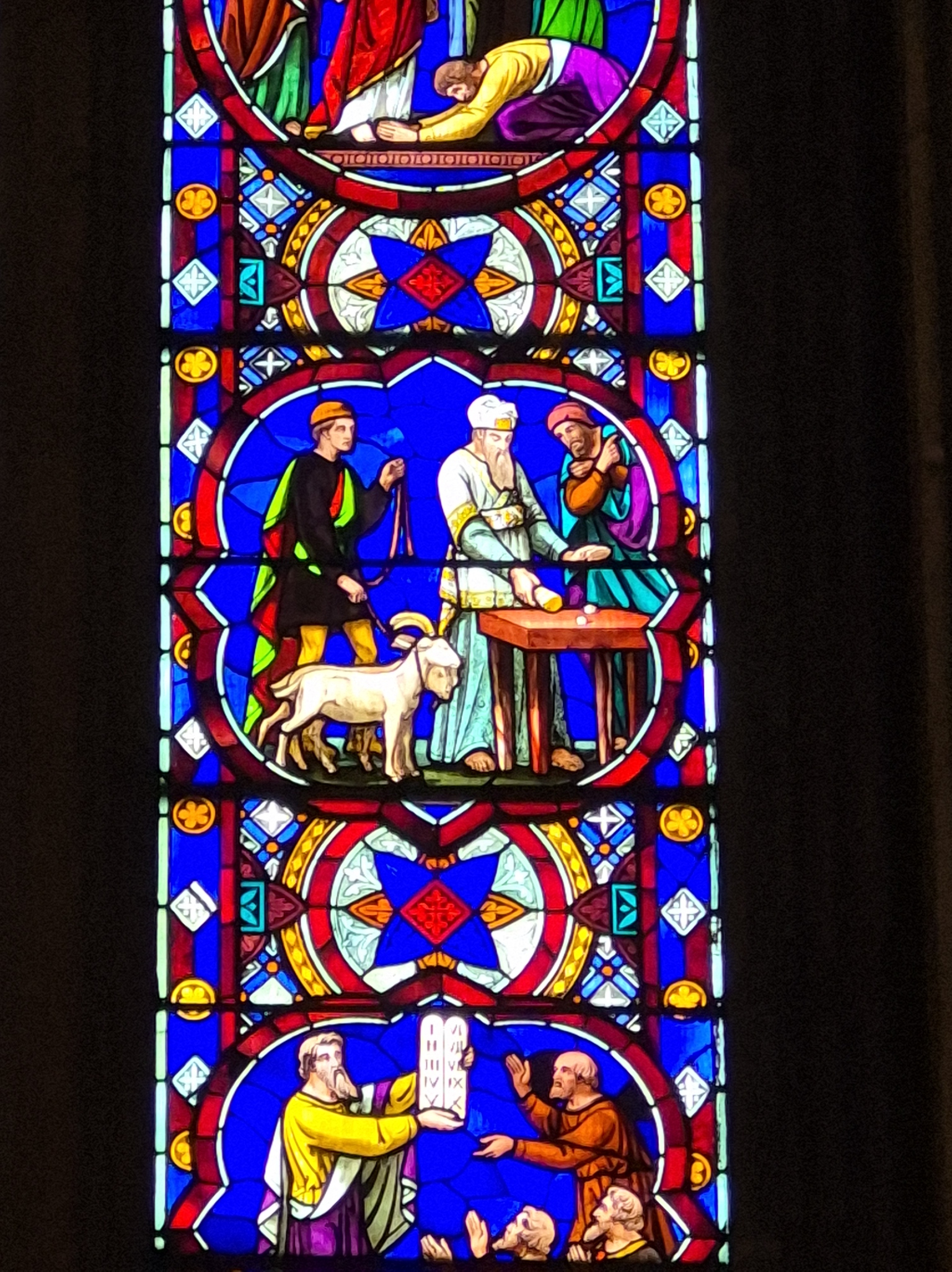
Scapegoat Ceremony shown in Stained Glass window in Lincoln Cathedral
I think Ives’s argument should be put on its head: Jane Parker has become the much-maligned ‘key witness’ in Anne Boleyn’s trial, since she was guilty in the case that brought down Katherine Howard, Thomas Culpepper, and herself. What was more natural than to assume that she was equally deeply involved in the fall of Anne Boleyn?
Perhaps it is not wholly imaginary to think that makes Jane a particularly satisfying scapegoat for Anne Boleyn’s fall because of her close relationship to Anne. To suggest that Anne’s own sister-in-law, the wife of her brother George, who provided the charge of incest, is particularly piquant. The people nearest to us are those who can reveal our deepest secrets and the fear of being betrayed by them runs deep.
The trial of Anne Boleyn and her alleged lovers was a means to an end and the charges spurious. Today it is merely fascinating to discuss the alleged contribution of individuals to the proceedings and interesting to observe how Jane’s action both before and after Anne Boleyn’s trial are today interpreted completely different, depending on whether or not an author regards Jane as the traitor.
Back in the second half of the sixteenth century, the trial of Anne Boleyn was not discussed (at least openly) as a political manoeuvre conducted on trumped up charges to remove a no longer wanted queen. This would have fundamentally damaged the reputation of Henry VIII, the father of Elizabeth I. Since her mother had to be cleared of any allegations of infidelity, somebody else had to be blamed. Jane Parker was the best choice for that role. She was the perfect scapegoat.
Further Reading:
James P. Carley, ‘The Writings of Henry Parker, Lord Morley: A Biographical Survey’, in: Marie Axton and James P. Carley (eds.), ‘Triumphs of English’. Henry Parker, Lord Morley, Translator to the Tudor Court (London, 2000).
Julia Fox, Jane Boleyn.The Infamous Lady Rochford (London, 2007).
Eric Ives, The Live and Death of Anne Boleyn. ‘The Most Happy’ (Oxford, 2004).
Monika E. Simon, From Robber Barons to Courtiers. The Changing World of the Lovells of Titchmarsh (Barnsley, 2021
Monika E Simon was born as the third of four sisters in 1969 in a small city in southern Bavaria. Interested in history from an early age, she wrote her MA thesis about the tenth-century Empress Adelheid at the Ludwig-Maximilians-Universtität in Munich. Having spent a year of her studies at the University of York (Yorkshire), she fell in love with the city and decided to transfer there for her doctoral thesis. For her DPhil thesis she studied the history of the Lovells of Titchmarsh which she submitted in 1999.
Coming 30 March: Princesses of the Early Middle Ages
Daughters of kings were often used to seal treaty alliances and forge peace with England’s enemies. Princesses of the Early Middle Ages: Royal Daughters of the Conquest explores the lives of these young women, how they followed the stereotype, and how they sometimes managed to escape it. It will look at the world they lived in, and how their lives and marriages were affected by political necessity and the events of the time. Princesses of the Early Middle Ages will also examine how these girls, who were often political pawns, were able to control their own lives and fates. Whilst they were expected to obey their parents in their marriage choices, several princesses were able to exert their own influence on these choices, with some outright refusing the husbands offered to them.
Their stories are touching, inspiring and, at times, heartbreaking.
Princesses of the Early Middle Ages: Royal Daughters of the Conquest is now available for pre-order from Pen & Sword and Amazon.
Also by Sharon Bennett Connolly:
Scotland’s history is dramatic, violent and bloody and Scotland’s Medieval Queens have seen it all. This is the story of Scotland through their eyes. Available now fromAmazon and Pen and Sword Books. Heroines of the Tudor World tells the stories of the most remarkable women from European history in the time of the Tudor dynasty, 1485-1603. These are the women who ruled, the women who founded dynasties, the women who fought for religious freedom, their families and love. Heroines of the Tudor World is now available from Amberley Publishing and Amazon UK.Women of the Anarchy demonstrates how Empress Matilda and Matilda of Boulogne, unable to wield a sword themselves, were prime movers in this time of conflict and lawlessness. It shows how their strengths, weaknesses, and personal ambitions swung the fortunes of war one way – and then the other. Available from Bookshop.org, Amberley Publishing and Amazon UK. King John’s Right-Hand Lady: The Story of Nicholaa de la Haye is the story of a truly remarkable lady, the hereditary constable of Lincoln Castle and the first woman in England to be appointed sheriff in her own right. Available from all good bookshops Pen & Sword Books, bookshop.org and Amazon.
Alternate Endings: An anthology of historical fiction short stories including Long Live the King… which is my take what might have happened had King John not died in October 1216. Available in paperback and kindle from Amazon.
Podcast:
Have a listen to theA Slice of Medieval podcast, which I co-host with Historical fiction novelist Derek Birks. Derek and I welcome guests, such as Ian Mortimer, Bernard Cornwell, Elizabeth Chadwick and Scott Mariani, and discuss a wide range of topics in medieval history, from significant events to the personalities involved.
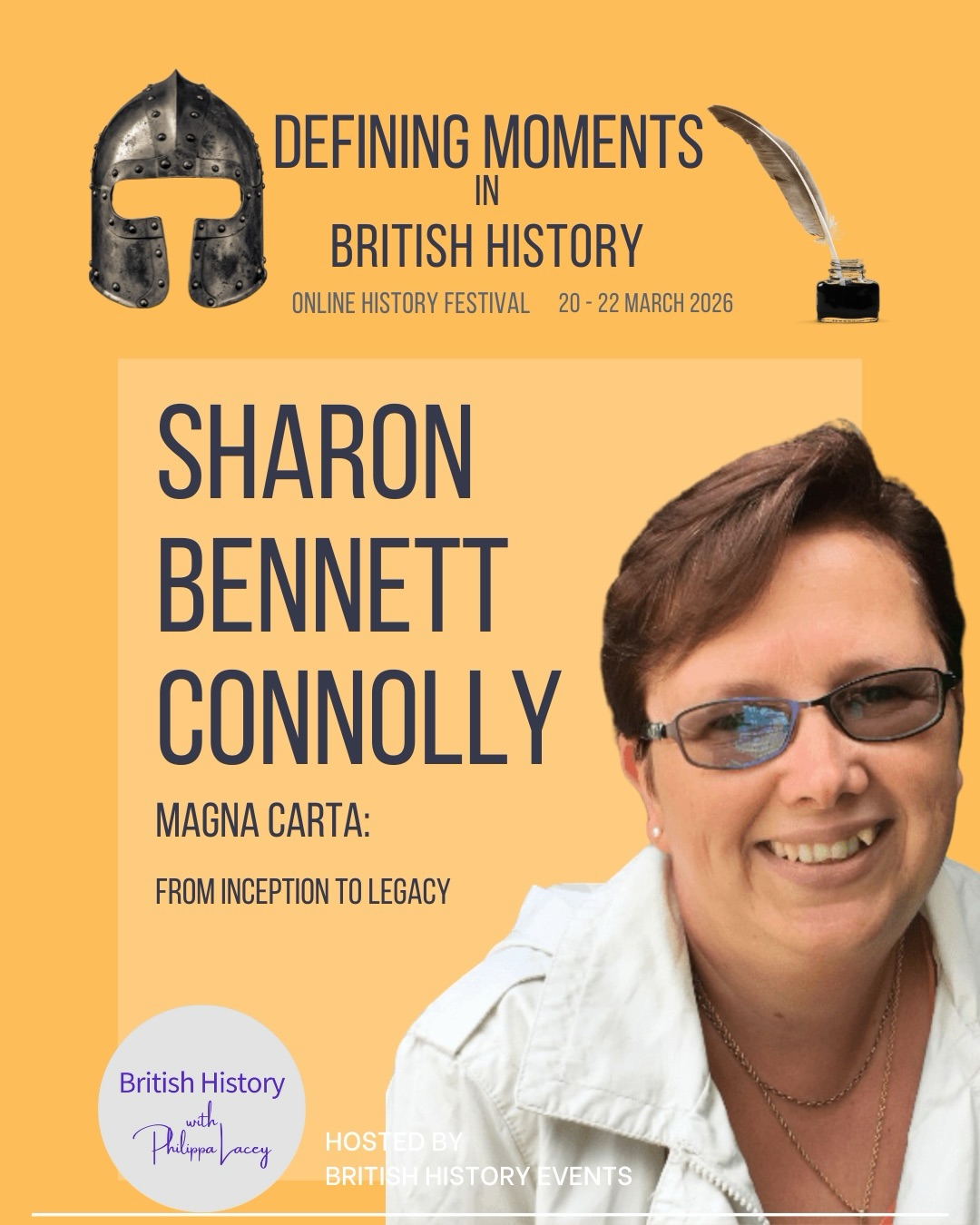
I am delighted to have been asked to take part in this year’s Online History Festival hosted by British History Events!
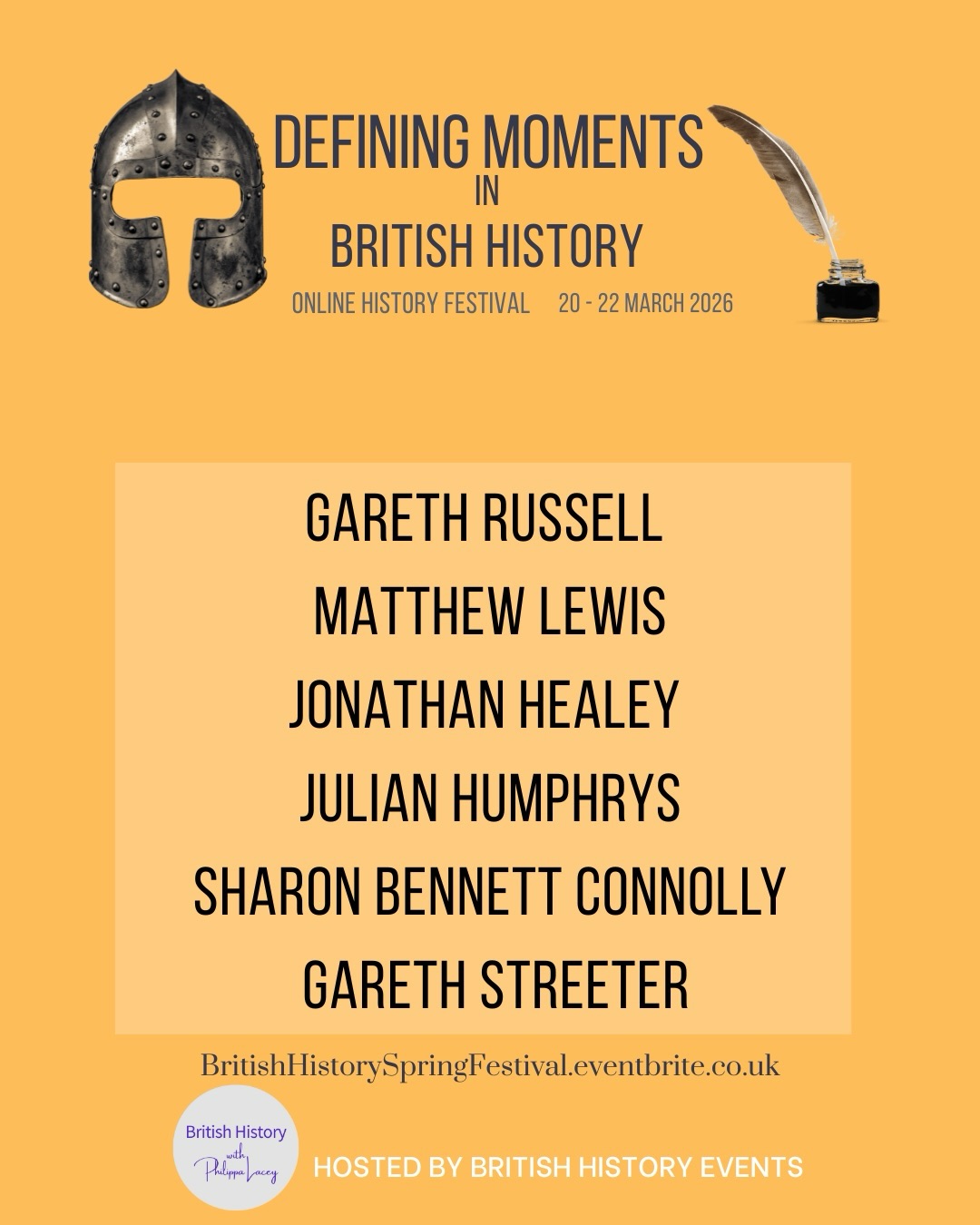
The theme and title of this year’s festival (their 6th) is ‘Defining Moments in British History’ – exploring six defining moments that have shaped Britain today. The festival is all online, taking place from the evening of Friday, 20th March until the evening of Sunday, 22nd March 2026.
Magna Carta: From Inception to Legacy
By 1215, the English barons’ objections to King John were almost beyond number. He had failed to face the French and had lost not only most of his family’s Continental possessions, but also those of his barons. Few had forgotten his treachery against his brother – his attempts on the throne whilst Richard was away on Crusade. His barons even complained that he forced himself on their wives and daughters.
The barons had had enough.
And the result was Magna Carta; a detailed document created to stave off civil war. It touched on the whole system of royal government. And it was granted to ‘all free men of the realm and their heirs forever’. It brought the king within the law, rather than above it.
It is the closest thing England has to a Constitution.
How significant was Magna Carta really?
In this lecture, I will explore the reasons for Magna Carta, the civil war that followed its creation and the people who fought for it and used it to assert their own rights. And we will look at how relevant it still is today, even beyond England’s shores.
So, I have been spending this week tweaking my PowerPoint presentation and recording the lecture.
There will be 6 talks from leading historians (including myself!), a live Q&A with all 6 historians, a live quiz, and a prize draw. Here is the line up!
Julian Humphrys explores ‘The Battle of Hastings: What Happened and What Followed’. Sharon Bennett Connolly (me!) traces ‘Magna Carta: From Inception to Legacy’. Matthew Lewis examines ‘How the Black Death Changed England Forever’. Gareth Russell tackles ‘Crisis of Faith: The Reformation in British History’. Jonathan Healey delves into ‘The British Civil Wars: How They Happened and Why They Matter’. Gareth Streeter looks at ‘The Birth of Britain: How the Glorious Revolution and the Act of Union Forged a Modern Nation’.
And I am really looking forward to the online Q&A and discussion.
Of course, Magna Carta is THE defining moment, but I will let the fellas have their say …
Don’t worry if you can’t watch all the talks as they go out – your ticket will give you access to everything in the festival until 31st May 2026.
Coming 30 March: Princesses of the Early Middle Ages
Daughters of kings were often used to seal treaty alliances and forge peace with England’s enemies. Princesses of the Early Middle Ages: Royal Daughters of the Conquest explores the lives of these young women, how they followed the stereotype, and how they sometimes managed to escape it. It will look at the world they lived in, and how their lives and marriages were affected by political necessity and the events of the time. Princesses of the Early Middle Ages will also examine how these girls, who were often political pawns, were able to control their own lives and fates. Whilst they were expected to obey their parents in their marriage choices, several princesses were able to exert their own influence on these choices, with some outright refusing the husbands offered to them.
Their stories are touching, inspiring and, at times, heartbreaking.
Princesses of the Early Middle Ages: Royal Daughters of the Conquest is now available for pre-order from Pen & Sword and Amazon.
Also by Sharon Bennett Connolly:
Scotland’s history is dramatic, violent and bloody and Scotland’s Medieval Queens have seen it all. This is the story of Scotland through their eyes. Available now fromAmazon and Pen and Sword Books. Heroines of the Tudor World tells the stories of the most remarkable women from European history in the time of the Tudor dynasty, 1485-1603. These are the women who ruled, the women who founded dynasties, the women who fought for religious freedom, their families and love. Heroines of the Tudor World is now available from Amberley Publishing and Amazon UK.Women of the Anarchy demonstrates how Empress Matilda and Matilda of Boulogne, unable to wield a sword themselves, were prime movers in this time of conflict and lawlessness. It shows how their strengths, weaknesses, and personal ambitions swung the fortunes of war one way – and then the other. Available from Bookshop.org, Amberley Publishing and Amazon UK. King John’s Right-Hand Lady: The Story of Nicholaa de la Haye is the story of a truly remarkable lady, the hereditary constable of Lincoln Castle and the first woman in England to be appointed sheriff in her own right. Available from all good bookshops Pen & Sword Books, bookshop.org and Amazon.
Alternate Endings: An anthology of historical fiction short stories including Long Live the King… which is my take what might have happened had King John not died in October 1216. Available in paperback and kindle from Amazon.
Podcast:
Have a listen to theA Slice of Medieval podcast, which I co-host with Historical fiction novelist Derek Birks. Derek and I welcome guests, such as Ian Mortimer, Bernard Cornwell, Elizabeth Chadwick and Scott Mariani, and discuss a wide range of topics in medieval history, from significant events to the personalities involved.
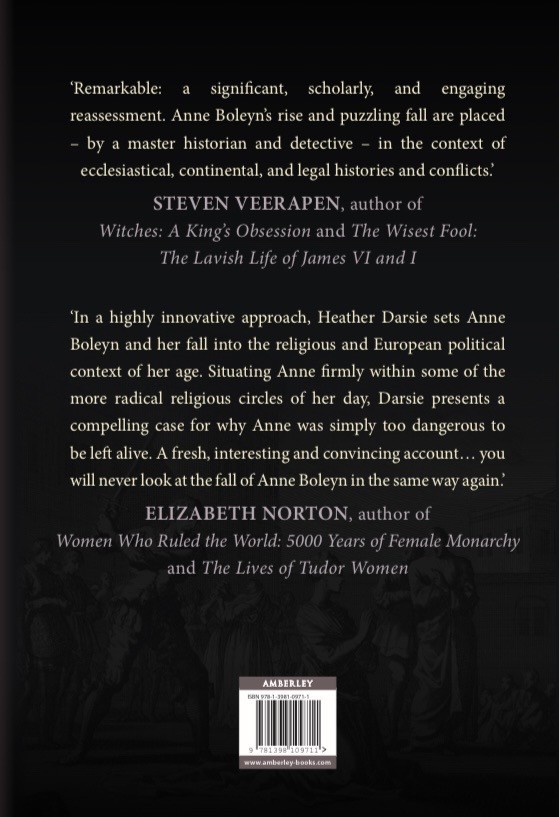
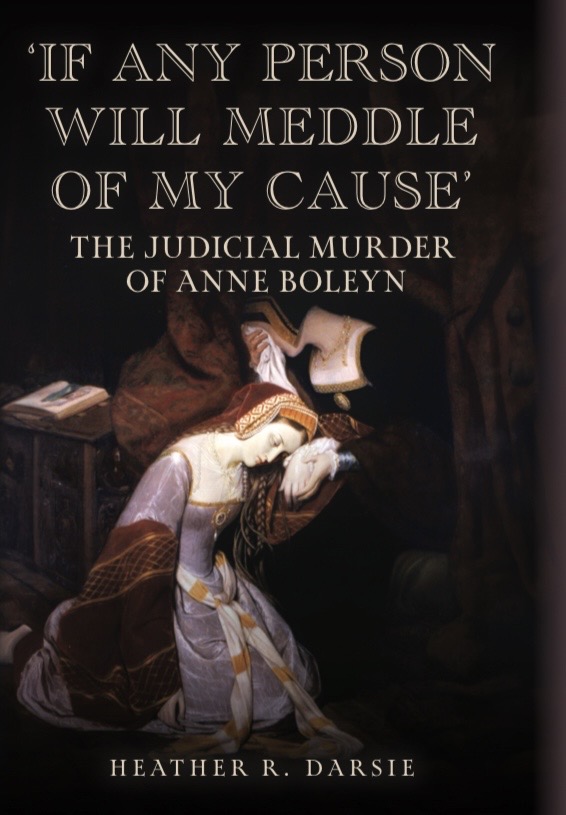
Anne Boleyn is one of the great enigmas of English history. Credited – or blamed – for Henry VIII’s break with Rome and the English Reformation, she is also the mother of one of England’s greatest monarchs, Queen Elizabeth I. Moreover, Anne Boleyn holds the tragic distinction of being the first queen of England to ever be executed. Historian Heather R. Darsie‘s new book, If Any Person Will Meddle of My Cause: The Judicial Murder of Anne Boleyn, looks into Anne’s queenship and execution – and how the law made her death possible.
And today we have a treat! An extract from the book, to give you a taste of what’s in store….
Welcome Heather!
Anne Boleyn Forces Legal Reform
By Heather R. Darsie, J. D.
Anne Boleyn is famously seen as the reason for Henry VIII breaking from the Catholic church. Her interest in at least reforming religion in England, if not going more toward the way of Martin Luther, made her a figurehead in some ways for underground efforts. In reality, Henry was finishing the work of his forbears from centuries before. He also quickly learned that he needed to pull away from Rome so that he could have full control of legal matters within his kingdom, without outside meddling or dawdling,
“Although Henry had grown frustrated over the confounding dithering of Clement VII and ineptitude of Cardinal Thomas Wolsey in the handling of his Great Matter, the issue of Henry VIII’s annulment from Katharine of Aragon was not the biggest problem. The biggest problem was, Henry rapidly learned, that he had no control over his legal system in very important arenas when he needed it most. Aside from not having legal control, the lag time in communications being sent from London to Rome and back again contributed to the delay in Henry’s annulment proceedings, too.
Once Henry was set on his path inspired by Anne Boleyn, he learned just how much money was being kept out his coffers. Cardinal Wolsey started the process before his death, but Thomas Cromwell and Anne spurred Henry to continue shutting down religious institutions in an effort to redistribute the nation’s wealth in favour of crown and kingdom. None of these ideas were novel….
Loosening the church’s powers with England began at the very tail end of the High Middle Ages with Edward I of England. At the beginning of the thirteenth century with the enaction of Magna Carta, the passing of land to a corporation, like a church, without royal consent was forbidden. …Edward I enacted the Statutum de Viris Religiosis, or Statute of Religious Men, in 1279…It forbade the passage of any lands in mortmain [meaning “deadhand”] to any religious man. If anyone did pass their lands to a religious man, then those lands were forfeited…The goals of the Mortmain statutes were not achieved until Henry VIII’s Parliament passed several statutes in 1529 and one directly addressing mortmain in 1531. Henry then began dissolving the monasteries in the 1530s, something he arguably would not have done without being encouraged by his fixation on and love for Anne Boleyn…
Henry VIII was not the first king of England to challenge the pope’s authority. He was the fourth, although the laws of the first two kings were more or less forgotten by the time Henry started taking action. Edward III passed the first, overtly aggressive statutes against papal power, with his successor Richard II taking even stronger action…The laws fell by the wayside during the fifteenth century, not to be fully revived until Henry VIII needed to assert stronger control….
[Edward III] enacted the Statute of Praemunire Facias, or simply the Statute of Praemunire, in 1353. This statute severely curtailed the influence and outright meddling of papal authority and other foreign powers within England… The punishments for the Statute of Praemunire were…severe. Anyone who effectively requested foreign interference with any legal matter, temporal or ecclesiastical, that rightly was under the purview of the king of England’s courts, was at risk of imprisonment, being outlawed and forfeiting all their property, goods, lands, and chattel. These were extremely serious penalties.
Being outlawed meant that the person had no rights or legal protection. Effectively, they were stripped of personhood and did not exist. If the person were robbed and killed after being outlawed, no crime was committed because the person existed outside of the law. Being outlawed was a desperate state of living and reserved for only the worst criminals, as in some ways it was a fate worse than death. The only positive element of being outlawed was that a person, if they survived their term of outlawry, they could be allowed back into society. Once recognised as a legal person again, they were usually at a diminished station, but at least they were alive and had rights… [Updates] were made to the Statute of Praemunire in 1365, curtailing the ability of the papal court to act as a court of first impression or a court of appeal for matters arising in England…
Roughly twenty-five years later, Richard II continued his grandfather Edward III’s work… The 1393 Statute of Praemunire Facias, enhancing the law passed in 1353, did not allow the papal curia to hear any non-spiritual matters that were prejudicial to the king, or went against the customs and laws of England. Spiritual matters could still be heard in Rome, such as divorces and annulments. Anyone who violated the 1393 statute risked punishment by forfeiting all that they owned and being outlawed. The same punishment applied to anyone who aided and abetted them. This was where Henry VIII suffered from the decisions of his great-great-great-granduncle Richard II in Henry’s Great Matter with Katharine of Aragon. This is why Henry’s annulment proceeding simply had to be heard by the pope in Rome, unless Cardinal Wolsey could figure out a solution.…”
Henry VIII’s need for Anne Boleyn opened his eyes to the restrictions of his legal control within England. Their passion inspired Henry to complete the work that was begun hundreds of years before anyone conjured the name of ‘Anne Boleyn’.
For more, pick up a copy of If Any Person Will Meddle of My Cause: The Judicial Murder of Anne Boleyn, available via hardback and Kindle in the UK, or via Kindle internationally. Hardbacks are available for international pre-order, with release on 21 April 2026.
About the book:
Many people know about the dramatic rise and fall of Anne Boleyn, Henry VIII’s controversial second wife, but this is the first book to look at her life from a Continental perspective. Her role models for queenship came from the Low Countries and France, and this contributed to her tragic end. Heather R. Darsie reviews the political missteps and implications of Anne Boleyn’s queenship, delving into the threat she posed to Henry, and why legal changes made during the early years of the English Reformation allowed the English king to judicially murder his inconvenient queen.
Historically, certain things have been overlooked about Anne’s execution: she wore colours usually associated with martyrdom, announced that she did not come to preach, was killed by beheading instead of burning, and had a very crude burial in an unmarked grave. Anne tried to portray herself as a martyr, and Henry did everything he could to prevent her from reaching that status. If Any Person Will Meddle of My Cause is about Anne Boleyn, but not the Anne Boleyn you know.
About the Author:
Heather R. Darsie is an independent researcher in the US specializing in early modern history. She focuses on researching the Holy Roman Empire and England in the early 16th century. She is the author of ‘Anna, Duchess of Cleves‘, ‘Children of the House of Cleves‘ and ‘Katharine of Aragon, Spanish Princess‘. Her primary career is as an attorney. She runs the website MaidensAndManuscripts.com.
Coming 30 March: Princesses of the Early Middle Ages
Daughters of kings were often used to seal treaty alliances and forge peace with England’s enemies. Princesses of the Early Middle Ages: Royal Daughters of the Conquest explores the lives of these young women, how they followed the stereotype, and how they sometimes managed to escape it. It will look at the world they lived in, and how their lives and marriages were affected by political necessity and the events of the time. Princesses of the Early Middle Ages will also examine how these girls, who were often political pawns, were able to control their own lives and fates. Whilst they were expected to obey their parents in their marriage choices, several princesses were able to exert their own influence on these choices, with some outright refusing the husbands offered to them.
Their stories are touching, inspiring and, at times, heartbreaking.
Princesses of the Early Middle Ages: Royal Daughters of the Conquest is now available for pre-order from Pen & Sword and Amazon.
Also by Sharon Bennett Connolly:
Scotland’s history is dramatic, violent and bloody and Scotland’s Medieval Queens have seen it all. This is the story of Scotland through their eyes. Available now fromAmazon and Pen and Sword Books. Heroines of the Tudor World tells the stories of the most remarkable women from European history in the time of the Tudor dynasty, 1485-1603. These are the women who ruled, the women who founded dynasties, the women who fought for religious freedom, their families and love. Heroines of the Tudor World is now available from Amberley Publishing and Amazon UK.Women of the Anarchy demonstrates how Empress Matilda and Matilda of Boulogne, unable to wield a sword themselves, were prime movers in this time of conflict and lawlessness. It shows how their strengths, weaknesses, and personal ambitions swung the fortunes of war one way – and then the other. Available from Bookshop.org, Amberley Publishing and Amazon UK. King John’s Right-Hand Lady: The Story of Nicholaa de la Haye is the story of a truly remarkable lady, the hereditary constable of Lincoln Castle and the first woman in England to be appointed sheriff in her own right. Available from all good bookshops Pen & Sword Books, bookshop.org and Amazon.
Alternate Endings: An anthology of historical fiction short stories including Long Live the King… which is my take what might have happened had King John not died in October 1216. Available in paperback and kindle from Amazon.
Podcast:
Have a listen to theA Slice of Medieval podcast, which I co-host with Historical fiction novelist Derek Birks. Derek and I welcome guests, such as Ian Mortimer, Bernard Cornwell, Elizabeth Chadwick and Scott Mariani, and discuss a wide range of topics in medieval history, from significant events to the personalities involved.
I hope you have all had a wonderful Christmas and enjoyed the New Year celebrations. Thankfully, my Wordly Women series is still going strong. I wonder if I can keep it going the whole year? We’ll see. I have at least 2 more interviews lined up, so we are starting the year strong!
My first guest of the year is a lady I have never met in person, but who feels like an old friend. I regularly chat with Carol Ann Lloyd on her podcast, Royals, Rebels and Romantics, when we have a lot of fun and ALWAYS go over time. Once we get talking, it is hard to stop us!
So, welcome to Carol Ann!
Sharon: Carol Ann, can I ask, what got you into writing?
Carol Ann: I have always really enjoyed writing. In fact, my mom kept a very silly story I wrote as a young school child called “Sam the Clam.” I illustrated it myself. It was pretty terrible, about a clam who of course spoke and moved around. It all rhymed. What I remember, though, it how much fun it was to create a little world.
Sharon: Tell us about your books.
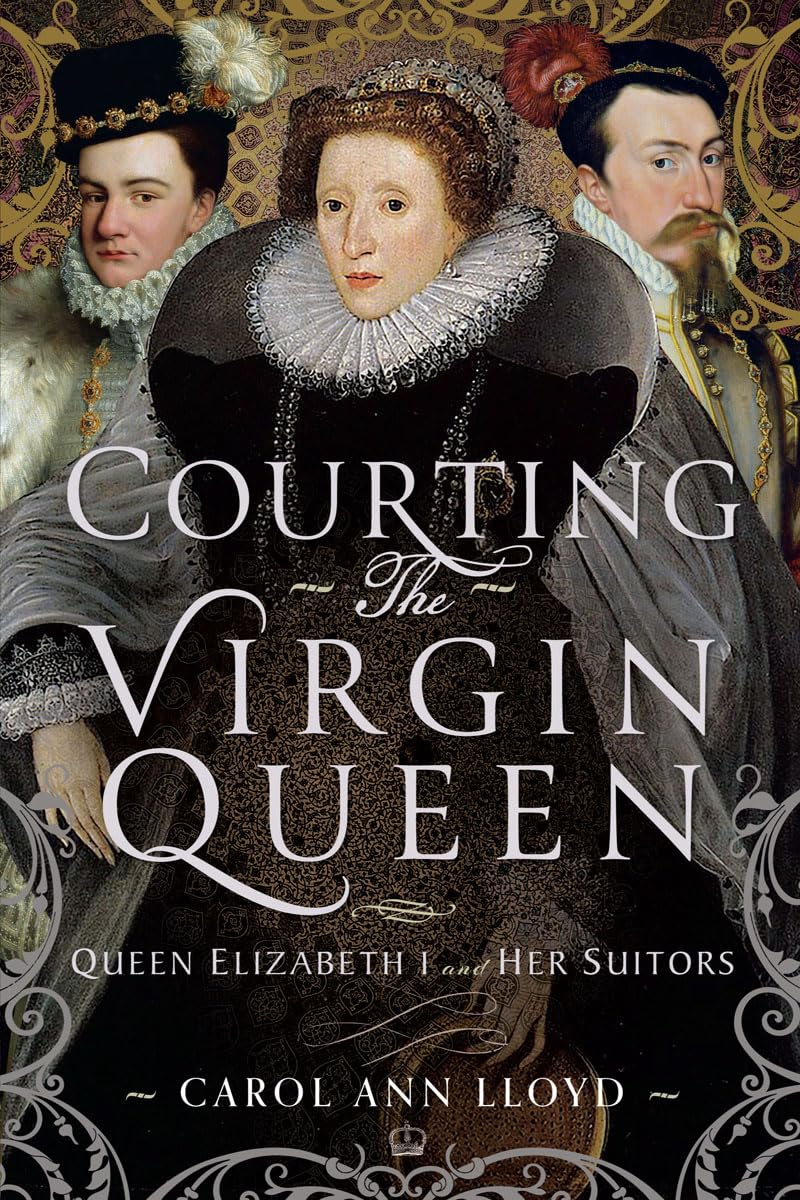
Carol Ann: I’ve published two books about Tudor history: The Tudors by Numbers and Courting the Virgin Queen.
I got the idea for The Tudors by Numbers when I was working on something about the coronations of Mary I and Elizabeth I. We usually think of the two half-sisters as opposing each other: Catholic and Protestant, daughter of Katherine of Aragon and daughter of Anne Boleyn, etc. But I started thinking of them as two succeeding Queens Regnant. When we put them together, the ruled for 50 years, which is a total of 42 percent of the Tudor dynasty. Those are important numbers, and I don’t think we usually consider the Tudor dynasty as having such a high percentage of female rule. Then, if you consider Jane Grey a Queen (which I do), there are three Tudor kings and three Tudor queens: 50 percent each. So I know the number six is the most famous, but I think there are other Tudor numbers that are equally important.
For Courting the Virgin Queen, I was asked to explore Elizabeth’s suitors. That was really interesting for me to take on. We know she never married, but why? I was struck by one of the first diplomatic comments about her reign, when the Count of Feria, the Spanish ambassador, wrote to Philip that “everything depends upon the husband this woman may take.” EVERYTHING. That got me thinking. He was right is so many ways. The foreign policy, the religious policy, trade partners and trade routes, future alliances, standing in Europe and around the world, the future of England—all that depended on the man Elizabeth chose as her husband. And, of course, there were no really good options. Elizabeth saw first-hand the problems with Mary’s Spanish marriage. And she saw all around her how women lost so much by marrying. She may have loved Robert Dudley, but she would have lost enormous credibility in England and abroad by marrying a subject. A foreign alliance might have proven handy at some points, but she would have linked her kingdom to another with no way out. There were no good options. Even though it infuriated her own council and dismayed the foreign picture, remaining the Virgin Queen was her best option.
Sharon: What attracts you to the Tudor period?
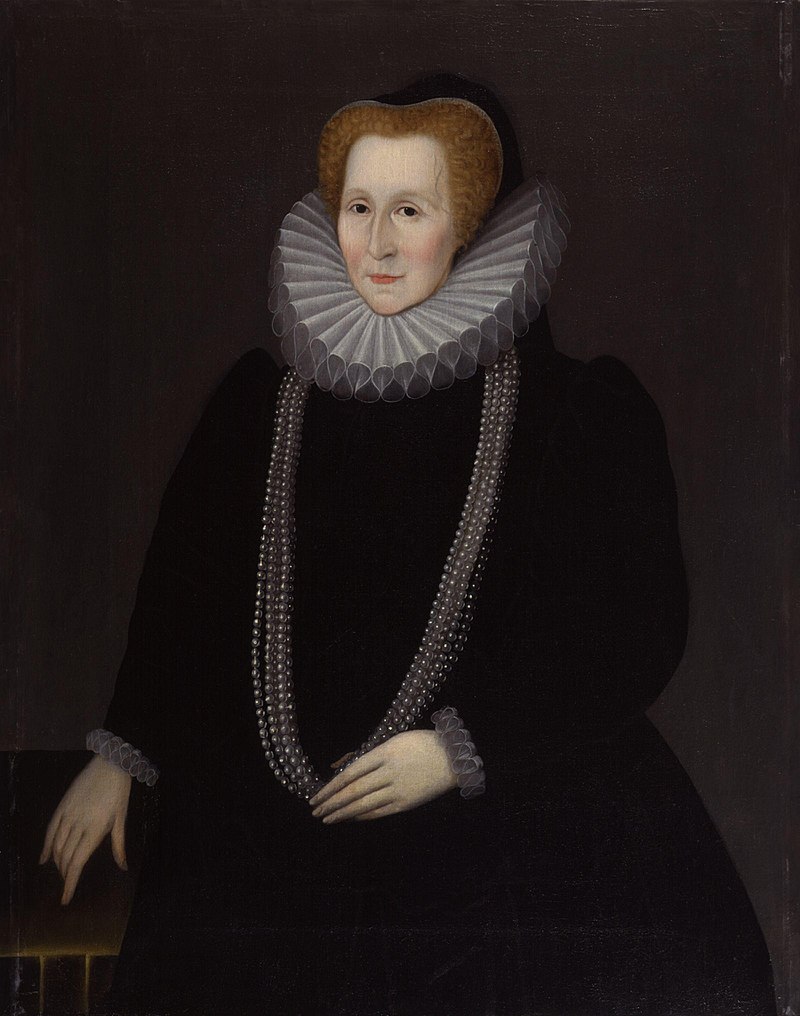
Bess of Hardwick
Carol Ann: The women! (Sharon: Yes! This is why we get along so well!) I love Tudor women. Of course, the Queens and the Queen Consorts are terrific. But so many other women are fascinating. Right now, I’m digging into Bess of Hardwick. She blows my mind. She was born around 1520 to a small landowner in Hardwick. The family had some standing, but when Bess’s father John. Hardwick died, the King took control of the lands because the John’s oldest son was just two years old. Bess was around 15 when she married the first time, but Robert Barlow died about 18 months later and she was a widow. She then married Sir William Cavendish of Chatsworth, gaining land and money. Bess and Cavendish had several children, and Bess enjoyed supervising the building works. But Sir William was accused of embezzlement and went into debt, and his death brought her into debt. She became a lady-in-waiting to Elizabeth I and met Sir William St Loe, who became her third husband. She was able to indulge in her passion for building, and the couple seem to have been genuinely in love (if their letters are to be believed).
When St Loe died, his daughters from his first wife had been excluded from his will. Bess’s reputation was tarnished. Still, she was very well off and returned to her home at Chatsworth. When she returned to court in 1566, she met and charmed the very wealthy George Talbot, marrying him in 1567 and becoming the Countess of Shrewsbury. This final marriage was a stormy one, not all that surprising as the couple had to play host to Mary, Queen of Scots. Although Bess and Mary seemed to get along well initially, working on embroidery together, as time went on the relationship soured. Bess also fell out of favour with Queen Elizabeth, although she tried to present herself as one of the Queen’s “most true and faith servants”. It was not entirely successful. Bess hoped her granddaughter Arbella, whom she helped raise, would become Queen after Elizabeth’s death. Her rocky marriage with Shrewsbury ended with his death in 1590. Bess moved back to Hardwick, where she built the new Hardwick Hall (known for being “more glass than wall”). She outlived Elizabeth I and saw James VI of Scotland succeed the English Queen. Bess of Hardwick died in 13 February, around 87 years old. She outlived four husbands and several monarchs (Henry VIII, Edward VI, Jane, Mary I, and Elizabeth I). What an inspiration for making the most of every opportunity!
Sharon: Who is your favourite Tudor and why?
Carol Ann: Anne Boleyn. I know it’s a cliché, but I can’t help it. She caught my eye when I was just a kid, watching the PBS (originally BBC) production of The Six Wives of Henry VIII. I saw how she was standing up to the men around her, and I was hooked. She is complicated, both generous and selfish, intelligent and foolish, ambitious and over-reaching. Everything about her intrigues me.
Sharon: Who is your least favourite Tudor and why?
Carol Ann: I’m not crazy about either of Jane Seymour’s brothers. I think they are self-absorbed and ruthless, with little or no thought to the people around them.
Sharon: How do you approach researching your topic?
Carol Ann: I love reading. I can start reading one article, find a reference to something that sounds interesting, and then I’m off down that rabbit hole. More often than not, that new area leads me into several more. There is nothing more fun for me than just losing myself in the little details and wonderful stories of history! I know I should be much more organized, so I’m afraid my approach also includes a lot of “where did I write that down?” searches through piles of paper as well.
Sharon: Tell us your ‘favourite’ true historical story you have come across in your research.
Carol Ann: Anne Boleyn and the Thomas Wyatt versus Henry VIII game of bowls story. Which might or might not be “true”, but it’s in some accounts.
Sharon: Tell us your least ‘favourite’ true historical story you have come across in your research.
Carol Ann:Katherine Parr helping Thomas Seymour hold Elizabeth down while he cut her dress to shreds. I hope against hope she was doing so because her presence there was the only way she could limit how far he would go. But it’s a tough story to read.
Sharon: Are there any other eras you would like to write about?
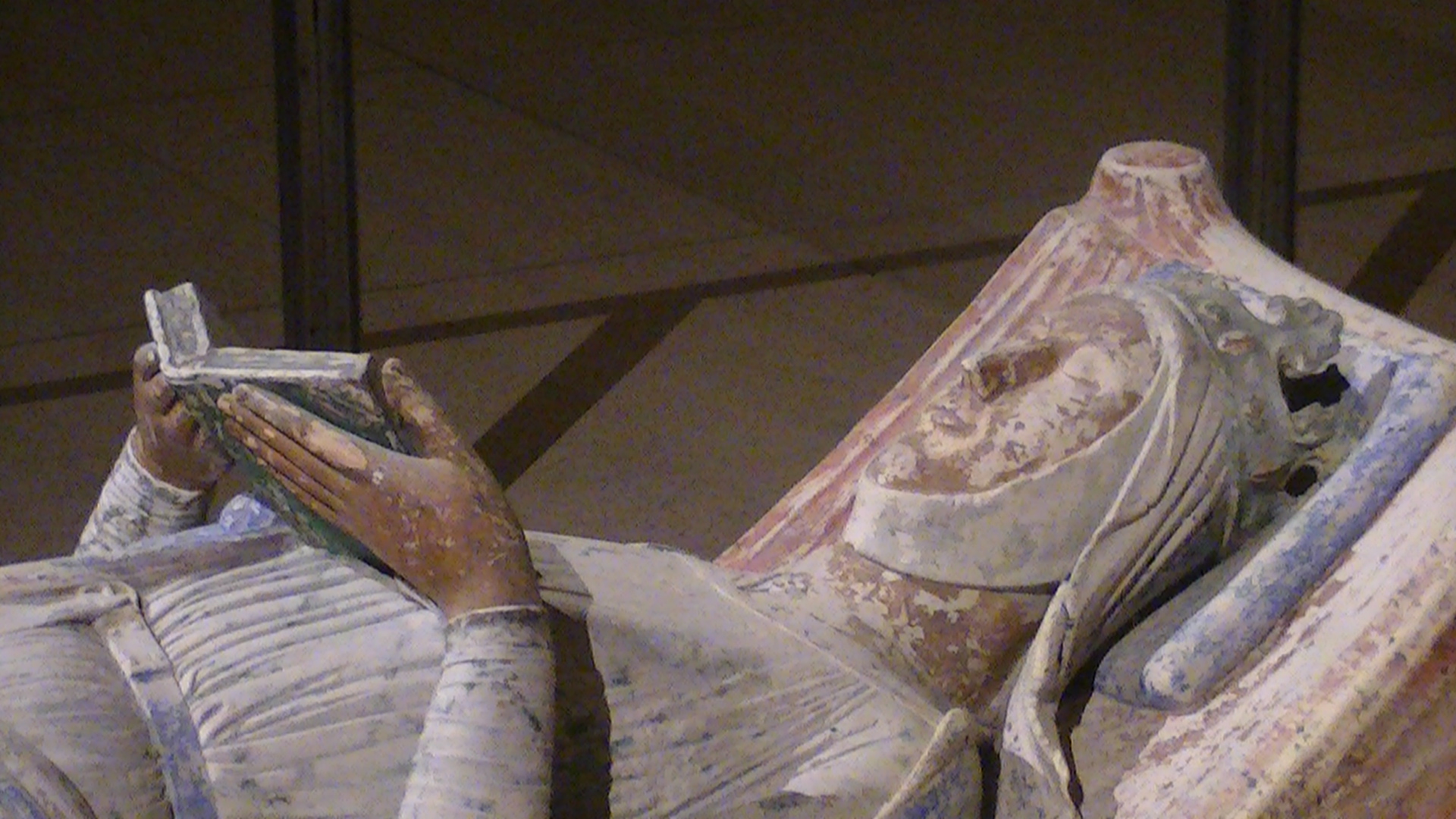
Eleanor of Aquitaine
Carol Ann: I’m working on a book now that starts in early times with the story of King Arthur and then highlights the time of Eleanor of Aquitaine. I am crazy about her, and it’s been great to explore her through this book. I would love to spend more time there. (Sharon: Oooooh, that sounds amazing. Can’t wait!)
Sharon: What are you working on now?
Carol Ann: I’m working on a book about the history of courtly love (and a bit about chivalry as well), looking closely at two of my favorite historical women: Eleanor of Aquitaine and Anne Boleyn. Two queen consorts who completely rewrote the book and who played courtly love at the highest levels.
Sharon: And finally, what is the best thing about being a writer?
Carol Ann: I love research! (Sharon: oh, me too!) I love traveling to England and heading to the National Archives at Kew and the British Library. I remember holding a seal of Henry VIII and one of Elizabeth I in my hands. In MY hands. It was amazing. I also was able to see the letters patent creating Anne Boleyn as Marchioness of Pembroke at the British Library. The falcon emblem was blazing with gold leaf and nearly as large as my hand. I couldn’t believe I was not dreaming. I also love researching closer to home at Folger Shakespeare Library. Again, I can’t believe I’m holding a document signed by Elizabeth I. I even have been in the room with her red velvet Bible. How can anything match that?!
About the author:
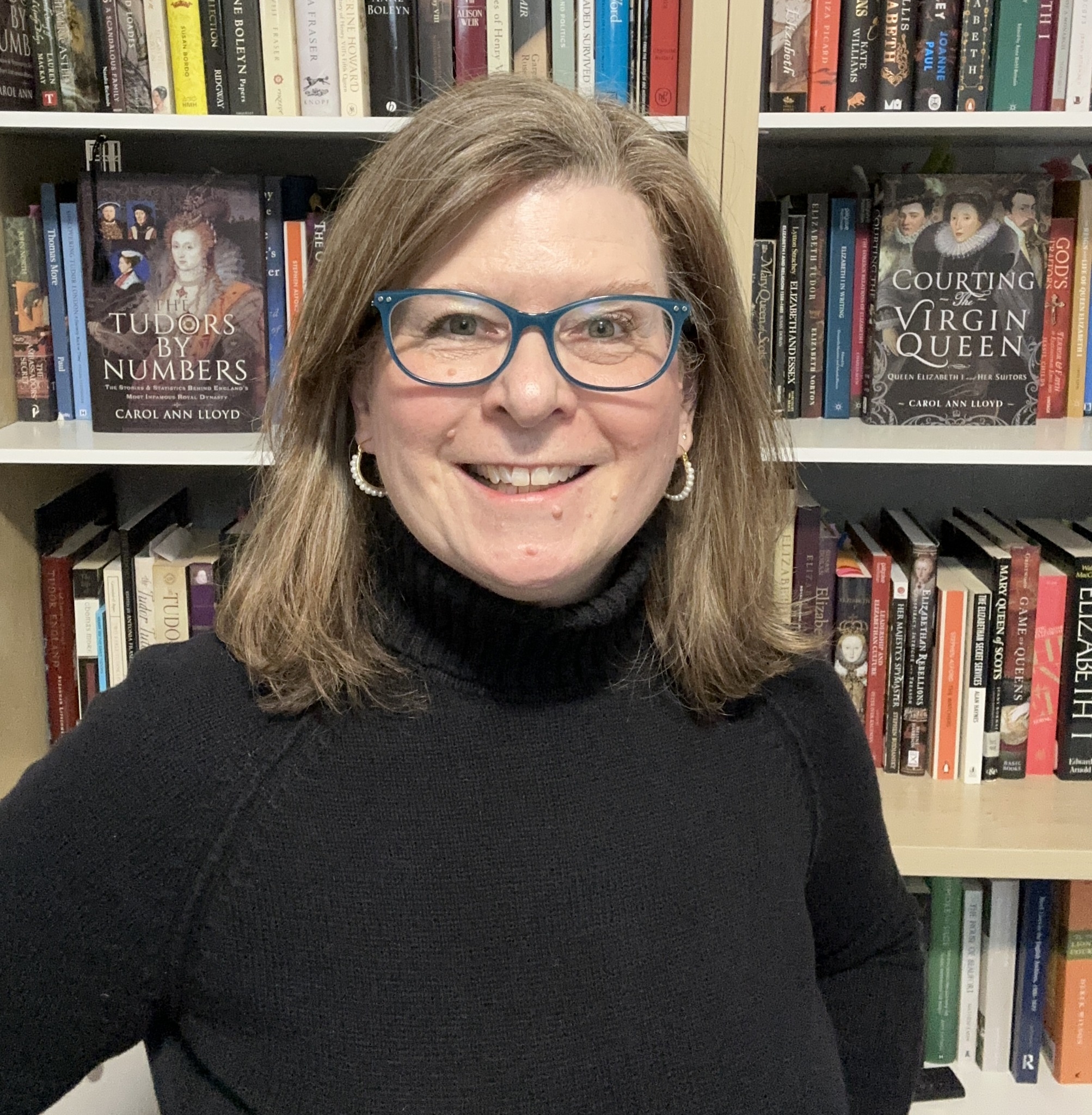
Carol Ann Lloyd turned an obsession with the Tudors into a speaking and writing career. She shares her love of history with Smithsonian Associates, Royal Oak Foundation, Agecroft Hall, Folger Shakespeare Library and other organizations. She holds degrees in Literature and Education and hosts a popular podcast, _British History: Royals, Rebels, and Romantics_. She also offers workshops about using Shakespeare strategies to improve communication skills and is a member of National Speakers Association.
Coming 30 March 2026: Princesses of the Early Middle Ages
Daughters of kings were often used to seal treaty alliances and forge peace with England’s enemies. Princesses of the Early Middle Ages: Royal Daughters of the Conquest explores the lives of these young women, how they followed the stereotype, and how they sometimes managed to escape it. It will look at the world they lived in, and how their lives and marriages were affected by political necessity and the events of the time. Princesses of the Early Middle Ages will also examine how these girls, who were often political pawns, were able to control their own lives and fates. Whilst they were expected to obey their parents in their marriage choices, several princesses were able to exert their own influence on these choices, with some outright refusing the husbands offered to them.
Their stories are touching, inspiring and, at times, heartbreaking.
Princesses of the Early Middle Ages: Royal Daughters of the Conquest is now available for pre-order from Pen & Sword and Amazon.
Also by Sharon Bennett Connolly:
Scotland’s history is dramatic, violent and bloody and Scotland’s Medieval Queens have seen it all. This is the story of Scotland through their eyes. Available now from Amazon and Pen and Sword Books. Heroines of the Tudor World tells the stories of the most remarkable women from European history in the time of the Tudor dynasty, 1485-1603. These are the women who ruled, the women who founded dynasties, the women who fought for religious freedom, their families and love. Heroines of the Tudor World is now available from Amberley Publishing and Amazon UK.Women of the Anarchy demonstrates how Empress Matilda and Matilda of Boulogne, unable to wield a sword themselves, were prime movers in this time of conflict and lawlessness. It shows how their strengths, weaknesses, and personal ambitions swung the fortunes of war one way – and then the other. Available from Bookshop.org, Amberley Publishing and Amazon UK. King John’s Right-Hand Lady: The Story of Nicholaa de la Haye is the story of a truly remarkable lady, the hereditary constable of Lincoln Castle and the first woman in England to be appointed sheriff in her own right. Available from all good bookshops Pen & Sword Books, bookshop.org and Amazon.
Alternate Endings: An anthology of historical fiction short stories including Long Live the King… which is my take what might have happened had King John not died in October 1216. Available in paperback and kindle from Amazon.
Podcast:
Have a listen to theA Slice of Medieval podcast, which I co-host with Historical fiction novelist Derek Birks. Derek and I welcome guests, such as Ian Mortimer, Bernard Cornwell, Elizabeth Chadwick and Scott Mariani, and discuss a wide range of topics in medieval history, from significant events to the personalities involved.
Just over a year ago I spent a fabulous weekend at the Historical Novel Society Conference at Dartington Hall in Devon. Derek and I hosted a panel under our A Slice of Medieval podcast banner, featuring Elizabeth Chadwick, David Gilman and Matthew Harffy. Bernard Cornwell was on before us and Ian Mortimer followed us onto the stage. I got to meet some of my heroes. Ian Mortimer was lovely to chat to. Michael Jecks told some great stories, one featuring a late-night hotel fire alarm. Steven A. McKay and I talked like old friends, even though it was the first time we had actually met. I got to discuss Emma of Normandy with Patricia Bracewell and medieval Yorkshire with Claire Dunn (C.F. Dunn).
It was a fabulous weekend! And amidst it all I had a chat with Rosemary Griggs. It was cut short because Rosemary knows the area well and was on her way to give a tour of the gardens. So, I was over the moon when Rosemary agreed to participate in my Wordly Women series, so we could have a proper natter!
And Rosemary is another champion of highlighting those women who should be better known to history!
Sharon: Hi Rosemary, welcome to the blog. First and foremost, what got you into writing?
Rosemary: I’ve always wanted to write; ever since a truly inspirational teacher at primary school encouraged me and also sparked my lifelong interest in history. Over the years, I’ve done a lot of writing of one sort or another. I even once won a prize in a travel writing competition. However, during my Civil Service career, I had to write speeches for government ministers and create carefully crafted policy advice; all rather dry! It’s wonderfully freeing that I can now tell the stories of some truly amazing women who lived in sixteenth century Devon.
Sharon: Tell us about your books
Rosemary: Having spent years delving into Devon’s past, I’ve become particularly fascinated by the Champernowne family. They rose to prominence in the sixteenth century as part of a closely connected network of powerful figures whose influence extended far beyond the county. Within their circle were the likes of Raleigh, Drake, Hawkins, and Grenville—names that still resonate today. Yet, the women are so often forgotten. In my “Daughters of Devon” novels, I bring into the spotlight women often overshadowed by their famous menfolk.
My first novel, A Woman of Noble Wit, is the story of Katherine Champernowne, Sir Walter Raleigh’s mother.
Next to catch my eye was a young French Huguenot woman, daughter of the man who killed King Henri II of France in a jousting accident. Although born in France, Lady Gabrielle Roberda Montgomery married into the Champernowne family and spent most of her adult life at Dartington Hall in Devon. I became so fascinated by the challenges she faced as an incomer to Elizabethan England that her story has spilled into two volumes, The Dartington Bride and recently published Mistress of Dartington Hall.
A lot of other Daughters of Devon are waiting to have their stories told.
Sharon: What attracts you to the Tudor period?
Rosemary: My fascination with the Tudor era began with the larger-than-life characters of the royal court. I’m as enthralled by the tales of Henry VIII and his queens as anyone. However, during that tumultuous period, immense social, political, and religious changes affected everyone, regardless of their wealth. The late fifteenth century saw the printing press’s arrival, which opened up learning and information to a wider audience, including many women. It was an ‘information revolution’, not unlike the transformative changes I’ve witnessed in my own life, especially since the internet was born. It’s working out how ordinary people, especially women, managed in such a rapidly changing world that keeps me rooted in those turbulent Tudor years.
Sharon: Who is your favourite Tudor and why?
Rosemary: Elizabeth I is the one who most fascinates me. Her 45-year reign brought stability after years of turmoil. People remember her as an intelligent, politically astute and powerful ruler. She had a formidable education, becoming fluent in multiple languages. Like many people, I admire Elizabeth for her wit and for her determination. I had always seen the defeat of the Spanish Armada as her greatest victory. However, as I was researching for my latest book, I discovered another side to her character. The queen’s reluctance to pay the soldiers and sailors needed to repel the Spanish invasion, or to provide enough arms and munitions was extremely frustrating for her commanders. Without that change in the wind, the outcome could have been very different.
My current research has also brought home to me how perilous Elizabeth’s life was in the years before she came to the throne. Having survived against the odds; she defied expectations by never marrying. Elizabeth was incredibly clever as she played off her various suitors to maintain or forge political alliances. She gave up a lot to rule alone. I would dearly love to be able to ask her what really happened with Thomas Seymour and whether she ever regretted not marrying Dudley.
Sharon: Who is your least favourite Tudor and why?
Rosemary: It would be easy to plump for Henry VIII as the ruthless tyrant he became in his later years. But I have a soft spot for the charismatic, intelligent young man who became king in1509. Instead, I’d go for his father, Henry VII, who has always seemed to me to be a rather cold, calculating type. Perhaps he had to be to return from exile to wrest the throne from Richard III on the battlefield. Yet I can’t forgive him for executing poor Edward of Warwick, or for his treatment of Catherine of Aragon after Prince Arthur died. Somehow, I cannot warm to Henry VII.
Sharon: How do you approach researching your topic?
Rosemary: I always start with original source documents relating to my character. Then I widen the net to consider what surviving documents reveal about those around them. I’m never happier than when I’m poring over a difficult text in the archives.
I’ve chosen a hard path, as I’m researching women whose imprint on the record is light. I can usually discover much more about the men in their lives, but eventually I’m armed with some key events taken from the record. These form the milestones on my subjects ’journeys through life, and I respect them absolutely. However, the beauty of writing fiction is that I can fill the gaps with creative imagination to weave a plausible narrative around those key events. To do that, I study every detail of Tudor life. I read widely about national events; I sift through accounts of local happenings. I question everything. I also visit the places they knew; I dress as they did. I all brings me closer to their world.
Sharon: Tell us your ‘favourite ’Devon story you have come across in your research.
Rosemary: My favourite Devon story doesn’t concern one of the ‘elite ’women I write about. Rather, it is an incident that brings one of the ordinary women of history briefly to our attention. In the mid-1530s, when Thomas Cromwell’s commissioners instructed a man to tear down St Nicholas Priory’s Church in Exeter, Elizabeth Glanfield gathered her friends and neighbours. They would allow no one to desecrate their beloved priory church without a fight. Grabbing brooms, shovels and staves, the pack of women descended on the worker who was dismantling the rood screen. The terrified man climbed high, but the women pursued him until he fell, breaking his arm. Eventually, the mayor of Exeter restored order. When the great and good sat in judgement on Elizabeth and her friends, they expressed the view that men disguised as women perpetrated the attack. Mere women, they suggested, could not be capable of such an act. Fortunately, Elizabeth and her friends escaped serious punishment. However, they did not save their church. Eventually, workers returned to demolish the church. They used some of the stone to repair the Exe bridge into the city. Parts of the priory buildings survived to be converted into an Elizabethan townhouse. Elizabeth Glanfield and the rioting women of Exeter are a rare example of local people resisting the dissolution of the monasteries. There is a longer version of this story on my website.
Sharon: Tell us your least ‘favourite’ Devon story you have come across in your research.
Rosemary: My least favourite is also about another ordinary woman and her appalling fate, although it has also been a tremendous source of inspiration for me. During the reign of Edward VI, Agnes Prest, a poor, uneducated Cornish woman, had heard the scriptures in a language she could understand. Queen Mary insisted she return to the old ways of worship under the Church of Rome. Agnes could not accept what she was being told to believe. The worst part of her story is that her own family, including her husband, ‘shopped ’Agnes to the church authorities. The Bishop of Exeter and all the high-ups of the church summoned Agnes and questioned her. She refused to yield. Eventually, they took Agnes to the prison cells beneath Exeter’s Rougemont Caste. In the second edition of his ‘Book of Martyrs’, Foxe mentions that a gentlewoman, Katherine Raleigh, visited Agnes. In August 1557, that poor Cornish woman walked the short distance from her prison cell to the area of Exeter we now call Southernhay, where she was burned at the stake. She was Exeter’s only Protestant martyr during the reign of Queen Mary.
Sharon: Are there any other eras you would like to write about?
Rosemary: I’ve often thought I could find some strong Devon women who played their part during the English Civil War. However, while recovering from Covid recently, I watched a lot of TV adaptations of Jane Austen novels. I’m now quite drawn to that time too.
Sharon: What are you working on now?
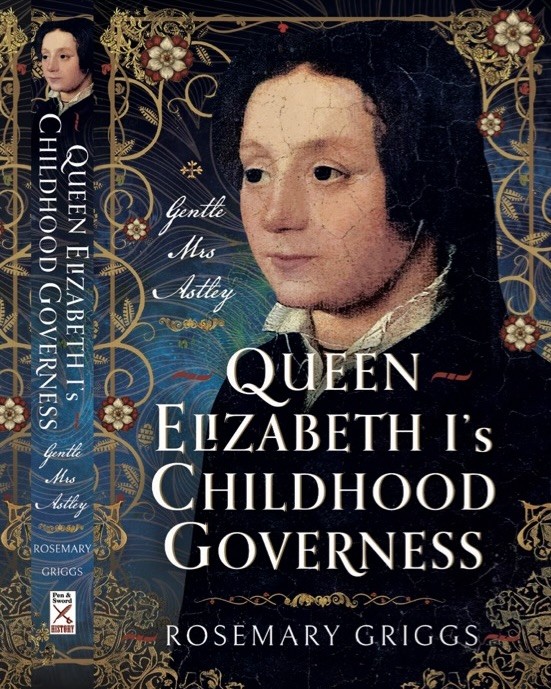
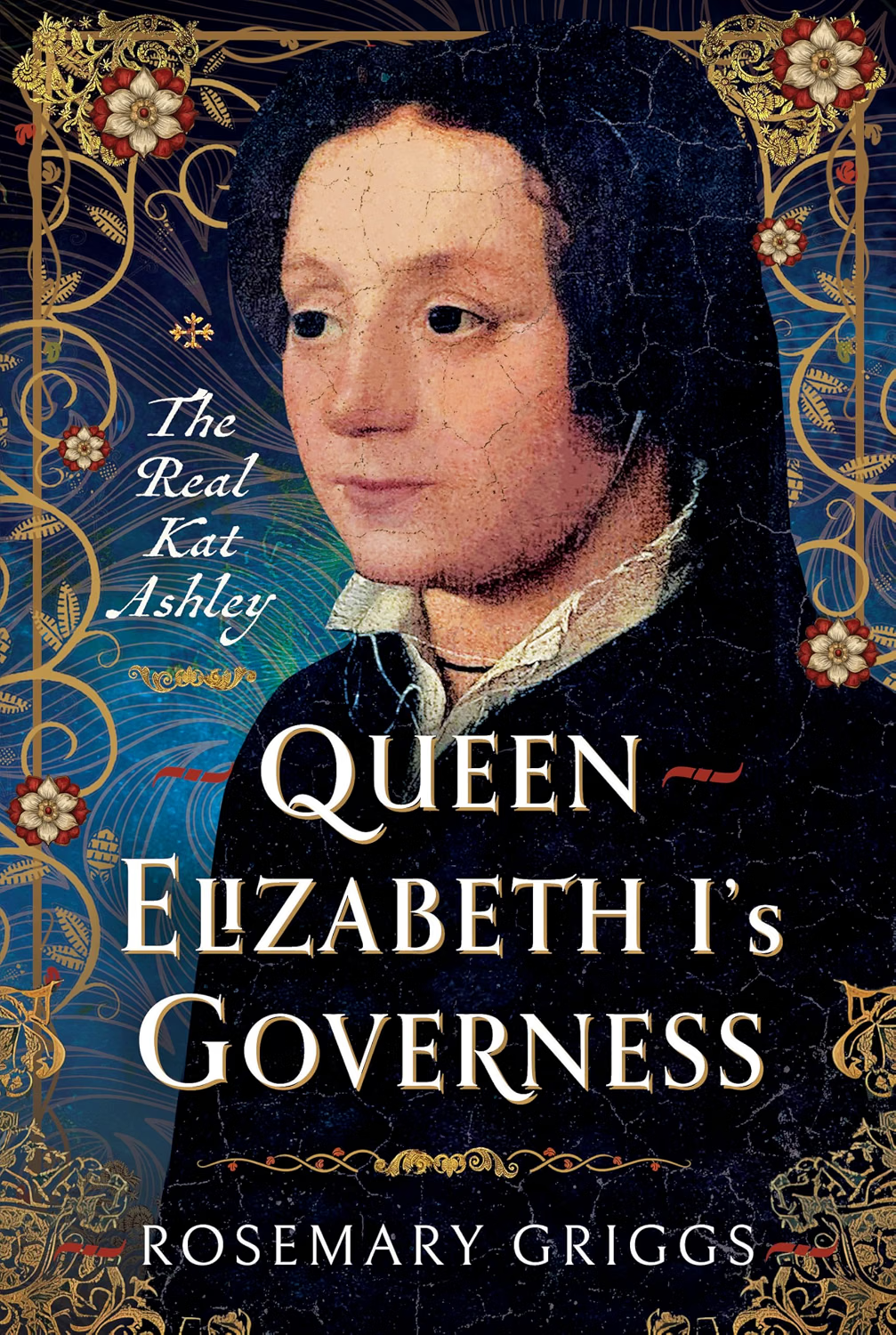
Rosemary: I’m very excited about my current project, my first work of nonfiction. A woman connected to the Champernownes has elbowed her way to the front of the queue of women whose stories I want to tell. Fans of Tudor history know her as Kat Ashley, Queen Elizabeth’s childhood governess. When I began mapping out a fictional account of her life, I found the character emerging from my detailed research was a little different from the woman familiar to us. Going back to the original sources made me question the accepted narrative. I had also discovered some interesting details historians seem to have overlooked. So, I am thrilled that Pen and Sword Books are giving me the opportunity to set out all of my research into this fascinating woman who had so much influence on Elizabeth I. Here is the fantastic jacket design. We are targeting publication summer of 2026.
Sharon: I’m looking forward to getting my hands on a copy – and don’t Pen & Sword do the most gorgeous covers?
Sharon: And finally, what is the best thing about being a writer?
Rosemary: Opening that box, holding your book for the first time is very special. But above all, it is when people tell me my story transported them back in time and they’ve enjoyed reading it, or even that it’s made them think. That’s what makes it all worthwhile.
About the Author:
Rosemary Griggs is an author, researcher, seamstress and popular West Country speaker. She has a particular interest in Devon’s sixteenth-century history and the Champernowne family.
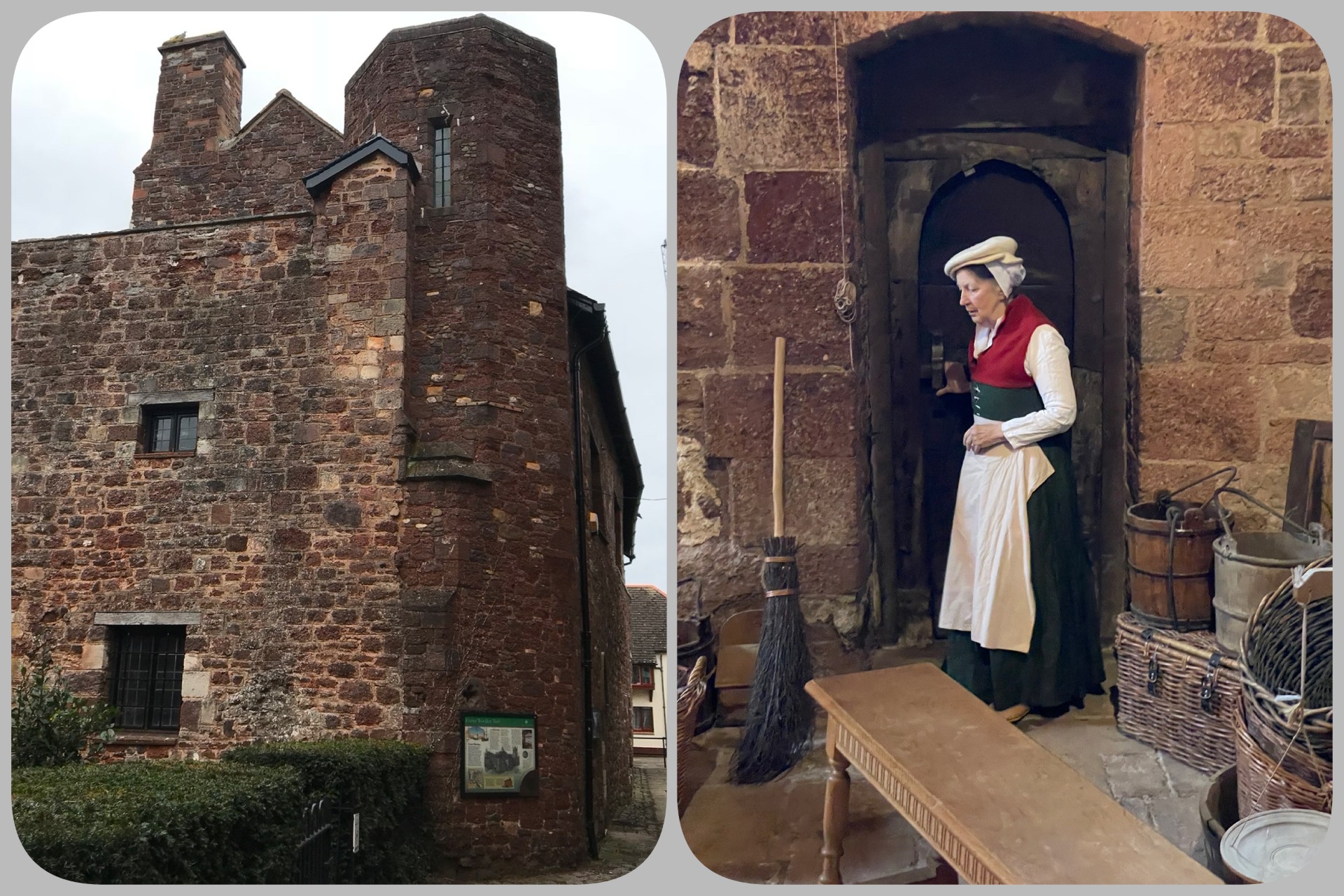
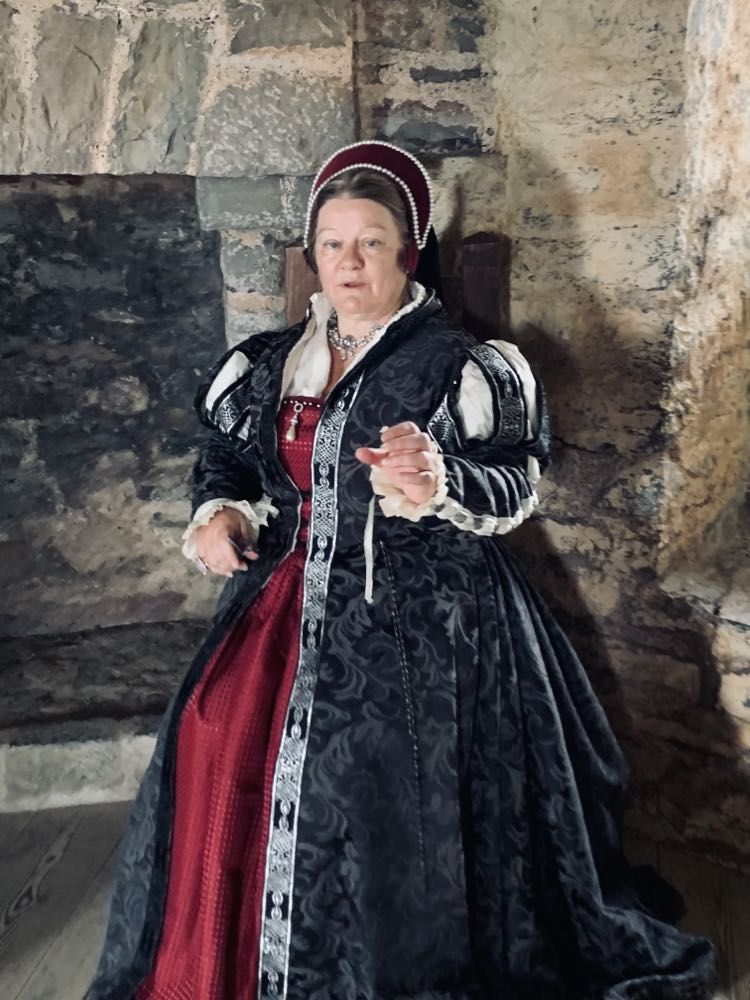
She loves telling the stories of the forgotten women of history; wives, sisters, daughters and mothers who played their part during the tumultuous Tudor years: the Daughters of Devon. Rosemary also researches, creates and wears sixteenth-century clothing. She brings the past to life through a unique blend of theatre, history and re-enactment at appearances and talks for museums and community groups all over the West Country. Out of costume, Rosemary leads heritage tours of the gardens at Dartington Hall, a fourteenth-century manor house in rolling south Devon parkland near Totnes.
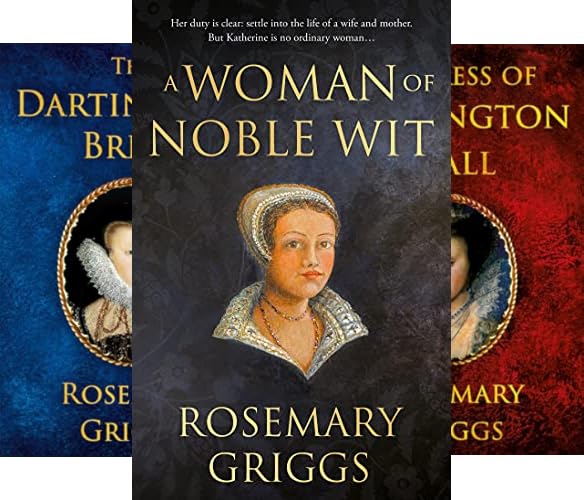
All three books are available as paperbacks from UK bookshops, and as Ebook worldwide. The first two are also available as audible: Rosemary’s bookshop; Amazon UK; Amazon US.
*
My Books
Signed, dedicated copies of all my books are available through my online bookshop.
Out now: Scotland’s Medieval Queens
Scotland’s history is dramatic, violent and bloody. Being England’s northern neighbour has never been easy. Scotland’s queens have had to deal with war, murder, imprisonment, political rivalries and open betrayal. They have loved and lost, raised kings and queens, ruled and died for Scotland. From St Margaret, who became one of the patron saints of Scotland, to Elizabeth de Burgh and the dramatic story of the Scottish Wars of Independence, to the love story and tragedy of Joan Beaufort, to Margaret of Denmark and the dawn of the Renaissance, Scotland’s Medieval Queens have seen it all. This is the story of Scotland through their eyes.
‘Scotland’s Medieval Queens gives a thorough grounding in the history of the women who ruled Scotland at the side of its kings, often in the shadows, but just as interesting in their lives beyond the spotlight. It’s not a subject that has been widely covered, and Sharon is a pioneer in bringing that information into accessible history.’ Elizabeth Chadwick (New York Times bestselling author)
Heroines of the Tudor World tells the stories of the most remarkable women from European history in the time of the Tudor dynasty, 1485-1603. These are the women who ruled, the women who founded dynasties, the women who fought for religious freedom, their families and love. Heroines of the Tudor World is now available for pre-order from Amberley Publishing and Amazon UK.Women of the Anarchy demonstrates how Empress Matilda and Matilda of Boulogne, unable to wield a sword themselves, were prime movers in this time of conflict and lawlessness. It shows how their strengths, weaknesses, and personal ambitions swung the fortunes of war one way – and then the other. Available from Bookshop.org, Amberley Publishing and Amazon UK. King John’s Right-Hand Lady: The Story of Nicholaa de la Haye is the story of a truly remarkable lady, the hereditary constable of Lincoln Castle and the first woman in England to be appointed sheriff in her own right. Available from all good bookshops Pen & Sword Books, bookshop.org and Amazon.
Alternate Endings: An anthology of historical fiction short stories including Long Live the King… which is my take what might have happened had King John not died in October 1216. Available in paperback and kindle from Amazon.
Podcast:
Have a listen to theA Slice of Medieval podcast, which I co-host with Historical fiction novelist Derek Birks. Derek and I welcome guests, such as Bernard Cornwell and Elizabeth Chadwick, and discuss a wide range of topics in medieval history, from significant events to the personalities involved.
Today, it is a pleasure to welcome Susan Abernethy back to History… the Interesting Bits, to chat about her fabulous new book, The Formidable Women Who Shaped Medieval Europe: Power and Patronage at the Burgundian Court.
How I Decided to Write The Formidable Women Who Shaped Medieval Europe: Power and Patronage at the Burgundian Court
It all started with the random purchase of a used copy of a biography of Isabel of Portugal by Aline S Taylor. It just so happened that Isabel was the daughter of King John I of Portugal and Philippa, daughter of John of Gaunt, Duke of Lancaster and son of King Edward III of England. To my surprise, Isabel was married, at the venerable age of 33, to Philip the Good, Duke of Burgundy as his third wife. At the time, I had no idea who Philip was and knew nothing about the duchy of Burgundy.
Isabel had a son who succeeded his father with the moniker of Charles the Bold. It turned out I owned a reprint of a turn of the century biography of Charles by Ruth Putnam in my library. Both Isabel and Charles greatly intrigued me as tenacious and resolute characters. I had to learn more. My research began with Putnam’s biography and progressed to the four volume biographies of each of the Valois dukes of Burgundy by Richard Vaughan.
As my knowledge of Burgundian history expanded, more women in history emerged. From the wives, daughters, grand-daughters and nieces, they were all used as pawns in the dukes’ diplomatic efforts to expand as well as govern the Burgundian Empire. The dukes could not have amassed their empire, the size of England and Wales combined, without their women. Some of these women lived lives of comfort and supreme authority while others were relentlessly bullied and badgered into surrendering their patrimony. This book is a collection of thirty-one of these women, related to the Valois dukes by blood, marriage and politics.
Isabel of Portugal
Many of them had a major role in the history of Western Europe, spreading their influence across numerous countries, including France, Germany, England, the Low Countries, Italy, Spain and many more. The first chapter of the book is a concise summary of how the Valois dukes grew their empire, beginning with the death of the Philip I, the last duke of the House of Burgundy. With his death, the duchy of Burgundy reverted to the French crown, and it was up to King John II of France to determine its fate. John had a younger son, Philip, who had distinguished himself as a fighter during the Hundred Years’ War.
As a reward for his faithful service, his father gave him the duchy of Touraine. Philip would later trade this small principality for the more prestigious duchy of Burgundy in 1363. He had a long-time dream of merging his new duchy to the county of Burgundy, otherwise known as the Franche-Comté and to do this, he needed to marry the heiress. So in the summer of 1369, he married Margaret of Male, who stood to inherit not just the Franche-Comté, but also Flanders and the counties of Rethel and Nevers, along with other territories.
So we have the first formidable woman, Margaret of Male, who not only gave birth to many children but aided her husband in ruling his newly acquired conglomeration of territories. Philip the Bold instituted a deliberate program of marrying his daughters into various regions around his provinces, not just as respectable mates for the grooms but to increase his territories. Richard Vaughan says Philip the Bold was one of the most talented diplomats of his age.
Margaret of Male
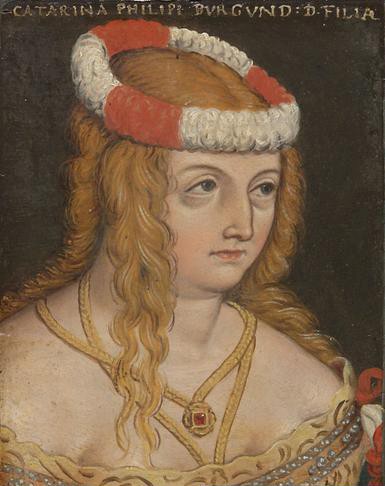
Two of Margaret’s daughters were exceedingly influential but for different reasons. One of my favorite discoveries in writing this book was Catherine of Burgundy, Duchess of Austria and Countess of Ferrette. Philip had is eye on the county of Ferrette (now a part of Alsace in northeastern France), which was under the influence of Leopold IV, Duke of Austria. Catherine’s marriage to Leopold would be a success in that the couple got along well; however, they had no children. When Philip the Bold failed to pay Catherine’s dowry she convinced Leopold to grant her the governance of the county of Ferrette which would give her an income.
She ruled the county competently, acting as a diplomat for her Burgundian ducal brother and nephew, John the Fearless and Philip the Good respectively, making economic and trade alliances and waging petty wars in the surrounding area. Catherine is one of the few women I’ve found who operated as a man would have in the medieval era which makes her pretty unique. Even more exceptionally, once Catherine became a widow, she married a handsome young nobleman without her brother’s permission, to the astonishment of just about everyone around her. She certainly must have been charming and persuasive.
Catherine’s sister Mary married Amadeus VIII, Duke of Savoy in the spring of 1401 but did not arrive in her new home until September 1403. Mary and Amadeus had many children, the most influential being their son Louis, who succeeded his father as duke of Savoy in 1440. He married Anne of Cyprus and together they had about nineteen children. Mary of Burgundy’s legacy lies among these grandchildren.
Catherine of Burgundy
Louis and Anne of Cyprus’ eldest son, Amadeus IX, married Yolande of France, the daughter of King Charles VII and Marie of Anjou. Yolande’s story looms large as one of the formidable women in the book. At the age of two, she left France to live in Savoy to be educated and to learn the language and customs of her new home. Her husband died young from various congenital ailments and Yolande acted as regent for her son during his minority.
As the leader of her country, Yolande became entangled in the web of the Spider King, her brother Louis XI of France and his mortal enemy, Charles the Bold, Duke of Burgundy as well as her numerous brothers-in-law and the crafty Duke of Milan. With authority and finesse, Yolande navigated these treacherous times. The intrepid Yolande would be captured and held captive twice along with her children. In both cases, she made brave and daring escapes.
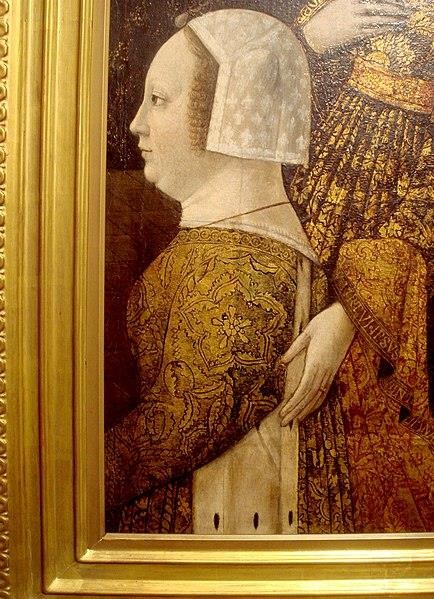
Louis and Anne of Cyprus had two other daughters who made their mark in history. At one time, the English monarch Edward IV considered Bona of Savoy as a wife. The negotiations stalled when Edward married the enchanting Elizabeth Woodville in 1464. By 1468, negotiations for her marriage to Galeazzo Maria Sforza, Duke of Milan were completed. Bona immediately gave birth to an heir and spare and modelled the perfect Italian Renaissance wife as her husband descended into paranoia and mental illness.
Bona of Savoy
When Galeazzo Maria was assassinated in 1476, Bona acted as regent for her minor son. At first, she met with great success but eventually she ran into trouble with her brother-in-law, Ludovico Sforza, who wrested power from her, forcing her to struggle for the rest of her life with being separated from her children and inconsistent income.
Bona’s sister Charlotte of Savoy married the Spider King Louis XI of France when she was nine years old and Louis twenty-seven. Of course, the marriage was not consummated until Charlotte came of age and she had three remarkable children. Her son would succeed his father in 1483 as King Charles VIII. Her daughter Anne of France, Duchess of Bourbon acted as regent for her minor brother for eight years and steered France through several crises.
Anne’s greatest achievement would be the annexation to France of the significant duchy of Brittany, one of her lifelong dreams, when her brother married the Breton duchess, Anne. Charlotte’s youngest daughter, Jeanne, born with several severe disabilities, would eventually become Queen of France as the wife of King Louis XII. The marriage would be extremely unhappy, and Louis XII did all in his power to obtain a divorce. After numerous attempts and following the payment of an enormous bribe to Pope Alexander VI, he obtained his annulment, and Louis XII married the widowed queen, Anne of Brittany.
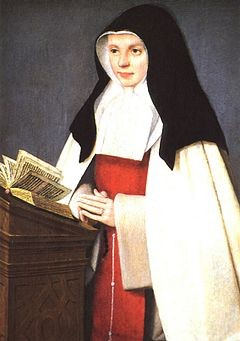
Jeanne of France
King Louis made sure Jeanne had abundant properties to guarantee a steady and ample income. Jeanne had a lifelong dream of living a monastic life. She used her funds to successfully build a convent and found a monastic order in Bourges. Her Order of the Virgin Mary, dedicated to the Renunciation, was so successful, it is still in existence to this day in monasteries in France, Belgium, Poland, Costa Rica, Guatemala and Africa. Jeanne was canonized in May 1950.
These and other stories of courageous, intelligent, audacious and fearless women populate this book. Some of the relationships between the women are complex so included in the back of the book are several family trees that illustrate their associations. We are lucky enough to have numerous portraits of most of the women in the collection and these are included in the plate section. My purpose in writing the book is to feature these women and shed light on the history of the Burgundian Empire.
Susan’s passion for history dates back fifty years and led her to study for a Bachelor of Arts degree in history at the University of North Carolina at Charlotte. She is currently a member of the Rocky Mountain Medieval and Renaissance Association, the Society for Renaissance Studies, The Historical Writers Association, and the Historical Association. Her work has appeared on several historical websites and in magazines and includes guest appearances on historical podcasts. Her blog, The Freelance History Writer, has continuously published over five hundred historical articles since 2012, with an emphasis on European, Tudor, Medieval, Renaissance, Early Modern and women’s history. She is currently working on her third non-fiction book.
*
My Books:
Signed, dedicated copies of all my books are available through my online bookshop.
Out now: Scotland’s Medieval Queens
Scotland’s history is dramatic, violent and bloody. Being England’s northern neighbour has never been easy. Scotland’s queens have had to deal with war, murder, imprisonment, political rivalries and open betrayal. They have loved and lost, raised kings and queens, ruled and died for Scotland. From St Margaret, who became one of the patron saints of Scotland, to Elizabeth de Burgh and the dramatic story of the Scottish Wars of Independence, to the love story and tragedy of Joan Beaufort, to Margaret of Denmark and the dawn of the Renaissance, Scotland’s Medieval Queens have seen it all. This is the story of Scotland through their eyes.
‘Scotland’s Medieval Queens gives a thorough grounding in the history of the women who ruled Scotland at the side of its kings, often in the shadows, but just as interesting in their lives beyond the spotlight. It’s not a subject that has been widely covered, and Sharon is a pioneer in bringing that information into accessible history.’ Elizabeth Chadwick (New York Times bestselling author)
Heroines of the Tudor World tells the stories of the most remarkable women from European history in the time of the Tudor dynasty, 1485-1603. These are the women who ruled, the women who founded dynasties, the women who fought for religious freedom, their families and love. Heroines of the Tudor World is now available for pre-order from Amberley Publishing and Amazon UK.Women of the Anarchy demonstrates how Empress Matilda and Matilda of Boulogne, unable to wield a sword themselves, were prime movers in this time of conflict and lawlessness. It shows how their strengths, weaknesses, and personal ambitions swung the fortunes of war one way – and then the other. Available from Bookshop.org, Amberley Publishing and Amazon UK. King John’s Right-Hand Lady: The Story of Nicholaa de la Haye is the story of a truly remarkable lady, the hereditary constable of Lincoln Castle and the first woman in England to be appointed sheriff in her own right. Available from all good bookshops Pen & Sword Books, bookshop.org and Amazon.
Alternate Endings: An anthology of historical fiction short stories including Long Live the King… which is my take what might have happened had King John not died in October 1216. Available in paperback and kindle from Amazon.
Podcast:
Have a listen to theA Slice of Medieval podcast, which I co-host with Historical fiction novelist Derek Birks. Derek and I welcome guests, such as Bernard Cornwell and Elizabeth Chadwick, and discuss a wide range of topics in medieval history, from significant events to the personalities involved.
It is time for another edition of Wordly Women! And today I am chatting with an author who, like me, likes to bring historical female characters to the fore, from the early medieval to the Tudors. She has also written a fabulous trilogy on Henry VIII himself. Judith Arnopp writes both historical fiction and non-fiction and has a wonderful back catalogue for you to explore, if you have not discovered her yet. Judith is also one of those authors who is happy to share her experiences with readers and writers alike.
Hello Judith! Welcome!
Sharon: What got you into writing?
Judith: It was so long ago now I barely remember. I have always written stories, as a child I wrote things to read to my dolls who were always very appreciative. When I was about fourteen I wrote a torrid romance featuring a heroine called Rosalind and a hero named Tybalt – I bet you can’t guess where the inspiration for those names came from – lol. My best friend used to come round every evening to hear the next chapter and there’d be hell to pay if it wasn’t ready. I’d love to get my hands on it now. I bet it was dreadful!
When marriage and children came along I still managed to write stories but now they featured my kids who loved listening to themselves having adventures. It wasn’t until my daughter and three sons had grown old enough not to need me 24/7 that I enrolled at the University of Wales and did a degree in English literature and Creative Writing. I loved it so much I stayed on to do a masters in Medieval History. I would have liked to remain at uni forever but one has to leave eventually and find a proper job.
At that time, we lived on a rural smallholding, far from town and suitable jobs were few so it made sense to concentrate on what I loved and what I was reasonably good at. Historical fiction was the obvious choice and luckily the internet, which was relatively new then, made easing myself into the book world achievable, even from the wilds of Wales. There were great online groups then, like You Write On where I encountered other authors, most of whom I am still in touch with today.
Sharon: Tell us about your books.
Judith: My first published novel was Peaceweaver; the story of Eadgyth, who was consort to both Gruffydd ap Llewellyn of Wales and Harold II of England. In the recent TV debacle, King and Conqueror, they renamed her Margaret for some reason and she played a much larger role in Harold’s story. My book is set in the years leading up to the Norman Conquest, culminating just after the Battle of Hastings.
A further two novels followed, The Forest Dwellers, set in the New forest after the invasion and another, The Song of Heledd, set in 7th century Powys. My early books barely made a ripple and sales were slow but people constantly asked me if I had written anything ‘Tudor’ – in the end, I caved in and wrote The Winchester Goose. That was the jumping off point really and I spent the next few years writing about Henry VIII’s queens, The Kiss of the Concubine, the story of Anne Boleyn, Intractable Heart, the story of Katheryn Parr, and was about Henry’s daughter, Mary. Once I’d written them I began to wonder if I was ready to tackle Henry himself.
Henry VIII is a huge undertaking. He had already cropped up in most of my books, The Beaufort Chronicle which is about his grandmother Margaret Beaufort, and A Song of Sixpence which is about his mother, Elizabeth of York. During the course of skirting around the king, I realised how few books there are that look at the events from his perspective. I knew it was time to stop being afraid, and just do it.
The four years it took me to write the trilogy were hard. I know it sounds silly but Henry figured so largely in my head that he became real and as I neared his later years, it became really difficult to live in such close proximity.
The trilogy is written in Henry’s voice. I imagined him sitting with me in my office as he related his story. Sometimes he would grow so indignant, so angry, so defensive that I forgot it was simply fiction.
Henry always had the perfect excuse and if he began to feel uncomfortable while making a confession he either grew angry and stormed out or just lied. He was a very unreliable narrator, which is something I love in other people’s books and it was fun to use the device in my own work. It is up to the reader to decide how much of his revelation is truth, and how much is gloss.
But somehow, particularly as I neared the end, I was able to empathise with him. I acknowledged his many sins but I had also come to a better understanding of what drove him. I wouldn’t say I pitied him exactly but I came to regret how his life unfolded. He could have been a great king.
Sharon: What attracts you to the Tudor period?
Judith: I think it is the intrigue, the uncertainty, the politics, the unacknowledged fear that everyone walked in. And then, of course, there are the fabulous clothes. When the reenactment group was still running I used to make heaps of Tudor gowns for when I played Mary I, and doublets and gowns for my husband who played Norfolk. Ill health has forced us to stop that for a while but I’d like to do it again. With a gown like that hanging in the wardrobe, it’s a shame not to.
We know so much about the reign of Henry VIII yet there are still so many questions that will never be answered. Nobody seemed to learn from past mistakes. After the plight of Anne Boleyn, why oh why did Katherine Howard play fast and loose with the king; and what was Jane Rochford thinking to encourage the queen in such a dangerous game?
I’d like to travel back in time to visit the Tudor court to find the answers, but not as a person, I value my head too much. Perhaps I could be a bird in the rafters of the great hall, or a fly on the bedchamber wall. Or maybe one of Henry’s beloved spaniels so I could listen in while he fondled my ears – that would be safer!
Sharon: Who is your favourite Tudor and why?
Judith: It is close between Margaret Beaufort or Henry VIII. I seem to be drawn to the historical figures who are regarded as ‘baddies’ but I am always puzzled by Margaret’s bad reputation. She was strong, brave, determined and loyal yet many people are convinced she was involved in the disappearance of the princes. Online arguments can be quite heated but I don’t join in. There is little point growing hot and bothered over a supposed crime with no evidence or even the certainty that foul play even took place. It would be totally out of character for Margaret, a pious woman of unblemished reputation to resort to infanticide. I disregard the theory yet remain totally fascinated. I do have my own ideas but like everyone else’s there is no evidence.
As to why Henry is one of my favourite Tudors, I guess I already answered that in the last question but I will try to sum it up.
If you put aside the fact of his crimes and focus on his motives, he becomes rather more understandable. I often wonder what I would have done were I in his shoes. To understand him we must put aside all modern opinion and look at it entirely from the perspective of a 16th century king.
He was unexpectedly thrust into kingship. He was raised to believe that as king his will was akin to God’s. It was drummed into him that a king’s first and only duty was to produce an heir, and protect the dynasty. He knew from the experience of losing his elder brother that one son was not enough for a king. In his youth, Henry excelled at everything, from wrestling and jousting to poetry and music. To fail was unthinkable and when he began to recognise he was not fulfilling expectations, it was unbearable. Time was running out, Katherine of Aragon was no longer fertile so he kicked out like an angry toddler and in doing so destroyed his wives, his oldest friends, his mentors, and he ultimately destroyed himself and his shining, unspotted image.
Many people hate Henry and I do not in any way admire him but he is nonetheless fascinating.
Sharon: Who is your least favourite Tudor and why?
Judith: I hate to say it but I think it is Jane Seymour. Not because of modern day perceptions of her as a home wrecker but simply because unlike the other queens, she does not emerge from the historical record as a fully rounded character. Even though she is often regarded as Henry’s greatest love, it is quite likely he would have moved on if he’d had time to grow tired of her. She is a bit yawny. The only extant historic item to provide a glimmer of her inner self is her splendid portrait. (which incidentally is on the cover of my non-fiction book about Tudor clothing, How to Dress Like A Tudor.)
Jane seems quite plain to our eyes, chubby face, cheesy-green skin tone which probably has more to do with the age of the painting than Jane herself. I suppose, after Anne, anyone would seem dull and we shouldn’t really compare them. If she’d had longer to make a personal dent in history I am sure I would feel differently but the only time I have felt a spark of interest in her is Hilary Mantel’s portrayal in Bring Out the Bodies. But that is fiction and Hilary was a genius.
Sharon: How do you approach researching your topic?
Judith: I’ve been researching in one way or another for donkey’s years but it wasn’t until I went to uni that I learned how to do it properly. I’ve been writing in roughly the same era for so long that I no longer need to research as deeply I used to. When I first began I had to know everything about Tudor life, customs, clothing, diet, housing, social niceties but now it is more a case of refreshing my knowledge. I usually write in the first person and I make a point of reading several different biographies of my subject, both contemporary and modern accounts to get a rounded picture.
As I said previously, I usually opt for ‘difficult’ characters so I read both sides of the matter, question everything and make a timeline of their lives, marking where they were and when so I can follow as close as possible in their footsteps.
But I always bear in mind that both primary and secondary accounts will be biased one way or another. There are very few first-person historical accounts (Oh how I’d love a secret diary of Margaret Beaufort to be discovered) so I can only surmise their inner thoughts by careful study of recorded reactions to events.
For instance, the death of Katherine and Henry’s children. We always hear how dreadful it must have been for her to watch her offspring die, and indeed it must have been. But they were Henry’s children too. His devastation must have been equal to Katherine’s. His grief would have matched his anger at God for depriving him of an heir. Of course, he hid it, he was very proud but I can imagine the death of each child increased his already burgeoning terror that he might fail to beget a son.
But sorry, I digress. Once I have sketched the outline of the story, I put aside the huge pile of research books I’ve accumulated and let my imagination take over. During the revision process I frequently return to my research to see where or if I have diverted – sometimes I correct it, but if it adds to the drama I don’t delete the scene but I make a note of the diversion in the authors’ note.
Sharon: Tell us your ‘favourite’ Wars of the Roses story you have come across in your research.
Judith: I’ve read historical fiction since I was a girl. I always sided with York (don’t shoot me!) and enjoyed books that portrayed women like Maguerite of Anjou and Margaret Beaufort as evil intentioned. Until relatively recently, any woman that stepped from her prescribed role was viewed negatively. As a young girl I never even questioned it but these days I am more neutral. I am old enough to realise that evil is in the eye of the beholder and things just aren’t black and white.
I still enjoy books set in the era but I no longer take up arms. As in any conflict there is good and bad on both sides.
It wasn’t until I began to read in this unbiased way that I even considered questioning Marguerite of Anjou’s portrayal in both fiction and non-fiction. She really wasn’t liked then and neither is she now. Shakespeare didn’t help by naming her as the ‘she-wolf’. But when you consider the whole York/Lancaster war from her point of view, the story changes.
She is an anointed queen, her incompetent husband goes a bit crazy, York comes strutting into court demanding to be regent when she has proven herself perfectly capable in the role but, of course, she is a woman, and a French woman at that! York then names her child illegitimate and somehow has him ousted from succession.
It is no wonder she was miffed!
Marguerite fought valiantly and tirelessly for her son’s rights until his death at Tewkesbury and there was nothing left to fight for. I rather admire that. Ok, some atrocities were carried out in her name, her ungoverned armies won her few friends but York and his contemporaries also carried out atrocious acts. The murder of Henry VI by Edward IV, the drowning of Clarence in the Tower. I could provide more examples.
Atrocities happen in war.
The injustices heaped upon Marguerite, coupled with the slurs that are still being spoken against her today inspired me to write her story but do not worry, I have not turned her into a saint. In my book, Marguerite: Hell Hath No Fury! you will encounter a young French girl who arrives in England to marry the king as part of the peace process at the end of the hundred years war. She is hated and reviled as a ‘foreigner’ from the start, saddled with an incompetent king, expected to produce an heir yet when she does, they name her an adulteress and her son a bastard.
As the long fight for justice continues, she is often rash, ungoverned, unwise. She grows angrier, and toward the end perhaps a little mad, but she fights tirelessly until she has nothing left worth fighting for. In judging Marguerite we should use the same rules as when judging her male counterparts.
Sharon: Tell us your least ‘favourite’ Wars of the Roses story you have come across in your research.
Judith: I don’t really have a ‘least favourite’. As a historian I try to remain objective so I am not squeamish when it comes to the murders and betrayal. If anything, the worse the story is, the more fascinating I find it.
It is important, imperative even, to view events from the perspective of the era. I am always impatient to hear Edmund Tudor derided as a child molester because of Margaret’s age when Henry VII was conceived. It may have raised a few eyebrows at the time but there is nothing in the record to suggest she was unwilling. Margaret was not alone, it was not unheard of and other women of the era also married and gave birth at a young age. Margaret always looked kindly on Edmund and in her will, requested to be buried with him rather than any of her other spouses. Her request was ignored and she lies in splendour at Westminster Abbey but her wish to be with Edmund suggests to me that she thought well of him and held no grudge, so why should we?
I try to keep a neutral opinion until the times comes to start writing and assume the persona of my chosen subject. As far as I am concerned, the more shocking the event, the better.
I am often so consumed by the subject of my novel that it prevents me from sleeping. The characters linger in my head for long after I’ve published and Henry has been the worst one for that. It is getting on for three years since the final volume of The Henrician Chronicle was published and he is still lurking but then, I guess it is to be expected as he always was an attention seeker.
Sharon: Are there any other eras you would like to write about?
Judith: Most of my books are set in transitional periods. I began my career writing about the Norman invasion, focusing on the problems regime changes bring. I covered the dissolution of the monasteries and the Reformation in Sisters of Arden, an era that was also life changing to the people of England. The war of the roses is similarly ‘transitional’ and there are still historical figures I’ve not yet covered. I quite fancy the glorious revolution and I’ve read a lot of novels set in and around WWI and WWII but I am too old now to carry out the research required to write in that era. It will be better to stick where I am, safe in the very dangerous world that I know.
Sharon: What are you working on now?
Judith: Marguerite: Hell Hath No Fury! was only published a short time ago and I am supposed to taking a few months off to rest. However, I have begun to play with something else. I have written a few chapters but am still finding my feet. Rather like The Book of Thornhold that jumps through several eras of history, it is about a place, rather than any particular period. The focus is on the history of the building, the people who lived there and the events that left a mark. Layers of history that build a transparency of events that shaped the building into what it is today. This of course, makes for a lot of research and the resulting book will be very hard to market but I’ve always been a glutton for punishment.
Sharon: And finally, what is the best thing about being a writer?
Judith: Oh, now there’s a question. It is very hard being a writer just now. It is all very fine when sitting in my own home, losing myself in time while tapping out fabulous stories but in recent years, marketing has become a living nightmare!
When I first began, around 2004, it was fun but now my mailbox in overflowing with faux promoters, faux publishers, tic-tockers, all demanding money for promises they either cannot fulfil or have no intention of delivering. It is no longer possible to know who to trust. There is also AI to deal with – a constant battle … AI stole our intellectual property for training purposes and is now putting the authors it stole from, and illustrators out of work … but I will leave it there, you asked what the best thing is…
For me it is the camaraderie with fellow authors, the mutual support, the back slapping, the advice, the encouragement. We may never meet face to face but authors understand things that non-writers can’t. I couldn’t do without them and neither could I continue to work without my readers. I appreciate every reader who takes the time to email to say how much they enjoy my work, the ones who go the extra mile of leaving a wonderful review or recommend my books to others. Like most authors, I need constant reassurance that I am doing ok. When the praise stops, the words falter and I am in danger of wandering away from my desk.
I am solitary by nature and writing is a lonely place but it pleases me to look up from my work and rediscover the wonderful view from my house that looks over Cardigan Bay. I save the few thousand words I have added to my wip, close my laptop and spend the rest of the day either gardening or walking on the beach or restoring my antique doll’s houses. Sometimes it is hard to believe that this is my job – I’ve no lengthy commute, no office clique to deal with, no rules. I may not be a big-name author but I love writing and I love my readers, and judging from their emails, they love me in return. I am grateful that they buy my books and keep me from penury. I am the author of my own life and that is just perfect.
About the Author:
Judith Arnopp’s novels are set during the War of the Roses and the Tudor era. They focus on women like Margaret Beaufort, Anne Neville, Elizabeth of York, Anne Boleyn, and Mary Tudor.
She has a Master’s degree in medieval studies and a BA in English and creative writing from the University of Wales, making Historical Fiction the obvious career choice. She lives on the coast of West Wales with her husband, John, and now her family have flown the nest she writes full time from her home overlooking Cardigan Bay. Her early books were set in the Anglo-Saxon period but since switching to the Wars of the roses and Tudor era her career has flourished and she now has a substantial collection of titles in her catalogue. All books are available on Kindle and in paperback, some are on Audible.
Judith also writes non-fiction, her most recent published by Pen and Sword is a study of Tudor clothing and fashion, How to Dress Like a Tudor. Her work features in several anthologies and magazines.
She runs a small seaside holiday let in Aberporth and when she has time for fun, likes to garden and restore antique doll’s houses. You can find her on most social media platforms.
Her novels include:
A Daughter of Warwick: the story of Anne Neville, Queen of Richard III; Marguerite: Hell Hath No Fury! the story of Marguerite of Anjou; A Song of Sixpence: the story of Elizabeth of York; The Beaufort Chronicle: the life of Lady Margaret Beaufort (three book series); A Matter of Conscience: Henry VIII, the Aragon Years (Book One of The Henrician Chronicle); A Matter of Faith: Henry VIII, the Days of the Phoenix (Book Two of The Henrician Chronicle); A Matter of Time: Henry VIII, the Dying of the Light (Book Three of The Henrician Chronicle); The Kiss of the Concubine: a story of Anne Boleyn; Sisters of Arden: on the Pilgrimage of Grace; The Winchester Goose: at the court of Henry VIII; Intractable Heart: the story of Katheryn Parr; The Heretic Wind: the life of Mary Tudor, Queen of England; Peaceweaver; The Forest Dwellers; The Song of Heledd; The Book of Thornhold
Signed, dedicated copies of all my books are available through my online bookshop.
Out now: Scotland’s Medieval Queens
Scotland’s history is dramatic, violent and bloody. Being England’s northern neighbour has never been easy. Scotland’s queens have had to deal with war, murder, imprisonment, political rivalries and open betrayal. They have loved and lost, raised kings and queens, ruled and died for Scotland. From St Margaret, who became one of the patron saints of Scotland, to Elizabeth de Burgh and the dramatic story of the Scottish Wars of Independence, to the love story and tragedy of Joan Beaufort, to Margaret of Denmark and the dawn of the Renaissance, Scotland’s Medieval Queens have seen it all. This is the story of Scotland through their eyes.
‘Scotland’s Medieval Queens gives a thorough grounding in the history of the women who ruled Scotland at the side of its kings, often in the shadows, but just as interesting in their lives beyond the spotlight. It’s not a subject that has been widely covered, and Sharon is a pioneer in bringing that information into accessible history.’ Elizabeth Chadwick (New York Times bestselling author)
Heroines of the Tudor World tells the stories of the most remarkable women from European history in the time of the Tudor dynasty, 1485-1603. These are the women who ruled, the women who founded dynasties, the women who fought for religious freedom, their families and love. Heroines of the Tudor World is now available for pre-order from Amberley Publishing and Amazon UK.Women of the Anarchy demonstrates how Empress Matilda and Matilda of Boulogne, unable to wield a sword themselves, were prime movers in this time of conflict and lawlessness. It shows how their strengths, weaknesses, and personal ambitions swung the fortunes of war one way – and then the other. Available from Bookshop.org, Amberley Publishing and Amazon UK. King John’s Right-Hand Lady: The Story of Nicholaa de la Haye is the story of a truly remarkable lady, the hereditary constable of Lincoln Castle and the first woman in England to be appointed sheriff in her own right. Available from all good bookshops Pen & Sword Books, bookshop.org and Amazon.
Alternate Endings: An anthology of historical fiction short stories including Long Live the King… which is my take what might have happened had King John not died in October 1216. Available in paperback and kindle from Amazon.
Podcast:
Have a listen to theA Slice of Medieval podcast, which I co-host with Historical fiction novelist Derek Birks. Derek and I welcome guests, such as Bernard Cornwell and Elizabeth Chadwick, and discuss a wide range of topics in medieval history, from significant events to the personalities involved.
The author of The King’s Mistress (U.S. title The September Queen) explores Tudor England with the tale of Bess of Hardwick—the formidable four-time widowed Tudor dynast who became one of the most powerful women in the history of England.
On her twelfth birthday, Bess of Hardwick receives the news that she is to be a waiting gentlewoman in the household of Lady Zouche. Armed with nothing but her razor-sharp wit and fetching looks, Bess is terrified of leaving home. But as her family has neither the money nor the connections to find her a good husband, she must go to facilitate her rise in society.
When Bess arrives at the glamorous court of King Henry VIII, she is thrust into a treacherous world of politics and intrigue, a world she must quickly learn to navigate. The gruesome fates of Henry’s wives convince Bess that marrying is a dangerous business. Even so, she finds the courage to wed not once, but four times. Bess outlives one husband, then another, securing her status as a woman of property. But it is when she is widowed a third time that she is left with a large fortune and even larger decisions—discovering that, for a woman of substance, the power and the possibilities are endless . . .
Venus in Winter by Gillian Bagwell transports you to Tudor England.
In her novel, Venus in Winter, Gillian Bagwell tells the story of the early years of one of my favourite Tudor heroines, Bess of Hardwick. Gillian follows Bess’s life from her teenage years through her first 3 marriages. The first, to Robert Barlow, which was over all-too-soon. Her second husband, William Cavendish, helped her claim her dower rights from Barlow’s estate and, through Cavendish leaving his estate to her, rather than their children, gave Bess the financial independence that few Tudor women knew and enjoyed. The third husband, Sir William St Loe, was trusted by Queen Elizabeth I herself. Each successive marriage gave Bess greater influence, position and financial independence.
Bess of Hardwick is a woman determined never to be poor again. Clever, beautiful and wise beyond her years, she makes the rules of Tudor society work for her.
But it is not all about money. Gillian Bagwell’s Bess is a fine young woman, learning to find her way in the world, to trust her own instincts to help her children and her wider family. She suffers loss, hardship and uncertainty and is the stronger for it. But this is Tudor England! She also finds herself in the Tower of London, facing questions from the queen’s inquisitors. This is the portrayal of a remarkable young woman who became the matriarch of a powerful family.
On New Years’ Day, as the Zouches and their attendants made their way to the presence chamber of Hampton Court, Bess was very excited. For on this day the king would be presented with his gift – the splendid table and chess pieces, which had been completed in time and had traveled from London swaddled in layers of wool.
The mood at court was lighter and happier than at any time Bess could recall. Anne of Cleves was present, companionably chatting with King Henry, and the shadow of Catherine Howard was almost dispelled by the warmth and light from the hundreds of candles, which made the air redolent of honey. A band of musicians played jaunty dance tunes, and the walls were hung with garlands of holly and ivy. Near the king, a table was stacked with gifts of such magnificence that it staggered Bess. Golden goblets, engraved silver coffers, books in richly ornaments bindings, jeweled collars and belts, furs of deep and gleaming pile, which she longed to touch. But nothing like the chess table the Zouches had brought.
Rich pastries and savory morsels were piled on platters, and great bowls of punch perfumed the air with steam. The room rang with laughter and chatter. Bess, Lizzie, and Doll took up a position near the door where they could watch each new arrival while Audrey trailed Lady Zouche as she made her way around the room greeting friends.
“There’s Anne Basset,” Doll said. “I like her. She always makes me laugh.”
“Lady Latimer is looking very pretty, don’t you think?” Bess asked, eyeing the lady’s emerald silk gown with envy. She didn’t recognize the handsome dark-haired man next to her, but knew it was not Lord Latimer. “Her husband must be too ill to be here.”
“Small wonder, as old as he is,” Doll whispered. “That’s Sir Thomas Seymour with her.”
In Venus in Winter, Gillian Bagwell has skillfully recreated the Tudor world, from the wilds of Derbyshire, to the splendour of the Tudor court. From the last, fearful years of the reign of Henry VIII to the glory and pageantry of Elizabeth I. Her attention to detail and considerable research means that, while the story is fiction it is woven around the historical facts. From her descriptions of the Derbyshire countryside and the detail of the Tudor palaces, you know that Gillian took her research seriously and visited everything she could, adding a note of authenticity to the story.
The characters in Bess of Hardwick are deep and diverse. Bess of Hardwick is a complex young woman, spurred on by a childhood threatened by poverty. She is ambitious, not so much for success as for security. Some of the great names of the Tudor world also put in an appearance. From Elizabeth I to Robert Dudley to Katherine Grey, Bess’s world is occupied by the great and the good of the 16th century. Bess once served in the household of Frances Grey, daughter of Henry VIII’s sister and mother of Jane Grey and Gillian Bagwell draws their story into Bess’s, showing how deep Bess’s affection for the family went. And telling the story of the Nine Days’ Queen through her eyes.
Venus in Winter is not only a wonderful retelling of Bess of Hardwick’s story but also a fascinating exercise in observing the goings-on of the Tudor court through Bess’s eyes. The attention to detail is exquisite.
I would love to see Gillian write a sequel to this, tackling Bess’s last marriage to George Talbot, Earl of Shrewsbury. It would be great to read her take on Bess and Shrewsbury’s deteriorating relationship as they act as gaolers for Mary Queens of Scots. And to see how Bess became friends with the captive queen, their scheming to marry Bess’s daughter to Mary’s cousin, that could have put Bess’s granddaughter, Arbella, on the throne, had it not all gone so terribly wrong. What a tale that would be! Especially with Gillian’s genius at storytelling.
To Buy the book: Venus in Winter is available from Amazon
About the author:
Gillian Bagwell’s historical novels have been praised for their vivid and lifelike characters and richly textured, compelling evocation of time and place. Her first career was in theatre, as an actress and later as a director and producer, and she founded the Pasadena Shakespeare Company and produced thirty-seven shows over ten years. Gillian has found her acting experience helpful to her writing, and many of the workshops and classes she’s taught at the annual Historical Novel Society Conferences in the US and the UK relate to her life in theatre, including writing effective historical dialogue, using acting tools to bring characters to life on the page, and giving effective public readings. She’s also a professional editor and provides writing coaching and manuscript evaluations. Gillian lives in Berkeley, California in the house where she grew up, her life enlivened by her five rescue cats.
*
My Books
Signed, dedicated copies of all my books are available through my online bookshop.
Out now: Scotland’s Medieval Queens
Scotland’s history is dramatic, violent and bloody. Being England’s northern neighbour has never been easy. Scotland’s queens have had to deal with war, murder, imprisonment, political rivalries and open betrayal. They have loved and lost, raised kings and queens, ruled and died for Scotland. From St Margaret, who became one of the patron saints of Scotland, to Elizabeth de Burgh and the dramatic story of the Scottish Wars of Independence, to the love story and tragedy of Joan Beaufort, to Margaret of Denmark and the dawn of the Renaissance, Scotland’s Medieval Queens have seen it all. This is the story of Scotland through their eyes.
‘Scotland’s Medieval Queens gives a thorough grounding in the history of the women who ruled Scotland at the side of its kings, often in the shadows, but just as interesting in their lives beyond the spotlight. It’s not a subject that has been widely covered, and Sharon is a pioneer in bringing that information into accessible history.’ Elizabeth Chadwick (New York Times bestselling author)
Heroines of the Tudor World tells the stories of the most remarkable women from European history in the time of the Tudor dynasty, 1485-1603. These are the women who ruled, the women who founded dynasties, the women who fought for religious freedom, their families and love. Heroines of the Tudor World is now available for pre-order from Amberley Publishing and Amazon UK.Women of the Anarchy demonstrates how Empress Matilda and Matilda of Boulogne, unable to wield a sword themselves, were prime movers in this time of conflict and lawlessness. It shows how their strengths, weaknesses, and personal ambitions swung the fortunes of war one way – and then the other. Available from Bookshop.org, Amberley Publishing and Amazon UK. King John’s Right-Hand Lady: The Story of Nicholaa de la Haye is the story of a truly remarkable lady, the hereditary constable of Lincoln Castle and the first woman in England to be appointed sheriff in her own right. Available from all good bookshops Pen & Sword Books, bookshop.org and Amazon.
Alternate Endings: An anthology of historical fiction short stories including Long Live the King… which is my take what might have happened had King John not died in October 1216. Available in paperback and kindle from Amazon.
Podcast:
Have a listen to theA Slice of Medieval podcast, which I co-host with Historical fiction novelist Derek Birks. Derek and I welcome guests, such as Elizabeth Chadwick, Helen Castor, Ian Mortimer, Scott Mariani and Bernard Cornwell and discuss a wide range of topics in medieval history, from significant events to the personalities involved.
Helena Snakenborg, Marchioness of Northampton, in coronation robes, 1603
An Elizabethan whose story I became aware of through a novel is Helena Snakenborg, who features in Tracy Borman’s novel, The King’s Witch. I had to know more about this Swedish lady living in Tudor England, and include her in my own Heroines of the Tudor World. Even more so after I learned that Helena was the only foreigner amongst Queen Elizabeth’s ladies. Helena was born in 1548, into an ancient Swedish baronial family. Her father, Ulf Henriksson, had been a trusted supporter of King Gustav I Vasa of Sweden. Her mother, Agneta Knuttson, was a descendant of the earls of Orkney and it is from her mother’s family that Helena took her name, Snakenborg.
In 1564, at the age of fifteen, Helena was appointed a maid of honour to Gustav Vasa’s daughter, and the sister of the new King Eric XIV, Princess Cecilia. Later that same year, Princess Cecilia embarked on a voyage to England, taking Helena with her. Cecilia claimed that as a committed Anglophile, she wanted to meet the queen of England. She may also have been hoping to revive her brother’s suit for Queen Elizabeth’s hand in marriage. Their overland journey to England was long and arduous.
They travelled through Poland and Germany in order to avoid hostile countries and were hampered by bad weather. The princess was accompanied by her husband and fell pregnant during the journey, necessitating further delays. Almost a year had passed by the time they arrived in London in September 1565, with the Spanish ambassador reporting to Philip II,
‘On the 11th instant [of September] the king of Sweden’s sister entered London at 2 o’clock in the afternoon. She is very far advanced in pregnancy, and was dressed in a black velvet robe with a mantle of black cloth of silver, and wore on her head a golden crown… She had with her six Ladies dressed in crimson taffety with mantles of the same.’1
The arrival of the Swedish princess caused a great deal of excitement at court and the queen gave them a lavish reception. Among Cecilia’s six ladies was Helena Snakenborg and in a letter to her mother, Helena wrote of their reception in England: ‘There came so many to visit us that there was no end to it. All wished us a hearty welcome to England.’2 After the official ceremonies were completed, Princess Cecilia was taken at once to the place designated for her confinement, where she gave birth to a son on 14 September. The princess was given the use of Bedford House as her London residence. She did not remain long in seclusion after the birth and she and her entourage soon became regular visitors at court, treated to receptions and entertainments.
William Parr, Marquess of Northampton
Helena was by all accounts a beautiful young woman, with large brown eyes, red hair and a pink and white complexion. She attracted the attention of William Parr, Marquess of Northampton, a man thirty-five years her senior whose sister, Kateryn Parr, had been Henry VIII’s sixth and final wife. In a letter to her mother, Helena told her about the marquess’s attention:
‘Amongst the gentlemen was a courtier who always came with the earliest arrivals and left amongst the last. When my gracious Lady had been “churched” after the baby was born, the Marquess of Northampton (for that was the courtier’s name) talked to my gracious lady about me.’3
The marquess of Northampton wasted no time in pressing his suit with Helena, sending her lavish gifts of clothes and jewels, and ‘being an impressionable and romantic young girl, Helena was swept off her feet by the experienced older man.’4 Helena was beguiled by Northampton, who wanted to marry her but felt prevented from doing so because, although divorced in 1551, his first wife Lady Anne Bourchier was still alive and there were some doubts as to the validity of the divorce.
In the meantime, Princess Cecilia had run up some rather large debts due to her lavish lifestyle in England. Her debts, in excess of £3,000, had been amassed as a result of the purchase of poultry, articles of plate and jewellery, a kirtle wrought with gold, a Venice lute – the list goes on. The princess left England in order to escape her creditors, though she had been obliged by the queen to sell whatever she could in order to raise as much money as she could to pay off at least some of the debt, leaving England in April 1566. The princess had wanted to take Helena with her, but the young woman was enjoying life in England, and the attentions of the marquess of Northampton, and wanted to stay.
Queen Elizabeth I
Queen Elizabeth came to Helena’s rescue by offering her a place in her household, appointing her a maid of honour in 1567 and later promoting her to Gentlewoman of the Privy Chamber. Although unpaid, the queen awarded her new maid of honour additional privileges, including lodgings at court, servants and a horse. It seems Queen Elizabeth had grown fond of Helena and was keen to help the budding romance of Helena and Northampton. Helena, in her turn, was in the queen’s thrall, emulating her dress and manners and even her signature, underlining the ‘H’ with the same flourish Elizabeth did with her ‘E’. Helena was diligent and conscientious in her duties and became an indispensable member of the queen’s household.
Helena’s relationship with Northampton was still hindered by Northampton’s ambiguous marital status, but the marquess was still generous with Helena, assigning ten of his own servants to care for her and giving her everything she needed or wanted. Helena told her mother: ‘I cannot imagine I shall ever want for anything however beautiful or expensive that his Lordship can buy without his getting it at once for his Elin.’5 The couple’s patience was eventually rewarded, so to speak, with the death of Anne Bourchier in January 1571. William Parr was finally free to marry.
A Young Lady Aged 21 in 1569, tentatively identified as a portrait of Helena Snakenborg
The wedding took place in May in the presence of Queen Elizabeth, who had offered her own closet in Whitehall Palace for the ceremony. The bride was twenty-two and the groom fifty-seven. The newlyweds divided their time between their houses in Guildford, Surrey, and Stanstead Hall, Essex, close enough to London that Helena could attend court regularly. The happy marriage came to a sudden end within just a few months, when the marquess fell ill at Warwick in September 1571. He had been suffering from gout for some time and it now took a turn for the worse. Helena nursed her ailing husband through the ensuing weeks, but the earl succumbed to his illness on 28 October. They had been married just five months. The queen bore the costs of the funeral and even provided material from her own wardrobe for the mourning outfits.
Helena was left a young widow with a substantial dower of £368 per annum from her husband’s estates in Cumberland. She could have retired from court and lived in comfort for the rest of her life, but Helena chose to return to the queen’s service just as soon as her husband’s affairs were settled. It was not long, however, before she attracted a new admirer in Thomas Gorges. Although the queen was initially in favour of the match, she refused to consent to a marriage, either out of jealousy or concern for the disparity in their statuses. Helena was a marchioness, whereas Thomas was merely a gentleman, serving as a Groom of the Privy Chamber. In spite of the queen’s objections, the couple married in secret in 1576, earning themselves Elizabeth’s wrath.
Dismissed from court, Helena wrote to the queen to beg forgiveness, describing herself as ‘a poure, desolate, and banished creature’.6
Thomas Gorges
Helena was soon forgiven and welcomed back to court, with the queen granting Helena manors in Huntingdonshire and Wiltshire. Her second marriage appears to have been as happy as the first, if not happier. Two years later, Helena left court to give birth to her first child, a daughter named after Elizabeth for whom the queen acted as godmother, presenting Helena with a silver-gilt bowl at the christening. A son, Francis, was probably born the following year, with at least six more children after that, two more daughters and four more sons, the last being born in 1589.
Despite her growing brood Helena still served the queen, acting as her deputy at the baptisms of children of distinguished noblemen, especially towards the end of the reign as the queen’s health was deteriorating. Helena was with Elizabeth during her final illness at Richmond and remained with the queen’s body after her death on 24 March 1603, watching over the corpse as it was laid in a lead coffin and then accompanied it as it was taken by barge from Richmond to Whitehall Palace in a sombre torchlit procession. As senior peeress, Helena was chief mourner at Elizabeth’s funeral at Westminster Abbey on 28 April.
Joint tomb of Helena and Sir Thomas Gorges, Salisbury Cathedral
The reign of King James I (VI of Scots) inevitably meant changes at court and Thomas Gorges was demoted. Helena, too, lost some of her privileges. And with the death of Thomas on 30 March 1610, she increasingly retreated from public life. A devoted member of the Church of England, she died on 10 April 1635, having lived in England for almost exactly seventy years. She granted over £1,700 in annuities and bequests in her will. At the time of her death, Helena had ninety-two living, direct descendants.
Helen Snakenborg, Marchioness of Northampton, was buried in Salisbury Cathedral, beside her second husband Thomas Gorges who had been laid to rest there in 1610.
In her long life, Helena Snakenborg had been lucky enough to enjoy two happy marriages, both made for love, and to have enjoyed the love and patronage of Queen Elizabeth. Even when she had faced the wrath of the queen, Helena had managed to win back her favour.
*
Images:
Courtesy of Wikipedia
Notes:
1. CSPS, Elizabeth 1558-67, I, 475 quoted in Tracy Borman, Elizabeth’s Women, p. 278; 2. ibid; 3. ibid; 4. Paul Harrington, ‘Gorges [née Snakenborg], Helena, Lady Gorges [other married name Helena Parr, marchioness of Northampton],’ Oxforddnb.com; 5. Tracy Borman, Elizabeth’s Women, p. 281; 6. BM Cotton MS Titus B II, f. 346 quoted in Tracy Borman, Elizabeth’s Women, p. 357
Sources:
Tracy Borman, Elizabeth’s Women; Paul Harrington, ‘Gorges [née Snakenborg], Helena, Lady Gorges [other married name Helena Parr, marchioness of Northampton],’ Oxforddnb.com; Calendar of State Papers Domestic: Edward VI, Mary and Elizabeth, 1547-80, ed. Robert Lemon; Elizabeth Norton, The Lives of Tudor Women; Amy Licence, Tudor Roses: From Margaret Beaufort to Elizabeth I; Paul Kendall, Queen Elizabeth I: Life & Legacy of the Virgin Queen; Lisa Hilton, Elizabeth I: Renaissance Prince, A Biography; John Guy, Elizabeth: The Forgotten Years; Laura Brennan, Elizabeth I: The Making of a Queen; R.E. Pritchard, Sex, Love & Marriage in the Elizabethan Age; Alison Weir, Elizabeth the Queen; Neville Williams, The Life and Times of Elizabeth I; Sarah Gristwood, The Tudors in Love: The Courtly Code Behind the Last Medieval Dynasty
*
My Books:
Signed, dedicated copies of all my books are available through my online bookshop.
Out now: Scotland’s Medieval Queens
Scotland’s history is dramatic, violent and bloody. Being England’s northern neighbour has never been easy. Scotland’s queens have had to deal with war, murder, imprisonment, political rivalries and open betrayal. They have loved and lost, raised kings and queens, ruled and died for Scotland. From St Margaret, who became one of the patron saints of Scotland, to Elizabeth de Burgh and the dramatic story of the Scottish Wars of Independence, to the love story and tragedy of Joan Beaufort, to Margaret of Denmark and the dawn of the Renaissance, Scotland’s Medieval Queens have seen it all. This is the story of Scotland through their eyes.
‘Scotland’s Medieval Queens gives a thorough grounding in the history of the women who ruled Scotland at the side of its kings, often in the shadows, but just as interesting in their lives beyond the spotlight. It’s not a subject that has been widely covered, and Sharon is a pioneer in bringing that information into accessible history.’ Elizabeth Chadwick (New York Times bestselling author)
Heroines of the Tudor World tells the stories of the most remarkable women from European history in the time of the Tudor dynasty, 1485-1603. These are the women who ruled, the women who founded dynasties, the women who fought for religious freedom, their families and love. Heroines of the Tudor World is now available for pre-order from Amberley Publishing and Amazon UK.Women of the Anarchy demonstrates how Empress Matilda and Matilda of Boulogne, unable to wield a sword themselves, were prime movers in this time of conflict and lawlessness. It shows how their strengths, weaknesses, and personal ambitions swung the fortunes of war one way – and then the other. Available from Bookshop.org, Amberley Publishing and Amazon UK. King John’s Right-Hand Lady: The Story of Nicholaa de la Haye is the story of a truly remarkable lady, the hereditary constable of Lincoln Castle and the first woman in England to be appointed sheriff in her own right. Available from all good bookshops Pen & Sword Books, bookshop.org and Amazon.
Alternate Endings: An anthology of historical fiction short stories including Long Live the King… which is my take what might have happened had King John not died in October 1216. Available in paperback and kindle from Amazon.
Podcast:
Have a listen to theA Slice of Medieval podcast, which I co-host with Historical fiction novelist Derek Birks. Derek and I welcome guests, such as Bernard Cornwell and Elizabeth Chadwick, and discuss a wide range of topics in medieval history, from significant events to the personalities involved.