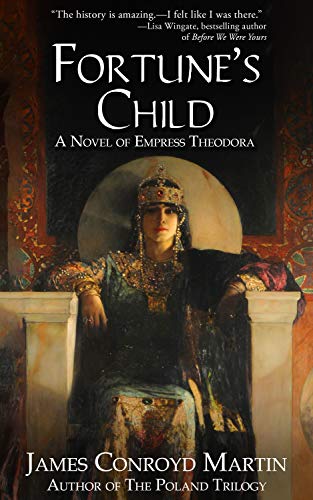
Theodora: actress, prostitute, mistress, feminist. And Byzantine Empress of the civilized world. Stephen: handsome Syrian boy, wizard’s apprentice, palace eunuch. And Secretary to the Empress. How does this unlikely pair become such allies that one day Empress Theodora asks Stephen to write her biography?
From a very young age, Theodora, daughter of a circus bearkeeper in Constantinople, sets her sights well above her station in life. Her exquisite beauty sets her apart on stages and in the eyes of men.
Stephen, a Syrian lad of striking good looks, is sold by his parents to a Persian wizard, who teaches him a skill in languages that will serve him well. By the time Destiny brings them together in Antioch, Theodora has undergone heart-rending trials and a transformation, while Stephen has been sold again . . . and castrated. Discover the enduring bond that, however imperfect, prompts Theodora—as Empress—to request palace eunuch Stephen to write her biography.
This is a true rags to riches story, of a girl from the lowers echelons of society who rose to be empress of Constantinople. Fortune’s Child: A Novel of Empress Theodora tells the story of Empress Theodora, born in 500, into a poor Greek family; her father a circus worker for the Greens, who rose to be Master of the Bears. Theodora’s future was to be an actress, a popular one, but little more than a prostitute in the eyes of many, and with no prospects to ever improve her situation, unless she forced matters.
Although a novel, Fortune’s Child: A Novel of Empress Theodora flawlessly blends history and story-telling to draw the reader into the exotic world of 6th century Constantinople and the East. Recreating the life of Theodora and the world in which she lived, James Conroyd Martin takes you on an adventure that explores every aspect of Theodora’s world, the challenges, grief and struggles that she had to face to climb out of the fate into which she was born and make her own fortune.
This is a novel that will take you through the full range of emotions. It is not all glamour and success, but neither is it all dull and gloom. The author imbues a humanity that invokes both sympathy and compassion for the title character, even when her actions are less than noble.
It is late at night when a soft knock, almost imperceptible, comes at the door. I open it to find Theodora standing there, a finger to her lips. She is dressed in a purple bedchamber robe. She wears no veil or headdress. Her hair falls about her face like an ebony frame about the portrait of a ghost. I stand aside and she enters, gliding like some visitant saint into a monk’s cell.
But she is no saint. And since I am no monk, I take the comfortable chair.
“You know the circumstances of my birth, Stephen, how my mother kept me from being … abandoned – exposed to the elements.”
I nod, taking up a kalamos.
“The story is legend by now. Of course, it may be quite accurate, but my mother would relate it as a way of upbraiding a thoughtless and unappreciative daughter who would drolly mimic the ways of the adults around her, as well as the pretentious airs of an older sister. I was two when the mid-wife was called again and mother gave birth to a third child – alas, another girl.” She pauses, appraising me, her biographer. “Take what I tell you, Stephen, and bring my life to parchment. Breathe life into my past.” The empress grimaces as she settles in without complaint against the hard back of the chair, bringing her hands together in her lap, the interlocking fingers pale as moonbeams against the purple of her robe. “I shall begin, Stephen, where my memory begins.”
For my pettiness in my choice of chair, I feel a tinge of guilt, but I dust away and begin taking the notes that will become her biography.
Sixth century Byzantium is a period that is not often featured in historical fiction, which is such a shame, if Fortune’s Child: A Novel of Empress Theodora is anything to go by. It is a thoroughly engaging read, immersing the reader in 6th century Byzantium, through the sights, sounds and smells of Constantinople; the challenges and prejudices faced by lower class women, however beautiful and alluring, and the rules and restrictions of the privileged classes and the imperial court.
It is, at times, a hard book to read, when the reality of a woman’s lot and the prejudices and attitudes Theodora had to face and overcome. And yet, she never seems to forget her roots. The author avoids melodrama to bring you a story that is, at once, the story of Theodora and of her biographer, and how their lives are intertwined with Theodora’s own rise through the ranks of society.
As you read the novel, you can understand why James Conroyd Martin chose to tell Theodora’s life, it is as mesmerising and engaging as Theodora herself must have been. From the first pages the reader is immediately and irrevocably invested in the story of this incredible woman. I cannot recommend it highly enough – it is a must-read. Many aspects of it will remain with you long after you have finished the last page.
Fortune’s Child: A Novel of Empress Theodora by James Conroyd Martin is available in hardback, paperback and ebook from Amazon UK.
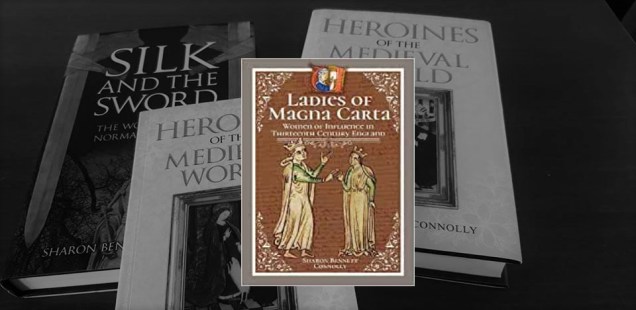
Ladies of Magna Carta: Women of Influence in Thirteenth Century England
In my first year of writing History … the Interesting Bits I told the stories of 2 remarkable women, contemporaries of each other, but with markedly different fates. Matilda de Braose fell foul of King John and suffered a horrible death in his dungeons, while Nicholaa de la Haye was John’s steadfast supporter, successfully defending Lincoln Castle in no fewer than 3 sieges; the last against a combined French and rebel army.
These 2 stories became the catalyst for my latest book, which looks into how the 1215 Magna Carta was relevant to the women of the great families of 13th century England, including the royal families of England and Scotland, the Marshals, the Bigods, the Salisburys,Braoses and Warennes.
Magna Carta clause 39: No man shall be taken, imprisoned, outlawed, banished or in any way destroyed, nor will we proceed against or prosecute him, except by the lawful judgement of his peers or by the law of the land.
This clause in Magna Carta was in response to the appalling imprisonment and starvation of Matilda de Braose, the wife of one of King John’s barons. Matilda was not the only woman who influenced, or was influenced by, the 1215 Charter of Liberties, now known as Magna Carta. Women from many of the great families of England were affected by the far-reaching legacy of Magna Carta, from their experiences in the civil war and as hostages, to calling on its use to protect their property and rights as widows.
Ladies of Magna Carta: Women of Influence in Thirteenth Century England looks into the relationships – through marriage and blood – of the various noble families and how they were affected by the Barons’ Wars, Magna Carta and its aftermath; the bonds that were formed and those that were broken. Including the royal families of England and Scotland, the Marshals, the Warennes, the Braoses and more, _Ladies of Magna Carta_ focuses on the roles played by the women of the great families whose influences and experiences have reached far beyond the thirteenth century.
And it is almost here! Ladies of Magna Carta: Women of Influence in Thirteenth Century England will be released in the UK on 30 May 2020 and is now available for pre-order from Amazon UK and from Book Depository worldwide.
Book Launch:
Please join me at The Collection, Lincoln, for the launch of Ladies of Magna Carta: Women of Influence in Thirteenth Century England, hosted by Lindum Books.
I will be doing a talk and book signing, at The Collection in Lincoln. Tickets: £7 Single; including book:£29. Couple including book: £32. Tickets are available from The collection and Lindum Books, Lincoln.
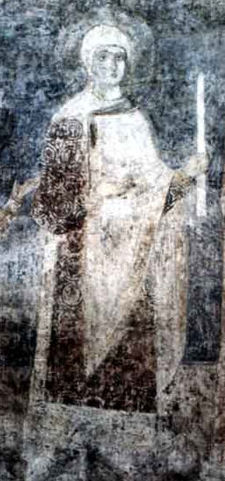
The legend of Harald Hardrada, King Harald III of Norway, is one of my favourite stories of the 11th century. It is the tale of a warrior king, probably the best fighter of his generation, a poet and a lover. Harald’s marriage to his first wife, Elisiv of Kyiv, is the stuff legends are made of; a landless prince making his fortune in Byzantium before returning to claim his bride and winning a crown. And they lived happily ever after …. or not!
Elisiv gave Harald 2 daughters, Ingegerd and Maria, but no sons. It may, therefore, have been a desire for sons that led Harald to take a second wife, although without setting aside his first. According to Snorri Sturluson, in the ‘winter after King Magnus the Good died, King Harald took Thora, daughter of Thorberg Arnason, and they had two sons; the oldest called Magnus, and the other Olaf.’ [1]
Thora (or Tora) was the daughter of Thorberg Arnason and Ragnhild Erlingsdottir and was born around 1025; her kinsman, Fin Arnason, was a good friend of Harald’s and was married to Bergliot, the daughter of Halfdan, a brother of Harald Hardrada and Saint Olaf. The marriage also provided the desired son and heir, which his first marriage had failed to do; both of Thora’s sons would later become kings of Norway. Magnus succeeded his father in 1066, and was in 1069 succeeded by his brother, Olaf III, who had ruled alongside Magnus since 1067.
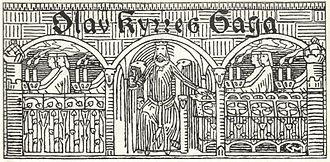
Gerhard Munthe: illustration for Olav Kyrres saga in Heimskringla (1899)
Harald probably went through some form of marriage ceremony, more likely a handfasting than a Christian marriage, with Thora in 1048. The marriage appears to have been a political arrangement, in order to garner the support of the powerful Giskeӕtten family, the chiefs of which played a significant role in power politics.
Of Harald’s two sons, Magnus, who succeeded his father in 1066, appears to have been as warlike as Harald. In 1058, aged no more than ten or eleven, he led a fleet to England in support of Earl Ӕlfgar of Mercia, after the earl had been outlawed only a year after he had succeeded to his father’s earldom. Magnus was probably little more than a figurehead for the expedition and unlikely to have been expected to make crucial military decisions, but it would have been good experience for the young prince, and a taste of what the future held for him. By the time he was sixteen, Magnus was a successful warrior and is said to have clashed with his father; the two almost coming to blows until the king was restrained by friends.
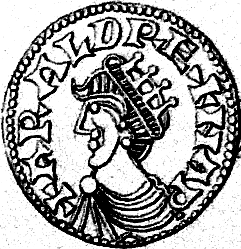
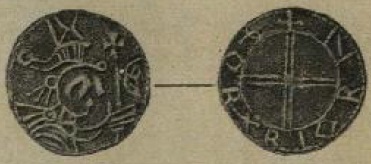
Coin dating to the reign of King Olaf Kyrre
It has been suggested that the marriage may have come following the death of Elisiv, or that Elisiv never even left Kyiv, but given that her daughters were born once Harald was back in Scandinavia, this seems improbable. Harald’s daughters are not likely to have been the daughters of Thora, as Maria was engaged to Thora’s brother, Eystein Orre; who would have been Maria’s uncle, had she been Thora’s daughter. Harald having two wives, simultaneously, seems the most likely explanation. As demonstrated by King Cnut and King Harold II of England, two wives and, therefore, two families, were not uncommon in Scandinavian culture; although in these two other cases an earlier wife was put aside for the sake of a more prestigious marriage, whereas Harald Hardrada’s first marriage was by far the more prestigious, while the second was politically expedient.
Thora was the kinswoman of Harald’s one-time friend, Fin Arnason, who was captured fighting for the Danes against Harald. When Fin refused Harald’s offer of quarter (life), Harald made a further offer:
Then Earl Fin broke out with the ugly expressions which since have been preserved, as a proof that he was so mad with rage that he could not govern his tongue: —
“No wonder thou hast bit so strongly, if the mare was with thee.”
Earl Fin got life and quarter and the king kept him a while about him…’
Heimskringla. The Chronicle of the Kings of Norway, by Snorre Sturluson.
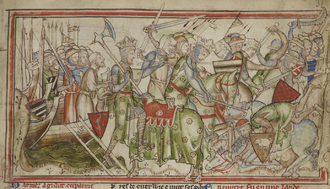
Harald landing near York, 1066 (Matthew Paris)
At the beginning of September, 1066, Harald sailed his fleet of over 200 ships to Shetland and then to Orkney, where he gathered reinforcements and left his wife and daughters to await news of events. There is some confusion as to which wife was left on Orkney, some sources say Elisiv, who, as Harald’s wife and queen would have expected to become queen of England, had he been successful. Some historians argue that as Thora was a relative of the Earl of Orkney she would have been more likely to travel with Harald than Elisiv.
We know from Thora’s joining one of Harald’s expeditions to Denmark, that he was not averse to taking his wives with him to war. However, given that young Magnus was left behind to rule Norway, aged only sixteen, it seems likely that his mother was also left behind, to advise him. According to Snorri;
‘Thora, the daughter of Thorberg, also remained behind; but he took with him Queen Ellisif [Elisiv] and her two daughters, Maria and Ingegerd. Olaf, King Harald’s son, also accompanied his father abroad.’
Heimskringla. The Chronicle of the Kings of Norway, by Snorre Sturluson.
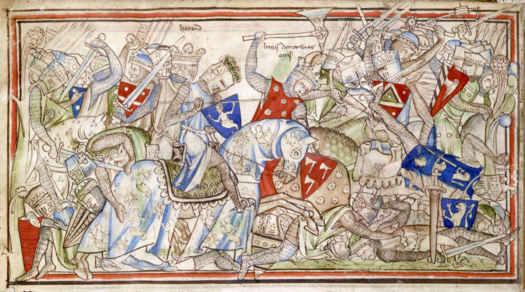
Harald fought two battles outside York. The first, the Battle of Fulford, on 20 September, against the brothers, Edwin, Earl of Mercia, and Morcar, Earl of Northumberland, ended in victory for Harald Hardrada and his ally, Tostig, the former earl of Northumberland and brother of the new King of England, Harold II. However, a second battle at Stamford Bridge, five days later, saw victory go to the English. Harold II had marched his men the 200 miles from the south coast to York, in less than 4 days, and confronted his brother and the Norwegian king on 25 September. At the end of the day, Harald Hardrada and Tostig both lay dead on the field.
Battle of Stamford Bridge, 1066 (Matthew Paris)
Harald and Elisiv’s daughter, Maria, is said to have died suddenly on 25 September 1066, the same day as the Battle of Stamford Bridge, on hearing of her father’s death. She had been betrothed to Eystein Orre, the brother of Harald’s second wife, Thora; Eystein was also among the dead at Stamford Bridge. Maria’s sister, Ingegerd, returned to Norway with her mother and half-brother. Olaf had traveled with the Norwegian army, but had not taken part in the battle, having been left to guard the ships at Riccal, near York. After the English victory, he was allowed to claim his father’s body and take the survivors home.
After Harald’s death, Norway was ruled successively by Harald’s sons Magnus II and Olaf III. Olaf III ruled until his death in 1093 and was succeeded by Magnus III, his acknowledged but illegitimate son.
Of Thora’s fate, little is certain. She may have remarried, although there is some confusion. According to Adam of Bremen, she married either King Swein of Denmark or an unknown Swedish king. [2] As with much of her life, the year of Thora’s death remains unknown.
Footnotes:
[1] Heimskringla. The Chronicle of the Kings of Norway, by Snorre Sturluson; [2] Fulford: The Forgotten Battle of 1066 by Charles Jones.
Pictures:
Courtesy of Wikipedia
Sources:
The English and the Norman Conquest by Dr Ann Williams; Brewer’s British Royalty by David Williamson; Britain’s Royal Families, the Complete Genealogy by Alison Weir; The Wordsworth Dictionary of British History by JP Kenyon; The Norman Conquestby Marc Morris; Harold, the King Who Fell at Hastings by Peter Rex; The Anglo-Saxons in 100 Facts by Martin Wall; The Anglo-Saxon Age by Martin Wall; Kings, Queens, Bones and Bastards by David Hilliam; The Mammoth Book of British kings & Queens by Mike Ashley; The Oxford Companion to British History Edited by John Cannon; The Anglo-Saxon Chronicles translated and edited by Michael Swaton; The Anglo-Saxon Chronicle translated by James Ingram; Queen Emma and the Vikings by Harriett O’Brien; The Bayeux Tapestry by Carola Hicks; On the Spindle Side: the Kinswomen of Earl Godwin of Wessex by Ann Williams; oxforddnb.com.
*
My Books
Signed, dedicated copies of all my books are available through my online bookshop.
Out now: Scotland’s Medieval Queens
Scotland’s history is dramatic, violent and bloody. Being England’s northern neighbour has never been easy. Scotland’s queens have had to deal with war, murder, imprisonment, political rivalries and open betrayal. They have loved and lost, raised kings and queens, ruled and died for Scotland. From St Margaret, who became one of the patron saints of Scotland, to Elizabeth de Burgh and the dramatic story of the Scottish Wars of Independence, to the love story and tragedy of Joan Beaufort, to Margaret of Denmark and the dawn of the Renaissance, Scotland’s Medieval Queens have seen it all. This is the story of Scotland through their eyes.
‘Scotland’s Medieval Queens gives a thorough grounding in the history of the women who ruled Scotland at the side of its kings, often in the shadows, but just as interesting in their lives beyond the spotlight. It’s not a subject that has been widely covered, and Sharon is a pioneer in bringing that information into accessible history.’ Elizabeth Chadwick (New York Times bestselling author)
Heroines of the Tudor World tells the stories of the most remarkable women from European history in the time of the Tudor dynasty, 1485-1603. These are the women who ruled, the women who founded dynasties, the women who fought for religious freedom, their families and love. Heroines of the Tudor World is now available for pre-order from Amberley Publishing and Amazon UK.Women of the Anarchy demonstrates how Empress Matilda and Matilda of Boulogne, unable to wield a sword themselves, were prime movers in this time of conflict and lawlessness. It shows how their strengths, weaknesses, and personal ambitions swung the fortunes of war one way – and then the other. Available from Bookshop.org, Amberley Publishing and Amazon UK. King John’s Right-Hand Lady: The Story of Nicholaa de la Haye is the story of a truly remarkable lady, the hereditary constable of Lincoln Castle and the first woman in England to be appointed sheriff in her own right. Available from all good bookshops Pen & Sword Books, bookshop.org and Amazon.
Alternate Endings: An anthology of historical fiction short stories including Long Live the King… which is my take what might have happened had King John not died in October 1216. Available in paperback and kindle from Amazon.
Podcast:
Have a listen to theA Slice of Medieval podcast, which I co-host with Historical fiction novelist Derek Birks. Derek and I welcome guests, such as Bernard Cornwell and Elizabeth Chadwick, and discuss a wide range of topics in medieval history, from significant events to the personalities involved.
One of my favourite characters of the 1066 story is the Norwegian king Harald Hardrada. Harald led a fascinating life, even before his ill-fated attempt on the English throne; exiled in Kyiv at 15, while seeking his fortune in the east he became captain of the famous Varangian Guard before returning to his native Norway to become king.
When I started writing Silk and the Sword: The Women of the Norman Conquest I discovered that there were several Kyivan links to the story of 1066. The baby sons of England’s short-lived king, Edmund II Ironside, who reigned and died in 1016, were given sanctuary and protection in Kyiv, saving them from the clutches of Edmund’s successor, King Cnut. And after the Conquest, Harold II Godwinson’s own daughter, Gytha, would make her life in Kyiv as the wife of Vladimir II Monomakh; she was the mother of Mstislav the Great, the last ruler of a united Kyivan Rus. Vladimir was the nephew of Harald Hardrada’s first wife, the Kyivan princess, Elisiv.
Harald Hardrada’s story had been one of almost-constant conflict since he was a teenager. At the age of 15 he had fought alongside his half-brother, King Óláf, at the Battle of Stiklestad, in an unsuccessful attempt by Óláf to regain the throne. The Anglo-Saxon Chronicle recorded: ‘This year returned King Óláf into Norway; but the people gathered together against him, and fought against him; and he was there slain, in Norway, by his own people, and was afterwards canonized.’ [1]
Following Olaf’s death, Harald Hardrada first fled to Sweden before moving on to Kyivan Rus. Harald spent 3 or 4 years at the court of Yaroslav I (the Wise), Prince of Kyiv. Yaroslav was the husband of Óláf’s sister-in-law, Ingergerd (sister of Óláf’s wife, Queen Astrid). At only 15, Harald’s military skills were already impressive and Yaroslav made him a captain in his army; the young Norwegian fought alongside the Kyivan prince on his campaigns against the Poles in 1031.
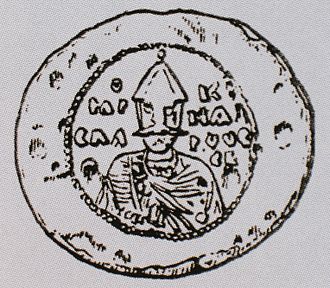
Coin of Harald
Having gained a reputation that spread throughout eastern Europe, in 1034 or 1035, Harald and his force of 500 men moved on to Constantinople, where he joined the ranks of the Varangian Guard, in the service of the Byzantine emperor, Michael IV (reigned 1034–1041). A formidable warrior and commander, Harald eventually became leader of the whole Varangian guard, seeing action against Arab pirates, and the towns of Asia Minor that supported them. Throughout his adventures in Byzantium, Harald sent his plunder back to Prince Yaroslav in Kyiv; treasure which, given the number of towns he had taken, must have been quite considerable.
On the death of Michael IV Constantinople proved a less friendly place for the Scandinavian and after a brief imprisonment and daring escape from his cell, Hardrada decided that it was time to return home. It is said that the new empress, Zoe, refused him permission to leave, but the Norwegian managed to escape Constantinople with two ships and his most loyal supporters. One of the ships was destroyed by the iron chains which blocked the seagoing entrance and exit to Constantinople, but the other made it through by shifting the weight in the ship so acted like a seesaw and it effectively jumped over the chain.
Harald returned to his friend Yaroslav I in Kyiv, to whom he had sent his vast amounts of plunder. In 1044, whilst still at Yaroslav’s court, Harald married the Kyivan prince’s daughter, Elisiv (also known as Elisiff, Elizabeth or Elizaveta). Elisiv was born around 1025 and would probably have met Harald when he first appeared at her father’s court, in 1034-5; when she was 9 or 10 years old and he a 15-year-old fugitive from Cnut’s conquest of Norway. Elisiv was probably the oldest daughter of Yaroslav’s eleven children with his wife, Ingegerd. Through her mother, Elisiv was the granddaughter of Sweden’s king, Olof Skötkonung. Her father, Grand Prince Yaroslav, was responsible for the rise in power and influence of Kyiv in the 11th century; his court was considered modern and cultured.
Yaroslav’s children were well-educated and able to read and write, including the girls; Elisiv’s sister, Anna, who married King Henry I of France, demonstrated her superior level of education when she signed her marriage contract with her full name, in her own hand; King Henry, her new husband, could only manage to write a cross. Although we have no description of Elisiv, we know that Anna was renowned for her ‘exquisite beauty, literacy and wisdom’ and we can assume that Elisiv, having shared in her sister’s upbringing, was no less accomplished. [2]
It is possible that marriage between Harald and Elisiv had been discussed during the Norwegian’s first visit to Kyiv in 1035. However, given that she would have only been nine or ten years of age when Harald left for Constantinople, it seems hard to believe the claims that Elisiv had refused him on the grounds that he was not wealthy enough to marry her; her father, on the other hand, may well have done so. This may also explain Harald sending his plunder back to Kyiv for safekeeping, as proof of his increasing wealth and eligibility as a husband for Elisiv, even if he still held no princely title and was exiled from his homeland. In 1044, therefore, there was no financial objection to Harald and Elisiv marrying and there is evidence that Harald was genuinely in love with his Kyivan bride. Harald wrote poetry to his princess:
Past Sicily’s wide plains we flew, A dauntless, never-wearied crew; Our Viking steed rushed through the sea, As Viking-like fast, fast sailed we. Never, I think, along this shore Did Norsemen ever sail before; Yet to the Kyivan queen, I fear, My gold-adorned, I am not dear. [3]
Contemporary image of Yaroslav the Wise, from his seal
With the treasure Harald amassed during his sojourn in Constantinople and Elisiv’s dowry, Harald now had the means to return home. He initially made for Sweden, arriving there in 1046. By the end of the year, he was co-king in Norway, under Magnus the Good, who left Harald to rule Norway while he concentrated on Denmark; the two kings had kept separate courts. Harald’s court in Norway was presided over by his queen, Elisiv. Within a few of years of arriving in Norway, the couple had two daughters, Ingegerd and Maria Haraldsdóttir. Ingergerd was probably born in 1046, with Maria arriving a year of two after.
Married life, however, was about to get more complicated, when Harald took a second wife, without setting aside Elisiv. According to Snorri Sturluson, in the ‘winter after King Magnus the Good died, King Harald took Thora, daughter of Thorberg Arnason, and they had two sons; the oldest called Magnus, and the other Olaf.’ [4]
It has been suggested that the marriage may have come following the death of Elisiv, or that Elisiv never even left Kyiv, but given that her daughters are believed to have been born once Harald was back in Scandinavia, this seems improbable. Harald’s daughters are not likely to have been the daughters of Thora, as Maria was engaged to Eystein Orre, who would have been her uncle had she been Thora’s daughter. Harald having two wives, simultaneously, seems the most likely explanation. As demonstrated by King Cnut and King Harold II of England, two wives and, therefore, two families, were not uncommon in Scandinavian culture; although in these two other cases an earlier wife was put aside for the sake of a more prestigious marriage, whereas Harald Hardrada’s first marriage was the most prestigious, while the second was politically expedient. And it was this second marriage which gave Harald his sons; Magnus and Olaf, both later kings of Norway.
Battle of Fulford, 1066, taken from ‘The Life of Edward the Confessor’
At the beginning of September, 1066, Harald sailed his fleet of over 200 ships to Shetland and then to Orkney, where he gathered reinforcements and left his wife and daughters to await news of events. There is some confusion as to which wife was left on Orkney, some sources say it was Elisiv, who, as Harald’s wife and queen would have expected to become queen of England, had he been successful. Some historians argue that as Thora was a relative of the Earl of Orkney she would have been more likely to travel with Harald than Elisiv.
We know from Thora’s joining one of Harald’s expeditions to Denmark, that he was not averse to taking his wives with him to war. However, given that young Magnus was left behind to rule Norway, aged only sixteen, it seems likely that his mother was also left behind, to advise him. According to Snorri; ‘Thora, the daughter of Thorberg, also remained behind; but he took with him Queen Ellisif [Elisiv] and her two daughters, Maria and Ingegerd. Olaf, King Harald’s son, also accompanied his father abroad.’ [5]
Battle of Stamford Bridge, 1066, taken from ‘The Life of Edward the Confessor’
Harald and Elisiv’s daughter, Maria, is said to have died suddenly on 25 September 1066, the same day as the Battle of Stamford Bridge, on hearing of her father’s death. Though this does not make sense, unless Maria had travelled to Riccal, where Harald moored his ships before marching to York, with the army and awaited the outcome of the battle with the ships; or the timing of her death has been altered for dramatic effect. Maria had been betrothed to Eystein Orre, the brother of Harald’s second wife, Thora; Eystein was also among the dead at Stamford Bridge. Maria’s sister, Ingegerd, returned to Norway with her mother and half-brother. She was first married to Olaf I, King of Denmark who died in 1095, with whom she had a daughter, Ulvhild. Following Olaf’s death, Ingegerd married Philip, King of Sweden. She was widowed again in 1118 and died around 1120, having been consecutively queen of Denmark and Sweden.
Of Harald’s queen, Elisiv, little is known after King Harald’s death, not even the year of her own death. This Kyivan princess, who captured the heart of one of the greatest Viking warriors of all time, just disappears into the mists of history.
Footnotes:
[1] The Anglo-Saxon Chronicle translated by James Ingram; [2] Prominent Russians: Anna Yaroslavna (article), russiapedia.rt.com; [3] Quoted in Fulford: The Forgotten Battle of 1066 by Charles Jones; [4] Heimskringla. The Chronicle of the Kings of Norway, by Snorre Sturluson; [5] ibid.
Pictures:
Courtesy of Wikipedia
Sources:
The English and the Norman Conquest by Dr Ann Williams; Brewer’s British Royalty by David Williamson; Britain’s Royal Families, the Complete Genealogy by Alison Weir; The Wordsworth Dictionary of British History by JP Kenyon; The Norman Conquest by Marc Morris; Harold, the King Who Fell at Hastings by Peter Rex; The Anglo-Saxons in 100 Facts by Martin Wall; The Anglo-Saxon Age by Martin Wall; Kings, Queens, Bones and Bastards by David Hilliam; The Mammoth Book of British kings & Queens by Mike Ashley; The Oxford Companion to British History Edited by John Cannon; The Anglo-Saxon Chronicles translated and edited by Michael Swanton; The Anglo-Saxon Chronicle translated by James Ingram; Queen Emma and the Vikings by Harriett O’Brien; The Bayeux Tapestry by Carola Hicks; On the Spindle Side: the Kinswomen of Earl Godwin of Wessex by Ann Williams; oxforddnb.com.
*
My Books
Signed, dedicated copies of all my books are available through my online bookshop.
Out now: Scotland’s Medieval Queens
Scotland’s history is dramatic, violent and bloody. Being England’s northern neighbour has never been easy. Scotland’s queens have had to deal with war, murder, imprisonment, political rivalries and open betrayal. They have loved and lost, raised kings and queens, ruled and died for Scotland. From St Margaret, who became one of the patron saints of Scotland, to Elizabeth de Burgh and the dramatic story of the Scottish Wars of Independence, to the love story and tragedy of Joan Beaufort, to Margaret of Denmark and the dawn of the Renaissance, Scotland’s Medieval Queens have seen it all. This is the story of Scotland through their eyes.
‘Scotland’s Medieval Queens gives a thorough grounding in the history of the women who ruled Scotland at the side of its kings, often in the shadows, but just as interesting in their lives beyond the spotlight. It’s not a subject that has been widely covered, and Sharon is a pioneer in bringing that information into accessible history.’ Elizabeth Chadwick (New York Times bestselling author)
Heroines of the Tudor World tells the stories of the most remarkable women from European history in the time of the Tudor dynasty, 1485-1603. These are the women who ruled, the women who founded dynasties, the women who fought for religious freedom, their families and love. Heroines of the Tudor World is now available for pre-order from Amberley Publishing and Amazon UK.Women of the Anarchy demonstrates how Empress Matilda and Matilda of Boulogne, unable to wield a sword themselves, were prime movers in this time of conflict and lawlessness. It shows how their strengths, weaknesses, and personal ambitions swung the fortunes of war one way – and then the other. Available from Bookshop.org, Amberley Publishing and Amazon UK. King John’s Right-Hand Lady: The Story of Nicholaa de la Haye is the story of a truly remarkable lady, the hereditary constable of Lincoln Castle and the first woman in England to be appointed sheriff in her own right. Available from all good bookshops Pen & Sword Books, bookshop.org and Amazon.
Alternate Endings: An anthology of historical fiction short stories including Long Live the King… which is my take what might have happened had King John not died in October 1216. Available in paperback and kindle from Amazon.
Podcast:
Have a listen to theA Slice of Medieval podcast, which I co-host with Historical fiction novelist Derek Birks. Derek and I welcome guests, such as Elizabeth Chadwick, Helen Castor, Ian Mortimer, Scott Mariani and Bernard Cornwell and discuss a wide range of topics in medieval history, from significant events to the personalities involved.
Zoe Porphyrogenita lived most of her life in relative obscurity. She was the second of 3 daughters born to Constantine VIII and his wife, Helena. Zoe was born in Constantinople in about 978. She was the niece of Basil II, the warrior emperor who had co-ruled, as senior emperor, with Constantine for over 60 years. Basil died in January 1025, leaving Constantine to rule alone for a further 3 years before his own death in November 1028. By all accounts, while Basil fought to preserve his empire, Constantine was more in love with the trapping of power, rather than the wielding of it.
Zoe’s father had been emperor since the age of 2, meaning that Zoe was ‘born into the purple’ – born to a reigning emperor. She had an elder sister, Eudokia, who joined a monastery, and a younger sister, Theodora. Zoe’s uncle Basil II refused to arrange marriages for his nieces, as such marriages would give their husbands a claim to the imperial throne. The girls lived in virtual obscurity in the women’s quarters of the palace for many years.
Zoe first appeared on the international stage in 1001, at the age of 23, when her uncle offered her as a bride to German Emperor Otto III (reigned 996-1002). Zoe had set sail from Constantinople, but on arriving at Bari, was met with the news that her prospective groom had died of a fever. Zoe returned home to Constantinople and the continued seclusion of the royal palace.
Following the death of her uncle, and with no legitimate male heir to succeed him, Zoe’s father, Constantine, sought to settle the empire’s future by finally arranging Zoe’s marriage. At the age of 50, in 1028, she was married to her father’s designated successor, probably to add legitimacy to his claim to the imperial throne. Her new husband became Emperor Romanos III, and Zoe empress consort, when he succeeded to the throne just 3 days after the wedding.
Zoe was described by a palace courtier, Michael Psellos, as;
‘a woman of great beauty, most imposing in her manner and commanding respect … a woman of passionate interests, prepared with equal enthusiasm for both alternatives, death or life, I mean. In that she reminded me of sea-waves, now lifting a ship on high and then again plunging it down to the depths … Zoe was openhanded, the sort of woman who could exhaust a sea teaming with gold-dust in one day … [she] confused the trifles of the harem with important matters of state … her eyes were large, set wide apart with imposing eyebrows. Her nose was inclined to be aquiline, and her whole body was radiant with the whiteness of her skin.’
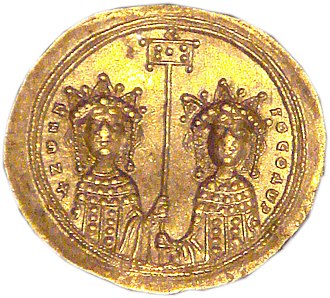
Zoe and Theodora, Chronographia
As empress consort, Zoe asserted herself. Her younger sister, Theodora, was sent to a monastery. Romanos was an unpopular ruler, his economic policies and military defeat in 1030 causing consternation. Neglected by her husband, who took a lover and refused to allow Zoe any say in affairs of state, the empress took a much younger, teenage lover, her chamberlain, Michael. Together they conspired to dispose of Romanos and he was found dead in his bath on 10 April 1034, allegedly poisoned by Zoe or her lover.
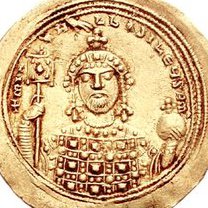
Michael IV
Zoe promptly married her young lover and made him Emperor Michael IV. Not surprisingly, their marriage was full of distrust and Zoe was allowed no power or say in government. Michael IV then banished Zoe to the gynaeceum, or women’s quarters.. His reign was no golden age, with the aristocracy opposing the undue influence of the emperor’s brother, John the Orphanostrophos. High taxation sparked a revolt, led by Peter Deljan, who used it as a pretext to end the Byzantine dominance of the Bulgars. The rebellion was quashed within a year, with the aid of Harald Hardrada and his 500 Norwegians, who had joined the Varanagian Guard in 1034. Further losses in Sicily and the emperor’s worsening epilepsy added to the empire’s woes. Not to be forgotten, Zoe began scheming to reclaim her throne. After she was allowed back to court, and unable to bear her own children due to her age, Zoe was persuaded to adopt Michael IV’s nephew, another Michael, and make him her heir.
Michael IV’s life would have probably ended in the same way as his predecessor, Romanos III, drowned in the bath or with a knife in his back, had he not died of natural causes in 1041, after retiring to a monastery. His nephew, Zoe’s adopted son, ascended the throne as Michael V; Michael was the son of the sister of Michael IV. Michael V was crowned in 1041 but immediately turned against those who had raised him to the throne. His uncle, John the Orphanotrophos, was exiled from court and Zoe was again banished to a monastery, an act which caused an uprising in Constantinople.
The people of Constantinople and the church wanted to see the crown returned to Zoe and the legitimate dynastic line. The mob ransacked the royal palace and deposed Michael V in April 1042. The young emperor was deposed after only 4 months of disastrous rule. He was exiled to a monastery, but complaints about such lenient treatment meant that orders were given for his mutilation. He was blinded, an act symbolically rendering him incapable of ruling, supposedly by Harald Hadrada, the future king of Norway, himself.
Zoe and Theodor
Now 64 years old, Zoe was empress once again.
Zoe’s sister, Theodora, was retrieved from her monastery to rule beside her. As the elder sister, Zoe’s throne was placed slightly forward of her Theodora’s at the joint coronation ceremony, as an obvious indication of which of the sisters was in charge!
The sisters sought to reform Byzantine imperial policies, making new court appointments, ending corrupt practices, such as selling titles, and instigating an investigation into the actions of their predecessor.
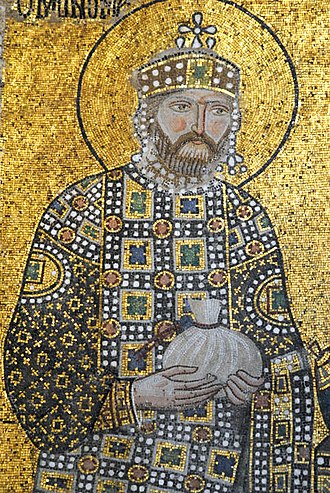
In the same year, 1042, Zoe took a third husband, Constantine Monomachos, who ruled as Emperor Constantine IX. Long-admired by the empress, Constantine had been exiled to Lesbos but was recalled to become Zoe’s third husband. Constantine was rich and elegant, with a reputation as a ladies man, but with experience of Byzantine government as a senior civil administrator. He co-ruled the empire with the 2 imperial sisters.
Domestic arrangements, however, were frowned upon when Constantine moved his long-time lover, Sclerina, into the imperial palace, apparently with Zoe’s blessing. The public were not so tolerant and called for Sclerina’s removal; the crisis was resolved by Sclerina’s sudden death from a pulmonary disease.
Emperor Constantine IX
Constantine set about reforming the Byzantine administration, exiling John the Orphanotrophos from court for a second time, and surrounding himself with noted intellectuals, among them Michael Psellos. However, his reforms and neglect of the army led to two uprisings, in 1043 and 1047, respectively, and saw the frontiers of the empire crumbling under incursions from the Normans, the Seljuks and the Pechenegs.
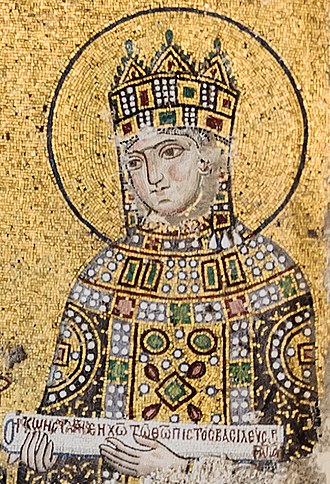
Constantine outlived his wife; Zoe died in 1050, aged about 72. And when her sister, Theodora, died in 1056, the Macedonian dynasty founded by Basil I (reigned 867-886) came to an end. Zoe is remembered in the gold and glass mosaic of the Hagia Sophia in Constantinople (now Istanbul) in which she is portrayed with Constantine IX and Jesus Christ. The inscription reads ‘Zoe, the most pious Augusta’.
Pictures:
Courtesy of Wikipaedia
Sources:
britannica.com; A History of the Vikings by T.D. Kendrick; God’s Viking: Harald Hardrada by Nic Fields; Heimskringla. The Chronicle of the Kings of Norway by Snorre Strurluson; Silk and the Sword: The Women of the Norman Conquest by Sharon Bennett Connolly; Ancient History Encyclopedia.
*
My Books:
Signed, dedicated copies of all my books are available, please get in touch by completing the contact me form.
Defenders of the Norman Crown: The Rise and Fall of the Warenne Earls of Surrey tells the fascinating story of the Warenne dynasty, of the successes and failures of one of the most powerful families in England, from its origins in Normandy, through the Conquest, Magna Carta, the wars and marriages that led to its ultimate demise in the reign of Edward III. Defenders of the Norman Crown: Rise and Fall of the Warenne Earls of Surrey is now available from Pen & Sword Books, Amazon in the UK and US,Bookshop.org and Book Depository.
Alternate Endings: An anthology of historical fiction short stories including Long Live the King… which is my take what might have happened had King John not died in October 1216. Available in paperback and kindle from Amazon.
*
You can be the first to read new articles by clicking the ‘Follow’ button, liking our Facebook page or joining me on Twitterand Instagram.
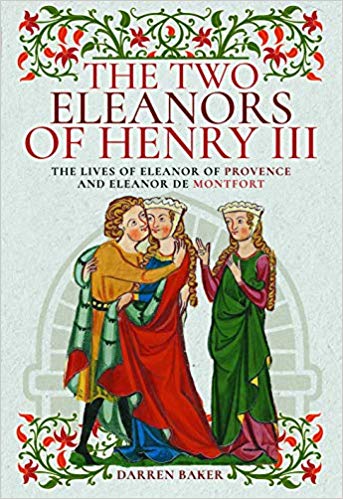
Eleanor of Provence was born in the province of her name in 1223. She has come to England at the age of twelve to marry the king, Henry III. He’s sixteen years older, but was a boy when he ascended the throne. He’s a kind, sensitive sort whose only personal attachments to women so far have been to his three sisters. The youngest of them is called Eleanor too. She was only nine when, for political reasons, her first marriage took place, but she’s already a chaste twenty-year old widow when the new queen arrives in 1236. In a short time, this Eleanor will marry the rising star of her brother’s court, a French parvenu named Simon de Montfort, thus wedding the fates of these four people together in an England about to undergo some of the most profound changes in its history. It’s a tale that covers three decades at its heart, with loyalty to family and principles at stake, in a land where foreigners are subject to intense scrutiny and jealousy. The relationship between these two sisters-in-law, close but ultimately doomed, will reflect not just the turbulence and tragedy of their times, but also the brilliance and splendour.
Having just reviewed one of the best fiction books of 2019 in Angus Donald’s Blood’s Campaign, it is a pleasure to review one of the best non-fiction books I’ve read this year. Darren Baker’s The Two Eleanors of Henry III: The Lives of Eleanor of Provence and Eleanor de Montfort is a truly engaging book, delving into the lives of two very different women, friends who were on opposing sides during the Second Baron’s War and the rebellion of Simon de Montfort.
Told chronologically, with their lives running in parallel, Darren Baker recreates the experiences of Eleanor of Provence, queen of Henry III, and Eleanor de Montfort, sister of Henry III and wife of his bitter enemy, Simon de Montfort. Sympathetic but not overly sentimental, Darren Baker recreates the political and personal lives of his two protagonists, both on the national and international stage.
The Two Eleanors of Henry III: The Lives of Eleanor of Provence and Eleanor de Montfort is a wonderful analysis of the years between the issuing of Magna Carta and the death of Simon de Montfort at the Battle of Evesham, clearly demonstrating the roles played by the wives of the two main protagonists in the ongoing battle between crown and barons. Darren Baker examines the conflict, and motivations behind it, from a new and innovative angle.
It cannot have been easy to write a dual biography about two women who shared a Christian name, but Darren Baker has a remarkable skill in always clearly identifying which Eleanor he is talking about at any particular time, negating any possible confusion for the reader.
As the banquet commences, Eleanor [of Provence] notices a man standing in close proximity to them, holding a basin of water for the king to clean his hands in before, during and after the meal. But e is clearly no servant. Besides wearing stately robes, he walks with Henry with a familiarity that suggests they are friends. More intriguing, his accent is very close to hers. Someone in the party whispers that it is Simon de Montfort, the son of the crusader who set most of their region ablaze three decades earlier. Simon too grew up in the south of France until his father was felled in the conflict. When the crusade was over, he ventured to England to claim the earldom of Leicester through his grandmother’s noble lineage. The earldom came with the office of steward, which is what this tall and handsome knight, then in his late twenties, is doing in attending the king at the feast.
Simon looks at the party from Provence with equal suspicion. He survived a purge of foreign courtiers only a few years before and is worried this new crowd from abroad might re-ignite that peculiar English obsession with aliens. His position seems safe because he is one of Henry’s most trusted confidants. He has recently shown his loyalty to him by proposing marriage to two widowed countesses on the Continent, presumably at the king’s urging. Henry has grand ideas about creating alliances across the Channel as a means of recovering the lands seized by the French from his father. ‘Do that,’ he intimated, ‘and I’ll find you a suitable bride if it doesn’t work out.’ Simon returned empty-handed.
Widows abound in this feudal society and the king gets to decide who marries the rich and powerful ones. None is more desirable than his own sister, who is also named Eleanor. She was younger than her new sister-in-law when she was betrothed to William Marshal II, son of her brother’s first regent. Because of her extreme youth at the time, it was years before she and William began cohabiting. Their marriage waas successfull but childless.
Don’t be fooled by the flowing narrative, The Two Eleanors of Henry III: The Lives of Eleanor of Provence and Eleanor de Montfort is an in-depth analysis, not only of the lives of the two women, but of the events which shaped their world and threatened the very stability of England and the monarchy. Darren Baker delves into the motivations of both women, their loyalty to their husbands and family and examines the lengths that each went to in order to protect their own interests.
The Two Eleanors of Henry III: The Lives of Eleanor of Provence and Eleanor de Montfort is a pleasure to read. It provides great insight into the lives of Eleanor of Provence, Eleanor de Montfort, their husbands and children and the impact that their family feuding had, not only on England, but also on the European stage. The author does not run to judgement and provides a balanced analysis of both sides of the conflict of the Second Barons’ War. He clearly points out the character strengths and flaws of both Eleanors, using chronicles and letters to build clear images of their characters and personalities.
The Two Eleanors of Henry III: The Lives of Eleanor of Provence and Eleanor de Montfort firmly places Eleanor of Provence and Eleanor de Montfort within the thirteenth century world in which they lived. Darren Baker brings their stories to life, with his passion for his subjects clearly visible in the elegant narrative. This book is a must for anyone interested in medieval women or in the conflict between Henry III and Simon de Montfort. Placing the focus on the two women who saw their husbands and sons drawn into the Second Barons’ War shines a whole new light on the period.
It is an enjoyable and fascinating read!
To buy the Book:
The Two Eleanors of Henry III: The Lives of Eleanor of Provence and Eleanor de Montfort is now available from Amazon UK and is available for pre-order from Amazon US and direct from Pen & Sword.
About the author:
Darren Baker is a translator and historian who took his degree at the University of Connecticut. He currently lives in the Czech Republic.
From Emma of Normandy, wife of both King Cnut and Æthelred II to Saint Margaret, a descendant of Alfred the Great himself, Silk and the Sword: the Women of the Norman Conquest traces the fortunes of the women who had a significant role to play in the momentous events of 1066. Available now from Amazon UK, Amberley Publishing,Book Depository and Amazon US.
Telling the stories of some of the most remarkable women from Medieval history, from Eleanor of Aquitaine to Julian of Norwich, Heroines of the Medieval World, is available now on kindle and in paperback in the UK from from both Amberley Publishing and Amazon, in the US from Amazon and worldwide from Book Depository.
*
You can be the first to read new articles by clicking the ‘Follow’ button, liking our Facebook page or joining me on Twitterand Instagram.
Today it is a pleasure to welcome Author Susan Higginbotham to History … the Interesting Bitswith a wonderful article about the correspondence between Mary Lincoln and Queen Victoria.
The First Lady and the Queen
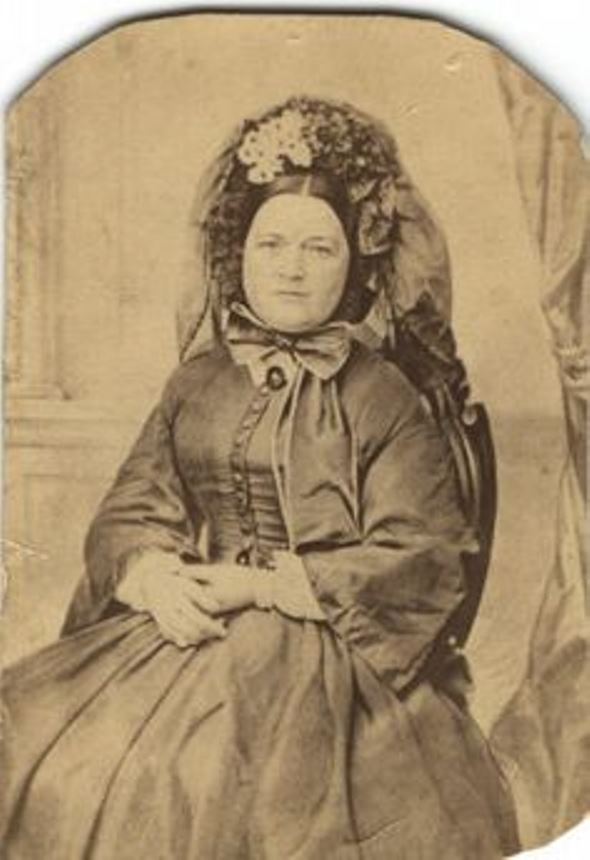
Mary Lincoln in widow’s weeds
Of the black-draped widows of the
nineteenth century, surely two of the best known are Queen Victoria, who gave
her name to the age, and Mary Lincoln, wife to the martyred American President.
Bereaved just a few years apart, they would spend the rest of their lives in
mourning.
Queen Victoria’s consort, Albert, died on December
14, 1861, at Windsor Palace. In due time, a formal
letter of condolence arrived from the United States, signed by Abraham
Lincoln, assuring the queen, “The American People . . . deplore his death
and sympathize in Your Majesty’s irreparable bereavement with an unaffected
sorrow. This condolence may not be altogether ineffectual, since we are sure it
emanates from only virtuous motives and natural affection. I do not dwell upon
it, however, because I know that the Divine hand that has wounded, is the only
one that can heal.”
Mary Lincoln acknowledged the royal loss in
her own way. On February 5, 1862, the Lincolns, at Mary’s suggestion, held a
magnificent reception at the White House. The New York Herald reported the next day, “Mrs. Lincoln received
the company with gracious courtesy. She was dressed in a magnificent white
satin robe, with a black flounce half a yard wide, looped with black and white
bows, a low corsage trimmed with black lace, and a bouquet of crepe myrtle on
her bosom. Her head-dress was a wreath of black and white flowers, with a bunch
of crepe myrtle on the right side. The only ornaments were a necklace,
earrings, brooch and bracelets, of pearl. The dress was simple and elegant. The
half mourning style was assumed in respect to Queen Victoria . . . whose
representative was one of the most distinguished among the guests on this
occasion.”
Not all of the press shared the Herald‘s enthusiasm. The country had
settled into what would prove to be years of civil war, and the extravagant reception
struck some as being in poor taste. The Pittsburgh
Gazette of February 8, 1862, titling its short piece “Our Court Gone
Into Mourning!” quoted the excerpt above, and then commented succinctly,
“Don’t larf.”
Sadly, Mary would soon be wearing full
mourning, and not as a courtesy for a distant queen. Her son Willie had fallen
ill, and Mary had spent much of the reception going to and from his bedside.
Though the prognosis initially appeared hopeful, Willie’s condition soon
deteriorated, and he died on February 20, 1862. Mary could not bear to attend
his funeral.
Unlike Queen Victoria, who put her entire
court into mourning for Albert, Mary had only herself to attend to. (Unlike
women, who when grieving for their closest relatives were expected to muffle
themselves in deep, lusterless black if their means permitted it, men could get
by simply with a black band around a sleeve or a hat–or with no mourning
apparel at all.) Still, there was a fashion aspect to mourning, to which entire
establishments catered, and Mary did not permit her terrible grief to prevent
her from giving precise instructions to Ruth Harris, the hapless milliner who
had the task of putting together a bonnet. “I want a very very fine black straw for myself–trimmed with folds of jet fine blk crape,” she instructed
on May 17, 1862. Alas, the bonnet did not quite suit, so later that month, Mary
explained, “I wished a much finer blk straw bonnet for mourning–without
the gloss.”
By April 1865, however, Mary was wearing
garments in an array of colors and looking forward to a brighter future. The
war was all but won, and although President Lincoln had just begun his second
term of office, he was looking forward to doing some traveling once he returned
to private life. He hoped to visit Europe, as did Mary.
Abraham Lincoln, of course, never realized
this dream, but was assassinated by John Wilkes Booth at Ford’s Theatre on
April 14, 1865, and died the next morning.
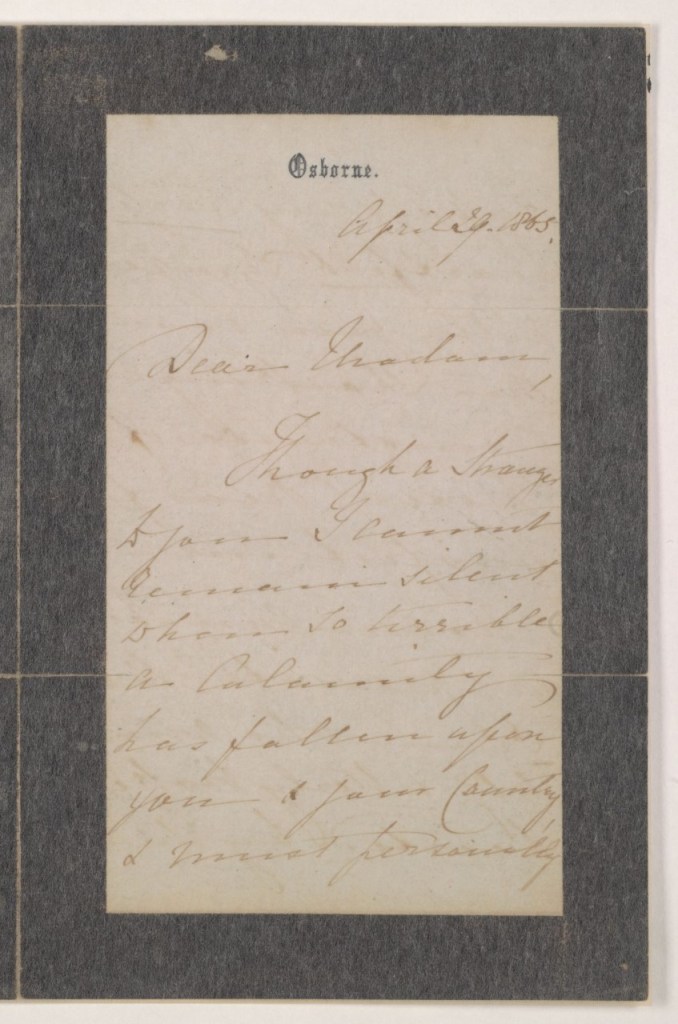
First page of the letter from Queen Victoria to Mary Lincoln
Several weeks later, Mary, who remained at
the White House for over a month after her husband’s death, received the
following black-bordered letter:
Osborne.
April 29, 1865.
Dear Madam,
Though a stranger to you I cannot remain silent when so terrible a calamity has fallen upon you & your country, & must personally express my deep & heartfelt sympathy with you under the shocking circumstances of your present dreadful misfortune.
No one can better appreciate than I can, who am myself utterly broken-hearted by the loss of my own beloved Husband, who was the Light of my Life, — my Stay — my All, — what your own sufferings must be; and I earnestly pray that you may be supported by Him to whom alone the sorely stricken can look for comfort, in this hour of heavy affliction.
With the renewed expression of true sympathy,
I remain,
dear Madam,
Your sincere friend
Victoria
Mary responded with her own black-bordered
letter:
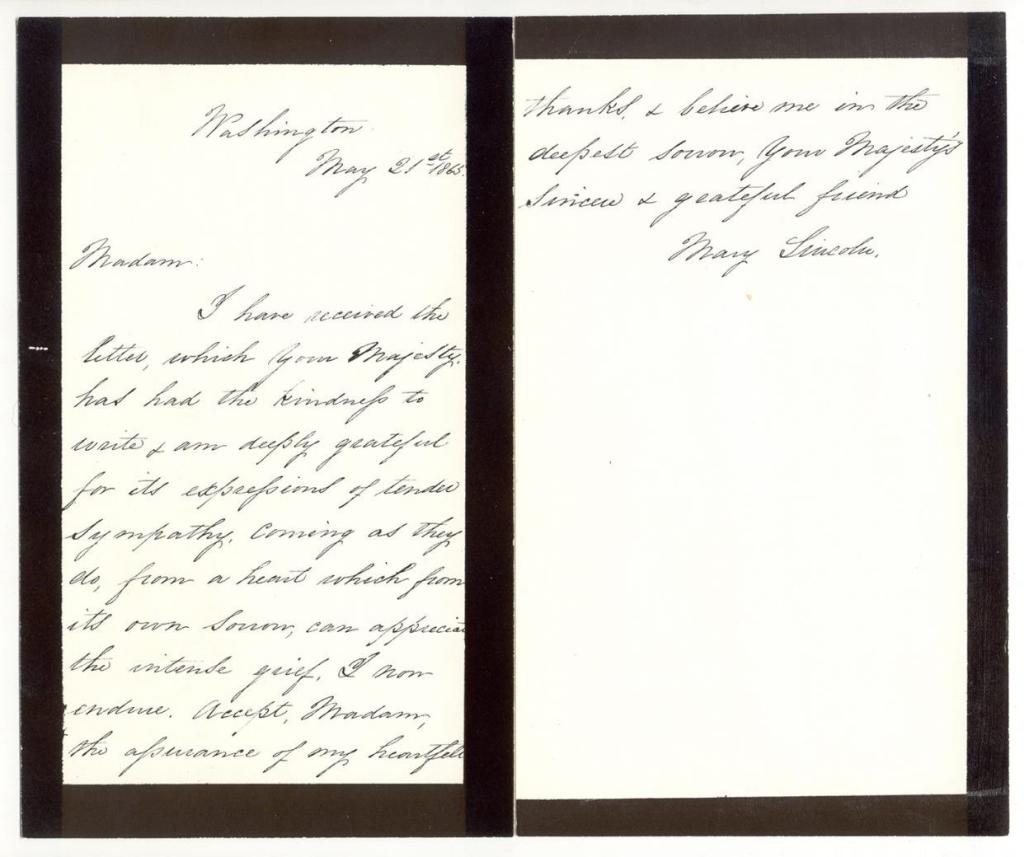
Mary Lincoln’s letter to Queen Victoria
Washington
May 21st, 1865
Madam:
I have received the letter, which Your Majesty has had the kindness to write, & am deeply grateful for its expressions of tender sympathy, coming as they do, from a heart which from its own sorrow, can appreciate the intense grief I now endure. Accept, Madam, the assurances of my heartfelt thanks &believe me in the deepest sorrow, Your Majesty’s sincere and grateful friend.
Mary Lincoln
On May 23, 1865, Mary Lincoln left the White House, and Washington, at last. Unable to stomach the idea of returning to Springfield, Illinois, where she had met her husband and spent most of her married life, she moved to Chicago, but found little comfort there. Finally, in October 1868, she and her youngest son, Thomas “Tad” Lincoln, sailed for Europe. Although she based herself in Frankfurt, she made an excursion to France. There, at Nice, Mary, traveling incognito, ran across Victoria and Albert’s eldest daughter, Victoria, Princess Royal, Crown Princess of Prussia. As Mary reported to Eliza Slataper on February 17, 1869, “She had alighted from her carriage and was selecting some gorgeous tablecovers–our eyes met & we looked earnestly at each other, yet until she left the store, I did not know, who she was. Of course she will always remain in ignorance, regarding me.”
That summer, Mary visited Scotland.
“Beautiful glorious Scotland, has spoilt me for every other Country!”
she reported to Eliza on August 21, 1869. Her Scottish tour included a stop at
Balmoral Castle. Although Victoria was absent, Mary told her friend Rhoda White
in a letter dated August 30, 1869, “I have
every assurance, that as sisters in grief a warm welcome would be give me–wherever she is–yet I prefer
quiet.”
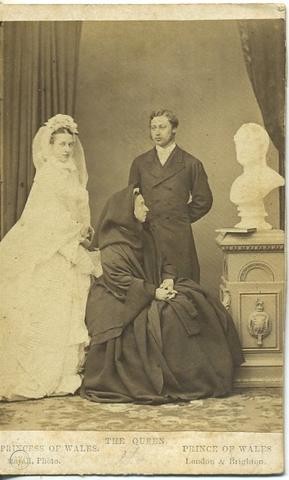
CDV of Victoria in mourning
Sadly, the sisters in grief were never to
meet, although by the fall of 1870 Mary was staying in England, the climate of
which disagreed with her and Tad, who was homesick as well. Mother and son returned
to the United States in May 1871. Cornered by a “lady reporter” for
the New York World, and asked to give
her impression of the English people, Mary replied, as reported on May 16,
1871, “We were . . . very pleasantly received there, and enjoyed our stay
exceedingly.”
As it turned out, Tad’s indisposition could
not be cured by leaving behind London’s fog, and the youth died of a lung
ailment in July 1871, just weeks after his return to America. His death
launched Mary into a downward spiral, culminating in her son Robert’s decision
to commit her to a private insane asylum in 1875. This at least invigorated
Mary, who soon engineered her release. Declared “restored to reason,”
Mary returned alone to Europe in 1876. but she seems to have avoided England,
and even her beloved Scotland, entirely. In failing health, Mary returned to
Springfield and died there on July 15, 1882.
Queen Victoria, however, had many more
years to live, and seven years after Mary’s death would greet Abraham and Mary’s
only surviving son, Robert, who was appointed minister to the Court of St.
James in 1889. On May 25, Robert Lincoln presented his credentials to the queen
at Windsor. The Chicago Tribune of
May 26, 1889, reported, “Lincoln congratulated the Queen on her 70th
birthday, and the Queen said some pleasant words to Mr. Lincoln about his
father.”
Mary Lincoln would have been quite pleased.
*
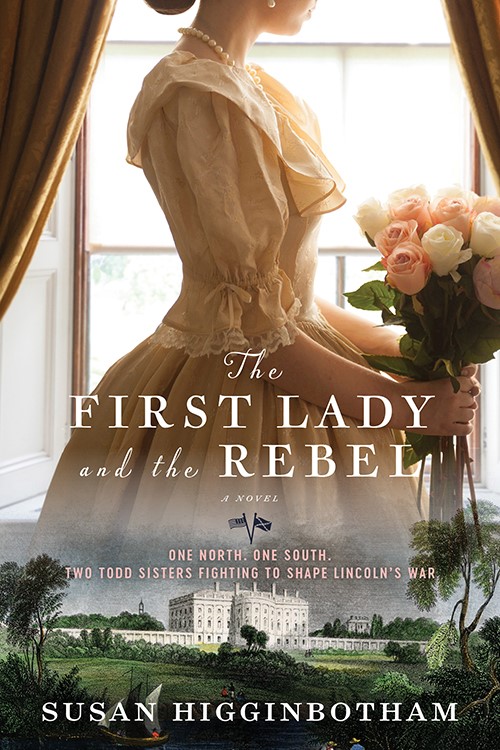
It is always a pleasure to have Susan visit the blog, and I owe her a huge thanks for such an interesting article. I would like to take this opportunity to wish Susan every success with her latest novel, The First Lady and the Rebel. If you’ve never read one of Susan’s books, I highly recommend you take the plunge!
About the Author:
Susan Higginbotham is the author of seven historical novels, including Hanging Mary, The Stolen Crown, and The Queen of Last Hopes. The Traitor’s Wife, her first novel, was the winner of ForeWord Magazine’s 2005 Silver Award for historical fiction and was a Gold Medalist, Historical/Military Fiction, 2008 Independent Publisher Book wards. She writes her own historical fiction blog, History Refreshed. Susan has worked as an editor and an attorney, and lives in Maryland with her family.
From the celebrated author Susan Higginbotham comes the incredible story of Lincoln’s First Lady
A Union’s First Lady
As the Civil War cracks the country in two, Mary Lincoln stands beside her husband praying for a swift Northern victory. But as the body count rises, Mary can’t help but fear each bloody gain. Because her beloved sister Emily is across party lines, fighting for the South, and Mary is at risk of losing both her country and her family in the tides of a brutal war.
A Confederate Rebel’s Wife
Emily Todd Helm has married the love of her life. But when her husband’s southern ties pull them into a war neither want to join, she must make a choice. Abandon the family she has built in the South or fight against the sister she has always loved best.
With a country’s legacy at stake, how will two sisters shape history?
From Emma of Normandy, wife of both King Cnut and Æthelred II to Saint Margaret, a descendant of Alfred the Great himself, Silk and the Sword: the Women of the Norman Conquest traces the fortunes of the women who had a significant role to play in the momentous events of 1066. Available now from Amazon UK, Amberley Publishing,Book Depository and Amazon US.
Telling the stories of some of the most remarkable women from Medieval history, from Eleanor of Aquitaine to Julian of Norwich, Heroines of the Medieval World, is available now on kindle and in paperback in the UK from from both Amberley Publishing and Amazon, in the US from Amazon and worldwide from Book Depository.
*
You can be the first to read new articles by clicking the ‘Follow’ button, liking our Facebook page or joining me on Twitterand Instagram.
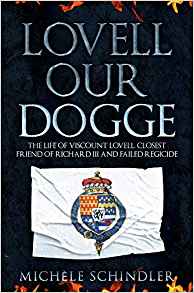
Today it is a pleasure to welcome Francis Lovell’s biographer Michele Schindler to the blog, with an article about Lovell’s wife, Anne FitzHugh Lovelle. Michele’s new book, Lovell Our Dogge, is out now. Over to Michele:
The discovery of Richard III`s remains in a car park in Leicester, seven years ago, has caused a surge of interest not only in the life of this controversial monarch, but also in his contemporaries. A particularly positive trend during these last years has been the interest showed in the women in Richard`s life, in the Wars of the Roses period in general. Whereas most of them have been typecast, if not outright ignored, over the last few centuries, many talented authors have focused on their lives, their influence, their politicial opinions, showing the fully rounded personalities they have been denied for so long.
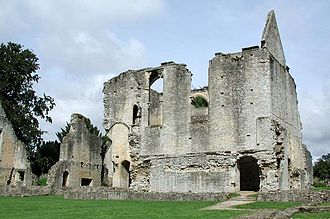
Minster Lovell
Sadly, however, one influential woman has been strangely excempt from this trend. While her contemporaries have finally been allowed to emerge from the mists of history, Anne Lovell has not been given any attention. Ignored in history books, maligned in fiction, Anne`s importance in life has been all but forgotten.
Her life did not begin in a way that
promised anything but rich and comfortable obscurity. Born as the third
daughter and fourth child of Henry FitzHugh, 5th Baron FitzHugh, and his wife
Alice Neville in 1460, Anne`s future probably seemed predictable, comprising of
marriage to a member of the gentry or lower-ranking nobility and motherhood.
At least, this appears to have been what
her parents were planning for her. In February 1465, when Anne was not more
than barely five years old at the most, they married her to the then
eight-year-old Francis Lovell, who had become Baron Lovell only around five
weeks earlier after his father`s sudden death. It was a marriage made possible
by Anne`s uncle Richard, Earl of Warwick, and would doubtlessly have been seen
as a good match for the little girl.
It cannot be said how much Anne and Francis saw of each other in the first years of their marriage. It is known, however, that it was in the summer of 1466 that Anne`s mother-in-law, Joan Beaumont died, leaving Francis and his sisters Joan and Frideswide full orphans. After their mother`s death, it seems the girls were raised together with Anne and her siblings in her parents` household.
It is probable that during this time, Anne knew her sisters-in-law far better than her husband, who did not live in the same household she did. It was only some years later that he seems to have started living in her parents` household, but it is known that by 10th September 1470, he was definitely there, for he is included, together with Anne, her siblings and his sisters, in a pardon granted to Henry FitzHugh for his rebellion that year. It is one oft her very few early mentions of Anne in the sources, though it does not say anything about her personally. Only ten years old when the pardon was issued, her inclusion being a nominal one, not indicative of any of her actions.
The next mention of Anne found in contemporary sources is from 1473, by which time quite a lot in her life had changed. Now thirteen, she had lost her father the year before and seen her brother Richard become Baron FitzHugh. Though her father`s death meant that she and her siblings were the king`s wards, it seems that their mother Alice, had been allowed to keep custody of them, and in the summer of 1473, she and her children, Anne among them, joined the prestigious Corpus Christi Guild in York.
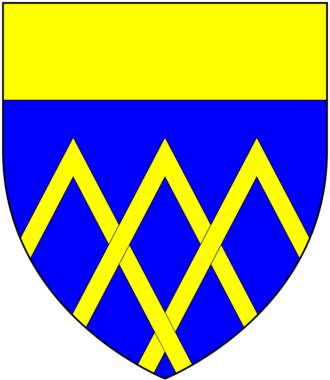
FitzHugh Arms
An interesting fact about this is that Anne`s husband, Francis, was present then as well and joined the guild with Anne and her family. This suggests Francis stayed with the FitzHughs regularly until Anne was old enough to be his wife in more than name, perhaps to give Anne the chance to get to know him, but there is no way to be certain. Nor do we know exactly when Anne was considered old enough, though some guesswork can be made. Francis made sure his sisters were not married before they were sixteen. It seems likely that he and Anne therefore also delayed cohabition and consummation until she had reached that age.
There evidence that this was also the age that Anne began living together with Francis, such as a letter written by Elizabeth Stonor in early March 1477. This letter refers to her and Francis, clearly as the Stonors` Oxfordshire neighbours. The context makes it clear that their relationship, while friendly, was still comparatively new and uncertain, which would fit perfectly with the Lovells, aged 20 and 16, first moving into Francis`s ancestral home of Minster Lovell Hall together around half a year before the letter was written.
The letter also contains an interesting minor mention of Anne, as the recipient of a present, like her husband, to win their good will. This indicates that the Stonors knew, or at least assumed, that Anne held some sway over her husband or meant something to him, as well as that she held some influence of her own, and that her friendship as well as his was worth cultivating.
Sadly, as so much of
Anne`s life, evidence about her in the following years is scarce. She often
visited her mother, usually together with her husband. Quite possibly, she also
often saw her sisters, both of whom named their first daughter after Anne, and
her brothers as well.
Even if she did not, she
definitely saw her older brother Richard at court on 4th January 1483, as he
acted as one of Anne`s husbands sponsors when he was created a viscount and
Anne became a viscountess, and event that must have been splendid for her.
It was the beginning of a
steep career for her husband and following events would catapult Anne, too,
more into the limelight than she had been until that point. Only four months
later, King Edward IV died and six months later, Edward`s brother Richard had
become king, in a way that remains controversial to this day. Since the new
king was her husband`s closest friend, he was favoured a lot, which was to
reflect on Anne as well.
It is known that when Richard became king, Anne was present for
his coronation. She was in the new queen`s train, like her mother Alice and
older sister Elizabeth, and like them and several other ladies of high
standing, she was given “a long gown of blue velvet with crimson
satin” and “one gown of crimson velvet and white damask” for the
festivities.
Unlike her mother and Elizabeth, Anne was not made a
lady-in-waiting to Queen Anne, who was her first cousin, and unlike them, she
does not seem to have been favoured in any other way by the new queen. In fact,
it seems that after the coronation, she was not ever present in her household,
which means that her presence at the coronation had been an exception made for
the special occasion.
As to why Anne did not join her mother and sister in becoming a
favour lady of the queen, we can once more only speculate. It is possible, of
course, that the two women simply did not like each other. However, had Anne
wished to be a lady-in-waiting, it is almost impossible Queen Anne could have
denied her this, as she was the wife of one of the most important men in the
government. It is therefore most likely Anne herself decided that she was not
interested in the position, though the reasons for this must remain lost to
history.
Lovell Our Dogge by Michele Schindler
Anne appears to have
chosen to remain close to her husband whenever possible, which would mean she
was at court often, and witnessed a lot of the events that remain so
controversial to this day. Her opinions on them can never be known, but it
seems that at the very least, she did not dislike Richard III.
Richard`s reign, famously, was not to last long, and within only two years of his accession, he was faced with an invasion, by an exiled Lancastrian earl named Henry Tudor. He employed Anne`s husband, among many others, to help him ward off this invasion. Perhaps with the danger of this task in mind, on 10th June 1485 Francis Lovell created an indenture in which he arranged for Anne to receive several manors in the event of his death, not just to keep for the rest of her life, but to own and be able to pass on to her descendants after her death. This was an unusual arrangement, and not at all one he would have needed to make, indicating that Anne was priced by her husband.
The fact that this arrangement would have enabled her to pass these manors on to her descandants also shows up an oddity. It is certain that Anne never had a child by Francis, yet even after what were likely nine years of living as man and wife, he does not seem to have at all blamed her for it, or, as can be seen from the indenture, even doubted she could have children. Since this arrangement could have disadvantaged any children Anne had by him, giving their half-siblings she potentially could have had by another man after Francis`s death a claim to these manors, it seems he thought or knew that their childlessness was his fault, though there is no telling why.
What Anne thought of this is, as always, up for speculation, but it does seem that she did not hold it against her husband. Nor does she seem to have held it against her husband that when Richard III was killed in battle, he chose not to accept the newly made Henry VII`s pardon. It is of course possible that she would have wished for him to do the same her brother Richard FitzHugh did, accept Henry VII, but once Francis`s decision decision was made, she supported it.
In march 1486, less than
a year after Henry`s accession, Francis started a rebellion with two
supporters, the brothers Humphrey and Thomas Stafford. It was a dangerous but
not well thought-out undertaking, probably born more of desperation than any
political thought, and not surprisingly, it failed. The brothers Stafford were
captured and faced the consequences of their actions, but Francis was never
caught, which seems to have been at least partly because Anne helped him. After
the failure of the rebellion, the Countess of Oxford relayed information where
Francis was hiding, which turned out to be inaccurate. Shortly afterwards,
Anne`s brother Richard was stripped of several offices and the whole FitzHugh
family, Anne included, watched with suspicion by the new government. Since
Countess Margaret was Anne`s aunt and quite close to her mother, it is
certainly far from impossible that the faulty intelligence where Francis was
hiding came from Anne.
Anne remained under
suspicion, and perfectly uncaring of the fact, for at least the next year.
Famously, in 1487, with the support of Margaret of York, Dowager Duchess of
Burgundy and John de la Pole, Earl of Lincoln, Francis started another
rebellion in 1487, which would go down in history as the Lambert Simnel
uprising. It was far better planned than the rebellion of 1486 had been,
and once more, Anne appears to have been in contact with her husband and to
have supported him.
In a letter to John
Paston written on 16th May 1487, Sir Edmund Bedingfeld warned him that there
were rumours he had met with “Lady Lovell”, and cautions him that he
should act wisely about this rumour. Bedingfield does not spell out why he
considers that such a meeting would be unthinkable, apparently certain Paston
would know. Since only three
months earlier, Paston had been chided by the Earl of Oxford, one of Henry`s
closest men, for accidentally passing on wrong information regarding Francis`s
whereabouts, it might very well be that Anne was suspected, or even known, to
have once more deliberately spread bad intelligence. It can naturally not be
proved today, but it certainly is remarkable that two people connected with
Anne were provided with wrong information about Francis`s whereabouts at moments
crucial for his escape.
It is obvious that the
rebels, while in Ireland and Burgundy, must have had a contact in England, as
they when they were landed on Piel Island in June 1487, they were already
awaited by supporters. There is some evidence that this supporter in England
was in fact Anne, and it seems that after Henry VII`s men had won the battle,
she was surreptiously investigated. But whatever she did, it was apparently
never proved, for Henry VII`s government enacted no punitive measures against her.
Interestingly, Anne does
not seem to have been afraid of being punished, or else her concern for Francis
overrode her fear, for in 1488, she was looking for her husband. We know this
from another letter to John Paston, this one from Anne`s mother, in which Alice
FitzHugh mentions
that Anne was looking for Francis, supported by unnamed “benevolers“. For this
purpose, she had send one of Francis`s men and fellow rebels, Edward Franke, to
look for him, but he had been unsuccessful.
What is especially intriguing about this is that that Edward Franke was himself a traitor at that point, and knowing of his whereabouts without reporting them was treason in itself. It speaks volumes about Anne`s feelings for her husband that she did not care for the danger to herself when trying to find out what had happened to him. It is also an indication that she was courageous, and determined to find the truth.
The mention of the “benevolers”, whom she seems to have trusted and who seem to have supported her in this risky undertaking, appear to show that she was a well-liked woman who had several close, trusted friends.
We do not know if Anne ever found out what happened to her husband. It seems that sometime before December 1489, she gave up looking, as we do know that by then, she had taken a religious vow, for when Henry VII`s government granted her an annuity of 20 pounds then, she was called “our sister in God”. It means that at the age of 29 years at the most, Anne was certain she did not want to marry another time. Though of course her marriage prospects were diminished significantly due to her being a traitor`s widow, she could have found someone interested in her family connections, or even married for affection, but chose not to. Again, it can be taken as an indicator of feelings of affection for Francis.
We do not know what sort of vow she took, nor do we know what happened to her after that. The last mention of her in any source is in a second attainder passed against Francis in 1495, at which time she was spoken of as still alive. She might have died in 1498, but was definitely dead by January 1513.
Huge thanks to Michele for such a fabulous post!
About the author:
Michele Schindler is a language teacher, teaching German and English as second languages. Before that, she studied at Johann Wolfgang Goethe-Universität in Frankfurt am Main, Germany, reading history with a focus on mediaeval studies, and English Studies. In addition to English and German, she speaks French, and read Latin.
From Emma of Normandy, wife of both King Cnut and Æthelred II to Saint Margaret, a descendant of Alfred the Great himself, Silk and the Sword: the Women of the Norman Conquest traces the fortunes of the women who had a significant role to play in the momentous events of 1066. Available now from Amazon UK, Amberley Publishing,Book Depository and Amazon US.
Telling the stories of some of the most remarkable women from Medieval history, from Eleanor of Aquitaine to Julian of Norwich, Heroines of the Medieval World, is available now on kindle and in paperback in the UK from from both Amberley Publishing and Amazon, in the US from Amazon and worldwide from Book Depository.
*
You can be the first to read new articles by clicking the ‘Follow’ button, liking our Facebook page or joining me on Twitterand Instagram.
While researching Silk and the Sword: the Women of the Norman Conquest I came across some incredibly interesting characters. One of the most misunderstood women of the 11th century has to be Lady Godiva. Although she would have been known as Godgifu in her lifetime, we shall call her Godiva, the name we have all grown up with, and to distinguish her from several notable ladies of a similar name in this period. Known for her legendary naked ride through Coventry in order to ease the tax burdens of its citizens, finding the true story of Lady Godiva was a fascinating experience. She was the grandmother of three of the leading English characters of the Norman Conquest; Harold II’s queen, Ealdgyth and the earls of Mercia and Northumberland, Edwin and Morcar.
The origins of Lady Godiva herself, are shrouded in mystery and the distance of time. We know nothing of her parentage or relations. There is some suggestion that she was the sister of Thorold of Bucknall, who is said to have founded a Benedictine abbey on his manor at Spalding, Lincolnshire, which he then gave to the great abbey at Crowland. However, there does appear to be some confusion and the charter from Crowland which mentions Thorold could well be spurious. The situation is further confused by the fact the land later passed to Ivo Taillebois, who founded a church at Spalding as a satellite of the church of St Nicholas at Angers. Ivo’s wife, Lucy, was the daughter of Turold, Sheriff of Lincoln. It is difficult to say whether Turold of Lincoln and Thorold of Bucknall are one and the same person, but it is possible; Turold and Thorold are both a derivative of the Scandinavian name Thorvaldr. Later legends even name Lucy as a daughter of Earl Ælfgar and therefore a granddaughter of Godiva. However, there is no surviving evidence to support this theory and the identity of Thorold and his relationship to Godiva is just as uncertain.
Church of St Mary, Stow (Stow Minster) Lincolnshire
Godiva was probably married before 1010 and so it is possible that she was born in the early 990s. She possessed considerable lands in the north-west of Mercia, suggesting that this is where she and her family were from. Mercia, in that time, covered almost all of the Midlands region, spreading from the Welsh borders across the centre of England. Her lands in Leicestershire, Warwickshire, Staffordshire and Shropshire, which amounted to sixty hides, may have constituted her own inheritance.1 Godiva’s high family status is also attested by the fact that she made a very good marriage, to Leofric, who would later become Earl of Mercia.
Leofric was the son of Leofwine, who had been appointed Ealdorman of the Hwicce, an ancient kingdom within the earldom of Mercia, by Æthelred II in 994. While the family lands were given to victorious Danes on the accession of Cnut, Leofwine was allowed to keep his rank and title and may have succeeded the traitorous Eadric Streona as Ealdorman of Mercia after his death in 1017. The family’s lands and influence appear to have been in the eastern part of Mercia, where they were known religious benefactors; Earl Leofwine was recorded as a benefactor at Peterborough Abbey. Leofric’s marriage to Godiva, therefore, may have been a way of extending his family’s influence into the western parts of Mercia. He was attesting charters as minister between 1019 and 1026, perhaps as sheriff under Hakon, Earl of Worcester.
His father, Leofwine, probably died in 1023 or shortly after, as that was the last year in which he attested a charter. There is no clear indication as to whether Leofwine was ever Earl of Mercia, although Leofric certainly held that title through the reigns of four kings; Cnut, Harold Harefoot, Harthacnut and Edward the Confessor. Leofric’s backing of Harold Harefoot, over Harthacnut, may have been a result of his son’s marriage. Ælfgar is thought to have married Ælfgifu, who was possibly a kinswoman of Harold Harefoot’s mother, Ælfgifu of Northampton, sometime in the late 1020s. Such a relationship would explain Leofric’s support for Harold Harefoot. Of course, so would the fact that Harthacnut was in no hurry to return from Denmark and Harold was on the spot and able to take charge.
Lady Godiva and Leofric were great benefactors to the church and acted in partnership, particularly in their endowment of Coventry Abbey which, according to John of Worcester, was made out of lands held by each of them. They also endowed the minster church of Stow St Mary, just to the north of Lincoln, and an Old English memorandum included both Leofric and Godiva in a request to Wulfwig, Bishop of Dorchester-on-Thames ‘to endow the monastery and assign lands to it.’2 Stow St Mary is a beautiful building at the centre of the small village of Stow. Founded in the seventh century, it boasts the faded graffiti carving of a Viking longboat on one of its inner walls. The endowment included provision for secular canons, under the supervision of the bishop and was made between and 1053 and 1055.
Information board explaining the links with Lady Godiva, Stow Minster, Lincolnshire
It is often difficult to work out the extent of Godiva’s involvement in her husband’s religious endowments. The Evesham Chronicle names both Leofric and Godiva (as Godgifu, of course) as the founders of both Coventry Abbey and Holy Trinity Church at Evesham. The couple also gave a crucifix, with the supporting figures of the Virgin and St John the Evangelist, to Holy Trinity Church. Moreover, Godiva had a reputation as a patroness of the Church throughout Mercia during her own lifetime. Orderic Vitalis said that Godiva gave ‘her whole store of gold and silver’ for the provision of ecclesiastical ornaments for the foundation at Coventry and John of Worcester also records Godiva’s devotion to the Virgin.3
There is one example that counters this argument, however, which involves a joint grant by Leofric and Godiva, of Wolverley and Blackwell, Worcestershire. The Second Worcester Cartulary, compiled by Hemming on the orders of Bishop Wulfstan, claims that Leofric returned Wolverley and Blackwell, and promised that the manors at Belbroughton, Bell Hall, Chaddesley Corbett and Fairford, seized by his father Leofwine, would revert to the Church on his death. Hemming, however, claims that Godiva held onto the lands for herself, rather than returning them; although she is said to have given the Church expensive vestments and ornaments, and a promise not only to pay the annual revenues from these estates to the Church, but to return the lands on her own death.4 That Edwin and Morcar seized the lands after their grandmother’s death, surely cannot be laid at Godiva’s door?
During her marriage, Godiva held several manors in her own right. Coventry, although little more than a village at this time, appears to have belonged to Godiva herself. She also had lands in various other parts of Mercia, including Newark, which she may have bought from her son, Ælfgar, as it was part of the comital lands (the earldom). Her lands at Appleby in Derbyshire were leased from Leofric, the Abbot of Peterborough, who was nephew and namesake of her husband, Earl Leofric.
Godiva and Leofric by Edmund Blair Leighton
Leofric died in 1057, on either 31 August or 30 September, at his manor of King’s Bromley in Staffordshire. John of Worcester said of him; this ‘man of excellent memory died at a good old age, in his own manor called Bromley, and was buried with honour in Coventry, which monastery he had founded and well endowed.’5 The 1057 entry of the Anglo-Saxon Chronicle reported; ‘The same year died Earl Leofric, on the second before the calends of October; who was very wise before God, and also before the world; and who benefited all this nation’.6
Godiva was to live on as a widow for at least ten more years. She would be there to see her son’s inheritance of the earldom of Mercia. Although titles and land did often pass from father to son, it was not a foregone conclusion. Indeed, Ælfgar’s rebellion in 1055 – which led to a subsequent exile – may well have been in fear of losing his inheritance, given that Edward the Confessor had just given the earldom of Northumbria to Tostig, son of Godwin, on the death of Earl Siward in place of his son and natural heir, Waltheof. Waltheof was still a child, however, and this may well have been a practical decision, in that it would be dangerous to leave such a powerful earldom, and the border with Scotland, in the control of a child. Ælfgar was banished again in 1058, but for a very short while, apparently, with the Anglo-Saxon Chronicle reporting; ‘Earl Ælfgar was expelled but he soon came back again, with violence, through the help of Gruffydd.’7
We do not have the exact date of Godiva’s death. Most historians seem to believe that she survived the Norman Conquest and died around 1067. She is mentioned as a pre-Conquest landholder in the Domesday Book, but that doesn’t necessarily mean that she was alive in 1066. Hemming, who compiled the Worcester cartulary, says that some of her lands passed directly to her grandsons, Edwin and Morcar, offering evidence that Godiva also outlived her son, Ælfgar, who probably died in 1062. If Godiva did live into 1067, then she would have seen the dangers that the Norman Conquest brought to her family. Although her son was dead, most of her grandchildren were very much alive, and at the heart of events. By 1065 her 2 surviving grandsons were both earls (a 3rd grandson, Burgred, died in 1060 while returning from a pilgrimage to Rome).
Morcar became Earl of Northumbria in 1065, chosen by the Northumbrians to replace the unpopular Tostig. His tenure, however, was of short duration and he was replaced with Copsig, an adherent of Tostig, by William the Conqueror. Edwin had succeeded his father as Earl of Mercia in 1062 but neither brother flourished under the rule of William the Conqueror. Their sister, Ealdgyth married Harold Godwinson (King Harold II) sometime in late 1065, or early 1066, and was the uncrowned Queen of England until Harold’s death at Hastings in October 1066. Following the battle, Ealdgyth was taken to Chester by her brothers, where she may have given birth the king Harold’s son, Harold, before disappearing from the records.
Godiva is believed to have died in 1067 and was most likely buried alongside her husband at Coventry; although the Evesham Chronicle claims that she was laid to rest in Holy Trinity, Evesham. In the thirteenth century, her death was remembered on 10 September, but we have no way of confirming the actual date. After the Conquest, Godiva’s lands were held by various personalities.
Statue of Alfred Lord Tennyson in the grounds of Lincoln Cathedral
We have no contemporary description of Godiva, of her personality or appearance. Her patronage of such religious institutions as Stow St Mary and Coventry Abbey is testimony to her piety and generosity. Stories of this generosity and piety were known to later chroniclers, such as William of Malmesbury and Henry of Huntingdon. Henry of Huntingdon said of Godiva that her name ‘meriting endless fame, was of distinguished worth, and founded the abbey at Coventry which she enriched with immense treasures of silver and gold. She also built the church at Stow, under the hill at Lincoln, and many others.’8 Although Henry of Huntingdon’s geography is a little skewed – Stow is a few miles north of Lincoln, rather than to the south, which ‘under the hill’ would suggest – it is obvious that Godiva’s fame was still alive in the twelfth century.
Lady Godiva is, perhaps, the most famous Anglo-Saxon woman in history. Everyone knows her legend – or a variation of it. And that legend has only grown and expanded down the years; like the game of Chinese whispers, the story has been added to and enhanced with every retelling. It was probably her reputation for generosity that gave rise to the legend for which she is famous today. The story of Godiva’s naked ride through Coventry appears to have been first recounted by Roger of Wendover, who died in 1236:
The Countess Godiva devoutly anxious to free the city of Coventry from a grievous and base thralldom often besought the Count, her husband, that he would for the love of the Holy Trinity and the sacred Mother of God liberate it from such servitude. But he rebuked her for vainly demanding a thing so injurious to himself and forbade her to move further therein. Yet she, out of womanly pertinacity, continued to press the matter in so much that she obtained this answer from him: ‘Ascend,’ he said, ‘thy horse naked and pass thus through the city from one end to the other in sight of the people and on thy return thou shalt obtain thy request.’ Upon which she returned: ‘And should I be willing to do this, wilt thou give me leave?’ ‘I will,’ he responded. Then the Countess Godiva, beloved of God, ascended her horse, naked, loosing her long hair which clothed her entire body except her snow white legs, and having performed the journey, seen by none, returned with joy to her husband who, regarding it as a miracle, thereupon granted Coventry a Charter, confirming it with his seal.
Flores Historiarum by Roger of Wendover, translated by Matthew of Westminster
This legend has grown and expanded over time, providing inspiration for ballads, poetry, paintings and sculptures throughout the centuries, the most famous being the poem, Lady Godiva, by Alfred Lord Tennyson, written in 1840, which included the lines:
Lady Godiva by John Collier
“The woman of a thousand summers back, Godiva, wife to that grim Earl, who ruled In Coventry: for when he laid a tax Upon his town, and all the mothers brought Their children, clamouring, ‘If we pay, we starve!’ She sought her lord, and found him, where he strode About the hall, among his dogs, alone, His beard a foot before him, and his hair A yard behind. She told him of their tears, And pray’d him, ‘If they pay this tax, they starve.’ Whereat he stared, replying, half-amazed, ‘You would not let your little finger ache For such as – these?’ – ‘But I would die,’ said she.”
Godiva by Alfred Lord Tennyson.
The legend arose from a story that Earl Leofric had introduced a toll on Coventry that the people could not afford to pay. Godiva went to her husband, begging that he rescind the taxes. He proved reluctant to offer the slightest reduction and is said to have told Godiva that he would only rescind the taxes if she rode naked through Coventry. In the earliest accounts Godiva rode through the market place, accompanied by two of Leofric’s soldiers, with her long, golden hair let loose to protect her modesty. In the early versions, the religious element of the story is highlighted, with Leofric hailing the fact no one had seen her nakedness as a miracle.
Although the story has endured through the centuries, I am inclined to believe that it didn’t happen – at least not in the way portrayed. It seems more plausible that Godiva had undertaken a pilgrimage, stripped of her fine clothes and jewels – in a state of undress, rather then undressed – maybe just in her shift or a simple, penitentiary, garment. While the legend is almost certainly distorted beyond recognition from the true story, it has guaranteed the immortality of a remarkable lady.
[1] Godgifu (d. 1067?) (article) by Ann Williams, oxforddnb.com; [2] ibid; [3] The Ecclesiastical History of England and Normandy by Ordericus Vitalis; [4] Godgifu (d. 1067?) (article) by Ann Williams, oxforddnb.com; [5] The Anglo-Saxon Chronicles edited and translated by Michael Swanton; [6] The Anglo-Saxon Chronicle translated by James Ingram; [7] The Anglo-Saxon Chronicles edited and translated by Michael Swanton; [8] The Chronicle of Henry of Huntingdon. Comprising the history of England, from the invasion of Julius Caesar to the accession of Henry II. Also, the Acts of Stephen, King of England and duke of Normandy Translated and edited by Thomas Forester. London, H.G. Bohn, 1807.
Sources:
The English and the Norman Conquest by Dr Ann Williams; Brewer’s British Royalty by David Williamson; Britain’s Royal Families, the Complete Genealogy by Alison Weir; The Wordsworth Dictionary of British History by JP Kenyon; The Norman Conquestby Marc Morris; Harold, the King Who Fell at Hastings by Peter Rex; The Anglo-Saxons in 100 Facts by Martin Wall; The Anglo-Saxon Age by Martin Wall; Kings, Queens, Bones and Bastards by David Hilliam; The Mammoth Book of British kings & Queens by Mike Ashley; The Oxford Companion to British History Edited by John Cannon; The Anglo-Saxon Chronicles translated and edited by Michael Swaton; The Anglo-Saxon Chronicle translated by James Ingram; Queen Emma and the Vikings by Harriett O’Brien; The Bayeux Tapestry by Carola Hicks; On the Spindle Side: the Kinswomen of Earl Godwin of Wessex by Ann Williams; oxforddnb.com.
*
Godiva’s story appears in greater detail in my book, Silk and the Sword: The Women of the Norman Conquest. From Emma of Normandy, wife of both King Cnut and Æthelred II to Saint Margaret, a descendant of Alfred the Great himself, Silk and the Sword: the Women of the Norman Conquest traces the fortunes of the women who had a significant role to play in the momentous events of 1066.
*
My Books
Signed, dedicated copies of all my books are available through my online store.
Out now: Scotland’s Medieval Queens
Scotland’s history is dramatic, violent and bloody. Being England’s northern neighbour has never been easy. Scotland’s queens have had to deal with war, murder, imprisonment, political rivalries and open betrayal. They have loved and lost, raised kings and queens, ruled and died for Scotland. From St Margaret, who became one of the patron saints of Scotland, to Elizabeth de Burgh and the dramatic story of the Scottish Wars of Independence, to the love story and tragedy of Joan Beaufort, to Margaret of Denmark and the dawn of the Renaissance, Scotland’s Medieval Queens have seen it all. This is the story of Scotland through their eyes.
‘Scotland’s Medieval Queens gives a thorough grounding in the history of the women who ruled Scotland at the side of its kings, often in the shadows, but just as interesting in their lives beyond the spotlight. It’s not a subject that has been widely covered, and Sharon is a pioneer in bringing that information into accessible history.’ Elizabeth Chadwick (New York Times bestselling author)
Heroines of the Tudor World tells the stories of the most remarkable women from European history in the time of the Tudor dynasty, 1485-1603. These are the women who ruled, the women who founded dynasties, the women who fought for religious freedom, their families and love. Heroines of the Tudor World is now available from Amberley Publishing and Amazon UK.Women of the Anarchy demonstrates how Empress Matilda and Matilda of Boulogne, unable to wield a sword themselves, were prime movers in this time of conflict and lawlessness. It shows how their strengths, weaknesses, and personal ambitions swung the fortunes of war one way – and then the other. Available from Bookshop.org, Amberley Publishing and Amazon UK. King John’s Right-Hand Lady: The Story of Nicholaa de la Haye is the story of a truly remarkable lady, the hereditary constable of Lincoln Castle and the first woman in England to be appointed sheriff in her own right. Available from all good bookshops Pen & Sword Books, bookshop.org and Amazon.
Alternate Endings: An anthology of historical fiction short stories including Long Live the King… which is my take what might have happened had King John not died in October 1216. Available in paperback and kindle from Amazon.
Podcast:
Have a listen to theA Slice of Medieval podcast, which I co-host with Historical fiction novelist Derek Birks. Derek and I welcome guests, such as Bernard Cornwell and Michael Jecks, and discuss a wide range of topics in medieval history, from significant events to the personalities involved.
Worshipped by Rome. Betrayed by love. Stalked by death. Rome is enjoying a period of stability and prosperity. The Empire’s borders are growing, and there are two sons in the imperial succession for the first time in Rome’s history. But all is not as it appears. Cracks are beginning to show. Two decades of war have taken their toll, and there are whispers of a sickness in the East. The Empire stands on the brink of true disaster, an age of gold giving way to one of iron and rust, a time of reason and strength sliding into hunger and pain. The decline may yet be halted, though. One man tries to hold the fracturing empire together. To Rome, he is their emperor, their Hercules, their Commodus. But Commodus is breaking up himself, and when the darkness grips, only one woman can hold him together. To Rome she was nothing. The plaything of the emperor. To Commodus, she was everything. She was Marcia.
Commodus by Simon Turney is the second in his The Damned Emperors series, exploring the lives of those emperors even Rome wanted to erase from history. The first in the series, Caligula was a fabulous and intelligent read that really made you think about the political intrigues of ancient Rome. Commodus is no less thought-provoking.
The thing that struck me after reading both Caligula and Commodus is why on earth would anyone want to be emperor – or even close to the emperor in ancient Rome. Yes, the job came with ‘phenomenal cosmic power’ (as the genie in Aladdin would put it) but you did not expect to die in your bed – unless it was from poison or an assassin in the night.
What makes The Damned Emperors series so unique is that Simon Turney uses the women close to the emperor to tell his story. In Caligula it was his own sister, Livilla, who witnessed her brother’s rise to ‘the purple’ and followed his story to an inevitable violent conclusion. In Commodus the tale is told through Marcia, a childhood friend who rose to be the emperor’s lover and consort, though not his wife and empress. Each woman is able to narrate the emperor’s life and the events which shape his personality and rule. Each book is a standalone.
‘I’m supposed to turn my other cheek to you, ignore your violence and forgive you. And because I want to be a good Christian, I’ll do that. I’ll forgive you but only this once.’
He made .to push me again, but perhaps something in my expression stopped him. Certainly, he stepped back. I was a freedwoman of the emperor Lucius Verus, and he was a slave. I had allowed him to get away with pushing me over in anger, but I had warned him not to do so again. For my part, I meant every word. I would punch him in the eye if he tried again. For his part, I suspect he thought I meant I would report his behaviour to the major-domo, which would have seen him beaten at the very least. Whatever the case, he walked away. As he reached the door, he paused and turned.
‘In the old days, they used to burn your sort.’
And then he was gone. I seethed, shaking, promising myself that one day I would settle that score. I received my second shock in a short space as Commodus emerged from the shadows near another door, confusion creasing his young, innocent face.
‘What’s a Criss-chen?’ he asked, stumbling a little over the unfamiliar word.
Hmm. I thought lessons would be cancelled today, what with Fulvus bedridden, but it seemed I was to teach instead. I thought long and hard on the question as he watched me with those intelligent, searching eyes.
‘We believe in only one God. He is the creator of all things and the world is made according to His plan.’ I shrugged, trotting out the words I’d heard so many times. ‘There’s more to it, but that’s the main thing.’
‘Which god?’
Marcia’s own story is as fascinating as that of the emperor she adores, and serves as an example of how power corrupts not only the leaders, but those around them. Marcia is an interesting character who uses necessity and love to justify actions that many would find questionable, if not downright abhorrent. And yet you can’t help liking and sympathising with a woman who had little real power and influence over her own life, let alone anyone the emperor’s!
Simon Turney is a master of intrigue and has a remarkable ability to get inside the head of the women who lived alongside these emperors. And then into the heads of the emperors themselves. You cannot help but have sympathy for these great men, who rose to such heights that they practically ruled the world, but could trust no one. His knowledge of Roman history is second-to-none and he puts it to good use in depicting not only the Roman psyche, but also the Roman way of life.
Simon Turney vividly recreates the streets of Rome, the buildings, people and events to the extent that you can practically smell the markets, the blood in the arenas and the wondrous aromas of the lavish meals served to the imperial family. As a consequence, you can also feel the despair and despondency of the poor and unrepresented populace – the plebs and the slaves – who are ignored and left to suffer famine and plague by their indifferent rulers.
Commodus is not always an easy read, but it is fascinating. It draws you in from the very first pages, and leads you on a journey of discovery, not only of the emperor himself but of the life of the imperial family. It is eye-opening! Beautifully written and addictive, it is one of those books that you can’t wait to finish – and yet, desperately want it not to end.
To buy the book:
Commodus: The Damned Emperors Book 2 by Simon Turney is available from Amazon in the UK and US.
About the author:
Simon lives with his wife, children and dogs in rural North Yorkshire. Having spent much of his childhood visiting historic sites with his grandfather, a local photographer, Simon fell in love with the Roman heritage of the region, beginning with the world famous Hadrian’s Wall. His fascination with the ancient world snowballed from there with great interest in Egypt, Greece and Byzantium, though his focus has always been Rome. A born and bred Yorkshireman with a love of country, history and architecture, Simon spends most of his rare free time travelling the world visiting historic sites, writing, researching the ancient world and reading voraciously.
Simon’s early career meandered along an arcane and eclectic path of everything from the Ministry of Agriculture to computer network management before finally settling back into the ancient world. During those varied years, Simon returned to university study to complete an honours degree in classical history through the Open University. With what spare time he had available and a rekindled love of all things Roman, he set off on an epic journey to turn Caesar’s Gallic War diaries into a novel accessible to all. The first volume of Marius’ Mules was completed in 2003 and has garnered international success, bestseller status and rave reviews, spawning numerous sequels. Marius’ Mules is still one of Simon’s core series and although Roman fiction features highly he now has Byzantine, Fantasy and Medieval series, too, as well as several collaborations and short stories in other genres.
Now, with in excess of 25 novels available and 5 awaiting release, Simon is a prolific writer, spanning genres and eras and releasing novels both independently and through renowned publishers including Canelo and Orion. Simon writes full time and is represented by MMB Creative literary agents.
Look out for Roman military novels featuring Caesar’s Gallic Wars in the form of the bestselling Marius’ Mules series, Roman thrillers in the Praetorian series, set during the troubled reign of Commodus, adventures around the 15th century Mediterranean world in the Ottoman Cycle, and a series of Historical Fantasy novels with a Roman flavour called the Tales of the Empire.
From Emma of Normandy, wife of both King Cnut and Æthelred II to Saint Margaret, a descendant of Alfred the Great himself, Silk and the Sword: the Women of the Norman Conquest traces the fortunes of the women who had a significant role to play in the momentous events of 1066. Available now from Amazon UK, Amberley Publishing,Book Depository and Amazon US.
Telling the stories of some of the most remarkable women from Medieval history, from Eleanor of Aquitaine to Julian of Norwich, Heroines of the Medieval World, is available now on kindle and in paperback in the UK from from both Amberley Publishing and Amazon, in the US from Amazon and worldwide from Book Depository.
*
You can be the first to read new articles by clicking the ‘Follow’ button, liking our Facebook page or joining me on Twitterand Instagram.