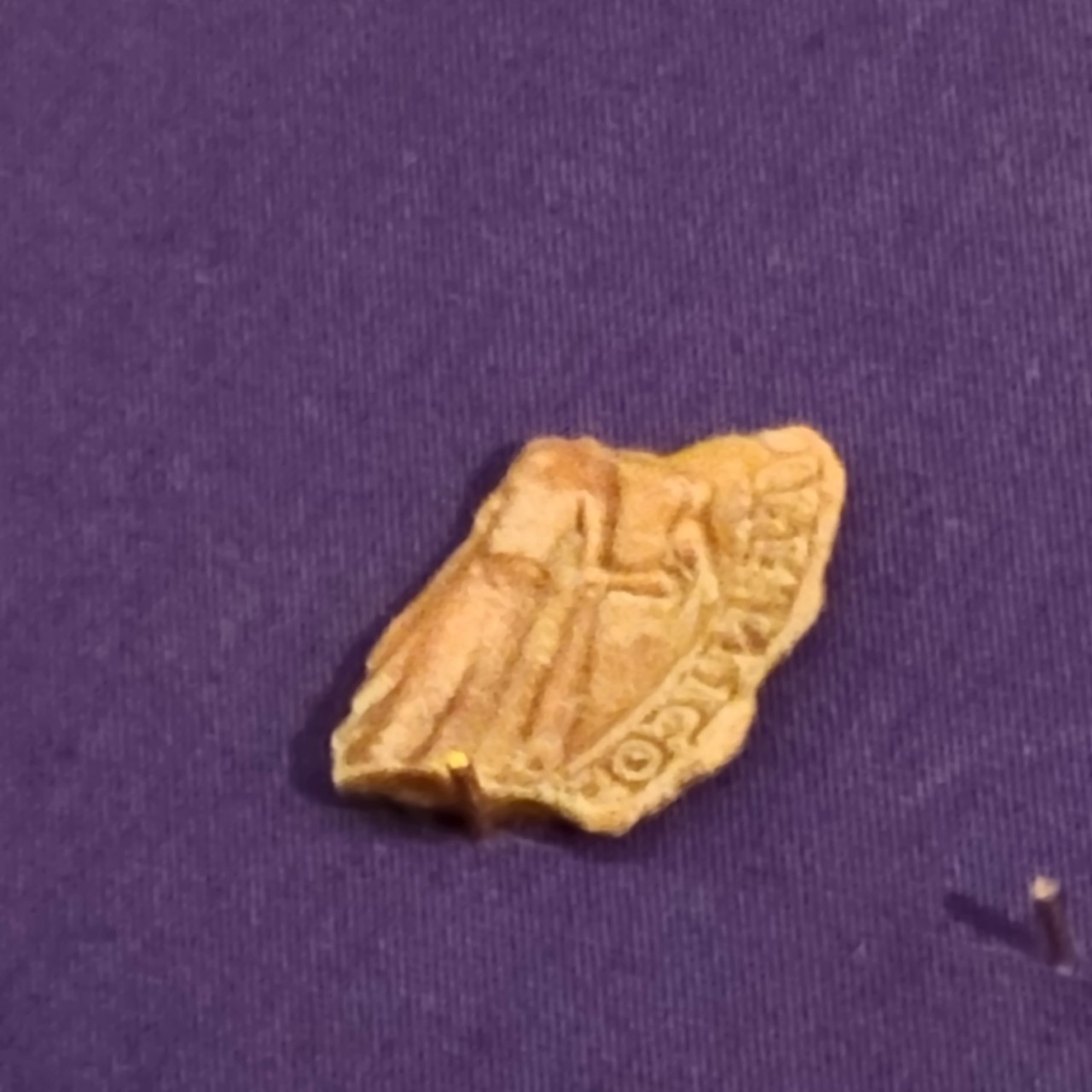
1191: Nicholaa de la Haye’s First Siege

History... the Interesting bits
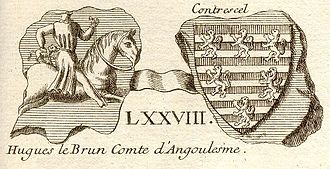
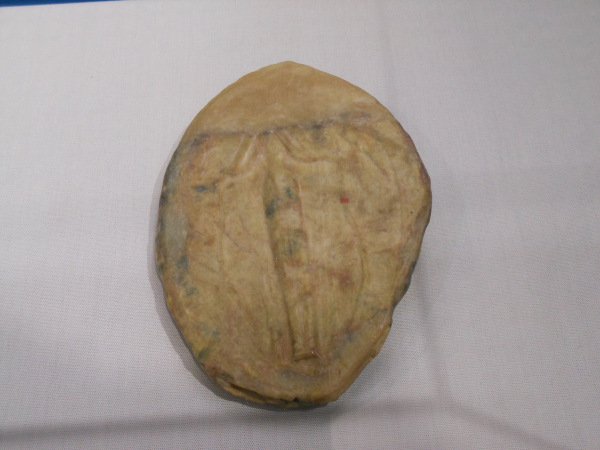
Partial seal of Nicholaa de la Haye

Nicholaa de la Haye first came to the attention of the chroniclers in the year 1191. She and her husband, Gerard de Camville, were in command of Lincoln Castle. Gerard was a talented administrator and was sheriff of Lincoln in 1189 and 1190 and again from 1199 to 1205. He was also hereditary constable of Lincoln Castle by right of his wife, Nicholaa. Although he had sworn allegiance to King Richard on his accession, in 1191 Gerard paid homage to the king’s brother John, then count of Mortain, for Lincoln Castle. This meant that Gerard and Nicholaa would be drawn into John’s dispute with King Richard’s chancellor, William Longchamp.

Before King Richard’s departure on crusade, the king had extracted a promise from John and their illegitimate half-brother Geoffrey, Archbishop of York, that neither would set foot in England for three years. Although it seems highly unlikely that Longchamp released John from his oath, the prince was back in England by 1191, possibly on the insistence of his mother, Eleanor of Aquitaine, who was watching over her favourite son’s domains while he was away on crusade.

Longchamp’s heavy-handed administration of the country caused much dissent among the barons and John chose to champion their cause. The catalyst for John’s armed opposition to William Longchamp may well have been the king’s recognition of his nephew, Arthur, Duke of Brittany still only a child of five years, as his heir; the only person in England who was meant to know was William Longchamp. However, it seems that Longchamp may have sounded out others to measure the level of support for Arthur. According to the chronicler William of Newburgh, he passed on the information to the king of Scots, at least, and possibly some of the Welsh princes. In early 1191 the news was widely leaked, and John came to hear of it.
History... the Interesting bits
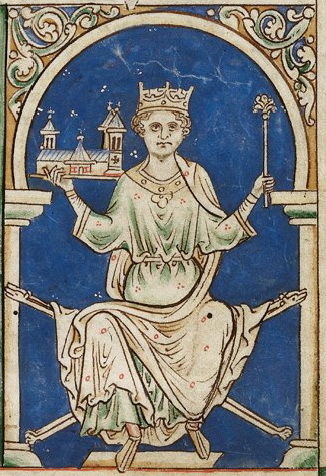
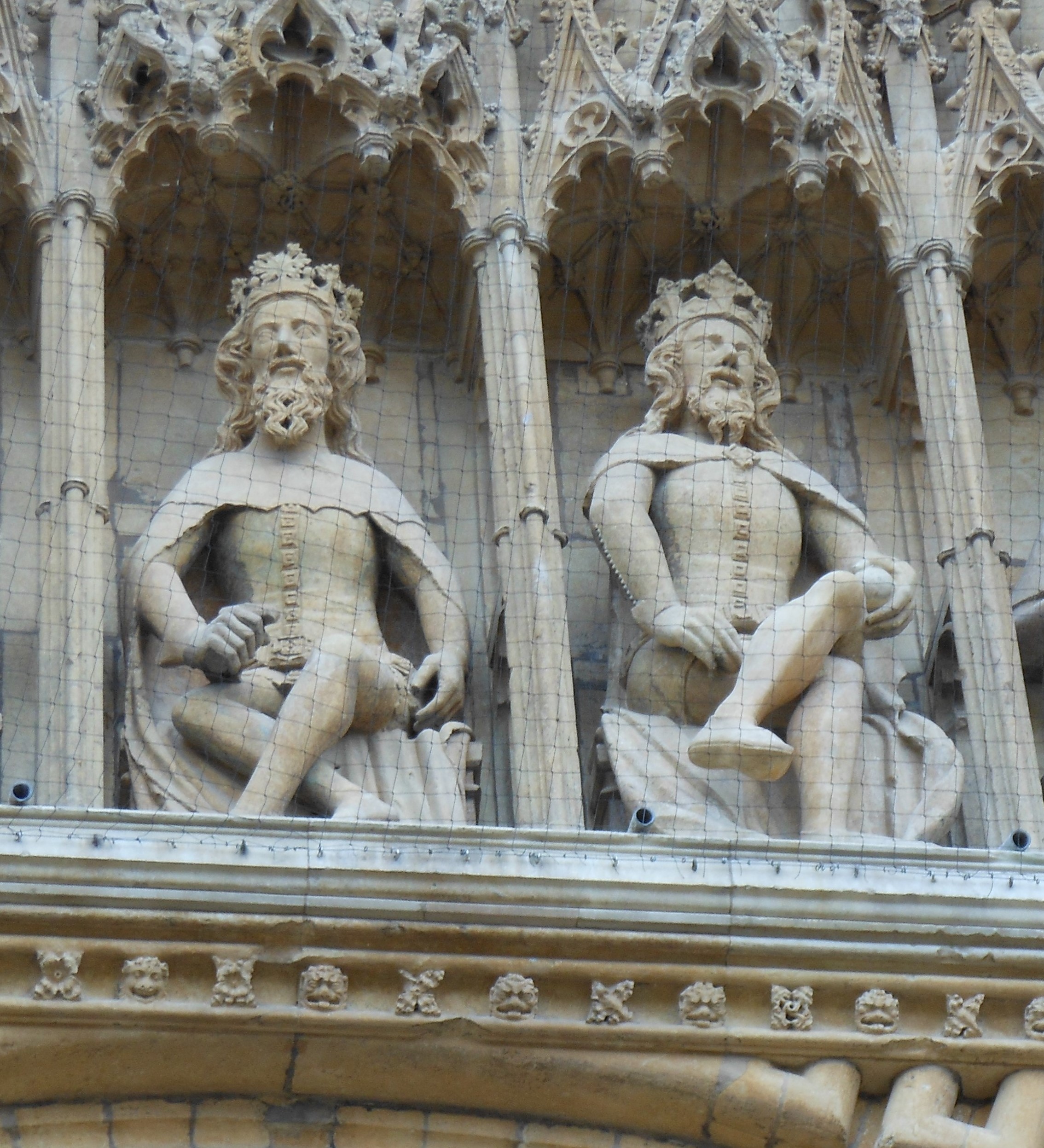
Richard I and John side by side in the Gallery of Kings on the West Front of Lincoln cathedral

According to William of Newburgh, John had expected to become the successor to the  kingdom, should the king not survive the cursade. Indeed, Richard’s advancement of his brother since his accession, in giving John lands in England and arranging his marriage to an English bride, all seemed to support this expectation. Richard’s actions in naming Arthur his heir, and Longchamp’s support for this, threatened to undermine John’s own claims and rights. Having heard the not-so-secret secret, John started building up his own powerbase. According to Richard of Devizes, John, ‘when he knew for certain that his brother had turned his back on England, presently perambulated the kingdom in a more popular manner, nor did he forbid his followers calling him the king’s heir.’

Tensions were rising. Richard of Devizes reported that, as a result of the king’s departure on crusade, the nobles were ‘all stirred up in arms, castles closed, cities fortified and entrenchments thrown up.’

John sent out letters, in secret, eliciting the support of the nobles against the justiciar. The king himself was so concerned over events in England that, in the spring, he had released Walter de Coutances, archbishop of Rouen, from his crusading vow and sent him back to sort things out. The king must have had concerns about the efficacy of William Longchamp’s rule, as he also sent a letter, to William Marshal, Hugh Bardolf, Geoffrey Fitz Peter and William Brewer, in which he ordered ‘If our chancellor does not act faithfully according to the advice of yourselves and others to whom we have committed the care of our kingdom, we order you to carry out your own dispositions in all the affairs of our kingdom, in castles and escheats, without any dispute.’

Walter de Coutances landed at Shoreham on 27 June, 1191. The situation had already escalated, however.

In 1190, on returning from his investigation into the massacre of the Jews of York, Longchamp stopped at Lincoln. He accused Gerard de Camville of harbouring thieves and robbers who preyed on the merchants attending the fair at Stamford. Longchamp had demanded that Gerard de Camville, described as ‘an enemy of the chancellor’ by the Crowland Chronicle, relinquish his custody of Lincoln Castle and swear allegiance to him, personally, as justiciar. Camville refused and instead ‘had done homage to Earl John, the king’s brother, for the castle of Lincoln, the custody whereof is known to belong to the inheritance of Nicholaa, the wife of the same Gerard, but under the king.’1

In acting against Gerard de Camville, Longchamp had forced him into John’s arms. On learning of Gerard’s defiance, Longchamp sent overseas for foreign mercenaries and set out north with the troops he had under his command, attacking Wigmore along the way and forcing Roger de Mortimer, impeached for conspiracy against the king, to surrender his castles and abjure England for three years. As Gerard de Camville joined John at Nottingham, Longchamp continued to Lincoln where he besieged the castle as ‘Gerard was with the earl; and his wife Nicholaa proposing to herself nothing effeminate defended the castle like a man. The chancellor was wholly busied about Lincoln.’2

History... the Interesting bits
Lincoln castle, East Gate

The formidable Nicholaa refused to yield, holding out for forty days before Longchamp raised the siege, having heard that Tickhill and Nottingham had fallen to John.

Gerard’s decision to leave Nicholaa in command of the castle, even though Longchamp was heading her way with an army, may have been to emphasise the standing of the de la Haye family in Lincolnshire, and its connections to the castle itself. He believed Lincoln would rally to her side. That he did not appoint a male deputy to take charge is testament to his trust in Nicholaa and her abilities. She had, after all, grown up with the castle as her birth right and would have been familiar with every part of its defences, its strengths and weaknesses. Although she would not have been able to fight, with sword and shield, she could direct the defence, placing soldiers where they were most needed, organising supplies of weapons and ammunition, and ensuring the stores of food and drink were suitably rationed.

Nicholaa was approaching forty when William Longchamp besieged her. She was no young, inexperienced girl, and she would have been used to command – and to her orders being obeyed. She was also a mother, of a daughter in her teens and at least two young boys, but it is unlikely that the children were in the castle; it is more likely they were being raised on her manor at Brattleby, just to the north of Lincoln. The castle itself may appear difficult to defend. The curtain wall was a third of a mile in length, but there was a steep drop on the south side. There were two main entrances, the East and West gates, and a number of postern gates. These had to be guarded closely. Similarly, the castle would also have been difficult to attack, and besiegers would have concentrated their energies on the main and postern gates. There is no record of Longchamp bringing up siege machinery, so it would have been a case of watching and waiting and hoping to starve out the castle occupants.

Nicholaa held out for forty days, as demonstrated by the Pipe Roll of 1191, which showed that mercenaries were employed for that length of time on the siege of Lincoln Castle. All the same, it must have been a relief for Nicholaa, when William Longchamp gave up the siege and marched his soldiers away.

According to Roger of Howden, the chancellor besieged Lincoln Castle, ‘having expelled Gerard de Camville from the keepership and the office of sheriff of Lincoln; which former office the chancellor gave to William de Stuteville and made him sheriff as well.’ John, in turn moved north in support of Gerard, quickly taking the ill-prepared royal castles of Tickhill (in Yorkshire) and Nottingham and demanding that Gerard de Camville be reinstated, saying that he ‘would visit him [the chancellor] with a rod of iron’.3
History... the Interesting bits
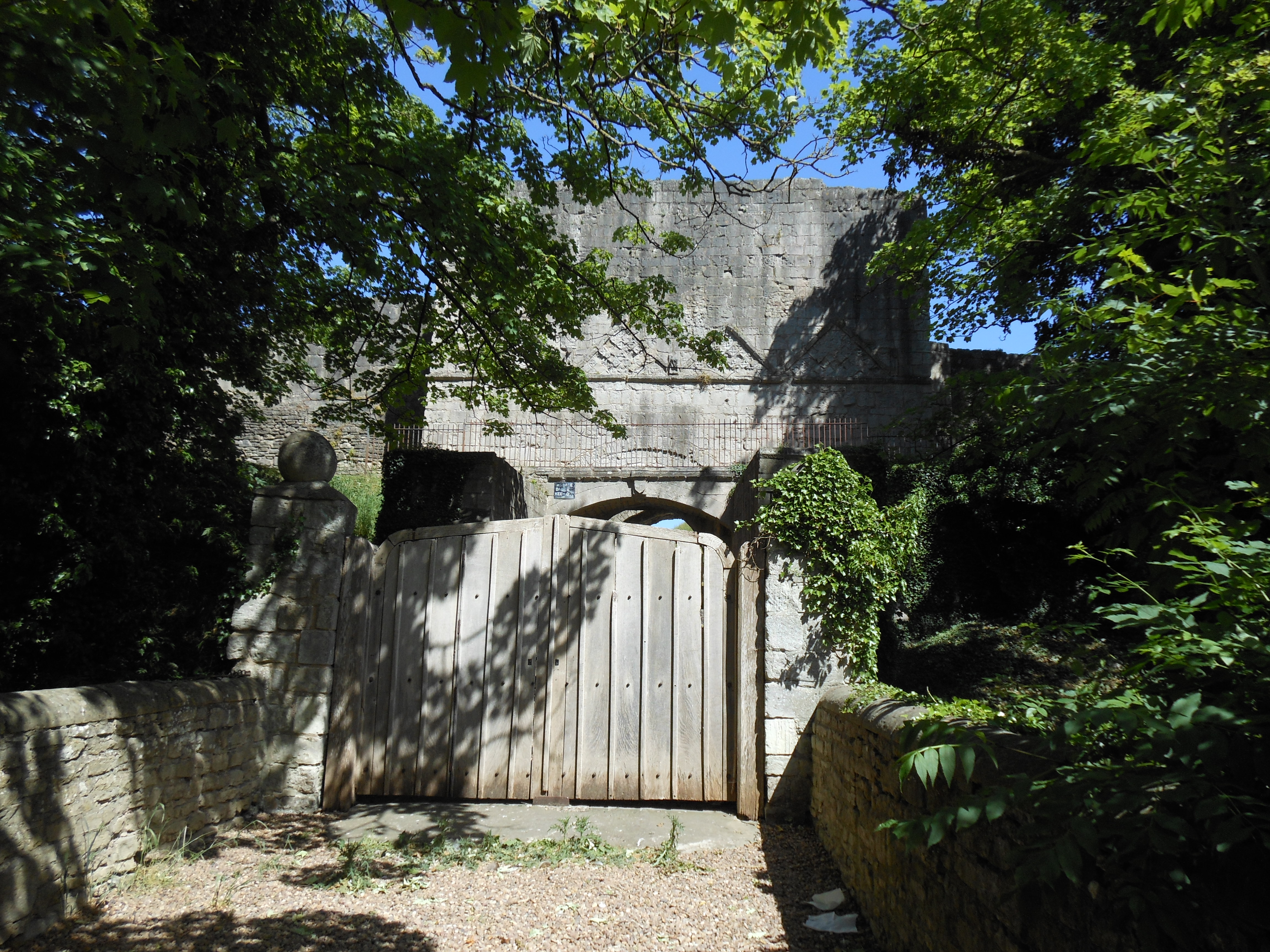
Gatehouse of Tickhill Castle, Yorkshire

John admonished Longchamp, saying ‘it was not proper to take from the loyal men of the kingdom, well known and free, their charges and commit them to strangers and men unknown; that it was a mark of his folly that he had intrusted the king’s castles to such, because they would expose them to adventurers; that if it should go with every barbarian with that facility, that even the castles should be ready at all times for their reception, that he would no longer bear in silence the destruction of his brother’s kingdom and affairs.’4

In the meantime, Walter de Coutances, Archbishop of Rouen but an Englishman by birth, had landed in England and hastened north to act as intermediary between the two warring factions. At some point in the escalating tensions, as Roger of Howden reports, William Longchamp, as papal legate, also issued a sentence of excommunication on John’s supporters. The list included John’s leading supporters, as well as Walter de Coutances, archbishop of Rouen, and Gerard de Camville.

Despite the blatant mistrust on both sides, settlement was reached, with the aid of bishops trusted by both men, and of barons who ‘swore that they would provide satisfaction between the earl and the chancellor concerning their quarrels and questions to the honour of both parties and the peace of the kingdom.’5 Agreement, mostly favourable to John, was reached whereby John would relinquish the castles he had taken, but then Longchamp would give Tickhill into the custody of Reginald de Wasseville and Nottingham to William de Wenn, both men of John’s affinity who each agreed to give up a hostage to the chancellor. John also promised not to harbour outlaws in his lands. Longchamp also agreed to drop his support for Arthur as Richard’s heir, to support John’s claim and ‘if the king should die…should promote him to the kingdom with all his power.’6

History... the Interesting bits
The Lucy Tower, Lincoln Castle’s main keep

Especial mention was made of Gerard de Camville, who was reinstated to Lincoln Castle, and ‘shall be reinstated in the office of sheriff of Lincoln, and on the same day a proper day shall be appointed for him to make his appearance in the court of our lord the king, there to abide his trial; and if in the judgement of the court of our lord the king proof can be given that he aught to lose that office as also the keepership of the castle of Lincoln, then he is to lose the same; but, if not, he is to keep it, unless in the meantime an agreement can be come to relative thereto on some other terms. And the lord John is not to support him against the decision of our lord the king, nor is he to harbour such outlaws or enemies to our lord the king, as shall be named to him, nor allow them to be harboured on his lands.’7

So, Gerard and Nicholaa would be safe in their castle at Lincoln, at least for now. What may happen on the king’s return was still to be determined. They also benefited from John’s largesse; Gerard was appointed keeper of the honour of Wallingford.

In the meantime, Nicholaa and Gerard could get on with the business of managing Lincoln Castle and the county of Lincolnshire.

For now…

Notes:

  1. Richard of Devizes, The Chronicle of Richard of Devizes, edited and translated by J. A. Giles
  2. ibid
  3. Roger of Howden (Hoveden), The Annals of Roger of Howden, translated by Henry T. Riley
  4. Devizes, The Chronicle of Richard of Devizes
  5. ibid
  6. ibid
  7. Howden, The Annals of Roger of Howden

Sources:

Richard of Devizes, The Chronicle of Richard of Devizes; Roger of Howden (Hoveden), The Annals of Roger of Howden; The Plantagenet Chronicles edited by Elizabeth Hallam; Brassey’s Battles by John Laffin; 1215 The Year of Magna Carta by Danny Danziger & John Gillingham; The Life and times of King John by Maurice Ashley; The Plantagenets, the Kings Who Made England by Dan Jones; England Under the Norman and Angevin Kings  by Robert Bartlett; lincolnshirelife.co.uk; catherinehanley.co.uk; magnacarta800th.com; lothene.org; lincolncastle.com; The Sheriff: The Man and His Office by Irene Gladwin; Louise Wilkinson, Women in Thirteenth Century Lincolnshire; Richard Huscraft, Tales from the Long Twelfth Century; J.W.F. Hill, Medieval Lincoln; swaton.org.uk; oxforddnb.com; Ingulph, Ingulph’ Chronicle of the Abbey of Croyland; Stephen Church, King John: England, Magna Carta and the Making of a Tyrant; Marc Morris, King John; Pipe Rolls; Red Book of the Exchequer

My Books:

Signed, dedicated copies of all my books are available, please get in touch by completing the contact me form or through my online bookshop.

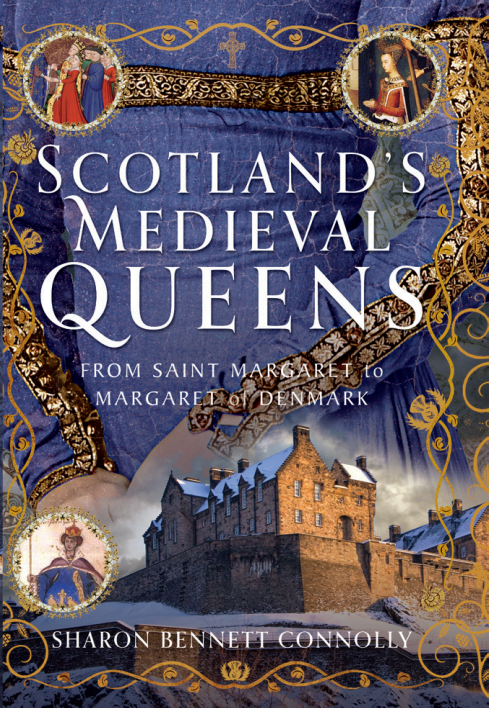
Out now: Scotland’s Medieval Queens

Books by Sharon Bennett Connolly

Scotland’s history is dramatic, violent and bloody. Being England’s northern neighbour has never been easy. Scotland’s queens have had to deal with war, murder, imprisonment, political rivalries and open betrayal. They have loved and lost, raised kings and queens, ruled and died for Scotland. From St Margaret, who became one of the patron saints of Scotland, to Elizabeth de Burgh and the dramatic story of the Scottish Wars of Independence, to the love story and tragedy of Joan Beaufort, to Margaret of Denmark and the dawn of the Renaissance, Scotland’s Medieval Queens have seen it all. This is the story of Scotland through their eyes.

Scotland’s Medieval Queens gives a thorough grounding in the history of the women who ruled Scotland at the side of its kings, often in the shadows, but just as interesting in their lives beyond the spotlight. It’s not a subject that has been widely covered, and Sharon is a pioneer in bringing that information into accessible history.’ Elizabeth Chadwick (New York Times bestselling author)

Available now from Amazon and Pen and Sword Books

Also by me:
Books by Sharon Bennett Connolly

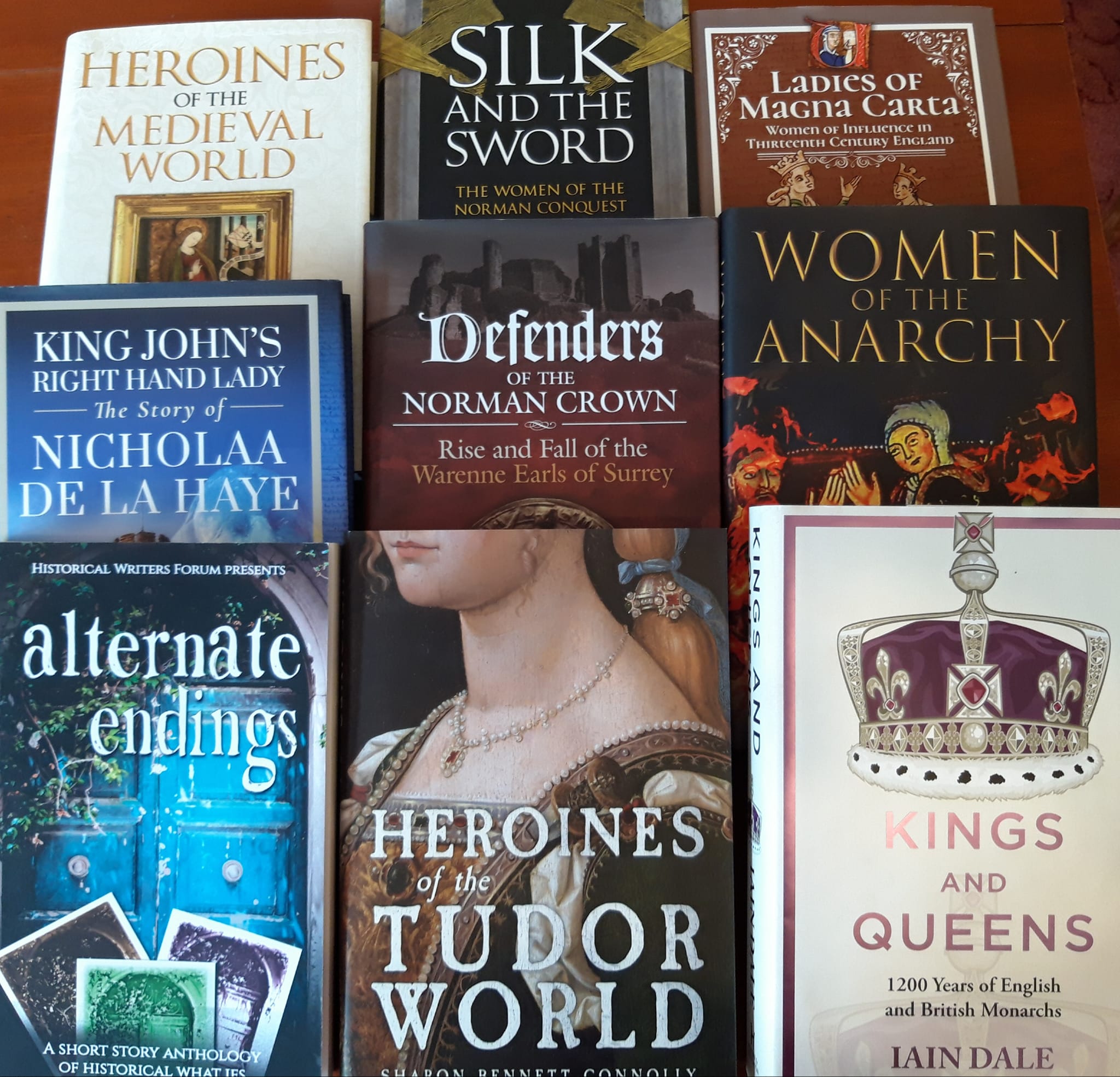
Heroines of the Tudor World tells the stories of the most remarkable women from European history in the time of the Tudor dynasty, 1485-1603. These are the women who ruled, the women who founded dynasties, the women who fought for religious freedom, their families and love. Heroines of the Tudor World is now available for pre-order from Amberley Publishing and Amazon UK. Women of the Anarchy demonstrates how Empress Matilda and Matilda of Boulogne, unable to wield a sword themselves, were prime movers in this time of conflict and lawlessness. It shows how their strengths, weaknesses, and personal ambitions swung the fortunes of war one way – and then the other. Available from Bookshop.orgAmberley Publishing and Amazon UKKing John’s Right-Hand Lady: The Story of Nicholaa de la Haye is the story of a truly remarkable lady, the hereditary constable of Lincoln Castle and the first woman in England to be appointed sheriff in her own right. Available from all good bookshops Pen & Sword Booksbookshop.org and Amazon

Royal Historical Society

Defenders of the Norman Crown: The Rise and Fall of the Warenne Earls of Surrey tells the fascinating story of the Warenne dynasty, from its origins in Normandy, through the Conquest, Magna Carta, the wars and marriages that led to its ultimate demise in the reign of Edward III. Available from Pen & Sword BooksAmazon in the UK and US, and Bookshop.orgLadies of Magna Carta: Women of Influence in Thirteenth Century England looks into the relationships of the various noble families of the 13th century, and how they were affected by the Barons’ Wars, Magna Carta and its aftermath; the bonds that were formed and those that were broken. It is now available in paperback and hardback from Pen & SwordAmazon, and Bookshop.orgHeroines of the Medieval World tells the stories of some of the most remarkable women from Medieval history, from Eleanor of Aquitaine to Julian of Norwich. Available now from Amberley Publishing and Amazon, and Bookshop.orgSilk and the Sword: The Women of the Norman Conquest traces the fortunes of the women who had a significant role to play in the momentous events of 1066. Available now from Amazon,  Amberley Publishing, and Bookshop.org.

Alternate Endings: An anthology of historical fiction short stories including Long Live the King… which is my take what might have happened had King John not died in October 1216. Available in paperback and kindle from Amazon.

*

Podcast:

A Slice of Medieval

Have a listen to the A Slice of Medieval podcast, which I co-host with Historical fiction novelist Derek Birks. Derek and I welcome guests, such as Bernard Cornwell and Elizabeth Chadwick, and discuss a wide range of topics in medieval history, from significant events to the personalities involved. In episode 15, Derek Birks and I discuss Nicholaa’s remarkable story:

There are now 80 episodes to listen to!

Every episode is also available on YouTube.

*

Don’t forget! Signed and dedicated copies of all my books are available through my online bookshop.

For forthcoming online and in-person talks, please check out my Events Page.

You can be the first to read new articles by clicking the ‘Follow’ button, liking our Facebook page or joining me on TwitterThreadsBluesky and Instagram.

*

©2023 Sharon Bennett Connolly FRHistS
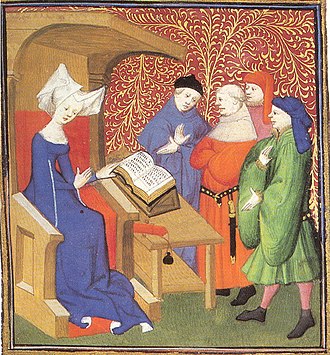
Christine de Pisan, Literary Trailblazer

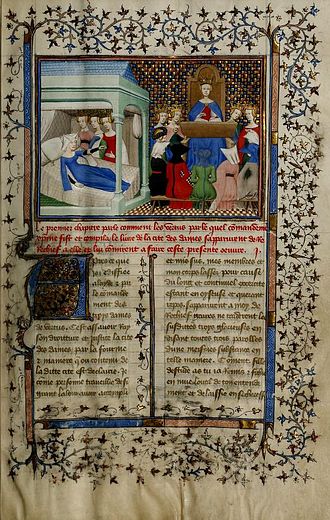
Christine de Pisan (sitting) lecturing to a group of men

Christine de Pisan was the first woman in history to make a living from writing.

Christine de Pisan was born around 1364 in Venice, Italy; the family was from the village of Pizzano, just outside Bologna. Her father, Tommaso di Benvenuto da Pizzano, was a graduate of the University of Bologna and was a lecturer in astrology at the university, but moved to Venice in 1357. In the late 1360s Tommaso was invited to join both the Hungarian and the French royal courts. He chose France and moved his family, including Christine and her two brothers Paolo and Aghinolfo, to Paris, in December 1368, becoming royal physician and astrologer to Charles V. Christine’s father paid particular attention to his daughter’s education, allowing her to be taught to the same standards as a boy of her age, although her mother disapproved. She was tutored in history, literature, religion and the classical languages.1

In 1380, at the age of fifteen, Tommaso arranged a marriage for Christine with Etienne de Castel. Ten years older than Christine, Etienne was a graduate of the University of Paris and became a royal secretary in the year they married. The position of royal secretary was a lifetime appointment and only open to the intellectual elite, as they were often involved in diplomatic events. In the same year, on 16 September, Tommaso’s patron Charles V died, leaving the family in a precarious financial position. Christine was further challenged by a series of tragedies toward the end of the decade. Her father, Tommaso, died in 1387, leaving Christine’s mother and niece in his daughter’s care. Around the same time, Christine lost a child, his name unknown; although two children, Marie and Jean, survived infancy. In 1390 her husband Etienne passed away at Beauvais and Christine was left with the responsibility of providing for herself and her young children, as well as her mother and niece.

Christine explained herself, in her book Mutation of Fortune, how she had to take on the mantle of the man of the house,

Let me summarise this moment,

Just who I am, what all this meant.

How I, a woman, became a man by a flick of Fortune’s hand

How she changed my body’s form

To the perfect masculine norm.2

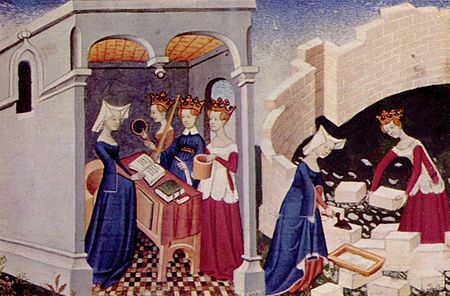
Illumination from The Book of the City of Ladies

Etienne had taken care of all the family’s financial dealings and it was a steep learning curve for Christine to learn to manage the accounts and pay off the family’s debts. Shortly after Etienne’s death, Christine found work as a copyist for a number of Parisian manuscript workshops. Eventually, around 1399, she began to compose her own prose and poetry as a means of supporting her family, and it was the grief of losing Etienne that informed Christine’s early works of poetry. Initially, she would send her works to members of the court, who sent her money in gratitude, with patrons eventually including Louis, Duke of Orléans, the Duke de Berry and France’s queen, Isabella of Bavaria. And as Christine’s fame spread beyond France, she could also count Philip II the Bold, Duke of Burgundy, and Thomas Montagu, 4th Earl of Salisbury, among her patrons. Writing in ballads and lais (poetry put to music), Christine could express her love and grief for Etienne and the sense of loss and loneliness she now felt,

Like the mourning dove I’m now alone,

And like a shepherdless sheep gone astray,

For death has long ago taken away

My loved one whom I constantly mourn…3

Christine de Pisan’s poems, amounted to ten volumes of verses, including L’Épistre au Dieu d’Amours (Letter to the God of Loves) which was published in 1399. In the early 1400s she also published Letters on the Debate of the Romance of the Rose, a response to Jean de Meun’s Le Roman de la Rose (The Romance of the Rose) attacking the traditional view of women causing the sins of men. Christine is, above all, remembered and revered for her work, Le Livre de la Cité des Dames (The Book of the City of Ladies), published in 1405. Well received in France, even in her own lifetime, it was later translated into Flemish and English. The book tells of the lives of past and present heroines, including pagan, Hebrew and Christian ladies who were renowned for being examples of exemplary womankind, famed for their chastity, loyalty and devotion. It included the lives of female saints who remained steadfast in their devotion to God in the face of martyrdom. City of Ladies was Christine’s response to the misogynistic portrait of womankind that was present in many works of the era, in which women were blamed for the misery in which men found themselves. The book suggests that women were capable of being anything, from warriors to artists and teachers, but stops short of suggesting that her contemporaries should pursue such careers.4

A page from Christine de Pisan’s The Book of the Three Virtues

In the same year, 1405, the sequel to City of Ladies, entitled Le Livre des Trois Vertus (The Book of the Three Virtues) was also published. This text was more of an instructional treatise, showing women how they should behave and how they could make a significant contribution to society from their various social spheres. In it Christine recommends that women should be modest and obedient as virgins, tolerant and humble as wives, and courageous and dignified as widows. It is possible that Le Livre des Trois Vertus was written as a book of instruction for eleven-year-old Marguerite de Nevers, the daughter of the Duke of Burgundy and bride of Louis of Guyenne, the heir to the throne of France. Although the book appears to be a contradiction of Christine’s own life, when she was making a name for herself as a writer to support her family, it has to be remembered that Christine was living in a male-dominated era, rather than the 21st century. She has often been advanced as the first feminist, but while she wanted to correct the negative view of women and improve the conditions of women, advancing arguments for better education and a role beyond the home, she was not intending to be revolutionary.

Christine’s writing proved so successful that she managed to pull herself out of debt and make a living at it; she was the first woman to ever become a professional writer. Her ability to write for varied audiences meant her work was often sought after. She eventually started receiving commissions to write specific items for her noble patrons, including political and moral works. A biography of Charles V, Le Livre des Fais et des Bonnes Meurs du Sage Roy Charles V (The Book of the Deeds and Good Character of the Wise King Charles V), which Christine wrote in 1404, was commissioned by the late king’s brother Philip, Duke of Burgundy. Her other works included The Book of the Body Politic and Feats of Arms and Chivalry. The latter was published anonymously as Christine doubted it would be taking seriously if a woman was identified as the author.

As Charles VI increasingly slipped into bouts of madness in the early 15th century, and France found itself on the verge of civil war, Christine would write about peace and the necessity of stable government. However, as France was dragged back into the Hundred Years War against England, she became increasingly marginalised. She retired from public life and retreated to the convent at Poissy, where her daughter was a nun. Her last work, in 1429, Le Ditié de Jehanne d’Arc (The Poem of Joan of Arc), extolled the virtues of Joan, the Maid of Orléans, as valiant and brave, chaste and pure; it was the only work written about Joan during her own lifetime. Writing at the height of Joan’s success. It portrayed the Maid, the leader of the revival of French fortunes in the war against the English, as the embodiment of the women Christine had written of in City of Ladies. However, Christine does not appear to have lived long enough to see the final chapters, and the tragedy, of Joan’s life – her imprisonment and death at the hands of the English. Christine probably died in 1430, the year before Joan.

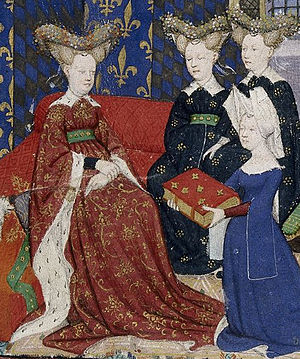
Christine de Pisan presents her book to Isabeau of Bavaria, Queen of France

Christine de Pisan was one of the most remarkable women of her age. In her world, women were denied their own voice and independence. There were strictures placed on every aspect of their lives, by tradition and society. And yet she circumvented these strictures, not only by writing, but by writing to make a living, and by giving a voice and identity to women everywhere. She was not a feminist; the notion of feminism simply did not exist. However, she was a forerunner for the feminist movement, and a sign of the independence that women would eventually achieve.

The poet, political and social observer Christine de Pisan was the culmination of a series of remarkable female trailblazers, including Hildegard of Bingen, Heloise (of Heloise and Abelard fame) and Marie de France. She proved that women were just as capable as men of making successful careers as writers.

*

Notes:

1. The Life and Triumphs of Christine de Pizan (article), faculty.msmc.edu; 2. The Writing of Christine de Pizan translated by Nadia Margolis, edited by Charity Cannon Willard; 3. ibid; 4. The Book of the City of Ladies by Christine de Pisan, translated by Rosalind Brown-Grant

*

My Books:

Signed, dedicated copies of all my books are available through my online bookshop.

Coming 30 January 2025: Scotland’s Medieval Queens

Scotland’s history is dramatic, violent and bloody. Being England’s northern neighbour has never been easy. Scotland’s queens have had to deal with war, murder, imprisonment, political rivalries and open betrayal. They have loved and lost, raised kings and queens, ruled and died for Scotland. From St Margaret, who became one of the patron saints of Scotland, to Elizabeth de Burgh and the dramatic story of the Scottish Wars of Independence, to the love story and tragedy of Joan Beaufort, to Margaret of Denmark and the dawn of the Renaissance, Scotland’s Medieval Queens have seen it all. This is the story of Scotland through their eyes.

Available for pre-order now.

Also by Sharon Bennett Connolly:

Heroines of the Tudor World tells the stories of the most remarkable women from European history in the time of the Tudor dynasty, 1485-1603. These are the women who ruled, the women who founded dynasties, the women who fought for religious freedom, their families and love. Heroines of the Tudor World is now available for pre-order from Amberley Publishing and Amazon UK. Women of the Anarchy demonstrates how Empress Matilda and Matilda of Boulogne, unable to wield a sword themselves, were prime movers in this time of conflict and lawlessness. It shows how their strengths, weaknesses, and personal ambitions swung the fortunes of war one way – and then the other. Available from Bookshop.orgAmberley Publishing and Amazon UKKing John’s Right-Hand Lady: The Story of Nicholaa de la Haye is the story of a truly remarkable lady, the hereditary constable of Lincoln Castle and the first woman in England to be appointed sheriff in her own right. Available from all good bookshops Pen & Sword Booksbookshop.org and Amazon

Defenders of the Norman Crown: The Rise and Fall of the Warenne Earls of Surrey tells the fascinating story of the Warenne dynasty, from its origins in Normandy, through the Conquest, Magna Carta, the wars and marriages that led to its ultimate demise in the reign of Edward III. Available from Pen & Sword BooksAmazon in the UK and US, and Bookshop.orgLadies of Magna Carta: Women of Influence in Thirteenth Century England looks into the relationships of the various noble families of the 13th century, and how they were affected by the Barons’ Wars, Magna Carta and its aftermath; the bonds that were formed and those that were broken. It is now available in paperback and hardback from Pen & SwordAmazon, and Bookshop.orgHeroines of the Medieval World tells the stories of some of the most remarkable women from Medieval history, from Eleanor of Aquitaine to Julian of Norwich. Available now from Amberley Publishing and Amazon, and Bookshop.orgSilk and the Sword: The Women of the Norman Conquest traces the fortunes of the women who had a significant role to play in the momentous events of 1066. Available now from Amazon,  Amberley Publishing, and Bookshop.org.

Alternate Endings: An anthology of historical fiction short stories including Long Live the King… which is my take what might have happened had King John not died in October 1216. Available in paperback and kindle from Amazon.

Podcast:

Have a listen to the A Slice of Medieval podcast, which I co-host with Historical fiction novelist Derek Birks. Derek and I welcome guests, such as Bernard Cornwell and Ian Mortimer, and discuss a wide range of topics in medieval history, from significant events to the personalities involved. 

*

Don’t forget! Signed and dedicated copies of all my books are available through my online bookshop.

For forthcoming online and in-person talks, please check out my Events Page.

You can be the first to read new articles by clicking the ‘Follow’ button, liking our Facebook page or joining me on TwitterThreadsBluesky and Instagram.

*

©2023 Sharon Bennett Connolly FRHistS
Eight Interesting Discoveries on writing 11th century non-fiction

Following on from my 10 Facts About Women and Magna Carta, I thought I would revisit the Norman Conquest and started thinking about I found most interesting when writing about 1066 and the years either side. And here’s what I discovered:

1. Not all primary sources are contemporary.

Emma of Normandy

Let me explain. Of course, all sources written in the 11th century are primary sources, but you do find people quoting sources as primary sources – only to discover that they were written 100 or even 200 years after the events.

One such legend, appearing two centuries after the events, suggested that Emma of Normandy’s relationship with her good friend, Bishop Stigand, was far more than that of her advisor and that he was, in fact, her lover – although the legend did get its bishops mixed up and named Ælfwine, rather than Stigand, as Emma’s lover. The story continues that Emma chose to prove her innocence in a trial by ordeal, and that she walked barefoot over white-hot ploughshares. Even though the tale varies depending on the source, the result is the same; when she completed the ordeal unharmed, and thus proven guiltless, she was reconciled with her contrite son, Edward.

However, there is no 11th century source for this event and it seems to have been created to explain Emma’s estrangement from her son, Edward the Confessor.

2. The Anglo-Saxon Chronicle is the most famous source of 11th century news. 

The Anglo-Saxon Chronicle gives wonderful snippets of information about life in Anglo-Saxon England – and the weather! If you have ever wondered where the English get their obsession with the weather, read the Anglo-Saxon Chronicle. It is also very dramatic.

For example, the year 1005 starts with; ‘Here in this year there was the great famine throughout the English race, such as no-one ever remembered on so grim before…’

1032 relates; ‘Here in this year appeared that wild-fire such as no man remembered before, and also it did damage everywhere in many places.’

And 1039 opens with ‘Here came the great gale…’

In 1053 we read, ‘Here [1052] was the great wind on the eve of the Feast of St Thomas, and the great wind was also all midwinter…’

And, of course, in 1066 we read about the appearance of Halley’s Comet; ‘Then throughout all England, a sign such as man ever saw before was seen in the heavens. Some me declared that it was the star comet, which some men called the ‘haired’ star; and it appeared first on the eve of the Great Litany, 24 April, and shone thus all the week….’

3. The Anglo-Saxon Chronicle is a fabulous source of news about church leaders.

Don’t get me wrong, the Anglo-Saxon Chronicle is invaluable to anyone studying the history of Anglo-Saxon Britain, but you can tell it was written by monks. There are some years where you learn little more than which church leader died, and who replaced him.

For example, the entry for 1023 from the E chronicle; ‘Here Bishop Wulfstan passed away, and Ælfric succeeded…’

And in 1032; ‘In the same year Ælfsige, bishop in Winchester, passed away, and Ælfwine, the king’s priest, succeeded to it.’

The only entry in the E Chronicle in 1033 was; ‘Here in this year Merehwit, bishop in Somerset, passed away, and he is buried in Glastonbury.’

And again in 1034; ‘Here Bishop Æthelric passed away.’

4. Not all inheritance was based on primogeniture.

King Harold II, Waltham Abbey

Primogeniture, where the eldest son inherited from his father, was not unusual in 11th century England; when Earl Godwin of Wessex died, his eldest surviving son, Harold, succeeded him. However, it was not yet established as the definitive rule of inheritance of later centuries. When Siward, Earl of Northumbria, died in 1055 his heir, Waltheof, was still a child and too young to hold such a formidable position on the borders of Scotland. The earldom was given to Tostig Godwinson, the favourite brother of Edward the Confessor’s queen, Edith. Though he didn’t do a great job with it…

And in the opening days of 1066, when Edward the Confessor died, the ætheling, Edgar was only a teenager, and so was passed over as king for the more mature and militarily experienced Harold Godwinson, Earl of Wessex, who became King Harold II.

5. Travel to distant places was not uncommon for the nobility.

At different times in the 11th century, both King Cnut and Tostig Godwinson are known to have travelled to Rome; indeed, during his trip to Rome in 1027, Cnut was present at the coronation of Holy Roman Emperor, Conrad II and arranged for the marriage of his daughter by Emma of Normandy, Gunhilda, to Conrad’s son, the future King Henry III of Germany.

As for Tostig, travelling to Rome was not without its dangers, and shortly after leaving the city, his travelling party was caught up in a local dispute between the papacy and the Tuscan nobility; they were attacked. Tostig was able to escape by the ruse of one of his own thegns, a man named Gospatric, who pretended to be the earl.

Tostig and Harold’s brother, Swegn Godwinson, who had murdered his own cousin, even went on pilgrimage to Jerusalem – barefoot – he died on the journey home.

And when I started writing Silk and the Sword: The Women of the Norman Conquest I discovered that there are several links to the story of 1066 with the Russian principality of Kyiv. The baby sons of England’s short-lived king, Edmund II Ironside, who reigned and died in 1016, were given sanctuary and protection in Kyiv, saving them from the clutches of Edmund’s successor, King Cnut. The first wife of Harald Hardrada, the third contender for the English throne in 1066, Elisiv, was a Kyivan princess. And after the Conquest, Harold II Godwinson’s own daughter by Edith Swanneck, Gytha, would make her life in Kyiv as the wife of Vladimir II Monomakh and as the mother of Mstislav the Great, the last ruler of a united Kyivan Rus. Vladimir was the nephew of Harald Hardrada’s first wife, the Kyivan princess, Elisiv.

6. Having 2 wives at the same time was not THAT unusual.

Elisiv of Kyiv

In the story of 1066 there were not one BUT three men who had two wives simultaneously.

Harold Godwinson is known for having been in a relationship with the famous Edith Swanneck for 20 years before becoming King, and then marrying Ealdgyth of Mercia without divorcing Edith. Edith is often referred to as Harold’s concubine, but most historians agree that she was his ‘hand-fast’ wife and had undergone a Danish – rather than Christian – style of wedding with Harold. Edith was no ignorant peasant, she was a wealthy woman in her own right and it is highly doubtful she would have accepted being Harold’s mistress, and raising his children, without some kind of marital protection.

Harald Hardrada also married a second ‘wife’, whilst still being married to Elisiv. Elisiv had given the Norwegian king two daughters, but his second wife, Thora, gave him two sons, Magnus and Olaf, who each, in turn, succeeded their father as King of Norway.

King Cnut was the first to take two wives; he had two sons by Ælfgifu of Northampton before marrying Emma of Normandy and producing a second family. The chronicles, however, claim that Ælfgifu’s sons were not the children of Cnut, with John (also known as Florence) of Worcester saying, ‘Ælfgiva desired to have a son by the king, but as she could not, she caused the new-born child of a certain priest to be brought to her, and made the king fully believe that she had just borne him a son’. And the Anglo-Saxon Chronicle claimed ‘[King] Harold [I Harefoot] also said that he was the son of king Canute and Ælfgiva of Northampton, although that is far from certain; for some say that he was the son of a cobbler, and that Ælfgiva had acted with regard to him as she had done in the case of Swein: for our part, as there are doubts on the subject, we cannot settle with any certainty the parentage of either.’

7. There were some incredible, strong women in the 11th century.

Lady Godiva

The story of the Norman Conquest invariably revolves around the men involved, Edward the Confessor, Harold II, William the Conqueror, Harald Hardrada, and so on. However, there were some amazing women whose strength and perseverance helped to steer and shape the events of the era.

There were, of course, the queens, Emma of Normandy, Edith of Wessex and Matilda of Flanders, who supported their husbands and helped to shape and – even – preserve history, with Emma and Edith both commissioning books to tell the stories of their times and Matilda being the image of queenship that all future queens of England modelled themselves on.

There was also the notorious Lady Godiva, who was probably a lot less scandalous than the legend, of her riding naked through Coventry, leads us to believe. And the incredible Gytha of Wessex, a woman whose story is entwined with every aspect of the period. From the reign of Cnut to that of William the Conqueror, Gytha and her family were involved in so many aspects of the 11th century, from the rise of her sons, through the Battle of Hastings itself, to the English resistance in the years immediately following the Conquest. Gytha was not one to give up easily, despite the horrendous losses her family suffered (three of her sons died in one single day at Hastings), she encouraged her grandsons to lead the opposition against the Conqueror in the west, but her eventual failure saw her seek shelter in Flanders, where she disappears from the pages of history.

8. There is still so much we don’t know!

Ӕlfgyva, the mysterious woman in the Bayeux Tapestry

What you discover when researching the 11th century and the Norman Conquest is that there are gaps in our knowledge. For instance, we do not know why Harold was travelling to Europe in 1064, when he was shipwrecked and became a guest at the court of William, Duke of Normandy (the future William the Conqueror). The Bayeux Tapestry depicts Harold swearing an oath during his stay there. Was Harold promising to support William’s claim to England when Edward the Confessor died?

The Bayeux Tapestry has another tantalising mystery. That of Ӕlfgyva. Ӕlfgyva is depicted in a doorway with a priest touching her cheek. Whether the touch is in admonishment or blessing is open to interpretation. Above her head, written in Latin, is the incomplete phrase  ‘Here a certain cleric and Ӕlfgyva’. But who was the mysterious Ӕlfgyva? Will we ever know?

Historical Writers Forum hosted a fabulous debate on ‘Ӕlfgyva’: The Mysterious Woman in the Bayeux Tapestry, which is available on YouTube. Hosted by Samantha Wilcoxson, it features myself, Pat Bracewell, Carol McGrath and Paula Lofting discussing the possible cadidates of Ӕlfgyva’s identity.

*

A version of this article was first published on Carol McGrath’s website in December 2018

Images:

Courtesy of Wikipedia, except King Harold II, which is ©2022 Sharon Bennett Connolly FRHistS.

Sources:

A Historical Document Pierre Bouet and François Neveux, bayeuxmuseum.com/en/un_document_historique_enThe Mystery Lady of the Bayeux Tapestry (article) by Paula Lofting, annabelfrage.qordpress.com; Ӕlfgyva: The Mysterious lady of the Bayeux Tapestry (article) by M.W. Campbell, Annales de NormandieThe Bayeux Tapestry, the Life Story of a Masterpiece by Carola HicksÆthelred II [Ethelred; known as Ethelred the Unready] (c. 966×8-1016) (article) by Simon Keynes, Oxford Dictionary of National Biography, oxforddnb.com; Britain’s Royal Families; the Complete Genealogy by Alison Weir; Queen Emma and the Vikings: The Woman Who Shaped the Events of 1066 by Harriet O’BrienThe Anglo-Saxon Chronicle translated by James IngramOn the Spindle Side: the Kinswomen of Earl Godwin of Wessex by Ann Williams; Swein [Sweyn], earl by Ann Williams, Oxford Dictionary of National Biography, oxforddnb.com, 23 September 2004; Ӕlfgifu [Ӕlfgifu of Northampton (fl. 1006-1036) (article) by Pauline Stafford, Oxford Dictionary of National Biography, oxforddnb.com; The Chronicle of John of Worcester, translated and edited by Thomas Forester, A.M; The Anglo-Saxon Chronicles edited and translated by Michael Swanton.

*

My Books:

Signed, dedicated copies of all my books are available through my online store.

OUT NOW! Heroines of the Tudor World

Heroines of the Tudor World tells the stories of the most remarkable women from European history in the time of the Tudor dynasty, 1485-1603. These are the women who ruled, the women who founded dynasties, the women who fought for religious freedom, their families and love. These are the women who made a difference, who influenced countries, kings and the Reformation. In the era dominated by the Renaissance and Reformation, Heroines of the Tudor World examines the threats and challenges faced by the women of the era, and how they overcame them. From writers to regents, from nuns to queens, Heroines of the Tudor World shines the spotlight on the women helped to shape Early Modern Europe.

Heroines of the Tudor World is now available for pre-order from Amberley Publishing and Amazon UK.

Coming 30 January 2025: Scotland’s Medieval Queens

Scotland’s history is dramatic, violent and bloody. Being England’s northern neighbour has never been easy. Scotland’s queens have had to deal with war, murder, imprisonment, political rivalries and open betrayal. They have loved and lost, raised kings and queens, ruled and died for Scotland. From St Margaret, who became one of the patron saints of Scotland, to Elizabeth de Burgh and the dramatic story of the Scottish Wars of Independence, to the love story and tragedy of Joan Beaufort, to Margaret of Denmark and the dawn of the Renaissance, Scotland’s Medieval Queens have seen it all. This is the story of Scotland through their eyes.

Available for pre-order now.

Also by Sharon Bennett Connolly:

Women of the Anarchy demonstrates how Empress Matilda and Matilda of Boulogne, unable to wield a sword themselves, were prime movers in this time of conflict and lawlessness. It shows how their strengths, weaknesses, and personal ambitions swung the fortunes of war one way – and then the other. Available from Bookshop.orgAmberley Publishing and Amazon UKKing John’s Right-Hand Lady: The Story of Nicholaa de la Haye is the story of a truly remarkable lady, the hereditary constable of Lincoln Castle and the first woman in England to be appointed sheriff in her own right. Available from all good bookshops Pen & Sword Booksbookshop.org and AmazonDefenders of the Norman Crown: The Rise and Fall of the Warenne Earls of Surrey tells the fascinating story of the Warenne dynasty, from its origins in Normandy, through the Conquest, Magna Carta, the wars and marriages that led to its ultimate demise in the reign of Edward III. Available from Pen & Sword BooksAmazon in the UK and US, and Bookshop.org

Ladies of Magna Carta: Women of Influence in Thirteenth Century England looks into the relationships of the various noble families of the 13th century, and how they were affected by the Barons’ Wars, Magna Carta and its aftermath; the bonds that were formed and those that were broken. It is now available in paperback and hardback from Pen & Sword,  Amazon, and Bookshop.orgHeroines of the Medieval World tells the stories of some of the most remarkable women from Medieval history, from Eleanor of Aquitaine to Julian of Norwich. Available now from Amberley Publishing and Amazon, and Bookshop.orgSilk and the Sword: The Women of the Norman Conquest traces the fortunes of the women who had a significant role to play in the momentous events of 1066. Available now from Amazon,  Amberley Publishing, and Bookshop.org.

Alternate Endings: An anthology of historical fiction short stories including Long Live the King… which is my take what might have happened had King John not died in October 1216. Available in paperback and kindle from Amazon.

Podcast:

Have a listen to the A Slice of Medieval podcast, which I co-host with Historical fiction novelist Derek Birks. Derek and I welcome guests, such as Bernard Cornwell, and discuss a wide range of topics in medieval history, from significant events to the personalities involved.

*

Don’t forget! Signed and dedicated copies of all my books are available through my online store.

For forthcoming online and in-person talks, please check out my Events Page.

You can be the first to read new articles by clicking the ‘Follow’ button, liking our Facebook page or joining me on TwitterThreads and Instagram.

*

©2022 Sharon Bennett Connolly FRHistS.

William and Gundrada de Warenne and the Foundation of a Dynasty

Books by Sharon Bennett Connolly
William de Warenne, Holy Trinity Church, Southover

William de Warenne, first earl of Surrey, was a younger son of Rodulf de Warenne and his wife Beatrix. It is possible that Beatrix was a niece of Duchess Gunnor of Normandy, making young William a cousin of William the Bastard, Duke of Normandy. The family name is probably derived from the hamlet of Varenne, part of the Warenne lands in the modern French department of Seine-Inférieure, Normandy. William’s older brother, Rodulf or Ralph, would inherit the greater part of the Warenne family estates in Normandy.

William’s date of birth is unrecorded; a younger son of the minor nobility does not tend to get a mention until he does something remarkable or becomes someone notable. Although still young William was considered a capable and experienced enough soldier to be given joint command of a Norman army, by the mid-1050s. His first recorded military action is in the 1054 campaign against the French. He was one of the commanders who fought against the King of France’s brother, Count Odo, at the Battle of Mortemer.  

De Warenne was rewarded with some of the lands of his kinsman, Roger (I) de Mortemer, who had fought for the French. William managed to retain some of these lands even after Mortemer was restored to favour, including the castles of Mortemer and Bellencombre. Bellencrombe would become the capital of the de Warenne estates in Normandy. De Warenne had also received some of  the confiscated lands of William, count of Arques in 1053. Duke William’s confidence in de Warenne is demonstrated in the fact he was one of the barons consulted during the planning of the invasion of England in 1066.

In fact, William de Warenne is one of only a handful of Norman barons who can be positively identified as having fought at the Battle of Hastings on 14th October, 1066. De Warenne was rewarded with vast swathes of land throughout the country. According to the Domesday survey his lands extended over 13 counties: stretching from Conisbrough in Yorkshire to Lewes in Sussex. His territories were acquired over the course of the reign of William I and elevated him the highest rank of magnates. By 1086 his riches were only surpassed by the king’s half-brothers and his own kinsman, Roger de Montgomery. He still ranks in the Top 20 of the richest people in the world – ever!

Books by Sharon Bennett Connolly
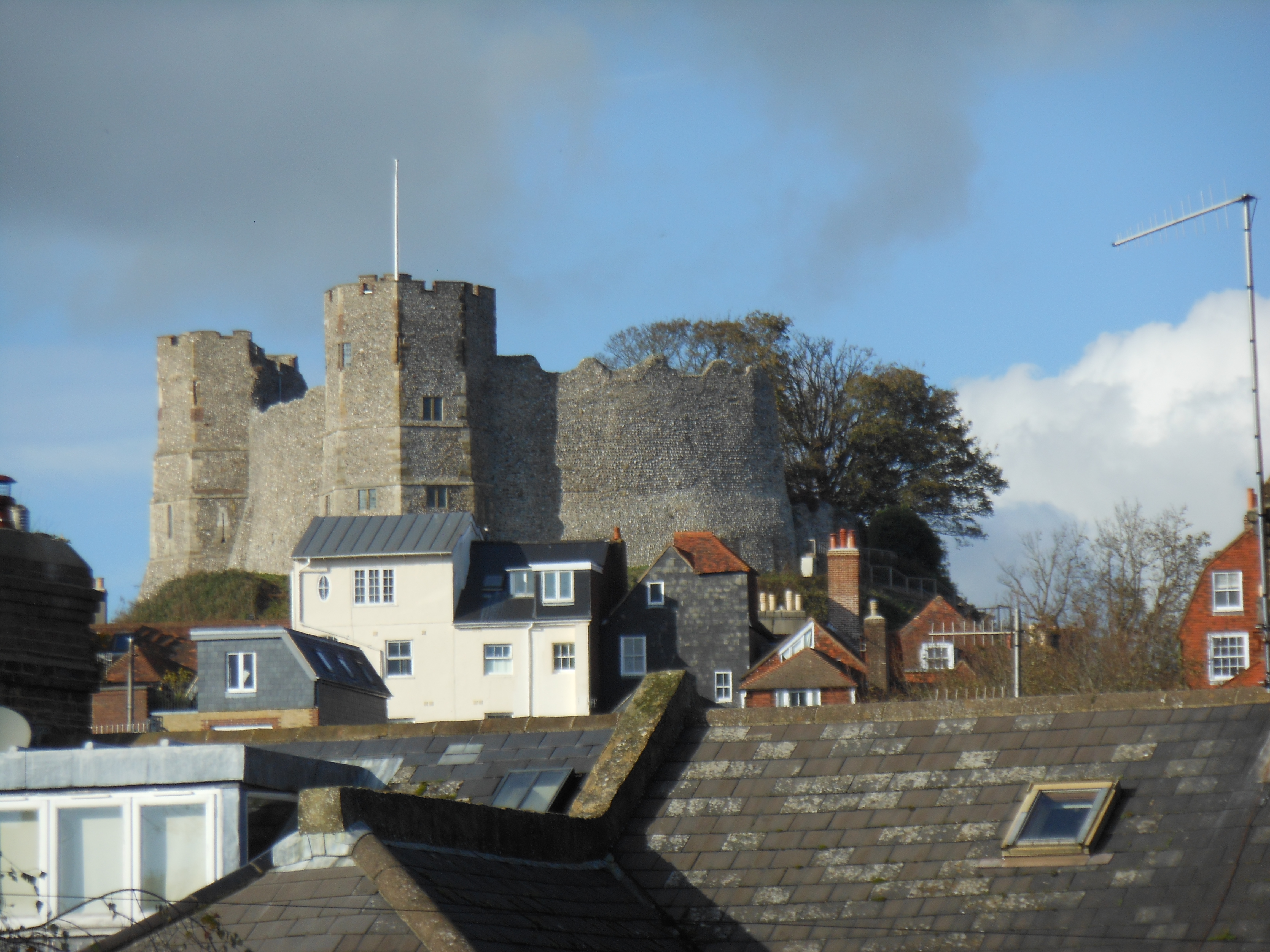
Lewes Castle

Throughout his career, William de Warenne acquired lands in numerous counties, sometimes by nefarious means. Much of the property, such as Conisbrough, had formerly belonged to the late king, Harold. In Norfolk he is said to have asserted lordship over freemen not necessarily assigned to him. He had disputes with neighbouring landowners in Conisbrough, over which properties were sokelands and he is said to have stolen lands from the bishop of Durham and the abbot of Ely. Some acquisitions were obtained peacefully, such as the manor of Whitchurch in Shropshire, which was left to him by his kinsman Roger de Montgomery. William was an energetic and attentive landowner and improved the economy of most of his estates; more than tripling his sheep flock at Castle Acre and doubling the value of his Yorkshire estates in just 20 years (at a time when the county was devastated by the Harrying of the North).

In 1067 William de Warenne was one of 4 prominent Normans appointed to govern England during William the Conqueror’s absence in Normandy. Following the Conquest, he continued to support the king and – subsequently – his son, William II Rufus – as a military commander for over 20 years. In 1074 he was with his father at the abbey of Holy Trinity in Rouen, where he was a witness to his father’s last known charter, and in 1083-85 he fought with the king on campaign in Maine, being wounded at the siege of the castle of Sainte-Suzanne.

In 1075, along with Richard de Clare, his fellow justiciar, he was sent to deal with the rebellion of Earl Ralph de Gael of East Anglia. De Gael had failed to respond to their summons to answer for an act of defiance and so the 2 lords faced and defeated the rebels at Fawdon in Cambridgeshire, mutilating their prisoners afterwards. Ralph withdrew to Norwich Castle; besieged for 3 months he managed to escape his attackers by boat, while the castle surrendered and was occupied by de Warenne.

William de Warenne was married to a Flemish noblewoman, Gundrada; her brother Gerbod was sometime earl of Chester and another brother, Frederic, held lands in Norfolk which eventually passed to Gundrada. Frederic, appears to have jointly, with Gundrada, held lands in England even before the Conquest, when two people named Frederic and Gundrada are mentioned as holding four manors in Kent and Sussex. It would indeed be a coincidence if there were two other related people, named Frederic and Gundrada, very distinctive foreign names, in England at that time. Gundrada’s brothers, it seems, were deeply involved in the border politics between Flanders and Normandy; indeed, it is thought that Gerbod resigned his responsibilities in Chester in order to return to the Continent to oversee the family’s lands and duties there, following the death of an older brother, Arnulf II of Oosterzele-Scheldewindeke.

Books by Sharon Bennett Connolly
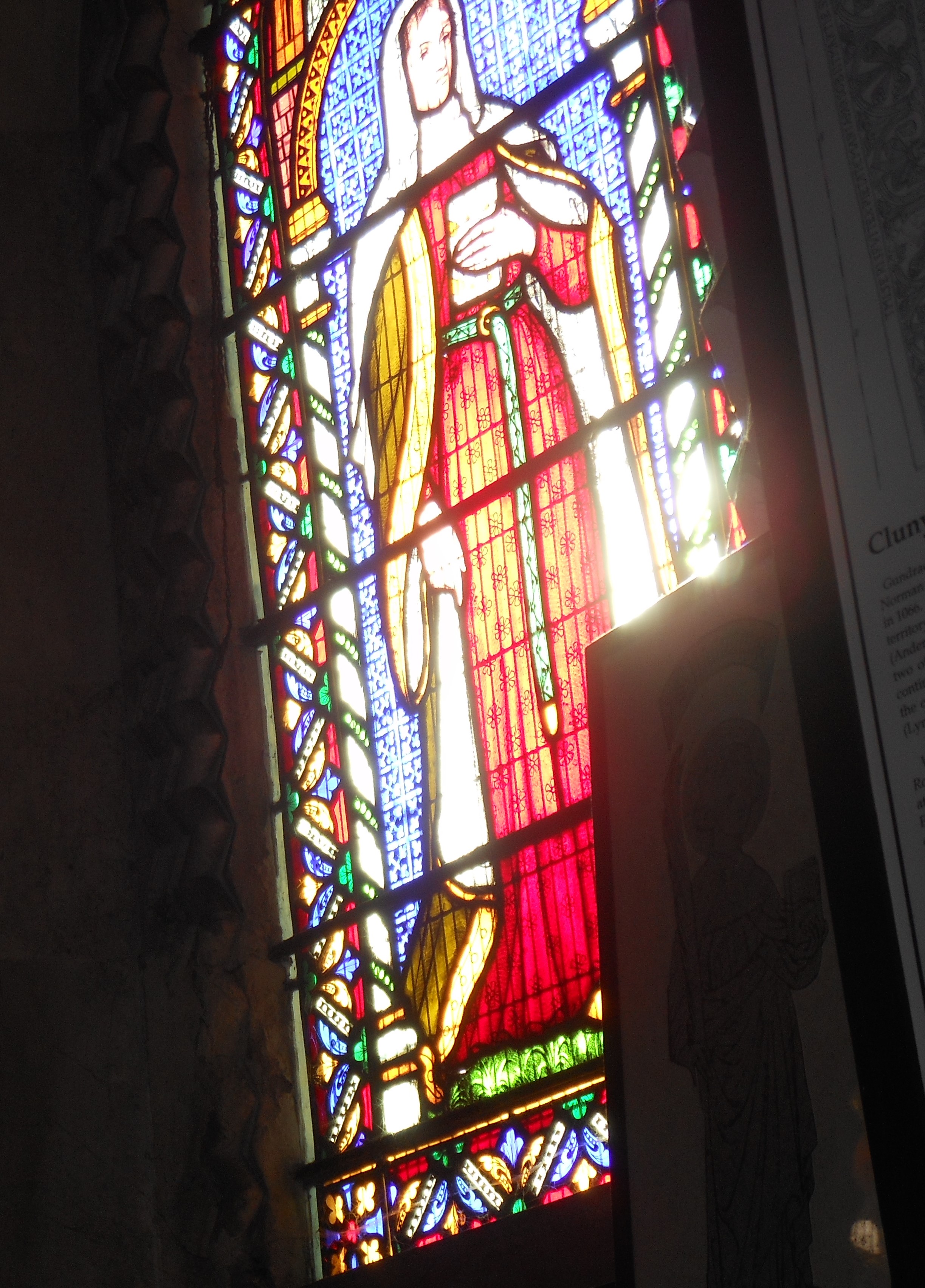
Gundrada de Warenne, Holy Trinity Church, Southover

Frederic was murdered by English freedom fighter, Hereward the Wake; his murder giving rise to a personal feud between Hereward and William de Warenne:

‘Among his other crimes, by trickery [Hereward] killed Frederick, brother of Earl William of Warenne, a man distinguished by lineage and possessions, who one night was surrounded in his own house. On account of his murder, such discord arose between Hereward and the aforesaid William that it could not be settled by any reparation nor in any court.’1

There has been considerable debate among historians over the theory that Gundrada may have been the daughter of William the Conqueror, but the confusion appears to have come from an unreliable charter belonging to Lewes Priory and Gundrada being part of the household of King William’s wife, Matilda. The confirmation charter of the foundation of the priory has King William naming ‘William de Warenne and his wife Gundrada, my daughter.’2 In the same charter, William de Warenne pleads ‘for the health of my mistress Queen Matilda, mother of my wife.’3  However, this is a confirmation of an earlier charter and in the original, while the king and William de Warenne, both, mention Gundrada, neither refer to her as being related to the king or queen.

Historian Elisabeth van Houts argues that Gundrada was most likely a distant relative of Queen Matilda and the counts of Flanders, as asserted in her epitaph as ‘offspring of dukes’ and a ‘noble shoot’. Indeed, had her father been William the Conqueror, her epitaph would surely have referred to her as the offspring of kings. Even if she had been the daughter of Matilda by an earlier marriage, off-spring of kings would have still been appropriate, given that Queen Matilda was the granddaughter of King Robert II of France. Though it does seem likely that Matilda and Gundrada were related in some way, perhaps distant cousins.

The ‘dukes’ referred to in Gundrada’s epitaph, although naturally assumed to be of Normandy, could well refer to a kinship with the house of Luxembourg, to which Queen Matilda’s paternal grandmother, Orgive, belonged. Moreover, Frederic was a familial name within the house of Luxembourg. This kinship via the House of Luxembourg with Queen Matilda would also explain the queen’s gift to Gundrada, of the manor of Carlton, which is usually given as evidence that Gundrada belonged to the queen’s household; an association which would be entirely consistent with kinship.

Books by Sharon Bennett Connolly
De Warenne coat of arms, Holy Trinity Church, Southover

Gundrada and William were married sometime around the time of the Conquest, either before or after the expedition to conquer England. They had 3 children together. Their eldest son, William, would succeed his father as Earl of Surrey and Warenne. He married Isabel de Vermandois, widow of Robert de Beaumont, earl of Leicester; with whom he had, according to one chronicler, been having an affair even before the earl’s death. Young William had a chequered career, he supported the claims of Robert Curthose, Duke of Normandy, to the English throne against the duke’s younger brother, Henry I, but changed sides and fought for Henry at the Battle of Tinchebrai in 1106. Duke Robert lost and was captured and imprisoned by Henry. William remained in the king’s favour for the rest of the reign, fighting alongside Henry at the Battle of Bremule in 1119. William, his son and stepsons were at Henry’s deathbed at Lyons-la-Foret when he died in 1135.

William and Gundrada’s second son, Rainald de Warenne, led the assault on Rouen in 1090, for William II Rufus, in the conflict between the English king and his older brother, Duke Robert. However, by 1105 Rainald was fighting for the duke against the youngest of the Conqueror’s sons, Henry I, defending the castle of Saint-Pierre-sur-Dives for the duke. He was captured by Henry the following year but had been freed by September 1106. It is possible he died shortly after but was certainly dead by 1118 when his brother issued a charter, in which he gave 6 churches to Lewes Priory, for the soul of deceased family members, including Rainald.

Gundrada and William also had a daughter, Edith, who married Gerard de Gournay, son of the lord of Gournay-en-Bray. Gerard also supported William II Rufus against Duke Robert and took part in the Crusade of 1096. Edith later accompanied him on pilgrimage back to Jerusalem, sometime after 1104, where he died. Gerard was succeeded by their son, Hugh de Gournay, whose daughter Gundreda would be the mother of Roger de Mowbray. Edith then married Drew de Monchy, with whom she had a son, Drew the Younger.

Books by Sharon Bennett Connolly
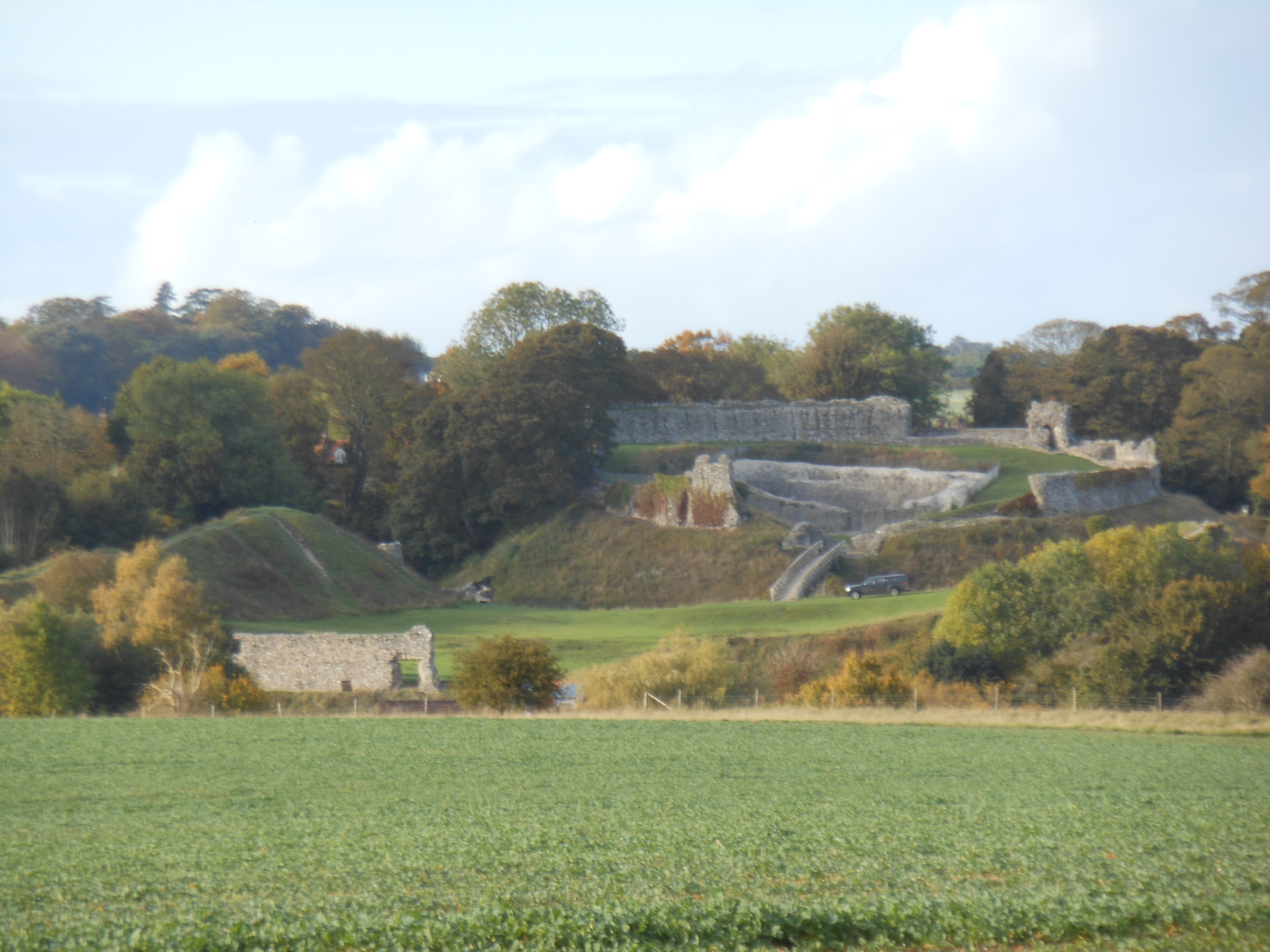
Castle Acre, Norfollk, where Gundrada died

Sadly, Gundrada died in childbirth at Castle Acre in Norfolk on 27th May 1085. She was buried in the chapter house of the couple’s own of foundation Lewes Priory.

William’s second wife was a sister of Richard Guet, who was described as ‘frater comitissae Warennae’ when he gave the manor of Cowyck to Bermondsey Abbey in 1098.3 Guet was a landowner in Perche, Normandy, but his sister’s name has not survived the passage of time. All we know of her is that, a few days after her husband’s death, she attempted to gift 100 shillings to Ely Abbey in restitution for damage caused by William de Warenne. The monks refused the donation, hoping that Warenne’s departing soul had been claimed by demons.4

Despite this feud with Ely, William de Warenne and his wife, Gundrada, had a reputation for piety. At some point in their marriage, probably 1081-3, they went on pilgrimage to Rome. Due of war in Italy they only got as far as the great abbey of Cluny in Burgundy, where they were received into the fellowship of monks. On their return to England, they founded a priory at Lewes, following the Cluniac rule and a prior and 3 monks were sent from Cluny to establish the foundation. It was the first Cluniac foundation in England.

Books by Sharon Bennett Connolly
St Pancras priory, Lewes, founded by William and Gundrada

Following the Conqueror’s death, William fought in support of the late king’s second son, William II Rufus against his older brother, Robert Curthose, who had inherited the dukedom of Normandy. He was rewarded in early 1088 with the earldom of Surrey. The new earl fought for William II Rufus during an invasion by Robert’s supporters and was badly wounded at the siege of Pevensey Castle, East Sussex, in the spring of 1088. He was taken to Lewes, where he died of his wounds on 24th June of the same year. Earl Warenne was buried beside his first wife, Gundrada, in the chapter house of Lewes Priory.

Following the dissolution of Lewes Priory in the 16th century, Gundrada’s tombstone was first moved to Isfield Church; it was moved again in 1775 to the parish church of St John the Baptist at Southover in Lewes. The remains of Gundrada and William, themselves, were discovered in 2 leaden chests in 1845, when the railway line was excavated through the priory grounds. They were laid to rest, for a final time, at the Southover church, in 1847, in a chapel dedicated to Gundrada de Warenne.

William and Gundrada de Warenne had founded a dynasty that would survive for almost 300 years, dying out in the reign of Edward III following the disastrous marriage of John de Warenne, 7th and last Earl of Warenne and Surrey

*

Footnotes:

¹ The Warenne (Hyde) Chronicle edited and translated by Elisabeth M.C. van Houts and Rosalind C. Love; 2 My translation from quote in George Floyd Duckett, Observations on the Parentage of Gundreda, the Daughter of William Duke of Normandy, and Wife of William de Warenne; 3 ibid; 4 Early Yorkshire Charters Volume 8: The Honour of Warenne, Edited by William Farrer and Charles Travis Clay; 5 ibid

Images:

All images ©2022 Sharon Bennett Connolly FRHistS
Sources:

Early Yorkshire Charters Volume 8: The Honour of Warenne, Edited by William Farrer and Charles Travis Clay; England Under the Norman and Angevin Kings by Robert BartlettBrewer’s British Royalty by David WilliamsonBritain’s Royal Families, the Complete Genealogy by Alison Weir; british-history.ac.uk; kristiedean.com; English Heritage Guidebook for Conisbrough Castle by Steven Brindle and Agnieszka Sadrei; oxforddnb.com; George Floyd Duckett, Observations on the Parentage of Gundreda, the Daughter of William Duke of Normandy, and Wife of William de Warenne; Elisabeth M.C. Van Houts and Rosalind C. Love (eds and trans), The Warenne (Hyde) Chronicle; C.P. Lewis, ‘Warenne, Gundrada de (d.1085)’, ODNB; Elisabeth Van Houts, ‘The Warenne View of the Past’, in Proceedings of the Battle Conference 2003, edited by John Gillingham

*

My Books:

Signed, dedicated copies of all my books are available through my online store.

Out now: Scotland’s Medieval Queens

Books by Sharon Bennett Connolly

Scotland’s history is dramatic, violent and bloody. Being England’s northern neighbour has never been easy. Scotland’s queens have had to deal with war, murder, imprisonment, political rivalries and open betrayal. They have loved and lost, raised kings and queens, ruled and died for Scotland. From St Margaret, who became one of the patron saints of Scotland, to Elizabeth de Burgh and the dramatic story of the Scottish Wars of Independence, to the love story and tragedy of Joan Beaufort, to Margaret of Denmark and the dawn of the Renaissance, Scotland’s Medieval Queens have seen it all. This is the story of Scotland through their eyes.

Scotland’s Medieval Queens gives a thorough grounding in the history of the women who ruled Scotland at the side of its kings, often in the shadows, but just as interesting in their lives beyond the spotlight. It’s not a subject that has been widely covered, and Sharon is a pioneer in bringing that information into accessible history.’ Elizabeth Chadwick (New York Times bestselling author)

Available now from Amazon and Pen and Sword Books

Also by Sharon Bennett Connolly:

Books by Sharon Bennett Connolly

Heroines of the Tudor World tells the stories of the most remarkable women from European history in the time of the Tudor dynasty, 1485-1603. These are the women who ruled, the women who founded dynasties, the women who fought for religious freedom, their families and love. Heroines of the Tudor World is now available for pre-order from Amberley Publishing and Amazon UK. Women of the Anarchy demonstrates how Empress Matilda and Matilda of Boulogne, unable to wield a sword themselves, were prime movers in this time of conflict and lawlessness. It shows how their strengths, weaknesses, and personal ambitions swung the fortunes of war one way – and then the other. Available from Bookshop.orgAmberley Publishing and Amazon UKKing John’s Right-Hand Lady: The Story of Nicholaa de la Haye is the story of a truly remarkable lady, the hereditary constable of Lincoln Castle and the first woman in England to be appointed sheriff in her own right. Available from all good bookshops Pen & Sword Booksbookshop.org and Amazon

Books by Sharon Bennett Connolly

Defenders of the Norman Crown: The Rise and Fall of the Warenne Earls of Surrey tells the fascinating story of the Warenne dynasty, from its origins in Normandy, through the Conquest, Magna Carta, the wars and marriages that led to its ultimate demise in the reign of Edward III. Available from Pen & Sword BooksAmazon in the UK and US, and Bookshop.orgLadies of Magna Carta: Women of Influence in Thirteenth Century England looks into the relationships of the various noble families of the 13th century, and how they were affected by the Barons’ Wars, Magna Carta and its aftermath; the bonds that were formed and those that were broken. It is now available in paperback and hardback from Pen & SwordAmazon, and Bookshop.orgHeroines of the Medieval World tells the stories of some of the most remarkable women from Medieval history, from Eleanor of Aquitaine to Julian of Norwich. Available now from Amberley Publishing and Amazon, and Bookshop.orgSilk and the Sword: The Women of the Norman Conquest traces the fortunes of the women who had a significant role to play in the momentous events of 1066. Available now from Amazon,  Amberley Publishing, and Bookshop.org.

Alternate Endings: An anthology of historical fiction short stories including Long Live the King… which is my take what might have happened had King John not died in October 1216. Available in paperback and kindle from Amazon.

Podcast:

Have a listen to the A Slice of Medieval podcast, which I co-host with Historical fiction novelist Derek Birks. Derek and I welcome guests, such as Bernard Cornwell and Elizabeth Chadwick, and discuss a wide range of topics in medieval history, from significant events to the personalities involved.

Every episode is also now available on YouTube.

*

Don’t forget! Signed and dedicated copies of all my books are available through my online store.

For forthcoming online and in-person talks, please check out my Events Page.

You can be the first to read new articles by clicking the ‘Follow’ button, liking our Facebook page or joining me on TwitterThreads and Instagram.

*

©2022 Sharon Bennett Connolly FRHistS.

Eleanor, daughter of a king, Countess of Pembroke

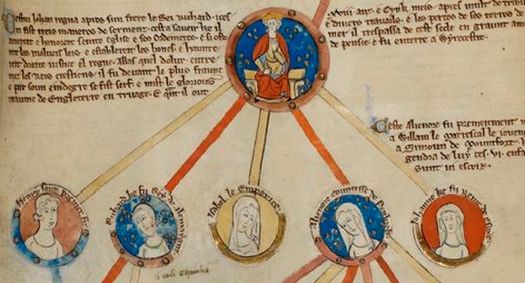
King John with his children Henry, Richard, Joan, Isabella and Eleanor

There was one daughter of King John for whom the legacy of Magna Carta and the struggle for political reform held particular significance. The life of Eleanor of England, and her husband Simon de Montfort, stands as the epilogue of the Magna Carta story. Although democratic government was still many centuries in the future, Magna Carta was the first step. The political movement led by Simon de Montfort was the second step …

However, had fate not stepped in, Eleanor may never have married Simon. From an early age, she had been the wife of another, until tragedy struck.

Eleanor of England was the youngest child of John and Isabelle d’Angoulême; she is said to have inherited her mother’s beauty and feisty temperament.1 Eleanor was thought to have been born at the height of her father’s troubles, in the midst of the Magna Carta crisis in 1215. However, historians are now inclined to the theory that she was born posthumously, sometime after the death of King John, either in late 1216 or early in 1217. She was named for her famous grandmother, Eleanor of Aquitaine. As a baby, little Eleanor was placed in the household of the bishop of Winchester, where her eldest brother, Henry, had been living since 1212.2 Eleanor’s father had died whilst the country was riven by war, on the night of 18/19 October 1216 at Newark. He was succeeded by Eleanor’s eldest brother Henry – now King Henry III. Eleanor’s mother, frozen out from any role in her son’s regency or life, returned to her native Angoulême and in 1220 married Hugh X de Lusignan, Count of La Marche.

In 1224 Eleanor’s future was decided when she was married to William (II) Marshal, Earl of Pembroke. The younger Marshal was the son of the first earl of Pembroke who had been regent in the early years of Henry III’s reign, and who had driven the French out of England following his victory at the Battle of Lincoln in May 1217. The first earl had a reputation for integrity and loyalty, having remained unwavering in his loyalty to King John during the Magna Carta crisis. The second earl, Eleanor’s husband, had been a hostage of the king between 1207 and 1213, as a guarantee of his father’s good behaviour. He later joined the baronial rebellion and was appointed marshal of the forces of the invader, Prince Louis. However, he returned to the Royalist cause when Louis refused him possession of Marlborough Castle, which had previously belonged to the younger Marshal’s grandfather.3

William (II) Marshal fought alongside his father at the Battle of Lincoln. On his father’s death in 1219, Marshal had succeeded him as earl of Pembroke and marshal of England; when his mother died in 1220, he succeeded to her lordships of Leinster and Netherwent. His younger brother, Richard Marshal, succeeded to the Clare lands in Ireland. In 1214 Marshal married Alice, the daughter of Baldwin de Béthune, Count of Aumâle, to whom he had been betrothed in 1203. The marriage was short-lived, however, as poor Alice died in 1216.

On 23 April 1224, William (II) Marshal was married to Eleanor; born in the 1190s, he was some twenty-or-so years older than his bride, who was no more than 9 years old on her wedding day, and may have been as young as 7.4

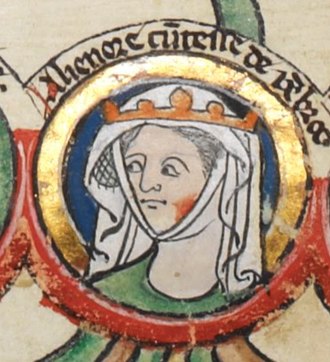
Eleanor of England, Countess of Pembroke

The marriage was agreed at the behest of the justiciar, Hubert de Burgh, and the papal legate, Pandulf, as a way of guaranteeing Marshal remained firmly in the justiciar’s camp, and to prevent the marshal making a foreign marriage. The match put an end to three years of indecision, as to whether Eleanor should marry a foreign prince or an English magnate. The king settled ten manors, confiscated from a French nobleman and already administered by Marshal, on his sister as her marriage portion.5

For the first five years of her marriage Eleanor continued to live at court, under the guardianship of Cecily of Sandford.6 In 1229, when she was 13 or 14, she went to live with her husband, and would spend her time travelling with him in England, France and Ireland. In May 1230, Marshal had taken twenty knights with him on Henry III’s expedition to Poitou. He also took his wife, probably at the behest of the king. Eleanor became seasick during the voyage to France and Henry had his ship drop anchor at the nearest landfall to give her time to recover, ordering the fleet to continue without them.7

Henry was probably hoping that Eleanor’s presence would help to secure the support of his mother and her second husband, Hugh de Lusignan, to his expedition against the French. Mother and daughter had not seen each other since Eleanor was a baby. Isabelle’s maternal affection for the children of her first husband, however, was practically non-existent, or deeply hidden, and Eleanor’s presence failed to persuade her mother and stepfather to remain loyal to Henry III. As we have seen in a previous article, Isabelle d’Angoulême‘s priorities as a French countess often clashed with those of her English family.

Marshal and Eleanor returned from France in the spring of 1231, with William handing over command of the English forces to Ranulf, Earl of Chester. Shortly after their return, the couple attended the wedding of Marshal’s widowed sister, Isabel, to the king’s brother, Richard, Earl of Cornwall. Family happiness turned to grief, however, when William (II) Marshal died suddenly in London a week later, on 6 April. He was buried beside his father at the Temple Church on 15 April 1231.

At the still very tender age of between 14 and 16, Eleanor was a now childless widow.

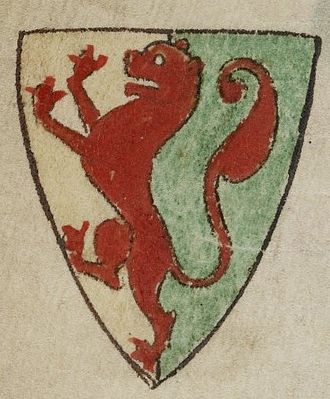
The arms of William Marshal, Earl of Pembroke

The earldom of Pembroke passed to William’s younger brother, Richard, and Eleanor would spend many years fighting unsuccessfully to get the entirety of her dowry from the Marshal family, which amounted to one third of the Marshal estates, according to the guarantees established by Magna Carta. The Great Charter stipulated a widow should receive the allocation of a dower within forty days of her husband’s death.

A year after William’s death Richard Marshal offered Eleanor £400 a year as her settlement. Henry III persuaded his sister to take it, wanting to be done with the business and probably well aware that it was as much as Eleanor was likely to get, despite the Marshal holdings amounting to an income of £3,000 a year.8 Henry stood as guarantor for the settlement but the payments would always be sporadic and unreliable, not helped by the fact that the earldom passed through four successive Marshal brothers between 1231 and 1245, each with differing priorities and more Marshal widows to assign their dowers.

In the midst of her grief, and influenced by her former governess, Eleanor took a vow of chastity in the presence of Edmund of Abingdon, Archbishop of Canterbury in 1234. Although she did not become a nun, the archbishop put a ring on her finger, to signify that she was a bride of Christ; she was, therefore, expected to remain chaste and virtuous for the rest of her life. As a result, the king seized her estates and Richard Marshal, as her husband’s heir, took many of her valuable chattels.

Knowing how teenagers see lost love as the end of the world, even today, one can understand Eleanor’s decision to take a vow of chastity, even if we cannot comprehend anyone giving such advice to a grieving 16-year-old. Eleanor may also have seen taking such a vow as a way of staving off her brother, the king, forcing her to remarry in the interests of the crown. Moreover, it put Eleanor’s life in her own hands and also served to appease the Marshal family, who would have seen their own lands, which made up Eleanor’s dower, controlled by another magnate or foreign prince had she remarried.

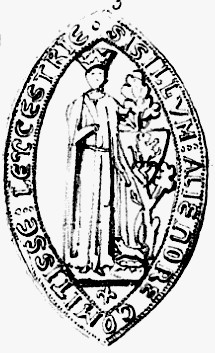
Eleanor’s seal as Countess of Leicester

The widowed Eleanor retired to the castle of Inkberrow in Worcestershire. King Henry III continued to watch over his sister throughout the 1230s; he sent her gifts of venison and timber for her manors. Throughout her life, Eleanor was known for her extravagant spending, which led to substantial debts; Henry lent her money and made sporadic payments to reduce the debts. And in 1237 her brother granted her Odiham Castle in Hampshire, which would become her principal residence.9

Although Eleanor spent the 7 years after William Marshal’s death as a young widow sworn to chastity, most people may have predicted that such a life would not last. And at some point after the mid-1230s, possibly at the wedding of Henry and Eleanor of Provence, Eleanor met Simon de Montfort, the man who would dominate English politics in the mid-thirteenth century.

The couple fell in love.

But that story is for another time…

*

Images:

Courtesy of Wikipedia

Footnotes:

1. Carol, ‘Eleanor of Leicester: A Broken Vow of Chastity’, historyofroyalwomen.com, 28 February 2017; 2. Elizabeth Norton, She Wolves; 3. R.F. Walker, ‘William Marshal, fifth earl of Pembroke (c. 1190–1231)’, oxforddnb.com; 4. Ibid; 5. Darren Baker, With All For All; 6. Elizabeth Hallam, ‘Eleanor, Countess of Pembroke and Leicester (1215?–1275)’, Oxforddnb.com; 7. Darren Baker, With All For All; 8. Ibid; Elizabeth Hallam, ‘Eleanor, Countess of Pembroke’.

Sources:

Rich Price, King John’s Letters Facebook group; Robert Bartlett England Under the Norman and Angevin Kings 1075-1225; Dan Jones The Plantagenets; the Kings who Made EnglandThe Plantagenet Chronicle Edited by Elizabeth Hallam; Maurice Ashley The Life and Times of King John; Roy Strong The Story of BritainOxford Companion to British History; Mike Ashley British Kings & Queens; David Williamson Brewer’s British Royalty; Ralph of Diceto, Images of History; Marc Morris, King John; David Crouch, William Marshal; Crouch and Holden, History of William Marshal; Crouch, David, ‘William Marshal [called the Marshal], fourth earl of Pembroke (c. 1146–1219)’, Oxforddnb.com; Flanagan, M.T., ‘Isabel de Clare, suo jure countess of Pembroke (1171×6–1220)’, Oxforddnb.com; Thomas Asbridge, The Greatest Knight; Chadwick, Elizabeth, ‘Clothing the Bones: Finding Mahelt Marshal’, livingthehistoryelizabethchadwick.blogspot.com; Stacey, Robert C., ‘Roger Bigod, fourth earl of Norfolk (c. 1212-1270)’, Oxforddnb.com; finerollshenry3.org.uk; Vincent, Nicholas, ‘William de Warenne, fifth earl of Surrey [Earl Warenne] (d. 1240)’, Oxforddnb.com.

*

My Books:

Signed, dedicated copies of all my books are available through my online bookshop.

Out Now! Women of the Anarchy

Two cousins. On the one side is Empress Matilda, or Maud. The sole surviving legitimate child of Henry I, she is fighting for her birthright and that of her children. On the other side is her cousin, Queen Matilda, supporting her husband, King Stephen, and fighting to see her own son inherit the English crown. Women of the Anarchy demonstrates how these women, unable to wield a sword, were prime movers in this time of conflict and lawlessness. It show how their strengths, weaknesses, and personal ambitions swung the fortunes of war one way – and then the other.

Available from Bookshop.orgAmberley Publishing and Amazon UK.

Coming on 15 June 2024: Heroines of the Tudor World

Heroines of the Tudor World tells the stories of the most remarkable women from European history in the time of the Tudor dynasty, 1485-1603. These are the women who ruled, the women who founded dynasties, the women who fought for religious freedom, their families and love. These are the women who made a difference, who influenced countries, kings and the Reformation. In the era dominated by the Renaissance and Reformation, Heroines of the Tudor World examines the threats and challenges faced by the women of the era, and how they overcame them. From writers to regents, from nuns to queens, Heroines of the Tudor World shines the spotlight on the women helped to shape Early Modern Europe.

Heroines of the Tudor World is now available for pre-order from Amberley Publishing and Amazon UK.

Also by Sharon Bennett Connolly:

King John’s Right-Hand Lady: The Story of Nicholaa de la Haye is the story of a truly remarkable lady, the hereditary constable of Lincoln Castle and the first woman in England to be appointed sheriff in her own right. It is is available from King John’s Right-Hand Lady: The Story of Nicholaa de la Haye is the story of a truly remarkable lady, the hereditary constable of Lincoln Castle and the first woman in England to be appointed sheriff in her own right. Available from all good bookshops or direct from Pen & Sword Booksbookshop.org and AmazonDefenders of the Norman Crown: The Rise and Fall of the Warenne Earls of Surrey tells the fascinating story of the Warenne dynasty, from its origins in Normandy, through the Conquest, Magna Carta, the wars and marriages that led to its ultimate demise in the reign of Edward III. Available from Pen & Sword BooksAmazon in the UK and US, and Bookshop.org

Ladies of Magna Carta: Women of Influence in Thirteenth Century England looks into the relationships of the various noble families of the 13th century, and how they were affected by the Barons’ Wars, Magna Carta and its aftermath; the bonds that were formed and those that were broken. It is now available in paperback and hardback from Pen & Sword,  Amazon, and Bookshop.orgHeroines of the Medieval World tells the stories of some of the most remarkable women from Medieval history, from Eleanor of Aquitaine to Julian of Norwich. Available now from Amberley Publishing and Amazon, and Bookshop.orgSilk and the Sword: The Women of the Norman Conquest traces the fortunes of the women who had a significant role to play in the momentous events of 1066. Available now from Amazon,  Amberley Publishing, and Bookshop.org.

Alternate Endings: An anthology of historical fiction short stories including Long Live the King… which is my take what might have happened had King John not died in October 1216. Available in paperback and kindle from Amazon.

Podcast:

Have a listen to the A Slice of Medieval podcast, which I co-host with Historical fiction novelist Derek Birks. Derek and I welcome guests, such as Bernard Cornwell and Elizabeth Chadwick, and discuss a wide range of topics in medieval history, from significant events to the personalities involved.

*

Don’t forget! Signed and dedicated copies of all my books are available through my online bookshop.

For forthcoming online and in-person talks, please check out my Events Page.

You can be the first to read new articles by clicking the ‘Follow’ button, liking our Facebook page or joining me on Twitter and Instagram.

©2022 Sharon Bennett Connolly FRHistS
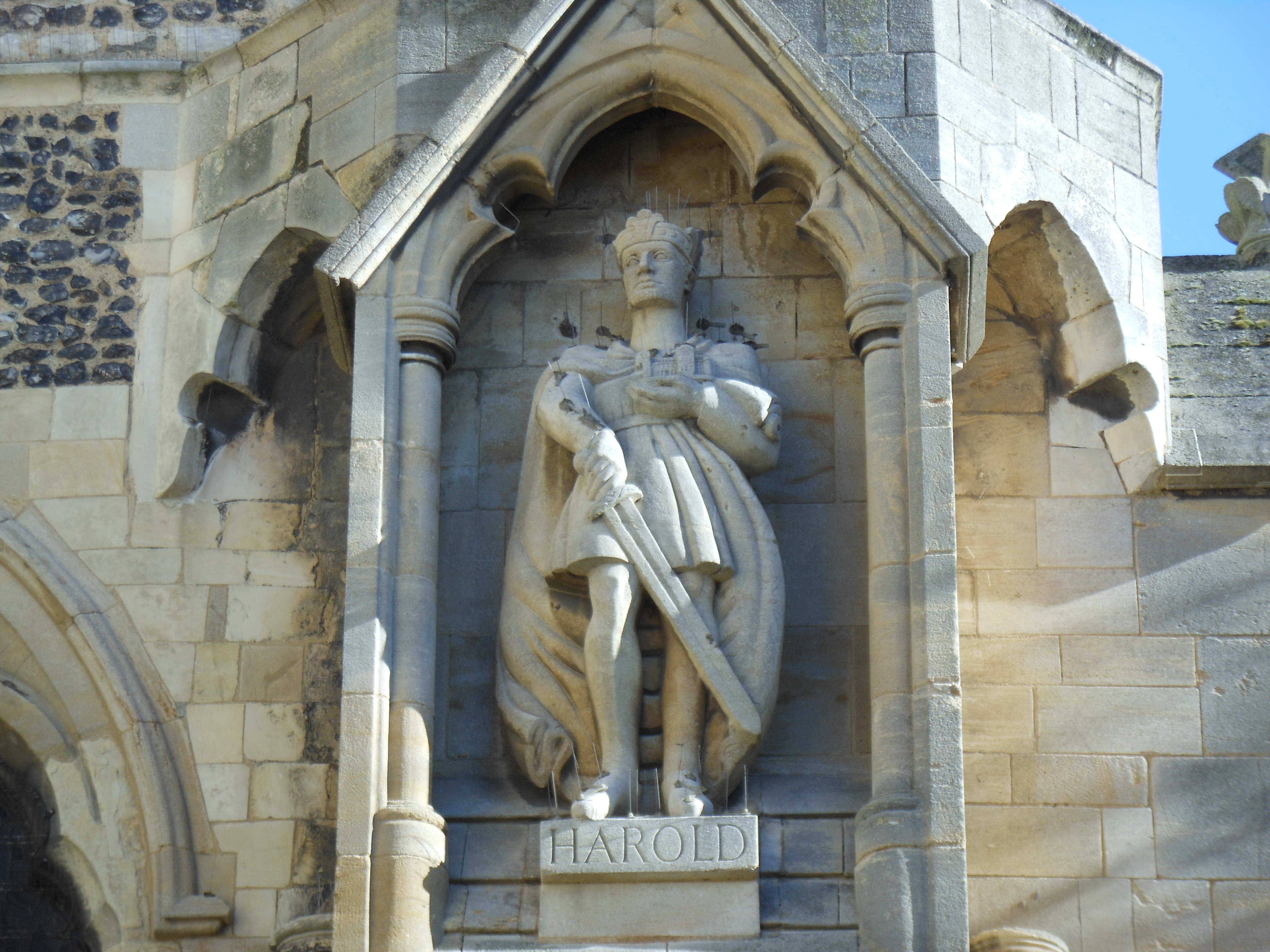
Ӕlfgyva: The Mysterious Woman in the Bayeux Tapestry

The Bayeux Tapestry is the famous pictorial depiction of the Norman Conquest of 1066, and of the events of the two years leading up to it. Commissioned in the 1070s, probably by Bishop Odo of Bayeux, rather than a woven tapestry, the work is in fact an embroidery. Started within ten years of the Norman Conquest it is a near-contemporary narrative of the events that changed England forever. It is told from the viewpoint of the victorious Normans, but with a sympathetic view of the English, at times. It begins in 1064 with Harold’s journey to Normandy, his meeting with Duke William and campaigning in Brittany, followed by the controversial oath-swearing; it then follows Harold’s return to England and his coronation following the death of Edward the Confessor, before concentrating on William’s preparations for invasion and the Battle of Hastings itself; the missing end panels may have included King William’s coronation.

As a prime example of how women have been given little or no part in the story of the Norman Conquest, out of 626 human figures, there are only three women who appear in the main narrative of the Bayeux Tapestry. One of these is easily identifiable as Edward the Confessor’s queen, Edith of Wessex, attending her husband on his deathbed. Another scene, as the Normans land on the shores of England, shows a woman and her child fleeing from a burning house, set alight by the invaders – possibly King Harold’s first wife, Edith Swanneck. The most intriguing woman in the Bayeux Tapestry, appears in one scene when Harold is in Normandy in 1064. She is identified as ‘Ӕlfgyva’, the name sewn into the tapestry above her head. However, the scene does not appear to be related in any way to the scenes either before or after and has therefore caused much discussion and theorising among historians.

Ӕlfgyva appears to be in a doorway, possibly as a suggestion that she was indoors, with a priest touching her cheek. Whether the touch is in admonishment or blessing is open to interpretation, some take it is a collaboration of some sort between the two. Written in Latin as ‘Ubi unus clericus et Ӕlfgyva’, the inscription simply reads, ‘Here a certain cleric and Ӕlfgyva’. Incomplete, the phrase fails to identify Ӕlfgyva or the priest, nor the context in which the two are together. In the borders, at Ӕlfgyva’s feet, is a naked man, imitating the stance of the cleric, perhaps placed there to indicate some kind of scandal associated with the lady.

As this is the only scene in the entire Bayeux Tapestry in which the woman is the leading character and considering that she is only one of three women depicted in the whole embroidery, the story which is depicted must be of some significance to the story of the Norman Conquest. But who was the mysterious Ӕlfgyva? Unfortunately, we are not without a substantial number of potential candidates who could be identified as Ӕlfgyva; Ӕlfgyva and its variants, Ӕlfgiva, Ӕlfgyfu, Ӕlfgifu and Elgiva, were popular names in England in the eleventh century. Indeed, Emma of Normandy’s name was changed to Ӕlfgifu on her marriage to King Ӕthelred II (often referred to as ‘the Unready’) and, just to make matters more confusing Ӕthelred’s first wife was also called Ӕlfgifu. Many historians have their own favourite theories for the identity of Ӕlfgyva; the numerous possible candidates include Emma herself, a sister of King Harold and the first, handfast wife of King Cnut. Each possibility comes with her own reasons for being the mysterious Ӕlfgyva, and her own claim for inclusion in the tapestry that tells the story of the Norman Conquest.

Several theories can be easily discounted. In the 18th century, it was suggested that ‘Ӕlfgyva’ translated to mean ‘queen’ and the image was therefore of a clerk informing Queen Matilda that King William had promised one of their daughters as a bride for Harold of Wessex. Of course, in 1064, Matilda was not queen, and so ‘Ӕlfgyva’ would have to translate as ‘duchess’.  In the 19th century, it was suggested that the scene depicted the daughter of Matilda and William being informed of her betrothal. This theory ignores the fact that Matilda and William did not have a daughter with the name Ӕlfgyva. A final, easily discounted theory is that the lady is Ealdgyth, Harold’s future queen, receiving the news of Harold’s rescue, either from the shipwreck or from the clutches of Count Guy of Ponthieu, by Duke William. This is meant to demonstrate Harold’s dishonesty in agreeing to marry a daughter of Duke William while he has a betrothed waiting at home. The fact is that there is no evidence that Harold was betrothed to Ealdgyth any earlier than late 1065 or early 1066. In fact, we do not know when Harold and Ealdgyth were betrothed or married, but it is likely to have happened shortly before, or during, his kingship, when he needed the support of the Earls Edwin and Morcar, Ealdgyth’s brothers. 

Ӕthelred II’s second wife is a candidate who does merit closer investigation. Emma of Normandy was the wife of Ӕthelred from the spring of 1002 until his death in 1016. In 1017, however, she married Ӕthelred’s nemesis and eventual successor, Cnut. Emma had three children by her first husband, Alfred, Edward and Goda, or Godgifu. She had three further children by King Cnut; Harthacnut, Gunhilda and an unnamed daughter who died as a child, aged 8. Emma’s name had been changed to Ӕlfgifu on her marriage to Ӕthelred and she was a prominent figure at the English court, having been crowned and anointed queen after the wedding ceremony. Emma gained even more prominence in the reign of King Cnut, who married her soon after he took the crown. Cnut appears to have trusted Emma a great deal and is known to have left his treasury with her, as did her son, Harthacnut.

As Cnut’s wife, Emma served to provide a link between Ӕthelred’s ancient dynasty of Wessex, dating back to King Alfred and beyond, and the new Danish dynasty of Cnut. As Cnut’s queen, until his death in 1035, her position appeared unassailable. That changed, however, when Cnut died and was succeeded by his sons as co-regents. With Harthacnut fighting in Denmark, Emma was left isolated and Harold I Harefoot moved against her. Emma was banished from England, and Harold seized control of the whole country. Following Harold’s death in 1040, Emma and her son returned unopposed and Harthacnut finally claimed the crown. Her triumph was short-lived, however, as Harthacnut collapsed and died at a wedding in 1042, and was replaced as king by his older, half-brother, Edward. Edward was also a son of Queen Emma, but his relationship with his mother was far less cordial. Having been exiled in Normandy for twenty-five years, while his mother sat beside Cnut on the English throne for much of that time, Edward held a great deal of resentment for his Emma.

Emma’s lands and property were all taken from her. The Dowager Queen’s close friend and advisor, Stigand, newly consecrated as bishop of East Anglia, shared in Emma’s disgrace and was stripped of office and ‘they took all that he had into their hands for the king, because he was nighest the counsel of his mother; and she acted as he advised, as men supposed’. Taken from the Anglo-Saxon Chronicle, this shows that Edward thought that Stigand had encouraged Emma in her perceived maltreatment of her only surviving son. It was probably as a result of this incident that various legends arose over Emma’s disgrace.

One story, appearing only two centuries later, suggested that Emma’s relationship with Bishop Stigand was far more than that of a queen and her advisor and that he was, in fact, her lover. The story continues that Emma chose to prove her innocence in a trial by ordeal, and that she walked barefoot over white-hot ploughshares. Even though the tale varies depending on the source, the result is the same; when she completed the ordeal unharmed, and was thus proven guiltless, she was reconciled with her contrite son, Edward. Emma appears to have never recovered fully from the depredations placed on her. Both she and Stigand seem to have been reconciled, to some extent, with Edward’s regime by 1044 but she never again enjoyed the status to which she had become accustomed during the reigns of Cnut and Harthacnut.

If Emma were the Ӕlfgyva/Ӕlfgifu of the Bayeux Tapestry, this story could well explain her inclusion, especially if the touch of the cleric in the Ӕlfgyva scene is that of a tender lover, rather than an admonishing priest. However, there are several reasons for discarding Emma as the candidate. The first instance of the story of Emma and Stigand as lovers appears two or three hundred years after her death, and there is no contemporary evidence of an affair that would have been the scandal of the decade, if not the century. Given that many of the chroniclers of the time were not averse to including such stories, it seems strange that they were all silent on the subject; unless, of course, the whole incident was a 14th century fabrication. Another argument against the theory is that Emma’s affair with Bishop Stigand, even in the unlikely event that it happened, would have had little bearing on the Norman Conquest, and would therefore be unlikely to merit inclusion in the Bayeux Tapestry.

Another leading possibility for the identity of the Ӕlfgyva of the Bayeux Tapestry is Ӕlfgifu of Northampton. Ӕlfgifu was the first wife of King Cnut, whom he had married as a handfast wife, in the Danish fashion rather than in a church. She was born around 990, into a prominent and influential Midlands family. It was possibly as a love-match, but also as part of the policy of Cnut’s father, King Sweyn Forkbeard, to establish himself in the midlands, that Ӕlfgifu was married to Cnut sometime between 1013 and 1016. The couple had two sons, Swein and Harold Harefoot. Swein would later be sent by his father to rule Norway, with his mother as regent, but was driven out by the Norwegians following years of misrule. He died in Denmark and Ӕlfgifu returned to England and her only surviving son, Harold I Harefoot who was crowned as sole king in 1037.

If Ӕlfgifu is the woman in the Bayeux Tapestry, then she is probably there in reference to a scandal that was spoken about even in her lifetime, in that Ӕlfgifu was so desperate to have a son by Cnut that she, with the help of a monk, passed off the new-born son a serving maid as her own child; Swein. Similar was said of Ӕlfgifu’s second son by Cnut, Harold I Harefoot, in the Anglo-Saxon Chronicle, which reported that, ‘some men said of Harold that he was son of King Cnut and Ӕlfgifu, daughter of Ealdorman Ӕlfhelm, but to many men it seemed quite unbelievable’. The scandalous stories arose after Cnut’s death in 1035, when Ӕlfgifu was back in England, working to establish the rule of her son, Harold Harefoot, as king. In another version of the tale, the monk had fathered the children himself. The stories may have been mere propaganda used to discredit Ӕlfgifu and cast doubts on the legitimacy of Harold and, therefore, his right to rule as Cnut’s successor.

The main question arising from the theory that Ӕlfgifu of Northampton is the Ӕlfgyva of the Bayeux Tapestry would be the relevance of a scandal that had arisen more than thirty years earlier. It has been argued that both William and Harold would view the scandal as propaganda, to discredit any claims by the Norwegians, such as Harald Hardrada, to the English throne. The naked men in the margins of the scene, one of whom is swinging an axe, are used as further evidence that it was Ӕlfgifu’s scandalous behavior to which the tapestry is referring. However, the fact that both of Ӕlfgifu’s sons died without heirs and that, therefore, there were no claimants descended from her to contest the throne in 1066, makes Ӕlfgifu’s inclusion – if, indeed it is Ӕlfgifu – rather redundant.  

My own leading candidate for Ӕlfgyva is a woman of a different name, but whose story included a scandal that would have been relevant to Harold of Wessex and his hostages. This lady was Eadgifu, or Eadgyva, who was Abbess of Leominster in 1046. Eadgifu’s story is told in the Anglo-Saxon Chronicle, when she came under the power of Swein Godwinson, oldest son of Earl Godwin and Countess Gytha. Swein, had been given an earldom made up from lands in Herefordshire, Gloucestershire, Berkshire, Oxfordshire and Somerset in 1043. In 1046 he had been campaigning in south Wales alongside Gruffydd, King of Gwynedd. The military campaign had ended successfully, with Swein receiving hostages for the good faith of the Welsh. On his return homeward, Swein stopped at Leominster, which was owned by the abbey of Leominster and administered by its abbess, Eadgifu. Swein abducted Eadgifu, probably in order to gain control of Leominster’s vast estates in Herefordshire. However, the king refused to give his permission for Swein and Eadgifu to marry; the pious King Edward the Confessor was understandably horrified at the idea of Swein marrying an abbess, a woman who had dedicated her life to God. Thwarted in his plans, Swein released Eadgifu after he had held her for some considerable time, possibly as long as a year.

As a result of his actions, which were considered not only criminal but sacrilegious in the eyes of the church, Swein was forced to flee England. A few months later, Swein returned to England, but was exiled again for the murder of his cousin, Beorn Estrithson. He was eventually forgiven and allowed to return home. When the feud between Earl Godwin’s family and the king arose in 1051, Earl Godwin and Swein were forced to give up hostages to the king, each handing over a son, Wulfnoth for Godwin and Hakon for Swein. Rather than face the witan, Godwin and his family chose to go into exile at the end on 1051 and only returned to England in the spring of 1052. Swein would never return as he had left on barefoot pilgrimage to Jerusalem and died on his homeward journey. The two hostages, however, were not restored to the family and are thought to have been sent to Normandy, possibly as a way to guarantee the future cooperation of the Godwin family.

It is possible that the union between Eadgifu and Swein resulted in a son, Hakon. It is not entirely certain that Hakon was the son of Eadgifu, but it does seem likely, as no other wife or concubine of Swein’s is mentioned in the chronicles. If he was the son of Eadgifu and Swein, the child would have been five or six years old when he was taken as a hostage to Normandy in 1052. If Eadgifu was the mother of Hakon it would not only explain her presence in the Bayeux Tapestry, but also the inclusion of Ӕlfgyva (Eadgifu) and her cleric in that part of the tapestry. Although there is no direct mention of these hostages in the tapestry, the scene immediately before the Ӕlfgyva scene is that of Harold arriving at Duke William’s court; and one of the possible reasons for Harold’s presence at William’s court was the recovery of the hostages, Eadgifu’s son included. Given the disgrace that Eadgifu must have faced, as an abbess having given birth to an illegitimate child, and the fact the child was only five years old when he was taken to Normandy as a hostage, it is not implausible that his mother accompanied him, and therefore is included in the Bayeux Tapestry as Hakon, no longer a valuable hostage given that his father had been dead for over ten years, was allowed to return to England with Earl Harold.

There is one major flaw in this argument, and that is the confusion of names, Eadgifu and Ӕlfgyva are similar but very different names and it is hard to imagine that someone would make such a big mistake on so important an undertaking as the Bayeux Tapestry; although not implausible, given that Harold’s brother, Leofwine, is identified as Lewine on another portion of the tapestry. We do not know, moreover, that Eadgifu ever accompanied her son to Normandy, or visited him there while he was a hostage. However, Eadgifu’s story, the scandal associated with her abduction by Swein and the presence of her son in Normandy, still makes her a contender. The scene with the cleric could well be him giving her a blessing on her return to England, or an admonition on the fact she had a child out of wedlock – and while she was an abbess who had given her life to God. Despite the disparity in names, the fact that she had links to Normandy through her son, and that her story was associated with Harold’s visit to Normandy and the request for the hostages to be freed, gives her a relevance to the tapestry and makes her one of the most plausible candidates for Ӕlfgyva.

Despite the many possibilities and theories surrounding Ӕlfgyva and her cleric, their identities and the reason for their inclusion in the Bayeux Tapestry, one fact remains; no definitive explanation is forthcoming. It is not beyond reason that the Ӕlfgyva of the Bayeux Tapestry is none of the ladies I have suggested, but someone else entirely who, in the passage of nearly a millennium, has been lost in the fogs of time. The story may well have been a familiar one at the time the tapestry was created, and no explanation beyond ‘Here a certain cleric and Ӕlfgyva’ may have been needed to identify the protagonists to viewers in the eleventh century.

Today, however, the story and the identity of the players continues to elude us…

Historical Writers Forum hosted a fabulous debate on ‘Ӕlfgyva’: The Mysterious Woman in the Bayeux Tapestry, which is available on YouTube. Hosted by Samantha Wilcoxson, it features myself, Pat Bracewell, Carol McGrath and Paula Lofting.

*

Images:

Courtesy of Flickr and Wikipedia

Sources:

A Historical Document Pierre Bouet and François Neveux, bayeuxmuseum.com/en/un_document_historique_en; The Mystery Lady of the Bayeux Tapestry (article) by Paula Lofting, annabelfrage.qordpress.com; Ӕlfgyva: The Mysterious lady of the Bayeux Tapestry (article) by M.W. Campbell, Annales de Normandie; The Bayeux Tapestry, the Life Story of a Masterpiece by Carola Hicks; Æthelred II [Ethelred; known as Ethelred the Unready] (c. 966×8-1016) (article) by Simon Keynes, Oxford Dictionary of National Biography, oxforddnb.com; Britain’s Royal Families; the Complete Genealogy by Alison Weir; Queen Emma and the Vikings: The Woman Who Shaped the Events of 1066 by Harriet O’Brien; The Anglo-Saxon Chronicle translated by James Ingram; On the Spindle Side: the Kinswomen of Earl Godwin of Wessex by Ann Williams; Swein [Sweyn], earl by Ann Williams, Oxford Dictionary of National Biography, oxforddnb.com, 23 September 2004; Ӕlfgifu [Ӕlfgifu of Northampton (fl. 1006-1036) (article) by Pauline Stafford, Oxford Dictionary of National Biography, oxforddnb.com; The Chronicle of John of Worcester, translated and edited by Thomas Forester, A.M; The Anglo-Saxon Chronicles edited and translated by Michael Swanton.

*

My Books

Signed, dedicated copies of all my books are available through my online store.

OUT NOW! Heroines of the Tudor World

Heroines of the Tudor World tells the stories of the most remarkable women from European history in the time of the Tudor dynasty, 1485-1603. These are the women who ruled, the women who founded dynasties, the women who fought for religious freedom, their families and love. These are the women who made a difference, who influenced countries, kings and the Reformation. In the era dominated by the Renaissance and Reformation, Heroines of the Tudor World examines the threats and challenges faced by the women of the era, and how they overcame them. From writers to regents, from nuns to queens, Heroines of the Tudor World shines the spotlight on the women helped to shape Early Modern Europe.

Heroines of the Tudor World is now available for pre-order from Amberley Publishing and Amazon UK.

Coming 30 January 2025: Scotland’s Medieval Queens

Scotland’s history is dramatic, violent and bloody. Being England’s northern neighbour has never been easy. Scotland’s queens have had to deal with war, murder, imprisonment, political rivalries and open betrayal. They have loved and lost, raised kings and queens, ruled and died for Scotland. From St Margaret, who became one of the patron saints of Scotland, to Elizabeth de Burgh and the dramatic story of the Scottish Wars of Independence, to the love story and tragedy of Joan Beaufort, to Margaret of Denmark and the dawn of the Renaissance, Scotland’s Medieval Queens have seen it all. This is the story of Scotland through their eyes.

Available for pre-order now.

Also by Sharon Bennett Connolly:

Women of the Anarchy demonstrates how Empress Matilda and Matilda of Boulogne, unable to wield a sword themselves, were prime movers in this time of conflict and lawlessness. It shows how their strengths, weaknesses, and personal ambitions swung the fortunes of war one way – and then the other. Available from Bookshop.orgAmberley Publishing and Amazon UKKing John’s Right-Hand Lady: The Story of Nicholaa de la Haye is the story of a truly remarkable lady, the hereditary constable of Lincoln Castle and the first woman in England to be appointed sheriff in her own right. Available from all good bookshops Pen & Sword Booksbookshop.org and AmazonDefenders of the Norman Crown: The Rise and Fall of the Warenne Earls of Surrey tells the fascinating story of the Warenne dynasty, from its origins in Normandy, through the Conquest, Magna Carta, the wars and marriages that led to its ultimate demise in the reign of Edward III. Available from Pen & Sword BooksAmazon in the UK and US, and Bookshop.org

Ladies of Magna Carta: Women of Influence in Thirteenth Century England looks into the relationships of the various noble families of the 13th century, and how they were affected by the Barons’ Wars, Magna Carta and its aftermath; the bonds that were formed and those that were broken. It is now available in paperback and hardback from Pen & Sword,  Amazon, and Bookshop.orgHeroines of the Medieval World tells the stories of some of the most remarkable women from Medieval history, from Eleanor of Aquitaine to Julian of Norwich. Available now from Amberley Publishing and Amazon, and Bookshop.orgSilk and the Sword: The Women of the Norman Conquest traces the fortunes of the women who had a significant role to play in the momentous events of 1066. Available now from Amazon,  Amberley Publishing, and Bookshop.org.

Alternate Endings: An anthology of historical fiction short stories including Long Live the King… which is my take what might have happened had King John not died in October 1216. Available in paperback and kindle from Amazon.

Podcast:

Have a listen to the A Slice of Medieval podcast, which I co-host with Historical fiction novelist Derek Birks. Derek and I welcome guests, such as Bernard Cornwell, and discuss a wide range of topics in medieval history, from significant events to the personalities involved.

*

Don’t forget! Signed and dedicated copies of all my books are available through my online store.

For forthcoming online and in-person talks, please check out my Events Page.

You can be the first to read new articles by clicking the ‘Follow’ button, liking our Facebook page or joining me on TwitterThreads and Instagram.

©2022 Sharon Bennett Connolly FRHistS
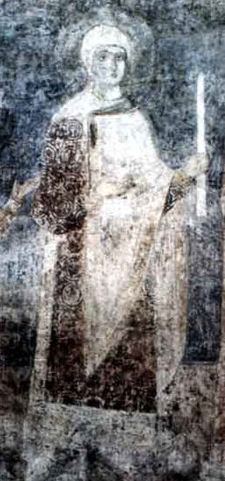
Isabelle d’Angoulême: A Complicated Queen

Why is Isabelle d’Angoulême so hard to love?

Seal of Isabelle d’Angoulême

At first sight, it is easy to have sympathy for Isabelle of Angoulême. When I started researching her for Ladies of Magna Carta: Women of Influence in Thirteenth Century England, I was expecting to be able to go some way to redeeming her reputation. She was married at a very young age – she was no more than 12 and may have been as young as 10 – to ‘Bad’ King John, the man who would later be accused of murdering his own nephew and left a woman to starve in his dungeons.

Isabelle d’Angoulême was the only child of Audemar, Count of Angoulême and Alice de Courtenay. Her mother was the daughter Peter de Courtenay, lord of Montargis and Chateaurenard, and a cousin of king Philip II Augustus of France. Through her Courtenay family connections, Isabelle was related to the royal houses of Jerusalem, Hungary, Aragon and Castile. When John set his sights on her, Isabelle was betrothed to Hugh IX de Lusignan: the chronicler Roger of Howden maintained that Isabelle had not yet reached the age of consent, which was why she was still only betrothed to Hugh, rather than married to him. The marriage between Isabelle and Hugh was intended to put to bed, literally, a long-running, bitter rivalry between the Lusignans and the counts of Angoulême. It would also unite neighbouring regions in Aquitaine, posing a threat to Angevin power in the region. This could have effectively cut Aquitaine in two, jeopardising the stability of the borders of Poitou and Gascony. John could not help but see the threat posed by the impending marriage and sought to put a stop to it. Count Audemar, it seems, was quite receptive to the suggestion that he abandon the Lusignan match if it meant that his daughter would become a queen.

King John

In the early years of their marriage, John appears to have treated Isabelle more like a child than a wife, which she still was, and she was financially dependent on him. When she was not at court with the king, Isabelle spent time at Marlborough Castle or in the household of John’s first wife, Isabella of Gloucester, at Winchester. Isabella’s allowance was raised from £50 to £80 a year, to pay for the extra expenses incurred by housing the queen.

It appears that Isabelle was an unpopular queen, guilty by her association with the excesses and abuses of John’s regime. It was in this light that John’s marriage to Isabelle was seen as the start of England’s woes, with some of the blame falling unfairly on the young queen. Contemporary sources reported that John spent his mornings in bed with the queen, when he should have been attending to the business of the country, casting Isabelle as some kind of temptress, irresistible to the king. The fact that Isabelle did not give birth to her first child until 1207, when she was in her late teens, puts the lie to these sources, suggesting that she and John  did not consummate the marriage in the first few years. After 16 years together, the couple had 5 children; Henry III, Richard of Cornwall, Isabella, Joan and the youngest, Eleanor, who was born in 1215 or 1216.

While her movements were restricted and closely controlled during her marriage to John, the situation did not improve for Isabelle following John’s death in 1216. Their 9-year-old son Henry was now king, but Isabelle was excluded from playing a role in the regency government; her unpopularity in England and lack of political experience were major factors. Moreover, she had had limited contact with her children: they lived in separate households and Isabelle was not responsible for their supervision or education, which added to her isolation. Almost as soon as Henrys crowned, Isabelle started making arrangements to go home, to Angoulême, of which she was countess in her own right. In 1217 she left England.

Isabelle’s son, Henry III of England

Once in her own domains, Isabelle was to arrange the wedding of her daughter, Joan. Joan had been betrothed, at the age of 4, to Hugh X de Lusignan, Count of La Marche and the son of Hugh IX, the man who had been betrothed to Isabelle before John married her. In 1220 Isabelle shocked England, and probably the whole continent, when she scandalously married her daughter’s betrothed herself. Poor 9-year-old Joan’s erstwhile fiancé was now her stepfather! Worse was to come, however, when the little princess was not returned to her homeland, as might have been expected, but held hostage, by Isabelle and Hugh, to ensure Hugh’s continued control of her dower lands, and as a guarantee to the transfer of her mother’s dower, which the English government was withholding against the return of Joan.

Stalemate.

Isabelle wrote to her son, Henry III, to explain and justify why she had supplanted her own daughter as Hugh’s bride, claiming ‘…lord Hugh of Lusignan remained alone and without heir in the region of Poitou, and his friends did not permit our daughter to be married to him, because she is so young; but they counselled him to take a wife from whom he might quickly have heirs, and it was suggested that he take a wife in France. If he had done so, all your land in Poitou and Gascony and ours would have been lost. But we, seeing the great danger that might emerge from such a marriage – and your counsellors would give us no counsel in this – took said H[ugh], count of La Marche, as our lord; and God knows that we did this more for your advantage than ours…’

Ironically, Isabelle had now achieved that which King John had hoped to avoid; the union of La Marche and Angoulême, splitting Angevin Aquitaine down the Little Joan was finally returned to England towards the end of 1220, but the arguments over Isabelle’s English lands continued throughout the 1220s and beyond. Isabelle would not retire in peace and in 1224 she and Hugh betrayed Henry by allying themselves with the King of France. In exchange for a substantial pension, they supported a French invasion of Poitou (the lands in France belonging to the King of England, her son).

Seal of Hugh X de Lusignan

Hugh and Isabelle were reconciled with Henry in 1226 and Isabelle met her first-born son for the first time in more than twelve years in 1230, when Henry mounted a futile expedition to Brittany and Poitou. Isabelle and Hugh, however, continued to play the kings of France and England against each other, always looking for the advantage, though this was probably as much by necessity as self-interest. They did, after all, live in France and their relationship with England complicated things. In 1242, for example, when Henry III invaded Poitou, Hugh X initially gave support to his English stepson, only to change sides once more, precipitating the collapse of Henry’s campaign. Isabelle herself was implicated in a plot to poison King Louis IX of France and his brother, only to be foiled at the last minute; the poisoners claimed to have been sent by Isabelle. There is no evidence of Isabelle denying the accusation, but she never admitted her guilt, either.

Isabelle’s second marriage proved even more unstable than her first, shaken by Hugh’s frequent infidelities and threats of divorce. Isabelle enjoyed greater personal authority within her second marriage; where she had issued no charters whilst married to King John, as Hugh de Lusignan’s wife, the couple issued numerous joint charters. Her difficult relationship with France added to Isabelle’s marital problems. In one instance, Isabelle was offended by the queen of France when she was not offered a chair to sit, in the queen’s presence, regardless of the fact she herself was a crowned and anointed queen. Following this insult, in 1241, Isabelle castigated Hugh de Lusignan for supporting a French candidate to the county of Poitou, ahead of her son, Henry III. In retaliation, Isabelle stripped Lusignan Castle of its furnishings and refused to allow her husband into her castle at Angoulême for three days.

Despite the rocky relationship, Isabelle and Hugh had nine children together, including Aymer de Lusignan and William de Valence. Many of his Lusignan half-siblings would later cause problems for Henry III, having come to England to seek patronage and advancement from their royal half-brother.

Tomb effigy of Isabelle d’Angoulême, Fontevraud Abbey

In 1244 the two royal cooks admitted the attempted poisoning of the French king, and that they had been paid by Isabelle. Before she could be arrested, Isabelle retired to Fontevraud Abbey, where she died on 4 June, 1246. The dowager queen of England was buried in the abbey’s churchyard. However, when Henry III visited his mother’s final resting place, he was shocked that she was buried outside the abbey and ordered that she be moved inside. She was finally laid to rest in the abbey church, beside Henry II and Eleanor of Aquitaine.

As contemporaries described her as ‘more Jezebel than Isabel’, accused her of ‘sorcery and witchcraft’, Isabelle of Angouleme’s reputation as a heartless mother and habitual schemer seems set to remain. Married to King John whilst still a child, she was castigated as the cause for the loss of the majority of John’s continental possessions and the subsequent strife and civil war; one could easily sympathise with her lack of love for England. That Isabelle apparently abandoned the children of her first husband within months of his death, and her supposed willingness to betray her son for her own ends would go some way to destroy the compassion one may have felt for her. However, we have to remember that nothing is ever black and white and we have to consider that Isabelle was balancing the interests of her two families – one French and one English – which were, unfortunately for Isabelle, irreconcilable due to the politics of the time.

One thing is for sure, Isabelle d’Angoulême is a fascinating character!

*

Images:

Courtesy of Wikipedia

Sources:

Rich Price, King John’s Letters Facebook group; Robert Bartlett England Under the Norman and Angevin Kings 1075-1225; Dan Jones The Plantagenets; the Kings who Made EnglandThe Plantagenet Chronicle Edited by Elizabeth Hallam; Maurice Ashley The Life and Times of King John; Roy Strong The Story of BritainOxford Companion to British History; Mike Ashley British Kings & Queens; David Williamson Brewer’s British Royalty; Ralph of Diceto, Images of History; Marc Morris, King John; David Crouch, William Marshal; Crouch and Holden, History of William Marshal; Crouch, David, ‘William Marshal [called the Marshal], fourth earl of Pembroke (c. 1146–1219)’, Oxforddnb.com; Flanagan, M.T., ‘Isabel de Clare, suo jure countess of Pembroke (1171×6–1220)’, Oxforddnb.com; Thomas Asbridge, The Greatest Knight; Chadwick, Elizabeth, ‘Clothing the Bones: Finding Mahelt Marshal’, livingthehistoryelizabethchadwick.blogspot.com; Stacey, Robert C., ‘Roger Bigod, fourth earl of Norfolk (c. 1212-1270)’, Oxforddnb.com; finerollshenry3.org.uk; Vincent, Nicholas, ‘William de Warenne, fifth earl of Surrey [Earl Warenne] (d. 1240)’, Oxforddnb.com.

My Books:

Signed, dedicated copies of all my books are available through my online store.

Out now: Scotland’s Medieval Queens

Scotland’s history is dramatic, violent and bloody. Being England’s northern neighbour has never been easy. Scotland’s queens have had to deal with war, murder, imprisonment, political rivalries and open betrayal. They have loved and lost, raised kings and queens, ruled and died for Scotland. From St Margaret, who became one of the patron saints of Scotland, to Elizabeth de Burgh and the dramatic story of the Scottish Wars of Independence, to the love story and tragedy of Joan Beaufort, to Margaret of Denmark and the dawn of the Renaissance, Scotland’s Medieval Queens have seen it all. This is the story of Scotland through their eyes.

Available now from Amazon and Pen and Sword Books

Also by Sharon Bennett Connolly:

Heroines of the Tudor World tells the stories of the most remarkable women from European history in the time of the Tudor dynasty, 1485-1603. These are the women who ruled, the women who founded dynasties, the women who fought for religious freedom, their families and love. Heroines of the Tudor World is now available for pre-order from Amberley Publishing and Amazon UK. Women of the Anarchy demonstrates how Empress Matilda and Matilda of Boulogne, unable to wield a sword themselves, were prime movers in this time of conflict and lawlessness. It shows how their strengths, weaknesses, and personal ambitions swung the fortunes of war one way – and then the other. Available from Bookshop.orgAmberley Publishing and Amazon UKKing John’s Right-Hand Lady: The Story of Nicholaa de la Haye is the story of a truly remarkable lady, the hereditary constable of Lincoln Castle and the first woman in England to be appointed sheriff in her own right. Available from all good bookshops Pen & Sword Booksbookshop.org and Amazon

Defenders of the Norman Crown: The Rise and Fall of the Warenne Earls of Surrey tells the fascinating story of the Warenne dynasty, from its origins in Normandy, through the Conquest, Magna Carta, the wars and marriages that led to its ultimate demise in the reign of Edward III. Available from Pen & Sword BooksAmazon in the UK and US, and Bookshop.orgLadies of Magna Carta: Women of Influence in Thirteenth Century England looks into the relationships of the various noble families of the 13th century, and how they were affected by the Barons’ Wars, Magna Carta and its aftermath; the bonds that were formed and those that were broken. It is now available in paperback and hardback from Pen & SwordAmazon, and Bookshop.orgHeroines of the Medieval World tells the stories of some of the most remarkable women from Medieval history, from Eleanor of Aquitaine to Julian of Norwich. Available now from Amberley Publishing and Amazon, and Bookshop.orgSilk and the Sword: The Women of the Norman Conquest traces the fortunes of the women who had a significant role to play in the momentous events of 1066. Available now from Amazon,  Amberley Publishing, and Bookshop.org.

Alternate Endings: An anthology of historical fiction short stories including Long Live the King… which is my take what might have happened had King John not died in October 1216. Available in paperback and kindle from Amazon.

Podcast:

Have a listen to the A Slice of Medieval podcast, which I co-host with Historical fiction novelist Derek Birks. Derek and I welcome guests, such as Bernard Cornwell, Elizabeth Chadwick and Michael Jecks, and discuss a wide range of topics in medieval history, from significant events to the personalities involved. Every episode is also now available on YouTube.

*

Don’t forget! Signed and dedicated copies of all my books are available through my online store.

For forthcoming online and in-person talks, please check out my Events Page.

You can be the first to read new articles by clicking the ‘Follow’ button, liking our Facebook page or joining me on TwitterThreadsBluesky and Instagram.

*

©2021 Sharon Bennett Connolly, FRHistS

Magna Carta’s Family Ties

Magna Carta

As I have been pursuing the various strands of research into the female personalities in medieval England, I have been struck, time and again, by how closely related the nobility were, through blood and marriage. Just look at the women who surround the Magna Carta story. Each of the women I wrote of had at least one familial connection to another great noble family; some had a number of links to several families. It is a tangled and complicated web, but I will try and give you a brief overview here.

As you may have noticed, my favourite medieval woman is Nicholaa de la Haye, castellan of Lincoln Castle; she successfully defended the castle through at least 3 sieges, the last 2 when she was a widow in her 60s. Nicholaa was related to King John’s half-brother, William  Longespée, Earl of Salisbury, through her son, Richard, whose daughter Idonea was married at a young age to William (II), Longespée’s son by his wife, Ela of Salisbury. It was as a result of this connection that William (I) Longespée claimed Lincoln Castle and the shrievalty of Lincolnshire following the Second Battle of Lincoln in May 1217. Longespée claimed that as they were his daughter-in-law’s inheritance, it was his right to administer them. Idonea’s father, Richard, had died sometime in the previous 12 months, leaving Idonea as his sole heir. Longespée appears to have conveniently forgotten – or ignored – the fact that the castle of Lincoln was Nicholaa’s by hereditary right – and Nicholaa was still very much alive!

Coat of arms of William Longespée, 3rd Earl of Salisbury

Despite Nicholaa’s stalwart defence of Lincoln Castle during a 10-week siege, Longespée was granted the position of sheriff just 4 days after the battle, and promptly seized the castle. Nicholaa’s refusal to accept this saw her presenting herself to the royal court and requesting she be reinstated. A compromise was reached whereby Longespée remained as sheriff of Lincolnshire, but Nicholaa was reinstated as castellan of Lincoln Castle, and given control of the city of Lincoln itself. Longespée was by no means satisfied and continued to scheme to gain control of the castle; Nicholaa doggedly held on and only retired from her position as castellan of Lincoln in 1226, 3 months after Longespée’s death.

Ela of Salisbury provided at least two further familial connections among my Ladies of Magna Carta. Through her grandfather, Patrick of Salisbury, Ela was a cousin of William Marshal and his five daughters. Marshal was the son of Patrick of Salisbury’s sister, Sybilla. Patrick himself had married, as his second wife, Ela de Talvas, who was the widow of William de Warenne, 3rd Earl of Warenne and Surrey. From her first marriage, Ela de Talvas was the mother of the heiress, Isabel de Warenne, Countess of Surrey in her own right and wife to, first, William of Blois, youngest son of King Stephen and secondly, Hamelin Plantagenet, illegitimate half-brother of King Henry II. Isabel de Warenne, therefore, was aunt to Ela of Salisbury, Richard the Lionheart and King John.

Arms of the Warenne earls of Surrey

Isabel de Warenne’s own aunt, Ada de Warenne, was married to the son and heir of King David I of Scotland, Henry, Earl of Huntingdon. Ada was the mother of two Scottish kings, Malcom IV the Maiden and William I the Lion. She was, therefore, the grandmother of the Scottish princesses, Margaret and Isabella, the only two women, other than the queen, Isabelle d’Angoulême, who can be clearly identified in a clause of Magna Carta. Margaret and Isabella had been handed over to King John as hostages following the 1209 Treaty of Norham, agreed between their father, William the Lion, and King John. John was supposed to find suitable husbands for the teenage girls; it had been implied that they would be married to John’s sons, Henry and Richard, but no marriages had ever materialised. Clause 59 of Magna Carta stipulated that John would find spouses for the princesses or send them home.

The two girls were eventually wed to English noblemen, though not until the 1220s. In 1221 Margaret married Hubert de Burgh, Henry III’s Justiciar and widower of another of my Ladies of Magna Carta, Isabella of Gloucester, who also had the dubious honour of having been the first wife of King John. Princess Isabella was married, in 1225, to Roger Bigod, Earl of Norfolk, who was 14 years her junior. The marriage was not a happy one. A third Scottish princess, Marjorie, who was several years younger than her two sisters and not part of the conditions of the Treaty of Norham, also married into the English nobility. She became the wife of Gilbert Marshal, 4th Earl of Pembroke, third son of the great William Marshal, Earl of Pembroke and regent for Henry III.

Hubert de Burgh from Matthew Paris’s Historia Anglorum

Roger Bigod was himself the son of Hugh Bigod, Earl of Norfolk, and Matilda Marshal, eldest daughter of William Marshal. Marshal was the man who had led the army that relieved Nicholaa de la Haye and the siege of Lincoln Castle in May 1220. Matilda married, as her second husband, William de Warenne, 5th Earl of Warenne and Surrey and only son of Isabel and Hamelin, mentioned earlier. Matilda’s sister, Isabel, was married to Gilbert de Clare, Earl of Gloucester; he was the nephew of the same Isabella of Gloucester who had been wife to King John, Geoffrey de Mandeville and Hubert de Burgh. Isabel Marshal then married, as her second husband, Richard, Earl of Cornwall, brother of Henry III and youngest son of King John. Another sister, Eva, married William (V) de Braose, grandson of William (IV) de Braose and Matilda, the poor woman who was imprisoned by King John and starved to death, alongside her eldest son, in his dungeons in 1210. It was Eva’s husband who was hanged by Llywelyn, Prince of Gwynedd, after he was found in Llywelyn’s bedroom with Llywelyn’s wife, Joan, Lady of Wales and illegitimate daughter of King John.

Which brings us neatly to the royal family. John’s eldest legitimate daughter, also named Joan, was betrothed as a child to Hugh X de Lusignan, Count of La Marche. The marriage never materialised, however, as Joan’s mother, Isabelle d’Angoulême, decided to marry Count Hugh in her daughter’s stead, causing a rather juicy scandal in the process! Joan was not without a suitor for long and within a year of her mother’s marriage she was married to Alexander II, King of Scots and brother of those same Scottish princesses who were included in Magna Carta’s clause 59. Of Joan’s sisters, Isabella was married to Frederick II, Holy Roman Emperor and Eleanor, only a baby at the time of her father’s death, was married to William (II) Marshal, eldest son and heir of the great William Marshal, at the age of 9. Eleanor was a widow before her 16th birthday, dramatically taking a vow of perpetual chastity in front of the Archbishop of Canterbury shortly after her husband’s death.

Arms of William Marshal, Earl of Pembroke

As her second husband, Eleanor married Simon de Montfort, Earl of Leicester, despite that pesky vow of chastity, which was to prove costly to Simon when he had to travel to Rome to seek a papal dispensation to have it annulled. Simon de Montfort was to continue the fight for reform that had been enshrined in Magna Carta, but would meet his end at the Battle of Evesham in 1265. Simon and Eleanor’s daughter, also named Eleanor, would marry Llywelyn, Prince of Wales, grandson of Llywelyn, Prince of Gwynedd. Eleanor died in childbirth in June 1282, while Llywelyn was defeated and killed by Edward I’s forces in December, the same year. Their only daughter, Gwenllian, was placed in a convent in Lincolnshire before she was 18 months old and would never leave it, dying there in 1337.

Another perpetual royal prisoner was Gwenllian’s distant cousin, Eleanor of Brittany, a granddaughter of Henry II, niece of King John and first cousin of Henry III. Her royal blood meant that she would never be afforded the protection enshrined in clause 39 of Magna Carta and inspired by the gruesome death of Matilda de Braose, that:

“No man shall be taken, imprisoned, outlawed, banished or in any way destroyed, nor will we proceed against or prosecute him, except by the lawful judgement of his peers or by the law of the land.”

There are many more familial links between the Ladies of Magna Carta. I could go on…

But I’m guessing that your heads are spinning and this is more than enough … for now.

Sources:

Rich Price, King John’s Letters Facebook group; Robert Bartlett England Under the Norman and Angevin Kings 1075-1225; Dan Jones The Plantagenets; the Kings who Made EnglandThe Plantagenet Chronicle Edited by Elizabeth Hallam; Maurice Ashley The Life and Times of King John; Roy Strong The Story of BritainOxford Companion to British History; Mike Ashley British Kings & Queens; David Williamson Brewer’s British Royalty; Ralph of Diceto, Images of History; Marc Morris, King John; David Crouch, William Marshal; Crouch and Holden, History of William Marshal; Crouch, David, ‘William Marshal [called the Marshal], fourth earl of Pembroke (c. 1146–1219)’, Oxforddnb.com; Flanagan, M.T., ‘Isabel de Clare, suo jure countess of Pembroke (1171×6–1220)’, Oxforddnb.com; Thomas Asbridge, The Greatest Knight; Chadwick, Elizabeth, ‘Clothing the Bones: Finding Mahelt Marshal’, livingthehistoryelizabethchadwick.blogspot.com; Stacey, Robert C., ‘Roger Bigod, fourth earl of Norfolk (c. 1212-1270)’, Oxforddnb.com; finerollshenry3.org.uk; Vincent, Nicholas, ‘William de Warenne, fifth earl of Surrey [Earl Warenne] (d. 1240)’, Oxforddnb.com.

*

My Books

Signed, dedicated copies of all my books are available through my online store.

OUT NOW! Heroines of the Tudor World

Heroines of the Tudor World tells the stories of the most remarkable women from European history in the time of the Tudor dynasty, 1485-1603. These are the women who ruled, the women who founded dynasties, the women who fought for religious freedom, their families and love. These are the women who made a difference, who influenced countries, kings and the Reformation. In the era dominated by the Renaissance and Reformation, Heroines of the Tudor World examines the threats and challenges faced by the women of the era, and how they overcame them. From writers to regents, from nuns to queens, Heroines of the Tudor World shines the spotlight on the women helped to shape Early Modern Europe.

Heroines of the Tudor World is now available for pre-order from Amberley Publishing and Amazon UK.

Coming 30 January 2025: Scotland’s Medieval Queens

Scotland’s history is dramatic, violent and bloody. Being England’s northern neighbour has never been easy. Scotland’s queens have had to deal with war, murder, imprisonment, political rivalries and open betrayal. They have loved and lost, raised kings and queens, ruled and died for Scotland. From St Margaret, who became one of the patron saints of Scotland, to Elizabeth de Burgh and the dramatic story of the Scottish Wars of Independence, to the love story and tragedy of Joan Beaufort, to Margaret of Denmark and the dawn of the Renaissance, Scotland’s Medieval Queens have seen it all. This is the story of Scotland through their eyes.

Available for pre-order now.

Also by Sharon Bennett Connolly:

Women of the Anarchy demonstrates how Empress Matilda and Matilda of Boulogne, unable to wield a sword themselves, were prime movers in this time of conflict and lawlessness. It shows how their strengths, weaknesses, and personal ambitions swung the fortunes of war one way – and then the other. Available from Bookshop.orgAmberley Publishing and Amazon UKKing John’s Right-Hand Lady: The Story of Nicholaa de la Haye is the story of a truly remarkable lady, the hereditary constable of Lincoln Castle and the first woman in England to be appointed sheriff in her own right. Available from all good bookshops Pen & Sword Booksbookshop.org and AmazonDefenders of the Norman Crown: The Rise and Fall of the Warenne Earls of Surrey tells the fascinating story of the Warenne dynasty, from its origins in Normandy, through the Conquest, Magna Carta, the wars and marriages that led to its ultimate demise in the reign of Edward III. Available from Pen & Sword BooksAmazon in the UK and US, and Bookshop.org

Ladies of Magna Carta: Women of Influence in Thirteenth Century England looks into the relationships of the various noble families of the 13th century, and how they were affected by the Barons’ Wars, Magna Carta and its aftermath; the bonds that were formed and those that were broken. It is now available in paperback and hardback from Pen & SwordAmazon, and Bookshop.orgHeroines of the Medieval World tells the stories of some of the most remarkable women from Medieval history, from Eleanor of Aquitaine to Julian of Norwich. Available now from Amberley Publishing and Amazon, and Bookshop.orgSilk and the Sword: The Women of the Norman Conquest traces the fortunes of the women who had a significant role to play in the momentous events of 1066. Available now from Amazon,  Amberley Publishing, and Bookshop.org.

Alternate Endings: An anthology of historical fiction short stories including Long Live the King… which is my take what might have happened had King John not died in October 1216. Available in paperback and kindle from Amazon.

Podcast:

Have a listen to the A Slice of Medieval podcast, which I co-host with Historical fiction novelist Derek Birks. Derek and I welcome guests, such as Bernard Cornwell and discuss a wide range of topics in medieval history, from significant events to the personalities involved.

*

Don’t forget! Signed and dedicated copies of all my books are available through my online store.

For forthcoming online and in-person talks, please check out my Events Page.

You can be the first to read new articles by clicking the ‘Follow’ button, liking our Facebook page or joining me on TwitterThreads and Instagram.

©2021 Sharon Bennett Connolly FRHistS
Daughters of the Greatest Knight

Arms of William Marshal, Earl of Pembroke

It is impossible to talk about anything related to Magna Carta without mentioning the man who has come to be known as ‘the Greatest Knight’: William Marshal, Earl of Pembroke, and his family. Marshal was one of the few nobles to stay loyal to King John throughout the Magna Carta crisis. That is not to say that the king and Marshal did not have their differences, nor that their relationship was always smooth sailing. However, William Marshal was famed for his loyalty and integrity and maintained his oaths to King John throughout his reign, regardless of the distrust between the two men.

The children of William and his wife, Isabel de Clare, cannot fail to have benefited from William Marshal’s rise through the ranks from fourth son and humble hearth knight, to earl of Pembroke and, eventually, regent for King Henry III. Their father’s position as a powerful magnate on the Welsh Marches, and the most respected knight in the kingdom, saw William’s daughters make advantageous marriages in the highest echelons of the English nobility.

William and Isabel were the parents of 10 children who survived to adulthood, 5 boys and 5 girls. In a bizarre and sad twist of fate, each of the boys would, in turn, succeed to the earldom, with not one leaving a male heir to continue the Marshal line. Of the girls, the couple’s eldest daughter was Matilda, also known as Maud or Mahelt. Given that her parents married in 1189 and she had two elder brothers, Matilda was probably born in 1193 or 1194. The Histoire de Guillaume le Maréchal wrote glowingly of Matilda, saying she had the gifts of

‘wisdom, generosity, beauty, nobility of heart, graciousness, and I can tell you in truth, all the good qualities which a noble lady should possess.’

 Histoire de Guillaume le Maréchal 

The Histoire goes on to say;

‘Her worthy father who loved her dearly, married her off, during his lifetime to the best and most handsome party he knew, to Sir Hugh Bigot.’

 Histoire de Guillaume le Maréchal 

Unfortunately for Matilda, her husband Hugh, the eldest son of the earl of Norfolk, was among the rebels during the Magna Carta crisis; their eldest son was taken hostage by the king when their castle at Framlingham surrendered to the royal army. It must have been a comfort to Matilda that, on John’s death, her son’s welfare, while still a hostage, would have been supervised by the new regent, the boy’s grandfather. When Hugh died in 1225, Matilda married for a second time just a few months later, to William de Warenne, Earl of Warenne and Surrey, thus uniting the Bigod, Warenne and Marshal families. The marriage appears to have been one of convenience rather than love but produced 2 children, a boy and a girl, John and Isabel. Matilda’s son by her second marriage, John de Warenne, joined his 3 older Bigod half-brothers, Roger, Hugh and Ralph as pall bearers for their mother’s coffin at her funeral in 1248, when she was laid to rest beside her mother at Tintern Abbey in Monmouthshire.

Seal of Matilda Marshal’s youngest son John de Warenne, 6th Earl of Warenne and Surrey

The next daughter, Isabel, was at least six years younger than Matilda, born in 1200. She was married to Gilbert de Clare, Earl of Gloucester and Hertford, who was twenty years her senior. Gilbert was the son of Richard de Clare, earl of Hertford, and Amicia, coheiress of William, Earl of Gloucester; through his mother he could trace his ancestry back to King Henry I, albeit through king’s illegitimate eldest son, Robert of Gloucester, the stalwart supporter of his half-sister, Empress Matilda. Gilbert’s aunt, Amicia’s sister, was Isabella of Gloucester, the discarded first wife of King John, who had held the earldom of Gloucester until her death on 14 October 1217, when it passed to Gilbert.

Both Gilbert and his father were named among the twenty-five barons appointed as Enforcers of Magna Carta in 1215; as a consequence, father and son were excommunicated at the beginning of 1216. After the death of King John, Gilbert sided with Prince Louis of France and was only reconciled with the royalist cause after the Battle of Lincoln in May 1217. This was despite having married Isabel, the second daughter of William Marshal, in 1214; Marshal had been regent of England for 9-year-old Henry III since King John’s death in October 1216. Like her older sister, Isabel had found her husband’s family were on the opposing side to her father in the Magna Carta crisis and the civil war that followed. They had 6 children together before Gilbert’s death in October 1230; he died on the return journey from an expedition to Brittany. Isabel was married again, not 6 months later, to the king’s younger brother, Richard, Earl of Cornwall. The early deaths of at least 2 children put a strain on this marriage and Richard had been seeking a divorce when Isabel found herself pregnant again. She was safely delivered of the longed-for son and heir, Henry of Almain in 1235. Tragically, Isabel herself died in childbirth, in 1240. Her baby son, Nicholas, died the same day.

The next-youngest of the Marshal sisters, Sibyl, was born around 1201: she was married to William de Ferrers, fifth earl of Derby. Unlike her elder sisters, Sibyl and her husband played little part in national affairs. Ferrers had been plagued by gout since his youth and led a largely secluded life. He was regularly transported by litter. Further, he had never fully recovered from an accident that had happened sometime in the 1230s. While crossing a bridge at St Neots in Huntingdonshire, Ferrers was thrown from his litter, into the water. It must have been a terrifying experience. He succeeded to the earldom of Derby on his father’s death in 1247 but died in 1254. During the marriage Sibyl gave birth to 7 children, all daughters: Agnes, Isabel, Maud, Sibyl, Joan, Agatha and Eleanor. Sibyl died sometime before 1247 and was laid to rest at Tintern Abbey, alongside her mother.

Tintern Abbey, Monmouthshire, resting place of several members of the Marshal family

William and Isabel Marshal’s fourth daughter, Eva, was born in about 1203 in Pembroke Castle, and so was only 16 when her father died – and 17 when she lost her mother. As a child, she spent several years with her family in exile in Ireland, only returning to England when her father was finally reconciled with King John in 1212. Sometime before 1221, Eva was married to William (V) de Braose, Lord of Abergavenny, son of Reginald de Braose and grandson of Matilda de Braose, who had died of starvation in King John’s dungeons in 1210. William de Braose was a wealthy Norman baron with estates along the Welsh Marches. He was hated by the Welsh, who had given him the nickname Gwilym Ddu, or Black William, and had been taken prisoner by Llywelyn ap Iorweth – Llywelyn the Great – in 1228.

Although he had been released after paying a ransom, de Braose later returned to Llywelyn’s court to arrange a marriage between his daughter, Isabella, and Llywelyn’s son and heir, Dafydd. During this stay, Eva’s husband was ‘caught in Llywelyn’s chamber with the King of England’s daughter, Llywelyn’s wife’. Whilst Llywelyn’s wife, Joan, Lady of Wales, the illegitimate daughter of King John, was imprisoned for a year, a much worse fate was meted out to William de Braose. He was publicly hanged on Llywelyn’s orders, leaving Eva a widow at the age of 27, with 4 young daughters, all under the age of 10. Despite the discomfort caused by Llywelyn’s execution of Braose, the marriage of Isabella and Dafydd went ahead, following some impressive diplomacy on Llywelyn’s part. Eva never remarried and spent her widowhood managing her own lands. She was caught up the revolt of her brother, Richard, in 1234, and appears to have acted as intermediary between her brother and the king to help resolve the situation. She died in 1246.

The youngest Marshal sister was Joan, who was still only a child when William Marshal died in 1219, being born in 1210. She is mentioned in the Histoire as having been called for by her ailing father, so that she could sing for him. Joan was married, before 1222, to Warin de Munchensi, a landholder and soldier who was born in the mid-1190s. When his father and older brother died in 1204 and 1208 (possibly), respectively, Warin was made a ward of his uncle William d’Aubigny, Earl of Arundel. He was ill-treated by King John, who demanded 2,000 marks in relief and quittance of his father’s Jewish debts on 23 December 1213. He was ordered to pay quickly and pledged his lands as a guarantee of his good behaviour.

Effigy identified as William Marshal, Temple Church, London

This harsh treatment drove him to ally with the rebel barons and he was captured fighting against the royalist forces, and his father-in-law, at the Battle of Lincoln, on 20 May 1217. He was, soon after, reconciled with the crown and served Henry III loyally on almost every military campaign of the next forty years. His marriage to Joan Marshal produced two children; John de Munchensi and a daughter, Joan, who would marry the king’s half-brother, William de Valence, fourth son of Isabelle d’Angoulême and her second husband, Hugh X de Lusignan, Count of La Marche. It was through his wife and, more accurately her mother, that William de Valence was allowed to accede to the earldom of Pembroke following the extinction of the Marshal male line. Joan Marshal died in 1234 and so never saw her daughter marry and become countess of Pembroke in 1247.

The various experiences of the 5 Marshal daughters serve as a demonstration of the divisions among the nobility, caused by the Magna Carta crisis, with several of them finding themselves on the opposing side to that of their father. It must have been a source of great anxiety for a family which appears to have been otherwise very close. These 5 young women also provide a snapshot of the fates of women in thirteenth century England, death in childbirth, early widowhood and second marriages arranged for personal security rather than love. What is evident is that, just like their father, these girls were an integral part of the Magna Carta story.

*

An earlier version of this article first appeared on Samantha Wilcoxson’s blog.

Sources:

Rich Price, King John’s Letters Facebook group; Robert Bartlett England Under the Norman and Angevin Kings 1075-1225; Dan Jones The Plantagenets; the Kings who Made EnglandThe Plantagenet Chronicle Edited by Elizabeth Hallam; Maurice Ashley The Life and Times of King John; Roy Strong The Story of BritainOxford Companion to British History; Mike Ashley British Kings & Queens; David Williamson Brewer’s British Royalty; Ralph of Diceto, Images of History; Marc Morris, King John; David Crouch, William Marshal; Crouch and Holden, History of William Marshal; Crouch, David, ‘William Marshal [called the Marshal], fourth earl of Pembroke (c. 1146–1219)’, Oxforddnb.com; Flanagan, M.T., ‘Isabel de Clare, suo jure countess of Pembroke (1171×6–1220)’, Oxforddnb.com; Thomas Asbridge, The Greatest Knight; Chadwick, Elizabeth, ‘Clothing the Bones: Finding Mahelt Marshal’, livingthehistoryelizabethchadwick.blogspot.com; Stacey, Robert C., ‘Roger Bigod, fourth earl of Norfolk (c. 1212-1270)’, Oxforddnb.com; finerollshenry3.org.uk; Vincent, Nicholas, ‘William de Warenne, fifth earl of Surrey [Earl Warenne] (d. 1240)’, Oxforddnb.com.

My Books

Signed, dedicated copies of all my books are available through my online bookshop.

Out now: Scotland’s Medieval Queens

Scotland’s history is dramatic, violent and bloody. Being England’s northern neighbour has never been easy. Scotland’s queens have had to deal with war, murder, imprisonment, political rivalries and open betrayal. They have loved and lost, raised kings and queens, ruled and died for Scotland. From St Margaret, who became one of the patron saints of Scotland, to Elizabeth de Burgh and the dramatic story of the Scottish Wars of Independence, to the love story and tragedy of Joan Beaufort, to Margaret of Denmark and the dawn of the Renaissance, Scotland’s Medieval Queens have seen it all. This is the story of Scotland through their eyes.

Scotland’s Medieval Queens gives a thorough grounding in the history of the women who ruled Scotland at the side of its kings, often in the shadows, but just as interesting in their lives beyond the spotlight. It’s not a subject that has been widely covered, and Sharon is a pioneer in bringing that information into accessible history.’ Elizabeth Chadwick (New York Times bestselling author)

Available now from Amazon and Pen and Sword Books

Also by Sharon Bennett Connolly:

Heroines of the Tudor World tells the stories of the most remarkable women from European history in the time of the Tudor dynasty, 1485-1603. These are the women who ruled, the women who founded dynasties, the women who fought for religious freedom, their families and love. Heroines of the Tudor World is now available for pre-order from Amberley Publishing and Amazon UK. Women of the Anarchy demonstrates how Empress Matilda and Matilda of Boulogne, unable to wield a sword themselves, were prime movers in this time of conflict and lawlessness. It shows how their strengths, weaknesses, and personal ambitions swung the fortunes of war one way – and then the other. Available from Bookshop.orgAmberley Publishing and Amazon UKKing John’s Right-Hand Lady: The Story of Nicholaa de la Haye is the story of a truly remarkable lady, the hereditary constable of Lincoln Castle and the first woman in England to be appointed sheriff in her own right. Available from all good bookshops Pen & Sword Booksbookshop.org and Amazon

Defenders of the Norman Crown: The Rise and Fall of the Warenne Earls of Surrey tells the fascinating story of the Warenne dynasty, from its origins in Normandy, through the Conquest, Magna Carta, the wars and marriages that led to its ultimate demise in the reign of Edward III. Available from Pen & Sword BooksAmazon in the UK and US, and Bookshop.orgLadies of Magna Carta: Women of Influence in Thirteenth Century England looks into the relationships of the various noble families of the 13th century, and how they were affected by the Barons’ Wars, Magna Carta and its aftermath; the bonds that were formed and those that were broken. It is now available in paperback and hardback from Pen & SwordAmazon, and Bookshop.orgHeroines of the Medieval World tells the stories of some of the most remarkable women from Medieval history, from Eleanor of Aquitaine to Julian of Norwich. Available now from Amberley Publishing and Amazon, and Bookshop.orgSilk and the Sword: The Women of the Norman Conquest traces the fortunes of the women who had a significant role to play in the momentous events of 1066. Available now from Amazon,  Amberley Publishing, and Bookshop.org.

Alternate Endings: An anthology of historical fiction short stories including Long Live the King… which is my take what might have happened had King John not died in October 1216. Available in paperback and kindle from Amazon.

Podcast:

Have a listen to the A Slice of Medieval podcast, which I co-host with Historical fiction novelist Derek Birks. Derek and I welcome guests, such as Bernard Cornwell and Michael Jecks, and discuss a wide range of topics in medieval history, from significant events to the personalities involved. Including an episode on William Marshal with Elizabeth Chadwick, author of The Greatest Knight. Every episode is now available on YouTube.

*

Don’t forget! Signed and dedicated copies of all my books are available through my online bookshop.

For forthcoming online and in-person talks, please check out my Events Page.

You can be the first to read new articles by clicking the ‘Follow’ button, liking our Facebook page or joining me on TwitterThreadsBluesky and Instagram.

*

©2021 Sharon Bennett Connolly FRHistS

Earl Warenne and the Second Crusade

History ... the Interesting Bits
Coat of arms of the Warenne earls of Surrey, in the Gundrada Chapel of Trinity Church, Southover

When looking at a particular period or event in history, it can be easy to assume that it was all-consuming for those involved. The rest of the world blurs into the background as a country is consumed by war. Or does it? Even in medieval times, countries were not unaffected by the others around them. I almost got swept into the idea that the period known in English history as the Anarchy was a time when people thought of little else but who should be king – or queen. Even those fighting in the war were not so blinkered. Nor ignorant of events outside of England’s borders.

Did you know, for instance, that not one, but two, contingents of crusaders left England’s shores in the midst of the Anarchy? One force was headed to Portugal, and the other to the Holy Land, to join the Second Crusade. One of those crusaders was William de Warenne, 3rd Earl of Warenne and Surrey.

William (III) de Warenne was the son of William (II) de Warenne, 2nd Earl of Warenne and Surrey, and Isabel de Vermandois, a granddaughter of King Henry I of France. William was born in 1119, a year after his parents’ marriage. He was the eldest of five children. His two brothers, Reginald and Ralph, appear frequently in his story, suggesting a close family bond. Of his sisters, Ada married Prince Henry of Scotland, and was the mother of two Scottish kings, Malcolm IV and William the Lion. Gundreda de Warenne married Roger de Beaumont, Earl of Warwick, who was a cousin of Gundreda’s half-brothers, the famous Beaumont twins, Waleran and Robert.

Waleran and Robert de Beaumont were the eldest sons of Isabel de Vermandois by her first husband, Robert de Beaumont, Count of Meulan and Earl of Leicester. Isabel had nine children with her first husband and five more with Earl Warenne. Interestingly, the two families appear to have got on rather well together. William (III) can often be found in the company of one or both of his older, twin, half-brothers, such as at the deathbed of Henry I, at Lyons-la-Forêt in 1135; William was there alongside his father, the second earl, and his brothers Waleran and Robert de Beaumont.

Following his father’s death in 1138, William (III) inherited the lands and titles of the earl of Warenne and Surrey. As such, he was heavily involved in that period of history known as the Anarchy, the contest between King Stephen and Empress Matilda for England’s crown. As his father had done, the 3rd earl supported King Stephen, fighting at both the First Battle of Lincoln and the siege of Winchester in 1141. By the late 1140s, although the conflict between Stephen and Matilda was still unresolved, Earl Warenne and his half-brother, Waleran de Beaumont, appear to have wanted to get away from the constant unrest of the cousins’ war and looked to join a more noble enterprise.

History ... the Interesting Bits
Castle Acre Priory, Norfolk

On 24 March 1146, Palm Sunday, near Vézélay, and perhaps motivated by the example of his royal cousin, Louis VII of France, William de Warenne took the cross and committed himself to the Second Crusade. From this moment on, the earl’s time was taken up with preparations for the expedition and making arrangements to ensure the security and administration of his earldom during his absence. Among others, he confirmed grants to Castle Acre Priory of the land of Thexton in Norfolk which Osmoda de Candos had given with the consent of her husband Philip: William’s brother Reginald is named in the charter and his brother Ralph, as well as his wife, Countess Ela, are all listed among the witnesses. He also confirmed a gift made to his brother Reginald whereby William son of Philip, gave his land of Harpley in Norfolk. During the winter of 1146–47, the earl granted to the monks of Castle Acre, a confirmation of any acquisitions which they might make, ‘from my fee of whatever tenancy within my tenseria [authority], whether by way of gift or purchase.’1

In 1147, before leaving England’s shores, the earl, his family and leading magnates congregated at Lewes Priory for the dedication of the new priory church. Most of the royal court were present, as were Ralph and Reginald de Warenne, the earl’s brothers; four leading church prelates attended, including Theobald, Archbishop of Canterbury and Henry of Blois, Bishop of Winchester as well as the bishops of Rochester and Bath. Also present were the abbots of Reading and Battle, the prior of Canterbury and William d’Aubigny, Earl of Sussex. Earl Warenne appears to have used the occasion to set his affairs in order and guarantee the security of his earldom during his absence.

History ... the Interesting Bits
St Pancras Priory, Lewes

The most significant charter issued on this occasion added to the endowment of Lewes’ priory church and promised that the earl would pay the taxes that the priory would ordinarily owe to the king. In it, the earl confirmed

‘all its lands of his fee, undertaking to acquit it of danegeld and all other services due to the king; and gift of tithe of corn, etc., from all his demesne lands and a full tenth penny of all his rents in England. He issued the charter when he caused the priory church to be dedicated and endowed it with the tenth penny of his rents, giving it seisin thereof by hair from his own head and that of Ralph de Warenne his brother, cut with a knife by Henry, bishop of Winchester, before the altar.’2

The locks of hair of Earl William and his brother Ralph, ceremoniously cut off by Bishop Henry before the altar, would afterwards have been placed on the altar, alongside the knife used in the ceremony, and may have later been ‘filed’ within the charter when it was sealed. This is the last reference to Ralph de Warenne that I could find in the historical record. Given that only Ralph and William stored locks of their hair, and not Reginald, who we know stayed in England, I think it possible that Ralph accompanied his older brother on crusade.

His affairs in order, the earldom was placed under the supervision of his very capable brother, Reginald de Warenne. The pope stipulated that church sanctions should not be invoked, ‘in respect of those men whom our beloved son Stephen the illustrious king of the English or his adversaries disinherited on the occasion of the war held for the realm before they took the cross.’3 In a time of continued civil war, this guaranteed protection of a crusader’s lands was a necessity. Earl William was now able to depart on crusade, secure in the knowledge that the family and lands he left behind were well protected from anyone wishing to take advantage of his absence:

At Whitsuntide Lewis [Louis], king of France, and Theodorie, earl of Flanders, and the count of St Egidius, with an immense multitude from every part of France, and numbers of the English, assumed the cross and journeyed to Jerusalem, intending to expel the Infidels who had taken the city of Rohen. A still greater number accompanied Conrad, emperor of Germany; and both armies passed through the territories of the emperor of Constantinople, who afterwards betrayed them.

Henry of Huntingdon
History ... the Interesting Bits
Louis VII, King of France

There were, in fact, two crusades that departed England’s shores in 1147. Some of the crusaders, an Anglo-Flemish force, went to Portugal and successfully captured Lisbon from the Muslims. Earl William de Warenne and his older half-brother, Waleran de Beaumont, joined their cousin King Louis VII of France and set out for the Holy Land. Taking the overland route, they followed in the footsteps of the German emperor, Conrad III, who had left Germany in May and arrived in Constantinople in September. Louis, accompanied by his wife Eleanor of Aquitaine, arrived in Constantinople with his army on 4 October. Tensions ran high from the start. On initially hearing of the proposed crusade, Byzantine emperor Manuel Comnenus, afraid of losing local trading connections, made a truce with the Turkish sultan of Rum in 1146 to protect Constantinople’s Asian lands from attack. To the Western crusaders, this was more proof of the apostasy of the Eastern church. The more fervent of Louis’ followers accused Emperor Manuel of treason and urged Louis to attack the emperor. Louis, on the other hand, was persuaded to appease the emperor by his less volatile advisers and the king promised to restore any imperial lands they may capture.

The German and French contingents met at Nicaea in November, with the Germans having already suffered a defeat at Dorylaeum on 25 October, after taking the inland route towards the kingdom of Jerusalem. The two armies, now combined, set off on the coastal route, following the path of the first crusaders’ advance into Philadelphia in Lydia. By the time they reached Ephesus, Conrad was seriously ill and returned to Constantinople to recover. The French king and his army continued on to Antioch; marching through difficult terrain in mid-winter proved particularly harrowing. The Seljuk Turks waited for the crusaders on the banks of the river Meander, but Louis’ army forced their way through. On 6 January 1148, they reached Laodicea and from there marched into the mountains that separate the Phrygia of the Pisidia. It was here that the army met with disaster.

As they crossed Mount Cadmus, the vanguard advanced too far ahead under the leadership of Geoffrey de Rançon, thus becoming detached from the main body of the army. As the vanguard progressed across Mount Cadmus, the French column followed behind, secure in the knowledge that the vanguard occupied the high ground to their front. William de Warenne was in the king’s bodyguard, towards the rear of the column, as they advanced. When the Turks appeared, the French broke their ranks and rushed upon them with swords drawn; the disorder in the ranks handing the advantage to their enemy. Retreating, the French found themselves in a narrow gorge, with a steep precipice on one side and crags on the other. Horses, men and baggage were forced over the precipice by the advancing Turks. Louis VII’s biographer, Odo de Deuil, related the events:

“…the king, who had been left behind in peril with certain of his nobles, since he was not accompanied by common soldiers or serjeants with bows (for he had not fortified himself for crossing the pass, which by common agreement he was to cross the next day), careless of his own life and with the desire of freeing the dying mob, pushed through the rear-guard and courageously checked the butchery of his middle division. He boldly assaulted the infidel, who outnumbered him a hundred times and whom the position aided a great deal; for there no horse could stand, I shall not say gallop, but barely stand, and the slower attack which resulted in the weakened knights’ thrust when wounding the enemy. On the slippery slope our men brandished their spears with all of their own might, but without the added force of their horses, and from the safe shelter of rocks and trees the Turks shot arrows. Freed by the knights’ efforts, the mob fled, carrying their own packs or leading the sumpter animals, and exposed the king and comrades to death in their stead….During the engagement the king lost his small but renowned royal guard; keeping a stout heart; however, he nimbly and bravely scaled a rock by making use of tree roots which God had provided for his safety. The enemy climbed after, in order to capture him, and the more distant rabble shot arrows at him. But by the will of God his cuirass protected him from the arrows, and to keep from being captured he defended the crag with his bloody sword, cutting off heads and hands of many opponents in the process…”

 Odo of Deuil, De Profectione Ludovici VII in Orientem
History ... the Interesting Bits
Laodicea

King Louis’ bodyguard was cut down in the fighting and William de Warenne was among the fallen. Louis himself was able to escape the carnage, standing alone against a number of attackers. As the night drew in, the king and survivors were able to take advantage of the darkness to reunite with the vanguard, which had believed the king lost. In one of his letters to Abbot Sugar, King Louis wrote of the disaster on Mount Cadmus, explaining how he had been separated from the vanguard and his escort had been cut down, with the loss of his cousin, William de Warenne. He was too upset to give any more details and Mount Cadmus remains a battle of which very little is known beyond the basic details.

“Nearby the baggage train was still crossing the pass, because the closer packed it was, the slower it fled over the crags. When he came upon it, the king, who was on foot, secured a horse and accompanied the men through the evening, which had already fallen. At that time breathless cohorts of knights from the camp met him and groaned when they saw him alone, bloody, and tired, for, without asking, they knew what had happened and mourned inconsolably for the missing royal escort, which numbered about forty (to wit, the count of Warenne and his brother Evrard of Breteuil, Manasses of Bulles and Gautier of Montjay and others; but I shall not record the names of all, lest I be considered unnecessarily wordy.)”

 Odo of Deuil, De Profectione Ludovici VII in Orientem


Despite the heavy losses, King Louis’ crusade continued, reuniting with the German contingent between March and June 1148. They failed to take Edessa and were forced to withdraw from Damascus after a week of heavy fighting, when fresh Muslim forces arrived. The crusade ended in failure and the French king, who blamed Emperor Manuel Comnenus for the fiasco, accepted the aid of Manuel’s enemy Roger of Sicily, who sent ships to take the French forces home. Of the English forces, while William de Warenne was lost at Mount Cadmus, his brother Waleran de Beaumont, Count of Meulan and Earl of Worcester, made it back to England’s shores, narrowly surviving a shipwreck along the way; he founded a monastery in gratitude. Of the two Anglo-Norman bishops who accompanied the crusade, Roger of Chester died at Antioch and was buried there, whereas Arnulf of Lisieux, who had served as one of the leading diplomats, returned but with his reputation faded.

History ... the Interesting Bits
Seal of Isabel de Warenne, Countess of Surrey

Perhaps it was always on the cards that the 3rd Earl Warenne’s unspectacular military career would end with his death in battle. He was only 28 years old and had held the earldom for just over nine years. The earl had been a stalwart supporter of King Stephen, not once wavering in his allegiance, despite his failures in Normandy and at Lincoln early on in his career. He had done extensive work on the family’s property at Castle Acre, reinforcing the castle and replanning the town, building the ramparts that now surround it. William de Warenne had been a generous benefactor to the church, especially the Warenne foundations at Lewes and Castle Acre.

Even in his absence on crusade, the earl was still technically in charge; his brother, Reginald, issued a number of charters, each with the proviso that ‘if Jesus Christ brought back the earl [from the crusade] he would cause him to confirm it’ or ‘do his best to obtain the earl’s confirmation.’4

The death of William de Warenne, 3rd Earl of Warenne and Surrey brought an end to the senior male line that had been founded with the creation of the earldom for William (I) de Warenne in 1088. The earl was survived by his wife, Ela de Talvas, still a young woman, and his daughter, Isabel de Warenne, a child probably no more than 10 years of age. Isabel was now the richest heiress in England and married to King Stephen‘s youngest son, William of Blois. The earl’s estates were left in the capable hands of his youngest brother, Reginald de Warenne, Baron of Wormegay, who would watch over them for his niece and her young husband.

Notes:

1 Edmund King, King Stephen; 2 Farrer, William and Charles Travis Clay, editors, Early Yorkshire Charters, Volume 8: The Honour of Warenne; 3 Epistolae Pontificum Romanorum ineditae quoted in Edmund King, King Stephen; 4 Farrer, William and Charles Travis Clay, editors, Early Yorkshire Charters, Volume 8: The Honour of Warenne; Odo of Deuil, De Profectione Ludovici VII in Orientem, magnacharta.com.

Sources:

Robert Batlett, England Under the Norman and Angevin Kings; Dan Jones, The Plantagenets; Donald Matthew, King Stephen; Medieval Lands Project on the Earls of Surrey, Conisbrough Castle; Farrer, William and Charles Travis Clay, editors, Early Yorkshire Charters, Volume 8: The Honour of Warenne; Morris, Marc King John: Treachery, Tyranny and the Road to Magna Carta; Church, Stephen, King John: England, Magna Carta and the Making of a Tyrant; doncasterhistory.co.uk; A History of the County of Sussex: Volume 2 edited by William Page; W.H. Blaauw, On the Early History of Lewes Priory, and its Seals, with extracts from a MS. Chronicle, Sussex Archaeological Collections; Rev. John Watson, Memoirs of the Ancient Earls of Warren and Surrey, and Their Descendants to the Present Time, Volume I;  Odo of Deuil, De Profectione Ludovici VII in Orientem; magnacharta.com; Cokayne, G.E., The Complete Peerage, Vol. XII; Henry of Huntingdon, The Chronicle of Henry of Huntingdon.

Images:

Louis VII and Laodicea courtesy of Wikipedia; Warenne seal, Castle Acre Priory, St Pancras Priory and Seal of Isabel de Warenne are ©2021 Sharon Bennett Connolly

My Books

Signed, dedicated copies of all my books are available through my online bookshop. or by contacting me.

Coming 30 March 2026: Princesses of the Early Middle Ages

Books by Sharon Bennett Connolly

Daughters of kings were often used to seal treaty alliances and forge peace with England’s enemies. Princesses of the Early Middle Ages: Royal Daughters of the Conquest explores the lives of these young women, how they followed the stereotype, and how they sometimes managed to escape it. It will look at the world they lived in, and how their lives and marriages were affected by political necessity and the events of the time. Princesses of the Early Middle Ages will also examine how these girls, who were often political pawns, were able to control their own lives and fates. Whilst they were expected to obey their parents in their marriage choices, several princesses were able to exert their own influence on these choices, with some outright refusing the husbands offered to them.

Their stories are touching, inspiring and, at times, heartbreaking.

Princesses of the Early Middle Ages: Royal Daughters of the Conquest is now available for pre-order from Pen & Sword and Amazon.

Also by Sharon Bennett Connolly:

Books by Sharon Bennett Connolly

Scotland’s history is dramatic, violent and bloody and Scotland’s Medieval Queens have seen it all. This is the story of Scotland through their eyes. Available now from Amazon and Pen and Sword BooksHeroines of the Tudor World tells the stories of the most remarkable women from European history in the time of the Tudor dynasty, 1485-1603. These are the women who ruled, the women who founded dynasties, the women who fought for religious freedom, their families and love. Heroines of the Tudor World is now available from Amberley Publishing and Amazon UK. Women of the Anarchy demonstrates how Empress Matilda and Matilda of Boulogne, unable to wield a sword themselves, were prime movers in this time of conflict and lawlessness. It shows how their strengths, weaknesses, and personal ambitions swung the fortunes of war one way – and then the other. Available from Bookshop.orgAmberley Publishing and Amazon UKKing John’s Right-Hand Lady: The Story of Nicholaa de la Haye is the story of a truly remarkable lady, the hereditary constable of Lincoln Castle and the first woman in England to be appointed sheriff in her own right. Available from all good bookshops Pen & Sword Booksbookshop.org and Amazon

Defenders of the Norman Crown: The Rise and Fall of the Warenne Earls of Surrey tells the fascinating story of the Warenne dynasty, from its origins in Normandy, through the Conquest, Magna Carta, the wars and marriages that led to its ultimate demise in the reign of Edward III. Available from Pen & Sword BooksAmazon in the UK and US, and Bookshop.orgLadies of Magna Carta: Women of Influence in Thirteenth Century England looks into the relationships of the various noble families of the 13th century, and how they were affected by the Barons’ Wars, Magna Carta and its aftermath; the bonds that were formed and those that were broken. It is now available in paperback and hardback from Pen & SwordAmazon, and Bookshop.orgHeroines of the Medieval World tells the stories of some of the most remarkable women from Medieval history, from Eleanor of Aquitaine to Julian of Norwich. Available now from Amberley Publishing and Amazon, and Bookshop.orgSilk and the Sword: The Women of the Norman Conquest traces the fortunes of the women who had a significant role to play in the momentous events of 1066. Available now from Amazon,  Amberley Publishing, and Bookshop.org.

Alternate Endings: An anthology of historical fiction short stories including Long Live the King… which is my take what might have happened had King John not died in October 1216. Available in paperback and kindle from Amazon.

Podcast:

A Slice of Medieval

Have a listen to the A Slice of Medieval podcast, which I co-host with Historical fiction novelist Derek Birks. Derek and I welcome guests, such as Ian Mortimer, Bernard Cornwell, Elizabeth Chadwick and Scott Mariani, and discuss a wide range of topics in medieval history, from significant events to the personalities involved. 

Every episode is also now available on YouTube.

*

Don’t forget! Signed and dedicated copies of all my books are available through my online bookshop.

For forthcoming online and in-person talks, please check out my Events Page.

You can be the first to read new articles by clicking the ‘Follow’ button, liking our Facebook page or joining me on TwitterThreadsBluesky and Instagram.

©2025 Sharon Bennett Connolly FRHistS