
The Bayeux Tapestry is the famous pictorial depiction of the Norman Conquest of 1066, and of the events of the two years leading up to it. Commissioned in the 1070s, probably by Bishop Odo of Bayeux, rather than a woven tapestry, the work is in fact an embroidery. Started within ten years of the Norman Conquest it is a near-contemporary narrative of the events that changed England forever. It is told from the viewpoint of the victorious Normans, but with a sympathetic view of the English, at times. It begins in 1064 with Harold’s journey to Normandy, his meeting with Duke William and campaigning in Brittany, followed by the controversial oath-swearing; it then follows Harold’s return to England and his coronation following the death of Edward the Confessor, before concentrating on William’s preparations for invasion and the Battle of Hastings itself; the missing end panels may have included King William’s coronation.
As a prime example of how women have been given little or no part in the story of the Norman Conquest, out of 626 human figures, there are only three women who appear in the main narrative of the Bayeux Tapestry. One of these is easily identifiable as Edward the Confessor’s queen, Edith of Wessex, attending her husband on his deathbed. Another scene, as the Normans land on the shores of England, shows a woman and her child fleeing from a burning house, set alight by the invaders – possibly King Harold’s first wife, Edith Swanneck. The most intriguing woman in the Bayeux Tapestry, appears in one scene when Harold is in Normandy in 1064. She is identified as ‘Ӕlfgyva’, the name sewn into the tapestry above her head. However, the scene does not appear to be related in any way to the scenes either before or after and has therefore caused much discussion and theorising among historians.
Ӕlfgyva appears to be in a doorway, possibly as a suggestion that she was indoors, with a priest touching her cheek. Whether the touch is in admonishment or blessing is open to interpretation, some take it is a collaboration of some sort between the two. Written in Latin as ‘Ubi unus clericus et Ӕlfgyva’, the inscription simply reads, ‘Here a certain cleric and Ӕlfgyva’. Incomplete, the phrase fails to identify Ӕlfgyva or the priest, nor the context in which the two are together. In the borders, at Ӕlfgyva’s feet, is a naked man, imitating the stance of the cleric, perhaps placed there to indicate some kind of scandal associated with the lady.
As this is the only scene in the entire Bayeux Tapestry in which the woman is the leading character and considering that she is only one of three women depicted in the whole embroidery, the story which is depicted must be of some significance to the story of the Norman Conquest. But who was the mysterious Ӕlfgyva? Unfortunately, we are not without a substantial number of potential candidates who could be identified as Ӕlfgyva; Ӕlfgyva and its variants, Ӕlfgiva, Ӕlfgyfu, Ӕlfgifu and Elgiva, were popular names in England in the eleventh century. Indeed, Emma of Normandy’s name was changed to Ӕlfgifu on her marriage to King Ӕthelred II (often referred to as ‘the Unready’) and, just to make matters more confusing Ӕthelred’s first wife was also called Ӕlfgifu. Many historians have their own favourite theories for the identity of Ӕlfgyva; the numerous possible candidates include Emma herself, a sister of King Harold and the first, handfast wife of King Cnut. Each possibility comes with her own reasons for being the mysterious Ӕlfgyva, and her own claim for inclusion in the tapestry that tells the story of the Norman Conquest.

Several theories can be easily discounted. In the 18th century, it was suggested that ‘Ӕlfgyva’ translated to mean ‘queen’ and the image was therefore of a clerk informing Queen Matilda that King William had promised one of their daughters as a bride for Harold of Wessex. Of course, in 1064, Matilda was not queen, and so ‘Ӕlfgyva’ would have to translate as ‘duchess’. In the 19th century, it was suggested that the scene depicted the daughter of Matilda and William being informed of her betrothal. This theory ignores the fact that Matilda and William did not have a daughter with the name Ӕlfgyva. A final, easily discounted theory is that the lady is Ealdgyth, Harold’s future queen, receiving the news of Harold’s rescue, either from the shipwreck or from the clutches of Count Guy of Ponthieu, by Duke William. This is meant to demonstrate Harold’s dishonesty in agreeing to marry a daughter of Duke William while he has a betrothed waiting at home. The fact is that there is no evidence that Harold was betrothed to Ealdgyth any earlier than late 1065 or early 1066. In fact, we do not know when Harold and Ealdgyth were betrothed or married, but it is likely to have happened shortly before, or during, his kingship, when he needed the support of the Earls Edwin and Morcar, Ealdgyth’s brothers.
Ӕthelred II’s second wife is a candidate who does merit closer investigation. Emma of Normandy was the wife of Ӕthelred from the spring of 1002 until his death in 1016. In 1017, however, she married Ӕthelred’s nemesis and eventual successor, Cnut. Emma had three children by her first husband, Alfred, Edward and Goda, or Godgifu. She had three further children by King Cnut; Harthacnut, Gunhilda and an unnamed daughter who died as a child, aged 8. Emma’s name had been changed to Ӕlfgifu on her marriage to Ӕthelred and she was a prominent figure at the English court, having been crowned and anointed queen after the wedding ceremony. Emma gained even more prominence in the reign of King Cnut, who married her soon after he took the crown. Cnut appears to have trusted Emma a great deal and is known to have left his treasury with her, as did her son, Harthacnut.
As Cnut’s wife, Emma served to provide a link between Ӕthelred’s ancient dynasty of Wessex, dating back to King Alfred and beyond, and the new Danish dynasty of Cnut. As Cnut’s queen, until his death in 1035, her position appeared unassailable. That changed, however, when Cnut died and was succeeded by his sons as co-regents. With Harthacnut fighting in Denmark, Emma was left isolated and Harold I Harefoot moved against her. Emma was banished from England, and Harold seized control of the whole country. Following Harold’s death in 1040, Emma and her son returned unopposed and Harthacnut finally claimed the crown. Her triumph was short-lived, however, as Harthacnut collapsed and died at a wedding in 1042, and was replaced as king by his older, half-brother, Edward. Edward was also a son of Queen Emma, but his relationship with his mother was far less cordial. Having been exiled in Normandy for twenty-five years, while his mother sat beside Cnut on the English throne for much of that time, Edward held a great deal of resentment for his Emma.
Emma’s lands and property were all taken from her. The Dowager Queen’s close friend and advisor, Stigand, newly consecrated as bishop of East Anglia, shared in Emma’s disgrace and was stripped of office and ‘they took all that he had into their hands for the king, because he was nighest the counsel of his mother; and she acted as he advised, as men supposed’. Taken from the Anglo-Saxon Chronicle, this shows that Edward thought that Stigand had encouraged Emma in her perceived maltreatment of her only surviving son. It was probably as a result of this incident that various legends arose over Emma’s disgrace.

One story, appearing only two centuries later, suggested that Emma’s relationship with Bishop Stigand was far more than that of a queen and her advisor and that he was, in fact, her lover. The story continues that Emma chose to prove her innocence in a trial by ordeal, and that she walked barefoot over white-hot ploughshares. Even though the tale varies depending on the source, the result is the same; when she completed the ordeal unharmed, and was thus proven guiltless, she was reconciled with her contrite son, Edward. Emma appears to have never recovered fully from the depredations placed on her. Both she and Stigand seem to have been reconciled, to some extent, with Edward’s regime by 1044 but she never again enjoyed the status to which she had become accustomed during the reigns of Cnut and Harthacnut.
If Emma were the Ӕlfgyva/Ӕlfgifu of the Bayeux Tapestry, this story could well explain her inclusion, especially if the touch of the cleric in the Ӕlfgyva scene is that of a tender lover, rather than an admonishing priest. However, there are several reasons for discarding Emma as the candidate. The first instance of the story of Emma and Stigand as lovers appears two or three hundred years after her death, and there is no contemporary evidence of an affair that would have been the scandal of the decade, if not the century. Given that many of the chroniclers of the time were not averse to including such stories, it seems strange that they were all silent on the subject; unless, of course, the whole incident was a 14th century fabrication. Another argument against the theory is that Emma’s affair with Bishop Stigand, even in the unlikely event that it happened, would have had little bearing on the Norman Conquest, and would therefore be unlikely to merit inclusion in the Bayeux Tapestry.
Another leading possibility for the identity of the Ӕlfgyva of the Bayeux Tapestry is Ӕlfgifu of Northampton. Ӕlfgifu was the first wife of King Cnut, whom he had married as a handfast wife, in the Danish fashion rather than in a church. She was born around 990, into a prominent and influential Midlands family. It was possibly as a love-match, but also as part of the policy of Cnut’s father, King Sweyn Forkbeard, to establish himself in the midlands, that Ӕlfgifu was married to Cnut sometime between 1013 and 1016. The couple had two sons, Swein and Harold Harefoot. Swein would later be sent by his father to rule Norway, with his mother as regent, but was driven out by the Norwegians following years of misrule. He died in Denmark and Ӕlfgifu returned to England and her only surviving son, Harold I Harefoot who was crowned as sole king in 1037.
If Ӕlfgifu is the woman in the Bayeux Tapestry, then she is probably there in reference to a scandal that was spoken about even in her lifetime, in that Ӕlfgifu was so desperate to have a son by Cnut that she, with the help of a monk, passed off the new-born son a serving maid as her own child; Swein. Similar was said of Ӕlfgifu’s second son by Cnut, Harold I Harefoot, in the Anglo-Saxon Chronicle, which reported that, ‘some men said of Harold that he was son of King Cnut and Ӕlfgifu, daughter of Ealdorman Ӕlfhelm, but to many men it seemed quite unbelievable’. The scandalous stories arose after Cnut’s death in 1035, when Ӕlfgifu was back in England, working to establish the rule of her son, Harold Harefoot, as king. In another version of the tale, the monk had fathered the children himself. The stories may have been mere propaganda used to discredit Ӕlfgifu and cast doubts on the legitimacy of Harold and, therefore, his right to rule as Cnut’s successor.
The main question arising from the theory that Ӕlfgifu of Northampton is the Ӕlfgyva of the Bayeux Tapestry would be the relevance of a scandal that had arisen more than thirty years earlier. It has been argued that both William and Harold would view the scandal as propaganda, to discredit any claims by the Norwegians, such as Harald Hardrada, to the English throne. The naked men in the margins of the scene, one of whom is swinging an axe, are used as further evidence that it was Ӕlfgifu’s scandalous behavior to which the tapestry is referring. However, the fact that both of Ӕlfgifu’s sons died without heirs and that, therefore, there were no claimants descended from her to contest the throne in 1066, makes Ӕlfgifu’s inclusion – if, indeed it is Ӕlfgifu – rather redundant.

My own leading candidate for Ӕlfgyva is a woman of a different name, but whose story included a scandal that would have been relevant to Harold of Wessex and his hostages. This lady was Eadgifu, or Eadgyva, who was Abbess of Leominster in 1046. Eadgifu’s story is told in the Anglo-Saxon Chronicle, when she came under the power of Swein Godwinson, oldest son of Earl Godwin and Countess Gytha. Swein, had been given an earldom made up from lands in Herefordshire, Gloucestershire, Berkshire, Oxfordshire and Somerset in 1043. In 1046 he had been campaigning in south Wales alongside Gruffydd, King of Gwynedd. The military campaign had ended successfully, with Swein receiving hostages for the good faith of the Welsh. On his return homeward, Swein stopped at Leominster, which was owned by the abbey of Leominster and administered by its abbess, Eadgifu. Swein abducted Eadgifu, probably in order to gain control of Leominster’s vast estates in Herefordshire. However, the king refused to give his permission for Swein and Eadgifu to marry; the pious King Edward the Confessor was understandably horrified at the idea of Swein marrying an abbess, a woman who had dedicated her life to God. Thwarted in his plans, Swein released Eadgifu after he had held her for some considerable time, possibly as long as a year.
As a result of his actions, which were considered not only criminal but sacrilegious in the eyes of the church, Swein was forced to flee England. A few months later, Swein returned to England, but was exiled again for the murder of his cousin, Beorn Estrithson. He was eventually forgiven and allowed to return home. When the feud between Earl Godwin’s family and the king arose in 1051, Earl Godwin and Swein were forced to give up hostages to the king, each handing over a son, Wulfnoth for Godwin and Hakon for Swein. Rather than face the witan, Godwin and his family chose to go into exile at the end on 1051 and only returned to England in the spring of 1052. Swein would never return as he had left on barefoot pilgrimage to Jerusalem and died on his homeward journey. The two hostages, however, were not restored to the family and are thought to have been sent to Normandy, possibly as a way to guarantee the future cooperation of the Godwin family.
It is possible that the union between Eadgifu and Swein resulted in a son, Hakon. It is not entirely certain that Hakon was the son of Eadgifu, but it does seem likely, as no other wife or concubine of Swein’s is mentioned in the chronicles. If he was the son of Eadgifu and Swein, the child would have been five or six years old when he was taken as a hostage to Normandy in 1052. If Eadgifu was the mother of Hakon it would not only explain her presence in the Bayeux Tapestry, but also the inclusion of Ӕlfgyva (Eadgifu) and her cleric in that part of the tapestry. Although there is no direct mention of these hostages in the tapestry, the scene immediately before the Ӕlfgyva scene is that of Harold arriving at Duke William’s court; and one of the possible reasons for Harold’s presence at William’s court was the recovery of the hostages, Eadgifu’s son included. Given the disgrace that Eadgifu must have faced, as an abbess having given birth to an illegitimate child, and the fact the child was only five years old when he was taken to Normandy as a hostage, it is not implausible that his mother accompanied him, and therefore is included in the Bayeux Tapestry as Hakon, no longer a valuable hostage given that his father had been dead for over ten years, was allowed to return to England with Earl Harold.
There is one major flaw in this argument, and that is the confusion of names, Eadgifu and Ӕlfgyva are similar but very different names and it is hard to imagine that someone would make such a big mistake on so important an undertaking as the Bayeux Tapestry; although not implausible, given that Harold’s brother, Leofwine, is identified as Lewine on another portion of the tapestry. We do not know, moreover, that Eadgifu ever accompanied her son to Normandy, or visited him there while he was a hostage. However, Eadgifu’s story, the scandal associated with her abduction by Swein and the presence of her son in Normandy, still makes her a contender. The scene with the cleric could well be him giving her a blessing on her return to England, or an admonition on the fact she had a child out of wedlock – and while she was an abbess who had given her life to God. Despite the disparity in names, the fact that she had links to Normandy through her son, and that her story was associated with Harold’s visit to Normandy and the request for the hostages to be freed, gives her a relevance to the tapestry and makes her one of the most plausible candidates for Ӕlfgyva.

Despite the many possibilities and theories surrounding Ӕlfgyva and her cleric, their identities and the reason for their inclusion in the Bayeux Tapestry, one fact remains; no definitive explanation is forthcoming. It is not beyond reason that the Ӕlfgyva of the Bayeux Tapestry is none of the ladies I have suggested, but someone else entirely who, in the passage of nearly a millennium, has been lost in the fogs of time. The story may well have been a familiar one at the time the tapestry was created, and no explanation beyond ‘Here a certain cleric and Ӕlfgyva’ may have been needed to identify the protagonists to viewers in the eleventh century.
Today, however, the story and the identity of the players continues to elude us…
A thorough investigation into Ӕlfgyva, the mysterious woman in the Bayeux Tapestry, is the last chapter in my book Silk and the Sword: the Women of the Norman Conquest, which is now available in paperback and ebook.
Historical Writers Forum hosted a fabulous debate on ‘Ӕlfgyva’: The Mysterious Woman in the Bayeux Tapestry, which is available on YouTube. Hosted by Samantha Wilcoxson, it features myself, Pat Bracewell, Carol McGrath and Paula Lofting.
*
Images:
Courtesy of Flickr and Wikipedia
Sources:
A Historical Document Pierre Bouet and François Neveux, bayeuxmuseum.com/en/un_document_historique_en; The Mystery Lady of the Bayeux Tapestry (article) by Paula Lofting, annabelfrage.qordpress.com; Ӕlfgyva: The Mysterious lady of the Bayeux Tapestry (article) by M.W. Campbell, Annales de Normandie; The Bayeux Tapestry, the Life Story of a Masterpiece by Carola Hicks; Æthelred II [Ethelred; known as Ethelred the Unready] (c. 966×8-1016) (article) by Simon Keynes, Oxford Dictionary of National Biography, oxforddnb.com; Britain’s Royal Families; the Complete Genealogy by Alison Weir; Queen Emma and the Vikings: The Woman Who Shaped the Events of 1066 by Harriet O’Brien; The Anglo-Saxon Chronicle translated by James Ingram; On the Spindle Side: the Kinswomen of Earl Godwin of Wessex by Ann Williams; Swein [Sweyn], earl by Ann Williams, Oxford Dictionary of National Biography, oxforddnb.com, 23 September 2004; Ӕlfgifu [Ӕlfgifu of Northampton (fl. 1006-1036) (article) by Pauline Stafford, Oxford Dictionary of National Biography, oxforddnb.com; The Chronicle of John of Worcester, translated and edited by Thomas Forester, A.M; The Anglo-Saxon Chronicles edited and translated by Michael Swanton.
*
My Books
Signed, dedicated copies of all my books are available through my online bookshop or the Contact Me page.
New releases in 2026:
New Hardbacks
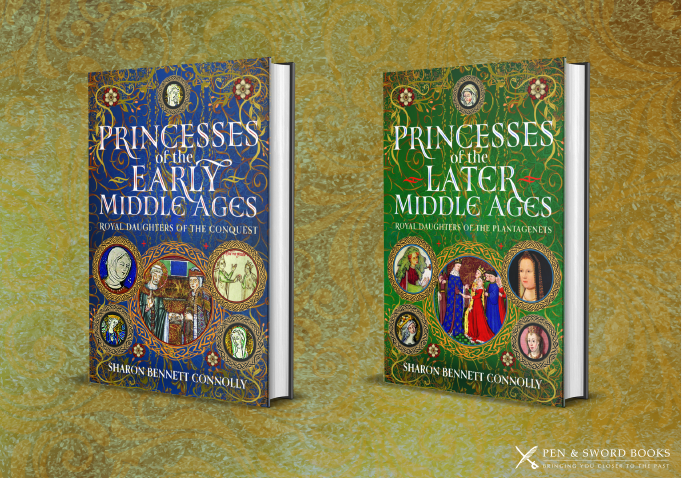
‘My daughter wanted me to treat her more like a princess. So, I married her to a stranger to strengthen the alliance with Poland!’
Princesses of the Early Middle Ages: Royal Daughters of the Conquest and Princesses of the Later Middle Ages: Royal Daughters of the Plantagenets tell the stories of England’s royal daughters from 1066 to the rise of the Tudors, from the last Anglo-Saxon princesses to the fall of the House of York.
Were they really pampered pawns sent off to marriages on the Continent, out of sight and out of mind?
Perhaps, there was different story, where a foreign marriage does not mean eternal exile, but a purpose in life, where a princess is a diplomat, an ambassador for England in her new country.
Where she is the bond between allies – most of the time.
Their stories are touching, inspiring and, at times, heartbreaking...
Praise for Princesses of the Early Middle Ages:
Heidi Malagisi: ‘This is another excellent book by Sharon Bennett Connolly. Extremely well researched and relatively easy to follow along, which is a great thing because there are so many Matildas and Eleanors in this book.‘
Tony Riches: “I challenge anyone with an interest in medieval Britain to not find something they will learn from this book.”
Anna Belfrage: “I just love how [Sharon] presents this huge cast of real life people in a casual, chatty tone that has me expecting the various female protagonists to suddenly pop their head up and add their own commentary.“
Buy now: Princesses of the Early Middle Ages: Royal Daughters of the Conquest
Praise for Princesses of the Later Middle Ages:
Elizabeth Chadwick: ‘Really interesting and informative and gives a great handle on the goings on surrounding these ladies!’
Kathryn Warner: ‘A deeply researched, richly detailed and fascinating account of late medieval England’s forgotten princesses. I loved it!’
Pre-order: Princesses of the Later Middle Ages: Royal Daughters of the Plantagenets
New in Paperback:
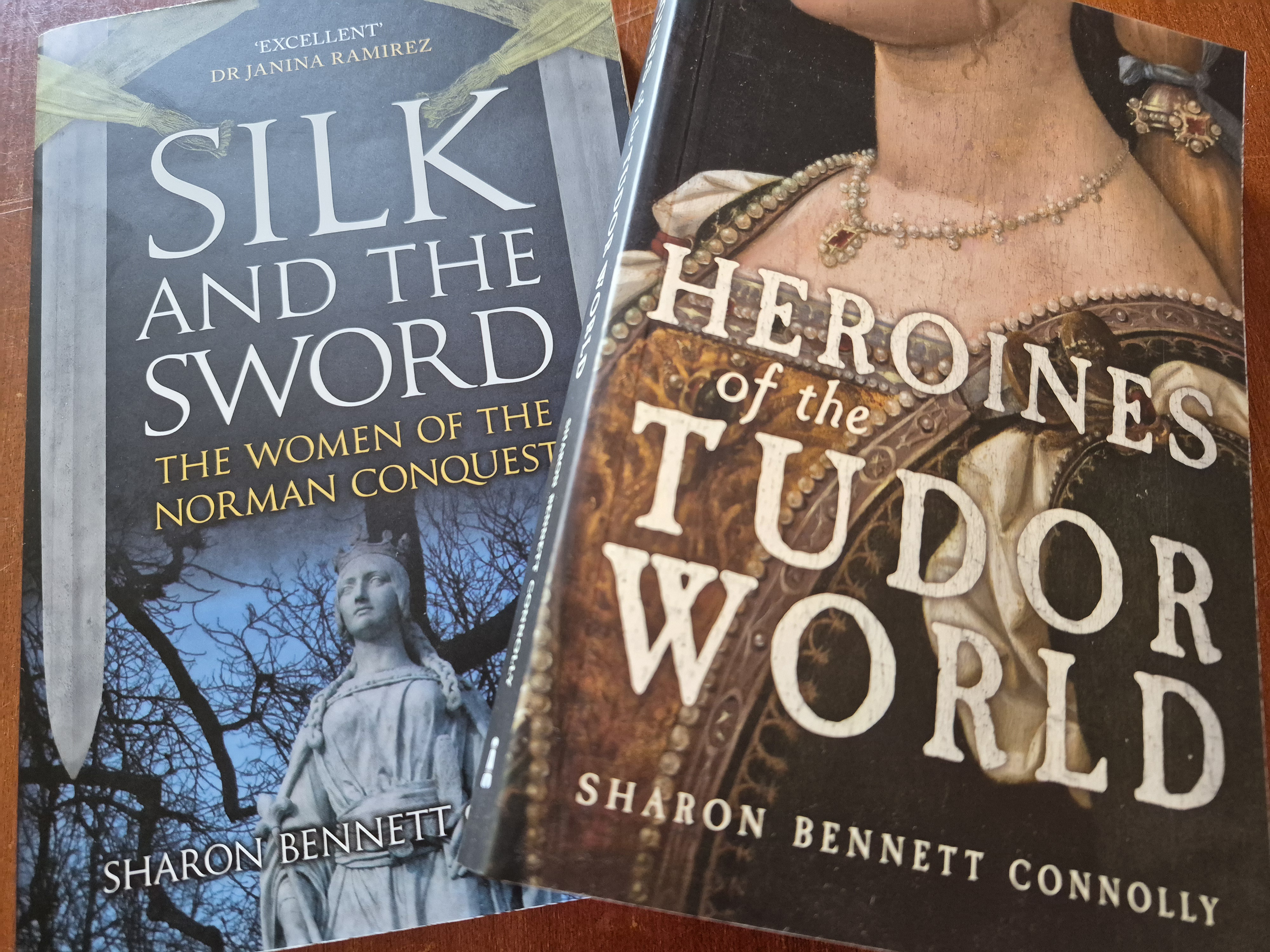
The momentous events of 1066, the story of invasion, battle and conquest, are well known. But what of the women? Silk and the Sword: The Women of the Norman Conquest traces the fortunes of the women who had a significant role to play during the Norman Conquest – wives, lovers, sisters, mothers, leaders. These are lives full of drama, pathos and sometimes mystery: Edith and Gytha searching the battlefield of Hastings for the body of Harold, his lover and mother united in their grief for the fallen king. Who was Ælfgyva, the lady of the Bayeux Tapestry, portrayed with a naked man at her feet?
Janina Ramirez said it’s ‘Excellent’!
Heroines of the Tudor World focuses on the women who lived through the Renaissance and Reformation, examining the threats and challenges they faced and how they overcame them. These are the women who ruled, the women who founded dynasties, the women who fought for religious freedom, their families and love. These are the women who made a difference, who influenced countries, kings and the Reformation.
Derek Birks: ‘An excellent account of the changing roles of women in Tudor society.’
Annie Whitehead: ‘What a treat this book was to read. Bennett Connolly has an easy, conversation style of writing which welcomes you from the opening pages and draws you into her story.‘
Available now from Amazon and Pen and Sword Books
Also by Sharon Bennett Connolly:
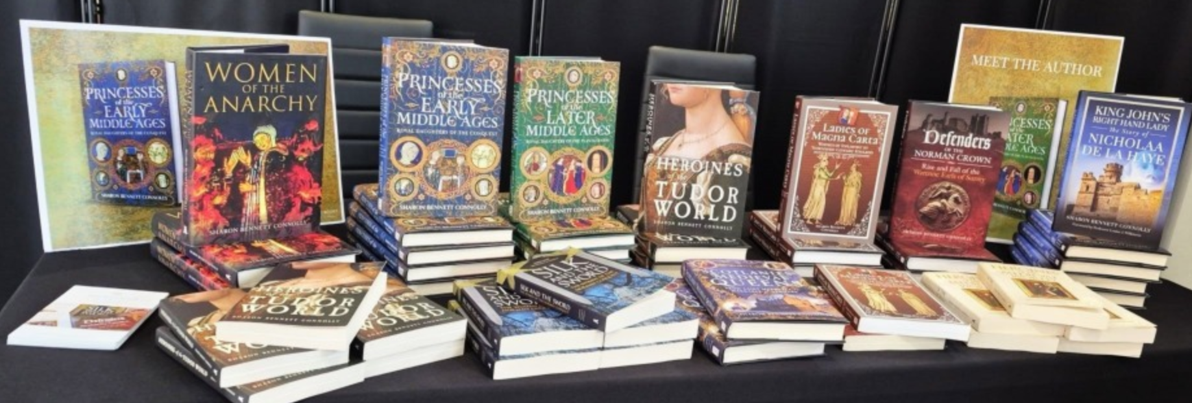
Heroines of the Medieval World; Silk and the Sword: The Women of the Norman Conquest; Ladies of Magna Carta: Women of Influence in Thirteenth Century England; Defenders of the Norman Crown: Rise and Fall of the Warenne Earls of Surrey; King John’s Right Hand Lady: The Story of Nicholaa de la Haye; Women of the Anarchy; Heroines of the Tudor World; Scotland’s Medieval Queens: From St Margaret to Margaret of Denmark; Princesses of the Early Middle Ages: Royal Daughters of the Conquest (March 2026); Princesses of the Later Middle Ages; Royal Daughters of the Plantagenets (August 2026)
Alternate Endings: An anthology of historical fiction short stories including Long Live the King… which is my take what might have happened had King John not died in October 1216. Available in paperback and kindle from Amazon.
All my books on Amazon and Bookshop.org .
You can also order direct from my publishers, Pen and Sword Books and Amberley Publishing.
*
Podcast:
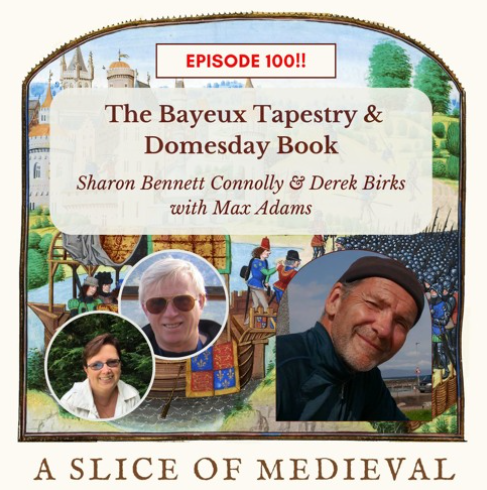
Have a listen to the A Slice of Medieval podcast, which I co-host with Historical fiction novelist Derek Birks. Derek and I welcome guests, such as Bernard Cornwell, and discuss a wide range of topics in medieval history, from significant events to the personalities involved.
We have just recorded our 100th episode which is a fabulous discussion with Max Adams about the significance of two historical treasures: the Bayeux Tapestry and Domesday Book.
Every episode is also now available on YouTube.
*
Don’t forget!
Signed and dedicated copies of all my books are available through my online store.
For forthcoming online and in-person talks, please check out my Events Page.
You can be the first to read new articles by clicking the ‘Follow’ button, liking our Facebook page or joining me on Twitter, Threads, Bluesky and Instagram.
*
©2022 Sharon Bennett Connolly FRHistS
 History... the interesting bits!