La Reine Margot

Marguerite de Valois by François Clouet

As many of my readers will know, one of my favourite all-time writers is the brilliant Alexandre Dumas, the author of The Three Musketeers. Dumas also wrote of Marguerite de Valois, La Reine Margot, who appears in my latest book, Heroines of the Tudor World.

Marguerite was the youngest surviving daughter of King Henri II of France and his queen, Catherine de Medici. She was born at the Château of St Germaine-en-Laye on 14 May 1553. She was her parents’ seventh child; their third daughter. She was raised alongside her two older sisters, Elisabeth (born in 1545) and Claude (born in 1547). Her brothers closest in age to her were Charles (born in 1550), Henri (born in 1551) and her younger brother Hercules (born in 1555), who would change his name to François when he was confirmed. Her brother, Henri, only two years older than her, was Marguerite’s closest family friendship as a child, though this did not last into adulthood. Henri would eventually rule France as King Henri III, succeeding to the throne on the death of his older brother Charles IX. Marguerite’s oldest brother was Francis – the future Francis II – who was born in 1544 and would go on to marry Mary, Queen of Scots. Another brother, Louis, died in 1550 at the age of just eighteen months.

Marguerite experienced tragedy at an early age, when her father, Henri II, died in July 1559, ten days after a jousting accident in which a lance had pierced his eye. Marguerite was only six years old. The princess was well educated and studied literature, classics, history, and a number of ancient and contemporary languages.  She was also taught the complexities and dangers of sixteenth century politics and saw her mother acting as regent for her brother, Charles IX, becoming the most powerful person in France and a woman of international importance.

As a teenager, Marguerite fell in love with Henry of Guise. He was a duke from a prominent family, but when they were found out, Henry was exiled from court and Marguerite was beaten so badly by her mother and brother, Charles IX, that her clothes were torn and ruined. The Guises might be a powerful family, and the most powerful Catholic faction at court, but their influence and popularity were a threat to the government of Catherine de Medici and the queen was not about to increase their prestige further by allowing the duke to marry her daughter.

Marguerite was a princess of France and not free to follow her heart.

Catherine de Medici with her children in 1561: 
Francis, Charles IX, Margaret and Henry III

The family had other plans for her marriage. Queen Catherine arranged with Jeanne d’Albret, Queen of Navarre, that Marguerite would marry her son, the Huguenot prince, Henri of Navarre. Although he had grown up at the French court, Henri’s mother had insisted that he be raised a Protestant. Henri was from the Bourbon branch of the French royal family and was the closest male relative to the throne after Marguerite’s brothers, he was the ‘First Prince of the Blood.’ Should her brothers die without producing heirs of their own, Henri of Navarre, though a Protestant, would be next in line to the throne. In 1572, when Marguerite and Henri married, Henri’s succession would have been only a distant possibility, with the twenty-two-year-old king, Charles IX, recently married himself and hoping for an heir; and two younger brothers to follow him should he not provide a son of his own.

The marriage of Henri and Marguerite was intended to rebuild family ties and broker peace between the French Catholics and the Huguenots, the French Protestants. Since 1560, France had been riven by factions, with the powerful Guise family championing the prospect of eradicating Protestantism within France, backed by Spain and the papacy. The Bourbons, led by Henri of Navarre’s mother, Jeanne d’Albret, led the Huguenots, French Calvinists. As queen, Catherine de Medici tried for compromise, wanting France to be independent of foreign powers, such as Spain and the papacy. Tens of thousands of French had died in the religious wars, despite the signing of a number a peace treaties, which never held. The 1572 Peace of St Germain-en-Laye was to seal the treaty with a wedding.

Of Marguerite, her future daughter-in-law, Jeanne d’Albret wrote:

‘As for her beauty, I agree she has a good figure but she holds herself in too much. As for her face, she uses so much help, it does irritate me, because she will ruin herself. But in this court make-up is normal just like in Spain.’1

Henry of Navarre and Margaret of Valois

Marguerite was a pawn in the midst of this political dispute. Born in December 1553, Henri was seven months younger than his bride. He and Marguerite were second cousins, both being the great-grandchildren of Charles, Count of Angoulême and his wife, Louise de Savoie. Marguerite descended from their son, Francis I, King of France, while Henri was descended from Francis’s sister, Marguerite d’Angoulême, Queen of Navarre. The young couple was betrothed in April 1572 and appeared to like each other at first, though it soon became evident that there was no chemistry between them, no physical attraction. It would be the first royal marriage between a Catholic and a Protestant. Henri’s mother, Jeanne d’Albret died before the wedding could take place, in June 1572, making Henri the new king of Navarre.

The wedding ceremony took place at the cathedral of Notre-Dame in Paris, atop a platform that had been erected on the western façade of the church and hung with cloth of gold, so that everyone could watch; Protestant Henri refused to be married within the Catholic cathedral and so the wedding would be conducted outside. At three o’clock in the afternoon, the king of Navarre and his entourage made a stately procession to the church. Henri was dressed in a doublet and cape of rich yellow satin, embroidered with diamonds and pearls. He was escorted by two of the bride’s brothers, the dukes of Anjou and Alençon.

The vast crowds were there to see Marguerite, described as ‘the greatest beauty in the world’ by a Neapolitan ambassador. She was led from the archbishop’s palace, close to the cathedral, by her brother, King Charles IX. The princess was wearing an ermine-trimmed gown of royal blue silk. Her fifteen-foot train was carried by three ladies-in-waiting. The ceremony was officiated by the Cardinal de Bourbon and when he asked Marguerite if she would take Henri as her husband, she refused to answer; her brother pushed her head so that she appeared to nod, and the cardinal took this to be her assent. The vows concluded, Marguerite and her party went inside the church to hear Mass, while Henri and his entourage waited outside.

Henri III, King of Navarre, later to become King Henri IV of France

There were three days of feasting to celebrate the marriage of Henri and Marguerite, the King and Queen of Navarre, before the peace was shattered by an assassination attempt on the Huguenot leader Gaspard de Coligny. Coligny was shot in the shoulder by the Sieur de Marevert. Firing from a house belonging to the duke de Guise, he had been aiming to kill. Coligny survived and was taken back to his lodgings, where the bullet was removed, the king sending his own physician to assist in Coligny’s treatment. Tensions were running high and Henri of Navarre and his attendants, staying at the Hôtel de Navarre, were nervous. On the morning of 24 August, Marguerite was woken by banging on her door, at which a blood-stained soldier staggered in, shouting ‘Navarre! Navarre!,’ pursued by two more men, armed with bows and arrows.

The St Bartholomew’s Day Massacre was proceeding through the streets of Paris. Maurevert’s attempted assassination of Coligny, probably at the orders of Henry of Guise, had caused the King and his mother to fear that they would be blamed. In order to prevent reprisals, they chose to strike first, sending their soldiers against the Huguenot leadership. Coligny was among those killed, his body thrown out of the window of his lodgings and burned by the crowd. As other Huguenots were cut down, the Catholic Parisians joined in the bloodbath, slaughtering their Huguenot neighbours. Marguerite and her husband both made it to safety at the Louvre Palace, where they were protected by royal troops. Henri’s friends and attendants were not so lucky and were butchered within earshot of the newlyweds. As the violence spread to more cities in the following days and weeks, over 5,000 were killed.

The leadership of the Huguenot faction had been dealt a serious blow. The older leaders were dead, murdered, and the younger leaders, Henri of Navarre and his cousin, Henri de Condé, were virtual prisoners, confined to the royal court and on 26 September 1572, Henri of Navarre renounced Protestantism. Four years later, he finally managed to flee the court, leaving his wife behind. Returning to the Protestant faith, he was now twenty-two and assumed the leadership of the Huguenots. Marguerite had remained at the French court following her husband’s flight. There’s was a rather liberal marriage, with neither one concerned if the other took lovers. Politically though, Marguerite worked in support of her husband, despite him being a Protestant and she being Catholic.

The St Bartholomew’s Day massacre painted by  François Dubois, a Huguenot painter

In 1578, Marguerite and her mother made a journey south, with Catherine de Medici hoping to build some bridges with the king of Navarre by delivering his wife to him. For the next five years, until 1583, Marguerite and Henri lived as husband and wife at Nérac, 100km south-east of Bordeaux. Initially, the marriage appeared to be experiencing a revival, but then Henri had an affair with on of Marguerite’s ladies, known as La Fosseuse, before moving onto a more serious relationship with Corisande de’Andouins, Countess of Guiche. In 1582 Henri III, King of France, summoned Marguerite back to court, with the hope that her husband would follow. Marguerite came but Henri did not.

While back at the French court, Marguerite had an affair with Jacques de Harlay, Sieur de Champvallon, and there were rumours that she was pregnant by him. Marguerite was ordered to leave court by her brother and left Paris on 8 August. As she travelled south, her party was stopped by a troop of royal archers, who insulted Marguerite and arrested two of her ladies. They were questioned about Marguerite’s baby, if there was one. All trace of the child, whether she was pregnant or not, had disappeared. On 13 April, Marguerite was reunited with her husband at Port St Marie, just north of Nérac. Just two months later, they heard of the death of Marguerite’s youngest brother, Francis, Duke of Anjou, who was a close ally of Henri of Navarre.

Francis’s death was a pivotal moment for the king of Navarre. He had been the heir of his brother Henri III and now, the heir was Henri of Navarre himself, at least until Henri III were to have a son of his own. The Holy Catholic League, however, funded by the king of Spain and the papacy, recognised the ageing and childless Cardinal de Bourbon as the heir to the throne. On 31 March 1585, the cardinal issued a proclamation promising to restore France to Catholicism and declaring that ‘subjects are not required to recognise or sustain the domination of a prince who has parted from the Catholic faith…’ On 9 September 1585 Pope Sixtus V excommunicated both Henri of Navarre and his cousin Condé – even though they were Protestants – and deprived them of their hereditary rights. He even declared that Henri had no right to the kingdom of Navarre. Henry of Guise was manoeuvring to promote his own candidacy for the throne of France by excluding Henri of Navarre.
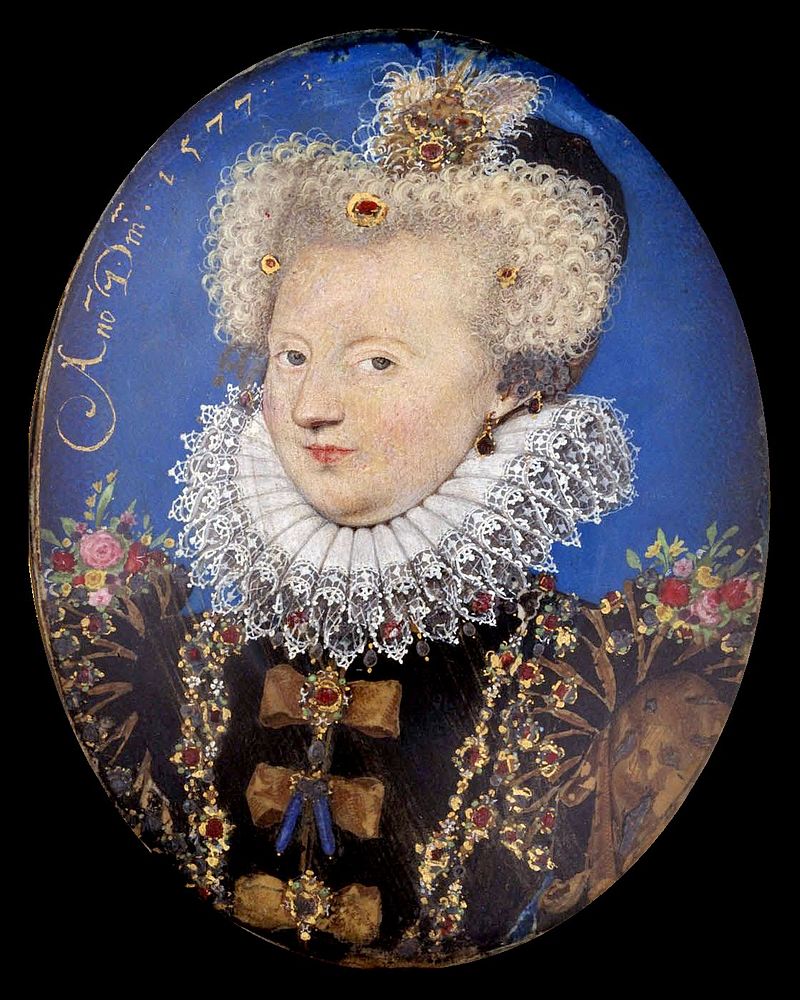
Marguerite de Valois painted by Nicholas Hilliard

After the death of his brother Francis, Henri III was forced to make war on Navarre by Henry of Guise, thus starting the War of the Three Henries. It was at this point that Marguerite took her life and future into her own hands. Having realised that she could not be content living with Henri, she left his court and moved to Agen, claiming she wanted to devote herself to the celebration of Easter. She joined the Holy Catholic League and with 2,000 soldiers she took Agen and held it in the name of the League. But after a bout of plague was seen as the punishment of God for Marguerite rebelling against her husband and brother, and the destruction of the garrison gunpowder left the city indefensible, she was forced to abandon Agen and moved further inland to another of her fortresses at Carlat.

As she left for Carlat, Marguerite was arrested by her brother’s forces under the command of the Marquis de Canillac, who escorted her to the great fortress at Usson. Marguerite charmed Canillac and within a year she was no longer a prisoner, but the sovereign lady of the territory, in the heart of the Auvergne. Marguerite spent the next 19 years living in Usson, as the Wars of Religion ground to their conclusion with a succession of deaths. The duke of Guise died in 1588, killed on the king’s orders. Catherine de Medici died in January 1589, just a few months before her 70th birthday. And in August 1589, King Henri III was assassinated by a Catholic enthusiast.

This left Henri of Navarre as the victor, though the war continued for 4 more years, as the Catholic League refused to accept a Protestant king. In 1593 Henri’s conversion to Catholicism, supposedly with the words ‘Paris is worth a Mass,’ Henri of Navarre became King Henri IV of France, his coronation taking place in Chartres Cathedral in February 1594. The Edict of Nantes finally ended the Wars of Religion in 1598, establishing Catholicism as the state religion in France, but allowing Huguenots to worship freely in many parts of France (excluding Paris). Though she was no longer living with Henri, Marguerite, the last surviving child of Henri II and Catherine de Medici, was now Queen of France and Navarre, and she and Henri were back on good terms. She established her court at Usson, writing her memoirs and poetry and building a library.

Henri IV, King of France and Navarre

In 1593 Marguerite made an agreement with Henri whereby he would give her 50,000 francs a year and pay her debts of 200,000 écus in return for her applying for the annulment of their marriage; she cited her barrenness, consanguinity and that she was forced to marry against her will as grounds for the annulment. Though the annulment was not granted by the pope until 1599, it did eventually leave Henri free to marry again, to Marie de Medici, and produce the all-important heir – the future King Louis XIII. Although she had been a pawn to the political manoeuvrings of her mother on her marriage to Henri of Navarre, Marguerite had, to all intents and purposes, managed to forge her own path in her later years. Her agreement to the annulment of her marriage meant the continuation of the line of Henri IV and secured the future of France. Marguerite returned to Paris in 1605 and lived there until her death in 1615.

Footnotes:

1. Dominic Pierce, ‘The Unique Career of Marguerite de Valois, Queen of Navarre’, tudortimes.co.uk

Images:

Courtesy of Wikipedia

Sources:

Dominic Pierce, ‘The Unique Career of Marguerite de Valois, Queen of Navarre’, tudortimes.co.uk; Nancy Goldstone, The Rival Queens: Catherine de Medici, Her Daughter Marguerite de Valois and the Betrayal that Ignited a Kingdom; Frieda Leonie, Catherine de Medici: A Biography; Pierre Groubert, The Course of French History; Estelle Paranque, Blood, Fire & Gold: The Story of Elizabeth I and Catherine de Medici; Amanda Prahl, ‘Biography of Margaret of Valois, France’s Slandered Queen’, thoughtco.com; François Bayrou, Henri IV: Le Roi Libre; Alexandre Dumas, La Reine Margot.

*

My Books

Signed, dedicated copies of all my books are available through my online bookshop.

Coming on 15 June 2024: Heroines of the Tudor World
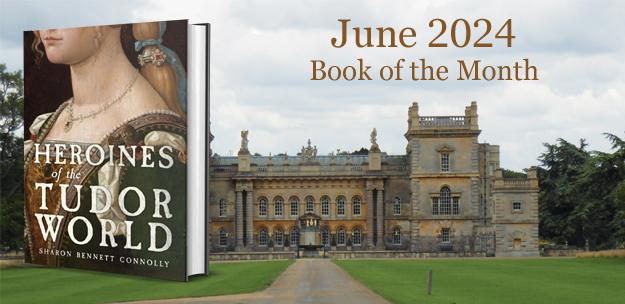
Heroines of the Tudor World tells the stories of the most remarkable women from European history in the time of the Tudor dynasty, 1485-1603. These are the women who ruled, the women who founded dynasties, the women who fought for religious freedom, their families and love. These are the women who made a difference, who influenced countries, kings and the Reformation. In the era dominated by the Renaissance and Reformation, Heroines of the Tudor World examines the threats and challenges faced by the women of the era, and how they overcame them. From writers to regents, from nuns to queens, Heroines of the Tudor World shines the spotlight on the women helped to shape Early Modern Europe.

Heroines of the Tudor World is now available for pre-order from Amberley Publishing and Amazon UK.

Out Now! Women of the Anarchy

Two cousins. On the one side is Empress Matilda, or Maud. The sole surviving legitimate child of Henry I, she is fighting for her birthright and that of her children. On the other side is her cousin, Queen Matilda, supporting her husband, King Stephen, and fighting to see her own son inherit the English crown. Women of the Anarchy demonstrates how these women, unable to wield a sword, were prime movers in this time of conflict and lawlessness. It show how their strengths, weaknesses, and personal ambitions swung the fortunes of war one way – and then the other.

Available from Bookshop.orgAmberley Publishing and Amazon UK.

Also by Sharon Bennett Connolly:
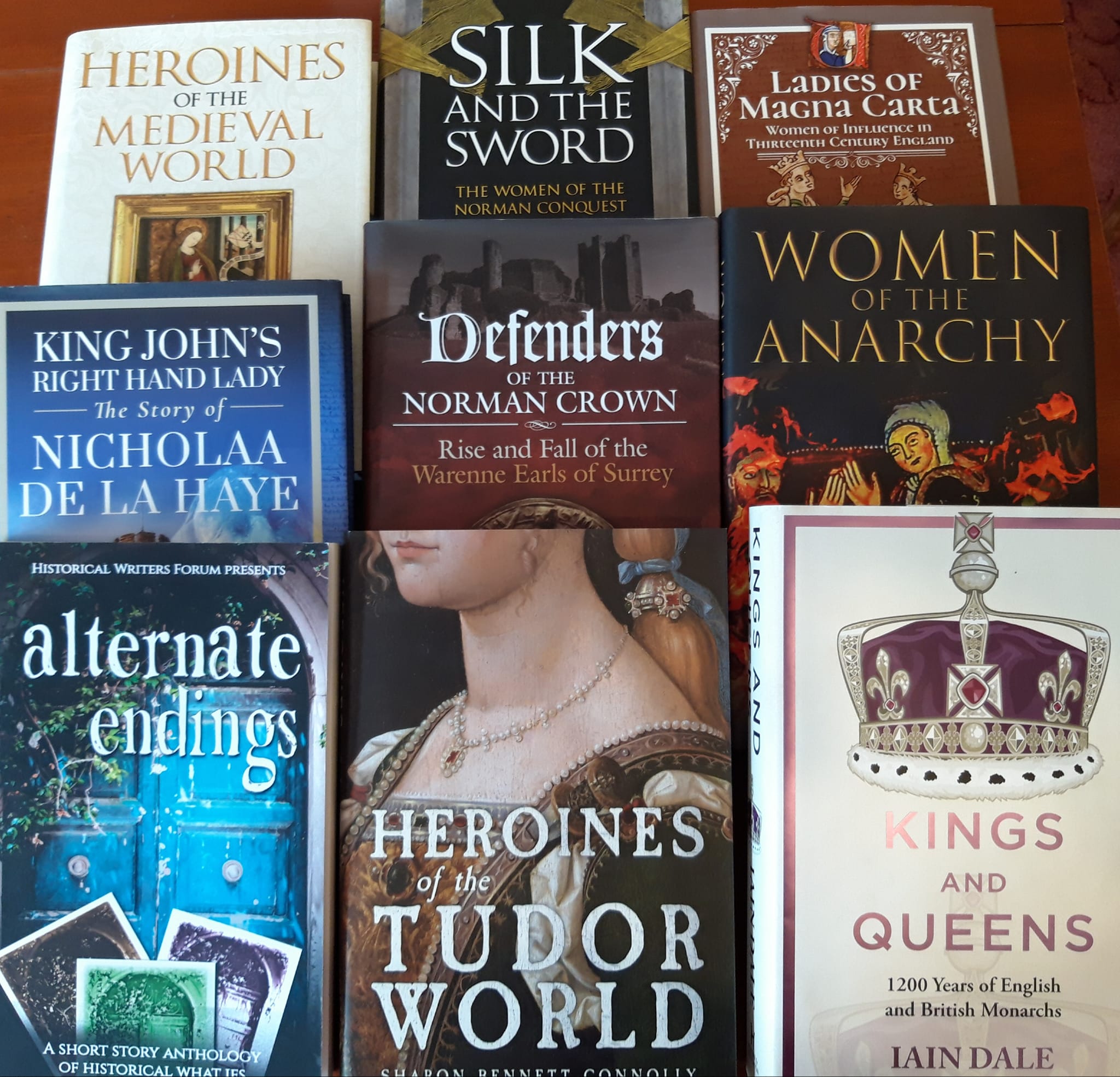
King John’s Right-Hand Lady: The Story of Nicholaa de la Haye is the story of a truly remarkable lady, the hereditary constable of Lincoln Castle and the first woman in England to be appointed sheriff in her own right. Available from all good bookshops or direct from Pen & Sword Booksbookshop.org and AmazonDefenders of the Norman Crown: The Rise and Fall of the Warenne Earls of Surrey tells the fascinating story of the Warenne dynasty, from its origins in Normandy, through the Conquest, Magna Carta, the wars and marriages that led to its ultimate demise in the reign of Edward III. Available from Pen & Sword BooksAmazon in the UK and US, and Bookshop.org

Ladies of Magna Carta: Women of Influence in Thirteenth Century England looks into the relationships of the various noble families of the 13th century, and how they were affected by the Barons’ Wars, Magna Carta and its aftermath; the bonds that were formed and those that were broken. It is now available in paperback and hardback from Pen & Sword,  Amazon, and Bookshop.orgHeroines of the Medieval World tells the stories of some of the most remarkable women from Medieval history, from Eleanor of Aquitaine to Julian of Norwich. Available now from Amberley Publishing and Amazon, and Bookshop.orgSilk and the Sword: The Women of the Norman Conquest traces the fortunes of the women who had a significant role to play in the momentous events of 1066. Available now from Amazon,  Amberley Publishing, and Bookshop.org.

Alternate Endings: An anthology of historical fiction short stories including Long Live the King… which is my take what might have happened had King John not died in October 1216. Available in paperback and kindle from Amazon.

Podcast:

Have a listen to the A Slice of Medieval podcast, which I co-host with Historical fiction novelist Derek Birks. Derek and I welcome guests, such as Bernard Cornwell and discuss a wide range of topics in medieval history, from significant events to the personalities involved.

*

Don’t forget! Signed and dedicated copies of all my books are available through my online bookshop.

For forthcoming online and in-person talks, please check out my Events Page.

You can be the first to read new articles by clicking the ‘Follow’ button, liking our Facebook page or joining me on Twitter and Instagram.

*

©2024 Sharon Bennett Connolly FRHistS.

Book Corner: Arthur by Giles Kristian

Years have passed since the clash of shieldwalls echoed across the land. The Saxons are now the lords of Britain. And yet the bards still sing of Arthur – ‘In our darkest time, when we need him most, shall he come again.’

Yet old Beran has no love of bards’ songs. Nor of people, unless they are paying him to steal or kill. He is a mercenary, in the employ of the cutthroat Nabor ap Nabor, and he has been ordered to murder a boy fleeing a burning city. No ordinary boy either. No, this boy is the son of King Constantine and the grandson of High King Ambrosius. And he could be the hope of Britain…if he lives.

Betraying his companions and returning to a world he thought he had left forever, Beran gives his word that he will take the boy to the one place that still holds out against the Saxons: Camelot.

Crossing a hostile land, they will meet the runaway lovers, Tristan and Isolde. They will seek the help of Guivret, called the Little King, and the Saracen, Palamedes, who once rode beneath Arthur’s banner.

Hunted by Saxons, Nabor ap Nabor, and Queen Morgana, this unlikely band must fight for their lives and for each other. For if there’s to be any hope for Britain, Beran must deliver the boy to Camelot. But to do that, he must also face his own past…

Wow!

Every now and then, a book comes along that stands head and shoulders above the rest. It draws you in. You cannot wait to finish it.

And yet…

Finishing it leaves you bereft.

That is Giles Kristian’s Arthur.

It is the third book in a series that was only meant to be a duology. After Lancelot and Camelot came out, I asked Giles if there would be an Arthur and he said, probably not – that he had covered Arthur’s story in the other two. He wasn’t sure there was anything more to add. And how could he do it? He would have to go back a rewrite Lancelot, but with Arthur as the focus. I understood his dilemma but it was disappointing that there would be no book dedicated to Arthur.

But then, he must have found inspiration from somewhere, because we now have Arthur. Lancelot was fabulous. Camelot was gripping. Arthur is on a whole other level. The premise of the novel is inspired. Continuing the story into the next generation, with flashbacks to Arthur’s early life and career. The new story is cleverly woven into the old legends. Morgana is a villain trying to get her hands on the heir to the throne. The tragic love story of Tristan and Isolde is woven into the narrative, as are other parts of the Arthurian legend. And Beran, the old soldier, is the reluctant hero, who reluctantly finds himself in the role of Prince Erbin’s protector.

‘I’m hungry,’ the boy said.

‘I told you, I don’t have any food,’ Beran replied, looking for the stars to make sure they were still walking west. Two bats tumbled and flitted above, across a patch of dark sky.

‘But I’m hungry,’ the boy insisted.

‘What do you expect me to do about it?’ Beran growled.

The boy’s face clenched in thought. ‘You must be good at setting traps,’ he said. ‘You outlaws live here in the forest, don’t you?’

‘I can feed myself. Didn’t ask for another mouth to feed.’

‘I’m a prince.’

‘A mouth’s a mouth.’

Beran could almost feel the boy frowning in the dark from two feet away. ‘We could set a snare like my father’s hunters do. They catch hares and polecats and pine martens that way.’

‘Not any more they don’t,’ Beran said. ‘Look, boy, if we stop to set traps, we’re more likely to catch one of the bastards who’s after us. Or a Saxon. Or one of Queen Morgana’s spearmen. We’ve got to keep moving.’

‘So, we’re going to Camelot?’ the boy asked.

The name struck Beran like a blow to the chest. He stopped and the boy stopped with him. ‘Why in Ban’s name would we go to Camelot?’ he asked.

‘Because that’s where Mother was taking me,’ the boy said, looking up at him, and Beran realized he had not even considered where the fugitives from Caer Colun had been bound with their treasures and this heir to the kingdom. It made sense, of course, for where else was safe in Britain for the son of Constantine the Battle King? The man who had modelled himself on the Roman generals who once ruled in the Dark Isles, and who had waged war against the Saxons for the last sixty years.

‘Lady Iselle wrote to my mother many times since my fatehr died, begging her to go to Camelot where we would be safe.’

Another name, another blow. ‘So why didn’t you?’ Beran asked. Your mother must’ve known Caer Colun could not hold out for ever. Even if the great Constantine had still been alive.’

‘Mother said we would never abandon the people. Lady Iselle could not take all of them to live within Camelot’s walls.’

‘Well, your mother’s people are slaves now, or dead. Or living beneath the sky like us,’ Beran said.

‘How long will it take to get to Camelot?’ the boy asked.

‘We’re not going to Camelot.’

Giles Kristian’s Arthur is a beautifully crafted story from start to finish, with twists and turns that will keep the reader on the edge of their seat and reading late into the night. And so you should. With enemies old and new, Beran has to avoid his former gang, stay clear of marauding Saxons and protect his charge from Queen Morgana’s men, who are hunting them relentlessly,

I do not want to ruin the reading experience with spoilers, I promise, but I will say endings are often not as good as you want them to be. They fail to live up to the promise.

That is not the case with Arthur.

The ending is spectacular.

They are everything you would expect of the legendary Arthur.

You ride with him.

You fight with him.

You are screaming his name as you charge the enemy.

It is perfection.

If there is only one book you read this year, make sure it is Arthur by Giles Kristian.

To buy Arthur on Amazon, click here.

About the author:

Family history (he is half Norwegian) and a passion for the fiction of Bernard Cornwell inspired GILES KRISTIAN to write. Set in the Viking world, his bestselling ‘Raven’ and ‘The Rise of Sigurd’ trilogies have been acclaimed by his peers, reviewers and readers alike. In The Bleeding Land and Brothers’ Fury, he tells the story of a family torn apart by the English Civil War. He also co-wrote Wilbur Smith’s No.1 bestseller, Golden Lion. His contemporary survival thriller, Where Blood Runs Cold, won the Wilbur Smith Adventure Writing Prize. With his SundaTimes bestseller Lancelot, Giles plunged into the rich waters of the Arthurian legend. His epic reimagining of our greatest island ‘history’ continued in Camelot and draws to a breath-taking close with Arthur.
Giles Kristian lives in Leicestershire.
To find out more, visit http://www.glieskristian.com. You can follow him on X @GilesKristian and Facebook/Giles Kristian

*

My Books

Signed, dedicated copies of all my books are available through my online bookshop.

Coming on 15 June 2024: Heroines of the Tudor World

Heroines of the Tudor World tells the stories of the most remarkable women from European history in the time of the Tudor dynasty, 1485-1603. These are the women who ruled, the women who founded dynasties, the women who fought for religious freedom, their families and love. These are the women who made a difference, who influenced countries, kings and the Reformation. In the era dominated by the Renaissance and Reformation, Heroines of the Tudor World examines the threats and challenges faced by the women of the era, and how they overcame them. From writers to regents, from nuns to queens, Heroines of the Tudor World shines the spotlight on the women helped to shape Early Modern Europe.

Heroines of the Tudor World is now available for pre-order from Amberley Publishing and Amazon UK.

Out Now! Women of the Anarchy

Two cousins. On the one side is Empress Matilda, or Maud. The sole surviving legitimate child of Henry I, she is fighting for her birthright and that of her children. On the other side is her cousin, Queen Matilda, supporting her husband, King Stephen, and fighting to see her own son inherit the English crown. Women of the Anarchy demonstrates how these women, unable to wield a sword, were prime movers in this time of conflict and lawlessness. It show how their strengths, weaknesses, and personal ambitions swung the fortunes of war one way – and then the other.

Available from Bookshop.orgAmberley Publishing and Amazon UK.

Also by Sharon Bennett Connolly:

King John’s Right-Hand Lady: The Story of Nicholaa de la Haye is the story of a truly remarkable lady, the hereditary constable of Lincoln Castle and the first woman in England to be appointed sheriff in her own right. Available from all good bookshops or direct from Pen & Sword Booksbookshop.org and AmazonDefenders of the Norman Crown: The Rise and Fall of the Warenne Earls of Surrey tells the fascinating story of the Warenne dynasty, from its origins in Normandy, through the Conquest, Magna Carta, the wars and marriages that led to its ultimate demise in the reign of Edward III. Available from Pen & Sword BooksAmazon in the UK and US, and Bookshop.org

Ladies of Magna Carta: Women of Influence in Thirteenth Century England looks into the relationships of the various noble families of the 13th century, and how they were affected by the Barons’ Wars, Magna Carta and its aftermath; the bonds that were formed and those that were broken. It is now available in paperback and hardback from Pen & Sword,  Amazon, and Bookshop.orgHeroines of the Medieval World tells the stories of some of the most remarkable women from Medieval history, from Eleanor of Aquitaine to Julian of Norwich. Available now from Amberley Publishing and Amazon, and Bookshop.orgSilk and the Sword: The Women of the Norman Conquest traces the fortunes of the women who had a significant role to play in the momentous events of 1066. Available now from Amazon,  Amberley Publishing, and Bookshop.org.

Alternate Endings: An anthology of historical fiction short stories including Long Live the King… which is my take what might have happened had King John not died in October 1216. Available in paperback and kindle from Amazon.

Podcast:

Have a listen to the A Slice of Medieval podcast, which I co-host with Historical fiction novelist Derek Birks. Derek and I welcome guests, such as Bernard Cornwell and discuss a wide range of topics in medieval history, from significant events to the personalities involved.

*

Don’t forget! Signed and dedicated copies of all my books are available through my online bookshop.

For forthcoming online and in-person talks, please check out my Events Page.

You can be the first to read new articles by clicking the ‘Follow’ button, liking our Facebook page or joining me on Twitter and Instagram.

*

©2024 Sharon Bennett Connolly FRHistS.

Guest Post: Medieval Hungary by Katerina Dunne

Today, it is a pleasure to welcome author Katerina Dunne to History…the Interesting Bits. With her fabulous novel, Lord of the Eyrie, Katerina introduced me to the fascinating history of medieval Hungary, something a knew very little about. And I wanted to know more. Katerina has just released a sequel, Return to the Eyrie and has joined me to give us a little historical background to her stories.

Medieval Hungary by Katerina Dunne

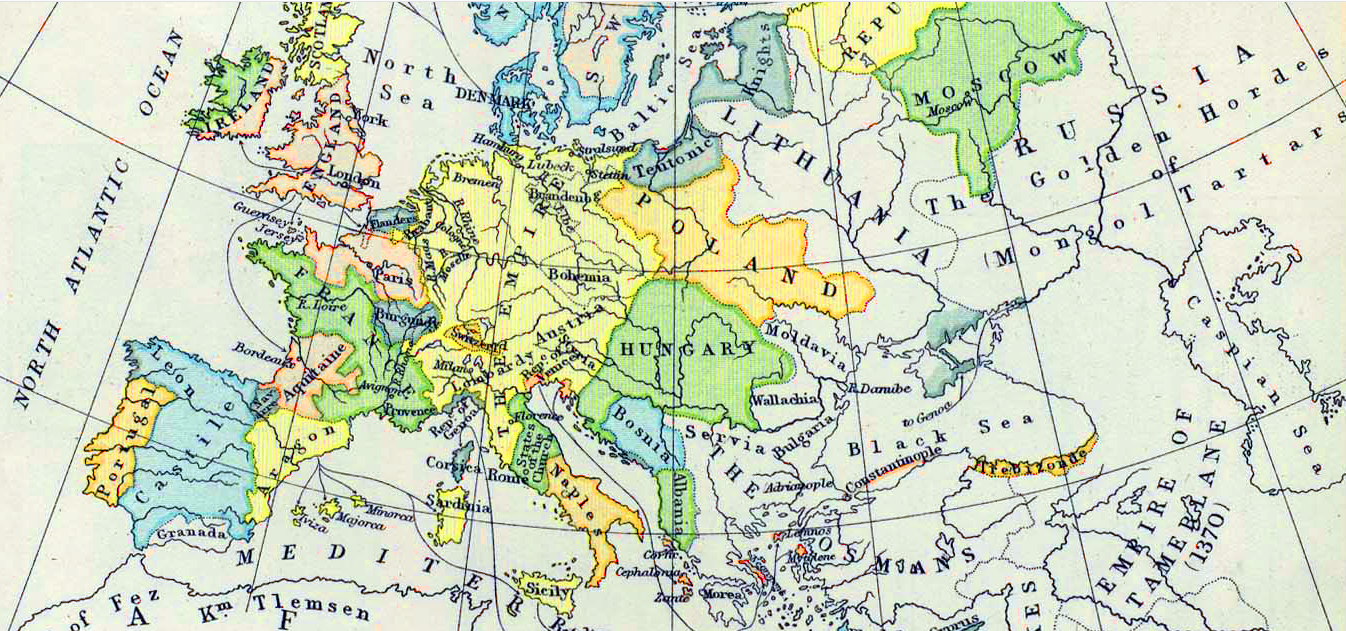
The history of medieval Hungary is fascinating, yet few in the English-speaking world know much about it. From groups of nomadic people raiding across Europe in the 9th – 10th century, the Hungarian conquerors settled in the Carpathian basin, converted to Christianity and, together with the peoples they found already living there, created a powerful multi-ethnic and multi-lingual kingdom, which at its peak stretched from Southern Poland to the Adriatic Sea and from lower Austria to Central Romania as the below map of 15th century Europe demonstrates:

My two historical fiction novels, Lord of the Eyrie (released in February 2022) and Return to the Eyrie (released in April 2024) make up a family saga that spans forty years (1440 to 1480) and two generations. They are set mostly in Transylvania (a province of the medieval Kingdom of Hungary) The noble family is fictional, but I have presented them as branches of powerful baronial clans from Transylvania and Eastern Hungary, so they interact with real historical figures and participate in real historical events.

The 15th century was a turbulent time for the Kingdom of Hungary due to internal conflict as well as the expansionist efforts of the Ottoman Empire towards the west and north. After the Ottoman conquest of Serbia and Bosnia, and the submission of Wallachia to the Sultan as a vassal state, Hungary became the last frontier holding back the Ottoman advance towards Central Europe.

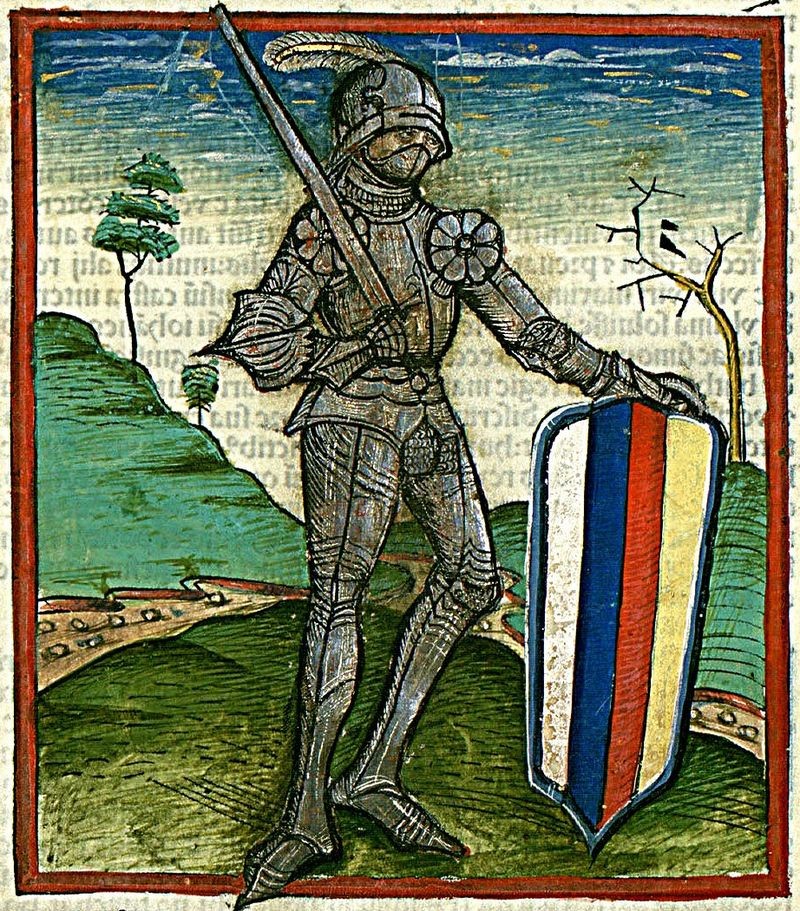
The years between 1440 and 1456 were dominated by the formidable personality of János Hunyadi, a lesser nobleman with obscure origins (likely Wallachian or possibly Cuman), whose military successes against the Ottomans elevated him to the ranks of the most powerful barons and earned him the title of Voivode (governor) of Transylvania and later Captain General and Regent of the Kingdom. At the peak of his power, Hunyadi was the richest landowner in the Kingdom of Hungary, holding about 2 million acres of land spread over 5 modern-day countries (Hungary, Romania, Serbia, Slovakia and Ukraine) He even loaned money to the king at times.

János Hunyadi in the Chronica Hungarorum by János Thuróczy – picture from Wikipedia

Although Hunyadi lost two major pitched battles against the Ottomans (the battle of Varna in 1444 and the battle of Kosovo in 1448), he achieved several victories against them in various campaigns and sieges. His last and biggest triumph was at the siege of Belgrade in July 1456, when the united forces of the city’s Serbian defenders, Hunyadi’s Transylvanian and mercenary army and a motley crowd of crusaders from lesser nobility, burghers, students, clergy and peasants defeated the mighty Sultan Mehmed the Second, the conqueror of Contstantinople. Hunyadi died in August 1456 of the plague which had spread in Belgrade in the aftermath of the siege.

As it often happens, when a powerful leader dies, chaos ensues among those who strive to take advantage. Hunyadi’s eldest son, László, inherited his father’s vast estates and titles. However, Hunyadi’s old rival, Count Ulrich of Cilli (modern-day Celje in Slovenia) – who was the Hungarian king’s relative – was not going to let this go. Cilli and László Hunyadi got involved in an incident during the king’s visit to Belgrade (which was under the Hunyadi family’s control) that led to Cilli’s death. Although the king (also called László) forgave the younger Hunyadi, he changed his mind when he returned to his palace in Buda. Under the influence of several powerful barons who opposed the Hunyadi family, the king arrested both Hunyadi’s sons, László and fourteen-year-old Mátyás, in the spring of 1457. While he had László executed, he imprisoned Mátyás and many of their supporters.

Furious about the events, Hunyadi’s widow, Erzsébet Szilágyi and her brother Mihály, started a rebellion in Transylvania which almost brought the kingdom to its knees. King László fled to Vienna but took Mátyás with him. When the king died suddenly at the young age of 17 from an illness, the Bohemian ruler George of Podebrady became Mátyás’ captor.

But the king’s death meant that Hungary was in need of a new ruler. After intense negotiations (which probably included promises, bribes and intimidation), Erzsébet and Mihály Szilágyi won the support of the other barons and declared the absent young Mátyás as the new king in January 1458. The legend has it that the Royal Council deliberated in Buda Castle and made the public announcement while the crowds of lesser nobles stood literally on the river Danube, the waters of which had frozen solid.

Following negotiations and a large ransom of 60,000 gold florins, Podebrady released Mátyás to his family, and the teenager was finally enthroned in February 1458. He could not be crowned though because the Hungarian Holy Crown was in the hands of the Holy Roman Emperor, Frederick III. How the crown had ended up there is another story—one of the most fascinating episodes in late medieval Hungarian history— which deserves a separate post. It took another four years and the astronomical sum of 80,000 gold florins to recover the crown. Mátyás was finally crowned with all the appropriate ceremony on 29 March 1464.

King Mátyás Hunyadi in the Chronica Hungarorum by János Thuróczy – picture from Wikipedia

He became known as Mátyás Corvinus (nicknamed The Raven King because of the Hunyadi coat of arms, which depicted a raven with a golden ring in its beak) One of the most important rulers in 15th century Europe, he brought the Italian Renaissance and Humanism to Hungary, upgraded the royal palance in Buda, established the famous Corvina Library and was the patron of many scholars and artists. Due to the fact that he was a member of the nobility rather than of royal blood, he faced strong opposition both from inside Hungary and from abroad (Holy Roman Empire, Bohemia and Poland) and he had to fight several wars to secure his grip on the throne. He kept a defensive stance towards the Ottomans, with relative success, and competed with them in his efforts to influence politics in neighbouring Wallachia, Moldavia and Bosnia. Mátyás is well-known for keeping Prince Vlad III of Wallachia (Vlad the Impaler) imprisoned for several years before finally releasing him in 1475 in order to place him on the Wallachian throne as an ally.

Mátyás conquered Vienna in 1485 and was negotiating his possible future designation as Holy Roman Emperor when he died in April 1490.

He has since become the subject of many legends not only in Hungary, but in several neighbouring Central European countries.

About the books:

János Hunyadi appears as a secondary character in my first book, Lord of the Eyrie, while King Mátyás plays a small but pivotal role in the sequel, Return to the Eyrie.

Even though these are parts of a two-volume family saga, each book can be read as a standalone.

Both novels are available in ebook and paperback format on Amazon:

To Buy:

Lord of the Eyrie is available from Amazon in the UK and the US.

Return to the Eyrie is now available in the UK and the US.

About the Author:

Katerina Dunne is the pen-name of Katerina Vavoulidou. Originally from Athens, Greece, Katerina has been living in Ireland since 1999. She has a degree in English Language and Literature from the University of Athens, an MA in Film Studies from University College Dublin and an MPhil in Medieval History from Trinity College Dublin.

Katerina is passionate about history, especially medieval history, and her main area of interest is 13th to 15th century Hungary. Although the main characters of her stories are fictional, Katerina uses real events and personalities as part of her narrative in order to bring to life the fascinating history of the medieval Kingdom of Hungary, a location and time period not so well-known to English-speaking readers.

You can contact Katerina by email: through her FB page: and on Goodreads.

*

My Books:

Signed, dedicated copies of all my books are available through my online bookshop.

Out Now! Women of the Anarchy

Two cousins. On the one side is Empress Matilda, or Maud. The sole surviving legitimate child of Henry I, she is fighting for her birthright and that of her children. On the other side is her cousin, Queen Matilda, supporting her husband, King Stephen, and fighting to see her own son inherit the English crown. Women of the Anarchy demonstrates how these women, unable to wield a sword, were prime movers in this time of conflict and lawlessness. It show how their strengths, weaknesses, and personal ambitions swung the fortunes of war one way – and then the other.

Available from Bookshop.orgAmberley Publishing and Amazon UK.

Coming on 15 June 2024: Heroines of the Tudor World

Heroines of the Tudor World tells the stories of the most remarkable women from European history in the time of the Tudor dynasty, 1485-1603. These are the women who ruled, the women who founded dynasties, the women who fought for religious freedom, their families and love. These are the women who made a difference, who influenced countries, kings and the Reformation. In the era dominated by the Renaissance and Reformation, Heroines of the Tudor World examines the threats and challenges faced by the women of the era, and how they overcame them. From writers to regents, from nuns to queens, Heroines of the Tudor World shines the spotlight on the women helped to shape Early Modern Europe.

Heroines of the Tudor World is now available for pre-order from Amberley Publishing and Amazon UK.

Also by Sharon Bennett Connolly:

King John’s Right-Hand Lady: The Story of Nicholaa de la Haye is the story of a truly remarkable lady, the hereditary constable of Lincoln Castle and the first woman in England to be appointed sheriff in her own right. Available from all good bookshops or direct from Pen & Sword Booksbookshop.org and AmazonDefenders of the Norman Crown: The Rise and Fall of the Warenne Earls of Surrey tells the fascinating story of the Warenne dynasty, from its origins in Normandy, through the Conquest, Magna Carta, the wars and marriages that led to its ultimate demise in the reign of Edward III. Available from Pen & Sword BooksAmazon in the UK and US, and Bookshop.org

Ladies of Magna Carta: Women of Influence in Thirteenth Century England looks into the relationships of the various noble families of the 13th century, and how they were affected by the Barons’ Wars, Magna Carta and its aftermath; the bonds that were formed and those that were broken. It is now available in paperback and hardback from Pen & Sword,  Amazon, and Bookshop.orgHeroines of the Medieval World tells the stories of some of the most remarkable women from Medieval history, from Eleanor of Aquitaine to Julian of Norwich. Available now from Amberley Publishing and Amazon, and Bookshop.orgSilk and the Sword: The Women of the Norman Conquest traces the fortunes of the women who had a significant role to play in the momentous events of 1066. Available now from Amazon,  Amberley Publishing, and Bookshop.org.

Alternate Endings: An anthology of historical fiction short stories including Long Live the King… which is my take what might have happened had King John not died in October 1216. Available in paperback and kindle from Amazon.

Podcast:

Have a listen to the A Slice of Medieval podcast, which I co-host with Historical fiction novelist Derek Birks. Derek and I welcome guests, such as Bernard Cornwell and Elizabeth Chadwick, and discuss a wide range of topics in medieval history, from significant events to the personalities involved.

*

Don’t forget! Signed and dedicated copies of all my books are available through my online bookshop.

For forthcoming online and in-person talks, please check out my Events Page.

You can be the first to read new articles by clicking the ‘Follow’ button, liking our Facebook page or joining me on Twitter and Instagram.

*

©2024 Katerina Dunne and Sharon Bennett Connolly FRHistS.

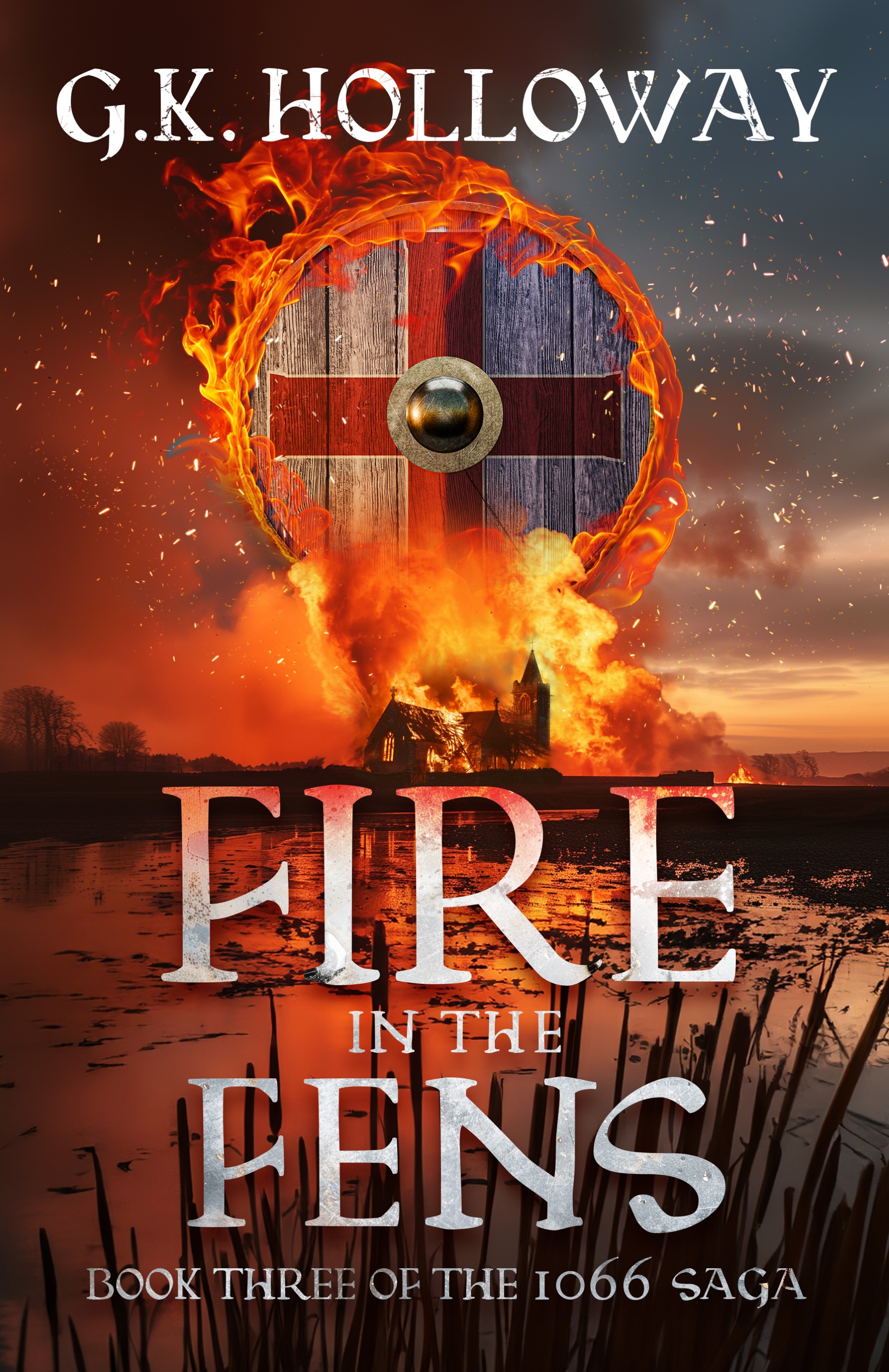
Guest Post: Researching the 11th Century by G.K. Holloway

It is a pleasure to welcome novelist G.K. Holloway to History…the Interesting Bits today, to talk about the research behind his wonderful series The 1066 Saga.

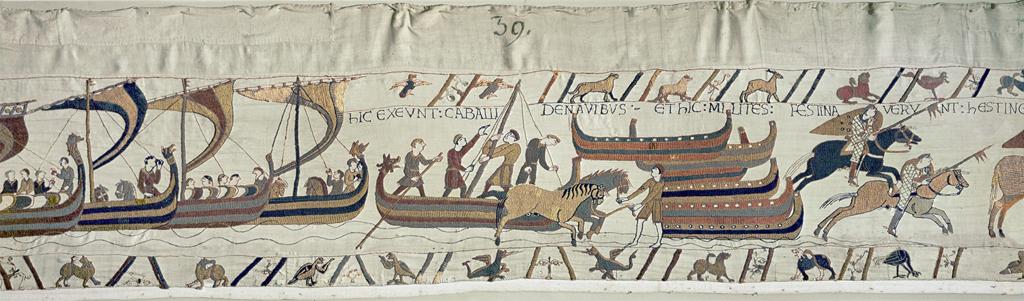
Norman invasion fleet, Bayeux Tapestry

Research for my books consists of mainly reading – books, magazines, academic papers, and blogs. It’s also good to get out a bit and visit and talking with experts, in my case locations of mainly locations of battles where I can talk with resident historians, reenactors and history fans, especially those with local knowledge.

Some of my reading consists of trawling around on the internet. It’s surprising what you can find, other than Wikipedia, as a source of material. And of course there are all sorts of groups on social media that specialise in my period in history. There are podcasts and blogs rich with information for recycling.

Books too, are an obvious place to look; the Doomsday Book is the first to spring to mind, the Anglo-Saxon Chronicle, and the Ecclesiastical History of Orderic Vitalis are useful too. But reader beware, it’s often the case with original material that objectivity wasn’t a strong point of the authors. Academic papers are nowadays can be easily accessed, although the cost of some of them is prohibitive. I’ve had read papers that have shone light into the dark recesses of history I hadn’t dreamed about. This means I’ll able to surprise readers with fascinating snippets that can give a glimpse of life a millennium ago.

Norman cavalry at the Battle of Hastings

Thank heavens for You Tube. There is a wealth of information to be found here, and a lot of it from top quality presenters and historians.

It’s not just what you see but what you don’t see that can be important. A prime example of this is the Bayeux Tapestry. It’s the closet you’ll get to newsreel footage of events covering the Norman Invasion. The full horror of war is not shied away from, burning houses, screaming women, decapitated soldiers and a horse running amok amongst dead bodies, all in glorious colour. But just as in modern times, news can be censored and people and events can be ’air brushed’ out of history, so too, it was the case way back then.

What remains of the well preserved embroidery, that’s correct, it is not a tapestry, is a sight to behold and worth a visit to Normandy to see. It’s surprising how colourful it is even after almost a thousand years. The imagery is clear and easy to follow but some scenes are missing. The story is told accurately enough and details like the appearance of Halley’s Comet are included. However, the Battle of Stamford Bridge is nowhere to be seen. Could it be that King William didn’t want it know that the army he fought at Senlac was exhausted from several hundred miles of marching and a huge battle against the biggest Norse army ever to have set foot in England. There is no depiction of the Battle of London Bridge, or the violence committed by his rampaging troops during his coronation. History has been, ‘cleaned up a bit,’ to the advantage of the victors. Nothing new there then.

Death of King Harold in the Bayeux Tapestry

It’s always a good idea to visit key locations. It’s one thing to look at maps and photographs but when you find yourself looking across the lagoons at Bosham, wandering around the castle at Falaise, starring up at Clifford’s Tower in York, or watching a reenactment at Battle Abbey, a much more realistic picture forms in your mind about what it must have been like to live all that time ago. To boost one’s knowledge it’s always a good idea to talk to reenactors; most of them have an encyclopaedic knowledge of the time period and especially their character’s part in it. Whether it be as a soldier, arrowsmith or seamstress.

Doing all the above is a great way of researching the history, but if like me, you write historical fiction rather than non-fiction, you would do well to read a good book. One I could recommend if, Story by Robert McKee. He deals with scriptwriting but it’s quite easy to apply his ideas to novels. You could also spend a lot of money and quite a bit of time on a creative writing course, but you might be better off getting a good editor.

So there you have it. Use as many sources as you can, and you’ll find many a nugget amongst the raw material.

1066: What Fates Impose

England is in crisis. King Edward has no heir and promises never to produce one. There are no obvious successors available to replace him, but quite a few claimants are eager to take the crown. While power struggles break out between the various factions at court, enemies abroad plot to make England their own. There are raids across the borders with Wales and Scotland.

Harold Godwinson, Earl of Wessex, is seen by many as the one man who can bring stability to the kingdom. He has powerful friends and two women who love him, but he has enemies will stop at nothing to gain power. As 1066 begins, England heads for an uncertain future. It seems even the heavens are against Harold.

In the Shadows of Castles

It’s the 1060s, and William of Normandy is establishing a new and brutal regime in England, but there are those who would defy him. As Norman soldiers spread like a plague across the land, resistance builds, but will it be enough to topple William and restore the rightful king to his throne? The English have the courage to fight, but the Normans, already victorious at Hastings, now build castles seeking to secure their tenuous foothold in these lands.

And what of the people caught up in these catastrophic events? Dispossessed but not defeated, their lives ripped apart, the English struggle for freedom from tyranny; amongst them, caught up in the turmoil, are a soldier, a thane and two sisters. As events unfold, their destinies become intertwined, bringing drastic changes that alter their lives forever.

Firmly embedded in the history of the Conquest, ‘In the Shadows of Castles’ is ultimately a story of love, hope and survival in a time of war.

About the Author:

1066 What Fates Impose, won the Gold Medal in the 2014 Wishing Shelf Independent Book Awards – Adult Fiction.

G K Holloway left university in 1980 with a degree in history and politics. After spending a year in Canada, he relocated to England’s West Country and began working in Secondary Education. Later he worked in Adult Education and then Further Education before finally working in Higher Education.

After reading a biography about Harold Godwinson, he became fascinated by the fall of Anglo Saxon England and spent several years researching events leading up to and beyond the Battle of Hastings. Eventually he decided he had enough material to make an engrossing novel. Using characters from the Bayeux Tapestry, the Norse Sagas, the Domesday Book and many other sources. He feels that he has brought the period and its characters to life in his own particular way. Following the major protagonists, as well as political, religious and personal themes, the downfall of Anglo-Saxon England is portrayed by a strong cast.

Nowadays he lives in Bristol with his wife and two children. When he’s not writing he works with his wife in their company.

1066 is his debut novel was originally published as an ebook. It has received very positive reviews and this has encouraged him to publish it in paperback. Currently he is working on a sequel. One day he hopes to write full time.

Visit G K Holloway’s website http://www.gkholloway.co.uk

GK Holloway’s books on Amazon

*

My Books:

Signed, dedicated copies of all my books are available through my online bookshop.

Out Now! Women of the Anarchy

Two cousins. On the one side is Empress Matilda, or Maud. The sole surviving legitimate child of Henry I, she is fighting for her birthright and that of her children. On the other side is her cousin, Queen Matilda, supporting her husband, King Stephen, and fighting to see her own son inherit the English crown. Women of the Anarchy demonstrates how these women, unable to wield a sword, were prime movers in this time of conflict and lawlessness. It show how their strengths, weaknesses, and personal ambitions swung the fortunes of war one way – and then the other.

Available from Bookshop.orgAmberley Publishing and Amazon UK.

Coming on 15 June 2024: Heroines of the Tudor World

Heroines of the Tudor World tells the stories of the most remarkable women from European history in the time of the Tudor dynasty, 1485-1603. These are the women who ruled, the women who founded dynasties, the women who fought for religious freedom, their families and love. These are the women who made a difference, who influenced countries, kings and the Reformation. In the era dominated by the Renaissance and Reformation, Heroines of the Tudor World examines the threats and challenges faced by the women of the era, and how they overcame them. From writers to regents, from nuns to queens, Heroines of the Tudor World shines the spotlight on the women helped to shape Early Modern Europe.

Heroines of the Tudor World is now available for pre-order from Amberley Publishing and Amazon UK.

Also by Sharon Bennett Connolly:

King John’s Right-Hand Lady: The Story of Nicholaa de la Haye is the story of a truly remarkable lady, the hereditary constable of Lincoln Castle and the first woman in England to be appointed sheriff in her own right. Available from all good bookshops or direct from Pen & Sword Booksbookshop.org and AmazonDefenders of the Norman Crown: The Rise and Fall of the Warenne Earls of Surrey tells the fascinating story of the Warenne dynasty, from its origins in Normandy, through the Conquest, Magna Carta, the wars and marriages that led to its ultimate demise in the reign of Edward III. Available from Pen & Sword BooksAmazon in the UK and US, and Bookshop.org

Ladies of Magna Carta: Women of Influence in Thirteenth Century England looks into the relationships of the various noble families of the 13th century, and how they were affected by the Barons’ Wars, Magna Carta and its aftermath; the bonds that were formed and those that were broken. It is now available in paperback and hardback from Pen & Sword,  Amazon, and Bookshop.orgHeroines of the Medieval World tells the stories of some of the most remarkable women from Medieval history, from Eleanor of Aquitaine to Julian of Norwich. Available now from Amberley Publishing and Amazon, and Bookshop.orgSilk and the Sword: The Women of the Norman Conquest traces the fortunes of the women who had a significant role to play in the momentous events of 1066. Available now from Amazon,  Amberley Publishing, and Bookshop.org.

Alternate Endings: An anthology of historical fiction short stories including Long Live the King… which is my take what might have happened had King John not died in October 1216. Available in paperback and kindle from Amazon.

Podcast:

Have a listen to the A Slice of Medieval podcast, which I co-host with Historical fiction novelist Derek Birks. Derek and I welcome guests, such as Bernard Cornwell and Elizabeth Chadwick, and discuss a wide range of topics in medieval history, from significant events to the personalities involved.

*

Don’t forget! Signed and dedicated copies of all my books are available through my online bookshop.

For forthcoming online and in-person talks, please check out my Events Page.

You can be the first to read new articles by clicking the ‘Follow’ button, liking our Facebook page or joining me on Twitter and Instagram.

*

©2024 GK Holloway and Sharon Bennett Connolly FRHistS.

Book Corner: Anthony Woodville, Sophisticate or Schemer? by Danielle Burton

The Woodville family are synonymous with the Wars of the Roses. While much has been published on the family as a whole, especially Elizabeth, wife of Edward IV, Anthony Woodville – the favourite sibling of Elizabeth – has been largely overlooked by history. He is famed for his arrest and execution in June 1483, but there is much more to learn from his life. Woodville was a man with an important cultural role. He was a knight, had a successful jousting career, and worked with the printing pioneer William Caxton. He was the printer’s only long-lasting patron in England and acted as translator for him, using the books printed by Caxton to educate Edward, Prince of Wales, the future Edward V.

This book seeks to bring Anthony Woodville out of the shadows of history, giving him the recognition he deserves and challenging the negative perceptions around him by investigating his personality and personal achievements in military, diplomatic and literary capacities.

I have always had the impression that Anthony Woodville would have stood out in any period of history. A Renaissance man, he championed the arts, patronised the printing press, was a renowned jouster and so well respected by his king that he was entrusted with the education and upbringing of the Prince of Wales – the future King Edward V.

I do think Woodville would have stood out in any generation, but it didn’t hurt that his sister was Elizabeth Woodville, Queen of England.

Anthony Woodville, as the queen’s brother, was at the centre of events during the reign of Edward IV. He accompanied his brother-in-law into exile when Henry VI briefly reclaimed the throne in 1470-71. He appeared in tournaments to celebrate the marriage of the king’s sister, Margaret, to the future duke of Burgundy. He was a poet and writer and was a patron of William Caxton, the man who brought the printing press to England. Caxton printed and published Woodville’s English translation of The Dictes and Sayings of the Philosophers. So why is there not a larger body of work on him?

Danielle Burton has rectified this omission with her fascinating, in-depth study, Anthony Woodville, Sophisticate or Schemer? She delves deep into Woodville’s life, family, loves and career.

The Woodville family are often viewed as grasping and power hungry. This is true of some of the family members, particularly Thomas Grey, Marquess of Dorset, who was the eldest son of Anthony’s sister Elizabeth by her first marriage to John Grey. However, Anthony, while of course benefitting from the advancement of his sister to the status of queen, notably avoided meddling wherever possible. His interests in piety, tutoring Edward, the Prince of Wales, jousting, and translating books let him play a background role in the Wars of the Roses.

While Anthony Woodville may have been a secondary figure in political terms, it is clear that he had a significant part in transforming English culture, especially through his patronage of William Caxton, as well as his tutelage of Edward. Prince of Wales, who resided at Ludlow Castle for around ten years. According to Dominic Mancini, and Italian visitor who stayed in England between late summer 1482 and July 1483, Anthony Woodville was ‘always considered a kind, serious and just man’ who was ‘tested by every vicissitude of life.’ It was for this reason that he had been entrusted with the ‘care and direction’ of the prince. Further to Mancini’s description of Anthony, he purposefully contrasts his character with that of other Woodvilles, who were ‘detested by the nobles.’ There is a certain amount of truth in this, for unlike some other family members Anthony preferred to stay away from court life, favouring more academic and religious pursuits.

As a debut work, Anthony Woodville, Sophisticate or Schemer? is very impressive. It is clear that Danielle Burton has done her research, thoroughly, using primary sources where possible. She uses her extensive knowledge of Anthony Woodville to suggest reasons for his actions and to fill in the gaps of our knowledge, clearly indicating her theories and supporting arguments. There are some minor errors, which other reviewers have highlighted, but nothing that changes the thrust of the arguments nor detracts from the enjoyment of reading. They certainly do not devalue the biography as a whole and are more a sign of the writer’s inexperience of the editing process. I certainly would not expect it to put a reader off.

I suspect Anthony Woodville is Danielle’s historical crush, but this adds to the passion in her retelling of his story. We all fall in love with our subjects, just a little bit. You cannot spend years studying a person without doing so.

Danielle Burton’s arguments are balanced and do not present Anthony Woodville and some flawless super hero. Rather, he is an accomplished knight who had his flaws and would often look to his own advantage. Who wouldn’t? He was, however, loyal to Edward IV and his nephew, Edward V. And, having been the younger Edward’s guardian since his early years, was probably a great influence on the teenage king. This would Explain why Richard, Duke of Gloucester – the future Richard III – saw him as a threat. In Anthony Woodville, Sophisticate or Schemer? Danielle looks into the events of 1483 in great detail, examining the relationship between Richard and Anthony and analysing what went wrong and why. Anthony Woodville’s execution at Pontefract Castle is a tragic consequence of the power struggle that followed the death of Edward IV and accession of Anthony’s charge, Edward V.

All in all, Anthony Woodville, Sophisticate or Schemer? by Danielle Burton is a much-needed addition to the study of the Wars of the Roses, highlighting a man of great influence who is often overlooked in favour of his royal contemporaries. It is an impressive piece of work.

Listen to: Danielle Burton talking about Anthony Woodville, Sophisticate or Schemer? with myself and Derek Birks on our podcast, on A Slice of Medieval.

To Buy the Book: Anthony Woodville, Sophisticate or Schemer? is available from Amazon or direct from Amberly Publishing.

About the Author: Danielle Burton has had a keen interest in the Wars of the Roses from a young age, including being a member of the Richard III Society since the age of 9. She has presented aspects of her research into the life of Anthony Woodville at various academic conferences, and works in the heritage sector.

*

My Books:

Signed, dedicated copies of all my books are available through my online bookshop.

Out Now! Women of the Anarchy

Two cousins. On the one side is Empress Matilda, or Maud. The sole surviving legitimate child of Henry I, she is fighting for her birthright and that of her children. On the other side is her cousin, Queen Matilda, supporting her husband, King Stephen, and fighting to see her own son inherit the English crown. Women of the Anarchy demonstrates how these women, unable to wield a sword, were prime movers in this time of conflict and lawlessness. It show how their strengths, weaknesses, and personal ambitions swung the fortunes of war one way – and then the other.

Available from Bookshop.orgAmberley Publishing and Amazon UK.

Coming on 15 June 2024: Heroines of the Tudor World

Heroines of the Tudor World tells the stories of the most remarkable women from European history in the time of the Tudor dynasty, 1485-1603. These are the women who ruled, the women who founded dynasties, the women who fought for religious freedom, their families and love. These are the women who made a difference, who influenced countries, kings and the Reformation. In the era dominated by the Renaissance and Reformation, Heroines of the Tudor World examines the threats and challenges faced by the women of the era, and how they overcame them. From writers to regents, from nuns to queens, Heroines of the Tudor World shines the spotlight on the women helped to shape Early Modern Europe.

Heroines of the Tudor World is now available for pre-order from Amberley Publishing and Amazon UK.

Also by Sharon Bennett Connolly:

King John’s Right-Hand Lady: The Story of Nicholaa de la Haye is the story of a truly remarkable lady, the hereditary constable of Lincoln Castle and the first woman in England to be appointed sheriff in her own right. Available from all good bookshops or direct from Pen & Sword Booksbookshop.org and AmazonDefenders of the Norman Crown: The Rise and Fall of the Warenne Earls of Surrey tells the fascinating story of the Warenne dynasty, from its origins in Normandy, through the Conquest, Magna Carta, the wars and marriages that led to its ultimate demise in the reign of Edward III. Available from Pen & Sword BooksAmazon in the UK and US, and Bookshop.org

Ladies of Magna Carta: Women of Influence in Thirteenth Century England looks into the relationships of the various noble families of the 13th century, and how they were affected by the Barons’ Wars, Magna Carta and its aftermath; the bonds that were formed and those that were broken. It is now available in paperback and hardback from Pen & Sword,  Amazon, and Bookshop.orgHeroines of the Medieval World tells the stories of some of the most remarkable women from Medieval history, from Eleanor of Aquitaine to Julian of Norwich. Available now from Amberley Publishing and Amazon, and Bookshop.orgSilk and the Sword: The Women of the Norman Conquest traces the fortunes of the women who had a significant role to play in the momentous events of 1066. Available now from Amazon,  Amberley Publishing, and Bookshop.org.

Alternate Endings: An anthology of historical fiction short stories including Long Live the King… which is my take what might have happened had King John not died in October 1216. Available in paperback and kindle from Amazon.

Podcast:

Have a listen to the A Slice of Medieval podcast, which I co-host with Historical fiction novelist Derek Birks. Derek and I welcome guests, such as Bernard Cornwell and Elizabeth Chadwick, and discuss a wide range of topics in medieval history, from significant events to the personalities involved.

*

Don’t forget! Signed and dedicated copies of all my books are available through my online bookshop.

For forthcoming online and in-person talks, please check out my Events Page.

You can be the first to read new articles by clicking the ‘Follow’ button, liking our Facebook page or joining me on Twitter and Instagram.

*

©2024 Sharon Bennett Connolly FRHistS 

Book Corner: Two Queenly Biographies from Joanna Arman

I am very fond of Joanna Arman as an author. She has a habit of bringing often-forgotten or ignored – or maligned – women to the fore and reassessing their role in history. Her biography of Æthelflæd, The Warrior Queen: The Life and Legend of Æthelflæd, Daughter of Alfred the Great, was an engaging and illuminating book, despite the challenges of writing about a woman who lived over a thousand years ago. Writing about any woman in history is challenging. Women are rarely mentioned in the chronicles. And when they are, contemporary sources are rarely balanced and often trying to advance a moral judgement of how women fell below the standard expected of them in their society. Which is why we need reappraisals of significant historic women, books which reassess their stories and apply the filter against the casual misogyny that women have suffered from throughout the centuries. Joanna Arman has set out to do that with books about two very different queens consort of England; Matilda of Scotland and Margaret of Anjou.

Matilda II: The Forgotten Queen

The wife of King Henry I and the mother of the Empress Maud is a woman and a Queen forgotten to history. She is frequently conflated with her daughter or her mother-in-law. She was born the daughter of the King of Scotland and an Anglo-Saxon princess. Her name was Edith, but her name was changed to Matilda at the time of her marriage. The Queen who united the line of William the Conqueror with the House of Wessex lived during an age marked by transition and turbulence. She married Henry in the first year of the 12th century and for the eighteen years of her rule aided him in reforming the administrative and legal system due to her knowledge of languages and legal tradition. Together she and her husband founded a series of churches and arranged a marriage for their daughter to the Holy Roman Emperor. Matilda was a woman of letters to corresponded with Kings, Popes, and prelates, and was respected by them all. Matilda’s greatest legacy was continuity: she united two dynasties and gave the Angevin Kings the legitimacy they needed so much. It was through her that the Empress Matilda and Henry II were able to claim the throne. She was the progenitor of the Plantagenet Kings, but the war and conflict which followed the death of her son William led to a negative stereotyping by Medieval Chroniclers. Although they saw her as pious, they said she was a runaway nun and her marriage to Henry was cursed. This book provides a much-needed re-evaluation of Edith/Matilda’s role and place in the history of the Queens of England.

Now, this is a book I have been waiting for!

And it is a book that has needed to be written for a long time. How useful it would have been when I was writing my own book, Women of the Anarchy. A complete biography of Matilda of Scotland – also referred to as Matilda II to distinguish her from her predecessor, Matilda of Flanders. As the wife of Henry I of England Matilda of Scotland is a woman often neglected and overlooked by historians. And yet, Queen Matilda was a truly remarkable queen and one who was well respected during her lifetime. Born as the eldest daughter of Malcolm III Canmore, King of Scots, and his saintly wife, Margaret of Wessex, and given the name Edith at birth, her name was changed to the more Norman name, Matilda, on her marriage to Henry I.

Joanna Arman expertly guides us through Queen Matilda’s life, from her childhood in a convent, supervised by her mother’s sister, Christina, through the various suitors who came calling to the controversy over her marriage to King Henry. Matilda II: The Forgotten Queen delves deep into the investigation into whether or not Matilda had ever been professed as a nun and presents the evidence and arguments for both sides. It is a fascinating study.

Queen Matilda’s role, as a queen, wife and mother, is examined in great detail, demonstrating her influence, both on her family and on England and Normandy. Matilda’s piety is shown as an anchoring force throughout her life, influencing the way she approaches problems and relationships. The queen is shown to be a deeply devout, kind and benevolent woman, with a strong sense of purpose and destiny.

Matilda II: The Forgotten Queen covers every aspect of the queen’s life, drawing on chronicles and charters to present what we know in a clear, engaging narrative that brings this often-overlooked queen to life. The book is accompanied by extensive notation and a through bibliography – I was flattered to discover my own book, Defenders of the Norman Crown: Rise and Fall of the Warenne Earls of Surrey, cited as a refence. It is an excellent biography, thoroughly researched and beautifully presented. I loved reading every word.

To buy Matilda II: The Forgotten Queen: Amazon

Margaret of Anjou: She-Wolf of France, Twice Queen of England

In 1445 a fifteen-year-old French girl left her homeland to marry the son of the great warrior Henry V. Sixteen years later, her husband had lost his throne and she had fled into exile. For a decade, she struggled to reclaim the throne of England before her final and shattering defeat at the Battle of Tewkesbury. It marked the final destruction of the House of Lancaster by Yorkist King Edward IV and his brothers. Margaret lost more than her family: she was also vilified. Shakespeare cast her as a sadistic killer who murdered the noble Richard, Duke of York. History cast her as a manipulative seductress whose destructive ambition was a major cause of the Wars of the Roses. Margaret of Anjou remains one of the most notorious consorts in medieval history, the queen we love to hate. But is her reputation deserved, or was she simply caught between the machinations and rivalries of powerful men? By examining Margaret’s life and actions in detail, this biography reveals a new side to the last foreign-born queen of medieval England. Margaret came from a family of strong women. Faced with hardship in the first years of her marriage, Margaret’s choices arose from a conviction that it was natural for a woman to take control in the absence of male leadership. A wealth of records have been left behind, allowing historians to investigate Margaret’s career as a beloved wife and, later, as the leader of a political faction struggling to secure the crown for her family. If the course of history had run differently, would she instead be considered a heroic warrior queen today – perhaps even England’s Joan of Arc?

At last! A balanced, objective biography of Margaret of Anjou that does not just regurgitate the ‘she-wolf’ trope (despite it being in the title).Peeling away the centuries of misogyny, Joanna Arman takes a new look at the historical record and presents a version of Margaret of Anjou, the long-suffering wife of the mentally-fragile king, Henry VI, that is much closer to the living, breathing woman she was. This does not mean that Margaret’s actions are excused away, that she is suddenly assessed as a saint. Rather, Joanna Arman presents Margaret of Anjou’s actions against the backdrop of the times; the challenges she was facing, and the actions she had to take in order to preserve her husband’s crown and her son’s inheritance.

Margaret is presented as a human being, prone to making mistakes just like the rest of us. She is also a woman, challenged with holding her own in a man’s world – and in a time of war. Joanna Arman presents the complete queen; a woman, a wife, a mother. And a leading protagonist in the Wars of the Roses. The book is a fascinating analysis of this influential queen, of her life, decisions and struggles that eventually led to her losing everything; her son, her husband and her crown.

Told with empathy, balance and passion, I defy anyone to not feel moved and invigorated by this fascinating study of a woman who had fought hard to hold on to everything, but lost it all. Faced with her husband’s mental illness and military ineptitude, Margaret tried to fill the void, to be king and queen. The male dominated society of 15th century England would not permit it. One wonders what Margaret might have achieved had she been allowed to take the reins of government. Her deadly rivalry with Richard, Duke of York, however, meant court factions would always manoeuvre against her, even after York’s death at Wakefield.

Joanna Arman has taken great care to ensure that Margaret of Anjou: She-Wolf of France, Twice Queen of England, is a biography of the queen. It is not a Lancastrian whitewash, nor a Yorkist hate-filled pamphlet. Margaret of Anjou is the centre of attention, the woman held out for appraisal, for assessment, for praise and criticism. That it is at once balanced, critical and empathetic is testament to Joanna Arman’s skill as the queen’s biographer.

To buy Margaret of Anjou: She-Wolf of France, Twice Queen of England: Amazon

*

My Books:

Signed, dedicated copies of all my books are available through my online bookshop.

Out Now! Women of the Anarchy

Two cousins. On the one side is Empress Matilda, or Maud. The sole surviving legitimate child of Henry I, she is fighting for her birthright and that of her children. On the other side is her cousin, Queen Matilda, supporting her husband, King Stephen, and fighting to see her own son inherit the English crown. Women of the Anarchy demonstrates how these women, unable to wield a sword, were prime movers in this time of conflict and lawlessness. It show how their strengths, weaknesses, and personal ambitions swung the fortunes of war one way – and then the other.

Available from Bookshop.orgAmberley Publishing and Amazon UK.

Coming on 15 June 2024: Heroines of the Tudor World

Heroines of the Tudor World tells the stories of the most remarkable women from European history in the time of the Tudor dynasty, 1485-1603. These are the women who ruled, the women who founded dynasties, the women who fought for religious freedom, their families and love. These are the women who made a difference, who influenced countries, kings and the Reformation. In the era dominated by the Renaissance and Reformation, Heroines of the Tudor World examines the threats and challenges faced by the women of the era, and how they overcame them. From writers to regents, from nuns to queens, Heroines of the Tudor World shines the spotlight on the women helped to shape Early Modern Europe.

Heroines of the Tudor World is now available for pre-order from Amberley Publishing and Amazon UK.

Also by Sharon Bennett Connolly:

King John’s Right-Hand Lady: The Story of Nicholaa de la Haye is the story of a truly remarkable lady, the hereditary constable of Lincoln Castle and the first woman in England to be appointed sheriff in her own right. Available from all good bookshops or direct from Pen & Sword Booksbookshop.org and AmazonDefenders of the Norman Crown: The Rise and Fall of the Warenne Earls of Surrey tells the fascinating story of the Warenne dynasty, from its origins in Normandy, through the Conquest, Magna Carta, the wars and marriages that led to its ultimate demise in the reign of Edward III. Available from Pen & Sword BooksAmazon in the UK and US, and Bookshop.org

Ladies of Magna Carta: Women of Influence in Thirteenth Century England looks into the relationships of the various noble families of the 13th century, and how they were affected by the Barons’ Wars, Magna Carta and its aftermath; the bonds that were formed and those that were broken. It is now available in paperback and hardback from Pen & Sword,  Amazon, and Bookshop.orgHeroines of the Medieval World tells the stories of some of the most remarkable women from Medieval history, from Eleanor of Aquitaine to Julian of Norwich. Available now from Amberley Publishing and Amazon, and Bookshop.orgSilk and the Sword: The Women of the Norman Conquest traces the fortunes of the women who had a significant role to play in the momentous events of 1066. Available now from Amazon,  Amberley Publishing, and Bookshop.org.

Alternate Endings: An anthology of historical fiction short stories including Long Live the King… which is my take what might have happened had King John not died in October 1216. Available in paperback and kindle from Amazon.

Podcast:

Have a listen to the A Slice of Medieval podcast, which I co-host with Historical fiction novelist Derek Birks. Derek and I welcome guests, such as Bernard Cornwell and Elizabeth Chadwick, and discuss a wide range of topics in medieval history, from significant events to the personalities involved.

*

Don’t forget! Signed and dedicated copies of all my books are available through my online bookshop.

For forthcoming online and in-person talks, please check out my Events Page.

You can be the first to read new articles by clicking the ‘Follow’ button, liking our Facebook page or joining me on Twitter and Instagram.

*

©2024 Sharon Bennett Connolly FRHistS

Hildegard of Bingen

History ... the Interesting Bits
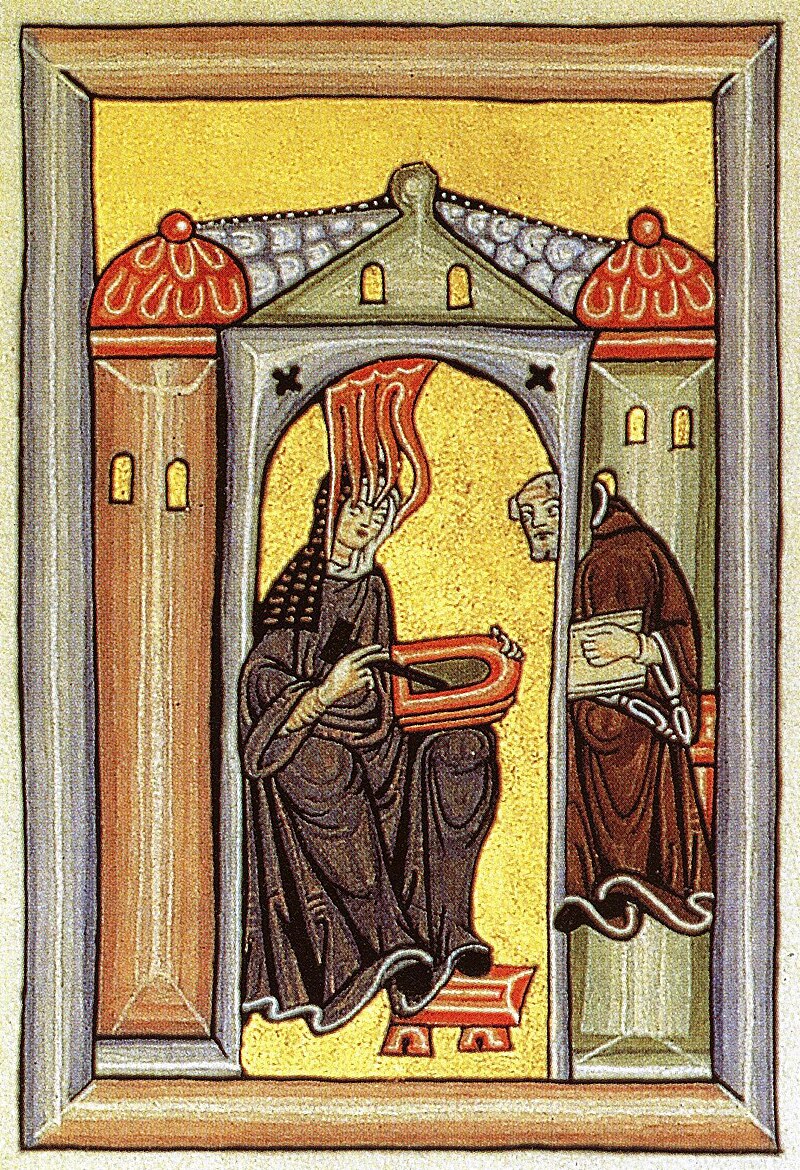
Illumination from Hildegard’s Scivias (1151) showing her receiving a vision and dictating to teacher Volmar

Hildegard of Bingen was rather brilliant. Born in around 1098 in Bremersheim in the Rhineland, into a noble family, Hildegard was the tenth child of Hildebert and Mechtild and was destined for life in a convent from an early age. She was around eight years old when she was placed with Jutta of Sponheim, a reclusive (possibly an anchorite), religious noblewoman who supervised the education of young girls from noble families. In 1112, at the age of fourteen, Hildegard, along with other girls in Jutta’s charge, took her vows at the monastery at Disibodenberg. Under Jutta, who became prioress at Disibodenberg, Hildegard was taught to read, and Latin, although she was not proficient in the latter, and in later life she relied on her secretaries to correct her Latin grammar.

Hildegard was a woman of many talents, she was a visionary, a musician, philosopher, theologian and an expert in medicine. She lived at the monastery of Disibodenberg for more than thirty years. It was in her early years there that she first experienced visions, which would make her famous even in her own lifetime. Initially, she only revealed her prophetic visions to her mentor, Jutta, and it was only when God commanded to her record them, that she revealed them to her friend and secretary, Volmar. With the permission of the Abbot of Disibodenberg, Kuno, and with the encouragement of Volmar and a fellow nun, Richardis of Stade, Hildegard started writing down her visions when she was in her forties. It was only after much encouragement from her Archbishop, Henry of Mainz, that her first work, Scivias, was published. The beautifully illustrated work was given approval from a commission set up by Pope Eugene III and was also supported by the saintly Bernard of Clairvaux.

Abbot Bernard of Clairvaux was one of a number of theologians with whom Hildegard maintained a correspondence. She regularly asked the venerable abbot for advice and guidance, and help in interpreting her visions. In one letter, she would tell him,

‘I have from earliest childhood seen great marvels which my tongue has no power to express but which the Spirit of God has taught me that I may believe … Indeed, I have no formal training at all, for I know how to read only on the most elementary level, certainly with no deep analysis. But please give me your opinion in this matter, because I am untaught and untrained in exterior material, but am only taught inwardly, in my spirit.’


Hildegard corresponded with the great personalities of her time, with emperors, popes and even queens. Sometime between 1154 and 1171, she responded to a letter from Eleanor of Aquitaine, asking for advice, with the words ‘Your mind is like a wall which is covered with clouds, and you look everywhere but have no rest. Flee this and attain stability with God and men, and God will help you in all your tribulations. May God give you his blessing and help in all your works’.

History ... the Interesting Bits
Hildegard of Bingen

In 1148 Hildegard had a vision in which God commanded her to take her nuns and establish her own nunnery. Although Abbot Kuno was reluctant to see Hildegard leave Disibodenberg – her reputation had brought the monastery pilgrims and prestige – she eventually prevailed and established a new convent at Rupertsberg. Hildegard’s convent admitted only noblewomen, she did not believe in mixing the classes within a convent, writing that different ‘classes of people should not be mixed, or they will fall out through deceit or arrogance, and the shame occasioned by their differences. The greatest danger of all is a breakdown in peaceful manners through mutual backbiting and hatred when the upper-class pounce on the lower or when the lower is promoted above the higher.’

It was at Rupertsberg that Hildegard wrote two medical works, Causes and Cures and Physica, after studying the illnesses of the sick who she cared for. Her writings suggested remedies for different ailments, using a wide variety of plants; for example, Hildegard explains how cloves could be used to remedy against gout, swollen intestines and hiccups. She also extolled the virtues of the rose as a cure for many ills, saying:

‘Rose is cold, and this coldness contains moderation which is useful. In the morning, or at daybreak, pluck a rose petal and place it on your eyes. It draws out the humour and makes them clear. One with small ulcers on his body should place rose petals over them. This pulls the mucus from them. One who is inclined to wrath should take rose and less sage and pulverise them. The sage lessens the wrath, and the rose makes him happy. Rose, and half as much sage, may be cooked with fresh, melted lard, in water, and an ointment made from this. The place where a person is troubled by a cramp or paralysis should be rubbed with it, and he will be better. Rose is also good to add to potions, unguents, and all medications. If even a little rose is added, they are so much better, because of the good virtues of the rose.’

Hildegard’s prolific writing career continued in her new surroundings. She produced religious poems, music and even a play, Ordo Virtutum. She also wrote two further books of her visions, Liber vitae meritorum (Book of Life’s Merits) and Liber divinonim operum (Book of Divine Works), and a life of the abbey’s patron saint, St Rupert. Ricardis of Stade and her friend and secretary, Volmar, had accompanied Hildegard from Disibodenberg to Rupertsberg and continued to help her as secretaries and assistants. A succession of secretaries came after Volmar and Richardis, including Hildegard’s nephew, Wesclein, her brother, Hugo of Tholey, and her last secretary, Guibert of Gembloux. Guibert and an earlier secretary, Godfrey of Disibodenbrg, both wrote biographies of Hildegard. The main purpose of the secretaries was to edit Hildegard’s works as her Latin grammar was far from proficient; however, they were under strict instructions not to change any of her words as they came from God, exhorting

‘Let no man be so audacious as to add anything to this writing lest he be blotted out from the book of life’.

History ... the Interesting Bits
Coin commemorating the 900th anniversary of the birth of Hildegard of Bingen

Hildegard was a prolific letter writer and, more than 800 years after her death, there are around 400 of her letters still extant today. Many wrote to her asking for advice and prophecies. Indeed, John of Salisbury said Pope Eugene III had consulted Hildegard for predictions about his reign, which had been accurate. In her letters, Hildegard acts as a mediator within the monastic world, soothing arguments within convents, between abbesses and their nuns, and abbots and their monks. She was respected by men and women alike, noble and poor. Hildegard gave advice and support and remonstrated against injustice and corruption. She travelled widely and undertook four preaching tours, between 1158 and 1170, a practice ordinarily forbidden to women, who were expected not to teach or speak in church.

Hildegard of Bingen died in her eighty-second year, at Rupertsberg, on 17 September 1179, and was canonised as Saint Hildegard on 10 May 2012 by Pope Benedict XVI, who declared her a doctor of the Church, in the same year. She was a woman of extraordinary talents, an exceptional writer, a poet and composer, a visionary, a mystic and a scientist. She was trusted and respected by the great men of her age and is considered to be the most influential woman in medieval Church history, a well-deserved accolade.

Sources:

The Letters of Hildegard of Bingen, translated by Joseph L. Baird and Radd K. Ehrman; Hildegardis Bingensis, Epistolarium, edited by Lieven Van Acker and Monika Klaes-Hachmoller; Medieval Europe 400–1500 by H.G. Koenigsberger; Medievalists.net, The Herbal Cures of Hildegard von Bingen – was she right?; Hildegard von Bingen’s Physica: The Complete English Translation of Her Classic Work on Health and Healing by Priscilla Throop; Six Trailblazing Medieval Women article by Susan Signe Morrison; The Letters of John of Salisbury, edited by W.J. Miller, S.J. Butler, H.E. Butler and revised by C.N.L. Brooke

*

My Books:

Signed, dedicated copies of all my books are available through my online bookshop.

Out now: Scotland’s Medieval Queens

Books by Sharon Bennett Connolly

Scotland’s history is dramatic, violent and bloody. Being England’s northern neighbour has never been easy. Scotland’s queens have had to deal with war, murder, imprisonment, political rivalries and open betrayal. They have loved and lost, raised kings and queens, ruled and died for Scotland. From St Margaret, who became one of the patron saints of Scotland, to Elizabeth de Burgh and the dramatic story of the Scottish Wars of Independence, to the love story and tragedy of Joan Beaufort, to Margaret of Denmark and the dawn of the Renaissance, Scotland’s Medieval Queens have seen it all. This is the story of Scotland through their eyes.

Scotland’s Medieval Queens gives a thorough grounding in the history of the women who ruled Scotland at the side of its kings, often in the shadows, but just as interesting in their lives beyond the spotlight. It’s not a subject that has been widely covered, and Sharon is a pioneer in bringing that information into accessible history.’ Elizabeth Chadwick (New York Times bestselling author)

Available now from Amazon and Pen and Sword Books

Also by Sharon Bennett Connolly:

Books by Sharon Bennett Connolly

Heroines of the Tudor World tells the stories of the most remarkable women from European history in the time of the Tudor dynasty, 1485-1603. These are the women who ruled, the women who founded dynasties, the women who fought for religious freedom, their families and love. Heroines of the Tudor World is now available for pre-order from Amberley Publishing and Amazon UK. Women of the Anarchy demonstrates how Empress Matilda and Matilda of Boulogne, unable to wield a sword themselves, were prime movers in this time of conflict and lawlessness. It shows how their strengths, weaknesses, and personal ambitions swung the fortunes of war one way – and then the other. Available from Bookshop.orgAmberley Publishing and Amazon UKKing John’s Right-Hand Lady: The Story of Nicholaa de la Haye is the story of a truly remarkable lady, the hereditary constable of Lincoln Castle and the first woman in England to be appointed sheriff in her own right. Available from all good bookshops Pen & Sword Booksbookshop.org and Amazon

Defenders of the Norman Crown: The Rise and Fall of the Warenne Earls of Surrey tells the fascinating story of the Warenne dynasty, from its origins in Normandy, through the Conquest, Magna Carta, the wars and marriages that led to its ultimate demise in the reign of Edward III. Available from Pen & Sword BooksAmazon in the UK and US, and Bookshop.orgLadies of Magna Carta: Women of Influence in Thirteenth Century England looks into the relationships of the various noble families of the 13th century, and how they were affected by the Barons’ Wars, Magna Carta and its aftermath; the bonds that were formed and those that were broken. It is now available in paperback and hardback from Pen & SwordAmazon, and Bookshop.orgHeroines of the Medieval World tells the stories of some of the most remarkable women from Medieval history, from Eleanor of Aquitaine to Julian of Norwich. Available now from Amberley Publishing and Amazon, and Bookshop.orgSilk and the Sword: The Women of the Norman Conquest traces the fortunes of the women who had a significant role to play in the momentous events of 1066. Available now from Amazon,  Amberley Publishing, and Bookshop.org.

Alternate Endings: An anthology of historical fiction short stories including Long Live the King… which is my take what might have happened had King John not died in October 1216. Available in paperback and kindle from Amazon.

Podcast:

Have a listen to the A Slice of Medieval podcast, which I co-host with Historical fiction novelist Derek Birks. Derek and I welcome guests, such as Bernard Cornwell and Elizabeth Chadwick, and discuss a wide range of topics in medieval history, from significant events to the personalities involved.

Every episode is also now available on YouTube.

*

Don’t forget! Signed and dedicated copies of all my books are available through my online bookshop.

For forthcoming online and in-person talks, please check out my Events Page.

You can be the first to read new articles by clicking the ‘Follow’ button, liking our Facebook page or joining me on TwitterThreadsBluesky and Instagram.

*

©2024 Sharon Bennett Connolly FRHistS.

Empress Matilda’s Escape in a Snow Storm

History...the Interesting Bits
Empress Matilda depicted at the coronation of her granddaughter, Matilda of England, as Duchess of Saxony, in an image from the Gospels of Henry the Lion.
In the mid-12th century, England was riven by civil war as King Stephen and Empress Matilda fought for a crown that was rightfully hers. In 1141, the empress came close to realising her ambition: Stephen had been captured and she was proclaimed ‘Lady of the English’, but the crown itself eluded her. Stephen’s wife, Queen Matilda, had fought back, captured the empress’s illegitimate half-brother, Earl Robert of Gloucester and negotiated a prisoner swap.

By January 1142, everyone was back where they started, with Stephen on the throne and Empress Matilda still fighting to wrest it from his grasp. In the early months of the year, both sides spent time consolidating their resources and manoeuvring for position rather than forcing a confrontation.

Except, things were a little more desperate. Her stocks were severely depleted and only her staunchest supporters remained with her; worse still, Stephen was now free to act on his own behalf. With the defection of Henry of Blois, Bishop of Winchester, back to his brother’s side, the church was against her as well.

The empress needed reinforcements. Her husband, Geoffrey of Anjou, implied that he would help, but only if her brother, Earl Robert, would come to him and ask in person. The empress was against the idea and Earl Robert was reluctant to leave his sister, not that Stephen was free again. But the king was lying ill at Nottingham, with rumours circulating that he was close to death. Robert decided it would be safe enough to leave for Normandy, though not without reservations.

Empress Matilda moved to Oxford to await her brother’s return. Although Oxford was not the most secure residence. It may have strong, high walls, but it was close to enemy territory. It was close to London. Her presence there would mean that the empress could act quickly, were Stephen to die.

But then, the king unexpectedly recovered.

History...the Interesting Bits
King Stephen

And went on the offensive, taking Wareham, held by Earl Robert’s eldest son, William of Gloucester. It was the castle guarding that would have been the earl’s landing place on his return from Normandy. Stephen then marched to Cirencester, the castle was abandoned by the garrison on his approach. He burned it to the ground before moving on to Bampton and Radcot, both garrisoned by the empress’s forces; one was taken by storm while the other surrendered.

By taking the nearby castles, Stephen was isolating the empress at Oxford, cutting off any possible aid. And it was only when this was done that Stephen turned his sights on the empress.

Oxford was a city protected by the surrounding Thames, guarded by a palisade on one side while the formidable castle, with its high donjon, stood sentinel on the other side. According to the Gesta Stephani, the king managed to find a deep ford by which he led his men across the river, ‘swimming rather than wading’, and launched an attack on the city’s defenders. When the defenders pulled back into the city, hoping to close the gates, the king’s forces mingled with them and made their way inside, burning buildings, killing those who resisted and capturing those who could offer a ransom. Others were ejected from the town, left to their own devices in the neighbouring countryside. While others were forced to seek shelter in the castle, with the empress.

The king encircled the castle, ordering that it be closely watched, day and night. The empress was not going to escape him again. There was slim chance of reinforcements coming to her aid. Her uncle David, King of Scots was back in Scotland, her loyal servant Miles of Gloucester, now Earl of Hereford, did not have enough men, and Brian FitzCount had to look to the defence of his own castle at Wallingford. And Earl Robert was still far away in Normandy, campaigning with Count Geoffrey while the latter made up his mind about sending reinforcements to aid his wife: over the summer and autumn of 1142, the two of them captured ten Norman castles.

On hearing of the empress’s predicament, Robert abandoned his quest for more troops and returned to England, forcing a landing at Wareham. With fifty-two ships and a force of between 300 and 400 knights in addition to foot soldiers, the earl managed to force Wareham’s surrender after a three-week siege. He then ordered a full muster of the empress’s forces at Cirencester before marching on Oxford to rescue his sister.

History...the Interesting Bits
Charles Ricketts, ‘The Flight of Matilda from Oxford’

Shut up in the castle, with winter upon them, the empress and her forces were cold, hungry and desperate. Entirely cut off from the outside world, neither supplies nor news had been able to get past the king’s blockade since September. In the middle of December, with the ground white with snow and the river frozen, the empress made a desperate gamble.

‘Very hard pressed as she was and altogether hopeless that help would come she left the castle by night with three knights of ripe judgement to accompany her.’

Gesta Stephani

In the dark of the night, presumably dressed in white to camouflage against the blanket of snow, accompanied by just 3 men, she slipped out of a postern gate, and ‘in wondrous fashion she escaped unharmed through so many enemies, so many watchers in the silence of the night, whom the king had heedfully posted on every side of the castle.’ The empress walked 6 miles, crossing the frozen river and traversing the enemy’s pickets, to reach Wallingford Castle. The Gesta Stephani remarked that never had he ‘read of another woman so luckily rescued from so many mortal foes and from the threat of dangers so great’.

History...the Interesting Bits
Oxford Castle

The Anglo-Saxon Chronicle tells the story slightly differently, saying that ‘in the night she was let down from the tower with ropes and stole out, and she fled and went on foot to Wallingford’.

Henry of Huntingdon added the detail that the empress was dressed in white, as camouflage: ‘Not long before Christmas, the empress fled across the frozen Thames, clothed in white garments, which reflected and resembled the snow, deceiving the eyes of the besiegers.’

Though they all tell the story slightly differently, every chronicler eagerly tells of the empress’s daring escape from Oxford Castle.

With the empress safely ensconced at Wallingford with Brian FitzCount, the garrison at Oxford could surrender. The king, deprived of his quarry, agreed easy terms with the remaining defenders.

Earl Robert, on hearing of his sister’s escape, stopped his advance on Oxford and instead made for Devizes, where brother and sister were reunited. The earl had brought a surprise for his sister. After 3 years apart, she was reunited with her eldest son, Henry of Anjou. Henry’s presence served to show England that Henry I’s heir was Empress Matilda’s nine-year-old son, Henry, rather than Stephen’s twelve-year-old son, Eustace.

History...the Interesting Bits
Henry II

Henry was placed in the household of his uncle, Earl Robert, and sent to Bristol to continue his education, alongside his cousin Roger, the earl’s younger son, who would later become Bishop of Worcester. Henry remained at Bristol until March 1144 and soon began to receive homage from his English vassals in person.

The war changed shaped at this time, with empress and earl consolidating their position in their own lands but biding their time, waiting for Henry to grow old enough to take over the reins of the struggle.

Henry’s presence changed the focus of Matilda’s campaign. She now realised that she would never sit on her father’s throne. But there was a new generation to fight for. The empress’s purpose was now to secure the throne for Henry in the next reign rather than to displace Stephen in this one.

*

An earlier version of this article appeared in the 4th edition of Living Medieval Magazine.

Sources:

The Anglo-Saxon Chronicles, edited and translated by Michael Swanton; Gesta Stephani, translated by K. R. Potter; Henry of Huntingdon, The History of the English People 1000-1154, translated by Diana Greenway; Henry of Huntingdon, The Chronicle of Henry of Huntingdon; Ordericus Vitalis, The Ecclesiastical History of England and Normandy; Matthew Lewis, Stephen and Matilda’s Civil War: Cousins of Anarchy; Catherine Hanely, Matilda: Empress, Queen, Warrior; Edmund King, King Stephen.

Images:

Courtesy of Wikipedia, except Oxford Castle which is used with the kind permission of Jayne Smith

*

My Books

Signed, dedicated copies of all my books are available through my online bookshop.

Out now: Scotland’s Medieval Queens

Books by Sharon Bennett Connolly

Scotland’s history is dramatic, violent and bloody. Being England’s northern neighbour has never been easy. Scotland’s queens have had to deal with war, murder, imprisonment, political rivalries and open betrayal. They have loved and lost, raised kings and queens, ruled and died for Scotland. From St Margaret, who became one of the patron saints of Scotland, to Elizabeth de Burgh and the dramatic story of the Scottish Wars of Independence, to the love story and tragedy of Joan Beaufort, to Margaret of Denmark and the dawn of the Renaissance, Scotland’s Medieval Queens have seen it all. This is the story of Scotland through their eyes.

Scotland’s Medieval Queens gives a thorough grounding in the history of the women who ruled Scotland at the side of its kings, often in the shadows, but just as interesting in their lives beyond the spotlight. It’s not a subject that has been widely covered, and Sharon is a pioneer in bringing that information into accessible history.’ Elizabeth Chadwick (New York Times bestselling author)

Available now from Amazon and Pen and Sword Books

Also by Sharon Bennett Connolly:

Books by Sharon Bennett Connolly

Heroines of the Tudor World tells the stories of the most remarkable women from European history in the time of the Tudor dynasty, 1485-1603. These are the women who ruled, the women who founded dynasties, the women who fought for religious freedom, their families and love. Heroines of the Tudor World is now available for pre-order from Amberley Publishing and Amazon UK. Women of the Anarchy demonstrates how Empress Matilda and Matilda of Boulogne, unable to wield a sword themselves, were prime movers in this time of conflict and lawlessness. It shows how their strengths, weaknesses, and personal ambitions swung the fortunes of war one way – and then the other. Available from Bookshop.orgAmberley Publishing and Amazon UKKing John’s Right-Hand Lady: The Story of Nicholaa de la Haye is the story of a truly remarkable lady, the hereditary constable of Lincoln Castle and the first woman in England to be appointed sheriff in her own right. Available from all good bookshops Pen & Sword Booksbookshop.org and Amazon

Defenders of the Norman Crown: The Rise and Fall of the Warenne Earls of Surrey tells the fascinating story of the Warenne dynasty, from its origins in Normandy, through the Conquest, Magna Carta, the wars and marriages that led to its ultimate demise in the reign of Edward III. Available from Pen & Sword BooksAmazon in the UK and US, and Bookshop.orgLadies of Magna Carta: Women of Influence in Thirteenth Century England looks into the relationships of the various noble families of the 13th century, and how they were affected by the Barons’ Wars, Magna Carta and its aftermath; the bonds that were formed and those that were broken. It is now available in paperback and hardback from Pen & SwordAmazon, and Bookshop.orgHeroines of the Medieval World tells the stories of some of the most remarkable women from Medieval history, from Eleanor of Aquitaine to Julian of Norwich. Available now from Amberley Publishing and Amazon, and Bookshop.orgSilk and the Sword: The Women of the Norman Conquest traces the fortunes of the women who had a significant role to play in the momentous events of 1066. Available now from Amazon,  Amberley Publishing, and Bookshop.org.

Alternate Endings: An anthology of historical fiction short stories including Long Live the King… which is my take what might have happened had King John not died in October 1216. Available in paperback and kindle from Amazon.

Podcast:

Have a listen to the A Slice of Medieval podcast, which I co-host with Historical fiction novelist Derek Birks. Derek and I welcome guests, such as Bernard Cornwell and Elizabeth Chadwick, and discuss a wide range of topics in medieval history, from significant events to the personalities involved. Our first ever episode was on The Anarchy!

Every episode is also now available on YouTube.

*

Don’t forget! Signed and dedicated copies of all my books are available through my online bookshop.

For forthcoming online and in-person talks, please check out my Events Page.

You can be the first to read new articles by clicking the ‘Follow’ button, liking our Facebook page or joining me on TwitterThreadsBluesky and Instagram.

Article: 2024 © Sharon Bennett Connolly FRHistS

The Coronation of King Stephen

History...the Interesting Bits
King Stephen

In December 1135, leaving his wife and children in the relative safety of Boulogne, Stephen of Blois took what must have been the biggest gamble of his life. After landing in England, he made his way to the capital, where he was met ‘with acclamation’ as London, though ‘mourning the grievous loss of its protector Henry, it revelled in exultant joy as though it had recovered him in Stephen’. According to the Gesta Stephani, a counsel was summoned to choose Henry’s successor and ‘on their own initiative, they agreed unanimously to choose a king’. The Anglo-Saxon Chronicle concurs, stating that ‘Stephen of Blois had come to England, and came to London, and the London people received him and sent for the archbishop William Corbeil and consecrated him as king on midwinter’s day’.

Henry of Huntingdon was far more critical of the accession of Stephen than the Gesta Stephani, for, although Stephen was ‘a man of great valour and boldness’, as he had ‘sworn the English realm’s oath of fealty to the daughter of King Henry, he tried God’s patience by seizing the crown of the kingdom’. Huntingdon was highly disapproving of the ease with which the leaders of the English church broke their oaths to Matilda in order to crown Stephen:

‘Roger, the great Bishop of Salisbury, who had been the second to take the oath, and had urged everyone else to do so, brought the royal crown to Stephen, as well as the strength of his support. For this reason, by the just judgement of God, he was later arrested and tormented by the very man he had made king, and pitiful ruin became his lot. In short, all those who had sworn the oath – whether bishops, earls or magnates – gave their approval to Stephen and paid homage to him. It was a bad sign that all England was subjected to him so speedily, without hindrance or difficulty, as ‘in the twinkling of an eye’.

Henry of Huntingdon: The History of the English People 1000-1154

It is, of course, the Anglo-Saxon Chronicle that made the most famous assessment of the years following Stephen’s seizure of the throne:

‘Wherever men tilled, the earth bore no corn because the land was all done for by such doings; and they said openly that Christ and His saints slept. Such things, and more than we know how to tell, we suffered nineteen years for our sins.’

The destruction was perhaps not as widespread as has been thought previously, however, and there is currently a reappraisal of the devastation wrought during the Anarchy. Even so, the chronicles of the time show that it was horrendous for the people living through it. The Anglo-Saxon Chronicle goes into great detail, denouncing the period as ‘this evil time’ and lamenting,

‘They did not spare the land of bishops nor of abbots nor of priests, but robbed monks and clerks; and every man who was stronger [robbed] another. If two or three men came riding to a village, all the villagers fled because of them – imagined that they were robbers. The bishops and the clergy always cursed them but that was nothing to them, because they were all accursed and forsworn and lost.’

History...the Interesting Bits
Henry of Blois, Bishop of Winchester

Such desolation was in the future. In December 1135, Stephen, with the backing of so many, may have thought the future was bright with possibilities. After receiving the support and acclamation of the Londoners, he hastened to Winchester to secure the royal treasury where he was reunited with his younger brother Henry, Bishop of Winchester, ‘on whom his enterprise entirely depended’. Bishop Henry, ‘overjoyed at his brother’s success, came to meet him with the Winchester citizens’. William de Pont de l’Arche, the royal treasurer, ‘on learning that the king had arrived, whether influenced by fear of him or affection for him, he came to meet him cordially, and delivered over to his disposal, together with the castle, King Henry’s very rich treasury, which the whole of England had abundantly filled from the time of the most ancient kings’.

It was the support of Pont de l’Arche that ensured Stephen’s success, along with the help of Roger, Bishop of Salisbury, Henry I’s Lord Chancellor and, after the king, the most powerful man in the kingdom. The role of Stephen’s brother, Bishop Henry of Winchester, was also seen as critical, especially by the Gesta Stephani. Stephen was then crowned at Westminster Abbey by Archbishop William Corbeil on 22 December 1135, according to the same rites used in the coronation of Henry I, providing a sense of continuity in the monarchy. Before the coronation, Stephen made promises to ensure that he would be accepted by the lay and clerical magnates alike. To the church, he agreed to follow what it defined as best practice in church–state relations, including the guarantee of canonical election to senior church offices. The compromises made to the lay barons were not as significant, but Stephen did make a limited concession on the extent of the royal forest (lands over which the king held exclusive hunting rights), and was reported to have promised wider reforms, including the abolition of geld.

The coronation was a religious ceremony, giving the king power and sacramental authority for the rest of his life. During the proceedings, Stephen promised to maintain ‘all the liberties and good laws of King Henry’. Following this, those present, standing for the community of the realm, accepted Stephen as their king. There then came the ceremonial anointing and investing with the symbols of royal power. He was then crowned by the Archbishop of Canterbury, followed by High mass and the kiss of peace. News of Stephen’s coronation spread throughout the kingdom and, according to the Gesta Stephani,

‘When at last these things were known and spread over England freely by word of mouth almost all the chief men of the kingdom accepted him gladly and respectfully, and having received very many gifts from him and likewise enlargement of their lands they devoted themselves wholly to his service by a voluntary oath, after paying homage.’

Gesta Stephani
History...the Interesting Bits
The coronation of King Stephen, as depicted by Matthew Paris, 13th century

After the coronation, the king had to get down to the actual business of ruling and establishing his authority over his dominions. The first document issued by the chancery was a charter in which Stephen granted ‘to all his barons and men of England’ all the liberties and good laws of his uncle, King Henry, along with ‘the laws of Edward the Confessor’. The Liber Eliensis at Ely recorded a version of Stephen’s accession in which he was supported by King Henry I. Though the provenance of the information within it has been lost, it seems entirely possible that it is copied from an official narrative sent out by Stephen’s administration:

‘While King Henry sickened unto death, a great number of powerful and noble men gathered about him, sorrowfully contemplating the last hours of their lord, and increasingly concerned about what dispositions he would make about himself and the kingdom. To them at the last he indicated what ought to happen. ‘To you,’ he said, ‘great and wise men, I give as king the worthy knight Stephen, my count, my most dear kinsman, a virtuous nobleman, yet firm in his faith in the Lord, for you to receive from me by right of inheritance, and you are all to be witness of this.’ Immediately thereafter the king breathed his last. The count took up his commission, and having gathered a large body of knights, he hastened to England and came before the Londoners. Since he was a renowned count and valiant knight, of proven integrity and greatly loved, and was descended from the stock of kings, and with the great men and the citizens won over by rewards and promises and the clergy fearing great disorder should he be turned away, he was received by the English as king of England. It greatly aided him in achieving this outcome that, just as the king his uncle had ordered, Hugh Bigod swore on the holy gospels before the clergy and people that he had been present at the king’s deathbed, and had heard him conceding the kingdom to Stephen his nephew, and had been sent by him to witness this within England.’

Liber Eliensis

Hugh Bigod’s claim that Henry had changed his mind at the last, and left the throne to Stephen, was enough to satisfy those who had sworn the oath to Matilda but were afraid of a future ruled by a woman. No one seems to have looked deeply into the suggestion that, after all Henry had done to secure his daughter’s accession, the wars he had fought and oaths he had extracted, he would just pass her – and his grandson, little Henry of Anjou – over at the last moment and leave everything to his favourite nephew. It seems more likely that it was not that Bigod’s statement was believed to be true but that it was hoped that it was – that was all the barons needed to turn their backs on their oaths to Matilda.

History...the Interesting Bits
Henry II and his mother, Empress Matilda, from a 12th century manuscript

Stephen’s coronation was immediately followed by his Christmas court, which was held in London. One of his first acts in the New Year was to attend the funeral of his predecessor, Henry I, who was laid to rest at his own foundation of Reading Abbey on 5 January 1136. According to Henry of Huntingdon,

‘King Stephen came there from his court, which he had held in London at Christmas itself, to meet his uncle’s body, together with William, Archbishop of Canterbury, and many bishops and nobles, and they buried King Henry with the respect due to so great a man.’

It was the beginning of a period of great instability for England. Richard of Hexham gives a clear impression of the unrest and uncertainty that Stephen’s accession caused, and the challenges it presented:

‘The beginning and course of his reign was overwhelmed by so many and such violent commotions, that how to describe them, or how they may be concluded, no one yet knows.’

Stephen had stolen the march on his cousin, Empress Matilda, but she was not going to simply accept that he had won…

*

Sources:

Donald Matthew, King Stephen; Robert Bartlett, England Under the Norman and Angevin Kings; David Williamson, Brewer’s British Royalty; the History Today Companion to British History; Dan Jones, the Plantagenets; englishmonarchs.co.uk; The Oxford Companion to British History; Mike Ashley, The Mammoth Book of British Kings & Queens; Alison Weir, Britain’s Royal Families, the Complete Genealogy; S.P. Thompson, Oxforddnb.com, Mary [Mary of Blois], suo jure countess of Boulogne (d. 1182), princess and abbess of Romsey; Anglo_Saxon Chronicles, edited by Michael Swanton; Gesta Stephani; Liber Eliensis; Henry of Huntingdon: The History of the English People 1000-1154; William of Malmesbury, Chronicles of the Kings of England, From the Earliest Period to the Reign of King Stephen c. 1090-1143; The Ecclesiastical History of England and Normandy by Ordericus Vitalis.

Images:

Courtesy of Wikipedia

*

My Books

Signed, dedicated copies of all my books are available, just click on contact me.

Out now: Scotland’s Medieval Queens

Books by Sharon Bennett Connolly

Scotland’s history is dramatic, violent and bloody. Being England’s northern neighbour has never been easy. Scotland’s queens have had to deal with war, murder, imprisonment, political rivalries and open betrayal. They have loved and lost, raised kings and queens, ruled and died for Scotland. From St Margaret, who became one of the patron saints of Scotland, to Elizabeth de Burgh and the dramatic story of the Scottish Wars of Independence, to the love story and tragedy of Joan Beaufort, to Margaret of Denmark and the dawn of the Renaissance, Scotland’s Medieval Queens have seen it all. This is the story of Scotland through their eyes.

Scotland’s Medieval Queens gives a thorough grounding in the history of the women who ruled Scotland at the side of its kings, often in the shadows, but just as interesting in their lives beyond the spotlight. It’s not a subject that has been widely covered, and Sharon is a pioneer in bringing that information into accessible history.’ Elizabeth Chadwick (New York Times bestselling author)

Available now from Amazon and Pen and Sword Books

Coming 30 March 2026: Princesses of the Early Middle Ages

Books by Sharon Bennett Connolly

Daughters of kings were often used to seal treaty alliances and forge peace with England’s enemies. Princesses of the Early Middle Ages: Royal Daughters of the Conquest explores the lives of these young women, how they followed the stereotype, and how they sometimes managed to escape it. It will look at the world they lived in, and how their lives and marriages were affected by political necessity and the events of the time. Princesses of the Early Middle Ages will also examine how these girls, who were often political pawns, were able to control their own lives and fates. Whilst they were expected to obey their parents in their marriage choices, several princesses were able to exert their own influence on these choices, with some outright refusing the husbands offered to them.

Their stories are touching, inspiring and, at times, heartbreaking.

Princesses of the Early Middle Ages: Royal Daughters of the Conquest is now available for pre-order.

Also by Sharon Bennett Connolly:

Books by Sharon Bennett Connolly

Heroines of the Tudor World tells the stories of the most remarkable women from European history in the time of the Tudor dynasty, 1485-1603. These are the women who ruled, the women who founded dynasties, the women who fought for religious freedom, their families and love. Heroines of the Tudor World is now available from Amberley Publishing and Amazon UK. Women of the Anarchy demonstrates how Empress Matilda and Matilda of Boulogne, unable to wield a sword themselves, were prime movers in this time of conflict and lawlessness. It shows how their strengths, weaknesses, and personal ambitions swung the fortunes of war one way – and then the other. Available from Bookshop.orgAmberley Publishing and Amazon UKKing John’s Right-Hand Lady: The Story of Nicholaa de la Haye is the story of a truly remarkable lady, the hereditary constable of Lincoln Castle and the first woman in England to be appointed sheriff in her own right. Available from all good bookshops Pen & Sword Booksbookshop.org and Amazon

History...the Interesting Bits

Defenders of the Norman Crown: The Rise and Fall of the Warenne Earls of Surrey tells the fascinating story of the Warenne dynasty, from its origins in Normandy, through the Conquest, Magna Carta, the wars and marriages that led to its ultimate demise in the reign of Edward III. Available from Pen & Sword BooksAmazon in the UK and US, and Bookshop.orgLadies of Magna Carta: Women of Influence in Thirteenth Century England looks into the relationships of the various noble families of the 13th century, and how they were affected by the Barons’ Wars, Magna Carta and its aftermath; the bonds that were formed and those that were broken. It is now available in paperback and hardback from Pen & SwordAmazon, and Bookshop.orgHeroines of the Medieval World tells the stories of some of the most remarkable women from Medieval history, from Eleanor of Aquitaine to Julian of Norwich. Available now from Amberley Publishing and Amazon, and Bookshop.orgSilk and the Sword: The Women of the Norman Conquest traces the fortunes of the women who had a significant role to play in the momentous events of 1066. Available now from Amazon,  Amberley Publishing, and Bookshop.org.

Alternate Endings: An anthology of historical fiction short stories including Long Live the King… which is my take what might have happened had King John not died in October 1216. Available in paperback and kindle from Amazon.

Podcast:

History...the Interesting Bits

Have a listen to the A Slice of Medieval podcast, which I co-host with Historical fiction novelist Derek Birks. Derek and I welcome guests, such as Ian Mortimer, Bernard Cornwell, Elizabeth Chadwick and Scott Mariani, and discuss a wide range of topics in medieval history, from significant events to the personalities involved. Episode 1 looked into the characters involved in The Anarchy.

Do have a listen to our 2025 Christmas episode in which Derek and I look bag at some of our favourite discussions with guests.

Every episode is also now available on YouTube.

*

Don’t forget! Signed and dedicated copies of all my books are available through my online bookshop.

For forthcoming online and in-person talks, please check out my Events Page.

You can be the first to read new articles by clicking the ‘Follow’ button, liking our Facebook page or joining me on TwitterThreadsBluesky and Instagram.

©2023 Sharon Bennett Connolly FRHistS

Le Charte aux Lacs d’Amour

When writing medieval non-fiction, you don’t get to tell many love stories. Most marriages were arranged between families for mutual gain or assistance. As a consequence, you don’t really expect to come across many tales of love – and actual love tokens are rare indeed. But in researching the story of Nicholaa de la Haye, I came across just that: a rather unique love token. 

Unfortunately, the love token did not belong to Nicholaa, the defender of Lincoln Castle and first ever female sheriff in England, it belonged to one of her sisters. Nicholaa was the eldest of three sisters and while she inherited Lincoln Castle and her family’s English lands, her sisters, Julia (or Gila) and Isabel, married and settled in Normandy. The story of the love token is Julia’s.

Julia, whose name appears as Gille in French but appears on charters in the Latin, Gila, was married to Richard du Hommet, who died around 1199/1200. Richard was the eldest son and heir of William du Hommet (or Hummez), constable of Normandy, who died around 1204 and his wife, Lucy. According to a charter dated 1232, recording donations to the monks of Saint-Sauveur-le-Vicomte, Lucy was the granddaughter and heir of Adam de Bruys. As constable, William du Hommet appeared as a witness to a charter of 1 March 1190 in which King Richard I ‘confirms to the archbishop and church of Rouen and all the bishops and mother churches of Normandy, concerning those who break the trêve de Dieu (a truce organised by the church).’ 

As with most medieval women, we know very little of Julia’s actual dates, so we have to generalise or make educated guesses. Julia was probably born sometime in the late 1150s, and would have grown up on her family’s lands in Lincolnshire. She will have probably married Richard du Hommet some time in the 1170s, when she was in her mid-to-late teens. She died in the 1190s and her husband remarried before his own death at the turn of the century. Julia and Richard had at least three sons and two or more daughters; two of these sons were the last two constables of Normandy from the Hommet family, succeeding their grandfather in the role. Richard du Hommet had certainly married Julia by the mid-1170s at the latest, when his grandfather, another Richard du Hommet, was still constable of Normandy, and while the younger Richard was still underage. The couple’s first child was born around 1180. 

Richard du Hommet predeceased his father by four or five years, so never became constable of Normandy in his own right, though he does appear to have assisted his father in his duties. In June 1190, Richard appears as a witness, alongside his father, to a charter of Richard I in which he ‘confirms to St Martin’s, Troarn and the monks there serving God the vill and island of Reimberhome etc., with the right of presentation to the church of St Mary there, as given, with his assent, by John son of William count of Ponthieu, etc.’ Father and son are recorded as ‘Willelmo de Humeto constabulario; Richardo de Humeto’ in the witness list. 

Richard and Julia are also the subjects of a unique charter, issued by King Richard I in June 1190. The charter was preserved by the Abbey of Aunai, which had been founded by the du Hommet family. It conferred the manors of Varreville and Pouppeville upon the couple, naming both ‘Ricardo de Humetis’ and ‘Gila, uxor sue’ (his wife) in the grant.  

And it has very famous laces by which the seal was attached. 

These laces are made of silk and each one is 50cm in length; one of the laces is green, now turning yellow, and the other is blue, speckled with brown. An Old French poem was embroidered on the laces: 

 “Jo sui druerie. Ne me dunez mie ; ki nostre amur deseivre la mort pu”,

(In French, ‘Je suis gage d’amour. Ne me donnez pas. Que celui qui sépare notre amour puisse recevoir la mort’  and in English, ‘I am a pledge of love. Do not give me away. May death come to whoever separates our love’).  

For this reason, the charter is known as the charte aux lacs d’amour (the charter with the laces of love). And while the idea of a love poem being attached to a charter issued in relation to a royal land grant is charming, the reasons behind it remain elusive. At first glance, the grant appears to have no special significance that would justify such a declaration of love, nor such careful detail and precision work being undertaken on its creation.  

I can’t help thinking that Richard I – the Lionheart – who was a fan of the troubadour tradition and courtly love, would have heartily approved of turning the charter into a token of enduring love.

Unfortunately, while the laces are still attached to the document, the words, which were still visible in the nineteenth century, have now faded away. At least someone thought to record them before they faded from existence. 

Under Henry I, the lands of Varreville and Pouppeville had been in the hands of Roger, Bishop of Salisbury, and had returned to the crown on his death. King Henry II had granted the same lands to Richard de la Haye, but they had reverted to the crown on his death in 1169, and were accounted for in the Exchequer accounts of 1180. So, it seems that in granting Varreville and Pouppeville to Julia and Richard du Hommet, Richard I was returning them to their former, rightful owners. This may explain why Julia is specifically mentioned in the charter and the grant stipulates that the lands pass to Richard’s children by Julia, rather than Richard’s children by any wife.  

According to Léopold De Lisle, in his study of the charter, the two manors formed Julia’s dowry, though she and her husband were unable to take possession of the lands immediately after the marriage. In the charter King Richard ‘gives, renderes and confirms to Richard du Hommet, and to Gila [Julia] his wife, and to their heirs, Pouppeville and Varreville with all their dependencies, for them to hold from the king with their barony, by right of the said Gila [Julia].’ De Lisle goes on to suggest that the laces used, with the accompanying love poem, were once a love token, perhaps given by Julia to Richard on their wedding day, and that Richard du Hommet persuaded the king to attach them to the charter that gave him possession of Julia’s lands, as a symbol of their union.  

If so, the fact that they have survived the centuries is particularly poignant. 

When Julia died in the 1190s, she was buried in Blanchelande Abbey, a religious community of the Premonstratensian order, known as the White Canons, in Neufmesnil. The abbey had been founded by Julia’s parents, and it was where her father, Richard de la Haye, had been interred after his death in 1169. On her death, Julia’s mother, Matilda de Vernon, with the approval of her son-in-law, Richard du Hommet, made a donation to the abbey in her daughter’s name. After a short period as a widower, Richard du Hommet married for a second time, to Alienor, widow of Robert de la Haie, who may well have been a distant cousin of Julia (I did not have time to delve into  the familial relationship, unfortunately). 

The enduring love of Richard and Julia is forever entwined in the laces attached to the land charter. Even if we can no longer see the words, we know they were there and survived seven centuries before they faded away… 

*

This article first appeared on ElizabethChadwick.com

Images:

Les archives du Calvados

Sources:

Les archives du Calvados; Leopold Deslisle, “Notice sur les attaches d’un sceau de Richard Coeur-de-Lion”; Richard of Devizes, The Chronicle of Richard of Devizes; Roger of Howden (Hoveden), The Annals of Roger of HowdenThe Plantagenet Chronicles edited by Elizabeth Hallam; Brassey’s Battles by John Laffin; 1215 The Year of Magna Carta by Danny Danziger & John Gillingham; The Life and times of King John by Maurice Ashley; The Plantagenets, the Kings Who Made England by Dan Jones; England Under the Norman and Angevin Kings  by Robert Bartlett; lincolnshirelife.co.uk; catherinehanley.co.uk; magnacarta800th.com; lothene.org; lincolncastle.com; The Sheriff: The Man and His Office by Irene Gladwin; Louise Wilkinson, Women in Thirteenth Century Lincolnshire; Richard Huscraft, Tales from the Long Twelfth Century; J.W.F. Hill, Medieval Lincoln; swaton.org.uk; oxforddnb.com; Ingulph, Ingulph’ Chronicle of the Abbey of Croyland; Stephen Church, King John: England, Magna Carta and the Making of a Tyrant; Marc Morris, King John; Pipe Rolls; Red Book of the Exchequer

*

My Books

Christmas is coming!

Signed, dedicated copies of all my books are available through my online bookshop.

Out now! Scotland’s Medieval Queens

Scotland’s history is dramatic, violent and bloody. Being England’s northern neighbour has never been easy. Scotland’s queens have had to deal with war, murder, imprisonment, political rivalries and open betrayal. They have loved and lost, raised kings and queens, ruled and died for Scotland. From St Margaret, who became one of the patron saints of Scotland, to Elizabeth de Burgh and the dramatic story of the Scottish Wars of Independence, to the love story and tragedy of Joan Beaufort, to Margaret of Denmark and the dawn of the Renaissance, Scotland’s Medieval Queens have seen it all. This is the story of Scotland through their eyes.

Available now from Amazon and Pen and Sword Books

Also by Sharon Bennett Connolly:

Heroines of the Tudor World tells the stories of the most remarkable women from European history in the time of the Tudor dynasty, 1485-1603. These are the women who ruled, the women who founded dynasties, the women who fought for religious freedom, their families and love. Heroines of the Tudor World is now available for pre-order from Amberley Publishing and Amazon UK. Women of the Anarchy demonstrates how Empress Matilda and Matilda of Boulogne, unable to wield a sword themselves, were prime movers in this time of conflict and lawlessness. It shows how their strengths, weaknesses, and personal ambitions swung the fortunes of war one way – and then the other. Available from Bookshop.orgAmberley Publishing and Amazon UKKing John’s Right-Hand Lady: The Story of Nicholaa de la Haye is the story of a truly remarkable lady, the hereditary constable of Lincoln Castle and the first woman in England to be appointed sheriff in her own right. Available from all good bookshops Pen & Sword Booksbookshop.org and Amazon

Defenders of the Norman Crown: The Rise and Fall of the Warenne Earls of Surrey tells the fascinating story of the Warenne dynasty, from its origins in Normandy, through the Conquest, Magna Carta, the wars and marriages that led to its ultimate demise in the reign of Edward III. Available from Pen & Sword BooksAmazon in the UK and US, and Bookshop.orgLadies of Magna Carta: Women of Influence in Thirteenth Century England looks into the relationships of the various noble families of the 13th century, and how they were affected by the Barons’ Wars, Magna Carta and its aftermath; the bonds that were formed and those that were broken. It is now available in paperback and hardback from Pen & SwordAmazon, and Bookshop.orgHeroines of the Medieval World tells the stories of some of the most remarkable women from Medieval history, from Eleanor of Aquitaine to Julian of Norwich. Available now from Amberley Publishing and Amazon, and Bookshop.orgSilk and the Sword: The Women of the Norman Conquest traces the fortunes of the women who had a significant role to play in the momentous events of 1066. Available now from Amazon,  Amberley Publishing, and Bookshop.org.

Alternate Endings: An anthology of historical fiction short stories including Long Live the King… which is my take what might have happened had King John not died in October 1216. Available in paperback and kindle from Amazon.

Podcast:

Have a listen to the A Slice of Medieval podcast, which I co-host with Historical fiction novelist Derek Birks. Derek and I welcome guests, such as Bernard Cornwell and discuss a wide range of topics in medieval history, from significant events to the personalities involved. Every episode is also now available on YouTube.

*

Don’t forget! Signed and dedicated copies of all my books are available through my online bookshop.

For forthcoming online and in-person talks, please check out my Events Page.

You can be the first to read new articles by clicking the ‘Follow’ button, liking our Facebook page or joining me on Twitter and Instagram.

©2023 Sharon Bennett Connolly FRHistS