Little Princess Gwenllian

Gwenllian was the only child of Llywelyn ab Gruffuddd, also known as Llywelyn the Last, Prince of Wales. Her mother was Eleanor de Montfort, who was the daughter of Eleanor of England, sister of Henry III, and Simon de Montfort, Earl of Leicester. Llywelyn and Eleanor had married in Worcester Cathedral in October 1278, in a lavish ceremony attended by Edward I, King of England, and Alexander III, King of Scots.

Sharon Bennett Connolly
Memorial to Gwenllian, Sempringham, Lincolnshire

Gwenllian, a descendant of both Welsh and English royalty, was born in June 1282 at the palace of Garth Celyn, Abergwyngregyn, near Bangor; her mother died giving birth to her. Shortly after her birth, Edward I concluded his conquest of Wales. Gwenllian’s father, Llywelyn, was killed in an ambush on 11 December 1282 – and just six months after her birth, Gwenllian was an orphan. Her uncle Dafydd, Llywelyn’s younger brother, became the little princess’s legal guardian. After his brother’s death, Dafydd continued the fight for Welsh independence but was betrayed to the English, in June 1283.

Dafydd, his wife, children and little Gwenllian were captured at Bera Mountain in Snowdonia, where they had been in hiding. At just one year old, Gwenllian was taken, by sea, probably to thwart any attempt at rescue, from Wales, the land of her birth. She would never see her homeland again. The baby girl was placed behind the high walls of the Gilbertine priory of Sempringham, in Lincolnshire, just south of the great city of Lincoln. Her female cousins, the seven daughters of Dafydd, were also placed in various nunneries, so it is possible some of her cousins were with her. Dafydd’s legitimate daughter, Gwladus, who was a similar age to Gwenllian, was placed in Sixhills, another Gilbertine priory, in the Lincolnshire Wolds.

Llywelyn
Statue of Gwenllian’s father, Llywelyn the Last at Cardiff City Hall

Dafydd’s two sons, Llywelyn and Owain, were imprisoned in Bristol Castle; the eldest, Llywelyn, died there in 1287, just four years after his capture. Owain was still living in 1325, every night securely incarcerated in a specially constructed timber cage within Bristol Castle. Dafydd himself suffered the horrendous ‘traitor’s death’; he was hung, drawn and quartered at Shrewsbury.

The Gilbertines were the only wholly-English monastic community. Their founder, St Gilbert, had some form of physical deformity, which prevented him from pursuing a career as a knight. He trained as a clerk in France, studying under Master Anselm at Laon. He eventually entered the household of the Bishop of Lincoln and, in 1129, was appointed Vicar of Sempringham and West Torrington. He established the first priory there in 1131, with seven local women vowing to live a life of chastity, poverty and obedience. Sempringham Priory was a double-house, housing both men and women in segregated quarters.

At its height, the priory housed 200 nuns and forty canons. The order followed strict rules, based on those of the Augustinian and Premonstratensian monasteries. By the time of Gilbert’s death in 1189 there were thirteen priories in England; this number had risen to twenty-five at the time of the Reformation.1

Gwenllian was a prisoner at the Gilbertine Priory of St Mary, at Sempringham, for the rest of her life. A prisoner of three English kings, Edward I, Edward II and Edward III, she was a rallying figure for the subjugated Welsh and too valuable to ever be freed. Edward I wrote to the Prior and Prioress of Sempringham of his decision to place Gwenllian in their custody, on 11 November 1283: ‘… Having the Lord before our eyes, pitying also her sex and her age, that the innocent may not seem to atone for the iniquity and ill-doing of the wicked and contemplating especially the life in your Order’.2

Sharon Bennett Connolly
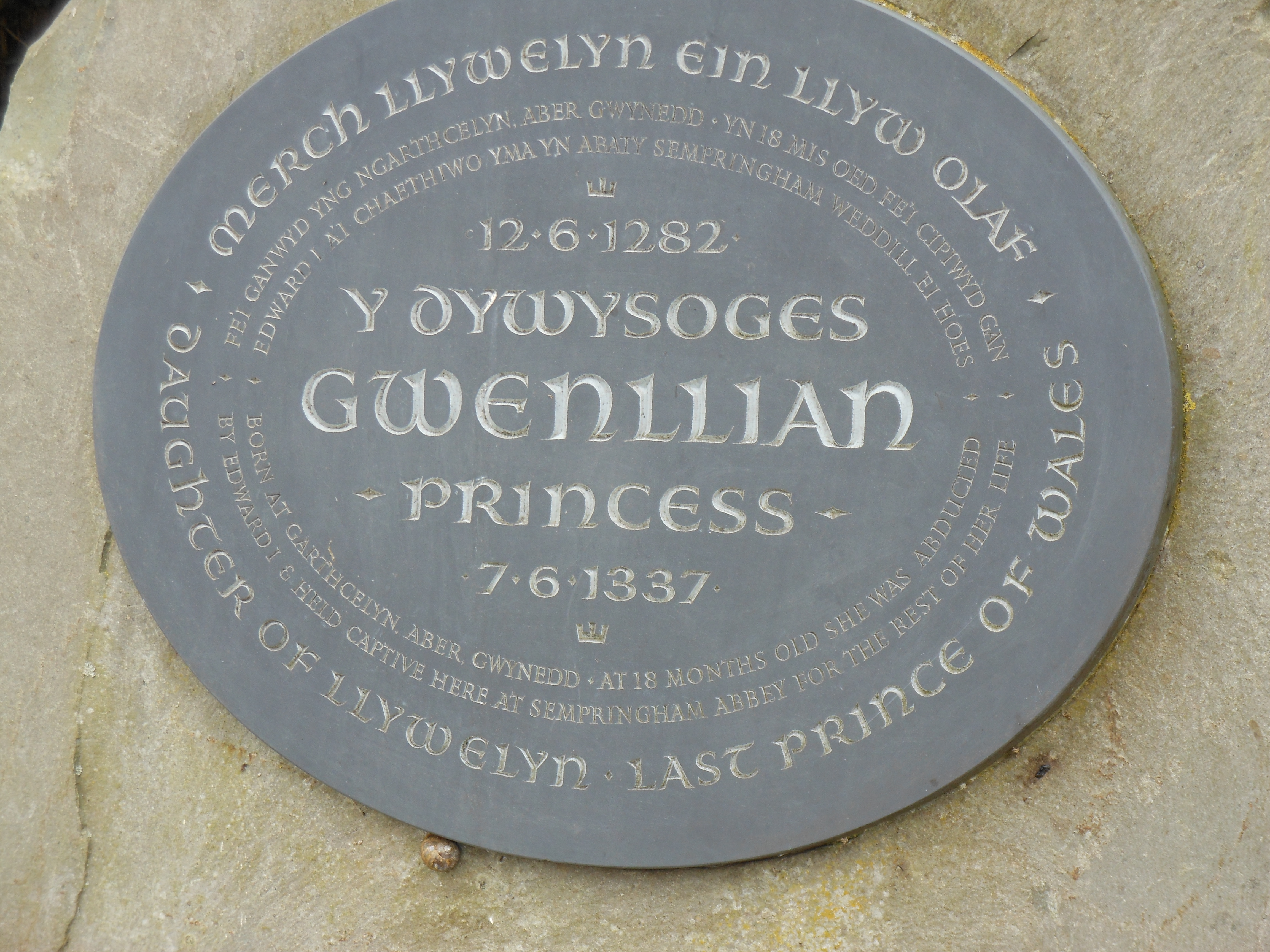
Memorial plaque to Gwenllian on the memorial at Sempringham

Although Edward wanted Gwenllian to be forgotten, he could not afford to forget about her himself, and four years after she was placed in the convent, Edward ordered Thomas Normanvill to ‘go to the places where the daughters of Llewellyn and of David his brother, who have taken the veil in the Order of Sempringham, are dwelling, and to report upon their state and custody by next Parliament’.3 The extent of Gwenllian’s knowledge of her own history and homeland is far from certain. Having been taken from Wales at six months old, she is said not to have spoken a word of Welsh and may not have even known how to spell her name; she is referred to as ‘Wencillian’, in a document sent to Edward III at the time of her death, although spelling was far from uniform in the 14th century.

Gwenllian was probably well-cared for. Edward III endowed her with a pension of £20 a year, which was paid to the priory for her food and clothing. Whether Gwenllian was treated according to her rank at the priory is unknown. However, she was aware of her importance and her family connections; as David Pilling points out and she does in fact call herself Princess of Wales, daughter of Llywelyn ap Gruffudd in a petition of 1327 to Edward II:

Wentliane, daughter of Lewelyn [Llywelyn], formerly Prince of Wales, prays the King of his grace to remember her and aid her, since the King, his father, promised her when she was put in the house of Sempringham, £100 of land and rent; whereof he told Walter de Langeton, then Treasurer, that he had given her £20 from the Exchequer yearly; and with this she has been provided.4

She is said to have received gifts from her cousin the king, and may have spent time in Edward III’s company, when he visited the priory at Easter-time in 1328; the young king issued a charter from Sempringham on 2 April of that year.5

Sharon Bennett Connolly
St Andrew’s Church, Sempringham stands close to the site of the Gilbertine priory of Sempringham

Gwenllian may also have spent time in the company of Joan Mortimer, the daughter of Roger Mortimer, supposed lover of Isabelle of France, Edward III’s mother, and ruler of England after the deposition of her huusband, Edward II. Joan was held at Sempringham following her father’s downfall in 1330. She was only eighteen at the time, however, so may have had little in common, beyond their joint status as prisoners of the crown, with Gwenllian, who was a woman now in her late forties who had spent her entire life in conventual seclusion. The profound difference between Joan and Gwenllian, of course, is that Joan was released after a short time.

Gwenllian only found her freedom in death. She died on 7 June 1337, the same month as her fifty-fifth birthday. She was buried at the priory where she had spent all but eighteen months of her life. Her grave was lost at the time of the dissolution of the monasteries, in the 16th century. However, a memorial plaque was placed near St Andrew’s Church in Sempringham in 1993, stating:

In memory of Gwenllian, daughter of the last Prince of Wales. Born at Abergwyngregyn 12.06.1282. Died at Sempringham 7.6.1337. Having been held prisoner for 54 years.6

Although she left very few marks on the world, a child whose very future was stolen by Edward I, Gwenllian’s remarkable story has not been forgotten. In 2009 a mountain in Snowdonia in Wales, formerly known as Carnedd Uchaf, was renamed Carnedd Gwenllian in the lost princess’s honour.

*

Gwenllian’s story, and that of her mother and grandmother, is told in my latest book, Ladies of Magna Carta: Women of Influence in Thirteenth Century England.

Footnotes: [1] David Ross, editor, Sempringham Priory, Church and Holy Well, britainexpress.com; [2] englishmonarchs.co.uk; [3] ibid; [4] William Rees, Calendar of Ancient Petitions Relating to Wales [5] Calendar of the Charter Rolls. 1-14, Edward III; [6] The Princess Gwenllian Society, Princessgwenllian.co.uk

Sources: castlewales.com; snowdoniaheritage.info; William Rees, Calendar of Ancient Petitions Relating to Wales; Marc Morris A Great and Terrible King;David Williamson Brewer’s British royalty; Mike Ashley The Mammoth Book of British kings & Queens; Alison Weir Britain’s Royal Families; Roy Strong The Story of Britain; Dan Jones The Plantagenets; the Kings who Made England; Chronicles of the Age of Chivalry Edited by Elizabeth Hallam; The Oxford Companion to British History; The History Today Companion to British History; Derek Wilson The Plantagenets; britainexpress.com; englishmonarchs.co.uk; princessgwenllian.co.uk; Calendar of the Charter Rolls; David Pilling.

Images: Photos of Sempringham Church and memorial ©2019 Sharon Bennett Connolly. Llywelyn the Last courtesy of Wikipedia.

*

My Books

Signed, dedicated copies of all my books are available through my online store.

Out now: Scotland’s Medieval Queens

Books by Sharon Bennett Connolly

Scotland’s history is dramatic, violent and bloody. Being England’s northern neighbour has never been easy. Scotland’s queens have had to deal with war, murder, imprisonment, political rivalries and open betrayal. They have loved and lost, raised kings and queens, ruled and died for Scotland. From St Margaret, who became one of the patron saints of Scotland, to Elizabeth de Burgh and the dramatic story of the Scottish Wars of Independence, to the love story and tragedy of Joan Beaufort, to Margaret of Denmark and the dawn of the Renaissance, Scotland’s Medieval Queens have seen it all. This is the story of Scotland through their eyes.

Scotland’s Medieval Queens gives a thorough grounding in the history of the women who ruled Scotland at the side of its kings, often in the shadows, but just as interesting in their lives beyond the spotlight. It’s not a subject that has been widely covered, and Sharon is a pioneer in bringing that information into accessible history.’ Elizabeth Chadwick (New York Times bestselling author)

Available now from Amazon and Pen and Sword Books

Also by Sharon Bennett Connolly:
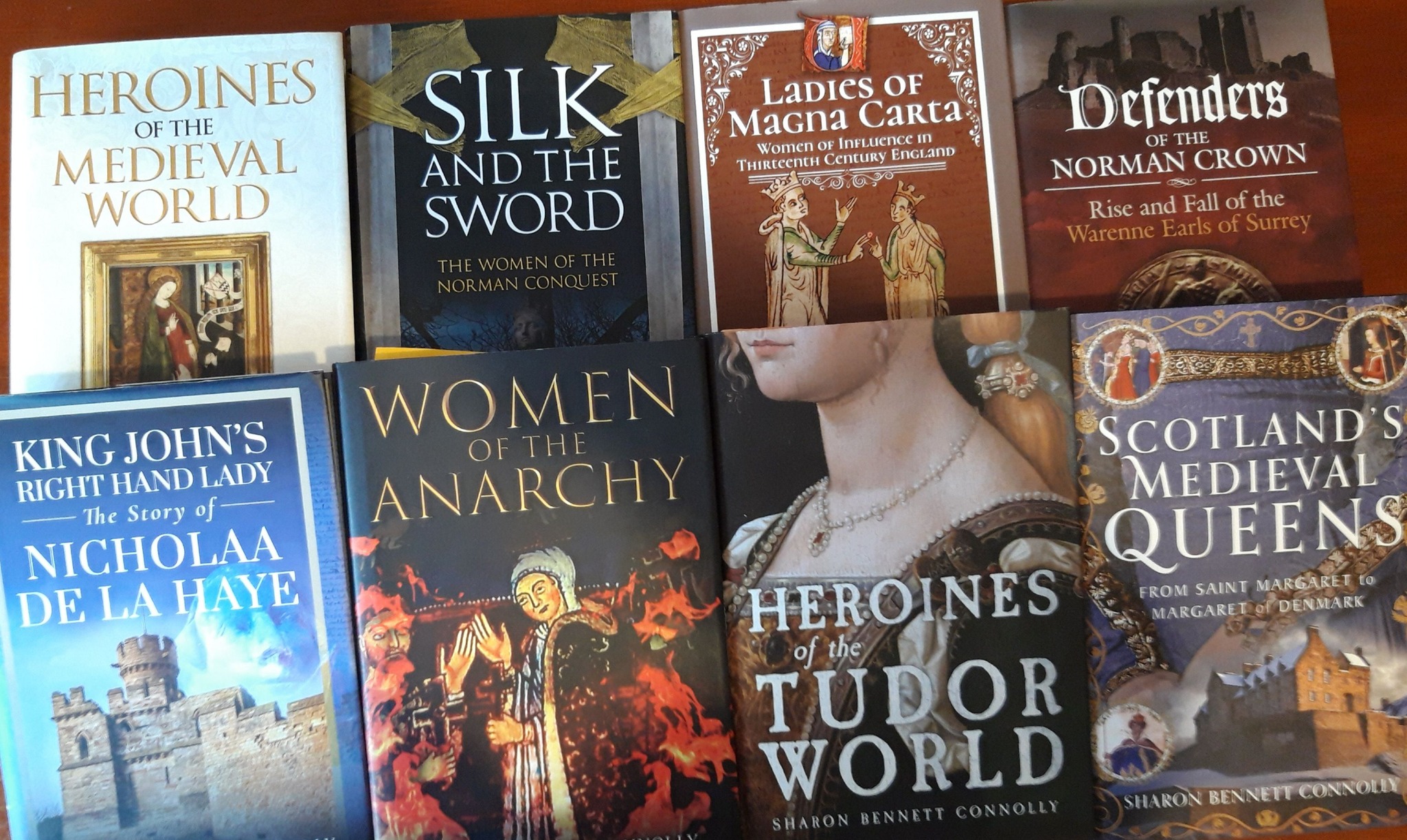
Books by Sharon Bennett Connolly

Heroines of the Tudor World tells the stories of the most remarkable women from European history in the time of the Tudor dynasty, 1485-1603. These are the women who ruled, the women who founded dynasties, the women who fought for religious freedom, their families and love. Heroines of the Tudor World is now available from Amberley Publishing and Amazon UK. Women of the Anarchy demonstrates how Empress Matilda and Matilda of Boulogne, unable to wield a sword themselves, were prime movers in this time of conflict and lawlessness. It shows how their strengths, weaknesses, and personal ambitions swung the fortunes of war one way – and then the other. Available from Bookshop.orgAmberley Publishing and Amazon UKKing John’s Right-Hand Lady: The Story of Nicholaa de la Haye is the story of a truly remarkable lady, the hereditary constable of Lincoln Castle and the first woman in England to be appointed sheriff in her own right. Available from all good bookshops Pen & Sword Booksbookshop.org and Amazon

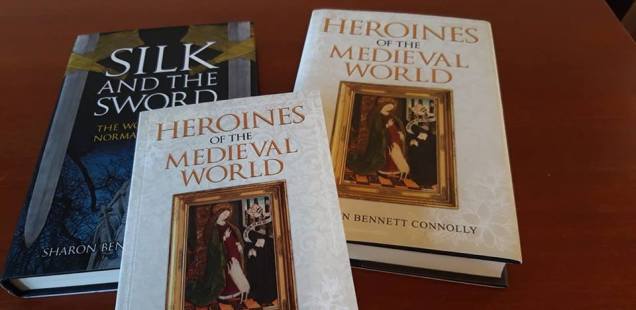
Defenders of the Norman Crown: The Rise and Fall of the Warenne Earls of Surrey tells the fascinating story of the Warenne dynasty, from its origins in Normandy, through the Conquest, Magna Carta, the wars and marriages that led to its ultimate demise in the reign of Edward III. Available from Pen & Sword BooksAmazon in the UK and US, and Bookshop.orgLadies of Magna Carta: Women of Influence in Thirteenth Century England looks into the relationships of the various noble families of the 13th century, and how they were affected by the Barons’ Wars, Magna Carta and its aftermath; the bonds that were formed and those that were broken. It is now available in paperback and hardback from Pen & SwordAmazon, and Bookshop.orgHeroines of the Medieval World tells the stories of some of the most remarkable women from Medieval history, from Eleanor of Aquitaine to Julian of Norwich. Available now from Amberley Publishing and Amazon, and Bookshop.orgSilk and the Sword: The Women of the Norman Conquest traces the fortunes of the women who had a significant role to play in the momentous events of 1066. Available now from Amazon,  Amberley Publishing, and Bookshop.org.

Alternate Endings: An anthology of historical fiction short stories including Long Live the King… which is my take what might have happened had King John not died in October 1216. Available in paperback and kindle from Amazon.

Podcast:

Have a listen to the A Slice of Medieval podcast, which I co-host with Historical fiction novelist Derek Birks. Derek and I welcome guests, such as Bernard Cornwell and Michael Jecks, and discuss a wide range of topics in medieval history, from significant events to the personalities involved. Every episode is also now available on YouTube.

*

Don’t forget! Signed and dedicated copies of all my books are available through my online bookshop.

For forthcoming online and in-person talks, please check out my Events Page.

You can be the first to read new articles by clicking the ‘Follow’ button, liking our Facebook page or joining me on TwitterThreadsBluesky and Instagram.


©2019 Sharon Bennett Connolly FRHistS

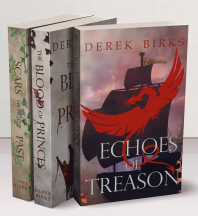
Book Corner: Echoes of Treason by Derek Birks

It is autumn 1483 and Richard III is king of England, but rumours about the fate of his nephews are rife and dissent is beginning to grow. Waiting in Brittany, is the exiled Lancastrian heir to the throne, Henry Tudor, who senses that his moment has come. Henry’s mother, Lady Margaret Stanley, plots to restore her son’s fortunes with a series of revolts against King Richard.
After the disastrous events of the summer, the embattled Elder family is scattered and in hiding. The outlawed head of the family, John, has escaped to Flanders along with a few loyal comrades, his sister, Meg, and his lover, Isabel. But the Elders will not be left to lick their wounds for long, because William Catesby, influential servant of King Richard, has made it his mission to destroy them.
When Lady Stanley tries to draw the Elders into the Tudor rebellion, John must decide whether he can cast aside his long-held Yorkist loyalties. Should he join Henry Tudor under the banner of St. George and the dragon of Wales?
It is the devil’s choice: poverty and a life in exile, or the slim chance of returning home by the fickle path of treason.

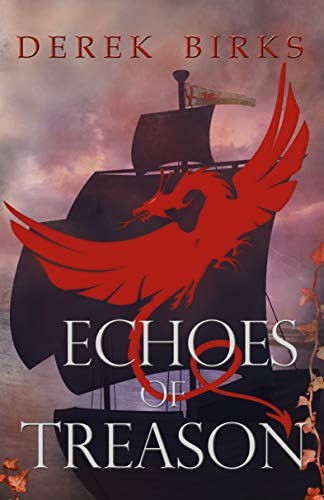
The first thing I have to say about Echoes of Treason by Derek Birks is wow! Not just for the story, but for such a stunning book cover!

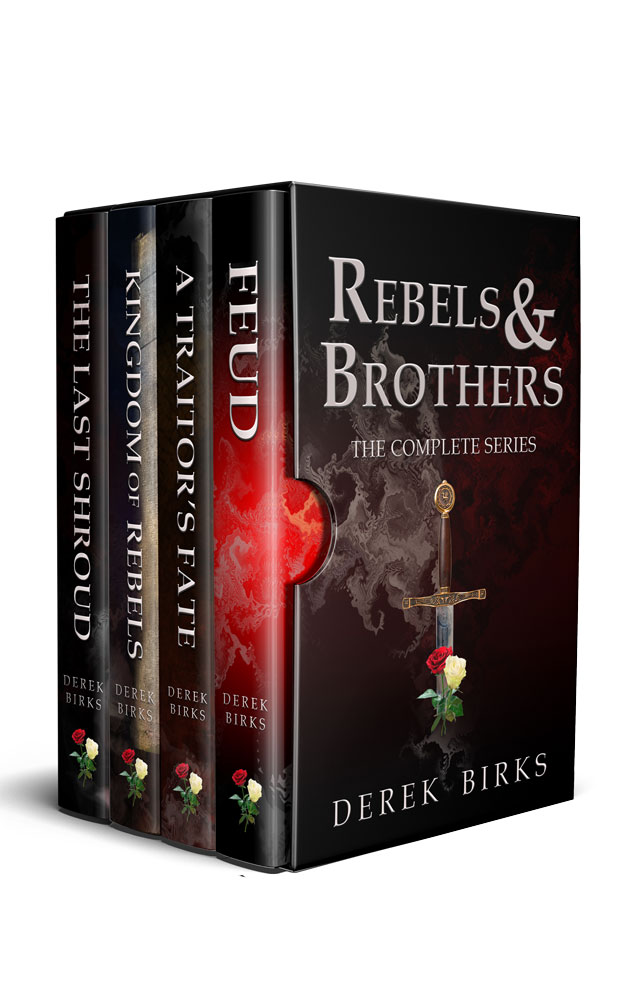
I have been a fan of Derek Birks’ work since his first book, Feud, introduced us to the Elder family in 2013. The first 4-book series, Rebel and Brothers was a refreshing new take on the Wars of the Roses era, combining national politics and war with the Elder family’s own challenges and enemies.

Echoes of Treason is the 3rd book in Derek Birks’ wonderful new series, The Craft of Kings, set during the reign of King Richard III, and following the younger generation of the Elder family, once again caught up in England’s drama. As with all Derek’s books, Echoes of Treason takes you on a fast-paced journey through medieval history, every page crammed with action and intrigue. This time we journey from Flanders to Brittany and on to England, coming face to face with enemies both old and new.

With her attention on the stall, Meg barely noticed the young woman who suddenly lurched forward and stumbled heavily into Isabel, knocking her to the ground. Torn between helping Isabel up and berating the clumsy woman who had come to rest at the feet of Thomas, Meg hesitated. Her eyes were drawn to the poor woman’s bloodstained kirtle and shift which had been torn open at the front to reveal more than a glimpse of two full, bare breasts.

Before Meg could move, however, a firm hand was clamped upon her mouth and she was lifted off her feet. Cursing her own folly, Meg was borne away, squirming, into one of the many small alleys leading away from the market. Too much time talking and not enough watching those around her! God’s teeth, she was usually so careful! She should have seen her attacker coming, love-besotted fool that she now was!

Her captor slammed her against a wall which ran alongside the alley, his hand still over her mouth. First things first, thought Meg, biting one of his fingers as hard as she could. While he was yelping in pain, she twisted half out of his grasp and reached down to her boot. But he recovered swiftly and they grappled with each other in a whirling flurry of arms until his greater strength enabled him to pin her to the wall once more with his hand around her neck. With his other hand he held a knife at her breast but she simply glared back at him, two sapphire eyes boring into his.

To her surprise, he sought to reassure her. “Don’t be alarmed, girl; you’ve no need to be frightened; I’ll not hurt you.”

But far from being afraid, Meg was just warming to her work. “Put up your blade,” she warned.

he gave a shake of the head until she pressed the point of the knife she had retrieved from her boot against his neck. Now, for the first time, she had his full attention.

“By Christ, little girl!” he cried. “Have a care with that knife!”

Echoes of Treason follows the Elder family into exile, following on from The Blood of Princes and John Elder’s attempts to rescue the Prince in the Tower. From the first pages, in exile in Bruges, to a dramatic return to England’s shores, the action is fast-paced, on land and sea. The author shows his wide breadth of knowledge of the era by incorporating actual events and characters who played leading roles in the history. There is a fabulous interview with Henry Tudor that leaves you smiling for days!

The tension is palpable on every page and builds to a crescendo as the story drives inexorably to the last, desperate fight. The plot, moreover, is as well thought out as the action and drags the Elder family into the intrigues and machinations of those fighting for the crown itself, and their scheming lackeys!

My favourite character in any Derek Birks book is Lady Eleanor Elder. Eleanor has become a bit of a heroine of mine; she is no weak-willed woman and fights with her wits and whatever weapon is to hand, whenever she is backed into a corner. It is a credit to the author that he has let this amazing woman take on a life of her own in the story, despite not being the lead character. She deserves a story of her own (hint, hint!)

I loved this book from the first page to the last. My only complaint is that I found it harder to write my own whilst I was reading it – I found myself drifting off into the Wars of the Roses and wondering how the Elders would get themselves out of the impossible predicament Derek Birks had sent them into. It is only when the last page has been turned that you can breathe a sigh of relief and one of regret, that the book finished too soon!

About the author:

Derek Birks was born in Hampshire in England but spent his teenage years in Auckland, New Zealand where he still has strong family ties.
For many years he taught history in a secondary school in Berkshire but took early retirement several years ago to concentrate on his writing.
Apart from writing, he spends his time gardening, travelling, walking and taking part in archaeological digs at a Roman villa.

Derek is interested in a wide range of historical themes but his particular favourite is the later Medieval period. He aims to write action-packed fiction which is rooted in accurate history. His debut historical novel, Feud, is set in the period of the Wars of the Roses and is the first of a four-book series entitled Rebels & Brothers which follows the fortunes of the fictional Elder family.
The other books of the series are (in order): A Traitor’s Fate, Kingdom of Rebels and The Last Shroud.

The first book of a brand new series, Scars From the Past, is now out in both kindle and paperback.
His books are available on Amazon in the UK and US.
You can find Derek at;
Amazon
Blog
Facebook
Twitter 

*

My Books

Silk and the Sword: The Women of the Norman Conquest

From Emma of Normandy, wife of both King Cnut and Æthelred II to Saint Margaret, a descendant of Alfred the Great himself, Silk and the Sword: the Women of the Norman Conquest traces the fortunes of the women who had a significant role to play in the momentous events of 1066.  Available now from Amazon UK,  Amberley Publishing, Book Depository and Amazon US.

Heroines of the Medieval World

Telling the stories of some of the most remarkable women from Medieval history, Heroines of the Medieval World,  is now available in hardback in the UK from Amazon UK, and in the US from Amazon US. It is available now in paperback in the UK from from both Amberley Publishing and Amazon and worldwide from Book Depository.

*

You can be the first to read new articles by clicking the ‘Follow’ button, liking our Facebook page or joining me on Twitter.

©2019 Sharon Bennett Connolly

Book Corner: Storm of steel by Matthew Harffy

Today I am delighted to be a part of the book tour for Matthew Harffy‘s latest addition to his Bernicia Chronicles, Storm of Steel, with a review of this fabulous new novel.

AD 643. Anglo-Saxon Britain. A gripping, action-packed historical thriller and the sixth instalment in the Bernicia Chronicles.

Heading south to lands he once considered his home, Beobrand is plunged into a dark world of piracy and slavery when an old friend enlists his help to recover a kidnapped girl. Embarking onto the wind-tossed seas, Beobrand pursues his quarry with single-minded tenacity.

But the Whale Road is never calm and his journey is beset with storms, betrayal and violence.

As the winds of his wyrd blow him ever further from what he knows, will Beobrand find victory on his quest or has his luck finally abandoned him?

I have had the distinct pleasure of following the adventures of Beobrand and his band of warriors from the very first to book to this one, the sixth in the series. In a feat that few authors ever manage to achieve, each book has been better than the last and, indeed, when I read the last one, Warrior of Woden, I sincerely doubted that Matthew Harffy could top it. But top it he has! And in spectacular style.

In Storm of Steel Beobrand has gone off in a new direction, on a  personal mission, rather than one dictated by kings, and by sea rather than land. This has given scope for a fabulous new adventure and gives a new edge to the battles, both on land and sea – and against the elements. It also means new experiences, as Beobrand journeys along the south coast and into Frankia. The locations are stunning, Matthew Harffy’s descriptions of dramatic coastlines, stormy weather and the different brands of people he encounters, from lowly peasants, to pirates and warlords, all serve to transport the reader back to the 7th century, recreating the Anglo-Saxon world in the mind of the reader.

‘Go Cynan,’ Beobrand whispered.

Cynan stepped away from the sailors and scrambled over the side of the ship, back into Háligsteorra. Beobrand followed him and quickly joined Bassus and the others where they stood before a pile of bloody corpses.

The pirates clambered off the ship even more quickly than they had boarded. Their leader was last, and he shuffled towards the wale still clutching Dalston to him, with the sharp seax blade digging into the skin beneath the monk’s chin.

When he reached the side, he stepped over, steadied by the welcoming hands of his men. He lifted Dalston bodily and carried him over with him.

‘Take the treasure the boy carries,’ shouted Beobrand. Send the boy back.’

The dull thuds of axe blows signalled the ropes that had held the ships together being cut. Using their oars, the pirates shoved the two ships apart. the gap between the vessels widened quickly, soon it would be too far even for an unarmoured man to jump.

‘Send the boy back!’ yelled Beobrand again, but as he said the words, he tasted the bitterness of defeat and deceit in his throat.

Storm of Steel is Beobrand’s 6th adventure; the stunning imagery and constant action leads the reader into Beobrand’s world in magnificent style. The action, as ever, is constant and leads the reader on a roller-coaster of a ride from the first page to the last, never quite certain that Beobrand will win through, nor even that he will survive the encounter with one of the greatest warlords of Frankia and rescue the kidnapped girl…. I’m not telling….

Matthew Harffy is an author whose writing goes from strength to strength with each book. I feel I’m repeating myself when I say ‘this is the best one yet’, but it truly is. I defy anyone to be able to put it down without wanting to read through to the end in one sitting. I certainly read late into the night, but the lack of sleep was well worth the experience of another adventure with the now-famous Beobrand and his band of warriors.

Storm of Steel  is a masterpiece of a novel, the visually imagery recreated by the words evoke a world so long in the past that little remains but archaeology, and yet the reader can imagine themselves there, and fighting at the side of Beobrand, Cynan, Bassus and the rest. But there is more to fighting in all of Matthew Harffy’s books. The intricate and engrossing plot weaves its way between the battles – against man and the elements – to tell a story that is at once intriguing and gripping.

Beobrand and the Bernicia Chronicles are a phenomenon!

I cannot recommend the stories of Beobrand, told in the Bernicia Chronicles, highly enough. And Storm of Steel stands out as one of the best books I have read so far, this year.

About the author

Matthew grew up in Northumberland where the rugged terrain, ruined castles and rocky coastline had a huge impact on him. He now lives in Wiltshire, England, with his wife and their two daughters.

 Follow Matthew Harffy:    

Twitter: @MatthewHarffy, Facebook: @MatthewHarffyAuthor, Website: http://www.matthewharffy.com/

Buy links:

Amazon: https://amzn.to/2INuSlg; Kobo: https://bit.ly/2IQsFWo; Google Play: ttps://bit.ly/2GEC8i9; iBooks: https://apple.co/2UQcr6Y

Follow Aria

Website: www.ariafiction.com; Twitter: @aria_fiction; Facebook: @ariafiction; Instagram: @ariafiction

*

My Books

Silk and the Sword: The Women of the Norman Conquest

From Emma of Normandy, wife of both King Cnut and Æthelred II to Saint Margaret, a descendant of Alfred the Great himself, Silk and the Sword: the Women of the Norman Conquest traces the fortunes of the women who had a significant role to play in the momentous events of 1066.  Available now from Amazon UK,  Amberley Publishing, Book Depository and Amazon US.

Heroines of the Medieval World

Telling the stories of some of the most remarkable women from Medieval history, Heroines of the Medieval World,  is now available in hardback in the UK from Amazon UK, and in the US from Amazon US. It is available now in paperback in the UK from from both Amberley Publishing and Amazon and worldwide from Book Depository.

*

You can be the first to read new articles by clicking the ‘Follow’ button, liking our Facebook page or joining me on Twitter.

©2019 Sharon Bennett Connolly


Guest Post: Anna Duchess of Cleves by Heather R. Darsie

Today it is a pleasure to welcome historian Heather R. Darsie to History… the Interesting Bits with an article about Anne of Cleves, Henry VIII’s fourth wife. Heather’s new book, Anna Duchess of Cleves; the king’s Beloved Sister is out now.

The First Hint of Trouble: An Early Spat Between the Johann II of Cleves and Elector Frederick of Saxony

By Heather R. Darsie

Throughout the late 15th and early 16th century, various disputes over territory sprung up across the German-speaking portions of the Holy Roman Empire. In 1517, a new facet of rebellion against the Empire was introduced in Saxony when Martin Luther’s 95 Theses became known. Maximilian I was still the Holy Roman Emperor in 1517. He could not know what the changing attitudes toward the Catholic church would do to the fabric of the Empire. Maximilian passed away on 12 January 1519, making his grandson Charles the next Holy Roman Emperor. Charles’ first coronation, in Germany, took place in 1520.

Twenty-year-old Charles V was crowned in October 1520 as the King of the Romans-Germans at a grand ceremony in Aachen. By being crowned King of the Romans-Germans, Charles V was the Holy Roman Emperor Elect. Pope Leo X gave Charles V permission to style himself as the Holy Roman Emperor until Charles’ 1530 coronation at Bologna by Pope Clement VII.

In 1520 when Charles V’s massive train of at least two thousand horse. The various electors, including Elector Fredrick of Saxony, made up part of Charles V’s company. Though the details are unclear, it is recorded in an account of Charles V’s coronation printed circa 1520 that the Elector of Saxony and “Duke of Gülch” – an archaic spelling of “Jülich” – squabbled for a long time over who took which precedence during the procession to Aachen Cathedral.

Frederick of Saxony believed that Johann III of Cleves should have been included with the Saxon contingent rather than Johann being independent of Saxony. Saxony was ruled by an Elector, with only eleven electors in all of the Germanic areas. By comparison, Johann III was only a duke, and there were hundreds of duchies in all of the Germanic areas. In the end, Anna’s father Johann III entered the city before Elector Frederick of Saxony. Elector Frederick likely took exception to this snub.

Elector Frederick, famous for having sheltered Martin Luther from Charles V, passed away. Because Frederick was childless, his younger brother John became Elector of Saxony in 1525. Frederick was Catholic throughout his life. There is some debate over whether Frederick converted to Lutheranism on his deathbed. In February 1527, Elector John’s son Johann Friedrich married Johann III’s eldest daughter, Sybylla of Cleves.  The debate over Lutheran reforms was in full swing, and Charles V tried his best to quell the rising tides of religious change.

The marital alliance between Anna of Cleves’ elder sister Sybylla and Johann Friedrich did not have the immediate benefits for which Elector John hoped. Elector John was a Lutheran even before he became the Elector of Saxony. Sybylla and Johann Friedrich welcomed their first son, also named Johann Friedrich, in January 1529. The next year, the first Diet of Augsburg took place. It was at this Diet that Emperor Charles V tried to soothe tensions over Protestantism, and also when he introduced his comprehensive criminal code. The Augsburg Confession was produced because of this Diet, too. After the Diet of Augsburg, the issue of religion and thus, allegiance to the Emperor became more divided.

Anna’s and Sybylla’s parents were Catholic, their mother Maria particularly so. Jülich-Cleves-Berg was understood to be predominantly Catholic under the reign of Johann III, but tolerant of Lutheranism. By the late 1520s, two political and religious ideas dominated Germany: pro-Imperial and pro-Catholic, or anti-Imperial and pro-Lutheran. This put Jülich-Cleves-Berg and Saxony on different ends of the political spectrum.

Sybylla herself converted to Lutheranism, as did Anna’s and Sybylla’s little sister Amalia. At the begin of his reign in 1539 as Duke Wilhelm V, Johann Friedrich sent Philipus Melanchthon to learn whether Wilhelm was pro-Lutheran or pro-Catholic. Johann Friedrich became Elector of Saxony in 1532 after the death of his father, and needed to know which way Wilhelm leaned.

If you’re curious to know more about religion in Cleves during Anna of Cleves’ lifetime, check out my new biography, “Anna, Duchess of Cleves: The King’s ‘Beloved Sister.’

Sources & Suggested Reading

  1. Römischer Künigklicher Maiestat Krönung zü Ach Geschehen. Author unknown. Circa Held by the Newberry Library, Chicago, Illinois.
  2. Rosenthal, Earl E. “The Invention of the Columnar Device of Emperor Charles V at the Court of Burgundy in Flanders in 1516.” Journal of the Warburg and Courtauld Institutes36 (1973): 198-230.
  3. Darsie, Heather. Anna, Duchess of Cleves: The King’s ‘Beloved Sister.’ Stroud: Amberley (2019).

Anna Duchess of Cleves; the king’s Beloved Sister

Anna was the ‘last woman standing’ of Henry VIII’s wives – and the only one buried in Westminster Abbey. How did she manage it?

Anna, Duchess of Cleves: The King’s ‘Beloved Sister’ looks at Anna from a new perspective, as a woman from the Holy Roman Empire and not as a woman living almost by accident in England. Starting with what Anna’s life as a child and young woman was like, the author describes the climate of the Cleves court, and the achievements of Anna’s siblings. It looks at the political issues on the Continent that transformed Anna’s native land of Cleves – notably the court of Anna’s brother-in-law, and its influence on Lutheranism – and Anna’s blighted marriage. Finally, Heather Darsie explores ways in which Anna influenced her step-daughters Elizabeth and Mary, and the evidence of their good relationships with her.

Was the Duchess Anna in fact a political refugee, supported by Henry VIII? Was she a role model for Elizabeth I? Why was the marriage doomed from the outset? By returning to the primary sources and visiting archives and museums all over Europe (the author is fluent in German, and proficient in French and Spanish) a very different figure emerges to the ‘Flanders Mare’.

Anna Duchess of Cleves; the king’s Beloved Sister is available now from Amberley Publishing and Amazon in the UK and from Book Depository worldwide.

About the author:

Heather Darsie works as an attorney in the US. Along with her Juris Doctorate she has a BA in German, which was of great value in her research in the archives of Germany, Switzerland and the Netherlands for this book. She is currently studying for her Master’s in Early Modern History through Northern Illinois University. She runs the website MaidensAndManuscripts.com and regularly contributes to QueenAnneBoleyn.com and TudorsDynasty.com. She has been researching this work for several years.

*

My books

Tracing the fortunes of the women who had a significant role to play in the momentous events of 1066, Silk and the Sword: the Women of the Norman Conquest is available from Amazon UK,  Amberley Publishing, Book Depository and Amazon US.

Also by Sharon Bennett Connolly:

Telling the stories of some of the most incredible women from Medieval history, Heroines of the Medieval World,  is now available in hardback in the UK from Amazon UK, and in the US from Amazon US. It is available now in paperback in the UK from from both Amberley Publishing and Amazon and worldwide from Book Depository.

*

You can be the first to read new articles by clicking the ‘Follow’ button, liking our Facebook page or joining me on Twitter.

©2019 Sharon Bennett Connolly and Heather R. Darsie

Mother’s Day Giveaway

Competition Closed: And the winner is Heather Jackson

Sunday 31st March 2019 is Mother’s Day in the UK this year and what beet way to celebrate the release of the paperback of Heroines of the Medieval World, than a giveaway for everyone’s favourite Heroine – MUM?!?!

“As Connolly ably demonstrates, knowing about these fascinating women is essential to filly understanding medieval Europe.” (Publishers Weekly)

About Heroines of the Medieval World

Heroines come in many different forms, and it is no less true for medieval heroines. They can be found in all areas of medieval life; from the dutiful wife and daughter to religious devotees, warriors and rulers. What makes them different compared to those of today are the limitations placed on them by those who directed their lives – their fathers, husbands, priests and kings. Women have always been an integral part of history, although when reading through the chronicles of the medieval world, you would be forgiven if you did not know it. We find that the vast majority of written references are focussed on men. The chronicles were written by men and, more often than not, written for men. It was men who ruled countries, fought wars, made laws and treaties, dominated religion and guaranteed – or tried to guarantee – the continued survival of their world. It was usually the men, but not all of them, who could read, who were trained to rule and who were expected to fight, to defend their people and their country…


And don’t worry, the offer is open worldwide – even if it isn’t Mother’s Day for you just yet.

If you would like to win a signed copy of Heroines of the Medieval World to give to your mum on Mother’s Day, or someone else’s mum – or even as a gift to yourself, simply leave a comment below or on my Facebook page and I will include you in the prize draw.

The draw will be made on Wednesday 27th March, so you should get the book in time for the big day.

*

Out Now!

Tracing the fortunes of the women who had a significant role to play in the momentous events of 1066, Silk and the Sword: the Women of the Norman Conquest is available from Amazon UK,  Amberley Publishing, Book Depository and Amazon US.

Also by Sharon Bennett Connolly:

Telling the stories of some of the most incredible women from Medieval history, Heroines of the Medieval World,  is now available in hardback in the UK from Amazon UK, and in the US from Amazon US. It is available now in paperback in the UK from from both Amberley Publishing and Amazon and worldwide from Book Depository.

*

You can be the first to read new articles by clicking the ‘Follow’ button, liking our Facebook page or joining me on Twitter.

 *

©2019 Sharon Bennett Connolly

Emma of Normandy, Queen of England

Detail of Emma of Normandy before an altar

In the years leading up to the Norman Conquest of 1066 one woman, in particular, stands out as the matriarch of the period: Emma of Normandy.

As wife of both Æthelred II and King Cnut, Emma of Normandy was the lynchpin of the story of the 11th century. As a Norman, and the mother of both a Danish king of England and a Saxon King of England, it was Emma who bound all three sides together in the conflict of 1066. Her story is suitably dramatic; with exile, tragedy and scandal all playing their part, starkly contrasting with the wealth and privilege of her role as the only twice-crowned Queen of England.

Emma was the daughter of Richard I, Duke of Normandy, and his wife, Gunnora. Born in around 985/987, she was married to Æthelred at Winchester on 5 April 1002, at which time she was given the English name Ælfgifu, although in the Anglo-Saxon Chronicle she is often referred to, simply, as ‘The Lady’. Her marriage with Æthelred was an attempt to seal a peace between England and Normandy, and to persuade the Normans not to allow the Viking raiders, who tormented England’s shores, to winter in their lands between raids into England. Despite the fact the Vikings continued to shelter in Normandy every winter, and raiding into England continued throughout the early years of the 11th century, the marriage was a success in that it produced two more sons and a daughter for Æthelred; a second family considering he was the father of as many as thirteen children by his first wife, Ælfgifu of York, including at least six sons.

Edward the Confessor

Of Emma and Æthelred’s two sons the eldest, Edward, would eventually succeed his half-brother, Harthacnut, to the English throne in 1042, ruling until his death on 5 January 1066. Edward’s younger brother, Alfred, was cruelly murdered during the reign of his step-brother, Harold I Harefoot. Harold was the son of Cnut by his first, handfast wife, Ælfgifu of Northampton. Alfred had arrived in England in 1036, ostensibly to visit his mother, though there are also theories that he intended to mount a challenge for the throne, and was welcomed by Earl Godwin of Wessex. However, his party were ambushed whilst being entertained by Godwin and Alfred was seized and taken to the abbey at Ely in Cambridgeshire, where he was later blinded and either murdered, or succumbed to his wounds. Either way, he died on 5 February 1037 and was buried in Ely Cathedral. Edward and Alfred’s sister, Goda (or Godgifu), was married firstly to Drogo, Count of Mantes and, secondly to Eustace II, Count of Boulogne. One of her sons by Drogo, Ralph, was made Earl of Hereford by his uncle, Edward, but earned himself the insulting nickname Ralph the Timid after fleeing the Welsh in battle.

As the Viking raids increased from 1010 onwards, Æthelred’s position on the throne proved precarious and he sent his wife and her young sons to Normandy for safety, before being forced into exile there himself in 1013, when Sweyn Forkbeard seized the throne. Sweyn’s death early in 1014 offered Æthelred a way back and he sent Edward to England to negotiate his return with the English Witan, who invited Æthelred to resume the throne ‘if he would govern them better than he did before’.1 Despite his promises, Æthelred proved just as inept as previously, failing to defeat the Danish invaders, led by Cnut. Æthelred died just two years later, on 23 April 1016 (ironically, St George’s Day), and was succeeded by his oldest surviving son by his first wife, Edmund II Ironside. Although Edmund put up a valiant fight against the Danish invaders, led by Cnut, a summer of fighting took its toll and he died on 30 November 1016.

Coin from the reign of Harthacnut

Cnut took control of the whole of England and one of his first actions was to send for Emma, who he married on 2 July 1017. Although Emma appears to have had little influence during the reign of her first husband, her marriage with Cnut appears to have been a partnership. She was a more visible figure in public, enjoying considerable influence at court and offering substantial patronage to the church. She gave Cnut three children including a son, Harthacnut, and two daughters, one who’s name is lost, died aged 8 and is buried in Bosham, Sussex. A second daughter, Gunhilda, married Henry III, Emperor of Germany.

When Cnut died in 1035 Emma was in England and retired to her manor in Winchester, taking the royal treasury with her in the hope she could pass it to her son, Harthacnut. However, Harthacnut was in Denmark and it was Harold Harefoot, one of Cnut’s sons by Ælfgifu of Northampton, who seized the initiative. An agreement was reached whereby the half-brothers ruled as co-kings with Emma acting for Harthacnut and ruling in Wessex. However, two years later Harthacnut had still not returned to England and Harold took the crown for himself, driving Emma into exile with Count Baldwin in Flanders.

Genealogical table of Cnut, Harold I and Harthacnut

Harthacnut appears to have been, by far, Emma’s favourite child. It was for his accession to the English throne that she schemed, rather than for her eldest son, Edward. In the early months of 1040 she and Harthacnut were preparing to invade England when they heard of Harold’s death. Harthacnut succeeded to the English throne without a fight and a year later invited his half-brother Edward, who had spent almost 25 years in Norman exile, to join him in England as his successor.

Harthacnut reigned for just ten days short of two years, he died after collapsing during a wedding celebration at Lambeth. He was buried alongside his father in the old minster at Winchester and Emma gave the head of St Valentine to the new minster for her son’s soul. Emma’s relationship with Edward, however, was more strained than that she experienced with Harthacnut. Years of separation and a strong sense of abandonment on Edward’s part cannot have helped the situation. Following his coronation in 1043, one of Edward’s first actions was to ride to Winchester and take charge of the Treasury, which had been left in his mother’s hands by Harthacnut. Accompanied by the three greatest earls of his realm – Siward, Godwin and Leofric – ‘they deprived her of all the treasure that she had; which were immense; because she was formerly very hard upon the king her son, and did less for him than he wished before he was king…’2

Emma’s friend and close adviser, Bishop Stigand, was deprived of his bishopric, although he was later reinstated and created Bishop of Winchester. He eventually rose to be Archbishop of Canterbury but was removed from office by William the Conqueror. However, at the time of her disgrace, Emma and Stigand’s close relationship gave rise to a later legend that they were more than friends and that Emma was accused of adultery with Stigand (although the 13th century story claimed the bishop’s name was Ælfwine). There is no contemporary evidence of the story, however, and it first appears more than 100 years after the Conquest. As the story went, Emma was accused of adultery and required to walk across red-hot ploughshares in order to prove her innocence. Being neither cut nor burned by the instruments she was declared innocent. As a consequence, Emma was welcomed back into the royal circle by a contrite Edward.

Winchester Cathedral

Although the story is almost certainly a fabrication, Emma was eventually reconciled with Edward, although she enjoyed a much less exalted position as the king’s mother than she had when Harthacnut reigned. She eventually retired to her own estates, living away from the limelight until her death on 6 March 1052. She was buried in the old minster at Winchester, alongside her second husband, Cnut and her favourite son, Harthacnut. Emma’s story forms the basis for the book Encomium Emmae Reginae, possibly commissioned by Emma herself, which provides a significant insight into English politics for the first half of the 11th century.

Emma had played a pivotal role in English politics in the first half of the 11th century, the effects of which would lead to the fateful events of 1066. She helped to shape the events from which the unique situation of the Norman Conquest would arise.  A prominent figure, particularly in the reigns of Cnut and Harthacnut, she was the most distinguished woman of her time. More than any other single person, Emma’s story provides the background to the Norman Conquest through the political and personal relationships formed in the first half of the 11th century.

*

Footnotes: 1The Anglo-Saxon Chronicle translated by James Ingram; 2ibid.

Picture credits: Detail of Emma of Normandy before an altar courtesy of the British Library; Edward the confessor courtesy of Wikipedia; coin from the reign of Harthacnut, courtesy of Hedning, taken from Wikipedia; Genealogical table of Cnut, Harold I and Harthacnut from the Genealogical Chronicle of the English Kings, British Library; Winchester Cathedral courtesy of Anne Marie Bouchard.

Sources: The English and the Norman Conquest by Dr Ann Williams; Brewer’s British Royalty by David Williamson; Britain’s Royal Families, the Complete Genealogy by Alison Weir; The Wordsworth Dictionary of British History by JP Kenyon; The Norman Conquest by Marc Morris; Harold, the King Who Fell at Hastings by Peter Rex; The Anglo-Saxons in 100 Facts by Martin Wall; The Anglo-Saxon Age by Martin Wall; Kings, Queens, Bones and Bastards by David Hilliam; The Mammoth Book of British kings & Queens by Mike Ashley; The Oxford Companion to British History Edited by John Cannon; The Anglo-Saxon Chronicles translated and edited by Michael Swanton; The Anglo-Saxon Chronicle translated by James Ingram; Queen Emma and the Vikings by Harriett O’Brien; The Bayeux Tapestry by Carola Hicks; On the Spindle Side: the Kinswomen of Earl Godwin of Wessex by Ann Williams; oxforddnb.com.

*

My books

Signed, dedicated copies of all my books are available through my online bookshop.

Out now: Scotland’s Medieval Queens

Scotland’s history is dramatic, violent and bloody. Being England’s northern neighbour has never been easy. Scotland’s queens have had to deal with war, murder, imprisonment, political rivalries and open betrayal. They have loved and lost, raised kings and queens, ruled and died for Scotland. From St Margaret, who became one of the patron saints of Scotland, to Elizabeth de Burgh and the dramatic story of the Scottish Wars of Independence, to the love story and tragedy of Joan Beaufort, to Margaret of Denmark and the dawn of the Renaissance, Scotland’s Medieval Queens have seen it all. This is the story of Scotland through their eyes.

Available now from Amazon and Pen and Sword Books

Also by Sharon Bennett Connolly:

Heroines of the Tudor World tells the stories of the most remarkable women from European history in the time of the Tudor dynasty, 1485-1603. These are the women who ruled, the women who founded dynasties, the women who fought for religious freedom, their families and love. Heroines of the Tudor World is now available for pre-order from Amberley Publishing and Amazon UK. Women of the Anarchy demonstrates how Empress Matilda and Matilda of Boulogne, unable to wield a sword themselves, were prime movers in this time of conflict and lawlessness. It shows how their strengths, weaknesses, and personal ambitions swung the fortunes of war one way – and then the other. Available from Bookshop.orgAmberley Publishing and Amazon UKKing John’s Right-Hand Lady: The Story of Nicholaa de la Haye is the story of a truly remarkable lady, the hereditary constable of Lincoln Castle and the first woman in England to be appointed sheriff in her own right. Available from all good bookshops Pen & Sword Booksbookshop.org and Amazon

Defenders of the Norman Crown: The Rise and Fall of the Warenne Earls of Surrey tells the fascinating story of the Warenne dynasty, from its origins in Normandy, through the Conquest, Magna Carta, the wars and marriages that led to its ultimate demise in the reign of Edward III. Available from Pen & Sword BooksAmazon in the UK and US, and Bookshop.orgLadies of Magna Carta: Women of Influence in Thirteenth Century England looks into the relationships of the various noble families of the 13th century, and how they were affected by the Barons’ Wars, Magna Carta and its aftermath; the bonds that were formed and those that were broken. It is now available in paperback and hardback from Pen & SwordAmazon, and Bookshop.orgHeroines of the Medieval World tells the stories of some of the most remarkable women from Medieval history, from Eleanor of Aquitaine to Julian of Norwich. Available now from Amberley Publishing and Amazon, and Bookshop.orgSilk and the Sword: The Women of the Norman Conquest traces the fortunes of the women who had a significant role to play in the momentous events of 1066. Available now from Amazon,  Amberley Publishing, and Bookshop.org.

Alternate Endings: An anthology of historical fiction short stories including Long Live the King… which is my take what might have happened had King John not died in October 1216. Available in paperback and kindle from Amazon.

Podcast:

Have a listen to the A Slice of Medieval podcast, which I co-host with Historical fiction novelist Derek Birks. Derek and I welcome guests, such as Bernard Cornwell and Elizabeth Chadwick, and discuss a wide range of topics in medieval history, from significant events to the personalities involved. Every episode is also now available on YouTube.

*

Don’t forget! Signed and dedicated copies of all my books are available through my online bookshop.

For forthcoming online and in-person talks, please check out my Events Page.

You can be the first to read new articles by clicking the ‘Follow’ button, liking our Facebook page or joining me on Twitter and Instagram.

©2019 Sharon Bennett Connolly FRHistS

Book Corner: The Scandal of George III’s Court by Catherine Curzon

From Windsor to Weymouth, the shadow of scandal was never too far from the walls of the House of Hanover. Did a fearsome duke really commit murder or a royal mistress sell commissions to the highest bidders, and what was the truth behind George III’s supposed secret marriage to a pretty Quaker? With everything from illegitimate children to illegal marriages, dead valets and equerries sneaking about the palace by candlelight, these eyebrow-raising tales from the reign of George III prove that the highest of births is no guarantee of good behaviour. Prepare to meet some shocking ladies, some shameless gentlemen and some politicians who really should know better. So tighten your stays, hoist up your breeches and prepare for a gallop through some of the most shocking royal scandals from the court of George III’s court. You’ll never look at a king in the same way again…

I have been taking a break from the medieval era this month to visit the court of King George III, reading the fabulous non-fiction book, The Scandal of  George III’s Court by Catherine Curzon. And what a thoroughly delightful read!

Anyone who has studied the Georgian era to some extent will be familiar with some of these scandals, but to have them all presented on one book is a real treat. Catherine Curzon loves her subject – and her subjects – and this shines through on every page. This is not some onerous read, listing scandal after scandal, but an in-depth look at some of the most devastating and salacious scandals that rocked the Georgian court – and obviously tried the precarious mental state of the king to its very limits.

My favourite is the retelling of a story which I have known for some time, but have never looked into in the depth that Catherine Curzon delves. The story of Caroline Matilda, Queen of Denmark, her mentally unbalanced husband and her lover, Struensee, is one that everyone should know, and ultimately a tragedy for all involved.;

Christian’s mental health had by now deteriorated drastically and when Struensee was promoted again, this time to Councillor of Conference and the queen’s ‘very’ Private Secretary, there could be no doubt how the wind was blowing. Struensee warned Caroline Matilda that her husband would soon be incapable of ruling and someone else would need to steer the ship of state. If Caroline Matilda didn’t seize the day, then Julianna Maria certainly would. That was all it took, and soon Denmark’s newest power couple began positioning themselves to take the reins of the kingdom.

Oddly, almost as soon as the affair began, Christian warmed to his wife, and began to hold her in a higher regard. Together, the trio of king, queen and doctor seemed to get along in a way that Caroline Matilda and Christian never had before. Though this was no ménage both husband and wife seemed far more at ease, and at 18, Caroline Matilda was finally flourishing, no longer the unhappy young woman she had once been.

She donned male attire to ride astride through the towns and countryside of Denmark and even took part in archery contests, scandalising the public and court alike. Her inseparable shadow, Struensee, was in the ascendant. He and Caroline Matilda’s passion blazed and with it, his influence only increased. By now virtually insane, Christian looked to his wife and doctor for guidance in all things yet Stuensee knew that if he wanted real power, he needed real office.

He wanted to be Prime minister.

Not all the scandals involve love affairs – although the majority do (that’s the Georgians for you!). Catherine Curzon also tells us the story of the Duke of York and the scandalous sale of army commissions – when he was Commander-in-Chief of the army – by his girlfriend! There is also the attempted assassination of the Duke of Cumberland, which left the poor prince with some horrific head injuries. The Scandal of King George III’s Court does not just tell us the stories, but analyses their nuances, the veracity of the facts and tries to get to the bottom of exactly what happened and why.

The book also emphasises the great interest by the Georgian public, in scandals involving the royal family, how they hung on every word of scandal they could read about – and how George III and Queen Charlotte tried to protect the dignity of the crown amidst the numerous dalliances of the king’s own brothers and the royal offspring.

I loved Catherine Curzon’s writing style! Such a fun read!

The strength of this book lies with the author. Catherine Curzon has a talent for telling stories – especially scandalous ones, apparently. She draws the reader in with an easy -going, conversational style, presenting the facts with her own colourful observations, making the reader feel a part of the scandalous liaisons and conspiracies that make up this book. The Scandal of King George III’s Court is a pleasure to read, and probably the greatest escapism you will ever experience from a non-fiction book. 

The Scandal of King George III’s Court is available from Amazon UK and Pen & Sword Books.

About the author:

Catherine Curzon is an author and royal historian of the 18th century.

She has written extensively for publications including HistoryExtra.com, the official website of BBC History Magazine, Who Do You Think You Are?, Your Family History, Real Crime, Explore History, All About History, History of Royals and Jane Austen’s Regency World. Catherine has spoken at venues and events including the Stamford Georgian Festival, the Bath Jane Austen Festival, Lichfield Guildhall, the National Maritime Museum at Greenwich, Dr Johnson’s House, Kenwood House, the Hurlingham Club, Godmersham Park, and the Royal Pavilion, Brighton. She has provided additional research for An Evening with Jane Austen, starring Adrian Lukis, and has introduced the performance at venues across the UK.

Catherine holds a Master’s degree in Film and when not dodging the furies of the guillotine can often be found cheering for the mighty Huddersfield Town. She lives in Yorkshire atop a ludicrously steep hill with a rakish colonial gentleman, a long-suffering cat and a lively dog.

*

Out Now!

Tracing the fortunes of the women who had a significant role to play in the momentous events of 1066, Silk and the Sword: the Women of the Norman Conquest will be released in the UK on 15 November 2018 and is available for pre-order on Amazon UK,  Amberley Publishing and Book Depository. It is scheduled for release in the US on 1 March 2019 and is available for pre-order from Amazon US.

Coming out in Paperback on 15 March:

Telling the stories of some of the most incredible women from Medieval history, Heroines of the Medieval World,  is now available in hardback in the UK from Amazon UK, in the US from Amazon US  and worldwide from Book Depository. It will be released in paperback in the UK from 15 March 2019 and in the US on 1 June 2019. It is available for pre-order from both Amazon UK and Amazon US.

*

You can be the first to read new articles by clicking the ‘Follow’ button, liking our Facebook page or joining me on Twitter.

*

©2019 Sharon Bennett Connolly

Margaret of Wessex, Scotland’s Sainted Queen

St Margaret, Queen of Scotland

Margaret of Wessex is a remarkable character to study. Her piety and devotion to the church saw her canonised as St Margaret just 150 years after her death; and named as Patroness of Scotland in the seventeenth century. Margaret had an impeccable Saxon pedigree – she was the daughter of Edward the Exile and his wife, Agatha. Edward was the son of Edmund II, usually known as Ironside, King of England in 1016; Edward’s grandfather was, therefore, Æthelred II (the Unready) and his uncle was Edward the Confessor, England’s king from 1042 until 1066. Such valuable royal blood meant she would never be allowed to pursue a life of seclusion in a convent.

When his father, Edmund II, was murdered in 1016, Edward and his younger brother Edmund were sent into exile on the Continent by England’s new king, Cnut. It is thought that Cnut intended that they would be killed once they had left English soil, but the boys were protected by Olof, King of Sweden, and sent on to safety in Kiev, where his daughter Ingegerd was wife of the ruling prince, Jaroslav the Wise. Edmund died sometime between 1046 and 1054, having married the unnamed daughter of a Hungarian king. Edward was also married, in c.1043, to Agatha, whose origins are uncertain: she may have been a daughter of Jaroslav; however, it is possible she was the daughter of Luidolf, Margrave of West Friesland and therefore a relative of Emperor Heinrich III.

Margaret, the eldest of three children, was born in either 1045 or 1046; her sister, Christina, was born around 1050 and her brother Edgar, the Ætheling, was born sometime between 1052 and 1056. The family might have spent their whole lives in European exile, were it not for Edward the Confessor lacking an heir to the English throne; although Edward was married to Edith Godwinson, the couple remained childless. Sometime in 1054 King Edward sent an embassy to Edward the Exile, to bring him back to England as ætheling, the heir to the throne. The embassy sought the aid of Heinrich III, possibly to facilitate communications. The family did not travel immediately, however, possibly because Agatha was pregnant with Edgar, and it was not until 1057 that another embassy, this time led by Harold Godwinson, was sent to bring Edward the Exile home and the family finally arrived in England, having journeyed in a ship  provided by Emperor Heinrich III’s successor, Heinrich IV.

Edmund II Ironside and his descendants

On 19 April, just days after their return, Edward the Exile died, whether by nefarious means or a simple twist of fate is uncertain. The suspicion has been raised that Edward’s rival for the throne, Harold Godwinson – the future King Harold II – may have taken the opportunity to remove his rival; although it was Harold who accompanied Edward back to England, so surely, had he intended murder, he would have done it sooner? Whatever the circumstances, the death of Edward the Exile was a blow for Edward the Confessor’s dynastic hopes. Edward’s little son Edgar, now the ætheling, was much too young to assume a political role. He and his sisters, with their mother, were now under the protection of King Edward. Edgar was given into the custody of Edward’s queen, Edith of Wessex, while the girls were sent to the royal convent at Wilton, to continue their education.

The family continued to live at court and by 5 January 1066, when Edward the Confessor died, Margaret was approaching her twentieth birthday. However, Edgar could have been as young as ten and was probably no older than fourteen; and due to his tender years, the young ætheling was passed over as candidate for the throne in preference for the older and more experienced (both politically and militarily) Harold Godwinson, who was crowned as King Harold II.

Following Harold’s death at the Battle of Hastings in October 1066, Edgar was proclaimed king in London, by some of his supporters, but was incapable of mounting any real challenge to William the Conqueror and his army of Normans; he had no option but to come to terms with the duke. However, Edgar was unsettled under Norman rule and by 1068  he had become involved in the opposition to the new regime, which had been festering in northern England. William’s ruthless response – the Harrying of the North – saw Edgar fleeing for his life; he made his way to Scotland, taking his mother and sisters with him.

Malcolm II Canmore

The family was warmly received at Dunfermline by Scotland’s king, Malcolm III Canmore. In 1057, King Malcolm had defeated King Macbeth in battle, at Lumphanan, to take the throne. By 1069 he was well established as king and married to Ingebiorg; the couple had at least two sons, Duncan and Donald. Ingebiorg seems to have disappeared from the scene before the Saxon royal family’s arrival in Scotland. Whether she died or was put aside seems uncertain, although her death seems most likely, leaving Malcolm free to find another wife. In 1069 Malcolm asked Edgar and his mother for Margaret’s hand in marriage. Margaret was reluctant to agree to the marriage as she was more inclined to a religious life and had hoped to become a nun. Nonetheless, with pressure from Malcolm, her brother and, possibly, her own sense of obligation to the king who was sheltering her family, she eventually accepted his proposal. They were married at Dunfermline sometime in 1069 or 1070 and, by all accounts, it seems to have been a happy and successful marriage and partnership. Margaret’s life as Queen of Scotland did not prevent her pursuing an active religious life; indeed, her position gave her a unique opportunity to influence the practice of Christianity in Scotland.

Margaret strove to bring the Church of Scotland into conformity with the practices of Western Catholicism, and away from the tenets of the Celtic Church, which had a great deal of influence in the country. She encouraged the Scottish clergy, and its people, to receive communion more than once a year at Easter, to refrain from working on a Sunday and to observe the Lenten fast from Ash Wednesday, rather than the following Monday. Queen Margaret also urged the clergy to celebrate Mass with a common ritual and sought to forbid marriage between a man and his stepmother or sister-in-law.

The queen was supported in all her reforms by her husband; indeed, if Malcolm III had not given his support it is doubtful that Margaret’s influence would have achieved much, if anything at all. The king’s role in her attempts at religious reform is vague, although Malcolm did arrange a conference for the clergy to introduce a number of reforms. Margaret was present, and embarrassed some of the clerics by knowing more about the proper procedures of the Church than they did. She even had the papal manuals to quote from.

Dunfermline Abbey

The queen founded a monastic community at Dunfermline, building the first major stone church in Scotland; and arranged with Lanfranc, Archbishop of Canterbury, to send monks from the cathedral monastery at Canterbury to become its first community. Although it started as a priory, it was elevated to an independent abbey in 1128, at the instigation of Margaret’s son, David I.

Margaret was a strong figure; she was pious but also worldly-wise. Having grown up on the Continent, she was familiar with many of the courts of Europe and had met some of its leading churchmen. A modernising queen, Margaret brought luxury to the Scottish court and into the lives of the nobles of her new country. A Life of St Margaret was commissioned by her daughter, Matilda, when she became Queen of England. It was written sometime between 1100 and 1107 by Turgot, Margaret’s former chaplain and the prior of Durham.

The biography emphasises the queen’s compassion for children and the poor and stresses her piety, pointing to the severity of her self-denial and her frequent fasting. However, it also tells us that she had a love of etiquette and formality, and had a fondness for fine clothes and jewellery.¹ Margaret enjoyed a high reputation in the Anglo-Norman world, even in her own lifetime; Orderic Vitalis described her as ‘eminent from her high birth, but even more renowned for her virtue and holy life’.²

Malcolm III and St Margaret

Margaret and Malcolm would have a large family, with six sons and two daughters growing to adulthood. Margaret took great care in educating them, ensuring they were given the essentials for their future royal careers. Her second son, Edmund, became king in November 1094, ruling jointly with his uncle – Malcolm’s brother  – Donald III, following the death of his half-brother, Duncan II. Edmund ruled south of the Forth/Clyde boundary, while Donald ruled the north, although there is no indication that he was ever crowned. In 1097, the co-kings were deposed in favour of Edmund’s younger brother, Edgar; Edmund became a monk at Montacute Abbey, Somerset, and died there, having never married. Edgar himself died on 8 January 1107. Unmarried and childless, he was succeeded by his brother, Alexander I, who died in April 1124. David I succeeded Alexander; he reigned until 1153 and was succeeded, in turn, by his grandson, Malcolm IV the Maiden. Another son, Æthelred, styled Earl of Fife, became Lay Abbot at Dunkeld and died around 1097. Malcolm and Margaret also had two daughters: Edith, who changed her name to Matilda on marrying King Henry I of England; and Mary, who married Eustace III, Count of Boulogne, and was the mother of Matilda of Boulogne, wife of Stephen, King of England. Edith (Matilda) and Mary were educated at Romsey Abbey, where Margaret’s sister, Christina was abbess.

As King of Scots, Malcolm also had claims to Cumbria and Northumbria and in 1069/70, he made raids into Northumberland. William I responded by sending an army north and the eventual peace treaty saw Malcolm’s oldest son by Ingebiorg, Duncan, being sent south as a hostage and guarantee of his good faith. Duncan would eventually reign, briefly, as Duncan II but was killed at the Battle of Monthechin in 1094. Malcolm made frequent raids into Northumberland, notably in 1079 and 1091, in attempts to gain control over the county.

When a diplomatic mission in 1092 failed, he attacked again in 1093, taking his eldest son by Margaret, Edward, with him. Malcolm was killed at the Siege of Alnwick, on 13 November 1093; Edward died shortly after, near Jedburgh, from wounds received at the Siege. Margaret died on 16 November 1093, just days after the battle, possibly on receiving the news, brought by her son Edgar, of the deaths of her husband and eldest son. Although the fact her body was weakened by her frequent fasting may have hastened her death. She was buried in the abbey she had founded at Dunfermline. Malcolm was initially buried at Tynemouth, but his remains were later moved to join his wife at Dunfermline.

Margaret’s sons honoured their mother’s memory, encouraging the popular cult of St  Margaret that developed soon after the queen’s death, to foster the idea that she should be made a saint; such an honour would serve to enhance the political and religious status of their family. One of the miracles attributed to her was that in 1199 Scotland’s king, William the Lion, was persuaded against launching an invasion of England after experiencing a vision while holding a vigil at Margaret’s tomb at Dunfermline. Her canonisation came in 1250, and in 1673 Pope Clement X named her Patroness of Scotland. Following the Reformation, the remains of both Margaret and Malcolm were removed to Spain by Philip II and reinterred in a chapel at the Escorial in Madrid.

St Margaret, Queen of Scotland

Margaret was a direct descendant of King Alfred the Great of Wessex. Her Saxon royal blood guaranteed she would not be allowed to enter a convent, she was too valuable on the marriage market. However, through her efforts to reform the Scottish Church, it could be said that she found a better way to worship God. Her legacy was cemented through the work of her son, David I, who continued in her policy of Church reform; while her Saxon blood found its way back into the English royal family through her daughter, Matilda, and her marriage to Henry I. Saint Margaret’s royal lineage ensured that she would not be allowed to devote her entire life to God, but her position as Queen of Scotland gave her the opportunity to direct her devotional tendencies into Church reform, making her a heroine to generations of Scots.

*

Footnotes:

¹ Vita B Simonis, col. 1219, quoted by Elizabeth van Houts in oxforddnb.com, May 2008; ² Quoted by epistolae.ccnmtl.columbia.edu.

*

Images:

All pictures courtesy of Wikipedia, except: Dunfermline Abbey courtesy of Angela Bennett; Edmund II Ironside and his descendants courtesy of British Library Catalogue of Illuminated Manuscripts.

*

Sources:

epistolae.ccnmtl.columbia.edu; Brewer’s British Royalty by David Williamson; Britain’s Royal Families, the Complete Genealogy by Alison Weir;The Wordsworth Dictionary of British History by JP Kenyon; The Anglo-Saxons in 100 Facts by Martin Wall; Kings, Queens, Bones and Bastards by David Hilliam; Heroines of the Medieval World by Sharon Bennett Connolly; The Mammoth Book of British kings & Queens by Mike Ashley; The Oxford Companion to British History Edited by John Cannon; The Anglo-Saxon Chronicles translated and edited by Michael Swanton; The Anglo-Saxon Chronicle translated by James Ingram; Queen Emma and the Vikings by Harriett O’Brien; The Bayeux Tapestry by Carola Hicks; oxforddnb.com.

*

My Books:

Signed, dedicated copies of all my books are available through my online store.

Coming 30 January 2025: Scotland’s Medieval Queens

Scotland’s history is dramatic, violent and bloody. Being England’s northern neighbour has never been easy. Scotland’s queens have had to deal with war, murder, imprisonment, political rivalries and open betrayal. They have loved and lost, raised kings and queens, ruled and died for Scotland. From St Margaret, who became one of the patron saints of Scotland, to Elizabeth de Burgh and the dramatic story of the Scottish Wars of Independence, to the love story and tragedy of Joan Beaufort, to Margaret of Denmark and the dawn of the Renaissance, Scotland’s Medieval Queens have seen it all. This is the story of Scotland through their eyes.

Available for pre-order now.

Also by Sharon Bennett Connolly:

Heroines of the Tudor World tells the stories of the most remarkable women from European history in the time of the Tudor dynasty, 1485-1603. These are the women who ruled, the women who founded dynasties, the women who fought for religious freedom, their families and love. Heroines of the Tudor World is now available for pre-order from Amberley Publishing and Amazon UK. Women of the Anarchy demonstrates how Empress Matilda and Matilda of Boulogne, unable to wield a sword themselves, were prime movers in this time of conflict and lawlessness. It shows how their strengths, weaknesses, and personal ambitions swung the fortunes of war one way – and then the other. Available from Bookshop.orgAmberley Publishing and Amazon UKKing John’s Right-Hand Lady: The Story of Nicholaa de la Haye is the story of a truly remarkable lady, the hereditary constable of Lincoln Castle and the first woman in England to be appointed sheriff in her own right. Available from all good bookshops Pen & Sword Booksbookshop.org and Amazon

Defenders of the Norman Crown: The Rise and Fall of the Warenne Earls of Surrey tells the fascinating story of the Warenne dynasty, from its origins in Normandy, through the Conquest, Magna Carta, the wars and marriages that led to its ultimate demise in the reign of Edward III. Available from Pen & Sword BooksAmazon in the UK and US, and Bookshop.orgLadies of Magna Carta: Women of Influence in Thirteenth Century England looks into the relationships of the various noble families of the 13th century, and how they were affected by the Barons’ Wars, Magna Carta and its aftermath; the bonds that were formed and those that were broken. It is now available in paperback and hardback from Pen & SwordAmazon, and Bookshop.orgHeroines of the Medieval World tells the stories of some of the most remarkable women from Medieval history, from Eleanor of Aquitaine to Julian of Norwich. Available now from Amberley Publishing and Amazon, and Bookshop.orgSilk and the Sword: The Women of the Norman Conquest traces the fortunes of the women who had a significant role to play in the momentous events of 1066. Available now from Amazon,  Amberley Publishing, and Bookshop.org.

Alternate Endings: An anthology of historical fiction short stories including Long Live the King… which is my take what might have happened had King John not died in October 1216. Available in paperback and kindle from Amazon.

Podcast:

Have a listen to the A Slice of Medieval podcast, which I co-host with Historical fiction novelist Derek Birks. Derek and I welcome guests, such as Bernard Cornwell, and discuss a wide range of topics in medieval history, from significant events to the personalities involved.

*

Don’t forget! Signed and dedicated copies of all my books are available through my online bookshop.

For forthcoming online and in-person talks, please check out my Events Page.

You can be the first to read new articles by clicking the ‘Follow’ button, liking our Facebook page or joining me on Twitter and Instagram.

*

©2019 Sharon Bennett Connolly FRHistS

Book Corner: Brandon – Tudor Knight by Tony Riches

Handsome, charismatic and a champion jouster, Sir Charles Brandon is the epitome of a Tudor Knight. A favourite of King Henry VIII, Brandon has a secret. He has fallen in love with Henry’s sister, Mary Tudor, the beautiful widowed Queen of France, and risks everything to marry her without the king’s consent.

Brandon becomes Duke of Suffolk, but his loyalty is tested fighting Henry’s wars in France. Mary’s public support for Queen Catherine of Aragon brings Brandon into dangerous conflict with the ambitious Boleyn family and the king’s new right-hand man, Thomas Cromwell.

Torn between duty to his family and loyalty to the king, Brandon faces an impossible decision: can he accept Anne Boleyn as his new queen?


I have had the privilege of reading several historical fiction biographies by Tony Riches and in each one the author manages to get ‘under the skin’ of his subject. With Brandon – A Tudor Knight he seems to have gone one step further. Tony Riches ‘gets’ Charles Brandon, Henry VIII’s best friend and brother-in-law. He makes no excuses for Brandon’s often-dubious marital choices, but portrays a man of his time, an ambitious Tudor knight, in need of money and position, but always aware of how far a man can fall, having seen Henry VIII’s most trusted advisers lose their heads.

The ‘sister’ book to Mary, Tudor Princess, Brandon – A Tudor Knight shows the other side to the story of the marriage between Henry VIII’s sister and his best friend. It is interesting to read about the two sides of the one marriage and seeing how events are perceived differently by the individual characters. That is not to say that Brandon – A Tudor Knight is merely an extension of Mary, Tudor PrincessBy no means! This novel tells Brandon’s story, and portrays and ambitious man whose desire to gain financial independence has led him to the wrong marriage bed, at least once.

However, he is also a loyal and loving husband and a man who achieved something that was almost impossible – surviving the reign of Henry VIII as his constant friend and despite marrying the king’s sister behind his back. Brandon is the epitome of the Tudor knight, a man experienced more in diplomacy than in warfare, and always subject to the mercurial whims of his prince. Brandon – A Tudor Knight is a fascinating look into the heart of the Tudor court, life in Tudor England and the marriage of a knight and his princess.

“Thomas Wolsey, a round-faced cleric who’d become Henry’s trusted secretary, greeted Brandon warmly yet studied him with sharp eyes. ‘I believe I owe you thanks, Master Brandon. I hear you’ve defended my name.’

‘It was nothing, Master Wolsey. You must know there are those at court who resent your access to the king.’ Brandon returned the smile. ‘It bothers them that you come from humble stock.’

Wolsey raised his eyebrows. ‘My late father, may God rest his soul, was a respected landowner and innkeeper in Suffolk. He worked hard ta pay for me to be educated at Oxford, yet all they remember is that he once worked as a butcher.’

‘They call me a stable boy behind my back, because I serve Sir Henry Bourchier as his Master of the Horse.’ Brandon grinned. ‘I don’t let it trouble me.’

‘It seems we have much in common.’ Wolsey gave him a wry look. ‘We serve the same master and ambitions – and share a common adversary.’

‘Sir Thomas Howard?’ Brandon saw the scowl of distaste on Wolsey’s face and knew he’d guessed correctly. ‘I suspect he makes trouble for us both when he can.’

Wolsey’s tone became conspiratorial. ‘Thomas Howard defends the privileges of nobility. The king rewards him well, but his day of reckoning will come.’

Brandon understood the implied threat and made a mental note never to cross Thomas Wolsey. He needed the cleric to help him understand the politics of court and council, but intuitively knew Wolsey could bear a grudge and make a dangerous enemy.”


The story is fast-paced and wonderfully woven so that the fact and fiction meld into a perfect narrative. Tony Riches is the consummate storyteller. He explores all aspects of Brandon’s life, including his insecurities and relationships with other members of the Tudor court. Charles Brandon is a ‘new man’ and feels the animosity of the ‘old guard’, descended from the medieval aristocracy. The exploration of these relationships provide a wonderful diversion into court rivalries, especially given Brandon’s unique position as the king’s brother-in-law.

Tony Riches’ research is impeccable and impressive; and his books stick close to the historical narrative, enriching known events with the emotions and conversations of those involved. If you are a fan of Tudor history, you will love theses stories.

Brandon – A Tudor Knight is a pleasure to read.


About the author:

Tony Riches is a full-time author of best-selling historical fiction. He lives in Pembrokeshire, West Wales and is a specialist in the fifteenth century, with a particular interest in the Wars of the Roses and the lives of the early Tudors. For more information about Tony’s other books please visit his website tonyriches.comand his popular blog, The Writing Desk and find him on Facebook and Twitter @tonyriches.

You can find all of Tony’s books, including Brandon – A Tudor Knight and Mary Tudor Princess, on Amazon in the UK and US.

*

Out Now!

Tracing the fortunes of the women who had a significant role to play in the momentous events of 1066, Silk and the Sword: the Women of the Norman Conquest is available from Amazon UK,  Amberley Publishing and Book Depository. It is scheduled for release in the US on 1 March 2019 and is available for pre-order from Amazon US.

Also by Sharon Bennett Connolly

Telling the stories of some of the most incredible women from Medieval history, Heroines of the Medieval World,  is still available in hardback in the UK from both Amazon UK, in the US from Amazon US  and worldwide from Book Depository. It will be released in paperback in the UK from 15 March 2019 and is available for pre-order from Amberley Publishing  and Amazon.

*Be the first to read new articles by clicking the ‘Follow’ button, liking our Facebookpage or joining me on Twitter.

©2018 Sharon Bennett Connolly

Book Corner: Henry VI and Margaret of Anjou by Amy Licence

He became king before his first birthday, inheriting a vast empire from his military hero father; she was the daughter of a king without power, who made an unexpected marriage at the age of fifteen. Almost completely opposite in character, together they formed an unlikely but complimentary partnership. Henry VI and Margaret of Anjou have become famous as the Lancastrian king and queen who were deposed during the Wars of the Roses but there is so much more to their story. The political narrative of their years together is a tale of twists and turns, encompassing incredible highs, when they came close to fulfilling their desires, and terrible, heart-breaking lows. Personally, their story is an intriguing one that raises may questions. Henry was a complex, misunderstood man, enlightened and unsuited to his times and the pressures of kingship. In the end, overcome by fortune and the sheer determination of their enemies, their alliance collapsed. England simply wasn’t ready for a gentle king like Henry, or woman like Margaret who defied contemporary stereotypes of gender and queenship. History has been a harsh judge to this royal couple. In this discerning dual biography, Amy Licence leads the way in a long-overdue re-evaluation of their characters and contributions during a tumultuous and defining period of British history.

I have to confess that I do tend to read about the Wars of the Roses from the Yorkist side, so it was quite refreshing to read a book that delves into the lives of the leaders of the Lancastrian faction of the era. Henry VI & Margaret of Anjou: A Marriage of Unequals is an illuminating and entertaining read.

And it was quite an education. Amy Licence is one of those authors who manages to look at her subjects with a great degree of equanimity. There appears to be no actual bias for or against the objects of her study. This was proven in her biographies of Catherine of Aragon and Anne Boleyn; each book looked at the protagonist with a distinct lack of pre-conceptions and judgement, presenting a clear and unbiased analysis on each queen as a unique individual. And she has managed to achieve the same balance in this book.

Amy Licence has turned her talent and passion for history to an analytical assessment of the two figures who led the Lancastrian faction during the Wars of the Roses. The author assesses each character – Henry VI and his queen Margaret of Anjou – as individuals and as a couple, analysing the challenges they faced, the decisions they made, and how Henry’s mental health affected their abilities to rule the kingdom effectively.

The fragile peace of March 1458 did not last. The combatants who had walked hand-in-hand from St Paul’s were soon plotting against each other’s lives, lying in wait in dark corners of the city with swords drawn. Responsibility for the outbreak of hostilities in 1459 has often been placed firmly by historians with Queen Margaret and her band of followers, but it was not this simple. The Pro-Yorkist ‘English Chronicle’ related how she now ‘ruled the roost as she like’ and Benet records that she was the instigator of the Coventry parliament that June, during which York and his allies were declared to be traitors, stripped of their assets and attainted. It was the unavoidable fate of the last Lancastrian family that their immediate successors would judge them harshly. Being on the losing side, on the wrong side of history, they are represented in the surviving chronicles as being deeply flawed; Henry weak and ineffectual and Margaret ambitious and warlike, while their son has been reduced to a blood-thirsty stereotype. Thank goodness, breathed the writers of the York-ruled 1460s and 70s, that the Lancastrians had been prevented from dominating England and establishing their line. It was not until the advent of the Tudors and the reign of Henry’s half-nephew, Henry VII, that a reappraisal of Henry VI began, but Margaret would have to wait significantly longer. As a woman taking an active part in a bloody conflict that threatened the throne of her husband and son, Margaret was a convenient scapegoat of contemporary, and subsequent, chroniclers who did not want to place blame for the next phase of war directly on the shoulders of an annointed king.


Henry VI & Margaret of Anjou: A Marriage of Unequals looks not only at the king and queen but also at those who shared their life and times, their son, their allies and those who sought to bring them down. The author looks into their actions and personalities, their presence on the international stage, and how the acted and interracted with the factions at court and the people of England itself. Every reader will come away with a greater understanding of the conflict which dominated England for over thirty years, now known as the Wars of the Roses, and of Henry’s and Margaret’s roles in the causes and course of the war.

Amy Licence’s unique and individual writing style is both easy and entertaining. It flows so well that it feels more like you’re reading a novel than a factual historical text. However, the impeccable research and intuitive analysis means that this book is accessible to both the casual reader, amateur historian and expert, alike. Ms Licence does not go easy on her subjects and is not afraid to say when they got things wrong. However, she is also fair and points out when history has been harsh and unforgiven, both on the couple – both together and as individuals – their friends and their enemies.

On the whole, this was a thoroughly enjoyable read, which focused on the less popular Lancastrian side of the argument and, as a a result, fills a void in the study of the era. If you want a greater understanding of the effects on history of the marriage of Henry and Margaret, of Henry’s illness, and of Margaret’s attempts to control her own life and the destinies of her husband and son, this is the perfect book.

Henry VI & Margaret of Anjou: A Marriage of Unequals is an engaging and entertaining book which will add depth to any history library and is a must-read tome for anyone fascinated by the Wars of the Roses. I highly recommend it.

About the Author:

Amy Licence is an historian of women’s lives in the medieval and early modern period, from Queens to commoners. Her particular interest lies in the late fifteenth and early sixteenth century, in gender relations, Queenship and identity, rites of passage, pilgrimage, female orthodoxy and rebellion, superstition, magic, fertility and childbirth. She is also interested in Modernism, specifically Woolf and the Bloomsbury Group, Picasso and Post-Impressionism.

Amy has written for The Guardian, The TLS, The New Statesman, BBC History, The English Review, The Huffington Post, The London Magazine and other places. She has been interviewed regularly for BBC radio, including Woman’s Hour, and made her TV debut in “The Real White Queen and her Rivals” documentary, for BBC2, in 2013. She also writes historical and literary fiction and has been shortlisted twice for the Asham Award.

Her website can be found at amylicence.weebly.com

*

Out Now!

Tracing the fortunes of the women who had a significant role to play in the momentous events of 1066, Silk and the Sword: the Women of the Norman Conquest is available from Amazon UK,  Amberley Publishing and Book Depository. It is scheduled for release in the US on 1 March 2019 and is available for pre-order from Amazon US.


Also by Sharon Bennett Connolly:

Telling the stories of some of the most incredible women from Medieval history, Heroines of the Medieval World,  is now available in hardback in the UK from both Amberley Publishing and Amazon UK, in the US from Amazon US  and worldwide from Book Depository. It will be released in paperback in the UK from 15 March 2019 and is available for pre-order on Amazon.

*

 Be the first to read new articles by clicking the ‘Follow’ button, liking our Facebookpage or joining me on Twitter.

©2018 Sharon Bennett Connolly