The Colourful Career of Edward, 2nd Duke of York

Edward_of_Norwich_Duke_of_York
Edward, 2nd Duke of York

Edward of Norwich, 2nd Duke of York, was born into wealth and privilege. Grandson of 2 kings and 1st cousin to 2 kings, his life story is full of ambition, glory and war, duty and service – and a hint of treason. All the ingredients needed for a rollicking good novel; with also the possibility of a strange love story.

Edward was born, probably at King’s Langley, in about 1373. A birthday of 1375 has also been suggested, but 1373 seems most likely. The fact he has Norwich after his name has suggested he could have been born there, but there is a theory that it is a derivation of “d’Everwick”, meaning “of York”.

Edward’s father was Edmund of Langley, 1st Duke of York and 5th son of Edward III and Philippa of Hainault. His mother was Isabella of Castile, daughter of Pedro the Cruel, king of Castile, and his mistress – and later, wife – Maria de Padilla. Although the couple had 3 children, their marriage doesn’t appear to have been a happy one and there were rumours of scandal surrounding Isabella, with a question mark raised over the paternity of her youngest son, Richard of Conisbrough. Edward also had a sister, Constance, who was close in age to him and born around 1374.
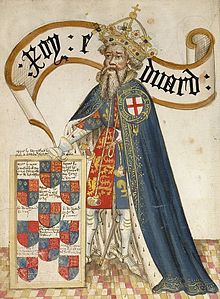
220px-Edward_III_of_England_(Order_of_the_Garter)
Edward III

Edward was born into a time of great change in the English monarchy. His grandmother, Philippa, had died in 1369 and his grandfather, Edward III, king since 1327, was slipping into senility, allowing his mistress, Alice Perrers, and her cohorts too much control of his affairs. In 1376 Edward’s eldest son and heir – and England’s hero of the time – Edward, the Black Prince, died after years of debilitating illness. The prince’s death broke the old king,  who died the following year, leaving his 10-year-old grandson Richard of Bordeaux, son of the Black Prince, as king.

The government – and the country – was largely in the hands of Edward and Richard’s uncle, John of Gaunt, Duke of Lancaster. John was the 4th son of Edward III and married to Edward of Norwich’s aunt, Constance of Castile. It was a time of uncertainty; many feared John would usurp the crown for  himself, but he stayed loyal to his nephew and Richard was crowned as King Richard II.

At only 4 years old Edward of Norwich attended the coronation, receiving his knighthood as part of the celebrations. Edward would be a loyal supporter of Richard II and received numerous royal grants, including the title of Earl of Rutland in February 1390. He was also given the title Earl of Cork when he accompanied Richard on his Irish campaign in 1394/5, leading several successful missions.

In the 1390s Edward emerged as a leading member of Richard’s circle of intimates. A man of considerable ability, Richard named him “the most able,wise and powerful man that he could think of”¹ and is even said to have considered leaving his crown to Edward. After the death of Richard’s queen, Anne of Bohemia, in 1394, Edward was one of the 3 feoffees of her estate, allowing him control of considerable patronage.
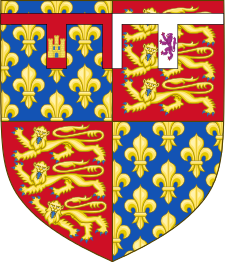
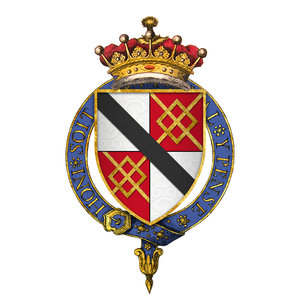
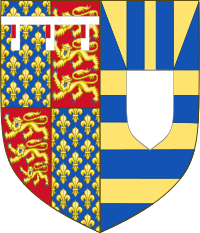
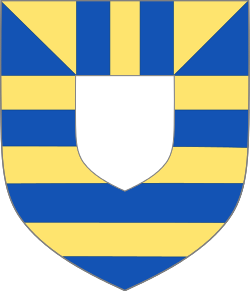
Arms_of_Edward_of_Norwich.svg
Arms of Edward of Norwich

Richard practically showered Edward with lucrative positions, including: admiral of the North & West (1391), Constable of Dover and Warden of the Cinque Ports (1396), Constable of the Tower of London (1397) and Constable of England (1398). He was also involved in the king’s diplomacy in France and the Holy Roman Empire, undertaking diplomatic missions to both.

Richard even took personal interest in Edward’s marriage prospects. In 1381 Edward had been betrothed to Beatriz of Portugal as part of the Anglo-Portuguese alliance against Castile. However, when the Portuguese made peace with Castile, Beatriz was married to Juan I of Castile instead.

Richard II suggested the sister-in-law of Giangaleazzo Visconti of Milan and also considered 3 relatives of Charles VI of France before suggesting Jeanne de Valois, younger sister of Richard’s proposed bride, Isabelle de Valois. Edward was addressed as ‘the king’s brother’ in recognition of their proposed marriages to sisters, even long after Edward’s planned marriage had fallen through.

By October 1398 Edward was married. His bride was a very curious choice for England’s most eligible bachelor. At 25 and likely to inherit his father’s dukedom in the not-too-distant future, Edward must surely have had the choice of every heiress in the kingdom of marriageable age. And yet his bride was twice widowed, 20 years his senior and with no dowry or inheritance to speak of.

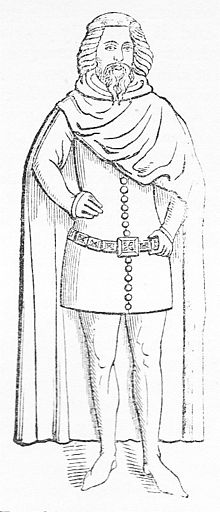
PhilippaMohun_Died1431_WestminsterAbbey_ByStothard
Effigy of Philippa Mohun, Duchess of York, from her tomb in Westminster Abbey

Philippa was the 3rd daughter of John Mohun, 2nd Baron Mohun and a founding member of the Order of the Garter, and his wife Joan Burghersh. She had first been married to Walter Fitzwalter, 3rd Baron Fitzwalter, who died in 1386 and secondly to Sir john Golafre who died in 1396. Having no male heirs, Philippa’s mother had sold the reversion of the Mohun estates to Lady Elizabeth Luttrell, leaving her daughters with no landed inheritance.

The fact this was hardly a glittering match for such an illustrious magnate greatly suggests that it was a love match. And, as with Philippa’s previous 2 marriages, the union was to remain childless; Edward would eventually name his young nephew as his heir.

While Edward was finalising the domestic arrangements for his new bride, England was falling into turmoil. Richard II had imprisoned one uncle Thomas of Woodstock, Duke of Gloucester, in Calais and was distrustful of another uncle, John of Gaunt.

In the 2nd half of the 1380s Gloucester and the Lords Appellants had been the focus of opposition against Richard’s personal rule and had attempted to curb the king’s excesses, forcing restrictions to his rule. John of Gaunt had restored order following his return from campaigning in Spain, but in 1397 Gloucester was murdered whilst imprisoned in Calais, most likely on  Richard’s orders. It was said Edward had played a leading role in the arrest of Gloucester and the earls of Arundel and Warwick and he certainly benefited from the aftermath, receiving a significant share of the forfeitures that followed.

In September 1397 he was made Duke of Aumale and given the post of Constable of England – formerly held by Gloucester. As Constable, Edward would preside over Richard’s legal reforms, extending the court of chivalry to include treason and other offences which touched the king’s dignity.
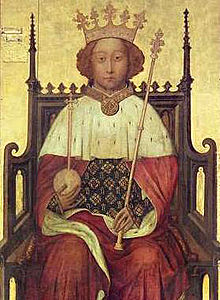
220px-Richard_II_King_of_England
Richard II

Of the other 2 ringleaders of the Lords Appellant, Richard Fitzalan, earl of Arundel was beheaded and Thomas de Beauchamp, earl of Warwick was stripped of his titles and imprisoned on the Isle of Man. Two of the younger members of the Lords Appellants, Thomas of Mowbray, earl of Nottingham and Henry Bolingbroke earl of Derby, had initially escaped any severe retribution. However, in  1398 Richard found a pretext to exile them both from the country.

Bolingbroke was the son of the most powerful man in the kingdom – John of Gaunt – he was also cousin to both Richard II and Edward of Norwich. On Gaunt’s death in 1399, instead of passing his inheritance onto Bolingbroke, Richard appropriated it for the crown, putting some of the lands into Edward’s care – and extending his cousin’s exile to life.

Later that year Richard set off on campaign to Ireland, taking with him his cousin Edward and Bolingbroke’s 13-year-old son, Henry of Monmouth. We don’t know how Edward had reacted to his cousin Henry’s disinheritance, but it can’t have been an easy time for him, caught in the middle of his warring cousins, and he may have felt uneasy with the sudden change in Henry’s circumstances at the hands of the king. He later claimed that he had not drawn any of the revenues from the Lancastrian lands which had been put in his custody.

Whilst Richard was in Ireland Henry of Bolingbroke landed at Ravenspur in Yorkshire, announcing that he had returned only to claim his inheritance. While Richard headed back to England to face him, Henry was progressing through the country, gaining support. Edward advised Richard to send John Montague, Earl of Salisbury, into north Wales while Richard gathered his forces. Montague raised 4,000 men, but his force had disintegrated by the time the king arrived. On arriving in south Wales, Richard had immediately pressed northwards, leaving Edward and his main force behind him.

170px-King_Henry_IV_from_NPG_(2)
Henry IV

There seems to be some confusion as to Edward’s actions. He was reputedly attacked as he made his way through Wales, but by which side is unclear. He was said to be part of the delegation sent – by Bolingbroke – to Richard at Flint, wearing Bolingbroke’s livery.

Jean Creton, in his Histoire du Roy d’Angleterre Richard II, says Edward ‘said nothing to the king, but kept at as great a distance as he could from him’². Creton stated there was no man alive that Richard had loved better and depicted Edward as a Judas deliberately betraying his king in 1399.

However, the transition of power from Richard II to Henry IV was far from plain sailing for Edward. Henry and Edward were 1st cousins, but Edward was one of the key personalities of Richard’s tyrannical reign, and a focus for revenge. According to the chronicler, Thomas Walsingham, Edward came close to being lynched as tempers ran hot during Henry’s 1st parliament. Edward was accused of urging Gloucester’s murder, a claim he was forced to vehemently deny. Henry resisted calls for the death penalty for Richard’s adherents, and settled instead for punishment by the confiscation of all titles and rewards granted since 1397.

Edward was one of the greatest losers; he lost the constableships of England and the Tower of London and his manor of Burstwick was granted to the earl of Northumberland. He was no longer Duke of Aumale and back to being, simply, earl of Rutland. However, when parliament finished, Henry confirmed Edward’s custody of the Channel Islands and his lordship of the Isle of Wight, suggesting the new king had confidence in his cousin’s loyalty, even if parliament didn’t.

180px-Edmund_of_Langley_2C_Duke_of_York
Edmund of Langley, 1st Duke of York

By the end of 1399 Edward had become embroiled in the Epiphany Rising, the plot to murder Henry IV and his sons during a tournament at Windsor on Twelfth Night. Edward is said to have been a conspirator, but it was he who betrayed the plot to the king, and he was rewarded with the restoration of the lordship of Oakham in Rutland. The plot’s failure meant death for Richard II; Richard had been held at Pontefract Castle since his deposition, but the uncovering of the plot meant he was too dangerous to keep alive. He died around 14th February 1400, probably from starvation.

Edward served the Lancastrian dynasty in much the same way he had Richard II. In October 1400 he was appointed Keeper of North Wales and July 1401 he was dispatched to France as Henry’s lieutenant in Aquitaine, in response to an appeal from the archbishop of Bordeaux who described Edward as ‘the man closest to the king after the king’s sons’.

Whilst in Bordeaux Edward succeeded as the Duke of York, following his father’s death on 1st August 1402. In May of the following year Edward gave up his office to return to England and by the autumn he was campaigning in Wales. In October he was appointed the king’s lieutenant in south Wales for 1 year, but by November the appointment had been extended to 3 years.

Still owed money from his time in Aquitaine, and with Henry unable to meet the costs of the war in Wales, Edward was left in serious financial straits. His men were on the verge of mutiny. However, Edward was one of those rare commanders, who knew how to inspire men and command loyalty. Forced to mortgage his properties to release funds, he made a promise to his troops that, on his honour, he would receive none of his own revenues until they were paid.

The Duke of York’s duty in Wales stood  him in good stead in February 1405 after his sister, Constance, implicated him in a plot against the crown. York was imprisoned in Pevensey Castle for 17 weeks. But it was the Prince of Wales who came to his defence in parliament. Henry of Monmouth described Edward as “a loyal and valiant knight”.  Speaking of clashes against Owen Glendower, in  1407 Prince Henry said “If it had not been for the duke’s good advice and counsel he and others would have been in great peril and desolation.”
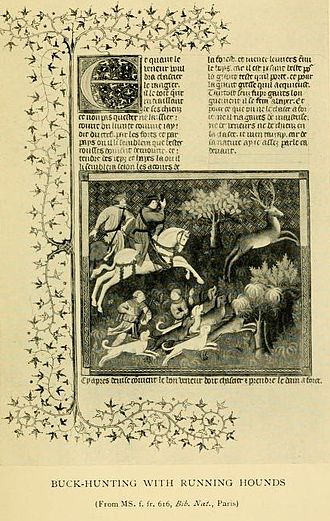
The_Master_of_Game_-_Buck_Hunting_With_Running_Hounds
1904 edition of Edward Duke of York’s “The Master of Game”

As far as the Prince of Wales was concerned, York “had laboured and served in such a way as to support and embolden all the other members of the company, as if he had been the poorest gentleman in the realm wishing to serve him in order to win honour and renown”.³

The Duke of York was an authority on hunting, translating the work Gaston Phebus, Count of Foix, Livre du Chasse” into English and adding several chapters himself. He dedicated the work, Master of Game to the Prince of Wales, the future Henry V. The book gives us a glimpse of the Duke of York’s personality and shows us why his men and peers thought so much of him:

“I ask of every person who reads this little treatise, or comes to hear of it, whatever their estate or condition, that in plain and simple language they will add to it anything they find useful and remove all that seems superfluous … so that this work may always grow through the advice and counsel of all hunters, and with this in mind, I tried to set out, as simply and clearly as I knew, what I understood of this craft, for the use and remembrance of all.”³

Edward and Prince Henry were particularly close. Edward was something of a mentor to the young Prince of Wales, as well as being his hunting master.

However, when Henry IV and the Prince of Wales quarreled over foreign policy, Edward sided with the king. In 1412 he accompanied the king’s 2nd son, Thomas, on campaign in France, to aid the Armagnacs against the Burgundians. Following the king’s death in 1413 he was preparing to defend Aquitaine in the June, and by August he was in Paris, negotiating a possible marriage between the new king, Henry V and Catherine of Valois.

220px-King_Henry_V_from_NPG
Henry V

Edward was back in England by October 1413, but was constantly involved in the diplomacy between England and France that led to Henry’s invasion of the country in 1415. In August 1415 Edward’s brother, Richard of Conisbrough, earl of Cambridge was executed for his involvement in the Southampton Plot to replace Henry V with his Mortimer cousin. For once, the Duke of York was above suspicion.

Shortly after the executions the fleet set sail for France and landed there on 13th August 1415. Almost immediately the army besieged Harfleur, finally taking the small town on 22nd September, but at great cost. During the siege dysentery had spread through the army, decimating Henry’s forces and leaving him with barely 6,000 men to continue the campaign.

As a result, Henry decided to make a run for Calais and safety, hoping to find a crossing of the River Somme whilst avoiding the French army amassing near Rouen. Edward, Duke of York, led the vanguard, taking part in several skirmishes from the harassing French troops and marching his men at an incredible pace. His men were starving and desperately ill – with more succumbing to dysentery every day.

Until they reached Agincourt.

According to historian Michael Jones, the Duke of York used his extensive hunting expertise to formulate the battle plan that would give Henry V the great victory that is still remembered today.

300px-Schlacht_von_Azincourt
Battle of Agincourt

His battle plan depended on a contingent of English archers being able to provoke the French into attacking down an enclosed valley, channelling them into the path of massed volley fire from a 2nd contingent of archers. The knights and men-at-arms would then enclose the survivors and destroy the remainder of the French army.

York was in the thick of the fighting, 90 men were killed defending his banner – the majority of the English casualties on the day. York fought valiantly but was killed as his helmet was smashed into his skull. His men protected their fallen leader’s body, preventing the French from breaking through the thin English line.

The London Chronicler wrote:

The Duke of York was slain,For his king he would not retreat, even by a foot, til his bascinet into his brain was brent [impaled].³

Edward Duke of York had led an illustrious and often controversial career. He had served 3 kings. He had written the first book on hunting in the English language. He could quote Chaucer, was a generous lord and a great military leader. The Chronicler of Godstow regarded him as a “second Solomon”. However, his reputation suffered damage during the Tudor era, when he was accused of being fat and dissolute – it was said he’d died at Agincourt after being suffocated in his armour because he was too heavy to rise after a fall.
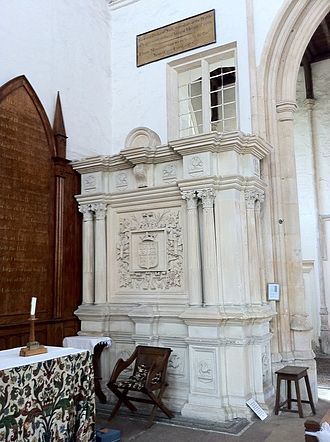
330px-Fotheringhay_memorial_Edward_2nd_Duke_of_York
Elizabethan memorial to Edward, 2nd Duke of York

The reverence with which Henry treated Edward after his death proves the lie of the later propaganda. Edward’s will was honoured; his nephew Richard inherited his lands and title, gifts to his men were fulfilled, such as Sir John Popham who received armour, a horse and a life rent from one of the Duke’s manors.

Edward asked to be buried in the church at Fotheringhay, where he had recently founded a college of priests. He was laid to rest beneath the choir steps, the grave marked by a marble slab with his figure upon it, engraved in brass. A larger memorial was added in Elizabethan times.

Edward’s wife Philippa survived him by 16 years, spending her widowhood at Carisbrooke Castle as the Lady of the Isle of Wight. She died 17th July 1431 and was buried in Westminster Abbey.

Edward’s nephew Richard, 3rd Duke of York, would go on to challenge Henry VI for the throne, dying at the Battle of Wakefield in December 1460. His son Edward would take up the mantle and succeed as Edward IV in March 1461, just 3 months after his father’s death.

*

Footnotes: ¹ Given-Wilson quoted in Oxford Database of National Biography; ² Jean Creton Histoire du Roy d’Angleterre Richard II quoted in Oxford Database of National Biography; ³ 24 Hours at Agincourt by Michael Jones.

*

Pictures courtesy of Wikipedia

*

Sources: The Oxford Companion to British History Edited by John Cannon; The Plantagenets, the Kings who Made England by Dan Jones; History Today Companion to British History Edited by Juliet Gardiner and Neil Wenborn;  Brewer’s British Royalty by David Williamson; 24 Hours at Agincourt by Michael Jones; Agincourt: My Family, the Battle and the Fight for France by Ranulph Fiennes Britain’s Royal Families, the Complete Genealogy by Alison Weir; The Mammoth Book of British Kings and Queens by Mike Ashley; The Plantagenets, the Kings that made Britain by Derek Wilson;  englishmonarchs.co.uk; oxforddnb.com; britannica.com; upenn.edu.

*

My Books:

Signed, dedicated copies of all my books are available through my online store.

OUT NOW! Heroines of the Tudor World
Heroines of the Tudor World tells the stories of the most remarkable women from European history in the time of the Tudor dynasty, 1485-1603. These are the women who ruled, the women who founded dynasties, the women who fought for religious freedom, their families and love. These are the women who made a difference, who influenced countries, kings and the Reformation. In the era dominated by the Renaissance and Reformation, Heroines of the Tudor World examines the threats and challenges faced by the women of the era, and how they overcame them. From writers to regents, from nuns to queens, Heroines of the Tudor World shines the spotlight on the women helped to shape Early Modern Europe.

Heroines of the Tudor World is now available for pre-order from Amberley Publishing and Amazon UK.

Coming 30 January 2025: Scotland’s Medieval Queens
Scotland’s history is dramatic, violent and bloody. Being England’s northern neighbour has never been easy. Scotland’s queens have had to deal with war, murder, imprisonment, political rivalries and open betrayal. They have loved and lost, raised kings and queens, ruled and died for Scotland. From St Margaret, who became one of the patron saints of Scotland, to Elizabeth de Burgh and the dramatic story of the Scottish Wars of Independence, to the love story and tragedy of Joan Beaufort, to Margaret of Denmark and the dawn of the Renaissance, Scotland’s Medieval Queens have seen it all. This is the story of Scotland through their eyes.

Available for pre-order now.

Also by Sharon Bennett Connolly:
Women of the Anarchy demonstrates how Empress Matilda and Matilda of Boulogne, unable to wield a sword themselves, were prime movers in this time of conflict and lawlessness. It shows how their strengths, weaknesses, and personal ambitions swung the fortunes of war one way – and then the other. Available from Bookshop.orgAmberley Publishing and Amazon UKKing John’s Right-Hand Lady: The Story of Nicholaa de la Haye is the story of a truly remarkable lady, the hereditary constable of Lincoln Castle and the first woman in England to be appointed sheriff in her own right. Available from all good bookshops Pen & Sword Booksbookshop.org and AmazonDefenders of the Norman Crown: The Rise and Fall of the Warenne Earls of Surrey tells the fascinating story of the Warenne dynasty, from its origins in Normandy, through the Conquest, Magna Carta, the wars and marriages that led to its ultimate demise in the reign of Edward III. Available from Pen & Sword BooksAmazon in the UK and US, and Bookshop.org

Ladies of Magna Carta: Women of Influence in Thirteenth Century England looks into the relationships of the various noble families of the 13th century, and how they were affected by the Barons’ Wars, Magna Carta and its aftermath; the bonds that were formed and those that were broken. It is now available in paperback and hardback from Pen & SwordAmazon, and Bookshop.orgHeroines of the Medieval World tells the stories of some of the most remarkable women from Medieval history, from Eleanor of Aquitaine to Julian of Norwich. Available now from Amberley Publishing and Amazon, and Bookshop.orgSilk and the Sword: The Women of the Norman Conquest traces the fortunes of the women who had a significant role to play in the momentous events of 1066. Available now from Amazon,  Amberley Publishing, and Bookshop.org.

Alternate Endings: An anthology of historical fiction short stories including Long Live the King… which is my take what might have happened had King John not died in October 1216. Available in paperback and kindle from Amazon.

Podcast:
Have a listen to the A Slice of Medieval podcast, which I co-host with Historical fiction novelist Derek Birks. Derek and I welcome guests, such as Bernard Cornwell, and discuss a wide range of topics in medieval history, from significant events to the personalities involved.

*

Don’t forget! Signed and dedicated copies of all my books are available through my online store.

For forthcoming online and in-person talks, please check out my Events Page.

You can be the first to read new articles by clicking the ‘Follow’ button, liking our Facebook page or joining me on TwitterThreads and Instagram.

*

©2015 Sharon Bennett Connolly, FRHistS
Illustrious Queen

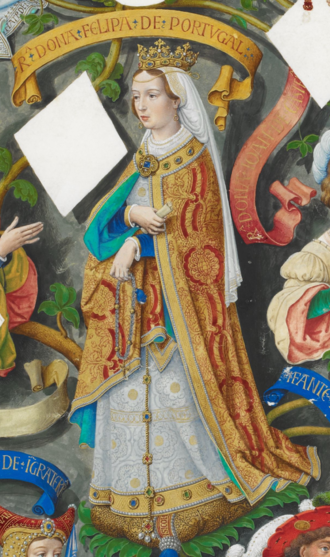
Filipa_de_Lencastre,_Rainha_de_Portugal_-_The_Portuguese_Genealogy_(Genealogia_dos_Reis_de_Portugal)
Philippa of Lancaster, Queen of Portugal

Philippa of Lancaster was born at Leicester on 31st March 1360. She was the eldest daughter of John of Gaunt, Duke of Lancaster and 4th son of Edward III, and his first wife Blanche of Lancaster, great-great-granddaughter of Henry III. her father was one of the richest men in the country – and one of the most powerful.

Her life as a child would have been one of luxury and privilege, with a glorious dynastic marriage awaiting her in the future. Philippa was raised alongside her younger sister, Elizabeth, who was born in 1363, and her baby brother, Henry of Bolingbroke, born in 1367.

The children shared a household for some of their childhood and were given the best education available. The reformer John Wycliffe, first translator of the Bible into English, was among their tutors.

The children lost their mother when Blanche died at Tutbury on 12th September, 1368, more likely from the complications of childbirth than from the plague, as a daughter, Isabella, who did not survive, was born around the same time.

The children’s father was with Blanche when she died but departed on campaign to France soon after; it is doubtful the children’s care was interrupted. The Lancaster household was well-organised and by 1376 the girls had been appointed a new governess; Katherine Swynford, who was by this time also mistress to their father, John of Gaunt.

450px-Casamento_João_I_e_Filipa_Lencastre
Wedding of Philippa and King John

As with most high-born women of the time, Philippa’s marriage was in the hands of her father. John of Gaunt planned for her to contract a dynastic match which would benefit and complement his own dynastic ambitions. In 1374, Philippa was betrothed to Gaston, Count of Foix, but nothing came of it. In 1381/2 she was offered in marriage to Jean de Blois, claimant to the duchy of Brittany; and in 1383 her prospective husband was Count William of Ostrevant, the heir to Hainault, Holland and Zeeland.

In 1385 and 25 years old Philippa was still unmarried. However, in the following year her father took her on his military expedition to Spain, hoping to claim the kingdom of Castile in right of his 2nd wife, Constance. Philippa’s marriage to John – or Joao – I of Portugal was agreed as part of an alliance made between the 2 Johns at Ponte do Mouro in November 1386.

Philippa was married to King John at Oporto on 2nd February 1387, before they had even received the required papal dispensation. The British Museum has a beautifully illuminated manuscript (above) which depicts the wedding, with John of Gaunt and his wife, Constance, looking on. Philippa was 26 – about 10 years older than the average age for a princess to marry. John was 3 years her senior and had been king for just short of 2 years.

Anoniem_-_Koning_Johan_I_van_Portugal_(1450-1500)_-_Lissabon_Museu_Nacional_de_Arte_Antiga_19-10-2010_16-12-61
John I, King of Portugal

Philippa became known as ‘Dona Fillipa’ in Portugal and would be one of the country’s best-loved queens. Her natural disposition to austerity and piety was endearing to the Portuguese people. Philippa reformed the court and encouraged courtly games among her ladies. French poet Eustace Deschamps characterised her as the chief patron of the order of The Flower of England, casting her at the centre of the court and the May Day celebrations.

A patron of literature, Philippa was sent a copy of John Gower’s poem “Confessio amantis“, which was translated into Portuguese by Robert Payn, an English canon of Lisbon Cathedral.

Philippa had been made a Lady of the Garter in 1378 and was instrumental in fostering  links between England and Portugal, a practice helped by the mixture of English and Portuguese servants in her household. She was on good terms with both Richard II and his successor – her brother, Henry IV.

In 1399 she wrote to the Archbishop of Canterbury, Thomas Arundel, asking him to intervene with Henry on behalf of her friend, Bishop Henry Despenser of Norwich, who had angered the new king by defending Richard II at the time of Henry’s invasion of England and seizure of the throne.

Rogier_van_der_Weyden_(workshop_of)_-_Portrait_of_Isabella_of_Portugal
John and Philippa’s daughter Isabella, Duchess of Burgundy

Philippa also had a hand in persuading Henry to arrange the marriage of her stepdaughter, Beatriz (John’s illegitimate daughter) to the earl of Arundel in 1405.

Almost immediately after the wedding John returned to the war. In July 1387 Philippa miscarried their first child while visiting John at Curval, where he lay seriously ill. However, after what appears to have been a bumpy start, the couple seem well-matched. John had had 2 illegitimate children before his marriage, but was demonstrably faithful to Philippa after the wedding.

In fact when court gossip reached the queen that he had been unfaithful, John went to great lengths to convince Philippa of his innocence. He even went so far as to commemorate the event by having a room in the royal apartments at Sintra decorated with chattering magpies – he must have had a great sense of humour, and confidence in his relationship to be so bold.

Philippa and John were to have a large family, which they brought up with great care. Of their 9 children,  5 sons and one daughter survived infancy and would later be known in Portugal as ‘the Illustrious Generation’. Their eldest surviving son, Edward, was born in 1391 and would succeed his father as King of Portugal in 1433. Peter, Duke of Coimbra, was born in 1392 and would act as regent for his nephew, Afonso V, following Edward’s death in 1438.

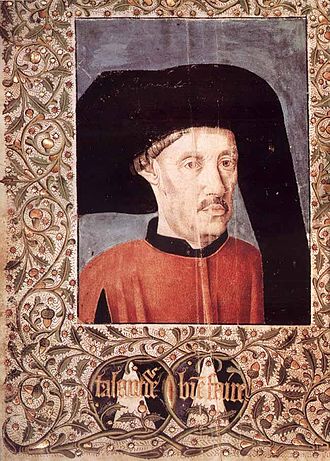
330px-Henry_the_Navigator_(Cronicas)
Prince Henry the Navigator

Their most famous son was Prince Henry ‘the Navigator’, Duke of Viseu, who was renowned for financing and researching great explorations – though he never undertook expeditions himself.

Their next youngest son was John, Duke of Beja and Constable of Portugal, who married Isabella, the daughter of Alfonso I, Duke of Braganza.

The baby of the family was Ferdinand, Grand Master of Aviz. He was born in 1402 and was later known as ‘the Saint Prince’ following his death as a prisoner of the Moors. Ferdinand had been held as a hostage for the return of Ceuta following the Disaster of Tangier, a siege led by his brother Henry. Ferdinand was held in increasingly severe confinement when it became apparent no ransom would be forthcoming, until he finally died in 1443.

John and Philippa’s one daughter, Isabella, was born in 1397 and would go on to marry Philip III the Good, Duke of Burgundy; and become the mother of Charles the Bold, Duke of Burgundy.

By 1415 Philippa’s oldest sons were itching to prove their martial prowess. Scorning their father’s offer to hold a magnificent tournament for them, they persuaded him to mount an attack on the port of Ceuta in North Africa. As they were about to set sail Philippa fell ill.

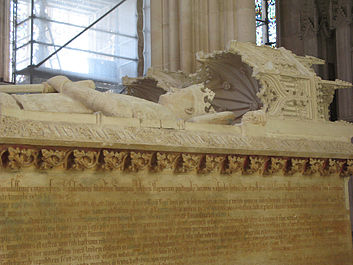
353px-BatalhaTombKingJohn
Tomb of John and Philippa

She had contracted plague and died at Odivelas, near Lisbon, on 18/19th July 1415. She was 55. On her deathbed she gave her 3 eldest sons, each, a jewel encrusted sword, in anticipation of their impending knighthoods, and a piece of the true cross. Giving them her blessing for the forthcoming military expedition she exhorted “them to preserve their faith and to fulfil the duties of their rank”¹.

The expedition sailed just 5 days after her death and Ceuta fell after only one day of siege, becoming Portugal’s first African possession.

Described as pious, charitable, affable and obedient to her husband, Portuguese historian Fernao Lopes, secretary to Philippa’s son, Fernando, held Philippa up as a model queen. Her piety was renowned; in later life she was said to regularly read the Book of Psalms.

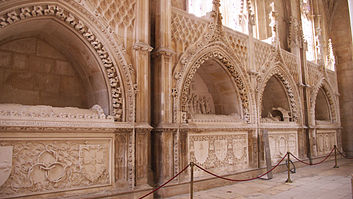
353px-Túmulos_de_los_Infantes
Tombs of the Infantes, the 4 younger sons of John and Philippa

Queen Philippa was buried in the Dominican Priory at Batalha Abbey, which had been founded by her husband. King John arranged for a magnificent tomb to be built in the Capela do Fundador. Constructed between 1426 and 1434, it is topped by their effigies, clasping each others’ hands. King John himself was laid beside her after his death in August 1433.

Their sons, Ferdinand, John, Henry and Peter, were laid to rest along the south side of the same chapel.

*

Footnote: ¹ Edgar Prestage, The Portuguese pioneers.

*

Pictures courtesy of Wikipedia

*

Sources: The Plantagenets, the Kings who Made England by Dan Jones;  Brewer’s British Royalty by David Williamson; Britain’s Royal Families, the Complete Genealogy by Alison Weir; The Mammoth Book of British Kings and Queens by Mike Ashley; The Plantagenets, the Kings that made Britain by Derek Wilson;  englishmonarchs.co.uk; oxforddnb.com; annvictoriaroberts.co.uk.

*

My Books

Signed, dedicated copies of all my books are available through my online bookshop.

Out now: Scotland’s Medieval Queens

Books by Sharon Bennett Connolly

Scotland’s history is dramatic, violent and bloody. Being England’s northern neighbour has never been easy. Scotland’s queens have had to deal with war, murder, imprisonment, political rivalries and open betrayal. They have loved and lost, raised kings and queens, ruled and died for Scotland. From St Margaret, who became one of the patron saints of Scotland, to Elizabeth de Burgh and the dramatic story of the Scottish Wars of Independence, to the love story and tragedy of Joan Beaufort, to Margaret of Denmark and the dawn of the Renaissance, Scotland’s Medieval Queens have seen it all. This is the story of Scotland through their eyes.

Scotland’s Medieval Queens gives a thorough grounding in the history of the women who ruled Scotland at the side of its kings, often in the shadows, but just as interesting in their lives beyond the spotlight. It’s not a subject that has been widely covered, and Sharon is a pioneer in bringing that information into accessible history.’ Elizabeth Chadwick (New York Times bestselling author)

Available now from Amazon and Pen and Sword Books

Also by Sharon Bennett Connolly:

Books by Sharon Bennett Connolly

Heroines of the Tudor World tells the stories of the most remarkable women from European history in the time of the Tudor dynasty, 1485-1603. These are the women who ruled, the women who founded dynasties, the women who fought for religious freedom, their families and love. Heroines of the Tudor World is now available for pre-order from Amberley Publishing and Amazon UK. Women of the Anarchy demonstrates how Empress Matilda and Matilda of Boulogne, unable to wield a sword themselves, were prime movers in this time of conflict and lawlessness. It shows how their strengths, weaknesses, and personal ambitions swung the fortunes of war one way – and then the other. Available from Bookshop.orgAmberley Publishing and Amazon UKKing John’s Right-Hand Lady: The Story of Nicholaa de la Haye is the story of a truly remarkable lady, the hereditary constable of Lincoln Castle and the first woman in England to be appointed sheriff in her own right. Available from all good bookshops Pen & Sword Booksbookshop.org and Amazon

Books by Sharon Bennett Connolly

Defenders of the Norman Crown: The Rise and Fall of the Warenne Earls of Surrey tells the fascinating story of the Warenne dynasty, from its origins in Normandy, through the Conquest, Magna Carta, the wars and marriages that led to its ultimate demise in the reign of Edward III. Available from Pen & Sword BooksAmazon in the UK and US, and Bookshop.orgLadies of Magna Carta: Women of Influence in Thirteenth Century England looks into the relationships of the various noble families of the 13th century, and how they were affected by the Barons’ Wars, Magna Carta and its aftermath; the bonds that were formed and those that were broken. It is now available in paperback and hardback from Pen & SwordAmazon, and Bookshop.orgHeroines of the Medieval World tells the stories of some of the most remarkable women from Medieval history, from Eleanor of Aquitaine to Julian of Norwich. Available now from Amberley Publishing and Amazon, and Bookshop.orgSilk and the Sword: The Women of the Norman Conquest traces the fortunes of the women who had a significant role to play in the momentous events of 1066. Available now from Amazon,  Amberley Publishing, and Bookshop.org.

Alternate Endings: An anthology of historical fiction short stories including Long Live the King… which is my take what might have happened had King John not died in October 1216. Available in paperback and kindle from Amazon.

Podcast:

A Slice of Medieval

Have a listen to the A Slice of Medieval podcast, which I co-host with Historical fiction novelist Derek Birks. Derek and I welcome guests, such as Bernard Cornwell and discuss a wide range of topics in medieval history, from significant events to the personalities involved. Our first ever episode was a discussion on The Anarchy 

Every episode is also now available on YouTube.

*

Don’t forget! Signed and dedicated copies of all my books are available through my online bookshop.

For forthcoming online and in-person talks, please check out my Events Page.

You can be the first to read new articles by clicking the ‘Follow’ button, liking our Facebook page or joining me on TwitterThreadsBluesky and Instagram.

©2016 Sharon Bennett Connolly FRHistS
The Kidnapped Countess

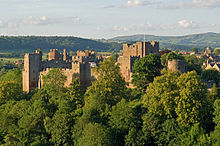
Denbigh_Castle_3
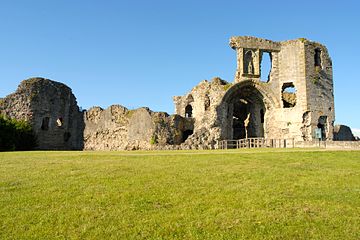
Denbigh Castle

The story of Alice de Lacey is like something straight from a novel, with rebellion, kidnappings and love all wrapped up in the life of this one Countess. Alice was born at Denbigh Castle on 25th December 1281. She was the daughter of Henry de Lacey, 5th Earl of Lincoln. Through her mother Margaret, she was a granddaughter of William (II) Longspee, Earl of Salisbury and his wife, Idonea de Camville. Through Margaret, Alice was also descended from 2 of the greatest women of the 13th century, Nicholaa de la Haye, castellan of Lincoln Castle, and Ela of Salisbury, Countess of Salisbury in her own right.

Alice was one of 3 children. With 2 brothers, Edmund and John, she was, of course, not  expected to inherit her father’s earldom. However, 2 family tragedies made Alice one of the richest heiresses in England. Young Edmund, it appears, drowned in a well at Denbigh Castle and John fell to his death from the parapet at Pontefract Castle, leaving Alice as her parents’ sole heir.

In 1294 Alice’s marriage was arranged by no-less than the king – Edward I – who saw her as a suitable bride for his nephew Thomas, Earl of Lancaster and son of the king’s brother Edmund Crouchback. Alice and Thomas were married on or before 28th October 1294; he was about 16 years old and Alice was not yet 13.

Edward I had shown his unscrupulous nature in the marriage settlement in that Thomas was given part of the Lacey inheritance on the marriage, with the rest to pass to Thomas on Henry de Lacey’s death. The settlement further stipulated that the de Lacey lands would pass to Lancaster in the event of Alice’s dying without issue; thus excluding all collateral heirs to the earldoms of Salisbury and Lincoln.

330px-Seal_Henry_de_Lacy
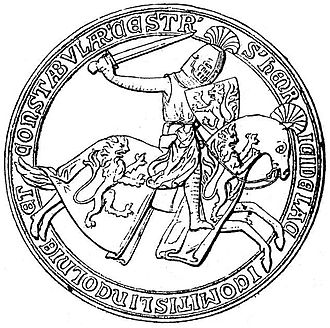
Seal of Henry de Lacey

Alice’s mother Margaret, Countess of Salisbury in her own right, died in 1309 and by June 1310 her father had remarried, to Joan Fitz Martin, probably in the hope of securing an heir for his earldom. In the event, it wasn’t to be and the Earl of Lincoln died in 1311, with his estates passing through his daughter, to Thomas Earl of Lancaster and Leicester.

With 5 earldoms to his name, Thomas now became one of the richest and most powerful men in the kingdom. Although he was initially a supporter of the new king, his cousin Edward II, he would soon turn against him and his favourites, making enemies along the way.

Poor Alice got caught in the middle of one of Thomas’s feuds.

According to the chronicler Walsingham:

The Countess of Lancaster … was seized at Canford, in Dorset, by a certain knight of the house and family of John, Earl Warenne, with many English retainers called together for the detestable deed, as it is said, with the royal assent. … With them was a certain man of a miserable stature, lame and hunchbacked, called Richard de St Martin, exhibiting and declaring constantly his evil intentions towards the lady, so miserably led away.

Alice was kidnapped in 1317 from her manor in Canford, Dorset, by John de Warenne‘s man, Sir Richard de St Martin, supposedly with the king’s knowledge. Several reasons for the abduction have been put forward; one is, of course, that Alice and St Martin were having an affair while another is that the affair was between Alice and John de Warenne, Earl of Surrey, himself. After all, John de Warenne did have a reputation with women.

Given the king’s involvement, a more likely explanation is that the kidnapping was organised by Earl Warenne in retaliation for Lancaster’s objections to the earl’s attempts to divorce his wife, Joan of Bar, in 1315/16. Joan was a cousin of Thomas of Lancaster and niece of King Edward II, but her marriage to John de Warenne was a disaster and John openly lived with his mistress, Maud Nerford. When he attempted to divorce Joan, Lancaster was one of his most vocal opponents; the divorce was eventually refused and Earl Warenne was even excommunicated for a time.

Arms_of_Edmund_Crouchback,_Earl_of_Leicester_and_Lancaster.svg
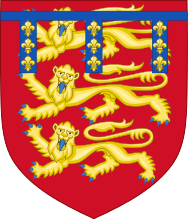
Arms of Thomas and his father as Earls of Lancaster and Leicester

Following her kidnapping, Alice was held at Reigate Castle, Surrey. Her abduction set off a private war between the 2 magnates, with Lancaster targeting Warenne’s Yorkshire estates and successfully besieging the Earl’s castle at Conisbrough in retaliation. Lancaster seems to have made little-to-no effort to actually rescue his wife and there is no record of how and when she was eventually released.

Alice and Thomas’s marriage does not appear to have been a happy one and there is some evidence that they were actually divorced in 1318, with Thomas retaining Alice’s earldoms after enforcing the marriage contract. The divorce was supposedly on account of her adultery with the Earl of Surrey’s squire, Sir Eubolo Lestrange (although this may be a confusion of facts from her abduction and her later marriage). It has also been claimed that Alice and her abductor, Richard de St Martin, were pre-contracted before her marriage to Thomas of Lancaster. However, although this is not impossible, it does seem unlikely, given Alice’s tender age on her wedding day.

Whether or not Alice and Thomas did divorce is still open to debate. If the divorce occurred, it did not protect her from the reprisals meted out after her husband’s failed rebellion and defeat at the Battle of Boroughbridge on 16th March 1322. While Thomas was executed Alice, along with her step-mother, Joan, was imprisoned in York Castle.

It must have been a truly terrifying time for the 2 women; with no protectors they were at the mercy of the king’s favourites, the Despensers, father and son. Threatened with execution by burning they were forced to turn over the majority of their estates. Having paid an enormous ransom of £20,000 Alice was finally released, securing some her titles, a small number of estates and the right to remarry.

021
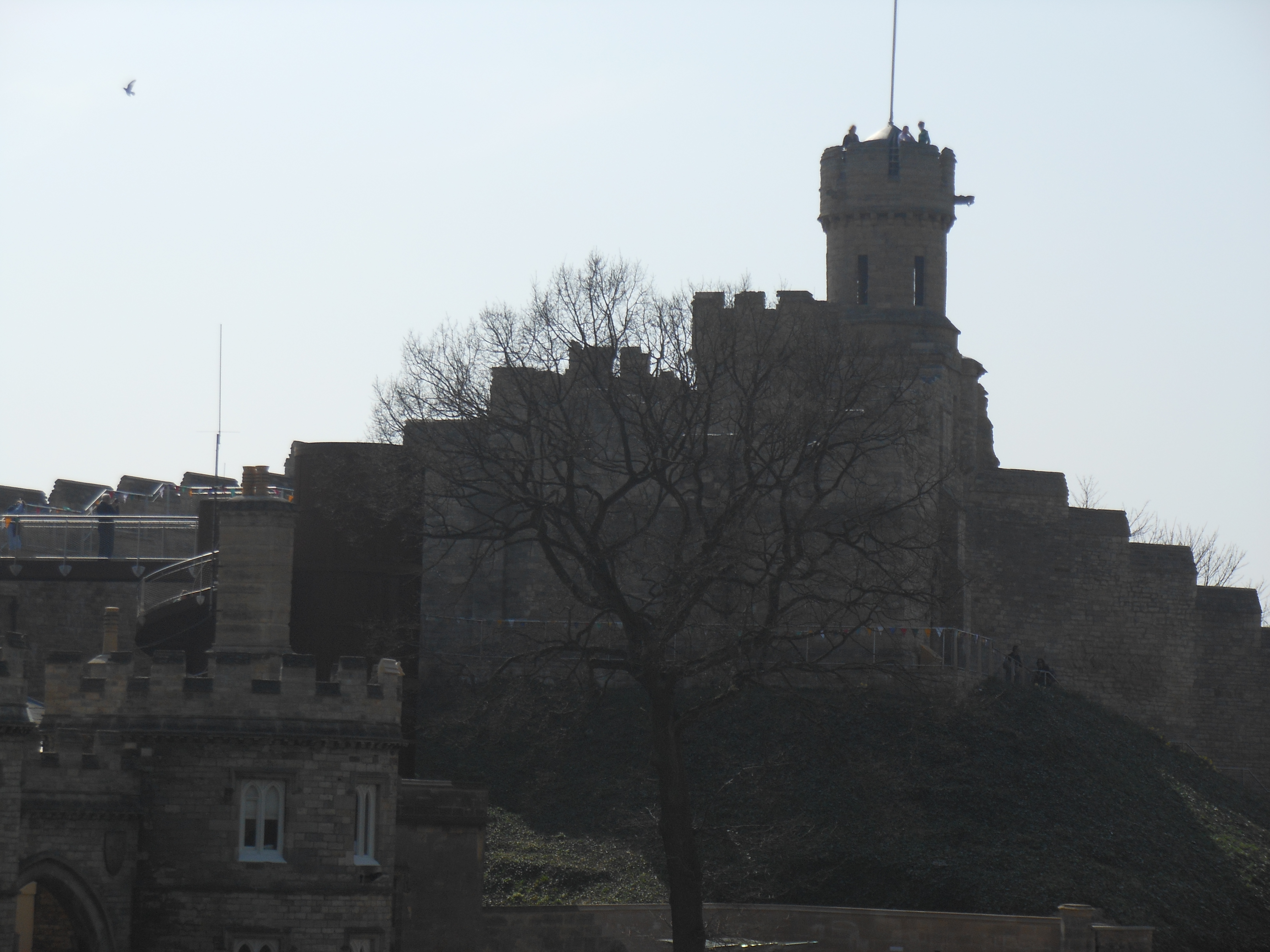
Lincoln Castle

Her step-mother, Joan, died in October 1322; we can only surmise as to whether or not her demise was as a consequence of her imprisonment.

Alice would eventually recover Lincoln Castle and the Earldom of Lincoln, but many of her estates were given to her erstwhile abductor, John de Warenne, and only returned to her by Edward III, many years later.

By November 1324 Alice had married again, this time to a minor baron from the Welsh Marches, Sir Ebule, or Eubolo, Lestrange of Shropshire. The  marriage demonstrated that Alice had managed to come out of the disaster of her first husband’s downfall with enough income and  property to make her an attractive proposition as a wife. Although, it does seem possible that this marriage was a love-match.

This marriage appears to have been a happier one, given that Lestrange moved over to Lincolnshire to look after his wife’s interests, and that it was with Sir Eubolo that Alice chose to be buried, when the time came. Alice and Sir Eubolo were married for over 10 years, although towards the latter part Lestrange was away campaigning in Scotland, where he died in September 1335. Alice was named as one of his executors and he was buried in Barlings Abbey, Lincolnshire.

Following his death, Alice took a vow of chastity and looked determined to settle into a life of quiet retirement. However, her adventures were not quite at an end. In 1335, or early 1336, Alice was kidnapped for a second time; she was abducted from her castle at Bolingbroke and raped, by Sir Hugh de Freyne. Freyne was a Herefordshire knight and royal keeper of the town and castle of Cardigan.

There appears some suggestion that Alice was in collusion with Sir Hugh, with the theory being that her abduction was a way for her to escape her vow of chastity. It seems more likely that Alice acquiesced to a situation over which she had little control. Edward III was furious and ordered the imprisonment of the couple, but they were reconciled with the king in 1336 and allowed to marry. The marriage did much to improve Freyne’s status and brought him a summons to Parliament in November 1336.

330px-Barlings_Abbey_ruins_-_geograph.org.uk_-_242596
Barlings Abbey

However, such success was short-lived as he died at Perth in December 1336 or January 1337.

Shortly after her third husband’s death, the Bishop of Lincoln issued a demand that Alice keep her prior vow and chastity. As there were no further marriages – or abductions – we can probably assume that she did. Alice died on the 2nd October 1348 at the grand age of 66. She was buried with her second husband at the Premonstratensian House of Barlings, in Lincolnshire, founded by Ralph de la Haye, uncle of the famous Nicholaa de la Haye.

Having had no children from any of her 3 marriages, Alice’s lands and titles, as according to her marriage settlement 54 years earlier, passed to the house of Lancaster and her husband’s nephew, Henry of Grosmont, 1st Duke of Lancaster and father of Blanche of Lancaster, John of Gaunt’s 1st wife.

*

Pictures courtesy of Wikipedia, except Lincoln Castle © 2015 Sharon Bennett Connolly FRHistS.

*

Sources: The Oxford Companion to British History Edited by John Cannon; The Plantagenets, the Kings who Made England by Dan Jones; History Today Companion to British History Edited by Juliet Gardiner and Neil Wenborn;  Brewer’s British Royalty by David Williamson; Britain’s Royal Families, the Complete Genealogy by Alison Weir; Conisbrough Castle by Steven Brindle and Agnieszka Sadraei; The Mammoth Book of British Kings and Queens by Mike Ashley; The Plantagenets, the Kings that made Britain by Derek Wilson;  findagrave.com; oxforddnb.com; royaldescent.net.

*

My Books

Signed, dedicated copies of all my books are available through my online store.

OUT NOW! Heroines of the Tudor World

Heroines of the Tudor World tells the stories of the most remarkable women from European history in the time of the Tudor dynasty, 1485-1603. These are the women who ruled, the women who founded dynasties, the women who fought for religious freedom, their families and love. These are the women who made a difference, who influenced countries, kings and the Reformation. In the era dominated by the Renaissance and Reformation, Heroines of the Tudor World examines the threats and challenges faced by the women of the era, and how they overcame them. From writers to regents, from nuns to queens, Heroines of the Tudor World shines the spotlight on the women helped to shape Early Modern Europe.

Heroines of the Tudor World is now available for pre-order from Amberley Publishing and Amazon UK.

Coming 30 January 2025: Scotland’s Medieval Queens

Scotland’s history is dramatic, violent and bloody. Being England’s northern neighbour has never been easy. Scotland’s queens have had to deal with war, murder, imprisonment, political rivalries and open betrayal. They have loved and lost, raised kings and queens, ruled and died for Scotland. From St Margaret, who became one of the patron saints of Scotland, to Elizabeth de Burgh and the dramatic story of the Scottish Wars of Independence, to the love story and tragedy of Joan Beaufort, to Margaret of Denmark and the dawn of the Renaissance, Scotland’s Medieval Queens have seen it all. This is the story of Scotland through their eyes.

Available for pre-order now.

Also by Sharon Bennett Connolly:

Women of the Anarchy demonstrates how Empress Matilda and Matilda of Boulogne, unable to wield a sword themselves, were prime movers in this time of conflict and lawlessness. It shows how their strengths, weaknesses, and personal ambitions swung the fortunes of war one way – and then the other. Available from Bookshop.orgAmberley Publishing and Amazon UKKing John’s Right-Hand Lady: The Story of Nicholaa de la Haye is the story of a truly remarkable lady, the hereditary constable of Lincoln Castle and the first woman in England to be appointed sheriff in her own right. Available from all good bookshops Pen & Sword Booksbookshop.org and AmazonDefenders of the Norman Crown: The Rise and Fall of the Warenne Earls of Surrey tells the fascinating story of the Warenne dynasty, from its origins in Normandy, through the Conquest, Magna Carta, the wars and marriages that led to its ultimate demise in the reign of Edward III. Available from Pen & Sword BooksAmazon in the UK and US, and Bookshop.org

Ladies of Magna Carta: Women of Influence in Thirteenth Century England looks into the relationships of the various noble families of the 13th century, and how they were affected by the Barons’ Wars, Magna Carta and its aftermath; the bonds that were formed and those that were broken. It is now available in paperback and hardback from Pen & SwordAmazon, and Bookshop.orgHeroines of the Medieval World tells the stories of some of the most remarkable women from Medieval history, from Eleanor of Aquitaine to Julian of Norwich. Available now from Amberley Publishing and Amazon, and Bookshop.orgSilk and the Sword: The Women of the Norman Conquest traces the fortunes of the women who had a significant role to play in the momentous events of 1066. Available now from Amazon,  Amberley Publishing, and Bookshop.org.

Alternate Endings: An anthology of historical fiction short stories including Long Live the King… which is my take what might have happened had King John not died in October 1216. Available in paperback and kindle from Amazon.

Podcast:

Have a listen to the A Slice of Medieval podcast, which I co-host with Historical fiction novelist Derek Birks. Derek and I welcome guests, such as Bernard Cornwell, and discuss a wide range of topics in medieval history, from significant events to the personalities involved.

*

Don’t forget! Signed and dedicated copies of all my books are available through my online store.

For forthcoming online and in-person talks, please check out my Events Page.

You can be the first to read new articles by clicking the ‘Follow’ button, liking our Facebook page or joining me on Twitter and Instagram.

*

©2016 Sharon Bennett Connolly FRHistS

Jeanne II, Tainted Queen

Ludvik10
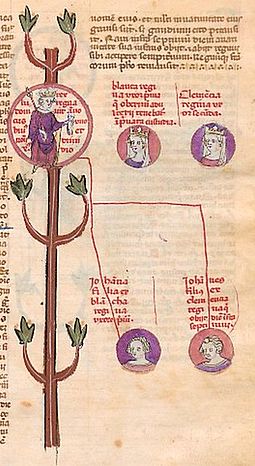
The family tree of Louis X

In 1312 a baby girl was born into the French royal family. Although some sources say she was born as early as 1309 or 1311, most seem to settle on January 1312. According to Isabella of France’s biographer, Kathryn Warner, the news was delivered to Edward II and Queen Isabella by Jeannot de Samoys, usher to Margaret of Burgundy, in March 1312, with the baby having been born on 28th January of that year.

Jeanne de France was to be the only surviving child of her parents, Louis of France and Margaret of Burgundy. Louis had become King of Navarre on the death of his mother in 1305 and was married to Margaret later in the same year, when Louis was 16 years old and Margaret was about 15.

Louis was Dauphin of France, the eldest of 3 surviving sons of Philip IV le Bel, king of France and Navarre, and of Jeanne I, queen of France and de jure queen of Navarre. Louis’ sister, Isabella, married Edward II of England. His brothers, Philip and Charles, were married to 2 sisters, Blanche and Joan of Burgundy, the daughters of Otto IV, Count of Burgundy.

In 1314 a scandal rocked the French monarchy to its very core, leaving a question mark over Jeanne’s legitimacy that is still there today. The Tour de Neslé Affair saw 2-year-old Jeanne’s mother, Margaret, convicted of adultery, and imprisoned in the Chateau-Gaillard for the rest of her life. Margaret’s cousin and sister-in-law, Blanche, was convicted alongside her. Although Blanche’s sister, Joan, with the support of her husband Philip,  was cleared of the charges, she was held under house arrest for a short time as it was believed she knew of the adulterous liaisons of her sisters-in-law.

The 2 knights in question, the D’Aunay brothers, were tortured and castrated before being brutally executed by being ‘broken on the wheel’ and decapitated.

330px-Margaret_of_Burgundy
Margaret of Burgundy, Jeanne’s mother

How much Jeanne would have known of these events is uncertain. Hopefully she was shielded from events in the royal nursery, but it  is not inconceivable that she was treated differently after the discovery of her mother’s adultery. Margaret’s betrayal meant Jeanne’s legitimacy was now in question.

However, events were to change again within in months. In November, 1314, Jeanne’s grandfather Philip IV died and her father succeeded to the French throne as King Louis X. Louis was now desperate to produce a male heir and with the papacy dragging its heels on his divorce from Jeanne’s mother, it’s possible he took matters into his own hands. Whether it was from natural causes after her rough treatment – or, more likely, strangulation on Louis’ orders – Margaret died shortly after Louis’ accession.

Louis then married Clementia of Hungary and the couple were crowned jointly at Reims in August 1315. Nothing is recorded of  the relationship between Jeanne and her stepmother, or of how Jeanne’s status changed as the daughter of the King. However, doubts over Jeanne’s legitimacy must still have been at the forefront of people’s minds as Louis X, on his deathbed in June 1316, made a point of  stating that Jeanne was his legitimate daughter. Clementia was pregnant at the time of Louis’ death, after a particularly strenuous game of tennis; their son John the Posthumous was born 5 months later and died just 5 days after that, causing a succession crisis.

Louis_X_of_France2
Louis X, Jeanne’s father

In most countries, Jeanne would automatically have become queen regnant on the death of her baby brother. However, her uncle Philip argued that French Salic Law, which determined the inheritance of French property and which stated that females could not inherit, also extended to the crown of France. Fearing the accession of a weak and feeble woman, the French nobles readily agreed.

Salic Law, however, did not extend to Navarre and Jeanne’s maternal grandmother Agnes of France, Duchess of Burgundy, and maternal uncle Odo IV, Count – later Duke – of Burgundy, tried to press Jeanne’s claims to the crown of Navarre, but were unsuccessful. In 1318 Odo came to an agreement with Philip that, should he have no male heirs, the counties of Champagne and Brie would go to Jeanne, while Jeanne would relinquish her claims to the thrones of France and Navarre – and would swear to this once she reached her majority, probably at the age of 12.

In the same agreement Odo was to marry Philip V’s daughter, Joan, and Jeanne would marry her cousin, Philip d’Evreux. Philip was the grandson of Philip III of France and his 2nd wife, Marie of Brabant; he was the son of Louis d’Evreux, half-brother of Jeanne’s grandfather, Philip IV.

330px-Philippe_III_de_Navarre
Philip III of Navarre, Jeanne’s husband

At just 6 years old Jeanne was married to 12-year-old Philip on 18th June 1318. She was then given into the care of Philip’s grandmother, the dowager queen Marie of Brabant, to continue her education.

There’s no evidence that Jeanne did relinquish her claims to the thrones of France and Navarre on her 12th birthday and the situation changed, again, when Philip V died in 1322 and was succeeded by his brother, Charles IV. A succession crisis arose yet again when Charles himself died on 1st February 1328, leaving France with a regency once more, until his pregnant wife, Jeanne d’Evreux, was delivered of a daughter, Blanche, on 1st April 1328.

This left Jeanne as the senior claimant to the French and Navarrese thrones. However, with Salic Law still in place, the French crown was offered to Philip of Valois, a descendant  of Philip III, who acceded to the throne as Philip VI. Philip, however, had no claim to the crown of Navarre as it had come to the French crown through the marriage of Philip IV with Queen Jeanne I of Navarre.

Not subject to Salic Law, therefore, and after the extinction of the male line, the crown of Navarre finally came to Jeanne, her inheritance was publicly acknowledged by the new king of France. The general assembly of Navarre proclaimed Jeanne as queen in May 1328, with a stipulation that Philip would reign jointly with her, but only until their eldest son attained his majority.

Jana2Navarra_SaintDenis
Jeanne II, Queen of Navarre

After years in the shadows and aged just 17, Jeanne and her husband were crowned jointly, as King Philip III and Queen Jeanne II of Navarre, at Pamplona on 5th March 1329. Several property agreements with the French crown left Jeanne and Philip with extensive lands in Normandy, Champagne and Philip’s county of Evreux, as well as their kingdom of Navarre.

Their marriage also appears to have been successful, with at least 7 children being born between 1326 and 1341, 3 of which were boys. Their eldest child, Maria, became the 1st wife of Peter IV of Aragon; while the next eldest, Blanche, born in 1330, was betrothed to John of France before marrying his father, Philip VI – who was 40 years her senior – in 1349, just months after her mother’s death.

Of their other daughters Agnes, born in the mid-1330s, married Gaston, Count of Foix. According to Froissart Gaston accidentally killed their only son, another Gaston, during a quarrel. Jeanne’s youngest daughter, Joan, was born in 1339 and would marry John II Viscount Rohan.

Some sources mention another daughter, Joan, born around 1324, who would become a nun at Longchamp. However, it seems highly likely that Joan was an illegitimate daughter of Philip d’Evreux, rather than the eldest daughter  of the Philip and Jeanne.

Jeanne and Philip’s eldest son and heir, Charles II the Bad, was born in 1330 and married Joan, daughter of John II of France. Charles was implicated in the assassination of the Constable of France, Charles de la Cerda, and intrigued with the English, against the French, during the Hundred Years’ War. He even escaped from imprisonment in Chateau-Gaillard, but was ultimately defeated by the French, who allowed him to remain as King of Navarre.

A son, Philip, Count of Longueville was born in 1336 and married Yolande of Flanders. While their youngest son, Louis, was born in 1341 and would become Duke of Durazzo in Albania by right of his wife, Joanna.

Joan II, Queen of Navarre

Jeanne and Philip shared their time between all their lands, with French governors installed to rule Navarre during their absences. As rulers of Navarre, Jeanne and Philip had active legislation and building programmes and tried to maintain peaceful relations with neighbouring states. As a couple they appear to have worked closely together, more than 41 decrees were issued jointly in their names.

Philip died in 1343, aged 37, whilst on Crusade against the Muslim Kingdom of Granada in Spain. He was mortally wounded by an arrow during the Siege of Algeciras and died shortly after. His body was returned to Pamplona for burial, while his heart was taken to Paris and interred at the Couvent des Jacobins.

From then on Jeanne ruled alone, dying of the plague on 6th October 1349 at the Chateau de Conflans. She was just months short of her 38th birthday, having ruled Navarre for 21 of her 38 years. Jeanne was buried in the royal Basilica of St Denis but her heart was laid to rest beside her husband’s in the Couvent des Jacobins, the taint of bastardy no longer an issue.

*

Sources: The Course of French History by Pierre Goubert; Isabella and the Strange Death of Edward II by Paul Doherty; Isabella of France: The Rebel Queen by Kathryn Warner; The Waning of the Middle Ages by J Huizinga; Medieval Europe 400-1500 by H.G. Koenigsberger; passion-histoire.net; maison-hantee.com; herodote.net; histoire-france.net; A history of France from the Earliest Times to the Treaty of Versailles by William Stearns Davis; History of France by Charlotte Mary Yonge; Histoireeurope.fr.

Pictures taken from Wikipedia.

Thanks to Kathryn Warner for her extra information regarding Jeanne’s date of birth.

*

My Books

Signed, dedicated copies of all my books are available through my online store.

OUT NOW! Heroines of the Tudor World

Heroines of the Tudor World tells the stories of the most remarkable women from European history in the time of the Tudor dynasty, 1485-1603. These are the women who ruled, the women who founded dynasties, the women who fought for religious freedom, their families and love. These are the women who made a difference, who influenced countries, kings and the Reformation. In the era dominated by the Renaissance and Reformation, Heroines of the Tudor World examines the threats and challenges faced by the women of the era, and how they overcame them. From writers to regents, from nuns to queens, Heroines of the Tudor World shines the spotlight on the women helped to shape Early Modern Europe.

Heroines of the Tudor World is now available for pre-order from Amberley Publishing and Amazon UK.

Coming 30 January 2025: Scotland’s Medieval Queens

Scotland’s history is dramatic, violent and bloody. Being England’s northern neighbour has never been easy. Scotland’s queens have had to deal with war, murder, imprisonment, political rivalries and open betrayal. They have loved and lost, raised kings and queens, ruled and died for Scotland. From St Margaret, who became one of the patron saints of Scotland, to Elizabeth de Burgh and the dramatic story of the Scottish Wars of Independence, to the love story and tragedy of Joan Beaufort, to Margaret of Denmark and the dawn of the Renaissance, Scotland’s Medieval Queens have seen it all. This is the story of Scotland through their eyes.

Available for pre-order now.

Also by Sharon Bennett Connolly:

Women of the Anarchy demonstrates how Empress Matilda and Matilda of Boulogne, unable to wield a sword themselves, were prime movers in this time of conflict and lawlessness. It shows how their strengths, weaknesses, and personal ambitions swung the fortunes of war one way – and then the other. Available from Bookshop.orgAmberley Publishing and Amazon UKKing John’s Right-Hand Lady: The Story of Nicholaa de la Haye is the story of a truly remarkable lady, the hereditary constable of Lincoln Castle and the first woman in England to be appointed sheriff in her own right. Available from all good bookshops Pen & Sword Booksbookshop.org and AmazonDefenders of the Norman Crown: The Rise and Fall of the Warenne Earls of Surrey tells the fascinating story of the Warenne dynasty, from its origins in Normandy, through the Conquest, Magna Carta, the wars and marriages that led to its ultimate demise in the reign of Edward III. Available from Pen & Sword BooksAmazon in the UK and US, and Bookshop.org

Ladies of Magna Carta: Women of Influence in Thirteenth Century England looks into the relationships of the various noble families of the 13th century, and how they were affected by the Barons’ Wars, Magna Carta and its aftermath; the bonds that were formed and those that were broken. It is now available in paperback and hardback from Pen & Sword,  Amazon, and Bookshop.orgHeroines of the Medieval World tells the stories of some of the most remarkable women from Medieval history, from Eleanor of Aquitaine to Julian of Norwich. Available now from Amberley Publishing and Amazon, and Bookshop.orgSilk and the Sword: The Women of the Norman Conquest traces the fortunes of the women who had a significant role to play in the momentous events of 1066. Available now from Amazon,  Amberley Publishing, and Bookshop.org.

Alternate Endings: An anthology of historical fiction short stories including Long Live the King… which is my take what might have happened had King John not died in October 1216. Available in paperback and kindle from Amazon.

Podcast:

Have a listen to the A Slice of Medieval podcast, which I co-host with Historical fiction novelist Derek Birks. Derek and I welcome guests, such as Bernard Cornwell, and discuss a wide range of topics in medieval history, from significant events to the personalities involved.

*

Don’t forget! Signed and dedicated copies of all my books are available through my online store.

For forthcoming online and in-person talks, please check out my Events Page.

You can be the first to read new articles by clicking the ‘Follow’ button, liking our Facebook page or joining me on TwitterThreads and Instagram.

*

©2015 Sharon Bennett Connolly FRHistS
The Jilted Princess

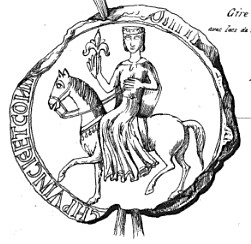
JoanEngland
Joan of England, Queen of Scotland

Joan of England was the oldest of daughter of King John and his 2nd wife, Isabella of Angoulême. Born on 22 July 1210 she was the 3rd of 5 children; she had 2 older brothers and 2 younger sisters would join the family by 1215.

Even before her birth, she was mooted as a possible bride for Alexander of Scotland, son of King William I of Scotland. A verbal agreement between the two kings, after the Treaty of Norham, in 1209 provided for John to arrange the marriages of William’s two daughters, with one marrying a son of John’s, and Alexander marrying one of John’s daughters.

Following the death of William I a further treaty in 1212 agreed to the marriage of 14-year-old Alexander II to 2-year-old Joan. However, the agreement seems to have been made as a way of preventing Alexander from looking to the continent – and especially France – for a potential bride, and by extension allies.

It did not stop John from looking further afield, nevertheless, for a more favourable marriage alliance. Nor did it stop Alexander from siding with the Barons against King John; Alexander was one of the Magna Carta signatories. John refused a proposal from King Philip II of France, for his son John, and settled in 1214 for a marriage with his old enemies the de Lusignan’s.

In 1214 Joan was betrothed to Hugh X de Lusignan. Hugh was the son of John’s rival for the hand of Isabella in 1200; Isabella’s engagement to Hugh IX was broken off  in order for her to marry John. Following the betrothal Hugh, Lord of Lusignan and Count of La Marche, was given custody of Joan and of Saintes, Saintonge and the Isle of Oléron as pledges for her dowry. Joan was just 4 years old when she travelled to the south of France to live with her future husband’s family. She was away from England at the height of the Baron’s War, and at her father’s death in October 1216.

It’s possible she was reunited with her mother in 1217 when Isabella of Angoulême left England, abandoning her four other children, in order to govern her own lands in Angoulême.

In 1220 in a scandalous about-face Hugh repudiated Joan and married her mother, his father’s former betrothed. And poor 9-year-old Joan’s erstwhile future husband was now her step-father!

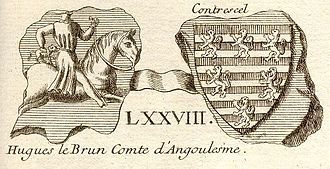
330px-Hugues_le_Brun
Hugh X de Lusignan, Joan’s betrothed and step-father

And worse was to come…

Instead of being sent back to England, as you would expect, Joan went from being Hugh’s betrothed – to being his prisoner. She was held hostage to ensure Hugh’s continued control of her dower lands, and to guarantee the transfer of his new wife’s dower, while England was withholding Queen Isabella’s dower against the return of Joan’s dower lands.

Negotiations to resolve the situation were ongoing. In the mean time, Henry III was already looking to arrange a new marriage for Joan. On 15th June 1220, in York, a conference between Alexander II and Henry III saw the Scots king agree to marry Joan, with a provision that he would marry Joan’s younger sister, Isabella, if Joan was not returned to England in time.

Negotiations for Joan’s return were long and difficult and not helped by the fact Hugh was threatening war in Poitou. Eventually, after Papal intervention, agreement was reached in October 1220 and Joan was surrendered to the English.

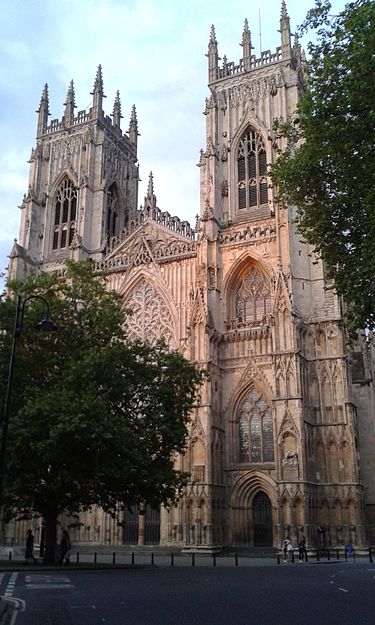
Joan and Alexander II were married on the 19th June 1221, at York Minster. Joan was just a month from her 11th birthday, while Alexander was 22. The archbishop of York performed the ceremony, which was witnessed Henry III and the great magnates of both realms. Henry III’s Pipe Rolls suggest the wedding was followed by 3 days of celebrations, costing £100. According to the Chronicle of Melrose ‘having celebrated the nuptials most splendidly, as was befitting, with all the natives of either realm rejoicing, [Alexander] conducted [Joan] to Scotland.’

York.mstr.
York Minster

The day before the wedding Alexander had assigned dower estates to Joan, worth an annual income of £1,000, including Jedburgh, Crail and Kinghorn. However, part of the dower was still held by Alexander’s mother, the dowager Queen Ermengarde, and Joan was not entitled to the income until after her mother-in-law’s death. This left Joan financially dependent on Alexander from the beginning.

There is a suggestion that Joan was not enamoured with Scotland and its society. She was hampered by her youth, her domineering mother-in-law and, eventually, by the fact she failed  to produce the desired heir. Her position was further hindered by tensions between her husband and brother from time to time.

In this, though, she seems to have found her purpose. Joan regularly acted as intermediary between the 2 kings. Alexander often used Joan’s personal letters to her brother as a way of communicating with Henry, while bypassing the formality of official correspondence between kings.

One such letter is a warning, possibly on behalf of Alexander’s constable, Alan of Galloway, of intelligence that Haakon IV of Norway was intending to aid Hugh de Lacy in Ireland. In the same letter she assured Henry that no one from Scotland would be going to Ireland to fight against Henry’s interests. Another letter, this time from Henry, was of a more personal nature, written in February 1235 it informed Joan of the marriage of their “beloved sister” Isabella to the holy Roman Emperor Frederick II, news at which he knew Joan “would greatly rejoice”.

In December 1235 Alexander and Joan were summoned to London, possibly for the coronation of Henry’s new queen, Eleanor of Provence. This would have been a long and arduous journey for the Scots monarchs, especially in the deepest part of winter.

Henry’s use of Joan as an intermediary suggests she did have some influence over her husband, this theory is supported by the fact that Joan accompanied Alexander to negotiations with the English king, at Newcastle in September 1236 and again at York in September 1237.

In 1234 Henry had granted Joan the manor of Fenstanton in Huntingdonshire and during the 1236 negotiations she was granted Driffield in Yorkshire, giving Joan an income independent of Scotland. Many have seen this as an indication that Joan was intending to spend more time in England, especially seeing as the chronicler Matthew Paris hints at an estrangement, although we cannot be certain.

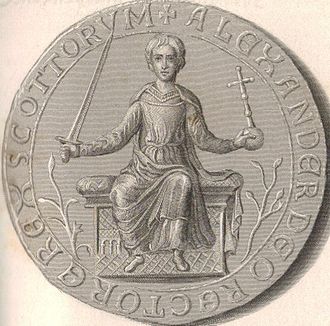
330px-Alexander_II_(Alba)_i
Alexander II

The 1236 and 1237 councils were attempts at resolving the ongoing claims of Alexander that King John had agreed to gift Northumberland to Alexander as part of the marriage contract between Alexander and Joan. Henry, of course, denied this. With the mediation of a papal legate, agreement was eventually reached in York at the 1237 council, with both queens present, when Alexander gave up the claim to Northumberland in return for lands in the northern counties with an annual income of £200.

Following the 1237 council Joan and her sister-in-law Eleanor of Provence departed on pilgrimage to the shrine of Thomas Becket at Canterbury. Given that Joan was now 27 and Eleanor already married for two years, it is possible both women were praying for children, and an heir.

Joan stayed in England for the rest of the year; much of the stay seems to have been informal and pleasurable. She spent Christmas at Henry’s court and was given new robes for herself, her clerks and servants, in addition to gifts of does and wine. Her widowed sister Eleanor, Countess of Pembroke, was present, along with the Countess of Chester and Joan’s cousin, the captive Eleanor of Brittany.

In late January arrangements were being made for Joan’s return to Scotland, but she fell ill before she could travel north. Still only 27 years of age Joan died on 4th March 1238 at Havering-atte-Bower in Essex, her brothers, King Henry III and Richard, Earl of Cornwall, were at her side.

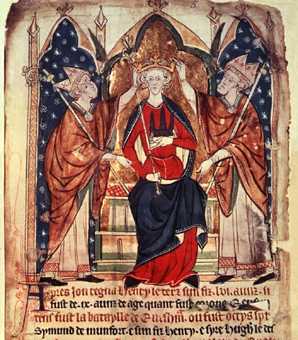
HenryIII
Henry III

According to Matthew Paris ‘her death was grievous, however she merited less mourning, because she refused to return [to Scotland] although often summoned back by her husband’. And even in death Joan elected to stay in England. her will requested that she be buried at the Cistercian nunnery of Tarrant in Dorset.

The convent benefited greatly from Henry III’s almsgiving for the soul of his sister; in 1252, over 13 years after her death, the king ordered a marble effigy to be made for her tomb (which unfortunately has not survived).

Talking of her wedding day, the Chronicle of Lanercost had described Joan as ‘a girl still of a young age, but when she was an adult of comely beauty.’

Alexander II married again just over a year after Joan’s death, to Marie de Coucy and their son, Alexander III, the longed-for heir, was born in 1241. Alexander II died of a fever in 1249.

*

Images courtesy of Wikipedia

*

Sources: The Oxford Companion to British History Edited by John Cannon; The Plantagenets, the Kings who Made England by Dan Jones; History Today Companion to British History Edited by Juliet Gardiner and Neil Wenborn;  Brewer’s British Royalty by David Williamson; Britain’s Royal Families, the Complete Genealogy by Alison Weir; The Plantagenet Chronicles Edited by Elizabeth Hallam; The Mammoth Book of British Kings and Queens by Mike Ashley; The Plantagenets, the Kings that made Britain by Derek Wilson; England Under the Norman and Angevin Kings  by Robert Bartlett; http://www.britannica.com; oxforddnb.com; finerollshenry3.org.uk.

*

My Books

Signed, dedicated copies of all my books are available through my online bookshop. or by contacting me.

Unfortunately, postage costs make it very expensive to send books to the US. However, if you buy one of my books in the US, I can send out a signed book plate. Just send me your address and who to dedicate it to via my contacting me page.

Coming 30 March: Princesses of the Early Middle Ages

Daughters of kings were often used to seal treaty alliances and forge peace with England’s enemies. Princesses of the Early Middle Ages: Royal Daughters of the Conquest explores the lives of these young women, how they followed the stereotype, and how they sometimes managed to escape it. It will look at the world they lived in, and how their lives and marriages were affected by political necessity and the events of the time. Princesses of the Early Middle Ages will also examine how these girls, who were often political pawns, were able to control their own lives and fates. Whilst they were expected to obey their parents in their marriage choices, several princesses were able to exert their own influence on these choices, with some outright refusing the husbands offered to them.

Their stories are touching, inspiring and, at times, heartbreaking.

Princesses of the Early Middle Ages: Royal Daughters of the Conquest is now available for pre-order from Pen & Sword and Amazon.

Also by Sharon Bennett Connolly:

Scotland’s history is dramatic, violent and bloody and Scotland’s Medieval Queens have seen it all. This is the story of Scotland through their eyes. Available now from Amazon and Pen and Sword BooksHeroines of the Tudor World tells the stories of the most remarkable women from European history in the time of the Tudor dynasty, 1485-1603. These are the women who ruled, the women who founded dynasties, the women who fought for religious freedom, their families and love. Heroines of the Tudor World is now available from Amberley Publishing and Amazon UK. Women of the Anarchy demonstrates how Empress Matilda and Matilda of Boulogne, unable to wield a sword themselves, were prime movers in this time of conflict and lawlessness. It shows how their strengths, weaknesses, and personal ambitions swung the fortunes of war one way – and then the other. Available from Bookshop.orgAmberley Publishing and Amazon UKKing John’s Right-Hand Lady: The Story of Nicholaa de la Haye is the story of a truly remarkable lady, the hereditary constable of Lincoln Castle and the first woman in England to be appointed sheriff in her own right. Available from all good bookshops Pen & Sword Booksbookshop.org and Amazon

Defenders of the Norman Crown: The Rise and Fall of the Warenne Earls of Surrey tells the fascinating story of the Warenne dynasty, from its origins in Normandy, through the Conquest, Magna Carta, the wars and marriages that led to its ultimate demise in the reign of Edward III. Available from Pen & Sword BooksAmazon in the UK and US, and Bookshop.orgLadies of Magna Carta: Women of Influence in Thirteenth Century England looks into the relationships of the various noble families of the 13th century, and how they were affected by the Barons’ Wars, Magna Carta and its aftermath; the bonds that were formed and those that were broken. It is now available in paperback and hardback from Pen & SwordAmazon, and Bookshop.orgHeroines of the Medieval World tells the stories of some of the most remarkable women from Medieval history, from Eleanor of Aquitaine to Julian of Norwich. Available now from Amberley Publishing and Amazon, and Bookshop.orgSilk and the Sword: The Women of the Norman Conquest traces the fortunes of the women who had a significant role to play in the momentous events of 1066. Available now from Amazon,  Amberley Publishing, and Bookshop.org.

Alternate Endings: An anthology of historical fiction short stories including Long Live the King… which is my take what might have happened had King John not died in October 1216. Available in paperback and kindle from Amazon.

Podcast:

Have a listen to the A Slice of Medieval podcast, which I co-host with Historical fiction novelist Derek Birks. Derek and I welcome guests, such as Bernard Cornwell and Michael Jecks, and discuss a wide range of topics in medieval history, from significant events to the personalities involved. 

Every episode is also now available on YouTube.

*

Don’t forget! Signed and dedicated copies of all my books are available through my online bookshop.

For forthcoming online and in-person talks, please check out my Events Page.

You can be the first to read new articles by clicking the ‘Follow’ button, liking our Facebook page or joining me on TwitterThreadsBluesky and Instagram.

*

©2015 Sharon Bennett Connolly FRHistS

Adela of Normandy – Daughter of the Conqueror

Adela
Adela of Normandy, Countess of Blois and Chartres

Adela of Normandy was the daughter of William the Conqueror, Duke of Normandy and King of England,  and his wife, Matilda of Flanders.

Although most sources give her date of birth around 1061/2, the Oxford Database of National Biography argues that her birth was after the Norman Conquest, as contemporary poetry suggests she was born the daughter of a king, rather than a duke.

Adela was one of nine or ten children born to William and Matilda, with at least four sisters and four brothers, although only three of her brothers survived to adulthood. Given her high level of literacy, and her patronage of poets in adulthood, it is likely that Adela was very well-educated as a child; either through tutors or possibly through residence in a convent, as happened with many daughters of the nobility at that time.

As a child, it seems, a marriage was arranged between Adela and Simon Crispin, count of Amiens; however, the groom chose to take monastic vows and an alternative marriage had to be found. As part of an alliance directed against the aggressive counts of Anjou, Adela was then  betrothed to Stephen of Blois, son of Count Theobald III, count of Blois and Champagne. Stephen was about 20 years older than his bride. The formal betrothal took place at Bourgueil and was later followed by a lavish wedding ceremony in Chartres Cathedral in about 1081.

StepanBlois_1089
Stephen, Count of Blois and Chartres

Adela and Stephen would have up to eleven children in all, with at least two sons born before Stephen succeeded his father as Count of Blois and Champagne in 1090.

Of their five daughters, Matilda married Richard d’Avranches, 2nd Earl of Chester. Tragically, he couple drowned in the White Ship disaster which deprived Henry I of his son and heir, William. Another daughter, Eleanor, married Raoul, Count of Vermandois. He was the brother of Isabelle de Vermandois, Countess of Leicester and Surrey.

Adela’s eldest surviving son seems to have been disinherited at an early age. However, while he is described as an ‘idiot’ by some, William was married to Agnes, the daughter of Giles, Lord of Sulli, and was given the titles Count of Chartres and Lord of Sulli, but was not allowed to inherit the richer county of Blois; which went to his younger brother, Theobald.

Poetry from the time of her wedding describes Adela as valorous, learned and generous. Indeed, she seems to have been a great asset to her husband, who included her in charitable donations and even in his early judicial rulings. Adela developed a cordial relationship with Bishop Ivo of Chartres, which worked well to maintain the peace between the laity and the clergy in the county.

In 1095 Stephen of Blois joined the First Crusade, leaving Adela as head of the family and regent of his domains.  Letters that the count sent to his wife indicate a great level of affection and trust; Adela was given charge of the family’s finances. However, Stephen’s return from crusade appears of have been less than happy. Adela  believed that he had not fulfilled his crusader’s vow and her criticism may have been a contributing factor in his return to the Holy Land in 1101 – she certainly approved of it.

Theobald
Theobald IV, Count of Blois and Champagne

Stephen was killed in combat in the Holy Land, during the siege of Ramallah in May 1102. He was succeeded as Count of Blois by his 2nd surviving son, Theobald. Theobald was knighted in 1107, by which point his older brother, William, had already been removed from the succession to Blois. William inherited the lesser title of Count of Chartres.

Following Stephen’s death Adela continued to act as regent until Theobald attained his majority. Even after Theobald came of age, mother and son ruled jointly until Adela retired from public life in 1120.

Adela was particularly close to her younger brother, Henry, who would later become King Henry I of England. She even supported him against their oldest brother, Robert, when Henry claimed the English crown.

An able administrator and negotiator, Adela settled many disputes among monasteries, and even between monasteries and laymen, in her own domains and beyond. Anselm, archbishop of Canterbury during the reign of William II and Henry I, praised her skills as negotiator and peacemaker following her success at achieving a temporary truce between Anselm and her brother in 1105.

HenryBlois
Henry of Blois, Bishop of Winchester

Anselm described her as an ardent supporter of papal reform, and enjoyed her hospitality during his exile from England. Adela hosted many other church dignitaries, including archbishop Thurstan of York and Pope Paschal II. Her family’s prestige and power was bolstered by her friendships with the leading ecclesiastic figures in both France and England.

An avid  patroness of the arts, Adela corresponded with such dignitaries as Hildebert, bishop of Le Mans and Abbot Baudri of Bourgeuil – later bishop of Dol – who both wrote poems dedicated to the countess. The book Ecclesiastical History Together with the Deeds of the Romans and the Franks, written by Hugh of Fleury, was dedicated to Adela.

One of Adela’s youngest sons, Henry of Winchester, was dedicated to the church at an early age, and was raised at the Priory of Cluny in France. He was nominated as Bishop of Winchester in 1129 and was a great support to his older brother, Stephen, when he claimed the throne of England on his uncle Henry’s death in 1135, at the expense of Henry’s daughter, Matilda

An active ruler Adela regularly toured the family’s domains, both as regent and mother of the reigning count. She also maintained links with the Anglo-Norman and Capetian kings. In 1101 Adela sent knights to help Philip I of France’s son, Louis, battling against rebels north of Paris.

Stepan_Blois
King Stephen

However, by 1107 her son Theobald had joined the revolt and relations with France were to deteriorate further in 1113 when the allied forces of Theobald, Henry I and Adela defeated a Capetian-Angevin army. After further conflict in 1118 Adela used her wealth and diplomatic skills to benefit her family.

In 1120 Adela stopped using the title of countess and retired to the Clunaic Priory of Marcigny;  the same year that her daughter Matilda died in the White Ship disaster off Barfleur in Normandy. She continued to be active in political affairs and lived to see her son, Stephen, claim the throne of England, though not the 20 years of conflict that ensued.

Aged almost 70, and having been a widow for half of her life, this most remarkable woman, Adela of Normandy, former Countess of Blois and Chartres, died in 1137, possibly on 8th March. Although later tradition has her buried with her mother at Holy Trinity in Caen, contemporary sources say she was buried at Marcigny.

*

Pictures courtesy of Wikipedia

*

Sources: England Under the Norman and Angevin Kings  by Robert Bartlett; Heroines of the Medieval World by Sharon Bennett Connolly; Silk and the Sword: The Women of the Norman Conquest by Sharon Bennett Connolly;  Brewer’s British Royalty by David Williamson; Britain’s Royal Families, the Complete Genealogy by Alison Weir; The Mammoth Book of British Kings and Queens by Mike Ashley; oxforddnb.com;  epistolae.ccnmtl.columbia.edu; womenshistory.about.com.

*

My Books

Signed, dedicated copies of all my books are available through my online bookshop.

Out now: Scotland’s Medieval Queens

Scotland’s history is dramatic, violent and bloody. Being England’s northern neighbour has never been easy. Scotland’s queens have had to deal with war, murder, imprisonment, political rivalries and open betrayal. They have loved and lost, raised kings and queens, ruled and died for Scotland. From St Margaret, who became one of the patron saints of Scotland, to Elizabeth de Burgh and the dramatic story of the Scottish Wars of Independence, to the love story and tragedy of Joan Beaufort, to Margaret of Denmark and the dawn of the Renaissance, Scotland’s Medieval Queens have seen it all. This is the story of Scotland through their eyes.

Available now from Amazon and Pen and Sword Books

Also by Sharon Bennett Connolly:

Heroines of the Tudor World tells the stories of the most remarkable women from European history in the time of the Tudor dynasty, 1485-1603. These are the women who ruled, the women who founded dynasties, the women who fought for religious freedom, their families and love. Heroines of the Tudor World is now available for pre-order from Amberley Publishing and Amazon UK. Women of the Anarchy demonstrates how Empress Matilda and Matilda of Boulogne, unable to wield a sword themselves, were prime movers in this time of conflict and lawlessness. It shows how their strengths, weaknesses, and personal ambitions swung the fortunes of war one way – and then the other. Available from Bookshop.orgAmberley Publishing and Amazon UKKing John’s Right-Hand Lady: The Story of Nicholaa de la Haye is the story of a truly remarkable lady, the hereditary constable of Lincoln Castle and the first woman in England to be appointed sheriff in her own right. Available from all good bookshops Pen & Sword Booksbookshop.org and Amazon

Defenders of the Norman Crown: The Rise and Fall of the Warenne Earls of Surrey tells the fascinating story of the Warenne dynasty, from its origins in Normandy, through the Conquest, Magna Carta, the wars and marriages that led to its ultimate demise in the reign of Edward III. Available from Pen & Sword BooksAmazon in the UK and US, and Bookshop.orgLadies of Magna Carta: Women of Influence in Thirteenth Century England looks into the relationships of the various noble families of the 13th century, and how they were affected by the Barons’ Wars, Magna Carta and its aftermath; the bonds that were formed and those that were broken. It is now available in paperback and hardback from Pen & SwordAmazon, and Bookshop.orgHeroines of the Medieval World tells the stories of some of the most remarkable women from Medieval history, from Eleanor of Aquitaine to Julian of Norwich. Available now from Amberley Publishing and Amazon, and Bookshop.orgSilk and the Sword: The Women of the Norman Conquest traces the fortunes of the women who had a significant role to play in the momentous events of 1066. Available now from Amazon,  Amberley Publishing, and Bookshop.org.

Alternate Endings: An anthology of historical fiction short stories including Long Live the King… which is my take what might have happened had King John not died in October 1216. Available in paperback and kindle from Amazon.

Podcast:

Have a listen to the A Slice of Medieval podcast, which I co-host with Historical fiction novelist Derek Birks. Derek and I welcome guests, such as Bernard Cornwell and Michael Jecks, and discuss a wide range of topics in medieval history, from significant events to the personalities involved. Every episode is also now available on YouTube.

*

Don’t forget! Signed and dedicated copies of all my books are available through my online bookshop.

For forthcoming online and in-person talks, please check out my Events Page.

You can be the first to read new articles by clicking the ‘Follow’ button, liking our Facebook page or joining me on Twitter and Instagram.

*

©2015 Sharon Bennett Connolly FRHistS.

Sanchia of Provence, Queen of the Romans

One of 4 sisters, all of whom became queens, Sanchia of Provence was born in Aix-en-Provence in about 1228. She was the third daughter of Raymond Berengar V, Count of Provence, and his wife Beatrice of Savoy.

Sanchie
Sanchie de Provence

Sanchia was 7 years younger than her oldest sister, Marguerite, who married Louis IX of France in 1234. Her second oldest sister, Eleanor, was 5 years her senior and married Henry III of England in 1236. Sanchia probably spent most of her childhood with Beatrice, who, as the youngest of the 4 sisters, was 3 years younger than Sanchia and didn’t marry until 1246; she would become Queen of Naples in 1266.

I could find no information on Sanchia’s childhood, beyond the fact that the sisters were all close, and remained so throughout their lives; thus helping to forge international relations through their exceptional familial bond.

The one description I could find of Sanchia was that she was ‘of incomparable beauty’.

Sanchia had originally been married, by proxy, to Raymond VII of Toulouse; however Raymond had failed to obtain an annulment of his previous marriage and the arrangement was declared void. In the mean time Richard, Earl of Cornwall and brother of Henry III of England visited Provence in 1241; he saw in Sanchia the chance to ally himself more closely with his brother’s interests, whilst at the same time strengthening his family’s position on the continent.

330px-Richard_of_Cornwall_
Richard Earl of Cornwall

Richard and Sanchia were betrothed by proxy in July 1242, following negotiations at Tarascon, led by Sanchia’s uncle, Peter of Savoy, and the Savoyard bishop of Hereford, Peter d’Aigueblanche.

Richard was the second and youngest son of King John of England and Isabella of Angoulême. Born in 1209, he was just 7 years old when his father died. A renowned soldier, Crusader, negotiator and administrator, Richard was one of the wealthiest men in Europe. He already had a son, Henry of Almain by his first wife, Isabella Marshal, daughter of the great William Marshal Earl of Pembroke. Isabella had died in childbirth in January 1240, after giving birth to a second son, who was stillborn.

In August-September 1242, following a failed campaign against Louis IX with his step-father, Hugh de Lusignan, Richard had planned to visit his future bride in Provence, before returning to England. However a falling-out with his brother, Henry III, and a fear of kidnapping forced Richard to change his plans and head straight for home, thus delaying a reunion with his bride-to-be.

Sanchia arrived in England in 1243. She and Richard were married in Westminster Abbey on 23rd November 1243. Sanchia was a girl of about 15, while Richard was 34. On his marriage, Richard confirmed in his possession of Cornwall and the honours of Wallingford and Eye. He was also given £2000 in cash by the king, and a promise of 1000 marks a year, in return for a renunciation of all claims to lands in Gascony and Ireland.

Richard’s marriage to Sanchia greatly improved his relations with the Savoyards, a powerful contingent of the queen’s relatives living in England. Following the marriage Richard served Peter of Savoy, titular earl of Richmond, as a banker and political ally.

Edmund,_2nd_Earl_of_Cornwall
Edmund, 2nd Earl of Cornwall

Richard and Sanchia had only 2 children. Their eldest son, Richard, was born at Wallingford in July 1246 and died there the following month; the little baby was buried at Grove Mill. Another son, Edmund, was born at Berkhamsted on 26 December 1249 and was baptised by his mother’s uncle, Boniface of Savoy, Archbishop of Canterbury. He would be knighted at the age of 22 and married Margaret, the daughter of Richard de Clare. However, the marriage was childless and the couple officially separated in February 1294.

Edmund had departed on crusade with the king’s son and heir, Edward (the future Edward I) when he heard of the murder of his older brother, Henry of Almain (son of Richard and his 1st wife, Isabella Marshal), who was murdered in Viterbo by the sons of Simon de Montfort. Edmund returned home to his father, who died the following year, leaving Edmund as the 2nd Earl of Cornwall. With no heir to succeed him, the earldom reverted to the crown on Edmund’s death in 1300.

In 1246 Sanchia’s father, Raymond Berengar V, died, leaving Provence to the youngest of his daughters; Beatrice was the only daughter still unmarried. Several suitors now set out to ‘win’ the heiress and her mother appealed to the pope for protection. The pope and Louis IX together decided that the most appropriate husband for Beatrice was Louis’ brother, Charles of Anjou. Beatrice’s mother offered no objection; however Henry III and Richard sought – unsuccessfully – to oppose the marriage, unsurprising when you consider their wives were denied their share of their father’s inheritance.

Statue_Raimond_Bérenger_IV
Raymond Berengar V, Count of Provence

Sanchia and her sister, Eleanor, were not as cut off from their family as most royal brides of the period appear to have been. Their mother, Beatrice of Savoy, arrived in England in 1248 with her brother, Thomas, to visit both her daughters.

Sanchia also accompanied her husband on an embassy to the French court in 1250, taking the opportunity to meet with her big sister, Marguerite; and possibly her little sister Beatrice, who was by then married to Charles of Anjou. Sanchia also joined the family gathering in Chartres and Paris in 1254, when Louis IX and queen Marguerite received Henry III and queen Eleanor; Her mother Countess Beatrice and youngest sister Beatrice were also present.

Sanchia and her sister Eleanor seem to have been in close contact ever since Sanchia arrived in England. Henry III officially recognised Sanchia as a voice in family dynastic matters. In the 1253 Calendar of Patent Rolls, she is included in a grant to her uncle, Peter of Savoy:

Grant to Peter de Sabaudia that if he have an heir male of his wife, he may assign or bequeath the lordship of his lands and heir to whom he will. The king also wills that the said heir shall not be married to anyone without the consent of Queen Eleanor and Sanchia, countess of Cornwall, and the brothers of the said Peter.”

Calendar of Patent Rolls, 1253

Sanchia seem to have had some influence in pleading for others. The Patent Rolls of 1255 record her achieving a pardon for a man who received an outlaw and again, in 1256, they record her gaining a licence to a man to enclose a wood.

330px-Beatrix4
Beatrice of Savoy, Countess of Provence

Henry III had made attempts to gain his brother a crown; he had accepted the crown of Sicily, offered by the pope, on his brother’s behalf, but the enterprise to recover the kingdom from the Hohenstaufens proved beyond the king’s means. In 1256, however, another opportunity arose with the death of William of Holland, papal candidate to be Holy Roman Emperor. With the support of his brother and his considerable wealth, diplomatic skills and imperial connections, Richard set about earning his election to the Empire.

On 26 December 1256 the crown of Germany was offered to Richard by the archbishop of Cologne. with his rival, King Alfonso of Castile, too busy with troubles at home to travel to Germany to claim the crown; Richard and Sanchia, with a large entourage including their son Edmund, but only half of the electors on their side, made their way to Aachen.

Sanchia and Richard were crowned as king and queen of Germany on 17 May 1257, by the archbishop of Cologne; being styled as the king and queen of the Romans, Richard still needed papal ratification to become Holy Roman Emperor. The coronation was followed by a splendid feast for Richard’ supporters before the new king and queen departed on progress around their new kingdom. Richard held his 1st royal parliament, or diet, in Mainz in September, and another progress in the spring of 1258 was spent confirming imperial privileges and issuing charters.

However, papal confirmation of Richard’s titles were not forthcoming and in the winter of 1258/9 Richard and Sanchia returned home to an England riven by baronial rebellion. Richard acted as mediator between his brother the king and his brother-in-law, Simon de Montfort, leader of the baronial opposition.

330px-Hailes_Abbey
Hailes Abbey, final resting place of Sanchia, her husband, Richard, and son, Edmund.

The political situation was still unresolved when Sanchia died at Berkhamsted on 9th November 1261 and was buried at Hailes Abbey 6 days later; her husband was absent from her death-bed and funeral.

After Sanchia’s death a grant in the Patent Rolls of Henry III:

for the saving of the king’s soul and of Sanchia, queen of Almain [Germany], to the master and brethren of the hospital of St Katharine without the Tower London of 50s a year at the Exchequer for the maintenance of a chaplain celebrating divine service daily in the chapel of St John within the Tower for her soul”.

Although she was only about 33 at her death, Sanchia’s legacy came from the close relationship with her sisters. All 4 sisters, and their mother, took part in the negotiations which led to the 1259 Treaty of Paris, improving relations between the French and English kings.

*

Pictures courtesy of Wikipedia

*

Sources:  The Plantagenet Chronicles edited by Elizabeth Hallam;  The Story of Britain by Roy Strong; The Plantagenets, the Kings Who Made England by Dan Jones; England Under the Norman and Angevin Kings  by Robert Bartlett; oxforddnb.com;  Brewer’s British Royalty by David Williamson; epistolae.ccnmtl.columbia.edu

*

My Books

Signed, dedicated copies of all my books are available through my online store.

OUT NOW! Heroines of the Tudor World

Heroines of the Tudor World tells the stories of the most remarkable women from European history in the time of the Tudor dynasty, 1485-1603. These are the women who ruled, the women who founded dynasties, the women who fought for religious freedom, their families and love. These are the women who made a difference, who influenced countries, kings and the Reformation. In the era dominated by the Renaissance and Reformation, Heroines of the Tudor World examines the threats and challenges faced by the women of the era, and how they overcame them. From writers to regents, from nuns to queens, Heroines of the Tudor World shines the spotlight on the women helped to shape Early Modern Europe.

Heroines of the Tudor World is now available for pre-order from Amberley Publishing and Amazon UK.

Coming 30 January 2025: Scotland’s Medieval Queens

Scotland’s history is dramatic, violent and bloody. Being England’s northern neighbour has never been easy. Scotland’s queens have had to deal with war, murder, imprisonment, political rivalries and open betrayal. They have loved and lost, raised kings and queens, ruled and died for Scotland. From St Margaret, who became one of the patron saints of Scotland, to Elizabeth de Burgh and the dramatic story of the Scottish Wars of Independence, to the love story and tragedy of Joan Beaufort, to Margaret of Denmark and the dawn of the Renaissance, Scotland’s Medieval Queens have seen it all. This is the story of Scotland through their eyes.

Available for pre-order now.

Also by Sharon Bennett Connolly:

Women of the Anarchy demonstrates how Empress Matilda and Matilda of Boulogne, unable to wield a sword themselves, were prime movers in this time of conflict and lawlessness. It shows how their strengths, weaknesses, and personal ambitions swung the fortunes of war one way – and then the other. Available from Bookshop.orgAmberley Publishing and Amazon UKKing John’s Right-Hand Lady: The Story of Nicholaa de la Haye is the story of a truly remarkable lady, the hereditary constable of Lincoln Castle and the first woman in England to be appointed sheriff in her own right. Available from all good bookshops Pen & Sword Booksbookshop.org and AmazonDefenders of the Norman Crown: The Rise and Fall of the Warenne Earls of Surrey tells the fascinating story of the Warenne dynasty, from its origins in Normandy, through the Conquest, Magna Carta, the wars and marriages that led to its ultimate demise in the reign of Edward III. Available from Pen & Sword BooksAmazon in the UK and US, and Bookshop.org

Ladies of Magna Carta: Women of Influence in Thirteenth Century England looks into the relationships of the various noble families of the 13th century, and how they were affected by the Barons’ Wars, Magna Carta and its aftermath; the bonds that were formed and those that were broken. It is now available in paperback and hardback from Pen & SwordAmazon, and Bookshop.orgHeroines of the Medieval World tells the stories of some of the most remarkable women from Medieval history, from Eleanor of Aquitaine to Julian of Norwich. Available now from Amberley Publishing and Amazon, and Bookshop.orgSilk and the Sword: The Women of the Norman Conquest traces the fortunes of the women who had a significant role to play in the momentous events of 1066. Available now from Amazon,  Amberley Publishing, and Bookshop.org.

Alternate Endings: An anthology of historical fiction short stories including Long Live the King… which is my take what might have happened had King John not died in October 1216. Available in paperback and kindle from Amazon.

Podcast:

Have a listen to the A Slice of Medieval podcast, which I co-host with Historical fiction novelist Derek Birks. Derek and I welcome guests, such as Bernard Cornwell, and discuss a wide range of topics in medieval history, from significant events to the personalities involved.

*

Don’t forget! Signed and dedicated copies of all my books are available through my online bookshop.

For forthcoming online and in-person talks, please check out my Events Page.

You can be the first to read new articles by clicking the ‘Follow’ button, liking our Facebook page or joining me on Twitter and Instagram.

©2015 Sharon Bennett Connolly FRHistS
Constance of York, the Rebel Countess

History...the Interesting Bits
Conisbrough Castle, possible birthplace of Constance of York

Constance of York was born around 1374, possibly at Conisbrough Castle in Yorkshire (although that is far from certain). She was the second of 3 children born to Edmund of Langley, Duke of York and 5th son of Edward III, and his wife, Isabella of Castile. Edmund and Isabella also had 2 boys, Edward of Norwich in around 1373 and Richard of Conisbrough, who is thought to have been born around 1375/6, but could have been born as late as the early 1380s.

Near-contemporary sources suggest that Edmund and Isabella were an ill-matched pair and their relationship was a rocky one, with Isabella accused of having an affair with John Holland, Duke of Exeter and half-brother to Richard II. Holland has also been suggested as the father of Isabella’s youngest son, Richard. However, recent research into contemporary records contradicts this image.

Constance’s childhood was short-lived. At the age of 4, in April 1378, she was betrothed to Edward le Despenser. However, young Edward appears to have died shortly after the betrothal as by November 1379 Constance was married to his only surviving, younger brother, Thomas, who was about 6 at the time.

Isabella_of_Castile-Langley
Isabella of Castile, Constance’s mother

It is highly likely that 4-year-old Constance remained in her parents’ household for several years after her marriage, although she may have spent time also in the household of her mother-in-law, who retained wardship of young Thomas despite her husband’s death.

Thomas le Despenser was a great-grandson of the infamous Hugh le Despenser the Younger, despised favourite and alleged lover of Edward II, who was executed on a 50-foot high gallows in 1326. The marriage was seen as a good match on both sides: the Despenser family had a considerable fortune and were among the 12 richest families in the country, while Constance was a granddaughter of Edward III. Her hand in marriage completed the rehabilitation of the Despenser family.

In 1386, at just 12-years-old Constance was made a Lady of the Garter by her cousin, Richard II; she was one of the youngest ever recipients of the award. In 1392 Constance’s mother died and the following year her father re-married. His new bride was about 6 years younger than Constance and was a niece to Richard II; Joan Holland was the daughter of Thomas Holland, 2nd earl of Kent and granddaughter of Joan of Kent, Princess of Wales. In a bizarre twist, she was also the niece of John Holland, 1st Duke of Exeter, the late Duchess of York’s alleged lover.

Thomas, meanwhile, was learning his trade as a soldier. He served with Richard II in Scotland in 1385, probably as a page or squire, given his tender years. In 1388 he was knighted by the Earl of Arundel, following his involvement in a naval expedition against the French. In 1391 Thomas travelled to Prussia to join the “crusade” against the Lithuanians.

It seems likely that, by 1394 with Thomas back in England, Thomas and Constance were finally living together as a couple.  In March of that year, Thomas had been granted full possession of his lands; he had been a ward of his mother, Elizabeth de Burghersh, since his father Edward’s death in 1375.

Coat_of_Arms_of_Sir_Thomas_le_Despencer,_1st_Earl_of_Gloucester,_KG
Arms of Thomas le Despenser, 1st Earl of Gloucester

It’s possible the couple had as many as 5 children, but only 2 survived infancy; a son, Edward, died young, Hugh died around 1401 and a daughter, Elizabeth, born around 1398, also died young.

The first definite date of birth of a child is Richard, possibly their 2nd son but the first to survive childhood, who was born 30 November 1396. Richard would inherit his grandmother’s title of Baron Burghersh on her death in about 1402. Richard married his second cousin Eleanor, daughter of Ralph Neville, 1st Earl of Westmoreland, and Joan Beaufort, daughter of John of Gaunt and Katherine Swynford.

Unfortunately, Richard and Eleanor had no children before Richard died, still only in his 20s. His title passed to his younger sister, Isabella, who had been born around 1400 and was married successively to 2 men, cousins, of the same name; she married firstly Richard de Beauchamp, Earl of Worcester and secondly Richard de Beauchamp, Earl of Warwick. Isabella’s daughter by Warwick, Anne, would later marry Richard Neville, known as the Kingmaker, and be the mother of Richard III’s queen, Anne Neville.

Thomas le Despenser was a great supporter of Richard II, he was involved in the arrest and prosecution of the Appellant lords, the Duke of Gloucester and the Earl of Arundel in 1397; in return for which he received a share of their lands. And on the 29th September 1397, le Despenser was created Earl of Gloucester.

In spite of his close links with Richard II, Gloucester initially supported the accession of Henry Bolingbroke as Henry IV, after usurping Richard’s throne. However, after he was attainted for his role in the death of Thomas of Woodstock, Duke of Gloucester, and deprived of his earldom he became disillusioned with the new regime.

450px-Pontefract_Castle
Painting of Pontefract Castle by Alexander Keirincx

Fearful of losing his estates, and possibly his life, in January 1400 he joined in a conspiracy with the earls of Kent, Salisbury and Huntingdon. Known as the Epiphany Rising, the earls planned to seize the king during a tournament at Windsor, intending to kill Henry IV and replace him with Richard II – still imprisoned at Pontefract Castle. The conspiracy was betrayed to the king by Edward of Norwich, Constance’s older brother and the conspirators were arrested and executed.  Richard II himself became the prime victim of the plot, which led Henry IV to believe it was too dangerous to keep the erstwhile king alive; he died shortly afterwards, still in custody at Pontefract Castle, probably from starvation.

Thomas le Despenser was executed on 13 January 1400. It is tempting to feel sorry for Constance of York, former Countess of Gloucester, mother of several infants and pregnant with her late husband’s child. And, indeed, it must have been difficult for her; a young, pregnant widow of a convicted traitor. With her husband’s lands forfeit, she could well have wondered what was going to happen to them all, especially following the death of her father in 1402. However, Constance herself was not beyond plotting.

Edward_of_Norwich_Duke_of_York
Edward of Norwich, 2nd Duke of York

In February 1405, during Owain Glyn Dwr‘s rebellion, Constance became involved in the plot to abduct Edmund Mortimer, 5th Earl of March from Windsor Castle. March had the greatest claim to the throne of all Henry IV’s rivals, being descended from Edward III’s second surviving son, Lionel of Antwerp. The plan was to deliver March and his younger brother, Roger, to their uncle, Sir Edmund Mortimer, who was married to Glyn Dwr’s daughter.

The boys were successfully released from Windsor, but recaptured before entering Wales. Although Constance does not seem to have suffered retribution for her part in the plot, she did implicate her brother Edward of Norwich, Duke of York, who was imprisoned in Pevensey Castle for seventeen weeks as a consequence.

Constance was also to cause scandal in her love life. As a young widow, she started a romantic liaison with Edmund Holland, 4th Earl of Kent. Edmund was the brother of Constance’s step-mother, Joan. A daughter, Eleanor, was born to the couple at Kenilworth in about 1405. She would later marry James Touchet, Lord Audley.

Whether or not Eleanor’s parents married became a bone of contention for the couple’s daughter, when she attempted to lay claim to her father’s lands and titles in 1430. Although Eleanor produced witnesses to prove the marriage of her parents, in about 1404, it was on the petition of Edmund’s sisters, Joan Duchess of York (Eleanor’s step-grandmother) and Margaret Holland, Duchess of Clarence, that Eleanor was adjudged illegitimate and unable to inherit from her father. With Eleanor declared illegitimate, Joan and Margaret became Edmund’s co-heirs and would divide their brother’s estate between them.

375px-Reading_Abbey_interior
Reading Abbey

Edmund was killed at the Battle of Ile-de-Brehat in September 1408 and buried on the island of Lavrec.

Constance outlived her lover by 8 years, dying on the 28 November 1416, the last survivor of the 3 York children. Her younger brother, Richard, had been executed in August 1415, for his part in the Southampton Plot to assassinate Henry V; and older brother Edward, Duke of York, was killed at Agincourt in October of the same year.

Constance of York, Countess of Gloucester, was buried at Reading Abbey in Berkshire.

*

Images:

Conisbrough Castle is ©2015 Sharon Bennett Connolly. All other pictures are courtesy of Wikipedia.

Sources:

Brewer’s British Royalty by David Williamson; History Today Companion to British History Edited by Juliet Gardiner & Neil Wenborn; The Mammoth Book of British kings & Queen by Mike Ashley; Britain’s Royal Families, the Complete Genealogy by Alison Weir; The Life and Times of Edward III by Paul Johnson; The Perfect King, the Life of Edward III by Ian Mortimer; Chronicles of the Age of Chivalry Edited by Elizabeth Hallam; yorkistage.blogspot.co.uk; richard111.com; The Oxford Companion to British History Edited by John Cannon.

*

My Books

Christmas is coming!

Signed, dedicated copies of all my books are available through my online bookshop.

Out now: Scotland’s Medieval Queens

Books by Sharon Bennett Connolly

Scotland’s history is dramatic, violent and bloody. Being England’s northern neighbour has never been easy. Scotland’s queens have had to deal with war, murder, imprisonment, political rivalries and open betrayal. They have loved and lost, raised kings and queens, ruled and died for Scotland. From St Margaret, who became one of the patron saints of Scotland, to Elizabeth de Burgh and the dramatic story of the Scottish Wars of Independence, to the love story and tragedy of Joan Beaufort, to Margaret of Denmark and the dawn of the Renaissance, Scotland’s Medieval Queens have seen it all. This is the story of Scotland through their eyes.

Scotland’s Medieval Queens gives a thorough grounding in the history of the women who ruled Scotland at the side of its kings, often in the shadows, but just as interesting in their lives beyond the spotlight. It’s not a subject that has been widely covered, and Sharon is a pioneer in bringing that information into accessible history.’ Elizabeth Chadwick (New York Times bestselling author)

Available now from Amazon and Pen and Sword Books

Coming 30 March 2026: Princesses of the Early Middle Ages

Books by Sharon Bennett Connolly

Daughters of kings were often used to seal treaty alliances and forge peace with England’s enemies. Princesses of the Early Middle Ages: Royal Daughters of the Conquest explores the lives of these young women, how they followed the stereotype, and how they sometimes managed to escape it. It will look at the world they lived in, and how their lives and marriages were affected by political necessity and the events of the time. Princesses of the Early Middle Ages will also examine how these girls, who were often political pawns, were able to control their own lives and fates. Whilst they were expected to obey their parents in their marriage choices, several princesses were able to exert their own influence on these choices, with some outright refusing the husbands offered to them.

Their stories are touching, inspiring and, at times, heartbreaking.

Princesses of the Early Middle Ages: Royal Daughters of the Conquest is now available for pre-order.

Also by Sharon Bennett Connolly:

Books by Sharon Bennett Connolly

Heroines of the Tudor World tells the stories of the most remarkable women from European history in the time of the Tudor dynasty, 1485-1603. These are the women who ruled, the women who founded dynasties, the women who fought for religious freedom, their families and love. Heroines of the Tudor World is now available from Amberley Publishing and Amazon UK. Women of the Anarchy demonstrates how Empress Matilda and Matilda of Boulogne, unable to wield a sword themselves, were prime movers in this time of conflict and lawlessness. It shows how their strengths, weaknesses, and personal ambitions swung the fortunes of war one way – and then the other. Available from Bookshop.orgAmberley Publishing and Amazon UKKing John’s Right-Hand Lady: The Story of Nicholaa de la Haye is the story of a truly remarkable lady, the hereditary constable of Lincoln Castle and the first woman in England to be appointed sheriff in her own right. Available from all good bookshops Pen & Sword Booksbookshop.org and Amazon

Books by Sharon Bennett Connolly

Defenders of the Norman Crown: The Rise and Fall of the Warenne Earls of Surrey tells the fascinating story of the Warenne dynasty, from its origins in Normandy, through the Conquest, Magna Carta, the wars and marriages that led to its ultimate demise in the reign of Edward III. Available from Pen & Sword BooksAmazon in the UK and US, and Bookshop.orgLadies of Magna Carta: Women of Influence in Thirteenth Century England looks into the relationships of the various noble families of the 13th century, and how they were affected by the Barons’ Wars, Magna Carta and its aftermath; the bonds that were formed and those that were broken. It is now available in paperback and hardback from Pen & SwordAmazon, and Bookshop.orgHeroines of the Medieval World tells the stories of some of the most remarkable women from Medieval history, from Eleanor of Aquitaine to Julian of Norwich. Available now from Amberley Publishing and Amazon, and Bookshop.orgSilk and the Sword: The Women of the Norman Conquest traces the fortunes of the women who had a significant role to play in the momentous events of 1066. Available now from Amazon,  Amberley Publishing, and Bookshop.org.

Alternate Endings: An anthology of historical fiction short stories including Long Live the King… which is my take what might have happened had King John not died in October 1216. Available in paperback and kindle from Amazon.

Podcast:

A Slice of Medieval

Have a listen to the A Slice of Medieval podcast, which I co-host with Historical fiction novelist Derek Birks. Derek and I welcome guests, such as Bernard Cornwell, Elizabeth Chadwick and Scott Mariani, and discuss a wide range of topics in medieval history, from significant events to the personalities involved. 

There are now over 75 episodes to listen to!

Every episode is also now available on YouTube.

*

Don’t forget! Signed and dedicated copies of all my books are available through my online bookshop.

For forthcoming online and in-person talks, please check out my Events Page.

You can be the first to read new articles by clicking the ‘Follow’ button, liking our Facebook page or joining me on TwitterThreadsBluesky and Instagram.

*

©2015 Sharon Bennett Connolly FRHistS

The Fascinating Marital Exploits of Joan, the Fair Maid of Kent

Joan_of_Kent
Joan, the Fair Maid of Kent

Joan of Kent was the daughter of Edmund of Woodstock, Earl of Kent and brother of Edward II. Edmund was a younger son of Edward I by his second wife, Margaret of France; he married Margaret Wake in 1325.

Joan was the third of four children, and was born on 28/9th September 1328 at Woodstock. When she was just 18 months old, Joan’s father was beheaded for treason on the orders of the Regent, Roger Mortimer and his lover, Queen Isabella; after becoming convinced that his brother, Edward II, was still alive, Edmund had become involved in a plot to free the erstwhile king.

Joan’s mother, Margaret Wake, was held under house arrest at Arundel Castle, along with all four of her children; Joan’s baby brother, John, was born a month after their father’s execution. Just a few months later, Edward III escaped Mortimer’s control and assumed power; he took over responsibility for his uncle’s family and Joan, a favourite of Edward’s queen, Philippa of Hainault, was raised at court.

The leading beauty of her day, Joan had little to offer a potential suitor, beyond her looks and keen intelligence. She had grown up in the same household as Edward III’s oldest children; his son and heir, Edward and his daughters Isabella and Joan.

Sometime around the age of 11 or 12, it seems that Joan secretly married, or promised to marry, Thomas Holland. However, shortly afterwards Holland left on Crusade to Prussia and during  his absence, Joan was married to William Montague, the future Earl of Salisbury in 1340/41.

Salisbury_1430
William Montague, Earl of Salisbury

When he returned to England, Thomas Holland discovered that his wife was married. Without the financial means to pursue his claim to be Joan’s husband through the church courts. Holland had to bide his time, joining Edward III’s campaigns in France, where he gained enough funds in ransoms to initiate the legal proceedings to recover his wife. In May 1348 Holland petitioned the pope, stating that Joan had been forced into her marriage with Salisbury. He went on to say that Joan had previously agreed to marry him and that their relationship had been consummated. He claimed her as his own wife, and Joan backed up his story.

It took 18 months for Joan’s marital status to be resolved, and for some of that time Salisbury kept Joan a prisoner, preventing her from presenting her testimony to the church lawyers. He was ordered to release her in order that she could give evidence at the inquisition looking into her marriage status.

In the mean time, England itself was in the grips of the Black Death, the bubonic plague. In order to lift the country’s spirits the king, Edward III, had arranged a grand tournament at Windsor, on St George’s Day, 23 April 1349. The knights in contention were founding members of the Order of the Garter; England’s greatest chivalric order, consisting of the king and 25 knights, it was probably founded in 1348, though the date is uncertain.

Joan herself is a part of the legend of the foundation of the Order of the Garter. She is said to be the lady who lost her garter during a ball celebrating the fall of Calais. Edward III is said to have returned the item to the 20-year-old damsel with the words “honi soit qui mal y pense” (evil to him who evil thinks).

Although the story is probably apocryphal (the fact a garter in those days was worn by men, not women, supporting this), Joan’s connection with the inaugural  tournament is all too true. Her presence brought an added bit of spice to the St George’s Day tournament of 1349. Her current husband, the Earl of Salisbury, fought on the king’s team, while Sir Thomas Holland was on the side of Prince Edward. Joan’s two husbands faced each other across the tournament field, with the object of their affection watching from the stands.

220px-Thomas_Holland_1430
Sir Thomas Holland

Although I couldn’t find the results of the tournament, Joan’s marital status was decided by Papal Bull on 13th November 1349, when the pope ordered her to divorce Salisbury and return to Holland. Which she did. I suppose we will never know if Joan had married Holland at the age of 11, or if they had an affair that only started after Holland returned from crusade, and the claim of a pre-contract was a clever ploy to get Joan out of an unhappy marriage.

It is easy for the cynic of the 21st century to nod their head sagely and say ‘good plan’. However, Joan and Thomas Holland were risking their eternal souls if they lied to a church court; such an oath was not to be undertaken lightly. It may be the romantic in me, but I cannot help but believe that Joan and Thomas were telling the truth about their promises to each other.

Joan succeeded her brother, John, as Baroness Wake of Liddell and Countess of Kent in December 1352 and was confirmed in her new titles in February 1353. Sir Thomas Holland, therefore, became Earl of Kent by right of his wife.

Joan and Sir Thomas Holland had five children together; three sons and two daughters. Edmund was born in 1352 and died young. Thomas, Earl of Kent, married Alice, the daughter of Richard FitzAlan, 10th Earl of Arundel; he died in 1397.  Their third son, John, was created Duke of Exeter in 1397 by his younger brother, King Richard II. He married Elizabeth of Lancaster, daughter of John of Gaunt and Blanche of Lancaster, but was executed in 1400 for his involvement in a plot to assassinate Henry IV and return his brother to the throne.

Of their daughters, Joan married John V, Duke of Brittany (who would marry Joanna of Navarre as his second wife, the future queen-consort of Henry IV), but died in 1384. Their youngest child, Matilda, was born in 1359 and married twice; first to Sir Hugh de Courtenay, who died in 1377, and then Waleran of Luxembourg, Count of St Pol and Ligny. Matilda died in 1391.

At the end of 1360 Sir Thomas Holland, a veteran soldier who had fought in the Crecy campaign, died from illness while in Normandy and Joan was left a widow.

Edward Prince of Wales – the Black Prince – may have offered comfort to the Lady Joan, his friend from childhood. Joan and Edward appear to have fallen in love. As widow with five children, and bringing no beneficial foreign alliance to the marriage table, Joan was hardly the ideal bride for the heir to the throne. Especially not with her dubious marital history. It was not the political match his father had wanted for his oldest son, but all attempts at a marriage alliance with a princess from the Low Countries had come to nought; and it seems the king was quite happy to accept his son’s choice of wife.

220px-Cernoch
Edward, the Black Prince

It must have caused quite a scandal at the time. Although a reputed beauty, Joan’s bigamous marriage to William Montague was well-known – and he was still alive. She had five children by her first husband, Thomas Holland. Moreover, she was 33 years of age, two years older than her prince. She hardly appeared ‘queen’ material.

However, according to the Chandos Herald Joan was “a lady of great worth…. very beautiful, pleasing and wise”. Edward III sent one of his own people to the pope to ask permission for the marriage, which was swiftly granted, securing the papal dispensations needed, given Edward and Joan were related withing the prohibited degrees (they were first cousins once removed).

With great ceremony Edward and Joan were married at Windsor on 10th October 1361, by the Archbishop of Canterbury and in the presence of the king and queen. Shortly after the wedding, the couple moved to Berkhamsted, where the king visited them after Christmas.

In 1363 they moved their entire household to Bordeaux, after the prince was given the Duchy of Aquitaine by his father. Their court there was lavish, exceeding the king’s own in brilliance.

In 1365 their first child was born; a son, Edward of Angoulême. His brother, Richard of Bordeaux, followed on 6th January 1367.

The chronicler, Froissart, tells the story:

In due course Joan, the princess, went into labour and by God’s grace was delivered of her child. It was a fine son, Richard of Bordeaux, born at Epiphany, 6 January , which that year fell on a Wednesday.

220px-Edward_of_Angouleme
Edward of Angouleme, from the Wilton Diptych

The child came into the world early in the morning to the great joy of the prince and the whole household, and was baptised the following Friday in the early afternoon on the holy font of St Andrew’s Church in the city of Bordeaux. The child was named Richard and he afterwards became King of England.”

Richard’s baptism was attended by three kings; Pedro of Castile, James IV of Majorca and Richard of Armenia. William Thorne, the Canterbury Chronicler, described them as the three ‘magi’ (or wise men), as Richard had been born on Epiphany, Twelfth Night; an auspicious sign for a bright future.

The Black Prince wrote fondly to his wife whilst campaigning in Spain: “Be assured, dearest companion, that we, our brother of Lancaster and all the great men of our army are, thank God, in good form.”

Froissart wrote of the Black Prince’s return from Spain, and his arrival in Bordeaux; “Where he was received with great celebrations. Princess Joan came to meet him and had Edward, her eldest son, carried with her; he was then about three years old.”

The Spanish campaign was aimed at supporting Pedro of Castile’s claim to the throne against that of his illegitimate half-brother, Henry of Trastamara. Although the Black Prince managed to re-establish Pedro’s rule, the Castilian king could not pay the English army and Edward, already with a reputation for heavy-handedness in Aquitaine, taxed the duchy in order to raise funds.

220px-Richard_II_King_of_England
Richard II

Sometime in late 1370 or early 1371 the young family suffered a heartbreaking tragedy. Little Edward of Angoulême died of bubonic plague. He was buried in Bordeaux, his funeral arranged by John of Gaunt and attended by all the great lords of Gascony.

Shortly afterwards, the remaining family returned to England, as reported by the chronicler Walsingham:

“When he had done this, Prince Edward hurried to return to England, as much because of the infirmities which troubled him, as because of lack of money. Therefore, at the beginning of January [1371], with his wife and small son Richard, and with  his household following behind, he reached Plymouth.”

The Black Prince’s health had been destroyed by a lifetime of campaigning. He returned to England a virtual invalid and died in 1376. Left a widow for a second time, Joan still had custody of her young son and was in charge of Richard’s education until his accession to the throne.

Edward III died in 1377, leaving the throne to 10-year-old Richard of Bordeaux. In his will he gave to Joan, Princess of Wales, a thousand marks and the free restitution of jewels she had pledged to him.

Despite her marital history, and a reputation for extravagance – she was said to have spent £200 on a set of jewelled buttons – Joan was loved by the English people. It was with her that John of Gaunt sought refuge following the sacking of his Savoy Palace in 1376, when the people were discontented with his rule.

Wilton_diptych
The Wilton Diptych

Joan was seen as a calming influence of her son, Richard II, and was by his side during the dangerous days of the Peasant’s Revolt of 1381; she sheltered in the Tower of London and rode in a whirligig to accompany her 13-year-old son to meet with the rebels at Mile End.

In 1385 Joan’s son, John Holland, while campaigning in Scotland, killed Ralph Stafford, son of the second Earl of Stafford, in a quarrel. He fled to sanctuary at the shrine of St John of Beverley, but was condemned to death. Joan pleaded with Richard for days, begging him to pardon his half-brother. She died at Wallingford Castle, on or shortly after 7 August 1385. The, when she made her will. King pardoned his half-brother the following day.

Although the Edward, the Black Prince, had built a chantry chapel for his wife, at Canterbury Cathedral, with ceiling bosses of her face, Joan was not buried at Canterbury with the Black Prince, but at the Greyfriars at Stamford in Lincolnshire, beside her first husband, Sir Thomas Holland. Unfortunately, nothing remains of the abbey beyond a gatehouse. Thomas and Joan’s tombs are lost.

*

Pictures taken from Wikipedia.

*

Sources: The Perfect King, the Life of Edward III by Ian Mortimer; The Life and Time of Edward III by Paul Johnson; The Reign of Edward III  by WM Ormrod; The Mammoth Book of British kings & Queens by Mike Ashley; Britain’s’ Royal Families, the Complete Genealogy by Alison Weir; Brewer’s British Royalty by David Williamson; The Plantagenets, the Kings Who Made Britain by Dan Jones; englishmonarchs.co.uk; The Oxford Companion to British History edited by John Cannon; Chronicles of the Age of Chivalry Edited by Elizabeth Hallam; The Black Prince by Michael Jones.

*

My Books

Signed, dedicated copies of all my books are available through my online store.

Out now: Scotland’s Medieval Queens

Books by Sharon Bennett Connolly

Scotland’s history is dramatic, violent and bloody. Being England’s northern neighbour has never been easy. Scotland’s queens have had to deal with war, murder, imprisonment, political rivalries and open betrayal. They have loved and lost, raised kings and queens, ruled and died for Scotland. From St Margaret, who became one of the patron saints of Scotland, to Elizabeth de Burgh and the dramatic story of the Scottish Wars of Independence, to the love story and tragedy of Joan Beaufort, to Margaret of Denmark and the dawn of the Renaissance, Scotland’s Medieval Queens have seen it all. This is the story of Scotland through their eyes.

Scotland’s Medieval Queens gives a thorough grounding in the history of the women who ruled Scotland at the side of its kings, often in the shadows, but just as interesting in their lives beyond the spotlight. It’s not a subject that has been widely covered, and Sharon is a pioneer in bringing that information into accessible history.’ Elizabeth Chadwick (New York Times bestselling author)

Available now from Amazon and Pen and Sword Books

Also by Sharon Bennett Connolly:

Books by Sharon Bennett Connolly

Heroines of the Tudor World tells the stories of the most remarkable women from European history in the time of the Tudor dynasty, 1485-1603. These are the women who ruled, the women who founded dynasties, the women who fought for religious freedom, their families and love. Heroines of the Tudor World is now available from Amberley Publishing and Amazon UK. Women of the Anarchy demonstrates how Empress Matilda and Matilda of Boulogne, unable to wield a sword themselves, were prime movers in this time of conflict and lawlessness. It shows how their strengths, weaknesses, and personal ambitions swung the fortunes of war one way – and then the other. Available from Bookshop.orgAmberley Publishing and Amazon UKKing John’s Right-Hand Lady: The Story of Nicholaa de la Haye is the story of a truly remarkable lady, the hereditary constable of Lincoln Castle and the first woman in England to be appointed sheriff in her own right. Available from all good bookshops Pen & Sword Booksbookshop.org and Amazon

Books by Sharon Bennett Connolly

Defenders of the Norman Crown: The Rise and Fall of the Warenne Earls of Surrey tells the fascinating story of the Warenne dynasty, from its origins in Normandy, through the Conquest, Magna Carta, the wars and marriages that led to its ultimate demise in the reign of Edward III. Available from Pen & Sword BooksAmazon in the UK and US, and Bookshop.orgLadies of Magna Carta: Women of Influence in Thirteenth Century England looks into the relationships of the various noble families of the 13th century, and how they were affected by the Barons’ Wars, Magna Carta and its aftermath; the bonds that were formed and those that were broken. It is now available in paperback and hardback from Pen & SwordAmazon, and Bookshop.orgHeroines of the Medieval World tells the stories of some of the most remarkable women from Medieval history, from Eleanor of Aquitaine to Julian of Norwich. Available now from Amberley Publishing and Amazon, and Bookshop.orgSilk and the Sword: The Women of the Norman Conquest traces the fortunes of the women who had a significant role to play in the momentous events of 1066. Available now from Amazon,  Amberley Publishing, and Bookshop.org.

Alternate Endings: An anthology of historical fiction short stories including Long Live the King… which is my take what might have happened had King John not died in October 1216. Available in paperback and kindle from Amazon.

Podcast:

A Slice of Medieval

Have a listen to the A Slice of Medieval podcast, which I co-host with Historical fiction novelist Derek Birks. Derek and I welcome guests, such as Bernard Cornwell and Michael Jecks, and discuss a wide range of topics in medieval history, from significant events to the personalities involved. 

Every episode is also now available on YouTube.

*

Signed and dedicated copies of all my books are available through my online store.

For forthcoming online and in-person talks, please check out my Events Page.

You can be the first to read new articles by clicking the ‘Follow’ button, liking our Facebook page or joining me on TwitterThreadsBluesky and Instagram.

©Sharon Bennett Connolly 2015 FRHistS
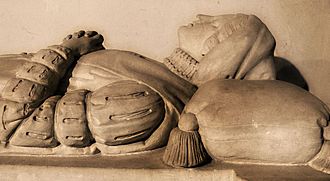
The Mother of the House of York

200px-Arms_of_Philippa_of_Clarence,_5th_Countess_of_Ulster.svg
Arms of Philippa of Clarence

Princess Philippa of Clarence was born at Eltham Palace in Kent on the 16th August 1355.  She was named after her grandmother, Philippa of Hainault, queen of Edward III, who was one of her Godparents.

The first grandchild of Edward III she was the only child of Lionel of Antwerp, Duke of Clarence, and his 1st wife, Elizabeth de Burgh. Lionel was the 1st of Edward and Philippa’s children to marry.

Lionel was the 3rd son of Edward and Philippa, but the 2nd to survive childhood. Born in 1338, he was married to Elizabeth de Burgh in the Tower of London on the 9th September 1342. Lionel was almost 4 years old and his bride was 6 years older, born in 1332. Elizabeth was the daughter and heiress of William de Burgh, 3rd Earl of Ulster, who had died the year after her birth. It seems the couple lived together as husband and wife from 1352, when Lionel was 14 and Elizabeth 20. Lionel became Earl of Ulster by right of his wife and took possession of vast estates in Ireland and the Honour of Clare, in Suffolk; from which he was created Duke of Clarence by Parliament on 13th November 1362.

220px-LionelDukeOfClarenceAtWestminster
Lionel Duke of Clarence

Philippa lost her mother when she was just 8 years old. Elizabeth died in Dublin in December 1363, she was buried  at Clare Priory in Suffolk. Lionel was married again in May 1368, in Milan, to Violante Visconti, daughter of the Lord of Milan. He died at Alba just 5 months after the wedding, in October 1368, and was buried at Pavia; his body was later reinterred to lie beside Elizabeth at Clare Priory in Suffolk.

The dukedom of Clarence became extinct on Lionel’s death, but the earldom of Ulster and Honour of Clare passed to Philippa, his only daughter and heiress.

Although an orphan at the tender age of 13, Philippa’s future had been settled even by the time of her mother’s death in 1363. When only in her 4th year she was married, at the Queen’s Chapel in Reading, in February 1359, to 7-year-old Edmund Mortimer. Edmund was the great-grandson of Roger Mortimer, 1st Earl of March and lover of Edward II’s queen, and Edward III’s mother, Isabella of France.

Mortimer had been executed on Edward III’s orders in 1330 and the marriage was viewed as a reconciliation with the Mortimer family, powerful lords on the Welsh Marches. The children’s wedding was also the 1st in a string of royal marriages. Philippa was married before any of her aunts and uncles; but weddings for her uncle John of Gaunt to Blanche of Lancaster  and her aunt Margaret to John Hastings, 2nd Earl of Pembroke followed in May the same year.

250px-Arms_of_the_House_of_Mortimer.svg
Arms of the House of Mortimer

The marriage alliances were all part of Edward III’s policy to provide for his large brood of children and tie the great baronial families of the kingdom to the crown, by bringing them into the Royal family.

Edmund Mortimer succeeded to his father’s earldom as the 3rd Earl of March in the year after the marriage and the couple spent their time between properties in England, Wales and Ireland.

Their 1st child was born when Philippa was 15; she gave birth to a daughter, Elizabeth, at Usk in Monmouthshire, on 12th February 1371. 3 more children followed; Roger born at Usk on 11th April 1374, Philippa, born at Ludlow in Shropshire on 21st November 1375 and finally Edmund, who was born at Ludlow on 9th November 1377.

Marriage to Philippa had brought her husband power and influence. Through his steward, Peter de la Mare, he was instrumental in the Good Parliament of 1376, which argued against the influence of Edward III’s lover, Alice Perrers, and her friends, on the government of the kingdom. He spoke up for royal legitimacy and, using similar language to that used against his grandfather, Roger Mortimer, decried the influence an adulterous affair was having  on the dignity of the crown.

220px-Ludlow_Castle_from_Whitcliffe,_2011
Ludlow Castle, Shropshire

Following Edward III’s death in 1377, until her own death 6 months later, Philippa was, technically, heiress presumptive to the crown of her cousin, Richard II. However, in a supplementary document to his will, Edward III had practically disinherited his eldest granddaughter. He settled the inheritance of the throne on his grandson, Richard, son of his eldest son, the Black Prince and then, in turn, starting with John of Gaunt, on his surviving sons and their sons.

Edward had thus attempted to destroy any claim Philippa might have had to the throne whilst at the same time, revoking the royal status of the Mortimer earls of March.

Although there appear to be several death dates for Philippa, the most likely is that she died as a result of complications following Edmund’s birth, as she had made a will in November 1377, suggesting she was preparing for death. She passed away on, or shortly before, 7th January 1378 and was buried at Wigmore, Herefordshire, the burial-place of the Mortimers.

Edmund’s star, however, continued to rise and he was appointed Lieutenant of Ireland by Richard II on 22nd October 1380.  He died at Cork on 26th or 27th December 1381 and his body was brought back to Wigmore for burial. He was succeeded as 4th Earl of March by his eldest son, Roger; who had succeeded Philippa as Earl of Ulster on her death.

220px-Harry_Hotspur_Percy
Sir Henry “Hotspur” Percy and Elizabeth Mortimer

Roger spent many years in wardship following his father’s death. He was courageous, but had a reputation for religious and moral laxity. He was killed in Ireland in 1398, while acting as the king’s Lieutenant. It is possible that, at some point, he was named heir to the throne by Richard II, although there is considerable doubt in this.

Of Philippa and Edmund’s other children Elizabeth married Sir Henry “Hotspur” Percy sometime before May 1380. They had 2 children, but he was killed at the Battle of Shrewsbury in 1403. Elizabeth then married Thomas, 1st Baron Camoys, with whom she had a son who died young. Elizabeth died on 20th April 1417 and was buried at Trotton in Sussex, with her 2nd husband.

Philippa’s daughter and namesake, Philippa, married John Hastings, 3rd Earl of Pembroke, son of the Earl of Pembroke who had married Edward III’s daughter, Margaret. Following his death in 1389, she married Richard FitzAlan, 11th Earl of Arundel, who was executed in 1397. Her 3rd marriage was to Thomas Poynings, 5th Baron St John of Basing, around November 1399. She died in 1400 or 1401 and was buried at Boxgrove Priory in Sussex.

220px-Richard_Plantagenet,_3rd_Duke_of_York
Richard, Duke of York

Edmund’s namesake, Philippa and Edmund’s youngest son was married in about 1402 to Katherine, the daughter of Owen Glendower. They had several children, but all died young. Edmund himself died sometime between 1409 and 1411.

Philippa’s grandson, Roger’s son, Edmund, succeeded his father as Earl of March and Ulster; he became the king’s ward following his father’s death and, following the usurpation he was kept in Henry IV’s family circle.

Edmund seems to have suffered from a lack of ambition and when some barons tried to place him on the throne in 1415, it was Edmund himself who revealed the Southampton Plot to Henry V.

Edmund died of plague in Ireland in January 1425, but it is his sister, Anne Mortimer, who had been married to Richard of Conisbrough, that Philippa’s claim to the throne was passed to Anne and Richard’s son, Richard, Duke of York; thus laying the foundations for the Wars of the Roses and the accession of Edward IV and, later, his brother, Richard III.

*

Pictures taken from Wikipedia.

*

Sources: The Perfect King, the Life of Edward III by Ian Mortimer; The Life and Time of Edward III by Paul Johnson; The Reign of Edward III  by WM Ormrod; The Mammoth Book of British kings & Queens by Mike Ashley; Britain’s’ Royal Families, the Complete Genealogy by Alison Weir; Brewer’s British Royalty by David Williamson; The Plantagenets, the Kings Who Made Britain by Dan Jones; mortimerhistorysociety.org.uk.

*

My books:

Signed, dedicated copies of all my books are available through my online store.

Out now: Scotland’s Medieval Queens

Books by Sharon Bennett Connolly

Scotland’s history is dramatic, violent and bloody. Being England’s northern neighbour has never been easy. Scotland’s queens have had to deal with war, murder, imprisonment, political rivalries and open betrayal. They have loved and lost, raised kings and queens, ruled and died for Scotland. From St Margaret, who became one of the patron saints of Scotland, to Elizabeth de Burgh and the dramatic story of the Scottish Wars of Independence, to the love story and tragedy of Joan Beaufort, to Margaret of Denmark and the dawn of the Renaissance, Scotland’s Medieval Queens have seen it all. This is the story of Scotland through their eyes.

Scotland’s Medieval Queens gives a thorough grounding in the history of the women who ruled Scotland at the side of its kings, often in the shadows, but just as interesting in their lives beyond the spotlight. It’s not a subject that has been widely covered, and Sharon is a pioneer in bringing that information into accessible history.’ Elizabeth Chadwick (New York Times bestselling author)

Available now from Amazon and Pen and Sword Books

Also by Sharon Bennett Connolly:

Books by Sharon Bennett Connolly

Heroines of the Tudor World tells the stories of the most remarkable women from European history in the time of the Tudor dynasty, 1485-1603. These are the women who ruled, the women who founded dynasties, the women who fought for religious freedom, their families and love. Heroines of the Tudor World is now available from Amberley Publishing and Amazon UK. Women of the Anarchy demonstrates how Empress Matilda and Matilda of Boulogne, unable to wield a sword themselves, were prime movers in this time of conflict and lawlessness. It shows how their strengths, weaknesses, and personal ambitions swung the fortunes of war one way – and then the other. Available from Bookshop.orgAmberley Publishing and Amazon UKKing John’s Right-Hand Lady: The Story of Nicholaa de la Haye is the story of a truly remarkable lady, the hereditary constable of Lincoln Castle and the first woman in England to be appointed sheriff in her own right. Available from all good bookshops Pen & Sword Booksbookshop.org and Amazon

Royal Historical Society

Defenders of the Norman Crown: The Rise and Fall of the Warenne Earls of Surrey tells the fascinating story of the Warenne dynasty, from its origins in Normandy, through the Conquest, Magna Carta, the wars and marriages that led to its ultimate demise in the reign of Edward III. Available from Pen & Sword BooksAmazon in the UK and US, and Bookshop.orgLadies of Magna Carta: Women of Influence in Thirteenth Century England looks into the relationships of the various noble families of the 13th century, and how they were affected by the Barons’ Wars, Magna Carta and its aftermath; the bonds that were formed and those that were broken. It is now available in paperback and hardback from Pen & SwordAmazon, and Bookshop.orgHeroines of the Medieval World tells the stories of some of the most remarkable women from Medieval history, from Eleanor of Aquitaine to Julian of Norwich. Available now from Amberley Publishing and Amazon, and Bookshop.orgSilk and the Sword: The Women of the Norman Conquest traces the fortunes of the women who had a significant role to play in the momentous events of 1066. Available now from Amazon,  Amberley Publishing, and Bookshop.org.

Alternate Endings: An anthology of historical fiction short stories including Long Live the King… which is my take what might have happened had King John not died in October 1216. Available in paperback and kindle from Amazon.

Podcast:

A Slice of Medieval

Have a listen to the A Slice of Medieval podcast, which I co-host with Historical fiction novelist Derek Birks. Derek and I welcome guests, such as Bernard Cornwell and Michael Jecks, and discuss a wide range of topics in medieval history, from significant events to the personalities involved. 

Every episode is also now available on YouTube.

*

Don’t forget! Signed and dedicated copies of all my books are available through my online store.

For forthcoming online and in-person talks, please check out my Events Page.

You can be the first to read new articles by clicking the ‘Follow’ button, liking our Facebook page or joining me on TwitterThreadsBluesky and Instagram.

*

©2015 Sharon Bennett Connolly FRHistS