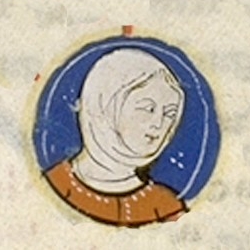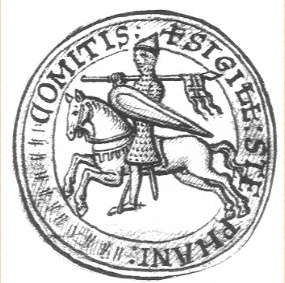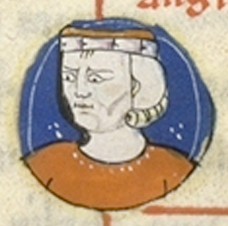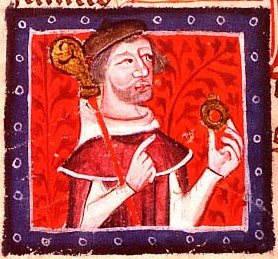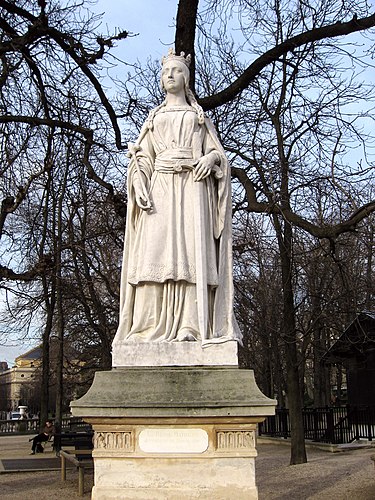
Matilda of Flanders was the consummate duchess and queen. Born in the early to mid-1030s, possibly around 1032, Matilda was the daughter of Baldwin V, Count of Flanders, and his wife Adela of France, a daughter of Robert the Pious, King of France. Matilda had two brothers and each of them became Count of Flanders in his turn; Baldwin of Mons and Robert the Frisian. As is often the case with medieval women, we know very little of Matilda’s early life, though it is likely she was raised alongside her aunt, Judith, her father’s sister who was of a similar age to Matilda, and who would go on to marry Tostig, Earl of Northumberland and brother of king Harold II.
The first time Matilda appears on the world stage is when her marriage is being discussed. There is a popular story of how Matilda refused to marry William, Duke of Normandy, stating that she was too highly born to marry a bastard. As the legend goes; on hearing this, William was so infuriated that he rode to Flanders and confronted Matilda. He is said to have thrown her to the ground, before pulling her braids and cutting her with his spurs. Matilda, unlikely as it seems, then accepted his proposal and they were married. Despite the story most likely being a later invention, William was the one to propose the marriage and, although he was a duke, his illegitimacy would have meant making a proposal to a niece of the King of France was audacious, to say the least.
The arrangements for the marriage of Matilda and William probably started in 1048, but it was a long, drawn out matter, marred by papal and political machinations. The Synod of Reims, of 3 and 4 October 1049, issued a decree instructing Count Baldwin not to allow the marriage of his daughter to Duke William. However, despite these papal objections, Matilda and William were married by 1053, at the latest. A penance was later imposed on the couple for their disobedience in marrying against papal prohibition. Each was to found an abbey; William founded the Abbaye-aux-Hommes, or St Stephen’s Abbey, in his Norman capital of Caen, while Matilda founded the Abbaye-aux-Dames, or Holy Trinity Abbey, in the same city. The two abbeys still stand to this day.
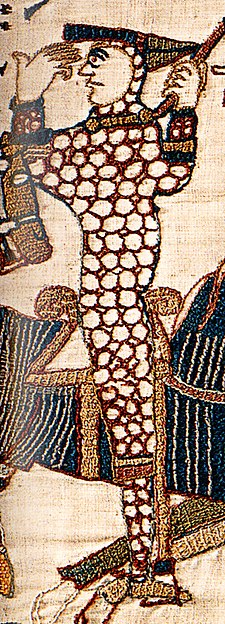
The marriage between Matilda and William proved to be a strong and trusting relationship; William is one of very few medieval kings believed to have been completely faithful to his wife, no known lovers or illegitimate children have ever been uncovered, although that did not stop the rumours. William of Malmesbury related one such story, of William having a mistress, the daughter of a priest, who Matilda ordered to be hamstrung and disinherited; in punishment, Matilda is said to have been beaten to death by a horse bridle. Malmesbury himself was sceptical of the story and, given that Matilda’s death came after a short illness in 1083, it does seem rather far-fetched.
William trusted Matilda to act as regent in Normandy during his many absences on campaign or in England. Their relationship appears to have been more of a partnership than most marriages of the time; she was witness to thirty-nine pre-conquest and sixty-one post-conquest charters. Matilda supported her husband’s proposed invasion of England; she promised a great ship for William’s personal use, called the Mora. Just before leaving for England in 1066, William accompanied Matilda to the consecration of her foundation, Holy Trinity Abbey – the Abbaye-aux-Dames – in Caen, arranging for his duchess to act as regent in his absence. The Conquest was a close-run thing and it was not until 1068 that William felt secure enough to bring his wife to England for her coronation. Matilda, six months pregnant with her son Henry, who would be born at Selby in September, was crowned Queen of England in Westminster Abbey, by Archbishop Ealdred of Canterbury, at Whitsuntide 1068.
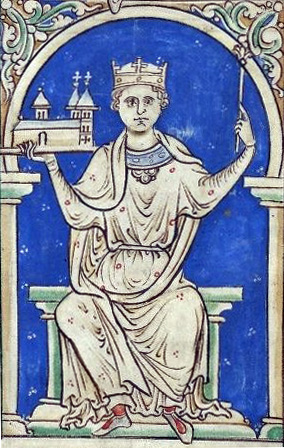
Matilda and William had a large family, with four boys and at least four daughters. Of their sons; the eldest, Robert Curthose, would inherit Normandy, Richard was killed in a hunting accident as a youth, William, known as Rufus, became King William II, and the youngest was the future King Henry I. Of the four or five daughters; Adeliza became a nun following a series of failed marriage plans, Cecilia was given to the convent of Ste Trinité as a child, Constance married Alain Fergant, Duke of Brittany, and Adela married Stephen of Blois and was the mother of King Stephen of England. There are suggestions of two further daughters, Matilda and Agatha, though evidence for their existence is limited. And for nearly 800 years it was believed that Gundrada de Warenne, wife of William de Warenne, the first Earl of Warenne and Surrey, was also a daughter of William and Matilda, but this seems increasingly unlikely and most historians argue against the theory.
Queen Matilda was very close to her family, especially her eldest son, Robert. William and Robert, father and son, however, were often at loggerheads, with Robert rebelling against his father as a young man. Matilda was constantly trying to play the peacemaker. During a period of exile imposed on Robert, Matilda still supported her son as best she could; she would send him vast amounts of silver and gold through a Breton messenger, Samson.
Although the problems with Robert, their eldest son, caused considerable tensions within the marriage, Matilda and William’s relationship is one of the most successful of the medieval period. Their partnership as rulers, and as husband and wife, was strong and appeared to be one built on mutual respect. One contemporary remarked that ‘The Queen adored the King and the King the Queen.’1

Matilda’s piety was renowned. Although founding the Abbaye aux Dames in Caen was a penance for her irregular marriage to William, her constant and repeated donations to religious houses demonstrated her dedication to her faith. The nuns of her abbey at Ste Trinité, Caen, received a substantial bequest from Matilda’s will, written the year before her death; as well as her crown and sceptre, they were given a chalice, a chasuble, a mantle of brocade, two golden chains with a cross, a chain decorated with emblems for hanging a lamp in front of the altar, several large candelabras, the draperies for her horse and all the vases ‘which she had not yet handed out during her life’. 2
Having drawn up her will in 1082, it is possible that Matilda was aware of her illness long before her last summer. The continuing worry over the rift between her husband and beloved son cannot have helped her health, and the arrival of winter saw her gravely ill. Matilda died on 2 November 1083, having ‘confessed her sins with bitter tears and, after fully accomplishing all that Christian custom requires and being fortified by the saving sacrament’.3 Her husband was with her throughout the final moments of her illness, and he ‘… showed many days of the deepest mourning how much he missed the love of her whom he had lost’.4 She was buried at Ste Trinité, Caen, following a funeral that lasted two days and that was attended by a host of monks, abbots, bishops and nuns and a host of people came to pay homage. There is no record of which of her children attended the funeral, although her daughter Cecilia was most likely in attendance, being a nun of the abbey. The original tombstone still survives; it has an inscription carved around the edge, emphasising her royal descent on her mother’s side.

Matilda’s height has been discussed frequently by historians, with some claiming that she was a dwarf. The casket, containing her bones, was opened in 1961 and misreported as revealing a woman of about 4ft 2in tall. However, Professor Dastague, from the Institut D’Anthropologie at Caen, who was present at the original dig confirmed that it had been calculated that Matilda was in fact 152cm, about 5ft, in height.5 Matilda’s actual height cannot be said with certainty, however, as the skeleton which was examined was incomplete. The queen’s grave had been destroyed in the sixteenth century, during the French Wars of Religion, and much of her remains never recovered.
William the Conqueror followed his wife to the grave four years later, in 1087. In many aspects of her life, Matilda is clearly seen as the ideal medieval wife and mother. Ever supportive of her husband, he relied heavily on her to administer Normandy in his frequent absences. Even when disobeying William, in her support of their eldest son Robert, she was still trying to be the embodiment of the good medieval woman, playing the peacemaker between warring members of her family. Her piety and steadfast support of her husband provided an example for future queens, and noble ladies, to follow.
*
The story of Matilda of Flanders appears in greater detail in my book Silk and the Sword: The Women of the Norman Conquest, newly released in paperback. While her daughters have a chapter of their own in Princesses of the Early Middle Ages: Royal Daughters of the Conquest.
This article, first appeared in March 2019, as Matilda of Flanders: The Ideal Medieval Queen, on Mary Anne Yarde’s wonderful blog Myths, Legends, Book and Coffee Pots.
*
Footnotes:
[1] Les Oeuvres Poétiques de Baudri de Bourgueil edited by P. Abrahams; [2] Musset, La Reine Mathilde, quoted by Elizabeth van Houts in oxforddnb.com. [3] Matilda by Tracy Borman, [4] Chronicles of the Kings of England, From the Earliest Period to the Reign of King Stephen by William of Malmesbury; [5] A Historical Obstetric Enigma: How Tall was Matilda? (article) by J Dewhurst Journal of Obstetriccs and Gynaecology.
Pictures:
Courtesy of Wikipedia
Sources:
England Under the Norman and Angevin Kings by Robert Bartlett; Heroines of the Medieval World by Sharon Bennett Connolly; Chronicles of the Kings of England, From the Earliest Period to the Reign of King Stephen by William of Malmesbury; Silk and the Sword: The Women of the Norman Conquest by Sharon Bennett Connolly; Brewer’s British Royalty by David Williamson; Britain’s Royal Families, the Complete Genealogy by Alison Weir; Matilda by Tracy Borman; The Norman Conquest by Marc Morris; The Anglo-Saxon Chronicles by Michael Swanton; The Anglo-Saxon Chronicle by James Ingram; The Mammoth Book of British Kings and Queens by Mike Ashley; oxforddnb.com; Queen Matilda, wife of William the Conqueror, was NOT a Dwarf (article) by Marc Morris, marcmorris.org.uk; womenshistory.about.com; epistolae.ccnmtl.columbia.edu; Les Oeuvres Poétiques de Baudri de Bourgueil edited by P. Abrahams
*
My Books
Signed, dedicated copies of all my books are available through my online bookshop or the Contact Me page.
New releases in 2026:
New Hardbacks
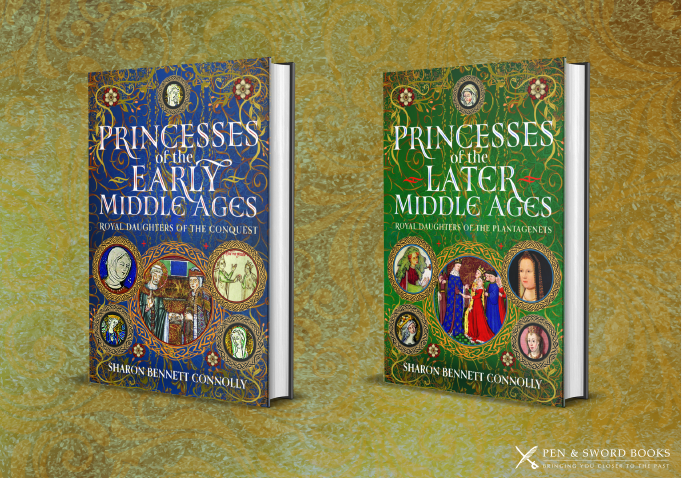
‘My daughter wanted me to treat her more like a princess. So, I married her to a stranger to strengthen the alliance with Poland!’
Princesses of the Early Middle Ages: Royal Daughters of the Conquest and Princesses of the Later Middle Ages: Royal Daughters of the Plantagenets tell the stories of England’s royal daughters from 1066 to the rise of the Tudors, from the last Anglo-Saxon princesses to the fall of the House of York.
Were they really pampered pawns sent off to marriages on the Continent, out of sight and out of mind?
Perhaps, there was different story, where a foreign marriage does not mean eternal exile, but a purpose in life, where a princess is a diplomat, an ambassador for England in her new country.
Where she is the bond between allies – most of the time.
Their stories are touching, inspiring and, at times, heartbreaking...
Praise for Princesses of the Early Middle Ages: Royal Daughters of the Conquest:
Heidi Malagisi: ‘This is another excellent book by Sharon Bennett Connolly. Extremely well researched and relatively easy to follow along, which is a great thing because there are so many Matildas and Eleanors in this book.‘
Tony Riches: “I challenge anyone with an interest in medieval Britain to not find something they will learn from this book.”
Anna Belfrage: “I just love how [Sharon] presents this huge cast of real life people in a casual, chatty tone that has me expecting the various female protagonists to suddenly pop their head up and add their own commentary.“
Praise for: Princesses of the Later Middle Ages: Royal Daughters of the Plantagenets:
Elizabeth Chadwick: “Every history buff should have this excellent work on their shelves. Sharon Bennett Connolly brings these often forgotten ladies of the Middle Ages out of the shadows and stands them in the spotlight. Triumphs, tragedies, elopements, stormy marriages, love stories, formidable personalities, it’s all here on the pages of history, brought to life by the meticulous research of Sharon Bennett Connolly. I loved it!“
Kathryn Warner: ‘A deeply researched, richly detailed and fascinating account of late medieval England’s forgotten princesses. I loved it!‘
Buy now: Princesses of the Early Middle Ages: Royal Daughters of the Conquest
Pre-order: Princesses of the Later Middle Ages: Royal Daughters of the Plantagenets
Out now in Paperback:
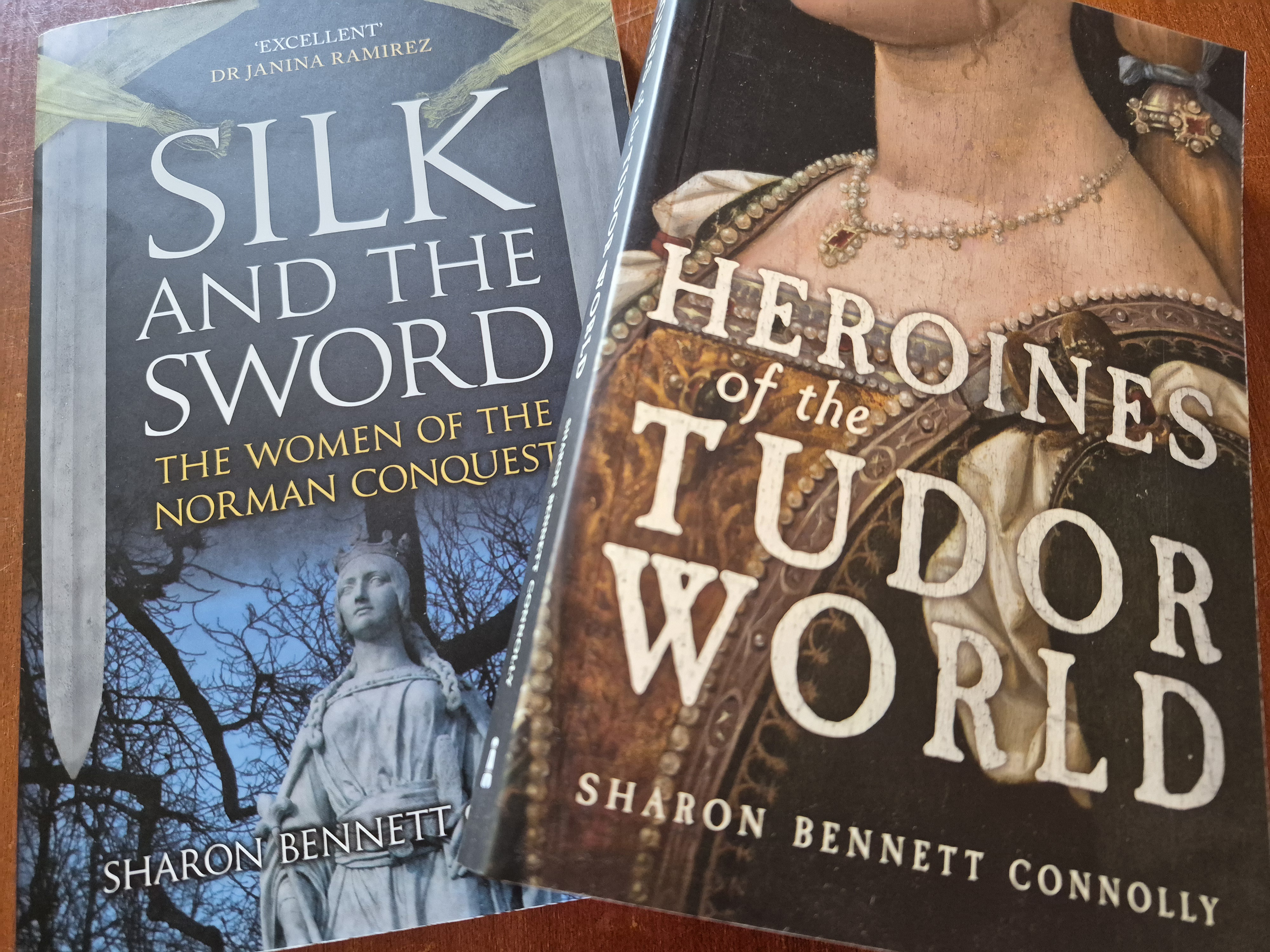
The momentous events of 1066, the story of invasion, battle and conquest, are well known. But what of the women? Silk and the Sword: The Women of the Norman Conquest traces the fortunes of the women who had a significant role to play during the Norman Conquest – wives, lovers, sisters, mothers, leaders. These are lives full of drama, pathos and sometimes mystery: Edith and Gytha searching the battlefield of Hastings for the body of Harold, his lover and mother united in their grief for the fallen king. Who was Ælfgyva, the lady of the Bayeux Tapestry, portrayed with a naked man at her feet?
Janina Ramirez said it’s ‘Excellent’!
Heroines of the Tudor World focuses on the women who lived through the Renaissance and Reformation, examining the threats and challenges they faced and how they overcame them. These are the women who ruled, the women who founded dynasties, the women who fought for religious freedom, their families and love. These are the women who made a difference, who influenced countries, kings and the Reformation.
Derek Birks: ‘An excellent account of the changing roles of women in Tudor society.’
Annie Whitehead: ‘What a treat this book was to read. Bennett Connolly has an easy, conversation style of writing which welcomes you from the opening pages and draws you into her story.‘
Also by Sharon Bennett Connolly:
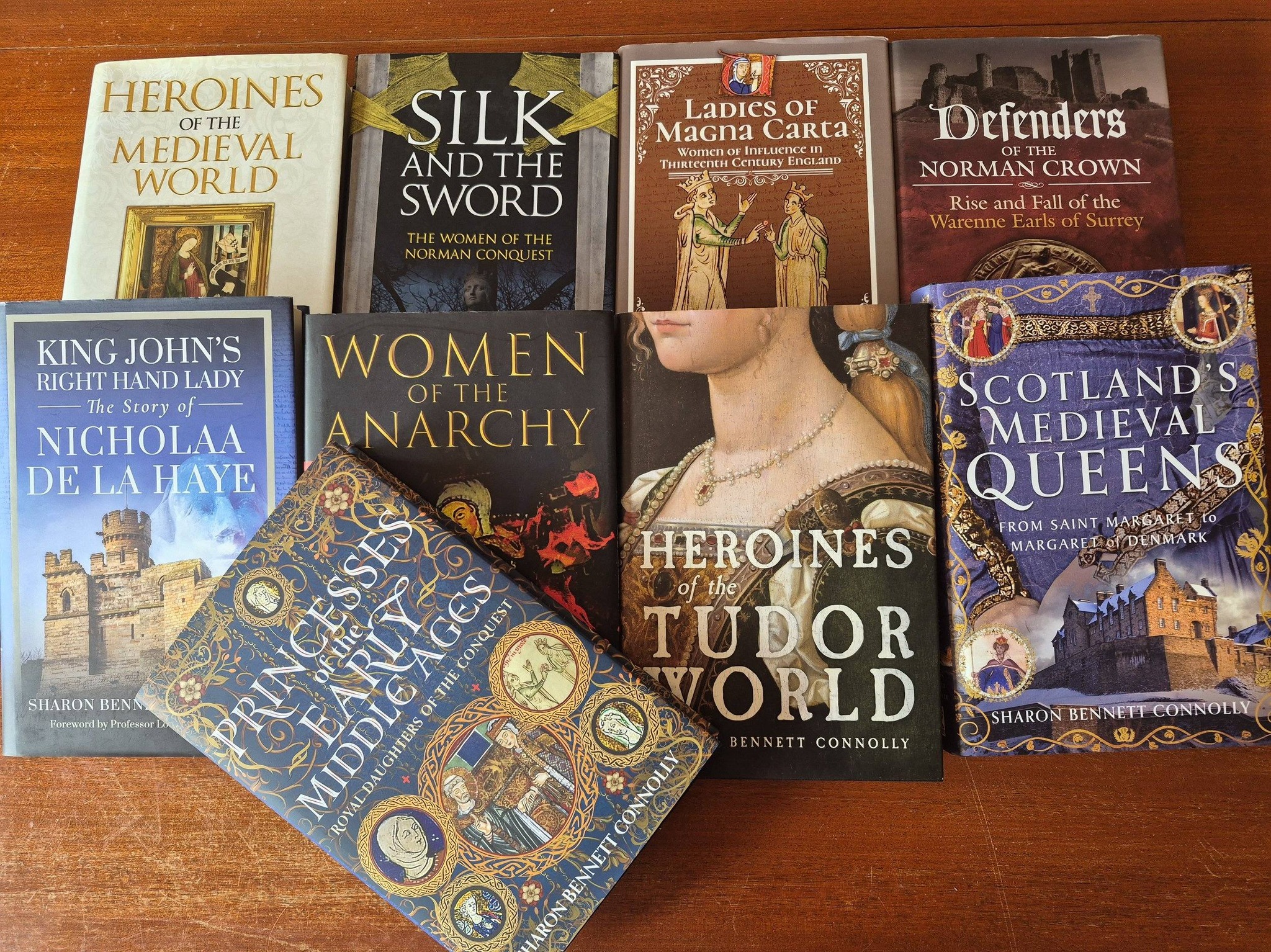
Heroines of the Medieval World; Silk and the Sword: The Women of the Norman Conquest; Ladies of Magna Carta: Women of Influence in Thirteenth Century England; Defenders of the Norman Crown: Rise and Fall of the Warenne Earls of Surrey; King John’s Right Hand Lady: The Story of Nicholaa de la Haye; Women of the Anarchy; Heroines of the Tudor World; Scotland’s Medieval Queens: From St Margaret to Margaret of Denmark; Princesses of the Early Middle Ages: Royal Daughters of the Conquest (March 2026); Princesses of the Later Middle Ages; Royal Daughters of the Plantagenets (August 2026)
Alternate Endings: An anthology of historical fiction short stories including Long Live the King… which is my take what might have happened had King John not died in October 1216. Available in paperback and kindle from Amazon.
All my books on Amazon and Bookshop.org . You can also order direct from my publishers, Pen and Sword Books and Amberley Publishing.
*
Podcast:
Have a listen to the A Slice of Medieval podcast, which I co-host with Historical fiction novelist Derek Birks. Derek and I welcome guests, such as Ian Mortimer, Bernard Cornwell, Elizabeth Chadwick and Scott Mariani, and discuss a wide range of topics in medieval history, from significant events to the personalities involved.
Every episode is also now available on YouTube.
*

Don’t forget!
Signed and dedicated copies of all my books are available through my online bookshop.
For forthcoming online and in-person talks, please check out my Events Page.
You can be the first to read new articles by clicking the ‘Follow’ button, liking our Facebook page or joining me on Twitter, Threads, Bluesky and Instagram.
*
©2019 Sharon Bennett Connolly FRHistS