The History and Legend of Lady Godiva

Books by Sharon Bennett Connolly
Lady Godiva

While researching Silk and the Sword: the Women of the Norman Conquest I came across some incredibly interesting characters. One of the most misunderstood women of the 11th century has to be Lady Godiva. Although she would have been known as Godgifu in her lifetime, we shall call her Godiva, the name we have all grown up with, and to distinguish her from several notable ladies of a similar name in this period. Known for her legendary naked ride through Coventry in order to ease the tax burdens of its citizens, finding the true story of Lady Godiva was a fascinating experience. She was the grandmother of three of the leading English characters of the Norman Conquest; Harold II’s queen, Ealdgyth and the earls of Mercia and Northumberland, Edwin and Morcar.

The origins of Lady Godiva herself, are shrouded in mystery and the distance of time. We know nothing of her parentage or relations. There is some suggestion that she was the sister of Thorold of Bucknall, who is said to have founded a Benedictine abbey on his manor at Spalding, Lincolnshire, which he then gave to the great abbey at Crowland. However, there does appear to be some confusion and the charter from Crowland which mentions Thorold could well be spurious. The situation is further confused by the fact the land later passed to Ivo Taillebois, who founded a church at Spalding as a satellite of the church of St Nicholas at Angers. Ivo’s wife, Lucy, was the daughter of Turold, Sheriff of Lincoln. It is difficult to say whether Turold of Lincoln and Thorold of Bucknall are one and the same person, but it is possible; Turold and Thorold are both a derivative of the Scandinavian name Thorvaldr. Later legends even name Lucy as a daughter of Earl Ælfgar and therefore a granddaughter of Godiva. However, there is no surviving evidence to support this theory and the identity of Thorold and his relationship to Godiva is just as uncertain.
Books by Sharon Bennett Connolly
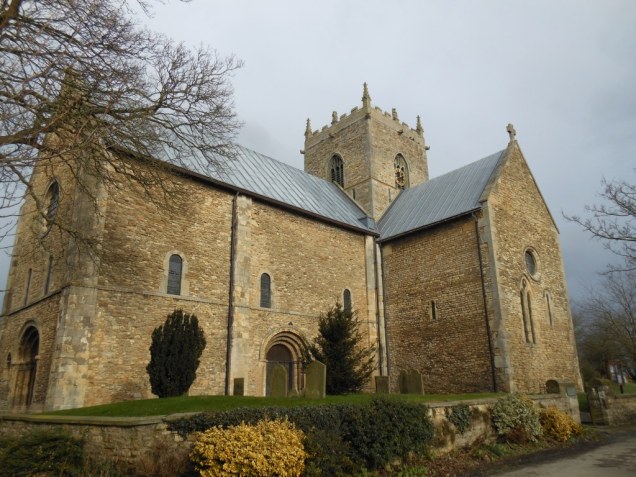
Church of St Mary, Stow (Stow Minster) Lincolnshire

Godiva was probably married before 1010 and so it is possible that she was born in the early 990s. She possessed considerable lands in the north-west of Mercia, suggesting that this is where she and her family were from. Mercia, in that time, covered almost all of the Midlands region, spreading from the Welsh borders across the centre of England. Her lands in Leicestershire, Warwickshire, Staffordshire and Shropshire, which amounted to sixty hides, may have constituted her own inheritance.1 Godiva’s high family status is also attested by the fact that she made a very good marriage, to Leofric, who would later become Earl of Mercia.

Leofric was the son of Leofwine, who had been appointed Ealdorman of the Hwicce, an ancient kingdom within the earldom of Mercia, by Æthelred II in 994. While the family lands were given to victorious Danes on the accession of Cnut, Leofwine was allowed to keep his rank and title and may have succeeded the traitorous Eadric Streona as Ealdorman of Mercia after his death in 1017. The family’s lands and influence appear to have been in the eastern part of Mercia, where they were known religious benefactors; Earl Leofwine was recorded as a benefactor at Peterborough Abbey. Leofric’s marriage to Godiva, therefore, may have been a way of extending his family’s influence into the western parts of Mercia. He was attesting charters as minister between 1019 and 1026, perhaps as sheriff under Hakon, Earl of Worcester.

His father, Leofwine, probably died in 1023 or shortly after, as that was the last year in which he attested a charter. There is no clear indication as to whether Leofwine was ever Earl of Mercia, although Leofric certainly held that title through the reigns of four kings; Cnut, Harold Harefoot, Harthacnut and Edward the Confessor. Leofric’s backing of Harold Harefoot, over Harthacnut, may have been a result of his son’s marriage. Ælfgar is thought to have married Ælfgifu, who was possibly a kinswoman of Harold Harefoot’s mother, Ælfgifu of Northampton, sometime in the late 1020s. Such a relationship would explain Leofric’s support for Harold Harefoot. Of course, so would the fact that Harthacnut was in no hurry to return from Denmark and Harold was on the spot and able to take charge.

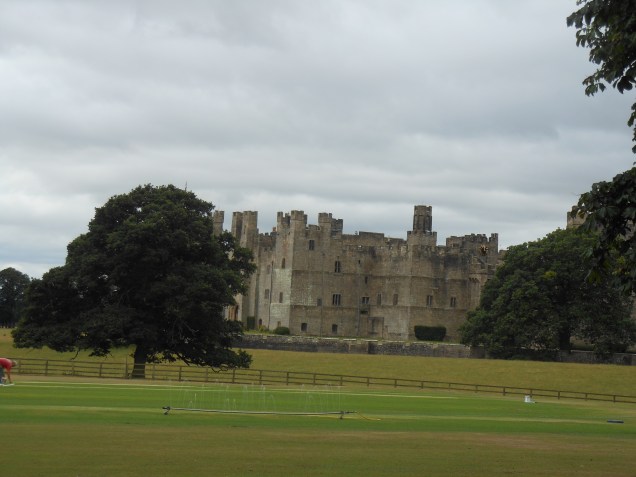
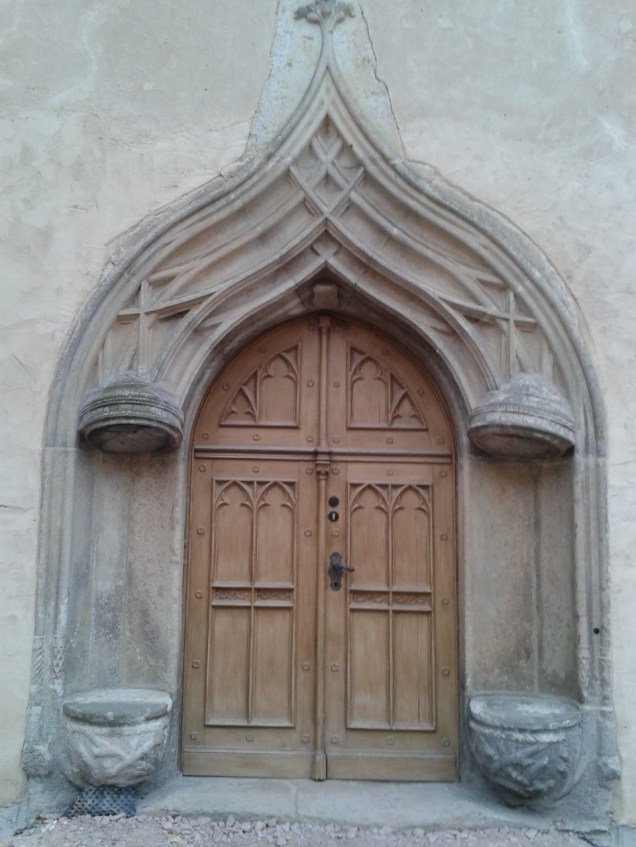
Lady Godiva and Leofric were great benefactors to the church and acted in partnership, particularly in their endowment of Coventry Abbey which, according to John of Worcester, was made out of lands held by each of them. They also endowed the minster church of Stow St Mary, just to the north of Lincoln, and an Old English memorandum included both Leofric and Godiva in a request to Wulfwig, Bishop of Dorchester-on-Thames ‘to endow the monastery and assign lands to it.’2 Stow St Mary is a beautiful building at the centre of the small village of Stow. Founded in the seventh century, it boasts the faded graffiti carving of a Viking longboat on one of its inner walls. The endowment included provision for secular canons, under the supervision of the bishop and was made between and 1053 and 1055.

Books by Sharon Bennett Connolly
Information board explaining the links with Lady Godiva, Stow Minster, Lincolnshire

It is often difficult to work out the extent of Godiva’s involvement in her husband’s religious endowments. The Evesham Chronicle names both Leofric and Godiva (as Godgifu, of course) as the founders of both Coventry Abbey and Holy Trinity Church at Evesham. The couple also gave a crucifix, with the supporting figures of the Virgin and St John the Evangelist, to Holy Trinity Church. Moreover, Godiva had a reputation as a patroness of the Church throughout Mercia during her own lifetime. Orderic Vitalis said that Godiva gave ‘her whole store of gold and silver’ for the provision of ecclesiastical ornaments for the foundation at Coventry and John of Worcester also records Godiva’s devotion to the Virgin.3

There is one example that counters this argument, however, which involves a joint grant by Leofric and Godiva, of Wolverley and Blackwell, Worcestershire. The Second Worcester Cartulary, compiled by Hemming on the orders of Bishop Wulfstan, claims that Leofric returned Wolverley and Blackwell, and promised that the manors at Belbroughton, Bell Hall, Chaddesley Corbett and Fairford, seized by his father Leofwine, would revert to the Church on his death. Hemming, however, claims that Godiva held onto the lands for herself, rather than returning them; although she is said to have given the Church expensive vestments and ornaments, and a promise not only to pay the annual revenues from these estates to the Church, but to return the lands on her own death.4 That Edwin and Morcar seized the lands after their grandmother’s death, surely cannot be laid at Godiva’s door?

During her marriage, Godiva held several manors in her own right. Coventry, although little more than a village at this time, appears to have belonged to Godiva herself. She also had lands in various other parts of Mercia, including Newark, which she may have bought from her son, Ælfgar, as it was part of the comital lands (the earldom). Her lands at Appleby in Derbyshire were leased from Leofric, the Abbot of Peterborough, who was nephew and namesake of her husband, Earl Leofric.
Books by Sharon Bennett Connolly
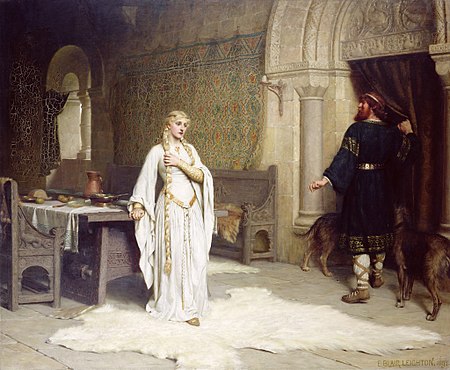
Godiva and Leofric by Edmund Blair Leighton

Leofric died in 1057, on either 31 August or 30 September, at his manor of King’s Bromley in Staffordshire. John of Worcester said of him; this ‘man of excellent memory died at a good old age, in his own manor called Bromley, and was buried with honour in Coventry, which monastery he had founded and well endowed.’5 The 1057 entry of the Anglo-Saxon Chronicle reported; ‘The same year died Earl Leofric, on the second before the calends of October; who was very wise before God, and also before the world; and who benefited all this nation’.6

Godiva was to live on as a widow for at least ten more years. She would be there to see her son’s inheritance of the earldom of Mercia. Although titles and land did often pass from father to son, it was not a foregone conclusion. Indeed, Ælfgar’s rebellion in 1055 – which led to a subsequent exile – may well have been in fear of losing his inheritance, given that Edward the Confessor had just given the earldom of Northumbria to Tostig, son of Godwin, on the death of Earl Siward in place of his son and natural heir, Waltheof. Waltheof was still a child, however, and this may well have been a practical decision, in that it would be dangerous to leave such a powerful earldom, and the border with Scotland, in the control of a child. Ælfgar was banished again in 1058, but for a very short while, apparently, with the Anglo-Saxon Chronicle reporting; ‘Earl Ælfgar was expelled but he soon came back again, with violence, through the help of Gruffydd.’7

We do not have the exact date of Godiva’s death. Most historians seem to believe that she survived the Norman Conquest and died around 1067. She is mentioned as a pre-Conquest landholder in the Domesday Book, but that doesn’t necessarily mean that she was alive in 1066. Hemming, who compiled the Worcester cartulary, says that some of her lands passed directly to her grandsons, Edwin and Morcar, offering evidence that Godiva also outlived her son, Ælfgar, who probably died in 1062. If Godiva did live into 1067, then she would have seen the dangers that the Norman Conquest brought to her family. Although her son was dead, most of her grandchildren were very much alive, and at the heart of events. By 1065 her 2 surviving grandsons were both earls (a 3rd grandson, Burgred, died in 1060 while returning from a pilgrimage to Rome).

Morcar became Earl of Northumbria in 1065, chosen by the Northumbrians to replace the unpopular Tostig. His tenure, however, was of short duration and he was replaced with Copsig, an adherent of Tostig, by William the Conqueror. Edwin had succeeded his father as Earl of Mercia in 1062 but neither brother flourished under the rule of William the Conqueror. Their sister, Ealdgyth married Harold Godwinson (King Harold II) sometime in late 1065, or early 1066, and was the uncrowned Queen of England until Harold’s death at Hastings in October 1066. Following the battle, Ealdgyth was taken to Chester by her brothers, where she may have given birth the king Harold’s son, Harold, before disappearing from the records.

Godiva is believed to have died in 1067 and was most likely buried alongside her husband at Coventry; although the Evesham Chronicle claims that she was laid to rest in Holy Trinity, Evesham. In the thirteenth century, her death was remembered on 10 September, but we have no way of confirming the actual date. After the Conquest, Godiva’s lands were held by various personalities.
Books by Sharon Bennett Connolly
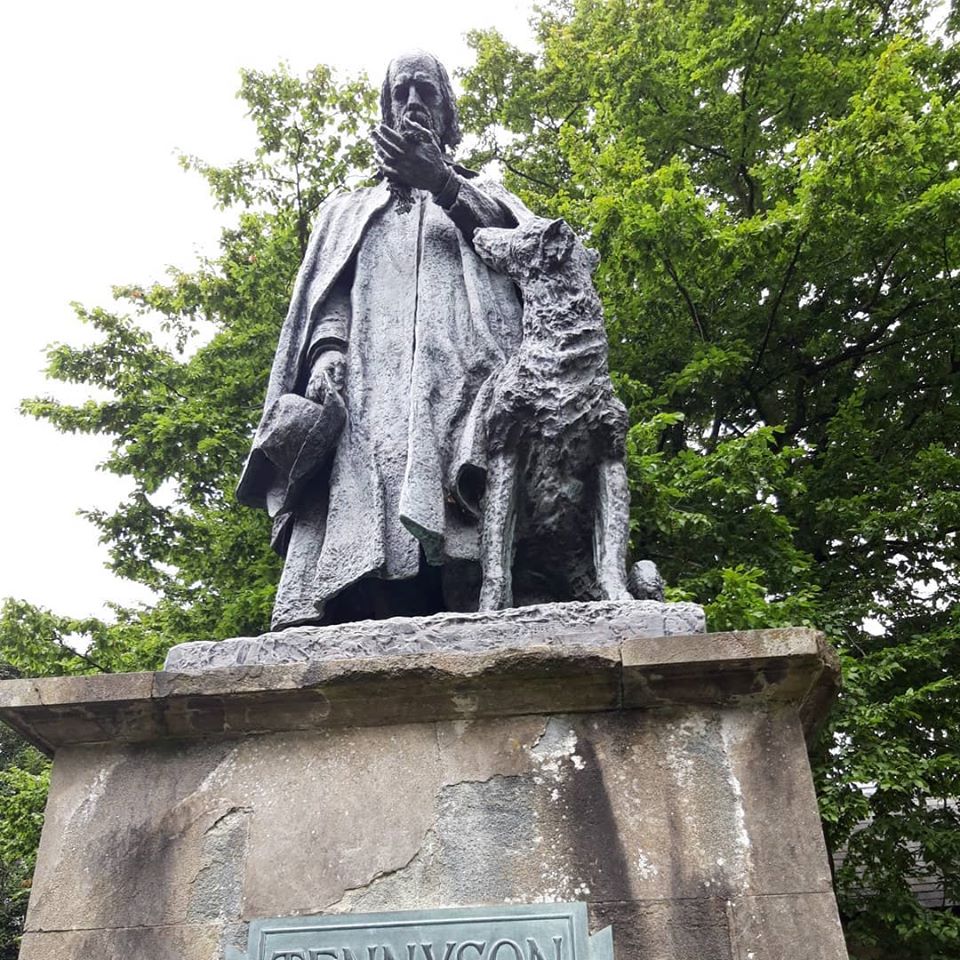
Statue of Alfred Lord Tennyson in the grounds of Lincoln Cathedral

We have no contemporary description of Godiva, of her personality or appearance. Her patronage of such religious institutions as Stow St Mary and Coventry Abbey is testimony to her piety and generosity. Stories of this generosity and piety were known to later chroniclers, such as William of Malmesbury and Henry of Huntingdon. Henry of Huntingdon said of Godiva that her name ‘meriting endless fame, was of distinguished worth, and founded the abbey at Coventry which she enriched with immense treasures of silver and gold. She also built the church at Stow, under the hill at Lincoln, and many others.’8 Although Henry of Huntingdon’s geography is a little skewed – Stow is a few miles north of Lincoln, rather than to the south, which ‘under the hill’ would suggest – it is obvious that Godiva’s fame was still alive in the twelfth century.

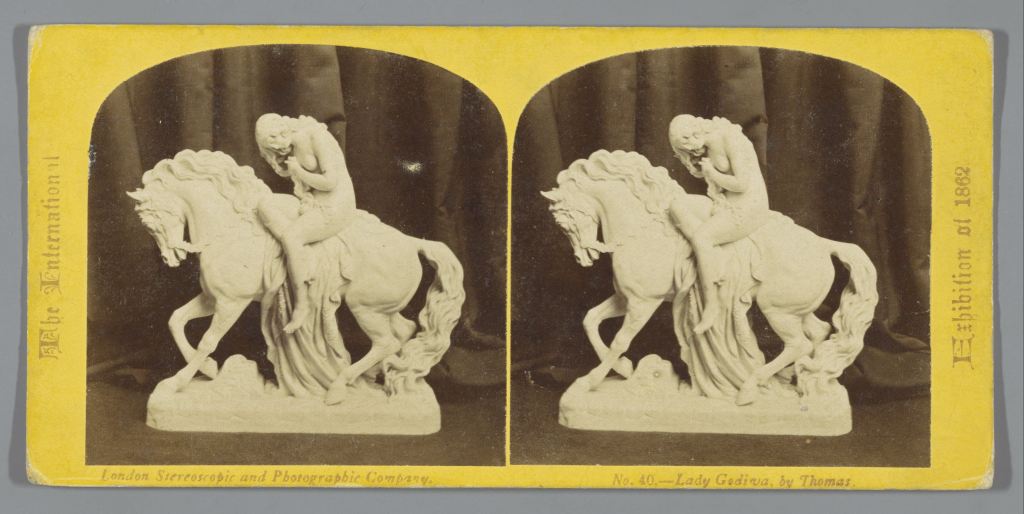
Lady Godiva is, perhaps, the most famous Anglo-Saxon woman in history. Everyone knows her legend – or a variation of it. And that legend has only grown and expanded down the years; like the game of Chinese whispers, the story has been added to and enhanced with every retelling. It was probably her reputation for generosity that gave rise to the legend for which she is famous today. The story of Godiva’s naked ride through Coventry appears to have been first recounted by Roger of Wendover, who died in 1236:

The Countess Godiva devoutly anxious to free the city of Coventry from a grievous and base thralldom often besought the Count, her husband, that he would for the love of the Holy Trinity and the sacred Mother of God liberate it from such servitude. But he rebuked her for vainly demanding a thing so injurious to himself and forbade her to move further therein. Yet she, out of womanly pertinacity, continued to press the matter in so much that she obtained this answer from him: ‘Ascend,’ he said, ‘thy horse naked and pass thus through the city from one end to the other in sight of the people and on thy return thou shalt obtain thy request.’ Upon which she returned: ‘And should I be willing to do this, wilt thou give me leave?’ ‘I will,’ he responded. Then the Countess Godiva, beloved of God, ascended her horse, naked, loosing her long hair which clothed her entire body except her snow white legs, and having performed the journey, seen by none, returned with joy to her husband who, regarding it as a miracle, thereupon granted Coventry a Charter, confirming it with his seal.

Flores Historiarum by Roger of Wendover, translated by Matthew of Westminster

This legend has grown and expanded over time, providing inspiration for ballads, poetry, paintings and sculptures throughout the centuries, the most famous being the poem, Lady Godiva, by Alfred Lord Tennyson, written in 1840, which included the lines:
Books by Sharon Bennett Connolly
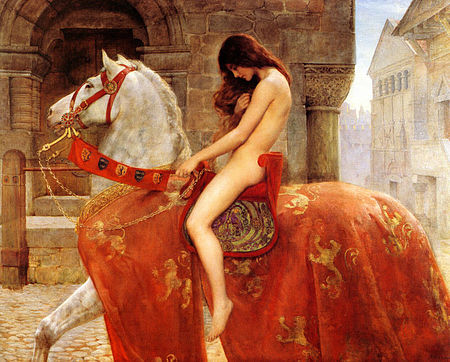
Lady Godiva by John Collier

“The woman of a thousand summers back,
Godiva, wife to that grim Earl, who ruled
In Coventry: for when he laid a tax
Upon his town, and all the mothers brought
Their children, clamouring, ‘If we pay, we starve!’
She sought her lord, and found him, where he strode
About the hall, among his dogs, alone,
His beard a foot before him, and his hair
A yard behind. She told him of their tears,
And pray’d him, ‘If they pay this tax, they starve.’
Whereat he stared, replying, half-amazed,
‘You would not let your little finger ache
For such as – these?’ – ‘But I would die,’ said she.”

Godiva by Alfred Lord Tennyson.

The legend arose from a story that Earl Leofric had introduced a toll on Coventry that the people could not afford to pay. Godiva went to her husband, begging that he rescind the taxes. He proved reluctant to offer the slightest reduction and is said to have told Godiva that he would only rescind the taxes if she rode naked through Coventry. In the earliest accounts Godiva rode through the market place, accompanied by two of Leofric’s soldiers, with her long, golden hair let loose to protect her modesty. In the early versions, the religious element of the story is highlighted, with Leofric hailing the fact no one had seen her nakedness as a miracle.

Although the story has endured through the centuries, I am inclined to believe that it didn’t happen – at least not in the way portrayed. It seems more plausible that Godiva had undertaken a pilgrimage, stripped of her fine clothes and jewels – in a state of undress, rather then undressed – maybe just in her shift or a simple, penitentiary, garment. While the legend is almost certainly distorted beyond recognition from the true story, it has guaranteed the immortality of a remarkable lady.

*

This article, The Real Lady Godiva, first appeared on Paula Lofting’s wonderful blog The Road to Hastings and Other Stories in December 2018.

*

Pictures:

Lady Godiva statue image courtesy of the Rijksmuseum; Stow Minster and statue of Alfred Lord Tennyson ©2018Sharon Bennett Connolly; Leighton and Collier paintings courtesy of Wikipedia

Footnotes:

[1] Godgifu (d. 1067?) (article) by Ann Williams, oxforddnb.com; [2] ibid; [3] The Ecclesiastical History of England and Normandy by Ordericus Vitalis; [4] Godgifu (d. 1067?) (article) by Ann Williams, oxforddnb.com; [5] The Anglo-Saxon Chronicles edited and translated by Michael Swanton; [6] The Anglo-Saxon Chronicle translated by James Ingram; [7] The Anglo-Saxon Chronicles edited and translated by Michael Swanton; [8] The Chronicle of Henry of Huntingdon. Comprising the history of England, from the invasion of Julius Caesar to the accession of Henry II. Also, the Acts of Stephen, King of England and duke of Normandy Translated and edited by Thomas Forester. London, H.G. Bohn, 1807.

Sources:

The English and the Norman Conquest by Dr Ann Williams; Brewer’s British Royalty by David Williamson; Britain’s Royal Families, the Complete Genealogy by Alison Weir; The Wordsworth Dictionary of British History by JP Kenyon; The Norman Conquestby Marc Morris; Harold, the King Who Fell at Hastings by Peter Rex; The Anglo-Saxons in 100 Facts by Martin Wall; The Anglo-Saxon Age by Martin Wall; Kings, Queens, Bones and Bastards by David Hilliam; The Mammoth Book of British kings & Queens by Mike Ashley; The Oxford Companion to British History Edited by John Cannon; The Anglo-Saxon Chronicles translated and edited by Michael Swaton; The Anglo-Saxon Chronicle translated by James Ingram; Queen Emma and the Vikings by Harriett O’Brien; The Bayeux Tapestry by Carola Hicks; On the Spindle Side: the Kinswomen of Earl Godwin of Wessex by Ann Williams; oxforddnb.com.

*

Godiva’s story appears in greater detail in my book, Silk and the Sword: The Women of the Norman Conquest. From Emma of Normandy, wife of both King Cnut and Æthelred II to Saint Margaret, a descendant of Alfred the Great himself, Silk and the Sword: the Women of the Norman Conquest traces the fortunes of the women who had a significant role to play in the momentous events of 1066.

*

My Books

Signed, dedicated copies of all my books are available through my online store.

Out now: Scotland’s Medieval Queens

Books by Sharon Bennett Connolly

Scotland’s history is dramatic, violent and bloody. Being England’s northern neighbour has never been easy. Scotland’s queens have had to deal with war, murder, imprisonment, political rivalries and open betrayal. They have loved and lost, raised kings and queens, ruled and died for Scotland. From St Margaret, who became one of the patron saints of Scotland, to Elizabeth de Burgh and the dramatic story of the Scottish Wars of Independence, to the love story and tragedy of Joan Beaufort, to Margaret of Denmark and the dawn of the Renaissance, Scotland’s Medieval Queens have seen it all. This is the story of Scotland through their eyes.

Scotland’s Medieval Queens gives a thorough grounding in the history of the women who ruled Scotland at the side of its kings, often in the shadows, but just as interesting in their lives beyond the spotlight. It’s not a subject that has been widely covered, and Sharon is a pioneer in bringing that information into accessible history.’ Elizabeth Chadwick (New York Times bestselling author)

Available now from Amazon and Pen and Sword Books

Also by Sharon Bennett Connolly:

Books by Sharon Bennett Connolly

Heroines of the Tudor World tells the stories of the most remarkable women from European history in the time of the Tudor dynasty, 1485-1603. These are the women who ruled, the women who founded dynasties, the women who fought for religious freedom, their families and love. Heroines of the Tudor World is now available from Amberley Publishing and Amazon UK. Women of the Anarchy demonstrates how Empress Matilda and Matilda of Boulogne, unable to wield a sword themselves, were prime movers in this time of conflict and lawlessness. It shows how their strengths, weaknesses, and personal ambitions swung the fortunes of war one way – and then the other. Available from Bookshop.orgAmberley Publishing and Amazon UKKing John’s Right-Hand Lady: The Story of Nicholaa de la Haye is the story of a truly remarkable lady, the hereditary constable of Lincoln Castle and the first woman in England to be appointed sheriff in her own right. Available from all good bookshops Pen & Sword Booksbookshop.org and Amazon

Defenders of the Norman Crown: The Rise and Fall of the Warenne Earls of Surrey tells the fascinating story of the Warenne dynasty, from its origins in Normandy, through the Conquest, Magna Carta, the wars and marriages that led to its ultimate demise in the reign of Edward III. Available from Pen & Sword BooksAmazon in the UK and US, and Bookshop.orgLadies of Magna Carta: Women of Influence in Thirteenth Century England looks into the relationships of the various noble families of the 13th century, and how they were affected by the Barons’ Wars, Magna Carta and its aftermath; the bonds that were formed and those that were broken. It is now available in paperback and hardback from Pen & SwordAmazon, and Bookshop.orgHeroines of the Medieval World tells the stories of some of the most remarkable women from Medieval history, from Eleanor of Aquitaine to Julian of Norwich. Available now from Amberley Publishing and Amazon, and Bookshop.orgSilk and the Sword: The Women of the Norman Conquest traces the fortunes of the women who had a significant role to play in the momentous events of 1066. Available now from Amazon,  Amberley Publishing, and Bookshop.org.

Alternate Endings: An anthology of historical fiction short stories including Long Live the King… which is my take what might have happened had King John not died in October 1216. Available in paperback and kindle from Amazon.

Podcast:

A Slice of Medieval

Have a listen to the A Slice of Medieval podcast, which I co-host with Historical fiction novelist Derek Birks. Derek and I welcome guests, such as Bernard Cornwell and Michael Jecks, and discuss a wide range of topics in medieval history, from significant events to the personalities involved. 

Every episode is also now available on YouTube.

*

Don’t forget! Signed and dedicated copies of all my books are available through my online store.

For forthcoming online and in-person talks, please check out my Events Page.

You can be the first to read new articles by clicking the ‘Follow’ button, liking our Facebook page or joining me on TwitterThreadsBluesky and Instagram.

©2019 Sharon Bennett Connolly FRHistS


Book Corner: The Legitimacy of Bastards by Helen Matthews

For the nobility and gentry in later medieval England, land was a source of wealth and status. Their marriages were arranged with this in mind, and it is not surprising that so many of them had mistresses and illegitimate children. John de Warenne, earl of Surrey, married at the age of twenty to a ten-year-old granddaughter of Edward I, had at least eight bastards and a complicated love life. In theory, bastards were at a considerable disadvantage. Regarded as filius nullius’ or the son of no one, they were unable to inherit real property and barred from the priesthood. In practice, illegitimacy could be less of a stigma in late medieval England than it became between the sixteenth and late twentieth centuries. There were ways of making provision for illegitimate offspring and some bastards did extremely well: in the church; through marriage; as soldiers; a few even succeeding to the family estates. _The Legitimacy of Bastards_ is the first book to consider the individuals who had illegitimate children, the ways in which they provided for them and attitudes towards both the parents and the bastard children. It also highlights important differences between the views of illegitimacy taken by the Church and by the English law.

I often come across non-fiction books about which I think ‘ooh, this could be handy for research’, but every once in a while I come across a book and I just think ‘wow! This is so useful! Every one needs a copy!’ The Legitimacy of Bastards; The Place of Illegitimate Children in Later Medieval England by Helen Matthews definitely falls in this latter category.

The Legitimacy of Bastards; The Place of Illegitimate Children in Later Medieval England examines the church and lay laws governing illegitimacy in later medieval England, and portrays the reality of bastard children. Based on the author’s own thesis, the book should be the ‘go to’ tool for anyone who needs to study the stigma, status and reality of illegitimacy in medieval England.

Divided into 6 chapters, The Legitimacy of Bastards; The Place of Illegitimate Children in Later Medieval England explores the legal status of illegitimate children and the various types – or categories – of illegitimacy within medieval society; whether they be children of unmarried parents, married parents or of members of the clergy dictated their prospects in life and career opportunities. The book also examines the methods used by parents in order to get around the various limitations placed on illegitimate children, such as legal devices, church careers and, of course, marriage.

One of the challenges of researching illegitimacy in later medieval England is that there is no single source of reliable records of the kind that is available, for example, for some of the Italian city states. It is no accident that the comprehensive study of bastardy in England begins with the sixteenth century and the introduction of parochial registration of births, marriages and deaths in 1538. Even then, the level of detail prior to 1850 is limited. Any attempt to establish the prevalence of illegitimacy in the period before parish registers are available is clearly even more problematic. Illegitimate children cannot be identified by their name alone. Bastards who were recognised by their fathers would very often take their father’s name, though some were known by their mother’s surname. It should be noted that a surname beginning with ‘Fitz-‘ simply means ‘son of’ and does not itself denote illegitimacy, although it became common for royal bastards to have names of this type, for example Henry Fitzroy, the son of Henry VIII (1509-47) and Elizabeth Blount, a lady-in-waiting to Katherine of Aragon.

However, some attempt has been made to do so at the level of peasant society by exploiting manorial records, mainly in the context of wider studies of a particular peasant community. As in the Italian city states, it is the existence of financial records that makes this possible. In this case the records concerned are payments of fines. These were either leyrwite, a fine for single women and widows of unfree status who committed fornication, or childwyte, a fine for giving birth to an illegitimate child.

The Legitimacy of Bastards; The Place of Illegitimate Children in Later Medieval England looks into illegitimacy throughout all levels of society, from the royal family to the lowly peasant. Incredibly useful to my own research, Helen Matthews presents the experiences of John de Warenne, 7th Earl of Surrey, as a case study of the practicalities of illegitimacy. This chapter helps the reader to understand the life and limitations of a child born outside of marriage, as well as the extraordinary lengths that parents were willing to go in order to advance the prospects of their children.

I had no idea how complex the laws surrounding illegitimacy in England, not just on inheritance, but also on marriage prospects, on the difference between church and state and on the difference between clerical and lay requirements for the legitimisation of a child.

An easy book to read, Helen Matthews has made good use of the materials and evidence available to build a picture of the realities of illegitimacy in later medieval England, not just for the child themselves, but for their families and the legitimate heirs. Impeccably researched and rich in detail The Legitimacy of Bastards; The Place of Illegitimate Children in Later Medieval England is a wonderful research tool and an engaging read, with none of the dryness that you often find in books developed from academic theses.

The only downside of The Legitimacy of Bastards; The Place of Illegitimate Children in Later Medieval England is that there are no footnotes, which makes it hard for the researcher to follow up some of the details; however, there is an exhaustive and impressive bibliography and an impressive list of the subjects used in the book for ease of cross-referencing.

The further I read into The Legitimacy of Bastards; The Place of Illegitimate Children in Later Medieval England the more I realised how useful this book will be to any researcher, student of history or casual reader around the subject. The impeccable research and engaging writing style make this a valuable addition to anyone’s medieval library.

I cannot recommend it highly enough!

To buy the book:

The Legitimacy of Bastards; The Place of Illegitimate Children in Later Medieval England is available from Pen & Sword and Amazon in the UK and US.

About the Author:

Helen Matthews studied medieval history at UCL and Royal Holloway. A chance remark in a footnote inspired her to embark on the thesis on medieval bastards, on which this book is based.

*

My Books

Silk and the Sword: The Women of the Norman Conquest

From Emma of Normandy, wife of both King Cnut and Æthelred II to Saint Margaret, a descendant of Alfred the Great himself, Silk and the Sword: the Women of the Norman Conquest traces the fortunes of the women who had a significant role to play in the momentous events of 1066.  Available now from Amazon UK,  Amberley Publishing, Book Depository and Amazon US.

Heroines of the Medieval World

Telling the stories of some of the most remarkable women from Medieval history, from Eleanor of Aquitaine to Julian of Norwich, Heroines of the Medieval World,  is available now on kindle and in paperback in the UK from from both Amberley Publishing and Amazon, in the US from Amazon and worldwide from Book Depository.

*

You can be the first to read new articles by clicking the ‘Follow’ button, liking our Facebook page or joining me on Twitter and Instagram.

©2019 Sharon Bennett Connolly


Matilda of Flanders, Queen of the Conqueror

History ... the Interesting Bits
Matilda of Flanders

Matilda of Flanders was the consummate duchess and queen. Born in the early to mid-1030s, possibly around 1032, Matilda was the daughter of Baldwin V, Count of Flanders, and his wife Adela of France, a daughter of Robert the Pious, King of France. Matilda had two brothers and each of them became Count of Flanders in his turn; Baldwin of Mons and Robert the Frisian. As is often the case with medieval women, we know very little of Matilda’s early life, though it is likely she was raised alongside her aunt, Judith, her father’s sister who was of a similar age to Matilda, and who would go on to marry Tostig, Earl of Northumberland and brother of king Harold II.

The first time Matilda appears on the world stage is when her marriage is being discussed. There is a popular story of how Matilda refused to marry William, Duke of Normandy, stating that she was too highly born to marry a bastard. As the legend goes; on hearing this, William was so infuriated that he rode to Flanders and confronted Matilda. He is said to have thrown her to the ground, before pulling her braids and cutting her with his spurs. Matilda, unlikely as it seems, then accepted his proposal and they were married. Despite the story most likely being a later invention, William was the one to propose the marriage and, although he was a duke, his illegitimacy would have meant making a proposal to a niece of the King of France was audacious, to say the least.

The arrangements for the marriage of Matilda and William probably started in 1048, but it was a long, drawn out matter, marred by papal and political machinations. The Synod of Reims, of 3 and 4 October 1049, issued a decree instructing Count Baldwin not to allow the marriage of his daughter to Duke William. However, despite these papal objections, Matilda and William were married by 1053, at the latest. A penance was later imposed on the couple for their disobedience in marrying against papal prohibition. Each was to found an abbey; William founded the Abbaye-aux-Hommes, or St Stephen’s Abbey, in his Norman capital of Caen, while Matilda founded the Abbaye-aux-Dames, or Holy Trinity Abbey, in the same city. The two abbeys still stand to this day.

History ... the Interesting Bits
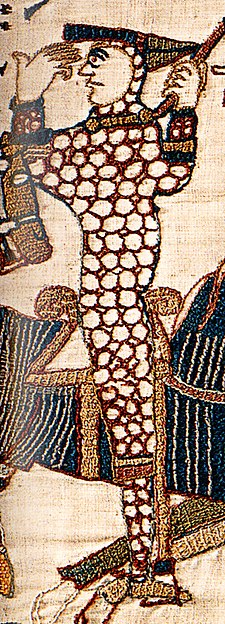
William the Conqueror from the Bayeux Tapestry

The marriage between Matilda and William proved to be a strong and trusting relationship; William is one of very few medieval kings believed to have been completely faithful to his wife, no known lovers or illegitimate children have ever been uncovered, although that did not stop the rumours. William of Malmesbury related one such story, of William having a mistress, the daughter of a priest, who Matilda ordered to be hamstrung and disinherited; in punishment, Matilda is said to have been beaten to death by a horse bridle. Malmesbury himself was sceptical of the story and, given that Matilda’s death came after a short illness in 1083, it does seem rather far-fetched.

William trusted Matilda to act as regent in Normandy during his many absences on campaign or in England. Their relationship appears to have been more of a partnership than most marriages of the time; she was witness to thirty-nine pre-conquest and sixty-one post-conquest charters. Matilda supported her husband’s proposed invasion of England; she promised a great ship for William’s personal use, called the Mora. Just before leaving for England in 1066, William accompanied Matilda to the consecration of her foundation, Holy Trinity Abbey – the Abbaye-aux-Dames – in Caen, arranging for his duchess to act as regent in his absence. The Conquest was a close-run thing and it was not until 1068 that William felt secure enough to bring his wife to England for her coronation. Matilda, six months pregnant with her son Henry, who would be born at Selby in September, was crowned Queen of England in Westminster Abbey, by Archbishop Ealdred of Canterbury, at Whitsuntide 1068.

Matilda and William had a large family, with four boys and at least four daughters. Of their sons; the eldest, Robert Curthose, would inherit Normandy, Richard was killed in a hunting accident as a youth, William, known as Rufus, became King William II, and the youngest was the future King Henry I. Of the four or five daughters; Adeliza became a nun following a series of failed marriage plans, Cecilia was given to the convent of Ste Trinité as a child, Constance married Alain Fergant, Duke of Brittany, and Adela married Stephen of Blois and was the mother of King Stephen of England. There are suggestions of two further daughters, Matilda and Agatha, though evidence for their existence is limited. Queen Matilda was very close to her family, especially her eldest son, Robert. William and Robert, father and son, however, were often at loggerheads, with Robert rebelling against his father as a young man. Matilda was constantly trying to play the peacemaker. During a period of exile imposed on Robert, Matilda still supported her son as best she could; she would send him vast amounts of silver and gold through a Breton messenger, Samson.

Although the problems with Robert, their eldest son, caused considerable tensions within the marriage, Matilda and William’s relationship is one of the most successful of the medieval period. Their partnership as rulers, and as husband and wife, was strong and appeared to be one built on mutual respect. One contemporary remarked that ‘The Queen adored the King and the King the Queen.’1

History ... the Interesting Bits
Matilda’s youngest son Henry I, King of England

Matilda’s piety was renowned. Although founding the Abbaye aux Dames in Caen was a penance for her irregular marriage to William, her constant and repeated donations to religious houses demonstrated her dedication to her faith. The nuns of her abbey at Ste Trinité, Caen, received a substantial bequest from Matilda’s will, written the year before her death; as well as her crown and sceptre, they were given a chalice, a chasuble, a mantle of brocade, two golden chains with a cross, a chain decorated with emblems for hanging a lamp in front of the altar, several large candelabras, the draperies for her horse and all the vases ‘which she had not yet handed out during her life’. 2

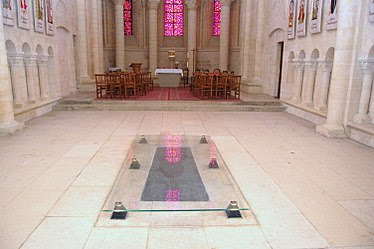
Having drawn up her will in 1082, it is possible that Matilda was aware of her illness long before her last summer. The continuing worry over the rift between her husband and beloved son cannot have helped her health, and the arrival of winter saw her gravely ill. Matilda died on 2 November 1083, having ‘confessed her sins with bitter tears and, after fully accomplishing all that Christian custom requires and being fortified by the saving sacrament’.3 Her husband was with her throughout the final moments of her illness, and he ‘… showed many days of the deepest mourning how much he missed the love of her whom he had lost’.4 She was buried at Ste Trinité, Caen, following a funeral that lasted two days and that was attended by a host of monks, abbots, bishops and nuns and a host of people came to pay homage. There is no record of which of her children attended the funeral, although her daughter Cecilia was most likely in attendance, being a nun of the abbey. The original tombstone still survives; it has an inscription carved around the edge, emphasising her royal descent on her mother’s side.

History ... the Interesting Bits
Queen Matilda’s Grave, Ste Trinité, Caen

Matilda’s height has been discussed frequently by historians, with some claiming that she was a dwarf. The casket, containing her bones, was opened in 1961 and misreported as revealing a woman of about 4ft 2in tall. However, Professor Dastague, from the Institut D’Anthropologie at Caen, who was present at the original dig confirmed that it had been calculated that Matilda was in fact 152cm, about 5ft, in height.5 Matilda’s actual height cannot be said with certainty, however, as the skeleton which was examined was incomplete. The queen’s grave had been destroyed in the sixteenth century, during the French Wars of Religion, and much of her remains never recovered.

William the Conqueror followed his wife to the grave four years later, in 1087. In many aspects of her life, Matilda is clearly seen as the ideal medieval wife and mother. Ever supportive of her husband, he relied heavily on her to administer Normandy in his frequent absences. Even when disobeying William, in her support of their eldest son Robert, she was still trying to be the embodiment of the good medieval woman, playing the peacemaker between warring members of her family. Her piety and steadfast support of her husband provided an example for future queens, and noble ladies, to follow.

*

This article, first appeared in March 2019, as Matilda of Flanders: The Ideal Medieval Queen, on Mary Anne Yarde’s wonderful blog Myths, Legends, Book and Coffee Pots.

*

Footnotes:

[1] Les Oeuvres Poétiques de Baudri de Bourgueil edited by P. Abrahams; [2] Musset, La Reine Mathilde, quoted by Elizabeth van Houts in oxforddnb.com. [3] Matilda by Tracy Borman, [4] Chronicles of the Kings of England, From the Earliest Period to the Reign of King Stephen by William of Malmesbury; [5] A Historical Obstetric Enigma: How Tall was Matilda? (article) by J Dewhurst Journal of Obstetriccs and Gynaecology.

Pictures:

Courtesy of Wikipedia

Sources:

England Under the Norman and Angevin Kings by Robert Bartlett; Heroines of the Medieval World by Sharon Bennett Connolly; Chronicles of the Kings of England, From the Earliest Period to the Reign of King Stephen by William of Malmesbury; Silk and the Sword: The Women of the Norman Conquest by Sharon Bennett Connolly; Brewer’s British Royalty by David Williamson; Britain’s Royal Families, the Complete Genealogy by Alison Weir; Matilda by Tracy Borman; The Norman Conquest by Marc Morris; The Anglo-Saxon Chronicles by Michael Swanton; The Anglo-Saxon Chronicle by James Ingram; The Mammoth Book of British Kings and Queens by Mike Ashley; oxforddnb.comQueen Matilda, wife of William the Conqueror, was NOT a Dwarf (article) by Marc Morris, marcmorris.org.uk; womenshistory.about.com; epistolae.ccnmtl.columbia.edu;  Les Oeuvres Poétiques de Baudri de Bourgueil edited by P. Abrahams

*

My Books

Signed, dedicated copies of all my books are available through my online store.

Out now: Scotland’s Medieval Queens

Books by Sharon Bennett Connolly

Scotland’s history is dramatic, violent and bloody. Being England’s northern neighbour has never been easy. Scotland’s queens have had to deal with war, murder, imprisonment, political rivalries and open betrayal. They have loved and lost, raised kings and queens, ruled and died for Scotland. From St Margaret, who became one of the patron saints of Scotland, to Elizabeth de Burgh and the dramatic story of the Scottish Wars of Independence, to the love story and tragedy of Joan Beaufort, to Margaret of Denmark and the dawn of the Renaissance, Scotland’s Medieval Queens have seen it all. This is the story of Scotland through their eyes.

Scotland’s Medieval Queens gives a thorough grounding in the history of the women who ruled Scotland at the side of its kings, often in the shadows, but just as interesting in their lives beyond the spotlight. It’s not a subject that has been widely covered, and Sharon is a pioneer in bringing that information into accessible history.’ Elizabeth Chadwick (New York Times bestselling author)

Available now from Amazon and Pen and Sword Books

Also by Sharon Bennett Connolly:

Books by Sharon Bennett Connolly

Heroines of the Tudor World tells the stories of the most remarkable women from European history in the time of the Tudor dynasty, 1485-1603. These are the women who ruled, the women who founded dynasties, the women who fought for religious freedom, their families and love. Heroines of the Tudor World is now available for pre-order from Amberley Publishing and Amazon UK. Women of the Anarchy demonstrates how Empress Matilda and Matilda of Boulogne, unable to wield a sword themselves, were prime movers in this time of conflict and lawlessness. It shows how their strengths, weaknesses, and personal ambitions swung the fortunes of war one way – and then the other. Available from Bookshop.orgAmberley Publishing and Amazon UKKing John’s Right-Hand Lady: The Story of Nicholaa de la Haye is the story of a truly remarkable lady, the hereditary constable of Lincoln Castle and the first woman in England to be appointed sheriff in her own right. Available from all good bookshops Pen & Sword Booksbookshop.org and Amazon

History ... the Interesting Bits

Defenders of the Norman Crown: The Rise and Fall of the Warenne Earls of Surrey tells the fascinating story of the Warenne dynasty, from its origins in Normandy, through the Conquest, Magna Carta, the wars and marriages that led to its ultimate demise in the reign of Edward III. Available from Pen & Sword BooksAmazon in the UK and US, and Bookshop.orgLadies of Magna Carta: Women of Influence in Thirteenth Century England looks into the relationships of the various noble families of the 13th century, and how they were affected by the Barons’ Wars, Magna Carta and its aftermath; the bonds that were formed and those that were broken. It is now available in paperback and hardback from Pen & SwordAmazon, and Bookshop.orgHeroines of the Medieval World tells the stories of some of the most remarkable women from Medieval history, from Eleanor of Aquitaine to Julian of Norwich. Available now from Amberley Publishing and Amazon, and Bookshop.orgSilk and the Sword: The Women of the Norman Conquest traces the fortunes of the women who had a significant role to play in the momentous events of 1066. Available now from Amazon,  Amberley Publishing, and Bookshop.org.

Alternate Endings: An anthology of historical fiction short stories including Long Live the King… which is my take what might have happened had King John not died in October 1216. Available in paperback and kindle from Amazon.

Podcast:

Have a listen to the A Slice of Medieval podcast, which I co-host with Historical fiction novelist Derek Birks. Derek and I welcome guests, such as Bernard Cornwell and Elizabeth Chadwick, and discuss a wide range of topics in medieval history, from significant events to the personalities involved. Episode 41 was on the Norman Conquest!

Every episode is also now available on YouTube.

*

Don’t forget! Signed and dedicated copies of all my books are available through my online bookshop.

For forthcoming online and in-person talks, please check out my Events Page.

You can be the first to read new articles by clicking the ‘Follow’ button, liking our Facebook page or joining me on TwitterThreadsBluesky and Instagram.

*

©2019 Sharon Bennett Connolly FRHistS

Judith of Flanders, Countess of Northumberland

History...the Interesting Bits
Judith of Flanders

Judith of Flanders was born sometime in the early 1030s. Her father was Baldwin IV, Count of Flanders; he died in 1035, when Judith was, at most, five years old and possibly still only a baby.

Baldwin had been count since the age of seven, from 987. His first wife was Orgive of Luxembourg, the mother of Baldwin’s son and heir, Baldwin V, who was born in 1012. Orgive died in 1030. Their son, Baldwin V, married Adele of France, the second daughter of Robert II (the Pious), King of France, and they had at least three children together, including Baldwin VI, Count of Flanders, and Matilda of Flanders, Duchess of Normandy and Queen of England as the wife of William the Conqueror. After Orgive’s death, Baldwin IV married again. In about 1031 he wed Eleanor of Normandy, the daughter of Baldwin’s neighbour, Richard II, Duke of Normandy, and his wife, Judith of Brittany. Eleanor’s brother was Robert I, Duke of Normandy, the father of William the Conqueror, who became Duke of Normandy and King of England. Eleanor’s daughter and only child Judith, therefore, was a first cousin of William the Conqueror, the future King of England, as well as aunt of his wife, Matilda.

When her father died in 1035, Judith’s older brother, who was about twenty years her senior, succeeded as Count Baldwin V; it would be he who decided on Judith’s future when the time came for her to marry. We know nothing of Judith’s childhood or level of education. As the daughter of a count, expected to make a good marriage into another ruling or noble family, she would have been taught how to run a large household, dancing, embroidery and possibly some languages, such as Latin. It is unlikely, however, that she was taught to read and write, skills usually reserved for members of the Church. It is possible she was raised alongside her niece, Matilda, who was of a similar age to Judith.

History...the Interesting Bits
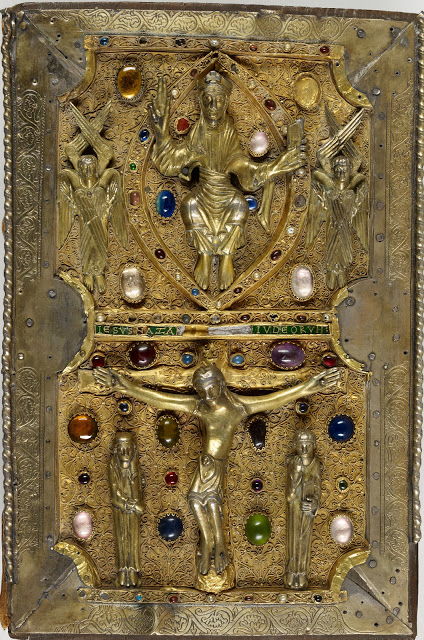
Cover of one of the four gospels commissioned by Judith of Flanders

In the late summer or autumn of 1051, Judith was married to Tostig, a son of the powerful Earl Godwin of Wessex and his wife, Gytha. And when the family fell foul of King Edward the Confessor, Judith accompanied them into exile; back to her homeland of Flanders. Tostig was probably the third eldest son of Godwin and Gytha of Wessex, one of his older brothers being the future King Harold II of England. He would have been in his early twenties at the time of his marriage and the family’s subsequent exile; Judith was no more than six years younger than him, which would suggest she was at least fifteen years old at the time of her marriage.

Judith would have returned to her new homeland of England when Tostig and his family forced their return from exile in 1052. After some vigorous negotiations in London, an uneasy peace was restored between Earl Godwin and the king. Judith and Tostig would have finally been able to settle down to married life, following months of uncertainty and upheaval. Although it is impossible to say for certain, they were probably given one of Godwin’s many comital estates, somewhere in Wessex, in which to set up their household. Their marriage appears to have been a successful one, with no rumours of infidelity recorded by the various chroniclers of the time. They are thought to have had two sons together, Skuli Tostisson Kongsfostre and Ketil Tostisson, born in 1052 and 1054, respectively.

Tostig was created earl of Northumbria in 1055 and spent the next few years sparring with Malcolm III, King of Scots. However, with peace restored Tostig left on pilgrimage to Rome in 1061, taking Judith with him. They were accompanied by several English bishops, including Ealdred, bishop of Worcester, who had just been made archbishop of York by King Edward, and was travelling to Rome to receive his pallium.

Their party reached Rome in the spring of 1061, where they were received honourably by Pope Nicholas; Tostig given the honour of attending a synod, possibly that held on 15 April at Easter 1061, at which Tostig is said to have sat next to the pope. Shortly after departing Rome for their homeward journey, Tostig’s party were caught up in a local dispute between the papacy and the Tuscan nobility; they were ambushed while travelling along the Via Cassia, by the Count of Galeria. Tostig was able to escape by the ruse of one of his own thegns pretending to be the earl. Judith and a large portion of the party had gone on ahead and were unaware for some time of what had befallen Tostig. She must have been relieved to hear of the failure of the attack when Tostig eventually caught up with her.

History...the Interesting Bits
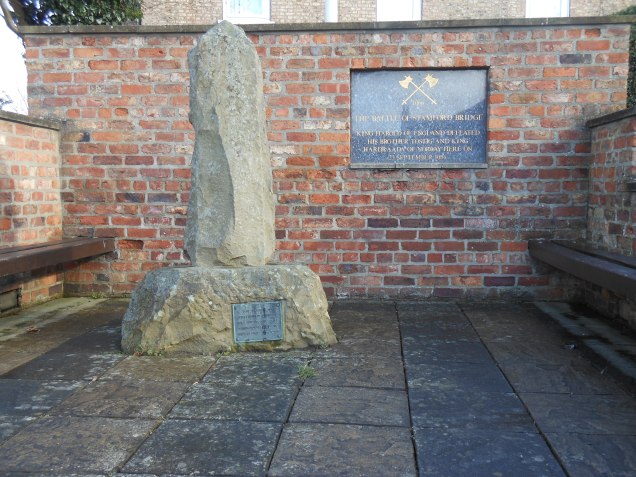
Memorial to the Battle of Stamford Bridge, York

Judith appears to have been a very pious individual, although some stories have come down to us of disagreements between the Earl and his countess, and the Church. One story from Symeon of Durham tells of Judith’s attempts to circumvent the rules of the community of St Cuthbert. Despite there being a specific injunction forbidding women to enter the precincts of the church in which lay the shrine of St Cuthbert, Judith was determined to get around this. She sent one of her own maidservants to attempt entry, but the poor girl fell ill as soon as she crossed the boundary and died shortly afterwards, clearly demonstrating the power of St Cuthbert’s will. We can assume that Judith gave up trying to enter the shrine after that! Judith sent gifts to the cathedral – including a crucifix, church ornaments and images of the Virgin Mary and St John the Evangelist, decorated in gold and silver – to make amends for her disastrous attempt to break the rules.

Despite this, the relationship between the couple and the Church at Durham was generally cordial and mutually appreciated. The earl and countess were notable for almsgiving in Northumbria, and for their generosity towards the community of St Cuthbert. In return Æthelwine, Bishop of Durham, was generous enough to give Judith a relic containing some of St Oswine’s hair. As a consequence, Tostig and Judith are both commemorated in the Durham Liber Vitae.

In 1065, rebellion in Northumbria, and the lack of support from his fellow nobles – including his brother Harold – saw Tostig and his family banished from England; he and Judith, their children and their entire household, crossed the English Channel on 1 November 1065. They made their way to Flanders, to seek refuge with Judith’s brother, Count Baldwin, where they were warmly welcomed just a few days before Christmas.

History...the Interesting Bits
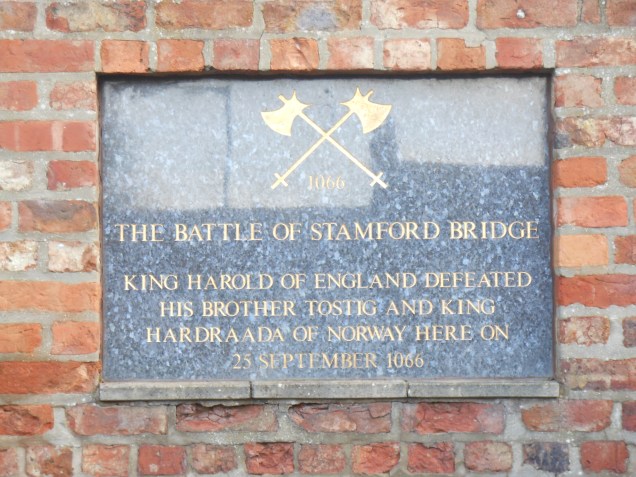
Memorial Plaque, Stamford Bridge, York

However, everything changed in January 1066, with the death of Edward the Confessor and the accession of Tostig’s brother, Harold, to the English throne. Not one to miss an opportunity, Tostig started raiding English shores, before invading from Scotland with his ally Harald Hardrada, King of Norway. They defeated the Northumbrians at the Battle of Fulford, near York, on 20 September, before facing Tostig’s brother, King Harold II, across the battlefield of Stamford Bridge 5 days later. King Harold proved victorious and Tostig and his ally, Harald Hardrada, were both killed in the fighting.

Judith’s whereabouts during Tostig’s invasion are not mentioned. It is possible that she stayed safe in Flanders with her family and two young sons, the oldest of whom was about fourteen by 1066. However, she may have travelled with her husband; there is a suggestion that at least one of her sons fought at Stamford Bridge and travelled to Norway with the survivors. Following Tostig’s defeat at Stamford Bridge, and Harold’s subsequent death at the Battle of Hastings, Judith’s two sons by Tostig eventually sought refuge with King Olaf ‘the Peaceable’ of Norway, Harald Hardrada’s son who had been allowed to return home following his father’s defeat and death at Stamford Bridge. Little is known of their movements after that, other than that the oldest, Skuli Tostisson Kongsfostre, must have married and had children as he was the ancestor of King Inge II of Norway.

History...the Interesting Bits
Wedding of Judith of Flanders and Welf IV, Duke of Bavaria

For a time, Judith remained in Flanders from where her older, half-brother, Count Baldwin V, arranged a second marriage for her in about 1070, to Welf IV, the newly created Duke of Bavaria. The couple were to have two sons and a daughter; Welf, who succeeded his father as Duke of Bavaria and died in 1119, Henry and Kunizza, who married Count Frederick of Diessen and died in 1120. Henry succeeded his brother as Duke of Bavaria and died in 1126; he had at least seven children by his wife, Wulfhilde of Saxony.

A patron of the arts, Judith is renowned for the commissioning of four gospel books, luxurious creations produced in England, probably at Winchester. When Judith left England, she took these gospels, with other manuscripts and relics in her private collection, with her to Flanders. After she remarried, they accompanied her to southern Germany.

On 12 March 1094, with the approval of her husband and sons, Judith drew up a list of bequests. She bequeathed the four gospels and other treasures, to the monastery at Weingarten, a foundation of her husband’s family, thus helping to disseminate Anglo-Saxon art throughout southern Europe. Among the bequests was also a relic of Christ’s blood, given to her by her father. She died a year later, on 5 March 1095, and was buried at the Abbey of Weingarten. Judith is remembered at Weingarten as a widowed queen of England, perhaps a testimony to how close her first husband got to the English throne.

*

This article, Judith of Flanders, Countess of Northumberland, first appeared on Mary Anne Yarde’s wonderful blog Myths, Legends, Book and Coffee Pots.

*

Images:

Courtesy of Wikipedia, except Stamford Bridge memorials ©2018 Sharon Bennett Connolly and Judith’s gospel courtesy of the British Library.

Sources:

The English and the Norman Conquest by Dr Ann Williams; Brewer’s British Royalty by David Williamson; Britain’s Royal Families, the Complete Genealogy by Alison Weir; The Wordsworth Dictionary of British History by JP Kenyon; The Norman Conquest by Marc Morris; Harold, the King Who Fell at Hastings by Peter Rex; The Anglo-Saxons in 100 Facts by Martin Wall; The Anglo-Saxon Age by Martin Wall; Kings, Queens, Bones and Bastards by David Hilliam; The Mammoth Book of British kings & Queens by Mike Ashley; The Oxford Companion to British History Edited by John Cannon; The Anglo-Saxon Chronicles translated and edited by Michael Swaton; The Anglo-Saxon Chronicle translated by James Ingram; Queen Emma and the Vikings by Harriett O’Brien; The Bayeux Tapestry by Carola Hicks; On the Spindle Side: the Kinswomen of Earl Godwin of Wessex by Ann Williams; oxforddnb.com.

*

My Books

Signed, dedicated copies of all my books are available through my online store.

OUT NOW! Scotland’s Medieval Queens

Books by Sharon Bennett Connolly

Scotland’s history is dramatic, violent and bloody. Being England’s northern neighbour has never been easy. Scotland’s queens have had to deal with war, murder, imprisonment, political rivalries and open betrayal. They have loved and lost, raised kings and queens, ruled and died for Scotland. From St Margaret, who became one of the patron saints of Scotland, to Elizabeth de Burgh and the dramatic story of the Scottish Wars of Independence, to the love story and tragedy of Joan Beaufort, to Margaret of Denmark and the dawn of the Renaissance, Scotland’s Medieval Queens have seen it all. This is the story of Scotland through their eyes.

Scotland’s Medieval Queens gives a thorough grounding in the history of the women who ruled Scotland at the side of its kings, often in the shadows, but just as interesting in their lives beyond the spotlight. It’s not a subject that has been widely covered, and Sharon is a pioneer in bringing that information into accessible history.’ Elizabeth Chadwick (New York Times bestselling author)

Available now from Amazon and Pen and Sword Books

Also by Sharon Bennett Connolly:

Books by Sharon Bennett Connolly

Heroines of the Tudor World tells the stories of the most remarkable women from European history in the time of the Tudor dynasty, 1485-1603. These are the women who ruled, the women who founded dynasties, the women who fought for religious freedom, their families and love. Heroines of the Tudor World is now available for pre-order from Amberley Publishing and Amazon UK. Women of the Anarchy demonstrates how Empress Matilda and Matilda of Boulogne, unable to wield a sword themselves, were prime movers in this time of conflict and lawlessness. It shows how their strengths, weaknesses, and personal ambitions swung the fortunes of war one way – and then the other. Available from Bookshop.orgAmberley Publishing and Amazon UKKing John’s Right-Hand Lady: The Story of Nicholaa de la Haye is the story of a truly remarkable lady, the hereditary constable of Lincoln Castle and the first woman in England to be appointed sheriff in her own right. Available from all good bookshops Pen & Sword Booksbookshop.org and Amazon

Historical Novel Society

Defenders of the Norman Crown: The Rise and Fall of the Warenne Earls of Surrey tells the fascinating story of the Warenne dynasty, from its origins in Normandy, through the Conquest, Magna Carta, the wars and marriages that led to its ultimate demise in the reign of Edward III. Available from Pen & Sword BooksAmazon in the UK and US, and Bookshop.orgLadies of Magna Carta: Women of Influence in Thirteenth Century England looks into the relationships of the various noble families of the 13th century, and how they were affected by the Barons’ Wars, Magna Carta and its aftermath; the bonds that were formed and those that were broken. It is now available in paperback and hardback from Pen & SwordAmazon, and Bookshop.orgHeroines of the Medieval World tells the stories of some of the most remarkable women from Medieval history, from Eleanor of Aquitaine to Julian of Norwich. Available now from Amberley Publishing and Amazon, and Bookshop.orgSilk and the Sword: The Women of the Norman Conquest traces the fortunes of the women who had a significant role to play in the momentous events of 1066. Available now from Amazon,  Amberley Publishing, and Bookshop.org.

Alternate Endings: An anthology of historical fiction short stories including Long Live the King… which is my take what might have happened had King John not died in October 1216. Available in paperback and kindle from Amazon.

Podcast:

A Slice of Medieval

Have a listen to the A Slice of Medieval podcast, which I co-host with Historical fiction novelist Derek Birks. Derek and I welcome guests, such as Bernard Cornwell, and discuss a wide range of topics in medieval history, from significant events to the personalities involved. A recent episode saw Derek and I looking at the years before the Norman Conquest in A Triumvirate of Earls.

Every episode is also now available on YouTube.

*

Don’t forget! Signed and dedicated copies of all my books are available through my online store.

For forthcoming online and in-person talks, please check out my Events Page.

You can be the first to read new articles by clicking the ‘Follow’ button, liking our Facebook page or joining me on TwitterThreads and Instagram.

©2019 Sharon Bennett Connolly FRHistS
Joan Beaufort: a Medieval Matriarch

History...the Interesting bits
Joan Beaufort, Countess of Westmorland, from the Neville Book of Hours

Joan Beaufort was the youngest child and only daughter of John of Gaunt and his mistress, Katherine Swynford. Her father, Gaunt, was the third surviving son of Edward III and his queen, Philippa of Hainault. He had married Blanche of Lancaster in 1359 – a marriage which eventually brought him the title of Duke of Lancaster. With Blanche he had 3 surviving legitimate children: Elizabeth, Philippa and Henry – the future king, Henry IV.

Joan’s mother, Katherine Swynford, was a member of Blanche’s household and had been married to a Lincolnshire knight, Sir Hugh Swynford, in 1367. They had 3 children together; Blanche, Thomas and Margaret. Sir Hugh was a tenant of John of Gaunt and served on the continent with him in 1366 and 1370. John of Gaunt was widowed in 1368, when Blanche died in childbirth. Katherine had been governess to the Lancaster children for a number of years when Hugh died in November 1371, leaving her a young widow with 3 children to feed.

John and Katherine may have begun their relationship shortly after Hugh’s death, despite John having married again, to Constance of Castile, in September 1371. John and Katherine’s first child, John, was probably born in 1372, with 3 more children, Henry, Thomas and Joan, born before 1379. They would be given the surname of Beaufort, though no one seems to know quite where the name came from. Although the children were illegitimate, the boys enjoyed successful careers during the reign of their half-brother, Henry IV; with John in politics, Henry rising to the rank of cardinal in the church and Thomas pursuing a military career.

Joan was the youngest of the Beaufort children, born sometime between 1377 and 1379. She was close to her family. She joined the household of her sister-in-law, Mary de Bohun, wife of her half-brother, the future Henry IV, in 1386. It seems that she was accompanied by her mum, Katherine Swynford, possibly because Katherine and John of Gaunt had separated and John was reconciled with his second wife, Constance of Castile. Joan was about 7-years-old and was continuing her education and being prepared for her first marriage – she had just been betrothed to 10-year-old Robert Ferrers of Oversley, Warwickshire. Robert would become one of her father’s retainers and, through his mother, heir to the estates of the Botelers of Wem, Shropshire. They were married in 1392, when Joan was 13 or 14 and 2 daughters were born in quick succession; Elizabeth in 1393 and Mary the following year. The marriage was cut short, however, when Robert died in 1395 or 1396, leaving Joan – still only in her mid-teens – a widow with young children.

History...the Interesting bits
John of Gaunt, Joan’s father

As the granddaughter of a king, Joan was bound not to remain a widow for long. And her marriage prospects improved drastically in February 1396, when her parents were married in Lincoln Cathedral. Shortly after he married Katherine, John of Gaunt applied to the pope to have their children declared legitimate; the papal bull declaring the legitimacy of Joan and her brothers arrived in September of the same year. As the legitimate granddaughter of a king, Joan’s status was improved immensely and she was soon married to the recently widowed 6th baron of Raby and later earl of Westmorland, Ralph Neville.

Unlike many medieval women, we have some idea of what Joan may have looked like, thanks to a miniature by Pol de Limbourg. Taken from the Neville Book of Hours, it shows Joan dressed piously in black and white, though her cloak and cuffs are lined with ermine and she wears the Lancastrian S-collar around her neck. Her features are delicate. Her hands, with rings on the fingers, are clasped in prayer.

Joan was a learned woman, she was educated to the same standard as her legitimate half-sisters, Philippa and Elizabeth of Lancaster. She seems to have possessed a considerable library, the texts being largely devotional. She owned a copy of ‘Les Cronikels de Jerusalem et de Viage de Godfray de Boylion’ (Chronicles of Jerusalem and the Voyages of Godfrey de Bouillon) which she lent to her nephew, Henry V, but had to petition the Council for its return after Henry’s death. Her brother, Thomas, had left her a book, titled ‘Tristram’.

Thomas Hoccleve dedicated a volume of poems, ‘Hoccleve’s Works’ to her sending it to her around 1422, saying:

Go, smal book to the noble excellence

Of my lady of Westmerland and seye,

Her humble seruant with al reuerence

Him recommandith vn-to hir nobleye.

Also, an early copy of Hoccleve’s ‘Regiment of Princes’ was made for Joan’s son-in-law, John Mowbray.

History...the Interesting bits
Raby Castle, Count Durham

Known for her piety, Joan left many bequests to religious institutions in her will, especially monasteries in the north. Admitted to the sisterhood at St Albans, she was also licensed to appropriate for the support of the chantry the advowson of the church of Welton, in the Howden area; and it was Joan who saw the completion of the college at Staindrop, founded by her husband in 1408. According to antiquarian, John Leland, Joan ‘erectid the very house self of the college’ in the form of a medieval hospital. Her piety, however, was not always conventional. Her father had been a defender of the Lollards – he employed John Wycliffe, the first person to translate the Bible into English, as a tutor to his children. And Joan seems to have had a similar religious curiosity – hence her association with Margery Kempe.

Margery Kempe was a mystic from Lyn, Norfolk; she claimed to have visions of Christ and travelled throughout England and on the Continent. She wrote the Book of Margery Kempe which recounted the story of her life and her visions and considered to be the first ever autobiography in English. Joan invited Margery Kempe to visit her at Raby. She also wrote a letter to exonerate Margery from accusations of corruption. Margery’s own testimony says they knew each other for ‘this two years and more’. In 1417 Margery was brought before the Archbishop of York, accused of advising Joan’s daughter, Elizabeth Greystoke, to leave her husband. Margery was found ‘not guilty’ of the offence and under questioning, admitted she had told Countess Joan and her daughter a ‘good tale of a lady who was damned because she would not love her enemies’. Margery even suggested her questioners ask Joan for corroboration of her testimony, demonstrating her trust that the Countess would back her.

Joan enjoyed influence at court – as the sister of one king, Henry IV, and aunt to his successor, Henry V. She was named in royal grants as ‘the king’s sister’ and made a Lady of the Garter in the reign of her cousin, Richard II. She was compassionate and used her influence to petition the king to aid those less fortunate, such as Christopher and Margaret Standith, who had fallen on hard times after Christopher had been dismissed from his father’s service for marrying for love. Joan wrote the king, asking him to give Margaret a position in the household of his queen, Joan of Navarre.

It can be argued that Joan had a strong bond of affection and purpose with her husband. They both wanted to see their family’s prospects improved even further, arranging advantageous marriages for their large brood of children. Although, it is unclear how much influence Joan had when her husband, the Earl of Westmorland, manage to entail the bulk of his estates onto his children by Joan, rather than the children by his first marriage to Margaret Stafford. This seems to have been a sensible strategy, given that his children by Joan were closely related to the royal family – Joan being the half sister of King Henry IV. The strategy, however, caused Joan problems after her husband’s death and led to a family feud – which sometimes turned violent – which wasn’t resolved until after Joan died.

History...the Interesting bits
Tomb of Ralph Neville, St Mary’s Church, Staindrop

Joan was a strong influence on her daughters and daughters-in-law. She concerned herself with matters of family – such as her children’s marriages – rather than business. Ralph’s son, also Ralph, by his first marriage, was married to Mary, Joan’s younger daughter from her first marriage. Ralph and Joan’s children were married into many of the leading noble dynasties of the time and served to strengthen the position of the Beauforts as a whole. Such significant marriages saw their eldest daughter, Katherine, married to John Mowbray, 2nd Duke of Norfolk – it was Katherine who later married John Woodville, brother-in-law of her nephew Edward IV; Katherine was around 65 years old and John just 20. Of other daughters, Eleanor married Henry Percy, 2nd Earl of Northumberland, while Anne married Humphrey Stafford, a descendant of Edward III and 1st Duke of Buckingham. Of their sons, Richard Neville married Alice Montagu, heiress to the earldom of Salisbury, and became Earl of Salisbury by right of his wife; their son, Richard Neville, was the Earl of Warwick known as the Kingmaker. Robert Neville became Bishop of Durham and other sons married rich heiresses to claim titles and positions for themselves.

Ralph died in 1425 and was buried at Staindrop, close to Raby Castle. His tomb includes effigies of both Joan and his first wife, although neither woman is buried beside him. Joan was herself responsible for the negotiations after her husband’s death, which saw their youngest daughter, Cecily, married to Richard, Duke of York. Two of Cecily’s sons would become Kings of England; Edward IV and Richard III.

Having married young herself, and having become a mother before she was 15 years old, Joan was sensible to the dangers of girls marrying too young and ensured that none of her daughters or daughters-in-law, faced the dangers of childbirth before they were 17 or 18 years of age. She even kept married couples apart – such as Cecily and the Duke of York – when necessary, in order to protect the girls.

History...the Interesting bits
Joan’s tomb, beside that of her her mother, in Lincoln Cathedral

On 28 November 1437, Joan was granted licence for the foundation of a chantry with two chaplains at Lincoln Cathedral, to pray daily for the soul of her mother, Katherine Swynford, as well as for herself, her husband, brother (Cardinal Henry Beaufort) and father. On the same day, she secured a grant for daily prayers to be said at Staindrop Church – where her husband Ralph, Earl of Westmorland, was buried – for the souls of her husband, brother and father.

Joan died at Howden, a manor near Beverley in her son Robert’s possession as Bishop of Durham, on 13 November 1440. In her will, she requested to be buried with her mother, with whom she had a strong bond in life, but also for her mother’s burial site to be enlarged and enclosed. It seems likely that the now-lost wrought iron screens which surrounded her mother’s tomb, were added at this time, rather than when Katherine died in 1403. Joan’s epitaph claimed that the whole nation grieved at her death.

There is, however, no clear indication why Joan chose to be buried with her mother, rather than at Staindrop with her husband. It may be that as the granddaughter of a king (Edward III), she thought Lincoln Cathedral a more appropriate resting place, or that she wanted to be as close to her mother in death as she had been in life.

*

Pictures: John of Gaunt and Joan Beaufort courtesy of Wikipedia. All other photos ©SharonBennettConnolly FRHistS

*

Sources: katherineswynfordsociety.org.uk; Red Roses: Blanche of Gaunt to Margaret Beaufort by Amy Licence; The Nevills of Middleham by K.L. Clark; The House of Beaufort: the Bastard Line that Captured the Crown by Nathen Amin; Brewer’s British Royalty by David Williamson; History Today Companion to British History Edited by Juliet Gardiner & Neil Wenborn; The mammoth Book of British kings & Queen by Mike Ashley; Britain’s Royal Families, the Complete Genealogy by Alison Weir; The Life and Times of Edward III by Paul Johnson; The Perfect King, the Life of Edward III by Ian Mortimer; The Reign of Edward III by WM Ormrod; Chronicles of the Age of Chivalry Edited by Elizabeth Hallam; Oxforddnb.com; womenshistory.about.com/od/medrenqueens/a/Katherine-Swynford.

*

My Books

Signed, dedicated copies of all my books are available through my online bookshop.

Out now: Scotland’s Medieval Queens

Books by Sharon Bennett Connolly

Scotland’s history is dramatic, violent and bloody. Being England’s northern neighbour has never been easy. Scotland’s queens have had to deal with war, murder, imprisonment, political rivalries and open betrayal. They have loved and lost, raised kings and queens, ruled and died for Scotland. From St Margaret, who became one of the patron saints of Scotland, to Elizabeth de Burgh and the dramatic story of the Scottish Wars of Independence, to the love story and tragedy of Joan Beaufort, to Margaret of Denmark and the dawn of the Renaissance, Scotland’s Medieval Queens have seen it all. This is the story of Scotland through their eyes.

Scotland’s Medieval Queens gives a thorough grounding in the history of the women who ruled Scotland at the side of its kings, often in the shadows, but just as interesting in their lives beyond the spotlight. It’s not a subject that has been widely covered, and Sharon is a pioneer in bringing that information into accessible history.’ Elizabeth Chadwick (New York Times bestselling author)

Available now from Amazon and Pen and Sword Books

Also by Sharon Bennett Connolly:

Books by Sharon Bennett Connolly

Heroines of the Tudor World tells the stories of the most remarkable women from European history in the time of the Tudor dynasty, 1485-1603. These are the women who ruled, the women who founded dynasties, the women who fought for religious freedom, their families and love. Heroines of the Tudor World is now available for pre-order from Amberley Publishing and Amazon UK. Women of the Anarchy demonstrates how Empress Matilda and Matilda of Boulogne, unable to wield a sword themselves, were prime movers in this time of conflict and lawlessness. It shows how their strengths, weaknesses, and personal ambitions swung the fortunes of war one way – and then the other. Available from Bookshop.orgAmberley Publishing and Amazon UKKing John’s Right-Hand Lady: The Story of Nicholaa de la Haye is the story of a truly remarkable lady, the hereditary constable of Lincoln Castle and the first woman in England to be appointed sheriff in her own right. Available from all good bookshops Pen & Sword Booksbookshop.org and Amazon

Royal Historical Society

Defenders of the Norman Crown: The Rise and Fall of the Warenne Earls of Surrey tells the fascinating story of the Warenne dynasty, from its origins in Normandy, through the Conquest, Magna Carta, the wars and marriages that led to its ultimate demise in the reign of Edward III. Available from Pen & Sword BooksAmazon in the UK and US, and Bookshop.orgLadies of Magna Carta: Women of Influence in Thirteenth Century England looks into the relationships of the various noble families of the 13th century, and how they were affected by the Barons’ Wars, Magna Carta and its aftermath; the bonds that were formed and those that were broken. It is now available in paperback and hardback from Pen & SwordAmazon, and Bookshop.orgHeroines of the Medieval World tells the stories of some of the most remarkable women from Medieval history, from Eleanor of Aquitaine to Julian of Norwich. Available now from Amberley Publishing and Amazon, and Bookshop.orgSilk and the Sword: The Women of the Norman Conquest traces the fortunes of the women who had a significant role to play in the momentous events of 1066. Available now from Amazon,  Amberley Publishing, and Bookshop.org.

Alternate Endings: An anthology of historical fiction short stories including Long Live the King… which is my take what might have happened had King John not died in October 1216. Available in paperback and kindle from Amazon.

Podcast:

A Slice of Medieval

Have a listen to the A Slice of Medieval podcast, which I co-host with Historical fiction novelist Derek Birks. Derek and I welcome guests, such as Bernard Cornwell and Elizabeth Chadwick, and discuss a wide range of topics in medieval history, from significant events to the personalities involved.

There are now 80 episodes to listen to!

Every episode is also available on YouTube.

*

Don’t forget! Signed and dedicated copies of all my books are available through my online bookshop.

For forthcoming online and in-person talks, please check out my Events Page.

You can be the first to read new articles by clicking the ‘Follow’ button, liking our Facebook page or joining me on TwitterThreadsBluesky and Instagram.

©2019 Sharon Bennett Connolly FRHistS
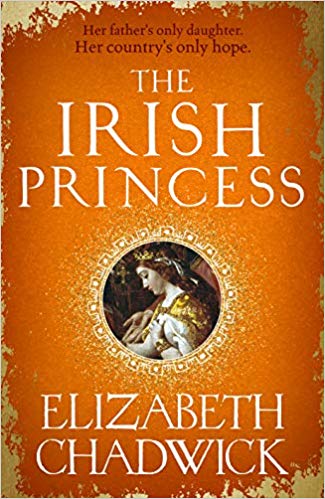
Book Corner: the Irish Princess by Elizabeth Chadwick

Her father’s only daughter.
Her country’s only hope.
Ireland, 1152

The King of Leinster, awaiting news of his newborn child, is disappointed to hear he has a daughter. Diarmait MacMurchada wanted another strapping son to shoulder a spear, wield a sword, and protect his kingdom. But the moment Diarmait holds tiny Aoife in his arms, he realised she would be his most precious treasure.

1166

Forced into exile Aoife and her family find themselves at the mercy of Henry II. Aoife – aware of her beauty but not its power – intrigues and beguiles Henry in equal measure. He agrees to help her father, an alliance that leads the MacMurchadas to the charistmatic Richard de Clare, a man dissatisfied with his lot and open to new horizons.

Diarmit promises Richard Aoife’s hand in marriage in return for his aid in Ireland, but Aoife has her own thoughts on the matter. She may be a prize, but she is not a pawn, and she will play the men at their own game. For herself, for her family, and for her country.

From the royal halls of scheming kings, to staunch Welsh border fortresses and the wild green kingdoms of Ireland, The Irish Princess is a sumptuous, journey of ambition and desire, love and loss, heartbreak and survival.

Elizabeth Chadwick’s The Irish Princess is one of the most anticipated historical fiction novels of the year. I was lucky enough to receive and advance copy from NetGalley – and it more than lives up to expectation. Telling the story of the marriage of Richard de Clare (Strongbow) and his Irish princess, Aoife MacMurchada, against the backdrop of the Norman invasion of Ireland it seamlessly weaves together the various strands to make an engaging and utterly engrossing story.

Aoife is a proud and precocious princess who has grown up amid the brutality of the power struggles of the Irish clans. She has seen brothers maimed and murdered, the heads of her father’s enemies decorating her home and had to flee into exile, all before she had left what should have been the innocence of childhood. Her marriage to Richard de Clare, Earl of Striguil, is a political necessity in the strategies of her father, to recover his lost kingdom of Leinster.

Richard de Clare, on the other hand, is a man on the outside; not trusted or employed by King Henry II, he sees helping Aoife’s father as an opportunity to gain a wife and heirs, lands and influence. He still has to play the courtier, however, and has to walk a fine line with Henry, deferring to the king whilst protecting his own interests – not an easy path to walk.

The entrance to the castle was above ground level with steps leading to a doorway decorated with a patterned arch of zig-zags and painted chevrons. A man stepped from the darkness of the arch and came down the steps to greet them. Tall and well proportioned, he moved with confident grace. His tunic was grey, topped by a cloak of a darker, charcoal hue, lined with squirrel fur, creating a strong but subtle contrast. His hair was the same rich auburn as the squirrel pelts.

Welcome to Striguil, sire.’ He bowed his head in courtesy and extended his hand to clasp her father’s. ‘I trust you have journeyed well?’ his voice was light, but the words were clearly spoken and his smile showed a flash of white teeth. he sent a brief glance in her direction, as he encompassed everyone in his greeting.

‘Well enough, my lord,’ her father answered in accented French. ‘But glad to arrive. You have a fine castle.’ His gaze roved the walls.

‘It serves its purpose well,’ de Clare replied, still smiling. ‘Will you come within?’

Diarmait presented Aoife’s mother and her brothers to de Clare, and then spread his arm in a flourish. ‘And this is my daughter Aoife.’

Aoife swallowed and held her ground as she had held it before King Henry. De Clare’s eyes were clear with a glassy mingling of sea-colours, utterly striking against the dark contrast of his pupils. His stare was as intense as Henry’s had been but assessing her rather than predatory.

‘My lady, you are indeed welcome,’ he said, speaking slowly and clearly to help her understand him. ‘Word of your great beauty has carried, and it is not exaggerated.’

Elizabeth Chadwick wonderfully combines the history of the conflict with the private lives and experiences of her leading characters. The personal stories are what make this book truly a incredible read. I wasn’t keen on Aoife at first, but she grows on you as she grows up and is a courageous heroine, who has to use all her attributes as a woman in order to survive and prosper. No shrinking violet and no meek, biddable child, she is well versed in the politics of Ireland and England, but knows her place as a woman of the times; advising and steering policy in private and charming the English king to gain his protection.

From Aoife herself, to her sister-in-law Basilia, from Richard de Clare to King Henry, it is the characters in The Irish Princess that serve as the backbone of the novel. They drive the direction of the story and the empathy and engagement of the reader, even more so than the action and intrigue of the times.

Elizabeth Chadwick, as always, has done extensive research and the historical story comes across in each page, even as she weaves in the recreated words and emotions of the characters, adding a sense of having a fly-on-the-wall view of events as they happened. The sweeping landscapes of Ireland, the bloody battlefields, the warmth and comfort of the lord’s hall and the intimacy of the lady’s private quarters are beautifully recreated and woven into the story to draw the reader into the world of Ireland at the time of the Norman invasion.

And to top it all, a cameo appearance by … (not saying, I don’t want to spoil the surprise!)

Fans of Elizabeth Chadwick – old and new – will not be disappointed by this wonderful novel. The author has lived up to every expectation in this wonderful novel. The story and characters are beautifully crafted to bring the reader an epic tale of love, war betrayal … and family.

The Irish Princess by Elizabeth Chadwick will be released on 12 September 2019 and is available from Amazon UK.

*

About the Author:

Myself and Elizabeth Chadwick at the Newark Book Festival, 2018

New York Times bestselling author Elizabeth Chadwick lives in a cottage in the Vale of Belvoir in Nottinghamshire with her husband and their 3 dogs. Her first novel, The Wild Hunt, won a Betty Trask Award and To Defy a King won the RNA’s 2011 Historical Novel Prize. She was also shortlisted for the Romantic Novelists’ Award in 1998 for The Champion, in 2001 for Lords of the White Castle, in 2002 for The Winter Mantle and in 2003 for The Falcons of Montabard. Her sixteenth novel, The Scarlet Lion, was nominated by Richard Lee, founder of the Historical Novel Society, as one of the top ten historical novels of the last decade. She often lectures at conferences and historical venues, has been consulted for television documentaries and is a member of the Royal Historical Society.

For more details on Elizabeth Chadwick and her books, visit http://www.elizabethchadwick.com, follow her on Twitter, read her blogs or chat to her on Facebook.

*

My books

Silk and the Sword: The Women of the Norman Conquest

From Emma of Normandy, wife of both King Cnut and Æthelred II to Saint Margaret, a descendant of Alfred the Great himself, Silk and the Sword: the Women of the Norman Conquest traces the fortunes of the women who had a significant role to play in the momentous events of 1066.  Available now from Amazon UK,  Amberley Publishing, Book Depository and Amazon US.

Heroines of the Medieval World

Telling the stories of some of the most remarkable women from Medieval history, from Eleanor of Aquitaine to Julian of Norwich, Heroines of the Medieval World,  is available now on kindle and in paperback in the UK from from both Amberley Publishing and Amazon, in the US from Amazon and worldwide from Book Depository.

*

You can be the first to read new articles by clicking the ‘Follow’ button, liking our Facebook page or joining me on Twitter and Instagram.

©2019 Sharon Bennett Connolly

Robert de Breteuil, the Crusading Earl

Sharon Bennett Connolly
Arms of Robert de Breteuil, 4th Earl of Leicester

Robert de Breteuil, also known as Robert de Beaumont, was a remarkable individual whose adventures in the Holy Land would make a wonderful novel. A renowned warrior and a powerful magnate, he was a companion to the Plantagenet princes, both Richard the Lionheart and King John. Robert was the son-in-law of Matilda de Braose, whose horrific persecution by King John led to her death by starvation in one of John’s dungeons – and the inclusion of clause 39 in Magna Carta:

“No man shall be taken, imprisoned, outlawed, banished or in any way destroyed, nor will we proceed against or prosecute him, except by the lawful judgement of his peers or by the law of the land.”

Magna Carta, magnacartaresearch.og

Robert was the second son of Robert de Breteuil, 3rd earl of Leicester, and his wife, Petronilla de Grandmesnil and the great-grandson of Robert de Beaumont, Count of Meulan and 1st Earl of Leicester, and his wife, Elizabeth de Vermandois. Robert was probably born in the early-1160s and was closely associated with his elder brother William. As they grew up and entered public life they were linked with the household of their cousin, Robert, Count of Meulan, and they regularly appeared on their father’s charters together. Their younger brother, Roger, was bishop of St Andrews. William died in 1189, sometime after the accession of King Richard I. A later legend suggests he suffered from leprosy, though there is no contemporary evidence to corroborate this. William’s death meant Robert therefore became heir to their father’s earldom of Leicester.

Both Robert and his father were at the royal court at Verneiul on 2 January 1190 and joined the Third Crusade of Richard the Loinheart. Robert’s father took an overland route to the Holy Land, while it appears that Robert travelled with the king. Robert was with the king at Messina, Sicily, when news reached him of his father’s death. The 3rd earl had died on 31 August or 1 September 1190 and so Robert was invested as earl by the king on 2 February 1191, in Sicily.

During his time in the Holy Land, Robert was one of the leaders of the assault on Acre on 11 July 1191 and fought in the battle of Arsuf on 7 September. In November he rescued some ambushed Templars at Ibn-Ibrak and then was himself surrounded, with his knights, by a party of Turks outside the camp at Ramlah. Robert was rescued by his cousin Robert de Neubourg; in the process he nearly drowned in a river and had two horses killed under him.

Sharon Bennett Connolly
Seal of Robert de Breteuil

Robert and his men were prominent among the forces who stormed Deir al-Bela on 22 May 1192 and on 5 August 1192 he was one of the ten knights who helped to thwart an attempt to kidnap the king from his tent at Jaffa and the king himself rescued Robert when he was thrown from his horse. He probably set out for home in September or October 1192, having distinguished himself and earned the king’s eternal goodwill.1

Following his return from the crusade, Robert was occupied with the defence of Normandy, but was captured by King Philip Augustus’ forces in June 1194, after a skirmish outside Gourany. He was imprisoned at Étampes for more than a year and only freed after surrendering his castle and lordship of Pacy-sur-Eure to King Philip. His freedom was achieved sometime around February 1196 and in the same year he was married to the teenage Loretta de Braose. Loretta de Braose, was probably born in the early-to-mid-1180s,. She was one of the sixteen children of Matilda and William de Braose. Four of her sisters married prominent Welsh Marcher lords, but Loretta was married to Robert de Breteuil, 4th earl of Leicester.

The marriage was an alliance of two of the leading Anglo-Norman families of the Plantagenet world. He was a powerful earl who had made a name for himself on the crusades, whilst she was a daughter of one of the most powerful barons of the Welsh March. As her marriage portion, Loretta was given Tawstock, near Barnstaple in Devon.

Robert de Breteuil was back campaigning in 1197 and 1198 and was with King Richard when he was mortally wounded at Châlus in April 1199. He had had a long association with Richard’s brother since John had been Count of Mortain, and so was a firm supporter of John’s succession, acting as steward at his coronation on 27 May 1199, claiming the office his grandfather had relinquished in 1153. Robert was highly influential in the early years of John’s reign. He also fought for John in Normandy, being one of the major landholders in the duchy, and was rewarded generously for his support; he was granted Richmondshire in Yorkshire in September 1203. The following year he suffered the loss of his Continental estates when Normandy fell and was the biggest loser of the Anglo-Norman barons.

Although he was one of the two barons (the other being William Marshal) who was given a year to decide whether to pay homage to King Philip of France to try to retain his Norman estates, Robert was not punished by John. Indeed, he was given more lands in England, English lands that had belonged to families who had chosen to remain in Normandy, such as the Harcourts. Robert died before King Philip’s deadline, and so never did have to decide where and how to share his allegiances in order to keep all his lands.

Sharon Bennett Connolly
The ruins of Leicester Abbey, where Robert de Breteuil is buried

Robert died on 20 or 21 October 1204; the life of St Hugh of Lincoln reported that he died a leper, although this seems highly unlikely.1 He was buried in the choir of the Augustinian Abbey in Leicester. Robert and Loretta had remained childless, so Robert’s lands were divided between his two sisters. The earldom and the town of Leicester went to his eldest sister, Amice, the wife of Simon de Montfort and therefore grandmother of the Simon de Montfort who would marry King John’s daughter, Eleanor, and claim the earldom of Leicester for himself. Half of the old earldom, centred around Brackley in Northamptonshire, went to Robert’s younger sister, Margaret, wife of Saher de Quincy, Earl of Winchester.

It is a sad legacy that Robert’s death before John began the persecution of Loretta’s family meant that she was without her husband’s powerful protection when she needed it most. King John’s pursuit of the family did not end with the deaths of Matilda, who died in custody in 1210, and William de Braose, Lord of Bramber, who died in exile in France in 1211. In November 1207 John extracted a promise from Loretta that she would not remarry without the king’s permission and her lands were taken from her. She probably left for France shortly afterwards and only returned to England in 1214.

Once in England, Loretta was allowed to recover her confiscated estates after again to only marry as the king directed. The restoration of Loretta’s estates were complicated by the king’s desire to keep happy those who had benefited from tehir confiscation, such as the powerful Saher de Quincy, earl of Winchester. Loretta’s experiences in this respect may well have inspired clauses 7 and 8 of Magna Carta, which guaranteed that widows should have their marriage portions without hindrance and that they could remarry at their own pleasure, so long as it was with the king’s consent.

Sharon Bennett Connolly
Arms of William de Braose, Loretta’s father

Loretta took her future into her own hands, however, and in early 1221, took a vow of chastity and became an anchorite in Hackington, near Canterbury. An anchorite was a religious recluse who lived in a small cell within a church, allowed on the briefest of contact with others, although she was allowed attendants to help with her daily needs. Loretta’s influence was still in evidence, however, in that she obtained a pardon for a man who had accidentally killed another and helped to establish the Franciscan order in England. She died on 4 March, probably in 1266, and was buried at the church of St Stephen, Hackington.

It is a fact of life that whilst researching one particular person, you come across several others who spark your interest. I stumbled upon the stories of Robert de Breteuil and Loretta de Braose while researching for my book, Ladies of Magna Carta.

*

Footnote: ¹Oxforddnb.com

Sources: sussexcastles.com; genie.com; steyningmuseum.org.uk; berkshirehistory.com; England Under the Norman and Angevin Kings 1075-1225 by Robert Bartlett; Oxford Companion to British History Edited by John Cannon; The Story of Britain by Roy Strong; The Plantagenets, the Kings who Made England by Dan Jones; The Life and Times of King John by Maurice Ashley; The Plantagenet Chronicles Edited by Elizabeth Hallam; Oxforddnb.com; magnacartareseearch.org; Magna Carta by David Starkey; King John by Marc Morris; King John, England, Magna Carta and the Making of a Tyrant by Stephen Church; 1215, the Year of Magna Carta by Danny Danziger and John Gillingham; Women in Thirteenth Century Lincolnshire by Louise J. Wilkinson.

Pictures courtesy of Wikipedia

*

My Books

Signed, dedicated copies of all my books are available through my online store.

Out now: Scotland’s Medieval Queens

Scotland’s history is dramatic, violent and bloody. Being England’s northern neighbour has never been easy. Scotland’s queens have had to deal with war, murder, imprisonment, political rivalries and open betrayal. They have loved and lost, raised kings and queens, ruled and died for Scotland. From St Margaret, who became one of the patron saints of Scotland, to Elizabeth de Burgh and the dramatic story of the Scottish Wars of Independence, to the love story and tragedy of Joan Beaufort, to Margaret of Denmark and the dawn of the Renaissance, Scotland’s Medieval Queens have seen it all. This is the story of Scotland through their eyes.

Scotland’s Medieval Queens gives a thorough grounding in the history of the women who ruled Scotland at the side of its kings, often in the shadows, but just as interesting in their lives beyond the spotlight. It’s not a subject that has been widely covered, and Sharon is a pioneer in bringing that information into accessible history.’ Elizabeth Chadwick (New York Times bestselling author)

Available now from Amazon and Pen and Sword Books

Also by Sharon Bennett Connolly:

Heroines of the Tudor World tells the stories of the most remarkable women from European history in the time of the Tudor dynasty, 1485-1603. These are the women who ruled, the women who founded dynasties, the women who fought for religious freedom, their families and love. Heroines of the Tudor World is now available from Amberley Publishing and Amazon UK. Women of the Anarchy demonstrates how Empress Matilda and Matilda of Boulogne, unable to wield a sword themselves, were prime movers in this time of conflict and lawlessness. It shows how their strengths, weaknesses, and personal ambitions swung the fortunes of war one way – and then the other. Available from Bookshop.orgAmberley Publishing and Amazon UKKing John’s Right-Hand Lady: The Story of Nicholaa de la Haye is the story of a truly remarkable lady, the hereditary constable of Lincoln Castle and the first woman in England to be appointed sheriff in her own right. Available from all good bookshops Pen & Sword Booksbookshop.org and Amazon

Defenders of the Norman Crown: The Rise and Fall of the Warenne Earls of Surrey tells the fascinating story of the Warenne dynasty, from its origins in Normandy, through the Conquest, Magna Carta, the wars and marriages that led to its ultimate demise in the reign of Edward III. Available from Pen & Sword BooksAmazon in the UK and US, and Bookshop.orgLadies of Magna Carta: Women of Influence in Thirteenth Century England looks into the relationships of the various noble families of the 13th century, and how they were affected by the Barons’ Wars, Magna Carta and its aftermath; the bonds that were formed and those that were broken. It is now available in paperback and hardback from Pen & SwordAmazon, and Bookshop.orgHeroines of the Medieval World tells the stories of some of the most remarkable women from Medieval history, from Eleanor of Aquitaine to Julian of Norwich. Available now from Amberley Publishing and Amazon, and Bookshop.orgSilk and the Sword: The Women of the Norman Conquest traces the fortunes of the women who had a significant role to play in the momentous events of 1066. Available now from Amazon,  Amberley Publishing, and Bookshop.org.

Alternate Endings: An anthology of historical fiction short stories including Long Live the King… which is my take what might have happened had King John not died in October 1216. Available in paperback and kindle from Amazon.

Podcast:

Have a listen to the A Slice of Medieval podcast, which I co-host with Historical fiction novelist Derek Birks. Derek and I welcome guests, such as Bernard Cornwell and Michael Jecks, and discuss a wide range of topics in medieval history, from significant events to the personalities involved. Every episode is also now available on YouTube.

*

Don’t forget! Signed and dedicated copies of all my books are available through my online store.

For forthcoming online and in-person talks, please check out my Events Page.

You can be the first to read new articles by clicking the ‘Follow’ button, liking our Facebook page or joining me on TwitterThreadsBluesky and Instagram.

*

©2019 Sharon Bennett Connolly FRHistS

Guest Post: Katharina by Margaret Skea

It is with great pleasure that I welcome author Margaret Skea to the blog today, talking about her latest book, Katharina: Fortitude, the history behind it and giving you a little teaser from the book itself.

As crazy ideas go, thinking of writing what could best be described as a fictionalized biography of Katharina von Bora, the escaped nun who married the reformer Martin Luther, ranked highly.  It had popped into my head, seemingly from nowhere, but once there, as crazy ideas so often do, it burrowed its way in so far no amount of rational thinking would dislodge it.

There were plenty of good reasons not to write her story.

Reason 1. I knew almost nothing about her, and it seemed that nobody else knew much about her either.

I did find a slim volume, of some 89 pages, written by a native German within the Luther Foundation, Martin Treu, well placed to have found any information there was to find. But the opening words were hardly encouraging.

It is impossible to write a biography of Katharina von Bora. The scanty and often enough fragmentary nature of the evidence allows for only a biographical sketch…’ Hmm.

Katharina

Reason 2.  I didn’t speak or read German, so whatever ‘fragmentary evidence’ existed, I couldn’t even read it for myself. Not the best start.

Reason 3. I was in the middle of writing my third Scottish novel, and there was a publisher waiting for it to be delivered, so the timing wasn’t exactly ideal. However, the Luther 500 anniversary was only just over one year away, so I knew if I was going to write about her it had to be immediately.

And there she was, hovering at my shoulder, shadowy and insubstantial, but refusing to go away. So the Scottish book set aside, I began to plan how I could make this crazy idea a reality. I read and re-read the 89 pages of the little book until I knew them almost by heart and scoured every other source I could find (in English) that made any reference to her at all.  Treu had also set me a challenge – he wrote: 

The lacunae in the sources have tempted authors and authoresses to fill in the gaps with their own imagination.’

Well, yes, that is, after all,  what historical fiction writers do. But he went on:

The result is frequently a picture that says more about the writer and their time than about the person and journey through life of Katharina von Bora.’

Ah, that was different – I didn’t want to write about my time, or me, I wanted to write about her time and about her.

The Lutherhaus portal commissioned by Luther as a gift for Katharina

But pessimistic as he was about anyone’s chances, I did find some wee nuggets in his book, and in others, that gave me a starting point, despite that there is dispute over her parentage, her birthplace, the circumstances surrounding her admission to two different convents, and little direct evidence of her character.  Retracing her steps  in Saxony, which involved driving over 1000 miles, gave me a real sense of her environment, including the terrain she travelled, the architecture, and artefacts, and many aspects of her life and times.  There were some surprises, too, particularly in relation to Martin Luther and his almost modern attitude towards her, as well as the discovery of many myths that needed to be dispelled. But perhaps the biggest challenge was finding a ‘voice’ for her and so I began to write snippets in 1st person present tense. And what started as a preliminary experiment continued throughout both books and the story truly became Katharina’s.

I hope I have done her justice and that readers will get as much enjoyment in reading as I found in writing it. 

Here is the opening section as a wee taster:

Chapter One

Wittenberg June 1525.

Martin Luther

The music stops, the sound of the fiddle dying away, the piper trailing a fraction behind, as he has done all evening. I cannot help but smile as I curtsy to Justus Jonas, his answering twinkle suggesting he shares my amusement.

‘Thank you, Frau Luther,’ and then, his smile wider, so that even before he continues I suspicion it isn’t the piping amuses him, ‘For a renegade nun, you dance well.’

It is on the tip of my tongue to respond with ‘ For a cleric, so do you,’ but I stop myself, aware that should I be overheard it would likely be considered inappropriate for any woman, far less a newly married one, to speak so to an older man, however good a friend he has been. And on this day of all days, I do not wish to invite censure. Instead I say, ‘I have been well taught. Barbara saw to that. She did not wish me to disgrace myself or her, and there is a pair of slippers with the soles worn through to testify to the hours of practice she insisted upon.’

‘She succeeded admirably then.’

All around us there is the buzz of laughter and chatter, an air of goodwill evident in every flushed face. Martin is waiting at the foot of the dais, and as we turn towards him, his smile of thanks to Justus is evidence he too is grateful for the seal of approval, of me and of the marriage, our shared dance a tangible sign to the whole town that Justus Jonas at least has no reservations regarding our union. Over his shoulder I catch Barbara’s eye and she nods also. I nod back, but am unable to suppress altogether the inner voice, tonight there is drink taken, tomorrow some may feel differently.

As if he can read my mind, Justus says, a new seriousness in his tone, ‘You have not made a mistake, either of you.’ He waves his hand at the folk clustered in groups along the length of the room. ‘Look around. When the difficult times come, as no doubt they will, remember tonight and the number of those who came to wish you well.’

                             *                            *                       *

The first challenge is not long in coming. We stroll home in the moonlight, accompanied by those guests who will spend the night in the cloister with us, adding their acceptance to our union.  Among them are Martin’s parents, and three councillors from Mansfeld, snatches of their conversation penetrating my thoughts.

Hans Luder’s tone, though gruff, cannot mask his satisfaction. ‘It is a good day’s work, and glad I am to see it, however long the wait.’

Martin’s mother’s voice is sweet and low, but bubbles with amusement, like a sparkling wine as it is poured into a glass. ‘Old you may be, but I trust your end is not yet nigh.’

There is an answering chuckle from one of the councillors,  ‘Indeed,’ Frau Luder, ‘So do we all.’

Lutherhaus

Hearing him, I tuck my arm into Martin’s, the momentary disagreement regarding Cardinal Albert’s gift forgotten, and look up at the myriad stars: pin-pricks of light in an ink-flooded sky, and my heart swells.  Frau Luther – the spelling may be different, but the status is the same and a title to be proud of, and though our marriage is already two weeks old, it is the first time I have felt it truly mine. The music still rings in my ears, memory of the dancing, the coin in the chest: all symbols of the regard in which the doctor is held and in which I now share, spreading a warmth through me from the top of my head to the tip of my toes. Jusuts is right. This is not a mistake, or not on my part at least. And, pray God, he is right about Martin also. We part from the company at the door of our chamber, and the light from the oil lamp flickers on the bedspread Barbara Cranach gifted to us. It is the last thing I see before sleep, the first when I wake, a talisman-harbinger of good things to come.

About the author

Margaret Skea is an award-winning novelist and short story writer. Short story credits include Neil GunnFish, the Historical Novel Society and Mslexia.

Growing up during the ‘Troubles in Northern Ireland it is perhaps inevitable that her writing often focuses on the pressures of living within conflict. Her debut novel Turn of the Tide, was the Historical Fiction winner in an Harper Collins-sponsored competition. It also gained her the Beryl Bainbridge Award for ‘Best First-Time Novelist 2014’.

Katharina: Deliverance, a fictionalised biography based on the early life of the reformer Martin Luther’s wife, was placed 2nd in the Historical Novel Society New Novel Award 2018.

The newly released, Katharina: Fortitude, is the powerful conclusion to Katharina’s story, but both books can easily be read as a stand-alone.

In an attempt to embrace the digital age she now has her own website at www.margaretskea.com and you can also follow her on Twitter at @margaretskea1 or on FB https://www.facebook.com/MargaretSkeaAuthor.Novels/

Book link: https://books2read.com/u/4j11BX

I would like to say a HUGE thank you to Margaret for such a fabulous post and wish her every success with Kathariana: Fortitude .

Kathariana: Fortitude came out 2 weeks ago and has been entered into the Kindle Storyteller Award. The competition opened in May, and yet Katharina is already at #65 out of over 5,000 entries. To be in with a chance of winning it needs to get into top 10. The book is currently on sale at 99p, so why not give it a go? I have! Just follow the link: https://books2read.com/u/4j11BX

*

My books

Silk and the Sword: The Women of the Norman Conquest

From Emma of Normandy, wife of both King Cnut and Æthelred II to Saint Margaret, a descendant of Alfred the Great himself, Silk and the Sword: the Women of the Norman Conquest traces the fortunes of the women who had a significant role to play in the momentous events of 1066.  Available now from Amazon UK,  Amberley Publishing, Book Depository and Amazon US.

Heroines of the Medieval World

Telling the stories of some of the most remarkable women from Medieval history, from Eleanor of Aquitaine to Julian of Norwich, Heroines of the Medieval World,  is available now on kindle and in paperback in the UK from from both Amberley Publishing and Amazon, in the US from Amazon and worldwide from Book Depository.
*

You can be the first to read new articles by clicking the ‘Follow’ button, liking our Facebook page or joining me on Twitter and Instagram.

*

©2019 Sharon Bennett Connolly and Margaret Skea

Book Corner: Joanna of Flanders, Heroine and Exile by Julie Sarpy

The new research in this biography solves the riddle of the disappearance of Joanna of Flanders early in the Hundred Years’ War, a leader described by David Hume as ‘the most extraordinary woman of the age’.

Joanna of Flanders, Countess de Montfort and Duchess of Brittany, vanished from public life after 1343 amid the Breton Wars of Succession during the Hundred Years’ War. As wife of the late Duke John de Montfort, Joanna’s rightful place was in Brittany as regent of the duchy for their five-year-old son and heir, John of Brittany. Famed for the defence of Hennebont in 1342 during her husband’s imprisonment, she, along with her children, had accompanied Edward III to England in February 1343 and never departed. She resided in comfortable obscurity at Tickhill Castle, Yorkshire, until her death around 1374.

What happened to her and why? Her extended absence should have provoked more suspicion, but it did not. Edward III certainly orchestrated her relocation from London to Yorkshire and sanctioned her indefinite detention.

Delving deeper into her story the answers to those two questions explore the complexities of medieval social structures, notably in the care of the vulnerable and the custody of women. The 19th-century Breton historian de la Borderie asked if Joanna’s ‘many tests had reversed her intelligence and thrown her into the abyss of madness’, a position accepted by many modern historians – but not by Julie Sarpy.

When my publishers, Amberley, asked if I would like to review Julie Sarpy’s Joanna of Flanders: Heroine and Exile I jumped at the chance. I first came across Joanna of Flanders when writing an article about her son, John V, Duke of Brittany; and I remember thinking, ‘I must look into this woman’. I have not yet had the opportunity (though I will write a blog post if I ever get the time). So, although I was aware of Joanna, I know only the bare bones of her story. Which is why this book intrigued me so much!

Julie Sarpy has done an incredible job of researching the story of Joanna of Flanders. Her investigation has uncovered some remarkable facts about Joanna’s life, the times she lived through and the treatment she received at the hands of her supposed ally, Edward III. This is a balanced, in-depth study of a woman who deserves her time in the limelight. Joanna of Flanders is, in short, an amazing woman, whose story deserves to be known by a much wider audience.

I have to admit to a personal interest in the tale, in grew up not far from Tickhill Castle, South Yorkshire, the site of Joanna’s imprisonment. And though everyone in the area knows about the castle’s connections to King John, to the de Warennes and to the dukes of Lancaster (it is now owned by the duchy of Lancaster), no one seems to know of its role as the prison of poor Joanna.

Joanna of Flanders’ life has not been given its full measure. One wonders how such a remarkable woman has been lost to the ages and ostensibly marginalised. For Joanna of Flanders, Countess of Montfort and Richmond, Duchess of Brittany, was, in her time, the heroine of Hennebont, the pivotal siege during the first half of the Breton Civil War (1341-1365) that prevented the French from taking over Brittany and routing the English early in the Hundred Years’ War (1337-1453). That was no small feat for anyone, especially a fourteenth-century woman. In fact, she seems to have been exceptional in many ways. Medieval French chronicler and contemporary Jean Froissart professed Joanna of Flanders ‘to possess the courage of a man and the heart of a lion.’ Breton historian Dom Lobineau said of the Countess of Montfort, ‘no adversity could crush her. her consistency in the most desperate circumstances always reassured those who attached [themselves] to her.’ She marshalled men and resources, unlike her rival the Breton-French Jeanne de Penthievre’s husband. Joanna of Flanders rallied her husband’s supporters, the pro-English Montfortist faction, in his absence during the Siege of Hennebont and then secured the safety of his heirs in England, with the aid of Edward III.

Julie Sarpy’s investigation into the life and imprisonment of Joann of Flanders is a fascinating study. The author follows the evidence from the records and chronicles of the time and reconstructs Joanna’s story, dispelling the false stories of her madness and clearly presenting Joanna of Flanders as a political prisoner; a remarkable woman whose imprisonment was essential to furthering the ambitions of her ally, Edward III.

Well written, entertaining and informative, this is an engaging and enjoyable book that should attract any history fan who wants to learn more about Joanna’s life and the wider story of the the Breton Civil War. From the first page, the author draws you in with the mystery of Joanna’ imprisonment and the teaser of who may benefit from having her out of the way. Julie Sarpy then takes you through the complexities of the Breton ducal family, the background and prosecution of the war before concentrating on Joanna’s imprisonment, the reasons behind it and the legal implications.

This is a thorough and absorbing study of a woman who has been largely neglected by history. It’s a story that deserves to be heard and that has been told, in Joanna of Flanders: Heroine and Exile, with remarkable skill and judgement – and a little sympathy for the heroine. I cannot recommend it highly enough.

About the author:

Originally from Louisiana, Julia Sarpy is a subject specialist librarian and adjunct faculty at Nova Southeastern University. She received her doctorate in European History from the University of Houston. A UCLA alum, she also hold master’s degrees from University of North Texas and Southern Methodist University.

Joanna of Flanders: Heroine and Exile is now available from Amberley Publishing and Amazon in the UK and will be released on 1 October 2019 in the US; it is available for pre-order on Amazon US.

*

My books

Silk and the Sword: The Women of the Norman Conquest

From Emma of Normandy, wife of both King Cnut and Æthelred II to Saint Margaret, a descendant of Alfred the Great himself, Silk and the Sword: the Women of the Norman Conquest traces the fortunes of the women who had a significant role to play in the momentous events of 1066.  Available now from Amazon UK,  Amberley Publishing, Book Depository and Amazon US.

Heroines of the Medieval World

Telling the stories of some of the most remarkable women from Medieval history, from Eleanor of Aquitaine to Julian of Norwich, Heroines of the Medieval World,  is available now on kindle and in paperback in the UK from from both Amberley Publishing and Amazon, in the US from Amazon and worldwide from Book Depository.

*

You can be the first to read new articles by clicking the ‘Follow’ button, liking our Facebook page or joining me on Twitter and Instagram.

*

©2019 Sharon Bennett Connolly

Interview my Character: Eleanor Elder

Today it is my stop on the Historical Writers’ Character Blog Hop, where we interview historical characters, both real and fictional. Watch out for Nicholaa de la Haye coming later in the tour!

And there’s a giveaway! the author has kindly offered a paperback copy of Echoes of Treason to a UK winner, or an ebook to a winner elsewhere in the world. To enter, simply leave a comment below or on the Facebook page. The draw will be made on 12 June. Good luck! Sorry, competition is now closesd!

I would like to welcome Lady Eleanor Elder to History…the Interesting Bits. Lady Eleanor is one of the principal characters in Derek Birks’ wonderful series of books, The Craft of Kings, the latest instalment of which, Echoes of Treason was released in May. Ever since I first read Feud, about 5 years ago, Lady Eleanor has become something of a heroine of mine. She has overcome many challenges and trials over Derek Birks’ 7 books and – so far – is still standing, if a little battered. She is a fighter, not out of choice, but out of necessity and an impressive survival instinct. She is a lady I am in awe of and so I was quite nervous to finally meet her!

  • Welcome Lady Eleanor, could you please tell our readers a little about yourself?

About myself? The hard ones first, eh? Well, I was born and not long after, my mother died. So she died before I knew her and later, when I was a lass growing up in the dale, those who did know her, never stopped telling me how like her I was. It didn’t sound like a compliment though… but by then I’d grown wild. I must have been about thirteen or so. I was wild and angry with everyone – except my only true friend, Becky Standlake.

  • What would you like to have been in your life, if you have not been caught up in the wars between Lancaster and York? Would you have made a good nun?

A nun? I see you try to provoke me with your questions!

(Sorry, Lady Eleanor, but my tongue was very firmly in my cheek!)

Well, of course, I was destined for marriage – or so my father kept saying – only no man would have me! By the time I was fifteen, my father had given up on me, I think… but by then I’d discovered what boys were really for and I fell in love with Will Coster, my brother Ned’s closest companion. Will was a commoner, but I didn’t care – still, we kept it to ourselves – even kept it from Ned. Then… we all descended into hell. All the rules changed when I was taken by force to a nunnery, aye, a nunnery! I tried to resist but in the end, I just had to bide my time. So, would I be a nun? Well, I’ve tried it and let’s just say, it did not go well…

  • What is your favourite thing to do?

When I was younger, I loved to roam the dales with Becky. There was a pool, fed by the hillside becks and ice cold even in summer. We’d swim naked in that pool and lie, shameless, on the large rocks to dry off in the sun. When war came, I lost that innocence; and it never, ever came back. At first I wanted nothing more than to fight for those I loved, but one by one, those I loved were stripped away… Now, what do I prize above all? I just want some peace…

  • You have become quite a role model for women, always fighting your corner, what is the advice you would give to any woman, in any era, who finds herself in a situation where she feels powerless?

Aye, a woman in the world of men can often feel weak and powerless. The crown, the law, the church, all their rules are made by men. What can a woman do against such odds? Well, she must learn to fight, but it’s not always about a sharp blade – by the Virgin, it’s taken me all my life to understand that! There are many other weapons a woman has, for what are men but boys full-grown? It’s not those full-grown boys that make you weak; it’s your own fear. You must have spirit for it’s what lies in your heart that matters. Spirit is everything…

  • Would you prefer to live in a castle or on a farm, city or country?

I don’t care where I am – though I can’t say I care much for the stench of the town. All that matters to me is who I’m with.

  • If you could live in any historical period, when would it be?

Eleanor Elder always lives in the present…

  • Echoes of Treason opened with you living in exile in Spain, what did you miss most about England while in exile?

My son, my nephew and the rest of my kin… that’s all I missed – though a little more coin would have helped…

  • Who is your favourite king, Richard III or Edward IV?

Edward IV was a charmer, I’m told, though I don’t think I ever met him; my brother Ned knew him well, liked him and served him well. England needed Edward, I think, but what a world of blood he brought down upon us. I met Gloucester when he was about 18 – he was full of himself and I can’t say I liked him much, and now he is the cause of my nephew, John’s troubles, so he is my enemy and I don’t ever forgive my enemies…

  • What achievement are you most proud of?

Proud? I take no pride from anything I’ve done. In a time of blood, I’ve survived and to do so, I’ve taken lives. I will do it again if I must… and let God judge me as he wishes.

  • You have lived a rather adventurous life, do you have any regrets?

Right now, no; but, if I live to be old, I expect to be haunted by countless regrets and when I die, I’ve no doubt that I’ll dwell in purgatory for a very, very long time… Because my passions have always ruled me – for good or ill – and, being swift to act, I’ve made many mistakes in my life: I’ve misjudged some folk and caused their ruin. But, most of all, I regret that many of those who dared to love me and tried to help me, died because of their love. Yet, anything I’ve done – however terrible – if it helped to save my loved ones, I don’t regret that for an instant. I would do it all again.

  • What is your greatest fear?

I fear not being able to protect those I love and keep them safe. But I discovered, only in the past few years, that there is one thing in all Christendom that truly terrifies me – but I’m not telling you that!

Lady Eleanor, it has been a pleasure to finally meet you. Thank you so much for taking the time to talk with me. I wish you the best of luck for Book 4.

Follow the Blog Hop

Wednesday 5 June Jen Black  interviews courageous, Byrhtnoth, of the Byrhtnoth Chronicles by Christine Hancock.

About the Author

Derek Birks

Derek Birks was born in Hampshire in England but spent his teenage years in Auckland, New Zealand where he still has strong family ties. For many years he taught history in a secondary school in Berkshire but took early retirement several years ago to concentrate on his writing. Apart from writing, he spends his time gardening, travelling, walking and taking part in archaeological digs at a Roman villa.

Derek is interested in a wide range of historical themes but his particular favourite is the later Medieval period. He aims to write action-packed fiction which is rooted in accurate history. His debut historical novel, Feud, is set in the period of the Wars of the Roses and is the first of a four-book series entitled Rebels & Brothers which follows the fortunes of the fictional Elder family.
The other books of the series are (in order): A Traitor’s Fate, Kingdom of Rebels and The Last Shroud.

The first 3 book of a brand new series, Scars From the Past, are now available in both kindle and paperback and are on Amazon in the UK and US.
You can find Derek at;
Amazon
Blog
Facebook
Twitter 

And look out for Nicholaa de la Haye dropping by Derek Birks’ blog, Dodging Arrows, for to chat on 22 June.

My Books

Silk and the Sword: The Women of the Norman Conquest

From Emma of Normandy, wife of both King Cnut and Æthelred II to Saint Margaret, a descendant of Alfred the Great himself, Silk and the Sword: the Women of the Norman Conquest traces the fortunes of the women who had a significant role to play in the momentous events of 1066.  Available now from Amazon UK,  Amberley Publishing, Book Depository and Amazon US.

Heroines of the Medieval World

Telling the stories of some of the most remarkable women from Medieval history, Heroines of the Medieval World,  is now available in hardback in the UK from Amazon UK, and in the US from Amazon US. It is available now in paperback in the UK from from both Amberley Publishing and Amazon and worldwide from Book Depository.

*

You can be the first to read new articles by clicking the ‘Follow’ button, liking our Facebook page or joining me on Twitter.

©2019 Sharon Bennett Connolly