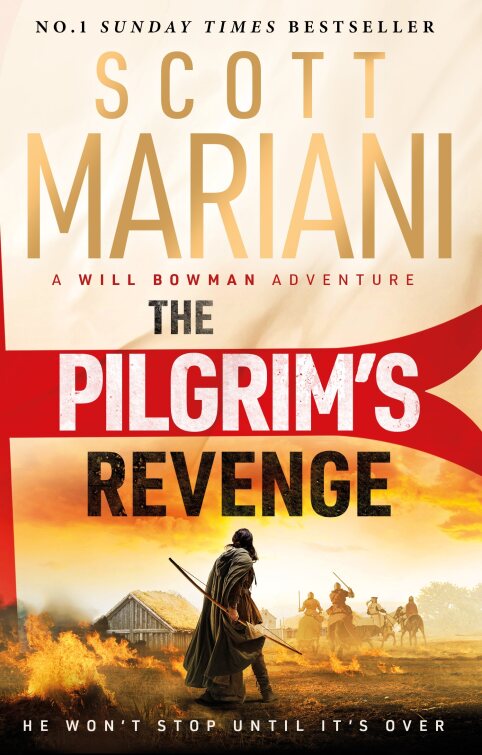
1191. For Will Bowman, newly restored to the service of King Richard ‘Lionheart’, the war against Saladin in the Holy Land now reaches its bloody climax.
HERO
No sooner is it over than the skulduggery of traitors conspiring against Richard’s kingdom threatens the outbreak of yet more conflict.
WARRIOR
Torn between his destiny and his allegiance, Will yearns for a life of peace. But when a deadly new danger threatens the king, only one man can save him.
RESCUER
Now, Will and his companions must embark on their most dangerous voyage yet, a covert rescue mission deep into the heartlands of a ruthless foreign power. Is Will’s loyalty to Richard strong enough to die for him?
A couple of years back I got an email, out of the blue, from one of my favourite authors, Scott Mariani. Scott didn’t even know I was a fan. He had found my blog and had a new historical fiction series coming out and wondered if I could feature it on History…the Interesting Bits. I have to admit that, at first, I thought it was a scam. One of my favourite authors contacting me out of the blue? How likely is that?
But, no. It really was Scott and I had the pleasure of interviewing him for the blog – and for A Slice of Medieval. I admit, I did have a few ‘fangirl’ moments. All the same, I was nervous about reading the first Will Bowman book. Scott had written 30 books in the fabulous Ben Hope series. They were modern thrillers, although most of them had a historical element – which is what drew me to them. But could a thriller writer move to full-on historical fiction and keep the tension, weave a story within the facts to the high standards that historical fiction fans expect? I needn’t have worried, The Pilgrim’s Revenge and The Knight’s Pledge lived up to Scott’s usual standard, taking me into a period I have myself written about in both Princesses of the Early Middle Ages and King John’s Right Hand Lady: the Story of Nicholaa de la Haye.
That is, the Third Crusade.
In The Pilgrim’s Revenge, we saw Will Bowman join the crusade as it sailed from England, pursuing the men who had killed his wife. In The Knight’s Pledge, Will proves himself the capable fighter and a man with convictions, opposed to the slaughter of prisoners, at the same time, enraging and endearing himself to Richard the Lionheart. And the tale continues in Die For A King, with Will, now one of the king’s most trusted knights, reaching the end of the Crusade and looking for new purpose.
No sooner has he pledge himself to the Knights’ Hospitallers than he receives a visit from two queens, Eleanor of Aquitaine and Berengaria of Navarre, with news of Richard’s capture on his way home and a plea that he lead a rescue mission into Germany. Die For A King is a fictional historical adventure built around a historic incident that sent shockwaves through Europe: the capture and imprisonment of King Richard the Lionheart.
Will jerked his head around to look to the east. From behind the very same sparsely wooded rise he had been about to ride over to reconnoitre, were streaming a large body of fast-moving cavalry. How many exactly was hard to say at this distance, but it was clear that they greatly outnumbered the party of pilgrim knights now setting up camp in blissful ignorance of this imminent attack. Perhaps by as many as eight or even ten to one: a ratio rapidly growing more disadvantageous with every passing moment that he went on watching the long line of riders emerging into the open, riding hard and sending up a dust cloud that rose like smoke and then was whipped away by the breeze. Curving around due west. Heading straight towards them. At their head fluttered the black and white Mussulman banner of holy war. Already Will could hear carried on the wind their blood-curdling cries of ‘Allahu Akbar!’ Ours is the greater god. We will destroy you in the name of Allah.
Grisel was prancing and tossing his head nervously, snorting and rolling his eyes with his ears laid flat back. Will could feel the latent power of the stallion fighting to break free. ‘Steady, steady, boy,’ he murmured reassuringly, patting the horse’s thick neck. ‘You were right. Renier may wish he had taken heed of your warning.’
‘I would say that somebody should perhaps go and wake up King Richard,’ Gabriel said dryly. ‘He is about to get an unpleasant surprise, else.’
But there was no need, as the alarm was already being raised across the camp with urgent cries of ‘Attack!’ and ‘They are coming!’ Those knights who had relieved themselves of their bothersome helmets, shields and weapons now hurriedly prepared for the imminent assault. Horses whinnied and reared up; one got loose of its handlers and galloped off in a panic. Man ran here and there, squires racing to get agitated animals under control; knights grabbing lances and spears from the rack, pulling on armour, helms, shoes; scurrying back from the privacy of the rocks where they had been urinating; yelling or receiving orders.
Amid this scene of woeful confusion King Richard burst out from hi stent with his drawn sword in his hand, glanced about him and quickly grasped the situation. Thankfully for him, he had had the foresight not to remove his hauberk, belts or boots in order to rest. Pulling the coif over his head and strapping on his helmet he leaped astride his tall dun warhorse, Fauvel, and began marshalling the men to repel the attackers. Meanwhile the charging Saracen cavalry column was fast closing in, and Will’s fear was confirmed that this had been an ill-chosen spot to make camp. The valley was far too open, permitting the enemy enough space to surround them and close in for the kill. They must be stopped before that could be allowed to happen.
Will’s powerful bow was the best longer-range weapon the king’s men possessed, markedly superior in both reach and accuracy to the handful of crossbows some of the squires and one or two of the knights had brought along. But unlike the handy little bows that the Saracen riders favoured, it did present the serious disadvantage of being virtually unusable from the back of a horse, on account of its unwieldy length. Will had faced an enemy cavalry charge on foot before now, and was loathe to repeat the experience, given the choice: so, reluctantly abandoning the use of the bow for now, he hurried Grisel over to where a couple of lances remained among the rack of weaponry.
Will was as yet no great expert in the use of the lance, but under the tutelage of his mentor Robert Leighton he had come to appreciate its great effectiveness to the mounted warrior. Grabbing up one of them by its long, slim oak shaft, he reined Grisel back around to face the incoming Saracens.
Die For A King by Scott Mariani is a fabulous adventure, set in two parts and in two arena: the Holy Land and Germany. A rescue mission that is so audacious it may just succeed. Scott Mariani has woven fact – of the Third Crusade and Richard the Lionheart’s kidnapping – with the fictional rescue attempt. Though, as Scott says in his Historical Note, it may be fictional but it is entirely plausible. Eleanor of Aquitaine was a wily political operator and it is entirely conceivable that she had a back-up plan, should negotiations fail.
Die For A King portrays the best and worst in men: those willing to die for their friends against the mercenaries who are in it solely for the money. Will has been consistently loyal to King Richard but some of the characters he employs in his mission are not so nobly minded. One thing they all have in common, however, is their ability to fight. Will Bowman is a fascinating character. A young man who set out on a mission of revenge who has become a trusted member of King Richard’s household, and who will not compromise his principles, even when he incurs the wrath of the king. He is also a man you definitely want on your side in a fight. He is resourceful and resilient.
Scott Mariani creates an eminently plausible scenario. The characters are wonderfully colourful, playing to a strong storyline.
Tense and unpredictable, the story leaves the reader guessing to the very end.
This is storytelling at its very best – Scott is a master of the art.
Scott Mariani is the No.1 Sunday Times bestselling author of the multi-million-selling Ben Hope thrillers. From 2025 he is launching into a new historical adventure series featuring medieval English hero Will Bowman, who is forced from his home to join King Richard ‘the Lionheart’ on the Third Crusade and rises up to become a knight. Book 1, The Pilgrim’s Revenge, is available from April 2025 and is published by Hodder & Stoughton.
Scott lives and writes in west Wales, UK. You can find out more about his work by visiting his official website.
*
My Books
Signed, dedicated copies of all my books are available through my online bookshop or the Contact Me page.
New releases in 2026:
New Hardbacks
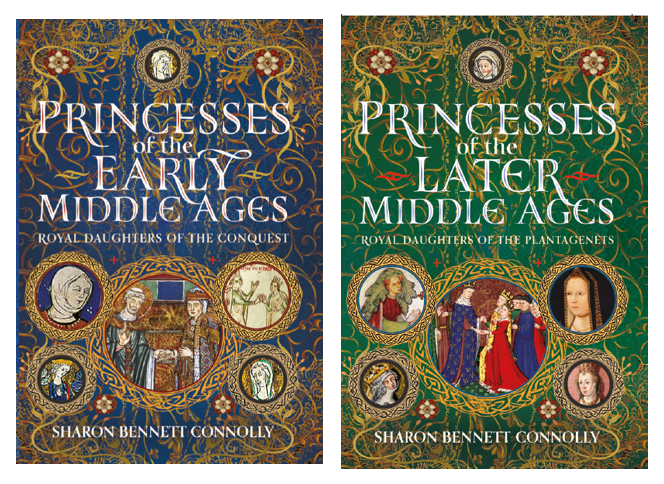
Out now: Princesses of the Early Middle Ages: Royal Daughters of the Conquest
‘My daughter wanted me to treat her more like a princess. So, I married her to a stranger to strengthen the alliance with Poland!’
Princesses of the Early Middle Ages: Royal Daughters of the Conquest and Princesses of the Later Middle Ages: Royal Daughters of the Plantagenets tell the stories of England’s royal daughters from 1066 to the rise of the Tudors, from the last Anglo-Saxon princesses to the fall of the House of York.
Were they really pampered pawns sent off to marriages on the Continent, out of sight and out of mind?
Perhaps, there was different story, where a foreign marriage does not mean eternal exile, but a purpose in life, where a princess is a diplomat, an ambassador for England in her new country.
Where she is the bond between allies – most of the time.
Heidi Malagisi: ‘This is another excellent book by Sharon Bennett Connolly. Extremely well researched and relatively easy to follow along, which is a great thing because there are so many Matildas and Eleanors in this book.‘
Tony Riches: “I challenge anyone with an interest in medieval Britain to not find something they will learn from this book.”
Anna Belfrage: “I just love how [Sharon] presents this huge cast of real life people in a casual, chatty tone that has me expecting the various female protagonists to suddenly pop their head up and add their own commentary.“
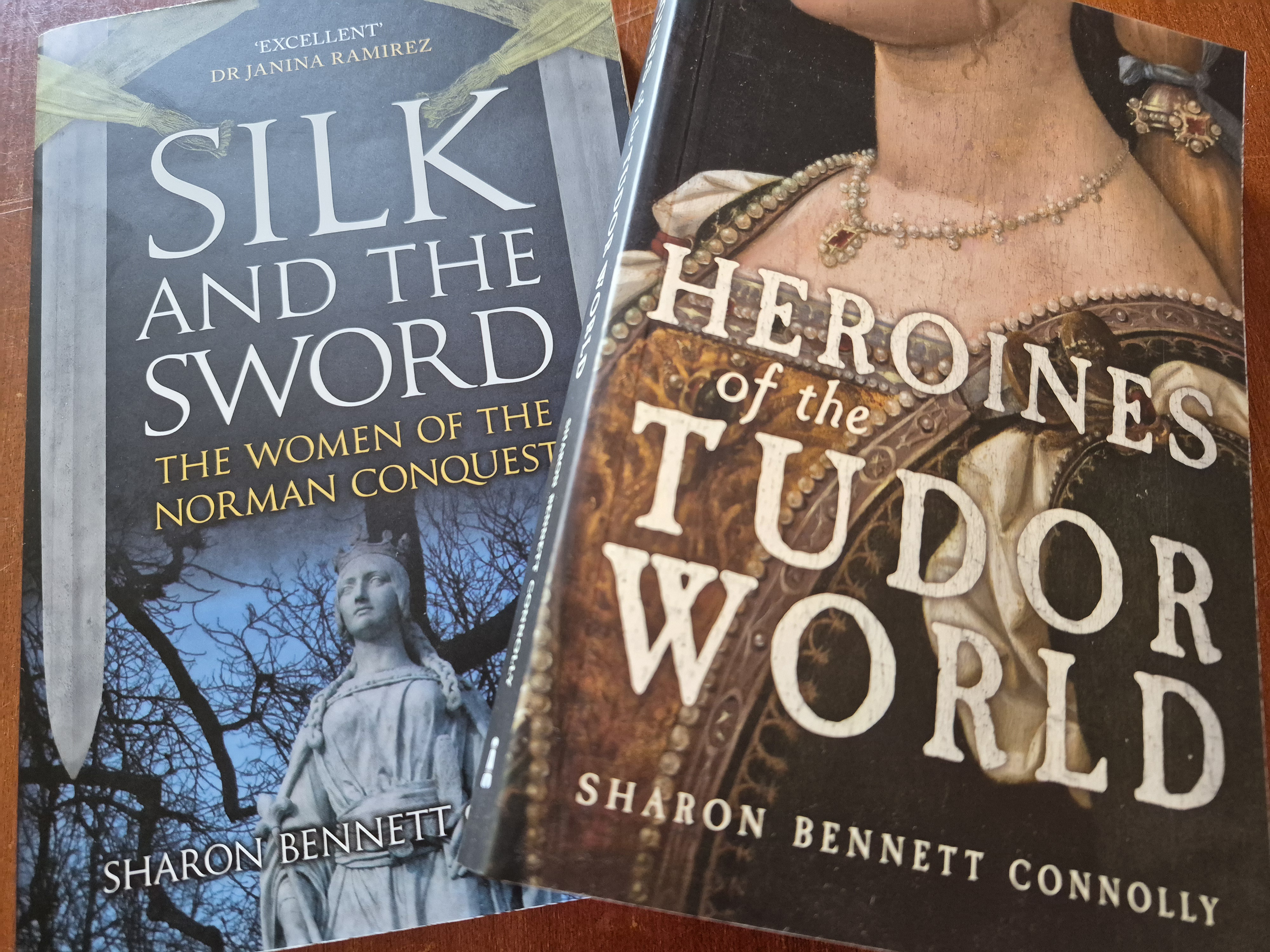
OUT NOW! The momentous events of 1066, the story of invasion, battle and conquest, are well known. But what of the women? Silk and the Sword: The Women of the Norman Conquest traces the fortunes of the women who had a significant role to play during the Norman Conquest – wives, lovers, sisters, mothers, leaders. These are lives full of drama, pathos and sometimes mystery: Edith and Gytha searching the battlefield of Hastings for the body of Harold, his lover and mother united in their grief for the fallen king. Who was Ælfgyva, the lady of the Bayeux Tapestry, portrayed with a naked man at her feet?
Janina Ramirez said it’s ‘Excellent’!
COMING 15 July 2026: Heroines of the Tudor World focuses on the women who lived through the Renaissance and Reformation, examining the threats and challenges they faced and how they overcame them. These are the women who ruled, the women who founded dynasties, the women who fought for religious freedom, their families and love. These are the women who made a difference, who influenced countries, kings and the Reformation.
Derek Birks: ‘An excellent account of the changing roles of women in Tudor society.’
Annie Whitehead: ‘What a treat this book was to read. Bennett Connolly has an easy, conversation style of writing which welcomes you from the opening pages and draws you into her story.‘
Also by Sharon Bennett Connolly:
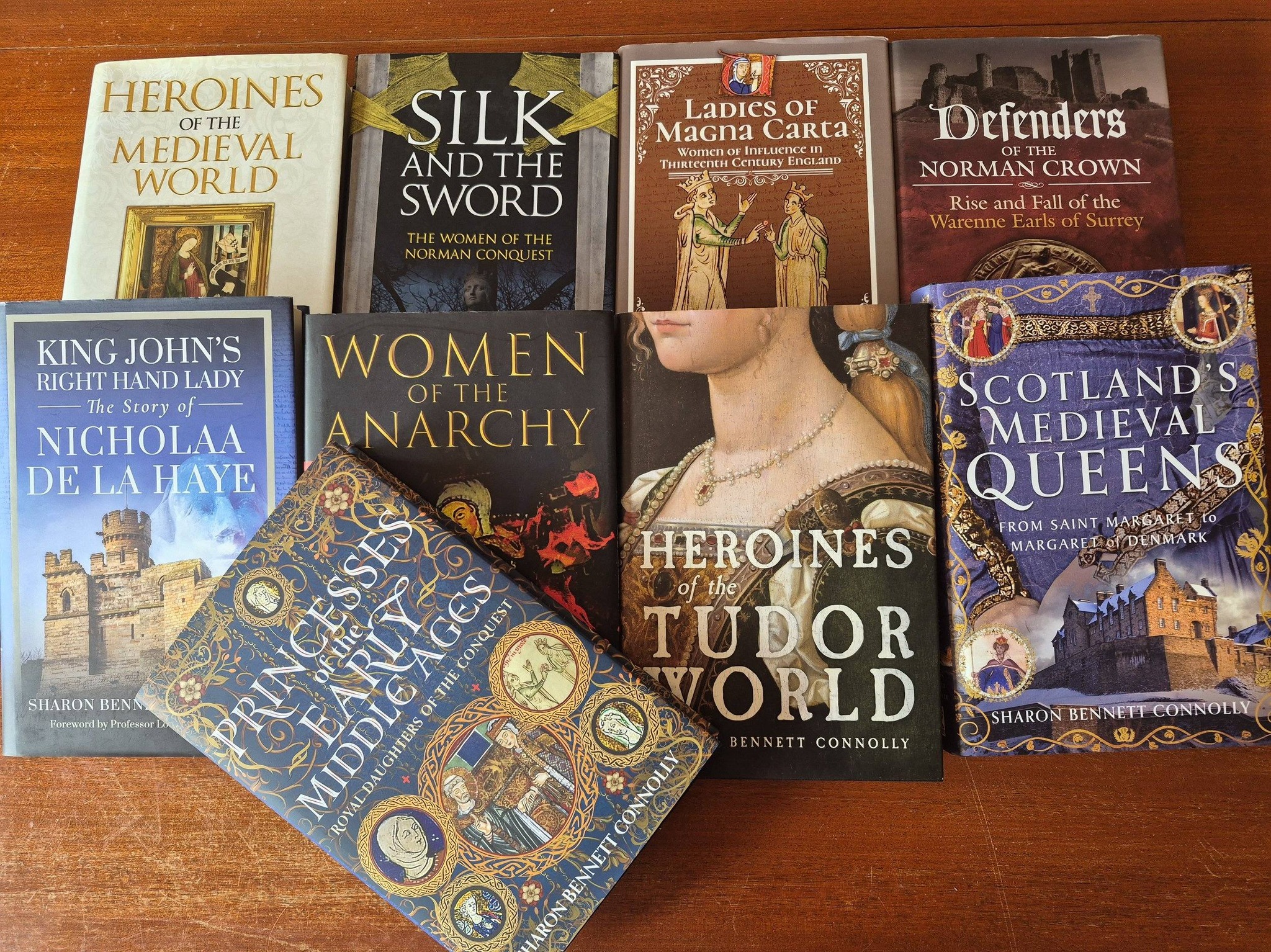
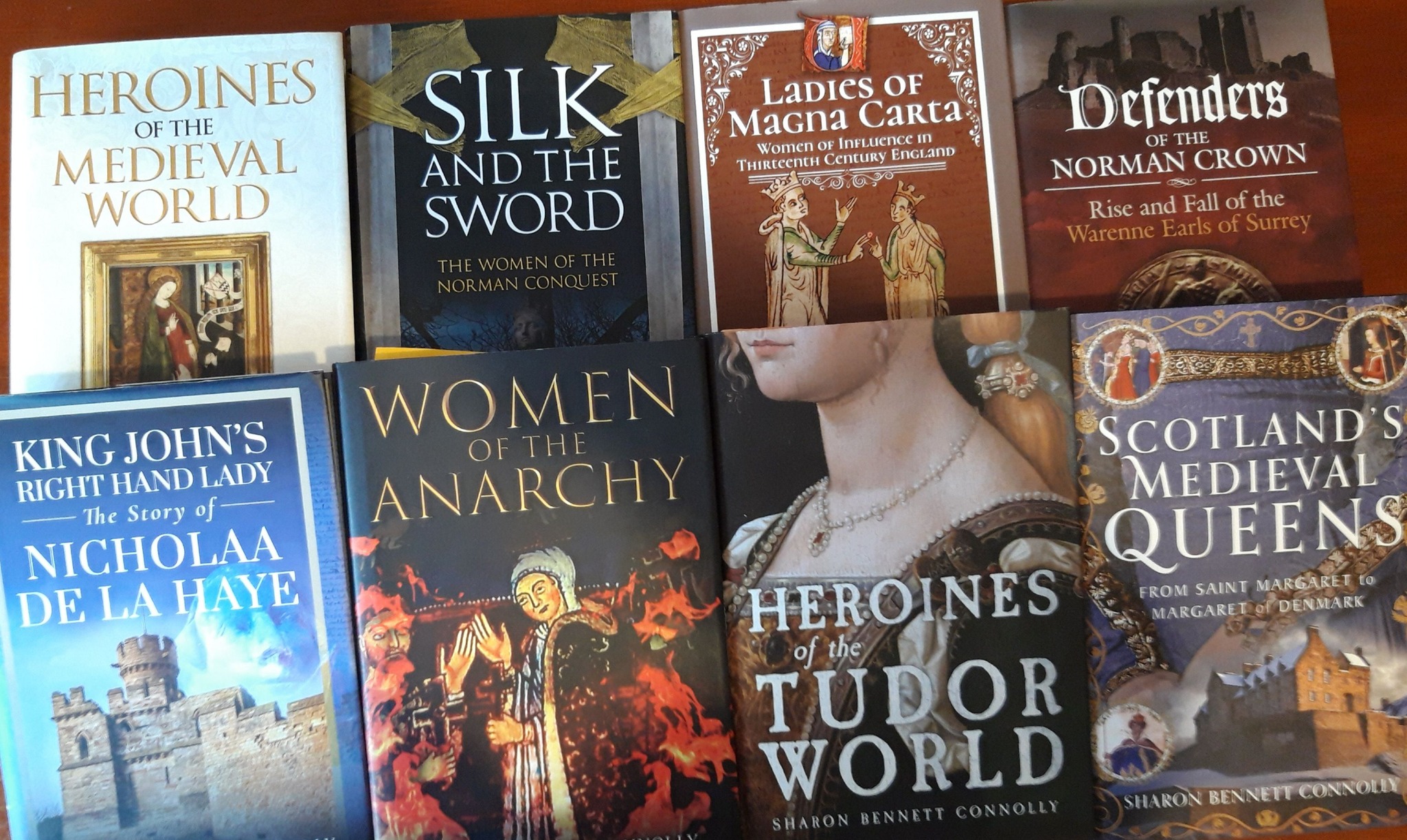
Heroines of the Medieval World; Silk and the Sword: The Women of the Norman Conquest; Ladies of Magna Carta: Women of Influence in Thirteenth Century England; Defenders of the Norman Crown: Rise and Fall of the Warenne Earls of Surrey; King John’s Right Hand Lady: The Story of Nicholaa de la Haye; Women of the Anarchy; Heroines of the Tudor World; Scotland’s Medieval Queens: From St Margaret to Margaret of Denmark; Princesses of the Early Middle Ages: Royal Daughters of the Conquest (March 2026); Princesses of the Later Middle Ages; Royal Daughters of the Plantagenets (August 2026)
Alternate Endings: An anthology of historical fiction short stories including Long Live the King… which is my take what might have happened had King John not died in October 1216. Available in paperback and kindle from Amazon.
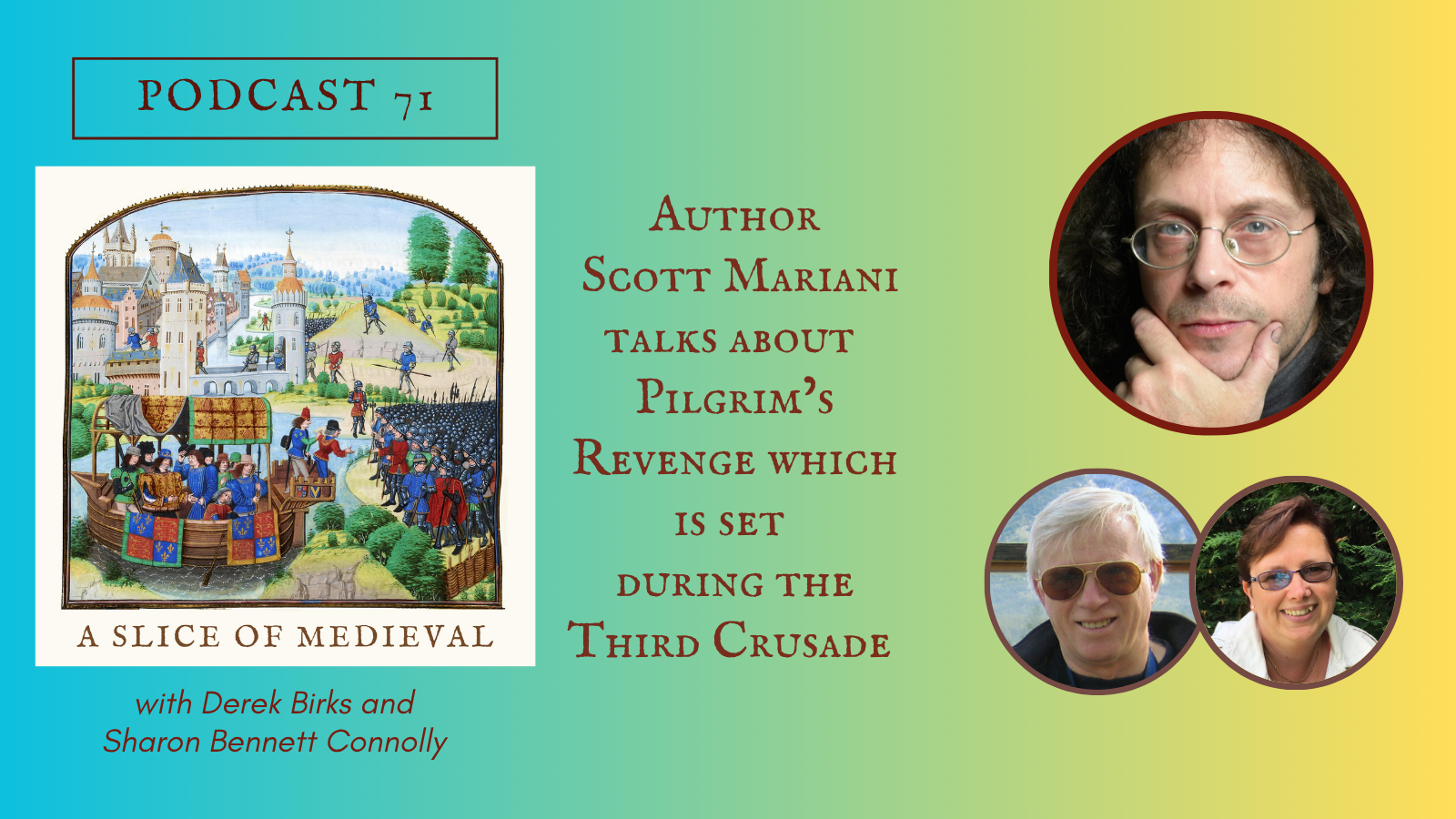
Have a listen to theA Slice of Medieval podcast, which I co-host with Historical fiction novelist Derek Birks. Derek and I welcome guests, such as Ian Mortimer, Bernard Cornwell, Elizabeth Chadwick and Scott Mariani, and discuss a wide range of topics in medieval history, from significant events to the personalities involved.
Will Bowman, now fully entangled in Richard Lionheart’s crusade, has reached the Holy Land. However, just as he and his crew are about to touch down in Acre, they are drawn into an intense battle at sea, where they are faced with the dreaded Byzantine weapon: Greek Fire.
Barely escaping with his life, Will gains the trust of Richard Lionheart, moving into his service. But as the siege of Acre continues, and Richard’s campaign grows ever more brutal and barbaric, Will begins to wonder just how safe his new position is.
And when the King sends him on a seemingly doomed mission, Will must ask himself: who exactly is he fighting for?
Well, Scott Mariani has taken to historical fiction like a duck to water. He has a flare for it. But then, he did draw me in with his Ben Hope novels, all of which had a historical mystery at the heart of the the story. With his second full, historical fiction, The Knight’s Pledge, he draws the reader into the action from the very first pages as his hero, Will Bowman, arrives at Acre to take part in the Third Crusade.
And an added bonus is that a quote from my review of the first book,The Pilgrim’s Revenge, is among the endorsements on the first pages!
And what an adventure we are treated to. Scott Mariani expertly blends fact with fiction and tells a story that will keep you hooked.
The story is gripping and full of suspense – you are never quite sure whether the heroes are going to succeed – or even make it out alive!
Will had personally come face to face with King Richard only once, and then for only a few brief moments. But he had seen his monarch flying fearlessly into the thick of battle enough times to know how he would respond.
Sure enough, almost within a heartbeat the flagship had diverted course and was steering straight at the enemy vessel, all oars manned and powering as hard as they could go. The captain of Will’s ship instantly followed suit, with a clamour of shouted orders and the frenzied activity of the sailors all around them. Every crewman aboard knew his duty as well as he knew his own name, and they needed little encouragement as they rushed to their stations and flung themselves behind the oars. Amid the rapid pounding of the drum and hoarse cries of ‘Heave ho, boys,’ and ‘We’ll have at those bastards,’ the ship picked up pace and curved sharply around. As they leaned hard into the turn, the deck sloped like a pitched roof and the bows threw up a white wave that smothered the nearside rail with foam.
One by one, every other ship of the fleet was veering off their course to engage this new enemy. Will sprinted back across the sloping deck to where he and his companions had been sitting earlier and snatched up the weapons that he kept stowed next to his habitual sleeping place. With hands trembling in anticipation of the fight that would very soon be on them he buckled up his sword belt, then quickly tensioned and strung his bow stave, an action that was second nature to him. He had been an expert with the bow for such a large part of his life that it had become the name he was known by. His leather quiver contained a sheaf of arrows carefully fashioned by his own hand, made to fly straight and true and each fitted with an iron-pointed bodkin head capable of piercing a coat of chain mail like the one he was wearing under his leather jerkin.
Gabriel came running hot on his heels, and disregarding his precious chessmen that were strewn and rolling all about the deck he grabbed the curved falchion sword he favoured over the more conventional straight-bladed variety. Samson’s preference was for his short-handled war axe, a gift to him from Will, which had hammered and split the heads of many a foe in the battles they had fought en route.
But this new enemy was like no other they had faced before. As the deck levelled itself after their steep turn, Will glanced forward and saw the Saracen ship suddenly much closer, partly wreathed behind the curtain of roiling black smoke that was pouring from the burning galley. ‘Godspeed,’ he yelled at Gabriel and Samson, then ran for the laddered companionway that led up to the elevated section of the forecastle. It was already teeming with his fellow archers, mostly equipped with crossbows and only a minority who used the more old-fashioned but further-shooting and more accurate – when properly handled – longbow.
Scott Mariani’s meticulous research and attention to detail helps to recreate the Holy Land of 1191. The sights, the smells, the spiders! Oh, and the insults! I have a new favourite insult; ‘scobberlotcher’.
Will Bowman proves how fearless and brave he can be. Though he is still young and has a naivety about him which I think will be increasingly challenged as his war goes on. It is fascinating to watch the evolution of this young man, from grieving farmer to warrior. And expert archer, he’s strong, courageous and loyal. He is quick-witted, intelligent, even, a natural leader of men, but still in possession of a sense of chivalry that will get him into trouble.
In the first half of the story, we follow the experiences of the army during the Siege of Acre, and its aftermath. Ever a writer with a sense of adventure, Scott Mariani then sends our hero on a near-suicidal mission in search of lost treasure. While it may not be in the historical record, the quest is certainly plausible – as is the outcome! (but no spoilers!)
All in all, The Knight’s Pledge is an absolute joy to read – or, rather, devour. Scott Mariani has lost none of his legendary storytelling skills in his transition from the thriller genre to historical fiction. And I like to think I can see a little of Ben Hope in this new hero, Will Bowman. I think Ben would certainly have approved of Will.
At least I know what I’m getting my dad for Christmas – he’s gonna love The Knight’s Pledge!
Scott Mariani is the No.1 Sunday Times bestselling author of the multi-million-selling Ben Hope thrillers. From 2025 he is launching into a new historical adventure series featuring medieval English hero Will Bowman, who is forced from his home to join King Richard ‘the Lionheart’ on the Third Crusade and rises up to become a knight. Book 1,THE PILGRIM’S REVENGE, is available from April 2025 and is published by Hodder & Stoughton.
Scott lives and writes in west Wales, UK. You can find out more about his work by visiting his official website.
*
My Books:
Signed, dedicated copies of all my books are available, please get in touch by completing the contact me form or through my online bookshop.
Out now: Scotland’s Medieval Queens
Scotland’s history is dramatic, violent and bloody. Being England’s northern neighbour has never been easy. Scotland’s queens have had to deal with war, murder, imprisonment, political rivalries and open betrayal. They have loved and lost, raised kings and queens, ruled and died for Scotland. From St Margaret, who became one of the patron saints of Scotland, to Elizabeth de Burgh and the dramatic story of the Scottish Wars of Independence, to the love story and tragedy of Joan Beaufort, to Margaret of Denmark and the dawn of the Renaissance, Scotland’s Medieval Queens have seen it all. This is the story of Scotland through their eyes.
‘Scotland’s Medieval Queens gives a thorough grounding in the history of the women who ruled Scotland at the side of its kings, often in the shadows, but just as interesting in their lives beyond the spotlight. It’s not a subject that has been widely covered, and Sharon is a pioneer in bringing that information into accessible history.’ Elizabeth Chadwick (New York Times bestselling author)
Daughters of kings were often used to seal treaty alliances and forge peace with England’s enemies. Princesses of the Early Middle Ages: Royal Daughters from the Conquest and Princesses of the Later Middle Ages: Royal Daughters of the Plantagenets will explore the lives of these young women, demonstrating how they followed the stereotype, and how they sometimes managed to escape it. It will look at the world they lived in, and how their lives and marriages were affected by political necessity and the events of the time.
Were they political pawns? Or, were they able to control their own lives and fates? What impact did they have on the world in which they lived?
Their stories are touching, inspiring and, at times, heartbreaking.
Princesses of the Early Middle Ages: Royal Daughters from the Conquest is now available for pre-order from Amazon and bookshop.org.
Also by me:
Heroines of the Tudor World tells the stories of the most remarkable women from European history in the time of the Tudor dynasty, 1485-1603. These are the women who ruled, the women who founded dynasties, the women who fought for religious freedom, their families and love. Heroines of the Tudor World is now available for pre-order from Amberley Publishing and Amazon UK.Women of the Anarchy demonstrates how Empress Matilda and Matilda of Boulogne, unable to wield a sword themselves, were prime movers in this time of conflict and lawlessness. It shows how their strengths, weaknesses, and personal ambitions swung the fortunes of war one way – and then the other. Available from Bookshop.org, Amberley Publishing and Amazon UK. King John’s Right-Hand Lady: The Story of Nicholaa de la Haye is the story of a truly remarkable lady, the hereditary constable of Lincoln Castle and the first woman in England to be appointed sheriff in her own right. Available from all good bookshops Pen & Sword Books, bookshop.org and Amazon.
Alternate Endings: An anthology of historical fiction short stories including Long Live the King… which is my take what might have happened had King John not died in October 1216. Available in paperback and kindle from Amazon.
*
Podcast:
Have a listen to theA Slice of Medieval podcast, which I co-host with Historical fiction novelist Derek Birks. Derek and I welcome guests, such as Bernard Cornwell and Elizabeth Chadwick, and discuss a wide range of topics in medieval history, from significant events to the personalities involved.
1190 – Humble layman Will Bowman lives in the countryside with his pregnant wife, when soldiers from Richard Lionheart’s army tear through his home. Will is beaten unconscious, and awakes to find his wife murdered, his farm burnt down, and his life forever changed.
In vengeance, Will infiltrates Richard’s army to find the marauding gang, and finds himself swept along in the march of the Crusades. With the help of new allies and fuelled by his loss, Will crosses Europe with the King’s army.
Can Will avenge his wife? Or will he be swept away by the unstoppable force of Richard’s Crusade?
I have been a Scott Mariani fan for a while now and was disappointed that Ben Hope has finally retired, though relieved for Ben that he survived 30 books of people trying to kill him. When one brilliant series ends, you begin to worry that what comes next will be a disappointment, or not as addictive, that you will not feel so invested in the new characters. Especially when the author moves genre. It is a big risk that author and reader take together.
So, when Scott Mariani moved from thriller with a historical twist to full-blown historical fiction, I was a tad concerned. Fans of historical fiction can be pedants. If there is a grey squirrel out of place, ie, in medieval England, someone will notice. If a character lives longer than he actually did (I am looking at Sweyn Forkbeard in Vikings Valhalla) someone will notice. There is a knack to historical fiction, to weaving the story within the known facts, to introducing fictional characters and creating their interactions with historical figures. The story has to have that essence of authenticity.
I needn’t have worried!
In fact, I probably should have trusted that Scott Mariani knew what he was doing. Though I may not have agreed with some of his theories in The Tudor Deception, the actual history was spot on. Having read the last Ben Hope book, The Templar Secret, after Christmas, I should have known a historical fiction book was around the corner. It is obvious the author loves his history. And, given the topic of that last Hope book, it should come as no surprise that Mariani’s first foray into historical fiction involved the crusades – the Third Crusade, to be precise.
Not that we get more than a glimpse of the Holy Land in this first book – all that is still to come.
By now Will had almost reached the nearest of the horsemen on his side of the yard. Up close, the rider was an intimidating figure looming far above him in the saddle with the blade of his drawn arming sword glinting in the sunlight. Before Will reached him the horseman saw his approach and wheeled his mount around to face him, dust flying from its hooves. With an angry shout the rider spurred the horse towards Will, swinging his sword down at him. Will ducked, and the double-edged blade hissed through the air above him.
It had been a blow meant to separate his head from his shoulders, and it had only narrowly missed its mark. The horse thundered past, shaking the ground. The rider reined it brutally around and charged at Will again.
Nothing like this had ever happened or even been heard of in Will’s experience. He had never been in a real fight, except a minor scuffle once when he was a lad, settled quickly with a couple of punches. This was deadly serious combat, and he was unprepared for it. But the terrible shocking sight of Beatrice in the soldiers’ clutches and the sound of her screams was enough to dispel his confusion and fear, filling him with rage and determination to do anything he could to drive these raiders away and make this stop. And the obvious realisation suddenly occurred to him, for the first time, that he was holding the very means of doing that in his hands. His bow was still unstrung, no more than a long wooden shaft with its hemp cord loosely attached to the bottom end. But practice had made him very adept at readying the weapon in moments; as the horseman bore down on him with the sword raised high, he bent the stave against his foot and looped the string into place.
The rider was almost on him. Will snatched an arrow from his quiver, nocked it to the string and simultaneously raised his bow and pulled it to full draw. He had never before pointed any weapon in anger at another human being, but there was little time to reflect on that fact, or even to take aim, as his enemy closed in. Will stood his ground until the last moment, released his arrow and saw it fly and hit the rider full in the chest.
The soldier flinched violently at the arrow strike. A normal opponent would have been a dead man, his heart split in two by the power of the longbow at such close range. But instead of piercing deep into his flesh the iron point glanced off his heavy chain mail and the broken pieces of the arrow shaft spun away through the air. Then Will had to leap out of the way of the charging horse, and he threw himself to the ground.
The Pilgrims’ Revenge starts in England and follows the journey of a crusader fleet to Outremer, with adventures that are often overlooked by historical fiction authors eager to get to the nitty gritty of the crusade. But what a story they miss out! Scott Mariani includes the little-known excursion of part of the fleet, into Portugal to help with the crusades there. Then, of course, we arrive in Sicily, where Richard the Lionheart frees his sister, Joanna, meets his bride Berengaria and antagonises his ‘ally’ Philip II of France. And then we get a wonderful, vivid depiction of the conquest of Cyprus.
All is seen through the eyes of our hero, Will Bowman, a men seeking revenge for the murder of his wife and unborn child. He only joins the crusade to chase the murderers but finds a purpose, a talent for soldiering, comradeship and a bent to command along the way. Scott Mariani seamlessly blends together the wider story of Richard the Lionheart’s crusading enterprise with Will’s personal story and experiences.
The Pilgrims’ Revenge is the first of what promises to be a fast-paced, exhilarating – and, hopefully, long – series. Punctuated by bloody battles, exquisite swordplay and a thrilling storyline, the action is relentless and Scott Mariani fans will not be disappointed. The research is exemplary, especially with regard to the conflict in Portugal, which is usually ignored. The historical figures are wonderfully written and the locations evocative, dusty, hot and exotic.
Will Bowman is a character I look forward to hearing much more about.
The Pilgrim’s Revenge will be available from 24 April 2025
Scott Mariani is the No.1 Sunday Times bestselling author of the multi-million-selling Ben Hope thrillers. From 2025 he is launching into a new historical adventure series featuring medieval English hero Will Bowman, who is forced from his home to join King Richard ‘the Lionheart’ on the Third Crusade and rises up to become a knight. Book 1,THE PILGRIM’S REVENGE, is available from April 2025 and is published by Hodder & Stoughton.
Scott lives and writes in west Wales, UK. You can find out more about his work by visiting his official website.
*
My books
Signed, dedicated copies of all my books are available through my online store.
Out now: Scotland’s Medieval Queens
Scotland’s history is dramatic, violent and bloody. Being England’s northern neighbour has never been easy. Scotland’s queens have had to deal with war, murder, imprisonment, political rivalries and open betrayal. They have loved and lost, raised kings and queens, ruled and died for Scotland. From St Margaret, who became one of the patron saints of Scotland, to Elizabeth de Burgh and the dramatic story of the Scottish Wars of Independence, to the love story and tragedy of Joan Beaufort, to Margaret of Denmark and the dawn of the Renaissance, Scotland’s Medieval Queens have seen it all. This is the story of Scotland through their eyes.
‘Scotland’s Medieval Queens gives a thorough grounding in the history of the women who ruled Scotland at the side of its kings, often in the shadows, but just as interesting in their lives beyond the spotlight. It’s not a subject that has been widely covered, and Sharon is a pioneer in bringing that information into accessible history.’ Elizabeth Chadwick (New York Times bestselling author)
Heroines of the Tudor World tells the stories of the most remarkable women from European history in the time of the Tudor dynasty, 1485-1603. These are the women who ruled, the women who founded dynasties, the women who fought for religious freedom, their families and love. Heroines of the Tudor World is now available for pre-order from Amberley Publishing and Amazon UK.Women of the Anarchy demonstrates how Empress Matilda and Matilda of Boulogne, unable to wield a sword themselves, were prime movers in this time of conflict and lawlessness. It shows how their strengths, weaknesses, and personal ambitions swung the fortunes of war one way – and then the other. Available from Bookshop.org, Amberley Publishing and Amazon UK. King John’s Right-Hand Lady: The Story of Nicholaa de la Haye is the story of a truly remarkable lady, the hereditary constable of Lincoln Castle and the first woman in England to be appointed sheriff in her own right. Available from all good bookshops Pen & Sword Books, bookshop.org and Amazon.
Alternate Endings: An anthology of historical fiction short stories including Long Live the King… which is my take what might have happened had King John not died in October 1216. Available in paperback and kindle from Amazon.
Podcast:
Have a listen to theA Slice of Medieval podcast, which I co-host with Historical fiction novelist Derek Birks. Derek and I welcome guests, such as Bernard Cornwell and Michael Jecks, and discuss a wide range of topics in medieval history, from significant events to the personalities involved. Every episode is also now available on YouTube.
*
Don’t forget!Signed and dedicated copies of all my books are available through my online store.
For forthcoming online and in-person talks, please check out my Events Page.
Robert de Breteuil, also known as Robert de Beaumont, was a remarkable individual whose adventures in the Holy Land would make a wonderful novel. A renowned warrior and a powerful magnate, he was a companion to the Plantagenet princes, both Richard the Lionheart and King John. Robert was the son-in-law of Matilda de Braose, whose horrific persecution by King John led to her death by starvation in one of John’s dungeons – and the inclusion of clause 39 in Magna Carta:
“No man shall be taken, imprisoned, outlawed, banished or in any way destroyed, nor will we proceed against or prosecute him, except by the lawful judgement of his peers or by the law of the land.”
Robert was the second son of Robert de Breteuil, 3rd earl of Leicester, and his wife, Petronilla de Grandmesnil and the great-grandson of Robert de Beaumont, Count of Meulan and 1st Earl of Leicester, and his wife, Elizabeth de Vermandois. Robert was probably born in the early-1160s and was closely associated with his elder brother William. As they grew up and entered public life they were linked with the household of their cousin, Robert, Count of Meulan, and they regularly appeared on their father’s charters together. Their younger brother, Roger, was bishop of St Andrews. William died in 1189, sometime after the accession of King Richard I. A later legend suggests he suffered from leprosy, though there is no contemporary evidence to corroborate this. William’s death meant Robert therefore became heir to their father’s earldom of Leicester.
Both Robert and his father were at the royal court at Verneiul on 2 January 1190 and joined the Third Crusade of Richard the Loinheart. Robert’s father took an overland route to the Holy Land, while it appears that Robert travelled with the king. Robert was with the king at Messina, Sicily, when news reached him of his father’s death. The 3rd earl had died on 31 August or 1 September 1190 and so Robert was invested as earl by the king on 2 February 1191, in Sicily.
During his time in the Holy Land, Robert was one of the leaders of the assault on Acre on 11 July 1191 and fought in the battle of Arsuf on 7 September. In November he rescued some ambushed Templars at Ibn-Ibrak and then was himself surrounded, with his knights, by a party of Turks outside the camp at Ramlah. Robert was rescued by his cousin Robert de Neubourg; in the process he nearly drowned in a river and had two horses killed under him.
Seal of Robert de Breteuil
Robert and his men were prominent among the forces who stormed Deir al-Bela on 22 May 1192 and on 5 August 1192 he was one of the ten knights who helped to thwart an attempt to kidnap the king from his tent at Jaffa and the king himself rescued Robert when he was thrown from his horse. He probably set out for home in September or October 1192, having distinguished himself and earned the king’s eternal goodwill.1
Following his return from the crusade, Robert was occupied with the defence of Normandy, but was captured by King Philip Augustus’ forces in June 1194, after a skirmish outside Gourany. He was imprisoned at Étampes for more than a year and only freed after surrendering his castle and lordship of Pacy-sur-Eure to King Philip. His freedom was achieved sometime around February 1196 and in the same year he was married to the teenage Loretta de Braose. Loretta de Braose, was probably born in the early-to-mid-1180s,. She was one of the sixteen children of Matilda and William de Braose. Four of her sisters married prominent Welsh Marcher lords, but Loretta was married to Robert de Breteuil, 4th earl of Leicester.
The marriage was an alliance of two of the leading Anglo-Norman families of the Plantagenet world. He was a powerful earl who had made a name for himself on the crusades, whilst she was a daughter of one of the most powerful barons of the Welsh March. As her marriage portion, Loretta was given Tawstock, near Barnstaple in Devon.
Robert de Breteuil was back
campaigning in 1197 and 1198 and was with King Richard when he was mortally
wounded at Châlus in April 1199. He had had a long association with Richard’s
brother since John had been Count of Mortain, and so was a firm supporter of
John’s succession, acting as steward at his coronation on 27 May 1199, claiming
the office his grandfather had relinquished in 1153. Robert was highly
influential in the early years of John’s reign. He also fought for John in
Normandy, being one of the major landholders in the duchy, and was rewarded
generously for his support; he was granted Richmondshire in Yorkshire in
September 1203. The following year he suffered the loss of his Continental
estates when Normandy fell and was the biggest loser of the Anglo-Norman
barons.
Although he was one of the two barons (the other being William Marshal) who was given a year to decide whether to pay homage to King Philip of France to try to retain his Norman estates, Robert was not punished by John. Indeed, he was given more lands in England, English lands that had belonged to families who had chosen to remain in Normandy, such as the Harcourts. Robert died before King Philip’s deadline, and so never did have to decide where and how to share his allegiances in order to keep all his lands.
The ruins of Leicester Abbey, where Robert de Breteuil is buried
Robert died on 20 or 21 October 1204; the life of St Hugh of Lincoln reported that he died a leper, although this seems highly unlikely.1 He was buried in the choir of the Augustinian Abbey in Leicester. Robert and Loretta had remained childless, so Robert’s lands were divided between his two sisters. The earldom and the town of Leicester went to his eldest sister, Amice, the wife of Simon de Montfort and therefore grandmother of the Simon de Montfort who would marry King John’s daughter, Eleanor, and claim the earldom of Leicester for himself. Half of the old earldom, centred around Brackley in Northamptonshire, went to Robert’s younger sister, Margaret, wife of Saher de Quincy, Earl of Winchester.
It is a sad legacy that Robert’s death before John began the persecution of Loretta’s family meant that she was without her husband’s powerful protection when she needed it most. King John’s pursuit of the family did not end with the deaths of Matilda, who died in custody in 1210, and William de Braose, Lord of Bramber, who died in exile in France in 1211. In November 1207 John extracted a promise from Loretta that she would not remarry without the king’s permission and her lands were taken from her. She probably left for France shortly afterwards and only returned to England in 1214.
Once in England, Loretta was allowed to recover her confiscated estates after again to only marry as the king directed. The restoration of Loretta’s estates were complicated by the king’s desire to keep happy those who had benefited from tehir confiscation, such as the powerful Saher de Quincy, earl of Winchester. Loretta’s experiences in this respect may well have inspired clauses 7 and 8 of Magna Carta, which guaranteed that widows should have their marriage portions without hindrance and that they could remarry at their own pleasure, so long as it was with the king’s consent.
Arms of William de Braose, Loretta’s father
Loretta took her future into her own hands, however, and in early 1221, took a vow of chastity and became an anchorite in Hackington, near Canterbury. An anchorite was a religious recluse who lived in a small cell within a church, allowed on the briefest of contact with others, although she was allowed attendants to help with her daily needs. Loretta’s influence was still in evidence, however, in that she obtained a pardon for a man who had accidentally killed another and helped to establish the Franciscan order in England. She died on 4 March, probably in 1266, and was buried at the church of St Stephen, Hackington.
It is a fact of life that whilst researching one particular person, you come across several others who spark your interest. I stumbled upon the stories of Robert de Breteuil and Loretta de Braose while researching for my book, Ladies of Magna Carta.
*
Footnote: ¹Oxforddnb.com
Sources: sussexcastles.com; genie.com; steyningmuseum.org.uk; berkshirehistory.com; England Under the Norman and Angevin Kings 1075-1225 byRobert Bartlett; Oxford Companion to British History Edited by John Cannon; The Story of Britain by Roy Strong; The Plantagenets, the Kings who Made England by Dan Jones; The Life and Times of King John by Maurice Ashley; The Plantagenet Chronicles Edited by Elizabeth Hallam; Oxforddnb.com; magnacartareseearch.org; Magna Carta by David Starkey; King John by Marc Morris; King John, England, Magna Carta and the Making of a Tyrant by Stephen Church; 1215, the Year of Magna Carta by Danny Danziger and John Gillingham; Women in Thirteenth Century Lincolnshire by Louise J. Wilkinson.
Pictures courtesy of Wikipedia
*
My Books
Signed, dedicated copies of all my books are available through my online store.
Out now: Scotland’s Medieval Queens
Scotland’s history is dramatic, violent and bloody. Being England’s northern neighbour has never been easy. Scotland’s queens have had to deal with war, murder, imprisonment, political rivalries and open betrayal. They have loved and lost, raised kings and queens, ruled and died for Scotland. From St Margaret, who became one of the patron saints of Scotland, to Elizabeth de Burgh and the dramatic story of the Scottish Wars of Independence, to the love story and tragedy of Joan Beaufort, to Margaret of Denmark and the dawn of the Renaissance, Scotland’s Medieval Queens have seen it all. This is the story of Scotland through their eyes.
‘Scotland’s Medieval Queens gives a thorough grounding in the history of the women who ruled Scotland at the side of its kings, often in the shadows, but just as interesting in their lives beyond the spotlight. It’s not a subject that has been widely covered, and Sharon is a pioneer in bringing that information into accessible history.’ Elizabeth Chadwick (New York Times bestselling author)
Heroines of the Tudor World tells the stories of the most remarkable women from European history in the time of the Tudor dynasty, 1485-1603. These are the women who ruled, the women who founded dynasties, the women who fought for religious freedom, their families and love. Heroines of the Tudor World is now available from Amberley Publishing and Amazon UK.Women of the Anarchy demonstrates how Empress Matilda and Matilda of Boulogne, unable to wield a sword themselves, were prime movers in this time of conflict and lawlessness. It shows how their strengths, weaknesses, and personal ambitions swung the fortunes of war one way – and then the other. Available from Bookshop.org, Amberley Publishing and Amazon UK. King John’s Right-Hand Lady: The Story of Nicholaa de la Haye is the story of a truly remarkable lady, the hereditary constable of Lincoln Castle and the first woman in England to be appointed sheriff in her own right. Available from all good bookshops Pen & Sword Books, bookshop.org and Amazon.
Alternate Endings: An anthology of historical fiction short stories including Long Live the King… which is my take what might have happened had King John not died in October 1216. Available in paperback and kindle from Amazon.
Podcast:
Have a listen to theA Slice of Medieval podcast, which I co-host with Historical fiction novelist Derek Birks. Derek and I welcome guests, such as Bernard Cornwell and Michael Jecks, and discuss a wide range of topics in medieval history, from significant events to the personalities involved. Every episode is also now available on YouTube.
*
Don’t forget!Signed and dedicated copies of all my books are available through my online store.
For forthcoming online and in-person talks, please check out my Events Page.
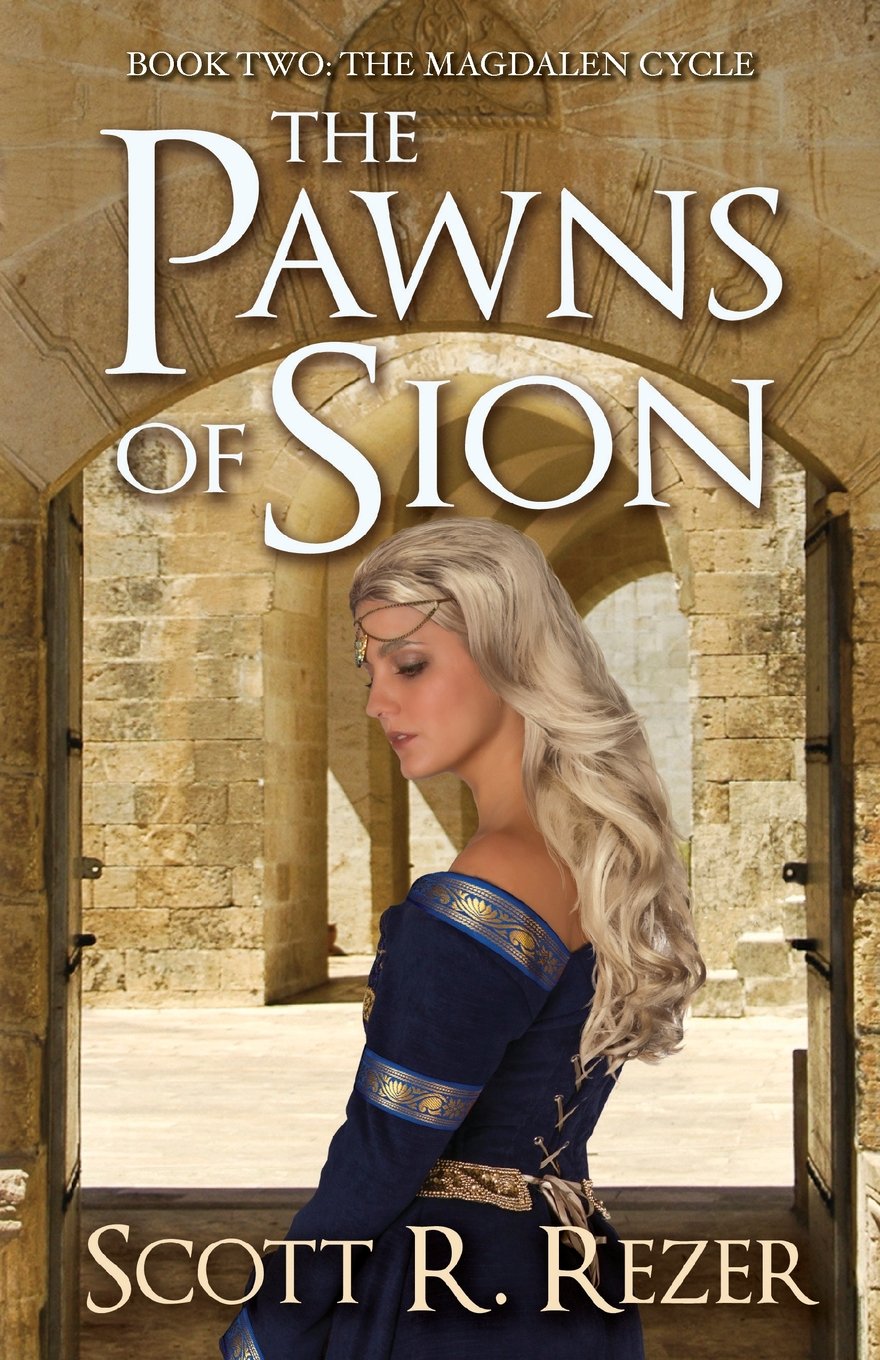
“At first glance The Pawns of Sion looks like a straightforward story about the politics and rivalries of the Kingdom of Jerusalem. But once you start reading, you discover the novel delves deeper than you’d ever thought possible. Scott R. Rezer has created a story which merges two realms, that of man and that of the angels. The war between Salehdin and the Christians runs parallel with the greater, age-old battle of good versus evil. The author has cleverly interwoven the two realms in a deep, intense book. The plot is detailed and unveiled in layers the deeper into the book you get.
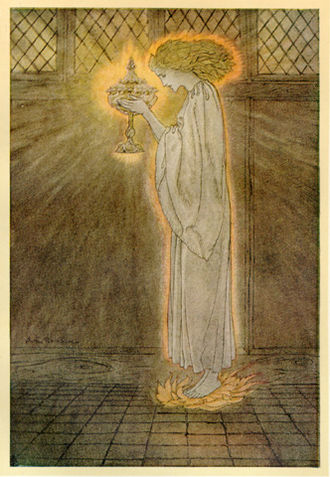
Set in the years immediately before the Third Crusade, the action moves fast and furious from the death of King Baldwin V, through the behind-the-scenes manipulations of the Order of Sion and the Magdalen’s attempts to stop them, while Salehdin takes advantage of the deep divisions revealed among the Christian lords. And underlying it all is the centuries-long search for the Holy Grail….”
I found The Pawns of Sion both fascinating and intriguing. It looks deeper into the origins of Christianity than other Crusader novels and the age-old battle of good against evil mirrors the irreconcilable differences of the Christian and Muslim combatants. There is the occasional missing word in the text, but this does not detract from the overall enjoyment of the book. The author knows how to evoke the reader’s sympathy – or distaste – for particular characters. You find yourself rooting for the good guys.
The full depth of the story is slowly revealed – each revelation releasing a new feature of the plot. And as each new secret is disclosed, it adds a little explanation to the motives and desires of the protagonists.
The language is, at times, haunting, drawing aside the veils between the realm of the natural world and that of the spiritual, giving the reader a sense of the surreal:
….Her magic shrank from the shadow of his evil rather than endure its touch. “Did you think you could defeat me with so little a thing as the death of your beloved daughter?” “You have no place here, Simon,” she hissed, ignoring his taunt. She drew a thin silver blade from the belt beneath her cloak. The rasping sound of metal upon metal overwhelmed the silence of the wood. “You never have.” “Your words wound me, Mariamne,” said Amalric de Lusignan. “Why must we continually bicker when we might become friends?” She walked towards him, sword on shoulder, shedding her immortal glamour and taking on a semblance men knew….
As with many people, the Knights Templar have always held me in awe and although they are not the heroes of the story, their Grand Master Gerard de Ridefort is one of the leading characters. The author makes good use of the known protagonists of the time, weaving his story around their lives and the events that shaped the Holy Land and its politics at the time. Each character is imbued with the qualities passed down by history.
Balian d’Ibelin is the good, noble knight, whose integrity is beyond question. Guion (Guy) de Lusignan is the weak, easily manipulated, indecisive king, while his wife, Sybilla, is the pawn he uses to gain power. Then there’s the young Ernoul, a fictional character who struggles to come to terms with his destiny. The historical characters are intermingled with the fictional ones, allowing the writer to create his own story within the historical record.
The characters are brought to life in the hot, arid backdrop of the Holy Land in the second half of 12th century. The author has recreated the Medieval Near East vividly, cleverly evincing the heat, the dust and the thirst, in the reader’s mind.
Although I found the duality of the story confusing at first, it didn’t take me long to find myself totally immersed in the concept, and in the general story itself. I like the depth of the story; the first few chapters reveal a complexity to the politics and religion of the Holy Land of the time. Individual stories are expertly woven together to make one great tapestry; a tapestry depicting the disasters befalling Outremer which would eventually lead to the launch of the Third Crusade. And behind it all are the origins of Christianity itself, the fight for good against evil and the search for the greatest relic, the Holy Grail.
It’s going to be very interesting, to see how this story continues in Book 3.
*
My book, Heroines of the Medieval World, is now available in hardback in the UK from both Amberley Publishing and Amazon UK and worldwide from Book Depository. It is also available on Kindle in both the UK and USA and will be available in Hardback from Amazon US from 1 May 2018.
Be the first to read new articles by clicking the ‘Follow’ button, liking our Facebook page or joining me on Twitter.









 History... the interesting bits!