Years have passed since the clash of shieldwalls echoed across the land. The Saxons are now the lords of Britain. And yet the bards still sing of Arthur – ‘In our darkest time, when we need him most, shall he come again.’
Yet old Beran has no love of bards’ songs. Nor of people, unless they are paying him to steal or kill. He is a mercenary, in the employ of the cutthroat Nabor ap Nabor, and he has been ordered to murder a boy fleeing a burning city. No ordinary boy either. No, this boy is the son of King Constantine and the grandson of High King Ambrosius. And he could be the hope of Britain…if he lives.
Betraying his companions and returning to a world he thought he had left forever, Beran gives his word that he will take the boy to the one place that still holds out against the Saxons: Camelot.
Crossing a hostile land, they will meet the runaway lovers, Tristan and Isolde. They will seek the help of Guivret, called the Little King, and the Saracen, Palamedes, who once rode beneath Arthur’s banner.
Hunted by Saxons, Nabor ap Nabor, and Queen Morgana, this unlikely band must fight for their lives and for each other. For if there’s to be any hope for Britain, Beran must deliver the boy to Camelot. But to do that, he must also face his own past…
Wow!
Every now and then, a book comes along that stands head and shoulders above the rest. It draws you in. You cannot wait to finish it.
And yet…
Finishing it leaves you bereft.
That is Giles Kristian’s Arthur.
It is the third book in a series that was only meant to be a duology. After Lancelot and Camelot came out, I asked Giles if there would be an Arthur and he said, probably not – that he had covered Arthur’s story in the other two. He wasn’t sure there was anything more to add. And how could he do it? He would have to go back a rewrite Lancelot, but with Arthuras the focus. I understood his dilemma but it was disappointing that there would be no book dedicated to Arthur.
But then, he must have found inspiration from somewhere, because we now have Arthur. Lancelot was fabulous. Camelot was gripping. Arthur is on a whole other level. The premise of the novel is inspired. Continuing the story into the next generation, with flashbacks to Arthur’s early life and career. The new story is cleverly woven into the old legends. Morgana is a villain trying to get her hands on the heir to the throne. The tragic love story of Tristan and Isolde is woven into the narrative, as are other parts of the Arthurian legend. And Beran, the old soldier, is the reluctant hero, who reluctantly finds himself in the role of Prince Erbin’s protector.
‘I’m hungry,’ the boy said.
‘I told you, I don’t have any food,’ Beran replied, looking for the stars to make sure they were still walking west. Two bats tumbled and flitted above, across a patch of dark sky.
‘But I’m hungry,’ the boy insisted.
‘What do you expect me to do about it?’ Beran growled.
The boy’s face clenched in thought. ‘You must be good at setting traps,’ he said. ‘You outlaws live here in the forest, don’t you?’
‘I can feed myself. Didn’t ask for another mouth to feed.’
‘I’m a prince.’
‘A mouth’s a mouth.’
Beran could almost feel the boy frowning in the dark from two feet away. ‘We could set a snare like my father’s hunters do. They catch hares and polecats and pine martens that way.’
‘Not any more they don’t,’ Beran said. ‘Look, boy, if we stop to set traps, we’re more likely to catch one of the bastards who’s after us. Or a Saxon. Or one of Queen Morgana’s spearmen. We’ve got to keep moving.’
‘So, we’re going to Camelot?’ the boy asked.
The name struck Beran like a blow to the chest. He stopped and the boy stopped with him. ‘Why in Ban’s name would we go to Camelot?’ he asked.
‘Because that’s where Mother was taking me,’ the boy said, looking up at him, and Beran realized he had not even considered where the fugitives from Caer Colun had been bound with their treasures and this heir to the kingdom. It made sense, of course, for where else was safe in Britain for the son of Constantine the Battle King? The man who had modelled himself on the Roman generals who once ruled in the Dark Isles, and who had waged war against the Saxons for the last sixty years.
‘Lady Iselle wrote to my mother many times since my fatehr died, begging her to go to Camelot where we would be safe.’
Another name, another blow. ‘So why didn’t you?’ Beran asked. Your mother must’ve known Caer Colun could not hold out for ever. Even if the great Constantine had still been alive.’
‘Mother said we would never abandon the people. Lady Iselle could not take all of them to live within Camelot’s walls.’
‘Well, your mother’s people are slaves now, or dead. Or living beneath the sky like us,’ Beran said.
‘How long will it take to get to Camelot?’ the boy asked.
‘We’re not going to Camelot.’
Giles Kristian’s Arthur is a beautifully crafted story from start to finish, with twists and turns that will keep the reader on the edge of their seat and reading late into the night. And so you should. With enemies old and new, Beran has to avoid his former gang, stay clear of marauding Saxons and protect his charge from Queen Morgana’s men, who are hunting them relentlessly,
I do not want to ruin the reading experience with spoilers, I promise, but I will say endings are often not as good as you want them to be. They fail to live up to the promise.
That is not the case with Arthur.
The ending is spectacular.
They are everything you would expect of the legendary Arthur.
You ride with him.
You fight with him.
You are screaming his name as you charge the enemy.
It is perfection.
If there is only one book you read this year, make sure it is Arthur by Giles Kristian.
Family history (he is half Norwegian) and a passion for the fiction of Bernard Cornwell inspired GILES KRISTIAN to write. Set in the Viking world, his bestselling ‘Raven’ and ‘The Rise of Sigurd’ trilogies have been acclaimed by his peers, reviewers and readers alike. In The Bleeding Land and Brothers’ Fury, he tells the story of a family torn apart by the English Civil War. He also co-wrote Wilbur Smith’s No.1 bestseller, Golden Lion. His contemporary survival thriller, Where Blood Runs Cold, won the Wilbur Smith Adventure Writing Prize. With his Sunday Times bestseller Lancelot, Giles plunged into the rich waters of the Arthurian legend. His epic reimagining of our greatest island ‘history’ continued in Camelot and draws to a breath-taking close with Arthur. Giles Kristian lives in Leicestershire. To find out more, visit http://www.glieskristian.com. You can follow him on X @GilesKristian and Facebook/Giles Kristian
*
My Books
Signed, dedicated copies of all my books are available through my online bookshop.
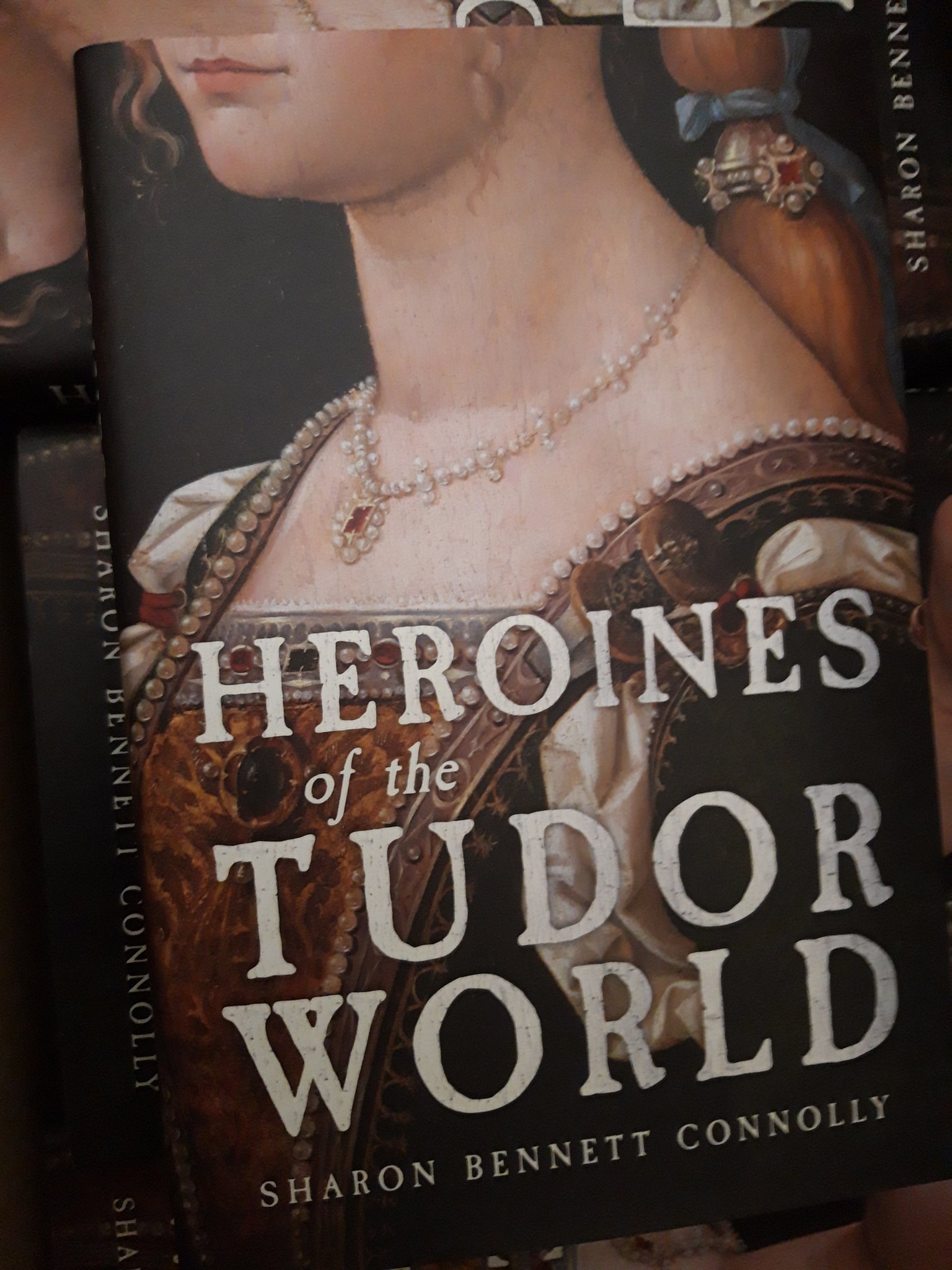
Coming on 15 June 2024: Heroines of the Tudor World
Heroines of the Tudor World tells the stories of the most remarkable women from European history in the time of the Tudor dynasty, 1485-1603. These are the women who ruled, the women who founded dynasties, the women who fought for religious freedom, their families and love. These are the women who made a difference, who influenced countries, kings and the Reformation. In the era dominated by the Renaissance and Reformation, Heroines of the Tudor World examines the threats and challenges faced by the women of the era, and how they overcame them. From writers to regents, from nuns to queens, Heroines of the Tudor World shines the spotlight on the women helped to shape Early Modern Europe.
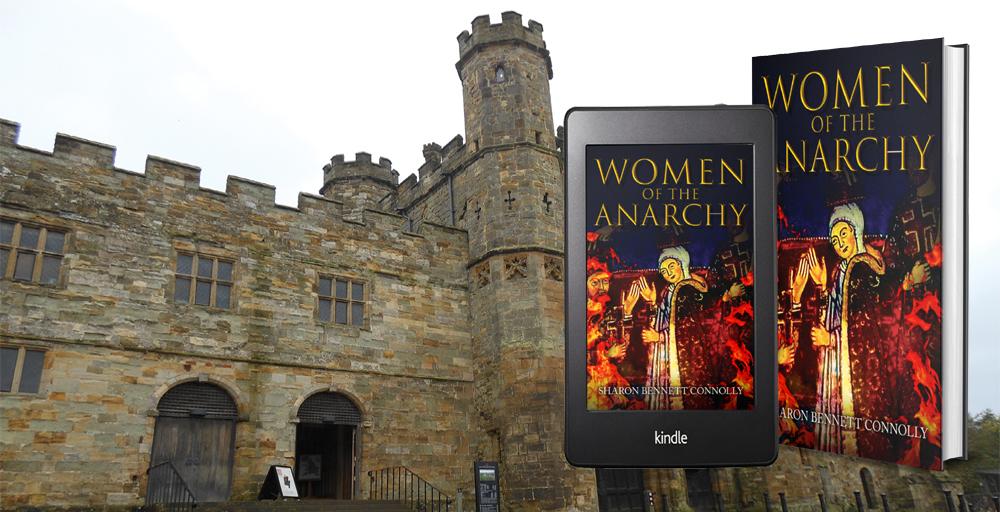
Two cousins. On the one side is Empress Matilda, or Maud. The sole surviving legitimate child of Henry I, she is fighting for her birthright and that of her children. On the other side is her cousin, Queen Matilda, supporting her husband, King Stephen, and fighting to see her own son inherit the English crown. Women of the Anarchy demonstrates how these women, unable to wield a sword, were prime movers in this time of conflict and lawlessness. It show how their strengths, weaknesses, and personal ambitions swung the fortunes of war one way – and then the other.
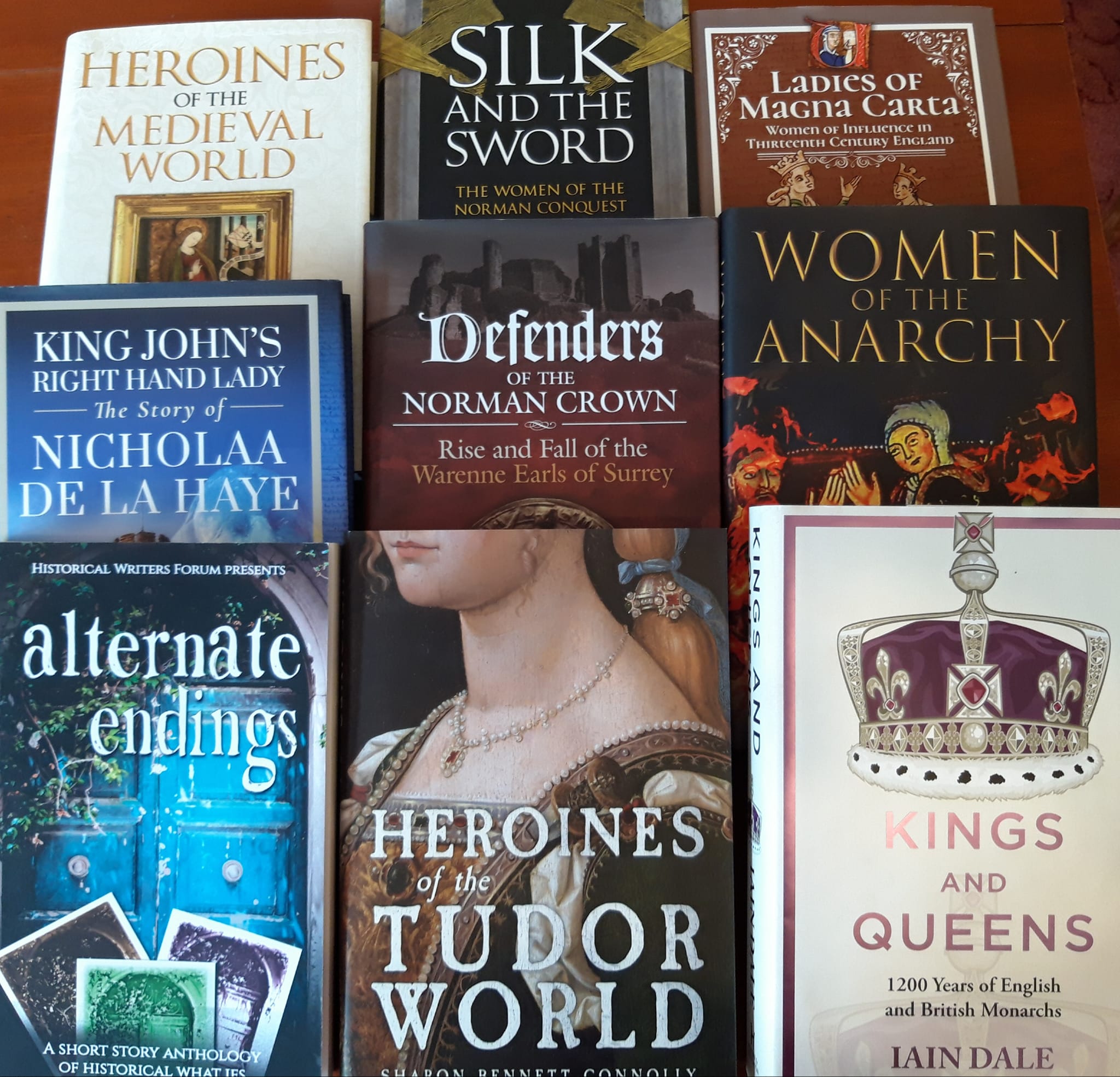
King John’s Right-Hand Lady: The Story of Nicholaa de la Haye is the story of a truly remarkable lady, the hereditary constable of Lincoln Castle and the first woman in England to be appointed sheriff in her own right. Available from all good bookshops or direct from Pen & Sword Books, bookshop.org and Amazon. Defenders of the Norman Crown: The Rise and Fall of the Warenne Earls of Surrey tells the fascinating story of the Warenne dynasty, from its origins in Normandy, through the Conquest, Magna Carta, the wars and marriages that led to its ultimate demise in the reign of Edward III. Available from Pen & Sword Books, Amazon in the UK and US, and Bookshop.org.
Alternate Endings: An anthology of historical fiction short stories including Long Live the King… which is my take what might have happened had King John not died in October 1216. Available in paperback and kindle from Amazon.
Podcast:
Have a listen to theA Slice of Medieval podcast, which I co-host with Historical fiction novelist Derek Birks. Derek and I welcome guests, such as Bernard Cornwell and discuss a wide range of topics in medieval history, from significant events to the personalities involved.
*
Don’t forget!Signed and dedicated copies of all my books are available through my online bookshop.
For forthcoming online and in-person talks, please check out my Events Page.
You can be the first to read new articles by clicking the ‘Follow’ button, liking our Facebook page or joining me on Twitterand Instagram.
It is a pleasure to welcome Jo Willett back to History…the Interesting Bits with a guest post about the subject of her latest book, the Georgian actress Sarah Siddons:
The famous actress Sarah Siddons, the Muse of Tragedy and the Queen of Drury Lane as she was known, was an expert on what we would today call brand control. The characters she played on stage were almost without exception highly moral, upstanding and noble. So, it was important that Sarah’s fans were encouraged to see her in the same light. In an age where many of her contemporary actresses on the London stage were either former sex workers or the mistresses of wealthy men (or both) Sarah ensured that every opportunity was taken to project the message that she was, by contrast, a happily married woman and a devoted mother.
Sarah had met her husband-to-be, William Siddons, when he joined her parents’ travelling acting troupe. She was aged 11 and he was 23. Biographers have tended to gloss over how quickly it was before the two started having romantic feelings for each other, for obvious reasons, but her parents soon became aware that the two were in love. They were wary of the relationship, not because of the age difference – Sarah’s father was similarly several years older than her mother and they had also met when her mother was young – but because they could see that William was not a particularly good actor. The story of how Sarah’s parents attempted to separate the lovers bears all the hallmarks of having been romanticised by Sarah in later life. But whatever happened, Sarah’s parents eventually decided to give their reluctant consent, and Sarah and William Siddons were married in Coventry in November 1773, when Sarah was 18 years old. The Siddons would always affectionately refer to each other as Sal and Sid.
So, Sarah was a married woman by the time she acquired fame and fortune as the greatest tragic actress of her generation. She had a false start at Drury Lane in David Garrick’s final season, but then rebuilt her career and returned to appear on stage at Drury Lane again, this time with Richard Brinsley Sheridan as manager, in 1782. Her first night was said to be one of the greatest ever seen on the British stage and she continued for some thirty years as the highest paid performer of her generation, mobbed by fans wherever she went. By 1782 she was already the mother of four children.
Sarah Siddons as Euphrasia in The Grecian Daughter
Sarah’s success enabled William to give up acting and to become her manager. In this role he proved himself often to be over-zealous in his demands for the fees he asked for her. The more Sarah earned in performance fees as the star, particularly in the regional theatres she toured every summer, the less was available to pay other actors in the company. Inevitably resentments festered. This was made worse when it appeared as if William had got Sarah out of appearing in ‘benefit’ performances, where the night’s takings went to a deserving actor in the cast. Her reputation suffered as a result, and she earned herself the nickname Lady Sarah Save-All.
Even though Sarah was the sole breadwinner, everything she earned was legally in William’s name. There is no evidence she questioned this – it was just how things were at the time. But William was not always wise when it came to investing. One year, for instance, he lost nearly a third of Sarah’s annual earnings, speculating on a new building at Saddlers Wells. Sarah never complained but she did find herself increasingly exhausted by her punishing work schedule and her health certainly suffered as a result.
It must also have been difficult for William that Sarah had such star status, whilst he was relatively unknown. She became the darling of King George III and his wife Queen Charlotte, for instance, but no mention was ever made of William’s having been introduced to the king and queen. It was as if he didn’t exist. Perhaps inevitably, William began to seek solace elsewhere. A friend called at the Siddons’ house one day to find Sarah weeping as she burned some papers which had alerted her to the fact her husband now had a mistress.
In 1792, ten years after Sarah’s triumph at Drury Lane, Hester Piozzi, a friend of Sarah’s, wrote in a letter to a mutual friend that the famous actress’s recent bout of ill-health could be put down to the fact that William had given his wife a Sexually Transmitted Infection, probably syphilis. This was far from being an uncommon problem at the time, but without the wonders of modern medicine it was incurable. Despite this, the couple clearly patched things up between the two of them, as their final child, a daughter named Cecilia, was born the following year.
Sarah Siddons as Lady MacBeth
Sarah never seems to have mentioned her STI. The only hint at it remains to this day Hester Piozzi’s letter. She would have dreaded any news of it escaping into the public domain. Her reputation as a happily married woman, the essence of respectability, would have been dangerously undermined. She was attended by the Royal Physician, Sir Lucas Pepys, who advised her to spend time recuperating at a spa. From then on she often suffered from what her public were told was erisypelas, a condition of the skin. In my biography I suggest that this was a means of covering up the fact her syphilis was developing.
But this was not the only problematic area in the Siddons’ relationship. Their two eldest daughters both suffered from increasingly serious diseases of the lungs, from which both of them were to die, Maria in 1798 and Sally in 1803. Sarah was able to rush to Maria’s bedside to be with her daughter for her last few weeks of life. But when Sally began to sicken during what would prove to be her last few months, her mother was on a long tour of Ireland. William wrote to his wife assuring her that Sally was recovering. He urged her to extend her tour from Dublin to Cork, specifically because there were bills to be met at home. Family life in London was proving to be particularly expensive at the time. Inevitably, and tragically, Sally worsened and died before her mother could make it back to be at her bedside for her end.
Sarah was always exceptionally guarded in her personal correspondence about her feelings towards her husband, but she let her mask slip around this time. ‘I have suffered too much from a husband’s unkindness,’ she wrote, ‘not to detest the man who treats a creature ill that depends on her husband for all her comforts.’ Clearly she blamed William for what had happened.
But Sarah herself was not entirely blameless. During her tour of Ireland she had met a young Spanish fencing master, Philomen Galindo. At first she could persuade herself that she was equally fond of Philomen and of his wife Catherine. But as the relationship developed, Catherine began to feel increasingly excluded and paranoid. Infatuated with Philomen, Sarah did her best to procure acting jobs for the couple in the new company of actors Sarah’s brother, the actor/manager John Philip Kemble, was putting together at Covent Garden. But John Philip made it very clear immediately that the Galindos were not the sort of people his celebrated sister should be associating with. It is impossible to prove whether Sarah was having a sexual relationship with Philomen Galindo, but his wife clearly thought she was. And when, several years later, Catherine had a pamphlet published, arguing her case and making public her side of the story, Sarah declined to sue for libel.
Sarah Siddons as The Tragic Muse by Joshua Reynolds
How much William knew about this is again hard to know, but it was just a year after their daughter Sally’s death, and just as Sarah had encouraged the Galindos to come to London on the false promise of finding jobs for them, that William and Sarah Siddons finally decided to separate. Very little adverse comment appeared in the press about this. All Sarah’s biographers up until now have played the separation right down and praised the actress for the dignity with which she handled the end of her marriage. One who was writing during Sarah’s lifetime wrote that William ‘retained at all times the sincerest regard for his incomparable lady.’ But the truth remained that the Siddons could no longer live with each other.
William drew up his will at the same time. He had asked Sarah to tell him what she would like from it. But, as she herself put it: ‘I can expect nothing more than you yourself have designed’. Despite all her worldly success, her reputation as the greatest tragic actress of her generation, and her image as someone as morally upright as the tragic heroines she played each night on stage, in real life her future was just as in jeopardy as theirs, dependent for her security on the goodwill of the husband from whom she was parting.
About the book:
Sarah Siddons grew up as a member of a family troupe of travelling actors, always poor and often hungry, resorting to foraging for turnips to eat. But before she was 30 she had become a superstar, her fees greater than any actor – male or female – had previously achieved. Her rise was not easy. Her London debut, aged just 20, was a disaster and could have condemned her to poverty and anonymity. But the young actress – already a mother of two – rebuilt her career, returning triumphantly to the capital after years of remorseless provincial touring. She became Britain’s greatest tragic actress, electrifying audiences with her performances. Her shows were sell-outs. Adored by theatre audiences, writers, artists and the royal family alike, Sarah grasped the importance of her image. She made sure that every leading portrait painter captured her likeness, so that engravings could be sold to her adoring public. In an eighteenth-century world of vicious satire and gossip, she also battled to manage her reputation. Married young, she took constant pains to portray herself as a respectable and happily married woman, even though her marriage did not live up to this ideal. Sarah’s story is not just about rags to riches; this remarkable woman also redefined the world of theatre and became the first celebrity actress.
Sarah Siddons: The First Celebrity Actress is available from Amazon
About the author:
Jo Willett has been an award-winning TV drama and comedy producer all her working life. Her credits range from the recent Manhunt, starring Martin Clunes, to Birds of a Feather. Her most relevant productions include Brief Encounters (a fictionalised story of the first women who ran Ann Summers parties in the 1980s), The Making of a Lady (an adaption of the Frances Hodgson Burnett novel _The Making of a Marchioness_), Bertie and Elizabeth (telling the story of the Queen Mother’s marriage) and the BAFTA-and-RTS Award-Winning A Rather English Marriage (starring Albert Finney, Tom Courtenay and Joanna Lumley, adapted from the novel of the same name by Angela Lambert). She studied English at Queens’ College Cambridge and has an MA in Arts Policy. She is married with a daughter, a son and a step-son. She lives in London. www.devoniaroad.co.uk.
*
My Books
Signed, dedicated copies of all my books are available through my online bookshop.
Coming on 15 June 2024: Heroines of the Tudor World
Heroines of the Tudor World tells the stories of the most remarkable women from European history in the time of the Tudor dynasty, 1485-1603. These are the women who ruled, the women who founded dynasties, the women who fought for religious freedom, their families and love. These are the women who made a difference, who influenced countries, kings and the Reformation. In the era dominated by the Renaissance and Reformation, Heroines of the Tudor World examines the threats and challenges faced by the women of the era, and how they overcame them. From writers to regents, from nuns to queens, Heroines of the Tudor World shines the spotlight on the women helped to shape Early Modern Europe.
Two cousins. On the one side is Empress Matilda, or Maud. The sole surviving legitimate child of Henry I, she is fighting for her birthright and that of her children. On the other side is her cousin, Queen Matilda, supporting her husband, King Stephen, and fighting to see her own son inherit the English crown. Women of the Anarchy demonstrates how these women, unable to wield a sword, were prime movers in this time of conflict and lawlessness. It show how their strengths, weaknesses, and personal ambitions swung the fortunes of war one way – and then the other.
King John’s Right-Hand Lady: The Story of Nicholaa de la Haye is the story of a truly remarkable lady, the hereditary constable of Lincoln Castle and the first woman in England to be appointed sheriff in her own right. Available from all good bookshops or direct from Pen & Sword Books, bookshop.org and Amazon. Defenders of the Norman Crown: The Rise and Fall of the Warenne Earls of Surrey tells the fascinating story of the Warenne dynasty, from its origins in Normandy, through the Conquest, Magna Carta, the wars and marriages that led to its ultimate demise in the reign of Edward III. Available from Pen & Sword Books, Amazon in the UK and US, and Bookshop.org.
Alternate Endings: An anthology of historical fiction short stories including Long Live the King… which is my take what might have happened had King John not died in October 1216. Available in paperback and kindle from Amazon.
Podcast:
Have a listen to theA Slice of Medieval podcast, which I co-host with Historical fiction novelist Derek Birks. Derek and I welcome guests, such as Bernard Cornwell and discuss a wide range of topics in medieval history, from significant events to the personalities involved.
*
Don’t forget!Signed and dedicated copies of all my books are available through my online bookshop.
For forthcoming online and in-person talks, please check out my Events Page.
You can be the first to read new articles by clicking the ‘Follow’ button, liking our Facebook page or joining me on Twitterand Instagram.
It is a pleasure to welcome novelist G.K. Holloway to History…the Interesting Bits today, to talk about the research behind his wonderful series The 1066 Saga.
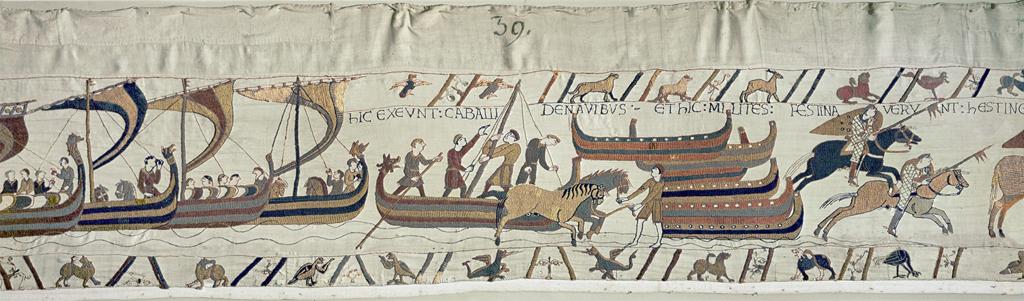
Norman invasion fleet, Bayeux Tapestry
Research for my books consists of mainly reading – books, magazines, academic papers, and blogs. It’s also good to get out a bit and visit and talking with experts, in my case locations of mainly locations of battles where I can talk with resident historians, reenactors and history fans, especially those with local knowledge.
Some of my reading consists of trawling around on the internet. It’s surprising what you can find, other than Wikipedia, as a source of material. And of course there are all sorts of groups on social media that specialise in my period in history. There are podcasts and blogs rich with information for recycling.
Books too, are an obvious place to look; the Doomsday Book is the first to spring to mind, the Anglo-Saxon Chronicle, and the Ecclesiastical History of Orderic Vitalis are useful too. But reader beware, it’s often the case with original material that objectivity wasn’t a strong point of the authors. Academic papers are nowadays can be easily accessed, although the cost of some of them is prohibitive. I’ve had read papers that have shone light into the dark recesses of history I hadn’t dreamed about. This means I’ll able to surprise readers with fascinating snippets that can give a glimpse of life a millennium ago.
Norman cavalry at the Battle of Hastings
Thank heavens for You Tube. There is a wealth of information to be found here, and a lot of it from top quality presenters and historians.
It’s not just what you see but what you don’t see that can be important. A prime example of this is the Bayeux Tapestry. It’s the closet you’ll get to newsreel footage of events covering the Norman Invasion. The full horror of war is not shied away from, burning houses, screaming women, decapitated soldiers and a horse running amok amongst dead bodies, all in glorious colour. But just as in modern times, news can be censored and people and events can be ’air brushed’ out of history, so too, it was the case way back then.
What remains of the well preserved embroidery, that’s correct, it is not a tapestry, is a sight to behold and worth a visit to Normandy to see. It’s surprising how colourful it is even after almost a thousand years. The imagery is clear and easy to follow but some scenes are missing. The story is told accurately enough and details like the appearance of Halley’s Comet are included. However, the Battle of Stamford Bridge is nowhere to be seen. Could it be that King William didn’t want it know that the army he fought at Senlac was exhausted from several hundred miles of marching and a huge battle against the biggest Norse army ever to have set foot in England. There is no depiction of the Battle of London Bridge, or the violence committed by his rampaging troops during his coronation. History has been, ‘cleaned up a bit,’ to the advantage of the victors. Nothing new there then.
Death of King Harold in the Bayeux Tapestry
It’s always a good idea to visit key locations. It’s one thing to look at maps and photographs but when you find yourself looking across the lagoons at Bosham, wandering around the castle at Falaise, starring up at Clifford’s Tower in York, or watching a reenactment at Battle Abbey, a much more realistic picture forms in your mind about what it must have been like to live all that time ago. To boost one’s knowledge it’s always a good idea to talk to reenactors; most of them have an encyclopaedic knowledge of the time period and especially their character’s part in it. Whether it be as a soldier, arrowsmith or seamstress.
Doing all the above is a great way of researching the history, but if like me, you write historical fiction rather than non-fiction, you would do well to read a good book. One I could recommend if, Story by Robert McKee. He deals with scriptwriting but it’s quite easy to apply his ideas to novels. You could also spend a lot of money and quite a bit of time on a creative writing course, but you might be better off getting a good editor.
So there you have it. Use as many sources as you can, and you’ll find many a nugget amongst the raw material.
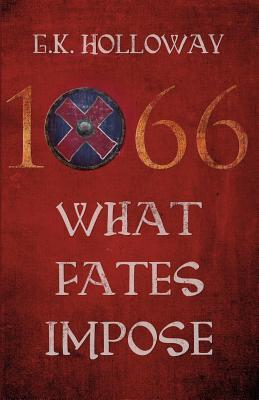
1066: What Fates Impose
England is in crisis. King Edward has no heir and promises never to produce one. There are no obvious successors available to replace him, but quite a few claimants are eager to take the crown. While power struggles break out between the various factions at court, enemies abroad plot to make England their own. There are raids across the borders with Wales and Scotland.
Harold Godwinson, Earl of Wessex, is seen by many as the one man who can bring stability to the kingdom. He has powerful friends and two women who love him, but he has enemies will stop at nothing to gain power. As 1066 begins, England heads for an uncertain future. It seems even the heavens are against Harold.
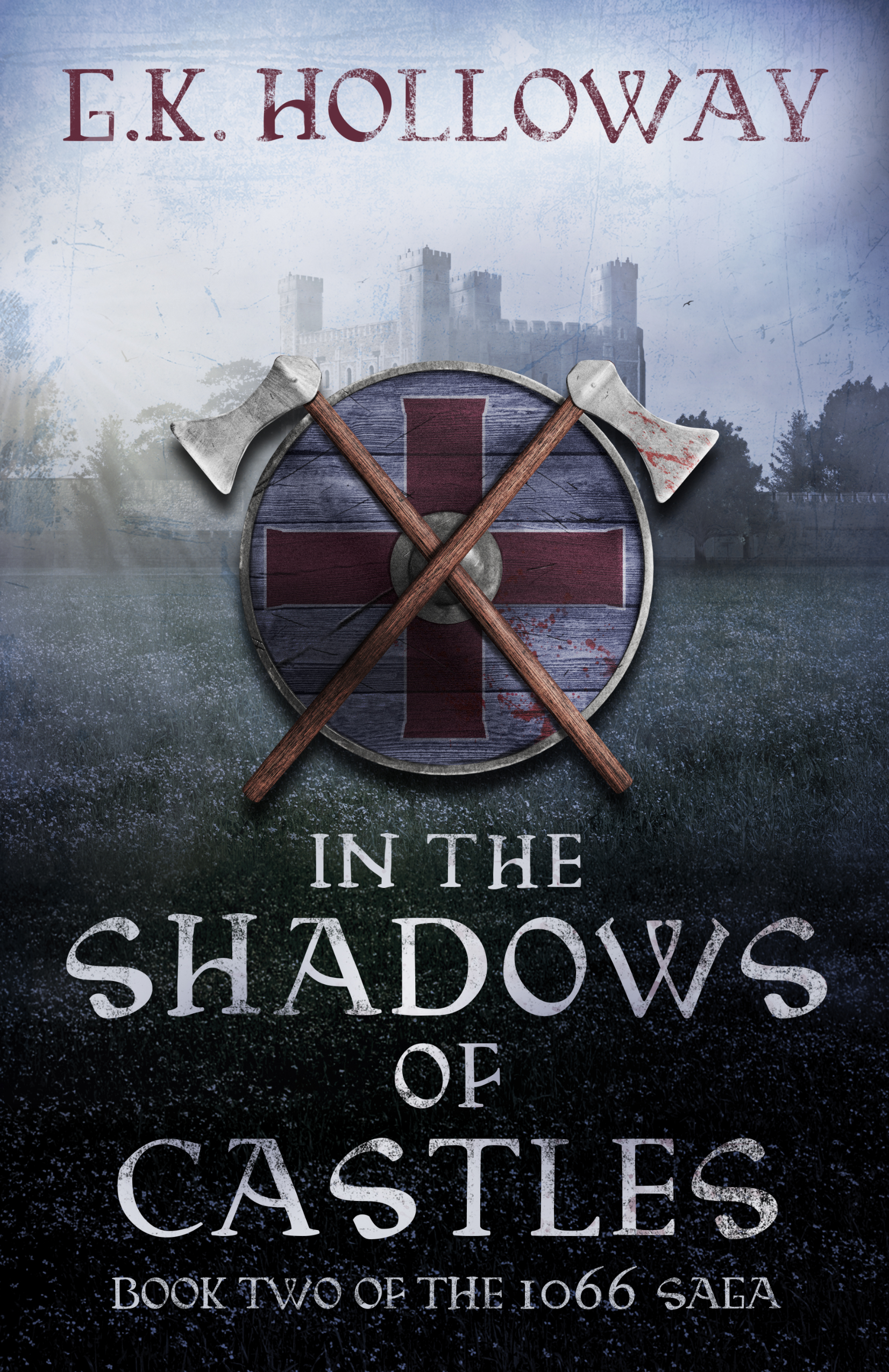
In the Shadows of Castles
It’s the 1060s, and William of Normandy is establishing a new and brutal regime in England, but there are those who would defy him. As Norman soldiers spread like a plague across the land, resistance builds, but will it be enough to topple William and restore the rightful king to his throne? The English have the courage to fight, but the Normans, already victorious at Hastings, now build castles seeking to secure their tenuous foothold in these lands.
And what of the people caught up in these catastrophic events? Dispossessed but not defeated, their lives ripped apart, the English struggle for freedom from tyranny; amongst them, caught up in the turmoil, are a soldier, a thane and two sisters. As events unfold, their destinies become intertwined, bringing drastic changes that alter their lives forever.
Firmly embedded in the history of the Conquest, ‘In the Shadows of Castles’ is ultimately a story of love, hope and survival in a time of war.
About the Author:
1066 What Fates Impose, won the Gold Medal in the 2014 Wishing Shelf Independent Book Awards – Adult Fiction.
G K Holloway left university in 1980 with a degree in history and politics. After spending a year in Canada, he relocated to England’s West Country and began working in Secondary Education. Later he worked in Adult Education and then Further Education before finally working in Higher Education.
After reading a biography about Harold Godwinson, he became fascinated by the fall of Anglo Saxon England and spent several years researching events leading up to and beyond the Battle of Hastings. Eventually he decided he had enough material to make an engrossing novel. Using characters from the Bayeux Tapestry, the Norse Sagas, the Domesday Book and many other sources. He feels that he has brought the period and its characters to life in his own particular way. Following the major protagonists, as well as political, religious and personal themes, the downfall of Anglo-Saxon England is portrayed by a strong cast.
Nowadays he lives in Bristol with his wife and two children. When he’s not writing he works with his wife in their company.
1066 is his debut novel was originally published as an ebook. It has received very positive reviews and this has encouraged him to publish it in paperback. Currently he is working on a sequel. One day he hopes to write full time.
Signed, dedicated copies of all my books are available through my online bookshop.
Out Now!Women of the Anarchy
Two cousins. On the one side is Empress Matilda, or Maud. The sole surviving legitimate child of Henry I, she is fighting for her birthright and that of her children. On the other side is her cousin, Queen Matilda, supporting her husband, King Stephen, and fighting to see her own son inherit the English crown. Women of the Anarchy demonstrates how these women, unable to wield a sword, were prime movers in this time of conflict and lawlessness. It show how their strengths, weaknesses, and personal ambitions swung the fortunes of war one way – and then the other.
Coming on 15 June 2024: Heroines of the Tudor World
Heroines of the Tudor World tells the stories of the most remarkable women from European history in the time of the Tudor dynasty, 1485-1603. These are the women who ruled, the women who founded dynasties, the women who fought for religious freedom, their families and love. These are the women who made a difference, who influenced countries, kings and the Reformation. In the era dominated by the Renaissance and Reformation, Heroines of the Tudor World examines the threats and challenges faced by the women of the era, and how they overcame them. From writers to regents, from nuns to queens, Heroines of the Tudor World shines the spotlight on the women helped to shape Early Modern Europe.
King John’s Right-Hand Lady: The Story of Nicholaa de la Haye is the story of a truly remarkable lady, the hereditary constable of Lincoln Castle and the first woman in England to be appointed sheriff in her own right. Available from all good bookshops or direct from Pen & Sword Books, bookshop.org and Amazon. Defenders of the Norman Crown: The Rise and Fall of the Warenne Earls of Surrey tells the fascinating story of the Warenne dynasty, from its origins in Normandy, through the Conquest, Magna Carta, the wars and marriages that led to its ultimate demise in the reign of Edward III. Available from Pen & Sword Books, Amazon in the UK and US, and Bookshop.org.
Alternate Endings: An anthology of historical fiction short stories including Long Live the King… which is my take what might have happened had King John not died in October 1216. Available in paperback and kindle from Amazon.
Podcast:
Have a listen to theA Slice of Medieval podcast, which I co-host with Historical fiction novelist Derek Birks. Derek and I welcome guests, such as Bernard Cornwell and Elizabeth Chadwick, and discuss a wide range of topics in medieval history, from significant events to the personalities involved.
*
Don’t forget!Signed and dedicated copies of all my books are available through my online bookshop.
For forthcoming online and in-person talks, please check out my Events Page.
You can be the first to read new articles by clicking the ‘Follow’ button, liking our Facebook page or joining me on Twitterand Instagram.
The Woodville family are synonymous with the Wars of the Roses. While much has been published on the family as a whole, especially Elizabeth, wife of Edward IV, Anthony Woodville – the favourite sibling of Elizabeth – has been largely overlooked by history. He is famed for his arrest and execution in June 1483, but there is much more to learn from his life. Woodville was a man with an important cultural role. He was a knight, had a successful jousting career, and worked with the printing pioneer William Caxton. He was the printer’s only long-lasting patron in England and acted as translator for him, using the books printed by Caxton to educate Edward, Prince of Wales, the future Edward V.
This book seeks to bring Anthony Woodville out of the shadows of history, giving him the recognition he deserves and challenging the negative perceptions around him by investigating his personality and personal achievements in military, diplomatic and literary capacities.
I have always had the impression that Anthony Woodville would have stood out in any period of history. A Renaissance man, he championed the arts, patronised the printing press, was a renowned jouster and so well respected by his king that he was entrusted with the education and upbringing of the Prince of Wales – the future King Edward V.
I do think Woodville would have stood out in any generation, but it didn’t hurt that his sister was Elizabeth Woodville, Queen of England.
Anthony Woodville, as the queen’s brother, was at the centre of events during the reign of Edward IV. He accompanied his brother-in-law into exile when Henry VI briefly reclaimed the throne in 1470-71. He appeared in tournaments to celebrate the marriage of the king’s sister, Margaret, to the future duke of Burgundy. He was a poet and writer and was a patron of William Caxton, the man who brought the printing press to England. Caxton printed and published Woodville’s English translation of The Dictes and Sayings of the Philosophers. So why is there not a larger body of work on him?
Danielle Burton has rectified this omission with her fascinating, in-depth study, Anthony Woodville, Sophisticate or Schemer? She delves deep into Woodville’s life, family, loves and career.
The Woodville family are often viewed as grasping and power hungry. This is true of some of the family members, particularly Thomas Grey, Marquess of Dorset, who was the eldest son of Anthony’s sister Elizabeth by her first marriage to John Grey. However, Anthony, while of course benefitting from the advancement of his sister to the status of queen, notably avoided meddling wherever possible. His interests in piety, tutoring Edward, the Prince of Wales, jousting, and translating books let him play a background role in the Wars of the Roses.
While Anthony Woodville may have been a secondary figure in political terms, it is clear that he had a significant part in transforming English culture, especially through his patronage of William Caxton, as well as his tutelage of Edward. Prince of Wales, who resided at Ludlow Castle for around ten years. According to Dominic Mancini, and Italian visitor who stayed in England between late summer 1482 and July 1483, Anthony Woodville was ‘always considered a kind, serious and just man’ who was ‘tested by every vicissitude of life.’ It was for this reason that he had been entrusted with the ‘care and direction’ of the prince. Further to Mancini’s description of Anthony, he purposefully contrasts his character with that of other Woodvilles, who were ‘detested by the nobles.’ There is a certain amount of truth in this, for unlike some other family members Anthony preferred to stay away from court life, favouring more academic and religious pursuits.
As a debut work, Anthony Woodville, Sophisticate or Schemer? is very impressive. It is clear that Danielle Burton has done her research, thoroughly, using primary sources where possible. She uses her extensive knowledge of Anthony Woodville to suggest reasons for his actions and to fill in the gaps of our knowledge, clearly indicating her theories and supporting arguments. There are some minor errors, which other reviewers have highlighted, but nothing that changes the thrust of the arguments nor detracts from the enjoyment of reading. They certainly do not devalue the biography as a whole and are more a sign of the writer’s inexperience of the editing process. I certainly would not expect it to put a reader off.
I suspect Anthony Woodville is Danielle’s historical crush, but this adds to the passion in her retelling of his story. We all fall in love with our subjects, just a little bit. You cannot spend years studying a person without doing so.
Danielle Burton’s arguments are balanced and do not present Anthony Woodville and some flawless super hero. Rather, he is an accomplished knight who had his flaws and would often look to his own advantage. Who wouldn’t? He was, however, loyal to Edward IV and his nephew, Edward V. And, having been the younger Edward’s guardian since his early years, was probably a great influence on the teenage king. This would Explain why Richard, Duke of Gloucester – the future Richard III – saw him as a threat. In Anthony Woodville, Sophisticate or Schemer? Danielle looks into the events of 1483 in great detail, examining the relationship between Richard and Anthony and analysing what went wrong and why. Anthony Woodville’s execution at Pontefract Castle is a tragic consequence of the power struggle that followed the death of Edward IV and accession of Anthony’s charge, Edward V.
All in all, Anthony Woodville, Sophisticate or Schemer? by Danielle Burton is a much-needed addition to the study of the Wars of the Roses, highlighting a man of great influence who is often overlooked in favour of his royal contemporaries. It is an impressive piece of work.
To Buy the Book:Anthony Woodville, Sophisticate or Schemer? is available from Amazon or direct from Amberly Publishing.
About the Author: Danielle Burton has had a keen interest in the Wars of the Roses from a young age, including being a member of the Richard III Society since the age of 9. She has presented aspects of her research into the life of Anthony Woodville at various academic conferences, and works in the heritage sector.
*
My Books:
Signed, dedicated copies of all my books are available through my online bookshop.
Out Now!Women of the Anarchy
Two cousins. On the one side is Empress Matilda, or Maud. The sole surviving legitimate child of Henry I, she is fighting for her birthright and that of her children. On the other side is her cousin, Queen Matilda, supporting her husband, King Stephen, and fighting to see her own son inherit the English crown. Women of the Anarchy demonstrates how these women, unable to wield a sword, were prime movers in this time of conflict and lawlessness. It show how their strengths, weaknesses, and personal ambitions swung the fortunes of war one way – and then the other.
Coming on 15 June 2024: Heroines of the Tudor World
Heroines of the Tudor World tells the stories of the most remarkable women from European history in the time of the Tudor dynasty, 1485-1603. These are the women who ruled, the women who founded dynasties, the women who fought for religious freedom, their families and love. These are the women who made a difference, who influenced countries, kings and the Reformation. In the era dominated by the Renaissance and Reformation, Heroines of the Tudor World examines the threats and challenges faced by the women of the era, and how they overcame them. From writers to regents, from nuns to queens, Heroines of the Tudor World shines the spotlight on the women helped to shape Early Modern Europe.
King John’s Right-Hand Lady: The Story of Nicholaa de la Haye is the story of a truly remarkable lady, the hereditary constable of Lincoln Castle and the first woman in England to be appointed sheriff in her own right. Available from all good bookshops or direct from Pen & Sword Books, bookshop.org and Amazon. Defenders of the Norman Crown: The Rise and Fall of the Warenne Earls of Surrey tells the fascinating story of the Warenne dynasty, from its origins in Normandy, through the Conquest, Magna Carta, the wars and marriages that led to its ultimate demise in the reign of Edward III. Available from Pen & Sword Books, Amazon in the UK and US, and Bookshop.org.
Alternate Endings: An anthology of historical fiction short stories including Long Live the King… which is my take what might have happened had King John not died in October 1216. Available in paperback and kindle from Amazon.
Podcast:
Have a listen to theA Slice of Medieval podcast, which I co-host with Historical fiction novelist Derek Birks. Derek and I welcome guests, such as Bernard Cornwell and Elizabeth Chadwick, and discuss a wide range of topics in medieval history, from significant events to the personalities involved.
*
Don’t forget!Signed and dedicated copies of all my books are available through my online bookshop.
For forthcoming online and in-person talks, please check out my Events Page.
You can be the first to read new articles by clicking the ‘Follow’ button, liking our Facebook page or joining me on Twitterand Instagram.
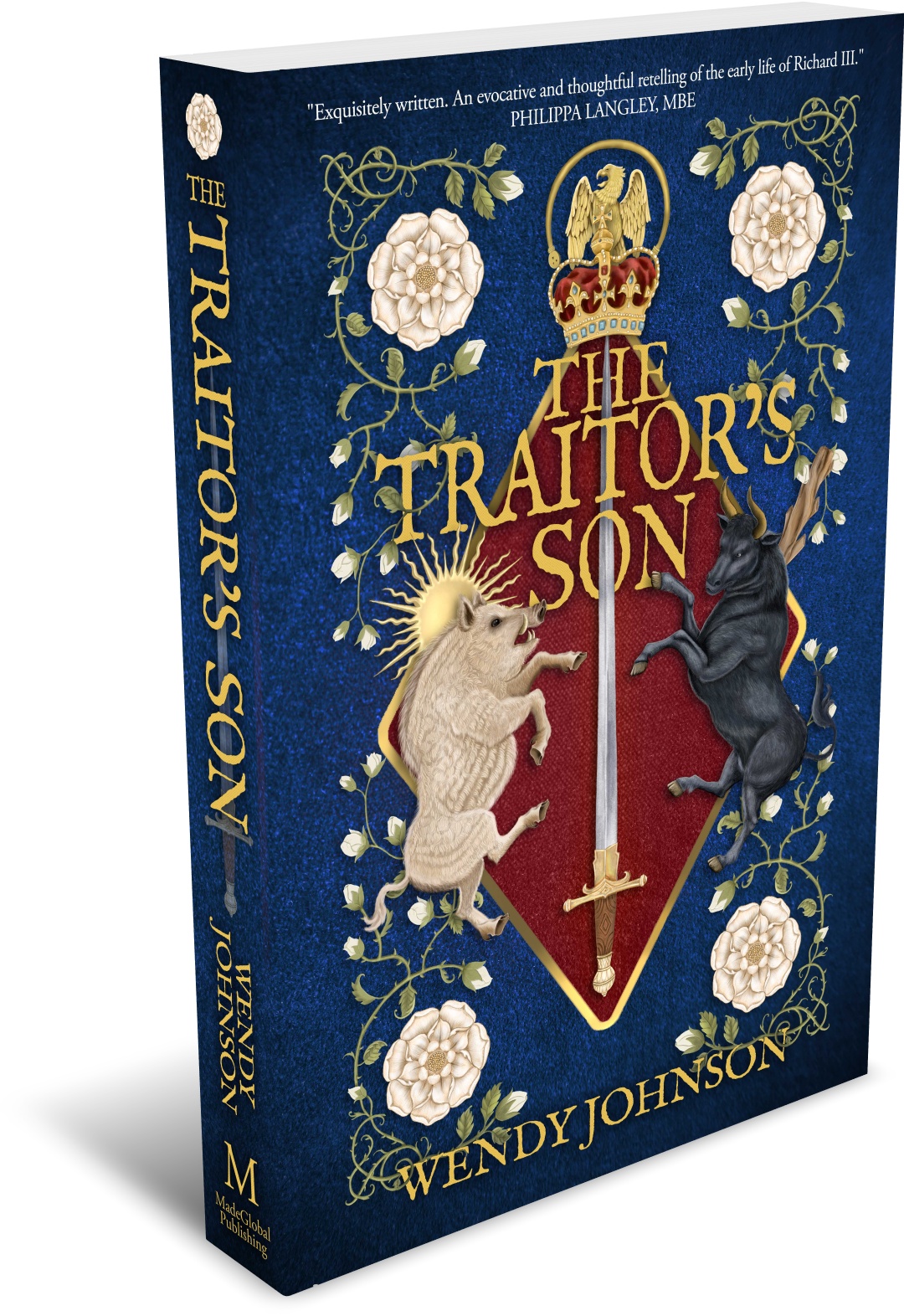
Today, it is a pleasure to welcome debut author, Wendy Johnson, to History…the Interesting Bits as part of her blog tour to celebrate the launch of Wendy’s first novel, The Traitor’s Son.
Middleham Castle – Home to Kings and Kingmakers
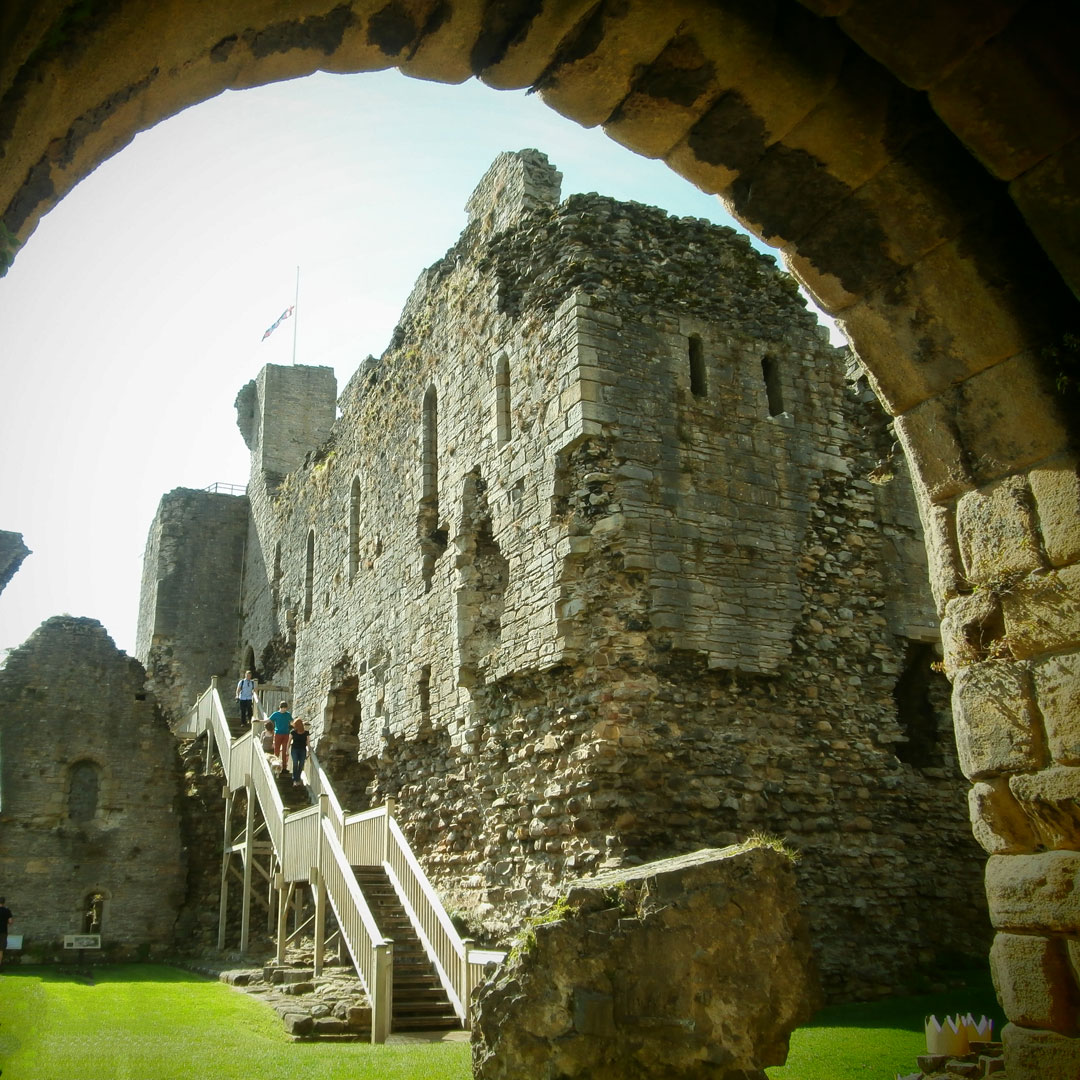
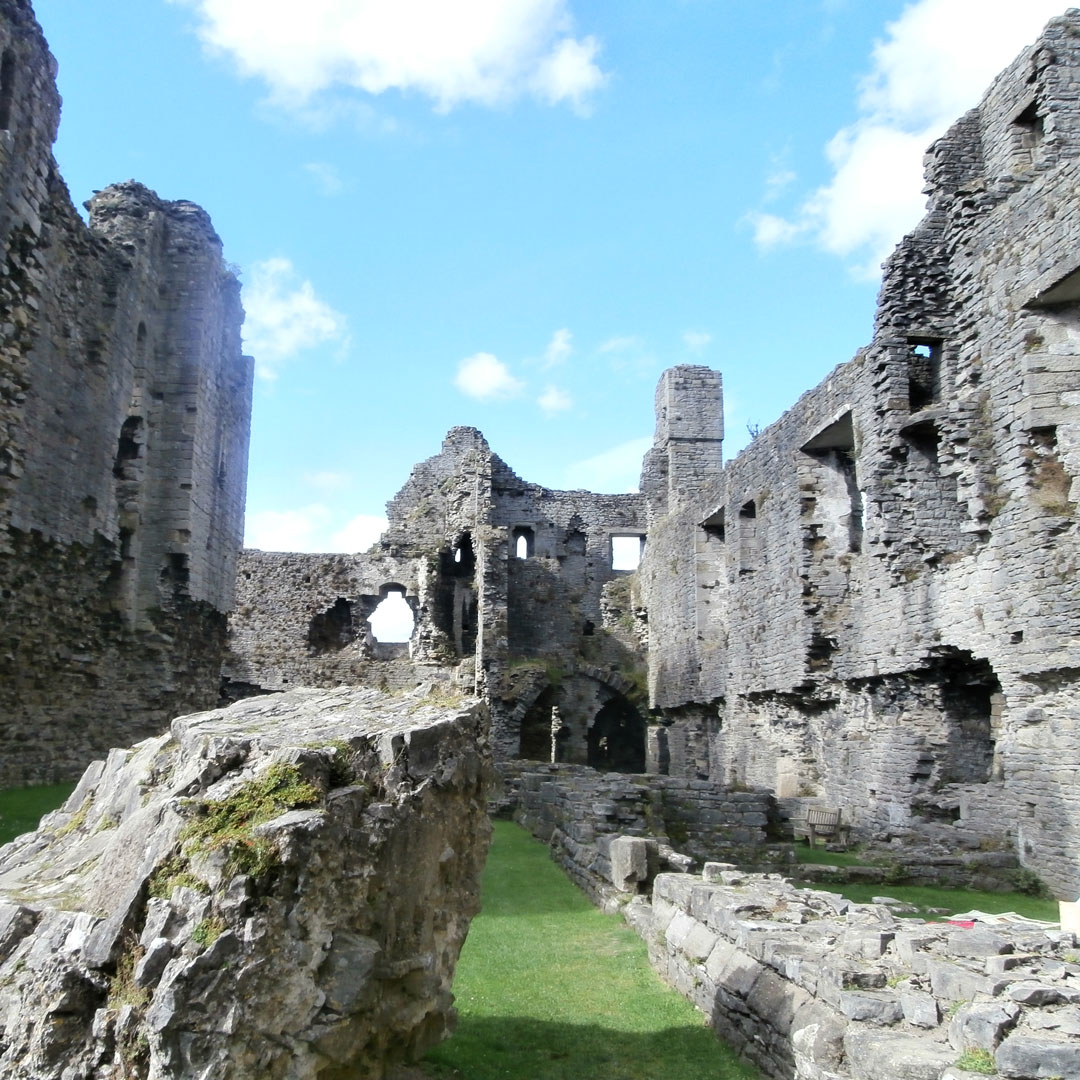
Middleham Castle, North Yorkshire, bastion of the illustrious Neville family and home to both Richard Neville, earl of Warwick and his cousin, the future Richard III, is an evocative and fascinating place.
Eleven miles from the market town of Richmond, and a stone’s throw from Leyburn, the castle stands at the heart of Middleham, amid Wensleydale’s rolling hills. The visitor’s first impression, on approaching its cavernous gatehouse, is that these ruins have witnessed the very essence of history, and if only walls could talk, they would have a treasure trove of secrets to reveal.
An earlier castle once stood on nearby William’s Hill, but the present edifice began to rise in the 1170s. The fortress came into the possession of the Neville family when Mary FitzRanulph married Robert Neville in the thirteenth century. However, Middleham appears to have been considered less important than Robert’s other castles at Raby and Sheriff Hutton.1 Later Nevilles made a number of improvements – heightening the towers and creating a new and larger gatehouse – but it was in the later fifteenth century that the castle became the home of some of the most influential figures of the Wars of the Roses: the three Richards.
Richard Neville, earl of Salisbury; Richard Neville, earl of Warwick; and Richard Plantagenet, duke of Gloucester were each caught up in one of the most dramatic periods of English history, when the crown changed hands from Lancaster to York, York to Lancaster, and back again in the course of only ten years.
Following the fateful Battle of Wakefield in 1460, Salisbury was captured and executed. His son, the enigmatic and forceful Earl of Warwick, was largely responsible for helping Edward IV, the first Yorkist king, to win the throne in 1461.
Richard duke of Gloucester, Edward’s youngest brother, who ascended the throne as Richard III, spent much of his life at Middleham. Installed in his cousin, Warwick’s, household at the age of twelve, Richard embarked on his knightly training under the earl’s tutelage, learning the military and social graces required of a chivalric warrior. At the age of twenty, following his marriage to Warwick’s daughter, Anne, Middleham became Richard’s favourite residence.
My debut novel, The Traitor’s Son, re-imagines these early years. As a grieving and fatherless boy, Richard finds solace in the company of his cousin, the Earl of Warwick, whose paternal influence repairs the boy’s shattered life. The castle of Middleham plays an important role in the novel – representing a new and, at first, unnerving, part in Richard’s journey, as he wonders whether he is able to live up to the earl’s expectations. I have chosen to illustrate Richard’s early feelings for Middleham and for his formidable cousin in the following scene, when the boy has been summoned into Warwick’s presence.
‘Belly lurching, he follows the earl’s man down the tight spiral and out into the bailey. Kitchen boys are throwing out slops, bandying jests, sniggering. As he approaches, they fall silent, snatching caps and bobbing knees. The air is cool, pungent with the scent of verdure and horse dung, birds chirruping in the violet dusk. A solitary crow swoops from the keep, hops across the earth in the clumsy, jerking manner of his breed, then takes off again in the direction of the practice yard.
He should have fetched a cloak. It’s so much colder here in the land of the Nevilles, plagued as it is with a perpetual wind sweeping from the moors and striking like a whiplash. He shivers, wondering why Warwick has hauled him from what little comfort there is to be had on such a dismal evening. To draw conclusions on the day’s events? To tell him he has failed?
Torchlight bobs on towering stone as they mount the steps to the keep. Challenged twice in the ascent, he could be at Westminster, and Warwick a king at the heart of the labyrinth. Surely, he thinks, it’s the dread of the moment that gives this impression, the creeping suffocation of growing darkness, the brilliance of the wind-torn flames. Warwick is my cousin and my tutor; he is not my sovereign.
The Middleham known to both Richard and Warwick was larger than the ruined fabric we see today. In addition to the keep, towers and surrounding ranges, there would have been stables, an armoury, a blacksmith’s forge and many more domestic buildings all integral to the daily life of the castle, as well as to the role of its lord as upholder of his estates and a foremost figure in society. How magnificent that life was, can be gleaned by the splendour of the Middleham Jewel: a fifteenth century gold and sapphire pendent found in the vicinity of the castle in 1986. Current thinking is that the jewel belonged to a woman – the most likely candidate being Anne Beauchamp, Warwick’s countess, or possibly Anne Neville, Warwick’s daughter, and wife of Richard III. Although the original pendent is on display in the Yorkshire Museum, York, a replica has pride of place in the castle’s English Heritage shop.
I find that visualising the past can help stir the imagination, as one explores Middleham’s evocative and dramatic ruins. If you’ve never experienced Middleham’s magic for yourself, then try following in the footsteps of kings and kingmakers, you’ll not regret it.
“Exquisitely written. An evocative and thoughtful retelling of the early life of Richard III.” Philippa Langley, MBE
Synopsis:
Caught between a king and a kingmaker, young Richard Plantagenet knows he’ll have to choose…
1461: Richard Duke of York, King by Right, has been branded a traitor and slain by his Lancastrian foes. For his eight-year-old son—Richard Plantagenet—England has become a dangerous place.
As the boy grapples with grief and uncertainty, his elder brother, Edward, defeats the enemy and claims the throne. Dazzled by his glorious sibling, young Richard soon discovers that imperfections lurk beneath his brother’s majestic façade. Enter Richard Neville, Earl of Warwick—cousin, tutor, luminary—whose life has given him everything but that which he truly craves: a son. A filial bond forms between man and boy as they fill the void in each other’s lives. Yet, when treachery tears their world asunder, Richard faces an agonizing dilemma: pledge allegiance to Edward—his blood brother and king—or to Warwick, the father figure who has shaped his life and affections.
Painfully trapped between duty and devotion, Richard faces a grim reality: whatever he decides will mean a fight to the death.
In “The Traitor’s Son”, Wendy Johnson masterfully weaves a tapestry of loyalty, love, and sacrifice against the backdrop of England’s turbulent history. Through the eyes of a young Richard III, readers are transported into a world where every choice is fraught with peril, and the bonds of kinship are tested to their limits. As Richard Plantagenet navigates the explosive tensions within his own family, readers are swept along on a journey of intrigue and passion that will leave them spellbound until the final page.
1) Middleham Castle from the Gatehouse (Wendy Johnson); 2) Middleham Castle: North Range (Wendy Johnson); 3) Middleham Castle: Towards the Gatehouse (Wendy Johnson).
About the author:
Wendy has a lifelong passion for medieval history, its people, and for bringing their incredible stories to life. Her specific areas of interest are the fifteenth century, the Wars of the Roses, and Richard III in particular. She enjoys narratives which immerse the reader in the past, and tries faithfully to recreate the later Middle Ages within in her own writing. She has contributed to a number of historical anthologies and was a runner up in the Woman and Home Short Story Competition 2008.
A member of the Richard III Society since 1986, Wendy is also a founder member of Philippa Langley’s Looking for Richard Project, which located the king’s lost grave in 2012. She co-authored Finding Richard III: the Official Account of Research by the Retrieval and Reburial Project in 2014, and in 2019 received the Richard III Society’s Robert Hamblin Award.
THE TRAITOR’S SON, volume one in a Richard III trilogy, is Wendy’s debut novel and she is currently working on the sequel.
*
My Books:
Signed, dedicated copies of all my books are available through my online bookshop.
Out Now!Women of the Anarchy
Two cousins. On the one side is Empress Matilda, or Maud. The sole surviving legitimate child of Henry I, she is fighting for her birthright and that of her children. On the other side is her cousin, Queen Matilda, supporting her husband, King Stephen, and fighting to see her own son inherit the English crown. Women of the Anarchy demonstrates how these women, unable to wield a sword, were prime movers in this time of conflict and lawlessness. It show how their strengths, weaknesses, and personal ambitions swung the fortunes of war one way – and then the other.
Coming on 15 June 2024: Heroines of the Tudor World
Heroines of the Tudor World tells the stories of the most remarkable women from European history in the time of the Tudor dynasty, 1485-1603. These are the women who ruled, the women who founded dynasties, the women who fought for religious freedom, their families and love. These are the women who made a difference, who influenced countries, kings and the Reformation. In the era dominated by the Renaissance and Reformation, Heroines of the Tudor World examines the threats and challenges faced by the women of the era, and how they overcame them. From writers to regents, from nuns to queens, Heroines of the Tudor World shines the spotlight on the women helped to shape Early Modern Europe.
King John’s Right-Hand Lady: The Story of Nicholaa de la Haye is the story of a truly remarkable lady, the hereditary constable of Lincoln Castle and the first woman in England to be appointed sheriff in her own right. Available from all good bookshops or direct from Pen & Sword Books, bookshop.org and Amazon. Defenders of the Norman Crown: The Rise and Fall of the Warenne Earls of Surrey tells the fascinating story of the Warenne dynasty, from its origins in Normandy, through the Conquest, Magna Carta, the wars and marriages that led to its ultimate demise in the reign of Edward III. Available from Pen & Sword Books, Amazon in the UK and US, and Bookshop.org.
Alternate Endings: An anthology of historical fiction short stories including Long Live the King… which is my take what might have happened had King John not died in October 1216. Available in paperback and kindle from Amazon.
Podcast:
Have a listen to theA Slice of Medieval podcast, which I co-host with Historical fiction novelist Derek Birks. Derek and I welcome guests, such as Bernard Cornwell and Elizabeth Chadwick, and discuss a wide range of topics in medieval history, from significant events to the personalities involved.
*
Don’t forget!Signed and dedicated copies of all my books are available through my online bookshop.
For forthcoming online and in-person talks, please check out my Events Page.
You can be the first to read new articles by clicking the ‘Follow’ button, liking our Facebook page or joining me on Twitterand Instagram.
I am very fond of Joanna Arman as an author. She has a habit of bringing often-forgotten or ignored – or maligned – women to the fore and reassessing their role in history. Her biography of Æthelflæd,The Warrior Queen: The Life and Legend of Æthelflæd, Daughter of Alfred the Great, was an engaging and illuminating book, despite the challenges of writing about a woman who lived over a thousand years ago. Writing about any woman in history is challenging. Women are rarely mentioned in the chronicles. And when they are, contemporary sources are rarely balanced and often trying to advance a moral judgement of how women fell below the standard expected of them in their society. Which is why we need reappraisals of significant historic women, books which reassess their stories and apply the filter against the casual misogyny that women have suffered from throughout the centuries. Joanna Arman has set out to do that with books about two very different queens consort of England; Matilda of Scotland and Margaret of Anjou.
Matilda II: The Forgotten Queen
The wife of King Henry I and the mother of the Empress Maud is a woman and a Queen forgotten to history. She is frequently conflated with her daughter or her mother-in-law. She was born the daughter of the King of Scotland and an Anglo-Saxon princess. Her name was Edith, but her name was changed to Matilda at the time of her marriage. The Queen who united the line of William the Conqueror with the House of Wessex lived during an age marked by transition and turbulence. She married Henry in the first year of the 12th century and for the eighteen years of her rule aided him in reforming the administrative and legal system due to her knowledge of languages and legal tradition. Together she and her husband founded a series of churches and arranged a marriage for their daughter to the Holy Roman Emperor. Matilda was a woman of letters to corresponded with Kings, Popes, and prelates, and was respected by them all. Matilda’s greatest legacy was continuity: she united two dynasties and gave the Angevin Kings the legitimacy they needed so much. It was through her that the Empress Matilda and Henry II were able to claim the throne. She was the progenitor of the Plantagenet Kings, but the war and conflict which followed the death of her son William led to a negative stereotyping by Medieval Chroniclers. Although they saw her as pious, they said she was a runaway nun and her marriage to Henry was cursed. This book provides a much-needed re-evaluation of Edith/Matilda’s role and place in the history of the Queens of England.
Now, this is a book I have been waiting for!
And it is a book that has needed to be written for a long time. How useful it would have been when I was writing my own book, Women of the Anarchy. A complete biography of Matilda of Scotland – also referred to as Matilda II to distinguish her from her predecessor, Matilda of Flanders. As the wife of Henry I of England Matilda of Scotland is a woman often neglected and overlooked by historians. And yet, Queen Matilda was a truly remarkable queen and one who was well respected during her lifetime. Born as the eldest daughter of Malcolm III Canmore, King of Scots, and his saintly wife, Margaret of Wessex, and given the name Edith at birth, her name was changed to the more Norman name, Matilda, on her marriage to Henry I.
Joanna Arman expertly guides us through Queen Matilda’s life, from her childhood in a convent, supervised by her mother’s sister, Christina, through the various suitors who came calling to the controversy over her marriage to King Henry. Matilda II: The Forgotten Queen delves deep into the investigation into whether or not Matilda had ever been professed as a nun and presents the evidence and arguments for both sides. It is a fascinating study.
Queen Matilda’s role, as a queen, wife and mother, is examined in great detail, demonstrating her influence, both on her family and on England and Normandy. Matilda’s piety is shown as an anchoring force throughout her life, influencing the way she approaches problems and relationships. The queen is shown to be a deeply devout, kind and benevolent woman, with a strong sense of purpose and destiny.
Matilda II: The Forgotten Queen covers every aspect of the queen’s life, drawing on chronicles and charters to present what we know in a clear, engaging narrative that brings this often-overlooked queen to life. The book is accompanied by extensive notation and a through bibliography – I was flattered to discover my own book, Defenders of the Norman Crown: Rise and Fall of the Warenne Earls of Surrey, cited as a refence. It is an excellent biography, thoroughly researched and beautifully presented. I loved reading every word.
Margaret of Anjou: She-Wolf of France, Twice Queen of England
In 1445 a fifteen-year-old French girl left her homeland to marry the son of the great warrior Henry V. Sixteen years later, her husband had lost his throne and she had fled into exile. For a decade, she struggled to reclaim the throne of England before her final and shattering defeat at the Battle of Tewkesbury. It marked the final destruction of the House of Lancaster by Yorkist King Edward IV and his brothers. Margaret lost more than her family: she was also vilified. Shakespeare cast her as a sadistic killer who murdered the noble Richard, Duke of York. History cast her as a manipulative seductress whose destructive ambition was a major cause of the Wars of the Roses. Margaret of Anjou remains one of the most notorious consorts in medieval history, the queen we love to hate. But is her reputation deserved, or was she simply caught between the machinations and rivalries of powerful men? By examining Margaret’s life and actions in detail, this biography reveals a new side to the last foreign-born queen of medieval England. Margaret came from a family of strong women. Faced with hardship in the first years of her marriage, Margaret’s choices arose from a conviction that it was natural for a woman to take control in the absence of male leadership. A wealth of records have been left behind, allowing historians to investigate Margaret’s career as a beloved wife and, later, as the leader of a political faction struggling to secure the crown for her family. If the course of history had run differently, would she instead be considered a heroic warrior queen today – perhaps even England’s Joan of Arc?
At last! A balanced, objective biography of Margaret of Anjou that does not just regurgitate the ‘she-wolf’ trope (despite it being in the title).Peeling away the centuries of misogyny, Joanna Arman takes a new look at the historical record and presents a version of Margaret of Anjou, the long-suffering wife of the mentally-fragile king, Henry VI, that is much closer to the living, breathing woman she was. This does not mean that Margaret’s actions are excused away, that she is suddenly assessed as a saint. Rather, Joanna Arman presents Margaret of Anjou’s actions against the backdrop of the times; the challenges she was facing, and the actions she had to take in order to preserve her husband’s crown and her son’s inheritance.
Margaret is presented as a human being, prone to making mistakes just like the rest of us. She is also a woman, challenged with holding her own in a man’s world – and in a time of war. Joanna Arman presents the complete queen; a woman, a wife, a mother. And a leading protagonist in the Wars of the Roses. The book is a fascinating analysis of this influential queen, of her life, decisions and struggles that eventually led to her losing everything; her son, her husband and her crown.
Told with empathy, balance and passion, I defy anyone to not feel moved and invigorated by this fascinating study of a woman who had fought hard to hold on to everything, but lost it all. Faced with her husband’s mental illness and military ineptitude, Margaret tried to fill the void, to be king and queen. The male dominated society of 15th century England would not permit it. One wonders what Margaret might have achieved had she been allowed to take the reins of government. Her deadly rivalry with Richard, Duke of York, however, meant court factions would always manoeuvre against her, even after York’s death at Wakefield.
Joanna Arman has taken great care to ensure that Margaret of Anjou: She-Wolf of France, Twice Queen of England, is a biography of the queen. It is not a Lancastrian whitewash, nor a Yorkist hate-filled pamphlet. Margaret of Anjou is the centre of attention, the woman held out for appraisal, for assessment, for praise and criticism. That it is at once balanced, critical and empathetic is testament to Joanna Arman’s skill as the queen’s biographer.
To buy Margaret of Anjou: She-Wolf of France, Twice Queen of England: Amazon
*
My Books:
Signed, dedicated copies of all my books are available through my online bookshop.
Out Now!Women of the Anarchy
Two cousins. On the one side is Empress Matilda, or Maud. The sole surviving legitimate child of Henry I, she is fighting for her birthright and that of her children. On the other side is her cousin, Queen Matilda, supporting her husband, King Stephen, and fighting to see her own son inherit the English crown. Women of the Anarchy demonstrates how these women, unable to wield a sword, were prime movers in this time of conflict and lawlessness. It show how their strengths, weaknesses, and personal ambitions swung the fortunes of war one way – and then the other.
Coming on 15 June 2024: Heroines of the Tudor World
Heroines of the Tudor World tells the stories of the most remarkable women from European history in the time of the Tudor dynasty, 1485-1603. These are the women who ruled, the women who founded dynasties, the women who fought for religious freedom, their families and love. These are the women who made a difference, who influenced countries, kings and the Reformation. In the era dominated by the Renaissance and Reformation, Heroines of the Tudor World examines the threats and challenges faced by the women of the era, and how they overcame them. From writers to regents, from nuns to queens, Heroines of the Tudor World shines the spotlight on the women helped to shape Early Modern Europe.
King John’s Right-Hand Lady: The Story of Nicholaa de la Haye is the story of a truly remarkable lady, the hereditary constable of Lincoln Castle and the first woman in England to be appointed sheriff in her own right. Available from all good bookshops or direct from Pen & Sword Books, bookshop.org and Amazon. Defenders of the Norman Crown: The Rise and Fall of the Warenne Earls of Surrey tells the fascinating story of the Warenne dynasty, from its origins in Normandy, through the Conquest, Magna Carta, the wars and marriages that led to its ultimate demise in the reign of Edward III. Available from Pen & Sword Books, Amazon in the UK and US, and Bookshop.org.
Alternate Endings: An anthology of historical fiction short stories including Long Live the King… which is my take what might have happened had King John not died in October 1216. Available in paperback and kindle from Amazon.
Podcast:
Have a listen to theA Slice of Medieval podcast, which I co-host with Historical fiction novelist Derek Birks. Derek and I welcome guests, such as Bernard Cornwell and Elizabeth Chadwick, and discuss a wide range of topics in medieval history, from significant events to the personalities involved.
*
Don’t forget!Signed and dedicated copies of all my books are available through my online bookshop.
For forthcoming online and in-person talks, please check out my Events Page.
You can be the first to read new articles by clicking the ‘Follow’ button, liking our Facebook page or joining me on Twitterand Instagram.
As my long-time readers will know, I have always had an interest in the Norman Conquest and the women involved in the struggle for England, on all three sides of the fight. My book, Silk and the Sword: The Women of the Norman Conquest, is now recommended by the Historical Association for teaching the Norman Conquest in schools and I love to give talks to classes of Year 7 students who are studying the Conquest from this unique angle. So when author L.P. O’Bryan offered to write an article on his research into the women of the era, I could not resist.
So, over to L.P. O’Bryan
Through Their Stories: The Women of 1066
Edith of Wessex, Queen of England, grieving for Edward the Confessor, Bayeux Tapestry.
The year 1066 stands as a watershed moment for England and Europe. The Battle of Hastings and the subsequent Norman Conquest altered the course of England’s history, reshaping its culture, language, and legal system.
While much has been written about the warriors and kings, the stories of the women who lived through these tumultuous times are often left untold. This article aims to explore the experiences of women amidst the upheaval of their society and the personal losses they endured.
The Prelude to Conquest
The year 1066 began with the death of Edward the Confessor, leaving a power vacuum that would draw Harold Godwinson, Harald Hardrada, and William of Normandy into a struggle for the English throne. Amidst this political turmoil, women of all stations managed their households and lands, often overseeing the welfare of their communities. Edith of Wessex, widow of Edward, and Gytha Thorkelsdóttir, mother of Harold Godwinson, were two examples of women who played significant roles in the fabric of English society at that time. Their lives, filled with the duties of governance and care, were about to be irrevocably changed.
The Battle of Hastings: A Turning Point
Edith Swan-Neck after Hastings looking for King Harold’s body. School of Lawrence Alma-Tadema.
On October 14, 1066, the fate of England was decided on the battlefield near Hastings. For the women awaiting news, the battle represented a moment of profound anxiety and fear. The loss of life from the battle was staggering, with many women losing husbands, sons, brothers, and fathers. The immediate aftermath of the battle saw a shift in the social landscape too, as Norman forces began to assert control over the conquered lands.
Imagine the heartache of a woman like Edith Swan-Neck, Harold’s common-law wife, identifying his body on the battlefield. Her grief mirrored by thousands of others, whose lives were transformed overnight, their futures uncertain in a country now ruled by foreign invaders.
Adapting to Norman Rule
The Norman Conquest introduced significant changes to English society, including the imposition of Norman customs, laws, and, more slowly, language. For English women, this meant navigating a new order that often placed them at a disadvantage. Land rights, inheritance laws, and social statuses were all subject to the whims of the new Norman elite.
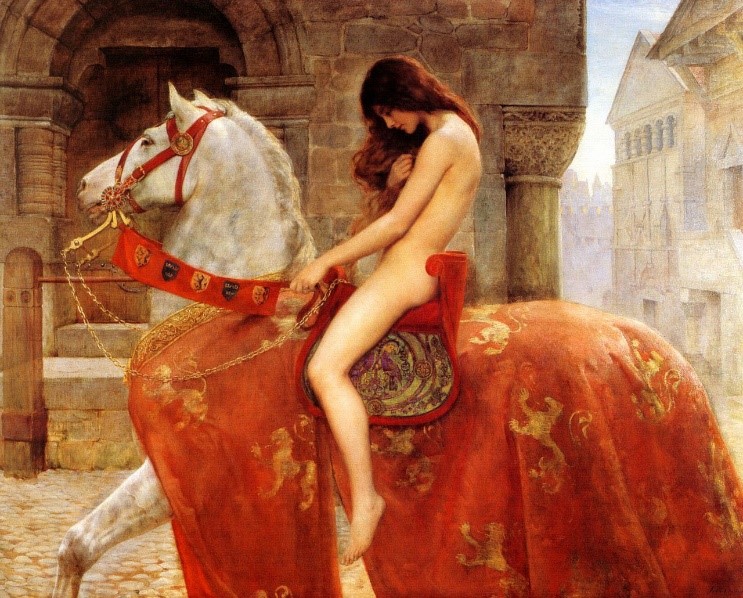
Despite these challenges, many English women found ways to adapt and survive. Some, like the legendary Lady Godiva, who is said to have protested against oppressive taxation under Norman rule, became symbols of resistance. The concept of a Peeping Tom, came from her ride, as a man named Tom was the only one believed to have opened his window to look at her. Such stories, whether more myth than real, highlight the resilience of women during this period of transition.
The Legacy of 1066 for Women
Lady Godiva by John Collier
The long-term effects of the Norman Conquest on English women were profound. The introduction of Norman customs and laws reshaped England, influencing women’s roles and rights for generations to come. The Domesday Book, a comprehensive survey ordered by William the Conqueror, provides insight into the changes in land ownership and societal structures that affected women’s lives.
Women who inherited family land because their husbands or fathers had been killed at Hastings in 1066, were allowed to keep their land if they married a Norman or Frenchman. Such marriages were intended to further the post-conquest social order and peace in England.
William the Conqueror betrothed his daughter Adeliza to the English Earl Edwin, though he was killed in 1070 before the marriage could take place.
Most intermarriages took place at the highest aristocratic level, intended to bring peace, though there were instances of intermarriage at other levels. One example is Wigot of Wallingford, the English guardian of an important crossing of the Thames near Oxford, agreed to have his daughter Ealdgyth marry Robert d’Ouilly, one of King William’s henchmen and later Castellan of Oxford.
The Domesday Book, completed in 1086, reveals that Judith was the most important woman landholder on the date when the Domesday survey was made. Omitting nunneries, she is one of about twenty women tenants-in-chief in 1086. Her extensive lands stretched throughout northern and eastern England, from Middlesex and Buckinghamshire to Yorkshire, with a concentration in the east Midlands. Judith was the widow of Earl Waltheof. She was also the niece of William the Conqueror. She was a northern French woman whose marriage was part of William’s attempts to come to terms with the English nobility after his conquest in 1066. By 1086 Judith’s husband was dead, executed for his part in rebellion. Judith was now a wealthy widow.
Many of the relatively small number of women mentioned in Domesday are relatives of William the Conqueror, illustrating how he had transferred most of the largest landholdings in England to his extended family. See this PDF article for more on the women in Domesday.
Other women, Godgifu and Allfgifu for example, the wives of two English earls, Edwin and Morcar, debated over their attitudes to the Conqueror, but still survived. These widows got to keep their dower and died in possession of at least some of it. They were part of a noble group whose power had arisen during the tenth and early eleventh centuries, and even within that group fortunes differed greatly.
The lack of information about lower born eleventh-century women does not justify sweeping generalization about them, however Domesday does provide some data. The statistics of Domesday suggest at first sight a deterioration in status. In Essex, for example, there were 25 women holding land in 1066, 9 in 1086; in Yorkshire, 19 in 1066, 4 in 1086; in Suffolk over 50 in 1066, 7 in 1066. Yet other shires show no decline, even a slight increase, as in Dorset where there were 9 women in 1066 and 10 in 1086 or in Warwickshire, with 8 in 1066 and 9 in 1086.
The women of 1066 experienced the Norman Conquest not just as a historical event, but as a deeply personal trauma that reshaped their lives and the lives of their descendants. Their stories, often overshadowed by the tales of kings and warriors, offer a poignant perspective on one of England’s most significant historical moments.
In remembering their stories, we honor their legacy, recognizing the vital role women have played in shaping our world. The women of 1066, through their resilience and adaptability, have left an indelible mark on history, reminding us of the power of the human spirit to endure, adapt, and overcome.
About the author:
L.P. O’Bryan is the author of a series of novels set in the aftermath of the Battle of Hastings, starting with, The Rise of Synne, more detail here. The series is about an orphan healer in the aftermath of Hastings.
*
My Books:
Signed, dedicated copies of all my books are available through my online bookshop.
Out Now!Women of the Anarchy
Two cousins. On the one side is Empress Matilda, or Maud. The sole surviving legitimate child of Henry I, she is fighting for her birthright and that of her children. On the other side is her cousin, Queen Matilda, supporting her husband, King Stephen, and fighting to see her own son inherit the English crown. Women of the Anarchy demonstrates how these women, unable to wield a sword, were prime movers in this time of conflict and lawlessness. It show how their strengths, weaknesses, and personal ambitions swung the fortunes of war one way – and then the other.
Coming on 15 June 2024: Heroines of the Tudor World
Heroines of the Tudor World tells the stories of the most remarkable women from European history in the time of the Tudor dynasty, 1485-1603. These are the women who ruled, the women who founded dynasties, the women who fought for religious freedom, their families and love. These are the women who made a difference, who influenced countries, kings and the Reformation. In the era dominated by the Renaissance and Reformation, Heroines of the Tudor World examines the threats and challenges faced by the women of the era, and how they overcame them. From writers to regents, from nuns to queens, Heroines of the Tudor World shines the spotlight on the women helped to shape Early Modern Europe.
King John’s Right-Hand Lady: The Story of Nicholaa de la Haye is the story of a truly remarkable lady, the hereditary constable of Lincoln Castle and the first woman in England to be appointed sheriff in her own right. Available from all good bookshops or direct from Pen & Sword Books, bookshop.org and Amazon. Defenders of the Norman Crown: The Rise and Fall of the Warenne Earls of Surrey tells the fascinating story of the Warenne dynasty, from its origins in Normandy, through the Conquest, Magna Carta, the wars and marriages that led to its ultimate demise in the reign of Edward III. Available from Pen & Sword Books, Amazon in the UK and US, and Bookshop.org.
Alternate Endings: An anthology of historical fiction short stories including Long Live the King… which is my take what might have happened had King John not died in October 1216. Available in paperback and kindle from Amazon.
Podcast:
Have a listen to theA Slice of Medieval podcast, which I co-host with Historical fiction novelist Derek Birks. Derek and I welcome guests, such as Bernard Cornwell and Elizabeth Chadwick, and discuss a wide range of topics in medieval history, from significant events to the personalities involved.
*
Don’t forget!Signed and dedicated copies of all my books are available through my online bookshop.
For forthcoming online and in-person talks, please check out my Events Page.
You can be the first to read new articles by clicking the ‘Follow’ button, liking our Facebook page or joining me on Twitterand Instagram.
Few periods in history have brought women to the fore, to the centre of events, as the Anarchy did in England. From 1135 to 1154, conflict raged when Stephen of Blois usurped the throne that rightfully belonged to his cousin Empress Matilda. During the lifetime of Henry I – Matilda’s father and Stephen’s uncle – Stephen had twice sworn oaths to guarantee the succession for Matilda. But when the time came, when Henry died on 1 December 1135, Stephen broke those oaths, and had himself crowned king in Westminster Abbey just 3 weeks after his uncle’s death.
If he thought Matilda would just accept losing her crown and stay at home with the children, Stephen was sorely mistaken. Pregnant with her third child at the time of her father’s death, Matilda had to bide her time, for a little while. And, as her husband Geoffrey of Anjou campaigned on her behalf in Normandy, Matilda landed in England on 30 September 1139 and her own campaign to claim the crown began.
And she nearly won.
The First Battle of Lincoln
Lincoln Castle
Early in 1141, news reached King Stephen that Ranulf de Gernons, the disgruntled Earl of Chester, had captured Lincoln Castle. Disappointed in his aspirations to Carlisle and Cumberland after they were given to Prince Henry of Scotland, Ranulf had turned his sights on Lincoln Castle, which had once been held by his mother, Lucy of Bolingbroke, Countess of Chester. Countess Lucy had died around 1138, leaving her Lincolnshire lands to her son by her second marriage, William de Roumare, Ranulf’s half-brother. Her lands elsewhere had been left to Ranulf de Gernons, who was the son of her third marriage, to Ranulf le Meschin, Earl of Chester.
It seems that in late 1140 Ranulf and his brother had contrived to gain possession of Lincoln Castle by subterfuge. As the story goes, the two brothers waited until the castle garrison had gone hunting before sending their wives to visit the castellan’s wife. A short while after, Earl Ranulf appeared at the castle gates, wearing no armour and with only three attendants, supposedly to collect his wife and sister-in-law. Once allowed inside, he and his men overpowered the small number of men-at-arms left to guard the castle and opened the gates to his brother. The half-brothers took control of the castle and, with it, the city of Lincoln.
The citizens of Lincoln appealed to the king, who had promptly arrived outside the castle walls by 6 January 1141 and began his siege. Earl Ranulf somehow escaped from the castle and returned to his lands in Chester in order to raise more troops. He also took the opportunity to appeal to his father-in-law for aid. Ranulf’s father-in-law was, Robert, Earl of Gloucester, the illegitimate son of Henry I and brother of Empress Matilda. A very capable soldier, Earl Robert commanded Matilda’s military forces and his daughter, Maud of Gloucester – Ranulf’s wife – was still trapped inside Lincoln Castle. If the need to rescue his daughter was not enough motivation to persuade Robert to intercede at Lincoln, Ranulf also promised to switch his allegiance, and his considerable resources, to Empress Matilda. Robert marched to Lincoln, meeting up with his son-in-law along the way. The earls’ forces arrived on the outskirts of Lincoln on 1 February, crossed the Fossdyke and the River Witham and arrayed for battle. Their rapid approach caught Stephen unawares. Outnumbered, Stephen was advised to withdraw his forces, until he could muster enough men to make an even fight of it.
Stephen, perhaps remembering the destruction of his father’s reputation after his flight from Antioch, refused to withdraw. He would stand and fight. The next morning, 2 February 1141, before battle was joined, King Stephen attended a solemn mass in the cathedral; according to Henry of Huntingdon, who claimed Bishop Alexander of Lincoln as his patron and may well have been present, the service was replete with ill omens:
‘But when, following custom, he offered a candle fit for a king and was putting it into Bishop Alexander’s hands, it broke into pieces. This was a warning to the king that he would be crushed. In the bishop’s presence, too, the pyx above the altar, which contained the Lord’s Body, fell, its chain having snapped off. This was a sign of the king’s downfall.’
Henry of Huntingdon, The History of the English People 1000-1154
After mass, the king led his forces through Lincoln’s West Gate, deploying them either on the slope leading down to the Fossdyke or possibly at the bottom of the slope, on Carrholme. King Stephen formed his army into three divisions, with mounted troops on each flank and the infantry in the centre. On the right flank were the forces of Waleran de Meulan, William de Warenne, Simon de Senlis, Gilbert of Hertford, Alan of Richmond and Hugh Bigod, Earl of Norfolk. The left was commanded by William of Aumale and William of Ypres, Stephen’s trusted mercenary captain, who led a force of Flemish and Breton troops. The centre comprised the shire levy, which included citizens of Lincoln, and Stephen’s own men-at-arms, fighting on foot around the royal standard.
1141 Battle of Lincoln from Historia Anglorum
The opposing army also deployed in three divisions, with ‘the disinherited’, those deprived of their lands by King Stephen, on the left. The infantry, comprising of Earl Ranulf’s Cheshire tenants and other levies, and dismounted knights were in the centre under Earl Ranulf himself. The cavalry, under the command of Earl Robert of Gloucester formed the right flank. The Welsh mercenaries, ‘ill armed but full of spirits’ were arrayed on the wings of the army. Before the battle, Henry of Huntingdon reports, speeches were heard from both sides, exhorting the men to battle and insulting the opposing commanders.
Baldwin fitz Gilbert spoke for King Stephen, whose voice did not carry well. According to Henry of Huntingdon, the armies were mobilising before his speech ended. The rebels were the first to advance, ‘the shouts of the advancing enemy were heard, mingled with the blasts of their trumpets, and the trampling of the horses, making the ground to quake.’ The ranks of the ‘disinherited’ moved forward with swords drawn, rather than lowered lances, intent on close quarter combat. This left flank of the rebel army fell upon Stephen’s right flank, ‘in which were Earl Alan, the Earl of Mellent [Meulan], with Hugh, the Earl of East Anglia [Norfolk], and Earl Symon, and the Earl of Warenne, with so much impetuosity that it was routed in the twinkling of an eye, one part being slain, another taken prisoner and the third put to flight.’ Faced with the ferocity of the assault and the very real prospect of death, rather than being taken prisoner and held for ransom, the earls fled the field with the remnants of their men. It was every man for himself as Stephen’s right wing disintegrated in panic.2
The left wing of the royal army appeared to have greater success, at least initially. The men of William of Aumale, Earl of York and Stephen’s mercenary captain, William of Ypres, rode down the Earl of Chester’s Welsh mercenaries and sent them running, but ‘the followers of the Earl of Chester attacked this body of horse, and it was scattered in a moment like the rest.’3 Other sources suggest that William of Ypres and William of Aumale fled before coming to close quarters with the enemy.4 Either way, William of Ypres’ men were routed and he was in no position to support the king and so fled the field, no doubt aware that he would not be well-treated were he to be captured.
Stephen’s centre, the infantry, including the Lincolnshire levies and the king’s own men-at-arms, were left isolated and surrounded, but continued to fight. Stephen himself was prominent in the vicious hand-to-hand fighting that followed. Henry of Huntingdon vividly describes the desperate scene as ‘the battle raged terribly round this circle; helmets and swords gleamed as they clashed, and the fearful screams and shouts re-echoed from the neighbouring hill and city walls.’5 The rebel cavalry charged into the royal forces killing many, trampling others and capturing some. King Stephen was deep in the midst of the fighting:
‘No respite, no breathing time was allowed, except in the quarter in which the king himself had taken his stand, where the assailants recoiled from the unmatched force of his terrible arm. The Earl of Chester seeing this, and envious of the glory the king was gaining, threw himself upon him with the whole weight of his men-at-arms. Even then the king’s courage did not fail, but his heavy battle-axe gleamed like lightning, striking down some, bearing back others. At length it was shattered by repeated blows, then he drew his well-tried sword, with which he wrought wonders until that, too, was broken.’
Henry of Huntingdon, The History of the English People 1000-1154;
According to Orderic Vitalis and the Gesta Stephani, it was the king’s sword that broke first, before he was passed a battle-axe by one of the fighting citizens of Lincoln, in order to continue the fight. Whatever the order, the king’s weapons were now useless and the king ‘fell to the ground by a blow from a stone.’6 Stephen was stunned and a soldier named William de Cahaignes then rushed at him, seized him by his helmet and shouted, ‘Here! Here! I have taken the king!’
The king’s forces being completely surrounded, flight was impossible. All were killed or taken prisoner, including Baldwin fitz Gilbert, the man who had given the rousing pre-battle speech to the men. In the immediate aftermath of the fighting, Lincoln was sacked, buildings set alight, valuables pillaged, and its citizens slaughtered by the victorious rebels.
Lady of the English
Empress Matilda depicted in an image from the Gospels of Henry the Lion.
Defeated, Stephen was first taken to Empress Matilda and then to imprisonment at Bristol Castle. A victorious Matilda was recognised as sovereign by the English people.
As for Matilda, ‘the lady empress-queen, Henry’s daughter, who was staying at Gloucester, was overjoyed at this event, having now, as it appeared to her, got possession of the kingdom for which fealty had been sworn to her’. As the Gesta Stephani, always insistent on naming Matilda countess rather than empress,relates, ‘the greater part of the kingdom at once submitted to the countess and her adherents and some of the king’s men, involved in sudden disasters, were being either captured or forcibly expelled from their possessions; others, very quickly foreswearing the faith they owed to the king, were voluntarily surrendering themselves and what was theirs to the countess’.
A victorious Matilda was recognised as sovereign by the English people, being named Lady of the English as Winchester in March.
Queen Matilda
Matilda of Boulogne, Queen of England
And Stephen’s greatest asset now showed her mettle.
In April, Stephen’s wife, Queen Matilda, sent a letter that was read out at the Legatine Council in Winchester, presided over by Henry of Blois, papal legate and Bishop of Winchester – and brother of King Stephen. The queen pleaded with the clergy to release the king from his imprisonment and restore him to the throne. As may have been expected, Bishop Henry refused to give in to the queen’s request, but her pleas may have affected a delegation of Londoners, also present, who were still openly loyal to Stephen and would see Queen Matilda’s letter as encouragement for them to maintain their position in the face of the bishop’s persuasion. Clearly the empress had a long way to go before the Londoners would admit her into the capital for her coronation at Westminster Abbey.
However, by mid-June, the empress was at Westminster, outside the city walls of London.
Empress Matilda was now at the height of her success. Her rival was in her custody, the church was on her side, she had the keys to the royal treasury and was about to make a ceremonial entry into London, her capital: ‘The empress, as we have already said, having treated with the Londoners, lost no time in entering the city with a great attendance of bishops and nobles: and being received at Westminster with a magnificent procession, took up her abode there for some days to set in order the affairs of the kingdom.’ Her uncle David, King of Scots and her half-brothers Robert of Gloucester and Reginald de Dunstanville, now Earl of Cornwall, were by her side.
Empress versus Queen
Oxford Castle
With her husband held in chains in Bristol castle, Matilda of Boulogne, Queen of England, wife of King Stephen and cousin of Empress Matilda, stepped into the fight. She first tried to negotiate, offering to take Stephen into exile if Matilda would at least guarantee their son’s inheritance of their ancestral lands. The empress refused, perhaps remembering that no such guarantee was ever made to her son, Henry, dispossessed of his inheritance by Stephen’s usurpation of the crown. Undeterred, Queen Matilda established a secure base in Kent, from where she raised an army to march on London, burning and ravaging the countryside surrounding the capital. It was becoming apparent that the struggle was far from over. A final masterstroke was when she moved up William of Ypres and his Flemish mercenaries, to threaten London, thus inducing the Londoners to turn against the empress.
Henry, Bishop of Winchester, deserted the empress and joined the queen, promising to expend his efforts on obtaining the release of the king, his brother.
The empress’s success was turning sour.
On the eve of the empress’s ceremonial entrance into the capital, the city’s church bells rang out, a prearranged signal for the citizens to rise against the empress and open the gates to the queen’s approaching army. Empress Matilda was still at Westminster, ‘reclining at a well-cooked feast’. Westminster was an unfortified palace that was not easily defensible and ‘being, however, forewarned by some of them, she fled shamefully with her retinue, leaving all her own and their apparel behind’.
The empress had no choice. She and her supporters rode for Oxford. Although things appeared precarious, all was not lost. Queen Matilda now held London, but the empress still had Stephen in her custody and room for manoeuvre. By the end of July, the empress and her army were riding south. As she approached Winchester, the empress sent a request to Bishop Henry to meet her outside the city, at which point he promptly fled to join Queen Matilda at Guildford.
The Rout of Winchester
Robert of Gloucester and his wife, Mabel
Winchester had two castles: the royal castle, which held for the empress, and Wolvesey, a palatial castle in the south-eastern corner of the city that was the residence of Bishop Henry of Winchester, though he was not at home at the time. Empress Matilda arrived at the royal castle of Winchester on 31 July and began the siege of Wolvesey on 1 August 1141.
In defiance, the garrison of the bishop’s castle threw burning material from the ramparts which, in the summer heat, quickly set the whole city ablaze. The stone cathedral survived, but much of the town, built in wood with thatched roofs, was lost. The devastation meant the city’s population had lost their homes and livelihoods, and the empress’s army were deprived of shelter and provisions. Worse, Queen Matilda was now approaching with an army of her own and, in turn, besieged the empress.
The empress’s army was trapped.
Surrounded, with the city in flames and supplies running short, the empress was forced to flee for her life. In the retreat, her half-brother and leading general, Robert, Earl of Gloucester, was captured.
Queen Matilda now had her own bargaining chip. As much as she needed her husband returned to her, the empress needed her brother.
Prisoner Exchange
Henry II
The practical arrangements for the exchange were rather complicated, with neither side trusting the other to hold to the bargain. On 1 November 1141, Queen Matilda surrendered at Bristol Castle, with one of her sons and two unidentified magnates, so that Stephen could be set at liberty. The king then rode to Winchester, where Earl Robert had been taken under guard, and on his arrival on 3 November the earl was freed, leaving his eldest son and heir, William of Gloucester, as surety. When the earl reached Bristol, the queen, her son and the two unnamed magnates were set at liberty and returned to Winchester. At that point, William of Gloucester was freed as well. After nine months of harsh imprisonment, Stephen was free at last.
By Christmas 1141, having endured nine months of incarceration, Stephen was back on his throne and celebrating the festive season at Canterbury, where he was symbolically re-crowned by the archbishop of Canterbury, with his queen by his side.
The empress was faced with the realisation of how close she had come to winning it all.
But lost.
At least she had her brother back and the fight was far from over.
The war would drag on until Stephen’s death in 1154, but the empress never came as close again to winning the crown. She eventually passed the baton to her son, Henry FitzEmpress, who would reign as Henry II. It was a kind of victory: it was her son who succeeded King Stephen rather than his own. Empress Matilda could ultimately claim victory as the crown returned to her line and that of her father, Henry I.
Gesta Stephani, translated by K. R. Potter; Henry of Huntingdon, The History of the English People 1000-1154; Marjorie Chibnall, The Empress Matilda: Queen Consort, Queen Mother and Lady of the English; Teresa Cole, The Anarchy: The Darkest Days of Medieval England; Catherine Hanley, Matilda: Empress, Queen, Warrior; Helen Castor, She-Wolves: The Women who Ruled England before Elizabeth; Robert Bartlett, England Under the Norman and Angevin Kings; J. Sharpe (trans.), The History of the Kings of England and of his Own Times by William Malmesbury; Orderici Vitalis, Historiae ecclesiasticae libri tredecem, translated by Auguste Le Prévost; Chronicles of the Reigns of Stephen, Henry II and Richard I; Edmund King, King Stephen; Donald Matthew, King Stephen; Matthew Lewis, Stephen and Matilda’s Civil War: Cousins of Anarchy.
*
My Books:
Signed, dedicated copies of all my books are available through my online bookshop.
Out Now!Women of the Anarchy
Two cousins. On the one side is Empress Matilda, or Maud. The sole surviving legitimate child of Henry I, she is fighting for her birthright and that of her children. On the other side is her cousin, Queen Matilda, supporting her husband, King Stephen, and fighting to see her own son inherit the English crown. Women of the Anarchy demonstrates how these women, unable to wield a sword, were prime movers in this time of conflict and lawlessness. It show how their strengths, weaknesses, and personal ambitions swung the fortunes of war one way – and then the other.
Coming on 15 June 2024: Heroines of the Tudor World
Heroines of the Tudor World tells the stories of the most remarkable women from European history in the time of the Tudor dynasty, 1485-1603. These are the women who ruled, the women who founded dynasties, the women who fought for religious freedom, their families and love. These are the women who made a difference, who influenced countries, kings and the Reformation. In the era dominated by the Renaissance and Reformation, Heroines of the Tudor World examines the threats and challenges faced by the women of the era, and how they overcame them. From writers to regents, from nuns to queens, Heroines of the Tudor World shines the spotlight on the women helped to shape Early Modern Europe.
King John’s Right-Hand Lady: The Story of Nicholaa de la Haye is the story of a truly remarkable lady, the hereditary constable of Lincoln Castle and the first woman in England to be appointed sheriff in her own right. Available from all good bookshops or direct from Pen & Sword Books, bookshop.org and Amazon. Defenders of the Norman Crown: The Rise and Fall of the Warenne Earls of Surrey tells the fascinating story of the Warenne dynasty, from its origins in Normandy, through the Conquest, Magna Carta, the wars and marriages that led to its ultimate demise in the reign of Edward III. Available from Pen & Sword Books, Amazon in the UK and US, and Bookshop.org.
Alternate Endings: An anthology of historical fiction short stories including Long Live the King… which is my take what might have happened had King John not died in October 1216. Available in paperback and kindle from Amazon.
Podcast:
Have a listen to theA Slice of Medieval podcast, which I co-host with Historical fiction novelist Derek Birks. Derek and I welcome guests, such as Bernard Cornwell and Elizabeth Chadwick, and discuss a wide range of topics in medieval history, from significant events to the personalities involved.
*
Don’t forget!Signed and dedicated copies of all my books are available through my online bookshop.
For forthcoming online and in-person talks, please check out my Events Page.
You can be the first to read new articles by clicking the ‘Follow’ button, liking our Facebook page or joining me on Twitterand Instagram.
It is always a pleasure to welcome historian and author, Toni Mount, to History… the Interesting Bits. Toni enjoys really getting a deep understanding of her characters, the lives they lived and the places they visited. For “The Colour of Sin”, her main characters were off on pilgrimage and that meant a lot of interesting places to research. Here, Toni talks about Canterbury Cathedral and how pilgrimage actually worked. Over to Toni Mount…
A Pilgrim’s Visit to Canterbury Cathedral
Christ Church Gate, Canterbury Cathedral
In order to research my new novel, The Colour of Sin, we visited Canterbury Cathedral. The story would involve our hero, Sebastian Foxley, taking his family on a pilgrimage to visit the shrine of St Thomas Becket in the cathedral, leaving behind his usual haunts in the City of London so a change of venue for him – and for me. I particularly wanted to get a feeling of what it would be like for a fifteenth-century pilgrim, to attempt to see things and experience them as he would have done. Fortunately, we had a wonderfully knowledgeable and helpful guide in Geoff Webb who was a mine of intriguing information.
Firstly, we had to remember that the cathedral was attached to a Benedictine monastery in those days so it was a far bigger larger complex of buildings, including the monks’ dormitory, rere-dorter or latrines, refectory, chapter house, infirmary, kitchen and other areas all of which would have been out-of-bounds to the pilgrims. Today, visitors can wander through the cloisters and view the garden with its water tower but for a pilgrim in 1480 this wouldn’t have been allowed. The magnificent chancel and choir were where the monks continued to hold their services throughout the day even as other areas of the cathedral were thronged with pilgrims. The same is the case today – most ordinary daily services are held in the choir but tourists may pass through whenever a service isn’t in progress, seeing some architectural wonders the medieval pilgrim would not have seen.
Secondly, how were the pilgrims ‘managed’ by the monks? Did they get a guided tour? Were they kept to a set route through the cathedral or could they wander off to admire the art works or the stained glass, or even the tomb or chantry chapel of someone important to them, personally? Geoff pointed out little windows high up, overlooking the place where Becket’s jewel-encrusted shrine would have stood. From here, the monks kept watch on the pilgrims gathered at the tomb, to make sure they behaved reverently and didn’t attempt to prise any gemstones from their settings as souvenirs. Elsewhere, stone seats were placed strategically for the similar purposes, where the monks could keep the crowds in order, if necessary.
The Nave, Canterbury Cathedral
Rather than a guided tour, there was a continuous line of pilgrims circling the cathedral, each following the one in front. On entering, the vast nave with its soaring fluted columns would have dragged every eye heavenwards. There would’ve been no seating but more than likely market stalls selling refreshments, pilgrim badges, phials of holy water and other saleable merchandise, the locals wouldn’t want to miss such a lucrative opportunity. The tour seems to have progressed along the side aisles, the north aisle having a specially constructed covered passage to take the pilgrims to the actual site of Becket’s martyrdom without disturbing the monks. Today, there is a plain stone table with a single candle burning upon it and a sculpture above representing the swords which slew Becket, forming an alarming jagged cross. This dates only to the 1990s but there would have been an altar here until the Reformation of 1538 destroyed it. Also, imprints on the floor show where memorial brasses were laid here, indicating important burials beneath. To the left is the chapel of Our Lady of the Martyrdom and St Blaise, newly constructed by the gifted mason and architect Richard Beke just thirty years before our hero, Seb Foxley’s pilgrimage.
In the area of the Martyrdom a flight of steps leads down to the crypt. For fifty years after he was slain, Becket’s tomb was down here among the Norman semi-circular arches of the 11th-century cathedral with its short, substantial round pillars, each with unique pattern and decoration, awaiting the completion of the ‘modern’ Trinity Chapel overhead. In 1220, the archbishop’s remains were ‘translated’ upstairs to the purpose-built and fabulous shrine. A later Chapel of Our Lady Undercroft was constructed down here in the mid-14th century by the royal architect, Henry Yevele, for Edward, the Black Prince. The prince wished to be buried here but, when he predeceased his father, Edward III, the king insisted that his eldest son, hero of Crecy and Poitiers, wouldn’t be hidden away in the undercroft but should share the prestigious Trinity Chapel with Becket, where every pilgrim would pass by the prince’s tomb and, hopefully, pray for his soul.
View in the Trinity Chapel, of the candle identifying the site of the shrine to St Thomas a Becket.
Beyond the Chapel of Our Lady Undercroft, towards the east, is the original site of Becket’s tomb between 1170 and 1220, still revered today with a candle burning on the floor and, beyond that, the circular Jesus Chapel, dedicated to Christ and his mother, the Virgin Mary. Pilgrims would have visited the undercroft as part of their ‘tour’. Graffiti adorn some of the walls beside the site of the tomb, among them a most artistic rendering of St John with his emblem of a majestic eagle. It’s thought that the graffiti were scratched in the stone by bored monks, spending hours here, watching the earlier pilgrims and making sure they didn’t do anything untoward in God’s house.
Also in the undercroft we saw a real jewel: St Gabriel’s Chapel. Its medieval wall paintings were encased in stone back in the 12th century because the wall was thought to be about to collapse – so Seb would have missed seeing them. Incidentally, this action kept them safe from the destruction of the Reformation and preserved them from the Puritan zealots of the Civil War, too. Now these once-forgotten paintings are revealed. To us, they are a marvel but to our medieval pilgrims they wouldn’t be unusual because the cathedral – and most parish churches – would have been painted with vivid murals, telling stories from the Bible for those who couldn’t read. St Gabriel’s other highlight is the glorious carvings on its central column, sharp, pristine and amusing, animals playing musical instruments, weird beasts and monsters conjured from the mason’s imagination.
Next door is the Black Prince’s Chantry Chapel where he planned prayers would be said forever for him and his beloved wife, Joan of Kent. Sadly for him, nine years after the prince’s death, in her will Joan requested burial beside her first husband and first love, Thomas Holland, Earl of Kent, at the Greyfriars, Stamford, Lincolnshire, and this was granted. The prince’s chantry is now used for services held in French. The Black Prince would have spoken courtly French so perhaps this is appropriate.
The magnificent stained glass of Canterbury Cathedral
Back up to the north aisle, we passed tombs of this archbishop and that, including that of Archbishop Chichele with its cadaver or memento mori beneath it, reminding all that no one escapes death. Next along is the tomb of Archbishop Thomas Bourchier, incumbent at the time of Seb’s visit. Bourchier was getting on in years so it’s quite possible that his tomb could have been under construction in 1480. Along the way, Geoff pointed out the glorious medieval stained glass windows. The Yorkist Royal window is famous, showing Edward IV kneeling with his two legitimate sons (the Princes in the Tower) behind him and facing his wife, Elizabeth Woodville, and their five daughters opposite. It was commissioned by Edward and glazed c.1480 so I don’t know whether Seb could have stood and admired this brand new window.
We climbed the steep stone stairs, dished and worn by the feet of countless pilgrims – I believe the pilgrim circuit ran anticlockwise, so they would have walked down these steps on the north side – up to the Trinity Chapel, now lacking the sumptuous shrine with its colonnaded openings through which pilgrims could reach in and touch the martyr’s coffin within for that moment of extra closeness to sainthood, to beseech Becket to put in a good word to God on their behalf. All around us were the vivid gemstone colours of the Miracle Windows, recording Becket’s known miraculous healings required as testimony to qualify for canonisation by the pope. Geoff told us to look for the green box shown at the end of each miracle story – the cash box in which the healed individual would put his donation to the cathedral in thanks for his recovery and a reminder to the pilgrims to do the same. I imagine these green boxes were all along the pilgrims’ route, maybe chained and the lids locked so nobody could help themselves to the offerings.
Ceiling of the Chapter House
Beyond the Trinity Chapel is the small, circular Corona Chapel, perhaps an even holier point of contact with St Thomas than the shrine. Corona means crown and it was here that the martyr’s severed crown of his head was kept in a jewelled reliquary, the remnant of his mortal remains most closely associated with the moment of his death since this injury killed him. Gory but holy. We were now on the south side of the cathedral.
Here we passed the Black Prince’s tomb, directly opposite that of his nephew, Henry IV and his queen, Joan of Navarre. Henry IV was the first Lancastrian king and had ousted the Black Prince’s son, Richard II, from the throne in 1399 and done away with him. So Henry was greatly in need of prayers for his soul and turned the Chapel of St Edward the Confessor, the saintly king, into a chantry for himself. The Black Prince’s likeness lies in full armour, hands together in prayer, gazing up forever at the tester above him, just as in a medieval bed. The tester is painted with the image of the Trinity for which the prince had special reverence, even clinging to life in his last illness long enough to die on Trinity Sunday. Above the tester are modern but authentic replicas of his helmet, surcoat-of-arms (embroidered by the Royal School of Needlework), gauntlets and shield.
Walking back towards the Choir, Cardinal Archbishop John Morton, nemesis of King Richard III, has a finely painted tomb. Seb would have been spared the sight of his patron’s future enemy. Instead, knowing Seb, he would probably have spent ages gazing at the stained glass and the mural paintings, causing a bottle-neck in the orderly progress of pilgrims around the cathedral, being told to move along by an impatient Benedictine, back down another long flight of worn stone steps – the pilgrims would have climbed these on their knees up towards the shrine – to return to the south aisle of the nave.
Tomb of Edward, the Black Prince
Another intriguing piece of masonry is on the wall of the south aisle. It consists of three little blind arched arcades: two Norman round arches and a pointed one of the earliest style. Geoff suggested this was the mason’s demonstration piece to the dubious monks showing them how a pointed arch would work and look, being a thing never seen before in England. Maybe it’s true, maybe not, but it’s a good story.
A detour up more steps gave us a great view down the nave on one hand and the fantastic 14th-century Choir Screen on the other with its carved Lancastrian kings, constructed to give the monks more privacy as they worshipped while the pilgrims streamed by on either side. Here there’s a massive stone armchair – doesn’t look very comfortable – the seat of the Ostiarius or gate-keeper monk who guarded the entrance to the monks-only choir, making sure no pilgrim wandered in where they didn’t belong.
Outside in the Precinct, we saw the colonnade of huge Norman arches that were once the Infirmary and I have to mention a modern installation – an enormous but charming warhorse, made of off-cuts of fencing.
My thanks go to our marvellous guide, Geoff Webb, and to Melodie Robson for organising this brilliant tour around Canterbury Cathedral and inspiring me with ideas for the novel, The Colour of Sin.
Come with Seb Foxley, Rose and their enigmatic friend Kit, a priest with a shadowy past, as they join a diverse group of pilgrims on what should be an uplifting spiritual journey to Canterbury Cathedral.
Beset by natural disasters and unexplained deaths, the dangers become apparent. Encountering outlaws and a fearsome black cat, every step is fraught with peril.
Amidst the chaos, Seb finds himself grappling with the mysteries surrounding him, as well as his own demons, while Rose’s reunion with her family sets off a chain of events with unforeseen consequences.
But the greatest threat lies in the shadows, where sinister forces unleash evil upon the unsuspecting pilgrims. In a world where trust is a scarce commodity and even allies may harbour dark intentions, Seb must uncover the truth and protect his fellow travellers.
Prepare to be enthralled by a tale of betrayal, intrigue and redemption as Seb Foxley races against time to unravel the malevolent secrets hidden within the heart of the pilgrimage. Who can you trust when even friends prove false?
Praise for Toni Mount’s Sebastian Foxley Medieval Murder Mystery Series
“An evocative masterclass in storytelling.” – Tony Riches, author of The Tudor Trilogy
“It’s superb. What a plot. What characters” – Carol McGrath, author of the She-wolves trilogy
“Toni mount gives you a real sense of actually being there”
“an excellent mystery, with multi-layers of plot”
“Much better than the average period detective story.”
“Toni Mount brings characters leaping off the page… plots that twist and turn, I am in heaven when reading her books”
Competition: Poster Giveaway
Want the chance to win a unique poster of The Colour of Sin by Toni Mount, the twelfth book in her Sebastian Foxley Medieval Murder Mystery series? You’ll be the only person in the world to have this full colour poster! Enter here!
About the Author:
Toni Mount earned her Master’s Degree as a mature student at the University of Kent by completing original research into a unique 15th-century medical manuscript.
She is the author of several successful non-fiction books including the number one bestsellers, Everyday Life in Medieval London and How to Survive in Medieval England, which reflects her detailed knowledge of the lives of ordinary people in the Middle Ages.
Toni’s enthusiastic understanding of the period allows her to create accurate, atmospheric settings and realistic characters for her Sebastian Foxley medieval murder mysteries.
Toni’s first career was as a scientist and this brings an extra dimension to her novels. She writes regularly for The Richard III Society’s Ricardian Bulletin and a variety of history blogs and is a major contributor to MedievalCourses.com.
As well as writing, Toni teaches history to adults, is an enthusiastic member of two creative writing groups and is a popular speaker to groups and societies.
The twelfth novel in Toni’s popular “Sebastian Foxley” murder mystery series, The Colour of Sin, is set in the ancient cathedral city of Canterbury, Kent.
*
My Books:
Signed, dedicated copies of all my books are available through my online bookshop.
Out Now!Women of the Anarchy
Two cousins. On the one side is Empress Matilda, or Maud. The sole surviving legitimate child of Henry I, she is fighting for her birthright and that of her children. On the other side is her cousin, Queen Matilda, supporting her husband, King Stephen, and fighting to see her own son inherit the English crown. Women of the Anarchy demonstrates how these women, unable to wield a sword, were prime movers in this time of conflict and lawlessness. It show how their strengths, weaknesses, and personal ambitions swung the fortunes of war one way – and then the other.
Coming on 15 June 2024: Heroines of the Tudor World
Heroines of the Tudor World tells the stories of the most remarkable women from European history in the time of the Tudor dynasty, 1485-1603. These are the women who ruled, the women who founded dynasties, the women who fought for religious freedom, their families and love. These are the women who made a difference, who influenced countries, kings and the Reformation. In the era dominated by the Renaissance and Reformation, Heroines of the Tudor World examines the threats and challenges faced by the women of the era, and how they overcame them. From writers to regents, from nuns to queens, Heroines of the Tudor World shines the spotlight on the women helped to shape Early Modern Europe.
King John’s Right-Hand Lady: The Story of Nicholaa de la Haye is the story of a truly remarkable lady, the hereditary constable of Lincoln Castle and the first woman in England to be appointed sheriff in her own right. Available from all good bookshops or direct from Pen & Sword Books, bookshop.org and Amazon. Defenders of the Norman Crown: The Rise and Fall of the Warenne Earls of Surrey tells the fascinating story of the Warenne dynasty, from its origins in Normandy, through the Conquest, Magna Carta, the wars and marriages that led to its ultimate demise in the reign of Edward III. Available from Pen & Sword Books, Amazon in the UK and US, and Bookshop.org.
Alternate Endings: An anthology of historical fiction short stories including Long Live the King… which is my take what might have happened had King John not died in October 1216. Available in paperback and kindle from Amazon.
Podcast:
Have a listen to theA Slice of Medieval podcast, which I co-host with Historical fiction novelist Derek Birks. Derek and I welcome guests, such as Bernard Cornwell and Elizabeth Chadwick, and discuss a wide range of topics in medieval history, from significant events to the personalities involved.
*
Don’t forget!Signed and dedicated copies of all my books are available through my online bookshop.
For forthcoming online and in-person talks, please check out my Events Page.
You can be the first to read new articles by clicking the ‘Follow’ button, liking our Facebook page or joining me on Twitterand Instagram.
We have another fabulous guest post to celebrate Women’s History Month 2024. Laura Adkins is visiting History … the Interesting Bits to talk about my favourite of Henry VIII’s six queens, Katherine (or Kateryn, as she would have written it) Parr.
Over to Laura…
A Fairy Step-mother – Kateryn Parr
Kateryn Parr
Although she only had one biological child, two of Kateryn Parr’s marriages would bring her five stepchildren whom she loved dearly as if they were her own.
Katheryn first foray into motherhood was when she became stepmother to Lord Latimer’s teenage son and daughter. It is more than likely that Latimer, when looking for a wife, was after someone who could be a mother to his children and be present in their lives as he was away a lot. He may have seen those motherly qualities in Kateryn. It would be his daughter, Margaret, 9 years old at the time of her father’s marriage to Kateryn, who would grow close to her new stepmother.
Margaret’s own mother had died in 1527 and her first stepmother died in 1530. This led to Kateryn becoming the only mother figure in the young girl’s life, and at an impressionable age. Kateryn would fill the role of mother, treating Margaret as if she were her own, even after Latimer’s death. Kateryn not only had a legal duty to the two teenagers at this time but a sense of parental duty and love.
Margaret’s father had been strongly Catholic, therefore, his children would have been Catholic. However, times were changing and in Margaret’s will there are curtain wordings which give an indication that she was more inclined towards the reformed religion. Could Kateryn have played a role in this? We do not know for certain, but Kateryn would certainly have been aware of Margaret’s beliefs and most likely had some impact on it. The only thing that would separate the two was Margaret’s death at the young age of 21, in 1545. In her will Margaret thanks Kateryn for ‘the godly education and tender love and bountiful goodness which I have ever found in her highness’. Kathryn had provided a mother figure for Margaret during her short life. She had provided the young girl with companionship when an alternative could have been a very lonely existence. Throughout her marriage to Henry, she was then able to bring her stepdaughter into court life and provide her with connections which she may never have had initially.
Mary I, Queen of England
Of Latimer’s eldest child, John, things would be slightly different; however not as a result of Kateryn’s parenting. John was 14 years old when Kateryn and his father married, an age where he would have already established his own views, thoughts and personality. The young boy had been without a mother figure through puberty and his adolescent development. We know, from Kateryn’s own words, that things had been a bit more difficult between stepmother and son than with Kateryn and Margaret. His father did not leave his properties to John, nor appoint him executor of his will. That his father did not have much faith in his sensitive, sulking and lying teenager gives an indication that John was maybe a bit more of a handful than most. And given what he went on to do later in his life (arrested for attempted rape of one of his servants in 1557 and murder in 1563) one can quite believe his upbringing was not an easy task for Kateryn. There must have been some mutual fondness for one another, as when she became queen, she gave his wife a place as one of her ladies-in-waiting. Also, the fact that his aggressive nature came to the surface after her death shows that maybe she had some influence on his nature.
On her marriage to Henry VIII in 1543, Kateryn found herself a stepmother once more, this time to two daughters and a son. These royal children would be familiar to Kateryn and were all at various stages of their lives. Mary was only four years younger than her new stepmother; Elizabeth Tudor was 9, the same age that Margaret had been when Kateryn entered her life and Edward who was approaching the age of 6. Kateryn had a real impact on all three of Henry’s children, so much so that it helped shape their future as monarchs and for Elizabeth as a woman. All three have left in their own words their affection for Kateryn, the first of Henry’s wives that they all accepted and most likely loved.
It was through her love for her stepchildren and not a power play which made Kateryn try to reunite them with their father. She wanted to reconcile the broken family and bring happiness back to the court. She knew such love and happiness growing up and sadness with the loss of her father and wanted to try and assist her stepchildren to have some happiness like she did. Henry had both Mary and Elizabeth re-established in the line of succession, something which Kateryn at least had some part in. It would be at Ashridge in August 1543 where the three Tudor children, Kateryn and their father would stay together for the first time.
Edward VI, King of England
During her role as regent all three of the royal children would stay at the court, with their stepmother. It would be Elizabeth’s longest stay since she was a baby and one which most historians agree had a huge impact on her. Here both Mary and Elizabeth witnessed a woman governing and imposing her authority on her male counsellors. And not just a woman from afar but their stepmother, one who loved them and could and most likely help guide and mentor them, preparing them for their potential futures as powerful women in a world of men.
With Mary, the relationship was more of close friendship. Kateryn was not stupid to try and push herself as stepmother to Mary. She used her new position as queen to try and help Mary, not only to restore her in the line of succession but also to reunite her with her father. The two bonded over their love of fashion, jewellery and music. This friendship had already been established when Kateryn was a lady in Mary’s household after the death of Latimer. Mary would also see Kateryn as another female of learning and virtue and held her stepmother in high regard. The Spanish ambassadors wrote that Kateryn has behaved affectionately towards her [Mary] and go on to thank Kateryn for the kindness shown to the princess. Even their opposing religious beliefs did not seem to hinder their relationship. Kateryn had nothing but love for Mary. and it was through this love which brought her, for the first time in over a decade, some sense of peace, happiness and a form of stability.
For Elizabeth and Edward, her role was ever more impressionable. Edward’s mother, Jane Seymour had died when he was only a few days old. The next two of Henry’s wives were in and out of his life so quickly the young boy barely had time get to know them. A boy who had only had one parent in his life, the distant albeit slightly affectionate Henry. Edward lacked someone who showed him love and affection. It seems he grew with a fence up from female affection. When Kateryn came along, she wanted to knock down the fence and show the boy that it is ok to love and that he was loved and displays of affection were allowed. And she succeeded. From an early stage he was referring to her as his dearest mother and signing himself as her most abundant son. This young boy, who was a secretive cold and judgmental child who showed genuine fondness for very few people had grown attached to his new stepmother and finally had a mother whom he could love and who would love him in return.
For Elizabeth, Kateryn appeared at the time when she was needed the most. The stepmother and daughter were most likely the closest of the Tudor children. Elizabeth was at an age when she needed guidance and understanding; she also needed a mother’s love and someone who could match her growing intelligence. It would be Kateryn who also brought William Grindle onboard to teach Elizabeth, which led to the future queen’s love of the humanist principles. The earliest surviving letter of Elizabeth’s in existence is one she had written to her stepmother, dated 31 July 1544 . She despairs of not seeing Kateryn’s illustrious presence for a whole year and appeals to Kateryn’s clemency to speak to the king on her behalf so she can join them at court. Here Elizabeth feels she can approach her stepmother without repercussions and that her stepmother loved her greatly. She wanted to be not only with the king but Kateryn too at court.
Elizabeth would always sign her letters to Kateryn as ‘Your most obedient daughter and most faithful servant…’ Kateryn had captured the young princess’s heart and interest.
Elizabeth was a bright and intelligent child and noticed what was going on around her. She would not fail to miss the authority of her new stepmother and how she wielded her own power whilst keeping the right balance of femininity, and without, most of the time offending Henry or the men around her.
Elizabeth I, Queen of England
After the death of Henry, Kateryn set up her home at Chelsea, along with Elizabeth. It would be at Chelsea where Elizabeth and Kateryn’s relationship was tested to its limit, nearly severing the close ties these two had for good. Kateryns forth husband, Thomas Seymour began to grow an unhealthy interest in Elizabeth. He started to enter her bedchamber in the early morning before she was dressed and wearing only her undergarments. Her governess, Kat Ashley had tried to dissuade him from doing so and even approached Kateryn herself. There was even an occasion where Kateryn held Elizabeth in a supposed playful jest while Thomas cut Elizabeth’s gown to shreds. Not appropriate behaviour from either of them. It was eventually evident to Kateryn that Elizabeth had feelings for Thomas. Because of his lust for her stepdaughter and for reasons of propriety, Kateryn sent Elizabeth away from Chelsea. Kateryn had by this time found out she was pregnant; she wanted Thomas to only have eyes for her and knew the implications that could happen should word get out of what was going on, and under her own roof. It had to stop, and more importantly she needed it to stop for the love she bore Elizabeth as her stepmother, even though she was hurt by Elizabeth’s actions. Although this flirtation with Thomas and the danger it had put them in had been a huge thrust of the knife at Kateryn, her love for Elizabeth did not wane. Within weeks Kateryn had written to Elizabeth, and she had written back. Both were declaring their love for one another, with Kateryn missing her young charge.
Kateryn approached the role of motherhood with all her heart and passion for her stepchildren as if they were her own flesh and blood. Lord Latimer certainly saw something in her when he chose her to be his wife, he wanted not only a companion but a mother to John and Margaret. Kateryn’s involvement with Henry’s children’s lives was accepted, encouraged and appreciated by the king. He may have even finally enjoyed playing happy families after all the turmoil of the previous few decades. Her warmth and affection assisted her in persuading him to place his daughters back into the line of succession. For Mary it was a little different as she had experienced it from her biological mother, but this love had been torn from her when she needed it most. Maybe Kateryn had helped bring back those cherished memories to her. Kateryn was able to provide her stepdaughters with a female role model, who they could look up to and learn from. Particularly as two of her stepdaughters were of royal blood who might one day become queens. This mother’s love she provided would have certainly made an impact on how they approached womanhood and their confidence that they could perform their role as queen.
About the Author:
Ever since being inspired by her history teacher in secondary school and the 1997 movie Titanic, Laura has had a passion for history, especially medieval and Tudor eras. She writes her blog the Local History Blogger which focuses on her home county of Essex, England. In her past jobs, she has been fortunate to work in historic locations such as the Tower of London and Banqueting House, Whitehall where she gave public talks on its history and talks on the Tudors and Stuarts. Her other passion in life is her daughter who now joins Laura on her history trips and outings. When she is not exploring Laura enjoys reading and adding to her growing collection of books. Katheryn Parr: Henry VIII’s Sixth Queen is her first book.
To Buy the Book:
Laura’s book Kateryn Parr: Henry VIII’s sixth queen is now available in Hardback from Pen and Sword.
1. Kateryn Parr – after Master John, c.1545. Oil on panel. The original portrait was initially thought to be of Lady Jane Grey and was only recently attributed to be Kateryn. Public domain image, via Wikimedia Common
2. Queen Mary Tudor – Anthonis Mor, 1554. Oil on panel. Public domain image, via Wikimedia Commons
3. King Edward VI – Workshop of Master John, c.1547. Public domain image, via Wikimedia Common
4. The young Princess Elizabeth – attributed to William Scrots, c.1546-1547. Oil on oak panel .Public domain image, via Wikimedia Commons
*
My Books:
Signed, dedicated copies of all my books are available through my online bookshop.
Out Now!Women of the Anarchy
Two cousins. On the one side is Empress Matilda, or Maud. The sole surviving legitimate child of Henry I, she is fighting for her birthright and that of her children. On the other side is her cousin, Queen Matilda, supporting her husband, King Stephen, and fighting to see her own son inherit the English crown. Women of the Anarchy demonstrates how these women, unable to wield a sword, were prime movers in this time of conflict and lawlessness. It show how their strengths, weaknesses, and personal ambitions swung the fortunes of war one way – and then the other.
Coming on 15 June 2024: Heroines of the Tudor World
Heroines of the Tudor World tells the stories of the most remarkable women from European history in the time of the Tudor dynasty, 1485-1603. These are the women who ruled, the women who founded dynasties, the women who fought for religious freedom, their families and love. These are the women who made a difference, who influenced countries, kings and the Reformation. In the era dominated by the Renaissance and Reformation, Heroines of the Tudor World examines the threats and challenges faced by the women of the era, and how they overcame them. From writers to regents, from nuns to queens, Heroines of the Tudor World shines the spotlight on the women helped to shape Early Modern Europe.
King John’s Right-Hand Lady: The Story of Nicholaa de la Haye is the story of a truly remarkable lady, the hereditary constable of Lincoln Castle and the first woman in England to be appointed sheriff in her own right. Available from all good bookshops or direct from Pen & Sword Books, bookshop.org and Amazon. Defenders of the Norman Crown: The Rise and Fall of the Warenne Earls of Surrey tells the fascinating story of the Warenne dynasty, from its origins in Normandy, through the Conquest, Magna Carta, the wars and marriages that led to its ultimate demise in the reign of Edward III. Available from Pen & Sword Books, Amazon in the UK and US, and Bookshop.org.
Alternate Endings: An anthology of historical fiction short stories including Long Live the King… which is my take what might have happened had King John not died in October 1216. Available in paperback and kindle from Amazon.
Podcast:
Have a listen to theA Slice of Medieval podcast, which I co-host with Historical fiction novelist Derek Birks. Derek and I welcome guests, such as Bernard Cornwell and Elizabeth Chadwick, and discuss a wide range of topics in medieval history, from significant events to the personalities involved.
*
Don’t forget!Signed and dedicated copies of all my books are available through my online bookshop.
For forthcoming online and in-person talks, please check out my Events Page.
You can be the first to read new articles by clicking the ‘Follow’ button, liking our Facebook page or joining me on Twitterand Instagram.