Yolande and the Hope for the Scottish Succession

330px-sceau_de_yolande_decosse_-_duchesse_de_bretagne
Yolande de Dreux

Yolande de Dreux was Scotland’s Queen Consort for only  4 months and 14 days. In that short time, she carried the hope of a nation – and its king – to secure the Scottish succession.

Yolande was born into a cadet branch of the French royal family, probably sometime in the mid-1260s. Her father was Robert IV, Count of Dreux, who died in 1282 and her mother was Beatrice de Montfort, who died  in 1311. Beatrice was the daughter of Count Jean I de Montfort l’Amoury and his wife Jeanne de Chateaudun, Beatrice was therefore a great-granddaughter of Simon de Montfort, earl of Leicester, and heiress to the impressive de Montfort estates. One of 6 children, Yolande had 2 brothers and 3 sisters. Little is known of Yolande’s childhood but we can imagine that as a junior member of the Capetian dynasty, she grew up amidst some privilege and splendour.

Whilst Yolande was growing into adulthood Scotland was experiencing a “golden age”, a period of relative peace and prosperity. Her king, Alexander III was married to Margaret, daughter of Henry III of England and the couple had 3 children survive childhood. Their daughter, Margaret, born at Windsor on 28th February, 1261,  was married to Erik II, king of Norway, in August 1281. Their eldest son, Alexander, was born on 21st January 1264, at Jedburgh. On 15th November 1282 Alexander married Margaret, the daughter of Guy de Dampierre, Count of Flanders. A younger son, David was born on 20th March 1273.

Queen Margaret died in 1275 and within 8 years all 3 of her children were dead; 8-year-old David died at Stirling Castle at the end of June 1281, Margaret died in childbirth on 9th April 1283 and Alexander died at Lindores Abbey in January 1284, sometime around his 20th birthday. Alexander’s heir was now his infant granddaughter by Margaret and Erik, little Margaret, the Maid of Norway, born shortly before her mother’s death.

dscn4964
Jedburgh Abbey

With his entire dynasty resting on the life of his toddler granddaughter, Alexander started the search for a new wife. In February 1285 he sent a Scottish embassy to France for this sole purpose. Their successful search saw Yolande arrive in Scotland that same summer, accompanied by her brother John. Alexander and Yolande were married at Jedburgh Abbey, Roxburghshire, on 14th October 1285, the feast of St Calixtus, in front of a large congregation made up of Scottish and French nobles. Yolande was probably no more than 22 years of age, while Alexander was in his 44th year.

The marriage was one of the shortest in British royal history – and the shortest of any English or Scottish king, lasting less than 5 months. Tragedy struck on 19 March 1286.

Alexander had spent the day attending a council meeting in Edinburgh. When the meeting broke up he set off on horseback to join his wife at Kinghorn Castle in Fife. It was said he wanted to be there to celebrate her birthday and he may also have recently discovered that she was pregnant with the much-desired heir. For whatever the reason, he was eager to get to her and took only a small escort of 3 men and 2 local guides. It seems that, with bad weather closing in and daylight fading, several people counselled against continuing the journey, including the ferryman at the River Forth and the bailie at Inverkeithing, who argued that Alexander should stay the night and continue his journey in the morning as a heavy storm was brewing.

330px-alexander_iii_and_ollamh_righ
Alexander III

Only 8 miles from his destination, Alexander would hear none of it and insisted on continuing his journey. He somehow lost his escort in the dark and worsening weather, but continued alone. It was the next morning when his body was found on the foreshore of Pettycur, just a mile from his destination. The most likely explanation was that his horse had stumbled, throwing the king whose neck was broken in the fall, although at least one historical fiction writer has suggested foul play while others have suggested the king was drunk.

There followed months of uncertainty in Scotland. She had lost one of her most successful kings and the succession was in turmoil. Little Margaret, the Maid of Norway, had been recognised by the council as Alexander’s heir, but his queen was pregnant; and if she gave birth to a boy he would be king from his first breath. A regency council was established to rule until the queen gave birth.

In the event, Yolande either suffered a miscarriage, or the child was stillborn. Some sources, the Lanercost Chronicle in particular, have questioned whether Yolande was pregnant at all, suggesting that she was intending to pass off another woman’s baby as her own. The plan thwarted, the chronicle recorded that ‘women’s cunning always turns toward a wretched outcome‘.¹ However, there are major discrepancies in the chronicle’s apparently malicious account and tradition has the baby buried at Cambuskenneth.
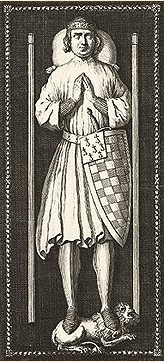
artur_bretan
Arthur of Brittany

The throne passed to little Margaret and arrangements began to have her brought to England, with marriage negotiations being opened with Edward I for the little queen to marry his son and heir; the future Edward II. Yolande continued to reside in Scotland for some time, possibly at Stirling Castle, and was confirmed in her dower properties, which included an annual income of £200 from Berwick; she also had estates in the sheriffdom of Stirling and a horse stud at Jedworth.

Margaret’s death at sea in 1290, while on her journey to her new kingdom, threw Scotland into years of turmoil, with 13 nobles advancing their competing claims to the crown and Edward I of England claiming the right to choose Alexander III’s successor, and recognition as Scotland’s overlord. The English king’s imperialist ambitions had thrown Scotland into crisis by 1296.

Luckily for Yolande, she was already far away from Scotland and the brewing wars. In May 1294 Yolande had married for a second time; Arthur of Brittany was a similar age to Yolande and was the son and heir of Jean II, duke of Brittany and earl of Richmond. Yolande was the second wife of Arthur, who already had 3 sons, Jean, Guy and Peter, by his first wife, Marie, Vicomtesse de Limoges.

It is possible that Arthur chose Yolande as a bride due to the impressive de Montfort territories that she stood to inherit from her mother, although there were legal wranglings between Yolande and her younger sister, Jeanne, who also claimed the lands.
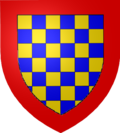
120px-blason_comtes_dreux
Arms of the counts of Dreux

Yolande and Arthur had 6 children together. Their eldest daughter, Joan was born a year after their marriage and married Robert, Lord of Cassel; she died in 1363. Beatrice was born c.1295 and married Guy, Lord of Laval; she lived until 1384. Their only son, John, was probably born 1295/6 and married Joan of Flanders. Of the 3 youngest daughters: Alice was born in the late 1290s married Bouchard VI, Count of Vendôme and died in 1377; Blanche was born in 1300 and died young; Mary was born in 1302 and became a nun, she died in 1377.

Arthur succeeded his father as Duke of Brittany in 1305 and ruled until his death in 1312. He was succeeded by John III, his eldest son by his first marriage. However, John’s death in 1341 sparked the War of the Breton Succession when Yolande’s son, John de Montfort, claimed the duchy in place of Joan of Penthièvre, daughter of Guy (Arthur’s 2nd son by his 1st wife), who was married to Charles of Blois, nephew of King Philip VI of France. Joan and Charles were therefore backed by the French crown, and Edward III of England supported the claims of John de Montfort; the war eventually became part of the greater conflict, the Hundred Years War. When John fell ill and died in 1345, the war continued in the name of his 6-year-old son and Yolande’s grandson, another John (John IV, duke of Brittany) and finally ended in John’s favour with the treaty of Guérande in April 1365.
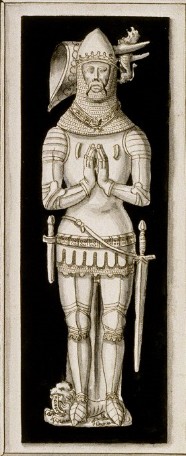
jan5bretan
John IV Duke of Brittany

After being widowed for a second time Yolande did not remarry.

During her time in Brittany Yolande continued to administer to her Scottish estates; in October 1323 safe-conduct to Scotland was granted to a French knight  ‘for the dower of the Duchess of Brittany while she was Queen of Scotland‘.² It seems uncertain when Yolande died. Sources vary between 1324 and 1330, although she was still alive on 1st February 1324 when she made provision for the support of her daughter, Marie, who had become a nun.

These arrangements for her daughter are the last mention of Yolande in the historical record, the date of her death as uncertain as that of her birth.

*

Footnotes: ¹ Chronique de Lanercost, 118,  quoted by Jessica Nelson in Oxforddnb.com. ²CSP Scot.. 3. no. 829 quoted by Jessica Nelson in Oxforddnb.com.

*

Pictures courtesy of Wikipedia, except Jedburgh Abbey, which is ©2016 Sharon Bennett Connolly.

*

Sources: Marc Morris Edward I: A Great and Terrible King by Marc Morris;  Brewer’s British Royalty by David Williamson; The Mammoth Book of British kings & Queens by Mike Ashley; Britain’s Royal Families by Alison Weir; The Oxford Companion to British History edited by John Cannon; The History Today Companion to British History Edited by Juliet Gardiner and Neil Wenborn; The Story of Scotland by Nigel Tranter; Scotland, History of a Nation by David Ross; oxforddnb.com; undiscoveredscotland.co.uk; freelancehistorywriter.com.

*

My books

Signed, dedicated copies of all my books are available through my online store.

Out now: Scotland’s Medieval Queens

Scotland’s history is dramatic, violent and bloody. Being England’s northern neighbour has never been easy. Scotland’s queens have had to deal with war, murder, imprisonment, political rivalries and open betrayal. They have loved and lost, raised kings and queens, ruled and died for Scotland. From St Margaret, who became one of the patron saints of Scotland, to Elizabeth de Burgh and the dramatic story of the Scottish Wars of Independence, to the love story and tragedy of Joan Beaufort, to Margaret of Denmark and the dawn of the Renaissance, Scotland’s Medieval Queens have seen it all. This is the story of Scotland through their eyes.

Available now from Amazon and Pen and Sword Books

Also by Sharon Bennett Connolly:
Heroines of the Tudor World tells the stories of the most remarkable women from European history in the time of the Tudor dynasty, 1485-1603. These are the women who ruled, the women who founded dynasties, the women who fought for religious freedom, their families and love. Heroines of the Tudor World is now available for pre-order from Amberley Publishing and Amazon UK. Women of the Anarchy demonstrates how Empress Matilda and Matilda of Boulogne, unable to wield a sword themselves, were prime movers in this time of conflict and lawlessness. It shows how their strengths, weaknesses, and personal ambitions swung the fortunes of war one way – and then the other. Available from Bookshop.orgAmberley Publishing and Amazon UKKing John’s Right-Hand Lady: The Story of Nicholaa de la Haye is the story of a truly remarkable lady, the hereditary constable of Lincoln Castle and the first woman in England to be appointed sheriff in her own right. Available from all good bookshops Pen & Sword Booksbookshop.org and Amazon

Defenders of the Norman Crown: The Rise and Fall of the Warenne Earls of Surrey tells the fascinating story of the Warenne dynasty, from its origins in Normandy, through the Conquest, Magna Carta, the wars and marriages that led to its ultimate demise in the reign of Edward III. Available from Pen & Sword BooksAmazon in the UK and US, and Bookshop.orgLadies of Magna Carta: Women of Influence in Thirteenth Century England looks into the relationships of the various noble families of the 13th century, and how they were affected by the Barons’ Wars, Magna Carta and its aftermath; the bonds that were formed and those that were broken. It is now available in paperback and hardback from Pen & SwordAmazon, and Bookshop.orgHeroines of the Medieval World tells the stories of some of the most remarkable women from Medieval history, from Eleanor of Aquitaine to Julian of Norwich. Available now from Amberley Publishing and Amazon, and Bookshop.orgSilk and the Sword: The Women of the Norman Conquest traces the fortunes of the women who had a significant role to play in the momentous events of 1066. Available now from Amazon,  Amberley Publishing, and Bookshop.org.

Alternate Endings: An anthology of historical fiction short stories including Long Live the King… which is my take what might have happened had King John not died in October 1216. Available in paperback and kindle from Amazon.

Podcast:

Have a listen to the A Slice of Medieval podcast, which I co-host with Historical fiction novelist Derek Birks. Derek and I welcome guests, such as Bernard Cornwell and Michael Jecks, and discuss a wide range of topics in medieval history, from significant events to the personalities involved. Every episode is also now available on YouTube.

*

Don’t forget! Signed and dedicated copies of all my books are available through my online store.

For forthcoming online and in-person talks, please check out my Events Page.

You can be the first to read new articles by clicking the ‘Follow’ button, liking our Facebook page or joining me on TwitterThreadsBluesky and Instagram.

*

©2016 Sharon Bennett Connolly, FRHistS
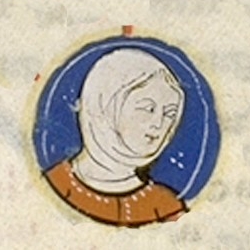
Adela of Normandy – Daughter of the Conqueror

Adela
Adela of Normandy, Countess of Blois and Chartres

Adela of Normandy was the daughter of William the Conqueror, Duke of Normandy and King of England,  and his wife, Matilda of Flanders.

Although most sources give her date of birth around 1061/2, the Oxford Database of National Biography argues that her birth was after the Norman Conquest, as contemporary poetry suggests she was born the daughter of a king, rather than a duke.

Adela was one of nine or ten children born to William and Matilda, with at least four sisters and four brothers, although only three of her brothers survived to adulthood. Given her high level of literacy, and her patronage of poets in adulthood, it is likely that Adela was very well-educated as a child; either through tutors or possibly through residence in a convent, as happened with many daughters of the nobility at that time.

As a child, it seems, a marriage was arranged between Adela and Simon Crispin, count of Amiens; however, the groom chose to take monastic vows and an alternative marriage had to be found. As part of an alliance directed against the aggressive counts of Anjou, Adela was then  betrothed to Stephen of Blois, son of Count Theobald III, count of Blois and Champagne. Stephen was about 20 years older than his bride. The formal betrothal took place at Bourgueil and was later followed by a lavish wedding ceremony in Chartres Cathedral in about 1081.

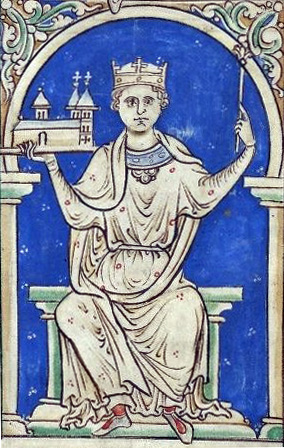
StepanBlois_1089
Stephen, Count of Blois and Chartres

Adela and Stephen would have up to eleven children in all, with at least two sons born before Stephen succeeded his father as Count of Blois and Champagne in 1090.

Of their five daughters, Matilda married Richard d’Avranches, 2nd Earl of Chester. Tragically, he couple drowned in the White Ship disaster which deprived Henry I of his son and heir, William. Another daughter, Eleanor, married Raoul, Count of Vermandois. He was the brother of Isabelle de Vermandois, Countess of Leicester and Surrey.

Adela’s eldest surviving son seems to have been disinherited at an early age. However, while he is described as an ‘idiot’ by some, William was married to Agnes, the daughter of Giles, Lord of Sulli, and was given the titles Count of Chartres and Lord of Sulli, but was not allowed to inherit the richer county of Blois; which went to his younger brother, Theobald.

Poetry from the time of her wedding describes Adela as valorous, learned and generous. Indeed, she seems to have been a great asset to her husband, who included her in charitable donations and even in his early judicial rulings. Adela developed a cordial relationship with Bishop Ivo of Chartres, which worked well to maintain the peace between the laity and the clergy in the county.

In 1095 Stephen of Blois joined the First Crusade, leaving Adela as head of the family and regent of his domains.  Letters that the count sent to his wife indicate a great level of affection and trust; Adela was given charge of the family’s finances. However, Stephen’s return from crusade appears of have been less than happy. Adela  believed that he had not fulfilled his crusader’s vow and her criticism may have been a contributing factor in his return to the Holy Land in 1101 – she certainly approved of it.

Theobald
Theobald IV, Count of Blois and Champagne

Stephen was killed in combat in the Holy Land, during the siege of Ramallah in May 1102. He was succeeded as Count of Blois by his 2nd surviving son, Theobald. Theobald was knighted in 1107, by which point his older brother, William, had already been removed from the succession to Blois. William inherited the lesser title of Count of Chartres.

Following Stephen’s death Adela continued to act as regent until Theobald attained his majority. Even after Theobald came of age, mother and son ruled jointly until Adela retired from public life in 1120.

Adela was particularly close to her younger brother, Henry, who would later become King Henry I of England. She even supported him against their oldest brother, Robert, when Henry claimed the English crown.

An able administrator and negotiator, Adela settled many disputes among monasteries, and even between monasteries and laymen, in her own domains and beyond. Anselm, archbishop of Canterbury during the reign of William II and Henry I, praised her skills as negotiator and peacemaker following her success at achieving a temporary truce between Anselm and her brother in 1105.

HenryBlois
Henry of Blois, Bishop of Winchester

Anselm described her as an ardent supporter of papal reform, and enjoyed her hospitality during his exile from England. Adela hosted many other church dignitaries, including archbishop Thurstan of York and Pope Paschal II. Her family’s prestige and power was bolstered by her friendships with the leading ecclesiastic figures in both France and England.

An avid  patroness of the arts, Adela corresponded with such dignitaries as Hildebert, bishop of Le Mans and Abbot Baudri of Bourgeuil – later bishop of Dol – who both wrote poems dedicated to the countess. The book Ecclesiastical History Together with the Deeds of the Romans and the Franks, written by Hugh of Fleury, was dedicated to Adela.

One of Adela’s youngest sons, Henry of Winchester, was dedicated to the church at an early age, and was raised at the Priory of Cluny in France. He was nominated as Bishop of Winchester in 1129 and was a great support to his older brother, Stephen, when he claimed the throne of England on his uncle Henry’s death in 1135, at the expense of Henry’s daughter, Matilda

An active ruler Adela regularly toured the family’s domains, both as regent and mother of the reigning count. She also maintained links with the Anglo-Norman and Capetian kings. In 1101 Adela sent knights to help Philip I of France’s son, Louis, battling against rebels north of Paris.

Stepan_Blois
King Stephen

However, by 1107 her son Theobald had joined the revolt and relations with France were to deteriorate further in 1113 when the allied forces of Theobald, Henry I and Adela defeated a Capetian-Angevin army. After further conflict in 1118 Adela used her wealth and diplomatic skills to benefit her family.

In 1120 Adela stopped using the title of countess and retired to the Clunaic Priory of Marcigny;  the same year that her daughter Matilda died in the White Ship disaster off Barfleur in Normandy. She continued to be active in political affairs and lived to see her son, Stephen, claim the throne of England, though not the 20 years of conflict that ensued.

Aged almost 70, and having been a widow for half of her life, this most remarkable woman, Adela of Normandy, former Countess of Blois and Chartres, died in 1137, possibly on 8th March. Although later tradition has her buried with her mother at Holy Trinity in Caen, contemporary sources say she was buried at Marcigny.

*

Pictures courtesy of Wikipedia

*

Sources: England Under the Norman and Angevin Kings  by Robert Bartlett; Heroines of the Medieval World by Sharon Bennett Connolly; Silk and the Sword: The Women of the Norman Conquest by Sharon Bennett Connolly;  Brewer’s British Royalty by David Williamson; Britain’s Royal Families, the Complete Genealogy by Alison Weir; The Mammoth Book of British Kings and Queens by Mike Ashley; oxforddnb.com;  epistolae.ccnmtl.columbia.edu; womenshistory.about.com.

*

My Books

Signed, dedicated copies of all my books are available through my online bookshop.

Out now: Scotland’s Medieval Queens

Scotland’s history is dramatic, violent and bloody. Being England’s northern neighbour has never been easy. Scotland’s queens have had to deal with war, murder, imprisonment, political rivalries and open betrayal. They have loved and lost, raised kings and queens, ruled and died for Scotland. From St Margaret, who became one of the patron saints of Scotland, to Elizabeth de Burgh and the dramatic story of the Scottish Wars of Independence, to the love story and tragedy of Joan Beaufort, to Margaret of Denmark and the dawn of the Renaissance, Scotland’s Medieval Queens have seen it all. This is the story of Scotland through their eyes.

Available now from Amazon and Pen and Sword Books

Also by Sharon Bennett Connolly:

Heroines of the Tudor World tells the stories of the most remarkable women from European history in the time of the Tudor dynasty, 1485-1603. These are the women who ruled, the women who founded dynasties, the women who fought for religious freedom, their families and love. Heroines of the Tudor World is now available for pre-order from Amberley Publishing and Amazon UK. Women of the Anarchy demonstrates how Empress Matilda and Matilda of Boulogne, unable to wield a sword themselves, were prime movers in this time of conflict and lawlessness. It shows how their strengths, weaknesses, and personal ambitions swung the fortunes of war one way – and then the other. Available from Bookshop.orgAmberley Publishing and Amazon UKKing John’s Right-Hand Lady: The Story of Nicholaa de la Haye is the story of a truly remarkable lady, the hereditary constable of Lincoln Castle and the first woman in England to be appointed sheriff in her own right. Available from all good bookshops Pen & Sword Booksbookshop.org and Amazon

Defenders of the Norman Crown: The Rise and Fall of the Warenne Earls of Surrey tells the fascinating story of the Warenne dynasty, from its origins in Normandy, through the Conquest, Magna Carta, the wars and marriages that led to its ultimate demise in the reign of Edward III. Available from Pen & Sword BooksAmazon in the UK and US, and Bookshop.orgLadies of Magna Carta: Women of Influence in Thirteenth Century England looks into the relationships of the various noble families of the 13th century, and how they were affected by the Barons’ Wars, Magna Carta and its aftermath; the bonds that were formed and those that were broken. It is now available in paperback and hardback from Pen & SwordAmazon, and Bookshop.orgHeroines of the Medieval World tells the stories of some of the most remarkable women from Medieval history, from Eleanor of Aquitaine to Julian of Norwich. Available now from Amberley Publishing and Amazon, and Bookshop.orgSilk and the Sword: The Women of the Norman Conquest traces the fortunes of the women who had a significant role to play in the momentous events of 1066. Available now from Amazon,  Amberley Publishing, and Bookshop.org.

Alternate Endings: An anthology of historical fiction short stories including Long Live the King… which is my take what might have happened had King John not died in October 1216. Available in paperback and kindle from Amazon.

Podcast:

Have a listen to the A Slice of Medieval podcast, which I co-host with Historical fiction novelist Derek Birks. Derek and I welcome guests, such as Bernard Cornwell and Michael Jecks, and discuss a wide range of topics in medieval history, from significant events to the personalities involved. Every episode is also now available on YouTube.

*

Don’t forget! Signed and dedicated copies of all my books are available through my online bookshop.

For forthcoming online and in-person talks, please check out my Events Page.

You can be the first to read new articles by clicking the ‘Follow’ button, liking our Facebook page or joining me on Twitter and Instagram.

*

©2015 Sharon Bennett Connolly FRHistS.

The Complicated Love Life of John of Gaunt

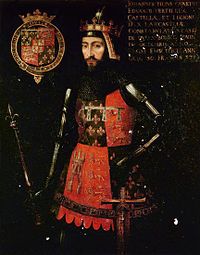
200px-johnofgaunt
John of Gaunt, Duke of Lancaster

The third surviving son of Edward III and Philippa of Hainault John of Gaunt was born in 1340 at the Abbey of St Bavon, in Ghent in modern-day Belgium. At the height of his career he was the most powerful man in the kingdom after the king. He was virtually regent for his father, Edward III, in his old age, thus getting the blame for military failures and government corruption. His reputation was further damaged when he blocked the reforms of the Good Parliament of 1376, which had tried to curb the corruption of Edward III’s and limit the influence of the king’s grasping mistress, Alice Perrers.

John of Gaunt’s wealth meant he could form the largest baronial retinue of knights and esquires in the country. He alone provided a quarter of the army raised for Richard II’s Scottish campaign in 1385. A stalwart supporter of his nephew, Richard II, he was the target for the rebels during the Peasants’ Revolt; his London residence, the Savoy Palace, was burned to the ground in 1381.

He was a soldier and statesman whose career spanned 6 decades and several countries, including England, Belgium, France, Scotland and Castile. However, by far the most fascinating part of his life is his love life. John married three times; his wives being two great heiresses and a long-time mistress.

John of Gaunt’s first marriage, at the age of 19, was aimed to give him prestige, property and income and was arranged as part of his father’s plans to provide for the futures of several of his children. John and 14-year-old Blanche of Lancaster, youngest daughter of Henry of Grosmont, Duke of Lancaster, were married on 19th May 1359 in the Queen’s Chapel at Reading.

Gaunt marriage
Wedding of John of Gaunt and Blanche of Lancaster

It is quite likely that John had already fathered one child, a daughter, Blanche, by Marie de St Hilaire before his marriage. Blanche was born sometime before 1360 and would go on to marry Sir Thomas Morieux before her death in 1388 or 1389.

Blanche of Lancaster was described as “jone et jolie” – young and pretty – by the chronicler Froisssart, and also “bothe fair and bright” and Nature’s “cheef patron of beautee” by Geoffrey Chaucer. She brought John of Gaunt the earldom of Lancaster following her father’s death from plague in 1361, and those of Leicester and Lincoln when her older sister, Matilda, died of the same disease in 1362, making him the largest landowner in the country, after the king.

The marriage proved very successful, with 7 children being born in just 8 years, 3 of whom survived infancy; daughters Philippa and Elizabeth and a son, Henry of Bolingbroke.

It has always been believed that Blanche died in 1369, when John of Gaunt was away in France, having moved her young family to Bolingbroke Castle in Lincolnshire, to escape a fresh outbreak of the Black Death, but that she succumbed to the plague while there. However, recent research has discovered that Blanche died at Tutbury on 12th September, 1368, more likely from the complications of childbirth than from the plague, following the birth of her daughter, Isabella, who died young. Her husband was by her side when she died and arranged to have prayers said for the soul of his lost duchess.

She was buried in St Paul’s Cathedral in London. John of Gaunt arranged for a splendid alabaster tomb and annual commemorations for the rest of his life. John also commissioned Geoffrey Chaucer to write The Book of the Duchess, also known as The Deth of Blaunche; a poem that is said to depict Gaunt’s mourning for his wife, in the tale of a Knight grieving for his lost love. In it Chaucer describes Blanche as “whyt, smothe, streght and flat. Naming the heroine “White”, he goes on to say she is “rody, fresh and lyvely hewed”.

Before 1365 Blanche had taken into her household a lady called Katherine Swynford, wife of one of her husband’s Lincolnshire knights. John was godfather to the Swynfords’ daughter, Blanche. Katherine later became governess to Blanche’s two daughters, Philippa and Elizabeth and young Blanche Swynford was lodged in the same chambers as the Duchess’s daughters, and accorded the same luxuries as the princesses.

Surrender
Surrender of Santiago de Compostela to John of Gaunt. Constance is the lady on horseback (Froissart)

Katherine was the daughter of a Hainault knight, Sir Paon de Roet of Guyenne, who came to England in the retinue of Queen Philippa. She had grown up at court with her sister, Philippa, who would later marry Geoffrey Chaucer. Whilst serving in Blanche’s household, she had married one of John of Gaunt’s retainers, a Lincolnshire knight, Sir Hugh Swynford of Coleby and Kettlethorpe, at St Clement Danes Church on the Strand, London.

Following Blanche’s death Katherine stayed on in the Duke’s household, taking charge of the Duke’s daughters. However, it was only shortly after her husband’s death in 1371 that rumours began of a liaison between Katherine and the Duke; although it is possible the affair started before Sir Hugh’s death, this is far from certain.

John and Katherine would have four children. They had 3 sons, John, Thomas and Henry, and a daughter, Joan, in the years between 1371 and 1379. They were supposedly born in John’s castle in Champagne, in France, and were given the name of the castle as their surname; Beaufort. However it seems just as likely that they were named after the lordship of Beaufort, which had formerly belonged to Gaunt and to which he still laid claim.

Meanwhile, John had not yet done with his dynastic ambitions and, despite his relationship with Katherine, married Constance of Castile in September 1371. Constance was the daughter of Peter I “the Cruel” and his ‘hand-fast’ wife, Maria de Padilla. Born in 1354 at Castro Kerez, Castile, she succeeded her father as ‘de jure’ Queen of Castile on 13th March 1369, but John was never able to wrest control of the kingdom from the rival claimant Henry of Tastamara, reigning as Henry III, and would eventually come to an agreement in 1388 where Henry married John and Constance’s daughter, Katherine.

Tombs
Tombs of Katherine Swynford and her daughter, Joan Beaufort, Lincoln Cathedral

Katherine – or Catalina – was born in 1372/3 at Hertford Castle and was the couple’s only surviving child.

John and Constance’s relationship appears to be purely dynastic. There is some suggestion John formally renounced his relationship with Katherine and reconciled with Constance in June 1381, possibly as a way to recover some popularity during the Peasant’s Revolt, following the destruction of his palace on the Thames.

Katherine left court and settled at her late husband’s manor at Kettlethorpe, before moving to a rented townhouse in Lincoln. John of Gaunt visited her regularly throughout the 1380s, and Katherine was frequently at court. With 4 children by John of Gaunt but still only, officially, governess to his daughters, Katherine was made a Lady of the Garter in 1388.

Constance, however, died on 24th March, 1394, at Leicester Castle and was buried at Newark Abbey in Leicester.

John then went to Guienne to look after his interests as Duke of Aquitaine and remained in France from September 1394 until December 1395. When he returned to England, John wasted no time in reuniting with Katherine and they were married in Lincoln Cathedral in January 1396.

John then made an appeal to the Pope and his children by Katherine were legitimated on 1st September 1396, and then by Charter of Richard II on 9th February 1397. However, it is claimed a later clause excluded the Beaufort children from the succession.

John was a man of renown, of culture and refinement. An amateur poet and friend of Chaucer, who had married Katherine’s sister, Philippa, he was also a patron of Wycliffe and encouraged the translation of the Bible into English.

His complicated love life would cause problems for future generations, with his son by Blanche of Lancaster, Henry, forcing the abdication of Richard II and usurping the throne on 30th September 1399. His Beaufort descendants would be prominent players on both sides of the Wars of the Roses. While his son John, Earl of Somerset was the grandfather of Margaret Beaufort, mother of Henry VII, his daughter, Joan, was grandmother of the Yorkist kings Edward IV and Richard III.

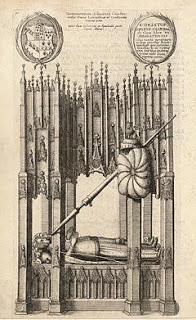
Tomb John of Gaunt
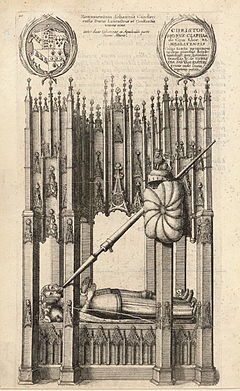
Drawing of the tomb of John of Gaunt and Blanche of Lancaster, etching by Wenceslas Hollar, 1658

Katherine would outlive John and died at Lincoln on 10th May 1403. She was buried, close to the High Altar, in the cathedral in which she had married her prince just 7 years earlier. Her daughter Joan, Countess of Westmoreland, was laid to rest beside her, following her death in 1440. Their tombs, however, are empty and they are buried beneath the floor of the cathedral.

John himself died on 3 February 1399, probably at Leicester Castle. He was buried in Old St Paul’s Cathedral, beside his first wife, Blanche of Lancaster. This has often been seen as his final act of love for his first wife, despite the problems John went through in order to finally be able to marry his mistress, Katherine Swynford.

Personally, I think the two ladies, Blanche and Katherine, were his true love at different parts of John’s life. And I hope he had some feelings for poor Constance, who frequently appears as only a means to his dynastic ambitions.

*

Article originally published on English Historical Fiction Authors in September 2015.

*

Sources: Williamson, David Brewer’s British Royalty; Juliet Gardiner & Neil Wenborn History Today Companion to British History; Mike Ashley The Mammoth Book of British Kings & Queens; Alison Weir Britain’s Royal Families, the Complete Genealogy; Paul Johnson The Life and Times of Edward III; Ian Mortimer The Perfect King, the Life of Edward III; WM Ormrod The Reign of Edward III; Edited by Elizabeth Hallam Chronicles of the Age of Chivalry; Amy Licence Red Roses: From Blanche of Gaunt to Margaret Beaufort; katherineswynfordsociety.org.uk; womenshistory.about.com/od/medrenqueens/a/Katherine-Swynford;.

*

Pictures courtesy of Wikipedia, except the tomb of Katherine Swynford, © Sharon Bennett Connolly, 2015.

*

My Books

Signed, dedicated copies of all my books are available through my online bookshop.

Out Now! Women of the Anarchy

On the one side is Empress Matilda, or Maud. The sole surviving legitimate child of Henry I, she is fighting for her birthright and that of her children. On the other side is her cousin, Queen Matilda, supporting her husband, King Stephen, and fighting to see her own son inherit the English crown. Both women are granddaughters of St Margaret, Queen of Scotland and descendants of Alfred the Great of Wessex. Women of the Anarchy demonstrates how these women, unable to wield a sword, were prime movers in this time of conflict and lawlessness. It show how their strengths, weaknesses, and personal ambitions swung the fortunes of war one way – and then the other.

Available for pre-order from Amberley Publishing and Amazon UK.

Coming on 15 June 2024: Heroines of the Tudor World

Heroines of the Tudor World tells the stories of the most remarkable women from European history in the time of the Tudor dynasty, 1485-1603. These are the women who ruled, the women who founded dynasties, the women who fought for religious freedom, their families and love. These are the women who made a difference, who influenced countries, kings and the Reformation. In the era dominated by the Renaissance and Reformation, Heroines of the Tudor World examines the threats and challenges faced by the women of the era, and how they overcame them. Some famous, some infamous, some less well known, including Anne Boleyn, Elizabeth Barton, Catherine de Medici, Bess of Hardwick and Elizabeth I. From writers to regents, from nuns to queens, Heroines of the Tudor World shines the spotlight on the women helped to shape Early Modern Europe.

Heroines of the Tudor World is now available for pre-order from Amberley Publishing and Amazon UK.

Also by Sharon Bennett Connolly:

King John’s Right-Hand Lady: The Story of Nicholaa de la Haye is the story of a truly remarkable lady, the hereditary constable of Lincoln Castle and the first woman in England to be appointed sheriff in her own right. It is is available from King John’s Right-Hand Lady: The Story of Nicholaa de la Haye is the story of a truly remarkable lady, the hereditary constable of Lincoln Castle and the first woman in England to be appointed sheriff in her own right. Available from all good bookshops or direct from Pen & Sword Booksbookshop.org and AmazonDefenders of the Norman Crown: The Rise and Fall of the Warenne Earls of Surrey tells the fascinating story of the Warenne dynasty, from its origins in Normandy, through the Conquest, Magna Carta, the wars and marriages that led to its ultimate demise in the reign of Edward III. Available from Pen & Sword BooksAmazon in the UK and US, and Bookshop.org

Ladies of Magna Carta: Women of Influence in Thirteenth Century England looks into the relationships of the various noble families of the 13th century, and how they were affected by the Barons’ Wars, Magna Carta and its aftermath; the bonds that were formed and those that were broken. It is now available in paperback and hardback from Pen & Sword,  Amazon, and Bookshop.orgHeroines of the Medieval World tells the stories of some of the most remarkable women from Medieval history, from Eleanor of Aquitaine to Julian of Norwich. Available now from Amberley Publishing and Amazon, and Bookshop.orgSilk and the Sword: The Women of the Norman Conquest traces the fortunes of the women who had a significant role to play in the momentous events of 1066. Available now from Amazon,  Amberley Publishing, and Bookshop.org.

Alternate Endings: An anthology of historical fiction short stories including Long Live the King… which is my take what might have happened had King John not died in October 1216. Available in paperback and kindle from Amazon.

Podcast:

Have a listen to the A Slice of Medieval podcast, which I co-host with Historical fiction novelist Derek Birks. Derek and I welcome guests, such as Bernard Cornwell and Elizabeth Chadwick, and discuss a wide range of topics in medieval history, from significant events to the personalities involved.

*

Don’t forget! Signed and dedicated copies of all my books are available through my online bookshop.

For forthcoming online and in-person talks, please check out my Events Page.

You can be the first to read new articles by clicking the ‘Follow’ button, liking our Facebook page or joining me on Twitter and Instagram.

©2015 Sharon Bennett Connolly FRHistS
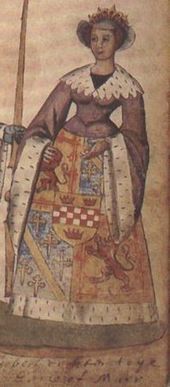
Blanche, Duchess of Lancaster

240px-Marriage_of_blanche_of_lancster_and_john_of_gaunt_1359
The wedding of Blanche of Lancaster and John of Gaunt, painted by Horace Wright, 1914

Blanche of Lancaster is one of those ladies of history more famous because of her children and the antics of her husband. Blanche’s life was pitifully short, but her legacy would see the unravelling of peace in the 15th century, and the decades of civil war called the Wars of the Roses.

Blanche of Lancaster was born around 25 March 1345, at Bolingbroke Castle in Lincolnshire. She was the second and youngest daughter of illustrious parents; Henry of Grosmont, Duke of Lancaster and Isabella de Beaumont. Henry of Grosmont was the grandson of Edmund Crouchback and a great-grandson of Henry III. Isabella was the daughter of Henry, 1st Baron de Beaumont and Earl of Buchan by right of his wife, Alice Comyn.

225px-Portrait_of_Henry,_Duke_of_Lancaster_-_William_Bruges's_Garter_Book_(c.1440-1450),_f.8_-_BL_Stowe_MS_594_(cropped)
Henry of Grosmont, Duke of Lancaster

Blanche had only one sibling, her older sister, Matilda, who was married, first to Ralph de Stafford and later to William V, Duke of Bavaria, Count of Holland, Hainault and Zeeland. Blanche herself was betrothed to John de Segrave as a child, but this seems to have been set aside soon afterwards.

By the late 1350s Blanche was a part of King Edward III’s plans to provide for his growing number of sons. As one of the country’s richest heiresses, Blanche was chosen as the bride for Edward’s 3rd surviving son, John of Gaunt. Blanche and John were 3rd cousins, being great-great-grandchildren of Henry III.

The couple was married on the 19 May 1359 at Reading Abbey in Berkshire. Blanche had just turned 14 and John was 19 years old.

In 1361 Blanche suffered a double tragedy; her father died of bubonic plague in Leicester in March and her mother succumbed to the same disease before the end of the year. While her sister inherited the earldoms of Leicester and Lincoln, John of Gaunt inherited those of Derby and Lancaster by right of his wife; however, the title of Duke of Lancaster became extinct with Henry of Grosmont’s death.

200px-Johnofgaunt
John of Gaunt, Duke of Lancaster

By April 1362 Blanche’s sister had also succumbed to the Black Death; there were some rumours of poison, but this seems unlikely. Maud had died childless and so Blanche inherited the remainder of her father’s estates. Blanche – and by extension John of Gaunt – now added the earldoms of Leicester and Lincoln to their vast holdings. John was invested with the title of Duke of Lancaster and was now the most powerful magnate in England; holding more than 30 castles, his lands and possessions were second only to those of the king.

Blanche herself was pregnant for most of her married life, giving birth to 7 children between 1360 and 1368. 3 sons, John, Edward and a second John, and a daughter, Isabella, died young. Two daughters and a son did, however, survive into adulthood.

Their eldest daughter, Philippa, was born on 31 March 1360  and would marry King John I of Portugal. Philippa was the mother of 8 children, known as the ‘Illustrious Generation’ in Portugal, including Edward, King of Portugal, Prince Henry the Navigator and Ferdinand the Holy Prince. Philippa herself would die of plague in 1415.

History....the Interesting Bits
Tomb of Henry IV and Joanna of Navarre, Canterbury Cathedral

A second daughter, Elizabeth, was born around 1363 at Burford, Shropshire. Although her first marriage to John Hastings, 3rd Earl of Pembroke, was annulled, her second marriage, to John Holland, 1st Duke of Exeter, would end with his execution for treason in 1400; they had 5 children. Elizabeth would marry for a 3rd time to John Cornwall, 1st Baron Fanhope, with whom she had a daughter before she died in 1426.

Blanche and John’s last surviving child, Henry of Bolingbroke, was born at Bolingbroke Castle in 1367, probably on 15 April. Having been exiled in the later years of the reign of his cousin, Richard II, Henry would return to England following the death of his father and confiscation of his inheritance by the king. Richard was forced to abdicate and Henry succeeded to the throne as King Henry IV.

300px-Old-Bolingbroke-Castle
Bolingbroke Castle, Lincolnshire, where Blanche of Lancaster was born

Henry’s first marriage, to Mary de Bohun, produced 7 children, including the future King Henry V; his second marriage was to Joanna of Navarre, Duchess of Brittany. Henry IV died on 20 March 1413 and was buried at Canterbury Cathedral; Joanna would be buried beside him following her own death in 1437.

By 1365 Blanche had taken Katherine Swynford into her household. Katherine was the wife of one of John of Gaunt’s Lincolnshire knights. Moreover, John was godfather to their daughter, Blanche, who was named after the Duchess. Young Blanche Swynford was lodged in the same chambers as the Duchess’s daughters, Philippa and Elizabeth and accorded the same luxuries as the princesses.

Having lost her parents and sister to the Black Death it is not surprising that Blanche was fearful of the disease. In the summer of 1368 she is said to have moved her family away from the city, to Bolingbroke Castle to escape the pestilence.

240px-Wenceslas_Hollar_-_John_of_Gaunt_(monument)
1658 etching by Wenceslas Hollar, of the tomb of John of Gaunt and Blanche of Lancaster

There seems to be some doubt over the year of her death – some sources say 1368, some 1369 – and even the nature of it. One theory is that Blanche succumbed to the bubonic plague, the disease she most feared, in 1369. As a daughter, Isabella, who died young, was born in 1368 some have suggested Blanche died in childbirth. Recent research by Amy Licence has discovered that Blanche died at Tutbury on 12 September, 1368, more likely from the complications of childbirth than from the plague. Her husband was by her side when she died and a letter has come to light in which John arranged to have prayers said for the soul of his lost duchess.¹

Blanche was buried in Old St Paul’s Cathedral, London; where John of Gaunt arranged for a splendid alabaster tomb and annual commemorations for the rest of his life. And despite 2 subsequent marriages, John of Gaunt would be interred next to Blanche following his own death in 1399. The tomb was lost when the cathedral was destroyed during the Great Fire of London in 1666.

Blanche is one of the few ladies of the 14th century of whom we have several descriptions. The Chronicler Froissart noted that she was “jone et jolie” – young and pretty.

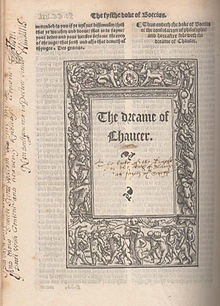
The best description, however, is from Geoffrey Chaucer, Katherine Swynford’s brother-in-law, who was commissioned by John of Gaunt to write The Book of the Duchess, also known as The Deth of Blaunche. The poem is said to depict Gaunt’s mourning for his wife, in the tale of a Knight grieving for his lost love.

220px-The_Dreame_of_Chaucer_Book_of_the_Duchess
Geoffrey Chaucer’s ‘The Book of the Duchess’

Chaucer describes Blanche’s neck (yes, her neck) as “whyt, smothe, streght and flat. Naming the heroine “White”, he goes on to say she is “rody, fresh and lyvely hewed”.  Blanche (White) was “bothe fair and bright” and Nature’s “cheef patron of beautee”.

Despite his marrying Constance of Castile just 2 years later, and his eventual marriage to his mistress, Katherine Swynford, being singled out as one of the great love affairs of the age, it was said that Blanche was the love of his life.

Chaucer’s poem and the lavish tomb and commemorations are said to highlight Gaunt’s love for his first wife; the fact he was eventually buried beside her has been seen, by many, as the final proof of this love.

*

Footnote: ¹Red Roses: From Blanche of Gaunt to Margaret Beaufort by Amy Licence.

*

Photograph of the tomb of Henry IV and Joanna of Navarre are © Sharon Bennett Connolly, 2015. All other pictures are courtesy of Wikipedia.

*

Sources: Brewer’s British Royalty by David Williamson; Red Roses: From Blanche of Gaunt to Margaret Beaufort by Amy Licence; History Today Companion to British History Edited by Juliet Gardiner & Neil Wenborn; The mammoth Book of British kings & Queen by Mike Ashley; Britain’s Royal Families, the Complete Genealogy by Alison Weir; The Life and Times of Edward III by paul Johnson; The Perfect King, the Life of Edward III by Ian Mortimer; Chronicles of the Age of Chivalry Edited by Elizabeth Hallam; unofficialroyalty.com; katherineswynfordsociety.org.uk; The Reign of Edward III by WM Ormrod; The Plantagenets, the kings Who Made Britain by Dan Jones; englishmonarchs.co.uk; oxforddnb.com.

*

My Books

Signed, dedicated copies of all my books are available through my online bookshop.

Out now: Scotland’s Medieval Queens

Books by Sharon Bennett Connolly

Scotland’s history is dramatic, violent and bloody. Being England’s northern neighbour has never been easy. Scotland’s queens have had to deal with war, murder, imprisonment, political rivalries and open betrayal. They have loved and lost, raised kings and queens, ruled and died for Scotland. From St Margaret, who became one of the patron saints of Scotland, to Elizabeth de Burgh and the dramatic story of the Scottish Wars of Independence, to the love story and tragedy of Joan Beaufort, to Margaret of Denmark and the dawn of the Renaissance, Scotland’s Medieval Queens have seen it all. This is the story of Scotland through their eyes.

Scotland’s Medieval Queens gives a thorough grounding in the history of the women who ruled Scotland at the side of its kings, often in the shadows, but just as interesting in their lives beyond the spotlight. It’s not a subject that has been widely covered, and Sharon is a pioneer in bringing that information into accessible history.’ Elizabeth Chadwick (New York Times bestselling author)

Available now from Amazon and Pen and Sword Books

Also by Sharon Bennett Connolly:

Books by Sharon Bennett Connolly

Heroines of the Tudor World tells the stories of the most remarkable women from European history in the time of the Tudor dynasty, 1485-1603. These are the women who ruled, the women who founded dynasties, the women who fought for religious freedom, their families and love. Heroines of the Tudor World is now available for pre-order from Amberley Publishing and Amazon UK. Women of the Anarchy demonstrates how Empress Matilda and Matilda of Boulogne, unable to wield a sword themselves, were prime movers in this time of conflict and lawlessness. It shows how their strengths, weaknesses, and personal ambitions swung the fortunes of war one way – and then the other. Available from Bookshop.orgAmberley Publishing and Amazon UKKing John’s Right-Hand Lady: The Story of Nicholaa de la Haye is the story of a truly remarkable lady, the hereditary constable of Lincoln Castle and the first woman in England to be appointed sheriff in her own right. Available from all good bookshops Pen & Sword Booksbookshop.org and Amazon

History...the Interesting Bits

Defenders of the Norman Crown: The Rise and Fall of the Warenne Earls of Surrey tells the fascinating story of the Warenne dynasty, from its origins in Normandy, through the Conquest, Magna Carta, the wars and marriages that led to its ultimate demise in the reign of Edward III. Available from Pen & Sword BooksAmazon in the UK and US, and Bookshop.orgLadies of Magna Carta: Women of Influence in Thirteenth Century England looks into the relationships of the various noble families of the 13th century, and how they were affected by the Barons’ Wars, Magna Carta and its aftermath; the bonds that were formed and those that were broken. It is now available in paperback and hardback from Pen & SwordAmazon, and Bookshop.orgHeroines of the Medieval World tells the stories of some of the most remarkable women from Medieval history, from Eleanor of Aquitaine to Julian of Norwich. Available now from Amberley Publishing and Amazon, and Bookshop.orgSilk and the Sword: The Women of the Norman Conquest traces the fortunes of the women who had a significant role to play in the momentous events of 1066. Available now from Amazon,  Amberley Publishing, and Bookshop.org.

Alternate Endings: An anthology of historical fiction short stories including Long Live the King… which is my take what might have happened had King John not died in October 1216. Available in paperback and kindle from Amazon.

Podcast:

A Slice of Medieval

Have a listen to the A Slice of Medieval podcast, which I co-host with Historical fiction novelist Derek Birks. Derek and I welcome guests, such as Bernard Cornwell, Helen Castor and Michael Jecks, and discuss a wide range of topics in medieval history, from significant events to the personalities involved. In a recent episode, Kathryn Warner joined us to chat about Blanche’s husband, John of Gaunt

Every episode is also now available on YouTube.

*

Don’t forget! Signed and dedicated copies of all my books are available through my online bookshop.

For forthcoming online and in-person talks, please check out my Events Page.

You can be the first to read new articles by clicking the ‘Follow’ button, liking our Facebook page or joining me on TwitterThreadsBluesky and Instagram.


©2015 Sharon Bennett Connolly FRHistS
Witchy Woman – the Fall of Eleanor Cobham, Duchess of Gloucester

300px-Starborough_Castle
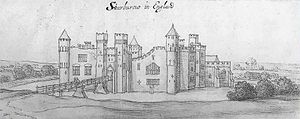
Sterborough Castle, possible birthplace of Eleanor

Born around 1400 and probably at the castle of Sterborough in Kent, Eleanor Cobham was the daughter of Sir Reginald Cobham of Sterborough and his wife Eleanor, daughter of Sir Thomas Culpeper of Rayal.

As is often the case with Medieval women, nothing is known of Eleanor’s early life. She appeared at court in her early 20s, when she was appointed lady-in-waiting to Jacqueline of Hainault,  Duchess of Gloucester.

Jacqueline had come to England to escape her 2nd husband, the abusive John IV Duke of Brabant. She obtained an annulment of the marriage from the Antipope, Benedict XIII, and married Humphrey, Duke of Gloucester, in 1423. He would spend a large amount of their marriage trying to recover Jacqueline’s lands from the Dukes of Brabant and Burgundy.

120px-HumphreyGloucester
Humphrey Duke of Gloucester

Humphrey was a younger brother of King Henry V and John, Duke of Bedford. He had fought at the Battle of Shrewsbury at the age of 12 years and 9 months and would go on to fight at Agincourt in 1415. On Henry V’s death, Humphrey acted as Protector for  his young nephew, Henry VI, whenever his older brother, the Duke of Bedford, was away fighting in France. However, he seems to have been little liked and was never trusted with full Regency powers.

In 1428 Pope Martin V refused to recognise the annulment of Jacqueline’s previous marriage to John of Brabant and declared the Gloucester marriage null and void. However, John of Brabant had died in 1426 and so Humphrey and Jacqueline were free to remarry – if they wanted to. In the mean time, Humphrey’s attention had turned to Eleanor of Cobham and he made no attempt to keep Jacqueline by his side.

This did not go down too well with the good ladies of London, who petitioned parliament between Christmas 1427 and Easter 1428.

According to the chronicler Stow their letters were delivered to Humphrey, the archbishops and the lords “containing matter of rebuke and sharpe reprehension of the Duke of Gloucester, because he would not deliver his wife Jacqueline out of her grievous imprisonment, being then held prisoner by the Duke of Burgundy, suffering her to remaine so unkindly, contrary to the law of God and the honourable estate of matrimony”.

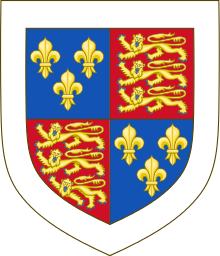
220px-Arms_of_Humphrey_of_Lancaster,_1st_Duke_of_Gloucester.svg
Coat of arms of Humphrey, Duke of Gloucester

Humphrey paid the petition little attention and married Eleanor sometime between 1428 and 1431. It has been suggested that Eleanor was the mother of Humphrey’s 2 illegitimate children – Arthur and Antigone – although this seems unlikely as Humphrey made no attempt to legitimise them following the marriage (as his grandfather John of Gaunt had done with his Beaufort children by Katherine Swynford).

Described by Aeneas Sylvius as “a woman distinguished in her form” and “beautiful and marvellously pleasant” by Jean de Waurin, Eleanor and Humphrey had a small but lively court at their residence of La Plesaunce at Greenwich. Humphrey had a lifelong love of learning, which Eleanor most likely shared, and the couple attracted scholars, musicians and poets to their court.

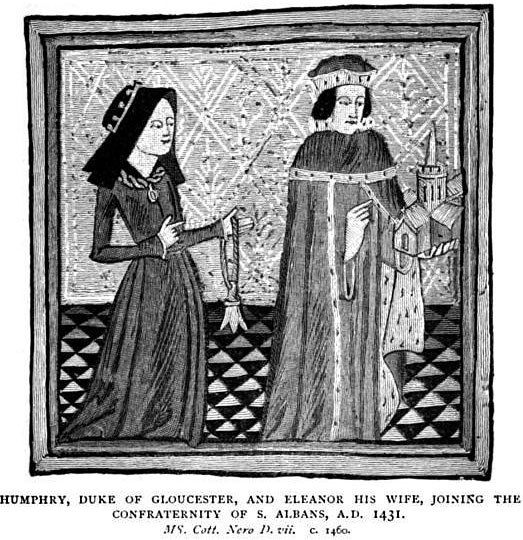
On 25th June 1431, as Duchess of Gloucester, Eleanor was admitted to the fraternity of the monastery of St Albans – to which her husband already belonged – and in 1432 she was made a Lady of the Garter.

Eleanor’s status rose even higher in 1435, with the death of John Duke of Bedford. Whilst Henry VI was still childless, John had been heir presumptive. He died having had no children and so the position passed to Humphrey, Duke of Gloucester.

With her heightened status, Eleanor received sumptuous Christmas gifts from the king; and her father was given custody of the French hostage Charles, Duke of Orleans – a prisoner since Agincourt.

But in 1441 came Eleanor’s dramatic downfall.

Master Thomas Southwell, a canon of St Stephen’s Chapel at Westminster, and Master Roger Bolyngbroke, a scholar, astronomer and cleric – and alleged necromancer, were arrested for casting the King’s horoscope and predicting his death.

humphrey__eleanor
Eleanor – alongside Humphrey – joining the confraternity of St Albans, 1431

Southwell and Bolyngbroke, along with Margery Jourdemayne, known as the Witch of Eye and renowned for selling potions and spells, were accused of making a wax image of the king, ‘the which image they dealt so with, that by their devilish incantations and sorcery they intended to bring out of life, little and little, the king’s person, as they little and little consumed that image’.

Bolyngbroke implicated Eleanor during questioning, saying she had asked him to cast her horoscope and predict her future; for the wife of the heir to the throne, this was a dangerous practise. Did she have her eye on the throne itself?

On hearing of the arrest of her associates Eleanor fled to Sanctuary at Westminster. Of 28 charges against her she admitted to 5. Eleanor denied the treason charges, but confessed to obtaining potions from Jourdemayne in order to help her conceive a child. Awaiting further proceedings, as Eleanor remained in Sanctuary, pleading sickness, she tried to escape by river. Thwarted, she was escorted to Leeds Castle on 11th August and held there for 2 months.

Having returned to Westminster Eleanor was examined by an ecclesiastical tribunal on 19th October and on the 23rd she faced Bolyngbroke, Southwell and Jourdemayne who accused her of being the “causer and doer of all these deeds”.

Eleanor was found guilty of sorcery and witchcraft; she was condemned to do public penance and perpetual imprisonment. Of her co-accused; Bolyngbroke was hanged, drawn and quartered, Southwell died in the Tower of London and Margery Jourdemayne was burned at the stake at Smithfield.

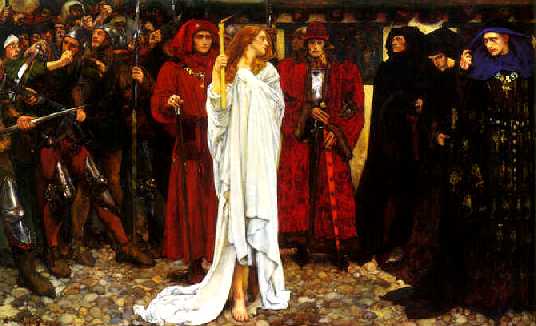
The_Penance_of_Eleanor_(Abbey)
The Penance of Eleanor by Edwin Austin Abbey

Eleanor’s own chaplain, Master John Hume, had also been arrested, although he was accused only of knowing of the others’ actions and was later pardoned.

On 3 occasions Eleanor was made to do public penance at various churches in London; on the 1st of such, 13th November 1441, bareheaded and dressed in black carrying a wax taper, she walked from Temple Bar to St Paul’s Cathedral, where she offered the wax taper at the high altar. Following 2 further penances, at Christ Church and St Michael’s in Cornhill, Eleanor was sent first to Chester Castle and then to Kenilworth. Her circumstances much reduced, Eleanor was allowed a household of only 12 persons.

Eleanor’s witchcraft conviction discredited her husband; Humphrey was marginalised and on 6th November 1441 his marriage was annulled. Humphrey’s enemies, Margaret of Anjou (Henry VI’s queen) and the Earl of Suffolk, convinced the king that his uncle was plotting against him. In February 1447, Humphrey was arrested and confined in Bury St Edmunds. He died a week later, on 23rd February; some claimed it was murder, but the most likely cause of death is stroke.

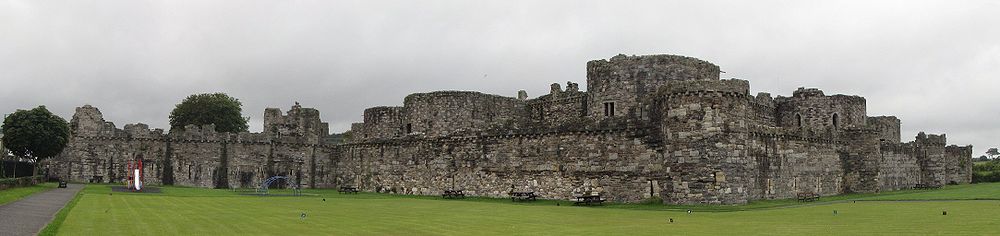
1000px-Beaumaris-01s
Beaumaris Castle, Anglesey

Eleanor was moved to Peel Castle on the Isle of Man, in 1446 and one final time in 1449 when she was transferred to Beaumaris Castle on Anglesey.

Eleanor Cobham, one time Duchess of Gloucester and wife to the heir to England’s throne, having risen so high – and fallen so low – died still a prisoner, at Beaumaris Castle on 7th July 1452; she was buried at Beaumaris, at the expense of Sir William Beauchamp, the castle’s constable.

*

Pictures courtesy of Wikipedia

*

Sources: Brewer’s British Royalty by David Williamson; History Today Companion to British History Edited by Juliet Gardiner and Neil Wenborn; The Mammoth Book of British Kings & Queens by Mike Ashley; Britain’s Royal Families, the Complete Genealogy by Alison Weir; The Oxford Companion to British History Edited by John Cannon; The Plantagenets, the Kings who made England by Dan Jones; The Plantagenets, the Kings that Made Britain by Derek Wilson; madameguillotine.co.uk; susanhigginbotham.com; The Medieval Mind.

*

My Books

Signed, dedicated copies of all my books are available through my online bookshop.

OUT NOW! Heroines of the Tudor World

Heroines of the Tudor World tells the stories of the most remarkable women from European history in the time of the Tudor dynasty, 1485-1603. These are the women who ruled, the women who founded dynasties, the women who fought for religious freedom, their families and love. These are the women who made a difference, who influenced countries, kings and the Reformation. In the era dominated by the Renaissance and Reformation, Heroines of the Tudor World examines the threats and challenges faced by the women of the era, and how they overcame them. From writers to regents, from nuns to queens, Heroines of the Tudor World shines the spotlight on the women helped to shape Early Modern Europe.

Heroines of the Tudor World is now available for pre-order from Amberley Publishing and Amazon UK.

Also by Sharon Bennett Connolly:

Women of the Anarchy demonstrates how Empress Matilda and Matilda of Boulogne, unable to wield a sword themselves, were prime movers in this time of conflict and lawlessness. It shows how their strengths, weaknesses, and personal ambitions swung the fortunes of war one way – and then the other. Available from Bookshop.orgAmberley Publishing and Amazon UKKing John’s Right-Hand Lady: The Story of Nicholaa de la Haye is the story of a truly remarkable lady, the hereditary constable of Lincoln Castle and the first woman in England to be appointed sheriff in her own right. Available from all good bookshops Pen & Sword Booksbookshop.org and AmazonDefenders of the Norman Crown: The Rise and Fall of the Warenne Earls of Surrey tells the fascinating story of the Warenne dynasty, from its origins in Normandy, through the Conquest, Magna Carta, the wars and marriages that led to its ultimate demise in the reign of Edward III. Available from Pen & Sword BooksAmazon in the UK and US, and Bookshop.org

Ladies of Magna Carta: Women of Influence in Thirteenth Century England looks into the relationships of the various noble families of the 13th century, and how they were affected by the Barons’ Wars, Magna Carta and its aftermath; the bonds that were formed and those that were broken. It is now available in paperback and hardback from Pen & Sword,  Amazon, and Bookshop.orgHeroines of the Medieval World tells the stories of some of the most remarkable women from Medieval history, from Eleanor of Aquitaine to Julian of Norwich. Available now from Amberley Publishing and Amazon, and Bookshop.orgSilk and the Sword: The Women of the Norman Conquest traces the fortunes of the women who had a significant role to play in the momentous events of 1066. Available now from Amazon,  Amberley Publishing, and Bookshop.org.

Alternate Endings: An anthology of historical fiction short stories including Long Live the King… which is my take what might have happened had King John not died in October 1216. Available in paperback and kindle from Amazon.

Podcast:

Have a listen to the A Slice of Medieval podcast, which I co-host with Historical fiction novelist Derek Birks. Derek and I welcome guests, such as Bernard Cornwell and discuss a wide range of topics in medieval history, from significant events to the personalities involved.

*

Don’t forget! Signed and dedicated copies of all my books are available through my online bookshop.

For forthcoming online and in-person talks, please check out my Events Page.

You can be the first to read new articles by clicking the ‘Follow’ button, liking our Facebook page or joining me on Twitter and Instagram.

©2015 Sharon Bennett Connolly FRHistS
Elizabeth de Burgh, the Captive Queen

edb1
King Robert I and Queen Elizabeth

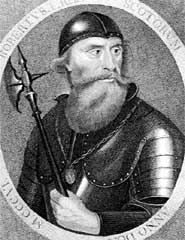
Certain periods and people in history hold a particular fascination for me. Robert the Bruce is one such. The grandfather of the Stewart dynasty and hero of Scotland, he started his career with some very divided loyalties. Initially a supporter of Edward I, it was only the arrival of William Wallace that started Bruce on his journey to becoming the saviour of Scottish independence.

Through the murder of his greatest rival and the Battle of Bannockburn, Bruce proved himself determined and resourceful, overcoming defeat to emerge victorious and master of his realm.

Bruce suffered greatly for the crown, with his family and friends facing similar hardships.

Robert the Bruce’s wife endured a no less punishing life in support of her husband.

Elizabeth de Burgh was born around 1289. The daughter of Richard de Burgh, Earl of Ulster and Connaught, and his wife, Margaret, she was a god-daughter of England’s king, Edward I. At the age of 13 Elizabeth was married to Robert the Bruce, Earl of Carrick, in 1302; probably at his manor of Writtle, near Chelmsford in Essex. It is possible the marriage was arranged by Edward; he certainly encouraged it, as a way of keeping his young Scottish noble loyal to his cause.

Queen Elizabeth de Burgh

However, events in Scotland would soon push the Bruce away from his English alliances; his murder of his greatest rival for the throne, John Comyn, in the Chapel of the Greyfriars in Dumfries. Aware that he would be excommunicated for his actions, Bruce raced to Scone to be crowned before a papal bull could be issued.

6 weeks later, on March 25th 1306, the Bruce was crowned King Robert I of Scotland, with Elizabeth by his side, by Isabella MacDuff, Countess of Buchan. As daughter of the Earl of Fife, Isabella claimed the hereditary right of the Clan MacDuff, to crown the King of Scots. The couple was crowned in a second ceremony the next day by the Bishop of St Andrews, William Lamberton, who had arrived too late to play his part in the ceremony on the 25th. Elizabeth is said to have referred to herself and Robert as ‘the king and queen of the May’ which is often seen as a criticism of her husband but may also be a foreshadowing of what was to come.

Unfortunately the coronation was not the end of trouble for the Bruces. If anything, things were about to get much worse.

An ailing Edward I sent his loyal lieutenant, Aymer de Valence, north and he met and defeated Robert’s army at Methven in June of the same year. Robert sent his brother Neil and the Earl of Atholl to escort his wife to safety. They took the Queen, Princess Marjorie (Robert the Bruce’s daughter by his first marriage), sisters Mary and Christian and the countess of Buchan, north towards Orkney.

Robertthebruce
Nineteenth Century depiction of Robert the Bruce

However, the English caught up with them at Kildrummy Castle and laid siege to it. The garrison was betrayed from within, the barns set alight and the Bruce women had barely time to escape with the Earl of Atholl before the castle was taken. Sir Neil Bruce and the entire garrison were executed; Neil was hung, drawn and quartered at Berwick in September 1306.

Queen Elizabeth and her companions made for Tain, in Easter Ross, possibly in the hope of finding a boat to take them onwards, to King Robert’s sister Isabella, Queen of Norway. However, they were captured by the Earl of Ross (a former adherent of the deposed King John Balliol), who took them from sanctuary at St Duthac and handed them over to the English. They were sent south, To Edward I at Lanercost Priory.

Elizabeth’s capture would have been a hard blow for Robert the Bruce. The new King of Scotland still lacked a male heir, and had no chance of getting one while his wife was in English hands. This made his hold on the throne even more precarious than it already was.

Edward I’s admirer, Sir Maurice Powicke said Edward treated his captives with a ‘peculiar ferocity’. He ordered that 24-year-old Mary Bruce and Isabella, the Countess of Buchan who performed Robert the Bruce’s coronation, should be imprisoned in specially constructed iron cages and suspended from the outside walls of castles; Mary at Roxburgh and Isabella at Berwick. Although it is more likely that the cages were in rooms within the castles, rather than exposed to the elements, they would be held in that way for 4 years, until Edward I’s successor, Edward II, ordered their removal to convents in 1310.

cropped-15720609675_e6e7a0fbcd_k2.jpg
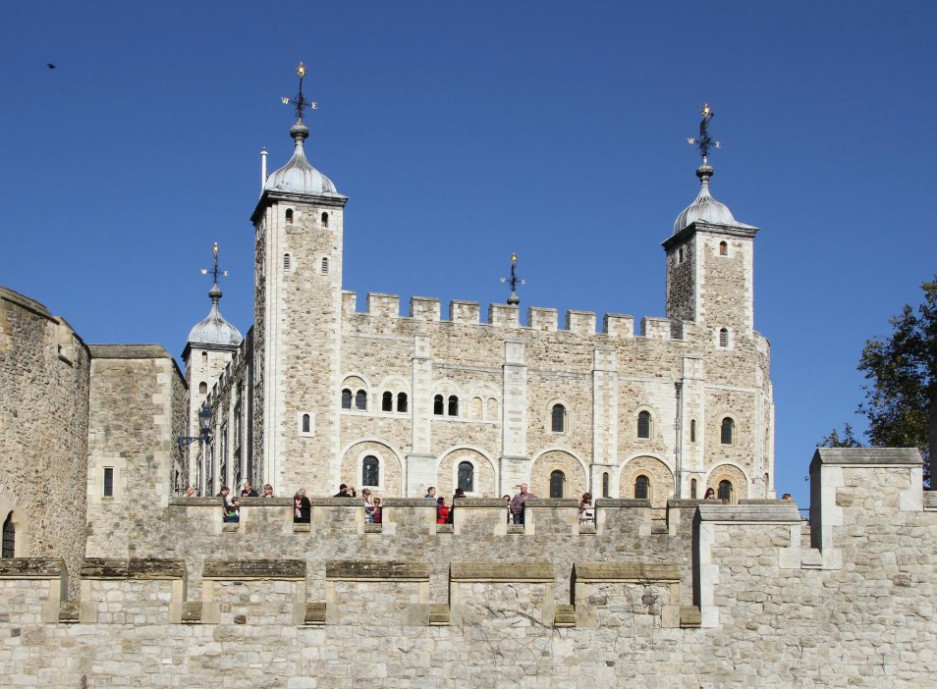
The Tower of London

It seems Edward ordered a cage to be made Marjorie at the Tower of London, where she was first held. But he relented, possibly because of her age, and the child – not yet 12 years old – was sent to a nunnery in Yorkshire. Initial orders were given that she should be held in solitary confinement, with no one allowed to speak to her; but this may also have been rescinded.

Marjorie’s aunt and Mary’s older sister, Christian, was also sent to a Gilbertine nunnery, this time in Lincolnshire; although her husband, Sir Christopher Seton, was hung, drawn and beheaded at Dumfries.

Elizabeth was treated more kindly than her step-daughter, and the other ladies. Her father was a close ally of Edward I and the king did not want to alienate him. He refused to acknowledge her as Queen of Scots and throughout her captivity, Elizabeth was referred to as Countess of Carrick, Robert’s title before he became king. Elizabeth was sent to Burstwick Manor in Holderness, Yorkshire, from where she wrote to Edward I, in an undated letter, complaining that she only had 3 changes of clothes, and no bed linen. She then spent 4 years at Bisham Manor in Berkshire.

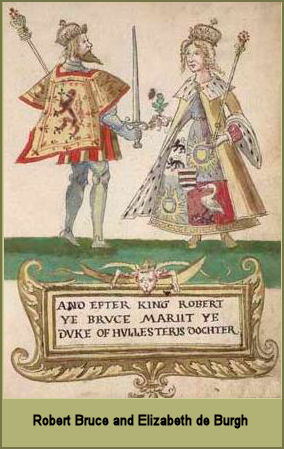
RobertBruceAndElizabethDeBurgh (280X280)_tcm4-562387
King Robert I (the Bruce) and Queen Elizabeth

However in 1312, with her husband gaining strength and raiding into Yorkshire, she was moved to a more secure location, and held at various sites in the south, including Windsor Castle. By this time she was permitted 6 attendants and was given a regular allowance. Elizabeth was later moved to Shaftesbury Abbey in Dorset but the political situation was about to change.

In 1314 Robert the Bruce achieved a not inconsiderable victory at the Battle of Bannockburn over Edward II and his English forces. Several notable English lords were taken prisoner, including Humphrey de Bohun, Earl of Hereford. Negotiations for his release led to a prisoner exchange and Elizabeth and the rest of the Bruce ladies, finally returned to Scotland after 8 years of imprisonment.

Reunited at last, Robert set about consolidating his kingdom, with his queen at his side.

His daughter, Marjorie Bruce, was married to Walter Stewart, hereditary High Steward of Scotland, though a succession settlement stipulated that Marjorie would only succeed to the throne on the deaths without male issue of King Robert and his one surviving brother, Edward. Following a fall from a horse while heavily pregnant, she gave birth to King Robert’s first grandson, also named Robert and the future king Robert II. Marjorie died just a few hours later.

220px-Dunfermline_Abbey_20080504_Robert_the_Bruce
Victorian brass plate covering the final resting place of Robert the Bruce and Elizabeth de Burgh in Dunfermline Abbey

Between 1315 and 1323 Elizabeth and Robert had two daughters: Margaret married William, 5th Earl of Sutherland and died in childbirth in 1346 or 1347; Matilda married Thomas Isaac and had two daughters, she died in 1353.

The  much longed-for son, David, was born in 1324; he was married to Joan of the Tower, daughter of Edward II of England, in 1328 and would succeed his father at the age of 5, as King David II, in 1329.

A second son, John, was born in or before 1327 but died young.

Elizabeth herself died on the 27th of October 1327, aged around 38, at the royal residence at Cullen in Banffshire. Given that her younger son may have been born – and died – in the same year as Elizabeth’s death, complications in childbirth, or in her recovery from childbirth, could well have contributed to Elizabeth’s death. The queen was buried in Dunfermline Abbey; Robert the Bruce was buried beside her when he died 18 months later.

*

Pictures courtesy of Wikipedia.

*

Further Reading:

The Story of Scotland by Nigel Tranter; Brewer’s British Royalty by David Williamson; Kings & Queens of Britain by Joyce Marlow; Mammoth Book of British Kings & Queens by Mike Ashley; Oxford Companion to British History Edited by John Cannon; Edward I A Great and Terrible King by Marc Morris; Britain’s Royal Families by Alison Weir; berkshirehistory.com; englishmonarchs.co.uk; thefreelancehistorywriter.comberkshirehistory.comeducationscotland.gov.uk/scotlandhistory; John of Fordun’s Chronicle of the Scottish Nation; Scotichronicon by Walter Bower; Chronicles of the Age of Chivalry, edited by Elizabeth Hallam; The Chronicle of Lanercost; Robert the Bruce by Stephen Spinks

*

My Books:

Signed, dedicated copies of all my books are available through my online store.

Out now: Scotland’s Medieval Queens

Scotland’s history is dramatic, violent and bloody. Being England’s northern neighbour has never been easy. Scotland’s queens have had to deal with war, murder, imprisonment, political rivalries and open betrayal. They have loved and lost, raised kings and queens, ruled and died for Scotland. From St Margaret, who became one of the patron saints of Scotland, to Elizabeth de Burgh and the dramatic story of the Scottish Wars of Independence, to the love story and tragedy of Joan Beaufort, to Margaret of Denmark and the dawn of the Renaissance, Scotland’s Medieval Queens have seen it all. This is the story of Scotland through their eyes.

Available now from Amazon and Pen and Sword Books

Also by Sharon Bennett Connolly:

Heroines of the Tudor World tells the stories of the most remarkable women from European history in the time of the Tudor dynasty, 1485-1603. These are the women who ruled, the women who founded dynasties, the women who fought for religious freedom, their families and love. Heroines of the Tudor World is now available for pre-order from Amberley Publishing and Amazon UK. Women of the Anarchy demonstrates how Empress Matilda and Matilda of Boulogne, unable to wield a sword themselves, were prime movers in this time of conflict and lawlessness. It shows how their strengths, weaknesses, and personal ambitions swung the fortunes of war one way – and then the other. Available from Bookshop.orgAmberley Publishing and Amazon UKKing John’s Right-Hand Lady: The Story of Nicholaa de la Haye is the story of a truly remarkable lady, the hereditary constable of Lincoln Castle and the first woman in England to be appointed sheriff in her own right. Available from all good bookshops Pen & Sword Booksbookshop.org and Amazon

Defenders of the Norman Crown: The Rise and Fall of the Warenne Earls of Surrey tells the fascinating story of the Warenne dynasty, from its origins in Normandy, through the Conquest, Magna Carta, the wars and marriages that led to its ultimate demise in the reign of Edward III. Available from Pen & Sword BooksAmazon in the UK and US, and Bookshop.orgLadies of Magna Carta: Women of Influence in Thirteenth Century England looks into the relationships of the various noble families of the 13th century, and how they were affected by the Barons’ Wars, Magna Carta and its aftermath; the bonds that were formed and those that were broken. It is now available in paperback and hardback from Pen & SwordAmazon, and Bookshop.orgHeroines of the Medieval World tells the stories of some of the most remarkable women from Medieval history, from Eleanor of Aquitaine to Julian of Norwich. Available now from Amberley Publishing and Amazon, and Bookshop.orgSilk and the Sword: The Women of the Norman Conquest traces the fortunes of the women who had a significant role to play in the momentous events of 1066. Available now from Amazon,  Amberley Publishing, and Bookshop.org.

Alternate Endings: An anthology of historical fiction short stories including Long Live the King… which is my take what might have happened had King John not died in October 1216. Available in paperback and kindle from Amazon.

Podcast:

Have a listen to the A Slice of Medieval podcast, which I co-host with Historical fiction novelist Derek Birks. Derek and I welcome guests, such as Bernard Cornwell and Michael Jecks, and discuss a wide range of topics in medieval history, from significant events to the personalities involved. Every episode is also now available on YouTube.

*

Don’t forget! Signed and dedicated copies of all my books are available through my online bookshop.

For forthcoming online and in-person talks, please check out my Events Page.

You can be the first to read new articles by clicking the ‘Follow’ button, liking our Facebook page or joining me on Twitter and Instagram.

*

©2015 Sharon Bennett Connolly FRHistS

James I and Joan Beaufort: A Royal Love Story

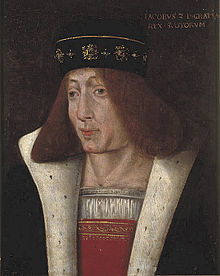
220px-King_James_I_of_Scotland
James I

The story of King James I of Scotland and his queen, Joan Beaufort, is one of those rarities in Medieval history; a true love story. He was a King in captivity and she a beautiful young lady of the court.

Following the murder of his brother, David, Duke of Rothesay, James was the only surviving son of Robert III of Scotland. He had been on his way to France, for his safety and to continue his education, when his ship was captured by pirates in April 1406. Aged only 11, he was handed over to the English king, Henry IV, and imprisoned in the Tower of London.

Shortly after his capture, James’s father died and he was proclaimed King of Scots, but the English would not release him.

James was closely guarded and regularly moved around, but he was also well-educated while in the custody of the English king and was an accomplished musician and poet. He was held at various castles, including the Tower, Nottingham Castle – where he was allowed to go hunting – and Windsor Castle.

Probably born in the early 1400s, Lady Joan Beaufort was the daughter of John Beaufort, 1st Earl of Somerset and legitimated son of John of Gaunt (himself the 3rd son of Edward III) by his mistress and, later, wife Kathryn Swynford. Joan’s mother was Margaret Holland, granddaughter of Joan of Kent (wife of Edward the Black Prince) from her marriage to Thomas Holland, 1st Earl of Kent.

Joan Beaufort was very well-connected; she was a niece of Henry IV, great-niece of Richard II and  great grand-daughter of Edward III. Her uncle, Henry Beaufort, was a cardinal and Chancellor of England.

150px-Beaufortforeman'sroll
Joan Beaufort, Queen of Scotland

Little seems to be known of her early life, but she was at court in the early 1420s, when James first set eyes on her. James wrote of his love for Joan in his famous poem, The Kingis Quair. According to Nigel Tranter, James was with the court at Windsor, when he saw Joan for the first time while walking her little lap-dog in the garden, below his window.

His narrow window afforded him only a limited view, but the Lady Joan walked the same route every morning and James wrote of her;

“Beauty, fair enough to make the world to dote, Are ye a worldy creature? Or heavenly thing in likeness of nature? Or are ye Cupid’s own priestess, come here, To loose me out of bonds”

One morning James managed to drop a plucked rose down to Lady Joan, which he saw her wearing the following evening at dinner. Nigel Tranter suggests Lady Joan grieved over James’s imprisonment and even pleaded for him to be released.

Their romance grew apace, but was interrupted when James had to accompany Henry V on his French campaign. Henry was hoping that James’s presence would make the Scots, fighting with the French, think twice about engaging with him. However, the strategy had little effect.

220px-Robert_of_Albany
Robert Stewart, Duke of Albany

James’s imprisonment lasted for 18 years. His uncle Robert Stewart, Duke of Albany and Guardian of Scotland in James’s absence, refused to ransom him, in the hope of gaining the throne for himself. He never quite garnered enough support, but managed to keep the Scottish nobles in check.

However, when he died in 1420 control passed to his son Murdoch (who had also been imprisoned by the English for 12 years, but was ransomed – instead of James – in 1414) and Scotland fell into a state of virtual anarchy.

Henry V had finally decided that it was time for James to return to Scotland when he died. It was left to Henry’s brother, John, Duke of Bedford, as Regent for the infant Henry VI, to agree the terms of James’s freedom. James was charged 60,000 marks in ransom – to cover the costs for his upkeep and education for 18 years, it was claimed. The agreement included a promise for the Scots to keep out of England’s wars with France, and for James to marry the Lady Joan Beaufort.

James and Joan were married at the Church of St Mary Overie, Southwark, on 2nd February 1424. James was released on the 28th March and the couple returned to Scotland shortly after. They were crowned at Scone by Henry de Warlaw, Bishop of St Andrews, on 21st May 1424.

James and Joan had 8 children together, 7 of whom survived childhood. Their 6 daughters helped to strengthen alliances across Europe. The oldest, Margaret, was born around Christmas 1424. At the age of 11 she was sent to France to marry the Dauphin, Louis – the future Louis XI – narrowly escaping her father’s fate when the English fleet tried to capture her en route. She died in 1445, leaving no children.

Isabella_of_Scotland
Isabella of Scotland

Isabella married Francis I, Duke of Brittany; she had 2 daughters and died in 1494. Eleanor married Sigismund, Archduke of Austria, and died in 1480. Joan was born mute and married James Douglas, Earl of Morton and had 4 children – her eldest son, Sir John Douglas, 2nd Earl of Morton, was probably killed at Flodden in 1513. Joan herself died in 1486.

Mary was created Countess of Buchan in 1444; she married Wolfert, Count of Grandpre, of the Netherlands, having 2 sons who died young before she died in 1465. A last daughter, Anabella, married, firstly, Louis of Savoy but following their divorce in 1458 she married George Gordon, 2nd Earl of Huntly. They had 2 children together before divorcing on the grounds of consanguinity in 1471.

James and Joan finally had twin sons in 1430. Born on 16th October, Alexander died the same year, but James would go on to succeed his father and married Mary of Gueldres in 1449.

On his return to Scotland, James immediately set about getting his revenge on the Duke of Albany’s family and adherents; executing some, including Murdoch, Albany’s son and heir. Two other claimants to James’s throne were sent to England, as hostages to the payment of his ransom.

James and Joan ruled Scotland for 13 years; James even allowed Joan to take some part in the business of government. His reforms, however, and desire for a firm but just government made enemies of some nobles, including his own chamberlain Sir Robert Stewart, grandson of Walter, Earl of Atholl, who had been James’s heir until the birth of his son.

Blackfriars_monastery_perth
Blackfriars Monastery, Perth

Due to his long imprisonment in the fortresses of England, James tended to avoid castles. On 21 February 1437 the King was staying at the Blackfriars in Perth when his chamberlain dismissed the guard and, having removed the locking bar to the King’s quarters, let the assassins into the priory.

James and Joan were alone with the queen’s ladies when they heard the men approaching. On seeing the locking bar missing, Joan’s lady, Kate Douglas, used her own arm to bar the door. The queen hid the king in an underground vault as Kate’s arm broke and the plotters gained entry. They dragged James from his hiding placed and stabbed him to death; Joan herself was wounded in the scuffle.

220px-James_II_of_Scotland_17th_century
James II

The plotters, led by Walter, Earl of Atholl, James’ own uncle, had expected to seize power, but were arrested and executed as the nobles rallied around the new king, 6-year-old James II.

James I was buried in Perth and Joan took an active role the government for her son, getting caught in a contest of power between Sir Alexander Livingstone and Sir William Crichton. Her second marriage to Sir James Stewart, the Black Knight of Lorne, led to her arrest by Livingstone, under the pretext that she may abduct the child-king.

Joan and her new husband were only released on the condition that she give up her custody of James II and leave the court.

They would go on to have 3 sons together before Joan died during a siege at Dunbar Castle on 15 July, 1445; although whether her death was caused by illness or the violence of the siege has not been determined. She was buried in the Carthusian priory in Perth alongside her first husband, King James I.

*

Sources: The Story of Scotland by Nigel Tranter; Brewer’s British royalty by David Williamson; Kings & Queens of Britain by Joyce Marlow; Mammoth Book of British Kings & Queens and British Kings & Queens by Mike Ashley; Oxford Companion to British History Edited by John Cannon; History Today Companion to British History Edited by juliet Gardiner & Neil Wenborn; Britain’s Royal Families by Alison Weir.

Pictures courtesy of Wikipedia.

*

My books

Signed, dedicated copies of all my books are available through my online bookshop.

Out now! Scotland’s Medieval Queens

Scotland’s history is dramatic, violent and bloody. Being England’s northern neighbour has never been easy. Scotland’s queens have had to deal with war, murder, imprisonment, political rivalries and open betrayal. They have loved and lost, raised kings and queens, ruled and died for Scotland. From St Margaret, who became one of the patron saints of Scotland, to Elizabeth de Burgh and the dramatic story of the Scottish Wars of Independence, to the love story and tragedy of Joan Beaufort, to Margaret of Denmark and the dawn of the Renaissance, Scotland’s Medieval Queens have seen it all. This is the story of Scotland through their eyes.

Available now from Amazon and Pen and Sword Books

Also by Sharon Bennett Connolly:

Heroines of the Tudor World tells the stories of the most remarkable women from European history in the time of the Tudor dynasty, 1485-1603. These are the women who ruled, the women who founded dynasties, the women who fought for religious freedom, their families and love. Heroines of the Tudor World is now available for pre-order from Amberley Publishing and Amazon UK. Women of the Anarchy demonstrates how Empress Matilda and Matilda of Boulogne, unable to wield a sword themselves, were prime movers in this time of conflict and lawlessness. It shows how their strengths, weaknesses, and personal ambitions swung the fortunes of war one way – and then the other. Available from Bookshop.orgAmberley Publishing and Amazon UKKing John’s Right-Hand Lady: The Story of Nicholaa de la Haye is the story of a truly remarkable lady, the hereditary constable of Lincoln Castle and the first woman in England to be appointed sheriff in her own right. Available from all good bookshops Pen & Sword Booksbookshop.org and Amazon

Defenders of the Norman Crown: The Rise and Fall of the Warenne Earls of Surrey tells the fascinating story of the Warenne dynasty, from its origins in Normandy, through the Conquest, Magna Carta, the wars and marriages that led to its ultimate demise in the reign of Edward III. Available from Pen & Sword BooksAmazon in the UK and US, and Bookshop.orgLadies of Magna Carta: Women of Influence in Thirteenth Century England looks into the relationships of the various noble families of the 13th century, and how they were affected by the Barons’ Wars, Magna Carta and its aftermath; the bonds that were formed and those that were broken. It is now available in paperback and hardback from Pen & SwordAmazon, and Bookshop.orgHeroines of the Medieval World tells the stories of some of the most remarkable women from Medieval history, from Eleanor of Aquitaine to Julian of Norwich. Available now from Amberley Publishing and Amazon, and Bookshop.orgSilk and the Sword: The Women of the Norman Conquest traces the fortunes of the women who had a significant role to play in the momentous events of 1066. Available now from Amazon,  Amberley Publishing, and Bookshop.org.

Alternate Endings: An anthology of historical fiction short stories including Long Live the King… which is my take what might have happened had King John not died in October 1216. Available in paperback and kindle from Amazon.

Podcast:

Have a listen to the A Slice of Medieval podcast, which I co-host with Historical fiction novelist Derek Birks. Derek and I welcome guests, such as Bernard Cornwell, and discuss a wide range of topics in medieval history, from significant events to the personalities involved. Every episode is also now available on YouTube.

*

Don’t forget! Signed and dedicated copies of all my books are available through my online bookshop.

For forthcoming online and in-person talks, please check out my Events Page.

You can be the first to read new articles by clicking the ‘Follow’ button, liking our Facebook page or joining me on TwitterThreadsBluesky and Instagram.

*

©2015 Sharon Bennett Connolly FRHistS
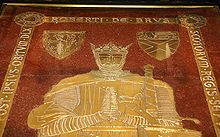
Eleanor, the ‘Pearl of Brittany’

cafc4ebfe479d11225f5ed912a69da3d

Eleanor of Brittany was born around 1184, the daughter of Geoffrey Plantagenet Duke of Brittany by right of his wife, and Constance of Brittany. Whilst estranged from his father, Henry II, Geoffrey had been trampled to death while competing at a tournament in Paris, in August 1186.

Described as beautiful, she has been called the Pearl, the Fair Maid and the Beauty of Brittany. A granddaughter of Henry II and Eleanor of Aquitaine, she was the eldest of her parents’ three children; a second daughter, Matilda was born the following year, but died young and a son, Arthur who was killed by – or at least on the orders of – King John in 1203. The birth of Eleanor’s brother Arthur in 1187 diminished her value on the marriage market; she no longer came with Brittany as her dowry, like her mother had done.

Initially, Eleanor’s life seemed destined to follow the same path as many royal princesses; marriage. Richard I, her legal guardian after the death of her father in 1186, following his sister Joanna’s adamant refusal, offered Eleanor as a bride to Saladin’s brother, Al-Adil, in a failed attempt at a political settlement to the 3rd Crusade. However, nothing came of the suggestion and, shortly after, at the age of nine, Eleanor was betrothed to Friedrich, the son of Duke Leopold VI of Austria, who had made the betrothal a part of the ransom for Richard I’s release from imprisonment by the Duke. Eleanor was travelling to Germany in the care of Baldwin de Béthune when news arrived that, Duke Leopold had died suddenly. The duke’s s son had ‘no great inclination’ for the proposed marriage and so Eleanor and her party turned around and returned home. Further marriage plans were mooted in 1195 and 1198, to Philip II of France’s son Louis, the dauphin, and Odo, Duke of Burgundy, respectively; although neither came to fruition.

Duchess Constance then pressed for Eleanor to be released from royal custody and by the time of Richard’s death, in 1199, Eleanor was living in France with her mother and brother. Eleanor’s fortunes changed drastically when Arthur rebelled against Richard’s successor, King John, in the early 1200s, encouraged by King Philip II of France. As the posthumous son of John’s older brother, Geoffrey, Arthur had a strong claim to the English crown, but had been sidelined in favour of his more mature and experienced uncle. He was also heavily influenced by the French king, a fact which did not go in his favour. Arthur was captured while besieging his grandmother, Eleanor of Aquitaine, at Mirebeau on 1st August 1202.

Eleanor was captured at the same time, or shortly after. And while her brother was imprisoned at Falaise, and later Rouen, in 1203 she was sent into perpetual imprisonment in England. Eleanor of Brittany holds the sad record of being the longest imprisoned English royal in British history.

If the laws of primogeniture had been strictly followed at the time, Eleanor would have been sovereign of England after her brother’s death. John and his successor, Henry III could never forget this. However, the experiences of Empress Matilda and her fight with King Stephen over her own rights to the crown – and the near-20 years of civil war between 1135 and 1154, had reinforced the attitude that a woman could not rule.

This did not, however, mean that Eleanor was no threat to John and Henry; should she be allowed to marry, her husband may be persuaded to fight to assert her rights, of form the focus to a rival faction at court – and an alternative royal line. Imprisoning Eleanor mean that John not only kept control of her, but also eliminated any possible opposition building around her rights to the throne.

Bowes Castle, North Yorkshire

Although her confinement has been described as ‘honourable’, Eleanor’s greater right to the throne meant she would never be freed, or allowed to marry and have children. King John gave her the title of Countess of Richmond on 27th May 1208, but Henry III would take it from her in 1219 and bestow the title elsewhere. From 1219 onward she was styled the ‘king’s kinswoman’ and ‘our cousin’.

It seems Eleanor did spend some time with the king and court, particularly in 1214 when she accompanied John to La Rochelle to pursue his war with the French. John planned to use Eleanor to gain Breton support and maybe set her up as his puppet Duchess of Brittany, replacing her younger half-sister Alice. Alice was the daughter of Eleanor’s mother, Constance, by her third marriage to Guy of Thouars. She was married to Peter of Dreux, a cousin of King Philip of France and Duke of Brittany by right of Alice. Using the carrot and stick approach, John offered Peter the earldom of Richmond to draw him to his side, while at the same time dangling the threat of restoring Eleanor to the dukedom, just by having her with him. Peter, however, refused to be threatened of persuaded and chose to face John in the field at Nantes. John’s victory and capture of Peter’s brother in the fighting persuaded Peter to agree to a truce, and John was content to leave Brittany alone, thereafter, advancing on Angers. His plans to restore Eleanor abandoned and forgotten.

Eleanor’s movements were restricted, and she was closely guarded. Her guards were changed regularly to enhance security, but her captivity was not onerous. She was provided with ‘robes’, two ladies-in-waiting in 1230, and given money for alms and linen for her ‘work’. One order provided her with cloth; however, it was to be ‘not of the king’s finest.’ She was granted the manor of Swaffham and a supply of venison from the royal forests. The royal family sent her gifts and she spent some time with the queen and the daughters of the king of Scotland, who were hostages in the king’s custody. Throughout her captivity she is said to have remained ‘defiant’.

King John

Eleanor was well-treated and fed an aristocratic diet, as her weekly shopping list attests; ‘Saturday: bread, ale, sole, almonds, butter, eggs. Sunday: mutton, pork, chicken and eggs. Monday: beef, pork, honey, vinegar. Tuesday: pork, eggs, egret. Wednesday: herring, conger, sole, eels, almonds and eggs. Thursday: pork, eggs, pepper, honey. Friday: conger, sole, eels, herring and almonds.’ In her sole surviving letter, written in 1208 with John’s consent, she is styled ‘Duchess of Brittany and Countess of Richmond.’

It is difficult to pinpoint exactly where Eleanor was imprisoned at any one time.  Over the years, she was held in various strongholds, including the castles of Corfe (Dorset), Burgh (Westmorland), and Bowes (Yorkshire).  Corfe Castle is mentioned at times, and it seems she was moved away from the coast in 1221 after a possible rescue plot was uncovered. She was also held at Marlborough for a time, and she was definitely at Gloucester Castle in 1236. By 1241 she was confined in Bristol castle, where Eleanor was visited regularly by bailiffs and leading citizens to ensure her continued welfare. Eleanor was also allowed   her chaplain and serving ladies to ensure her comfort. She died at the age of about fifty-seven, after thirty-nine years of imprisonment, achieving in death, the freedom that had eluded her in life.

She was initially buried at St James’s Priory Church in Bristol but her remains were later removed to the abbey at Amesbury, a convent with a long association with the crown.

*

Sources: Douglas Boyd, Eleanor, April Queen of Aquitaine; Dan Jones, The Plantagenets: the Kings who made England; Robert Bartlett, England Under the Norman and Angevin Kings 1075-1225; Alison Weir, Eleanor of Aquitaine and Britain’s Royal Families; Oxford Companion to British History; The History Today Companion to British History; Robert Lacey, Great Tales from English History; Mike Ashley, A Brief History of British Kings and Queens and The Mammoth Book of British Kings and Queens; findagrave.com; spokeo.com.

Pictures: Wikipedia, findagrave.com; Bowes Castle is ©Sharon Bennett Connolly

*

My books

Christmas is coming!

Signed, dedicated copies of all my books are available through my online bookshop.

Coming 15 January 2024: Women of the Anarchy

On the one side is Empress Matilda, or Maud. The sole surviving legitimate child of Henry I, she is fighting for her birthright and that of her children. On the other side is her cousin, Queen Matilda, supporting her husband, King Stephen, and fighting to see her own son inherit the English crown. Both women are granddaughters of St Margaret, Queen of Scotland and descendants of Alfred the Great of Wessex. Women of the Anarchy demonstrates how these women, unable to wield a sword, were prime movers in this time of conflict and lawlessness. It show how their strengths, weaknesses, and personal ambitions swung the fortunes of war one way – and then the other.

Available for pre-order from Amberley Publishing and Amazon UK.

Also by Sharon Bennett Connolly:

Out nowKing John’s Right-Hand Lady: The Story of Nicholaa de la Haye is the story of a truly remarkable lady. Nicholaa de la Haye was the hereditary constable of Lincoln Castle and the first woman in England to be appointed sheriff in her own right. Her strength and tenacity saved England at one of the lowest points in its history. Nicholaa de la Haye is one woman in English history whose story needs to be told…

King John’s Right-Hand Lady: The Story of Nicholaa de la Haye is now available from Pen & Sword Booksbookshop.org and Amazon.

Defenders of the Norman Crown: The Rise and Fall of the Warenne Earls of Surrey tells the fascinating story of the Warenne dynasty, of the successes and failures of one of the most powerful families in England, from its origins in Normandy, through the Conquest, Magna Carta, the wars and marriages that led to its ultimate demise in the reign of Edward III. Defenders of the Norman Crown: Rise and Fall of the Warenne Earls of Surrey is now available from Pen & Sword BooksAmazon in the UK and US, and Bookshop.org.

Ladies of Magna Carta: Women of Influence in Thirteenth Century England looks into the relationships of the various noble families of the 13th century, and how they were affected by the Barons’ Wars, Magna Carta and its aftermath; the bonds that were formed and those that were broken. It is now available in paperback and hardback from Pen & Sword,  Amazon, and Bookshop.org.

Heroines of the Medieval World tells the stories of some of the most remarkable women from Medieval history, from Eleanor of Aquitaine to Julian of Norwich. Available now from Amberley Publishing and Amazon, and Bookshop.org.

Silk and the Sword: The Women of the Norman Conquest traces the fortunes of the women who had a significant role to play in the momentous events of 1066. Available now from Amazon,  Amberley Publishing, and Bookshop.org.

Alternate Endings: An anthology of historical fiction short stories including Long Live the King… which is my take what might have happened had King John not died in October 1216. Available in paperback and kindle from Amazon.

Podcast:

Have a listen to the A Slice of Medieval podcast, which I co-host with Historical fiction novelist Derek Birks. Derek and I welcome guests, such as Bernard Cornwell, and discuss a wide range of topics in medieval history, from significant events to the personalities involved.

*

Don’t forget! Signed and dedicated copies of all my books are available through my online bookshop.

For forthcoming online and in-person talks, please check out my Events Page.

You can be the first to read new articles by clicking the ‘Follow’ button, liking our Facebook page or joining me on Twitter and Instagram.

*

©2015 Sharon Bennett Connolly FRHistS

Isabella of Castile, the Controversial First Duchess of York, c.1355-1392

Isabella_of_Castile-Langley
Isabella of Castile

As the third daughter of Peter (or Pedro) the Cruel of Castile and his long-term mistress (and sometime wife) Maria of Padilla, Isabella of Castile‘s childhood was marred by her father’s battles to hold on to his throne and almost constant warfare with Aragon.

Peter was known in some areas as Peter the Cruel and in others as Peter the Just, depending which side of the conflict people were on. He received support from Edward III of England’s eldest son and heir Edward, the Black Prince, but Peter’s failure to pay the costs of the prince’s campaign,  his faithlessness, and the failing health of the Black Prince, meant the king of Castile was left to his own devices by 1367. Adding to Peter’s woes, his own nobles backed the king’s illegitimate brother, Henry of Tastamara, as an alternative candidate. Henry eventually defeated and killed Peter in March 1369.

Peter had been married, in June 1353, to the unfortunate French princess, Blanche de Bourbon, though some historians believe he had already married Maria de Padilla sometime before this. Whatever the case, Peter abandoned Blanche for Maria just 3 days after the wedding. Blanche was imprisoned in various castles, far away from the French border to prevent her rescue. Repeated calls from the French, for her to be released, went unheeded and the pope refused to excommunicate Peter for his actions. Blanche died at Medina Sidonia in 1361, though whether her death was by natural causes or assassination on Peter’s orders is disputed. One source claims Peter’s crossbowman was sent to kill Blanche. Another claims she was poisoned. While another suggests natural causes. With Peter and his brother Henry vying for the crown, misinformation his hard to filter.

Isabella was born sometime around 1355. Her mother died in 1361 and her 3-year-old brother, Alfonso, in 1362. In 1362, Peter had persuaded the Cortes to recognise his relationship with Maria as a legitimate marriage, and thus legitimise his 3 daughters, Beatrix, Constance and Isabella, making Beatrix his heir. However, Beatrix died in 1367 and son, on Peter’s death in 1369, it was Constance who inherited their father’s claim to the crown of Castile. The situation in Castile was precarious, to say the least and Constance was unable to pursue her claim. Her father had taken Constance and her sister to the English territory of Guyenne in 1366, where they had remained whilst Peter had tried to reclaim his crown from Henry. They remained in Bayonne as hostages against the repayment of the financial costs of the expedition. Following Peter’s death, the English took the princesses in and soon after, in September 1371, Constance was married to John of Gaunt, the third surviving son of Edward III, at Roquefort. John of Gaunt had become duke of Lancaster on marrying his first wife, Blanche of Lancaster, who had died in 1368; he saw this second marriage as an opportunity to gain a kingdom of his own. When the newly married couple returned to London, they brought Constance’s younger sister, Isabella, with them.

Edmund_of_Langley_remonstrating_with_the_King_of_Portugal_-_Chronique_d'_Angleterre_(Volume_III)_(late_15th_C),_f.186r_-_BL_Royal_MS_14_E_IV

Following Constance’s official entry into London, 16-year-old Isabella probably stayed with her sister and new brother-in-law at Gaunt’s house on the Thames, the Savoy. A year later, Edward III arranged for Isabella to marry Gaunt’s younger brother, Edmund of Langley. Edmund was the fifth son, fourth surviving of Edward III and Philippa of Hainault. Born in 1341, Edmund was 14 years older than his bride. They were married on 4 July 1372, at Wallingford. John of Gaunt gave the bride a wedding gift of plate bought from leading London goldsmiths. The marriage was a continuation of the of the English policy of the time, to reinforce the dynastic link between England and Castile and thus ensuring that both heirs of Peter of Castile were married into the English royal line. Should Constance die without an heir, Isabella would inherit her claim to the Castilian throne.

On her marriage to Edmund, Isabella became Countess of Cambridge, and would become the first ever Duchess of York when Edmund was created Duke of York by his nephew, King Richard II, on 6 August 1385. She was appointed a Lady of the Garter in 1379. In 1381, Isabella accompanied her husband, taking along their 8-year-old son Edward to Lisbon, on John of Gaunt’s ill-fated expedition to claim the Castilian throne for his wife. The Portuguese chronicler, Ferñao Lopes, noted how the Portuguese king, Ferdinand, supported the countess on his arm on the walk up the steep slope from the Tagus to the cathedral, and led her mount by the rein to the monastery where they were lodged. Little Edward was briefly betrothed to King Ferdinand’s only legitimate child, Beatriz, who would go on to marry John I of Castle, the son of Henry of Trastamara.

The couple’s first son, Edward was born in 1373 – he would become the second Duke of York, and be killed at Agincourt in 1415. A daughter, Constance, was born in 1374. A second son, Richard of Conisbrough, grandfather of both Edward IV and Richard III, was born at Conisbrough Castle in Yorkshire, sometime between 1375 and 1386. He was executed for his involvement in the Southampton Plot, against Henry V, in 1415.

It is hard to discern the truth of the relationship between Isabella and Edmund. Froissart remarked on Edmund’s indolent character and together they were described as an ill-matched pair. Thomas of Walsingham, in particular, commented on Isabella’s ‘loose morals.’ And 40 years after her death, John Shirley, spicing up poems he was transcribing with gossip, referred to a love affair ‘my lady of York doughter to the king of Spaygne and my lord of Huntyngdone.’ The affair was said to have started as early as 1374 and has cast doubt on the legitimacy of Edmund and Isabella’s third and youngest child, Richard of Conisbrough. Recent studies, however, have cast doubt on the affair, their argument supported by Duke Edmund’s will, giving the lie to a rocky relationship by requesting to be buried ‘near his beloved Isabel, formerly his companion.’ 

conisbroughcastle
Conisbrough Castle, Yorkshire

Isabella died on 23 December 1392, aged about 37, and was buried at the church of the Dominicans, in King’s Langley, on 14 January 1393. In her will, drawn up a week before her death, and with her husband’s consent, she made Richard II her heir and asked that he provide a pension for her youngest son and Richard II’s godson, Richard of Conisbrough. Richard was given an allowance of £500 by the king, but this was only paid sporadically following Richard II’s deposition by Henry IV. Richard was not even mentioned in the wills of his father and brother and G.L. Harriss, of the Oxford Dictionary of National Biography, has speculated this could be proof that Richard was not the son of the Duke of York. Although it could simply be because his mother had already made provision for their youngest son. At the time of Isabella’s death, Duke Edmund was still in debt due to the failed Castilian expedition, and so Isabella’s will gave provision for her younger son whilst protecting the incomes of her husband and older son.

Jenny Stratford’s recent essay on Isabella of Castile from the Oxford Dictionary of National Biography has an extensive study of Isabella’s will and argues against the supposed affair with John Holland, rooting out the sources of the rumours and and demonstrating how they took flight. Isabella’s will demonstrates her pride in her heritage and affection for her husband and children, as well as a conventional piety. She left personal bequests to Richard II and his queen, Anne of Bohemia, in addition to books, jewels, plate, horses and robes to her husband, children and friends, with monetary bequests for various other members of the York household, including servants and the musicians of the household chapel. Isabella also left a bequest of robes, furs and jewels, to the first lady of her household, Marie St Hilaire, who was the mother of Gaunt’s illegitimate daughter, Blanche, born about 1359.

Edmund married again, to his cousin Joan Holland, niece of his first wife’s supposed lover, John Holland. In another bizarre family twist, it was Joan’s brother, Edmund Holland, 4th Earl of Kent, who had an affair – and an illegitimate daughter – with Constance of York, the daughter of Edmund and Isabella.

*

Sources: Ian Mortimer, Edward III The Perfect King; englishmonarchs.co.uk; womenshistory.about.com; WM Ormrod, The Reign of Edward III; Conisbrough Castle, South Yorkshire; Oxforddnb.com; The History Today Companion to British History, edited by Juliet Gardiner & Neil Wenborn; Brewer’s British Royalty by David Williamson; Britain’s Royal Families, the Complete Genealogy by Alison Weir; The Wars of the Roses by John Gillingham; The Wordsworth Dictionary of British History by J.P. Kenyon; The Oxford Companion to British History, edited by John Cannon; The Reign of Edward III by WM Ormrod; The Wars of the Roses by Martin J Dougherty; englishmonarchs.co.uk; womenshistory.about.com; findagrave.com; conisbroughcastle.org.uk; hrionline.ac.uk.

Photos from Wikipedia, except Conisbrough Castle which is © Sharon Bennett Connolly.

*

My Books

Signed, dedicated copies of all my books are available through my online bookshop.

Coming on 15 June 2024: Heroines of the Tudor World

Heroines of the Tudor World tells the stories of the most remarkable women from European history in the time of the Tudor dynasty, 1485-1603. These are the women who ruled, the women who founded dynasties, the women who fought for religious freedom, their families and love. These are the women who made a difference, who influenced countries, kings and the Reformation. In the era dominated by the Renaissance and Reformation, Heroines of the Tudor World examines the threats and challenges faced by the women of the era, and how they overcame them. From writers to regents, from nuns to queens, Heroines of the Tudor World shines the spotlight on the women helped to shape Early Modern Europe.

Heroines of the Tudor World is now available for pre-order from Amberley Publishing and Amazon UK.

Out Now! Women of the Anarchy

Two cousins. On the one side is Empress Matilda, or Maud. The sole surviving legitimate child of Henry I, she is fighting for her birthright and that of her children. On the other side is her cousin, Queen Matilda, supporting her husband, King Stephen, and fighting to see her own son inherit the English crown. Women of the Anarchy demonstrates how these women, unable to wield a sword, were prime movers in this time of conflict and lawlessness. It show how their strengths, weaknesses, and personal ambitions swung the fortunes of war one way – and then the other.

Available from Bookshop.orgAmberley Publishing and Amazon UK.

Also by Sharon Bennett Connolly:

King John’s Right-Hand Lady: The Story of Nicholaa de la Haye is the story of a truly remarkable lady, the hereditary constable of Lincoln Castle and the first woman in England to be appointed sheriff in her own right. It is is available from King John’s Right-Hand Lady: The Story of Nicholaa de la Haye is the story of a truly remarkable lady, the hereditary constable of Lincoln Castle and the first woman in England to be appointed sheriff in her own right. Available from all good bookshops or direct from Pen & Sword Booksbookshop.org and AmazonDefenders of the Norman Crown: The Rise and Fall of the Warenne Earls of Surrey tells the fascinating story of the Warenne dynasty, from its origins in Normandy, through the Conquest, Magna Carta, the wars and marriages that led to its ultimate demise in the reign of Edward III. Available from Pen & Sword BooksAmazon in the UK and US, and Bookshop.org

Ladies of Magna Carta: Women of Influence in Thirteenth Century England looks into the relationships of the various noble families of the 13th century, and how they were affected by the Barons’ Wars, Magna Carta and its aftermath; the bonds that were formed and those that were broken. It is now available in paperback and hardback from Pen & Sword,  Amazon, and Bookshop.orgHeroines of the Medieval World tells the stories of some of the most remarkable women from Medieval history, from Eleanor of Aquitaine to Julian of Norwich. Available now from Amberley Publishing and Amazon, and Bookshop.orgSilk and the Sword: The Women of the Norman Conquest traces the fortunes of the women who had a significant role to play in the momentous events of 1066. Available now from Amazon,  Amberley Publishing, and Bookshop.org.

Alternate Endings: An anthology of historical fiction short stories including Long Live the King… which is my take what might have happened had King John not died in October 1216. Available in paperback and kindle from Amazon.

Podcast:

Have a listen to the A Slice of Medieval podcast, which I co-host with Historical fiction novelist Derek Birks. Derek and I welcome guests, such as Bernard Cornwell and discuss a wide range of topics in medieval history, from significant events to the personalities involved.

*

Don’t forget! Signed and dedicated copies of all my books are available through my online bookshop.

For forthcoming online and in-person talks, please check out my Events Page.

You can be the first to read new articles by clicking the ‘Follow’ button, liking our Facebook page or joining me on Twitter and Instagram.

*

©2015 Updated ©2024 Sharon Bennett Connolly FRHistS