The promise of vengeance no matter how long it takes.
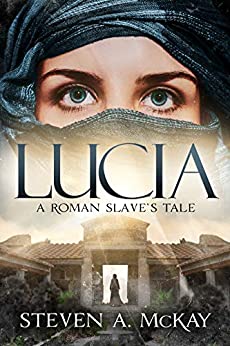
At eight years old, Lucia is torn from the life she knew. Her village burned to the ground and parents murdered by Romans, she is kidnapped, sold and shipped abroad to the Villa Tempestatis in Britannia to serve the young Roman army officer Castus.
Faced with a bleak future of decades of servitude to her master, as well as sadistic brutality at the hands of his manageress, Paltucca, she finds herself fixated by one thought alone: vengeance.
Yet Villa Tempestatis, with its picturesque surroundings in Britannia’s green countryside, offers a life that’s a little easier than elsewhere in the Roman empire. The slaves form strong bonds of love and friendship, enjoy feasts and holiday celebrations together, and are even allowed, sometimes, to start a family. Many of them are happy enough with their lot.
Despite that, every moment of Lucia’s life is blighted by her hatred for Castus and Paltucca, and only seeing them both destroyed will bring her a measure of peace, even if it takes decades of work and planning…
From the moment you read the dedication in the front of Lucia, you will know you are in for an emotional rollercoaster:
Dedicated to all the men, women and children forced into slavery and forgotten by history.
And you would be right!
Lucia is one of those novels that will stay with you long, long … long after you have read the final page and closed the book (probably with a tear on your cheek). To say it is thought-provoking would be an understatement. This is one of those stories that will really get under your skin.
I have read everything Steven A. McKay has written, from his unique take on the Robin Hood stories to his wonderfully atmospheric Warrior Druid of Britain series, but Lucia is on another level. It is probably his best writing yet. It is a story that is at once desperate and uplifting, a story that touches you deep in your soul.
Set in a splendid villa in Roman Britain, Lucia captures perfectly a life of slavery. The brutality, the feeling of helplessness, the inhumanity is contrasted with the compassion, the humanity and the sense of family and comradeship with fellow slaves. Steve A. McKay clearly and cleverly depicts the blurred lines of the master and slave relationship and the slaves serve the Roman family, being detached from it and at the same time an integral part of the family life.
The villa was a wonderful sight on a July day like this, with its white plastered walls and red-tiled roofs seeming to glow in the sunshine, while its position on the hill afforded superb views of the land around: well-tended fields of corn and grain; groves of trees once sacred to the native Britons; and the sparkling waters of the narrow river that flowed past the western wing, providing their water for drinking, cleaning, cooking and, of course, bathing.
Sometimes, on particular beautiful days, Lucia forgot about her previous life, as the daughter of a warlord in Germania. Forgot about her previous existence before she was captured by the Romans who had destroyed her village, slaughtered her people and sold her at the market to her master.
It had been a year already since Publius Licinius Castus, a young Roman officer himself, had bought her from that terrible slave-market and shipped her here, to his lavish country villa in this damp land.
Villa Tempestatis
A lump came to her throat as an image of her parents – happy, smiling down with pride on their beloved daughter – came to her, and she angrily brushed away the tears forming in her eyes before they had a chance to streak her grimy cheeks.
Yes, sometimes she was able to forget her previous, free life in Germania, but it was never long before reality returned and she felt her spirit crushed so hard that it almost stopped her heart from beating.
The beauty of the villa and its surroundings hid the pain of dozens of slaves who had lived here over generations, young and old. Some of them, like Paltucca, were able to adapt and even thrive in such conditions, while others wilted and eventually, under the weight of what they’d lost, rendered themselves useless to the master. Those unfortunates soon disappeared, never to be heard of again.
Lucia wondered if she would end up like that one day, sold to be worked to death in a mine perhaps, when the stolen memory of the joy of her childhood became too much to bear.
Lucia explores the life of a girl forced into slavery by the Romans at the age of 8, and her relationship with her master and her fellow slaves. The book does a wonderful job of depicting not only the life of a slave but also their emotions, the fact that they do live their lives despite a lack of freedom, that they lived, loved, even raised families. It clearly demonstrates the contrast between the acceptance and cooperation that you still have to live, despite not being free, and that deep, constant yearning for freedom.
Lucia is one of those books for which you can write an awesome review – and yet, still know that your review will never do the book justice. It is, beyond doubt, the best thing Steven A. McKay has ever written, simply because it makes the reader re-evaluate the way they think and feel – and takes them to a depth of their soul they probably have never visited before.
Touching a topic that has affected lives throughout history, and yet seems just as relevant today; slavery. Lucia plays on all your emotions: anger, pity, empathy, love and hate. At times, Lucia is a hard book to read, but is essential reading on so many levels. Steven A McKay has written a truly riveting depiction of the life of a slave.
This is how books should be written, with passion and compassion. If you only read one more book this year, it should be Lucia.
Steven McKay was born in 1977 near Glasgow in Scotland. He live in Old Kilpatrick with his wife and two young children. After obtaining his Bachelor of Arts degree with the Open University he decided to follow his life-long ambition and write a historical novel.
He plays guitar and sings in a heavy metal band when they can find the time to meet up.
You can check out his website here. Steven also has an Amazon Author page and can be found on Twitter and Facebook.
Matilda – also known as Mahelt or Maud – was the eldest daughter of the great William Marshal, Earl of Pembroke, known to many as The Greatest Knight! She lived through on of the most tumultuous periods of English history, the reign of King John, Magna Carta, the First Barons’ War and the minority of King Henry III.
Effigy identified as William Marshal, Temple Church, London
Although we do not have a birth date for Matilda Marshal, given that her parents married in 1189 and she had two elder brothers, Matilda was probably born in 1193 or 1194. She was the third child and eldest daughter of William Marshal and his wife Isabel de Clare. The Histoire de Guillaume le Marechale praises Matilda saying she had the gifts of ‘wisdom, generosity, beauty, nobility of heart, graciousness, and I can tell you in truth, all the good qualities which a noble lady should possess.’1 The Histoire goes on to say; ‘Her worthy father who loved her dearly, married her off, during his lifetime to the best and most handsome party he knew, to Sir Hugh Bigot.’2 Of William and Isabel’s five daughters, it is only Matilda who is mentioned in the Histoire as being ‘loved dearly’ by her father.
In 1207 when the Marshal family moved to Ireland, William looked to settle Matilda’s future. Now aged 13 of 14, Matilda was old enough to be married and William approached Roger Bigod, second Earl of Norfolk, to propose a match between Matilda and Roger’s son and heir, Hugh Bigod. Hugh was Roger’s son by his wife Ida de Tosny, former mistress of King Henry II and the mother of the king’s son, William Longespée, Earl of Salisbury. Roger and Ida had married at Christmas in 1181 and so Hugh was probably in his mid-twenties when the marriage with Matilda was suggested.
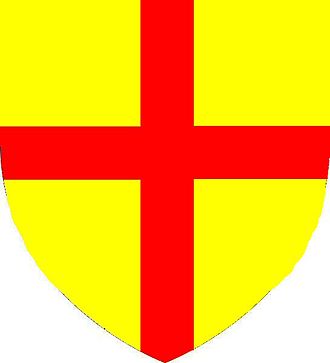
Coat of arms of Matilda’s 1st husband Hugh Bigod, 3rd Earl of Norfolk
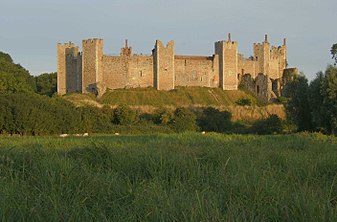
According to the Histoire William asked Roger Bigod ‘graciously, being the wise man he was, to arrange a handsome marriage between his own daughter and his son Hugh. The boy was worthy, mildmannered, and noblehearted and the young lady was a very young thing and both noble and beautiful. The marriage was a most suitable one and pleased both families involved.’3 The match was a good one. After the marriage, Matilda lived with her husband at the earl of Norfolk’s magnificent thirteen-towered castle at Framlingham. In 1209 she gave birth to a son, Roger, who would succeed his father as 4th Earl of Norfolk. Another son, Hugh, was born in 1212, and a daughter, Isabelle in 1215. A third and final son, Ralph, was probably born in 1216 or 1217.
Matilda’s family was deeply divided by the Magna Carta crisis and subsequent civil war. Her husband and father-in-law had joined the ranks of the baronial rebellion in 1215, as had her brother, William Marshal the Younger, whilst her father remained a staunch supporter of the king, holding the Welsh Marches for the Royalist cause during the civil war.
In 1216 the war touched Matilda personally, with Framlingham Castle being besieged by King John, who demanded the castle’s surrender:
The King to his well-beloved men, William le Enveise, constable of Framlingham, and all the knights presently with him in that castle, greetings. We command that you deliver up to our trusty and well beloved William de Harcourt and Elias de Beauchamp the castle of Framlingham. And in testimony hereof we thereto send you these our letters patent. Witness myself, at Framlingham, the thirteenth day of March, in the seventeenth year of our reign.4
We do not know whether Matilda was in residence at the castle at the time of the siege; her father-in-law was in, or on his way to, London and her husband Hugh’s whereabouts are unknown, but he was not at Framlingham. The king allowed the constable, William le Enveise, to send messengers to the earl and seek advice on what they should do. The earl probably advised the constable to surrender as the castle capitulated to the king without a fight two days later. One of Matilda’s sons, most likely the eldest, Roger, was taken as hostage.
It is not hard to imagine what thoughts and feelings – and fears – must have gone through Matilda’s mind, knowing that her young son, only 6 or 7 years of age, was in the custody of King John. The king’s treatment of Matilda de Braose was common knowledge, and rumours of what had happened to Arthur of Brittany were rife. Her own two older brothers, William and Richard, had also been held for several years as hostages to their father’s good behaviour. It must have been a comfort to Matilda, however, to know that King John depended on the loyalty of her father, and so would treat the boy well, if only to avoid alienating the man whose support he sorely needed.
Framlingham Castle, Suffolk
Despite King John’s death in October 1216, Matilda’s husband and father-in-law remained in rebellion, supporting the claims of Louis of France, the dauphin, who had invaded England early in 1216 and controlled much of the south. The earl of Norfolk only came to terms with the Royalist government when the French prince returned home in September 1217; after which he was finally restored to the earldom of Norfolk and Framlingham Castle was returned to him. It was probably also at this time that his grandson, Roger, was returned to his mother; his last year as a hostage would have been when his own grandfather, William Marshal, was in power as regent. Which must have allowed Matilda to rest easier and allayed her fears for her son.
Matilda spent time with her father while he was dying in April and May 1219. The Histoire says of Matilda at her father’s deathbed:
‘My lady Mahelt [Matilda] la Bigote was so full of grief she almost went out of her mind, so great was her love for him. Often she appealed to God, asking Him why He was taking from her what her heart loved most.’5
It goes on to tell the story of the ailing William Marshal calling for his daughters to sing to him. William asked Matilda to be the first to sing:
‘She had no wish to do so for her life at the time was a bitter cup, but she had no wish to disobey her father’s command. She started to sing since she wished to please her father, and she sang exceedingly well, giving a verse of a song in a sweet, clear voice.’6
Matilda’s husband, Hugh, succeeded to the title of earl of Norfolk when his father died sometime between April and August 1221, probably aged well into his seventies. The new earl, however, only enjoyed his title for four years; he died suddenly in 1225, aged only 43. He was succeeded by their eldest son, Roger, then only 16 years old and therefore still a minor. His wardship was given to William Longespée, Earl of Salisbury, the young earl’s half-uncle, but when Longespée died the following year, the wardship was transferred to Alexander II, King of Scots.
With custody of the young earl of Norfolk, and of all his lands, Alexander II married Roger to his sister, Isabella of Scotland. The only lands not granted to the king of Scots were those which Matilda held in dower as Hugh Bigod’s widow. Matilda was still only 32 when Hugh died, with three of her four children still to care for. As a valuable marriage prize she, or her family, acted quickly to secure her future and safety and within three months of her husband’s death, Matilda was married once more.
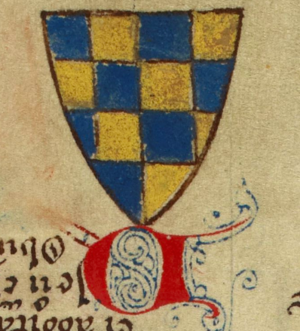
Arms of William de Warenne
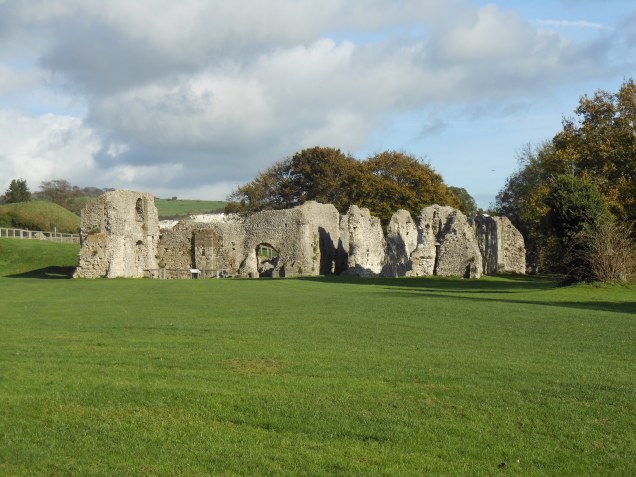
Her second husband was William de Warenne, 5th Earl of Surrey, also known as Earl Warenne. William was the only son of Isabel de Warenne, Countess of Surrey in her own right, and her second husband, Hamelin de Warenne, half-brother of King Henry II. Matilda was the earl’s second wife, his first wife, also called Matilda, the daughter of William d’Aubigny, second Earl of Arundel had died childless on 6 February 1215 and was buried at Lewes Priory, Sussex. William de Warenne was a neighbour of the Bigods, having lands centred in Castle Acre in Norfolk, and he had joined the rebellion against King John at about the same time as Roger Bigod, although William was back in the Royalist camp by March 1217 and was a prominent participant in the negotiations which ended the war in August 1217.
Probably born in the late 1260s, William was considerably older than his new wife and the marriage appears to have been one of practicality, rather than affection. The earl had purchased Matilda’s marriage, essentially meaning her dower in Norfolk, before July 1225. Matilda continued to style herself as ‘Matildis la Bigot’ in charters, with ‘Matildis de Warenne’ added only as an afterthought, or not at all. For example, a charter from the early 1240s, following the death of William de Warenne, has the salutation, ‘ego Latilda Bigot comitissa Norf ’ et Warenn.’7 This may be an indication that this second marriage was not of Matilda’s own choosing and she may even have preferred to remain a widow, rather than entering into this second marriage. The continuing use of her name from her first marriage possibly being her own mark of rebellion against her new situation.
After the resolution of the crisis of 1216/1217 William de Warenne served the crown faithfully, save for his brief involvement in the confederation against it led by Henry III’s brother Richard of Cornwall, between July and October 1227. He was forced to surrender Tickhill Castle, but his disgrace was only temporary and in 1228 he received the third penny for the county of Surrey for the first time, an honorary payment previously denied to William and his father. In 1230 William de Warenne was appointed keeper of the east-coast ports of England during the king’s expedition to Brittany. In 1236 he was cup bearer at the coronation of Eleanor of Provence and in 1237 he witnessed the reissue of Magna Carta; the ageing earl was one of the few surviving barons who had been witness to the original charter in 1215.
The Warenne stronghold of Castle Acre Castle, Norfolk
In his early 70s, William de Warenne died in London on 27 or 28 May 1240; he was buried before the high altar at his family’s foundation of Lewes Priory in Sussex. In his memory, the king ordered that a wayside cross be erected on the road between Carshalton and Merton, in Surrey.
Matilda bore her second husband two children, a boy and a girl, John and Isabel (later Isabel d’Aubigny). John would succeed his father as earl and attained his majority in 1248, when he succeeded to the vast Warenne estates. He would pursue a martial career and was one of Edward I’s fiercest generals. Matilda did not marry again after William’s death. In 1246, as the last surviving child of William Marshal, and with neither of her five brothers leaving a son, Matilda was granted the Marshal’s rod by King Henry III. She did, at this point, change her name on charters, to ‘Martill marescalla Angliae, comitissa Norfolciae et Warennae.’8
Emphasising her Marshal name as her father’s eldest surviving child, Matilda was, significantly, claiming the title Marshal of England as her right, thus increasing her power and prestige, and taking the authority of the marshal as her own. Matilda appears to have acted independently during her second marriage, purchasing land in the Don Valley in South Yorkshire, close to the Warenne stronghold of Conisbrough Castle and after the queen she was ‘undoubtedly the most powerful and wealthy woman in England from 1242 onwards.’9
Tintern Abbey Monmouthshire
Matilda Marshal died in 1248, either on 27 March or at the beginning of April, in her mid-50s. Choosing to be interred with her Marshal family, rather than either of her husbands, Matilda was buried at Tintern Abbey, Monmouthshire. Her three Bigod sons and their Warenne half-brother carried their mother’s bier into the church, where she was laid to rest close to her mother, Isabel, two of her brothers, Walter and Ancel, and her sister, Sybil. It is through Matilda’s marriage to Hugh Bigod, Earl of Norfolk, that the present duke of Norfolk also bears the title of Earl Marshal.
1David Crouch and Anthony Holden, History of William Marshal: Text and Translation; 2 ibid; 3ibid; 4Letter of 13 March 1216, Rich Price, King John’s Letters; 5Crouch and Holden, History of William Marshal: Text and Translation; 6ibid; 7Chadwick, Elizabeth, ‘Clothing the Bones: Finding Mahelt Marshal’, livingthehistoryelizabethchadwick.blogspot.com; 8Vincent, Nicholas, ‘William de Warenne, fifth earl of Surrey [Earl Warenne] (d. 1240)’, Oxforddnb.com; 9David Crouch quoted in Chadwick, ‘Clothing the Bones: Finding Mahelt Marshal’.
Sources:
Rich Price, King John’s Letters Facebook group; Robert Bartlett England Under the Norman and Angevin Kings 1075-1225; Dan Jones The Plantagenets; the Kings who Made England; The Plantagenet Chronicle Edited by Elizabeth Hallam; Maurice Ashley The Life and Times of King John; Roy Strong The Story of Britain; Oxford Companion to British History; Mike Ashley British Kings & Queens; David Williamson Brewer’s British Royalty; Ralph of Diceto, Images of History; Marc Morris, King John; David Crouch, William Marshal; Crouch and Holden, History of William Marshal; Crouch, David, ‘William Marshal [called the Marshal], fourth earl of Pembroke (c. 1146–1219)’, Oxforddnb.com; Flanagan, M.T., ‘Isabel de Clare, suo jure countess of Pembroke (1171×6–1220)’, Oxforddnb.com; Thomas Asbridge, The Greatest Knight; Chadwick, Elizabeth, ‘Clothing the Bones: Finding Mahelt Marshal’, livingthehistoryelizabethchadwick.blogspot.com; Stacey, Robert C., ‘Roger Bigod, fourth earl of Norfolk (c. 1212-1270)’, Oxforddnb.com; finerollshenry3.org.uk; Vincent, Nicholas, ‘William de Warenne, fifth earl of Surrey [Earl Warenne] (d. 1240)’, Oxforddnb.com.
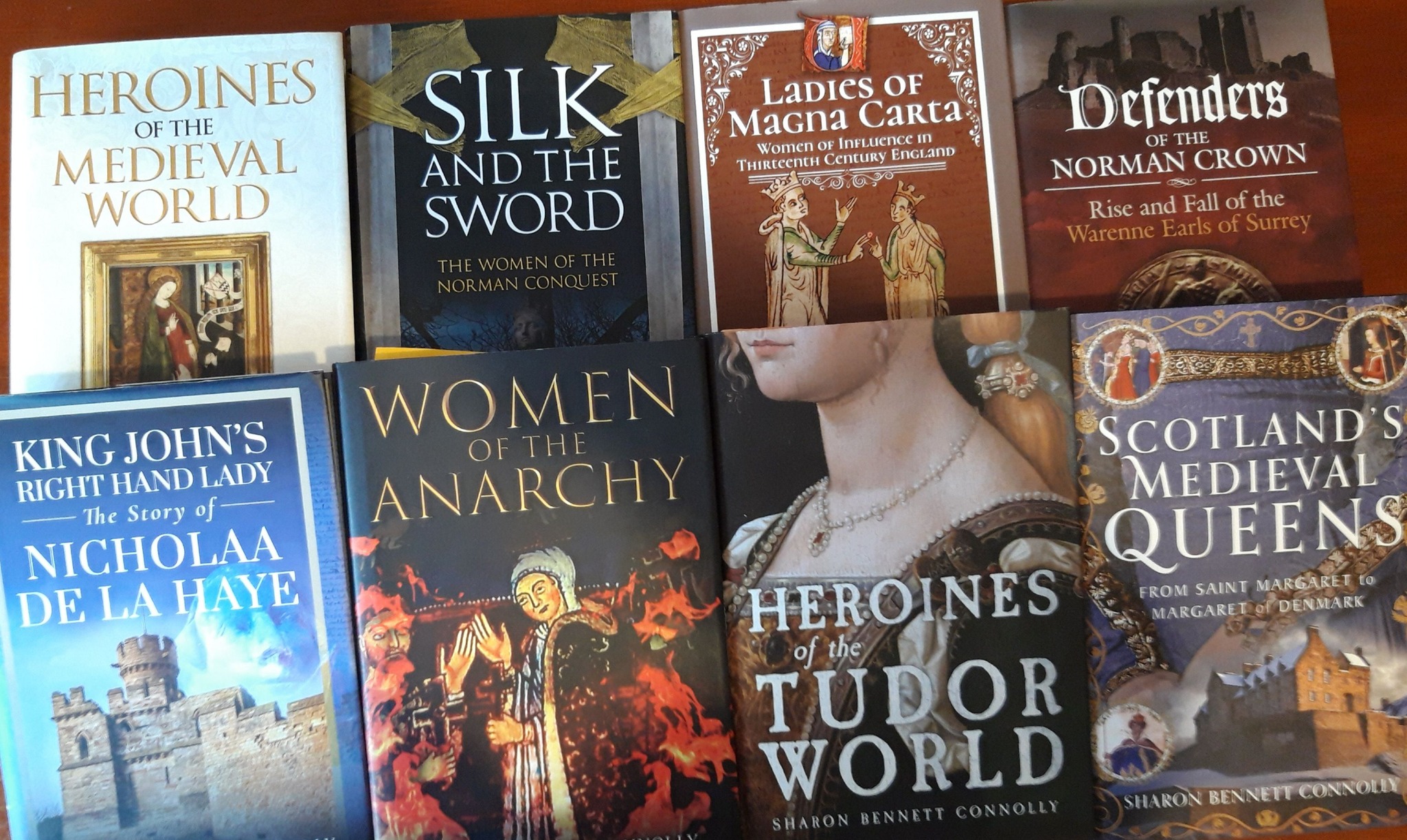
My Books
Signed, dedicated copies of all my books are available through my online bookshop.
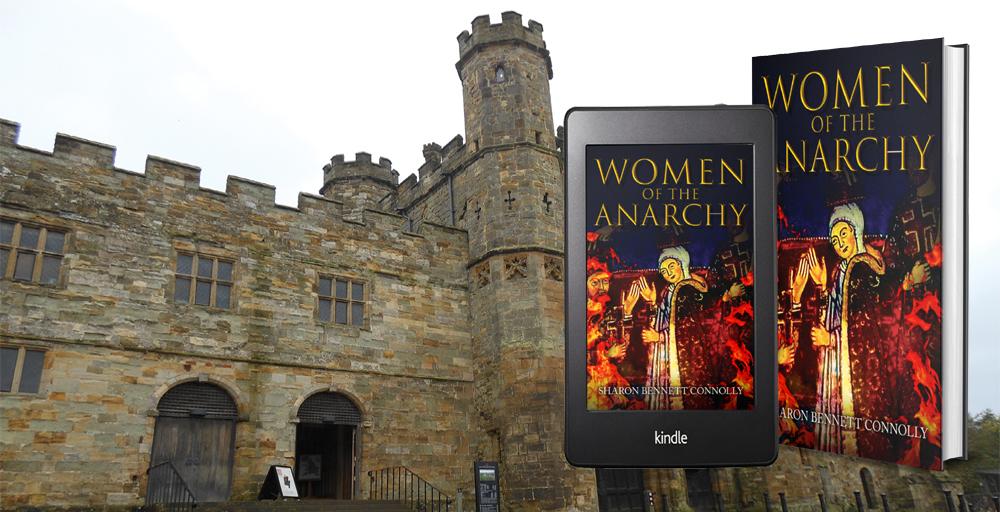
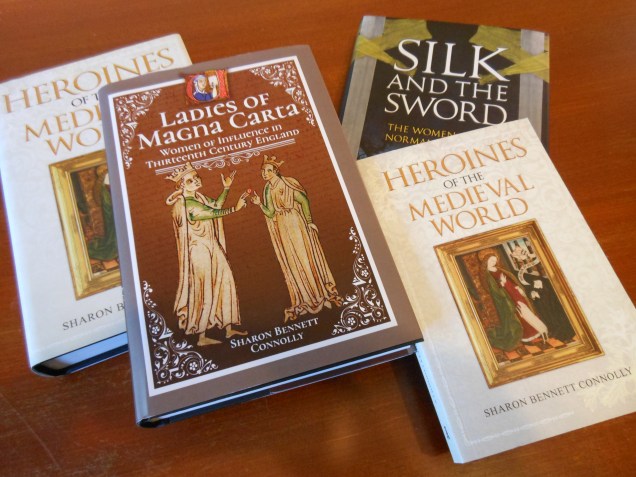
Out Now!Women of the Anarchy
Two cousins. On the one side is Empress Matilda, or Maud. The sole surviving legitimate child of Henry I, she is fighting for her birthright and that of her children. On the other side is her cousin, Queen Matilda, supporting her husband, King Stephen, and fighting to see her own son inherit the English crown. Women of the Anarchy demonstrates how these women, unable to wield a sword, were prime movers in this time of conflict and lawlessness. It show how their strengths, weaknesses, and personal ambitions swung the fortunes of war one way – and then the other.
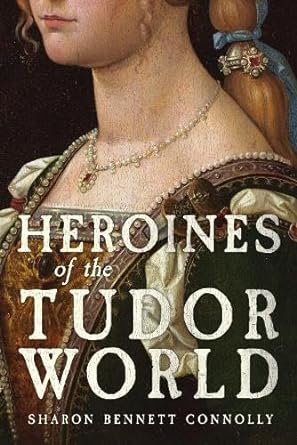
Coming on 15 June 2024: Heroines of the Tudor World
Heroines of the Tudor World tells the stories of the most remarkable women from European history in the time of the Tudor dynasty, 1485-1603. These are the women who ruled, the women who founded dynasties, the women who fought for religious freedom, their families and love. These are the women who made a difference, who influenced countries, kings and the Reformation. In the era dominated by the Renaissance and Reformation, Heroines of the Tudor World examines the threats and challenges faced by the women of the era, and how they overcame them. From writers to regents, from nuns to queens, Heroines of the Tudor World shines the spotlight on the women helped to shape Early Modern Europe.
King John’s Right-Hand Lady: The Story of Nicholaa de la Haye is the story of a truly remarkable lady, the hereditary constable of Lincoln Castle and the first woman in England to be appointed sheriff in her own right. It is is available from King John’s Right-Hand Lady: The Story of Nicholaa de la Haye is the story of a truly remarkable lady, the hereditary constable of Lincoln Castle and the first woman in England to be appointed sheriff in her own right. Available from all good bookshops or direct from Pen & Sword Books, bookshop.org and Amazon. Defenders of the Norman Crown: The Rise and Fall of the Warenne Earls of Surrey tells the fascinating story of the Warenne dynasty, from its origins in Normandy, through the Conquest, Magna Carta, the wars and marriages that led to its ultimate demise in the reign of Edward III. Available from Pen & Sword Books, Amazon in the UK and US, and Bookshop.org.
Alternate Endings: An anthology of historical fiction short stories including Long Live the King… which is my take what might have happened had King John not died in October 1216. Available in paperback and kindle from Amazon.
Podcast:
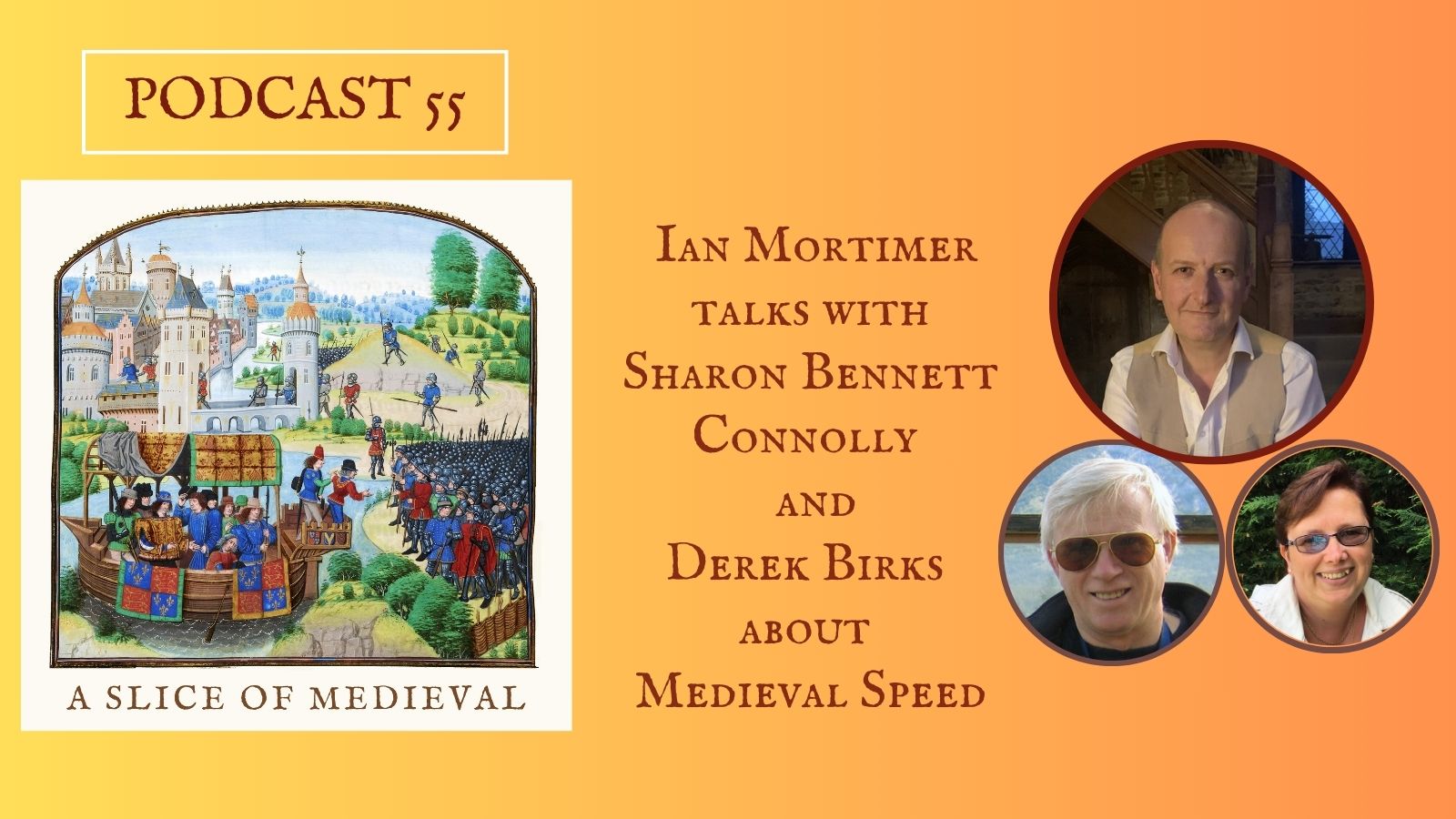
Have a listen to theA Slice of Medieval podcast, which I co-host with Historical fiction novelist Derek Birks. Derek and I welcome guests, such as Bernard Cornwell and Elizabeth Chadwick, and discuss a wide range of topics in medieval history, from significant events to the personalities involved.
*
Don’t forget!Signed and dedicated copies of all my books are available through my online bookshop.
For forthcoming online and in-person talks, please check out my Events Page.
You can be the first to read new articles by clicking the ‘Follow’ button, liking our Facebook page or joining me on Twitterand Instagram.
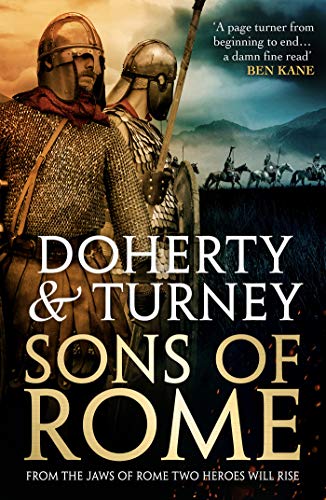
As twilight descends on the 3rd century AD, the Roman Empire is but a shadow of its former self. Decades of usurping emperors, splinter kingdoms and savage wars have left the people beleaguered, the armies weary and the future uncertain. And into this chaos Emperor Diocletian steps, reforming the succession to allow for not one emperor to rule the world, but four.
Meanwhile, two boys share a chance meeting in the great city of Treverorum as Diocletian’s dream is announced to the imperial court. Throughout the years that follow, they share heartbreak and glory as that dream sours and the empire endures an era of tyranny and dread. Their lives are inextricably linked, their destinies ever-converging as they rise through Rome’s savage stations, to the zenith of empire. For Constantine and Maxentius, the purple robes beckon…
Ever wondered what happens when two of your favourite authors get together and write a book?
Well, when its Simon Turney and Gordon Doherty, the result is a real page turner of an adventure that is impossible to put down!
Sons of Rome is the first in a new series by these two stalwarts in the field of Roman fiction. I only finished it yesterday and I am already desperate to read part two. The book fulfills the promise offered by combining two incredible authors. It is beautifully written, fast-paced and completely addictive.
Telling the story in alternating chapters, from the viewpoints of Constantine and Maxentius, it highlights the power struggles of the latter part of the Roman Empire. The Empire has got so big that a tetrarchy of two emperors and two caesars shared control of the eastern and western empires, with one emperor claiming seniority – Augustus – over the three other rulers.
Constantine and Maxentius – friends since childhood – are set to challenge the existing order of the tetrarchy, testing their friendship to its limits and beyond. Distrust and misunderstandings abound when destiny and the quest for ultimate power forces the two into opposition to each other.
Maxentius
By the Milvian Bridge across the Tiber, the next day
off to the left a centurion screamed imprecations at his men, driving them on across the churned turf and into the press of battle, while the clash and clamour of Rome’s armies at war filled the air around us.
I had to pause to adjust my rich wool hat, for it had become so sweat-sodden that it constantly threatened to slip down across my eyes, and it doesn’t do for an emperor to be cursing and blind as he fights for his throne. IN the searing heat of the sun’s glaring fiery orb, my horse stank of sweat and my purple cloak clung damp to my back, sticking to the beast’s rump behind me.
My sword had become heavy in my hand. I’d had only a brief chance to use it that morning, when I had managed to slip my overprotective bodyguard and join the cavalry in a brief push. But I had waved it around enthusiastically from time to time, giving orders to charge here and hold there. I knew my histories. Julius Caesar’s men would have followed him into the jaws of Cerberus himself just because of that great general’s presence on the field.
And I, Maxentius, emperor of Rome, had to be a new Julius Caesar this day, or I would be no one.
Briefly, across the sea of glinting helms and the forest of spear points, I caught sight of him. My enemy. The man who would wrest Rome from me. Constantine. My brother, my oldest friend, and yet my last and most bitter adversary. Like a hero of ancient myth, he rose in his saddle, sword rising and falling in a constant spray of blood.
The two leading characters, Constantine and Maxentius, are skillfully recreated by Turney and Doherty, each with their own personality and quirks; and each with their own pain and ambition. Constantine is the more martial of the two – you get the impression that he could march across the whole empire and subdue any who stand in his way. Whereas Maxentius has a first-rate political mind; what he lacks in military experience, he makes up for in his own battle arena, the corridors of power.
The contrasting qualities and abilities displayed by Constantine and Maxentius serve to create a unique story that has the reader gripped from the very first pages. You can’t help but have a favourite when you read of Constantine’s exploits and how he won the loyalty of the legions once sworn to his father. And then, of course, he was proclaimed emperor in York and I’m a Yorkshire lass…. But you may feel your allegiance changing when reading of Maxentius’ own abilities in winning favour with the people of the city of Rome itself, with the way he wins the loyalty of the African legions.
This is a totally absorbing book which combines action, political intrigue and divided loyalties to recreate a story that is fascinating to read and unputdownable – there’s that word again, it needs to be a real word. Honest!
Oh, and you get to spend the whole book, trying to work out which author is Constantine and which is Maxentius. Or, indeed, wondering if they even wrote it that way. The transition from one author to the other is seamless; the styles of each certainly complement the other. The benefit of two authors is obvious; each of the two leading characters – Maxentius and Constantine – narrating the story have clearly defined, individual voices. It gives Sons of Rome a strength and individuality that you rarely come across in a book.
I can heartily recommend it!
*
About the authors
Simon Turney
Simon Turney is the author of the Marius’ Mules and Praetorian series, as well as The Damned Emperor series for Orion and Tales of the Empire series for Canelo. He is based in Yorkshire.
Gordon Doherty is the author of the Legionary and Strategos series, and wrote the Assassin’s Creed tie-in novel Odyssey. He is based in Scotland.
Competition is now closed and the draw has been made. The winner is… Lisa Graham. Thank you so much to everyone for taking part – there were over 300 entries! And thank you for the many wonderful birthday wishes. Apparently a ‘big’ birthday doesn’t feel as overwhelming when you have so many wonderful friends. THANK YOU!!!!
It’s my birthday!
Today is my birthday, and its one of those big ones with a ‘0’ on the end. I’m not going to say exactly, but here’s a few clues:
I’m not 40 or 60;
My son keeps telling me that I’m now a part of history;
and he keeps making sly remarks about half centuries.
So, you work it out…
Anyway, seeing as its such a big birthday, I thought it would be nice to celebrate with a giveaway, seeing as I haven’t done one in a while.
The competition is open to everyone, wherever you are in the world. To win a signed and dedicated copy of one of my books, simply leave a comment below or on my Facebook page and I will include you in the prize draw.
Today it is a pleasure to welcome historian Toni Mount to History…the Interesting Bits, with an article on the Frost Fairs on the River Thames.
Frost Fairs
Anyone who was in the UK, Ireland or much of Europe in February and March 2018 will probably remember the weather phenomenon of anticyclone Hartmut, better known as ‘The Beast from the East’. The Beast began its onslaught on 22nd February, bringing heavy snowfall and unusually low temperatures which lasted into the first week of March. Across Europe, it caused 95 deaths, seventeen of them in the UK. The deepest snowfall in England was 22 inches [57 cm] in Gloucestershire. The lowest temperature, measured in the Cairngorm Mountains in Scotland was -14℃ [7℉] with winds up to 70 mph [110 km/hr]. Two weeks of such intense cold weather is unusual in the UK today, though who knows what may lie ahead in the future with the effects of climate change. However, climate change is nothing new. The lifetime of Isaac Newton, from 1642 to 1727, saw far worse winter weather during ‘The Little Ice-Age’, as it is known, and the period from December 1683 to March 1684 saw an unprecedented cold spell in England.
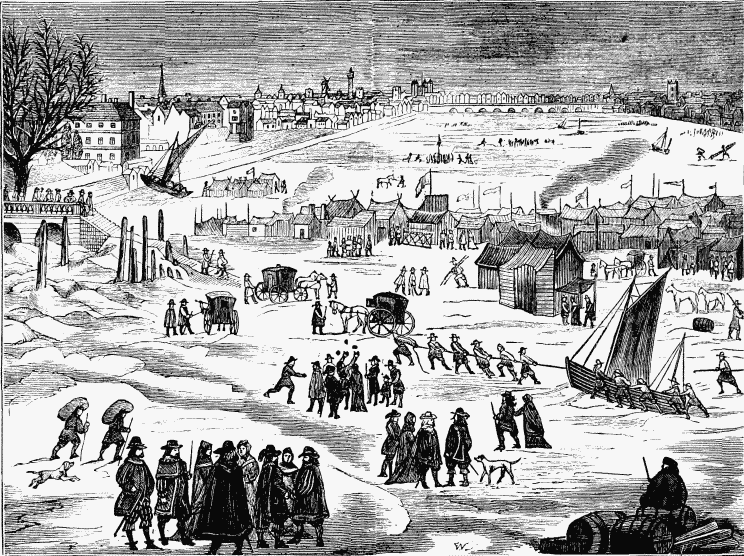
Engraving of the Frost Fair on the Thames in London, 1683-84 [British Museum Collection]
Thermometers were a recent invention and a universal scale of temperature readings had yet to be established but descriptions of the thickness of ice formed on ponds in a single night suggest the long spell of exceptional freezing weather was worse than any winter before and has still to be surpassed. December 1683 began with a hard frost, followed by a bitter east wind laden with snow. In London, the snow melted on the 7th but a sharp frost on the 12th was succeeded by a week of heavy snowfall and a north-easterly wind. Places other than London suffered similarly. Bristol suffered badly on the 19th; Durham on Christmas Eve and Oxford had its worst snow on Christmas Day, although London only saw snow showers that day.
The previous October 1683 had seen temperatures more than 4°F below the average, so the ground was already colder than normal when the bad weather began in December. Daily thermometer readings – however inaccurate – were recorded by Dr John Downes in London. According to him, the greatest cold occurred on 15th-16th January when ‘the spirit fell within the ball’ of his thermometer so gave no reading. His thermometer probably hung indoors, close to a window was the usual position for such instruments, suggesting a likely reading of 25°F indoors when he took note of it, mid‐morning. This would probably indicate a temperature of below 10°F outdoors. It was almost as cold in the first days of February.
In Durham, farther north in Teesdale, a fellow scientist, Mr Sanderson, made occasional records of the thickness of ice formed ‘where John Aislaby gets his water, on 12th-13th February, ice formed two inches thick overnight’. He then adds ‘it was in my gazette [newspaper] that at the Downs [part of the English Channel off the coast of Kent] the water was frozen a mile into the Sea, which was never known before’. This occurred during the latter part of January. From other sources we learn that, for fourteen days, in the English Channel, packet‐boats with the mail could not leave the Belgian coast and that ‘the sea was frozen for two leagues off Caen [in Normandy, France]’. Near Manchester, Sanderson noted, ‘it did freeze ice more than half a yard thick, and some ice continued till 25th March’.
Undeterred by the cold, the people of Leeds in Yorkshire held a frost fair on the frozen River Aire. According to Ralph Thoresby, an ox-roast was set up there and various sporting activities organised. January saw no improvement and in the south, by the end of the month, the Thames estuary was frozen a mile out to sea and wagons were hauling goods downriver from London as far as Gravesend in Kent.
In London, John Evelyn’s diary provides a wealth of information, noting that brewers and other tradesmen reliant on a water supply were out of work because all the pipes were frozen. He was greatly concerned that:
The fowls, fish and birds and all our plants and greens universally perishing. Many parks of deer are destroyed and all sorts of fuel so dear that there were great contributions to keep the poor alive. … London, by reason of the excessive coldness of the air hindering the ascent of the smoke, was so filled with the fuliginous steam of sea-coal that one could hardly see across the streetes… and no one could scarcely breathe.
Evelyn also tells us that ‘every moment was full of disastrous accidents’ and trees were being cracked asunder by the frost as if by a lightning strike. Despite these gloomy realities, Londoners made the best of the weather conditions. A broadsheet of the time calls it ‘Great Britain’s Wonder or London’s Admiration: a prodigious frost which began about the beginning of December and continued till the fourth day of February following’. The Thames had frozen over before but never had the freeze lasted so long. The river ice was more than a foot thick [30cms] enabling it to be crossed by coach, carriage, sledge or on foot. Enterprising boatmen, robbed of their livelihood otherwise, put wheels under their boats to ferry passengers across the river. By 1st January, a fair and marketplace had been set up on the ice.
King Charles II and members of the royal court visited the makeshift town, enjoying eating meat from an ox-roast, taking part in a fox-hunt on ice and having souvenir cards printed in a booth where a printer had set up his press. The cards proved popular, the printer reckoning to make at least £5 per day at sixpence a time. In other words, he was printing around 200 cards every day and making an excellent income from his ingenuity. Food stalls sold everything from pancakes to roast beef and there were numerous taverns, goldsmiths’ shops, a toy shop, coffee-houses, a lottery booth, a music booth and even a brothel: all doing a brisk trade on ice. A circus was put on by Mr Chipperfield: the first known performance of a family business that still continues today, if in a very different health-and-safety, animal-welfare conscious, twenty-first-century format. No such niceties concerned the entrepreneurs who arranged the bull- and bear-baiting spectacles either.
John Evelyn wrote that:
Coaches plied from Westminster to the Temple… to and fro, as in the streets; sleds, sliding with skeetes [skates], a bull-baiting, horse and coach races, puppet plays and interludes [short dramatic sketches], cooks, tippling [drinking] and other lewd places, so that it seemed to be a bacchanalian triumph, or a carnival on water.
Others noted sporting activities, including football and skittles being played. The ice began to thaw a little on 4th-5th February and the booths began to be dismantled but it froze again so that Evelyn could still cross in his coach to Lambeth Palace to dine with the Archbishop of Canterbury. On other occasions, he walked upriver on the ice from his home in Deptford.
In Newton’s long lifetime the Thames would freeze over again in 1709 but the ice did not last so long as to allow another frost fair that year. However, the winter of 1715-16 was sufficiently severe and long-lasting that the river was frozen for almost three months and a fair was set up once more. On this occasion, there was far more snow than in 1683-84, ‘vast quantities fallen at different times in the season’, so that London was described at the time as being ‘almost impassable’.
Below, is an excerpt from a poem written in 1684:
BEHOLD the Wonder of this present Age,
A Famous RIVER now becomes a Stage.
Question not what I now declare to you,
The Thames is now both Fair and Market, too.
And many Thousands dayly do resort,
There to behold the Pastime and the Sport
Early and Late, used by young and old,
And valu’d not the fierceness of the Cold….
Back in history, the Thames had been frozen before. For example, in the reign of King Stephen, in 1150, ‘after a very wet summer there was in December so great a frost that horses and carriages crossed it [the Thames] upon the ice as safely as upon the dry ground, and that the frost lasted till the following month of March’. Again, in 1281, the Thames was frozen over and when the ice broke up at last, it carried away five of the stone arches of London Bridge, causing it to partially collapse and making this entrance into the city impassable until it was repaired. In 1434, ‘the Thames was so strongly frozen over, that merchandise and provisions brought into the mouth of the river were obliged to be unladen, and brought by land to the city’. In 1515, too, carriages passed over on the ice from Lambeth to Westminster and once more, when the ice melted a number of arches of London Bridge were ‘borne downe and carried away with the streame’. On the 21st of December 1564, during a lengthy hard frost, football and ‘shooting at marks’ were played on the Thames. Courtiers came from Whitehall Palace to mix with common citizens and watch the fun. Tradition says that Queen Elizabeth I herself walked upon the ice but all was gone by 5th January. However, Londoners had the chance to play all manner of sports and visit trading stalls on the river again in 1620, in the reign of James I.
The River Thames last iced over completely, enough to hold a Frost Fair on its frozen waters, in 1814 but, since then, the building of the Victoria and Albert Embankments has made it faster-flowing and less likely to ice up. However, it partially froze in the harsh winters of 1947 and 1963.
Who can say whether or not even more extreme weather events may happen in the future as a result of climate change? Only time may tell if another Frost Fair, like those experienced by Isaac Newton and his colleagues, will ever be held again on the Thames.
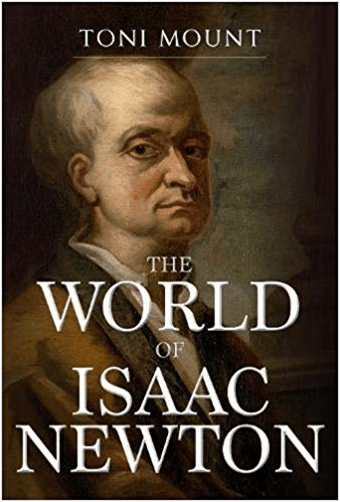
The World of Isaac Newton by Toni Mount
For nine decades Isaac Newton strode the world of science and discovery, religion and thought – from 17th century Lincolnshire farm-boy to one of the most influential scientists of all time – his discoveries have relevance for us today and for our future. This fascinating new biography looks at his world, his times, the people he influenced and the breakthroughs in science and thought that would change the world.
About the Author
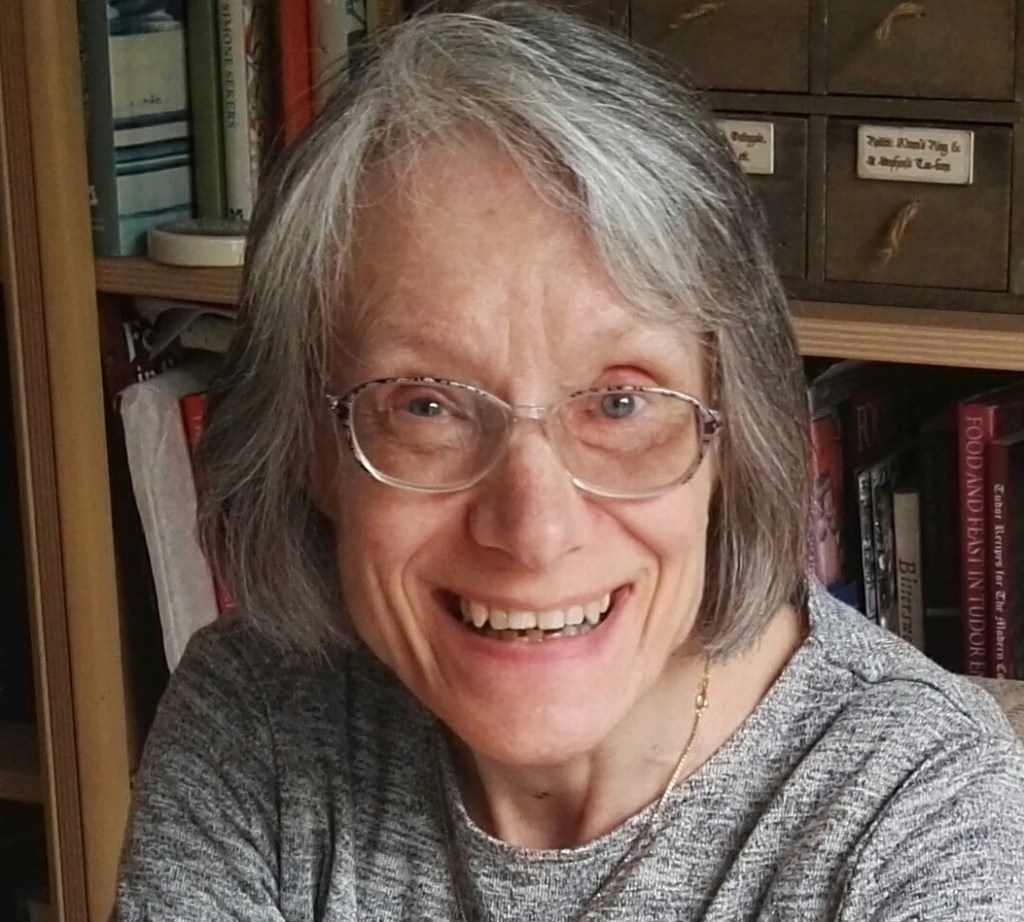
Toni Mount’s first career was in science, leading to many years in a second profession in teaching. Her love of history led to a third career as a writer with her first book, released by Amberley Publishing in 2014, Everyday Life in Medieval London. She continues to teach history to adults both in person and online and has now written many successful non-fiction and fiction books. This latest study allows her to return to her first love, science, and the chance to bring a fresh look at one of the world’s most famous characters.
The history of women in medieval Wales before the English conquest of 1282 is one largely shrouded in mystery. For the Age of Princes, an era defined by ever-increased threats of foreign hegemony, internal dynastic strife and constant warfare, the comings and goings of women are little noted in sources. This misfortune touches even the most well-known royal woman of the time, Joan of England (d. 1237), the wife of Llywelyn the Great of Gwynedd, illegitimate daughter of King John and half-sister to Henry III. With evidence of her hand in thwarting a full scale English invasion of Wales to a notorious scandal that ended with the public execution of her supposed lover by her husband and her own imprisonment, Joan’s is a known, but little-told or understood story defined by family turmoil, divided loyalties and political intrigue. From the time her hand was promised in marriage as the result of the first Welsh-English alliance in 1201 to the end of her life, Joan’s place in the political wranglings between England and the Welsh kingdom of Gwynedd was a fundamental one. As the first woman to be designated Lady of Wales, her role as one a political diplomat in early thirteenth-century Anglo-Welsh relations was instrumental. This first-ever account of Siwan, as she was known to the Welsh, interweaves the details of her life and relationships with a gendered re-assessment of Anglo-Welsh politics by highlighting her involvement in affairs, discussing events in which she may well have been involved but have gone unrecorded and her overall deployment of royal female agency.
Finally!
I have got my hands on this much-anticipated book, Joan, Lady of Wales by Danna R. Messer. I have to admit, I devoured every word. Joan has been in need of a biographer for some time, and I am so pleased that Danna took up the challenge and produced this remarkable study of the illegitimate daughter of King John who became Lady of Wales as the wife of Llywelyn ap Iorweth – Llywelyn Fawr.
Ever since I have known this book was being written, I have been itching to get my hands on it!
Anyone who is a fan of Sharon Penman will have heard of Joan, and most likely have a soft spot for this incredible woman. This biography gives you the chance to study the facts, to meet the woman behind the story and read of how deeply involved she was in Anglo-Welsh relations in the first half of the 13th century. Danna R. Messer portrays a politically astute and powerful woman, aware of her duty, importance and capabilities, not only as the daughter and sister of England’s kings, but also as Llywelyns wife and consort – and as the mother of his heir.
Detail of the sarcophagus thought to belong to Joan in St Mary’s and St Nicholas’s Church, Beaumaris
Beautifully written, with clear, concise arguments and a passion for her subject, the author has brought Joan to life. This is a book that is impossible to put down. Danna R. Messer does not shy away from areas of controversy, either, examining every aspect of Joan’s relationship with William de Braose, the man who was hanged after being found with Joan in Llywelyn’s chamber. the deconstruction of the event, the aftermath and the repercussions make for fascinating reading – its worth getting the book just to discover how everything unfolded.
As are all life stories, that of Joan of England’s is complicated; the complexities of which are further irritated by a dearth of contemporaneous material related to her. The identity of her mother remains a mystery and is much debated by today’s genealogists, as is who her children were. how many she really had and where some even ended up in their own lives. How many times she travelled as an envoy, how many charters she issued and just how fully she participated in effecting Welsh polity can never be fully known. No matter the daunting aspect of approaching such an ill-documented existence, which is a painstaking project indeed, it is one that yields both exciting and long-overdue results.
This study of Joan of England seeks to revise the master narrative of native medieval Wales in the early-thirteenth century – to generate a better ad more inclusively nuanced understanding of the history of this fascinating and wild region of Britain and its relationship with England by placing this particularly interesting and fascinating woman at the forefront in the sequence of events…
Although Siwan’s role in Anglo-Welsh history has received recognition by historians, she has been still largely relegated to the sidelines; an indication that her role was not entirely critical to the stability and growth of Welsh polity, or peace with England overall. On the flip side, it is sometimes difficult not to naturally overplay our hand and emphatically conclude that Joan was, indeed, a heroine and that if it were not for her, the very fabric of native Wales would have been fundamentally altered by the time Llywelyn died in 1240. On balance, however, it is vitally important to understand that the aggregate of Joan’s interventions in the early-thirteenth century ensured that she really was a crucial player in the political wranglings between the ruler of Gwynedd and the rulers of England. The famous early-twentieth-century Welsh historian J.E. Lloyd concluded that Llywelyn ap Iorweth ‘had one emissary whose diplomatic services far outran those of the seneschal and who helped him in this capacity for the greater part of his reign. To the assistance of his wife Joan, both as advocate and counsellor, there can be no doubt he was much indebted.’ To the assistance of Joan, Lady of Wales, there can be no doubt that the history of native medieval Wales is also much indebted.
Joan, Lady of Wales by Danna R. Messer not only examines every aspect of Joan’s life, but places that life in the wider context of English and Welsh events, of Anglo-Welsh relations and of the place of women in Welsh society and history in general. This in-depth study provides an overview analysis of the status of women in Welsh history, the laws surrounding marriage and adultery, legitimate and illegitimate children and demonstrates how Joan’s own confirmation of legitimacy in the 1220s added prestige and legitimacy to her husband’s position within Wales and the wider sphere of Anglo-Welsh relations.
Arms of the royal house of Gwynedd
Danna R. Messer also explores the use of title and authority for women in the 13th century, depicting Joan as a queen, both in her actions and relationship with others. Although she was not crowned and anointed in the same manner as an English queen would be, she held the same level of authority and respect, both in the public and the private sphere of the Welsh court.
A collection of a bout 20 black and white photos help to illustrate Joan’s story, Joan, Lady of Wales is a stunning, comprehensive study of the unique character and position that Joan occupies in both English and Welsh history.
Despite a woeful lack of sources mentioning Joan, Danna has managed to tease out every piece of information she could find on Joan and her position and duties, not only in Wales as the wife and consort of Llywelyn, but also in England as the daughter and, later, sister of the king. Joan’s status as the primary diplomat in Anglo-Welsh relations comes through clearly in the way Joan was treated by her husband and the rewards she was given by the English crown.
In brief, in Joan, Lady of Wales, Danna R. Messer recreates the life and times of this incredible woman, giving us a more complete portrait than has ever been achieved since her own lifetime. We are given a full and complete analysis – as far as the sources and distance of time will allow – of Joan’s political and personal life, the good and the bad, including the scandal, the ambition and Joan’s own legacy and what it meant for those who followed her.
Joan, Lady of Wales has long needed her own biography, to bring her out from the shadows of the lives of her father, brother, husband and son – and this book does not disappoint. It is, quite simply, a beautifully-executed, fascinating and addictive read.
Joan, Lady of Wales is available in hardback from Pen &Sword and Amazon.
About the author:
Dr Danna R. Messer has published on various aspects of the wives of the native Welsh rulers before 1282, providing a gendered perspective of medieval Welsh politics. As an editor and historian, she is widely involved in medieval history and queenship studies generally, including her roles as Series Editor for Medieval History for Pen and Sword, editor for the Royal Studies Journal and editor for Normans to Early Plantagenet Consorts, the first volume of the forthcoming four-book series, English Consorts: Power, Influence, Dynasty (Palgrave). She is also Acquisitions Editor for Arc Humanities Press and the Executive Editor for the Encyclopedia of the Global Middle Ages, a partnership project with Bloomsbury Academic and Arc Humanities Press.
Ada de Warenne was born around 1120, daughter of William de Warenne 2nd Earl of Surrey and Isabel de Vermandois. Through her mother, she was a great-granddaughter of Henry I of France and half-sister to twins Waleran and Robert de Beaumont, Count of Meulan and 2nd Earl of Leicester, respectively, and Hugh de Beaumont, 1st Earl of Bedford. Her niece, Isabel de Warenne, would marry William of Blois, the younger son of King Stephen and, following his death, Hamelin, half-brother of Henry II of England. Ada’s family connections were of the highest quality in the Anglo-Norman world.
As a consequence, Ada’s future marriage became an international concern. On 9 April 1139, following the defeat of the Scottish army at the Battle of the Standard, the Treaty of Durham was concluded between King Stephen of England and King David I of Scots. Primarily negotiated by Stephen’s wife, Queen Matilda – King David’s own niece – the terms were extremely favourable to the defeated Scots. All the lands that Prince Henry of Scotland, King David’s son and heir, had held in 1138 were returned to him, save for the castles at Bamburgh and Newcastle, for which he was recompensed with two towns of equal value in the south. Furthermore, Henry was confirmed as earl of Huntingdon and created earl of Northumbria, a title which encompassed Northumberland, Durham, Cumberland, Westmoreland and the parts of Lancashire north of the Ribble.
Malcolm IV, King of Scots
It was agreed that English law would remain in force in these regions, but that the barons within the earldom were permitted to do homage to Prince Henry, saving only their allegiance to King Stephen. In return, King David and his son promised a permanent peace and provided four hostages. Although the text of the treaty is now lost, it seems likely that the prince’s marriage to Ada de Warenne, sister of the third Earl Warenne and half-sister of the Beaumont twins, was included in the terms of the Treaty of Durham.
Shortly after the treaty was signed, Prince Henry joined King Stephen’s court for a time, accompanying Stephen on campaign, which came not without a little risk. While Stephen’s forces besieged Ludlow, Henry was dragged from his horse by an iron hook, and nearly taken prisoner, but he was gallantly rescued from the enemy by the King himself.
It was probably during his stay with Stephen’s court that Henry married his bride. Orderic Vitalis claims that the marriage was a love match. However, the timing clearly suggests that the union was a consequence of the 1139 treaty of Durham, perhaps with the intention of drawing Henry into Stephen’s corner by allying him in marriage to his staunchest supporters, the Beaumont twins; although it is not inconceivable that affection grew between the couple during Henry’s stay at Stephen’s court. On her marriage, which took place sometime between the conclusion of the treaty of Durham and Henry’s return to Scotland, Ada became Countess of Huntingdon and Northumbria and Lady of Haddington and Crail.
Henry was the only surviving son of King David I of Scotland and his queen, Matilda (or Maud), widow of Simon (I) de Senlis, who had died in 1113. Henry’s mother, Matilda, was the daughter of Waltheof, Earl of Northumbria, and Judith of Lens, a niece of William the Conqueror. Henry’s older brother, Malcolm, was tragically killed when a toddler; he was reportedly murdered by a Scandinavian monk in his father’s service, who is said to have savagely attacked the child with his artificial iron hand. Needless to say, the murderous monk was executed: David ordered that he be torn apart by wild horses.
The marriage of Ada and Henry produced three sons and three daughters.
William the Lion, King of Scots
Ada never became Queen of Scots as Henry of Scotland died in 1152, a year before the death of David I. On his son’s death, David recognised his grandson and Ada’s eldest son, Malcolm, as his heir. During her son’s reign, Ada became known as the Queen Mother of Scotland. At this time, in her charters, she is most frequently styled ‘Ada comitissa regis Scottorum.’
Born in 1142, Malcolm succeeded to the crown at the age of 11 as Malcolm IV. Also known as Malcolm the Maiden, he died, unmarried, at Jedburgh in December 1165. Ada had been trying to arrange a suitable bride for him when he died.
He was succeeded by Ada’s second son, William I the Lion. William was one of the longest reigning kings of Scots in history, ruling for 49 years. He married Ermengarde de Beaumont, a granddaughter of Henry I of England by his illegitimate daughter, Constance. William and Ermengarde had three daughters and a son, who succeeded his father as Alexander II in 1214. Their two eldest daughters, Margaret and Isabella, are mentioned in a clause of Magna Carta. They became hostages of King John following the treaty of Norham in 1209; the English king had promised to marry at least one of them to his son, the future King Henry III, and to find a suitable husband for the other. Both girls married English nobles – eventually. Their brother, Alexander II, married Henry III’s sister, Joan, but the marriage was childless.
Ada and Henry’s third son, David, Earl of Huntingdon, married Matilda of Chester and it is through the daughters of David that Robert the Bruce and John Balliol both based their claims as Competitors to the Scots crown in the 1290s.
Of the three daughters, Matilda died young, in 1152, the same year as her father, meaning poor Ada faced a double grief, of losing a husband and a daughter in one year. Ada’s namesake, Ada of Huntingdon married Floris III, Count of Holland, in 1161. She had four sons and four daughters before the count died at Antioch while on the Third Crusade, in 1190. The younger Ada’s great-great-grandson, Floris V, Count of Holland, was one of the Thirteen Competitors for the Scots crown in 1291. Lastly, Margaret married Conan IV, Duke of Brittany and Earl of Richmond in 1160. She was the mother of Constance, Duchess of Brittany, wife of Henry II’s son Geoffrey and mother of the tragic Arthur of Brittany who was murdered by King John, and Eleanor, the Pearl of Brittany who spent all her adult life in ‘honourable imprisonment’ in England.
St Martin’s Kirk, Haddington
Following her husband’s death Ada played little part in the politics of Scotland. She did, however, take great interest in the futures of her children, arranging the marriages of her daughters and seeking a bride for her son, King Malcolm IV. She later retired to her dower lands at Haddington in East Lothian, given to her by David I. It was possibly the first Royal Burgh in Scotland.
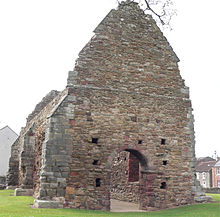
A generous patroness of the Church, Ada de Warenne died in 1178, shortly after founding the nunnery at Haddington. She is believed to be buried in the Haddington area, possibly in St Mary’s Church, although the exact location of her grave is lost to history. In 1198 her grandson, the future Alexander II, would be born in her old palace at Haddington, after her dower-lands were passed on to her daughter-in-law, Queen Ermengarde.
*
Images from Wikipedia.
Further Reading: G.W.S. Barrow, David I (c. 1185-1153) (article), Oxforddnb.com; Keith Stringer, Ada [née Ada de Warenne], countess of Northumberland (c. 1123-1178), Oxforddnb.com; Keith Stringer, Henry, earl of Northumberland (c. 1115-1152) (article), Oxforddnb.com; The Chronicle of Henry of Huntingdon; W.W. Scott, Malcolm IV (c. 1141–1165) (article), (article), Oxforddnb.com; Comprising the history of England, from the invasion of Julius Caesar to the accession of Henry II. Also, the Acts of Stephen, King of England and duke of Normandy Translated and edited by Thomas Forester; Early Yorkshire Charters Volume 8: The Honour of Warenne, Edited by William Farrer and Charles Travis Clay; Brewer’s British Royalty by David Williamson; The Mammoth Book of British Kings and Queens by Mike Ashley; The Story of Scotland by Nigel Tranter; Ada, Queen Mother of Scotland (article) by Victoria Chandler; David Ross, Scotland: History of a Nation; Matthew Lewis, Stephen and Matilda’s Civil War: Cousins of Anarchy; Stephen Spinks, Robert the Bruce: Champion of a Nation.
*
My Books:
Signed, dedicated copies of all my books are available through my online bookshop.
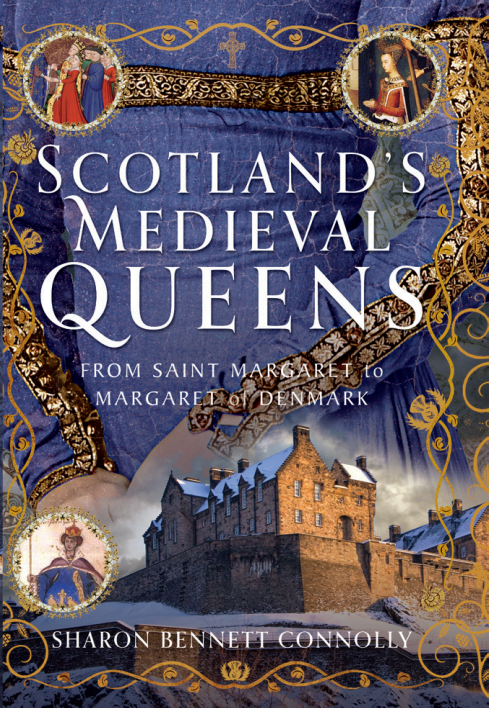
Coming 30 January 2025: Scotland’s Medieval Queens
Scotland’s history is dramatic, violent and bloody. Being England’s northern neighbour has never been easy. Scotland’s queens have had to deal with war, murder, imprisonment, political rivalries and open betrayal. They have loved and lost, raised kings and queens, ruled and died for Scotland. From St Margaret, who became one of the patron saints of Scotland, to Elizabeth de Burgh and the dramatic story of the Scottish Wars of Independence, to the love story and tragedy of Joan Beaufort, to Margaret of Denmark and the dawn of the Renaissance, Scotland’s Medieval Queens have seen it all. This is the story of Scotland through their eyes.
Heroines of the Tudor World tells the stories of the most remarkable women from European history in the time of the Tudor dynasty, 1485-1603. These are the women who ruled, the women who founded dynasties, the women who fought for religious freedom, their families and love. Heroines of the Tudor World is now available for pre-order from Amberley Publishing and Amazon UK.Women of the Anarchy demonstrates how Empress Matilda and Matilda of Boulogne, unable to wield a sword themselves, were prime movers in this time of conflict and lawlessness. It shows how their strengths, weaknesses, and personal ambitions swung the fortunes of war one way – and then the other. Available from Bookshop.org, Amberley Publishing and Amazon UK. King John’s Right-Hand Lady: The Story of Nicholaa de la Haye is the story of a truly remarkable lady, the hereditary constable of Lincoln Castle and the first woman in England to be appointed sheriff in her own right. Available from all good bookshops Pen & Sword Books, bookshop.org and Amazon.
Alternate Endings: An anthology of historical fiction short stories including Long Live the King… which is my take what might have happened had King John not died in October 1216. Available in paperback and kindle from Amazon.
Podcast:
Have a listen to theA Slice of Medieval podcast, which I co-host with Historical fiction novelist Derek Birks. Derek and I welcome guests, such as Bernard Cornwell and Elizabeth Chadwick, and discuss a wide range of topics in medieval history, from significant events to the personalities involved.
*
Don’t forget!Signed and dedicated copies of all my books are available through my online bookshop.
For forthcoming online and in-person talks, please check out my Events Page.
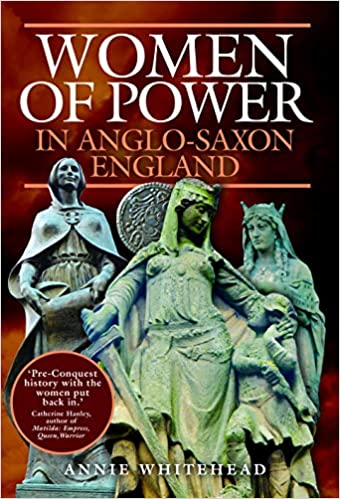
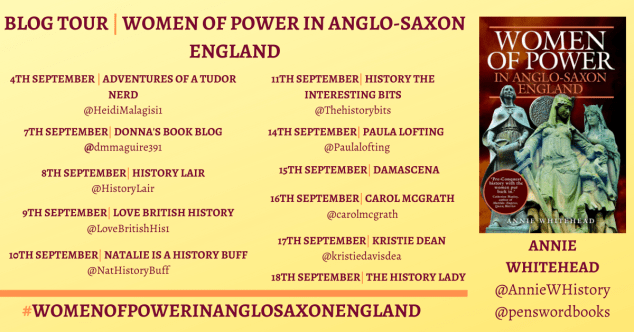
Women of Power in Anglo-Saxon England examines the lives of individual women in a way that has often been done for the Anglo-Saxon men but not for their wives, sisters, mothers and daughters. It tells their stories: those who ruled and schemed, the peace-weavers and the warrior women, the saints and the sinners. It explores, and restores, their reputations.
Over to you Annie….
All the Ælfgifus
I was recently interviewed on BBC Radio Northampton where we chatted about a lady known as Ælfgifu of Northampton. During the pre-recording chat, it became clear that there was some confusion over the name. I told the presenter that I wasn’t the least surprised, as there are no fewer than eight ladies with that name featured in my new book. I thought I’d take this opportunity to introduce them. (The name, incidentally, translates as Elf-gift, which I think is rather beautiful.)
Ælfgifu, daughter of Edward the Elder
Edward the Elder
We don’t know a great deal about her but I do feel rather sorry for her. She and her sister, Eadgyth, were, apparently, both sent to Germany so that the future emperor, Otto, could choose one of them as his bride. He married Eadgyth – it was, apparently, ‘love at first sight’ – and Ælfgifu married another prince. What Ælfgifu felt about being rejected by Otto, we can only surmise. Of course, Otto might not have been every young girl’s dream, in which case Ælfgifu might have considered that she’d had a lucky escape. It must have rankled though, being declared less attractive than her sister.
Ælfgifu of Shaftesbury
King Edmund was the son of Edward the Elder and a half-brother of the Ælfgifu mentioned above. He became king at around the age of eighteen and his first wife, Ælfgifu, bore him two sons, both future kings. Her identity is debateable and her background unknown. She wasn’t married for long. Her son Eadwig (I’ll come back to him) was probably born around 940, and his younger brother Edgar around 943. King Edmund himself died in 946 – the victim of a brawl, or perhaps a political assassination – having married again, so his first marriage must have ended not long after Edgar’s birth. Ælfgifu is known as Ælfgifu of Shaftesbury, and it would be easy to assume that she retired to Shaftesbury Abbey in the manner of a number of previous queens, but the short-lived nature of her marriage and the young age of her children suggest another scenario. It is plausible that she died in childbirth, either in labour with Edgar or with a subsequent pregnancy in which both mother and child died. If she did indeed die in childbirth then she cannot have been a nun at Shaftesbury, but merely a benefactor.
Ælfgifu the Harlot
Mortimer portrait of Dunstan scolding Ælfgifu the Harlot
In 955 Edmund’s brother, who’d succeeded him, died and was in turn succeeded by Edmund’s son, Eadwig (see, I told you I’d come back to him). Life at court got rather interesting when Eadwig, still only a teenager, married a young woman named Ælfgifu. Many of you will know the story of how he was found in bed on his coronation day with his wife, and her mother. Depending on which version one reads, the mother was banished and/or hamstrung in punishment, or she threatened the abbot who found them, and who was himself subsequently banished, that she would have his eyes put out if he ever returned. The young couple’s marriage was annulled two years later, on the grounds that they were too closely related. However, Ælfgifu is presumed to be the same woman who left a will, in which she’s identified as being descended from the brother of Alfred the Great. This being so, she was descended from the branch of the royal family that had risen up in rebellion. Ælfgifu’s marrying the king might have been seen as an attempt to strengthen those claims. It’s not a theory which I whole-heartedly embrace but it does seem that there was a lot of political manoeuvring at court and I suspect Ælfgifu was an innocent caught up in the turmoil. She was certainly welcomed back to court by Eadwig’s brother when he became king.
Ælfgifu of York – Possibly
Aethelred the Unready
That brother of Eadwig’s had a son, known to history as Æthelred the Unready. His first wife’s identity is a bit of a mystery. The chronicler John of Worcester said that she was called Ælfgifu, and that she was the daughter of an ealdorman called Æthelberht. But there is no evidence of this woman’s father; no ealdorman named Æthelberht is recorded elsewhere. Roger of Wendover said that she was a ‘woman of low birth’, while Ailred of Rievaulx, writing in the mid-twelfth century, said that she was the daughter of a man named Thored, but he didn’t name her. It is possible that Æthelred was married first to a woman named Ælfgifu and then to the daughter of Thored, but it is generally accepted that this was one woman and, combining the two versions, that she was Ælfgifu, daughter of Thored.
We don’t hear much from her as she didn’t witness any charters and is otherwise unnamed in the sources. What she did do, though, is have at least nine children, (one of whom was also called Ælfgifu, whose husband was murdered by her sister’s husband, which must have made for awkward family Christmases)! She must have lived until the eleventh century, for her youngest son, Edgar, did not appear on charter witness lists until 1001. We do not know exactly how old the royal children would typically have been when they first appeared on the witness lists, but we do know that they were sometimes still babes in arms. It is not known what happened to Ælfgifu and it is possible that she died at around the same time, for King Æthelred got married again in 1002…
…To a woman named Emma, but who was given the English name of Ælfgifu. As if this wasn’t confusing enough! And after Æthelred the Unready died, Emma married again. Her husband was King Cnut, who already had a wife/concubine:
Ælfgifu of Northampton
Emma – Ælfgifu of Northampton’s rival
This Ælfgifu came from a powerful Mercian family. Her father was ealdorman of Northumbria, her uncle founded Burton Abbey and her grandmother founded Wolverhampton. Ælfgifu’s father was murdered and her brothers were blinded and generally Æthelred the Unready mistrusted the family, as well he might. For at some point, possibly around 1013, Ælfgifu married Cnut, the son of the invader, Swein Forkbeard. She had two sons by Cnut, and they were given Danish names – Swein and Harold – as if recognised as potential heirs, but when Cnut became king, he married Emma and also had a son with her, who was named Harthacnut.
Emma, with her credentials as an English queen, was no doubt important to Cnut, but so too was Ælfgifu of Northampton, and Cnut had a task for her to perform. Cnut had an empire to rule, and Harthacnut was sent to Denmark while in 1030, Ælfgifu and her son Swein were sent to Norway, there to rule for Cnut. The regency in Norway may have been hugely symbolic, and it is telling that the period was remembered in Scandinavian history as ‘Ælfgifu’s time’, but for various reasons it wasn’t hugely successful. Swein died in 1035, but so too did Cnut.
Now a (rather unseemly at times) battle began as Emma and Ælfgifu fought for their sons to succeed. You can read all about these fraught years in my new book but the upshot was that Ælfgifu was successful in the short term and Harold ‘Harefoot’ became king. Sadly though he died in 1040. We don’t know what happened to Ælfgifu after this, but there is a French twelfth-century story which speaks of a woman named Alveva and it’s possible that she lived out her years as an exile in southern France.
By 1066, another Harold was on the throne. He had a wife/concubine who’s known to history as Edith Swanneck, and one of her children was a daughter named Ælfgifu.
Ælfgifu the Unlucky
But the last Ælfgifu I want to talk about is one I’ve nicknamed ‘unlucky’. You’ll recall that Ælfgifu of Northampton’s brothers were blinded. They weren’t the only ones and in 993 a man named Ælfgar suffered the same fate. His wife was another woman named Ælfgifu. When Ælfgifu of Northampton’s father was killed and her brothers blinded, another man was named as being deprived of all his property. With a little bit of detective work I was able to say with some degree of certainty that this man was the second husband of our last Ælfgifu, which means that her first husband was blinded and the second was deprived of all his property. Given that it’s clear the name Ælfgifu seems to have been given only to noblewomen, I think this one must have expected a slightly more comfortable and uneventful life!
Follow the Blog Tour!
Annie’s book, Women of Power in Anglo-Saxon England, was published by Pen & Sword Books in June 2020. It can be purchased from Pen & Sword and online.
About the Author:
Annie is an author and historian and an elected member of the Royal Historical Society and has won awards and prizes for her fiction and nonfiction.
Published works include Mercia: The Rise and Fall of a Kingdom (Amberley Books) and novels and stories set in Anglo-Saxon England, including To Be A Queen, the story of Æthelflæd, Lady of the Mercians, longlisted for HNS Book of the Year 2016. She was the inaugural winner of the Dorothy Dunnett/HWA Short Story Competition in 2017. You can connect with Annie through her Website, on Facebook, Twitter and on her Blog and Amazon Author Page.
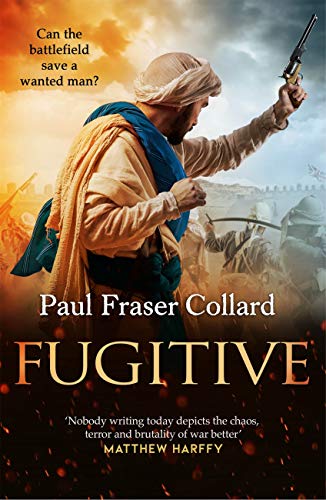
Roguish hero Jack Lark – soldier, leader, imposter – crosses borders once more as he pursues a brand-new adventure in Africa.
London, 1868. Jack has traded the battlefield for business, running a thriving club in the backstreets of Whitechapel. But this underworld has rules and when Jack refuses to comply, he finds himself up against the East End’s most formidable criminal – with devastating consequences.
A wanted man, Jack turns to his friend Macgregor, an ex-officer, treasure hunter and his ticket out of England. Together they join the British army on campaign across the tablelands of Abyssinia to the fortress of Magdala, a high-stakes mission to free British prisoners captured by the notorious Emperor Tewodros.
But life on the run can turn dangerous, especially in a land ravaged by war . . .
Stupendous!
That is the first word that came to my mind when I was asked what I thought of Fugitive by Paul Fraser Collard. Fugitive is book no. 9 in the adventures of Victorian rogue, Jack Lark. Over the last few years, the release of the latest of Jack Lark’s adventures has become one of the highlights of my summer. Last year’s holiday reading was The Lost Outlaw, and the year before that it was The Rebel Killer. And after such amazing books in recent years, Fugitive had a lot to live up to.
In many of the previous books, Jack has taken on the persona of others, officers and soldiers all. He has travelled the globe, fighting in hotspots from the Crimea to America, more often than not concealing his own identity. In Fugitive, Jack Lark is finally himself, though whether that it a good thing or not is open to discussion.
Jack Lark is a bit of a rascal, taking opportunities where he finds them and running with it. He has fought on both sides of the American Civil War, had a stint in the French Foreign Legion and is now going in search of a fortune – and adventure – in Africa as the British Empire’s inexorable expansion opens more opportunities for those willing to take the risk. And, of course, as with any Jack Lark adventure, things get complicated and he is followed by the trouble he hoped to leave behind in London…
‘Do you think -‘ Bertie started.
‘Hush now.’ Cooper was quick to interrupt. ‘He’s coming.’
The three men looked down the alley as one. Sure enough, a figure was approaching. The fog wrapped around him like a ghostly shawl, so that he was little more than an apparition, a dark shadow shrouded in mist.
‘Is that him?’ Bertie whispered.
‘That’s the captain all right,’ Cooper answered softly, the words barely audible.
The figure came closer. It did not hurry. It did not swagger or strut. It simply moved with purpose.
‘Have you got the rhino?’ There was no greeting. Just five short words, delivered staccato. Little could be seen of the captain’s face beneath a dark-coloured pork pie hat pulled down low. He was tall, just a shade under six foot, and was wearing a tightly buttoned overcoat.
‘Are you truly the captain?’ Oddly, it was Bertie who spoke for the three. He stared at the man, his eyes as wide as those of a child seeing a bear for the first time.
‘I’m the captain.’ The words were spoken softly, but every man heard them. ‘Now have you got the rhino?’
He lifted his chin as he repeated the question. For the first time, the three gentlemen got a good glimpse of his face. A scar ran down the left-hand side, the lower half disappearing into a heavy beard. But it was not that that drew their attention; it was the hard grey eyes that stared back at them as if the captain could see right down to their very souls.
The confirmation of identity was enough. Charles fished into his overcoat and pulled out a thick wedge of banknotes, which he held out in front of him.
The captain took the bundle swiftly. He did not check it. Instead, he carefully unbuttoned his coat and tucked the notes deep into an inside pocket. It was artfully done, every gesture sharp and controlled, the coat pulled open just long enough to give the three men a glimpse of the stout oak cudgel hooked into the captain’s belt.
‘Follow me.’ The captain turned on his heel and walked back down the alley, setting a rapid pace. He did not bother to see if they followed.
Just as his character is an expert at impersonation, Paul Fraser Collard has become a master at drawing out the drama and raising the tension to the very last pages of the book. His writing draws the reader in from the very first page and forces you to stay up late and get up early, just to get one more chapter in before work!
The research is, as always, impeccable, and the author takes the reader from the seedier areas of nighttime London to the fortress of Magdala, in the heart of Abyssinia, on a journey across seas, through the stifling heat of the desert and into the fortress itself, with danger and action following every step of the way. From fights in the backstreets of London to the pitched battles of the Victorian Imperial army against the poorly armed Abyssinian massed army, the reader is drawn into a world full of excitement, danger … and possibilities.
I love that Jack Lark is not a man who goes looking for trouble – he tends to fall into it. However, once trouble finds him, he doesn’t shirk from the challenge and faces whatever is set before him. The character development of Jack Lark himself, throughout all 9 books, is fascinating, and probably the best I’ve ever read. He grows and learns from each adventure and is more self-aware in Fugitive of his own abilities – and his failings. He finds out exactly who he is, discovering himself just as the reader does; accepting his flaws.
As the books are set half a century after the Peninsular War, Jack Lark’s adventure are often compare to those of Bernard Cornwell’s Richard Sharpe; with the comparison extending to the two authors. I am not sure Lark and Sharpe are too much alike, beyond the fact they each have a scar on their faces and are ferocious fighters. Sharpe fights within the British army system, whereas Lark is very much an outsider. However, they bot come from similar backgrounds and I can’t help but think that, had they met, they would have got on like a house on fire – or killed each other.
With that in mind, any fan of Bernard Cornwell would not be disappointed if they picked up a Jack Lark book to try. The wonderfully vivid and lively characters Paul Fraser Collard has created – and the very unlikely hero – are a treat for any lover of action and adventure in their historical fiction
*
About the author:
Paul Fraser Collard’s love of military history started at an early age. A childhood spent watching films like Waterloo and Zulu whilst reading Sharpe, Flashman and the occasional Commando comic, gave him a desire to know more of the men who fought in the great wars of the Nineteenth and Twentieth Centuries. This fascination led to a desire to write and his series of novels featuring the brutally courageous Victorian rogue and imposter Jack Lark burst into life in 2013. Since then Paul has continued to write, developing the Jack Lark series to great acclaim. To find out more about Paul and his novels visit www.paulfrasercollard.com or find him on twitter @pfcollard.
As with so many nobles of the eleventh century, Gundrada and William de Warenne were known for their piety. Either in 1077 or 1081-3 (the dates vary according to the sources) the couple set off on a pilgrimage to Rome. Unfortunately, they never actually made it as far as Italy, due to the outbreak of war between the pope, Hildebrand, and the Holy Roman Emperor. They did, however, reach the magnificent abbey of St Peter and St Paul at Cluny in Burgundy, where Gundrada’s brother, Gerbod, was now a monk and they themselves were received into the fellowship of the monks.
Shortly after the Norman Conquest, Gerbod had been made Earl of Chester, but had resigned this position and returned to Flanders in 1071. Gerbod’s return home had been essential to guarantee the safety of the family’s lands and interests there. The former earl of Chester’s eventual fate is uncertain, however; one report has him killed while another sees him imprisoned. His most likely fate comes from a third account, which claims that Gerbod accidentally killed his lord, Count Arnulf III, the nephew of Queen Matilda, at the Battle of Cassel in 1071. According to this last account, Gerbod travelled to Rome to perform penance for killing his young lord, but was prevented from his self-imposed mutilation by Pope Gregory VII. Instead, the pope sent him to Abbot Hugh at Cluny, who gave Gerbod absolution and admitted him to the order as a monk.1 This would explain William and Gundrada‘s visit to Cluny and the Warenne attraction to the Cluniac order, which led to the foundation of the priory of St Pancras at Lewes, the first Cluniac priory founded in England.
The memorial to the 1264 Battle of Lewes, in the grounds of Lewes Priory
Although Abbot Hugh was absent at the time of the de Warenne’s visit, the abbey at Cluny inspired the couple, they ‘were so struck with the high standard of religious life maintained there that they determined to put their proposed foundation under Cluny, and accordingly desired the abbot to send three or four of his monks to begin the monastery. He, however, would not at first consent—fearing that at so great a distance from their mother-house they would become undisciplined’.2
It was only after William and Gundrada managed to gain the backing of the king, William the Conqueror, that the abbot gave his consent and eventually sent a monk named Lanzo, to act as prior, with three other monks to found the community. William gave them the church of St Pancras at Lewes, which had recently been rebuilt in stone, and the land surrounding it. Their territory was extended by William de Warenne acquiring ‘all the land and the island near Lewes which is called Southye’ for his monks, in return for, every Nativity of St John the Baptist, the delivery of ‘ten arrows, barbed, shafted, and feathered.’3 William and Gundrada were expecting to build a community to house twelve monks. All the churches on the vast Warenne estates were given to the priory, including endowments from the lands of Gundrada’s brother Frederic in Norfolk, recently inherited by Gundrada. The priory was to pay a fixed sum of 50s a year to the abbey at Cluny, but the independence of the Lewes monks was severely restricted, with the right of appointing its prior and admitting new monks being solely the reserve of the abbot of Cluny.4 A second priory, started by William but finished by his son, also William, was built on the family’s lands at Castle Acre in Norfolk.
The Cluniac order were unique in the church in that they had been granted exemption from excommunication by Pope Alexander II in 1061, who declared that anyone attempting to excommunicate the monks of Cluny would be ‘accursed by our Lord and St Peter, and fit to be burnt in eternal fire with the devil and the traitor Judas, and to be cast down with the impious into the abyss and Tartarean chaos.’5 The order had been founded in the year 910 by monks seeking to pursue a more austere lifestyle and a stricter interpretation of the Rule of St Benedict, laid down in the sixth century and the basis for medieval monastic life. Cluniac monks were renowned for the length and rigour of their church worship, the strict rules that governed them and their freedom from lay control and episcopal control, save for the pope. Their stringent rule contrasted with the order’s love of art and decoration, as demonstrated in the magnificent façade of the Cluniac priory of Castle Acre in Norfolk.6
Castle Acre Priory, Norfolk
The first Cluniac priory in England, St Pancras was also the acknowledged chief among Cluny’s establishments in England, all of which were founded within 150 years of the Norman Conquest; it became one of the wealthiest monasteries in the country. The family chronicle, the Warenne Chronicle may have originated at St Pancras Priory. Although it is also called the Hyde Chronicle, it is so called because it was discovered at Hyde Abbey in Winchester. It’s origin before that is unknown, so it is entirely possible that the chronicle originated was written at Lewes. This would also explain the chronicler’s extensive knowledge of the Warenne family.
Not only did the priory receive gifts and grants from each successive earl of Warenne, but also from other quarters, including those who wished to be buried there and those wanting to become monks. Among the grants issued to the priory over the years were allowances of venison for sick monks, fishing rights, the monopoly of eels from the Warenne’s Yorkshire properties and the right of taking wood three days a week from Pentecost (fifty days after Easter Sunday) to St Peter’s day (29 June).7 Of the Warenne earls of Surrey, all were buried at the priory at Lewes, except the third earl, who died on crusade in the Holy Land, and William of Blois, the first husband of Isabel de Warenne, who was buried in France. In addition to the family members, Lewes Priory was the chosen final resting place for the rich and noble, including earls and countesses of Arundel, and members of the prominent Nevill, Maltravers and Bohun families.
Gundrada died in childbirth at Castle Acre in Norfolk on 27 May 1085. It seems the misunderstanding over Gundrada’s parentage, and the claim that she was the daughter of William the Conqueror and his queen, Matilda of Flanders, arose with the monks at Lewes Priory, when a copy of an earlier charter claimed she was the daughter of Matilda of Flanders. Whether this was accidental or a deliberate misdirection is open to conjecture; the impression of royal links could give houses an advantage over other monasteries when seeking patronage.
Gundrada died before her husband received his earldom, and so never bore the title of countess. She was buried in the chapter house of St Pancras Priory at Lewes; her husband would be buried beside her three years later. Around 1145, when new monastic buildings were consecrated at St Pancras, Gundrada’s bones were placed in a leaden chest and interred under a tombstone of black Tournai marble, ‘richly carved in the Romanesque style, with foliage and lions’ heads’.8 The sculptor was trained at Cluny and would later work for Henry I’s nephew, Henry of Blois, Bishop of Winchester and brother of King Stephen. The inscription on the tombstone, which runs along all four sides and down the middle, reads:
‘Gundrada, offspring of dukes, glory of the age, noble shoot,
brought to the churches of the English the balm of her character.
As a Martha …
That part of Martha [in her] died; the greater part of Mary survives.
she was to the wretched; a Mary she was in her piety.
O, pious Pancras, witness of truth and justice,
she makes you her heir; may you in your clemency accept the mother.
The sixth day of the kalends of June, showing itself,
broke the alabaster containing her flesh …’
Elisabeth M.C. Van Houts and Rosalind C. Love (eds and trans), The Warenne (Hyde) Chronicle
William de Warenne was awarded the earldom of Surrey in the spring of 1088. He did not live long enough to enjoy his new title, however, dying within months, or possibly weeks, of attaining the honour, in June 1088. It is conceivable that William’s epitaph was written by Orderic Vitalis himself, who recreates it in volume iv of his Ecclesiastical History. [45] It reads:
‘Earl William, in this place your fame is kindled.
You built this house and were its generous friend:
This (place) honours your body, because pleasing was the gift
you gave so willingly to the poor of Christ.
The saint himself, Pancras, your heir, who guards your ashes,
Will raise you to the mansions of the blessed in the stars.
Saint Pancras give, we pray, a seat in heaven
To him who for your glory gave this house.’
Elisabeth M.C. Van Houts and Rosalind C. Love (eds and trans), The Warenne (Hyde) Chronicle
St John the Baptist church, Southover
Following the dissolution of St Pancras Priory at Lewes in the sixteenth century, the tombstone was first moved to Isfield Church; it was moved again in 1775 to the parish church of St John the Baptist at Southover in Lewes. The church is situated close to the grounds of the ruined priory and may once have been within the priory’s precincts. The remains of Gundrada and William were discovered in the ruined priory in two leaden chests in 1845 and finally laid to rest in the Gundrada chapel at the Southover church in 1847. 9
The priory founded by William and Gundrada would continue its association with the Warenne family until the death of John, the seventh and final Warenne Earl of Surrey, who was buried there in 1347. The relationship was not always amicable, however; Earl Hamelin, the 4th Earl Warenne and second husband of Countess Isabel, had a long-running disagreement with the founding house at Cluny.
1Elisabeth Van Houts, Hereward and Flanders (article), Anglo-Saxon England vol. 28; 2A History of the County of Sussex: Volume 2 edited by William Page; 3 Lewes Chartulary quoted in W.H. Blaauw, On the Early History of Lewes Priory, and its Seals, with extracts from a MS. Chronicle, Sussex Archaeological Collections; 4W.H. Blaauw, On the Early History of Lewes Priory, and its Seals, with extracts from a MS. Chronicle, Sussex Archaeological Collections; 5Bullarum. Rom. Pontiff. Collectio, t.l. Roma, 1739-62 quoted in ibid; 6Edward Impey, Castle Acre Priory and Castle, English Heritage; 7Blaauw; 8Warenne, Gundrada de (d.1085) (article) by C.P. Lewis, Oxforddnb.com, oxforddnb.com; 9Elisabeth M.C. Van Houts and Rosalind C. Love (eds and trans), The Warenne (Hyde) Chronicle
Sources:
Elisabeth Van Houts, Hereward and Flanders (article), Anglo-Saxon England vol. 28; A History of the County of Sussex: Volume 2 edited by William Page; W.H. Blaauw, On the Early History of Lewes Priory, and its Seals, with extracts from a MS. Chronicle, Sussex Archaeological Collections; Edward Impey, Castle Acre Priory and Castle, English Heritage; Warenne, Gundrada de (d.1085) (article) by C.P. Lewis, Oxforddnb.com, oxforddnb.com; Elisabeth M.C. Van Houts and Rosalind C. Love (eds and trans), The Warenne (Hyde) Chronicle; Jeffrey James, The Bastard’s Sons: Robert, William and Henry of Normandy; Early Yorkshire Charters Volume 8 Edited by William Farrer and Charles Travis Clay; Rev. John Watson, Memoirs of the Ancient Earls of Warren and Surrey, and Their Descendants to the Present Time, Volume I; Alfred S. Ellis, Biographical Notes on the Yorkshire Tenants Named in Domesday Book (article); C.P. Lewis, Warenne, William de, first Earl of Surrey [Earl Warenne] (d. 1088) (article), Oxforddnb.com
*
My Books
Signed, dedicated copies of all my books are available through my online store.
Out now: Scotland’s Medieval Queens
Scotland’s history is dramatic, violent and bloody. Being England’s northern neighbour has never been easy. Scotland’s queens have had to deal with war, murder, imprisonment, political rivalries and open betrayal. They have loved and lost, raised kings and queens, ruled and died for Scotland. From St Margaret, who became one of the patron saints of Scotland, to Elizabeth de Burgh and the dramatic story of the Scottish Wars of Independence, to the love story and tragedy of Joan Beaufort, to Margaret of Denmark and the dawn of the Renaissance, Scotland’s Medieval Queens have seen it all. This is the story of Scotland through their eyes.
‘Scotland’s Medieval Queens gives a thorough grounding in the history of the women who ruled Scotland at the side of its kings, often in the shadows, but just as interesting in their lives beyond the spotlight. It’s not a subject that has been widely covered, and Sharon is a pioneer in bringing that information into accessible history.’ Elizabeth Chadwick (New York Times bestselling author)
Heroines of the Tudor World tells the stories of the most remarkable women from European history in the time of the Tudor dynasty, 1485-1603. These are the women who ruled, the women who founded dynasties, the women who fought for religious freedom, their families and love. Heroines of the Tudor World is now available for pre-order from Amberley Publishing and Amazon UK.Women of the Anarchy demonstrates how Empress Matilda and Matilda of Boulogne, unable to wield a sword themselves, were prime movers in this time of conflict and lawlessness. It shows how their strengths, weaknesses, and personal ambitions swung the fortunes of war one way – and then the other. Available from Bookshop.org, Amberley Publishing and Amazon UK. King John’s Right-Hand Lady: The Story of Nicholaa de la Haye is the story of a truly remarkable lady, the hereditary constable of Lincoln Castle and the first woman in England to be appointed sheriff in her own right. Available from all good bookshops Pen & Sword Books, bookshop.org and Amazon.
Alternate Endings: An anthology of historical fiction short stories including Long Live the King… which is my take what might have happened had King John not died in October 1216. Available in paperback and kindle from Amazon.
Podcast:
Have a listen to theA Slice of Medieval podcast, which I co-host with Historical fiction novelist Derek Birks. Derek and I welcome guests, such as Bernard Cornwell and Michael Jecks, and discuss a wide range of topics in medieval history, from significant events to the personalities involved. Every episode is also now available on YouTube.
*
Don’t forget!Signed and dedicated copies of all my books are available through my online store.
For forthcoming online and in-person talks, please check out my Events Page.