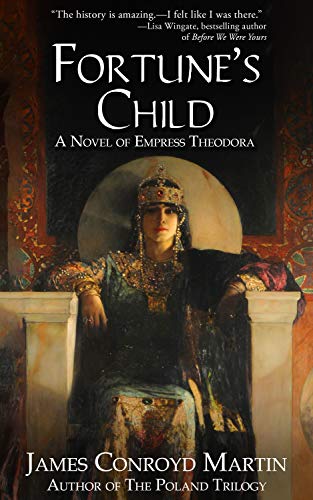
Theodora: actress, prostitute, mistress, feminist. And Byzantine Empress of the civilized world. Stephen: handsome Syrian boy, wizard’s apprentice, palace eunuch. And Secretary to the Empress. How does this unlikely pair become such allies that one day Empress Theodora asks Stephen to write her biography?
From a very young age, Theodora, daughter of a circus bearkeeper in Constantinople, sets her sights well above her station in life. Her exquisite beauty sets her apart on stages and in the eyes of men.
Stephen, a Syrian lad of striking good looks, is sold by his parents to a Persian wizard, who teaches him a skill in languages that will serve him well. By the time Destiny brings them together in Antioch, Theodora has undergone heart-rending trials and a transformation, while Stephen has been sold again . . . and castrated. Discover the enduring bond that, however imperfect, prompts Theodora—as Empress—to request palace eunuch Stephen to write her biography.
This is a true rags to riches story, of a girl from the lowers echelons of society who rose to be empress of Constantinople. Fortune’s Child: A Novel of Empress Theodora tells the story of Empress Theodora, born in 500, into a poor Greek family; her father a circus worker for the Greens, who rose to be Master of the Bears. Theodora’s future was to be an actress, a popular one, but little more than a prostitute in the eyes of many, and with no prospects to ever improve her situation, unless she forced matters.
Although a novel, Fortune’s Child: A Novel of Empress Theodora flawlessly blends history and story-telling to draw the reader into the exotic world of 6th century Constantinople and the East. Recreating the life of Theodora and the world in which she lived, James Conroyd Martin takes you on an adventure that explores every aspect of Theodora’s world, the challenges, grief and struggles that she had to face to climb out of the fate into which she was born and make her own fortune.
This is a novel that will take you through the full range of emotions. It is not all glamour and success, but neither is it all dull and gloom. The author imbues a humanity that invokes both sympathy and compassion for the title character, even when her actions are less than noble.
It is late at night when a soft knock, almost imperceptible, comes at the door. I open it to find Theodora standing there, a finger to her lips. She is dressed in a purple bedchamber robe. She wears no veil or headdress. Her hair falls about her face like an ebony frame about the portrait of a ghost. I stand aside and she enters, gliding like some visitant saint into a monk’s cell.
But she is no saint. And since I am no monk, I take the comfortable chair.
“You know the circumstances of my birth, Stephen, how my mother kept me from being … abandoned – exposed to the elements.”
I nod, taking up a kalamos.
“The story is legend by now. Of course, it may be quite accurate, but my mother would relate it as a way of upbraiding a thoughtless and unappreciative daughter who would drolly mimic the ways of the adults around her, as well as the pretentious airs of an older sister. I was two when the mid-wife was called again and mother gave birth to a third child – alas, another girl.” She pauses, appraising me, her biographer. “Take what I tell you, Stephen, and bring my life to parchment. Breathe life into my past.” The empress grimaces as she settles in without complaint against the hard back of the chair, bringing her hands together in her lap, the interlocking fingers pale as moonbeams against the purple of her robe. “I shall begin, Stephen, where my memory begins.”
For my pettiness in my choice of chair, I feel a tinge of guilt, but I dust away and begin taking the notes that will become her biography.
Sixth century Byzantium is a period that is not often featured in historical fiction, which is such a shame, if Fortune’s Child: A Novel of Empress Theodora is anything to go by. It is a thoroughly engaging read, immersing the reader in 6th century Byzantium, through the sights, sounds and smells of Constantinople; the challenges and prejudices faced by lower class women, however beautiful and alluring, and the rules and restrictions of the privileged classes and the imperial court.
It is, at times, a hard book to read, when the reality of a woman’s lot and the prejudices and attitudes Theodora had to face and overcome. And yet, she never seems to forget her roots. The author avoids melodrama to bring you a story that is, at once, the story of Theodora and of her biographer, and how their lives are intertwined with Theodora’s own rise through the ranks of society.
As you read the novel, you can understand why James Conroyd Martin chose to tell Theodora’s life, it is as mesmerising and engaging as Theodora herself must have been. From the first pages the reader is immediately and irrevocably invested in the story of this incredible woman. I cannot recommend it highly enough – it is a must-read. Many aspects of it will remain with you long after you have finished the last page.
Fortune’s Child: A Novel of Empress Theodora by James Conroyd Martin is available in hardback, paperback and ebook from Amazon UK.
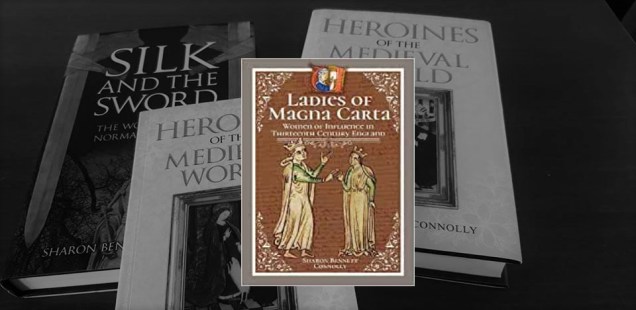
Ladies of Magna Carta: Women of Influence in Thirteenth Century England
In my first year of writing History … the Interesting Bits I told the stories of 2 remarkable women, contemporaries of each other, but with markedly different fates. Matilda de Braose fell foul of King John and suffered a horrible death in his dungeons, while Nicholaa de la Haye was John’s steadfast supporter, successfully defending Lincoln Castle in no fewer than 3 sieges; the last against a combined French and rebel army.
These 2 stories became the catalyst for my latest book, which looks into how the 1215 Magna Carta was relevant to the women of the great families of 13th century England, including the royal families of England and Scotland, the Marshals, the Bigods, the Salisburys,Braoses and Warennes.
Magna Carta clause 39: No man shall be taken, imprisoned, outlawed, banished or in any way destroyed, nor will we proceed against or prosecute him, except by the lawful judgement of his peers or by the law of the land.
This clause in Magna Carta was in response to the appalling imprisonment and starvation of Matilda de Braose, the wife of one of King John’s barons. Matilda was not the only woman who influenced, or was influenced by, the 1215 Charter of Liberties, now known as Magna Carta. Women from many of the great families of England were affected by the far-reaching legacy of Magna Carta, from their experiences in the civil war and as hostages, to calling on its use to protect their property and rights as widows.
Ladies of Magna Carta: Women of Influence in Thirteenth Century England looks into the relationships – through marriage and blood – of the various noble families and how they were affected by the Barons’ Wars, Magna Carta and its aftermath; the bonds that were formed and those that were broken. Including the royal families of England and Scotland, the Marshals, the Warennes, the Braoses and more, _Ladies of Magna Carta_ focuses on the roles played by the women of the great families whose influences and experiences have reached far beyond the thirteenth century.
And it is almost here! Ladies of Magna Carta: Women of Influence in Thirteenth Century England will be released in the UK on 30 May 2020 and is now available for pre-order from Amazon UK and from Book Depository worldwide.
Book Launch:
Please join me at The Collection, Lincoln, for the launch of Ladies of Magna Carta: Women of Influence in Thirteenth Century England, hosted by Lindum Books.
I will be doing a talk and book signing, at The Collection in Lincoln. Tickets: £7 Single; including book:£29. Couple including book: £32. Tickets are available from The collection and Lindum Books, Lincoln.
The legend of Harald Hardrada, King Harald III of Norway, is one of my favourite stories of the 11th century. It is the tale of a warrior king, probably the best fighter of his generation, a poet and a lover. Harald’s marriage to his first wife, Elisiv of Kyiv, is the stuff legends are made of; a landless prince making his fortune in Byzantium before returning to claim his bride and winning a crown. And they lived happily ever after …. or not!
Elisiv gave Harald 2 daughters, Ingegerd and Maria, but no sons. It may, therefore, have been a desire for sons that led Harald to take a second wife, although without setting aside his first. According to Snorri Sturluson, in the ‘winter after King Magnus the Good died, King Harald took Thora, daughter of Thorberg Arnason, and they had two sons; the oldest called Magnus, and the other Olaf.’ [1]
Thora (or Tora) was the daughter of Thorberg Arnason and Ragnhild Erlingsdottir and was born around 1025; her kinsman, Fin Arnason, was a good friend of Harald’s and was married to Bergliot, the daughter of Halfdan, a brother of Harald Hardrada and Saint Olaf. The marriage also provided the desired son and heir, which his first marriage had failed to do; both of Thora’s sons would later become kings of Norway. Magnus succeeded his father in 1066, and was in 1069 succeeded by his brother, Olaf III, who had ruled alongside Magnus since 1067.
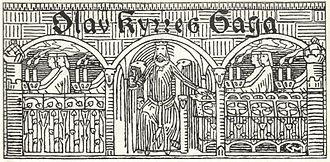
Gerhard Munthe: illustration for Olav Kyrres saga in Heimskringla (1899)
Harald probably went through some form of marriage ceremony, more likely a handfasting than a Christian marriage, with Thora in 1048. The marriage appears to have been a political arrangement, in order to garner the support of the powerful Giskeӕtten family, the chiefs of which played a significant role in power politics.
Of Harald’s two sons, Magnus, who succeeded his father in 1066, appears to have been as warlike as Harald. In 1058, aged no more than ten or eleven, he led a fleet to England in support of Earl Ӕlfgar of Mercia, after the earl had been outlawed only a year after he had succeeded to his father’s earldom. Magnus was probably little more than a figurehead for the expedition and unlikely to have been expected to make crucial military decisions, but it would have been good experience for the young prince, and a taste of what the future held for him. By the time he was sixteen, Magnus was a successful warrior and is said to have clashed with his father; the two almost coming to blows until the king was restrained by friends.
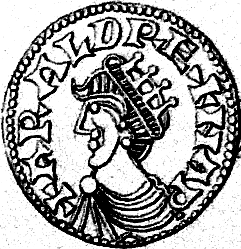
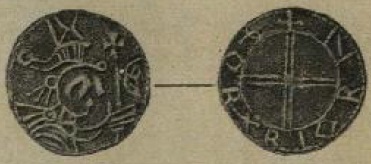
Coin dating to the reign of King Olaf Kyrre
It has been suggested that the marriage may have come following the death of Elisiv, or that Elisiv never even left Kyiv, but given that her daughters were born once Harald was back in Scandinavia, this seems improbable. Harald’s daughters are not likely to have been the daughters of Thora, as Maria was engaged to Thora’s brother, Eystein Orre; who would have been Maria’s uncle, had she been Thora’s daughter. Harald having two wives, simultaneously, seems the most likely explanation. As demonstrated by King Cnut and King Harold II of England, two wives and, therefore, two families, were not uncommon in Scandinavian culture; although in these two other cases an earlier wife was put aside for the sake of a more prestigious marriage, whereas Harald Hardrada’s first marriage was by far the more prestigious, while the second was politically expedient.
Thora was the kinswoman of Harald’s one-time friend, Fin Arnason, who was captured fighting for the Danes against Harald. When Fin refused Harald’s offer of quarter (life), Harald made a further offer:
Then Earl Fin broke out with the ugly expressions which since have been preserved, as a proof that he was so mad with rage that he could not govern his tongue: —
“No wonder thou hast bit so strongly, if the mare was with thee.”
Earl Fin got life and quarter and the king kept him a while about him…’
Heimskringla. The Chronicle of the Kings of Norway, by Snorre Sturluson.
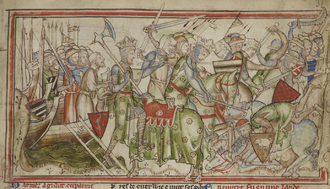
Harald landing near York, 1066 (Matthew Paris)
At the beginning of September, 1066, Harald sailed his fleet of over 200 ships to Shetland and then to Orkney, where he gathered reinforcements and left his wife and daughters to await news of events. There is some confusion as to which wife was left on Orkney, some sources say Elisiv, who, as Harald’s wife and queen would have expected to become queen of England, had he been successful. Some historians argue that as Thora was a relative of the Earl of Orkney she would have been more likely to travel with Harald than Elisiv.
We know from Thora’s joining one of Harald’s expeditions to Denmark, that he was not averse to taking his wives with him to war. However, given that young Magnus was left behind to rule Norway, aged only sixteen, it seems likely that his mother was also left behind, to advise him. According to Snorri;
‘Thora, the daughter of Thorberg, also remained behind; but he took with him Queen Ellisif [Elisiv] and her two daughters, Maria and Ingegerd. Olaf, King Harald’s son, also accompanied his father abroad.’
Heimskringla. The Chronicle of the Kings of Norway, by Snorre Sturluson.
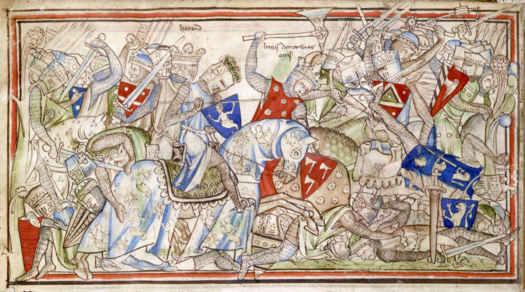
Harald fought two battles outside York. The first, the Battle of Fulford, on 20 September, against the brothers, Edwin, Earl of Mercia, and Morcar, Earl of Northumberland, ended in victory for Harald Hardrada and his ally, Tostig, the former earl of Northumberland and brother of the new King of England, Harold II. However, a second battle at Stamford Bridge, five days later, saw victory go to the English. Harold II had marched his men the 200 miles from the south coast to York, in less than 4 days, and confronted his brother and the Norwegian king on 25 September. At the end of the day, Harald Hardrada and Tostig both lay dead on the field.
Battle of Stamford Bridge, 1066 (Matthew Paris)
Harald and Elisiv’s daughter, Maria, is said to have died suddenly on 25 September 1066, the same day as the Battle of Stamford Bridge, on hearing of her father’s death. She had been betrothed to Eystein Orre, the brother of Harald’s second wife, Thora; Eystein was also among the dead at Stamford Bridge. Maria’s sister, Ingegerd, returned to Norway with her mother and half-brother. Olaf had traveled with the Norwegian army, but had not taken part in the battle, having been left to guard the ships at Riccal, near York. After the English victory, he was allowed to claim his father’s body and take the survivors home.
After Harald’s death, Norway was ruled successively by Harald’s sons Magnus II and Olaf III. Olaf III ruled until his death in 1093 and was succeeded by Magnus III, his acknowledged but illegitimate son.
Of Thora’s fate, little is certain. She may have remarried, although there is some confusion. According to Adam of Bremen, she married either King Swein of Denmark or an unknown Swedish king. [2] As with much of her life, the year of Thora’s death remains unknown.
Footnotes:
[1] Heimskringla. The Chronicle of the Kings of Norway, by Snorre Sturluson; [2] Fulford: The Forgotten Battle of 1066 by Charles Jones.
Pictures:
Courtesy of Wikipedia
Sources:
The English and the Norman Conquest by Dr Ann Williams; Brewer’s British Royalty by David Williamson; Britain’s Royal Families, the Complete Genealogy by Alison Weir; The Wordsworth Dictionary of British History by JP Kenyon; The Norman Conquestby Marc Morris; Harold, the King Who Fell at Hastings by Peter Rex; The Anglo-Saxons in 100 Facts by Martin Wall; The Anglo-Saxon Age by Martin Wall; Kings, Queens, Bones and Bastards by David Hilliam; The Mammoth Book of British kings & Queens by Mike Ashley; The Oxford Companion to British History Edited by John Cannon; The Anglo-Saxon Chronicles translated and edited by Michael Swaton; The Anglo-Saxon Chronicle translated by James Ingram; Queen Emma and the Vikings by Harriett O’Brien; The Bayeux Tapestry by Carola Hicks; On the Spindle Side: the Kinswomen of Earl Godwin of Wessex by Ann Williams; oxforddnb.com.
*
My Books
Signed, dedicated copies of all my books are available through my online bookshop.
Out now: Scotland’s Medieval Queens
Scotland’s history is dramatic, violent and bloody. Being England’s northern neighbour has never been easy. Scotland’s queens have had to deal with war, murder, imprisonment, political rivalries and open betrayal. They have loved and lost, raised kings and queens, ruled and died for Scotland. From St Margaret, who became one of the patron saints of Scotland, to Elizabeth de Burgh and the dramatic story of the Scottish Wars of Independence, to the love story and tragedy of Joan Beaufort, to Margaret of Denmark and the dawn of the Renaissance, Scotland’s Medieval Queens have seen it all. This is the story of Scotland through their eyes.
‘Scotland’s Medieval Queens gives a thorough grounding in the history of the women who ruled Scotland at the side of its kings, often in the shadows, but just as interesting in their lives beyond the spotlight. It’s not a subject that has been widely covered, and Sharon is a pioneer in bringing that information into accessible history.’ Elizabeth Chadwick (New York Times bestselling author)
Heroines of the Tudor World tells the stories of the most remarkable women from European history in the time of the Tudor dynasty, 1485-1603. These are the women who ruled, the women who founded dynasties, the women who fought for religious freedom, their families and love. Heroines of the Tudor World is now available for pre-order from Amberley Publishing and Amazon UK.Women of the Anarchy demonstrates how Empress Matilda and Matilda of Boulogne, unable to wield a sword themselves, were prime movers in this time of conflict and lawlessness. It shows how their strengths, weaknesses, and personal ambitions swung the fortunes of war one way – and then the other. Available from Bookshop.org, Amberley Publishing and Amazon UK. King John’s Right-Hand Lady: The Story of Nicholaa de la Haye is the story of a truly remarkable lady, the hereditary constable of Lincoln Castle and the first woman in England to be appointed sheriff in her own right. Available from all good bookshops Pen & Sword Books, bookshop.org and Amazon.
Alternate Endings: An anthology of historical fiction short stories including Long Live the King… which is my take what might have happened had King John not died in October 1216. Available in paperback and kindle from Amazon.
Podcast:
Have a listen to theA Slice of Medieval podcast, which I co-host with Historical fiction novelist Derek Birks. Derek and I welcome guests, such as Bernard Cornwell and Elizabeth Chadwick, and discuss a wide range of topics in medieval history, from significant events to the personalities involved.
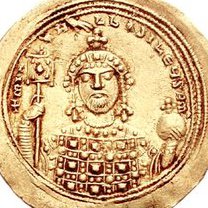
Zoe Porphyrogenita lived most of her life in relative obscurity. She was the second of 3 daughters born to Constantine VIII and his wife, Helena. Zoe was born in Constantinople in about 978. She was the niece of Basil II, the warrior emperor who had co-ruled, as senior emperor, with Constantine for over 60 years. Basil died in January 1025, leaving Constantine to rule alone for a further 3 years before his own death in November 1028. By all accounts, while Basil fought to preserve his empire, Constantine was more in love with the trapping of power, rather than the wielding of it.
Zoe’s father had been emperor since the age of 2, meaning that Zoe was ‘born into the purple’ – born to a reigning emperor. She had an elder sister, Eudokia, who joined a monastery, and a younger sister, Theodora. Zoe’s uncle Basil II refused to arrange marriages for his nieces, as such marriages would give their husbands a claim to the imperial throne. The girls lived in virtual obscurity in the women’s quarters of the palace for many years.
Zoe first appeared on the international stage in 1001, at the age of 23, when her uncle offered her as a bride to German Emperor Otto III (reigned 996-1002). Zoe had set sail from Constantinople, but on arriving at Bari, was met with the news that her prospective groom had died of a fever. Zoe returned home to Constantinople and the continued seclusion of the royal palace.
Following the death of her uncle, and with no legitimate male heir to succeed him, Zoe’s father, Constantine, sought to settle the empire’s future by finally arranging Zoe’s marriage. At the age of 50, in 1028, she was married to her father’s designated successor, probably to add legitimacy to his claim to the imperial throne. Her new husband became Emperor Romanos III, and Zoe empress consort, when he succeeded to the throne just 3 days after the wedding.
Zoe was described by a palace courtier, Michael Psellos, as;
‘a woman of great beauty, most imposing in her manner and commanding respect … a woman of passionate interests, prepared with equal enthusiasm for both alternatives, death or life, I mean. In that she reminded me of sea-waves, now lifting a ship on high and then again plunging it down to the depths … Zoe was openhanded, the sort of woman who could exhaust a sea teaming with gold-dust in one day … [she] confused the trifles of the harem with important matters of state … her eyes were large, set wide apart with imposing eyebrows. Her nose was inclined to be aquiline, and her whole body was radiant with the whiteness of her skin.’
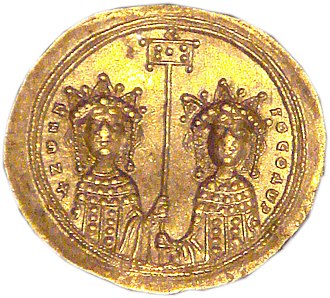
Zoe and Theodora, Chronographia
As empress consort, Zoe asserted herself. Her younger sister, Theodora, was sent to a monastery. Romanos was an unpopular ruler, his economic policies and military defeat in 1030 causing consternation. Neglected by her husband, who took a lover and refused to allow Zoe any say in affairs of state, the empress took a much younger, teenage lover, her chamberlain, Michael. Together they conspired to dispose of Romanos and he was found dead in his bath on 10 April 1034, allegedly poisoned by Zoe or her lover.
Michael IV
Zoe promptly married her young lover and made him Emperor Michael IV. Not surprisingly, their marriage was full of distrust and Zoe was allowed no power or say in government. Michael IV then banished Zoe to the gynaeceum, or women’s quarters.. His reign was no golden age, with the aristocracy opposing the undue influence of the emperor’s brother, John the Orphanostrophos. High taxation sparked a revolt, led by Peter Deljan, who used it as a pretext to end the Byzantine dominance of the Bulgars. The rebellion was quashed within a year, with the aid of Harald Hardrada and his 500 Norwegians, who had joined the Varanagian Guard in 1034. Further losses in Sicily and the emperor’s worsening epilepsy added to the empire’s woes. Not to be forgotten, Zoe began scheming to reclaim her throne. After she was allowed back to court, and unable to bear her own children due to her age, Zoe was persuaded to adopt Michael IV’s nephew, another Michael, and make him her heir.
Michael IV’s life would have probably ended in the same way as his predecessor, Romanos III, drowned in the bath or with a knife in his back, had he not died of natural causes in 1041, after retiring to a monastery. His nephew, Zoe’s adopted son, ascended the throne as Michael V; Michael was the son of the sister of Michael IV. Michael V was crowned in 1041 but immediately turned against those who had raised him to the throne. His uncle, John the Orphanotrophos, was exiled from court and Zoe was again banished to a monastery, an act which caused an uprising in Constantinople.
The people of Constantinople and the church wanted to see the crown returned to Zoe and the legitimate dynastic line. The mob ransacked the royal palace and deposed Michael V in April 1042. The young emperor was deposed after only 4 months of disastrous rule. He was exiled to a monastery, but complaints about such lenient treatment meant that orders were given for his mutilation. He was blinded, an act symbolically rendering him incapable of ruling, supposedly by Harald Hadrada, the future king of Norway, himself.
Zoe and Theodor
Now 64 years old, Zoe was empress once again.
Zoe’s sister, Theodora, was retrieved from her monastery to rule beside her. As the elder sister, Zoe’s throne was placed slightly forward of her Theodora’s at the joint coronation ceremony, as an obvious indication of which of the sisters was in charge!
The sisters sought to reform Byzantine imperial policies, making new court appointments, ending corrupt practices, such as selling titles, and instigating an investigation into the actions of their predecessor.
In the same year, 1042, Zoe took a third husband, Constantine Monomachos, who ruled as Emperor Constantine IX. Long-admired by the empress, Constantine had been exiled to Lesbos but was recalled to become Zoe’s third husband. Constantine was rich and elegant, with a reputation as a ladies man, but with experience of Byzantine government as a senior civil administrator. He co-ruled the empire with the 2 imperial sisters.
Domestic arrangements, however, were frowned upon when Constantine moved his long-time lover, Sclerina, into the imperial palace, apparently with Zoe’s blessing. The public were not so tolerant and called for Sclerina’s removal; the crisis was resolved by Sclerina’s sudden death from a pulmonary disease.
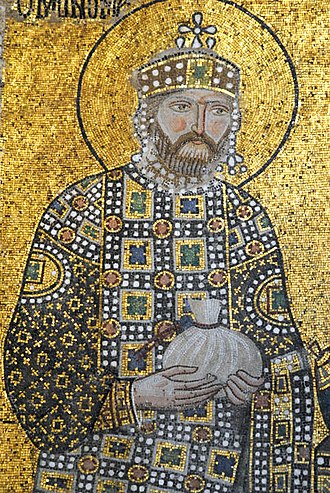
Emperor Constantine IX
Constantine set about reforming the Byzantine administration, exiling John the Orphanotrophos from court for a second time, and surrounding himself with noted intellectuals, among them Michael Psellos. However, his reforms and neglect of the army led to two uprisings, in 1043 and 1047, respectively, and saw the frontiers of the empire crumbling under incursions from the Normans, the Seljuks and the Pechenegs.
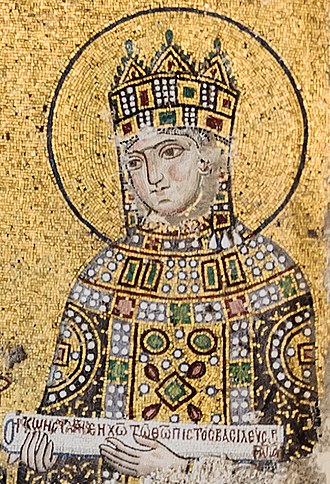
Constantine outlived his wife; Zoe died in 1050, aged about 72. And when her sister, Theodora, died in 1056, the Macedonian dynasty founded by Basil I (reigned 867-886) came to an end. Zoe is remembered in the gold and glass mosaic of the Hagia Sophia in Constantinople (now Istanbul) in which she is portrayed with Constantine IX and Jesus Christ. The inscription reads ‘Zoe, the most pious Augusta’.
Pictures:
Courtesy of Wikipaedia
Sources:
britannica.com; A History of the Vikings by T.D. Kendrick; God’s Viking: Harald Hardrada by Nic Fields; Heimskringla. The Chronicle of the Kings of Norway by Snorre Strurluson; Silk and the Sword: The Women of the Norman Conquest by Sharon Bennett Connolly; Ancient History Encyclopedia.
*
My Books:
Signed, dedicated copies of all my books are available, please get in touch by completing the contact me form.
Defenders of the Norman Crown: The Rise and Fall of the Warenne Earls of Surrey tells the fascinating story of the Warenne dynasty, of the successes and failures of one of the most powerful families in England, from its origins in Normandy, through the Conquest, Magna Carta, the wars and marriages that led to its ultimate demise in the reign of Edward III. Defenders of the Norman Crown: Rise and Fall of the Warenne Earls of Surrey is now available from Pen & Sword Books, Amazon in the UK and US,Bookshop.org and Book Depository.
Alternate Endings: An anthology of historical fiction short stories including Long Live the King… which is my take what might have happened had King John not died in October 1216. Available in paperback and kindle from Amazon.
*
You can be the first to read new articles by clicking the ‘Follow’ button, liking our Facebook page or joining me on Twitterand Instagram.
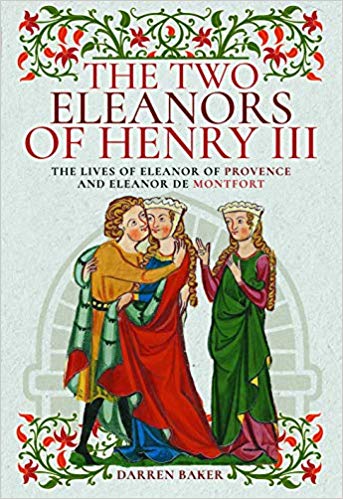
Eleanor of Provence was born in the province of her name in 1223. She has come to England at the age of twelve to marry the king, Henry III. He’s sixteen years older, but was a boy when he ascended the throne. He’s a kind, sensitive sort whose only personal attachments to women so far have been to his three sisters. The youngest of them is called Eleanor too. She was only nine when, for political reasons, her first marriage took place, but she’s already a chaste twenty-year old widow when the new queen arrives in 1236. In a short time, this Eleanor will marry the rising star of her brother’s court, a French parvenu named Simon de Montfort, thus wedding the fates of these four people together in an England about to undergo some of the most profound changes in its history. It’s a tale that covers three decades at its heart, with loyalty to family and principles at stake, in a land where foreigners are subject to intense scrutiny and jealousy. The relationship between these two sisters-in-law, close but ultimately doomed, will reflect not just the turbulence and tragedy of their times, but also the brilliance and splendour.
Having just reviewed one of the best fiction books of 2019 in Angus Donald’s Blood’s Campaign, it is a pleasure to review one of the best non-fiction books I’ve read this year. Darren Baker’s The Two Eleanors of Henry III: The Lives of Eleanor of Provence and Eleanor de Montfort is a truly engaging book, delving into the lives of two very different women, friends who were on opposing sides during the Second Baron’s War and the rebellion of Simon de Montfort.
Told chronologically, with their lives running in parallel, Darren Baker recreates the experiences of Eleanor of Provence, queen of Henry III, and Eleanor de Montfort, sister of Henry III and wife of his bitter enemy, Simon de Montfort. Sympathetic but not overly sentimental, Darren Baker recreates the political and personal lives of his two protagonists, both on the national and international stage.
The Two Eleanors of Henry III: The Lives of Eleanor of Provence and Eleanor de Montfort is a wonderful analysis of the years between the issuing of Magna Carta and the death of Simon de Montfort at the Battle of Evesham, clearly demonstrating the roles played by the wives of the two main protagonists in the ongoing battle between crown and barons. Darren Baker examines the conflict, and motivations behind it, from a new and innovative angle.
It cannot have been easy to write a dual biography about two women who shared a Christian name, but Darren Baker has a remarkable skill in always clearly identifying which Eleanor he is talking about at any particular time, negating any possible confusion for the reader.
As the banquet commences, Eleanor [of Provence] notices a man standing in close proximity to them, holding a basin of water for the king to clean his hands in before, during and after the meal. But e is clearly no servant. Besides wearing stately robes, he walks with Henry with a familiarity that suggests they are friends. More intriguing, his accent is very close to hers. Someone in the party whispers that it is Simon de Montfort, the son of the crusader who set most of their region ablaze three decades earlier. Simon too grew up in the south of France until his father was felled in the conflict. When the crusade was over, he ventured to England to claim the earldom of Leicester through his grandmother’s noble lineage. The earldom came with the office of steward, which is what this tall and handsome knight, then in his late twenties, is doing in attending the king at the feast.
Simon looks at the party from Provence with equal suspicion. He survived a purge of foreign courtiers only a few years before and is worried this new crowd from abroad might re-ignite that peculiar English obsession with aliens. His position seems safe because he is one of Henry’s most trusted confidants. He has recently shown his loyalty to him by proposing marriage to two widowed countesses on the Continent, presumably at the king’s urging. Henry has grand ideas about creating alliances across the Channel as a means of recovering the lands seized by the French from his father. ‘Do that,’ he intimated, ‘and I’ll find you a suitable bride if it doesn’t work out.’ Simon returned empty-handed.
Widows abound in this feudal society and the king gets to decide who marries the rich and powerful ones. None is more desirable than his own sister, who is also named Eleanor. She was younger than her new sister-in-law when she was betrothed to William Marshal II, son of her brother’s first regent. Because of her extreme youth at the time, it was years before she and William began cohabiting. Their marriage waas successfull but childless.
Don’t be fooled by the flowing narrative, The Two Eleanors of Henry III: The Lives of Eleanor of Provence and Eleanor de Montfort is an in-depth analysis, not only of the lives of the two women, but of the events which shaped their world and threatened the very stability of England and the monarchy. Darren Baker delves into the motivations of both women, their loyalty to their husbands and family and examines the lengths that each went to in order to protect their own interests.
The Two Eleanors of Henry III: The Lives of Eleanor of Provence and Eleanor de Montfort is a pleasure to read. It provides great insight into the lives of Eleanor of Provence, Eleanor de Montfort, their husbands and children and the impact that their family feuding had, not only on England, but also on the European stage. The author does not run to judgement and provides a balanced analysis of both sides of the conflict of the Second Barons’ War. He clearly points out the character strengths and flaws of both Eleanors, using chronicles and letters to build clear images of their characters and personalities.
The Two Eleanors of Henry III: The Lives of Eleanor of Provence and Eleanor de Montfort firmly places Eleanor of Provence and Eleanor de Montfort within the thirteenth century world in which they lived. Darren Baker brings their stories to life, with his passion for his subjects clearly visible in the elegant narrative. This book is a must for anyone interested in medieval women or in the conflict between Henry III and Simon de Montfort. Placing the focus on the two women who saw their husbands and sons drawn into the Second Barons’ War shines a whole new light on the period.
It is an enjoyable and fascinating read!
To buy the Book:
The Two Eleanors of Henry III: The Lives of Eleanor of Provence and Eleanor de Montfort is now available from Amazon UK and is available for pre-order from Amazon US and direct from Pen & Sword.
About the author:
Darren Baker is a translator and historian who took his degree at the University of Connecticut. He currently lives in the Czech Republic.
From Emma of Normandy, wife of both King Cnut and Æthelred II to Saint Margaret, a descendant of Alfred the Great himself, Silk and the Sword: the Women of the Norman Conquest traces the fortunes of the women who had a significant role to play in the momentous events of 1066. Available now from Amazon UK, Amberley Publishing,Book Depository and Amazon US.
Telling the stories of some of the most remarkable women from Medieval history, from Eleanor of Aquitaine to Julian of Norwich, Heroines of the Medieval World, is available now on kindle and in paperback in the UK from from both Amberley Publishing and Amazon, in the US from Amazon and worldwide from Book Depository.
*
You can be the first to read new articles by clicking the ‘Follow’ button, liking our Facebook page or joining me on Twitterand Instagram.
ONE OF THE MOST TURBULENT REIGNS IN HISTORY PAVED THE WAY FOR THE FIRST MODERN REVOLUTION.
AFTER THE TUDORS CAME THE STUARTS . . .
If you enjoy S. J. Parris and Andrew Taylor, then this is the series you need to read next.
August 25, 1689
The English Army is besieging Carrickfergus in Ireland. Brilliant but unusual gunner Holcroft Blood of the Royal Train of Artillery is ready to unleash his cannons on the rebellious forces of deposed Catholic monarch James II. But this is more than war for Captain Blood, a lust for private vengeance burns within him.
French intelligence agent Henri d’Erloncourt has come across the seas to foment rebellion against William of Orange, the newly installed Dutch ruler of England, Scotland and Ireland. But Henri’s true mission is not to aid the suffering of the Irish but to serve the interests of his master, Louis le Grand.
Michael ‘Galloping’ Hogan, brigand, boozer and despoiler of Protestant farms, strives to defend his native land – and make a little profit on the side. But when he takes the Frenchman’s gold, he suspects deep in his freedom-loving heart, that he has merely swapped one foreign overlord for another.
July 1, 1690
On the banks of the River Boyne, on a fateful, scorching hot day, two armies clash in bloody battle – Protestant against Catholic – in an epic struggle for mastery of Ireland. And, when the slaughter is over and the smoke finally clears, for these three men, nothing will ever be the same again . . .
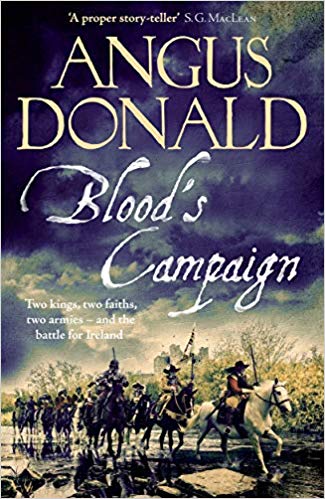
The sign of a really good book is always that you find yourself absorbed in it, desperate to finish it but bereft when you do. Blood’s Campaign is a really, really, really good book!
I was extremely excited to be offered this book to review by NetGalley. The first 2 books in the series, Blood’s Game and Blood’s Revolution, were both fantastic and refreshingly unique stories, introducing a hero who was sympathetic and quirky in a very distinct way.
Blood’s Campaign, the third in the series following the exploits of Holcroft Blood, it takes us to Ireland and the campaign that led to the Battle of the Boyne and the end of James VII and II’s hopes to regain the throne from his daughter and her husband, the joint monarchs, William III and Mary II. Angus Donald combines the story of the campaign with Blood’s own personal mission to find and destroy the French spy, codenamed Narrey – Holcroft’s one-time friend, Henri d’Erloncourt.
In today’s society, Holcroft Blood would be on the Autistic Spectrum. In the 17th Century, there was no such diagnosis. He was simply seen as a peculiar character. Holcroft is well aware of his failings, of his inability to understand jokes and to read some people; this, and his black-and-white outlook on life can lead to distractions which in themselves could lead him into trouble, especially with women. He feels more comfortable when order is enforced, which makes the army the ideal home for Holcroft.
He clambered up the pile of rubble by the corner of the farmhouse and pulled out his telescope. ‘You take over, Enoch,’ he said over his shoulder. ‘Nothing fancy, go for the highest rate of fire. I’ll spot for you from here.’
He trained the telescope on the roof of Joymount House. The twenty-four-pounders were being moved again. No need to aim at the breach any more. Then to his joy he caught a glimpse of Narrey standing alone by the easel, tapping his chin with the wooden end of the paintbrush, on the right-hand roof before he moved out of sight towards the rear.
Please, God, let him stay where he is, please, God, let him remain up there.
He looked behind him to see what stage the reloading process had reached. Nearly there.
‘Tend the match,’ Jackson was saying to the matrosse now holding the linstock. ‘Have a care. Give fire! May the Lord guide our efforts.’
It was a beautiful shot. The mortar coughed, spitting the missile in a high, elegant arc, a parabola, far over the burnt-out farmhouse, soaring over the town walls and dropping down, down until the hollow iron sphere exploded with a colossal bang exactly over the centre of the battery atop Joymount House.
‘Dead on, Enoch,’ shouted Holcroft. ‘Full on target. More of that, please.’At that moment, a musket cracked and a ball pinged from a piece of broken rubble beside his cheek, spattering him painfully with grains of brick dust. The Irish musketeers on the walls had, at last, taken notice of the mortar’s position.
Holcroft Blood’s penchant for mathematics makes him the perfect gunner and he feels at home calculating angles and distances and the flight of a cannonball – the science of gunnery offers him a home in a world that he often finds hard to understand. However, his mathematical mind also means he has a knack for codes – a skill which has drawn him into the world of espionage before, and which he uses again in an attempt to corner his implacable enemy, Narrey.
Holcroft not only has to negotiate the machinations of his enemies, but the enmity of his commanding officer, and his own feelings, in order to track down his enemy and fulfill his duties within the army. The story of the campaign which led to the Battle of the Boyne and beyond is laid out beautifully by Angus Donald – as is the gorgeous Irish landscape.
The author’s research is impeccable and thorough, not only with the battle itself, but also with his knowledge of provisions, troop movements, training and 17th century society in both Ireland and England. His knowledge of the campaign, gunnery and the minutiae of army life help to bring to life the Stuart world in vivid and colourful detail.
Blood’s Campaign is exciting from the first page to the last. A totally absorbing story, it will keep you reading ‘just another chapter’ long into the night. You don’t just read this book – you devour it.
Blood’s Campaign is definitely in my 10 best books of 2019. It takes you on a wonderful adventure and leaves you wanting more!
Angus Donald was educated at Marlborough College and Edinburgh University. He has worked as a fruit-picker in Greece, a waiter in New York and as an anthropologist studying magic and witchcraft in Indonesia. For many years he was a journalist in Hong Kong, India, Afghanistan and London. He is married to Mary, with whom he has two children, and he now writes full time from a medieval farmhouse in Kent.
He is the author of the bestselling Outlaw Chronicles, a series of eight books set in the 12th/13th centuries and featuring a gangster-ish Robin Hood and his loyal lieutenant Sir Alan Dale. His new Holcroft Blood series stars a mildly autistic artillery officer who was the son of notorious 17th-century Crown Jewel thief Colonel Thomas Blood. The series begins with Blood’s Game, followed by Blood’s Revolution and Blood’s Campaign (out November 2019). The author has also written an epic Asian fantasy novel Gates of Stone under the pseudonym Angus Macallan. He is always happy to chat to readers on Facebook, Twitter and via his website http://www.angusdonaldbooks.com
From Emma of Normandy, wife of both King Cnut and Æthelred II to Saint Margaret, a descendant of Alfred the Great himself, Silk and the Sword: the Women of the Norman Conquest traces the fortunes of the women who had a significant role to play in the momentous events of 1066. Available now from Amazon UK, Amberley Publishing,Book Depository and Amazon US.
Telling the stories of some of the most remarkable women from Medieval history, from Eleanor of Aquitaine to Julian of Norwich, Heroines of the Medieval World, is available now on kindle and in paperback in the UK from from both Amberley Publishing and Amazon, in the US from Amazon and worldwide from Book Depository.
*
You can be the first to read new articles by clicking the ‘Follow’ button, liking our Facebook page or joining me on Twitterand Instagram.
AD 838. Deep in the forests of Wessex, Dunston’s solitary existence is shattered when he stumbles on a mutilated corpse.
Accused of the murder, Dunston must clear his name and keep the dead man’s daughter alive in the face of savage pursuers desperate to prevent a terrible secret from being revealed.
Rushing headlong through Wessex, Dunston will need to use all the skills of survival garnered from a lifetime in the wilderness. And if he has any hope of victory against the implacable enemies on their trail, he must confront his long-buried past – becoming the man he once was and embracing traits he had promised he would never return to. The Wolf of Wessex must hunt again; honour and duty demand it.
I have watched Matthew Harffy‘s writing career take off from the very first book, The Serpent Sword. Matthew’s wonderful series, the Bernicia Chronicles bring 7th century England to life. However, its always a risk for a writer – and a reader – to start a new book series, or produce a standalone, especially when the first series was so impressive. I’m sure writer and reader both begin to wonder if the new project will stand up to the reader’s high expectations.
Well, Matthew Harffy need not have worried.
His new hero, Dunston, rather older than young Beobrand – though no less bold and living a couple of hundred years later, is a truly fascinating character, with a history of his own that is as compelling as Beobrand’s ever was. But, there the similarity ends. Dunston is a whole new creation, his story unique and mesmerising in its hints at a past that earned him the name Dunston the Bold.
As we have come to expect from Matthew Harffy, Wolf of Wessex is a beautifully crafted novel, the story and action carefully balanced to take the reader on a wonderful journey through 9th century Wessex. The skillful storyteller shines through on every page.
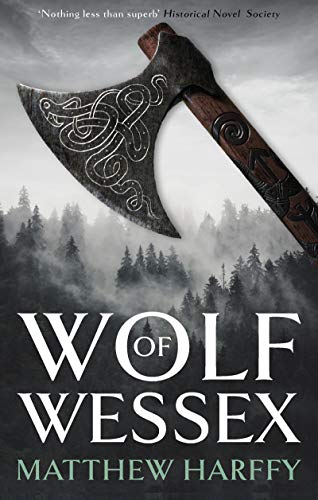
And what a gorgeous book cover! So atmospheric, it complements the book perfectly.
The man frowned.
“Do not fear,” he said. “Odin won’t hurt you. Will you, boy?”
As if in answer, the dog licked her hand. Looking down, she saw the knife still clutched there. The dog looked up at her with its one, deep brown eye. It nuzzled its snout into her, inviting her to stroke it perhaps. Shakily, she sheathed the knife and reached out to caress the soft fur of the dog’s ears. Odin sat down contentedly and once again nudged her with his head, encouraging her to continue.
Could the man be one of the heathen Norsemen to have named his dog thus, she wondered?
“By Christ’s bones,” said the man. “Disobedient and soft.”
She noted that he had in his large hand a long seax. The blade of the knife glimmered dully as he moved. For an instant, her fear returned with a sudden icy chill. But as she watched, he slid the weapon into a scabbard that hung from his belt.
“Now,” the old man said, “who are you and what are you dooing in my forest?”
“I -,” she stammered, her voice catching, “I am Aedwen, Lytelman’s daughter.”
“And where were you headed?”
“To find my father…” she swallowed, not wishing to put words to what had occurred. “He – He was attacked.”
The man ran a callused hand over his face and beard. His eyes glittered, chips of ice in the crags of his face. She wondered if he ever smiled. His was a hard face, unyielding and unsmiling, so unlike her father’s. He always appeared content with his lot in life. She recalled his screams and shuddered.
Set in the time of Alfred the Great’s grandfather, Dunston and Aedwen are an odd combination for travelling companions; an aged warrior and a teenage girl, both drawn into a greater conspiracy by the murder of Aedwen’s father. Thrown together by circumstance, these two wonderful characters take us on an adventure that will not easily be forgotten.
As has come to be expected with Matthew Harffy, his research into the period is impeccable. Not only with the weapons, but all aspects of life in 9th century Wessex, from the charcoal burners to the king’s warriors and reeves, are recreated with an eye to accuracy and authenticity. Matthew Harffy keeps the tension high throughout the book, using the characters, events and even landscape to enhance the drama of the story.
However, what makes this novel – as always – is the story itself. Beautifully written, engrossing and fraught with tension, it is enthralling from the first word to the last and will leave the reader wanting more.
In Wolf of Wessex, a true page-turner, Matthew Harffy has produced a contender for Best Read of 2019. A must-read for anyone who loves action packed books with a great story!
About the author:
Matthew Harffy lived in Northumberland as a child and the area had a great impact on him. The rugged terrain, ruined castles and rocky coastline made it easy to imagine the past. Decades later, a documentary about Northumbria’s Golden Age sowed the kernel of an idea for a series of historical fiction novels. The first of them is the action-packed tale of vengeance and coming of age, THE SERPENT SWORD.
Matthew has worked in the IT industry, where he spent all day writing and editing, just not the words that most interested him. Prior to that he worked in Spain as an English teacher and translator. Matthew lives in Wiltshire, England, with his wife and their two daughters.
From Emma of Normandy, wife of both King Cnut and Æthelred II to Saint Margaret, a descendant of Alfred the Great himself, Silk and the Sword: the Women of the Norman Conquest traces the fortunes of the women who had a significant role to play in the momentous events of 1066. Available now from Amazon UK, Amberley Publishing,Book Depository and Amazon US.
Telling the stories of some of the most remarkable women from Medieval history, from Eleanor of Aquitaine to Julian of Norwich, Heroines of the Medieval World, is available now on kindle and in paperback in the UK from from both Amberley Publishing and Amazon, in the US from Amazon and worldwide from Book Depository.
*
You can be the first to read new articles by clicking the ‘Follow’ button, liking our Facebook page or joining me on Twitterand Instagram.
Ever since I first discovered Bernard Cornwell’s Richard Sharpe 30 years ago, I have had a fascination for all-things Napoleonic – the Peninsular War in particular (I even wrote my university dissertation on it!). The Walcheren expedition of 1809 was an extension of this conflict, and a rather disastrous one. Author Lynn Bryant is currently writing a fiction series, The Manxman Series, based on the events of the Walcheren Campaign. Book 2, This Blighted Expedition, is out this week. Today Lynn visits us to talk about the research behind the book.
This Blighted Expedition: a novel of the Walcheren Campaign of 1809 (Book 2 in the Manxman series)
This
Blighted Expedition
is my eleventh published historical novel, and the second in the Manxman
series, which follows the fortunes of the fictional Captain Hugh Kelly of HMS Iris, his wife Roseen and his young
first lieutenant Alfred Durrell. This book takes them to the Walcheren campaign
of 1809 where a huge joint operation between the army and the navy went
disastrously wrong, and led to an ignominious retreat, the deaths of over 4000
men from the deadly Walcheren fever and a Parliamentary inquiry.
Researching Walcheren has been very
different to researching the better known campaigns of the wars for my
Peninsular War Saga. There is a huge amount of published contemporary material
in the form of letters and journals about the Peninsular War. Officers, and in
a few cases, their enlisted men, wrote endlessly to their family and friends
about their experiences in the war, and modern historians have done a
remarkable job of discovering, editing and publishing these accounts. When
researching the doings of my fictional regiment at the siege of Badajoz, the
problem was having time to sift through all the material and also of knowing
when to stop. Writing fiction, as opposed to history, there comes a point when
you have to decide how you’re going to write it and then stop researching. You
are not trying to give a perfect account of events, you’re trying to give a
credible account of events from the point of view of your characters. There’s a
big difference.
With Walcheren, I was unusually
lucky to have a great deal of help with the sources, in the person of Dr
Jacqueline Reiter, who is something of an expert on the campaign. Jacqueline
has done an enormous amount of research on Walcheren, and has written an
excellent biography of John Pitt, second Earl of Chatham, who commanded the
army during the campaign. She is currently working on a biography of Sir Home
Popham, the controversial navy officer who played such a large part in the
planning and execution of the joint operation at Walcheren. Not only did
Jacqueline point me in the direction of the few books written on the subject,
but she also generously shared her own notes and sources from many years of
research.
With a joint operation, I needed to
follow both the army and the navy. As always, my starting point was to read any
books on the subject to get a general overview, and I’ve listed them in full
below. There aren’t many, but I read Jacqueline’s book on Chatham, and the
books by Martin R Howard and Gordon Bond on the campaign. There is a brief
account of the campaign in Andrew Limm’s Walcheren to Waterloo and a
frustratingly short mention of it in Hugh Popham’s biography of Sir Home Riggs
Popham. I was also very grateful to Carl Christie, for sharing his excellent
thesis on the campaign with me as well as his list of sources.
There are some accounts by both
army and navy officers. Many are very brief, and included in volumes describing
their more glorious achievements in later campaigns. One of the most useful
sources for the navy was the letters and journals of Edward Codrington, which
are available online. I owe the story of the wreck of the Venerable to him and
to Dr McGrigor, who was aboard the ship and described it vividly in his
autobiography. Jacqueline Reiter generously shared her research notes on the
log of the Venerable, which confirmed McGrigor’s account of the army wives
aboard the vessel.
Some of my old favourite army
writers include an account of Walcheren, including Private Harris and Private
Wheeler and it is from them that I have taken my account of the fever, along
with several medical men who wrote about it. The Proceedings of the Army give
daily accounts of the progress of the siege works, once again shared by Dr
Reiter, and offer a marvellous impression of the mind-numbing tedium of the
digging of trenches and building of batteries.
I am indebted to Gareth Glover for
sending me the account of the campaign by Joseph Barrallier of the 71st
who told the story of Pack’s abortive attack on Veere really well. Excerpts of
diaries by Captain Bowlby of the 4th foot and General Trench are
very short, but give marvellous small details which help to bring a novel to
life, such as Trench’s mention of the order of 24th July stating
that plundering would be punished by ‘instant death’. Trench is also scathing
about Chatham’s abilities as a commander, and writes that: “yesterday about 12
o’clock he got under way being preceded by a column of 8 waggons in the first
of which was a life turtle, he had a fresh horse at Schore but did not attempt
to go further than Crabbendyke, tho’ Batz was but 7 miles off.” Evidently
Chatham’s indolence and slow progress was a source of frustration in his army.
The rather unusual aspect of the
Walcheren campaign was the large number of civilians who accompanied the army,
including a number of journalists, most of them invited by that relentless
self-publicist, Sir Home Popham. Once again, I am indebted to Jacqui Reiter for
a lot of information about them, including the diary and letters of young Lord
Lowther. Lowther was a gift wrapped in silver paper for a historical novelist,
and almost everything I have written about him was true.
In addition to sources which are
directly relevant to the campaign, I spent a great deal of time reading online
accounts of the Parliamentary inquiry into Walcheren, since I decided that the
story of one of my characters, needed to end with his appearance before the
House of Commons. This turned out to be one of those impulsive decisions a
writer makes, without really thinking about the amount of work involved. I did
the same thing at the end of the first book in the series, by choosing to end
the novel with a general Court Martial which took hours of research into
procedure and rules of evidence. It turns out that a Parliamentary inquiry
takes even longer although as a set piece to end the novel, it was very
effective.
While most of my research is done
sitting at my desk, I was lucky enough to be able to go to Walcheren earlier
this year, to visit many of the sites I’ve been writing about. The apartment we
stayed in was in one of the many old houses on Korendijk in Middelburg, which
would have been there at the time Katja de Groot was living there and I was
ridiculously excited when our hostess explained that the old beams in the house
are so scarred and in some places burned, because they were all re-used from
broken up ships in the Vlissingen and Antwerp dockyards. That kind of on the
ground research is priceless and I feel as though I know Katja’s lovely
Middelburg home personally.
This
Blighted Expedition
is available on Kindle and will be available in paperback in a few weeks. In
the end, it is always my aim, as a novelist to engage the reader with my
characters, both fictional and real. The research is a framework, on which to
build a story, and by the end of the book it often feels as though I’ve been
playing a game of Jenga with the research, carefully removing as much of it as
I can to enable the story to stand up but not taking out so much that the whole
thing comes crashing down. I hope I’ve achieved it and that readers enjoy the
end result.
As this is a blog post, not a thesis, I’ve provided a short book list but if readers have any further questions about online sources, please contact me on my website, on Facebook or on Twitter and I’ll do my best to answer them.
Bibliography
Bond, Gordon, The Grand Expedition: the British invasion of Holland in 1809 (University of Georgia Press, 1979); Christie, Carl A, The Walcheren Expedition of 1809 (PhD, University of Dundee, 1975); Howard, Martin R, Walcheren 1809: the scandalous destruction of a British army; Limm, Andrew, Walcheren to Waterloo: the British Army in the Low Countries during the French Revolution and Napoleonic Wars (Pen and Sword, 2018); Popham, Hugh, A Damned Cunning Fellow: the eventful life of Rear-Admiral Sir Home Popham (The Old Ferry Press, 1991); Reiter, Jacqueline, The Late Lord: the life of John Pitt, 2nd Earl of Chatham (Pen and Sword 2017).
About the author:
Lynn Bryant was born
and raised in London’s East End. She studied History at University and had
dreams of being a writer from a young age. Since this was clearly not something
a working class girl made good could aspire to, she had a variety of careers
including a librarian, NHS administrator, relationship counsellor and manager of
an art gallery before realising that most of these were just as unlikely as
being a writer and took the step of publishing her first book.
She now lives in the
Isle of Man and is married to a man who understands technology, which saves her
a job, and has two grown up children and two Labradors. History is still a
passion, with a particular enthusiasm for the Napoleonic era and the sixteenth
century. When not writing she waits on the Labradors, reads anything that’s put
in front of her and makes periodic and unsuccessful attempts to keep a tidy
house.
This Blighted Expedition is available on Amazon kindle here and will be out in paperback by the end of November. To celebrate publication, the first book, An Unwilling Alliance is available from 1st to 5th November 2019 FREE on Amazon here.
In the meantime, I am about to embark on book six of the Peninsular War Saga. It’s called An Unrelenting Enmity and to give myself a kick start with the writing process, I am attempting NaNaWriMo for the first time ever. To follow my progress why not join me on my blog over at Writing with Labradors, or on Facebook or Twitter?
From Emma of Normandy, wife of both King Cnut and Æthelred II to Saint Margaret, a descendant of Alfred the Great himself, Silk and the Sword: the Women of the Norman Conquest traces the fortunes of the women who had a significant role to play in the momentous events of 1066. Available now from Amazon UK, Amberley Publishing,Book Depository and Amazon US.
Telling the stories of some of the most remarkable women from Medieval history, from Eleanor of Aquitaine to Julian of Norwich, Heroines of the Medieval World, is available now on kindle and in paperback in the UK from from both Amberley Publishing and Amazon, in the US from Amazon and worldwide from Book Depository.
*
You can be the first to read new articles by clicking the ‘Follow’ button, liking our Facebook page or joining me on Twitterand Instagram.
Jack Blackjack stands accused of killing a priest in the wickedly entertaining new Bloody Mary Tudor mystery.
April, 1555. A priest has been stabbed to death in the village of St Botolph, to the east of the City of London, his body left to rot by the roadside – and Jack Blackjack stands accused of his murder.
As well as clearing his name, Jack has his own reasons for wanting to find out who really killed the priest – but this is an investigation where nothing is as it seems. Was it a random attack by a desperate outlaw, or do the answers lie in the murdered priest’s past? As he questions those who knew the dead man, Jack is faced with a number of conflicting accounts – and it’s clear that not everyone can be telling him the whole truth.
But Jack is about to be sidetracked from the investigation … with disastrous consequences.
I have been a fan of Michael Jecks‘ books ever since the first, The Last Templar, came out many, many years ago. And The Dead Don’t Wait clearly reminds me why I am such a fan of his writing. It is a wonderful murder mystery set in the time of Queen Mary I and a fine example of why Michael Jecks is considered one of the foremost authors of historical crime fiction.
The Dead Don’t Wait is the 4th title in Jecks’ Bloody Mary Mystery series.
The characters are wonderfully colourful and the various suspects suitably despicable or sympathetic, depending on their possible motives. The victim himself is not exactly the most innocent of men. And without the modern benefits of fingerprinting and DNA analysis, the book’s dubious hero, Jack Blackjack, must use his best detective skills to solve the crime. This fabulous combination serves to create a murder mystery that will have the reader gripped from the first page to the last.
What makes this book so perfect is its ‘hero’ – and I use the term as loosely as possible. Jack Blackjack is the most unremarkable hero you have probably come across. His drinking and womanising gets him into no end of trouble, and the fact he is officially an assassin – who has an aversion to blood – makes him the most unlikely of heroes and should make him an unsympathetic protagonist. However, it’s impossible not to like him!
Thus it was that a scant few minutes later I found myself bellowing for Raphe, who had finally found a decent wine, which he set about pouring into fresh cups. Sir Richard took up one and sipped it with a black glower fixed to his face, which was suddenly washed away and replaced by a beatific smile. ‘Hah! That’s more like it, boy! Next time I come, you will make sure that you find that barrel again, won’t ye? And next time we come here and find you’re serving dregs to your master, I will have you taken to the stocks personally. Understand me, boy?’
‘Y-yes,’ Raphe said, and I was delighted to hear him stammer. It was the first time in months that I had seen him lost for words or anxious, and it was a salve to my soul.
‘The dog,’ I said before he could scurry away. ‘You will have to put it out. I don’t want some mangy cur in my house. It could have rabies, for all you know.’
‘Yes, sir.’
That itself was a major success. He tended to avoid calling me ‘sir’, as if that was to concede that his own position was inferior. I watched him with narrowed eyes. I didn’t trust his sudden conversion to politeness.
He walked out carrying the two dirty cups and the empty flagon before I could comment further.
‘So you deny knowing this dead man?’ Sir Richard said.
‘Yes! I don’t even know the place you’re talking about. I’ve never been there. I spent all day today here in London.’
It is not only by the intricacies of the murder plot and the unravelling of the mystery, that the reader is entertained, but also by Jack’s own ability to get himself into the deepest water with the seediest members of the Tudor underworld.
The Dead Don’t Wait is a fast paced, enjoyable murder mystery with a balanced combination of diligent detective work and frenetic action. The characters drive this story, from Jack and his co-detective, Sir Richard, to Arch and Hamon, the London low-lifes who see Jack as an easy mark, to the various suspects who all have their own stories to unravel.
Michael Jecks weaves the various strands of the story together to create an engaging story that is impossible to put down and keeps the reader enthralled until long past their bedtime! It is thoroughly enjoyable!
For any fan of the detective novel, and any lover of Tudor history, this is a must read, and Jack Blackjack is a protagonist everyone should meet!
*
The Dead Don’t Wait is available from Amazon in the UK and US.
From Emma of Normandy, wife of both King Cnut and Æthelred II to Saint Margaret, a descendant of Alfred the Great himself, Silk and the Sword: the Women of the Norman Conquest traces the fortunes of the women who had a significant role to play in the momentous events of 1066. Available now from Amazon UK, Amberley Publishing,Book Depository and Amazon US.
Telling the stories of some of the most remarkable women from Medieval history, from Eleanor of Aquitaine to Julian of Norwich, Heroines of the Medieval World, is available now on kindle and in paperback in the UK from from both Amberley Publishing and Amazon, in the US from Amazon and worldwide from Book Depository.
*
You can be the first to read new articles by clicking the ‘Follow’ button, liking our Facebook page or joining me on Twitterand Instagram.
While researching Silk and the Sword: the Women of the Norman Conquest I came across some incredibly interesting characters. One of the most misunderstood women of the 11th century has to be Lady Godiva. Although she would have been known as Godgifu in her lifetime, we shall call her Godiva, the name we have all grown up with, and to distinguish her from several notable ladies of a similar name in this period. Known for her legendary naked ride through Coventry in order to ease the tax burdens of its citizens, finding the true story of Lady Godiva was a fascinating experience. She was the grandmother of three of the leading English characters of the Norman Conquest; Harold II’s queen, Ealdgyth and the earls of Mercia and Northumberland, Edwin and Morcar.
The origins of Lady Godiva herself, are shrouded in mystery and the distance of time. We know nothing of her parentage or relations. There is some suggestion that she was the sister of Thorold of Bucknall, who is said to have founded a Benedictine abbey on his manor at Spalding, Lincolnshire, which he then gave to the great abbey at Crowland. However, there does appear to be some confusion and the charter from Crowland which mentions Thorold could well be spurious. The situation is further confused by the fact the land later passed to Ivo Taillebois, who founded a church at Spalding as a satellite of the church of St Nicholas at Angers. Ivo’s wife, Lucy, was the daughter of Turold, Sheriff of Lincoln. It is difficult to say whether Turold of Lincoln and Thorold of Bucknall are one and the same person, but it is possible; Turold and Thorold are both a derivative of the Scandinavian name Thorvaldr. Later legends even name Lucy as a daughter of Earl Ælfgar and therefore a granddaughter of Godiva. However, there is no surviving evidence to support this theory and the identity of Thorold and his relationship to Godiva is just as uncertain.
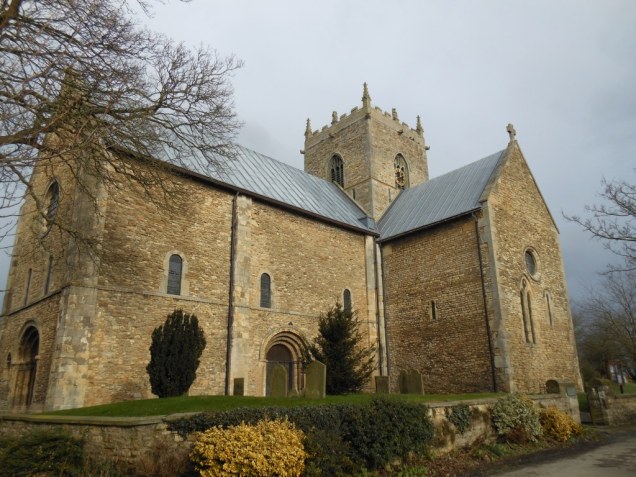
Church of St Mary, Stow (Stow Minster) Lincolnshire
Godiva was probably married before 1010 and so it is possible that she was born in the early 990s. She possessed considerable lands in the north-west of Mercia, suggesting that this is where she and her family were from. Mercia, in that time, covered almost all of the Midlands region, spreading from the Welsh borders across the centre of England. Her lands in Leicestershire, Warwickshire, Staffordshire and Shropshire, which amounted to sixty hides, may have constituted her own inheritance.1 Godiva’s high family status is also attested by the fact that she made a very good marriage, to Leofric, who would later become Earl of Mercia.
Leofric was the son of Leofwine, who had been appointed Ealdorman of the Hwicce, an ancient kingdom within the earldom of Mercia, by Æthelred II in 994. While the family lands were given to victorious Danes on the accession of Cnut, Leofwine was allowed to keep his rank and title and may have succeeded the traitorous Eadric Streona as Ealdorman of Mercia after his death in 1017. The family’s lands and influence appear to have been in the eastern part of Mercia, where they were known religious benefactors; Earl Leofwine was recorded as a benefactor at Peterborough Abbey. Leofric’s marriage to Godiva, therefore, may have been a way of extending his family’s influence into the western parts of Mercia. He was attesting charters as minister between 1019 and 1026, perhaps as sheriff under Hakon, Earl of Worcester.
His father, Leofwine, probably died in 1023 or shortly after, as that was the last year in which he attested a charter. There is no clear indication as to whether Leofwine was ever Earl of Mercia, although Leofric certainly held that title through the reigns of four kings; Cnut, Harold Harefoot, Harthacnut and Edward the Confessor. Leofric’s backing of Harold Harefoot, over Harthacnut, may have been a result of his son’s marriage. Ælfgar is thought to have married Ælfgifu, who was possibly a kinswoman of Harold Harefoot’s mother, Ælfgifu of Northampton, sometime in the late 1020s. Such a relationship would explain Leofric’s support for Harold Harefoot. Of course, so would the fact that Harthacnut was in no hurry to return from Denmark and Harold was on the spot and able to take charge.
Lady Godiva and Leofric were great benefactors to the church and acted in partnership, particularly in their endowment of Coventry Abbey which, according to John of Worcester, was made out of lands held by each of them. They also endowed the minster church of Stow St Mary, just to the north of Lincoln, and an Old English memorandum included both Leofric and Godiva in a request to Wulfwig, Bishop of Dorchester-on-Thames ‘to endow the monastery and assign lands to it.’2 Stow St Mary is a beautiful building at the centre of the small village of Stow. Founded in the seventh century, it boasts the faded graffiti carving of a Viking longboat on one of its inner walls. The endowment included provision for secular canons, under the supervision of the bishop and was made between and 1053 and 1055.
Information board explaining the links with Lady Godiva, Stow Minster, Lincolnshire
It is often difficult to work out the extent of Godiva’s involvement in her husband’s religious endowments. The Evesham Chronicle names both Leofric and Godiva (as Godgifu, of course) as the founders of both Coventry Abbey and Holy Trinity Church at Evesham. The couple also gave a crucifix, with the supporting figures of the Virgin and St John the Evangelist, to Holy Trinity Church. Moreover, Godiva had a reputation as a patroness of the Church throughout Mercia during her own lifetime. Orderic Vitalis said that Godiva gave ‘her whole store of gold and silver’ for the provision of ecclesiastical ornaments for the foundation at Coventry and John of Worcester also records Godiva’s devotion to the Virgin.3
There is one example that counters this argument, however, which involves a joint grant by Leofric and Godiva, of Wolverley and Blackwell, Worcestershire. The Second Worcester Cartulary, compiled by Hemming on the orders of Bishop Wulfstan, claims that Leofric returned Wolverley and Blackwell, and promised that the manors at Belbroughton, Bell Hall, Chaddesley Corbett and Fairford, seized by his father Leofwine, would revert to the Church on his death. Hemming, however, claims that Godiva held onto the lands for herself, rather than returning them; although she is said to have given the Church expensive vestments and ornaments, and a promise not only to pay the annual revenues from these estates to the Church, but to return the lands on her own death.4 That Edwin and Morcar seized the lands after their grandmother’s death, surely cannot be laid at Godiva’s door?
During her marriage, Godiva held several manors in her own right. Coventry, although little more than a village at this time, appears to have belonged to Godiva herself. She also had lands in various other parts of Mercia, including Newark, which she may have bought from her son, Ælfgar, as it was part of the comital lands (the earldom). Her lands at Appleby in Derbyshire were leased from Leofric, the Abbot of Peterborough, who was nephew and namesake of her husband, Earl Leofric.
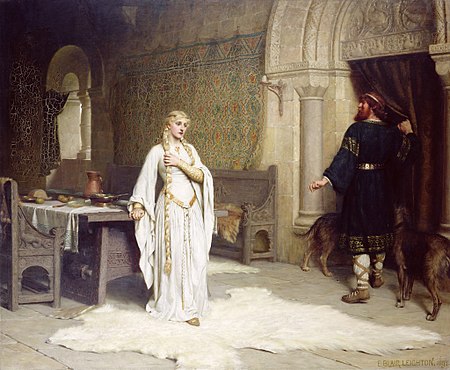
Godiva and Leofric by Edmund Blair Leighton
Leofric died in 1057, on either 31 August or 30 September, at his manor of King’s Bromley in Staffordshire. John of Worcester said of him; this ‘man of excellent memory died at a good old age, in his own manor called Bromley, and was buried with honour in Coventry, which monastery he had founded and well endowed.’5 The 1057 entry of the Anglo-Saxon Chronicle reported; ‘The same year died Earl Leofric, on the second before the calends of October; who was very wise before God, and also before the world; and who benefited all this nation’.6
Godiva was to live on as a widow for at least ten more years. She would be there to see her son’s inheritance of the earldom of Mercia. Although titles and land did often pass from father to son, it was not a foregone conclusion. Indeed, Ælfgar’s rebellion in 1055 – which led to a subsequent exile – may well have been in fear of losing his inheritance, given that Edward the Confessor had just given the earldom of Northumbria to Tostig, son of Godwin, on the death of Earl Siward in place of his son and natural heir, Waltheof. Waltheof was still a child, however, and this may well have been a practical decision, in that it would be dangerous to leave such a powerful earldom, and the border with Scotland, in the control of a child. Ælfgar was banished again in 1058, but for a very short while, apparently, with the Anglo-Saxon Chronicle reporting; ‘Earl Ælfgar was expelled but he soon came back again, with violence, through the help of Gruffydd.’7
We do not have the exact date of Godiva’s death. Most historians seem to believe that she survived the Norman Conquest and died around 1067. She is mentioned as a pre-Conquest landholder in the Domesday Book, but that doesn’t necessarily mean that she was alive in 1066. Hemming, who compiled the Worcester cartulary, says that some of her lands passed directly to her grandsons, Edwin and Morcar, offering evidence that Godiva also outlived her son, Ælfgar, who probably died in 1062. If Godiva did live into 1067, then she would have seen the dangers that the Norman Conquest brought to her family. Although her son was dead, most of her grandchildren were very much alive, and at the heart of events. By 1065 her 2 surviving grandsons were both earls (a 3rd grandson, Burgred, died in 1060 while returning from a pilgrimage to Rome).
Morcar became Earl of Northumbria in 1065, chosen by the Northumbrians to replace the unpopular Tostig. His tenure, however, was of short duration and he was replaced with Copsig, an adherent of Tostig, by William the Conqueror. Edwin had succeeded his father as Earl of Mercia in 1062 but neither brother flourished under the rule of William the Conqueror. Their sister, Ealdgyth married Harold Godwinson (King Harold II) sometime in late 1065, or early 1066, and was the uncrowned Queen of England until Harold’s death at Hastings in October 1066. Following the battle, Ealdgyth was taken to Chester by her brothers, where she may have given birth the king Harold’s son, Harold, before disappearing from the records.
Godiva is believed to have died in 1067 and was most likely buried alongside her husband at Coventry; although the Evesham Chronicle claims that she was laid to rest in Holy Trinity, Evesham. In the thirteenth century, her death was remembered on 10 September, but we have no way of confirming the actual date. After the Conquest, Godiva’s lands were held by various personalities.
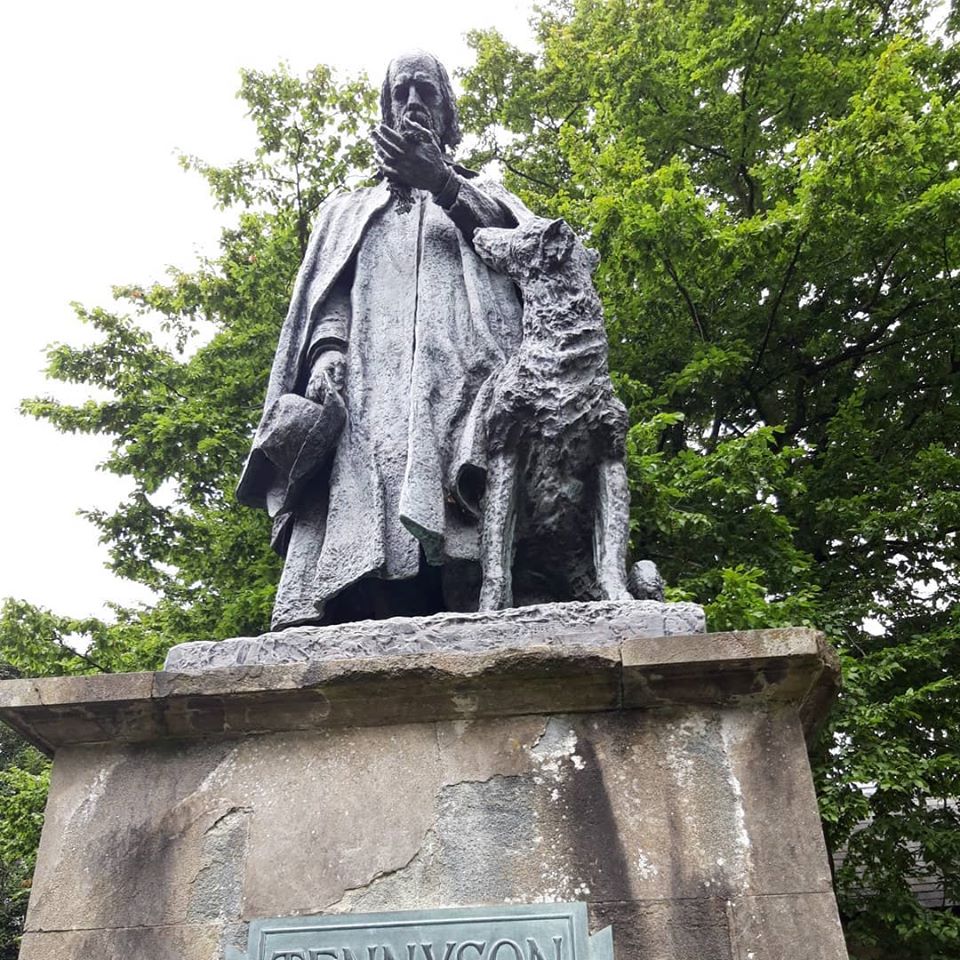
Statue of Alfred Lord Tennyson in the grounds of Lincoln Cathedral
We have no contemporary description of Godiva, of her personality or appearance. Her patronage of such religious institutions as Stow St Mary and Coventry Abbey is testimony to her piety and generosity. Stories of this generosity and piety were known to later chroniclers, such as William of Malmesbury and Henry of Huntingdon. Henry of Huntingdon said of Godiva that her name ‘meriting endless fame, was of distinguished worth, and founded the abbey at Coventry which she enriched with immense treasures of silver and gold. She also built the church at Stow, under the hill at Lincoln, and many others.’8 Although Henry of Huntingdon’s geography is a little skewed – Stow is a few miles north of Lincoln, rather than to the south, which ‘under the hill’ would suggest – it is obvious that Godiva’s fame was still alive in the twelfth century.
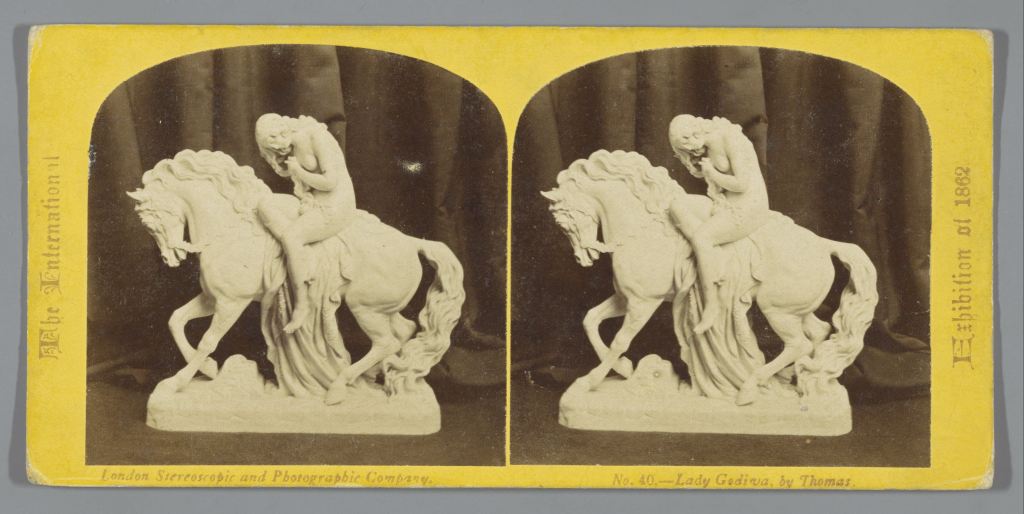
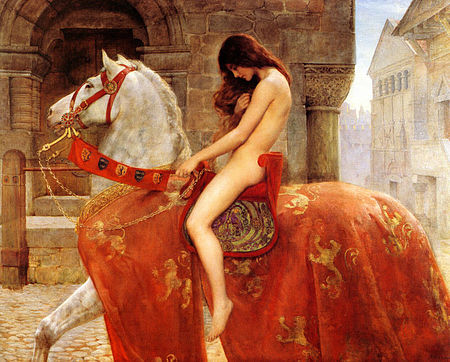
Lady Godiva is, perhaps, the most famous Anglo-Saxon woman in history. Everyone knows her legend – or a variation of it. And that legend has only grown and expanded down the years; like the game of Chinese whispers, the story has been added to and enhanced with every retelling. It was probably her reputation for generosity that gave rise to the legend for which she is famous today. The story of Godiva’s naked ride through Coventry appears to have been first recounted by Roger of Wendover, who died in 1236:
The Countess Godiva devoutly anxious to free the city of Coventry from a grievous and base thralldom often besought the Count, her husband, that he would for the love of the Holy Trinity and the sacred Mother of God liberate it from such servitude. But he rebuked her for vainly demanding a thing so injurious to himself and forbade her to move further therein. Yet she, out of womanly pertinacity, continued to press the matter in so much that she obtained this answer from him: ‘Ascend,’ he said, ‘thy horse naked and pass thus through the city from one end to the other in sight of the people and on thy return thou shalt obtain thy request.’ Upon which she returned: ‘And should I be willing to do this, wilt thou give me leave?’ ‘I will,’ he responded. Then the Countess Godiva, beloved of God, ascended her horse, naked, loosing her long hair which clothed her entire body except her snow white legs, and having performed the journey, seen by none, returned with joy to her husband who, regarding it as a miracle, thereupon granted Coventry a Charter, confirming it with his seal.
Flores Historiarum by Roger of Wendover, translated by Matthew of Westminster
This legend has grown and expanded over time, providing inspiration for ballads, poetry, paintings and sculptures throughout the centuries, the most famous being the poem, Lady Godiva, by Alfred Lord Tennyson, written in 1840, which included the lines:
Lady Godiva by John Collier
“The woman of a thousand summers back, Godiva, wife to that grim Earl, who ruled In Coventry: for when he laid a tax Upon his town, and all the mothers brought Their children, clamouring, ‘If we pay, we starve!’ She sought her lord, and found him, where he strode About the hall, among his dogs, alone, His beard a foot before him, and his hair A yard behind. She told him of their tears, And pray’d him, ‘If they pay this tax, they starve.’ Whereat he stared, replying, half-amazed, ‘You would not let your little finger ache For such as – these?’ – ‘But I would die,’ said she.”
Godiva by Alfred Lord Tennyson.
The legend arose from a story that Earl Leofric had introduced a toll on Coventry that the people could not afford to pay. Godiva went to her husband, begging that he rescind the taxes. He proved reluctant to offer the slightest reduction and is said to have told Godiva that he would only rescind the taxes if she rode naked through Coventry. In the earliest accounts Godiva rode through the market place, accompanied by two of Leofric’s soldiers, with her long, golden hair let loose to protect her modesty. In the early versions, the religious element of the story is highlighted, with Leofric hailing the fact no one had seen her nakedness as a miracle.
Although the story has endured through the centuries, I am inclined to believe that it didn’t happen – at least not in the way portrayed. It seems more plausible that Godiva had undertaken a pilgrimage, stripped of her fine clothes and jewels – in a state of undress, rather then undressed – maybe just in her shift or a simple, penitentiary, garment. While the legend is almost certainly distorted beyond recognition from the true story, it has guaranteed the immortality of a remarkable lady.
[1] Godgifu (d. 1067?) (article) by Ann Williams, oxforddnb.com; [2] ibid; [3] The Ecclesiastical History of England and Normandy by Ordericus Vitalis; [4] Godgifu (d. 1067?) (article) by Ann Williams, oxforddnb.com; [5] The Anglo-Saxon Chronicles edited and translated by Michael Swanton; [6] The Anglo-Saxon Chronicle translated by James Ingram; [7] The Anglo-Saxon Chronicles edited and translated by Michael Swanton; [8] The Chronicle of Henry of Huntingdon. Comprising the history of England, from the invasion of Julius Caesar to the accession of Henry II. Also, the Acts of Stephen, King of England and duke of Normandy Translated and edited by Thomas Forester. London, H.G. Bohn, 1807.
Sources:
The English and the Norman Conquest by Dr Ann Williams; Brewer’s British Royalty by David Williamson; Britain’s Royal Families, the Complete Genealogy by Alison Weir; The Wordsworth Dictionary of British History by JP Kenyon; The Norman Conquestby Marc Morris; Harold, the King Who Fell at Hastings by Peter Rex; The Anglo-Saxons in 100 Facts by Martin Wall; The Anglo-Saxon Age by Martin Wall; Kings, Queens, Bones and Bastards by David Hilliam; The Mammoth Book of British kings & Queens by Mike Ashley; The Oxford Companion to British History Edited by John Cannon; The Anglo-Saxon Chronicles translated and edited by Michael Swaton; The Anglo-Saxon Chronicle translated by James Ingram; Queen Emma and the Vikings by Harriett O’Brien; The Bayeux Tapestry by Carola Hicks; On the Spindle Side: the Kinswomen of Earl Godwin of Wessex by Ann Williams; oxforddnb.com.
*
Godiva’s story appears in greater detail in my book, Silk and the Sword: The Women of the Norman Conquest. From Emma of Normandy, wife of both King Cnut and Æthelred II to Saint Margaret, a descendant of Alfred the Great himself, Silk and the Sword: the Women of the Norman Conquest traces the fortunes of the women who had a significant role to play in the momentous events of 1066.
*
My Books
Signed, dedicated copies of all my books are available through my online store.
Out now: Scotland’s Medieval Queens
Scotland’s history is dramatic, violent and bloody. Being England’s northern neighbour has never been easy. Scotland’s queens have had to deal with war, murder, imprisonment, political rivalries and open betrayal. They have loved and lost, raised kings and queens, ruled and died for Scotland. From St Margaret, who became one of the patron saints of Scotland, to Elizabeth de Burgh and the dramatic story of the Scottish Wars of Independence, to the love story and tragedy of Joan Beaufort, to Margaret of Denmark and the dawn of the Renaissance, Scotland’s Medieval Queens have seen it all. This is the story of Scotland through their eyes.
‘Scotland’s Medieval Queens gives a thorough grounding in the history of the women who ruled Scotland at the side of its kings, often in the shadows, but just as interesting in their lives beyond the spotlight. It’s not a subject that has been widely covered, and Sharon is a pioneer in bringing that information into accessible history.’ Elizabeth Chadwick (New York Times bestselling author)
Heroines of the Tudor World tells the stories of the most remarkable women from European history in the time of the Tudor dynasty, 1485-1603. These are the women who ruled, the women who founded dynasties, the women who fought for religious freedom, their families and love. Heroines of the Tudor World is now available from Amberley Publishing and Amazon UK.Women of the Anarchy demonstrates how Empress Matilda and Matilda of Boulogne, unable to wield a sword themselves, were prime movers in this time of conflict and lawlessness. It shows how their strengths, weaknesses, and personal ambitions swung the fortunes of war one way – and then the other. Available from Bookshop.org, Amberley Publishing and Amazon UK. King John’s Right-Hand Lady: The Story of Nicholaa de la Haye is the story of a truly remarkable lady, the hereditary constable of Lincoln Castle and the first woman in England to be appointed sheriff in her own right. Available from all good bookshops Pen & Sword Books, bookshop.org and Amazon.
Alternate Endings: An anthology of historical fiction short stories including Long Live the King… which is my take what might have happened had King John not died in October 1216. Available in paperback and kindle from Amazon.
Podcast:
Have a listen to theA Slice of Medieval podcast, which I co-host with Historical fiction novelist Derek Birks. Derek and I welcome guests, such as Bernard Cornwell and Michael Jecks, and discuss a wide range of topics in medieval history, from significant events to the personalities involved.