Eleanor, the ‘Pearl of Brittany’

History...the Interesting Bits
Eleanor of Brittany

Eleanor of Brittany was born around 1184, the daughter of Geoffrey Plantagenet Duke of Brittany by right of his wife, and Constance of Brittany. Whilst estranged from his father, Henry II, Geoffrey had been trampled to death while competing at a tournament in Paris, in August 1186.

Described as beautiful, she has been called the Pearl, the Fair Maid and the Beauty of Brittany. A granddaughter of Henry II and Eleanor of Aquitaine, she was the eldest of her parents’ three children; a second daughter, Matilda was born the following year, but died young and a son, Arthur who was killed by – or at least on the orders of – King John in 1203. The birth of Eleanor’s brother Arthur in 1187 diminished her value on the marriage market; she no longer came with Brittany as her dowry, like her mother had done.

Initially, Eleanor’s life seemed destined to follow the same path as many royal princesses; marriage. Richard I, her legal guardian after the death of her father in 1186, following his sister Joanna’s adamant refusal, offered Eleanor as a bride to Saladin’s brother, Al-Adil, in a failed attempt at a political settlement to the Third Crusade.

Nothing came of the suggestion and, shortly after, at the age of nine, Eleanor was betrothed to Friedrich, the son of Duke Leopold VI of Austria, who had made the betrothal a part of the ransom for Richard I’s release from imprisonment by the Duke. Eleanor was travelling to Germany in the care of Baldwin de Béthune when news arrived that, Duke Leopold had died suddenly. The duke’s s son had ‘no great inclination’ for the proposed marriage and so Eleanor and her party turned around and returned home. Further marriage plans were mooted in 1195 and 1198, to Philip II of France’s son Louis, the dauphin, and Odo, Duke of Burgundy, respectively; although neither came to fruition.

History...the Interesting Bits
Arthur of Brittany

Duchess Constance then pressed for Eleanor to be released from royal custody and by the time of Richard’s death, in 1199, Eleanor was living in France with her mother and brother. Eleanor’s fortunes changed drastically when Arthur rebelled against Richard’s successor, King John, in the early 1200s, encouraged by King Philip II of France.

As the posthumous son of John’s older brother, Geoffrey, Arthur had a strong claim to the English crown, but had been sidelined in favour of his more mature and experienced uncle. He was also heavily influenced by the French king, a fact which did not go in his favour. Arthur was captured while besieging his grandmother, Eleanor of Aquitaine, at Mirebeau on 1st August 1202.

Eleanor was captured at the same time, or shortly after. And while her brother was imprisoned at Falaise, and later Rouen, in 1203 she was sent into perpetual imprisonment in England. Eleanor of Brittany holds the sad record of being the longest imprisoned English royal in British history.

If the laws of primogeniture had been strictly followed at the time, Eleanor would have been sovereign of England after her brother’s death. John and his successor, Henry III could never forget this. However, the experiences of Empress Matilda and her fight with King Stephen over her own rights to the crown – and the near-20 years of civil war between 1135 and 1154, had reinforced the attitude that a woman could not rule.
History...the Interesting Bits
Eleanor of Brittany

This did not, however, mean that Eleanor was no threat to John and Henry; should she be allowed to marry, her husband may be persuaded to fight to assert her rights, of form the focus to a rival faction at court – and an alternative royal line. Imprisoning Eleanor mean that John not only kept control of her, but also eliminated any possible opposition building around her rights to the throne.

Although her confinement has been described as ‘honourable’, Eleanor’s greater right to the throne meant she would never be freed, or allowed to marry and have children. King John gave her the title of Countess of Richmond on 27th May 1208, but Henry III would take it from her in 1219 and bestow the title elsewhere. From 1219 onward she was styled the ‘king’s kinswoman’ and ‘our cousin’.

It seems Eleanor did spend some time with the king and court, particularly in 1214 when she accompanied John to La Rochelle to pursue his war with the French. John planned to use Eleanor to gain Breton support and maybe set her up as his puppet Duchess of Brittany, replacing her younger half-sister Alice.

Alice was the daughter of Eleanor’s mother, Constance, by her third marriage to Guy of Thouars. She was married to Peter of Dreux, a cousin of King Philip of France and Duke of Brittany by right of Alice. Using the carrot and stick approach, John offered Peter the earldom of Richmond to draw him to his side, while at the same time dangling the threat of restoring Eleanor to the dukedom, just by having her with him. Peter, however, refused to be threatened of persuaded and chose to face John in the field at Nantes. John’s victory and capture of Peter’s brother in the fighting persuaded Peter to agree to a truce, and John was content to leave Brittany alone, thereafter, advancing on Angers. His plans to restore Eleanor abandoned and forgotten.

History...the Interesting Bits
Bowes Castle, North Yorkshire

Eleanor’s movements were restricted, and she was closely guarded. Her guards were changed regularly to enhance security, but her captivity was not onerous. She was provided with ‘robes’, two ladies-in-waiting in 1230, and given money for alms and linen for her ‘work’. One order provided her with cloth; however, it was to be ‘not of the king’s finest.’ She was granted the manor of Swaffham and a supply of venison from the royal forests. The royal family sent her gifts and she spent some time with the queen and the daughters of the king of Scotland, who were hostages in the king’s custody.

Throughout her captivity she is said to have remained ‘defiant’.

Eleanor was well-treated and fed an aristocratic diet, as her weekly shopping list attests; ‘Saturday: bread, ale, sole, almonds, butter, eggs. Sunday: mutton, pork, chicken and eggs. Monday: beef, pork, honey, vinegar. Tuesday: pork, eggs, egret. Wednesday: herring, conger, sole, eels, almonds and eggs. Thursday: pork, eggs, pepper, honey. Friday: conger, sole, eels, herring and almonds.’ In her sole surviving letter, written in 1208 with John’s consent, she is styled ‘Duchess of Brittany and Countess of Richmond.’

It is difficult to pinpoint exactly where Eleanor was imprisoned at any one time.  Over the years, she was held in various strongholds, including the castles of Corfe (Dorset), Burgh (Westmorland), and Bowes (Yorkshire).  Corfe Castle is mentioned at times, and it seems she was moved away from the coast in 1221 after a possible rescue plot was uncovered. She was also held at Marlborough for a time, and she was definitely at Gloucester Castle in 1236.
History...the Interesting Bits
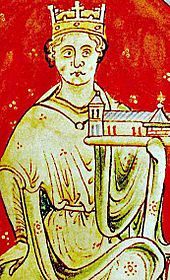
King John

By 1241 she was confined in Bristol castle, where Eleanor was visited regularly by bailiffs and leading citizens to ensure her continued welfare. Eleanor was also allowed   her chaplain and serving ladies to ensure her comfort. She died on 10 August 1241, at the age of about fifty-seven. After thirty-nine years of imprisonment, Eleanor achieved in death the freedom that had eluded her in life.

She was initially buried at St James’s Priory Church in Bristol but her remains were later removed to the abbey at Amesbury, a convent with a long association with the crown.

*

Sources: Douglas Boyd, Eleanor, April Queen of Aquitaine; Dan Jones, The Plantagenets: the Kings who made England; Robert Bartlett, England Under the Norman and Angevin Kings 1075-1225; Alison Weir, Eleanor of Aquitaine and Britain’s Royal Families; Oxford Companion to British History; The History Today Companion to British History; Robert Lacey, Great Tales from English History; Mike Ashley, A Brief History of British Kings and Queens and The Mammoth Book of British Kings and Queens; findagrave.com; spokeo.com.

Pictures: Wikipedia, findagrave.com; Bowes Castle is ©Sharon Bennett Connolly

*

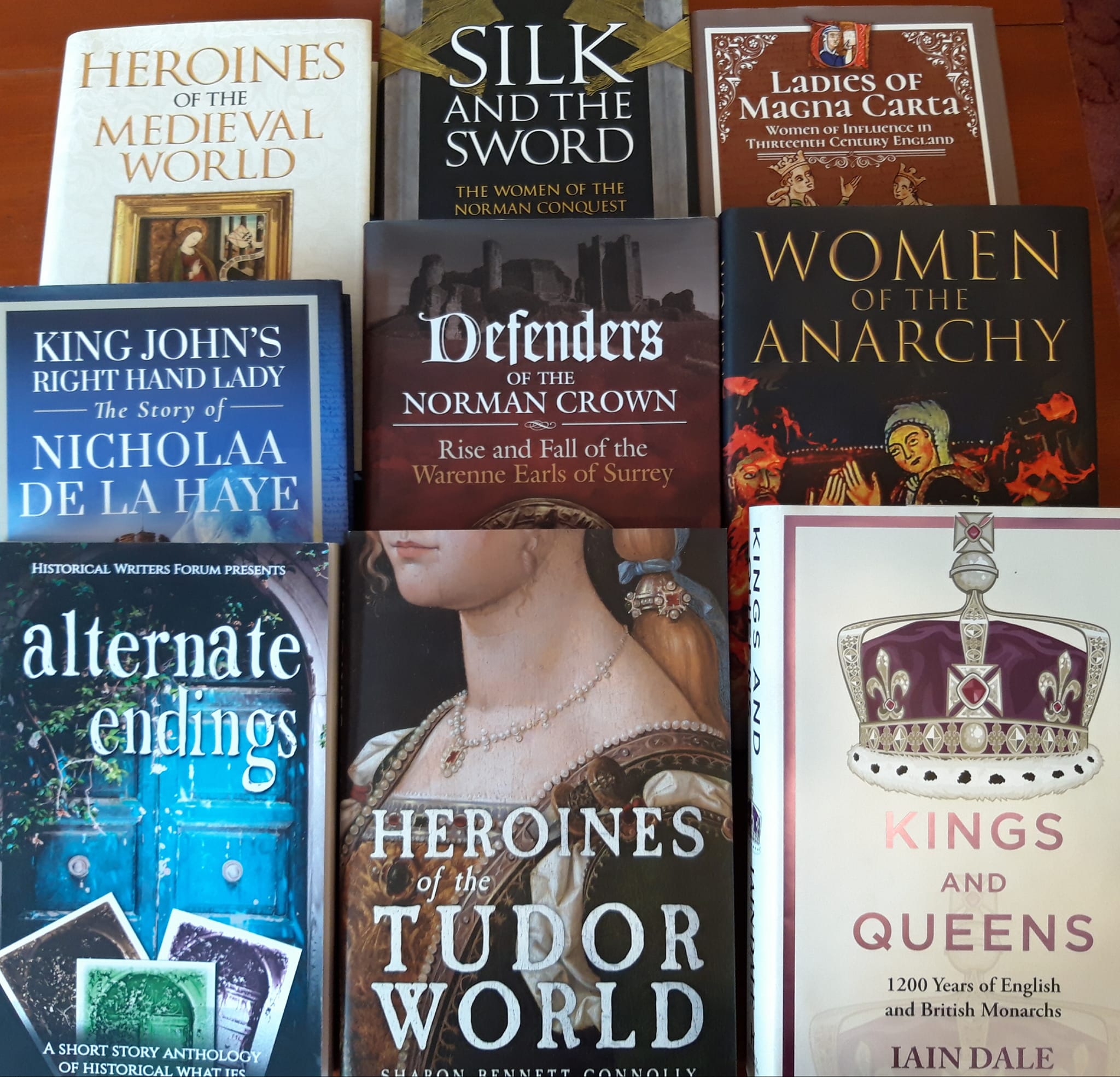
My books

Signed, dedicated copies of all my books are available through my online bookshop. or by contacting me.

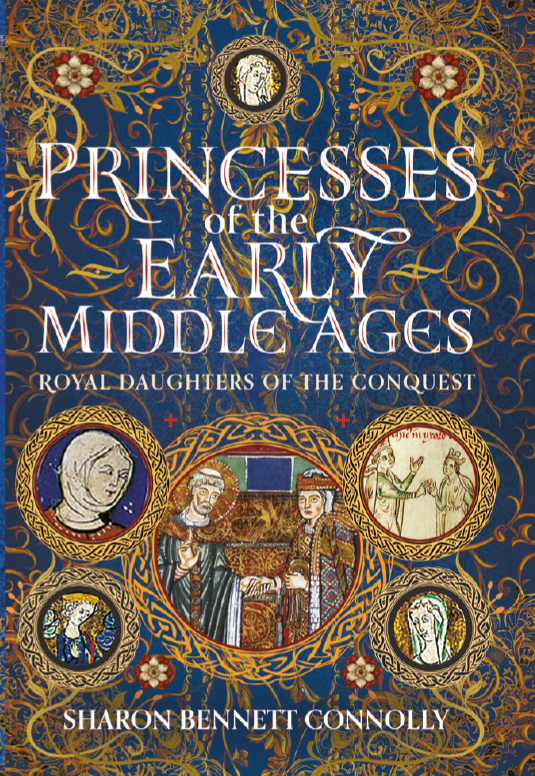
Coming 30 March: Princesses of the Early Middle Ages
Books by Sharon Bennett Connolly

Daughters of kings were often used to seal treaty alliances and forge peace with England’s enemies. Princesses of the Early Middle Ages: Royal Daughters of the Conquest explores the lives of these young women, how they followed the stereotype, and how they sometimes managed to escape it. It will look at the world they lived in, and how their lives and marriages were affected by political necessity and the events of the time. Princesses of the Early Middle Ages will also examine how these girls, who were often political pawns, were able to control their own lives and fates. Whilst they were expected to obey their parents in their marriage choices, several princesses were able to exert their own influence on these choices, with some outright refusing the husbands offered to them.

Their stories are touching, inspiring and, at times, heartbreaking.

Princesses of the Early Middle Ages: Royal Daughters of the Conquest is now available for pre-order from Pen & Sword and Amazon.

Also by Sharon Bennett Connolly:

Books by Sharon Bennett Connolly

Scotland’s history is dramatic, violent and bloody and Scotland’s Medieval Queens have seen it all. This is the story of Scotland through their eyes. Available now from Amazon and Pen and Sword Books. Heroines of the Tudor World tells the stories of the most remarkable women from European history in the time of the Tudor dynasty, 1485-1603. These are the women who ruled, the women who founded dynasties, the women who fought for religious freedom, their families and love. Heroines of the Tudor World is now available from Amberley Publishing and Amazon UK. Women of the Anarchy demonstrates how Empress Matilda and Matilda of Boulogne, unable to wield a sword themselves, were prime movers in this time of conflict and lawlessness. It shows how their strengths, weaknesses, and personal ambitions swung the fortunes of war one way – and then the other. Available from Bookshop.org, Amberley Publishing and Amazon UK. King John’s Right-Hand Lady: The Story of Nicholaa de la Haye is the story of a truly remarkable lady, the hereditary constable of Lincoln Castle and the first woman in England to be appointed sheriff in her own right. Available from all good bookshops Pen & Sword Books, bookshop.org and Amazon. 
History...the Interesting Bits

Defenders of the Norman Crown: The Rise and Fall of the Warenne Earls of Surrey tells the fascinating story of the Warenne dynasty, from its origins in Normandy, through the Conquest, Magna Carta, the wars and marriages that led to its ultimate demise in the reign of Edward III. Available from Pen & Sword Books, Amazon in the UK and US, and Bookshop.org. Ladies of Magna Carta: Women of Influence in Thirteenth Century England looks into the relationships of the various noble families of the 13th century, and how they were affected by the Barons’ Wars, Magna Carta and its aftermath; the bonds that were formed and those that were broken. It is now available in paperback and hardback from Pen & Sword, Amazon, and Bookshop.org. Heroines of the Medieval World tells the stories of some of the most remarkable women from Medieval history, from Eleanor of Aquitaine to Julian of Norwich. Available now from Amberley Publishing and Amazon, and Bookshop.org. Silk and the Sword: The Women of the Norman Conquest traces the fortunes of the women who had a significant role to play in the momentous events of 1066. Available now from Amazon,  Amberley Publishing, and Bookshop.org.

Alternate Endings: An anthology of historical fiction short stories including Long Live the King… which is my take what might have happened had King John not died in October 1216. Available in paperback and kindle from Amazon.

Podcast:

A Slice of Medieval

Have a listen to the A Slice of Medieval podcast, which I co-host with Historical fiction novelist Derek Birks. Derek and I welcome guests, such as Ian Mortimer, Bernard Cornwell, Elizabeth Chadwick and Scott Mariani, and discuss a wide range of topics in medieval history, from significant events to the personalities involved. 

Every episode is also now available on YouTube.

*

Don’t forget! Signed and dedicated copies of all my books are available through my online bookshop.

For forthcoming online and in-person talks, please check out my Events Page.

You can be the first to read new articles by clicking the ‘Follow’ button, liking our Facebook page or joining me on Twitter, Threads, Bluesky and Instagram.

*

©2015 Sharon Bennett Connolly FRHistS
Isabella of Castile, the Controversial First Duchess of York, c.1355-1392

Isabella_of_Castile-Langley
Isabella of Castile

As the third daughter of Peter (or Pedro) the Cruel of Castile and his long-term mistress (and sometime wife) Maria of Padilla, Isabella of Castile‘s childhood was marred by her father’s battles to hold on to his throne and almost constant warfare with Aragon.

Peter was known in some areas as Peter the Cruel and in others as Peter the Just, depending which side of the conflict people were on. He received support from Edward III of England’s eldest son and heir Edward, the Black Prince, but Peter’s failure to pay the costs of the prince’s campaign,  his faithlessness, and the failing health of the Black Prince, meant the king of Castile was left to his own devices by 1367. Adding to Peter’s woes, his own nobles backed the king’s illegitimate brother, Henry of Tastamara, as an alternative candidate. Henry eventually defeated and killed Peter in March 1369.

Peter had been married, in June 1353, to the unfortunate French princess, Blanche de Bourbon, though some historians believe he had already married Maria de Padilla sometime before this. Whatever the case, Peter abandoned Blanche for Maria just 3 days after the wedding. Blanche was imprisoned in various castles, far away from the French border to prevent her rescue. Repeated calls from the French, for her to be released, went unheeded and the pope refused to excommunicate Peter for his actions. Blanche died at Medina Sidonia in 1361, though whether her death was by natural causes or assassination on Peter’s orders is disputed. One source claims Peter’s crossbowman was sent to kill Blanche. Another claims she was poisoned. While another suggests natural causes. With Peter and his brother Henry vying for the crown, misinformation his hard to filter.

Isabella was born sometime around 1355. Her mother died in 1361 and her 3-year-old brother, Alfonso, in 1362. In 1362, Peter had persuaded the Cortes to recognise his relationship with Maria as a legitimate marriage, and thus legitimise his 3 daughters, Beatrix, Constance and Isabella, making Beatrix his heir. However, Beatrix died in 1367 and son, on Peter’s death in 1369, it was Constance who inherited their father’s claim to the crown of Castile. The situation in Castile was precarious, to say the least and Constance was unable to pursue her claim. Her father had taken Constance and her sister to the English territory of Guyenne in 1366, where they had remained whilst Peter had tried to reclaim his crown from Henry. They remained in Bayonne as hostages against the repayment of the financial costs of the expedition. Following Peter’s death, the English took the princesses in and soon after, in September 1371, Constance was married to John of Gaunt, the third surviving son of Edward III, at Roquefort. John of Gaunt had become duke of Lancaster on marrying his first wife, Blanche of Lancaster, who had died in 1368; he saw this second marriage as an opportunity to gain a kingdom of his own. When the newly married couple returned to London, they brought Constance’s younger sister, Isabella, with them.

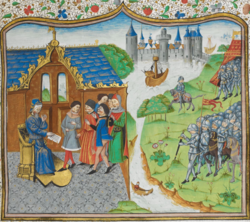
Edmund_of_Langley_remonstrating_with_the_King_of_Portugal_-_Chronique_d'_Angleterre_(Volume_III)_(late_15th_C),_f.186r_-_BL_Royal_MS_14_E_IV

Following Constance’s official entry into London, 16-year-old Isabella probably stayed with her sister and new brother-in-law at Gaunt’s house on the Thames, the Savoy. A year later, Edward III arranged for Isabella to marry Gaunt’s younger brother, Edmund of Langley. Edmund was the fifth son, fourth surviving of Edward III and Philippa of Hainault. Born in 1341, Edmund was 14 years older than his bride. They were married on 4 July 1372, at Wallingford. John of Gaunt gave the bride a wedding gift of plate bought from leading London goldsmiths. The marriage was a continuation of the of the English policy of the time, to reinforce the dynastic link between England and Castile and thus ensuring that both heirs of Peter of Castile were married into the English royal line. Should Constance die without an heir, Isabella would inherit her claim to the Castilian throne.

On her marriage to Edmund, Isabella became Countess of Cambridge, and would become the first ever Duchess of York when Edmund was created Duke of York by his nephew, King Richard II, on 6 August 1385. She was appointed a Lady of the Garter in 1379. In 1381, Isabella accompanied her husband, taking along their 8-year-old son Edward to Lisbon, on John of Gaunt’s ill-fated expedition to claim the Castilian throne for his wife. The Portuguese chronicler, Ferñao Lopes, noted how the Portuguese king, Ferdinand, supported the countess on his arm on the walk up the steep slope from the Tagus to the cathedral, and led her mount by the rein to the monastery where they were lodged. Little Edward was briefly betrothed to King Ferdinand’s only legitimate child, Beatriz, who would go on to marry John I of Castle, the son of Henry of Trastamara.

The couple’s first son, Edward was born in 1373 – he would become the second Duke of York, and be killed at Agincourt in 1415. A daughter, Constance, was born in 1374. A second son, Richard of Conisbrough, grandfather of both Edward IV and Richard III, was born at Conisbrough Castle in Yorkshire, sometime between 1375 and 1386. He was executed for his involvement in the Southampton Plot, against Henry V, in 1415.

It is hard to discern the truth of the relationship between Isabella and Edmund. Froissart remarked on Edmund’s indolent character and together they were described as an ill-matched pair. Thomas of Walsingham, in particular, commented on Isabella’s ‘loose morals.’ And 40 years after her death, John Shirley, spicing up poems he was transcribing with gossip, referred to a love affair ‘my lady of York doughter to the king of Spaygne and my lord of Huntyngdone.’ The affair was said to have started as early as 1374 and has cast doubt on the legitimacy of Edmund and Isabella’s third and youngest child, Richard of Conisbrough. Recent studies, however, have cast doubt on the affair, their argument supported by Duke Edmund’s will, giving the lie to a rocky relationship by requesting to be buried ‘near his beloved Isabel, formerly his companion.’ 

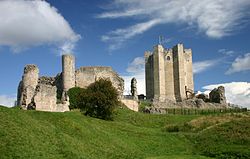
conisbroughcastle
Conisbrough Castle, Yorkshire

Isabella died on 23 December 1392, aged about 37, and was buried at the church of the Dominicans, in King’s Langley, on 14 January 1393. In her will, drawn up a week before her death, and with her husband’s consent, she made Richard II her heir and asked that he provide a pension for her youngest son and Richard II’s godson, Richard of Conisbrough. Richard was given an allowance of £500 by the king, but this was only paid sporadically following Richard II’s deposition by Henry IV. Richard was not even mentioned in the wills of his father and brother and G.L. Harriss, of the Oxford Dictionary of National Biography, has speculated this could be proof that Richard was not the son of the Duke of York. Although it could simply be because his mother had already made provision for their youngest son. At the time of Isabella’s death, Duke Edmund was still in debt due to the failed Castilian expedition, and so Isabella’s will gave provision for her younger son whilst protecting the incomes of her husband and older son.

Jenny Stratford’s recent essay on Isabella of Castile from the Oxford Dictionary of National Biography has an extensive study of Isabella’s will and argues against the supposed affair with John Holland, rooting out the sources of the rumours and and demonstrating how they took flight. Isabella’s will demonstrates her pride in her heritage and affection for her husband and children, as well as a conventional piety. She left personal bequests to Richard II and his queen, Anne of Bohemia, in addition to books, jewels, plate, horses and robes to her husband, children and friends, with monetary bequests for various other members of the York household, including servants and the musicians of the household chapel. Isabella also left a bequest of robes, furs and jewels, to the first lady of her household, Marie St Hilaire, who was the mother of Gaunt’s illegitimate daughter, Blanche, born about 1359.

Edmund married again, to his cousin Joan Holland, niece of his first wife’s supposed lover, John Holland. In another bizarre family twist, it was Joan’s brother, Edmund Holland, 4th Earl of Kent, who had an affair – and an illegitimate daughter – with Constance of York, the daughter of Edmund and Isabella.

*

Sources: Ian Mortimer, Edward III The Perfect King; englishmonarchs.co.uk; womenshistory.about.com; WM Ormrod, The Reign of Edward III; Conisbrough Castle, South Yorkshire; Oxforddnb.com; The History Today Companion to British History, edited by Juliet Gardiner & Neil Wenborn; Brewer’s British Royalty by David Williamson; Britain’s Royal Families, the Complete Genealogy by Alison Weir; The Wars of the Roses by John Gillingham; The Wordsworth Dictionary of British History by J.P. Kenyon; The Oxford Companion to British History, edited by John Cannon; The Reign of Edward III by WM Ormrod; The Wars of the Roses by Martin J Dougherty; englishmonarchs.co.uk; womenshistory.about.com; findagrave.com; conisbroughcastle.org.uk; hrionline.ac.uk.

Photos from Wikipedia, except Conisbrough Castle which is © Sharon Bennett Connolly.

*

My Books

Signed, dedicated copies of all my books are available through my online bookshop.

Coming on 15 June 2024: Heroines of the Tudor World

Heroines of the Tudor World tells the stories of the most remarkable women from European history in the time of the Tudor dynasty, 1485-1603. These are the women who ruled, the women who founded dynasties, the women who fought for religious freedom, their families and love. These are the women who made a difference, who influenced countries, kings and the Reformation. In the era dominated by the Renaissance and Reformation, Heroines of the Tudor World examines the threats and challenges faced by the women of the era, and how they overcame them. From writers to regents, from nuns to queens, Heroines of the Tudor World shines the spotlight on the women helped to shape Early Modern Europe.

Heroines of the Tudor World is now available for pre-order from Amberley Publishing and Amazon UK.

Out Now! Women of the Anarchy

Two cousins. On the one side is Empress Matilda, or Maud. The sole surviving legitimate child of Henry I, she is fighting for her birthright and that of her children. On the other side is her cousin, Queen Matilda, supporting her husband, King Stephen, and fighting to see her own son inherit the English crown. Women of the Anarchy demonstrates how these women, unable to wield a sword, were prime movers in this time of conflict and lawlessness. It show how their strengths, weaknesses, and personal ambitions swung the fortunes of war one way – and then the other.

Available from Bookshop.org, Amberley Publishing and Amazon UK.

Also by Sharon Bennett Connolly:

King John’s Right-Hand Lady: The Story of Nicholaa de la Haye is the story of a truly remarkable lady, the hereditary constable of Lincoln Castle and the first woman in England to be appointed sheriff in her own right. It is is available from King John’s Right-Hand Lady: The Story of Nicholaa de la Haye is the story of a truly remarkable lady, the hereditary constable of Lincoln Castle and the first woman in England to be appointed sheriff in her own right. Available from all good bookshops or direct from Pen & Sword Books, bookshop.org and Amazon. Defenders of the Norman Crown: The Rise and Fall of the Warenne Earls of Surrey tells the fascinating story of the Warenne dynasty, from its origins in Normandy, through the Conquest, Magna Carta, the wars and marriages that led to its ultimate demise in the reign of Edward III. Available from Pen & Sword Books, Amazon in the UK and US, and Bookshop.org. 

Ladies of Magna Carta: Women of Influence in Thirteenth Century England looks into the relationships of the various noble families of the 13th century, and how they were affected by the Barons’ Wars, Magna Carta and its aftermath; the bonds that were formed and those that were broken. It is now available in paperback and hardback from Pen & Sword,  Amazon, and Bookshop.org. Heroines of the Medieval World tells the stories of some of the most remarkable women from Medieval history, from Eleanor of Aquitaine to Julian of Norwich. Available now from Amberley Publishing and Amazon, and Bookshop.org. Silk and the Sword: The Women of the Norman Conquest traces the fortunes of the women who had a significant role to play in the momentous events of 1066. Available now from Amazon,  Amberley Publishing, and Bookshop.org.

Alternate Endings: An anthology of historical fiction short stories including Long Live the King… which is my take what might have happened had King John not died in October 1216. Available in paperback and kindle from Amazon.

Podcast:

Have a listen to the A Slice of Medieval podcast, which I co-host with Historical fiction novelist Derek Birks. Derek and I welcome guests, such as Bernard Cornwell and discuss a wide range of topics in medieval history, from significant events to the personalities involved.

*

Don’t forget! Signed and dedicated copies of all my books are available through my online bookshop.

For forthcoming online and in-person talks, please check out my Events Page.

You can be the first to read new articles by clicking the ‘Follow’ button, liking our Facebook page or joining me on Twitter and Instagram.

*

©2015 Updated ©2024 Sharon Bennett Connolly FRHistS