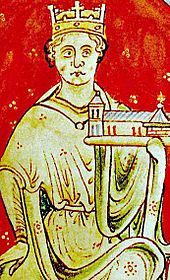
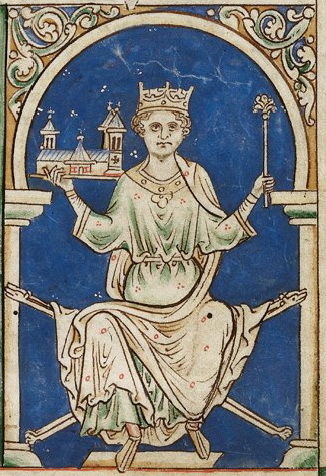
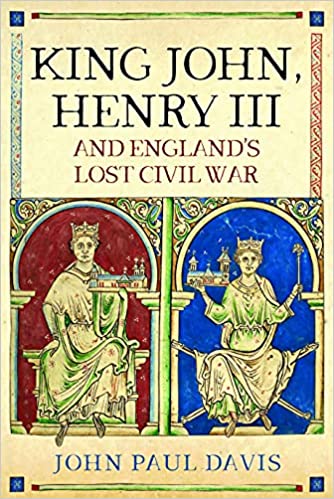
In 1204, the great Angevin Empire created by the joining of the dynasties of Henry II of England and his queen, Eleanor of Aquitaine, was fragmenting. At its height, the family landholdings had been among the largest the world had ever seen. From the border of England and Scotland in the north to south of the Pyrenees, it seemed there was nowhere in Europe destined to escape Plantagenet control. Yet within five years of his accession, King John’s grip on the family holdings was loosening. Betrayal against his father and brother, the murder of his nephew, and breaking promises made to his supporters were just some of the accusations levelled against him. When Philip II conquered Normandy, the chroniclers believed that an ancient prophecy was fulfilled: that in this year the sword would be separated from the sceptre. For the first time since 1066, England’s rule over the ancestral land was over. For John, troubles on the continent were just the beginning of a series of challenges that would ultimately define his reign. Difficult relations with the papacy and clergy, coupled with rising dissent among his barons ensured conflict would not be limited to the continent. When John died in 1216, more than half of the country was in the hands of the dauphin of France. Never had the future of the Plantagenet dynasty looked more uncertain. As the following pages will show, throughout the first eighteen years of the reign of Henry III, the future direction of England as a political state, the identity of the ruling family and the fate of Henry II’s lost empire were still matters that could have gone either way. For the advisors of the young king, led by the influential regent, William Marshal, 1st Earl of Pembroke, the effects of John’s reign would be long and severe. Successful implementation of the failed Magna Carta may have ensured his son’s short-term survival, yet living up to such promises created arguably a more significant challenge. This is the story of how the varying actions of two very different kings both threatened and created the English way of life, and ultimately put England on the path to its Lost Civil War.
What a fascinating book!
King John, Henry III and England’s Lost Civil War by John Paul Davis is a study of the often overlooked civil war that took place between the First and Second Barons’ Wars of the 13th century. Very much overshadowed by King John’s struggles against the imposition of Magna Carta in 1215 and the later rise of Simon de Montfort, who was England’s ruler in all but name in 1264/5, the Marshal War often gets sidelined or ignored. Admittedly not as disruptive or even as violent as its more famous counterparts, the Marshal War was still an important event in the reign of Henry III.
In King John, Henry III and England’s Lost Civil War, John Paul Davis takes the reader on a thorough investigation into the events and politics that caused the Marshal War. Meticulously researched and beautifully written, John Paul Davis examines the reigns of both King John and Henry III in order to explain the context and background to the short-lived rebellion of 1234 of the country’s leading magnates.
A howling gale tore through the streets of Newark on the evening of 18 October 1216. A mid-sized market town located some forty miles inland from the North Sea, it was rare for a storm to give rise to the levels of concern often felt by citizens of its coastal counterparts. Lying on both the Great North Road and the Fosse Way, the area was popular with travellers, especially cloth and wool merchants in town to sell their wares. The early twelfth-century bridge over the Trent had improved the trade links further, and by the reign of Henry II, the market had become well established. Though most of the buildings were of timber construction, even at the height of winter weather damage was often repairable.
This was not the first time the town had been forced to endure such a tempest.
Behind the sturdy stone walls of the nearby Norman castle, the abbot of Croxton had far more troubling issues to address. The south riverside fortress, though by no means immune to regular splashback, was far better prepared for nature’s challenges than the earlier motte-and-bailey that had preceded it. The same lack of worry, however, could not be said of the crisis that had brought him there. Renowned for his medicinal expertise, it didn’t take him long to realise that the patient he had been asked to treat was beyond hope of recovery. Rather than prolong the inevitable, he heard the dying man’s confession and performed the last rites. The storm was over by sunrise.
Blighted by a combination of chronic fatigue, dysentery brought about from years of poor diet and a sudden fever, King John passed away in the early hours of 19 October after more than seventeen years on the throne. His final year had been a black one for England. Accusations of betrayal against his own family and an inability to keep his allies on side had contributed in no small part to humiliating defeat on the Continent. By 1214, the loss of much of his ancestral birthright had been compounded by domestic discord. Loathed in equal measure by natural adversary and should-be follower, John’s life ended ignominiously amid a strange alliance of foreign invader and baronial rebel. Somewhat surprisingly perhaps, it ended through natural causes.
There are several instances where my own research crosses with John Paul Davis’s work and it was interesting to see William de Warenne, 5th Earl of Warenne and Surrey, and the son of Hamelin and Isabel de Warenne, make an appearance; William played a prominent part in the events surrounding the rebellion. I have to say, also, that King John, Henry III and England’s Lost Civil War would be a perfect accompaniment to my own book Ladies of Magna Carta: Women of Influence in Thirteenth Century England, which looks at the same years, though with the focus on the women.
The research is impeccable. John Paul Davis and I apparently agree on many aspects of the period, which is encouraging! If you have an interest in 13th century history, this is definitely a book for your library. John Paul Davis fills in many of the gaps between the First and Second Barons’ Wars, an often overlooked period of history.
Written in an engaging, accessible manner, King John, Henry III and England’s Lost Civil War, is a thoroughly entertaining study of the politics, history and personalities involved in the first third of the century, from the devastating reign of King John, through the minority of Henry III and into the early years of Henry’s personal rule.
I can heartily recommend it!
King John, Henry III and England’s Lost Civil War is now available from Amazon and Pen & Sword Books.
About the author:
John Paul Davis is the international bestselling author of eleven thriller novels and four works of historical non-fiction. His debut thriller, The Templar Agenda, was a UK top 20 bestseller; The Cortés Trilogy has also been an international bestseller. As well as being a thriller author, his debut work, Robin Hood: The Unknown Templar, has been the subject of international attention, including articles in The Sunday Telegraph, The Daily Mail, Yorkshire Post and Nottingham Evening Post, mentions in USA Today and The Independent and reviews in the Birmingham Post and Medieval History Journal. His second work, Pity for the Guy, was the first full-length biography of Guy Fawkes and was featured on ITV’s The Alan Titchmarsh Show in November 2011. His most recent work on Henry III, The Gothic King, was released in 2013. His latest work of non-fiction, A Hidden History of the Tower of London, also published by Pen & Sword, was released in February 2020. He was educated at Loughborough University and lives in Warwickshire. His websites are http://www.officiallyjpd.com and http://www.theunknowntemplar.com. Twitter: @unknown_templar.
*
My Books
Signed, dedicated copies of all my books are available, please get in touch by completing the contact me form.
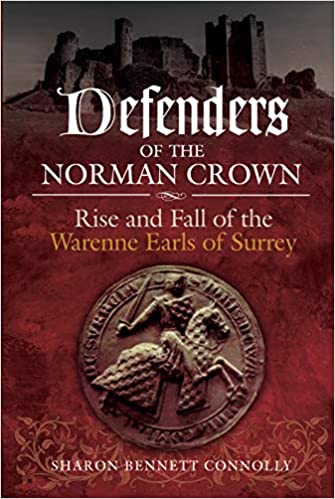
Defenders of the Norman Crown: The Rise and Fall of the Warenne Earls of Surrey tells the fascinating story of the Warenne dynasty, of the successes and failures of one of the most powerful families in England, from its origins in Normandy, through the Conquest, Magna Carta, the wars and marriages that led to its ultimate demise in the reign of Edward III. Defenders of the Norman Crown: Rise and Fall of the Warenne Earls of Surrey is now available from Pen & Sword Books, Amazon in the UK and US and Book Depository.
It is impossible to talk about anything related to Magna Carta without mentioning the man who has come to be known as ‘the Greatest Knight’: William Marshal, Earl of Pembroke, and his family. Marshal was one of the few nobles to stay loyal to King John throughout the Magna Carta crisis. That is not to say that the king and Marshal did not have their differences, nor that their relationship was always smooth sailing. However, William Marshal was famed for his loyalty and integrity and maintained his oaths to King John throughout his reign, regardless of the distrust between the two men.
The children of William and his wife, Isabel de Clare, cannot fail to have benefited from William Marshal’s rise through the ranks from fourth son and humble hearth knight, to earl of Pembroke and, eventually, regent for King Henry III. Their father’s position as a powerful magnate on the Welsh Marches, and the most respected knight in the kingdom, saw William’s daughters make advantageous marriages in the highest echelons of the English nobility.
William and Isabel were the parents of 10 children who survived to adulthood, 5 boys and 5 girls. In a bizarre and sad twist of fate, each of the boys would, in turn, succeed to the earldom, with not one leaving a male heir to continue the Marshal line. Of the girls, the couple’s eldest daughter was Matilda, also known as Maud or Mahelt. Given that her parents married in 1189 and she had two elder brothers, Matilda was probably born in 1193 or 1194. The Histoire de Guillaume le Maréchal wrote glowingly of Matilda, saying she had the gifts of
‘wisdom, generosity, beauty, nobility of heart, graciousness, and I can tell you in truth, all the good qualities which a noble lady should possess.’
Histoire de Guillaume le Maréchal
The Histoire goes on to say;
‘Her worthy father who loved her dearly, married her off, during his lifetime to the best and most handsome party he knew, to Sir Hugh Bigot.’
Histoire de Guillaume le Maréchal
Unfortunately for Matilda, her husband Hugh, the eldest son of the earl of Norfolk, was among the rebels during the Magna Carta crisis; their eldest son was taken hostage by the king when their castle at Framlingham surrendered to the royal army. It must have been a comfort to Matilda that, on John’s death, her son’s welfare, while still a hostage, would have been supervised by the new regent, the boy’s grandfather. When Hugh died in 1225, Matilda married for a second time just a few months later, to William de Warenne, Earl of Warenne and Surrey, thus uniting the Bigod, Warenne and Marshal families. The marriage appears to have been one of convenience rather than love but produced 2 children, a boy and a girl, John and Isabel. Matilda’s son by her second marriage, John de Warenne, joined his 3 older Bigod half-brothers, Roger, Hugh and Ralph as pall bearers for their mother’s coffin at her funeral in 1248, when she was laid to rest beside her mother at Tintern Abbey in Monmouthshire.
Seal of Matilda Marshal’s youngest son John de Warenne, 6th Earl of Warenne and Surrey
The next daughter, Isabel, was at least six years younger than Matilda, born in 1200. She was married to Gilbert de Clare, Earl of Gloucester and Hertford, who was twenty years her senior. Gilbert was the son of Richard de Clare, earl of Hertford, and Amicia, coheiress of William, Earl of Gloucester; through his mother he could trace his ancestry back to King Henry I, albeit through king’s illegitimate eldest son, Robert of Gloucester, the stalwart supporter of his half-sister, Empress Matilda. Gilbert’s aunt, Amicia’s sister, was Isabella of Gloucester, the discarded first wife of King John, who had held the earldom of Gloucester until her death on 14 October 1217, when it passed to Gilbert.
Both Gilbert and his father were named among the twenty-five barons appointed as Enforcers of Magna Carta in 1215; as a consequence, father and son were excommunicated at the beginning of 1216. After the death of King John, Gilbert sided with Prince Louis of France and was only reconciled with the royalist cause after the Battle of Lincoln in May 1217. This was despite having married Isabel, the second daughter of William Marshal, in 1214; Marshal had been regent of England for 9-year-old Henry III since King John’s death in October 1216. Like her older sister, Isabel had found her husband’s family were on the opposing side to her father in the Magna Carta crisis and the civil war that followed. They had 6 children together before Gilbert’s death in October 1230; he died on the return journey from an expedition to Brittany. Isabel was married again, not 6 months later, to the king’s younger brother, Richard, Earl of Cornwall. The early deaths of at least 2 children put a strain on this marriage and Richard had been seeking a divorce when Isabel found herself pregnant again. She was safely delivered of the longed-for son and heir, Henry of Almain in 1235. Tragically, Isabel herself died in childbirth, in 1240. Her baby son, Nicholas, died the same day.
The next-youngest of the Marshal sisters, Sibyl, was born around 1201: she was married to William de Ferrers, fifth earl of Derby. Unlike her elder sisters, Sibyl and her husband played little part in national affairs. Ferrers had been plagued by gout since his youth and led a largely secluded life. He was regularly transported by litter. Further, he had never fully recovered from an accident that had happened sometime in the 1230s. While crossing a bridge at St Neots in Huntingdonshire, Ferrers was thrown from his litter, into the water. It must have been a terrifying experience. He succeeded to the earldom of Derby on his father’s death in 1247 but died in 1254. During the marriage Sibyl gave birth to 7 children, all daughters: Agnes, Isabel, Maud, Sibyl, Joan, Agatha and Eleanor. Sibyl died sometime before 1247 and was laid to rest at Tintern Abbey, alongside her mother.
Tintern Abbey, Monmouthshire, resting place of several members of the Marshal family
William and Isabel Marshal’s fourth daughter, Eva, was born in about 1203 in Pembroke Castle, and so was only 16 when her father died – and 17 when she lost her mother. As a child, she spent several years with her family in exile in Ireland, only returning to England when her father was finally reconciled with King John in 1212. Sometime before 1221, Eva was married to William (V) de Braose, Lord of Abergavenny, son of Reginald de Braose and grandson of Matilda de Braose, who had died of starvation in King John’s dungeons in 1210. William de Braose was a wealthy Norman baron with estates along the Welsh Marches. He was hated by the Welsh, who had given him the nickname Gwilym Ddu, or Black William, and had been taken prisoner by Llywelyn ap Iorweth – Llywelyn the Great – in 1228.
Although he had been released after paying a ransom, de Braose later returned to Llywelyn’s court to arrange a marriage between his daughter, Isabella, and Llywelyn’s son and heir, Dafydd. During this stay, Eva’s husband was ‘caught in Llywelyn’s chamber with the King of England’s daughter, Llywelyn’s wife’. Whilst Llywelyn’s wife, Joan, Lady of Wales, the illegitimate daughter of King John, was imprisoned for a year, a much worse fate was meted out to William de Braose. He was publicly hanged on Llywelyn’s orders, leaving Eva a widow at the age of 27, with 4 young daughters, all under the age of 10. Despite the discomfort caused by Llywelyn’s execution of Braose, the marriage of Isabella and Dafydd went ahead, following some impressive diplomacy on Llywelyn’s part. Eva never remarried and spent her widowhood managing her own lands. She was caught up the revolt of her brother, Richard, in 1234, and appears to have acted as intermediary between her brother and the king to help resolve the situation. She died in 1246.
The youngest Marshal sister was Joan, who was still only a child when William Marshal died in 1219, being born in 1210. She is mentioned in the Histoire as having been called for by her ailing father, so that she could sing for him. Joan was married, before 1222, to Warin de Munchensi, a landholder and soldier who was born in the mid-1190s. When his father and older brother died in 1204 and 1208 (possibly), respectively, Warin was made a ward of his uncle William d’Aubigny, Earl of Arundel. He was ill-treated by King John, who demanded 2,000 marks in relief and quittance of his father’s Jewish debts on 23 December 1213. He was ordered to pay quickly and pledged his lands as a guarantee of his good behaviour.
Effigy identified as William Marshal, Temple Church, London
This harsh treatment drove him to ally with the rebel barons and he was captured fighting against the royalist forces, and his father-in-law, at the Battle of Lincoln, on 20 May 1217. He was, soon after, reconciled with the crown and served Henry III loyally on almost every military campaign of the next forty years. His marriage to Joan Marshal produced two children; John de Munchensi and a daughter, Joan, who would marry the king’s half-brother, William de Valence, fourth son of Isabelle d’Angoulême and her second husband, Hugh X de Lusignan, Count of La Marche. It was through his wife and, more accurately her mother, that William de Valence was allowed to accede to the earldom of Pembroke following the extinction of the Marshal male line. Joan Marshal died in 1234 and so never saw her daughter marry and become countess of Pembroke in 1247.
The various experiences of the 5 Marshal daughters serve as a demonstration of the divisions among the nobility, caused by the Magna Carta crisis, with several of them finding themselves on the opposing side to that of their father. It must have been a source of great anxiety for a family which appears to have been otherwise very close. These 5 young women also provide a snapshot of the fates of women in thirteenth century England, death in childbirth, early widowhood and second marriages arranged for personal security rather than love. What is evident is that, just like their father, these girls were an integral part of the Magna Carta story.
Rich Price, King John’s Letters Facebook group; Robert Bartlett England Under the Norman and Angevin Kings 1075-1225; Dan Jones The Plantagenets; the Kings who Made England; The Plantagenet Chronicle Edited by Elizabeth Hallam; Maurice Ashley The Life and Times of King John; Roy Strong The Story of Britain; Oxford Companion to British History; Mike Ashley British Kings & Queens; David Williamson Brewer’s British Royalty; Ralph of Diceto, Images of History; Marc Morris, King John; David Crouch, William Marshal; Crouch and Holden, History of William Marshal; Crouch, David, ‘William Marshal [called the Marshal], fourth earl of Pembroke (c. 1146–1219)’, Oxforddnb.com; Flanagan, M.T., ‘Isabel de Clare, suo jure countess of Pembroke (1171×6–1220)’, Oxforddnb.com; Thomas Asbridge, The Greatest Knight; Chadwick, Elizabeth, ‘Clothing the Bones: Finding Mahelt Marshal’, livingthehistoryelizabethchadwick.blogspot.com; Stacey, Robert C., ‘Roger Bigod, fourth earl of Norfolk (c. 1212-1270)’, Oxforddnb.com; finerollshenry3.org.uk; Vincent, Nicholas, ‘William de Warenne, fifth earl of Surrey [Earl Warenne] (d. 1240)’, Oxforddnb.com.
My Books
Signed, dedicated copies of all my books are available through my online bookshop.
Out now: Scotland’s Medieval Queens
Scotland’s history is dramatic, violent and bloody. Being England’s northern neighbour has never been easy. Scotland’s queens have had to deal with war, murder, imprisonment, political rivalries and open betrayal. They have loved and lost, raised kings and queens, ruled and died for Scotland. From St Margaret, who became one of the patron saints of Scotland, to Elizabeth de Burgh and the dramatic story of the Scottish Wars of Independence, to the love story and tragedy of Joan Beaufort, to Margaret of Denmark and the dawn of the Renaissance, Scotland’s Medieval Queens have seen it all. This is the story of Scotland through their eyes.
‘Scotland’s Medieval Queens gives a thorough grounding in the history of the women who ruled Scotland at the side of its kings, often in the shadows, but just as interesting in their lives beyond the spotlight. It’s not a subject that has been widely covered, and Sharon is a pioneer in bringing that information into accessible history.’ Elizabeth Chadwick (New York Times bestselling author)
Heroines of the Tudor World tells the stories of the most remarkable women from European history in the time of the Tudor dynasty, 1485-1603. These are the women who ruled, the women who founded dynasties, the women who fought for religious freedom, their families and love. Heroines of the Tudor World is now available for pre-order from Amberley Publishing and Amazon UK.Women of the Anarchy demonstrates how Empress Matilda and Matilda of Boulogne, unable to wield a sword themselves, were prime movers in this time of conflict and lawlessness. It shows how their strengths, weaknesses, and personal ambitions swung the fortunes of war one way – and then the other. Available from Bookshop.org, Amberley Publishing and Amazon UK. King John’s Right-Hand Lady: The Story of Nicholaa de la Haye is the story of a truly remarkable lady, the hereditary constable of Lincoln Castle and the first woman in England to be appointed sheriff in her own right. Available from all good bookshops Pen & Sword Books, bookshop.org and Amazon.
Alternate Endings: An anthology of historical fiction short stories including Long Live the King… which is my take what might have happened had King John not died in October 1216. Available in paperback and kindle from Amazon.
Podcast:
Have a listen to theA Slice of Medieval podcast, which I co-host with Historical fiction novelist Derek Birks. Derek and I welcome guests, such as Bernard Cornwell and Michael Jecks, and discuss a wide range of topics in medieval history, from significant events to the personalities involved. Including an episode on William Marshal with Elizabeth Chadwick, author of The Greatest Knight. Every episode is now available on YouTube.
*
Don’t forget!Signed and dedicated copies of all my books are available through my online bookshop.
For forthcoming online and in-person talks, please check out my Events Page.
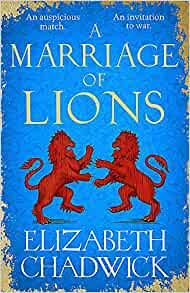
Raised at the court of King Henry III as a chamber lady to the queen, young Joanna of Swanscombe’s life changes forever when she comes into an inheritance far above all expectations, including her own.
Now a wealthy heiress, Joanna’s arranged marriage to the King’s charming, tournament-loving half-brother William de Valence immediately stokes the flames of political unrest as more established courtiers object to the privileges bestowed on newcomers.
As Joanna and William strive to build a life together, England descends into a bitter civil war. In mortal danger, William is forced to run for his life, and Joanna is left with only her wit and courage to outfox their enemies and prevent them from destroying her husband, her family, and their fortunes.
What a marvellous adventure!
A Marriage of Lions is another fabulous, character-driven historical novel from Elizabeth Chadwick. An enjoyable and entertaining read, it will take you through the full range of emotions; it will have you in tears in one moment and shouting at the characters in the book the next. Beautifully written, it is a wonderful reading experience.
As I have come to expect with Elizabeth Chadwick, A Marriage of Lions transports you back through the centuries, so expertly that you can almost imagine yourself in the midst of Henry III’s court and the battle of wills between Henry and Simon de Montfort. In a change of focus to most books of the time, Elizabeth foregoes telling de Montfort’s story to concentrate on the remarkable relationship of William de Valence and his wife, Joanna de Munchesny, granddaughter of the great William Marshal.
Having just written a biography of the Warenne family, who were the earls of Surrey from the time of the Norman Conquest to the death of the 7th and last earl in 1347, I took particular interest in Elizabeth’s portrayal of John de Warenne, 6th Earl of Surrey, who was brother-in-law to both King Henry III and William de Valence. He was also a cousin to William’s wife, Joanna, through their Marshal mothers. And I have to say, I think Elizabeth got John spot on. He was a loyal, noble character with his friends and family – a trait that ran through his family. Though he could be ruthless to his enemies and was not a benevolent lord to his tenants.
A Marriage of Lions is not just a fascinating read, it is an experience not to be missed, shining a light on the 13th century, on not only the complex political manoeuvring, but also on the family dynamics that coloured the politics of all those involved, from inheritance disputes to political reform and financial management. Elizabeth manages to weave all these different threads into one fabulous, addictive story.
Elizabeth Chadwick seamlessly combines the history with the fiction.
‘Did you know my mother well?’ Joanna ventured, hoping for crumbs.
Her aunt held out her empty cup to a passing servant to be refilled. ‘I was married with a child before she was born, but I saw her sometimes and I grew to know her better when our father was dying. We sang to him, your mother and me. She was young and shy, but he took great delight in it and it was a moment of light and blessing amid his pain.’ a shadow crossed her face. ‘Our mother died less than a year later and I cared for your mother until she came to be wed. That is why I say you are like her for I knew her well when she was your age. I miss her. I miss all of my sisters. I am the last one. None have made old bones.’
‘I am sorry, madam,’ Joanna said. Her aunt Isabelle, Mahelt’s sister, had died bearing the child she had been carrying at the Queen’s churching – a stillborn son. Her husband, the King’s brother, Richard, had since departed on crusade with Simon de Montfort who was making good use of his exile. ‘I am sorry for the loss of your husband too.’
‘Him I do not miss,’ her aunt said brusquely. ‘Marriage is a bargain and you make the best of your circumstances. If you are fortunate you will bear sons and daughters to nurture and shape, who will be your consolation and make you proud.’
She beckoned to a junior squire who had been attending on the newly knighted Peter of Savoy.
The boy joined them and bowed. Joanna eyed him curiously. He had glossy crow’s wing hair and dark-brown eyes set under slanted brows. He was of about her own age and she recognised his guarded expression from her own repertoire. Her aunt introduced him as her son, John de Warenne, who was entering the household of the newly knighted Peter of Savoy as his squire and ward, where he would be trained to knighthood.
The boy bowed again and gave Joanna an evaluating, slightly wary look. She could almost see prickles bristling on him like a defensive hedgehog. She understood his tension for she had reacted in the same way when she first arrived at court.
‘I will be glad to have another cousin to talk to,’ she said.
Elizabeth Chadwick demonstrates a deep understanding of the politics and nuances of the royal court of Henry III, showing how factionalism and court favourites led to the Second Barons’ War and how it was Henry’s Lusignan siblings suffered from the fallout of Henry’s mounting disagreements with Simon de Montfort. A Marriage of Lions also shows readers how women, despite their inability to take to the field of battle, could use their own skills and abilities to not only protect their family, but also further the interests of their husbands and children. Through Joanna de Munchesny, Elizabeth Chadwick emphasises that medieval women were no more meek and defenceless in the 13th century than they are today. Joanna was intelligent and resourceful – and a force to be reckoned with! She is a character than any reader can admire and get behind.
I have written about many of the historical personages in A Marriage of Lions, either as research subjects or peripheral subjects of my books and I found myself nodding along to Elizabeth Chadwick’s own assessments of these characters, from Simon de Montfort to John de Warenne, from Matilda Marshal to de Montfort’s wife, Eleanor of England – I think Elizabeth and I must read many of the same books for research. This also serves to demonstrate how much knowledge and research the author has accumulated over the years, and how deeply she comes to understand her characters. While this isn’t essential in a historical fiction book, it does help to add authenticity to a novel, and draws the reader in deeper, so that they become totally immersed in the story and its characters.
While I have enjoyed many an Elizabeth Chadwick novel, A Marriage of Lions stands on a level with The Greatest Knight as one of her very best. If you are an Elizabeth Chadwick fan, this is a must read. If you have never read Elizabeth, then I suggest you start with this one – you will definitely want to read the rest afterwards. It is one of the best historical fiction novels that I have read this year. I did not want it to finish and yet – at the same time – could not wait to get to the end!
Elizabeth Chadwick has a knack of getting into the heads and hearts of her characters, so that they jump off the page and insinuate themselves into the thought of the reader. The book is impossible to put down – until the very last page. And finishing the book – especially this book – leaves the reader bereft.
New York Times bestselling author Elizabeth Chadwick lives in a cottage in the Vale of Belvoir in Nottinghamshire with her husband and their 3 dogs. Her first novel, The Wild Hunt, won a Betty Trask Award and To Defy a King won the RNA’s 2011 Historical Novel Prize. She was also shortlisted for the Romantic Novelists’ Award in 1998 for The Champion, in 2001 for Lords of the White Castle, in 2002 for The Winter Mantle and in 2003 for The Falcons of Montabard. Her sixteenth novel, The Scarlet Lion, was nominated by Richard Lee, founder of the Historical Novel Society, as one of the top ten historical novels of the last decade. She often lectures at conferences and historical venues, has been consulted for television documentaries and is a member of the Royal Historical Society.
For more details on Elizabeth Chadwick and her books, visit http://www.elizabethchadwick.com, follow her on Twitter, read her blogs or chat to her on Facebook.
*
My Books
Signed, dedicated copies of all my books are available, please get in touch by completing the contact me form.
Defenders of the Norman Crown: The Rise and Fall of the Warenne Earls of Surrey tells the fascinating story of the Warenne dynasty, of the successes and failures of one of the most powerful families in England, from its origins in Normandy, through the Conquest, Magna Carta, the wars and marriages that led to its ultimate demise in the reign of Edward III. Defenders of the Norman Crown: Rise and Fall of the Warenne Earls of Surrey is now available from Pen & Sword Books, Amazon in the UK and US and Book Depository.
Today it is a pleasure to welcome author Monika E Simon back to the blog, with an article looking at one particular member of the Lovell family. Monika’s book, From Robber Barons to Courtiers: The Changing World of the Lovells of Titchmarsh, has just been released in the UK. Over to Monika:
Philip Lovell, a career in royal service
Parish church of St James the Great, Hanslope, Buckinghamshire
Philip Lovell was the younger son of William Lovell II and his wife Isabel (family unknown). He was the only member of the Lovell family who entered the church and had a successful if chequered career as a clerk and administrator in royal service, culminating in his appointment as Treasurer of England in 1252. He is also the first Lovell who left a significant trail in the royal records.Nonetheless, little is known about Philip Lovell’s early life. When his father William Lovell II died in 1212/13, Philip’s elder brother John Lovell I was still underage and King John granted his wardship to his supporter Alan Basset. As younger brother, Philip must have been underage as well. Unlike others who made their career in the church, Philip Lovell did not set his feet on this path as a young man. He married at an unknown time the widow of Alexander de Arsic whose name unfortunately is also unknown. They had three children, two sons, Philip Lovell the younger and Henry Lovell, and one daughter Amicia who married Richard de Curzon of Derbyshire. It is also not known when Philip Lovell’s wife died.
After his wife’s death Philip Lovell entered the church and in 1231/32 was ordained subdeacon and given the living in Lutterworth (Leicestershire) by Nicholas de Verdun. It may have also been Nicholas de Verdun who introduced Philip to Roger de Quincy, Earl of Winchester and Constable of Scotland, whose service Philip entered. Again the information is vague but Philip was witnessing the earl’s charters before 1240 and eventually became the earl’s steward for his English estates. During this period, Philip Lovell frequently travelled to Scotland where he earned the friendship of King Alexander II and second his wife Marie de Coucy, as Mathew Paris reports.
Philip Lovell must have worked efficiently and without causing trouble as otherwise Roger de Quincy would not have employed him as a steward or at least retained him in that position.
Over time Philip Lovell gained several positions in the church. He was as rector of Stanground (Huntingdonshire), Rock (Worcestershire), canon of London, and holding the living of Hanslope.
Seal of Alexander II
After about ten years in the service of Roger de Quincy and, no doubt using the contacts he had made for example with William Mauduit, Chamberlain of the Exchequer, entered the service of Henry III. In 1249 Philip Lovell was appointed a justiciary of the Jews through the influence of another influential man, John Mansel. Mansel was an ambitious and highly successful administrator whom Mathew Paris described as Henry III chief or special councillor. Perhaps he felt responsible for the man, he had introduced to royal service but he remained a firm supporter of Philip Lovell throughout his time in royal service.
At first everything went well for Philip Lovell and in 1250 he was styled a clerk and counsellor of the king. But a year later, Philip was disgraced for allegedly taking bribes from wealthy Jews in return for reducing the amount of tallage they had to pay. It is possible that the charges were trumped up by his rival and colleague, Robert de la Ho, as chronicles imply.
John Mansel and Alexander III of Scotland put in a good word with Henry III and Philip was restored to favour. John Mansel arranged for Alexander III to petition Henry III to restore Philip to favour, which he did remembering his parents friendship with Philip. Philip Lovell must have made a very good and lasting impression on Alexander II and his queen for his son to petition Henry III. John Mansel himself paid the fine of 10 marks of gold (a substantial sum) that Philip had offered. Even if Mansel felt responsible for the man he had been instrumental to gain the position as justiciar of the Jews it seems unlikely to me he would have gone to such length if he had thought that Philip was completely hopeless.
Philip Lovell’s restoration to favour was complete and swift. Not even a year after his dismissal from office, on 27 August 1252, he was appointed Treasurer of England. As a key figure in the administration of the country, his name appears constantly in the government records. The Patent Rolls, Close Rolls, and the Liberate Rolls of this period contain a multitude of references to his work which was incredibly varied.
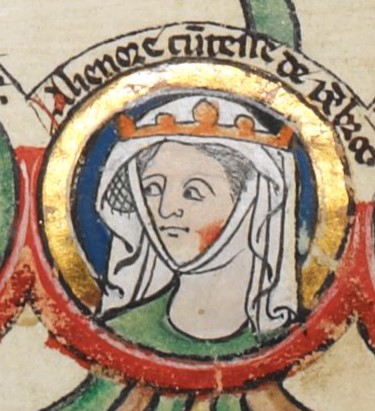
Eleanor of England, Countess of Leicester
The Liberate Rolls are the records of the writs ordering money to be paid out of the treasury. The work of the treasurer was varied and often hands-on. Most often, Philip Lovell was the person to authorise the payment. For example when the sheriffs of London were to be repaid for the lead they had purchased for building works in Windsor and on another occasion for the transport of the gear of the king’s pavilion in Westminster to Portsmouth. On other occasions the sheriff of Surrey and Sussex had transported the king’s treasure from London to Portsmouth. The sheriff of Kent was paid back the money he had spent on the reception of the Barsias Martini, the elect of Toledo and his household in Dover and on their travels to the New Temple in London.
Money was also paid out to Eleanor of England, Countess of Leicester for her dower. In 1256, Philip Lovell received 1,600 marks from Margaret de Lascy, Countess of Lincoln, a part payment of the arrears of the money she owned as her share of the dower payments to Eleanor of England.
Philip himself was often purchasing items for the royal court. For example, he bought 30 gold-wrought cloths for Queen Eleanor or wax for the king’s children in Windsor.
The purchases also shed a light on the sheer size of the royal household. In 1253, Philip Lovell and two colleagues purchased 82 gold buckles, 277 precious rings of gold, 15 girdles, 89 ‘massive’ rings of gold, and 14 ‘massive’ buckles of gold to the tune of £250 17s. 5d. In 1254, 600 ells of linen were bought to make napkins for the feast of St Edward. Another large purchase, in 1255, was of various spices: 385 pounds of pepper, 386 pounds of ginger, 4 pounds of mace, 12 pounds of setwall (valerian), and 16 pound of sugar ‘of Alexandria’. Sheep, boars and fowl were sent from the sheriff of Buckinghamshire to Westminster for the Feast of St Edward in 1255. Wine was also bought for the king. On several occasions Philip Lovell himself bought the wine and transported it to where the royal household was at the time.
Another frequent expense was for gift of the king to a church or cleric. In 1255, for example, five gold-wrought cloths, a piece of red sandal (a light silk material), and another piece of green sandal were bought for a cloth for St Peter’s in Westminster. In 1256, Philip Lovell bought an embroidered cope to give to the church of St Edmund. A year later he bought another embroidered cope that was a gift by the king to Westminster in honour of St Edward. It was not only vestments and cloth that was given to churches, in 1257 Philip bought a gold buckle for 10 marks to give to the feretory of St Edmund of Pontigny.
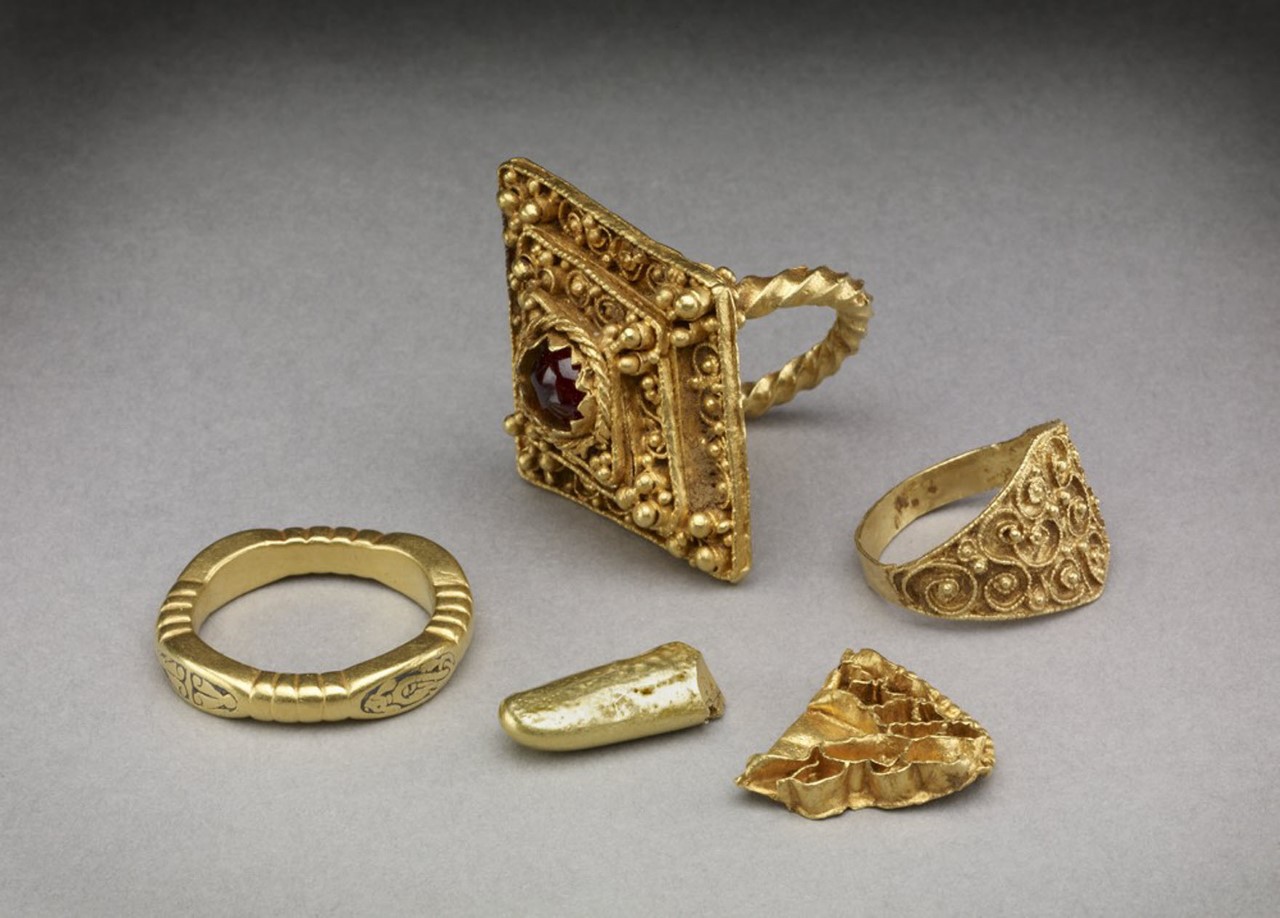
Hoard of Anglo-Saxon rings found at Leeds, West Yorkshire
For his service to the king, Philip Lovell was to be given ecclesiastical benefices, dignities or prebends to the amount of 200 marks per year. He was granted free pasture in the forest of Whittlewood and received gifts of trees on several occasions. He also often received grants of deer from the royal forests. In 1250, he simply took a hind and a doe in Sherwood Forest without asking prior permission. His pardon by the king for this offence must be regarded as a further sign of the good favour he stood in. Philip Lovell was also granted the wardship and marriage of the heirs of Vivian de Staundon.
Not all of Henry III attempts to promote his treasurer were successful. In 1257 he tried to persuade the monks of Coventry to make Philip Lovell bishop of Lichfield and Coventry but without success.
In the late 1250s, the dissatisfaction of the barons of England increased and with the charismatic leadership of Simon de Montfort, Earl of Leicester the demands for changes in the government grew louder. Philip Lovell was one of the men they wanted to remove from office. He had been too harsh in his attempts to find revenue for the treasury, as in 1255 when he was making an inquiry into the king’s revenues and rights in eight midland counties. Simon de Montfort had his private complaints against the king and his treasurer as the payments of his wife’s dower were a constant problem. The critics were eventually successful. Philip Lovell was accused of plundering the forest of Whittlewood, charges that were trumped up according to Nicholas Vincent in his biography of Philip Lovell in the ODNB. Nonetheless, Philip was dismissed from service and replaced by John de Crachale, archdeacon of Bedford.
Philip Lovell retired to Hanslope where he died on 29 December 1258 of grief that the king, whom he had served so faithfully, would not forgive him. His estates, which included lands in Little Brickhill (Buckinghamshire), Littlebury (Essex), and Snotescombe (Northamptonshire), were at first confiscated but later divided between his three children and his nephew John Lovell II.
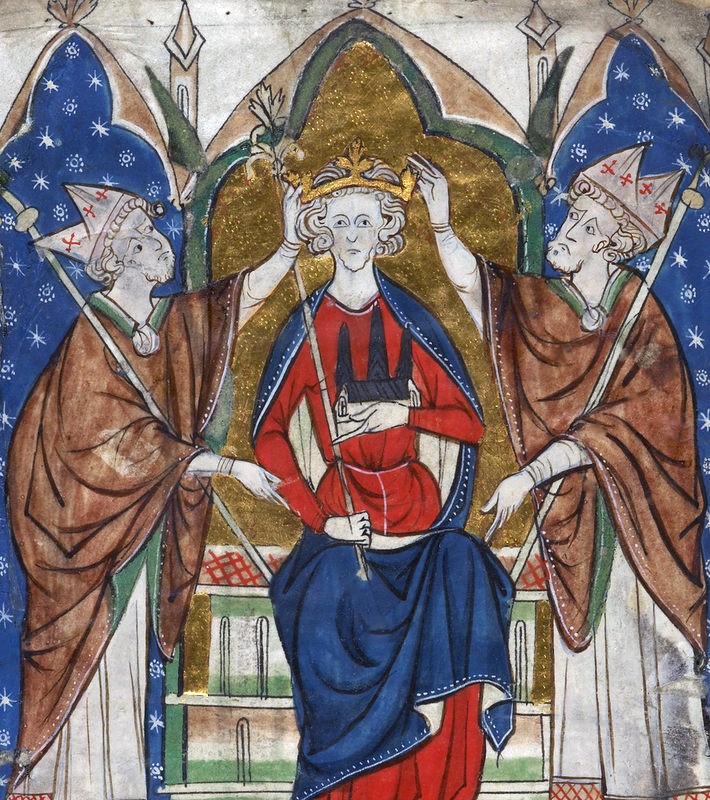
Coronation of King Henry III
Philip Lovell was a controversial figure. He lost his position as he was thoroughly disliked by many barons. Being responsible for collecting taxes and guarding the king’s financial rights and income is, if done thoroughly, not a job that is likely to make a person popular with those whose money he took. Modern historians are also critical. J.R. Maddicot describes him as ‘a man with a bad reputation for corrupt and oppressive behaviour’. Matthew Paris by contrast calls him a prudent, eloquent and magnanimous man.
Philip Lovell’s nephew, John Lovell II also entered royal service though he choose the more traditional route for a noblemen: service in war. It is possible that his uncle’s position at court helped him in this respect. However, John Lovell II’s maternal uncles, the Bassets, were a stronger influence that his paternal uncle Philip. Several brothers of John Lovell II’s mother Katherine were high-ranking members of the royal administration. The fact that John Lovell II decided to adapt the Basset coat of arms to become that used by the Lovell family speaks for a close link between the two families.
Monika E. Simon studied Medieval History, Ancient History, and English Linguistics and Middle English Literature at the Ludwig-Maximilians-Universität, Munich, from which she received an MA. She wrote her DPhil thesis about the Lovells of Titchmarsh at the University of York. She lives and works in Munich.
Defenders of the Norman Crown: The Rise and Fall of the Warenne Earls of Surrey tells the fascinating story of the Warenne dynasty, of the successes and failures of one of the most powerful families in England, from its origins in Normandy, through the Conquest, Magna Carta, the wars and marriages that led to its ultimate demise in the reign of Edward III.
John de Warenne, 7th and last Earl of Warenne and Surrey (Earl Warenne), was the only son of William de Warenne, who in turn was the only son of the colourful and rather legendary John de Warenne, 6th Earl Warenne. The 6th earl had been married in 1247 to Alice de Lusignan, half-sister of King Henry III as the second eldest daughter of Isabelle d’Angoulême, Queen of England as the wife of King John, and her second husband, Hugh X de Lusignan, Count of La Marche and Lord of Lusignan and Valence.
Born in around 1224, Alice was seven years older than her 16-year-old husband. The marriage had formed part of King Henry’s much-despised policy of patronising his Lusignan siblings and thus was condemned by Matthew Paris. Rather harshly, Paris claimed that the marriage was ‘beyond the bride’s station.’1 Given that Alice was half-sister of the king of England, this assessment seems a tad unfair. For John’s son and grandson, it would provide them with powerful royal relations in the future; William de Warenne was a first cousin of Edward I and the younger John de Warenne was a second cousin to Edward II.
Alice de Lusignan, Countess of Warenne and Surrey, died on 9 February 1256, just hours or days after William’s birth. She was ‘placed in the earth before the great altar [Lewes priory] in the presence of her brother Adelmar [Aymer], [bishop] elect of Winchester.’2 Despite being one of the wealthiest and most powerful earls in the country, and with only one legitimate son to succeed him, John de Warenne would never remarry, perhaps an indication of the deep affection that he held for his semi-royal wife.
In his late twenties, William de Warenne was married to Joan, daughter of Richard de Vere, Earl of Oxford, sometime in 1284: ‘Also William de Warenne married the daughter of the Earl of Oxford.’3 Through his mother, William was the nephew of Henry III and first cousin to Edward I. Through his father, William was descended from, among others, William Marshal, Geoffrey of Anjou and six Warenne earls of Surrey. However, William was destined never to succeed to the expansive earldom of Surrey. He was killed in a tournament at Croydon in December 1286, just six months after the birth of his only son and heir, John. The Annals of Lewes Priory recorded the events of 1286:
This year, on June 30, was born the first-begotten son of Sir William de Warenn, by his wife, daughter of the Earl of Oxford, whom he had married, as appears above. He was baptised and called by the name of John, on the 7th of November, with immense rejoicing; but alas! As the prophet testifies, ‘our joys are extinguished, but lamentation possesses us;’ for in the same year, on the first Sunday before the feast of Thomas the Apostle, which was on December 15, the father of the aforesaid youth [Sir William, killed in a tournament at Croydon], concerning whom our gladness had been, expired, and, oh sadness! He in whom flourished entire nobility, generosity and honesty, and the beginning of the glory of all knighthood, now lies buried and covered with stones. But there was present at the entombment of this so noble a man, the lord of Canterbury, who buried him before the high altar, on the left side, near his mother, with the greatest devotion of respect, as was fitting, many nobles of the land being present. The earl marshal [Roger Bigod, Earl of Norfolk], the Earl of Oxford and several barons … were anxiously afflicted.4
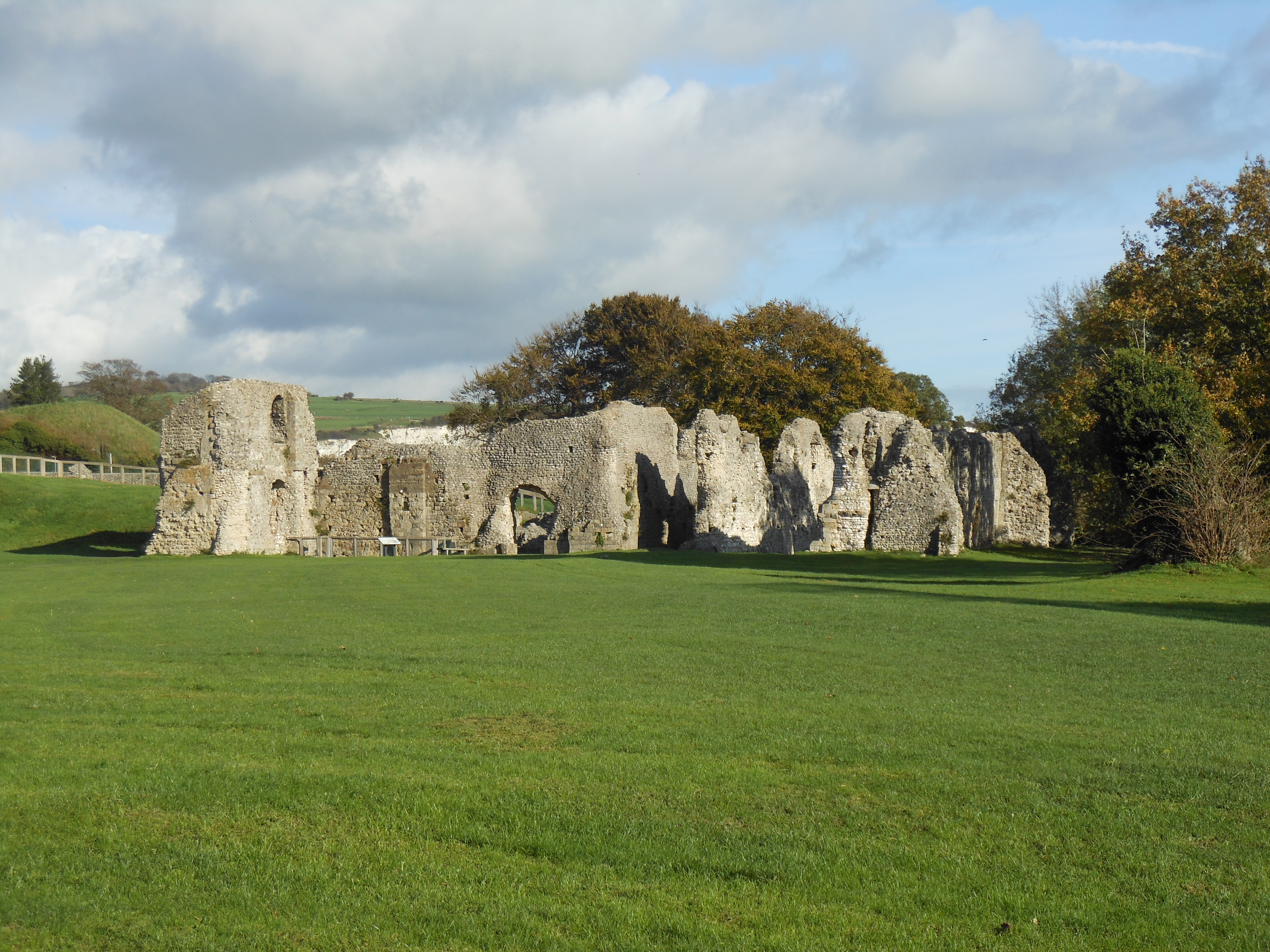
St Pancras priory, Lewes, the Warenne family mausoleum
Some sources suggest that John was the posthumous son of William, stating that William was killed in January 1286; however, this entry in the Annals of Lewes Priory makes it clear that John was born almost six months before his father was killed. John’s sister, Alice, on the other hand, may well have been born the year after her father’s death, in June 1287; hence John being referred to as the ‘first-begotten son’ despite being the only son. Joan was pregnant with Alice and no one yet knew if the child would be a boy or a girl.
Given the chronicle was written by a monk at Lewes, a priory patronised by the Warenne family, the laments and praise of William may be slightly exaggerated. However, that the archbishop of Canterbury conducted the funeral rites, and the presence of many senior nobles, suggests that William was, indeed, well thought of. This fact may give the lie to the rumours of murder that inevitably accompany a medieval death from unnatural causes. Rumours that William’s enemies had taken the opportunity of the tournament to despatch the young lord appear to be without foundation.
Young John suffered a further bereavement on 1293, when his mother, Joan died. Aged only 7, it seems arrangements had already been made should John still be a minor when his parents died. It had been agreed that the custody of John and his lands should go to Joan’s parents, Robert de Vere and his wife, Alice de Sanford. However, Earl Robert died in 1296 and it is not known where 10-year-old John spent the remainder of his childhood. It seems likely that John was raised by his Warenne grandfather, until the 6th Earl’s death in 1304.
At the age of 18, John succeeded to the earldom of his grandfather as the 7th earl of Warenne, Surrey and Sussex. His vast holdings comprised of lands and manors in numerous counties, including Sussex, Surrey, Lincolnshire, Yorkshire, Wiltshire and Norfolk. John, Earl Warenne, was still a minor and would be for another three years; as a consequence, he was made a royal ward, his lands taken into the custody of the Crown. Although he and his lands were in royal custody, and managed by custodians, John lived on his own estates and in 1305 the king commanded John to provide him with forty dried and salted barrels of deer.5 In the same year, he was sent to attend a tournament at Guildford, part of John’s estates, by Edward I, who provided the young lord with considerable funds for his maintenance.6
On 7 April 1306, in spite of the fact he had not yet performed homage to the king, still only 19 years old, Edward granted John his grandfather’s lands. It may well have been at this time that Edward Balliol was placed in John’s custody. The son of John’s aunt, Isabella, and King John Balliol of Scotland, the younger Balliol had been in the custody of his grandfather, the sixth Earl Warenne, from 1299 until the old earl’s death in 1304.
Seal of Edward Balliol as King of Scots
Given that it is likely his mother was no longer living when John Balliol became king in 1292, and that the couple had been married sometime before 7th February 1281, it seems probable that Edward was born sometime in the 1280s, making him of a similar age to his cousin, John de Warenne. Indeed, the two young men may well have spent their teenage years together in their grandfather’s household, training for knighthood. John was Balliol’s guardian for about 4 years, until it was ordered that he be delivered into royal custody in 1310, by Edward II. Edward Balliol had a strong claim to the Scottish throne, one that he would later be encouraged to pursue by Edward III in the 1330s. In May 1306, John de Warenne attended his first parliament at Westminster, an event which marked his coming of age, although he was not yet 21; in fact, he was still a month shy of his twentieth birthday.
John’s early coming of age appears to have been a part of larger scheme by King Edward, as during the parliamentary session, John was brought before the king and offered Edward’s granddaughter in marriage; the young earl readily agreed to the marriage, even though his bride was only 10 years old. The proposed bride was Joan, or Jeanne of Bar, Edward’s granddaughter by his eldest daughter, Eleanor and her husband Henry, Count of Bar. In the week following the betrothal of John and Joan, and in anticipation of a new expedition against Scotland, on 22 May 1306, Edward I held a magnificent ceremony for the knighting of his eldest son, Edward; the king knighted the prince, who then went on to knight the other candidates, in the glorious setting of Westminster Abbey.
In anticipation of the prince’s knighting, and in order to gather a body of knights who would be loyal to his son, the king proclaimed that all young men of sufficient age and income should travel to Westminster, to be knighted at royal expense alongside their future king, Prince Edward. The ceremony was also to bestow knighthoods on almost 300 men, John de Warenne included: ‘The yong Erle of Warenne with grete nobley was thare / A wif thei him bikenne, the erles douhter of Bare.’7
There were so many young men to be knighted, that it was impossible to find accommodation for all, and apple trees had to be chopped down in the gardens of the New Temple to make room. The prince and his closest companions kept their vigil, the night before the ceremony, watching their arms, in the abbey church at Westminster. Matthew of Westminster records that:
there was such a noise of trumpets and pipes, and such a clamour of voices, that one side of the choir could not hear the other. The others kept their vigil at the New Temple. The King provided them the necessary scarlet cloths, fine linen and belts for their use from his own wardrobe. 8
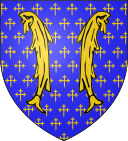
Arms of the House of Bar
The following morning, the king knighted his son in the palace of Westminster, investing him with his knight’s belt and spurs. The prince then crossed to Westminster Abbey, to invest the others; ‘The crowd was enormous, so great indeed, that two knights were killed. Each candidate was attended by three knights, who saw and assisted him through the ceremony.’9 The prince knighted sixty of the candidates himself, with other knights assisting with the rest. A lavish banquet – which later became known as the Feast of the Swans – followed the proceedings:
when two swans were brought in ornamented with gold network, emblematical of constancy and truth. When they were placed upon the table the King rose and made a vow to God and to the swans, that he would set out for Scotland and avenge the death of Comyn, and punish the treachery of the Scots … It was under these exceptionally interesting circumstances that Warenne received his knighthood.10
The murder of John Comyn, at the hands of Robert the Bruce in the church of the Greyfriars in Dumfries, on 10 February 1306, following an argument, had sent shockwaves through Christendom. Bruce had then raced to Scone where he was crowned King Robert I of Scots. As the celebrations continued a number of weddings also took place, involving several barons and nobles. John’s sister, Alice, married Edmund FitzAlan, 9th Earl of Arundel. Edmund had been a ward of John’s grandfather. The two young men were very close in age and were political allies and friends.
John de Warenne and Joan of Bar were married on 25 May, ‘before an altar spread with glittering cloths-of-gold.’11 Barely 10 years old, Joan was escorted to the palace at Westminster with great pomp and she and John were married in the presence of the ageing king. The Wardrobe Accounts bear witness to the extravagance of the ceremony and celebrations:
‘1306. May 25. In money lent and dispersed in the presence of the King, at the nuptials celebrated in the King’s chapel at Westminster, between John, Earl de Warenne, and the Lady Joanna, daughter of the Count de Barr, xls [40s].’ Other money was paid out ‘for diverse minstrels’, and ‘for letting fly the king’s gyrfalcon.’ More extravagance was expended to Thomas the coachbuilder, ‘advanced on making a chariot for the Earl de Warenne, June 28, lxs [60s],’ and to Walter de Bardeney, ‘advanced on harness being made for the said Earl, on the same day, cs [100s].’ While Walter de Bedewynde was commissioned ‘for a new carriage for the use of the Countess de Warenne, by order of the Treasurer.’12
Conisbrough Castle, South Yorkshire, where John de Warenne, the last Earl of Warenne and Surrey, died in 1347
The marriage would prove to be a disaster, with John spending most of his adult life trying to obtain a divorce from Joan in order to marry his mistress, Maud de Nerford, and thus legitimise his children by her. Although the relationship with Maud eventually broke down, possibly due to the considerable pressure they couple must have been under with the almost-constant court cases, John was still trying to obtain a divorce from Joan to his dying day. In his latter years, in a last desperate attempt to produce a legitimate heir, he hoped to marry his mistress at that time, Isabella Holland, who his described as ‘ma compaigne’ in his will.13
John de Warenne, seventh and last Earl of Warenne, Surrey, Sussex and Strathearn died at Conisbrough Castle between 28 and 30 June 1347, possibly even on his sixty-first birthday (30 June). He asked to be buried at St Pancras Priory, Lewes, in an arch near the high altar. His will, dated 24 June 1347, left various gifts to his illegitimate children and to Isabella, to whom he left plate, jewels, cows, horses and other beasts, ‘and after that my debts and devises be made, I give to my said “compaigne” all the residue of all my goods and chattels, and whatsoever things they find.’14 To Joan, his wife of forty years, he left nothing.
*
Footnotes:
1. Scott L. Waugh, ‘Warenne, John de, seventh earl of Surrey earl of Surrey and Sussex, Earl Warenne’, ODNB; 2. ‘Annals written by a certain monk of Lewes, from the birth of Christ to the year 1312’ quoted in Blaauw, On the Early History of Lewes Priory; 3. ibid; 4. ibid; 5. Scott L. Waugh, ‘Warenne, John de, seventh earl of Surrey earl of Surrey and Sussex, Earl Warenne’, ODNB; 6. ibid; 7. F. Royston Fairbank, ‘The Last Earl of Warenne and Surrey, and the Distribution of his Possessions’, The Yorkshire Archaeological Journal, vol. XIX; 8. ibid; 9. ibid; 10. ibid; 11. Kelcey Wilson-Lee, Daughters of Chivalry: The Forgotten Children of Edward I; 12. Wardrobe Accounts quoted in F. Royston Fairbank, ‘The Last Earl of Warenne and Surrey, and the Distribution of his Possessions’, The Yorkshire Archaeological Journal, vol. XIX; 13. Katheryn Warner, Philippa of Hainault: Mother of the English Nation; 14. Calendar of Papal Registers, Papal Letters quoted in F. Royston Fairbank, ‘The Last Earl of Warenne and Surrey, and the Distribution of his Possessions’, The Yorkshire Archaeological Journal, vol. XIX
The Oxford Companion to British History Edited by John Cannon; The Plantagenets, the Kings who Made England by Dan Jones; History Today Companion to British History Edited by Juliet Gardiner and Neil Wenborn; Brewer’s British Royalty by David Williamson; Britain’s Royal Families, the Complete Genealogy by Alison Weir; Early Yorkshire Charters Volume 8, Edited by William Farrer and Charles Travis Clay; Conisbrough Castle by Steven Brindle and Agnieszka Sadraei; The Mammoth Book of British Kings and Queens by Mike Ashley; The Plantagenets, the Kings that made Britain by Derek Wilson; oxforddnb.com; royaldescent.net; F. Royston Fairbank, ‘The Last Earl of Warenne and Surrey, and the Distribution of his Possessions’, The Yorkshire Archaeological Journal, vol. XIX; Scott L. Waugh, ‘Warenne, John de, seventh earl of Surrey earl of Surrey and Sussex, Earl Warenne’, ODNB; ‘Annals written by a certain monk of Lewes, from the birth of Christ to the year 1312’ quoted in Blaauw, On the Early History of Lewes Priory; Kelcey Wilson-Lee, Daughters of Chivalry: The Forgotten Children of Edward I; Katheryn Warner, Philippa of Hainault: Mother of the English Nation
My Books
Signed, dedicated copies of all my books are available through my online store.
Out now: Scotland’s Medieval Queens
Scotland’s history is dramatic, violent and bloody. Being England’s northern neighbour has never been easy. Scotland’s queens have had to deal with war, murder, imprisonment, political rivalries and open betrayal. They have loved and lost, raised kings and queens, ruled and died for Scotland. From St Margaret, who became one of the patron saints of Scotland, to Elizabeth de Burgh and the dramatic story of the Scottish Wars of Independence, to the love story and tragedy of Joan Beaufort, to Margaret of Denmark and the dawn of the Renaissance, Scotland’s Medieval Queens have seen it all. This is the story of Scotland through their eyes.
‘Scotland’s Medieval Queens gives a thorough grounding in the history of the women who ruled Scotland at the side of its kings, often in the shadows, but just as interesting in their lives beyond the spotlight. It’s not a subject that has been widely covered, and Sharon is a pioneer in bringing that information into accessible history.’ Elizabeth Chadwick (New York Times bestselling author)
Heroines of the Tudor World tells the stories of the most remarkable women from European history in the time of the Tudor dynasty, 1485-1603. These are the women who ruled, the women who founded dynasties, the women who fought for religious freedom, their families and love. Heroines of the Tudor World is now available from Amberley Publishing and Amazon UK.Women of the Anarchy demonstrates how Empress Matilda and Matilda of Boulogne, unable to wield a sword themselves, were prime movers in this time of conflict and lawlessness. It shows how their strengths, weaknesses, and personal ambitions swung the fortunes of war one way – and then the other. Available from Bookshop.org, Amberley Publishing and Amazon UK. King John’s Right-Hand Lady: The Story of Nicholaa de la Haye is the story of a truly remarkable lady, the hereditary constable of Lincoln Castle and the first woman in England to be appointed sheriff in her own right. Available from all good bookshops Pen & Sword Books, bookshop.org and Amazon.

Alternate Endings: An anthology of historical fiction short stories including Long Live the King… which is my take what might have happened had King John not died in October 1216. Available in paperback and kindle from Amazon.
Podcast:
Have a listen to theA Slice of Medieval podcast, which I co-host with Historical fiction novelist Derek Birks. Derek and I welcome guests, such as Bernard Cornwell and discuss a wide range of topics in medieval history, from significant events to the personalities involved.
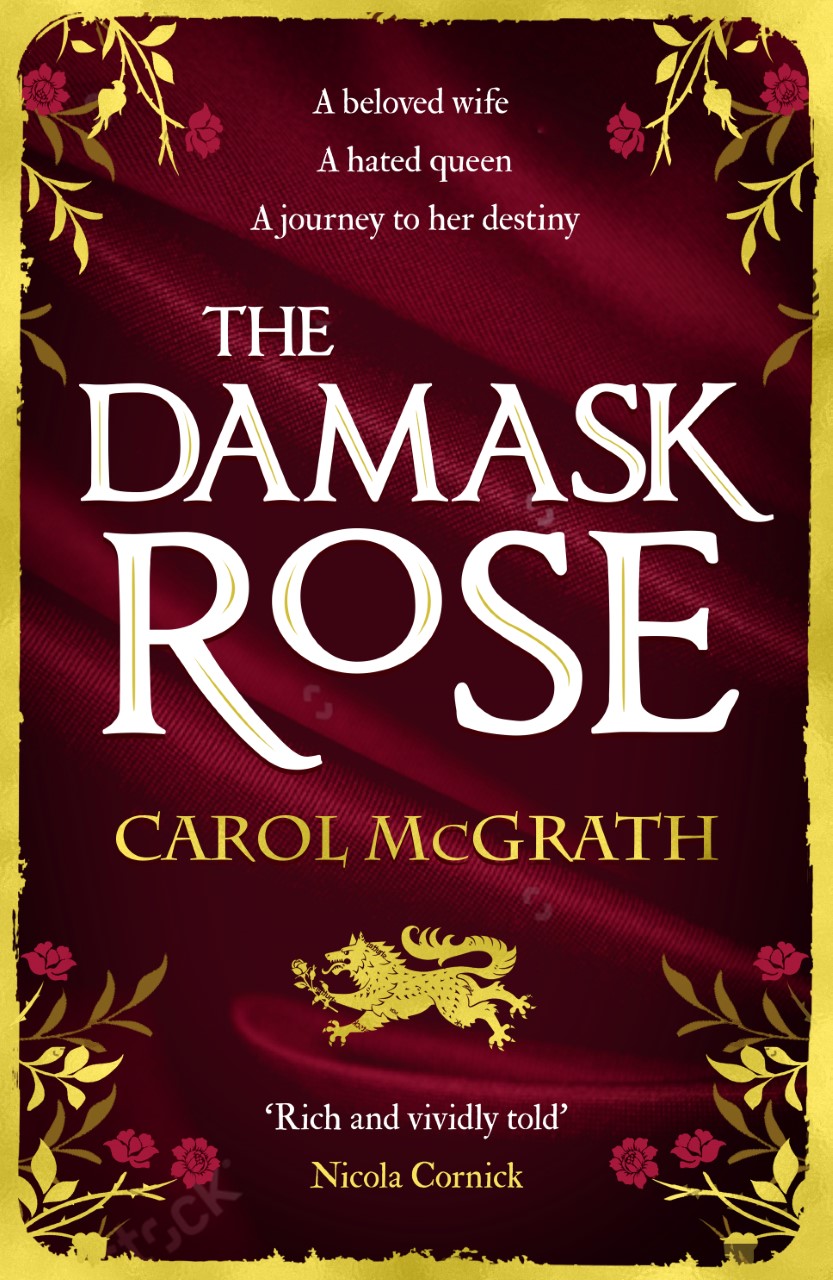
It is a pleasure to welcome to History…the Interesting Bits, author Carol McGrath. Carol’s latest novel, The Damask Rose, is out this month and tells the story of Eleanor of Castile and her devoted husband, King Edward I. Eleanor of Castile led an adventurous life, to say the least, even accompanying her husband on Crusade to the Holy Land.
Carol McGrath tells us more…
Female Crusaders
Eleanor of Castile (1241-1290) is placed at the centre of my new publication The Damask Rose. She was married to Edward I at only twelve years old when he was fifteen and was his father Henry III’s heir. It is always thought that, throughout her life, Eleanor was devoted to Edward and him to her. They certainly supported each other throughout her life, almost always together. They even journeyed on Crusade together. She was not the first royal spouse to Crusade. Eleanor of Aquitaine and Marguerite of France had crusaded before her.
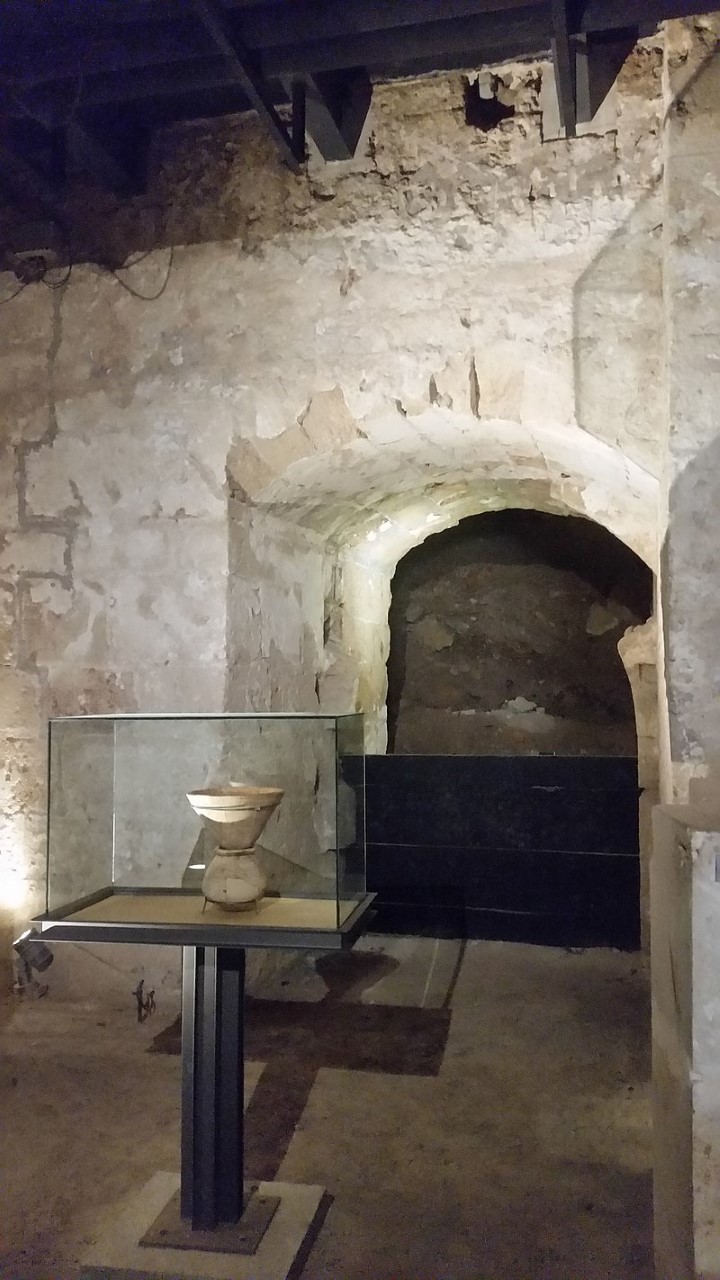
Sugar Storage Jar
In 1270 they set off on Crusade but they never reached Jerusalem. Acre was the royal couple’s home for more than a year. Edward was an able and courageous leader but the Crusade was militarily unsuccessful. They established their crusading court in Acre after the death of the original Crusade leader, the saintly Louis IX, at Carthage, and Edward became the eighth Crusade’s figure head. A legend says that Eleanor was so dutiful and committed to Edward, her only love, she saved his life in June 1272 when an assassin struck Edward down with a poisoned dagger. Edward apparently wrestled the knife from his assailant and killed him but not before he took injury to his arm.
The story relates that Eleanor sucked out the poison. This is not entirely true. Bartolemo Fiadoni known as the Ptolemy of Lucca is responsible for the popular tradition that Eleanor ‘showed great faithfulness; for with her tongue she licked his open wounds all the day, and sucked out the humour, and thus by her virtue drew out all the poisonous material.’ It is a story from the period’s High Romantic Tradition thus expressing Eleanor’s heroism. Read The Damask Rose to discover what most likely really did happen and how Edward survived the attack.
The story illustrates how the Crusades claimed both ecclesiastical and chivalric ideas linking Church and Court, how at the time, the Crusades became romanticised. Courtly literature was linked to women in Historical Romances, many of which were associated with crusading and the Holy Grail. In fact, many ordinary women went on Crusade as well as queens and noble women. These ordinary women were almost always described in sources in relation to men as daughters, wives, mothers, aunts, sisters and even more distant kin. However, sometimes we find widows or women, well past child bearing age and referred to as ‘in old age’, on Crusade.
Toilets in Acre
Individual female crusaders mentioned in sources were predominantly well to do. Even so, others exist such as the woman who followed a goose on Crusade because she believed it was filled with the Holy Spirit. Women generally were accompanied male relatives but some, like the goose lady, travelled without a guardian. A passenger list surviving from the Saint Viktor, a Crusade ship of 1250 records forty two of the 342 common people travelling to the Holy Land were women. Twenty-two of these women had no male chaperone. Securing a suitable male escort was apparently a huge problem. Large groups of widows might travel together as pilgrims. Pilgrims were not supposed to carry arms and even if women had travelled with pilgrim guards, they were still vulnerable. Women Crusaders were utterly courageous and determined. For example, in her mid-sixties, Ermeongarde, Countess of Brittany, who had taken the veil in Dijon in 1130, visited her half-brother, King Fulke of Jerusalem, and passed some years in the nunnery of St Anne in the Holy City. She safely return to Brittany in 1135 to tell her tale.
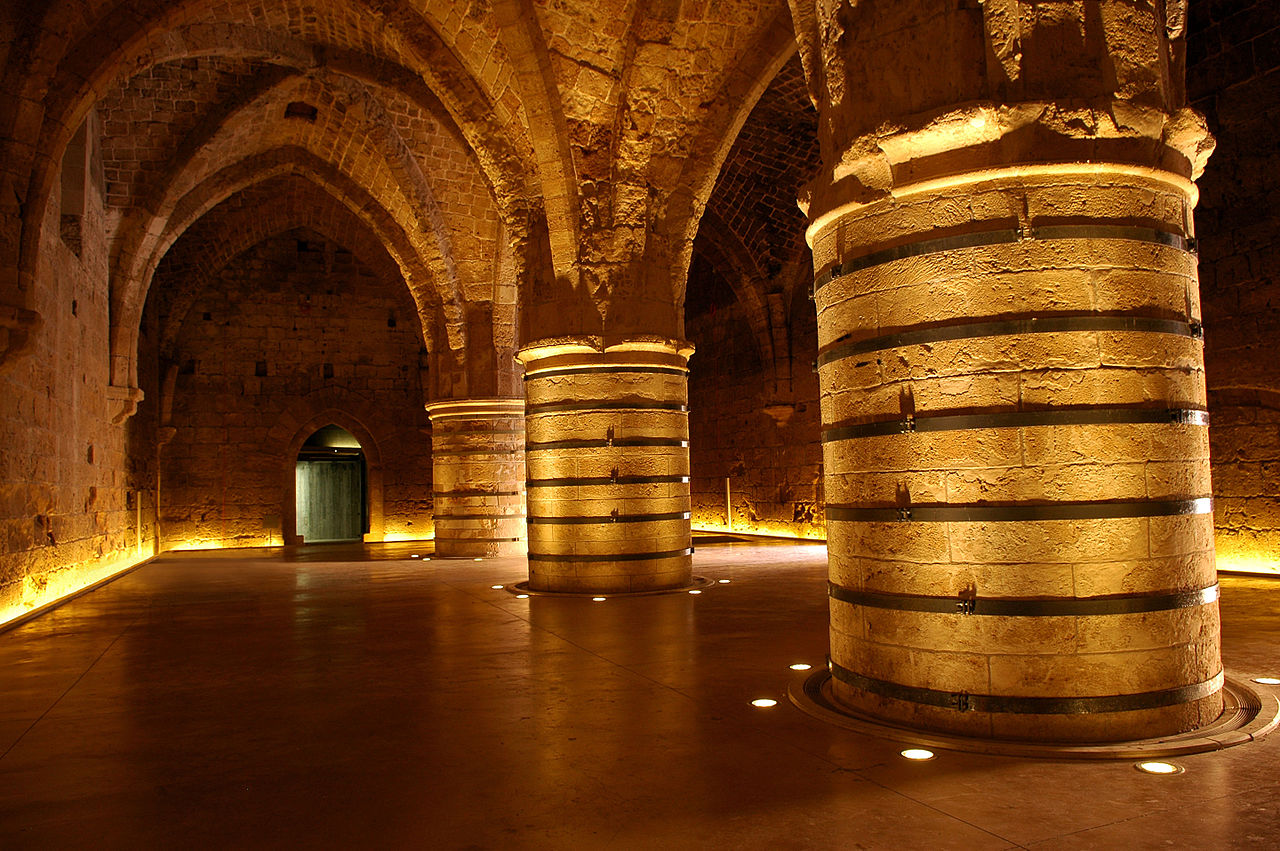
The Dining Hall, Hospitaller Palace, Acre
Piety was the main reason for taking the cross. Women sometimes took the cross in public ceremonies alongside men. Jerusalem was naturally the goal. The two fold nature of armed pilgrimage to rescue the Holy Land by force and to pray at shrines gave women a ‘canonical loophole’ to participate. Also, Crusading affected women’s lives whether they stayed in Europe, took the cross or lived abroad in settler territories. Although women are recorded as present since the First Crusade, it was only during the thirteenth century that they were granted legal status as crucesignatae. Spiritual rewards such as the remittance of sins were indeed as attractive to women as men.
Women fulfilled practical functions during siege warfare on Crusade often undertaking jobs such as clearing rubble and filling ditches. They are recorded as bringing refreshments to the first Crusaders at the Battle of Dorylaeum. They are known to have transported materials to weave the panels in a siege engine in 1099 at the Siege of Jerusalem. This I found fascinating. They washed clothing and picked lice out of body linen. By the fourth Crusade, women were entitled to a share of the booty. They ground corn and maintained markets. They tended to the wounded and the sick.
A Parisian woman called Hosenda tended Louis IX when he was ill from dysentery in 1250. It was dangerous too. If a woman was captured her captivity held a sexual slur which devalued them regarding ransom. A woman was valued at a third the price of a man. Power in the settlements was, however, often transferred through widows and heiresses. Aristocratic marriages were extremely important to Crusader settler society. They cemented political alliances between Latins from the West, the Levant, Greeks, Armenians and Syrians. Some women even became feudal lords thus contributing to the defence of the Holy Land and women who stayed behind acted as regents and organised financing the Crusaders.
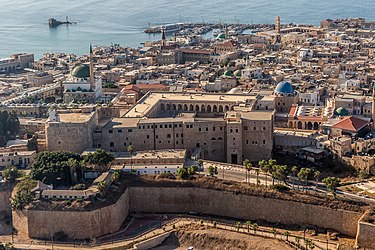
The Hospitaller Palace Acre
As for Eleanor of Castile, nothing quite so amazing. She was a child bearer during her Crusade experience, pregnant for most of the campaign. It is thought she suffered a still birth early on; her daughter, Joan of Acre, was born on Crusade; her son Alfonso was born on the long journey home. It is unlikely Eleanor actually saw much of Acre where prostitution was rife, a city called ‘a sinful city and one filled with all uncleanness’ by Oliver of Poderborn. It is likely that after the excitement of their arrival, Acre soon palled on her accompanying noble women and their ladies. At least, Eleanor, a true blue-stocking, could find escape in her beautiful books and the lovely gardens of the Citadel of the Knights Hospitaller, a substantial building complex of five thousand square miles, three times that of the Tower of London, her home for the duration. To discover more do read my new novel The Damask Rose.
Many thanks to Carol McGrath for her wonderful insight and research into female crusaders.
To buy The Damask Rose: tinyurl.com/dk2att32
Look out for my review of The Damask Rose, which will go live in a few days…
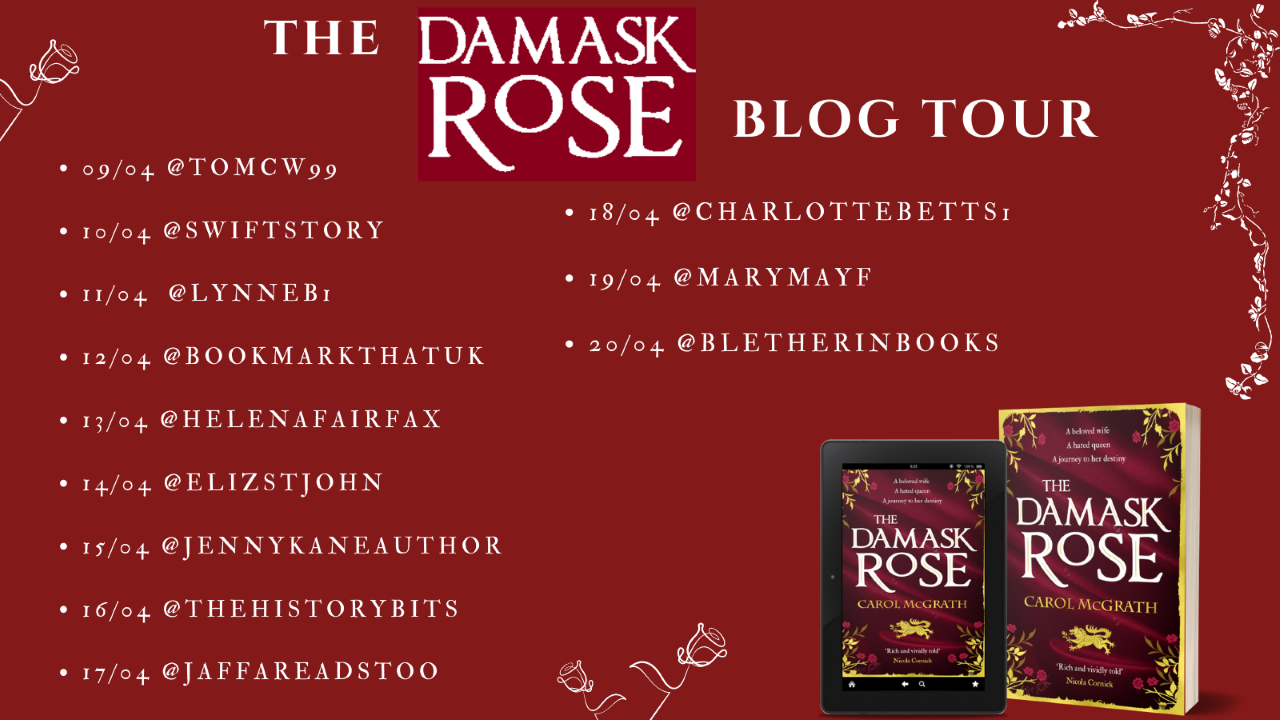
Catch up on Carol’s blog tour so far – and follow the last few stops with the bloggers.
About the author:
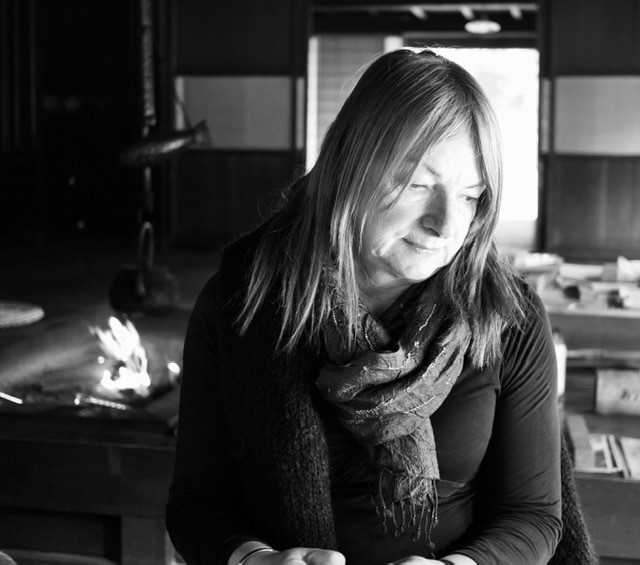
Carol McGrath is the author of the acclaimed She-Wolves Trilogy, which began with the hugely successful The Silken Rose and continues with the brand new The Damask Rose. Born in Northern Ireland, she fell in love with historical fiction at a young age, when exploring local castles, such as Carrickfergus, and nearby archaeological digs – and discovering some ancient bones herself. While completing a degree in history, she became fascinated by the strong women who were silenced in record, and was inspired to start exploring their lives. Her first novel, The Handfasted Wife, was shortlisted for the Romantic Novelists’ Association Awards, and Mistress Cromwell was widely praised as a timely feminist retelling of Tudor court life. Her novels are known for their intricacy, depth of research and powerful stories.
Defenders of the Norman Crown: The Rise and Fall of the Warenne Earls of Surrey tells the fascinating story of the Warenne dynasty, of the successes and failures of one of the most powerful families in England, from its origins in Normandy, through the Conquest, Magna Carta, the wars and marriages that led to its ultimate demise in the reign of Edward III.
Defenders of the Norman Crown: Rise and Fall of the Warenne Earls of Surreywill be released in the UK on 31 May and in the US on 6 August. And it is now available for pre-order from Pen & Sword Books, Amazon in the UK and US and Book Depository.
For many years, although William Longespée’s father was known, the identity of his mother was very much in question. William Longespée was the son of Henry II, king of England, and it was thought that his mother was a common harlot, called Ikenai. In that case, he would have been a full brother of another of Henry’s illegitimate sons, Geoffrey, Archbishop of York. There were also theories that his mother was Rosamund Clifford, famed in ballads as ‘the Fair Rosamund’. However, it is now considered beyond doubt that his mother was, in fact, Ida de Tosney, wife of Roger Bigod, Earl of Norfolk, from a relationship she had with the king before her marriage.
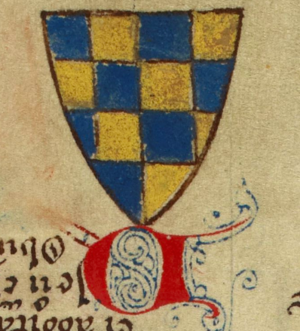
Coat of arms of William Longespée, 3rd Earl of Salisbury
There are two extant pieces of evidence supporting this. The first is a charter in the cartulary of Bradenstoke Priory, made by William Longespée, in which he refers explicitly to his mother as ‘Countess Ida, my mother’. There is also a prisoner roll from after the Battle of Bouvines, in which a fellow captive, one the sons of Ida and the earl of Norfolk, Ralph Bigod, is listed as ‘Ralph Bigod, brother [halfbrother] of the earl of Salisbury’. Ralph was a younger son of Earl Roger and Ida and had been fighting under Longespée’s command in the battle in which both were taken prisoner.
Ida was probably the daughter of Roger (III) de Tosney, a powerful Anglo-Norman lord, and his wife, also called Ida. She was made a royal ward after her father’s death and became mistress of King Henry II sometime afterwards. She gave the king one son, William Longespée, who was born around 1176, making him ten years younger than the king’s youngest legitimate son, John. Around Christmas 1181, Ida was married to Roger Bigod, Earl of Norfolk and through his mother’s Norfolk family, Longespée had four half-brothers, Hugh, William, Ralph and Roger and two half-sisters, Mary and Margery.
Despite the misunderstandings over his mother, the identity of William Longespée’s father was never in doubt. He was Henry II’s son and acknowledged by his father; as an illegitimate son of Henry II, William Longespée’s fortune and position in society were inextricably linked with the fortunes of his royal half-brothers, King Richard I and King John, both of whom he served. Longespée adopted the coat of arms of his paternal grandfather, Geoffrey Plantagenet, Count of Anjou, of azure, six leoncels rampant or [gold], to emphasise his descent from the Angevin counts.
The moniker of Longespée (also Lungespée or Longsword) harkens back to his Norman forebear and namesake William Longsword, second Duke of Normandy (reigned 928–942), from whom he was descended through his father, the king. Little is known of Longespée’s childhood, upbringing or education, though a letter of 1220 that Longespée sent to Hubert de Burgh reminds the justiciar that they were raised together, probably fostered in a noble household. In 1188, Longespée had been given the manor of Appleby in Lincolnshire by his father, but he did not come into prominence until the reign of his half-brother Richard I.
It was King Richard who arranged Longespée’s marriage to the rich heiress Ela of Salisbury. Ela’s father, William, Earl of Salisbury, had carried the sceptre at Richard I’s coronation, in 1194 he had served as high sheriff of Somerset and Dorset and in 1195 campaigned with King Richard in Normandy. In the same year, he was one of the four earls who supported the canopy of state at Richard’s second coronation, and attended the great council, called by the king, at Nottingham. He died in 1196, leaving his only child, Ela, as his sole heir. Ela became Countess of Salisbury in her own right, and the most prized heiress in England.
On her father’s death, Ela’s wardship passed into the hands of the king himself, Richard I, the Lionheart. The king saw Ela as the opportunity to reward his loyal, but illegitimate, half-brother, William Longespée, by offering him her hand in marriage; the Salisbury lands being seen as a suitable reward for a king’s son, especially one born out of wedlock. They would give Longespée a power base in England. Ela and Longespée were married in the same year her father died, 1196. At the time of his marriage to Ela, Longespée was in his early twenties, while his bride was not yet 10 years old, although she would not have been expected to consummate the marriage until she was 14 or 15, and they would not have lived as husband and wife until Ela was at least 12 years old, the church’s legal age of marriage for a girl.
Ela’s new husband was an experienced soldier and statesman and would be able to protect Ela, her lands and interests. William acquired the title Earl of Salisbury by right of his wife and took over the management of the vast Salisbury estates.
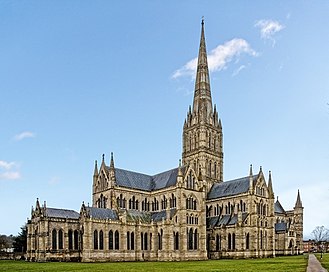
Salisbury Cathedral
William (I) Longespée had an impressive military and political career during the reigns of his half-brothers. He first served in Normandy with Richard between 1196 and 1198, attesting several charters for his brother at Château Gaillard, and taking part in the campaigns against King Philip II of France, gaining essential military experience. He took part in John’s coronation on 27 May 1199 and was frequently with John thereafter. The half-brothers appear to have enjoyed a very cordial relationship; the court rolls record them gaming together and John granting Longespée numerous royal favours, from gifts of wine to an annual pension. By 1201 Longespée, along with William Marshal and Geoffrey fitz Peter, Earl of Essex ‘were seen by John at this stage in his reign as the main props to his rule, and lavish gifts followed.’1
Although Longespée’s marriage to Ela of Salisbury gave him rank and prestige, it was not a wealthy earldom. The barony commanded fifty-six knights’ fees and gave the earl custody of the royal fortress of Salisbury, but Longespée had no castle of his own. He was made sheriff of Wiltshire on 3 separate occasions, 1199–1202, 1203–1207 and 1213–1226, but was never granted the position as a hereditary right by the king. As sheriff, it was Longespée’s task to hunt down the famous outlaw Fulk Fitzwarin, whom he besieged in Stanley Abbey in 1202. When Fitzwarin and his band of about 30 men were pardoned in 1203, Longespée was among those who secured the pardon from the king. During his career, William was also entrusted with several important diplomatic missions. In 1202 he negotiated a treaty with Sancho VII of Navarre and in 1204 he and William Marshal escorted the Welsh prince Llywelyn to the king at Worcester. He was also sent to Scotland on a diplomatic mission to King William the Lion in 1205 and was with John at York in November 1206 when the two kings met. The earl was also involved in the election of his nephew, Otto, as German emperor, heading an embassy to the princes of Germany which resulted in Otto’s coronation.
William Longespée’s most prominent role during the reign of King John, however, was as a military leader. He was a commander of considerable ability. In August 1202 he had fought alongside William Marshal and William de Warenne, Earl of Surrey, hounding the retreating forces of King Philip of France. The French king had withdrawn from the siege of Arques following news of John’s victory over his nephew, Arthur, at Mirebeau. Longespée and his lightly-armed fellow earls, however, narrowly escaped capture from a counterattack led by William de Barres. Following the fall of Normandy, Longespée was given command of Gascony in May 1204. In September of the same year he was also given custody of Dover castle and made warden of the Cinque Ports; he retained both offices until May 1206. In 1208 Longespée was appointed warden of the Welsh Marches and in 1210 he joined King John on the Irish expedition which had been prompted by William de Braose fleeing to Ireland to escape John’s persecution. In 1213 he allied with the counts of Holland and Boulogne, led an expeditionary force to the aid of Count Ferrand of Flanders against King Philip II and on 30 May he achieved a significant naval victory when his forces destroyed the French fleet off the Flemish coast near Damme, burning many enemy ships and capturing others. The victory forced King Philip to abandon plans for an invasion of England.
In 1214 William Longespée commanded an army in northern France for the king, while John was campaigning in Poitou. He managed to recover most of the lands lost by the count of Flanders and,, in July of the same year, he commanded the right-wing of the allied army at the Battle of Bouvines, alongside Renaud de Dammartin, Count of Boulogne. William fought bravely but was captured, after being clubbed on the head by Philippe, the bishop of Beauvais. According to the Histoire de Guillaume le Maréchal the battle had been fought against the earl’s advice, and if it were not for Longespée’s own heroic actions, Emperor Otto would have been taken prisoner or, worse, killed. The battle was a military disaster for the English forces in France and ended John’s hopes of recovering his Continental possessions. William Longespée was held prisoner for almost a year. He was eventually ransomed and exchanged in March 1215, for John’s prisoner, Robert, son of the count of Dreux, who had been captured at Nantes in 1214.
William Longespée was back in England by May 1215 and appointed to examine the state of royal castles. However, England was reaching crisis point by this time, with the rebellion of the barons gathering pace. Although unable to prevent rebels from gaining control of London, he was effective against the rebels in Devon, forcing them to abandon Exeter. He was named among those barons who had advised John to grant Magna Carta, though whether he was actually present at Runnymede, when the charter was sealed, is unknown. He was granted lands from the royal demesne in August 1215 in compensation for the loss of Trowbridge, which had been returned to Henry de Bohun, one of the twenty-five barons appointed to the committee to oversee the enforcement of the terms of Magna Carta. Also in 1215, following the fall of Rochester, Longespée was given the task of containing the rebels in London, while John led the rest of his forces north. Alongside Faulkes de Bréauté and Savaric de Mauléon, he led a punitive chevauchée through Essex, Hertfordshire, Middlesex, Cambridgeshire and Huntingdonshire. However, in the early weeks of 1216, when Walter Buc’s Brabançon mercenaries ravaged the Isle of Ely, it was Longespée who protected the women from their worst excesses.
Longespée was still supporting John when Louis, the Dauphin, landed on 21 May 1216; however, Louis’ rapid advance through the southern counties, and the fall of Winchester in June 1216, led the earl of Salisbury to submit and ally with Louis. He remained in opposition to his half-brother for the rest of John’s life. Unfounded rumours, recorded by William the Breton, suggested that Longespée’s desertion of John was caused by the king’s seduction of Ela while the earl was a prisoner of war in France. It seems more likely that, like so many others, he saw John’s cause as lost and decided to cut his own losses. With Longespée’s defection, and that of William de Warenne, Earl of Surrey, John’s support was severely diminished and in retaliation, John ordered his brother’s lands seized in August 1216.
Battle of Lincoln 1217, from Matthew Paris
Despite the death of King John in October 1216, Longespée remained with Louis and even called for Hubert de Burgh to surrender Dover to the French. However, when Louis returned to France in March 1217, to gather reinforcements, Longespée submitted to the king, swearing loyalty to his 9-year-old nephew, Henry III. He was also absolved of the sentence of excommunication which had been passed on all those who had defected to Louis. Along with Longespée, William Marshal’s eldest son, William (II), and a hundred other men from Wiltshire and the south-west, returned to the king’s peace. Longespée was now instrumental in driving the French from England and defeating the remaining rebel barons. He was part of William Marshal’s army at the Battle of Lincoln Fair on 20 May 1217, when Lincoln Castle and its formidable castellan, Nicholaa de la Haye, were finally relieved following a months-long siege by the French under the Comte de Perche.
We know nothing of William and Ela’s married life, although it appears to have been a happy one. The couple had at least eight children together, if not more; 4 boys and 4 girls. Of their 3 youngest boys, Richard became a canon at the newly built Salisbury Cathedral, Stephen became seneschal of Gascony and justiciar of Ireland, and their youngest son, Nicholas, was elected bishop of Salisbury in 1291; he was consecrated at Canterbury by Archbishop John Pecham on 16 March 1292. Already in his sixties, Nicholas died on 18 May 1297. In 1216, the oldest son, William II Longespée, fourth Earl of Salisbury, was granted marriage by King John to Idonea, granddaughter and sole heiress of the formidable Nicholaa de la Haye. Both children were very young when the grant was made, with Idonea being, possibly, no older than 8, the youngest age that a betrothal was sanctioned by the church, though she could not be married until the age of 12. John ordered that:
Effigy from William Longespée’s tomb
The sheriffs of Oxford and of Berkshire are commanded that they cause William, Earl of Salisbury, to have the right of marriage of the daughter of Richard de Canville, born of Eustacia, who was the daughter of Gilbert Basset and wife of the said Richard, for William his first-born son by his wife Ela, Countess of Salisbury, with all the inheritance belonging to the said Richard’s daughter from her mother in their Bailiwicks. Witness myself, at Reigate, the twenty second day of April.
Letter from King John, 22 April 1216
This order may be the source of Nicholaa de la Haye’s later wranglings with Salisbury. Although it states that Salisbury should take possession of Idonea’s inheritance from her mother, the earl may have assumed – or presumed – to take all of Idonea’s inheritance into his custody, regardless of the fact Nicholaa was still very much alive at this time. It also suggests that Richard de Canville, Idonea’s father, may have already been deceased, despite most mentions of him have him dying in the first quarter of 1217. Otherwise, she would have still been in her father’s custody. Salisbury and Nicholaa de la Haye would spend several years in legal disputes over the inheritance of Nicholaa’s Lincolnshire holdings, and tried repeatedly to take Lincoln Castle from her. William (II) Longespée went on crusade with Richard, Earl of Cornwall, in 1240–1 and later led the English contingent in the Seventh Crusade led by Louis IX of France. His company formed part of the doomed vanguard, which was overwhelmed at Mansourah in Egypt on 8 February 1250. William’s body was buried in Acre, but his effigy lies atop an empty tomb in Salisbury Cathedral. His mother, Ela, is said to have experienced a vision of her son’s last moments at the time of his death.
Of William and Ela’s 4 daughters, Petronilla died unmarried, possibly having become a nun. Isabella married William de Vescy, Lord of Alnwick, and had children before her death in 1244. Another daughter, named Ela after her mother, married firstly Thomas de Beaumont, Earl of Warwick and, secondly, Phillip Basset; sadly, she had no children by either husband. A fourth daughter, Ida, married Walter fitzRobert; her second marriage was to William de Beauchamp, Baron Bedford, by whom she had 6 children.
As a couple, William Longespée and Ela were great patrons of the church, laying the 4th and 5th foundation stones for the new Salisbury Cathedral in 1220. William de Warenne, Earl of Surrey and a cousin to Ela – Ela’s father was half-brother to William’s mother, Countess Isabel de Warenne – also laid a foundation stone. In the first half of the 1220s, Longespée played an influential role in the minority government of Henry III and also served in Gascony to secure the last remaining Continental possessions of the English king. In 1225 he was shipwrecked off the coast of Brittany and a rumour spread that he was dead. While he spent months recovering at the island monastery of Ré, Hubert de Burgh, first Earl of Kent and widower of Isabella of Gloucester, proposed a marriage between Ela and his nephew, Reimund. Ela, however, would not even consider it, insisting that she knew William was alive and that, even if he were dead, she would never presume to marry below her status. It has been suggested that she used clause 8 of Magna Carta to support her rejection of the offer:
‘No widow is to be distrained to marry while she wishes to live without a husband.’
Clause 8, 1215 Magna Carta
Tomb of William Longespée, Salisbury Cathedral
As it turned out, William Longespée was, indeed, still alive and he eventually returned to England and his wife; after landing in Cornwall, he made his way to Salisbury. From Salisbury he went to Marlborough to complain to the king that Reimund had tried to marry Ela whilst he was still alive. According to the Annals and antiquities of Lacock Abbey, Reimund was present at Longespée’s audience with the king, confessed his wrongdoing and offered to make reparations, thus restoring peace.
Unfortunately, Longespée never seems to have recovered fully from his injuries and died at the royal castle of Salisbury shortly after his return home, on 7 March 1226, amid rumours of being poisoned by Hubert de Burgh or his nephew. He was buried in a splendid tomb in Salisbury Cathedral.
Although the earldom of Salisbury still belonged to his wife, his son, William (II) Longespée was sometimes called Earl of Salisbury, but never legally bore the title as he died before his mother. Ela did not marry again. On her husband’s death, she was forced to relinquish her custody of the royal castle at Salisbury, although she did eventually buy it back. More importantly, she was allowed to take over her husband’s role as sheriff of Wiltshire, which he had held 3 times in his career and continuously from 1213 until his death in 1226. Ela herself served twice as sheriff of Wiltshire from 1227 until 1228 and again from 1231 to 1237.
Ela of Salisbury outlived both her eldest son and grandson. She was succeeded as Countess of Salisbury by her great-granddaughter, Margaret, who was the daughter of William III Longespée. Just over 10 years after she was widowed, Ela entered her own foundation of Lacock Priory in 1237 and became the first Abbess when it was upgraded to an Abbey in 1239. As Abbess, Ela was able to secure many rights and privileges for the abbey and its village. She obtained a copy of the 1225 issue of Magna Carta, which had been given to her husband for him to distribute around Wiltshire. She remained Abbess for 20 years, resigning in 1259. Ela remained at the abbey, however, and died there on 24th August, 1261.
*
Footnotes:
1David Crouch, William Marshal
Images courtesy of Wikipedia.
Sources:
finerollshenry3.org.uk; Oxforddnb.com; magnacarta800th.com; Church, Stephen, King John: England, Magna Carta and the Making of a Tyrant; Danziger, Danny and John Gillingham, 1215: The Year of Magna Carta; Crouch, David, William Marshal; Matthew Paris, Robert de Reading and others, Flores Historiarum, volume III; Robert Bartlett England Under the Norman and Angevin Kings 1075-1225; Dan Jones The Plantagenets; the Kings who Made England; Maurice Ashley The Life and Times of King John; Roy Strong The Story of Britain; Oxford Companion to British History; Mike Ashley British Kings & Queens; David Williamson Brewer’s British Royalty; Rich Price King John’s Letters Facebook page; Elizabeth Hallam, editor, The Plantagenet Chronicles; Donald Matthew, King Stephen; Medieval Lands Project on the Earls of Surrey, Conisbrough Castle; Farrer, William and Charles Travis Clay, editors, Early Yorkshire Charters, Volume 8: The Honour of Warenne; Rev. John Watson, Memoirs of the Ancient Earls of Warren and Surrey and their Descendants to the Present Time; Morris, Marc King John: Treachery, Tyranny and the Road to Magna Carta; doncasterhistory.co.uk.
*
My books
Signed, dedicated copies of all my books are available through my online bookshop.
Out now: Scotland’s Medieval Queens
Scotland’s history is dramatic, violent and bloody. Being England’s northern neighbour has never been easy. Scotland’s queens have had to deal with war, murder, imprisonment, political rivalries and open betrayal. They have loved and lost, raised kings and queens, ruled and died for Scotland. From St Margaret, who became one of the patron saints of Scotland, to Elizabeth de Burgh and the dramatic story of the Scottish Wars of Independence, to the love story and tragedy of Joan Beaufort, to Margaret of Denmark and the dawn of the Renaissance, Scotland’s Medieval Queens have seen it all. This is the story of Scotland through their eyes.
‘Scotland’s Medieval Queens gives a thorough grounding in the history of the women who ruled Scotland at the side of its kings, often in the shadows, but just as interesting in their lives beyond the spotlight. It’s not a subject that has been widely covered, and Sharon is a pioneer in bringing that information into accessible history.’ Elizabeth Chadwick (New York Times bestselling author)
Heroines of the Tudor World tells the stories of the most remarkable women from European history in the time of the Tudor dynasty, 1485-1603. These are the women who ruled, the women who founded dynasties, the women who fought for religious freedom, their families and love. Heroines of the Tudor World is now available for pre-order from Amberley Publishing and Amazon UK.Women of the Anarchy demonstrates how Empress Matilda and Matilda of Boulogne, unable to wield a sword themselves, were prime movers in this time of conflict and lawlessness. It shows how their strengths, weaknesses, and personal ambitions swung the fortunes of war one way – and then the other. Available from Bookshop.org, Amberley Publishing and Amazon UK. King John’s Right-Hand Lady: The Story of Nicholaa de la Haye is the story of a truly remarkable lady, the hereditary constable of Lincoln Castle and the first woman in England to be appointed sheriff in her own right. Available from all good bookshops Pen & Sword Books, bookshop.org and Amazon.
Alternate Endings: An anthology of historical fiction short stories including Long Live the King… which is my take what might have happened had King John not died in October 1216. Available in paperback and kindle from Amazon.
Podcast:
Have a listen to theA Slice of Medieval podcast, which I co-host with Historical fiction novelist Derek Birks. Derek and I welcome guests, such as Bernard Cornwell and discuss a wide range of topics in medieval history, from significant events to the personalities involved.
Defenders of the Norman Crown: Rise and Fall of the Warenne Earls of Surrey is now available for pre-order.
In the reign of Edward I, when asked Quo Warranto? – by what warrant he held his lands – John de Warenne, the 6th earl of Warenne and Surrey, is said to have drawn a rusty sword, claiming ‘My ancestors came with William the Bastard, and conquered their lands with the sword, and I will defend them with the sword against anyone wishing to seize them.’
John’s ancestor, William de Warenne, 1st Earl of Surrey, fought for William the Conqueror at the Battle of Hastings in 1066. He was rewarded with enough land to make him one of the richest men of all time. In his search for a royal bride, the 2nd earl kidnapped the wife of a fellow baron. The 3rd earl died on crusade, fighting for his royal cousin, Louis VII of France…
For three centuries, the Warennes were at the heart of English politics at the highest level, until one unhappy marriage brought an end to the dynasty. The family moved in the most influential circles, married into royalty and were not immune to scandal.
Defenders of the Norman Crown tells the fascinating story of the Warenne dynasty, of the successes and failures of one of the most powerful families in England, from its origins in Normandy, through the Conquest, Magna Carta, the wars and marriages that led to its ultimate demise in the reign of Edward III.
As a child, I regularly visited Conisbrough Castle. I have fond memories of summer picnics in the outer bailey, rolling down the hills and sneaking past the man in his little hut to get into the inner bailey without paying (sorry about that).
Conisbrough Castle
In those days the history of the castle mainly focused on the fact it was the inspiration for the Saxon stronghold of the eponymous hero’s father in Sir Walter Scott’s novel, Ivanhoe. Scott is said to have been driving by in a carriage, on his way to Scotland, when he saw the castle and decided it was the perfect setting for a Saxon lord’s home – quite ironic, considering the fact it had been a Norman stronghold since the Conquest, although it had previously belonged to the unfortunate King Harold II, defeated and killed at the Battle of Hastings.
As a tour guide at the castle in the 1990s, I developed a fascination for the family that had once owned Conisbrough Castle and built the magnificent hexagonal keep: the Warenne earls of Surrey. The last Warenne earl died 674 years ago and the castle became a royal castle shortly after. However, for almost 300 years, from the Norman Conquest to 1347, Conisbrough Castle was part of the vast Warenne demesne. The extensive Warenne lands spanned the country from Lewes on the south coast to their castles of Conisbrough and Sandal in Yorkshire, with their family powerbase in East Anglia, where they built a magnificent priory, castle and medieval village at Castle Acre. The family mausoleum was at St Pancras Priory in Lewes, founded by the first earl and his wife, Gundrada, burial place of all but two subsequent earls and numerous other family members.
St Pancras Priory, Lewes
The Warennes were at the heart of English history and politics from the time of the Conquest to their demise. The Warenne story is one of drama, tragedy, glory and ambition that was consigned to history with the death of John II de Warenne, the seventh and last Earl of Warenne, Surrey, Sussex and Strathearn. The dynasty founded by William and Gundrada in the turmoil of the Norman Conquest, would continue to serve the Crown until John’s death in 1347.
To tell the Warenne story has been a personal ambition for a long time; I cannot wait for you to read the story of this incredible family.
Defenders of the Norman Crown: Rise and Fall of the Warenne Earls of Surrey
Defenders of the Norman Crown: Rise and Fall of the Warenne Earls of Surrey will be released in the UK on 31 May and in the US on 6 August. And it is now available for pre-order from Pen & Sword Books, Amazon in the UK and US and Book Depository.
One of the families that dominated the thirteenth century were the de Montforts. They arose in France, in a hamlet close to Paris, and grew to prominence under the crusading fervour of that time, taking them from leadership in the Albigensian wars to lordships around the Mediterranean. They marry into the English aristocracy, join the crusade to the Holy Land, then another crusade in the south of France against the Cathars. The controversial stewardship of Simon de Montfort (V) in that conflict is explored in depth. It is his son Simon de Montfort (VI) who is perhaps best known. His rebellion against Henry III of England ultimately establishes the first parliamentary state in Europe. The decline of the family begins with Simon s defeat and death at Evesham in 1265. Initially they revive their fortunes under the new king of Sicily, but they scandalise Europe with a vengeful political murder. By this time it is the twilight of the crusades era and the remaining de Montforts either perish or are expelled. Eleanor de Montfort, the last Princess of Wales, dies in childbirth and her daughter is raised as a nun.
There are so many reasons to love Crusaders and Revolutionaries of the Thirteenth Century: De Montfort by Darren Baker. The foremost reason is that it is a fabulous, enjoyable and entertaining read. Darren Baker has fast become the ‘go to’ historian for all things De Montfort. His research is thorough and the story is recounted in an accessible manner that draws the reader in. Told in chronological order, the narrative flows freely, drawing the reader into the lives of this incredible family.
The second reason is the cover. If there ever was a cover to attract a reader, this is it. It is stunning! And the artwork was done by a de Montfort descendant, Rosana de Montfort. It epitomises the ethos of the medieval barons, their sense of duty and dedication to the crusading ideal.
Crusaders and Revolutionaries of the Thirteenth Century: De Montfort charts the successes and failures of the Montfort family from their origins to the dizzy heights of Simon VI de Montfort, Earl of Leicester and virtual ruler of England in the reign of Henry III and beyond. The triumph of this book, however, is not in the famous Simon of English history, but in this Simon’s father, the leader of the Albigensian Crusade against the Cathar heresy in south-western France. Having studied the Albigensian Crusade during my university years, it was interesting to revisit the conflict, focusing on the de Montfort contribution.
Although the book invariable concentrates on the two famous Simon de Montforts – father and son – it also highlights the less renowned, the crusading de Montforts who made their reputations in the Holy Land, the wives and daughters who helped to hold the family together and the younger brothers and sons who shared in the family tradition of war and crusading. Crusaders and Revolutionaries of the Thirteenth Century: De Montfort is a fascinating study of this famous – and sometimes notorious – family.
Simon de Montfort’s first-known encounter with the Cathars was actually a miracle. A perfect and his initiate were brought before him near Castres. After taking counsel, Simon decided to burn them. The initiate panicked and asked for mercy, promising to be a good Catholic in the future. After a heated discussion, Simon sided with those who insisted the man had come too far with his heresy. Both men were bound with chains and tied to a stake.
This was not the first use of burning at the stake in the crusade. A smaller army had already moved through the Agenais northwest of Toulouse. According to William of Tudela, this host ‘condemned many heretics to be burned and had many fair women thrown into the flames, for they refused to recant however much they were begged to do so’. The Church had provided no fixed guidelines to secular authorities on the punishment of heretics except to insist that it be ‘fitting’. Burning them to death had always been the conventional way, both because the flames purged them of their sins and it resembled the hell they found themselves in.
In this particular case, Simon justified burning the novice because, if he was truly repentant, the flames would expiate his sins; if he was not, it would be his ‘just reward for perfidy’. The fire was lit, but while the prefect was consumed by the flames instantly, the initiate broke out of his chains and escaped with just singed fingertips. Peter of Vaux-de-Cernay does not say what became of the man after that, but since he calls his escape a miracle, Simon and the others probably did so too and spared the heretic his life.
For anyone interested in studying the 12th and 13th centuries, of the de Montforts in particular, Crusaders and Revolutionaries of the Thirteenth Century: De Montfort would be an invaluable – and essential – addition to their library. It not only works as the study of a medieval family, but as a study of the motivations of medieval barons, both in their religious and military duties – and of the women who support them.
Crusaders and Revolutionaries of the Thirteenth Century: De Montfort is a wonderful study of the entire de Montfort family. Darren Baker provides his usual level of unbiased analysis that allows the reader to make their own decision of the family and its individual members. His research and referencing is impeccable, as I have come to expect, and his extensive use of primary sources provide a unique insight into the de Montfort family.
My review simply cannot do this book justice. What I can say, is that I cannot recommend it highly enough. Crusaders and Revolutionaries of the Thirteenth Century: De Montfort is a wonderful book for anyone interested in medieval history, either for leisure, research or study. The narrative is so eminently readable that you find yourself forgetting it is not a novel, it is so enjoyable.
Crusaders and Revolutionaries of the Thirteenth Century: De Montfort is now available in hardback and ebook from Pen & Sword Books and Amazon.
Hubert de Burgh seeking sanctuary in 1234, from Matthew Paris’s Historia Anglorum
As we have already seen, Hubert de Burgh was a key ally of King John during the Magna Carta crisis. Having risen from the ranks of minor land owner to one of the most senior positions in the land, King’s Justiciar, de Burgh was indispensable to King John. As justiciar, in the Magna Carta, Hubert de Burgh is mentioned as being the one to hold ultimate responsibility in the realm whenever the king was abroad; this was a considerable change to the role of justiciar in former reigns, when he was primarily responsible as president of the exchequer and chief justice. He was, essentially, the most powerful man in the land after the king himself.
After sealing Magna Carta at Runnymede on 15 June 1215, John was soon writing to the pope to have Magna Carta annulled. England was plunged into civil war. The barons invited the French dauphin, Prince Louis, to join them and make a play for the throne. Louis was the son of John’s erstwhile friend Philip II Augustus, King of France, and the husband of his niece Blanche, who was the daughter of his sister Eleanor, Queen of Castile.
Louis and his men had landed on the Isle of Thanet on 14 May 1216. The dauphin advanced through Kent and took Canterbury before moving onto Winchester. Louis was hailed as King of England in London in June of 1216. John seems to have been undecided as to how to act; he sent his oldest son Henry to safety at Devizes Castle in Wiltshire. Dover Castle, under the command of Hubert de Burgh, held out against the French and rebel forces, as did Windsor and Lincoln, under the formidable Nicholaa de la Haye. Despite the death of King John, at Newark on the night of 18/19 October 1216, William Longespée, Earl of Salisbury, John’s illegitimate half-brother, had remained with Louis and it was he who called for Hubert de Burgh to surrender Dover to the French. De Burgh was besieged at Dover Castle, the gateway to England from the Continent, from 22 July 1216 until King John’s death in October of the same year, when the Dauphin Louis abandoned the siege.
Ten days after his father’s death, on 28 October, 9-year-old Henry III was crowned at Gloucester and William Marshal was appointed as the young king’s regent. Hubert de Burgh attended a council of the new king, Henry III, at Bristol on 11 November 1216, when Magna Carta was reissued; he appears as justiciar at the head of the list of lay barons on the witness list. In the spring of 1217, he was back at Dover, having reprovisioned it, and from April he was once again under siege. The Battle of Lincoln , on 20 May 1217 saw the allied French and rebel forces defeated by William Marshal, causing Louis to lift the siege at Dover and retire to London and await reinforcements.
Hubert de Burgh then commanded an English fleet in a naval battle off Sandwich on 24 August 1217, which saw the English ships under defeat the French fleet and capture their flagship. The English naval forces had intercepted the French bringing equipment and supplies to Prince Louis, the dauphin of France;
The Battle of Sandwich, 1217
‘On 24 August, the whole enemy fleet joined battle with the king’s men, not far from the Isle of Thanet. Many of their ships and some of the leaders of the French party were captured, but the rest were able to evade capture by flight; many of the lesser men were killed. Scattered in confusion, the enemy could not regroup.’
The Barnwell Annalist
King John’s illegitimate son, Richard of Chilham, is said to have played a significant part in the battle. Richard brought his own ship alongside the French flagship, the most formidable of the enemy’s vessels, commanded by Eustace the Monk. Richard and his men boarded the ship. Roger of Wendover suggests that it was Richard himself who beheaded Eustace the Monk after his capture. Although other sources disagree with this, none deny that Richard’s actions in the battle were significant.
Lincoln Cathedral’s Magna Carta, held at Lincoln Castle
The Battle of Sandwich thus consolidated the Royalist victory over the rebels and their French allies. As a consequence, the English were able to dictate terms to Louis; Louis agreed to a settlement of £10,000 as an inducement to go home. Peace was signed at Kingston Upon Thames on 12 September and the French left England shortly afterwards. Magna Carta was issued a third time, along with a new charter, the Charter of the Forest, issued for the first time.
On the personal front, Hubert de Burgh’s first wife, Beatrice de Warenne, had died sometime before 18 December 1214. De Burgh retained Beatrice’s lands at Wormegay throughout his lifetime and they only passed to her eldest son, William Bardolf, on de Burgh’s death in May 1243. William Bardolf’s inheritance of Portslade and Harthill, both held from the honour of Warenne, serve to demonstrate the continued connections that this junior branch of the family held with the powerful Warenne earls throughout the thirteenth century.
In September 1217, de Burgh married Isabella of Gloucester, King John’s discarded first wife. On 13 October 1217 the sheriffs of nine counties were ordered to relinquish custody of Isabella’s lands to de Burgh. This was Isabella’s third and final marriage – she had previously married to John, before he became king, and Geoffrey de Mandeville, Earl of Essex, one of the rebel barons; he had died in 1216 whilst still in rebellion against the king. This final marriage for Isabella was, sadly, very short-lived and Isabella was dead within a month, possibly only a few weeks, of her wedding day and almost exactly a year after the death of her first husband, King John.
Isabella died on 14 October 1217, probably at Keynsham Abbey near Bristol, and was buried at the cathedral of Christ Church, Canterbury. Shortly before her death, Isabella made a grant to the monks of Canterbury, of £10 of land in her manor of Petersfield, Hampshire, which was witnessed by Hubert de Burgh and other members of his household.
Two years later, following the death of William Marshal in 1219, Hubert de Burgh took over the reins of government, alongside the young king’s tutor, Peter des Roches, Bishop of Winchester, and the papal legate, Pandulf. This central government, however, was weakened by the fact the castles, manors and sheriffdoms of the realm were held by those who had served King John, and who claimed they could not be removed from their positions until the king reached his majority. These same lords were siphoning off revenue that should have gone to the treasury, further weakening the authority of the crown. It was only when the king reached his majority at the end of 1223 that de Burgh could dismiss many of the sheriffs and castellans. However, this resulted in a bitter power struggle that was to last for the next decade, and would eventually lead to Hubert de Burgh’s political downfall, arrest and imprisonment.
Seal of William the Lion, King of Scots
In June 1221, Alexander II, King of Scots, married Henry III’s sister Joan, at York. It was probably at this event, when the Scottish and English royal families came together in celebration, that the future of Alexander’s sister Margaret, a hostage in England since the treaty of Norham in 1209, was finally resolved. Margaret was the eldest daughter of William I the Lion, King of Scots, and a granddaughter of Ada de Warenne; she was therefore a second cousin of de Burgh’s first wife, Beatrice de Warenne.
It was decided that Margaret would be married to Hubert de Burgh. They ceremony took place in London on 3 October 1221, with King Henry himself giving the bride away. Each of his previous marriages had given de Burgh social and political advancement, and valuable familial connections. Marrying Margaret of Scotland was no less an impressive match, but would later be used against him by his enemies, who accused de Burgh of marrying Margaret while the king was still too young to decide if he might want to marry the Scottish princess himself, as his father had proposed. Hubert de Burgh did, after all, have far humbler origins than one would expect for the spouse of a princess. The Scottish preferred to view Hubert de Burgh as the royal justiciar he had become, rather than the member of the minor noble family into which he had been born.
Margaret was at least 26 years of age when she married Hubert de Burgh and may even have been over 30. De Burgh was in his early fifties. Due to Margaret’s high status as a Scottish princess, many of the grants of lands and privileges were made to the couple jointly, rather than solely to Hubert de Burgh. De Burgh was made earl of Kent in 1227, with the title specifically entailed on his children by Margaret, rather than on his children by his first marriage to Beatrice de Warenne. Hubert de Burgh and Margaret, had one child, a girl named Margaret but known as Megotta, who was probably born in the early 1220s. There were rumours that de Burgh was planning to divorce Margaret in 1232, but he fell from royal favour before such a move could be pursued.
Hubert de Burgh was at the height of his power throughout the 1220s. In 1224, he arranged for the marriage of William (II) Marshal, 2nd Earl of Pembroke, to the king’s youngest sister, Eleanor. The bride was no more than 9 years old on her wedding day, whereas Marshal was about 30. The marriage was agreed at the behest of de Burgh,and the papal legate, Pandulf, as a way of guaranteeing Marshal remained firmly in the justiciar’s camp, and to prevent him making a foreign marriage. The match put an end to three years of indecision, as to whether Eleanor should marry a foreign prince or an English magnate. The king settled ten manors, confiscated from a French nobleman and already administered by Marshal, on his sister as her marriage portion.
When it was thought that William Longspée, Earl of Salisbury, was dead following a shipwreck off the Brittany coast, in 1225, Hubert de Burgh sought to take advantage of the earl’s death to further his own family connections. While Salisbury spent months recovering at the island monastery of Ré in France, Hubert de Burgh proposed a marriage between Salisbury’s wife, Ela, and his own nephew, Reimund. Ela, however, would not even consider it, insisting that she knew William was alive and that, even if he were dead, she would never presume to marry below her status, a right provided in Magna Carta. However, as it turned out, William Longespée was, indeed, still alive and he eventually returned to England and his wife, landing in Cornwall and then making his way to Salisbury. From Salisbury he went to Marlborough to complain to the king that Reimund had tried to marry Ela whilst he was still alive. According to the Annals and Antiquities of Lacock Abbey Reimund was present at Longespée’s audience with the king, confessed his wrongdoing and offered to make reparations, thus restoring peace. Unfortunately, Longespée never seems to have recovered fully from his injuries and died at the royal castle at Salisbury shortly after his return home, on 7 March 1226, amid rumours of being poisoned by Hubert de Burgh or his nephew.
Arms of William de Warenne, Conisbrough Castle
William de Warenne, 5th Earl of Warenne and Surrey, was a staunch ally of the justiciar, Hubert de Burgh, who had been married to his cousin Beatrice de Warenne, the daughter and heir of William de Warenne of Wormegay. He had supported de Burgh in 1223–4, when the justiciar’s position was threatened by rivals at court. However, with the king attaining his majority and fully taking up the reins of government in 1227, Hubert de Burgh’s hold on power weakened. The king’s administration was divided by powerful factions and de Burgh fell from favour; he was stripped of his offices and imprisoned. William de Warenne was drawn into the downfall of his former patron, when de Burgh was imprisoned in 1232. Warenne was one of the four earls tasked with keeping de Burgh in custody at Devizes Castle and when de Burgh’s enemies themselves fell in 1234, Warenne was the earl to accept the surrender of de Burgh’s castles at Bramber and Knepp, which had been taken by the former justiciar’s enemies.
With her husband’s downfall, Princess Margaret, Countess of Kent, and her daughter, were deprived of all their belongings. They sought sanctuary at Bury St Edmunds, from where they were forbidden to leave by the king’s own order. Margaret humbled herself before the king when he visited Bury St Edmunds, perhaps softening Henry III somewhat as the king then allowed her to visit her husband so they could discuss their situation. Relations between the king and de Burgh thawed slightly in 1234. In February Margaret was given possession of Hubert de Burgh’s hereditary lands and in May of the same year de Burgh was finally pardoned and the king ‘undertook to do what grace he will.’
Hubert de Burgh’s castle of Hadleigh, Essex
Whilst in sanctuary Margaret secretly arranged the marriage of Megotta to Richard de Clare, Earl of Hertford and Gloucester, the son of Isabel Marshal and Gilbert de Clare, who was of similar age to Megotta. The young couple may have known each other as Richard was a ward of Hubert de Burgh until the justiciar’s disgrace in 1232. Hubert de Burgh may not have known of his wife’s activities and the discovery of the arrangement in 1236 reignited tensions between the king and his former justiciar, who was attempting to regain the king’s trust.
The discovery of the marriage was a devastating blow to de Burgh; he had lost the king’s confidence completely and retired from public life. The death of Megotta in 1237 was a further blow but did not ease the tensions with the king. Hubert de Burgh and Margaret were finally pardoned for the marriage in October 1239, de Burgh surrendering his three castles in Upper Gwent and Hadleigh Castle in Essex as part of the agreement. De Burgh did not return to office, despite the pardon, and remained in retirement until his death. He died at his Surrey manor of Banstead in May 1243 and was buried at the Blackfriars in London, a monastery of which he was a benefactor, and where Margaret would be buried when she died in 1259.
finerollshenry3.org.uk; Oxforddnb.com; magnacarta800th.com; Church, Stephen, King John: England, Magna Carta and the Making of a Tyrant; Danziger, Danny and John Gillingham, 1215: The Year of Magna Carta; Crouch, David, William Marshal; Matthew Paris, Robert de Reading and others, Flores Historiarum, volume III; Robert Bartlett England Under the Norman and Angevin Kings 1075-1225; Dan Jones The Plantagenets; the Kings who Made England; Maurice Ashley The Life and Times of King John; Roy Strong The Story of Britain; Oxford Companion to British History; Mike Ashley British Kings & Queens; David Williamson Brewer’s British Royalty; Rich Price King John’s Letters Facebook page; Elizabeth Hallam, editor, The Plantagenet Chronicles; Donald Matthew, King Stephen; Medieval Lands Project on the Earls of Surrey, Conisbrough Castle; Farrer, William and Charles Travis Clay, editors, Early Yorkshire Charters, Volume 8: The Honour of Warenne; Rev. John Watson, Memoirs of the Ancient Earls of Warren and Surrey and their Descendants to the Present Time; Morris, Marc King John: Treachery, Tyranny and the Road to Magna Carta; doncasterhistory.co.uk.
*
My books
Signed, dedicated copies of all my books are available, please get in touch by completing the contact me form.
Coming 30 May 2023!
King John’s Right-Hand Lady: The Story of Nicholaa de la Haye is now available for pre-order as a hardback and Kindle from Pen & Sword Books, bookshop.org and Amazon (UK and US).
In a time when men fought and women stayed home, Nicholaa de la Haye held Lincoln Castle against all-comers. Not once, but three times, earning herself the ironic praise that she acted ‘manfully’. Nicholaa gained prominence in the First Baron’s War, the civil war that followed the sealing of Magna Carta in 1215.
A truly remarkable lady, Nicholaa was the first woman to be appointed sheriff in her own right. Her strength and tenacity saved England at one of the lowest points in its history. Nicholaa de la Haye is one woman in English history whose story needs to be told…
Alternate Endings: An anthology of historical fiction short stories including Long Live the King… which is my take what might have happened had King John not died in October 1216. Available in paperback and kindle from Amazon.
*
For forthcoming online and in-person talks, please check out my Events Page.
You can be the first to read new articles by clicking the ‘Follow’ button, liking our Facebook page or joining me on Twitterand Instagram.