The Children of King Stephen

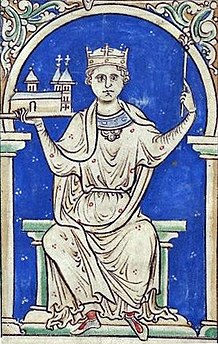
King Stephen

I have always been fascinated by the story of The Anarchy, that period of civil war in 12th century England. Empress Matilda fought her cousin, King Stephen, for the crown of England and the Anglo-Saxon Chronicle famously reported:

… they said openly that Christ and His saints slept. Such things, and more than we know how to tell, we suffered nineteen years for our sins.

The Anglo-Saxon Chronicles, edited and translated by Michael Swanton, p.265

King Stephen of England and his wife, Matilda of Boulogne, had three children who survived infancy, and yet – on his death – Stephen disinherited his surviving son, William, to leave his throne to Henry, Count of Anjou and Duke of Normandy. Henry was the son of Stephen’s bitter enemy, Empress Matilda.

Matilda of Boulogne, herself, was a cousin of Empress Matilda through her mother, Mary of Scotland, sister to the empress’s mother, Matilda of Scotland. Matilda of Boulogne and Empress Matilda were both granddaughters of Malcolm III of Scotland and his saintly wife, Margaret of Wessex; they were nieces of King David I of Scotland.

The Empress was was the only surviving legitimate child of Henry I (reigned 1100-1135), and his designated heir – but she was a woman and England’s nobles were reluctant to be ruled by a woman. This reluctance to allow Matilda to take the throne was heightened by their dislike and distrust of Matilda’s husband, Geoffrey, Count of Anjou. Stephen of Blois was Henry I’s nephew and the son of Henry’s favourite sister, Adela of Normandy. He was one of the old king’s closest male relatives and in the confusion following Henry’s death it was Stephen who took the initiative, acting quickly and decisively, and taking the kingdom of England and the duchy of Normandy for himself.
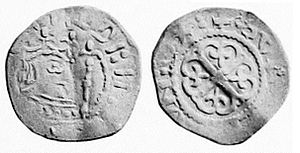
Silver penny of Empress Matilda, from the Oxford mint

What followed was a period known as the Anarchy, almost twenty years of conflict and bloodshed as Stephen and Matilda battled for supremacy. Ultimately, Stephen managed to retain control of England but Matilda’s eldest son, Henry, was eager to win back his birthright.

Following several incursions by Henry – whilst still in his teens – he and Stephen came to an agreement: Stephen would hold the throne until his death, but Henry would succeed him.

So, what happened to Stephen’s children?

Stephen and Matilda had two children, Baldwin and Matilda, who did not survive to adulthood. Matilda was married in 1136, as an infant, to Waleran de Beaumont, eldest twin son of Robert de Beaumont, 1st Earl of Leicester, and Isabel de Vermandois. The poor little girl died the following year, aged only 4.

Eustace IV, Count of Boulogne

The eldest surviving son of Stephen and Matilda was Eustace IV, Count of Boulogne. Eustace was an unpleasant character, by most accounts. The Anglo-Saxon Chronicle called him ‘an evil man’ who ‘robbed the lands and laid heavy taxes upon them’. Henry of Huntingdon’s appraisal of Eustace was almost as damning:

… he was a man proven in military skill, but obdurate against the things of God, very harsh towards the incumbents of churches, very loyal towards those who persecute the Church.

The History of the English People 1000-1154 by Henry of Huntingdon

Eustace was married in Paris, in 1140, to Constance, the only daughter of Louis VI of France and his second wife, Adelaide of Savoy. She was the sister of King Louis VII, the first husband of Eleanor of Aquitaine. Constance ‘was a good woman but enjoyed little happiness with him’. According to the Anglo-Saxon Chronicle:

1140. Then Eustace the king’s son travelled to France and took to wife the sister of the king of France and thought to get Normandy through that, but he had little success, and with just cause, because he was an evil man, because wheresoever he came he did more evil than good; he robbed the lands and laid great taxes on them. He brought his wife to England and put her in the castle at Canterbury. She was a good woman but she had little happiness with him, and Christ did not wish that he should rule long, and he [1153] and his mother [1152] both died.

The Anglo-Saxon Chronicles, edited and translated by Michael Swanton, p.267
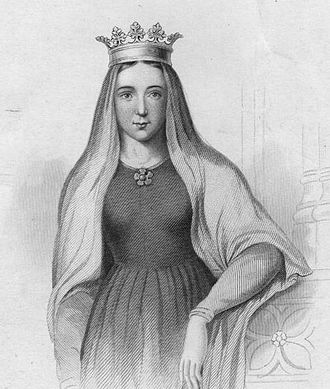
330px-matilda_of_boulogne
Matilda of Boulogne

Stephen made attempts to have Eustace crowned, in his own lifetime, as heir-designate, in order to guarantee his succession. This was blocked by the Papacy; though they supported Stephen as king, over Matilda, they were keen to see the throne return to the senior legitimate line of Henry I through Matilda’s son, Henry.

The young prince had retired from court after a thawing of relations between Stephen and Henry. He was;

‘greatly vexed and angry because the war, in his opinion, had reached no proper conclusion’.

Gesta Stephani

Although Eustace had been recognised, as Stephen’s heir, by the secular baronage, I can’t help thinking that it was a real stroke of luck for England when Eustace died of a seizure or ‘in a fit of madness’ in August 1153. He had recently laid waste to the lands of the abbey of Bury St Edmunds and so some said the revered saint had exacted his revenge. Another theory was that he choked to death and, of course, rumours of poisoning are not surprising. Eustace’s death paved the way for an ‘understanding’, over the succession, between Stephen and Henry of Anjou, in the form of the Treaty of Winchester (or Wallingford, as it is also known). In it, it was agreed that Stephen would remain king for the rest of his life, but would ‘adopt’ seventeen-year-old Henry and recognise him as his heir.

William, Earl of Surrey

Stephen’s youngest son was William, who was born sometime in the mid-1130s. It is thought William was born following Stephen’s accession to the English throne in 1135, as he was named after his great-grandfather, William the Conqueror, King of England and Duke of Normandy, rather than with a name associated with the County of Boulogne, as had his older brothers, Eustace and Baldwin.

Seal of Isabel de Warenne, 4th Countess of Surrey

In 1148 he was married to Isabel de Warenne, sole heiress to William de Warenne, 3rd Earl of Surrey, in order to bring the vast Warenne lands within the influence of the crown. Isabel’s father had departed on the Second Crusade in 1147 and would not return, being killed at the Battle of Mount Cadmus, in Laodicea, in January 1148. Young William was being addressed as an earl even before his father-in-law’s death.1 He would succeed to the County of Boulogne in 1153, on the death of Eustace and the county of Mortain on the death of his father in 1154.

Shortly after his brother’s death, and with the help of the clergy, William made an agreement with Henry of Anjou, whereby he waived his own rights to the crown in return for assurances explicitly recognising his rights to his lands, as Count of Boulogne and Earl of Surrey. Although, it is not known whether he did this willingly, or was persuaded by others, the agreement was an essential tool for the peaceful accession of Henry.

In spite of this agreement, William was implicated in a plot against Henry in early 1154 – or he at least knew about it – in which some Flemish mercenaries planned, but failed, to ambush Henry on the road near Canterbury. There may have been a tit-for-tat retaliation as William’s leg was broken in an ‘accident’ at about the same time.

However, when King Stephen died, William made no attempt to oppose Henry’s accession. In the early years of his reign, Henry acted to curb some of the power and influence William may have wielded by confiscating some of the lands and castles from his patrimony of Mortain, but allowing him to retain the earldom of Surrey, for the most part. William was even knighted by Henry II, after he joined the new king on his campaign against Toulouse.

William died in France, without issue, in 1159, after falling ill at the Siege of Toulouse and was buried in the Hospital of Montmorillon in Poitou, France. He was in his early 20s and left his young wife, Isabel, about the same age, a widow.

Mary of Boulogne
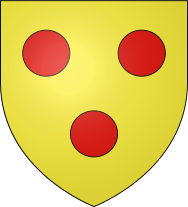
188px-blason_courtenay-svg
Arms of the county of Boulogne

William was succeeded in the County of Boulogne by his sister, Mary, the third surviving child of Stephen and Matilda. Mary was born around 1136 and placed in a convent at an early age. Although it has long been believed that Mary was placed in a convent in England, it now seems likely that she was placed at St Sulpice in Rouen before moving to England in the early 1150s.2 She moved first to the Priory of Lillechurch, Kent, and then to Romsey Abbey, where she was elected Abbess sometime before 1155.

Five years later – shortly after William’s death – Mary was abducted by Matthew of Alsace, second son of the Count of Flanders, and forced to marry him. There was outrage among the clergy – the incident was even discussed by the Pope – but the marriage was allowed to stand, at least until Mary produced an heir to the county of Boulogne. Mary and Matthew had two children – Ida and Mathilde – and it was after the birth of Mathilde that the couple was divorced, in 1170.

Matthew would continue to rule Boulogne and would eventually be succeeded by Ida, his eldest daughter by Mary, on his death in 1173. Mary was allowed to return to the convent life, becoming a Benedictine nun at St Austrebert, Montreuil. She died there in July 1182, aged about 46.

The abduction and forced marriage of Mary may well have been a political move. Although there does not appear to be any proof that Henry II sanctioned it, he certainly benefited from Mary being safely married to a loyal vassal. She was, after all a great heiress and – through her father – a rival claimant to the throne of England.

It is, perhaps, a sad legacy for King Stephen that, after almost 20 years of warfare in order to hold onto his throne, the king was not able to pass it on to any of his children. His sons dying without issue meant that his bloodline continued only through his daughter, Mary, and the County of Boulogne, which Stephen had inherited through his marriage to Matilda.

*

Footnotes: 1 Farrer, William and Charles Travis Clay, editors, Early Yorkshire Charters, Volume 8: The Honour of Warenne; 2 with thanks to historian Sharan Newman

Further reading:

Donald Matthew, King Stephen; Robert Bartlett, England Under the Norman and Angevin Kings; David Williamson, Brewer’s British Royalty; the History Today Companion to British History; Dan Jones, the Plantagenets; englishmonarchs.co.uk; The Oxford Companion to British History; Mike Ashley, The Mammoth Book of British kings & Queens; Alison Weir, Britain’s Royal Families, the Complete Genealogy; Farrer, William and Charles Travis Clay, editors, Early Yorkshire Charters, Volume 8: The Honour of Warenne; Gesta Stephani; Henry of Huntingdon, The History of the English People 1000-1154; J. Sharpe (trans.), The History of the Kings of England and of his Own Times by William Malmesbury; Catherine Hanley, Matilda: Empress, Queen, Warrior; Orderici Vitalis, Historiae ecclesiasticae libri tredecem, translated by Auguste Le Prévost; Chronicles of the Reigns of Stephen, Henry II and Richard I; Edmund King, King Stephen; Donald Matthew, King Stephen; Teresa Cole, the Anarchy: The Darkest Days of Medieval England;  Matthew Lewis, Stephen and Matilda’s Civil War: Cousins of Anarchy.

Pictures courtesy of Wikipedia

*

My Books

Signed, dedicated copies of all my books are available through my online bookshop.

Coming 15 January 2024: Women of the Anarchy

On the one side is Empress Matilda, or Maud. The sole surviving legitimate child of Henry I, she is fighting for her birthright and that of her children. On the other side is her cousin, Queen Matilda, supporting her husband, King Stephen, and fighting to see her own son inherit the English crown. Both women are granddaughters of St Margaret, Queen of Scotland and descendants of Alfred the Great of Wessex. Women of the Anarchy demonstrates how these women, unable to wield a sword, were prime movers in this time of conflict and lawlessness. It show how their strengths, weaknesses, and personal ambitions swung the fortunes of war one way – and then the other.

Available for pre-order from Amberley Publishing and Amazon UK.

Coming on 15 June 2024: Heroines of the Tudor World
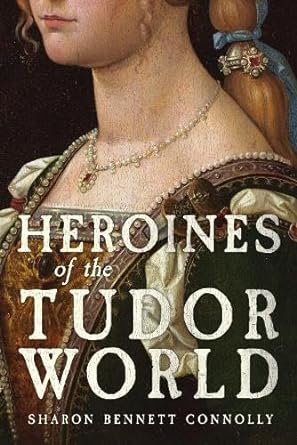
Heroines of the Tudor World tells the stories of the most remarkable women from European history in the time of the Tudor dynasty, 1485-1603. These are the women who ruled, the women who founded dynasties, the women who fought for religious freedom, their families and love. These are the women who made a difference, who influenced countries, kings and the Reformation. In the era dominated by the Renaissance and Reformation, Heroines of the Tudor World examines the threats and challenges faced by the women of the era, and how they overcame them. Some famous, some infamous, some less well known, including Anne Boleyn, Elizabeth Barton, Catherine de Medici, Bess of Hardwick and Elizabeth I. From writers to regents, from nuns to queens, Heroines of the Tudor World shines the spotlight on the women helped to shape Early Modern Europe.

Heroines of the Tudor World is now available for pre-order from Amberley Publishing and Amazon UK.

Also by Sharon Bennett Connolly:

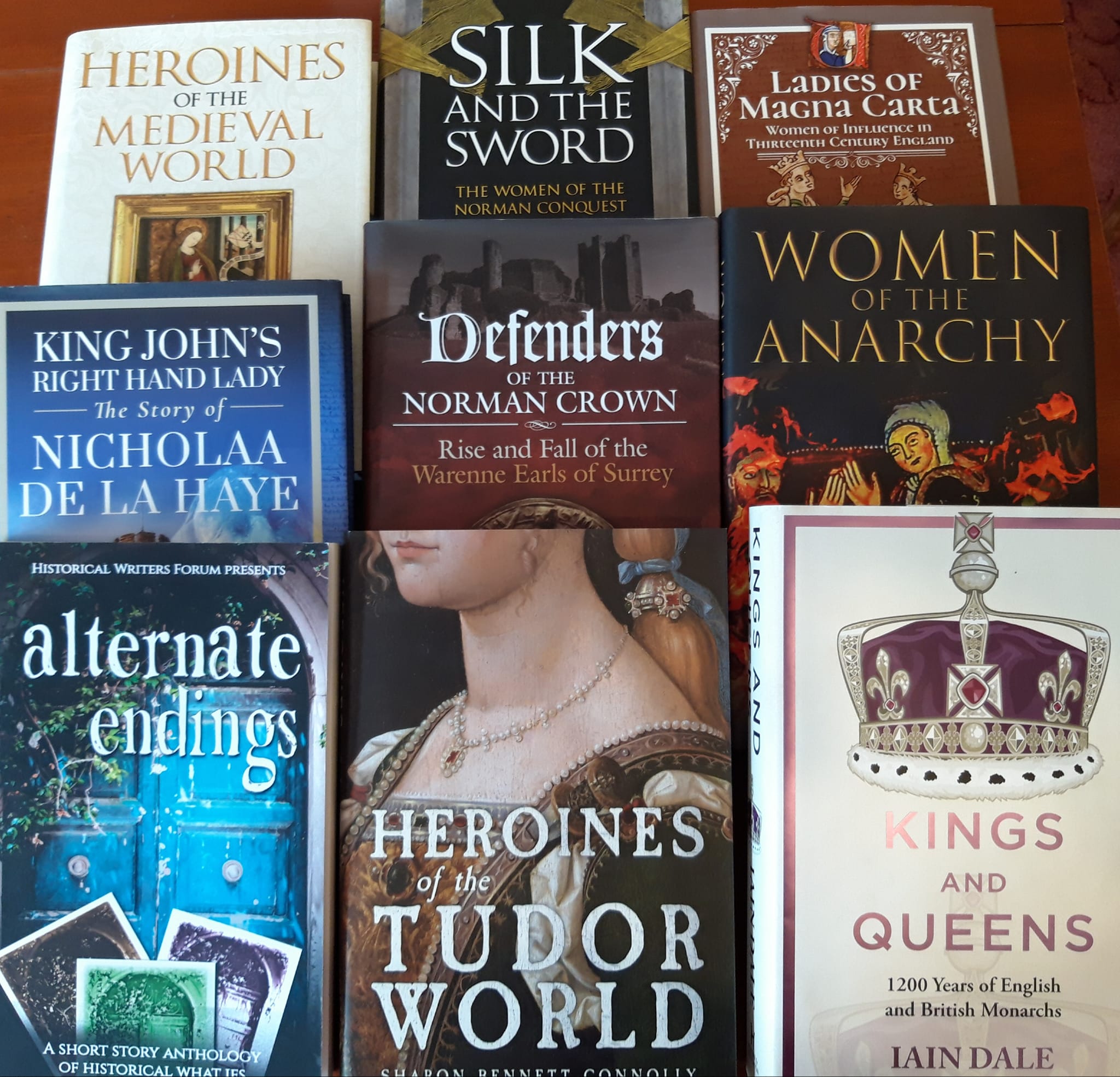
King John’s Right-Hand Lady: The Story of Nicholaa de la Haye is the story of a truly remarkable lady. Nicholaa de la Haye was the hereditary constable of Lincoln Castle and the first woman in England to be appointed sheriff in her own right. Her strength and tenacity saved England at one of the lowest points in its history. Nicholaa de la Haye is one woman in English history whose story needs to be told… King John’s Right-Hand Lady: The Story of Nicholaa de la Haye is now available from Pen & Sword Booksbookshop.org and Amazon.

Defenders of the Norman Crown: The Rise and Fall of the Warenne Earls of Surrey tells the fascinating story of the Warenne dynasty, of the successes and failures of one of the most powerful families in England, from its origins in Normandy, through the Conquest, Magna Carta, the wars and marriages that led to its ultimate demise in the reign of Edward III. Defenders of the Norman Crown: Rise and Fall of the Warenne Earls of Surrey is now available from Pen & Sword BooksAmazon in the UK and US, and Bookshop.org.
Ladies of Magna Carta: Women of Influence in Thirteenth Century England looks into the relationships of the various noble families of the 13th century, and how they were affected by the Barons’ Wars, Magna Carta and its aftermath; the bonds that were formed and those that were broken. It is now available in paperback and hardback from Pen & Sword,  Amazon, and Bookshop.org.

Heroines of the Medieval World tells the stories of some of the most remarkable women from Medieval history, from Eleanor of Aquitaine to Julian of Norwich. Available now from Amberley Publishing and Amazon, and Bookshop.org.

Silk and the Sword: The Women of the Norman Conquest traces the fortunes of the women who had a significant role to play in the momentous events of 1066. Available now from Amazon,  Amberley Publishing, and Bookshop.org.

Alternate Endings: An anthology of historical fiction short stories including Long Live the King… which is my take what might have happened had King John not died in October 1216. Available in paperback and kindle from Amazon.

Podcast:

Have a listen to the A Slice of Medieval podcast, which I co-host with Historical fiction novelist Derek Birks. Derek and I welcome guests, such as Bernard Cornwell, and discuss a wide range of topics in medieval history, from significant events to the personalities involved.

*

Don’t forget! Signed and dedicated copies of all my books are available through my online bookshop.

For forthcoming online and in-person talks, please check out my Events Page.

You can be the first to read new articles by clicking the ‘Follow’ button, liking our Facebook page or joining me on Twitter and Instagram.

*

©2020 Sharon Bennett Connolly FRHistS
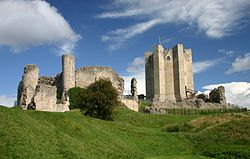
Conisbrough Castle – its Life and History

ConisbroughCastle

Growing up near Conisbrough Castle, South Yorkshire, I did not know much about its history. It was rather underrated. We always thought it was just a bland old place – it was great for exploring and rolling down the hills and playing hide and seek in the inner bailey. However, being so far from London, the centre of power,  it didn’t seem to have much history or national importance. The most famous thing about it was that it was used as the Saxon castle in Sir Walter Scott’s Ivanhoe.

The castle’s early history

English Heritage have spent a lot of money on it in recent years. When I worked there in the early 1990s there was no roof, it was open to the elements, with green moss on the walls and erosion caused by acid rain. And there was just a very narrow walkway around the inside of the keep. It was just a shell. Now it has a roof, floors on every level, sensitive lighting, information videos on each floor and a fantastic little visitor centre with a small museum. It looks so much better (although I still wouldn’t want to stand on the battlements on a windy day like today).

020
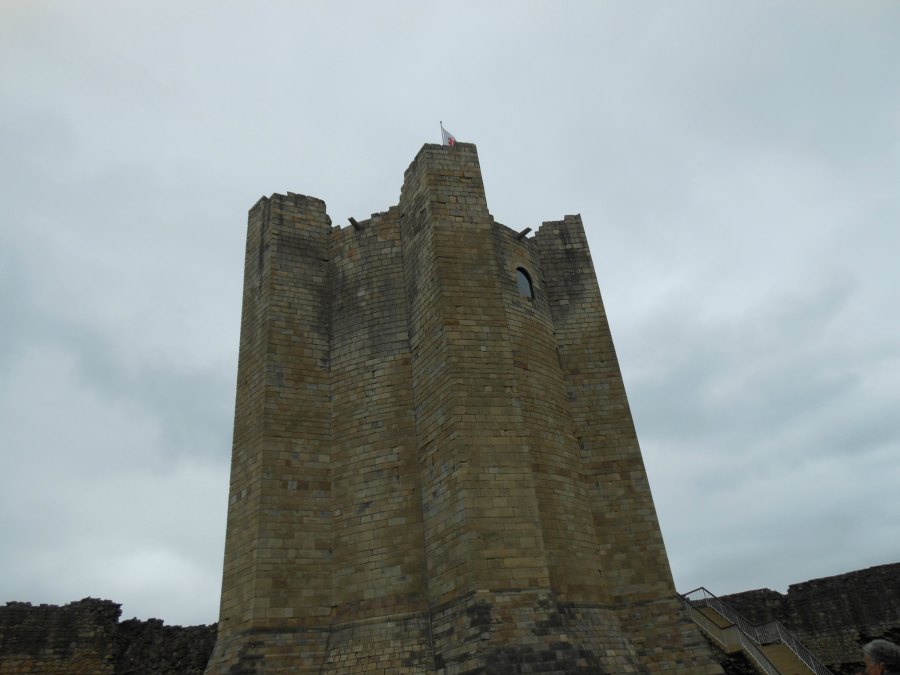
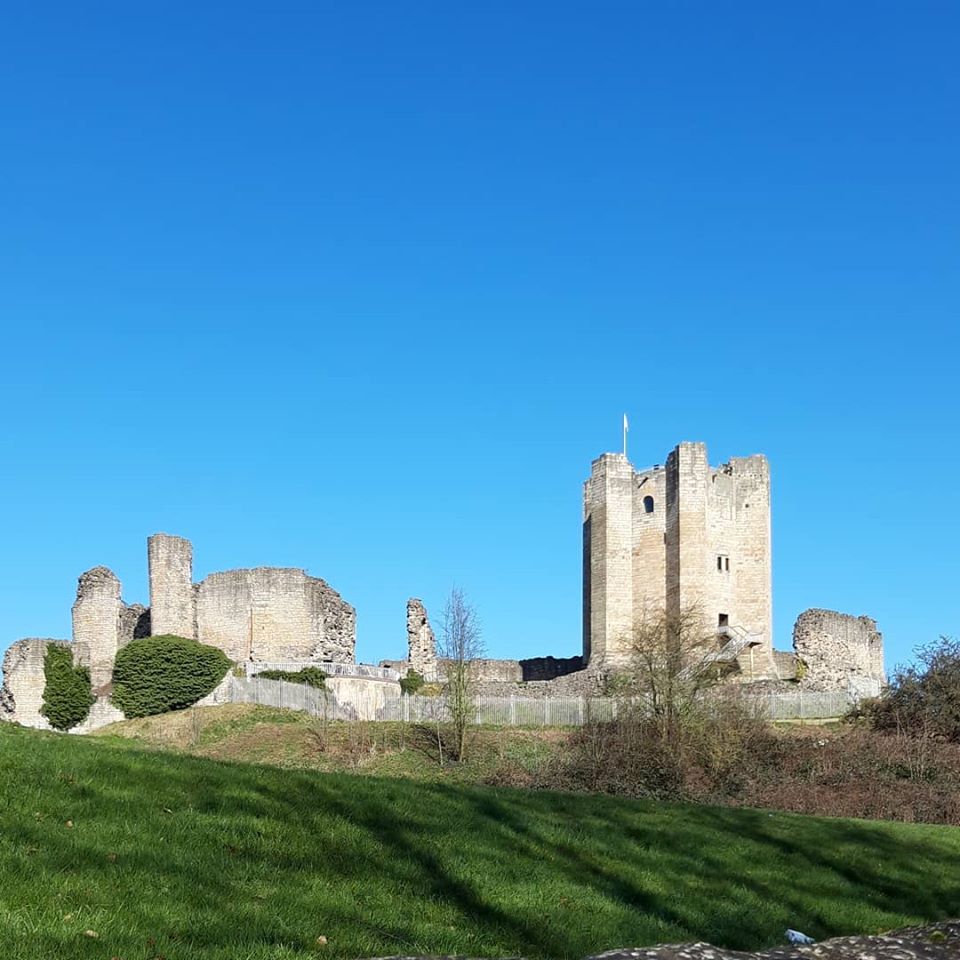
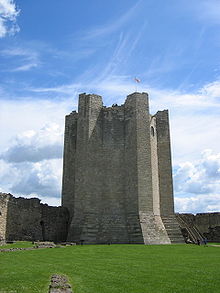
Conisbrough’s hexagonal keep

When I joined the castle team as a volunteer tour guide, I started looking into the actual history of the Castle, seeing it more for what it has been, than for the visitor attraction it is now. Instead of being a forgotten, unimportant little castle in the middle of nowhere, Conisbrough Castle comes to life through the history it has been a part of, and the people who have called it home.

According to Geoffrey of Monmouth, in his Historia Regum Britanniae (History of the Kings of Britain), Conisbrough was founded as ‘Conan’s Burg’ by a British leader called Conan. It was said to have later belonged to Ambrosius Aurelianus, a candidate for the legendary King Arthur. As Geoffrey of Monmouth says, Ambrosius captured the Saxon leader Hengist, once a mercenary for Vortigern, at the battle of ‘Maisbeli.’ And brought him to his stronghold at Conisbrough. Hengist was then beheaded on Ambrosius’ orders and buried at the entrance to the castle of ‘Cunengeburg’, that is Conisbrough. A small hill, locally called Hengist’s Mound, is in the grounds of the outer bailey.

What we know, for certain, is that by 1066 the Honour of Conisbrough belonged to Harold Godwinson, Earl of Wessex and later King Harold II of England, though there is no evidence that he ever visited. On a prominent, steep hill, the castle guards the main road between Sheffield and Doncaster to the east, and the navigable River Don to the north.

010 (2)
The kitchen range in the inner bailey

Following Harold’s defeat and death at the Battle of Hastings, and shortly after the Harrying of the North of 1068 Conisbrough was given to one of William the Conqueror’s greatest supporters, William de Warenne. Warenne was a cousin of Duke William of Normandy and fought alongside him at the Battle of Hastings. He was given land in various counties, including Lewes in Sussex and Conisbrough in Yorkshire; and although he developed his property at Castle Acre in Norfolk, little was done at Conisbrough. In those days the castle itself was little more than a wooden motte and bailey construction, surrounded by wooden palisades and earthworks.

*

A thoroughly modern Castle

It was not until the reign of Henry II that the Castle began to take on the majestic appearance we know today. Conisbrough came into the hands of Hamelin Plantagenet, illegitimate half-brother of King Henry II; Hamelin had married the de Warenne heiress, Isabel, 4th Countess of Warenne and Surrey, and became 4th Earl of Warenne and Surrey by right of his wife.

029
Fireplace in the bedchamber in the keep

It was Hamelin who built the spectacular hexagonal keep that we can see today. The stairs to the keep were originally accessed across a drawbridge, which could be raised in times of attack. The ground floor was used for storage, with a basement storeroom below, housing the keep’s well,  and accessed by ladder.

The first floor holds the great chamber, or solar, with a magnificent fireplace and seating in the glass-less window. According to Margaret Wood’s The English Medieval House, “It has been shown * that the two earliest known examples of a hooded fireplace, at Conisborough [sic] keep (c. 1185)‘ in Yorkshire (PI. XLI p), occur where the circular plan of the room made an arched fireplace difficult to construct. Here a lintel was formed along a chord of the circumference, and the resulting filling above assumed a hooded form.” This is where the Lord would have conducted business, or entertained important guests. Henry II, King John and King Edward II are known to have visited Conisbrough: King John even issued a charter from Conisbrough Castle in March 1201.

030
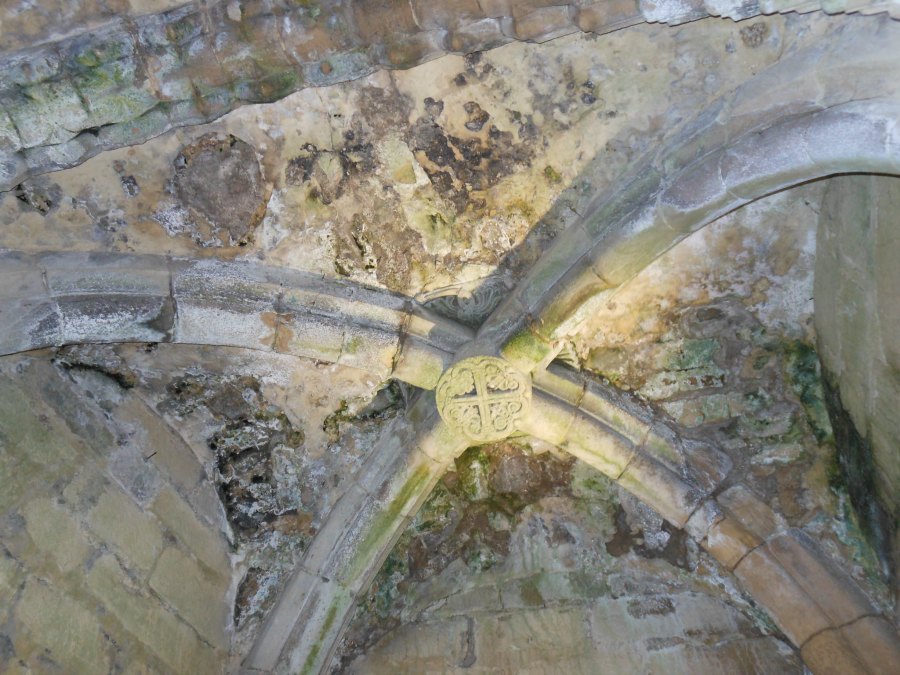
The chapel’s vaulted ceiling

The second floor would have been sleeping quarters for the lord and lady. Both the solar and the bedchamber have impressive fireplaces, garderobes and a stone basin, which would have had running water delivered from a rainwater cistern on the roof.

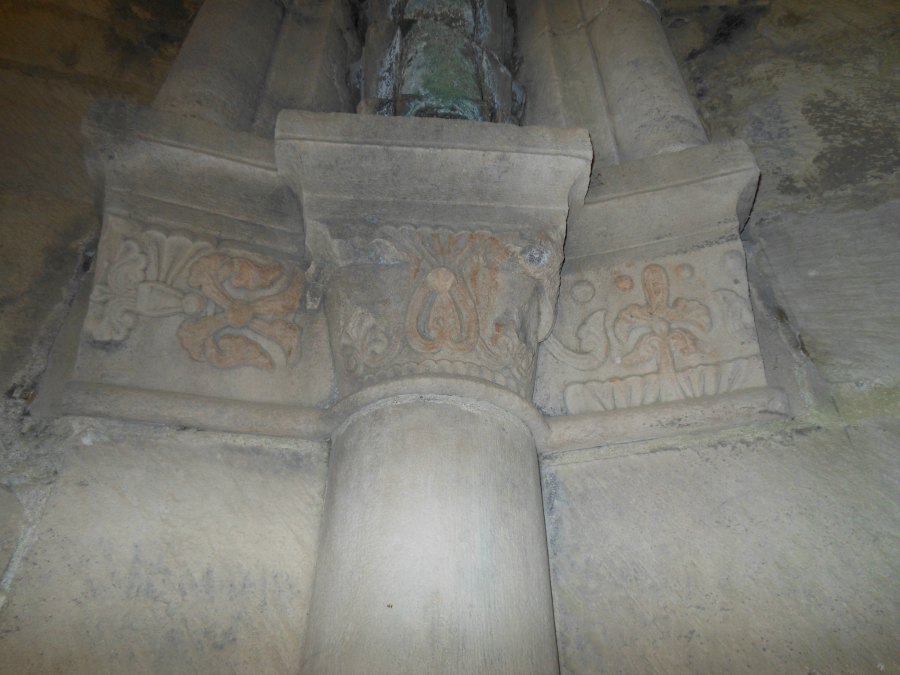
On this floor, also, built into one of the keep’s buttresses is the family’s private chapel. This may well have been the chapel endowed by Hamelin and Isabel in 1189-90, and dedicated to St Philip and St James (although there was a, now lost, second chapel in the inner bailey to which the endowment could refer). The chapel is well-decorated, with quatrefoil windows, elaborate carving on the columns and a wonderful vaulted ceiling.

036
Chapel carvings

There is a small sacristy for the priest, just to the left of the door, with another basin for the priest’s personal use, and cavities for storing the vestments and altar vessels.

The winding stairs, built within the keep’s thick walls, give access to each successive level and, eventually, to the battlements, with a panoramic view of the surrounding area.

These battlements also had cisterns to hold rainwater, a bread oven and weapons storage; and wooden hoardings stretching out over the bailey to aid in defence. The keep and curtain walls – which were built slightly later – were of a state-of-the art design in their day. The barbican, leading into the inner bailey, had 2 gatehouses and  a steep passageway guarded by high walls on both sides; an attacking force would have been defenceless against missiles from above, with nowhere to run in the cramped corridor.

041
View from the battlements

Although the encircling moat is dry (the keep is built high on a hill), all the detritus from the toilets and kitchens drained into it; another little aid to defence – imagine having to attack through that kind of waste?

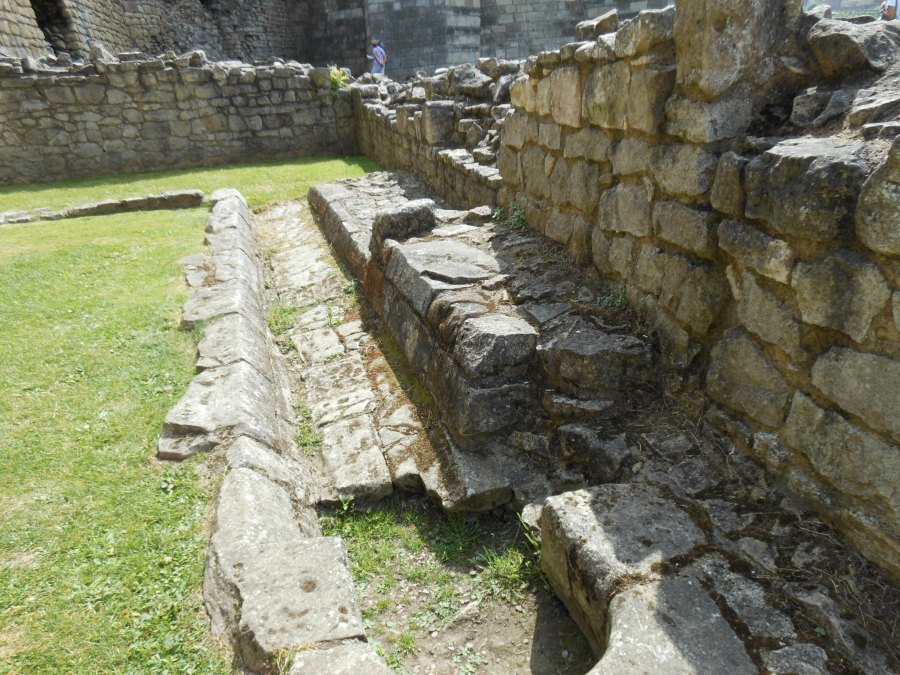
None of the buildings in the inner bailey have survived, although you can see their stone foundations in the ground. Along one wall there were kitchens and service rooms leading into a great hall, with a raised dais at the far end, and a solar and living quarters above. Another range of buildings attached to the western wall also held living quarters, possibly for the garrison and any guests. There’s even a small jail cell just to the side of the barbican.

Although Conisbrough is not a large castle, the extensive range of buildings, the magnificent decorations of the fireplaces and chapel, suggest it would have been impressive in its day; and reflects the importance of the castle’s owners and occupants.

*

The Castle’s Residents

008 (2)
The inner bailey

The Warenne Earls of Surrey were close to the crown, and the centre of government, for the best part 3 centuries. The daughter of the 2nd Earl, Ada, had married the heir to the Scots throne and was mother to 2 Scottish kings; Malcolm the Maiden and William the Lion.

Hamelin’s son and heir, William, 5th Earl of Warenne and Surrey, married Maud Marshal, daughter of the Greatest knight, William Marshal, Earl of Pembroke and Regent during Henry III’s  infancy. A cousin of King John, William was deeply involved in the Magna Carta crisis, though not always in support of his cousin. Their son John, the 6th Earl, was Edward I’s lieutenant in Scotland and beat the Scots at the Battle of Dunbar in 1296, though he had been defeated by William Wallace at Stirling Bridge the following year. John’s daughter, Isabella, married John Balliol, King of Scots, and was mother to Edward Balliol, another Scottish king. John’s sister, Isabel, married Hugh d’Aubigny, 5th Earl of Arundel, and is remembered as the countess who stood up to Henry III, invoking Magna Carta, when he appropriated land that was rightfully hers.

The 7th – and last – Warenne earl, John, was a colourful character who lived through some of the most dramatic events of English history; the reign of Edweard II. John was the grandson of the 6th earl; his father, William de Warenne, had diedbeen killed in a tournament at Croydon, in December 1286, when John was just 6 months old. Although he was married to Joan of Bar, a granddaughter of Edward I, John lived openly with his mistress and made several unsuccessful attempts to obtain a divorce from his wife. A private feud with Thomas Earl of Lancaster saw John arrange the kidnapping of Earl Tomas’ wife, Alice de Lacey, possibly in retaliation for Lancaster standing in the way of Surrey’s longed-for divorce. The result was the 1st – and only – siege of Conisbrough Castle.

Lancaster sent forces to seize the Warenne castles at Sandal and Conisbrough. His men found the gates of Conisbrough closed to them. The castle was defended by only six men, including the town miller and three brothers, Thomas, Henry and William Greathead, who were men-at-arms. The siege lasted less than two hours and the defenders appear to have relinquished the castle after apparently putting up a token resistance; the three brothers were fined for drawing blood. The chapel in the castle’s inner bailey may have been damaged in the brief altercation, as the following year, Lancaster sent orders to his castellan at Conisbrough, John de Lassell, to ‘repailler la couverture de la chapele de Conynggesburgh.’1

028
The bedchamber in the keep, with wash basin and stairway leading to the garderobe and battlements

The last Earl of Surrey died without heirs in 1347 and Conisbrough passed to John de Warenne’s godson, Edmund of Langley, fourth son of Edward III. Edmund’s wife Isabella of Castile gave birth to her 3rd child, Richard Earl of Cambridge (also known as Richard of Conisbrough) at Conisbrough, possibly in the lavish bedchamber within the keep itself. Cambridge had the dubious reputation of being England’s poorest Earl and was executed following his involvement in the Southampton plot against Henry V; however, he is remembered to history as the grandfather of the Yorkist kings, Edward IV and Richard III.

Following Cambridge’s execution for treason in 1415 his 2nd wife, Maud Clifford, made Conisbrough her principal residence until her death in 1446. Maud entertained her Clifford family here and her great-nephew and godson John Clifford, known to Yorkists as the Butcher of Skipton was born there in 1435. In a strange twist of fate, John Clifford is the one accused of murdering the Earl of Cambridge’s 17-year-old grandson Edmund, Earl of Rutland, following the Lancastrian’s defeat of the Yorksists at the Battle of Wakefield on 30 December 1460. Maud died at the castle in August 1446 and is buried in Roche Abbey, about 10 miles from her home.

The castle underwent repairs during the reigns of Edward IV and Richard III, in 1482-3, but by 1538 a survey revealed the it had fallen into neglect and decay, with parts of the curtain wall having slipped down the embankment.

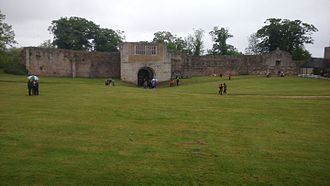
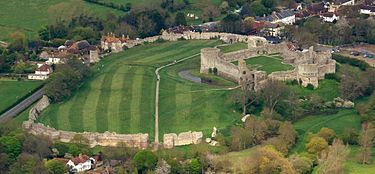
From then on, although it has had successive owners until it came under the protection of English Heritage, Conisbrough Castle has been a picturesque ruin, a wonderful venue for picnics and exploring its many hidden treasures.

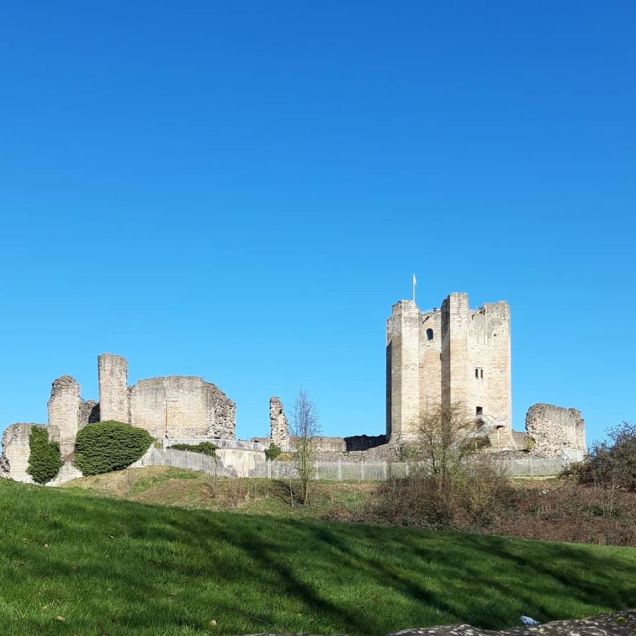
Conisbrough Castle from the outer bailey

*

All photographs are copyright to Sharon Bennett Connolly, 2015.

Footnote:

1 Hunter’s South Yorkshire ii; Deanery of Doncaster ii quoted in F. Royston Fairbank, The Last Earl of Warenne and Surrey, and the Distribution of His Possessions, Yorkshire Archaeological Journal, p. 213

*

Sources:

Further reading: East Yorkshire Charters Volume 8: The Honour of Warenne, edited by William Farrer & Charles Travis Clay; English Heritage Guidebook for Conisbrough Castle by Steven Brindle and Agnieszka Sadrei; English Tourist Board’s English Castles Almanac; The English Medieval House by Margaret Wood; http://www.kristiedean.com/butcher-skipton; On the Trail of the Yorks by Kristie Dean; F. Royston Fairbank, The Last Earl of Warenne and Surrey, and the Distribution of His Possessions, Yorkshire Archaeological Journal.

*

My Books

Defenders of the Norman Crown: The Rise and Fall of the Warenne Earls of Surrey tells the fascinating story of the Warenne dynasty, of the successes and failures of one of the most powerful families in England, from its origins in Normandy, through the Conquest, Magna Carta, the wars and marriages that led to its ultimate demise in the reign of Edward III.

1 family. 8 earls. 300 years of English history!

Defenders of the Norman Crown: Rise and Fall of the Warenne Earls of Surrey will be released in the UK on 31 May and in the US on 6 August. And it is now available for pre-order from Pen & Sword BooksAmazon in the UK and US and Book Depository.

Also by Sharon Bennett Connolly:

Ladies of Magna Carta: Women of Influence in Thirteenth Century England looks into the relationships of the various noble families of the 13th century, and how they were affected by the Barons’ Wars, Magna Carta and its aftermath; the bonds that were formed and those that were broken. It is now available from Pen & Sword,  Amazon and from Book Depository worldwide.

Heroines of the Medieval World tells the stories of some of the most remarkable women from Medieval history, from Eleanor of Aquitaine to Julian of Norwich. Available now from Amberley Publishing and Amazon and Book Depository.

Silk and the Sword: The Women of the Norman Conquest traces the fortunes of the women who had a significant role to play in the momentous events of 1066.  Available now from Amazon,  Amberley Publishing, Book Depository.

*

You can be the first to read new articles by clicking the ‘Follow’ button, liking our Facebook page or joining me on Twitter and Instagram.

©2020 Sharon Bennett Connolly

Isabel de Warenne, Countess of Surrey

025
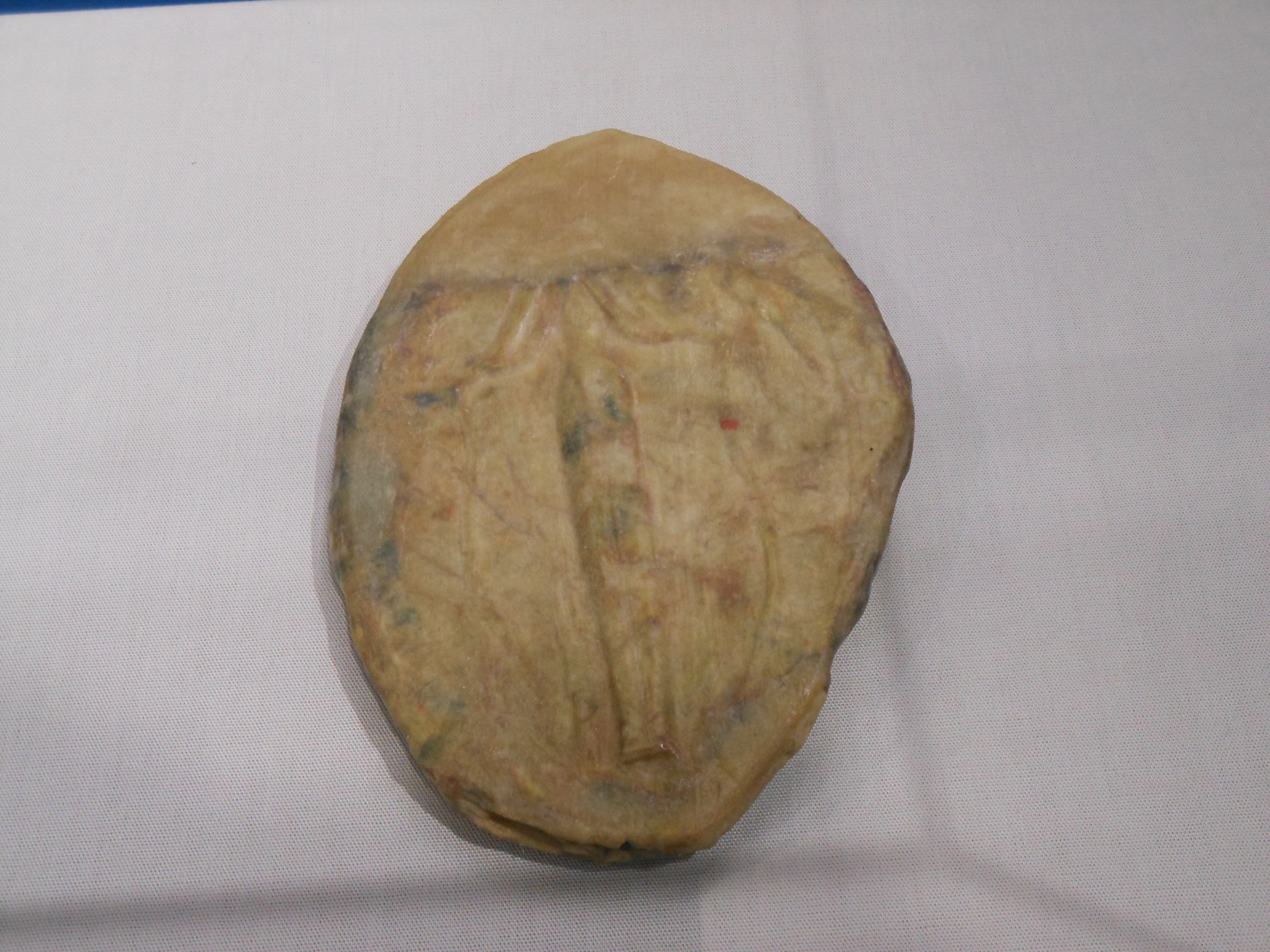
Seal of Isabel de Warenne, Conisbrough Castle

Isabel de Warenne was the only surviving child of William de Warenne, 3rd Earl of Warenne and Surrey, and his wife Adela, or Ela, de Talvas, daughter of William III of Ponthieu. When her father died on the Second Crusade to the Holy Land, in around 1148, Isabel became 4th Countess of Surrey, in her own right, and one of the most prized heiresses in England and Normandy, with large estates in Yorkshire.

Isabel was born during a period of civil war in England, a time known as The Anarchy (c.1135-54), when King Stephen fought against Empress Matilda, the daughter of Henry I, for the right to rule England. Isabel’s father, William, was a staunch supporter of the king and had fought at the Battle of Lincoln in February 1141, though without distinction; his men were routed early on in the battle and William was among a number of earls who fled the field. He later redeemed himself that summer by capturing Empress Matilda’s brother and senior general, Robert Earl of Gloucester, at Winchester.

The earl appears to have tired of the civil war in 1147 and departed on Crusade with his half-brother, Waleran de Beaumont, Count of Meulan, and their cousin, King Louis VII of France. In the same year, as part of King Stephen’s attempts to control the vast de Warenne lands during a crucial time in the Anarchy, Earl Warenne’s only daughter, Isabel, was married to Stephen’s younger son, William of Blois, who would become Earl by right of his wife, following the 3rd earl’s death on Crusade in 1148; the earl was killed fighting in the doomed rearguard at the Battle of Mount Cadmus near Laodicea in January 1148.

Lewes Priory

It has been suggested that William of Blois was some 7 or 8 years younger than his wife, Isabel. However, this seems improbable and it appears more likely that the young couple were of similar ages. Isabel’s father had been born in 1119 and was no older than 29 when he died; his wife, Ela de Talvas, was a few years younger than her husband. This means that, even if the couple married as soon as they reached the ages allowed by the church, 12 for a girl and 14 for a boy, which would have been 1133 at the earliest, and Ela fell pregnant on her wedding night, Isabel could have been no older 13 in 1147. Given the danger associated with girls giving birth before their teens, it seems plausible that Isabel was not born until the late 1130s and may have been between 10 and 12, or younger when she married William of Blois.

Even before it was known that Earl Warenne had died on crusade, William of Blois was already being referred to as earl in a number of charters relating to Warenne lands, one such charter, dated to c.1148, was issued with the proviso ‘that if God should bring back the earl [from the crusade] he would do his best to obtain the earl’s confirmation, or otherwise that of his lord earl William, the king’s son.’1

During the 3rd earl’s absence, and while the new earl and countess were still only children, the vast Warenne lands were administered by the 3rd earl’s youngest brother, Reginald de Warenne, Baron Wormegay, who was a renowned and accomplished administrator and estate manager. We do not know when news reached England of the earl’s death, the tidings may have arrived before the return of the earl’s half-brother, Waleran, later in the year. However, the future of the earldom was already secure with the succession of Isabel and her young husband, carefully watched over by Isabel’s uncle, Reginald.

In August 1153 the young couple’s future prospects could have changed drastically when William’s elder brother Eustace, their father’s heir, died. As a consequence, William inherited his mother’s County of Boulogne from his brother, adding to his already substantial domains. He may also have expected to inherit his brother’s position as heir to the throne – or not. It seems that William’s ambitions did not extend to the lofty heights of the throne, or he was not considered suitable for the crown. Either way, the young man was removed from the succession to the crown by his own father, when Stephen made a deal with Empress Matilda’s son, Henry of Anjou, that the throne would go to him on Stephen’s death, thus returning the crown to the rightful line of succession.

William seems to have accepted this, on the whole. Although there is some suggestion of his involvement in a plot against Henry later in 1154, during which William suffered a broken leg, he served Henry loyally, once he became king, until his own death, returning from the king’s campaign in Toulouse, in 1159.

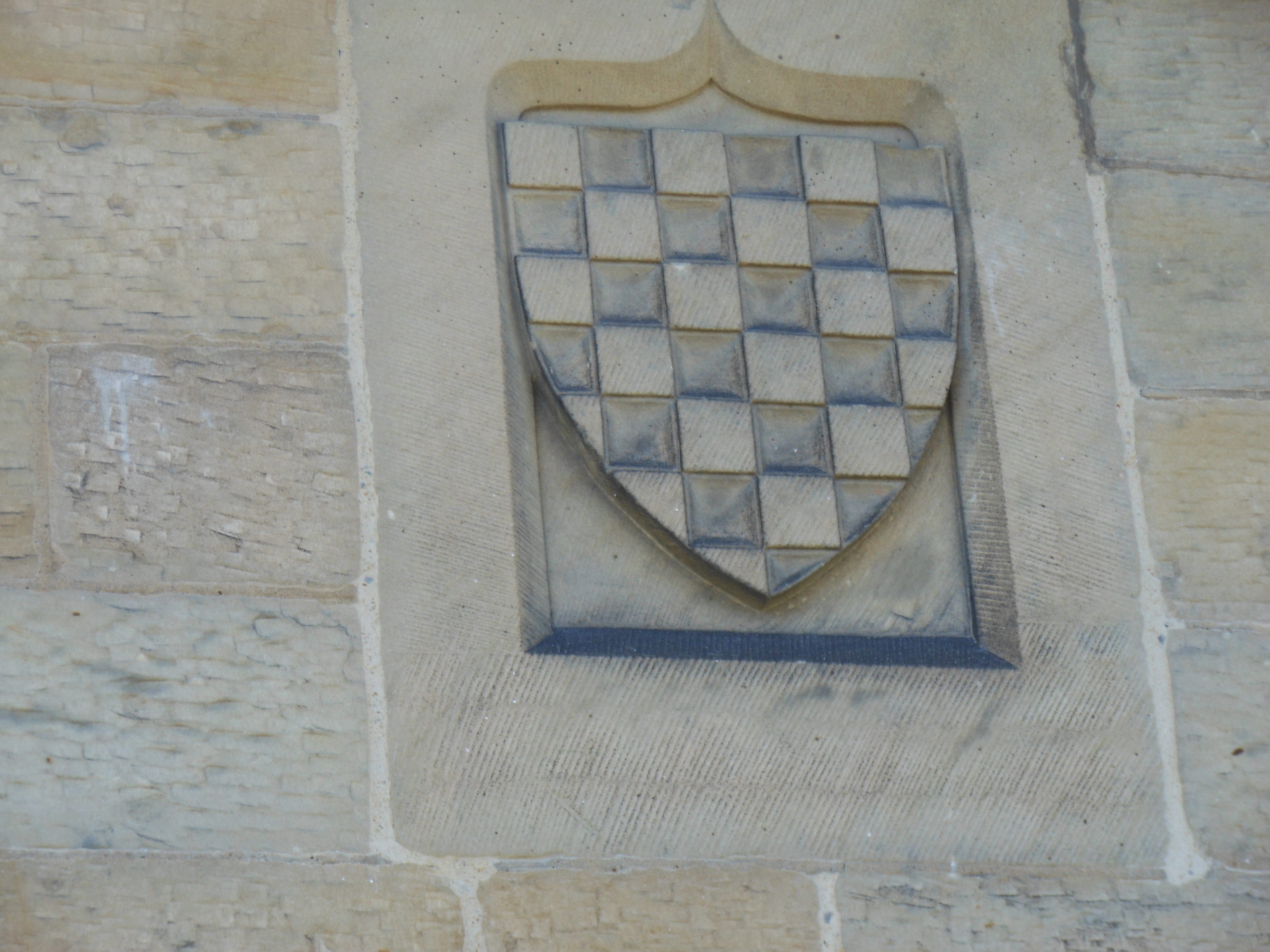
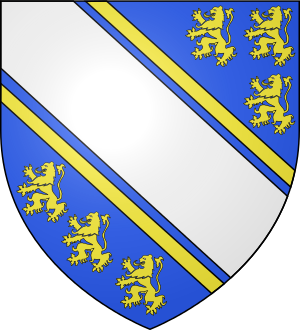
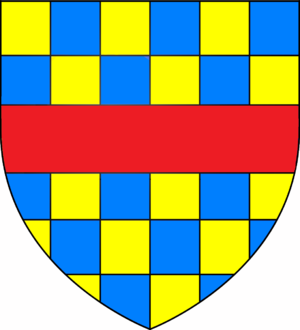
The Warenne coat of arms

Now in her mid-20s, and as their marriage had been childless, Isabel was once again a prize heiress. Although she seems to have had a little respite from the marriage market, by 1162 Henry II’s youngest brother, William X, Count of Poitou, was seeking a dispensation to marry her. The dispensation was refused by Thomas Becket, Archbishop of Canterbury, on the grounds of consanguinity; the archbishop’s objection was not that Isabel and William were too closely related, but that William and Isabel’s first husband had been cousins. William died shortly after the archbishop refused to sanction the marriage – it is said, of a broken heart.

King Henry was not to be thwarted so easily in his plans to bring the Warenne lands into the royal family, and his illegitimate half-brother, Hamelin, was married to Isabel in 1164. Hamelin was the son of Herny’s father, Geoffrey, Count of Anjou, and an unknown woman, born around 1130, in the time when Geoffrey and Empress Matilda were estranged. In an unusual step, Hamelin took his wife’s surname and bore the titles Earl of Warenne and Surrey in her right.

The marriage appears to have been highly successful. Hamelin was loyal to his brother and his nephew, Richard I, and played a prominent part in English politics whilst Richard was absent on the 3rd Crusade. He also built the highly innovative keep at Conisbrough in the 1170s and 1180s.

220px-Conisbrough_keep
The keep at Conisbrough Castle

Isabel and Hamelin had four surviving children. Their son and heir, William, would become the 5th Earl of Surrey and married Matilda Marshal, daughter of the great William Marshal, Earl of Pembroke and regent for King Henry III. There were also three daughters, Ela, Isabel and Matilda. It has been suggested that Matilda was Hamelin’s daughter by a previous relationship, but this theory is based on an erroneous death date for her husband. One of the daughters – although it is not clear which – bore an illegitimate son, Richard Fitzroy, by her cousin, John (the future King John).

Isabel died in her mid-60s, in 1203, and was buried at Lewes Priory, alongside Hamelin, who had died the previous year. In 1202, Countess Isabel had granted ‘for the soul of her husband earl Hamelin, to the priory of St Katherine, Lincoln, of similar easements for 60 beasts, namely for 40 as of his gift and 20 as of hers.’2

*

Footnotes: 1 Farrer, William and Charles Travis Clay, editors, Early Yorkshire Charters, Volume 8: The Honour of Warenne; 2 ibid

Sources: Robert Batlett, England Under the Norman and Angevin Kings; Dan Jones, The Plantagenets; Donald Matthew, King Stephen; Medieval Lands Project on the Earls of Surrey, Conisbrough Castle; Farrer, William and Charles Travis Clay, editors, Early Yorkshire Charters, Volume 8: The Honour of Warenne; Morris, Marc King John: Treachery, Tyranny and the Road to Magna Carta; Church, Stephen, King John: England, Magna Carta and the Making of a Tyrant; doncasterhistory.co.uk

Photos: All images © Sharon Bennett Connolly 2015.

*

My Books

Signed, dedicated copies of all my books are available through my online bookshop.

Coming 15 January 2024: Women of the Anarchy

On the one side is Empress Matilda, or Maud. The sole surviving legitimate child of Henry I, she is fighting for her birthright and that of her children. On the other side is her cousin, Queen Matilda, supporting her husband, King Stephen, and fighting to see her own son inherit the English crown. Both women are granddaughters of St Margaret, Queen of Scotland and descendants of Alfred the Great of Wessex. Women of the Anarchy demonstrates how these women, unable to wield a sword, were prime movers in this time of conflict and lawlessness. It show how their strengths, weaknesses, and personal ambitions swung the fortunes of war one way – and then the other.

Available for pre-order from Amberley Publishing and Amazon UK.

Coming on 15 June 2024: Heroines of the Tudor World

Heroines of the Tudor World tells the stories of the most remarkable women from European history in the time of the Tudor dynasty, 1485-1603. These are the women who ruled, the women who founded dynasties, the women who fought for religious freedom, their families and love. These are the women who made a difference, who influenced countries, kings and the Reformation. In the era dominated by the Renaissance and Reformation, Heroines of the Tudor World examines the threats and challenges faced by the women of the era, and how they overcame them. Some famous, some infamous, some less well known, including Anne Boleyn, Elizabeth Barton, Catherine de Medici, Bess of Hardwick and Elizabeth I. From writers to regents, from nuns to queens, Heroines of the Tudor World shines the spotlight on the women helped to shape Early Modern Europe.

Heroines of the Tudor World is now available for pre-order from Amberley Publishing and Amazon UK.

Also by Sharon Bennett Connolly:

King John’s Right-Hand Lady: The Story of Nicholaa de la Haye is the story of a truly remarkable lady, the hereditary constable of Lincoln Castle and the first woman in England to be appointed sheriff in her own right. It is is available from Pen & Sword Booksbookshop.org and Amazon. Defenders of the Norman Crown: The Rise and Fall of the Warenne Earls of Surrey tells the fascinating story of the Warenne dynasty, from its origins in Normandy, through the Conquest, Magna Carta, the wars and marriages that led to its ultimate demise in the reign of Edward III. Available from Pen & Sword BooksAmazon in the UK and US, and Bookshop.org.

Ladies of Magna Carta: Women of Influence in Thirteenth Century England looks into the relationships of the various noble families of the 13th century, and how they were affected by the Barons’ Wars, Magna Carta and its aftermath; the bonds that were formed and those that were broken. It is now available in paperback and hardback from Pen & Sword,  Amazon, and Bookshop.org. Heroines of the Medieval World tells the stories of some of the most remarkable women from Medieval history, from Eleanor of Aquitaine to Julian of Norwich. Available now from Amberley Publishing and Amazon, and Bookshop.org. Silk and the Sword: The Women of the Norman Conquest traces the fortunes of the women who had a significant role to play in the momentous events of 1066. Available now from Amazon,  Amberley Publishing, and Bookshop.org.

Alternate Endings: An anthology of historical fiction short stories including Long Live the King… which is my take what might have happened had King John not died in October 1216. Available in paperback and kindle from Amazon.

Podcast:

Have a listen to the A Slice of Medieval podcast, which I co-host with Historical fiction novelist Derek Birks. Derek and I welcome guests, such as Bernard Cornwell and Elizabeth Chadwick, and discuss a wide range of topics in medieval history, from significant events to the personalities involved.

*

Don’t forget! Signed and dedicated copies of all my books are available through my online bookshop.

For forthcoming online and in-person talks, please check out my Events Page.

*You can be the first to read new articles by clicking the ‘Follow’ button, liking our Facebook page or joining me on Twitter and Instagram.

Article: 2020 © Sharon Bennett Connolly FRHistS

David Hey Memorial Lecture

It was an honour and a privilege to be asked to present the David Hey Memorial Lecture for the Doncaster Local Heritage Festival 2020. Due to the current Coronavirus outbreak, the lecture was moved online and broadcast via You Tube.

Conisbrough Castle

To keep it relevant with Doncaster and South Yorkshire, I decided to talk about one of my favourite subjects, and my current research project; the Warennes, the earls of Surrey who held Conisbrough from the Norman Conquest until the death of the last earl in 1347.

A family at the centre of English history for almost 300 years. It is a story of strong family loyalties, national and international rivalries, rebellion and civil wars, lost loves and royal connections. It’s also the story of Conisbrough’s iconic castle!

This talk is dedicated to David Hey. In the 1970s he was one of few professional historians to respond in a positive way to the growing interest in family and local history. David was a highly regarded and pioneering figure in this field.He held posts of importance such as being Professor of Local and Family History at the University of Sheffield and President of the British Association of Local History. But he was first and foremost a Yorkshireman at heart and never forgot his roots. He was the Patron of the Doncaster and District Heritage Association and gave a talk at the 2013 Heritage Festival.

So, here it is:

I hope you enjoyed it!

I would like to express my immense gratitude to the Doncaster Local Heritage Festival for inviting me to present such a prestigious lecture. I truly hope I did justice to the memory of David Hey.

*

My Books

Coming soon! 

Ladies of Magna Carta: Women of Influence in Thirteenth Century England will be released in the UK on 30 May 2020 and is now available for pre-order from Pen & SwordAmazon UK and from Book Depository worldwide. It will be released in the US on 2 September and is available for pre-order from Amazon US.

Also by Sharon Bennett Connolly:

Silk and the Sword: The Women of the Norman Conquest traces the fortunes of the women who had a significant role to play in the momentous events of 1066.  Available now from Amazon UK,  Amberley Publishing, Book Depository and Amazon US.

Heroines of the Medieval World tells the stories of some of the most remarkable women from Medieval history, from Eleanor of Aquitaine to Julian of Norwich. Available now from Amberley Publishing and Amazon UK, Amazon US and Book Depository.

*

You can be the first to read new articles by clicking the ‘Follow’ button, liking our Facebook page or joining me on Twitter and Instagram.

©2020 Sharon Bennett Connolly 

The Struggles of Alice

tickhill_castle
The bailey of Tickhill Castle, South Yorkshire

Alice, Countess of Eu, was born into 2 of the noblest families of England and France, and married into a third. The daughter of Henry, Count of Eu and Lord Hastings, her mother was Matilda, daughter of Hamelin and Isabel de Warenne, Earl and Countess of Surrey.

Through her maternal grandparents, Alice was closely related to the kings of England. Her grandfather, Hamelin, was the illegitimate  half-brother of King Henry II of England. Richard I and King John, therefore, were her cousins. Alice’s grandmother, Isabel de Warenne, had been one of the richest, most prized heiresses in England and had first been married to the younger son of King Stephen, before she married Hamelin.

Alice’s father, Henry, held lands in England and Normandy. The Honour of Tickhill, in Yorkshire, had been granted to Henry’s father John, Count of Eu, by King Stephen, in 1139, after proving his rights as heir to the original owners, the de Busil family, through Beatrice, the sister of Roger de Busil, who died in 1102. However, in 1141, Empress Matilda captured the castle after Count John was taken prisoner at the Battle of Lincoln. The castle seems to have stayed in  royal hands for many years afterwards, with Richard I taking possession on his accession; he then gave it to his brother John, as part of his holdings. As a consequence, the castle was besieged by the Bishop of Durham when John rebelled against Richard in 1194 and was surrendered only when the king returned to England following his capture and imprisonment in Germany, 3 years after Henry’s death.

Matilda and Henry had 4 children, 2 sons and 2 daughters. Alice was the eldest of the daughters, her sister Jeanne being younger. Sadly, both sons, Raoul and Guy, died young and in consecutive years, with Guy dying in 1185 and Raoul in 1186, leaving Alice as heir to her father’s lands.

Alice’s father died in 1191, and Alice became suo jure Countess of Eu and Lady Hastings. Alice’s mother, Matilda, later married again; her second husband was Henry d’Estouteville of Eckington, Lord of Valmont and Rames in Normandy. Matilda had a son, John, by d’Estouteville, and it was Alice’s half-brother, therefore, who became the heir to all the lands Matilda held in her own right, leaving Alice solely with the inheritance from her father.

Very little is known of Alice’s early years; we do not even have a year for her birth. Given that her grandparents did not marry until 1164, her parents would not have married until the early 1180s, which would mean is likely that Alice was born sometime around the mid-1180s. On her father’s death in 1191, she came into possession of lands in both England and Normandy, France. In August, 1209, Alice officially received the Comté of Eu from Philip II Augustus, King of France, when she also made a quitclaim of all rights to Neufchatel, Mortemer and Arques. Mortemer was a part of the de Warenne ancestral lands in Normandy, given to William I de Warenne by Willliam the Conqueror; suggesting that Alice was renouncing her own rights to the French de Warenne lands, as a granddaughter of Isabel de Warenne, Countess of Surrey.

Alice made a prestigious marriage to Raoul de Lusignan, the brother of Hugh IX de Lusignan and a powerful Poitevin lord. It was Raoul’s nephew, Hugh X, who would repudiate Joanna, the daughter of King John, in order to marry the dead king’s widow and queen, Isabelle d’Angoulême.

Raoul had been previously married to Marguerite de Courtney, but the marriage had been annulled by 1213, suggesting Alice and Raoul married around that time. On marrying Alice, Raoul became Raoul I, Count of Eu by right of his wife.

Arms of Humphrey de Bohun, 2nd Earl of Hereford and Earl of Essex, Constable of England

Raoul and Alice had four children together. Raoul II de Lusignan, Count of Eu and Guînes, was married 3 times and had one daughter, Marie de Lusignan, by his second wife, Yolande de Dreux. Raoul died sometime between 1245 and 1250 and was buried at the Abbey of Foucarmont. Mathilde married Humphgrey de Bohun, 2nd Earl of Hereford and Earl of Essex, and had 7 children together, including 4 boys. Mathilde died in August 1241 and was buried in Llanthony Secunda Priory, Gloucester. Her husband was buried beside her when he died in September 1275. Another son, Guerin (or Warin) de Lusignan died sometime after 29 September 1217, when he is granted the castle at Tickhill by Henry III. A second daughter, Jeanne, is mentioned in the necrology of the church of Eu, which records the anniversary of her death as 3 October, though no year is given.

In 1214 Alice, as Countess of Eu, was restored to the Honour of Tickhill by King John as part of the conditions of an agreement with her husband’s family, the de Lusignans. However, Robert de Vipont, who was in physical possession of the castle, refused to relinquish it, and claimed the castle in his own right. It took many years and much litigation before Alice finally took possession of the castle in 1222. Her husband, Raoul, died on 1st May, 1219, and was succeeded as Count of Eu by their son, Raoul II, still only a child.

It was left to Alice, now Dowager Countess, to administer the Eu inheritance. She paid 15,000 silver marks to the French King to receive the county of Eu in her own name and regained control of her English lands, entrusted to her uncle, the Earl of Surrey, as her representative, following her husband’s death.

Alice was a shrewd political survivor. However, with lands in France and England, two countries often at war, she found herself caught between a rock and a hard place. In 1225 she handed Tickhill Castle to Henry III, until the end of hostilities with France, as a means of safeguarding her lands. Nevertheless, this did not save her when she was ordered to levy troops for the French king, Louis IX, as Countess of Eu, and send her forces to fight for him. Henry III seized Tickhill Castle, although it was only permanently attached to the English crown after Alice’s death.

Alice was renowned for her wide patronage, both secular and religious, and has left numerous charters as testament. She was a benefactor of both French and English religious houses, including Battle Abbey and Christ Church, Canterbury in England and Eu and Foucarmont – where her son would be laid to rest – in France. Alice issued a charter in 1219, to Roche Abbey, which was witnessed by her uncle William, Earl de Warenne. She also granted an annual allowance to Loretta, Countess of Leicester, who was living as a recluse at Hackington.

Alice also granted several lands to others, such as Greetwell in the county of Lincoln, which had previously been held by Walter de Tylly in Alice’s name and was given to Earl de Warenne in August 1225; the earl was to annually render a sparrowhawk to Philippa de Tylly in payment.  In 1232 Alice issued a charter to Malvesin de Hersy, of Osberton in the county of Nottingham, providing him with all customs due to Tickhill in return for 2 knights’ fees. Malvesin had been constable of Tickhill in 1220-1 and his brother Sir Baldwin de Hersy was Constable of Consibrough Castle, seat of Earl de Warenne.

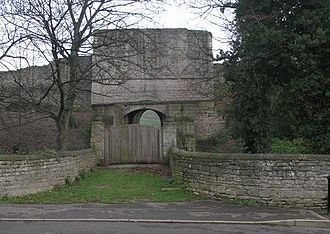
The gatehouse of Tickhill Castle

Having spent most of her life fighting for her rights to her lands in England and France, caught between 2 great nations, whose relations were acrimonious to say the least, Alice appears to have conducted herself admirably. Her connections to the powerful de Lusignan and de Warenne families could not have harmed her situation.

Now in her early 60s, and having been a widow for almost 30 years, Alice died sometime in May 1246, probably between the 13th and 15th, at La Mothe St Héray in Poitou, France, leaving a will. It seems likely that she was buried at her husband’s foundation of Fontblanche Priory in Exoudon.

*

Alice’s story features in my book, Defenders of the Norman Crown: Rise and Fall of the Warenne Earls of Surrey.

Pictures courtesy of Wikipedia.

*

Sources: Early Yorkshire Charters Volume 8: The Honour of Warenne, Edited by William Farrer and Charles Travis Clay; England Under the Norman and Angevin Kings by Robert Bartlett; Brewer’s British Royalty by David Williamson; Britain’s Royal Families, the Complete Genealogy by Alison Weir; british-history.ac.uk; kristiedean.com; English Heritage Guidebook for Conisbrough Castle by Steven Brindle and Agnieszka Sadrei; oxforddnb.com; Tickhill Castle Guide Leaflet, Lords of the Honour of Tickhill; fmg.ac.

*

My Books

Signed, dedicated copies of all my books are available through my online store.

OUT NOW! Heroines of the Tudor World

Heroines of the Tudor World tells the stories of the most remarkable women from European history in the time of the Tudor dynasty, 1485-1603. These are the women who ruled, the women who founded dynasties, the women who fought for religious freedom, their families and love. These are the women who made a difference, who influenced countries, kings and the Reformation. In the era dominated by the Renaissance and Reformation, Heroines of the Tudor World examines the threats and challenges faced by the women of the era, and how they overcame them. From writers to regents, from nuns to queens, Heroines of the Tudor World shines the spotlight on the women helped to shape Early Modern Europe.

Heroines of the Tudor World is now available for pre-order from Amberley Publishing and Amazon UK.

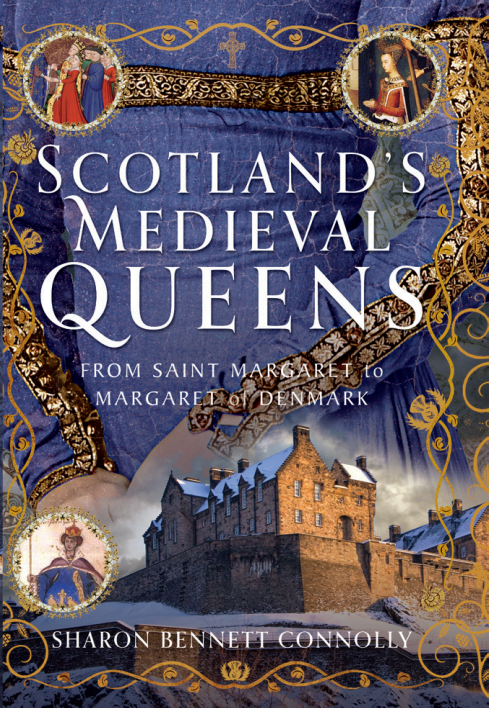
Coming 30 January 2025: Scotland’s Medieval Queens

Scotland’s history is dramatic, violent and bloody. Being England’s northern neighbour has never been easy. Scotland’s queens have had to deal with war, murder, imprisonment, political rivalries and open betrayal. They have loved and lost, raised kings and queens, ruled and died for Scotland. From St Margaret, who became one of the patron saints of Scotland, to Elizabeth de Burgh and the dramatic story of the Scottish Wars of Independence, to the love story and tragedy of Joan Beaufort, to Margaret of Denmark and the dawn of the Renaissance, Scotland’s Medieval Queens have seen it all. This is the story of Scotland through their eyes.

Available for pre-order now.

Also by Sharon Bennett Connolly:

Women of the Anarchy demonstrates how Empress Matilda and Matilda of Boulogne, unable to wield a sword themselves, were prime movers in this time of conflict and lawlessness. It shows how their strengths, weaknesses, and personal ambitions swung the fortunes of war one way – and then the other. Available from Bookshop.orgAmberley Publishing and Amazon UKKing John’s Right-Hand Lady: The Story of Nicholaa de la Haye is the story of a truly remarkable lady, the hereditary constable of Lincoln Castle and the first woman in England to be appointed sheriff in her own right. Available from all good bookshops Pen & Sword Booksbookshop.org and AmazonDefenders of the Norman Crown: The Rise and Fall of the Warenne Earls of Surrey tells the fascinating story of the Warenne dynasty, from its origins in Normandy, through the Conquest, Magna Carta, the wars and marriages that led to its ultimate demise in the reign of Edward III. Available from Pen & Sword BooksAmazon in the UK and US, and Bookshop.org

Ladies of Magna Carta: Women of Influence in Thirteenth Century England looks into the relationships of the various noble families of the 13th century, and how they were affected by the Barons’ Wars, Magna Carta and its aftermath; the bonds that were formed and those that were broken. It is now available in paperback and hardback from Pen & SwordAmazon, and Bookshop.orgHeroines of the Medieval World tells the stories of some of the most remarkable women from Medieval history, from Eleanor of Aquitaine to Julian of Norwich. Available now from Amberley Publishing and Amazon, and Bookshop.orgSilk and the Sword: The Women of the Norman Conquest traces the fortunes of the women who had a significant role to play in the momentous events of 1066. Available now from Amazon,  Amberley Publishing, and Bookshop.org.

Alternate Endings: An anthology of historical fiction short stories including Long Live the King… which is my take what might have happened had King John not died in October 1216. Available in paperback and kindle from Amazon.

Podcast:

Have a listen to the A Slice of Medieval podcast, which I co-host with Historical fiction novelist Derek Birks. Derek and I welcome guests, such as Bernard Cornwell, and discuss a wide range of topics in medieval history, from significant events to the personalities involved.

*

Don’t forget! Signed and dedicated copies of all my books are available through my online store.

For forthcoming online and in-person talks, please check out my Events Page.

You can be the first to read new articles by clicking the ‘Follow’ button, liking our Facebook page or joining me on TwitterThreads and Instagram.

*

©2017 Sharon Bennett Connolly, FRHistS

William de Warenne, the Conqueror’s Man

History...the Interesting Bits
William de Warenne, 1st earl of Surrey

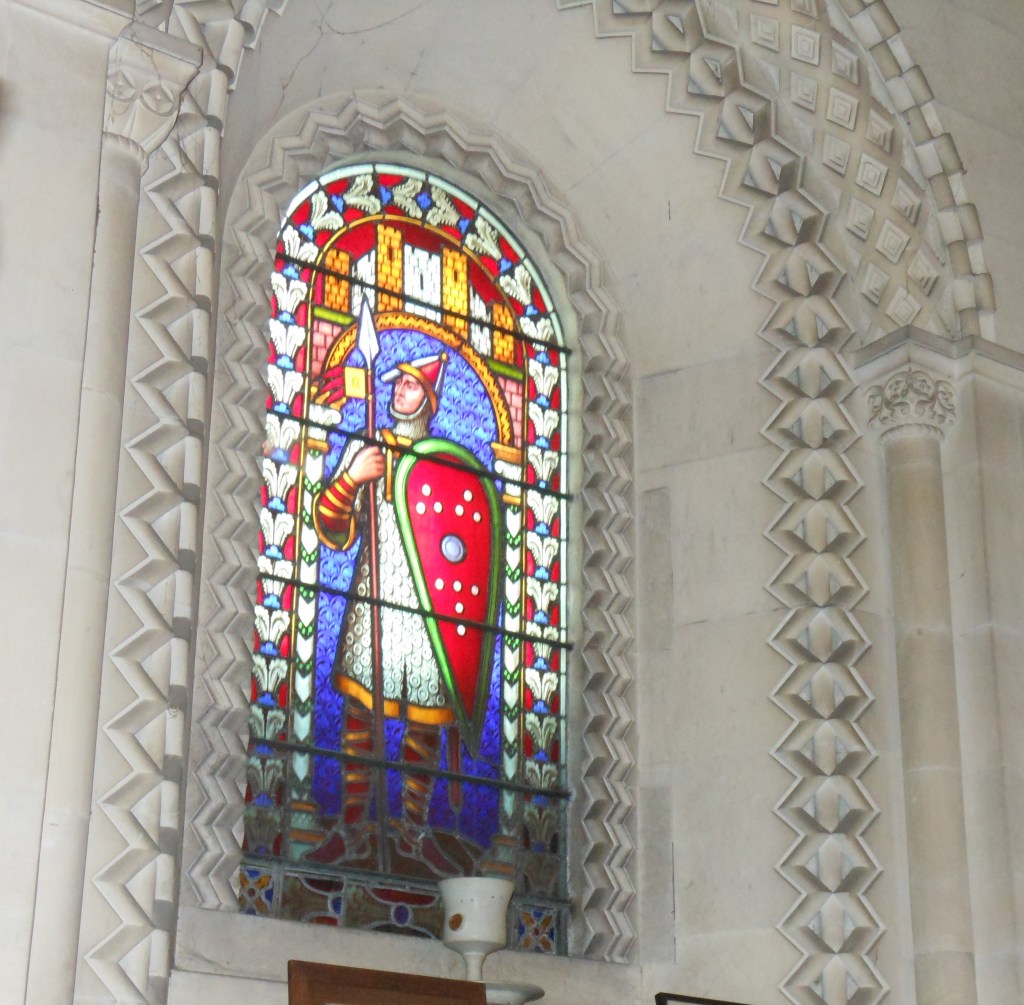
William de Warenne, first earl of Surrey, was a younger son of Rodulf de Warenne and his wife Beatrix. It is possible that Beatrix was a niece of Duchess Gunnor of Normandy, making young William a cousin of William the Bastard, duke of Normandy. The family name is probably derived from the hamlet of Varenne, part of the Warenne lands in the department of Seine-Inférieure, Normandy. William’s older brother, Rodulf or Ralph, would inherit the greater part of the Warenne family estates in Normandy.

His birth, as you might expect, is shrouded in the fog of time; a younger son of the minor nobility does not tend to get a mention until he does something remarkable or becomes someone notable. Although still young William was considered a capable and experienced enough soldier to be given joint command of a Norman army, by the mid-1050s. His first recorded military action is in the campaign against his own kinsman, Roger (I) de Mortemer of 1054, as one of the commanders of an army which defeated the French.

De Warenne was rewarded with some of the Mortemer lands; some of which he managed to retain even after Mortemer’s restoration to favour, including the castles of Mortemer and Bellencombre. Bellencrombe would become the capital of the de Warenne estates in Normandy. De Warenne received more rewards from the confiscated lands of William, count of Arques in 1053. Duke William’s confidence in de Warenne is demonstrated in the fact he was one of the barons consulted during the planning of the invasion of England in 1066.

In fact, William de Warenne is one of only a handful of Norman barons known to have fought at the Battle of Hastings on 14th October, 1066 as King William recalled his presence at the battle on his deathbed. De Warenne was rewarded with vast swathes of land throughout the country. According to the Domesday survey his lands extended over 13 counties; stretching from Conisbrough in Yorkshire to Lewes in Sussex. His territories were acquired over the course of the reign of William I and elevated him the highest rank of magnates. By 1086 his riches were only surpassed by the king’s half-brothers and his own kinsman, Roger de Montgomery. He is still in the Top 20 list of the richest people in History.

330px-bayeuxtapestryscene52
Battle of Hastings, 1066

Throughout his career, William de Warenne acquired lands in numerous counties, sometimes by nefarious means. Much of the property, such as Conisbrough, had formerly belonged to the late king, Harold. In Norfolk he is said to have asserted lordship over freemen not necessarily assigned to him. He had disputes with neighbouring landowners in Conisbrough, over which properties were sokelands and he is said to have stolen lands from the bishop of Durham and the abbot of Ely. Some acquisitions were obtained peacefully, such as the manor of Whitchurch in Shropshire, which was left to him by his kinsman Roger de Montgomery. William was an energetic and attentive landowner, and improved the economy of most of his estates; more than tripling his sheep flock at Castle Acre and doubling the value of his Yorkshire estates in just 20 years (at a time when the county was devastated by the Harrying of the North.

In 1067 William de Warenne was one of 4 prominent Normans appointed to govern England during William the Conqueror’s absence in Normandy. Following the Conquest, he continued to support the king and – subsequently – his son, William II Rufus – as a military commander for over 20 years. In 1074 he was with is father at  the abbey of Holy Trinity in Rouen and in 1083-85 he fought with the king on campaign in Maine, being wounded at the siege of the castle of Sainte-Suzanne.

In 1075, along with Richard de Clare, his fellow justiciar, he was sent to deal with the rebellion of Earl Ralph de Gael of East Anglia. De Gael had failed to respond to their summons to answer for an act of defiance and so the 2 lords faced and defeated the rebels at Fawdon in Cambridgeshire, mutilating their prisoners afterwards. Ralph withdrew to Norwich Castle; besieged for 3 months he managed to escape his attackers by boat, while the castle surrendered and was occupied by de Warenne.

History...the Interesting Bits
Gundrada de Warenne

William de Warenne was married to a Flemish noblewoman, Gundrada; her brother Gerbod was sometime earl of Chester and another brother, Frederic, held lands in Norfolk which eventually passed to Gundrada. He was murdered by Enlgish freedom fighter, Hereward the Wake; his murder giving rise to a personal feud between Hereward and William de Warenne:

Among his other crimes, by trickery [Hereward] killed Frederick, brother of Earl William of Warenne, a man distinguished by lineage and possessions, who one night was surrounded in his own house. On account of his murder, such discord arose between Hereward and the aforesaid William that it could not be settled by any reparation nor in any court.1

There has been considerable debate among historians over the theory that Gundrada may have been the daughter of William the Conqueror, but the confusion appears to have come from an unreliable charter belonging to Lewes Priory and Gundrada being part of the household of King William’s wife, Matilda; though it does seem likely that Matilda and Gundrada were related in some way, perhaps distant cousins. Gundrada and William were married sometime around the time of the Conquest, either before or after the expedition to conquer England.

They had 3 children together. Their eldest son, William, would succeed his father as Earl of Surrey and de Warenne. He married Isabel de Vermandois, widow of Robert de Beaumont, earl of Leicester; with whom he had, apparently, been having an affair even before the earl’s death. Young William had a chequered career, he supported the claims of Robert Curthose, duke of Normandy, to the English throne against the duke’s younger brother, Henry I. However, duke Robert lost and was captured and imprisoned by Henry. Henry eventually forgave William, who fought for the king at the Battle of Bremule and was with Henry he died in 1135.

A second son, Rainald de Warenne, led the assault on Rouen in 1090, for William II Rufus, in the conflict between the English king and his older brother, Duke Robert. However, by 1105 Rainald was now fighting for the duke against the youngest of the Conqueror’s sons, Henry I, defending the castle of Saint-Pierre-sur-Dives for the duke. He was captured by Henry the following year, but had been freed by September 1106. It is possible he died shortly after, but was certainly dead by 1118 when his brother issued a charter, in which he gave 6 churches to Lewes Priory, for the soul of deceased family members, including Rainald.

Gundrada and William also had a daughter, Edith, who married Gerard de Gournay, son of the lord of Gournay-en-Bray. Gerard also supported William II Rufus against Duke Robert and took part in the Crusade of 1096. Edith later accompanied him on pilgrimage back to Jerusalem, sometime after 1104, where he died. Gerard was succeeded by their son, Hugh de Gournay, whose daughter Gundreda would be the mother of Roger de Mowbray. Edith then married Drew de Monchy, with whom she had a son, Drew the Younger.

Castle_Acre_Castle
Castle Acre Castle, Norfolk

Gundrada died in childbirth at Castle Acre in Norfolk on 27th May 1085. She was buried in the chapter-house of the couple’s own of foundation Lewes Priory.

William’s second wife was a sister of Richard Guet, who was described as ‘frater comitissae Warennae’ when he gave the manor of Cowyck to Bermondsey Abbey in 1098.2 Guet was a landowner in Perche, Normandy, but his sister’s name has not survived the passage of time. All we know of her is that, a few days after her husband’s death, she attempted to gift 100 shillings to Ely Abbey in restitution for damage caused by William de Warenne. The monks refused the donation, hoping that Warenne’s departing soul had been claimed by demons.3

Despite this reputation at Ely, William de Warenne and his wife, Gundrada, had a reputation for piety. At some point in their marriage, either in 1077 or between 1081 and 1083, they went on pilgrimage to Rome. Due of war in Italy they only got as far as the great abbey of Cluny in Burgundy, where they were received into the fellowship of monks. On their return to England they founded a priory at Lewes, following the Cluniac rule and a prior and 3 monks were sent from Cluny to establish the foundation. It was the first Cluniac foundation in England.

pevensey_castle_aerial_alt
Pevensey Castle

Following the Conqueror’s death, William fought in support of the late king’s second son, William II Rufus against his older brother, Robert Curthose, who had inherited the dukedom of Normandy. He was rewarded in early 1088 with the earldom of Surrey. The new earl fought for William II Rufus during an invasion by Robert’s supporters and was badly wounded in the leg at the siege of Pevensey Castle, East Sussex, in the spring of 1088. He was taken to Lewes, where he died of his wounds on 24th June of the same year. Earl Warenne was buried beside his first wife, Gundrada, in the chapter-house of Lewes Priory.

Following the dissolution of Lewes Priory in the 16th century, Gundrada’s tombstone was 1st moved to Isfield Church; it was moved again in 1775 to the parish church of St John the Baptist at Southover in Lewes. The remains of Gundrada and William, themselves, were discovered in 2 leaden chests in 1845, when the railway line was excavated through the priory grounds. They were laid to rest, for a final time, at the Southover church, in 1847.

*

The story of William and Gundrada de Warenne appears in my book, Silk and the Sword: the Women of the Norman Conquest. It is told in much greater detail in Defenders of the Norman Crown: The Rise and Fall of the Warenne Earls of Surrey

*

Footnotes: ¹The Warenne (Hyde) Chronicle edited and translated by Elisabeth M.C. van Houts and Rosalind C. Love; 2Early Yorkshire Charters Volume 8: The Honour of Warenne, Edited by William Farrer and Charles Travis Clay; 3ibid

Images: Gundrada church window ©lewespriory.org.uk; William de Warenne church window ©Sharon Bennett Connolly; Bayeux Tapestry, Castle Acre and Pevensey Castle courtesy of Wikipedia.

SourcesEarly Yorkshire Charters Volume 8: The Honour of Warenne, Edited by William Farrer and Charles Travis Clay; England Under the Norman and Angevin Kings by Robert BatlettBrewer’s British Royalty by David WilliamsonBritain’s Royal Families, the Complete Genealogy by Alison Weir; british-history.ac.uk; kristiedean.com; English Heritage Guidebook for Conisbrough Castle by Steven Brindle and Agnieszka Sadrei; The Warenne (Hyde) Chronicle edited and translated by Elisabeth M.C. van Houts and Rosalind C. Love; oxforddnb.com.

*

My Books

Signed, dedicated copies of all my books are available through my online bookshop.

OUT NOW! Scotland’s Medieval Queens

Books by Sharon Bennett Connolly

Scotland’s history is dramatic, violent and bloody. Being England’s northern neighbour has never been easy. Scotland’s queens have had to deal with war, murder, imprisonment, political rivalries and open betrayal. They have loved and lost, raised kings and queens, ruled and died for Scotland. From St Margaret, who became one of the patron saints of Scotland, to Elizabeth de Burgh and the dramatic story of the Scottish Wars of Independence, to the love story and tragedy of Joan Beaufort, to Margaret of Denmark and the dawn of the Renaissance, Scotland’s Medieval Queens have seen it all. This is the story of Scotland through their eyes.

Scotland’s Medieval Queens gives a thorough grounding in the history of the women who ruled Scotland at the side of its kings, often in the shadows, but just as interesting in their lives beyond the spotlight. It’s not a subject that has been widely covered, and Sharon is a pioneer in bringing that information into accessible history.’ Elizabeth Chadwick (New York Times bestselling author)

Available now from Amazon and Pen and Sword Books

Also by Sharon Bennett Connolly:

Books by Sharon Bennett Connolly

Heroines of the Tudor World tells the stories of the most remarkable women from European history in the time of the Tudor dynasty, 1485-1603. These are the women who ruled, the women who founded dynasties, the women who fought for religious freedom, their families and love. Heroines of the Tudor World is now available for pre-order from Amberley Publishing and Amazon UK. Women of the Anarchy demonstrates how Empress Matilda and Matilda of Boulogne, unable to wield a sword themselves, were prime movers in this time of conflict and lawlessness. It shows how their strengths, weaknesses, and personal ambitions swung the fortunes of war one way – and then the other. Available from Bookshop.orgAmberley Publishing and Amazon UKKing John’s Right-Hand Lady: The Story of Nicholaa de la Haye is the story of a truly remarkable lady, the hereditary constable of Lincoln Castle and the first woman in England to be appointed sheriff in her own right. Available from all good bookshops Pen & Sword Booksbookshop.org and Amazon

Royal Historical Society

Defenders of the Norman Crown: The Rise and Fall of the Warenne Earls of Surrey tells the fascinating story of the Warenne dynasty, from its origins in Normandy, through the Conquest, Magna Carta, the wars and marriages that led to its ultimate demise in the reign of Edward III. Available from Pen & Sword BooksAmazon in the UK and US, and Bookshop.orgLadies of Magna Carta: Women of Influence in Thirteenth Century England looks into the relationships of the various noble families of the 13th century, and how they were affected by the Barons’ Wars, Magna Carta and its aftermath; the bonds that were formed and those that were broken. It is now available in paperback and hardback from Pen & SwordAmazon, and Bookshop.orgHeroines of the Medieval World tells the stories of some of the most remarkable women from Medieval history, from Eleanor of Aquitaine to Julian of Norwich. Available now from Amberley Publishing and Amazon, and Bookshop.orgSilk and the Sword: The Women of the Norman Conquest traces the fortunes of the women who had a significant role to play in the momentous events of 1066. Available now from Amazon,  Amberley Publishing, and Bookshop.org.

Alternate Endings: An anthology of historical fiction short stories including Long Live the King… which is my take what might have happened had King John not died in October 1216. Available in paperback and kindle from Amazon.

Podcast:

A Slice of Medieval

Have a listen to the A Slice of Medieval podcast, which I co-host with Historical fiction novelist Derek Birks. Derek and I welcome guests, such as Bernard Cornwell and Elizabeth Chadwick, and discuss a wide range of topics in medieval history, from significant events to the personalities involved.

Every episode is also now available on YouTube.

*

Don’t forget! Signed and dedicated copies of all my books are available through my online bookshop.

For forthcoming online and in-person talks, please check out my Events Page.

You can be the first to read new articles by clicking the ‘Follow’ button, liking our Facebook page or joining me on TwitterThreadsBluesky and Instagram.

*

©2016 Sharon Bennett Connolly, FRHistS

Gundrada, Daughter of Debate

resizer.php
Gundrada de Warenne, Church of St John the Baptist, Southover

In 1066 William de Warenne joined his namesake the Duke of Normandy on his expedition to conquer England.  De Warenne is one of the few named knights involved in the Battle of Hastings, and one of William of Normandy’s most trusted captains.

Sometime in the years either side of the Conquest, William had married Gundrada.

Gundrada’s parentage has long been a subject of debate among historians. For many years she was believed to be the daughter of William the Conqueror and his wife, Matilda of Flanders. It seems the misunderstanding arose with the monks at Lewes Priory, when a copy of an earlier charter claimed she was the daughter of Matilda of Flanders. Lewes was founded as a Cluniac monastery by William and Gundrada and it may be that the monks got carried away with the idea of their foundress having royal blood, or that there was an error when copying the charter from the original.

For whatever reason, the claims by Lewes Priory have caused controversy throughout the ensuing centuries. In the sixteenth century Leland believed that she was the Conqueror’s daughter, while Orderic Vitalis had stated that she was ‘Sister of Gherbode, a Fleming, to whom King William the First had given the City and Earldom of Chester’¹ By the 1800s it was thought that Gundrada was not a daughter of the King, but of the queen, Matilda, by an earlier, forgotten marriage to a Flemish nobleman called Gerbod.

Other suggestions have included that she was an adopted daughter, raised alongside William and Matilda’s own children who were of a similar age. Alternatively, due to her Flemish origins, it has been argued that the confusion arose as she had joined Matilda’s household at an early age; an assertion supported by Matilda’s gift to Gundrada of the manor of Carlton in Cambridge – a manor Gundrada later gave to Lewes Priory.

69111381_136159050499
William de Warenne, 1st earl of Warenne and Surrey, Church of St John the Baptist, Southover

In 1888 in the English Historical Review, E.A. Freeman used the priory’s original charter to conclude that there was no familial relationship between Gundrada and William the Conqueror. In it, while the king and William de Warenne, both, mention Gundrada, neither refer to her as being related to the king or queen. Freeman stated ‘there is nothing to show that Gundrada was the daughter either of King William or of Queen Matilda; there is a great deal to show that she was not.’²

It now seems more likely that Gundrada was a Flemish noblewoman, the sister of Gerbod who would be, for a brief time, Earl of Chester. Her father may also have been called Gerbod, and was the hereditary advocate of the monastery of St Bertin; a title which later will pass down through the de Warenne family. Another brother, Frederic, had land in Sussex and Kent, even before the Conquest. The brothers, it seems, were deeply involved in the politics of Flanders and Normandy; indeed, it is thought that Gerbod resigned his responsibilities in Chester in order to return to the continent to oversee the family’s land and duties there. Frederic, along with the count of Flanders, was witness to Count Guy of Ponthieu’s  charter to the abbey of St Riquier in 1067.

William de Warenne was well rewarded for his part in the Norman Conquest, receiving lands in 13 counties, including the Honour of Consibrough in South Yorkshire, previously owned by the last Saxon king, Harold II Godwinson. De Warenne’s brothers-in-law had also joined the expedition, and Frederic was rewarded with the lands of a man named Toki; in Norfolk, Suffolk and Cambridgeshire, worth over £100.

However, Frederic was unable to enjoy his good fortune for long, as he was killed in the rebellion of Hereward the Wake in 1070. His lands at Castle Acre and elsewhere, still known as ‘Frederic’s Fief’ in 1086, were inherited by his sister, who retained control of them throughout her lifetime. One manor was given to the abbey of St Riquier, possibly by Gundrada in memory of her brother.

800px-LewesPriory1
Lewes Priory, Sussex

Gundrada’s other brother, Gerbod resigned his position in Chester in 1070 and returned to Flanders which was in the midst of civil war, following the death of its count. Gerbod’s return was essential to guarantee the safety of the family’s lands and interests. The former earl’s fate is uncertain; one report has him killed while another sees him imprisoned, and a third claims Gerbod accidentally killed his lord, Count Arnulf, at the Battle of Kassel in 1071. According to this last account, Gerbod travelled to Rome to perform penance. He intended to have the hand that struck the fatal blow amputated but was persuaded against it and eventually became a monk at Cluny.

It seems that neither brother raised a family, as Gerbod’s lands in Flanders were also inherited by Gundrada; the family interest in the abbey of St Bertin would eventually be passed on to Gundrada and William’s 2nd son, Reynold.

As with so many nobles of the 11th century, Gundrada and William were known for their piety. In 1077 the couple made a pilgrimage to Rome; en route, they visited the magnificent abbey of Cluny in Burgundy. They must have been impressed with the abbey, as it inspired them to found their own Cluniac priory at Lewes in Sussex. In 1078 the abbot of Cluny sent over the first monks as William and Gundrada were supervising the new monastery’s construction; it would be the first Cluniac house in England. All the churches on the de Warenne’s vast estates were given to the priory, including endowments from her brother Frederic’s lands in Norfolk.

Castle_Acre_Castle
Castle Acre, Norfolk

Gundrada and William had 3 children together. Their eldest son, William, would succeed his father as Earl of Surrey and de Warenne. He married Isabel de Vermandois, widow of Robert de Beaumont, earl of Leicester; with whom he had, apparently, been having an affair even before the earl’s death. Young William had a chequered career, he supported the claims of Robert Curthose, duke of Normandy, to the English throne against the duke’s younger brother, Henry I. However, duke Robert lost and was captured and imprisoned by Henry. Henry eventually forgave William, who fought for the king at the Battle of Bremule and was with Henry he died in 1135.

69110904_130412014050
Gundrada’s tombstone, St John’s Church, Southover

A second son, Reynold de Warenne, led the assault on Rouen in 1090, for William II Rufus, in the conflict between the English king and his older brother, Duke Robert. However, by 1105 Reynold was now fighting for the duke against the youngest of the Conqueror’s sons, Henry I, defending the castle of Saint-Pierre-sur-Dives for the duke. He was captured by Henry the following year, but had been freed by September 1106. It is possible he died shortly after, but was certainly dead by 1118 when his brother issued a charter, in which he gave 6 churches to Lewes Priory, for the soul of deceased family members, including Reynold.

Gundrada and William also had a daughter, Edith, who married Gerard de Gournay, son of the lord of Gournay-en-Bray. Gerard also supported William II Rufus against Duke Robert and took part in the Crusade of 1096. Edith later accompanied him on pilgrimage back to Jerusalem, sometime after 1104, where he died. Gerard was succeeded by their son, Hugh de Gournay, whose daughter Gundreda would be the mother of Roger de Mowbray. Edith then married Drew de Monchy, with whom she had a son, Drew the Younger.

William de Warenne was created earl of Surrey shortly before his death in 1088; after he had helped William II to suppress a revolt led by Bishop Odo of Bayeux. De Warenne was wounded in the leg during the fighting and was taken to Lewes Priory where he died a short time later.

69111381_130412146348
Tombs of Gundrada and William de Warenne

Gundrada had died in childbirth at Castle Acre in Norfolk on 27th May 1085, therefore never receiving the title of countess. She was buried in the chapter house of Lewes Priory; her husband would be buried beside her 3 years later. Around 1145 new monastic buildings were consecrated at Lewes Priory, Gundrada’s bones were placed in a leaden chest and interred under a tombstone of black Tournai marble, ‘richly carved in the Romanesque style, with foliage and lions’ heads’³. The sculptor was trained at Cluny and would later work for Henry I’s nephew, Henry of Blois, bishop of Winchester and brother of King Stephen.

The tombstone read:

Gundrada, offspring of dukes, glory of the age, noble shoot,
brought to the churches of the English the balm of her character.
As a Martha …
she was to the wretched; a Mary she was in her piety.
That part of Martha [in her] died; the greater part of Mary survives.
O, pious Pancras, witness of truth and justice,
she makes you her heir; may you in your clemency accept the mother.
The sixth day of the kalends of June, showing itself,
broke the alabaster containing her flesh …4

Following the dissolution of Lewes Priory in the 16th century, the tombstone was first moved to Isfield Church; it was moved again in 1775 to the parish church of St John at Southover in Lewes. The remains of Gundrada and William were discovered in 2 leaden chests in 1845 and finally laid to rest at the Southover church in 1847.

The dynasty founded by William and Gundrada would continue until the death of John, the 7th and final de Warenne Earl of Surrey, in 1347.

*

The story of William and Gundrada de Warenne appears in my books, Silk and the Sword: the Women of the Norman Conquest and in even greater detail in Defenders of the Norman Crown: Rise and Fall of the Warenne Earls of Surrey.

*

Footnotes: ¹Early Yorkshire Charters Volume 8 Edited by William Farrer and Charles Travis Clay; ²ibid; ³C.P.Lewis, Oxforddnb.com; 4 Elisabeth M.C. Van Houts and Rosalind C. Love (eds and trans), The Warenne (Hyde) Chronicle

Images: Gundrada and William de Warenne church windows ©lewespriory.org.uk; Castle Acre and Lewes Priory courtesy of Wikipedia; Gundrada’s tombstone and the tombs of Gundrada and William courtesy of findagrave.com.

Sources: Early Yorkshire Charters Volume 8: The Honour of Warenne, Edited by William Farrer and Charles Travis Clay; England Under the Norman and Angevin Kings by Robert Batlett; Brewer’s British Royalty by David Williamson; Britain’s Royal Families, the Complete Genealogy by Alison Weir; british-history.ac.uk; kristiedean.com; English Heritage Guidebook for Conisbrough Castle by Steven Brindle and Agnieszka Sadrei; oxforddnb.com.

*

My Books

Signed, dedicated copies of all my books are available through my online bookshop.

Coming on 15 June224: Heroines of the Tudor World

Heroines of the Tudor World tells the stories of the most remarkable women from European history in the time of the Tudor dynasty, 1485-1603. These are the women who ruled, the women who founded dynasties, the women who fought for religious freedom, their families and love. These are the women who made a difference, who influenced countries, kings and the Reformation. In the era dominated by the Renaissance and Reformation, Heroines of the Tudor World examines the threats and challenges faced by the women of the era, and how they overcame them. From writers to regents, from nuns to queens, Heroines of the Tudor World shines the spotlight on the women helped to shape Early Modern Europe.

Heroines of the Tudor World is now available for pre-order from Amberley Publishing and Amazon UK.

Out Now! Women of the Anarchy

Two cousins. On the one side is Empress Matilda, or Maud. The sole surviving legitimate child of Henry I, she is fighting for her birthright and that of her children. On the other side is her cousin, Queen Matilda, supporting her husband, King Stephen, and fighting to see her own son inherit the English crown. Women of the Anarchy demonstrates how these women, unable to wield a sword, were prime movers in this time of conflict and lawlessness. It show how their strengths, weaknesses, and personal ambitions swung the fortunes of war one way – and then the other.

Available from Bookshop.orgAmberley Publishing and Amazon UK.

Also by Sharon Bennett Connolly:

King John’s Right-Hand Lady: The Story of Nicholaa de la Haye is the story of a truly remarkable lady, the hereditary constable of Lincoln Castle and the first woman in England to be appointed sheriff in her own right. It is is available from King John’s Right-Hand Lady: The Story of Nicholaa de la Haye is the story of a truly remarkable lady, the hereditary constable of Lincoln Castle and the first woman in England to be appointed sheriff in her own right. Available from all good bookshops, from Pen & Sword Booksbookshop.org and AmazonDefenders of the Norman Crown: The Rise and Fall of the Warenne Earls of Surrey tells the fascinating story of the Warenne dynasty, from its origins in Normandy, through the Conquest, Magna Carta, the wars and marriages that led to its ultimate demise in the reign of Edward III. Available from Pen & Sword BooksAmazon in the UK and US, and Bookshop.org

Ladies of Magna Carta: Women of Influence in Thirteenth Century England looks into the relationships of the various noble families of the 13th century, and how they were affected by the Barons’ Wars, Magna Carta and its aftermath; the bonds that were formed and those that were broken. It is now available in paperback and hardback from Pen & Sword,  Amazon, and Bookshop.orgHeroines of the Medieval World tells the stories of some of the most remarkable women from Medieval history, from Eleanor of Aquitaine to Julian of Norwich. Available now from Amberley Publishing and Amazon, and Bookshop.orgSilk and the Sword: The Women of the Norman Conquest traces the fortunes of the women who had a significant role to play in the momentous events of 1066. Available now from Amazon,  Amberley Publishing, and Bookshop.org.

Alternate Endings: An anthology of historical fiction short stories including Long Live the King… which is my take what might have happened had King John not died in October 1216. Available in paperback and kindle from Amazon.

Podcast:

Have a listen to the A Slice of Medieval podcast, which I co-host with Historical fiction novelist Derek Birks. Derek and I welcome guests, such as Bernard Cornwell and discuss a wide range of topics in medieval history, from significant events to the personalities involved. Our first ever episode was a discussion on The Anarchy

*

Don’t forget! Signed and dedicated copies of all my books are available through my online bookshop.

For forthcoming online and in-person talks, please check out my Events Page.

You can be the first to read new articles by clicking the ‘Follow’ button, liking our Facebook page or joining me on Twitter and Instagram.

*

©2016 Sharon Bennett Connolly FRHistS
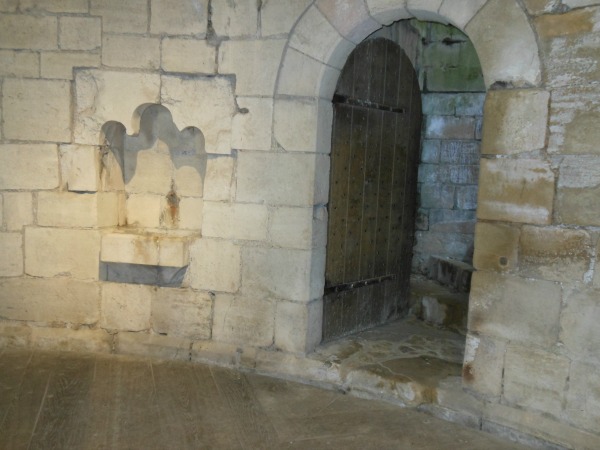
Countess Maud

CliffordArms
The Clifford coat of arms

There are many women in history of whom we only have snippets of information. However, those snippets prove to be fascinating and demonstrate how closely the lives of noble houses were tied together – and how they were torn apart. Maud Clifford is one such lady.

Born about 1389 at Brough Castle in Westmoreland, Maud (or Matilda) was the daughter of Thomas Clifford, 6th Baron Clifford, and his wife Elizabeth de Ros. Maud’s brother, John, has also been given 1389 as his possible year of birth. It may be that John or Maud were twins, or that they were born within a year of each other.

Their early childhood cannot have been very pleasant. Their paternal grandfather, Roger Clifford, died in July of 1389, probably of a stroke. In October 1391, their father, Thomas, died. Whilst in Königsberg Thomas had had a disagreement with Sir William Douglas, illegitimate son of the earl of Douglas; Douglas was killed in the ensuing brawl and Clifford, overcome with guilt, went on pilgrimage to Jerusalem in penance. He died on an unidentified Mediterranean island whilst on the way to the Holy City.

Nothing else seems to be known of Maud’s childhood. Sometime before 1406 she was married to John Neville, Lord Latimer. For some unknown reason the marriage was never consummated and Maud successfully sued for an annulment. The marriage was dissolved with very favourable terms for Maud; some of the Neville lands had been put in trust for Maud and, even though the marriage had been declared invalid, she was allowed to keep them.

300px-Skipton_Castle_main_gate,_2007
Skipton Castle, family seat of the Cliffords

Maud was, therefore, a very attractive bride for a landless earl. Richard of Conisbrough, earl of Cambridge, was the poorest – and the only landless – earl in England. He lived at Conisbrough Castle in Yorkshire as the tenant of his older brother, Edward, Duke of York. Richard was a widower with 2 small children; his wife, Anne Mortimer, had died sometime after 1411, when she had given birth to their 2nd child, Richard (future Duke of York), probably at Conisbrough Castle. It is not known when Anne died, but it was before 1414, which is the probable date of Maud’s marriage to the earl of Cambridge.

Unfortunately the marriage proved to be short-lived, with Richard of Conisbrough becoming involved in the Southampton Plot, a plan to overthrow King Henry V and replace him with  Richard’s brother-in-law, Edmund Mortimer, Earl of March. However, March revealed the plot to the King and Richard and his accomplices were arrested, with Richard beheaded for treason on  5th August 1415.

008 (2)
Conisbrough Castle

Richard of Conisbrough was not attainted, so his lands, such as they were, were not forfeit to the crown. Maud was allowed to remain at Conisbrough Castle, and her step-son, Richard, would be allowed to inherit the Dukedom of York from his uncle, Edward, following his death at Agincourt in October 1415.

It is not clear how much contact Maud had with her step-children. The eldest child, Isabel, had been born around 1409; she had been betrothed in 1412 to Sir Thomas Grey and it is possible that she was raised in the household of the Grey family. As Duke of York, Richard’s wardship and marriage was a great prize, and would eventually go to Ralph Neville, earl of Westmoreland; with York marrying Neville’s daughter, Cecily. The Yorks’ eldest and youngest sons would become the Yorkist kings of England; Edward IV and Richard III, respectively.

Maud would continue to use Conisbrough Castle as her principal residence throughout her life; she received an annuity of £100 from the Earl of March, perhaps to assuage his guilt in the part he played in her husband’s downfall. She seems to have led a full and active life, and remained very close to her Clifford family; they  stayed with her often and she was a regular visitor to the Clifford home of Skipton Castle. Her nephew, Thomas and his family, lived with her at Conisbrough for a year in 1437, while his castle at Skipton was undergoing extensive works.

036
Carvings in the chapel at Conisbrough Castle

On 8th April 1435 Maud’s great-nephew, John Clifford – the future 9th Baron Clifford – was born at Conisbrough Castle. He was the grandson of Maud’s brother, John, and son of her nephew, Thomas, and his wife, Joan Dacre. Baby John would have been born either in the solar of the keep itself, or in the family apartments above the great hall of the inner bailey.

Either way its most likely he was baptised in the small private chapel within the keep; with Maud as his godmother. The chapel is built into one of the keep’s 6 buttresses and, despite the years and water damage, it is a wonder to behold, with exquisite designs carved into the stone columns, and the vaulted ceiling.

300px-'The_Murder_of_Rutland_by_Lord_Clifford'_by_Charles_Robert_Leslie,_1815
‘The Murder of Rutland by Lord Clifford’ by Charles Robert Leslie

Maud’s brother, John, was killed at the siege of Meaux in 1422 and her nephew, Thomas, would be killed at the First Battle of St Albans in 1455, supposedly by Richard, Duke of York, himself. And so it was, that on the 30th december 1460, at the Battle of Wakefield, John Clifford is said to have taken his revenge by killing York’s son Edmund, the 17-year-old earl of Rutland. Whether or not Clifford uttered the words ‘as your father slew mine, so I shall slay thee’ as he killed young Edmund, is entirely debatable, but the event serves to highlight how closely the noble families of the Wars of the Roses were related.

There is some suggestion that Maud remarried in 1429. The supposed groom was John Wentworth of North Elmsall, Yorkshire. However, this seems to be more of a family legend among the Wentworth family and only arose over 100 years after Maud’s death.

Maud’s will demonstrates her closeness to her family, and serves as an insight into her comfortable life and the sumptuous furnishings of the castle.

View from the nave of the church to the high altar, Roche Abbey

To Thomas, Lord Clifford, my relation: a ‘hall’ of arras [a fine woven wall-hanging from Arras] bought from Sir Robert Babthorpe; my bed of Arras with three curtains; four cushions of red silk; two long cushions of cloth.

To John Clifford, my godson: 12 silver dishes, 6 salt-cellars signed with the ‘trayfulles’ [trefoils] and a shell.

To Beatrice Waterton, my relation: a gold cross, which belonged to my mother; my green Primary [a book of readings from the Bible]; a diamond; my best furred robe with ‘martes’ [marten fur].

To Katherine Fitzwilliam: the brooch that I wear everyday; a small black Primary; a jewel called Agnus Dei covered with silver and written around with pearls; my best robe furred with miniver [white stoat fur].

To Maud Clifford, my god-daughter: my best gold belt.¹

Maud died, of an unknown illness, at Conisbrough Castle on 26th August 1446 and was  buried at Roche Abbey, of which she was a benefactor. Her tomb is now lost to history, but may have been in the nave of the church, where many secular patrons are known to have been buried.2 Though some tombs still remaining, their markings are faded after centuries of exposure to the elements, and none can be definitively identified.

*

Footnote: ¹English Heritage Guidebook for Conisbrough Castle by Steven Brindle and Agnieszka Sadrei; English Heritage Guidebook for Roche Abbey by Peter Ferguson and Stuart Harrison.

*

Pictures courtesy of Wikipedia, except Roche Abbey and Conisbrough Castle and chapel ©2016 Sharon Bennett Connolly

*

Sources: Sources: The History Today Companion to British History, edited by Juliet Gardiner & Neil Wenborn; Brewer’s British Royalty by David Williamson; Britain’s Royal Families, the Complete Genealogy by Alison Weir; The Wars of the Roses by John Gillingham; The Wordsworth Dictionary of British History by J.P. Kenyon; The Oxford Companion to British History, edited by John Cannon; The Reign of Edward III by WM Ormrod; The Wars of the Roses by Martin J Dougherty; englishmonarchs.co.uk; womenshistory.about.com; findagrave.com; conisbroughcastle.org.uk; hrionline.ac.uk; English Heritage Guidebook for Conisbrough Castle by Steven Brindle and Agnieszka Sadrei; English Heritage Guidebook for Roche Abbey by Peter Ferguson and Stuart Harrison; oxforddnb.com.

*

My Books

Signed, dedicated copies of all my books are available through my online store.

OUT NOW! Heroines of the Tudor World

Heroines of the Tudor World tells the stories of the most remarkable women from European history in the time of the Tudor dynasty, 1485-1603. These are the women who ruled, the women who founded dynasties, the women who fought for religious freedom, their families and love. These are the women who made a difference, who influenced countries, kings and the Reformation. In the era dominated by the Renaissance and Reformation, Heroines of the Tudor World examines the threats and challenges faced by the women of the era, and how they overcame them. From writers to regents, from nuns to queens, Heroines of the Tudor World shines the spotlight on the women helped to shape Early Modern Europe.

Heroines of the Tudor World is now available for pre-order from Amberley Publishing and Amazon UK.

Also by Sharon Bennett Connolly:

Women of the Anarchy demonstrates how Empress Matilda and Matilda of Boulogne, unable to wield a sword themselves, were prime movers in this time of conflict and lawlessness. It shows how their strengths, weaknesses, and personal ambitions swung the fortunes of war one way – and then the other. Available from Bookshop.orgAmberley Publishing and Amazon UKKing John’s Right-Hand Lady: The Story of Nicholaa de la Haye is the story of a truly remarkable lady, the hereditary constable of Lincoln Castle and the first woman in England to be appointed sheriff in her own right. Available from all good bookshops Pen & Sword Booksbookshop.org and AmazonDefenders of the Norman Crown: The Rise and Fall of the Warenne Earls of Surrey tells the fascinating story of the Warenne dynasty, from its origins in Normandy, through the Conquest, Magna Carta, the wars and marriages that led to its ultimate demise in the reign of Edward III. Available from Pen & Sword BooksAmazon in the UK and US, and Bookshop.org

Ladies of Magna Carta: Women of Influence in Thirteenth Century England looks into the relationships of the various noble families of the 13th century, and how they were affected by the Barons’ Wars, Magna Carta and its aftermath; the bonds that were formed and those that were broken. It is now available in paperback and hardback from Pen & Sword,  Amazon, and Bookshop.orgHeroines of the Medieval World tells the stories of some of the most remarkable women from Medieval history, from Eleanor of Aquitaine to Julian of Norwich. Available now from Amberley Publishing and Amazon, and Bookshop.orgSilk and the Sword: The Women of the Norman Conquest traces the fortunes of the women who had a significant role to play in the momentous events of 1066. Available now from Amazon,  Amberley Publishing, and Bookshop.org.

Alternate Endings: An anthology of historical fiction short stories including Long Live the King… which is my take what might have happened had King John not died in October 1216. Available in paperback and kindle from Amazon.

Podcast:

Have a listen to the A Slice of Medieval podcast, which I co-host with Historical fiction novelist Derek Birks. Derek and I welcome guests, such as Bernard Cornwell, and discuss a wide range of topics in medieval history, from significant events to the personalities involved.

*

Don’t forget! Signed and dedicated copies of all my books are available through my online store.

For forthcoming online and in-person talks, please check out my Events Page.

You can be the first to read new articles by clicking the ‘Follow’ button, liking our Facebook page or joining me on Twitter and Instagram.

*

©2016 Sharon Bennett Connolly FRHistS
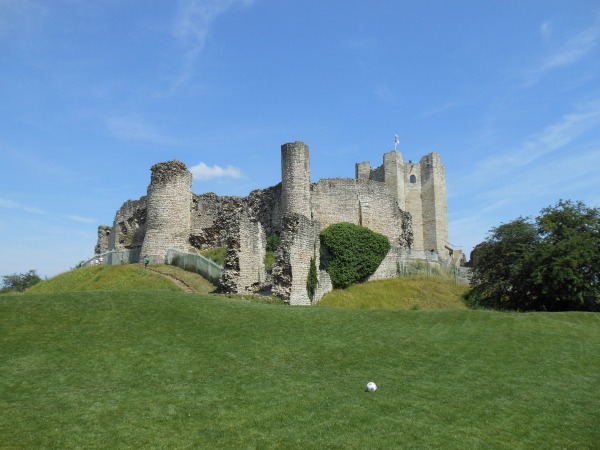
Book Corner: On the Trail of the Yorks by Kristie Dean

24th March On the Trail slider 13

Today is the last day of Kristie Dean‘s Blog Tour to celebrate the release of her latest book, On the Trail of the Yorks. Congratulations to Kristie on what has been a wonderful virtual book tour – and ‘thank you’ for asking History…the Interesting Bits to be a part of it.

So, I think, for the last day, it is only fair to give you my review of this remarkable book.

12791083_736187379851237_1299001826319792577_nRichard III is probably the House of York’s best-known figure, but the other members of the family are just as intriguing as the king who fell on Bosworth Field. This book explores the places associated with members of this fascinating family and discovers their stories through the locations they visited and inhabited. It reveals the lives of the Yorks by exploring the cathedrals, castles, battlefields and manor houses that shaped their history. Featuring locations such as Fotheringhay, Baynard’s Castle, Durham Cathedral and the Palace of Westminster, among many others, this book brings each site to life, giving a gripping account of its heritage as well as accurate information for the visitor. Extensive descriptions and an array of illustrations and photographs recreate these poignant and sometimes controversial locations, immersing the reader in the ancient and intriguing world of the Yorks.

Just over a year ago Kristie Dean published her book, The World of Richard III. This was a unique book with its own inimitable style. A combination of history book and travel guide, Ms Dean told the story of Richard III through the geographical locations associated with him. In On the Trail of the Yorks Kristie Dean has extended her research to include the rest of Richard’s family, from his father the Duke of York through his wife and brothers to his niece, Elizabeth of York, queen of Henry VII.

1422626_729589277177714_706482969626694562_nThe book is laid out in an easy-to-follow format, with each main character of the Yorkist dynasty getting their own chapter. The chapters then follow a loosely chronological manner, based on when the locations were used, or visited, by the person in question. Ms Dean always gives a history of the association between the Yorks and the historic site, while also giving a general history of the location. The book acts as a practical guide for each location; giving not only useful contact details, but also travel information and what to look out for while you are there.

The centre of the book has a treasure trove of colourful and black and white images. Including portraits depicting leading members of the House of York and photographs of the places the Yorks and Kristie Dean have visited. The wonderful pictures help to bring the history to life and you find yourself flicking between the descriptions of the various sites and the related pictures.

Kristie Dean also discusses locations which are no longer available to us. Her description of Old St Paul’s Cathedral, which was destroyed during the 1666 Great Fire of London, is so thorough and passionate that it leaves the reader bereft at the thought of what is lost.

Some places are familiar to any fan of the Yorkist dynasty; York, Fotheringhay, Ludlow and, of course, Middleham. While other locations are less-instantly recognisable as having Yorkist connections, but just as interesting; castles such as Conisbrough and the shrine of Our Lady of Walsingham. The book itself takes you from locations in England to Ireland and into France and the Continent, with comprehensive travel information as you go; giving you a tour of some of the best historic sites that Europe has to offer – whilst never moving from your armchair.

220px-Eltham_Palace_-_geograph.org.uk_-_19354
Eltham Palace

No matter how familiar it is to us, each location is given the same level of attention, with detailed descriptions of the site, the things to see – and what not to miss – and the Yorkist story behind  it. Kristie Dean builds up the personal stories of the individual members of the family through the buildings and places particularly associated with them.

On every page Kristie Dean’s passion and enthusiasm for her subject shines through. Here, she writes about Westminster Hall:

Few other places have survived to offer the York enthusiast such a rich tapestry of history; few other places allow one to stand under the same roof where so much history has passed. The atmospheric presence of those long gone can be felt, separated from today’s visitor by only the thin wall of time. You might feel hurried to move on to the next room, but find a corner and stand for a moment to experience the atmosphere…..

This book allows the reader to vicariously visit the locations associated with the family of the House of York, with the history of each site, descriptions of what it would have looked like in the 15th century and descriptions of what is available to visit today.

065
Bosworth Battlefield

You can vividly imagine being in Staindrop Church, or the church at Fotheringhay during the re-internment of Richard Duke of York in 1476, or feasting at the castle afterwards. Kristie Dean’s own information and knowledge is enhanced by her use of contemporary quotes, to give past descriptions of the locations and of the events she is describing.

It would be easy for a book of this kind to be confusing and higgledy-piggledy, but the author keeps focussed throughout and makes the book easy to follow, both as a history book and as a guide-book; keeping on topic and explaining any overlaps.

The work is thorough and impressive in the blend of history and geography, allowing you to use the book as a general history and tour guide, while each chapter and location is designed as a standalone guide, allowing you to drop in and out of the book as you please; a useful tool when travelling.

In short, this is a wonderful resource for both the armchair traveller, and the historical tourist, enhanced by photographs of locations and a level of detail that is second-to-none. It is a ‘must have’ on the book shelves for any fan of Richard III, the House of York or the Wars of the Roses in general, in order to enhance our knowledge of the period.

KristieKristie Dean has an MA in History and now enjoys teaching the subject, following a successful career in public relations. Her particular historic interest is the medieval era, specifically the Plantagenets, the Wars of the Roses and the Tudors. When not traveling for research, you can find Kristie at home in Tennessee with her husband, three dogs, and two cats. On the Trail of the Yorks is available now from Amazon UK and from Amazon US in May. And The World of Richard III will be released in paperback in May 2016, with its new title ….  On the Trail of Richard III.

*

My book, Heroines of the Medieval World,  is now available in hardback in the UK from both Amberley Publishing and Amazon UK and worldwide from Book Depository. It is also available on Kindle in both the UK and USA and will be available in Hardback from Amazon US from 1 May 2018.

Be the first to read new articles by clicking the ‘Follow’ button, liking our Facebook page or joining me on Twitter.

*

Pictures: Eltham Palace courtesy of Wikipedia; Bosworth ©SharonBennettConnolly 2014

The Colourful Career of Edward, 2nd Duke of York

Edward_of_Norwich_Duke_of_York
Edward, 2nd Duke of York

Edward of Norwich, 2nd Duke of York, was born into wealth and privilege. Grandson of 2 kings and 1st cousin to 2 kings, his life story is full of ambition, glory and war, duty and service – and a hint of treason. All the ingredients needed for a rollicking good novel; with also the possibility of a strange love story.

Edward was born, probably at King’s Langley, in about 1373. A birthday of 1375 has also been suggested, but 1373 seems most likely. The fact he has Norwich after his name has suggested he could have been born there, but there is a theory that it is a derivation of “d’Everwick”, meaning “of York”.

Edward’s father was Edmund of Langley, 1st Duke of York and 5th son of Edward III and Philippa of Hainault. His mother was Isabella of Castile, daughter of Pedro the Cruel, king of Castile, and his mistress – and later, wife – Maria de Padilla. Although the couple had 3 children, their marriage doesn’t appear to have been a happy one and there were rumours of scandal surrounding Isabella, with a question mark raised over the paternity of her youngest son, Richard of Conisbrough. Edward also had a sister, Constance, who was close in age to him and born around 1374.

220px-Edward_III_of_England_(Order_of_the_Garter)
Edward III

Edward was born into a time of great change in the English monarchy. His grandmother, Philippa, had died in 1369 and his grandfather, Edward III, king since 1327, was slipping into senility, allowing his mistress, Alice Perrers, and her cohorts too much control of his affairs. In 1376 Edward’s eldest son and heir – and England’s hero of the time – Edward, the Black Prince, died after years of debilitating illness. The prince’s death broke the old king,  who died the following year, leaving his 10-year-old grandson Richard of Bordeaux, son of the Black Prince, as king.

The government – and the country – was largely in the hands of Edward and Richard’s uncle, John of Gaunt, Duke of Lancaster. John was the 4th son of Edward III and married to Edward of Norwich’s aunt, Constance of Castile. It was a time of uncertainty; many feared John would usurp the crown for  himself, but he stayed loyal to his nephew and Richard was crowned as King Richard II.

At only 4 years old Edward of Norwich attended the coronation, receiving his knighthood as part of the celebrations. Edward would be a loyal supporter of Richard II and received numerous royal grants, including the title of Earl of Rutland in February 1390. He was also given the title Earl of Cork when he accompanied Richard on his Irish campaign in 1394/5, leading several successful missions.

In the 1390s Edward emerged as a leading member of Richard’s circle of intimates. A man of considerable ability, Richard named him “the most able,wise and powerful man that he could think of”¹ and is even said to have considered leaving his crown to Edward. After the death of Richard’s queen, Anne of Bohemia, in 1394, Edward was one of the 3 feoffees of her estate, allowing him control of considerable patronage.

Arms_of_Edward_of_Norwich.svg
Arms of Edward of Norwich

Richard practically showered Edward with lucrative positions, including: admiral of the North & West (1391), Constable of Dover and Warden of the Cinque Ports (1396), Constable of the Tower of London (1397) and Constable of England (1398). He was also involved in the king’s diplomacy in France and the Holy Roman Empire, undertaking diplomatic missions to both.

Richard even took personal interest in Edward’s marriage prospects. In 1381 Edward had been betrothed to Beatriz of Portugal as part of the Anglo-Portuguese alliance against Castile. However, when the Portuguese made peace with Castile, Beatriz was married to Juan I of Castile instead.

Richard II suggested the sister-in-law of Giangaleazzo Visconti of Milan and also considered 3 relatives of Charles VI of France before suggesting Jeanne de Valois, younger sister of Richard’s proposed bride, Isabelle de Valois. Edward was addressed as ‘the king’s brother’ in recognition of their proposed marriages to sisters, even long after Edward’s planned marriage had fallen through.

By October 1398 Edward was married. His bride was a very curious choice for England’s most eligible bachelor. At 25 and likely to inherit his father’s dukedom in the not-too-distant future, Edward must surely have had the choice of every heiress in the kingdom of marriageable age. And yet his bride was twice widowed, 20 years his senior and with no dowry or inheritance to speak of.

PhilippaMohun_Died1431_WestminsterAbbey_ByStothard
Effigy of Philippa Mohun, Duchess of York, from her tomb in Westminster Abbey

Philippa was the 3rd daughter of John Mohun, 2nd Baron Mohun and a founding member of the Order of the Garter, and his wife Joan Burghersh. She had first been married to Walter Fitzwalter, 3rd Baron Fitzwalter, who died in 1386 and secondly to Sir john Golafre who died in 1396. Having no male heirs, Philippa’s mother had sold the reversion of the Mohun estates to Lady Elizabeth Luttrell, leaving her daughters with no landed inheritance.

The fact this was hardly a glittering match for such an illustrious magnate greatly suggests that it was a love match. And, as with Philippa’s previous 2 marriages, the union was to remain childless; Edward would eventually name his young nephew as his heir.

While Edward was finalising the domestic arrangements for his new bride, England was falling into turmoil. Richard II had imprisoned one uncle Thomas of Woodstock, Duke of Gloucester, in Calais and was distrustful of another uncle, John of Gaunt.

In the 2nd half of the 1380s Gloucester and the Lords Appellants had been the focus of opposition against Richard’s personal rule and had attempted to curb the king’s excesses, forcing restrictions to his rule. John of Gaunt had restored order following his return from campaigning in Spain, but in 1397 Gloucester was murdered whilst imprisoned in Calais, most likely on  Richard’s orders. It was said Edward had played a leading role in the arrest of Gloucester and the earls of Arundel and Warwick and he certainly benefited from the aftermath, receiving a significant share of the forfeitures that followed.

In September 1397 he was made Duke of Aumale and given the post of Constable of England – formerly held by Gloucester. As Constable, Edward would preside over Richard’s legal reforms, extending the court of chivalry to include treason and other offences which touched the king’s dignity.

220px-Richard_II_King_of_England
Richard II

Of the other 2 ringleaders of the Lords Appellant, Richard Fitzalan, earl of Arundel was beheaded and Thomas de Beauchamp, earl of Warwick was stripped of his titles and imprisoned on the Isle of Man. Two of the younger members of the Lords Appellants, Thomas of Mowbray, earl of Nottingham and Henry Bolingbroke earl of Derby, had initially escaped any severe retribution. However, in  1398 Richard found a pretext to exile them both from the country.

Bolingbroke was the son of the most powerful man in the kingdom – John of Gaunt – he was also cousin to both Richard II and Edward of Norwich. On Gaunt’s death in 1399, instead of passing his inheritance onto Bolingbroke, Richard appropriated it for the crown, putting some of the lands into Edward’s care – and extending his cousin’s exile to life.

Later that year Richard set off on campaign to Ireland, taking with him his cousin Edward and Bolingbroke’s 13-year-old son, Henry of Monmouth. We don’t know how Edward had reacted to his cousin Henry’s disinheritance, but it can’t have been an easy time for him, caught in the middle of his warring cousins, and he may have felt uneasy with the sudden change in Henry’s circumstances at the hands of the king. He later claimed that he had not drawn any of the revenues from the Lancastrian lands which had been put in his custody.

Whilst Richard was in Ireland Henry of Bolingbroke landed at Ravenspur in Yorkshire, announcing that he had returned only to claim his inheritance. While Richard headed back to England to face him, Henry was progressing through the country, gaining support. Edward advised Richard to send John Montague, Earl of Salisbury, into north Wales while Richard gathered his forces. Montague raised 4,000 men, but his force had disintegrated by the time the king arrived. On arriving in south Wales, Richard had immediately pressed northwards, leaving Edward and his main force behind him.

170px-King_Henry_IV_from_NPG_(2)
Henry IV

There seems to be some confusion as to Edward’s actions. He was reputedly attacked as he made his way through Wales, but by which side is unclear. He was said to be part of the delegation sent – by Bolingbroke – to Richard at Flint, wearing Bolingbroke’s livery.

Jean Creton, in his Histoire du Roy d’Angleterre Richard II, says Edward ‘said nothing to the king, but kept at as great a distance as he could from him’². Creton stated there was no man alive that Richard had loved better and depicted Edward as a Judas deliberately betraying his king in 1399.

However, the transition of power from Richard II to Henry IV was far from plain sailing for Edward. Henry and Edward were 1st cousins, but Edward was one of the key personalities of Richard’s tyrannical reign, and a focus for revenge. According to the chronicler, Thomas Walsingham, Edward came close to being lynched as tempers ran hot during Henry’s 1st parliament. Edward was accused of urging Gloucester’s murder, a claim he was forced to vehemently deny. Henry resisted calls for the death penalty for Richard’s adherents, and settled instead for punishment by the confiscation of all titles and rewards granted since 1397.

Edward was one of the greatest losers; he lost the constableships of England and the Tower of London and his manor of Burstwick was granted to the earl of Northumberland. He was no longer Duke of Aumale and back to being, simply, earl of Rutland. However, when parliament finished, Henry confirmed Edward’s custody of the Channel Islands and his lordship of the Isle of Wight, suggesting the new king had confidence in his cousin’s loyalty, even if parliament didn’t.

180px-Edmund_of_Langley_2C_Duke_of_York
Edmund of Langley, 1st Duke of York

By the end of 1399 Edward had become embroiled in the Epiphany Rising, the plot to murder Henry IV and his sons during a tournament at Windsor on Twelfth Night. Edward is said to have been a conspirator, but it was he who betrayed the plot to the king, and he was rewarded with the restoration of the lordship of Oakham in Rutland. The plot’s failure meant death for Richard II; Richard had been held at Pontefract Castle since his deposition, but the uncovering of the plot meant he was too dangerous to keep alive. He died around 14th February 1400, probably from starvation.

Edward served the Lancastrian dynasty in much the same way he had Richard II. In October 1400 he was appointed Keeper of North Wales and July 1401 he was dispatched to France as Henry’s lieutenant in Aquitaine, in response to an appeal from the archbishop of Bordeaux who described Edward as ‘the man closest to the king after the king’s sons’.

Whilst in Bordeaux Edward succeeded as the Duke of York, following his father’s death on 1st August 1402. In May of the following year Edward gave up his office to return to England and by the autumn he was campaigning in Wales. In October he was appointed the king’s lieutenant in south Wales for 1 year, but by November the appointment had been extended to 3 years.

Still owed money from his time in Aquitaine, and with Henry unable to meet the costs of the war in Wales, Edward was left in serious financial straits. His men were on the verge of mutiny. However, Edward was one of those rare commanders, who knew how to inspire men and command loyalty. Forced to mortgage his properties to release funds, he made a promise to his troops that, on his honour, he would receive none of his own revenues until they were paid.

The Duke of York’s duty in Wales stood  him in good stead in February 1405 after his sister, Constance, implicated him in a plot against the crown. York was imprisoned in Pevensey Castle for 17 weeks. But it was the Prince of Wales who came to his defence in parliament. Henry of Monmouth described Edward as “a loyal and valiant knight”.  Speaking of clashes against Owen Glendower, in  1407 Prince Henry said “If it had not been for the duke’s good advice and counsel he and others would have been in great peril and desolation.”

The_Master_of_Game_-_Buck_Hunting_With_Running_Hounds
1904 edition of Edward Duke of York’s “The Master of Game”

As far as the Prince of Wales was concerned, York “had laboured and served in such a way as to support and embolden all the other members of the company, as if he had been the poorest gentleman in the realm wishing to serve him in order to win honour and renown”.³

The Duke of York was an authority on hunting, translating the work Gaston Phebus, Count of Foix, Livre du Chasse” into English and adding several chapters himself. He dedicated the work, Master of Game to the Prince of Wales, the future Henry V. The book gives us a glimpse of the Duke of York’s personality and shows us why his men and peers thought so much of him:

“I ask of every person who reads this little treatise, or comes to hear of it, whatever their estate or condition, that in plain and simple language they will add to it anything they find useful and remove all that seems superfluous … so that this work may always grow through the advice and counsel of all hunters, and with this in mind, I tried to set out, as simply and clearly as I knew, what I understood of this craft, for the use and remembrance of all.”³

Edward and Prince Henry were particularly close. Edward was something of a mentor to the young Prince of Wales, as well as being his hunting master.

However, when Henry IV and the Prince of Wales quarreled over foreign policy, Edward sided with the king. In 1412 he accompanied the king’s 2nd son, Thomas, on campaign in France, to aid the Armagnacs against the Burgundians. Following the king’s death in 1413 he was preparing to defend Aquitaine in the June, and by August he was in Paris, negotiating a possible marriage between the new king, Henry V and Catherine of Valois.

220px-King_Henry_V_from_NPG
Henry V

Edward was back in England by October 1413, but was constantly involved in the diplomacy between England and France that led to Henry’s invasion of the country in 1415. In August 1415 Edward’s brother, Richard of Conisbrough, earl of Cambridge was executed for his involvement in the Southampton Plot to replace Henry V with his Mortimer cousin. For once, the Duke of York was above suspicion.

Shortly after the executions the fleet set sail for France and landed there on 13th August 1415. Almost immediately the army besieged Harfleur, finally taking the small town on 22nd September, but at great cost. During the siege dysentery had spread through the army, decimating Henry’s forces and leaving him with barely 6,000 men to continue the campaign.

As a result, Henry decided to make a run for Calais and safety, hoping to find a crossing of the River Somme whilst avoiding the French army amassing near Rouen. Edward, Duke of York, led the vanguard, taking part in several skirmishes from the harassing French troops and marching his men at an incredible pace. His men were starving and desperately ill – with more succumbing to dysentery every day.

Until they reached Agincourt.

According to historian Michael Jones, the Duke of York used his extensive hunting expertise to formulate the battle plan that would give Henry V the great victory that is still remembered today.

300px-Schlacht_von_Azincourt
Battle of Agincourt

His battle plan depended on a contingent of English archers being able to provoke the French into attacking down an enclosed valley, channelling them into the path of massed volley fire from a 2nd contingent of archers. The knights and men-at-arms would then enclose the survivors and destroy the remainder of the French army.

York was in the thick of the fighting, 90 men were killed defending his banner – the majority of the English casualties on the day. York fought valiantly but was killed as his helmet was smashed into his skull. His men protected their fallen leader’s body, preventing the French from breaking through the thin English line.

The London Chronicler wrote:

The Duke of York was slain,For his king he would not retreat, even by a foot, til his bascinet into his brain was brent [impaled].³

Edward Duke of York had led an illustrious and often controversial career. He had served 3 kings. He had written the first book on hunting in the English language. He could quote Chaucer, was a generous lord and a great military leader. The Chronicler of Godstow regarded him as a “second Solomon”. However, his reputation suffered damage during the Tudor era, when he was accused of being fat and dissolute – it was said he’d died at Agincourt after being suffocated in his armour because he was too heavy to rise after a fall.

330px-Fotheringhay_memorial_Edward_2nd_Duke_of_York
Elizabethan memorial to Edward, 2nd Duke of York

The reverence with which Henry treated Edward after his death proves the lie of the later propaganda. Edward’s will was honoured; his nephew Richard inherited his lands and title, gifts to his men were fulfilled, such as Sir John Popham who received armour, a horse and a life rent from one of the Duke’s manors.

Edward asked to be buried in the church at Fotheringhay, where he had recently founded a college of priests. He was laid to rest beneath the choir steps, the grave marked by a marble slab with his figure upon it, engraved in brass. A larger memorial was added in Elizabethan times.

Edward’s wife Philippa survived him by 16 years, spending her widowhood at Carisbrooke Castle as the Lady of the Isle of Wight. She died 17th July 1431 and was buried in Westminster Abbey.

Edward’s nephew Richard, 3rd Duke of York, would go on to challenge Henry VI for the throne, dying at the Battle of Wakefield in December 1460. His son Edward would take up the mantle and succeed as Edward IV in March 1461, just 3 months after his father’s death.

*

Footnotes: ¹ Given-Wilson quoted in Oxford Database of National Biography; ² Jean Creton Histoire du Roy d’Angleterre Richard II quoted in Oxford Database of National Biography; ³ 24 Hours at Agincourt by Michael Jones.

*

Pictures courtesy of Wikipedia

*

Sources: The Oxford Companion to British History Edited by John Cannon; The Plantagenets, the Kings who Made England by Dan Jones; History Today Companion to British History Edited by Juliet Gardiner and Neil Wenborn;  Brewer’s British Royalty by David Williamson; 24 Hours at Agincourt by Michael Jones; Agincourt: My Family, the Battle and the Fight for France by Ranulph Fiennes Britain’s Royal Families, the Complete Genealogy by Alison Weir; The Mammoth Book of British Kings and Queens by Mike Ashley; The Plantagenets, the Kings that made Britain by Derek Wilson;  englishmonarchs.co.uk; oxforddnb.com; britannica.com; upenn.edu.

*

My Books:

Signed, dedicated copies of all my books are available through my online store.

OUT NOW! Heroines of the Tudor World

Heroines of the Tudor World tells the stories of the most remarkable women from European history in the time of the Tudor dynasty, 1485-1603. These are the women who ruled, the women who founded dynasties, the women who fought for religious freedom, their families and love. These are the women who made a difference, who influenced countries, kings and the Reformation. In the era dominated by the Renaissance and Reformation, Heroines of the Tudor World examines the threats and challenges faced by the women of the era, and how they overcame them. From writers to regents, from nuns to queens, Heroines of the Tudor World shines the spotlight on the women helped to shape Early Modern Europe.

Heroines of the Tudor World is now available for pre-order from Amberley Publishing and Amazon UK.

Coming 30 January 2025: Scotland’s Medieval Queens

Scotland’s history is dramatic, violent and bloody. Being England’s northern neighbour has never been easy. Scotland’s queens have had to deal with war, murder, imprisonment, political rivalries and open betrayal. They have loved and lost, raised kings and queens, ruled and died for Scotland. From St Margaret, who became one of the patron saints of Scotland, to Elizabeth de Burgh and the dramatic story of the Scottish Wars of Independence, to the love story and tragedy of Joan Beaufort, to Margaret of Denmark and the dawn of the Renaissance, Scotland’s Medieval Queens have seen it all. This is the story of Scotland through their eyes.

Available for pre-order now.

Also by Sharon Bennett Connolly:

Women of the Anarchy demonstrates how Empress Matilda and Matilda of Boulogne, unable to wield a sword themselves, were prime movers in this time of conflict and lawlessness. It shows how their strengths, weaknesses, and personal ambitions swung the fortunes of war one way – and then the other. Available from Bookshop.orgAmberley Publishing and Amazon UKKing John’s Right-Hand Lady: The Story of Nicholaa de la Haye is the story of a truly remarkable lady, the hereditary constable of Lincoln Castle and the first woman in England to be appointed sheriff in her own right. Available from all good bookshops Pen & Sword Booksbookshop.org and AmazonDefenders of the Norman Crown: The Rise and Fall of the Warenne Earls of Surrey tells the fascinating story of the Warenne dynasty, from its origins in Normandy, through the Conquest, Magna Carta, the wars and marriages that led to its ultimate demise in the reign of Edward III. Available from Pen & Sword BooksAmazon in the UK and US, and Bookshop.org

Ladies of Magna Carta: Women of Influence in Thirteenth Century England looks into the relationships of the various noble families of the 13th century, and how they were affected by the Barons’ Wars, Magna Carta and its aftermath; the bonds that were formed and those that were broken. It is now available in paperback and hardback from Pen & SwordAmazon, and Bookshop.orgHeroines of the Medieval World tells the stories of some of the most remarkable women from Medieval history, from Eleanor of Aquitaine to Julian of Norwich. Available now from Amberley Publishing and Amazon, and Bookshop.orgSilk and the Sword: The Women of the Norman Conquest traces the fortunes of the women who had a significant role to play in the momentous events of 1066. Available now from Amazon,  Amberley Publishing, and Bookshop.org.

Alternate Endings: An anthology of historical fiction short stories including Long Live the King… which is my take what might have happened had King John not died in October 1216. Available in paperback and kindle from Amazon.

Podcast:

Have a listen to the A Slice of Medieval podcast, which I co-host with Historical fiction novelist Derek Birks. Derek and I welcome guests, such as Bernard Cornwell, and discuss a wide range of topics in medieval history, from significant events to the personalities involved.

*

Don’t forget! Signed and dedicated copies of all my books are available through my online store.

For forthcoming online and in-person talks, please check out my Events Page.

You can be the first to read new articles by clicking the ‘Follow’ button, liking our Facebook page or joining me on TwitterThreads and Instagram.

*

©2015 Sharon Bennett Connolly, FRHistS