Joan, Lady of Wales

Detail of the sarcophagus thought to belong to Joan in St Mary’s and St Nicholas’s Church, Beaumaris

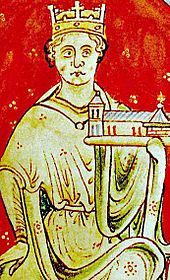
Many daughters, especially those of kings, had little or no say in who they would marry; they were bargaining pieces in the search for alliances. Even their legitimacy mattered little compared to what they could bring to the table, if their fathers were powerful enough. Joan, or Joanna, the illegitimate daughter of King John, was one such young lady.

Very little is known of Joan until her appearance on the international stage in 1203, aged twelve or thirteen. It was in that year mention is made of a ship, chartered in Normandy, ‘to carry the king’s daughter and the king’s accoutrements to England’.¹ The daughter in question appears to be Joan, born around 1191 to an unknown mother, possibly a lady by the name of Clemencia or Clementina. Nothing is known of Joan’s childhood, which appears to have been spent in Normandy. However, although she grew up in obscurity, Joan must have received an education suitable to her rank as the daughter of a prince and, later, king; after all, her father intended to marry her to a prince and so would need her to be able to act the part of a princess.

By 15 October 1204 Joan was betrothed to the foremost prince in Wales; Llywelyn ab Iorweth, prince of Gwynedd, also known as Llywelyn Fawr, or Llywelyn the Great. In the summer of 1204, he had paid homage to King John for his Welsh lands, having recognised the English king as overlord by treaty in July 1201; allowing him to marry Joan was a sign of John’s favour. By the time of his marriage, Llywelyn was already an accomplished warrior and experienced statesman; and was the father of at least two children, a son and daughter, Gruffuddd ab Llywelyn and Gwenllian. Their mother was possibly Tangwystl, but her union with Llywelyn was not recognised by the Church and the children were considered illegitimate under Church law.

Joan and Llywelyn were probably married in the spring of 1205; part of Joan’s dowry, the castle and manor of Ellesmere, were granted to Llywelyn on 16 April 1205, suggesting the wedding took place around that time. Joan was fourteen or fifteen at the time; at thirty-two, Llywelyn was about eighteen years her senior. Having been uprooted from her home in Normandy, she had probably spent a year at the English court, learning of the politics and duties associated with her new home in Wales. The language and traditions of her new homeland would have been completely alien to the young woman. Even her name was not the same, in Welsh, she was known as Siwan.

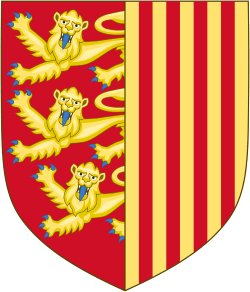
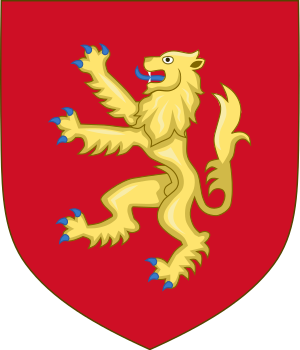
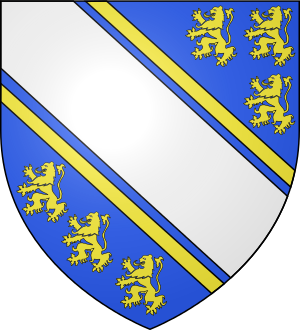
Arms of the royal house of Gwynedd

For someone barely into her teenage years, all these changes must have been daunting. Not only was she expected to become a wife and a princess to a nation that was totally alien to her, but her responsibilities also included the role of peacemaker. In a prestigious marriage for an illegitimate daughter, Joan was thrown into the heart of Anglo-Welsh relations. She was to become an important diplomatic tool for her father and, later, her half-brother, Henry III; acting as negotiator and peacemaker between the English crown and her husband, almost from the first day of her marriage.

Despite the marriage of Joan and Llywelyn, relations between England and Wales were rarely cordial. Following a devastating defeat by the English in 1211, in which the invading army had swept into Gwynedd, capturing the Bishop of Bangor in his own cathedral, Joan’s skills were sorely needed and

‘Llywelyn, being unable to suffer the King’s rage, sent his wife, the King’s daughter, to him by the counsel of his leading men to seek to make peace with the King on whatever terms he could.’

Brut y Tywysogyn or The Chronicle of the Princes: Peniarth MS 20 Version, editor T. Jones

Joan managed to negotiate peace, but at a high price, including the loss of the Four Cantrefs (the land between the Conwy and the Dee rivers), a heavy tribute of cattle and horses and the surrender of hostages, including Llywelyn’s son, Gruffudd.

Following a deterioration of Anglo-Welsh relations, and as a precursor to invasion, twenty-eight of the Welsh hostages were hanged in 1212, though Gruffudd was not one of them. However, the English attack was called off when John received word from Joan that his barons were planning treason closer to home. The last years of John’s reign were taken up with conflict with his barons, leading to the issuing of Magna Carta in 1215 and a French invasion by Louis, eldest son of Philip II Augustus. The last thing John needed, if he was to save his kingdom, was to be distracted by discontent in Wales. In 1214 Joan successfully negotiated with her father for the release of the Welsh hostages still in English hands, including Llywelyn’s son, Gruffudd; they were freed the following year.

Following her father’s death in October 1216, Joan continued to work towards peace between Wales and England. She visited Henry in person in September 1224, meeting him in Worcester; Joan seems to have had a good relationship with her half-brother, evidenced by his gifts to her of the manor of Rothley in Leicestershire, in 1225, followed by that of Condover in Shropshire, in 1226. An extant letter to Henry III, addressed to her ‘most excellent lord and dearest brother’ is a plea for him to come to an understanding with Llywelyn.

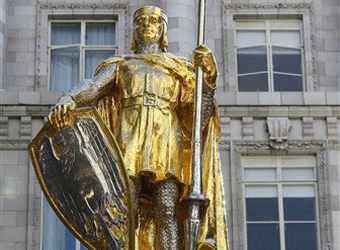
Statue of Llywelyn the Great, Conwy

In the letter, Joan uses her relationship with Henry to try to ease the mounting tensions between the two men. She describes her grief ‘beyond measure’ that discord between her husband and brother had arisen out of the machinations of their enemies, and reassures her brother of Llywelyn’s affection for him. In the mid-1220s, Henry acted as a sponsor, with Llywelyn, in Joan’s appeal to Pope Honorius III to be declared legitimate; in 1226 her appeal was allowed on the grounds that neither of Joan’s parents had been married to others when she was born.

Joan and Llywelyn’s marriage appears to have been, for the most part, a successful one. Joan’s high-born status, as the daughter of a king, brought great prestige to Gwynedd. As a consequence, her household was doubled from four to eight staff, including a cook who could prepare Joan’s favourite dishes. Llywelyn seems to have valued his wife’s opinion; as we have seen, he often made use of her diplomatic skills and relationship with the English court and he often consulted her on other matters. Her influence extended to Welsh legal texts, which, from this period onwards, included French words. Joan’s position was strengthened even further by the arrival of her children. Sometime between 1212 and 1215, her son, Dafydd, was born; in 1220 he was recognised as Llywelyn’s heir by Henry III, officially supplanting his older, illegitimate, half-brother, Gruffudd, who was entitled to his father’s lands under Welsh law.

The move received papal approval in 1222. As a result, in 1229 Dafydd performed homage to Henry III, as his father’s heir. A daughter, Elen, was probably born around 1210, as she was first married in 1222, to John the Scot, Earl of Chester. Her second marriage, in 1237 or 1238, was to Robert de Quincy. Joan was the mother to at least two more of Llywelyn’s daughters, Gwladus and Margaret. Gwladus was married to Reginald de Braose. Her stepson, William (V) de Braose, was to play a big part in Joan’s scandalous downfall in 1230.

Joan’s life in the first quarter of the 13th century had been exemplary; she was the ideal medieval woman, a dutiful daughter and wife, whose marriage helped to broker peace, if an uneasy one, between two countries. She had fulfilled her wifely duties, both by providing a son and heir and being supportive of her husband to the extent that she should not be included in the roll call of scandalous women – however, in 1230, everything changed.

William de Braose was a wealthy Norman baron with estates along the Welsh Marches, he was the grandson of Maud de Braose, who starved to death in King John’s dungeons. Hated by the Welsh, who had given him the nickname Gwilym Ddu, or Black William, he had been taken prisoner by Llywelyn in 1228, near Montgomery. Although he had been released after paying a ransom, de Braose had returned to Llywelyn’s court to arrange a marriage between his daughter, Isabella, and Llywelyn’s son and heir, Dafydd. During this stay, William de Braose was ‘caught in Llywelyn’s chamber with the King of England’s daughter, Llywelyn’s wife’. ²

The exact details of the relationship between Joan and William are unknown; neither can we say whether Joan was with William de Braose by choice or force. At the time, however, the blame was laid at Joan’s door. Contemporaries were deeply shocked at Joan’s betrayal of her husband; indeed, following this scandal, Welsh law identified the sexual misconduct of the wife of a ruler as ‘the greatest disgrace’. Joan was no young girl struggling to come to terms with her position in life; she was about forty years old, had been Llywelyn’s consort for twenty-five years and had borne him at least two children when the affair was discovered. The most surprising thing about the whole affair, moreover, is Llywelyn’s response. His initial anger saw William de Braose arrested, put on trial and hanged from the nearest tree on 2 May 1230. Joan was imprisoned in a tower. This rage, however vicious, was remarkably brief.

Maybe it was due to the strength of the previous relationship between Llywelyn and Joan, or maybe it was the high value placed on Joan’s diplomatic skills and her links with the English court; but within a year the terms of Joan’s imprisonment had been relaxed and just months after that, she was back on the political stage. Llywelyn appears to have forgiven her; the couple were reconciled and Joan returned to her life and position as Lady of Wales. Indeed, Joan soon reprised her diplomatic duties. She attended a conference between her husband, son and her brother, Henry III at Shrewsbury, in 1232. Despite William de Braose’s betrayal of Llywelyn, and subsequent violent death, the wedding between his daughter, Isabella, and Llywelyn’s son, Dafydd, was not derailed and by 1232 they were married.

Llywelyn with his sons, Dafydd and Gruffudd

Joan’s indiscretion was forgiven by Llywelyn, maybe even forgotten, and when she died on 2 February 1237, the Welsh prince was deeply affected by grief. Joan died at Garth Celyn, Abergwyngregyn, on the north coast of Gwynedd. She was buried close to the shore of Llanfaes, in the Franciscan friary that Llywelyn founded in her memory – a testament to his love for her. The friary was consecrated in 1240, just a few months before Llywelyn’s own death in April of that year. The friary was destroyed in 1537, during Henry VIII’s dissolution of the monasteries.

Joan’s remains were lost, but her coffin was eventually found, being used as a horse trough in the town of Beaumaris, on Anglesey. It is a testament to Joan’s personality, and the strength of her relationship with Llywelyn, that her affair with de Braose had few lasting consequences for her. Had she been younger, when the legitimacy of her children could have been called into question, her punishment could have been much harsher and the consequences more far-reaching.

*

Footnotes: ¹ Magna rotuli, 2–569, quoted in Joan, d. 1237, by Kate Norgate and Rev. A.D. Carr in Oxfroddnb.com; ² ibid.

Images courtesy of Wikipedia

Sources: Oxforddnb.com; England Under the Norman and Angevin Kings 1075-1225 by Robert Bartlett; Oxford Companion to British History Edited by John Cannon; The Story of Britain by Roy Strong; The Plantagenets, the Kings who Made England by Dan Jones; The Life and Times of King John by Maurice Ashley; The Plantagenet Chronicles Edited by Elizabeth Hallam; Oxforddnb.com; magnacartareseearch.org; Magna Carta by David Starkey; King John by Marc Morris; King John, England, Magna Carta and the Making of a Tyrant by Stephen Church; 1215, the Year of Magna Carta by Danny Danziger and John Gillingham; Women in Thirteenth Century Lincolnshire by Louise J. Wilkinson.

*

My Books

Signed, dedicated copies of all my books are available through my online store.

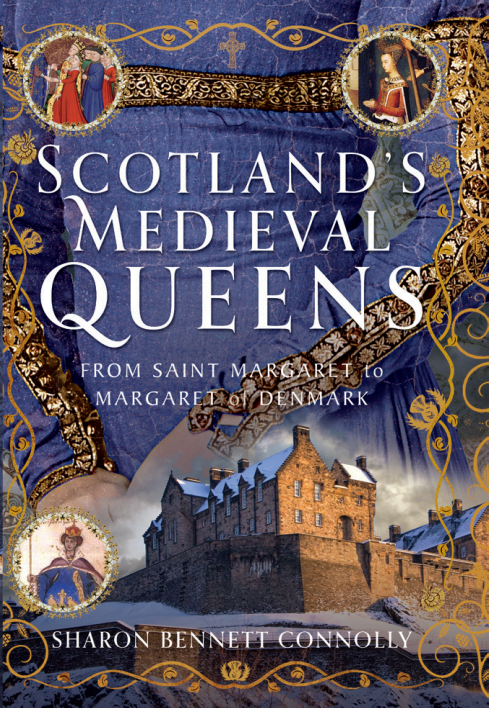
Out now: Scotland’s Medieval Queens

Scotland’s history is dramatic, violent and bloody. Being England’s northern neighbour has never been easy. Scotland’s queens have had to deal with war, murder, imprisonment, political rivalries and open betrayal. They have loved and lost, raised kings and queens, ruled and died for Scotland. From St Margaret, who became one of the patron saints of Scotland, to Elizabeth de Burgh and the dramatic story of the Scottish Wars of Independence, to the love story and tragedy of Joan Beaufort, to Margaret of Denmark and the dawn of the Renaissance, Scotland’s Medieval Queens have seen it all. This is the story of Scotland through their eyes.

Available now from Amazon and Pen and Sword Books

Also by Sharon Bennett Connolly:

Heroines of the Tudor World tells the stories of the most remarkable women from European history in the time of the Tudor dynasty, 1485-1603. These are the women who ruled, the women who founded dynasties, the women who fought for religious freedom, their families and love. Heroines of the Tudor World is now available for pre-order from Amberley Publishing and Amazon UK. Women of the Anarchy demonstrates how Empress Matilda and Matilda of Boulogne, unable to wield a sword themselves, were prime movers in this time of conflict and lawlessness. It shows how their strengths, weaknesses, and personal ambitions swung the fortunes of war one way – and then the other. Available from Bookshop.orgAmberley Publishing and Amazon UKKing John’s Right-Hand Lady: The Story of Nicholaa de la Haye is the story of a truly remarkable lady, the hereditary constable of Lincoln Castle and the first woman in England to be appointed sheriff in her own right. Available from all good bookshops Pen & Sword Booksbookshop.org and Amazon

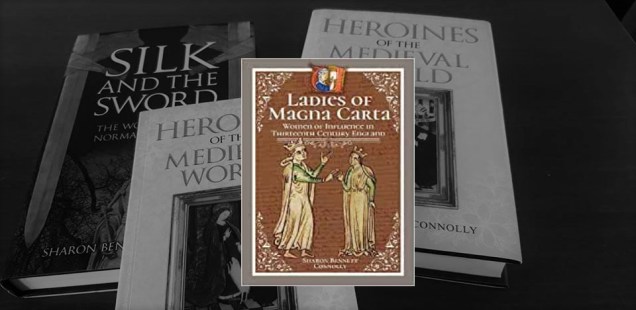
Defenders of the Norman Crown: The Rise and Fall of the Warenne Earls of Surrey tells the fascinating story of the Warenne dynasty, from its origins in Normandy, through the Conquest, Magna Carta, the wars and marriages that led to its ultimate demise in the reign of Edward III. Available from Pen & Sword BooksAmazon in the UK and US, and Bookshop.orgLadies of Magna Carta: Women of Influence in Thirteenth Century England looks into the relationships of the various noble families of the 13th century, and how they were affected by the Barons’ Wars, Magna Carta and its aftermath; the bonds that were formed and those that were broken. It is now available in paperback and hardback from Pen & SwordAmazon, and Bookshop.orgHeroines of the Medieval World tells the stories of some of the most remarkable women from Medieval history, from Eleanor of Aquitaine to Julian of Norwich. Available now from Amberley Publishing and Amazon, and Bookshop.orgSilk and the Sword: The Women of the Norman Conquest traces the fortunes of the women who had a significant role to play in the momentous events of 1066. Available now from Amazon,  Amberley Publishing, and Bookshop.org.

Alternate Endings: An anthology of historical fiction short stories including Long Live the King… which is my take what might have happened had King John not died in October 1216. Available in paperback and kindle from Amazon.

Podcast:

Have a listen to the A Slice of Medieval podcast, which I co-host with Historical fiction novelist Derek Birks. Derek and I welcome guests, such as Bernard Cornwell and Michael Jecks, and discuss a wide range of topics in medieval history, from significant events to the personalities involved. Every episode is also now available on YouTube.

*

Don’t forget! Signed and dedicated copies of all my books are available through my online store.

For forthcoming online and in-person talks, please check out my Events Page.

You can be the first to read new articles by clicking the ‘Follow’ button, liking our Facebook page or joining me on TwitterThreadsBluesky and Instagram.

©2020 Sharon Bennett Connolly, FRHistS

Guest Post: Why was Ailenor of Provence called a She Wolf Queen? by Carol McGrath

Alienor of Provence

Given my recent articles on She Wolves, it is a distinct pleasure to welcome Carol McGrath to History…the Interesting Bits with an article about Eleanor of Provence, another queen labelled a ‘she-wolf’.

Why was Ailenor of Provence called a She Wolf Queen?

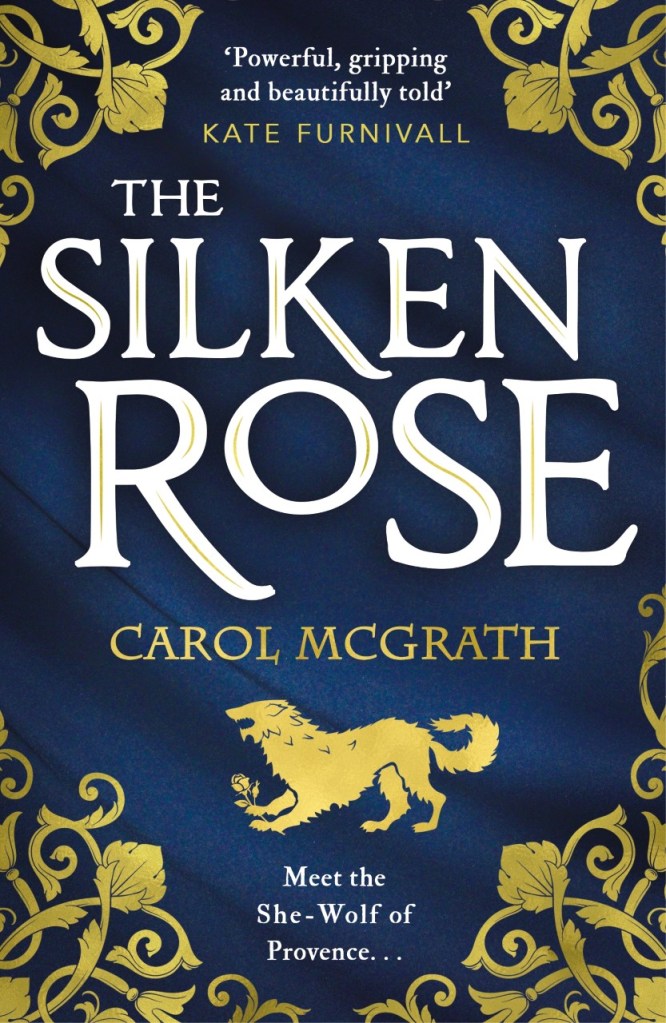
The first novel, in The She Wolf Queens Trilogy, The Silken Rose was published as an ebook on Thursday 2nd April. The Silken Rose features Ailenor of Provence, who married Henry III in 1236 at only twelve or thirteen years of age. He was already old at twenty-nine years old. The term She Wolf Queen was initially used for Margaret of Anjou by William Shakespeare.

Later, the Victorian Historian, Agnes Strickland, used it for Ailenor of Provence, although Ailenor had, without doubt, made enemies during own her life time. Why label Ailenor of Provence a she wolf queen. Did she deserve this sobriquet?

Alms dish (photograph courtesy of Carol McGrath)

In many ways beautiful Ailenor was the perfect queen who generously gave alms to the poor, was devoted to her husband and endowed abbeys. She was a good mother, protective of her children. Exemplary you might think. However, Ailenor was foreign at a time when English Continental territories had been reduced to Gascony and Aquitaine and ‘Englishness’ was becoming a national identity.

Ailenor of Provence never brought Henry a dowry. She was not even from the top-drawer of European nobility. After her marriage, she introduced a collection of penniless Savoyard and Provençal relatives to England.  The English barons who had become inward looking, after the loss of estates in Normandy during the previous reign, were furious. They disliked top positions being parcelled out to the queen’s relatives, particularly to her uncles from Savoy.

Opus Anglicanum

It probably seemed natural to Ailenor to advance her own relatives. Uncle William of Savoy who had accompanied Ailenor to England became one of King Henry’s chief counsellors. Henry even attempted to make him Bishop of Winchester.

Uncle Peter, reportedly charming and clever, became an advisor and received the Honour of Richmond, in Yorkshire. Peter built the Savoy Palace in London. Thomas of Savoy acted as an envoy when Ailenor attempted to buy the Sicilian crown for her second son, Edmund. An unpopular foolish move. It was costly and fell apart when Thomas was captured and imprisoned in Turin and Ailenor had to raise a ransom. The handsome, reforming Uncle Boniface became Archbishop of Canterbury.

Peter of Savoy

In addition, talented clerks came to England from Provence and Savoy. They took over running the treasury as well as other areas of government. This did not please the English barons who felt such jobs were theirs to distribute and control. Henry loved pageants and parties. He spent money on magnificent, expensive building works such as Westminster Abbey. She adored fashion and rich embroidery.  I off set her point of view in the novel with that of a court embroiderer. Extravagant spending and nepotism would lead to conflict between King and Barons. She was blamed as a bad influence on the King.

English marriages were arranged for her relations, including that of Ailenor’s younger sister, Sanchia, to Henry’s brother, Richard of Cornwall. This limited English heirs and heiresses available for English barons’ own sons and daughters. After the disgrace and death of Henry’s mother, his hated Lusignan half-brothers arrived in England seeking patronage. Incensed,

Coat of arms of Alienor of Provence

Ailenor’s opposition to the unpopular Lusignans gave her momentarily a stronger political position at court. However, she recognised she would have to tolerate them if she was to preserve good will within her marriage. Henry made her joint regent when he campaigned in Gascony during the 1250s but she levied new taxes, an unpopular move.

At the outbreak of the Baron’s war in 1263, Ailenor was pelted with offal from London Bridge as she attempted to take a boat from The Tower upriver. After that, she sailed for France to raise mercenaries for the royalist cause.

Ailenor was a force to be reckoned with. No wonder during the Victorian era she earned the title of she wolf queen. Nowadays, I suspect, we admire her loyalty, intelligence, love of culture and personal strength.

I would like to extend huge thanks to Carol for a fabulous post and wish her every success with The Silken Rose.

About the author:

Carol McGrath

Following her first degree in English and History, Carol McGrath completed an MA in Creative Writing at The Seamus Heaney Centre, Belfast, followed by an MPhil from University of London. Her fifth historical novel, The Silken Rose, first in The Rose Trilogy, published by the Headline Group, is set during the High Middle Ages. It features Ailenor of Provence and will be published on April 2nd 2020. Carol was the co-ordinator of the Historical Novels’ Society Conference, Oxford in September 2016. Visit her website: http://www.carolcmcgrath.co.uk.

Carol’s latest novel, The Silken Rose, telling the remarkable story of Alienor of Provence is available now. To purchase The Silken Rose ebook click here

To watch the trailer click here https://youtu.be/EOPKFBhpa0I

To subscribe to my newsletter click here   bit.ly/39eUgKl

*

My Books

Coming soon! 

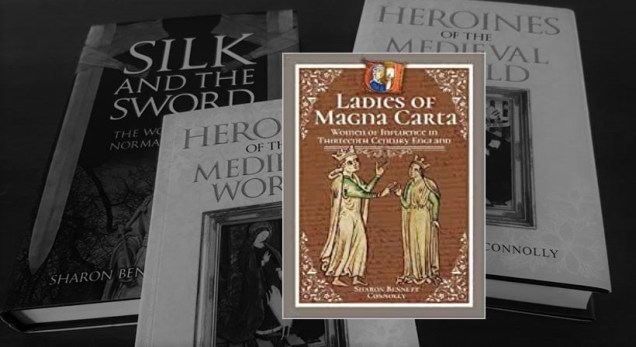
Ladies of Magna Carta: Women of Influence in Thirteenth Century England will be released in the UK on 30 May 2020 and is now available for pre-order from Pen & SwordAmazon UK and from Book Depository worldwide. It will be released in the US on 2 September and is available for pre-order from Amazon US.

Also by Sharon Bennett Connolly:

Silk and the Sword: The Women of the Norman Conquest traces the fortunes of the women who had a significant role to play in the momentous events of 1066.  Available now from Amazon UK,  Amberley Publishing, Book Depository and Amazon US.

Heroines of the Medieval World tells the stories of some of the most remarkable women from Medieval history, from Eleanor of Aquitaine to Julian of Norwich. Available now from Amberley Publishing and Amazon UK, Amazon US and Book Depository.

*

You can be the first to read new articles by clicking the ‘Follow’ button, liking our Facebook page or joining me on Twitter and Instagram.

©2020 Sharon Bennett Connolly and Carol McGrath

Book Corner: The Peasants' Revolting Crimes by Terry Deary

By Lewis Connolly

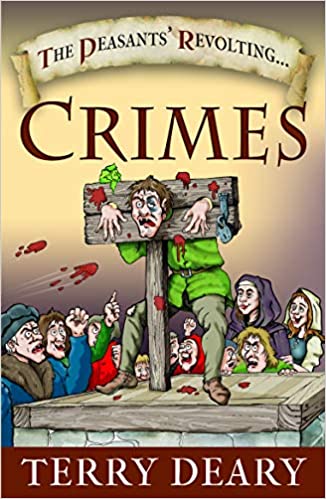
Popular history writer Terry Deary takes us on a light-hearted and often humorous romp through the centuries with Mr & Mrs Peasant, recounting foul and dastardly deeds committed by the underclasses, as well as the punishments meted out by those on the right side’ of the law.

Discover tales of arsonists and axe-wielders, grave robbers and garroters, poisoners and prostitutes. Delve into the dark histories of beggars, swindlers, forgers, sheep rustlers and a whole host of other felons from the lower ranks of society who have veered off the straight and narrow. There are stories of highwaymen and hooligans, violent gangs, clashing clans and the witch trials that shocked a nation. Learn too about the impoverished workers who raised a riot opposing crippling taxes and draconian laws, as well as the strikers and machine-smashers who thumped out their grievances against new technologies that threatened their livelihoods.

Britain has never been short of those who have been prepared to flout the law of the land for the common good, or for their own despicable purposes. The upper classes have lorded and hoarded their wealth for centuries of British history, often to the disadvantage of the impoverished. Frustration in the face of this has resulted in revolt. Read all about it here!

This entertaining book is packed full of revolting acts and acts of revolt, revealing how ordinary folk – from nasty Normans to present-day lawbreakers – have left an extraordinary trail of criminality behind them. The often gruesome penalties exacted in retribution reveal a great deal about some of the most fascinating eras of British history.

It has been a strange week for us all, I’m sure. And on Tuesday evening we got a message from my son’s school saying it was closed until further notice, so Wednesday morning was my first day of home schooling. School have been amazing and set tons of work to keep the child occupied. However, on Wednesday, there was no English so I had to set some myself; which was basically for said child to write a review of Terry Deary’s The Peasants’ Revolting CRIMES. I received this book as a review copy from the publishers, Pen & Sword, but the child got to read it first, and loved it. He’s a die-hard fan of Horrible Histories, so this book was right up his street.

So, it’s over to Lewis:

I liked, no I LOVED Terry Deary’s The Peasants’ Revolting CRIMES. I would recommend it for people who are age 13+ (due to minor swearing content) and you will not need to know your history because this book educates you in the revolting and hard life of the peasant.

Opening with ‘Norman Nastiness’, the book gives you a vivid taste of peasant crimes right up until the ‘Georgian Jokers and Victorian Villains’ and beyond.

The last witch

After seeing a smiling ‘medium’ at a psychic fair, a friend of mine punched her. When I asked him why he would do such a thing, he replied, ‘My father always taught me to strike a happy medium’,

In 1944, Helen Duncan was a Scottish spiritual medium, working in Portsmouth. She began broadcasting information from the port’s gullible sailors wjhho came ot consult her. D-Day was approaching and she was a security risk. She had to be stopped.

Duncan was originally charged under the Vagrancy Act 1824, relating to fortune telling, astrology and spiritualism. Then there was a change of plan. The paranoid government’s legal experts sent her to be tried by jury at the Old Bailey for contravening section 4 of the Witchcraft Act 1735, which carried the heavier penalty of a prison sentence.

Winston Churchill even described the whole episode as ‘obsolete tomfoolery’ but Helen went to prison for nine months.

The 1753 Act was later repealed and replaced with the Fraudulent Mediums Act of 1951.

So, no more witch trials.

You could call it hex-it

In this book, you will explore various ages of history, from the Middle Ages to the Stuarts, to the vicious, unforgiving Victorian era and the modern era. You will hear various quotes from all sorts of people, from William Shakespeare, to Martin Luther King and many, many others as you explore the book.

I particularly like the funny jokes like “Bring a man a fire and he will be warm for a day. Give a man a fire and he will be warm for the rest of his life” and “Will Shakespeare. Great writer, dodgy historian”. There are various other jokes, which are scattered throughout the book.

There was nothing to dislike about this book, despite its gory and bloody moments. It will tickle your funny bone for hours on end, so much so you will never put it down!

In conclusion, this is a great book for children and adults alike. It is not only comedy but it also used 100% historically accurate. You should order it now. What are you waiting for?

Huge thanks to Lewis for a fabulous, entertaining review!

The Peasants’ Revolting CRIMES by Terry Deary is available from Pen & Sword and Amazon.

About the author:

Terry Deary is the esteemed author of the immensely popular Horrible Histories series. This is his first title for Pen and Sword Books, to be followed next year by The Peasants’ Revolting Lives.

My Books

Coming soon! 

Ladies of Magna Carta: Women of Influence in Thirteenth Century England will be released in the UK on 30 May 2020 and is now available for pre-order from Pen & SwordAmazon UK and from Book Depository worldwide. It will be released in the US on 2 September and is available for pre-order from Amazon US.

Also by Sharon Bennett Connolly:

Silk and the Sword: The Women of the Norman Conquest traces the fortunes of the women who had a significant role to play in the momentous events of 1066.  Available now from Amazon UK,  Amberley Publishing, Book Depository and Amazon US.

Heroines of the Medieval World tells the stories of some of the most remarkable women from Medieval history, from Eleanor of Aquitaine to Julian of Norwich. Available now from Amberley Publishing and Amazon UK, Amazon US and Book Depository.

*

You can be the first to read new articles by clicking the ‘Follow’ button, liking our Facebook page or joining me on Twitter and Instagram.

©2020 Sharon Bennett Connolly 

Mother’s Day Giveaway

Competition Closed: And the winner is Carolyn Hester

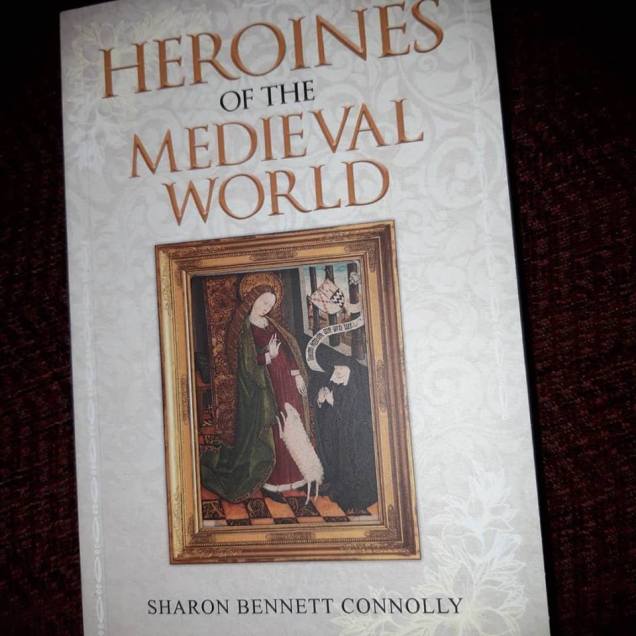
Sunday 22nd March 2020 is Mother’s Day in the UK this year and what better way to celebrate the 1st birthday of the paperback of Heroines of the Medieval World, than a giveaway for everyone’s favourite Heroine – MUM?!?!

“As Connolly ably demonstrates, knowing about these fascinating women is essential to filly understanding medieval Europe.” (Publishers Weekly)

About Heroines of the Medieval World

Heroines come in many different forms, and it is no less true for medieval heroines. They can be found in all areas of medieval life; from the dutiful wife and daughter to religious devotees, warriors and rulers. What makes them different compared to those of today are the limitations placed on them by those who directed their lives – their fathers, husbands, priests and kings. Women have always been an integral part of history, although when reading through the chronicles of the medieval world, you would be forgiven if you did not know it. We find that the vast majority of written references are focussed on men. The chronicles were written by men and, more often than not, written for men. It was men who ruled countries, fought wars, made laws and treaties, dominated religion and guaranteed – or tried to guarantee – the continued survival of their world. It was usually the men, but not all of them, who could read, who were trained to rule and who were expected to fight, to defend their people and their country…

And don’t worry, the offer is open worldwide – even if it isn’t Mother’s Day for you just yet.

It’s easy to enter!

To win a signed copy of Heroines of the Medieval World dedicated to a heroine of your choice – your mum, aunt, sister, grandmother, daughter or yourself (I won’t judge!), or someone else’s mum – for Mother’s Day, simply leave a comment below or on my Facebook page and I will include you in the prize draw.

The draw will be made on Wednesday 18th March, so you should get the book in time for the big day.

Good luck!

*

My Books

Coming soon! 

Ladies of Magna Carta: Women of Influence in Thirteenth Century England will be released in the UK on 30 May 2020 and is now available for pre-order from Pen & SwordAmazon UK and from Book Depository worldwide. It will be released in the US on 2 September and is available for pre-order from Amazon US.

Also by Sharon Bennett Connolly:

Silk and the Sword: The Women of the Norman Conquest traces the fortunes of the women who had a significant role to play in the momentous events of 1066.  Available now from Amazon UK,  Amberley Publishing, Book Depository and Amazon US.

Heroines of the Medieval World tells the stories of some of the most remarkable women from Medieval history, from Eleanor of Aquitaine to Julian of Norwich. Available now from Amberley Publishing and Amazon UK, Amazon US and Book Depository.

*

You can be the first to read new articles by clicking the ‘Follow’ button, liking our Facebook page or joining me on Twitter and Instagram.

©2020 Sharon Bennett Connolly 

Little Princess Gwenllian

Gwenllian was the only child of Llywelyn ab Gruffuddd, also known as Llywelyn the Last, Prince of Wales. Her mother was Eleanor de Montfort, who was the daughter of Eleanor of England, sister of Henry III, and Simon de Montfort, Earl of Leicester. Llywelyn and Eleanor had married in Worcester Cathedral in October 1278, in a lavish ceremony attended by Edward I, King of England, and Alexander III, King of Scots.

Sharon Bennett Connolly
Memorial to Gwenllian, Sempringham, Lincolnshire

Gwenllian, a descendant of both Welsh and English royalty, was born in June 1282 at the palace of Garth Celyn, Abergwyngregyn, near Bangor; her mother died giving birth to her. Shortly after her birth, Edward I concluded his conquest of Wales. Gwenllian’s father, Llywelyn, was killed in an ambush on 11 December 1282 – and just six months after her birth, Gwenllian was an orphan. Her uncle Dafydd, Llywelyn’s younger brother, became the little princess’s legal guardian. After his brother’s death, Dafydd continued the fight for Welsh independence but was betrayed to the English, in June 1283.

Dafydd, his wife, children and little Gwenllian were captured at Bera Mountain in Snowdonia, where they had been in hiding. At just one year old, Gwenllian was taken, by sea, probably to thwart any attempt at rescue, from Wales, the land of her birth. She would never see her homeland again. The baby girl was placed behind the high walls of the Gilbertine priory of Sempringham, in Lincolnshire, just south of the great city of Lincoln. Her female cousins, the seven daughters of Dafydd, were also placed in various nunneries, so it is possible some of her cousins were with her. Dafydd’s legitimate daughter, Gwladus, who was a similar age to Gwenllian, was placed in Sixhills, another Gilbertine priory, in the Lincolnshire Wolds.

Llywelyn
Statue of Gwenllian’s father, Llywelyn the Last at Cardiff City Hall

Dafydd’s two sons, Llywelyn and Owain, were imprisoned in Bristol Castle; the eldest, Llywelyn, died there in 1287, just four years after his capture. Owain was still living in 1325, every night securely incarcerated in a specially constructed timber cage within Bristol Castle. Dafydd himself suffered the horrendous ‘traitor’s death’; he was hung, drawn and quartered at Shrewsbury.

The Gilbertines were the only wholly-English monastic community. Their founder, St Gilbert, had some form of physical deformity, which prevented him from pursuing a career as a knight. He trained as a clerk in France, studying under Master Anselm at Laon. He eventually entered the household of the Bishop of Lincoln and, in 1129, was appointed Vicar of Sempringham and West Torrington. He established the first priory there in 1131, with seven local women vowing to live a life of chastity, poverty and obedience. Sempringham Priory was a double-house, housing both men and women in segregated quarters.

At its height, the priory housed 200 nuns and forty canons. The order followed strict rules, based on those of the Augustinian and Premonstratensian monasteries. By the time of Gilbert’s death in 1189 there were thirteen priories in England; this number had risen to twenty-five at the time of the Reformation.1

Gwenllian was a prisoner at the Gilbertine Priory of St Mary, at Sempringham, for the rest of her life. A prisoner of three English kings, Edward I, Edward II and Edward III, she was a rallying figure for the subjugated Welsh and too valuable to ever be freed. Edward I wrote to the Prior and Prioress of Sempringham of his decision to place Gwenllian in their custody, on 11 November 1283: ‘… Having the Lord before our eyes, pitying also her sex and her age, that the innocent may not seem to atone for the iniquity and ill-doing of the wicked and contemplating especially the life in your Order’.2

Sharon Bennett Connolly
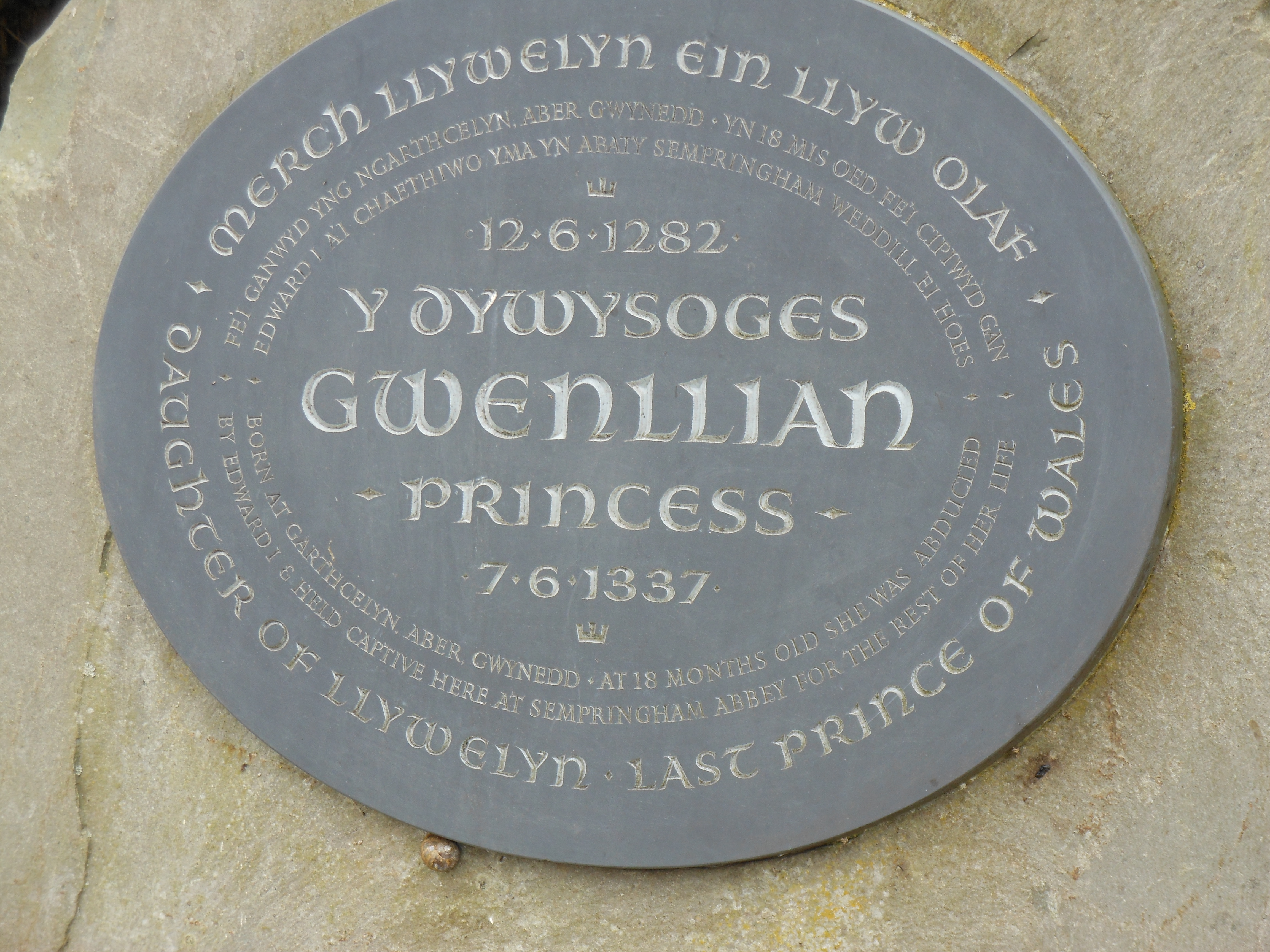
Memorial plaque to Gwenllian on the memorial at Sempringham

Although Edward wanted Gwenllian to be forgotten, he could not afford to forget about her himself, and four years after she was placed in the convent, Edward ordered Thomas Normanvill to ‘go to the places where the daughters of Llewellyn and of David his brother, who have taken the veil in the Order of Sempringham, are dwelling, and to report upon their state and custody by next Parliament’.3 The extent of Gwenllian’s knowledge of her own history and homeland is far from certain. Having been taken from Wales at six months old, she is said not to have spoken a word of Welsh and may not have even known how to spell her name; she is referred to as ‘Wencillian’, in a document sent to Edward III at the time of her death, although spelling was far from uniform in the 14th century.

Gwenllian was probably well-cared for. Edward III endowed her with a pension of £20 a year, which was paid to the priory for her food and clothing. Whether Gwenllian was treated according to her rank at the priory is unknown. However, she was aware of her importance and her family connections; as David Pilling points out and she does in fact call herself Princess of Wales, daughter of Llywelyn ap Gruffudd in a petition of 1327 to Edward II:

Wentliane, daughter of Lewelyn [Llywelyn], formerly Prince of Wales, prays the King of his grace to remember her and aid her, since the King, his father, promised her when she was put in the house of Sempringham, £100 of land and rent; whereof he told Walter de Langeton, then Treasurer, that he had given her £20 from the Exchequer yearly; and with this she has been provided.4

She is said to have received gifts from her cousin the king, and may have spent time in Edward III’s company, when he visited the priory at Easter-time in 1328; the young king issued a charter from Sempringham on 2 April of that year.5

Sharon Bennett Connolly
St Andrew’s Church, Sempringham stands close to the site of the Gilbertine priory of Sempringham

Gwenllian may also have spent time in the company of Joan Mortimer, the daughter of Roger Mortimer, supposed lover of Isabelle of France, Edward III’s mother, and ruler of England after the deposition of her huusband, Edward II. Joan was held at Sempringham following her father’s downfall in 1330. She was only eighteen at the time, however, so may have had little in common, beyond their joint status as prisoners of the crown, with Gwenllian, who was a woman now in her late forties who had spent her entire life in conventual seclusion. The profound difference between Joan and Gwenllian, of course, is that Joan was released after a short time.

Gwenllian only found her freedom in death. She died on 7 June 1337, the same month as her fifty-fifth birthday. She was buried at the priory where she had spent all but eighteen months of her life. Her grave was lost at the time of the dissolution of the monasteries, in the 16th century. However, a memorial plaque was placed near St Andrew’s Church in Sempringham in 1993, stating:

In memory of Gwenllian, daughter of the last Prince of Wales. Born at Abergwyngregyn 12.06.1282. Died at Sempringham 7.6.1337. Having been held prisoner for 54 years.6

Although she left very few marks on the world, a child whose very future was stolen by Edward I, Gwenllian’s remarkable story has not been forgotten. In 2009 a mountain in Snowdonia in Wales, formerly known as Carnedd Uchaf, was renamed Carnedd Gwenllian in the lost princess’s honour.

*

Gwenllian’s story, and that of her mother and grandmother, is told in my latest book, Ladies of Magna Carta: Women of Influence in Thirteenth Century England.

Footnotes: [1] David Ross, editor, Sempringham Priory, Church and Holy Well, britainexpress.com; [2] englishmonarchs.co.uk; [3] ibid; [4] William Rees, Calendar of Ancient Petitions Relating to Wales [5] Calendar of the Charter Rolls. 1-14, Edward III; [6] The Princess Gwenllian Society, Princessgwenllian.co.uk

Sources: castlewales.com; snowdoniaheritage.info; William Rees, Calendar of Ancient Petitions Relating to Wales; Marc Morris A Great and Terrible King;David Williamson Brewer’s British royalty; Mike Ashley The Mammoth Book of British kings & Queens; Alison Weir Britain’s Royal Families; Roy Strong The Story of Britain; Dan Jones The Plantagenets; the Kings who Made England; Chronicles of the Age of Chivalry Edited by Elizabeth Hallam; The Oxford Companion to British History; The History Today Companion to British History; Derek Wilson The Plantagenets; britainexpress.com; englishmonarchs.co.uk; princessgwenllian.co.uk; Calendar of the Charter Rolls; David Pilling.

Images: Photos of Sempringham Church and memorial ©2019 Sharon Bennett Connolly. Llywelyn the Last courtesy of Wikipedia.

*

My Books

Signed, dedicated copies of all my books are available through my online store.

Out now: Scotland’s Medieval Queens

Books by Sharon Bennett Connolly

Scotland’s history is dramatic, violent and bloody. Being England’s northern neighbour has never been easy. Scotland’s queens have had to deal with war, murder, imprisonment, political rivalries and open betrayal. They have loved and lost, raised kings and queens, ruled and died for Scotland. From St Margaret, who became one of the patron saints of Scotland, to Elizabeth de Burgh and the dramatic story of the Scottish Wars of Independence, to the love story and tragedy of Joan Beaufort, to Margaret of Denmark and the dawn of the Renaissance, Scotland’s Medieval Queens have seen it all. This is the story of Scotland through their eyes.

Scotland’s Medieval Queens gives a thorough grounding in the history of the women who ruled Scotland at the side of its kings, often in the shadows, but just as interesting in their lives beyond the spotlight. It’s not a subject that has been widely covered, and Sharon is a pioneer in bringing that information into accessible history.’ Elizabeth Chadwick (New York Times bestselling author)

Available now from Amazon and Pen and Sword Books

Also by Sharon Bennett Connolly:

Books by Sharon Bennett Connolly

Heroines of the Tudor World tells the stories of the most remarkable women from European history in the time of the Tudor dynasty, 1485-1603. These are the women who ruled, the women who founded dynasties, the women who fought for religious freedom, their families and love. Heroines of the Tudor World is now available from Amberley Publishing and Amazon UK. Women of the Anarchy demonstrates how Empress Matilda and Matilda of Boulogne, unable to wield a sword themselves, were prime movers in this time of conflict and lawlessness. It shows how their strengths, weaknesses, and personal ambitions swung the fortunes of war one way – and then the other. Available from Bookshop.orgAmberley Publishing and Amazon UKKing John’s Right-Hand Lady: The Story of Nicholaa de la Haye is the story of a truly remarkable lady, the hereditary constable of Lincoln Castle and the first woman in England to be appointed sheriff in her own right. Available from all good bookshops Pen & Sword Booksbookshop.org and Amazon

Defenders of the Norman Crown: The Rise and Fall of the Warenne Earls of Surrey tells the fascinating story of the Warenne dynasty, from its origins in Normandy, through the Conquest, Magna Carta, the wars and marriages that led to its ultimate demise in the reign of Edward III. Available from Pen & Sword BooksAmazon in the UK and US, and Bookshop.orgLadies of Magna Carta: Women of Influence in Thirteenth Century England looks into the relationships of the various noble families of the 13th century, and how they were affected by the Barons’ Wars, Magna Carta and its aftermath; the bonds that were formed and those that were broken. It is now available in paperback and hardback from Pen & SwordAmazon, and Bookshop.orgHeroines of the Medieval World tells the stories of some of the most remarkable women from Medieval history, from Eleanor of Aquitaine to Julian of Norwich. Available now from Amberley Publishing and Amazon, and Bookshop.orgSilk and the Sword: The Women of the Norman Conquest traces the fortunes of the women who had a significant role to play in the momentous events of 1066. Available now from Amazon,  Amberley Publishing, and Bookshop.org.

Alternate Endings: An anthology of historical fiction short stories including Long Live the King… which is my take what might have happened had King John not died in October 1216. Available in paperback and kindle from Amazon.

Podcast:

Have a listen to the A Slice of Medieval podcast, which I co-host with Historical fiction novelist Derek Birks. Derek and I welcome guests, such as Bernard Cornwell and Michael Jecks, and discuss a wide range of topics in medieval history, from significant events to the personalities involved. Every episode is also now available on YouTube.

*

Don’t forget! Signed and dedicated copies of all my books are available through my online bookshop.

For forthcoming online and in-person talks, please check out my Events Page.

You can be the first to read new articles by clicking the ‘Follow’ button, liking our Facebook page or joining me on TwitterThreadsBluesky and Instagram.


©2019 Sharon Bennett Connolly FRHistS

The Countess who Chastised a King

300px-royal_arms_of_england_1154-1189-svg
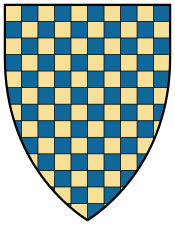
The arms of Hugh d’Aubigny, 5th Earl of Arundel

I recently came across the wonderful story of Isabel d’Aubigny, countess of Arundel, a woman who wouldn’t be cheated – even if it was by the king himself.

Isabel was born sometime in the late 1220s, the daughter of William de Warenne, 5th earl of Surrey and Warenne, and Matilda (or Maud) Marshal, daughter and co-heir of the Greatest Knight, William Marshal, earl of Pembroke. Through her grandfather, Hamelin Plantagenet, illegitimate half-brother of King Henry II, Isabel was a cousin of the king, Henry III.

With such impeccable parentage and family connections, it is no surprise that Isabel made a prestigious marriage. At no older than 8 years of age Isabel was married, in 1234, to 20-year-old Hugh d’Aubigny, 5th earl of Arundel. Hugh’s father, William, 3rd Earl of Arundel, had died in 1221, on his way home from the Fifth Crusade. William had been succeeded as 4th Earl by his oldest son and namesake, who died just 3 years after his father, aged just 21, leaving the earldom to his brother Hugh.

On their marriage, Isabel’s father granted the couple a manor at Marham in Norfolk, worth £40 a year in rent. The charter for this grant offers the only details available for the marriage. In 1242 Hugh accompanied the king on his expedition to Aquitaine. However, after just 9 years, on 7 May 1243, Hugh died; leaving Isabel, at 17 years of age, a childless widow, with a rather large dower.

Within weeks of her husband’s death, on 29th May, Isabel’s marriage was granted to Pierre de Genevre, a Savoyard favourite of the king, Henry III. However, the patent rolls show that provision was made for Isabel to remain unmarried should she so wish; although she would have to pay Pierre for the privilege. Given that she never remarried, she must have been more than happy to pay.

The de Warenne coat of arms

The Arundel inhheritance was divided between Hugh’s 4 sisters; Mabel, Isabel, Nicholaa and Cecily. The earldom itself went to Hugh’s nephew, his sister Isabel’s son, John FitzAlan. Isabel was well provided for, however, with her dower including the hundred and manor of Bourne in Lincolnshire, the manors of Wymondham and Kenninghall in Norfolk, Stansted in Essex and several properties in Norfolk and Buckinghamshire. Suffice to say, she was a very wealthy widow and would continue to be styled Countess of Arundel until her death.

In 1249, the same year as her mother died, Isabel founded the only English convent that was part of the Cistercian order. Established at Marham, two Cistercian abbots had inspected it in its first year. Isabel’s brother, John de Warenne, 6th Earl of Surrey, the Bishop of Norwich and Henry III himself all issued charters confirming the abbeys foundation. Along with other endowments, Isabel herself made 11 grants to the abbey in its early years, giving it a strong economic foundation. In 1252 Isabel was granted papal permission to visit the Cistercian house at Waverley to consult with him about her convent; Waverley’s annals record that she granted 4 marks and a cask of wine to the monks there.

Isabel was very protective of her property rights and went on the offensive when they were threatened, even if that meant going against the king. In 1252 Isabel did just that. One of her tenants, Thomas of Ingoldisthorpe, held a ¼ knight’s fee from Isabel at Fring and Snettisham; he also had property in the honour of Haughley, as an escheat from the crown. On his death in 1252 Henry III took all of Thomas’s lands in wardship until Thomas’s heir was of age, including Isabel’s ¼ knight’s fee. In March of 1252 Henry granted the wardship of the lands and marriage of the heir to his former treasurer and keeper of the king’s wardrobe, Peter Chaceporc. Had Thomas held his lands in chief from the king, Henry would have been within his rights to take prerogative wardship, however his land at Haughley was  held from the honour of Haughley, which only in the king’s hands as an escheat and Isabel had therefore been treated unjustly in being denied the wardship of his heirs.

Isabel took her grievances direct to the king, supposedly berating him for trampling on the rights laid out in Magna Carta. She is said to have asked:

‘Where are the liberties of England, so often recorded, so often granted, and so often ransomed?’¹

According to Matthew Paris, the chronicler and a personal friend of Isabel’s (though no particular fan of Henry), Henry scorned Isabel’s argument, ‘derisively and curling his nostrils’ and asked if the nobles of the realm had given her permission to speak on their behalf. Isabel argued that the king had given her the right to speak thus, in the articles granted in Magna Carta and accused the king of being a ‘shameless transgressor’ of the liberties laid down in the Great Charter, breaking his sworn oath to uphold its principles. At the end of the audience, Henry refused to be moved, ‘After listening to her [civilly] reproachful speech, the king was silent, and the countess, without obtaining or even asking for permission, returned home.’²

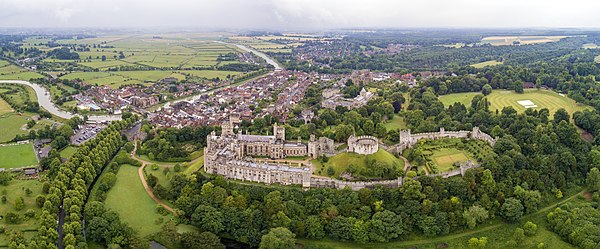
Arundel Castle

Isabel was one of the great nobles of England, the daughter of one earl and wife of another, and was obviously undaunted by an audience with the king. And although the king did not react to her reprimand immediately he did, eventually, admit that he may have been in the wrong, issuing a letter to her on 23 May 1253 saying:

‘Since the king has learnt that Thomas of Ingoldisthorpe, whose son and heir is in the custody of Peter Chaceporc by concession of the king, did not hold from the crown of the king in chief but from the honour of Haughley, which is in the hand of the king as his escheat, and that the same Thomas held from Hugh de Aubigny, once earl of Arundel, a quarter part of the fee of one knight with appurtenances in Fring and Snettisham and the service of which was assigned to Isabella, countess of Arundel, the widow of the foresaid earl, in dower, he has returned to the same countess custody of the foresaid quarter part of a fee with appurtenances; and the foresaid Peter is ordered to give the countess full seizin of the foresaid custody.’²

However, Isabel’s victory was incomplete, as in late 1253, while the king was overseas in Aquitaine, she instigated legal proceedings against Peter Chaceporc ‘for custody of Ingoldisthorpe’. Whether Chaceporc had not relinquished the land, or she believed she was entitled to more land than was returned to her, Isabel in fact lost the suit and was amerced £20 (30 marks) for a false claim. The writ was witnessed by Henry III’s queen, Eleanor of Provence, and his brother Richard, Earl of Cornwall.

As persistent as ever, and although he was overseas, Isabel appealed directly to the king, who responded with a pardon, although it seems he still smarted from the upbraiding she had given him earlier in the year:

‘3 April. Meilham. Henry, by the grace of God king of England, lord of Ireland, duke of Normandy and Aquitaine and count of Anjou sends greeting to his beloved consort E, by the same grace queen of England, lady of Ireland, duchess of Normandy and Aquitaine and countess of Anjou and to his beloved and faithful brother, R. earl of Cornwall. Know that we have pardoned our beloved and faithful Isabella countess of Arundel the 30m. at which she was amerced before our justices against our beloved and faithful … Peter Chaceporc, our Treasurer, for custody of Ingoldisthorpe. We, therefore, order you to cause the same countess to be quit of the aforesaid 30m. by our seal of England provided she says nothing opprobrious to us as she did when we were at Westminster and as we have signified to her by letter. Witness myself.’³

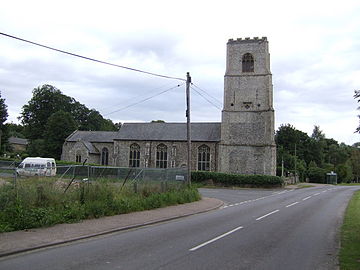
Holy Trinity Church, Marham

Isabel obviously had an eye for business, given that she could so concern herself with a ¼ knight’s fee out of the 60 that she held. A wealthy widow with impressive family connections, she was renowned not only for her religious endowment of the Cistercian convent at Marham, but also as a patron of religious texts, having commissioned at least 2 saints’ lives, including the life of St Richard of Wyche by Ralph Bocking. Isabel could count among her friends Richard Wych himself, the bishop of Chichester who was later canonised, and Matthew Paris. Paris translated  a life of Saint Edmund of Abingdon in to Anglo-Norman verse for Isabel’s personal use.

Isabel died shortly before 23 November 1282 and was laid to rest at her own foundation at Marham; her dower properties passed to her husband’s great-great nephew, Richard FitzAlan, 8th Earl of Arundel. Having spent almost 40 years as a childless widow, Isabel never remarried, her remarkable life dedicated to the patronage of her convent at Markham and religious writers, such as Paris and Bocking. This incredible woman stands out as the countess who reprimanded and humbled her king for his injustices.

*

Isabel’s remarkable story appears in my book, Defenders Of the Norman Crown: Rise and Fall of the Warenne Earls of Surrey.

Footnotes: 1. quoted by John A. Nichols in Oxforddnb.com; 2. quoted by Susanna Annesley in finerollshenry3.org.uk; 3. ibid.

*

Sources: John A. Nichols Oxforddnb.com; Susanna Annesley finerollshenry3.org.uk; Robert Bartlett England Under the Norman and Angevin Kings; Dan Jones The Plantagenets;David Williamson Brewer’s British Royalty; british-history.ac.uk; Early Yorkshire Charters Volume 8: The Honour of Warenne, Edited by William Farrer and Charles Travis Clay.

Pictures courtesy of Wikipedia: d’Aubigny arms by Sodocan; Warenne arms by Madboy74; Arundel Castle by Chensiyuan; Holy Trinity Church by John Billinger.

*

My Books

Signed, dedicated copies of all my books are available through my online bookshop.

Coming 30 January 2025: Scotland’s Medieval Queens

Scotland’s history is dramatic, violent and bloody. Being England’s northern neighbour has never been easy. Scotland’s queens have had to deal with war, murder, imprisonment, political rivalries and open betrayal. They have loved and lost, raised kings and queens, ruled and died for Scotland. From St Margaret, who became one of the patron saints of Scotland, to Elizabeth de Burgh and the dramatic story of the Scottish Wars of Independence, to the love story and tragedy of Joan Beaufort, to Margaret of Denmark and the dawn of the Renaissance, Scotland’s Medieval Queens have seen it all. This is the story of Scotland through their eyes.

Available for pre-order now.

Also by Sharon Bennett Connolly:

Heroines of the Tudor World tells the stories of the most remarkable women from European history in the time of the Tudor dynasty, 1485-1603. These are the women who ruled, the women who founded dynasties, the women who fought for religious freedom, their families and love. Heroines of the Tudor World is now available for pre-order from Amberley Publishing and Amazon UK. Women of the Anarchy demonstrates how Empress Matilda and Matilda of Boulogne, unable to wield a sword themselves, were prime movers in this time of conflict and lawlessness. It shows how their strengths, weaknesses, and personal ambitions swung the fortunes of war one way – and then the other. Available from Bookshop.orgAmberley Publishing and Amazon UKKing John’s Right-Hand Lady: The Story of Nicholaa de la Haye is the story of a truly remarkable lady, the hereditary constable of Lincoln Castle and the first woman in England to be appointed sheriff in her own right. Available from all good bookshops Pen & Sword Booksbookshop.org and Amazon

Defenders of the Norman Crown: The Rise and Fall of the Warenne Earls of Surrey tells the fascinating story of the Warenne dynasty, from its origins in Normandy, through the Conquest, Magna Carta, the wars and marriages that led to its ultimate demise in the reign of Edward III. Available from Pen & Sword BooksAmazon in the UK and US, and Bookshop.orgLadies of Magna Carta: Women of Influence in Thirteenth Century England looks into the relationships of the various noble families of the 13th century, and how they were affected by the Barons’ Wars, Magna Carta and its aftermath; the bonds that were formed and those that were broken. It is now available in paperback and hardback from Pen & SwordAmazon, and Bookshop.orgHeroines of the Medieval World tells the stories of some of the most remarkable women from Medieval history, from Eleanor of Aquitaine to Julian of Norwich. Available now from Amberley Publishing and Amazon, and Bookshop.orgSilk and the Sword: The Women of the Norman Conquest traces the fortunes of the women who had a significant role to play in the momentous events of 1066. Available now from Amazon,  Amberley Publishing, and Bookshop.org.

Alternate Endings: An anthology of historical fiction short stories including Long Live the King… which is my take what might have happened had King John not died in October 1216. Available in paperback and kindle from Amazon.

Podcast:

Have a listen to the A Slice of Medieval podcast, which I co-host with Historical fiction novelist Derek Birks. Derek and I welcome guests, such as Bernard Cornwell, and discuss a wide range of topics in medieval history, from significant events to the personalities involved.

*

Don’t forget! Signed and dedicated copies of all my books are available through my online bookshop.

For forthcoming online and in-person talks, please check out my Events Page.

You can be the first to read new articles by clicking the ‘Follow’ button, liking our Facebook page or joining me on TwitterThreadsBluesky and Instagram.

*

©2017 Sharon Bennett Connolly, FRHistS

“The Lincoln Fair” – the Battle that Saved England

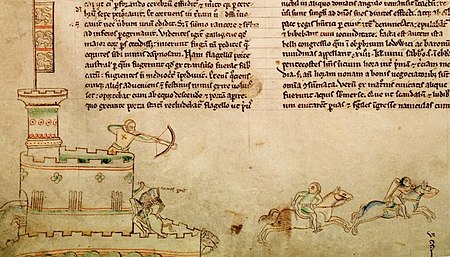
The Battle of Lincoln by Matthew Paris

Saturday 20th May, 2017, marked the 800th anniversary of one of Medieval England’s most decisive battles. The Second Battle of Lincoln, also known as “The Lincoln Fair”, rescued England from the clutches of Louis, Dauphin of France and future King Louis VIII.

England had been in turmoil during the last years of the reign of King John, with the barons trying to curtail the worst of his excesses. It had been hoped that the 1215 issuing of Magna Carta would prevent war, but when John reneged on the Great Charter, war was inevitable. England’s disgruntled barons even went so far as to write to Philip II, King of France, and invite his son, Louis, to come and claim the throne. Louis jumped at the chance and landed on England’s shores in 1216.

Strategically placed in the centre of the country, Lincoln was a target for the rebel barons and their French allies. An important Royalist stronghold, it was held by the redoubtable hereditary castellan, Lady Nicholaa de la Haye, who had been widowed in the early months of 1215. Lincoln Castle had already been under siege in 1216, when the northern rebels had been paid to go away. The rebels – including the King of Scotland – then fled north as John’s army advanced on the city. It was probably after the 1216 siege that Nicholaa made a show of relinquishing her post as castellan; however, John had other ideas:

And once it happened that after the war King John came to Lincoln and the said Lady Nicholaa went out of the eastern gate of the castle carrying the keys of the castle in her hand and met the king and offered the keys to him as her lord and said she was a woman of great age and was unable to bear such fatigue any longer and he besought her saying, “My beloved Nicholaa, I will that you keep the castle as hitherto until I shall order otherwise”.¹

John went even further to show his trust in Nicholaa, who was a long-time supporter of the unpopular king. As Louis consolidated his position in the south, John made an inspection of Lincoln castle in September 1216. He then moved south, losing his baggage as he crossed the Wash and falling ill as he travelled. After a brief stay at Swineshead Abbey, he made his way to Newark, where he died on the night of 18/19 October. Mere hours earlier, John had made history by appointing Nicholaa to the post of Sheriff of Lincolnshire. She was the first woman to ever be appointed sheriff in her own right. .

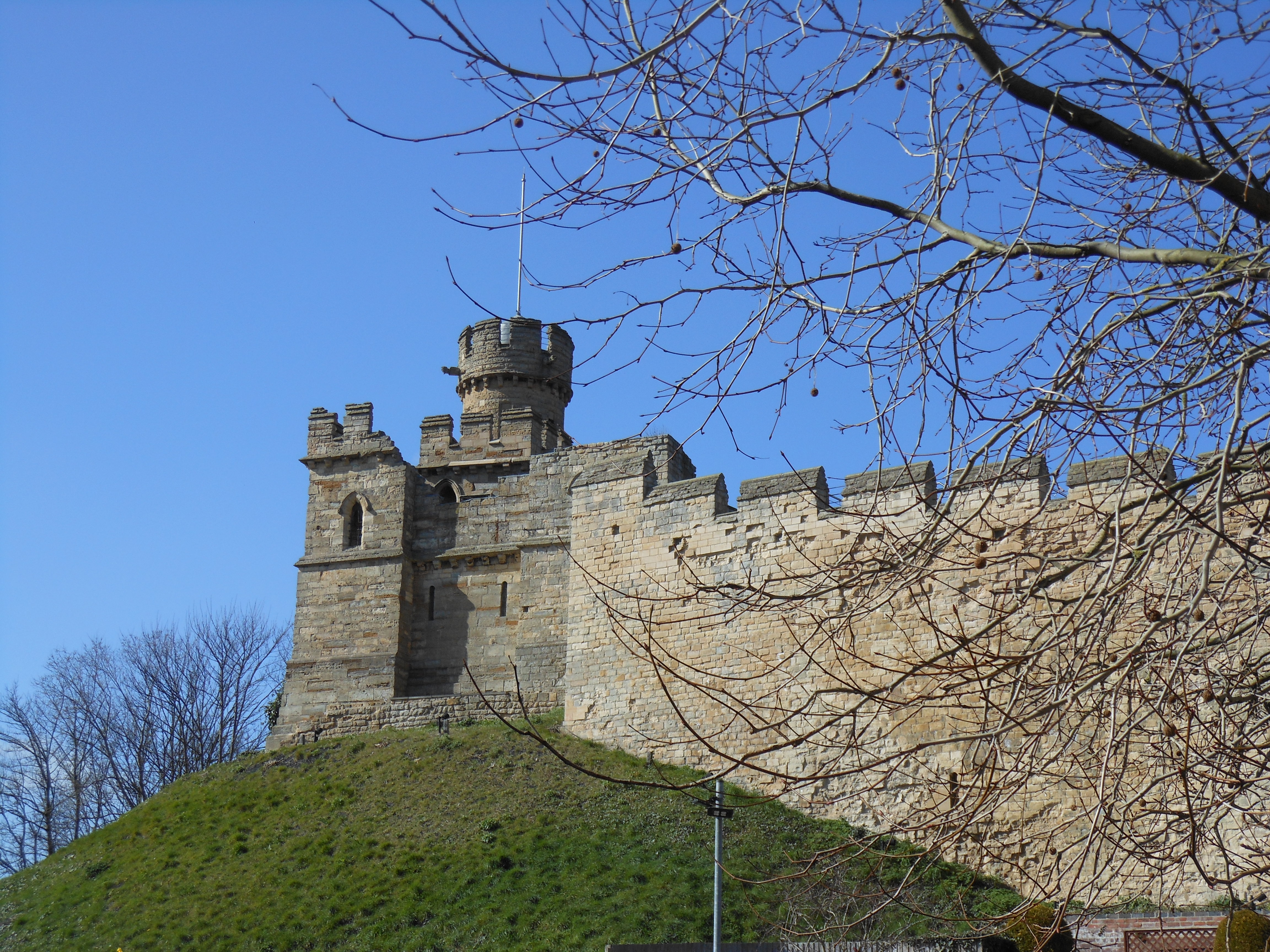
The Observatory Tower, Lincoln Castle

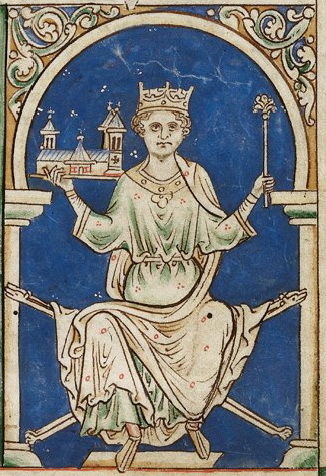
When John died, half of his country was occupied by a foreign invader and his throne now occupied by his 9-year-old son, Henry III. The only royal castles still in royalist hands were Windsor, Dover – and Lincoln. The elder statesman and notable soldier William Marshal, Earl of Pembroke was appointed Regent and set out to save the kingdom.

Following the coronation of young Henry, Magna Carta was reissued and some of the rebel barons returned to the fold, not wanting to make war on a 9-year-old king. However, Louis still had powerful supporters and did not seem keen to give up on his dream to rule England.

Louis’ forces, under the Comte de Perche, along with leading rebels Saher de Quincy, Earl of Wonchester, and Robert FitzWalter, marched north intending to relieve Mountsorel Castle, which was being besieged by the Earl of Chester. Fearing he was facing the entire French invading force, Chester had withdrawn as the French arrived and Perche’s forces diverted to Lincoln. Gilbert de Gant, on hearing news of John’s death, had occupied the city in late 1216 with a small force. He was now reinforced by Perche’s army and in early 1217, they laid siege to the castle. Now in her 60s, Nicholaa de la Haye took charge of the defences, with the help of her lieutenant, Sir Geoffrey de Serland.

For almost 3 months – from March to mid-May – siege machinery continuously bombarded the south and east walls of the castle. When the allied force proved insufficient to force a surrender, the French had to send for reinforcements. This meant that half of Louis’ entire army was now outside the gates of Lincoln Castle and provided William Marshal with an opportunity; one decisive battle against Louis’ forces at Lincoln could destroy the hopes of Louis and the rebel barons, once and for all.

DSCN5225
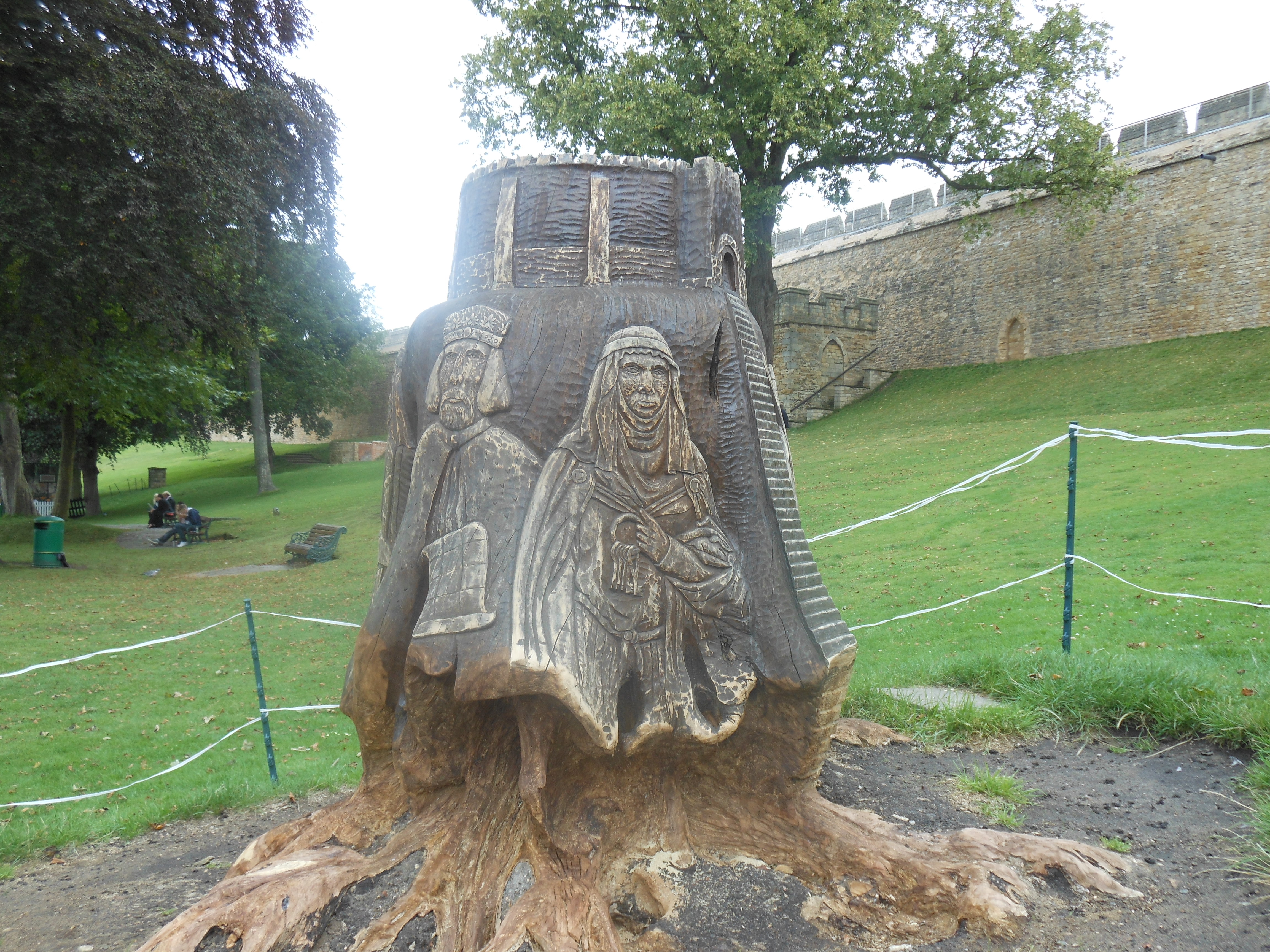
Nicholaa de la Haye, Lincoln Castle

Risking all on one battle was a gamble, but one that Marshal was determined to take. Spurred on by the chivalrous need to rescue a lady in distress – the formidable Lady Nicholaa – Marshal ordered his forces to muster at Newark by 17th May. While the young king, Henry III, waited at Nottingham, Marshal’s army prepared for war. The papal legate, Guala Bicchieri, absolved the Royalist army of all their sins – of all the sins they had committed since their birth – and excommunicated the French and rebel forces, before riding to join the king at Nottingham.

While at Newark, Marshal set out the order of battle, although not without some argument. The Norman contingent and Ranulf, earl of Chester, both claimed the right to lead the vanguard. However, when Ranulf threatened to withdraw his men, it was decided to acquiesce to his demands.

Lincoln is an unusual city; its castle and cathedral sit at the top of a hill, with the rest of the city to the south, at the hill’s base. In the 12th century it was enclosed in a rectangular wall, which had stood since Roman times,  with 5 gates, and the castle abutting the wall at the north-west corner. William Marshal decided not to attack Lincoln from the south, which would have meant heading up the Fosse Way (the old Roman road) and forcing a crossing of the River Witham, before climbing the steep slope to the castle and cathedral (so steep, the road going up is called Steep Hill to this day). Instead he chose to take a circuitous route, so he could come at the city from the north-west and attack close to the castle and cathedral, directly where the enemy troops were concentrated.

On the 19th May Marshal’s forces rode from Newark alongside the the River Trent and set up camp at Torksey, about 8 miles to the north of Lincoln, or Stow, depending on the source you read. Or, perhaps, both.

Coronation of Louis VIII and Blanche of Castile. Louis’ claim to England was through his wife, a granddaughter of Henry II

The English commanders included William Marshal, earl of Pembroke, his son, Young William Marshal, and nephew, John Marshal, in addition to Ranulf, Earl of Chester, William Longspée, Earl of Salisbury, Peter des Roches, Bishop of Winchester, and Faulkes de Breauté, King John’s mercenary captain. They led 406 knights, 317 crossbowmen and a large number of sergeants-at-arms, foot soldiers and camp followers.

Although Louis was in charge of the French forces in England, those in Lincoln were led by Thomas, Comte de Perche, himself a grandson of Henry II’s daughter Matilda, and therefore a cousin of King Henry III. Perche was also related to William Marshal; both were descended from sisters of Patrick, 1st earl of Salisbury. The commanders of the English rebels in the city included Robert FitzWalter and Saer de Quincey, Earl of Winchester. They led over 600 knights and several thousand infantry.

At various points in the lead up to the battle, William Marshal is known to have made some stirring speeches. When battle was imminent, he made one more;

Now listen, my lords! There is honour and glory to be won here, and I know that here we have the chance to free our land. It is true that you can win this battle. Our lands and our possessions those men have taken and seized by force. Shame be upon the man who does not strive, this very day, to put up a challenge, and may the Lord our God decide the matter. You see them here in your power. So much do I fully guarantee, that they are ours for the taking, whatever happens. If courage and bravery are not found wanting.

Coat of arms of William Marshal

And, if we die …, God, who knows who are his loyal servants, will place us today in paradise, of that I am completely certain. And, if we beat them, it is no lie to say that we will have won eternal glory for the rest of our lives and for our kin. And I shall tell you another fact which works very badly against them: they are excommunicated and for that reason all the more trapped. I can tell you that they will come to a sticky end as they descend into hell. There you see men who have started a war on God and the Holy Church. I can fully guarantee you this, that God has surrendered them into our hands.

Let us make haste and attack them, for it is truly time to do so!²

As with all battles, the information gets confusing as the fighting commences, timings get distorted and facts mixed. No two sources give exactly the same information. So the story of a battle is a matter of putting the pieces together and making sense of various snippets of information – much as it would have been for the commanders on the day.

In the dawn of 20th May the English Royalist army marched south towards Lincoln, probably climbing to the ridge at Stow so as not to have that climb nearer to Lincoln, with the enemy in sight. Marshal had hoped that, on reaching the plain in front of the city walls, the French and rebels would come out and meet him and a pitched battle would be fought outside of the city. Marshal was resting everything – the very future of England – on the outcome of that one battle. However, it seems that, although the allied leaders did come out and take a look at the forces arrayed before them, they then chose to stay inside the city walls and wait for the Royalists to come to them.

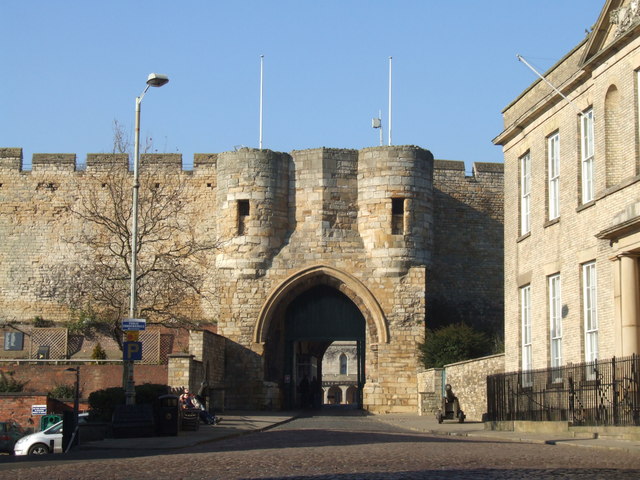
The West Gate of Lincoln Castle

William Marshal’s nephew, John Marshal was sent to the castle, to ascertain the situation within the city, but as he approached, Nicholaa’s deputy, Geoffrey de Serland, was making his way out to report to the English commanders that the castle was still in Nicholaa’s hands. It is not hard to imagine Nicholaa or her deputy climbing the tallest towers of the castle – perhaps the one now known as the Observatory Tower, used in Matthew Paris’s illustration – to watch out for an approaching relief force. Seeing the Marshal’s banners appearing in the north must have been an amazing feeling.

The castle itself had two main gates, one in the eastern wall and one in the west, with postern gates in the Lucy Tower to the south-east of the castle, the tower known as Cobb Hall to the north-east corner and another in the northern wall. On ascertaining that the castle still held, Peter des Roches then made his way inside, most likely by either the postern gate in Cobb Hall, or the one in the northern wall. Having met with Nicholaa de la Haye in the Lucy Tower, it seems he then made his way into the town via its postern gate, to check the defences and try to find a way into the city.

According to the Histoire, des Roches’ reconnaissance proved successful and he reported to Marshal that there was a gate within the north-west wall of the city, which, although blockaded, could be cleared. As Marshal set men to clearing the blockaded gate, the earl of Chester was sent to attack the North Gate as a diversion and Faulkes de Breauté took his crossbowmen into the castle via a postern gate and set them on the ramparts above the East Gate, so their bolts could fire down on the besiegers.

De Breauté fell into disgrace in 1224 and so the major source for the Battle of Lincoln – the Histoire de Guillaume le Maréschale – plays down his role in the battle. However, his crossbowmen managed to keep the French forces focussed on the castle, rather than Marshal’s forces outside the city. De Breauté did make a sortie out of the East Gate, to attack the besiegers, but was taken prisoner and had to be rescued by his own men; although at what stage of the battle this happened is uncertain.

The Histoire tells how it took several hours, it seems, for Marshal’s men to break through the gate. The 70-year-old William Marshal was so eager to lead the charge that he had to be reminded to don his helmet. Once safely helmeted, he led his men through the city gates and down Bailgate to approach the castle from the north, his men spilling into the space between castle and cathedral, where the main force of the besiegers were still firing missiles at the castle.

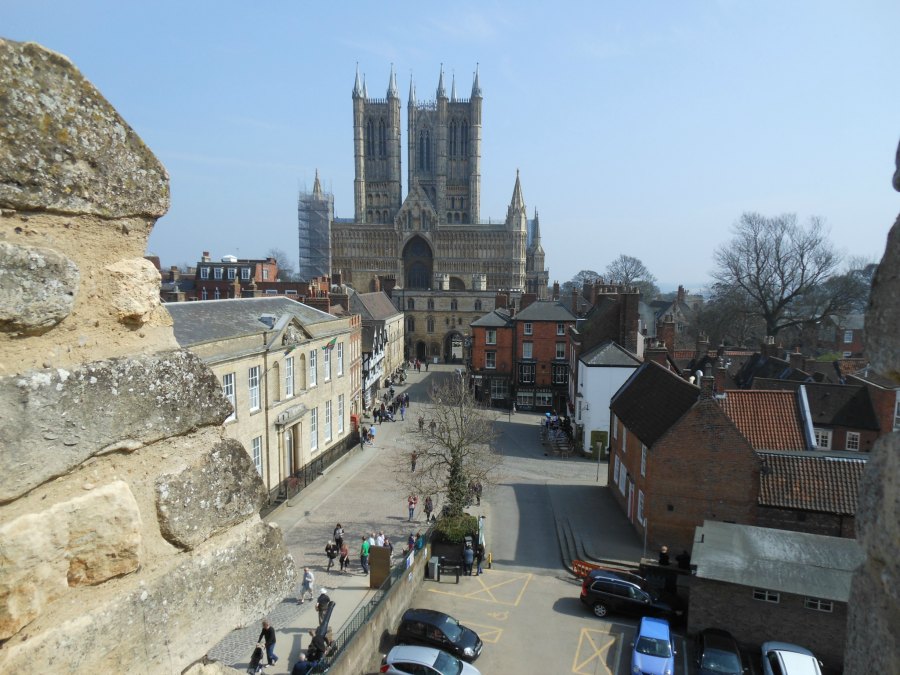
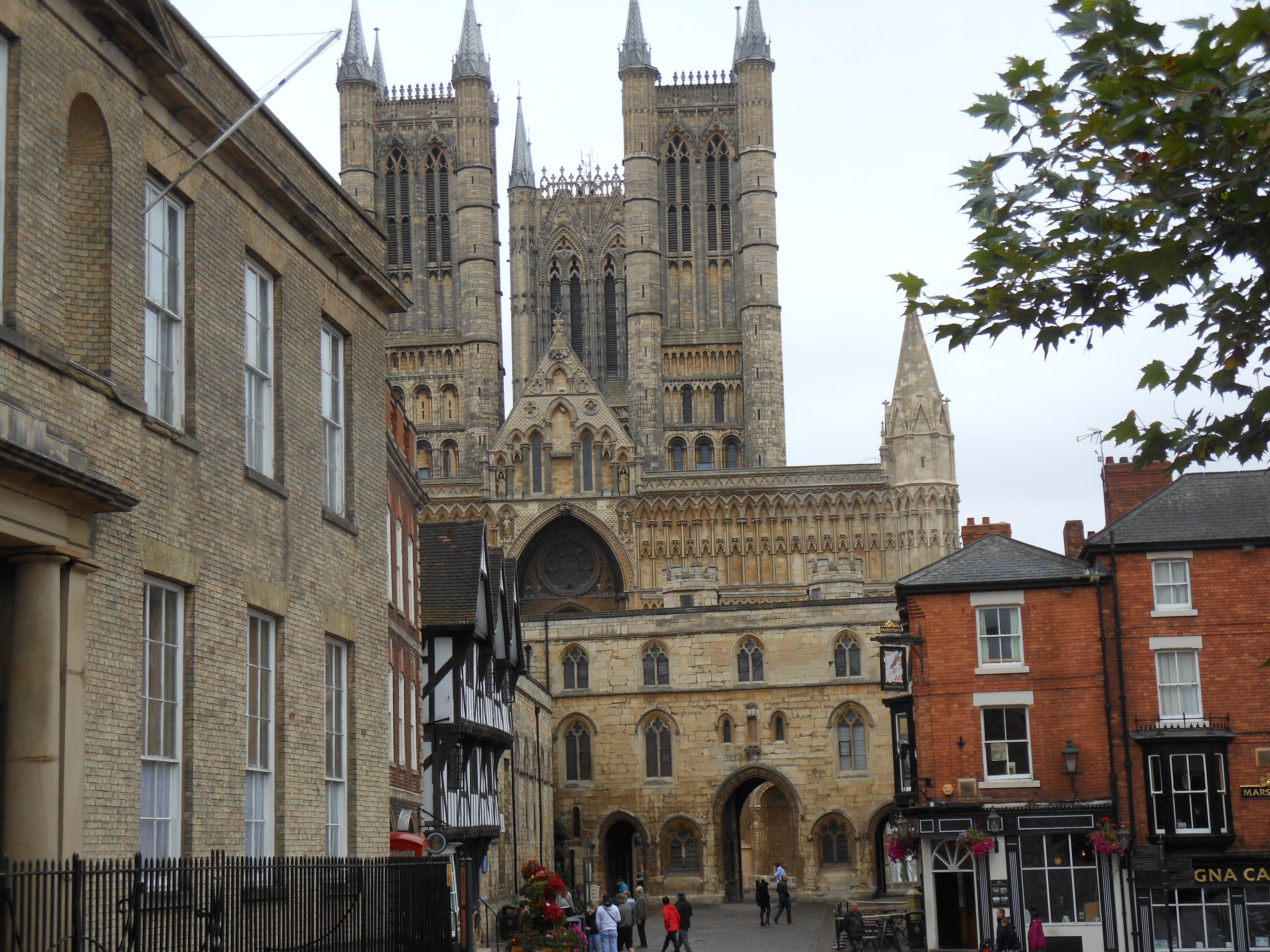
Lincoln Cathedral viewed from the Castle. The fiercest fighting was between the 2 great buildings

The English forces took the enemy so totally by surprise that one man – according to the Histoire he was the enemy’s ‘most expert stonethrower’² – thought they were allies and continued loading the siege machinery, only to have his head struck from his shoulders.

Almost simultaneously, it seems, the earl of Chester had broken through a gate to the northeast and arrived from behind the cathedral. Battle was joined on all sides. Vicious, close-quarter combat had erupted in the narrow streets, but the fiercest fighting was in front of the cathedral. In the midst of the melee, William Longspée took a blow from Robert of Roppesley, whose  lance broke against the earl. The aged Marshal dealt a blow to Roppesley that the knight who, having crawled to a nearby house ‘out of fear, [he] went to hide in an upper room as quickly as he could’.³

The Comte de Perche made his stand in front of the cathedral, rallying his troops; and it was there he took a blow from Reginald Croc which breached the eye slit of his helmet. Croc himself was badly wounded and died the same day. The Comte continued to fight, striking several blows to the Marshal’s helmet (the one he had almost forgotten to don), before falling from his horse. It was thought the Comte was merely stunned until someone tried to remove his helmet and it was discovered that the point of Croc’s sword had pierced the count’s eye and continued into his brain, killing him.

With the death of their leader,  the French and rebel barons lost heart and started pulling back. They fled downhill, to the south of the city. Although they briefly rallied, making an uphill assault, the battle was lost. There was a bottleneck as the defeated soldiers tried to escape through the city gates, made worse by a cow stuck in the South Gate and the bridge across the Witham as the enemy forces fled. The cow could not be moved and so the rebels butchered it – only to discover a dead cow was even harder to move. The rebel leaders, Saher de Quincey and Robert FitzWalter were both taken prisoner, as were many others. In total, about half of the enemy knights surrendered.

The battle had lasted no more than 6 hours.

The East Gate of Lincoln Castle

Sadly, in the aftermath of the battle, women took to the river with their children, in small boats, to escape the unwanted attentions of the victorious army. However, not knowing how to control the overloaded craft, many capsized and the women and children drowned.

The city, which had supported the rebels, was sacked, churches included; the excommunication seen as permission that everything was fair game. Although, one does wonder how much choice the citizens had in siding with the rebels and their French allies – survive or die would have been the reality. The battle earned the name ‘The Lincoln Fair,’ possibly because of the amount of plunder gained by the victorious English army.

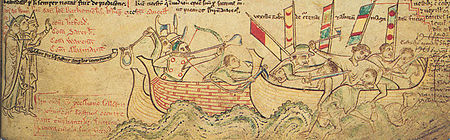
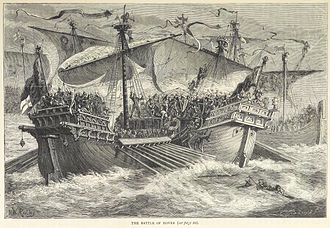
Immediately the battle was won, William Marshal, earl of Pembroke, rode to Nottingham to inform the king of the victory. The Battle of Lincoln turned the tide of the war. On hearing of the battle, Louis immediately lifted his siege of Dover Castle and withdrew to London. His situation became desperate, his English allies were bristling against the idea of Louis giving English land as reward to his French commanders and were beginning to see the young Henry III as rightful king – after all, the son couldn’t be blamed for the actions of the father. In August of the same year Louis was soundly defeated at sea in the Battle of Sandwich, off the Kent coast. By September he had sued for peace and returned to France.

Lincoln Cathedral

In an incredible demonstration of ingratitude, within 4 days of the relief of the Castle, Nicholaa de la Haye’s position of Sheriff of Lincolnshire was given to the king’s uncle William Longspée, Earl of Salisbury, who took control of the city and seized the castle. Salisbury was the father-in-law of Nicholaa’s granddaughter – and heir – Idonea de Camville. However, not one to give up easily, Nicholaa travelled to court to remind the king’s regents of her services, and request her rights be restored to her. A compromise was eventually reached whereby Salisbury remained as Sheriff of the County, while Nicholaa held the city and the castle. Although Salisbury never gave hope of acquiring the castle, it was still in Nicholaa’s hands when he died in 1226.

The battle had been a magnificent victory for the 70-year-old regent, William Marshal, Earl of Pembroke, and is a testament to his claim to the title ‘The Greatest Knight’. He staked the fate of the country on this one battle and pulled off a decisive victory, saving his king and country. Although, he could not have achieved it, had Nicholaa not so stubbornly held onto Lincoln Castle.

*

Footnotes: ¹Irene Gladwin: The Sheriff; The Man and His Office; ²Histoire de Guillaume le Maréschal translated by Stewart Gregory; ³ Quoted in Thomas Asbridge’s The greatest Knight

All photos from Lincoln – Castle, Cathedral, Nicholaa de la Haye and Magna Carta, © Sharon Bennett Connolly 2015. All other pictures are courtesy of Wikipedia.

*

You can read more on the story of the 1217 Battle of Lincoln – and Nicholaa de la Haye in particular – in my book, King John’s Right Hand Lady: The Story of Nicholaa de la Haye. Or listen to the episode on Nicholaa de la Haye in our A Slice of Medieval podcast

*

Sources: King John by Marc Morris; Henry III The Son of Magna Carta by Matthew Lewis; The Demon’s Brood by Desmond Seward; The Greatest Knight by Thomas Asbridge; The Knight Who Saved England by Richard Brooks; The Plantagenet Chronicles edited by Elizabeth Hallam; Brassey’s Battles by John Laffin; 1215 The Year of Magna Carta by Danny Danziger & John Gillingham; The Life and times of King John by Maurice Ashley; The Story of Britain by Roy Strong; The Plantagenets, the Kings Who Made England by Dan Jones; England Under the Norman and Angevin Kings  by Robert Bartlett; lincolnshirelife.co.uk; catherinehanley.co.uk; magnacarta800th.com; lothene.org; lincolncastle.com; Nick Buckingham; The Sheriff: The Man and His Office by Irene Gladwin; Elizabeth Chadwick; swaton.org.uk; Histoire de Guillaume le Mareschal translated by Stewart Gregory, usna.edu.

*

My Books

Signed, dedicated copies of all my books are available through my online bookshop.

Out now: Scotland’s Medieval Queens

Scotland’s history is dramatic, violent and bloody. Being England’s northern neighbour has never been easy. Scotland’s queens have had to deal with war, murder, imprisonment, political rivalries and open betrayal. They have loved and lost, raised kings and queens, ruled and died for Scotland. From St Margaret, who became one of the patron saints of Scotland, to Elizabeth de Burgh and the dramatic story of the Scottish Wars of Independence, to the love story and tragedy of Joan Beaufort, to Margaret of Denmark and the dawn of the Renaissance, Scotland’s Medieval Queens have seen it all. This is the story of Scotland through their eyes.

Scotland’s Medieval Queens gives a thorough grounding in the history of the women who ruled Scotland at the side of its kings, often in the shadows, but just as interesting in their lives beyond the spotlight. It’s not a subject that has been widely covered, and Sharon is a pioneer in bringing that information into accessible history.’ Elizabeth Chadwick (New York Times bestselling author)

Available now from Amazon and Pen and Sword Books

Also by Sharon Bennett Connolly:

Heroines of the Tudor World tells the stories of the most remarkable women from European history in the time of the Tudor dynasty, 1485-1603. These are the women who ruled, the women who founded dynasties, the women who fought for religious freedom, their families and love. Heroines of the Tudor World is now available from Amberley Publishing and Amazon UK. Women of the Anarchy demonstrates how Empress Matilda and Matilda of Boulogne, unable to wield a sword themselves, were prime movers in this time of conflict and lawlessness. It shows how their strengths, weaknesses, and personal ambitions swung the fortunes of war one way – and then the other. Available from Bookshop.orgAmberley Publishing and Amazon UKKing John’s Right-Hand Lady: The Story of Nicholaa de la Haye is the story of a truly remarkable lady, the hereditary constable of Lincoln Castle and the first woman in England to be appointed sheriff in her own right. Available from all good bookshops Pen & Sword Booksbookshop.org and Amazon

Defenders of the Norman Crown: The Rise and Fall of the Warenne Earls of Surrey tells the fascinating story of the Warenne dynasty, from its origins in Normandy, through the Conquest, Magna Carta, the wars and marriages that led to its ultimate demise in the reign of Edward III. Available from Pen & Sword BooksAmazon in the UK and US, and Bookshop.orgLadies of Magna Carta: Women of Influence in Thirteenth Century England looks into the relationships of the various noble families of the 13th century, and how they were affected by the Barons’ Wars, Magna Carta and its aftermath; the bonds that were formed and those that were broken. It is now available in paperback and hardback from Pen & SwordAmazon, and Bookshop.orgHeroines of the Medieval World tells the stories of some of the most remarkable women from Medieval history, from Eleanor of Aquitaine to Julian of Norwich. Available now from Amberley Publishing and Amazon, and Bookshop.orgSilk and the Sword: The Women of the Norman Conquest traces the fortunes of the women who had a significant role to play in the momentous events of 1066. Available now from Amazon,  Amberley Publishing, and Bookshop.org.

Alternate Endings: An anthology of historical fiction short stories including Long Live the King… which is my take what might have happened had King John not died in October 1216. Available in paperback and kindle from Amazon.

Podcast:

Have a listen to the A Slice of Medieval podcast, which I co-host with Historical fiction novelist Derek Birks. Derek and I welcome guests, such as Bernard Cornwell and Michael Jecks, and discuss a wide range of topics in medieval history, from significant events to the personalities involved. Every episode is also now available on YouTube.

*

Don’t forget! Signed and dedicated copies of all my books are available through my online bookshop.

For forthcoming online and in-person talks, please check out my Events Page.

You can be the first to read new articles by clicking the ‘Follow’ button, liking our Facebook page or joining me on TwitterThreadsBluesky and Instagram.

©2017 Sharon Bennett Connolly FRHistS

The Struggles of Alice

tickhill_castle
The bailey of Tickhill Castle, South Yorkshire

Alice, Countess of Eu, was born into 2 of the noblest families of England and France, and married into a third. The daughter of Henry, Count of Eu and Lord Hastings, her mother was Matilda, daughter of Hamelin and Isabel de Warenne, Earl and Countess of Surrey.

Through her maternal grandparents, Alice was closely related to the kings of England. Her grandfather, Hamelin, was the illegitimate  half-brother of King Henry II of England. Richard I and King John, therefore, were her cousins. Alice’s grandmother, Isabel de Warenne, had been one of the richest, most prized heiresses in England and had first been married to the younger son of King Stephen, before she married Hamelin.

Alice’s father, Henry, held lands in England and Normandy. The Honour of Tickhill, in Yorkshire, had been granted to Henry’s father John, Count of Eu, by King Stephen, in 1139, after proving his rights as heir to the original owners, the de Busil family, through Beatrice, the sister of Roger de Busil, who died in 1102. However, in 1141, Empress Matilda captured the castle after Count John was taken prisoner at the Battle of Lincoln. The castle seems to have stayed in  royal hands for many years afterwards, with Richard I taking possession on his accession; he then gave it to his brother John, as part of his holdings. As a consequence, the castle was besieged by the Bishop of Durham when John rebelled against Richard in 1194 and was surrendered only when the king returned to England following his capture and imprisonment in Germany, 3 years after Henry’s death.

Matilda and Henry had 4 children, 2 sons and 2 daughters. Alice was the eldest of the daughters, her sister Jeanne being younger. Sadly, both sons, Raoul and Guy, died young and in consecutive years, with Guy dying in 1185 and Raoul in 1186, leaving Alice as heir to her father’s lands.

Alice’s father died in 1191, and Alice became suo jure Countess of Eu and Lady Hastings. Alice’s mother, Matilda, later married again; her second husband was Henry d’Estouteville of Eckington, Lord of Valmont and Rames in Normandy. Matilda had a son, John, by d’Estouteville, and it was Alice’s half-brother, therefore, who became the heir to all the lands Matilda held in her own right, leaving Alice solely with the inheritance from her father.

Very little is known of Alice’s early years; we do not even have a year for her birth. Given that her grandparents did not marry until 1164, her parents would not have married until the early 1180s, which would mean is likely that Alice was born sometime around the mid-1180s. On her father’s death in 1191, she came into possession of lands in both England and Normandy, France. In August, 1209, Alice officially received the Comté of Eu from Philip II Augustus, King of France, when she also made a quitclaim of all rights to Neufchatel, Mortemer and Arques. Mortemer was a part of the de Warenne ancestral lands in Normandy, given to William I de Warenne by Willliam the Conqueror; suggesting that Alice was renouncing her own rights to the French de Warenne lands, as a granddaughter of Isabel de Warenne, Countess of Surrey.

Alice made a prestigious marriage to Raoul de Lusignan, the brother of Hugh IX de Lusignan and a powerful Poitevin lord. It was Raoul’s nephew, Hugh X, who would repudiate Joanna, the daughter of King John, in order to marry the dead king’s widow and queen, Isabelle d’Angoulême.

Raoul had been previously married to Marguerite de Courtney, but the marriage had been annulled by 1213, suggesting Alice and Raoul married around that time. On marrying Alice, Raoul became Raoul I, Count of Eu by right of his wife.

Arms of Humphrey de Bohun, 2nd Earl of Hereford and Earl of Essex, Constable of England

Raoul and Alice had four children together. Raoul II de Lusignan, Count of Eu and Guînes, was married 3 times and had one daughter, Marie de Lusignan, by his second wife, Yolande de Dreux. Raoul died sometime between 1245 and 1250 and was buried at the Abbey of Foucarmont. Mathilde married Humphgrey de Bohun, 2nd Earl of Hereford and Earl of Essex, and had 7 children together, including 4 boys. Mathilde died in August 1241 and was buried in Llanthony Secunda Priory, Gloucester. Her husband was buried beside her when he died in September 1275. Another son, Guerin (or Warin) de Lusignan died sometime after 29 September 1217, when he is granted the castle at Tickhill by Henry III. A second daughter, Jeanne, is mentioned in the necrology of the church of Eu, which records the anniversary of her death as 3 October, though no year is given.

In 1214 Alice, as Countess of Eu, was restored to the Honour of Tickhill by King John as part of the conditions of an agreement with her husband’s family, the de Lusignans. However, Robert de Vipont, who was in physical possession of the castle, refused to relinquish it, and claimed the castle in his own right. It took many years and much litigation before Alice finally took possession of the castle in 1222. Her husband, Raoul, died on 1st May, 1219, and was succeeded as Count of Eu by their son, Raoul II, still only a child.

It was left to Alice, now Dowager Countess, to administer the Eu inheritance. She paid 15,000 silver marks to the French King to receive the county of Eu in her own name and regained control of her English lands, entrusted to her uncle, the Earl of Surrey, as her representative, following her husband’s death.

Alice was a shrewd political survivor. However, with lands in France and England, two countries often at war, she found herself caught between a rock and a hard place. In 1225 she handed Tickhill Castle to Henry III, until the end of hostilities with France, as a means of safeguarding her lands. Nevertheless, this did not save her when she was ordered to levy troops for the French king, Louis IX, as Countess of Eu, and send her forces to fight for him. Henry III seized Tickhill Castle, although it was only permanently attached to the English crown after Alice’s death.

Alice was renowned for her wide patronage, both secular and religious, and has left numerous charters as testament. She was a benefactor of both French and English religious houses, including Battle Abbey and Christ Church, Canterbury in England and Eu and Foucarmont – where her son would be laid to rest – in France. Alice issued a charter in 1219, to Roche Abbey, which was witnessed by her uncle William, Earl de Warenne. She also granted an annual allowance to Loretta, Countess of Leicester, who was living as a recluse at Hackington.

Alice also granted several lands to others, such as Greetwell in the county of Lincoln, which had previously been held by Walter de Tylly in Alice’s name and was given to Earl de Warenne in August 1225; the earl was to annually render a sparrowhawk to Philippa de Tylly in payment.  In 1232 Alice issued a charter to Malvesin de Hersy, of Osberton in the county of Nottingham, providing him with all customs due to Tickhill in return for 2 knights’ fees. Malvesin had been constable of Tickhill in 1220-1 and his brother Sir Baldwin de Hersy was Constable of Consibrough Castle, seat of Earl de Warenne.

The gatehouse of Tickhill Castle

Having spent most of her life fighting for her rights to her lands in England and France, caught between 2 great nations, whose relations were acrimonious to say the least, Alice appears to have conducted herself admirably. Her connections to the powerful de Lusignan and de Warenne families could not have harmed her situation.

Now in her early 60s, and having been a widow for almost 30 years, Alice died sometime in May 1246, probably between the 13th and 15th, at La Mothe St Héray in Poitou, France, leaving a will. It seems likely that she was buried at her husband’s foundation of Fontblanche Priory in Exoudon.

*

Alice’s story features in my book, Defenders of the Norman Crown: Rise and Fall of the Warenne Earls of Surrey.

Pictures courtesy of Wikipedia.

*

Sources: Early Yorkshire Charters Volume 8: The Honour of Warenne, Edited by William Farrer and Charles Travis Clay; England Under the Norman and Angevin Kings by Robert Bartlett; Brewer’s British Royalty by David Williamson; Britain’s Royal Families, the Complete Genealogy by Alison Weir; british-history.ac.uk; kristiedean.com; English Heritage Guidebook for Conisbrough Castle by Steven Brindle and Agnieszka Sadrei; oxforddnb.com; Tickhill Castle Guide Leaflet, Lords of the Honour of Tickhill; fmg.ac.

*

My Books

Signed, dedicated copies of all my books are available through my online store.

OUT NOW! Heroines of the Tudor World

Heroines of the Tudor World tells the stories of the most remarkable women from European history in the time of the Tudor dynasty, 1485-1603. These are the women who ruled, the women who founded dynasties, the women who fought for religious freedom, their families and love. These are the women who made a difference, who influenced countries, kings and the Reformation. In the era dominated by the Renaissance and Reformation, Heroines of the Tudor World examines the threats and challenges faced by the women of the era, and how they overcame them. From writers to regents, from nuns to queens, Heroines of the Tudor World shines the spotlight on the women helped to shape Early Modern Europe.

Heroines of the Tudor World is now available for pre-order from Amberley Publishing and Amazon UK.

Coming 30 January 2025: Scotland’s Medieval Queens

Scotland’s history is dramatic, violent and bloody. Being England’s northern neighbour has never been easy. Scotland’s queens have had to deal with war, murder, imprisonment, political rivalries and open betrayal. They have loved and lost, raised kings and queens, ruled and died for Scotland. From St Margaret, who became one of the patron saints of Scotland, to Elizabeth de Burgh and the dramatic story of the Scottish Wars of Independence, to the love story and tragedy of Joan Beaufort, to Margaret of Denmark and the dawn of the Renaissance, Scotland’s Medieval Queens have seen it all. This is the story of Scotland through their eyes.

Available for pre-order now.

Also by Sharon Bennett Connolly:

Women of the Anarchy demonstrates how Empress Matilda and Matilda of Boulogne, unable to wield a sword themselves, were prime movers in this time of conflict and lawlessness. It shows how their strengths, weaknesses, and personal ambitions swung the fortunes of war one way – and then the other. Available from Bookshop.orgAmberley Publishing and Amazon UKKing John’s Right-Hand Lady: The Story of Nicholaa de la Haye is the story of a truly remarkable lady, the hereditary constable of Lincoln Castle and the first woman in England to be appointed sheriff in her own right. Available from all good bookshops Pen & Sword Booksbookshop.org and AmazonDefenders of the Norman Crown: The Rise and Fall of the Warenne Earls of Surrey tells the fascinating story of the Warenne dynasty, from its origins in Normandy, through the Conquest, Magna Carta, the wars and marriages that led to its ultimate demise in the reign of Edward III. Available from Pen & Sword BooksAmazon in the UK and US, and Bookshop.org

Ladies of Magna Carta: Women of Influence in Thirteenth Century England looks into the relationships of the various noble families of the 13th century, and how they were affected by the Barons’ Wars, Magna Carta and its aftermath; the bonds that were formed and those that were broken. It is now available in paperback and hardback from Pen & SwordAmazon, and Bookshop.orgHeroines of the Medieval World tells the stories of some of the most remarkable women from Medieval history, from Eleanor of Aquitaine to Julian of Norwich. Available now from Amberley Publishing and Amazon, and Bookshop.orgSilk and the Sword: The Women of the Norman Conquest traces the fortunes of the women who had a significant role to play in the momentous events of 1066. Available now from Amazon,  Amberley Publishing, and Bookshop.org.

Alternate Endings: An anthology of historical fiction short stories including Long Live the King… which is my take what might have happened had King John not died in October 1216. Available in paperback and kindle from Amazon.

Podcast:

Have a listen to the A Slice of Medieval podcast, which I co-host with Historical fiction novelist Derek Birks. Derek and I welcome guests, such as Bernard Cornwell, and discuss a wide range of topics in medieval history, from significant events to the personalities involved.

*

Don’t forget! Signed and dedicated copies of all my books are available through my online store.

For forthcoming online and in-person talks, please check out my Events Page.

You can be the first to read new articles by clicking the ‘Follow’ button, liking our Facebook page or joining me on TwitterThreads and Instagram.

*

©2017 Sharon Bennett Connolly, FRHistS

Isabella, England’s Second Holy Roman Empress

Isabella_of_England,_Holy_Roman_Empress
Isabella of England, Holy Roman Empress

Nearly everyone knows that Henry I’s daughter Matilda, Lady of the English, was Holy Roman Empress as the wife of Holy Roman Emperor Henry V. What is less well-known is that, almost 70 years after Matilda’s death, her great-granddaughter followed in her footsteps.

Isabella of England was born in 1214; she was the 4th of 5 children born to King John and his 2nd wife Isabella of Angouleme. She had 3 older siblings, Henry, Richard and Joan, and a baby sister Eleanor. Born at a time when her father’s strife with his barons was at its height, her early childhood was turbulent, to say the least. John died just 2 years later, in October 1216, leaving 9-year-old Henry as king of a country in the midst of civil war while fighting off an occupying French army.

Even before her father’s death, Isabella’s older sister Joan (born in 1210) had left England, to be raised by the family of her intended husband, Hugh de Lusignan. However, by 1220, amidst great scandal, Hugh had repudiated Joan and married her mother in her stead, whilst still holding Joan as hostage in order to gain Queen Isabella’s dower.

Whilst Joan was still in the hands of the Lusignans, her marriage to Alexander II of Scotland was negotiated, with an added clause that Isabella could be substituted for her older sister, should Joan not make it back to England in time. In the event Joan returned in time and Henry III looked elsewhere for a husband for Isabella.

330px-Frederick_II_and_eagle
Frederick II, Holy Roman Emperor

Becoming part of his policy of continental diplomacy, Henry looked at several possible husbands, such as Henry VII, king of the Romans and Louis IX of France. After some prompting by Pope Gregory IX, Holy Roman Emperor Frederick II (father of Henry VII) sent an embassy to England to pursue his own suit for the English princess to become his 3rd wife.

Within 3 days of the Sicilian embassy’s arrival Henry was agreeable to the match, which complimented his keen interest in the Holy Roman Empire. He had Isabella brought from the Tower of London to Westminster to be interviewed by the ambassadors. They were so impressed with her that they hailed Isabella “Vivat imperatrix! Vivat!”

The marriage contract was signed on 22nd February 1235, with Henry giving Isabella a dowry of 30,000 marks. Although Isabella already had her own fine chapel silver, Henry gave her a magnificent trousseau, which included a service of gold and silver plate. The English people were irritated by Henry’s demand for a substantial marriage aid, but Henry saw the marriage as adding to his personal prestige, and a possible alliance against Louis IX of France.

On 11th May 1235 Isabella set sail from Sandwich, escorted by the bishop of Exeter, the archbishop of Cologne and the duke of Brabant; she arrived at Antwerp 4 days later. With a substantial escort, to guard against kidnap threats from Frederick II’s enemies, Isabella arrived in Cologne on 24th May. She made a processional entry into the city, to the cheers of a 10,00 strong crowd, endearing herself to the noble ladies by throwing her veil back.

The marriage of Frederick II and Isabella of England

She was to spend 6 weeks in Cologne waiting for Frederick, who was dealing with a rebellion by his oldest son, Henry VII.

By July 1235, however, they were together in Worms where, on Sunday the 15th, they were married in the cathedral by the archbishop of Mainz. Isabella was crowned Holy Roman Empress at the same time. Four days of wedding festivities followed, with guests including – according to Matthew Paris – 4 kings, 11 dukes and 30 counts and marquesses.

Frederick, it seems, put great store by astrology; in 1228 Michael Scot had completed his encyclopedia of astrology while at Frederick’s court. And it was on the advice of the emperor’s court astrologers that the marriage was not consummated until the 2nd night.

Isabella was the emperor’s third wife; his first, Constance of Aragon, had died of malaria in 1222 and his second wife, Queen Isabella-Yolanda of Jerusalem had died in childbirth in 1228. Frederick was 20 years Isabella’s senior and expended all his energy on war, travelling and ceremonials in order to maintain his authority throughout his vast empire.

Frederick was delighted with his bride; she was beautiful and popular. He sent 3 leopards to Henry III in England as a sign of his appreciation. However, following the celebrations he also dismissed the majority of Isabella’s English attendants; she was allowed to retain only her nurse, Margaret Biset – who and been with her  since her early childhood – and a maid, called Kathrein.

300px-St._Peter's_Cathedral_Worms_south_side
St Peter’s Cathedrals, Worms, where Isabella was married and crowned Holy Roman Empress

Isabella travelled with Frederick’s slaves to his palace at Hagenau, where Frederick spent the winter with his new empress. Their first child was probably born around 1237/8, although there does seem to be some confusion over how many children there were, and when they were born. What is certain is 2 children survived childhood; Henry, King of Jerusalem, died unmarried in his teens in 1254 and Margaret married Albert I, Margrave of Meissen and Langrave of Thuringia and Misnes, in 1256.

Isabella travelled extensively through her husband’s lands, residing in Apulia, Lombardy, Noventa between 1238 and 1239. Frederick was always close by, despite his battles with  the papacy, and arrived in southern Italy shortly after his wife’s arrival in February 1240.

Isabella was expected to live in some magnificence, but Henry III was irritated that she was only rarely allowed to appear in public. There were rumours that Frederick kept his wives in a harem, although these were probably unfounded and arose from the seclusion that firstly Isabella-Yolanda and then Isabella lived in.

When Richard Earl of Cornwall visited the Emperor in 1241, he didn’t immediately see his sister, although this was probably down to court protocol, as the Empress was pregnant at the time. When they did meet the brother and sister were treated to a lavish court entertainment, being delighted by a magnificent display of jugglers and Muslim dancers.

330px-Cattedrale0558_1_copia
Andria cathedral, Isabella’s final resting-place

Following Richard’s visit, Frederick II returned to war. He was besieging Faenza in northern Italy when his wife died in childbirth on 1st December 1241; the baby died with her. Before his departure  on campaign, Isabella had urged Frederick to stay on good terms with her brother Henry III, who was leaning more and more towards the papacy.

She was buried at Andria, Sicily, alongside the emperor’s 2nd wife, Isabella-Yolanda. Isabella had been married for just over 6 years and was only  27 years of age.

Through her daughter Margaret, Isabella is the ancestor of Queen Victoria’s beloved husband, Prince Albert.

*

Pictures courtesy of Wikipedia

*

Sources: The Oxford Companion to British History Edited by John Cannon; The Plantagenets, the Kings who Made England by Dan Jones; History Today Companion to British History Edited by Juliet Gardiner and Neil Wenborn;  Brewer’s British Royalty by David Williamson; Britain’s Royal Families, the Complete Genealogy by Alison Weir; The Plantagenet Chronicles Edited by Elizabeth Hallam; The Mammoth Book of British Kings and Queens by Mike Ashley; The Plantagenets, the Kings that made Britain by Derek Wilson; England Under the Norman and Angevin Kings  by Robert Bartlett; http://www.britannica.com; oxforddnb.com.

*

Isabella’s story features in greater detail in my book, Ladies of Magna Carta: Women of Influence in Thirteenth Century England .

My Books

Christmas is coming!

Signed, dedicated copies of all my books are available through my online bookshop.

Coming 15 January 2024: Women of the Anarchy

On the one side is Empress Matilda, or Maud. The sole surviving legitimate child of Henry I, she is fighting for her birthright and that of her children. On the other side is her cousin, Queen Matilda, supporting her husband, King Stephen, and fighting to see her own son inherit the English crown. Both women are granddaughters of St Margaret, Queen of Scotland and descendants of Alfred the Great of Wessex. Women of the Anarchy demonstrates how these women, unable to wield a sword, were prime movers in this time of conflict and lawlessness. It show how their strengths, weaknesses, and personal ambitions swung the fortunes of war one way – and then the other.

Available for pre-order from Amberley Publishing and Amazon UK.

Coming on 15 June 2024: Heroines of the Tudor World
Heroines of the Tudor World tells the stories of the most remarkable women from European history in the time of the Tudor dynasty, 1485-1603. These are the women who ruled, the women who founded dynasties, the women who fought for religious freedom, their families and love. These are the women who made a difference, who influenced countries, kings and the Reformation. In the era dominated by the Renaissance and Reformation, Heroines of the Tudor World examines the threats and challenges faced by the women of the era, and how they overcame them. Some famous, some infamous, some less well known, including Anne Boleyn, Elizabeth Barton, Catherine de Medici, Bess of Hardwick and Elizabeth I. From writers to regents, from nuns to queens, Heroines of the Tudor World shines the spotlight on the women helped to shape Early Modern Europe.

Heroines of the Tudor World is now available for pre-order from Amberley Publishing and Amazon UK.

Also by Sharon Bennett Connolly:

Out nowKing John’s Right-Hand Lady: The Story of Nicholaa de la Haye is the story of a truly remarkable lady. Nicholaa de la Haye was the hereditary constable of Lincoln Castle and the first woman in England to be appointed sheriff in her own right. Her strength and tenacity saved England at one of the lowest points in its history. Nicholaa de la Haye is one woman in English history whose story needs to be told… King John’s Right-Hand Lady: The Story of Nicholaa de la Haye is now available from Pen & Sword Booksbookshop.org and Amazon.

Defenders of the Norman Crown: The Rise and Fall of the Warenne Earls of Surrey tells the fascinating story of the Warenne dynasty, of the successes and failures of one of the most powerful families in England, from its origins in Normandy, through the Conquest, Magna Carta, the wars and marriages that led to its ultimate demise in the reign of Edward III. Defenders of the Norman Crown: Rise and Fall of the Warenne Earls of Surrey is now available from Pen & Sword BooksAmazon in the UK and US, and Bookshop.org.

Ladies of Magna Carta: Women of Influence in Thirteenth Century England looks into the relationships of the various noble families of the 13th century, and how they were affected by the Barons’ Wars, Magna Carta and its aftermath; the bonds that were formed and those that were broken. It is now available in paperback and hardback from Pen & Sword,  Amazon, and Bookshop.org.

Heroines of the Medieval World tells the stories of some of the most remarkable women from Medieval history, from Eleanor of Aquitaine to Julian of Norwich. Available now from Amberley Publishing and Amazon, and Bookshop.org.

Silk and the Sword: The Women of the Norman Conquest traces the fortunes of the women who had a significant role to play in the momentous events of 1066. Available now from Amazon,  Amberley Publishing, and Bookshop.org.

Alternate Endings: An anthology of historical fiction short stories including Long Live the King… which is my take what might have happened had King John not died in October 1216. Available in paperback and kindle from Amazon.

Podcast:

Have a listen to the A Slice of Medieval podcast, which I co-host with Historical fiction novelist Derek Birks. Derek and I welcome guests, such as Bernard Cornwell, and discuss a wide range of topics in medieval history, from significant events to the personalities involved.

*

Don’t forget! Signed and dedicated copies of all my books are available through my online bookshop.

For forthcoming online and in-person talks, please check out my Events Page.

You can be the first to read new articles by clicking the ‘Follow’ button, liking our Facebook page or joining me on Twitter and Instagram.

*

©2016 Sharon Bennett Connolly FRHistS
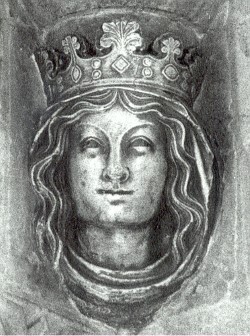
The Eternal Legacy of Magna Carta

031
Lincoln Cathedral’s Magna Carta

June 15th 2015 was the 800th anniversary of the signing of Magna Carta.

On 1 April 2015 Lincoln Castle reopened its doors after an extensive refurbishment. The renovations included a new purpose-built, state-of-the-art, underground vault for its most prized possession: one of only four surviving copies of the original 1215 Great Charter – the Magna Carta.

The Magna Carta’s new home cannot fail to emphasise the importance of this charter in the history of not only England, but also the rest of the world. Two films – Magna Carta: Challenging the Power of the King and Magna Carta: Meaning and Myth – reconstruct the events leading up to Magna Carta and chart its significance through the centuries, respectively.

But what is Magna Carta? And what makes it so important?

In many ways, the reign of King John had been a continuation of that of his father, Henry II, and of his brother, Richard I, with one significant difference. Early in his reign John had lost the French part of the great Angevin empire: Normandy and most of Aquitaine were now held by France. In 1214 King John returned to England following his army’s defeat by the French at the Battle of Bouvines. The battle ended the king’s hopes of regaining the lost empire.

Added to this catastrophe was the character and personality of John himself. By nature John was paranoid, secretive and distrustful. John’s cruelty is widely known. He is accused of killing his nephew and rival claimant to the English throne, Arthur of Brittany; he hanged 28 Welsh hostages (sons of rebel chieftains) and he hounded William de Braose and his family all the way to Ireland and back. De Braose’s wife and son died in one of John’s prisons, probably from starvation.

The History of William Marshal, a biography of the great knight and statesman, states of John: ‘He kept his prisoners in such a horrible manner, and in such abject confinement that it seemed an indignity and a disgrace to all those with him who witnessed such cruelty’.

Although John faced the fallout of Magna Carta, many of the injustices targeted by the barons can be seen in the reigns of his predecessors. Heavy taxes, arbitrary fines and the exploitation of wardships were long-established royal revenue earners. However, where Henry and Richard had a whole empire to exploit, John’s need for money had to be met by England alone.

Even John’s disagreement with the Church can see parallels in the reign of Henry II and his clashes with Thomas Becket. John opposed the election of Stephen Langton as Archbishop of Canterbury, and refused to allow his consecration. Pope Innocent III went so far as to excommunicate John and place England under interdict; in 1213 Philip II of France was even invited to depose him.

John finally came to an agreement with the Church in May 1213, swearing that the liberties established under Henry I would be strictly observed and allowing Langton to take up his post as archbishop. However, John broke his oath almost immediately and Langton became one of the leaders of the opposition to the king.

The barons’ objections to John were almost beyond number. He had failed to face the French and had lost not only most of his family’s Continental possessions, but also those of his barons. Few had forgotten his treachery against his brother – his attempts on the throne whilst Richard was away on Crusade. His barons even complained that he forced himself on their wives and daughters.

The barons had had enough.

Lincoln Cathedral Sharon's pic
Lincoln Cathedral

The rebels were ready to fight. After occupying London they made one final attempt to prevent war, presenting the king with a list of their demands.

Following further negotiations a long detailed document was produced, dealing with particular grievances of the time and with injustices in general. It touched on the whole system of royal government. And it was granted to ‘all free men of the realm and their heirs forever’.

Magna Carta

Of its 63 clauses, some terms were asking for immediate remedies, such as the removal of corrupt administrators and the sending home of foreign mercenaries. The clause stating that fighting outside of the kingdom could not be imposed by the king was a reaction to John’s recent attempts to force his English barons to help him recover his Continental domains.

Others had long-term aims. The document sought to guarantee the privileges of the Church and the City of London. Restrictions were placed on the powers of regional officials, such as sheriffs, to prevent abuses. The royal court was fixed at Westminster, for justice to be obtainable by all, and royal judges were to visit each county regularly. Taxes could no longer be levied without the consent of the Church and the barons.

John and the barons at Runnymede

Clauses included the fixing of inheritance charges and protection from exploitation for under-age heirs; the king was to take only what was reasonable from an estate (although ‘reasonable’ remained undefined). From henceforth a widow was to be free to choose whether or not to remarry and her marriage portion (dowry) would be made available to her immediately on her husband’s death. Another clause sought to prevent the seizure of land from Jews and the king’s debtors.

Magna Carta even went so far as to regulate weights and measures. It also reduced the size of the king’s forests and limited the powers of forest justices.

Although most of the 63 clauses of Magna Carta are now defunct, three still remain as major tenets of British law, including ‘to no one will we sell, to no one will we deny or delay right or justice’. That no person could be imprisoned, outlawed or deprived of his lands except by judgement of his peers and the law of the land has remained the cornerstone of the English legal system ever since.

Magna Carta was sealed at Runnymede, Berkshire, on 15 June 1215. John ordered that the charter be circulated around the towns and villages.

As a peace agreement between King John and his rebellious barons, however, it failed miserably. By July John was appealing to the Pope for help. Pope Innocent III’s response arrived in England in September. The treaty was declared null and void; it was ‘not only shameful and demeaning but also illegal and unjust’. By the time the letter arrived in England, the dispute had already erupted into the Barons’ War.

Deciding they could no longer deal with John’s perfidy, the rebel barons invited the King of France, Philip II, to claim the throne. Philip’s son and heir, the future Louis VIII, accepted the offer. Having landed on the south coast, he marched for London, where he was proclaimed King of England on 2 June 1216.

John’s fortuitous death at Newark in October 1216 turned the tide against Louis and the rebels. The highly respected knight and statesman, William Marshal, Earl of Pembroke, was appointed regent for John’s nine-year-old son, Henry III. Marshal’s staunch loyalty was renowned throughout Europe; he was the embodiment of the chivalric code. Many barons who had previously sided with Louis saw the opportunity to come back from the brink, and rally around the young king. Marshal reissued Magna Carta and faced and defeated the joint French and rebel army at Lincoln on 20 May 1217.

Afterwards, the English were able to dictate peace terms to Louis, and the French went home. Magna Carta was issued a third time, along with a new Forest Charter (also on display at Lincoln Castle). It was reissued in 1225, on Henry III attaining his majority and it is the 1225 edition which remains on the statute books today.

The Legacy of Magna Carta

021
Lincoln Castle

It is hard to overstate the enduring significance of Magna Carta. Although it was initially a document conceived by rebel barons, the regents of Henry III exploited Magna Carta as a royalist device to recover the loyalty of the rebel barons. However, once it was issued it was used as a curb to all regal excesses. In 1265 it was invoked to create the first representative parliament.

By the late 1200s Magna Carta was regarded as a fundamental statement of English liberties.

Magna Carta set the precedent for future reform programmes, such as the Provisions of Oxford of 1258, the Ordinances of 1311, the Petition of Right of 1628 and the Grand Remonstrance of 1641.

The influence of Magna Carta has spread far beyond England’s shores. It can be seen in the United States’ 1791 Bill of Rights, in the 1948 Universal Declaration of Human Rights and the 1950 European Convention on Human Rights.

Although a failure in the short term, in the long term, Magna Carta established defined limitations to royal rights, laying down that standard to be observed by the crown and its agents.

It is the closest thing England has to a Constitution.

*

Article and Photos © Sharon Bennett Connolly FRHistS 2015, except John and his barons, which is courtesy of Wikipedia.
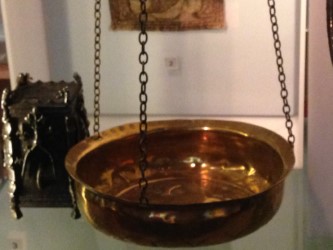
*

Article originally published on The Review in June 2015.

*

Sources: Robert Bartlett England Under the Norman and Angevin Kings 1075-1225; Dan Jones The Plantagenets; the Kings who Made England; The Plantagenet Chronicle Edited by Elizabeth Hallam; Maurice Ashley The Life and Times of King John; Roy Strong The Story of Britain; Oxford Companion to British History; Mike Ashley British Kings & Queens; David Williamson Brewer’s British Royalty.

My Books

Signed, dedicated copies of all my books are available, please get in touch by completing the contact me form.

Out now!

King John’s Right-Hand Lady: The Story of Nicholaa de la Haye is now available for pre-order from Pen & Sword Booksbookshop.org and Amazon UK. (I will hopefully have a US release date shortly)
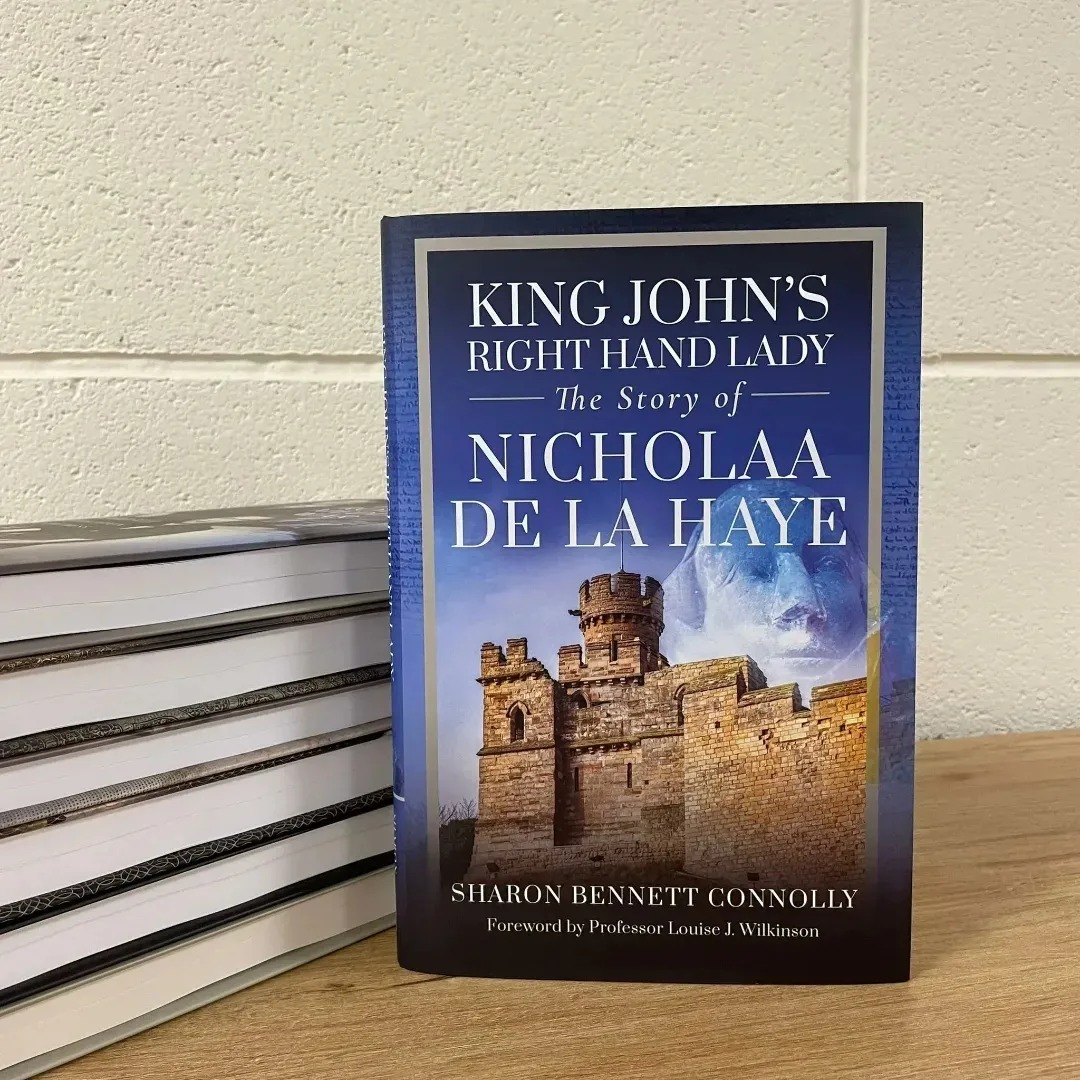
In a time when men fought and women stayed home, Nicholaa de la Haye held Lincoln Castle against all-comers. Not once, but three times, earning herself the ironic praise that she acted ‘manfully.’ Nicholaa gained prominence in the First Baron’s War, the civil war that followed the sealing of Magna Carta in 1215.

A truly remarkable lady, Nicholaa was the first woman to be appointed sheriff in her own right. Her strength and tenacity saved England at one of the lowest points in its history. Nicholaa de la Haye is one woman in English history whose story needs to be told…

Coming 15 January 2024: Women of the Anarchy

On the one side is Empress Matilda, or Maud. The sole surviving legitimate child of Henry I, she is fighting for her birthright and that of her children. On the other side is her cousin, Queen Matilda, supporting her husband, King Stephen, and fighting to see her own son inherit the English crown. Both women are granddaughters of St Margaret, Queen of Scotland and descendants of Alfred the Great of Wessex. Women of the Anarchy demonstrates how these women, unable to wield a sword, were prime movers in this time of conflict and lawlessness. It show how their strengths, weaknesses, and personal ambitions swung the fortunes of war one way – and then the other.

Available for pre-order from Amberley Publishing and Amazon UK.

Also by Sharon Bennett Connolly:

Defenders of the Norman Crown: The Rise and Fall of the Warenne Earls of Surrey tells the fascinating story of the Warenne dynasty, of the successes and failures of one of the most powerful families in England, from its origins in Normandy, through the Conquest, Magna Carta, the wars and marriages that led to its ultimate demise in the reign of Edward III. Defenders of the Norman Crown: Rise and Fall of the Warenne Earls of Surrey is now available from Pen & Sword BooksAmazon in the UK and US, and  Bookshop.org.

Ladies of Magna Carta: Women of Influence in Thirteenth Century England looks into the relationships of the various noble families of the 13th century, and how they were affected by the Barons’ Wars, Magna Carta and its aftermath; the bonds that were formed and those that were broken. It is now available in paperback and hardback from Pen & Sword,  Amazon, and Bookshop.org.

Heroines of the Medieval World tells the stories of some of the most remarkable women from Medieval history, from Eleanor of Aquitaine to Julian of Norwich. Available now from Amberley Publishing and Amazon, and Bookshop.org.

Silk and the Sword: The Women of the Norman Conquest traces the fortunes of the women who had a significant role to play in the momentous events of 1066. Available now from Amazon,  Amberley Publishing, and Bookshop.org.

Alternate Endings: An anthology of historical fiction short stories including Long Live the King… which is my take what might have happened had King John not died in October 1216. Available in paperback and kindle from Amazon.

Podcast:

Have a listen to the A Slice of Medieval podcast, which I co-host with Historical fiction novelist Derek Birks. Derek and I welcome guests, such as Bernard Cornwell and discuss a wide range of topics in medieval history, from significant events to the personalities involved.

*

For forthcoming online and in-person talks, please check out my Events Page.

You can be the first to read new articles by clicking the ‘Follow’ button, liking our Facebook page or joining me on Twitter and Instagram.

©2015 Sharon Bennett Connolly FRHistS