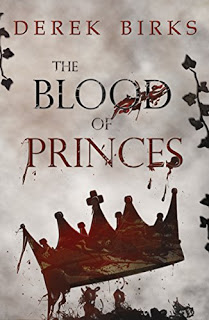
Today over at The Review, you can read my thoughts on Derek Birks’s fantastic new novel, The Blood of Princes, the second book in his Scars from the Past series telling the story of the disappearances of the Princes on the Tower and the accession of Richard III.
And there’s a fabulous giveaway – a paperback copy available to one lucky winner.
Here’s a taster:
John Elder has taken on the mantle of head of the Elder family and finds himself at the centre of English politics in 1483, with Richard III taking the throne and his nephews secured in the Tower of London.
I have followed the adventures of the Elder family since Feud, the first book in the Rebels & Brothers series; and each book just gets better and better. These are tales of loyalty, love, honour and betrayal that have you sat on the very edge of your seat from the first page to the last. You never know how it is going to end – Mr Birks is not afraid of killing off a lead or much-loved character when the story demands it. And the difference between success and failure is a very fine line. But that’s what makes these books so addictive….
To read the full review of this fantastic novel – and to enter the prize draw and be in with a chance in this fantastic giveaway, simply visit The Review and leave a comment.
Good luck!
*
My book,
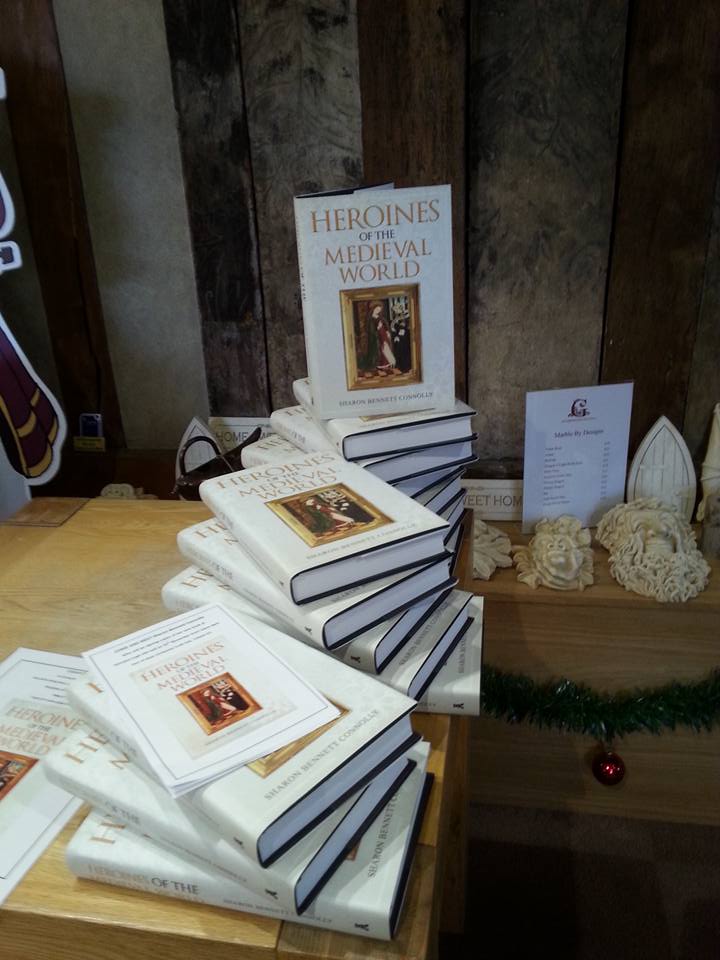
Heroines of the Medieval World, is now available in hardback in the UK from both Amberley Publishing and Amazon UK and worldwide from Book Depository. It is also available on Kindle in both the UK and USA and will be available in Hardback from Amazon US from 1 May 2018.
You can be the first to read new articles by clicking the ‘Follow’ button, liking our Facebook page or joining me on Twitter.
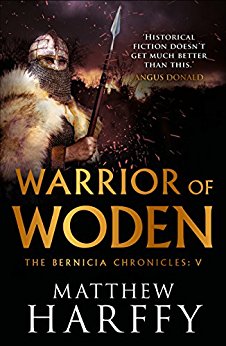
AD 642. Anglo-Saxon Britain. A gripping, action-packed historical thriller and the fifth instalment in the Bernicia Chronicles. Perfect for fans of Bernard Cornwell.
Oswald has reigned over Northumbria for eight years and Beobrand has led the king to ever greater victories. Rewarded for his fealty and prowess in battle, Beobrand is now a wealthy warlord, with a sizable warband. Tales of Beobrand’s fearsome black-shielded warriors and the great treasure he has amassed are told throughout the halls of the land.
Many are the kings who bow to Oswald. And yet there are those who look upon his realm with a covetous eye. And there is one ruler who will never kneel before him.
When Penda of Mercia, the great killer of kings, invades Northumbria, Beobrand is once more called upon to stand in an epic battle where the blood of many will be shed in defence of the kingdom.
But in this climactic clash between the pagan Penda and the Christian Oswald there is much more at stake than sovereignty. This is a battle for the very souls of the people of Albion.
I have had the good fortune of reading each book in Matthew Harffy’s series as soon as it has been released (and often before) and have been amazed and impressed with each one. And Warrior of Woden is no exception. This has to be Matthew Harffy’s best book yet!
The Bernicia Chronicles are set in seventh century Northumbria and follow the exploits of Beobrand, a warlord from Kent who has made his home in Northumbria. In the series so far, we have watched him grow from a young fighter to one of the most feared warriors in Britain. He is loyal to his family, his followers and his king, he has loved, lost, fought and killed. Beobrand as a character is all-too human, however, every loss affects him and helps him develop not only as a leader in his world, but as a character in the book.
Beobrand slapped the shoulder of the stocky man to his right.
“Acennan, take command of the men.” Acennan did not speak, but nodded his understanding.
“Cynan, with me,” Beobrand said, his tone a sharp bark of command.
Trusting that the younger warrior would obey, Beobrand left his position in the Northumbrian shieldwall and rushed along the lines, elbowing and pushing men aside with his bulk.
“See that cross is held aloft,” Beobrand hissed. “Whatever happens, do not let that rood fall. And Cynan,” he gripped Cynan’s shoulder tightly, halting his onward rush, “the king has not fallen. Do you hear me?”
Cynan stared wide-eyed at him for a moment before nodding. Beobrand left the Waelisc warrior to his task and pushed forward towards the king. His stomach roiled but he took some comfort when, from the corner of his eye, he noted that the carved wood cross rose once more into the sky, casting its long shadow over the icy ground and the fyrd-men gathered there. He knew he could rely on Cynan. The erstwhile thrall had proven his worth many times over since he had joined Beobrand’s warband three years before.
The shieldwall was closing ranks, regaining some order at the bellowed commands of Derian, Oswald’s battle-leader. Beobrand thanked the gods for the man. The bearded thegn knew his work. There was no warrior more doughty; none more steadfast. The shieldwall would not be allowed to break while Derian yet breathed.
Two men were half-dragging Oswald back from the front of the line.
“I must stand,” Oswald protested, his voice muffled by the ornate faceplate of his grimhelm. “I will not retreat from this rabble. In God’s name, I must fight. Unhand me! I command it.”
The warriors, who had been pulling the king backward, paused, unsure of themselves. They relaxed their grip on Oswald. His legs buckled and he almost fell to the cold earth. Beobrand leapt forward and caught him. Around them, men shuffled back to make room for their king.
After years of warfare, Beobrand has seen almost everything, but the world still has a few surprises for him and in Warrior of Woden, he sees some of the worst humanity can do. Matthew Harffy does a remarkable job of seamlessly fitting Beobrand into the timeline of actual events, whilst giving him a story that is entirely his own, so that the reader cannot discern where history ends and fiction begins. Each character has their own distinguished style, in language, fighting and his relationship with Beobrand. Beobrand’s enemies are as individual as his friends; each relationship is well thought through and unique. You find yourself thinking ‘I knew Beobrand would react like that’.
As the chief protagonist, Beobrand is a hero we can all relate too. He is a strong, confident leader in battle, trusted by his men to not throw their lives away needlessly. He leads his men to victory but worries that he it’s not a good father and knows he could be a better boyfriend. Some things have never changed down the centuries! He has his foibles, which is want makes him believable and likeable as a hero.
Warrior of Woden is that it immerses the reader in the era. The language the author uses invokes the time period without being archaic, leaving the reader with a deep sense that they have been transported to the seventh century. You can almost hear the clash of swords, shields and axes, smell that tang of blood in your nose. The fighting is vicious and brutal, but the relationships between Beobrand and his men, and Beobrand and his family, create a dual story of men at war and men at home.
This book has that ‘je ne sais quoi’ which makes it impossible to put down. From the first page, the action is non-stop, the intrigue and action keep you hooked to the very end. To put it simply, The Bernicia Chronicles get better and better with every instalment – and I am desperate to read the next.
*
About the author: Matthew Harffy grew up in Northumberland where the rugged terrain, ruined castles and rocky coastline had a huge impact on him He now lives in Wiltshire, England, with his wife and their two daughters.
Warrior of Woden, Book 5 in the Bernicia Chronicles, is available from 1st April 2018, on Amazon.
*
My Book:
Heroines of the Medieval World, is now available in hardback in the UK from both Amberley Publishing and Amazon UK. It is also available on Kindle in both the UK and USA and will be available in Hardback from Amazon US from 1 May 2018. It can also be ordered worldwide from Book Depository.
You can be the first to read new articles by clicking the ‘Follow’ button, liking our Facebook page or joining me on Twitter.
From the author of the international best-selling Tudor Trilogy, the true story of the Tudor dynasty continues with the daughter of King Henry VII, sister to King Henry VIII. Mary Tudor watches her elder brother become King of England and wonders what the future holds for her. Born into great privilege, Mary has beauty and intelligence beyond her years and is the most marriageable princess in Europe. Henry plans to use her marriage to build a powerful alliance against his enemies. Will she dare risk his anger by marrying for love? Meticulously researched and based on actual events, this ‘sequel’ follows Mary’s story from book three of the Tudor Trilogy and is set during the reign of King Henry VIII.
Mary Tudor Princess by Tony Riches is the latest novel from author of the Tudor Trilogy. Telling the story of Henry VIII’s little sister, it traces Mary’s life from the death of her father in 1509 to her own death in 1533. Mary was a fascinating lady, who married the ageing King of France out of duty to her brother, but extracted a promise from Henry VIII to be able to choose her second husband. As a consequence, widowed and still in France, she married her brother’s best friend, Charles Brandon, who had been sent to escort her back to England, only to face the wrath of her brother.
Princess Mary has always been my favourite Tudor. She did the impossible and married for love, and survived her brother’s anger. Being the king’s little sister must have counted for something! I fell in love with Mary’s story after watching the film, The Sword and the Rose as a teenager and Tony Riches has done a wonderful job of bringing this Tudor princess to life once again.
Although I don’t do much Tudor research at the minute, the story does overlap with several ladies I have looked into, and it was fascinating to see how the author included Katherine Willoughby and her mother, Maria de Salinas, in the story; Katherine would eventually marry Charles Brandon herself. Bessie Blount also gets a mention! It is fascinating to see how so many Tudor characters interacted with Mary, and to read of her friendship with Katherine of Aragon, the two women being affectionate with each other but always aware of their respective stations.
Mary Tudor and Charles Brandon
Mary dismissed her muttering French servants and sated her frustration at them by tearing down the black cloths covering the long windows. Shafts of bright winter sun lit up motes of dust drifting like tiny, glittering starts in the still air. Tears of relief ran down Mary’s face as she looked out at the River Seine and the spires of Notre-Dame Cathedral. She was leaving Cluny Palace forever.
John Palsgrave returned with the news that the waiting was finally over. Charles Brandon had sailed from Dover on the same ship and was meeting with Francis to negotiate her return to England.
Mary’s mind raced with questions. ‘Why must he negotiate?’ Of course I will return. Francis has no wish to hold me here. Is it the return of my dowry?’ She recalled Wolsey’s scheming before she’d left for France. He’d foreseen Louis’ death and already planned for her return, wording the marriage contract to Henry’s advantage.
John Palsgrave nodded. ‘There is a considerable sum of money at stake, Your Grace, as well as the question of the jewels from the late king.’
‘They were gifts!’ She heard the outrage and frustration in her voice. Her confinement and aching tooth made her short-tempered. She saw her secretary’s troubled look. ‘I’m sorry. Does Duke Francis,’ she corrected herself, ‘does King Francis want them returned?’
This book has so many strengths. It is a fabulous, enjoyable story that will keep you riveted to the page until the very end. The historical research is impeccable, transporting the reader back to the Tudor era and immersing them in the period, the fashions, the language and lifestyle. You are back in the Tudor court where the king’s will and whims are paramount. It is fascinating to watch how this Tudor princess negotiated her way through the politics, the plots and the fact her brother’s word was law.
Tony Riches is a wonderful author, who breathes life into long dead historical characters, depicting their stories, their lives, in a way that stays true to the era from which they have come. With Mary Tudor Princess not only does he give us a glimpse into the Tudor court, but into the personalities who inhabited it, always staying true to the known history. The story does not shy away from the politics of the time, from Henry VIII’s dealings with France, Scotland and the Holy Roman Empire, to his desire for a son and the Reformation that would result.
Mary Tudor Princess rebuilds Mary’s world, showing us the contrast in her private and public life, showing the balance of duties to family and state. Her life was not all sweetness and roses, and the author deals with the deaths of family members, love and betrayal in a sympathetic and empathetic manner. The book gives the impression that you are a fly on the wall, watching Mary’s life as it unfolds, her dreams and passions tempered by her duty and station.
This is a wonderful novel for anyone who wants to get a sense of the personality of Mary, her husband, Charles Brandon, and the Tudor court itself. I cannot recommend it highly enough. It was a pleasure and an privilege to read.
*
About the author:
Tony Riches is a full-time author of best-selling historical fiction. He lives in Pembrokeshire, West Wales and is a specialist in the fifteenth century, with a particular interest in the Wars of the Roses and the lives of the early Tudors. For more information about Tony’s other books please visit his website tonyriches.com and his popular blog, The Writing Desk and find him on Facebook and Twitter @tonyriches.
You can find all of Tony’s books, including Mary Tudor Princess, on Amazon in the UK and US.
*
My books
Heroines of the Medieval World tells the stories of women, famous, infamous and unknown, who shaped the course of medieval history. It is available in hardback in the UK from both Amberley Publishing and Amazon UK. It is now available in Hardback from Amazon US and worldwide from Book Depository.
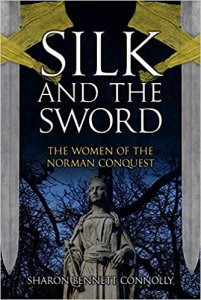
From Emma of Normandy, wife of both King Cnut and Aethelred II to Saint Margaret, a descendant of Alfred the Great himself, Silk and the Sword: the Women of the Norman Conquest traces the fortunes of the women who had a significant role to play in the momentous events of 1066. Silk and the Sword: the Women of the Norman Conquest will be released in the UK on 15 November 2018 and is available for pre-order on Amazon UK, Amberley Publishing and Book Depository.
You can be the first to read new articles by clicking the ‘Follow’ button, liking our Facebook page or joining me on Twitter.
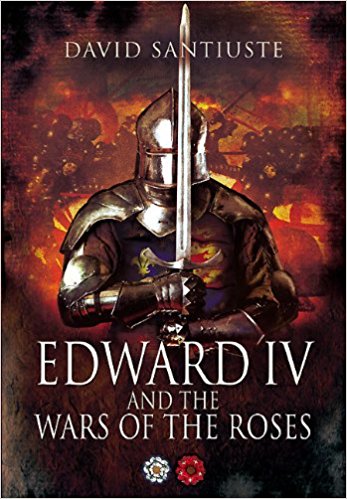
Indisputably the most effective general of the Wars of the Roses, Edward IV died in his bed, undefeated in battle. Yet Edward has not achieved the martial reputation of other warrior kings such as Henry V – perhaps because he fought battles against his own people in a civil war. It has also been suggested that he lacked the personal discipline expected of a truly great commander. But, as David Santiuste shows in this perceptive and highly readable new study, Edward was a formidable military leader whose strengths and subtlety have not been fully recognized. This reassessment of Edward’s military role, and of the Wars of the Roses in which he played such a vital part, gives a fascinating insight into Edward the man and into the politics and the fighting. Based on contemporary sources and the latest scholarly research, Edward IV and the Wars of the Roses brings to life an extraordinary period of English history.
I was very happy to be asked to review Edward IV and the Wars of the Roses by historian David Santiuste. I had dipped in and out of it for my research of various characters of the period, but never had the time to sit down and read it from cover to cover. To read it with a view to review was a prime opportunity. Now, I don’t review books that I didn’t enjoy, so I do only give positive reviews.. However, if a book gets reviewed by me, it means it’s good. And Edward IV and the Wars of the Roses was brilliant. It is a fabulous, in-depth analysis of one of England’s most underrated kings.
Dealing predominantly with the first part of Edward’s life and reign the book concentrates on his political and military skills. It analyses his personal qualities and skills as a leader and politician, while also looking at the bigger stage of the conflict that became known as the Wars of the Roses. This is not an ‘I love Edward IV’ book, but rather a balanced portrayal of the strengths and weaknesses of the charismatic king, and of the people around him.
… Perhaps surviving portraits do not do Edward justice, although observers were often impressed by his physique as much as his face. When Edward’s coffin was opened in the eighteenth century his skeleton was measured at 6 feet 3½ inches and it was broadly proportioned. Edward had a tremendous presence, of which he was keenly aware. Even later in life, when his looks had faded and he had put on weight, the Italian observer Mancini reports that Edward ‘was wont to show himself to those who wished to watch him, and seized any opportunity occasion offered of revealing his fine stature more protractedly and more evidently to onlookers.’ In 1459 Edward was still untested, but his potential was clear: Yorkist verses from the following year were to describe him as ‘Edward, Earl of March, whose fame the earth shall spread’.
Where this book shines is in the author’s portrayal of the relationship between Edward IV and Richard, Earl of Warwick. David Santiuste makes it clear that the relationship was complex and far from dominated by Warwick. He shows how Edward was able to be his own man and explains clearly how the relationship broke down, with blame on both sides, and how this relationship affected both Edward and his kingship.
Making good use of primary sources and his own vast knowledge of the era, David Santiuste presents his arguments in a clear, concise manner, stating his own opinion and discussing where facts and historians differ in a respectful, engaging style. He handles the significant moments of Edward IV’s career with great empathy and understanding, demonstrating how the king’s life, future and country were changed by his ability to make the most of events – and heavenly phenomena – thrown at him.
The Illustrated Life of Edward IV presents Edward, at the moment the parhelia appear, appealing to God for guidance, just like Paul at Damascus: ‘Lord, what will you have me do?’ Coppini had described Edward as ‘prudent and magnanimous’, but we should remember that Edward was still eighteen years old, The loss of his father and brother must have shaken him to the core. For Edward, then, this was a moment of great personal significance…..
David Santiuste displays an impressive level of understanding of fifteenth century warfare and generalship, and of the political atmosphere of the time. Every page of the book demonstrates the author’s enthusiasm for his subject and for history in general. Easily readable, enjoyable and engaging, the author avoids technical speak and draws the reader in.
This is a must-read for any fan of the Wars of the Roses, or any student of kingship and medieval history. Enjoyable and engaging, it takes the reader to the heart of the civil war which raged across England in the second half of the fifteenth century.
About the author:
David Santiuste teaches history at the Centre for Open Learning, University of Edinburgh. His most recent book is The Hammer of the Scots. His other publications include Edward IV and the Wars of the Roses, as well as various articles.
David’s website can be found at davidsantiuste.com, where he writes an occasional blog. You can follow him on Facebook at David Santiuste Historian or on Twitter @dbsantiuste.
Edward IV and the Wars of the Roses is available from Amazon.
*
My Book:
Heroines of the Medieval World, is now available in hardback in the UK from both Amberley Publishing and Amazon UK. It is also available on Kindle in both the UK and USA and will be available in Hardback from Amazon US from 1 May 2018. It can also be ordered worldwide from Book Depository.
You can be the first to read new articles by clicking the ‘Follow’ button, liking our Facebook page or joining me on Twitter.
Today I have a special treat for readers. Not only is there a review of a fantastic novel, but there is – for the fist time, ever, on the blog – a giveaway as well! Anna Belfrage has kindly offered an ebook of this fabulous, not-to-be-missed novel to accompany my review.
After Henry of Lancaster’s rebellion has been crushed early in 1329, a restless peace settles over England. However, the young Edward III is no longer content with being his regents’ puppet, no matter that neither Queen Isabella nor Roger Mortimer show any inclination to give up their power. Caught in between is Adam de Guirande, torn between his loyalty to the young king and that to his former lord, Roger Mortimer.
Edward III is growing up fast. No longer a boy to be manipulated, he resents the power of his mother, Queen Isabella, and Mortimer. His regents show little inclination of handing over their power to him, the rightful king, and Edward suspects they never will unless he forces their hand.
Adam de Guirande is first and foremost Edward’s man, and he too is of the opinion that the young king is capable of ruling on his own. But for Adam siding with his king causes heartache, as he still loves Roger Mortimer, the man who shaped him into who he is.
Inevitably, Edward and his regents march towards a final confrontation. And there is nothing Adam can do but pray and hope that somehow things will work out. Unfortunately, prayers don’t always help.
The Cold Light of Dawnby Anna Belfrage is the 4th book in ‘The King’s Greatest Enemy series, spanning the final years of the reign of Edward II and the early years of the reign of Edward III. The story of Kit and Adam de Guirande started with Adam serving Roger Mortimer in In the Shadow of the Storm and has followed the young couple through thick and thin in Days of Sun and Glory and danger and adventure, and the fall of a king in Under the Approaching Dark. The series has been stunning from the very beginning, combining suspense, adventure, political intrigue and an old-fashioned love story to draw the reader into the heart of the 14th century.
It will be hard to justice to this fantastic novel in a review. The book not only tells you a story, but awakens your feelings and takes you on an emotional journey as well as a literary one. I enjoy reading – I always have – but I rarely come across a book, or series of books, that bring out all the emotions and will have me laughing and smiling in places, heart in my mouth in other places and leave me with tears streaming down my face at times. The action and excitement are constant, the dangers ever-present.
“What’s she doing here?” she whispered.
Beside her Meg gasped in admiration, eyes riveted to the figure clad in green and blue, the hood of her mantle thrown back to reveal a veil in the sheerest of linen.
“I am sure we will find out.” William set a hand to her back, sufficient support for Kit to stiffen her spine.
“Sister,” Kit offered reluctantly when the neat little mare came to a halt in front of her. Alicia Luytens and she shared a father, but where Alicia had been born in wedlock, Kit was the child of an illicit union, the damage further compounded – at least in Alicia’s eyes – by the fact that Kit’s mother was a salter’s daughter.
Alicia did not reply, narrow face set in an unreadable expression as she gazed at her surroundings. “My father was born here,” she said to her male companion as she dismounted. “Imagine that! Such humble beginnings.” She landed lightly on her feet, made as if to enter the manor house, but Kit blocked her way.
“I do not recall inviting you,” Kit said
So what is it about Anna Belfrage’s writing that makes her stories so special? I wish I knew! I wish I could bottle it! She is the consummate story teller. She breathes life into her characters, brings the past right to you, and takes you back in time so the 21st century is a distant memory. In The Cold Light of Dawn the author draws on her vast knowledge of the 14th century in order to transport the reader to the early reign of Edward III.
It is her knowledge and understanding of her characters, both historical and invented, that bring the era to vivid life. Edward III is the teenage king, trying to break the shackles of his mother and her lover, Isabella and Roger Mortimer. Edward and his young wife, Philippa, are depicted as both teenagers and royals – young people, at times, with a power they are unsure how to wield, while at other times chafing under the control of their elders. And they control the lives of Adam and Kit. Adam is the captain of Edward’s guard, while Kit is one of Philippa’s ladies. Both benefit and suffer from the pleasures of the master and mistress.
Roger Mortimer is a wonderful character; I had never felt sorry for him and the road his life took him, until reading this series. Roger is a larger-than-life character, much as he must have been at the time, knowing the dangers he risks, but acting with a certainty that he is doing his duty, however misguided some of his actions appear to be. And even the minor characters are well researched, including one of my own Heroines, Alice de Lacey, who is sympathetically portrayed, despite the fact she has little more than a walk-on part.
The Cold Light of Dawn takes the story of Adam and Kit through personal challenges and national intrigues, their duties placing them at the heart of matters they don’t always want to have anything to do with, dividing their loyalties and endangering their lives. A fast-paced and thoroughly engrossing read, this is a book that is impossible to put down, continuing a series that has got stronger with every new story.
Giveaway!
If you would like to be in with a chance of winning an ebook copy of The Cold Light of Dawn, simply leave a comment below, or on the post on my Facebook page. The winner will be drawn on Friday 23rd February. Good Luck!
About the Author
Had Anna been allowed to choose, she’d have become a time-traveller. As this was impossible, she became a financial professional with two absorbing interests: history and writing. Anna has authored the acclaimed time-slip series The Graham Saga, winner of multiple awards, including the HNS Indie Award 2015. Her ongoing series is set in the 1320s and features Adam de Guirande, his wife Kit, and their adventures during Roger Mortimer’s rise to power.
If you would like to find out more about Anna and her books, visit her blog.
The Cold Light of Dawn is available from today in paperback or ebook from Amazon in the UK and US.
*
My Book:
Heroines of the Medieval World, is now available in hardback in the UK from both Amberley Publishing and Amazon UK. It is also available on Kindle in both the UK and USA and will be available in Hardback from Amazon US from 1 May 2018. It can also be ordered worldwide from Book Depository.
You can be the first to read new articles by clicking the ‘Follow’ button, liking our Facebook page or joining me on Twitter.
Edward II is one of the most controversial kings of English history. On numerous occasions he brought England to the brink of civil war.
Author Stephen Spinks argues that Edward and the later murdered Piers Gaveston were lovers, not merely ‘brothers-in-arms’. Influenced by successive royal favourites and with a desire for personal vengeance, his rule became highly polarised and unstable. His own wife took a lover and invaded his kingdom resulting in his forced abdication; the first in British history. Edward’s prevailing legacy remains the warning that all kings can fall from power.
And yet … war, debt and baronial oppression before 1307 ensured that Edward II inherited a toxic legacy that any successor would have found almost impossible to wrestle with. Stephen Spinks explores that legacy using contemporary and later sources. By focusing on Edward’s early years as much as on his reign, and exploring the conflicting influences of those around him, Stephen shows the human side of this tale against a backdrop of political intrigues and betrayals. He peels back the layers to reveal the man who wore the crown. Edward’s belief in his unchallengable right to rule, increasingly at odds with those at his court, and his undeniable thirst for revenge, creates a fourteenth-century tragedy on a grand scale.
I have to say, I had been looking forward to the release of Edward II the Man: A Doomed Inheritance by Stephen Spinks for sometime. It sounded like such an interesting premise for a book, looking at the human side of one of England’s most ineffective kings. And I wasn’t disappointed. This book is a wonderful read, enjoyable from beginning to end.
Meticulously researched and eloquently argued, this book presents Edward II as a man, a king, a friend and a lover. Stephen Spinks uses all the sources available to examine every aspect of Edward’s life – the public and the private – giving us a deep insight into the character of the man and the king. Stephen Spinks presents Edward in all his facets, as a king, father, friend and enemy. He examines those who surround Edward at different stages in his life, discussing how they variously influence or infuriate him.
Entertaining anecdotes help to decipher the character of a king who often made the wrong choice when faced with a decision.
While Edward was working with those around him to seek a political compromise, he heard in late June that the son of a tanner, John Powderham, had arrived in Oxford declaring himself to be the one true king of England. He alleged that he and Edward had been switched at birth. Two days later the arrested Powderham found himself in the presence of the king, who with his characteristic humour, greeted the imposter as ‘brother’. When Edward asked him if such claims were true, not remotely intimidated by his royal audience, simply repeated his claim. What happened next says something about Edward’s character. Whereas most kings would have been apoplectic with rage, the king, still in a playful mood, laughed and suggested John be given a ‘bauble’ and allowed to go around the country as a fool…. Isabella was angry over the whole affair; she rightly saw such claims as a dangerous affront to Edward’s dignity. Powderham was hanged on 23 July…
Written in chronological order, Edward II the Man: A Doomed Inheritance discusses the influences that shaped Edward’s character and kingship, highlighting his personal bravery, political judgements and misjudgments, and the way he was influenced by personal favourites, including Piers Gaveston and Hugh Despenser the Younger. Analysing all the major events of Edward’s reign, such as Bannockburn, the death of Gaveston and Isabella’s betrayal, Stephen Spinks manages to bring to life this complex enigma of a medieval king.
As you would expect with any biography of Edward II, the king’s mysterious death is covered in detail, presenting the facts and offering credible theories. The author also makes an eloquent, persuasive, argument for the survival of Edward II after 1327, building a believable timetable of events from the sources available. Although I am still not totally convinced….
Edward II the Man: A Doomed Inheritance is a colourful, full-of-life biography of the controversial king. It is a fabulous book if you want to learn about Edward II, or examine deeper the events and influences on his life. Enjoyable, entertaining and informative, it is a pleasure to read and easy to devour.
About the Author
Stephen Spinks wrote his dissertation on Edward II while studying at King’s College, London. He works for the National Trust and manages three Medieval heritage sites with 900 volunteers and 150 staff. He is a columnist for ‘Midlands Zone’ magazine, in which he writes a very well received exploration of life as a gay man today, partly political, partly personal. He has given many interviews on radio and in his capacity at the National Trust, to ‘BBC’s Escape to the Country’ and the ‘Antiques Road Show’. He has been studying the primary sources (and locations) for this book over the past 15 years.
Heroines of the Medieval World, is now available in hardback in the UK from both Amberley Publishing and Amazon UK. It is also available on Kindle in both the UK and USA and will be available in Hardback from Amazon US from 1 May 2018. It can also be ordered worldwide from Book Depository.
You can be the first to read new articles by clicking the ‘Follow’ button, liking our Facebook page or joining me on Twitter.
Mary Tudor has always been known as ‘Bloody Mary’, the name given to her by later Protestant chroniclers who vilified her for attempting to re-impose Roman Catholicism in England. Although a more nuanced picture of the first queen regnant has since emerged, she is still stereotyped, depicted as a tragic and lonely figure, personally and politically isolated after the annulment of her parents’ marriage and rescued from obscurity only through the good offices of Katherine Parr.
Although Henry doted on Mary as a child and called her his ‘pearl of the world’, her determination to side with her mother over the annulment both hurt him as a father and damaged perceptions of him as a monarch commanding unhesitating obedience. However, once Mary had finally been pressured into compliance, Henry reverted to being a loving father and Mary played an important role in court life.
As Melita Thomas points out, Mary was a gambler – and not just with cards. Later, she would risk all, including her life, to gain the throne. As a young girl of just seventeen she made the first throw of the dice, defiantly maintaining her claim to be Henry’s legitimate daughter against the determined attempts of Anne Boleyn and the king to break her spirit.
Following the 500th anniversary of Mary’s birth, The King’s Pearl re-examines Mary’s life during the reign of Henry VIII and her complex, dramatic relationship with her father.
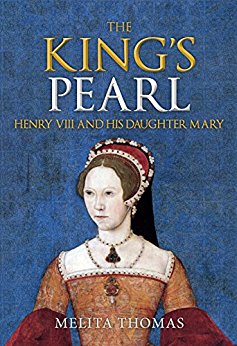
The King’s Pearl: Henry VIII and his Daughter Mary by Melita Thomas is an in-depth look into the life of Mary I, in her formative years. It tells the story of England’s first queen regnant, during the life and reign of her father, Henry VIII.
This is a wonderful book, giving an insight into the years of Mary’s life which are rarely considered, when she went from being a pampered princess of two adoring parents to an adolescent declared a bastard by her own father. The author paints the picture of a young woman who had gone through more trials and emotions imposed by her father than any daughter should have to bear. The King’s Pearl: Henry VIII and his Daughter Mary evokes sympathy and understanding for the extremes of life experiences that Mary I had to endure, once her parents’ marriage had broken down. From being denied the company of her mother, the attention of her father to being bullied and belittled, in fear of imprisonment, and worse.
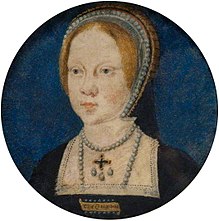
Mary at the time of her engagement to Charles V. She is wearing a rectangular brooch inscribed with “The Emperour”
On St George’s Day 1527, the French ambassadors went to see Mary at Greenwich. After dinner, Henry led them into a hall in which Mary, Katharine and the French queen were present, with a large comapny of ladies and gentlemen. The proud father told the ambassadors to speak to his daughter in Latin, French and Italian, and she was able to respond in all three languages. She also wrote in French for them, before performing on the spinet. The ambassadors agreed the young lady was very accomplished for her age, which was eleven years and two months. Contrary to the previous description of her as tall, Turenne thought although she was very pretty, she was so ‘thin, spare, and small’, that she could not possibly be married for another three years. From the opposing descriptions of her, we can perhaps infer that none of them is terribly accurate – those who wanted her to be considered ready for marriage described her as tall and robust, while those who wished to delay matters spoke of her as small.
Every aspect of Mary’s early life is examined in detail, from her pampered childhood, surrounded by courtiers and loving parents, to the loneliness of an out-of-favour, illegitimate daughter. Her various marriage prospects are a constant theme throughout the book, demonstrating how Mary was used as a bargaining chip in Henry VIII’s constant diplomatic wranglings between Francis I of France and Charles V, Holy Roman Emperor.
Melita Thomas’ research is impeccable, her arguments and theories are backed up by primary sources, including memoirs, letters and treaties. The focus is entirely on Mary, her relationships with her family and courtiers and the way her father’s policies and marriages affected her life. It examines every aspect of Mary’s life in impeccable detail; her education, court life, her relationships, health and daily routine. It is a sad tale, of a father who demanded absolute obedience, and never considered the consequences of his actions on the mental well-being of his children.
Well-written and beautifully presented, The King’s Pearl: Henry VIII and his Daughter Mary, is a perfect and essential addition to any Tudor library.
*
About the author
Melita Thomas is a co-founder and editor of Tudor Times, a website devoted to Tudor and Stewart history. Her articles have appeared in BBC History Extra an Britain magazine. The King’s Pearl is available from Amberley Publishing and Amazon UK. and will be available from Amazon US from 1st June 2018.
My Book:
Heroines of the Medieval World, is now available in hardback in the UK from both Amberley Publishing and Amazon UK. It is also available on Kindle in both the UK and USA and will be available in Hardback from Amazon US from 1 May 2018. It can also be ordered worldwide from Book Depository.
You can be the first to read new articles by clicking the ‘Follow’ button, liking our Facebook page or joining me on Twitter.
Anna posed some very interesting, thoughtful questions and finished off with a wonderful review of ‘Heroines’ – for which I am still smiling.
Here’s a taster of the interview:
Why this passion for history?
I honestly don’t know. I have always loved history – I just can’t get enough of it. The stories and the mysteries are so compelling. I love the ‘what ifs’. And it is something that is everywhere – you can go to Scotland, France, Russia, Canada and there is history.
Have you ever wished you could travel back in time to say hello to some of your favourite medieval heroines?
I would love to – so long as I can come back, I wouldn’t want to live in the past. I like my creature comforts too much. But it would be nice to sit at a table with Agnes of Dunbar and Nicholaa de la Haye and find out what made them so formidable. Or Eleanor of Aquitaine’s daughters and ask them what they really thought of their mum and dad – oh, that would be so interesting.
If you would like to read the entire interview and review, simply click here.
*
My Book:
Heroines of the Medieval World, is now available in hardback in the UK from both Amberley Publishing and Amazon UK and worldwide from Book Depository. It is also available on Kindle in both the UK and USA and will be available in Hardback from Amazon US from 1 May 2018.
You can be the first to read new articles by clicking the ‘Follow’ button, liking our Facebook page or joining me on Twitter.
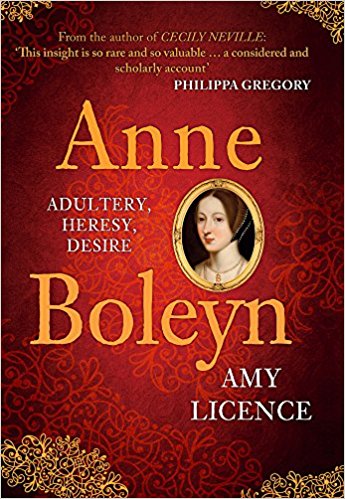
Anne Boleyn’s unconventional beauty inspired poets ‒ and she so entranced Henry VIII with her wit, allure and style that he was prepared to set aside his wife of over twenty years and risk his immortal soul. Her sister had already been the king’s mistress, but the other Boleyn girl followed a different path. For years the lovers waited; did they really remain chaste? Did Anne love Henry, or was she a calculating femme fatale?
Eventually replacing the long-suffering Catherine of Aragon, Anne enjoyed a magnificent coronation and gave birth to the future Queen Elizabeth, but her triumph was short-lived. Why did she go from beloved consort to adulteress and traitor within a matter of weeks? What role did Thomas Cromwell and Jane Seymour of Wolf Hall play in Anne’s demise? Was her fall one of the biggest sex scandals of her era, or the result of a political coup?
With her usual eye for the telling detail, Amy Licence explores the nuances of this explosive and ultimately deadly relationship to answer an often neglected question: what choice did Anne really have? When she writes to Henry during their protracted courtship, is she addressing a suitor, or her divinely ordained king? This book follows Anne from cradle to grave and beyond. Anne is vividly brought to life amid the colour, drama and unforgiving politics of the Tudor court.
Reviewing such a book as Anne Boleyn: Adultery, Heresy, Desire by Amy Licence is a daunting prospect. How can one do justice to a book which may well be the definitive biography of Anne Boleyn? Well, I suppose Amy had the same issue when writing it – how to do justice to Anne Boleyn’s story while avoiding falling into the bias of having a favourite between Anne and her rival, Catherine of Aragon? Having already produced a stunning account of the life of Catherine of Aragon, this is the second in a series which will hopefully include all 6 of Henry VIII’s wives, and presents Anne Boleyn as she was; a woman like any other, with loves, hopes and fears, rather than as the foil and ruin of the married bliss of Catherine and Henry.
However she did it, Amy Licence has managed to produce a balanced, fair assessment of this much hated/loved (depending on which side of the fence you are on) queen. Telling the story from the very beginning, from the rise of Anne’s predecessors through the guilds of London, through her childhood and early years in the courts of Burgundy and France to her dominance of Henry VIII’s court. The book strips away the veil of malice and rumour surrounding her, providing a new and in-depth analysis of Anne the woman and Anne the queen. It shows her as a growing and developing individual, reacting and responding to the forces around her, rather than the historical fiction view of a scheming harridan out to displace Catherine and take the throne for herself. It demonstrates that the Tudor world and Anne’s life, was constantly fluid, developing and responding to situations as they present themselves.
Amy Licence is a wonderful writer and historian – her books are always accessible and enjoyable reads, bringing back to life some of the most fascinating characters of history. And Anne Boleyn: Adultery, Heresy, Desire is no exception. Beautifully written, it presents Anne’s story as never before seen, with a balance rarely achieved when it comes to telling Anne Boleyn’s story. Anne is presented neither as a tragic victim, nor a scheming temptress. Her story unfolds as it does for all of us, with events and actions influencing her decisions and demonstrating that her life was a long winding road; the direction neither predetermined nor inevitable. It shows how Anne’s experiences, both in England and the continent, helped to shape Anne the woman, her outlook and her destiny.
Amy Licence achieves a balance between presenting the everyday domesticity of Henry VIII’s life and court and the national and international politics of the day. I love the little snippets of domestic life interspersed in the deeper issues, such as Henry’s dog, Ball, getting lost in Waltham Forest. She demonstrates the influences of the Reformation on Anne and Henry, and on the country at large, but also highlights the reactionary nature of the Reformation against church abuses. Rather than presenting it as ‘Henry wanted a divorce so he broke with Rome’, but as one cog in a very complex wheel of reactionism and Reformation; showing it in its wider context, not only in England but across Europe, and how both Henry’s and Anne’s attitudes were changed and shaped by the wider European movement of reform.
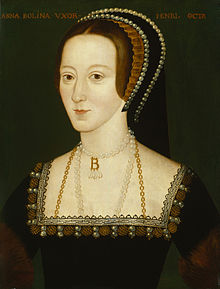
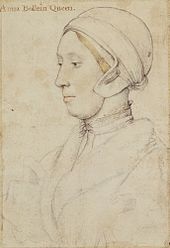
Anne Boleyn by Hans Holbein the Younger
At twelve years old, Anne Boleyn left her home at Hever, travelled to Dover and embarked for Calais. It was to be the start of the education that gave her the air of sophistication and poise that would attract Henry, a unique edge, and the cultural polish and confidence to hold her own in the courts of Burgundy,, France and, eventually, England. in fairy-tale castles that outstripped any buildings she knew from home, hung with the most exquisite Flemish tapestries, in libraries housing the best illuminated manuscripts, where leading artists worked and musicians played, Anne absorbed the latest and best of the northern European Renaissance. Her exposure to its religious and cultural thinking made her something of a ‘new’ woman, part of a generation who would question the old ways and faiths, emboldened to reject centuries of Catholic ritual, the efficacy of saints and the pope, a different world to the England in which she spent her early years.
Amy Licence has managed to write a book about Anne Boleyn, giving us the character of the woman and showing how she grew into her role as queen, but showing her as human, a woman who made not only loyal friends and achieved a position she was never born to, but also a woman who made enemies and mistakes and whose downfall was one of the most tragic, staged events in English history. With the use of primary sources, including letters, court documents and accounts, Amy not only recreates the world of Anne and Henry VIII, but also the personalities and politics of the people and countries surrounding them. Where there is disagreement or controversy , she presents all sides of the argument, using her excellent analytical skills to dissect the story, present the facts and explain her own theories, reasoning and conclusions.
Not only does Amy Licence expertly dissect the character of Anne, but also the personalities associated with her story, from her own family to Henry, Catherine and Cardinal Wolsey. She provides a deep analysis of Anne Boleyn, her character, strengths and weaknesses, successes and failures. She does not shy away from the negatives in Anne’s character, such as her pettiness towards Catherine of Aragon, but manages to convey how Henry’s pursuit of her, the lengthy divorce proceedings and long years of waiting must have affected her.
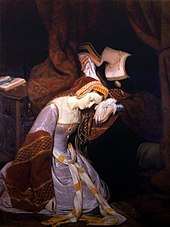
Anne Boleyn in the Tower by Edouard Cibot
Amy Licence’s unique, intimate writing style draws the reader in and provides an engaging, perceptive analysis of one of the most enigmatic women of the Renaissance period. Whether you love or hate Anne Boleyn, Anne Boleyn: Adultery, Heresy, Desire will give you new perspectives of this polarising, iconic woman and help to demonstrate the complexities of Anne’s life and career. While being sympathetic to Anne Boleyn the woman, but not afraid to criticise, Amy Licence provides a balanced analysis of Anne Boleyn’s life, influence and legacy.
*
Amy Licence is an historian of women’s lives in the medieval and early modern period, from Queens to commoners. Her particular interest lies in the late fifteenth and early sixteenth century, in gender relations, Queenship and identity, rites of passage, pilgrimage, female orthodoxy and rebellion, superstition, magic, fertility and childbirth. She is also interested in Modernism, specifically Woolf and the Bloomsbury Group, Picasso and Post-Impressionism.
Amy has written for The Guardian, The TLS, The New Statesman, BBC History, The English Review, The Huffington Post, The London Magazine and other places. She has been interviewed regularly for BBC radio, including Woman’s Hour, and made her TV debut in “The Real White Queen and her Rivals” documentary, for BBC2, in 2013. She also writes historical and literary fiction and has been shortlisted twice for the Asham Award.
Her website can be found at amylicence.weebly.com.
Anne Boleyn: Adultery, Heresy, Desire is available from Amberley Publishing and Amazon. It will be available in the US from Amazon on 1st April 2018.
*
Heroines of the Medieval World:
Heroines of the Medieval World, is now available in hardback in the UK from both Amberley Publishing and Amazon UK and worldwide from Book Depository. It is also available on Kindle in both the UK and USA and will be available in Hardback from Amazon US from 1 May 2018.
You can be the first to read new articles by clicking the ‘Follow’ button, liking our Facebook page or joining me on Twitter.
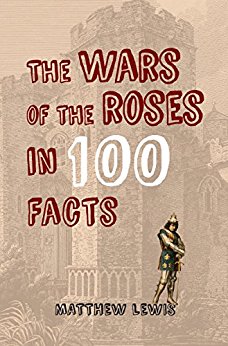
The Wars of the Roses in 100 Facts by Matthew Lewis
The Wars of the Roses were a series of brutal conflicts between rival branches of the Plantagenet family – the Lancastrians and the Yorkists. The wars were fought between the descendants of Edward III and are believed to stem from the deposition of the unpopular Richard II by his cousin, Henry Bolingbroke, who became Henry IV. The wars were thought to have been fought between 1455 and 1487, and they saw many kings rise and fall as their supporters fought for their right to rule.
The Wars of the Roses in 100 Facts covers this dangerous and exciting period of political change, guiding us through the key events, such as the individual battles, and the key personalities, such as Richard, Duke of York, and the Earl of Warwick, known as ‘the Kingmaker’. Matthew Lewis takes us on a tour through the Wars of the Roses, fact by fact, in easy-to-read, bite-size chunks. He examines some of the most important aspects of this period, from the outbreak of the conflict at the First Battle of St Albans, to Henry VI’s insanity, and the character of Richard III and his final defeat at the hands of Henry Tudor.
What can I say? I love these little books. This book series – I have already reviewed The Anglo-Saxons in 100 Facts – is a fabulous introduction to some of the most fascinating events in history.
The Wars of the Roses in 100 Facts by Matthew Lewis is a wonderful little book giving details of 100 of the most important and significant events of the Wars of the Roses. From the deposition of Richard II to the death of Cardinal Reginald Pole, arguably the last Yorkist descendant, Matthew Lewis tells the tale of the most divisive conflict in English history in an entertaining and engaging manner.
20. King Henry Could Have Died at the First Battle of St Albans
During the First Battle of St Albans, as Warwick’s archers fired at the men defending the king, Henry VI was struck by an arrow that cut him on the neck. As the fighting grew closer, the king was taken into a tanner’s shop to receive treatment and to keep him out of the way of further harm.
Benet’s Chronicle records that once the battle was won, York, Salisbury and Warwick burst into the tanner’s shop and found Henry, wounded and at their mercy. Instead of finishing off the king, as York might have done had he truly wanted the crown at this stage, Benet’s Chronicleexplains that the lords fell to their knees and pledged their allegiance to the king, ‘at which he was greatly cheered’.
Henry was escorted to the comfort of the abbey to continue his treatment and, although he was dismayed to learn of Somerset’s death, he was well treated and on the following morning he was escorted to London by the Yorkist lords. York might well have widened the wound at Henry’s neck and ensured that there were no witnesses. He could then have blamed the stray arrow for killing the king. This is possibly the clearest sign that at this point, Henry’s crown was safe and secure.
What I love about this book is it is a wonderful combination of the best known facts, the battles and the politics, and some little known facts and events that mean even a seasoned Wars of the Roses enthusiast will find something to engage their interest. The brief, 1-2 page chapters mean the reader can drop in and out of the book at their leisure, or whenever they have 5 minutes to spare.
These little snippets are utterly enthralling and informative. They combine to give a wonderful, universal picture of the conflict; the battles and the characters involved. The book is beautifully written and well researched. It is organised in a loosely chronological manner, with fabulous insights into the major players and events of the Wars of the Roses.
Although The Wars of the Roses in 100 Facts is restricted to 100 facts, it is not short on insight and analysis. Matthew Lewis does a great job of achieving a balance of facts with the analytical approach of the historian. It would be a wonderful addition to the library of anyone interested in the Wars of the Roses, or the later fifteenth century as a whole.
*
Matthew Lewis is an author and historian with particular interest in the medieval period. His books include a history of the Wars of the Roses, a biography of Richard, 3rd Duke of York, and two novels of historical fiction telling the life of King Richard III and the aftermath of the Battle of Bosworth. He also writes a history blog, sharing thoughts and snippets. He can be found on Twitter @MattLewisAuthor.
The Wars of the Roses in 100 Facts is available from Amberley and Amazon.
*
Heroines of the Medieval World:
Heroines of the Medieval World, is now available in hardback in the UK from both Amberley Publishing and Amazon UK and worldwide from Book Depository. It is also available on Kindle in both the UK and USA and will be available in Hardback from Amazon US from 1 May 2018.
You can be the first to read new articles by clicking the ‘Follow’ button, liking our Facebook page or joining me on Twitter.
 Today over at The Review, you can read my thoughts on Derek Birks’s fantastic new novel, The Blood of Princes, the second book in his Scars from the Past series telling the story of the disappearances of the Princes on the Tower and the accession of Richard III.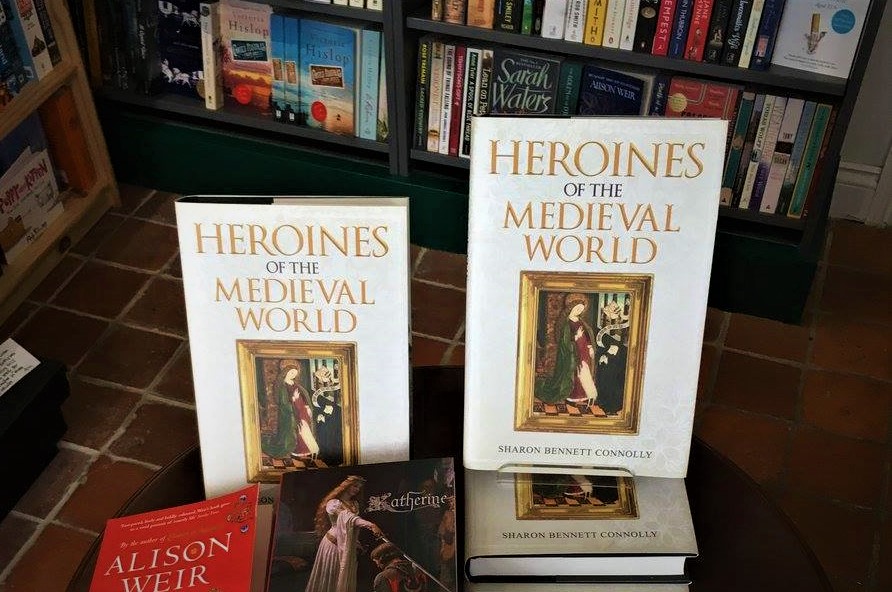





 Giveaway!



 History... the interesting bits!