
A Plantagenet prince, Arthur of Brittany‘s story is one of the most tragic of the Medieval period. The posthumous son of Geoffrey, 4th son of Henry II of England and Eleanor of Aquitaine, and Constance of Brittany, he was Duke of Brittany from the moment of his birth.
Constance and Geoffrey had married in 1181; their daughter, Eleanor, was born in 1184. It was during an estrangement from his father Geoffrey that was trampled to death while competing at a tournament in Paris, in August 1186.
Arthur was born several months later, in March or April 1187. In 1190 the two-year-old Arthur was named as heir presumptive to his uncle Richard I, king of England; Richard even arranged a betrothal for young Arthur, to a daughter of Tancred of Sicily. However, the Emperor Henry VI conquered Sicily in 1194 and the betrothal came to nothing.
Arthur was a valuable pawn for both the kings of France and England; when Richard tried to take him into his household, in 1196, his mother sent him to the French court, where he spent several months. On his return to Brittany, Constance started involving him in the government of the duchy.
On Richard’s death in 1199, the great William Marshal and Hubert Walter, Archbishop of Canterbury and Justiciar of England, were instrumental in persuading the English barons to accept the king’s youngest brother John as King. They reasoned that John knew more of England – and was more experienced – than young Arthur. And that John was not as friendly with the king of France, Philip II Augustus, who supported Arthur’s claim to the English crown.
In August 1199, Philip complained that John had not paid him homage for the French lands held by the English king. He demanded the Vexin and that John relinquish Anjou, Maine and Touraine, the Angevin ancestral lands, to Arthur. According to Gervase of Canterbury John ‘made up his mind to resist the French king like a man, and to fight manfully for the peace of his country.’
By September, John was winning the war. William des Roches, Arthur’s seneschal in Anjou, offered to defect to John. He was bitter that Philip Augustus had destroyed the Angevin fortress of Ballon after capturing it from John, rather than handing it to Arthur. This high-profile defection was followed by the submission of Arthur himself, he and his mother met John at Le Mans. However, they received a warning that the king was planning to arrest and imprison them, and fled Le Mans in the dead of night, making their way to the French court. Whether the intelligence was true or not, John’s past record of betrayal was obviously enough to sow distrust in the minds of Arthur and his mother and make the threat credible.
A temporary truce followed, which was made more permanent in January 1200, before John and Philip II came to terms at Le Goulet on 18 May 1200. Philip agreed to withdraw his support of Arthur in return for John paying homage to Philip for his French possessions. In addition, Arthur performed homage to John for Brittany. Arthur’s claim was revived, however, when King Philip confiscated John’s possessions in Northern France for refusing to acknowledge Philip as his overlord. Philip recognised Arthur as the rightful heir to Normandy and Anjou. Tensions were then exacerbated when Philip declared all of John’s continental possessions forfeit as a result of his refusal to deal justly with Hugh IX de Lusignan, who had rebelled following John’s marriage to Hugh’s betrothed, Isabelle d’Angoulême.
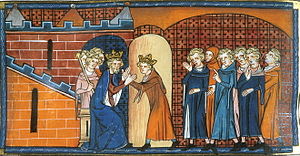
War followed.
In July 1202 Arthur, newly knighted and betrothed to King Philip’s infant daughter, took a force of knights, including the de Lusignans, into Aquitaine, to make war on John. having received intelligence that his grandmother, Eleanor of Aquitaine, was travelling to Poitiers, he set a course to intercept her at Mirebeau. The ageing queen sought refuge in the castle and sent word to her son, King John, asking for assistance. Having become aware of Arthur’s move against Aquitaine, John had already set out with his army and was at Le Mans when he received his mother’s message. Taking a small force so he could move quickly, John made a forced march to the rescue of his mother, covering 100 miles in less than two days and surprising Arthur and his allies while they were still at breakfast, on the morning of 1 August. After some fierce fighting through the streets, the enemy commanders were all captured. One of John’s barons, William de Braose, captured Arthur and handed him over to the King, who imprisoned him at Falaise.
His captivity was probably less than comfortable, despite his rank and familial relationship. According to William Marshal, John ‘kept his prisoners in such a horrible manner and such abject confinement that it seemed an indignity and disgrace to all those with him who witnessed his cruelty.’
Whilst imprisoned at Falaise, John ordered that Arthur should be blinded and castrated. Two of the three messengers dispatched to carry the order fled the king’s court, to avoid the distasteful duty, but one reached Falaise. However, Arthur’s jailer Hubert de Burgh, balked at mutilating a 15-year-old boy, saying that John would regret the order, and John ‘was not displeased for the moment that his order had not been carried out.’ Though word was put out that the deed had been done, in the hope that the news would quell insurrection in Brittany. The Bretons were so enraged that the revolt rose to a new level of ferocity and the rebels were only pacified when it was announced that Arthur was, in fact, alive and well.
Arthur was later removed to confinement in Rouen.

King Philip and the nobility of Brittany continued to press for the release of the young duke, but John had other ideas. It was in Rouen, at Easter 1203, most likely on 3rd or 4th April, that Arthur was put to death. He was 16 years old. A chronicler of the Cistercian monastery of Margam, Glamorgan, described the murder:
“The King of the French took the castle of Chinon, and afterwards all the garrisons of Normandy, Anjou, and the city of Poitiers, with other castles, fortified towns and cities, as he so willed it – for this reason; when king John had captured Arthur, he had him kept alive in prison for some time, but finally, in the great tower at Rouen, on the Thursday before Easter, after his dinner and when drunk and possessed by the devil, he killed him by his own hand, and, after a large stone had been tied to the body, threw it in the Seine. It was discovered by a fisherman in his net and recognised when it was brought to the riverbank, and, for fear of the tyrant, secretly buried at the priory of Bec, which is called Notre Dame des Pres.
When the aforesaid king of the French heard the news of this and knew for certain that Arthur had been killed, he had his killer John summoned to the court of France, as was customary with dukes of Normandy, to answer for the murder of such a great man and to defend himself if he could; of such a great man, say I, for he was the legitimate heir of England, the count of Brittany, and the son-in-law of the king of France. John, fully aware of his evil deed, never dared to appear before the court, but fled to England and exercised a most cruel tyranny over his people until he died. When he never came to answer for the death of Arthur or to defend himself, judgement was given against him by the king’s court, and he was deprived of all his titles, in all the lands and honours which he held of the French crown; this was an incontrovertible and just sentence.”
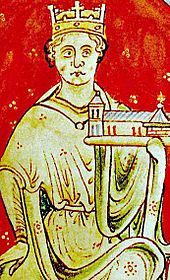
Whether John committed the deed himself, or merely ordered it done, will probably never be known; of the fact he was present there seems to be little doubt. Whatever his part, however, it was an act that would be held against John, not only during his lifetime, but for centuries to come. In 1204 King Philip, most likely knowing – or at least suspecting – that Arthur was dead, made the young duke of Brittany’s release a condition of any peace settlement.
On Arthur’s death the duchy should have passed to his older sister, Eleanor; but she was also a prisoner of King John and would be held in confinement in England for the rest of her life. So it passed to his two-year-old half-sister, Alix of Thouars, daughter of Constance and her third husband, Guy of Thouars.
*
Sources: Dan Jones, The Plantagenets: The Kings Who Made England; Robert Bartlett, England Under the Norman and Angevin Kings 1075-1225; Maurice Ashley, The Life and Times of King John; H.G. Koenigsberger, Medieval Europe 400-1500; History Today Companion to British History; Charles Phillips, Illustrated Encyclopedia of the Kings & Queens of Britain; Oxford Companion to British History; Mike Ashley, The Mammoth Book of British Kings & Queens; Douglas Boyd, Eleanor: April Queen of Aquitaine
Pictures courtesy of Wikipedia
*
My Books
Signed, dedicated copies of all my books are available through my online bookshop. or by contacting me.
New releases in 2026:
New Hardbacks
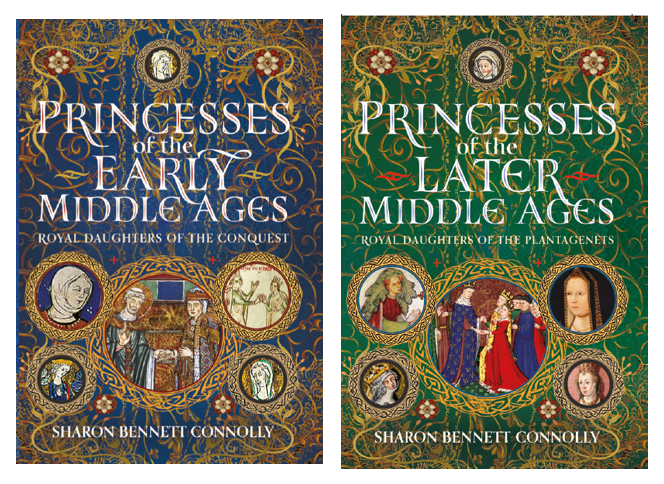
‘My daughter wanted me to treat her more like a princess. So, I married her to a stranger to strengthen the alliance with Poland!’
Princesses of the Early Middle Ages: Royal Daughters of the Conquest and Princesses of the Later Middle Ages: Royal Daughters of the Plantagenets tell the stories of England’s royal daughters from 1066 to the rise of the Tudors, from the last Anglo-Saxon princesses to the fall of the House of York.
Were they really pampered pawns sent off to marriages on the Continent, out of sight and out of mind?
Perhaps, there was different story, where a foreign marriage does not mean eternal exile, but a purpose in life, where a princess is a diplomat, an ambassador for England in her new country.
Where she is the bond between allies – most of the time.
Their stories are touching, inspiring and, at times, heartbreaking...
Heidi Malagisi: ‘This is another excellent book by Sharon Bennett Connolly. Extremely well researched and relatively easy to follow along, which is a great thing because there are so many Matildas and Eleanors in this book.‘
Tony Riches: “I challenge anyone with an interest in medieval Britain to not find something they will learn from this book.”
Anna Belfrage: “I just love how [Sharon] presents this huge cast of real life people in a casual, chatty tone that has me expecting the various female protagonists to suddenly pop their head up and add their own commentary.“
Buy now: Princesses of the Early Middle Ages: Royal Daughters of the Conquest
Pre-order: Princesses of the Later Middle Ages: Royal Daughters of the Plantagenets
New in Paperback:
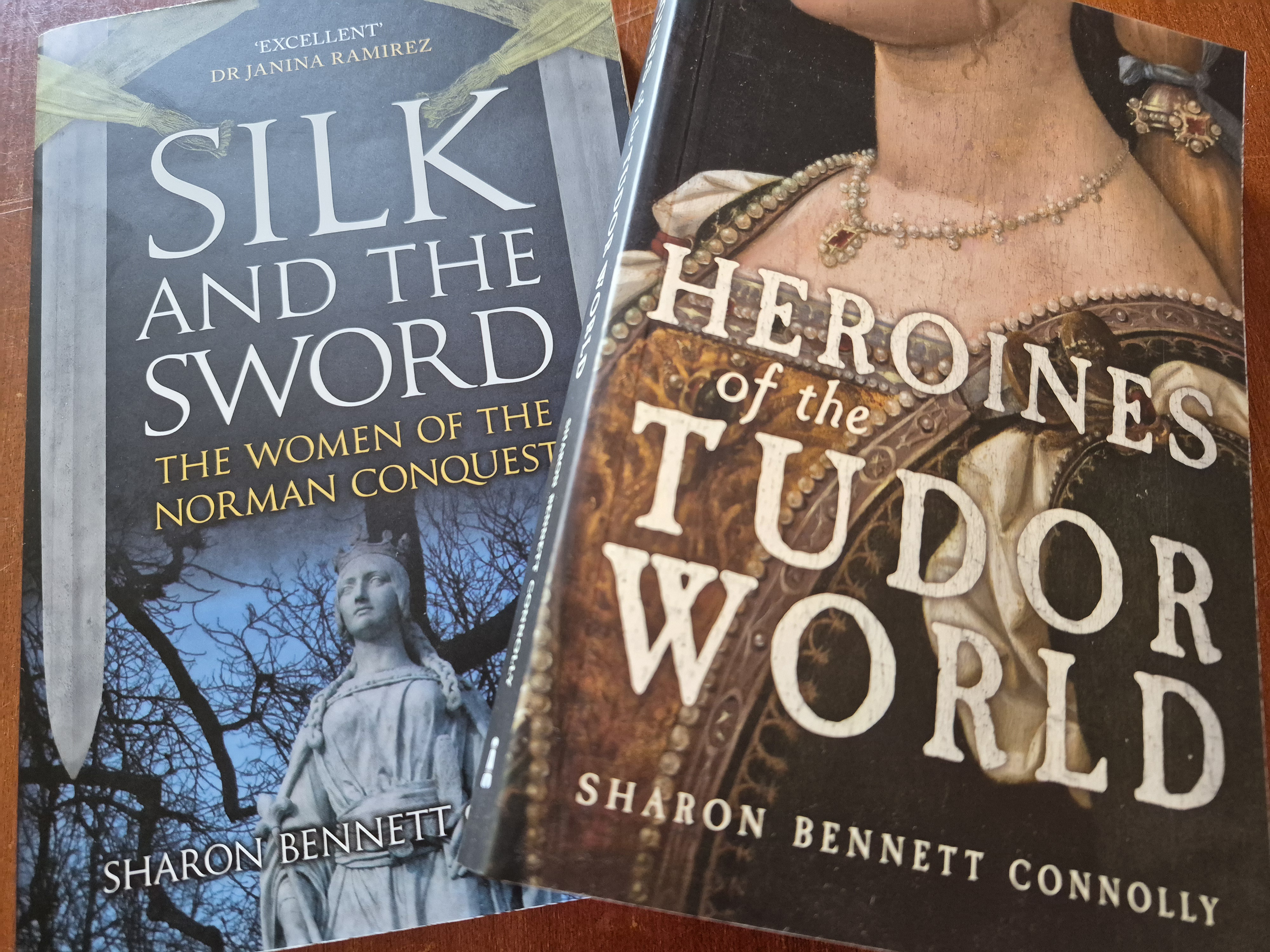
The momentous events of 1066, the story of invasion, battle and conquest, are well known. But what of the women? Silk and the Sword: The Women of the Norman Conquest traces the fortunes of the women who had a significant role to play during the Norman Conquest – wives, lovers, sisters, mothers, leaders. These are lives full of drama, pathos and sometimes mystery: Edith and Gytha searching the battlefield of Hastings for the body of Harold, his lover and mother united in their grief for the fallen king. Who was Ælfgyva, the lady of the Bayeux Tapestry, portrayed with a naked man at her feet?
Janina Ramirez said it’s ‘Excellent’!
Heroines of the Tudor World focuses on the women who lived through the Renaissance and Reformation, examining the threats and challenges they faced and how they overcame them. These are the women who ruled, the women who founded dynasties, the women who fought for religious freedom, their families and love. These are the women who made a difference, who influenced countries, kings and the Reformation.
Derek Birks: ‘An excellent account of the changing roles of women in Tudor society.’
Annie Whitehead: ‘What a treat this book was to read. Bennett Connolly has an easy, conversation style of writing which welcomes you from the opening pages and draws you into her story.‘
Also by Sharon Bennett Connolly:
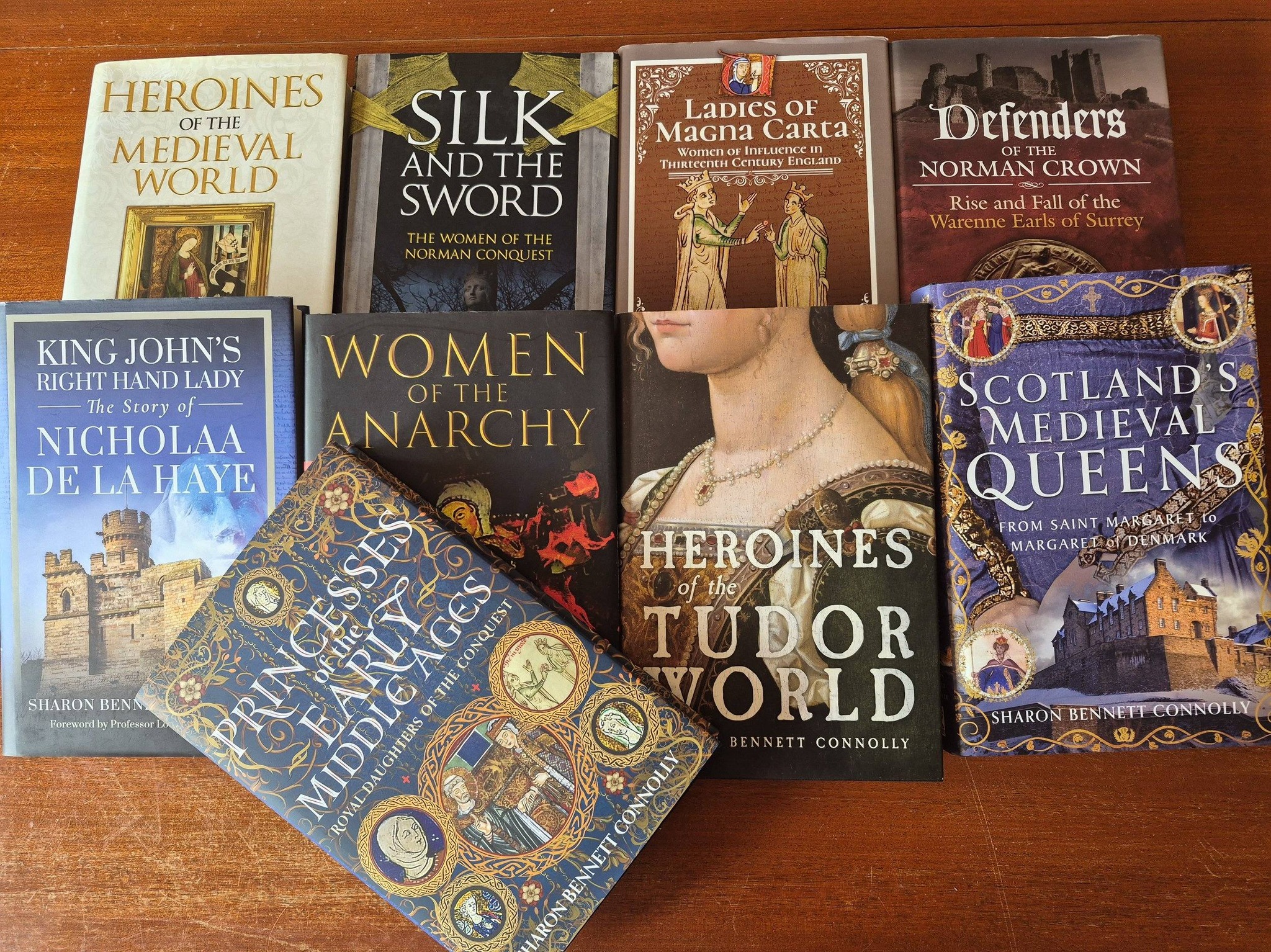
Heroines of the Medieval World; Silk and the Sword: The Women of the Norman Conquest; Ladies of Magna Carta: Women of Influence in Thirteenth Century England; Defenders of the Norman Crown: Rise and Fall of the Warenne Earls of Surrey; King John’s Right Hand Lady: The Story of Nicholaa de la Haye; Women of the Anarchy; Heroines of the Tudor World; Scotland’s Medieval Queens: From St Margaret to Margaret of Denmark; Princesses of the Early Middle Ages: Royal Daughters of the Conquest (March 2026); Princesses of the Later Middle Ages; Royal Daughters of the Plantagenets (August 2026)
Alternate Endings: An anthology of historical fiction short stories including Long Live the King… which is my take what might have happened had King John not died in October 1216. Available in paperback and kindle from Amazon.
All my books on Amazon and Bookshop.org . You can also order direct from my publishers, Pen and Sword Books and Amberley Publishing.
Podcast:

Have a listen to the A Slice of Medieval podcast, which I co-host with Historical fiction novelist Derek Birks. Derek and I welcome guests, such as Ian Mortimer, Bernard Cornwell, Elizabeth Chadwick and Scott Mariani, and discuss a wide range of topics in medieval history, from significant events to the personalities involved.
Every episode is also now available on YouTube.
*
Don’t forget!
Signed and dedicated copies of all my books are available through my online bookshop.
For forthcoming online and in-person talks, please check out my Events Page.
You can be the first to read new articles by clicking the ‘Follow’ button, liking our Facebook page or joining me on Twitter, Threads, Bluesky and Instagram.
*
©2015 Sharon Bennett Connolly FRHistS


Lol welcome to the family…….
LikeLike
Great post. Very informative.
LikeLike
Thank you, Kristie
LikeLiked by 1 person
Hi just a quick question, which source was your quote from Marshal about the conditions of John’s prisoners from? I haven’t seen it before and it seems out of character for him so I’d love to know where it came from. Great post too.
LikeLike
Hi and thank you. Marshal’s quote was in Dan Jones’ book, The plantagenets:The Kings who made England.
LikeLiked by 2 people
Thanks, I’ll have to have a look. I don’t have a copy and I’d love to know where he got it I’ll have to find one in the library.
LikeLiked by 1 person
Too bad they didn’t back Arthur instead of John esp since Marshall took on Henry III years later as a child. Might have seen a much better king!
LikeLiked by 1 person
Maybe Gloria. But I think the barons were thinking ‘better the devil you know’. They probably thought John would be more capable of holding off the French. As it was, it didn’t work out that way and it does get you wondering how England would have been under Arthur. His reign couldn’t have been much more disastrous than John’s, surely? But…if not for John, we wouldn’t have the Magna Carta. Interesting thought…
LikeLike
Yes, I have always wondered what would have been England’s future been if Arthur had been king, instead of John. Or, even if Richard had not died. Ah, Well, such is history and the ‘what if’s of life. That’s why we have Allison Weir and readers like us!
LikeLike
Indeed Suzie. I find the ‘what could have been’ just as fascinating as what actually happened. Poor Arthur. Sharon 🙂
LikeLike
Another great article! I would like to write a novel featuring Maud de Braose when I am done with my current project, so this incident will be a key element.
LikeLiked by 1 person
Thanks Samantha. She is truly fascinating. I look forward to reading your novel on Maud – her story deserves to be told. Let me know when you’ve finished it – I’ll be more than happy to review it for you. 🙂
LikeLike
Thanks! I have to finish with Margaret Pole first. She’s being a bit shy.
LikeLike
Sounds interesting. My tbr pile will be a mountain before long! 🙂
LikeLike
Very interesting post. It is hard to imagine the awful things that were done behind the glamour of living in a castle.
LikeLike
Thank you Laura. Yes, it’s nice to read about history – but I’m not sure I’d want to live there, far to dangerous!
LikeLike
Reblogged this on History's Untold Treasures and commented:
H/T History, the Interesting Bits
LikeLike
Thank you 🙂
LikeLiked by 1 person
You’re welcome! And thanks for letting me share! 🙂
LikeLike