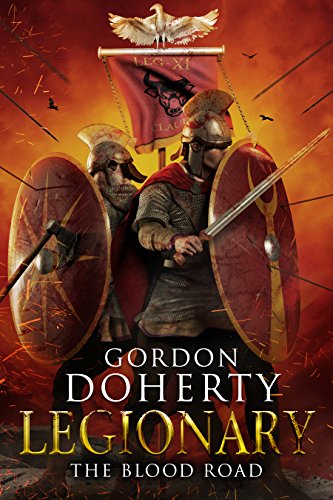
381 AD: The Gothic War draws to a brutal climax, and the victor’s name will be written in blood…
The great struggle between the Eastern Roman Empire and the Gothic Horde rumbles into its fifth year. It seems that there can be no end to the conflict, for although the Goths are masters of the land, they cannot topple the last of the imperial cities. But heralds bring news that might change it all: Emperor Gratian readies to lead his Western legions into the fray, to turn matters on their head, to crush the horde and save the East!
The men of the XI Claudia legion long for their homeland’s salvation, but Tribunus Pavo knows these hopes drip with danger. For he and his soldiers are Gratian’s quarry as much as any Goth. The road ahead will be fraught with broken oaths, enemy blades… and tides of blood.
Gordon Doherty‘s Legionary: The Blood Roadis the 7th book in his acclaimed Legionary series and is a masterpiece of Roman fiction. I don’t often read Roman historical fiction, but whenever I do stray from medieval history into the realms of the legions, I find myself asking ‘why don’t I do this more often?’ Legionary: The Blood Road again made me realise how much I love a good book about Rome!.
Legionary: The Blood Road is a fast-paced, enjoyable novel of the Roman legions which grips you from the very first page. The action and intrigue never lets up, from the opening lines to the last, taking the reader on a journey through the Eastern Empire of Theodosius and its struggles against the Goths. The battles are so vividly portrayed, they feel real; the tactics of the Roman legions and of the Gothic horde, have obviously been extensively researched. The author transports you back to the events and leaves you feeling that you were a spectator to the actual battles. The suspense is tangible, the end of the book cleverly disguised so that, to the very last pages, you are fearful that the hero may not prevail.
‘For the Claudia,’ panted one voice, thick with emotion.
He turned to the rise, seeing the men of the First Century slacken in relief. Seven legionaries lay still on reddened earth; another dozen groaned and clutched wounds. Pavo betrayed not a chink of emotion, the ‘soldier’s skin’ like a layer of old boot leather around his heart. He quietly stooped to pack a little frost around the stinging gash on the back of his hand. Primus Pilus Sura, his most trusted man in the legions and out, wrenched his spear clear of the shoulder of another Hun corpse, his blonde hair shuddering and his boyish features ruined by a snarl. ‘We weren’t sent here to fight Huns,’ he seethed at the toppling body.
‘Thank Mithras we were here though,’ said Pavo, peeling his helm from his head and scruffing a hand through his short, dark hair. He offered a nod to the onager crew – fifty strides back – who had measured the range and unleashed the rock that had destroyed the ice-bridge. ‘Imagine we were not. These bastards would have poured across, then sent back word to others. The nightmare on the far banks would have spilled over here in its entirety.’
‘Still a bit of a nightmare on this side too, Tribunus,’ said Centurion Libo, throwing his helmet to the ground and scratching behind his ear like a dog, flakes of dry skin spraying from his wild matter hair. His painted, wooden eye remained fixed and staring while the good eye swivelled to look south, he like the many others thinking of the turmoil still ongoing many miles away.
And what a hero! Pavo is a fabulous character, who is vividly portrayed. It’s almost like you know him personally. Human, flawed, ruthless; but a beloved leader whose men will follow him, no matter what. He has earned their loyalty by giving them his loyalty and it is this mutual strength and trust which provides the backbone to the story. You find yourself rooting for him through is many trials and tribulations, while at the same time wondering how anyone could get out of the predicaments in which he finds himself!
Pavo, however, has made some powerful enemies, and it is his relationship with these enemies – the Emperor Gratian, no less – that leads Pavo into the greatest danger. Gratian doesn’t want Pavo dead – he wants him to suffer. Pavo has to balance his need to stay away from Gratian – and his personal band of assassins – against his duties to protect and defend the empire against the invading horde and an ever-elusive dream of peace. The suspense is almost too much to take and will keep you reading long into the dark hours of the night.
In Legionary: The Blood RoadGordon Doherty expertly transports you back to the great days of the Roman Empire, using his extensive knowledge of the era and incredible story-telling skills to give the reader the impression of being there, in the midst of battle and court politics. The sights, sounds and smells of the eastern empire can be vividly imagined as you get absorbed into the story and atmosphere of Imperial Rome.
I have read a couple of the earlier Legionary books, but have missed a few. However, with Legionary: The Blood Roadyou could easily read this book if it was your first introduction to author Gordon Doherty. This is a self-contained novel that introduces past events when they need explanation, but tells a complete story in the author’s own, inimitable style.
Gordon Doherty is one of the must-read authors of Roman history, a wonderful story-teller who vividly recreates the era, through the landscape, people and the politics. The battles and intrigues are masterfully recreated to entertain and engage the reader; I cannot recommend it highly enough. Legionary: The Blood Roadis a fabulous read!
Gordon Doherty is a Scottish writer, addicted to reading and writing historical fiction.
His love of history was first kindled by the ruins of Hadrian’s Wall and the Antonine Wall, and travelling around the ancient world has kept the fire burning brightly ever since. The later Roman Empire and Byzantium hold a particular fascination for him. There is something quite special about the metamorphosis from late antiquity into the ‘dark ages’ and the medieval period.
While historical fiction is his passion, he alsoenjoy writing comedy and sci-fi too. Perhaps one day he’ll find a way to combine all three!
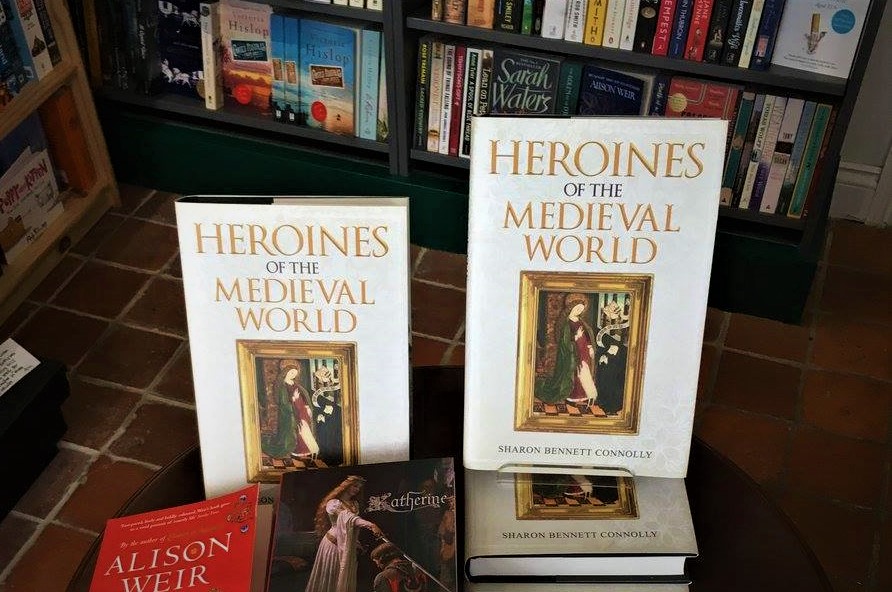
Heroines of the Medieval World tells the stories of women, famous, infamous and unknown, who shaped the course of medieval history. It is available in hardback in the UK from both Amberley Publishing and Amazon UK. It is now available in Hardback from Amazon US and worldwide from Book Depository.
From Emma of Normandy, wife of both King Cnut and Aethelred II to Saint Margaret, a descendant of Alfred the Great himself, Silk and the Sword: the Women of the Norman Conquest traces the fortunes of the women who had a significant role to play in the momentous events of 1066. Silk and the Sword: the Women of the Norman Conquest will be released in the UK on 15 November 2018 and is available for pre-order on Amazon UK, Amberley Publishing and Book Depository.
You can be the first to read new articles by clicking the ‘Follow’ button, liking our Facebook page or joining me on Twitter.
Today it is with great pleasure that I welcome novelist Gordon Doherty to the blog. Gordon’s latest instalment in his Legionary series, Legionary: The Blood Road, has just been released and is a cracking read (look out for my review later this week). Gordon joins us to talk about the background behind this magnificent Legionary series, set in ancient Rome.
So, without further ado, it is over to Gordon….
A Gap in History
A gap in history – an impossible void?
Writing historical fiction is, for me, like climbing into a time machine and going there, being in the moment. In penning the Legionary series, I feel like I have marched with the legions of the Roman Empire, across the green hills of Thracia, through the sweltering Persian desert, and over the snowy Balkan Mountains. I have fought in countless battles, sliced across the turquoise waters of the Aegean in an imperial galley, climbed the Great Aqueduct in Constantinople with cutthroats in close pursuit. It’s the ultimate escapism. This time machine of mine needs just a little fuel – a solid account of the history to spark the imagination, factual bones to which I can add the fictional flesh. But what if there is no fuel? When a gap appears in the history? Well here’s my experience…
The Gothic War: so turbulent it blew a hole in history!
The 4th century AD Roman historian Ammianus Marcellinus serves as, as Edward Gibbon said, “an accurate and faithful guide” thanks to his famous work Res Gestae (literally ‘things done’), in which he charts the events of the empire from the accession of Emperor Nerva in 96 AD all the way through to 378 AD. It was the tail end of this chronicle – the Gothic War – that really intrigued me, and Res Getae served as a perfect historical spine for the Legionary series and a constant supply of fuel for the time machine.
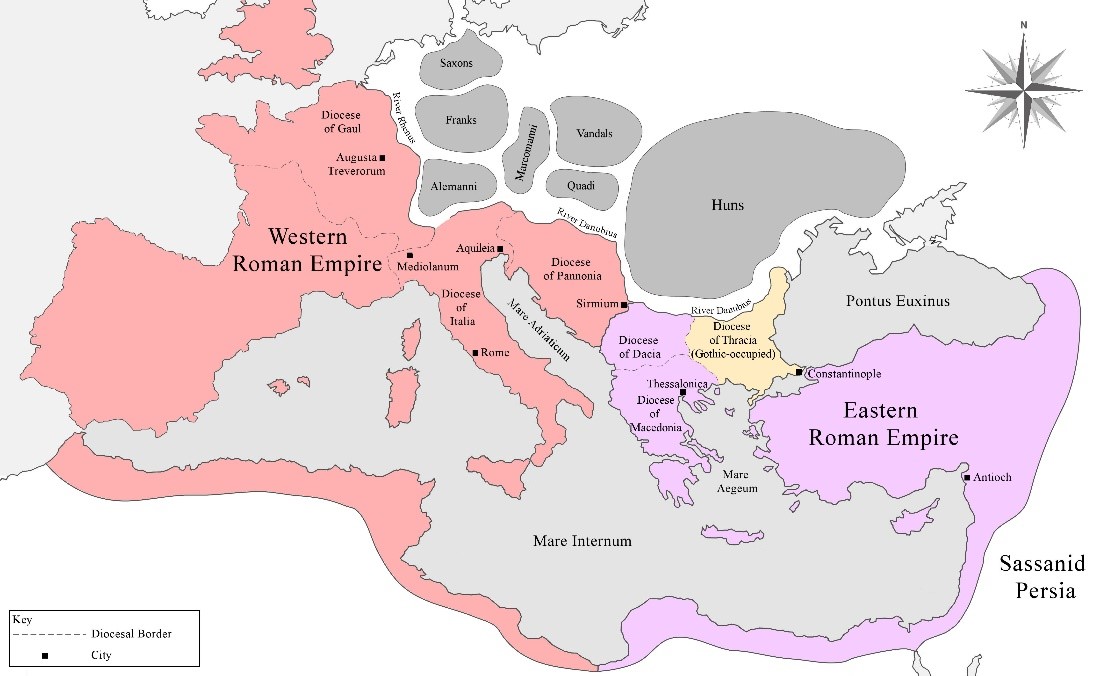
The Roman Empire during the Gothic War.
The late 4th Century AD was a tumultuous time for the Roman Empire. The ground shook and a distant thunder sounded as a new threat poured across the eastern horizon. The Huns swept towards Europe from the Eurasian steppe in an event we call the Great Migration. These skilled and fearsome horsemen trampled over every tribe they found – none of whom had an answer to the Hunnic mode of fighting – roving in packs, whirling lassos and loosing clouds of arrows on their stunned quarry. Tribe after tribe fell – butchered or subjugated. Next in the Huns’ line of sight were the Goths, a Germanic people who inhabited the land north of the River Danube (roughly modern Romania).
The war-torn Diocese of Thracia.
The Goths were hardy and fierce warriors, but even with the many warriors they could muster, they too simply could not resist the Huns. So they turned and fled south, and in 376 AD they begged to be allowed to cross the Danube and take sanctuary in the Eastern Roman Empire (the empire had existed in two halves for some time by this point). Eastern Emperor Valens permitted their entry, hoping the alliance could be mutually beneficial – the Goths gaining a safer new home and the empire acquiring many thousands of new recruits for the legions. The Romans settled the Goths in a temporary camp somewhere in northern Thracia (modern Bulgaria)… then proceeded to make an absolute mess of matters. The odious Count Lupicinus oversaw severe maltreatment of the refugee population. His soldiers offered the starving Goths only rotting dog meat in exchange for their children to sell as slaves. Inevitably, the refugees broke out in revolt, and the Gothic War began. All Thracia became a war zone, and even the mighty city of Constantinople – the Eastern capital – came under threat.
The last stand at the Battle of Adrianople – one of the Roman Empire’s darkest days.
Ammianus Marcellinus described the bitter struggle wonderfully (see my timeline here), right up to and including the day that would go down in history as one of the empire’s darkest: when the forces of Emperor Valens lined up to face the Gothic horde a short way north of the city of Adrianople on a sweltering August afternoon with the best regiments the empire had – the crack cavalry and palace legions. That day, in the baking heat, they were routed by the Goths. Two-thirds of the eastern legions were slaughtered. Valens was killed amongst his men, and the Eastern Empire was left staring into oblivion as the Goths roared in triumph, masters of Thracia.
“What happened next?” I hear you cry. Well, Ammianus signs off with the infuriatingly calm and valedictory line:
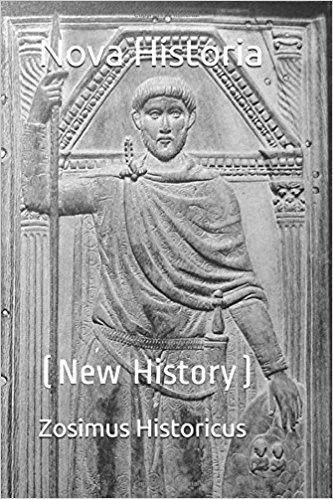
Zosimus’ Historia Nova – a muddled but still useful account.
Thus have I, a Greek by birth, and formerly a soldier, related all the events from the accession of Nerva to the death of Valens, to the best of my abilities; professing above all things to tell the truth, which, as I believe, I have never knowingly perverted, either by silence or by falsehood. Let better men in the flower of their age, and of eminent accomplishments, relate the subsequent events.
His parting call for a successor to take up the mantle was never adequately answered. The years after 378 AD are something of a historical void. Not surprising, given that the people of the Roman Empire had at that time more pressing matters to attend to than recording events.
Like the empire itself, I too found myself staring into oblivion. Legionary: Gods & Emperors ended after the Battle of Adrianople, but the story of Pavo and the XI Claudia legion was far from over. Yet how could I write about the aftermath of the Battle of Adrianople when my faithful guide had no more to say?
Another guide, perhaps? Well, there was Zosimus, the 6th century AD writer who composed the Historia Nova (the ‘New History’), a work charting affairs after 378 AD and all the way up to 410. Perfect! Well, not quite. Zosimus relied heavily on secondary research, basing his history directly on the earlier histories of Dexippus, Eunapius and Olympiodorus. This, presumably, is why the Historia Nova is riddled with contradictions and inaccuracies. In some places where he has leveraged Eunapius, he speaks negatively about the Roman-Vandal general Stilicho, and later when he has clearly used Olympiodorus, he speaks glowingly of the same man. Likewise, he describes the post-Adrianople movements of the Goths in a way that demonstrate that he clearly didn’t understand the lay of the land at the time – more than once telling how, after raiding imperial territory, they went back across the Danube (the Goths were firmly planted in fallen Thracia by this point – they never again returned to their old, Hun-ridden home north of the river). Still, Zosimus’ account was by no means a dead loss. Even his muddled version of events served as a starting point, and I attempted to detangle the descriptions and put a plausible timeline to it all.
To add a little more structure to this still-nebulous picture, I charted the attestations of the whereabouts of the Eastern and Western Emperors. Accounts of Theodosius I (Valens’ eastern successor) indicate that he made the city of Thessalonica his base of operations as he set about rejuvenating the Eastern Army. From there he roved north to tackle the Gothic horde… only to suffer defeat somewhere near Scupi in modern Macedonia. After that, it seems he remained in Constantinople for many years. Likewise, it seems Gratian, Emperor of the West, travelled to the war-torn eastern lands at least once per year during the period 378-382 AD. This ties in with the efforts of his Western Army to strike back the Gothic horde, so I could confidently assume that he was directly involved in this initiative.
Then I came to the bombastic orations of Themistius, the rhetorician and philosopher who served as a spokesperson and something of a spin doctor for Emperor Valens’ successor, Theodosius I. Now even the most prosaic of histories are subjective to a degree, but Themistius’ speeches are anything but prosaic and certainly not objective, in they are almost burlesque in their predispositions. Crucially, however, the orations he delivered in the years between 378 AD and 382 AD serve as key indicators of how the Gothic War developed after the disaster at Adrianople, and make it clear that there was a drastic shift in imperial stance. In 379 AD, not long after Theodosius’ coronation, Themistius booms:
The Goths will quake. Our mighty soldier-emperor will draw every able man together, our miners will bring iron for them and we will slaughter the barbarian!
Fighting talk! So although the Eastern Empire was grievously wounded, it is clear they did not intend to lie down and die. Yet just a few years later, Themistius proclaimed, with respect to the Gothic War:
It is an emperor’s job to govern, not to fight. And he has such a love of mankind…
This was clearly a case of managing expectations and an indicator that the aggressive earlier announcement had not played out as predicted. Sure enough, peace was agreed with the Goths the very next year, in 382 AD. The Gothic War ended not with bloody victory and vengeance, but after a series of brutal and inconclusive battles, leaving two exhausted sides realising neither could win.
So it was from this jigsaw of patchy chronicles, minor mentions of the emperors’ movements and blustery monologues from the era’s most famous orator, that I managed to piece together a picture of the post-Adrianople Roman Empire. There are places where I had to speculate and employ the imagination at full thrust – and I can’t describe how much fun that was. Most importantly, the ‘time machine’ was up and running again, and Legionary: The Blood Road was born!
I’m a Scottish writer, addicted to reading and writing historical fiction.
Gordon Doherty
My love of history was first kindled by the ruins of Hadrian’s Wall and the Antonine Wall, and travelling around the ancient world has kept the fire burning brightly ever since. The later Roman Empire and Byzantium hold a particular fascination for me. There is something quite special about the metamorphosis from late antiquity into the ‘dark ages’ and the medieval period.
While historical fiction is my passion, I enjoy writing comedy and sci-fi too. Perhaps one day I’ll find a way to combine all three!
Heroines of the Medieval World tells the stories of women, famous, infamous and unknown, who shaped the course of medieval history. It is available in hardback in the UK from both Amberley Publishing and Amazon UK. It is now available in Hardback from Amazon US and worldwide from Book Depository.
From Emma of Normandy, wife of both King Cnut and Aethelred II to Saint Margaret, a descendant of Alfred the Great himself, Silk and the Sword: the Women of the Norman Conquest traces the fortunes of the women who had a significant role to play in the momentous events of 1066. Silk and the Sword: the Women of the Norman Conquest will be released in the UK on 15 November 2018 and is available for pre-order on Amazon UK, Amberley Publishing and Book Depository.
You can be the first to read new articles by clicking the ‘Follow’ button, liking our Facebook page or joining me on Twitter.
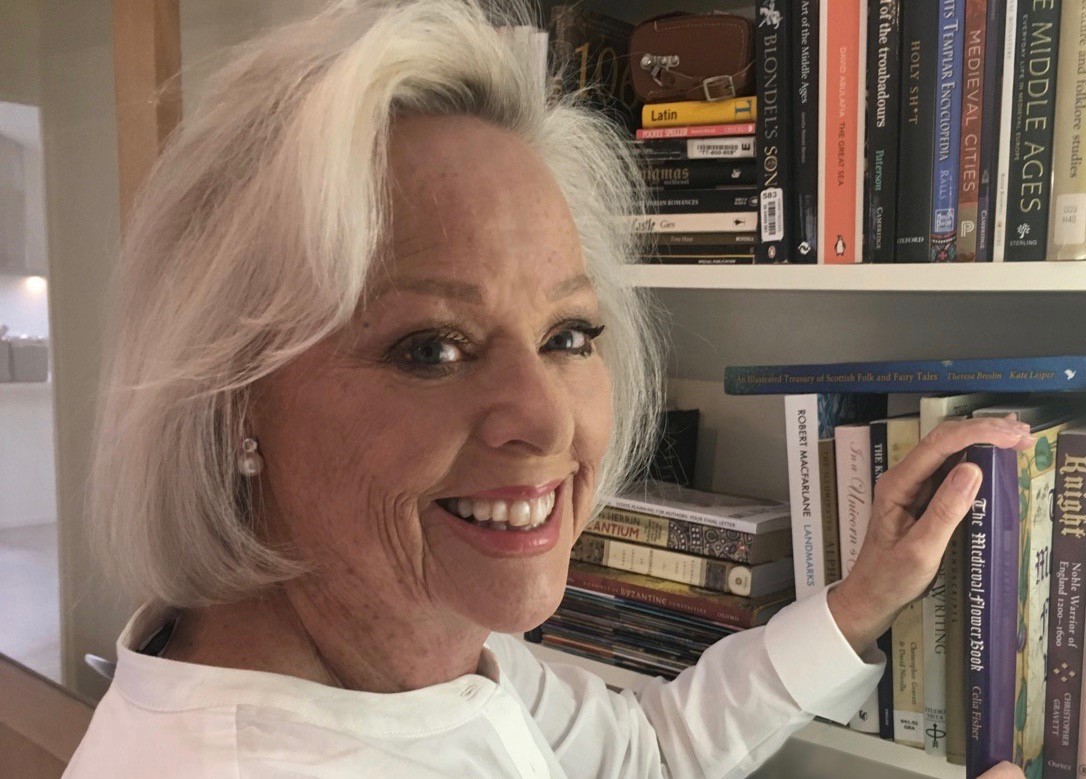
It is with great pleasure that I welcome Prue Batten to the blog today, on the very day of the release of her latest novel, Michael. Hi Prue, thanks so much for agreeing to an interview on History… the Interesting Bits. Welcome.
Thanks so much Sharon for inviting me.
What made you become a writer?
I don’t think I have ever really consciously thought about ‘being’ a writer. Writing has been an art-form I have loved from Grade Three, rather like painting or sketching. I used to write little prose pieces to describe scenes or events, be they imaginary or real. Even from such a young age, the use of words would make me contented and it was something at which I excelled at school. As I grew older, nothing changed. I learned other art-forms of course, but writing stayed with me. The chance to place novels before readers was mere serendipity but that’s a whole other story…
Where do you find the inspiration for your stories?
In the case of my fantasies, inanimate things like embroideries, paperweights, a Japanese cloth made of paper and silk called shifu. And most lately, as I begin another fantasy – maps and cabinets of curiosity.
Tell us a little about the book you have written so far.
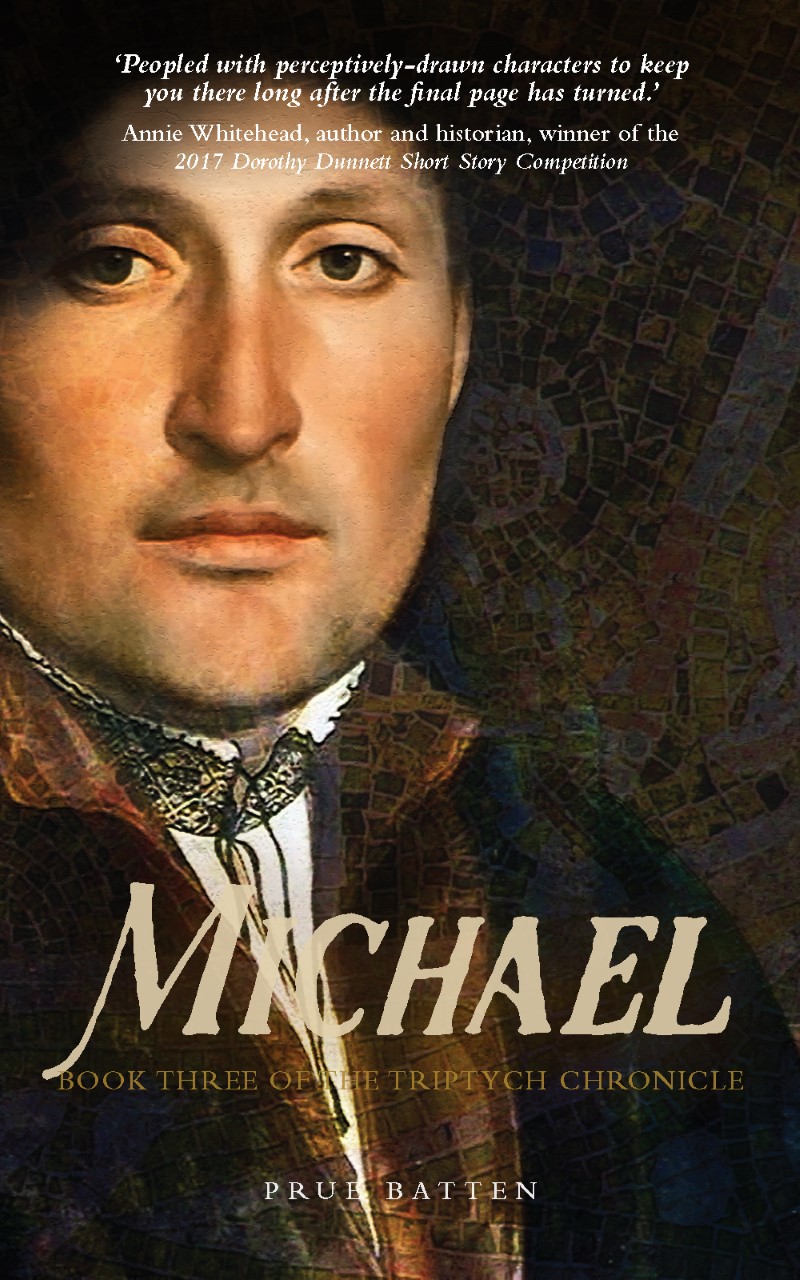
The book I have just finished writing and which will be released this July, is the final in an historical fiction trilogy entitled The Triptych Chronicle. The book is called Michael. The trilogy is about the insidious rivalries of trade in the twelfth century and essentially, each novel is a standalone, but they fit together like fingers in gloves to make a series. Tobias, Book One, is about the theft of the infamous Tyrian purple dye from the Byzantine empire and is set in Constantinople. The second, Guillaume, involves the same trading house, but a different location, Lyon, and is about the discovery of the Waldensian Bible. Michael is set back in Constantinople where byssus, an enigmatic silk woven from mollusc tendrils, arouses jealousies. The underlying thread in the three books is revenge and each of the three men are good friends and employees of the trading house, Gisborne-ben Simon…
Please, tell me about your new book, Michael.
The blurb reads thus but like all blurbs, seems to change on a daily basis as one tries to tweak it!
Michael Sarapion, merchant and thief, returns to Byzantine Constantinople from which he fled the year before in fear of his life. In his company is Tobias, the dwarf brother of an icon thief and Ahmed, an Arab galleymaster with secrets.
Michael is filled with grief and fury, intending vengeance for a treasure lost to him twelve years before. He must trust in priests, defy the empire and guard those dearest to him as he searches, because he understands that to restore what is rightfully his, he must kill… or be killed.
In this final standalone to The Triptych Chronicle trilogy, Michael, Tobias and the stalwarts of the House of Gisborne-ben Simon will slice a swathe through the Byzantine city, with those who challenge them hard on their heels.
How do you organise you writing day – do you write every day?
I try with minimal success. Some days, I’m lucky if I write 150 words. Some days I’ve written up to 2000. But if I have a ‘writing day’, I begin with business. I clear my emails and social media and then I sit and read the previous chapter to the point where I must continue. I write with a pen and A4 paper, so the pages are filled with cross-hatching and bold black lines. When I have about 10-12 pages written, and having edited it (many times), I will then transcribe to the computer which is another edit in itself.
What is your favourite thing about being a writer?
Seclusion, placing myself elsewhere, concentration of the mind, being mindful. Also, I am one of the few writers that seems to love working with the editor. It’s akin to working with a swimming coach. Writing is so solitary and once the editor steps in, there’s a chance to lay out ideas and styles. I always visualise my editor striding up and down the pool beside me, shouting out instructions as I swim laps. I have a good relationship with my editor!
What is your least favourite thing about being a writer?
Finishing the first draft! And once the book is as polished as it can be, and is published, watching my dashboards to see if anybody buys it.
How do you see social media (such as Facebook and Twitter), is it a blessing, a hindrance, or a necessary evil?
A blessing. I love social media for two reasons. One is that solitude issue. Social media enables one to break out of the bubble and communicate with kindred spirits everywhere – be they writers or readers. The other is that living as far south of the globe as one can go without falling off the end of the world, I get to meet and make friends with people I might never meet otherwise. I think to take those friendships through the years, even if I cease being a writer, is the most wonderful gift.
What is your favourite period in history, and why?
It’s the late Medieval period. In my case, the late twelfth century. To me, it’s as close as one can get to the Renaissance without being surrounded by the flamboyance of that timeframe. There was so much beautiful religious art in the period, the strengthening of trade with the east, religious excitement (as with the Waldensians – almost a Reformation!) and exploration. As spices and other exotic goods moved into Europe from the east, food styles changed, clothing styles changed. And I still haven’t mentioned politics…
What story would you really like to tell, but haven’t written yet?
A fictional version of my ancestor’s story. I am descended from a convict who was tried and sentenced to transportation to Van Diemen’s Land from England in the 1800’s. His sentence for stealing two sheep was fourteen years, essentially a death sentence, and yet he took his carpentry skills with him and managed to survive to become a free man. And here I am…
Who is your favourite historical character and why?
Prue Batten
Nicholas de Fleury from the House of Niccolo series by Dorothy Dunnett. He is a brilliantly Macchiavellian character who Dorothy set in the Renaissance, and it was his merchant intrigue that set me researching what trade may have been like three hundred years earlier. Effectively my medieval merchants laid the groundwork for Renaissance merchants like Niccolo. How I would love to converse with DD about that…
Who are your favourite authors who inspire you?
So many, through the years, beginning with Rosemary Sutcliffe as a teenager.
Others are Dorothy Dunnett, Mary Stewart, Simon Turney, Matthew Harffy, Michael Jecks, and Christian Cameron, Kathryn Gauci and Elisabeth Storrs in the hist.fict genre. In fantasy? Tolkein, Juliet Marillier and Cecilia Dart Thornton. In contemporary fiction? Jan Ruth, GS Johnston, Jilly Cooper. And they are all just a few of many exceptional names.
What is your favourite all-time book , the one that you cannot do without?
May I have two?
Niccolo Rising. Who cannot fail to be drawn in by three drunk men sailing downriver in the Duke of Burgundy’s bath tub!
Anne of Green Gables by LM. Montgomery because there’s always ‘scope for the imagination’.
What is the one piece of advice that you would give an aspiring writer?
Write because you love words. Read more words. And take your time. It’s worth the wait…
Thanks you so much, Sharon, for taking an interest in my work and my life. My books may be purchased by following this link: http://author.to/pruebatten
Thank you Prue, for taking the time to respond with such in-depth, thoughtful answers. I can’t wait to read Michael!
About Prue Batten:
Prue Batten has been an indie writer since 2008 when her first novel, a fantasy entitled The Stumpwork Robe, was published in a POD exercise funded by the UK Arts Council.
Since then, she has indie published three further books of the fantasy quartet which won awards, six historical fiction novels, some of which have also won awards, and an illustrated childrens’ book, through her own imprint, Darlington Press. She has also worked with writers of excellence to publish anthologies to raise money for cancer research and has a long-term collaboration with an American miniature press for whom she writes short stories.
Heroines of the Medieval World tells the stories of women, famous, infamous and unknown, who shaped the course of medieval history. It is available in hardback in the UK from both Amberley Publishing and Amazon UK. It is now available in Hardback from Amazon US and worldwide from Book Depository.
From Emma of Normandy, wife of both King Cnut and Aethelred II to Saint Margaret, a descendant of Alfred the Great himself, Silk and the Sword: the Women of the Norman Conquest traces the fortunes of the women who had a significant role to play in the momentous events of 1066. Silk and the Sword: the Women of the Norman Conquest will be released in the UK on 15 November 2018 and is available for pre-order on Amazon UK, Amberley Publishing and Book Depository.
You can be the first to read new articles by clicking the ‘Follow’ button, liking our Facebook page or joining me on Twitter.
The first wife of Ӕthelred II, Ӕlfgifu of York is a shadowy figure in history, with very little known about her. She was probably born sometime in the 960s. Ӕthelred and Ӕlfgifu were married around 985, when he was in his late teens or early twenties; Ӕlfgifu may have been a little younger.
The monk Ailred of Rievaulx, writing in the 1150s, identified her as the daughter of, Thored. Ailred had served in the household of David I, King of Scotland, a great-great-grandson of Ӕthelred II and Ӕlfgifu through his mother, Queen Margaret and so Ailred was well place to learn the ancestry of King David with some accuracy. Thored was Earl of Northumbria between, about, 975 and 992 and regularly attested charters by King Ӕthelred II during the 980s.
Marriage to the daughter of the leading noble of Northumbria would have been a beneficial move for King Ӕthelred. It would have helped to expand and strengthen his influence over the north of England, an area notoriously independent of the royal administration of the south, and bring him powerful friends and allies.
Ӕthelred was the youngest son of King Edgar the Peaceable and his last wife, Ælfthryth. The grandson of Edward the Elder, and great-grandson of Alfred the Great, Edgar was king from 959 until his death in 975. His wife, Ælfthryth, was probably born around 945; she was the daughter of Ealdorman Ordgar of Devon, her mother an unknown woman who is said to have been descended from the royal family. She was first married around the age of eleven to Æthelwold, the son of Æthelstan Half-King, ealdorman of East Anglia. However, Æthelwold died in 962, probably in a hunting accident, although there were rumours of murder on the orders of his wife’s supposed lover, King Edgar. Edgar’s marital history was already chequered. Ælfthryth could be Edgar’s second or third wife; she was certainly the third relationship by which children were born.
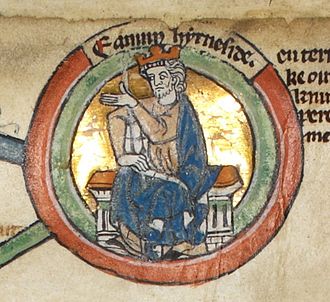
Ælfgifu’s son Edmund II Ironside
Ælfthryth and Edgar were married in 964 and were soon the parents of two sons; Edmund and Æthelred. Despite having an older half-brother, Edward, it is Edmund who was treated as Edgar’s acknowledged heir; his name being above that of Edward’s in a charter of 966, witnessed by both boys, which founded the New Minster at Winchester. Poor Ælfthryth must have been distraught when, in 971 and still only a child of about seven, young Edmund died.
When King Edgar died suddenly in 975 it was Edward, at the age of 13, who was proclaimed king, despite Ælfthryth trying to claim the crown for her surviving son, Æthelred, who was aged between 7 and 10 years of age. Edward reigned for just 3 years before he met a violent and untimely death at Corfe Castle in Dorset.
It was on 18th March 978 that 16-year-old King Edward visited his step-mother and half-brother at Ælfthryth’s estate at Corfe. Whether Edward had been out hunting, or was in the area to specifically visit Ælfthryth and Æthelred seems to be uncertain. However, he did send a message that he would be calling on them and Ælfthryth’s retainers were awaiting the young king at the gate, when he arrived with a small retinue. Still sitting in the saddle, he was handed a drink; and stabbed. It must have been a horrific sight, as the king’s horse panicked and bolted, racing off with Edward’s foot stuck in the stirrup and the dying king being dragged along behind. The Anglo-Saxon Chronicle recorded:
No worse deed than this was ever done by the English nation since they first sought the land of Britain. Men murdered him, but God hath magnified him. He was in life an earthly king. He is now after death a heavenly saint. ¹
With Edward’s death his surviving brother, Æthelred, possibly as young as 10 years old, and certainly no older than 13, was now king of England, with his mother and a council of prominent nobleman to guide him. He would rule over a tumultuous period in English history, when Saxon England was under frequent attacks from the Danes. His tendency to inaction, indecision, his ineffectual handling of the Danish incursions and the fact he lost the throne to Sweyn Forkbeard, have earned him a reputation as one of England’s worst rulers.
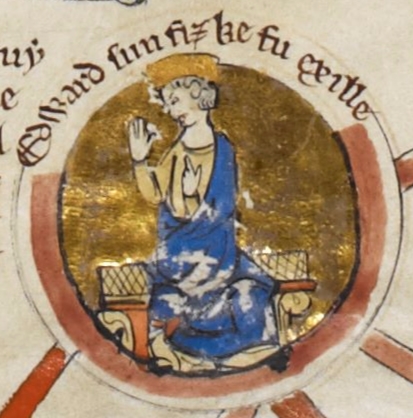
Edward the Exile, grandson of Ælfgifu and father of St Margaret, Queen of Scotland
As his mother and adviser – and a force to be reckoned with – it may well have been Ælfthryth who chose Ӕlfgifu of York as a bride for Æthelred. It is also possible, even likely, that Ælfgifu was never crowned because her mother-in-law, the crowned and anointed queen, was still alive. Indeed, Ælfgifu’s successor as Æthelred’s wife, Emma of Normandy, was given a coronation, but Ælfthryth was dead by then.
In the 15-or-so years of marriage to Ӕlfgifu of York, the couple had a large number of children, including at least 6 boys and 4 girls. It is even likely that Ӕlfgifu’s mother-in-law, Ælfthryth, raised a number of her children, including the royal couple’s first-born son and ætheling, Æthelstan. Ӕthelstan, was born c.986 but would die before his father, in June 1014, either killed in battle or from wounds received during the wars against Sweyn Forkbeard and his son Cnut. Ӕthelred and Ӕlfgifu’s other sons included Ecgberht, Edmund, Eadred, Eadwig and Edgar and all died young.
In April 1016 Edmund succeeded his father as King Edmund II Ironside but died in November of the same year, probably from wounds received in battle after a summer of constant fighting. His sons, Edward and Edmund, escaped Cnut by being sent into exile in eastern Europe. King Edmund’s sole-surviving brother Eadwig was murdered in 1017, on the orders of the victorious King Cnut.
Of Ӕthelred and Ӕlfgifu’s daughters, three were married to prominent Saxon noblemen. Edith was married to the traitorous Ealdorman, Eadric Streona, who kept changing sides during the wars against the Danes and eventually met his death on the orders of the triumphant King Cnut. Ӕlfgifu married Uhtred, Earl of Northumbria, an ally of Edmund Ironside who had to submit to Cnut when his earldom was under threat of being overrun by the Danes. He and forty of his supporters were murdered on Cnut’s orders in 1016. A third daughter, Wulfhild, married Ulfcytel, Ealdorman of East Anglia, who was killed in the fighting of 1016. A possible fourth daughter, whose name is unknown, became the abbess at Wherwell, a prominent convent at the time, and died in the 1050s.
Other than the children she bore, however, Ӕlfgifu of York has left very little imprint on history. She gets barely a mention in the chronicles of the time. Sulcard of Westminster, writing in the second half of the eleventh century, says that she was “of very noble English stock”, but fails to give her name, while William of Malmesbury ignores her altogether. John of Worcester makes mention of Ӕlfgifu, giving her name and listing her sons but states, probably erroneously, that she was the daughter of Ӕthelberht. Ailred of Rievaulx provides us with the details of Ӕlfgifu’s parentage but, again, fails to name her. The poor woman doesn’t even make it into the Anglo-Saxon Chronicle.
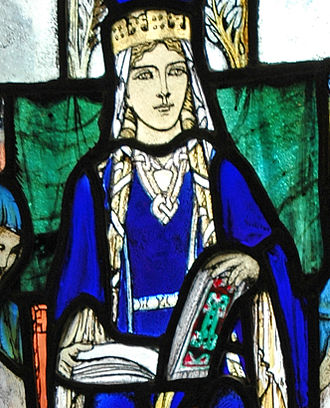
St Margaret, Queen of Scotland
There is no evidence that Ӕlfgifu was a crowned and anointed as queen, unlike her successor, Emma of Normandy. We know nothing of her, not her personality or her actions during her time as Ӕthelred’s wife. We don’t even know the date of her death, though it must have been before April 1002, when Ӕthelred married Emma of Normandy.
Ӕlfgifu of York’s story has been greatly overshadowed by her larger-than-life successor, Emma of Normandy, the twice-crowned Queen of England as the wife of both Ӕthelred II (the Unready) and King Cnut (the Great). However, although she may have had little impact on history during her lifetime, it is the blood of Ӕlfgifu of York that still runs in the veins of the British royal family today, through the descendants of her son, Edmund II Ironside and his granddaughter, St Margaret, Queen of Scotland. Margaret’s daughter, Edith, was married to King Henry I of England. Her name was changed to Matilda on her marriage and it is through this Matilda and her daughter and namesake, Matilda, the Lady of the English, that all English kings and queens are descended.
*
Footnotes: ¹ Anglo-Saxon Chronicle edited by Michael Swanton.
*
Pictures courtesy of Wikipedia
Sources: Brewer’s British Royalty by David Williamson; Britain’s Royal Families, the Complete Genealogy by Alison Weir;The Wordsworth Dictionary of British History by JP Kenyon; The Anglo-Saxons in 100 Facts by Martin Wall; Kings, Queens, Bones and Bastards by David Hilliam; The Mammoth Book of British kings & Queens by Mike Ashley; The Oxford Companion to British History Edited by John Cannon; The Anglo-Saxon Chronicles translated and edited by Michael Swaton; The Anglo-Saxon Chronicle translated by James Ingram; Queen Emma and the Vikings by Harriett O’Brien; The Bayeux Tapestry by Carola Hicks; oxforddnb.com.
*
My books
Signed, dedicated copies of all my books are available through my online store.
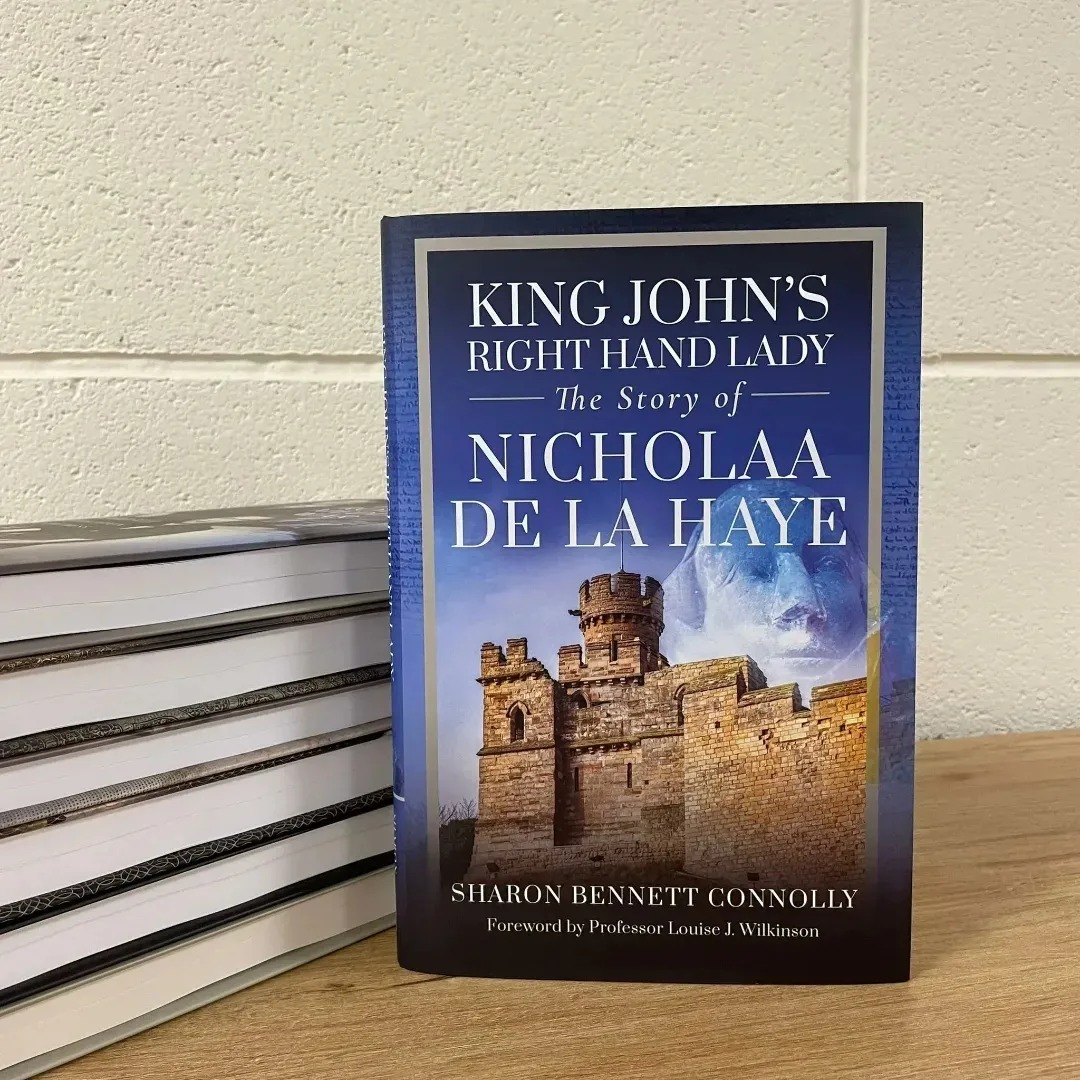
Out now: King John’s Right-Hand Lady: The Story of Nicholaa de la Haye
In a time when men fought and women stayed home, Nicholaa de la Haye held Lincoln Castle against all-comers, gaining prominence in the First Baron’s War, the civil war that followed the sealing of Magna Carta in 1215. A truly remarkable lady, Nicholaa was the first woman to be appointed sheriff in her own right. Her strength and tenacity saved England at one of the lowest points in its history. Nicholaa de la Haye is one woman in English history whose story needs to be told…
On the one side is Empress Matilda, or Maud. The sole surviving legitimate child of Henry I, she is fighting for her birthright and that of her children. On the other side is her cousin, Queen Matilda, supporting her husband, King Stephen, and fighting to see her own son inherit the English crown. Both women are granddaughters of St Margaret, Queen of Scotland and descendants of Alfred the Great of Wessex. Women of the Anarchy demonstrates how these women, unable to wield a sword, were prime movers in this time of conflict and lawlessness. It show how their strengths, weaknesses, and personal ambitions swung the fortunes of war one way – and then the other.
Alternate Endings: An anthology of historical fiction short stories including Long Live the King… which is my take what might have happened had King John not died in October 1216. Available in paperback and kindle from Amazon.
New Podcast:
Have a listen to theA Slice of Medieval podcast, which I co-host with Historical fiction novelist Derek Birks. Derek and I welcome guests, such as Bernard Cornwell, and discuss a wide range of topics in medieval history, from significant events to the personalities involved.
*
Signed and dedicated copies of all my books are available through my online store.
For forthcoming online and in-person talks, please check out my Events Page.
You can be the first to read new articles by clicking the ‘Follow’ button, liking our Facebook page or joining me on Twitterand Instagram.
Mary Tudor’s childhood was overshadowed by the men in her life: her father, Henry VII, and her brothers Arthur, heir to the Tudor throne, and Henry VIII. These men and the beliefs held about women at the time helped to shape Mary’s life. She was trained to be a dutiful wife and at the age of eighteen Mary married the French king, Louis XII, thirty-four years her senior.
When her husband died three months after the marriage, Mary took charge of her life and shaped her own destiny. As a young widow, Mary blossomed. This was the opportunity to show the world the strong, self-willed, determined woman she always had been. She remarried for love and at great personal risk to herself. She loved and respected Katherine of Aragon and despised Anne Boleyn – again, a dangerous position to take.
Author Sarah Bryson has returned to primary sources, state papers and letters, to unearth the truth about this intelligent and passionate woman. This is the story of Mary Tudor, told through her own words for the first time.
Mary Tudor, Queen of France, is probably my favourite Tudor. She is a woman who understood duty, but also managed to forge her own way in life, while keeping her mercurial brother (Henry VIII) appeased. I have loved reading anything I could find on her since watching the film The Sword and the Rose as a teenager.
Mary Tudor followed her duty and married the husband her brother chose for her – Louis XII of France. However, before leaving England’s shores for her new life as Queen of France, she managed to extract a promise from her brother which would mean she could eventually choose the direction of her life. Henry promised that if she married the husband he had chosen for her, then she would be allowed to choose her next husband. And Mary knew that she would have a second husband; Louis XII was 53 and Mary was 18. Their marriage lasted less than 3 months.
Not wanting to trust to her brother’s ability to keep to his promise once she was back under his roof, Mary then married the man of her choice before she had even left France. He was Charles Brandon, one of her brother’s closest friends. The marriage could have caused great scandal, Brandon was far lower in rank than his royal bride. It did cause the couple financial hardship, that lasted the duration of their marriage; Henry exacted a heavy price, in fines, for his sister to follow her heart.
Sarah Bryson tells the story of Mary Tudor with great empathy and a deep understanding of the woman, her personal and private life, her highs and lows. Using Mary’s own letters as the backbone of the book, the author brings the French Queen to vivid life. It is impossible not to read this book and come to a new admiration for this remarkable lively English princess.
Mary Tudor, Queen of France, and Charles Brandon, Duke of Suffolk
Mary would not have been able to challenge men verbally, or publicly speak her mind. To do so would have been to step out of the mould that had been so carefully created for her by the men in her life and the culture of her time. Many men held the belief that to publicly challenge a man meant that a woman was not in fact a true woman, or that the woman was somehow mentally unbalanced. There were even physical and humiliating punishments for women who dared to challenge or speak ill of their husbands. Therefore Mary influenced the men in her life by using what skills and means she had at hand – in her case it was letter writing.
Mary Tudor’s letters are a fascinating and captivating look at how a woman could wield power without publicly challenging the patriarchy. They show how Mary was able to manoeuvre those around her to follow her heart – marrying her second husband for love, rather than being dragged back to the international chess game as a marriage pawn. They are also, on occasion, a way of looking into Mary’s life whereby the layers of princess and queen are stripped back and only the woman remains.
La Reine Blanche by Sarah Bryson provides an intimate assessment of the life of Mary Tudor. The author’s love of her subject shines through on every page. Her extensive knowledge of Mary, Charles Brandon and Henry VIII serves to make this book both entertaining and informative and makes it eminently readable. The reader is engaged from the first page and transported to the life and times of the subject and her family.
La Reine Blanche is well written and engaging. With impeccable research it follows Mary’s story from cradle to grave, giving a deep insight into the woman and the times in which she lived. It analyses the constraints which were placed on a woman – and especially a queen – at that time. It also provides an interesting assessment of Henry VIII, both as a brother and a king. There is a wonderful balance between Mary’s public and private life as the author delves into Mary’s experiences, motivations and clever manipulations of those around her. Sarah Bryson brings Mary to life through her letters, clearly demonstrating how the Tudor princess was aware of her station and the limitations placed on women; but used her own wiles and the art of flattery and persuasion to take as much control of her life as was humanly possible.
In reading Sarah Bryson’s wonderful biography, it is impossible not to fall a little bit in love with this amazing Tudor princess and French Queen.
La Reine Blanche by Sarah Bryson is now available from Amberley Books and Amazon .
About the author: Sarah Bryson is a researcher, writer and educator. Se runs a website dedicated to Tudor history and has written on other websites including ‘On the Tudor Trail’ and ‘Queen Anne Boleyn’. She has been studying primary sources to tell the story of Mary Tudor for a decade and is the author on Mary Boleyn and Charles Brandon.
*
Picture courtesy of Wikipedia
*
My books
Heroines of the Medieval World tells the stories of women, famous, infamous and unknown, who shaped the course of medieval history. It is available in hardback in the UK from both Amberley Publishing and Amazon UK. It is now available in Hardback from Amazon US and worldwide from Book Depository.
From Emma of Normandy, wife of both King Cnut and Aethelred II to Saint Margaret, a descendant of Alfred the Great himself, Silk and the Sword: the Women of the Norman Conquest traces the fortunes of the women who had a significant role to play in the momentous events of 1066. Silk and the Sword: the Women of the Norman Conquest will be released in the UK on 15 November 2018 and is available for pre-order on Amazon UK, Amberley Publishing and Book Depository.
You can be the first to read new articles by clicking the ‘Follow’ button, liking our Facebook page or joining me on Twitter.
Æthelflæd (from The Cartulary and Customs of Abingdon Abbey, c. 1220)
12th June 2018 marked the 1100th anniversary of one of England’s greatest ever women. The daughter of Alfred the Great, Æthelflæd, Lady of the Mercians, led the resistance against Danish invasion, alongside her brother, Edward the Elder. And yet, she is virtually unknown to the people of today.
Æthelflæd was born about 870, the eldest child of King Alfred and his wife, Ealhswith. Alfred’s biographer, Asser, says Ealhswith was a member of the Mercian royal house through her mother, Eadburh. Around 886 Æthelflæd was married to Æthelred, ealdorman of Mercia and a trusted lieutenant of her father. Æthelred ruled over the English half of the Mercian kingdom, which had been dissected by the Vikings, but submitted to King Alfred’s overlordship. The marriage was a political alliance, intended to strengthen Saxon resistance to the Danes, who were now occupying Northumbria, Yorkshire and East Anglia. The resulting close relationship of Mercia and Wessex was only further strengthened by the renewed Viking attacks of the 890s.
During the early years of their marriage the young couple appear to have settled in London, the city that had been entrusted to Æthelred’s care by Alfred. Æthelflæd seems to have taken after her father – she was a strong, brave woman and is often regarded more as a partner to Æthelred than a meek, obedient wife. The couple jointly presided over provincial courts. The ‘Mercian Register’, a fragment of a Mercian chronicle, included in some versions of the Anglo-Saxon Chronicle, records that Æthelflæd was exercising regal powers in the region even before her husband’s death. In his final years Æthelred increasingly suffered from illness, during which time Æthelflæd assumed greater authority. The couple had only one child, a daughter, Ælfwynn. Writing 2 centuries later William of Malmesbury claimed the lack of more children was due to Æthelflæd’s avoidance of marital relations, possibly due to a fear of dying in childbirth. Malmesbury quotes her as saying it was ‘unbecoming a daughter of a king to give way to a delight, which after a time produced such painful consequences’. Æthelred died in 911, though whether this was from wounds received in battle or from illness remains unclear. He was buried at Gloucester.
Charter S 221 dated 901 of Æthelred and Ætheflæd donating land and a golden chalice to Much Wenlock Church
Wessex had already adjusted to a change in ruler when Æthelflæd’s father had died in 899 and had been succeeded by her younger brother, Edward ‘the Elder’. When Æthelred died, Edward was happy to support his sister as sole ruler of Mercia, but he took personal control of the cities of London and Oxford, cities that could be used as bases from which Edward would be able to launch campaigns against the Danes of the Midlands. The siblings seem to have had a trusting relationship for many years; Edward had entrusted his son Æthelstan, often viewed as the first king of England, to Æthelflæd and her husband, to be educated at the Mercian court.
The first woman to rule an Anglo-Saxon kingdom – albeit as a client of her brother’s more powerful kingdom of Wessex, Æthelflæd was accorded the title the Lady of the Mercians. She proved to be a vital ally to her brother and the siblings worked together to combat the threats of the Danes. In 909, according to the Anglo-Saxon Chronicle, Edward sent an army, made up of West Saxons and Mercians, into Danish territory in the north. It was probably this army that brought back to Mercia the relics of St Oswald, the 7th century Northumbrian saint. They had been taken from Bardney in Lincolnshire and Æthelflæd had them translated to the new minster at Gloucester, which was renamed St Oswald in his honour.
Æthelflæd continued the policy, started by her father, of building burhs and established a ring of fortified centres around western Mercia. The burhs not only provided protection against the Danes, but served as bases from which to launch attacks on Danish occupied regions. Each burh could provide a refuge for all villagers within a 20-mile radius; it would have a large garrison, depot and its own water supply. During Æthelred’s lifetime, burhs had been established at ‘Bremesburh’, Worcester (between 887 and 899) and Chester (907). Later, on Æthelflæd’s orders, in 913, fortresses were built at several further sites, including Bridgnorth, Tamworth and Stafford, in response to Viking raids into Edward’s territories.
Edward built two further burhs at Buckingham in 914, plugging a defensive gap between Tamworth and Hertford. At the same time, Æthelflæd built one at Warwick and another at Eddisbury; this latter, with a new burh at Runcorn in 915, helped to strengthen her northern defences. While the Danes appeared to be the greatest risk, Æthelflæd did not neglect her defences along the Welsh border, building a burh at Chirbury and one at the now-lost location of ‘Wearburh’. In the same year, Edward fortified Bedford and in 916 he built a burh at Maldon to fortify Essex against seaborne raiding. While this building programme was going on, it also seems highly likely that Æthelflæd rebuilt and strengthened the defences of Gloucester and Hereford.
Statue of Æthelflæd and her nephew, Athelstan, Tamworth
Æthelflæd was no silent partner in Edward’s reconquest of England. Most remarkably, she personally led successful military campaigns against the Welsh, the Norse and the Danes of York. The Anglo-Saxon Chronicle relates that on the feast of St Cyriac the Martyr, 16 June 916, the abbot Egbert and his retainers, were murdered for no known reason. The Mercian abbot had been travelling in the Welsh mountain kingdom of Brycheiniog when he was attacked. Æthelflæd seems to have taken the murder as a personal affront; the abbot was, after all, under her protection. Three days later she invaded Wales; her army ravaged Brycheiniog, burning the little kingdom. Although King Tewdr escaped, Æthelflæd took his wife, Queen Angharad, as a hostage, with 33 others, many of whom were relatives of the Welsh king. Eventually, the king submitted to Æthelflæd, promising to serve her faithfully and to pay compensation. The incident not only demonstrates Æthelflæd’s commitment to her people, but also shows her strength and determination, attributes she was to put to good use against the Danes.
In 917 Æthelflæd turned her attention to those Danes. Danish forces had taken the offensive, raiding English territories. By the end of the year Edward had subdued East Anglia, with all the Scandinavian armies of the region submitting to him. While her brother was raiding in the East Midlands, Æthelflæd led her forces across the West Midlands. She marched on the Viking stronghold of Derby, personally leading the army on campaign. It would be the first of the Danes’ ‘Five Boroughs’, which made up the Danelaw, to fall. Although she managed to successfully storm the fort, her army suffered heavy casualties, including four of her most trusted and senior thegns (thegns were the army’s commanders and officers). The Anglo-Saxon Chronicle reported; ‘With God’s help Ethelfleda, lady of Mercia, captured the fortress known as Derby with all its assets. Four of her favoured ministers were slain inside the gates’.¹
The Saxon victory was a great shock to the Danes. Their Viking myths told of an invincible woman who would appear at Ragnarok, the Norse apocalypse, and make brave warriors cower before her. Æthelflæd was relentless – in early 918 she and her army moved on to Leicester, while Edward headed for Stamford. Leicester was the centre of a heavily settled Danish colony, and Æthelflæd ravaged the countryside around the settlement. The Danes had no choice but to surrender in the face of her indefatigable forces. However, she was magnanimous in victory, displaying mercy and charity by distributing alms as she progressed into town.
Æthelflæd in the thirteenth century Genealogical Chronicle of the English Kings
The inexorable advance of Æthelflæd’s army combined with her compassion for the defeated was to prove to be a clever strategy, demonstrating to those regions still controlled by the Danes that she was prepared to offer compromise if they would only submit to her. The Danes of York, the Viking capital, in particular, began to look at submitting to Æthelflæd as a serious option to avoid continued conflict. Their new king was Ragnall, a Viking pirate from Dublin, who had taken the throne by force; but the Danes knew that Edward and Æthelflæd would never make peace with him. In the summer of 918 the noblemen and magnates of York sent emissaries to Æthelflæd, promising that they would surrender to her.
In May, King Edward had marched his army to Stamford, building a new fort south of the river and accepting the surrender of the local Danes, who submitted to him as their new ruler. It was while he was still at Stamford that Edward received word of his sister, The Anglo-Saxon Chronicle made a cold, clinical report:
918 While he was there his sister Æthelflæd died at Tamworth two weeks before midsummer. The king took possession of Tamworth and the whole province of Mercia which she had governed.²
Æthelflæd died suddenly at Tamworth on 12 June 918. She was buried beside her husband, in the east chapel of the cathedral she had founded, St Oswald’s Minister, Gloucester. Although she did not live long enough to see the successful conclusion to the work she and her brother had carried out, her achievements cannot be lightly brushed off. Between 910 and 920 all Danish territories south of Yorkshire had been conquered. Her nephew Athelstan consolidated the kingdom that had been created by the efforts of Edward and Æthelflæd. If Æthelflæd did not live to see the extent of her success, neither did she live to see her daughter, Ælfwynn, nearly thirty and still unmarried, briefly become the nominal ruler of Mercia; only to be ‘deprived of all authority’ six months later and taken to Wessex, from where nothing more is heard of her.
St Oswald’s Priory, Gloucester, where Æthelflæd and her husband are buried
The story of Æthelflæd mainly comes from the Mercian Register, embedded largely in the B, C and D texts of the Anglo-Saxon Chronicle. She appears only rarely in the primary text, text A, which focuses on Edward and Wessex. Text A tries to minimise Æthelflæd’s significance, but could not wholly obscure her achievements. She was, after all, the daughter of Alfred the Great, the wife of the ealdorman of Mercia and a prominent woman in her own right, in an era when this was an incredible rarity. It is thought that it was Æthelflæd, the Lady of the Mercians, who inspired the 10th century poem, ‘Judith’ who is ‘white and shining’, ‘noble and courageous’. In the poem, Æthelflæd is depicted as the ‘valorous virgin’ who struck off the head of the hostile foe with her gleaming sword and ‘ascribed the glory of all that to the Lord of Hosts’. Recognising her vital role in the creation of England, the 12th century Henry of Huntingdon declared Æthelflæd ‘to have been so powerful that in praise and exaltation of her wonderful gifts, some call her not only lady, but even king’. In a poem he described her as ‘worthy of a man’s name’ and ‘more illustrious than Caesar’, apparently high praise indeed – for a woman.
In the 21st century Æthelflæd’s story is becoming more widely known than it has ever been. She is one of the major influences of my book, Heroines of the Medieval World and appears, appropriately, in the chapter on Warrior Heroines. Joanna Arman’s non-fiction book The Warrior Queen: the Life and Legend of Æthelflæd, Daughter of Alfred the Greatis well worth a perusal. In addition, with her appearance in Bernard Cornwell’s wonderful The Last Kingdom books and television series, and Annie Whitehead’s non-fiction book, Mercia: the rise and Fall of a Kingdom, as well as her novel, To Be A Queen, Æthelflæd’s story is finally being brought into the light. On the 1100th anniversary of her death, her incredible achievements were being celebrated in the heart of Mercia, in Gloucester and Tamworth. And not before time; Æthelflæd should be the inspiration for future generations of strong, influential women and stand out as an example of what can be achieved if you are determined enough.
*
Footnotes: ¹ The Anglo-Saxon Chronicles by Michael Swanton; ² ibid.
Pictures courtesy of Wikipedia
Further Reading: The Anglo-Saxon Chronicles by Michael Swanton; The Anglo-Saxon Chronicle by James Ingram; Chronicles of the Kings of England, From the Earliest Period to the Reign of King Stephen, c. 1090–1143 by William of Malmesbury; The Chronicle of Henry of Huntingdon by Thomas Forester; Alfred the Great by David Sturdy; Brewer’s British Royalty by David Williamson; History Today Companion to British History Edited by Juliet Gardiner & Neil Wenborn; The mammoth Book of British kings & Queen by Mike Ashley; Britain’s Royal Families, the Complete Genealogy by Alison Weir; The Wordsworth Dictionary of British History by JP Kenyon; The Anglo-Saxons in 100 Facts by Martin Wall; Kings, Queens, Bones and Bastards by David Hilliam; The Oxford Companion to British History Edited by John Cannon; oxforddnb.com.
*
My Books
Signed, dedicated copies of all my books are available through my online bookshop.
Out now: Scotland’s Medieval Queens
Scotland’s history is dramatic, violent and bloody. Being England’s northern neighbour has never been easy. Scotland’s queens have had to deal with war, murder, imprisonment, political rivalries and open betrayal. They have loved and lost, raised kings and queens, ruled and died for Scotland. From St Margaret, who became one of the patron saints of Scotland, to Elizabeth de Burgh and the dramatic story of the Scottish Wars of Independence, to the love story and tragedy of Joan Beaufort, to Margaret of Denmark and the dawn of the Renaissance, Scotland’s Medieval Queens have seen it all. This is the story of Scotland through their eyes.
‘Scotland’s Medieval Queens gives a thorough grounding in the history of the women who ruled Scotland at the side of its kings, often in the shadows, but just as interesting in their lives beyond the spotlight. It’s not a subject that has been widely covered, and Sharon is a pioneer in bringing that information into accessible history.’ Elizabeth Chadwick (New York Times bestselling author)
Heroines of the Tudor World tells the stories of the most remarkable women from European history in the time of the Tudor dynasty, 1485-1603. These are the women who ruled, the women who founded dynasties, the women who fought for religious freedom, their families and love. Heroines of the Tudor World is now available from Amberley Publishing and Amazon UK.Women of the Anarchy demonstrates how Empress Matilda and Matilda of Boulogne, unable to wield a sword themselves, were prime movers in this time of conflict and lawlessness. It shows how their strengths, weaknesses, and personal ambitions swung the fortunes of war one way – and then the other. Available from Bookshop.org, Amberley Publishing and Amazon UK. King John’s Right-Hand Lady: The Story of Nicholaa de la Haye is the story of a truly remarkable lady, the hereditary constable of Lincoln Castle and the first woman in England to be appointed sheriff in her own right. Available from all good bookshops Pen & Sword Books, bookshop.org and Amazon.
Alternate Endings: An anthology of historical fiction short stories including Long Live the King… which is my take what might have happened had King John not died in October 1216. Available in paperback and kindle from Amazon.
Podcast:
Have a listen to theA Slice of Medieval podcast, which I co-host with Historical fiction novelist Derek Birks. Derek and I welcome guests, such as Bernard Cornwell and discuss a wide range of topics in medieval history, from significant events to the personalities involved.
We often hear the story that Kateryn – or Katherine – Parr was used to marriage to older men when she accepted the proposal of Henry VIII in 1543. Her second husband, Lord Latimer, was a widower with young children and twenty years older than his bride. And her first husband, it has often been said was a man much older in years. However, this story has arisen from a case of mistaken identity, between a grandfather and grandson of the same name, Edward Burgh.
Kateryn Parr’s first husband was Edward Burgh (pronounced Borough) of Gainsborough in Lincolnshire. And Kateryn’s early biographers appear to have assumed that this was Edward Burgh senior, Lord Burgh from 1496 to his death in 1528.
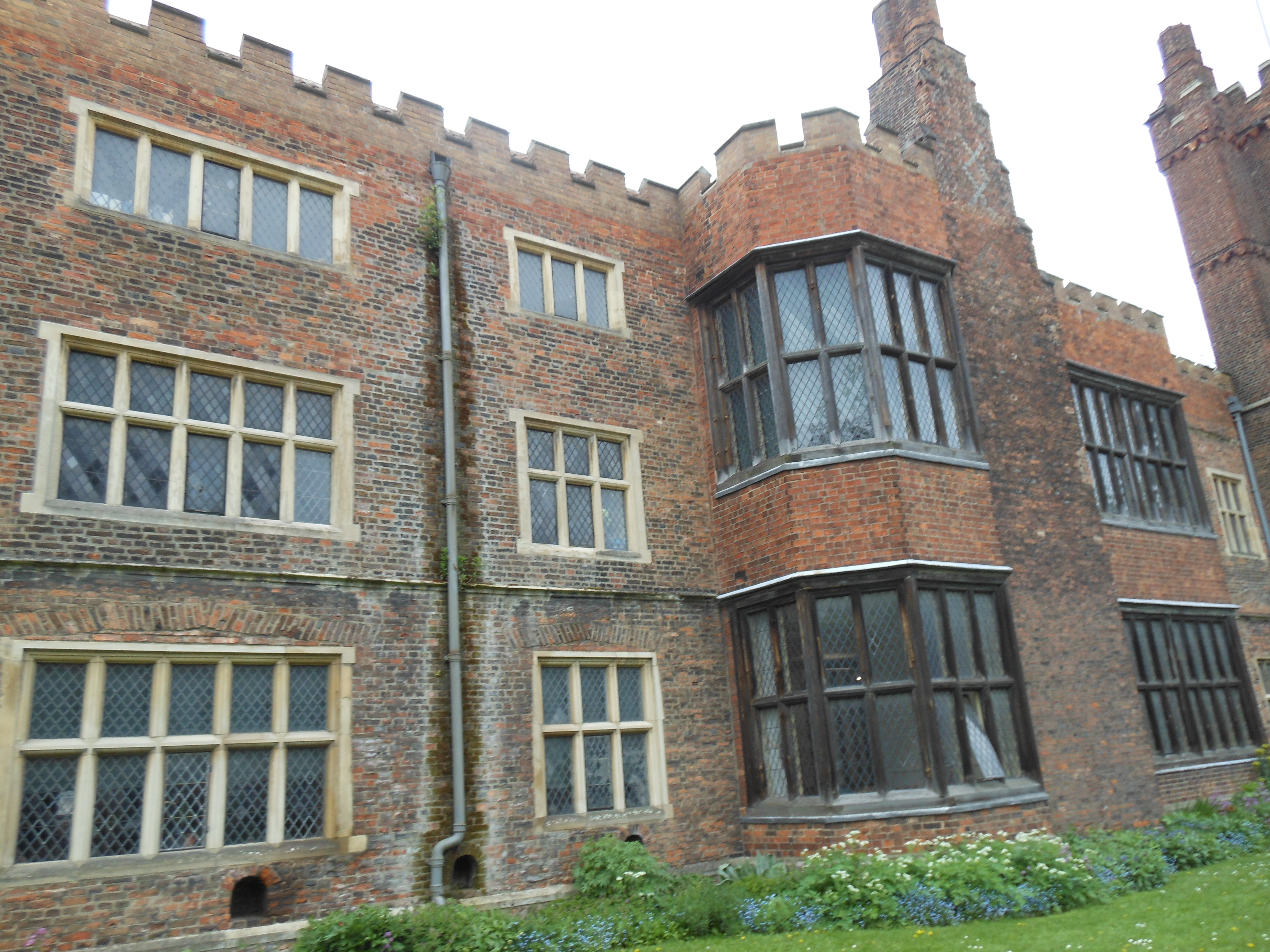
The Burgh family were descended from Hubert de Burgh, 1st Earl of Kent and Justiciar for King John and Henry III. Hubert had even been married, briefly, to King John’s first, discarded wife, Isabel of Gloucester. The first Thomas Burgh had fought at Agincourt and married Elizabeth Percy, a co-heiress of a junior branch of the mighty Percy family, the Earls of Northumberland. It was through Elizabeth Percy that the manor house at Gainsborough came into the Burgh family, inherited from her father; she then left the estate to her son Thomas (II) Burgh, Baron Gainsborough, on her death in 1455.
Thomas (II) Burgh was a trusted Yorkist, named sheriff of Lincoln in 1460 and, later, an Esquire of the Body for King Edward IV. By the end of 1462 he had been knighted and was a member of the Privy Council. By 1464 he had married a wealthy widow Margaret, dowager Lady Botreaux and daughter of Lord Thomas Ros. It was Sir Thomas Burgh who, along with Thomas Stanley, rescued Edward IV from his imprisonment in Middleham Castle by the Earl of Warwick.
The sacking of Burgh’s manor house at Gainsborough was the opening move of the rebellion of Richard, Lord Welles, in 1470, which eventually saw Edward IV escaping to Flanders and the brief readeption of Henry VI; Edward IV recovered his kingdom in 1471, with the Battle of Tewkesbury, and Henry VI’s mysterious death in the Tower of London just days later, putting an end to Lancastrian hopes. On Edward IV’s death, Sir Thomas had initially supported the succession of his brother, Richard III, but switched his allegiance to Henry Tudor shortly after King Richard visited the Sir Thomas’s Hall at Gainsborough. What had been said to make this staunch Yorkist transfer his support to a Lancastrian pretender, we can only guess….
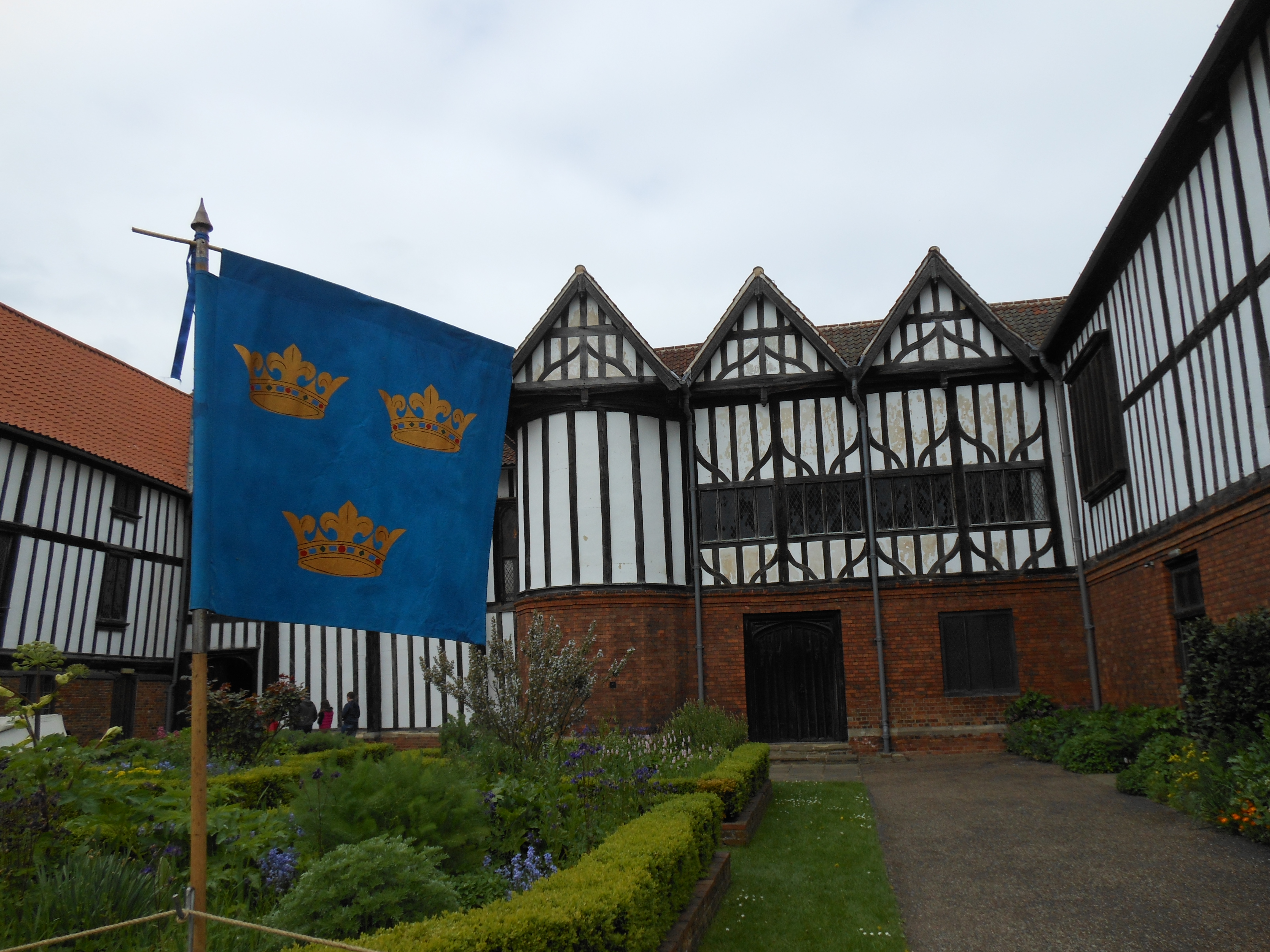
Gainsborough Old Hall
In 1496, Thomas was succeeded as Baron Gainsborough by his son, Edward Burgh, who married Anne Cobham, daughter of Sir Thomas, 5th Baron Cobham of Starborough, when he was 13 and she was just 9 years old. It was from this marriage that the Burgh’s would inherit Starborough Castle.
Although he won his knighthood on the battlefield at Stoke in 1487, and was a Member of Parliament for Lincoln in 1492, Edward appears to have been less politically capable than his father. He soon fell foul of King Henry VII, whether it was because of the fact he associated with those the king distrusted, or due to early signs of mental illness, in December 1496, Edward was forced into a legal bond where he was obliged to present himself to the king wherever and whenever it was demanded, and to vow to do his subjects no harm.¹ He was even remanded to the custody of the Lord Chamberlain and had to seek royal permission if he wanted to leave court for any reason. For a time, he was incarcerated in the Fleet Prison, but managed to escape, despite his promise and financial guarantee not to; an action which put him in thousands of pounds of debt to the king.
From his mother, Margaret de Ros, it seems Edward had inherited a mental illness, one which also affected his Ros cousins, Sir George Tailboys and Lord Ros of Hamlake. As a result, in 1509, ‘distracted of memorie’, he was declared a lunatic.² His wife died in 1526 and he died in 1528, never quite recovering his wits. He was succeeded as Baron Burgh of Gainsborough by his son, Thomas (III).
In 1496, aged just 8-years-old, Thomas (III) had married Agnes Tyrwhitt. The marriage had been arranged by his grandfather, Thomas (II) and gave the younger Thomas useful contacts within Yorkshire and Lincolnshire, contacts he would need to counteract the damaging effects of his father’s mental illness and royal disfavour. Thomas (III) pursued a dual career, combining service as a justice of the peace in Lindsey with his service at court. In 1513 he was knighted on the battlefield of Flodden, the same field on which James IV of Scotland met his death. He was Sheriff of Lincoln in 1518-19 and 1524-25. He was appointed Anne Boelyn’s Lord Chamberlain in May 1533, and held the middle of the queen’s train at her coronation. He was also one of the twenty-six peers who sat at Anne’s trial in 1536.
Thomas (III) and his wife had as many as 12 children. The eldest of which was Edward, who died in 1533. It was this Edward who was the 1st husband of Kateryn Parr, a marriage that had been arranged in 1529 by Sir Thomas and Kateryn’s widowed mother, Maud Parr; her husband, Thomas Parr of Kendal, had died in 1517. Maud had taken it upon herself to arrange her daughter’s future. After a failed proposal to marry Katherine to Henry Scrope, the son of Lord Scrope of Bolton, due to the prospective groom’s lack of enthusiasm, Maud turned to another of her late husband’s relatives and arranged for Katherine to marry Edward.
Young Edward was of a similar age to his wife, not the old man as was stated in Katherine’s early biographies, when he was mistaken for his grandfather. Kateryn was 17 at the time of the marriage, with Edward in his early twenties. It is impossible not to muse on how life could have been so different for Kateryn, had this first marriage proved longer-lasting.
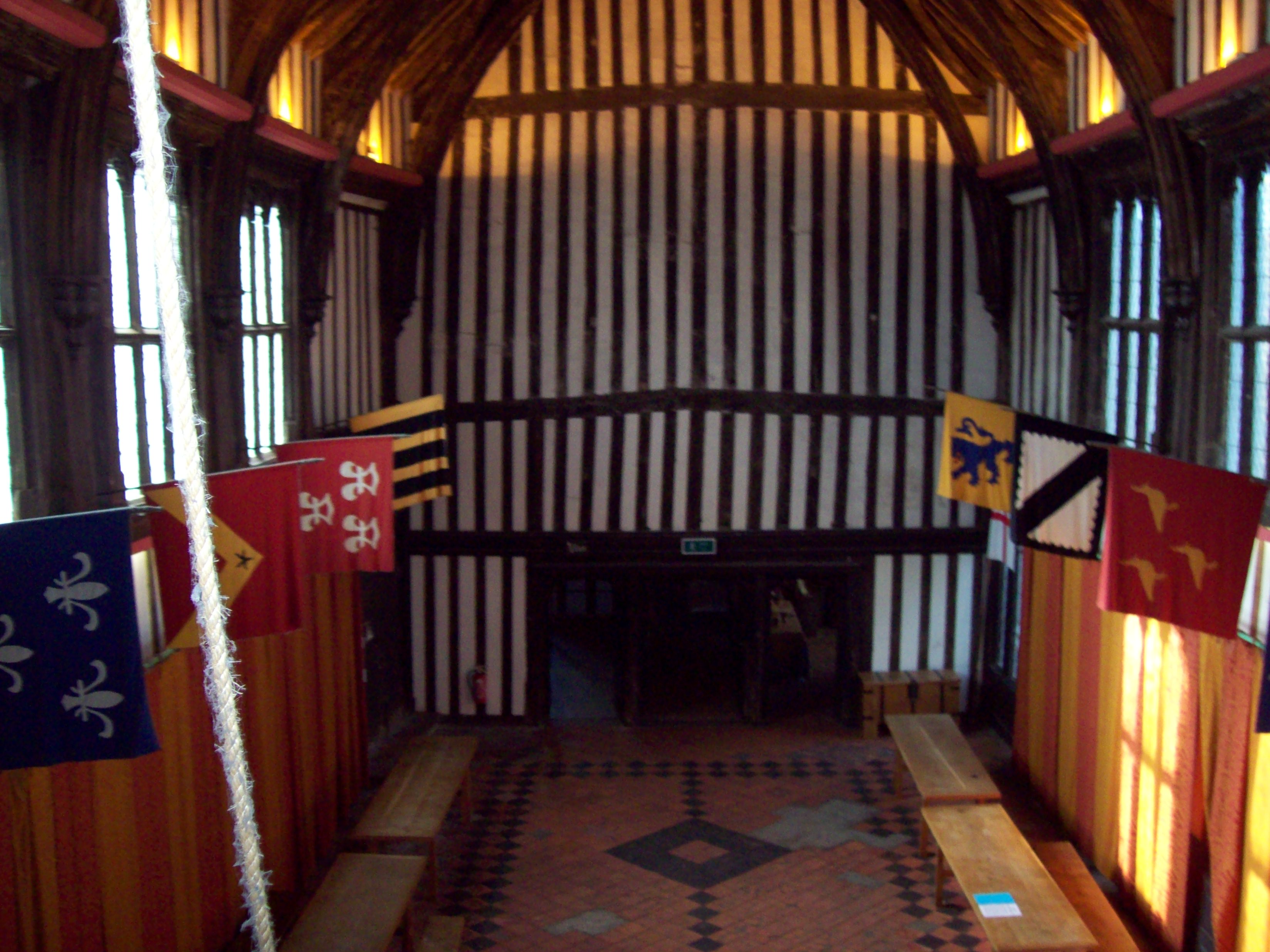
The great hall of Gainsborough Old Hall viewed from the solar
Sir Thomas, however, was renowned for his violent outbursts and wild rages (possibly due to the inherited mental instability in the family) and had a tyrannical control over his family. The first two years of the marriage, spent at Sir Thomas’s Hall at Gainsborough, was a miserable time for Kateryn. She wrote, regularly, to her mother of her unhappiness and it seems the situation was only resolved following a visit by Maud Parr, who persuaded Sir Thomas to allow Edward and Kateryn to move to their own, smaller, house at Kirton-in-Lindsey.
We don’t know whether Edward was a sickly individual (he may have inherited his grandfather’s mental illness), or whether or not he succumbed to a sudden illness, but their happiness was short-lived, as he died in the spring of 1533. Having no children, Kateryn was left with little from the marriage, and, with her mother having died the previous year, and with her siblings in no position to assist her, she was virtually alone in the world. It was possibly as a remedy to her isolation that Kateryn married her second husband, John Neville, 3rd Baron Latimer, who was twenty years her senior, in 1534. There is no record that Kateryn served any of Henry VIII’s queens. Her first appearance at court seems to be in 1542, when she became a lady-in-waiting in Mary Tudor’s household, before she caught the King’s eye.
Kateryn had not forgotten her time with the Burgh family, however, and when she became queen Katerynpaid a pension from her own purse to her former sister-in-law, Elizabeth Owen, widow of her husband’s younger brother, Thomas. Poor Elizabeth had been accused of adultery, during her husband’s lifetime, by her domineering father-in-law, Sir Thomas, and her children were declared illegitimate by a private Act of Parliament in 1542. Although, it does appear that Thomas had a partial change of heart before his death in 1550, as his will included a bequest for ‘700 marks towards the preferment and marriage of Margaret, daughter of Dame Elizabeth Burgh, late wife to Sir Thomas my son, deceased …’ ³
Gainsborough Old Hall
Sir Thomas, Baron Burgh of Gainsborough, was eventually succeeded by his third surviving son, William, born in the early 1520s. He married Katherine Fiennes de Clinton, daughter of Edward Fiennes de Clinton – the future Earl of Lincoln – and Elizabeth (Bessie) Blount, a former mistress of Henry VIII and mother of the king’s illegitimate son, Henry Fitzroy, Duke of Richmond and Somerset.
Lord Latimer died on 2 March 1543 and Kateryn became Queen of England when she married Henry VIII on 12 July the same year. Her marriage to the king would last less than 4 years and ended with Henry’s death on 28 January 1547. In May 1547 Kateryn secretly married her 4th and final husband, Sir Thomas Seymour, brother of her predecessor as queen, Jane Seymour, and uncle of King Edward VI. She died at Sudeley Castle on 5 September 1548, having given birth to a daughter, Mary, 6 days earlier. She was buried in the chapel at Sudeley on the same day. Her daughter was given into the custody of Katherine Willoughby, Duchess of Suffolk, but disappeared from history whilst still a toddler.
*
Footnotes: ¹ ² & ³ Gainsborough Old Hall, Extended Guide Book by Sue Allen
Sources: Gainsborough Old Hall, Extended Guide Book by Sue Allen; In Bed with the Tudors by Amy Licence; oxforddnb.com; The Life and Times of Henry VIII by Robert Lacey; England Under the Tudors by Arthur D Innes; The Earlier Tudors 185-1558 by JD Mackie; Elizabeth’s Women by Tracy Borman; Henry VIII: King and Court by Alison Weir; In the Footsteps of the Six Wives of Henry VIII by Sarah Morris and Natalie Grueninger; Ladies-in-Waiting: Women who Served at the Tudor Court by Victoria Sylvia Evans; The Life and Times of Henry VII by Neville Williams; The Six Wives and Many Mistresses of Henry VIII: The Women’s Stories by Amy Licence; Tudorplace.com; John Leland Leland’s itinerary in England and Wales 1535-43 edited by L Toulmin Smith (1906-10); Letters and Papers, Foreign and Domestic, of the Reign of Henry VIII 1509-47 edited by JS Brewer, James Gairdner and RH Brodie, HMSO London 1862-1932; Privy Purse Expenses of King Henry VIII from November MDXIX to December MDXXXII edited by Sir Nicholas Harris Nicolas 1827.
*
My Books
Signed, dedicated copies of all my books are available through my online bookshop.
OUT NOW! Heroines of the Tudor World
Heroines of the Tudor World tells the stories of the most remarkable women from European history in the time of the Tudor dynasty, 1485-1603. These are the women who ruled, the women who founded dynasties, the women who fought for religious freedom, their families and love. These are the women who made a difference, who influenced countries, kings and the Reformation. In the era dominated by the Renaissance and Reformation, Heroines of the Tudor World examines the threats and challenges faced by the women of the era, and how they overcame them. From writers to regents, from nuns to queens, Heroines of the Tudor World shines the spotlight on the women helped to shape Early Modern Europe.
Women of the Anarchy demonstrates how Empress Matilda and Matilda of Boulogne, unable to wield a sword themselves, were prime movers in this time of conflict and lawlessness. It shows how their strengths, weaknesses, and personal ambitions swung the fortunes of war one way – and then the other. Available from Bookshop.org, Amberley Publishing and Amazon UK. King John’s Right-Hand Lady: The Story of Nicholaa de la Haye is the story of a truly remarkable lady, the hereditary constable of Lincoln Castle and the first woman in England to be appointed sheriff in her own right. Available from all good bookshops Pen & Sword Books, bookshop.org and Amazon. Defenders of the Norman Crown: The Rise and Fall of the Warenne Earls of Surrey tells the fascinating story of the Warenne dynasty, from its origins in Normandy, through the Conquest, Magna Carta, the wars and marriages that led to its ultimate demise in the reign of Edward III. Available from Pen & Sword Books, Amazon in the UK and US, and Bookshop.org.
Alternate Endings: An anthology of historical fiction short stories including Long Live the King… which is my take what might have happened had King John not died in October 1216. Available in paperback and kindle from Amazon.
Podcast:
Have a listen to theA Slice of Medieval podcast, which I co-host with Historical fiction novelist Derek Birks. Derek and I welcome guests, such as Bernard Cornwell and discuss a wide range of topics in medieval history, from significant events to the personalities involved.
*
Don’t forget!Signed and dedicated copies of all my books are available through my online bookshop.
For forthcoming online and in-person talks, please check out my Events Page.
You can be the first to read new articles by clicking the ‘Follow’ button, liking our Facebook page or joining me on Twitterand Instagram.
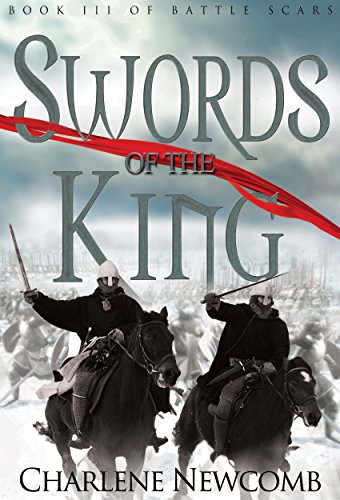
Today over at The Review, you can read my thoughts on Charlene Newcomb’s fantastic new novel, Swords of the King, the third book in her Battle Scarsseries telling the story of two knights in the service of King Richard the Lionheart.
And there’s a fabulous giveaway – an ebook boxset of the entire series to one lucky winner.
Here’s a taster:
Swords of the King is the third instalment of Charlene Newcomb’s magnificent Battle Scars series which has followed Sir Henry de Grey and Sir Stephan de l’Aigle from the third Crusade to northern France in the service of King Richard the Lionheart of England. In Men of the Cross, we saw Henry and Stephan meet and get to know each other whilst experiencing the horrors of the Third Crusade. In For King and Country they were back in England, trying to thwart the evil machinations of Prince John whilst King Richard was stuck in a German prison. In Swords of the King, the two heroes are back together again, this time fighting in France alongside King Richard, with enemies within and without.
The story revolves around Plantagenet family crises and the machinations of Philip II of France and his attempts to disrupt Richard I’s policies and tactics. While many of characters have their own agenda, they must also work to implement King Richard’s; not an easy task when the French and enemies closer to home are ready to thwart you at every turn…
To read the full review of this fantastic novel – and to enter the prize draw and be in with a chance in this fantastic giveaway, simply visit The Review and leave a comment.
Silk and the Sword: the Women of the Norman Conquest will be released in the UK on 15 November 2018 and is available for pre-order on Amazon UK, Amberley Publishing and Book Depository.
You can be the first to read new articles by clicking the ‘Follow’ button, liking our Facebook page or joining me on Twitter.
Hi all. I know I have been quiet recently, so I thought I would write a post with all my latest news.
Book News
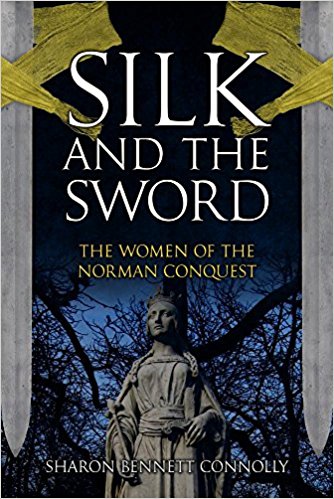
Silk and the Sword: the Women of the Norman Conquest
I have been working hard to finish my latest book, Silk and the Sword: The Women of the Norman Conquest, which went off to the publishers yesterday. I have thoroughly enjoyed delving into the lives of the women of the 11th century and looking at the events of 1066 through their eyes.
Here’s the synopsis:
Everyone knows about the events of 1066; the story of invasion and conquest.
But what of the women?
Harold II of England had been with Edith Swan-neck for twenty years but in 1066, in order to strengthen his hold on the throne, he married Ealdgyth, sister of two earls. William of Normandy’s duchess, Matilda of Flanders had, supposedly, only agreed to marry the Duke after he’d pulled her pigtails and thrown her in the mud. Harald Hardrada had two wives – apparently at the same time.
So, who were these women? What was their real story? And what happened to them after 1066?
From Emma of Normandy, wife of both King Cnut and Æ II to Saint Margaret, a descendant of Alfred the Great himself, ‘Silk and the Sword’ traces the fortunes of the women who had a significant role to play in the momentous events of 1066.
Silk and the Sword: The Women of the Norman Conquest is due for release in the UK on 15 November 2018 and is available for pre-order on Amazon UK, Amberley Publishing and Book Depository. I have no date for the US release, but will keep you posted.
Heroines of the Medieval World
In other exciting news, Heroines of the Medieval World is released today in hardback the US and Canada, and is available from Amazon US.
These are the stories of women, famous, infamous and unknown, who shaped the course of medieval history.
Today, it is easy to think that all women from this era were downtrodden, retiring and obedient housewives, whose sole purpose was to give birth to children (preferably boys) and serve their husbands. Heroines of the Medieval World looks at the lives of the women who broke the mould: those who defied social norms and made their own future, consequently changing lives, society and even the course of history.
Some of the women are famous, such as Eleanor of Aquitaine, who was not only a duchess in her own right but also Queen Consort of France through her first marriage and Queen Consort of England through her second, in addition to being a crusader and a rebel.
Then there are the more obscure but no less remarkable figures such as Nicholaa de la Haye, who defended Lincoln Castle in the name of King John, and Maud de Braose, who spoke out against the same king’s excesses and whose death (or murder) was the inspiration for a clause in Magna Carta.
Women had to walk a fine line in the Middle Ages, but many learned to survive – even flourish – in this male-dominated world. Some led armies, while others made their influence felt in more subtle ways, but all made a contribution to their era and should be remembered for daring to defy and lead in a world that demanded they obey and follow.
Other News
I have recently confirmed two new projects that I will be working on over the next couple of years.
Ladies of the Magna Carta
Ladies of the Magna Carta will look at the wives and families of the barons who were involved in the creation and implementation of the 1215 Magna Carta, and will be published by Pen & Sword Books in 2020.
The De Warenne Earls of Surrey: From the Conquest to the Reign of Edward III
The De Warenne Earls of Surrey: From the Conquest to the Reign of Edward III is a biography of the De Warenne family, from the first Earl, William de Warenne, who fought for William the Conqueror at the Battle of Hastings, to the seventh and last earl, John de Warenne and his unfortunate wife, Joan of Bar.
Newark Book Festival
On Sunday 15 July, 2018, I will be appearing at the Newark Book Festival, Nottinghamshire, UK. I will be talking on a Historical Fiction panel with the wonderful Elizabeth Chadwick and hosted by Nick Quantrill.
Silk and the Sword: the Women of the Norman Conquest will be released in the UK on 15 November 2018 and is available for pre-order on Amazon UK, Amberley Publishing and Book Depository.
You can be the first to read new articles by clicking the ‘Follow’ button, liking our Facebook page or joining me on Twitter.
Today it is my pleasure to be a part of S.J.A. Turney’s Blog Blitz with a review of his latest novel, Daughter of War.
An extraordinary story of the Knights Templar, seen from the bloody inside
Europe is aflame. On the Iberian Peninsula the wars of the Reconquista rage across Aragon and Castile. Once again, the Moors are gaining the upper hand. Christendom is divided.
Amidst the chaos comes a young knight: Arnau of Valbona. After his Lord is killed in an act of treachery, Arnau pledges to look after his daughter, whose life is now at risk. But in protecting her Arnau will face terrible challenges, and enter a world of Templars, steely knights and visceral combat he could never have imagined.
She in turn will find a new destiny with the Knights as a daughter of war… Can she survive? And can Arnau find his destiny?
An explosive novel of greed and lust, God and blood, Daughter of War marks the beginning of an epic new series from bestseller S.J.A. Turney. Perfect for fans of Bernard Cornwell, Conn Iggulden and Matthew Harffy.
I had been looking forward to reading Daughter of War by S.J.A. Turney ever since i heard about the book. And I was not disappointed. Daughter of War is like no other Templar story I have read. The story is set in Spain, rather than the Holy Land, during the Reconquista. And has none of the mysticism that many Templar novels revolve around.
Rather than making the book unreadable, however, this makes the story all-the-more fascinating. the author concentrates on the fighting, monastic and community elements of the Templar order and, as a result, has managed to create a story that is both unique and refreshing. This is a must-read for any fan of the real Knights Templar.
What did I love about this book? Everything. The story revolves around a small Templar preceptory in rural Spain, which has attracted the attention and ire of an unscrupulous and greedy Spanish noble. The preceptory is run by Ermengarda d’Oluja – a woman – but a formidable, commanding woman who has become one of my favourite characters. If ever I write a Heroines of the Medieval World 2, Ermengarda will be in there! And that’s the amazing thing, Ermengarda is a real historical character who did run a Templar preceptory – I didn’t even know they had women in the Templars.
But if you think that because there is a female Templar, that this book would be any less gritty or warlike than any other Templar story, you’d be mistaken. Ermengarda is a woman of steel and an incredible character. S.J.A. Turney, however, has made sure to keep her within the male-orientated realm in which she lived. She extends the limits of female convention if the twelfth century, but never quite breaks them.
The story also deals with the powerlessness of women in the medieval era and the fact that they did not have the right to decide their own fate when it came to marriage. That they could be forced to marry wherever their family and betters decided. And this is what causes the conflict in Daughter of War.
… There, in an antechamber of ancient stone, beneath an elegantly vaulted ceiling, stood Titborga Cervelló de Santa Coloma in her mourning dress of pure white. The sound of loud conversation emerged from the great hall beyond the thick, heavy wooden doors and, though the details of the discussion could not quite be made out, they sounded purposeful and combative.
Arnau dropped to a knee and bowed his head in respect.
‘My lady.’
‘Rise, Señor de Vallbona,’ she said in an odd, worried tone.
‘How may I be of service?’ he asked, climbing to his feet once more and adjusting his grey bliaut swiftly.
Something about the way the lady’s eyes scoured the dim surroundings put him on edge, and when she spoke, her voice was quiet and suspicious. ‘You are one of Santa Coloma’a most trusted men, Arnau de Vallbona.’
‘I have striven in my time to serve your father appropriately,’ he replied, brow creased more than ever.
‘My father spoke of you often, and well. I have seen you with him. He held you in esteem, perhaps more than one might expect for your somewhat minor rank.’
Arnau stifled the disappointment and irritation he felt at the rather blunt remark. Keeping his expression carefully neutral, he nodded. ‘Your father was a great man. I looked up to him. Even at the end, I -‘
‘I need your help. Your oath, Señor de Vallbona.’
Now Arnau felt alarm. These were careful words spoken in a dangerous tone. What was happening? …
Arnau and Titborga are wonderful characters, each joining the Templar order for their own reasons, and each looking for their own purpose in life. Each character – indeed, every character in the book – is unique, with their own hopes and dreams – and challenges. The book takes care not to stereotype the Templars into over zealous religious fanatics, but gives each their individual stories.
Care is taken to enthuse the book with historical accuracy, be it of the region in which the story is based, of the Templar order in general and of the preceptory in particular. The level of research that has gone into this book is astounding and impressive and has helped to create the world of 12th century Spain, torn between Christian and Muslim inhabitants.
As a story, the pace is incredible and barely gives the reader any time to stop and think as the Templars deal with the growing crisis. The attention to detail of S.J.A. Turney means that the fight scenes, in particular, are incredible scenes that draw the reader in, until they’re cowering behind their sofa to hide from the swinging swords and flying crossbow bolts. The author is a true wordsmith and recreates the medieval world and people with a skill level that is rarely achieved and maintained.
Daughter of War has an air of authenticity that is rarely achieved by an author, you can feel the heat of medieval Spain, the desperation of people in a fight they are not sure they can win, and the determination of those who know they are in the right. However, above all, Daughter of War is one thing; it is a fabulously entertaining story, and I cannot recommend it highly enough.
About the author:
S.J.A. Turney is an author of Roman and medieval historical fiction, gritty historical fantasy and rollicking Roman children’s books. He lives with his family and extended menagerie of pets in rural North Yorkshire.
Heroines of the Medieval World, is now available in hardback in the UK from both Amberley Publishing and Amazon UK and worldwide from Book Depository. It is also available on Kindle in both the UK and USA and will be available in Hardback from Amazon US from 1 May 2018.
You can be the first to read new articles by clicking the ‘Follow’ button, liking our Facebook page or joining me on Twitter.
381 AD: The Gothic War draws to a brutal climax, and the victor’s name will be written in blood…