Guest Post: Finding Isabelle, a Mother and a Queen by Terri Lewis

When writing non-fiction biographies, you can tell the life of a person. You can say what happened to them, how they affected events and how they were perceived by others. But there are gaps. If you do not have the evidence, you cannot just make it up. If you are looking for reasons, you can offer different scenarios. It is hard to get to the heart of a person, though. You cannot put words in their mouths, or attribute feelings and emotions. Fiction can go where non fiction cannot tread. It can give you a vivid retelling of a fabulous story. It is not always historically accurate, there are some things we cannot know, but fiction can fill in the gaps. It can bring the past to life and give you a sense of the era that no other medium can.

And that is what Terri Lewis has achieved with remarkable skill in her novel if Isabelle d’Angoulême, Behold the Bird in Flight. And it is a pleasure to welcome Terri to History…the Interesting Bits to talk a little about her research behind her novel.

Finding Isabelle, a Mother and a Queen

by Terri Lewis

History...the Interesting Bits
A birthing stool

I was in high school when I first asked my history teacher, “Where are the women?” An unsatisfactory answer gave impetus to what became a need to find forgotten women. Eventually I became obsessed with Isabelle d’Angoulême, King John’s second wife, and decided to resurrect her by writing a novel.

There are a few documented facts about her life: Historians think she was about twelve years old when John abducted her from her French fiancé, took her to England, and crowned her queen. The chronicles, when they bothered to mention her, were not kind; Matthew Paris called her a “Jezebel” and “slut” who kept John in bed until noon, an assessment most likely reflecting John’s reputation, not the reality of his wife. Isabelle apparently didn’t receive the normal queen’s gold—a percentage of John’s income—or the rents from lands given to her at the time of their marriage; John kept the monies for himself. In “history,” I found only men – fighting, amassing money and enemies, riding off to conquer unknown lands, signing writs, allowing fairs, courting and dancing and always fighting. Isabelle’s life, like the lives of most medieval women, was mainly blank.

But. . . she bore John five children.

My research on medieval childbirth uncovered dire statistics: 20% to 33% of medieval women died from childbearing. The mortality rate per single birth was only slightly higher than in modern times, but multiple pregnancies compounded the risk. Birth control was forbidden by the all-powerful Church so basically a fertile woman had children until menopause or until she died. Because kings had to have sons, as did counts and dukes and other lords—a child to inherit land and carry on the family name. Daughters were less important. An only-child daughter could inherit a kingdom , but not for herself, for her husband. Girls who had brothers would serve as bargaining chips in marriages that formed diplomatic alliances or enlarged territory for their fathers.

In another statistic, infants were uncertain to live to inheritance. Nicholas Orme wrote, “It has been suggested that 25% of [medieval children] may have died in their first year, half as many (12.5%) between one and four, and a quarter as many (6%) between five and nine.” Danger was everywhere. A cut could become infected and penicillin was years in the future. Children fell into wells and down stone stairs, or into the fire that burned in the middle of the great hall, the main source of heat. Many died of illnesses for which bleeding or herbal concoctions were the only cure. Multiple pregnancies mitigated this danger. I note that Isabelle, in addition to the five children with John, had nine more children with her second husband. But two of her own daughters died in childbirth.

History...the Interesting Bits
Isabelle in her innocence

Isabelle wouldn’t have gone to a hospital. She’d have had a lying-in chamber removed from the main keep and furnished with a birthing stool, a midwife with practical experience but not a doctor because childbirth was a woman’s domain and doctors were men, and a room full of ladies-in-waiting who watched and prayed with her. If the birth was difficult, window shutters would be opened to release the new soul into life. If that failed, an arrow could be shot heavenward to waken God to the peril and ask for his help.

Since history decreed that Isabelle would live through childbirth, I decided to have her observe the suffering of her best friend. That scene became an important milestone in Isabelle’s growing up.

What kind of mother would Isabelle have been? I’d never read about a medieval mother. Women in 1200 who appeared in the chronicles were queens, royalty, or religious. Motherhood was important only for the child, preferable a boy, a gift to the father. The woman was just a bearing body.

I decided that Isabelle learned from her own mother, Alice de Courtney, the granddaughter of Louis le Gros of France. Alice would have been familiar with expectations for noble daughters. And she was married three times. I tried to imagine the experience of being handed to various husbands like a package—the decisions being made by fathers and kings. Perhaps she had grounded herself in her new household with a new husband by following the rules. The first “courtesy book” setting forth standards of behavior— Liber Urbani or the book of civilized man— appeared in England late in the 12th century. Written in Latin, the long poem contained general advice such as honor your parents, hold your tongue, don’t mount your horse in the great hall, and such gems as “when you pick up food with a spoon, do not shovel it on board with your thumb.”

History...the Interesting Bits
Midwife swaddling the child

I needed to imagine a relationship between Isabelle and her mother. When I was twelve, my mother was the center of everything; I’d come home from school and stand in the kitchen to tell stories about my friends or things the teacher said. But Isi’s mother wouldn’t be in the kitchen. She was a countess; she’d have cooks and laundresses and maids. I couldn’t imagine that she was anything to Isabelle but a rule-maker. And Isabelle’s position required rules. When she was of age, she would be married – handed off in essence – to another count. The marriage would presumably involve a castle and her husband would go off to war or crusade or to visit a king, and Isabelle would be required to manage the vast operation of the castle while he was gone. Even when he was home, she would oversee household tasks, her belt laden with keys to various chests of fabric or spices, to rooms holding barrels of wine and other supplies. So I made her mother strict, set Isabelle chafing against her, then allowed her to escape, grow up a bit, marry John, and have her children.

Two boys first. Then three girls. Today one can find numerous mothers writing how overpowering love when their baby was laid on their breast changed their lives. But as queen of an itinerant court, Isabelle lived on the road with John who visited barons, trying to bring them to heel. So breastfeeding was impractical. It also acted as a form of contraception and Isabelle’s job was to conceive as often as possible and give John heirs. This meant that her babies would be handed over at birth to a wet-nurse, a hired woman who’d breast feed them as if her own. So the first attachment of mother to child was cut off and understandably, wet nurses often developed close relationships with their charges, particularly as children were generally breastfed for longer than they are today – boys often up to the age of two.
History...the Interesting Bits
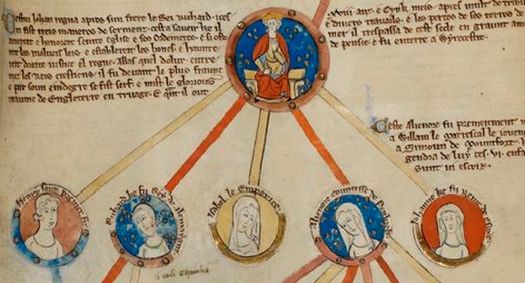
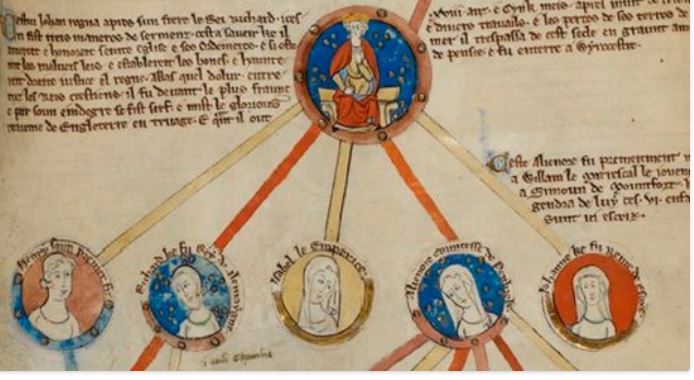
13th century depiction of John’s children (Isabelle not included)

At age seven, the boys would have sent to other noble castles for education. Perhaps the idea was that those other educators would have less attachment to the children and thus they would supply a strict upbringing without coddling. Isabelle’s girls would have remained with her as the kingdom fell deeper into chaos. The Barons were revolting, the Pope had excommunicated John, the French were threatening to invade and conquer. With a growing sense that the throne would be gone before her ten-year-old son Henry could assume it, Isabelle would have known the French would kill him along with the rest of her children, leaving no pretenders. How best to save them? I’ll leave that inside the novel and just say she managed as best she could. History has condemned her ultimate decision, but I understand how she came to it.

About the book:
History...the Interesting Bits

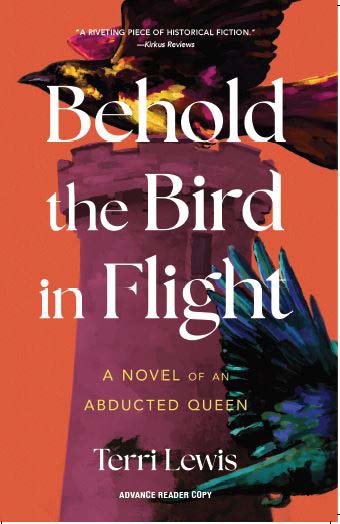
Romantic and stubborn, eleven-year-old Isi plans to marry for love and be mistress of her own castle. But life in 1198 is full of threat and a series of tragic events teaches her growing up is hard. When Isi falls for Hugh, a French nobleman, he consents to marry her, but only for her dowry. She longs for more. Hoping a jealous man will fall in love, she flirts with a king. The flirtation backfires: King John abducts and marries her. Now trapped in cold, warring England with a malicious husband, Isi must hide her yearning for Hugh and find her own power. If she fails, she won’t live to return to her beloved. Inspired by real historical figures—Isabelle d’Angoulême, Hugh de Lusignan, and King John of Magna Carta fame—Behold the Bird in Flight is set in a period that valued women only for their dowries and childbearing. Isabelle’s story has been mainly erased by men, but the medieval chronicles suggest a woman who developed her own power and wielded it. And as the woman behind the throne, who’s to say she didn’t influence history?

About the Author:

History...the Interesting Bits

Terri Lewis fell in love with medieval history in college. Not the dates or wars, but the mysterious daily lives of the people. Finally two sentences in a book bought at Windsor Castle led her to write her debut novel, Behold the Bird in Flight, A Novel of an Abducted Queen.

Published in Denver Quarterly, Blue Mesa Review, and Chicago Quarterly Review among others, and accepted to the Sewanee Writers’ Conference, she has worked with Laura van den Berg, Jill McCorkle, and Rebecca Makkai. Shortlisted for LitMag’s Virginia Woolf Award for Short Fiction, she won the 2025 Miami University Press Novella Prize. She reviews for The Washington Independent Review of Books.

Before she was an author, she had career as a ballet dancer in Denver and Germany, ran a dance company in Arkansas, earned a B.A. in history and education, and an M.A. in theater, not necessarily in that order. She lives with her husband and two lively dogs in Denver, Colorado.

Where to find Terri:

Website: Substack: Instagram: terri.lewis1: Facebook: terri lewis author

Buy the book at Amazon.com (in $), Amazon.co.uk (in £), and Amazon.Fr (in €)

*

My Books:

Signed, dedicated copies of all my books are available through my online bookshop.

Out now: Scotland’s Medieval Queens

Books by Sharon Bennett Connolly

Scotland’s history is dramatic, violent and bloody. Being England’s northern neighbour has never been easy. Scotland’s queens have had to deal with war, murder, imprisonment, political rivalries and open betrayal. They have loved and lost, raised kings and queens, ruled and died for Scotland. From St Margaret, who became one of the patron saints of Scotland, to Elizabeth de Burgh and the dramatic story of the Scottish Wars of Independence, to the love story and tragedy of Joan Beaufort, to Margaret of Denmark and the dawn of the Renaissance, Scotland’s Medieval Queens have seen it all. This is the story of Scotland through their eyes.

Scotland’s Medieval Queens gives a thorough grounding in the history of the women who ruled Scotland at the side of its kings, often in the shadows, but just as interesting in their lives beyond the spotlight. It’s not a subject that has been widely covered, and Sharon is a pioneer in bringing that information into accessible history.’ Elizabeth Chadwick (New York Times bestselling author)

Available now from Amazon and Pen and Sword Books

Also by Sharon Bennett Connolly:

Books by Sharon Bennett Connolly

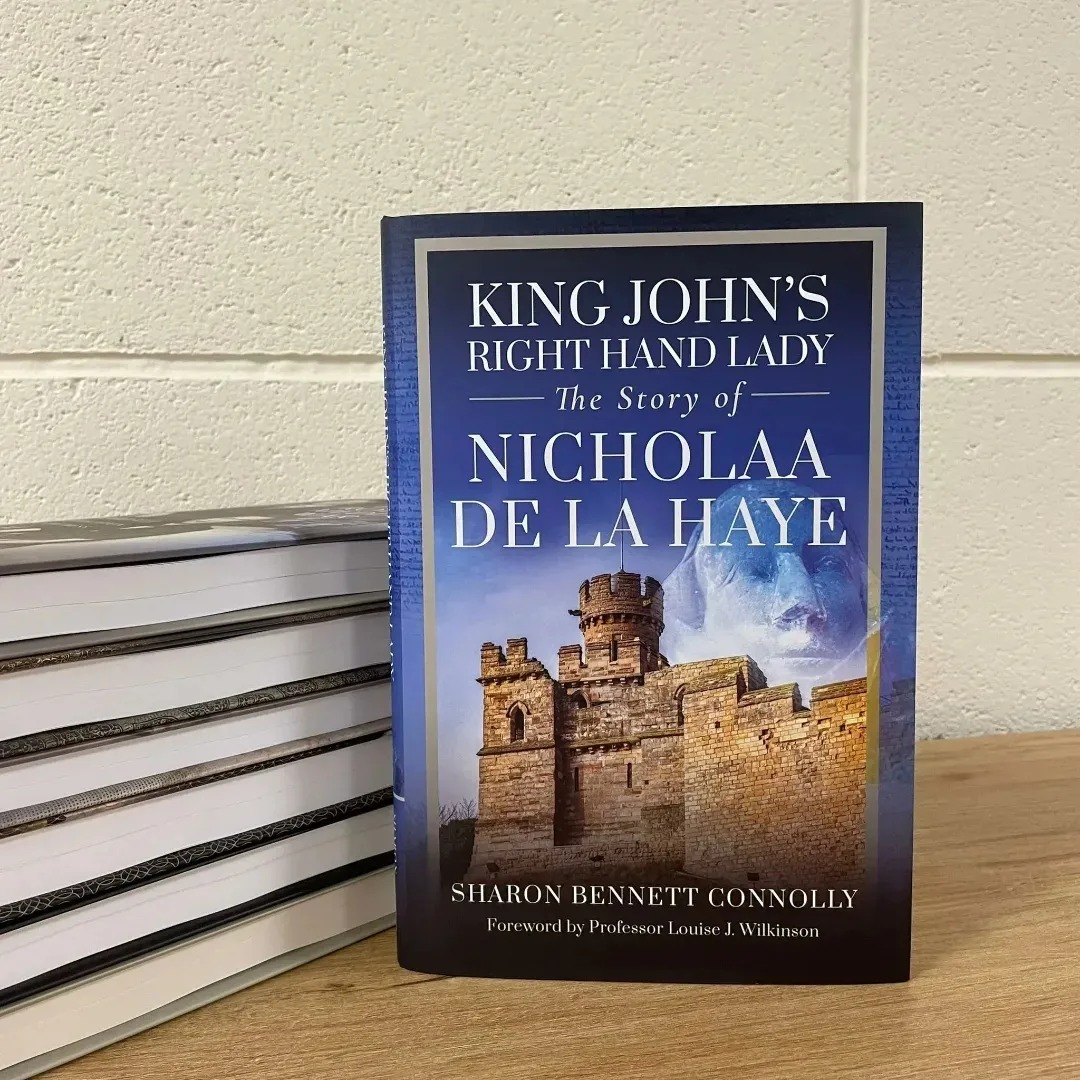
Heroines of the Tudor World tells the stories of the most remarkable women from European history in the time of the Tudor dynasty, 1485-1603. These are the women who ruled, the women who founded dynasties, the women who fought for religious freedom, their families and love. Heroines of the Tudor World is now available for pre-order from Amberley Publishing and Amazon UK. Women of the Anarchy demonstrates how Empress Matilda and Matilda of Boulogne, unable to wield a sword themselves, were prime movers in this time of conflict and lawlessness. It shows how their strengths, weaknesses, and personal ambitions swung the fortunes of war one way – and then the other. Available from Bookshop.orgAmberley Publishing and Amazon UKKing John’s Right-Hand Lady: The Story of Nicholaa de la Haye is the story of a truly remarkable lady, the hereditary constable of Lincoln Castle and the first woman in England to be appointed sheriff in her own right. Available from all good bookshops Pen & Sword Booksbookshop.org and Amazon

Royal Historical Society

Defenders of the Norman Crown: The Rise and Fall of the Warenne Earls of Surrey tells the fascinating story of the Warenne dynasty, from its origins in Normandy, through the Conquest, Magna Carta, the wars and marriages that led to its ultimate demise in the reign of Edward III. Available from Pen & Sword BooksAmazon in the UK and US, and Bookshop.orgLadies of Magna Carta: Women of Influence in Thirteenth Century England looks into the relationships of the various noble families of the 13th century, and how they were affected by the Barons’ Wars, Magna Carta and its aftermath; the bonds that were formed and those that were broken. It is now available in paperback and hardback from Pen & SwordAmazon, and Bookshop.orgHeroines of the Medieval World tells the stories of some of the most remarkable women from Medieval history, from Eleanor of Aquitaine to Julian of Norwich. Available now from Amberley Publishing and Amazon, and Bookshop.orgSilk and the Sword: The Women of the Norman Conquest traces the fortunes of the women who had a significant role to play in the momentous events of 1066. Available now from Amazon,  Amberley Publishing, and Bookshop.org.

Alternate Endings: An anthology of historical fiction short stories including Long Live the King… which is my take what might have happened had King John not died in October 1216. Available in paperback and kindle from Amazon.

Podcast:

A Slice of Medieval

Have a listen to the A Slice of Medieval podcast, which I co-host with Historical fiction novelist Derek Birks. Derek and I welcome guests, such as Bernard Cornwell and Elizabeth Chadwick, and discuss a wide range of topics in medieval history, from significant events to the personalities involved.

Every episode is also now available on YouTube.

*

Don’t forget! Signed and dedicated copies of all my books are available through my online bookshop.

For forthcoming online and in-person talks, please check out my Events Page.

You can be the first to read new articles by clicking the ‘Follow’ button, liking our Facebook page or joining me on TwitterThreadsBluesky and Instagram.

*

©2025 Sharon Bennett Connolly FRHistS and Terri Lewis
Ermengarde de Beaumont, Queen of Scots

History... the Interesting Bits
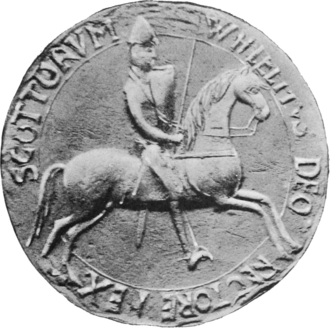
William I the Lion, King of Scots

Unusually for a king in medieval times, by 1185 William the Lion, King of Scots had been on the throne for 20 years, was past 40 and was still unmarried, despite having several illegitimate children. Until he married, William’s heir was his younger brother, David. Ironically, William’s mother, Ada de Warenne, who had been so keen to find a bride for her oldest son Malcolm IV that she was not above putting suitable girls in his bed, does not seem to have had the same sense of urgency with William. There’s no evidence that she pressured him to marry as she had his older brother. Though, I suppose, at least William had shown an interest in women and had the bastards to prove it.

And William was looking for a bride. Henry II, always happy to remind William that he was the Scots king’s overlord, exercised his right to choose William’s wife.

In May 1186, during a council at Woodstock, King Henry suggested Ermengarde de Beaumont as a bride for William. Ermengarde was the daughter of Richard, Vicomte de Beaumont-sur- Sarthe, who was himself the son of Constance, one of the many illegitimate daughters of King Henry I of England. With such diluted royal blood, she was hardly a prestigious match for the king of Scots. William felt slighted but he reluctantly accepted the marriage after consulting his advisers, the offer sweetened by a generous payment for the wedding celebrations and the return of two forfeited Scottish castles, as a wedding present.

History... the Interesting Bits
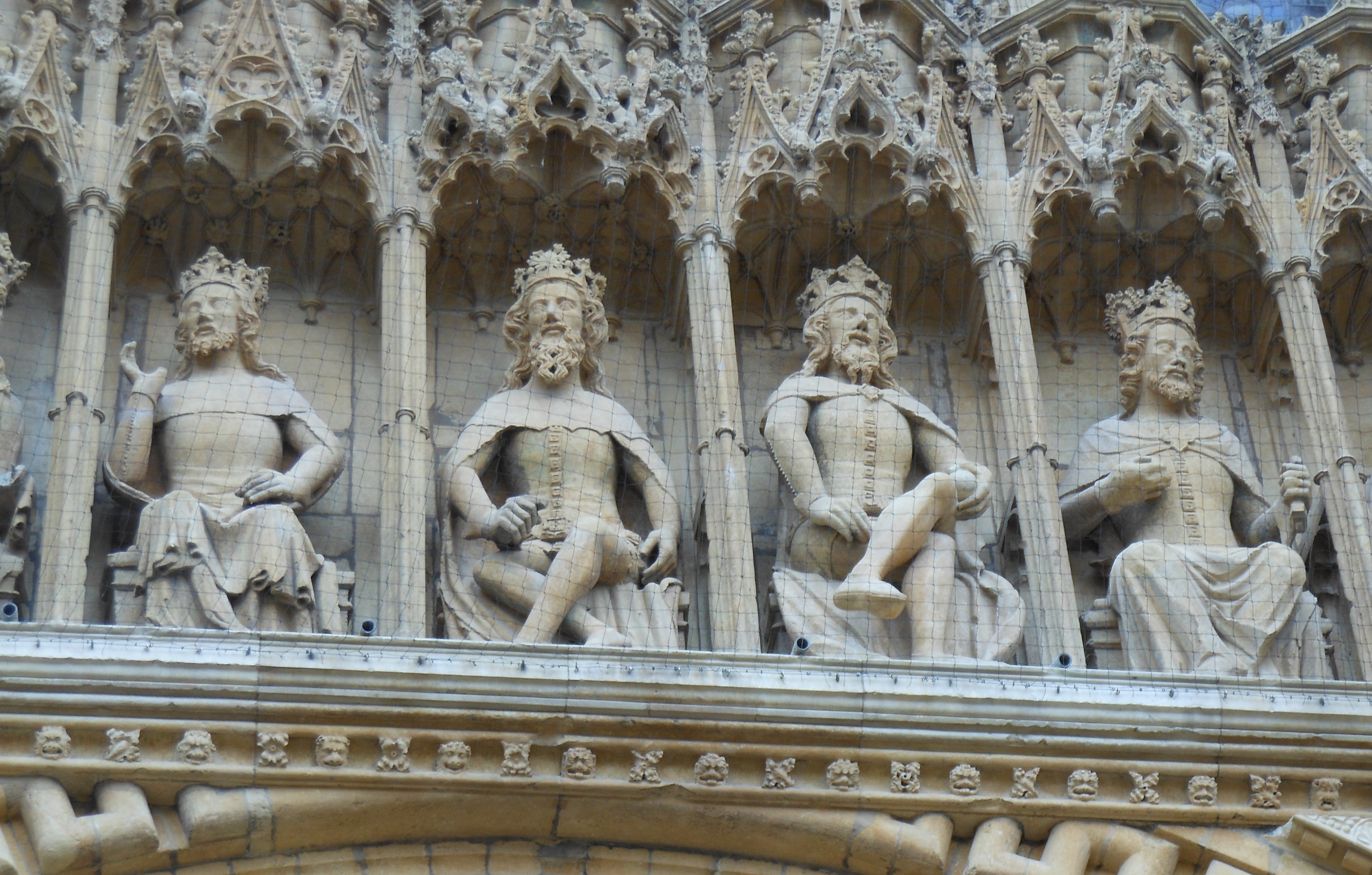
Henry II, King of England, Lincoln Cathedral

We have, of course, no record of Ermengarde’s thoughts on the marriage, nor of whether she was aware of the fact it was seen as an insult to the Scots king. The wedding was celebrated at Woodstock, conducted by the Archbishop of Canterbury, on 5 September 1186,

‘with great magnificence, on the nones of September [5th Sept.] (being the sixth day of the week [Friday], the moon being in her eighteenth day), in the royal chapel in the park at Woodstock, in the presence of the king himself.’1

Following the ceremony, King Henry hosted 4 days of festivities. Although we do not know Ermengarde’s birth date, at the time of the marriage, she was described as ‘a girl’, suggesting that she may have only just reached the age of 12, the minimum legal age girls could marry. It has been suggested that Ermengarde’s tender age may also have been the reason for William’s reluctance to marry her.

We do not know the year of birth of Ermengarde’s first child, a daughter named Margaret, but it was sometime between 1187 and 1195. Another daughter, Isabella, was born a year or two later. If Ermengarde gave birth to Margaret the year after her marriage, it seems highly likely that she was at least fourteen or fifteen years old at the time of her wedding. However, a later birthdate, in the 1190s would suggest that Ermengarde was younger at the time of her marriage and was given time to mature before bearing children. The king’s growing need for an heir would, perhaps, indicate that Ermengarde was old enough to bear children at the time of their marriage, and that describing the bride as ‘a girl’ was alluding to her youth, but not her actual age. Unfortunately, the vagaries of chroniclers means that we cannot say for certain

In the spring of 1195 King William fell gravely ill at Clackmannan, causing a succession crisis, the sum of his legitimate children being one, possibly two, daughters at this time – and no son. The Scottish barons deliberated a number of options, such as recognising William’s oldest legitimate daughter, Margaret, as his heir. They also considered marrying Margaret to Otto, Duke of Saxony, grandson of Henry II, and allowing Otto to succeed to the throne. The earl of Dunbar led a faction who claimed that both solutions were contrary to the custom of the land, so long as the king had a brother who could succeed him. Traditionally, the Scots throne had passed to the oldest, legitimate, male member of the royal family, rather than by primogeniture.

This must have been a worrying time for Ermengarde, not only for the health of her husband, but for her own status in Scotland, should her daughter be disinherited. Not to mention the concern that Margaret, then aged only 8 at the most, might be married at such a young age to secure the succession. In the event, the discussion was moot as the king recovered from his illness and three years later the queen gave birth to Alexander, the much-desired son and heir.

History... the Interesting Bits
Alexander II, King of Scots

Chronicler John of Fordun described the relief and celebration felt throughout the country at the birth of the heir to the Scots throne:

‘Now this most fortunate king of Scotland, William, had, nearly twelve years ago, with great splendour and rejoicings, taken to wife Ermyngarde, daughter of the Viscount of Beaumont… By her he had a son, named Alexander, — to the great gladness of his people, and the refreshment of the whole kingdom of the Scots, as the after course of these annals will show forth. He was born at Haddington, on Saint Bartholomew’s Day, in the year 1198. In every place in the whole country, the common folk used to forsake their menial work on this day, wherein they first heard tidings of his birth, and spend it in joy; while priests and churchmen donned the alb, and walked in procession, with loud voice glorifying God in hymns and canticles, and humbly praising Him.’

Although she does not act as a witness on any of King William’s extant charters, Queen Ermengarde appears to have played an active role in Scotland, with William allowing her an increasingly influential part in public affairs. One disgruntled canon, in 1207, complained that Walter, a royal chaplain, had obtained the bishopric of Glasgow by not only bribing the king’s chamberlain, but also Queen Ermengarde. The queen may also have offered patronage to relatives, including one Richard de Beaumont, perhaps a brother or cousin, who received substantial lands in Crail. As the king’s health declined in old age – he was already 46 when he married Ermengarde – the queen took on more responsibilities, especially where her children were concerned.

Relations with England had changed in 1199, with the accession of King John, the youngest son of Henry II. During the reign of King Richard, William had agreed with the justiciar, William Longchamp, and supported Arthur of Brittany as the king’s heir. However, it was John who succeeded Richard and he may well have remembered William’s stance. Soon after John’s accession, King William asked for the return of Northumberland. The two kings met at Lincoln in 1200, with William doing homage for his English lands but getting no satisfaction in his claim to Northumberland. In subsequent meetings, John continued to prevaricate, leaving the dispute unresolved.

In the meantime, the death of the bishop of Durham meant John took over the vacant see and set about building a castle at Tweedmouth. The Scots, saw this as a direct threat to Berwick and destroyed the building works. Matters reached a crisis point in 1209.

History... the Interesting Bits
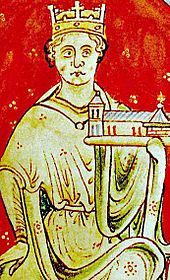
King John of England

After many threats, and with both sides building up their armies, the two kings met at Norham, Northumberland, in the last week of July and first week of August 1209. The Scots were in a desperate position, with an ailing and ageing king, and a 10-year-old boy as heir, whilst the English, with their Welsh allies and foreign mercenaries, had an army big enough to force a Scottish submission. Queen Ermengarde appears to have acted as a mediator between the two kings, although the subsequent treaty, agreed at Norham on 7 August, was humiliating for the Scots it did, at least, prevent a war. The Scots agreed to pay 15,000 marks for peace and to surrender hostages, including the king’s two oldest legitimate daughters, Margaret and Isabella. As a sweetener, John promised to marry the Margaret to one of his sons; although Henry was only 2 years old at the time and Richard was just 8 months, whilst the girls were already in their mid teens, at least. It was agreed that Isabella would be married to an English noble of suitable rank, an earl at least.

The king’s daughters and the other Scottish hostages were handed into the custody of England’s justiciar, at Carlisle on 16 August.

How the girls, or their parents, thought about this turn of events, we know not. Given John’s proven record of prevarication and perfidy, King William may have hoped that the promised marriages would occur in good time but may also have expected that John would find a way out of the pledges he had made. William and John met again at Durham in February 1212, a meeting in which ‘The queen of Scotland was present and acted as mediator, an extraordinary woman, gifted with a charming and witty eloquence.’3 The queen’s efforts bore fruit and peace between the two countries was renewed, as ‘There in the presence of the nobles of both kingdoms and the revered lady the queen of the Scots a formula for achieving peace and love, to be observed between the kingdoms and their kings for ever, was worked out anew and confirmed by charters given by both parties.’4

It was also agreed that the Scottish prince, Alexander, should be given an English wife. With at least one of the prince’s older sisters already intended for a son of King John, marrying Alexander to one of John’s daughters would further bind the Scots to the Plantagenet cause. Prince Alexander, now aged 14, would be knighted by King John, the ceremony taking place at Clerkenwell on 4 March 1212.

Ermengarde may have taken a more prominent role in the negotiations of 1212 as King William’s health began to fail. Their son, Alexander, was still only a teenager and so it would have fallen to the queen to take the lead in the talks. William was a physically active king almost to the very last moment. In January and February 1213, when both the Scots and English kings were close to the border, a meeting was proposed, but William resisted and could not be persuaded to meet with John. In his 70th year, he was probably already very ill.

History...the Interesting Bits
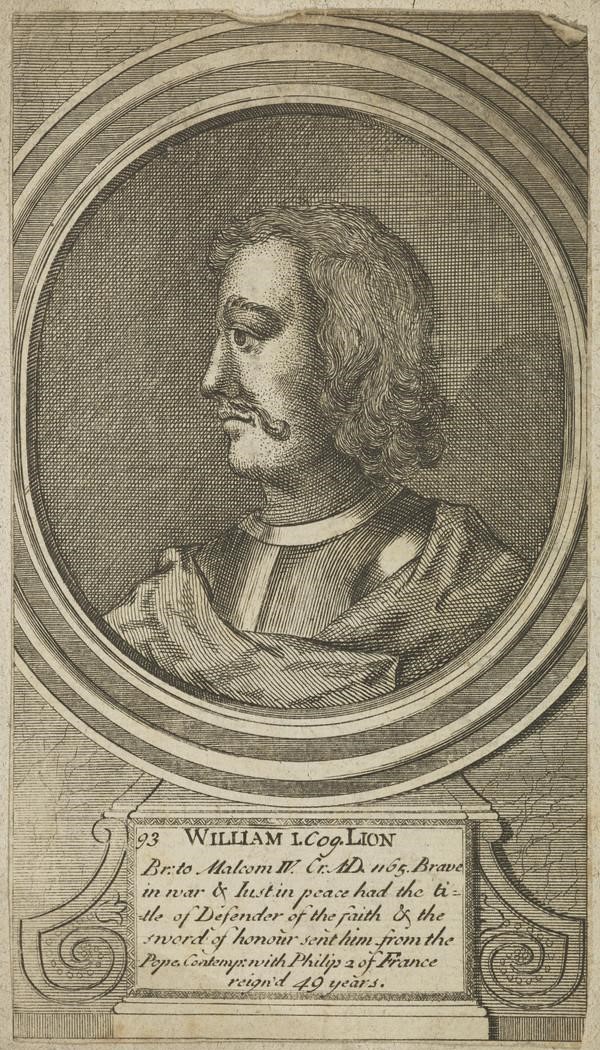
18th century image of William I the Lion

As William’s health failed, Queen Ermengarde appears to have taken on more responsibilities and exerted her influence on the court. The king rallied in 1214, so that he was well enough to travel to Elgin in the summer, where he came to an accord with John, the new earl of Caithness, and received the earl’s unnamed daughter as a hostage. The journey took its toll on the king, and he suffered some sort of collapse. He was taken, in easy stages, to the royal castle at Stirling, where he saw his lords for the last time. With the queen in attendance, William urged his barons and bishops to accept Alexander, now 16 years old, as king. King William I, later known as William the Lion, died on 4 December 1214, aged about seventy-one, having reigned for a total of forty-nine years, almost to the day.

On the morning after her husband’s death, Queen Ermengarde was ‘in a state of extreme mourning and worn out with grief.’5 The prelates and nobles attempted to rouse the queen from her melancholy by asking that she arrange the late king’s funeral, but the queen would not be moved. They left Ermengarde with her grief and took the young king to Scone, where he was crowned as King Alexander II on 6 December. King William was then buried at Arbroath on 10 December. The new king and his mother then presided over the royal Christmas feast at Forfar but returned to Stirling in January 1215, before visiting Arbroath, to see the tomb of King William.

Queen Ermengarde had been much younger than her husband, possibly by as much as thirty years. She would, therefore, continue to live for many years into her son’s reign.

History ... the Interesting Bits
Magna Carta

King Alexander II sided with the English barons in their struggle against the tyranny of King John, making an alliance with the northern barons, who agreed to press for a decision on the future of Alexander’s sisters, and a resolution of the lordship of the northern counties. He raided the northern English earldoms, exploiting the unrest in England to renew Scottish claims to these counties, besieging Norham in October 1215 and receiving the homage of the leading men of Northumberland. And when a French force joined the fight on the side of the rebels, the papal legate pronounced a sentence of excommunication on the rebels and their French and Scottish allies; it even extended to Queen Ermengarde. Scotland put under interdict. Following John’s death in October 1216 and the defeat of the French rebel army at Lincoln in May 1217, Alexander’s position in England became precarious.

The Scots king surrendered Carlisle Castle at Berwick on 1 December 1217 and submitted to England’s boy-king Henry III at Northampton later in the same month. Alexander’s sentence of excommunication was lifted by the archbishop of York, while the bishop of Durham absolved his mother, Queen Ermengarde.

With King Alexander’s submission, there followed an unprecedented almost 80 years of unbroken peace between England and Scotland, sealed by his marriage – in York – with Joan, Henry III’s sister in June 1221. Another marriage soon followed, when, in London on 30 October, Alexander’s oldest sister, Margaret, was married to Hubert de Burgh.

History ... the Interesting Bits
Joan of England, Queen of Scots

Queen Ermengarde must have felt relief that her son had found a bride, and hoped that an heir would soon follow. She may also have been satisfied that her eldest daughter, Margaret, once thought of as the heir to the Scots throne, was also finally settled in matrimony. Though there was complaint from some sides that Margaret had been pressed into a disparaging marriage when she had been promised a prince as a bridegroom. Hubert de Burgh was King Henry III’s justiciar, but was of minor nobility. He only receive his earldom of Kent after his marriage to Margaret. As for Margaret’s sister Isabella, she returned to Scotland, still unmarried. She eventually married Roger Bigod, the young Earl of Norfolk, in 1225. The wedding took place at Alnwick, in Northumberland, which may mean that Queen Ermengarde was able to attend.

Queen Ermengarde devoted her later years to founding an abbey at Balmerino, with the help of Alexander. A parish in the district of Cupar in county of Fife, it was an area she regularly visited for the benefit of her health. The dowager queen raised the money to found the Cistercian abbey, paying 1,000 merks to purchase the land and acting as overseer to the building project. The abbey was built in red stone, quarried locally. Dedicated to Saint Edward the Confessor, Balmerino was populated by monks from Melrose Abbey. Queen Ermengarde appears to have had a particular veneration for the sainted English king as the only other religious gift we can attribute to her was to the hospital of St Edward at Berwick.

The queen had lived long enough to see three of her four children settled in marriage, and may have met her first grandchild, a daughter born to Princess Margaret in 1227, also named Margaret. In the same year, Henry III’s brother Richard, Earl of Cornwall, arrived in Scotland to speak with Queen Ermengarde. The object of the discussions was his possible marriage to the queen’s youngest daughter, Marjory. The earl’s proposals were attractive to neither the Scots nor his brother and negotiations came to naught, but the fact that it was Ermengarde that Richard approached, rather than the king, clearly demonstrates the queen’s continuing influence on her family. Her youngest daughter was not married until August 1235, when she married Gilbert Marshal, Earl of Pembroke, at Berwick.

History... the Interesting Bits
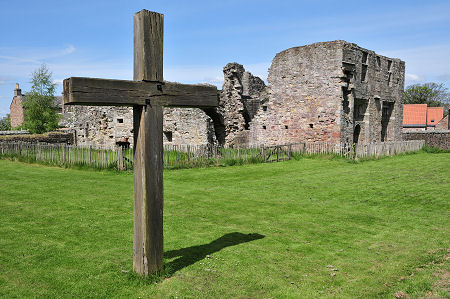
Balmerino Abbey with Queen Ermengarde’s Cross in the foreground

The queen did not live to see the wedding as in February 1233 Ermengarde de Beaumont died. She was buried before the high altar of the abbey to which she had dedicated her years of widowhood, Balmerino. Although the surviving records hint at the queen enjoying substantial authority in Scotland, especially where her family were concerned, we have few specifics. That she was entrusted with negotiating with the English emissaries, in 1209 and again in 1212, suggests that she possessed impressive diplomatic skills, and that King William had considerable confidence in his wife’s abilities. Furthermore, the queen’s evident grief at her husband’s death attests to a deep affection within the union, an affection that not only defined the marriage, but also the whole family, with the queen continuing to exert her influence on the relationships of her children in the years after her husband’s death.

Having served Scotland as queen for 28 years and as its dowager queen for a further 19 years, Ermengarde de Beaumont defined the role of Queen of Scots for subsequent royal consorts. Her memory cast a long shadow.

*

Images:

Courtesy of Wikipedia except Henry II, which is ©2025 Sharon Bennett Connolly FRHistS, and Balmerino Abbey which is courtesy of Undiscovered Scotland

Notes:

1. Mediaeval chronicles of Scotland, translated by Joseph Stephenson; 2. John of Fordun’s Chronicle of the Scottish Nation; 3. Walter Bower, Scotichronicon, V 4; 4. ibid; 5. Rosalind K. Marshall, Scottish Queens 1034–1714

Bibliography:

Walter Bower, Scotichronicon, V 4; Chronicles of the Picts, chronicles of the Scots, and other early memorials of Scottish history, edited by W. F. Skene; fmg.ac/Projects/MedLands/SCOTLAND; John of Fordun’s Chronicle of the Scottish Nation, edited by W. F. Skene, Edinburgh, Edmonston and Douglas; Rosalind K. Marshall, Scottish Queens 1034–1714; Mediaeval chronicles of Scotland: the chronicles of Melrose and Holyrood, translated by Joseph Stephenson; Richard Oram, editor, The Kings and Queens of Scotland; The annals of Roger de Hoveden. Comprising the history of England and of other countries of Europe from A.D. 732 to A.D. 1201, edited by Henry T. Riley; David Ross, Scotland, History of a Nation; W.W. Scott, Ermengarde [Ermengarde de Beaumont], oxforddnb.com; W.W. Scott, William I [known as William the Lion] (c. 1142–1214), oxforddnb.com

*

My Books:

Signed, dedicated copies of all my books are available through my online bookshop.

Out now: Scotland’s Medieval Queens

Books by Sharon Bennett Connolly

Scotland’s history is dramatic, violent and bloody. Being England’s northern neighbour has never been easy. Scotland’s queens have had to deal with war, murder, imprisonment, political rivalries and open betrayal. They have loved and lost, raised kings and queens, ruled and died for Scotland. From St Margaret, who became one of the patron saints of Scotland, to Elizabeth de Burgh and the dramatic story of the Scottish Wars of Independence, to the love story and tragedy of Joan Beaufort, to Margaret of Denmark and the dawn of the Renaissance, Scotland’s Medieval Queens have seen it all. This is the story of Scotland through their eyes.

Scotland’s Medieval Queens gives a thorough grounding in the history of the women who ruled Scotland at the side of its kings, often in the shadows, but just as interesting in their lives beyond the spotlight. It’s not a subject that has been widely covered, and Sharon is a pioneer in bringing that information into accessible history.’ Elizabeth Chadwick (New York Times bestselling author)

Available now from Amazon and Pen and Sword Books

Also by Sharon Bennett Connolly:

Books by Sharon Bennett Connolly

Heroines of the Tudor World tells the stories of the most remarkable women from European history in the time of the Tudor dynasty, 1485-1603. These are the women who ruled, the women who founded dynasties, the women who fought for religious freedom, their families and love. Heroines of the Tudor World is now available for pre-order from Amberley Publishing and Amazon UK. Women of the Anarchy demonstrates how Empress Matilda and Matilda of Boulogne, unable to wield a sword themselves, were prime movers in this time of conflict and lawlessness. It shows how their strengths, weaknesses, and personal ambitions swung the fortunes of war one way – and then the other. Available from Bookshop.orgAmberley Publishing and Amazon UKKing John’s Right-Hand Lady: The Story of Nicholaa de la Haye is the story of a truly remarkable lady, the hereditary constable of Lincoln Castle and the first woman in England to be appointed sheriff in her own right. Available from all good bookshops Pen & Sword Booksbookshop.org and Amazon

Royal Historical Society

Defenders of the Norman Crown: The Rise and Fall of the Warenne Earls of Surrey tells the fascinating story of the Warenne dynasty, from its origins in Normandy, through the Conquest, Magna Carta, the wars and marriages that led to its ultimate demise in the reign of Edward III. Available from Pen & Sword BooksAmazon in the UK and US, and Bookshop.orgLadies of Magna Carta: Women of Influence in Thirteenth Century England looks into the relationships of the various noble families of the 13th century, and how they were affected by the Barons’ Wars, Magna Carta and its aftermath; the bonds that were formed and those that were broken. It is now available in paperback and hardback from Pen & SwordAmazon, and Bookshop.orgHeroines of the Medieval World tells the stories of some of the most remarkable women from Medieval history, from Eleanor of Aquitaine to Julian of Norwich. Available now from Amberley Publishing and Amazon, and Bookshop.orgSilk and the Sword: The Women of the Norman Conquest traces the fortunes of the women who had a significant role to play in the momentous events of 1066. Available now from Amazon,  Amberley Publishing, and Bookshop.org.

Alternate Endings: An anthology of historical fiction short stories including Long Live the King… which is my take what might have happened had King John not died in October 1216. Available in paperback and kindle from Amazon.

Podcast:

A Slice of Medieval

Have a listen to the A Slice of Medieval podcast, which I co-host with Historical fiction novelist Derek Birks. Derek and I welcome guests, such as Bernard Cornwell and Elizabeth Chadwick, and discuss a wide range of topics in medieval history, from significant events to the personalities involved.

Every episode is also now available on YouTube.

*

Don’t forget! Signed and dedicated copies of all my books are available through my online bookshop.

For forthcoming online and in-person talks, please check out my Events Page.

You can be the first to read new articles by clicking the ‘Follow’ button, liking our Facebook page or joining me on TwitterThreadsBluesky and Instagram.

*

©2025 Sharon Bennett Connolly FRHistS.

The Women Behind Magna Carta

Magna Carta

Throughout my research into medieval women, two ladies in particular have popped up a number of times: Nicholaa de la Haye and Matilda de Braose. Their unique stories drew me into their world, and the turbulent times of King John. They were the spark that led me to look into the story of Magna Carta; how its clauses were influenced by women and how women used it to protect their own rights. Magna Carta was, perhaps, the first step on the long road to democracy in England, and many women played key roles in its creation and development.

The Magna Carta of 1215 reflects the needs and events of the time in which it was issued; an England on the brink of civil war, disaffected barons demanding redress, the Church and cities such as London looking for protection. It was drawn up by barons looking for redress and legal protection from a king whose word could no longer be trusted, who meted out arbitrary punishments and heavy taxes. It was not a charter that was intended to form the protection and legal rights of every man, woman and child in the land; though it has come to be seen as just that in subsequent centuries. Indeed, the common man does not get a mention, and of the sixty-three clauses, only eight of them mention women as a gender.

The significance of women in the Magna Carta story is not just their limited inclusion in the charter itself, but also in their experiences of the unsettled times in which they lived, in their influence on the charter itself and in their use of its clauses to exact redress for injustices they had experienced. The political crisis which saw the issuing of Magna Carta, and the civil war which followed, was not just significant to the barons involved, but to their wives and families, tenants and retainers. The conflict tore families apart as they took sides in the struggle and saw more than one baron change sides mid-crisis. Wives and daughters were caught in the middle, often torn by divided loyalties; between their birth family and the family into which they had married; between their fathers and their husbands. For instance, Matilda Marshal was the eldest daughter of William Marshal, a man known for his staunch loyalty to the crown, but she was married to Hugh Bigod, son of Roger, second Earl of Norfolk, one of the leaders of baronial opposition.

Tomb of Nicholaa de la Haye, St Michael’s Church, Swaton

Although they had very different experiences, they shared a number of similarities. Probably born within a few years of each other, they were contemporaries and both were key figures in the reign of King John, though for very different reasons. While Nicholaa de la Haye was a staunch supporter of the man who is, arguably, England’s most despised king in history, Matilda de Braose was one of his most female victims. Matilda’s family were harassed to Ireland and back by John, before she and her eldest son were left in a prison cell to starve to death; they were found after 11 days, Matilda’s head resting on her son’s chest, her son’s cheeks bearing the bite marks as evidence of lengths Matilda went to in her desperation to stay alive. It was Matilda’s experiences at the hands of King John that inspired clause 39 of Magna Carta, that clause that is still the cornerstone of British justice to this day:

‘No man shall be taken, imprisoned, outlawed, banished or in any way destroyed, nor will we proceed against or prosecute him, except by the lawful judgement of his peers or by the law of the land’

Nicholaa de la Haye, on the other hand, had been a long-time supporter of King John. She first successfully defended Lincoln Castle, in support of John, in the siege of 1191; the siege lasted 40 days before William Longchamp, the hated justiciar, gave up and went home. In 1216, Nicholaa successfully defended it again, this time paying off the rebel barons so that they would lift the siege. In the aftermath, John came north and ravaged the Isle of Axholme, where the barons had retreated to, with ‘fire and sword’. It was after this even that Nicholaa, now in her 60s and recently widowed, offered to relinquish custody of the castle. John refused to accept her resignation and in October, hours before his death, appointed Nicholaa Sheriff of Lincolnshire: she was the first ever female sheriff in England.

King John

Although Nicholaa de la Haye and Matilda de Braose were the major influences behind my book, Ladies of Magna Carta, they were not the only women to make an impression on the Magna Carta story. The deeper I dug, the more stories I uncovered that deserved to be told. Matilda’s own daughter, Loretta de Braose, was one such. Recently widowed following the death of her husband, Robert de Breteuil, Earl of Leicester, Loretta had been forced by John to relinquish her dower rights; Magna Carta clauses 7 and 8 of Magna Carta, protecting widows’ rights:

Clause 7:

After her husband’s death, a widow shall have her marriage portion and her inheritance at once and without any hindrance; nor shall she pay anything for her dower, her marriage portion, or her inheritance which she and her husband held on the day of her husband’s death; and she may stay in her husband’s house for 40 days after his death, within which period her dower shall be assigned to her.

Clause 8:

No widow shall be compelled to marry so long as she wishes to live without a husband, provided that she gives security that she will not marry without our consent if she holds of us, or without the consent of the lord of whom she holds, if she holds of another.

Furthermore, there are two women who can be clearly identified in Magna Carta itself, though they are not named, they are two Scottish princesses. The sisters of King Alexander II had been held hostage in England since 1209, when John forced the humiliating Treaty of Norham on their ailing father, King William the Lion. Clause 59 promised:

‘We will treat Alexander, king of Scots, concerning the return of his sisters and hostages and his liberties and rights in the same manner in which we will act towards our other barons of England, unless it ought to be otherwise because of the charters which we have from William his father, formerly king of Scots; and this shall be determined by the judgement of his peers in our court.

Women not only influenced the clauses of Magna Carta, however, they also used Magna Carta to assert and protect their own rights. Women such as Ela of Salisbury, who used the promises of Magna Carta to avoid an unwelcome marriage proposal when her husband, William Longspée was missing and feared dead. Or Isabel d’Aubigny, Countess of Arundel, who proclaimed ‘Where are the liberties of England, so often recorded, so often granted and so often ransomed’, when King Henry III foolishly attempted to steal land that was rightfully hers. She must have been a fearsome opponent, as Henry responded to one of her petitions, saying that he would grant her leniency ‘so long as she says nothing opprobrious to us as she did when we were at Westminster!’

Eleanor de Montfort

And then there were the women for whom Magna Carta offered no protection or respite. Women such as Eleanor of Brittany, for whom even clause 39 could be of no help. Their royal blood and ability to be a focus for opposition to the crown meant that successive kings would keep them imprisoned, either in castles, as with Eleanor, or in a rural convent, as with Gwenllian of Wales, orphan daughter of Llywelyn, Prince of Wales and his wife, Eleanor de Montfort, who was herself a granddaughter of King John.

It was Eleanor’s mother, also Eleanor, the youngest daughter of King John and not a year old at her father’s death, who, as the wife of Simon de Montfort, Earl of Leicester, would continue the struggle to curb the powers of the crown in the Second Barons’ War. She herself was defending Dover Castle when her husband was killed at the Battle of Evesham. She spent her final years in French exile. Her struggles to obtain her dower lands from the powerful Marshal family, guaranteed in Magna Carta, were a major component of Eleanor’s own dissatisfaction with her brother, Henry III.

It is through the stories of these remarkable women and the relationships of the various noble families of the 13th century, that I wanted to examine how they were affected by the First Barons’ Wars, Magna Carta and its aftermath. It is a study of the bonds that were formed and those that were broken among the women of the great families of 13th century England, including the royal families of England and Scotland, the Marshals, the Bigods, the Salisburys, Braoses and Warennes.

Their stories are inspirational, if heartbreaking at times.

Images:

Courtesy of Wikipedia except Nicholaa de la Haye which is ©2023 Sharon Bennett Connolly FRHistS

Sources:

Richard of Devizes, The Chronicle of Richard of Devizes; Roger of Howden (Hoveden), The Annals of Roger of HowdenThe Plantagenet Chronicles edited by Elizabeth Hallam; Brassey’s Battles by John Laffin; 1215 The Year of Magna Carta by Danny Danziger & John Gillingham; The Life and times of King John by Maurice Ashley; The Plantagenets, the Kings Who Made England by Dan Jones; England Under the Norman and Angevin Kings  by Robert Bartlett; lincolnshirelife.co.uk; catherinehanley.co.uk; magnacarta800th.com; lothene.org; lincolncastle.com; The Sheriff: The Man and His Office by Irene Gladwin; Louise Wilkinson, Women in Thirteenth Century Lincolnshire; Richard Huscraft, Tales from the Long Twelfth Century; J.W.F. Hill, Medieval Lincoln; swaton.org.uk; oxforddnb.com; Stephen Church, King John: England, Magna Carta and the Making of a Tyrant; Marc Morris, King John; Pipe Rolls; Red Book of the Exchequer

My Books

Signed, dedicated copies of all my books are available through my online store.

Out nowKing John’s Right-Hand Lady: The Story of Nicholaa de la Haye

In a time when men fought and women stayed home, Nicholaa de la Haye held Lincoln Castle against all-comers, gaining prominence in the First Baron’s War, the civil war that followed the sealing of Magna Carta in 1215. A truly remarkable lady, Nicholaa was the first woman to be appointed sheriff in her own right. Her strength and tenacity saved England at one of the lowest points in its history. Nicholaa de la Haye is one woman in English history whose story needs to be told…

King John’s Right-Hand Lady: The Story of Nicholaa de la Haye is now available from Pen & Sword Booksbookshop.org and Amazon.

Coming 15 January 2024: Women of the Anarchy

On the one side is Empress Matilda, or Maud. The sole surviving legitimate child of Henry I, she is fighting for her birthright and that of her children. On the other side is her cousin, Queen Matilda, supporting her husband, King Stephen, and fighting to see her own son inherit the English crown. Both women are granddaughters of St Margaret, Queen of Scotland and descendants of Alfred the Great of Wessex. Women of the Anarchy demonstrates how these women, unable to wield a sword, were prime movers in this time of conflict and lawlessness. It show how their strengths, weaknesses, and personal ambitions swung the fortunes of war one way – and then the other.

Available for pre-order from Amberley Publishing and Amazon UK.

Also by Sharon Bennett Connolly:

Defenders of the Norman Crown: The Rise and Fall of the Warenne Earls of Surrey tells the fascinating story of the Warenne dynasty, of the successes and failures of one of the most powerful families in England, from its origins in Normandy, through the Conquest, Magna Carta, the wars and marriages that led to its ultimate demise in the reign of Edward III. Defenders of the Norman Crown: Rise and Fall of the Warenne Earls of Surrey is now available from Pen & Sword BooksAmazon in the UK and US, and  Bookshop.org.

Ladies of Magna Carta: Women of Influence in Thirteenth Century England looks into the relationships of the various noble families of the 13th century, and how they were affected by the Barons’ Wars, Magna Carta and its aftermath; the bonds that were formed and those that were broken. It is now available in paperback and hardback from Pen & Sword,  Amazon, and Bookshop.org.

Heroines of the Medieval World tells the stories of some of the most remarkable women from Medieval history, from Eleanor of Aquitaine to Julian of Norwich. Available now from Amberley Publishing and Amazon, and Bookshop.org.

Silk and the Sword: The Women of the Norman Conquest traces the fortunes of the women who had a significant role to play in the momentous events of 1066. Available now from Amazon,  Amberley Publishing, and Bookshop.org.

Alternate Endings: An anthology of historical fiction short stories including Long Live the King… which is my take what might have happened had King John not died in October 1216. Available in paperback and kindle from Amazon.

Podcast:

Have a listen to the A Slice of Medieval podcast, which I co-host with Historical fiction novelist Derek Birks. Derek and I welcome guests, such as Bernard Cornwell, and discuss a wide range of topics in medieval history, from significant events to the personalities involved.

*

Signed and dedicated copies of all my books are available through my online store.

For forthcoming online and in-person talks, please check out my Events Page.

You can be the first to read new articles by clicking the ‘Follow’ button, liking our Facebook page or joining me on Twitter and Instagram.

©2023 Sharon Bennett Connolly FRHistS

10 Facts about Nicholaa de la Haye that you may not know…

King John’s Right Hand Lady: The Story of Nicholaa de la Haye
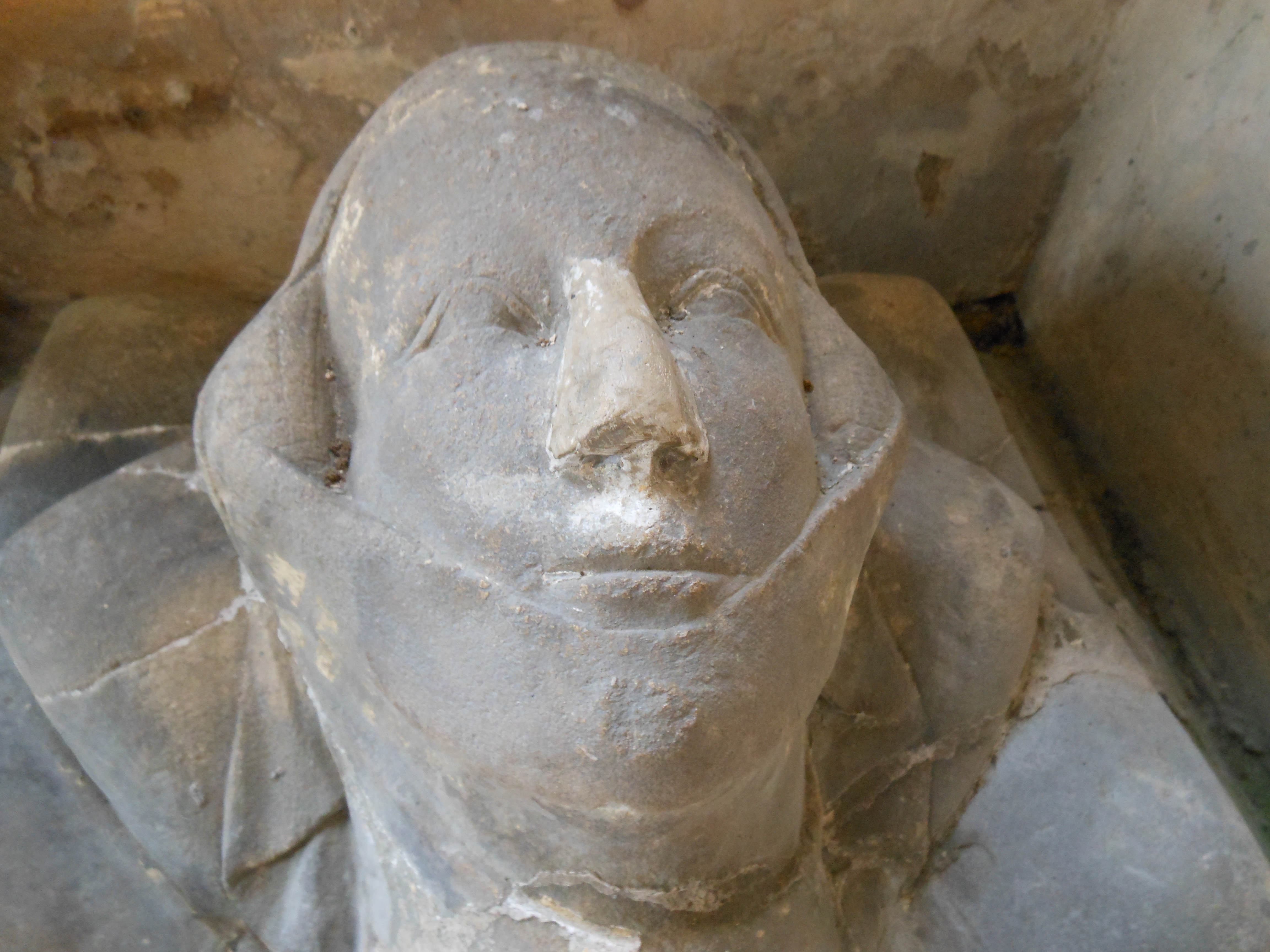
Tomb effigy of Nicholaa de la Haye, St Michael’s Church, Swaton

As you may have noticed, Nicholaa de la Haye is a favourite of mine. She is the subject of my 5th book, King John’s Right Hand Lady: The Story of Nicholaa de la Haye. She was one of King John’s most stalwart supporters. She held Lincoln Castle against all-comers during the First Barons’ War which followed the sealing of Magna Carta in 1215. Her career is the more remarkable because Nicholaa was a woman in command of a castle in her own right. And she masterminded its defence against the might of the rebel barons and their French allies, even though the city of Lincoln was also against her.

So, who was she?

10 Things about Nicholaa de la Haye that you may not know…

1. Nicholaa had both English and Norman ancestry. Unlike many Normans, Nicholaa could trace her Lincolnshire roots, through her paternal grandmother, Muriel, to before the Norman Conquest; her grandmother’s grandfather was Colswein of Lincoln, an Englishman who had found favour with William the Conqueror in the years after the Conquest. Nicholaa’s father was Richard de la Haye, whose family originated from La Haye-du-Puits in Normandy, and was distantly related, through marriage, to William the Conqueror. Nicholaa’s mother was Matilda de Vernon, a niece of Baldwin de Redvers, Earl of Devon, the first magnate to rebel against King Stephen when he stole the throne from Empress Matilda.

2. Nicholaa was hereditary constable of Lincoln Castle. Just like her father and grandfather before her, Nicholaa held Lincoln Castle for the king. A charter dated between 1155 and 1158, issued by Henry II, confirmed the succession of Richard de la Haye to his father in all of his father’s lands in Lincolnshire, including the constableship of Lincoln Castle.

King John’s Right Hand Lady: The Story of Nicholaa de la Haye
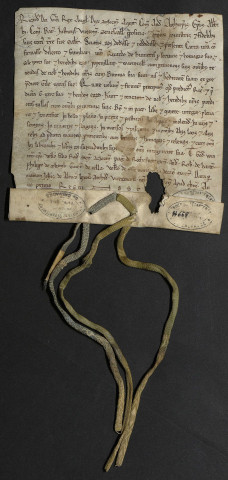
The Charte aux lacs d’Amour

3. Nicholaa was the oldest of three sisters. Her sister Gila (or Julia) married Richard du Hommet, the grandson and son of successive constables of Normandy. In 1191 a charter was issued to Gila and Richard, known as the charte aux lacs d’amour (the charter of the laces of love), which had laces attached to the seal on which was written a love poem: ‘I am a pledge of love. Do not give me away. May whoever separates our love receive death’. Nicholaa’s other sister, Isabel de la Haye married William de Rollos, who was probably from Bourne, in Lincolnshire. The Rollos family returned to Normandy during the reign of King John.

4. Nicholaa’s first husband was William Fitz Erneis, who may have been a younger son of Robert Fitz Erneis, a minor Lincolnshire lord. Nicholaa and William had one surviving child, a daughter named Matilda, before William died in 1178. Nicholaa would later pay a fine of 300 marks to King Richard I so that she could marry her daughter to whomever she wished except, of course, to an enemy of the king. Nicholaa was still accounting for this debt until 1212. In 1201, she still owed 40 marks and a palfrey (a horse).

5. Before 1185, Nicholaa had remarried, this time to Gerard de Camville, son of Richard de Camville, lord of Middleton Stoney in Oxfordshire. A family with an impressive record of royal service, Richard had died in Italy in 1176 while escorting the king’s daughter, Joanna, to her wedding with King William of Sicily. Gerard’s half-brother, also called Richard, accompanied Richard the Lionheart on Crusade; this Richard de Camville was made governor of Cyprus before dying at Acre in 1191. Gerard himself served the kings Henry II, Richard the Lionheart and John. He was Constable of Lincoln Castle by right of his wife and sheriff of Lincolnshire on two occasions.

6. Nicholaa first comes to the attention of the chroniclers in 1191, when Prince John led the opposition to, William Longchamp, the man left in charge of England during Richard the Lionheart’s absence on crusade. Longchamp wanted Lincoln Castle for one of his friends and determined to take it. Gerard sought the help of Prince John swearing fealty to him at Nottingham, leaving to Nicholaa to hold the castle. William Longchamp hired a force of mercenaries and laid siege to the castle in Gerard’s absence. The formidable Nicholaa refused to yield, holding out for 40 days before Longchamp gave up and went home. Amusingly, Richard of Devizes said of this defence of Lincoln Castle, that she did it ‘without thinking of anything womanly’.

King John’s Right Hand Lady: The Story of Nicholaa de la Haye
The kings Nicholaa served: Henry II, Richard I King John and Henry III, Lincoln Cathedral

7. By the time the king arrived home in 1194, John had fled to France, leaving his supporters to face the music. On 31 March 1194, on the first day of his council at Nottingham, King Richard dispossessed Gerard de Camville of the castle and shrievalty of Lincoln. And on 2 April, Gerard was charged with harbouring outlaws (wonder if they mean Robin Hood?), treason for failing to answer the king’s justices’ summons over the harbouring of the said outlaws, and for taking up arms and aiding John in taking the castles of Tickhill and Nottingham. The outcome of the proceedings is not recorded, but given that Gerard was fined 2,000 marks to recover the king’s good will and his lands, we can assume that the judges did not find in his favour.

8. When Richard the Lionheart died on 6 April 1199 and was succeeded by his brother, John, Nicholaa and Gerard de Camville were restored to favour and to Lincoln Castle. Gerard was also appointed sheriff of Lincolnshire and served in that office for the next six years, becoming ‘a greater man than ever.’ In November 1200, Nicholaa and Gerard welcomed the kings of England and Scotland to Lincoln, where King William the Lion paid homage to King John outside the city walls.

King John’s Right Hand Lady: The Story of Nicholaa de la Haye
The Observatory Tower, Lincoln Castle

9. Gerard died in December 1214, leaving Nicholaa in command of Lincoln Castle. In 1216, she was besieged by a force of rebel barons who had taken up arms against King John in the aftermath of the issuing of Magna Carta. Nicholaa paid them off – they stopped attacking the castle but remained in the city. In the same year, Nicholaa met King John at the East Gate of Lincoln Castle, with the castle’s keys in her hand, offering to resign her position as constable, citing her weariness and great age (she was in her 60s). John refused, telling her to remain in post until he ordered otherwise.

10. On 18 October 1216, at Newark Castle, in one of his final acts and just hours before his death, King John appointed Nicholaa de la Haye as sheriff of Lincolnshire. She was the first woman in English history to be appointed to the office of sheriff in her own right – but she would not be the last.

King John’s Right Hand Lady: The Story of Nicholaa de la Haye
Depiction of the 1217 Battle of Lincoln from Matthew Paris

11. (Oops!) For 7 months, from October 1216 to May 1217, Lincoln Castle was once again under siege by a force of English rebel barons and their French allies under the command of the Comte de Perche. Nicholaa directed the castle’s defence until royalist forces could come to her aid. On 20 May 1217, William Marshal and the royalist army came to her relief, fighting the Battle of Lincoln through the city’s streets.

12. (double oops!) There was a rise in the number of baby girls named Nicholaa, in Lincolnshire, in the 13th century.

13. Have a listen to the A Slice of Medieval episode dedicated to Nicholaa de la Haye, where Derek Birks and I discuss the ins and outs – and highs and lows – of Nicholaa’s career.

Sources:

Richard of Devizes, The Chronicle of Richard of Devizes; Roger of Howden (Hoveden), The Annals of Roger of HowdenThe Plantagenet Chronicles edited by Elizabeth Hallam; Brassey’s Battles by John Laffin; 1215 The Year of Magna Carta by Danny Danziger & John Gillingham; The Life and times of King John by Maurice Ashley; The Plantagenets, the Kings Who Made England by Dan Jones; England Under the Norman and Angevin Kings  by Robert Bartlett; lincolnshirelife.co.uk; catherinehanley.co.uk; magnacarta800th.com; lothene.org; lincolncastle.com; The Sheriff: The Man and His Office by Irene Gladwin; Louise Wilkinson, Women in Thirteenth Century Lincolnshire; Richard Huscraft, Tales from the Long Twelfth Century; J.W.F. Hill, Medieval Lincoln; swaton.org.uk; oxforddnb.com; Ingulph, Ingulph’ Chronicle of the Abbey of Croyland; Stephen Church, King John: England, Magna Carta and the Making of a Tyrant; Marc Morris, King John; Pipe Rolls; Red Book of the Exchequer

*

My Books

Signed, dedicated copies of all my books are available through my online store.

Out now: Scotland’s Medieval Queens

Books by Sharon Bennett Connolly

Scotland’s history is dramatic, violent and bloody. Being England’s northern neighbour has never been easy. Scotland’s queens have had to deal with war, murder, imprisonment, political rivalries and open betrayal. They have loved and lost, raised kings and queens, ruled and died for Scotland. From St Margaret, who became one of the patron saints of Scotland, to Elizabeth de Burgh and the dramatic story of the Scottish Wars of Independence, to the love story and tragedy of Joan Beaufort, to Margaret of Denmark and the dawn of the Renaissance, Scotland’s Medieval Queens have seen it all. This is the story of Scotland through their eyes.

Scotland’s Medieval Queens gives a thorough grounding in the history of the women who ruled Scotland at the side of its kings, often in the shadows, but just as interesting in their lives beyond the spotlight. It’s not a subject that has been widely covered, and Sharon is a pioneer in bringing that information into accessible history.’ Elizabeth Chadwick (New York Times bestselling author)

Available now from Amazon and Pen and Sword Books

Also by Sharon Bennett Connolly:

Books by Sharon Bennett Connolly

Heroines of the Tudor World tells the stories of the most remarkable women from European history in the time of the Tudor dynasty, 1485-1603. These are the women who ruled, the women who founded dynasties, the women who fought for religious freedom, their families and love. Heroines of the Tudor World is now available for pre-order from Amberley Publishing and Amazon UK. Women of the Anarchy demonstrates how Empress Matilda and Matilda of Boulogne, unable to wield a sword themselves, were prime movers in this time of conflict and lawlessness. It shows how their strengths, weaknesses, and personal ambitions swung the fortunes of war one way – and then the other. Available from Bookshop.orgAmberley Publishing and Amazon UKKing John’s Right-Hand Lady: The Story of Nicholaa de la Haye is the story of a truly remarkable lady, the hereditary constable of Lincoln Castle and the first woman in England to be appointed sheriff in her own right. Available from all good bookshops Pen & Sword Booksbookshop.org and Amazon

Royal Historical Society

Defenders of the Norman Crown: The Rise and Fall of the Warenne Earls of Surrey tells the fascinating story of the Warenne dynasty, from its origins in Normandy, through the Conquest, Magna Carta, the wars and marriages that led to its ultimate demise in the reign of Edward III. Available from Pen & Sword BooksAmazon in the UK and US, and Bookshop.orgLadies of Magna Carta: Women of Influence in Thirteenth Century England looks into the relationships of the various noble families of the 13th century, and how they were affected by the Barons’ Wars, Magna Carta and its aftermath; the bonds that were formed and those that were broken. It is now available in paperback and hardback from Pen & SwordAmazon, and Bookshop.orgHeroines of the Medieval World tells the stories of some of the most remarkable women from Medieval history, from Eleanor of Aquitaine to Julian of Norwich. Available now from Amberley Publishing and Amazon, and Bookshop.orgSilk and the Sword: The Women of the Norman Conquest traces the fortunes of the women who had a significant role to play in the momentous events of 1066. Available now from Amazon,  Amberley Publishing, and Bookshop.org.

Alternate Endings: An anthology of historical fiction short stories including Long Live the King… which is my take what might have happened had King John not died in October 1216. Available in paperback and kindle from Amazon.

Podcast:

Have a listen to the A Slice of Medieval podcast, which I co-host with Historical fiction novelist Derek Birks. Derek and I welcome guests, such as Bernard Cornwell and Elizabeth Chadwick, and discuss a wide range of topics in medieval history, from significant events to the personalities involved.

Every episode is also now available on YouTube.

*

Signed and dedicated copies of all my books are available through my online store.

For forthcoming online and in-person talks, please check out my Events Page.

You can be the first to read new articles by clicking the ‘Follow’ button, liking our Facebook page or joining me on TwitterThreadsBluesky and Instagram.

©2023 Sharon Bennett Connolly FRHistS

Eleanor, daughter of a king, Countess of Pembroke

King John with his children Henry, Richard, Joan, Isabella and Eleanor

There was one daughter of King John for whom the legacy of Magna Carta and the struggle for political reform held particular significance. The life of Eleanor of England, and her husband Simon de Montfort, stands as the epilogue of the Magna Carta story. Although democratic government was still many centuries in the future, Magna Carta was the first step. The political movement led by Simon de Montfort was the second step …

However, had fate not stepped in, Eleanor may never have married Simon. From an early age, she had been the wife of another, until tragedy struck.

Eleanor of England was the youngest child of John and Isabelle d’Angoulême; she is said to have inherited her mother’s beauty and feisty temperament.1 Eleanor was thought to have been born at the height of her father’s troubles, in the midst of the Magna Carta crisis in 1215. However, historians are now inclined to the theory that she was born posthumously, sometime after the death of King John, either in late 1216 or early in 1217. She was named for her famous grandmother, Eleanor of Aquitaine. As a baby, little Eleanor was placed in the household of the bishop of Winchester, where her eldest brother, Henry, had been living since 1212.2 Eleanor’s father had died whilst the country was riven by war, on the night of 18/19 October 1216 at Newark. He was succeeded by Eleanor’s eldest brother Henry – now King Henry III. Eleanor’s mother, frozen out from any role in her son’s regency or life, returned to her native Angoulême and in 1220 married Hugh X de Lusignan, Count of La Marche.

In 1224 Eleanor’s future was decided when she was married to William (II) Marshal, Earl of Pembroke. The younger Marshal was the son of the first earl of Pembroke who had been regent in the early years of Henry III’s reign, and who had driven the French out of England following his victory at the Battle of Lincoln in May 1217. The first earl had a reputation for integrity and loyalty, having remained unwavering in his loyalty to King John during the Magna Carta crisis. The second earl, Eleanor’s husband, had been a hostage of the king between 1207 and 1213, as a guarantee of his father’s good behaviour. He later joined the baronial rebellion and was appointed marshal of the forces of the invader, Prince Louis. However, he returned to the Royalist cause when Louis refused him possession of Marlborough Castle, which had previously belonged to the younger Marshal’s grandfather.3

William (II) Marshal fought alongside his father at the Battle of Lincoln. On his father’s death in 1219, Marshal had succeeded him as earl of Pembroke and marshal of England; when his mother died in 1220, he succeeded to her lordships of Leinster and Netherwent. His younger brother, Richard Marshal, succeeded to the Clare lands in Ireland. In 1214 Marshal married Alice, the daughter of Baldwin de Béthune, Count of Aumâle, to whom he had been betrothed in 1203. The marriage was short-lived, however, as poor Alice died in 1216.

On 23 April 1224, William (II) Marshal was married to Eleanor; born in the 1190s, he was some twenty-or-so years older than his bride, who was no more than 9 years old on her wedding day, and may have been as young as 7.4

Eleanor of England, Countess of Pembroke

The marriage was agreed at the behest of the justiciar, Hubert de Burgh, and the papal legate, Pandulf, as a way of guaranteeing Marshal remained firmly in the justiciar’s camp, and to prevent the marshal making a foreign marriage. The match put an end to three years of indecision, as to whether Eleanor should marry a foreign prince or an English magnate. The king settled ten manors, confiscated from a French nobleman and already administered by Marshal, on his sister as her marriage portion.5

For the first five years of her marriage Eleanor continued to live at court, under the guardianship of Cecily of Sandford.6 In 1229, when she was 13 or 14, she went to live with her husband, and would spend her time travelling with him in England, France and Ireland. In May 1230, Marshal had taken twenty knights with him on Henry III’s expedition to Poitou. He also took his wife, probably at the behest of the king. Eleanor became seasick during the voyage to France and Henry had his ship drop anchor at the nearest landfall to give her time to recover, ordering the fleet to continue without them.7

Henry was probably hoping that Eleanor’s presence would help to secure the support of his mother and her second husband, Hugh de Lusignan, to his expedition against the French. Mother and daughter had not seen each other since Eleanor was a baby. Isabelle’s maternal affection for the children of her first husband, however, was practically non-existent, or deeply hidden, and Eleanor’s presence failed to persuade her mother and stepfather to remain loyal to Henry III. As we have seen in a previous article, Isabelle d’Angoulême‘s priorities as a French countess often clashed with those of her English family.

Marshal and Eleanor returned from France in the spring of 1231, with William handing over command of the English forces to Ranulf, Earl of Chester. Shortly after their return, the couple attended the wedding of Marshal’s widowed sister, Isabel, to the king’s brother, Richard, Earl of Cornwall. Family happiness turned to grief, however, when William (II) Marshal died suddenly in London a week later, on 6 April. He was buried beside his father at the Temple Church on 15 April 1231.

At the still very tender age of between 14 and 16, Eleanor was a now childless widow.

The arms of William Marshal, Earl of Pembroke

The earldom of Pembroke passed to William’s younger brother, Richard, and Eleanor would spend many years fighting unsuccessfully to get the entirety of her dowry from the Marshal family, which amounted to one third of the Marshal estates, according to the guarantees established by Magna Carta. The Great Charter stipulated a widow should receive the allocation of a dower within forty days of her husband’s death.

A year after William’s death Richard Marshal offered Eleanor £400 a year as her settlement. Henry III persuaded his sister to take it, wanting to be done with the business and probably well aware that it was as much as Eleanor was likely to get, despite the Marshal holdings amounting to an income of £3,000 a year.8 Henry stood as guarantor for the settlement but the payments would always be sporadic and unreliable, not helped by the fact that the earldom passed through four successive Marshal brothers between 1231 and 1245, each with differing priorities and more Marshal widows to assign their dowers.

In the midst of her grief, and influenced by her former governess, Eleanor took a vow of chastity in the presence of Edmund of Abingdon, Archbishop of Canterbury in 1234. Although she did not become a nun, the archbishop put a ring on her finger, to signify that she was a bride of Christ; she was, therefore, expected to remain chaste and virtuous for the rest of her life. As a result, the king seized her estates and Richard Marshal, as her husband’s heir, took many of her valuable chattels.

Knowing how teenagers see lost love as the end of the world, even today, one can understand Eleanor’s decision to take a vow of chastity, even if we cannot comprehend anyone giving such advice to a grieving 16-year-old. Eleanor may also have seen taking such a vow as a way of staving off her brother, the king, forcing her to remarry in the interests of the crown. Moreover, it put Eleanor’s life in her own hands and also served to appease the Marshal family, who would have seen their own lands, which made up Eleanor’s dower, controlled by another magnate or foreign prince had she remarried.

Eleanor’s seal as Countess of Leicester

The widowed Eleanor retired to the castle of Inkberrow in Worcestershire. King Henry III continued to watch over his sister throughout the 1230s; he sent her gifts of venison and timber for her manors. Throughout her life, Eleanor was known for her extravagant spending, which led to substantial debts; Henry lent her money and made sporadic payments to reduce the debts. And in 1237 her brother granted her Odiham Castle in Hampshire, which would become her principal residence.9

Although Eleanor spent the 7 years after William Marshal’s death as a young widow sworn to chastity, most people may have predicted that such a life would not last. And at some point after the mid-1230s, possibly at the wedding of Henry and Eleanor of Provence, Eleanor met Simon de Montfort, the man who would dominate English politics in the mid-thirteenth century.

The couple fell in love.

But that story is for another time…

*

Images:

Courtesy of Wikipedia

Footnotes:

1. Carol, ‘Eleanor of Leicester: A Broken Vow of Chastity’, historyofroyalwomen.com, 28 February 2017; 2. Elizabeth Norton, She Wolves; 3. R.F. Walker, ‘William Marshal, fifth earl of Pembroke (c. 1190–1231)’, oxforddnb.com; 4. Ibid; 5. Darren Baker, With All For All; 6. Elizabeth Hallam, ‘Eleanor, Countess of Pembroke and Leicester (1215?–1275)’, Oxforddnb.com; 7. Darren Baker, With All For All; 8. Ibid; Elizabeth Hallam, ‘Eleanor, Countess of Pembroke’.

Sources:

Rich Price, King John’s Letters Facebook group; Robert Bartlett England Under the Norman and Angevin Kings 1075-1225; Dan Jones The Plantagenets; the Kings who Made EnglandThe Plantagenet Chronicle Edited by Elizabeth Hallam; Maurice Ashley The Life and Times of King John; Roy Strong The Story of BritainOxford Companion to British History; Mike Ashley British Kings & Queens; David Williamson Brewer’s British Royalty; Ralph of Diceto, Images of History; Marc Morris, King John; David Crouch, William Marshal; Crouch and Holden, History of William Marshal; Crouch, David, ‘William Marshal [called the Marshal], fourth earl of Pembroke (c. 1146–1219)’, Oxforddnb.com; Flanagan, M.T., ‘Isabel de Clare, suo jure countess of Pembroke (1171×6–1220)’, Oxforddnb.com; Thomas Asbridge, The Greatest Knight; Chadwick, Elizabeth, ‘Clothing the Bones: Finding Mahelt Marshal’, livingthehistoryelizabethchadwick.blogspot.com; Stacey, Robert C., ‘Roger Bigod, fourth earl of Norfolk (c. 1212-1270)’, Oxforddnb.com; finerollshenry3.org.uk; Vincent, Nicholas, ‘William de Warenne, fifth earl of Surrey [Earl Warenne] (d. 1240)’, Oxforddnb.com.

*

My Books:

Signed, dedicated copies of all my books are available through my online bookshop.

Out Now! Women of the Anarchy

Two cousins. On the one side is Empress Matilda, or Maud. The sole surviving legitimate child of Henry I, she is fighting for her birthright and that of her children. On the other side is her cousin, Queen Matilda, supporting her husband, King Stephen, and fighting to see her own son inherit the English crown. Women of the Anarchy demonstrates how these women, unable to wield a sword, were prime movers in this time of conflict and lawlessness. It show how their strengths, weaknesses, and personal ambitions swung the fortunes of war one way – and then the other.

Available from Bookshop.orgAmberley Publishing and Amazon UK.

Coming on 15 June 2024: Heroines of the Tudor World

Heroines of the Tudor World tells the stories of the most remarkable women from European history in the time of the Tudor dynasty, 1485-1603. These are the women who ruled, the women who founded dynasties, the women who fought for religious freedom, their families and love. These are the women who made a difference, who influenced countries, kings and the Reformation. In the era dominated by the Renaissance and Reformation, Heroines of the Tudor World examines the threats and challenges faced by the women of the era, and how they overcame them. From writers to regents, from nuns to queens, Heroines of the Tudor World shines the spotlight on the women helped to shape Early Modern Europe.

Heroines of the Tudor World is now available for pre-order from Amberley Publishing and Amazon UK.

Also by Sharon Bennett Connolly:

King John’s Right-Hand Lady: The Story of Nicholaa de la Haye is the story of a truly remarkable lady, the hereditary constable of Lincoln Castle and the first woman in England to be appointed sheriff in her own right. It is is available from King John’s Right-Hand Lady: The Story of Nicholaa de la Haye is the story of a truly remarkable lady, the hereditary constable of Lincoln Castle and the first woman in England to be appointed sheriff in her own right. Available from all good bookshops or direct from Pen & Sword Booksbookshop.org and AmazonDefenders of the Norman Crown: The Rise and Fall of the Warenne Earls of Surrey tells the fascinating story of the Warenne dynasty, from its origins in Normandy, through the Conquest, Magna Carta, the wars and marriages that led to its ultimate demise in the reign of Edward III. Available from Pen & Sword BooksAmazon in the UK and US, and Bookshop.org

Ladies of Magna Carta: Women of Influence in Thirteenth Century England looks into the relationships of the various noble families of the 13th century, and how they were affected by the Barons’ Wars, Magna Carta and its aftermath; the bonds that were formed and those that were broken. It is now available in paperback and hardback from Pen & Sword,  Amazon, and Bookshop.orgHeroines of the Medieval World tells the stories of some of the most remarkable women from Medieval history, from Eleanor of Aquitaine to Julian of Norwich. Available now from Amberley Publishing and Amazon, and Bookshop.orgSilk and the Sword: The Women of the Norman Conquest traces the fortunes of the women who had a significant role to play in the momentous events of 1066. Available now from Amazon,  Amberley Publishing, and Bookshop.org.

Alternate Endings: An anthology of historical fiction short stories including Long Live the King… which is my take what might have happened had King John not died in October 1216. Available in paperback and kindle from Amazon.

Podcast:

Have a listen to the A Slice of Medieval podcast, which I co-host with Historical fiction novelist Derek Birks. Derek and I welcome guests, such as Bernard Cornwell and Elizabeth Chadwick, and discuss a wide range of topics in medieval history, from significant events to the personalities involved.

*

Don’t forget! Signed and dedicated copies of all my books are available through my online bookshop.

For forthcoming online and in-person talks, please check out my Events Page.

You can be the first to read new articles by clicking the ‘Follow’ button, liking our Facebook page or joining me on Twitter and Instagram.

©2022 Sharon Bennett Connolly FRHistS

Book Corner: Edward I’s Regent by Michael Ray

Born at Christmas 1249 to Richard, Edmund of Cornwall was nephew to Henry III and cousin to Edward I. His eventful childhood took him to Germany when his father was elected king there. He was captured at the battle of Lewes and imprisoned for more than a year. Returning from crusade, he witnessed the brutal murder of his half-brother, which left him as heir to his father, the richest man in the kingdom. Throughout his life, Edmund played a crucial role in medieval England. As Regent of England, Earl of Cornwall and the richest man in the land, he was a leading force of the late-thirteenth century. This book considers Edmund’s life, his use of his wealth to lend to the king and others and to be a major benefactor of religious houses. His piety saw him found two new religious houses, rebuild another and bring the Holy Blood relic from Germany to Hailes abbey. His record as Regent of England for three years is assessed. The wide spread of his lands, which included 13castles and more than 800 places in 27 counties, and his tenants are set out as is his place in the local community. The basis of his wealth and its sources, including money from his lands but also from tin mining and marine dues in Cornwall, is explored and his knightly affinity and his close associates and officials are considered. On a personal level, the book examines his unsuccessful, childless marriage with the sister of the Earl of Gloucester. Edmund was a key figure throughout Edward I’s rein and the late-thirteenth century. In this insightful account, the man behind England’s ‘greatest king’ is at long last brought to the fore.

Edward I’s Regent: Edmund of Cornwall, The Man Behind England’s Greatest King by Michael Ray is a fascinating study of a little-known but highly significant noble of the reign of Edward I. Edmund of Cornwall was the son of Richard, Earl of Cornwall. Richard was the younger son of King John and Isabelle d’Angoulême, and brother to King Henry III. The second son of Richard of Cornwall, Edmund’s mother was Sanchia of Provence, younger sister of Henry III’s queen, Eleanor of Provence. Edmund may ever have become Earl of Cornwall, had his older brother, Henry of Almain, not been murdered by Guy de Montfort, son of the famous Simon de Montfort, in a church in Viterbo, Italy, in 1271.

With such a dramatic inheritance, it is no surprise that Edmund’s life and deeds were no less dramatic.

I do like this new tendency to look away from England’s monarchs and turn the spotlight on those who served them. It gives a more rounded approach to history and historical biography and greatly illuminates the reigns of the kings who are served. It also demonstrates how much is still left to study in history and how wide and deep historians can go in order to gain a greater understanding of the rule of medieval kings. The relationship between baron and king was, more often than not, one of mutual trust and reliance. Edward I’s Regent: Edmund of Cornwall, The Man Behind England’s Greatest King by Michael Ray serves to demonstrate just how deep and essential this relationship was.

On 29 November and December 1272, Edmund and Bishop Giffard sent letters requiring Llywelyn to come to the Ford of Montgomery, the traditional place for meetings between the English and Welsh rulers, to render his homage to the new monarch and to send the 3,000 marks he owed to the King by Christmas at the latest. The King needed the money for his crusade. Llywelyn neither came nor paid and the impasse continued until well after the new King’s return.

Meanwhile neither Edmund, or his officials, were not always well-behaved in the land of the absentee King. In January 1273, Edmund’s men were accused of occupying lands belonging to Peter de la Mare which led to the Chancellor, Walter de Merton, ordering the escheator to remedy the position. Despite this, in June, Edmund was still being obstructive. A long-running dispute with the Bishop of Exeter led to a threat of excommunication. Even though Edmund was at the heart of government, he was pursued by the Exchequer over his father’s debts. However, this did not prevent Edmund from being amongst those ready to go to France to meet and welcome back Edward I. Edmund was granted protection until August 1273 but he was still in Paris in December when he received 2,000 marks from the King. Whilst Edward I did not finally arrive back in England until 2 August 1274, it seems likely that Edmund had already returned as he asked Robert Burnell to summon a council in March. Edmund was present at the King’s coronation on 19 August 1274.

From the start of the reign, tasks were entrusted to Edmund by the King. At the beginning of 1275 Edmund was ready to resolve a dispute with Flemish merchants but was unable to act as the Count of Flanders had not sent a representative. In March, the King stayed at two of Edmund’s manors, Cippenham and Risborough in Buckinghamshire, and it can be assumed that Edmund was present. The first of many royal charters to be witnessed by Edmund was attested at Westminster on 22 October 1274.

Edward I’s Regent: Edmund of Cornwall, The Man Behind England’s Greatest King by Michael Ray is an in-depth study of a man who was an integral part of Edward I’s government, but whose life and career has often been overlooked. Michael Ray expertly examines every aspect of Edmund’s life and career in great detail. With the use of chronicles and charter evidence, the author demonstrates the extent to which Edmund of Cornwall was an integral part of Edward I’s administration and court,, both as a cousin to the king, an administrator and a soldier.

Thoroughly researched and with extensive footnotes and bibliography, this is an excellent book in every way. t is a pleasure to read.

Edward I’s Regent: Edmund of Cornwall, The Man Behind England’s Greatest King by Michael Ray is an eminently readable book that could only be an asset to the study of medieval history and the reign of Edward I in particular. Whether you are studying medieval history for academia or simply as a hobby, this is a book which is not to be missed. I can highly recommend it.

To buy the book:

Edward I’s Regent: Edmund of Cornwall, The Man Behind England’s Greatest King by Michael Ray is available in hardback and Kindle from Pen & Sword Books and Amazon.

About the author:

After school in Shropshire, Michael Ray read geography and town planning at King’s and University Colleges, London. Retiring early from a planning career, he returned to KCL and obtained a PhD after a study of aliens in thirteenth-century England. He has since been published in books, journals and on websites including Academia.

My Books:

Signed, dedicated copies of all my books are available, please get in touch by completing the contact me form.

Defenders of the Norman Crown: The Rise and Fall of the Warenne Earls of Surrey tells the fascinating story of the Warenne dynasty, of the successes and failures of one of the most powerful families in England, from its origins in Normandy, through the Conquest, Magna Carta, the wars and marriages that led to its ultimate demise in the reign of Edward III. Defenders of the Norman Crown: Rise and Fall of the Warenne Earls of Surrey is now available from Pen & Sword BooksAmazon in the UK and US, Bookshop.org and Book Depository.

1 family. 8 earls. 300 years of English history!

Also by Sharon Bennett Connolly:

Ladies of Magna Carta: Women of Influence in Thirteenth Century England looks into the relationships of the various noble families of the 13th century, and how they were affected by the Barons’ Wars, Magna Carta and its aftermath; the bonds that were formed and those that were broken. It is now available in paperback and hardback from Pen & Sword,  AmazonBookshop.org and from Book Depository worldwide.

Heroines of the Medieval World tells the stories of some of the most remarkable women from Medieval history, from Eleanor of Aquitaine to Julian of Norwich. Available now from Amberley Publishing and Amazon, Bookshop.org and Book Depository.

Silk and the Sword: The Women of the Norman Conquest traces the fortunes of the women who had a significant role to play in the momentous events of 1066.  Available now from Amazon,  Amberley Publishing, Bookshop.org and Book Depository.

Alternate endings: An anthology of historical fiction short stories including Long Live the King… which is my stake what might have happened had King John not died in October 1216. Available in paperback and kindle from Amazon.

*

You can be the first to read new articles by clicking the ‘Follow’ button, liking our Facebook page or joining me on Twitter and Instagram.

*

©2022 Sharon Bennett Connolly FRHistS.

10 Facts About Women and Magna Carta

Magna Carta

Magna Carta is probably the most significant charter in English history and, today, its importance extends beyond England’s shores, holding a special place in the constitutions of many countries around the world. Despite its age, Magna Carta’s iconic status is a more modern phenomena, seen in the influence it has had on nations and organisations throughout the world, such as the United States of America and the United Nations, who have used it as the basis for their own 1791 Bill of Rights and the 1948 Universal Declaration of Human Rights, respectively.

Originally called the Charter of Liberties, it was renamed Magna Carta, or Great Charter, in 1217, when the Charter of the Forest (see Appendix C) was issued. Sealed (not signed) in the meadow at Runnymede in June 1215, the legacy of Magna Carta, down through the centuries, has enjoyed a much greater impact on history and the people of the world than it did at the time of its creation. As a peace treaty between rebellious barons and the infamous King John, it was an utter failure, thrown out almost before the wax seals had hardened, not worth the parchment it was written on.

The Magna Carta of 1215 reflects the needs and events of the time in which it was issued; an England on the brink of civil war, disaffected barons demanding redress, the Church and cities such as London looking for protection. It was not a charter that was intended to form the protection and legal rights of every man, woman and child in the land; though it has come to be seen as just that in subsequent centuries. Indeed, the common man does not get a mention, and of the sixty-three clauses, only eight of them mention women as a gender. Only one clause uses the word femina – woman – and that is a clause which restricts the rights and powers of a woman, rather than upholding them.

10 Facts About Women and Magna Carta

1. As queen, Isabelle d’Angoulême is mentioned in Clause 61, the security clause of Magna Carta:

Seal of Isaballe d’Angoulême

…And if we or our justiciar, should we be out of the kingdom, do not redress the offence within forty days from the time it was brought to the notice of us or our justiciar, should we be out of the kingdom, the aforesaid four barons shall refer the case to the rest of the twenty-five barons and those twenty-five barons with the commune of all the land shall distrain and distress us in every way they can, namely by seizing castles, lands and possessions, and in such other ways as they can, saving our person and those of our queen and our children, until, in their judgement, amends have been made; and when it has been redressed they are to obey us as they did before…

2. Other than Isabelle d’Angoulême, only 2 women can be positively identified in the text of Magna Carta. Though they are not named, the Scottish princesses, Isabella and Margaret appear in clause 59 as the ‘sisters’ of Alexander II, King of Scots:

We will treat Alexander, king of Scots, concerning the return of his sisters and hostages and his liberties and rights in the same manner in which we will act towards our other barons of England, unless it ought to be otherwise because of the charters which we have from William his father, formerly king of Scots; and this shall be determined by the judgement of his peers in our court.

3. Magna Carta restricts the right of women to accuse others of murder. Clause 54 states: 

‘No one shall be taken or imprisoned upon the appeal of a woman for the death of anyone except her husband.’

King John

In a time when a man had the right to face his accuser in trial by combat to prove his innocence, this right would be automatically removed if his accuser was a woman; women were not allowed to use force of arms. A female accuser was seen as being able to circumvent the law, and therefore the law was open to abuse. It was merely that a woman may make a false accusation, rather that a woman may be manipulated by her menfolk to make an accusation, knowing that she would not be required to back it up by feat of arms. Whereas her husband, father or brother may have been challenged to do just that.

Clause 54 was used on 5 July 1215, when King John ordered the release of Everard de Mildeston, an alleged murderer. Everard had been accused of the murder of her son, Richard, by Seina Chevel. The charge was therefore forbidden under the terms of Magna Carta, and the accused released.

4. The experiences of Loretta de Braose are believed to have inspired Clauses 7 and 8, which sought to protect the rights of widows. Clause 7 established that:

After her husband’s death, a widow shall have her marriage portion and her inheritance at once and without any hindrance; nor shall she pay anything for her dower, her marriage portion, or her inheritance which she and her husband held on the day of her husband’s death; and she may stay in her husband’s house for 40 days after his death, within which period her dower shall be assigned to her.’

5. Clause 8 allowed that a widow was to be free to choose whether or not to remarry, so long as she paid for the privilege:

No widow shall be compelled to marry so long as she wishes to live without a husband, provided that she gives security that she will not marry without our consent if she holds of us, or without the consent of the lord of whom she holds, if she holds of another.’

The clauses protecting widows were intended to protect the inheritances of underage heirs, rather than the rights of the women themselves.

6. Clause 11 protects a wife from having to repay the debts of her dead husband from her dower:

And if a man dies owing a debt to the Jews, his wife may have her dower and pay nothing of that debt; and if he leaves children under age, their needs shall be met in a manner in keeping with the holding of the deceased; and the debts shall be paid out of the residue, saving the service due to the lords. Debts owing to others than Jews shall be dealt with likewise.’

This clause would have saved many-a-widow from poverty!

7. Clause 12 allows the king to raise a ‘reasonable’ aid or scutage (taxes) to pay towards the first marriage of his eldest daughter:

Joan of England, King John’s oldest daughter

No scutage or aid shall be levied in our realm except by the common counsel of our realm, unless it is for the ransom of our person, the knighting of our eldest son or the first marriage of our eldest daughter; and for these only a reasonable aid is to be levied. Aids from the city of London are to be treated likewise.’

This not only guaranteed the king the opportunity to raise money towards the marriage of his eldest daughter – it limited him from imposing taxes to pay towards the marriage of any younger daughters, limiting the liability of the populace.

8. Clause 15 allows that no lord could raise a tax from his free men except to ransom his person, knight his eldest son and marry his eldest daughter once:

Henceforth we will not grant anyone that he may take an aid from his free men except to ransom his person, to make his eldest son a knight and to marry his eldest daughter once; and for these purposes only a reasonable aid is to be levied.’

9. The fate of Matilda de Braose, left to starve to death in John’s dungeons, is thought to have influenced clauses 39 and 40 of Magna Carta. Clause 39 states;

No man shall be taken, imprisoned, outlawed, banished or in any way destroyed, nor will we proceed against or prosecute him, except by the lawful judgement of his peers or by the law of the land.

Clause 40 promised:

To no one will we sell, to no one will we deny or delay right or justice.’

Clause 39 could not prevent the perpetual imprisonment of women of royal blood, such as Eleanor of Brittany and Gwenllian of Wales. Their royal blood made them a focus for rebellion and opposition and therefore a threat to the throne and the stability of the kingdom.

10. Ela of Salisbury used clause 8 of Magna Carta to support her rejection of an unwelcome offer of marriage:

No widow is to be distrained to marry while she wishes to live without a husband.’

The clause got Ela out of a sticky situation. Reports of her husband’s death were premature and he returned home shortly after. Tricky situation avoided…

11. Clause 6 of Magna Carta dictated that

Heirs shall be given in marriage without disparagement, yet so that before a marriage is contracted it shall be made known to the heir’s next of kin.’

This clause should have effectively protected women from being forced to marry below their station, though it did not always work.

12Isabel d’Aubigny famously invoked Magna Carta when Henry III commandeered land and rights that were rightly hers, proclaiming; 

‘Where are the liberties of England, so often recorded, so often granted, and so often ransomed?’

13. The Rt. Hon. Fiona Woolf, C.B.E., called Magna Carta

the single most important legal document in history. The foundation for global constitutions, commerce and communities. The anchor for the Rule of Law.’ 

You may have noticed that there were 13 facts, rather than the 10 as advertised – my apologies. I got carried away!

*

Sources:

Rich Price, King John’s Letters Facebook group; Robert Bartlett England Under the Norman and Angevin Kings 1075-1225; Dan Jones The Plantagenets; the Kings who Made EnglandThe Plantagenet Chronicle Edited by Elizabeth Hallam; Maurice Ashley The Life and Times of King John; Roy Strong The Story of BritainOxford Companion to British History; Mike Ashley British Kings & Queens; David Williamson Brewer’s British Royalty; Ralph of Diceto, Images of History; Marc Morris, King John; David Crouch, William Marshal; Crouch and Holden, History of William Marshal; Crouch, David, ‘William Marshal [called the Marshal], fourth earl of Pembroke (c. 1146–1219)’, Oxforddnb.com; Flanagan, M.T., ‘Isabel de Clare, suo jure countess of Pembroke (1171×6–1220)’, Oxforddnb.com; Thomas Asbridge, The Greatest Knight; Chadwick, Elizabeth, ‘Clothing the Bones: Finding Mahelt Marshal’, livingthehistoryelizabethchadwick.blogspot.com; Stacey, Robert C., ‘Roger Bigod, fourth earl of Norfolk (c. 1212-1270)’, Oxforddnb.com; finerollshenry3.org.uk; Vincent, Nicholas, ‘William de Warenne, fifth earl of Surrey [Earl Warenne] (d. 1240)’, Oxforddnb.com.

*

My Books:

Signed, dedicated copies of all my books are available, please get in touch by completing the contact me form.

Out nowKing John’s Right-Hand Lady: The Story of Nicholaa de la Haye

In a time when men fought and women stayed home, Nicholaa de la Haye held Lincoln Castle against all-comers, gaining prominence in the First Baron’s War, the civil war that followed the sealing of Magna Carta in 1215. A truly remarkable lady, Nicholaa was the first woman to be appointed sheriff in her own right. Her strength and tenacity saved England at one of the lowest points in its history. Nicholaa de la Haye is one woman in English history whose story needs to be told…

King John’s Right-Hand Lady: The Story of Nicholaa de la Haye is now available from Pen & Sword Booksbookshop.org and Amazon.

Coming 15 January 2024: Women of the Anarchy

On the one side is Empress Matilda, or Maud. The sole surviving legitimate child of Henry I, she is fighting for her birthright and that of her children. On the other side is her cousin, Queen Matilda, supporting her husband, King Stephen, and fighting to see her own son inherit the English crown. Both women are granddaughters of St Margaret, Queen of Scotland and descendants of Alfred the Great of Wessex. Women of the Anarchy demonstrates how these women, unable to wield a sword, were prime movers in this time of conflict and lawlessness. It show how their strengths, weaknesses, and personal ambitions swung the fortunes of war one way – and then the other.

Available for pre-order from Amberley Publishing and Amazon UK.

Also by Sharon Bennett Connolly:

Defenders of the Norman Crown: The Rise and Fall of the Warenne Earls of Surrey tells the fascinating story of the Warenne dynasty, of the successes and failures of one of the most powerful families in England, from its origins in Normandy, through the Conquest, Magna Carta, the wars and marriages that led to its ultimate demise in the reign of Edward III. Defenders of the Norman Crown: Rise and Fall of the Warenne Earls of Surrey is now available from Pen & Sword BooksAmazon in the UK and US, and  Bookshop.org.

Ladies of Magna Carta: Women of Influence in Thirteenth Century England looks into the relationships of the various noble families of the 13th century, and how they were affected by the Barons’ Wars, Magna Carta and its aftermath; the bonds that were formed and those that were broken. It is now available in paperback and hardback from Pen & Sword,  Amazon, and Bookshop.org.

Heroines of the Medieval World tells the stories of some of the most remarkable women from Medieval history, from Eleanor of Aquitaine to Julian of Norwich. Available now from Amberley Publishing and Amazon, and Bookshop.org.

Silk and the Sword: The Women of the Norman Conquest traces the fortunes of the women who had a significant role to play in the momentous events of 1066. Available now from Amazon,  Amberley Publishing, and Bookshop.org.

Alternate Endings: An anthology of historical fiction short stories including Long Live the King… which is my take what might have happened had King John not died in October 1216. Available in paperback and kindle from Amazon.

Podcast:

Have a listen to the A Slice of Medieval podcast, which I co-host with Historical fiction novelist Derek Birks. Derek and I welcome guests, such as Bernard Cornwell, and discuss a wide range of topics in medieval history, from significant events to the personalities involved.

*

For forthcoming online and in-person talks, please check out my Events Page.

You can be the first to read new articles by clicking the ‘Follow’ button, liking our Facebook page or joining me on Twitter and Instagram.

*

©2022 Sharon Bennett Connolly, FRHistS

Isabelle d’Angoulême: A Complicated Queen

Why is Isabelle d’Angoulême so hard to love?

Seal of Isabelle d’Angoulême

At first sight, it is easy to have sympathy for Isabelle of Angoulême. When I started researching her for Ladies of Magna Carta: Women of Influence in Thirteenth Century England, I was expecting to be able to go some way to redeeming her reputation. She was married at a very young age – she was no more than 12 and may have been as young as 10 – to ‘Bad’ King John, the man who would later be accused of murdering his own nephew and left a woman to starve in his dungeons.

Isabelle d’Angoulême was the only child of Audemar, Count of Angoulême and Alice de Courtenay. Her mother was the daughter Peter de Courtenay, lord of Montargis and Chateaurenard, and a cousin of king Philip II Augustus of France. Through her Courtenay family connections, Isabelle was related to the royal houses of Jerusalem, Hungary, Aragon and Castile. When John set his sights on her, Isabelle was betrothed to Hugh IX de Lusignan: the chronicler Roger of Howden maintained that Isabelle had not yet reached the age of consent, which was why she was still only betrothed to Hugh, rather than married to him. The marriage between Isabelle and Hugh was intended to put to bed, literally, a long-running, bitter rivalry between the Lusignans and the counts of Angoulême. It would also unite neighbouring regions in Aquitaine, posing a threat to Angevin power in the region. This could have effectively cut Aquitaine in two, jeopardising the stability of the borders of Poitou and Gascony. John could not help but see the threat posed by the impending marriage and sought to put a stop to it. Count Audemar, it seems, was quite receptive to the suggestion that he abandon the Lusignan match if it meant that his daughter would become a queen.

King John

In the early years of their marriage, John appears to have treated Isabelle more like a child than a wife, which she still was, and she was financially dependent on him. When she was not at court with the king, Isabelle spent time at Marlborough Castle or in the household of John’s first wife, Isabella of Gloucester, at Winchester. Isabella’s allowance was raised from £50 to £80 a year, to pay for the extra expenses incurred by housing the queen.

It appears that Isabelle was an unpopular queen, guilty by her association with the excesses and abuses of John’s regime. It was in this light that John’s marriage to Isabelle was seen as the start of England’s woes, with some of the blame falling unfairly on the young queen. Contemporary sources reported that John spent his mornings in bed with the queen, when he should have been attending to the business of the country, casting Isabelle as some kind of temptress, irresistible to the king. The fact that Isabelle did not give birth to her first child until 1207, when she was in her late teens, puts the lie to these sources, suggesting that she and John  did not consummate the marriage in the first few years. After 16 years together, the couple had 5 children; Henry III, Richard of Cornwall, Isabella, Joan and the youngest, Eleanor, who was born in 1215 or 1216.

While her movements were restricted and closely controlled during her marriage to John, the situation did not improve for Isabelle following John’s death in 1216. Their 9-year-old son Henry was now king, but Isabelle was excluded from playing a role in the regency government; her unpopularity in England and lack of political experience were major factors. Moreover, she had had limited contact with her children: they lived in separate households and Isabelle was not responsible for their supervision or education, which added to her isolation. Almost as soon as Henrys crowned, Isabelle started making arrangements to go home, to Angoulême, of which she was countess in her own right. In 1217 she left England.

Isabelle’s son, Henry III of England

Once in her own domains, Isabelle was to arrange the wedding of her daughter, Joan. Joan had been betrothed, at the age of 4, to Hugh X de Lusignan, Count of La Marche and the son of Hugh IX, the man who had been betrothed to Isabelle before John married her. In 1220 Isabelle shocked England, and probably the whole continent, when she scandalously married her daughter’s betrothed herself. Poor 9-year-old Joan’s erstwhile fiancé was now her stepfather! Worse was to come, however, when the little princess was not returned to her homeland, as might have been expected, but held hostage, by Isabelle and Hugh, to ensure Hugh’s continued control of her dower lands, and as a guarantee to the transfer of her mother’s dower, which the English government was withholding against the return of Joan.

Stalemate.

Isabelle wrote to her son, Henry III, to explain and justify why she had supplanted her own daughter as Hugh’s bride, claiming ‘…lord Hugh of Lusignan remained alone and without heir in the region of Poitou, and his friends did not permit our daughter to be married to him, because she is so young; but they counselled him to take a wife from whom he might quickly have heirs, and it was suggested that he take a wife in France. If he had done so, all your land in Poitou and Gascony and ours would have been lost. But we, seeing the great danger that might emerge from such a marriage – and your counsellors would give us no counsel in this – took said H[ugh], count of La Marche, as our lord; and God knows that we did this more for your advantage than ours…’

Ironically, Isabelle had now achieved that which King John had hoped to avoid; the union of La Marche and Angoulême, splitting Angevin Aquitaine down the Little Joan was finally returned to England towards the end of 1220, but the arguments over Isabelle’s English lands continued throughout the 1220s and beyond. Isabelle would not retire in peace and in 1224 she and Hugh betrayed Henry by allying themselves with the King of France. In exchange for a substantial pension, they supported a French invasion of Poitou (the lands in France belonging to the King of England, her son).

Seal of Hugh X de Lusignan

Hugh and Isabelle were reconciled with Henry in 1226 and Isabelle met her first-born son for the first time in more than twelve years in 1230, when Henry mounted a futile expedition to Brittany and Poitou. Isabelle and Hugh, however, continued to play the kings of France and England against each other, always looking for the advantage, though this was probably as much by necessity as self-interest. They did, after all, live in France and their relationship with England complicated things. In 1242, for example, when Henry III invaded Poitou, Hugh X initially gave support to his English stepson, only to change sides once more, precipitating the collapse of Henry’s campaign. Isabelle herself was implicated in a plot to poison King Louis IX of France and his brother, only to be foiled at the last minute; the poisoners claimed to have been sent by Isabelle. There is no evidence of Isabelle denying the accusation, but she never admitted her guilt, either.

Isabelle’s second marriage proved even more unstable than her first, shaken by Hugh’s frequent infidelities and threats of divorce. Isabelle enjoyed greater personal authority within her second marriage; where she had issued no charters whilst married to King John, as Hugh de Lusignan’s wife, the couple issued numerous joint charters. Her difficult relationship with France added to Isabelle’s marital problems. In one instance, Isabelle was offended by the queen of France when she was not offered a chair to sit, in the queen’s presence, regardless of the fact she herself was a crowned and anointed queen. Following this insult, in 1241, Isabelle castigated Hugh de Lusignan for supporting a French candidate to the county of Poitou, ahead of her son, Henry III. In retaliation, Isabelle stripped Lusignan Castle of its furnishings and refused to allow her husband into her castle at Angoulême for three days.

Despite the rocky relationship, Isabelle and Hugh had nine children together, including Aymer de Lusignan and William de Valence. Many of his Lusignan half-siblings would later cause problems for Henry III, having come to England to seek patronage and advancement from their royal half-brother.

Tomb effigy of Isabelle d’Angoulême, Fontevraud Abbey

In 1244 the two royal cooks admitted the attempted poisoning of the French king, and that they had been paid by Isabelle. Before she could be arrested, Isabelle retired to Fontevraud Abbey, where she died on 4 June, 1246. The dowager queen of England was buried in the abbey’s churchyard. However, when Henry III visited his mother’s final resting place, he was shocked that she was buried outside the abbey and ordered that she be moved inside. She was finally laid to rest in the abbey church, beside Henry II and Eleanor of Aquitaine.

As contemporaries described her as ‘more Jezebel than Isabel’, accused her of ‘sorcery and witchcraft’, Isabelle of Angouleme’s reputation as a heartless mother and habitual schemer seems set to remain. Married to King John whilst still a child, she was castigated as the cause for the loss of the majority of John’s continental possessions and the subsequent strife and civil war; one could easily sympathise with her lack of love for England. That Isabelle apparently abandoned the children of her first husband within months of his death, and her supposed willingness to betray her son for her own ends would go some way to destroy the compassion one may have felt for her. However, we have to remember that nothing is ever black and white and we have to consider that Isabelle was balancing the interests of her two families – one French and one English – which were, unfortunately for Isabelle, irreconcilable due to the politics of the time.

One thing is for sure, Isabelle d’Angoulême is a fascinating character!

*

Images:

Courtesy of Wikipedia

Sources:

Rich Price, King John’s Letters Facebook group; Robert Bartlett England Under the Norman and Angevin Kings 1075-1225; Dan Jones The Plantagenets; the Kings who Made EnglandThe Plantagenet Chronicle Edited by Elizabeth Hallam; Maurice Ashley The Life and Times of King John; Roy Strong The Story of BritainOxford Companion to British History; Mike Ashley British Kings & Queens; David Williamson Brewer’s British Royalty; Ralph of Diceto, Images of History; Marc Morris, King John; David Crouch, William Marshal; Crouch and Holden, History of William Marshal; Crouch, David, ‘William Marshal [called the Marshal], fourth earl of Pembroke (c. 1146–1219)’, Oxforddnb.com; Flanagan, M.T., ‘Isabel de Clare, suo jure countess of Pembroke (1171×6–1220)’, Oxforddnb.com; Thomas Asbridge, The Greatest Knight; Chadwick, Elizabeth, ‘Clothing the Bones: Finding Mahelt Marshal’, livingthehistoryelizabethchadwick.blogspot.com; Stacey, Robert C., ‘Roger Bigod, fourth earl of Norfolk (c. 1212-1270)’, Oxforddnb.com; finerollshenry3.org.uk; Vincent, Nicholas, ‘William de Warenne, fifth earl of Surrey [Earl Warenne] (d. 1240)’, Oxforddnb.com.

My Books:

Signed, dedicated copies of all my books are available through my online store.

Out now: Scotland’s Medieval Queens

Scotland’s history is dramatic, violent and bloody. Being England’s northern neighbour has never been easy. Scotland’s queens have had to deal with war, murder, imprisonment, political rivalries and open betrayal. They have loved and lost, raised kings and queens, ruled and died for Scotland. From St Margaret, who became one of the patron saints of Scotland, to Elizabeth de Burgh and the dramatic story of the Scottish Wars of Independence, to the love story and tragedy of Joan Beaufort, to Margaret of Denmark and the dawn of the Renaissance, Scotland’s Medieval Queens have seen it all. This is the story of Scotland through their eyes.

Available now from Amazon and Pen and Sword Books

Also by Sharon Bennett Connolly:

Heroines of the Tudor World tells the stories of the most remarkable women from European history in the time of the Tudor dynasty, 1485-1603. These are the women who ruled, the women who founded dynasties, the women who fought for religious freedom, their families and love. Heroines of the Tudor World is now available for pre-order from Amberley Publishing and Amazon UK. Women of the Anarchy demonstrates how Empress Matilda and Matilda of Boulogne, unable to wield a sword themselves, were prime movers in this time of conflict and lawlessness. It shows how their strengths, weaknesses, and personal ambitions swung the fortunes of war one way – and then the other. Available from Bookshop.orgAmberley Publishing and Amazon UKKing John’s Right-Hand Lady: The Story of Nicholaa de la Haye is the story of a truly remarkable lady, the hereditary constable of Lincoln Castle and the first woman in England to be appointed sheriff in her own right. Available from all good bookshops Pen & Sword Booksbookshop.org and Amazon

Defenders of the Norman Crown: The Rise and Fall of the Warenne Earls of Surrey tells the fascinating story of the Warenne dynasty, from its origins in Normandy, through the Conquest, Magna Carta, the wars and marriages that led to its ultimate demise in the reign of Edward III. Available from Pen & Sword BooksAmazon in the UK and US, and Bookshop.orgLadies of Magna Carta: Women of Influence in Thirteenth Century England looks into the relationships of the various noble families of the 13th century, and how they were affected by the Barons’ Wars, Magna Carta and its aftermath; the bonds that were formed and those that were broken. It is now available in paperback and hardback from Pen & SwordAmazon, and Bookshop.orgHeroines of the Medieval World tells the stories of some of the most remarkable women from Medieval history, from Eleanor of Aquitaine to Julian of Norwich. Available now from Amberley Publishing and Amazon, and Bookshop.orgSilk and the Sword: The Women of the Norman Conquest traces the fortunes of the women who had a significant role to play in the momentous events of 1066. Available now from Amazon,  Amberley Publishing, and Bookshop.org.

Alternate Endings: An anthology of historical fiction short stories including Long Live the King… which is my take what might have happened had King John not died in October 1216. Available in paperback and kindle from Amazon.

Podcast:

Have a listen to the A Slice of Medieval podcast, which I co-host with Historical fiction novelist Derek Birks. Derek and I welcome guests, such as Bernard Cornwell, Elizabeth Chadwick and Michael Jecks, and discuss a wide range of topics in medieval history, from significant events to the personalities involved. Every episode is also now available on YouTube.

*

Don’t forget! Signed and dedicated copies of all my books are available through my online store.

For forthcoming online and in-person talks, please check out my Events Page.

You can be the first to read new articles by clicking the ‘Follow’ button, liking our Facebook page or joining me on TwitterThreadsBluesky and Instagram.

*

©2021 Sharon Bennett Connolly, FRHistS

Book Corner: King John, Henry III and England’s Lost Civil War by John Paul Davis

In 1204, the great Angevin Empire created by the joining of the dynasties of Henry II of England and his queen, Eleanor of Aquitaine, was fragmenting. At its height, the family landholdings had been among the largest the world had ever seen. From the border of England and Scotland in the north to south of the Pyrenees, it seemed there was nowhere in Europe destined to escape Plantagenet control. Yet within five years of his accession, King John’s grip on the family holdings was loosening. Betrayal against his father and brother, the murder of his nephew, and breaking promises made to his supporters were just some of the accusations levelled against him. When Philip II conquered Normandy, the chroniclers believed that an ancient prophecy was fulfilled: that in this year the sword would be separated from the sceptre. For the first time since 1066, England’s rule over the ancestral land was over. For John, troubles on the continent were just the beginning of a series of challenges that would ultimately define his reign. Difficult relations with the papacy and clergy, coupled with rising dissent among his barons ensured conflict would not be limited to the continent. When John died in 1216, more than half of the country was in the hands of the dauphin of France. Never had the future of the Plantagenet dynasty looked more uncertain. As the following pages will show, throughout the first eighteen years of the reign of Henry III, the future direction of England as a political state, the identity of the ruling family and the fate of Henry II’s lost empire were still matters that could have gone either way. For the advisors of the young king, led by the influential regent, William Marshal, 1st Earl of Pembroke, the effects of John’s reign would be long and severe. Successful implementation of the failed Magna Carta may have ensured his son’s short-term survival, yet living up to such promises created arguably a more significant challenge. This is the story of how the varying actions of two very different kings both threatened and created the English way of life, and ultimately put England on the path to its Lost Civil War.

What a fascinating book!

King John, Henry III and England’s Lost Civil War by John Paul Davis is a study of the often overlooked civil war that took place between the First and Second Barons’ Wars of the 13th century. Very much overshadowed by King John’s struggles against the imposition of Magna Carta in 1215 and the later rise of Simon de Montfort, who was England’s ruler in all but name in 1264/5, the Marshal War often gets sidelined or ignored. Admittedly not as disruptive or even as violent as its more famous counterparts, the Marshal War was still an important event in the reign of Henry III.

In King John, Henry III and England’s Lost Civil War, John Paul Davis takes the reader on a thorough investigation into the events and politics that caused the Marshal War. Meticulously researched and beautifully written, John Paul Davis examines the reigns of both King John and Henry III in order to explain the context and background to the short-lived rebellion of 1234 of the country’s leading magnates.

A howling gale tore through the streets of Newark on the evening of 18 October 1216. A mid-sized market town located some forty miles inland from the North Sea, it was rare for a storm to give rise to the levels of concern often felt by citizens of its coastal counterparts. Lying on both the Great North Road and the Fosse Way, the area was popular with travellers, especially cloth and wool merchants in town to sell their wares. The early twelfth-century bridge over the Trent had improved the trade links further, and by the reign of Henry II, the market had become well established. Though most of the buildings were of timber construction, even at the height of winter weather damage was often repairable.

This was not the first time the town had been forced to endure such a tempest.

Behind the sturdy stone walls of the nearby Norman castle, the abbot of Croxton had far more troubling issues to address. The south riverside fortress, though by no means immune to regular splashback, was far better prepared for nature’s challenges than the earlier motte-and-bailey that had preceded it. The same lack of worry, however, could not be said of the crisis that had brought him there. Renowned for his medicinal expertise, it didn’t take him long to realise that the patient he had been asked to treat was beyond hope of recovery. Rather than prolong the inevitable, he heard the dying man’s confession and performed the last rites. The storm was over by sunrise.

Blighted by a combination of chronic fatigue, dysentery brought about from years of poor diet and a sudden fever, King John passed away in the early hours of 19 October after more than seventeen years on the throne. His final year had been a black one for England. Accusations of betrayal against his own family and an inability to keep his allies on side had contributed in no small part to humiliating defeat on the Continent. By 1214, the loss of much of his ancestral birthright had been compounded by domestic discord. Loathed in equal measure by natural adversary and should-be follower, John’s life ended ignominiously amid a strange alliance of foreign invader and baronial rebel. Somewhat surprisingly perhaps, it ended through natural causes.

There are several instances where my own research crosses with John Paul Davis’s work and it was interesting to see William de Warenne, 5th Earl of Warenne and Surrey, and the son of Hamelin and Isabel de Warenne, make an appearance; William played a prominent part in the events surrounding the rebellion. I have to say, also, that King John, Henry III and England’s Lost Civil War would be a perfect accompaniment to my own book Ladies of Magna Carta: Women of Influence in Thirteenth Century England, which looks at the same years, though with the focus on the women.

The research is impeccable. John Paul Davis and I apparently agree on many aspects of the period, which is encouraging! If you have an interest in 13th century history, this is definitely a book for your library. John Paul Davis fills in many of the gaps between the First and Second Barons’ Wars, an often overlooked period of history.

Written in an engaging, accessible manner, King John, Henry III and England’s Lost Civil War, is a thoroughly entertaining study of the politics, history and personalities involved in the first third of the century, from the devastating reign of King John, through the minority of Henry III and into the early years of Henry’s personal rule.

I can heartily recommend it!

King John, Henry III and England’s Lost Civil War is now available from Amazon and Pen & Sword Books.

About the author:

John Paul Davis is the international bestselling author of eleven thriller novels and four works of historical non-fiction. His debut thriller, The Templar Agenda, was a UK top 20 bestseller; The Cortés Trilogy has also been an international bestseller. As well as being a thriller author, his debut work, Robin Hood: The Unknown Templar, has been the subject of international attention, including articles in The Sunday Telegraph, The Daily Mail, Yorkshire Post and Nottingham Evening Post, mentions in USA Today and The Independent and reviews in the Birmingham Post and Medieval History Journal. His second work, Pity for the Guy, was the first full-length biography of Guy Fawkes and was featured on ITV’s The Alan Titchmarsh Show in November 2011. His most recent work on Henry III, The Gothic King, was released in 2013. His latest work of non-fiction, A Hidden History of the Tower of London, also published by Pen & Sword, was released in February 2020. He was educated at Loughborough University and lives in Warwickshire. His websites are http://www.officiallyjpd.com and http://www.theunknowntemplar.com. Twitter: @unknown_templar.

*

My Books

Signed, dedicated copies of all my books are available, please get in touch by completing the contact me form.

Defenders of the Norman Crown: The Rise and Fall of the Warenne Earls of Surrey tells the fascinating story of the Warenne dynasty, of the successes and failures of one of the most powerful families in England, from its origins in Normandy, through the Conquest, Magna Carta, the wars and marriages that led to its ultimate demise in the reign of Edward III. Defenders of the Norman Crown: Rise and Fall of the Warenne Earls of Surrey is now available from Pen & Sword BooksAmazon in the UK and US and Book Depository.

1 family. 8 earls. 300 years of English history!

Also by Sharon Bennett Connolly:

Ladies of Magna Carta: Women of Influence in Thirteenth Century England looks into the relationships of the various noble families of the 13th century, and how they were affected by the Barons’ Wars, Magna Carta and its aftermath; the bonds that were formed and those that were broken. It is now available in paperback and hardback from Pen & Sword,  Amazon and from Book Depository worldwide.

Heroines of the Medieval World tells the stories of some of the most remarkable women from Medieval history, from Eleanor of Aquitaine to Julian of Norwich. Available now from Amberley Publishing and Amazon and Book Depository.

Silk and the Sword: The Women of the Norman Conquest traces the fortunes of the women who had a significant role to play in the momentous events of 1066.  Available now from Amazon,  Amberley Publishing, Book Depository.

*

You can be the first to read new articles by clicking the ‘Follow’ button, liking our Facebook page or joining me on Twitter and Instagram.

©2021 Sharon Bennett Connolly

Daughters of the Greatest Knight

Arms of William Marshal, Earl of Pembroke

It is impossible to talk about anything related to Magna Carta without mentioning the man who has come to be known as ‘the Greatest Knight’: William Marshal, Earl of Pembroke, and his family. Marshal was one of the few nobles to stay loyal to King John throughout the Magna Carta crisis. That is not to say that the king and Marshal did not have their differences, nor that their relationship was always smooth sailing. However, William Marshal was famed for his loyalty and integrity and maintained his oaths to King John throughout his reign, regardless of the distrust between the two men.

The children of William and his wife, Isabel de Clare, cannot fail to have benefited from William Marshal’s rise through the ranks from fourth son and humble hearth knight, to earl of Pembroke and, eventually, regent for King Henry III. Their father’s position as a powerful magnate on the Welsh Marches, and the most respected knight in the kingdom, saw William’s daughters make advantageous marriages in the highest echelons of the English nobility.

William and Isabel were the parents of 10 children who survived to adulthood, 5 boys and 5 girls. In a bizarre and sad twist of fate, each of the boys would, in turn, succeed to the earldom, with not one leaving a male heir to continue the Marshal line. Of the girls, the couple’s eldest daughter was Matilda, also known as Maud or Mahelt. Given that her parents married in 1189 and she had two elder brothers, Matilda was probably born in 1193 or 1194. The Histoire de Guillaume le Maréchal wrote glowingly of Matilda, saying she had the gifts of

‘wisdom, generosity, beauty, nobility of heart, graciousness, and I can tell you in truth, all the good qualities which a noble lady should possess.’

 Histoire de Guillaume le Maréchal 

The Histoire goes on to say;

‘Her worthy father who loved her dearly, married her off, during his lifetime to the best and most handsome party he knew, to Sir Hugh Bigot.’

 Histoire de Guillaume le Maréchal 

Unfortunately for Matilda, her husband Hugh, the eldest son of the earl of Norfolk, was among the rebels during the Magna Carta crisis; their eldest son was taken hostage by the king when their castle at Framlingham surrendered to the royal army. It must have been a comfort to Matilda that, on John’s death, her son’s welfare, while still a hostage, would have been supervised by the new regent, the boy’s grandfather. When Hugh died in 1225, Matilda married for a second time just a few months later, to William de Warenne, Earl of Warenne and Surrey, thus uniting the Bigod, Warenne and Marshal families. The marriage appears to have been one of convenience rather than love but produced 2 children, a boy and a girl, John and Isabel. Matilda’s son by her second marriage, John de Warenne, joined his 3 older Bigod half-brothers, Roger, Hugh and Ralph as pall bearers for their mother’s coffin at her funeral in 1248, when she was laid to rest beside her mother at Tintern Abbey in Monmouthshire.

Seal of Matilda Marshal’s youngest son John de Warenne, 6th Earl of Warenne and Surrey

The next daughter, Isabel, was at least six years younger than Matilda, born in 1200. She was married to Gilbert de Clare, Earl of Gloucester and Hertford, who was twenty years her senior. Gilbert was the son of Richard de Clare, earl of Hertford, and Amicia, coheiress of William, Earl of Gloucester; through his mother he could trace his ancestry back to King Henry I, albeit through king’s illegitimate eldest son, Robert of Gloucester, the stalwart supporter of his half-sister, Empress Matilda. Gilbert’s aunt, Amicia’s sister, was Isabella of Gloucester, the discarded first wife of King John, who had held the earldom of Gloucester until her death on 14 October 1217, when it passed to Gilbert.

Both Gilbert and his father were named among the twenty-five barons appointed as Enforcers of Magna Carta in 1215; as a consequence, father and son were excommunicated at the beginning of 1216. After the death of King John, Gilbert sided with Prince Louis of France and was only reconciled with the royalist cause after the Battle of Lincoln in May 1217. This was despite having married Isabel, the second daughter of William Marshal, in 1214; Marshal had been regent of England for 9-year-old Henry III since King John’s death in October 1216. Like her older sister, Isabel had found her husband’s family were on the opposing side to her father in the Magna Carta crisis and the civil war that followed. They had 6 children together before Gilbert’s death in October 1230; he died on the return journey from an expedition to Brittany. Isabel was married again, not 6 months later, to the king’s younger brother, Richard, Earl of Cornwall. The early deaths of at least 2 children put a strain on this marriage and Richard had been seeking a divorce when Isabel found herself pregnant again. She was safely delivered of the longed-for son and heir, Henry of Almain in 1235. Tragically, Isabel herself died in childbirth, in 1240. Her baby son, Nicholas, died the same day.

The next-youngest of the Marshal sisters, Sibyl, was born around 1201: she was married to William de Ferrers, fifth earl of Derby. Unlike her elder sisters, Sibyl and her husband played little part in national affairs. Ferrers had been plagued by gout since his youth and led a largely secluded life. He was regularly transported by litter. Further, he had never fully recovered from an accident that had happened sometime in the 1230s. While crossing a bridge at St Neots in Huntingdonshire, Ferrers was thrown from his litter, into the water. It must have been a terrifying experience. He succeeded to the earldom of Derby on his father’s death in 1247 but died in 1254. During the marriage Sibyl gave birth to 7 children, all daughters: Agnes, Isabel, Maud, Sibyl, Joan, Agatha and Eleanor. Sibyl died sometime before 1247 and was laid to rest at Tintern Abbey, alongside her mother.

Tintern Abbey, Monmouthshire, resting place of several members of the Marshal family

William and Isabel Marshal’s fourth daughter, Eva, was born in about 1203 in Pembroke Castle, and so was only 16 when her father died – and 17 when she lost her mother. As a child, she spent several years with her family in exile in Ireland, only returning to England when her father was finally reconciled with King John in 1212. Sometime before 1221, Eva was married to William (V) de Braose, Lord of Abergavenny, son of Reginald de Braose and grandson of Matilda de Braose, who had died of starvation in King John’s dungeons in 1210. William de Braose was a wealthy Norman baron with estates along the Welsh Marches. He was hated by the Welsh, who had given him the nickname Gwilym Ddu, or Black William, and had been taken prisoner by Llywelyn ap Iorweth – Llywelyn the Great – in 1228.

Although he had been released after paying a ransom, de Braose later returned to Llywelyn’s court to arrange a marriage between his daughter, Isabella, and Llywelyn’s son and heir, Dafydd. During this stay, Eva’s husband was ‘caught in Llywelyn’s chamber with the King of England’s daughter, Llywelyn’s wife’. Whilst Llywelyn’s wife, Joan, Lady of Wales, the illegitimate daughter of King John, was imprisoned for a year, a much worse fate was meted out to William de Braose. He was publicly hanged on Llywelyn’s orders, leaving Eva a widow at the age of 27, with 4 young daughters, all under the age of 10. Despite the discomfort caused by Llywelyn’s execution of Braose, the marriage of Isabella and Dafydd went ahead, following some impressive diplomacy on Llywelyn’s part. Eva never remarried and spent her widowhood managing her own lands. She was caught up the revolt of her brother, Richard, in 1234, and appears to have acted as intermediary between her brother and the king to help resolve the situation. She died in 1246.

The youngest Marshal sister was Joan, who was still only a child when William Marshal died in 1219, being born in 1210. She is mentioned in the Histoire as having been called for by her ailing father, so that she could sing for him. Joan was married, before 1222, to Warin de Munchensi, a landholder and soldier who was born in the mid-1190s. When his father and older brother died in 1204 and 1208 (possibly), respectively, Warin was made a ward of his uncle William d’Aubigny, Earl of Arundel. He was ill-treated by King John, who demanded 2,000 marks in relief and quittance of his father’s Jewish debts on 23 December 1213. He was ordered to pay quickly and pledged his lands as a guarantee of his good behaviour.

Effigy identified as William Marshal, Temple Church, London

This harsh treatment drove him to ally with the rebel barons and he was captured fighting against the royalist forces, and his father-in-law, at the Battle of Lincoln, on 20 May 1217. He was, soon after, reconciled with the crown and served Henry III loyally on almost every military campaign of the next forty years. His marriage to Joan Marshal produced two children; John de Munchensi and a daughter, Joan, who would marry the king’s half-brother, William de Valence, fourth son of Isabelle d’Angoulême and her second husband, Hugh X de Lusignan, Count of La Marche. It was through his wife and, more accurately her mother, that William de Valence was allowed to accede to the earldom of Pembroke following the extinction of the Marshal male line. Joan Marshal died in 1234 and so never saw her daughter marry and become countess of Pembroke in 1247.

The various experiences of the 5 Marshal daughters serve as a demonstration of the divisions among the nobility, caused by the Magna Carta crisis, with several of them finding themselves on the opposing side to that of their father. It must have been a source of great anxiety for a family which appears to have been otherwise very close. These 5 young women also provide a snapshot of the fates of women in thirteenth century England, death in childbirth, early widowhood and second marriages arranged for personal security rather than love. What is evident is that, just like their father, these girls were an integral part of the Magna Carta story.

*

An earlier version of this article first appeared on Samantha Wilcoxson’s blog.

Sources:

Rich Price, King John’s Letters Facebook group; Robert Bartlett England Under the Norman and Angevin Kings 1075-1225; Dan Jones The Plantagenets; the Kings who Made EnglandThe Plantagenet Chronicle Edited by Elizabeth Hallam; Maurice Ashley The Life and Times of King John; Roy Strong The Story of BritainOxford Companion to British History; Mike Ashley British Kings & Queens; David Williamson Brewer’s British Royalty; Ralph of Diceto, Images of History; Marc Morris, King John; David Crouch, William Marshal; Crouch and Holden, History of William Marshal; Crouch, David, ‘William Marshal [called the Marshal], fourth earl of Pembroke (c. 1146–1219)’, Oxforddnb.com; Flanagan, M.T., ‘Isabel de Clare, suo jure countess of Pembroke (1171×6–1220)’, Oxforddnb.com; Thomas Asbridge, The Greatest Knight; Chadwick, Elizabeth, ‘Clothing the Bones: Finding Mahelt Marshal’, livingthehistoryelizabethchadwick.blogspot.com; Stacey, Robert C., ‘Roger Bigod, fourth earl of Norfolk (c. 1212-1270)’, Oxforddnb.com; finerollshenry3.org.uk; Vincent, Nicholas, ‘William de Warenne, fifth earl of Surrey [Earl Warenne] (d. 1240)’, Oxforddnb.com.

My Books

Signed, dedicated copies of all my books are available through my online bookshop.

Out now: Scotland’s Medieval Queens

Scotland’s history is dramatic, violent and bloody. Being England’s northern neighbour has never been easy. Scotland’s queens have had to deal with war, murder, imprisonment, political rivalries and open betrayal. They have loved and lost, raised kings and queens, ruled and died for Scotland. From St Margaret, who became one of the patron saints of Scotland, to Elizabeth de Burgh and the dramatic story of the Scottish Wars of Independence, to the love story and tragedy of Joan Beaufort, to Margaret of Denmark and the dawn of the Renaissance, Scotland’s Medieval Queens have seen it all. This is the story of Scotland through their eyes.

Scotland’s Medieval Queens gives a thorough grounding in the history of the women who ruled Scotland at the side of its kings, often in the shadows, but just as interesting in their lives beyond the spotlight. It’s not a subject that has been widely covered, and Sharon is a pioneer in bringing that information into accessible history.’ Elizabeth Chadwick (New York Times bestselling author)

Available now from Amazon and Pen and Sword Books

Also by Sharon Bennett Connolly:

Heroines of the Tudor World tells the stories of the most remarkable women from European history in the time of the Tudor dynasty, 1485-1603. These are the women who ruled, the women who founded dynasties, the women who fought for religious freedom, their families and love. Heroines of the Tudor World is now available for pre-order from Amberley Publishing and Amazon UK. Women of the Anarchy demonstrates how Empress Matilda and Matilda of Boulogne, unable to wield a sword themselves, were prime movers in this time of conflict and lawlessness. It shows how their strengths, weaknesses, and personal ambitions swung the fortunes of war one way – and then the other. Available from Bookshop.orgAmberley Publishing and Amazon UKKing John’s Right-Hand Lady: The Story of Nicholaa de la Haye is the story of a truly remarkable lady, the hereditary constable of Lincoln Castle and the first woman in England to be appointed sheriff in her own right. Available from all good bookshops Pen & Sword Booksbookshop.org and Amazon

Defenders of the Norman Crown: The Rise and Fall of the Warenne Earls of Surrey tells the fascinating story of the Warenne dynasty, from its origins in Normandy, through the Conquest, Magna Carta, the wars and marriages that led to its ultimate demise in the reign of Edward III. Available from Pen & Sword BooksAmazon in the UK and US, and Bookshop.orgLadies of Magna Carta: Women of Influence in Thirteenth Century England looks into the relationships of the various noble families of the 13th century, and how they were affected by the Barons’ Wars, Magna Carta and its aftermath; the bonds that were formed and those that were broken. It is now available in paperback and hardback from Pen & SwordAmazon, and Bookshop.orgHeroines of the Medieval World tells the stories of some of the most remarkable women from Medieval history, from Eleanor of Aquitaine to Julian of Norwich. Available now from Amberley Publishing and Amazon, and Bookshop.orgSilk and the Sword: The Women of the Norman Conquest traces the fortunes of the women who had a significant role to play in the momentous events of 1066. Available now from Amazon,  Amberley Publishing, and Bookshop.org.

Alternate Endings: An anthology of historical fiction short stories including Long Live the King… which is my take what might have happened had King John not died in October 1216. Available in paperback and kindle from Amazon.

Podcast:

Have a listen to the A Slice of Medieval podcast, which I co-host with Historical fiction novelist Derek Birks. Derek and I welcome guests, such as Bernard Cornwell and Michael Jecks, and discuss a wide range of topics in medieval history, from significant events to the personalities involved. Including an episode on William Marshal with Elizabeth Chadwick, author of The Greatest Knight. Every episode is now available on YouTube.

*

Don’t forget! Signed and dedicated copies of all my books are available through my online bookshop.

For forthcoming online and in-person talks, please check out my Events Page.

You can be the first to read new articles by clicking the ‘Follow’ button, liking our Facebook page or joining me on TwitterThreadsBluesky and Instagram.

*

©2021 Sharon Bennett Connolly FRHistS