Elizabeth Mure, Robert II and a Question of Legitimacy

Books by Sharon Bennett Connolly
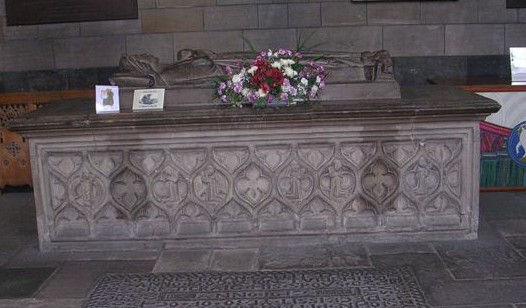
Tomb of Marjorie Bruce, Paisley Abbey

Robert II, King of Scots, had been born on 2 March 1316, as the grandson and heir of Robert the Bruce. His mother. Marjorie Bruce, had died at the time of his birth, or shortly after. He had been supplanted as his grandfather’s heir when Bruce’s queen, Elizabeth de Burgh, gave birth to a son, David Bruce, in 1324. David was crowned as King David II on his father’s death in 1329. Although only 5-years-old, David was already a married ‘man’, having wed Edward III’s 7-year-old sister, Joan of the Tower, in July 1328.

Edward III saw an opportunity in Scotland having a child-king and, notwithstanding the headache he was causing his own sister, he decided to support the claims, to the Scottish crown, of Edward Balliol, son of the deposed king, John Balliol, and his wife, Isabella de Warenne. Edward III invaded Scotland. King David and his young wife were sent to France for their safety, while the Scots fought for the kingdom. One of those leading the fight was Robert Stewart, David’s nephew – Robert the Bruce’s grandson. He had become High Steward of Scotland on his father’s death in 1327. He was made guardian of Scotland whilst still in his late teens and fought in the defeat of the Scots at Halidon Hill in July 1333, when he was still only 17.

Robert was David II’s heir – until the latter produced a son and heir of his own, at least. Uncle and nephew had a fractious relationship, even after David returned from French exile. David may have resented the reputation Robert had gained in fighting for Scottish independence, and he was certainly wary of Robert’s powerful position, as High Steward, guardian and – of course – as heir presumptive to the crown.
Books by Sharon Bennett Connolly
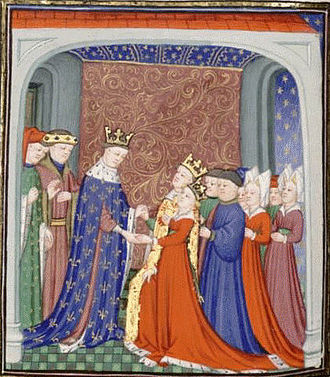
David II and Joan being greeted by Philip VI of France

Robert’s strength, however, lay not only in his proximity to the throne, but also in the fact he had managed to do what David had not, produce an heir. Six, in fact. Robert’s rather unusual marital situation, and perhaps the growing awareness, as the years went on, that there was less and less likelihood of David producing an heir, saw him apply for a papal dispensation to marry Elizabeth Mure, which was supported by King David, King Philip VI of France, the seven Scottish bishops and parliament. It was granted on 22 November 1347, at least ten years after the start of their relationship. The dispensation allowed for the retrospective legitimisation of their children:

This Robert took to his bed one of the daughters of Adam More, knight; and of her he begat sons and daughters, out of wedlock. But he afterwards – in the year 1349, to wit – bespoke and got the dispensation of the Apostolic See, and espoused her regularly, according to the forms of the Church.1

An earlier dispensation, issued in 1345, had annulled Elizabeth’s betrothal to Hugh Giffard. Elizabeth was the daughter of Adam Mure of Rowallon, Ayrshire. Though whether her mother was his first wife, Joan Cunnigham, or his second wife, Janet, is undetermined. The unusual nature of their relationship and marital situation has given rise to questions over the legitimacy of their children. According to John Riddell, the facts of the relationship are that:

Robert II, when related to Elizabeth Mure, in the third and fourth forbidden degrees of affinity, and the fourth forbidden degree of consanguinity, lived for a long space in concubinage with her, during which ‘prolis utriusque sexus multitudinem procrearunf’ – during that unhallowed, and in law, incestuous connection; till at last, resolving to marry, but discovering the double relationship between them, which was a bar to their marriage at common (Ecclesiastical) law, they then obtained a dispensation from Clement VI, in 1347, for the purpose, in ordinary form. After which it is in proof, that they did marry under authority of the dispensation, – Robert founding in 1364, in compliance with an injunction there, a Chaplainry, in expiation of his former offence, which was, by received doctrine at the time, deemed an aggravated one.2
Books by Sharon Bennett Connolly
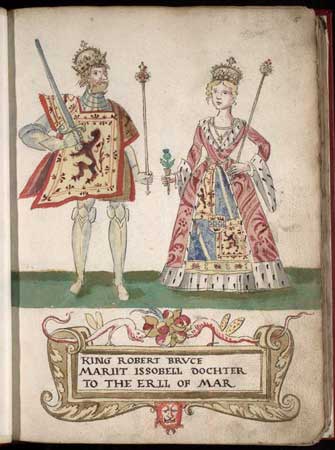
Robert II’s maternal grandparents, Robert the Bruce and his first wife, Isabella of Mar

It has been argued that the children of Robert and Elizabeth were not only born outside of marriage, but also that their parents were related within the limited degrees, and therefore the relationship was incestuous without a papal dispensation. This, however, ignores the possibility that Robert and Elizabeth did go through a form of marriage in the 1330s, when Scotland was deeply involved in its war with England and, with David II sent to France for his safety and Robert was the senior representative of the Bruce family in Scotland. Moreover, it may have been thought prudent that Robert should marry sooner, rather than later, for dynastic considerations. With Edward Balliol unmarried and with no heir, the fact that the king’s heir was married with children was significant, a sign that the Bruce–Stewart dynasty was secure, at least.

That the marriage was not regularised until the war was over could be excused by the fact there were more urgent matters to attend to and the financial and legal obligations of obtaining a dispensation could wait. This would certainly explain the papacy’s willingness to regulate the marriage by issuing a retroactive dispensation. Alternatively, they may have only recently discovered a familial relationship within the prohibited degrees, and therefore applied for a dispensation. Elizabeth and Robert then underwent a second, formal, marriage ceremony in 1349.

Their first child, John, had been born in about 1337 and was created Earl of Carrick in 1369, the title held by his great-grandfather, Robert the Bruce, before he became king. He would ascend the throne as Robert III on his father’s death in 1390. Although the birth order could be slightly different, it seems likely that John was followed by a sister, Margaret, who was married to John MacDonald, Lord of the Isles, as his second wife, for which a papal dispensation was issued on 14 June 1350. The couple were granted the island of Colowsay by Margaret’s father in a charter dated to July 1376. Three more sons followed, Walter, Robert and Alexander. Walter was married to Isabel, Countess of Fife, in April 1360 or 1361. He died sometime after 14 August 1362 but before the end of the year, as his widow married again, to Thomas Bisset of Upsetlington on 10 January 1363. She resigned the earldom of Fife to Walter’s brother, Robert Stewart, Earl of Menteith, on 30 March 1371.

Robert Stewart is identified as the ‘second born of the king’ in the Liber Pluscardensis. Robert was Earl of Menteith by right of his wife, Margaret Graham, a title she herself had inherited from her mother, Mary. Margaret had been married three times before; her first husband, Sir John Moray, was the son of Christian Bruce, King Robert I’s sister, by her last husband, Sir Andrew Murray. Robert was later created Duke of Albany and acted as regent during his brother’s reign.
Books by Sharon Bennett Connolly
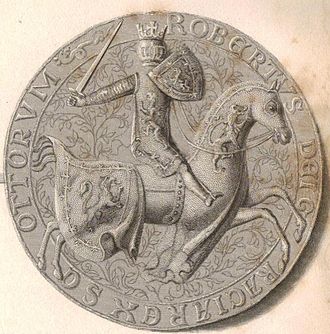
The reverse side of Robert II’s Great Seal

The third son, Alexander, has a significant reputation as a cruel and rapacious character, earning him the nickname, the Wolf of Badenoch. He married Euphemia, Countess of Ross and was Earl of Ross in her name. Euphemia resigned her share of Buchan to the king, who regranted it to Alexander and Euphemia, in July 1382, so that they were Earl and Countess of Ross and Buchan. The marriage had its difficulties and Alexander left his wife, for ‘Mariota’s daughter Athyn’ but was ordered to return to her, in a charter dated 2 November 1389, by the Bishop of Moray and Ross. Apparently, the breach was irretrievable, as Pope Clement VII ‘issued a commission to dissolve her marriage’ on 9 June 1392, and in December 1392 Euphemia was granted a divorce ‘from bed and board’.3 Although Alexander had seven illegitimate children, he and Euphemia had remained childless.

Robert II and Elizabeth Mure also had four more daughters, although their order of birth is unknown. Marjory married John Dunbar, the son of Patrick Dunbar and Isabel Randolph of Moray. He was created Earl of Moray by his father-in-law in March 1372. Marjory’s second husband was Alexander Keith of Grandown.

Jean, or Joan, Stewart was married three times, firstly to John Keith, son of William de Keith, the Marischal, in January 1374. John died just fourteen months later. A year after that, in either June or October 1376, Jean married Sir John Lyon of Glamis. On 4 October 1376, King Robert II granted land, the thanedom of Tannadyce in Forfar, possibly a wedding gift, ‘to his dearest son John Lyon and Johanna his wife, the King’s beloved daughter’.4 The marriage was initially kept secret and only publicly acknowledged on 10 May 1378 when the king, with the consent of his surviving sons, ‘granted to the spouses letters of acknowledgement and remission for any clandestine marriage formerly contracted by them, in regard a marriage had been solemnly celebrated between them in face of the Church, in presence of the King and his sons and other friends and relatives.’5 Further grants followed, but Sir John was killed, apparently murdered by Sir James Lindsay on 4 November 1382. According to the Liber Pluscardensis, the deed was done at night when the ‘victim was in bed and unsuspecting’.6 Their only child was John’s son and successor, also called John Lyon. On 20 November 1384, Jean married for a third and final time, to Sir James Sandilands of Calder. Ahead of the marriage, Sir James was granted the baronies of Dalzell, Motherwell and Wiston, to be held by Sir James and Jean, the king’s daughter, ‘whom God willing he is about to take to wife’.7 The princess is last mentioned in 1404, as ‘Lady Johanna of Glammys’. She was buried beside her second husband, Sir John Lyon, at Scone Abbey.

Another daughter, Elizabeth Stewart, married Thomas Hay, Baron of Erroll and Constable of Scotland. A charter issued by King Robert II granted an annuity to ‘Thomas Hay and Elizabeth the king’s daughter, and the children born and to be born of them’ dated 7 September 1372, the day of their marriage.8

Isabel Stewart was married twice, firstly to James Douglas, son of William Douglas, Earl of Douglas, and his wife, Margaret, Countess of Mar. A papal dispensation was issued for the marriage in September 1371 and James succeeded his father as Earl Douglas in 1384. Sir James died in 1388 and sometime in the next two years, Isabel married John Edmonstone of Duntreath. Isabel most likely died before 22 July 1410, when accounts record payments to ‘John Edmonstone … for the reason that he was once married to the Countess of Douglas’.9

Through the marriages of his sons and daughters, Robert Stewart created a familial network that extended his influence over the greater part of central, western and north-eastern Scotland. He formed unions with eight of the country’s fifteen existing earldoms as well as gaining other lordships, royal castles and offices north of the Forth-Clyde line. However, the unusual nature of the marriage of Robert and Elizabeth would always leave a question mark hanging over the legitimacy of their children, an uncertainty that the children of Robert’s second marriage would highlight and try to exploit.
Books by Sharon Bennett Connolly
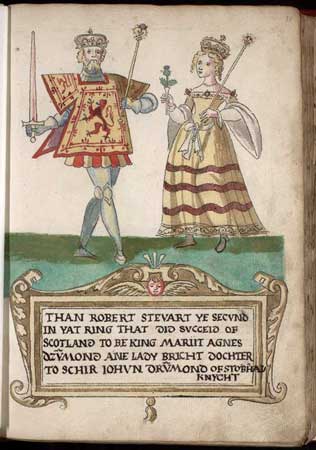
Robert III and his queen, Annabella Drummond

But it was Elizabeth’s eldest son, John, Earl of Carrick, who would succeed his father as King Robert III. Elizabeth herself, though married to David II’s heir, was never to become queen. She died sometime before 1355, possibly in childbirth as she would have been no more than in her late 30s, or perhaps from complications arising from having borne at least nine children, and possibly as many as thirteen. We have so little information about her that her place of burial is also unknown, though Paisley Abbey or Scone Abbey are possibilities. We only know that poor Elizabeth was dead by 1355 because 2 May of that year is the date of the papal dispensation for Robert Stewart’s second marriage, to Euphemia Ross.

Whatever the nature of their marriage, and the reason for the dispensation, it was not an arranged marriage for dynastic purposes. Robert and Elizabeth appear to have chosen each other. The number of children born, even during times of war, suggests that Robert and Elizabeth had a close and loving relationship. This did not, however, preclude Robert from marrying again, possibly only a short time after Elizabeth’s death. Walter Bower suggests that, although Robert’s relationship with Elizabeth Mure was earlier, the marriage only occurred after Queen Euphemia’s death:

It is noteworthy that the said King Robert fathered three sons by the Lady Elizabeth daughter of Sir Adam More, namely John who was later king, and Robert duke of Albany, and the said Alexander earl of Buchan, who was commonly called ‘The Wolf of Badenoch’. Later he married the Lady Euphemia daughter of Hugh earl of Ross, by whom he fathered Walter earl of Athol and lord of Brechin, and David earl of Strathearn. But on the death of Queen Euphemia he married the said Lady Elizabeth, and so by virtue of subsequent marriage, a second marriage ceremony, the said brothers John, Robert and Alexander were legitimated, for according to canon law a subsequent marriage legitimates sons born before the marriage.10
Books by Sharon Bennett Connolly
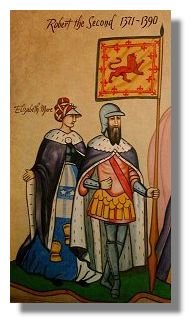
Robert II and Elizabeth Mure

This timeline, of course, does not work, as the papal dispensation, legitimising the children, was issued in 1347 and there is every indication that Elizabeth was dead before 1355.

King Robert II died at Dundonald Castle on 19 April 1390 and was buried at Scone Abbey. He had spent almost his entire life as heir presumptive to the Scottish throne, always waiting on the sidelines. It is a sad fact of history that we have very little insight into the personalities and appearances of Robert’s wives. We do not know, for instance, what either wife thought of his various mistresses, nor his illegitimate children. They cannot have been happy about his philandering but may have accepted it, reluctantly. It was certainly not an unusual trait in the men of the family, as both Robert the Bruce and David II had had a string of mistresses.

Robert’s first wife, Elizabeth Mure, never got to wear the crown, though her influence, through her children, would set the tone for the Scottish royal house of Stewart into the next century.

We shall leave the story Robert’s second wife, Queen Euphemia, for another day.

*

Images: courtesy of Wikipedia

Notes:

1. John of Fordun’s Chronicle of the Scottish Nation; 2. John Riddell, Stewartiana, containing the case of Robert II and Elizabeth Mure; 3. Sir James Balfour Paul, editor, The Scots Peerage, Vol. VII; 4. ibid, Vol VIII; 5. ibid; 6. ibid; 7. ibid; 8. Burnett (1880) Exchequer Rolls, Vol. IV; 9. ibid; 10. Bower, Scotichronicon, V 7.

Sources:

John of Fordun’s Chronicle of the Scottish Nation, edited by W. F. Skene; Walter Bower, Scotichronicon; John Riddell, Stewartiana, containing the case of Robert II and Elizabeth Mure; Sir James Balfour Paul, editor, The Scots Peerage; fmg.ac/Projects/MedLands/SCOTLAND; Susan Abernethy, The Two Wives of Robert II, King of Scots – Elizabeth Mure and Euphemia Ross; G. Barrow, G. (1978), The Aftermath of War: Scotland and England in the late Thirteenth and early Fourteenth Centuries; Rosalind K. Marshall, Scottish Queens 1034–1714; Nigel Tranter, The Story of Scotland; Richard Oram, editor, The Kings and Queens of Scotland; David Ross, Scotland, History of a NationLiber pluscardensis, edited by Felix James Henry Skene.

*

My Books

Signed, dedicated copies of all my books are available through my online bookshop.

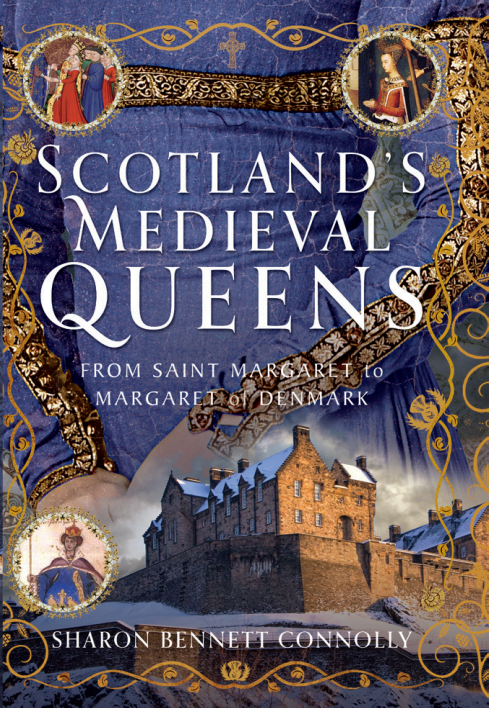
Out now: Scotland’s Medieval Queens

Books by Sharon Bennett Connolly

Scotland’s history is dramatic, violent and bloody. Being England’s northern neighbour has never been easy. Scotland’s queens have had to deal with war, murder, imprisonment, political rivalries and open betrayal. They have loved and lost, raised kings and queens, ruled and died for Scotland. From St Margaret, who became one of the patron saints of Scotland, to Elizabeth de Burgh and the dramatic story of the Scottish Wars of Independence, to the love story and tragedy of Joan Beaufort, to Margaret of Denmark and the dawn of the Renaissance, Scotland’s Medieval Queens have seen it all. This is the story of Scotland through their eyes.

Scotland’s Medieval Queens gives a thorough grounding in the history of the women who ruled Scotland at the side of its kings, often in the shadows, but just as interesting in their lives beyond the spotlight. It’s not a subject that has been widely covered, and Sharon is a pioneer in bringing that information into accessible history.’ Elizabeth Chadwick (New York Times bestselling author)

Available now from Amazon and Pen and Sword Books

Coming 30 March 2026: Princesses of the Early Middle Ages
Books by Sharon Bennett Connolly

Daughters of kings were often used to seal treaty alliances and forge peace with England’s enemies. Princesses of the Early Middle Ages: Royal Daughters of the Conquest explores the lives of these young women, how they followed the stereotype, and how they sometimes managed to escape it. It will look at the world they lived in, and how their lives and marriages were affected by political necessity and the events of the time. Princesses of the Early Middle Ages will also examine how these girls, who were often political pawns, were able to control their own lives and fates. Whilst they were expected to obey their parents in their marriage choices, several princesses were able to exert their own influence on these choices, with some outright refusing the husbands offered to them.

Their stories are touching, inspiring and, at times, heartbreaking.

Princesses of the Early Middle Ages: Royal Daughters of the Conquest is now available for pre-order.

Also by Sharon Bennett Connolly:

Books by Sharon Bennett Connolly

Heroines of the Tudor World tells the stories of the most remarkable women from European history in the time of the Tudor dynasty, 1485-1603. These are the women who ruled, the women who founded dynasties, the women who fought for religious freedom, their families and love. Heroines of the Tudor World is now available from Amberley Publishing and Amazon UK. Women of the Anarchy demonstrates how Empress Matilda and Matilda of Boulogne, unable to wield a sword themselves, were prime movers in this time of conflict and lawlessness. It shows how their strengths, weaknesses, and personal ambitions swung the fortunes of war one way – and then the other. Available from Bookshop.orgAmberley Publishing and Amazon UKKing John’s Right-Hand Lady: The Story of Nicholaa de la Haye is the story of a truly remarkable lady, the hereditary constable of Lincoln Castle and the first woman in England to be appointed sheriff in her own right. Available from all good bookshops Pen & Sword Booksbookshop.org and Amazon

Royal Historical Society

Defenders of the Norman Crown: The Rise and Fall of the Warenne Earls of Surrey tells the fascinating story of the Warenne dynasty, from its origins in Normandy, through the Conquest, Magna Carta, the wars and marriages that led to its ultimate demise in the reign of Edward III. Available from Pen & Sword BooksAmazon in the UK and US, and Bookshop.orgLadies of Magna Carta: Women of Influence in Thirteenth Century England looks into the relationships of the various noble families of the 13th century, and how they were affected by the Barons’ Wars, Magna Carta and its aftermath; the bonds that were formed and those that were broken. It is now available in paperback and hardback from Pen & SwordAmazon, and Bookshop.orgHeroines of the Medieval World tells the stories of some of the most remarkable women from Medieval history, from Eleanor of Aquitaine to Julian of Norwich. Available now from Amberley Publishing and Amazon, and Bookshop.orgSilk and the Sword: The Women of the Norman Conquest traces the fortunes of the women who had a significant role to play in the momentous events of 1066. Available now from Amazon,  Amberley Publishing, and Bookshop.org.

Alternate Endings: An anthology of historical fiction short stories including Long Live the King… which is my take what might have happened had King John not died in October 1216. Available in paperback and kindle from Amazon.

Podcast:

A Slice of Medieval

Have a listen to the A Slice of Medieval podcast, which I co-host with Historical fiction novelist Derek Birks. Derek and I welcome guests, such as Ian Mortimer, Bernard Cornwell, Elizabeth Chadwick and Scott Mariani, and discuss a wide range of topics in medieval history, from significant events to the personalities involved. 

There are now over 80 episodes to listen to!

Every episode is also now available on YouTube.

*

Don’t forget! Signed and dedicated copies of all my books are available through my online bookshop.

For forthcoming online and in-person talks, please check out my Events Page.

You can be the first to read new articles by clicking the ‘Follow’ button, liking our Facebook page or joining me on TwitterThreadsBluesky and Instagram.

*

©2025 Sharon Bennett Connolly FRHistS
Book Corner: The Royal Rebel by Elizabeth Chadwick

1338: England has declared war on France, and Jeanette of Kent, cousin to King Edward III, says goodbye to her family and travels overseas with the royal court for the first time. Once in Antwerp, she is captivated by talented household knight Thomas Holland, just as he in turn is powerfully drawn to her.

Although both know their romance is forbidden, their love for each other grows stronger than the danger they face, and they marry in secret. But before they can make their tryst known, Thomas has to leave for war, and in his absence, Jeanette is forced into a second marriage and locked away from the world.

Then Thomas returns, and the real fight begins. As hostile family members battle to keep Jeanette and Thomas apart, the defiant lovers vow to be reunited – whatever the cost…

It is always the sign of a good book if the author can leave me in tears and send me through a range of emotions from beginning to end. In The Royal Rebel, Elizabeth Chadwick has achieved this and then some!

The controversy over Joan of Kent‘s first marriage is fascinating. There are so many possibilities and connotations. And so much politics! Girls in medieval times were not supposed to choose their own husbands. Marriage was a political alliance for noble families, not a love affair. Romance had nothing to do with it.

The Royal Rebel is the story of the most famous ‘love triangle’ of the14th century. Joan, the daughter of the Earl of Kent, secretly married Thomas Holland, who then went off on crusade for a year. In the mean time, Joan’s mother arranged her daughter’s marriage to William Montague, the heir to the earldom of Salisbury. It was a mutually beneficial marriage. Joan had royal blood, but tainted by the fact her father had been executed. While Montague was the heir to a large earldom but would benefit from a closer connection to the crown. Thomas Holland, on the other hand, was a household knight with few prospects and whose father had been executed for treason. And when he returned from crusading in Eastern Europe, due to financial constraints, he did not immediately lay claim to his wife.

It was a storyline worthy of a modern-day soap opera.

Thomas Holland took his claims that he and Joan were married all the way to Rome. The investigation into the marriage was long, drawn-out legalese, mired in canon law and I did wonder how Elizabeth Chadwick was going to make it interesting. Of course! I needn’t have feared. She draws out the tension, adds in the human element, family dynamics and political considerations and keeps the reader gripped to the very end – even though I already knew the outcome!

The next day, Jeanette [Joan of Kent], Joan, Hawise and several other ladies from the Queen’s chamber gathered to dole out arms to the poor at the monastery gates. Usually, the almoners and designated servants distributed the donations, but today, in thanksgiving, the Queen’s ladies were involved in the task, and as well as the food, small amounts of money and items of clothing were handed out.

Jeanette played her part with a whole heart and a wide and ready smile. She was in charge of dispensing the bread, while Joan ladled pottage into the bowls people had brought them. Thomas and Otto arrived with their retinues to assist and stand guard, and the loaves of bread and jugs of beer were soon emptied, and all the money and clothing gone.

‘Thank you,’ Jeanette said, smiling at Thomas as she gathered up the empty baskets.

‘It has been my pleasure, demoiselle.’

He had brought one of his old hoods and two thick blankets to give away and had provided a small purse of alms money. His manner towards the folk who had come to receive charity had been courteous and good-humoured. Jeanette had noted his common touch which did not detract from the authority he possessed to lead men and maintain his rank. He had tousled a small boy’s hair, and jested with a toothless old woman who had cackled at him with lecherous appreciation, saying if she had been thirty years younger…

Once more, he escorted her and the ladies back to the royal apartments, and carried the baskets himself.

‘You look like a housewife going to market,’ she said, amused and very aware of his presence at her side. Their pace was a saunter, eking out the moment.

‘Looks can be deceptive,’ he replied. ‘It is what lies beneath that matters.’

He leaned a little towards her, and Jeanette’s breath shortened.

‘Then I suppose that like all truth it is buried, and must be sought by diligent investigation,’ she said pertly, giving as good as she got, and was rewarded by a flash of his grin.

‘I have always found that to be the case, demoiselle,’ he said, as they came to the Queen’s door. ‘And usually well rewarded.’

The Royal Rebel by Elizabeth Chadwick is no mere romance. It is the story of a trying decade in the reign of Edward III. Just as he embarks on the Hundred Years War with France (I wonder if he would have been so keen, if someone had told him the war’s eventual name?), plague ravages Europe and the court is gripped by the scandal of Joan’, Thomas and William’s marital situation. The detail is impressive.

Elizabeth Chadwick is moving into a period new to her, the late medieval; away from the 12th and 13th centuries of which she is so familiar. Not that you would know it. Her research has been meticulous and her attention to detail, to the dress and customs of the period, is second-to-none. Elizabeth Chadwick has really thought about the circumstances involving the clandestine marriage of Joan of Kent and Tomas Holland – and the very public marriage of Joan and Willian Montague. And how all this came about! The plot is intricate but entirely plausible and answers several questions around the actions of the parties involved.

The Royal Rebel also highlights the quandary over inheritance that would always hang over Joan’s marriage to Montague whilst the question mark remained over the validity of their marriage. Would any children have even been legitimate? Joan’s frustrations over her treatment is palpable; not being allowed to be with her true husband, being ignored by her elders, not being believed and even being prevented from freely giving her testimony in the court case. The Salisburys even locked her up!

The Royal Rebel by Elizabeth Chadwick is not just a good read, it is an experience of life in the mid-14th century and not to be missed.

The Royal Rebel by Elizabeth Chadwick is most definitely among my Top 5 books of 2024. I cannot recommend it highly enough!

To Buy the Book:

The Royal Rebel by Elizabeth Chadwick is now available from Amazon and all good bookshops.

About the Author:

New York Times bestselling author Elizabeth Chadwick lives in a cottage in the Vale of Belvoir in Nottinghamshire with her husband and their three dogs. Her first novel, The Wild Hunt, won a Betty Trask Award, To Defy a King won the Romantic Novelist Association’s Historical Novel Prize and The Scarlet Lion was nominated by Richard Lee – founder of the Historical Novel Society – as one of the top ten historical novels of the last decade. She often lectures at conferences and historical venues, has been consulted for television documentaries and is a member of the Royal Historical Society.

Keep in touch with Elizabeth via her website, her blogs or on social media.

http://www.elizabethchadwick.com
twitter: @chadwickauthor
facebook: ElizabethChadwick

*

My Books:

Signed, dedicated copies of all my books are available through my online bookshop.

Coming 30 January 2025: Scotland’s Medieval Queens

Scotland’s history is dramatic, violent and bloody. Being England’s northern neighbour has never been easy. Scotland’s queens have had to deal with war, murder, imprisonment, political rivalries and open betrayal. They have loved and lost, raised kings and queens, ruled and died for Scotland. From St Margaret, who became one of the patron saints of Scotland, to Elizabeth de Burgh and the dramatic story of the Scottish Wars of Independence, to the love story and tragedy of Joan Beaufort, to Margaret of Denmark and the dawn of the Renaissance, Scotland’s Medieval Queens have seen it all. This is the story of Scotland through their eyes.

Available for pre-order now.

Also by Sharon Bennett Connolly:

Heroines of the Tudor World tells the stories of the most remarkable women from European history in the time of the Tudor dynasty, 1485-1603. These are the women who ruled, the women who founded dynasties, the women who fought for religious freedom, their families and love. Heroines of the Tudor World is now available for pre-order from Amberley Publishing and Amazon UK. Women of the Anarchy demonstrates how Empress Matilda and Matilda of Boulogne, unable to wield a sword themselves, were prime movers in this time of conflict and lawlessness. It shows how their strengths, weaknesses, and personal ambitions swung the fortunes of war one way – and then the other. Available from Bookshop.orgAmberley Publishing and Amazon UKKing John’s Right-Hand Lady: The Story of Nicholaa de la Haye is the story of a truly remarkable lady, the hereditary constable of Lincoln Castle and the first woman in England to be appointed sheriff in her own right. Available from all good bookshops Pen & Sword Booksbookshop.org and Amazon

Defenders of the Norman Crown: The Rise and Fall of the Warenne Earls of Surrey tells the fascinating story of the Warenne dynasty, from its origins in Normandy, through the Conquest, Magna Carta, the wars and marriages that led to its ultimate demise in the reign of Edward III. Available from Pen & Sword BooksAmazon in the UK and US, and Bookshop.orgLadies of Magna Carta: Women of Influence in Thirteenth Century England looks into the relationships of the various noble families of the 13th century, and how they were affected by the Barons’ Wars, Magna Carta and its aftermath; the bonds that were formed and those that were broken. It is now available in paperback and hardback from Pen & SwordAmazon, and Bookshop.orgHeroines of the Medieval World tells the stories of some of the most remarkable women from Medieval history, from Eleanor of Aquitaine to Julian of Norwich. Available now from Amberley Publishing and Amazon, and Bookshop.orgSilk and the Sword: The Women of the Norman Conquest traces the fortunes of the women who had a significant role to play in the momentous events of 1066. Available now from Amazon,  Amberley Publishing, and Bookshop.org.

Alternate Endings: An anthology of historical fiction short stories including Long Live the King… which is my take what might have happened had King John not died in October 1216. Available in paperback and kindle from Amazon.

Podcast:

Have a listen to the A Slice of Medieval podcast, which I co-host with Historical fiction novelist Derek Birks. Derek and I welcome guests, such as Bernard Cornwell, and discuss a wide range of topics in medieval history, from significant events to the personalities involved, including Elizabeth Chadwick discussing her writing of The Royal Rebel as a guest for the 2024 HNS Conference’s Writing Medieval panel, alongside Matthew Harffy and David Gilman.

*

Don’t forget! Signed and dedicated copies of all my books are available through my online bookshop.

For forthcoming online and in-person talks, please check out my Events Page.

You can be the first to read new articles by clicking the ‘Follow’ button, liking our Facebook page or joining me on TwitterThreadsBluesky and Instagram.

©2024 Sharon Bennett Connolly FRHistS
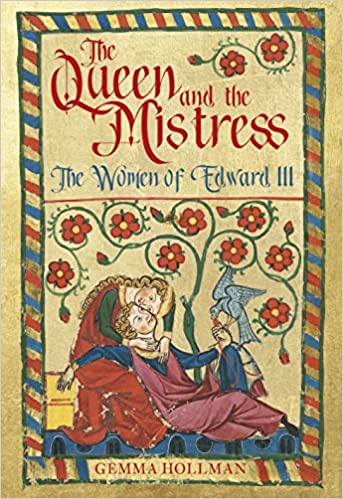
Guest Post: Alice Perrers, from Goldsmith’s Daughter to Lady of the Sun by Gemma Hollman

Today it is an absolute pleasure to welcome author and historian Gemma Hollman to History…the Interesting Bits as a stop on her blog tour for her latest book. The Queen and the Mistress: The Women of Edward III is a fascinating dual biography of Philippa of Hainault, queen of Edward III, and Alice Perrers, the king’s mistress.

Alice Perrers: From Goldsmith’s Daughter to Lady of the Sun

King Edward III

In the medieval period, a popular image came to be used to describe human life and society: that of the Wheel of Fortune. The idea was that the ancient goddess Fortuna was in control of a wheel which she would spin. People sat at various points on the wheel, and as Fortuna turned the wheel people would rise up to great heights, or drop to great lows. Medieval writers became enamoured with the symbolism of great people having a great fall because of the spinning of Fortune’s Wheel. One fourteenth-century courtier who epitomised the wheel was a woman named Alice Perrers, who was lucky enough to rise higher than her contemporaries could have imagined – but who also spun back down again.

Alice Perrers has been an enigma for centuries. Even many of her contemporaries did not really know who she was or where she came from, with chroniclers like Thomas Walsingham of St Albans Abbey making disparaging guesses to her lowly origins. Recent research has shown that Alice most likely came from a goldsmithing family in London, and so whilst she was not close to the upper echelons of society, when looking at the country as a whole she would have had a reasonable upbringing. The merchant classes had seen an upturn in their wealth during the reign of Edward III, who had been on the throne officially since 1327, and so Alice’s family probably enjoyed the benefits of this.

As the daughter of a trade family, Alice may have had some basic education, and her life initially followed the path of the majority of women of her time. She was married off, likely as a teenager, to another London goldsmith, and the couple found further wealth through the favour of the king; her husband was known to have supplied jewels to Edward III himself. But soon, Alice’s life took a turn when her husband died. The couple had no children, and her future was uncertain. Prospects for young widows were not always promising.

Queen Philippa of Hainault

Here, Fortuna turned her wheel and set Alice onto the path of greatness. She somehow found her way to court, in one of the most coveted positions in the kingdom as she became a damsel to Edward III’s wife, Queen Philippa of Hainault. Alice was catapulted into the wealth and glamour of the English monarchy. The court was filled with many of the greatest nobles of the period, including at times the captured French king, and it was a place filled with feasting, jousting, jewels, music, and writing. As one of the queen’s damsels, Alice had a place at centre stage to all that was going on. She would accompany the queen as she travelled across her various castles and attended events, and she was entitled to luxurious clothes. It must have seemed like life could not get better.

But Alice was an intelligent, ambitious, shrewd woman. Not content to simply receive the gifts afforded to her as a lady-in-waiting, Alice started to build up connections at court. She wined and dined with many powerful knights, merchants, and members of the nobility. She began to lend money and make property deals, extracting favourable terms for herself. Soon she had pieces of land of her own – quite a feat for a single woman of her status. But that was not all that Alice had obtained at court, for she had caught the eye of the king himself. Soon, a relationship began between them.

Edward III had been a loyal husband to his wife for over 30 years, but by the 1360s Philippa was severely unwell. It was clear she was not going to live for many more years, and this may have provided the impetus for Edward’s eyes to wander. Alice was a perfect choice for him. Young, likely beautiful, headstrong, it is easy to see why Edward found her attractive. But Edward had spent decades cultivating an image as a loyal, family man, and so the couple did their best to keep their relationship secret. If nothing else, to save the queen public humiliation.

The secrecy did not dampen their relationship, and within a few years Alice had given birth to 3 children with the king. At the end of the decade, the great queen died, and it was not long before Alice shifted to a more prominent place at court. Soon everybody knew that Alice had the king’s heart – and with it, a significant share of power. People were soon rushing to Alice to obtain favours with the king, offering her pieces of property and whatever else they thought she might like in the hope she may get them something in return. Even the Pope petitioned this mistress for help.

Alice Perrers and Edward III, painted by Ford Maddox Brown

As the 1370s wore on, Alice rose to the greatest heights of the wheel, almost taking on the position of unofficial queen. During the king’s jubilee year, Alice took centre stage in celebrations dressed as the Lady of the Sun. But as medieval writers loved to point out, the wheel also was fond of dropping people into a fall, and so too was this to happen to Alice. Eventually, the men at court got fed up with the undue influence of Alice and her friends on the king. They felt that those of old noble blood should be the only ones to advise the king, and finally the knights of the land gathered together at the Good Parliament to end their evil influence once and for all. Alice was banished from the king’s presence, and after his death the full weight of the law came for her. She was banished further – this time from the entire kingdom of England – and all of her hard-earned lands, jewels, and goods were taken from her.

But Alice was clever, and she had made contingency plans. She knew that her presence at court grated on those around her, and she had found powerful allies. It emerged that she had undertaken a secret marriage to a powerful knight, and he wasn’t going to give up Alice’s wealth. The couple fought for years to obtain the return of Alice’s possessions, and it was a fight that she carried with her to her death. Many of Alice’s female contemporaries had two paths in life: marriage or a nunnery. But Alice chose to forge one of her own, that of mistress and a powerful single woman. Was she as evil as her later reputation suggested? Or was there something more underneath the surface?

*

About the book:

IN A WORLD WHERE MAN IS KING, CAN WOMEN REALLY HAVE IT ALL – AND KEEP IT?

Philippa of Hainault was Queen of England for forty-one years. Her marriage to Edward III, when they were both teenagers, was more political transaction than romantic wedding, but it would turn into a partnership of deep affection. The mother of twelve children, she was the perfect medieval queen: pious, unpolitical and fiercely loyal to both her king and adopted country.

Alice Perrers entered court as a young widow and would soon catch the eye of an ageing king whose wife was dying. Born to a family of London goldsmiths, this charismatic and highly intelligent woman would use her position as the king’s favourite to build up her own portfolio of land, wealth and prestige, only to see it all come crashing down as Edward himself neared death.

The Queen and the Mistress is a story of female power and passion, and how two very different women used their skills and charms to navigate a tumultuous royal court – and win the heart of the same man.

To buy the book: Amazon

About the author:

Gemma Hollman is a historian and author who specialises in late medieval English history. A Fellow of the Royal Historical Society, her first book ‘Royal Witches’ was published in 2019 and her second book ‘The Queen and the Mistress’ will be released in November 2022. She has a particular interest in the plethora of strong, intriguing and complicated women from the medieval period, a time she had always been taught was dominated by men.

Gemma also works full-time in the heritage industry whilst running her historical blog, Just History Posts, which explores all periods of history in more depth.

*

My Books:

Signed, dedicated copies of all my books are available, please get in touch by completing the contact me form.

Defenders of the Norman Crown: The Rise and Fall of the Warenne Earls of Surrey tells the fascinating story of the Warenne dynasty, of the successes and failures of one of the most powerful families in England, from its origins in Normandy, through the Conquest, Magna Carta, the wars and marriages that led to its ultimate demise in the reign of Edward III. Defenders of the Norman Crown: Rise and Fall of the Warenne Earls of Surrey is now available from Pen & Sword BooksAmazon in the UK and US, Bookshop.org and Book Depository.

1 family. 8 earls. 300 years of English history!

Also by Sharon Bennett Connolly:

Ladies of Magna Carta: Women of Influence in Thirteenth Century England looks into the relationships of the various noble families of the 13th century, and how they were affected by the Barons’ Wars, Magna Carta and its aftermath; the bonds that were formed and those that were broken. It is now available in paperback and hardback from Pen & Sword, AmazonBookshop.org and from Book Depository worldwide.

Heroines of the Medieval World tells the stories of some of the most remarkable women from Medieval history, from Eleanor of Aquitaine to Julian of Norwich. Available now from Amberley Publishing and Amazon, Bookshop.org and Book Depository.

Silk and the Sword: The Women of the Norman Conquest traces the fortunes of the women who had a significant role to play in the momentous events of 1066.  Available now from Amazon,  Amberley Publishing, Bookshop.org and Book Depository.

Alternate Endings: An anthology of historical fiction short stories including Long Live the King… which is my take what might have happened had King John not died in October 1216. Available in paperback and kindle from Amazon.

*

You can be the first to read new articles by clicking the ‘Follow’ button, liking our Facebook page or joining me on Twitter and Instagram.

©2022 Sharon Bennett Connolly FRHistS

Yorkshire’s Little Prince

Æthelread II (known to history as the Æthelread Unready)

It may come as no surprise that very few royals have been born in Yorkshire over the years. There was Ӕlfgifu of York, the first wife of Ӕthelred II (known to history as Ӕthelred the Unready). Ӕlfgifu was the daughter of the earl of Northumbria and the marriage was intended to strengthen the links between the north and south of England. Ӕlfgifu was the mother of, among others, Edmund II Ironside, and therefore the great-grandmother of Margaret of Wessex, (St Margaret) Queen of Scots as the wife of Malcolm III Canmor. Ӕlfgifu died before April 1002 when Ӕthelred II married his second wife, Emma of Normandy.

Another royal with links to Yorkshire was Henry I. The youngest son of William the Conqueror and Matilda of Flanders, Henry was the only king of England born in Yorkshire. Henry was born in Selby in the summer of 1068, whilst his father was in the county, stamping out rebellion and pursuing his Harrying of the North. He would seize the throne in 1100 following the death of his older brother, William II Rufus, in a hunting accident in the New Forest. In the same year, Henry would marry Edith of Scotland, who changed her name to Matilda on her marriage. As the daughter of Malcolm III and St Margaret, Edith/Matilda was herself a descendant of Ӕthelred II and Ӕlfgifu of York.

There is also, of course, Edward of Middleham, the son of Richard III, who spent his short life, of no more than 10 years, living in Yorkshire. He was created Prince of Wales in a ceremony in York Minster in a lavish ceremony in September 1483. Edward died on 9 April 1484, a year to the day after the unexpected death of his uncle, Edward IV.

One other medieval royal born in Yorkshire, a little prince who spent his entire – though tragically short – life in our great county. William of Hatfield.

I read a book recently that mistakenly said William of Hatfield was born in Hatfield, Hertfordshire. I was amazed that the author wasn’t aware that he was actually born at the royal hunting lodge of Hatfield, near Doncaster. I thought everyone knew this! Then I realised that most people, when talking about royals and Hatfield, would automatically think of the Hertfordshire Hatfield. It was, after all, where Queen Elizabeth I was living when she was told that she was queen of England. It makes sense that most people would think of that Hatfield first.

But I’m a Yorkshire lass and, as I say, we don’t get many royals born up our way. So, I suppose, when we do, we know about them.

Monument to William of Hatfield, York Minster

William of Hatfield was the fourth child and second son of Edward III and Philippa of Hainault. The king and queen were keeping Christmas at the manor of Hatfield, in the old West Riding of Yorkshire, in 1336, when Prince William was born. Hatfield was situated in the midst of the royal hunting grounds of Hatfield Chase and was close to the Earl Warenne’s hunting lodge of Peel Castle, Thorne. The young prince was baptised by William Melton, Archbishop of York, but died soon afterwards. After his death, the little prince’s body was transported a little further north, to York. On 10 February 1337, William was buried in York Minster, the church in which his parents had been married in January 1328. His short life memorialised by an elaborate tomb surmounted with his effigy and located in the north quire aisle of the Minster, though the site of his grave is now lost.

In 1345, the tragic little prince’s story was caught up in the marital affairs of John de Warenne, 7th and last earl of Warenne and Surrey. John had been married to a granddaughter of King Edward I, Joan of Bar, in 1306, when John was 20 years old and Joan a girl of 10. The marriage was a disaster, with John having a number of affairs and spending many years trying to obtain a divorce. In pursuit of this divorce, and in the hope of finally being able to marry his mistress of the time, Isabella Holland, John claimed that he had had an affair before marrying Joan, with his wife’s maternal aunt Mary of Woodstock, when he was 19 and Mary 27 years of age. This was indeed a drastic claim, as Mary had been a nun since she was about 7 years old, and it was probably born out of desperation; John was becoming increasingly infirm and still had no heir to succeed him. It was a last-ditch attempt to marry Isabella and have legitimate children. It failed, though the earl’s confession was presented to Pope Clement VI who,

on 15 May, 1345, issued a mandate to the Bishop of S. Asaph to absolve John de Warenne, Earl of Surrey and Stratherne, Lord of Bromfeld and Yale, from excommunication, which he has incurred by inter-marrying with Joan, daughter of Henry, Count de Barre, whose mother’s sister, Mary, he had carnally known. A penance is to be enjoined; and as to the marriage, canonical action is to be taken.

Calendar of Papal Registers, Papal Letters (p. 116) quoted in Fairbank, ‘The Last Earl of Warenne and Surrey’, p. 245
Roche Abbey, South Yorkshire

No further action seems to have been taken with regards to the marriage. John and Joan would remain husband and wife until John’s death at Conisbrough Castle at the end of June, 1347. John’s penance, however, appears to have been the generous donation of the manor of Hatfield to Roche Abbey:

1345. November 22. Westminster. Whereas the King’s kinsman, John de Warenna, Earl of Surrey, holds the manor of Haytfield for life of the grant of Edward II, with successive remainders to Maud de Neyrford for life, to John de Warenna her son, in tail male, to Thomas his brother, in tail male, and to the heirs of the body of the said earl, and reversion to the said King and his heirs, as in the letters patent is more fully contained; the earl has now made petition that – Whereas the said Maud is dead, and John son of Maud and Thomas have taken the religious habit in the Order of the Brethren of the Hospital of S. John of Jerusalem in England, at Clerkenwell, he may have licence to grant for his life to the abbot and convent of Roche, the advowson of the church of Haytfield, held in chief, which church is extended, of the value of 70 marks yearly; and the King has assented to his petition. Also, as a further grace, the King has granted that the abbot and convent shall retain in frankalmoign the said advowson, which should revert to him on the death of the earl; and may appropriate the church whenever they deem it expedient to do so, to find thirteen monks as chaplains to celebrate divine service daily for ever in the abbey for the King, Queen Philippa, and their children, and for the earl; also for the soul of William, the King’s son, who lately died in the said manor; also the souls of the progenitors of the King and of the earl.

Calendar of Papal Registers, Papal Letters (p. 116) quoted in Fairbank, ‘The Last Earl of Warenne and Surrey’, p. 246

It is touching that John’s penance also served as a means for the king and queen to remember their infant son, William, who had been born in late 1336 at the manor of Hatfield, Doncaster, and died there in early 1337.

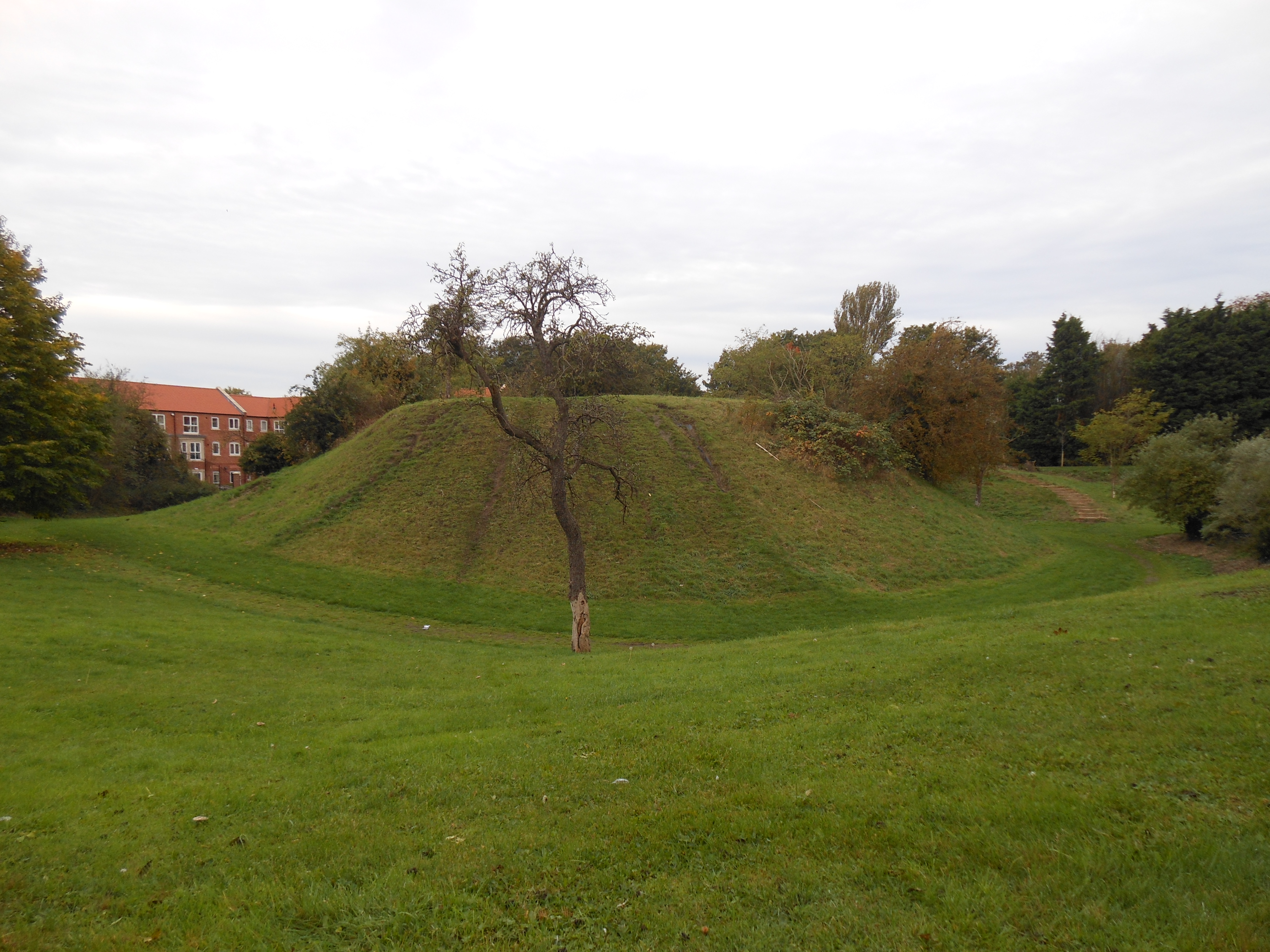
The motte of Peel Castle, Thorne, near Doncaster

William had been born six years after his older brother Edward, known to history as the Black Prince, who was their father Edward III’s heir, until his death in 1376, a year before the king. As a consequence, Edward III was succeeded by the Black Prince’s only surviving son by his wife, Joan of Kent, Richard II. It was the usurpation of Henry IV, who seized the crown from King Richard in 1399, that caused the fatal rivalry of the royal houses of Lancaster and York. Had William survived to adulthood, the story of England in the 15th century could have been very different; the rival houses of Lancaster and York were both descended from sons of Edward III who were younger than William.

Had he lived, the Wars of the Roses may never have happened….

*

Images:

Courtesy of Wikipedia, except Peel Castle and Roche Abbey, which are © Sharon Bennett Connolly

Sources: 

The Oxford Companion to British History Edited by John Cannon; The Plantagenets, the Kings who Made England by Dan Jones; History Today Companion to British History Edited by Juliet Gardiner and Neil Wenborn;  Brewer’s British Royalty by David Williamson; Britain’s Royal Families, the Complete Genealogy by Alison Weir; Early Yorkshire Charters Volume 8, Edited by William Farrer and Charles Travis Clay; Conisbrough Castle by Steven Brindle and Agnieszka Sadraei; The Mammoth Book of British Kings and Queens by Mike Ashley; The Plantagenets, the Kings that made Britain by Derek Wilson; oxforddnb.com; royaldescent.net; Fairbank, F. Royston, ‘The Last Earl of Warenne and Surrey, and the Distribution of hisPossessions’, The Yorkshire Archaeological Journal, vol. XIX, (1907), pp. 193–266; Historic England, ‘Peel Hill Motte and Bailey Castle, Thorne’, historicengland.org.uk; ‘Peel Hill Motte’, http://historyofthorne.com/peel_hill.html

*

My Books:

Signed, dedicated copies of all my books are available through my online bookshop.

Out Now! Women of the Anarchy

Two cousins. On the one side is Empress Matilda, or Maud. The sole surviving legitimate child of Henry I, she is fighting for her birthright and that of her children. On the other side is her cousin, Queen Matilda, supporting her husband, King Stephen, and fighting to see her own son inherit the English crown. Women of the Anarchy demonstrates how these women, unable to wield a sword, were prime movers in this time of conflict and lawlessness. It show how their strengths, weaknesses, and personal ambitions swung the fortunes of war one way – and then the other.

Available from Bookshop.orgAmberley Publishing and Amazon UK.

Coming on 15 June 2024: Heroines of the Tudor World

Heroines of the Tudor World tells the stories of the most remarkable women from European history in the time of the Tudor dynasty, 1485-1603. These are the women who ruled, the women who founded dynasties, the women who fought for religious freedom, their families and love. These are the women who made a difference, who influenced countries, kings and the Reformation. In the era dominated by the Renaissance and Reformation, Heroines of the Tudor World examines the threats and challenges faced by the women of the era, and how they overcame them. From writers to regents, from nuns to queens, Heroines of the Tudor World shines the spotlight on the women helped to shape Early Modern Europe.

Heroines of the Tudor World is now available for pre-order from Amberley Publishing and Amazon UK.

Also by Sharon Bennett Connolly:

King John’s Right-Hand Lady: The Story of Nicholaa de la Haye is the story of a truly remarkable lady, the hereditary constable of Lincoln Castle and the first woman in England to be appointed sheriff in her own right. It is is available from King John’s Right-Hand Lady: The Story of Nicholaa de la Haye is the story of a truly remarkable lady, the hereditary constable of Lincoln Castle and the first woman in England to be appointed sheriff in her own right. Available from all good bookshops or direct from Pen & Sword Booksbookshop.org and AmazonDefenders of the Norman Crown: The Rise and Fall of the Warenne Earls of Surrey tells the fascinating story of the Warenne dynasty, from its origins in Normandy, through the Conquest, Magna Carta, the wars and marriages that led to its ultimate demise in the reign of Edward III. Available from Pen & Sword BooksAmazon in the UK and US, and Bookshop.org

Ladies of Magna Carta: Women of Influence in Thirteenth Century England looks into the relationships of the various noble families of the 13th century, and how they were affected by the Barons’ Wars, Magna Carta and its aftermath; the bonds that were formed and those that were broken. It is now available in paperback and hardback from Pen & Sword,  Amazon, and Bookshop.orgHeroines of the Medieval World tells the stories of some of the most remarkable women from Medieval history, from Eleanor of Aquitaine to Julian of Norwich. Available now from Amberley Publishing and Amazon, and Bookshop.orgSilk and the Sword: The Women of the Norman Conquest traces the fortunes of the women who had a significant role to play in the momentous events of 1066. Available now from Amazon,  Amberley Publishing, and Bookshop.org.

Alternate Endings: An anthology of historical fiction short stories including Long Live the King… which is my take what might have happened had King John not died in October 1216. Available in paperback and kindle from Amazon.

Podcast:

Have a listen to the A Slice of Medieval podcast, which I co-host with Historical fiction novelist Derek Birks. Derek and I welcome guests, such as Bernard Cornwell and Elizabeth Chadwick, and discuss a wide range of topics in medieval history, from significant events to the personalities involved.

*

Don’t forget! Signed and dedicated copies of all my books are available through my online bookshop.

For forthcoming online and in-person talks, please check out my Events Page.

You can be the first to read new articles by clicking the ‘Follow’ button, liking our Facebook page or joining me on Twitter and Instagram.

*

©2021 Sharon Bennett Connolly, FRHistS

Women in Love: Katherine Swynford and Joan Beaufort, Queen of Scots

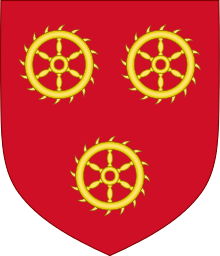
The coat of arms of Katherine Swynford

Sometimes the similarities in the stories of medieval women are intriguing. Especially among families. Katherine Swynford’s story is one of the endurance of love and is unique in that she eventually married her prince. Katherine’s granddaughter, Joan Beaufort, is one half of, arguably, the greatest love story of the middle ages. I say arguably, of course, because many would say that Katherine’s was the greatest.

You may not consider a mistress as a heroine, seeing her as ‘the other woman’ and not worthy of consideration. However, women in the medieval era had little control over their own lives; if a lord wanted them, who were they to refuse? And even if they were in love, differences in social position could mean marriage was impossible – at least for a time.

Katherine was born around 1350; she was the younger daughter of Sir Payn Roelt, a Hainault knight in the service of Edward III’s queen, Philippa of Hainault, who eventually rose to be Guyenne King of Arms. Her mother’s identity is unknown, but Katherine and her older sister, Philippa, appear to have been spent their early years in Queen Philippa’s household. By 1365 Katherine was serving Blanche, Duchess of Lancaster, the first wife of John of Gaunt and Katherine was married to Sir Hugh Swynford of Coleby and Kettlethorpe, Lincolnshire, shortly after. The couple had three children, Thomas, Margaret, who became a nun, and Blanche, who was named after the duchess. John of Gaunt stood as little Blanche’s godfather and she was raised alongside his own daughters by Duchess Blanche.

Following Blanche’s death in 1368, Katherine was appointed governess to the duchess’s daughters. In September 1371 John of Gaunt was remarried, to Constance of Castile; Constance had a claim to the throne of Castile and John was soon being addressed as King of Castile. In the same year, Katherine’s husband, Sir Hugh Swynford, died whilst serving overseas and it seems that within months of his death, probably in the winter of 1371/72 Katherine became John’s mistress. Their first child, John Beaufort, was born towards the end of 1372. Over the next few years, three further children – two sons and a daughter – followed. John’s wife Constance also had children during this time – she gave birth to a daughter, Catherine, (Catalina) in 1373 and a short-lived son, John, in 1374.

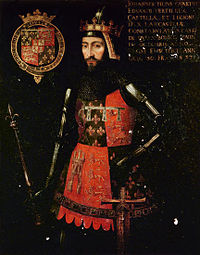
John of Gaunt, Duke of Lancaster

We can only guess at what the two women thought of each other, but it can’t have been an easy time for either. In 1381, following the unrest of the Peasants’ Revolt and the hefty criticism aimed particularly at John and his relationship with Katherine, John renounced Katherine. Giving up her position as governess, Katherine left court and returned to Lincoln. Her relationship with John of Gaunt and, indeed, his family, remained cordial and the duke still visited her, although discreetly. In 1388 Katherine was made a Lady of the Garter – a high honour indeed. And in 1394 Constance died.

In January 1396, John and Katherine were finally married in Lincoln Cathedral; they had to obtain a dispensation from the church as John was godfather to Katherine’s daughter. With the marriage, Katherine had gone from being a vilified mistress to Duchess of Lancaster. Her children by John were legitimised by the pope in September 1396 and by Richard II’s royal patent in the following February, although they were later excluded from the succession by Henry IV.

Sadly, Katherine’s marital happiness with John of Gaunt was short-lived; John of Gaunt died in February 1399 and Katherine retired to live in Lincoln, close to the cathedral of which her second son by John, Henry, was bishop. Katherine herself died at Lincoln on 10 May 1403 and was buried in the cathedral in which she had married her prince. Her tomb can still be seen today and lies close to the high altar, beside that of her youngest child Joan Beaufort, countess of Westmorland, who died in 1440.

Although it seems easy to criticise Katherine’s position as ‘the other woman’, her life cannot have been an easy one. The insecurity and uncertainty of her position, due to the lack of a wedding ring, must have caused her much unease. However, that she eventually married her prince, where so many other medieval mistresses simply fell by the wayside and were forgotten, makes her story unique. What makes her even more unique is that Katherine’s own granddaughter was part of one of the greatest love stories of the middle ages.

Joan Beaufort was the only daughter of Katherine’s eldest son by John of Gaunt, also named John. The story of King James I of Scotland and his queen, Joan Beaufort, is probably the greatest love story of the medieval era. He was a king in captivity and she a beautiful young lady of the court of her Lancastrian cousin, Henry V. The son of Robert III of Scotland, James had been on his way to France, sent there for safety and to continue his education, when his ship was captured by pirates in April 1406. Aged only eleven, he had been handed over to the English king, Henry IV, and imprisoned in the Tower of London. Within a couple of months of his capture, James’s father had died, and he was proclaimed King of Scots, but the English would not release their valuable prisoner. James was closely guarded and regularly moved around, but he was also well-educated while in the custody of the English king and became an accomplished musician and poet.

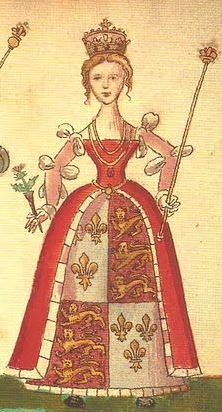
Joan Beaufort, Queen of Scots

Probably born in the early 1400s, Lady Joan was the daughter of John Beaufort, 1st Earl of Somerset. She was at court by the early 1420s, when James first set eyes on her. The Scottish king wrote of his love for Joan in his famous poem, The Kingis Quair. According to Nigel Tranter, James was with the court at Windsor, when he saw Joan for the first time; she was walking her little lapdog in the garden, below his window. The narrow window afforded him only a limited view, but the Lady Joan walked the same route every morning and James wrote of her;

Beauty, fair enough to make the world to dote,

Are ye a worldy creature?

Or heavenly thing in likeness of nature?

Or are ye Cupid’s own priestess, come here,

To loose me out of bonds

One morning James is said to have dropped a plucked rose down to Lady Joan, which he saw her wearing the following evening at dinner. Nigel Tranter suggests Lady Joan grieved over James’s imprisonment and even pleaded for his release. Written in the winter of 1423/24, the autobiographical poem, The Kingis Quair, gives expression to James’ feelings for Joan;

I declare the kind of my loving

Truly and good, without variance

I love that flower above all other things

James’s imprisonment lasted for eighteen years. His uncle Robert Stewart, Duke of Albany and Guardian of Scotland in James’s absence, refused to ransom him, in the hope of gaining the throne himself. He never quite garnered enough support, but managed to keep the Scottish nobles in check. However, when he died in 1420, control passed to his son Murdoch, and Scotland fell into a state of virtual anarchy. With Henry V’s death in 1422, it fell to his brother John, Duke of Bedford, as regent for the infant Henry VI, to arrange James’ release. The Scots king was charged 60,000 marks in ransom – ironically, it was claimed that it was to cover the costs for his upkeep and education for eighteen years. The agreement included a promise for the Scots to keep out of England’s wars with France, and for James to marry an English noble woman – not an onerous clause, given his love for Lady Joan Beaufort.

James and Joan were married at the Church of St Mary Overie in Southwark (now Southwark Cathedral) on 2 February 1424, with the wedding feast taking place in the adjoining hall, the official residence of Joan’s uncle Henry Beaufort, Bishop of Winchester. Finally united – and free – the young couple made their way north soon afterwards and were crowned together at Scone Abbey on 21 May 1424. James and Joan had eight children, seven of whom survived childhood. Their six daughters helped to strengthen alliances across Europe. The royal couple finally had twin sons on 16 October 1430; and although Alexander died within a year of his birth, his younger twin, James, thrived and was created Duke of Rothesay and heir to the throne. He would eventually succeed his father as James II.

On his return to Scotland, James immediately set about getting his revenge on the Duke of Albany’s family and adherents; executing some, including Murdoch, Albany’s son and heir. Two other claimants to James’s throne were sent to England, as hostages for the payment of his ransom. James and Joan ruled Scotland for thirteen years; James even allowed Joan to take some part in the business of government. Although the Scots were wary of her being English, Queen Joan became a figurehead for patronage and pageantry. The English hope that Joan’s marriage to James would also steer the Scots away from their Auld Alliance with France, was short-lived, however, and the 1436 marriage of their eldest daughter, Margaret, to the French dauphin formed part of the renewal of the Auld Alliance.

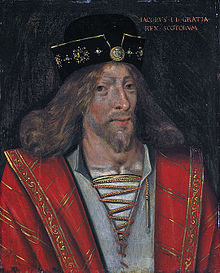
James I, King of Scots

James’ political reforms, combined with his desire for a firm but just government, made enemies of some nobles, including his own chamberlain Sir Robert Stewart, grandson of Walter, Earl of Atholl, who had been James’s heir until the birth of his sons. Sir Robert and his grandfather hatched a plot to kill the king and queen. In February 1437, the royal couple was staying at the Blackfriars in Perth when the king’s chamberlain dismissed the guard and the assassins were let into the priory. The king is said to have hidden in an underground vault as the plotters were heard approaching. There is a legend that the vault had originally been an underground passage, however, the king had ordered the far end to be sealed, when his tennis balls kept getting lost down there. Unfortunately, that also meant James had blocked off his own escape route. The assassins dragged the king from his hiding place and stabbed him to death; Joan herself was wounded in the scuffle.

And one of the greatest love affairs of the era ended in violence and death. The plotters, far from seizing control of the country, were arrested and executed as the Scottish nobles rallied around the new king, six-year-old James II. Joan’s life would continue to be filled with political intrigue, but her love story had been viciously cut short, without the happy ending her grandmother had achieved. Joan would marry again, to Sir James Stewart, the Black Knight of Lorne. They would go on to have 3 sons together before Joan died during a siege at Dunbar Castle on 15 July, 1445; although whether her death was caused by illness or the violence of the siege has not been determined. She was buried in the Carthusian priory in Perth alongside her first husband, King James I.

Katherine and Joan led very different lives, although the similarities are there if you look for them; they both lived their lives around the glittering court and married for love. Joan’s happy marriage only achieved because her grandmother finally got her prince; if Katherine had not married John of Gaunt, the Beauforts would have remained illegitimate and their future prospects seriously restricted by the taint of bastardy.

*

Images courtesy of Wikipedia.

Sources:

katherineswynfordsociety.org.uk; Red Roses: Blanche of Gaunt to Margaret Beaufort by Amy Licence; The Nevills of Middleham by K.L. Clark; The House of Beaufort: the Bastard Line that Captured the Crown by Nathen Amin; Brewer’s British Royalty by David Williamson; History Today Companion to British History Edited by Juliet Gardiner & Neil Wenborn; The mammoth Book of British kings & Queen by Mike Ashley; Britain’s Royal Families, the Complete Genealogy by Alison Weir; The Life and Times of Edward III by Paul Johnson; The Perfect King, the Life of Edward III by Ian Mortimer; The Reign of Edward III by WM Ormrod; Chronicles of the Age of Chivalry Edited by Elizabeth Hallam; Oxforddnb.com; womenshistory.about.com/od/medrenqueens/a/Katherine-Swynford.

An earlier version of this article first appeared on The Henry Tudor Society blog in November 2017.

*

My Books

Signed, dedicated copies of all my books are available through my online store.

Out now: Scotland’s Medieval Queens

Scotland’s history is dramatic, violent and bloody. Being England’s northern neighbour has never been easy. Scotland’s queens have had to deal with war, murder, imprisonment, political rivalries and open betrayal. They have loved and lost, raised kings and queens, ruled and died for Scotland. From St Margaret, who became one of the patron saints of Scotland, to Elizabeth de Burgh and the dramatic story of the Scottish Wars of Independence, to the love story and tragedy of Joan Beaufort, to Margaret of Denmark and the dawn of the Renaissance, Scotland’s Medieval Queens have seen it all. This is the story of Scotland through their eyes.

Available now from Amazon and Pen and Sword Books

Also by Sharon Bennett Connolly:

Heroines of the Tudor World tells the stories of the most remarkable women from European history in the time of the Tudor dynasty, 1485-1603. These are the women who ruled, the women who founded dynasties, the women who fought for religious freedom, their families and love. Heroines of the Tudor World is now available for pre-order from Amberley Publishing and Amazon UK. Women of the Anarchy demonstrates how Empress Matilda and Matilda of Boulogne, unable to wield a sword themselves, were prime movers in this time of conflict and lawlessness. It shows how their strengths, weaknesses, and personal ambitions swung the fortunes of war one way – and then the other. Available from Bookshop.orgAmberley Publishing and Amazon UKKing John’s Right-Hand Lady: The Story of Nicholaa de la Haye is the story of a truly remarkable lady, the hereditary constable of Lincoln Castle and the first woman in England to be appointed sheriff in her own right. Available from all good bookshops Pen & Sword Booksbookshop.org and Amazon

Defenders of the Norman Crown: The Rise and Fall of the Warenne Earls of Surrey tells the fascinating story of the Warenne dynasty, from its origins in Normandy, through the Conquest, Magna Carta, the wars and marriages that led to its ultimate demise in the reign of Edward III. Available from Pen & Sword BooksAmazon in the UK and US, and Bookshop.orgLadies of Magna Carta: Women of Influence in Thirteenth Century England looks into the relationships of the various noble families of the 13th century, and how they were affected by the Barons’ Wars, Magna Carta and its aftermath; the bonds that were formed and those that were broken. It is now available in paperback and hardback from Pen & SwordAmazon, and Bookshop.orgHeroines of the Medieval World tells the stories of some of the most remarkable women from Medieval history, from Eleanor of Aquitaine to Julian of Norwich. Available now from Amberley Publishing and Amazon, and Bookshop.orgSilk and the Sword: The Women of the Norman Conquest traces the fortunes of the women who had a significant role to play in the momentous events of 1066. Available now from Amazon,  Amberley Publishing, and Bookshop.org.

Alternate Endings: An anthology of historical fiction short stories including Long Live the King… which is my take what might have happened had King John not died in October 1216. Available in paperback and kindle from Amazon.

Podcast:

Have a listen to the A Slice of Medieval podcast, which I co-host with Historical fiction novelist Derek Birks. Derek and I welcome guests, such as Bernard Cornwell and discuss a wide range of topics in medieval history, from significant events to the personalities involved.

*

Don’t forget! Signed and dedicated copies of all my books are available through my online store.

For forthcoming online and in-person talks, please check out my Events Page.

You can be the first to read new articles by clicking the ‘Follow’ button, liking our Facebook page or joining me on TwitterThreadsBluesky and Instagram.

*

©2021 Sharon Bennett Connolly FRHistS
Joan Beaufort: a Medieval Matriarch

History...the Interesting bits
Joan Beaufort, Countess of Westmorland, from the Neville Book of Hours

Joan Beaufort was the youngest child and only daughter of John of Gaunt and his mistress, Katherine Swynford. Her father, Gaunt, was the third surviving son of Edward III and his queen, Philippa of Hainault. He had married Blanche of Lancaster in 1359 – a marriage which eventually brought him the title of Duke of Lancaster. With Blanche he had 3 surviving legitimate children: Elizabeth, Philippa and Henry – the future king, Henry IV.

Joan’s mother, Katherine Swynford, was a member of Blanche’s household and had been married to a Lincolnshire knight, Sir Hugh Swynford, in 1367. They had 3 children together; Blanche, Thomas and Margaret. Sir Hugh was a tenant of John of Gaunt and served on the continent with him in 1366 and 1370. John of Gaunt was widowed in 1368, when Blanche died in childbirth. Katherine had been governess to the Lancaster children for a number of years when Hugh died in November 1371, leaving her a young widow with 3 children to feed.

John and Katherine may have begun their relationship shortly after Hugh’s death, despite John having married again, to Constance of Castile, in September 1371. John and Katherine’s first child, John, was probably born in 1372, with 3 more children, Henry, Thomas and Joan, born before 1379. They would be given the surname of Beaufort, though no one seems to know quite where the name came from. Although the children were illegitimate, the boys enjoyed successful careers during the reign of their half-brother, Henry IV; with John in politics, Henry rising to the rank of cardinal in the church and Thomas pursuing a military career.

Joan was the youngest of the Beaufort children, born sometime between 1377 and 1379. She was close to her family. She joined the household of her sister-in-law, Mary de Bohun, wife of her half-brother, the future Henry IV, in 1386. It seems that she was accompanied by her mum, Katherine Swynford, possibly because Katherine and John of Gaunt had separated and John was reconciled with his second wife, Constance of Castile. Joan was about 7-years-old and was continuing her education and being prepared for her first marriage – she had just been betrothed to 10-year-old Robert Ferrers of Oversley, Warwickshire. Robert would become one of her father’s retainers and, through his mother, heir to the estates of the Botelers of Wem, Shropshire. They were married in 1392, when Joan was 13 or 14 and 2 daughters were born in quick succession; Elizabeth in 1393 and Mary the following year. The marriage was cut short, however, when Robert died in 1395 or 1396, leaving Joan – still only in her mid-teens – a widow with young children.

History...the Interesting bits
John of Gaunt, Joan’s father

As the granddaughter of a king, Joan was bound not to remain a widow for long. And her marriage prospects improved drastically in February 1396, when her parents were married in Lincoln Cathedral. Shortly after he married Katherine, John of Gaunt applied to the pope to have their children declared legitimate; the papal bull declaring the legitimacy of Joan and her brothers arrived in September of the same year. As the legitimate granddaughter of a king, Joan’s status was improved immensely and she was soon married to the recently widowed 6th baron of Raby and later earl of Westmorland, Ralph Neville.

Unlike many medieval women, we have some idea of what Joan may have looked like, thanks to a miniature by Pol de Limbourg. Taken from the Neville Book of Hours, it shows Joan dressed piously in black and white, though her cloak and cuffs are lined with ermine and she wears the Lancastrian S-collar around her neck. Her features are delicate. Her hands, with rings on the fingers, are clasped in prayer.

Joan was a learned woman, she was educated to the same standard as her legitimate half-sisters, Philippa and Elizabeth of Lancaster. She seems to have possessed a considerable library, the texts being largely devotional. She owned a copy of ‘Les Cronikels de Jerusalem et de Viage de Godfray de Boylion’ (Chronicles of Jerusalem and the Voyages of Godfrey de Bouillon) which she lent to her nephew, Henry V, but had to petition the Council for its return after Henry’s death. Her brother, Thomas, had left her a book, titled ‘Tristram’.

Thomas Hoccleve dedicated a volume of poems, ‘Hoccleve’s Works’ to her sending it to her around 1422, saying:

Go, smal book to the noble excellence

Of my lady of Westmerland and seye,

Her humble seruant with al reuerence

Him recommandith vn-to hir nobleye.

Also, an early copy of Hoccleve’s ‘Regiment of Princes’ was made for Joan’s son-in-law, John Mowbray.

History...the Interesting bits
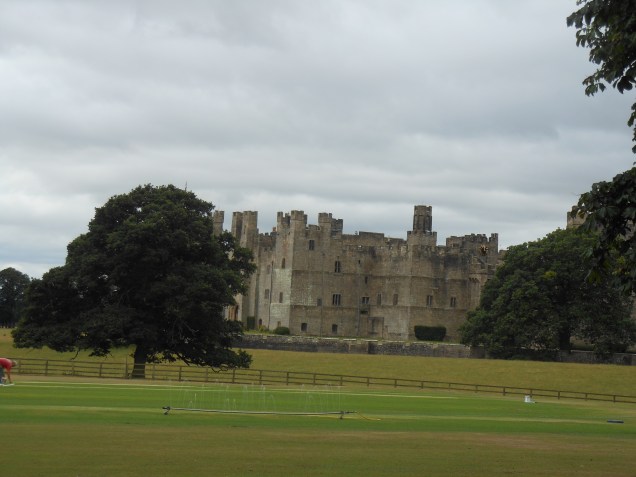
Raby Castle, Count Durham

Known for her piety, Joan left many bequests to religious institutions in her will, especially monasteries in the north. Admitted to the sisterhood at St Albans, she was also licensed to appropriate for the support of the chantry the advowson of the church of Welton, in the Howden area; and it was Joan who saw the completion of the college at Staindrop, founded by her husband in 1408. According to antiquarian, John Leland, Joan ‘erectid the very house self of the college’ in the form of a medieval hospital. Her piety, however, was not always conventional. Her father had been a defender of the Lollards – he employed John Wycliffe, the first person to translate the Bible into English, as a tutor to his children. And Joan seems to have had a similar religious curiosity – hence her association with Margery Kempe.

Margery Kempe was a mystic from Lyn, Norfolk; she claimed to have visions of Christ and travelled throughout England and on the Continent. She wrote the Book of Margery Kempe which recounted the story of her life and her visions and considered to be the first ever autobiography in English. Joan invited Margery Kempe to visit her at Raby. She also wrote a letter to exonerate Margery from accusations of corruption. Margery’s own testimony says they knew each other for ‘this two years and more’. In 1417 Margery was brought before the Archbishop of York, accused of advising Joan’s daughter, Elizabeth Greystoke, to leave her husband. Margery was found ‘not guilty’ of the offence and under questioning, admitted she had told Countess Joan and her daughter a ‘good tale of a lady who was damned because she would not love her enemies’. Margery even suggested her questioners ask Joan for corroboration of her testimony, demonstrating her trust that the Countess would back her.

Joan enjoyed influence at court – as the sister of one king, Henry IV, and aunt to his successor, Henry V. She was named in royal grants as ‘the king’s sister’ and made a Lady of the Garter in the reign of her cousin, Richard II. She was compassionate and used her influence to petition the king to aid those less fortunate, such as Christopher and Margaret Standith, who had fallen on hard times after Christopher had been dismissed from his father’s service for marrying for love. Joan wrote the king, asking him to give Margaret a position in the household of his queen, Joan of Navarre.

It can be argued that Joan had a strong bond of affection and purpose with her husband. They both wanted to see their family’s prospects improved even further, arranging advantageous marriages for their large brood of children. Although, it is unclear how much influence Joan had when her husband, the Earl of Westmorland, manage to entail the bulk of his estates onto his children by Joan, rather than the children by his first marriage to Margaret Stafford. This seems to have been a sensible strategy, given that his children by Joan were closely related to the royal family – Joan being the half sister of King Henry IV. The strategy, however, caused Joan problems after her husband’s death and led to a family feud – which sometimes turned violent – which wasn’t resolved until after Joan died.

History...the Interesting bits
Tomb of Ralph Neville, St Mary’s Church, Staindrop

Joan was a strong influence on her daughters and daughters-in-law. She concerned herself with matters of family – such as her children’s marriages – rather than business. Ralph’s son, also Ralph, by his first marriage, was married to Mary, Joan’s younger daughter from her first marriage. Ralph and Joan’s children were married into many of the leading noble dynasties of the time and served to strengthen the position of the Beauforts as a whole. Such significant marriages saw their eldest daughter, Katherine, married to John Mowbray, 2nd Duke of Norfolk – it was Katherine who later married John Woodville, brother-in-law of her nephew Edward IV; Katherine was around 65 years old and John just 20. Of other daughters, Eleanor married Henry Percy, 2nd Earl of Northumberland, while Anne married Humphrey Stafford, a descendant of Edward III and 1st Duke of Buckingham. Of their sons, Richard Neville married Alice Montagu, heiress to the earldom of Salisbury, and became Earl of Salisbury by right of his wife; their son, Richard Neville, was the Earl of Warwick known as the Kingmaker. Robert Neville became Bishop of Durham and other sons married rich heiresses to claim titles and positions for themselves.

Ralph died in 1425 and was buried at Staindrop, close to Raby Castle. His tomb includes effigies of both Joan and his first wife, although neither woman is buried beside him. Joan was herself responsible for the negotiations after her husband’s death, which saw their youngest daughter, Cecily, married to Richard, Duke of York. Two of Cecily’s sons would become Kings of England; Edward IV and Richard III.

Having married young herself, and having become a mother before she was 15 years old, Joan was sensible to the dangers of girls marrying too young and ensured that none of her daughters or daughters-in-law, faced the dangers of childbirth before they were 17 or 18 years of age. She even kept married couples apart – such as Cecily and the Duke of York – when necessary, in order to protect the girls.

History...the Interesting bits
Joan’s tomb, beside that of her her mother, in Lincoln Cathedral

On 28 November 1437, Joan was granted licence for the foundation of a chantry with two chaplains at Lincoln Cathedral, to pray daily for the soul of her mother, Katherine Swynford, as well as for herself, her husband, brother (Cardinal Henry Beaufort) and father. On the same day, she secured a grant for daily prayers to be said at Staindrop Church – where her husband Ralph, Earl of Westmorland, was buried – for the souls of her husband, brother and father.

Joan died at Howden, a manor near Beverley in her son Robert’s possession as Bishop of Durham, on 13 November 1440. In her will, she requested to be buried with her mother, with whom she had a strong bond in life, but also for her mother’s burial site to be enlarged and enclosed. It seems likely that the now-lost wrought iron screens which surrounded her mother’s tomb, were added at this time, rather than when Katherine died in 1403. Joan’s epitaph claimed that the whole nation grieved at her death.

There is, however, no clear indication why Joan chose to be buried with her mother, rather than at Staindrop with her husband. It may be that as the granddaughter of a king (Edward III), she thought Lincoln Cathedral a more appropriate resting place, or that she wanted to be as close to her mother in death as she had been in life.

*

Pictures: John of Gaunt and Joan Beaufort courtesy of Wikipedia. All other photos ©SharonBennettConnolly FRHistS

*

Sources: katherineswynfordsociety.org.uk; Red Roses: Blanche of Gaunt to Margaret Beaufort by Amy Licence; The Nevills of Middleham by K.L. Clark; The House of Beaufort: the Bastard Line that Captured the Crown by Nathen Amin; Brewer’s British Royalty by David Williamson; History Today Companion to British History Edited by Juliet Gardiner & Neil Wenborn; The mammoth Book of British kings & Queen by Mike Ashley; Britain’s Royal Families, the Complete Genealogy by Alison Weir; The Life and Times of Edward III by Paul Johnson; The Perfect King, the Life of Edward III by Ian Mortimer; The Reign of Edward III by WM Ormrod; Chronicles of the Age of Chivalry Edited by Elizabeth Hallam; Oxforddnb.com; womenshistory.about.com/od/medrenqueens/a/Katherine-Swynford.

*

My Books

Signed, dedicated copies of all my books are available through my online bookshop.

Out now: Scotland’s Medieval Queens

Books by Sharon Bennett Connolly

Scotland’s history is dramatic, violent and bloody. Being England’s northern neighbour has never been easy. Scotland’s queens have had to deal with war, murder, imprisonment, political rivalries and open betrayal. They have loved and lost, raised kings and queens, ruled and died for Scotland. From St Margaret, who became one of the patron saints of Scotland, to Elizabeth de Burgh and the dramatic story of the Scottish Wars of Independence, to the love story and tragedy of Joan Beaufort, to Margaret of Denmark and the dawn of the Renaissance, Scotland’s Medieval Queens have seen it all. This is the story of Scotland through their eyes.

Scotland’s Medieval Queens gives a thorough grounding in the history of the women who ruled Scotland at the side of its kings, often in the shadows, but just as interesting in their lives beyond the spotlight. It’s not a subject that has been widely covered, and Sharon is a pioneer in bringing that information into accessible history.’ Elizabeth Chadwick (New York Times bestselling author)

Available now from Amazon and Pen and Sword Books

Also by Sharon Bennett Connolly:

Books by Sharon Bennett Connolly

Heroines of the Tudor World tells the stories of the most remarkable women from European history in the time of the Tudor dynasty, 1485-1603. These are the women who ruled, the women who founded dynasties, the women who fought for religious freedom, their families and love. Heroines of the Tudor World is now available for pre-order from Amberley Publishing and Amazon UK. Women of the Anarchy demonstrates how Empress Matilda and Matilda of Boulogne, unable to wield a sword themselves, were prime movers in this time of conflict and lawlessness. It shows how their strengths, weaknesses, and personal ambitions swung the fortunes of war one way – and then the other. Available from Bookshop.orgAmberley Publishing and Amazon UKKing John’s Right-Hand Lady: The Story of Nicholaa de la Haye is the story of a truly remarkable lady, the hereditary constable of Lincoln Castle and the first woman in England to be appointed sheriff in her own right. Available from all good bookshops Pen & Sword Booksbookshop.org and Amazon

Royal Historical Society

Defenders of the Norman Crown: The Rise and Fall of the Warenne Earls of Surrey tells the fascinating story of the Warenne dynasty, from its origins in Normandy, through the Conquest, Magna Carta, the wars and marriages that led to its ultimate demise in the reign of Edward III. Available from Pen & Sword BooksAmazon in the UK and US, and Bookshop.orgLadies of Magna Carta: Women of Influence in Thirteenth Century England looks into the relationships of the various noble families of the 13th century, and how they were affected by the Barons’ Wars, Magna Carta and its aftermath; the bonds that were formed and those that were broken. It is now available in paperback and hardback from Pen & SwordAmazon, and Bookshop.orgHeroines of the Medieval World tells the stories of some of the most remarkable women from Medieval history, from Eleanor of Aquitaine to Julian of Norwich. Available now from Amberley Publishing and Amazon, and Bookshop.orgSilk and the Sword: The Women of the Norman Conquest traces the fortunes of the women who had a significant role to play in the momentous events of 1066. Available now from Amazon,  Amberley Publishing, and Bookshop.org.

Alternate Endings: An anthology of historical fiction short stories including Long Live the King… which is my take what might have happened had King John not died in October 1216. Available in paperback and kindle from Amazon.

Podcast:

A Slice of Medieval

Have a listen to the A Slice of Medieval podcast, which I co-host with Historical fiction novelist Derek Birks. Derek and I welcome guests, such as Bernard Cornwell and Elizabeth Chadwick, and discuss a wide range of topics in medieval history, from significant events to the personalities involved.

There are now 80 episodes to listen to!

Every episode is also available on YouTube.

*

Don’t forget! Signed and dedicated copies of all my books are available through my online bookshop.

For forthcoming online and in-person talks, please check out my Events Page.

You can be the first to read new articles by clicking the ‘Follow’ button, liking our Facebook page or joining me on TwitterThreadsBluesky and Instagram.

©2019 Sharon Bennett Connolly FRHistS

Book Corner: Joanna of Flanders, Heroine and Exile by Julie Sarpy

The new research in this biography solves the riddle of the disappearance of Joanna of Flanders early in the Hundred Years’ War, a leader described by David Hume as ‘the most extraordinary woman of the age’.

Joanna of Flanders, Countess de Montfort and Duchess of Brittany, vanished from public life after 1343 amid the Breton Wars of Succession during the Hundred Years’ War. As wife of the late Duke John de Montfort, Joanna’s rightful place was in Brittany as regent of the duchy for their five-year-old son and heir, John of Brittany. Famed for the defence of Hennebont in 1342 during her husband’s imprisonment, she, along with her children, had accompanied Edward III to England in February 1343 and never departed. She resided in comfortable obscurity at Tickhill Castle, Yorkshire, until her death around 1374.

What happened to her and why? Her extended absence should have provoked more suspicion, but it did not. Edward III certainly orchestrated her relocation from London to Yorkshire and sanctioned her indefinite detention.

Delving deeper into her story the answers to those two questions explore the complexities of medieval social structures, notably in the care of the vulnerable and the custody of women. The 19th-century Breton historian de la Borderie asked if Joanna’s ‘many tests had reversed her intelligence and thrown her into the abyss of madness’, a position accepted by many modern historians – but not by Julie Sarpy.

When my publishers, Amberley, asked if I would like to review Julie Sarpy’s Joanna of Flanders: Heroine and Exile I jumped at the chance. I first came across Joanna of Flanders when writing an article about her son, John V, Duke of Brittany; and I remember thinking, ‘I must look into this woman’. I have not yet had the opportunity (though I will write a blog post if I ever get the time). So, although I was aware of Joanna, I know only the bare bones of her story. Which is why this book intrigued me so much!

Julie Sarpy has done an incredible job of researching the story of Joanna of Flanders. Her investigation has uncovered some remarkable facts about Joanna’s life, the times she lived through and the treatment she received at the hands of her supposed ally, Edward III. This is a balanced, in-depth study of a woman who deserves her time in the limelight. Joanna of Flanders is, in short, an amazing woman, whose story deserves to be known by a much wider audience.

I have to admit to a personal interest in the tale, in grew up not far from Tickhill Castle, South Yorkshire, the site of Joanna’s imprisonment. And though everyone in the area knows about the castle’s connections to King John, to the de Warennes and to the dukes of Lancaster (it is now owned by the duchy of Lancaster), no one seems to know of its role as the prison of poor Joanna.

Joanna of Flanders’ life has not been given its full measure. One wonders how such a remarkable woman has been lost to the ages and ostensibly marginalised. For Joanna of Flanders, Countess of Montfort and Richmond, Duchess of Brittany, was, in her time, the heroine of Hennebont, the pivotal siege during the first half of the Breton Civil War (1341-1365) that prevented the French from taking over Brittany and routing the English early in the Hundred Years’ War (1337-1453). That was no small feat for anyone, especially a fourteenth-century woman. In fact, she seems to have been exceptional in many ways. Medieval French chronicler and contemporary Jean Froissart professed Joanna of Flanders ‘to possess the courage of a man and the heart of a lion.’ Breton historian Dom Lobineau said of the Countess of Montfort, ‘no adversity could crush her. her consistency in the most desperate circumstances always reassured those who attached [themselves] to her.’ She marshalled men and resources, unlike her rival the Breton-French Jeanne de Penthievre’s husband. Joanna of Flanders rallied her husband’s supporters, the pro-English Montfortist faction, in his absence during the Siege of Hennebont and then secured the safety of his heirs in England, with the aid of Edward III.

Julie Sarpy’s investigation into the life and imprisonment of Joann of Flanders is a fascinating study. The author follows the evidence from the records and chronicles of the time and reconstructs Joanna’s story, dispelling the false stories of her madness and clearly presenting Joanna of Flanders as a political prisoner; a remarkable woman whose imprisonment was essential to furthering the ambitions of her ally, Edward III.

Well written, entertaining and informative, this is an engaging and enjoyable book that should attract any history fan who wants to learn more about Joanna’s life and the wider story of the the Breton Civil War. From the first page, the author draws you in with the mystery of Joanna’ imprisonment and the teaser of who may benefit from having her out of the way. Julie Sarpy then takes you through the complexities of the Breton ducal family, the background and prosecution of the war before concentrating on Joanna’s imprisonment, the reasons behind it and the legal implications.

This is a thorough and absorbing study of a woman who has been largely neglected by history. It’s a story that deserves to be heard and that has been told, in Joanna of Flanders: Heroine and Exile, with remarkable skill and judgement – and a little sympathy for the heroine. I cannot recommend it highly enough.

About the author:

Originally from Louisiana, Julia Sarpy is a subject specialist librarian and adjunct faculty at Nova Southeastern University. She received her doctorate in European History from the University of Houston. A UCLA alum, she also hold master’s degrees from University of North Texas and Southern Methodist University.

Joanna of Flanders: Heroine and Exile is now available from Amberley Publishing and Amazon in the UK and will be released on 1 October 2019 in the US; it is available for pre-order on Amazon US.

*

My books

Silk and the Sword: The Women of the Norman Conquest

From Emma of Normandy, wife of both King Cnut and Æthelred II to Saint Margaret, a descendant of Alfred the Great himself, Silk and the Sword: the Women of the Norman Conquest traces the fortunes of the women who had a significant role to play in the momentous events of 1066.  Available now from Amazon UK,  Amberley Publishing, Book Depository and Amazon US.

Heroines of the Medieval World

Telling the stories of some of the most remarkable women from Medieval history, from Eleanor of Aquitaine to Julian of Norwich, Heroines of the Medieval World,  is available now on kindle and in paperback in the UK from from both Amberley Publishing and Amazon, in the US from Amazon and worldwide from Book Depository.

*

You can be the first to read new articles by clicking the ‘Follow’ button, liking our Facebook page or joining me on Twitter and Instagram.

*

©2019 Sharon Bennett Connolly

Little Princess Gwenllian

Gwenllian was the only child of Llywelyn ab Gruffuddd, also known as Llywelyn the Last, Prince of Wales. Her mother was Eleanor de Montfort, who was the daughter of Eleanor of England, sister of Henry III, and Simon de Montfort, Earl of Leicester. Llywelyn and Eleanor had married in Worcester Cathedral in October 1278, in a lavish ceremony attended by Edward I, King of England, and Alexander III, King of Scots.

Sharon Bennett Connolly
Memorial to Gwenllian, Sempringham, Lincolnshire

Gwenllian, a descendant of both Welsh and English royalty, was born in June 1282 at the palace of Garth Celyn, Abergwyngregyn, near Bangor; her mother died giving birth to her. Shortly after her birth, Edward I concluded his conquest of Wales. Gwenllian’s father, Llywelyn, was killed in an ambush on 11 December 1282 – and just six months after her birth, Gwenllian was an orphan. Her uncle Dafydd, Llywelyn’s younger brother, became the little princess’s legal guardian. After his brother’s death, Dafydd continued the fight for Welsh independence but was betrayed to the English, in June 1283.

Dafydd, his wife, children and little Gwenllian were captured at Bera Mountain in Snowdonia, where they had been in hiding. At just one year old, Gwenllian was taken, by sea, probably to thwart any attempt at rescue, from Wales, the land of her birth. She would never see her homeland again. The baby girl was placed behind the high walls of the Gilbertine priory of Sempringham, in Lincolnshire, just south of the great city of Lincoln. Her female cousins, the seven daughters of Dafydd, were also placed in various nunneries, so it is possible some of her cousins were with her. Dafydd’s legitimate daughter, Gwladus, who was a similar age to Gwenllian, was placed in Sixhills, another Gilbertine priory, in the Lincolnshire Wolds.

Llywelyn
Statue of Gwenllian’s father, Llywelyn the Last at Cardiff City Hall

Dafydd’s two sons, Llywelyn and Owain, were imprisoned in Bristol Castle; the eldest, Llywelyn, died there in 1287, just four years after his capture. Owain was still living in 1325, every night securely incarcerated in a specially constructed timber cage within Bristol Castle. Dafydd himself suffered the horrendous ‘traitor’s death’; he was hung, drawn and quartered at Shrewsbury.

The Gilbertines were the only wholly-English monastic community. Their founder, St Gilbert, had some form of physical deformity, which prevented him from pursuing a career as a knight. He trained as a clerk in France, studying under Master Anselm at Laon. He eventually entered the household of the Bishop of Lincoln and, in 1129, was appointed Vicar of Sempringham and West Torrington. He established the first priory there in 1131, with seven local women vowing to live a life of chastity, poverty and obedience. Sempringham Priory was a double-house, housing both men and women in segregated quarters.

At its height, the priory housed 200 nuns and forty canons. The order followed strict rules, based on those of the Augustinian and Premonstratensian monasteries. By the time of Gilbert’s death in 1189 there were thirteen priories in England; this number had risen to twenty-five at the time of the Reformation.1

Gwenllian was a prisoner at the Gilbertine Priory of St Mary, at Sempringham, for the rest of her life. A prisoner of three English kings, Edward I, Edward II and Edward III, she was a rallying figure for the subjugated Welsh and too valuable to ever be freed. Edward I wrote to the Prior and Prioress of Sempringham of his decision to place Gwenllian in their custody, on 11 November 1283: ‘… Having the Lord before our eyes, pitying also her sex and her age, that the innocent may not seem to atone for the iniquity and ill-doing of the wicked and contemplating especially the life in your Order’.2

Sharon Bennett Connolly
Memorial plaque to Gwenllian on the memorial at Sempringham

Although Edward wanted Gwenllian to be forgotten, he could not afford to forget about her himself, and four years after she was placed in the convent, Edward ordered Thomas Normanvill to ‘go to the places where the daughters of Llewellyn and of David his brother, who have taken the veil in the Order of Sempringham, are dwelling, and to report upon their state and custody by next Parliament’.3 The extent of Gwenllian’s knowledge of her own history and homeland is far from certain. Having been taken from Wales at six months old, she is said not to have spoken a word of Welsh and may not have even known how to spell her name; she is referred to as ‘Wencillian’, in a document sent to Edward III at the time of her death, although spelling was far from uniform in the 14th century.

Gwenllian was probably well-cared for. Edward III endowed her with a pension of £20 a year, which was paid to the priory for her food and clothing. Whether Gwenllian was treated according to her rank at the priory is unknown. However, she was aware of her importance and her family connections; as David Pilling points out and she does in fact call herself Princess of Wales, daughter of Llywelyn ap Gruffudd in a petition of 1327 to Edward II:

Wentliane, daughter of Lewelyn [Llywelyn], formerly Prince of Wales, prays the King of his grace to remember her and aid her, since the King, his father, promised her when she was put in the house of Sempringham, £100 of land and rent; whereof he told Walter de Langeton, then Treasurer, that he had given her £20 from the Exchequer yearly; and with this she has been provided.4

She is said to have received gifts from her cousin the king, and may have spent time in Edward III’s company, when he visited the priory at Easter-time in 1328; the young king issued a charter from Sempringham on 2 April of that year.5

Sharon Bennett Connolly
St Andrew’s Church, Sempringham stands close to the site of the Gilbertine priory of Sempringham

Gwenllian may also have spent time in the company of Joan Mortimer, the daughter of Roger Mortimer, supposed lover of Isabelle of France, Edward III’s mother, and ruler of England after the deposition of her huusband, Edward II. Joan was held at Sempringham following her father’s downfall in 1330. She was only eighteen at the time, however, so may have had little in common, beyond their joint status as prisoners of the crown, with Gwenllian, who was a woman now in her late forties who had spent her entire life in conventual seclusion. The profound difference between Joan and Gwenllian, of course, is that Joan was released after a short time.

Gwenllian only found her freedom in death. She died on 7 June 1337, the same month as her fifty-fifth birthday. She was buried at the priory where she had spent all but eighteen months of her life. Her grave was lost at the time of the dissolution of the monasteries, in the 16th century. However, a memorial plaque was placed near St Andrew’s Church in Sempringham in 1993, stating:

In memory of Gwenllian, daughter of the last Prince of Wales. Born at Abergwyngregyn 12.06.1282. Died at Sempringham 7.6.1337. Having been held prisoner for 54 years.6

Although she left very few marks on the world, a child whose very future was stolen by Edward I, Gwenllian’s remarkable story has not been forgotten. In 2009 a mountain in Snowdonia in Wales, formerly known as Carnedd Uchaf, was renamed Carnedd Gwenllian in the lost princess’s honour.

*

Gwenllian’s story, and that of her mother and grandmother, is told in my latest book, Ladies of Magna Carta: Women of Influence in Thirteenth Century England.

Footnotes: [1] David Ross, editor, Sempringham Priory, Church and Holy Well, britainexpress.com; [2] englishmonarchs.co.uk; [3] ibid; [4] William Rees, Calendar of Ancient Petitions Relating to Wales [5] Calendar of the Charter Rolls. 1-14, Edward III; [6] The Princess Gwenllian Society, Princessgwenllian.co.uk

Sources: castlewales.com; snowdoniaheritage.info; William Rees, Calendar of Ancient Petitions Relating to Wales; Marc Morris A Great and Terrible King;David Williamson Brewer’s British royalty; Mike Ashley The Mammoth Book of British kings & Queens; Alison Weir Britain’s Royal Families; Roy Strong The Story of Britain; Dan Jones The Plantagenets; the Kings who Made England; Chronicles of the Age of Chivalry Edited by Elizabeth Hallam; The Oxford Companion to British History; The History Today Companion to British History; Derek Wilson The Plantagenets; britainexpress.com; englishmonarchs.co.uk; princessgwenllian.co.uk; Calendar of the Charter Rolls; David Pilling.

Images: Photos of Sempringham Church and memorial ©2019 Sharon Bennett Connolly. Llywelyn the Last courtesy of Wikipedia.

*

My Books

Signed, dedicated copies of all my books are available through my online store.

Out now: Scotland’s Medieval Queens

Books by Sharon Bennett Connolly

Scotland’s history is dramatic, violent and bloody. Being England’s northern neighbour has never been easy. Scotland’s queens have had to deal with war, murder, imprisonment, political rivalries and open betrayal. They have loved and lost, raised kings and queens, ruled and died for Scotland. From St Margaret, who became one of the patron saints of Scotland, to Elizabeth de Burgh and the dramatic story of the Scottish Wars of Independence, to the love story and tragedy of Joan Beaufort, to Margaret of Denmark and the dawn of the Renaissance, Scotland’s Medieval Queens have seen it all. This is the story of Scotland through their eyes.

Scotland’s Medieval Queens gives a thorough grounding in the history of the women who ruled Scotland at the side of its kings, often in the shadows, but just as interesting in their lives beyond the spotlight. It’s not a subject that has been widely covered, and Sharon is a pioneer in bringing that information into accessible history.’ Elizabeth Chadwick (New York Times bestselling author)

Available now from Amazon and Pen and Sword Books

Also by Sharon Bennett Connolly:

Books by Sharon Bennett Connolly

Heroines of the Tudor World tells the stories of the most remarkable women from European history in the time of the Tudor dynasty, 1485-1603. These are the women who ruled, the women who founded dynasties, the women who fought for religious freedom, their families and love. Heroines of the Tudor World is now available from Amberley Publishing and Amazon UK. Women of the Anarchy demonstrates how Empress Matilda and Matilda of Boulogne, unable to wield a sword themselves, were prime movers in this time of conflict and lawlessness. It shows how their strengths, weaknesses, and personal ambitions swung the fortunes of war one way – and then the other. Available from Bookshop.orgAmberley Publishing and Amazon UKKing John’s Right-Hand Lady: The Story of Nicholaa de la Haye is the story of a truly remarkable lady, the hereditary constable of Lincoln Castle and the first woman in England to be appointed sheriff in her own right. Available from all good bookshops Pen & Sword Booksbookshop.org and Amazon

Defenders of the Norman Crown: The Rise and Fall of the Warenne Earls of Surrey tells the fascinating story of the Warenne dynasty, from its origins in Normandy, through the Conquest, Magna Carta, the wars and marriages that led to its ultimate demise in the reign of Edward III. Available from Pen & Sword BooksAmazon in the UK and US, and Bookshop.orgLadies of Magna Carta: Women of Influence in Thirteenth Century England looks into the relationships of the various noble families of the 13th century, and how they were affected by the Barons’ Wars, Magna Carta and its aftermath; the bonds that were formed and those that were broken. It is now available in paperback and hardback from Pen & SwordAmazon, and Bookshop.orgHeroines of the Medieval World tells the stories of some of the most remarkable women from Medieval history, from Eleanor of Aquitaine to Julian of Norwich. Available now from Amberley Publishing and Amazon, and Bookshop.orgSilk and the Sword: The Women of the Norman Conquest traces the fortunes of the women who had a significant role to play in the momentous events of 1066. Available now from Amazon,  Amberley Publishing, and Bookshop.org.

Alternate Endings: An anthology of historical fiction short stories including Long Live the King… which is my take what might have happened had King John not died in October 1216. Available in paperback and kindle from Amazon.

Podcast:

Have a listen to the A Slice of Medieval podcast, which I co-host with Historical fiction novelist Derek Birks. Derek and I welcome guests, such as Bernard Cornwell and Michael Jecks, and discuss a wide range of topics in medieval history, from significant events to the personalities involved. Every episode is also now available on YouTube.

*

Don’t forget! Signed and dedicated copies of all my books are available through my online bookshop.

For forthcoming online and in-person talks, please check out my Events Page.

You can be the first to read new articles by clicking the ‘Follow’ button, liking our Facebook page or joining me on TwitterThreadsBluesky and Instagram.


©2019 Sharon Bennett Connolly FRHistS

Book Corner: The Cold Light of Dawn by Anna Belfrage

Giveaway!

Today I have a special treat for readers. Not only is there a review of a fantastic novel, but there is – for the fist time, ever, on the blog – a giveaway as well! Anna Belfrage has kindly offered an ebook of this fabulous, not-to-be-missed novel to accompany my review.

After Henry of Lancaster’s rebellion has been crushed early in 1329, a restless peace settles over England. However, the young Edward III is no longer content with being his regents’ puppet, no matter that neither Queen Isabella nor Roger Mortimer show any inclination to give up their power. Caught in between is Adam de Guirande, torn between his loyalty to the young king and that to his former lord, Roger Mortimer.

Edward III is growing up fast. No longer a boy to be manipulated, he resents the power of his mother, Queen Isabella, and Mortimer. His regents show little inclination of handing over their power to him, the rightful king, and Edward suspects they never will unless he forces their hand.

Adam de Guirande is first and foremost Edward’s man, and he too is of the opinion that the young king is capable of ruling on his own. But for Adam siding with his king causes heartache, as he still loves Roger Mortimer, the man who shaped him into who he is.

Inevitably, Edward and his regents march towards a final confrontation. And there is nothing Adam can do but pray and hope that somehow things will work out. Unfortunately, prayers don’t always help.

The Cold Light of Dawn  by Anna Belfrage is the 4th book in ‘The King’s Greatest Enemy series, spanning the final years of the reign of Edward II and the early years of the reign of Edward III. The story of Kit and Adam de Guirande started with Adam serving Roger Mortimer in In the Shadow of the Storm and has followed the young couple through thick and thin in Days of Sun and Glory and danger and adventure, and the fall of a king in Under the Approaching Dark. The series has been stunning from the very beginning, combining suspense, adventure, political intrigue and an old-fashioned love story to draw the reader into the heart of the 14th century.

It will be hard to justice to this fantastic novel in a review. The book not only tells you a story, but awakens your feelings and takes you on an emotional journey as well as a literary one. I enjoy reading – I always have – but I rarely come across a book, or series of books, that bring out all the emotions and will have me laughing and smiling in places, heart in my mouth in other places and leave me with tears streaming down my face at times. The action and excitement are constant, the dangers ever-present.

“What’s she doing here?” she whispered.

Beside her Meg gasped in admiration, eyes riveted to the figure clad in green and blue, the hood of her mantle thrown back to reveal a veil in the sheerest of linen.

“I am sure we will find out.” William set a hand to her back, sufficient support for Kit to stiffen her spine.

“Sister,” Kit offered reluctantly when the neat little mare came to a halt in front of her. Alicia Luytens and she shared a father, but where Alicia had been born in wedlock, Kit was the child of an illicit union, the damage further compounded – at least in Alicia’s eyes – by the fact that Kit’s mother was a salter’s daughter.

Alicia did not reply, narrow face set in an unreadable expression as she gazed at her surroundings. “My father was born here,” she said to her male companion as she dismounted. “Imagine that! Such humble beginnings.” She landed lightly on her feet, made as if to enter the manor house, but Kit blocked her way.

“I do not recall  inviting you,” Kit said

So what is it about Anna Belfrage’s writing that makes her stories so special? I wish I knew! I wish I could bottle it! She is the consummate story teller. She breathes life into her characters, brings the past right to you, and takes you back in time so the 21st century is a distant memory.  In The Cold Light of Dawn the author draws on her vast knowledge of the 14th century in order to transport the reader to the early reign of Edward III.

It is her knowledge and understanding of her characters, both historical and invented, that bring the era to vivid life. Edward III is the teenage king, trying to break the shackles of his mother and her lover, Isabella and Roger Mortimer. Edward and his young wife, Philippa, are depicted as both teenagers and royals – young people, at times, with a power they are unsure how to wield, while at other times chafing under the control of their elders. And they control the lives of Adam and Kit. Adam is the captain of Edward’s guard, while Kit is one of Philippa’s ladies. Both benefit and suffer from the pleasures  of the master and mistress.

Roger Mortimer is a wonderful character; I had never felt sorry for him and the road his life took him, until reading this series. Roger is a larger-than-life character, much as he must have been at the time, knowing the dangers he risks, but acting with a certainty that he is doing his duty, however misguided some of his actions appear to be. And even the minor characters are well researched, including one of my own Heroines, Alice de Lacey, who is sympathetically portrayed, despite the fact she has little more than a walk-on part.

The Cold Light of Dawn takes the story of Adam and Kit through personal challenges and national intrigues, their duties placing them at the heart of matters they don’t always want to have anything to do with, dividing their loyalties and endangering their lives. A fast-paced and thoroughly engrossing read, this is a book that is impossible to put down, continuing a series that has got stronger with every new story.

Giveaway!

If you would like to be in with a chance of winning an ebook copy of The Cold Light of Dawn, simply leave a comment below, or on the post on my Facebook page. The winner will be drawn on Friday 23rd February. Good Luck!

About the Author

Had Anna been allowed to choose, she’d have become a time-traveller. As this was impossible, she became a financial professional with two absorbing interests: history and writing. Anna has authored the acclaimed time-slip series The Graham Saga, winner of multiple awards, including the HNS Indie Award 2015. Her ongoing series is set in the 1320s and features Adam de Guirande, his wife Kit, and their adventures during Roger Mortimer’s rise to power.

If you would like to find out more about Anna and her books, visit her blog.

The Cold Light of Dawn is available from today in paperback or ebook from Amazon in the UK and US.

*

My Book:

Heroines of the Medieval World,  is now available in hardback in the UK from both Amberley Publishing and Amazon UK. It is also available on Kindle in both the UK and USA and will be available in Hardback from Amazon US from 1 May 2018. It can also be ordered worldwide from Book Depository.

You can be the first to read new articles by clicking the ‘Follow’ button, liking our Facebook page or joining me on Twitter.

*

©2018 Sharon Bennett Connolly

Book Corner: Edward II the Man, A Doomed Inheritance by Stephen Spinks

Edward II is one of the most controversial kings of English history. On numerous occasions he brought England to the brink of civil war.

Author Stephen Spinks argues that Edward and the later murdered Piers Gaveston were lovers, not merely ‘brothers-in-arms’. Influenced by successive royal favourites and with a desire for personal vengeance, his rule became highly polarised and unstable. His own wife took a lover and invaded his kingdom resulting in his forced abdication; the first in British history. Edward’s prevailing legacy remains the warning that all kings can fall from power.

And yet … war, debt and baronial oppression before 1307 ensured that Edward II inherited a toxic legacy that any successor would have found almost impossible to wrestle with. Stephen Spinks explores that legacy using contemporary and later sources. By focusing on Edward’s early years as much as on his reign, and exploring the conflicting influences of those around him, Stephen shows the human side of this tale against a backdrop of political intrigues and betrayals. He peels back the layers to reveal the man who wore the crown. Edward’s belief in his unchallengable right to rule, increasingly at odds with those at his court, and his undeniable thirst for revenge, creates a fourteenth-century tragedy on a grand scale.

I have to say, I had been looking forward to the release of Edward II the Man: A Doomed Inheritance by Stephen Spinks for sometime. It sounded like such an interesting premise for a book, looking at the human side of one of England’s most ineffective kings. And I wasn’t disappointed. This book is a wonderful read, enjoyable from beginning to end.

Meticulously researched and eloquently argued, this book presents Edward II as a man, a king, a friend and a lover. Stephen Spinks uses all the sources available to examine every aspect of Edward’s life – the public and the private – giving us a deep insight into the character of the man and the king. Stephen Spinks presents Edward in all his facets, as a king, father, friend and enemy. He examines those who surround Edward at different stages in his life, discussing how they variously influence or infuriate him.

Entertaining anecdotes help to decipher the character of a king who often made the wrong choice when faced with a decision.

While Edward was working with those around him to seek a political compromise, he heard in late June that the son of a tanner, John Powderham, had arrived in Oxford declaring himself to be the one true king of England. He alleged that he and Edward had been switched at birth. Two days later the arrested Powderham found himself in the presence of the king, who with his characteristic humour, greeted the imposter as ‘brother’. When Edward asked him if such claims were true, not remotely intimidated by his royal audience, simply repeated his claim. What happened next says something about Edward’s character. Whereas most kings would have been apoplectic with rage, the king, still in a playful mood, laughed and suggested John be given a ‘bauble’ and allowed to go around the country as a fool…. Isabella was angry over the whole affair; she rightly saw such claims as a dangerous affront to Edward’s dignity. Powderham was hanged on 23 July…


Written in chronological order, Edward II the Man: A Doomed Inheritance discusses the influences that shaped Edward’s character and kingship, highlighting his personal bravery, political judgements and misjudgments, and the way he was influenced by personal favourites, including Piers Gaveston and Hugh Despenser the Younger. Analysing all the major events of Edward’s reign, such as Bannockburn, the death of Gaveston and Isabella’s betrayal, Stephen Spinks manages to bring to life this complex enigma of a medieval king.

As you would expect with any biography of Edward II, the king’s mysterious death is covered in detail, presenting the facts and offering credible theories. The author also makes an eloquent, persuasive, argument for the survival of Edward II after 1327, building a believable timetable of events from the sources available. Although I am still not totally convinced….

Edward II the Man: A Doomed Inheritance is a colourful, full-of-life biography of the controversial king. It is a fabulous book if you want to learn about Edward II, or examine deeper the events and influences on his life. Enjoyable, entertaining and informative, it is a pleasure to read and easy to devour.


About the Author

Stephen Spinks wrote his dissertation on Edward II while studying at King’s College, London. He works for the National Trust and manages three Medieval heritage sites with 900 volunteers and 150 staff. He is a columnist for ‘Midlands Zone’ magazine, in which he writes a very well received exploration of life as a gay man today, partly political, partly personal. He has given many interviews on radio and in his capacity at the National Trust, to ‘BBC’s Escape to the Country’ and the ‘Antiques Road Show’. He has been studying the primary sources (and locations) for this book over the past 15 years.

Edward II the Man: A Doomed Inheritance is available from Amazon and Amberley Publishing.

*

My Book:

Heroines of the Medieval World,  is now available in hardback in the UK from both Amberley Publishing and Amazon UK. It is also available on Kindle in both the UK and USA and will be available in Hardback from Amazon US from 1 May 2018. It can also be ordered worldwide from Book Depository.

You can be the first to read new articles by clicking the ‘Follow’ button, liking our Facebook page or joining me on Twitter.

*

©2018 Sharon Bennett Connolly