
Mary of Blois was the youngest daughter of Stephen of Blois and his wife, Matilda of Boulogne, herself the granddaughter of St Margaret, queen of Scotland. Mary was born in Blois, France around 1136. She was destined for the cloister from an early age and, while still a young girl, was placed in a convent at St Sulpice in Rennes.
Mary’s lineage and the quirks of fate, however, meant that Mary’s peaceful convent life would be violently cut short.
Mary’s father Stephen was the nephew of Henry I, and his closest, legitimate, male relatives. Following the death of his only legitimate son, William Adelin, in the White Ship disaster of 1120, and with his only other legitimate child, Empress Matilda, living in Germany, it seems that Henry looked at Stephen as a possible successor. However, when Matilda’s husband died in 1125 and the empress returned to her father’s court, Stephen’s position was left undetermined. Stephen remained prominent at the English court, always present as a viable alternative to the succession of a woman – Empress Matilda.
In the confusion following Henry’s death in December 1135, it was Stephen who acted quickly and decisively. As he claimed the crown in England and his adherents secured Normandy in Stephen’s name, Empress Matilda was home in Anjou with her husband Geoffrey, Count of Anjou and two young sons, Henry and Geoffrey. She was pregnant with her third and youngest son, William.
What followed was a period known as the Anarchy, almost 20 years of conflict and bloodshed as Stephen and the Empress Matilda battled for supremacy of England and Normandy. Ultimately, Stephen managed to retain control of England but lost Normandy to Count Geoffrey, who passed it on to his and Matilda’s eldest son, Henry FitzEmpress. Henry, was eager to win back his birthright and following several incursions by Henry – whilst still in his teens – he and Stephen came to an agreement.

Stephen and his wife Matilda had five children in total, but only three, including Mary, who survived infancy. Of Stephen and Matilda’s three children, Eustace IV, Count of Boulogne, was the eldest to survive into adulthood, and was groomed as his father’s heir. He was married to Constance of France, daughter of King Louis VI and sister of Louis VII, in 1140 and knighted in 1147. He died in August 1153, after suffering some form of seizure. The Anglo-Saxon Chronicle said of him
‘he had little success, and with just cause, because he was an evil man, because wheresoever he came he did more evil than good; he robbed the lands and laid great taxes on them.’
Anglo_Saxon Chronicles, edited by Michael Swanton
The Gesta Stephani, however, paints a picture of
‘a young man of high character … his manners were grave; he excelled in warlike exercises and had great natural courage … he was courteous and affable … and possessed much of his father’s spirit … ever ready to draw close the bands of peace’ but ‘never shrank from presenting a resolute and indomitable front to his enemies.’
Gesta Stephani
Stephen’s youngest son was William, who was born around 1134/5. In 1149 he married Isabel de Warenne, sole heiress to William de Warenne, third earl of Surrey, in order to bring the vast Warenne lands within the influence of the crown. William would succeed to the County of Boulogne in 1153, on the death of Eustace. Shortly after his brother’s death, and with the help of the clergy, William made an agreement with Henry of Anjou, whereby he waived his own rights to the crown in return for assurances explicitly recognising his rights to his lands, as Count of Boulogne and Mortain and Earl of Surrey.
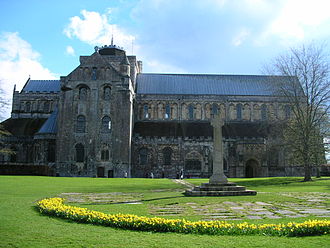
Mary, who had been in the convent at St Sulpice in Rennes, was moved around 1150-52, apparently after some discord with the nunnery. Her parents founded a new convent for her at Lillechurch (Higham) in Kent, making it a sister convent with Rennes’ St Sulpice. Mary does not appear to have been given the title of prioress. However, a charter of Henry II, dated around 1155-58, confirmed Lillechurch to Mary and her nuns, suggesting she held some position of authority. Before 1160, however, Mary had become abbess of the great abbey at Romsey, an older and more prestigious institution than her little foundation at Lillechurch.
Mary’s brother William died without issue in 1159 during the Siege of Toulouse. Though a nun, Mary succeeded him in the County of Boulogne. As a consequence, in 1160 Mary’s life was turned upside down. She was suddenly a great heiress, countess of Boulogne in her own right and too great a marriage prize to be allowed to remain secluded in the cloisters. She was abducted from Romsey Abbey by Matthew of Alsace, second son of the Count of Flanders, and forced to marry him. This may well have been a political move; although there does not appear to be any proof that Henry II sanctioned it, most sources imply that the marriage was forced on her by the king and he certainly benefited from Mary being safely married to a loyal vassal. She was, after all, not only a great heiress but, through her father, she had a strong, rival claim to the throne of England.

There was great outrage among the clergy; marriage with a nun was a breach against canon law and opposed by the leading ecclesiastical figures of the day. One source suggested the pope had granted a dispensation for the marriage. However, given that Pope Alexander III expressed great disapproval in a letter to the archbishop of Rheims, his consent seems highly unlikely. The pope imposed an interdict on Matthew of Alsace and pressed the claims of the wife of Mary’s brother, Eustace, to the Boulogne estates; even though Constance had died some fourteen years before. The furore seems to have died down eventually, and the marriage was allowed to stand.
Unfortunately for Henry II, Matthew turned out to be a not-so-loyal vassal and rebelled at least twice. The first occasion arose when Matthew tried to press his claims to Mortain, land that should have been part of Mary’s inheritance but was now held by Henry II. The king was not too accommodating. An agreement was eventually reached whereby, in return for £1,000, Matthew would renounce all claims to those parts of his wife’s estates that were still in royal hands.
Mary seems to have had little love for Henry II, possibly due to his involvement in her abduction and marriage, or simply because of the fact their respective families had spent many years at war. With so much bad history, you wouldn’t expect them to have an affectionate relationship, but Mary appears to have actively worked against Henry. Following a meeting with the ambassadors of the emperor, Frederick Barbarossa, she wrote to King Louis of France. In the document, she describes Henry II as ‘the fraudulent king’, while informing Louis of Henry’s manoeuvring against him.
Mary and Matthew had two children, daughters Ida and Mathilde; and it was after the birth of Mathilde that the couple were divorced, in 1170. There is some suggestion that Matthew was pressured to agree to the divorce by his dying father and the emperor, Frederick Barbarossa, probably in the hope of having the interdict – placed on Matthew on his marriage to Mary – lifted. After the divorce, Matthew would continue to rule Boulogne and was succeeded by Ida on his death in 1173.
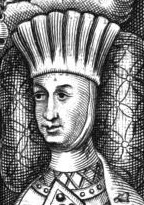
Ida (b. c1160) married three times; her first husband, Gerard III, count of Gueldres, who died in 1183. Her short marriage to her second husband, Berthold IV, Duke of Zehringen, ended in his death in 1186. Ida’s last marriage was to Reginald, or Renaud, de Tree, Count of Dammartin, who was a childhood friend of France’s king, Philip Augustus. It seems Renaud abducted Ida and forced her into marriage. He died in 1227, outliving Ida, who died in 1216, by eleven years. It was Matilda, the daughter of Ida and Renaud, who inherited Boulogne from Ida, and would also become Queen of Portugal through her marriage to Alfonso III of Portugal.
Born in 1170 Ida’s younger sister, Mathilde, married Henry I, duke of Louvain and Brabant, when she was nine-years-old. She would have seven children before her death sometime in 1210 or 1211; she was buried in St Peter’s Church, Leuven.
The interdict, which had been placed on Matthew on his marriage to Mary, was finally lifted when she returned to the convent life in 1169-70, becoming a simple Benedictine nun at St Austrebert, Montreuil. Mary died there in July 1182, possibly on the 25th, aged about forty-six, and was buried within the convent that had been her home for over ten years. A woman who obviously believed that her life should be devoted to God, she is remarkable in that she managed to fulfil her dynastic duties in a forced marriage, and yet asserted herself so that she was able to return to the secluded life she so obviously craved.
*
Mary of Boulogne’s story – and that of her older sister, Matilda – appears in greater detail in my latest book, Princesses of the Early Middle Ages: Royal Daughters of the Conquest.
Sources:
Donald Matthew, King Stephen; Robert Bartlett, England Under the Norman and Angevin Kings; David Williamson, Brewer’s British Royalty; the History Today Companion to British History; Dan Jones, the Plantagenets; englishmonarchs.co.uk; The Oxford Companion to British History; Mike Ashley, The Mammoth Book of British Kings & Queens; Alison Weir, Britain’s Royal Families, the Complete Genealogy; S.P. Thompson, Oxforddnb.com, Mary [Mary of Blois], suo jure countess of Boulogne (d. 1182), princess and abbess of Romsey; Anglo_Saxon Chronicles, edited by Michael Swanton; Gesta Stephani.
*
My Books
Signed, dedicated copies of all my books are available through my online bookshop or the Contact Me page.
Book Releases in 2026:
New Hardbacks
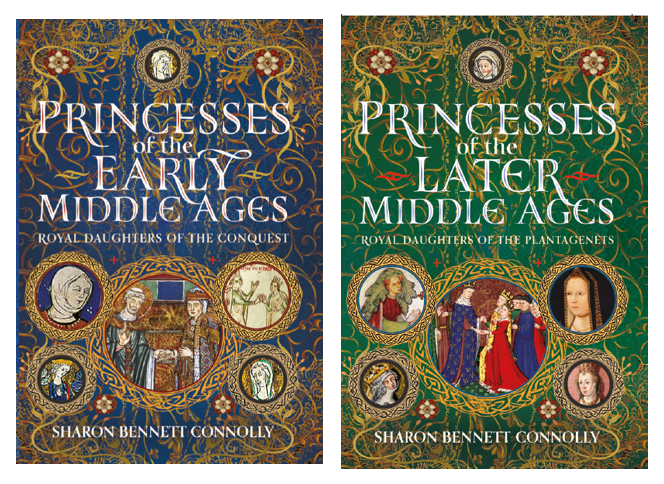
Out now: Princesses of the Early Middle Ages: Royal Daughters of the Conquest
‘My daughter wanted me to treat her more like a princess. So, I married her to a stranger to strengthen the alliance with Poland!’
Princesses of the Early Middle Ages: Royal Daughters of the Conquest and Princesses of the Later Middle Ages: Royal Daughters of the Plantagenets tell the stories of England’s royal daughters from 1066 to the rise of the Tudors, from the last Anglo-Saxon princesses to the fall of the House of York.
Were they really pampered pawns sent off to marriages on the Continent, out of sight and out of mind?
Perhaps, there was different story, where a foreign marriage does not mean eternal exile, but a purpose in life, where a princess is a diplomat, an ambassador for England in her new country.
Where she is the bond between allies – most of the time.
Heidi Malagisi: ‘This is another excellent book by Sharon Bennett Connolly. Extremely well researched and relatively easy to follow along, which is a great thing because there are so many Matildas and Eleanors in this book.‘
Tony Riches: “I challenge anyone with an interest in medieval Britain to not find something they will learn from this book.”
Anna Belfrage: “I just love how [Sharon] presents this huge cast of real life people in a casual, chatty tone that has me expecting the various female protagonists to suddenly pop their head up and add their own commentary.“
Out now: Princesses of the Early Middle Ages: Royal Daughters of the Conquest
Pre-order: Princesses of the Later Middle Ages: Royal Daughters of the Plantagenets
New in Paperback:
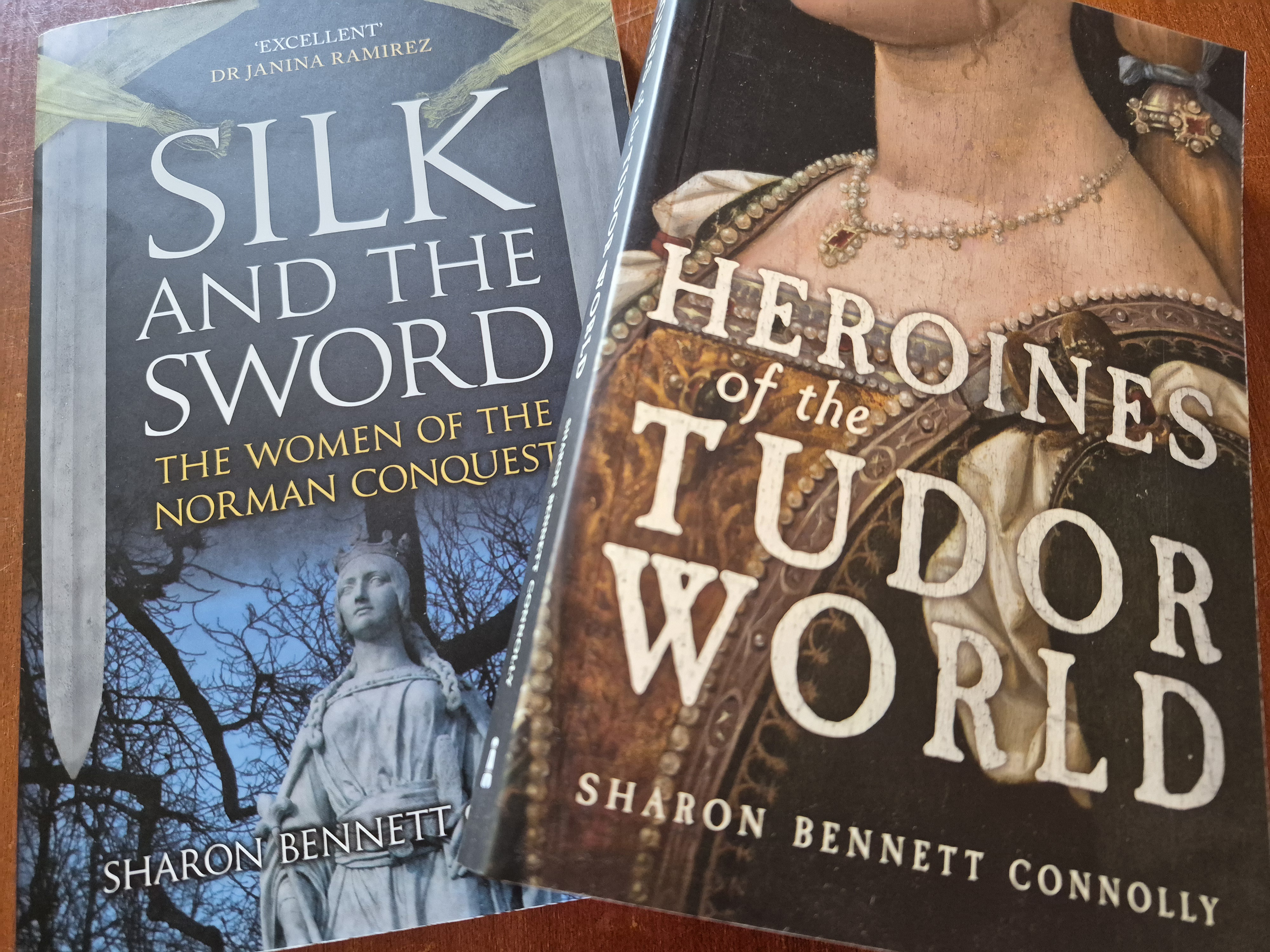
OUT NOW! The momentous events of 1066, the story of invasion, battle and conquest, are well known. But what of the women? Silk and the Sword: The Women of the Norman Conquest traces the fortunes of the women who had a significant role to play during the Norman Conquest – wives, lovers, sisters, mothers, leaders. These are lives full of drama, pathos and sometimes mystery: Edith and Gytha searching the battlefield of Hastings for the body of Harold, his lover and mother united in their grief for the fallen king. Who was Ælfgyva, the lady of the Bayeux Tapestry, portrayed with a naked man at her feet?
Janina Ramirez said it’s ‘Excellent’!
COMING 15 July 2026: Heroines of the Tudor World focuses on the women who lived through the Renaissance and Reformation, examining the threats and challenges they faced and how they overcame them. These are the women who ruled, the women who founded dynasties, the women who fought for religious freedom, their families and love. These are the women who made a difference, who influenced countries, kings and the Reformation.
Derek Birks: ‘An excellent account of the changing roles of women in Tudor society.’
Annie Whitehead: ‘What a treat this book was to read. Bennett Connolly has an easy, conversation style of writing which welcomes you from the opening pages and draws you into her story.‘
Also by Sharon Bennett Connolly:
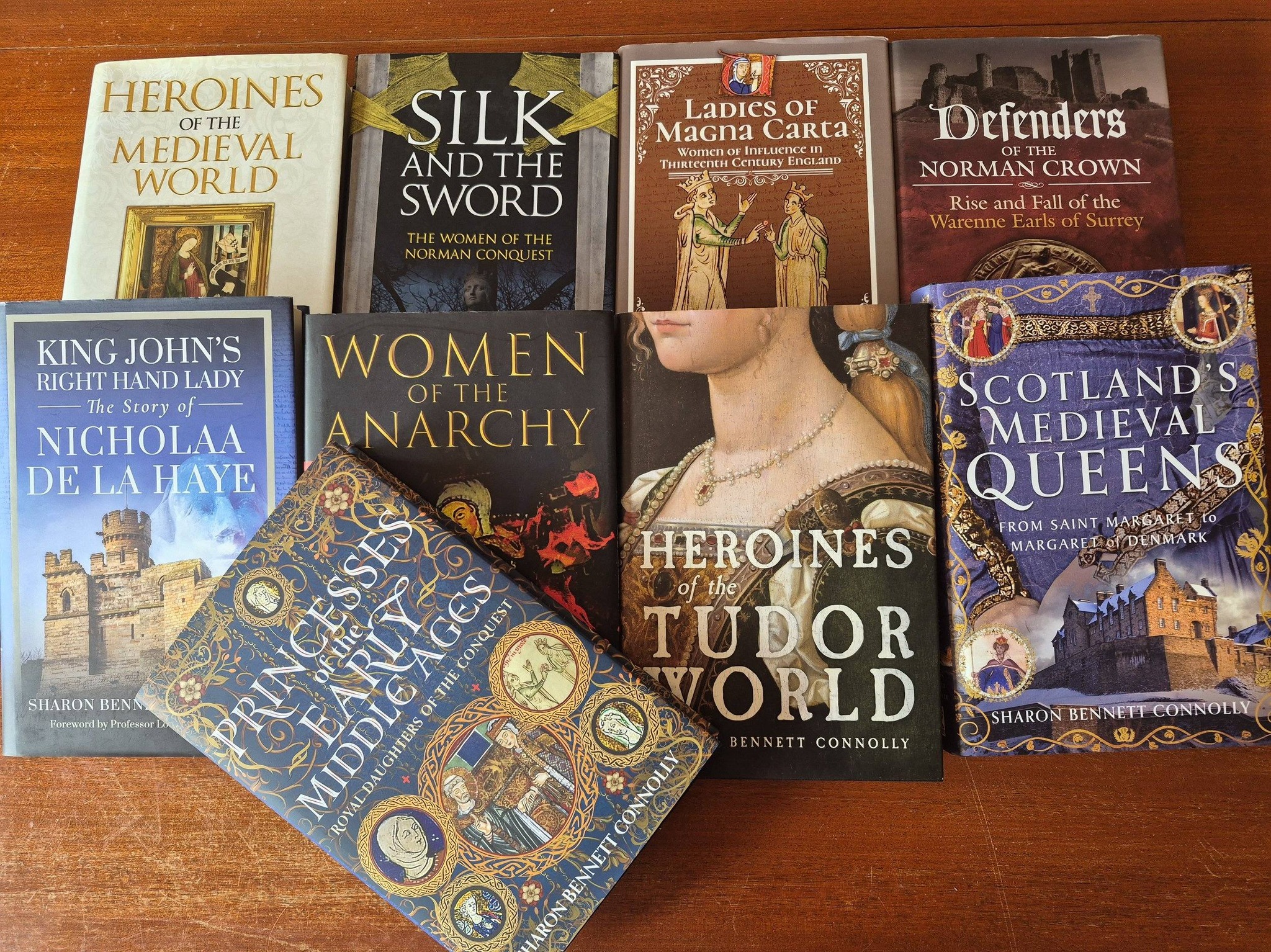
Heroines of the Medieval World; Silk and the Sword: The Women of the Norman Conquest; Ladies of Magna Carta: Women of Influence in Thirteenth Century England; Defenders of the Norman Crown: Rise and Fall of the Warenne Earls of Surrey; King John’s Right Hand Lady: The Story of Nicholaa de la Haye; Women of the Anarchy; Heroines of the Tudor World; Scotland’s Medieval Queens: From St Margaret to Margaret of Denmark; Princesses of the Early Middle Ages: Royal Daughters of the Conquest (March 2026); Princesses of the Later Middle Ages; Royal Daughters of the Plantagenets (August 2026)
Alternate Endings: An anthology of historical fiction short stories including Long Live the King… which is my take what might have happened had King John not died in October 1216. Available in paperback and kindle from Amazon.
All my books on Amazon and Bookshop.org .
You can also order direct from my publishers, Pen and Sword Books and Amberley Publishing.
Podcast:

Have a listen to the A Slice of Medieval podcast, which I co-host with Historical fiction novelist Derek Birks. Derek and I welcome guests, such as Ian Mortimer, Bernard Cornwell, Elizabeth Chadwick and Scott Mariani, and discuss a wide range of topics in medieval history, from significant events to the personalities involved.
Every episode is also now available on YouTube.
*

Don’t forget!
Signed and dedicated copies of all my books are available through my online bookshop.
For forthcoming online and in-person talks, please check out my Events Page.
You can be the first to read new articles by clicking the ‘Follow’ button, liking our Facebook page or joining me on Twitter, Threads, Bluesky and Instagram.
*
©2020 Sharon Bennett Connolly FRHistS


Reblogged this on Dave Loves History.
LikeLiked by 1 person