Emma of Normandy, Queen of England

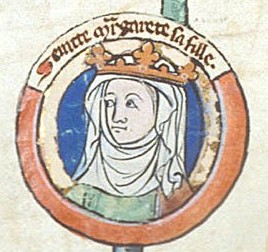
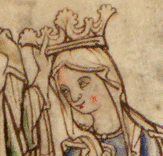
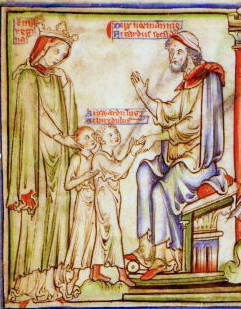
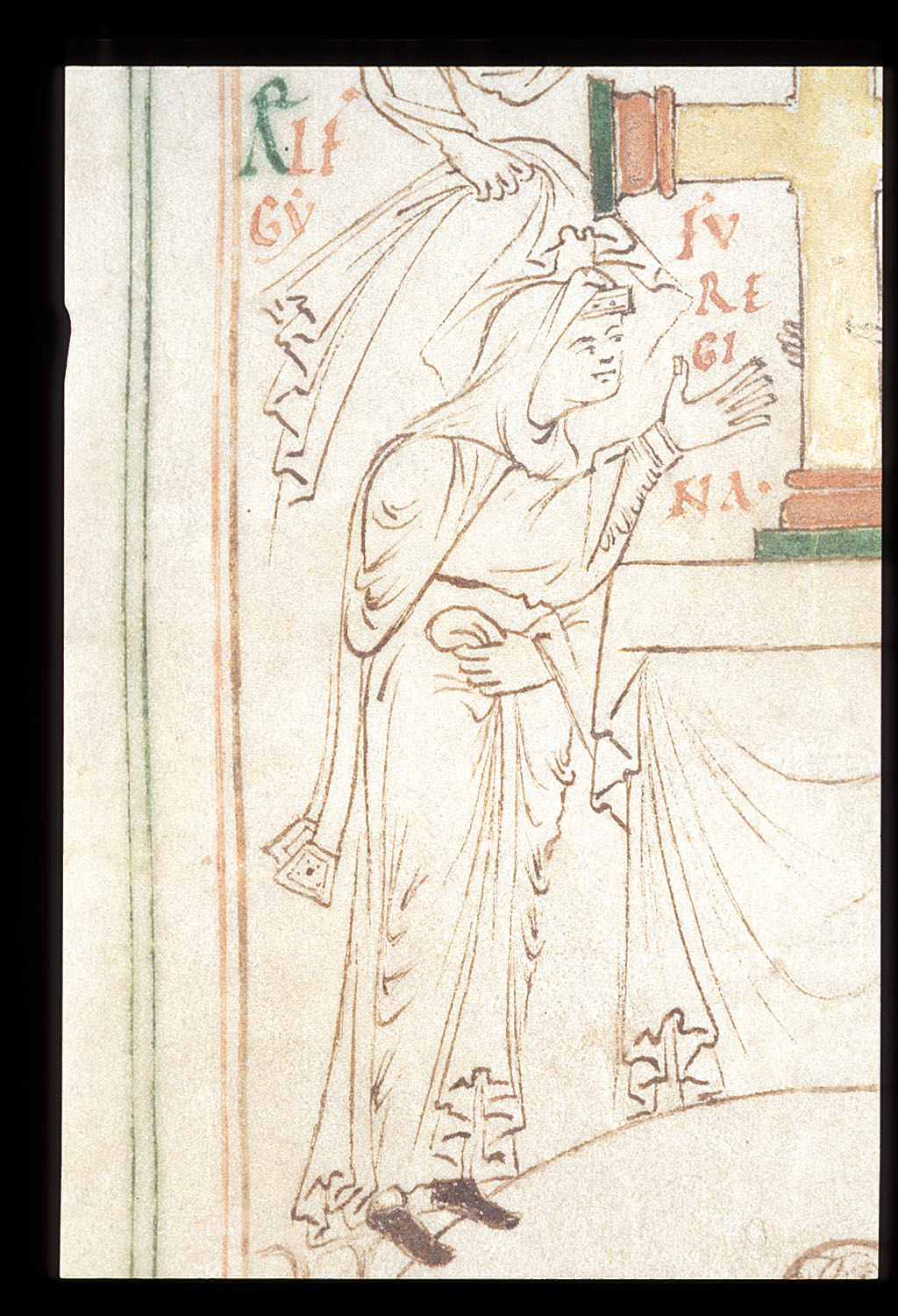
Detail of Emma of Normandy before an altar

In the years leading up to the Norman Conquest of 1066 one woman, in particular, stands out as the matriarch of the period: Emma of Normandy.

As wife of both Æthelred II and King Cnut, Emma of Normandy was the lynchpin of the story of the 11th century. As a Norman, and the mother of both a Danish king of England and a Saxon King of England, it was Emma who bound all three sides together in the conflict of 1066. Her story is suitably dramatic; with exile, tragedy and scandal all playing their part, starkly contrasting with the wealth and privilege of her role as the only twice-crowned Queen of England.

Emma was the daughter of Richard I, Duke of Normandy, and his wife, Gunnora. Born in around 985/987, she was married to Æthelred at Winchester on 5 April 1002, at which time she was given the English name Ælfgifu, although in the Anglo-Saxon Chronicle she is often referred to, simply, as ‘The Lady’. Her marriage with Æthelred was an attempt to seal a peace between England and Normandy, and to persuade the Normans not to allow the Viking raiders, who tormented England’s shores, to winter in their lands between raids into England. Despite the fact the Vikings continued to shelter in Normandy every winter, and raiding into England continued throughout the early years of the 11th century, the marriage was a success in that it produced two more sons and a daughter for Æthelred; a second family considering he was the father of as many as thirteen children by his first wife, Ælfgifu of York, including at least six sons.
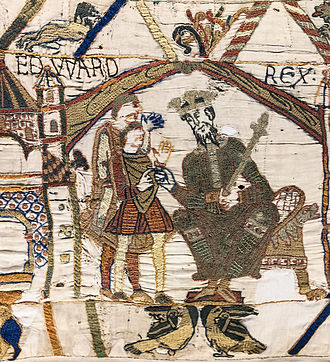
Edward the Confessor

Of Emma and Æthelred’s two sons the eldest, Edward, would eventually succeed his half-brother, Harthacnut, to the English throne in 1042, ruling until his death on 5 January 1066. Edward’s younger brother, Alfred, was cruelly murdered during the reign of his step-brother, Harold I Harefoot. Harold was the son of Cnut by his first, handfast wife, Ælfgifu of Northampton. Alfred had arrived in England in 1036, ostensibly to visit his mother, though there are also theories that he intended to mount a challenge for the throne, and was welcomed by Earl Godwin of Wessex. However, his party were ambushed whilst being entertained by Godwin and Alfred was seized and taken to the abbey at Ely in Cambridgeshire, where he was later blinded and either murdered, or succumbed to his wounds. Either way, he died on 5 February 1037 and was buried in Ely Cathedral. Edward and Alfred’s sister, Goda (or Godgifu), was married firstly to Drogo, Count of Mantes and, secondly to Eustace II, Count of Boulogne. One of her sons by Drogo, Ralph, was made Earl of Hereford by his uncle, Edward, but earned himself the insulting nickname Ralph the Timid after fleeing the Welsh in battle.

As the Viking raids increased from 1010 onwards, Æthelred’s position on the throne proved precarious and he sent his wife and her young sons to Normandy for safety, before being forced into exile there himself in 1013, when Sweyn Forkbeard seized the throne. Sweyn’s death early in 1014 offered Æthelred a way back and he sent Edward to England to negotiate his return with the English Witan, who invited Æthelred to resume the throne ‘if he would govern them better than he did before’.1 Despite his promises, Æthelred proved just as inept as previously, failing to defeat the Danish invaders, led by Cnut. Æthelred died just two years later, on 23 April 1016 (ironically, St George’s Day), and was succeeded by his oldest surviving son by his first wife, Edmund II Ironside. Although Edmund put up a valiant fight against the Danish invaders, led by Cnut, a summer of fighting took its toll and he died on 30 November 1016.
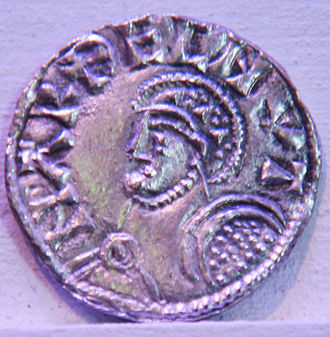
Coin from the reign of Harthacnut

Cnut took control of the whole of England and one of his first actions was to send for Emma, who he married on 2 July 1017. Although Emma appears to have had little influence during the reign of her first husband, her marriage with Cnut appears to have been a partnership. She was a more visible figure in public, enjoying considerable influence at court and offering substantial patronage to the church. She gave Cnut three children including a son, Harthacnut, and two daughters, one who’s name is lost, died aged 8 and is buried in Bosham, Sussex. A second daughter, Gunhilda, married Henry III, Emperor of Germany.

When Cnut died in 1035 Emma was in England and retired to her manor in Winchester, taking the royal treasury with her in the hope she could pass it to her son, Harthacnut. However, Harthacnut was in Denmark and it was Harold Harefoot, one of Cnut’s sons by Ælfgifu of Northampton, who seized the initiative. An agreement was reached whereby the half-brothers ruled as co-kings with Emma acting for Harthacnut and ruling in Wessex. However, two years later Harthacnut had still not returned to England and Harold took the crown for himself, driving Emma into exile with Count Baldwin in Flanders.
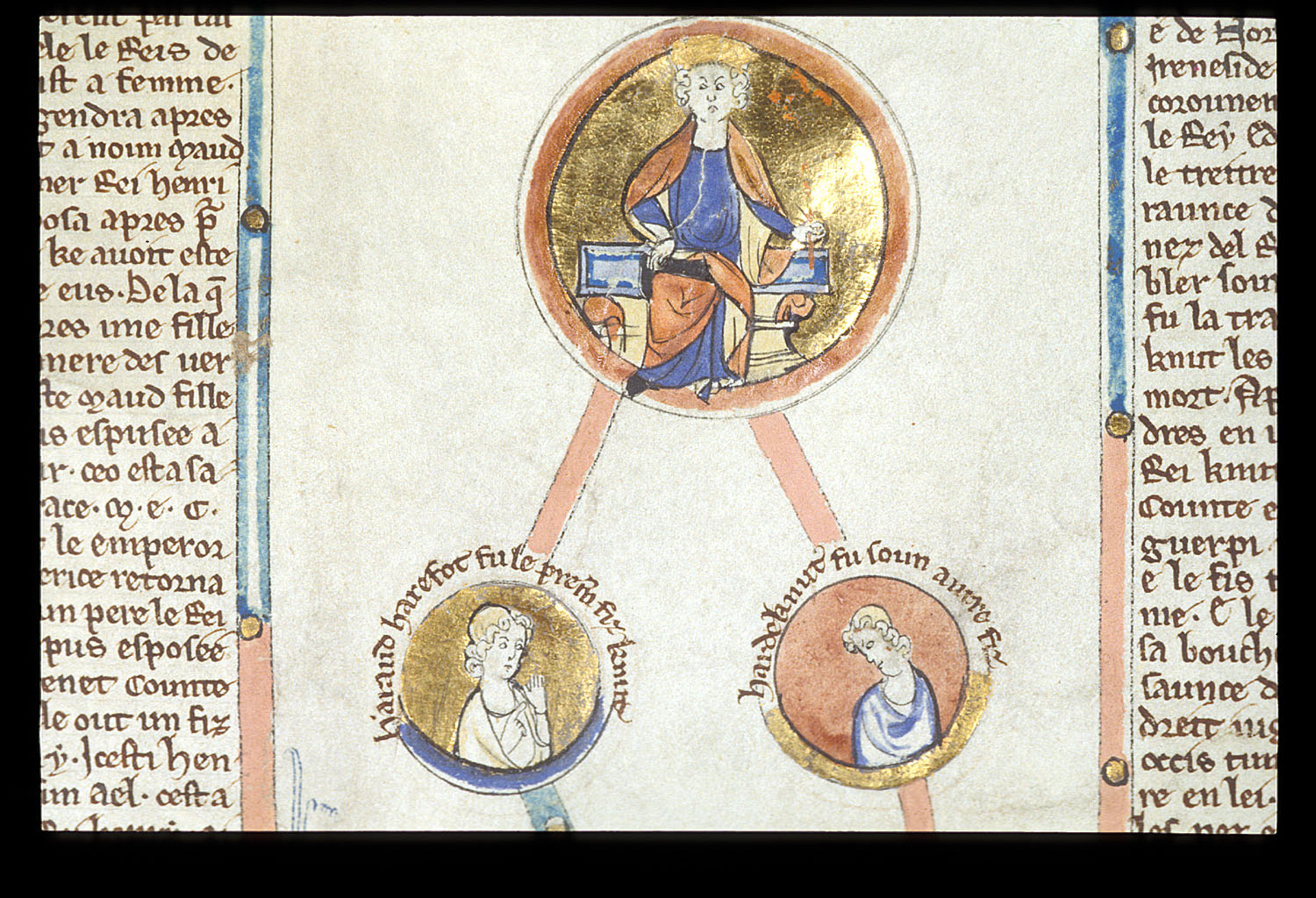
Genealogical table of Cnut, Harold I and Harthacnut

Harthacnut appears to have been, by far, Emma’s favourite child. It was for his accession to the English throne that she schemed, rather than for her eldest son, Edward. In the early months of 1040 she and Harthacnut were preparing to invade England when they heard of Harold’s death. Harthacnut succeeded to the English throne without a fight and a year later invited his half-brother Edward, who had spent almost 25 years in Norman exile, to join him in England as his successor.

Harthacnut reigned for just ten days short of two years, he died after collapsing during a wedding celebration at Lambeth. He was buried alongside his father in the old minster at Winchester and Emma gave the head of St Valentine to the new minster for her son’s soul. Emma’s relationship with Edward, however, was more strained than that she experienced with Harthacnut. Years of separation and a strong sense of abandonment on Edward’s part cannot have helped the situation. Following his coronation in 1043, one of Edward’s first actions was to ride to Winchester and take charge of the Treasury, which had been left in his mother’s hands by Harthacnut. Accompanied by the three greatest earls of his realm – Siward, Godwin and Leofric – ‘they deprived her of all the treasure that she had; which were immense; because she was formerly very hard upon the king her son, and did less for him than he wished before he was king…’2

Emma’s friend and close adviser, Bishop Stigand, was deprived of his bishopric, although he was later reinstated and created Bishop of Winchester. He eventually rose to be Archbishop of Canterbury but was removed from office by William the Conqueror. However, at the time of her disgrace, Emma and Stigand’s close relationship gave rise to a later legend that they were more than friends and that Emma was accused of adultery with Stigand (although the 13th century story claimed the bishop’s name was Ælfwine). There is no contemporary evidence of the story, however, and it first appears more than 100 years after the Conquest. As the story went, Emma was accused of adultery and required to walk across red-hot ploughshares in order to prove her innocence. Being neither cut nor burned by the instruments she was declared innocent. As a consequence, Emma was welcomed back into the royal circle by a contrite Edward.
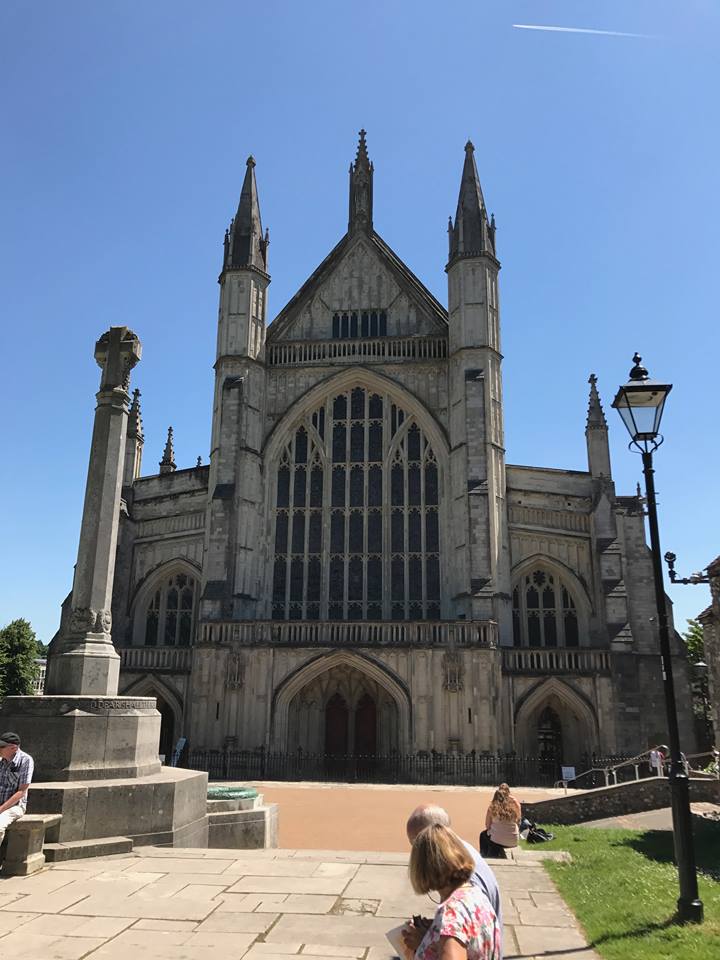
Winchester Cathedral

Although the story is almost certainly a fabrication, Emma was eventually reconciled with Edward, although she enjoyed a much less exalted position as the king’s mother than she had when Harthacnut reigned. She eventually retired to her own estates, living away from the limelight until her death on 6 March 1052. She was buried in the old minster at Winchester, alongside her second husband, Cnut and her favourite son, Harthacnut. Emma’s story forms the basis for the book Encomium Emmae Reginae, possibly commissioned by Emma herself, which provides a significant insight into English politics for the first half of the 11th century.

Emma had played a pivotal role in English politics in the first half of the 11th century, the effects of which would lead to the fateful events of 1066. She helped to shape the events from which the unique situation of the Norman Conquest would arise.  A prominent figure, particularly in the reigns of Cnut and Harthacnut, she was the most distinguished woman of her time. More than any other single person, Emma’s story provides the background to the Norman Conquest through the political and personal relationships formed in the first half of the 11th century.

*

Footnotes: 1The Anglo-Saxon Chronicle translated by James Ingram; 2ibid.

Picture credits: Detail of Emma of Normandy before an altar courtesy of the British Library; Edward the confessor courtesy of Wikipedia; coin from the reign of Harthacnut, courtesy of Hedning, taken from Wikipedia; Genealogical table of Cnut, Harold I and Harthacnut from the Genealogical Chronicle of the English Kings, British Library; Winchester Cathedral courtesy of Anne Marie Bouchard.

Sources: The English and the Norman Conquest by Dr Ann Williams; Brewer’s British Royalty by David Williamson; Britain’s Royal Families, the Complete Genealogy by Alison Weir; The Wordsworth Dictionary of British History by JP Kenyon; The Norman Conquest by Marc Morris; Harold, the King Who Fell at Hastings by Peter Rex; The Anglo-Saxons in 100 Facts by Martin Wall; The Anglo-Saxon Age by Martin Wall; Kings, Queens, Bones and Bastards by David Hilliam; The Mammoth Book of British kings & Queens by Mike Ashley; The Oxford Companion to British History Edited by John Cannon; The Anglo-Saxon Chronicles translated and edited by Michael Swanton; The Anglo-Saxon Chronicle translated by James Ingram; Queen Emma and the Vikings by Harriett O’Brien; The Bayeux Tapestry by Carola Hicks; On the Spindle Side: the Kinswomen of Earl Godwin of Wessex by Ann Williams; oxforddnb.com.

*

My books

Signed, dedicated copies of all my books are available through my online bookshop.

Out now: Scotland’s Medieval Queens

Scotland’s history is dramatic, violent and bloody. Being England’s northern neighbour has never been easy. Scotland’s queens have had to deal with war, murder, imprisonment, political rivalries and open betrayal. They have loved and lost, raised kings and queens, ruled and died for Scotland. From St Margaret, who became one of the patron saints of Scotland, to Elizabeth de Burgh and the dramatic story of the Scottish Wars of Independence, to the love story and tragedy of Joan Beaufort, to Margaret of Denmark and the dawn of the Renaissance, Scotland’s Medieval Queens have seen it all. This is the story of Scotland through their eyes.

Available now from Amazon and Pen and Sword Books

Also by Sharon Bennett Connolly:
Heroines of the Tudor World tells the stories of the most remarkable women from European history in the time of the Tudor dynasty, 1485-1603. These are the women who ruled, the women who founded dynasties, the women who fought for religious freedom, their families and love. Heroines of the Tudor World is now available for pre-order from Amberley Publishing and Amazon UK. Women of the Anarchy demonstrates how Empress Matilda and Matilda of Boulogne, unable to wield a sword themselves, were prime movers in this time of conflict and lawlessness. It shows how their strengths, weaknesses, and personal ambitions swung the fortunes of war one way – and then the other. Available from Bookshop.orgAmberley Publishing and Amazon UKKing John’s Right-Hand Lady: The Story of Nicholaa de la Haye is the story of a truly remarkable lady, the hereditary constable of Lincoln Castle and the first woman in England to be appointed sheriff in her own right. Available from all good bookshops Pen & Sword Booksbookshop.org and Amazon

Defenders of the Norman Crown: The Rise and Fall of the Warenne Earls of Surrey tells the fascinating story of the Warenne dynasty, from its origins in Normandy, through the Conquest, Magna Carta, the wars and marriages that led to its ultimate demise in the reign of Edward III. Available from Pen & Sword BooksAmazon in the UK and US, and Bookshop.orgLadies of Magna Carta: Women of Influence in Thirteenth Century England looks into the relationships of the various noble families of the 13th century, and how they were affected by the Barons’ Wars, Magna Carta and its aftermath; the bonds that were formed and those that were broken. It is now available in paperback and hardback from Pen & SwordAmazon, and Bookshop.orgHeroines of the Medieval World tells the stories of some of the most remarkable women from Medieval history, from Eleanor of Aquitaine to Julian of Norwich. Available now from Amberley Publishing and Amazon, and Bookshop.orgSilk and the Sword: The Women of the Norman Conquest traces the fortunes of the women who had a significant role to play in the momentous events of 1066. Available now from Amazon,  Amberley Publishing, and Bookshop.org.

Alternate Endings: An anthology of historical fiction short stories including Long Live the King… which is my take what might have happened had King John not died in October 1216. Available in paperback and kindle from Amazon.

Podcast:

Have a listen to the A Slice of Medieval podcast, which I co-host with Historical fiction novelist Derek Birks. Derek and I welcome guests, such as Bernard Cornwell and Elizabeth Chadwick, and discuss a wide range of topics in medieval history, from significant events to the personalities involved. Every episode is also now available on YouTube.

*

Don’t forget! Signed and dedicated copies of all my books are available through my online bookshop.

For forthcoming online and in-person talks, please check out my Events Page.

You can be the first to read new articles by clicking the ‘Follow’ button, liking our Facebook page or joining me on Twitter and Instagram.

©2019 Sharon Bennett Connolly FRHistS
Margaret of Wessex, Scotland’s Sainted Queen

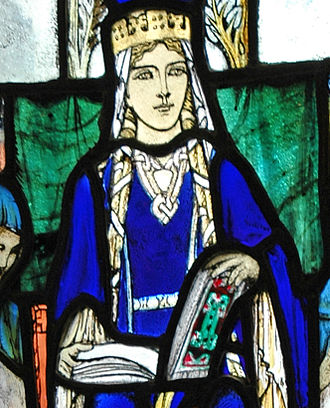
St Margaret, Queen of Scotland

Margaret of Wessex is a remarkable character to study. Her piety and devotion to the church saw her canonised as St Margaret just 150 years after her death; and named as Patroness of Scotland in the seventeenth century. Margaret had an impeccable Saxon pedigree – she was the daughter of Edward the Exile and his wife, Agatha. Edward was the son of Edmund II, usually known as Ironside, King of England in 1016; Edward’s grandfather was, therefore, Æthelred II (the Unready) and his uncle was Edward the Confessor, England’s king from 1042 until 1066. Such valuable royal blood meant she would never be allowed to pursue a life of seclusion in a convent.

When his father, Edmund II, was murdered in 1016, Edward and his younger brother Edmund were sent into exile on the Continent by England’s new king, Cnut. It is thought that Cnut intended that they would be killed once they had left English soil, but the boys were protected by Olof, King of Sweden, and sent on to safety in Kiev, where his daughter Ingegerd was wife of the ruling prince, Jaroslav the Wise. Edmund died sometime between 1046 and 1054, having married the unnamed daughter of a Hungarian king. Edward was also married, in c.1043, to Agatha, whose origins are uncertain: she may have been a daughter of Jaroslav; however, it is possible she was the daughter of Luidolf, Margrave of West Friesland and therefore a relative of Emperor Heinrich III.

Margaret, the eldest of three children, was born in either 1045 or 1046; her sister, Christina, was born around 1050 and her brother Edgar, the Ætheling, was born sometime between 1052 and 1056. The family might have spent their whole lives in European exile, were it not for Edward the Confessor lacking an heir to the English throne; although Edward was married to Edith Godwinson, the couple remained childless. Sometime in 1054 King Edward sent an embassy to Edward the Exile, to bring him back to England as ætheling, the heir to the throne. The embassy sought the aid of Heinrich III, possibly to facilitate communications. The family did not travel immediately, however, possibly because Agatha was pregnant with Edgar, and it was not until 1057 that another embassy, this time led by Harold Godwinson, was sent to bring Edward the Exile home and the family finally arrived in England, having journeyed in a ship  provided by Emperor Heinrich III’s successor, Heinrich IV.

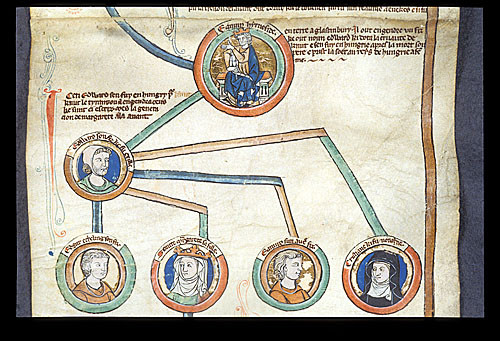
Edmund II Ironside and his descendants

On 19 April, just days after their return, Edward the Exile died, whether by nefarious means or a simple twist of fate is uncertain. The suspicion has been raised that Edward’s rival for the throne, Harold Godwinson – the future King Harold II – may have taken the opportunity to remove his rival; although it was Harold who accompanied Edward back to England, so surely, had he intended murder, he would have done it sooner? Whatever the circumstances, the death of Edward the Exile was a blow for Edward the Confessor’s dynastic hopes. Edward’s little son Edgar, now the ætheling, was much too young to assume a political role. He and his sisters, with their mother, were now under the protection of King Edward. Edgar was given into the custody of Edward’s queen, Edith of Wessex, while the girls were sent to the royal convent at Wilton, to continue their education.

The family continued to live at court and by 5 January 1066, when Edward the Confessor died, Margaret was approaching her twentieth birthday. However, Edgar could have been as young as ten and was probably no older than fourteen; and due to his tender years, the young ætheling was passed over as candidate for the throne in preference for the older and more experienced (both politically and militarily) Harold Godwinson, who was crowned as King Harold II.

Following Harold’s death at the Battle of Hastings in October 1066, Edgar was proclaimed king in London, by some of his supporters, but was incapable of mounting any real challenge to William the Conqueror and his army of Normans; he had no option but to come to terms with the duke. However, Edgar was unsettled under Norman rule and by 1068  he had become involved in the opposition to the new regime, which had been festering in northern England. William’s ruthless response – the Harrying of the North – saw Edgar fleeing for his life; he made his way to Scotland, taking his mother and sisters with him.

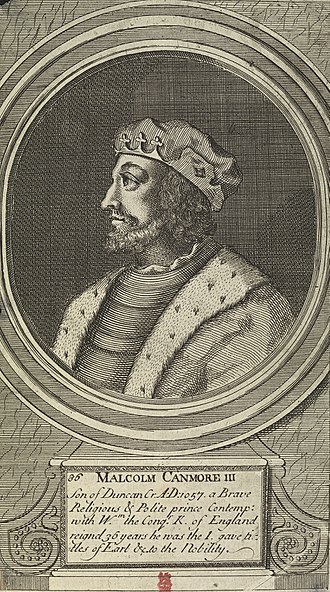
Malcolm II Canmore

The family was warmly received at Dunfermline by Scotland’s king, Malcolm III Canmore. In 1057, King Malcolm had defeated King Macbeth in battle, at Lumphanan, to take the throne. By 1069 he was well established as king and married to Ingebiorg; the couple had at least two sons, Duncan and Donald. Ingebiorg seems to have disappeared from the scene before the Saxon royal family’s arrival in Scotland. Whether she died or was put aside seems uncertain, although her death seems most likely, leaving Malcolm free to find another wife. In 1069 Malcolm asked Edgar and his mother for Margaret’s hand in marriage. Margaret was reluctant to agree to the marriage as she was more inclined to a religious life and had hoped to become a nun. Nonetheless, with pressure from Malcolm, her brother and, possibly, her own sense of obligation to the king who was sheltering her family, she eventually accepted his proposal. They were married at Dunfermline sometime in 1069 or 1070 and, by all accounts, it seems to have been a happy and successful marriage and partnership. Margaret’s life as Queen of Scotland did not prevent her pursuing an active religious life; indeed, her position gave her a unique opportunity to influence the practice of Christianity in Scotland.

Margaret strove to bring the Church of Scotland into conformity with the practices of Western Catholicism, and away from the tenets of the Celtic Church, which had a great deal of influence in the country. She encouraged the Scottish clergy, and its people, to receive communion more than once a year at Easter, to refrain from working on a Sunday and to observe the Lenten fast from Ash Wednesday, rather than the following Monday. Queen Margaret also urged the clergy to celebrate Mass with a common ritual and sought to forbid marriage between a man and his stepmother or sister-in-law.

The queen was supported in all her reforms by her husband; indeed, if Malcolm III had not given his support it is doubtful that Margaret’s influence would have achieved much, if anything at all. The king’s role in her attempts at religious reform is vague, although Malcolm did arrange a conference for the clergy to introduce a number of reforms. Margaret was present, and embarrassed some of the clerics by knowing more about the proper procedures of the Church than they did. She even had the papal manuals to quote from.

Dunfermline Abbey

The queen founded a monastic community at Dunfermline, building the first major stone church in Scotland; and arranged with Lanfranc, Archbishop of Canterbury, to send monks from the cathedral monastery at Canterbury to become its first community. Although it started as a priory, it was elevated to an independent abbey in 1128, at the instigation of Margaret’s son, David I.

Margaret was a strong figure; she was pious but also worldly-wise. Having grown up on the Continent, she was familiar with many of the courts of Europe and had met some of its leading churchmen. A modernising queen, Margaret brought luxury to the Scottish court and into the lives of the nobles of her new country. A Life of St Margaret was commissioned by her daughter, Matilda, when she became Queen of England. It was written sometime between 1100 and 1107 by Turgot, Margaret’s former chaplain and the prior of Durham.

The biography emphasises the queen’s compassion for children and the poor and stresses her piety, pointing to the severity of her self-denial and her frequent fasting. However, it also tells us that she had a love of etiquette and formality, and had a fondness for fine clothes and jewellery.¹ Margaret enjoyed a high reputation in the Anglo-Norman world, even in her own lifetime; Orderic Vitalis described her as ‘eminent from her high birth, but even more renowned for her virtue and holy life’.²

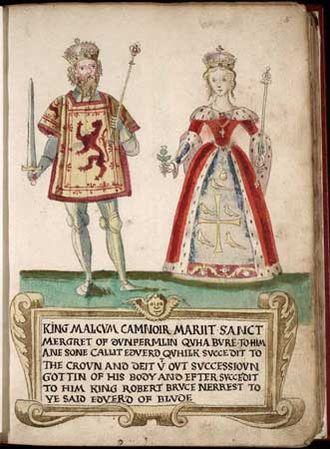
Malcolm III and St Margaret

Margaret and Malcolm would have a large family, with six sons and two daughters growing to adulthood. Margaret took great care in educating them, ensuring they were given the essentials for their future royal careers. Her second son, Edmund, became king in November 1094, ruling jointly with his uncle – Malcolm’s brother  – Donald III, following the death of his half-brother, Duncan II. Edmund ruled south of the Forth/Clyde boundary, while Donald ruled the north, although there is no indication that he was ever crowned. In 1097, the co-kings were deposed in favour of Edmund’s younger brother, Edgar; Edmund became a monk at Montacute Abbey, Somerset, and died there, having never married. Edgar himself died on 8 January 1107. Unmarried and childless, he was succeeded by his brother, Alexander I, who died in April 1124. David I succeeded Alexander; he reigned until 1153 and was succeeded, in turn, by his grandson, Malcolm IV the Maiden. Another son, Æthelred, styled Earl of Fife, became Lay Abbot at Dunkeld and died around 1097. Malcolm and Margaret also had two daughters: Edith, who changed her name to Matilda on marrying King Henry I of England; and Mary, who married Eustace III, Count of Boulogne, and was the mother of Matilda of Boulogne, wife of Stephen, King of England. Edith (Matilda) and Mary were educated at Romsey Abbey, where Margaret’s sister, Christina was abbess.

As King of Scots, Malcolm also had claims to Cumbria and Northumbria and in 1069/70, he made raids into Northumberland. William I responded by sending an army north and the eventual peace treaty saw Malcolm’s oldest son by Ingebiorg, Duncan, being sent south as a hostage and guarantee of his good faith. Duncan would eventually reign, briefly, as Duncan II but was killed at the Battle of Monthechin in 1094. Malcolm made frequent raids into Northumberland, notably in 1079 and 1091, in attempts to gain control over the county.

When a diplomatic mission in 1092 failed, he attacked again in 1093, taking his eldest son by Margaret, Edward, with him. Malcolm was killed at the Siege of Alnwick, on 13 November 1093; Edward died shortly after, near Jedburgh, from wounds received at the Siege. Margaret died on 16 November 1093, just days after the battle, possibly on receiving the news, brought by her son Edgar, of the deaths of her husband and eldest son. Although the fact her body was weakened by her frequent fasting may have hastened her death. She was buried in the abbey she had founded at Dunfermline. Malcolm was initially buried at Tynemouth, but his remains were later moved to join his wife at Dunfermline.

Margaret’s sons honoured their mother’s memory, encouraging the popular cult of St  Margaret that developed soon after the queen’s death, to foster the idea that she should be made a saint; such an honour would serve to enhance the political and religious status of their family. One of the miracles attributed to her was that in 1199 Scotland’s king, William the Lion, was persuaded against launching an invasion of England after experiencing a vision while holding a vigil at Margaret’s tomb at Dunfermline. Her canonisation came in 1250, and in 1673 Pope Clement X named her Patroness of Scotland. Following the Reformation, the remains of both Margaret and Malcolm were removed to Spain by Philip II and reinterred in a chapel at the Escorial in Madrid.

St Margaret, Queen of Scotland

Margaret was a direct descendant of King Alfred the Great of Wessex. Her Saxon royal blood guaranteed she would not be allowed to enter a convent, she was too valuable on the marriage market. However, through her efforts to reform the Scottish Church, it could be said that she found a better way to worship God. Her legacy was cemented through the work of her son, David I, who continued in her policy of Church reform; while her Saxon blood found its way back into the English royal family through her daughter, Matilda, and her marriage to Henry I. Saint Margaret’s royal lineage ensured that she would not be allowed to devote her entire life to God, but her position as Queen of Scotland gave her the opportunity to direct her devotional tendencies into Church reform, making her a heroine to generations of Scots.

*

Footnotes:

¹ Vita B Simonis, col. 1219, quoted by Elizabeth van Houts in oxforddnb.com, May 2008; ² Quoted by epistolae.ccnmtl.columbia.edu.

*

Images:

All pictures courtesy of Wikipedia, except: Dunfermline Abbey courtesy of Angela Bennett; Edmund II Ironside and his descendants courtesy of British Library Catalogue of Illuminated Manuscripts.

*

Sources:

epistolae.ccnmtl.columbia.edu; Brewer’s British Royalty by David Williamson; Britain’s Royal Families, the Complete Genealogy by Alison Weir;The Wordsworth Dictionary of British History by JP Kenyon; The Anglo-Saxons in 100 Facts by Martin Wall; Kings, Queens, Bones and Bastards by David Hilliam; Heroines of the Medieval World by Sharon Bennett Connolly; The Mammoth Book of British kings & Queens by Mike Ashley; The Oxford Companion to British History Edited by John Cannon; The Anglo-Saxon Chronicles translated and edited by Michael Swanton; The Anglo-Saxon Chronicle translated by James Ingram; Queen Emma and the Vikings by Harriett O’Brien; The Bayeux Tapestry by Carola Hicks; oxforddnb.com.

*

My Books:

Signed, dedicated copies of all my books are available through my online store.

Coming 30 January 2025: Scotland’s Medieval Queens

Scotland’s history is dramatic, violent and bloody. Being England’s northern neighbour has never been easy. Scotland’s queens have had to deal with war, murder, imprisonment, political rivalries and open betrayal. They have loved and lost, raised kings and queens, ruled and died for Scotland. From St Margaret, who became one of the patron saints of Scotland, to Elizabeth de Burgh and the dramatic story of the Scottish Wars of Independence, to the love story and tragedy of Joan Beaufort, to Margaret of Denmark and the dawn of the Renaissance, Scotland’s Medieval Queens have seen it all. This is the story of Scotland through their eyes.

Available for pre-order now.

Also by Sharon Bennett Connolly:

Heroines of the Tudor World tells the stories of the most remarkable women from European history in the time of the Tudor dynasty, 1485-1603. These are the women who ruled, the women who founded dynasties, the women who fought for religious freedom, their families and love. Heroines of the Tudor World is now available for pre-order from Amberley Publishing and Amazon UK. Women of the Anarchy demonstrates how Empress Matilda and Matilda of Boulogne, unable to wield a sword themselves, were prime movers in this time of conflict and lawlessness. It shows how their strengths, weaknesses, and personal ambitions swung the fortunes of war one way – and then the other. Available from Bookshop.orgAmberley Publishing and Amazon UKKing John’s Right-Hand Lady: The Story of Nicholaa de la Haye is the story of a truly remarkable lady, the hereditary constable of Lincoln Castle and the first woman in England to be appointed sheriff in her own right. Available from all good bookshops Pen & Sword Booksbookshop.org and Amazon

Defenders of the Norman Crown: The Rise and Fall of the Warenne Earls of Surrey tells the fascinating story of the Warenne dynasty, from its origins in Normandy, through the Conquest, Magna Carta, the wars and marriages that led to its ultimate demise in the reign of Edward III. Available from Pen & Sword BooksAmazon in the UK and US, and Bookshop.orgLadies of Magna Carta: Women of Influence in Thirteenth Century England looks into the relationships of the various noble families of the 13th century, and how they were affected by the Barons’ Wars, Magna Carta and its aftermath; the bonds that were formed and those that were broken. It is now available in paperback and hardback from Pen & SwordAmazon, and Bookshop.orgHeroines of the Medieval World tells the stories of some of the most remarkable women from Medieval history, from Eleanor of Aquitaine to Julian of Norwich. Available now from Amberley Publishing and Amazon, and Bookshop.orgSilk and the Sword: The Women of the Norman Conquest traces the fortunes of the women who had a significant role to play in the momentous events of 1066. Available now from Amazon,  Amberley Publishing, and Bookshop.org.

Alternate Endings: An anthology of historical fiction short stories including Long Live the King… which is my take what might have happened had King John not died in October 1216. Available in paperback and kindle from Amazon.

Podcast:

Have a listen to the A Slice of Medieval podcast, which I co-host with Historical fiction novelist Derek Birks. Derek and I welcome guests, such as Bernard Cornwell, and discuss a wide range of topics in medieval history, from significant events to the personalities involved.

*

Don’t forget! Signed and dedicated copies of all my books are available through my online bookshop.

For forthcoming online and in-person talks, please check out my Events Page.

You can be the first to read new articles by clicking the ‘Follow’ button, liking our Facebook page or joining me on Twitter and Instagram.

*

©2019 Sharon Bennett Connolly FRHistS
Gytha of Wessex and the Fall of the House of Godwin

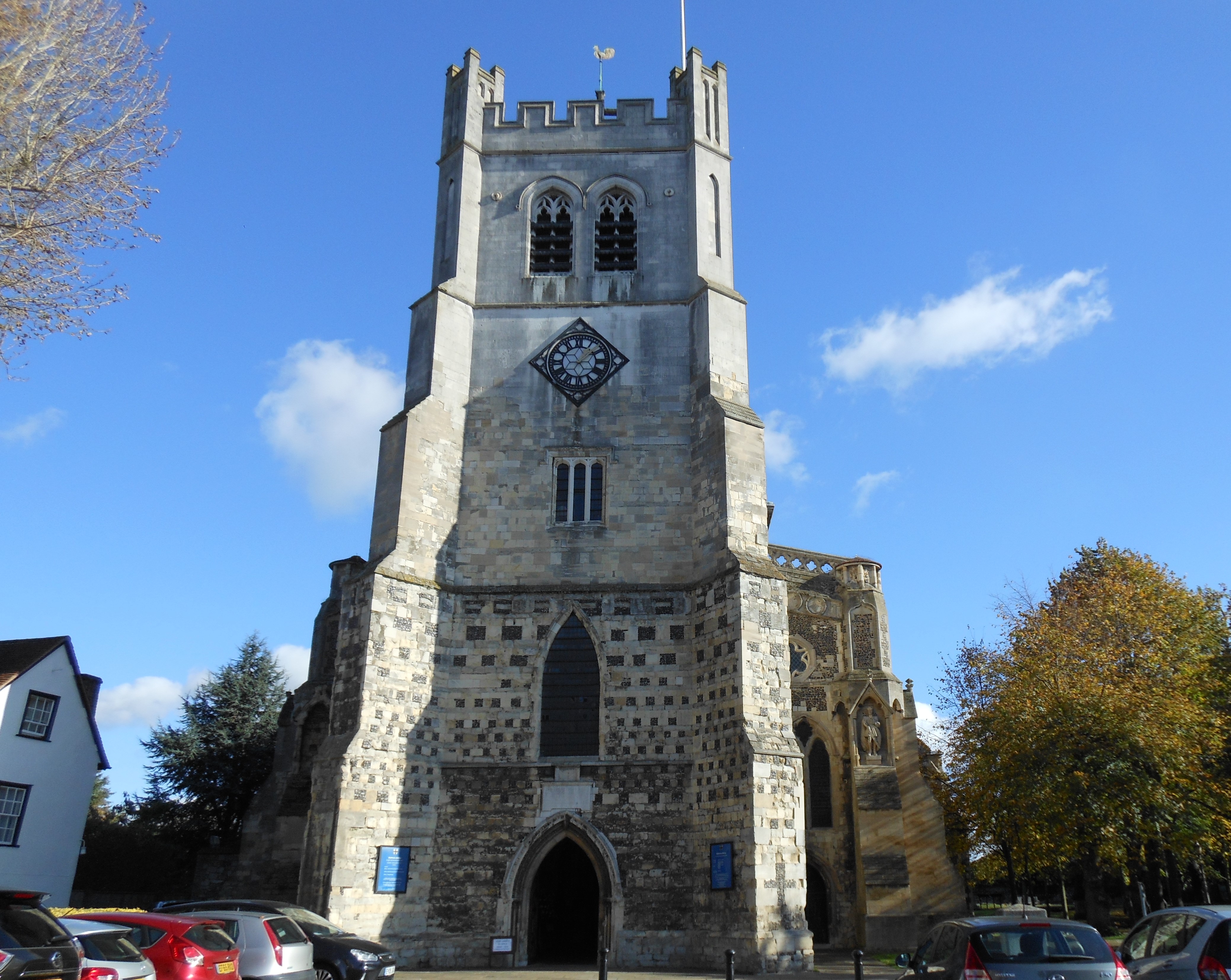
Statue of King Harold, Waltham Abbey

The years following the death of Earl Godwin of Wessex, husband of Gytha, saw the rise of their sons. Harold had succeeded to his father’s earldom of Wessex and in 1055 Tostig was given the earldom of Northumbria; Earl Siward had died at York, leaving only a young son, Waltheof, to succeed him. It was thought too dangerous to leave a county which bordered Scotland in the hands of a child, and so the earldom was awarded to Tostig. When Ælfgar succeeded to his father Leofric’s earldom of Mercia in 1057, he had to relinquish the earldom of East Anglia, which was given to Gyrth, one of Gytha and Godwin’s younger sons. Another son, Leofwine, appears to have succeeded to part of the earldom of Ralph, Earl of Hereford, on his death in 1057, gaining lands in the south Midlands, including in Hertfordshire, Middlesex and Buckinghamshire.

The movements of Gytha herself over the years immediately following Godwin’s death have gone unrecorded. The widow of the great earl probably spent most of her time in retirement on her estates, possibly visiting her family on occasion and spending time at King Edward’s court, with her daughter, Queen Edith.

However, her family was threatened yet again in 1065, when the Northumbrians revolted against her son Tostig’s harsh rule. Unrest in Northumbria had been growing steadily over recent years. Tostig was rarely in the earldom, preferring to spend his time at court, with the king and his sister, and leaving the day-to-day governance of Northumbria to his representatives in the region. It was these representatives, therefore, who bore the brunt of the disaffection with Tostig’s rule. According to John of Worcester, a force of 200 armed men marched on York, killing about 200 of the earl’s retainers, seizing his weapons and treasury, which were stored in the city.¹ The rebels then invited Morcar, the brother of Earl Edwin of Mercia, to become their earl.  The rebellion gathered pace when Mercian Earl Edwin joined his own forces with those of Morcar, and the brothers were, in turn, joined by their Welsh allies and marched south.

They met Earl Harold, Tostig’s brother, at Northampton; Harold’s message to the rebels was to withdraw their army and take their grievances to the king. The rebels, however, demanded that Tostig should not only be removed from Northumbria, but banished from England altogether. No lord – including Harold – was prepared to restore Tostig by force; no one wanted to see the country divided by civil war. Having run out of options, Edward acquiesced to the rebels’ demands. Morcar was confirmed as Earl of Northumbria and the rights they had enjoyed in the past, called the ‘Laws of Cnut’ by the Anglo-Saxon Chronicle, were restored to the Northumbrians. Tostig was exiled. It must have caused Gytha great distress to see her son, Tostig, with his wife, Judith, young children and household, cross the English Channel to Flanders, on 1 November 1065. It was probably the last time she saw her son.

Tostig’s departure was merely the start of a year of grief for both Gytha, although it may not have felt that way during the start of the new year of 1066. On 5 January, Edward the Confessor breathed his last, leaving the kingdom to his brother-in-law, Earl Harold. Gytha must have seen Harold’s hasty coronation on 6 January, in the newly rebuilt Westminster Abbey, as the crowning glory forher family, and a sign of new beginnings for all her children. However, if Harold expected a honeymoon period as king, he was to be sorely disappointed. By Easter, England was living in fear of invasion from Duke William of Normandy. These fears were further stoked when ‘a sign such as men never saw before was seen in the heavens.’²

Memorial to the Battle of Stamford Bridge, outside York

The appearance of the great comet, later to be known as Halley’s Comet, was seen as a portent for change in the kingdom. The comet was visible every night for the whole of the last week of April, and no sooner had it disappeared than news arrived of a hostile fleet attacking England’s shores. The threat did not come from Normandy, but from Gytha’s exiled son, Tostig. How devastated she must have been, to see one son attacking another, but Harold proved implacable and set out for Sandwich to confront Tostig. Tostig withdrew before his brother’s arrival and sailed up the coast towards Northumbria, eventually seeking refuge with King Malcom in Scotland.

Having seen off his brother, Harold now prepared to face the greater threat of Duke William of Normandy, watching and waiting for the arrival of William’s ships. The fear and anticipation that gripped the country cannot have failed to affect Gytha, knowing that her sons were at the heart of events. Leofwine and Gyrth were stalwart in their support of Harold, whilst Tostig was brooding and planning in the court of the Scots king. The months of anticipation must have been hard on them all, but in September, Harold was forced to stand down his army, provisions had run out and ‘no man could keep them there any longer. They therefore had leave to go home; and the king rode up, and the ships were driven to London; but many perished ere they came thither.’²

As the summer drew to a close, Harold received news that his brother, Tostig, had landed in the north with Harald Hardrada, King of Norway, and 300 ships. They defeated a force of Northumbrians, led by the Mercian brothers, earls Morcar and Edwin, at the Battle of Fulford on 20 September 1066. Having received news of this defeat, King Harold force marched his army the 190 miles from London to York in just four days, so that he was able to face the Scandinavians at Stamford Bridge, on the outskirts of the city, on 25  September. He was accompanied by two of his younger brothers, Gyrth and Leofwine.

King Harold’s troops prevailed, despite their near-exhausted state after such a march. Harald Hardrada and Tostig were both killed in the battle, which saw about 11,000 of the estimated 20,000 combatants dead at the end of the day. Harold had no time to savour his victory, nor mourn the loss of his brother, for three days after the battle Duke William of Normandy landed at Pevensey on the south coast. As soon as he received the news, Harold turned his army south and marched to face this new enemy. It may well be that he sent a messenger to his mother while en route, informing her of Tostig’s death and of his own success.

William of Jumièges states that Gytha tried to persuade Harold against facing Duke William. In the same, tense family conference, Harold’s brother Gyrth offered to fight the Duke, ‘since he had sworn no oath and owed nothing to him’.[4] Harold was enraged, he ‘taunted Gyrth and even insolently kicked his mother Gytha who was trying to hold him back.’[4] By 14 October Harold had arrived at Senlac Hill, 7 miles north of Hastings, where he arrayed his army to face the opposing Normans. Stories have Gytha awaiting the outcome of the battle behind the lines, with Harold’s handfast wife, Edith Swanneck.

By the end of the day, three of Gytha’s sons lay among the dead; Harold, Gyrth and Leofwine. It is also possible her grandson Hakon died on the field of battle; he had returned to England with Harold in 1064, after being held hostage in Normandy since 1052. According to William of Poitiers, ‘Far and wide the earth was covered with the flower of the English nobility and youth, drenched in blood.’[5]

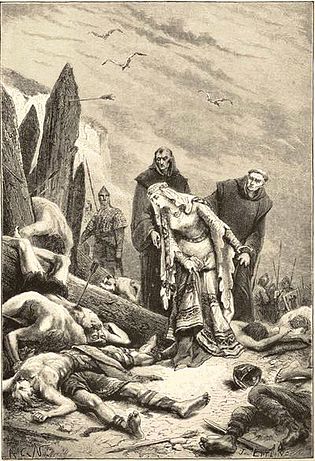
Edith searching the battlefield for Harold’s body

In the aftermath of the battle there is a heartrending story that Gytha and Edith walked the battlefield, searching for Harold’s body, which was said to be recognisable by marks that only Edith, his lover of twenty years, would know (probably tattoos). It was reported that Gytha offered Duke William the weight of Harold’s body in gold, if she could be allowed to take him for burial. William refused, with an angry retort, saying it would be unfair to bury him, given that so many remained unburied on the field on his account. However, most sources suggest that William then ordered that Harold be buried in an unmarked grave, on a cliff overlooking England’s shores. Other stories have Harold’s remains being claimed by Edith and taken for burial at Harold’s own foundation of Waltham Abbey. Whether it was Gytha or Edith who identified Harold, whether he was buried in Waltham Abbey of an unmarked grave close to the sea, the tragedy for Gytha and Edith was that Harold was dead and William was now England’s ruler.

As William consolidated his hold on England and as she was grieving the loss of four sons within a space of three weeks, Gytha probably retreated to her estates in Wessex. Her one surviving son, Wulfnoth, was still a hostage in Normandy and so nothing more is heard of her until 1068. Gytha appears to have settled in the west of Wessex, for she and her family were implicated in a conspiracy in Exeter, from where messages were being sent to other cities, urging rebellion. It appears that Gytha planned a Godwinson revival with the sons of Harold and Edith Swanneck.

In their late teens or early twenties, the boys fled to Ireland after the death of their father and were now plotting to return with an invasion fleet. King William had just returned from Normandy, when the conspiracy arose. Exeter was to be the base from which the rebellion could gather and spread throughout the country; when the king demanded Exeter give the king its fealty, the city refused. As William arrived at the city with his army, they played for time, saying they would open their gates, while at the same time preparing to resist. After eighteen days of siege, the city surrendered. The Norman chroniclers suggest that the inhabitants were worn down by William the Conqueror’s relentless assaults, or that the city wall partially collapsed; while the English Chroniclers argue that the surrender came about after Gytha had deserted the cause.

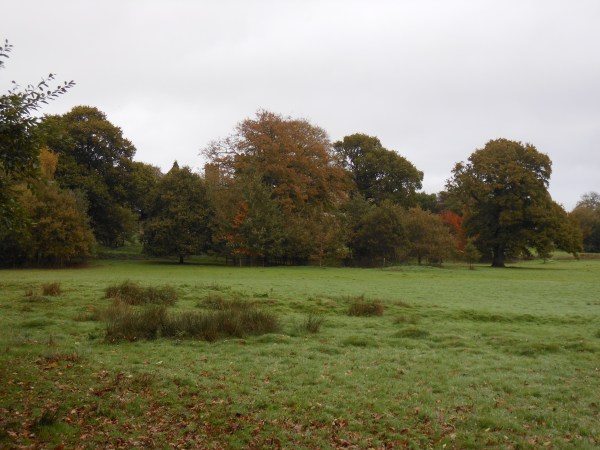
Battlefield at Hastings
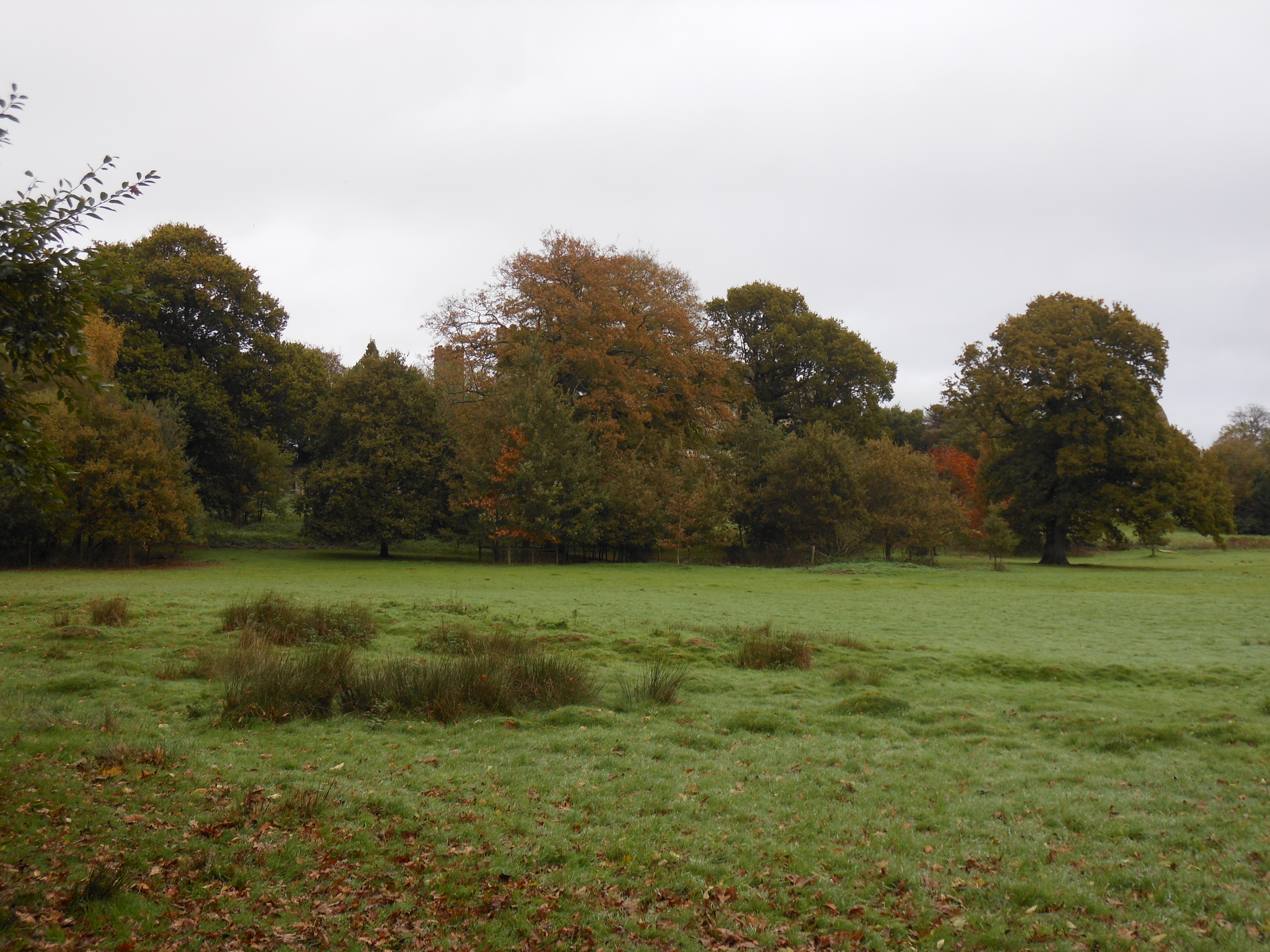
The Hastings battlefield

According to John of Worcester, ‘the countess Gytha, mother of Harold, king of England, and sister of Sweyn, king of Denmark, escaped from the city, with many others, and retired to Flanders; and the citizens submitted to the king, and paid him fealty.’¹ Gytha took a boat into the Bristol Channel and landed on the island of Flat Holme, possibly to await the arrival of her grandsons from Ireland. And with Gytha and her supporters gone, the city was able to surrender and agree terms with the king. Following the failure of the conspiracy, Gytha’s lands in England were declared forfeit and distributed among the victorious Normans, as had previously happened to those who had fought at Hastings in 1066.

She remained on Flat Holm for some time; her grandsons, Godwine, Edmund and Magnus, arrived from Ireland later in the year, possibly making a brief stop on Flat Holm to visit her before landing in Somerset and making for Bristol. Although the campaign failed to take the city, they returned to Ireland with considerable plunder after raiding along the Somerset coast. Another attempt at gathering support in Devon the following year also ended in failure and the boys returned to Ireland.

It was probably after this second failed invasion that Gytha left the island of Flat Holm and England, taking with her ‘a great store of treasure’.[6] She was accompanied by several surviving members of her family, including her daughter, Gunhilda, and her granddaughter and namesake Gytha (Harold’s daughter by Edith Swanneck). After a short stay in Flanders, Gytha may have made her way to Denmark, where her nephew Swein Estrithson was king.

Gytha’s daughter, Gunhilda, joined the convent at St  Omer, staying there for several years before moving to Bruges. Apart from one visit to Denmark, she then spent the remainder of her years in Bruges, dying there on 24 August 1087, a memorial plaque, discovered in 1786, describes her as a child of noble parents, her father Godwin ‘ruled over the greater part of England’ and her mother Gytha ‘sprung from a noble family of Danes’.[7] According to Ann Williams, Gunhilda had lived her life as a vowess, taking a vow of perpetual virginity when still a girl. In Bruges she may have been attached to the Church of St Donatien as a vowess, as she had donated a collection of relics to the church.

Gytha, Countess of Wessex

Gytha’s granddaughter, Gytha, the daughter of King Harold by Edith Swanneck, was married to Vladimir II Monomakh, prince of Smolensk and (later) Kyiv, sometime after her arrival on the Continent. She was the mother of Mstislav the Great, Grand Prince of Kyiv, who was born in 1076; he was the last ruler of a united Kyivan Rus. Gytha died in 1107; it was through her and her son Mstislav that the Godwinson blood eventually made it back into the English royal family, with Mstislav’s direct descendant Philippa of Hainault, wife and queen of Edward III.

Unfortunately for us, once she reaches the Continent, Gytha, the wife of Godwin, disappears from history. Where she lived, and for how much longer, has gone unrecorded, shrouding her last days or years in mystery.

Gytha’s life was an extraordinary story of privilege and power, war and loss. She was a wife whose husband decided the fate of kings, and a mother who lost four sons in battle within three weeks in 1066, three in the same battle. It is impossible to imagine the agony of waiting at Hastings, and hearing of the death of her son the king. It speaks for her determination and tenacity that she did not just curl up and give in after such losses. She continued her resistance to William the Conqueror for as long as she could, before going into exile on the Continent, disappearing from the pages of history.

*

Photos of King Harold, Hastings and Stamford Bridge ©Sharon Bennett Connolly 2018. Pictures of Gytha and Edith Swanneck courtesy of Wikipedia.

Footnotes: ¹The Chronicle of John of Worcester, translated and edited by Thomas Forester, A.M.; ²The Anglo-Saxon Chronicle translated by James Ingram; ³The Chronicle of Henry of Huntingdon. Comprising the history of England, from the invasion of Julius Caesar to the accession of Henry II. Also, the Acts of Stephen, King of England and duke of Normandy Translated and edited by Thomas Forester; [4] Gesta Normannorum Ducum by William of Jumièges, edited and translated by Elizabeth Van Houts; [5] The Gesta Guillielmi of William of Poitiers, edited by R.H.C. Davis and Marjorie Chibnall; [6] The Ecclesiastical History of England and Normandy by Ordericus Vitalis; [7] On the Spindle Side: the Kinswomen of Earl Godwin of Wessex by Ann Williams.

*

Sources: The English and the Norman Conquest by Dr Ann Williams; Brewer’s British Royalty by David Williamson; Britain’s Royal Families, the Complete Genealogy by Alison Weir; The Wordsworth Dictionary of British History by JP Kenyon; The Norman Conquestby Marc Morris; Harold, the King Who Fell at Hastings by Peter Rex; The Anglo-Saxons in 100 Facts by Martin Wall; The Anglo-Saxon Age by Martin Wall; Kings, Queens, Bones and Bastards by David Hilliam; The Mammoth Book of British kings & Queens by Mike Ashley; The Oxford Companion to British History Edited by John Cannon; The Anglo-Saxon Chronicles translated and edited by Michael Swaton; The Anglo-Saxon Chronicle translated by James Ingram; Queen Emma and the Vikings by Harriett O’Brien; The Bayeux Tapestry by Carola Hicks; On the Spindle Side: the Kinswomen of Earl Godwin of Wessex by Ann Williams; oxforddnb.com.

*

My Books:

Signed, dedicated copies of all my books are available through my online bookshop.

OUT NOW! Heroines of the Tudor World

Heroines of the Tudor World tells the stories of the most remarkable women from European history in the time of the Tudor dynasty, 1485-1603. These are the women who ruled, the women who founded dynasties, the women who fought for religious freedom, their families and love. These are the women who made a difference, who influenced countries, kings and the Reformation. In the era dominated by the Renaissance and Reformation, Heroines of the Tudor World examines the threats and challenges faced by the women of the era, and how they overcame them. From writers to regents, from nuns to queens, Heroines of the Tudor World shines the spotlight on the women helped to shape Early Modern Europe.

Heroines of the Tudor World is now available for pre-order from Amberley Publishing and Amazon UK.

Also by Sharon Bennett Connolly:

Women of the Anarchy demonstrates how Empress Matilda and Matilda of Boulogne, unable to wield a sword themselves, were prime movers in this time of conflict and lawlessness. It shows how their strengths, weaknesses, and personal ambitions swung the fortunes of war one way – and then the other. Available from Bookshop.orgAmberley Publishing and Amazon UKKing John’s Right-Hand Lady: The Story of Nicholaa de la Haye is the story of a truly remarkable lady, the hereditary constable of Lincoln Castle and the first woman in England to be appointed sheriff in her own right. Available from all good bookshops Pen & Sword Booksbookshop.org and AmazonDefenders of the Norman Crown: The Rise and Fall of the Warenne Earls of Surrey tells the fascinating story of the Warenne dynasty, from its origins in Normandy, through the Conquest, Magna Carta, the wars and marriages that led to its ultimate demise in the reign of Edward III. Available from Pen & Sword BooksAmazon in the UK and US, and Bookshop.org

Ladies of Magna Carta: Women of Influence in Thirteenth Century England looks into the relationships of the various noble families of the 13th century, and how they were affected by the Barons’ Wars, Magna Carta and its aftermath; the bonds that were formed and those that were broken. It is now available in paperback and hardback from Pen & Sword,  Amazon, and Bookshop.orgHeroines of the Medieval World tells the stories of some of the most remarkable women from Medieval history, from Eleanor of Aquitaine to Julian of Norwich. Available now from Amberley Publishing and Amazon, and Bookshop.orgSilk and the Sword: The Women of the Norman Conquest traces the fortunes of the women who had a significant role to play in the momentous events of 1066. Available now from Amazon,  Amberley Publishing, and Bookshop.org.

Alternate Endings: An anthology of historical fiction short stories including Long Live the King… which is my take what might have happened had King John not died in October 1216. Available in paperback and kindle from Amazon.

Podcast:

Have a listen the A Slice of Medieval podcast, which I co-host with Historical fiction novelist Derek Birks. Derek and I welcome guests, such as Bernard Cornwell and discuss a wide range of topics in medieval history, from significant events to the personalities involved.

Every episode is also now available on YouTube.

*

Don’t forget! Signed and dedicated copies of all my books are available through my online bookshop.

For forthcoming online and in-person talks, please check out my Events Page.

You can be the first to read new articles by clicking the ‘Follow’ button, liking our Facebook page or joining me on Twitter and Instagram.

*

©2018 Sharon Bennett Connolly, FRHistS

Gytha of Wessex and the Rise of the House of Godwin

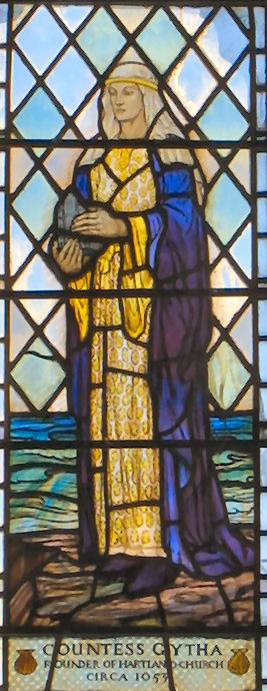
Countess Gytha

I have to admit, I expected Emma of Normandy to be the woman who stole the show with my second book, Silk and the Sword: the Women of the Norman Conquest, but I was pleasantly surprised to discover it was Gytha of Wessex! Gytha completes the triumvirate of remarkable women who presided over the first half of the eleventh century in England; the others being Emma of Normandy and the legendary Lady Godiva. However, unlike Emma and Godiva, Gytha was at the centre of events before, during and after the fateful year of 1066. Her story is far too long to be told in one blog post, so I will concentrate on the lesser known part of the story; the early years of the marriage of Godwin and Gytha.

A woman of impeccable pedigree, Gytha was the mother of a large brood of children that included several earls, the queen of Edward the Confessor and the last Anglo-Saxon king of England. Raised in Denmark, Gytha was the daughter of Thorgils Sprakaleg, a Danish magnate who himself was said to have been the grandson of a bear and a Swedish maiden. Although obviously not true, such a legend serves to weave a sense of mystery and legacy into a family. Little is known of her mother; a later story suggested she was Tyra, daughter of Harold Bluetooth, king of Norway and Denmark, but this has been discounted by historians.

Gytha was probably either born in the last decade of the tenth century or the first decade of the eleventh, and she had at least two brothers. Eilaf who was Earl of Gloucestershire under King Cnut while her second brother, Earl Ulf, was married to King Cnut’s sister, Estrith, and was the father of Swein Estrithson, King of Denmark from 1047 to 1076. Earl Ulf had two other children, Beorn Estrithson and Asbjørn; Beorn spent time with his aunt’s family and was murdered by his cousin, Gytha’s oldest son, Swein Godwinson, in 1049. Ulf acted as Regent of Denmark for King Cnut before he was killed, apparently on the orders of Cnut himself, on Christmas Day 1026.

It was in about 1022 that Gytha was married to Godwin. According to The Life of King Edward, commissioned by Gytha’s daughter, Queen Edith, it was early in his reign that King Cnut took Godwin with him to Denmark, where the king ‘tested more closely his wisdom’, and ‘admitted [him] to his council and gave him his sister [sic] as wife.’¹ Although Gytha was not, in fact, Cnut’s sister, she was still a part of the extended Danish royal family; giving her to Godwin as a wife was a substantial reward and a sign of Cnut’s trust in him. What Gytha thought of being given in marriage to a man below her station, no matter how much a favourite of Cnut’s he was, we can only surmise. We can assume that she probably had little say in the matter; once Cnut had decided on the marriage, who could refuse such a powerful king?

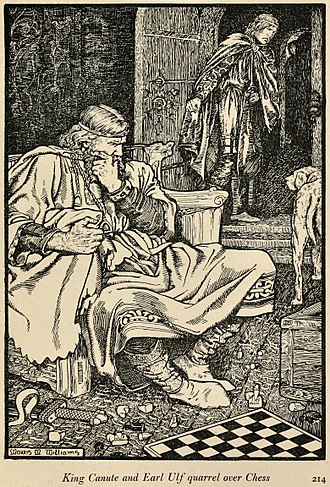
King Cnut with Gytha’s brother, Earl Ulf

Godwin’s background is obscured by time, but it is likely that he was the son of Wulfnoth Cild, a Sussex thegn who fell afoul of the politics and political machinations of the reign of Æthelred II the Unready. The appellation ‘Cild’ denotes a young man or warrior and is usually applied to those of rank in Anglo-Saxon England. In 1009  Wulfnoth had been accused of treason by Brihtric, the brother of the powerful and wily Eadric Streona. What treason he had committed is unclear, and it is likely that the charges were unfounded. The accusations came during the muster of the magnificent new fleet, built on the orders of Æthelred II to counter the incursions of the Scandinavians. Wulfnoth fled to sea, taking twenty of the new ships with him. According to the Anglo-Saxon Chronicle, Brihtric went in pursuit of him, with eighty ships, but his force was run aground in a heavy storm and then attacked by Wulfnoth, who set fire to Brihtric’s ships. The destruction of the greater part of the fleet was to put an end to any hope of campaigning off the English coast and Æthelred gave up on the project and went home.

It is possible that Godwin was married to a lady called Thyra, before he married Gytha.  According to William of Malmesbury, Thyra was Cnut’s sister, and a quite unpleasant lady. She is said to have had a son who, while out riding a horse ‘was carried into the Thames, and perished in the stream: his mother, too, paid the penalty of her cruelty; being killed by a stroke of lightning. For it is reported, that she was in the habit of purchasing companies of slaves in England, and sending them into Denmark; more especially girls, whose beauty and age rendered them more valuable, that she might accumulate money by this horrid traffic.’²

Godwin appears to have accumulated considerable lands during the reign of Cnut. Although only one charter survives from the period, in which Cnut granted him Polhampton in Hampshire, Godwin also possessed manors in Kent, Sussex and Hampshire, some of which had previously belonged to the royal estates in the reign of Æthelred II. Although we don’t hear of Gytha at this time – the chronicles rarely mention the women – we can assume that she enjoyed and benefitted from the favour her husband received from King Cnut. It is likely that she spent the majority of her time in the 1020s and 1030s giving birth to, and raising, her large brood of children. Gytha and Godwin had a large family of at least ten – possibly eleven – children.

Their daughter Edith was probably born within a year of the marriage and would become Queen of England as the wife of King Edward the Confessor. Although we cannot be certain of the order of birth, the eldest son seems likely to have been Swein, who was born in about 1023, with Harold – the future King Harold II – probably arriving the year after. Five more sons may have followed; Tostig, Gyrth, Leofwine, Wulfnoth and possibly Alfgar.

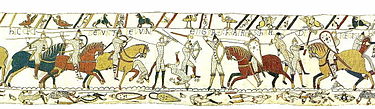
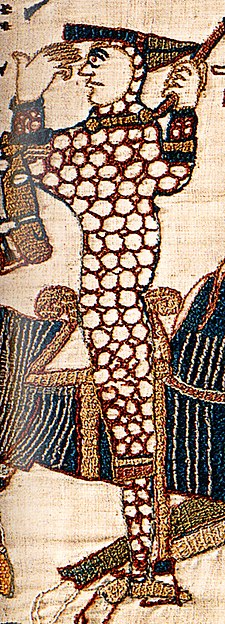
Death of Leofwine at the Battle of Hastings, depicted in the Bayeux Tapestry

Tostig, Gyrth and Leofwine all became earls under Edward the Confessor and were deeply involved in the events of 1066, although not all on the same side. While still only a child, Wulfnoth was taken to Normandy as a hostage in about 1052, with his nephew, Hakon (the son of Wulfnoth’s older brother, Swein). Wulfnoth died sometime after 1087, but whether in England or Normandy is unclear. It is possible that young Hakon died whilst still a hostage in Normandy; however, there is some suggestion that he was released following Harold’s visit to Normandy in 1064 and fought – and died – alongside his uncles at the Battle of Hastings on 14 October 1066. Little is known of Alfgar; if he existed, he may have been a monk at Reims in France.

As well as Edith, Gytha and Godwin are thought to have had two or three more daughters. Little is known of Eadgiva (or Eadgifu), but for her name and that she held the comital estate of Crewkerne in Somerset; she is also on a list of women in confraternity with the New Minster at Winchester but may have been dead by 1066. A younger daughter, Gunhilda, is believed to have been a vowess from an early age and became a nun after the Conquest, either at St Omer in France or Bruges in Flanders. Gunhilda died at Bruges on 24 August 1087 and is buried in Bruges Cathedral.

When Edward the Confessor came to the throne in 1042 the support of the powerful Earl Godwin was essential to the success of his accession. Among the lands acquired by Godwin during the 1040s was Woodchester in Gloucestershire, which he bought for Gytha. The manor was intended to support her when she stayed at Berekely, for ‘she was unwilling to use up anything from that manor because of the destruction of the abbey.’¹

As Godwin’s star continued to rise; so too did that of his family. In 1043 an earldom, centred on Hereford, had been created for his eldest son, Swein, and in 1044 Harold, the next oldest, was made Earl of East Anglia. Gytha must have been proud to see her husband and sons rise so high, and surely was overjoyed as she became the mother of a queen when her eldest daughter, Edith, married King Edward on 23  January 1045. The family must have appeared unassailable to their fellow and rival nobles.

For Gytha, it was mostly a time for pride in her children, although one of her sons would disappoint and humiliate her. Swein Godwinson was, by most accounts, a rather unpleasant character. Although a notable fighter, he was ruthless and determined. One source suggests that  Swein had, at some point, impugned his mother’s reputation, claiming that he was not the son of Godwin, but of the former king, Cnut. The claim was indignantly refuted by Gytha, who gathered together the noble ladies of Wessex to witness her oath that Godwin was Swein’s father. It is impossible to imagine what must have gone through Gytha’s mind when Swein made this claim. To be so blatantly accused of infidelity by her eldest son, someone who should have had a care for his mother’s reputation, must have been heartbreaking. Whether it was a political move – to pursue a claim to the throne as Cnut’s heir – or not, Swein effectively rejected Godwin as his father and called his mother an unfaithful wife.

Harold Godwinson, King of England

In the national theater, moreover, the year 1051 brought a crisis that threatened the family’s very position in English society. Edward the Confessor, unhappy at the apparently unassailable position of the Godwin family, sought to curb the Earl of Wessex’s strength and influence. Both sides raised their retainers, intending to defend their positions with force, if necessary. Civil war loomed.

The two sides came back from the brink, with Godwin called before the king to answer for his actions. The king, however, offered to take the earl back into his peace ‘when he gave him back his brother alive.’ Earl Godwin’s involvement in the death of Edward’s brother, Alfred, had come back to haunt him. Godwin would have known, at that moment, that there was no chance of reconciliation. The earl rode away from London, returning to Bosham. John of Worcester takes up the story:

… but his army gradually dwindling away and deserting him, he did not venture to abide the judgment of the king’s court, but fled, under cover of night. When, therefore, the morning came, the king, in his witan, with the unanimous consent of the whole army, made a decree that Godwin and his five sons should be banished. Thereupon he and his wife Gytha, and Tostig and his wife Judith, the daughter of Baldwin, count of Flanders, and two of his other sons, namely, Sweyn and Gyrth, went, without loss of time, to Thorney, where a ship had been got ready for them. They quickly laded her with as much gold, silver, and other valuable articles as she could hold, and, embarking in great haste, directed her course towards Flanders and Baldwin the count.³

Godwin and Gytha’s two other sons, Harold and Leofwine, headed west; arriving at Bristol, they took Swein’s ship, which had already been prepared and provisioned for him, and sailed to exile in Ireland. The couple’s youngest son, Wulfstan, and Swein’s son, Hakon, may already have been in the custody of King Edward as hostages. Queen Edith, therefore, was the only Godwin who remained at liberty in England, although not for long. She was banished to the nunnery at Wherwell, where Edward’s half-sister was abbess; her land, jewels and possessions were taken from her and Edward may have started divorce proceedings, though they were never completed.

Godwin and Gytha, along with Swein, Tostig and the family’s retainers, spent the winter in Bruges from where Swein, looking to the salvation of his soul, set out on pilgrimage to Jerusalem. According to John of Worcester, Swein walked the whole way, barefoot, but caught a cold on the way home and died. In the spring of 1052, the family set about orchestrating their return to England. After some initial setbacks,  Godwin attacked the Isle of Wight and was reunited with his sons, Harold and Leofwine, newly arrived from Ireland. They proceeded, along the Sussex and Kent coasts, to London, unopposed, and anchored on the south bank of the Thames, opposite the forces of the king and his earls who were waiting on the north bank with fifty ships.

Queen Edith of Wessex

Godwin sent to the king, requesting the restoration of his lands and the lands of his sons, but Edward flatly refused. However, public opinion had turned against the king; his strong support for his Norman advisers and the visit of William of Normandy soon after the Godwin’s exile, had soured public opinion which turned to favour Godwin and his family. The Norman contingent of Edward’s administration, seeing events were turning against them, and that Godwin would be welcomed back into the fold, mounted their horses and fled London, some going north, some west; presumably with Godwin and Gytha’s son, Wulfstan, and their grandson, Hakon, as hostages.

The following morning Godwin met the king in a council outside London. The Earl begged forgiveness of the king, declaring that he and his sons were innocent of the charges laid against them. Despite his underlying fury, Edward had no choice but to grant Godwin a pardon and restore the lands and titles of the whole family. According to the Anglo-Saxon Chronicle, Gytha is even mentioned in the agreement, whereby the council ‘gave Godwin fairly his earldom, so full and so free as he at first possessed it, and his sons also all that they formerly had; and his wife and his daughter so full and so free as they formerly had.’ Soon after, their daughter, Edith, was fetched from her incarceration in the nunnery and reinstated as queen.

The Anglo-Saxon Chronicle also mentions that Godwin fell sick shortly after the conclusion of negotiations with Edward. Given that the earl died at Easter 1053, we can imagine that Gytha spent the winter nursing her ailing husband. On Easter Monday (12 April), Godwin was dining with his sons, Harold and Tostig, and King Edward, at Winchester, when ‘he suddenly sank towards the foot-stool, deprived of speech and of all his strength; he was carried to the king’s chamber, and it was thought it would pass over, but it was not so; but he continued like this unspeaking and helpless, through until the Thursday and then gave up his life. And he lies there in the Old Minster; and his son Harold succeeded to his earldom.’ [ASC]

Writing later, with a flair for the dramatic, William of Malmesbury had Godwin’s last words to Edward before he collapsed as; ‘May God not permit me to swallow if I have done anything to endanger Alfred or to hurt you.’² Contemporary chronicles do not mention such a declaration, so while it makes Godwin’s death appear as divine justice, it is more than likely untrue.

King Harold’s coronation in the Bayeux Tapestry

Following his death on 15 April 1053, the House of Godwin continued its inexorable rise. Harold had succeeded to his father’s earldom of Wessex and in 1055 Tostig was given the earldom of Northumbria; Earl Siward had died at York, leaving only a young son, Waltheof, to succeed him. It was thought too dangerous to leave a county which bordered Scotland in the hands of a child, and so the earldom was awarded to Tostig. When Ælfgar succeeded to his father Leofric’s earldom of Mercia in 1057, he had to relinquish the earldom of East Anglia, which was given to Gyrth, one of Gytha’s younger sons. Another son, Leofwine, appears to have succeeded to part of the earldom of Ralph, Earl of Hereford, on his death in 1057, gaining lands in the south Midlands.

Gytha’s movements in the years immediately after Godwin’s death have gone unrecorded. The widow of the great earl probably spent most of her time in retirement on her estates, possibly visiting her family on occasion and spending time at King Edward’s court, with her daughter, Queen Edith. One can imagine she would watch the success of her son’s with pride, unaware of the looming storm clouds that would see 4 of her sons lying dead on battlefields at Stamford Bridge and Hastings within the short space of 3 weeks in the autumn of 1066.

*

Footnotes: ¹Godwine, earl of Wessex (d. 1053) by Ann Williams, oxforddnb.com; ²The History of the Kings of England and of his Own Times by William Malmesbury; ³The Chronicle of John of Worcester, translated and edited by Thomas Forester; [ASC] The Anglo-Saxon Chronicle translated by James Ingram

*

Sources: The English and the Norman Conquest by Dr Ann Williams; Brewer’s British Royalty by David Williamson; Britain’s Royal Families, the Complete Genealogy by Alison Weir; The Wordsworth Dictionary of British History by JP Kenyon; The Norman Conquestby Marc Morris; Harold, the King Who Fell at Hastings by Peter Rex; The Anglo-Saxons in 100 Facts by Martin Wall; The Anglo-Saxon Age by Martin Wall; Kings, Queens, Bones and Bastards by David Hilliam; The Mammoth Book of British kings & Queens by Mike Ashley; The Oxford Companion to British History Edited by John Cannon; The Anglo-Saxon Chronicles translated and edited by Michael Swaton; The Anglo-Saxon Chronicle translated by James Ingram; Queen Emma and the Vikings by Harriett O’Brien; The Bayeux Tapestry by Carola Hicks; oxforddnb.com.

*

My Books

Signed, dedicated copies of all my books are available through my online bookshop.

Out now: Scotland’s Medieval Queens

Scotland’s history is dramatic, violent and bloody. Being England’s northern neighbour has never been easy. Scotland’s queens have had to deal with war, murder, imprisonment, political rivalries and open betrayal. They have loved and lost, raised kings and queens, ruled and died for Scotland. From St Margaret, who became one of the patron saints of Scotland, to Elizabeth de Burgh and the dramatic story of the Scottish Wars of Independence, to the love story and tragedy of Joan Beaufort, to Margaret of Denmark and the dawn of the Renaissance, Scotland’s Medieval Queens have seen it all. This is the story of Scotland through their eyes.

Available now from Amazon and Pen and Sword Books

Also by Sharon Bennett Connolly:

Heroines of the Tudor World tells the stories of the most remarkable women from European history in the time of the Tudor dynasty, 1485-1603. These are the women who ruled, the women who founded dynasties, the women who fought for religious freedom, their families and love. Heroines of the Tudor World is now available for pre-order from Amberley Publishing and Amazon UK. Women of the Anarchy demonstrates how Empress Matilda and Matilda of Boulogne, unable to wield a sword themselves, were prime movers in this time of conflict and lawlessness. It shows how their strengths, weaknesses, and personal ambitions swung the fortunes of war one way – and then the other. Available from Bookshop.orgAmberley Publishing and Amazon UKKing John’s Right-Hand Lady: The Story of Nicholaa de la Haye is the story of a truly remarkable lady, the hereditary constable of Lincoln Castle and the first woman in England to be appointed sheriff in her own right. Available from all good bookshops Pen & Sword Booksbookshop.org and Amazon

Defenders of the Norman Crown: The Rise and Fall of the Warenne Earls of Surrey tells the fascinating story of the Warenne dynasty, from its origins in Normandy, through the Conquest, Magna Carta, the wars and marriages that led to its ultimate demise in the reign of Edward III. Available from Pen & Sword BooksAmazon in the UK and US, and Bookshop.orgLadies of Magna Carta: Women of Influence in Thirteenth Century England looks into the relationships of the various noble families of the 13th century, and how they were affected by the Barons’ Wars, Magna Carta and its aftermath; the bonds that were formed and those that were broken. It is now available in paperback and hardback from Pen & SwordAmazon, and Bookshop.orgHeroines of the Medieval World tells the stories of some of the most remarkable women from Medieval history, from Eleanor of Aquitaine to Julian of Norwich. Available now from Amberley Publishing and Amazon, and Bookshop.orgSilk and the Sword: The Women of the Norman Conquest traces the fortunes of the women who had a significant role to play in the momentous events of 1066. Available now from Amazon,  Amberley Publishing, and Bookshop.org.

Alternate Endings: An anthology of historical fiction short stories including Long Live the King… which is my take what might have happened had King John not died in October 1216. Available in paperback and kindle from Amazon.

Podcast

Have a listen to the A Slice of Medieval podcast, which I co-host with Historical fiction novelist Derek Birks. Derek and I welcome guests, such as Bernard Cornwell, Elizabeth Chadwick and Michael Jecks, and discuss a wide range of topics in medieval history, from significant events to the personalities involved. Every episode is also now available on YouTube.

*

Don’t forget! Signed and dedicated copies of all my books are available through my online bookshop.

For forthcoming online and in-person talks, please check out my Events Page.

You can be the first to read new articles by clicking the ‘Follow’ button, liking our Facebook page or joining me on TwitterThreadsBluesky and Instagram.

*

©2018 Sharon Bennett Connolly FRHistS
The Dreadful Fate of Alfred the Aetheling

History ... the Interesting Bits
Emma fleeing England with Edward and Alfred, following the invasion of Sweyn Forkbeard

Alfred the Ætheling was the younger son of Æthelred II the Unready and his second wife, Emma of Normandy.

Emma was the daughter of Richard I, Duke of Normandy, and his wife, Gunnora. Born in around 985/987, she was married to Æthelred at Winchester on 5 April 1002, at which time she was given the English name Ælfgifu, although in the Anglo-Saxon Chronicle she is often referred to, simply, as ‘The Lady’. Her marriage with Æthelred was an attempt to seal a peace between England and Normandy, and to persuade the Normans not to allow the Viking raiders to winter in their lands between raids into England. Although the Vikings continued to shelter in Normandy during the winter, and raiding into England continued throughout the early years of the 11th century, the marriage was a success in that it produced two more sons and a daughter for Æthelred; a second family considering he was the father of as many as thirteen children by his first wife, Ælfgifu of York, including at least six sons.

Of Emma and Æthelred’s two sons the eldest, Edward, would eventually succeed to the English throne following the death of his half-brother, Harthacnut, son of Emma by her second husband, King Cnut. Edward became king in 1042 and ruled until his death on 5 January 1066, leaving the crown on his deathbed to the ill-fated Harold II Godwinson. Edward’s younger brother, Alfred, however, was to suffer a rather different fate.

Alfred was born sometime before 1012 and styled ætheling, or throne-worthy, although he had numerous older brothers also holding that title. However, whilst still a young child, his father’s hold on the kingdom was becoming ever more precarious. By 1013 Danish king Sweyn Forkbeard was gaining victory after victory. Emma and her children were sent to safety in her native Normandy. The Anglo-Saxon Chronicle records:

‘the Lady then turned across the sea to her brother Richard, and Ӕlfsige, abbot of Peterborough with her. And the king sent Bishop Ӕlfhun across the sea with the ӕthelings Edward and Alfred in order that he should look after them.’¹

Ӕthelred spent Christmas on the Isle of Wight, before joining his family in Normandy as Sweyn consolidated his victory. The Dane’s ascendancy was short-lived however, as he died after a fall from his horse on 3 February 1014. His death gave Ӕthelred a way back to his kingdom and he sent Edward to England to negotiate his return with the English Witan, who invited Æthelred to resume the throne ‘if he would govern them better than he did before’.¹ Unfortunately, despite his promises, Æthelred proved just as inept as before, failing to defeat the Danish invaders, led by Sweyn’s son Cnut. The beleaguered Æthelred died just two years later, on 23 April 1016, and was succeeded by his oldest surviving son by his first wife, Edmund II Ironside. Although Edmund put up a valiant fight against the Danish invaders, a summer of fighting took its toll and he died on 30 November 1016, probably from wounds received in the recent string of battles. The rumours of murder by a sword thrust into the bowels as Edmund visited the latrine, only arose centuries later.

History ... the Interesting Bits
Emma, with Edward and Alfred, welcomed to the Norman court by Duke Richard II

Alfred and his brother Edward, again, sought in exile in Normandy, as Cnut consolidated his control on the whole of England.. One of the new king’s first actions was to send for their mother Emma, who he married on 2 July 1017. Marrying Emma was a sensible move for Cnut, she was a link to the old regime and provided a sense of continuity for England’s conquered people. How much choice had in accepting the most powerful man in the country as her husband, we do not know; she may have thought it the only way of ensuring Cnut did not pursue the deaths of her sons in exile. Emma gave Cnut three children including a son, Harthacnut, and two daughters; one, who’s name is lost, died aged 8 and is buried in Bosham, Sussex. A second daughter, Gunhilda, married Henry III, Emperor of Germany.

When Cnut died in 1035 Emma was in England and retired to her manor in Winchester, taking the royal treasury with her, in the hope she could pass it to her son, Harthacnut. However, Harthacnut was in Denmark and it was Harold Harefoot, one of Cnut’s two sons by Ælfgifu of Northampton, who seized the initiative. An agreement was reached whereby the half-brothers ruled as co-kings with Emma acting for Harthacnut, in his absence, and ruling in Wessex.

As it was, in 1036 Harold was accepted as England’s ruler, Harthacnut was ruling in Denmark and Emma was living on her estates in Winchester. Emma faced tragedy, however, when her son Alfred arrived in England. The ætheling was probably approaching thirty years of age and had been living in exile in Normandy for the last twenty years, arrived in England. According to Norman sources, it was Edward who had first tried to join their mother in Winchester in 1036, sailing up the Solent and winning a battle near Southampton before returning to Normandy with his plunder. It was after this that Alfred attempted to visit his mother in Winchester, but many feared he would make a play for the crown.

However, before he had the chance to see Emma, the ӕtheling was welcomed by Earl Godwin, taken to Godwin’s estate at Guildford, where he was seized and taken to Ely. At Ely he was blinded; blinding was a symbolic gesture aimed at destroying his worth as a king.

The Anglo-Saxon Chronicle retold the tale in rhyme:

History ... the Interesting Bits
Detail of Queen Emma before an altar

‘But then Godwine stopped him, and set him in captivity,

and drove off his companions, and some variously killed;

some of them were sold for money, some cruelly destroyed,

some of them were fettered, some of them were blinded,

some maimed, some scalped.

No more horrible deed was done in this country

since the Danes came and made peace here.

Now we must trust to the dear God

that they who, without blame, were so wretchedly destroyed

rejoice happily with Christ.

The ӕtheling still lived; he was threatened with every evil;

until it was decided that he be led

to Ely town, fettered thus.

As soon as he came on ship he was blinded,

and blind thus brought to the monks.

And there he dwelt as long as he lived.

Afterwards he was buried, as well befitted him,

full honourably, as he was entitled,

at the west end, very near at hand to the steeple,

in the south side-chapel. His soul is with Christ.²

Emma’s own biography, the Encomium Emmae Reginae tells the story slightly differently, saying that Harold Harefoot forged a letter from Emma to her son, which claimed that the English would prefer Edward or Alfred as king, enticing Alfred to come to England and claim the crown. It does seem likely that Alfred received such a letter, but it may well have come from Emma herself, who sought to lay the blame on Harold when the expedition failed so abysmally.

History ... the Interesting Bits
Edward the Confessor, taken from the Bayeux Tapestry

The sources are confusing over what exactly happened. Some state that when Alfred arrived in England, he was met by Earl Godwin, who swore fealty to him and established the ætheling at Guildford, but then Harold attacked in the night and took Alfred to Ely, where he was tried, blinded, killed and buried. While others suggest that Godwin betrayed Alfred and handed him over to King Harold. Either way, the result is always the same; Alfred was blinded and either intentionally killed or died from wounds caused by his blinding, on Harold’s orders, with or without the connivance of Godwin in late 1036 or early 1037.³ This one potential threat to Harold’s crown was thus eliminated and buried in Ely.

Emma must have been relieved that at least Edward had remained safe in Normandy. Despite the fact she had not seen him for many years, the loss of Alfred must have been a cruel blow to his mother. His brothers, moreover, did not forget Alfred’s fate. On his accession in 1040, Harthacnut pursued the prosecution of Godwin and Lyfing, the Bishop of Worcester and Crediton who had also been implicated in Alfred’s death, for Alfred’s murder. Lyfing was deprived of his see in punishment. Godwin gave the king a warship carrying eighty fighting men as appeasement – an expensive sweetener – and swore that he had not wanted the prince blinded and that whatever he had done had been on the orders of King Harold.

Like Harthacnut, Edward was never convinced of Godwin’s innocence, a fact which added to the increasing distrust and conflict between the king and his most powerful earl in the first ten years of Edward’s reign. Indeed, when the Godwin family and Edward quarrelled in 1051, it was Edward’s demand to have his brother returned to him that made Earl Godwin realise there would be no rapprochement; the earl sailed into exile in Flanders with his family. When he did manage to negotiate his return the following year, Edward and Godwin were still wary of each other. Moreover, when Godwin died at Winchester 1052, having collapsed during the Easter feast to entertain the king, a story arose that Godwin had called on God to choke him with a mouthful of cake if he were guilty of Alfred’s murder. Needless to say, Earl Godwin collapsed on the floor the very next moment. Though it is a great moral story, there is probably little truth in it, and it is likely we will never know the extent of Godwin’s guilt, or innocence.

*

Footnotes: ¹The Anglo-Saxon Chronicle translated by James ingram; ²The Anglo-Saxon Chronicles translated and edited by Michael Swaton; ³Alfred Ætheling (article) by M.K.Lawson, oxforddnb.com

*

Pictures courtesy of Wikipedia, except Queen Emma, courtesy of British Library.

Sources: Brewer’s British Royalty by David Williamson; Britain’s Royal Families, the Complete Genealogy by Alison Weir;The Wordsworth Dictionary of British History by JP Kenyon; The Anglo-Saxons in 100 Facts by Martin Wall; Kings, Queens, Bones and Bastards by David Hilliam; The Mammoth Book of British kings & Queens by Mike Ashley; The Oxford Companion to British History Edited by John Cannon; The Anglo-Saxon Chronicles translated and edited by Michael Swaton; The Anglo-Saxon Chronicle translated by James Ingram; Queen Emma and the Vikings by Harriett O’Brien; The Bayeux Tapestry by Carola Hicks; oxforddnb.com.

*

My Books

Signed, dedicated copies of all my books are available through my online bookshop.

Out now: Scotland’s Medieval Queens

Books by Sharon Bennett Connolly

Scotland’s history is dramatic, violent and bloody. Being England’s northern neighbour has never been easy. Scotland’s queens have had to deal with war, murder, imprisonment, political rivalries and open betrayal. They have loved and lost, raised kings and queens, ruled and died for Scotland. From St Margaret, who became one of the patron saints of Scotland, to Elizabeth de Burgh and the dramatic story of the Scottish Wars of Independence, to the love story and tragedy of Joan Beaufort, to Margaret of Denmark and the dawn of the Renaissance, Scotland’s Medieval Queens have seen it all. This is the story of Scotland through their eyes.

Scotland’s Medieval Queens gives a thorough grounding in the history of the women who ruled Scotland at the side of its kings, often in the shadows, but just as interesting in their lives beyond the spotlight. It’s not a subject that has been widely covered, and Sharon is a pioneer in bringing that information into accessible history.’ Elizabeth Chadwick (New York Times bestselling author)

Available now from Amazon and Pen and Sword Books

Also by Sharon Bennett Connolly:

Books by Sharon Bennett Connolly

Heroines of the Tudor World tells the stories of the most remarkable women from European history in the time of the Tudor dynasty, 1485-1603. These are the women who ruled, the women who founded dynasties, the women who fought for religious freedom, their families and love. Heroines of the Tudor World is now available for pre-order from Amberley Publishing and Amazon UK. Women of the Anarchy demonstrates how Empress Matilda and Matilda of Boulogne, unable to wield a sword themselves, were prime movers in this time of conflict and lawlessness. It shows how their strengths, weaknesses, and personal ambitions swung the fortunes of war one way – and then the other. Available from Bookshop.orgAmberley Publishing and Amazon UKKing John’s Right-Hand Lady: The Story of Nicholaa de la Haye is the story of a truly remarkable lady, the hereditary constable of Lincoln Castle and the first woman in England to be appointed sheriff in her own right. Available from all good bookshops Pen & Sword Booksbookshop.org and Amazon

Defenders of the Norman Crown: The Rise and Fall of the Warenne Earls of Surrey tells the fascinating story of the Warenne dynasty, from its origins in Normandy, through the Conquest, Magna Carta, the wars and marriages that led to its ultimate demise in the reign of Edward III. Available from Pen & Sword BooksAmazon in the UK and US, and Bookshop.orgLadies of Magna Carta: Women of Influence in Thirteenth Century England looks into the relationships of the various noble families of the 13th century, and how they were affected by the Barons’ Wars, Magna Carta and its aftermath; the bonds that were formed and those that were broken. It is now available in paperback and hardback from Pen & SwordAmazon, and Bookshop.orgHeroines of the Medieval World tells the stories of some of the most remarkable women from Medieval history, from Eleanor of Aquitaine to Julian of Norwich. Available now from Amberley Publishing and Amazon, and Bookshop.orgSilk and the Sword: The Women of the Norman Conquest traces the fortunes of the women who had a significant role to play in the momentous events of 1066. Available now from Amazon,  Amberley Publishing, and Bookshop.org.

Alternate Endings: An anthology of historical fiction short stories including Long Live the King… which is my take what might have happened had King John not died in October 1216. Available in paperback and kindle from Amazon.

Podcast:

Have a listen to the A Slice of Medieval podcast, which I co-host with Historical fiction novelist Derek Birks. Derek and I welcome guests, such as Elizabeth Chadwick, Helen Castor, Ian Mortimer, Scott Mariani and Bernard Cornwell and discuss a wide range of topics in medieval history, from significant events to the personalities involved.

Every episode is also now available on YouTube.

*

Don’t forget! Signed and dedicated copies of all my books are available through my online bookshop.

For forthcoming online and in-person talks, please check out my Events Page.

You can be the first to read new articles by clicking the ‘Follow’ button, liking our Facebook page or joining me on TwitterThreadsBluesky and Instagram.

*

©2018 Sharon Bennett Connolly FRHistS
The Wives and Family of King Harold II

History ... the Interesting Bits
Statue of King Harold II at Waltham Abbey

The future king, Harold II Godwinson, was born into an Anglo-Danish family whose extensive influence and power meant they were frequently seen as the power behind the throne. This also meant that they were often seen as a threat to the man wearing the crown – especially Edward the Confessor – and suffered exile as a result.

Harold was born around 1022/3 to Godwin and his wife, Gytha Thorkelsdottir. Gytha was a member of the extended Danish royal family, as her brother, Ulf, was married to King Cnut the Great’s sister, Estrith. Gytha’s nephew, Sweyn Estrithson, would eventually rule Denmark as king. Harold received the earldom of East Anglia in 1044 and, as the oldest surviving son of Godwin, Earl of Wessex, he succeeded to his father’s earldom in 1053. Godwin died at Winchester in Easter week of 1053, after collapsing during a feast to entertain his son-in-law, King Edward the Confessor.

Harold’s sister, Edith, was the wife of King Edward; she had married him in January 1046. However, the fact they had no children meant there was no clear successor to the English crown; a situation that would be a major cause of the crisis of 1066. Of Harold’s brothers three were to become earls; Tostig, Gyrth and Leofwine. However, Tostig was driven out of his earldom of Northumberland by an uprising in 1065 and replaced with Morcar, the brother of Edwin, earl of Mercia. Gyrth and Leofwine both fought – and died – alongside Harold at Hastings. Harold’s older brother, Sweyn, once Earl of Hereford, had left on pilgrimage to Jerusalem in 1051, to atone for his many sins, which included the murder of his own cousin and the kidnapping and rape of an abbess, Eadgifu. He died – or was killed – on his journey home. Another, younger brother, Wulfnoth, was a hostage at the court of William, Duke of Normandy, along with his nephew – Sweyn’s son – Hakon.

History ... the Interesting Bits
Memorial to the 1066 Battle of Stamford bridge just outside York

Harold, himself, was not only one of the king’s foremost earls but also one of his most respected advisors and generals. In short, the Godwinsons were the most powerful family in the kingdom, after the king himself – and often resented for the fact. At one point Harold, with his father and brothers, had been exiled from England after quarrelling with the king. During a visit to Normandy in 1064, Harold is even said to have sworn an oath to back William of Normandy’s claim to the English throne in the likely event that Edward the Confessor died without an heir; a claim that William used to the full in order to secure papal approval for his invasion of England.

However, when it came to the moment of truth, it was Harold the old king is said to have named on his deathbed as his successor. He was crowned on 6 January, just hours after the burial of Edward the Confessor in Westminster Abbey. There was no gentle introduction to kingship for King Harold II, however, and  almost immediately he had to prepare to defend England against the rival claimants of Norway and Normandy; and against his own brother, Tostig, who had joined forces with Harald Hardrada, King of Norway.

Harold’s love life was as tangled as his political life.

History ... the Interesting Bits
The battlefield of Hastings

Harold probably met Edith the Swan-neck (or Swanneshals) at about the same time as he became Earl of East Anglia, in 1044, which makes it possible that Edith the Swan-neck and the East Anglian magnate, Eadgifu the Fair, are one and the same. Eadgifu the Fair held over 270 hides of land and was one of the richest magnates in England. The majority of her estates lay in Cambridgeshire, but she also held land in Buckinghamshire, Hertfordshire, Essex and Suffolk; in the Domesday Book, Eadgifu held the manor at Harkstead in Suffolk, which was attached to Harold’s manor of Brightlingsea in Essex, and some of her Suffolk lands were tributary to Harold’s manor of East Bergholt.

While it is by no means certain that Eadgifu is Edith the Swan-neck, several historians – including Ann Williams in the Oxford Database of National Biography – make convincing arguments that they were. Even their names, Eadgifu and Eadgyth, are so similar that the difference could be merely a matter of spelling or mistranslation; indeed, the Abbey of St Benet of Hulme, Norfolk, remembers an Eadgifu Swanneshals among its patrons.

History ... the Interesting Bits
The gatehouse of Battle Abbey

What we do know is that by 1065 Harold had been living with the wonderfully-named Eadgyth Swanneshals (Edith the Swan-neck) for twenty years. History books label her as Harold’s concubine, but Edith was, obviously, no weak and powerless peasant, so it’s highly likely they went through a hand-fasting ceremony  – or ‘Danish marriage’ – a marriage, but not one recognised by the Church. It was not an uncommon practice – King Cnut had married his first wife, Ælfgifu of Northampton, in the same fashion. Edith being a hand-fast wife meant that Harold was still free to marry a second ‘wife’ in a Christian ceremony at a later date. Although we can’t say why Harold didn’t marry Edith in a manner recognised by the Church, it may be that they were both young and one or both of their families would not consent to their marriage.

Harold and Edith had about six children together – including three sons, Godwin, Edmund, Magnus and possibly a fourth, Ulf. They also had two daughters. Gytha married Vladimir Monomakh, Great Prince of Kiev, and is the ancestress of the current queen, Elizabeth II, through her descent from Philippa of Hainault. A second daughter, Gunnhild, spent sometime in Wilton Abbey in Wiltshire, although it is not certain that she was there with the intention of becoming a nun, or for safety and protection from the invading Normans. However, she is said to have eloped, before taking her vows, with a Breton knight, Alan the Red.

History ... the Interesting Bits
Lady Godiva, grandmother of Harold’s second wife, Ealdgyth

However, despite their twenty years and many children, and with the health of the king, Edward the Confessor, deteriorating, it became politically expedient for Harold to marry, to strengthen his position as England’s premier earl and, possibly, next king. Ealdgyth of Mercia was the daughter of Alfgar, Earl of Mercia, and granddaughter of the famous Lady Godiva and, according to William of Jumièges, very beautiful. Her brothers were Edwin, Earl of Mercia, and Morcar, who replaced Harold’s brother Tostig as Earl of Northumberland in the last months of 1065.

Ealdgyth was the widow of Gruffuddd ap Llywelyn, King of Gwynedd from 1039 and ruler of all Wales after 1055, with whom she had had at least one child, a daughter, Nest. Gruffuddd had been murdered in 1063, following an English expedition into Wales. Gruffudd’s own men are said to have betrayed their king, killed him and presented his head to Harold in submission. Harold’s subsequent marriage to Ealdgyth, which probably took place at the end of 1065 or beginning of 1066, not only secured the support of the earls of Northumbria and Mercia, but also weakened the political ties of the same earls with the new rulers of north Wales.

History ... the Interesting Bits
William the Conqueror, Harold’s nemesis

As Harold’s wife Ealdgyth was, therefore, for a short time, Queen of England. However, with Harold having to defend his realm, first against Harold Hardrada and his own brother, Tostig, at Stamford Bridge in September of 1066 and, subsequently, against William of Normandy at Hastings, it is unlikely Ealdgyth had time to enjoy her exalted status. At the time of the Battle of Hastings, on 14 October 1066, Ealdgyth was in London, but her brothers took her north to Chester soon after. Although sources are contradictory, it seems possible Ealdgyth was heavily pregnant and gave birth to a son, or twin sons, Harold and Ulf Haroldson, within months of the battle. The identity of Ulf’s mother seems to be sorely disputed, with some believing he was the twin brother of Harold and others that he was the youngest son of Edith Swan-neck; I suppose we will never know for certain.

Unfortunately, we hear nothing of Ealdgyth after the birth of Harold (and Ulf); her fate remains unknown. Young Harold is said to have grown up in exile on the Continent and died in 1098.

Despite his marriage to Ealdgyth of Mercia it seems Edith the Swan-neck remained close to Harold and it was she who was said to be waiting close by when the king faced William of Normandy at Senlac Hill near Hastings on 14 October 1066. She awaited the outcome alongside Harold’s mother, Gytha. Having lost a son, Tostig, just two weeks before, fighting against his brother and with the Norwegians at the Battle of Stamford Bridge, Gytha lost three more sons – Harold, Gyrth and Leofwine and, possibly, her grandson, Haakon, in the fierce battle at Hastings.

History ... the Interesting Bits
Waltham Abbey, where Edith is said to have brought Harold’s body after the Battle of Hastings

It is heart-wrenching, even now, to think of Edith and the elderly Gytha, wandering the blood-soaked field after the battle, in search of the fallen king. Sources say that Gytha was unable to identify her sons amid the mangled and mutilated bodies. It fell to Edith to find Harold, by undoing the chain mail of the victims, in order to recognise certain identifying marks on the king’s body – probably tattoos. There is a tradition, from the monks of Waltham Abbey, of Edith bringing Harold’s body to them for burial, soon after the battle. Although other sources suggest Harold was buried close to the battlefield, and without ceremony, it is hard not to hope that Edith was able to perform this last service for the king. However, any trace of Harold’s remains was swept away by Henry VIII’s dissolution of the monasteries, so the grave of England’s last Anglo-Saxon king is lost to history.

History ... the Interesting Bits
Edith searching the battlefield of Hastings for Harold’s body

After another year or so of leading resistance to Norman rule in the south-west, Harold’s mother, Gytha, eventually fled into exile on the Continent, taking Harold and Edith’s daughter, another Gytha, with her. Gytha and her nephew, Swein Estrithson, King of Denmark, arranged the marriage of the younger Gytha to the prince of Smolensk and – later – Kiev, Vladimir II Monomakh.

Edith and Harold’s sons fled to Ireland with all but one living into the 1080s, though the dates of their eventual deaths remain uncertain. Gunnhild remained in her nunnery at Wilton until sometime before 1093, when she became the wife or concubine of Alan the Red, a Norman magnate. Whether or not she was kidnapped seems to be in question but when Alan died in 1093, instead of returning to the convent, Gunnhild became the mistress of Alan’s brother and heir, Alan Niger. Alan Rufus held vast lands in East Anglia – lands that had once belonged to Eadgifu the Fair and, if Eadgifu was Edith the Swan-neck, it’s possible that Alan married Gunnhild to strengthen his claims to her mother’s lands.

History ... the Interesting Bits
Stone marking the site of Harold’s grave at Waltham Abbey

After 1066 Edith’s lands had passed to Ralph de Gael, but he rebelled against King William and so they were eventually given to Alan the Red. Gunnhild and Alan are thought to have had a daughter, Matilda, who was married to Walter d’Eyncourt. Matilda and Walter’s oldest son, William d’Eyncourt, died as a child whilst fostered in the household of William II Rufus. He was buried in Lincoln Cathedral; his grave is now lost but his grave marker is preserved in the cathedral’s museum.

Of Edith the Swan-neck, there is no trace after Harold is interred at Waltham Abbey. Although she spent twenty years at the side of the man who would become king, and her daughter, Gytha, would be an ancestress of the English royal family of today, Edith simply disappears from the pages of history. Overall, history has treated Edith kindly; sympathising with a woman who remained loyal to her man to the end, despite the fact her official status was questionable.

*

Pictures ©2018 Sharon Bennett Connolly except Lady Godiva, which is courtesy of the Rijksmuseum and Edith at Hastings and William the Conqueror, which are courtesy of Wikipedia.

*

Sources: The English and the Norman Conquest by Dr Ann Williams; Brewer’s British Royalty by David Williamson; Britain’s Royal Families, the Complete Genealogy by Alison Weir; The Wordsworth Dictionary of British History by JP Kenyon; The Norman Conquest by Marc Morris; Harold, the King Who Fell at Hastings by Peter Rex; The Anglo-Saxons in 100 Facts by Martin Wall; The Anglo-Saxon Age by Martin Wall; Kings, Queens, Bones and Bastards by David Hilliam; The Mammoth Book of British kings & Queens by Mike Ashley; The Oxford Companion to British History Edited by John Cannon; The Anglo-Saxon Chronicles translated and edited by Michael Swaton; The Anglo-Saxon Chronicle translated by James Ingram; Queen Emma and the Vikings by Harriett O’Brien; The Bayeux Tapestry by Carola Hicks; oxforddnb.com.

*

My books

Signed, dedicated copies of all my books are available through my online store.

Out now: Scotland’s Medieval Queens

Books by Sharon Bennett Connolly

Scotland’s history is dramatic, violent and bloody. Being England’s northern neighbour has never been easy. Scotland’s queens have had to deal with war, murder, imprisonment, political rivalries and open betrayal. They have loved and lost, raised kings and queens, ruled and died for Scotland. From St Margaret, who became one of the patron saints of Scotland, to Elizabeth de Burgh and the dramatic story of the Scottish Wars of Independence, to the love story and tragedy of Joan Beaufort, to Margaret of Denmark and the dawn of the Renaissance, Scotland’s Medieval Queens have seen it all. This is the story of Scotland through their eyes.

Scotland’s Medieval Queens gives a thorough grounding in the history of the women who ruled Scotland at the side of its kings, often in the shadows, but just as interesting in their lives beyond the spotlight. It’s not a subject that has been widely covered, and Sharon is a pioneer in bringing that information into accessible history.’ Elizabeth Chadwick (New York Times bestselling author)

Available now from Amazon and Pen and Sword Books

Also by Sharon Bennett Connolly:

Books by Sharon Bennett Connolly

Heroines of the Tudor World tells the stories of the most remarkable women from European history in the time of the Tudor dynasty, 1485-1603. These are the women who ruled, the women who founded dynasties, the women who fought for religious freedom, their families and love. Heroines of the Tudor World is now available from Amberley Publishing and Amazon UK. Women of the Anarchy demonstrates how Empress Matilda and Matilda of Boulogne, unable to wield a sword themselves, were prime movers in this time of conflict and lawlessness. It shows how their strengths, weaknesses, and personal ambitions swung the fortunes of war one way – and then the other. Available from Bookshop.orgAmberley Publishing and Amazon UKKing John’s Right-Hand Lady: The Story of Nicholaa de la Haye is the story of a truly remarkable lady, the hereditary constable of Lincoln Castle and the first woman in England to be appointed sheriff in her own right. Available from all good bookshops Pen & Sword Booksbookshop.org and Amazon

Books by Sharon Bennett Connolly

Defenders of the Norman Crown: The Rise and Fall of the Warenne Earls of Surrey tells the fascinating story of the Warenne dynasty, from its origins in Normandy, through the Conquest, Magna Carta, the wars and marriages that led to its ultimate demise in the reign of Edward III. Available from Pen & Sword BooksAmazon in the UK and US, and Bookshop.orgLadies of Magna Carta: Women of Influence in Thirteenth Century England looks into the relationships of the various noble families of the 13th century, and how they were affected by the Barons’ Wars, Magna Carta and its aftermath; the bonds that were formed and those that were broken. It is now available in paperback and hardback from Pen & SwordAmazon, and Bookshop.orgHeroines of the Medieval World tells the stories of some of the most remarkable women from Medieval history, from Eleanor of Aquitaine to Julian of Norwich. Available now from Amberley Publishing and Amazon, and Bookshop.orgSilk and the Sword: The Women of the Norman Conquest traces the fortunes of the women who had a significant role to play in the momentous events of 1066. Available now from Amazon,  Amberley Publishing, and Bookshop.org.

Alternate Endings: An anthology of historical fiction short stories including Long Live the King… which is my take what might have happened had King John not died in October 1216. Available in paperback and kindle from Amazon.

Podcast:

A Slice of Medieval

Have a listen to the A Slice of Medieval podcast, which I co-host with Historical fiction novelist Derek Birks. Derek and I welcome guests, such as Bernard Cornwell, Scott Mariana and Michael Jecks, and discuss a wide range of topics in medieval history, from significant events to the personalities involved. 

Every episode is also now available on YouTube.

*

Don’t forget! Signed and dedicated copies of all my books are available through my online store.

For forthcoming online and in-person talks, please check out my Events Page.

You can be the first to read new articles by clicking the ‘Follow’ button, liking our Facebook page or joining me on TwitterThreadsBluesky and Instagram.

*

©2018 Sharon Bennett Connolly FRHistS

Æthelflæd, Lady of the Mercians

Books by Sharon Bennett Connolly
Æthelflæd (from The Cartulary and Customs of Abingdon Abbey, c. 1220)

12th June 2018 marked the 1100th anniversary of one of England’s greatest ever women. The daughter of Alfred the Great, Æthelflæd, Lady of the Mercians, led the resistance against Danish invasion, alongside her brother, Edward the Elder. And yet, she is virtually unknown to the people of today.

Æthelflæd was born about 870, the eldest child of King Alfred and his wife, Ealhswith. Alfred’s biographer, Asser, says Ealhswith was a member of the Mercian royal house through her mother, Eadburh. Around 886 Æthelflæd was married to Æthelred, ealdorman of Mercia and a trusted lieutenant of her father. Æthelred ruled over the English half of the Mercian kingdom, which had been dissected by the Vikings, but submitted to King Alfred’s overlordship. The marriage was a political alliance, intended to strengthen Saxon resistance to the Danes, who were now occupying Northumbria, Yorkshire and East Anglia. The resulting close relationship of Mercia and Wessex was only further strengthened by the renewed Viking attacks of the 890s.

During the early years of their marriage the young couple appear to have settled in London, the city that had been entrusted to Æthelred’s care by Alfred. Æthelflæd seems to have taken after her father – she was a strong, brave woman and is often regarded more as a partner to Æthelred than a meek, obedient wife. The couple jointly presided over provincial courts. The ‘Mercian Register’, a fragment of a Mercian chronicle, included in some versions of the Anglo-Saxon Chronicle, records that Æthelflæd was exercising regal powers in the region even before her husband’s death. In his final years Æthelred increasingly suffered from illness, during which time Æthelflæd assumed greater authority. The couple had only one child, a daughter, Ælfwynn. Writing 2 centuries later William of Malmesbury claimed the lack of more children was due to Æthelflæd’s avoidance of marital relations, possibly due to a fear of dying in childbirth. Malmesbury quotes her as saying it was ‘unbecoming a daughter of a king to give way to a delight, which after a time produced such painful consequences’. Æthelred died in 911, though whether this was from wounds received in battle or from illness remains unclear. He was buried at Gloucester.

Books by Sharon Bennett Connolly
Charter S 221 dated 901 of Æthelred and Ætheflæd donating land and a golden chalice to Much Wenlock Church

Wessex had already adjusted to a change in ruler when Æthelflæd’s father had died in 899 and had been succeeded by her younger brother, Edward ‘the Elder’. When Æthelred died, Edward was happy to support his sister as sole ruler of Mercia, but he took personal control of the cities of London and Oxford, cities that could be used as bases from which Edward would be able to launch campaigns against the Danes of the Midlands. The siblings seem to have had a trusting relationship for many years; Edward had entrusted his son Æthelstan, often viewed as the first king of England, to Æthelflæd and her husband, to be educated at the Mercian court.

The first woman to rule an Anglo-Saxon kingdom  – albeit as a client of her brother’s more powerful kingdom of Wessex, Æthelflæd was accorded the title the Lady of the Mercians. She proved to be a vital ally to her brother and the siblings worked together to combat the threats of the Danes. In 909, according to the Anglo-Saxon Chronicle, Edward sent an army, made up of West Saxons and Mercians, into Danish territory in the north. It was probably this army that brought back to Mercia the relics of St Oswald, the 7th century Northumbrian saint. They had been taken from Bardney in Lincolnshire and Æthelflæd had them translated to the new minster at Gloucester, which was renamed St Oswald in his honour.

Æthelflæd continued the policy, started by her father, of building burhs and established a ring of fortified centres around western Mercia. The burhs not only provided protection against the Danes, but served as bases from which to launch attacks on Danish occupied regions. Each burh could provide a refuge for all villagers within a 20-mile radius; it would have a large garrison, depot and its own water supply. During Æthelred’s lifetime, burhs had been established at ‘Bremesburh’, Worcester (between 887 and 899) and Chester (907). Later, on Æthelflæd’s orders, in 913, fortresses were built at several further sites, including Bridgnorth, Tamworth and Stafford, in response to Viking raids into Edward’s territories.

Edward built two further burhs at Buckingham in 914, plugging a defensive gap between Tamworth and Hertford. At the same time, Æthelflæd built one at Warwick and another at Eddisbury; this latter, with a new burh at Runcorn in 915, helped to strengthen her northern defences. While the Danes appeared to be the greatest risk, Æthelflæd did not neglect her defences along the Welsh border, building a burh at Chirbury and one at the now-lost location of ‘Wearburh’. In the same year, Edward fortified Bedford and in 916 he built a burh at Maldon to fortify Essex against seaborne raiding. While this building programme was going on, it also seems highly likely that Æthelflæd rebuilt and strengthened the defences of Gloucester and Hereford.

Books by Sharon Bennett Connolly
Statue of Æthelflæd and her nephew, Athelstan, Tamworth

Æthelflæd was no silent partner in Edward’s reconquest of England. Most remarkably, she personally led successful military campaigns against the Welsh, the Norse and the Danes of York. The Anglo-Saxon Chronicle relates that on the feast of St Cyriac the Martyr, 16 June 916, the abbot Egbert and his retainers, were murdered for no known reason. The Mercian abbot had been travelling in the Welsh mountain kingdom of Brycheiniog when he was attacked. Æthelflæd seems to have taken the murder as a personal affront; the abbot was, after all, under her protection. Three days later she invaded Wales; her army ravaged Brycheiniog, burning the little kingdom. Although King Tewdr escaped, Æthelflæd took his wife, Queen Angharad, as a hostage, with 33 others, many of whom were relatives of the Welsh king. Eventually, the king submitted to Æthelflæd, promising to serve her faithfully and to pay compensation. The incident not only demonstrates Æthelflæd’s commitment to her people, but also shows her strength and determination, attributes she was to put to good use against the Danes.

In 917 Æthelflæd turned her attention to those Danes. Danish forces had taken the offensive, raiding English territories. By the end of the year Edward had subdued East Anglia, with all the Scandinavian armies of the region submitting to him. While her brother was raiding in  the East Midlands, Æthelflæd led her forces across the West Midlands. She marched on the Viking stronghold of Derby, personally leading the army on campaign. It would be the first of the Danes’ ‘Five Boroughs’, which made up the Danelaw, to fall. Although she managed to successfully storm the fort, her army suffered heavy casualties, including four of her most trusted and senior thegns (thegns were the army’s commanders and officers). The Anglo-Saxon Chronicle reported; ‘With God’s help Ethelfleda, lady of Mercia, captured the fortress known as Derby with all its assets. Four of her favoured ministers were slain inside the gates’.¹

The Saxon victory was a great shock to the Danes. Their Viking myths told of an invincible woman who would appear at Ragnarok, the Norse apocalypse, and make brave warriors cower before her. Æthelflæd was relentless  – in early 918 she and her army moved on to Leicester, while Edward headed for Stamford. Leicester was the centre of a heavily settled Danish colony, and Æthelflæd ravaged the countryside around the settlement. The Danes had no choice but to surrender in the face of her indefatigable forces. However, she was magnanimous in victory, displaying mercy and charity by distributing alms as she progressed into town.

Books by Sharon Bennett Connolly
Æthelflæd in the thirteenth century Genealogical Chronicle of the English Kings

The inexorable advance of Æthelflæd’s army combined with her compassion for the defeated was to prove to be a clever strategy, demonstrating to those regions still controlled by the Danes that she was prepared to offer compromise if they would only submit to her. The Danes of York, the Viking capital, in particular, began to look at submitting to Æthelflæd as a serious option to avoid continued conflict. Their new king was Ragnall, a Viking pirate from Dublin, who had taken the throne by force; but the Danes knew that Edward and Æthelflæd would never make peace with him. In the summer of 918 the noblemen and magnates of York sent emissaries to Æthelflæd, promising that they would surrender to her.

In May, King Edward had marched his army to Stamford, building a new fort south of the river and accepting the surrender of the local Danes, who submitted to him as their new ruler. It was while he was still at Stamford that Edward received word of his sister, The Anglo-Saxon Chronicle made a cold, clinical report:

918 While he was there his sister Æthelflæd died at Tamworth two weeks before midsummer. The king took possession of Tamworth and the whole province of Mercia which she had governed.²

Æthelflæd died suddenly at Tamworth on 12 June 918. She was buried beside her husband, in the east chapel of the cathedral she had founded, St Oswald’s Minister, Gloucester. Although she did not live long enough to see the successful conclusion to the work she and her brother had carried out, her achievements cannot be lightly brushed off. Between 910 and 920 all Danish territories south of Yorkshire had been conquered. Her nephew Athelstan consolidated the kingdom that had been created by the efforts of Edward and Æthelflæd. If Æthelflæd did not live to see the extent of her success, neither did she live to see her daughter, Ælfwynn, nearly thirty and still unmarried, briefly become the nominal ruler of Mercia; only to be ‘deprived of all authority’ six months later and taken to Wessex, from where nothing more is heard of her.

Books by Sharon Bennett Connolly
St Oswald’s Priory, Gloucester, where Æthelflæd and her husband are buried

The story of Æthelflæd mainly comes from the Mercian Register, embedded largely in the B, C and D texts of the Anglo-Saxon Chronicle. She appears only rarely in the primary text, text A, which focuses on Edward and Wessex. Text A tries to minimise Æthelflæd’s significance, but could not wholly obscure her achievements. She was, after all, the daughter of Alfred the Great, the wife of the ealdorman of Mercia and a prominent woman in her own right, in an era when this was an incredible rarity. It is thought that it was Æthelflæd, the Lady of the Mercians, who inspired the 10th century poem, ‘Judith’ who is ‘white and shining’, ‘noble and courageous’. In the poem, Æthelflæd is depicted as the ‘valorous virgin’ who struck off the head of the hostile foe with her gleaming sword and ‘ascribed the glory of all that to the Lord of Hosts’. Recognising her vital role in the creation of England, the 12th century Henry of Huntingdon declared Æthelflæd ‘to have been so powerful that in praise and exaltation of her wonderful gifts, some call her not only lady, but even king’. In a poem he described her as ‘worthy of a man’s name’ and ‘more illustrious than Caesar’, apparently high praise indeed – for a woman.

In the 21st century Æthelflæd’s story is becoming more widely known than it has ever been. She is one of the major influences of my book, Heroines of the Medieval World and appears, appropriately, in the chapter on Warrior Heroines. Joanna Arman’s non-fiction book The Warrior Queen: the Life and Legend of Æthelflæd, Daughter of Alfred the Great is well worth a perusalIn addition, with her appearance in Bernard Cornwell’s wonderful The Last Kingdom books and television series, and Annie Whitehead’s non-fiction book, Mercia: the rise and Fall of a Kingdom, as well as her novel, To Be A Queen, Æthelflæd’s story is finally being brought into the light. On the 1100th anniversary of her death, her incredible achievements were being celebrated in the heart of Mercia, in Gloucester and Tamworth. And not before time; Æthelflæd should be the inspiration for future generations of strong, influential women and stand out as an example of what can be achieved if you are determined enough.

*

Footnotes: ¹ The Anglo-Saxon Chronicles by Michael Swanton; ² ibid.

Pictures courtesy of Wikipedia

Further Reading: The Anglo-Saxon Chronicles by Michael Swanton; The Anglo-Saxon Chronicle by James Ingram; Chronicles of the Kings of England, From the Earliest Period to the Reign of King Stephen, c. 1090–1143 by William of Malmesbury; The Chronicle of Henry of Huntingdon by Thomas Forester; Alfred the Great by David Sturdy; Brewer’s British Royalty by David Williamson;  History Today Companion to British History Edited by Juliet Gardiner & Neil Wenborn; The mammoth Book of British kings & Queen by Mike Ashley; Britain’s Royal Families, the Complete Genealogy by Alison Weir; The Wordsworth Dictionary of British History by JP Kenyon; The Anglo-Saxons in 100 Facts by Martin Wall; Kings, Queens, Bones and Bastards by David Hilliam; The Oxford Companion to British History Edited by John Cannon; oxforddnb.com.

*

My Books

Signed, dedicated copies of all my books are available through my online bookshop.

Out now: Scotland’s Medieval Queens

Books by Sharon Bennett Connolly

Scotland’s history is dramatic, violent and bloody. Being England’s northern neighbour has never been easy. Scotland’s queens have had to deal with war, murder, imprisonment, political rivalries and open betrayal. They have loved and lost, raised kings and queens, ruled and died for Scotland. From St Margaret, who became one of the patron saints of Scotland, to Elizabeth de Burgh and the dramatic story of the Scottish Wars of Independence, to the love story and tragedy of Joan Beaufort, to Margaret of Denmark and the dawn of the Renaissance, Scotland’s Medieval Queens have seen it all. This is the story of Scotland through their eyes.

Scotland’s Medieval Queens gives a thorough grounding in the history of the women who ruled Scotland at the side of its kings, often in the shadows, but just as interesting in their lives beyond the spotlight. It’s not a subject that has been widely covered, and Sharon is a pioneer in bringing that information into accessible history.’ Elizabeth Chadwick (New York Times bestselling author)

Available now from Amazon and Pen and Sword Books

Also by Sharon Bennett Connolly:

Books by Sharon Bennett Connolly

Heroines of the Tudor World tells the stories of the most remarkable women from European history in the time of the Tudor dynasty, 1485-1603. These are the women who ruled, the women who founded dynasties, the women who fought for religious freedom, their families and love. Heroines of the Tudor World is now available from Amberley Publishing and Amazon UK. Women of the Anarchy demonstrates how Empress Matilda and Matilda of Boulogne, unable to wield a sword themselves, were prime movers in this time of conflict and lawlessness. It shows how their strengths, weaknesses, and personal ambitions swung the fortunes of war one way – and then the other. Available from Bookshop.orgAmberley Publishing and Amazon UKKing John’s Right-Hand Lady: The Story of Nicholaa de la Haye is the story of a truly remarkable lady, the hereditary constable of Lincoln Castle and the first woman in England to be appointed sheriff in her own right. Available from all good bookshops Pen & Sword Booksbookshop.org and Amazon

Books by Sharon Bennett Connolly

Defenders of the Norman Crown: The Rise and Fall of the Warenne Earls of Surrey tells the fascinating story of the Warenne dynasty, from its origins in Normandy, through the Conquest, Magna Carta, the wars and marriages that led to its ultimate demise in the reign of Edward III. Available from Pen & Sword BooksAmazon in the UK and US, and Bookshop.orgLadies of Magna Carta: Women of Influence in Thirteenth Century England looks into the relationships of the various noble families of the 13th century, and how they were affected by the Barons’ Wars, Magna Carta and its aftermath; the bonds that were formed and those that were broken. It is now available in paperback and hardback from Pen & SwordAmazon, and Bookshop.orgHeroines of the Medieval World tells the stories of some of the most remarkable women from Medieval history, from Eleanor of Aquitaine to Julian of Norwich. Available now from Amberley Publishing and Amazon, and Bookshop.orgSilk and the Sword: The Women of the Norman Conquest traces the fortunes of the women who had a significant role to play in the momentous events of 1066. Available now from Amazon,  Amberley Publishing, and Bookshop.org.

Alternate Endings: An anthology of historical fiction short stories including Long Live the King… which is my take what might have happened had King John not died in October 1216. Available in paperback and kindle from Amazon.

Podcast:

A Slice of Medieval

Have a listen to the A Slice of Medieval podcast, which I co-host with Historical fiction novelist Derek Birks. Derek and I welcome guests, such as Bernard Cornwell and discuss a wide range of topics in medieval history, from significant events to the personalities involved.

Every episode is also now available on YouTube.

*

Don’t forget! Signed and dedicated copies of all my books are available through my online bookshop.

For forthcoming online and in-person talks, please check out my Events Page.

You can be the first to read new articles by clicking the ‘Follow’ button, liking our Facebook page or joining me on TwitterThreadsBluesky and Instagram.

*

©2018 Sharon Bennett Connolly FRHistS
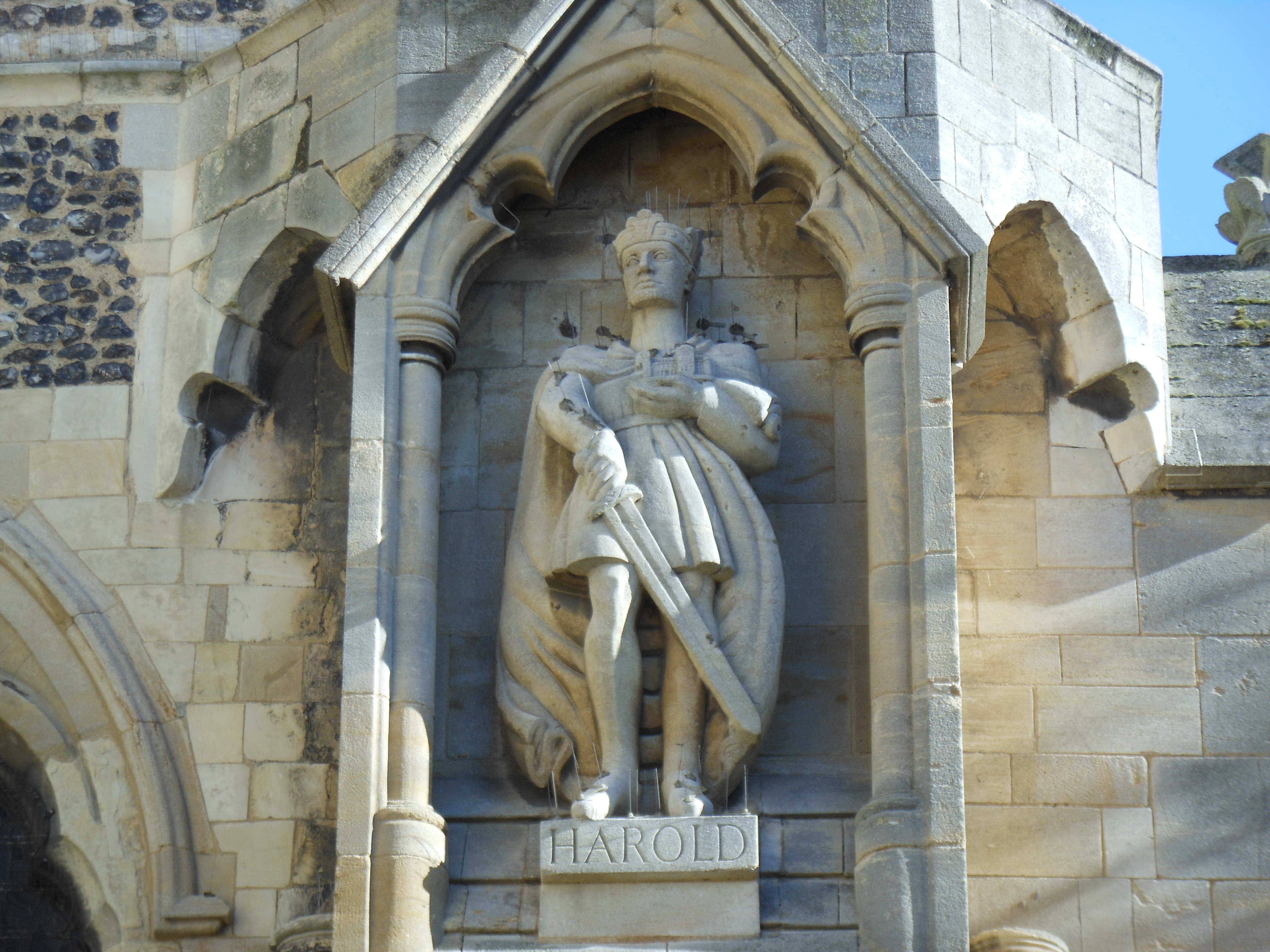
The First Marriage of Kateryn Parr

Katherine Parr

We often hear the story that Kateryn – or Katherine – Parr was used to marriage to older men when she accepted the proposal of Henry VIII in 1543. Her second husband, Lord Latimer, was a widower with young children and twenty years older than his bride. And her first husband, it has often been said was a man much older in years. However, this story has arisen from a case of mistaken identity, between a grandfather and grandson of the same name, Edward Burgh.

Kateryn Parr’s first husband was Edward Burgh (pronounced Borough) of Gainsborough in Lincolnshire. And Kateryn’s early biographers appear to have assumed that this was Edward Burgh senior, Lord Burgh from 1496 to his death in 1528.

The Burgh family were descended from Hubert de Burgh, 1st Earl of Kent and Justiciar for King John and Henry III. Hubert had even been married, briefly, to King John’s first, discarded wife, Isabel of Gloucester. The first Thomas Burgh had fought at Agincourt and married Elizabeth Percy, a co-heiress of a junior branch of the mighty Percy family, the Earls of Northumberland. It was through Elizabeth Percy that the manor house at Gainsborough came into the Burgh family, inherited from her father; she then left the estate to her son Thomas (II) Burgh, Baron  Gainsborough, on her death in 1455.

Thomas (II) Burgh was a trusted Yorkist, named sheriff of Lincoln in 1460 and, later, an Esquire of the Body for King Edward IV. By the end of 1462 he had been knighted and was a member of the Privy Council. By 1464 he had married a wealthy widow Margaret, dowager Lady Botreaux and daughter of Lord Thomas Ros. It was Sir Thomas Burgh who, along with Thomas Stanley, rescued Edward IV from his imprisonment in Middleham Castle by the Earl of Warwick.

The sacking of Burgh’s manor house at Gainsborough was the opening move of the rebellion of Richard, Lord Welles, in 1470, which eventually saw Edward IV escaping to Flanders and the brief readeption of Henry VI; Edward IV recovered his kingdom in 1471, with the Battle of Tewkesbury, and Henry VI’s mysterious death in the Tower of London just days later, putting an end to Lancastrian hopes. On Edward IV’s death, Sir Thomas had initially supported the succession of his brother, Richard III, but switched his allegiance to Henry Tudor shortly after King Richard visited the Sir Thomas’s Hall at Gainsborough. What had been said to make this staunch Yorkist transfer his support to a Lancastrian pretender, we can only guess….

Gainsborough Old Hall

In 1496, Thomas was succeeded as Baron Gainsborough by his son, Edward Burgh, who married Anne Cobham, daughter of Sir Thomas, 5th Baron Cobham of Starborough, when he was 13 and she was just 9 years old. It was from this marriage that the Burgh’s would inherit Starborough Castle.

Although he won his knighthood on the battlefield at Stoke in 1487, and was a Member of Parliament for Lincoln in 1492, Edward appears to have been less politically capable than his father. He soon fell foul of King Henry VII, whether it was because of the fact he associated with those the king distrusted, or due to early signs of mental illness, in December 1496, Edward was forced into a legal bond where he was obliged to present himself to the king wherever and whenever it was demanded, and to vow to do his subjects no harm.¹ He was even remanded to the custody of the Lord Chamberlain and had to seek royal permission if he wanted to leave court for any reason. For a time, he was incarcerated in the Fleet Prison, but managed to escape, despite his promise and financial guarantee not to; an action which put him in thousands of pounds of debt to the king.

From his mother, Margaret de Ros, it seems Edward had inherited a mental illness, one which also affected his Ros cousins, Sir George Tailboys and Lord Ros of Hamlake. As a result, in 1509, ‘distracted of memorie’, he was declared a lunatic.² His wife died in 1526 and he died in 1528, never quite recovering his wits. He was succeeded as Baron Burgh of Gainsborough by his son, Thomas (III).

In 1496, aged just 8-years-old, Thomas (III) had married Agnes Tyrwhitt. The marriage had been arranged by his grandfather, Thomas (II) and gave the younger Thomas useful contacts within Yorkshire and Lincolnshire, contacts he would need to counteract the damaging effects of his father’s mental illness and royal disfavour. Thomas (III) pursued a dual career, combining service as a justice of the peace in Lindsey with his service at court. In 1513 he was knighted on the battlefield of Flodden, the same field on which James IV of Scotland met his death. He was Sheriff of Lincoln in 1518-19 and 1524-25. He was appointed Anne Boelyn’s Lord Chamberlain in May 1533, and held the middle of the queen’s train at her coronation. He was also one of the twenty-six peers who sat at Anne’s trial in 1536.

Thomas (III) and his wife had as many as 12 children. The eldest of which was Edward, who died in 1533. It was this Edward who was the 1st husband of Kateryn Parr, a marriage that had been arranged in 1529 by Sir Thomas and Kateryn’s widowed mother, Maud Parr; her husband, Thomas Parr of Kendal, had died in 1517. Maud had taken it upon herself to arrange her daughter’s future. After a failed proposal to marry Katherine to Henry Scrope, the son of Lord Scrope of Bolton, due to the prospective groom’s lack of enthusiasm, Maud turned to another of her late husband’s relatives and arranged for Katherine to marry Edward.

Young Edward was of a similar age to his wife, not the old man as was stated in Katherine’s early biographies, when he was mistaken for his grandfather. Kateryn was 17 at the time of the marriage, with Edward in his early twenties. It is impossible not to muse on how life could have been so different for Kateryn, had this first marriage proved longer-lasting.

The great hall of Gainsborough Old Hall viewed from the solar

Sir Thomas, however, was renowned for his violent outbursts and wild rages (possibly due to the inherited mental instability in the family) and had a tyrannical control over his family. The first two years of the marriage, spent at Sir Thomas’s Hall at Gainsborough, was a miserable time for Kateryn. She wrote, regularly, to her mother of her unhappiness and it seems the situation was only resolved following a visit by Maud Parr, who persuaded Sir Thomas to allow Edward and Kateryn to move to their own, smaller, house at Kirton-in-Lindsey.

We don’t know whether Edward was a sickly individual (he may have inherited his grandfather’s mental illness), or whether or not he succumbed to a sudden illness, but their happiness was short-lived, as he died in the spring of 1533. Having no children, Kateryn was left with little from the marriage, and, with her mother having died the previous year, and with her siblings in no position to assist her, she was virtually alone in the world. It was possibly as a remedy to her isolation that Kateryn married her second husband, John Neville, 3rd Baron Latimer, who was twenty years her senior, in 1534. There is no record that Kateryn served any of Henry VIII’s queens. Her first appearance at court seems to be in 1542, when she became a lady-in-waiting in Mary Tudor’s household, before she caught the King’s eye.

Kateryn had not forgotten her time with the Burgh family, however, and when she became queen Katerynpaid a pension from her own purse to her former sister-in-law, Elizabeth Owen, widow of her husband’s younger brother, Thomas. Poor Elizabeth had been accused of adultery, during her husband’s lifetime, by her domineering father-in-law, Sir Thomas, and her children were declared illegitimate by a private Act of Parliament in 1542. Although, it does appear that Thomas had a partial change of heart before his death in 1550, as his will included a bequest for ‘700 marks towards the preferment and marriage of Margaret, daughter of Dame Elizabeth Burgh, late wife to Sir Thomas my son, deceased …’ ³

Gainsborough Old Hall

Sir Thomas, Baron Burgh of Gainsborough, was eventually succeeded by his third surviving son, William, born in the early 1520s. He married Katherine Fiennes de Clinton, daughter of Edward Fiennes de Clinton – the future Earl of Lincoln – and Elizabeth (Bessie) Blount, a former mistress of Henry VIII and mother of the king’s illegitimate son, Henry Fitzroy, Duke of Richmond and Somerset.

Lord Latimer died on 2 March 1543 and Kateryn became Queen of England when she married Henry VIII on 12 July the same year. Her marriage to the king would last less than 4 years and ended with Henry’s death on 28 January 1547. In May 1547 Kateryn secretly married her 4th and final husband, Sir Thomas Seymour, brother of her predecessor as queen, Jane Seymour, and uncle of King Edward VI. She died at Sudeley Castle on 5 September 1548, having given birth to a daughter, Mary, 6 days earlier. She was buried in the chapel at Sudeley on the same day. Her daughter was given into the custody of Katherine Willoughby, Duchess of Suffolk, but disappeared from history whilst still a toddler.

*

Footnotes: ¹ ² & ³ Gainsborough Old Hall, Extended Guide Book by Sue Allen

Sources: Gainsborough Old Hall, Extended Guide Book by Sue Allen; In Bed with the Tudors by Amy Licence; oxforddnb.com; The Life and Times of Henry VIII by Robert Lacey; England Under the Tudors by Arthur D Innes; The Earlier Tudors 185-1558 by JD Mackie; Elizabeth’s Women by Tracy Borman; Henry VIII: King and Court by Alison Weir; In the Footsteps of the Six Wives of Henry VIII by Sarah Morris and Natalie Grueninger; Ladies-in-Waiting: Women who Served at the Tudor Court by Victoria Sylvia Evans; The Life and Times of Henry VII by Neville Williams; The Six Wives and Many Mistresses of Henry VIII: The Women’s Stories by Amy Licence; Tudorplace.com; John Leland Leland’s itinerary in England and Wales 1535-43 edited by L Toulmin Smith (1906-10); Letters and Papers, Foreign and Domestic, of the Reign of Henry VIII 1509-47 edited by JS Brewer, James Gairdner and RH Brodie, HMSO London 1862-1932; Privy Purse Expenses of King Henry VIII from November MDXIX to December MDXXXII edited by Sir Nicholas Harris Nicolas 1827.

*

My Books

Signed, dedicated copies of all my books are available through my online bookshop.

OUT NOW! Heroines of the Tudor World

Heroines of the Tudor World tells the stories of the most remarkable women from European history in the time of the Tudor dynasty, 1485-1603. These are the women who ruled, the women who founded dynasties, the women who fought for religious freedom, their families and love. These are the women who made a difference, who influenced countries, kings and the Reformation. In the era dominated by the Renaissance and Reformation, Heroines of the Tudor World examines the threats and challenges faced by the women of the era, and how they overcame them. From writers to regents, from nuns to queens, Heroines of the Tudor World shines the spotlight on the women helped to shape Early Modern Europe.

Heroines of the Tudor World is now available for pre-order from Amberley Publishing and Amazon UK.

Also by Sharon Bennett Connolly:

Women of the Anarchy demonstrates how Empress Matilda and Matilda of Boulogne, unable to wield a sword themselves, were prime movers in this time of conflict and lawlessness. It shows how their strengths, weaknesses, and personal ambitions swung the fortunes of war one way – and then the other. Available from Bookshop.orgAmberley Publishing and Amazon UKKing John’s Right-Hand Lady: The Story of Nicholaa de la Haye is the story of a truly remarkable lady, the hereditary constable of Lincoln Castle and the first woman in England to be appointed sheriff in her own right. Available from all good bookshops Pen & Sword Booksbookshop.org and AmazonDefenders of the Norman Crown: The Rise and Fall of the Warenne Earls of Surrey tells the fascinating story of the Warenne dynasty, from its origins in Normandy, through the Conquest, Magna Carta, the wars and marriages that led to its ultimate demise in the reign of Edward III. Available from Pen & Sword BooksAmazon in the UK and US, and Bookshop.org

Ladies of Magna Carta: Women of Influence in Thirteenth Century England looks into the relationships of the various noble families of the 13th century, and how they were affected by the Barons’ Wars, Magna Carta and its aftermath; the bonds that were formed and those that were broken. It is now available in paperback and hardback from Pen & Sword,  Amazon, and Bookshop.orgHeroines of the Medieval World tells the stories of some of the most remarkable women from Medieval history, from Eleanor of Aquitaine to Julian of Norwich. Available now from Amberley Publishing and Amazon, and Bookshop.orgSilk and the Sword: The Women of the Norman Conquest traces the fortunes of the women who had a significant role to play in the momentous events of 1066. Available now from Amazon,  Amberley Publishing, and Bookshop.org.

Alternate Endings: An anthology of historical fiction short stories including Long Live the King… which is my take what might have happened had King John not died in October 1216. Available in paperback and kindle from Amazon.

Podcast:

Have a listen to the A Slice of Medieval podcast, which I co-host with Historical fiction novelist Derek Birks. Derek and I welcome guests, such as Bernard Cornwell and discuss a wide range of topics in medieval history, from significant events to the personalities involved.

*

Don’t forget! Signed and dedicated copies of all my books are available through my online bookshop.

For forthcoming online and in-person talks, please check out my Events Page.

You can be the first to read new articles by clicking the ‘Follow’ button, liking our Facebook page or joining me on Twitter and Instagram.

©2018 Sharon Bennett Connolly FRHistS
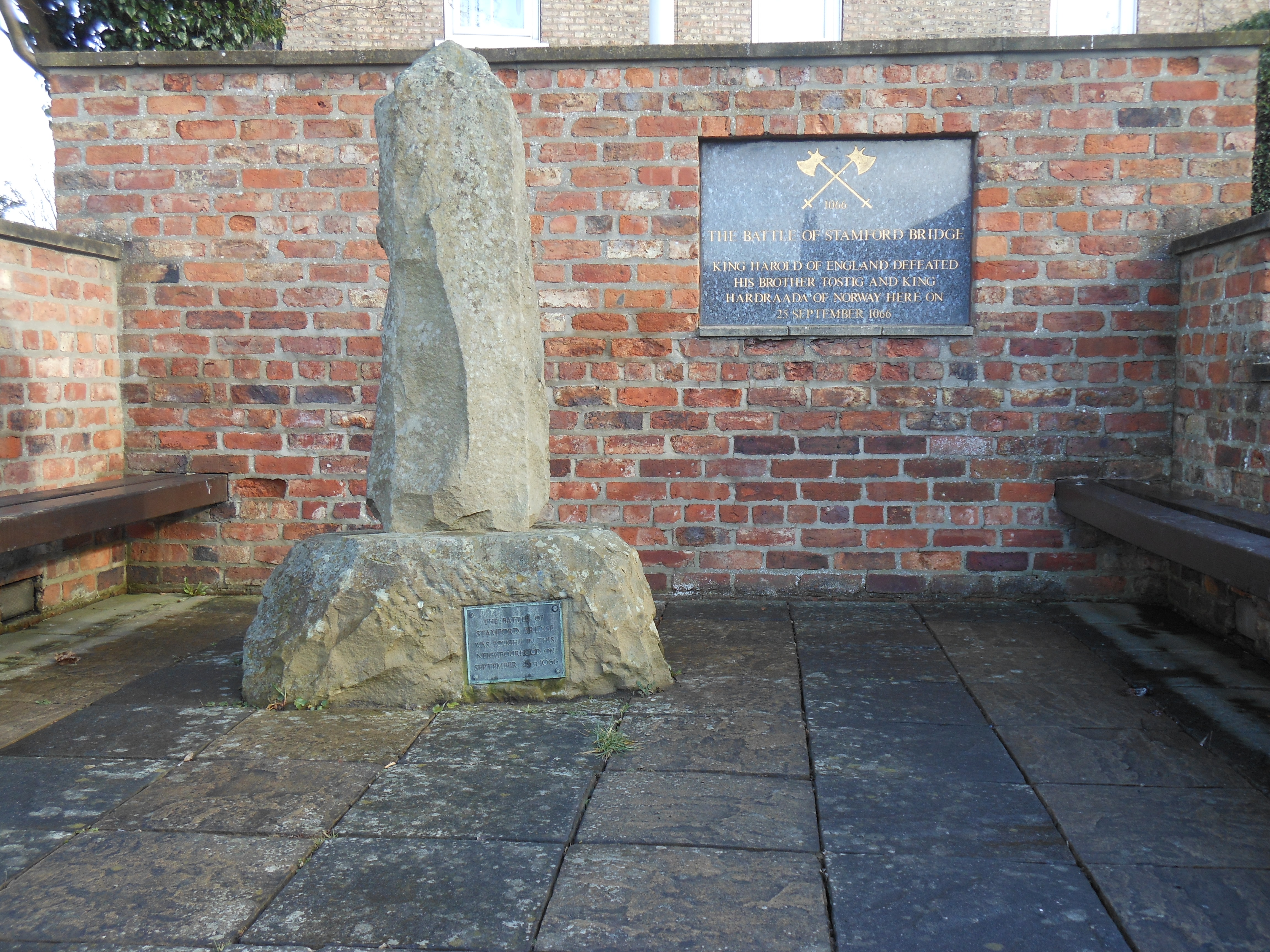
The Countess who Chastised a King

300px-royal_arms_of_england_1154-1189-svg
The arms of Hugh d’Aubigny, 5th Earl of Arundel

I recently came across the wonderful story of Isabel d’Aubigny, countess of Arundel, a woman who wouldn’t be cheated – even if it was by the king himself.

Isabel was born sometime in the late 1220s, the daughter of William de Warenne, 5th earl of Surrey and Warenne, and Matilda (or Maud) Marshal, daughter and co-heir of the Greatest Knight, William Marshal, earl of Pembroke. Through her grandfather, Hamelin Plantagenet, illegitimate half-brother of King Henry II, Isabel was a cousin of the king, Henry III.

With such impeccable parentage and family connections, it is no surprise that Isabel made a prestigious marriage. At no older than 8 years of age Isabel was married, in 1234, to 20-year-old Hugh d’Aubigny, 5th earl of Arundel. Hugh’s father, William, 3rd Earl of Arundel, had died in 1221, on his way home from the Fifth Crusade. William had been succeeded as 4th Earl by his oldest son and namesake, who died just 3 years after his father, aged just 21, leaving the earldom to his brother Hugh.

On their marriage, Isabel’s father granted the couple a manor at Marham in Norfolk, worth £40 a year in rent. The charter for this grant offers the only details available for the marriage. In 1242 Hugh accompanied the king on his expedition to Aquitaine. However, after just 9 years, on 7 May 1243, Hugh died; leaving Isabel, at 17 years of age, a childless widow, with a rather large dower.

Within weeks of her husband’s death, on 29th May, Isabel’s marriage was granted to Pierre de Genevre, a Savoyard favourite of the king, Henry III. However, the patent rolls show that provision was made for Isabel to remain unmarried should she so wish; although she would have to pay Pierre for the privilege. Given that she never remarried, she must have been more than happy to pay.

The de Warenne coat of arms

The Arundel inhheritance was divided between Hugh’s 4 sisters; Mabel, Isabel, Nicholaa and Cecily. The earldom itself went to Hugh’s nephew, his sister Isabel’s son, John FitzAlan. Isabel was well provided for, however, with her dower including the hundred and manor of Bourne in Lincolnshire, the manors of Wymondham and Kenninghall in Norfolk, Stansted in Essex and several properties in Norfolk and Buckinghamshire. Suffice to say, she was a very wealthy widow and would continue to be styled Countess of Arundel until her death.

In 1249, the same year as her mother died, Isabel founded the only English convent that was part of the Cistercian order. Established at Marham, two Cistercian abbots had inspected it in its first year. Isabel’s brother, John de Warenne, 6th Earl of Surrey, the Bishop of Norwich and Henry III himself all issued charters confirming the abbeys foundation. Along with other endowments, Isabel herself made 11 grants to the abbey in its early years, giving it a strong economic foundation. In 1252 Isabel was granted papal permission to visit the Cistercian house at Waverley to consult with him about her convent; Waverley’s annals record that she granted 4 marks and a cask of wine to the monks there.

Isabel was very protective of her property rights and went on the offensive when they were threatened, even if that meant going against the king. In 1252 Isabel did just that. One of her tenants, Thomas of Ingoldisthorpe, held a ¼ knight’s fee from Isabel at Fring and Snettisham; he also had property in the honour of Haughley, as an escheat from the crown. On his death in 1252 Henry III took all of Thomas’s lands in wardship until Thomas’s heir was of age, including Isabel’s ¼ knight’s fee. In March of 1252 Henry granted the wardship of the lands and marriage of the heir to his former treasurer and keeper of the king’s wardrobe, Peter Chaceporc. Had Thomas held his lands in chief from the king, Henry would have been within his rights to take prerogative wardship, however his land at Haughley was  held from the honour of Haughley, which only in the king’s hands as an escheat and Isabel had therefore been treated unjustly in being denied the wardship of his heirs.

Isabel took her grievances direct to the king, supposedly berating him for trampling on the rights laid out in Magna Carta. She is said to have asked:

‘Where are the liberties of England, so often recorded, so often granted, and so often ransomed?’¹

According to Matthew Paris, the chronicler and a personal friend of Isabel’s (though no particular fan of Henry), Henry scorned Isabel’s argument, ‘derisively and curling his nostrils’ and asked if the nobles of the realm had given her permission to speak on their behalf. Isabel argued that the king had given her the right to speak thus, in the articles granted in Magna Carta and accused the king of being a ‘shameless transgressor’ of the liberties laid down in the Great Charter, breaking his sworn oath to uphold its principles. At the end of the audience, Henry refused to be moved, ‘After listening to her [civilly] reproachful speech, the king was silent, and the countess, without obtaining or even asking for permission, returned home.’²

Arundel Castle

Isabel was one of the great nobles of England, the daughter of one earl and wife of another, and was obviously undaunted by an audience with the king. And although the king did not react to her reprimand immediately he did, eventually, admit that he may have been in the wrong, issuing a letter to her on 23 May 1253 saying:

‘Since the king has learnt that Thomas of Ingoldisthorpe, whose son and heir is in the custody of Peter Chaceporc by concession of the king, did not hold from the crown of the king in chief but from the honour of Haughley, which is in the hand of the king as his escheat, and that the same Thomas held from Hugh de Aubigny, once earl of Arundel, a quarter part of the fee of one knight with appurtenances in Fring and Snettisham and the service of which was assigned to Isabella, countess of Arundel, the widow of the foresaid earl, in dower, he has returned to the same countess custody of the foresaid quarter part of a fee with appurtenances; and the foresaid Peter is ordered to give the countess full seizin of the foresaid custody.’²

However, Isabel’s victory was incomplete, as in late 1253, while the king was overseas in Aquitaine, she instigated legal proceedings against Peter Chaceporc ‘for custody of Ingoldisthorpe’. Whether Chaceporc had not relinquished the land, or she believed she was entitled to more land than was returned to her, Isabel in fact lost the suit and was amerced £20 (30 marks) for a false claim. The writ was witnessed by Henry III’s queen, Eleanor of Provence, and his brother Richard, Earl of Cornwall.

As persistent as ever, and although he was overseas, Isabel appealed directly to the king, who responded with a pardon, although it seems he still smarted from the upbraiding she had given him earlier in the year:

‘3 April. Meilham. Henry, by the grace of God king of England, lord of Ireland, duke of Normandy and Aquitaine and count of Anjou sends greeting to his beloved consort E, by the same grace queen of England, lady of Ireland, duchess of Normandy and Aquitaine and countess of Anjou and to his beloved and faithful brother, R. earl of Cornwall. Know that we have pardoned our beloved and faithful Isabella countess of Arundel the 30m. at which she was amerced before our justices against our beloved and faithful … Peter Chaceporc, our Treasurer, for custody of Ingoldisthorpe. We, therefore, order you to cause the same countess to be quit of the aforesaid 30m. by our seal of England provided she says nothing opprobrious to us as she did when we were at Westminster and as we have signified to her by letter. Witness myself.’³

Holy Trinity Church, Marham

Isabel obviously had an eye for business, given that she could so concern herself with a ¼ knight’s fee out of the 60 that she held. A wealthy widow with impressive family connections, she was renowned not only for her religious endowment of the Cistercian convent at Marham, but also as a patron of religious texts, having commissioned at least 2 saints’ lives, including the life of St Richard of Wyche by Ralph Bocking. Isabel could count among her friends Richard Wych himself, the bishop of Chichester who was later canonised, and Matthew Paris. Paris translated  a life of Saint Edmund of Abingdon in to Anglo-Norman verse for Isabel’s personal use.

Isabel died shortly before 23 November 1282 and was laid to rest at her own foundation at Marham; her dower properties passed to her husband’s great-great nephew, Richard FitzAlan, 8th Earl of Arundel. Having spent almost 40 years as a childless widow, Isabel never remarried, her remarkable life dedicated to the patronage of her convent at Markham and religious writers, such as Paris and Bocking. This incredible woman stands out as the countess who reprimanded and humbled her king for his injustices.

*

Isabel’s remarkable story appears in my book, Defenders Of the Norman Crown: Rise and Fall of the Warenne Earls of Surrey.

Footnotes: 1. quoted by John A. Nichols in Oxforddnb.com; 2. quoted by Susanna Annesley in finerollshenry3.org.uk; 3. ibid.

*

Sources: John A. Nichols Oxforddnb.com; Susanna Annesley finerollshenry3.org.uk; Robert Bartlett England Under the Norman and Angevin Kings; Dan Jones The Plantagenets;David Williamson Brewer’s British Royalty; british-history.ac.uk; Early Yorkshire Charters Volume 8: The Honour of Warenne, Edited by William Farrer and Charles Travis Clay.

Pictures courtesy of Wikipedia: d’Aubigny arms by Sodocan; Warenne arms by Madboy74; Arundel Castle by Chensiyuan; Holy Trinity Church by John Billinger.

*

My Books

Signed, dedicated copies of all my books are available through my online bookshop.

Coming 30 January 2025: Scotland’s Medieval Queens

Scotland’s history is dramatic, violent and bloody. Being England’s northern neighbour has never been easy. Scotland’s queens have had to deal with war, murder, imprisonment, political rivalries and open betrayal. They have loved and lost, raised kings and queens, ruled and died for Scotland. From St Margaret, who became one of the patron saints of Scotland, to Elizabeth de Burgh and the dramatic story of the Scottish Wars of Independence, to the love story and tragedy of Joan Beaufort, to Margaret of Denmark and the dawn of the Renaissance, Scotland’s Medieval Queens have seen it all. This is the story of Scotland through their eyes.

Available for pre-order now.

Also by Sharon Bennett Connolly:

Heroines of the Tudor World tells the stories of the most remarkable women from European history in the time of the Tudor dynasty, 1485-1603. These are the women who ruled, the women who founded dynasties, the women who fought for religious freedom, their families and love. Heroines of the Tudor World is now available for pre-order from Amberley Publishing and Amazon UK. Women of the Anarchy demonstrates how Empress Matilda and Matilda of Boulogne, unable to wield a sword themselves, were prime movers in this time of conflict and lawlessness. It shows how their strengths, weaknesses, and personal ambitions swung the fortunes of war one way – and then the other. Available from Bookshop.orgAmberley Publishing and Amazon UKKing John’s Right-Hand Lady: The Story of Nicholaa de la Haye is the story of a truly remarkable lady, the hereditary constable of Lincoln Castle and the first woman in England to be appointed sheriff in her own right. Available from all good bookshops Pen & Sword Booksbookshop.org and Amazon

Defenders of the Norman Crown: The Rise and Fall of the Warenne Earls of Surrey tells the fascinating story of the Warenne dynasty, from its origins in Normandy, through the Conquest, Magna Carta, the wars and marriages that led to its ultimate demise in the reign of Edward III. Available from Pen & Sword BooksAmazon in the UK and US, and Bookshop.orgLadies of Magna Carta: Women of Influence in Thirteenth Century England looks into the relationships of the various noble families of the 13th century, and how they were affected by the Barons’ Wars, Magna Carta and its aftermath; the bonds that were formed and those that were broken. It is now available in paperback and hardback from Pen & SwordAmazon, and Bookshop.orgHeroines of the Medieval World tells the stories of some of the most remarkable women from Medieval history, from Eleanor of Aquitaine to Julian of Norwich. Available now from Amberley Publishing and Amazon, and Bookshop.orgSilk and the Sword: The Women of the Norman Conquest traces the fortunes of the women who had a significant role to play in the momentous events of 1066. Available now from Amazon,  Amberley Publishing, and Bookshop.org.

Alternate Endings: An anthology of historical fiction short stories including Long Live the King… which is my take what might have happened had King John not died in October 1216. Available in paperback and kindle from Amazon.

Podcast:

Have a listen to the A Slice of Medieval podcast, which I co-host with Historical fiction novelist Derek Birks. Derek and I welcome guests, such as Bernard Cornwell, and discuss a wide range of topics in medieval history, from significant events to the personalities involved.

*

Don’t forget! Signed and dedicated copies of all my books are available through my online bookshop.

For forthcoming online and in-person talks, please check out my Events Page.

You can be the first to read new articles by clicking the ‘Follow’ button, liking our Facebook page or joining me on TwitterThreadsBluesky and Instagram.

*

©2017 Sharon Bennett Connolly, FRHistS
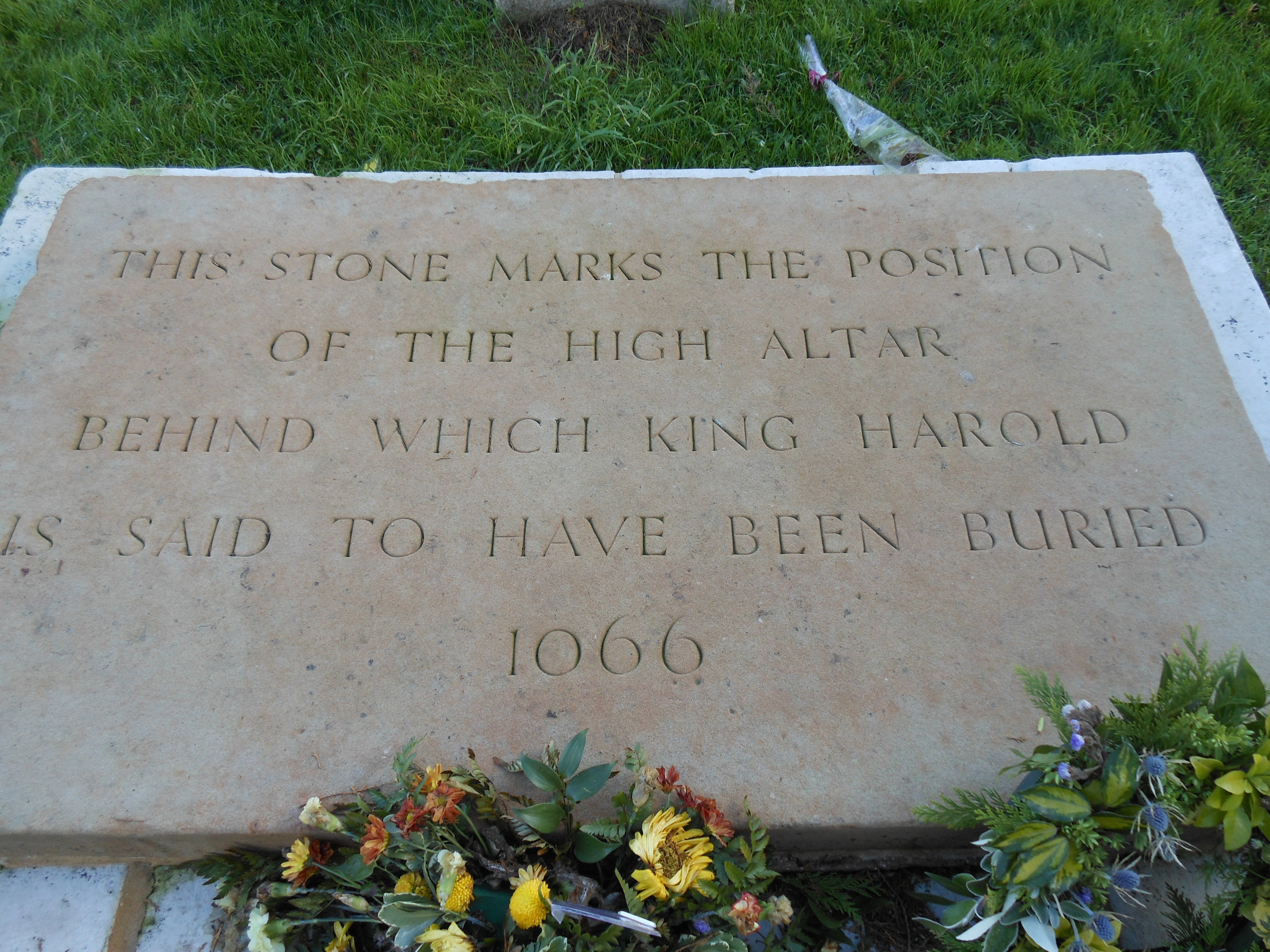
‘Fair Rosamund’

Fair Rosamund by John William Waterhouse

The story of Rosamund de Clifford is shrouded in more legends than most medieval lives. After Eleanor of Aquitaine, she is the woman most associated with Henry II, king of England. In historical fiction, she is the woman who claimed his heart and stole him away from his queen. But who was she? How much of her story is real, how much is fantasy?

Rosamund de Clifford was probably born around 1140. She was the daughter of Walter de Clifford, a lord on the Welsh Marches, and his wife Margaret de Tosny. We know nothing of her childhood, she may have been educated at Godstow Abbey, but it is not certain; nor is when she actually met the king. The rest of her life is made of rumour and gossip.

Rosamund’s father served Henry II on campaign in Wales in the 1160s. It is possible that the king first met the young woman on a visit to de Clifford’s residence of Bredelais during the campaign. Some theories have Henry’s affair with Rosamund starting around 1165, the first Christmas that Henry spent apart from his queen, Eleanor of Aquitaine. Eleanor held her Christmas court at Angers while Henry was at Oxford. Henry had a tendency to be constantly on the move and it was unusual for him to be so immobile, which has led to suspicions that this was when his love affair with Rosamund began. However, there is evidence that Henry may also have been nursing some sort of injury, which would also curtail his movements.

Henry and Eleanor were to have one more child, John, born at Christmas 1166, which suggests the Christmas 1165 separation was more due to the logistics of ruling large domains than it was to Henry finding love elsewhere. However, there is a later story of Eleanor intending to have her lying in at the royal palace of Woodstock, only to find Rosamund in residence on her arrival and quickly relocating to Oxford to give birth.

Henry and Eleanor holding court

Henry was never a faithful husband and was known to have several illegitimate children, including William Longspée and Geoffrey, Archbishop of York. He numbered among his conquests Rohese, a daughter of the prominent de Clare family and Ida de Tosny, who later married Hugh Bigod, earl of Norfolk, and was mother of Longspée. If Henry and Rosamund did begin their relationship in the mid-1160s, they did a marvellous job of keeping the affair secret, as it was not made public until 1174.

Henry’s relationship with his queen soured considerably in the early 1170s with Eleanor taking the side of their sons and joining them in open rebellion in 1172-73. Henry managed to crush the rebellion and forgave his sons, but he was not so lenient with Eleanor. In 1174 he escorted her to England and installed her in Old Sarum, condemning her to what would be 15 years of imprisonment; she would only be released when her favourite son, Richard I, ascended the throne in 1189.

In the same year as Eleanor’s imprisonment, Henry’s relationship with Rosamund became common knowledge. She resided at the royal palace of Woodstock in Oxfordshire, which was extensively refurbished in the early 1170s. It was said that ‘King Henry had made for her a house of wonderful workmanship, a labyrinth of Daedelian design.’¹ There was said to be a labyrinth, a secret bower where Henry and Rosamund met and a well where Rosamund bathed. Rosamund’s Well can still be seen today in the grounds of Blenheim Palace, which now stands where Woodstock once stood.

Although it has come down through legend as a great love story, nothing is known of Rosamund’s feelings towards Henry, nor whether she any any say in her position as the king’s mistress. The chroniclers of the time, of course, painted her as the fallen woman, a seductress and adulteress. They created puns derived from her name; Rosamund, or rosa mundi meaning the rose of the world became rosa immunda – the unclean rose – and rosa immundi – the unchaste rose.

The ruins of Godstow Abbey

That poor Rosamund was blamed for Henry’s infidelity was a sign of the times; women were the daughters of Eve, temptation for honourable men who had no power to resist them. Rosamund’s early death was seen as a just punishment for her lascivious lifestyle. Rosamund ended her relationship with Henry in 1175/6 and withdrew to Godstow Abbey. It seems likely that she was already ill when she entered the priory and she died in 1176. Henry paid for a lavish tomb within the convent church, at which the nuns left floral tributes on a daily basis. In the years following Rosamund’s death, Henry endowed the convent with 2 churches at Wycombe and Bloxham, new buildings and substantial amounts of building materials. Rosamund’s father, Walter, granted the abbey mills and a meadow, for the souls of his wife and daughter.

Unfortunately, however, Rosamund was not allowed to rest in peace. In 1190 when  the saintly Bishop Hugh of Lincoln visited Godstow he was horrified that Rosamund’s tomb had a place of honour within the church and ordered her remains to be removed. The tomb was resited in the nun’s chapter house, with an accompanying inscription admonishing her lifestyle:

This tomb doth here enclose the world’s most beauteous Rose,

Rose passing sweet erewhile, now nought but odour vile.²

Eleanor prepares to poison Rosamund by Evelyn De Morgan

Rosamund’s early death – she was still only in her 30s – inspired legends of revenge; Eleanor has been variously accused of stabbing her in her bath and poisoning her. In one extravagant version, Rosamund was hidden in her secret bower within a maze but, with the help of a silken thread, a jealous Eleanor still found her and stabbed her while she bathed. In another the discarded queen forced Rosamund to drink from a poison cup. Of course, a closely guarded prisoner in Old Sarum or at Winchester as she was, it was impossible for Eleanor to do any such thing. But it makes for a good story!

Rosamund’s relationship with Henry probably lasted no more than 10 years and possibly as little as 3 years. She may have seen little of Henry in that time, as he was a constantly on the move and only spent a little over 3 of those 10 years in England in total. It is possible that Rosamund sometimes travelled with him, discreetly, although this seems unlikely given that no one knew of her until after Eleanor’s rebellion and imprisonment. There are some theories that suggest Henry had lost interest in Rosamund even before her death, and that was the reason for her retirement to Godstow. Although his lavish endowment of the Abbey may argue otherwise, Henry is said to have turned his attentions to his son Richard’s fiancée, Princess Alys, sister of Philip II of France.

Perhaps the truth of Rosamund’s story matters less than the legend and romance that has grown up around it. Maybe the story of unrequited love, secret trysts and hidden bowers are just as important to history than the sordid truth a woman seduced by a king with little say in the direction of her own life, denied husband, children and a future.

Maybe the romance is what makes the story more palatable.

The Ballad of Fair Rosamund

The Flower of the World

When as king Henry ruled this land,

The second of that name,

Besides the queene, he dearly loved

A faire and comely dame

Most peerless was her beautye founde,

Her favour, and her face;

A sweeter creature in this worlde

Could never prince embrace.

Her crisped lockes like threads of golds

Appeared to each man’s sight;

Her sparkling eyes, like Orient pearles,

Did cast a heavenlye light.

The blood within her crystal cheeks

Did such a colour drive,

As though the lillye and the rose

For mastership did strive.

Yea Rossamonde, fair Rosamonde,

Her name was called so,

To whom our queene, dame Ellinor,

Was known a deadly foe.

The king therefore, for her defence

Against the furious queene,

At Woodstocke builded such a bower,

The like was never seene.

Most curiously that bower was built

Of stone and timber strong,

An hundred and fifty doors

Did to this bower belong.

And they so cunningly contriv’d,

With turnings round about,

That none but with a clue of thread

Could enter in and out.³

*

Footnotes: ¹Polychronicon quoted in Oxforddnb.com; ² Speed quoted in Oxforddnb.com; ³Anonymous quoted in Eleanor, April Queen of Aquitaine by Douglas Boyd

Pictures courtesy of Wikipedia

Sources: Oxforddnb.com by T.A. Archer, rev by Elizabeth Hallam; Wordsworth Dictionary of British History by J.P. Kenyon; kings, Queens, Bones and Bastards by David Hilliam; England Under the Norman and Angevin Kings 1075-1225 by Robert Bartlett; King John by Marc Morris; The Devil’s Brood by Desmond Seward; The Greatest Knight by Thomas Asbridge; Eleanor, April Queen of Aquitaine by Douglas Boyd; Eleanor of Aquitaine by Alison Weir; The Plantagenet Chronicles Edited by Elizabeth Hallam.

*

My books

Signed, dedicated copies of all my books are available through my online bookshop.

Out Now! Women of the Anarchy

Two cousins. On the one side is Empress Matilda, or Maud. The sole surviving legitimate child of Henry I, she is fighting for her birthright and that of her children. On the other side is her cousin, Queen Matilda, supporting her husband, King Stephen, and fighting to see her own son inherit the English crown. Women of the Anarchy demonstrates how these women, unable to wield a sword, were prime movers in this time of conflict and lawlessness. It show how their strengths, weaknesses, and personal ambitions swung the fortunes of war one way – and then the other.

Available from Bookshop.orgAmberley Publishing and Amazon UK.

Coming on 15 June 2024: Heroines of the Tudor World

Heroines of the Tudor World tells the stories of the most remarkable women from European history in the time of the Tudor dynasty, 1485-1603. These are the women who ruled, the women who founded dynasties, the women who fought for religious freedom, their families and love. These are the women who made a difference, who influenced countries, kings and the Reformation. In the era dominated by the Renaissance and Reformation, Heroines of the Tudor World examines the threats and challenges faced by the women of the era, and how they overcame them. From writers to regents, from nuns to queens, Heroines of the Tudor World shines the spotlight on the women helped to shape Early Modern Europe.

Heroines of the Tudor World is now available for pre-order from Amberley Publishing and Amazon UK.

Also by Sharon Bennett Connolly:

King John’s Right-Hand Lady: The Story of Nicholaa de la Haye is the story of a truly remarkable lady, the hereditary constable of Lincoln Castle and the first woman in England to be appointed sheriff in her own right. It is is available from King John’s Right-Hand Lady: The Story of Nicholaa de la Haye is the story of a truly remarkable lady, the hereditary constable of Lincoln Castle and the first woman in England to be appointed sheriff in her own right. Available from all good bookshops or direct from Pen & Sword Booksbookshop.org and AmazonDefenders of the Norman Crown: The Rise and Fall of the Warenne Earls of Surrey tells the fascinating story of the Warenne dynasty, from its origins in Normandy, through the Conquest, Magna Carta, the wars and marriages that led to its ultimate demise in the reign of Edward III. Available from Pen & Sword BooksAmazon in the UK and US, and Bookshop.org

Ladies of Magna Carta: Women of Influence in Thirteenth Century England looks into the relationships of the various noble families of the 13th century, and how they were affected by the Barons’ Wars, Magna Carta and its aftermath; the bonds that were formed and those that were broken. It is now available in paperback and hardback from Pen & Sword,  Amazon, and Bookshop.orgHeroines of the Medieval World tells the stories of some of the most remarkable women from Medieval history, from Eleanor of Aquitaine to Julian of Norwich. Available now from Amberley Publishing and Amazon, and Bookshop.orgSilk and the Sword: The Women of the Norman Conquest traces the fortunes of the women who had a significant role to play in the momentous events of 1066. Available now from Amazon,  Amberley Publishing, and Bookshop.org.

Alternate Endings: An anthology of historical fiction short stories including Long Live the King… which is my take what might have happened had King John not died in October 1216. Available in paperback and kindle from Amazon.

Podcast:

Have a listen to the A Slice of Medieval podcast, which I co-host with Historical fiction novelist Derek Birks. Derek and I welcome guests, such as Bernard Cornwell and Elizabeth Chadwick, and discuss a wide range of topics in medieval history, from significant events to the personalities involved.

*

Don’t forget! Signed and dedicated copies of all my books are available through my online bookshop.

For forthcoming online and in-person talks, please check out my Events Page.

You can be the first to read new articles by clicking the ‘Follow’ button, liking our Facebook page or joining me on Twitter and Instagram.

*

©2017 Sharon Bennett Connolly FRHistS