The Unfortunate Wives of Philip II of France

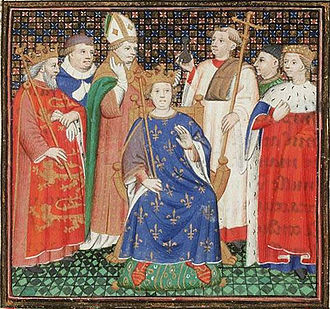
330px-the_coronation_of_philippe_ii_auguste_in_the_presence_of_henry_ii_of_england
Coronation of Philip II Augustus

Philip II Augustus had acceded to the throne of France in 1180, at the tender age of fifteen. He married his first wife, Isabella of Hainault the same year; she was only ten-years-old. Isabella was the daughter of Baldwin V, count of Hainault, and Margaret I, countess of Flanders. At just one year old she had been betrothed to Henry, the future count of Champagne and nephew of Adele, queen of France. However, Isabella’s father later reneged on his promises, and arranged Isabella’s marriage to Philip, the son and heir of Louis VII. Philip had been crowned junior king of France in 1179. Isabella and Philip were married on 28 April 1180 and Isabella was crowned queen exactly one month later, even though her father-in-law was still king. With Louis VII’s death Philip and Isabella acceded to the throne as sole king and queen in September of the same year.

Philip was a capricious being when it came to his wives, indeed, he attempted to repudiate Isabella when she was only fourteen. Isabella’s father had taken the side of his enemies in war against Flanders, but he cited her failure to produce an heir as his reason for putting her aside, despite her still-tender age. Unfortunately for Philip, Isabella appeared before the council at Sens, called to support his repudiation of her, barefoot and penitent. Isabella was a popular queen and the people were so taken with this act of humility that their protests forced the king to take her back.

isabelladehainault
Isabella of Hainault

She gave birth to the desired son and heir, the future Louis VIII, three years later, in 1187. However, on 14 March 1190 she gave birth to twin boys, Robert and Philip, but died from complications the next day, aged just nineteen; the babies died three days after their mother. The Chronique rimee of Philippe Mouskes described her as “Queen Isabelle, she of noble form and lovely eyes.” Philip II left on Crusade just a few short months after Isabella’s death; however, with only one living son, he was soon looking around for a new wife.

Ingeborg was the daughter of Valdemar I the Great, king of Denmark, and Sofia of Minsk, and was the youngest of their eight surviving children. Born around 1176, it was only six years later, in 1182, that her father died. Valdemar was succeeded by Ingeborg’s older brother, Knut (or Canute) VI; and it fell to Knut to arrange Ingeborg’s future. I could not find any details of Ingeborg’s childhood, although she was probably educated to the standard expected of princesses of the time, in order to make her attractive in the international royal marriage market. A princess was expected to be able to manage a household, to sew, play music, sing, dance and much more.

Ingeborg held many political attractions for the king of France, her brother not only had a claim to the English throne, stretching back to the time of Cnut the Great, who ruled England in the eleventh century, but he also possessed an impressive navy, one which Philip would rather have with him, than against him. Such an alliance also helped France and Denmark to stand up to the expansionism of the Holy Roman Empire, under Emperor Henry VI.

On the conclusion of negotiations with Knut’s representatives, Philip sent an embassy to Denmark, to escort his bride back to France. The envoys were afforded a lavish reception at the Danish court, where the formal arrangements for the marriage were finalised. Ingeborg was provided with a dowry of 10,000 marks in gold and set out for a new life in France, accompanied by the French envoys and many Danish dignitaries, probably not expecting to ever see her homeland again. Ten years older than Ingeborg, Philip met his bride for the first time on their wedding day, 14 August 1193, in the cathedral church at Amiens. Ingeborg was crowned queen of France the next day, by the archbishop of Reims; her name changed to Isambour, to make it more acceptable to the French language, though what she thought of this, we cannot say.
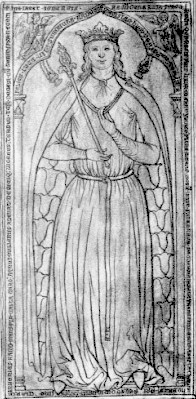
ingeborg_of_denmark
Ingeborg of Denmark

At seventeen years of age, contemporary sources extolled her excellent qualities; in addition to the obligatory courtly praise of her appearance, comparing her beauty with that of Helen of Troy, she was a model of virtue. Ingeborg was described as ‘very kind, young of age but old of wisdom’ by Étienne de Tournai, who knew her well and said that the beauty of her soul overshadowed that of her face. Remarkably, given subsequent events, even those chroniclers devoted to her Philip II, such as Guillaume le Breton, spoke of the new queen with respect.

Unfortunately, no one knows what happened on the wedding night, but poor Ingeborg had one of the shortest honeymoon periods in history; and by the end of the coronation ceremony he had such an aversion to Ingeborg that he tried to get the Danish envoys to take her home with them. Ingeborg, however, refused to go, saying that she had been crowned queen of France, and her place was now in France. Queen Ingeborg sought sanctuary in a convent in Soissons, from where she wrote an appeal to the pope, Celestine III. Three months later, Philip established a friendly ecclesiastical council in Compiègne, in an attempt to have the marriage annulled. Ingeborg was present, but, speaking no French, had little understanding of the proceedings until they were interpreted for her.

Philip claimed that Ingeborg was related to his first wife, and the marriage was therefore within the prohibited degrees of consanguinity, going so far as to falsify his family tree to provide proof. As a result, the churchmen, sympathetic to their king, determined that the marriage was void.  When Ingeborg was informed of the decision, she appealed to Rome, protesting loudly “Mala Francia! Roma! Roma!” Her homeland finally took notice of Ingeborg’s plight and following a meeting with a Danish delegation, who produced their own genealogy showing that Ingeborg and Philippe had very little blood in common, the pope declared the decision by Philip’s ecclesiastical council to be invalid and ordered that Philip should take back his wife, and was not to remarry.

Thwarted by Ingeborg’s stubbornness, Philip decided to force her to acquiesce, by making Ingeborg’s life as uncomfortable as possible. She was placed under house arrest; first at an abbey near Lille, then at the monastery of Saint Maur des Fossés and at various other convents afterwards, her treatment becoming gradually harsher the longer she refused to give in. For seven years, the French court saw nothing of her; Étienne de Tournai reported, to the archbishop of Reims, that “she spent all her days in prayer, reading, work; solemn practices fill her every moment”.

330px-psalterofingeborg
Ingeborg’s psalter

Ingeborg would spend twenty years, incarcerated in various castles and abbeys, contesting any annulment. The longer her imprisonment, the more desperate her situation became; Ingeborg was forced to sell or pawn most of her possessions, even down to her clothing, in order to sustain herself. She later described herself, in a letter to the pope, Celestine III, as “…discarded like a dried and diseased branch; here I am, deprived of all help and consolation.”

As the consanguinity argument was not working for Philip, in pursuit of his divorce, and with his counsellors already having an eye on a new bride for the king, another argument was advanced; that of non-consummation. Ingeborg, however, remained steadfast, insisting that she and Philip had slept together on their wedding night. The pope again took Ingeborg’s side. Philip disregarded the pope’s decree to return to Ingeborg and took a new wife, Agnes of Merania, a German princess, in 1196. They had two children together, Philip and Marie, illegitimate due to their father’s bigamous marriage with their mother. However, in 1198, the new pope, Innocent III, asserted his authority by declaring the marriage invalid, he announced that Philip was still married to Ingeborg and ordered the king to return to his true wife.

agnes_of_merania_hedwig_codex
Agnes of Merania

Philip responded by making Ingeborg’s imprisonment even harsher. Following vigorous correspondence between Paris and the papacy Innocent responded with his most powerful weapon; excommunication. On 15 January 1200, the whole of France was put under interdict, all churches were closed. There were to be no church services or offices; no sacraments were to be performed, save for the baptism of new-borns and the last rites of the dying, until Philip acquiesced to the pope’s demands and, at least, renounced Agnes, even if he didn’t return to Ingeborg. Indeed, Philip’s own son, Louis, had to hold his wedding to Blanche of Castile, daughter of Eleanor of Castile, in Normandy due to the interdict.

Towards the end of the year Philip finally gave in. Poor Agnes was stripped of her status as Philip’s wife and exiled from court; she died in July 1201, heartbroken. Her two children by Philip were legitimised by the pope shortly afterwards. For Ingeborg, however, nothing changed. Philip refused to take her back and appealed again for an annulment, this time claiming that she had bewitched him on their wedding night. The appeal, again, was refused and Ingeborg was only released – finally – in 1213. Philippe’s change of heart was not out of any sense of guilt, affection or justice, but more for practicality. With King John’s barons risen against him, the situation in England was ripe to be exploited, and Philip needed peace with Denmark in order to concentrate his attentions on the greater prize; the English throne.
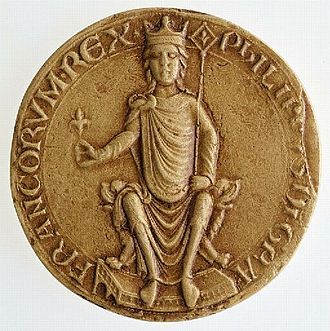
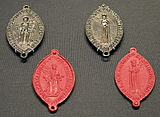
330px-sceau_de_philippe_auguste-_-_archives_nationales_-_sc-d157
Seal of Philip II Augusts

Ingeborg had been a prisoner in France for twenty years. Now, because of political expediency, she was not only free, but reinstated as queen, accorded the respect and dignity she had had a right to since her wedding day in 1193. However, her husband never returned to her bed; it was for outward appearances only. His son, Louis, now had his own son and heir, and so there was no need for Philip to be with Ingeborg, physically, in order to secure the succession. On his deathbed, in 1223, Philip II Augustus asked his son to treat Ingeborg well; while in his will, he left her 10,000 livres. The new king, Louis VIII, and his son, Louis IX, would both treat Ingeborg kindly and accord her all the respect due to her rank as dowager queen of France. Such an action was politically preferable to Louis; by recognising Ingeborg as legitimate queen of France he emphasised that Agnes had not been, and that, therefore, her children, especially Louis’s half-brother, Philip, had no right to the throne (despite his legitimisation by the pope).

After Philip’s death Ingeborg paid for masses to be said for his soul, whether out of duty, or as a sign of forgiveness, we’ll never know. A dignified and pious widow, she then retired to the priory of St Jean de l’Île, Corbeil. She died on 29 July, though the year of her death has variously been given as 1236, 1237, 1238 or 1239. Ingeborg survived her husband by more than fourteen years and was buried in a church in Corbeil, having spent twenty of her forty-five years, as queen, a prisoner of her husband.

*

Pictures courtesy of Wikipedia

Sources: Géraud, Hercule, Ingeburge de Danemark, reine de France, 1193-1236. Mémoire de feu Hercule Géraud, couronné par l’Académie des Inscriptions et Belles-Lettres dans sa séance du 11 août 1844. [Première partie.] Article; Étienne de Tournai, quoted in Géraud, Hercule, Ingeburge de Danemark, reine de France, 1193-1236. Mémoire de feu Hercule Géraud, couronné par l’Académie des Inscriptions et Belles-Lettres dans sa séance du 11 août 1844. [Première partie.] Article; Anna Belfrage Weep, Ingeborg, weep, (article) annabelfrage.wordpress.com; Goubert, Pierre The Course of French History; histoirefrance.net; historyofroyalwomen.com.

*

My books

Signed, dedicated copies of all my books are available through my online bookshop. or by contacting me.

Coming 30 March: Princesses of the Early Middle Ages
Books by Sharon Bennett Connolly

Daughters of kings were often used to seal treaty alliances and forge peace with England’s enemies. Princesses of the Early Middle Ages: Royal Daughters of the Conquest explores the lives of these young women, how they followed the stereotype, and how they sometimes managed to escape it. It will look at the world they lived in, and how their lives and marriages were affected by political necessity and the events of the time. Princesses of the Early Middle Ages will also examine how these girls, who were often political pawns, were able to control their own lives and fates. Whilst they were expected to obey their parents in their marriage choices, several princesses were able to exert their own influence on these choices, with some outright refusing the husbands offered to them.

Their stories are touching, inspiring and, at times, heartbreaking.

Princesses of the Early Middle Ages: Royal Daughters of the Conquest is now available for pre-order from Pen & Sword and Amazon.

Also by Sharon Bennett Connolly:

Books by Sharon Bennett Connolly

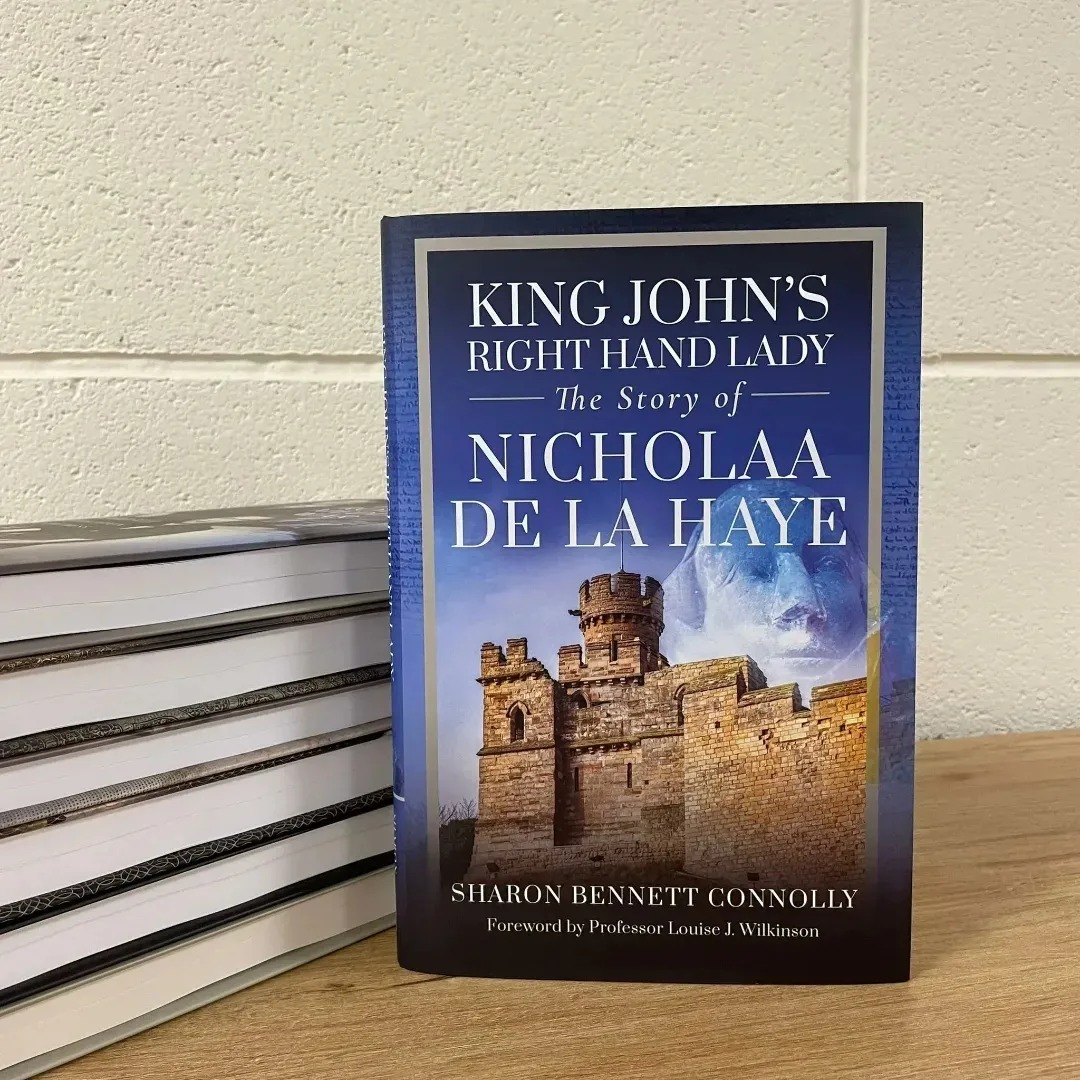
Scotland’s history is dramatic, violent and bloody and Scotland’s Medieval Queens have seen it all. This is the story of Scotland through their eyes. Available now from Amazon and Pen and Sword BooksHeroines of the Tudor World tells the stories of the most remarkable women from European history in the time of the Tudor dynasty, 1485-1603. These are the women who ruled, the women who founded dynasties, the women who fought for religious freedom, their families and love. Heroines of the Tudor World is now available from Amberley Publishing and Amazon UK. Women of the Anarchy demonstrates how Empress Matilda and Matilda of Boulogne, unable to wield a sword themselves, were prime movers in this time of conflict and lawlessness. It shows how their strengths, weaknesses, and personal ambitions swung the fortunes of war one way – and then the other. Available from Bookshop.orgAmberley Publishing and Amazon UKKing John’s Right-Hand Lady: The Story of Nicholaa de la Haye is the story of a truly remarkable lady, the hereditary constable of Lincoln Castle and the first woman in England to be appointed sheriff in her own right. Available from all good bookshops Pen & Sword Booksbookshop.org and Amazon

Defenders of the Norman Crown: The Rise and Fall of the Warenne Earls of Surrey tells the fascinating story of the Warenne dynasty, from its origins in Normandy, through the Conquest, Magna Carta, the wars and marriages that led to its ultimate demise in the reign of Edward III. Available from Pen & Sword BooksAmazon in the UK and US, and Bookshop.orgLadies of Magna Carta: Women of Influence in Thirteenth Century England looks into the relationships of the various noble families of the 13th century, and how they were affected by the Barons’ Wars, Magna Carta and its aftermath; the bonds that were formed and those that were broken. It is now available in paperback and hardback from Pen & SwordAmazon, and Bookshop.orgHeroines of the Medieval World tells the stories of some of the most remarkable women from Medieval history, from Eleanor of Aquitaine to Julian of Norwich. Available now from Amberley Publishing and Amazon, and Bookshop.orgSilk and the Sword: The Women of the Norman Conquest traces the fortunes of the women who had a significant role to play in the momentous events of 1066. Available now from Amazon,  Amberley Publishing, and Bookshop.org.

Alternate Endings: An anthology of historical fiction short stories including Long Live the King… which is my take what might have happened had King John not died in October 1216. Available in paperback and kindle from Amazon.

Podcast:
A Slice of Medieval

Have a listen to the A Slice of Medieval podcast, which I co-host with Historical fiction novelist Derek Birks. Derek and I welcome guests, such as Ian Mortimer, Bernard Cornwell, Elizabeth Chadwick and Scott Mariani, and discuss a wide range of topics in medieval history, from significant events to the personalities involved. 

Every episode is also now available on YouTube.

*

Don’t forget! Signed and dedicated copies of all my books are available through my online bookshop.

For forthcoming online and in-person talks, please check out my Events Page.

You can be the first to read new articles by clicking the ‘Follow’ button, liking our Facebook page or joining me on TwitterThreadsBluesky and Instagram.

*

©2017 Sharon Bennett Connolly FRHistS
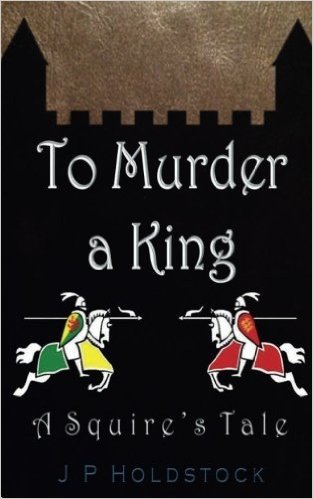
Book Corner: To Murder a King by James Holdstock

41DpuNqWh7L._SX311_BO1,204,203,200_My latest book review, of James Holdstock’s amazing To Murder a King has gone live over at The Review today!

To Murder A King is the first book in James Holdstock’s A Squire’s Tale series. While it is aimed at teenage readers it is a fabulous tale for all ages. A story of murder and intrigue with a little bit of the dark arts thrown in it leaves you gripped from the first pages. Of course, it doesn’t hurt that the greatest knight in history, William Marshal, has a leading role!

This novel is a fabulous adventure set in the early days of the reign of King John. Suitable for children from, about 9 and above, it is an enjoyable, entertaining read – even for an adult. It tells the story in such a way that children also learn about medieval life, politics and warfare; and even the prejudices of Normans towards Saxons….

To read the full review of this fantastic novel – and to enter the prize draw and be in with a chance of winning a paperback copy in the giveaway, simply visit The Review and leave a comment. Good luck!
*
My book, Heroines of the Medieval World,  is now available in hardback in the UK from both Amberley Publishing and Amazon UK and worldwide from Book Depository. It is also available on Kindle in both the UK and USA and will be available in Hardback from Amazon US from 1 May 2018.

Be the first to read new articles by clicking the ‘Follow’ button, liking our Facebook page or joining me on Twitter.

*

©Sharon Bennett Connolly 2016

Book Corner: A Palace for Our Kings by James Wright

book_front_cover_hi_resIn the heart of Sherwood Forest lies the picturesque, yet unassuming, village of King’s Clipstone. Between the twelfth and fifteenth centuries one of the very largest royal palaces ever to have graced the Mediaeval landscape stood there.

The palace was visited by eight kings who held parliament, Christmas feasts and tournaments; were visited by the king of Scotland, a papal envoy and traitorous barons; built a fortification, great hall and a stable for two hundred horses; went hunting, drank wine and conceived a prince; listened to storytellers, poets and singers.

This is the history of one of the great lost buildings of Britain and of the individuals that built, worked and lived there. Above all this is story of the people whose lives have been shaped for centuries by an extraordinary structure standing in a remarkable landscape.

A Palace For Our Kings: The history and archaeology of a Mediaeval royal palace in the heart of Sherwood Forest by archaeologist James Wright is a wonderful study of a little known piece of English history. It tells the story of a palace located in the heart of Sherwood Forest. James Wright is an archaeologist who has been involved with King’s Clipstone for many years and his love and enthusiasm for the project shine through on every page of this marvellous book.

The King’s Houses at Clipstone in Nottinghamshire has an incredibly unique and fascinating story to tell. The book traces the history of the village of King’s Clipstone – and it’s palace – from Roman times to the 21st century. It tells not only the archaeological story, but also the life and history of the palace and its people.

James Wright has used the medieval chronicles to explain and support his archaeological discoveries and theories. They also serve to illustrate the varying uses of the palace throughout the years, and demonstrate how national and international events influenced the history of the King’s Houses. The chronicles are drawn on to explain building practices and alterations;

The king’s chamber was whitewashed, quite a job as the space was big enough to warrant two chimneys with a window between them. This window was subsequently blocked up and the remaining windows in Henry’s chamber were installed with protective iron bars, a legacy of the attempt on his life at Woodstock thirteen years previously.

The palace’s story is amply illustrated with the help of photographic evidence, floor plans and maps throughout this highly detailed and fascinating study. The author has also drawn from the memoirs and accounts of antiquarians throughout the generations in order to tell the comprehensive story of the King’s Houses st Clipstone The book contains so much detail that it is impossible not to find something of interest. I have lived half an hour from Sherwood Forest for most of my life, but this book has given me a whole new perspective on the Forest and the people who lived within and around it; giving the Forest and its palace a whole new significance – to me and to history in particular.

Pos:167,Tm:584_AT,Cst:0,Gm:B,Fv:0,Stb:69
The King’s Houses, Clipstone

James Wright has managed to write an archaeological study which is riveting to the historian or general reader alike. He explains everything clearly, with the minimum of technical language.  The archaeological discoveries are discussed in the context of architectural, royal and social history, explaining how the palace developed over the years, as royal requirements and – even – the appearance of royal dignity changed through the centuries.

Pottery was often preferred for serving up victuals as, unlike silver or pewter, it did not taint the taste of food; although in the later Mediaeval period communal serving platters were used less as private dining became preferable. In this was food and dining became yet another method of social exclusion through the refinement of the palate.

A Palace For Our Kings: The history and archaeology of a Mediaeval royal palace in the heart of Sherwood Forest also places Clipstone and the King’s Houses in a regional context; discussing its purpose as a hunting lodge, as a stopover point between London and the North, and as a royal residence. The influences of the larger region – such as York, Nottingham and Lincoln – are considered, not only on the people but also the architecture of the palace.

The author draws on more famous locations, such as Clarendon and Woodstock, to explain and compare the development of king’s Clipstone and the demonstrate how improvements to other royal residences influenced the development of the King’s Houses through the centuries.

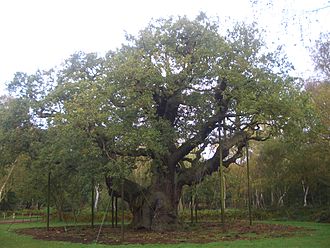
330px-Major_Oak
The Major Oak, Sherwood Forest

Moreover, the book provides a fascinating insight into how the palace affected the lives of the common people in the area. From the scales of justice to the enclosure of local pastureland; the palace was intrinsically intertwined with the lives of the local populace. The book highlights how the actions of the kings who used the palace played a part not only in the livelihoods of the local community but also in their standard of living and, indeed, life itself.

From the stories of kings, through witchcraft, war and religion to the individual lives of the families who lived and worked there, this book tells the remarkable history of the palace and its people; and of its rediscovery and significance to the history of England. This book is a marvel to read; it is a fabulous story of how 1,500 years of history have affected one small area of England – and how that little village played its part in English history.

I cannot recommend it highly enough, it is written in a wonderful, conversational manner which makes it accessible to all, and tells a truly fascinating story which made it a pleasure, and a privilege, to read.

A Palace For Our Kings: The history and archaeology of a Mediaeval royal palace in the heart of Sherwood Forest by James Wright is out now as a limited edition paperback and e-book via Triskele Publishing. More information on the book and the King’s Houses at Clipstone can be found on social media: Facebook  and Twitter.

©2016 Sharon Bennett Connolly.

*

My book, Heroines of the Medieval World,  is now available in hardback in the UK from both Amberley Publishing and Amazon UK and worldwide from Book Depository. It is also available on Kindle in both the UK and USA and will be available in Hardback from Amazon US from 1 May 2018.

Be the first to read new articles by clicking the ‘Follow’ button, liking our Facebook page or joining me on Twitter.

*

‘The Major Oak’ taken from Wikipedia. ‘The King’s Houses’ photo ©James Wright.

Eleanor of England, Queen Leonor of Castile

EleonoraAngl
Eleanor of England, Queen of Castile

On 13th October 1162 (1161 has also been suggested, but most sources agree on 1162) the Queen of England gave birth to a 2nd daughter at Domfront Castle in Normandy, Eleanor. She was the 6th child of Europe’s most glamorous and controversial couple; Henry II and Eleanor of Aquitaine. Named after her mother Eleanor was baptised by Cardinal Henry of Pisa, with the chronicler Robert de Torigny standing as her godfather.

Of Eleanor’s 4 older brothers 3 had survived infancy; Henry, the Young King, Richard the Lionheart and Geoffrey – later Duke of Brittany. Geoffrey was nearest to Eleanor in age, but already 4 years old when she was born. Eleanor’s older sister, Matilda, had been born in 1156 and would be married to Henry V ‘the Lion’, Duke of Saxony and Bavaria, when Eleanor was just 6 years old. At the age of 3 Eleanor would be joined by a baby sister, Joanna, in the Plantagenet nursery and by a last brother, John, in 1166.

Eleanor’s birth coincided with an awkward period in her parents’ marriage. Eleanor of Aquitaine’s vassals, unhappy with Henry’s rule, were attempting to get her marriage to Henry annulled on the grounds of consanguinity. Although the plot was unsuccessful and the Cardinals were unimpressed with the argument, it cannot have been an easy time for the King and Queen.

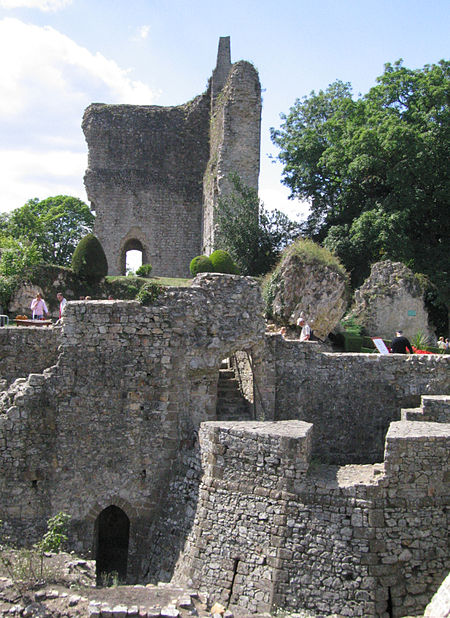
450px-DonjonDomfront61
Domfront, Eleanor’s birthplace

Eleanor’s early childhood was quite nomadic. She travelled often with her parents, in her mother’s entourage. Henry had been absent from the country for 5 years when Eleanor first came to England with her parents in 1163. The Royal family would spend the Christmas of 1164/5 at Marlborough, while in the midst of the crisis of Henry’s disagreements with his archbishop of Canterbury, Thomas a Becket. Eleanor of Aquitaine would then take her children to Winchester, from where they visited Sherborne Castle in Dorset and the Isle of Wight before moving to Westminster.

In February 1165 3-year-old Eleanor was betrothed to the infant son of Frederick Barbarossa, Frederick, in order to cement a treaty with the Emperor. And following the conclusion of the treaty the Archbishop of Cologne was introduced to Eleanor and Matilda (who was to marry Henry the Lion). However, where Matilda departed for her new life in Germany in 1168, Eleanor’s proposed marriage was still in the distant future.

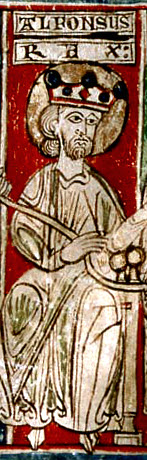
Alfons8Kastilie
Alfonso VIII of Castile

Some historians have speculated that Eleanor was educated for some time at Fontevrault Abbey, along with her younger sister Joanna and her baby brother, John, who spent 5 years there after initially being intended for the church. However, by 1168 she was with her mother, who had decided to settle in Aquitaine and was allowed, by Henry II, to have her children with her.

By 1170 Eleanor’s marriage to the Emperor’s son was no longer a part of Henry II’s plans, and he decided to look elsewhere for an alliance. Seeking to extend his influence across the Pyrenees and to prevent a French alliance with Castile, Henry betrothed Eleanor to 7-year-old Alfonso VIII, king of Castile since he was just 2 years old. Raoul de Faye, Seneschal of Poitou for Eleanor of Aquitaine, was influential in negotiating the marriage; arranging for Eleanor to receive Gascony as her dowry, but only after the death of her mother.

September 1170 saw Eleanor on her way to Castile. A month short of her 8th birthday, some historians suggest she was escorted as far as Bordeaux by her mother, but this is not supported by the contemporary chronicles. However, she would have been given a suitable escort – as the daughter of a king and as a future queen herself – to see her safely to her new country. The wedding took place at Burgos Cathedral in 1174, when the bride was twelve-years-old.

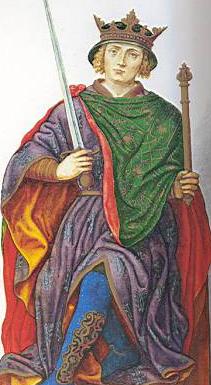
Enrique_I_de_Castilla
Henry I, King of Castile

Eleanor and Alfonso appear to have had a very successful marriage, and a close, trusting relationship. Eleanor is renowned for introducing her mother’s Poitevin culture into the Castilian court. The court encouraged the culture and architecture of Eleanor’s youth, whilst blending it with the luxuries offered by the neighbouring Moorish culture. Castilian poet Ramon Vidal described Eleanor as “Queen Leonore modestly clad in a mantle of rich stuff, red, with a silver border wrought with golden lions.” While the troubadour Pierre Vidal described to Eleanor as elegant and gracious.

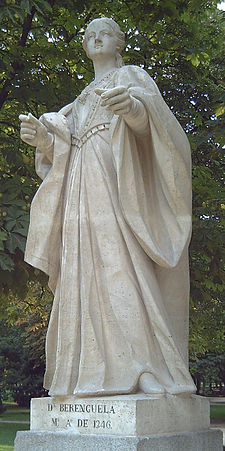
Eleanor and Alfonso would have 7 children that survived infancy. Their eldest daughter Berengaria would marry Alfonso IX, King of Leon, and would act as regent in Castile for her younger brother, Henry I, before succeeding him as queen regnant. Berengaria and Alfonso’s marriage was dissolved by the papacy, on the grounds of consanguinity; but their children were declared legitimate. Shortly after succeeding to the throne of Castile, Berengaria abdicated in favour of her son, Ferdinand III, but continued to act as his closest adviser.

225px-Doña_Berenguela_01
Berengaria, Queen of Castile

One daughter, Eleanor, married James I, king of Aragon, but they divorced in 1229. While another, Constance, was dedicated as a nun and eventually became abbess of the abbey of Las Huelgas, founded by her parents in 1187. The abbey’s nuns were drawn from the highest ranks of the Spanish nobility, they belonged to the  Cistercian Order, a closed community mainly cut off from the world.

Alfonso and Eleanor had 2 sons who would survive childhood. The eldest, Ferdinand, predeceased his parents, dying of a fever in 1209 or 1211. Henry I would succeed his father, but died in 1217 when a loose roof tile fell on his head. He was 13 years old.

Two other daughters survived childhood. Eleanor’s 2nd eldest daughter, 14-year-old Urraca, was initially suggested as the bride of the future Louis VIII of France, son of Philip II Augustus. In 1200 the girls’ grandmother, Eleanor of Aquitaine, was instrumental in arranging the marriage; her dowry was to be provided from the territories Richard I had won from France at the end of the 12th century.

D._Urraca_de_Castela,_Rainha_de_Portugal_-_The_Portuguese_Genealogy_(Genealogia_dos_Reis_de_Portugal)
Urraca, Queen of Portugal

Eleanor of Aquitaine outlived all but 2 of her children. With the deaths of Richard I and his sister Joanna in 1199, only Eleanor in Castile and her baby brother John, now King of England, remained of the once large brood of 4 boys and 3 girls who had survived infancy.

Such recent losses may have helped to persuade the 77-year-old Eleanor of Aquitaine to travel to Castile, in person and in the depths of winter, to collect the granddaughter who would be Louis’ bride. The reunion of the 2 Eleanors would surely have been highly emotional.

She was received at Alfonso’s court with all the pageantry and courtesies appropriate for most remarkable woman of her time. The Dowager Queen of England stayed with her daughter for over 2 months, taking the opportunity to spend some time with her daughter and grandchildren, as the marriage would not be able to take place until after Lent.

In getting to know her granddaughters, Eleanor of Aquitaine seems to have decided that 12-year-old Blanca would make a more suitable bride for Louis. Whether it was because of the girls’ temperaments or simply a matter of names, as some historians have suggested. Urraca was not a name easily translated into French, whereas Blanca, as Blanche, was easily  recognisable.

Blancheofcastile
Blanche of Castile, Queen of France

It was, therefore, 12-year-old Blanche who travelled back to France with her grandmother to marry the Dauphin, Louis – the same Louis who would be invited to become England’s king by the rebel barons and laid siege to Lincoln Castle in 1216. Blanche and Louis were married in Normandy, as France was under papal interdict at the time; Blanche would be the mother, and lifelong adviser, of Louis IX (St Louis).

In 1206 Urraca married the heir to the throne of Portugal – the future King Alfonso II.

Eleanor of England and Alfonso VIII appear to have had a happy, successful marriage, producing a family of 4 sons and 8 daughters over a 16 year period. Eleanor enhanced the culture of the Castilian court and acted as a diplomatic conduit between her husband and brothers, Richard and John, in order to aid each other and keep the peace – most of the time. However, in 1204, following the death of Eleanor of Aquitaine, Alfonso had to resort to a show of military force in order to successfully claim his wife’s dower rights over Gascony from John.

Burgos_-_Las_Huelgas_10
Abbey of Las Huelgas

Their happy marriage came to an end when Alfonso died in Burgos on 6th October 1214. He was buried in the Abbey of Las Huelgas, where their daughter, Constance, was now Abbess, leaving Eleanor as regent for their 10-year-old son, Henry I. Broken-hearted Eleanor, however, only survived her husband by a little over 3 weeks. Overcome with grief she died in Burgos on 31st October 1214, and was laid to rest beside her beloved husband; leaving their daughter Berengaria to take up the regency for Henry.

Of Eleanor’s grandchildren 2 were to become saints, Louis IX of France and Berengaria’s son Ferdinand III, king of Castile; her great-granddaughter and namesake, Eleanor of Castile (Ferdinand’s daughter), would become Queen of England as the wife of Edward I.

*

Pictures courtesy of Wikipedia

*

Sources: Brewer’s Royalty by David Williamson; The Mammoth Book of British Kings & Queens by Mike Ashley; Britain’s Royal Families, the Complete Genealogy by Alison Weir; The Plantagenet Chronicles Edited by Elizabeth Hallam; England Under the Norman and Angevin Kings by Robert Bartlett; Eleanor of Aquitaine, by the Wrath of God, Queen of England by Alison Weir; Eleanor, April Queen of Aquitaine by Douglas Boyd; oxforddnb.com.

*

My Books

Christmas is coming!

Signed, dedicated copies of all my books are available through my online bookshop.

Coming 15 January 2024: Women of the Anarchy

On the one side is Empress Matilda, or Maud. The sole surviving legitimate child of Henry I, she is fighting for her birthright and that of her children. On the other side is her cousin, Queen Matilda, supporting her husband, King Stephen, and fighting to see her own son inherit the English crown. Both women are granddaughters of St Margaret, Queen of Scotland and descendants of Alfred the Great of Wessex. Women of the Anarchy demonstrates how these women, unable to wield a sword, were prime movers in this time of conflict and lawlessness. It show how their strengths, weaknesses, and personal ambitions swung the fortunes of war one way – and then the other.

Available for pre-order from Amberley Publishing and Amazon UK.

Also by Sharon Bennett Connolly:

Out nowKing John’s Right-Hand Lady: The Story of Nicholaa de la Haye is the story of a truly remarkable lady. Nicholaa de la Haye was the hereditary constable of Lincoln Castle and the first woman in England to be appointed sheriff in her own right. Her strength and tenacity saved England at one of the lowest points in its history. Nicholaa de la Haye is one woman in English history whose story needs to be told…

King John’s Right-Hand Lady: The Story of Nicholaa de la Haye is now available from Pen & Sword Booksbookshop.org and Amazon.

Defenders of the Norman Crown: The Rise and Fall of the Warenne Earls of Surrey tells the fascinating story of the Warenne dynasty, of the successes and failures of one of the most powerful families in England, from its origins in Normandy, through the Conquest, Magna Carta, the wars and marriages that led to its ultimate demise in the reign of Edward III. Defenders of the Norman Crown: Rise and Fall of the Warenne Earls of Surrey is now available from Pen & Sword BooksAmazon in the UK and US, and Bookshop.org.

Ladies of Magna Carta: Women of Influence in Thirteenth Century England looks into the relationships of the various noble families of the 13th century, and how they were affected by the Barons’ Wars, Magna Carta and its aftermath; the bonds that were formed and those that were broken. It is now available in paperback and hardback from Pen & Sword,  Amazon, and Bookshop.org.

Heroines of the Medieval World tells the stories of some of the most remarkable women from Medieval history, from Eleanor of Aquitaine to Julian of Norwich. Available now from Amberley Publishing and Amazon, and Bookshop.org.

Silk and the Sword: The Women of the Norman Conquest traces the fortunes of the women who had a significant role to play in the momentous events of 1066. Available now from Amazon,  Amberley Publishing, and Bookshop.org.

Alternate Endings: An anthology of historical fiction short stories including Long Live the King… which is my take what might have happened had King John not died in October 1216. Available in paperback and kindle from Amazon.

Podcast:

Have a listen to the A Slice of Medieval podcast, which I co-host with Historical fiction novelist Derek Birks. Derek and I welcome guests, such as Bernard Cornwell, and discuss a wide range of topics in medieval history, from significant events to the personalities involved.

*

Don’t forget! Signed and dedicated copies of all my books are available through my online bookshop.

For forthcoming online and in-person talks, please check out my Events Page.

You can be the first to read new articles by clicking the ‘Follow’ button, liking our Facebook page or joining me on Twitter and Instagram.

*

©2016 Sharon Bennett Connolly FRHistS
The Jilted Princess

JoanEngland
Joan of England, Queen of Scotland

Joan of England was the oldest of daughter of King John and his 2nd wife, Isabella of Angoulême. Born on 22 July 1210 she was the 3rd of 5 children; she had 2 older brothers and 2 younger sisters would join the family by 1215.

Even before her birth, she was mooted as a possible bride for Alexander of Scotland, son of King William I of Scotland. A verbal agreement between the two kings, after the Treaty of Norham, in 1209 provided for John to arrange the marriages of William’s two daughters, with one marrying a son of John’s, and Alexander marrying one of John’s daughters.

Following the death of William I a further treaty in 1212 agreed to the marriage of 14-year-old Alexander II to 2-year-old Joan. However, the agreement seems to have been made as a way of preventing Alexander from looking to the continent – and especially France – for a potential bride, and by extension allies.

It did not stop John from looking further afield, nevertheless, for a more favourable marriage alliance. Nor did it stop Alexander from siding with the Barons against King John; Alexander was one of the Magna Carta signatories. John refused a proposal from King Philip II of France, for his son John, and settled in 1214 for a marriage with his old enemies the de Lusignan’s.

In 1214 Joan was betrothed to Hugh X de Lusignan. Hugh was the son of John’s rival for the hand of Isabella in 1200; Isabella’s engagement to Hugh IX was broken off  in order for her to marry John. Following the betrothal Hugh, Lord of Lusignan and Count of La Marche, was given custody of Joan and of Saintes, Saintonge and the Isle of Oléron as pledges for her dowry. Joan was just 4 years old when she travelled to the south of France to live with her future husband’s family. She was away from England at the height of the Baron’s War, and at her father’s death in October 1216.

It’s possible she was reunited with her mother in 1217 when Isabella of Angoulême left England, abandoning her four other children, in order to govern her own lands in Angoulême.

In 1220 in a scandalous about-face Hugh repudiated Joan and married her mother, his father’s former betrothed. And poor 9-year-old Joan’s erstwhile future husband was now her step-father!

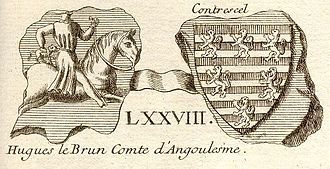
330px-Hugues_le_Brun
Hugh X de Lusignan, Joan’s betrothed and step-father

And worse was to come…

Instead of being sent back to England, as you would expect, Joan went from being Hugh’s betrothed – to being his prisoner. She was held hostage to ensure Hugh’s continued control of her dower lands, and to guarantee the transfer of his new wife’s dower, while England was withholding Queen Isabella’s dower against the return of Joan’s dower lands.

Negotiations to resolve the situation were ongoing. In the mean time, Henry III was already looking to arrange a new marriage for Joan. On 15th June 1220, in York, a conference between Alexander II and Henry III saw the Scots king agree to marry Joan, with a provision that he would marry Joan’s younger sister, Isabella, if Joan was not returned to England in time.

Negotiations for Joan’s return were long and difficult and not helped by the fact Hugh was threatening war in Poitou. Eventually, after Papal intervention, agreement was reached in October 1220 and Joan was surrendered to the English.

Joan and Alexander II were married on the 19th June 1221, at York Minster. Joan was just a month from her 11th birthday, while Alexander was 22. The archbishop of York performed the ceremony, which was witnessed Henry III and the great magnates of both realms. Henry III’s Pipe Rolls suggest the wedding was followed by 3 days of celebrations, costing £100. According to the Chronicle of Melrose ‘having celebrated the nuptials most splendidly, as was befitting, with all the natives of either realm rejoicing, [Alexander] conducted [Joan] to Scotland.’

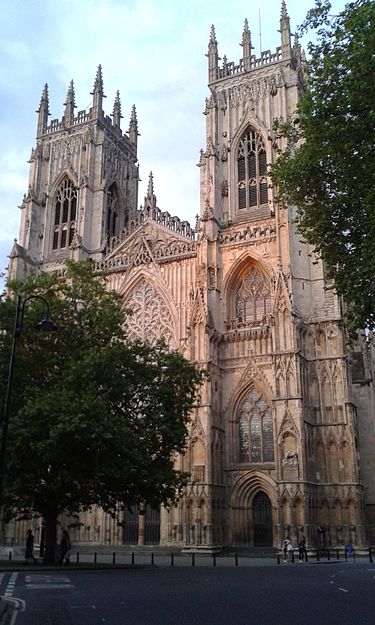
York.mstr.
York Minster

The day before the wedding Alexander had assigned dower estates to Joan, worth an annual income of £1,000, including Jedburgh, Crail and Kinghorn. However, part of the dower was still held by Alexander’s mother, the dowager Queen Ermengarde, and Joan was not entitled to the income until after her mother-in-law’s death. This left Joan financially dependent on Alexander from the beginning.

There is a suggestion that Joan was not enamoured with Scotland and its society. She was hampered by her youth, her domineering mother-in-law and, eventually, by the fact she failed  to produce the desired heir. Her position was further hindered by tensions between her husband and brother from time to time.

In this, though, she seems to have found her purpose. Joan regularly acted as intermediary between the 2 kings. Alexander often used Joan’s personal letters to her brother as a way of communicating with Henry, while bypassing the formality of official correspondence between kings.

One such letter is a warning, possibly on behalf of Alexander’s constable, Alan of Galloway, of intelligence that Haakon IV of Norway was intending to aid Hugh de Lacy in Ireland. In the same letter she assured Henry that no one from Scotland would be going to Ireland to fight against Henry’s interests. Another letter, this time from Henry, was of a more personal nature, written in February 1235 it informed Joan of the marriage of their “beloved sister” Isabella to the holy Roman Emperor Frederick II, news at which he knew Joan “would greatly rejoice”.

In December 1235 Alexander and Joan were summoned to London, possibly for the coronation of Henry’s new queen, Eleanor of Provence. This would have been a long and arduous journey for the Scots monarchs, especially in the deepest part of winter.

Henry’s use of Joan as an intermediary suggests she did have some influence over her husband, this theory is supported by the fact that Joan accompanied Alexander to negotiations with the English king, at Newcastle in September 1236 and again at York in September 1237.

In 1234 Henry had granted Joan the manor of Fenstanton in Huntingdonshire and during the 1236 negotiations she was granted Driffield in Yorkshire, giving Joan an income independent of Scotland. Many have seen this as an indication that Joan was intending to spend more time in England, especially seeing as the chronicler Matthew Paris hints at an estrangement, although we cannot be certain.

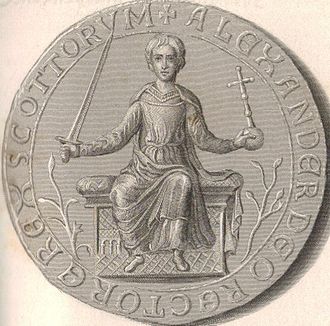
330px-Alexander_II_(Alba)_i
Alexander II

The 1236 and 1237 councils were attempts at resolving the ongoing claims of Alexander that King John had agreed to gift Northumberland to Alexander as part of the marriage contract between Alexander and Joan. Henry, of course, denied this. With the mediation of a papal legate, agreement was eventually reached in York at the 1237 council, with both queens present, when Alexander gave up the claim to Northumberland in return for lands in the northern counties with an annual income of £200.

Following the 1237 council Joan and her sister-in-law Eleanor of Provence departed on pilgrimage to the shrine of Thomas Becket at Canterbury. Given that Joan was now 27 and Eleanor already married for two years, it is possible both women were praying for children, and an heir.

Joan stayed in England for the rest of the year; much of the stay seems to have been informal and pleasurable. She spent Christmas at Henry’s court and was given new robes for herself, her clerks and servants, in addition to gifts of does and wine. Her widowed sister Eleanor, Countess of Pembroke, was present, along with the Countess of Chester and Joan’s cousin, the captive Eleanor of Brittany.

In late January arrangements were being made for Joan’s return to Scotland, but she fell ill before she could travel north. Still only 27 years of age Joan died on 4th March 1238 at Havering-atte-Bower in Essex, her brothers, King Henry III and Richard, Earl of Cornwall, were at her side.

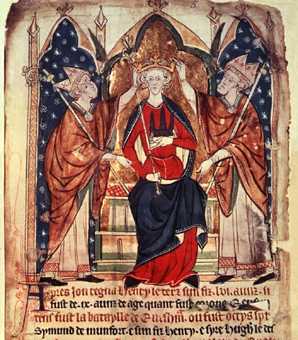
HenryIII
Henry III

According to Matthew Paris ‘her death was grievous, however she merited less mourning, because she refused to return [to Scotland] although often summoned back by her husband’. And even in death Joan elected to stay in England. her will requested that she be buried at the Cistercian nunnery of Tarrant in Dorset.

The convent benefited greatly from Henry III’s almsgiving for the soul of his sister; in 1252, over 13 years after her death, the king ordered a marble effigy to be made for her tomb (which unfortunately has not survived).

Talking of her wedding day, the Chronicle of Lanercost had described Joan as ‘a girl still of a young age, but when she was an adult of comely beauty.’

Alexander II married again just over a year after Joan’s death, to Marie de Coucy and their son, Alexander III, the longed-for heir, was born in 1241. Alexander II died of a fever in 1249.

*

Images courtesy of Wikipedia

*

Sources: The Oxford Companion to British History Edited by John Cannon; The Plantagenets, the Kings who Made England by Dan Jones; History Today Companion to British History Edited by Juliet Gardiner and Neil Wenborn;  Brewer’s British Royalty by David Williamson; Britain’s Royal Families, the Complete Genealogy by Alison Weir; The Plantagenet Chronicles Edited by Elizabeth Hallam; The Mammoth Book of British Kings and Queens by Mike Ashley; The Plantagenets, the Kings that made Britain by Derek Wilson; England Under the Norman and Angevin Kings  by Robert Bartlett; http://www.britannica.com; oxforddnb.com; finerollshenry3.org.uk.

*

My Books

Signed, dedicated copies of all my books are available through my online bookshop. or by contacting me.

Unfortunately, postage costs make it very expensive to send books to the US. However, if you buy one of my books in the US, I can send out a signed book plate. Just send me your address and who to dedicate it to via my contacting me page.

Coming 30 March: Princesses of the Early Middle Ages

Daughters of kings were often used to seal treaty alliances and forge peace with England’s enemies. Princesses of the Early Middle Ages: Royal Daughters of the Conquest explores the lives of these young women, how they followed the stereotype, and how they sometimes managed to escape it. It will look at the world they lived in, and how their lives and marriages were affected by political necessity and the events of the time. Princesses of the Early Middle Ages will also examine how these girls, who were often political pawns, were able to control their own lives and fates. Whilst they were expected to obey their parents in their marriage choices, several princesses were able to exert their own influence on these choices, with some outright refusing the husbands offered to them.

Their stories are touching, inspiring and, at times, heartbreaking.

Princesses of the Early Middle Ages: Royal Daughters of the Conquest is now available for pre-order from Pen & Sword and Amazon.

Also by Sharon Bennett Connolly:

Scotland’s history is dramatic, violent and bloody and Scotland’s Medieval Queens have seen it all. This is the story of Scotland through their eyes. Available now from Amazon and Pen and Sword BooksHeroines of the Tudor World tells the stories of the most remarkable women from European history in the time of the Tudor dynasty, 1485-1603. These are the women who ruled, the women who founded dynasties, the women who fought for religious freedom, their families and love. Heroines of the Tudor World is now available from Amberley Publishing and Amazon UK. Women of the Anarchy demonstrates how Empress Matilda and Matilda of Boulogne, unable to wield a sword themselves, were prime movers in this time of conflict and lawlessness. It shows how their strengths, weaknesses, and personal ambitions swung the fortunes of war one way – and then the other. Available from Bookshop.orgAmberley Publishing and Amazon UKKing John’s Right-Hand Lady: The Story of Nicholaa de la Haye is the story of a truly remarkable lady, the hereditary constable of Lincoln Castle and the first woman in England to be appointed sheriff in her own right. Available from all good bookshops Pen & Sword Booksbookshop.org and Amazon

Defenders of the Norman Crown: The Rise and Fall of the Warenne Earls of Surrey tells the fascinating story of the Warenne dynasty, from its origins in Normandy, through the Conquest, Magna Carta, the wars and marriages that led to its ultimate demise in the reign of Edward III. Available from Pen & Sword BooksAmazon in the UK and US, and Bookshop.orgLadies of Magna Carta: Women of Influence in Thirteenth Century England looks into the relationships of the various noble families of the 13th century, and how they were affected by the Barons’ Wars, Magna Carta and its aftermath; the bonds that were formed and those that were broken. It is now available in paperback and hardback from Pen & SwordAmazon, and Bookshop.orgHeroines of the Medieval World tells the stories of some of the most remarkable women from Medieval history, from Eleanor of Aquitaine to Julian of Norwich. Available now from Amberley Publishing and Amazon, and Bookshop.orgSilk and the Sword: The Women of the Norman Conquest traces the fortunes of the women who had a significant role to play in the momentous events of 1066. Available now from Amazon,  Amberley Publishing, and Bookshop.org.

Alternate Endings: An anthology of historical fiction short stories including Long Live the King… which is my take what might have happened had King John not died in October 1216. Available in paperback and kindle from Amazon.

Podcast:

Have a listen to the A Slice of Medieval podcast, which I co-host with Historical fiction novelist Derek Birks. Derek and I welcome guests, such as Bernard Cornwell and Michael Jecks, and discuss a wide range of topics in medieval history, from significant events to the personalities involved. 

Every episode is also now available on YouTube.

*

Don’t forget! Signed and dedicated copies of all my books are available through my online bookshop.

For forthcoming online and in-person talks, please check out my Events Page.

You can be the first to read new articles by clicking the ‘Follow’ button, liking our Facebook page or joining me on TwitterThreadsBluesky and Instagram.

*

©2015 Sharon Bennett Connolly FRHistS
Isabella, England’s Second Holy Roman Empress

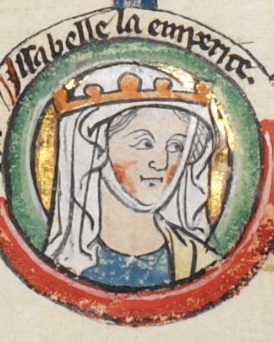
Isabella_of_England,_Holy_Roman_Empress
Isabella of England, Holy Roman Empress

Nearly everyone knows that Henry I’s daughter Matilda, Lady of the English, was Holy Roman Empress as the wife of Holy Roman Emperor Henry V. What is less well-known is that, almost 70 years after Matilda’s death, her great-granddaughter followed in her footsteps.

Isabella of England was born in 1214; she was the 4th of 5 children born to King John and his 2nd wife Isabella of Angouleme. She had 3 older siblings, Henry, Richard and Joan, and a baby sister Eleanor. Born at a time when her father’s strife with his barons was at its height, her early childhood was turbulent, to say the least. John died just 2 years later, in October 1216, leaving 9-year-old Henry as king of a country in the midst of civil war while fighting off an occupying French army.

Even before her father’s death, Isabella’s older sister Joan (born in 1210) had left England, to be raised by the family of her intended husband, Hugh de Lusignan. However, by 1220, amidst great scandal, Hugh had repudiated Joan and married her mother in her stead, whilst still holding Joan as hostage in order to gain Queen Isabella’s dower.

Whilst Joan was still in the hands of the Lusignans, her marriage to Alexander II of Scotland was negotiated, with an added clause that Isabella could be substituted for her older sister, should Joan not make it back to England in time. In the event Joan returned in time and Henry III looked elsewhere for a husband for Isabella.

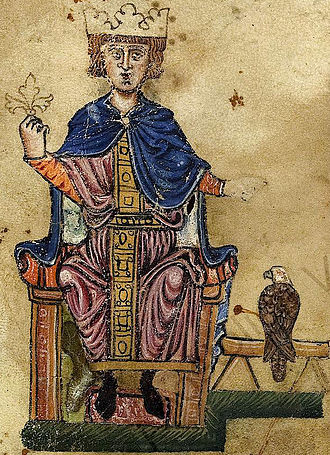
330px-Frederick_II_and_eagle
Frederick II, Holy Roman Emperor

Becoming part of his policy of continental diplomacy, Henry looked at several possible husbands, such as Henry VII, king of the Romans and Louis IX of France. After some prompting by Pope Gregory IX, Holy Roman Emperor Frederick II (father of Henry VII) sent an embassy to England to pursue his own suit for the English princess to become his 3rd wife.

Within 3 days of the Sicilian embassy’s arrival Henry was agreeable to the match, which complimented his keen interest in the Holy Roman Empire. He had Isabella brought from the Tower of London to Westminster to be interviewed by the ambassadors. They were so impressed with her that they hailed Isabella “Vivat imperatrix! Vivat!”

The marriage contract was signed on 22nd February 1235, with Henry giving Isabella a dowry of 30,000 marks. Although Isabella already had her own fine chapel silver, Henry gave her a magnificent trousseau, which included a service of gold and silver plate. The English people were irritated by Henry’s demand for a substantial marriage aid, but Henry saw the marriage as adding to his personal prestige, and a possible alliance against Louis IX of France.

On 11th May 1235 Isabella set sail from Sandwich, escorted by the bishop of Exeter, the archbishop of Cologne and the duke of Brabant; she arrived at Antwerp 4 days later. With a substantial escort, to guard against kidnap threats from Frederick II’s enemies, Isabella arrived in Cologne on 24th May. She made a processional entry into the city, to the cheers of a 10,00 strong crowd, endearing herself to the noble ladies by throwing her veil back.

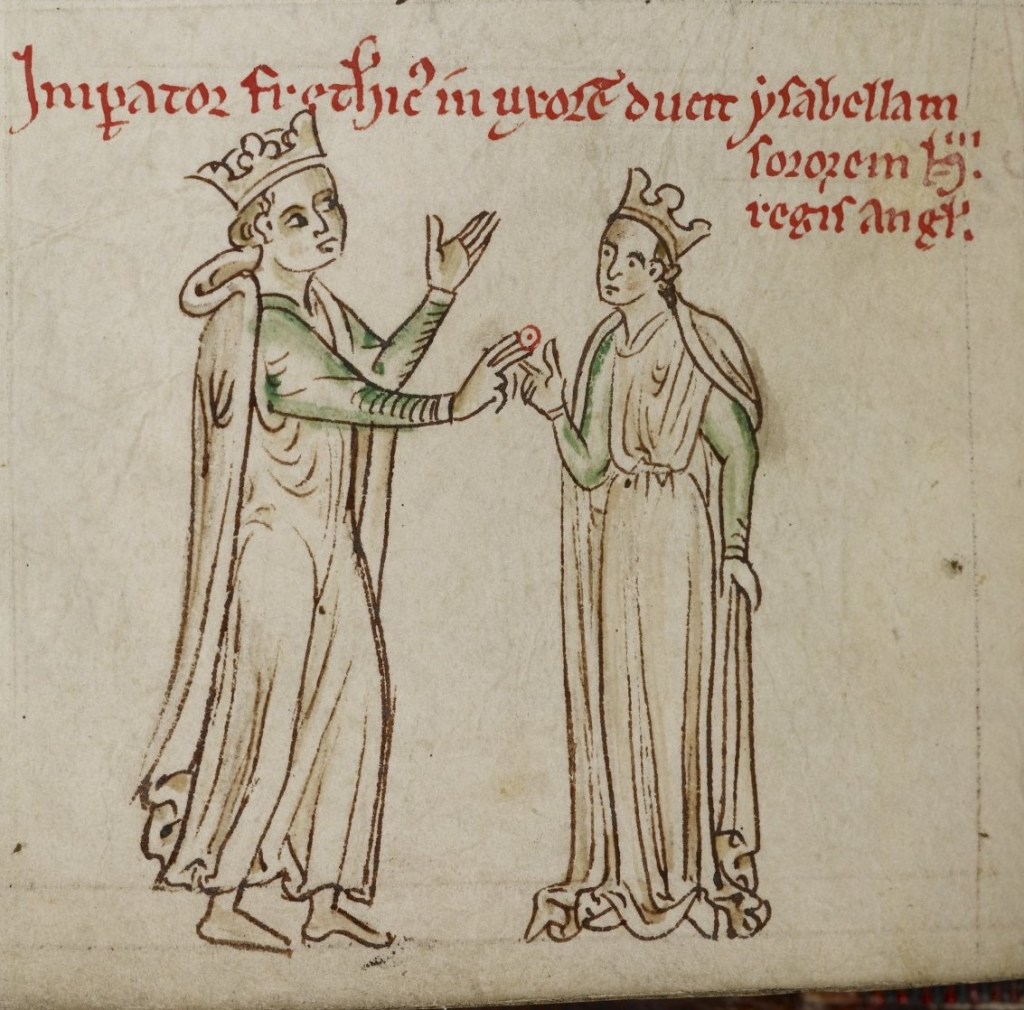
The marriage of Frederick II and Isabella of England

She was to spend 6 weeks in Cologne waiting for Frederick, who was dealing with a rebellion by his oldest son, Henry VII.

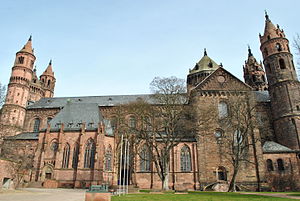
By July 1235, however, they were together in Worms where, on Sunday the 15th, they were married in the cathedral by the archbishop of Mainz. Isabella was crowned Holy Roman Empress at the same time. Four days of wedding festivities followed, with guests including – according to Matthew Paris – 4 kings, 11 dukes and 30 counts and marquesses.

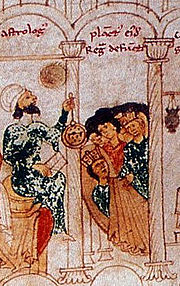
Frederick, it seems, put great store by astrology; in 1228 Michael Scot had completed his encyclopedia of astrology while at Frederick’s court. And it was on the advice of the emperor’s court astrologers that the marriage was not consummated until the 2nd night.

Isabella was the emperor’s third wife; his first, Constance of Aragon, had died of malaria in 1222 and his second wife, Queen Isabella-Yolanda of Jerusalem had died in childbirth in 1228. Frederick was 20 years Isabella’s senior and expended all his energy on war, travelling and ceremonials in order to maintain his authority throughout his vast empire.

Frederick was delighted with his bride; she was beautiful and popular. He sent 3 leopards to Henry III in England as a sign of his appreciation. However, following the celebrations he also dismissed the majority of Isabella’s English attendants; she was allowed to retain only her nurse, Margaret Biset – who and been with her  since her early childhood – and a maid, called Kathrein.

300px-St._Peter's_Cathedral_Worms_south_side
St Peter’s Cathedrals, Worms, where Isabella was married and crowned Holy Roman Empress

Isabella travelled with Frederick’s slaves to his palace at Hagenau, where Frederick spent the winter with his new empress. Their first child was probably born around 1237/8, although there does seem to be some confusion over how many children there were, and when they were born. What is certain is 2 children survived childhood; Henry, King of Jerusalem, died unmarried in his teens in 1254 and Margaret married Albert I, Margrave of Meissen and Langrave of Thuringia and Misnes, in 1256.

Isabella travelled extensively through her husband’s lands, residing in Apulia, Lombardy, Noventa between 1238 and 1239. Frederick was always close by, despite his battles with  the papacy, and arrived in southern Italy shortly after his wife’s arrival in February 1240.

Isabella was expected to live in some magnificence, but Henry III was irritated that she was only rarely allowed to appear in public. There were rumours that Frederick kept his wives in a harem, although these were probably unfounded and arose from the seclusion that firstly Isabella-Yolanda and then Isabella lived in.

When Richard Earl of Cornwall visited the Emperor in 1241, he didn’t immediately see his sister, although this was probably down to court protocol, as the Empress was pregnant at the time. When they did meet the brother and sister were treated to a lavish court entertainment, being delighted by a magnificent display of jugglers and Muslim dancers.

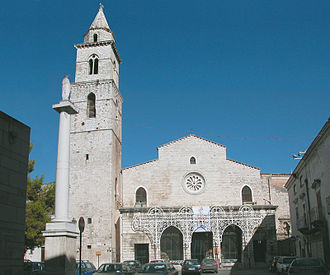
330px-Cattedrale0558_1_copia
Andria cathedral, Isabella’s final resting-place

Following Richard’s visit, Frederick II returned to war. He was besieging Faenza in northern Italy when his wife died in childbirth on 1st December 1241; the baby died with her. Before his departure  on campaign, Isabella had urged Frederick to stay on good terms with her brother Henry III, who was leaning more and more towards the papacy.

She was buried at Andria, Sicily, alongside the emperor’s 2nd wife, Isabella-Yolanda. Isabella had been married for just over 6 years and was only  27 years of age.

Through her daughter Margaret, Isabella is the ancestor of Queen Victoria’s beloved husband, Prince Albert.

*

Pictures courtesy of Wikipedia

*

Sources: The Oxford Companion to British History Edited by John Cannon; The Plantagenets, the Kings who Made England by Dan Jones; History Today Companion to British History Edited by Juliet Gardiner and Neil Wenborn;  Brewer’s British Royalty by David Williamson; Britain’s Royal Families, the Complete Genealogy by Alison Weir; The Plantagenet Chronicles Edited by Elizabeth Hallam; The Mammoth Book of British Kings and Queens by Mike Ashley; The Plantagenets, the Kings that made Britain by Derek Wilson; England Under the Norman and Angevin Kings  by Robert Bartlett; http://www.britannica.com; oxforddnb.com.

*

Isabella’s story features in greater detail in my book, Ladies of Magna Carta: Women of Influence in Thirteenth Century England .

My Books

Christmas is coming!

Signed, dedicated copies of all my books are available through my online bookshop.

Coming 15 January 2024: Women of the Anarchy

On the one side is Empress Matilda, or Maud. The sole surviving legitimate child of Henry I, she is fighting for her birthright and that of her children. On the other side is her cousin, Queen Matilda, supporting her husband, King Stephen, and fighting to see her own son inherit the English crown. Both women are granddaughters of St Margaret, Queen of Scotland and descendants of Alfred the Great of Wessex. Women of the Anarchy demonstrates how these women, unable to wield a sword, were prime movers in this time of conflict and lawlessness. It show how their strengths, weaknesses, and personal ambitions swung the fortunes of war one way – and then the other.

Available for pre-order from Amberley Publishing and Amazon UK.

Coming on 15 June 2024: Heroines of the Tudor World

Heroines of the Tudor World tells the stories of the most remarkable women from European history in the time of the Tudor dynasty, 1485-1603. These are the women who ruled, the women who founded dynasties, the women who fought for religious freedom, their families and love. These are the women who made a difference, who influenced countries, kings and the Reformation. In the era dominated by the Renaissance and Reformation, Heroines of the Tudor World examines the threats and challenges faced by the women of the era, and how they overcame them. Some famous, some infamous, some less well known, including Anne Boleyn, Elizabeth Barton, Catherine de Medici, Bess of Hardwick and Elizabeth I. From writers to regents, from nuns to queens, Heroines of the Tudor World shines the spotlight on the women helped to shape Early Modern Europe.

Heroines of the Tudor World is now available for pre-order from Amberley Publishing and Amazon UK.

Also by Sharon Bennett Connolly:

Out nowKing John’s Right-Hand Lady: The Story of Nicholaa de la Haye is the story of a truly remarkable lady. Nicholaa de la Haye was the hereditary constable of Lincoln Castle and the first woman in England to be appointed sheriff in her own right. Her strength and tenacity saved England at one of the lowest points in its history. Nicholaa de la Haye is one woman in English history whose story needs to be told… King John’s Right-Hand Lady: The Story of Nicholaa de la Haye is now available from Pen & Sword Booksbookshop.org and Amazon.

Defenders of the Norman Crown: The Rise and Fall of the Warenne Earls of Surrey tells the fascinating story of the Warenne dynasty, of the successes and failures of one of the most powerful families in England, from its origins in Normandy, through the Conquest, Magna Carta, the wars and marriages that led to its ultimate demise in the reign of Edward III. Defenders of the Norman Crown: Rise and Fall of the Warenne Earls of Surrey is now available from Pen & Sword BooksAmazon in the UK and US, and Bookshop.org.

Ladies of Magna Carta: Women of Influence in Thirteenth Century England looks into the relationships of the various noble families of the 13th century, and how they were affected by the Barons’ Wars, Magna Carta and its aftermath; the bonds that were formed and those that were broken. It is now available in paperback and hardback from Pen & Sword,  Amazon, and Bookshop.org.

Heroines of the Medieval World tells the stories of some of the most remarkable women from Medieval history, from Eleanor of Aquitaine to Julian of Norwich. Available now from Amberley Publishing and Amazon, and Bookshop.org.

Silk and the Sword: The Women of the Norman Conquest traces the fortunes of the women who had a significant role to play in the momentous events of 1066. Available now from Amazon,  Amberley Publishing, and Bookshop.org.

Alternate Endings: An anthology of historical fiction short stories including Long Live the King… which is my take what might have happened had King John not died in October 1216. Available in paperback and kindle from Amazon.

Podcast:

Have a listen to the A Slice of Medieval podcast, which I co-host with Historical fiction novelist Derek Birks. Derek and I welcome guests, such as Bernard Cornwell, and discuss a wide range of topics in medieval history, from significant events to the personalities involved.

*

Don’t forget! Signed and dedicated copies of all my books are available through my online bookshop.

For forthcoming online and in-person talks, please check out my Events Page.

You can be the first to read new articles by clicking the ‘Follow’ button, liking our Facebook page or joining me on Twitter and Instagram.

*

©2016 Sharon Bennett Connolly FRHistS
The Eternal Legacy of Magna Carta

031
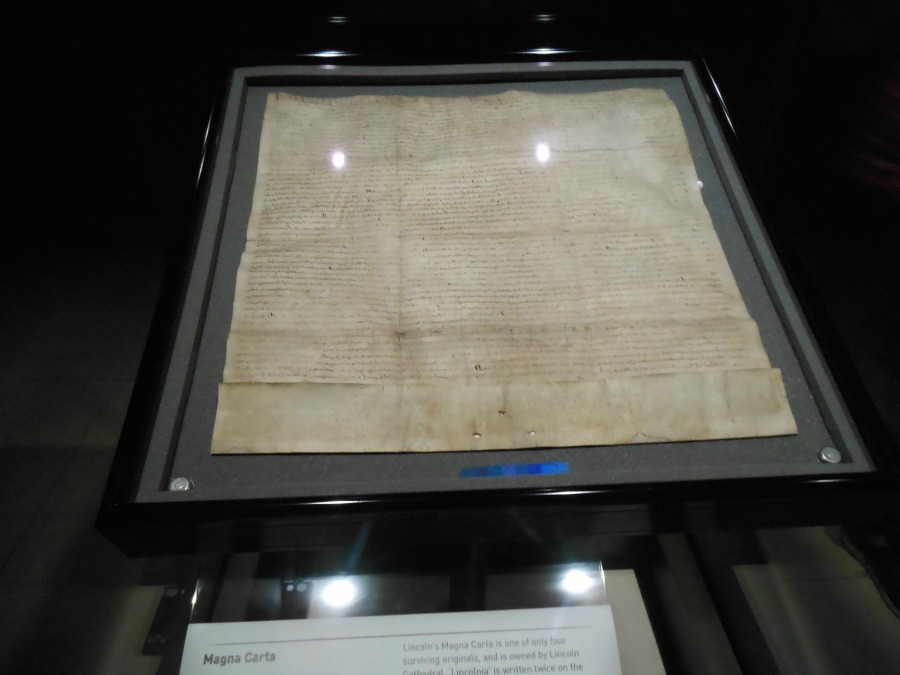
Lincoln Cathedral’s Magna Carta

June 15th 2015 was the 800th anniversary of the signing of Magna Carta.

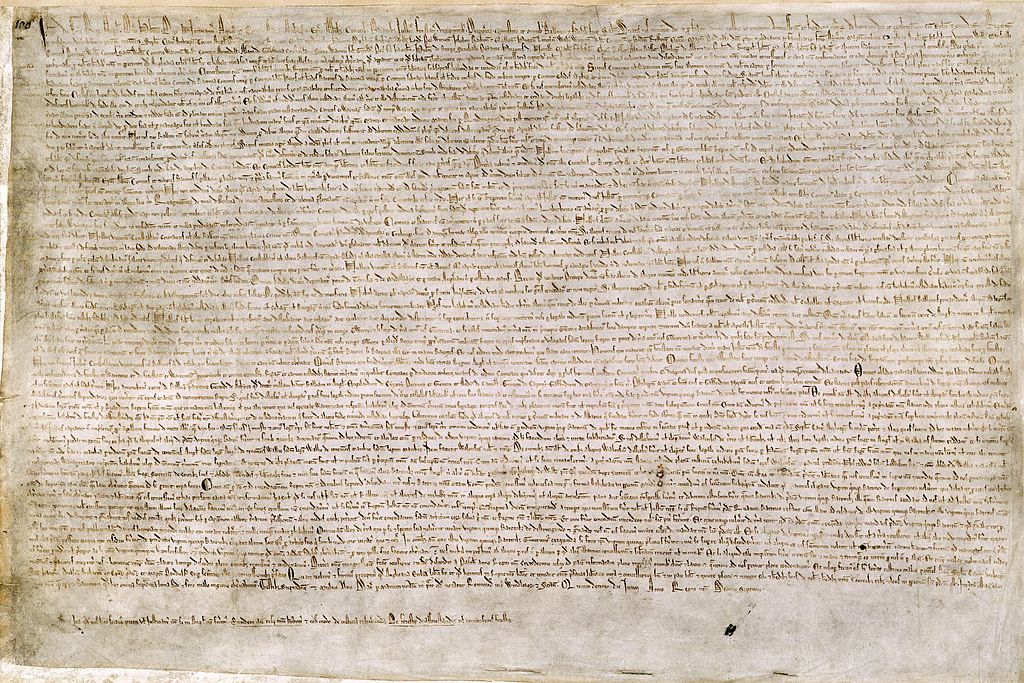
On 1 April 2015 Lincoln Castle reopened its doors after an extensive refurbishment. The renovations included a new purpose-built, state-of-the-art, underground vault for its most prized possession: one of only four surviving copies of the original 1215 Great Charter – the Magna Carta.

The Magna Carta’s new home cannot fail to emphasise the importance of this charter in the history of not only England, but also the rest of the world. Two films – Magna Carta: Challenging the Power of the King and Magna Carta: Meaning and Myth – reconstruct the events leading up to Magna Carta and chart its significance through the centuries, respectively.

But what is Magna Carta? And what makes it so important?

In many ways, the reign of King John had been a continuation of that of his father, Henry II, and of his brother, Richard I, with one significant difference. Early in his reign John had lost the French part of the great Angevin empire: Normandy and most of Aquitaine were now held by France. In 1214 King John returned to England following his army’s defeat by the French at the Battle of Bouvines. The battle ended the king’s hopes of regaining the lost empire.

Added to this catastrophe was the character and personality of John himself. By nature John was paranoid, secretive and distrustful. John’s cruelty is widely known. He is accused of killing his nephew and rival claimant to the English throne, Arthur of Brittany; he hanged 28 Welsh hostages (sons of rebel chieftains) and he hounded William de Braose and his family all the way to Ireland and back. De Braose’s wife and son died in one of John’s prisons, probably from starvation.

The History of William Marshal, a biography of the great knight and statesman, states of John: ‘He kept his prisoners in such a horrible manner, and in such abject confinement that it seemed an indignity and a disgrace to all those with him who witnessed such cruelty’.

Although John faced the fallout of Magna Carta, many of the injustices targeted by the barons can be seen in the reigns of his predecessors. Heavy taxes, arbitrary fines and the exploitation of wardships were long-established royal revenue earners. However, where Henry and Richard had a whole empire to exploit, John’s need for money had to be met by England alone.

Even John’s disagreement with the Church can see parallels in the reign of Henry II and his clashes with Thomas Becket. John opposed the election of Stephen Langton as Archbishop of Canterbury, and refused to allow his consecration. Pope Innocent III went so far as to excommunicate John and place England under interdict; in 1213 Philip II of France was even invited to depose him.

John finally came to an agreement with the Church in May 1213, swearing that the liberties established under Henry I would be strictly observed and allowing Langton to take up his post as archbishop. However, John broke his oath almost immediately and Langton became one of the leaders of the opposition to the king.

The barons’ objections to John were almost beyond number. He had failed to face the French and had lost not only most of his family’s Continental possessions, but also those of his barons. Few had forgotten his treachery against his brother – his attempts on the throne whilst Richard was away on Crusade. His barons even complained that he forced himself on their wives and daughters.

The barons had had enough.

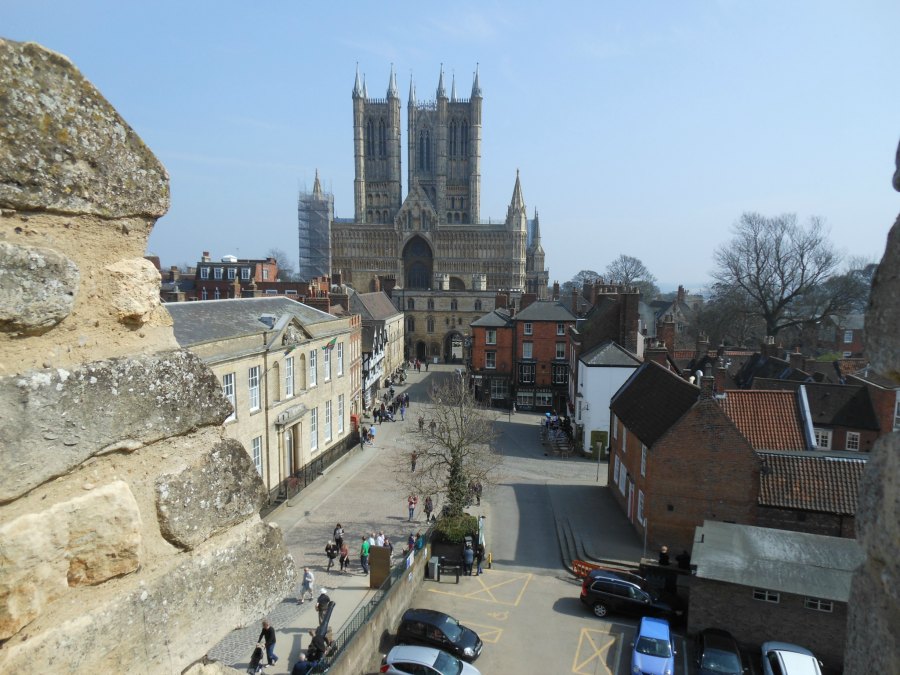
Lincoln Cathedral Sharon's pic
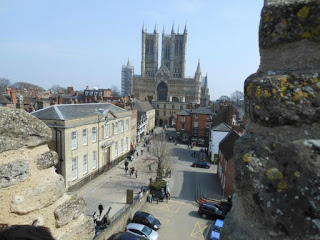
Lincoln Cathedral

The rebels were ready to fight. After occupying London they made one final attempt to prevent war, presenting the king with a list of their demands.

Following further negotiations a long detailed document was produced, dealing with particular grievances of the time and with injustices in general. It touched on the whole system of royal government. And it was granted to ‘all free men of the realm and their heirs forever’.

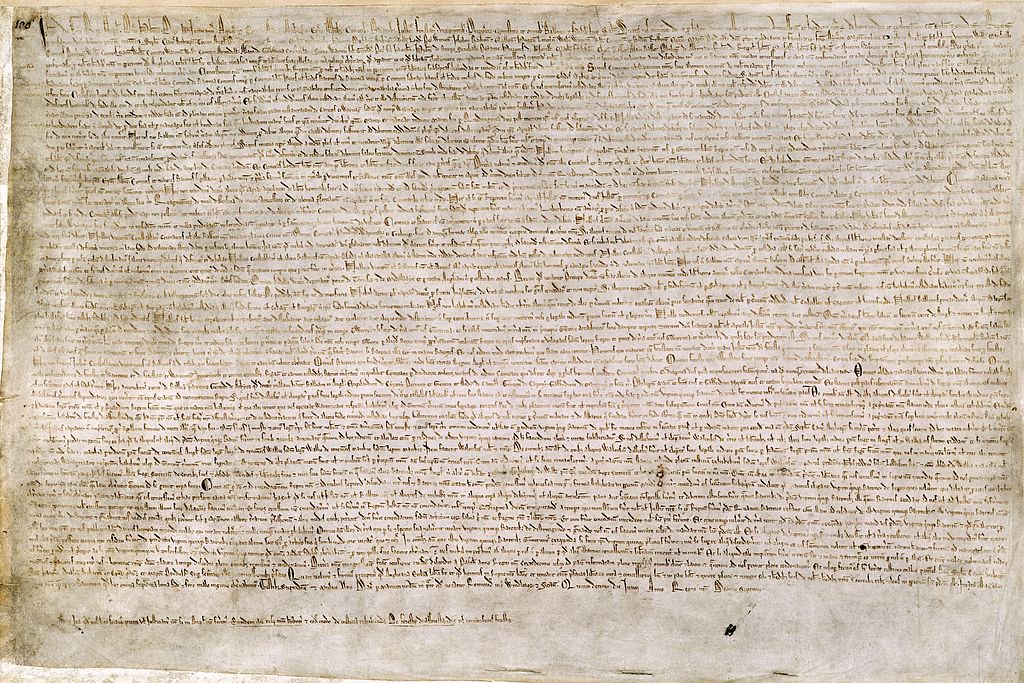
Magna Carta

Of its 63 clauses, some terms were asking for immediate remedies, such as the removal of corrupt administrators and the sending home of foreign mercenaries. The clause stating that fighting outside of the kingdom could not be imposed by the king was a reaction to John’s recent attempts to force his English barons to help him recover his Continental domains.

Others had long-term aims. The document sought to guarantee the privileges of the Church and the City of London. Restrictions were placed on the powers of regional officials, such as sheriffs, to prevent abuses. The royal court was fixed at Westminster, for justice to be obtainable by all, and royal judges were to visit each county regularly. Taxes could no longer be levied without the consent of the Church and the barons.

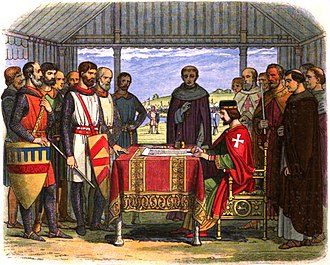
John and the barons at Runnymede

Clauses included the fixing of inheritance charges and protection from exploitation for under-age heirs; the king was to take only what was reasonable from an estate (although ‘reasonable’ remained undefined). From henceforth a widow was to be free to choose whether or not to remarry and her marriage portion (dowry) would be made available to her immediately on her husband’s death. Another clause sought to prevent the seizure of land from Jews and the king’s debtors.

Magna Carta even went so far as to regulate weights and measures. It also reduced the size of the king’s forests and limited the powers of forest justices.

Although most of the 63 clauses of Magna Carta are now defunct, three still remain as major tenets of British law, including ‘to no one will we sell, to no one will we deny or delay right or justice’. That no person could be imprisoned, outlawed or deprived of his lands except by judgement of his peers and the law of the land has remained the cornerstone of the English legal system ever since.

Magna Carta was sealed at Runnymede, Berkshire, on 15 June 1215. John ordered that the charter be circulated around the towns and villages.

As a peace agreement between King John and his rebellious barons, however, it failed miserably. By July John was appealing to the Pope for help. Pope Innocent III’s response arrived in England in September. The treaty was declared null and void; it was ‘not only shameful and demeaning but also illegal and unjust’. By the time the letter arrived in England, the dispute had already erupted into the Barons’ War.

Deciding they could no longer deal with John’s perfidy, the rebel barons invited the King of France, Philip II, to claim the throne. Philip’s son and heir, the future Louis VIII, accepted the offer. Having landed on the south coast, he marched for London, where he was proclaimed King of England on 2 June 1216.

John’s fortuitous death at Newark in October 1216 turned the tide against Louis and the rebels. The highly respected knight and statesman, William Marshal, Earl of Pembroke, was appointed regent for John’s nine-year-old son, Henry III. Marshal’s staunch loyalty was renowned throughout Europe; he was the embodiment of the chivalric code. Many barons who had previously sided with Louis saw the opportunity to come back from the brink, and rally around the young king. Marshal reissued Magna Carta and faced and defeated the joint French and rebel army at Lincoln on 20 May 1217.

Afterwards, the English were able to dictate peace terms to Louis, and the French went home. Magna Carta was issued a third time, along with a new Forest Charter (also on display at Lincoln Castle). It was reissued in 1225, on Henry III attaining his majority and it is the 1225 edition which remains on the statute books today.

The Legacy of Magna Carta

021
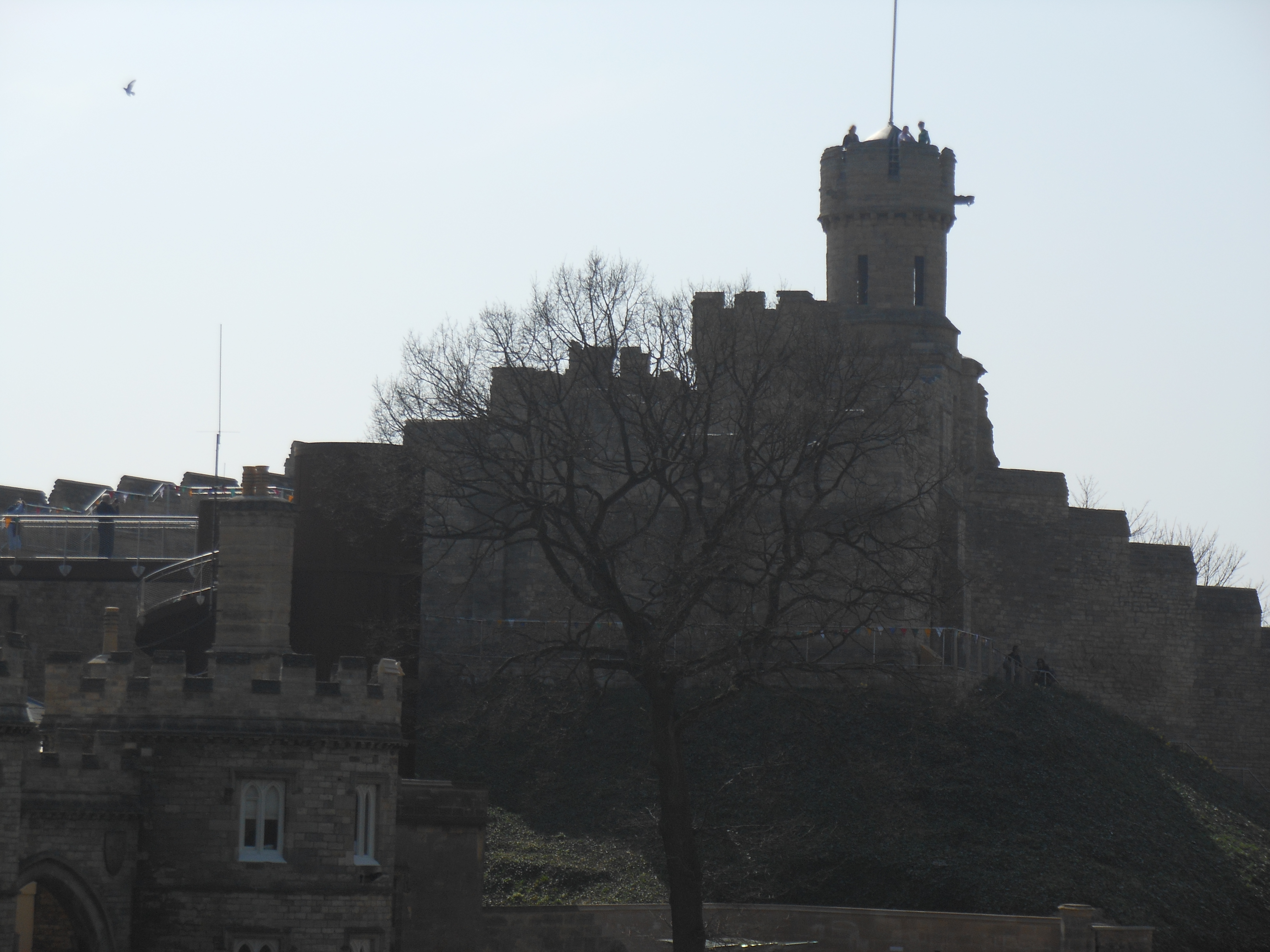
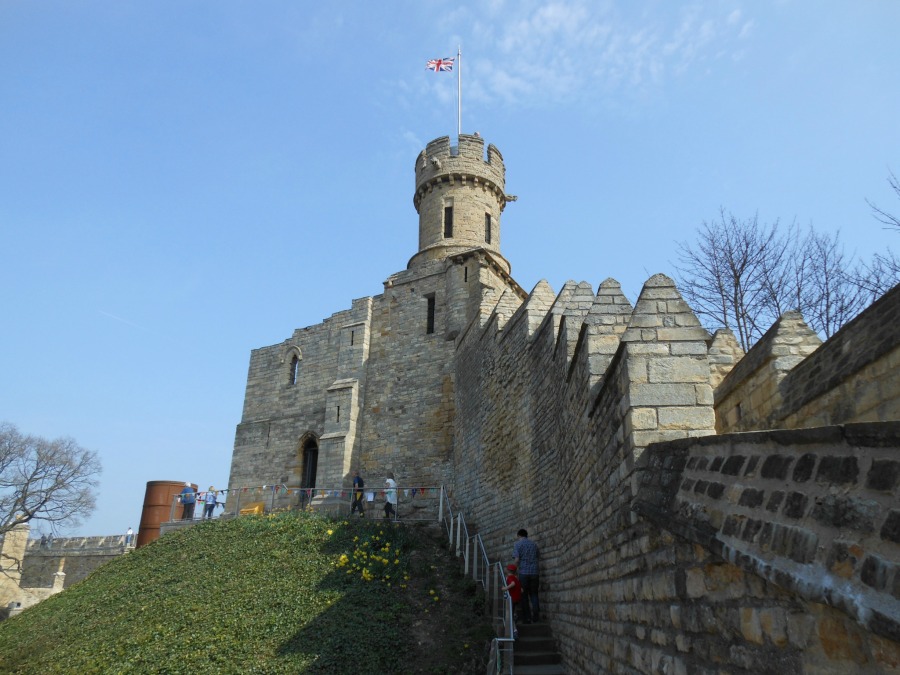
Lincoln Castle

It is hard to overstate the enduring significance of Magna Carta. Although it was initially a document conceived by rebel barons, the regents of Henry III exploited Magna Carta as a royalist device to recover the loyalty of the rebel barons. However, once it was issued it was used as a curb to all regal excesses. In 1265 it was invoked to create the first representative parliament.

By the late 1200s Magna Carta was regarded as a fundamental statement of English liberties.

Magna Carta set the precedent for future reform programmes, such as the Provisions of Oxford of 1258, the Ordinances of 1311, the Petition of Right of 1628 and the Grand Remonstrance of 1641.

The influence of Magna Carta has spread far beyond England’s shores. It can be seen in the United States’ 1791 Bill of Rights, in the 1948 Universal Declaration of Human Rights and the 1950 European Convention on Human Rights.

Although a failure in the short term, in the long term, Magna Carta established defined limitations to royal rights, laying down that standard to be observed by the crown and its agents.

It is the closest thing England has to a Constitution.

*

Article and Photos © Sharon Bennett Connolly FRHistS 2015, except John and his barons, which is courtesy of Wikipedia.

*

Article originally published on The Review in June 2015.

*

Sources: Robert Bartlett England Under the Norman and Angevin Kings 1075-1225; Dan Jones The Plantagenets; the Kings who Made England; The Plantagenet Chronicle Edited by Elizabeth Hallam; Maurice Ashley The Life and Times of King John; Roy Strong The Story of Britain; Oxford Companion to British History; Mike Ashley British Kings & Queens; David Williamson Brewer’s British Royalty.

My Books

Signed, dedicated copies of all my books are available, please get in touch by completing the contact me form.

Out now!

King John’s Right-Hand Lady: The Story of Nicholaa de la Haye is now available for pre-order from Pen & Sword Booksbookshop.org and Amazon UK. (I will hopefully have a US release date shortly)

In a time when men fought and women stayed home, Nicholaa de la Haye held Lincoln Castle against all-comers. Not once, but three times, earning herself the ironic praise that she acted ‘manfully.’ Nicholaa gained prominence in the First Baron’s War, the civil war that followed the sealing of Magna Carta in 1215.

A truly remarkable lady, Nicholaa was the first woman to be appointed sheriff in her own right. Her strength and tenacity saved England at one of the lowest points in its history. Nicholaa de la Haye is one woman in English history whose story needs to be told…

Coming 15 January 2024: Women of the Anarchy

On the one side is Empress Matilda, or Maud. The sole surviving legitimate child of Henry I, she is fighting for her birthright and that of her children. On the other side is her cousin, Queen Matilda, supporting her husband, King Stephen, and fighting to see her own son inherit the English crown. Both women are granddaughters of St Margaret, Queen of Scotland and descendants of Alfred the Great of Wessex. Women of the Anarchy demonstrates how these women, unable to wield a sword, were prime movers in this time of conflict and lawlessness. It show how their strengths, weaknesses, and personal ambitions swung the fortunes of war one way – and then the other.

Available for pre-order from Amberley Publishing and Amazon UK.

Also by Sharon Bennett Connolly:

Defenders of the Norman Crown: The Rise and Fall of the Warenne Earls of Surrey tells the fascinating story of the Warenne dynasty, of the successes and failures of one of the most powerful families in England, from its origins in Normandy, through the Conquest, Magna Carta, the wars and marriages that led to its ultimate demise in the reign of Edward III. Defenders of the Norman Crown: Rise and Fall of the Warenne Earls of Surrey is now available from Pen & Sword BooksAmazon in the UK and US, and  Bookshop.org.

Ladies of Magna Carta: Women of Influence in Thirteenth Century England looks into the relationships of the various noble families of the 13th century, and how they were affected by the Barons’ Wars, Magna Carta and its aftermath; the bonds that were formed and those that were broken. It is now available in paperback and hardback from Pen & Sword,  Amazon, and Bookshop.org.

Heroines of the Medieval World tells the stories of some of the most remarkable women from Medieval history, from Eleanor of Aquitaine to Julian of Norwich. Available now from Amberley Publishing and Amazon, and Bookshop.org.

Silk and the Sword: The Women of the Norman Conquest traces the fortunes of the women who had a significant role to play in the momentous events of 1066. Available now from Amazon,  Amberley Publishing, and Bookshop.org.

Alternate Endings: An anthology of historical fiction short stories including Long Live the King… which is my take what might have happened had King John not died in October 1216. Available in paperback and kindle from Amazon.

Podcast:

Have a listen to the A Slice of Medieval podcast, which I co-host with Historical fiction novelist Derek Birks. Derek and I welcome guests, such as Bernard Cornwell and discuss a wide range of topics in medieval history, from significant events to the personalities involved.

*

For forthcoming online and in-person talks, please check out my Events Page.

You can be the first to read new articles by clicking the ‘Follow’ button, liking our Facebook page or joining me on Twitter and Instagram.

©2015 Sharon Bennett Connolly FRHistS
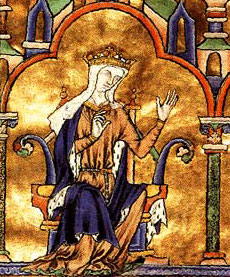
Nicholaa de la Haye, England’s Forgotten Heroine

History...the Interesting Bits
Seal of Nicholaa de la Haye, Lincoln Cathedral

Nicholaa de la Haye is one of those very rare women in English history. She is renowned for her abilities, rather than her family and connections. In a time when men fought and women stayed home, Nicholaa de la Haye held Lincoln Castle against all-comers. Her strength and tenacity saved England at one of its lowest points in history.

The eldest daughter and co-heiress of Richard de la Haye and his wife, Matilda de Vernon, Nicholaa was probably born in the early-to-mid 1150s. Her father was Baron of Brattleby. Richard’s father was a Norman, Robert de la Haye of La Haye du Puits in the Cotentin. His mother, Muriel, was English, a Lincolnshire heiress as the granddaughter of Colswein of Lincoln. In 1166 Richard he was recorded as owing 20 knights’ fees, which had been reduced to 16 by 1172. When he died in 1169, Nicholaa inherited her father’s land in Lincolnshire and his position as hereditary castellan of Lincoln Castle, a position she would hold for over 50 years.

Nicholaa was married twice, her first husband, William Fitz Erneis, died in 1178, leaving Nicholaa a young widow with one daughter, Matilda. Before 1185 she married Gerard de Camville (or Canville), brother of Richard de Camville, admiral of Richard I’s crusading fleet during the Third Crusade. Nicholaa and Gerard had at least 2 children together; Richard and Thomas. Richard was heir to both Nicholaa and Gerard. Nothing is known of Thomas beyond his name. Another daughter may have been Nicholaa d’Eyncourt, who sued Nicholaa’s granddaughter for some de la Haye lands in the 1230s; however, while it seems certain that Nicholaa d’Eyncourt was kin, unfortunately, her exact relation to Nicholaa de la Haye has not been established.

Nicholaa’s husbands each claimed the position of castellan of Lincoln Castle by right of his wife; but Nicholaa seems to have been far from the normal subservient wife. When her husband was not in the castle, she was left in charge rather than an alternative, male deputy.

History...the Interesting Bits
Lincoln castle walls leading to the Observatory Tower

Nicholaa first comes to the attention of the chroniclers in 1191, when Prince John led the opposition to his brother’s chancellor, William Longchamp. Accusing him of harbouring outlaws, Longchamp demanded that Gerard de Camville relinquish Lincoln Castle to one of his own supporters. Gerard refused, and swore fealty to John, joining him at Nottingham Castle. Leaving Nicholaa to hold Lincoln. He probably assumed that Longchamp would not wage war on a woman. However, Richard I’s Chancellor, William Longchamp, had no such qualms. He headed north and laid siege to Lincoln Castle, probably assuming, wrongly, that Nicholaa would submit easily.

The formidable Nicholaa refused to yield, holding out for 40 days before Longchamp raised the siege, following the fall of the castles at Tickhill and Nottingham to John. Amusingly, Richard of Devizes said of this defence of Lincoln Castle, that she did it ‘without thinking of anything womanly’.

In 1194, on the king’s return, Camville was stripped of his positions as Sheriff of Lincolnshire and Castellan of the castle; only having it returned to him on the accession of King John in 1199.

As we all know, King John’s reign wasn’t exactly smooth sailing. He lost his French lands and was held to account by the barons of England for  numerous examples of maladministration, corruption and  outright murder. In 1215 he had been forced to seal the Great Charter, or Magna Carta, in order to avoid war. Although it eventually came to be considered a fundamental statement of English liberties, as a peace treaty Magna Carta failed miserably. Within months John had written to Pope Innocent III and the charter had been declared null and void; the barons were up in arms.

Gerard de Camville died in December 1214 and, although now a widow, it seems the castle remained in Nicholaa’s hands. On one of King John’s visits to inspect the castle’s defences in 1216, either in February or September there was a rather dramatic display of fealty from Nicholaa :

History...the Interesting Bits
Nicholaa de la Haye, Lincoln Castle

And once it happened that after the war King John came to Lincoln and the said Lady Nicholaa went out of the eastern gate of the castle carrying the keys of the castle in her hand and met the king and offered the keys to him as her lord and said she was a woman of great age and was unable to bear such fatigue any longer and he besought her saying, “My beloved Nicholaa, I will that you keep the castle as hitherto until I shall order otherwise”.¹

Whether Nicholaa ever intended to give up Lincoln, or the event was staged so that John could demonstrate his continued trust in Nicholaa, is open to debate. I suspect it was the latter. John was in the midst of civil war and running short of allies. Nicholaa had already demonstrated her abilities at defending Lincoln, and her loyalty to John – he would have been hard put to replace her. However, the event gave John the opportunity to reinforce his trust in Nicholaa in front of his barons.

The rebels invited the king of France to take the throne of England; instead Philip II‘s son, Louis (the future Louis VIII), accepted the offer and was hailed as King of England in London in June 1216. In the same year Nicholaa prevented another siege by paying off a rebel army, led by Gilbert de Gant, who remained in occupation of the city of Lincoln but lifted the siege of the castle. After Nicholaa paid off the 1216 besiegers, John came north and he chased the rebels into the Isle of Axholme ‘with fire and sword’.

As Louis consolidated his position in the south, John then made an inspection of Lincoln castle in September. Moving south, just 2 weeks later, the king’s baggage train was lost as he crossed the Wash estuary and within a few more days John was desperately ill, probably from dysentery. He moved on to the castle at Newark, from where, just hours before his death, John appointed Nicholaa de la Haye as Sheriff of Lincolnshire in her own right:

History...the Interesting Bits
The East Gate of Lincoln Castle

‘The King to the archbishops, bishops, earls, barons, knights, freeholders and others of the county of Lincoln etc.. Know that we have granted to our trusty and well-beloved, the lady Nicholaa de Haye and Philip Marc, the county of Lincoln with all its appurtenances, to be in their custody for so long as it may please us. We therefore command that you do heed and obey the said Nicholaa and Philip in all things as the bailiffs of the said county. And in testimony etc.. Witness myself, at Newark, the eighteenth day of October, in the eighteenth year of our reign.’

From King John’s Letters and Papers, translated by Rich Price

King John died at Newark on the night of 18/19th October 1216, with half his country occupied by a foreign invader and his throne now occupied by his 9-year-old son, Henry III. The elder statesman and notable soldier William Marshal, Earl of Pembroke was appointed Regent and set out to save the kingdom.

Meanwhile, Gilbert de Gant renewed the siege of Lincoln Castle, receiving reinforcements from Louis’ forces, under the Comte de Perche, in early 1217. Now in her 60s Nicholaa de la Haye took charge of the defences.

400px-BitvaLincoln1217ortho
The Battle of Lincoln, 1217

When the small force proved insufficient to force a surrender, the French had to send for reinforcements and siege engines. For almost 7 months, Nicholaa was besieged, with the circle tightening from March to mid-May as siege machinery bombarded the south and east walls of the castle. On the 20th May William Marshal arrived, from the north-west, with a relieving force. Attacking from the north of Lincoln, his army fell upon the besieging forces and, after about 6 hours of combat, routed the enemy; the French commander, the Comte de Perche, was killed in the fighting, and the rebel leaders captured.

The city, which had supported the rebels and welcomed the French, was sacked and looted by the victorious army; the battle becoming known as the Lincoln Fair, as a result. The Battle of Lincoln turned the tide of the war. After a further defeat in the naval Battle of Sandwich in the summer, the French were forced to seek peace and returned home. Magna Carta was reissued and Henry III’s regents could set about healing the country.

In a magnificent demonstration of ingratitude, within 4 days of the relief of the Castle, Nicholaa’s position of Sheriff of Lincolnshire was given to the king’s uncle William Longspée, Earl of Salisbury, who took control of the city and promptly seized the castle.

The king’s council should have known that Nicholaa would not give up her castle so easily. She travelled to court to remind the king’s regents of her services, and request her rights be restored to her. And in October 1217, an order was issued in Henry III’s name to

Magna_Carta_(British_Library_Cotton_MS_Augustus_II.106)
Magna carta

To our beloved and loyal uncle, W. Earl of Salisbury, greetings. Recently, our beloved and loyal lady, Mistress Nicholaa de Haya, came to us in London, begging us to restore her rights, and particularly the custody of Lincoln Castle, which she ought to have and usually possesses. We, considering her faithful service to our lord King J., our father, and our subsequently commended expenses, kindly, as was fitting, heeded her, restoring her rights, namely, the aforementioned custody of Lincoln Castle and others, saving our beloved and loyal R. Earl of Chester, in his matter [rather his right] which he claims to have in the same Castle. Furthermore, we have entrusted the county of Lincoln, along with the city of Lincoln, to the same Nicholaa, to be kept for as long as we please. And therefore we command you that, all delay and occasion postponed, you restore to her the said castle of Lincoln, with its appurtenances, removing from there all those who are on our part. And that you cause her to have without delay full possession of the said county with the city of Lincoln, as is above mentioned. And in testimony of this matter, etc. Witness the count, at Westminster, the 32nd (sic) day of October, in the second year of our reign.2

The settlement was not ideal, however, and some wrangling seems to have continued until Salisbury’s death in 1226.

Nicholaa’s granddaughter and heiress, Idonea – the daughter of Nicholaa’s eldest son Richard – was married to Salisbury’s son, William II Longspée; the couple inherited the de la Haye and Camville lands on Nicholaa’s death. As a result, Salisbury felt it was his right to hold his daughter-in-law’s inheritance, even though Nicholaa was not yet dead. Understandably, Nicholaa felt differently.

On the death of her second husband, Gerard de Camville, Nicholaa had declared herself femme sole, meaning she would be able to control her own lands. A staunchly independent woman, Nicholaa issued some 25 surviving charters in her name. She made grants to various religious houses, including Lincoln Cathedral, and even secured a royal grant for a weekly market for her village of Swaton.

History...the Interesting Bits
Land grant with Nicholaa de la Haye’s seal attached

A most able adversary for some of the greatest military minds of the time, and a loyal supporter of King John, Nicholaa de la Haye was unique among her peers. Although praised by the chroniclers, they seemed to find difficulty in describing a woman who acted in such a fashion;  the Dunstable annals refer to her as a ‘noble woman’, saying she acted ‘manfully’. One cannot fail to feel admiration for a woman who managed to hold her own in a man’s world, who fought for her castle and her home in a time when women had so little say over their own lives – and at such an advanced age. Her bravery and tenacity saved Henry III’s throne.

Not surprisingly, both King John and Henry III referred to her as ‘our beloved and faithful Nicholaa de la Haye’.

Nicholaa de la Haye, the woman who saved England, lived well into her 70s. By late 1226 she had retired to her manor at Swaton, dying there on 20 November, 1230. She was buried in St Michael’s Church, Swaton in Lincolnshire, where her tomb can be seen to this day.

*

Footnotes: ¹Irene Gladwin: The Sheriff; The Man and His Office; 2 ‘1217, membranes 11, 10, 9, 8’, in Calendar of Patent Rolls, Henry III: Volume 1, 1216-1225, ed. H C Maxwell Lyte (London, 1901), British History Online https://www.british-history.ac.uk/cal-pat-rolls/hen3/vol1/pp117-132 [accessed 16 July 2025].

*

Nicholaa’s story was the inspiration behind my third book, Ladies of Magna Carta: Women of Influence in Thirteenth Century England. And my full-length biography of Nicholaa, King John’s Right-Hand Lady: the Story of Nicholaa de la Haye, was published in May, 2023.

*

Image credits:

Photos of Lincoln Castle and Nicholaa’s seal, © Sharon Bennett Connolly 2015. Picture of the Battle of Lincoln and Magna Carta are courtesy of Wikipedia. Image of the land grant from the National Archives.

*

Sources:

The Plantagenet Chronicles edited by Elizabeth Hallam; Brassey’s Battles by John Laffin; 1215 The Year of Magna Carta by Danny Danziger & John Gillingham; The Life and times of King John by Maurice Ashley; The Story of Britain by Roy Strong; The Plantagenets, the Kings Who Made England by Dan Jones; England Under the Norman and Angevin Kings  by Robert Bartlett; lincolnshirelife.co.uk; catherinehanley.co.uk; magnacarta800th.com; lothene.org; lincolncastle.com; The Sheriff: The Man and His Office by Irene Gladwin; Elizabeth Chadwick; Nick Buckingham; swaton.org.uk; Women in Thirteenth Century Lincolnshire by Louise Wilkinson.

*

My Books:

Signed, dedicated copies of all my books are available through my online bookshop. or by contacting me.

Coming in 2026

30 March: Princesses of the Early Middle Ages: Royal Daughters of the Conquest 

‘My daughter wanted me to treat her more like a princess. So, I married her to a stranger to strengthen the alliance with Poland!’

The medieval princess has often been portrayed as a pawn in the political machinations of her father or brother, married off to distant lands for the sake of peace, or land, or both. Never to be seen or thought of again.

But was that really her fate?

From the daughters of Harold, the last Saxon king, to the sisters of Henry III, Princesses of the Early Middle Ages explores the lives of these young women, how they followed the stereotype, and how they sometimes managed to escape it. It will look at the world they lived in, and how their lives and marriages were affected by political necessity and the events of the time.

Princesses of the Early Middle Ages: Royal Daughters of the Conquest is now available for pre-order from Pen & Sword and Amazon.

30 August: Princesses of the Later Middle Ages: Royal Daughters of the Plantagenets

Continuing the story, Princesses of the Later Middle Ages: Royal Daughters of the Plantagenets looks at the lives of the princesses, from the treasured daughters of Henry III to the children of Edward IV, whose lives were turned upside down when they were declared illegitimate.

What we see is a very different story, where a foreign marriage does not mean eternal exile, but a purpose in life, where a princess is a diplomat, an ambassador for England in her new country. She is the bond between allies – most of the time.

Princesses of the Later Middle Ages is now available for pre-order.

Also by Sharon Bennett Connolly:

Books by Sharon Bennett Connolly

Scotland’s history is dramatic, violent and bloody and Scotland’s Medieval Queens have seen it all. This is the story of Scotland through their eyes. Available now from Amazon and Pen and Sword BooksHeroines of the Tudor World tells the stories of the most remarkable women from European history in the time of the Tudor dynasty, 1485-1603. These are the women who ruled, the women who founded dynasties, the women who fought for religious freedom, their families and love. Heroines of the Tudor World is now available from Amberley Publishing and Amazon UK. Women of the Anarchy demonstrates how Empress Matilda and Matilda of Boulogne, unable to wield a sword themselves, were prime movers in this time of conflict and lawlessness. It shows how their strengths, weaknesses, and personal ambitions swung the fortunes of war one way – and then the other. Available from Bookshop.orgAmberley Publishing and Amazon UKKing John’s Right-Hand Lady: The Story of Nicholaa de la Haye is the story of a truly remarkable lady, the hereditary constable of Lincoln Castle and the first woman in England to be appointed sheriff in her own right. Available from all good bookshops Pen & Sword Booksbookshop.org and Amazon

Books by Sharon Bennett Connolly

Defenders of the Norman Crown: The Rise and Fall of the Warenne Earls of Surrey tells the fascinating story of the Warenne dynasty, from its origins in Normandy, through the Conquest, Magna Carta, the wars and marriages that led to its ultimate demise in the reign of Edward III. Available from Pen & Sword BooksAmazon in the UK and US, and Bookshop.orgLadies of Magna Carta: Women of Influence in Thirteenth Century England looks into the relationships of the various noble families of the 13th century, and how they were affected by the Barons’ Wars, Magna Carta and its aftermath; the bonds that were formed and those that were broken. It is now available in paperback and hardback from Pen & SwordAmazon, and Bookshop.orgHeroines of the Medieval World tells the stories of some of the most remarkable women from Medieval history, from Eleanor of Aquitaine to Julian of Norwich. Available now from Amberley Publishing and Amazon, and Bookshop.orgSilk and the Sword: The Women of the Norman Conquest traces the fortunes of the women who had a significant role to play in the momentous events of 1066. Available now from Amazon,  Amberley Publishing, and Bookshop.org.

Alternate Endings: An anthology of historical fiction short stories including Long Live the King… which is my take what might have happened had King John not died in October 1216. Available in paperback and kindle from Amazon.

Podcast:

A Slice of Medieval

Have a listen to the A Slice of Medieval podcast, which I co-host with Historical fiction novelist Derek Birks. Derek and I welcome guests, such as Ian Mortimer, Bernard Cornwell, Elizabeth Chadwick and Scott Mariani, and discuss a wide range of topics in medieval history, from significant events to the personalities involved. 

Every episode is also now available on YouTube.

*

Don’t forget! Signed and dedicated copies of all my books are available through my online bookshop.

For forthcoming online and in-person talks, please check out my Events Page.

You can be the first to read new articles by clicking the ‘Follow’ button, liking our Facebook page or joining me on TwitterThreads, Bluesky and Instagram.

©2015 Sharon Bennett Connolly FRHistS
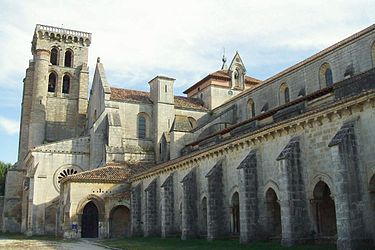
Joanna of England, the Lionheart’s Little Sister

220px-Joanna_Plantagenet
Joanna of England

Joanna of England was born in October 1165, the 7th child and youngest daughter of Henry II of England and Eleanor of Aquitaine. Ten years younger than her eldest brother, Henry the Young King, she was born at a time when their parents’ relationship was breaking down; her mother would eventually go to war against her husband, before being imprisoned by him for the last 16 years of Henry’s reign.

Born at Angers Castle in Anjou, Christmas 1165 was the first ever Christmas her parents spent apart; with Henry still in England dealing with a Welsh revolt, it would be several months before he met his new daughter for the first time. Although Joanna spent much of her childhood at her mother’s court in Poitiers, she and her younger brother, John, spent sometime boarding at the magnificent Abbey of Fontevraud. Whilst there Joanna was educated in the skills needed to run a large, aristocratic household and in several languages; English, Norman French and rudimentary Latin.

160px-Britishmuseumsealofjoanna
Joanna’s seals

When Eleanor and her sons rebelled in 1173, Henry II went to war against his wife. When she was captured – wearing men’s clothes – she was sent to imprisonment in England. Joanna joined her father’s entourage and frequently appeared at Henry’s Easter and Christmas courts.

3 years later, Eleanor was allowed to travel to Winchester to say ‘goodbye’ to her youngest daughter, who had been betrothed to King William II of Sicily. Provided with a trousseau, probably similar to that of her sister Matilda on her marriage to Henry the Lion, Joanna set out from Winchester at the end of August 1176; escorted by Bishop John of Norwich and her uncle, Hamelin de Warenne.

Joanna’s entourage must have been a sight to see. Once on the Continent, she was escorted from Barfleur by her brother Henry, the Young King. Her large escort was intended to dissuade bandit attacks against her impressive dowry, which included fine horses, gems and precious metals. At Poitiers, Joanna was met by another brother, Richard, who escorted his little sister to Toulouse in a leisurely and elegant progress.

Dedication_mosaic_-_Cathedral_of_Monreale_-_Italy_2015_(crop)
William II dedicating the Cathedral of Monreale to the Virgin Mary

Having finally reached Sicily 12-year-old Joanna was married to 24-year-old William on 13th February 1177, in Palermo Cathedral. The marriage ceremony was followed by her coronation as Queen of Sicily. Joanna must have looked magnificent, her bejewelled dress cost £114 – not a small sum at the time.

Sicily was an ethnically diverse country; William’s court was composed of Christian, Muslim and Greek advisers. William himself spoke, read and wrote Arabic and, in fact, kept a harem of both Christian and Muslim girls within the palace. Although she was kept secluded, it must have been a strange life for a young girl, partly raised in a convent.

Joanna and William only had one child, Bohemond, Duke of Apulia, who was born – and died – in 1181. And when William died without an heir in November 1189, Joanna became a pawn in the race for the succession. William’s aunt, Constance was the rightful heir, but she was married to Henry VI, Holy Roman Emperor and many feared being absorbed into his empire. William II’s illegitimate nephew, Tancred of Lecce, seized the initiative. He claimed the throne and, in need of money, imprisoned Joanna and stole her dowry and the treasures left to her by her husband.

180px-Vilem2Sicilie_smrt
William II of Sicily on his deathbed

Who knows how long Joanna would have remained imprisoned, if it had not been for her brother’s eagerness to go on Crusade? Having gained the English throne in 1189 Richard I – the Lionheart – had wasted no time in organising the Third Crusade and arrived at Messina in Sicily in September 1190.

Richard demanded Joanna’s release; and fearing the Crusader king’s anger Tancred capitulated and freed Joanna, paying 40,000 ounces of gold towards the Crusade in fulfilment of William II’s promise of aid.

Described as beautiful and spirited, Joanna had been Queen of Sicily for 13 years and it seems that, while at her brother’s court, she caught the eye of Richard’s co-Crusdaer, King Philip II of France. Richard was having none of it and moved Joanna to the Priory of Bagnara on the mainland, out of sight and hopefully out of mind.

Richard stayed in Sicily for sometime, negotiating a treaty with Tancred which would recognise him as rightful king of Sicily in return for the remainder of Joanna’s dowry and 19 ships to support the Crusade. He was also waiting for his bride, Berengaria of Navarre, to catch up with him.

Richard_I_and_Joan_greeting_Philip_Augustus
Joanna with her brother, Richard the Lionheart, and King Philip II of France

During Lent of 1191 Joanna had a brief reunion with her mother Eleanor of Aquitaine when she arrived in Sicily, having escorted Richard’s bride. Joanna became Berengaria’s chaperone and they were lodged together at Bagnara, like ‘two doves in a cage’.

Unable to marry in the Lenten season, Richard sent Joanna and Berengaria on ahead of the main army, and departed Sicily for the Holy Land.

The Royal ladies’ ship was driven to Limassol on Cyprus by a storm. After several ships were crippled and then plundered by the islanders, the ruler of Cyprus, Isaac Comnenus, tried to lure Joanna and Berengaria ashore. Richard came to the rescue, reduced Cyprus in 3 weeks and clamped Comnenus in chains (silver ones apparently). Lent being over, Richard and Berengaria were married, with great pomp and celebration, before the whole party continued their journey to the Holy Land, arriving at Acre in June 1191.

Joanna’s time in the Holy Land was spent in Acre and Jaffa, accompanying her sister-in-law and following – at a safe distance – behind the Crusading army. She spent Christmas 1191 with Richard and Berengaria, at Beit-Nuba, just 12 miles from Jerusalem. However, although he re-took Acre and Jaffa, Richard fell out with his allies and was left without a force strong enough to take Jerusalem.

In attempts to reach a political settlement with the Muslim leader, Saladin, Richard even offered Joanna as a bride for Saladin’s brother. His plans were scuppered, however, when Joanna refused outright to even consider marrying a Muslim, despite the fact Richard’s plan would have seen her installed as Queen of Jerusalem.

When a 3-year truce was eventually agreed with Saladin, Joanna and Berengaria were sent ahead of the army, to Sicily and onto Rome where they were to await Richard’s arrival. Richard, however, never made it; falling into the hands of Duke Leopold of Austria, he was handed over to his enemy, the Holy Roman Emperor.

With Richard imprisoned, Berengaria and Joanna arrived back in Poitiers. Berengaria herself set out to help raise the ransom money for Richard’s release, which finally came about in February 1194.

220px-Raimond6Toulouse
Raymond VI Count of Toulouse

Joanna spent the next few years at her mother’s and brother’s courts, her wealth having been squandered by Richard’s Crusade. But at the age of 31 she was proposed as a bride for Raymond VI, Count of Toulouse. Her title as Queen of Sicily would give him greater prestige while bringing the County of Toulouse into the Plantagenet fold, a long-time aim of Eleanor’s.

3-times married Raymond does not seem to have been ideal husband material; he had been excommunicated for marrying his third wife whilst still married to his second. And he now repudiated wife number 3, confining her to a convent, in order to marry Joanna. Despite such a colourful history, the wedding went ahead and Joanna and Raymond were married in Rouen in October 1196, with Queen Berengaria in attendance.

Although not a happy marriage Joanna gave birth to a son, Raymond, in around 1197 and a daughter, possibly called Mary, in 1198. Little is known of Mary, and it is possible she died in infancy. Raymond succeeded his father as Raymond VII Count of Toulouse, and married twice.

220px-RaimondVIIToulouse1242
Raymond VII Count of Toulouse

Raymond VI was not a popular Count of Toulouse and while he was away in the Languedoc, in 1199, dealing with rebel barons, Joanna herself tried to face down her husband’s enemies. She laid siege to a rebel stronghold at Cassee. Mid-siege, however, her troops turned traitor and fired the army’s camp – Joanna managed to escape, but was probably injured.

A pregnant Joanna was then trying to make her way to her brother Richard when she heard of his death. She diverted course and finally reached her mother at Niort. Hurt, distressed and pregnant, Eleanor sent her to Fontevraud to be looked after by the nuns.

With no allowance from her husband, Joanna returned to her mother and brother – King John – in Rouen in June 1199, pleading poverty; Eleanor managed to persuade John to give his sister an annual pension of 100 marks.

Joanna’s last few months must have been a desperate time. Too ill to travel and heavily pregnant, she remained at Rouen. In September, King John gave her a lump sum of 3,000 marks, to dispose of in her will; she specifically mentioned a legacy towards the cost of a new kitchen at Fontevraud and asked Eleanor to dispose of the remainder in charitable works for the religious and the poor.

800px-Abbaye_Fontevraud_-_Eglise_Abbatiale,_facade_ouest
The Church at the Abbey of Fontevraud

Knowing she was dying, Joanna became desperate to be veiled as a nun at Fontevraud; a request normally denied to married women – especially when they were in the late stages of pregnancy. However, seeing how desperate her daughter was, Eleanor sent for Matilda, the Abbess of Fontevraud but, fearing the Abbess would arrive too late, she also asked Hubert Walter, the Archbishop of Canterbury, to intervene. The Archbishop tried to dissuade Joanna, but was impressed by her fervour and convened a committee of nuns and clergy; who agreed that Joanna must be ‘inspired by heaven’.

In Eleanor’s presence, the Archbishop admitted Joanna to the Order of Fontevraud. Joanna was too weak to stand and died shortly after the ceremony; her son, Richard, was born a few minutes later and lived only long enough to be baptised. She died on 4 September 1199, a month short of her 34th birthday.

Joanna and her baby son were interred together at Fontevraud, the funeral cortege having been escorted there by Eleanor of Aquitaine and King John.

The Winchester Annalist said of Joanna, that she was;

a woman whose masculine spirit overcame the weakness of her sex

Winchester Annalist quoted in Oxforddnb.com

*

Do have a listen to our recent episode of A Slice of Medieval in which Derek and I chat with Catherine Hanley about her biography of Joanna, Lionessheart.

Pictures taken from Wikipedia

References: Mike Ashley The Mammoth Book of Kings & Queens; Alison Weir Britain’s Royal Families, the Complete Genealogy; Robert Bartlett England Under the Norman and Angevin Kings; Alison Weir Eleanor of Aquitaine, by the Wrath of God, Queen of England; Douglas Boyd Eleanor, April Queen of Aquitaine; bestofsicily.com; Oxforddnb.com; britannica.com; geni.com; royalwomenblogspot.co.uk; medievalqueens.com.

*

My books

Signed, dedicated copies of all my books are available through my online bookshop.

Out now: Scotland’s Medieval Queens

Books by Sharon Bennett Connolly

Scotland’s history is dramatic, violent and bloody. Being England’s northern neighbour has never been easy. Scotland’s queens have had to deal with war, murder, imprisonment, political rivalries and open betrayal. They have loved and lost, raised kings and queens, ruled and died for Scotland. From St Margaret, who became one of the patron saints of Scotland, to Elizabeth de Burgh and the dramatic story of the Scottish Wars of Independence, to the love story and tragedy of Joan Beaufort, to Margaret of Denmark and the dawn of the Renaissance, Scotland’s Medieval Queens have seen it all. This is the story of Scotland through their eyes.

Scotland’s Medieval Queens gives a thorough grounding in the history of the women who ruled Scotland at the side of its kings, often in the shadows, but just as interesting in their lives beyond the spotlight. It’s not a subject that has been widely covered, and Sharon is a pioneer in bringing that information into accessible history.’ Elizabeth Chadwick (New York Times bestselling author)

Available now from Amazon and Pen and Sword Books

Also by Sharon Bennett Connolly:

Books by Sharon Bennett Connolly

Heroines of the Tudor World tells the stories of the most remarkable women from European history in the time of the Tudor dynasty, 1485-1603. These are the women who ruled, the women who founded dynasties, the women who fought for religious freedom, their families and love. Heroines of the Tudor World is now available for pre-order from Amberley Publishing and Amazon UK. Women of the Anarchy demonstrates how Empress Matilda and Matilda of Boulogne, unable to wield a sword themselves, were prime movers in this time of conflict and lawlessness. It shows how their strengths, weaknesses, and personal ambitions swung the fortunes of war one way – and then the other. Available from Bookshop.orgAmberley Publishing and Amazon UKKing John’s Right-Hand Lady: The Story of Nicholaa de la Haye is the story of a truly remarkable lady, the hereditary constable of Lincoln Castle and the first woman in England to be appointed sheriff in her own right. Available from all good bookshops Pen & Sword Booksbookshop.org and Amazon

Royal Historical Society

Defenders of the Norman Crown: The Rise and Fall of the Warenne Earls of Surrey tells the fascinating story of the Warenne dynasty, from its origins in Normandy, through the Conquest, Magna Carta, the wars and marriages that led to its ultimate demise in the reign of Edward III. Available from Pen & Sword BooksAmazon in the UK and US, and Bookshop.orgLadies of Magna Carta: Women of Influence in Thirteenth Century England looks into the relationships of the various noble families of the 13th century, and how they were affected by the Barons’ Wars, Magna Carta and its aftermath; the bonds that were formed and those that were broken. It is now available in paperback and hardback from Pen & SwordAmazon, and Bookshop.orgHeroines of the Medieval World tells the stories of some of the most remarkable women from Medieval history, from Eleanor of Aquitaine to Julian of Norwich. Available now from Amberley Publishing and Amazon, and Bookshop.orgSilk and the Sword: The Women of the Norman Conquest traces the fortunes of the women who had a significant role to play in the momentous events of 1066. Available now from Amazon,  Amberley Publishing, and Bookshop.org.

Alternate Endings: An anthology of historical fiction short stories including Long Live the King… which is my take what might have happened had King John not died in October 1216. Available in paperback and kindle from Amazon.

Podcast:

A Slice of Medieval

Have a listen to the A Slice of Medieval podcast, which I co-host with Historical fiction novelist Derek Birks. Derek and I welcome guests, such as Elizabeth Chadwick, Helen Castor, Ian Mortimer, Scott Mariani and Bernard Cornwell and discuss a wide range of topics in medieval history, from significant events to the personalities involved. 

Every episode is also now available on YouTube.

*

Don’t forget! Signed and dedicated copies of all my books are available through my online store.

For forthcoming online and in-person talks, please check out my Events Page.

You can be the first to read new articles by clicking the ‘Follow’ button, liking our Facebook page or joining me on TwitterThreadsBluesky and Instagram.

©2015 Sharon Bennett Connolly FRHistS

Lincoln Castle, a Journey Through History

064
The Observatory Tower

I love the school holidays. My son and I always find something historical to explore. Today, it was Lincoln Castle.

The Castle only reopened on the 1st April, 2015, after an extensive revamp. And it was teeming with visitors (apparently it was the quietest day since they reopened, so the last week must have been incredibly hectic for the staff).

Lincoln Castle was started by William the Conqueror in 1068 and has been in constant use ever since. You can follow its history, just by looking at the buildings that occupy the Inner Bailey. In its time, it has been a military fortification, a Victorian prison and is now home to Lincoln’s Crown Court – and the Magna Carta!

Magna_Carta_(British_Library_Cotton_MS_Augustus_II.106)
Magna Carta

Lincoln Cathedral’s Magna Carta is one of only four surviving originals. It is now on display in an impressive purpose-built, underground vault. The Magna Carta is accompanied by an original copy of the 1217 Charter of the Forest.

There is a 20-minute video, with a very believable King John and the great William Marshal, discussing the Magna Carta and explaining its inception and significance through the centuries.

041
Prison Chapel

The Magna Carta Vault is a modern addition, adjoining the imposing Victorian prison. In its day, the prison was an innovation in the harshness punishment; the prisoners were held in solitary confinement for 24 hours a day.

There was no relief from the solitude, even when attending church services; the prison chapel was constructed in a way that each prisoner could see the priest, but could have no contact with his fellow prisoners. The chapel gives me the creeps everytime I visit it. I have a thing about dummies, but it’s also the thought of all those prisoners only able to see the one person, in the pulpit; cut off from society and each other.

037
Inside the male prison

The prison included some wonderful interactive displays, with the opportunity to read the diaries of the priest, the wardens and prisoners. Kids can dress-up as prisoners or wardens, explore the separate male and female prisons, and watch videos of the inmates, explaining their crimes – and pleading their innocence!

The Castle grounds give you the sense of the thousand years of history its walls have witnessed.

It was at Lincoln that King Stephen was captured by forces loyal to the Empress Matilda, during the civil war – the Anarchy – that followed the death of Henry I (when Matilda and Stephen both claimed the throne).

046
From the battlements: Lincoln Cathedral

Henry VIII and Catherine Howard had visited Lincoln Castle during their northern progress of 1541, shortly before Catherine’s infidelities were uncovered.

You can now walk the whole length of the walls – a third of a mile, though it can feel longer, with all the steps. You can climb the narrow spiral staircase to the top of the Observatory Tower – and take in the whole view of Lincoln, its Cathedral and the Fens.

The Lucy Tower contains within its walls a small cemetery, where executed prisoners, and those who died of disease, were buried.

077
The West Gate

The West Gate is a little piece of history in itself; opened to William Marshal’s troops during the Second Battle of Lincoln, by the castle’s castellan, Nicholaa de la Haye, whilst the castle was under siege from the army of Louis of France, who had been invited to take England by King John’s disaffected barons. The Dauphin was defeated shortly after, outside the Castle’s walls, and returned to France.

087
Remnant of the Eleanor Cross

Another memento from history, within the Inner Bailey, is the remnant of Lincoln’s Eleanor Cross. Eleanor of Castile was just 7 miles from Lincoln when she died in 1290 and Lincoln’s Eleanor Cross is the first marker of her funeral procession, which ended at Westminster Abbey. Eleanor’s viscera (her intestines) were buried in Lincoln Cathedral, while her embalmed body was transported to London, an elaborate cross being erected at each stopping place along the way.

025
Inside the Victorian Kitchen

The Castle has not forgotten its younger visitors, with a little treasure trail and quiz, based on King John’s loss of the Crown Jewels in the Wash.

The prize was well worth winning – chocolate coins from the Victorian Kitchen. And ‘thank you’ to the Victorian lady, who insisted all children pay a 1 coin tax to their parents out of their winnings – very tasty!

Whether you choose to explore by yourself, take the guided tour or simply bask in the sun of the Bailey, Lincoln Castle is a wonderful day out – for the young and old alike – I can highly recommend it.

066
The exercise yard and facade of the Victorian prison

*

My book, Heroines of the Medieval World,  is now available in hardback in the UK from both Amberley Publishing and Amazon UK and worldwide from Book Depository. It is also available on Kindle in both the UK and USA and will be available in Hardback from Amazon US from 1 May 2018.
Be the first to read new articles by clicking the ‘Follow’ button, liking our Facebook page or joining me on Twitter.

*

All pictures and article are copyright to Sharon Bennett Connolly, 2015, except the Magna Carta, which is courtesy of Wikipedia.

*

For further information, visit http://www.lincolncastle.com

072
The Crown Court building

©2015 Sharon Bennett Connolly