Book Corner: Agricola: Invader by Simon Turney

The first volume in a thrilling new historical adventure series by Simon Turney, critically acclaimed author of Legion XXII and Sons of Rome.

58 AD, Rome. Agricola, teenage son of an impoverished yet distinguished noble family, has staked all his resources and reputation on a military career. His reward? A posting as tribune in the far-off northern province of Britannia.

Serving under renowned general Suetonius Paulinus, Agricola soon learns the brutality of life on the very edges of the empire, for the Celtic tribes of Britannia are far from vanquished.

To take control of the province, the Romans must defeat the ancient might of the druids – and the fury of the Iceni, warriors in their thousands led by a redoubtable queen named Boudicca…

I do like a good Simon Turney novel, and this is one of his best! I was a little dubious about Agricola: Invader, wondering if I would appreciate a book set in Roman Britain where the native Britons are the enemy. But the author drew me in with his first scenes, of sword practice and then an imaginary dinner party with some of the great and the good, including Vespasian, Paulinus and Agricola himself. It must have been a fun scene to write and you can tell that Simon Turney is enjoying himself. The scene serves another purpose, it sets up the greater story, whereby Agricola’s mother calls in old favours, using her dead husband’s connections to secure her 18-year-old son his first position in the Roman legions.

From those first scenes, Agricola leaves Rome to take up his appointment in Britannia. He faces jealousy and prejudice within the military hierarchy, while battling the druids and the native tribes, who are chafing under the Roman yoke. We do not meet Boudicca, although Agricola faces her revolt, which is a shame, to e honest. I was looking forward to Agricola and Boudicca staring each other down in a fictitious face-to-face. But no matter. This is Agricola’s story. We see Britannia’s history through his eyes, from the point of view of the great Roman war machine and the Pax Romana. Of the victors.

One cannot help but sympathise with our ancient ancestors but that does not diminish the story.

So, once they were settled onto a new ship, a trireme of the classis Britannica, he began to ask about their destination.

‘Tell me about Britannia,’ he began.

‘Firstly, stop calling it that.’

‘Why?’

‘Because Britannia is a Roman invention. If you want to understand my people you have to stop thinking like their conqueror. To my people it is just “the land” and we are “people of the land”. We have mostly come to think of ourselves in the tribal groups you acknowledge: the Silures, the Ordovices, the Demetae and so on. But here and there you will find small tribes that Rome considers Silurian while they themselves think otherwise. Indeed, you will find tribes who are part if the Silures and are content to recognise the fact, and yet still call themselves by their own ancient names.’

‘Now onder you could not mount an organised defence of your island when we came.’

Luci narrowed his eyes. ‘From what you tell me of your people’s history, you were no different.’

‘I’ll give you that. Perhaps Rome would not have taken Liguria and Gaul if we had managed to overcome our own hatreds and differences long enough to turn them on our enemy. Speaking as a product of their conquest, though, I’m not sure we would have survived without the order that Rome brings.’

A grunt was the only answer to that.

Agricola comes across – at first – as a typical teenager. He’s read the books and knows everything. He’s brash, confident, but is aware of a lack of knowledge of his destination. He even buys a slave, a Briton, to educate him on the people of the land he is to be stationed.

I like Agricola. I like his slave, Luci, even more. A pure invention of Simon Turney, Luci is a Silurian slave, purchased by Agricola in Rome. He has his own story to tell, which comes out in stages and is, at times, surprising. He gives Agricola an insight into the enemy’s minds and tactics, helping the young tribune out in potentially dangerous situations. The relationship between master and slave develops throughout the book. Luci is hardly the submissive, beaten slave. He knows his value, and his own abilities. As does Agricola. It is a fascinating relationship and a highlight of the book.

Simon Turney stays true to the history, depicting the strength and might of the Roman legions as the pacify Britannia. He expertly recreates the Roman campaign that swept across England and Wales.

Agricola: Invader is a riveting read and I am happy to hear that it is only the start of Agricola’s adventures. There’s more to follow! Simon Turney has a passion for the era that shines through on every page. His own enthusiasm for the subject will draw the reader in and leave them wanting more.

To buy Agricola: Invader

About the author:

Simon lives with his wife, children, rabbits and dog in rural North Yorkshire. Having spent much of his childhood visiting historic sites with his grandfather, a local photographer, Simon fell in love with the Roman heritage of the region, beginning with the world famous Hadrian’s Wall. His fascination with the ancient world snowballed from there with great interest in Egypt, Greece and Byzantium, though his focus has always been Rome. A born and bred Yorkshireman with a love of country, history and architecture, Simon spends most of his rare free time travelling the world visiting historic sites, writing, researching the ancient world and reading voraciously.

Simon’s early career meandered along an arcane and eclectic path of everything from the Ministry of Agriculture to computer network management before finally settling back into the ancient world. During those varied years, Simon returned to university study to complete an honours degree in classical history through the Open University. With what spare time he had available and a rekindled love of all things Roman, he set off on an epic journey to turn Caesar’s Gallic War diaries into a novel accessible to all. The first volume of Marius’ Mules was completed in 2003 and has garnered international success, bestseller status and rave reviews, spawning numerous sequels. Marius’ Mules is still one of Simon’s core series and although Roman fiction features highly he now has Byzantine, Fantasy and Medieval series, too, as well as several collaborations and short stories in other genres.

Now with in excess of 40 novels available and, Simon is a prolific writer, spanning genres and eras and releasing novels both independently and through renowned publishers including Canelo and Orion. Simon writes full time and is represented by MMB Creative literary agents.

Look out for Roman military novels featuring Caesar’s Gallic Wars in the form of the bestselling Marius’ Mules series, Roman thrillers in the Praetorian series, set during the troubled reign of Commodus, imperial intrigue in the Damned Emperors series and the Rise of Emperors series, epics of the Knights Templar, adventures around the 15th century Mediterranean world in the Ottoman Cycle, and a series of Historical Fantasy novels with a Roman flavour called the Tales of the Empire.

*

My Books:

Signed, dedicated copies of all my books are available through my online bookshop.

Out Now! Women of the Anarchy
Two cousins. On the one side is Empress Matilda, or Maud. The sole surviving legitimate child of Henry I, she is fighting for her birthright and that of her children. On the other side is her cousin, Queen Matilda, supporting her husband, King Stephen, and fighting to see her own son inherit the English crown. Women of the Anarchy demonstrates how these women, unable to wield a sword, were prime movers in this time of conflict and lawlessness. It show how their strengths, weaknesses, and personal ambitions swung the fortunes of war one way – and then the other.

Available from Bookshop.orgAmberley Publishing and Amazon UK.

Coming on 15 June 2024: Heroines of the Tudor World
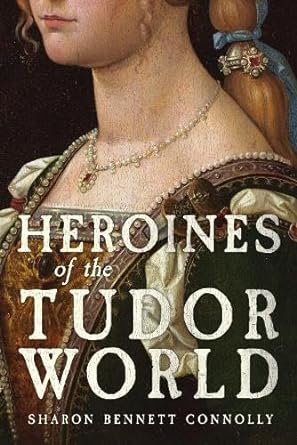
Heroines of the Tudor World tells the stories of the most remarkable women from European history in the time of the Tudor dynasty, 1485-1603. These are the women who ruled, the women who founded dynasties, the women who fought for religious freedom, their families and love. These are the women who made a difference, who influenced countries, kings and the Reformation. In the era dominated by the Renaissance and Reformation, Heroines of the Tudor World examines the threats and challenges faced by the women of the era, and how they overcame them. From writers to regents, from nuns to queens, Heroines of the Tudor World shines the spotlight on the women helped to shape Early Modern Europe.

Heroines of the Tudor World is now available for pre-order from Amberley Publishing and Amazon UK.

Also by Sharon Bennett Connolly:

King John’s Right-Hand Lady: The Story of Nicholaa de la Haye is the story of a truly remarkable lady, the hereditary constable of Lincoln Castle and the first woman in England to be appointed sheriff in her own right. Available from all good bookshops or direct from Pen & Sword Booksbookshop.org and AmazonDefenders of the Norman Crown: The Rise and Fall of the Warenne Earls of Surrey tells the fascinating story of the Warenne dynasty, from its origins in Normandy, through the Conquest, Magna Carta, the wars and marriages that led to its ultimate demise in the reign of Edward III. Available from Pen & Sword BooksAmazon in the UK and US, and Bookshop.org

Ladies of Magna Carta: Women of Influence in Thirteenth Century England looks into the relationships of the various noble families of the 13th century, and how they were affected by the Barons’ Wars, Magna Carta and its aftermath; the bonds that were formed and those that were broken. It is now available in paperback and hardback from Pen & Sword,  Amazon, and Bookshop.orgHeroines of the Medieval World tells the stories of some of the most remarkable women from Medieval history, from Eleanor of Aquitaine to Julian of Norwich. Available now from Amberley Publishing and Amazon, and Bookshop.orgSilk and the Sword: The Women of the Norman Conquest traces the fortunes of the women who had a significant role to play in the momentous events of 1066. Available now from Amazon,  Amberley Publishing, and Bookshop.org.

Alternate Endings: An anthology of historical fiction short stories including Long Live the King… which is my take what might have happened had King John not died in October 1216. Available in paperback and kindle from Amazon.

Podcast:

Have a listen to the A Slice of Medieval podcast, which I co-host with Historical fiction novelist Derek Birks. Derek and I welcome guests, such as Bernard Cornwell and Elizabeth Chadwick, and discuss a wide range of topics in medieval history, from significant events to the personalities involved.

*

Don’t forget! Signed and dedicated copies of all my books are available through my online bookshop.

For forthcoming online and in-person talks, please check out my Events Page.

You can be the first to read new articles by clicking the ‘Follow’ button, liking our Facebook page or joining me on Twitter and Instagram.

*

©2024 Sharon Bennett Connolly FRHistS

Matilda of Boulogne: From Countess to Queen

Matilda of Boulogne, Queen of England

King Stephen’s wife, Matilda of Boulogne, was a stalwart supporter of her husband. She was arguably more capable than Stephen and often took the initiative in diplomatic negotiations. Acting as Stephen’s wife, she offered a stark contrast to the independence and authority of Empress Matilda that so infuriated the barons. Matilda of Boulogne was a little more subtle than her imperious counterpart, only ever acting in her husband’s name, not her own. Even later, when she held the command of Stephen’s forces during his captivity in 1141, she claimed to act only on behalf of her husband and sons.

Matilda of Boulogne was an example of how a woman was expected to act and comport herself: strong and confident, but subject to her husband’s will. On this last, Empress Matilda failed in the eyes of the barons; she was acting for herself. In the event, the barons of England and Normandy despised her second husband, Geoffrey of Anjou, so they would have been even less receptive to Matilda had her husband tried to assert his authority. It was a conundrum that Matilda was never able to resolve, though she would not give up trying.

According to the Gesta Stephani (The Deeds of Stephen), Stephen of Blois was ‘by far the dearest of all his nephews to King Henry the peacemaker, not only because of the close family relationship, but also because he was peculiarly eminent for many conspicuous virtues’. Born at Blois in or around 1096, Stephen was the third son of Adela and her husband, Stephen, Count of Blois and Chartres. His father was one of the leaders of the First Crusade and may well have departed for the Holy Land before – or shortly after – the younger Stephen’s birth. It is likely that young Stephen had little contact with his father; the count returned from crusade in 1198, only to depart again in 1201.

In 1125, it was King Henry who arranged for Stephen’s marriage to the daughter and sole heiress of the Count of Boulogne, Matilda. Matilda’s mother was Mary of Scotland, sister of Henry I’s first wife, Matilda of Scotland; the younger Matilda was therefore first cousin to Henry I’s daughter, Empress Matilda. The daughter of King Malcolm III Canmore and his queen Margaret of Wessex, Mary of Scotland could trace her illustrious heritage all the way back to Alfred the Great; she had been educated in England alongside her sister. Mary was married to Eustace III, Count of Boulogne, and their only child, Matilda, was probably born the following year, in 1105. The baby’s maternal aunt, Matilda of Scotland, stood as godmother. It is possible that, like her mother and aunt, young Matilda was educated at the convents of Wilton and Romsey. She was certainly a well-educated and capable woman. As we shall see, as an adult, she seems as erudite and well versed in politics as her husband, perhaps with an even better capacity for diplomacy.

Henry I, King of England

Mary of Scotland died when her daughter was around ten or eleven years old, on 31 May 1116. She was buried in the wealthy Cluniac house of Bermondsey Abbey in England.

The county of Boulogne lay within the greater county of Flanders. Nominally owing fealty to France, it was largely autonomous and held extensive interests in England, particularly in Essex and the south-east. The county also controlled one of the most important Channel crossings to England at Wissant. Keeping the county onside by marrying a reliable magnate to the heir to Boulogne was of great interest to Henry. As its heiress, Matilda of Boulogne was a figure of major political significance, her marriage deserving of careful consideration. Given that she was still unmarried at the age of twenty, with such a rich inheritance, it is possible that previous but unrecorded marital arrangements had fallen through, or that her father and uncle had taken extra care in ensuring that Matilda’s hand in marriage went to the right person.

By 1125, King Henry had been married to Adeliza of Louvain for four years, but no children had been born of the union. Likewise, Henry’s daughter, Empress Matilda, had yet to produce a living child and was at this stage more likely to be envisioning a future within the empire rather than as her father’s successor. King Henry may have been looking elsewhere for an heir to his throne; his Blois nephews, Theobald and Stephen, were the obvious candidates. As a bride to Stephen, Matilda of Boulogne would strengthen his claim to the throne, both by her Saxon royal blood and by the financial backing of the county of Boulogne.

Matilda of Boulogne and Stephen were married early in 1125, though the exact date is not recorded. Shortly after the marriage, Matilda’s father, Eustace, a former crusader, abdicated in favour of his son-in-law. Eustace retired to the Cluniac priory at Romilly, taking leave of his daughter and son-in-law in a public ceremony, probably followed by a private farewell, at the priory where he died a short time later, aged about seventy-five. As Count of Boulogne and Mortain, Stephen was now a man to be reckoned with, with considerable resources on both sides of the English Channel; he was the greatest landowner in Suffolk, Essex and the north-west of England.

Rule over the strategically important county of Boulogne would be a suitable training ground for Stephen to get used to exercising significant power in his own right. Through certain charters in the latter half of the 1120s, we can see Stephen administering his cross-Channel lordship. In 1127 he founded Furness Abbey in his lordship of Lancaster. The abbey’s mother house was located at Savigny, in Stephen’s county of Mortain. In the same year, Stephen granted the monks of Canterbury Cathedral priory an exemption from tolls at Wissant, the port through which they shipped their wine.

Empress Matilda depicted at the coronation of her granddaughter, Matilda of England, as Duchess of Saxony, in an image from the Gospels of Henry the Lion.

In marrying into the county of Boulogne, Stephen had joined a family well versed in commerce. He was heavily involved in the county’s business proceedings, usually mentioned alongside his wife, Matilda of Boulogne, who appears to have been the one in charge of the day-to-day management of the county. The Essex town of Colchester was the centre of administration for Boulogne’s interests in England. In the early years of Henry I’s reign the lands in Colchester had been identified as ‘the lands of Count Eustace,’ and were built up with the addition of lands that had belonged to Eudo Dapifer, also known as Iwun al Capel, brother-in-law of William the Conqueror and a member of the de la Haye family, until his death in 1120.

Stephen and Matilda were at Canterbury in person to confirm a charter to the monks of Christ Church, which gave the monks freedom from customs duties for the port of Wissant, granted by Count Eustace. The count and countess placed their sealed charter on the high altar of the abbey church; it is still held in the abbey archives. The ceremony was presided over by the Archbishop of Canterbury himself, William Corbeil. In 1131, the couple wrote to the archbishop and the Bishop of Ely to notify them that they had transferred the secular rights of the church at Gamlingay in Cambridgeshire to the Augustinian canons of Colchester, ‘for the remission of our sins and those of our ancestors and for the safe preservation of our son, Eustace, and our other offspring and for our temporal well-being.’ This is the first mention of Eustace and dates his birth to no later than August 1131, when Hervey, Bishop of Ely, died.

The fact these charters were jointly granted by both Stephen and Matilda serve to demonstrate how closely involved Matilda was in the management of the county, and how closely Stephen and Matilda worked together as a couple. The trust they developed in each other would stand them in good stead in the years to come.

In the early 1130s Matilda of Boulogne, like her counterpart Empress Matilda in Anjou, would have been occupied with a number of pregnancies. The couple’s first child, a son named Eustace, was born no later than 1131 and at least two further children, Baldwin and Matilda, were born before Stephen became king in 1135. Little Baldwin died before his father even came to the throne; he was buried beside the altar at Holy Trinity, Aldgate, the abbey founded by the countess’s aunt Matilda of Scotland, Henry I’s first queen. That Baldwin was buried in London suggests that Matilda spent time in England as well as Boulogne during this period. Two more children, William and Mary (or Marie), were probably born after Stephen seized the crown. The three older children were given names that called to mind the county of Boulogne, with both Eustace and Baldwin being the names of several former counts. William, on the other hand, was a reference to Stephen’s grandfather, William the Conqueror, King of England.

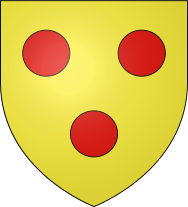
Arms of the county of Boulogne

Despite henry I having his barons swear – twice – to uphold the claims of his daughter to the throne of England, Henry I left no written instruction as to the disposition of his throne and lands, which led to the chroniclers disputing exactly what the king had intended. What is certain is that in his final days, Henry did not name his heir. Unfortunately, the lack of this definitive designation at the last meant that there was enough ambiguity for Stephen to seize the initiative.

What the chronicles do agree on is that Henry’s death caused a great deal of unrest on both sides of the Channel. According to Orderic Vitalis, ‘on the very same day that the Normans heard that their firm ruler had died in the first week of Advent they rushed out hungrily like ravening wolves to plunder and ravage mercilessly’. On the other side of the Channel, the Anglo-Saxon Chronicle made a similar report: ‘Then his land immediately grew dark because every man who could immediately robbed another.’

At Henry I’s death in December 1135, the major players in the drama that was about to unfold were scattered throughout the Anglo-Norman realm. Robert, Earl of Gloucester was at his father’s side; Queen Adeliza was in England; Empress Matilda was in Anjou with her husband, Geoffrey, and in the early stages of her third pregnancy; and Stephen of Blois was in Boulogne with his wife, Matilda. In the days after the king’s death, the lack of a designated heir was evident, and the barons moved to maintain peace in Normandy.

Stephen, King of England

Stephen had decided his own priorities, possibly well in advance of the king’s death and perhaps in collusion with his brother, Theobald. Whether Empress Matilda had an inkling of what Stephen was planning we do not know, though it seems unlikely given her own move into Normandy and no further. Stephen was not with the king when he died. Although he had been with Henry at Rouen earlier in the year, by late November 1135 he was in his county of Boulogne and it was there that the news of the king’s demise reached him, probably two or three days later. The speed of Stephen’s response, and its organisation, shows that he had been contemplating his plan of action for some time.

It is not hard to imagine him sitting in Boulogne, surrounded by his wife and family, watching and waiting for the arrival of the news that would set his plans in motion. According to the Gesta Stephani, ‘as soon as he heard by report that King Henry had breathed his last, forming a mighty design like the famous Saul, [Stephen] made for the coast, since he was the other side of the Channel, and happening to gain a favourable wind turned his mind and his ship towards England’.

Leaving his wife and children in the relative safety of Boulogne, Stephen took what must have been the biggest gamble of his life.

*

Further reading:

Donald Matthew, King Stephen; Robert Bartlett, England Under the Norman and Angevin Kings; David Williamson, Brewer’s British Royalty; the History Today Companion to British History; Dan Jones, the Plantagenets; englishmonarchs.co.uk; The Oxford Companion to British History; Mike Ashley, The Mammoth Book of British kings & Queens; Alison Weir, Britain’s Royal Families, the Complete Genealogy; Farrer, William and Charles Travis Clay, editors, Early Yorkshire Charters, Volume 8: The Honour of WarenneGesta Stephani; Henry of Huntingdon, The History of the English People 1000-1154; J. Sharpe (trans.), The History of the Kings of England and of his Own Times by William Malmesbury; Catherine Hanley, Matilda: Empress, Queen, Warrior; Orderici Vitalis, Historiae ecclesiasticae libri tredecem, translated by Auguste Le Prévost; Chronicles of the Reigns of Stephen, Henry II and Richard I; Edmund King, King Stephen; Donald Matthew, King Stephen; Teresa Cole, the Anarchy: The Darkest Days of Medieval England;  Matthew Lewis, Stephen and Matilda’s Civil War: Cousins of Anarchy.

*

My Books:

Signed, dedicated copies of all my books are available through my online bookshop.

Out Now! Women of the Anarchy

Two cousins. On the one side is Empress Matilda, or Maud. The sole surviving legitimate child of Henry I, she is fighting for her birthright and that of her children. On the other side is her cousin, Queen Matilda, supporting her husband, King Stephen, and fighting to see her own son inherit the English crown. Women of the Anarchy demonstrates how these women, unable to wield a sword, were prime movers in this time of conflict and lawlessness. It show how their strengths, weaknesses, and personal ambitions swung the fortunes of war one way – and then the other.

Available from Bookshop.orgAmberley Publishing and Amazon UK.

Coming on 15 June 2024: Heroines of the Tudor World

Heroines of the Tudor World tells the stories of the most remarkable women from European history in the time of the Tudor dynasty, 1485-1603. These are the women who ruled, the women who founded dynasties, the women who fought for religious freedom, their families and love. These are the women who made a difference, who influenced countries, kings and the Reformation. In the era dominated by the Renaissance and Reformation, Heroines of the Tudor World examines the threats and challenges faced by the women of the era, and how they overcame them. From writers to regents, from nuns to queens, Heroines of the Tudor World shines the spotlight on the women helped to shape Early Modern Europe.

Heroines of the Tudor World is now available for pre-order from Amberley Publishing and Amazon UK.

Also by Sharon Bennett Connolly:

King John’s Right-Hand Lady: The Story of Nicholaa de la Haye is the story of a truly remarkable lady, the hereditary constable of Lincoln Castle and the first woman in England to be appointed sheriff in her own right. Available from all good bookshops or direct from Pen & Sword Booksbookshop.org and AmazonDefenders of the Norman Crown: The Rise and Fall of the Warenne Earls of Surrey tells the fascinating story of the Warenne dynasty, from its origins in Normandy, through the Conquest, Magna Carta, the wars and marriages that led to its ultimate demise in the reign of Edward III. Available from Pen & Sword BooksAmazon in the UK and US, and Bookshop.org

Ladies of Magna Carta: Women of Influence in Thirteenth Century England looks into the relationships of the various noble families of the 13th century, and how they were affected by the Barons’ Wars, Magna Carta and its aftermath; the bonds that were formed and those that were broken. It is now available in paperback and hardback from Pen & Sword,  Amazon, and Bookshop.orgHeroines of the Medieval World tells the stories of some of the most remarkable women from Medieval history, from Eleanor of Aquitaine to Julian of Norwich. Available now from Amberley Publishing and Amazon, and Bookshop.orgSilk and the Sword: The Women of the Norman Conquest traces the fortunes of the women who had a significant role to play in the momentous events of 1066. Available now from Amazon,  Amberley Publishing, and Bookshop.org.

Alternate Endings: An anthology of historical fiction short stories including Long Live the King… which is my take what might have happened had King John not died in October 1216. Available in paperback and kindle from Amazon.

Podcast:

Have a listen to the A Slice of Medieval podcast, which I co-host with Historical fiction novelist Derek Birks. Derek and I welcome guests, such as Bernard Cornwell and Elizabeth Chadwick, and discuss a wide range of topics in medieval history, from significant events to the personalities involved.

*

Don’t forget! Signed and dedicated copies of all my books are available through my online bookshop.

For forthcoming online and in-person talks, please check out my Events Page.

You can be the first to read new articles by clicking the ‘Follow’ button, liking our Facebook page or joining me on Twitter and Instagram.

*

©2024 Sharon Bennett Connolly FRHistS.

Hildegard of Bingen

History ... the Interesting Bits
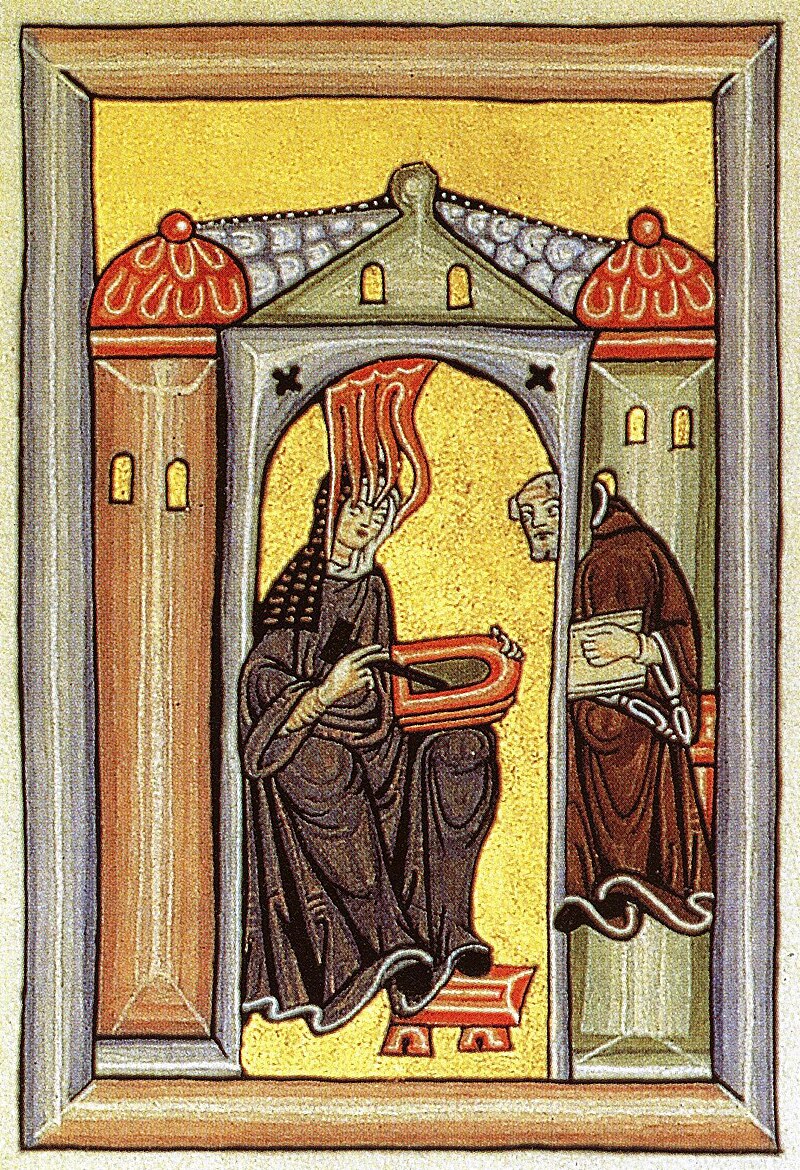
Illumination from Hildegard’s Scivias (1151) showing her receiving a vision and dictating to teacher Volmar

Hildegard of Bingen was rather brilliant. Born in around 1098 in Bremersheim in the Rhineland, into a noble family, Hildegard was the tenth child of Hildebert and Mechtild and was destined for life in a convent from an early age. She was around eight years old when she was placed with Jutta of Sponheim, a reclusive (possibly an anchorite), religious noblewoman who supervised the education of young girls from noble families. In 1112, at the age of fourteen, Hildegard, along with other girls in Jutta’s charge, took her vows at the monastery at Disibodenberg. Under Jutta, who became prioress at Disibodenberg, Hildegard was taught to read, and Latin, although she was not proficient in the latter, and in later life she relied on her secretaries to correct her Latin grammar.

Hildegard was a woman of many talents, she was a visionary, a musician, philosopher, theologian and an expert in medicine. She lived at the monastery of Disibodenberg for more than thirty years. It was in her early years there that she first experienced visions, which would make her famous even in her own lifetime. Initially, she only revealed her prophetic visions to her mentor, Jutta, and it was only when God commanded to her record them, that she revealed them to her friend and secretary, Volmar. With the permission of the Abbot of Disibodenberg, Kuno, and with the encouragement of Volmar and a fellow nun, Richardis of Stade, Hildegard started writing down her visions when she was in her forties. It was only after much encouragement from her Archbishop, Henry of Mainz, that her first work, Scivias, was published. The beautifully illustrated work was given approval from a commission set up by Pope Eugene III and was also supported by the saintly Bernard of Clairvaux.

Abbot Bernard of Clairvaux was one of a number of theologians with whom Hildegard maintained a correspondence. She regularly asked the venerable abbot for advice and guidance, and help in interpreting her visions. In one letter, she would tell him,

‘I have from earliest childhood seen great marvels which my tongue has no power to express but which the Spirit of God has taught me that I may believe … Indeed, I have no formal training at all, for I know how to read only on the most elementary level, certainly with no deep analysis. But please give me your opinion in this matter, because I am untaught and untrained in exterior material, but am only taught inwardly, in my spirit.’


Hildegard corresponded with the great personalities of her time, with emperors, popes and even queens. Sometime between 1154 and 1171, she responded to a letter from Eleanor of Aquitaine, asking for advice, with the words ‘Your mind is like a wall which is covered with clouds, and you look everywhere but have no rest. Flee this and attain stability with God and men, and God will help you in all your tribulations. May God give you his blessing and help in all your works’.

History ... the Interesting Bits
Hildegard of Bingen

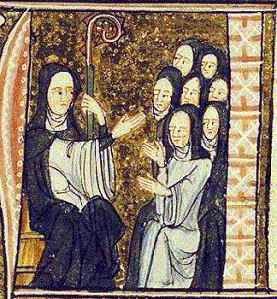
In 1148 Hildegard had a vision in which God commanded her to take her nuns and establish her own nunnery. Although Abbot Kuno was reluctant to see Hildegard leave Disibodenberg – her reputation had brought the monastery pilgrims and prestige – she eventually prevailed and established a new convent at Rupertsberg. Hildegard’s convent admitted only noblewomen, she did not believe in mixing the classes within a convent, writing that different ‘classes of people should not be mixed, or they will fall out through deceit or arrogance, and the shame occasioned by their differences. The greatest danger of all is a breakdown in peaceful manners through mutual backbiting and hatred when the upper-class pounce on the lower or when the lower is promoted above the higher.’

It was at Rupertsberg that Hildegard wrote two medical works, Causes and Cures and Physica, after studying the illnesses of the sick who she cared for. Her writings suggested remedies for different ailments, using a wide variety of plants; for example, Hildegard explains how cloves could be used to remedy against gout, swollen intestines and hiccups. She also extolled the virtues of the rose as a cure for many ills, saying:

‘Rose is cold, and this coldness contains moderation which is useful. In the morning, or at daybreak, pluck a rose petal and place it on your eyes. It draws out the humour and makes them clear. One with small ulcers on his body should place rose petals over them. This pulls the mucus from them. One who is inclined to wrath should take rose and less sage and pulverise them. The sage lessens the wrath, and the rose makes him happy. Rose, and half as much sage, may be cooked with fresh, melted lard, in water, and an ointment made from this. The place where a person is troubled by a cramp or paralysis should be rubbed with it, and he will be better. Rose is also good to add to potions, unguents, and all medications. If even a little rose is added, they are so much better, because of the good virtues of the rose.’

Hildegard’s prolific writing career continued in her new surroundings. She produced religious poems, music and even a play, Ordo Virtutum. She also wrote two further books of her visions, Liber vitae meritorum (Book of Life’s Merits) and Liber divinonim operum (Book of Divine Works), and a life of the abbey’s patron saint, St Rupert. Ricardis of Stade and her friend and secretary, Volmar, had accompanied Hildegard from Disibodenberg to Rupertsberg and continued to help her as secretaries and assistants. A succession of secretaries came after Volmar and Richardis, including Hildegard’s nephew, Wesclein, her brother, Hugo of Tholey, and her last secretary, Guibert of Gembloux. Guibert and an earlier secretary, Godfrey of Disibodenbrg, both wrote biographies of Hildegard. The main purpose of the secretaries was to edit Hildegard’s works as her Latin grammar was far from proficient; however, they were under strict instructions not to change any of her words as they came from God, exhorting

‘Let no man be so audacious as to add anything to this writing lest he be blotted out from the book of life’.

History ... the Interesting Bits
Coin commemorating the 900th anniversary of the birth of Hildegard of Bingen

Hildegard was a prolific letter writer and, more than 800 years after her death, there are around 400 of her letters still extant today. Many wrote to her asking for advice and prophecies. Indeed, John of Salisbury said Pope Eugene III had consulted Hildegard for predictions about his reign, which had been accurate. In her letters, Hildegard acts as a mediator within the monastic world, soothing arguments within convents, between abbesses and their nuns, and abbots and their monks. She was respected by men and women alike, noble and poor. Hildegard gave advice and support and remonstrated against injustice and corruption. She travelled widely and undertook four preaching tours, between 1158 and 1170, a practice ordinarily forbidden to women, who were expected not to teach or speak in church.

Hildegard of Bingen died in her eighty-second year, at Rupertsberg, on 17 September 1179, and was canonised as Saint Hildegard on 10 May 2012 by Pope Benedict XVI, who declared her a doctor of the Church, in the same year. She was a woman of extraordinary talents, an exceptional writer, a poet and composer, a visionary, a mystic and a scientist. She was trusted and respected by the great men of her age and is considered to be the most influential woman in medieval Church history, a well-deserved accolade.

Sources:

The Letters of Hildegard of Bingen, translated by Joseph L. Baird and Radd K. Ehrman; Hildegardis Bingensis, Epistolarium, edited by Lieven Van Acker and Monika Klaes-Hachmoller; Medieval Europe 400–1500 by H.G. Koenigsberger; Medievalists.net, The Herbal Cures of Hildegard von Bingen – was she right?; Hildegard von Bingen’s Physica: The Complete English Translation of Her Classic Work on Health and Healing by Priscilla Throop; Six Trailblazing Medieval Women article by Susan Signe Morrison; The Letters of John of Salisbury, edited by W.J. Miller, S.J. Butler, H.E. Butler and revised by C.N.L. Brooke

*

My Books:

Signed, dedicated copies of all my books are available through my online bookshop.

Out now: Scotland’s Medieval Queens

Books by Sharon Bennett Connolly

Scotland’s history is dramatic, violent and bloody. Being England’s northern neighbour has never been easy. Scotland’s queens have had to deal with war, murder, imprisonment, political rivalries and open betrayal. They have loved and lost, raised kings and queens, ruled and died for Scotland. From St Margaret, who became one of the patron saints of Scotland, to Elizabeth de Burgh and the dramatic story of the Scottish Wars of Independence, to the love story and tragedy of Joan Beaufort, to Margaret of Denmark and the dawn of the Renaissance, Scotland’s Medieval Queens have seen it all. This is the story of Scotland through their eyes.

Scotland’s Medieval Queens gives a thorough grounding in the history of the women who ruled Scotland at the side of its kings, often in the shadows, but just as interesting in their lives beyond the spotlight. It’s not a subject that has been widely covered, and Sharon is a pioneer in bringing that information into accessible history.’ Elizabeth Chadwick (New York Times bestselling author)

Available now from Amazon and Pen and Sword Books

Also by Sharon Bennett Connolly:

Books by Sharon Bennett Connolly

Heroines of the Tudor World tells the stories of the most remarkable women from European history in the time of the Tudor dynasty, 1485-1603. These are the women who ruled, the women who founded dynasties, the women who fought for religious freedom, their families and love. Heroines of the Tudor World is now available for pre-order from Amberley Publishing and Amazon UK. Women of the Anarchy demonstrates how Empress Matilda and Matilda of Boulogne, unable to wield a sword themselves, were prime movers in this time of conflict and lawlessness. It shows how their strengths, weaknesses, and personal ambitions swung the fortunes of war one way – and then the other. Available from Bookshop.orgAmberley Publishing and Amazon UKKing John’s Right-Hand Lady: The Story of Nicholaa de la Haye is the story of a truly remarkable lady, the hereditary constable of Lincoln Castle and the first woman in England to be appointed sheriff in her own right. Available from all good bookshops Pen & Sword Booksbookshop.org and Amazon

Defenders of the Norman Crown: The Rise and Fall of the Warenne Earls of Surrey tells the fascinating story of the Warenne dynasty, from its origins in Normandy, through the Conquest, Magna Carta, the wars and marriages that led to its ultimate demise in the reign of Edward III. Available from Pen & Sword BooksAmazon in the UK and US, and Bookshop.orgLadies of Magna Carta: Women of Influence in Thirteenth Century England looks into the relationships of the various noble families of the 13th century, and how they were affected by the Barons’ Wars, Magna Carta and its aftermath; the bonds that were formed and those that were broken. It is now available in paperback and hardback from Pen & SwordAmazon, and Bookshop.orgHeroines of the Medieval World tells the stories of some of the most remarkable women from Medieval history, from Eleanor of Aquitaine to Julian of Norwich. Available now from Amberley Publishing and Amazon, and Bookshop.orgSilk and the Sword: The Women of the Norman Conquest traces the fortunes of the women who had a significant role to play in the momentous events of 1066. Available now from Amazon,  Amberley Publishing, and Bookshop.org.

Alternate Endings: An anthology of historical fiction short stories including Long Live the King… which is my take what might have happened had King John not died in October 1216. Available in paperback and kindle from Amazon.

Podcast:

Have a listen to the A Slice of Medieval podcast, which I co-host with Historical fiction novelist Derek Birks. Derek and I welcome guests, such as Bernard Cornwell and Elizabeth Chadwick, and discuss a wide range of topics in medieval history, from significant events to the personalities involved.

Every episode is also now available on YouTube.

*

Don’t forget! Signed and dedicated copies of all my books are available through my online bookshop.

For forthcoming online and in-person talks, please check out my Events Page.

You can be the first to read new articles by clicking the ‘Follow’ button, liking our Facebook page or joining me on TwitterThreadsBluesky and Instagram.

*

©2024 Sharon Bennett Connolly FRHistS.

Warenne Family Ties

Seal of John de Warenne, 6th earl of Warenne and Surrey

In the reign of Edward I, when asked Quo Warranto – by what warrant he held his lands – John de Warenne, the 6th earl of Surrey, is said to have drawn a rusty sword, claiming “My ancestors came with William the Bastard, and conquered their lands with the sword, and I will defend them with the sword against anyone wishing to seize them”

When I started writing Defenders of the Norman Crown: Rise and Fall of the Warenne Earls of Surrey, I expected to find a healthy – or, rather, unhealthy – level of sibling rivalry. After all, this family was related to both the Norman and Plantagenet royal families, neither of whom are renowned for any sort of brotherly love.

You only have to look at the warring antics of Robert Curthose, William II and Henry I, to imagine the level of sibling rivalry involved in Norman times. The three brothers fought over who should have Normandy and England after their father’s death, to the extent that Robert Curthose ended up the prisoner of his little brother, Henry I, for the last 30 years of his life. The Plantagenets were little better, with Prince – later King – John trying to steal his brother’s throne while Richard I was imprisoned in Germany.

William de Warenne, 1st Earl Warenne, Trinity Church, Southover.

With these examples in mind, I was surprised to discover that the Warennes were a rather functional bunch as far as family goes. They went out of their way to help and support each other, even to the extent of half-siblings and in-laws. William de Warenne, the first earl of Warenne and Surrey (often referred to, simply, as Earl Warenne), pursued a private feud with English freedom fighter, Hereward the Wake, after he murdered William’s brother-in-law, Frederic. 

The Warenne (Hyde) Chronicle claims that Hereward, ‘Among his other crimes, by trickery he killed Frederick, brother[-in-law] of Earl William of Warenne, a man distinguished by lineage and possessions, who one night was surrounded in his own house.’ Following Frederic’s murder, according to the Chronicle, ‘such discord arose between Hereward and William that it could not be settled by any reparation nor in any court.’ According to the Gesta Herewardi, Frederic was planning to capture or kill Hereward, who struck first by killing Frederic.

William de Warenne was determined to get his revenge; he attempted to ambush Hereward at a place called Earith. One of William’s men tried unsuccessfully to bribe Hereward’s men to betray him. William was unhorsed when Hereward fired an arrow at him; it rebounded from William’s mailcoat, but the force of the shot saw William fall from his horse and rendered unconscious as he hit the ground. The ambush having failed, William de Warenne then appears in the Gesta Herewardi with an angry outburst against the Norman knight Deda, who had given a eulogistic account of the rebels on the Isle of Ely. According to the Liber Eliensis, William ‘flared up with weighty indignation, and alleged that he [Deda] had been inveigled by a bribe and was lying.’

St Pancras Priory, Lewes, the Warenne family mausoleum

William de Warenne, the second Earl Warenne, continued the tradition of looking out for family, when his younger brother, Rainald, was captured by King Henry I. In 1105 Rainald de Warenne was among the supporters of Robert Curthose, Duke of Normandy and Henry I’s oldest brother, who captured and imprisoned Robert fitz Hamon, a friend of King Henry, intending to ransom him. Henry saw fitz Hamon’s capture as an opportunity to deal decisively with Normandy, though he claimed he was invading not out of ambition, but to protect the church and the poor people of Normandy. 

Henry invaded in the spring of 1106. Rainald de Warenne was captured by Henry’s forces during a skirmish at the fortified Abbey of Saint-Pierre-sur-Dive. The abbot there had been plotting with Duke Robert to trap Henry, offering to hand over the castle to the English king, while sequestering Rainald de Warenne, Robert de Stuteville and their men within, ready to seize Henry as soon as he entered. Suspecting treachery, Henry arrived at daybreak with a force of 700 men-at-arms and took the garrison completely by surprise, capturing the duke’s men and burning the castle to the ground.

The sources vary, but Rainald was released either shortly before or shortly after the battle of Tinchebrai – the final, decisive battle between the royal Norman brother. Orderic Vitalis claims that William de Warenne served as one of King Henry’s chief commanders at Tinchebrai and that Rainald was released shortly before the battle. Grateful for his brother’s release, Earl William urged his men to fight the king’s cause with the utmost determination. 

According to the Warenne (Hyde) Chronicle, however, Rainald was not released until after the battle, when he was ‘reluctantly handed back to his brother, who pleaded for him to Henry.’ Whichever is correct, the result was the same, Rainald was now free, thanks to the insistence and loyalty of his older brother.

Warenne shield of blue and gold check, Trinity Church, Southover.

In the next generation, the children and stepchildren of William de Warenne, the 2nd Earl Warenne, got on remarkably well together. William had married Isabel de Vermandois, the widow of the recently deceased Robert de Beaumont, Earl of Leicester. Isabel was already the mother of 9 children, including the famous twins Robert and Waleran de Beaumont, when she married William, with whom the chronicler Henry of Huntingdon claims she was having an affair, even before her husband died. 

With William, Isabel had a further 5 children, 3 boys and 2 girls. Earl Warenne was at King Henry I’s deathbed, alongside his son, also named William de Warenne (the future 3rd Earl Warenne), and stepsons, Waleran and Robert de Beaumont. When the 2nd Earl Warenne died, it was Waleran de Beaumont who became the head of the combined, and rather large, Beaumont/Warenne family. Indeed, Waleran and William de Warenne, 3rd Earl Warenne, having grown tired of the Anarchy – the war between King Stephen and Empress Matilda which lasted from 1135 to 1154 – departed on Crusade together in 1147. Unfortunately, William de Warenne was killed at the Battle of Mount Cadmus in January 1148, and Waleran returned home alone.

A touching story from just before his departure on crusade relates to the 3rd Earl Warenne and his two younger brothers, Reginald and Ralph de Warenne. The earl held a dedication ceremony for the new church at St Pancras Priory, Lewes, the mausoleum of the Warenne family, founded by the 1st earl and his wife, Gundrada. In the accompanying charter, the earl endowed the priory, in which his father and grandparents were buried, and where his mother would soon be laid to rest, with the tenth penny of his rents and ‘giving it seisin thereof by hair from his own head and that of Ralph de Warenne his brother, cut with a knife by Henry, bishop of Winchester, before the altar.’ 

It is not hard to imagine how moving a ceremony this must have been, two brothers kneeling before the altar to have their hair cut by the bishop of Winchester, Henry of Blois, the brother of King Stephen. The scene is made all the more poignant in hindsight, knowing that the third earl never returned from the crusade on which he was about to embark.

Conisbrough Castle

And when the 3rd Earl Warenne failed to return from the Holy Land, it was down to his younger brother, Reginald, to look after the family interests and those of his brother’s sole surviving heir, William’s daughter, Isabel de Warenne, the 4th Countess of Warenne and Surrey. Isabel, though still only a child, had been married to King Stephen’s youngest son, William of Blois, probably before her father’s departure to the Holy Land. Isabel’s second husband, Hamelin, the illegitimate half-brother of Henry II, built the great keep at Conisbrough Castle.

Hamelin and Isabel’s son, William de Warenne, the 5th earl, looked out for the interests of his niece, Alice de Lusignan, in her struggles with the crown, both under King John and Henry III, to secure her inheritance of Tickhill Castle in Yorkshire.

Such examples of the earls taking care of their family, and working in alliance with their in-laws, was to be a feature of every generation down to the 7th and last earl, John II de Warenne, who was given the custody and care of his cousin, Edward Balliol, the son of John Balliol, the deposed King of Scots, around 1307. The Warenne earls, to a man, looked after their relations, both near and far. In the story of a family, it is quite fitting – and highly unusual – that the Warenne earls appear to have always put family first.

*

Images:

Are ©2023 Sharon Bennett Connolly FRHistS except the seal of John de Warenne, which is courtesy of Wikimedia Commons

Sources:

Robert Bartlett, England Under the Norman and Angevin Kings; Dan Jones, The Plantagenets; Donald Matthew, King Stephen; Medieval Lands Project on the Earls of Surrey, Conisbrough Castle; Farrer, William and Charles Travis Clay, editors, Early Yorkshire Charters, Volume 8: The Honour of Warenne; Morris, Marc King John: Treachery, Tyranny and the Road to Magna Carta; Church, Stephen, King John: England, Magna Carta and the Making of a Tyrant; doncasterhistory.co.uk; A History of the County of Sussex: Volume 2 edited by William Page; W.H. Blaauw, On the Early History of Lewes Priory, and its Seals, with extracts from a MS. Chronicle, Sussex Archaeological Collections; Rev. John Watson, Memoirs of the Ancient Earls of Warren and Surrey, and Their Descendants to the Present Time, Volume I;  Odo of Deuil, De Profectione Ludovici VII in Orientem; magnacharta.com; Cokayne, G.E., The Complete Peerage, Vol. XII; Henry of Huntingdon, The Chronicle of Henry of Huntingdon; Elisabeth van Houts and Rosalind C. Love, The Warenne (Hyde) Chronicle.

*

My Books

Christmas is coming!

Signed, dedicated copies of all my books are available through my online bookshop.

Coming 15 January 2024: Women of the Anarchy

On the one side is Empress Matilda, or Maud. The sole surviving legitimate child of Henry I, she is fighting for her birthright and that of her children. On the other side is her cousin, Queen Matilda, supporting her husband, King Stephen, and fighting to see her own son inherit the English crown. Both women are granddaughters of St Margaret, Queen of Scotland and descendants of Alfred the Great of Wessex. Women of the Anarchy demonstrates how these women, unable to wield a sword, were prime movers in this time of conflict and lawlessness. It show how their strengths, weaknesses, and personal ambitions swung the fortunes of war one way – and then the other.

Available for pre-order from Amberley Publishing and Amazon UK.

Coming on 15 June 2024: Heroines of the Tudor World

Heroines of the Tudor World tells the stories of the most remarkable women from European history in the time of the Tudor dynasty, 1485-1603. These are the women who ruled, the women who founded dynasties, the women who fought for religious freedom, their families and love. These are the women who made a difference, who influenced countries, kings and the Reformation. In the era dominated by the Renaissance and Reformation, Heroines of the Tudor World examines the threats and challenges faced by the women of the era, and how they overcame them. Some famous, some infamous, some less well known, including Anne Boleyn, Elizabeth Barton, Catherine de Medici, Bess of Hardwick and Elizabeth I. From writers to regents, from nuns to queens, Heroines of the Tudor World shines the spotlight on the women helped to shape Early Modern Europe.

Heroines of the Tudor World is now available for pre-order from Amberley Publishing and Amazon UK.

Also by Sharon Bennett Connolly:

King John’s Right-Hand Lady: The Story of Nicholaa de la Haye is the story of a truly remarkable lady. Nicholaa de la Haye was the hereditary constable of Lincoln Castle and the first woman in England to be appointed sheriff in her own right. Her strength and tenacity saved England at one of the lowest points in its history. Nicholaa de la Haye is one woman in English history whose story needs to be told… King John’s Right-Hand Lady: The Story of Nicholaa de la Haye is now available from Pen & Sword Booksbookshop.org and Amazon.

Defenders of the Norman Crown: The Rise and Fall of the Warenne Earls of Surrey tells the fascinating story of the Warenne dynasty, of the successes and failures of one of the most powerful families in England, from its origins in Normandy, through the Conquest, Magna Carta, the wars and marriages that led to its ultimate demise in the reign of Edward III. Defenders of the Norman Crown: Rise and Fall of the Warenne Earls of Surrey is now available from Pen & Sword BooksAmazon in the UK and US, and Bookshop.org.

Ladies of Magna Carta: Women of Influence in Thirteenth Century England looks into the relationships of the various noble families of the 13th century, and how they were affected by the Barons’ Wars, Magna Carta and its aftermath; the bonds that were formed and those that were broken. It is now available in paperback and hardback from Pen & Sword,  Amazon, and Bookshop.org.

Heroines of the Medieval World tells the stories of some of the most remarkable women from Medieval history, from Eleanor of Aquitaine to Julian of Norwich. Available now from Amberley Publishing and Amazon, and Bookshop.org.

Silk and the Sword: The Women of the Norman Conquest traces the fortunes of the women who had a significant role to play in the momentous events of 1066. Available now from Amazon,  Amberley Publishing, and Bookshop.org.

Alternate Endings: An anthology of historical fiction short stories including Long Live the King… which is my take what might have happened had King John not died in October 1216. Available in paperback and kindle from Amazon.

Podcast:

Have a listen to the A Slice of Medieval podcast, which I co-host with Historical fiction novelist Derek Birks. Derek and I welcome guests, such as Bernard Cornwell, and discuss a wide range of topics in medieval history, from significant events to the personalities involved.

*

Don’t forget! Signed and dedicated copies of all my books are available through my online bookshop.

For forthcoming online and in-person talks, please check out my Events Page.

You can be the first to read new articles by clicking the ‘Follow’ button, liking our Facebook page or joining me on Twitter and Instagram.

*

©2023 Sharon Bennett Connolly FRHistS