The Maid of Norway – The Tragic Story of Scotland’s First Queen Regnant

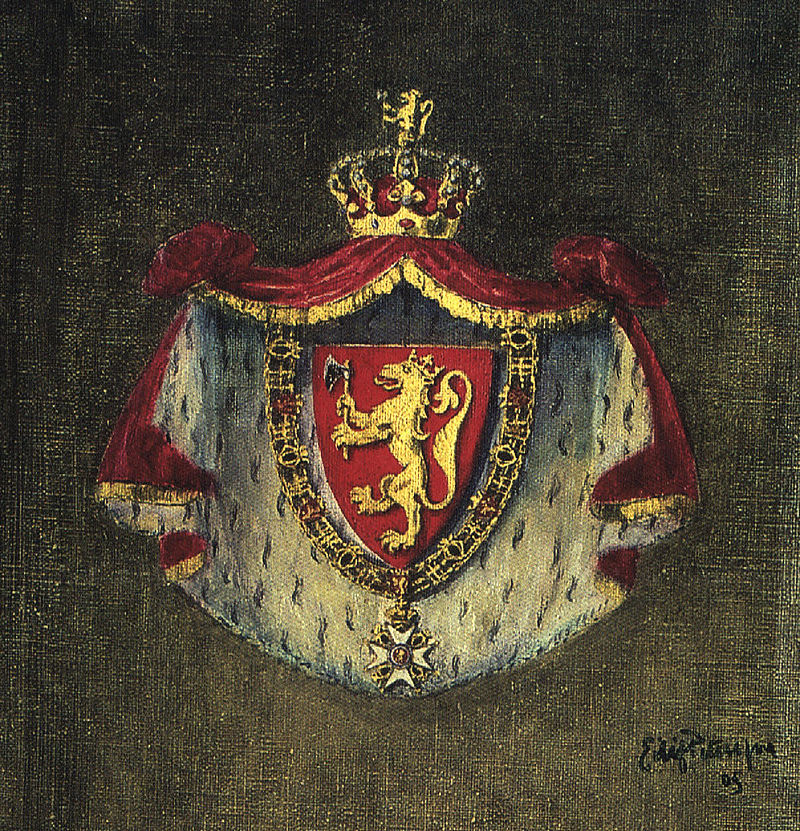
800px-Kongevåpen_1905
The coat of arms of Norway

The story of Margaret, the Maid of Norway, is short and sad. The little girl died before her 8th birthday, and before she ever set foot in the country of which she was Queen. And her death set into a motion a chain of events that would see Scotland torn apart by war for years to come.

Margaret’s claim to the Scottish throne came from her grandfather, Alexander III. Alexander had come to the throne at the age of 8 and had proved to be a very capable and strong monarch. He had married, on 26th December 1251, Margaret, the daughter of Henry III of England and Eleanor of Provence.

Margaret and Alexander had 3 children together. Their eldest daughter, Margaret, was born in February 1261 at Windsor Castle. And of their 2 sons; Alexander was born in 1264 at Jedburgh and David who was born in March 1273. However, their family was soon to face a succession of tragedies. Queen Margaret died in February 1275 at Cupar Castle. And 8-year-old David died in June 1281 at Stirling Castle.

220px-Margaret_Plantagenet,_Queen_of_Scotland
Margaret of England, Queen of Scotland

One happy event in the midst of the tragedy, was the marriage of 20-year-old Margaret of Scotland to 13-year-old Erik Magnusson around the 31st August 1281. Erik had become King Erik II of Norway the year before, with a royal council ruling for the under-age king.

Eric came of age in 1282 and the following year, on the 9th April 1283, Margaret gave birth to a daughter, another Margaret. The queen died giving birth to Margaret; at Tonsberg, Norway, and was buried in Christ’s Kirk, Bergen.

For Alexander III, even more tragedy was to follow in January 1284 when his son and heir, Alexander, died aged just 20. Alexander’s death sparked a succession crisis for Scotland’s king. He had no brothers or uncles to succeed him; his only heir was his 8-month-old granddaughter, Margaret, in Norway. In the same year Alexander obtained, from his nobles, a recognition of Margaret’s right to succeed to the throne, should he fail to produce any further heirs.

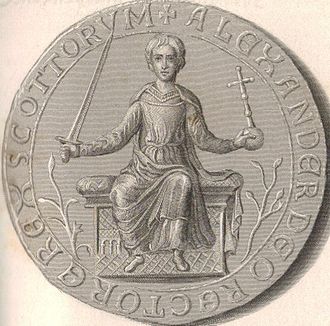
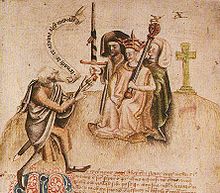
220px-Alexander_III_and_Ollamh_Rígh
The coronation of Alexander III

However, the death of his last surviving child also prompted Alexander III to look for a new wife. And on 1st November 1285, at Jedburgh Abbey, Alexander married Yolande de Dreux, daughter of Robert IV, Count of Dreux, in the hope of producing an heir.

Shortly after the marriage, on 18/19 March 1286, Alexander was on his way to visit his new bride, one night, when he got separated from his escort during a violent storm; his horse appears to have lost its footing and fallen down an embankment. The king’s body, with his neck broken, was found on the beach the next day, just a mile from where his wife was staying, at Kinghorn in Fife.

With the new queen pregnant 6 Guardians were appointed to rule the kingdom until the arrival of Alexander’s posthumous heir. However, Yolande either miscarried, or the baby was still-born and by the end of the year it was clear that Scotland had to look elsewhere for a ruler. Alexander’s only surviving heir was now 3-year-old Margaret of Norway.

Within weeks of Alexanders death Robert Bruce and John Balliol had both made attempts on the crown and the south-west was raised in rebellion. However the majority of Scots, represented by the 6 Guardians, gave their backing to Margaret, the Maid of Norway and Bruce and Balliol were forcibly held in check.

Eirik_Magnusson_(Stavanger_cathedral)
Erik II Magnusson

As early as 1284 Alexander III had, following the death of his last son, floated the idea that England and Scotland might unite through marriage. In response to a letter of condolence from his brother-in-law, Edward I, Alexander had suggested that, through his tiny granddaughter, ‘much may yet come to pass’.

The prospect at the time had not been without risk, however; should Alexander have more children, England would have been committed to a disadvantageous marriage with a Norwegian princess. But with Alexander’s death, and the queen’s child dead, Margaret’s accession seemed certain.

With the Guardians maintaining an uneasy peace between the competing claims of Margaret, Robert Bruce and John Balliol, Erik II of Norway sought the help of Edward I of England. Messengers were sent between the English and Norwegian courts and in Spring 1289 serious negotiations began.

On 6th November 1289 an international summit was held at Salisbury. The Norwegian ambassadors met with Edward and his advisers. It’s possible the Scottish Guardians had also sent representatives, but some sources say the Scots were excluded from these initial talks. The summit proved successful and it was agreed that Margaret would marry Edward of Caernarfon, Edward I’s son and heir, within the next 12 months.

For the Scottish, the marriage alliance promised an end to the years of uncertainty and to the latent threats they had been facing since 1286. For Margaret, a marriage alliance with England gave the Maid a powerful protector.

edward03
Alexander III of Scotland (left) with Edward I of England (centre) and Llewelyn, prince of Wales (right)

In March 1290 the community of Scotland, comprising over 100 Scotsmen of substance, met to ratify the marriage agreement. They wrote to Edward expressing their will to proceed with the wedding. The Guardians of Scotland, however, had sworn an oath to preserve Alexander III’s kingdom intact and undiminished for his eventual heirs, and their overriding concern now was to safeguard Scotland’s future independence.

It was agreed at Brigham that, although Edward and Margaret were not yet of marriageable age, the would be regarded as married on Margaret’s arrival from Norway – and Edward of Caernarfon would be King of Scotland from that moment. The business of Scottish government and law was to remain in Scotland and be run by a resident Viceroy or lieutenant.

There was no common ground, however, on the issue of royal fortresses: Edward I wanted to appoint all custodians as a guarantee of security but the Scots saw this as a demand for the surrender of sovereignty. In the final agreement, ratified at Northampton, the point is glossed over with an agreement that keepers would be appointed by the ‘common advice of the Scots and the English king’.

The reason Edward acquiesced on – or, rather, failed to push – the castles issue was the news that Margaret had already left Norway. Edward wanted the deal signed and sealed before the Scots’ hand was strengthened by the physical possession of their queen.

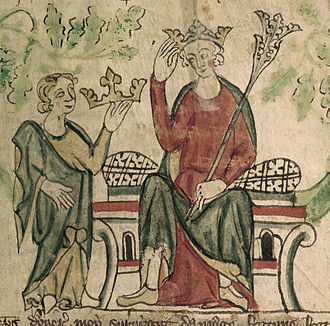
Edward_II_-_British_Library_Royal_20_A_ii_f10_(detail)
Edward of Carnarvon

In the final agreement, the Scots got a clear statement safeguarding their independence. Edward promised that Scotland should remain ‘free in itself, and without subjection from the kingdom of England’.

Margaret set sail in September 1290; accompanied by Bishop Narve of Bergen, she was bound for Leith. In preparation for the Maid’s arrival, Edward I sent gifts for his future daughter-in-law; and the magnates of Scotland began to assemble at Scone Abbey, Perth, in anticipation of the enthronement of their new queen.

However, storms drove the Maid’s ship off course and she landed at St Margaret’s Hope, South Ronaldsay, on Orkney. Scottish and English representatives rode north to Orkney to meet her. Sometime between 26 and 29 September 1290, Margaret died at Orkney, in the arms of the Bishop, supposedly from the effects of a severe bout of seasickness. She was 7 years old.

As the Scottish and English messengers returned south with news of the Maid’s death, Margaret’s body was returned to Norway. She was buried beside her mother, in the north aisle of Christ’s Kirk, in Bergen.

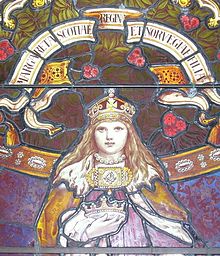
220px-Margaret,_Maid_of_Norway
Margaret, Maid of Norway, Queen of Scotland

Her father confirmed the identity of the body before her burial, an act that proved significant in 1300, a year after Erik’s death, when a woman turned up in Bergen. claiming to be Margaret. Reports say the woman appeared to be 40 years old, when Margaret would have only been 17, and she gained popular support, despite the king’s identification Margaret’s body, before finally being convicted as ‘the False Margareth’; she was burned at the stake in 1301.

The tragedy of Margaret’s death brought an end to the rule of the House of Dunkeld, begun with Malcolm III Canmore in 1058, and plunged Scotland into crisis. Edward I’s intervention with his judgement of the 13 Competitors for the crown, and his backing of John Balliol as the next King, saw the beginning of Scotland’s Wars of Independence. Marred not only be English invasion, but also the in-fighting among the Scottish nobles, it was not until Robert the Bruce emerged victorious that Scotland found her feet again.

*

Pictures taken from Wikipedia, except that of Edward I, Alexander III and Llewelyn, which was taken from castlewales.com

*

Sources: castlewales.com; Marc Morris Edward I: A Great and Terrible King; David Williamson Brewer’s British royalty; Mike Ashley The Mammoth Book of British kings & Queens; Alison Weir Britain’s Royal Families; Roy Strong The Story of Britain; Dan Jones The Plantagenets; the Kings who Made England; Chronicles of the Age of Chivalry Edited by Elizabeth Hallam; The Oxford Companion to British History edited by John Cannon; The History Today Companion to British History Edited by Juliet Gardiner and Neil Wenborn; The Plantagenets by Derek Wilson; The Story of Scotland by Nigel Tranter; royal.gov.uk; britroyals.com; undiscoveredscotland.co.uk; englishmonarchs.co.uk; educationscotland.gov.uk.

*

My Books

Signed, dedicated copies of all my books are available through my online store.

OUT NOW! Heroines of the Tudor World

Heroines of the Tudor World tells the stories of the most remarkable women from European history in the time of the Tudor dynasty, 1485-1603. These are the women who ruled, the women who founded dynasties, the women who fought for religious freedom, their families and love. These are the women who made a difference, who influenced countries, kings and the Reformation. In the era dominated by the Renaissance and Reformation, Heroines of the Tudor World examines the threats and challenges faced by the women of the era, and how they overcame them. From writers to regents, from nuns to queens, Heroines of the Tudor World shines the spotlight on the women helped to shape Early Modern Europe.

Heroines of the Tudor World is now available for pre-order from Amberley Publishing and Amazon UK.

Coming 30 January 2025: Scotland’s Medieval Queens

Scotland’s history is dramatic, violent and bloody. Being England’s northern neighbour has never been easy. Scotland’s queens have had to deal with war, murder, imprisonment, political rivalries and open betrayal. They have loved and lost, raised kings and queens, ruled and died for Scotland. From St Margaret, who became one of the patron saints of Scotland, to Elizabeth de Burgh and the dramatic story of the Scottish Wars of Independence, to the love story and tragedy of Joan Beaufort, to Margaret of Denmark and the dawn of the Renaissance, Scotland’s Medieval Queens have seen it all. This is the story of Scotland through their eyes.

Available for pre-order now.

Also by Sharon Bennett Connolly:

Women of the Anarchy demonstrates how Empress Matilda and Matilda of Boulogne, unable to wield a sword themselves, were prime movers in this time of conflict and lawlessness. It shows how their strengths, weaknesses, and personal ambitions swung the fortunes of war one way – and then the other. Available from Bookshop.orgAmberley Publishing and Amazon UKKing John’s Right-Hand Lady: The Story of Nicholaa de la Haye is the story of a truly remarkable lady, the hereditary constable of Lincoln Castle and the first woman in England to be appointed sheriff in her own right. Available from all good bookshops Pen & Sword Booksbookshop.org and AmazonDefenders of the Norman Crown: The Rise and Fall of the Warenne Earls of Surrey tells the fascinating story of the Warenne dynasty, from its origins in Normandy, through the Conquest, Magna Carta, the wars and marriages that led to its ultimate demise in the reign of Edward III. Available from Pen & Sword BooksAmazon in the UK and US, and Bookshop.org

Ladies of Magna Carta: Women of Influence in Thirteenth Century England looks into the relationships of the various noble families of the 13th century, and how they were affected by the Barons’ Wars, Magna Carta and its aftermath; the bonds that were formed and those that were broken. It is now available in paperback and hardback from Pen & Sword,  Amazon, and Bookshop.orgHeroines of the Medieval World tells the stories of some of the most remarkable women from Medieval history, from Eleanor of Aquitaine to Julian of Norwich. Available now from Amberley Publishing and Amazon, and Bookshop.orgSilk and the Sword: The Women of the Norman Conquest traces the fortunes of the women who had a significant role to play in the momentous events of 1066. Available now from Amazon,  Amberley Publishing, and Bookshop.org.

Alternate Endings: An anthology of historical fiction short stories including Long Live the King… which is my take what might have happened had King John not died in October 1216. Available in paperback and kindle from Amazon.

Podcast:

Have a listen to the A Slice of Medieval podcast, which I co-host with Historical fiction novelist Derek Birks. Derek and I welcome guests, such as Bernard Cornwell, and discuss a wide range of topics in medieval history, from significant events to the personalities involved.

*

Don’t forget! Signed and dedicated copies of all my books are available through my online bookshop.

For forthcoming online and in-person talks, please check out my Events Page.

You can be the first to read new articles by clicking the ‘Follow’ button, liking our Facebook page or joining me on TwitterThreads and Instagram.

©2015 Sharon Bennett Connolly FRHistS

Poor Little Marjorie Bruce

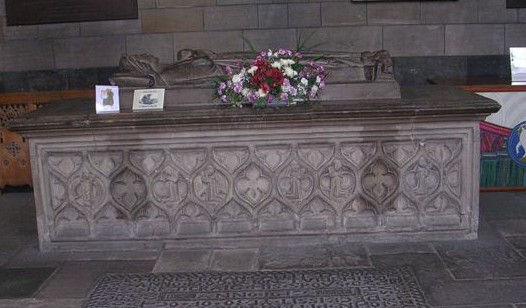
Marjorie_Bruce_Paisley_Abbey
Tomb of Marjorie Bruce, Paisley Abbey

I’ve always had a soft spot for little Marjorie Bruce. Dead before her 20th birthday, her short life was filled with tragedy and adversity from the moment of her birth. I could find no pictures of her, just ones of her tomb; which just about sums it up for poor Marjorie.

Marjorie was born at a time of great upheaval for Scotland; Edward I was claiming overlordship of the country, and the right to choose its next king. John Balliol was picked as king, only for Edward to humiliate and dethrone him a short time later.

Marjorie’s father, Robert the Bruce, was one of the chief claimants of the Scots crown.

Marjorie was the only daughter of Robert the Bruce, Lord of Annandale and Earl of Carrick, and Isabella of Mar. Isabella was the daughter of Donald, 6th Earl of Mar, and Helen, possible illegitimate daughter of Llewelyn the Great, Prince of Wales.

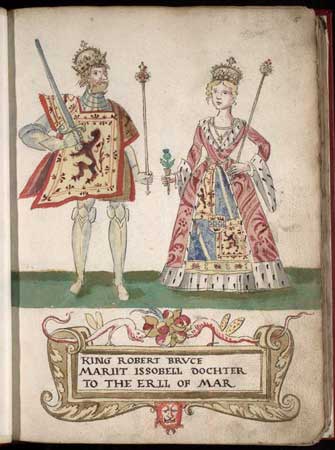
Robert_I_and_Isabella_of_Mar
Marjorie’s parents; Robert the Bruce and Isabella of Mar

Isabella and Robert had married in 1295 and Marjorie arrived about 2 years later. At the age of only 19, Isabella died shortly after giving birth and poor Marjorie was left motherless, with a father who was fighting, alternately, for and against the English.

Even when still a baby, Marjorie was seen as a political pawn, when on 9 July 1297, Edward I demanded that she be handed over as a hostage to her father’s good behaviour. Three of Robert’s allies, ‘Robert bishop of Glasgow, James the Steward of Scotland, and Alexander de Lindesye, become guarantees for the Earl of Carrick’s loyalty till he delivers his daughter Margerie as a hostage.’ Although, there is no record that Marjorie was ever handed over to the English at this time.

Marjorie was named after her paternal grandmother, Marjorie, Countess of Carrick in her own right. And it seems highly likely that Marjorie’s care was handed to one of her father’s sister, either Mary or Christian.

At 6 years old Marjorie acquired a new step-mother when Robert married Elizabeth de Burgh, daughter of Richard de Burgh, Earl of Ulster, and god-daughter of Edward I. Although Edward I appears to have arranged the marriage in order to keep the Bruce’s loyalty, it was only a short while after the marriage that Robert the Bruce finally decided to join William Wallace and fight for Scotland.

In 1306, following his murder of his rival for the throne, John Comyn, Robert the Bruce defied Edward I by having himself crowned King of Scots at Scone Abbey. Little 8-year-old Marjorie was suddenly a Princess of Scotland as the daughter of  King Robert I; although her uncle Edward Bruce was designated Robert’s heir.

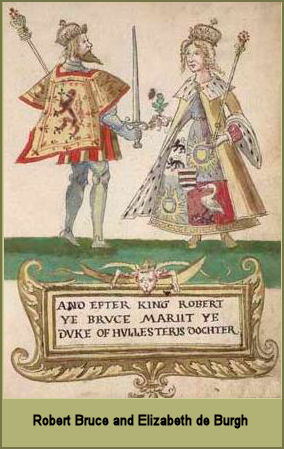
RobertBruceAndElizabethDeBurgh (280X280)_tcm4-562387
Robert the Bruce and his queen, Elizabeth de Burgh

Unfortunately Robert’s coronation infuriated Edward I even more. After King Robert was brought to battle, and defeated, at Methven in June 1306 he and his family became fugitives in their own land. Edward I of England was determined to hunt him down; sending men after Robert and all his adherents.

In August 1306 Robert split his party; while he headed west he sent Marjorie and Elizabeth to the north-east, possibly hoping they could escape to Orkney and onto Norway, where his sister, Isabel, was queen.

Accompanying Elizabeth and Marjorie were Robert’s other 2 sisters, Christian and Mary, and Isabella, Countess of Buchan, who had crowned Robert at Scone. They were escorted by John of Strathbogie, Earl of Atholl, and Robert’s younger brother, Sir Niall Bruce.

By September 1306, the women and their escort had reached Kildrummy Castle in Aberdeenshire; where Edward’s forces caught up with them. While Sir Niall Bruce and the garrison stoically attempted to hold off the English troops, the Earl of Atholl escaped with the women. Having made it to the far north of Scotland, but were apprehended at Tain, near Inverness, by the Earl of Ross, a supporter of the Comyns.

Kildrummy had fallen in the mean time.

170px-Gal_nations_edward_i
Edward I

Sir Niall Bruce and the Kildrummy garrison were handed over to the English and executed; Sir Niall suffered hanging, drawing and quartering at Berwick. The Earl of Atholl and the Bruce women, along with the Countess of Buchan, were sent south to King Edward.

When they reached London, the Earl of Atholl suffered the same fate as Sir Niall, the first earl to ever suffer a traitor’s execution.

Although Edward did not order the executions of the women folk, it cannot be said he treated them kindly. They were used to set an example; a demonstration of the price of rebellion against Edward.

For Mary Bruce and the Countess of Buchan, he ordered the construction of iron cages. Isabella, Countess of Buchan, who had set the crown of Scotland on Robert the Bruce’s head, was imprisoned in one such cage supposedly suspended high from the walls of Berwick castle, open the elements and the mockery of the people of Berwick. The same was ordered for Mary Bruce at Roxburgh. Although the cages were actually in rooms inside the two strongholds, rather than outside and suspended from the walls. Either way, it was still horrendous treatment for two noblewomen.

220px-Watton_Abbey
Watton Abbey, where Marjorie was confined for 8 years

Christian Bruce, whose husband had recently been executed as a traitor at Dumfries, was ordered to be confined at a convent at Sixhills in Lincolnshire; while Elizabeth de Burgh was confined to various manors in England and treated more kindly due to her father’s friendship with the king.

For Marjorie Bruce, these events must have been terrifying. Edward ordered her confined in an iron cage in the Tower of London, where no one was to speak to her. Whether Edward relented of his own free will, or was advised against such treatment of a child of not yet 10 years old, the order was rescinded and she was confined to a convent at Watton in Yorkshire.

On 15 March 1307, Edward sent orders for financial provision for Marjory: ‘The K. commands the sheriff of York, by view of the Prior of Wattone, to allow Margery daughter of Robert de Brus, staying in Wattone by the K.’s order, 3d. a day for her expenses, from the morrow of All Souls last year, when she came there; and a mark yearly for her dress.’

Although loyal to their king, we can only hope that the nuns took pity on the poor child, and treated her kindly. She was held at Watton for 8 years and it was only her father’s victory at Bannockburn, in 1314, that eventually secured her freedom.

175px-Paisley_abbey
Paisley Abbey

Robert the Bruce’s resounding victory over Edward I’s son and successor, Edward II, in the 1314 battle meant Bruce was finally in a position to insist on the return of his queen, daughter, sisters and the Countess of Buchan. With so many English nobles taken prisoner, the women were the price demanded in the exchange of hostages.

On Marjorie’s return to Scotland, King Robert almost immediately set about arranging her marriage. With the queen not yet having produced a child, the now-17-year-old Marjorie was needed to produce an heir for the Bruce dynasty.

Just 5 years older the Marjorie, Walter Stewart, the wealthy and powerful 6th High Steward of Scotland was the ideal candidate as a husband. Walter had distinguished himself as a commander at the Battle of Bannockburn, and was the man entrusted by Bruce to bring his family home for their English captivity.

Robert_II_of_Scotland
Robert II of Scotland

Walter and Marjorie were married shortly after, with Marjorie’s dowry including the Barony of Bathgate in West Lothian. Whatever happiness – if any – Marjorie derived from the marriage, however, was short-lived.

In 1316, whilst heavily pregnant, she fell from her horse when out riding near Paisley Abbey. Going into premature labour, Marjorie was taken to the Abbey, where she was delivered of a son, Robert, on 2nd March 1316. It is possible that Robert was delivered by caesarean as his mother was close to death. Marjorie survived the birth by just a few hours and died the same day.

Poor little Marjorie Bruce was dead at the tender age of 19 – the same as her mother before her – having lived through some of the most turbulent years of Scottish history.

Had she lived she would have seen her son succeed her brother, David II, on the Scots throne as King Robert II, founder of the Stewart dynasty.

*

Pictures courtesy of Wikipedia.

*

Sources: The Story of Scotland by Nigel Tranter; Brewer’s British Royalty by David Williamson; Kings & Queens of Britain by Joyce Marlow; Mammoth Book of British Kings & Queens by Mike Ashley; Oxford Companion to British History Edited by John Cannon; Edward I, A Great and Terrible King by Marc Morris; Britain’s Royal Families by Alison Weir; History Today Companion to British History Edited by Juliet Gardiner & Neil Wenborn; The Plantagenets, The Kings Who Made England by Dan Jones; The Illustrated Encyclopaedia of the Kings & Queens of Britain by Charles Phillips; Kings & Queens of Britain by Joyce Marlow; englishmonarchs.co.uk; educationscotland.gov.uk; Sisters of the Bruce; electricscotland.com.

*

My Books

Signed, dedicated copies of all my books are available through my online bookshop. or by contacting me.

Coming 30 March: Princesses of the Early Middle Ages

Books by Sharon Bennett Connolly

Daughters of kings were often used to seal treaty alliances and forge peace with England’s enemies. Princesses of the Early Middle Ages: Royal Daughters of the Conquest explores the lives of these young women, how they followed the stereotype, and how they sometimes managed to escape it. It will look at the world they lived in, and how their lives and marriages were affected by political necessity and the events of the time. Princesses of the Early Middle Ages will also examine how these girls, who were often political pawns, were able to control their own lives and fates. Whilst they were expected to obey their parents in their marriage choices, several princesses were able to exert their own influence on these choices, with some outright refusing the husbands offered to them.

Their stories are touching, inspiring and, at times, heartbreaking.

Princesses of the Early Middle Ages: Royal Daughters of the Conquest is now available for pre-order from Pen & Sword and Amazon.

Also by Sharon Bennett Connolly:
Books by Sharon Bennett Connolly

Scotland’s history is dramatic, violent and bloody and Scotland’s Medieval Queens have seen it all. This is the story of Scotland through their eyes. Available now from Amazon and Pen and Sword BooksHeroines of the Tudor World tells the stories of the most remarkable women from European history in the time of the Tudor dynasty, 1485-1603. These are the women who ruled, the women who founded dynasties, the women who fought for religious freedom, their families and love. Heroines of the Tudor World is now available from Amberley Publishing and Amazon UK. Women of the Anarchy demonstrates how Empress Matilda and Matilda of Boulogne, unable to wield a sword themselves, were prime movers in this time of conflict and lawlessness. It shows how their strengths, weaknesses, and personal ambitions swung the fortunes of war one way – and then the other. Available from Bookshop.orgAmberley Publishing and Amazon UKKing John’s Right-Hand Lady: The Story of Nicholaa de la Haye is the story of a truly remarkable lady, the hereditary constable of Lincoln Castle and the first woman in England to be appointed sheriff in her own right. Available from all good bookshops Pen & Sword Booksbookshop.org and Amazon

Defenders of the Norman Crown: The Rise and Fall of the Warenne Earls of Surrey tells the fascinating story of the Warenne dynasty, from its origins in Normandy, through the Conquest, Magna Carta, the wars and marriages that led to its ultimate demise in the reign of Edward III. Available from Pen & Sword BooksAmazon in the UK and US, and Bookshop.orgLadies of Magna Carta: Women of Influence in Thirteenth Century England looks into the relationships of the various noble families of the 13th century, and how they were affected by the Barons’ Wars, Magna Carta and its aftermath; the bonds that were formed and those that were broken. It is now available in paperback and hardback from Pen & SwordAmazon, and Bookshop.orgHeroines of the Medieval World tells the stories of some of the most remarkable women from Medieval history, from Eleanor of Aquitaine to Julian of Norwich. Available now from Amberley Publishing and Amazon, and Bookshop.orgSilk and the Sword: The Women of the Norman Conquest traces the fortunes of the women who had a significant role to play in the momentous events of 1066. Available now from Amazon,  Amberley Publishing, and Bookshop.org.

Alternate Endings: An anthology of historical fiction short stories including Long Live the King… which is my take what might have happened had King John not died in October 1216. Available in paperback and kindle from Amazon.

Podcast:

Have a listen to the A Slice of Medieval podcast, which I co-host with Historical fiction novelist Derek Birks. Derek and I welcome guests, such as Bernard Cornwell and Michael Jecks, and discuss a wide range of topics in medieval history, from significant events to the personalities involved. 

Every episode is also now available on YouTube.

*

Don’t forget! Signed and dedicated copies of all my books are available through my online store.

For forthcoming online and in-person talks, please check out my Events Page.

You can be the first to read new articles by clicking the ‘Follow’ button, liking our Facebook page or joining me on TwitterThreadsBluesky and Instagram.

*

©2015 Sharon Bennett Connolly FRHistS
Elizabeth de Burgh, the Captive Queen

edb1
King Robert I and Queen Elizabeth

Certain periods and people in history hold a particular fascination for me. Robert the Bruce is one such. The grandfather of the Stewart dynasty and hero of Scotland, he started his career with some very divided loyalties. Initially a supporter of Edward I, it was only the arrival of William Wallace that started Bruce on his journey to becoming the saviour of Scottish independence.

Through the murder of his greatest rival and the Battle of Bannockburn, Bruce proved himself determined and resourceful, overcoming defeat to emerge victorious and master of his realm.

Bruce suffered greatly for the crown, with his family and friends facing similar hardships.

Robert the Bruce’s wife endured a no less punishing life in support of her husband.

Elizabeth de Burgh was born around 1289. The daughter of Richard de Burgh, Earl of Ulster and Connaught, and his wife, Margaret, she was a god-daughter of England’s king, Edward I. At the age of 13 Elizabeth was married to Robert the Bruce, Earl of Carrick, in 1302; probably at his manor of Writtle, near Chelmsford in Essex. It is possible the marriage was arranged by Edward; he certainly encouraged it, as a way of keeping his young Scottish noble loyal to his cause.

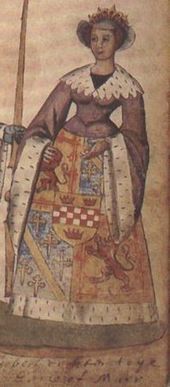
Queen Elizabeth de Burgh

However, events in Scotland would soon push the Bruce away from his English alliances; his murder of his greatest rival for the throne, John Comyn, in the Chapel of the Greyfriars in Dumfries. Aware that he would be excommunicated for his actions, Bruce raced to Scone to be crowned before a papal bull could be issued.

6 weeks later, on March 25th 1306, the Bruce was crowned King Robert I of Scotland, with Elizabeth by his side, by Isabella MacDuff, Countess of Buchan. As daughter of the Earl of Fife, Isabella claimed the hereditary right of the Clan MacDuff, to crown the King of Scots. The couple was crowned in a second ceremony the next day by the Bishop of St Andrews, William Lamberton, who had arrived too late to play his part in the ceremony on the 25th. Elizabeth is said to have referred to herself and Robert as ‘the king and queen of the May’ which is often seen as a criticism of her husband but may also be a foreshadowing of what was to come.

Unfortunately the coronation was not the end of trouble for the Bruces. If anything, things were about to get much worse.

An ailing Edward I sent his loyal lieutenant, Aymer de Valence, north and he met and defeated Robert’s army at Methven in June of the same year. Robert sent his brother Neil and the Earl of Atholl to escort his wife to safety. They took the Queen, Princess Marjorie (Robert the Bruce’s daughter by his first marriage), sisters Mary and Christian and the countess of Buchan, north towards Orkney.

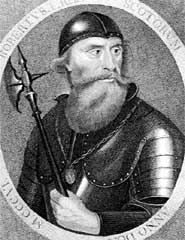
Robertthebruce
Nineteenth Century depiction of Robert the Bruce

However, the English caught up with them at Kildrummy Castle and laid siege to it. The garrison was betrayed from within, the barns set alight and the Bruce women had barely time to escape with the Earl of Atholl before the castle was taken. Sir Neil Bruce and the entire garrison were executed; Neil was hung, drawn and quartered at Berwick in September 1306.

Queen Elizabeth and her companions made for Tain, in Easter Ross, possibly in the hope of finding a boat to take them onwards, to King Robert’s sister Isabella, Queen of Norway. However, they were captured by the Earl of Ross (a former adherent of the deposed King John Balliol), who took them from sanctuary at St Duthac and handed them over to the English. They were sent south, To Edward I at Lanercost Priory.

Elizabeth’s capture would have been a hard blow for Robert the Bruce. The new King of Scotland still lacked a male heir, and had no chance of getting one while his wife was in English hands. This made his hold on the throne even more precarious than it already was.

Edward I’s admirer, Sir Maurice Powicke said Edward treated his captives with a ‘peculiar ferocity’. He ordered that 24-year-old Mary Bruce and Isabella, the Countess of Buchan who performed Robert the Bruce’s coronation, should be imprisoned in specially constructed iron cages and suspended from the outside walls of castles; Mary at Roxburgh and Isabella at Berwick. Although it is more likely that the cages were in rooms within the castles, rather than exposed to the elements, they would be held in that way for 4 years, until Edward I’s successor, Edward II, ordered their removal to convents in 1310.

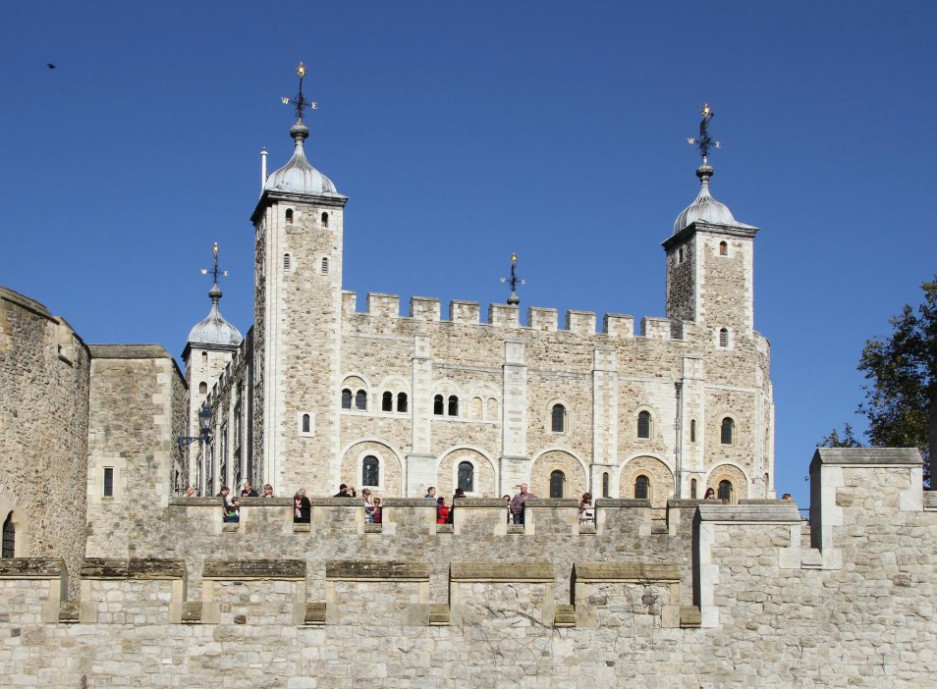
cropped-15720609675_e6e7a0fbcd_k2.jpg
The Tower of London

It seems Edward ordered a cage to be made Marjorie at the Tower of London, where she was first held. But he relented, possibly because of her age, and the child – not yet 12 years old – was sent to a nunnery in Yorkshire. Initial orders were given that she should be held in solitary confinement, with no one allowed to speak to her; but this may also have been rescinded.

Marjorie’s aunt and Mary’s older sister, Christian, was also sent to a Gilbertine nunnery, this time in Lincolnshire; although her husband, Sir Christopher Seton, was hung, drawn and beheaded at Dumfries.

Elizabeth was treated more kindly than her step-daughter, and the other ladies. Her father was a close ally of Edward I and the king did not want to alienate him. He refused to acknowledge her as Queen of Scots and throughout her captivity, Elizabeth was referred to as Countess of Carrick, Robert’s title before he became king. Elizabeth was sent to Burstwick Manor in Holderness, Yorkshire, from where she wrote to Edward I, in an undated letter, complaining that she only had 3 changes of clothes, and no bed linen. She then spent 4 years at Bisham Manor in Berkshire.

RobertBruceAndElizabethDeBurgh (280X280)_tcm4-562387
King Robert I (the Bruce) and Queen Elizabeth

However in 1312, with her husband gaining strength and raiding into Yorkshire, she was moved to a more secure location, and held at various sites in the south, including Windsor Castle. By this time she was permitted 6 attendants and was given a regular allowance. Elizabeth was later moved to Shaftesbury Abbey in Dorset but the political situation was about to change.

In 1314 Robert the Bruce achieved a not inconsiderable victory at the Battle of Bannockburn over Edward II and his English forces. Several notable English lords were taken prisoner, including Humphrey de Bohun, Earl of Hereford. Negotiations for his release led to a prisoner exchange and Elizabeth and the rest of the Bruce ladies, finally returned to Scotland after 8 years of imprisonment.

Reunited at last, Robert set about consolidating his kingdom, with his queen at his side.

His daughter, Marjorie Bruce, was married to Walter Stewart, hereditary High Steward of Scotland, though a succession settlement stipulated that Marjorie would only succeed to the throne on the deaths without male issue of King Robert and his one surviving brother, Edward. Following a fall from a horse while heavily pregnant, she gave birth to King Robert’s first grandson, also named Robert and the future king Robert II. Marjorie died just a few hours later.

220px-Dunfermline_Abbey_20080504_Robert_the_Bruce
Victorian brass plate covering the final resting place of Robert the Bruce and Elizabeth de Burgh in Dunfermline Abbey

Between 1315 and 1323 Elizabeth and Robert had two daughters: Margaret married William, 5th Earl of Sutherland and died in childbirth in 1346 or 1347; Matilda married Thomas Isaac and had two daughters, she died in 1353.

The  much longed-for son, David, was born in 1324; he was married to Joan of the Tower, daughter of Edward II of England, in 1328 and would succeed his father at the age of 5, as King David II, in 1329.

A second son, John, was born in or before 1327 but died young.

Elizabeth herself died on the 27th of October 1327, aged around 38, at the royal residence at Cullen in Banffshire. Given that her younger son may have been born – and died – in the same year as Elizabeth’s death, complications in childbirth, or in her recovery from childbirth, could well have contributed to Elizabeth’s death. The queen was buried in Dunfermline Abbey; Robert the Bruce was buried beside her when he died 18 months later.

*

Pictures courtesy of Wikipedia.

*

Further Reading:

The Story of Scotland by Nigel Tranter; Brewer’s British Royalty by David Williamson; Kings & Queens of Britain by Joyce Marlow; Mammoth Book of British Kings & Queens by Mike Ashley; Oxford Companion to British History Edited by John Cannon; Edward I A Great and Terrible King by Marc Morris; Britain’s Royal Families by Alison Weir; berkshirehistory.com; englishmonarchs.co.uk; thefreelancehistorywriter.comberkshirehistory.comeducationscotland.gov.uk/scotlandhistory; John of Fordun’s Chronicle of the Scottish Nation; Scotichronicon by Walter Bower; Chronicles of the Age of Chivalry, edited by Elizabeth Hallam; The Chronicle of Lanercost; Robert the Bruce by Stephen Spinks

*

My Books:

Signed, dedicated copies of all my books are available through my online store.

Out now: Scotland’s Medieval Queens

Scotland’s history is dramatic, violent and bloody. Being England’s northern neighbour has never been easy. Scotland’s queens have had to deal with war, murder, imprisonment, political rivalries and open betrayal. They have loved and lost, raised kings and queens, ruled and died for Scotland. From St Margaret, who became one of the patron saints of Scotland, to Elizabeth de Burgh and the dramatic story of the Scottish Wars of Independence, to the love story and tragedy of Joan Beaufort, to Margaret of Denmark and the dawn of the Renaissance, Scotland’s Medieval Queens have seen it all. This is the story of Scotland through their eyes.

Available now from Amazon and Pen and Sword Books

Also by Sharon Bennett Connolly:

Heroines of the Tudor World tells the stories of the most remarkable women from European history in the time of the Tudor dynasty, 1485-1603. These are the women who ruled, the women who founded dynasties, the women who fought for religious freedom, their families and love. Heroines of the Tudor World is now available for pre-order from Amberley Publishing and Amazon UK. Women of the Anarchy demonstrates how Empress Matilda and Matilda of Boulogne, unable to wield a sword themselves, were prime movers in this time of conflict and lawlessness. It shows how their strengths, weaknesses, and personal ambitions swung the fortunes of war one way – and then the other. Available from Bookshop.orgAmberley Publishing and Amazon UKKing John’s Right-Hand Lady: The Story of Nicholaa de la Haye is the story of a truly remarkable lady, the hereditary constable of Lincoln Castle and the first woman in England to be appointed sheriff in her own right. Available from all good bookshops Pen & Sword Booksbookshop.org and Amazon

Defenders of the Norman Crown: The Rise and Fall of the Warenne Earls of Surrey tells the fascinating story of the Warenne dynasty, from its origins in Normandy, through the Conquest, Magna Carta, the wars and marriages that led to its ultimate demise in the reign of Edward III. Available from Pen & Sword BooksAmazon in the UK and US, and Bookshop.orgLadies of Magna Carta: Women of Influence in Thirteenth Century England looks into the relationships of the various noble families of the 13th century, and how they were affected by the Barons’ Wars, Magna Carta and its aftermath; the bonds that were formed and those that were broken. It is now available in paperback and hardback from Pen & SwordAmazon, and Bookshop.orgHeroines of the Medieval World tells the stories of some of the most remarkable women from Medieval history, from Eleanor of Aquitaine to Julian of Norwich. Available now from Amberley Publishing and Amazon, and Bookshop.orgSilk and the Sword: The Women of the Norman Conquest traces the fortunes of the women who had a significant role to play in the momentous events of 1066. Available now from Amazon,  Amberley Publishing, and Bookshop.org.

Alternate Endings: An anthology of historical fiction short stories including Long Live the King… which is my take what might have happened had King John not died in October 1216. Available in paperback and kindle from Amazon.

Podcast:

Have a listen to the A Slice of Medieval podcast, which I co-host with Historical fiction novelist Derek Birks. Derek and I welcome guests, such as Bernard Cornwell and Michael Jecks, and discuss a wide range of topics in medieval history, from significant events to the personalities involved. Every episode is also now available on YouTube.

*

Don’t forget! Signed and dedicated copies of all my books are available through my online bookshop.

For forthcoming online and in-person talks, please check out my Events Page.

You can be the first to read new articles by clicking the ‘Follow’ button, liking our Facebook page or joining me on Twitter and Instagram.

*

©2015 Sharon Bennett Connolly FRHistS

The Tragic Story of the 1st Duke of Rothesay

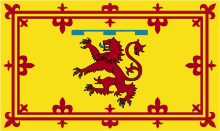
220px-Duke_of_Rothesay_Standard.svg
Standard of the Duke of Rothesay

David Stewart was born on 24th October, 1378, the son of John, Earl of Carrick and heir to the throne, and Annabella Drummond. His grandfather was King Robert II, who was himself the grandson of Robert I the Bruce, being the son of Robert’s unfortunate daughter, Marjorie Bruce, who died in childbirth, aged only 19.

His father succeeded to the throne in 1390, taking the name King Robert III (John being considered an unlucky name for kings). AS heir to the throne, David was created Earl of Carrick in the same year. Robert III, however, was an invalid – he had been kicked by a horse 2 years before his accession. Never having fully recovered from his injuries, he was also prone to depression. This severely limited his ability to govern and his younger brother, also called Robert, took over much of the administration of the realm.

As a highly ambitious younger brother, Robert Stewart, was a ruthless politician with designs on the throne for himself. Towards the end of his father’s reign – following his brother’s injury – he had been protector of the realm; and it seems he intended to keep the position for the duration of his brother’s reign.

220px-Robert_III_and_Annabella_Drummond
Robert III and his queen, Annabella Drummond

From 1393 Robert III tried to impose his own authority and rule for himself, but caused more division between the Highlands of the north and the Lowlands of the south; bribery and corruption were rife.

In 1395 young David was married to Elizabeth Dunbar, daughter of the Earl of March. However, they were close blood relations and had married before the required papal dispensation had arrived. The couple were censured by the church and forced to live apart for two years – after which they would be allowed to remarry. They separated in 1397.

In April 1398 Robert III’s wife, Annabella, called a special council at which David, still only 19, was made Duke of Rothesay. It was the first ever creation of a duke in Scotland, and the title would, from that moment on, be borne by all heirs to the Scottish throne. He would also receive the title Earl of Atholl later in the same year.

Annabella also had David named “Lieutenant of the Realm”, as a means of ensuring that David would succeed his increasingly frail father. This appointment essentially gave him the rule of Scotland, in his father’s place; although he was to consult with the full council, with his Uncle Robert as his primary advisor.

In the same council Robert Stewart was made Duke of Albany.

A power struggle developed between Albany and David. As their rivalry grew more intense the country was effectively divided into 2 factions.

David, it seems, was of a ‘dissolute and licentious’ nature (Ashley) and almost as inept as his father. According to Nigel Tranter he was “high-spirited” and “not always noted for good judgement”.

220px-Robert_of_Albany
Robert Stewart, Duke of Albany

In 1400, instead of remarrying Elizabeth Dunbar, David married Marjorie Douglas, daughter of Archibald the 3rd Earl of Douglas and his wife Joan, at Bothwell Church. She and David would have no children.

The marriage itself caused the Earl of March – father of David’s 1st wife – to renounce his allegiance and swear fealty to Henry IV of England, thus prompting an English invasion. Henry managed to reach Edinburgh without much opposition. Once there he summoned the dukes of Rothesay and Albany to pay homage to him, but neither did.

David held Edinburgh Castle against Henry, whilst Albany had mustered an army 15 miles away at Calder Muir; but he failed to march to Rothesay’s aid. Henry IV was eventually forced to retire for lack of supplies, with the Scots powerless to take the advantage.

David was blamed for provoking the English invasion. Following his mother’s death in 1401, his popularity was further damaged when he failed to consult his council, as was required, before taking a number of steps which threatened the positions of his nobles, especially his uncle.

220px-Falkland_Palace
Falkland Palace

With Queen Annabella’s death went David’s chief supporter and last protector. Albany, in alliance with David’s brother-in-law, the 4th Earl of Douglas, took action and had David waylaid on the road to St Andrews, arrested and held captive in St Andrews Castle, before being moved to Falkland Palace, supposedly hooded and mounted backwards on a mule.

According to Tranter, David was flung into a cellar, with no food and water. There were stories of nursing mothers giving him their breast milk for sustenance, through a crack in the cellar’s masonry. He survived for at least 18 days, supposedly dying of starvation between 25th and 27th March 1402, aged 23.

Some historians now think David died of dysentery; but whether he died of starvation or disease the result was the same; from April 1402 Robert, Duke of Albany, was in control of Scotland.

A few weeks after his death a public inquiry, under the control of Albany, exonerated Albany and Douglas of any complicity in the death, ordering that no one should “murmur against” them. The inquiry concluded that David Stewart, Duke of Rothesay, had died “by divine providence and not otherwise”.

300px-Lindores_abbey_04
Lindores Abbey, burial-place of David, Duke of Rothesay

David was buried in Lindores Abbey, Fife. The king founded a chaplaincy at the parish church of Dundee to pray for David’s soul, and ordered daily masses to be said in the prince’s memory at Deer Abbey and Culross.

Following David’s death his widow, Marjorie, went on to marry Sir Walter Haliburton in 1403; she died sometime before 11th May 1421.

The king, Robert III, took some time to realise that his second son, James, may also be in danger. In 1406, the king arranged for him to be sent to France for his own safety. Aged just 12, James was smuggled out of Scotland by ship, but was captured by pirates off Flamborough Head, and handed over to the English to begin 18 years of imprisonment.

King Robert III died of grief shortly after.

Albany was, thereafter, the effective ruler of Scotland until his death in 1420.

*

Pictures courtesy of Wikipedia.

Sources: The Story of Scotland by Nigel Tranter; Brewer’s British Royalty by David Williamson; Kings & Queens of Britain by Joyce Marlow; Mammoth Book of British Kings & Queens and British Kings & Queens by Mike Ashley; Oxford Companion to British History Edited by John Cannon; History Today Companion to British History Edited by juliet Gardiner & Neil Wenborn; Britain’s Royal Families by Alison Weir; undiscoveredscotland.co.uk; englishmonarchs.co.uk

*

My Books

Signed, dedicated copies of all my books are available, please get in touch by completing the contact me form.

Coming 30 May 2023!

King John’s Right-Hand Lady: The Story of Nicholaa de la Haye is now available for pre-order from Pen & Sword Booksbookshop.org and Amazon UK. (I will hopefully have a US release date shortly)

In a time when men fought and women stayed home, Nicholaa de la Haye held Lincoln Castle against all-comers. Not once, but three times, earning herself the ironic praise that she acted ‘manfully’. Nicholaa gained prominence in the First Baron’s War, the civil war that followed the sealing of Magna Carta in 1215.

A truly remarkable lady, Nicholaa was the first woman to be appointed sheriff in her own right. Her strength and tenacity saved England at one of the lowest points in its history. Nicholaa de la Haye is one woman in English history whose story needs to be told…

 Also by Sharon Bennett Connolly:

Defenders of the Norman Crown: The Rise and Fall of the Warenne Earls of Surrey tells the fascinating story of the Warenne dynasty, of the successes and failures of one of the most powerful families in England, from its origins in Normandy, through the Conquest, Magna Carta, the wars and marriages that led to its ultimate demise in the reign of Edward III. Defenders of the Norman Crown: Rise and Fall of the Warenne Earls of Surrey is now available from Pen & Sword BooksAmazon in the UK and US, Bookshop.org and Book Depository.

Ladies of Magna Carta: Women of Influence in Thirteenth Century England looks into the relationships of the various noble families of the 13th century, and how they were affected by the Barons’ Wars, Magna Carta and its aftermath; the bonds that were formed and those that were broken. It is now available in paperback and hardback from Pen & Sword,  AmazonBookshop.org and from Book Depository worldwide.

Heroines of the Medieval World tells the stories of some of the most remarkable women from Medieval history, from Eleanor of Aquitaine to Julian of Norwich. Available now from Amberley Publishing and Amazon, Bookshop.org and from Book Depository worldwide.

Silk and the Sword: The Women of the Norman Conquest traces the fortunes of the women who had a significant role to play in the momentous events of 1066. Available now from Amazon,  Amberley Publishing, Bookshop.org and Book Depository.

Alternate Endings: An anthology of historical fiction short stories including Long Live the King… which is my take what might have happened had King John not died in October 1216. Available in paperback and kindle from Amazon.

*

For forthcoming online and in-person talks, please check out my Events Page.

*

You can be the first to read new articles by clicking the ‘Follow’ button, liking our Facebook page or joining me on Twitter and Instagram.

*

2015 Sharon Bennett Connolly FRHistS

James I and Joan Beaufort: A Royal Love Story

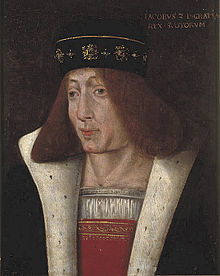
220px-King_James_I_of_Scotland
James I

The story of King James I of Scotland and his queen, Joan Beaufort, is one of those rarities in Medieval history; a true love story. He was a King in captivity and she a beautiful young lady of the court.

Following the murder of his brother, David, Duke of Rothesay, James was the only surviving son of Robert III of Scotland. He had been on his way to France, for his safety and to continue his education, when his ship was captured by pirates in April 1406. Aged only 11, he was handed over to the English king, Henry IV, and imprisoned in the Tower of London.

Shortly after his capture, James’s father died and he was proclaimed King of Scots, but the English would not release him.

James was closely guarded and regularly moved around, but he was also well-educated while in the custody of the English king and was an accomplished musician and poet. He was held at various castles, including the Tower, Nottingham Castle – where he was allowed to go hunting – and Windsor Castle.

Probably born in the early 1400s, Lady Joan Beaufort was the daughter of John Beaufort, 1st Earl of Somerset and legitimated son of John of Gaunt (himself the 3rd son of Edward III) by his mistress and, later, wife Kathryn Swynford. Joan’s mother was Margaret Holland, granddaughter of Joan of Kent (wife of Edward the Black Prince) from her marriage to Thomas Holland, 1st Earl of Kent.

Joan Beaufort was very well-connected; she was a niece of Henry IV, great-niece of Richard II and  great grand-daughter of Edward III. Her uncle, Henry Beaufort, was a cardinal and Chancellor of England.

150px-Beaufortforeman'sroll
Joan Beaufort, Queen of Scotland

Little seems to be known of her early life, but she was at court in the early 1420s, when James first set eyes on her. James wrote of his love for Joan in his famous poem, The Kingis Quair. According to Nigel Tranter, James was with the court at Windsor, when he saw Joan for the first time while walking her little lap-dog in the garden, below his window.

His narrow window afforded him only a limited view, but the Lady Joan walked the same route every morning and James wrote of her;

“Beauty, fair enough to make the world to dote, Are ye a worldy creature? Or heavenly thing in likeness of nature? Or are ye Cupid’s own priestess, come here, To loose me out of bonds”

One morning James managed to drop a plucked rose down to Lady Joan, which he saw her wearing the following evening at dinner. Nigel Tranter suggests Lady Joan grieved over James’s imprisonment and even pleaded for him to be released.

Their romance grew apace, but was interrupted when James had to accompany Henry V on his French campaign. Henry was hoping that James’s presence would make the Scots, fighting with the French, think twice about engaging with him. However, the strategy had little effect.

220px-Robert_of_Albany
Robert Stewart, Duke of Albany

James’s imprisonment lasted for 18 years. His uncle Robert Stewart, Duke of Albany and Guardian of Scotland in James’s absence, refused to ransom him, in the hope of gaining the throne for himself. He never quite garnered enough support, but managed to keep the Scottish nobles in check.

However, when he died in 1420 control passed to his son Murdoch (who had also been imprisoned by the English for 12 years, but was ransomed – instead of James – in 1414) and Scotland fell into a state of virtual anarchy.

Henry V had finally decided that it was time for James to return to Scotland when he died. It was left to Henry’s brother, John, Duke of Bedford, as Regent for the infant Henry VI, to agree the terms of James’s freedom. James was charged 60,000 marks in ransom – to cover the costs for his upkeep and education for 18 years, it was claimed. The agreement included a promise for the Scots to keep out of England’s wars with France, and for James to marry the Lady Joan Beaufort.

James and Joan were married at the Church of St Mary Overie, Southwark, on 2nd February 1424. James was released on the 28th March and the couple returned to Scotland shortly after. They were crowned at Scone by Henry de Warlaw, Bishop of St Andrews, on 21st May 1424.

James and Joan had 8 children together, 7 of whom survived childhood. Their 6 daughters helped to strengthen alliances across Europe. The oldest, Margaret, was born around Christmas 1424. At the age of 11 she was sent to France to marry the Dauphin, Louis – the future Louis XI – narrowly escaping her father’s fate when the English fleet tried to capture her en route. She died in 1445, leaving no children.

Isabella_of_Scotland
Isabella of Scotland

Isabella married Francis I, Duke of Brittany; she had 2 daughters and died in 1494. Eleanor married Sigismund, Archduke of Austria, and died in 1480. Joan was born mute and married James Douglas, Earl of Morton and had 4 children – her eldest son, Sir John Douglas, 2nd Earl of Morton, was probably killed at Flodden in 1513. Joan herself died in 1486.

Mary was created Countess of Buchan in 1444; she married Wolfert, Count of Grandpre, of the Netherlands, having 2 sons who died young before she died in 1465. A last daughter, Anabella, married, firstly, Louis of Savoy but following their divorce in 1458 she married George Gordon, 2nd Earl of Huntly. They had 2 children together before divorcing on the grounds of consanguinity in 1471.

James and Joan finally had twin sons in 1430. Born on 16th October, Alexander died the same year, but James would go on to succeed his father and married Mary of Gueldres in 1449.

On his return to Scotland, James immediately set about getting his revenge on the Duke of Albany’s family and adherents; executing some, including Murdoch, Albany’s son and heir. Two other claimants to James’s throne were sent to England, as hostages to the payment of his ransom.

James and Joan ruled Scotland for 13 years; James even allowed Joan to take some part in the business of government. His reforms, however, and desire for a firm but just government made enemies of some nobles, including his own chamberlain Sir Robert Stewart, grandson of Walter, Earl of Atholl, who had been James’s heir until the birth of his son.

Blackfriars_monastery_perth
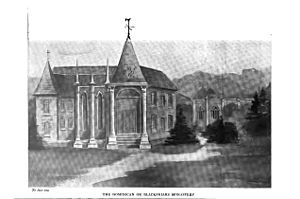
Blackfriars Monastery, Perth

Due to his long imprisonment in the fortresses of England, James tended to avoid castles. On 21 February 1437 the King was staying at the Blackfriars in Perth when his chamberlain dismissed the guard and, having removed the locking bar to the King’s quarters, let the assassins into the priory.

James and Joan were alone with the queen’s ladies when they heard the men approaching. On seeing the locking bar missing, Joan’s lady, Kate Douglas, used her own arm to bar the door. The queen hid the king in an underground vault as Kate’s arm broke and the plotters gained entry. They dragged James from his hiding placed and stabbed him to death; Joan herself was wounded in the scuffle.

220px-James_II_of_Scotland_17th_century
James II

The plotters, led by Walter, Earl of Atholl, James’ own uncle, had expected to seize power, but were arrested and executed as the nobles rallied around the new king, 6-year-old James II.

James I was buried in Perth and Joan took an active role the government for her son, getting caught in a contest of power between Sir Alexander Livingstone and Sir William Crichton. Her second marriage to Sir James Stewart, the Black Knight of Lorne, led to her arrest by Livingstone, under the pretext that she may abduct the child-king.

Joan and her new husband were only released on the condition that she give up her custody of James II and leave the court.

They would go on to have 3 sons together before Joan died during a siege at Dunbar Castle on 15 July, 1445; although whether her death was caused by illness or the violence of the siege has not been determined. She was buried in the Carthusian priory in Perth alongside her first husband, King James I.

*

Sources: The Story of Scotland by Nigel Tranter; Brewer’s British royalty by David Williamson; Kings & Queens of Britain by Joyce Marlow; Mammoth Book of British Kings & Queens and British Kings & Queens by Mike Ashley; Oxford Companion to British History Edited by John Cannon; History Today Companion to British History Edited by juliet Gardiner & Neil Wenborn; Britain’s Royal Families by Alison Weir.

Pictures courtesy of Wikipedia.

*

My books

Signed, dedicated copies of all my books are available through my online bookshop.

Out now! Scotland’s Medieval Queens

Scotland’s history is dramatic, violent and bloody. Being England’s northern neighbour has never been easy. Scotland’s queens have had to deal with war, murder, imprisonment, political rivalries and open betrayal. They have loved and lost, raised kings and queens, ruled and died for Scotland. From St Margaret, who became one of the patron saints of Scotland, to Elizabeth de Burgh and the dramatic story of the Scottish Wars of Independence, to the love story and tragedy of Joan Beaufort, to Margaret of Denmark and the dawn of the Renaissance, Scotland’s Medieval Queens have seen it all. This is the story of Scotland through their eyes.

Available now from Amazon and Pen and Sword Books

Also by Sharon Bennett Connolly:

Heroines of the Tudor World tells the stories of the most remarkable women from European history in the time of the Tudor dynasty, 1485-1603. These are the women who ruled, the women who founded dynasties, the women who fought for religious freedom, their families and love. Heroines of the Tudor World is now available for pre-order from Amberley Publishing and Amazon UK. Women of the Anarchy demonstrates how Empress Matilda and Matilda of Boulogne, unable to wield a sword themselves, were prime movers in this time of conflict and lawlessness. It shows how their strengths, weaknesses, and personal ambitions swung the fortunes of war one way – and then the other. Available from Bookshop.orgAmberley Publishing and Amazon UKKing John’s Right-Hand Lady: The Story of Nicholaa de la Haye is the story of a truly remarkable lady, the hereditary constable of Lincoln Castle and the first woman in England to be appointed sheriff in her own right. Available from all good bookshops Pen & Sword Booksbookshop.org and Amazon

Defenders of the Norman Crown: The Rise and Fall of the Warenne Earls of Surrey tells the fascinating story of the Warenne dynasty, from its origins in Normandy, through the Conquest, Magna Carta, the wars and marriages that led to its ultimate demise in the reign of Edward III. Available from Pen & Sword BooksAmazon in the UK and US, and Bookshop.orgLadies of Magna Carta: Women of Influence in Thirteenth Century England looks into the relationships of the various noble families of the 13th century, and how they were affected by the Barons’ Wars, Magna Carta and its aftermath; the bonds that were formed and those that were broken. It is now available in paperback and hardback from Pen & SwordAmazon, and Bookshop.orgHeroines of the Medieval World tells the stories of some of the most remarkable women from Medieval history, from Eleanor of Aquitaine to Julian of Norwich. Available now from Amberley Publishing and Amazon, and Bookshop.orgSilk and the Sword: The Women of the Norman Conquest traces the fortunes of the women who had a significant role to play in the momentous events of 1066. Available now from Amazon,  Amberley Publishing, and Bookshop.org.

Alternate Endings: An anthology of historical fiction short stories including Long Live the King… which is my take what might have happened had King John not died in October 1216. Available in paperback and kindle from Amazon.

Podcast:

Have a listen to the A Slice of Medieval podcast, which I co-host with Historical fiction novelist Derek Birks. Derek and I welcome guests, such as Bernard Cornwell, and discuss a wide range of topics in medieval history, from significant events to the personalities involved. Every episode is also now available on YouTube.

*

Don’t forget! Signed and dedicated copies of all my books are available through my online bookshop.

For forthcoming online and in-person talks, please check out my Events Page.

You can be the first to read new articles by clicking the ‘Follow’ button, liking our Facebook page or joining me on TwitterThreadsBluesky and Instagram.

*

©2015 Sharon Bennett Connolly FRHistS
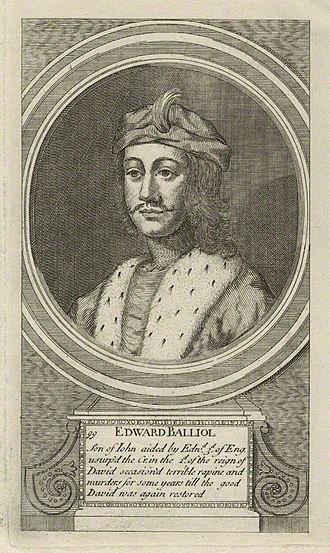
Isabella de Warenne, Queen of Scotland?

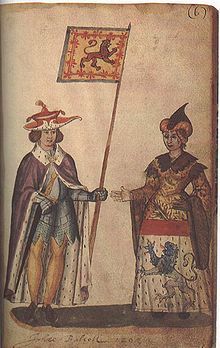
John Balliol and Isabella de Warenne

Whilst researching for my article on Ada de Warenne I discovered that a hundred years later, a kinswoman of hers also, briefly, made an appearance on the stage of Scottish history. I looked at both women, again in my latest book, Scotland’s Medieval Queens, a project I am immensely excited about. I love Scottish history!

Isabella de Warenne was the daughter of John de Warenne, 6th Earl of Surrey, and Alice de Lusignan. As such, Isabella had connections, both to royalty and the highest ranks of the English nobility. Her mother, Alice, was the daughter of King John of England’s widow, Isabella of Angouleme, and Hugh X de Lusignan and half-sister to Henry III of England. Isabella was, therefore, Henry’s niece and a 1st cousin of King Edward I. Through her paternal grandmother, Matilda Marshal, Isabella was also a great-granddaughter of the ‘Greatest Knight’ William Marshal, Earl of Pembroke and Regent of England in the early years of Henry III’s reign.

Isabella was one of three children; her elder sister, Eleanor, married Henry Percy and was the mother of Henry de Percy, 1st Baron Percy. Isabella’s younger brother, William de Warenne, married Joan de Vere, daughter of the 5th Earl of Oxford, and was father to two children, a son and a daughter; John and Alice. Isabella’s nephew, John de Warenne, was the last Earl of Warenne and Surrey, whose marital and extra-marital situation led to the extinction of the senior Warenne line. It was through John’s sister, Alice de Warenne, that the title earl of Surrey would eventually pass to her son Richard Fitzalan, 10th Earl of Arundel.

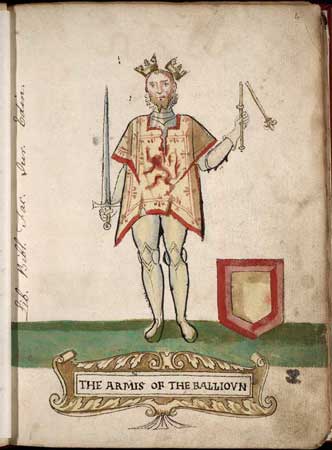
John Balliol, King of Scots

Alice de Lusignan died in 1256, shortly after giving birth to her youngest child, William, leaving the 25-year-old Earl Warenne to raise three young children alone. Alice de Lusignan was buried at Lewes Priory, the Warenne family mausoleum, she was ‘placed in the earth before the great altar in the presence of her brother Adelmar [Aymer de Valence], [bishop] elect of Winchester.’1 Isabella was probably born around 1253, although some genealogical sources claim she was younger and the daughter of a second, unknown wife of John de Warenne.

Isabella was married to John Balliol, Lord of Bywell, sometime before 7 February 1281. The confusion over her age is probably based on the writings of chronicler Thomas Wykes, who, in trying to explain why John Balliol did not succeed to the Balliol lands until a year after his brother’s death, suggested that the lands were in wardship to Edward I due to John Balliol’s youth. According to Wykes, Balliol needed Edward’s consent for his proposed marriage to Isabella, describing John as a youth, adolescens, and Isabella, a young girl, adolescentula. In fact, at the date of their marriage, John was about thirty years of age and Isabel was at least in her mid-twenties. Clearly, Edward could not have been exercising rights of wardship in a minority but the true reasons for his heavy-handed intervention are not clear.

Furthermore, there is no evidence that John ever remarried after Alice’s death, so this theory seems unlikely. It is just as likely – or more likely, in fact – that Isabella married late because previous marriage proposals or arrangements had failed, either due to failed negotiations or the death of the proposed groom. Such instances often went unrecorded, and are much more feasible than the suggestion that the earl had remarried but not one of the chroniclers of the time had mentioned it.

In the early 1290s, John Balliol was one of the 13 Competitors for the Scottish throne. He was the great-grandson of Ada de Warenne’s youngest son, David, Earl of Huntingdon, by David’s daughter, Margaret. John and Isabella were, therefore, 4th cousins, both being descended from William de Warenne, 2nd Earl of Surrey, and his wife, Isabel de Vermandois.

Balliol’s claim lay through seniority, he was grandson of Margaret, the eldest daughter of David of Huntingdon. The other leading Competitor was Robert de Brus, grandfather of the future King Robert (I) the Bruce. Robert de Brus’s claim lay in the fact he was closer in degree to the same David, being the son of David’s youngest daughter, Isobel. John Balliol was therefore David’s great-grandson, whereas Robert de Brus was his grandson, though by a younger daughter.

With 13 claimants to the Scottish throne it was Edward I of England who was given the duty of selecting Scotland’s next king. Isabella’s close family links to the English crown may have helped Edward decide in John’s favour and he was installed as King of Scotland in November 1292.

John and Isabella may have had at least three, but possibly four, children together.

A daughter, Margaret, died unmarried. There is mention of another daughter, Anne; but there is  doubt as to whether she ever existed.

Their eldest son, Edward, was born around 1283. Following the deposition of his father, in November 1299 Isabella and John’s oldest son, Edward, was entrusted to the custody of his Earl Warenne, who was then approaching his 70th year. After his grandfather’s death in 1304, Edward was transferred to the custody of his cousin John, the 7th Earl Warenne, until he was delivered into royal custody in 1310.

By the 1330s Edward’s prospects had improved. He was seen as a useful political tool, a rival claimant to the Scottish crown. With English support, Edward made his own bid for the throne, and was crowned king following his defeat of 8-year-old David II‘s forces at the Battle of Dupplin Moor in 1332. David’s supporters and Edward struggled against each other, until they eventually triumphed over Edward and he was deposed in 1336.

Isabella’s son, Edward Balliol, King of Scots

Edward finally surrendered his claim to the Scottish throne in 1356 whilst living in English exile; he died in Wheatley, Doncaster, probably in 1363 or 1364. Although his final resting place has recently been claimed to be under Doncaster Post Office, the former site of Doncaster Priory, it remains elusive.

John and Isabella’s possible younger son, Henry, was killed on 16th December 1332 at the Battle of Annan, a resounding victory for supporters of David II against Henry’s brother, Edward.

Although Edward was briefly married to Margaret of Taranto, the marriage was annulled. Neither Edward nor Henry had any children.

Very little is known of John and Isabella’s life together. Her death date and final resting place are both unknown. It is by no means certain that Isabella was still alive when John became king, so may have died before 1292, when John succeeded to the Scottish throne. She was no longer living, however, when her own father defeated John and the Scottish army at the Battle of Dunbar in April 1296; John abdicated in July of the same year and died in French exile in 1314.

John’s claim to the Scottish throne was supported by the Comyns, which led to the murder of John Comyn, in the church at Dumfries in 1306, by Robert the Bruce, who had succeeded his grandfather as the other leading Competitor to the throne. Shortly after the murder, he was crowned King Robert I at Scone but was only able to consolidate his rule after winning a resounding victory over the English at Bannockburn in 1314.

*

Footnotes:

1‘Annals written by a certain monk of Lewes, from the birth of Christ to the year 1312’ quoted in W.H. Blaauw, On the Early History of Lewes Priory, and its Seals, with extracts from a MS. Chronicle

Picture:

John Balliol and Isabella de Warenne from britroyals.com; Edward Balliol courtesy of Wikipedia

Further reading:

W.H. Blaauw, On the Early History of Lewes Priory, and its Seals, with extracts from a MS. Chronicle; William Farrer and Charles Travis Clay, editors, Early Yorkshire Charters, Volume 8: The Honour of Warenne; Nigel Tranter, The Story of Scotland; britroyals.com; Rev. John Watson, Memoirs of the Ancient Earls of Warren and Surrey, and Their Descendants to the Present Time, Volume I; G.P. Stell, John [John de Balliol] (c. 1248×50-1314) (article), Oxforddnb.com; Susan M. Johns, ‘Alice de Lusignan, suo jure countess of Eu’, Oxforddnb.com; Scott L. Waugh, Warenne, John de, sixth earl of Surrey [earl of Surrey and Sussex, Earl Warenne] (1231-1304) Oxforddnb.com; royal.gov.uk/HistoryoftheMonarchy/ScottishMonarchs; Alison Weir, Britain’s Royal Families; David Williamson, Brewer’s British Royalty; Mike Ashley, The Mammoth Book of British Kings and Queens; englishmonarchs.co.uk.

*

My Books

Signed, dedicated copies of all my books are available through my online bookshop.

Coming 30 January 2025: Scotland’s Medieval Queens

Scotland’s history is dramatic, violent and bloody. Being England’s northern neighbour has never been easy. Scotland’s queens have had to deal with war, murder, imprisonment, political rivalries and open betrayal. They have loved and lost, raised kings and queens, ruled and died for Scotland. From St Margaret, who became one of the patron saints of Scotland, to Elizabeth de Burgh and the dramatic story of the Scottish Wars of Independence, to the love story and tragedy of Joan Beaufort, to Margaret of Denmark and the dawn of the Renaissance, Scotland’s Medieval Queens have seen it all. This is the story of Scotland through their eyes.

Available for pre-order now.

Also by Sharon Bennett Connolly:

Defenders of the Norman Crown: The Rise and Fall of the Heroines of the Tudor World tells the stories of the most remarkable women from European history in the time of the Tudor dynasty, 1485-1603. These are the women who ruled, the women who founded dynasties, the women who fought for religious freedom, their families and love. Heroines of the Tudor World is now available for pre-order from Amberley Publishing and Amazon UK. Women of the Anarchy demonstrates how Empress Matilda and Matilda of Boulogne, unable to wield a sword themselves, were prime movers in this time of conflict and lawlessness. It shows how their strengths, weaknesses, and personal ambitions swung the fortunes of war one way – and then the other. Available from Bookshop.orgAmberley Publishing and Amazon UKKing John’s Right-Hand Lady: The Story of Nicholaa de la Haye is the story of a truly remarkable lady, the hereditary constable of Lincoln Castle and the first woman in England to be appointed sheriff in her own right. Available from all good bookshops Pen & Sword Booksbookshop.org and Amazon

Defenders of the Norman Crown: The Rise and Fall of the Warenne Earls of Surrey tells the fascinating story of the Warenne dynasty, from its origins in Normandy, through the Conquest, Magna Carta, the wars and marriages that led to its ultimate demise in the reign of Edward III. Available from Pen & Sword BooksAmazon in the UK and US, and Bookshop.orgLadies of Magna Carta: Women of Influence in Thirteenth Century England looks into the relationships of the various noble families of the 13th century, and how they were affected by the Barons’ Wars, Magna Carta and its aftermath; the bonds that were formed and those that were broken. It is now available in paperback and hardback from Pen & SwordAmazon, and Bookshop.orgHeroines of the Medieval World tells the stories of some of the most remarkable women from Medieval history, from Eleanor of Aquitaine to Julian of Norwich. Available now from Amberley Publishing and Amazon, and Bookshop.orgSilk and the Sword: The Women of the Norman Conquest traces the fortunes of the women who had a significant role to play in the momentous events of 1066. Available now from Amazon,  Amberley Publishing, and Bookshop.org.

Alternate Endings: An anthology of historical fiction short stories including Long Live the King… which is my take what might have happened had King John not died in October 1216. Available in paperback and kindle from Amazon.

Podcast:

Have a listen to the A Slice of Medieval podcast, which I co-host with Historical fiction novelist Derek Birks. Derek and I welcome guests, such as Bernard Cornwell, and discuss a wide range of topics in medieval history, from significant events to the personalities involved.

*

Don’t forget! Signed and dedicated copies of all my books are available through my online bookshop.

For forthcoming online and in-person talks, please check out my Events Page.

You can be the first to read new articles by clicking the ‘Follow’ button, liking our Facebook page or joining me on TwitterThreadsBluesky and Instagram.

*

©2015 Sharon Bennett Connolly FRHistS