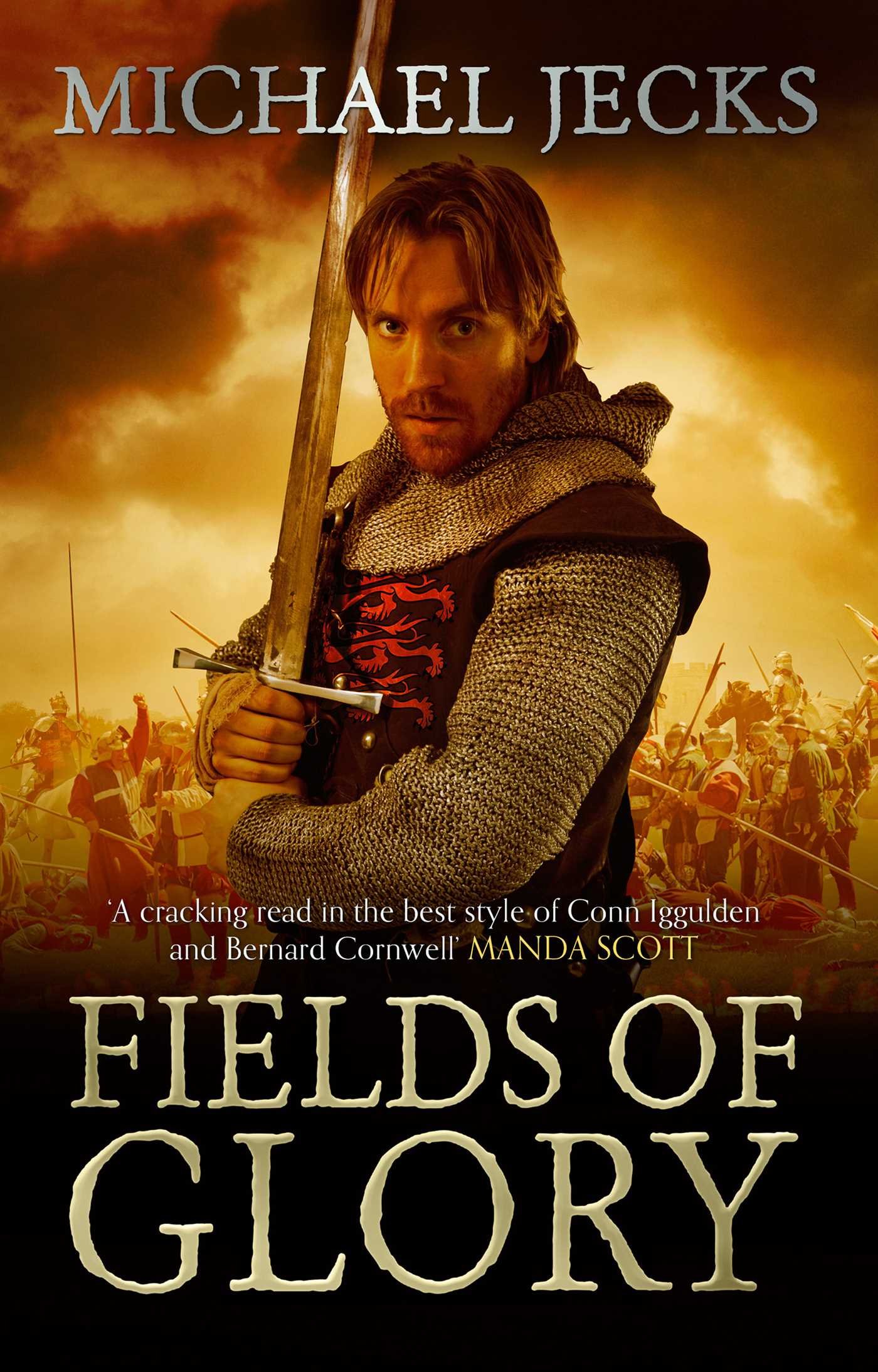
 “The year is 1346 and King Edward III is restless. Despite earlier victories his army has still not achieved a major breakthrough and the French crown remains intact. Determined to bring France under English rule and the French army to its knees he has regrouped and planned a new route of attack.
And on the beaches of Normandy his men now mass, ready to march through France to victory. But the French are nowhere to be seen. Edward knows that the worst thing he could do would be to take the battle to the French, where they will have the advantage and so he sets up camp near a small hill at Crécy and waits.
The Battle of Crécy will be a decisive turning point in the Hundred Years’ Wars. This is the story of that battle and the men who won it.”
A masterpiece!
Fields of Glory follows the English army from their landing on the beaches of Normandy, through the devastating destruction of the chevauchée through Northern France and to the gates of Paris itself, before the retreat ever north in search of a crossing of the River Somme, and the final confrontation with the French army.
We experience the sieges, the skirmishes, the looting and death through the eyes of one of Edward I’s captains and his vintaine (company) of 20 men; hardened soldiers who all have their own secrets, fears and superstitions.
We are also given snippets behind the decision-making of the great King Edward III and his 16-year-old son Edward, the future Black Prince. The army’s leaders are vivid, but distant, characters as the story concentrates on the experiences of the fighting men
The Vintaine’s captain, Berenger, leads his men through the armies skirmishes and their own personal battles and conflicts. Rescuing a French girl from the Welsh contingent brings its own problems, dividing the opinions and conflicts of the men while showing the humanity that still existed among the devastation.
Berenger is a seasoned soldier and experienced captain, who needs his men as much as – if not more than – they need him. His men are real characters; Clip, with his prophecies of doom becomes a sort mascot of the company – only if he predicts their deaths are they confident of survival; and Geoff, who projects his own demons onto others in order to avoid their reality. And then there’s young Ed, just a boy wanting revenge on the french for all the ills of the world, and learning the realities of war through this small band of soldiers.
And then there is Archibald, the King’s gynour, a strange loner of a man who incites fear and loathing even from his own side. He is in charge of the king’s gonnes, the cannon which are slowly becoming part of the modern battlefield, but which are still distrusted by the common soldier.
One scene in particular leaves the reader cold and thoughtful. I don’t want to give too much away, but the king’s justice, meted out to his own men following the plundering of a monastery, left me with a sleepless night, so vivid was the imagery invoked by the scene:
“Ed listened to the king’s words with breathless disbelief.
When the men had all been marched back to the army he had thought that there would be a court, an opportunity to explain – and yet here he was, with the sentence of death on him!”
How the scene plays out – well, I’ll leave that for you to discover, but it is thought-provoking, indeed.
Micheal Jecks’ treatment of the book’s climax – the Battle of Crécy itself – is gripping and masterful in its telling. While getting glimpses of the battle’s bigger picture, you are treated to the personal battles of Berenger’s men, the vicious hand-to-hand combat, the losses and victories. The devastation and risks wrought by the new battlefield science – gunpowder – are wonderfully described in great detail.
This is story-telling at its best.
The research is, as always, impeccable and the story of the Crécy campaign is told in all its devastation and glory. The interaction of the characters leaves the reader eager to know them better, to read on. The fight scenes are well though out and realistic, the narrative of the Battle of Crecy itself being the highlight of the book.
Michael Jecks‘s Knights Templar Mysteries have been entertaining readers for many years. I have been reading and enjoying his books since The Last Templar started it all. The knowledge and detail of the early 14th century judicial system has fascinated many.
Fields of Glory takes Michael Jecks in a whole new direction and I can’t say I’m disappointed. The story-telling is masterful – and has taken on a frenetic energy of its own. It is hard to believe he could write anything better, but Book 2 of this Hundred Years’ War series, Blood on the Sand, is already in the bookshops and promises to be just as exciting and action-filled as the first.
*
My book, Heroines of the Medieval World, is now available in hardback in the UK from both Amberley Publishing and Amazon UK and worldwide from Book Depository. It is also available on Kindle in both the UK and USA and will be available in Hardback from Amazon US from 1 May 2018.

Be the first to read new articles by clicking the ‘Follow’ button, liking our Facebook page or joining me on Twitter.
©Sharon Bennett Connolly 2015