Guest Post: Through Their Stories: The Women of 1066 by L.P. O’Bryan

As my long-time readers will know, I have always had an interest in the Norman Conquest and the women involved in the struggle for England, on all three sides of the fight. My book, Silk and the Sword: The Women of the Norman Conquest, is now recommended by the Historical Association for teaching the Norman Conquest in schools and I love to give talks to classes of Year 7 students who are studying the Conquest from this unique angle. So when author L.P. O’Bryan offered to write an article on his research into the women of the era, I could not resist.

So, over to L.P. O’Bryan

Through Their Stories: The Women of 1066

Edith of Wessex, Queen of England, grieving for Edward the Confessor, Bayeux Tapestry. 

The year 1066 stands as a watershed moment for England and Europe. The Battle of Hastings and the subsequent Norman Conquest altered the course of England’s history, reshaping its culture, language, and legal system.

While much has been written about the warriors and kings, the stories of the women who lived through these tumultuous times are often left untold. This article aims to explore the experiences of women amidst the upheaval of their society and the personal losses they endured.

The Prelude to Conquest

The year 1066 began with the death of Edward the Confessor, leaving a power vacuum that would draw Harold Godwinson, Harald Hardrada, and William of Normandy into a struggle for the English throne. Amidst this political turmoil, women of all stations managed their households and lands, often overseeing the welfare of their communities. Edith of Wessex, widow of Edward, and Gytha Thorkelsdóttir, mother of Harold Godwinson, were two examples of women who played significant roles in the fabric of English society at that time. Their lives, filled with the duties of governance and care, were about to be irrevocably changed.

The Battle of Hastings: A Turning Point

Edith Swan-Neck after Hastings looking for King Harold’s body. School of Lawrence Alma-Tadema.  

On October 14, 1066, the fate of England was decided on the battlefield near Hastings. For the women awaiting news, the battle represented a moment of profound anxiety and fear. The loss of life from the battle was staggering, with many women losing husbands, sons, brothers, and fathers. The immediate aftermath of the battle saw a shift in the social landscape too, as Norman forces began to assert control over the conquered lands.

Imagine the heartache of a woman like Edith Swan-Neck, Harold’s common-law wife, identifying his body on the battlefield. Her grief mirrored by thousands of others, whose lives were transformed overnight, their futures uncertain in a country now ruled by foreign invaders.

Adapting to Norman Rule

The Norman Conquest introduced significant changes to English society, including the imposition of Norman customs, laws, and, more slowly, language. For English women, this meant navigating a new order that often placed them at a disadvantage. Land rights, inheritance laws, and social statuses were all subject to the whims of the new Norman elite.

Despite these challenges, many English women found ways to adapt and survive. Some, like the legendary Lady Godiva, who is said to have protested against oppressive taxation under Norman rule, became symbols of resistance. The concept of a Peeping Tom, came from her ride, as a man named Tom was the only one believed to have opened his window to look at her. Such stories, whether more myth than real, highlight the resilience of women during this period of transition.

The Legacy of 1066 for Women
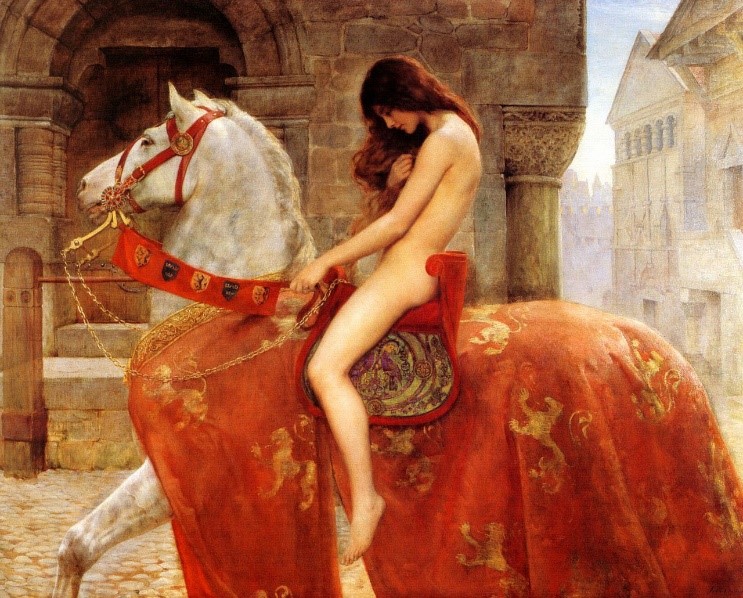
Lady Godiva by John Collier

The long-term effects of the Norman Conquest on English women were profound. The introduction of Norman customs and laws reshaped England, influencing women’s roles and rights for generations to come. The Domesday Book, a comprehensive survey ordered by William the Conqueror, provides insight into the changes in land ownership and societal structures that affected women’s lives.

Women who inherited family land because their husbands or fathers had been killed at Hastings in 1066, were allowed to keep their land if they married a Norman or Frenchman. Such marriages were intended to further the post-conquest social order and peace in England.

William the Conqueror betrothed his daughter Adeliza to the English Earl Edwin, though he was killed in 1070 before the marriage could take place.

Most intermarriages took place at the highest aristocratic level, intended to bring peace, though there were instances of intermarriage at other levels. One example is Wigot of Wallingford, the English guardian of an important crossing of the Thames near Oxford, agreed to have his daughter Ealdgyth marry Robert d’Ouilly, one of King William’s henchmen and later Castellan of Oxford.

The Domesday Book, completed in 1086, reveals that Judith was the most important woman landholder on the date when the Domesday survey was made. Omitting nunneries, she is one of about twenty women tenants-in-chief in 1086. Her extensive lands stretched throughout northern and eastern England, from Middlesex and Buckinghamshire to Yorkshire, with a concentration in the east Midlands. Judith was the widow of Earl Waltheof. She was also the niece of William the Conqueror. She was a northern French woman whose marriage was part of William’s attempts to come to terms with the English nobility after his conquest in 1066. By 1086 Judith’s husband was dead, executed for his part in rebellion. Judith was now a wealthy widow.

Many of the relatively small number of women mentioned in Domesday are relatives of William the Conqueror, illustrating how he had transferred most of the largest landholdings in England to his extended family. See this PDF article for more on the women in Domesday.

Other women, Godgifu and Allfgifu for example, the wives of two English earls, Edwin and Morcar, debated over their attitudes to the Conqueror, but still survived. These widows got to keep their dower and died in possession of at least some of it. They were part of a noble group whose power had arisen during the tenth and early eleventh centuries, and even within that group fortunes differed greatly.

The lack of information about lower born eleventh-century women does not justify sweeping generalization about them, however Domesday does provide some data. The statistics of Domesday suggest at first sight a deterioration in status. In Essex, for example, there were 25 women holding land in 1066, 9 in 1086; in Yorkshire, 19 in 1066, 4 in 1086; in Suffolk over 50 in 1066, 7 in 1066. Yet other shires show no decline, even a slight increase, as in Dorset where there were 9 women in 1066 and 10 in 1086 or in Warwickshire, with 8 in 1066 and 9 in 1086.

The women of 1066 experienced the Norman Conquest not just as a historical event, but as a deeply personal trauma that reshaped their lives and the lives of their descendants. Their stories, often overshadowed by the tales of kings and warriors, offer a poignant perspective on one of England’s most significant historical moments.

In remembering their stories, we honor their legacy, recognizing the vital role women have played in shaping our world. The women of 1066, through their resilience and adaptability, have left an indelible mark on history, reminding us of the power of the human spirit to endure, adapt, and overcome.

About the author:

L.P. O’Bryan is the author of a series of novels set in the aftermath of the Battle of Hastings, starting with, The Rise of Synne, more detail here. The series is about an orphan healer in the aftermath of Hastings.

*

My Books:

Signed, dedicated copies of all my books are available through my online bookshop.

Out Now! Women of the Anarchy
Two cousins. On the one side is Empress Matilda, or Maud. The sole surviving legitimate child of Henry I, she is fighting for her birthright and that of her children. On the other side is her cousin, Queen Matilda, supporting her husband, King Stephen, and fighting to see her own son inherit the English crown. Women of the Anarchy demonstrates how these women, unable to wield a sword, were prime movers in this time of conflict and lawlessness. It show how their strengths, weaknesses, and personal ambitions swung the fortunes of war one way – and then the other.

Available from Bookshop.orgAmberley Publishing and Amazon UK.

Coming on 15 June 2024: Heroines of the Tudor World
Heroines of the Tudor World tells the stories of the most remarkable women from European history in the time of the Tudor dynasty, 1485-1603. These are the women who ruled, the women who founded dynasties, the women who fought for religious freedom, their families and love. These are the women who made a difference, who influenced countries, kings and the Reformation. In the era dominated by the Renaissance and Reformation, Heroines of the Tudor World examines the threats and challenges faced by the women of the era, and how they overcame them. From writers to regents, from nuns to queens, Heroines of the Tudor World shines the spotlight on the women helped to shape Early Modern Europe.

Heroines of the Tudor World is now available for pre-order from Amberley Publishing and Amazon UK.

Also by Sharon Bennett Connolly:

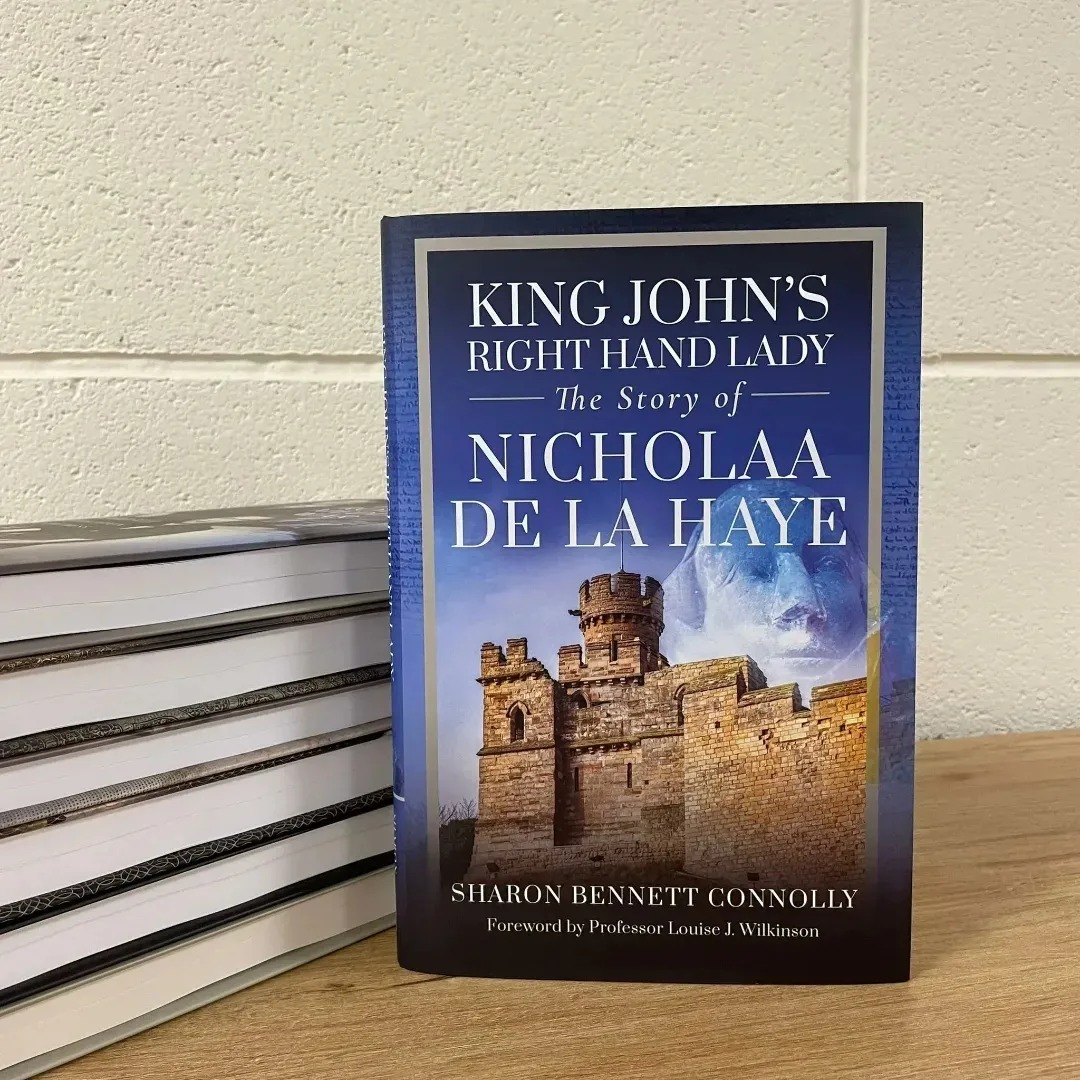
King John’s Right-Hand Lady: The Story of Nicholaa de la Haye is the story of a truly remarkable lady, the hereditary constable of Lincoln Castle and the first woman in England to be appointed sheriff in her own right. Available from all good bookshops or direct from Pen & Sword Booksbookshop.org and AmazonDefenders of the Norman Crown: The Rise and Fall of the Warenne Earls of Surrey tells the fascinating story of the Warenne dynasty, from its origins in Normandy, through the Conquest, Magna Carta, the wars and marriages that led to its ultimate demise in the reign of Edward III. Available from Pen & Sword BooksAmazon in the UK and US, and Bookshop.org

Ladies of Magna Carta: Women of Influence in Thirteenth Century England looks into the relationships of the various noble families of the 13th century, and how they were affected by the Barons’ Wars, Magna Carta and its aftermath; the bonds that were formed and those that were broken. It is now available in paperback and hardback from Pen & Sword,  Amazon, and Bookshop.orgHeroines of the Medieval World tells the stories of some of the most remarkable women from Medieval history, from Eleanor of Aquitaine to Julian of Norwich. Available now from Amberley Publishing and Amazon, and Bookshop.orgSilk and the Sword: The Women of the Norman Conquest traces the fortunes of the women who had a significant role to play in the momentous events of 1066. Available now from Amazon,  Amberley Publishing, and Bookshop.org.

Alternate Endings: An anthology of historical fiction short stories including Long Live the King… which is my take what might have happened had King John not died in October 1216. Available in paperback and kindle from Amazon.

Podcast:

Have a listen to the A Slice of Medieval podcast, which I co-host with Historical fiction novelist Derek Birks. Derek and I welcome guests, such as Bernard Cornwell and Elizabeth Chadwick, and discuss a wide range of topics in medieval history, from significant events to the personalities involved.

*

Don’t forget! Signed and dedicated copies of all my books are available through my online bookshop.

For forthcoming online and in-person talks, please check out my Events Page.

You can be the first to read new articles by clicking the ‘Follow’ button, liking our Facebook page or joining me on Twitter and Instagram.

*

©2024 Sharon Bennett Connolly FRHistS and L.P. O’Bryan

Matilda of Boulogne: From Countess to Queen

Matilda of Boulogne, Queen of England

King Stephen’s wife, Matilda of Boulogne, was a stalwart supporter of her husband. She was arguably more capable than Stephen and often took the initiative in diplomatic negotiations. Acting as Stephen’s wife, she offered a stark contrast to the independence and authority of Empress Matilda that so infuriated the barons. Matilda of Boulogne was a little more subtle than her imperious counterpart, only ever acting in her husband’s name, not her own. Even later, when she held the command of Stephen’s forces during his captivity in 1141, she claimed to act only on behalf of her husband and sons.

Matilda of Boulogne was an example of how a woman was expected to act and comport herself: strong and confident, but subject to her husband’s will. On this last, Empress Matilda failed in the eyes of the barons; she was acting for herself. In the event, the barons of England and Normandy despised her second husband, Geoffrey of Anjou, so they would have been even less receptive to Matilda had her husband tried to assert his authority. It was a conundrum that Matilda was never able to resolve, though she would not give up trying.

According to the Gesta Stephani (The Deeds of Stephen), Stephen of Blois was ‘by far the dearest of all his nephews to King Henry the peacemaker, not only because of the close family relationship, but also because he was peculiarly eminent for many conspicuous virtues’. Born at Blois in or around 1096, Stephen was the third son of Adela and her husband, Stephen, Count of Blois and Chartres. His father was one of the leaders of the First Crusade and may well have departed for the Holy Land before – or shortly after – the younger Stephen’s birth. It is likely that young Stephen had little contact with his father; the count returned from crusade in 1198, only to depart again in 1201.

In 1125, it was King Henry who arranged for Stephen’s marriage to the daughter and sole heiress of the Count of Boulogne, Matilda. Matilda’s mother was Mary of Scotland, sister of Henry I’s first wife, Matilda of Scotland; the younger Matilda was therefore first cousin to Henry I’s daughter, Empress Matilda. The daughter of King Malcolm III Canmore and his queen Margaret of Wessex, Mary of Scotland could trace her illustrious heritage all the way back to Alfred the Great; she had been educated in England alongside her sister. Mary was married to Eustace III, Count of Boulogne, and their only child, Matilda, was probably born the following year, in 1105. The baby’s maternal aunt, Matilda of Scotland, stood as godmother. It is possible that, like her mother and aunt, young Matilda was educated at the convents of Wilton and Romsey. She was certainly a well-educated and capable woman. As we shall see, as an adult, she seems as erudite and well versed in politics as her husband, perhaps with an even better capacity for diplomacy.

Henry I, King of England

Mary of Scotland died when her daughter was around ten or eleven years old, on 31 May 1116. She was buried in the wealthy Cluniac house of Bermondsey Abbey in England.

The county of Boulogne lay within the greater county of Flanders. Nominally owing fealty to France, it was largely autonomous and held extensive interests in England, particularly in Essex and the south-east. The county also controlled one of the most important Channel crossings to England at Wissant. Keeping the county onside by marrying a reliable magnate to the heir to Boulogne was of great interest to Henry. As its heiress, Matilda of Boulogne was a figure of major political significance, her marriage deserving of careful consideration. Given that she was still unmarried at the age of twenty, with such a rich inheritance, it is possible that previous but unrecorded marital arrangements had fallen through, or that her father and uncle had taken extra care in ensuring that Matilda’s hand in marriage went to the right person.

By 1125, King Henry had been married to Adeliza of Louvain for four years, but no children had been born of the union. Likewise, Henry’s daughter, Empress Matilda, had yet to produce a living child and was at this stage more likely to be envisioning a future within the empire rather than as her father’s successor. King Henry may have been looking elsewhere for an heir to his throne; his Blois nephews, Theobald and Stephen, were the obvious candidates. As a bride to Stephen, Matilda of Boulogne would strengthen his claim to the throne, both by her Saxon royal blood and by the financial backing of the county of Boulogne.

Matilda of Boulogne and Stephen were married early in 1125, though the exact date is not recorded. Shortly after the marriage, Matilda’s father, Eustace, a former crusader, abdicated in favour of his son-in-law. Eustace retired to the Cluniac priory at Romilly, taking leave of his daughter and son-in-law in a public ceremony, probably followed by a private farewell, at the priory where he died a short time later, aged about seventy-five. As Count of Boulogne and Mortain, Stephen was now a man to be reckoned with, with considerable resources on both sides of the English Channel; he was the greatest landowner in Suffolk, Essex and the north-west of England.

Rule over the strategically important county of Boulogne would be a suitable training ground for Stephen to get used to exercising significant power in his own right. Through certain charters in the latter half of the 1120s, we can see Stephen administering his cross-Channel lordship. In 1127 he founded Furness Abbey in his lordship of Lancaster. The abbey’s mother house was located at Savigny, in Stephen’s county of Mortain. In the same year, Stephen granted the monks of Canterbury Cathedral priory an exemption from tolls at Wissant, the port through which they shipped their wine.

Empress Matilda depicted at the coronation of her granddaughter, Matilda of England, as Duchess of Saxony, in an image from the Gospels of Henry the Lion.

In marrying into the county of Boulogne, Stephen had joined a family well versed in commerce. He was heavily involved in the county’s business proceedings, usually mentioned alongside his wife, Matilda of Boulogne, who appears to have been the one in charge of the day-to-day management of the county. The Essex town of Colchester was the centre of administration for Boulogne’s interests in England. In the early years of Henry I’s reign the lands in Colchester had been identified as ‘the lands of Count Eustace,’ and were built up with the addition of lands that had belonged to Eudo Dapifer, also known as Iwun al Capel, brother-in-law of William the Conqueror and a member of the de la Haye family, until his death in 1120.

Stephen and Matilda were at Canterbury in person to confirm a charter to the monks of Christ Church, which gave the monks freedom from customs duties for the port of Wissant, granted by Count Eustace. The count and countess placed their sealed charter on the high altar of the abbey church; it is still held in the abbey archives. The ceremony was presided over by the Archbishop of Canterbury himself, William Corbeil. In 1131, the couple wrote to the archbishop and the Bishop of Ely to notify them that they had transferred the secular rights of the church at Gamlingay in Cambridgeshire to the Augustinian canons of Colchester, ‘for the remission of our sins and those of our ancestors and for the safe preservation of our son, Eustace, and our other offspring and for our temporal well-being.’ This is the first mention of Eustace and dates his birth to no later than August 1131, when Hervey, Bishop of Ely, died.

The fact these charters were jointly granted by both Stephen and Matilda serve to demonstrate how closely involved Matilda was in the management of the county, and how closely Stephen and Matilda worked together as a couple. The trust they developed in each other would stand them in good stead in the years to come.

In the early 1130s Matilda of Boulogne, like her counterpart Empress Matilda in Anjou, would have been occupied with a number of pregnancies. The couple’s first child, a son named Eustace, was born no later than 1131 and at least two further children, Baldwin and Matilda, were born before Stephen became king in 1135. Little Baldwin died before his father even came to the throne; he was buried beside the altar at Holy Trinity, Aldgate, the abbey founded by the countess’s aunt Matilda of Scotland, Henry I’s first queen. That Baldwin was buried in London suggests that Matilda spent time in England as well as Boulogne during this period. Two more children, William and Mary (or Marie), were probably born after Stephen seized the crown. The three older children were given names that called to mind the county of Boulogne, with both Eustace and Baldwin being the names of several former counts. William, on the other hand, was a reference to Stephen’s grandfather, William the Conqueror, King of England.

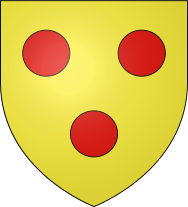
Arms of the county of Boulogne

Despite henry I having his barons swear – twice – to uphold the claims of his daughter to the throne of England, Henry I left no written instruction as to the disposition of his throne and lands, which led to the chroniclers disputing exactly what the king had intended. What is certain is that in his final days, Henry did not name his heir. Unfortunately, the lack of this definitive designation at the last meant that there was enough ambiguity for Stephen to seize the initiative.

What the chronicles do agree on is that Henry’s death caused a great deal of unrest on both sides of the Channel. According to Orderic Vitalis, ‘on the very same day that the Normans heard that their firm ruler had died in the first week of Advent they rushed out hungrily like ravening wolves to plunder and ravage mercilessly’. On the other side of the Channel, the Anglo-Saxon Chronicle made a similar report: ‘Then his land immediately grew dark because every man who could immediately robbed another.’

At Henry I’s death in December 1135, the major players in the drama that was about to unfold were scattered throughout the Anglo-Norman realm. Robert, Earl of Gloucester was at his father’s side; Queen Adeliza was in England; Empress Matilda was in Anjou with her husband, Geoffrey, and in the early stages of her third pregnancy; and Stephen of Blois was in Boulogne with his wife, Matilda. In the days after the king’s death, the lack of a designated heir was evident, and the barons moved to maintain peace in Normandy.

Stephen, King of England

Stephen had decided his own priorities, possibly well in advance of the king’s death and perhaps in collusion with his brother, Theobald. Whether Empress Matilda had an inkling of what Stephen was planning we do not know, though it seems unlikely given her own move into Normandy and no further. Stephen was not with the king when he died. Although he had been with Henry at Rouen earlier in the year, by late November 1135 he was in his county of Boulogne and it was there that the news of the king’s demise reached him, probably two or three days later. The speed of Stephen’s response, and its organisation, shows that he had been contemplating his plan of action for some time.

It is not hard to imagine him sitting in Boulogne, surrounded by his wife and family, watching and waiting for the arrival of the news that would set his plans in motion. According to the Gesta Stephani, ‘as soon as he heard by report that King Henry had breathed his last, forming a mighty design like the famous Saul, [Stephen] made for the coast, since he was the other side of the Channel, and happening to gain a favourable wind turned his mind and his ship towards England’.

Leaving his wife and children in the relative safety of Boulogne, Stephen took what must have been the biggest gamble of his life.

*

Further reading:

Donald Matthew, King Stephen; Robert Bartlett, England Under the Norman and Angevin Kings; David Williamson, Brewer’s British Royalty; the History Today Companion to British History; Dan Jones, the Plantagenets; englishmonarchs.co.uk; The Oxford Companion to British History; Mike Ashley, The Mammoth Book of British kings & Queens; Alison Weir, Britain’s Royal Families, the Complete Genealogy; Farrer, William and Charles Travis Clay, editors, Early Yorkshire Charters, Volume 8: The Honour of WarenneGesta Stephani; Henry of Huntingdon, The History of the English People 1000-1154; J. Sharpe (trans.), The History of the Kings of England and of his Own Times by William Malmesbury; Catherine Hanley, Matilda: Empress, Queen, Warrior; Orderici Vitalis, Historiae ecclesiasticae libri tredecem, translated by Auguste Le Prévost; Chronicles of the Reigns of Stephen, Henry II and Richard I; Edmund King, King Stephen; Donald Matthew, King Stephen; Teresa Cole, the Anarchy: The Darkest Days of Medieval England;  Matthew Lewis, Stephen and Matilda’s Civil War: Cousins of Anarchy.

*

My Books:

Signed, dedicated copies of all my books are available through my online bookshop.

Out Now! Women of the Anarchy

Two cousins. On the one side is Empress Matilda, or Maud. The sole surviving legitimate child of Henry I, she is fighting for her birthright and that of her children. On the other side is her cousin, Queen Matilda, supporting her husband, King Stephen, and fighting to see her own son inherit the English crown. Women of the Anarchy demonstrates how these women, unable to wield a sword, were prime movers in this time of conflict and lawlessness. It show how their strengths, weaknesses, and personal ambitions swung the fortunes of war one way – and then the other.

Available from Bookshop.orgAmberley Publishing and Amazon UK.

Coming on 15 June 2024: Heroines of the Tudor World

Heroines of the Tudor World tells the stories of the most remarkable women from European history in the time of the Tudor dynasty, 1485-1603. These are the women who ruled, the women who founded dynasties, the women who fought for religious freedom, their families and love. These are the women who made a difference, who influenced countries, kings and the Reformation. In the era dominated by the Renaissance and Reformation, Heroines of the Tudor World examines the threats and challenges faced by the women of the era, and how they overcame them. From writers to regents, from nuns to queens, Heroines of the Tudor World shines the spotlight on the women helped to shape Early Modern Europe.

Heroines of the Tudor World is now available for pre-order from Amberley Publishing and Amazon UK.

Also by Sharon Bennett Connolly:

King John’s Right-Hand Lady: The Story of Nicholaa de la Haye is the story of a truly remarkable lady, the hereditary constable of Lincoln Castle and the first woman in England to be appointed sheriff in her own right. Available from all good bookshops or direct from Pen & Sword Booksbookshop.org and AmazonDefenders of the Norman Crown: The Rise and Fall of the Warenne Earls of Surrey tells the fascinating story of the Warenne dynasty, from its origins in Normandy, through the Conquest, Magna Carta, the wars and marriages that led to its ultimate demise in the reign of Edward III. Available from Pen & Sword BooksAmazon in the UK and US, and Bookshop.org

Ladies of Magna Carta: Women of Influence in Thirteenth Century England looks into the relationships of the various noble families of the 13th century, and how they were affected by the Barons’ Wars, Magna Carta and its aftermath; the bonds that were formed and those that were broken. It is now available in paperback and hardback from Pen & Sword,  Amazon, and Bookshop.orgHeroines of the Medieval World tells the stories of some of the most remarkable women from Medieval history, from Eleanor of Aquitaine to Julian of Norwich. Available now from Amberley Publishing and Amazon, and Bookshop.orgSilk and the Sword: The Women of the Norman Conquest traces the fortunes of the women who had a significant role to play in the momentous events of 1066. Available now from Amazon,  Amberley Publishing, and Bookshop.org.

Alternate Endings: An anthology of historical fiction short stories including Long Live the King… which is my take what might have happened had King John not died in October 1216. Available in paperback and kindle from Amazon.

Podcast:

Have a listen to the A Slice of Medieval podcast, which I co-host with Historical fiction novelist Derek Birks. Derek and I welcome guests, such as Bernard Cornwell and Elizabeth Chadwick, and discuss a wide range of topics in medieval history, from significant events to the personalities involved.

*

Don’t forget! Signed and dedicated copies of all my books are available through my online bookshop.

For forthcoming online and in-person talks, please check out my Events Page.

You can be the first to read new articles by clicking the ‘Follow’ button, liking our Facebook page or joining me on Twitter and Instagram.

*

©2024 Sharon Bennett Connolly FRHistS.

Warenne Family Ties

Seal of John de Warenne, 6th earl of Warenne and Surrey

In the reign of Edward I, when asked Quo Warranto – by what warrant he held his lands – John de Warenne, the 6th earl of Surrey, is said to have drawn a rusty sword, claiming “My ancestors came with William the Bastard, and conquered their lands with the sword, and I will defend them with the sword against anyone wishing to seize them”

When I started writing Defenders of the Norman Crown: Rise and Fall of the Warenne Earls of Surrey, I expected to find a healthy – or, rather, unhealthy – level of sibling rivalry. After all, this family was related to both the Norman and Plantagenet royal families, neither of whom are renowned for any sort of brotherly love.

You only have to look at the warring antics of Robert Curthose, William II and Henry I, to imagine the level of sibling rivalry involved in Norman times. The three brothers fought over who should have Normandy and England after their father’s death, to the extent that Robert Curthose ended up the prisoner of his little brother, Henry I, for the last 30 years of his life. The Plantagenets were little better, with Prince – later King – John trying to steal his brother’s throne while Richard I was imprisoned in Germany.

William de Warenne, 1st Earl Warenne, Trinity Church, Southover.

With these examples in mind, I was surprised to discover that the Warennes were a rather functional bunch as far as family goes. They went out of their way to help and support each other, even to the extent of half-siblings and in-laws. William de Warenne, the first earl of Warenne and Surrey (often referred to, simply, as Earl Warenne), pursued a private feud with English freedom fighter, Hereward the Wake, after he murdered William’s brother-in-law, Frederic. 

The Warenne (Hyde) Chronicle claims that Hereward, ‘Among his other crimes, by trickery he killed Frederick, brother[-in-law] of Earl William of Warenne, a man distinguished by lineage and possessions, who one night was surrounded in his own house.’ Following Frederic’s murder, according to the Chronicle, ‘such discord arose between Hereward and William that it could not be settled by any reparation nor in any court.’ According to the Gesta Herewardi, Frederic was planning to capture or kill Hereward, who struck first by killing Frederic.

William de Warenne was determined to get his revenge; he attempted to ambush Hereward at a place called Earith. One of William’s men tried unsuccessfully to bribe Hereward’s men to betray him. William was unhorsed when Hereward fired an arrow at him; it rebounded from William’s mailcoat, but the force of the shot saw William fall from his horse and rendered unconscious as he hit the ground. The ambush having failed, William de Warenne then appears in the Gesta Herewardi with an angry outburst against the Norman knight Deda, who had given a eulogistic account of the rebels on the Isle of Ely. According to the Liber Eliensis, William ‘flared up with weighty indignation, and alleged that he [Deda] had been inveigled by a bribe and was lying.’

St Pancras Priory, Lewes, the Warenne family mausoleum

William de Warenne, the second Earl Warenne, continued the tradition of looking out for family, when his younger brother, Rainald, was captured by King Henry I. In 1105 Rainald de Warenne was among the supporters of Robert Curthose, Duke of Normandy and Henry I’s oldest brother, who captured and imprisoned Robert fitz Hamon, a friend of King Henry, intending to ransom him. Henry saw fitz Hamon’s capture as an opportunity to deal decisively with Normandy, though he claimed he was invading not out of ambition, but to protect the church and the poor people of Normandy. 

Henry invaded in the spring of 1106. Rainald de Warenne was captured by Henry’s forces during a skirmish at the fortified Abbey of Saint-Pierre-sur-Dive. The abbot there had been plotting with Duke Robert to trap Henry, offering to hand over the castle to the English king, while sequestering Rainald de Warenne, Robert de Stuteville and their men within, ready to seize Henry as soon as he entered. Suspecting treachery, Henry arrived at daybreak with a force of 700 men-at-arms and took the garrison completely by surprise, capturing the duke’s men and burning the castle to the ground.

The sources vary, but Rainald was released either shortly before or shortly after the battle of Tinchebrai – the final, decisive battle between the royal Norman brother. Orderic Vitalis claims that William de Warenne served as one of King Henry’s chief commanders at Tinchebrai and that Rainald was released shortly before the battle. Grateful for his brother’s release, Earl William urged his men to fight the king’s cause with the utmost determination. 

According to the Warenne (Hyde) Chronicle, however, Rainald was not released until after the battle, when he was ‘reluctantly handed back to his brother, who pleaded for him to Henry.’ Whichever is correct, the result was the same, Rainald was now free, thanks to the insistence and loyalty of his older brother.

Warenne shield of blue and gold check, Trinity Church, Southover.

In the next generation, the children and stepchildren of William de Warenne, the 2nd Earl Warenne, got on remarkably well together. William had married Isabel de Vermandois, the widow of the recently deceased Robert de Beaumont, Earl of Leicester. Isabel was already the mother of 9 children, including the famous twins Robert and Waleran de Beaumont, when she married William, with whom the chronicler Henry of Huntingdon claims she was having an affair, even before her husband died. 

With William, Isabel had a further 5 children, 3 boys and 2 girls. Earl Warenne was at King Henry I’s deathbed, alongside his son, also named William de Warenne (the future 3rd Earl Warenne), and stepsons, Waleran and Robert de Beaumont. When the 2nd Earl Warenne died, it was Waleran de Beaumont who became the head of the combined, and rather large, Beaumont/Warenne family. Indeed, Waleran and William de Warenne, 3rd Earl Warenne, having grown tired of the Anarchy – the war between King Stephen and Empress Matilda which lasted from 1135 to 1154 – departed on Crusade together in 1147. Unfortunately, William de Warenne was killed at the Battle of Mount Cadmus in January 1148, and Waleran returned home alone.

A touching story from just before his departure on crusade relates to the 3rd Earl Warenne and his two younger brothers, Reginald and Ralph de Warenne. The earl held a dedication ceremony for the new church at St Pancras Priory, Lewes, the mausoleum of the Warenne family, founded by the 1st earl and his wife, Gundrada. In the accompanying charter, the earl endowed the priory, in which his father and grandparents were buried, and where his mother would soon be laid to rest, with the tenth penny of his rents and ‘giving it seisin thereof by hair from his own head and that of Ralph de Warenne his brother, cut with a knife by Henry, bishop of Winchester, before the altar.’ 

It is not hard to imagine how moving a ceremony this must have been, two brothers kneeling before the altar to have their hair cut by the bishop of Winchester, Henry of Blois, the brother of King Stephen. The scene is made all the more poignant in hindsight, knowing that the third earl never returned from the crusade on which he was about to embark.

Conisbrough Castle

And when the 3rd Earl Warenne failed to return from the Holy Land, it was down to his younger brother, Reginald, to look after the family interests and those of his brother’s sole surviving heir, William’s daughter, Isabel de Warenne, the 4th Countess of Warenne and Surrey. Isabel, though still only a child, had been married to King Stephen’s youngest son, William of Blois, probably before her father’s departure to the Holy Land. Isabel’s second husband, Hamelin, the illegitimate half-brother of Henry II, built the great keep at Conisbrough Castle.

Hamelin and Isabel’s son, William de Warenne, the 5th earl, looked out for the interests of his niece, Alice de Lusignan, in her struggles with the crown, both under King John and Henry III, to secure her inheritance of Tickhill Castle in Yorkshire.

Such examples of the earls taking care of their family, and working in alliance with their in-laws, was to be a feature of every generation down to the 7th and last earl, John II de Warenne, who was given the custody and care of his cousin, Edward Balliol, the son of John Balliol, the deposed King of Scots, around 1307. The Warenne earls, to a man, looked after their relations, both near and far. In the story of a family, it is quite fitting – and highly unusual – that the Warenne earls appear to have always put family first.

*

Images:

Are ©2023 Sharon Bennett Connolly FRHistS except the seal of John de Warenne, which is courtesy of Wikimedia Commons

Sources:

Robert Bartlett, England Under the Norman and Angevin Kings; Dan Jones, The Plantagenets; Donald Matthew, King Stephen; Medieval Lands Project on the Earls of Surrey, Conisbrough Castle; Farrer, William and Charles Travis Clay, editors, Early Yorkshire Charters, Volume 8: The Honour of Warenne; Morris, Marc King John: Treachery, Tyranny and the Road to Magna Carta; Church, Stephen, King John: England, Magna Carta and the Making of a Tyrant; doncasterhistory.co.uk; A History of the County of Sussex: Volume 2 edited by William Page; W.H. Blaauw, On the Early History of Lewes Priory, and its Seals, with extracts from a MS. Chronicle, Sussex Archaeological Collections; Rev. John Watson, Memoirs of the Ancient Earls of Warren and Surrey, and Their Descendants to the Present Time, Volume I;  Odo of Deuil, De Profectione Ludovici VII in Orientem; magnacharta.com; Cokayne, G.E., The Complete Peerage, Vol. XII; Henry of Huntingdon, The Chronicle of Henry of Huntingdon; Elisabeth van Houts and Rosalind C. Love, The Warenne (Hyde) Chronicle.

*

My Books

Christmas is coming!

Signed, dedicated copies of all my books are available through my online bookshop.

Coming 15 January 2024: Women of the Anarchy

On the one side is Empress Matilda, or Maud. The sole surviving legitimate child of Henry I, she is fighting for her birthright and that of her children. On the other side is her cousin, Queen Matilda, supporting her husband, King Stephen, and fighting to see her own son inherit the English crown. Both women are granddaughters of St Margaret, Queen of Scotland and descendants of Alfred the Great of Wessex. Women of the Anarchy demonstrates how these women, unable to wield a sword, were prime movers in this time of conflict and lawlessness. It show how their strengths, weaknesses, and personal ambitions swung the fortunes of war one way – and then the other.

Available for pre-order from Amberley Publishing and Amazon UK.

Coming on 15 June 2024: Heroines of the Tudor World

Heroines of the Tudor World tells the stories of the most remarkable women from European history in the time of the Tudor dynasty, 1485-1603. These are the women who ruled, the women who founded dynasties, the women who fought for religious freedom, their families and love. These are the women who made a difference, who influenced countries, kings and the Reformation. In the era dominated by the Renaissance and Reformation, Heroines of the Tudor World examines the threats and challenges faced by the women of the era, and how they overcame them. Some famous, some infamous, some less well known, including Anne Boleyn, Elizabeth Barton, Catherine de Medici, Bess of Hardwick and Elizabeth I. From writers to regents, from nuns to queens, Heroines of the Tudor World shines the spotlight on the women helped to shape Early Modern Europe.

Heroines of the Tudor World is now available for pre-order from Amberley Publishing and Amazon UK.

Also by Sharon Bennett Connolly:

King John’s Right-Hand Lady: The Story of Nicholaa de la Haye is the story of a truly remarkable lady. Nicholaa de la Haye was the hereditary constable of Lincoln Castle and the first woman in England to be appointed sheriff in her own right. Her strength and tenacity saved England at one of the lowest points in its history. Nicholaa de la Haye is one woman in English history whose story needs to be told… King John’s Right-Hand Lady: The Story of Nicholaa de la Haye is now available from Pen & Sword Booksbookshop.org and Amazon.

Defenders of the Norman Crown: The Rise and Fall of the Warenne Earls of Surrey tells the fascinating story of the Warenne dynasty, of the successes and failures of one of the most powerful families in England, from its origins in Normandy, through the Conquest, Magna Carta, the wars and marriages that led to its ultimate demise in the reign of Edward III. Defenders of the Norman Crown: Rise and Fall of the Warenne Earls of Surrey is now available from Pen & Sword BooksAmazon in the UK and US, and Bookshop.org.

Ladies of Magna Carta: Women of Influence in Thirteenth Century England looks into the relationships of the various noble families of the 13th century, and how they were affected by the Barons’ Wars, Magna Carta and its aftermath; the bonds that were formed and those that were broken. It is now available in paperback and hardback from Pen & Sword,  Amazon, and Bookshop.org.

Heroines of the Medieval World tells the stories of some of the most remarkable women from Medieval history, from Eleanor of Aquitaine to Julian of Norwich. Available now from Amberley Publishing and Amazon, and Bookshop.org.

Silk and the Sword: The Women of the Norman Conquest traces the fortunes of the women who had a significant role to play in the momentous events of 1066. Available now from Amazon,  Amberley Publishing, and Bookshop.org.

Alternate Endings: An anthology of historical fiction short stories including Long Live the King… which is my take what might have happened had King John not died in October 1216. Available in paperback and kindle from Amazon.

Podcast:

Have a listen to the A Slice of Medieval podcast, which I co-host with Historical fiction novelist Derek Birks. Derek and I welcome guests, such as Bernard Cornwell, and discuss a wide range of topics in medieval history, from significant events to the personalities involved.

*

Don’t forget! Signed and dedicated copies of all my books are available through my online bookshop.

For forthcoming online and in-person talks, please check out my Events Page.

You can be the first to read new articles by clicking the ‘Follow’ button, liking our Facebook page or joining me on Twitter and Instagram.
*

©2023 Sharon Bennett Connolly FRHistS

Guest Post: the Historical Rabbit Hole by Maxine Sommer

Today I have the pleasure of welcoming Maxine Sommer to History…the Interesting Bits, a lover of Medieval History, if ever there was one. Next year, Maxine will run her first History tours through England and France, following the trail of the Plantagenets.

I fell down a rabbit hole…

And emerged into a historical realm alive with chivalry, intrigue and power struggles.

You may ask what on earth would impel an unassuming middle-aged woman who only braved her first flight outside Australia at the age of 41, to decide to create a tour company specializing in historical-themed tours of France and the UK. The answer my friends resides within the above-mentioned rabbit hole.

I simply picked up a book.

That’s right, imagine if you will, a moment some two decades past when destiny beckoned me towards an unexpected treasure. I have always been an avid reader, but in recent years my enthusiasm for this pastime had been stifled by adulthood’s demands, not least the nurturing of five children. Now it was time… full of excitement at the thought of once again becoming engrossed in a magnificent tale, I explored my sister’s book-laden shelves. I finally opted for one from her collection – as it turns out, a choice guided by the inexplicable precision of fate’s hand. And so dear readers, I found myself totally absorbed within the pages of “The Sunne in Splendour”, penned by the astounding Sharon Kay Penman. The chronicle of Richard III, a monarch enshrouded in a tapestry of infamy, though totally unfamiliar to me at the time, seized my imagination with a tenacious grip. Unbelievably, history, a subject I had spurned in my school days, suddenly beckoned irresistibly. It is a huge book, definitely not for the faint-hearted, and I read it in record time… staying up until the wee hours of the morning because I simply could not put it down. After finishing this, and guided by an unyielding curiosity, I became a well-known visitor to my local library, searching for more of Sharon’s books. The next one I read was “When Christ and his Saints Slept” and with it came the realization that each page was opening another facet of history’s dramatic picture.

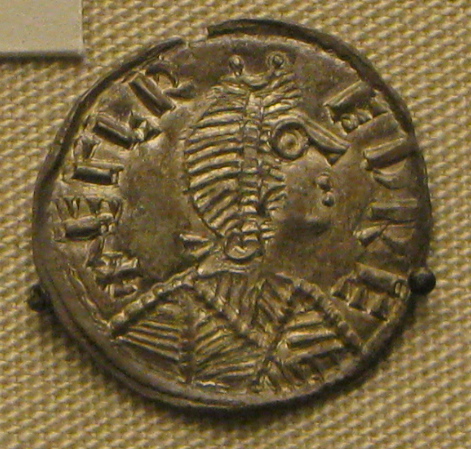
Alfred the Great coin

I quickly became totally hooked on this genre, my fascination knew no borders, enjoying tales that ranged from the illustrious King Alfred the Great and the Vikings, to the turmoil of the 18th century. Like a mosaic artist, I pieced together a chronology that unfolded across centuries, each novel augmenting my list of captivating historical figures. Yet in the labyrinth of historical sagas, one dynasty held me spellbound – the indomitable Plantagenets, sovereigns who reigned for more than three centuries, and totally transformed England’s destiny.

The following decade saw me immerse myself in an array of historical fiction, discovering all I could about this powerful dynasty. I even ventured into the uncharted territory of non-fiction, a realm I had never before explored for mere enjoyment. During this time, an unexpected, and slightly off-track obsession took root: the enthralling “Outlander” series by Diana Gabaldon, a time-travelling tale of the final 1745 Jacobite rebellion in Scotland. I was ecstatic when this saga leapt from page to screen in 2014. With recent images of the series in my mind and fueled with a life-long desire to see Scotland, a travel adventure beckoned. Plans were made, the saving began and with much excitement, my sister and I finally embarked on the gruelling 24hr flight to Glasgow in June 2017, to begin an Outlander adventure. We had a ball, and I found that I thoroughly enjoyed the small group atmosphere, which was both friendly and welcoming. Having the services of a Tour Manager as well as a local Tour Guide made our adventure not only personal but truly unique. Little did I realise then that this tour would kindle the spark for my future endeavours.

While the Scottish adventure might not have directly concerned the Plantagenets, my love for this era showed no sign of dimming. My interest was captivated by so many of the historical figures of the time, names like Eleanor of Aquitaine, Edward the Black Prince, and William Marshal, the greatest knight of the Middle Ages, and the power behind five of the Plantagenet kings. Reminiscing on the amazing time I had in Scotland, I began to search for a themed tour in France based on the Plantagenets, surely there had to be one. Unfortunately, and to my absolute disappointment, my search yielded no results whatsoever. The seeds planted in my mind by my tour in Scotland began to take root, a vision took form, and I dared to dream. It would be the words of one of my dearest friends that eventually gave me that final push… she simply said “Max, what is stopping you”? And thus, the idea of Plantagenet Discoveries was born, and I began to read and research the people, history and places I planned to visit.

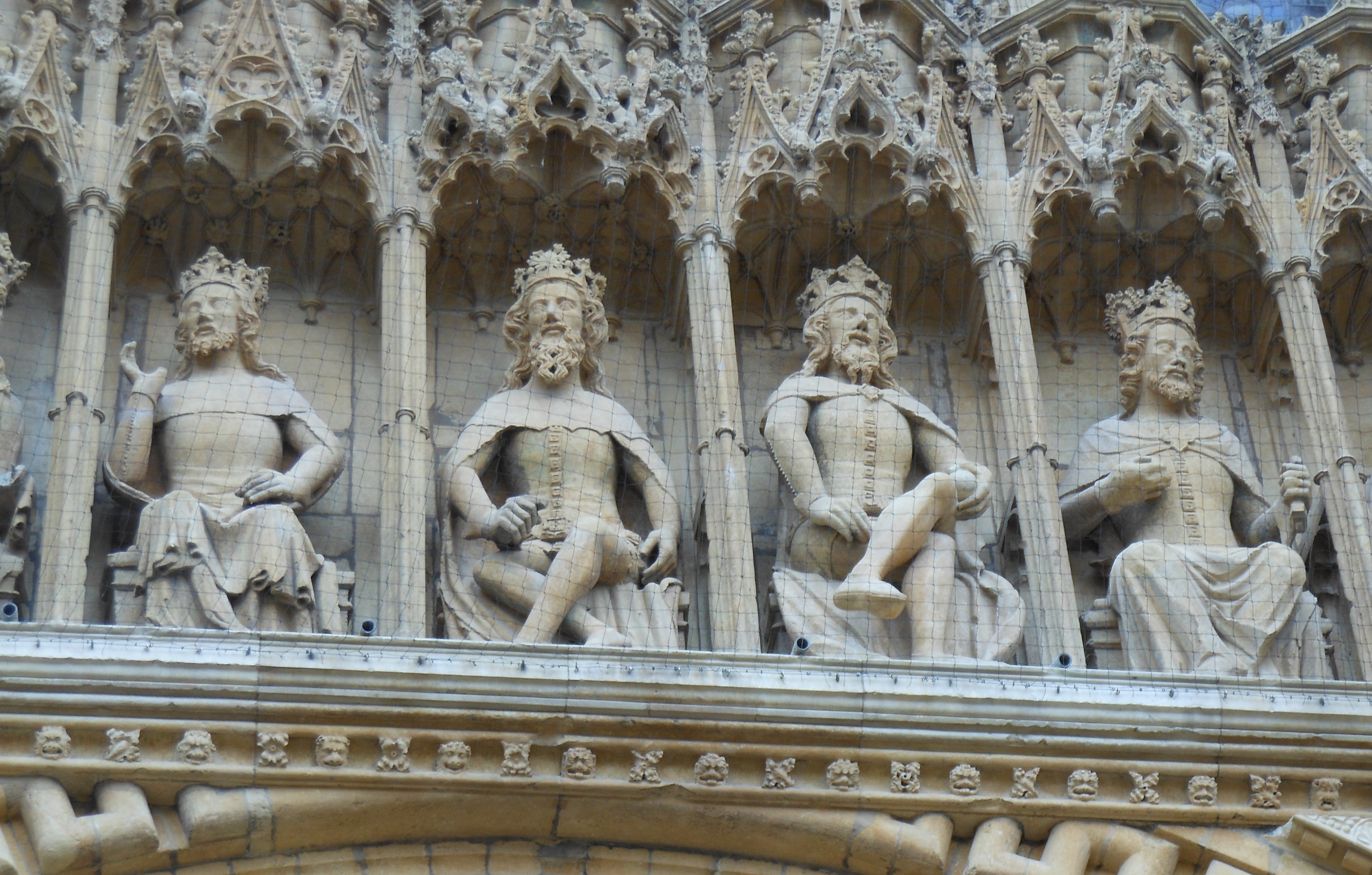
The Gallery of Kings, Lincoln Cathedral

I worked on convincing my best friend of 30 years to come with me on this epic journey as she too was fascinated with medieval history, and after much deliberation, she decided to join me on this life-changing adventure. Together we embarked on a rollercoaster of meticulous planning, fervent study of tourism and business, and ceaseless research, we even began French lessons. For almost two years we navigated the crazy path between ordinary life, family obligations, our full-time jobs, and all that was necessary to get a new tour business off the ground. Remarkably, the onset of Covid-19 was a blessing in disguise as it allowed us ample planning time. Financial contributions were huge, our optimism continued to grow, and we remained positive this dream would become a reality. That dream was a tour company where we could share our passion for this incredible part of history. It would be a unique small group experience for our guests that would be fun, friendly, and informative, while providing them with the utmost in personal service. With the help of my wonderful son Chris (who happens to be a Digital Marketing Head for an advertising agency), we finally unveiled our website and social media presence in August 2022, it is very handy having our own personal social media guru.

Our flight bookings were confirmed, and the countdown began to September 2nd when we would fly to France and England for our reconnaissance mission. Chris and his partner Martin, who live in Sweden, met us and we enjoyed a short stay in the beautiful city of Paris before we headed off to explore. Serving as chauffeurs for a month, the boys skillfully navigated us across the landscapes of both France and England. While laughter and fun were in abundance, our schedule proved relentless, every moment earmarked for visits to hotels and historic sites, as well as the perpetual task of tending to our social media presence, which is almost a part-time job in itself. The return journey home on September 30th found us both weary to the bone, but looking at the task ahead of us with a mixture of excitement and enthusiasm.

I feel the need to divert off track here for a bit and talk about an extraordinary event that happened during our travels. It was the 8th of September 2022 – a date etched in history as Queen Elizabeth II passed away. For an Australian like me, the surrealism of being present during such a pivotal moment defies description. I will always remember the news reaching us as we ate dinner at a lovely little outdoor café in the historic city of Le Mans, France. For me, the sadness I felt was only surpassed by the profound local response to her death. The French people echoed the lament, and as we travelled around France our shared grief forged connections with all those we encountered. Our foresight in procuring Eurostar tickets months prior to our travels provided us with easy passage across the channel, despite the masses attempting to reach London for the funeral which was scheduled for the 19th of September. As it happened, this was the very day we planned to depart the city, casting us into the logistics of travel amidst large crowds and road closures. Bad timing you would say – well at first that is exactly what I thought. Gradually however, the irony of this situation dawned on me like an epiphany, fate actually has magnificent timing. On a reconnaissance adventure, where we were tracing the footsteps of bygone royalty, we found ourselves in London during the most momentous historic event that most of us will ever see in our lifetime. Up until now we could only read about or imagine the impact that the death of a monarch would have on its people, and yet here we were, given the opportunity of witnessing it firsthand. An entire nation, and a significant part of the world, ground to a halt, queue’s stretched for days as the people sought a final glimpse of their queen. There was an extraordinary sense of ‘something’ that is impossible to verbalise. The myriad of emotions were tangible, sadness, fear, apprehension, but above all an overwhelming sense of loss. We stood there, participants in a sombre yet pivotal chapter of history, another thread woven into the tapestry of the past.

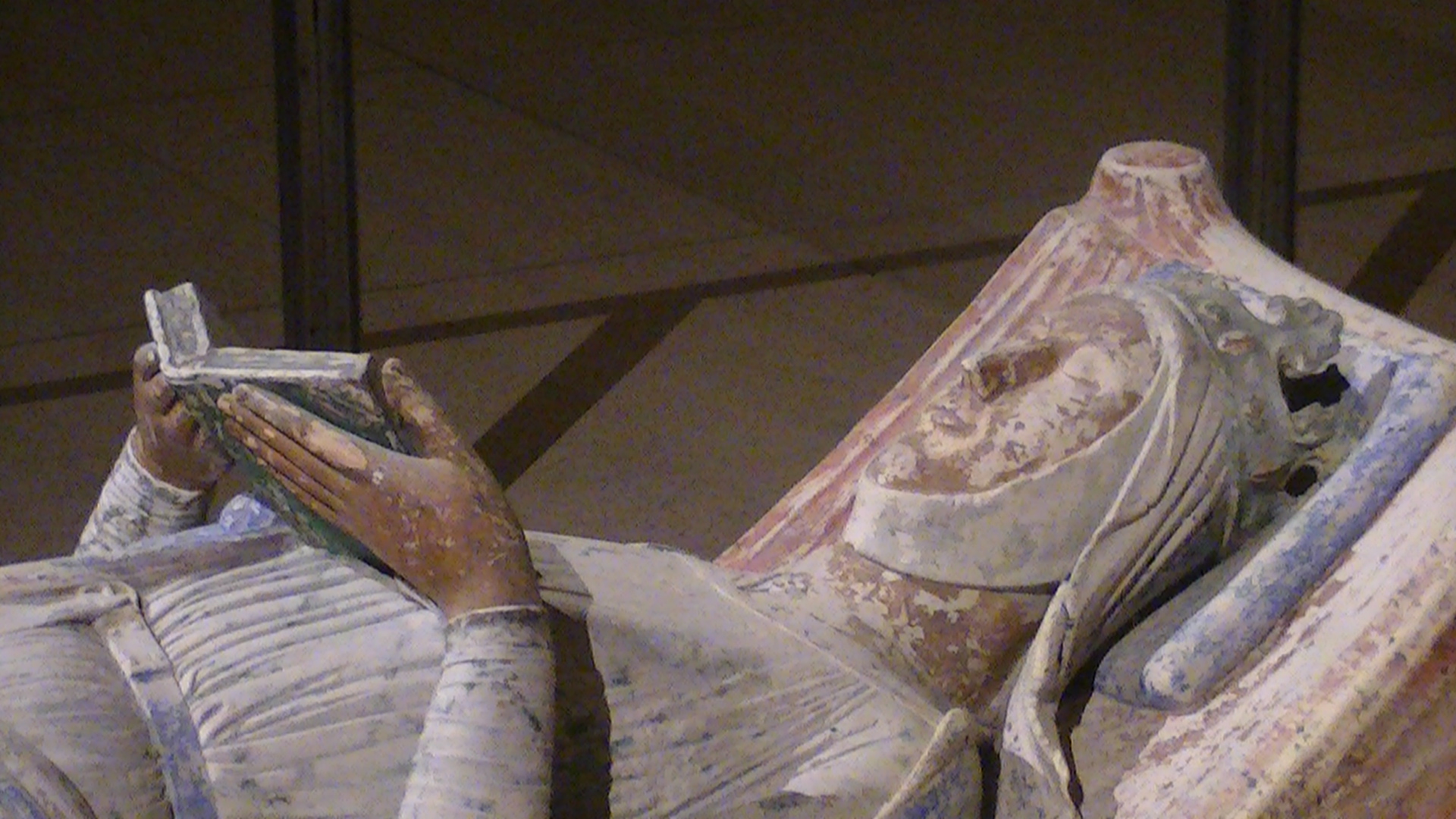
Effigy of Eleanor of Aquitaine, Fontevrault Abbey

But let us return to our narrative, in the spirit of determination, Deb and I set to work. One of the main challenges we faced was the time difference, Australia’s vast isolation meant that all correspondence depended on email. This works fine if you receive responses, but all too often, this does not happen. If it came to having to make phone calls, which it often did, navigating time zones together with full-time working hours certainly is not an easy task. It involves a well-managed calendar I can tell you.

Then there was the language barrier, a real hurdle in communication. It is simple to translate a digital document or email, but when it comes to phone calls, it can be more challenging. I found in France, that many people speak English, occasionally however, challenges arise due to a lack of fluency. I remember the night we stayed at Chateau Castel Novel (a stunning 12th-century castle in central France), we were served the most beautiful and enticing appetizer. The room abounded with laughter as we tried to find out exactly what this dish was made from. The path to success lay in the beacon of humour, for those willing to chuckle at their own linguistic escapades. The mood lightened, communication flowed, and we discovered that the dish was in fact made from potato. With the spirit of laughter as our guide, we began to sow the seeds of rapport, nurturing relationships that we hope will stand the test of time.

Earlier this year, life, often the master of unforeseen twists, dealt us our biggest blow. Due to personal reasons, Deb found herself at a crossroads, her only choice to step away from the venture entirely. The fallout was profound – for us both, it felt like the world had momentarily lost its rhythm. Amid our devastation, a realization emerged that life weaves its own threads of trial and triumph, and God’s plan does not always align with ours, compelling us to soldier on, adapting and accepting.

I am now navigating these waters unaccompanied, and while the quiet absence of another’s counsel is sorely missed, I’ve discovered a reservoir of resilience and unwavering optimism. I have come to terms with my solo voyage, and each wave of uncertainty is met with an anchor of positivity. Numbers were slow initially, but now a silver lining peeks through the clouds in the form of bookings and deposits, heralding the success of my long-anticipated adventure in September 2024.

For me, this has been more than just a business endeavour, it has been a story of remarkable personal growth and transformation. My life has echoed with the mantra “Every day is a school day”, a truth etched into the fabric of my experience. A habit of burying my head in the sand has given way to a newfound tenacity, a willingness to face challenges head-on.

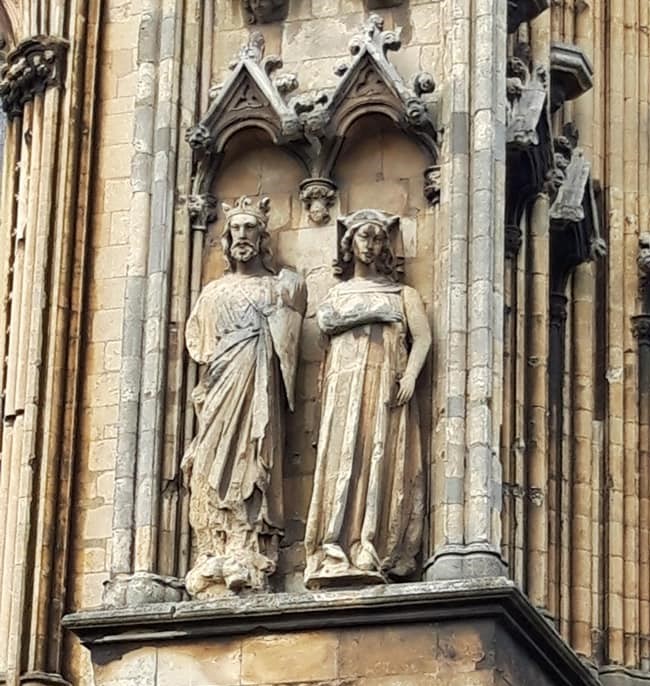
Edward I and Eleanor of Castile, Lincoln Cathedral

As I reach the closing chapter of this article, I can’t help but radiate my enthusiasm. My passion and my vision are no longer confined within the chambers of my imagination, this dream has now become a reality. And you know what is even more fantastic – along the journey, I have found my tribe, and I couldn’t be happier about that!!

So, if this story has resonated with you, I invite you to delve deeper by visiting http://www.plantagenetdiscoveries.com. There, amidst the pages, you will unearth not only the itineraries of our tours, but the musings of heart, encapsulated in my blog posts. You can also follow me on both Facebook and Instagram @plantagenetdiscoveries and I have a friendly Facebook group community where we share photos and stories of medieval history and travel. http://www.facebook.com/groups/loversofmedievalhistorytravel

And for all those among Sharon’s incredible community, a special treat awaits – a 10% discount on each tour, with an additional 5% for the adventurous souls embracing the Back-to-Back option.

Join me on this extraordinary time-travel adventure as we let the echoes of history guide our steps, but more importantly, as we make incredible friendships and memories that will be sure to last a lifetime.

Max

*

My Books

Christmas is coming!

Signed, dedicated copies of all my books are available through my online bookshop.

Coming 15 January 2024: Women of the Anarchy

On the one side is Empress Matilda, or Maud. The sole surviving legitimate child of Henry I, she is fighting for her birthright and that of her children. On the other side is her cousin, Queen Matilda, supporting her husband, King Stephen, and fighting to see her own son inherit the English crown. Both women are granddaughters of St Margaret, Queen of Scotland and descendants of Alfred the Great of Wessex. Women of the Anarchy demonstrates how these women, unable to wield a sword, were prime movers in this time of conflict and lawlessness. It show how their strengths, weaknesses, and personal ambitions swung the fortunes of war one way – and then the other.

Available for pre-order from Amberley Publishing and Amazon UK.

Also by Sharon Bennett Connolly:

Out nowKing John’s Right-Hand Lady: The Story of Nicholaa de la Haye is the story of a truly remarkable lady. Nicholaa de la Haye was the hereditary constable of Lincoln Castle and the first woman in England to be appointed sheriff in her own right. Her strength and tenacity saved England at one of the lowest points in its history. Nicholaa de la Haye is one woman in English history whose story needs to be told…

King John’s Right-Hand Lady: The Story of Nicholaa de la Haye is now available from Pen & Sword Booksbookshop.org and Amazon.

Defenders of the Norman Crown: The Rise and Fall of the Warenne Earls of Surrey tells the fascinating story of the Warenne dynasty, of the successes and failures of one of the most powerful families in England, from its origins in Normandy, through the Conquest, Magna Carta, the wars and marriages that led to its ultimate demise in the reign of Edward III. Defenders of the Norman Crown: Rise and Fall of the Warenne Earls of Surrey is now available from Pen & Sword BooksAmazon in the UK and US, and Bookshop.org.

Ladies of Magna Carta: Women of Influence in Thirteenth Century England looks into the relationships of the various noble families of the 13th century, and how they were affected by the Barons’ Wars, Magna Carta and its aftermath; the bonds that were formed and those that were broken. It is now available in paperback and hardback from Pen & Sword,  Amazon, and Bookshop.org.

Heroines of the Medieval World tells the stories of some of the most remarkable women from Medieval history, from Eleanor of Aquitaine to Julian of Norwich. Available now from Amberley Publishing and Amazon, and Bookshop.org.

Silk and the Sword: The Women of the Norman Conquest traces the fortunes of the women who had a significant role to play in the momentous events of 1066. Available now from Amazon,  Amberley Publishing, and Bookshop.org.

Alternate Endings: An anthology of historical fiction short stories including Long Live the King… which is my take what might have happened had King John not died in October 1216. Available in paperback and kindle from Amazon.

Podcast:

Have a listen to the A Slice of Medieval podcast, which I co-host with Historical fiction novelist Derek Birks. Derek and I welcome guests, such as Bernard Cornwell, and discuss a wide range of topics in medieval history, from significant events to the personalities involved.

*

Don’t forget! Signed and dedicated copies of all my books are available through my online bookshop.

For forthcoming online and in-person talks, please check out my Events Page.

You can be the first to read new articles by clicking the ‘Follow’ button, liking our Facebook page or joining me on Twitter and Instagram.

*

©2023 Maxine Sommer and Sharon Bennett Connolly FRHistS

Matilda and Edith, Women of Different Fates

History...the Interesting Bits
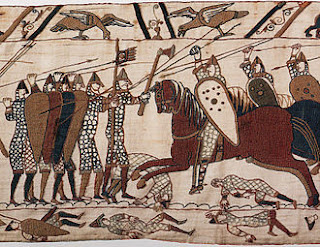
The Battle of Hastings, from the Bayeux Tapestry

Although the Battle of Hastings was fought by men, the women of the two opponents, Harold and William, had as much invested in the outcome as their husbands. The two women, however, have very different reputations. Whereas Matilda appears as the epitome of the medieval ideal woman, Edith has come down through history as ‘the other woman’. However, for both these women, their futures, and the futures of their children, were inextricably linked with the fates of the men fighting on Senlac Hill on that October morning in 1066.

Harold had met Edith Swan-neck at about the same time as he became earl of East Anglia, in 1044. Which makes it possible that Edith Swan-neck and the East Anglian magnate, Eadgifu the Fair, are one and the same. Eadgifu the Fair held over 270 hides of land and was one of the richest magnates in England. The majority of her estates lay in Cambridgeshire, but she also held land in Buckinghamshire, Hertfordshire, Essex and Suffolk; in the Domesday Book Eadgifu held the manor at Harkstead in Suffolk, which was attached to Harold’s manor of Brightlingsea in Essex and some of her Suffolk lands were tributary to Harold’s manor of East Bergholt. While it is by no means certain that Eadgifu is Edith Swan-neck several historians – including Ann Williams in the Oxford Dictionary of National Biography – make convincing arguments that they were. Even their names, Eadgifu and Eadgyth, are so similar that the difference could be merely a matter of spelling or mistranslation; indeed, the abbey of St Benet of Hulme, Norfolk, remembers an Eadgifu Swanneshals among its patrons.

By 1065 Harold had been living with the wonderfully-named Eadgyth Swanneshals (Edith the Swan-neck) for twenty years. History books label her as Harold’s concubine, but Edith was, obviously, no weak and powerless peasant, so it’s highly likely they went through a hand-fasting ceremony – or ‘Danish marriage’ – a marriage, but not one recognized by the church, thus allowing Harold to take a second ‘wife’ should he need to. Harold and Edith had at least 6 children together; including four sons, Godwin, Edmund, Magnus and Ulf and two daughters, Gytha, who married Vladimir Monomakh, Great Prince of Kiev, and Gunnhild, was to become a nun at Wilton Abbey in Wiltshire, but never took her vows.

History...the Interesting Bits
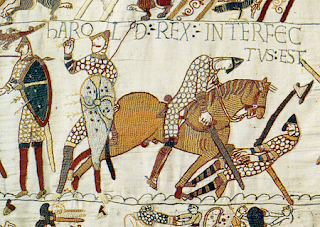
King Harold at the Battle of Hastings, from the Bayeux Tapestry

However, despite their twenty years and many children together, with the health of the king, Edward the Confessor, deteriorating, it became politically expedient for Harold to marry in order to strengthen his position as England’s premier earl and, possibly, next king. Ealdgyth was the daughter of Alfgar, earl of Mercia, and, according to William of Jumieges, very beautiful. She was the widow of Gruffudd ap Llywelyn, King of Gwynedd from 1039 and ruler of all Wales after 1055, with whom she had had at least one child, a daughter, Nest. Gruffudd had been murdered in 1063, following an expedition into Wales, some sources suggest it was by Harold himself, however Gruffudd’s own men are the chief suspects. Harold’s subsequent marriage to Ealdgyth not only secured the support of the earls of Northumbria and Mercia, but also weakened the political ties of the same earls with the new rulers of north Wales.

Rather than his loyal and loving ‘wife’, Edith, it was Ealdgyth, therefore, who was for a short time, queen of England. However, with Harold having to defend his realm, first against Harold Hardrada and his own brother, Tostig, at Stamford Bridge in September of 1066 and, subsequently, against William of Normandy at Hastings, it is unlikely Ealdgyth had time to enjoy her exalted status. At the time of the Battle of Hastings, 14th October 1066, Ealdgyth was in London, but her brothers took her north to Chester soon after. Although sources are confused it seems possible that Ealdgyth was heavily pregnant and gave birth to a son, Harold Haroldson, within months of the battle. Unfortunately, that is the last we hear of Ealdgyth; her fate remains unknown. Young Harold is said to have grown up in exile on the Continent and died in 1098.

Despite his marriage to Ealdgyth it seems Edith Swan-neck remained close to Harold and it was she who was waiting close by when the king faced William of Normandy at Senlac Hill near Hastings on 14th October 1066. She awaited the outcome alongside Harold’s mother, Gytha. Having lost a son, Tostig, just two weeks before, fighting against his brother and with the Norwegians at the Battle of Stamford Bridge, Gytha lost three more sons – Harold, Gyrth and Leofwine – and her grandson, Haakon, in the battle at Hastings.

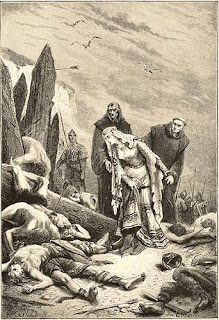
And it was Edith and the elderly Gytha, who wandered the blood-soaked field in the aftermath of the battle, in search of the fallen king. Sources say that Gytha was unable to identify her sons amidst the mangled and mutilated bodies. It fell to Edith to find Harold, by undoing the chain mail of the victims, in order to recognize certain identifying marks on the king’s body – probably tattoos. 

History...the Interesting Bits
Edith finding Harold’s body on the battlefield

The monks of Waltham Abbey had a tradition of Edith bringing Harold’s body to them for burial, soon after the battle. Although other sources suggest Harold was buried close to the battlefield, and without ceremony, it is hard not to hope that Edith was able to perform this last service for the king. However, any trace of Harold’s remains was swept away by Henry VIII’s Dissolution of the Monasteries, so the grave of England’s last Anglo-Saxon king is lost to history.

Harold’s mother, Gytha, eventually fled into exile on the Continent, taking Harold and Edith’s daughter, another Gytha, with her, possibly arranging her marriage to the prince of Smolensk and – later – Kiev. The sons of Edith and Harold fled to Ireland with all but one, living into the 1080s, though the dates of their eventual deaths remain uncertain. Gunnhild remained in her nunnery at Wilton until sometime before 1093, when she became the wife or concubine of Alan the Red, a Norman magnate. Whether or not she was kidnapped seems to be in question but when Alan died in 1093, instead of returning to the convent, Gunnhild became the mistress of Alan’s brother and heir, Alan Niger. Alan Rufus held vast lands in East Anglia – lands that had once belonged to Eadgifu the Fair and, if Eadgifu was Edith Swan-neck, it’s possible that Alan married Gunnhild to strengthen his claims to her mother’s lands.  

Of Edith Swan-neck, there is no trace after Harold is interred at Waltham Abbey, she simply disappears from the pages of history…

For Matilda, on the other hand, the Battle of Hastings marked the start of another stage of her life and career as the wife of William, duke of Normandy and, now, King of England. Matilda of Flanders was probably born around 1032, the daughter of Baldwin V, count of Flanders, and his wife, Adela, a daughter of King Robert the Pious of France. The young duke, William of Normandy, was probably pushing his luck when he proposed a marriage between himself and young Matilda. Although he was a duke and Baldwin a mere count, there was the question of his illegitimacy and Normandy was hardly the most stable of regions; William had spent all of his adult life fighting to keep hold of it. 

History...the Interesting Bits
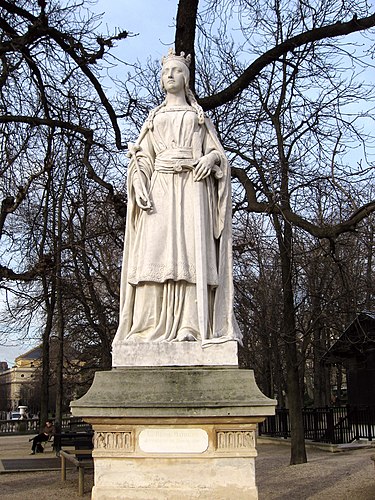
Matilda of Flanders

A later story tells of how Matilda refused to marry William, stating that, being granddaughter of a king, she was too high born to marry a bastard. William was said to be so incensed with this response that he straightaway rode to Flanders, accosted young Matilda in the street, pulling her from her horse by her braids, before hitting her and cutting her with his spurs; whereupon Matilda changed her mind and agreed to marry William. While amusing, it is highly likely that the story is an invention, and highly unlikely that Matilda was asked her opinion on the marriage. Getting to the altar was not an easy task, however, as the pope refused to allow the marriage, without giving his reasons. It is possible that the refusal was on the grounds of consanguinity, although it seems the only familial link is that William’s aunt married Matilda’s grandfather as his second wife (Matilda’s father, however, was the son of the count’s first wife, so there was no blood relationship). It seems more likely that the refusal was politically motivated, due to Count Baldwin’s support of the Lotharingian’s rebellion against Pope Leo IX’s sponsor, the Holy Roman Emperor. 

William was not to be thwarted, however, and before 1053 he married, Matilda despite the papal interdict; they were eventually ordered to establish a monastery each in penance for the marrying without papal dispensation, but the marriage was allowed to stand. In penance Matilda established the Abbaye-aux-Dames, consecrated in 1066, while William founded the Abbay-aux-Hommes, both in Caen.

The marriage between Matilda and William proved to be a strong and trusting relationship; William is one of very few medieval kings believed to have been completely faithful to his wife, no rumours of extra-marital affairs have ever been uncovered. He trusted Matilda to act as regent in Normandy during his many absences on campaign or in England. Matilda supported her husband’s proposed invasion of England, promised a great ship for William’s personal used, it was called the Mora; the ship had a figurehead of a small boy, whose right hand pointed to England and left hand held a horn to his lips.

History...the Interesting Bits
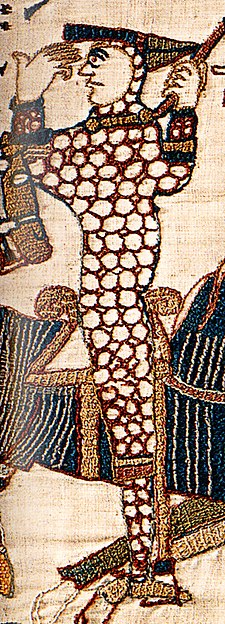
William the Conqueror from the Bayeux Tapestry

Matilda and William had a rather large family, with 4 boys and at least 4 daughters. Their eldest son, Robert Curthose, who inherited Normandy, was followed by Richard, who was killed during a hunting accident as a youth, William, known as Rufus who became King William II, and the future Henry I. Of the 4 or 5 daughters Adelida became a nun following a series of failed marriage plans, Cecilia was given to the convent of Ste Trinite as a child, Constance married Alain Fergant, duke of Brittany and Adela married Stephen of Blois; their son, another Stephen would succeed Henry I as King of England. There are suggestions of 2 further daughters, Matilda and Agatha, though evidence for their existence is highly limited.

Matilda was very close to her family, especially her eldest son, Robert, whose later antics were to cause  problems between his parents. William and Robert, father and son, were often at loggerheads, with Robert in open rebellion against his father as a young adult. Matilda was constantly trying to play the peacemaker and was so upset by one quarrel that she was ‘choked by tears and could not speak’. Even during a period of exile imposed on Robert, Matilda still supported her son as best she can; she would send him vast amounts of silver and gold through a Breton messenger, Samson. On discovering Samson’s complicity William threatened to blind the messenger and it was only through Matilda’s intervention that the Breton escaped.

Where poor Edith Swan-neck lost almost everything at Hastings, Matilda’s star was in the ascendant, but the Conquest was not without problems and it was not until 1068 that William felt secure enough to bring his wife over to England. Matilda was crowned Queen of England in Winchester Cathedral at Pentecost in that year, although further unrest soon saw her returned to the relative safety of Normandy, where she was acting as regent for her absent husband. Matilda was one of the most active of medieval queens, standing in as an able administrator during her husband’s absences; hearing land pleas and corresponding with such as the pope, who is known to have asked her to use her influence over her husband, on occasion. She was also the driving force in holding together her family, keeping relations as cordial as possible, even with the rebellious Robert. And it may well be her own strength of character, as the centre of the family, that meant none of her sons would marry until after her death.

Matilda’s piety is renowned. Although founding the Abbaye-aux-Dames in Caen was a penance for her irregular marriage to William, her constant and repeated donations to religious houses demonstrate her dedication to her faith. Among her many donations; she gave the monks of Marmoutier a new refectory and a cope and to the monks of St Evroult she gave £100 for a refectory, a mark of gold, a chasuble decorated with gold and pearls, and a cope for the chanter. The nuns of her abbey at Ste Trinite, Caen, received a substantial bequest from Matilda’s will; as well as her regalia, they were given a chalice, a chasuble, a mantle of brocade, 2 golden chains with a cross, a chain decorated with emblems for hanging a lamp in front of the altar, several large candelabras, the draperies for her horse and all the vases ‘which she had not yet handed out during her life’.

History...the Interesting Bits
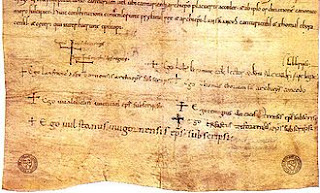
Matilda and William’s Xs on a charter

Matilda and William’s relationship is one of the most successful of the medieval period. Said to be a happy and loving marriage, their trust in each other was demonstrable and it was remarked up on when William fell seriously ill during a stay at Cherbourg between 1063 and 1066, Matilda prayed for his recovery at the altar; the monks remarking on her informal appearance as the sign of her distress her husband illness was causing her. Matilda fell ill in the late summer of 1083 and died on 2nd November of the same year. She was buried at Ste Trinite, Caen, where the original tombstone, with the inscription carved round the edge, still survives. Following her death William cut a sad and lonely figure; becoming increasingly isolated he followed his wife to the grave 4 years later in 1087.

Select bibliography:

Oxforddnb.com; The Norman Conquest: William the Conquerors’ Subjugation of England by Teresa Cole; William the Conqueror: The Bastard of Normandy by Peter Rex; Kings, Queens, Bones and Bastards by David Hilliam; Britains’ Royal Families: The Complete Genealogy by Alison Weir; The Oxford Companion to British History edited by John Cannon; epistolae.ccnmtl.columbia.edu.

My Books

Signed, dedicated copies of all my books are available through my online bookshop.

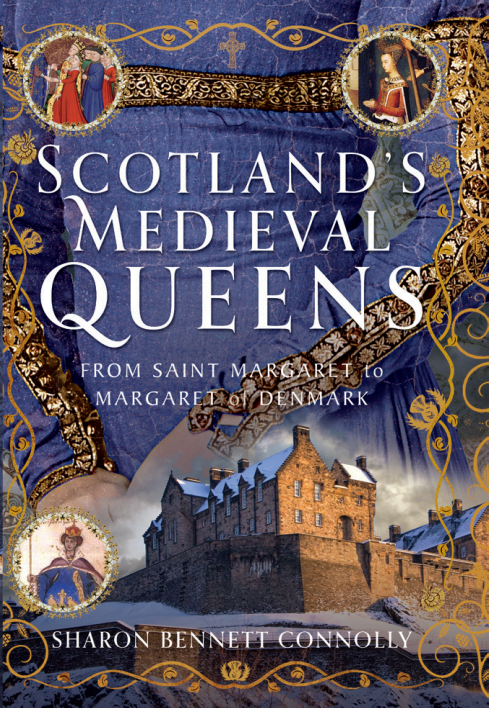
Out now: Scotland’s Medieval Queens

Books by Sharon Bennett Connolly

Scotland’s history is dramatic, violent and bloody. Being England’s northern neighbour has never been easy. Scotland’s queens have had to deal with war, murder, imprisonment, political rivalries and open betrayal. They have loved and lost, raised kings and queens, ruled and died for Scotland. From St Margaret, who became one of the patron saints of Scotland, to Elizabeth de Burgh and the dramatic story of the Scottish Wars of Independence, to the love story and tragedy of Joan Beaufort, to Margaret of Denmark and the dawn of the Renaissance, Scotland’s Medieval Queens have seen it all. This is the story of Scotland through their eyes.

Scotland’s Medieval Queens gives a thorough grounding in the history of the women who ruled Scotland at the side of its kings, often in the shadows, but just as interesting in their lives beyond the spotlight. It’s not a subject that has been widely covered, and Sharon is a pioneer in bringing that information into accessible history.’ Elizabeth Chadwick (New York Times bestselling author)

Available now from Amazon and Pen and Sword Books

Also by Sharon Bennett Connolly:

Books by Sharon Bennett Connolly

Heroines of the Tudor World tells the stories of the most remarkable women from European history in the time of the Tudor dynasty, 1485-1603. These are the women who ruled, the women who founded dynasties, the women who fought for religious freedom, their families and love. Heroines of the Tudor World is now available for pre-order from Amberley Publishing and Amazon UK. Women of the Anarchy demonstrates how Empress Matilda and Matilda of Boulogne, unable to wield a sword themselves, were prime movers in this time of conflict and lawlessness. It shows how their strengths, weaknesses, and personal ambitions swung the fortunes of war one way – and then the other. Available from Bookshop.orgAmberley Publishing and Amazon UKKing John’s Right-Hand Lady: The Story of Nicholaa de la Haye is the story of a truly remarkable lady, the hereditary constable of Lincoln Castle and the first woman in England to be appointed sheriff in her own right. Available from all good bookshops Pen & Sword Booksbookshop.org and Amazon

History...the Interesting Bits

Defenders of the Norman Crown: The Rise and Fall of the Warenne Earls of Surrey tells the fascinating story of the Warenne dynasty, from its origins in Normandy, through the Conquest, Magna Carta, the wars and marriages that led to its ultimate demise in the reign of Edward III. Available from Pen & Sword BooksAmazon in the UK and US, and Bookshop.orgLadies of Magna Carta: Women of Influence in Thirteenth Century England looks into the relationships of the various noble families of the 13th century, and how they were affected by the Barons’ Wars, Magna Carta and its aftermath; the bonds that were formed and those that were broken. It is now available in paperback and hardback from Pen & SwordAmazon, and Bookshop.orgHeroines of the Medieval World tells the stories of some of the most remarkable women from Medieval history, from Eleanor of Aquitaine to Julian of Norwich. Available now from Amberley Publishing and Amazon, and Bookshop.orgSilk and the Sword: The Women of the Norman Conquest traces the fortunes of the women who had a significant role to play in the momentous events of 1066. Available now from Amazon,  Amberley Publishing, and Bookshop.org.

Alternate Endings: An anthology of historical fiction short stories including Long Live the King… which is my take what might have happened had King John not died in October 1216. Available in paperback and kindle from Amazon.

Podcast:

History...the Interesting Bits

Have a listen to the A Slice of Medieval podcast, which I co-host with Historical fiction novelist Derek Birks. Derek and I welcome guests, such as Bernard Cornwell and Elizabeth Chadwick, and discuss a wide range of topics in medieval history, from significant events to the personalities involved.

Every episode is also now available on YouTube.

*

Don’t forget! Signed and dedicated copies of all my books are available through my online bookshop.

For forthcoming online and in-person talks, please check out my Events Page.

You can be the first to read new articles by clicking the ‘Follow’ button, liking our Facebook page or joining me on TwitterThreadsBluesky and Instagram.

©2023 Sharon Bennett Connolly FRHistS 


10 Facts about Nicholaa de la Haye that you may not know…

King John’s Right Hand Lady: The Story of Nicholaa de la Haye
Tomb effigy of Nicholaa de la Haye, St Michael’s Church, Swaton

As you may have noticed, Nicholaa de la Haye is a favourite of mine. She is the subject of my 5th book, King John’s Right Hand Lady: The Story of Nicholaa de la Haye. She was one of King John’s most stalwart supporters. She held Lincoln Castle against all-comers during the First Barons’ War which followed the sealing of Magna Carta in 1215. Her career is the more remarkable because Nicholaa was a woman in command of a castle in her own right. And she masterminded its defence against the might of the rebel barons and their French allies, even though the city of Lincoln was also against her.

So, who was she?

10 Things about Nicholaa de la Haye that you may not know…

1. Nicholaa had both English and Norman ancestry. Unlike many Normans, Nicholaa could trace her Lincolnshire roots, through her paternal grandmother, Muriel, to before the Norman Conquest; her grandmother’s grandfather was Colswein of Lincoln, an Englishman who had found favour with William the Conqueror in the years after the Conquest. Nicholaa’s father was Richard de la Haye, whose family originated from La Haye-du-Puits in Normandy, and was distantly related, through marriage, to William the Conqueror. Nicholaa’s mother was Matilda de Vernon, a niece of Baldwin de Redvers, Earl of Devon, the first magnate to rebel against King Stephen when he stole the throne from Empress Matilda.

2. Nicholaa was hereditary constable of Lincoln Castle. Just like her father and grandfather before her, Nicholaa held Lincoln Castle for the king. A charter dated between 1155 and 1158, issued by Henry II, confirmed the succession of Richard de la Haye to his father in all of his father’s lands in Lincolnshire, including the constableship of Lincoln Castle.

King John’s Right Hand Lady: The Story of Nicholaa de la Haye
The Charte aux lacs d’Amour

3. Nicholaa was the oldest of three sisters. Her sister Gila (or Julia) married Richard du Hommet, the grandson and son of successive constables of Normandy. In 1191 a charter was issued to Gila and Richard, known as the charte aux lacs d’amour (the charter of the laces of love), which had laces attached to the seal on which was written a love poem: ‘I am a pledge of love. Do not give me away. May whoever separates our love receive death’. Nicholaa’s other sister, Isabel de la Haye married William de Rollos, who was probably from Bourne, in Lincolnshire. The Rollos family returned to Normandy during the reign of King John.

4. Nicholaa’s first husband was William Fitz Erneis, who may have been a younger son of Robert Fitz Erneis, a minor Lincolnshire lord. Nicholaa and William had one surviving child, a daughter named Matilda, before William died in 1178. Nicholaa would later pay a fine of 300 marks to King Richard I so that she could marry her daughter to whomever she wished except, of course, to an enemy of the king. Nicholaa was still accounting for this debt until 1212. In 1201, she still owed 40 marks and a palfrey (a horse).

5. Before 1185, Nicholaa had remarried, this time to Gerard de Camville, son of Richard de Camville, lord of Middleton Stoney in Oxfordshire. A family with an impressive record of royal service, Richard had died in Italy in 1176 while escorting the king’s daughter, Joanna, to her wedding with King William of Sicily. Gerard’s half-brother, also called Richard, accompanied Richard the Lionheart on Crusade; this Richard de Camville was made governor of Cyprus before dying at Acre in 1191. Gerard himself served the kings Henry II, Richard the Lionheart and John. He was Constable of Lincoln Castle by right of his wife and sheriff of Lincolnshire on two occasions.

6. Nicholaa first comes to the attention of the chroniclers in 1191, when Prince John led the opposition to, William Longchamp, the man left in charge of England during Richard the Lionheart’s absence on crusade. Longchamp wanted Lincoln Castle for one of his friends and determined to take it. Gerard sought the help of Prince John swearing fealty to him at Nottingham, leaving to Nicholaa to hold the castle. William Longchamp hired a force of mercenaries and laid siege to the castle in Gerard’s absence. The formidable Nicholaa refused to yield, holding out for 40 days before Longchamp gave up and went home. Amusingly, Richard of Devizes said of this defence of Lincoln Castle, that she did it ‘without thinking of anything womanly’.

King John’s Right Hand Lady: The Story of Nicholaa de la Haye
The kings Nicholaa served: Henry II, Richard I King John and Henry III, Lincoln Cathedral

7. By the time the king arrived home in 1194, John had fled to France, leaving his supporters to face the music. On 31 March 1194, on the first day of his council at Nottingham, King Richard dispossessed Gerard de Camville of the castle and shrievalty of Lincoln. And on 2 April, Gerard was charged with harbouring outlaws (wonder if they mean Robin Hood?), treason for failing to answer the king’s justices’ summons over the harbouring of the said outlaws, and for taking up arms and aiding John in taking the castles of Tickhill and Nottingham. The outcome of the proceedings is not recorded, but given that Gerard was fined 2,000 marks to recover the king’s good will and his lands, we can assume that the judges did not find in his favour.

8. When Richard the Lionheart died on 6 April 1199 and was succeeded by his brother, John, Nicholaa and Gerard de Camville were restored to favour and to Lincoln Castle. Gerard was also appointed sheriff of Lincolnshire and served in that office for the next six years, becoming ‘a greater man than ever.’ In November 1200, Nicholaa and Gerard welcomed the kings of England and Scotland to Lincoln, where King William the Lion paid homage to King John outside the city walls.

King John’s Right Hand Lady: The Story of Nicholaa de la Haye
The Observatory Tower, Lincoln Castle

9. Gerard died in December 1214, leaving Nicholaa in command of Lincoln Castle. In 1216, she was besieged by a force of rebel barons who had taken up arms against King John in the aftermath of the issuing of Magna Carta. Nicholaa paid them off – they stopped attacking the castle but remained in the city. In the same year, Nicholaa met King John at the East Gate of Lincoln Castle, with the castle’s keys in her hand, offering to resign her position as constable, citing her weariness and great age (she was in her 60s). John refused, telling her to remain in post until he ordered otherwise.

10. On 18 October 1216, at Newark Castle, in one of his final acts and just hours before his death, King John appointed Nicholaa de la Haye as sheriff of Lincolnshire. She was the first woman in English history to be appointed to the office of sheriff in her own right – but she would not be the last.

King John’s Right Hand Lady: The Story of Nicholaa de la Haye
Depiction of the 1217 Battle of Lincoln from Matthew Paris

11. (Oops!) For 7 months, from October 1216 to May 1217, Lincoln Castle was once again under siege by a force of English rebel barons and their French allies under the command of the Comte de Perche. Nicholaa directed the castle’s defence until royalist forces could come to her aid. On 20 May 1217, William Marshal and the royalist army came to her relief, fighting the Battle of Lincoln through the city’s streets.

12. (double oops!) There was a rise in the number of baby girls named Nicholaa, in Lincolnshire, in the 13th century.

13. Have a listen to the A Slice of Medieval episode dedicated to Nicholaa de la Haye, where Derek Birks and I discuss the ins and outs – and highs and lows – of Nicholaa’s career.

Sources:

Richard of Devizes, The Chronicle of Richard of Devizes; Roger of Howden (Hoveden), The Annals of Roger of HowdenThe Plantagenet Chronicles edited by Elizabeth Hallam; Brassey’s Battles by John Laffin; 1215 The Year of Magna Carta by Danny Danziger & John Gillingham; The Life and times of King John by Maurice Ashley; The Plantagenets, the Kings Who Made England by Dan Jones; England Under the Norman and Angevin Kings  by Robert Bartlett; lincolnshirelife.co.uk; catherinehanley.co.uk; magnacarta800th.com; lothene.org; lincolncastle.com; The Sheriff: The Man and His Office by Irene Gladwin; Louise Wilkinson, Women in Thirteenth Century Lincolnshire; Richard Huscraft, Tales from the Long Twelfth Century; J.W.F. Hill, Medieval Lincoln; swaton.org.uk; oxforddnb.com; Ingulph, Ingulph’ Chronicle of the Abbey of Croyland; Stephen Church, King John: England, Magna Carta and the Making of a Tyrant; Marc Morris, King John; Pipe Rolls; Red Book of the Exchequer

*

My Books

Signed, dedicated copies of all my books are available through my online store.

Out now: Scotland’s Medieval Queens

Books by Sharon Bennett Connolly

Scotland’s history is dramatic, violent and bloody. Being England’s northern neighbour has never been easy. Scotland’s queens have had to deal with war, murder, imprisonment, political rivalries and open betrayal. They have loved and lost, raised kings and queens, ruled and died for Scotland. From St Margaret, who became one of the patron saints of Scotland, to Elizabeth de Burgh and the dramatic story of the Scottish Wars of Independence, to the love story and tragedy of Joan Beaufort, to Margaret of Denmark and the dawn of the Renaissance, Scotland’s Medieval Queens have seen it all. This is the story of Scotland through their eyes.

Scotland’s Medieval Queens gives a thorough grounding in the history of the women who ruled Scotland at the side of its kings, often in the shadows, but just as interesting in their lives beyond the spotlight. It’s not a subject that has been widely covered, and Sharon is a pioneer in bringing that information into accessible history.’ Elizabeth Chadwick (New York Times bestselling author)

Available now from Amazon and Pen and Sword Books

Also by Sharon Bennett Connolly:

Books by Sharon Bennett Connolly

Heroines of the Tudor World tells the stories of the most remarkable women from European history in the time of the Tudor dynasty, 1485-1603. These are the women who ruled, the women who founded dynasties, the women who fought for religious freedom, their families and love. Heroines of the Tudor World is now available for pre-order from Amberley Publishing and Amazon UK. Women of the Anarchy demonstrates how Empress Matilda and Matilda of Boulogne, unable to wield a sword themselves, were prime movers in this time of conflict and lawlessness. It shows how their strengths, weaknesses, and personal ambitions swung the fortunes of war one way – and then the other. Available from Bookshop.orgAmberley Publishing and Amazon UKKing John’s Right-Hand Lady: The Story of Nicholaa de la Haye is the story of a truly remarkable lady, the hereditary constable of Lincoln Castle and the first woman in England to be appointed sheriff in her own right. Available from all good bookshops Pen & Sword Booksbookshop.org and Amazon

Royal Historical Society

Defenders of the Norman Crown: The Rise and Fall of the Warenne Earls of Surrey tells the fascinating story of the Warenne dynasty, from its origins in Normandy, through the Conquest, Magna Carta, the wars and marriages that led to its ultimate demise in the reign of Edward III. Available from Pen & Sword BooksAmazon in the UK and US, and Bookshop.orgLadies of Magna Carta: Women of Influence in Thirteenth Century England looks into the relationships of the various noble families of the 13th century, and how they were affected by the Barons’ Wars, Magna Carta and its aftermath; the bonds that were formed and those that were broken. It is now available in paperback and hardback from Pen & SwordAmazon, and Bookshop.orgHeroines of the Medieval World tells the stories of some of the most remarkable women from Medieval history, from Eleanor of Aquitaine to Julian of Norwich. Available now from Amberley Publishing and Amazon, and Bookshop.orgSilk and the Sword: The Women of the Norman Conquest traces the fortunes of the women who had a significant role to play in the momentous events of 1066. Available now from Amazon,  Amberley Publishing, and Bookshop.org.

Alternate Endings: An anthology of historical fiction short stories including Long Live the King… which is my take what might have happened had King John not died in October 1216. Available in paperback and kindle from Amazon.

Podcast:

Have a listen to the A Slice of Medieval podcast, which I co-host with Historical fiction novelist Derek Birks. Derek and I welcome guests, such as Bernard Cornwell and Elizabeth Chadwick, and discuss a wide range of topics in medieval history, from significant events to the personalities involved.

Every episode is also now available on YouTube.

*

Signed and dedicated copies of all my books are available through my online store.

For forthcoming online and in-person talks, please check out my Events Page.

You can be the first to read new articles by clicking the ‘Follow’ button, liking our Facebook page or joining me on TwitterThreadsBluesky and Instagram.

©2023 Sharon Bennett Connolly FRHistS

Book Corner: The King’s Jewel by Elizabeth Chadwick

Wales, 1093.

Meet Nesta, a woman trying to survive in a man’s world – a world where the men who would protect her are dead and banished.

The warm, comfortable family life of young Nesta, daughter of Prince Rhys of Deheubarth is destroyed when her father is killed and she is taken hostage. Her honour is further tarnished when she is taken as an unwilling concubine by King William’s ruthless younger brother Henry, who later ascends the throne under suspicious circumstances.

Gerald FitzWalter, an ambitious young knight is rewarded for his unwavering loyalty to his new King with Nesta’s hand in marriage. He is delighted, having always admired her from afar, but Nesta’s only comfort is her return to her beloved Wales where cannot help but be tempted by the handsome, charismatic and dangerous son of the Welsh prince, Owain. When he offers her the chance to join him in his plan to overthrow Norman rule she must choose between her duty and her desire . . .

The King’s Jewel by Elizabeth Chadwick recounts the story of Nesta ferch Rhys, the young Welsh princess who became the mistress of Henry I of England, bearing him at least one son. I first came across Nesta’s story when I was researching Heroines of the Medieval World. On the face of it, Nesta’s life appears exciting and adventurous but Elizabeth Chadwick tempers this with a clear understanding of how little control Nesta had over her own life.

Losing her father at an early age, the poor girl was a pawn in the hands of powerful men. She first appears in history as a concubine of King Henry I, though the exact dates of their relationship, the year it took place and how long it lasted, are unknown. What is known, is that Nesta had a son by Henry and that she married Gerald of Windsor as her first husband in the early 1100s. By 1109, she and Gerald had three children. By the end of her life, Nesta was the mother of no fewer than nine children by at least four different men. She had also endured an abduction by her cousin. As a Welsh heiress, in the face of Norman expansion, Nesta was never going to have a quiet life.

And Princess Nesta’s story has been brought to life by Elizabeth Chadwick’s The King’s Jewel, fleshing out the little we know to build a whole world and life around Nesta, telling a story that is both absorbing and historically accurate.

A short ride brought them to the settlement at Pembroke, where the women were thrust into a small room halfway up a stone lookout tower. A soldier tossed in their baggage, ransacked of all jewellery, fabric and trinkets. Straw pallets and coarse woollen blankets were thrown down for their slumber. The only light in the dismal chamber came from a slit of a window open to the air, and cresset lamps, burning smokily, sputtering tallow fat. The soldier returned, bringing bowls of barley broth and coarse bread, and then departed, closing and barring the door.

Nesta gazed at their bleak surroundings with a horrible, hollow sensation in her stomach. Two nights ago she had slept in a feather bed with fresh linen sheets and soft furs. She had enjoyed the clean, sweet light of beeswax candles and had washed her hands and face with rose water. She had belongings, wealth and status. Any man daring to fondle her haunch and laugh about it would have lost his hand for the insult.

‘What will happen to us?’ she asked her mother who was staring at the pallets in disgust.

‘If tehy had wanted to kill us, they would have done so by now,’ Gwladus said with a shrug. ‘I do not matter, unless I happen to be carrying another child, which I know I am not, but you are your father’s daughter, and that makes you valuable.’

Nesta folded her arms and shivered.

‘You had your first bleed at Christmas, and you are of an age to wed. Any of these Normans could take you to wife and lay claim to your father’s lands by their laws. You are not a hostage for your people, but a girl who brings with her the gift of stolen territory.’

Nesta went rigid. ‘I would never marry one of them – never!’

Gwladus shook her head. ‘What you want does not matter to them, but they cannot take what you already are inside. Hold your head high and remember your heritage. You are a pattern for others to emulate for courage and loyalty.’ She took three steps to Nesta and touched her cheek. ‘I am depending on you to carry this burden for your family’s pride.’

‘I won’t let you down.’ Nesta’s voice quivered for, despite her defiant words, she felt small, afraid and overwhelmed.

‘Oh, my beautiful girl.’ Gwladus hugged her hard and tears squeezed out from between her closed eyelids. ‘I know you will not. And you shall always have my love – always, whatever happens.’

Nesta drew in the familiar scent of her mother’s skin, seeking comfort. ‘I want it all to go away,’ she whispered.

‘I know you do. I know.’ Gwladus rocked her back and forth and kissed her cheek. ‘So do I. Dear Holy Virgin, so do I.’

As we have come to expect, The King’s Jewel is up to Elizabeth Chadwick’s usual superior standard of story-telling. Using what we do know of Nesta’s life, Elizabeth builds an engaging story of a young woman who makes the most of a life forced upon her, but whose instinct to rebel sees her make decisions that are not always in her own best interests. We are introduced to a girl who has lost almost everything, her father dead, brother in exile and mother condemned to a nunnery, and is at the mercy of her captors. From that frightened little girl, Elizabeth Chadwick creates a captivating story that will keep the reader enthralled to the very end.

The research is impeccable and I found myself nodding at the narrative more than once, knowing where Elizabeth found those little tidbits of information. And as I finished the book, I marvelled at how Elizabeth had managed to weave the few facts we do know seamlessly into the story, adding a strong element of authenticity to the elements of fiction.

The King’s Jewel is a thoroughly enjoyable novel, set in the heart of Wales against the backdrop of the Norman kings of England determined to stamp their authority on the wild country and its people. Nesta is, at once, the symbol of resistance and reluctant submission and her journey to find some kind of balance to her life is riveting.

The beauty of The King’s Jewel is that Elizabeth Chadwick brings Nesta to life, making her a real person in the eyes of the reader, eliciting sympathy for a young girl who has no control over her destiny, compassion for a woman making a marriage not of her choosing and understanding for the decisions made that led her down a dangerous path. Elizabeth understands the internal conflict that must have arisen for Nesta out of being married to a Norman, whilst wanting freedom for her Welsh homeland and people.

I cannot recommend it highly enough!

The King’s Jewel is available from Amazon.

About the Author:

New York Times bestselling author Elizabeth Chadwick lives in a cottage in the Vale of Belvoir in Nottinghamshire with her husband and their three dogs. Her first novel, The Wild Hunt, won a Betty Trask Award, To Defy a King won the Romantic Novelist Association’s Historical Novel Prize and The Scarlet Lion was nominated by Richard Lee – founder of the Historical Novel Society – as one of the top ten historical novels of the last decade. She often lectures at conferences and historical venues, has been consulted for television documentaries and is a member of the Royal Historical Society.

Keep in touch with Elizabeth via her website, her blogs or on social media.

http://www.elizabethchadwick.com
twitter: @chadwickauthor
facebook: ElizabethChadwick

*

My Books

Signed, dedicated copies of all my books are available, please get in touch by completing the contact me form.

Out nowKing John’s Right-Hand Lady: The Story of Nicholaa de la Haye

In a time when men fought and women stayed home, Nicholaa de la Haye held Lincoln Castle against all-comers, gaining prominence in the First Baron’s War, the civil war that followed the sealing of Magna Carta in 1215. A truly remarkable lady, Nicholaa was the first woman to be appointed sheriff in her own right. Her strength and tenacity saved England at one of the lowest points in its history. Nicholaa de la Haye is one woman in English history whose story needs to be told…

King John’s Right-Hand Lady: The Story of Nicholaa de la Haye is now available from Pen & Sword Booksbookshop.org and Amazon.

Coming 15 January 2024: Women of the Anarchy

On the one side is Empress Matilda, or Maud. The sole surviving legitimate child of Henry I, she is fighting for her birthright and that of her children. On the other side is her cousin, Queen Matilda, supporting her husband, King Stephen, and fighting to see her own son inherit the English crown. Both women are granddaughters of St Margaret, Queen of Scotland and descendants of Alfred the Great of Wessex. Women of the Anarchy demonstrates how these women, unable to wield a sword, were prime movers in this time of conflict and lawlessness. It show how their strengths, weaknesses, and personal ambitions swung the fortunes of war one way – and then the other.

Available for pre-order from Amberley Publishing and Amazon UK.

Also by Sharon Bennett Connolly:

Defenders of the Norman Crown: The Rise and Fall of the Warenne Earls of Surrey tells the fascinating story of the Warenne dynasty, of the successes and failures of one of the most powerful families in England, from its origins in Normandy, through the Conquest, Magna Carta, the wars and marriages that led to its ultimate demise in the reign of Edward III. Defenders of the Norman Crown: Rise and Fall of the Warenne Earls of Surrey is now available from Pen & Sword BooksAmazon in the UK and US, and  Bookshop.org.

Ladies of Magna Carta: Women of Influence in Thirteenth Century England looks into the relationships of the various noble families of the 13th century, and how they were affected by the Barons’ Wars, Magna Carta and its aftermath; the bonds that were formed and those that were broken. It is now available in paperback and hardback from Pen & Sword,  Amazon, and Bookshop.org.

Heroines of the Medieval World tells the stories of some of the most remarkable women from Medieval history, from Eleanor of Aquitaine to Julian of Norwich. Available now from Amberley Publishing and Amazon, and Bookshop.org.

Silk and the Sword: The Women of the Norman Conquest traces the fortunes of the women who had a significant role to play in the momentous events of 1066. Available now from Amazon,  Amberley Publishing, and Bookshop.org.

Alternate Endings: An anthology of historical fiction short stories including Long Live the King… which is my take what might have happened had King John not died in October 1216. Available in paperback and kindle from Amazon.

Podcast:

Have a listen to the A Slice of Medieval podcast, which I co-host with Historical fiction novelist Derek Birks. Derek and I welcome guests, such as Bernard Cornwell and discuss a wide range of topics in medieval history, from significant events to the personalities involved.

*

For forthcoming online and in-person talks, please check out my Events Page.

You can be the first to read new articles by clicking the ‘Follow’ button, liking our Facebook page or joining me on Twitter and Instagram.

©2023 Sharon Bennett Connolly FRHistS

Eight Interesting Discoveries on writing 11th century non-fiction

Following on from my 10 Facts About Women and Magna Carta, I thought I would revisit the Norman Conquest and started thinking about I found most interesting when writing about 1066 and the years either side. And here’s what I discovered:

1. Not all primary sources are contemporary.

Emma of Normandy

Let me explain. Of course, all sources written in the 11th century are primary sources, but you do find people quoting sources as primary sources – only to discover that they were written 100 or even 200 years after the events.

One such legend, appearing two centuries after the events, suggested that Emma of Normandy’s relationship with her good friend, Bishop Stigand, was far more than that of her advisor and that he was, in fact, her lover – although the legend did get its bishops mixed up and named Ælfwine, rather than Stigand, as Emma’s lover. The story continues that Emma chose to prove her innocence in a trial by ordeal, and that she walked barefoot over white-hot ploughshares. Even though the tale varies depending on the source, the result is the same; when she completed the ordeal unharmed, and thus proven guiltless, she was reconciled with her contrite son, Edward.

However, there is no 11th century source for this event and it seems to have been created to explain Emma’s estrangement from her son, Edward the Confessor.

2. The Anglo-Saxon Chronicle is the most famous source of 11th century news. 

The Anglo-Saxon Chronicle gives wonderful snippets of information about life in Anglo-Saxon England – and the weather! If you have ever wondered where the English get their obsession with the weather, read the Anglo-Saxon Chronicle. It is also very dramatic.

For example, the year 1005 starts with; ‘Here in this year there was the great famine throughout the English race, such as no-one ever remembered on so grim before…’

1032 relates; ‘Here in this year appeared that wild-fire such as no man remembered before, and also it did damage everywhere in many places.’

And 1039 opens with ‘Here came the great gale…’

In 1053 we read, ‘Here [1052] was the great wind on the eve of the Feast of St Thomas, and the great wind was also all midwinter…’

And, of course, in 1066 we read about the appearance of Halley’s Comet; ‘Then throughout all England, a sign such as man ever saw before was seen in the heavens. Some me declared that it was the star comet, which some men called the ‘haired’ star; and it appeared first on the eve of the Great Litany, 24 April, and shone thus all the week….’

3. The Anglo-Saxon Chronicle is a fabulous source of news about church leaders.

Don’t get me wrong, the Anglo-Saxon Chronicle is invaluable to anyone studying the history of Anglo-Saxon Britain, but you can tell it was written by monks. There are some years where you learn little more than which church leader died, and who replaced him.

For example, the entry for 1023 from the E chronicle; ‘Here Bishop Wulfstan passed away, and Ælfric succeeded…’

And in 1032; ‘In the same year Ælfsige, bishop in Winchester, passed away, and Ælfwine, the king’s priest, succeeded to it.’

The only entry in the E Chronicle in 1033 was; ‘Here in this year Merehwit, bishop in Somerset, passed away, and he is buried in Glastonbury.’

And again in 1034; ‘Here Bishop Æthelric passed away.’

4. Not all inheritance was based on primogeniture.

King Harold II, Waltham Abbey

Primogeniture, where the eldest son inherited from his father, was not unusual in 11th century England; when Earl Godwin of Wessex died, his eldest surviving son, Harold, succeeded him. However, it was not yet established as the definitive rule of inheritance of later centuries. When Siward, Earl of Northumbria, died in 1055 his heir, Waltheof, was still a child and too young to hold such a formidable position on the borders of Scotland. The earldom was given to Tostig Godwinson, the favourite brother of Edward the Confessor’s queen, Edith. Though he didn’t do a great job with it…

And in the opening days of 1066, when Edward the Confessor died, the ætheling, Edgar was only a teenager, and so was passed over as king for the more mature and militarily experienced Harold Godwinson, Earl of Wessex, who became King Harold II.

5. Travel to distant places was not uncommon for the nobility.

At different times in the 11th century, both King Cnut and Tostig Godwinson are known to have travelled to Rome; indeed, during his trip to Rome in 1027, Cnut was present at the coronation of Holy Roman Emperor, Conrad II and arranged for the marriage of his daughter by Emma of Normandy, Gunhilda, to Conrad’s son, the future King Henry III of Germany.

As for Tostig, travelling to Rome was not without its dangers, and shortly after leaving the city, his travelling party was caught up in a local dispute between the papacy and the Tuscan nobility; they were attacked. Tostig was able to escape by the ruse of one of his own thegns, a man named Gospatric, who pretended to be the earl.

Tostig and Harold’s brother, Swegn Godwinson, who had murdered his own cousin, even went on pilgrimage to Jerusalem – barefoot – he died on the journey home.

And when I started writing Silk and the Sword: The Women of the Norman Conquest I discovered that there are several links to the story of 1066 with the Russian principality of Kyiv. The baby sons of England’s short-lived king, Edmund II Ironside, who reigned and died in 1016, were given sanctuary and protection in Kyiv, saving them from the clutches of Edmund’s successor, King Cnut. The first wife of Harald Hardrada, the third contender for the English throne in 1066, Elisiv, was a Kyivan princess. And after the Conquest, Harold II Godwinson’s own daughter by Edith Swanneck, Gytha, would make her life in Kyiv as the wife of Vladimir II Monomakh and as the mother of Mstislav the Great, the last ruler of a united Kyivan Rus. Vladimir was the nephew of Harald Hardrada’s first wife, the Kyivan princess, Elisiv.

6. Having 2 wives at the same time was not THAT unusual.

Elisiv of Kyiv

In the story of 1066 there were not one BUT three men who had two wives simultaneously.

Harold Godwinson is known for having been in a relationship with the famous Edith Swanneck for 20 years before becoming King, and then marrying Ealdgyth of Mercia without divorcing Edith. Edith is often referred to as Harold’s concubine, but most historians agree that she was his ‘hand-fast’ wife and had undergone a Danish – rather than Christian – style of wedding with Harold. Edith was no ignorant peasant, she was a wealthy woman in her own right and it is highly doubtful she would have accepted being Harold’s mistress, and raising his children, without some kind of marital protection.

Harald Hardrada also married a second ‘wife’, whilst still being married to Elisiv. Elisiv had given the Norwegian king two daughters, but his second wife, Thora, gave him two sons, Magnus and Olaf, who each, in turn, succeeded their father as King of Norway.

King Cnut was the first to take two wives; he had two sons by Ælfgifu of Northampton before marrying Emma of Normandy and producing a second family. The chronicles, however, claim that Ælfgifu’s sons were not the children of Cnut, with John (also known as Florence) of Worcester saying, ‘Ælfgiva desired to have a son by the king, but as she could not, she caused the new-born child of a certain priest to be brought to her, and made the king fully believe that she had just borne him a son’. And the Anglo-Saxon Chronicle claimed ‘[King] Harold [I Harefoot] also said that he was the son of king Canute and Ælfgiva of Northampton, although that is far from certain; for some say that he was the son of a cobbler, and that Ælfgiva had acted with regard to him as she had done in the case of Swein: for our part, as there are doubts on the subject, we cannot settle with any certainty the parentage of either.’

7. There were some incredible, strong women in the 11th century.

Lady Godiva

The story of the Norman Conquest invariably revolves around the men involved, Edward the Confessor, Harold II, William the Conqueror, Harald Hardrada, and so on. However, there were some amazing women whose strength and perseverance helped to steer and shape the events of the era.

There were, of course, the queens, Emma of Normandy, Edith of Wessex and Matilda of Flanders, who supported their husbands and helped to shape and – even – preserve history, with Emma and Edith both commissioning books to tell the stories of their times and Matilda being the image of queenship that all future queens of England modelled themselves on.

There was also the notorious Lady Godiva, who was probably a lot less scandalous than the legend, of her riding naked through Coventry, leads us to believe. And the incredible Gytha of Wessex, a woman whose story is entwined with every aspect of the period. From the reign of Cnut to that of William the Conqueror, Gytha and her family were involved in so many aspects of the 11th century, from the rise of her sons, through the Battle of Hastings itself, to the English resistance in the years immediately following the Conquest. Gytha was not one to give up easily, despite the horrendous losses her family suffered (three of her sons died in one single day at Hastings), she encouraged her grandsons to lead the opposition against the Conqueror in the west, but her eventual failure saw her seek shelter in Flanders, where she disappears from the pages of history.

8. There is still so much we don’t know!

Ӕlfgyva, the mysterious woman in the Bayeux Tapestry

What you discover when researching the 11th century and the Norman Conquest is that there are gaps in our knowledge. For instance, we do not know why Harold was travelling to Europe in 1064, when he was shipwrecked and became a guest at the court of William, Duke of Normandy (the future William the Conqueror). The Bayeux Tapestry depicts Harold swearing an oath during his stay there. Was Harold promising to support William’s claim to England when Edward the Confessor died?

The Bayeux Tapestry has another tantalising mystery. That of Ӕlfgyva. Ӕlfgyva is depicted in a doorway with a priest touching her cheek. Whether the touch is in admonishment or blessing is open to interpretation. Above her head, written in Latin, is the incomplete phrase  ‘Here a certain cleric and Ӕlfgyva’. But who was the mysterious Ӕlfgyva? Will we ever know?

Historical Writers Forum hosted a fabulous debate on ‘Ӕlfgyva’: The Mysterious Woman in the Bayeux Tapestry, which is available on YouTube. Hosted by Samantha Wilcoxson, it features myself, Pat Bracewell, Carol McGrath and Paula Lofting discussing the possible cadidates of Ӕlfgyva’s identity.

*

A version of this article was first published on Carol McGrath’s website in December 2018

Images:

Courtesy of Wikipedia, except King Harold II, which is ©2022 Sharon Bennett Connolly FRHistS.

Sources:

A Historical Document Pierre Bouet and François Neveux, bayeuxmuseum.com/en/un_document_historique_enThe Mystery Lady of the Bayeux Tapestry (article) by Paula Lofting, annabelfrage.qordpress.com; Ӕlfgyva: The Mysterious lady of the Bayeux Tapestry (article) by M.W. Campbell, Annales de NormandieThe Bayeux Tapestry, the Life Story of a Masterpiece by Carola HicksÆthelred II [Ethelred; known as Ethelred the Unready] (c. 966×8-1016) (article) by Simon Keynes, Oxford Dictionary of National Biography, oxforddnb.com; Britain’s Royal Families; the Complete Genealogy by Alison Weir; Queen Emma and the Vikings: The Woman Who Shaped the Events of 1066 by Harriet O’BrienThe Anglo-Saxon Chronicle translated by James IngramOn the Spindle Side: the Kinswomen of Earl Godwin of Wessex by Ann Williams; Swein [Sweyn], earl by Ann Williams, Oxford Dictionary of National Biography, oxforddnb.com, 23 September 2004; Ӕlfgifu [Ӕlfgifu of Northampton (fl. 1006-1036) (article) by Pauline Stafford, Oxford Dictionary of National Biography, oxforddnb.com; The Chronicle of John of Worcester, translated and edited by Thomas Forester, A.M; The Anglo-Saxon Chronicles edited and translated by Michael Swanton.

*

My Books:

Signed, dedicated copies of all my books are available through my online store.

OUT NOW! Heroines of the Tudor World

Heroines of the Tudor World tells the stories of the most remarkable women from European history in the time of the Tudor dynasty, 1485-1603. These are the women who ruled, the women who founded dynasties, the women who fought for religious freedom, their families and love. These are the women who made a difference, who influenced countries, kings and the Reformation. In the era dominated by the Renaissance and Reformation, Heroines of the Tudor World examines the threats and challenges faced by the women of the era, and how they overcame them. From writers to regents, from nuns to queens, Heroines of the Tudor World shines the spotlight on the women helped to shape Early Modern Europe.

Heroines of the Tudor World is now available for pre-order from Amberley Publishing and Amazon UK.

Coming 30 January 2025: Scotland’s Medieval Queens

Scotland’s history is dramatic, violent and bloody. Being England’s northern neighbour has never been easy. Scotland’s queens have had to deal with war, murder, imprisonment, political rivalries and open betrayal. They have loved and lost, raised kings and queens, ruled and died for Scotland. From St Margaret, who became one of the patron saints of Scotland, to Elizabeth de Burgh and the dramatic story of the Scottish Wars of Independence, to the love story and tragedy of Joan Beaufort, to Margaret of Denmark and the dawn of the Renaissance, Scotland’s Medieval Queens have seen it all. This is the story of Scotland through their eyes.

Available for pre-order now.

Also by Sharon Bennett Connolly:

Women of the Anarchy demonstrates how Empress Matilda and Matilda of Boulogne, unable to wield a sword themselves, were prime movers in this time of conflict and lawlessness. It shows how their strengths, weaknesses, and personal ambitions swung the fortunes of war one way – and then the other. Available from Bookshop.orgAmberley Publishing and Amazon UKKing John’s Right-Hand Lady: The Story of Nicholaa de la Haye is the story of a truly remarkable lady, the hereditary constable of Lincoln Castle and the first woman in England to be appointed sheriff in her own right. Available from all good bookshops Pen & Sword Booksbookshop.org and AmazonDefenders of the Norman Crown: The Rise and Fall of the Warenne Earls of Surrey tells the fascinating story of the Warenne dynasty, from its origins in Normandy, through the Conquest, Magna Carta, the wars and marriages that led to its ultimate demise in the reign of Edward III. Available from Pen & Sword BooksAmazon in the UK and US, and Bookshop.org

Ladies of Magna Carta: Women of Influence in Thirteenth Century England looks into the relationships of the various noble families of the 13th century, and how they were affected by the Barons’ Wars, Magna Carta and its aftermath; the bonds that were formed and those that were broken. It is now available in paperback and hardback from Pen & Sword,  Amazon, and Bookshop.orgHeroines of the Medieval World tells the stories of some of the most remarkable women from Medieval history, from Eleanor of Aquitaine to Julian of Norwich. Available now from Amberley Publishing and Amazon, and Bookshop.orgSilk and the Sword: The Women of the Norman Conquest traces the fortunes of the women who had a significant role to play in the momentous events of 1066. Available now from Amazon,  Amberley Publishing, and Bookshop.org.

Alternate Endings: An anthology of historical fiction short stories including Long Live the King… which is my take what might have happened had King John not died in October 1216. Available in paperback and kindle from Amazon.

Podcast:

Have a listen to the A Slice of Medieval podcast, which I co-host with Historical fiction novelist Derek Birks. Derek and I welcome guests, such as Bernard Cornwell, and discuss a wide range of topics in medieval history, from significant events to the personalities involved.

*

Don’t forget! Signed and dedicated copies of all my books are available through my online store.

For forthcoming online and in-person talks, please check out my Events Page.

You can be the first to read new articles by clicking the ‘Follow’ button, liking our Facebook page or joining me on TwitterThreads and Instagram.

*

©2022 Sharon Bennett Connolly FRHistS.

William and Gundrada de Warenne and the Foundation of a Dynasty

Books by Sharon Bennett Connolly
William de Warenne, Holy Trinity Church, Southover

William de Warenne, first earl of Surrey, was a younger son of Rodulf de Warenne and his wife Beatrix. It is possible that Beatrix was a niece of Duchess Gunnor of Normandy, making young William a cousin of William the Bastard, Duke of Normandy. The family name is probably derived from the hamlet of Varenne, part of the Warenne lands in the modern French department of Seine-Inférieure, Normandy. William’s older brother, Rodulf or Ralph, would inherit the greater part of the Warenne family estates in Normandy.

William’s date of birth is unrecorded; a younger son of the minor nobility does not tend to get a mention until he does something remarkable or becomes someone notable. Although still young William was considered a capable and experienced enough soldier to be given joint command of a Norman army, by the mid-1050s. His first recorded military action is in the 1054 campaign against the French. He was one of the commanders who fought against the King of France’s brother, Count Odo, at the Battle of Mortemer.  

De Warenne was rewarded with some of the lands of his kinsman, Roger (I) de Mortemer, who had fought for the French. William managed to retain some of these lands even after Mortemer was restored to favour, including the castles of Mortemer and Bellencombre. Bellencrombe would become the capital of the de Warenne estates in Normandy. De Warenne had also received some of  the confiscated lands of William, count of Arques in 1053. Duke William’s confidence in de Warenne is demonstrated in the fact he was one of the barons consulted during the planning of the invasion of England in 1066.

In fact, William de Warenne is one of only a handful of Norman barons who can be positively identified as having fought at the Battle of Hastings on 14th October, 1066. De Warenne was rewarded with vast swathes of land throughout the country. According to the Domesday survey his lands extended over 13 counties: stretching from Conisbrough in Yorkshire to Lewes in Sussex. His territories were acquired over the course of the reign of William I and elevated him the highest rank of magnates. By 1086 his riches were only surpassed by the king’s half-brothers and his own kinsman, Roger de Montgomery. He still ranks in the Top 20 of the richest people in the world – ever!

Books by Sharon Bennett Connolly
Lewes Castle

Throughout his career, William de Warenne acquired lands in numerous counties, sometimes by nefarious means. Much of the property, such as Conisbrough, had formerly belonged to the late king, Harold. In Norfolk he is said to have asserted lordship over freemen not necessarily assigned to him. He had disputes with neighbouring landowners in Conisbrough, over which properties were sokelands and he is said to have stolen lands from the bishop of Durham and the abbot of Ely. Some acquisitions were obtained peacefully, such as the manor of Whitchurch in Shropshire, which was left to him by his kinsman Roger de Montgomery. William was an energetic and attentive landowner and improved the economy of most of his estates; more than tripling his sheep flock at Castle Acre and doubling the value of his Yorkshire estates in just 20 years (at a time when the county was devastated by the Harrying of the North).

In 1067 William de Warenne was one of 4 prominent Normans appointed to govern England during William the Conqueror’s absence in Normandy. Following the Conquest, he continued to support the king and – subsequently – his son, William II Rufus – as a military commander for over 20 years. In 1074 he was with his father at the abbey of Holy Trinity in Rouen, where he was a witness to his father’s last known charter, and in 1083-85 he fought with the king on campaign in Maine, being wounded at the siege of the castle of Sainte-Suzanne.

In 1075, along with Richard de Clare, his fellow justiciar, he was sent to deal with the rebellion of Earl Ralph de Gael of East Anglia. De Gael had failed to respond to their summons to answer for an act of defiance and so the 2 lords faced and defeated the rebels at Fawdon in Cambridgeshire, mutilating their prisoners afterwards. Ralph withdrew to Norwich Castle; besieged for 3 months he managed to escape his attackers by boat, while the castle surrendered and was occupied by de Warenne.

William de Warenne was married to a Flemish noblewoman, Gundrada; her brother Gerbod was sometime earl of Chester and another brother, Frederic, held lands in Norfolk which eventually passed to Gundrada. Frederic, appears to have jointly, with Gundrada, held lands in England even before the Conquest, when two people named Frederic and Gundrada are mentioned as holding four manors in Kent and Sussex. It would indeed be a coincidence if there were two other related people, named Frederic and Gundrada, very distinctive foreign names, in England at that time. Gundrada’s brothers, it seems, were deeply involved in the border politics between Flanders and Normandy; indeed, it is thought that Gerbod resigned his responsibilities in Chester in order to return to the Continent to oversee the family’s lands and duties there, following the death of an older brother, Arnulf II of Oosterzele-Scheldewindeke.

Books by Sharon Bennett Connolly
Gundrada de Warenne, Holy Trinity Church, Southover

Frederic was murdered by English freedom fighter, Hereward the Wake; his murder giving rise to a personal feud between Hereward and William de Warenne:

‘Among his other crimes, by trickery [Hereward] killed Frederick, brother of Earl William of Warenne, a man distinguished by lineage and possessions, who one night was surrounded in his own house. On account of his murder, such discord arose between Hereward and the aforesaid William that it could not be settled by any reparation nor in any court.’1

There has been considerable debate among historians over the theory that Gundrada may have been the daughter of William the Conqueror, but the confusion appears to have come from an unreliable charter belonging to Lewes Priory and Gundrada being part of the household of King William’s wife, Matilda. The confirmation charter of the foundation of the priory has King William naming ‘William de Warenne and his wife Gundrada, my daughter.’2 In the same charter, William de Warenne pleads ‘for the health of my mistress Queen Matilda, mother of my wife.’3  However, this is a confirmation of an earlier charter and in the original, while the king and William de Warenne, both, mention Gundrada, neither refer to her as being related to the king or queen.

Historian Elisabeth van Houts argues that Gundrada was most likely a distant relative of Queen Matilda and the counts of Flanders, as asserted in her epitaph as ‘offspring of dukes’ and a ‘noble shoot’. Indeed, had her father been William the Conqueror, her epitaph would surely have referred to her as the offspring of kings. Even if she had been the daughter of Matilda by an earlier marriage, off-spring of kings would have still been appropriate, given that Queen Matilda was the granddaughter of King Robert II of France. Though it does seem likely that Matilda and Gundrada were related in some way, perhaps distant cousins.

The ‘dukes’ referred to in Gundrada’s epitaph, although naturally assumed to be of Normandy, could well refer to a kinship with the house of Luxembourg, to which Queen Matilda’s paternal grandmother, Orgive, belonged. Moreover, Frederic was a familial name within the house of Luxembourg. This kinship via the House of Luxembourg with Queen Matilda would also explain the queen’s gift to Gundrada, of the manor of Carlton, which is usually given as evidence that Gundrada belonged to the queen’s household; an association which would be entirely consistent with kinship.

Books by Sharon Bennett Connolly
De Warenne coat of arms, Holy Trinity Church, Southover

Gundrada and William were married sometime around the time of the Conquest, either before or after the expedition to conquer England. They had 3 children together. Their eldest son, William, would succeed his father as Earl of Surrey and Warenne. He married Isabel de Vermandois, widow of Robert de Beaumont, earl of Leicester; with whom he had, according to one chronicler, been having an affair even before the earl’s death. Young William had a chequered career, he supported the claims of Robert Curthose, Duke of Normandy, to the English throne against the duke’s younger brother, Henry I, but changed sides and fought for Henry at the Battle of Tinchebrai in 1106. Duke Robert lost and was captured and imprisoned by Henry. William remained in the king’s favour for the rest of the reign, fighting alongside Henry at the Battle of Bremule in 1119. William, his son and stepsons were at Henry’s deathbed at Lyons-la-Foret when he died in 1135.

William and Gundrada’s second son, Rainald de Warenne, led the assault on Rouen in 1090, for William II Rufus, in the conflict between the English king and his older brother, Duke Robert. However, by 1105 Rainald was fighting for the duke against the youngest of the Conqueror’s sons, Henry I, defending the castle of Saint-Pierre-sur-Dives for the duke. He was captured by Henry the following year but had been freed by September 1106. It is possible he died shortly after but was certainly dead by 1118 when his brother issued a charter, in which he gave 6 churches to Lewes Priory, for the soul of deceased family members, including Rainald.

Gundrada and William also had a daughter, Edith, who married Gerard de Gournay, son of the lord of Gournay-en-Bray. Gerard also supported William II Rufus against Duke Robert and took part in the Crusade of 1096. Edith later accompanied him on pilgrimage back to Jerusalem, sometime after 1104, where he died. Gerard was succeeded by their son, Hugh de Gournay, whose daughter Gundreda would be the mother of Roger de Mowbray. Edith then married Drew de Monchy, with whom she had a son, Drew the Younger.

Books by Sharon Bennett Connolly
Castle Acre, Norfollk, where Gundrada died

Sadly, Gundrada died in childbirth at Castle Acre in Norfolk on 27th May 1085. She was buried in the chapter house of the couple’s own of foundation Lewes Priory.

William’s second wife was a sister of Richard Guet, who was described as ‘frater comitissae Warennae’ when he gave the manor of Cowyck to Bermondsey Abbey in 1098.3 Guet was a landowner in Perche, Normandy, but his sister’s name has not survived the passage of time. All we know of her is that, a few days after her husband’s death, she attempted to gift 100 shillings to Ely Abbey in restitution for damage caused by William de Warenne. The monks refused the donation, hoping that Warenne’s departing soul had been claimed by demons.4

Despite this feud with Ely, William de Warenne and his wife, Gundrada, had a reputation for piety. At some point in their marriage, probably 1081-3, they went on pilgrimage to Rome. Due of war in Italy they only got as far as the great abbey of Cluny in Burgundy, where they were received into the fellowship of monks. On their return to England, they founded a priory at Lewes, following the Cluniac rule and a prior and 3 monks were sent from Cluny to establish the foundation. It was the first Cluniac foundation in England.

Books by Sharon Bennett Connolly
St Pancras priory, Lewes, founded by William and Gundrada

Following the Conqueror’s death, William fought in support of the late king’s second son, William II Rufus against his older brother, Robert Curthose, who had inherited the dukedom of Normandy. He was rewarded in early 1088 with the earldom of Surrey. The new earl fought for William II Rufus during an invasion by Robert’s supporters and was badly wounded at the siege of Pevensey Castle, East Sussex, in the spring of 1088. He was taken to Lewes, where he died of his wounds on 24th June of the same year. Earl Warenne was buried beside his first wife, Gundrada, in the chapter house of Lewes Priory.

Following the dissolution of Lewes Priory in the 16th century, Gundrada’s tombstone was first moved to Isfield Church; it was moved again in 1775 to the parish church of St John the Baptist at Southover in Lewes. The remains of Gundrada and William, themselves, were discovered in 2 leaden chests in 1845, when the railway line was excavated through the priory grounds. They were laid to rest, for a final time, at the Southover church, in 1847, in a chapel dedicated to Gundrada de Warenne.

William and Gundrada de Warenne had founded a dynasty that would survive for almost 300 years, dying out in the reign of Edward III following the disastrous marriage of John de Warenne, 7th and last Earl of Warenne and Surrey

*

Footnotes:

¹ The Warenne (Hyde) Chronicle edited and translated by Elisabeth M.C. van Houts and Rosalind C. Love; 2 My translation from quote in George Floyd Duckett, Observations on the Parentage of Gundreda, the Daughter of William Duke of Normandy, and Wife of William de Warenne; 3 ibid; 4 Early Yorkshire Charters Volume 8: The Honour of Warenne, Edited by William Farrer and Charles Travis Clay; 5 ibid

Images:

All images ©2022 Sharon Bennett Connolly FRHistS

Sources:

Early Yorkshire Charters Volume 8: The Honour of Warenne, Edited by William Farrer and Charles Travis Clay; England Under the Norman and Angevin Kings by Robert BartlettBrewer’s British Royalty by David WilliamsonBritain’s Royal Families, the Complete Genealogy by Alison Weir; british-history.ac.uk; kristiedean.com; English Heritage Guidebook for Conisbrough Castle by Steven Brindle and Agnieszka Sadrei; oxforddnb.com; George Floyd Duckett, Observations on the Parentage of Gundreda, the Daughter of William Duke of Normandy, and Wife of William de Warenne; Elisabeth M.C. Van Houts and Rosalind C. Love (eds and trans), The Warenne (Hyde) Chronicle; C.P. Lewis, ‘Warenne, Gundrada de (d.1085)’, ODNB; Elisabeth Van Houts, ‘The Warenne View of the Past’, in Proceedings of the Battle Conference 2003, edited by John Gillingham

*

My Books:

Signed, dedicated copies of all my books are available through my online store.

Out now: Scotland’s Medieval Queens

Books by Sharon Bennett Connolly

Scotland’s history is dramatic, violent and bloody. Being England’s northern neighbour has never been easy. Scotland’s queens have had to deal with war, murder, imprisonment, political rivalries and open betrayal. They have loved and lost, raised kings and queens, ruled and died for Scotland. From St Margaret, who became one of the patron saints of Scotland, to Elizabeth de Burgh and the dramatic story of the Scottish Wars of Independence, to the love story and tragedy of Joan Beaufort, to Margaret of Denmark and the dawn of the Renaissance, Scotland’s Medieval Queens have seen it all. This is the story of Scotland through their eyes.

Scotland’s Medieval Queens gives a thorough grounding in the history of the women who ruled Scotland at the side of its kings, often in the shadows, but just as interesting in their lives beyond the spotlight. It’s not a subject that has been widely covered, and Sharon is a pioneer in bringing that information into accessible history.’ Elizabeth Chadwick (New York Times bestselling author)

Available now from Amazon and Pen and Sword Books

Also by Sharon Bennett Connolly:

Books by Sharon Bennett Connolly

Heroines of the Tudor World tells the stories of the most remarkable women from European history in the time of the Tudor dynasty, 1485-1603. These are the women who ruled, the women who founded dynasties, the women who fought for religious freedom, their families and love. Heroines of the Tudor World is now available for pre-order from Amberley Publishing and Amazon UK. Women of the Anarchy demonstrates how Empress Matilda and Matilda of Boulogne, unable to wield a sword themselves, were prime movers in this time of conflict and lawlessness. It shows how their strengths, weaknesses, and personal ambitions swung the fortunes of war one way – and then the other. Available from Bookshop.orgAmberley Publishing and Amazon UKKing John’s Right-Hand Lady: The Story of Nicholaa de la Haye is the story of a truly remarkable lady, the hereditary constable of Lincoln Castle and the first woman in England to be appointed sheriff in her own right. Available from all good bookshops Pen & Sword Booksbookshop.org and Amazon

Books by Sharon Bennett Connolly

Defenders of the Norman Crown: The Rise and Fall of the Warenne Earls of Surrey tells the fascinating story of the Warenne dynasty, from its origins in Normandy, through the Conquest, Magna Carta, the wars and marriages that led to its ultimate demise in the reign of Edward III. Available from Pen & Sword BooksAmazon in the UK and US, and Bookshop.orgLadies of Magna Carta: Women of Influence in Thirteenth Century England looks into the relationships of the various noble families of the 13th century, and how they were affected by the Barons’ Wars, Magna Carta and its aftermath; the bonds that were formed and those that were broken. It is now available in paperback and hardback from Pen & SwordAmazon, and Bookshop.orgHeroines of the Medieval World tells the stories of some of the most remarkable women from Medieval history, from Eleanor of Aquitaine to Julian of Norwich. Available now from Amberley Publishing and Amazon, and Bookshop.orgSilk and the Sword: The Women of the Norman Conquest traces the fortunes of the women who had a significant role to play in the momentous events of 1066. Available now from Amazon,  Amberley Publishing, and Bookshop.org.

Alternate Endings: An anthology of historical fiction short stories including Long Live the King… which is my take what might have happened had King John not died in October 1216. Available in paperback and kindle from Amazon.

Podcast:

Have a listen to the A Slice of Medieval podcast, which I co-host with Historical fiction novelist Derek Birks. Derek and I welcome guests, such as Bernard Cornwell and Elizabeth Chadwick, and discuss a wide range of topics in medieval history, from significant events to the personalities involved.

Every episode is also now available on YouTube.

*

Don’t forget! Signed and dedicated copies of all my books are available through my online store.

For forthcoming online and in-person talks, please check out my Events Page.

You can be the first to read new articles by clicking the ‘Follow’ button, liking our Facebook page or joining me on TwitterThreads and Instagram.

*

©2022 Sharon Bennett Connolly FRHistS.

Book Corner: Femina by Janina Ramirez

The middle ages are seen as a bloodthirsty time of Vikings, saints and kings: a patriarchal society which oppressed and excluded women. But when we dig a little deeper into the truth, we can see that the ‘dark’ ages were anything but.

Oxford and BBC historian Janina Ramirez has uncovered countless influential women’s names struck out of historical records, with the word FEMINA annotated beside them. As gatekeepers of the past ordered books to be burnt, artworks to be destroyed, and new versions of myths, legends and historical documents to be produced, our view of history has been manipulated.

Only now, through a careful examination of the artefacts, writings and possessions they left behind, are the influential and multifaceted lives of women emerging. Femina goes beyond the official records to uncover the true impact of women like Jadwiga, the only female King in Europe, Margery Kempe, who exploited her image and story to ensure her notoriety, and the Loftus Princess, whose existence gives us clues about the beginnings of Christianity in England. See the medieval world with fresh eyes and discover why these remarkable women were removed from our collective memories.

When I wrote Heroines of the Medieval World five years ago, I said at the time that it was a book that needed to be written – I just wasn’t sure if I was the person to write it. If I had been asked who should write it, one of the top names on my list would have been Janina Ramirez. So I was not surprised when I discovered that Janina had written a book on medieval women, Femina: A New History of the Middle Ages, Through the Women Written Out of It.

I admit I was a little worried that Femina would make my Heroines obsolete or redundant, but I probably shouldn’t have been. After all, every writer has their own style and approach and every book – even if on the same topic – is written differently. And while the two books do overlap in places, we do not always reach the same conclusion and they really would complement each other on a book shelf (hint, hint!).

Femina: A New History of the Middle Ages, Through the Women Written Out of It looks at some of the most remarkable women of the medieval period, including two women you will be familiar with if you have read Heroines of the Medieval World, Æthelflæd, Lady of the Mercians and Jadwiga, ‘King’ of Poland. And the chapter on Jadwiga is particularly illuminating as Dr Ramirez applies her background in Art History to the symbolism and significance of Jadwiga’s reign, both on a political and spiritual level.

Janina Ramirez also provides great insight in to Emma of Normandy, who I looked at in detail for my own book, Silk and the Sword: the Women of the Norman Conquest. Study is even made of Ӕlfgyva, the mysterious woman in the Bayeux Tapestry, though Janina and I come to very different conclusions – and I would dearly love to have a face-to-face conversation with her to thrash out our theories. That would be fun!

Hild moved from Hartlepool to the site known then as Strenaeshalch and now as Whitby, in AD 657. Here she was granted land to build a double monastery where both men and women could learn the scriptures and dedicate themselves to a monastic life. And engraved stone slab commemorates her successor as abbess, Ælfflæd, and the use of the Latin script and alphabet supports Bede’s suggestion that Whitby was a centre of learning and literacy. But like at Hartlepool, finds from Hild’s abbacy include many luxuries such as decorative hairpins, golden book covers and even a comb with a runic inscription. Runes were the alphabet of the pre-Christian English, but the inscription is clearly Christian: My God. May God Almighty help Cy …’ Again, we find an object which links the Germanic warrior world to the new Christina one. Like Hild herself it straddles ideologies and a time of transition.

Hild was at the top of the tree in terms of influence in seventh-century Northumbria. Bede states that ‘even kings and princes sought and received her counsel’, and she acted as mentor to the daughter of Oswui, King of the Northumbrians from 642-670. What’s more, it was under her rule, in the monastery she founded herself, that the leaders of the English church gathered for the famous Synod of Whitby in AD 664. With Hild in charge of proceedings, the good and the great, representatives of Rome and Ireland, argued which traditions the Northumbrian church should follow. The result went the way of Rome. The variety and uniqueness of Celtic monasteries was lost to the rigour and routine of the Benedictine Rule, and monasticism in the north was transformed forever. For a woman to be involved in such high-level synodal processes is something extraordinary even today. It is also significant that five men who trained under Hild were all made bishops; if there were king-makers in the medieval world, then she was the bishop-maker. Whitby was the training ground for a new, Roman Christian, learned and respected English church. From Hild’s northern headland, educated men and women would stretch out the length and breadth of the country, assuming the very highest positions within churches and monasteries, including the archbishop of York. Hild’s influence would permeate the fabric of Christianity in this part of the world and its effects were felt down the centuries.

Femina: A New History of the Middle Ages, Through the Women Written Out of It is a fabulous study of a number of medieval women – and medieval woman in general. Dr Ramirez manages to combine what it was like to be a woman in medieval times, including their rights and the dangers they faced, such as childbirth, with the histories of particular women – and not always women you would expect to see in history book. The most fascinating chapter is that which is devoted to the Cathars, a religious sect much misunderstood and persecuted to extinction by the church. Janina Ramirez highlights not only their suffering and personal testimonies, but also the strength and respect that women held within the community. It truly is illuminating.

From warrior Viking women, to the successes of Æthelflæd and the excessive crying of Margery Kempe, Janina Ramirez shines a light on the lives and experiences of a huge variety of medieval women. Archaeological discoveries, religious artefacts and medieval artwork are used to describe and illuminate the world in which these women lived and died.

Femina: A New History of the Middle Ages, Through the Women Written Out of It is an engaging, entertaining read, with Janina Ramirez’s unique and wonderful take on medieval history. Introducing her vast knowledge of Art History into the mix adds vibrancy to the individual stories and brings these incredible women to life. Dr Ramirez is fabulous writer and communicator and takes the reader on an incredible journey of discovery through the medieval world. Her enthusiasm and fascination for the topic shines through on every page.

Femina: A New History of the Middle Ages, Through the Women Written Out of It by Janina Ramirez is truly a pleasure to read.

About the author:

Dr Janina Ramirez is a Sunday Times bestselling author, an Oxford lecturer, BBC broadcaster and researcher. She has presented and written over 30 hours of BBC history documentaries and series on TV and radio, and written five books for children and adults.

My books

Signed, dedicated copies of all my books are available, please get in touch by completing the contact me form.

Defenders of the Norman Crown: The Rise and Fall of the Warenne Earls of Surrey tells the fascinating story of the Warenne dynasty, of the successes and failures of one of the most powerful families in England, from its origins in Normandy, through the Conquest, Magna Carta, the wars and marriages that led to its ultimate demise in the reign of Edward III. Defenders of the Norman Crown: Rise and Fall of the Warenne Earls of Surrey is now available from Pen & Sword BooksAmazon in the UK and US, Bookshop.org and Book Depository.

1 family. 8 earls. 300 years of English history!

Also by Sharon Bennett Connolly:

Ladies of Magna Carta: Women of Influence in Thirteenth Century England looks into the relationships of the various noble families of the 13th century, and how they were affected by the Barons’ Wars, Magna Carta and its aftermath; the bonds that were formed and those that were broken. It is now available in paperback and hardback from Pen & Sword,  AmazonBookshop.org and from Book Depository worldwide.

Heroines of the Medieval World tells the stories of some of the most remarkable women from Medieval history, from Eleanor of Aquitaine to Julian of Norwich. Available now from Amberley Publishing and Amazon, Bookshop.org and Book Depository.

Silk and the Sword: The Women of the Norman Conquest traces the fortunes of the women who had a significant role to play in the momentous events of 1066.  Available now from Amazon,  Amberley Publishing, Bookshop.org and Book Depository.

*

You can be the first to read new articles by clicking the ‘Follow’ button, liking our Facebook page or joining me on Twitter and Instagram.

©2022 Sharon Bennett Connolly