1191: Nicholaa de la Haye’s First Siege

History... the Interesting bits
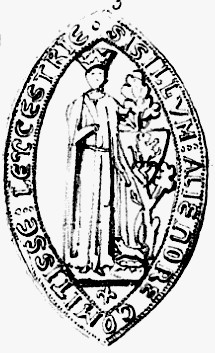
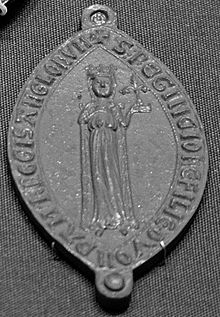
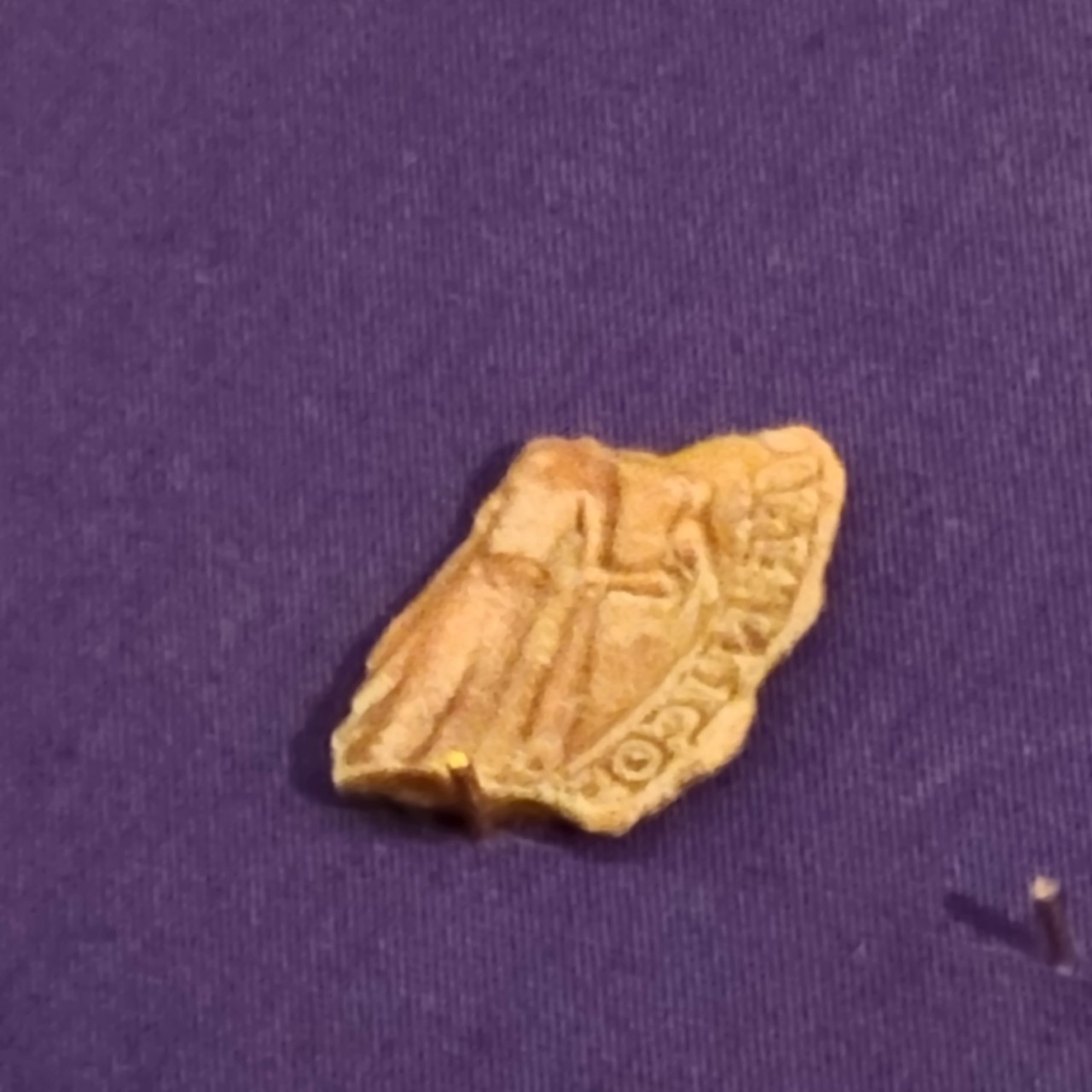
Partial seal of Nicholaa de la Haye

Nicholaa de la Haye first came to the attention of the chroniclers in the year 1191. She and her husband, Gerard de Camville, were in command of Lincoln Castle. Gerard was a talented administrator and was sheriff of Lincoln in 1189 and 1190 and again from 1199 to 1205. He was also hereditary constable of Lincoln Castle by right of his wife, Nicholaa. Although he had sworn allegiance to King Richard on his accession, in 1191 Gerard paid homage to the king’s brother John, then count of Mortain, for Lincoln Castle. This meant that Gerard and Nicholaa would be drawn into John’s dispute with King Richard’s chancellor, William Longchamp.

Before King Richard’s departure on crusade, the king had extracted a promise from John and their illegitimate half-brother Geoffrey, Archbishop of York, that neither would set foot in England for three years. Although it seems highly unlikely that Longchamp released John from his oath, the prince was back in England by 1191, possibly on the insistence of his mother, Eleanor of Aquitaine, who was watching over her favourite son’s domains while he was away on crusade.

Longchamp’s heavy-handed administration of the country caused much dissent among the barons and John chose to champion their cause. The catalyst for John’s armed opposition to William Longchamp may well have been the king’s recognition of his nephew, Arthur, Duke of Brittany still only a child of five years, as his heir; the only person in England who was meant to know was William Longchamp. However, it seems that Longchamp may have sounded out others to measure the level of support for Arthur. According to the chronicler William of Newburgh, he passed on the information to the king of Scots, at least, and possibly some of the Welsh princes. In early 1191 the news was widely leaked, and John came to hear of it.
History... the Interesting bits
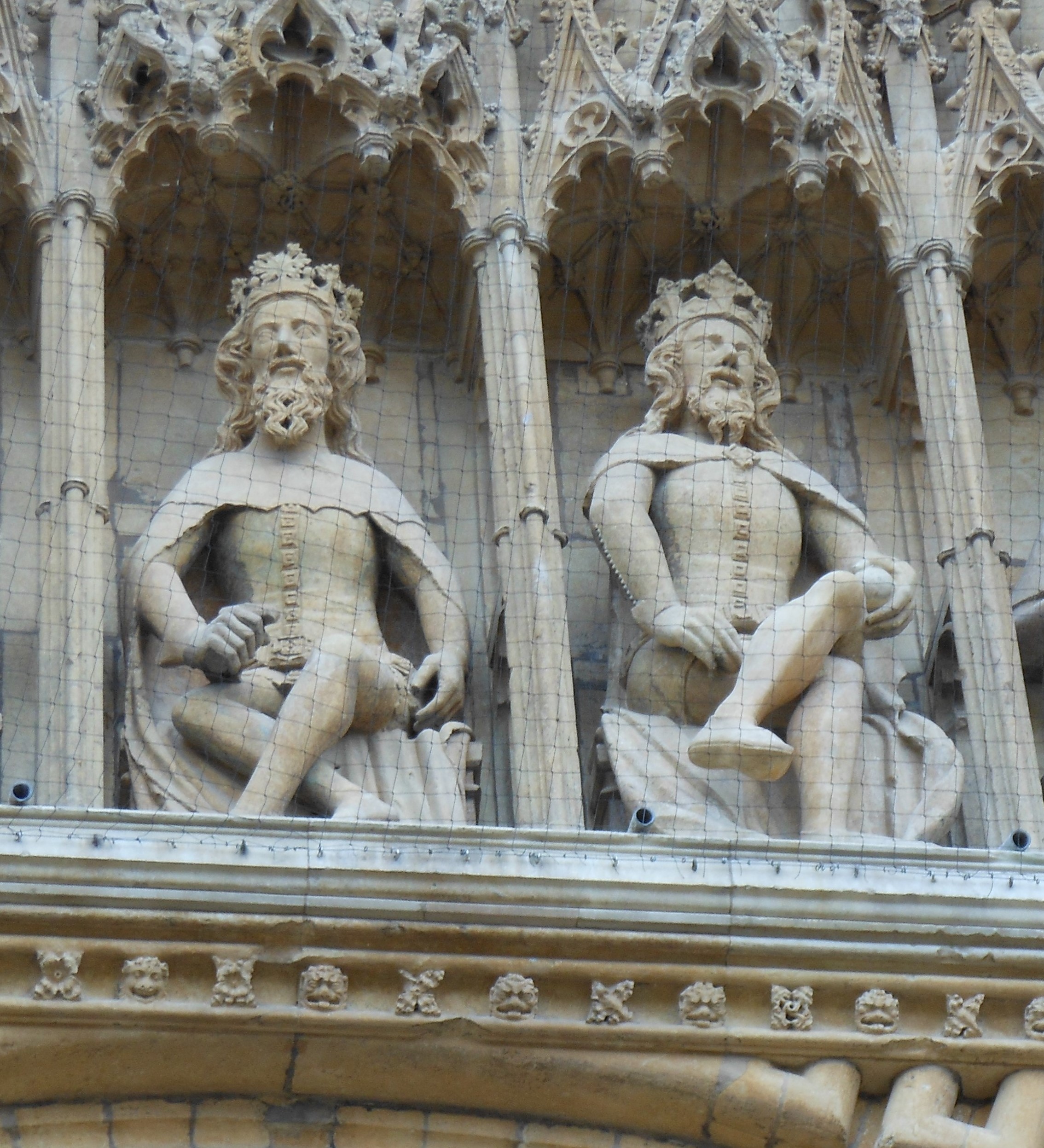
Richard I and John side by side in the Gallery of Kings on the West Front of Lincoln cathedral

According to William of Newburgh, John had expected to become the successor to the  kingdom, should the king not survive the cursade. Indeed, Richard’s advancement of his brother since his accession, in giving John lands in England and arranging his marriage to an English bride, all seemed to support this expectation. Richard’s actions in naming Arthur his heir, and Longchamp’s support for this, threatened to undermine John’s own claims and rights. Having heard the not-so-secret secret, John started building up his own powerbase. According to Richard of Devizes, John, ‘when he knew for certain that his brother had turned his back on England, presently perambulated the kingdom in a more popular manner, nor did he forbid his followers calling him the king’s heir.’

Tensions were rising. Richard of Devizes reported that, as a result of the king’s departure on crusade, the nobles were ‘all stirred up in arms, castles closed, cities fortified and entrenchments thrown up.’

John sent out letters, in secret, eliciting the support of the nobles against the justiciar. The king himself was so concerned over events in England that, in the spring, he had released Walter de Coutances, archbishop of Rouen, from his crusading vow and sent him back to sort things out. The king must have had concerns about the efficacy of William Longchamp’s rule, as he also sent a letter, to William Marshal, Hugh Bardolf, Geoffrey Fitz Peter and William Brewer, in which he ordered ‘If our chancellor does not act faithfully according to the advice of yourselves and others to whom we have committed the care of our kingdom, we order you to carry out your own dispositions in all the affairs of our kingdom, in castles and escheats, without any dispute.’

Walter de Coutances landed at Shoreham on 27 June, 1191. The situation had already escalated, however.

In 1190, on returning from his investigation into the massacre of the Jews of York, Longchamp stopped at Lincoln. He accused Gerard de Camville of harbouring thieves and robbers who preyed on the merchants attending the fair at Stamford. Longchamp had demanded that Gerard de Camville, described as ‘an enemy of the chancellor’ by the Crowland Chronicle, relinquish his custody of Lincoln Castle and swear allegiance to him, personally, as justiciar. Camville refused and instead ‘had done homage to Earl John, the king’s brother, for the castle of Lincoln, the custody whereof is known to belong to the inheritance of Nicholaa, the wife of the same Gerard, but under the king.’1

In acting against Gerard de Camville, Longchamp had forced him into John’s arms. On learning of Gerard’s defiance, Longchamp sent overseas for foreign mercenaries and set out north with the troops he had under his command, attacking Wigmore along the way and forcing Roger de Mortimer, impeached for conspiracy against the king, to surrender his castles and abjure England for three years. As Gerard de Camville joined John at Nottingham, Longchamp continued to Lincoln where he besieged the castle as ‘Gerard was with the earl; and his wife Nicholaa proposing to herself nothing effeminate defended the castle like a man. The chancellor was wholly busied about Lincoln.’2

History... the Interesting bits
Lincoln castle, East Gate

The formidable Nicholaa refused to yield, holding out for forty days before Longchamp raised the siege, having heard that Tickhill and Nottingham had fallen to John.

Gerard’s decision to leave Nicholaa in command of the castle, even though Longchamp was heading her way with an army, may have been to emphasise the standing of the de la Haye family in Lincolnshire, and its connections to the castle itself. He believed Lincoln would rally to her side. That he did not appoint a male deputy to take charge is testament to his trust in Nicholaa and her abilities. She had, after all, grown up with the castle as her birth right and would have been familiar with every part of its defences, its strengths and weaknesses. Although she would not have been able to fight, with sword and shield, she could direct the defence, placing soldiers where they were most needed, organising supplies of weapons and ammunition, and ensuring the stores of food and drink were suitably rationed.

Nicholaa was approaching forty when William Longchamp besieged her. She was no young, inexperienced girl, and she would have been used to command – and to her orders being obeyed. She was also a mother, of a daughter in her teens and at least two young boys, but it is unlikely that the children were in the castle; it is more likely they were being raised on her manor at Brattleby, just to the north of Lincoln. The castle itself may appear difficult to defend. The curtain wall was a third of a mile in length, but there was a steep drop on the south side. There were two main entrances, the East and West gates, and a number of postern gates. These had to be guarded closely. Similarly, the castle would also have been difficult to attack, and besiegers would have concentrated their energies on the main and postern gates. There is no record of Longchamp bringing up siege machinery, so it would have been a case of watching and waiting and hoping to starve out the castle occupants.

Nicholaa held out for forty days, as demonstrated by the Pipe Roll of 1191, which showed that mercenaries were employed for that length of time on the siege of Lincoln Castle. All the same, it must have been a relief for Nicholaa, when William Longchamp gave up the siege and marched his soldiers away.

According to Roger of Howden, the chancellor besieged Lincoln Castle, ‘having expelled Gerard de Camville from the keepership and the office of sheriff of Lincoln; which former office the chancellor gave to William de Stuteville and made him sheriff as well.’ John, in turn moved north in support of Gerard, quickly taking the ill-prepared royal castles of Tickhill (in Yorkshire) and Nottingham and demanding that Gerard de Camville be reinstated, saying that he ‘would visit him [the chancellor] with a rod of iron’.3
History... the Interesting bits
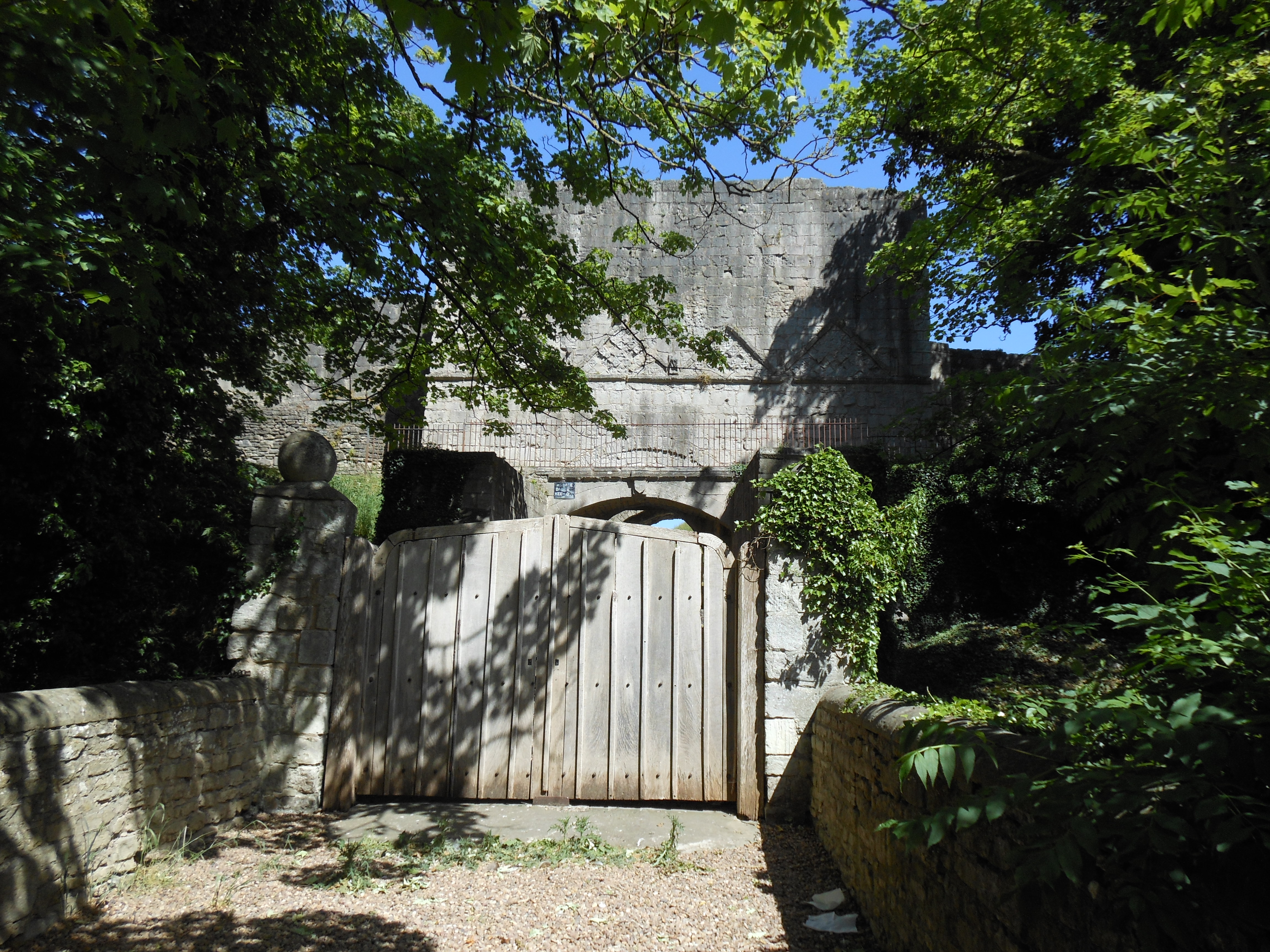
Gatehouse of Tickhill Castle, Yorkshire

John admonished Longchamp, saying ‘it was not proper to take from the loyal men of the kingdom, well known and free, their charges and commit them to strangers and men unknown; that it was a mark of his folly that he had intrusted the king’s castles to such, because they would expose them to adventurers; that if it should go with every barbarian with that facility, that even the castles should be ready at all times for their reception, that he would no longer bear in silence the destruction of his brother’s kingdom and affairs.’4

In the meantime, Walter de Coutances, Archbishop of Rouen but an Englishman by birth, had landed in England and hastened north to act as intermediary between the two warring factions. At some point in the escalating tensions, as Roger of Howden reports, William Longchamp, as papal legate, also issued a sentence of excommunication on John’s supporters. The list included John’s leading supporters, as well as Walter de Coutances, archbishop of Rouen, and Gerard de Camville.

Despite the blatant mistrust on both sides, settlement was reached, with the aid of bishops trusted by both men, and of barons who ‘swore that they would provide satisfaction between the earl and the chancellor concerning their quarrels and questions to the honour of both parties and the peace of the kingdom.’5 Agreement, mostly favourable to John, was reached whereby John would relinquish the castles he had taken, but then Longchamp would give Tickhill into the custody of Reginald de Wasseville and Nottingham to William de Wenn, both men of John’s affinity who each agreed to give up a hostage to the chancellor. John also promised not to harbour outlaws in his lands. Longchamp also agreed to drop his support for Arthur as Richard’s heir, to support John’s claim and ‘if the king should die…should promote him to the kingdom with all his power.’6

History... the Interesting bits
The Lucy Tower, Lincoln Castle’s main keep

Especial mention was made of Gerard de Camville, who was reinstated to Lincoln Castle, and ‘shall be reinstated in the office of sheriff of Lincoln, and on the same day a proper day shall be appointed for him to make his appearance in the court of our lord the king, there to abide his trial; and if in the judgement of the court of our lord the king proof can be given that he aught to lose that office as also the keepership of the castle of Lincoln, then he is to lose the same; but, if not, he is to keep it, unless in the meantime an agreement can be come to relative thereto on some other terms. And the lord John is not to support him against the decision of our lord the king, nor is he to harbour such outlaws or enemies to our lord the king, as shall be named to him, nor allow them to be harboured on his lands.’7

So, Gerard and Nicholaa would be safe in their castle at Lincoln, at least for now. What may happen on the king’s return was still to be determined. They also benefited from John’s largesse; Gerard was appointed keeper of the honour of Wallingford.

In the meantime, Nicholaa and Gerard could get on with the business of managing Lincoln Castle and the county of Lincolnshire.

For now…

Notes:

  1. Richard of Devizes, The Chronicle of Richard of Devizes, edited and translated by J. A. Giles
  2. ibid
  3. Roger of Howden (Hoveden), The Annals of Roger of Howden, translated by Henry T. Riley
  4. Devizes, The Chronicle of Richard of Devizes
  5. ibid
  6. ibid
  7. Howden, The Annals of Roger of Howden

Sources:

Richard of Devizes, The Chronicle of Richard of Devizes; Roger of Howden (Hoveden), The Annals of Roger of Howden; The Plantagenet Chronicles edited by Elizabeth Hallam; Brassey’s Battles by John Laffin; 1215 The Year of Magna Carta by Danny Danziger & John Gillingham; The Life and times of King John by Maurice Ashley; The Plantagenets, the Kings Who Made England by Dan Jones; England Under the Norman and Angevin Kings  by Robert Bartlett; lincolnshirelife.co.uk; catherinehanley.co.uk; magnacarta800th.com; lothene.org; lincolncastle.com; The Sheriff: The Man and His Office by Irene Gladwin; Louise Wilkinson, Women in Thirteenth Century Lincolnshire; Richard Huscraft, Tales from the Long Twelfth Century; J.W.F. Hill, Medieval Lincoln; swaton.org.uk; oxforddnb.com; Ingulph, Ingulph’ Chronicle of the Abbey of Croyland; Stephen Church, King John: England, Magna Carta and the Making of a Tyrant; Marc Morris, King John; Pipe Rolls; Red Book of the Exchequer

My Books:

Signed, dedicated copies of all my books are available, please get in touch by completing the contact me form or through my online bookshop.

Out now: Scotland’s Medieval Queens

Books by Sharon Bennett Connolly

Scotland’s history is dramatic, violent and bloody. Being England’s northern neighbour has never been easy. Scotland’s queens have had to deal with war, murder, imprisonment, political rivalries and open betrayal. They have loved and lost, raised kings and queens, ruled and died for Scotland. From St Margaret, who became one of the patron saints of Scotland, to Elizabeth de Burgh and the dramatic story of the Scottish Wars of Independence, to the love story and tragedy of Joan Beaufort, to Margaret of Denmark and the dawn of the Renaissance, Scotland’s Medieval Queens have seen it all. This is the story of Scotland through their eyes.

Scotland’s Medieval Queens gives a thorough grounding in the history of the women who ruled Scotland at the side of its kings, often in the shadows, but just as interesting in their lives beyond the spotlight. It’s not a subject that has been widely covered, and Sharon is a pioneer in bringing that information into accessible history.’ Elizabeth Chadwick (New York Times bestselling author)

Available now from Amazon and Pen and Sword Books

Also by me:
Books by Sharon Bennett Connolly

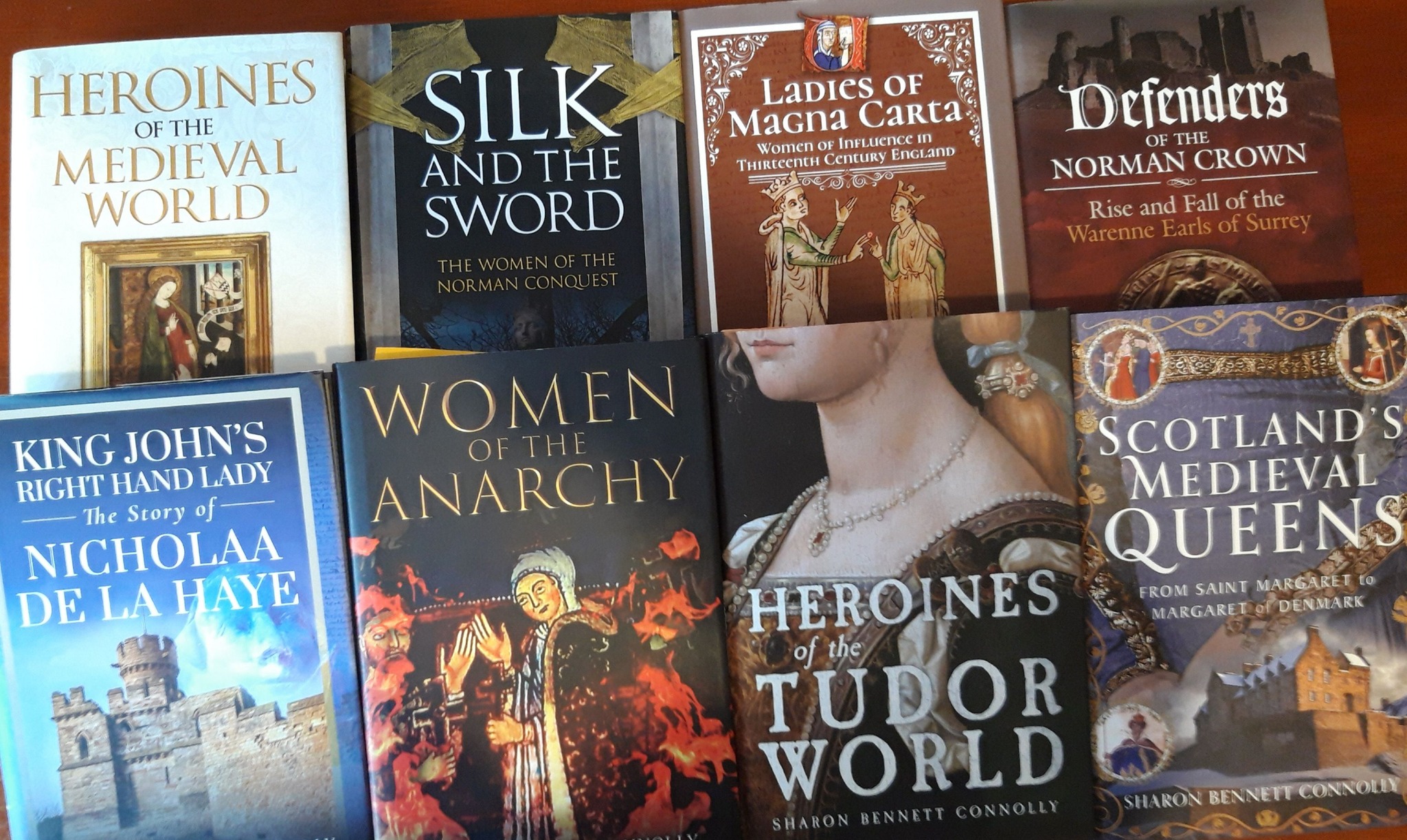
Heroines of the Tudor World tells the stories of the most remarkable women from European history in the time of the Tudor dynasty, 1485-1603. These are the women who ruled, the women who founded dynasties, the women who fought for religious freedom, their families and love. Heroines of the Tudor World is now available for pre-order from Amberley Publishing and Amazon UK. Women of the Anarchy demonstrates how Empress Matilda and Matilda of Boulogne, unable to wield a sword themselves, were prime movers in this time of conflict and lawlessness. It shows how their strengths, weaknesses, and personal ambitions swung the fortunes of war one way – and then the other. Available from Bookshop.orgAmberley Publishing and Amazon UKKing John’s Right-Hand Lady: The Story of Nicholaa de la Haye is the story of a truly remarkable lady, the hereditary constable of Lincoln Castle and the first woman in England to be appointed sheriff in her own right. Available from all good bookshops Pen & Sword Booksbookshop.org and Amazon

Royal Historical Society

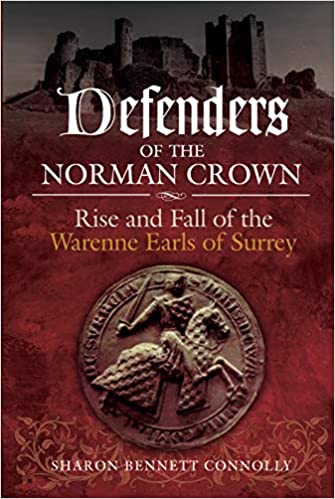
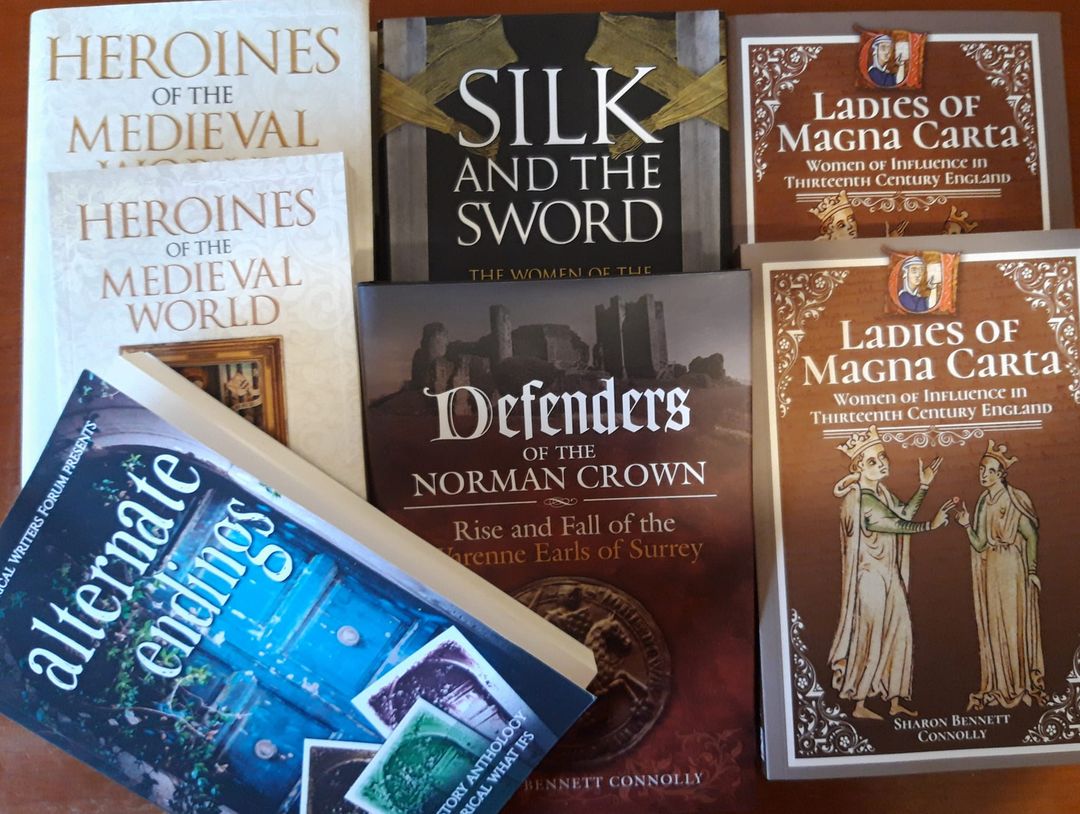
Defenders of the Norman Crown: The Rise and Fall of the Warenne Earls of Surrey tells the fascinating story of the Warenne dynasty, from its origins in Normandy, through the Conquest, Magna Carta, the wars and marriages that led to its ultimate demise in the reign of Edward III. Available from Pen & Sword BooksAmazon in the UK and US, and Bookshop.orgLadies of Magna Carta: Women of Influence in Thirteenth Century England looks into the relationships of the various noble families of the 13th century, and how they were affected by the Barons’ Wars, Magna Carta and its aftermath; the bonds that were formed and those that were broken. It is now available in paperback and hardback from Pen & SwordAmazon, and Bookshop.orgHeroines of the Medieval World tells the stories of some of the most remarkable women from Medieval history, from Eleanor of Aquitaine to Julian of Norwich. Available now from Amberley Publishing and Amazon, and Bookshop.orgSilk and the Sword: The Women of the Norman Conquest traces the fortunes of the women who had a significant role to play in the momentous events of 1066. Available now from Amazon,  Amberley Publishing, and Bookshop.org.

Alternate Endings: An anthology of historical fiction short stories including Long Live the King… which is my take what might have happened had King John not died in October 1216. Available in paperback and kindle from Amazon.

*

Podcast:

A Slice of Medieval

Have a listen to the A Slice of Medieval podcast, which I co-host with Historical fiction novelist Derek Birks. Derek and I welcome guests, such as Bernard Cornwell and Elizabeth Chadwick, and discuss a wide range of topics in medieval history, from significant events to the personalities involved. In episode 15, Derek Birks and I discuss Nicholaa’s remarkable story:

There are now 80 episodes to listen to!

Every episode is also available on YouTube.

*

Don’t forget! Signed and dedicated copies of all my books are available through my online bookshop.

For forthcoming online and in-person talks, please check out my Events Page.

You can be the first to read new articles by clicking the ‘Follow’ button, liking our Facebook page or joining me on TwitterThreadsBluesky and Instagram.

*

©2023 Sharon Bennett Connolly FRHistS
Two new books in one month!

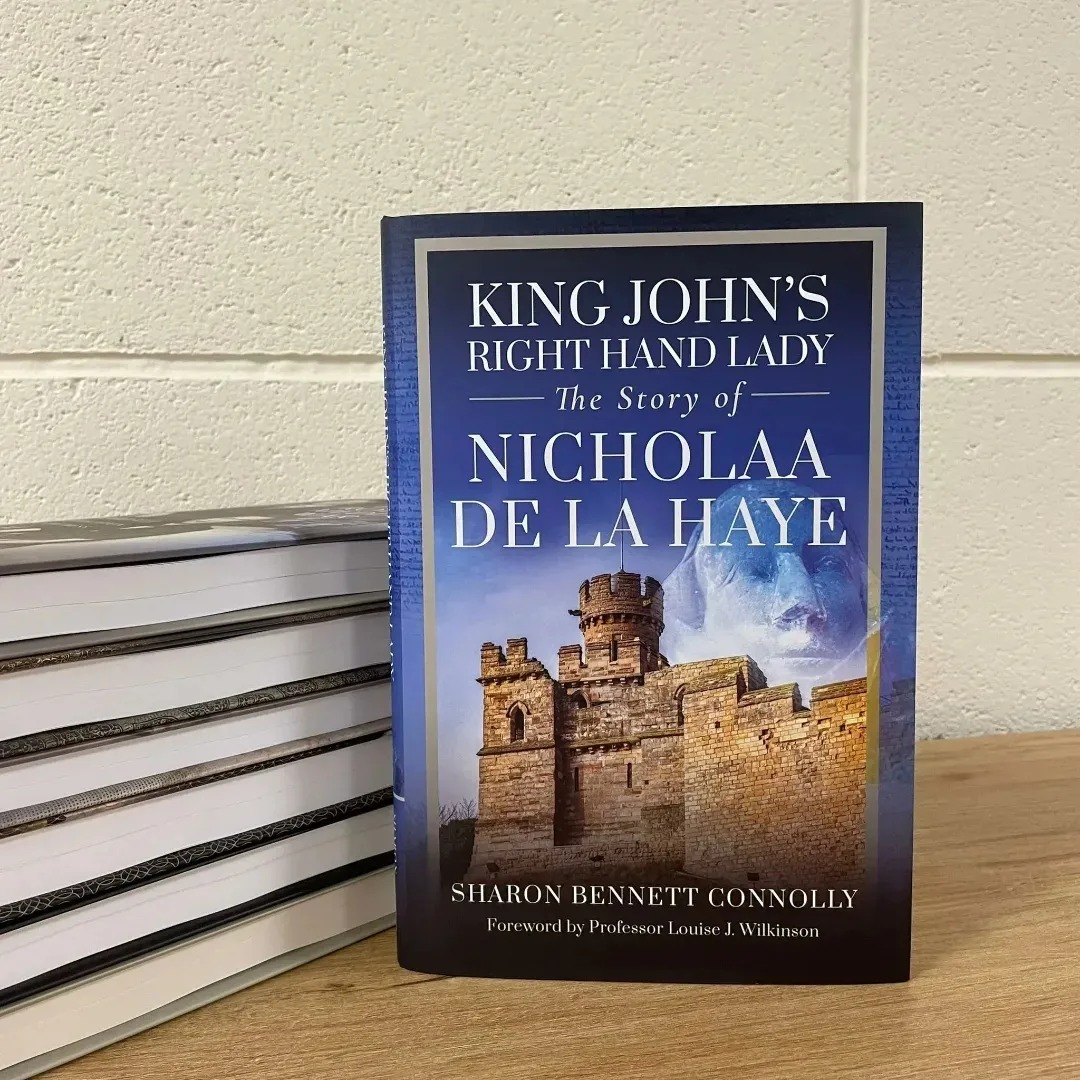
King John’s Right Hand Lady: The Story of Nicholaa de la Haye

Well, it has been quite a journey, but my biography of Nicholaa de la Haye is now out in the world. My journey with Nicholaa started off with a blog post in 2015, shortly after a day trip to Lincoln Castle with my son. From that day on, I devoured everything I could find on Nicholaa. Nicholaa was one of the inspirations for my first book, Heroines of the Medieval World; I wanted to tell the stories of the most incredible women in medieval history and Nicholaa was certainly in my Top 10. And from that book, I started thinking that there was more scope to examine the women related to the Magna Carta story, especially Nicholaa and her contemporary, Matilda de Braose. The conflicting lives and experiences of these two women inspired Ladies of Magna Carta: Women of Influence in Thirteenth Century England; while Matilda became King John’s bitter enemy and ultimate victim, Nicholaa was a loyal ally, trusted to hold Lincoln Castle against the rebel barons and was the first woman to be appointed as a county sheriff.

As I was researching Nicholaa’s story for Ladies of Magna Carta, I got very excited as I realised that I may have enough material for a full biography. I contacted my editor, expected her to shut me down and say ‘no thanks, no one will be interested.’ But, instead, she said ‘go for it!’ And the project was born.

In a time when men fought and women stayed home, Nicholaa de la Haye held Lincoln Castle against all-comers. Not once, but three times, earning herself the ironic praise that she acted ‘manfully’. Nicholaa gained prominence in the First Baron’s War, the civil war that followed the sealing of Magna Carta in 1215. Although recently widowed, and in her 60s, in 1217 Nicholaa endured a siege that lasted over three months, resisting the English rebel barons and their French allies. The siege ended in the battle known as the Lincoln Fair, when 70-year-old William Marshal, the Greatest Knight in Christendom, spurred on by the chivalrous need to rescue a lady in distress, came to Nicholaa’s aid. Nicholaa de la Haye was a staunch supporter of King John, remaining loyal to the very end, even after most of his knights and barons had deserted him. A truly remarkable lady, Nicholaa was the first woman to be appointed sheriff in her own right. Her strength and tenacity saved England at one of the lowest points in its history. Nicholaa de la Haye is one woman in English history whose story needs to be told…

And early reviews are fantastic!

Whilst I have read many wonderful new releases so far this year, and I look forward to reading and reviewing many more, I have to say this has been my favourite so far. Not only is Nicholaa’s story fascinating, the way Sharon presents her impeccable scholarship is second-to-none.
I hold this book up as the gold standard for how history should be written. Sharon does not just tell the narrative history, but actually presents the primary sources, showing not just what we know of Nicholaa’s life, but how we know it. It is wonderful to be able to read the sources and see how Sharon pieced together Nicholaa’s life and family. Where sources raise more questions than they answer, Sharon does not just run with a chosen narrative version, but admits to the ambiguities and gaps in the historical record, and where relevant, offers multiple theories as to what really happened.
I must thank Sharon Bennett Connolly of History the Interesting Bits for bringing this fascinating woman out of the shadows, and for doing so in such an illuminating way.” Jessica Carey-Bunning

Connolly’s devotion to uncovering Nicholaa de la Haye’s life and her time in power as the constable of Lincoln in her own right is reflected throughout the book, and Connolly’s clear familiarity with the time period and the de la Haye family makes this book an incredibly fascinating read. Her prose and detail provides the reader with a complete understanding of the complicated late twelfth and early thirteenth century politics in London and the power struggles between various nobles and the sons of Henry II, and Connolly explains this wonderfully.” Lily Amidon

An engrossing account of a little-known historical figure and the pivotal role she played in late 12th/early 13th century history and politics. This is one of those rare books that is scrupulously researched and scholarly but also grips like a novel. Setting the character of Nicolaa de la Haye in her historical context, “King John’s Right Hand Lady” casts light on the remarkable story of the woman who was England’s first female sheriff, and in doing so casts a fascinating light on the character of Nicolaa herself as well as the age she lived in. highly recommended.” Nicola Cornick

History lovers will enjoy learning about this unique lady whom history nearly forgot. History academics will relish the depth of research, end notes, appendices, and comprehensive biography.” Christy Howl

A strong, independent woman who lived a thrilling life and was willing to defend her home of Lincoln Castle even at the age of sixty, Nicholaa de la Haye was an unsung heroine of the thirteenth century. Connolly’s passion for telling Nicholaa’s tale of trials and tribulations exudes on every page. “King John’s Right Hand Lady: The Story of Nicholaa de la Haye” by Sharon Bennett Connolly is the perfect book for anyone who wants a story about the Plantagenets, King John, and the first female sheriff of England. A true triumph in exploring the life of a more hidden figure from the thirteenth century.” Heidi Malagisi

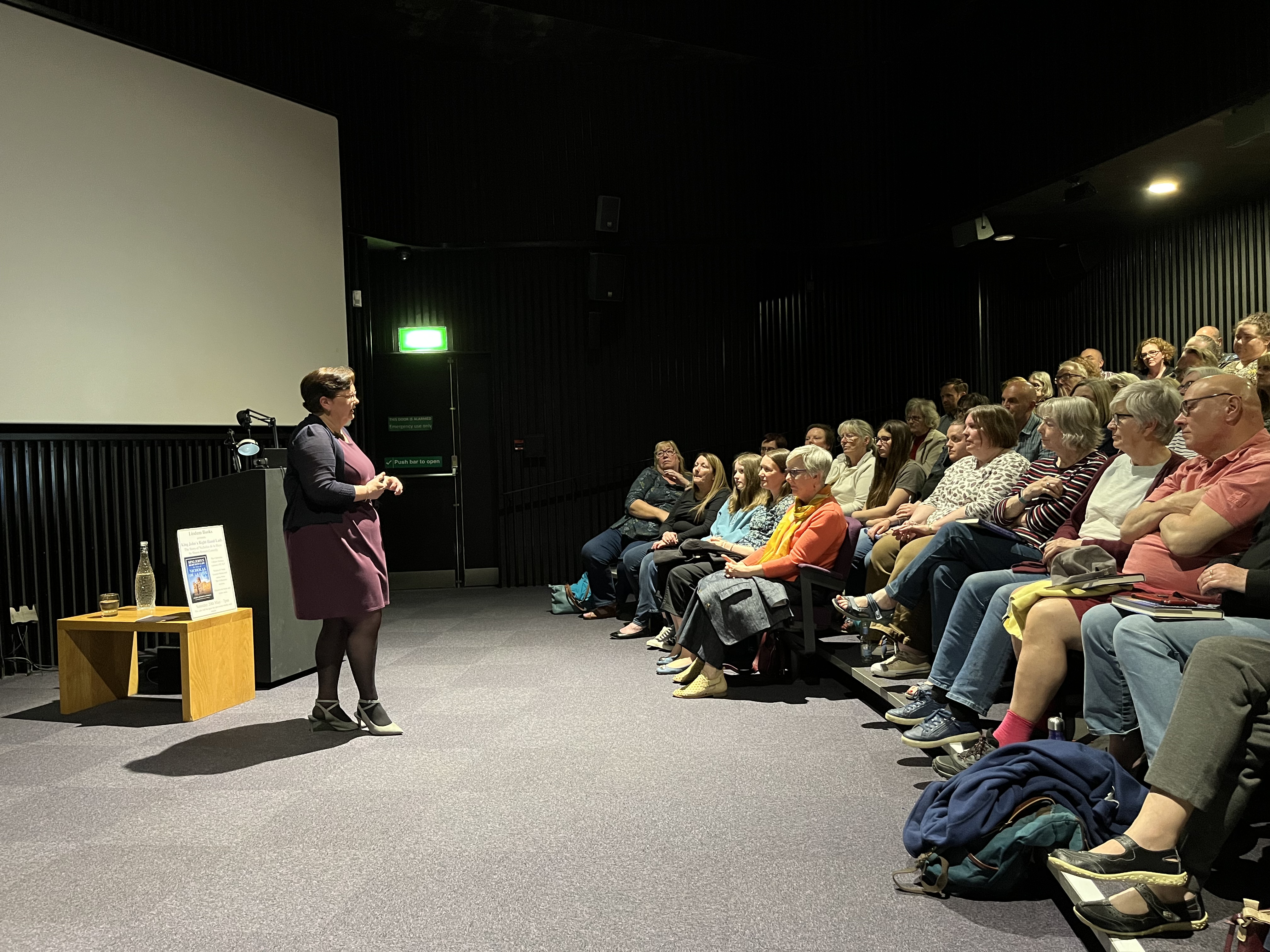
I am immensely grateful to everyone at Lindum Books and the Lincoln Museum, in Lincoln, who hosted the launch of King John’s Right Hand Lady: The Story of Nicholaa de la Haye, to a sell-out crowd at the Lincoln Museum, on 20 May 2023, the 806th anniversary of the 1217 Battle of Lincoln, in which Nicholaa played a pivotal role as Constable of Lincoln Castle. And thanks to the incredible audience, who laughed at my jokes in all the right places.

To Buy King John’s Right Hand Lady:

King John’s Right-Hand Lady: The Story of Nicholaa de la Haye is now available as a hardback and Kindle from Pen & Sword Booksbookshop.org and Amazon (UK and US).

I said two new books, didn’t I?

Well, yes, I did. Because on the same day that King John’s Right-Hand Lady: The Story of Nicholaa de la Haye hit the bookshops, the paperback edition of Defenders of the Norman Crown: Rise and Fall of the Warenne Earls of Surrey was also published:

In the reign of Edward I, when asked Quo Warranto? – by what warrant he held his lands – John de Warenne, the 6th earl of Warenne and Surrey, is said to have drawn a rusty sword, claiming ‘My ancestors came with William the Bastard, and conquered their lands with the sword, and I will defend them with the sword against anyone wishing to seize them.’

John’s ancestor, William de Warenne, 1st Earl of Surrey, fought for William the Conqueror at the Battle of Hastings in 1066. He was rewarded with enough land to make him one of the richest men of all time. In his search for a royal bride, the 2nd earl kidnapped the wife of a fellow baron. The 3rd earl died on crusade, fighting for his royal cousin, Louis VII of France…

For three centuries, the Warennes were at the heart of English politics at the highest level, until one unhappy marriage brought an end to the dynasty. The family moved in the most influential circles, married into royalty and were not immune to scandal.

Defenders of the Norman Crown tells the fascinating story of the Warenne dynasty, of the successes and failures of one of the most powerful families in England, from its origins in Normandy, through the Conquest, Magna Carta, the wars and marriages that led to its ultimate demise in the reign of Edward III.

Reviews:

I loved Defenders of the Norman Crown.  Sharon Bennett Connolly’s detailed, meticulous research brings together a wealth of sources to give the reader a fascinating view of one of the powerful families on which the Crown depended for centuries. Politics and power, Marriages and mistresses,  Lordship and land, Defenders of the Norman Crown has it all. Sharon Bennett Connolly has written a very fine book indeed – I loved it.” Elizabeth Chadwick, author of The Greatest Knight

I am reading and loving Defenders of the Norman Crown by Sharon Bennett Connolly and it’s stunning. The Warenne family, their sons, daughters and wives making gripping reading and vividly filling in fascinating background shading to the stories of medieval monarchs. Wonderful research and gripping true stories, all well substantiated with relevant sources.” Carol McGrath, author of the She-Wolf Trilogy

Sharon Bennett Connolly has written an evocative narrative, highlighting the role the Warenne earls of Surrey played in the nation’s history. Her meticulous research is evident in every page, making the book both a reference guide and an immensely enjoyable read.“Kristie Dean, author of On the Trail of Richard III

A vivid portrayal of a powerful aristocratic family. Sharon Bennett Connolly follows the fortunes of the Warenne earls of Surrey from supporters of William the Conqueror at the battle of Hastings to their eventual demise in the reign of Edward III. Connolly writes with verve and enthusiasm, bringing the Warennes to life in all their guises – warriors, landowners and crusaders – and does not neglect the women of the family. A highly readable and well-illustrated survey.” Michael Jones, author of The Black Prince

To Buy Defenders of the Norman Crown

Defenders of the Norman Crown: Rise and Fall of the Warenne Earls of Surrey was released in the UK on 31 May and will be out in the US on 6 August. And it is now available for pre-order from Pen & Sword Books, Bookshop.org and Amazon in the UK and US.

Signed, dedicated copies of all my books are available, please get in touch by completing the contact me form.

Also by me:

Ladies of Magna Carta: Women of Influence in Thirteenth Century England looks into the relationships of the various noble families of the 13th century, and how they were affected by the Barons’ Wars, Magna Carta and its aftermath; the bonds that were formed and those that were broken. It is now available in paperback and hardback from Pen & Sword,  Amazon, and Bookshop.org.

Heroines of the Medieval World tells the stories of some of the most remarkable women from Medieval history, from Eleanor of Aquitaine to Julian of Norwich. Available now from Amberley Publishing and Amazon, and Bookshop.org.

Silk and the Sword: The Women of the Norman Conquest traces the fortunes of the women who had a significant role to play in the momentous events of 1066. Available now from Amazon,  Amberley Publishing, and Bookshop.org.

Alternate Endings: An anthology of historical fiction short stories including Long Live the King… which is my take what might have happened had King John not died in October 1216. Available in paperback and kindle from Amazon.

*

Podcast:

Have a listen to my A Slice of Medieval podcast, where Derek Birks and I discuss Nicholaa’s remarkable story:

For forthcoming online and in-person talks, please check out my Events Page.

You can be the first to read new articles by clicking the ‘Follow’ button, liking our Facebook page or joining me on Twitter and Instagram.

*

©2023 Sharon Bennett Connolly FRHistS

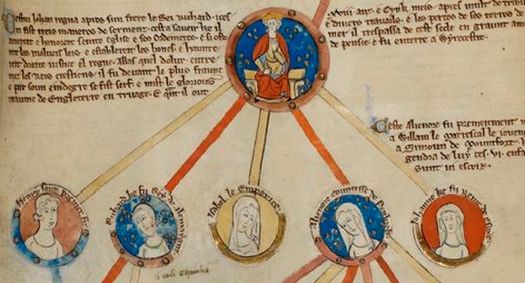
Eleanor, daughter of a king, Countess of Pembroke

King John with his children Henry, Richard, Joan, Isabella and Eleanor

There was one daughter of King John for whom the legacy of Magna Carta and the struggle for political reform held particular significance. The life of Eleanor of England, and her husband Simon de Montfort, stands as the epilogue of the Magna Carta story. Although democratic government was still many centuries in the future, Magna Carta was the first step. The political movement led by Simon de Montfort was the second step …

However, had fate not stepped in, Eleanor may never have married Simon. From an early age, she had been the wife of another, until tragedy struck.

Eleanor of England was the youngest child of John and Isabelle d’Angoulême; she is said to have inherited her mother’s beauty and feisty temperament.1 Eleanor was thought to have been born at the height of her father’s troubles, in the midst of the Magna Carta crisis in 1215. However, historians are now inclined to the theory that she was born posthumously, sometime after the death of King John, either in late 1216 or early in 1217. She was named for her famous grandmother, Eleanor of Aquitaine. As a baby, little Eleanor was placed in the household of the bishop of Winchester, where her eldest brother, Henry, had been living since 1212.2 Eleanor’s father had died whilst the country was riven by war, on the night of 18/19 October 1216 at Newark. He was succeeded by Eleanor’s eldest brother Henry – now King Henry III. Eleanor’s mother, frozen out from any role in her son’s regency or life, returned to her native Angoulême and in 1220 married Hugh X de Lusignan, Count of La Marche.

In 1224 Eleanor’s future was decided when she was married to William (II) Marshal, Earl of Pembroke. The younger Marshal was the son of the first earl of Pembroke who had been regent in the early years of Henry III’s reign, and who had driven the French out of England following his victory at the Battle of Lincoln in May 1217. The first earl had a reputation for integrity and loyalty, having remained unwavering in his loyalty to King John during the Magna Carta crisis. The second earl, Eleanor’s husband, had been a hostage of the king between 1207 and 1213, as a guarantee of his father’s good behaviour. He later joined the baronial rebellion and was appointed marshal of the forces of the invader, Prince Louis. However, he returned to the Royalist cause when Louis refused him possession of Marlborough Castle, which had previously belonged to the younger Marshal’s grandfather.3

William (II) Marshal fought alongside his father at the Battle of Lincoln. On his father’s death in 1219, Marshal had succeeded him as earl of Pembroke and marshal of England; when his mother died in 1220, he succeeded to her lordships of Leinster and Netherwent. His younger brother, Richard Marshal, succeeded to the Clare lands in Ireland. In 1214 Marshal married Alice, the daughter of Baldwin de Béthune, Count of Aumâle, to whom he had been betrothed in 1203. The marriage was short-lived, however, as poor Alice died in 1216.

On 23 April 1224, William (II) Marshal was married to Eleanor; born in the 1190s, he was some twenty-or-so years older than his bride, who was no more than 9 years old on her wedding day, and may have been as young as 7.4

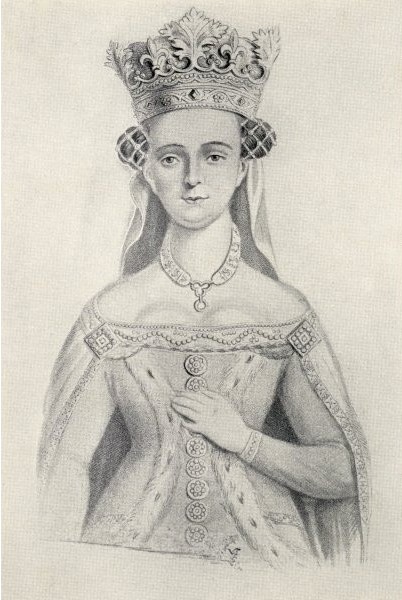
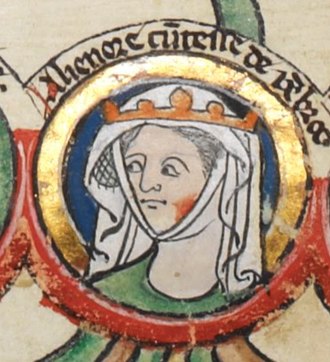
Eleanor of England, Countess of Pembroke

The marriage was agreed at the behest of the justiciar, Hubert de Burgh, and the papal legate, Pandulf, as a way of guaranteeing Marshal remained firmly in the justiciar’s camp, and to prevent the marshal making a foreign marriage. The match put an end to three years of indecision, as to whether Eleanor should marry a foreign prince or an English magnate. The king settled ten manors, confiscated from a French nobleman and already administered by Marshal, on his sister as her marriage portion.5

For the first five years of her marriage Eleanor continued to live at court, under the guardianship of Cecily of Sandford.6 In 1229, when she was 13 or 14, she went to live with her husband, and would spend her time travelling with him in England, France and Ireland. In May 1230, Marshal had taken twenty knights with him on Henry III’s expedition to Poitou. He also took his wife, probably at the behest of the king. Eleanor became seasick during the voyage to France and Henry had his ship drop anchor at the nearest landfall to give her time to recover, ordering the fleet to continue without them.7

Henry was probably hoping that Eleanor’s presence would help to secure the support of his mother and her second husband, Hugh de Lusignan, to his expedition against the French. Mother and daughter had not seen each other since Eleanor was a baby. Isabelle’s maternal affection for the children of her first husband, however, was practically non-existent, or deeply hidden, and Eleanor’s presence failed to persuade her mother and stepfather to remain loyal to Henry III. As we have seen in a previous article, Isabelle d’Angoulême‘s priorities as a French countess often clashed with those of her English family.

Marshal and Eleanor returned from France in the spring of 1231, with William handing over command of the English forces to Ranulf, Earl of Chester. Shortly after their return, the couple attended the wedding of Marshal’s widowed sister, Isabel, to the king’s brother, Richard, Earl of Cornwall. Family happiness turned to grief, however, when William (II) Marshal died suddenly in London a week later, on 6 April. He was buried beside his father at the Temple Church on 15 April 1231.

At the still very tender age of between 14 and 16, Eleanor was a now childless widow.

The arms of William Marshal, Earl of Pembroke

The earldom of Pembroke passed to William’s younger brother, Richard, and Eleanor would spend many years fighting unsuccessfully to get the entirety of her dowry from the Marshal family, which amounted to one third of the Marshal estates, according to the guarantees established by Magna Carta. The Great Charter stipulated a widow should receive the allocation of a dower within forty days of her husband’s death.

A year after William’s death Richard Marshal offered Eleanor £400 a year as her settlement. Henry III persuaded his sister to take it, wanting to be done with the business and probably well aware that it was as much as Eleanor was likely to get, despite the Marshal holdings amounting to an income of £3,000 a year.8 Henry stood as guarantor for the settlement but the payments would always be sporadic and unreliable, not helped by the fact that the earldom passed through four successive Marshal brothers between 1231 and 1245, each with differing priorities and more Marshal widows to assign their dowers.

In the midst of her grief, and influenced by her former governess, Eleanor took a vow of chastity in the presence of Edmund of Abingdon, Archbishop of Canterbury in 1234. Although she did not become a nun, the archbishop put a ring on her finger, to signify that she was a bride of Christ; she was, therefore, expected to remain chaste and virtuous for the rest of her life. As a result, the king seized her estates and Richard Marshal, as her husband’s heir, took many of her valuable chattels.

Knowing how teenagers see lost love as the end of the world, even today, one can understand Eleanor’s decision to take a vow of chastity, even if we cannot comprehend anyone giving such advice to a grieving 16-year-old. Eleanor may also have seen taking such a vow as a way of staving off her brother, the king, forcing her to remarry in the interests of the crown. Moreover, it put Eleanor’s life in her own hands and also served to appease the Marshal family, who would have seen their own lands, which made up Eleanor’s dower, controlled by another magnate or foreign prince had she remarried.

Eleanor’s seal as Countess of Leicester

The widowed Eleanor retired to the castle of Inkberrow in Worcestershire. King Henry III continued to watch over his sister throughout the 1230s; he sent her gifts of venison and timber for her manors. Throughout her life, Eleanor was known for her extravagant spending, which led to substantial debts; Henry lent her money and made sporadic payments to reduce the debts. And in 1237 her brother granted her Odiham Castle in Hampshire, which would become her principal residence.9

Although Eleanor spent the 7 years after William Marshal’s death as a young widow sworn to chastity, most people may have predicted that such a life would not last. And at some point after the mid-1230s, possibly at the wedding of Henry and Eleanor of Provence, Eleanor met Simon de Montfort, the man who would dominate English politics in the mid-thirteenth century.

The couple fell in love.

But that story is for another time…

*

Images:

Courtesy of Wikipedia

Footnotes:

1. Carol, ‘Eleanor of Leicester: A Broken Vow of Chastity’, historyofroyalwomen.com, 28 February 2017; 2. Elizabeth Norton, She Wolves; 3. R.F. Walker, ‘William Marshal, fifth earl of Pembroke (c. 1190–1231)’, oxforddnb.com; 4. Ibid; 5. Darren Baker, With All For All; 6. Elizabeth Hallam, ‘Eleanor, Countess of Pembroke and Leicester (1215?–1275)’, Oxforddnb.com; 7. Darren Baker, With All For All; 8. Ibid; Elizabeth Hallam, ‘Eleanor, Countess of Pembroke’.

Sources:

Rich Price, King John’s Letters Facebook group; Robert Bartlett England Under the Norman and Angevin Kings 1075-1225; Dan Jones The Plantagenets; the Kings who Made EnglandThe Plantagenet Chronicle Edited by Elizabeth Hallam; Maurice Ashley The Life and Times of King John; Roy Strong The Story of BritainOxford Companion to British History; Mike Ashley British Kings & Queens; David Williamson Brewer’s British Royalty; Ralph of Diceto, Images of History; Marc Morris, King John; David Crouch, William Marshal; Crouch and Holden, History of William Marshal; Crouch, David, ‘William Marshal [called the Marshal], fourth earl of Pembroke (c. 1146–1219)’, Oxforddnb.com; Flanagan, M.T., ‘Isabel de Clare, suo jure countess of Pembroke (1171×6–1220)’, Oxforddnb.com; Thomas Asbridge, The Greatest Knight; Chadwick, Elizabeth, ‘Clothing the Bones: Finding Mahelt Marshal’, livingthehistoryelizabethchadwick.blogspot.com; Stacey, Robert C., ‘Roger Bigod, fourth earl of Norfolk (c. 1212-1270)’, Oxforddnb.com; finerollshenry3.org.uk; Vincent, Nicholas, ‘William de Warenne, fifth earl of Surrey [Earl Warenne] (d. 1240)’, Oxforddnb.com.

*

My Books:

Signed, dedicated copies of all my books are available through my online bookshop.

Out Now! Women of the Anarchy

Two cousins. On the one side is Empress Matilda, or Maud. The sole surviving legitimate child of Henry I, she is fighting for her birthright and that of her children. On the other side is her cousin, Queen Matilda, supporting her husband, King Stephen, and fighting to see her own son inherit the English crown. Women of the Anarchy demonstrates how these women, unable to wield a sword, were prime movers in this time of conflict and lawlessness. It show how their strengths, weaknesses, and personal ambitions swung the fortunes of war one way – and then the other.

Available from Bookshop.orgAmberley Publishing and Amazon UK.

Coming on 15 June 2024: Heroines of the Tudor World

Heroines of the Tudor World tells the stories of the most remarkable women from European history in the time of the Tudor dynasty, 1485-1603. These are the women who ruled, the women who founded dynasties, the women who fought for religious freedom, their families and love. These are the women who made a difference, who influenced countries, kings and the Reformation. In the era dominated by the Renaissance and Reformation, Heroines of the Tudor World examines the threats and challenges faced by the women of the era, and how they overcame them. From writers to regents, from nuns to queens, Heroines of the Tudor World shines the spotlight on the women helped to shape Early Modern Europe.

Heroines of the Tudor World is now available for pre-order from Amberley Publishing and Amazon UK.

Also by Sharon Bennett Connolly:

King John’s Right-Hand Lady: The Story of Nicholaa de la Haye is the story of a truly remarkable lady, the hereditary constable of Lincoln Castle and the first woman in England to be appointed sheriff in her own right. It is is available from King John’s Right-Hand Lady: The Story of Nicholaa de la Haye is the story of a truly remarkable lady, the hereditary constable of Lincoln Castle and the first woman in England to be appointed sheriff in her own right. Available from all good bookshops or direct from Pen & Sword Booksbookshop.org and AmazonDefenders of the Norman Crown: The Rise and Fall of the Warenne Earls of Surrey tells the fascinating story of the Warenne dynasty, from its origins in Normandy, through the Conquest, Magna Carta, the wars and marriages that led to its ultimate demise in the reign of Edward III. Available from Pen & Sword BooksAmazon in the UK and US, and Bookshop.org

Ladies of Magna Carta: Women of Influence in Thirteenth Century England looks into the relationships of the various noble families of the 13th century, and how they were affected by the Barons’ Wars, Magna Carta and its aftermath; the bonds that were formed and those that were broken. It is now available in paperback and hardback from Pen & Sword,  Amazon, and Bookshop.orgHeroines of the Medieval World tells the stories of some of the most remarkable women from Medieval history, from Eleanor of Aquitaine to Julian of Norwich. Available now from Amberley Publishing and Amazon, and Bookshop.orgSilk and the Sword: The Women of the Norman Conquest traces the fortunes of the women who had a significant role to play in the momentous events of 1066. Available now from Amazon,  Amberley Publishing, and Bookshop.org.

Alternate Endings: An anthology of historical fiction short stories including Long Live the King… which is my take what might have happened had King John not died in October 1216. Available in paperback and kindle from Amazon.

Podcast:

Have a listen to the A Slice of Medieval podcast, which I co-host with Historical fiction novelist Derek Birks. Derek and I welcome guests, such as Bernard Cornwell and Elizabeth Chadwick, and discuss a wide range of topics in medieval history, from significant events to the personalities involved.

*

Don’t forget! Signed and dedicated copies of all my books are available through my online bookshop.

For forthcoming online and in-person talks, please check out my Events Page.

You can be the first to read new articles by clicking the ‘Follow’ button, liking our Facebook page or joining me on Twitter and Instagram.

©2022 Sharon Bennett Connolly FRHistS
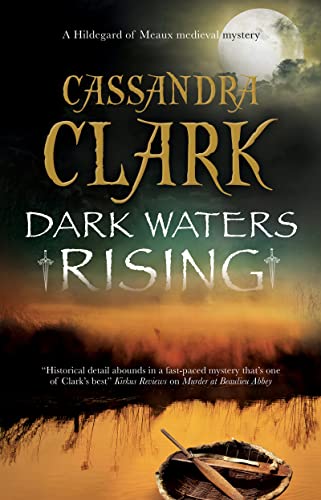
Book Corner: Dark Waters Rising by Cassandra Clark

A storm is coming . . . Can nun sleuth Hildegard solve the murder of a lay sister before the rising flood waters trap her with a cunning killer?

Autumn, 1394. All is not well at Swyne Priory. Dissension has arisen amongst the nuns. The new novices whisper in corners, spreading malicious rumours and sharing dark secrets.

The Prioress gives Hildegard an order: search out the cause of this unrest, and put a stop to it. But before Hildegard can investigate, she’s forced to deal with a new problem: the arrival of a mysterious stranger in the middle of the night, claiming his life is in danger.

Hildegard isn’t sure whether to believe him, but when a body is discovered near the priory, she’s soon plunged into a dark and dangerous puzzle where nothing is as it seems. All she knows for certain is that a storm is coming, threatening to cut the priory off from the outside world and trap them with a killer . . .

Dark Waters Rising is the twelfth and final novel of Cassandra Clark’s fabulous series charting the adventure of her nun-turned-sleuth Hildegard of Meaux. Deep in the wilds of Yorkshire, amidst a storm that threatens to drown everything and everyone, Hildegard is thrown into yet another mystery when a court musician appears at the gates of her abbey, just as one of the abbey’s servants is viciously murdered. Coincidence?

Dark Waters Rising is set in the turbulent reign of King Richard II, when the king’s own relatives are always looking to their own advantage – to the detriment of the king and those who support him. It is a thrilling murder mystery, tinged with court intrigue, despite the distance between Yorkshire and London. The political connotations are never far from the minds of Hildegard and her colleagues. Hildegard has to consider the motives of the major players on the national stage, and of those closer to home if she is to uncover the murderer and keep her fellow nuns safe.

Cassandra Clark is the consummate story teller and draws the reader in from the very first pages, taking them on a journey of deceit and discovery as the tale unravels and the villains – and friends – are unmasked.

Hildegard took charge. ‘He’s going to wake the entire priory. Keep the beam in place.’

Speaking through the peephole she demanded, ‘Who’s there?’

From the lane a voice gasped something and Hildegard had to ask again. ‘Who is it? Declare yourself.’

‘I beg you – please, sister, for the love of God, let me in – I beg you, let me inside or I’m a dead man!

‘Your name, sir?’

‘Master Leonin, King’s musician, and I beg entry to your convent. Sister, I mean you no harm – I am alone. One man only. Help me!’

‘Are you armed?’

A pause followed.

Hildegard repeated the question. Eventually a hesitant voice replied, ‘Only with my one knife, for eating and practical purposes while travelling.’

‘That could mean anything, ‘ whispered Blanche the porteress.

Hildegard whispered back. ‘Fear not. I have my own knife, equally practical.’

She gave a glance towards several nuns who, roused from their beds, had crowded into the lodge. She noticed one or two looking as formidable as ever and decided to take a risk.

Peering back through the peephole she could just about discern a hooded figure move into view. Behind him was the short bridge over the moat and beyond that only the dense black of the thicket at the edge of the woods. Apart from this one fellow battering at the door there was no sign of anyone else, no band of cut-throats, nothing but the swish of rain and the gurgling in the gutters as it spewed down through the waste pipes.

She whispered to Blanche, ‘Go on. Open it slowly.’ She gave a last hurried glance outside before stepping back as the bar slid out, the door flew open, and the stranger fell inside.

He was clawing for breath and gasping, ‘I thank you with all my heart, dear sisters! Thank you, thank you!’

His hood fell back and they saw he had black hair plastered to his skull and a clean-shaven face washed by rain. Kneeling in the puddle he brought in he seemed incapable of rising to his feet. With hands clasped he lifted his face to them, eyes stark with something liker terror. He was no more than a boy, a very handsome, exotic-looking boy, wearing filthy but expensive velvet and worn-out embroidered Spanish-leather boots.

‘My blessed saviours – my dear angels of mercy,’ he whispered in a strange accent, then he astonished them all by leaning forward to kiss the flagstones in front of them.

‘Can you stand on your feet, young fellow?’ Hildegard demanded. ‘Come, get up. You’re safe from whatever threatens you outside our precinct.’

‘A moment.’ He was gasping for air. With what seemed like fear, head bent over his clasped hands as a prayer issued from his lips, he broke off with a sob then took another gulping breath before slowly subsiding to the floor in a dead faint.

In Dark Waters Rising Cassandra Clark evokes an atmosphere of desolation and isolation within a storm-swept Yorkshire of the 14th century. Her knowledge of the landscape and its people adds to the authenticity of the story and the history. All is intricately woven into the story to draw the reader into the world of late 14th century England – and the intrigues that abounded.

The reign of Richard II is woefully underrepresented in fiction and non-fiction alike, so it is refreshing to see an entire series of stories set in the period. It s even more refreshing to see them sympathetic to Richard II, rather than championing the Lancastrian cause of Henry of Bolingbroke, the future King Henry IV.

I like Hildegard. She is a no-nonsense, practical nun who just gets on with things. You can imagine that she is the one everyone goes to for advice. The sensible one. Cassandra Clark manages to include a wide range of diverse and individual characters, both in the religious houses and those around them, creating a rich tapestry of personalities for this medieval tale.

If you haven’t met Hildegard of Meaux, yet, I suggest you acquaint yourself with this amazing series.

Beautifully written and expertly told, the story and plot reveals itself gradually, building to the inevitable climax, and the ending of a fabulous series of stories.

Hildegard of Meaux will be sorely missed!

*

To Buy the Book:

Dark Waters Rising by Cassandra Clark is now available from Amazon.

About the author:

Cassandra Clark is an award-winning scriptwriter for theatre, radio and television, and the author of nine previous novels in the Hildegard of Meaux medieval mystery series. Running wild near the ruins of the Abbey of Meaux in the East Riding as a child became her inspiration for the series while the discovery in a dusty archive of the Chronicle of Meaux written in 1395 is the secret source for her research.

*

My Books:

Signed, dedicated copies of all my books are available, please get in touch by completing the contact me form.

Defenders of the Norman Crown: The Rise and Fall of the Warenne Earls of Surrey tells the fascinating story of the Warenne dynasty, of the successes and failures of one of the most powerful families in England, from its origins in Normandy, through the Conquest, Magna Carta, the wars and marriages that led to its ultimate demise in the reign of Edward III. Defenders of the Norman Crown: Rise and Fall of the Warenne Earls of Surrey is now available from Pen & Sword Books, Amazon in the UK and US, Bookshop.org and Book Depository.

1 family. 8 earls. 300 years of English history!

Also by Sharon Bennett Connolly:

Ladies of Magna Carta: Women of Influence in Thirteenth Century England looks into the relationships of the various noble families of the 13th century, and how they were affected by the Barons’ Wars, Magna Carta and its aftermath; the bonds that were formed and those that were broken. It is now available in paperback and hardback from Pen & SwordAmazonBookshop.org and from Book Depository worldwide.

Heroines of the Medieval World tells the stories of some of the most remarkable women from Medieval history, from Eleanor of Aquitaine to Julian of Norwich. Available now from Amberley Publishing and Amazon, Bookshop.org and Book Depository.

Silk and the Sword: The Women of the Norman Conquest traces the fortunes of the women who had a significant role to play in the momentous events of 1066.  Available now from Amazon,  Amberley Publishing, Bookshop.org and Book Depository.

Alternate Endings: An anthology of historical fiction short stories including Long Live the King… which is my take what might have happened had King John not died in October 1216. Available in paperback and kindle from Amazon.

*

You can be the first to read new articles by clicking the ‘Follow’ button, liking our Facebook page or joining me on Twitter and Instagram.

*

©2022 Sharon Bennett Connolly, FRHistS

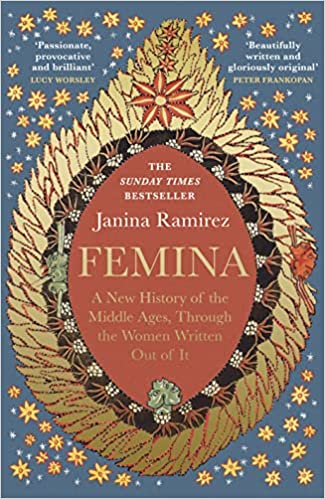
Book Corner: Femina by Janina Ramirez

The middle ages are seen as a bloodthirsty time of Vikings, saints and kings: a patriarchal society which oppressed and excluded women. But when we dig a little deeper into the truth, we can see that the ‘dark’ ages were anything but.

Oxford and BBC historian Janina Ramirez has uncovered countless influential women’s names struck out of historical records, with the word FEMINA annotated beside them. As gatekeepers of the past ordered books to be burnt, artworks to be destroyed, and new versions of myths, legends and historical documents to be produced, our view of history has been manipulated.

Only now, through a careful examination of the artefacts, writings and possessions they left behind, are the influential and multifaceted lives of women emerging. Femina goes beyond the official records to uncover the true impact of women like Jadwiga, the only female King in Europe, Margery Kempe, who exploited her image and story to ensure her notoriety, and the Loftus Princess, whose existence gives us clues about the beginnings of Christianity in England. See the medieval world with fresh eyes and discover why these remarkable women were removed from our collective memories.

When I wrote Heroines of the Medieval World five years ago, I said at the time that it was a book that needed to be written – I just wasn’t sure if I was the person to write it. If I had been asked who should write it, one of the top names on my list would have been Janina Ramirez. So I was not surprised when I discovered that Janina had written a book on medieval women, Femina: A New History of the Middle Ages, Through the Women Written Out of It.

I admit I was a little worried that Femina would make my Heroines obsolete or redundant, but I probably shouldn’t have been. After all, every writer has their own style and approach and every book – even if on the same topic – is written differently. And while the two books do overlap in places, we do not always reach the same conclusion and they really would complement each other on a book shelf (hint, hint!).

Femina: A New History of the Middle Ages, Through the Women Written Out of It looks at some of the most remarkable women of the medieval period, including two women you will be familiar with if you have read Heroines of the Medieval World, Æthelflæd, Lady of the Mercians and Jadwiga, ‘King’ of Poland. And the chapter on Jadwiga is particularly illuminating as Dr Ramirez applies her background in Art History to the symbolism and significance of Jadwiga’s reign, both on a political and spiritual level.

Janina Ramirez also provides great insight in to Emma of Normandy, who I looked at in detail for my own book, Silk and the Sword: the Women of the Norman Conquest. Study is even made of Ӕlfgyva, the mysterious woman in the Bayeux Tapestry, though Janina and I come to very different conclusions – and I would dearly love to have a face-to-face conversation with her to thrash out our theories. That would be fun!

Hild moved from Hartlepool to the site known then as Strenaeshalch and now as Whitby, in AD 657. Here she was granted land to build a double monastery where both men and women could learn the scriptures and dedicate themselves to a monastic life. And engraved stone slab commemorates her successor as abbess, Ælfflæd, and the use of the Latin script and alphabet supports Bede’s suggestion that Whitby was a centre of learning and literacy. But like at Hartlepool, finds from Hild’s abbacy include many luxuries such as decorative hairpins, golden book covers and even a comb with a runic inscription. Runes were the alphabet of the pre-Christian English, but the inscription is clearly Christian: My God. May God Almighty help Cy …’ Again, we find an object which links the Germanic warrior world to the new Christina one. Like Hild herself it straddles ideologies and a time of transition.

Hild was at the top of the tree in terms of influence in seventh-century Northumbria. Bede states that ‘even kings and princes sought and received her counsel’, and she acted as mentor to the daughter of Oswui, King of the Northumbrians from 642-670. What’s more, it was under her rule, in the monastery she founded herself, that the leaders of the English church gathered for the famous Synod of Whitby in AD 664. With Hild in charge of proceedings, the good and the great, representatives of Rome and Ireland, argued which traditions the Northumbrian church should follow. The result went the way of Rome. The variety and uniqueness of Celtic monasteries was lost to the rigour and routine of the Benedictine Rule, and monasticism in the north was transformed forever. For a woman to be involved in such high-level synodal processes is something extraordinary even today. It is also significant that five men who trained under Hild were all made bishops; if there were king-makers in the medieval world, then she was the bishop-maker. Whitby was the training ground for a new, Roman Christian, learned and respected English church. From Hild’s northern headland, educated men and women would stretch out the length and breadth of the country, assuming the very highest positions within churches and monasteries, including the archbishop of York. Hild’s influence would permeate the fabric of Christianity in this part of the world and its effects were felt down the centuries.

Femina: A New History of the Middle Ages, Through the Women Written Out of It is a fabulous study of a number of medieval women – and medieval woman in general. Dr Ramirez manages to combine what it was like to be a woman in medieval times, including their rights and the dangers they faced, such as childbirth, with the histories of particular women – and not always women you would expect to see in history book. The most fascinating chapter is that which is devoted to the Cathars, a religious sect much misunderstood and persecuted to extinction by the church. Janina Ramirez highlights not only their suffering and personal testimonies, but also the strength and respect that women held within the community. It truly is illuminating.

From warrior Viking women, to the successes of Æthelflæd and the excessive crying of Margery Kempe, Janina Ramirez shines a light on the lives and experiences of a huge variety of medieval women. Archaeological discoveries, religious artefacts and medieval artwork are used to describe and illuminate the world in which these women lived and died.

Femina: A New History of the Middle Ages, Through the Women Written Out of It is an engaging, entertaining read, with Janina Ramirez’s unique and wonderful take on medieval history. Introducing her vast knowledge of Art History into the mix adds vibrancy to the individual stories and brings these incredible women to life. Dr Ramirez is fabulous writer and communicator and takes the reader on an incredible journey of discovery through the medieval world. Her enthusiasm and fascination for the topic shines through on every page.

Femina: A New History of the Middle Ages, Through the Women Written Out of It by Janina Ramirez is truly a pleasure to read.

About the author:

Dr Janina Ramirez is a Sunday Times bestselling author, an Oxford lecturer, BBC broadcaster and researcher. She has presented and written over 30 hours of BBC history documentaries and series on TV and radio, and written five books for children and adults.

My books

Signed, dedicated copies of all my books are available, please get in touch by completing the contact me form.

Defenders of the Norman Crown: The Rise and Fall of the Warenne Earls of Surrey tells the fascinating story of the Warenne dynasty, of the successes and failures of one of the most powerful families in England, from its origins in Normandy, through the Conquest, Magna Carta, the wars and marriages that led to its ultimate demise in the reign of Edward III. Defenders of the Norman Crown: Rise and Fall of the Warenne Earls of Surrey is now available from Pen & Sword BooksAmazon in the UK and US, Bookshop.org and Book Depository.

1 family. 8 earls. 300 years of English history!

Also by Sharon Bennett Connolly:

Ladies of Magna Carta: Women of Influence in Thirteenth Century England looks into the relationships of the various noble families of the 13th century, and how they were affected by the Barons’ Wars, Magna Carta and its aftermath; the bonds that were formed and those that were broken. It is now available in paperback and hardback from Pen & Sword,  AmazonBookshop.org and from Book Depository worldwide.

Heroines of the Medieval World tells the stories of some of the most remarkable women from Medieval history, from Eleanor of Aquitaine to Julian of Norwich. Available now from Amberley Publishing and Amazon, Bookshop.org and Book Depository.

Silk and the Sword: The Women of the Norman Conquest traces the fortunes of the women who had a significant role to play in the momentous events of 1066.  Available now from Amazon,  Amberley Publishing, Bookshop.org and Book Depository.

*

You can be the first to read new articles by clicking the ‘Follow’ button, liking our Facebook page or joining me on Twitter and Instagram.

©2022 Sharon Bennett Connolly

The Daughters of Henry II and Eleanor of Aquitaine

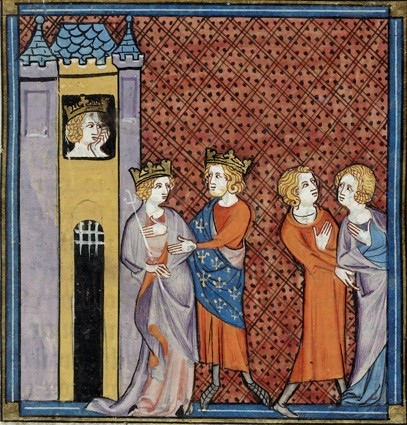
A 14th-century representation of Henry and Eleanor

In history we tend to focus on the actions of the men in a family. Well, let’s face it, the life of Henry II and his sons is fascinating, full of love, honour, death and betrayal. Who wouldn’t be drawn into that world? But did you know that the women of the family had no less exciting and eventful lives?

With a mother like Eleanor of Aquitaine, you would not expect her daughters to be shrinking violets. And, indeed, they were not. And neither were the girls sent off into the world, never to see their parents again. In what may be a unique occurrence for royal princesses, each of the three daughters of Eleanor and Henry II would get to spend time with their mother later in their lives.

Matilda of England, the eldest daughter and third child of Henry and Eleanor, was born in London in June 1156. As her parents ruled an empire that stretched from the Scottish borders to the Pyrenees, travel was a constant part of Matilda’s childhood. She took her first sea-voyage across the English Channel at just 2 months old, accompanied her big brother, Henry, later to be known as The Young King. Throughout her childhood, Matilda is often seen accompanying her mother and siblings traveling through the vast Angevin domains. By the time she was 8-years-old, negotiations had begun for her marriage to Henry the Lion; her father planning an alliance with the German Emperor, Frederick Barbarossa. The marriage was part of her father’s policy to build up opposition to Louis VII of France and the Pope, Alexander III. And in July 1166 her mother accompanied 10-year-old Matilda to Dover, where she embarked on a German ship that would take her to her new life and future husband. Her wedding to Henry V ‘the Lion’, Duke of Saxony and Bavaria, finally took place in the cathedral at Minden, Germany, on 1 February 1168. 

Matilda’s dowry and send-off from England cost around £4,500 (about a quarter of England’s annual revenue). The young princess was given a trousseau worth £63, including saddles with gilt fittings, ‘two large silken cloths, and two tapestries and one cloth of samite and twelve sable skins’. Despite the fact Henry the Lion was 27 years Matilda’s senior, the marriage appears to have been a success and produced 10 children, including their eldest daughter, Richenza (her name was later changed to Matilda), born around 1172, and sons Henry, Otto and William. Otto was briefly considered as heir to the English throne by his uncle Richard I, before King John claimed the crown. He would briefly become Holy Roman Emperor as Otto IV in 1209 until his death in 1218.

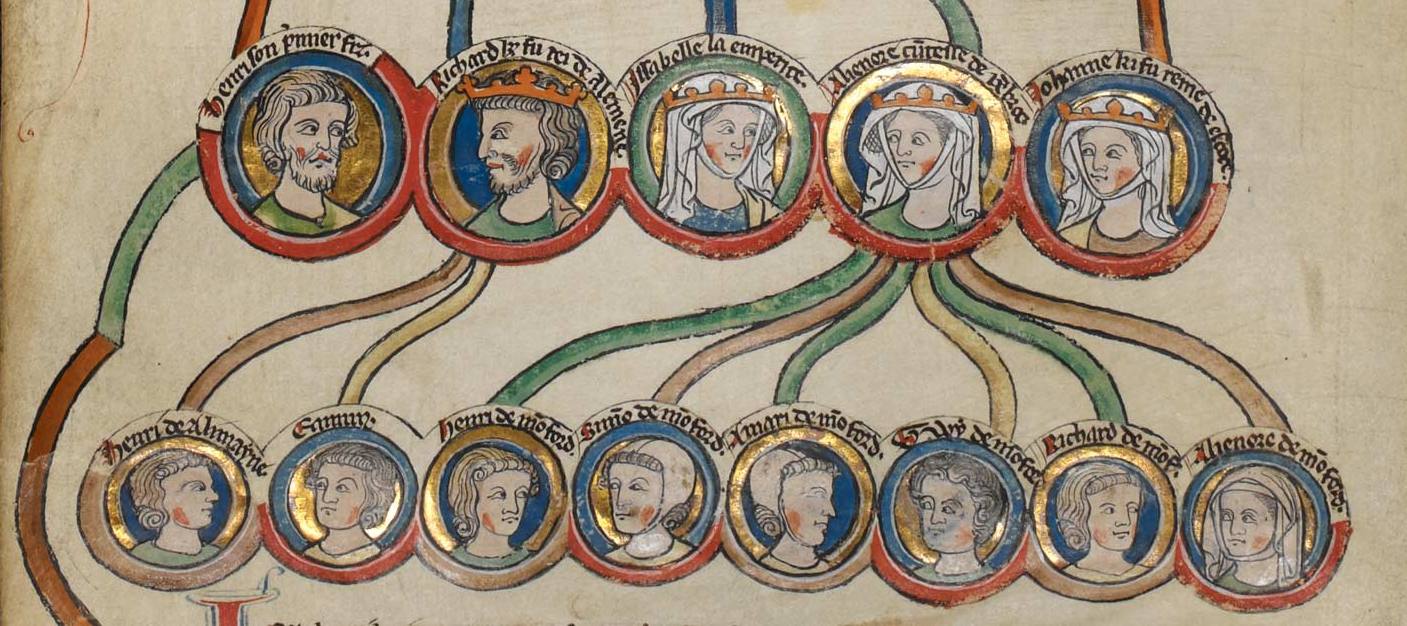
13th-century depiction of Henry II and his legitimate children

Matilda’s fortunes changed dramatically in 1180 when, following a quarrel with Frederick Barbarossa, who held Henry responsible for the failure of a campaign in Italy, Henry the Lion was deprived of his fiefs and exiled from his lands for 7 years. Henry, Matilda and their children sought refuge with Matilda’s father and, in the Autumn of 1181, Henry II welcomed his daughter, giving her the palace of Argentin as a home for her family. Matilda and her family spent the next two years in the Angevin lands on the Continent; but in 1184 a pregnant Matilda accompanied her father to England, where she gave birth to her son, William, at Winchester. While at her father’s court Matilda petitioned the king to ease the restrictions on her mother’s imprisonment; following her involvement in the failed rebellion of her sons in 1173-4, Eleanor of Aquitaine had spent the last ten years incarcerated in England, at Old Sarum. Although still a prisoner, Eleanor was permitted to stay with Matilda while she was staying in England and when Eleanor was allowed to cross the Channel to take possession of the Vexin Castles, Matilda accompanied her.

Coronation of Henry the Lion and Matilda, from the Gospels of Henry the Lion, c.1188

Matilda and Henry were finally allowed to return to Germany in October 1185, although their children, Otto, William and Matilda remained at Henry’s court, to be raised by their grandfather. Matilda died at Brunswick on 28th June 1189 and was buried there, in the Cathedral of St Blasius, of which she was co-foundress. Her father Henry II died just 8 days later, probably before the news of his daughter’s death could reach him. Matilda’s husband would be buried alongside her, following his death on 6th August 1195.

Matilda’s next youngest sister, Eleanor, was born in October 1162 (1161 has also been suggested, but most sources agree on 1162) at Domfront Castle in Normandy. As with Matilda, Eleanor’s early childhood was quite nomadic. She travelled often with her parents, in her mother’s entourage. In February 1165 3-year-old Eleanor was betrothed to the infant son of Frederick Barbarossa, Frederick, as part of the same negotiations which saw Matilda married to Henry the Lion. However, Eleanor’s proposed marriage would eventually fall by the wayside. By 1170 Henry II was seeking to extend his influence across the Pyrenees and in order to prevent a French alliance with Castile, he betrothed Eleanor to 14-year-old Alfonso VIII, who had been king of Castile since he was just 2 years old. By September 1170, a month short of her 8th birthday, Eleanor was on her way to Castile, with an impressive escort to see her safely to her wedding at Burgos Cathedral.

The betrothal of Alfonso VIII of Castile and Eleanor of England

Eleanor and Alfonso appear to have had a very successful marriage, and a close, trusting relationship. Described as modest, elegant and gracious, Eleanor is renowned for introducing her mother’s Poitevin culture into the Castilian court, blending it with the luxuries offered by neighbouring Moorish cultures. Eleanor also acted as a diplomatic conduit between her husband and brothers, Richard and John, in order to aid each other and keep the peace, although not always successfully.Seven of Eleanor and Alfonso’s children survived infancy. Their eldest daughter Berengaria would eventually act as regent in Castile for her younger brother, Henry I, before succeeding him as queen regnant. One daughter, Eleanor, married James I, king of Aragon, but they divorced in 1229. While another, Constance, was dedicated as a nun and eventually became abbess of the abbey of Las Huelgas, founded by her parents in 1187.

Alfonso and Eleanor also had 2 sons who would survive childhood. The eldest, Ferdinand, died of a fever in 1209 or 1211 while his younger brother, Henry, would succeed his father, but died in a freak accident when a loose roof tile fell on his head. He was 13 years old.

Of their two other daughters, 14-year-old Urraca was initially suggested as the bride of the future Louis VIII of France, son of Philip II Augustus. The girls’ grandmother, Eleanor of Aquitaine, was instrumental in arranging the marriage and the 77-year-old queen travelled to Castile, in 1200, in person and in the depths of winter, to collect the granddaughter who would be Louis’ bride. The reunion of mother and daughter would surely have been highly emotional, having not seen each other in 23 years. The elder Eleanor spent two months with her daughter and her family and in getting to know her granddaughters, Eleanor of Aquitaine seems to have decided that the younger Blanca – rather than Urraca – would make a more suitable bride for Louis. The 12-year-old princess travelled back to Normandy with her grandmother where Blanca – or Blanche – and Louis were married.

Eleanor of England, Queen of Castile

The happy marriage of Eleanor and Alfonso came to an end when Alfonso died in Burgos on 6th October 1214. He was buried in the Abbey of Las Huelgas, where their daughter, Constance, was now Abbess, leaving Eleanor as regent for their 10-year-old son, Henry I. Broken-hearted Eleanor, however, only survived her husband by a little over 3 weeks. Overcome with grief she died in Burgos on 31st October 1214, and was laid to rest beside her beloved husband; leaving their daughter Berengaria to take up the regency for Henry. Eleanor was the last surviving daughter of the Henry II and Eleanor of Aquitaine. Only her younger brother, King John, remained of the Plantagenet siblings.

The youngest of the trio of Plantagenet sisters, Joanna, was born in October 1165. Ten years younger than her oldest brother, Henry the Young King, she was born at Angers Castle in Anjou, at a time when their parents’ relationship was breaking down; 1165 was the first ever Christmas Henry and Eleanor spent apart. With Henry still in England dealing with a Welsh revolt, he would not meet his new daughter for several months. Although Joanna spent much of her childhood at her mother’s court in Poitiers, she and her younger brother, John, were also educated at the magnificent Abbey of Fontevraud, where she learned the skills needed to run a large, aristocratic household.

Although Eleanor was imprisoned following the failed rebellion of 1173, three years later, she was allowed to travel to Winchester to say ‘goodbye’ to her youngest daughter, who had been betrothed to King William II of Sicily. Provided with an impressive trousseau, Joanna set out from Winchester at the end of August 1176, accompanied by her uncle Hamelin de Warenne Earl of Surrey. Once on the Continent, she was escorted from Barfleur by her brother Henry, the Young King to Poitiers, and from Poitiers, by another brother, Richard, who then escorted his little sister to Toulouse in a leisurely and elegant progress.

Joanna of England

Having finally reached Sicily 12-year-old Joanna was married to 24-year-old William on 13th February 1177, in Palermo Cathedral. The marriage ceremony was followed by her coronation as Queen of Sicily. Joanna must have looked magnificent, her bejewelled dress cost £114 – not a small sum at the time. Joanna and William had no surviving children and when William died without an heir in November 1189, Joanna became a pawn in the race for the succession. William’s sister, Constance was the rightful heir, but she was married to Henry VI, Holy Roman Emperor and many feared being absorbed into his empire. William II’s illegitimate nephew, Tancred of Lecce, seized the initiative. He claimed the throne and, in need of money, imprisoned Joanna and stole her dowry and the treasures left to her by her husband.

Luckily for Joanna her brother Richard I – the Lionheart – having gained the English throne in 1189, had wasted no time in organising the Third Crusade and arrived at Messina in Sicily in September 1190. Richard demanded Joanna’s release; and fearing the Crusader king’s anger Tancred capitulated and freed Joanna, also paying 40,000 ounces of gold towards the Crusade.

The beautiful and spirited Joanna was briefly reunited with her mother in Lent of 1191 when she arrived in Sicily with Richard’s bride, Berengaria of Navarre. Joanna and Berengaria were to become firm friends and travelled together to the Holy Land, ahead of Richard’s main force. However, during a storm, their ship was onto the shores of Cyprus by a storm and the two women were at risk of becoming hostages of the ruler of Cyprus, Isaac Comnenus. Again, Richard came to the rescue, reduced Cyprus in three weeks and clamped Comnenus in chains (silver ones apparently). Lent being over, Richard and Berengaria were married, with great pomp and celebration, before the whole party continued their journey to the Holy Land, arriving at Acre in June 1191.

Seal of Joanna of England

Joanna’s time in the Holy Land was mainly spent in Acre and Jaffa, accompanying her sister-in-law and following – at a safe distance – behind the Crusading army. In attempts to reach a political settlement with the Muslim leader, Saladin, Richard even offered Joanna as a bride for Saladin’s brother. His plans were scuppered, however, when Joanna refused outright to even consider marrying a Muslim. When a three-year truce was eventually agreed with Saladin, Joanna and Berengaria left the Holy Land ahead of the army, to await Richard in Rome. Richard, however, never made it; falling into the hands of Duke Leopold of Austria, he was handed over to his enemy, the Holy Roman Emperor. He was eventually freed in 1194, following payment of a huge ransom. 

Joanna spent the next few years at the courts of her mother and brother. But at the age of 31 she was proposed as a bride for Raymond VI, Count of Toulouse, with the aim of bringing the County of Toulouse into the Plantagenet fold, a long-time dream of Eleanor’s. Raymond had a colourful marital history. He had been excommunicated for marrying his third wife whilst still married to his second; and he now repudiated his third wife in order to marry Joanna, which he did in Rouen in October 1196, with Queen Berengaria in attendance. Although not a happy marriage the couple had two children; with a son Raymond born around 1197 and a daughter, possibly called Mary, in 1198.

Raymond VI, however, was not a popular Count and faced rebellion. Joanna herself had to confront some of her husband’s enemies. She laid siege to a rebel stronghold at Cassee; however, her own traitorous troops set fire to her camp and Joanna barely managed to escape. Injured and pregnant, Joanna was then trying to make her way to her brother Richard when she heard of his death; changing direction, she eventually reached her mother at Niort. With no allowance from her Joanna’s husband, Queen Eleanor managed to persuade John to give his sister an annual pension of 100 marks. Knowing she was dying, Joanna became desperate to be veiled as a nun at Fontevraud; a request normally denied to married women – especially when they were in the late stages of pregnancy. However, seeing how desperate her daughter was, Eleanor asked Hubert Walter, the Archbishop of Canterbury, to intervene.

Tombs of Henry II and Eleanor of Aquitaine at Fontevraud Abbey

The Archbishop tried to dissuade Joanna, but was impressed by her fervour and convened a committee of nuns and clergy; who agreed that Joanna must be ‘inspired by heaven’. In Eleanor’s presence, the Archbishop admitted Joanna to the Order of Fontevraud. Joanna was too weak to stand and died shortly after the ceremony; her son, Richard, was born a few minutes later and lived only long enough to be baptised. She died in September 1199, a month short of her 34th birthday. Joanna and her baby son were interred together at Fontevraud, the funeral cortege having been escorted there by Eleanor of Aquitaine and King John.

There is no record that Matilda, Eleanor and Joanna ever met as adults, and the last time they were together as sisters was most likely shortly before Matilda’s marriage, when Joanna was only 2-years-old. However, although they led very different and adventurous lives, all three daughters of Eleanor of Aquitaine had the unique opportunity, in the medieval era, of spending time with their mother as adults. Given the dangers of travel and the great distances involved, as well as the fickleness of life in general, they may have hoped for a reunion but surely would never have expected it to become a reality.

*

An earlier version of this article first appeared on Henry the Young King Blog in 2017.

Images:

Courtesy of Wikipedia

Further reading: 

The Oxford Companion to British History Edited by John Cannon; The Plantagenets, the Kings who Made England by Dan Jones; History Today Companion to British History Edited by Juliet Gardiner and Neil Wenborn;  Brewer’s British Royalty by David Williamson; Britain’s Royal Families, the Complete Genealogy by Alison Weir; The Plantagenet Chronicles Edited by Elizabeth Hallam; The Mammoth Book of British Kings and Queens by Mike Ashley; The Plantagenets, the Kings that made Britain by Derek Wilson; England Under the Norman and Angevin Kings  by Robert Bartlett; finerollshenry3.org.ukEleanor, April Queen of Aquitaine by Douglas Boyd; Eleanor of Aquitaine, by the Wrath of God, Queen of England by Alison Weir; oxforddnb.com; bestofsicily.com; britannica.com; geni.com; royalwomenblogspot.co.uk; medievalqueens.com.

*

My Books:

Signed, dedicated copies of all my books are available through my online bookshop.

Coming 15 January 2024: Women of the Anarchy

On the one side is Empress Matilda, or Maud. The sole surviving legitimate child of Henry I, she is fighting for her birthright and that of her children. On the other side is her cousin, Queen Matilda, supporting her husband, King Stephen, and fighting to see her own son inherit the English crown. Both women are granddaughters of St Margaret, Queen of Scotland and descendants of Alfred the Great of Wessex. Women of the Anarchy demonstrates how these women, unable to wield a sword, were prime movers in this time of conflict and lawlessness. It show how their strengths, weaknesses, and personal ambitions swung the fortunes of war one way – and then the other.

Available for pre-order from Amberley Publishing and Amazon UK.

Coming on 15 June 2024: Heroines of the Tudor World

Heroines of the Tudor World tells the stories of the most remarkable women from European history in the time of the Tudor dynasty, 1485-1603. These are the women who ruled, the women who founded dynasties, the women who fought for religious freedom, their families and love. These are the women who made a difference, who influenced countries, kings and the Reformation. In the era dominated by the Renaissance and Reformation, Heroines of the Tudor World examines the threats and challenges faced by the women of the era, and how they overcame them. Some famous, some infamous, some less well known, including Anne Boleyn, Elizabeth Barton, Catherine de Medici, Bess of Hardwick and Elizabeth I. From writers to regents, from nuns to queens, Heroines of the Tudor World shines the spotlight on the women helped to shape Early Modern Europe.

Heroines of the Tudor World is now available for pre-order from Amberley Publishing and Amazon UK.

Also by Sharon Bennett Connolly:

King John’s Right-Hand Lady: The Story of Nicholaa de la Haye is the story of a truly remarkable lady. Nicholaa de la Haye was the hereditary constable of Lincoln Castle and the first woman in England to be appointed sheriff in her own right. Her strength and tenacity saved England at one of the lowest points in its history. Nicholaa de la Haye is one woman in English history whose story needs to be told… King John’s Right-Hand Lady: The Story of Nicholaa de la Haye is now available from Pen & Sword Booksbookshop.org and Amazon.

Defenders of the Norman Crown: The Rise and Fall of the Warenne Earls of Surrey tells the fascinating story of the Warenne dynasty, of the successes and failures of one of the most powerful families in England, from its origins in Normandy, through the Conquest, Magna Carta, the wars and marriages that led to its ultimate demise in the reign of Edward III. Defenders of the Norman Crown: Rise and Fall of the Warenne Earls of Surrey is now available from Pen & Sword BooksAmazon in the UK and US, and Bookshop.org.

Ladies of Magna Carta: Women of Influence in Thirteenth Century England looks into the relationships of the various noble families of the 13th century, and how they were affected by the Barons’ Wars, Magna Carta and its aftermath; the bonds that were formed and those that were broken. It is now available in paperback and hardback from Pen & Sword,  Amazon, and Bookshop.org.

Heroines of the Medieval World tells the stories of some of the most remarkable women from Medieval history, from Eleanor of Aquitaine to Julian of Norwich. Available now from Amberley Publishing and Amazon, and Bookshop.org.

Silk and the Sword: The Women of the Norman Conquest traces the fortunes of the women who had a significant role to play in the momentous events of 1066. Available now from Amazon,  Amberley Publishing, and Bookshop.org.

Alternate Endings: An anthology of historical fiction short stories including Long Live the King… which is my take what might have happened had King John not died in October 1216. Available in paperback and kindle from Amazon.

Podcast:

Have a listen to the A Slice of Medieval podcast, which I co-host with Historical fiction novelist Derek Birks. Derek and I welcome guests, such as Bernard Cornwell and Elizabeth Chadwick, and discuss a wide range of topics in medieval history, from significant events to the personalities involved.

*

Don’t forget! Signed and dedicated copies of all my books are available through my online bookshop.

For forthcoming online and in-person talks, please check out my Events Page.

You can be the first to read new articles by clicking the ‘Follow’ button, liking our Facebook page or joining me on Twitter and Instagram.

©2021 Sharon Bennett Connolly FRhistS

Daughters of the Greatest Knight

Arms of William Marshal, Earl of Pembroke

It is impossible to talk about anything related to Magna Carta without mentioning the man who has come to be known as ‘the Greatest Knight’: William Marshal, Earl of Pembroke, and his family. Marshal was one of the few nobles to stay loyal to King John throughout the Magna Carta crisis. That is not to say that the king and Marshal did not have their differences, nor that their relationship was always smooth sailing. However, William Marshal was famed for his loyalty and integrity and maintained his oaths to King John throughout his reign, regardless of the distrust between the two men.

The children of William and his wife, Isabel de Clare, cannot fail to have benefited from William Marshal’s rise through the ranks from fourth son and humble hearth knight, to earl of Pembroke and, eventually, regent for King Henry III. Their father’s position as a powerful magnate on the Welsh Marches, and the most respected knight in the kingdom, saw William’s daughters make advantageous marriages in the highest echelons of the English nobility.

William and Isabel were the parents of 10 children who survived to adulthood, 5 boys and 5 girls. In a bizarre and sad twist of fate, each of the boys would, in turn, succeed to the earldom, with not one leaving a male heir to continue the Marshal line. Of the girls, the couple’s eldest daughter was Matilda, also known as Maud or Mahelt. Given that her parents married in 1189 and she had two elder brothers, Matilda was probably born in 1193 or 1194. The Histoire de Guillaume le Maréchal wrote glowingly of Matilda, saying she had the gifts of

‘wisdom, generosity, beauty, nobility of heart, graciousness, and I can tell you in truth, all the good qualities which a noble lady should possess.’

 Histoire de Guillaume le Maréchal 

The Histoire goes on to say;

‘Her worthy father who loved her dearly, married her off, during his lifetime to the best and most handsome party he knew, to Sir Hugh Bigot.’

 Histoire de Guillaume le Maréchal 

Unfortunately for Matilda, her husband Hugh, the eldest son of the earl of Norfolk, was among the rebels during the Magna Carta crisis; their eldest son was taken hostage by the king when their castle at Framlingham surrendered to the royal army. It must have been a comfort to Matilda that, on John’s death, her son’s welfare, while still a hostage, would have been supervised by the new regent, the boy’s grandfather. When Hugh died in 1225, Matilda married for a second time just a few months later, to William de Warenne, Earl of Warenne and Surrey, thus uniting the Bigod, Warenne and Marshal families. The marriage appears to have been one of convenience rather than love but produced 2 children, a boy and a girl, John and Isabel. Matilda’s son by her second marriage, John de Warenne, joined his 3 older Bigod half-brothers, Roger, Hugh and Ralph as pall bearers for their mother’s coffin at her funeral in 1248, when she was laid to rest beside her mother at Tintern Abbey in Monmouthshire.

Seal of Matilda Marshal’s youngest son John de Warenne, 6th Earl of Warenne and Surrey

The next daughter, Isabel, was at least six years younger than Matilda, born in 1200. She was married to Gilbert de Clare, Earl of Gloucester and Hertford, who was twenty years her senior. Gilbert was the son of Richard de Clare, earl of Hertford, and Amicia, coheiress of William, Earl of Gloucester; through his mother he could trace his ancestry back to King Henry I, albeit through king’s illegitimate eldest son, Robert of Gloucester, the stalwart supporter of his half-sister, Empress Matilda. Gilbert’s aunt, Amicia’s sister, was Isabella of Gloucester, the discarded first wife of King John, who had held the earldom of Gloucester until her death on 14 October 1217, when it passed to Gilbert.

Both Gilbert and his father were named among the twenty-five barons appointed as Enforcers of Magna Carta in 1215; as a consequence, father and son were excommunicated at the beginning of 1216. After the death of King John, Gilbert sided with Prince Louis of France and was only reconciled with the royalist cause after the Battle of Lincoln in May 1217. This was despite having married Isabel, the second daughter of William Marshal, in 1214; Marshal had been regent of England for 9-year-old Henry III since King John’s death in October 1216. Like her older sister, Isabel had found her husband’s family were on the opposing side to her father in the Magna Carta crisis and the civil war that followed. They had 6 children together before Gilbert’s death in October 1230; he died on the return journey from an expedition to Brittany. Isabel was married again, not 6 months later, to the king’s younger brother, Richard, Earl of Cornwall. The early deaths of at least 2 children put a strain on this marriage and Richard had been seeking a divorce when Isabel found herself pregnant again. She was safely delivered of the longed-for son and heir, Henry of Almain in 1235. Tragically, Isabel herself died in childbirth, in 1240. Her baby son, Nicholas, died the same day.

The next-youngest of the Marshal sisters, Sibyl, was born around 1201: she was married to William de Ferrers, fifth earl of Derby. Unlike her elder sisters, Sibyl and her husband played little part in national affairs. Ferrers had been plagued by gout since his youth and led a largely secluded life. He was regularly transported by litter. Further, he had never fully recovered from an accident that had happened sometime in the 1230s. While crossing a bridge at St Neots in Huntingdonshire, Ferrers was thrown from his litter, into the water. It must have been a terrifying experience. He succeeded to the earldom of Derby on his father’s death in 1247 but died in 1254. During the marriage Sibyl gave birth to 7 children, all daughters: Agnes, Isabel, Maud, Sibyl, Joan, Agatha and Eleanor. Sibyl died sometime before 1247 and was laid to rest at Tintern Abbey, alongside her mother.

Tintern Abbey, Monmouthshire, resting place of several members of the Marshal family

William and Isabel Marshal’s fourth daughter, Eva, was born in about 1203 in Pembroke Castle, and so was only 16 when her father died – and 17 when she lost her mother. As a child, she spent several years with her family in exile in Ireland, only returning to England when her father was finally reconciled with King John in 1212. Sometime before 1221, Eva was married to William (V) de Braose, Lord of Abergavenny, son of Reginald de Braose and grandson of Matilda de Braose, who had died of starvation in King John’s dungeons in 1210. William de Braose was a wealthy Norman baron with estates along the Welsh Marches. He was hated by the Welsh, who had given him the nickname Gwilym Ddu, or Black William, and had been taken prisoner by Llywelyn ap Iorweth – Llywelyn the Great – in 1228.

Although he had been released after paying a ransom, de Braose later returned to Llywelyn’s court to arrange a marriage between his daughter, Isabella, and Llywelyn’s son and heir, Dafydd. During this stay, Eva’s husband was ‘caught in Llywelyn’s chamber with the King of England’s daughter, Llywelyn’s wife’. Whilst Llywelyn’s wife, Joan, Lady of Wales, the illegitimate daughter of King John, was imprisoned for a year, a much worse fate was meted out to William de Braose. He was publicly hanged on Llywelyn’s orders, leaving Eva a widow at the age of 27, with 4 young daughters, all under the age of 10. Despite the discomfort caused by Llywelyn’s execution of Braose, the marriage of Isabella and Dafydd went ahead, following some impressive diplomacy on Llywelyn’s part. Eva never remarried and spent her widowhood managing her own lands. She was caught up the revolt of her brother, Richard, in 1234, and appears to have acted as intermediary between her brother and the king to help resolve the situation. She died in 1246.

The youngest Marshal sister was Joan, who was still only a child when William Marshal died in 1219, being born in 1210. She is mentioned in the Histoire as having been called for by her ailing father, so that she could sing for him. Joan was married, before 1222, to Warin de Munchensi, a landholder and soldier who was born in the mid-1190s. When his father and older brother died in 1204 and 1208 (possibly), respectively, Warin was made a ward of his uncle William d’Aubigny, Earl of Arundel. He was ill-treated by King John, who demanded 2,000 marks in relief and quittance of his father’s Jewish debts on 23 December 1213. He was ordered to pay quickly and pledged his lands as a guarantee of his good behaviour.

Effigy identified as William Marshal, Temple Church, London

This harsh treatment drove him to ally with the rebel barons and he was captured fighting against the royalist forces, and his father-in-law, at the Battle of Lincoln, on 20 May 1217. He was, soon after, reconciled with the crown and served Henry III loyally on almost every military campaign of the next forty years. His marriage to Joan Marshal produced two children; John de Munchensi and a daughter, Joan, who would marry the king’s half-brother, William de Valence, fourth son of Isabelle d’Angoulême and her second husband, Hugh X de Lusignan, Count of La Marche. It was through his wife and, more accurately her mother, that William de Valence was allowed to accede to the earldom of Pembroke following the extinction of the Marshal male line. Joan Marshal died in 1234 and so never saw her daughter marry and become countess of Pembroke in 1247.

The various experiences of the 5 Marshal daughters serve as a demonstration of the divisions among the nobility, caused by the Magna Carta crisis, with several of them finding themselves on the opposing side to that of their father. It must have been a source of great anxiety for a family which appears to have been otherwise very close. These 5 young women also provide a snapshot of the fates of women in thirteenth century England, death in childbirth, early widowhood and second marriages arranged for personal security rather than love. What is evident is that, just like their father, these girls were an integral part of the Magna Carta story.

*

An earlier version of this article first appeared on Samantha Wilcoxson’s blog.

Sources:

Rich Price, King John’s Letters Facebook group; Robert Bartlett England Under the Norman and Angevin Kings 1075-1225; Dan Jones The Plantagenets; the Kings who Made EnglandThe Plantagenet Chronicle Edited by Elizabeth Hallam; Maurice Ashley The Life and Times of King John; Roy Strong The Story of BritainOxford Companion to British History; Mike Ashley British Kings & Queens; David Williamson Brewer’s British Royalty; Ralph of Diceto, Images of History; Marc Morris, King John; David Crouch, William Marshal; Crouch and Holden, History of William Marshal; Crouch, David, ‘William Marshal [called the Marshal], fourth earl of Pembroke (c. 1146–1219)’, Oxforddnb.com; Flanagan, M.T., ‘Isabel de Clare, suo jure countess of Pembroke (1171×6–1220)’, Oxforddnb.com; Thomas Asbridge, The Greatest Knight; Chadwick, Elizabeth, ‘Clothing the Bones: Finding Mahelt Marshal’, livingthehistoryelizabethchadwick.blogspot.com; Stacey, Robert C., ‘Roger Bigod, fourth earl of Norfolk (c. 1212-1270)’, Oxforddnb.com; finerollshenry3.org.uk; Vincent, Nicholas, ‘William de Warenne, fifth earl of Surrey [Earl Warenne] (d. 1240)’, Oxforddnb.com.

My Books

Signed, dedicated copies of all my books are available through my online bookshop.

Out now: Scotland’s Medieval Queens

Scotland’s history is dramatic, violent and bloody. Being England’s northern neighbour has never been easy. Scotland’s queens have had to deal with war, murder, imprisonment, political rivalries and open betrayal. They have loved and lost, raised kings and queens, ruled and died for Scotland. From St Margaret, who became one of the patron saints of Scotland, to Elizabeth de Burgh and the dramatic story of the Scottish Wars of Independence, to the love story and tragedy of Joan Beaufort, to Margaret of Denmark and the dawn of the Renaissance, Scotland’s Medieval Queens have seen it all. This is the story of Scotland through their eyes.

Scotland’s Medieval Queens gives a thorough grounding in the history of the women who ruled Scotland at the side of its kings, often in the shadows, but just as interesting in their lives beyond the spotlight. It’s not a subject that has been widely covered, and Sharon is a pioneer in bringing that information into accessible history.’ Elizabeth Chadwick (New York Times bestselling author)

Available now from Amazon and Pen and Sword Books

Also by Sharon Bennett Connolly:

Heroines of the Tudor World tells the stories of the most remarkable women from European history in the time of the Tudor dynasty, 1485-1603. These are the women who ruled, the women who founded dynasties, the women who fought for religious freedom, their families and love. Heroines of the Tudor World is now available for pre-order from Amberley Publishing and Amazon UK. Women of the Anarchy demonstrates how Empress Matilda and Matilda of Boulogne, unable to wield a sword themselves, were prime movers in this time of conflict and lawlessness. It shows how their strengths, weaknesses, and personal ambitions swung the fortunes of war one way – and then the other. Available from Bookshop.orgAmberley Publishing and Amazon UKKing John’s Right-Hand Lady: The Story of Nicholaa de la Haye is the story of a truly remarkable lady, the hereditary constable of Lincoln Castle and the first woman in England to be appointed sheriff in her own right. Available from all good bookshops Pen & Sword Booksbookshop.org and Amazon

Defenders of the Norman Crown: The Rise and Fall of the Warenne Earls of Surrey tells the fascinating story of the Warenne dynasty, from its origins in Normandy, through the Conquest, Magna Carta, the wars and marriages that led to its ultimate demise in the reign of Edward III. Available from Pen & Sword BooksAmazon in the UK and US, and Bookshop.orgLadies of Magna Carta: Women of Influence in Thirteenth Century England looks into the relationships of the various noble families of the 13th century, and how they were affected by the Barons’ Wars, Magna Carta and its aftermath; the bonds that were formed and those that were broken. It is now available in paperback and hardback from Pen & SwordAmazon, and Bookshop.orgHeroines of the Medieval World tells the stories of some of the most remarkable women from Medieval history, from Eleanor of Aquitaine to Julian of Norwich. Available now from Amberley Publishing and Amazon, and Bookshop.orgSilk and the Sword: The Women of the Norman Conquest traces the fortunes of the women who had a significant role to play in the momentous events of 1066. Available now from Amazon,  Amberley Publishing, and Bookshop.org.

Alternate Endings: An anthology of historical fiction short stories including Long Live the King… which is my take what might have happened had King John not died in October 1216. Available in paperback and kindle from Amazon.

Podcast:

Have a listen to the A Slice of Medieval podcast, which I co-host with Historical fiction novelist Derek Birks. Derek and I welcome guests, such as Bernard Cornwell and Michael Jecks, and discuss a wide range of topics in medieval history, from significant events to the personalities involved. Including an episode on William Marshal with Elizabeth Chadwick, author of The Greatest Knight. Every episode is now available on YouTube.

*

Don’t forget! Signed and dedicated copies of all my books are available through my online bookshop.

For forthcoming online and in-person talks, please check out my Events Page.

You can be the first to read new articles by clicking the ‘Follow’ button, liking our Facebook page or joining me on TwitterThreadsBluesky and Instagram.

*

©2021 Sharon Bennett Connolly FRHistS
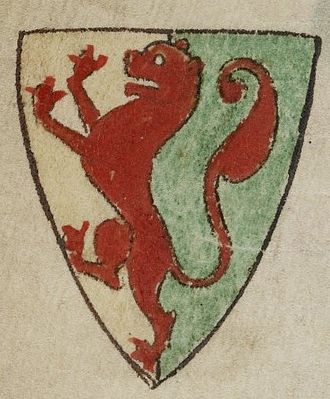
Guest Post: The Women of the House of Montfort by Darren Baker

It is a pleasure to welcome historian Darren Baker to History … the Interesting Bits today, with a guest article about the women of the family of Simon de Montfort. Darren is the author of The Two Eleanors, a book telling the dual biography of Eleanor of Provence, wife of Henry III, and Eleanor of England, wife of Simon de Montfort. Darren’s latest book, Crusaders and Revolutionaries of the Thirteenth Century: De Montfort, was released in November from Pen & Sword and is a stunning biography of the the Montfort family.

So, over to Darren …

The Women of the House of Montfort

Darren Baker

King Philip I of France leaving his wife for Bertrade de Montfort

The house of Montfort arose some 50 kilometres west of Paris in a place known today as Montfort l’Amaury. Their family name ‘de Montfort’ is usually associated with two Simons, father and son, the relentless Albigensian crusader and the determined English revolutionary, both men of the 13th century. Other family members went further afield and established lordships in Italy and the crusader states.

Less known is the prominence of the de Montfort women. Their influence reaches back to the 11th century, starting with Isabella. Her father, Simon I, gave her in marriage to Ralph de Tosny, who in turn forced his sister Agnes to marry this first Simon. When Isabella fell out with her father’s children with Agnes, she put on armour and led a body knights in the field against her half-brothers.

Isabella’s half-sister Bertrade was married to Fulk IV of Anjou. She grew tired of his lecherous ways and took as her next husband the king of France, Philip I, who deserted his wife to marry her. Hoping to see her son with Philip succeed to the throne over her stepson Louis (VI), Bertrade had the older youth poisoned, but the attempt failed and brought about her disgrace. She died in a nunnery in 1117, not living to see her son from her first marriage, Fulk V of Anjou, become king of Jerusalem.

Two generations later, Simon III stood loyally by the English in their fight with the French. He was rewarded with marriages for his three children into the Anglo-Norman nobility. His oldest son Amaury V married Mabel, daughter of the earl of Gloucester, the next son Simon IV married Amicia, daughter of the earl of Leicester, and daughter Bertrade II married Hugh, the earl of Chester. This Bertrade was the mother of the legendary Ranulf de Blondeville, arguably the last of the great Anglo-Norman barons.

The senior branch of the house of Montfort died out in 1213, but Amicia’s son Simon V (the crusader), who was already the count of Montfort, inherited the earldom of Leicester. It was confiscated by King John in 1207 and ended up in the custody of Ranulf. It was from Ranulf that Simon VI acquired Leicester in 1231 and became an English noble, but that’s getting ahead of the story.

Eleanor de Montfort and children

Simon V’s wife was Alice de Montmorency. She was very much an active crusader against the Albigensians and often participated in her husband’s war councils. Their daughter Petronilla was born during the crusade and baptised by Dominic de Guzman, founder of the Dominican order. After Simon’s death in 1218, Alice placed Petronilla in a nunnery, where she became the abbess later in life. Alice’s oldest daughter Amicia founded the nunnery of Montargis, south of Paris, and died there in 1252.

In England, Alice’s son Simon VI rose high in royal favour and married Eleanor, the youngest sister of King Henry III and widow of William Marshal II. Together she and Simon had five sons and one daughter. The clash between Eleanor’s husband and brother ended in civil war and Simon’s death in 1265 at the battle of Evesham. Eleanor left England to live out the rest of her life in Montargis and took her namesake daughter with her.

Guy de Montfort was the only one of Eleanor’s sons to marry. He found service under Charles of Anjou, the king of Sicily, and rapidly advanced to become the count of Nola. He received a Tuscan heiress as his bride, but he scandalised the family in 1271 by vengefully murdering his cousin. Guy escaped punishment for the most part and had two daughters, of whom only the youngest Anastasia survived to adulthood. She became the countess of Nola at her father’s death in 1292 and married into the Orsini family of Rome.

Eleanor de Montfort died in 1275, living long enough to see her daughter marry Llywelyn of Wales by proxy. Later that year, the boat carrying young Eleanor and her brother Amaury VIII was captured by the forces of their cousin King Edward I, who had been alerted to their intentions. Eleanor was confined at Windsor Castle and not freed to marry Llywelyn until 1278.

She died four years later giving birth to a daughter Gwenllian. When Llywelyn was then killed, the baby girl was placed in a nunnery in Lincolnshire. By the time of her death in 1337, the de Montfort family, once so admired and respected across Europe and the Mediterranean, seemed long extinct. But their fortunes were about to be revived.

Joan of Navarre, Queen of England

This part of the story goes back to Simon V and Alice’s oldest son Amaury VII, who succeeded his father as the count of Montfort. He was followed by his son John, whose wife was pregnant when he left on crusade and died overseas. The daughter born to her, Beatrice, became the countess of Montfort when she came of age. She married Robert of Dreux and had a daughter Yolande, who became the second wife of King Alexander III of Scotland in 1285 in the hope of producing an heir to that throne.

It didn’t happen, and after Alexander died, Yolande married Arthur II of Brittany. Their son John succeeded her as the count of Montfort, and when his half-brother the duke of Brittany died in 1341 without an heir, John put in a claim for the duchy. It turned into a war of succession, which was won by his son, another John of Montfort, in 1365, a hundred years after Evesham.

In 1386, this John of Montfort took as his third wife the famous Joan of Navarre. She was the mother of his children and after his death became the queen of England with her marriage to King Henry IV. It was through her and Yolande that the Montfort family line returned to England.

About the Author:

Darren Baker was born in California, raised in South Carolina, and came to Europe in 1990, settling permanently in the Czech Republic. A former submariner in the US Pacific fleet, he later studied languages at the University of Connecticut and works as a translator. A trip to the UK inspired him to revisit the events of 13th century England, which he does on his website simon2014.com and in his books. His newly released Crusaders and Revolutionaries of the Thirteenth Century: De Montfort is his fourth on the subject.

*

My Books

Ladies of Magna Carta: Women of Influence in Thirteenth Century England looks into the relationships of the various noble families of the 13th century, and how they were affected by the Barons’ Wars, Magna Carta and its aftermath; the bonds that were formed and those that were broken. It is now available from Pen & Sword,  Amazon and from Book Depository worldwide.

Also by Sharon Bennett Connolly:

Silk and the Sword: The Women of the Norman Conquest traces the fortunes of the women who had a significant role to play in the momentous events of 1066.  Available now from Amazon,  Amberley Publishing, Book Depository.

Heroines of the Medieval World tells the stories of some of the most remarkable women from Medieval history, from Eleanor of Aquitaine to Julian of Norwich. Available now from Amberley Publishing and Amazon and Book Depository.

*

You can be the first to read new articles by clicking the ‘Follow’ button, liking our Facebook page or joining me on Twitter and Instagram.

©2020 Sharon Bennett Connolly

Guest Post: Empress Hermine and the Tragic Wedding

Today it is a pleasure to welcome author Moniek Bloks to History … The Interesting Bits on the first stop of her book tour. Moniek is the author of a new biography of Kaiser Wilhelm II’s second wife, Hermine Reuss of Greiz. The book, Hermine; An Empress in Exile will be released in the UK on Friday 11th December.

So, it’s over to Moniek:

Hermine

Empress Hermine and the tragic wedding

Caroline and her husband

Hermine Reuss of Greiz was one of the five daughters of Heinrich XXII, Prince Reuss of Greiz and his wife Princess Ida of Schaumburg-Lippe. Her childhood was overshadowed by the death of her mother in childbirth and the incurable disability of her only brother.  A 13-year marriage to Prince Johann Georg of Schönaich-Carolath produced five children before her husband’s death of tuberculosis. However determined never to be married again, Hermine ended up meeting the exiled German Emperor Wilhelm II, and soon fate had other plans.

But before Hermine had even married her first husband, she met the Emperor as a 15-year-old girl. In 1903, her elder sister Caroline was destined to marry Wilhelm Ernst, Grand Duke of Saxe-Weimar-Eisenach. Hermine and Caroline were especially close, and Caroline was only three years older than her. On 30 April 1903, Caroline married the Grand Duke at Bückeburg Palace, but Caroline was deeply unhappy; she hardly knew the man she was going to marry and abhorred the life that was waiting for her in Weimar.

Though faced with the separation of her much-beloved sister, Hermine’s memories of that day also focused on a man who towered above everyone else, the Emperor. Her uncle and guardian, who was hosting the wedding, promised to introduce her to him and young Hermine dutifully curtseyed to him. It was an unforgettable experience for her, but the Emperor paid little attention. She later said, “How could he have foreseen that this blushing little girl was his future wife? I stood there, frozen on the spot where the Emperor had received my greeting. The Emperor went on and chatted with my uncle.”

Caroline

It wasn’t just Caroline who had doubts about the wedding. Wilhelm Ernst received a stern talking to from the Emperor, and he said, “Only love can turn a palace into a home. Caroline is like a little bird, fallen out of its nest. She will miss the sisters who loved her. It will take her some time before she learns to be at home on the cold parquet floor of your castle.” He then raised his voice and said, “You have given me an Oath of Allegiance, and I order you to marry tomorrow.” The wedding went ahead as planned.

Caroline remained deeply unhappy, took up smoking and barely ate. The unhappiness of her marriage consumed her body, and she was soon emaciated. On 17 January 1905, Hermine sat by her dying sister’s bedside. On top of everything, Caroline had fallen ill with influenza, and her weakened body simply could not fight the disease. Hermine wrote, “The attack was so violent that there was no hope of her recovery from the first. She received the tenderest care, but all effort was in vain. In her heart of hearts, she did not wish to live.”

Hermine would always remember that she first met her future husband at her sister’s wedding but mostly, she would remember the dear sister she lost.

Many thanks to Moniek for a wonderful post and my very best wishes on her latest release. Please do follow the rest of the blog tour.

The book Hermine: An Empress in Exile will be released on 11 December 2020 (UK) and 1 January 2021 (US).

About the book:

Hermine Reuss of Greiz is perhaps better known as the second wife of the Kaiser (Emperor Wilhelm II of Germany) whom she married shortly after the death of his first wife Auguste Viktoria and while he was in exile in the Netherlands. She was by then a widow herself with young children. She was known to be ambitious about wanting to return to power, and her husband insisted on her being called ‘Empress’. To achieve her goal, she turned to the most powerful man in Germany at the time, Adolf Hitler. Unfortunately, her dream was not realised as Hitler refused to restore the monarchy and with the death of Wilhelm in 1941, Hermine was forced to return to her first husband’s lands. She was arrested shortly after the end of the Second World War and would die under mysterious circumstances while under house arrest by the Red Army.

*

About the author:

Moniek Bloks

Moniek Bloks is the editor of the successful blog History of Royal Women. She lives in the Netherlands and has a background in law.

Her interest in historical royal women and writing began at an early age, and she has been glad to share the stories of often little-known royal women.

When she isn’t writing, she is visiting castles and palaces around Europe with her trusty camera.

*

My Books

Ladies of Magna Carta: Women of Influence in Thirteenth Century England looks into the relationships of the various noble families of the 13th century, and how they were affected by the Barons’ Wars, Magna Carta and its aftermath; the bonds that were formed and those that were broken. It is now available from Pen & Sword, Amazon and from Book Depository worldwide.

Also by Sharon Bennett Connolly:

Silk and the Sword: The Women of the Norman Conquest traces the fortunes of the women who had a significant role to play in the momentous events of 1066.  Available now from Amazon,  Amberley Publishing, Book Depository.

Heroines of the Medieval World tells the stories of some of the most remarkable women from Medieval history, from Eleanor of Aquitaine to Julian of Norwich. Available now from Amberley Publishing and Amazon and Book Depository.

*

You can be the first to read new articles by clicking the ‘Follow’ button, liking our Facebook page or joining me on Twitter and Instagram.

©2020 Sharon Bennett Connolly and Moniek Bloks

The Two Wives of King John

King John

One of the most intriguing relationships of the Magna Carta story is that between Isabella of Gloucester and Isabelle d’Angoulême, the two wives of King John.

Isabella of Gloucester is a unique individual in the story of Magna Carta. She is, in many ways, a shadow in the pages of history, and yet she held one of the greatest earldoms in England. There are no pictures of her, not even a description of her personality or appearance. At one time, no one even seemed certain of her name; she has been called Isabel, Isabella, Hawise, Avice – but Isabella is how she appears in the Close Rolls.1

Isabella was the youngest daughter and co-heiress of William, second Earl of Gloucester, who was himself the son of Robert of Gloucester, an illegitimate son of King Henry I and Empress Matilda’s half-brother and stalwart supporter during her war against King Stephen. Earl William’s wife was Hawise, the daughter of Robert de Beaumont, third Earl of Leicester. Isabella’s only brother Robert had died in 1166, making Isabella and her two sisters co-heiresses to the earldom of Gloucester. Although her date of birth has been lost to history, it seems likely she was born in the early 1160s.

We know very little of Isabella’s childhood, although, considering her social status, as the daughter of one of England’s wealthiest earls, it is likely that she was given the education expected of a high-ranking noblewoman and taught to run a large household, as well as the social graces of singing, dancing and needlework. Her parents’ marriage appears to have been a successful one. Isabella’s mother, Countess Hawise, was a regular witness to her husband’s charters and was mentioned in several of them, especially in the pro amina clauses of grants made to religious houses that sought spiritual benefits for those named.

Arms of Geoffrey de Mandeville, Isabella of Gloucester’s second husband

Isabella’s father, although a first cousin of Henry II, had a complicated relationship with the king, especially after Henry had taken Bristol Castle from the earl; the castle had been held by William’s father before him. Despite remaining loyal to Henry II during the rebellion of the king’s sons in 1173–74 and agreeing to the marriage of his youngest daughter to Prince John, Earl William’s loyalty remained suspect and he was arrested and imprisoned in 1183. The unfortunate earl died whilst still a captive, on 23 November 1183.

Isabella was betrothed, in 1176, to Prince John, the youngest son of Henry II and Eleanor of Aquitaine. John was 9 years old at the time of the betrothal, while Isabella was probably a few years older. Under the terms of the marriage agreement, Earl William recognised John as heir to the earldom of Gloucester, effectively disinheriting Isabella’s two elder sisters. The marriage was to be a way for Henry II to provide for his youngest son. After the Earl of Gloucester’s death in 1183, his entire estate was passed to Isabella, who had been made a ward of the king.

Isabella’s older sisters were both already married; Mabel was the wife of Amaury of Évreux and Amicia was married to the earl of Hertford. On their father’s death they had both been explicitly excluded from the estate to prevent the division of the comital inheritance and they received annuities of £100 each in compensation. Taking Isabella into wardship, Henry II therefore seized all the Gloucester lands and made the income from them available for John’s use, as Isabella’s future husband. The king, however, appears to have kept his options open and had not finalised John’s marriage to Isabella by the time of his death; in case a more suitable alliance came along.

Winchester Cathedral, Isabella and Isabelle shared a household in Winchester

King Richard I, on the other hand, thought it expedient to get his brother safely married, on his own accession to the throne in 1189. The wedding took place at Marlborough Castle in Wiltshire on 29 August 1189; John was 21 and Isabella may have been approaching 30. Baldwin, the archbishop of Canterbury at the time, opposed the marriage as the couple were related within the third degree of consanguinity; they were second cousins, both being great-grandchildren of Henry I. John had to promise to seek a papal dispensation and, even then, the couple were ordered, by the archbishop, not to sleep together.

Although Isabella and John were married for ten years, their marriage was neither happy nor successful. They spent some time together in the first years of their marriage as they issued charters together during a visit to Normandy around 1190–91.2 However, they appear to have spent less and less time together as the years went on. They never had any children and it is during this time in his life that John’s illegitimate children, including Richard of Chilham and Joan Lady of Wales, were born; a further suggestion that the couple were not close. In 1193, as part of his plotting with Philip Augustus, John promised to marry the French king’s half-sister, Alice, who had previously been betrothed to John’s own brother, Richard. Nothing eventually came of the marriage proposal, but it was an implicit rejection of Isabella as his wife.

John succeeded to the throne on the death of his older brother, Richard the Lionheart, on 6 April 1199. He was crowned, alone, on 27 May 1199; the fact that Isabella was not crowned with him suggests that John was already looking for a way out of the marriage. Poor Isabella would never be styled ‘queen’ and it was possibly as early as August 1199, but certainly by early 1200, that John obtained a divorce on the grounds of consanguinity, the very objection for which he was supposed to have obtained a dispensation when he married Isabella in 1189. The bishops of Lisieux, Bayeux and Avranches, sitting in Normandy, provided the required judgement. One chronicler said of John that ‘seized by hope of a more elevated marriage, he acted on wicked counsel and rejected his wife.’3

Keen to keep his hold on the substantial Gloucester lands, John took Isabella into wardship, again, holding her in ‘honourable confinement’ for the next fourteen years. Little is known of her day-to-day life, although she does appear to have remained on civil terms with King John. John met the expenses of Isabella’s household and staff and sent her numerous gifts, including wine and cloth. Things may well have been a little awkward at times, especially after John found himself another wife.

Westminster Abbey, where Isabelle d’Angoulême was crowned Queen of England

Having discarded Isabella, John began to look elsewhere for a new wife; he sent ambassadors to the Iberian peninsula to investigate the possibilities of a match with the daughter of the king of Portugal. However, any such plans were hastily abandoned when John set his sights on Isabelle d’Angoulême.

Isabelle was the only child of Audemar (or Aymer), Count of Angoulême and Alice de Courtenay. Alice was the daughter Peter de Courtenay, lord of Montargis and Chateaurenard, and a cousin of king Philip II Augustus of France. Through her Courtenay family connections, Isabelle was also related to the royal houses of Jerusalem, Hungary, Aragon and Castile. There was one tiny problem, however, Isabelle was already betrothed to Hugh IX de Lusignan. The marriage was intended to end the bitter rivalry of the two families but would also be a threat to Angevin power in the region, effectively splitting Aquitaine in two, with the Lusignans controlling the centre.

John therefore suggested to Count Audemar that he marry Isabelle himself. The count jumped at the chance of seeing his daughter become queen of England. Isabelle and John were married on 24 August 1200; Isabelle was no more than 12 and may have been as young as 10, John was 33 or 34.

Seal of Isabelle d’Angoulême

When John remarried in 1200 to Isabelle d’Angoulême, he housed his new wife with his ex-wife, which could have been rather awkward for both women. Queen Isabelle was still very young, probably no more than 12 years old on her marriage. Despite the chroniclers claiming Isabelle was a temptress and kept John in bed when he should have been ruling the kingdom, in the early years of their marriage, the king appears to have treated her more like a child than a wife; which she, of course, was. Her independence was severely limited by John keeping personal control of her finances.

When she was not at court with the king, Isabelle spent time at Marlborough or in the household of John’s first wife, Isabella of Gloucester, at Winchester. Isabella’s allowance was raised from £50 to £80 a year, to pay for the extra expenses incurred by housing the queen.4 The young queen remained in Isabella of Gloucester’s household until the birth of her first child, Henry, in 1207; in that year Isabella of Gloucester was moved to Sherborne before the queen gave birth. And now that she no longer had the care of the queen, Isabella’s allowance was reduced back down to £50 a year.

One may imagine this was quite awkward for Isabella of Gloucester, the discarded wife being forced to host her former husband’s young bride. On closer reflection, however, it may also have been a comfort to her. The teenage queen would probably have been lively company for the 40-something countess who had never been blessed with children. She may have felt protective and motherly to the girl, especially knowing John as well as she must have done.

Following the birth of her first son, Henry, Isabelle gave John four more children; another son, Richard, born in 1209 and daughters, Joan, born in 1210, Isabella, born in 1214 and Eleanor, who was born in either 1215 or 1216, and married the famed Simon de Montfort, Earl of Leicester, as her second husband. Following John’s death in 1216, Isabelle returned to France, to her county of Angoulême, where, in 1220, she married Hugh X de Lusignan, the son of her former betrothed.

The gatehouse to Canterbury Cathedral, where Isabella of Gloucester is buried

Isabella of Gloucester was finally allowed to remarry in 1214; a letters patent issued by John on 28 January 1214 informed all the knights and tenants of the honour of Gloucester that ‘we have given Isabella, countess of Gloucester, our kinswoman’ in marriage to Geoffrey de Mandeville, Earl of Essex.5 Mandeville had to pay the massive sum of 20,000 marks for the privilege of marrying the king’s first wife; an amount he could never hope to repay. He was one of the barons who rose in rebellion during the Magna Carta crisis of 1215.

*

Footnotes:

1 Rich Price, King John’s Letters Facebook group; 2 Louise Wilkinson, Isabel of Gloucester, wife of King John, magnacarta800th.com; 3 Ralph of Diceto, Images of History; 4 Lisa Hilton, Queen’s Consort: England’s Medieval Queens; 5 Louise Wilkinson, Isabel of Gloucester, wife of King John, magnacarta800th.com

Sources:

Rich Price, King John’s Letters Facebook group; Louise Wilkinson, Isabel of Gloucester, wife of King John, magnacarta800th.com; Robert Bartlett England Under the Norman and Angevin Kings 1075-1225; Dan Jones The Plantagenets; the Kings who Made EnglandThe Plantagenet Chronicle Edited by Elizabeth Hallam; Maurice Ashley The Life and Times of King John; Roy Strong The Story of BritainOxford Companion to British History; Mike Ashley British Kings & Queens; David Williamson Brewer’s British Royalty; Robert B. Patterson, Isabella, suo jure Countess of Gloucester (c. 1160-1217), Oxforddnb.com; Ralph of Diceto, Images of History; Lisa Hilton, Queen’s Consort: England’s Medieval Queens; Marc Morris, King John; Elizabeth Norton, She-Wolves: The Notorious Queens of England; Louise Wilkinson, Isabella of Angoulême, wife of King John, magnacarta800th.com

Images:

Courtesy of Wikipedia, except Winchester Cathedral is ©2020 courtesy of Anne Marie Bouchard, Westminster Abbey, ©2020 courtesy of Daniel Gleave and Canterbury Cathedral which is ©2020 Sharon Bennett Connolly.

*

My Books:

Signed, dedicated copies of all my books are available through my online bookshop.

Out Now! Women of the Anarchy

Two cousins. On the one side is Empress Matilda, or Maud. The sole surviving legitimate child of Henry I, she is fighting for her birthright and that of her children. On the other side is her cousin, Queen Matilda, supporting her husband, King Stephen, and fighting to see her own son inherit the English crown. Women of the Anarchy demonstrates how these women, unable to wield a sword, were prime movers in this time of conflict and lawlessness. It show how their strengths, weaknesses, and personal ambitions swung the fortunes of war one way – and then the other.

Available from Bookshop.orgAmberley Publishing and Amazon UK.

Coming on 15 June 2024: Heroines of the Tudor World

Heroines of the Tudor World tells the stories of the most remarkable women from European history in the time of the Tudor dynasty, 1485-1603. These are the women who ruled, the women who founded dynasties, the women who fought for religious freedom, their families and love. These are the women who made a difference, who influenced countries, kings and the Reformation. In the era dominated by the Renaissance and Reformation, Heroines of the Tudor World examines the threats and challenges faced by the women of the era, and how they overcame them. From writers to regents, from nuns to queens, Heroines of the Tudor World shines the spotlight on the women helped to shape Early Modern Europe.

Heroines of the Tudor World is now available for pre-order from Amberley Publishing and Amazon UK.

Also by Sharon Bennett Connolly:

King John’s Right-Hand Lady: The Story of Nicholaa de la Haye is the story of a truly remarkable lady, the hereditary constable of Lincoln Castle and the first woman in England to be appointed sheriff in her own right. It is is available from King John’s Right-Hand Lady: The Story of Nicholaa de la Haye is the story of a truly remarkable lady, the hereditary constable of Lincoln Castle and the first woman in England to be appointed sheriff in her own right. Available from all good bookshops or direct from Pen & Sword Booksbookshop.org and AmazonDefenders of the Norman Crown: The Rise and Fall of the Warenne Earls of Surrey tells the fascinating story of the Warenne dynasty, from its origins in Normandy, through the Conquest, Magna Carta, the wars and marriages that led to its ultimate demise in the reign of Edward III. Available from Pen & Sword BooksAmazon in the UK and US, and Bookshop.org

Ladies of Magna Carta: Women of Influence in Thirteenth Century England looks into the relationships of the various noble families of the 13th century, and how they were affected by the Barons’ Wars, Magna Carta and its aftermath; the bonds that were formed and those that were broken. It is now available in paperback and hardback from Pen & Sword,  Amazon, and Bookshop.orgHeroines of the Medieval World tells the stories of some of the most remarkable women from Medieval history, from Eleanor of Aquitaine to Julian of Norwich. Available now from Amberley Publishing and Amazon, and Bookshop.orgSilk and the Sword: The Women of the Norman Conquest traces the fortunes of the women who had a significant role to play in the momentous events of 1066. Available now from Amazon,  Amberley Publishing, and Bookshop.org.

Alternate Endings: An anthology of historical fiction short stories including Long Live the King… which is my take what might have happened had King John not died in October 1216. Available in paperback and kindle from Amazon.

Podcast:

Have a listen to the A Slice of Medieval podcast, which I co-host with Historical fiction novelist Derek Birks. Derek and I welcome guests, such as Bernard Cornwell and Elizabeth Chadwick, and discuss a wide range of topics in medieval history, from significant events to the personalities involved.

*

Don’t forget! Signed and dedicated copies of all my books are available through my online bookshop.

For forthcoming online and in-person talks, please check out my Events Page.

You can be the first to read new articles by clicking the ‘Follow’ button, liking our Facebook page or joining me on Twitter and Instagram.

*

©2020 Sharon Bennett Connolly FRHistS