1141: The War of the Two Matildas

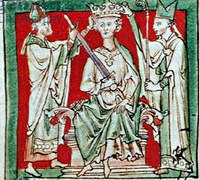
The coronation of King Stephen

Few periods in history have brought women to the fore, to the centre of events, as the Anarchy did in England. From 1135 to 1154, conflict raged when Stephen of Blois usurped the throne that rightfully belonged to his cousin Empress Matilda. During the lifetime of Henry I – Matilda’s father and Stephen’s uncle – Stephen had twice sworn oaths to guarantee the succession for Matilda. But when the time came, when Henry died on 1 December 1135, Stephen broke those oaths, and had himself crowned king in Westminster Abbey just 3 weeks after his uncle’s death.

If he thought Matilda would just accept losing her crown and stay at home with the children, Stephen was sorely mistaken. Pregnant with her third child at the time of her father’s death, Matilda had to bide her time, for a little while. And, as her husband Geoffrey of Anjou campaigned on her behalf in Normandy, Matilda landed in England on 30 September 1139 and her own campaign to claim the crown began.

And she nearly won.

The First Battle of Lincoln

Lincoln Castle

Early in 1141, news reached King Stephen that Ranulf de Gernons, the disgruntled Earl of Chester, had captured Lincoln Castle. Disappointed in his aspirations to Carlisle and Cumberland after they were given to Prince Henry of Scotland, Ranulf had turned his sights on Lincoln Castle, which had once been held by his mother, Lucy of Bolingbroke, Countess of Chester. Countess Lucy had died around 1138, leaving her Lincolnshire lands to her son by her second marriage, William de Roumare, Ranulf’s half-brother. Her lands elsewhere had been left to Ranulf de Gernons, who was the son of her third marriage, to Ranulf le Meschin, Earl of Chester.

It seems that in late 1140 Ranulf and his brother had contrived to gain possession of Lincoln Castle by subterfuge. As the story goes, the two brothers waited until the castle garrison had gone hunting before sending their wives to visit the castellan’s wife.  A short while after, Earl Ranulf appeared at the castle gates, wearing no armour and with only three attendants, supposedly to collect his wife and sister-in-law. Once allowed inside, he and his men overpowered the small number of men-at-arms left to guard the castle and opened the gates to his brother. The half-brothers took control of the castle and, with it, the city of Lincoln.

The citizens of Lincoln appealed to the king, who had promptly arrived outside the castle walls by 6 January 1141 and began his siege. Earl Ranulf somehow escaped from the castle and returned to his lands in Chester in order to raise more troops. He also took the opportunity to appeal to his father-in-law for aid. Ranulf’s father-in-law was, Robert, Earl of Gloucester, the illegitimate son of Henry I and brother of Empress Matilda. A very capable soldier, Earl Robert commanded Matilda’s military forces and his daughter, Maud of Gloucester – Ranulf’s wife – was still trapped inside Lincoln Castle. If the need to rescue his daughter was not enough motivation to persuade Robert to intercede at Lincoln, Ranulf also promised to switch his allegiance, and his considerable resources, to Empress Matilda. Robert marched to Lincoln, meeting up with his son-in-law along the way. The earls’ forces arrived on the outskirts of Lincoln on 1 February, crossed the Fossdyke and the River Witham and arrayed for battle.  Their rapid approach caught Stephen unawares. Outnumbered, Stephen was advised to withdraw his forces, until he could muster enough men to make an even fight of it.

Stephen, perhaps remembering the destruction of his father’s reputation after his flight from Antioch, refused to withdraw. He would stand and fight. The next morning, 2 February 1141, before battle was joined, King Stephen attended a solemn mass in the cathedral; according to Henry of Huntingdon, who claimed Bishop Alexander of Lincoln as his patron and may well have been present, the service was replete with ill omens:

‘But when, following custom, he offered a candle fit for a king and was putting it into Bishop Alexander’s hands, it broke into pieces. This was a warning to the king that he would be crushed. In the bishop’s presence, too, the pyx above the altar, which contained the Lord’s Body, fell, its chain having snapped off. This was a sign of the king’s downfall.’

Henry of Huntingdon, The History of the English People 1000-1154

After mass, the king led his forces through Lincoln’s West Gate, deploying them either on the slope leading down to the Fossdyke or possibly at the bottom of the slope, on Carrholme. King Stephen formed his army into three divisions, with mounted troops on each flank and the infantry in the centre. On the right flank were the forces of Waleran de Meulan, William de Warenne, Simon de Senlis, Gilbert of Hertford, Alan of Richmond and Hugh Bigod, Earl of Norfolk. The left was commanded by William of Aumale and William of Ypres, Stephen’s trusted mercenary captain, who led a force of Flemish and Breton troops. The centre comprised the shire levy, which included citizens of Lincoln, and Stephen’s own men-at-arms, fighting on foot around the royal standard.
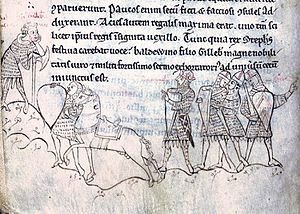
1141 Battle of Lincoln from Historia Anglorum

The opposing army also deployed in three divisions, with ‘the disinherited’, those deprived of their lands by King Stephen, on the left. The infantry, comprising of Earl Ranulf’s Cheshire tenants and other levies, and dismounted knights were in the centre under Earl Ranulf himself. The cavalry, under the command of Earl Robert of Gloucester formed the right flank. The Welsh mercenaries, ‘ill armed but full of spirits’ were arrayed on the wings of the army. Before the battle, Henry of Huntingdon reports, speeches  were heard from both sides, exhorting the men to battle and insulting the opposing commanders.

Baldwin fitz Gilbert spoke for King Stephen, whose voice did not carry well. According to Henry of Huntingdon, the armies were mobilising before his speech ended. The rebels were the first to advance, ‘the shouts of the advancing enemy were heard, mingled with the blasts of their trumpets, and the trampling of the horses, making the ground to quake.’ The ranks of the ‘disinherited’ moved forward with swords drawn, rather than lowered lances, intent on close quarter combat. This left flank of the rebel army fell upon Stephen’s right flank, ‘in which were Earl Alan, the Earl of Mellent [Meulan], with Hugh, the Earl of East Anglia [Norfolk], and Earl Symon, and the Earl of Warenne, with so much impetuosity that it was routed in the twinkling of an eye, one part being slain, another taken prisoner and the third put to flight.’ Faced with the ferocity of the assault and the very real prospect of death, rather than being taken prisoner and held for ransom, the earls fled the field with the remnants of their men. It was every man for himself as Stephen’s right wing disintegrated in panic.2

The left wing of the royal army appeared to have greater success, at least initially. The men of William of Aumale, Earl of York and Stephen’s mercenary captain, William of Ypres, rode down the Earl of Chester’s Welsh mercenaries and sent them running, but ‘the followers of the Earl of Chester attacked this body of horse, and it was scattered in a moment like the rest.’3 Other sources suggest that William of Ypres and William of Aumale fled before coming to close quarters with the enemy.4 Either way, William of Ypres’ men were routed and he was in no position to support the king and so fled the field, no doubt aware that he would not be well-treated were he to be captured.

Stephen’s centre, the infantry, including the Lincolnshire levies and the king’s own men-at-arms, were left isolated and surrounded, but continued to fight. Stephen himself was prominent in the vicious hand-to-hand fighting that followed. Henry of Huntingdon vividly describes the desperate scene as ‘the battle raged terribly round this circle; helmets and swords gleamed as they clashed, and the fearful screams and shouts re-echoed from the neighbouring hill and city walls.’5 The rebel cavalry charged into the royal forces killing many, trampling others and capturing some. King Stephen was deep in the midst of the fighting:

‘No respite, no breathing time was allowed, except in the quarter in which the king himself had taken his stand, where the assailants recoiled from the unmatched force of his terrible arm. The Earl of Chester seeing this, and envious of the glory the king was gaining, threw himself upon him with the whole weight of his men-at-arms. Even then the king’s courage did not fail, but his heavy battle-axe gleamed like lightning, striking down some, bearing back others. At length it was shattered by repeated blows, then he drew his well-tried sword, with which he wrought wonders until that, too, was broken.’

Henry of Huntingdon, The History of the English People 1000-1154;

According to Orderic Vitalis and the Gesta Stephani, it was the king’s sword that broke first, before he was passed a battle-axe by one of the fighting citizens of Lincoln, in order to continue the fight. Whatever the order, the king’s weapons were now useless and the king ‘fell to the ground by a blow from a stone.’6 Stephen was stunned and a soldier named William de Cahaignes then rushed at him, seized him by his helmet and shouted, ‘Here! Here! I have taken the king!’

The king’s forces being completely surrounded, flight was impossible. All were killed or taken prisoner, including Baldwin fitz Gilbert, the man who had given the rousing pre-battle speech to the men. In the immediate aftermath of the fighting, Lincoln was sacked, buildings set alight, valuables pillaged, and its citizens slaughtered by the victorious rebels.

Lady of the English

Empress Matilda depicted in an image from the Gospels of Henry the Lion.

Defeated, Stephen was first taken to Empress Matilda and then to imprisonment at Bristol Castle. A victorious Matilda was recognised as sovereign by the English people.

As for Matilda, ‘the lady empress-queen, Henry’s daughter, who was staying at Gloucester, was overjoyed at this event, having now, as it appeared to her, got possession of the kingdom for which fealty had been sworn to her’. As the Gesta Stephani, always insistent on naming Matilda countess rather than empress,relates, ‘the greater part of the kingdom at once submitted to the countess and her adherents and some of the king’s men, involved in sudden disasters, were being either captured or forcibly expelled from their possessions; others, very quickly foreswearing the faith they owed to the king, were voluntarily surrendering themselves and what was theirs to the countess’.

A victorious Matilda was recognised as sovereign by the English people, being named Lady of the English as Winchester in March.

Queen Matilda

Matilda of Boulogne, Queen of England

And Stephen’s greatest asset now showed her mettle.

In April, Stephen’s wife, Queen Matilda, sent a letter that was read out at the Legatine Council in Winchester, presided over by Henry of Blois, papal legate and Bishop of Winchester – and brother of King Stephen. The queen pleaded with the clergy to release the king from his imprisonment and restore him to the throne. As may have been expected, Bishop Henry refused to give in to the queen’s request, but her pleas may have affected a delegation of Londoners, also present, who were still openly loyal to Stephen and would see Queen Matilda’s letter as encouragement for them to maintain their position in the face of the bishop’s persuasion. Clearly the empress had a long way to go before the Londoners would admit her into the capital for her coronation at Westminster Abbey.

However, by mid-June, the empress was at Westminster, outside the city walls of London.

Empress Matilda was now at the height of her success. Her rival was in her custody, the church was on her side, she had the keys to the royal treasury and was about to make a ceremonial entry into London, her capital: ‘The empress, as we have already said, having treated with the Londoners, lost no time in entering the city with a great attendance of bishops and nobles: and being received at Westminster with a magnificent procession, took up her abode there for some days to set in order the affairs of the kingdom.’ Her uncle David, King of Scots and her half-brothers Robert of Gloucester and Reginald de Dunstanville, now Earl of Cornwall, were by her side.

Empress versus Queen
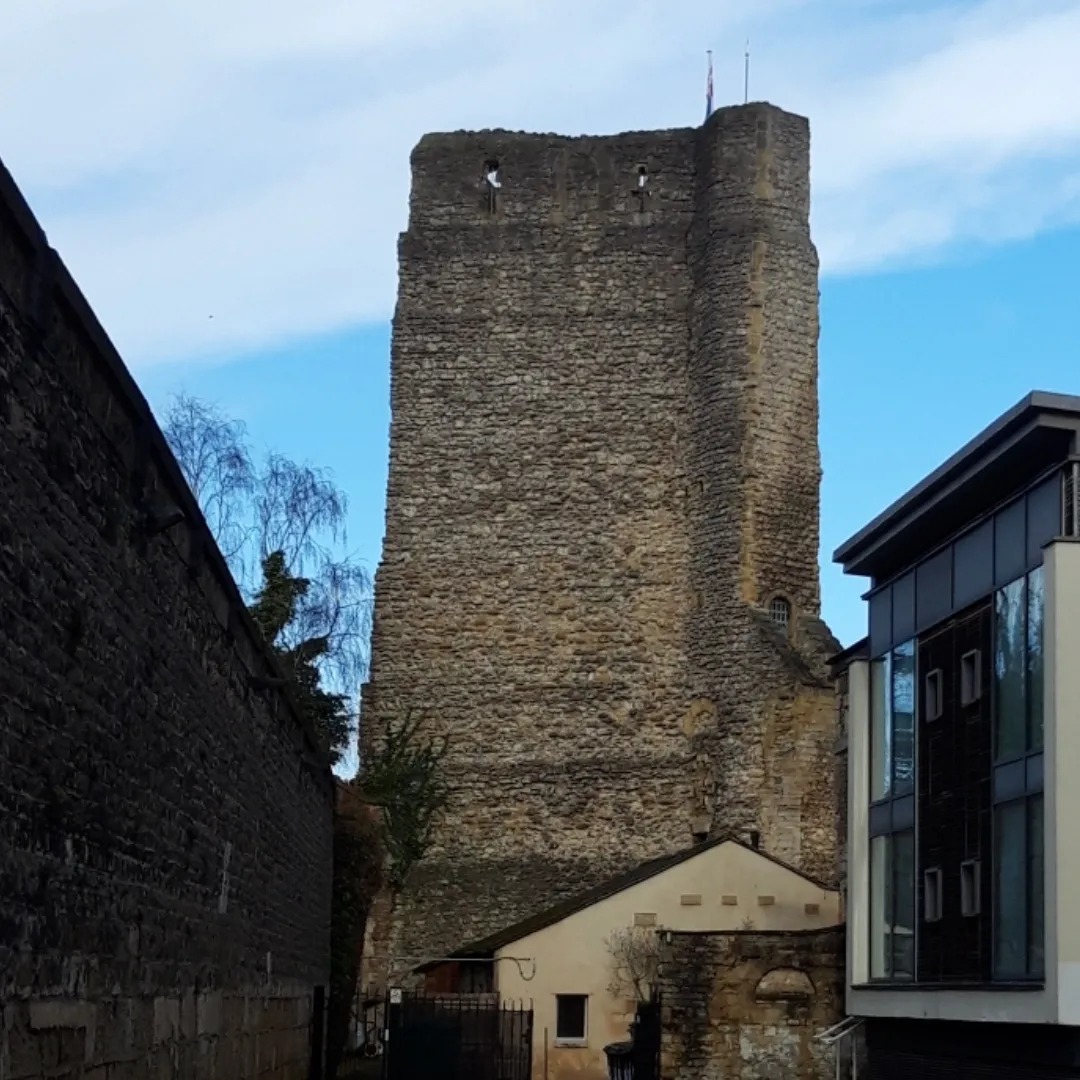
Oxford Castle

With her husband held in chains in Bristol castle, Matilda of Boulogne, Queen of England, wife of King Stephen and cousin of Empress Matilda, stepped into the fight. She first tried to negotiate, offering to take Stephen into exile if Matilda would at least guarantee their son’s inheritance of their ancestral lands. The empress refused, perhaps remembering that no such guarantee was ever made to her son, Henry, dispossessed of his inheritance by Stephen’s usurpation of the crown. Undeterred, Queen Matilda established a secure base in Kent, from where she raised an army to march on London, burning and ravaging the countryside surrounding the capital. It was becoming apparent that the struggle was far from over. A final masterstroke was when she moved up William of Ypres and his Flemish mercenaries, to threaten London, thus inducing the Londoners to turn against the empress.

Henry, Bishop of Winchester, deserted the empress and joined the queen, promising to expend his efforts on obtaining the release of the king, his brother.

The empress’s success was turning sour.

On the eve of the empress’s ceremonial entrance into the capital, the city’s church bells rang out, a prearranged signal for the citizens to rise against the empress and open the gates to the queen’s approaching army. Empress Matilda was still at Westminster, ‘reclining at a well-cooked feast’. Westminster was an unfortified palace that was not easily defensible and ‘being, however, forewarned by some of them, she fled shamefully with her retinue, leaving all her own and their apparel behind’.

The empress had no choice. She and her supporters rode for Oxford. Although things appeared precarious, all was not lost. Queen Matilda now held London, but the empress still had Stephen in her custody and room for manoeuvre. By the end of July, the empress and her army were riding south. As she approached Winchester, the empress sent a request to Bishop Henry to meet her outside the city, at which point he promptly fled to join Queen Matilda at Guildford.

The Rout of Winchester

Robert of Gloucester and his wife, Mabel

Winchester had two castles: the royal castle, which held for the empress, and Wolvesey, a palatial castle in the south-eastern corner of the city that was the residence of Bishop Henry of Winchester, though he was not at home at the time. Empress Matilda arrived at the royal castle of Winchester on 31 July and began the siege of Wolvesey on 1 August 1141.

In defiance, the garrison of the bishop’s castle threw burning material from the ramparts which, in the summer heat, quickly set the whole city ablaze. The stone cathedral survived, but much of the town, built in wood with thatched roofs, was lost. The devastation meant the city’s population had lost their homes and livelihoods, and the empress’s army were deprived of shelter and provisions. Worse, Queen Matilda was now approaching with an army of her own and, in turn, besieged the empress.

The empress’s army was trapped.

Surrounded, with the city in flames and supplies running short, the empress was forced to flee for her life. In the retreat, her half-brother and leading general, Robert, Earl of Gloucester, was captured.

Queen Matilda now had her own bargaining chip. As much as she needed her husband returned to her, the empress needed her brother.

Prisoner Exchange

Henry II

The practical arrangements for the exchange were rather complicated, with neither side trusting the other to hold to the bargain. On 1 November 1141, Queen Matilda surrendered at Bristol Castle, with one of her sons and two unidentified magnates, so that Stephen could be set at liberty. The king then rode to Winchester, where Earl Robert had been taken under guard, and on his arrival on 3 November the earl was freed, leaving his eldest son and heir, William of Gloucester, as surety. When the earl reached Bristol, the queen, her son and the two unnamed magnates were set at liberty and returned to Winchester. At that point, William of Gloucester was freed as well. After nine months of harsh imprisonment, Stephen was free at last.

By Christmas 1141, having endured nine months of incarceration, Stephen was back on his throne and celebrating the festive season at Canterbury, where he was symbolically re-crowned by the archbishop  of Canterbury, with his queen by his side.

The empress was faced with the realisation of how close she had come to winning it all.

But lost.

At least she had her brother back and the fight was far from over.

The war would drag on until Stephen’s death in 1154, but the empress never came as close again to winning the crown. She eventually passed the baton to her son, Henry FitzEmpress, who would reign as Henry II. It was a kind of victory: it was her son who succeeded King Stephen rather than his own. Empress Matilda could ultimately claim victory as the crown returned to her line and that of her father, Henry I.

*

Images:

Courtesy of Wikipedia except Lincoln Castle and Oxford Castle which are ©SharonBennettConnolly FRHistS 

Selected bibliography:

Gesta Stephani, translated by K. R. Potter; Henry of Huntingdon, The History of the English People 1000-1154; Marjorie Chibnall, The Empress Matilda: Queen Consort, Queen Mother and Lady of the English; Teresa Cole, The Anarchy: The Darkest Days of Medieval England; Catherine Hanley, Matilda: Empress, Queen, Warrior; Helen Castor, She-Wolves: The Women who Ruled England before Elizabeth; Robert Bartlett, England Under the Norman and Angevin Kings; J. Sharpe (trans.), The History of the Kings of England and of his Own Times by William Malmesbury; Orderici Vitalis, Historiae ecclesiasticae libri tredecem, translated by Auguste Le Prévost; Chronicles of the Reigns of Stephen, Henry II and Richard I; Edmund King, King Stephen; Donald Matthew, King Stephen; Matthew Lewis, Stephen and Matilda’s Civil War: Cousins of Anarchy.

*

My Books:

Signed, dedicated copies of all my books are available through my online bookshop.

Out Now! Women of the Anarchy
Two cousins. On the one side is Empress Matilda, or Maud. The sole surviving legitimate child of Henry I, she is fighting for her birthright and that of her children. On the other side is her cousin, Queen Matilda, supporting her husband, King Stephen, and fighting to see her own son inherit the English crown. Women of the Anarchy demonstrates how these women, unable to wield a sword, were prime movers in this time of conflict and lawlessness. It show how their strengths, weaknesses, and personal ambitions swung the fortunes of war one way – and then the other.

Available from Bookshop.orgAmberley Publishing and Amazon UK.

Coming on 15 June 2024: Heroines of the Tudor World
Heroines of the Tudor World tells the stories of the most remarkable women from European history in the time of the Tudor dynasty, 1485-1603. These are the women who ruled, the women who founded dynasties, the women who fought for religious freedom, their families and love. These are the women who made a difference, who influenced countries, kings and the Reformation. In the era dominated by the Renaissance and Reformation, Heroines of the Tudor World examines the threats and challenges faced by the women of the era, and how they overcame them. From writers to regents, from nuns to queens, Heroines of the Tudor World shines the spotlight on the women helped to shape Early Modern Europe.

Heroines of the Tudor World is now available for pre-order from Amberley Publishing and Amazon UK.

Also by Sharon Bennett Connolly:

King John’s Right-Hand Lady: The Story of Nicholaa de la Haye is the story of a truly remarkable lady, the hereditary constable of Lincoln Castle and the first woman in England to be appointed sheriff in her own right. Available from all good bookshops or direct from Pen & Sword Booksbookshop.org and AmazonDefenders of the Norman Crown: The Rise and Fall of the Warenne Earls of Surrey tells the fascinating story of the Warenne dynasty, from its origins in Normandy, through the Conquest, Magna Carta, the wars and marriages that led to its ultimate demise in the reign of Edward III. Available from Pen & Sword BooksAmazon in the UK and US, and Bookshop.org

Ladies of Magna Carta: Women of Influence in Thirteenth Century England looks into the relationships of the various noble families of the 13th century, and how they were affected by the Barons’ Wars, Magna Carta and its aftermath; the bonds that were formed and those that were broken. It is now available in paperback and hardback from Pen & Sword,  Amazon, and Bookshop.orgHeroines of the Medieval World tells the stories of some of the most remarkable women from Medieval history, from Eleanor of Aquitaine to Julian of Norwich. Available now from Amberley Publishing and Amazon, and Bookshop.orgSilk and the Sword: The Women of the Norman Conquest traces the fortunes of the women who had a significant role to play in the momentous events of 1066. Available now from Amazon,  Amberley Publishing, and Bookshop.org.

Alternate Endings: An anthology of historical fiction short stories including Long Live the King… which is my take what might have happened had King John not died in October 1216. Available in paperback and kindle from Amazon.

Podcast:

Have a listen to the A Slice of Medieval podcast, which I co-host with Historical fiction novelist Derek Birks. Derek and I welcome guests, such as Bernard Cornwell and Elizabeth Chadwick, and discuss a wide range of topics in medieval history, from significant events to the personalities involved.

*

Don’t forget! Signed and dedicated copies of all my books are available through my online bookshop.

For forthcoming online and in-person talks, please check out my Events Page.

You can be the first to read new articles by clicking the ‘Follow’ button, liking our Facebook page or joining me on Twitter and Instagram.

*

©2024 Sharon Bennett Connolly FRHistS 

Warenne Family Ties

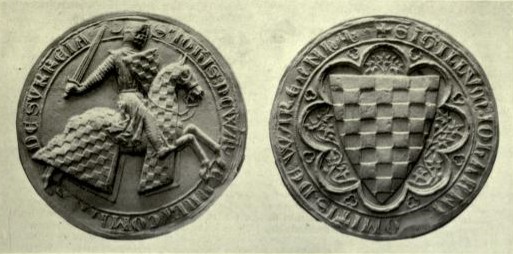
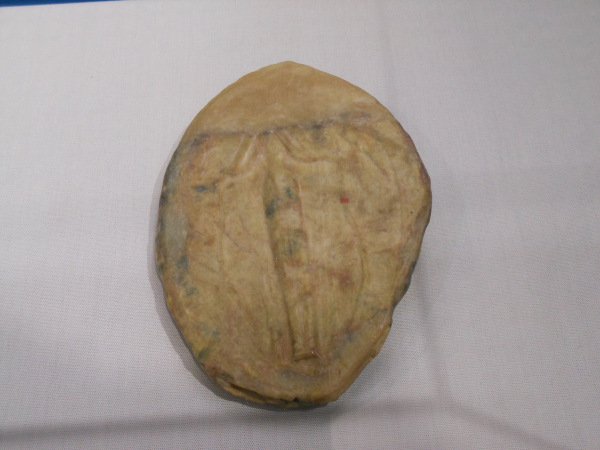
Seal of John de Warenne, 6th earl of Warenne and Surrey

In the reign of Edward I, when asked Quo Warranto – by what warrant he held his lands – John de Warenne, the 6th earl of Surrey, is said to have drawn a rusty sword, claiming “My ancestors came with William the Bastard, and conquered their lands with the sword, and I will defend them with the sword against anyone wishing to seize them”

When I started writing Defenders of the Norman Crown: Rise and Fall of the Warenne Earls of Surrey, I expected to find a healthy – or, rather, unhealthy – level of sibling rivalry. After all, this family was related to both the Norman and Plantagenet royal families, neither of whom are renowned for any sort of brotherly love.

You only have to look at the warring antics of Robert Curthose, William II and Henry I, to imagine the level of sibling rivalry involved in Norman times. The three brothers fought over who should have Normandy and England after their father’s death, to the extent that Robert Curthose ended up the prisoner of his little brother, Henry I, for the last 30 years of his life. The Plantagenets were little better, with Prince – later King – John trying to steal his brother’s throne while Richard I was imprisoned in Germany.

William de Warenne, 1st Earl Warenne, Trinity Church, Southover.

With these examples in mind, I was surprised to discover that the Warennes were a rather functional bunch as far as family goes. They went out of their way to help and support each other, even to the extent of half-siblings and in-laws. William de Warenne, the first earl of Warenne and Surrey (often referred to, simply, as Earl Warenne), pursued a private feud with English freedom fighter, Hereward the Wake, after he murdered William’s brother-in-law, Frederic. 

The Warenne (Hyde) Chronicle claims that Hereward, ‘Among his other crimes, by trickery he killed Frederick, brother[-in-law] of Earl William of Warenne, a man distinguished by lineage and possessions, who one night was surrounded in his own house.’ Following Frederic’s murder, according to the Chronicle, ‘such discord arose between Hereward and William that it could not be settled by any reparation nor in any court.’ According to the Gesta Herewardi, Frederic was planning to capture or kill Hereward, who struck first by killing Frederic.

William de Warenne was determined to get his revenge; he attempted to ambush Hereward at a place called Earith. One of William’s men tried unsuccessfully to bribe Hereward’s men to betray him. William was unhorsed when Hereward fired an arrow at him; it rebounded from William’s mailcoat, but the force of the shot saw William fall from his horse and rendered unconscious as he hit the ground. The ambush having failed, William de Warenne then appears in the Gesta Herewardi with an angry outburst against the Norman knight Deda, who had given a eulogistic account of the rebels on the Isle of Ely. According to the Liber Eliensis, William ‘flared up with weighty indignation, and alleged that he [Deda] had been inveigled by a bribe and was lying.’

St Pancras Priory, Lewes, the Warenne family mausoleum

William de Warenne, the second Earl Warenne, continued the tradition of looking out for family, when his younger brother, Rainald, was captured by King Henry I. In 1105 Rainald de Warenne was among the supporters of Robert Curthose, Duke of Normandy and Henry I’s oldest brother, who captured and imprisoned Robert fitz Hamon, a friend of King Henry, intending to ransom him. Henry saw fitz Hamon’s capture as an opportunity to deal decisively with Normandy, though he claimed he was invading not out of ambition, but to protect the church and the poor people of Normandy. 

Henry invaded in the spring of 1106. Rainald de Warenne was captured by Henry’s forces during a skirmish at the fortified Abbey of Saint-Pierre-sur-Dive. The abbot there had been plotting with Duke Robert to trap Henry, offering to hand over the castle to the English king, while sequestering Rainald de Warenne, Robert de Stuteville and their men within, ready to seize Henry as soon as he entered. Suspecting treachery, Henry arrived at daybreak with a force of 700 men-at-arms and took the garrison completely by surprise, capturing the duke’s men and burning the castle to the ground.

The sources vary, but Rainald was released either shortly before or shortly after the battle of Tinchebrai – the final, decisive battle between the royal Norman brother. Orderic Vitalis claims that William de Warenne served as one of King Henry’s chief commanders at Tinchebrai and that Rainald was released shortly before the battle. Grateful for his brother’s release, Earl William urged his men to fight the king’s cause with the utmost determination. 

According to the Warenne (Hyde) Chronicle, however, Rainald was not released until after the battle, when he was ‘reluctantly handed back to his brother, who pleaded for him to Henry.’ Whichever is correct, the result was the same, Rainald was now free, thanks to the insistence and loyalty of his older brother.

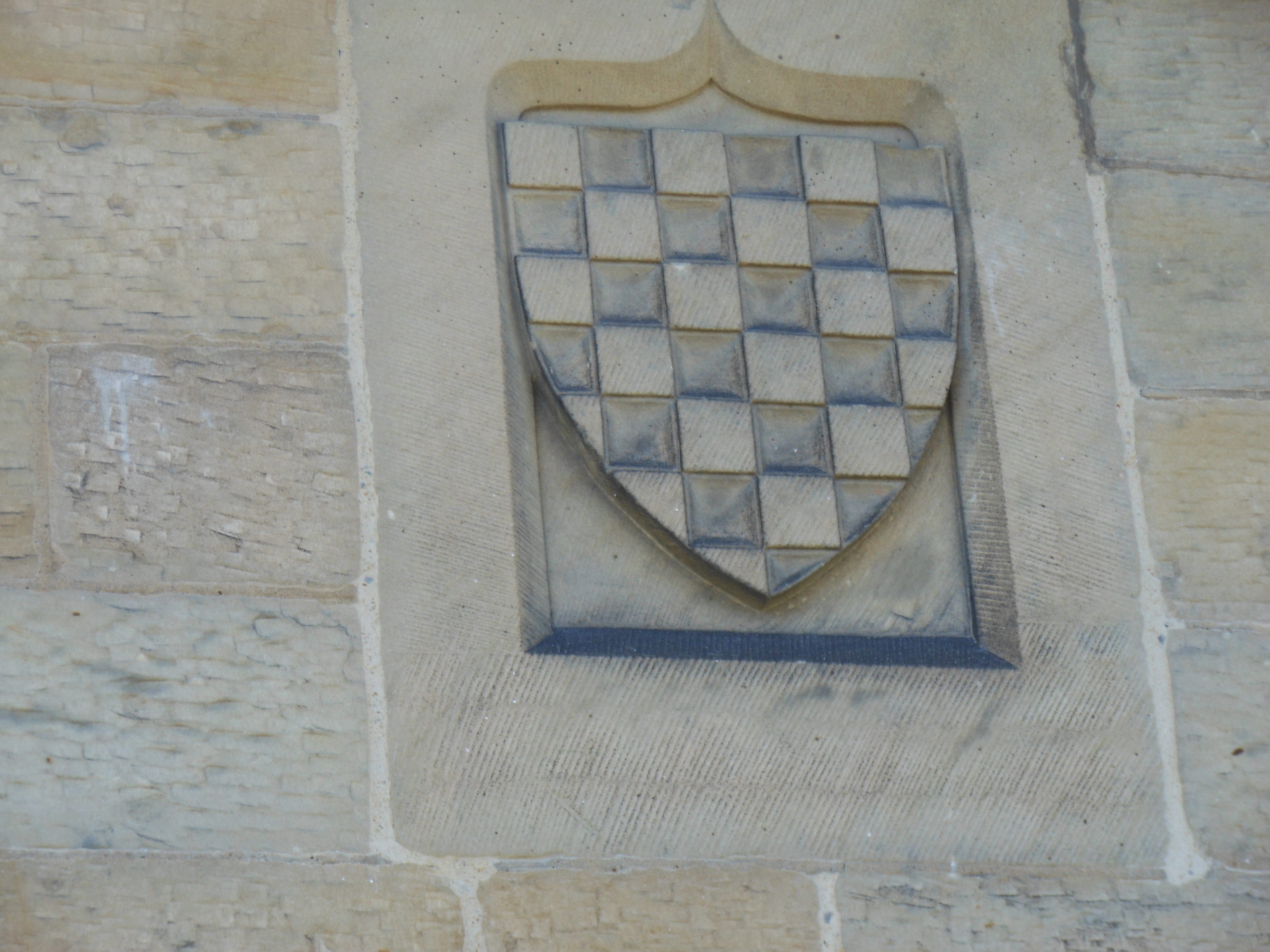
Warenne shield of blue and gold check, Trinity Church, Southover.

In the next generation, the children and stepchildren of William de Warenne, the 2nd Earl Warenne, got on remarkably well together. William had married Isabel de Vermandois, the widow of the recently deceased Robert de Beaumont, Earl of Leicester. Isabel was already the mother of 9 children, including the famous twins Robert and Waleran de Beaumont, when she married William, with whom the chronicler Henry of Huntingdon claims she was having an affair, even before her husband died. 

With William, Isabel had a further 5 children, 3 boys and 2 girls. Earl Warenne was at King Henry I’s deathbed, alongside his son, also named William de Warenne (the future 3rd Earl Warenne), and stepsons, Waleran and Robert de Beaumont. When the 2nd Earl Warenne died, it was Waleran de Beaumont who became the head of the combined, and rather large, Beaumont/Warenne family. Indeed, Waleran and William de Warenne, 3rd Earl Warenne, having grown tired of the Anarchy – the war between King Stephen and Empress Matilda which lasted from 1135 to 1154 – departed on Crusade together in 1147. Unfortunately, William de Warenne was killed at the Battle of Mount Cadmus in January 1148, and Waleran returned home alone.

A touching story from just before his departure on crusade relates to the 3rd Earl Warenne and his two younger brothers, Reginald and Ralph de Warenne. The earl held a dedication ceremony for the new church at St Pancras Priory, Lewes, the mausoleum of the Warenne family, founded by the 1st earl and his wife, Gundrada. In the accompanying charter, the earl endowed the priory, in which his father and grandparents were buried, and where his mother would soon be laid to rest, with the tenth penny of his rents and ‘giving it seisin thereof by hair from his own head and that of Ralph de Warenne his brother, cut with a knife by Henry, bishop of Winchester, before the altar.’ 

It is not hard to imagine how moving a ceremony this must have been, two brothers kneeling before the altar to have their hair cut by the bishop of Winchester, Henry of Blois, the brother of King Stephen. The scene is made all the more poignant in hindsight, knowing that the third earl never returned from the crusade on which he was about to embark.

Conisbrough Castle

And when the 3rd Earl Warenne failed to return from the Holy Land, it was down to his younger brother, Reginald, to look after the family interests and those of his brother’s sole surviving heir, William’s daughter, Isabel de Warenne, the 4th Countess of Warenne and Surrey. Isabel, though still only a child, had been married to King Stephen’s youngest son, William of Blois, probably before her father’s departure to the Holy Land. Isabel’s second husband, Hamelin, the illegitimate half-brother of Henry II, built the great keep at Conisbrough Castle.

Hamelin and Isabel’s son, William de Warenne, the 5th earl, looked out for the interests of his niece, Alice de Lusignan, in her struggles with the crown, both under King John and Henry III, to secure her inheritance of Tickhill Castle in Yorkshire.

Such examples of the earls taking care of their family, and working in alliance with their in-laws, was to be a feature of every generation down to the 7th and last earl, John II de Warenne, who was given the custody and care of his cousin, Edward Balliol, the son of John Balliol, the deposed King of Scots, around 1307. The Warenne earls, to a man, looked after their relations, both near and far. In the story of a family, it is quite fitting – and highly unusual – that the Warenne earls appear to have always put family first.

*

Images:

Are ©2023 Sharon Bennett Connolly FRHistS except the seal of John de Warenne, which is courtesy of Wikimedia Commons

Sources:

Robert Bartlett, England Under the Norman and Angevin Kings; Dan Jones, The Plantagenets; Donald Matthew, King Stephen; Medieval Lands Project on the Earls of Surrey, Conisbrough Castle; Farrer, William and Charles Travis Clay, editors, Early Yorkshire Charters, Volume 8: The Honour of Warenne; Morris, Marc King John: Treachery, Tyranny and the Road to Magna Carta; Church, Stephen, King John: England, Magna Carta and the Making of a Tyrant; doncasterhistory.co.uk; A History of the County of Sussex: Volume 2 edited by William Page; W.H. Blaauw, On the Early History of Lewes Priory, and its Seals, with extracts from a MS. Chronicle, Sussex Archaeological Collections; Rev. John Watson, Memoirs of the Ancient Earls of Warren and Surrey, and Their Descendants to the Present Time, Volume I;  Odo of Deuil, De Profectione Ludovici VII in Orientem; magnacharta.com; Cokayne, G.E., The Complete Peerage, Vol. XII; Henry of Huntingdon, The Chronicle of Henry of Huntingdon; Elisabeth van Houts and Rosalind C. Love, The Warenne (Hyde) Chronicle.

*

My Books

Christmas is coming!

Signed, dedicated copies of all my books are available through my online bookshop.

Coming 15 January 2024: Women of the Anarchy

On the one side is Empress Matilda, or Maud. The sole surviving legitimate child of Henry I, she is fighting for her birthright and that of her children. On the other side is her cousin, Queen Matilda, supporting her husband, King Stephen, and fighting to see her own son inherit the English crown. Both women are granddaughters of St Margaret, Queen of Scotland and descendants of Alfred the Great of Wessex. Women of the Anarchy demonstrates how these women, unable to wield a sword, were prime movers in this time of conflict and lawlessness. It show how their strengths, weaknesses, and personal ambitions swung the fortunes of war one way – and then the other.

Available for pre-order from Amberley Publishing and Amazon UK.

Coming on 15 June 2024: Heroines of the Tudor World

Heroines of the Tudor World tells the stories of the most remarkable women from European history in the time of the Tudor dynasty, 1485-1603. These are the women who ruled, the women who founded dynasties, the women who fought for religious freedom, their families and love. These are the women who made a difference, who influenced countries, kings and the Reformation. In the era dominated by the Renaissance and Reformation, Heroines of the Tudor World examines the threats and challenges faced by the women of the era, and how they overcame them. Some famous, some infamous, some less well known, including Anne Boleyn, Elizabeth Barton, Catherine de Medici, Bess of Hardwick and Elizabeth I. From writers to regents, from nuns to queens, Heroines of the Tudor World shines the spotlight on the women helped to shape Early Modern Europe.

Heroines of the Tudor World is now available for pre-order from Amberley Publishing and Amazon UK.

Also by Sharon Bennett Connolly:

King John’s Right-Hand Lady: The Story of Nicholaa de la Haye is the story of a truly remarkable lady. Nicholaa de la Haye was the hereditary constable of Lincoln Castle and the first woman in England to be appointed sheriff in her own right. Her strength and tenacity saved England at one of the lowest points in its history. Nicholaa de la Haye is one woman in English history whose story needs to be told… King John’s Right-Hand Lady: The Story of Nicholaa de la Haye is now available from Pen & Sword Booksbookshop.org and Amazon.

Defenders of the Norman Crown: The Rise and Fall of the Warenne Earls of Surrey tells the fascinating story of the Warenne dynasty, of the successes and failures of one of the most powerful families in England, from its origins in Normandy, through the Conquest, Magna Carta, the wars and marriages that led to its ultimate demise in the reign of Edward III. Defenders of the Norman Crown: Rise and Fall of the Warenne Earls of Surrey is now available from Pen & Sword BooksAmazon in the UK and US, and Bookshop.org.
Ladies of Magna Carta: Women of Influence in Thirteenth Century England looks into the relationships of the various noble families of the 13th century, and how they were affected by the Barons’ Wars, Magna Carta and its aftermath; the bonds that were formed and those that were broken. It is now available in paperback and hardback from Pen & Sword,  Amazon, and Bookshop.org.

Heroines of the Medieval World tells the stories of some of the most remarkable women from Medieval history, from Eleanor of Aquitaine to Julian of Norwich. Available now from Amberley Publishing and Amazon, and Bookshop.org.

Silk and the Sword: The Women of the Norman Conquest traces the fortunes of the women who had a significant role to play in the momentous events of 1066. Available now from Amazon,  Amberley Publishing, and Bookshop.org.

Alternate Endings: An anthology of historical fiction short stories including Long Live the King… which is my take what might have happened had King John not died in October 1216. Available in paperback and kindle from Amazon.

Podcast:

Have a listen to the A Slice of Medieval podcast, which I co-host with Historical fiction novelist Derek Birks. Derek and I welcome guests, such as Bernard Cornwell, and discuss a wide range of topics in medieval history, from significant events to the personalities involved.

*

Don’t forget! Signed and dedicated copies of all my books are available through my online bookshop.

For forthcoming online and in-person talks, please check out my Events Page.

You can be the first to read new articles by clicking the ‘Follow’ button, liking our Facebook page or joining me on Twitter and Instagram.

*

©2023 Sharon Bennett Connolly FRHistS
Isabel and Hamelin de Warenne: Marriage and Partnership

Seal of Isabel de Warenne, Conisbrough Castle

Isabel de Warenne was the only surviving child of William de Warenne, 3rd Earl of Warenne and Surrey, and his wife Adela, or Ela, de Talvas, daughter of William III of Ponthieu. When her father died on the Second Crusade to the Holy Land, in around 1148, Isabel became 4th Countess of Surrey in her own right and one of the most prized heiresses in England and Normandy, with large estates in Yorkshire, Norfolk and Sussex.

Isabel was born during a period of civil war in England, a time known as The Anarchy (c.1135-54), when King Stephen fought against Empress Matilda, the daughter of Henry I, for the right to rule England. Isabel’s father, William, was a staunch supporter of the king and had fought at the Battle of Lincoln in February 1141, though without distinction; his men were routed early on in the battle and William was among a number of earls who fled the field. He later redeemed himself that summer by capturing Empress Matilda’s brother and senior general, Robert Earl of Gloucester, at Winchester.

The earl appears to have tired of the civil war in 1147 and departed on Crusade with his half-brother, Waleran de Beaumont, Count of Meulan, and their cousin, King Louis VII of France. In the same year, as part of King Stephen’s attempts to control the vast de Warenne lands during a crucial time in the Anarchy, Earl Warenne’s only daughter, Isabel, was married to Stephen’s younger son, William of Blois, who would become Earl by right of his wife, following the 3rd earl’s death on Crusade in 1148; he was killed fighting in the doomed rearguard at the Battle of Mount Cadmus near Laodicea in January 1148.

It has been suggested that William of Blois was some 7 or 8 years younger than his wife, Isabel. However, this seems improbable and it appears more likely that the young couple were of similar ages. Isabel’s father had been born in 1119 and was no older than 29 when he died; his wife, Ela de Talvas, was a few years younger than her husband. This means that, even if the couple married as soon as they reached the ages allowed by the church to marry, 12 for a girl and 14 for a boy, and Ela fell pregnant on her wedding night, Isabel could have been no older 13 in 1147. Given the danger associated with girls giving birth before their teens, it seems plausible that Isabel was not born until the late 1130s and may have been between 10 and 12, or younger when she married William of Blois.

The Warenne coat of arms at Trinity Church, Southover

Even before it was known that Earl Warenne had died on crusade, William of Blois was already being referred to as earl in a number of charters relating to Warenne lands, one such charter, dated to c.1148, was issued by the earl’s brother with the proviso ‘that if God should bring back the earl [from the crusade] he would do his best to obtain the earl’s confirmation, or otherwise that of his lord earl William, the king’s son.’1 During the 3rd earl’s absence, and while the new earl and countess were still only children, the vast Warenne lands were administered by the 3rd earl’s youngest brother, Reginald de Warenne, Baron Wormegay, who was a renowned and accomplished administrator and estate manager. We do not know when news reached England of the earl’s death, the tidings may have arrived before the return of the earl’s half-brother, Waleran, later in the year. However, the future of the earldom was already secure with the succession of Isabel and her young husband, carefully watched over by Isabel’s uncle, Reginald.

In 1154 the young couple’s future prospects could have changed drastically when William’s elder brother Eustace, their father’s heir, died. As a consequence, William inherited his mother’s County of Boulogne from his brother, adding to his already substantial domains. He may also have expected to inherit his brother’s position as heir to the throne – or not. It seems that William’s ambitions did not extend to the lofty heights of the throne, or he was not considered suitable for the crown. Either way, the young man was removed from the succession by his own father. Stephen made a deal with Empress Matilda’s son, Henry of Anjou, that the crown would go to him on Stephen’s death, thus returning the crown to the rightful line of succession.

William seems to have accepted this, on the whole. Although there is some suggestion of his involvement in a plot against Henry later in 1154, during which William suffered a broken leg. William served Henry loyally, once he became king, until his own death, returning from the king’s campaign in Toulouse, in 1159.

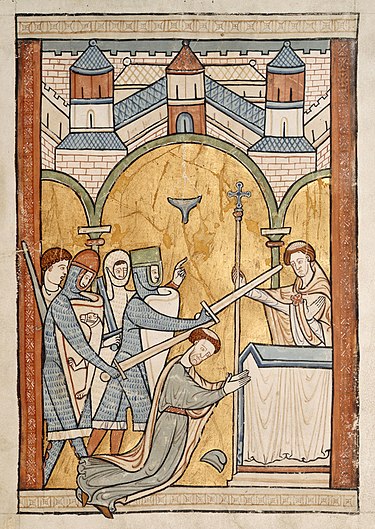
Now in her mid-20s, and as their marriage had been childless, Isabel was once again a prize heiress. Although she seems to have had a little respite from the marriage market, by 1162 Henry II’s youngest brother, William X, Count of Poitou, was seeking a dispensation to marry her. The dispensation was refused by Thomas Becket, Archbishop of Canterbury, on the grounds of consanguinity; the archbishop’s objection was not that Isabel and William were too closely related, but that William and Isabel’s first husband had been cousins. William died shortly after the archbishop refused to sanction the marriage – it is said, of a broken heart.

Contemporary illustration of the murder of Thomas Becket

King Henry was not to be thwarted so easily in his plans to bring the Warenne lands into the royal family, and his illegitimate half-brother, Hamelin, was married to Isabel in 1164. The illegitimate son of Geoffrey, Count of Anjou, Hamelin was born sometime around 1130, when Geoffrey was estranged from his wife, Empress Matilda. His mother was, possibly, Adelaide of Angers, though this is by no means certain. Geoffrey had a second illegitimate child, Emma, who was possibly Hamelin’s full sister. Emma married the Welsh prince, Davydd ap Owain of Gwynedd. Geoffrey of Anjou was the second husband to Empress Matilda, daughter of Henry I of England and would be the mother of the future Henry II, Hamelin’s half-brother.

In an unusual step, Hamelin took his wife’s surname and bore the titles Earl of Warenne and Surrey in her right. Hamelin was incredibly loyal to Henry and his marriage to an heiress was reward for his support, whilst at the same time giving him position and influence within England. Hamelin and Isabel married in April 1164, Hamelin even taking the de Warenne surname after the marriage; Isabel’s trousseau cost an impressive £41 10s 8d. Hamelin became Earl of Surrey by right of his wife, though was more habitually called Earl Warenne. In some references, he is named as the 5th Earl of Surrey and in others the 4th: this confusion arises from the fact that the earldom belonged to Isabel, and her two husbands both held the earldom, sometimes being numbered the 4th and 5th earls to avoid confusion. They were, in fact, both, the 4th Earl of Surrey.

Hamelin supported his brother the king in the contest of wills that Henry was engaged in with his archbishop of Canterbury, Thomas Becket. When Henry called for the archbishop to appear at a great council at Northampton Castle on 12 October 1164, to answer to the charges laid against him, Hamelin was at the trial and spoke in support of his brother. Indeed, the new earl and the archbishop appear to have started a war of words; Hamelin defended Henry’s dignity and called Becket a traitor. The archbishop’s retort was ‘Were I a knight instead of a priest, my fist would prove you a liar!’ Ironically, it is thought that Hamelin’s denunciation of Becket was motivated by the injury caused to the royal family in Becket’s refusal to allow Henry’s brother, William – Hamelin’s half-brother – to marry Isabel de Warenne; who was now Hamelin’s wife.

Henry II

Hamelin’s animosity to Becket was not to survive the archbishop’s martyrdom and he actively participated in the cult that grew up around Thomas Becket after his violent death. In later life, the earl claimed that the cloth covering Becket’s tomb had cured his blindness, caused by a cataract, in one eye.

Hamelin was an influential and active member of the English barony. He supported Henry during his sons’ rebellion in 1173 and formed part of the entourage which escorted Princess Joanna (daughter of Henry and Eleanor of Aquitaine) to Sicily for her marriage to King William. Joanna’s escort was ordered not to return home until they had seen ‘the King of Sicily and Joanna crowned in wedlock’. Hamelin remained close to the crown even after Henry’s death, supporting his nephew, Richard I. Hamelin was among the earls present at Richard’s first coronation in September 1189; and carried one of the three swords at his second coronation in April 1194.

During Richard’s absence on Crusade, Hamelin sided with the Regent, William Longchamp, against the intrigues of Richard’s brother John. Hamelin held great store in the rule of law, attested by the legend on his seal, ‘pro lege, per lege’. This adherence to the law explains Hamelin’s support for Longchamp against that of his own nephew, John, and even as the justiciar’s overzealous actions alienated others. Hamelin was one of only two magnates entrusted with the collection and storage of the king’s ransom, when he was held captive by Duke Leopold of  Austria, appointed by Eleanor of Aquitaine; the other was William d’Aubigny, Earl of Arundel. Hamelin’s involvement with the court continued into the reign of King John; he was present at John’s coronation and at Lincoln when William, King of Scots, Isabel’s cousin, gave his oath of homage in November 1200.

The keep of Conisbrough Castle

Away from court, Hamelin appears to have been an avid builder; he built a cylindrical keep at his manor of Mortemer in Normandy. He then constructed a larger and improved version, using all the latest techniques of castle design, at his manor of Conisbrough, South Yorkshire. He may also have been the one to build Peel Castle at Thorne, a hunting lodge which had a 3-sided donjon that was of smaller, but similar, design to Conisbrough. Hamelin spent a lot of time and money on Conisbrough Castle, which took almost 10 years to complete, and it appears to have been a favourite family residence. King John visited there in 1201, and two of Hamelin’s daughters married landowners from the nearby manors of Tickhill and Sprotborough. His son, William de Warenne, the 5th earl, would complete the castle, rebuilding the curtain wall in stone.

Hamelin was also involved in a famous dispute with Hugh, abbot of Cluny, over the appointment of a new prior to St Pancras Priory, Lewes. Abbot Hugh was known as a man of great piety and honour; he had been prior of Lewes but was elected as abbot of Reading in 1186 and became abbot of Cluny in 1199. In 1200, Abbot Hugh appointed one Alexander to the vacant position of prior of Lewes, but Hamelin refused to accept the nomination. In establishing the priory at Lewes, the abbots of Cluny had apparently reserved the right to appoint the prior, and to admit all monks seeking entry into the order; however, Hamelin claimed that the patronage of the priory belonged to him, and it was his right to appoint the prior.

The dispute dragged on, and it was only after intervention from King John that agreement was eventually reached whereby, should the position of prior become vacant, the earl and the monks should send representatives to the abbot, who would nominate two candidates, of whom the earl’s proctors should choose one to be appointed prior.

Peel Castle, Thorne

The marriage of Hamelin and Isabel appears to have been highly successful. They had four surviving children. Their son and heir, William, would become the 5th Earl of Surrey and married Maud Marshal, daughter of the great William Marshal, Earl of Pembroke and regent for King Henry III. Ela married twice, firstly to a Robert de Newburn, of whom nothing else is known, and secondly to William Fitzwilliam of Sprotborough, a village just a few miles from Conisbrough. Isabel was married, firstly, to Robert de Lascy, who died in 1193, and secondly, no later than the spring of 1196, to Gilbert de Laigle, Lord of Pevensey.

Matilda, or Maud, married Henry, Count of Eu, who died around 1190; by Henry, she was the mother of Alice de Lusignan, who struggled to maintain her inheritance during the reign of King John. Matilda then married Henry d’Estouteville, a Norman lord. It was once thought that Matilda was the daughter of Hamelin by an earlier relationship, due to the supposed death date of Matilda’s husband, Henry, Count of Eu. There was a mistaken belief that Henry had died in 1172, which would mean that Matilda could not have been a daughter of the marriage of Isabel and Hamelin, who were married in 1164, as she would have been too young to have married and borne children with Henry. The Chronicle of the Counts of Eu records Henry’s death as 1183, which also appears to be an error as Henry was assessed for scutage for Wales at Michaelmas 1190; with this later death date it was entirely possible, and indeed likely, that Matilda was the legitimate daughter of both Hamelin and Countess Isabel.

St Pancras Priory, Lewes

One of the daughters – although it is not clear which – bore an illegitimate son, Richard Fitzroy, Baron Chilham, who was born, possibly, around 1190, by her cousin, John (the future King John). This must have caused considerable family tensions!

Hamelin died on 7th May 1202, in his early 70s and was buried in the chapter house at Lewes Priory, in Sussex. Isabel died in her mid-60s, in 1203, and was buried at Lewes Priory, alongside Hamelin. In 1202, Countess Isabel had granted ‘for the soul of her husband earl Hamelin, to the priory of St Katherine, Lincoln, of similar easements for 60 beasts, namely for 40 as of his gift and 20 as of hers.2 Together, Hamelin and Isabel had played important roles in English politics for almost 40 years, whilst raising a family and, literally, building a home at Conisbrough Castle.

Footnotes: 

Farrer, William and Charles Travis Clay, editors, Early Yorkshire Charters, Volume 8: The Honour of Warenneibid

Sources:

Robert Batlett, England Under the Norman and Angevin Kings; Dan Jones, The Plantagenets; Donald Matthew, King Stephen; Medieval Lands Project on the Earls of Surrey, Conisbrough Castle; Farrer, William and Charles Travis Clay, editors, Early Yorkshire Charters, Volume 8: The Honour of Warenne; Morris, Marc King John: Treachery, Tyranny and the Road to Magna Carta; Church, Stephen, King John: England, Magna Carta and the Making of a Tyrant; doncasterhistory.co.uk; A History of the County of Sussex: Volume 2 edited by William Page; W.H. Blaauw, On the Early History of Lewes Priory, and its Seals, with extracts from a MS. Chronicle, Sussex Archaeological Collections; Rev. John Watson, Memoirs of the Ancient Earls of Warren and Surrey, and Their Descendants to the Present Time, Volume I;  Odo of Deuil, De Profectione Ludovici VII in Orientem; magnacharta.com; Cokayne, G.E., The Complete Peerage, Vol. XII; Henry of Huntingdon, The Chronicle of Henry of Huntingdon.

Images:

All images ©Sharon Bennett Connolly except Henry II and the illustration of Becket’s murder which is courtesy of Wikipedia.

*

My Books:

Signed, dedicated copies of all my books are available through my online bookshop.

Out Now! Women of the Anarchy

On the one side is Empress Matilda, or Maud. The sole surviving legitimate child of Henry I, she is fighting for her birthright and that of her children. On the other side is her cousin, Queen Matilda, supporting her husband, King Stephen, and fighting to see her own son inherit the English crown. Both women are granddaughters of St Margaret, Queen of Scotland and descendants of Alfred the Great of Wessex. Women of the Anarchy demonstrates how these women, unable to wield a sword, were prime movers in this time of conflict and lawlessness. It show how their strengths, weaknesses, and personal ambitions swung the fortunes of war one way – and then the other. Available from my online bookshop, bookshop.orgAmberley Publishing and Amazon UK.

Coming on 15 June 2024: Heroines of the Tudor World

Heroines of the Tudor World tells the stories of the most remarkable women from European history in the time of the Tudor dynasty, 1485-1603. These are the women who ruled, the women who founded dynasties, the women who fought for religious freedom, their families and love. These are the women who made a difference, who influenced countries, kings and the Reformation. In the era dominated by the Renaissance and Reformation, Heroines of the Tudor World examines the threats and challenges faced by the women of the era, and how they overcame them. Some famous, some infamous, some less well known, including Anne Boleyn, Elizabeth Barton, Catherine de Medici, Bess of Hardwick and Elizabeth I. From writers to regents, from nuns to queens, Heroines of the Tudor World shines the spotlight on the women helped to shape Early Modern Europe.

Heroines of the Tudor World is now available for pre-order from Amberley Publishing and Amazon UK.

Also by Sharon Bennett Connolly:

King John’s Right-Hand Lady: The Story of Nicholaa de la Haye is the story of a truly remarkable lady, the hereditary constable of Lincoln Castle and the first woman in England to be appointed sheriff in her own right. It is is available from Pen & Sword Booksbookshop.org and AmazonDefenders of the Norman Crown: The Rise and Fall of the Warenne Earls of Surrey tells the fascinating story of the Warenne dynasty, from its origins in Normandy, through the Conquest, Magna Carta, the wars and marriages that led to its ultimate demise in the reign of Edward III. Available from Pen & Sword BooksAmazon in the UK and US, and Bookshop.org.

Ladies of Magna Carta: Women of Influence in Thirteenth Century England looks into the relationships of the various noble families of the 13th century, and how they were affected by the Barons’ Wars, Magna Carta and its aftermath; the bonds that were formed and those that were broken. It is now available in paperback and hardback from Pen & Sword,  Amazon, and Bookshop.orgHeroines of the Medieval World tells the stories of some of the most remarkable women from Medieval history, from Eleanor of Aquitaine to Julian of Norwich. Available now from Amberley Publishing and Amazon, and Bookshop.orgSilk and the Sword: The Women of the Norman Conquest traces the fortunes of the women who had a significant role to play in the momentous events of 1066. Available now from Amazon,  Amberley Publishing, and Bookshop.org.

Alternate Endings: An anthology of historical fiction short stories including Long Live the King… which is my take what might have happened had King John not died in October 1216. Available in paperback and kindle from Amazon.

Podcast:

Have a listen to the A Slice of Medieval podcast, which I co-host with Historical fiction novelist Derek Birks. Derek and I welcome guests, such as Bernard Cornwell and Elizabeth Chadwick, and discuss a wide range of topics in medieval history, from significant events to the personalities involved.

*

Don’t forget! Signed and dedicated copies of all my books are available through my online bookshop.

For forthcoming online and in-person talks, please check out my Events Page.

*You can be the first to read new articles by clicking the ‘Follow’ button, liking our Facebook page or joining me on Twitter and Instagram.

©2022 Sharon Bennett Connolly, FRHistS

William and Gundrada de Warenne and the Foundation of a Dynasty

Books by Sharon Bennett Connolly
William de Warenne, Holy Trinity Church, Southover

William de Warenne, first earl of Surrey, was a younger son of Rodulf de Warenne and his wife Beatrix. It is possible that Beatrix was a niece of Duchess Gunnor of Normandy, making young William a cousin of William the Bastard, Duke of Normandy. The family name is probably derived from the hamlet of Varenne, part of the Warenne lands in the modern French department of Seine-Inférieure, Normandy. William’s older brother, Rodulf or Ralph, would inherit the greater part of the Warenne family estates in Normandy.

William’s date of birth is unrecorded; a younger son of the minor nobility does not tend to get a mention until he does something remarkable or becomes someone notable. Although still young William was considered a capable and experienced enough soldier to be given joint command of a Norman army, by the mid-1050s. His first recorded military action is in the 1054 campaign against the French. He was one of the commanders who fought against the King of France’s brother, Count Odo, at the Battle of Mortemer.  

De Warenne was rewarded with some of the lands of his kinsman, Roger (I) de Mortemer, who had fought for the French. William managed to retain some of these lands even after Mortemer was restored to favour, including the castles of Mortemer and Bellencombre. Bellencrombe would become the capital of the de Warenne estates in Normandy. De Warenne had also received some of  the confiscated lands of William, count of Arques in 1053. Duke William’s confidence in de Warenne is demonstrated in the fact he was one of the barons consulted during the planning of the invasion of England in 1066.

In fact, William de Warenne is one of only a handful of Norman barons who can be positively identified as having fought at the Battle of Hastings on 14th October, 1066. De Warenne was rewarded with vast swathes of land throughout the country. According to the Domesday survey his lands extended over 13 counties: stretching from Conisbrough in Yorkshire to Lewes in Sussex. His territories were acquired over the course of the reign of William I and elevated him the highest rank of magnates. By 1086 his riches were only surpassed by the king’s half-brothers and his own kinsman, Roger de Montgomery. He still ranks in the Top 20 of the richest people in the world – ever!

Books by Sharon Bennett Connolly
Lewes Castle

Throughout his career, William de Warenne acquired lands in numerous counties, sometimes by nefarious means. Much of the property, such as Conisbrough, had formerly belonged to the late king, Harold. In Norfolk he is said to have asserted lordship over freemen not necessarily assigned to him. He had disputes with neighbouring landowners in Conisbrough, over which properties were sokelands and he is said to have stolen lands from the bishop of Durham and the abbot of Ely. Some acquisitions were obtained peacefully, such as the manor of Whitchurch in Shropshire, which was left to him by his kinsman Roger de Montgomery. William was an energetic and attentive landowner and improved the economy of most of his estates; more than tripling his sheep flock at Castle Acre and doubling the value of his Yorkshire estates in just 20 years (at a time when the county was devastated by the Harrying of the North).

In 1067 William de Warenne was one of 4 prominent Normans appointed to govern England during William the Conqueror’s absence in Normandy. Following the Conquest, he continued to support the king and – subsequently – his son, William II Rufus – as a military commander for over 20 years. In 1074 he was with his father at the abbey of Holy Trinity in Rouen, where he was a witness to his father’s last known charter, and in 1083-85 he fought with the king on campaign in Maine, being wounded at the siege of the castle of Sainte-Suzanne.

In 1075, along with Richard de Clare, his fellow justiciar, he was sent to deal with the rebellion of Earl Ralph de Gael of East Anglia. De Gael had failed to respond to their summons to answer for an act of defiance and so the 2 lords faced and defeated the rebels at Fawdon in Cambridgeshire, mutilating their prisoners afterwards. Ralph withdrew to Norwich Castle; besieged for 3 months he managed to escape his attackers by boat, while the castle surrendered and was occupied by de Warenne.

William de Warenne was married to a Flemish noblewoman, Gundrada; her brother Gerbod was sometime earl of Chester and another brother, Frederic, held lands in Norfolk which eventually passed to Gundrada. Frederic, appears to have jointly, with Gundrada, held lands in England even before the Conquest, when two people named Frederic and Gundrada are mentioned as holding four manors in Kent and Sussex. It would indeed be a coincidence if there were two other related people, named Frederic and Gundrada, very distinctive foreign names, in England at that time. Gundrada’s brothers, it seems, were deeply involved in the border politics between Flanders and Normandy; indeed, it is thought that Gerbod resigned his responsibilities in Chester in order to return to the Continent to oversee the family’s lands and duties there, following the death of an older brother, Arnulf II of Oosterzele-Scheldewindeke.

Books by Sharon Bennett Connolly
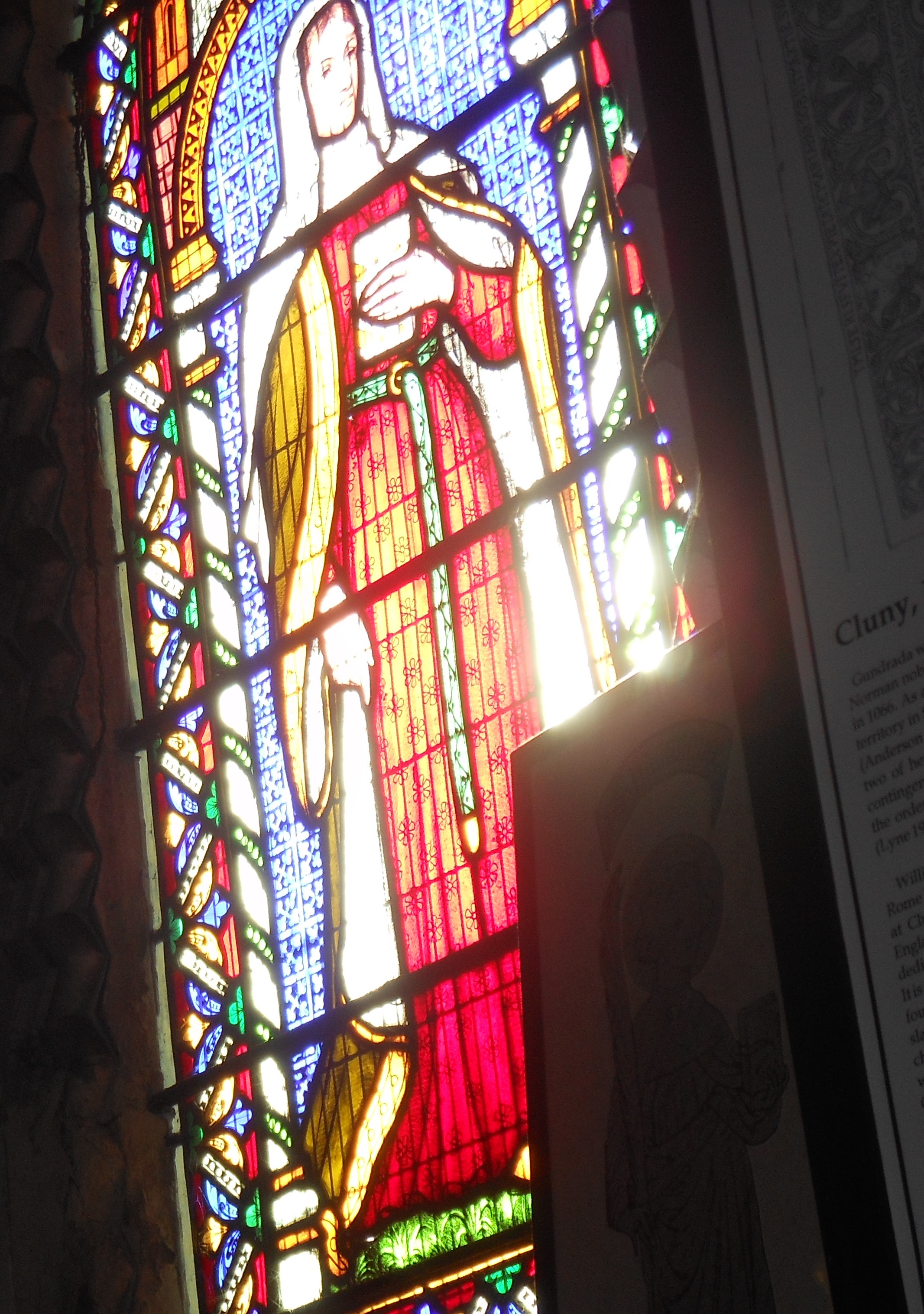
Gundrada de Warenne, Holy Trinity Church, Southover

Frederic was murdered by English freedom fighter, Hereward the Wake; his murder giving rise to a personal feud between Hereward and William de Warenne:

‘Among his other crimes, by trickery [Hereward] killed Frederick, brother of Earl William of Warenne, a man distinguished by lineage and possessions, who one night was surrounded in his own house. On account of his murder, such discord arose between Hereward and the aforesaid William that it could not be settled by any reparation nor in any court.’1

There has been considerable debate among historians over the theory that Gundrada may have been the daughter of William the Conqueror, but the confusion appears to have come from an unreliable charter belonging to Lewes Priory and Gundrada being part of the household of King William’s wife, Matilda. The confirmation charter of the foundation of the priory has King William naming ‘William de Warenne and his wife Gundrada, my daughter.’2 In the same charter, William de Warenne pleads ‘for the health of my mistress Queen Matilda, mother of my wife.’3  However, this is a confirmation of an earlier charter and in the original, while the king and William de Warenne, both, mention Gundrada, neither refer to her as being related to the king or queen.

Historian Elisabeth van Houts argues that Gundrada was most likely a distant relative of Queen Matilda and the counts of Flanders, as asserted in her epitaph as ‘offspring of dukes’ and a ‘noble shoot’. Indeed, had her father been William the Conqueror, her epitaph would surely have referred to her as the offspring of kings. Even if she had been the daughter of Matilda by an earlier marriage, off-spring of kings would have still been appropriate, given that Queen Matilda was the granddaughter of King Robert II of France. Though it does seem likely that Matilda and Gundrada were related in some way, perhaps distant cousins.

The ‘dukes’ referred to in Gundrada’s epitaph, although naturally assumed to be of Normandy, could well refer to a kinship with the house of Luxembourg, to which Queen Matilda’s paternal grandmother, Orgive, belonged. Moreover, Frederic was a familial name within the house of Luxembourg. This kinship via the House of Luxembourg with Queen Matilda would also explain the queen’s gift to Gundrada, of the manor of Carlton, which is usually given as evidence that Gundrada belonged to the queen’s household; an association which would be entirely consistent with kinship.

Books by Sharon Bennett Connolly
De Warenne coat of arms, Holy Trinity Church, Southover

Gundrada and William were married sometime around the time of the Conquest, either before or after the expedition to conquer England. They had 3 children together. Their eldest son, William, would succeed his father as Earl of Surrey and Warenne. He married Isabel de Vermandois, widow of Robert de Beaumont, earl of Leicester; with whom he had, according to one chronicler, been having an affair even before the earl’s death. Young William had a chequered career, he supported the claims of Robert Curthose, Duke of Normandy, to the English throne against the duke’s younger brother, Henry I, but changed sides and fought for Henry at the Battle of Tinchebrai in 1106. Duke Robert lost and was captured and imprisoned by Henry. William remained in the king’s favour for the rest of the reign, fighting alongside Henry at the Battle of Bremule in 1119. William, his son and stepsons were at Henry’s deathbed at Lyons-la-Foret when he died in 1135.

William and Gundrada’s second son, Rainald de Warenne, led the assault on Rouen in 1090, for William II Rufus, in the conflict between the English king and his older brother, Duke Robert. However, by 1105 Rainald was fighting for the duke against the youngest of the Conqueror’s sons, Henry I, defending the castle of Saint-Pierre-sur-Dives for the duke. He was captured by Henry the following year but had been freed by September 1106. It is possible he died shortly after but was certainly dead by 1118 when his brother issued a charter, in which he gave 6 churches to Lewes Priory, for the soul of deceased family members, including Rainald.

Gundrada and William also had a daughter, Edith, who married Gerard de Gournay, son of the lord of Gournay-en-Bray. Gerard also supported William II Rufus against Duke Robert and took part in the Crusade of 1096. Edith later accompanied him on pilgrimage back to Jerusalem, sometime after 1104, where he died. Gerard was succeeded by their son, Hugh de Gournay, whose daughter Gundreda would be the mother of Roger de Mowbray. Edith then married Drew de Monchy, with whom she had a son, Drew the Younger.

Books by Sharon Bennett Connolly
Castle Acre, Norfollk, where Gundrada died

Sadly, Gundrada died in childbirth at Castle Acre in Norfolk on 27th May 1085. She was buried in the chapter house of the couple’s own of foundation Lewes Priory.

William’s second wife was a sister of Richard Guet, who was described as ‘frater comitissae Warennae’ when he gave the manor of Cowyck to Bermondsey Abbey in 1098.3 Guet was a landowner in Perche, Normandy, but his sister’s name has not survived the passage of time. All we know of her is that, a few days after her husband’s death, she attempted to gift 100 shillings to Ely Abbey in restitution for damage caused by William de Warenne. The monks refused the donation, hoping that Warenne’s departing soul had been claimed by demons.4

Despite this feud with Ely, William de Warenne and his wife, Gundrada, had a reputation for piety. At some point in their marriage, probably 1081-3, they went on pilgrimage to Rome. Due of war in Italy they only got as far as the great abbey of Cluny in Burgundy, where they were received into the fellowship of monks. On their return to England, they founded a priory at Lewes, following the Cluniac rule and a prior and 3 monks were sent from Cluny to establish the foundation. It was the first Cluniac foundation in England.

Books by Sharon Bennett Connolly
St Pancras priory, Lewes, founded by William and Gundrada

Following the Conqueror’s death, William fought in support of the late king’s second son, William II Rufus against his older brother, Robert Curthose, who had inherited the dukedom of Normandy. He was rewarded in early 1088 with the earldom of Surrey. The new earl fought for William II Rufus during an invasion by Robert’s supporters and was badly wounded at the siege of Pevensey Castle, East Sussex, in the spring of 1088. He was taken to Lewes, where he died of his wounds on 24th June of the same year. Earl Warenne was buried beside his first wife, Gundrada, in the chapter house of Lewes Priory.

Following the dissolution of Lewes Priory in the 16th century, Gundrada’s tombstone was first moved to Isfield Church; it was moved again in 1775 to the parish church of St John the Baptist at Southover in Lewes. The remains of Gundrada and William, themselves, were discovered in 2 leaden chests in 1845, when the railway line was excavated through the priory grounds. They were laid to rest, for a final time, at the Southover church, in 1847, in a chapel dedicated to Gundrada de Warenne.

William and Gundrada de Warenne had founded a dynasty that would survive for almost 300 years, dying out in the reign of Edward III following the disastrous marriage of John de Warenne, 7th and last Earl of Warenne and Surrey

*

Footnotes:

¹ The Warenne (Hyde) Chronicle edited and translated by Elisabeth M.C. van Houts and Rosalind C. Love; 2 My translation from quote in George Floyd Duckett, Observations on the Parentage of Gundreda, the Daughter of William Duke of Normandy, and Wife of William de Warenne; 3 ibid; 4 Early Yorkshire Charters Volume 8: The Honour of Warenne, Edited by William Farrer and Charles Travis Clay; 5 ibid

Images:

All images ©2022 Sharon Bennett Connolly FRHistS
Sources:

Early Yorkshire Charters Volume 8: The Honour of Warenne, Edited by William Farrer and Charles Travis Clay; England Under the Norman and Angevin Kings by Robert BartlettBrewer’s British Royalty by David WilliamsonBritain’s Royal Families, the Complete Genealogy by Alison Weir; british-history.ac.uk; kristiedean.com; English Heritage Guidebook for Conisbrough Castle by Steven Brindle and Agnieszka Sadrei; oxforddnb.com; George Floyd Duckett, Observations on the Parentage of Gundreda, the Daughter of William Duke of Normandy, and Wife of William de Warenne; Elisabeth M.C. Van Houts and Rosalind C. Love (eds and trans), The Warenne (Hyde) Chronicle; C.P. Lewis, ‘Warenne, Gundrada de (d.1085)’, ODNB; Elisabeth Van Houts, ‘The Warenne View of the Past’, in Proceedings of the Battle Conference 2003, edited by John Gillingham

*

My Books:

Signed, dedicated copies of all my books are available through my online store.

Out now: Scotland’s Medieval Queens

Books by Sharon Bennett Connolly

Scotland’s history is dramatic, violent and bloody. Being England’s northern neighbour has never been easy. Scotland’s queens have had to deal with war, murder, imprisonment, political rivalries and open betrayal. They have loved and lost, raised kings and queens, ruled and died for Scotland. From St Margaret, who became one of the patron saints of Scotland, to Elizabeth de Burgh and the dramatic story of the Scottish Wars of Independence, to the love story and tragedy of Joan Beaufort, to Margaret of Denmark and the dawn of the Renaissance, Scotland’s Medieval Queens have seen it all. This is the story of Scotland through their eyes.

Scotland’s Medieval Queens gives a thorough grounding in the history of the women who ruled Scotland at the side of its kings, often in the shadows, but just as interesting in their lives beyond the spotlight. It’s not a subject that has been widely covered, and Sharon is a pioneer in bringing that information into accessible history.’ Elizabeth Chadwick (New York Times bestselling author)

Available now from Amazon and Pen and Sword Books

Also by Sharon Bennett Connolly:

Books by Sharon Bennett Connolly

Heroines of the Tudor World tells the stories of the most remarkable women from European history in the time of the Tudor dynasty, 1485-1603. These are the women who ruled, the women who founded dynasties, the women who fought for religious freedom, their families and love. Heroines of the Tudor World is now available for pre-order from Amberley Publishing and Amazon UK. Women of the Anarchy demonstrates how Empress Matilda and Matilda of Boulogne, unable to wield a sword themselves, were prime movers in this time of conflict and lawlessness. It shows how their strengths, weaknesses, and personal ambitions swung the fortunes of war one way – and then the other. Available from Bookshop.orgAmberley Publishing and Amazon UKKing John’s Right-Hand Lady: The Story of Nicholaa de la Haye is the story of a truly remarkable lady, the hereditary constable of Lincoln Castle and the first woman in England to be appointed sheriff in her own right. Available from all good bookshops Pen & Sword Booksbookshop.org and Amazon

Books by Sharon Bennett Connolly

Defenders of the Norman Crown: The Rise and Fall of the Warenne Earls of Surrey tells the fascinating story of the Warenne dynasty, from its origins in Normandy, through the Conquest, Magna Carta, the wars and marriages that led to its ultimate demise in the reign of Edward III. Available from Pen & Sword BooksAmazon in the UK and US, and Bookshop.orgLadies of Magna Carta: Women of Influence in Thirteenth Century England looks into the relationships of the various noble families of the 13th century, and how they were affected by the Barons’ Wars, Magna Carta and its aftermath; the bonds that were formed and those that were broken. It is now available in paperback and hardback from Pen & SwordAmazon, and Bookshop.orgHeroines of the Medieval World tells the stories of some of the most remarkable women from Medieval history, from Eleanor of Aquitaine to Julian of Norwich. Available now from Amberley Publishing and Amazon, and Bookshop.orgSilk and the Sword: The Women of the Norman Conquest traces the fortunes of the women who had a significant role to play in the momentous events of 1066. Available now from Amazon,  Amberley Publishing, and Bookshop.org.

Alternate Endings: An anthology of historical fiction short stories including Long Live the King… which is my take what might have happened had King John not died in October 1216. Available in paperback and kindle from Amazon.

Podcast:

Have a listen to the A Slice of Medieval podcast, which I co-host with Historical fiction novelist Derek Birks. Derek and I welcome guests, such as Bernard Cornwell and Elizabeth Chadwick, and discuss a wide range of topics in medieval history, from significant events to the personalities involved.

Every episode is also now available on YouTube.

*

Don’t forget! Signed and dedicated copies of all my books are available through my online store.

For forthcoming online and in-person talks, please check out my Events Page.

You can be the first to read new articles by clicking the ‘Follow’ button, liking our Facebook page or joining me on TwitterThreads and Instagram.

*

©2022 Sharon Bennett Connolly FRHistS.

Earl Warenne’s Search for a Royal Bride

As you may know, in medieval times most noble marriages were arranged by parents. They were usually alliances between families whose interests were aligned, and whose assets and connections could be mutually beneficial to each other. Rarely did an earl have to search for his own wife. However, it did happen.

William de Warenne, 1st Earl of Warenne and Surrey

William de Warenne, the second Earl of Warenne and Surrey, was about 20 when he inherited the earldom – and vast tracts of land stretching from the South Coast to Yorkshire – from his father in 1088. His mother, Gundrada de Warenne, had died in childbirth 3 years previously. And his father had spent his final days helping King William II put down a rebellion. The first earl was grievously wounded at the siege of Pevensey and died a few days later. The earldom itself was still in its infancy, having been conferred on the first earl scant months before his demise. With all this going on, therefore, it is no surprise that arranging his son and heir’s marriage had not made it onto the earl’s pressing agenda.

The second earl would have to make his own arrangements. And he set his sights rather high. William was interested in a royal bride. The young woman in question was Matilda of Scotland (at that time, she was known as Edith), daughter of Malcom III Canmor, King of Scots, and his wife, the saintly Queen Margaret. Edith/Matilda not only had the blood of Scottish kings flowing through her veins, but also the blood of England’s Anglo-Saxon kings; her mother Margaret was the daughter of Edward the Exile, a grandson of King Æthelræd II the Unready, and a descendant of Alfred the Great. Born in the early 1080s, Matilda and her sister Mary had been raised and educated by their aunt, Christine, at the abbey of Romsey, though their father had apparently insisted that they were not destined for the religious life. Matilda and her sister had returned to Scotland in 1093, after their father’s falling-out with King William II Rufus, but were brought back south in 1094, by their uncle Edgar, following Malcolm’s death in battle at Alnwick and Queen Margaret’s own sad demise just days later. Mary would eventually be married to Eustace III, Count of Boulogne, and was the mother of Matilda of Boulogne, wife of King Stephen. At some point after Edith/Matilda’s return to England, William de Warenne sought Matilda’s hand in marriage, although he was not the only one. As Orderic Vitalis says:

‘Alain the Red, Count of Brittany, asked William Rufus for permission to marry Matilda, who was first called Edith, but was refused. Afterwards, William de Warenne, Earl of Surrey, asked for this princess; but reserved for another by God’s permission, she made a more illustrious marriage. Henry, having ascended the English throne, married Matilda’

Orderic Vitalis
The Warenne coat of arms, adopted by the second earl

Following the rebuff from King William, Earl William seems to have rarely appeared at court. A royal bride would have been a major asset for a man with Earl William’s ambition, but a marriage alliance of the powerful Warennes with a descendant of the Scottish and Anglo-Saxon royal houses could have been perceived as a threat to the ruling Normans. Aware that William de Warenne was disappointed with the loss of his royal bride and then seeing her married to the new king, Henry I attempted to make amends and win the earl’s support by offering one of his illegitimate daughters as an alternative bride. Unfortunately, Anselm, Archbishop of Canterbury, opposed the marriage on the grounds of consanguinity – the bride and groom were distant cousins – and Earl William was once again disappointed.

William, it seems, was quite bitter at having been thwarted in his plans to marry the Scottish princess, and then the king’s daughter, to the extent that he is credited with making up derogatory nicknames for the king and queen. He ridiculed Henry’s studious approach to hunting by calling him ‘stagfoot’; a reference to Henry’s claim that he could tell the number of tines in a stag’s antlers by examining the beast’s hoofprint, although the nickname could also be applied to Henry’s notorious womanising and the numerous illegitimate offspring that resulted. In a dig at both Henry and Queen Matilda, Earl William is believed to have been behind the Anglo-Saxon nicknames ‘Godric and Goda’, used by some of the Norman nobles as an insult and possibly an allusion to Henry’s inclination towards his English subjects at the expense of his Norman ones.

Gundrada de Warenne

In all the years of unrest with Normandy, Earl William de Warenne would remain a bachelor. With peace finally achieved, however, it seems that the earl was at last ready to settle down. Unfortunately, the new object of his affections was Isabel de Vermandois. And she was married.

Also sometimes known as Elisabeth, Isabel had the blood of kings flowing through her veins; her father was Hugh Capet, Count of Vermandois by right of his wife, a younger son of King Henry I of France and Anna of Kyiv. Her mother was Adelaide de Vermandois, a descendant of the ancient Carolingian dynasty. Isabel was one of her parents’ nine surviving children, four boys and five girls. As with many medieval women, there are no images of Isabel, not even a description of her appearance. Her life can be pieced together, somewhat, through her marriages and through her children. From the moment of her birth, as the granddaughter of the King of France, Isabel was a valuable prize on the international marriage market. As a result, her childhood proved to be depressingly short. By 1096 a marriage was mooted between Isabel and Robert de Beaumont, Count of Meulan and Earl of Leicester, he was 46 years old. Isabel was about 10. Robert de Beaumont was a seasoned warrior and courtier, with lands in both England and Normandy. He had fought alongside William the Conqueror at the Battle of Hastings and was with William II Rufus when he was killed in a hunting accident in the New Forest. A loyal supporter of Henry I, he would fight for his king at the Battle of Tinchebrai in 1106 and received the earldom of Leicester in 1107.

The marriage was originally opposed by the church. Not only were the prospective couple related within the prohibited degrees, but also, Isabel was not yet 12, the minimum legal age that a girl could marry. Before leaving on the First Crusade, however, Isabel’s father was able to persuade Pope Urban to issue a dispensation and the marriage went ahead in 1096. The fact their first child was not born until 1102 suggests that, despite her father’s haste in arranging Isabel’s marriage, her husband at least gave the young girl time to mature before taking her to his bed. Isabel gave Robert nine children; the first was a daughter, Emma, born in 1102. Twin boys followed in 1104; Waleran and Robert de Beaumont, earls of Worcester and Leicester, respectively. The brothers were active supporters of King Stephen during the conflict with Empress Matilda, popularly known as the Anarchy. Another daughter, Isabel, was a mistress of Henry I before being married to Gilbert de Clare, first Earl of Pembroke. Through her son Richard de Clare, second Earl of Pembroke, she would be the grandmother of Isabel de Clare, wife of the great knight and regent for Henry III, William Marshal.

Waleran de Beaumont

Isabel’s marriage to Robert de Beaumont appears to have ended in scandal and controversy. The chronicler Henry of Huntingdon reported that she was seduced by Earl William de Warenne, saying of Robert that ‘when he was at the height of his fame, it happened that another count stole his wife, by intrigue and violent treachery.’ It is hard to blame a young woman of thirty, in an arranged marriage to a man more than twice her age, for looking elsewhere for love and comfort. Although William de Warenne himself must have been around fifty and still twenty years Isabel’s senior. Huntingdon suggests that Earl William hatched a plot to kidnap Isabel – possibly with her approval – after Robert de Beaumont refused to grant his wife a divorce. It was claimed that the adultery of his wife with the earl had made the end of Robert de Beaumont’s life all-the-more miserable. Beaumont died on 5 June 1118, in England.

Such rumours of adultery, however, may have been little more than gossip, or a later invention, arising from the haste in which Isabel de Vermandois was married to Earl William de Warenne following her husband’s demise. The marriage was arranged, or at least sanctioned, by the king, possibly at the instigation of Earl Warenne, though this is by no means proof of any relationship prior to the marriage. Earl Warenne was badly in need of a wife, having been active on the political stage for thirty years and still with no son to succeed him. Indeed, the death of his brother, Rainald, leaving no heirs, sometime before 1118, may have prompted Earl William to consider the future of the earldom with more of a sense of urgency. It is thought he may have been the father of two illegitimate sons, Rainald blundus and Rainald brunus, who appear as brothers of the third earl in a charter.

Castle Acre Priory, Norfolk, rebuilt on its present site by the second Earl Warenne

Isabel and William appear to have married very soon after Robert de Beaumont’s death, given that their first child, a son also named William, was born in 1119: he would become the third Earl Warenne on his father’s death in 1138. At least four more children followed, including two sons. Ralph de Warenne, does not seem to have married and may have joined his big brother on crusade; nothing is heard of him following his brother’s departure for the Holy Land. A third son, Reginald de Warenne, would marry the heiress to the barony of Wormegay: he was a trusted administrator of the Warenne lands for his brother, the third earl.

William and Isabel also had two daughters. Ada de Warenne fulfilled her father’s royal ambitions when she married Henry of Huntingdon, heir to the Scottish throne. Two of Ada’s sons became kings of Scotland; Malcolm IV and William the Lion. Another daughter, Gundreda, is described as ‘uterine sister’ of Waleran de Beaumont, Isabel de Vermandois’ son by her first marriage. Gundreda is a clear demonstration of how well Countess Isabel’s two families integrated. Gundreda married Roger de Beaumont, a cousin of her Beaumont half-siblings. Roger had become earl of Warwick on his father’s death in 1119 and must have been some years older than his wife, who cannot have been born before 1120. Roger de Beaumont vacillated during the period known as The Anarchy, but finally sided with King Stephen. He was with the royal court when news reached it that his wife, Countess Gundreda, had tricked the garrison of Warwick castle into surrendering to the supporters of Henry of Anjou, the future King Henry II. The earl apparently died from the shock of hearing of his wife’s betrayal on 12 June 1153.

St Pancras Priory, Lewes, where both William and Isabel were laid to rest

On his marriage to Isabel, Earl William adopted the Vermandois coat of arms as his own and the blue and yellow checks became known as the ‘Warenne chequer’, perhaps to highlight his wife’s illustrious ancestry as a member of the French royal family. William and Isabel enjoyed 20 years of married life before the earl died, in his early 70s, and having been one of the leading magnates of England and Normandy for fifty years. William de Warenne, second Earl Warenne died on or around 11 May 1138 and was buried at his father’s feet at St Pancras Priory, Lewes. When he died, he left the earldom with more land than he had inherited and even greater prestige, having married a member of the French royal family. Isabel de Vermandois outlived her husband by almost ten years, dying around 1147 or 1148. She was also buried at Lewes Priory, close to her second husband.

*

Images: Gundrada church window, William de Warenne church window and Warenne coat of arms ©Sharon Bennett Connolly, courtesy of Trinity Church, Southover; St Pancras Priory and Castle Acre Priory ©Sharon Bennett Connolly Waleran de Beaumont courtesy of Wikipedia.

SourcesEarly Yorkshire Charters Volume 8: The Honour of Warenne, Edited by William Farrer and Charles Travis Clay; England Under the Norman and Angevin Kings by Robert Bartlett; Brewer’s British Royalty by David Williamson; Britain’s Royal Families, the Complete Genealogy by Alison Weir; british-history.ac.uk; kristiedean.com; English Heritage Guidebook for Conisbrough Castle by Steven Brindle and Agnieszka Sadrei; The Warenne (Hyde) Chronicle edited and translated by Elisabeth M.C. van Houts and Rosalind C. Love; The Ecclesiastical History of England and Normandy by Orderic Vitalis oxforddnb.com.

*

My Books:

Signed, dedicated copies of all my books are available through my online bookshop.

Out now: Scotland’s Medieval Queens

Scotland’s history is dramatic, violent and bloody. Being England’s northern neighbour has never been easy. Scotland’s queens have had to deal with war, murder, imprisonment, political rivalries and open betrayal. They have loved and lost, raised kings and queens, ruled and died for Scotland. From St Margaret, who became one of the patron saints of Scotland, to Elizabeth de Burgh and the dramatic story of the Scottish Wars of Independence, to the love story and tragedy of Joan Beaufort, to Margaret of Denmark and the dawn of the Renaissance, Scotland’s Medieval Queens have seen it all. This is the story of Scotland through their eyes.

Scotland’s Medieval Queens gives a thorough grounding in the history of the women who ruled Scotland at the side of its kings, often in the shadows, but just as interesting in their lives beyond the spotlight. It’s not a subject that has been widely covered, and Sharon is a pioneer in bringing that information into accessible history.’ Elizabeth Chadwick (New York Times bestselling author)

Available now from Amazon and Pen and Sword Books

Also by Sharon Bennett Connolly:

Heroines of the Tudor World tells the stories of the most remarkable women from European history in the time of the Tudor dynasty, 1485-1603. These are the women who ruled, the women who founded dynasties, the women who fought for religious freedom, their families and love. Heroines of the Tudor World is now available for pre-order from Amberley Publishing and Amazon UK. Women of the Anarchy demonstrates how Empress Matilda and Matilda of Boulogne, unable to wield a sword themselves, were prime movers in this time of conflict and lawlessness. It shows how their strengths, weaknesses, and personal ambitions swung the fortunes of war one way – and then the other. Available from Bookshop.orgAmberley Publishing and Amazon UKKing John’s Right-Hand Lady: The Story of Nicholaa de la Haye is the story of a truly remarkable lady, the hereditary constable of Lincoln Castle and the first woman in England to be appointed sheriff in her own right. Available from all good bookshops Pen & Sword Booksbookshop.org and Amazon

Defenders of the Norman Crown: The Rise and Fall of the Warenne Earls of Surrey tells the fascinating story of the Warenne dynasty, from its origins in Normandy, through the Conquest, Magna Carta, the wars and marriages that led to its ultimate demise in the reign of Edward III. Available from Pen & Sword BooksAmazon in the UK and US, and Bookshop.orgLadies of Magna Carta: Women of Influence in Thirteenth Century England looks into the relationships of the various noble families of the 13th century, and how they were affected by the Barons’ Wars, Magna Carta and its aftermath; the bonds that were formed and those that were broken. It is now available in paperback and hardback from Pen & SwordAmazon, and Bookshop.orgHeroines of the Medieval World tells the stories of some of the most remarkable women from Medieval history, from Eleanor of Aquitaine to Julian of Norwich. Available now from Amberley Publishing and Amazon, and Bookshop.orgSilk and the Sword: The Women of the Norman Conquest traces the fortunes of the women who had a significant role to play in the momentous events of 1066. Available now from Amazon,  Amberley Publishing, and Bookshop.org.

Alternate Endings: An anthology of historical fiction short stories including Long Live the King… which is my take what might have happened had King John not died in October 1216. Available in paperback and kindle from Amazon.

Podcast:

Have a listen to the A Slice of Medieval podcast, which I co-host with Historical fiction novelist Derek Birks. Derek and I welcome guests, such as Bernard Cornwell and Michael Jecks, and discuss a wide range of topics in medieval history, from significant events to the personalities involved. Every episode is also now available on YouTube.

*

Don’t forget! Signed and dedicated copies of all my books are available through my online bookshop.

For forthcoming online and in-person talks, please check out my Events Page.

You can be the first to read new articles by clicking the ‘Follow’ button, liking our Facebook page or joining me on TwitterThreadsBluesky and Instagram.

*

©2022 Sharon Bennett Connolly FRHistS.

The Mysterious Knight in the Graveyard

The imposing keep of Conisbrough Castle

Whilst I was researching the Warenne earls of Surrey my cousin, who lives in Conisbrough, passed on to me a story of the accidental discovery of a long-dead knight during road-widening work in the village. Whether he has any relation to the Warenne family is open to conjecture, of course, although it is entirely possible. His identity is a mystery…

The story starts in 1955, with a road widening programme that was carried out along Church Street in Conisbrough. Conisbrough was a tightly packed village, with the road so narrow in places that cars had to mount the pavement if they met oncoming traffic. The ‘pinch’ was outside the parish church of St Peter’s. As a consequence, Conisbrough Urban District Council set to work to widen the road where Church Street meets Church Yard. As this was church property, and graves would have to be disturbed, strict rules were put in place to allow the work to proceed. The then vicar, Rev. G.F. Braithwaite allowed that the boundary wall could be removed and rebuilt a metre further into the churchyard. It was stipulated, however, that no photographs or archaeological examinations could be undertaken during the works. They expected to find twelve lots of human remains in the area to be excavated, and these were to be removed and reinterred speedily, and with reverence and solemn prayer, elsewhere within the churchyard.

When the boundary wall was removed, the stones were carefully stacked for reuse. One stone proved particularly interesting. It was a large stone which had been situated close to the base of the wall, was about a metre long and half a metre wide, with the image of a sword blade carved into the façade; the part of the stone which would have shown the hilt was missing. Work then began on excavating that area of the church yard that was to make way for the widened road. It was expected that twelve graves, dating from Victorian times, would need to be removed. The remains were removed only a short distance and reinterred in an area which is now the memorial garden. As work continued, however, the number of graves had been sorely underestimated, and several dozen graves were uncovered. It was discovered that graves had been stacked, one on top of another, going back through the years.

The Warenne coat of arms

Among the remains found was one who had been buried with a small shield. The shield was about 60cm long and 50cm wide, decorated with a lion rampant (where the lion is stood on his two back legs). It was, therefore, assumed that the remains were that of a knight; although the stipulation that there could be no archaeological investigation, nor photographs taken, means that we know nothing beyond this. We do know that the knight did not belong to the household of the Warenne earls, who had owned Conisbrough and its castle since the time of the Normans; their coat of arms was a shield of blue and gold checks, adopted by the second earl in the first half of the twelfth century.

Although the colour of the lion on the shield was black, this is unlikely to have been the original colour; several hundred years in the ground had erased any indication of the colours of the lion or the background of the shield, thus making it impossible to identify the coat of arms. The remains were reinterred along with the others, according to the conditions imposed for the road widening scheme. The work was then continued, the road widened and a new boundary wall built, with steps into the church yard and a memorial park marking where the disturbed remains had been reburied.

St Peter’s Church, Conisbrough

The incident was then forgotten about with the passage of time. Indeed, when I came to look into it, few had heard of the mysterious knight buried in Conisbrough church yard. Internet searches brought up nothing. The story re-emerged in 1990, when Conisbrough Castle installed new floodlights and hosted a grand ‘switch on’ ceremony for the residents of Conisbrough. An article sent to me by a Conisbrough resident talks of meeting re-enactors at the ceremony, who were dressed as knights of the Earl of Norfolk, with a lion rampant on their shields.

It was then suggested that Earl Hamelin’s daughter Isabel had married Roger Bigod, the first Earl of Norfolk, who died in 1221. Unfortunately, this relationship is not supported by history; Earl Roger was, in fact, the second earl of Norfolk and married to Ida de Tosny, former mistress of Henry II. However, Earl Roger’s son, Hugh, who died in 1225, was married to Matilda Marshal, the eldest daughter of William Marshal, Earl of Pembroke and regent for Henry III. On Hugh’s death, Matilda had married William de Warenne, Earl Hamelin’s son and fifth Earl of Warenne and Surrey. It is entirely possible that Matilda was accompanied by knights of her first husband when she visited Conisbrough, or was visited there by a Norfolk knight who then perished and was buried in the church yard of St Peter’s at Conisbrough. However, the emblem of the earls of Norfolk, in Matilda’s time, was a red cross on a yellow background. The red lion rampant, on a field of gold and green, was only adopted until 1269, when Roger Bigod, fifth earl of Norfolk and Matilda Marshal’s grandson, inherited the title of Marshal of England, which had passed to the family through his grandmother. This also means that it is just as likely, or even more so, that the shield belonged to a Marshal retainer who was visiting Matilda, or in Matilda’s employ.

The coat of arms of William Marshal, Earl of Pembroke

There are several other possibilities for a Warenne connection to the knight in the churchyard. The emblem of the lion rampant was not an uncommon feature among medieval heraldry in England and Scotland. The royal arms of Scotland, for example, are of a red lion rampant on a yellow field. Edward Balliol, King of Scotland at various points in the 1330s, was a grandson of John de Warenne, sixth Earl of Warenne and Surrey, through his mother, Isabella de Warenne. Edward did not officially relinquish his claim to the Scottish throne until 1356 and died near Doncaster in around 1367. The mysterious knight may have been one of his household retainers. Another daughter of the sixth earl, Eleanor, married Henry Percy, the son of a cadet branch of the earls of Northumberland. The Percy family arms are a blue lion rampant on a yellow field. Other families associated with the Warennes also used the lion rampant on their shields, not least being the d’Aubigny earls of Arundel, whose arms were a yellow lion rampant on a red field; Isabel, daughter of William, the fifth Earl of Warenne and Surrey, married Hugh d’Aubigny, the fifth Earl of Arundel.

One final possibility is that the knight was a natural son of the last earl. John de Warenne, seventh Earl of Warenne and Surrey, had no legitimate children with his wife Joan of Bar, a granddaughter of Edward I but fathered a number of illegitimate children by his mistress, Maud Nerford. Maud was from a knightly family in Norfolk; their coat of arms was a lion rampant. It is known that at least one of their sons used the Nerford arms as his own. Further, the arms of John’s last mistress, Isabella Holland, who he called ‘ma compaigne’ in his will, was a white lion rampant of a blue field, surrounded by white fleur de lys.1

As to the stone, mentioned earlier, with the carving of a sword blade upon it, it was suggested that this stone was previously a grave marker for the mysterious knight and was found lying in the church grounds sometime in the early 1800s. There was extensive building going on in Conisbrough between 1800 and 1810 and it is assumed that stone was used to rebuild the boundary wall of the churchyard. The fact that the two were found in the vicinity of each other is no suggestion of a link. As archaeologist James Wright explained to me, such stones were often used to decorate churches, castles and important buildings, then repurposed elsewhere once those buildings fell into disuse. The stone could have come from anywhere, and not necessarily a grave marker at all. The stone in question can still be seen at St Peter’s church, to the side of the church porch.

Scotland’s King John Balliol with the arms of a red lion rampant on his surcoat

Although we have no definitive answers as to the identity of the mysterious knight who rests in the grounds of St Peter’s Church, Conisbrough, there are many possibilities that suggest a familial link with the Warenne family. As we have no archaeological survey or photographs to aid the investigation, definitive identification is impossible. Indeed, we do not even have any useful dates through which we can narrow down the possibilities. Although the last earl of Warenne and Surrey died in 1347, it seems unlikely that the knight is from a later period and had no relationship whatsoever with the Warenne earls. Conisbrough Castle passed into royal hands after the earl’s death and was given to Edward III’s fourth surviving son, Edmund of Langley, Duke of York; although the arms of Edmund and his sons were derived from the royal arms of England, which are three lions passant quartered with the fleur de lys of France.

It seems likely, therefore, that although we do not know the identity of century of the knight, he died sometime during the 300 years that the Warenne family held the castle and honour of Conisbrough; and there are several possible explanations for his association with the family, through their many and varied prestigious marriage alliances. There is also a chance that the knight was a Warenne himself, as the illegitimate son of the seventh and final earl, John de Warenne, and his mistress, Maud de Nerford.

The possibilities may not be endless, but they are numerous; without further information, however, it is impossible to narrow it down.

Footnotes:

1 Warner, Kathryn, Philippa of Hainault: Mother of the English Nation

Images:

Conisbrough Castle and Warenne coat of arms by © Sharon Bennett Connolly, St Peter’s Church, Conisbrough by © Andrea Mason, John Balliol and Marshal arms courtesy of Wikipedia

Sources:

Early Yorkshire Charters Volume 8 Edited by William Farrer and Charles Travis Clay; Rev. John Watson, Memoirs of the Ancient Earls of Warren and Surrey, and Their Descendants to the Present Time, Volume I; Alfred S. Ellis, Biographical Notes on the Yorkshire Tenants Named in Domesday Book (article); The Plantagenets, the Kings who Made England by Dan Jones; History Today Companion to British History Edited by Juliet Gardiner and Neil Wenborn;  Brewer’s British Royalty by David Williamson; Conisbrough Castle Giudebook by Steven Brindle and Agnieszka Sadraei; F. Royston Fairbank, ‘The Last Earl of Warenne and Surrey, and the Distribution of his Possessions’, The Yorkshire Archaeological Journal, vol. XIX; Scott L. Waugh, ‘Warenne, John de, seventh earl of Surrey earl of Surrey and Sussex, Earl Warenne’, ODNB; Kelcey Wilson-Lee, Daughters of Chivalry: The Forgotten Children of Edward I; Kathryn Warner, Philippa of Hainault: Mother of the English Nation; Vincent, Nicholas, ‘William de Warenne, fifth earl of Surrey [Earl Warenne] (d. 1240)’, Oxforddnb.com; Marc Morris, King John; David Crouch, William Marshal; Crouch and Holden, History of William Marshal; Crouch, David, ‘William Marshal [called the Marshal], fourth earl of Pembroke (c. 1146–1219)’, Oxforddnb.com; Flanagan, M.T., ‘Isabel de Clare, suo jure countess of Pembroke (1171×6–1220)’, Oxforddnb.com; Thomas Asbridge, The Greatest Knight; Chadwick, Elizabeth, ‘Clothing the Bones: Finding Mahelt Marshal’, livingthehistoryelizabethchadwick.blogspot.com; Stacey, Robert C., ‘Roger Bigod, fourth earl of Norfolk (c. 1212-1270)’, Oxforddnb.com; finerollshenry3.org.uk.

*

My Books

Signed, dedicated copies of all my books are available through my online bookshop.

Coming 15 January 2024: Women of the Anarchy

On the one side is Empress Matilda, or Maud. The sole surviving legitimate child of Henry I, she is fighting for her birthright and that of her children. On the other side is her cousin, Queen Matilda, supporting her husband, King Stephen, and fighting to see her own son inherit the English crown. Both women are granddaughters of St Margaret, Queen of Scotland and descendants of Alfred the Great of Wessex. Women of the Anarchy demonstrates how these women, unable to wield a sword, were prime movers in this time of conflict and lawlessness. It show how their strengths, weaknesses, and personal ambitions swung the fortunes of war one way – and then the other.

Available for pre-order from Amberley Publishing and Amazon UK.

Coming on 15 June 2024: Heroines of the Tudor World

Heroines of the Tudor World tells the stories of the most remarkable women from European history in the time of the Tudor dynasty, 1485-1603. These are the women who ruled, the women who founded dynasties, the women who fought for religious freedom, their families and love. These are the women who made a difference, who influenced countries, kings and the Reformation. In the era dominated by the Renaissance and Reformation, Heroines of the Tudor World examines the threats and challenges faced by the women of the era, and how they overcame them. Some famous, some infamous, some less well known, including Anne Boleyn, Elizabeth Barton, Catherine de Medici, Bess of Hardwick and Elizabeth I. From writers to regents, from nuns to queens, Heroines of the Tudor World shines the spotlight on the women helped to shape Early Modern Europe.

Heroines of the Tudor World is now available for pre-order from Amberley Publishing and Amazon UK.

Also by Sharon Bennett Connolly:

King John’s Right-Hand Lady: The Story of Nicholaa de la Haye is the story of a truly remarkable lady. Nicholaa de la Haye was the hereditary constable of Lincoln Castle and the first woman in England to be appointed sheriff in her own right. Her strength and tenacity saved England at one of the lowest points in its history. Nicholaa de la Haye is one woman in English history whose story needs to be told… King John’s Right-Hand Lady: The Story of Nicholaa de la Haye is now available from Pen & Sword Booksbookshop.org and Amazon.

Defenders of the Norman Crown: The Rise and Fall of the Warenne Earls of Surrey tells the fascinating story of the Warenne dynasty, of the successes and failures of one of the most powerful families in England, from its origins in Normandy, through the Conquest, Magna Carta, the wars and marriages that led to its ultimate demise in the reign of Edward III. Defenders of the Norman Crown: Rise and Fall of the Warenne Earls of Surrey is now available from Pen & Sword BooksAmazon in the UK and US, and Bookshop.org.

Ladies of Magna Carta: Women of Influence in Thirteenth Century England looks into the relationships of the various noble families of the 13th century, and how they were affected by the Barons’ Wars, Magna Carta and its aftermath; the bonds that were formed and those that were broken. It is now available in paperback and hardback from Pen & Sword,  Amazon, and Bookshop.org.

Heroines of the Medieval World tells the stories of some of the most remarkable women from Medieval history, from Eleanor of Aquitaine to Julian of Norwich. Available now from Amberley Publishing and Amazon, and Bookshop.org.

Silk and the Sword: The Women of the Norman Conquest traces the fortunes of the women who had a significant role to play in the momentous events of 1066. Available now from Amazon,  Amberley Publishing, and Bookshop.org.

Alternate Endings: An anthology of historical fiction short stories including Long Live the King… which is my take what might have happened had King John not died in October 1216. Available in paperback and kindle from Amazon.

Podcast:

Have a listen to the A Slice of Medieval podcast, which I co-host with Historical fiction novelist Derek Birks. Derek and I welcome guests, such as Bernard Cornwell and Elizabeth Chadwick, and discuss a wide range of topics in medieval history, from significant events to the personalities involved.

*

Don’t forget! Signed and dedicated copies of all my books are available through my online bookshop.

For forthcoming online and in-person talks, please check out my Events Page.

You can be the first to read new articles by clicking the ‘Follow’ button, liking our Facebook page or joining me on Twitter and Instagram.

©2022 Sharon Bennett Connolly

Daughters of the Greatest Knight

Arms of William Marshal, Earl of Pembroke

It is impossible to talk about anything related to Magna Carta without mentioning the man who has come to be known as ‘the Greatest Knight’: William Marshal, Earl of Pembroke, and his family. Marshal was one of the few nobles to stay loyal to King John throughout the Magna Carta crisis. That is not to say that the king and Marshal did not have their differences, nor that their relationship was always smooth sailing. However, William Marshal was famed for his loyalty and integrity and maintained his oaths to King John throughout his reign, regardless of the distrust between the two men.

The children of William and his wife, Isabel de Clare, cannot fail to have benefited from William Marshal’s rise through the ranks from fourth son and humble hearth knight, to earl of Pembroke and, eventually, regent for King Henry III. Their father’s position as a powerful magnate on the Welsh Marches, and the most respected knight in the kingdom, saw William’s daughters make advantageous marriages in the highest echelons of the English nobility.

William and Isabel were the parents of 10 children who survived to adulthood, 5 boys and 5 girls. In a bizarre and sad twist of fate, each of the boys would, in turn, succeed to the earldom, with not one leaving a male heir to continue the Marshal line. Of the girls, the couple’s eldest daughter was Matilda, also known as Maud or Mahelt. Given that her parents married in 1189 and she had two elder brothers, Matilda was probably born in 1193 or 1194. The Histoire de Guillaume le Maréchal wrote glowingly of Matilda, saying she had the gifts of

‘wisdom, generosity, beauty, nobility of heart, graciousness, and I can tell you in truth, all the good qualities which a noble lady should possess.’

 Histoire de Guillaume le Maréchal 

The Histoire goes on to say;

‘Her worthy father who loved her dearly, married her off, during his lifetime to the best and most handsome party he knew, to Sir Hugh Bigot.’

 Histoire de Guillaume le Maréchal 

Unfortunately for Matilda, her husband Hugh, the eldest son of the earl of Norfolk, was among the rebels during the Magna Carta crisis; their eldest son was taken hostage by the king when their castle at Framlingham surrendered to the royal army. It must have been a comfort to Matilda that, on John’s death, her son’s welfare, while still a hostage, would have been supervised by the new regent, the boy’s grandfather. When Hugh died in 1225, Matilda married for a second time just a few months later, to William de Warenne, Earl of Warenne and Surrey, thus uniting the Bigod, Warenne and Marshal families. The marriage appears to have been one of convenience rather than love but produced 2 children, a boy and a girl, John and Isabel. Matilda’s son by her second marriage, John de Warenne, joined his 3 older Bigod half-brothers, Roger, Hugh and Ralph as pall bearers for their mother’s coffin at her funeral in 1248, when she was laid to rest beside her mother at Tintern Abbey in Monmouthshire.

Seal of Matilda Marshal’s youngest son John de Warenne, 6th Earl of Warenne and Surrey

The next daughter, Isabel, was at least six years younger than Matilda, born in 1200. She was married to Gilbert de Clare, Earl of Gloucester and Hertford, who was twenty years her senior. Gilbert was the son of Richard de Clare, earl of Hertford, and Amicia, coheiress of William, Earl of Gloucester; through his mother he could trace his ancestry back to King Henry I, albeit through king’s illegitimate eldest son, Robert of Gloucester, the stalwart supporter of his half-sister, Empress Matilda. Gilbert’s aunt, Amicia’s sister, was Isabella of Gloucester, the discarded first wife of King John, who had held the earldom of Gloucester until her death on 14 October 1217, when it passed to Gilbert.

Both Gilbert and his father were named among the twenty-five barons appointed as Enforcers of Magna Carta in 1215; as a consequence, father and son were excommunicated at the beginning of 1216. After the death of King John, Gilbert sided with Prince Louis of France and was only reconciled with the royalist cause after the Battle of Lincoln in May 1217. This was despite having married Isabel, the second daughter of William Marshal, in 1214; Marshal had been regent of England for 9-year-old Henry III since King John’s death in October 1216. Like her older sister, Isabel had found her husband’s family were on the opposing side to her father in the Magna Carta crisis and the civil war that followed. They had 6 children together before Gilbert’s death in October 1230; he died on the return journey from an expedition to Brittany. Isabel was married again, not 6 months later, to the king’s younger brother, Richard, Earl of Cornwall. The early deaths of at least 2 children put a strain on this marriage and Richard had been seeking a divorce when Isabel found herself pregnant again. She was safely delivered of the longed-for son and heir, Henry of Almain in 1235. Tragically, Isabel herself died in childbirth, in 1240. Her baby son, Nicholas, died the same day.

The next-youngest of the Marshal sisters, Sibyl, was born around 1201: she was married to William de Ferrers, fifth earl of Derby. Unlike her elder sisters, Sibyl and her husband played little part in national affairs. Ferrers had been plagued by gout since his youth and led a largely secluded life. He was regularly transported by litter. Further, he had never fully recovered from an accident that had happened sometime in the 1230s. While crossing a bridge at St Neots in Huntingdonshire, Ferrers was thrown from his litter, into the water. It must have been a terrifying experience. He succeeded to the earldom of Derby on his father’s death in 1247 but died in 1254. During the marriage Sibyl gave birth to 7 children, all daughters: Agnes, Isabel, Maud, Sibyl, Joan, Agatha and Eleanor. Sibyl died sometime before 1247 and was laid to rest at Tintern Abbey, alongside her mother.

Tintern Abbey, Monmouthshire, resting place of several members of the Marshal family

William and Isabel Marshal’s fourth daughter, Eva, was born in about 1203 in Pembroke Castle, and so was only 16 when her father died – and 17 when she lost her mother. As a child, she spent several years with her family in exile in Ireland, only returning to England when her father was finally reconciled with King John in 1212. Sometime before 1221, Eva was married to William (V) de Braose, Lord of Abergavenny, son of Reginald de Braose and grandson of Matilda de Braose, who had died of starvation in King John’s dungeons in 1210. William de Braose was a wealthy Norman baron with estates along the Welsh Marches. He was hated by the Welsh, who had given him the nickname Gwilym Ddu, or Black William, and had been taken prisoner by Llywelyn ap Iorweth – Llywelyn the Great – in 1228.

Although he had been released after paying a ransom, de Braose later returned to Llywelyn’s court to arrange a marriage between his daughter, Isabella, and Llywelyn’s son and heir, Dafydd. During this stay, Eva’s husband was ‘caught in Llywelyn’s chamber with the King of England’s daughter, Llywelyn’s wife’. Whilst Llywelyn’s wife, Joan, Lady of Wales, the illegitimate daughter of King John, was imprisoned for a year, a much worse fate was meted out to William de Braose. He was publicly hanged on Llywelyn’s orders, leaving Eva a widow at the age of 27, with 4 young daughters, all under the age of 10. Despite the discomfort caused by Llywelyn’s execution of Braose, the marriage of Isabella and Dafydd went ahead, following some impressive diplomacy on Llywelyn’s part. Eva never remarried and spent her widowhood managing her own lands. She was caught up the revolt of her brother, Richard, in 1234, and appears to have acted as intermediary between her brother and the king to help resolve the situation. She died in 1246.

The youngest Marshal sister was Joan, who was still only a child when William Marshal died in 1219, being born in 1210. She is mentioned in the Histoire as having been called for by her ailing father, so that she could sing for him. Joan was married, before 1222, to Warin de Munchensi, a landholder and soldier who was born in the mid-1190s. When his father and older brother died in 1204 and 1208 (possibly), respectively, Warin was made a ward of his uncle William d’Aubigny, Earl of Arundel. He was ill-treated by King John, who demanded 2,000 marks in relief and quittance of his father’s Jewish debts on 23 December 1213. He was ordered to pay quickly and pledged his lands as a guarantee of his good behaviour.

Effigy identified as William Marshal, Temple Church, London

This harsh treatment drove him to ally with the rebel barons and he was captured fighting against the royalist forces, and his father-in-law, at the Battle of Lincoln, on 20 May 1217. He was, soon after, reconciled with the crown and served Henry III loyally on almost every military campaign of the next forty years. His marriage to Joan Marshal produced two children; John de Munchensi and a daughter, Joan, who would marry the king’s half-brother, William de Valence, fourth son of Isabelle d’Angoulême and her second husband, Hugh X de Lusignan, Count of La Marche. It was through his wife and, more accurately her mother, that William de Valence was allowed to accede to the earldom of Pembroke following the extinction of the Marshal male line. Joan Marshal died in 1234 and so never saw her daughter marry and become countess of Pembroke in 1247.

The various experiences of the 5 Marshal daughters serve as a demonstration of the divisions among the nobility, caused by the Magna Carta crisis, with several of them finding themselves on the opposing side to that of their father. It must have been a source of great anxiety for a family which appears to have been otherwise very close. These 5 young women also provide a snapshot of the fates of women in thirteenth century England, death in childbirth, early widowhood and second marriages arranged for personal security rather than love. What is evident is that, just like their father, these girls were an integral part of the Magna Carta story.

*

An earlier version of this article first appeared on Samantha Wilcoxson’s blog.

Sources:

Rich Price, King John’s Letters Facebook group; Robert Bartlett England Under the Norman and Angevin Kings 1075-1225; Dan Jones The Plantagenets; the Kings who Made EnglandThe Plantagenet Chronicle Edited by Elizabeth Hallam; Maurice Ashley The Life and Times of King John; Roy Strong The Story of BritainOxford Companion to British History; Mike Ashley British Kings & Queens; David Williamson Brewer’s British Royalty; Ralph of Diceto, Images of History; Marc Morris, King John; David Crouch, William Marshal; Crouch and Holden, History of William Marshal; Crouch, David, ‘William Marshal [called the Marshal], fourth earl of Pembroke (c. 1146–1219)’, Oxforddnb.com; Flanagan, M.T., ‘Isabel de Clare, suo jure countess of Pembroke (1171×6–1220)’, Oxforddnb.com; Thomas Asbridge, The Greatest Knight; Chadwick, Elizabeth, ‘Clothing the Bones: Finding Mahelt Marshal’, livingthehistoryelizabethchadwick.blogspot.com; Stacey, Robert C., ‘Roger Bigod, fourth earl of Norfolk (c. 1212-1270)’, Oxforddnb.com; finerollshenry3.org.uk; Vincent, Nicholas, ‘William de Warenne, fifth earl of Surrey [Earl Warenne] (d. 1240)’, Oxforddnb.com.

My Books

Signed, dedicated copies of all my books are available through my online bookshop.

Out now: Scotland’s Medieval Queens

Scotland’s history is dramatic, violent and bloody. Being England’s northern neighbour has never been easy. Scotland’s queens have had to deal with war, murder, imprisonment, political rivalries and open betrayal. They have loved and lost, raised kings and queens, ruled and died for Scotland. From St Margaret, who became one of the patron saints of Scotland, to Elizabeth de Burgh and the dramatic story of the Scottish Wars of Independence, to the love story and tragedy of Joan Beaufort, to Margaret of Denmark and the dawn of the Renaissance, Scotland’s Medieval Queens have seen it all. This is the story of Scotland through their eyes.

Scotland’s Medieval Queens gives a thorough grounding in the history of the women who ruled Scotland at the side of its kings, often in the shadows, but just as interesting in their lives beyond the spotlight. It’s not a subject that has been widely covered, and Sharon is a pioneer in bringing that information into accessible history.’ Elizabeth Chadwick (New York Times bestselling author)

Available now from Amazon and Pen and Sword Books

Also by Sharon Bennett Connolly:

Heroines of the Tudor World tells the stories of the most remarkable women from European history in the time of the Tudor dynasty, 1485-1603. These are the women who ruled, the women who founded dynasties, the women who fought for religious freedom, their families and love. Heroines of the Tudor World is now available for pre-order from Amberley Publishing and Amazon UK. Women of the Anarchy demonstrates how Empress Matilda and Matilda of Boulogne, unable to wield a sword themselves, were prime movers in this time of conflict and lawlessness. It shows how their strengths, weaknesses, and personal ambitions swung the fortunes of war one way – and then the other. Available from Bookshop.orgAmberley Publishing and Amazon UKKing John’s Right-Hand Lady: The Story of Nicholaa de la Haye is the story of a truly remarkable lady, the hereditary constable of Lincoln Castle and the first woman in England to be appointed sheriff in her own right. Available from all good bookshops Pen & Sword Booksbookshop.org and Amazon

Defenders of the Norman Crown: The Rise and Fall of the Warenne Earls of Surrey tells the fascinating story of the Warenne dynasty, from its origins in Normandy, through the Conquest, Magna Carta, the wars and marriages that led to its ultimate demise in the reign of Edward III. Available from Pen & Sword BooksAmazon in the UK and US, and Bookshop.orgLadies of Magna Carta: Women of Influence in Thirteenth Century England looks into the relationships of the various noble families of the 13th century, and how they were affected by the Barons’ Wars, Magna Carta and its aftermath; the bonds that were formed and those that were broken. It is now available in paperback and hardback from Pen & SwordAmazon, and Bookshop.orgHeroines of the Medieval World tells the stories of some of the most remarkable women from Medieval history, from Eleanor of Aquitaine to Julian of Norwich. Available now from Amberley Publishing and Amazon, and Bookshop.orgSilk and the Sword: The Women of the Norman Conquest traces the fortunes of the women who had a significant role to play in the momentous events of 1066. Available now from Amazon,  Amberley Publishing, and Bookshop.org.

Alternate Endings: An anthology of historical fiction short stories including Long Live the King… which is my take what might have happened had King John not died in October 1216. Available in paperback and kindle from Amazon.

Podcast:

Have a listen to the A Slice of Medieval podcast, which I co-host with Historical fiction novelist Derek Birks. Derek and I welcome guests, such as Bernard Cornwell and Michael Jecks, and discuss a wide range of topics in medieval history, from significant events to the personalities involved. Including an episode on William Marshal with Elizabeth Chadwick, author of The Greatest Knight. Every episode is now available on YouTube.

*

Don’t forget! Signed and dedicated copies of all my books are available through my online bookshop.

For forthcoming online and in-person talks, please check out my Events Page.

You can be the first to read new articles by clicking the ‘Follow’ button, liking our Facebook page or joining me on TwitterThreadsBluesky and Instagram.

*

©2021 Sharon Bennett Connolly FRHistS
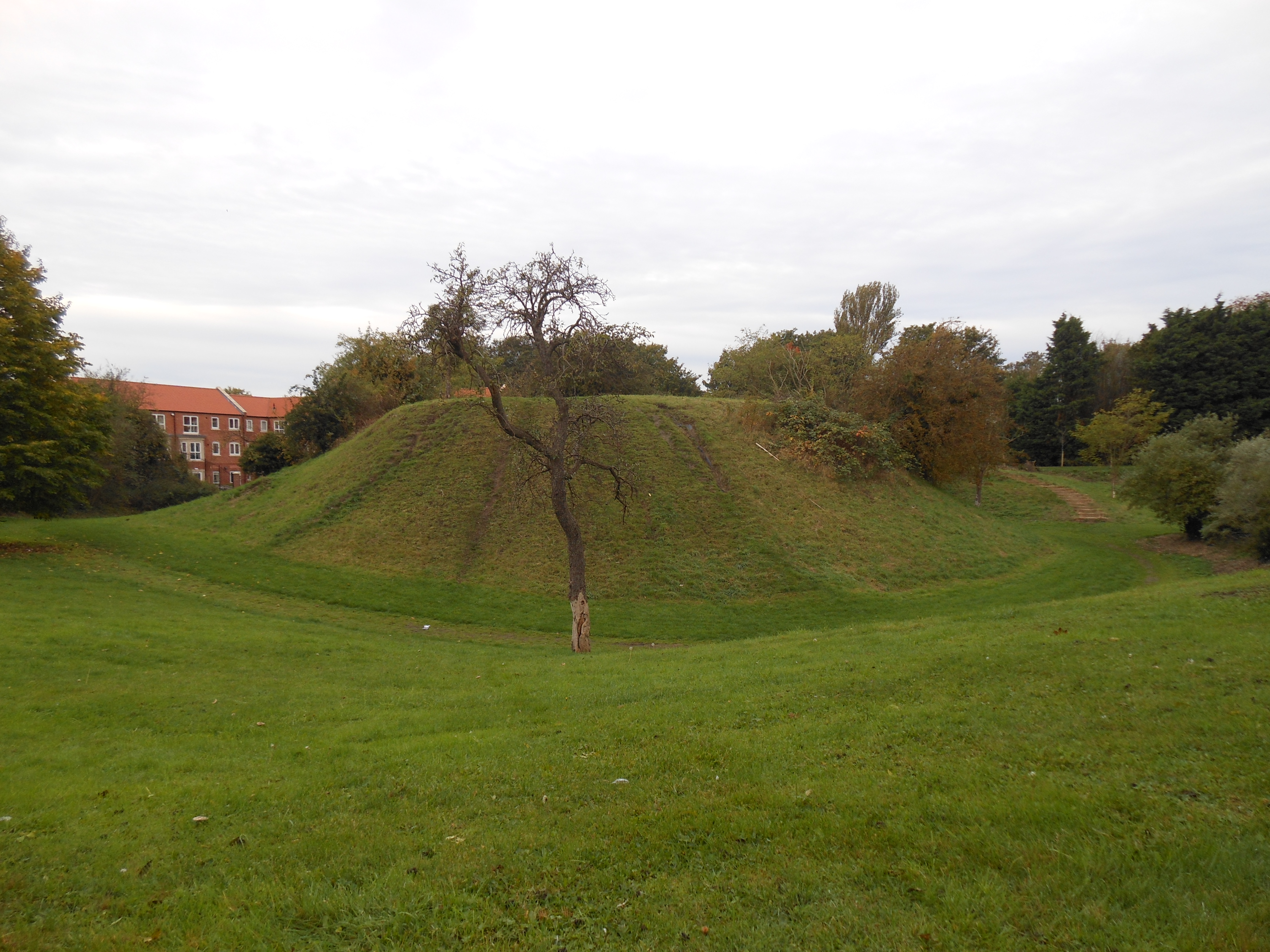
Book Giveaway: Ladies of Magna Carta

Giveaway results!

First of all, i would like to say a huge thank you to everyone who entered the giveaway. There were 156 entries, which is truly incredible. But unfortunately there can be only one winnerAnd the winner is…Charlotte Clark.

Congratulations Charlotte. Thank you all for taking part and giving me such a confidence boost with your lovely comments.

If you do get your hands on a copy of Ladies of Magna Carta – or any of my books – do get in touch and I will send you a signed bookplate to pop in the front. Alternatively, I do have copies of all my books in stock if you’d like to purchase a signed and dedicated copy.

Love Sharon x

I realise that I haven’t done a giveaway in over a year. So, to celebrate the release of Ladies of Magna Carta in paperback in the UK this week, I thought I would do a giveaway. One signed copy of the brand spanking new paperback (it looks very pretty!) will go to the lucky competition winner.

Inspired by the lives of Matilda de Braose and Nichoaa de la Haye, My third book looks at the events surrounding the issuing of Magna Carta with a view to how it affected the women.

Praise for Ladies of Magna Carta:

“Sharon Bennett Connolly throws much needed light on the lives of the high-born women of thirteenth-century England…Connolly’s version of the first Plantagenets is superbly concise. No distractions or detours, hitting all the right nails on the head…Connolly’s book is an informative and delightful read about women aspiring to control their destiny against this backdrop, but their success or failure had less to do with Magna Carta than with the timeless principles of resourcefulness, determination and knowing how to skilfully handle the big guy. It’s these qualities that make their stories inspiring.”

Darren Baker, author of The Two Eleanors

“A well-researched and comprehensive study of the women who lived through, and were affected by, the Barons’ Revolt and the sealing of the Magna Carta. Ms Bennett Connolly has skilfully brought to the fore the lives of the women who have hitherto been hidden in the background. A must-read for anyone interested in this pivotal moment in English and Scottish history.”

Annie Whitehead, author of Women of Power in Anglo-Saxon England

It’s easy to enter!

The competition is open to everyone, wherever you are in the world. To win a signed and dedicated copy of Ladies of Magna Carta, simply leave a comment below or on my Facebook page and I will include you in the prize draw.

The draw will be made on Sunday 21 November.

*

My Books

Signed, dedicated copies of all my books are available, please get in touch by completing the contact me form.

Defenders of the Norman Crown: The Rise and Fall of the Warenne Earls of Surrey tells the fascinating story of the Warenne dynasty, of the successes and failures of one of the most powerful families in England, from its origins in Normandy, through the Conquest, Magna Carta, the wars and marriages that led to its ultimate demise in the reign of Edward III. Defenders of the Norman Crown: Rise and Fall of the Warenne Earls of Surrey is now available from Pen & Sword BooksAmazon in the UK and US and Book Depository.

1 family. 8 earls. 300 years of English history!

Also by Sharon Bennett Connolly:

Ladies of Magna Carta: Women of Influence in Thirteenth Century England looks into the relationships of the various noble families of the 13th century, and how they were affected by the Barons’ Wars, Magna Carta and its aftermath; the bonds that were formed and those that were broken. It is now available in paperback and hardback from Pen & Sword,  Amazon and from Book Depository worldwide.

Heroines of the Medieval World tells the stories of some of the most remarkable women from Medieval history, from Eleanor of Aquitaine to Julian of Norwich. Available now from Amberley Publishing and Amazon and Book Depository.

Silk and the Sword: The Women of the Norman Conquest traces the fortunes of the women who had a significant role to play in the momentous events of 1066.  Available now from Amazon,  Amberley Publishing, Book Depository.

*

You can be the first to read new articles by clicking the ‘Follow’ button, liking our Facebook page or joining me on Twitter and Instagram.

©2021 Sharon Bennett Connolly

Earl Warenne and the Second Crusade

Coat of arms of the Warenne earls of Surrey, in the Gundrada Chapel of Trinity Church, Southover

When looking at a particular period or event in history, it can be easy to assume that it was all-consuming for those involved. The rest of the world blurs into the background as a country is consumed by war. Or does it? Even in medieval times, countries were not unaffected by the others around them. I almost got swept into the idea that the period known in English history as the Anarchy was a time when people thought of little else but who should be king – or queen. Even those fighting in the war were not so blinkered. Nor ignorant of events outside of England’s borders.

Did you know, for instance, that not one, but two, contingents of crusaders left England’s shores in the midst of the Anarchy? One force was headed to Portugal, and the other to the Holy Land, to join the Second Crusade. One of those crusaders was William de Warenne, 3rd Earl of Warenne and Surrey.

William (III) de Warenne was the son of William (II) de Warenne, 2nd Earl of Warenne and Surrey, and Isabel de Vermandois, a granddaughter of King Henry I of France. William was born in 1119, a year after his parents’ marriage. He was the eldest of five children. His two brothers, Reginald and Ralph, appear frequently in his story, suggesting a close family bond. Of his sisters, Ada married Prince Henry of Scotland, and was the mother of two Scottish kings, Malcolm IV and William the Lion. Gundreda de Warenne married Roger de Beaumont, Earl of Warwick, who was a cousin of Gundreda’s half-brothers, the famous Beaumont twins, Waleran and Robert.

Waleran and Robert de Beaumont were the eldest sons of Isabel de Vermandois by her first husband, Robert de Beaumont, Count of Meulan and Earl of Leicester. Isabel had nine children with her first husband and five more with Earl Warenne. Interestingly, the two families appear to have got on rather well together. William (III) can often be found in the company of one or both of his older, twin, half-brothers, such as at the deathbed of Henry I, at Lyons-la-Forêt in 1135; William was there alongside his father, the second earl, and his brothers Waleran and Robert de Beaumont.

Following his father’s death in 1138, William (III) inherited the lands and titles of the earl of Warenne and Surrey. As such, he was heavily involved in that period of history known as the Anarchy, the contest between King Stephen and Empress Matilda for England’s crown. As his father had done, the 3rd earl supported King Stephen, fighting at both the First Battle of Lincoln and the siege of Winchester in 1141. By the late 1140s, although the conflict between Stephen and Matilda was still unresolved, Earl Warenne and his half-brother, Waleran de Beaumont, appear to have wanted to get away from the constant unrest of the cousins’ war and looked to join a more noble enterprise.

Castle Acre Priory, Norfolk

On 24 March 1146, Palm Sunday, near Vézélay, and perhaps motivated by the example of his royal cousin, Louis VII of France, William de Warenne took the cross and committed himself to the Second Crusade. From this moment on, the earl’s time was taken up with preparations for the expedition and making arrangements to ensure the security and administration of his earldom during his absence. Among others, he confirmed grants to Castle Acre Priory of the land of Thexton in Norfolk which Osmoda de Candos had given with the consent of her husband Philip: William’s brother Reginald is named in the charter and his brother Ralph, as well as his wife, Countess Ela, are all listed among the witnesses. He also confirmed a gift made to his brother Reginald whereby William son of Philip, gave his land of Harpley in Norfolk. During the winter of 1146–47, the earl granted to the monks of Castle Acre, a confirmation of any acquisitions which they might make, ‘from my fee of whatever tenancy within my tenseria [authority], whether by way of gift or purchase.’1

In 1147, before leaving England’s shores, the earl, his family and leading magnates congregated at Lewes Priory for the dedication of the new priory church. Most of the royal court were present, as were Ralph and Reginald de Warenne, the earl’s brothers; four leading church prelates attended, including Theobald, Archbishop of Canterbury and Henry of Blois, Bishop of Winchester as well as the bishops of Rochester and Bath. Also present were the abbots of Reading and Battle, the prior of Canterbury and William d’Aubigny, Earl of Sussex. Earl Warenne appears to have used the occasion to set his affairs in order and guarantee the security of his earldom during his absence.

St Pancras Priory, Lewes

The most significant charter issued on this occasion added to the endowment of Lewes’ priory church and promised that the earl would pay the taxes that the priory would ordinarily owe to the king. In it, the earl confirmed

‘all its lands of his fee, undertaking to acquit it of danegeld and all other services due to the king; and gift of tithe of corn, etc., from all his demesne lands and a full tenth penny of all his rents in England. He issued the charter when he caused the priory church to be dedicated and endowed it with the tenth penny of his rents, giving it seisin thereof by hair from his own head and that of Ralph de Warenne his brother, cut with a knife by Henry, bishop of Winchester, before the altar.’2

The locks of hair of Earl William and his brother Ralph, ceremoniously cut off by Bishop Henry before the altar, would afterwards have been placed on the altar, alongside the knife used in the ceremony, and may have later been ‘filed’ within the charter when it was sealed. This is the last reference to Ralph de Warenne that I could find in the historical record. Given that only Ralph and William stored locks of their hair, and not Reginald, who we know stayed in England, I think it possible that Ralph accompanied his older brother on crusade.

His affairs in order, the earldom was placed under the supervision of his very capable brother, Reginald de Warenne. The pope stipulated that church sanctions should not be invoked, ‘in respect of those men whom our beloved son Stephen the illustrious king of the English or his adversaries disinherited on the occasion of the war held for the realm before they took the cross.’3 In a time of continued civil war, this guaranteed protection of a crusader’s lands was a necessity. Earl William was now able to depart on crusade, secure in the knowledge that the family and lands he left behind were well protected from anyone wishing to take advantage of his absence:

At Whitsuntide Lewis [Louis], king of France, and Theodorie, earl of Flanders, and the count of St Egidius, with an immense multitude from every part of France, and numbers of the English, assumed the cross and journeyed to Jerusalem, intending to expel the Infidels who had taken the city of Rohen. A still greater number accompanied Conrad, emperor of Germany; and both armies passed through the territories of the emperor of Constantinople, who afterwards betrayed them.

Henry of Huntingdon
Louis VII, King of France

There were, in fact, two crusades that departed England’s shores in 1147. Some of the crusaders, an Anglo-Flemish force, went to Portugal and successfully captured Lisbon from the Muslims. Earl William de Warenne and his older half-brother, Waleran de Beaumont, joined their cousin King Louis VII of France and set out for the Holy Land. Taking the overland route, they followed in the footsteps of the German emperor, Conrad III, who had left Germany in May and arrived in Constantinople in September. Louis, accompanied by his wife Eleanor of Aquitaine, arrived in Constantinople with his army on 4 October. Tensions ran high from the start. On initially hearing of the proposed crusade, Byzantine emperor Manuel Comnenus, afraid of losing local trading connections, made a truce with the Turkish sultan of Rum in 1146 to protect Constantinople’s Asian lands from attack. To the Western crusaders, this was more proof of the apostasy of the Eastern church. The more fervent of Louis’ followers accused Emperor Manuel of treason and urged Louis to attack the emperor. Louis, on the other hand, was persuaded to appease the emperor by his less volatile advisers and the king promised to restore any imperial lands they may capture.

The German and French contingents met at Nicaea in November, with the Germans having already suffered a defeat at Dorylaeum on 25 October, after taking the inland route towards the kingdom of Jerusalem. The two armies, now combined, set off on the coastal route, following the path of the first crusaders’ advance into Philadelphia in Lydia. By the time they reached Ephesus, Conrad was seriously ill and returned to Constantinople to recover. The French king and his army continued on to Antioch; marching through difficult terrain in mid-winter proved particularly harrowing. The Seljuk Turks waited for the crusaders on the banks of the river Meander, but Louis’ army forced their way through. On 6 January 1148, they reached Laodicea and from there marched into the mountains that separate the Phrygia of the Pisidia. It was here that the army met with disaster.

As they crossed Mount Cadmus, the vanguard advanced too far ahead under the leadership of Geoffrey de Rançon, thus becoming detached from the main body of the army. As the vanguard progressed across Mount Cadmus, the French column followed behind, secure in the knowledge that the vanguard occupied the high ground to their front. William de Warenne was in the king’s bodyguard, towards the rear of the column, as they advanced. When the Turks appeared, the French broke their ranks and rushed upon them with swords drawn; the disorder in the ranks handing the advantage to their enemy. Retreating, the French found themselves in a narrow gorge, with a steep precipice on one side and crags on the other. Horses, men and baggage were forced over the precipice by the advancing Turks. Louis VII’s biographer, Odo de Deuil, related the events:

“…the king, who had been left behind in peril with certain of his nobles, since he was not accompanied by common soldiers or serjeants with bows (for he had not fortified himself for crossing the pass, which by common agreement he was to cross the next day), careless of his own life and with the desire of freeing the dying mob, pushed through the rear-guard and courageously checked the butchery of his middle division. He boldly assaulted the infidel, who outnumbered him a hundred times and whom the position aided a great deal; for there no horse could stand, I shall not say gallop, but barely stand, and the slower attack which resulted in the weakened knights’ thrust when wounding the enemy. On the slippery slope our men brandished their spears with all of their own might, but without the added force of their horses, and from the safe shelter of rocks and trees the Turks shot arrows. Freed by the knights’ efforts, the mob fled, carrying their own packs or leading the sumpter animals, and exposed the king and comrades to death in their stead….During the engagement the king lost his small but renowned royal guard; keeping a stout heart; however, he nimbly and bravely scaled a rock by making use of tree roots which God had provided for his safety. The enemy climbed after, in order to capture him, and the more distant rabble shot arrows at him. But by the will of God his cuirass protected him from the arrows, and to keep from being captured he defended the crag with his bloody sword, cutting off heads and hands of many opponents in the process…”

 Odo of Deuil, De Profectione Ludovici VII in Orientem
Laodicea

King Louis’ bodyguard was cut down in the fighting and William de Warenne was among the fallen. Louis himself was able to escape the carnage, standing alone against a number of attackers. As the night drew in, the king and survivors were able to take advantage of the darkness to reunite with the vanguard, which had believed the king lost. In one of his letters to Abbot Sugar, King Louis wrote of the disaster on Mount Cadmus, explaining how he had been separated from the vanguard and his escort had been cut down, with the loss of his cousin, William de Warenne. He was too upset to give any more details and Mount Cadmus remains a battle of which very little is known beyond the basic details.

“Nearby the baggage train was still crossing the pass, because the closer packed it was, the slower it fled over the crags. When he came upon it, the king, who was on foot, secured a horse and accompanied the men through the evening, which had already fallen. At that time breathless cohorts of knights from the camp met him and groaned when they saw him alone, bloody, and tired, for, without asking, they knew what had happened and mourned inconsolably for the missing royal escort, which numbered about forty (to wit, the count of Warenne and his brother Evrard of Breteuil, Manasses of Bulles and Gautier of Montjay and others; but I shall not record the names of all, lest I be considered unnecessarily wordy.)”

 Odo of Deuil, De Profectione Ludovici VII in Orientem


Despite the heavy losses, King Louis’ crusade continued, reuniting with the German contingent between March and June 1148. They failed to take Edessa and were forced to withdraw from Damascus after a week of heavy fighting, when fresh Muslim forces arrived. The crusade ended in failure and the French king, who blamed Emperor Manuel Comnenus for the fiasco, accepted the aid of Manuel’s enemy Roger of Sicily, who sent ships to take the French forces home. Of the English forces, while William de Warenne was lost at Mount Cadmus, his brother Waleran de Beaumont, Count of Meulan and Earl of Worcester, made it back to England’s shores, narrowly surviving a shipwreck along the way; he founded a monastery in gratitude. Of the two Anglo-Norman bishops who accompanied the crusade, Roger of Chester died at Antioch and was buried there, whereas Arnulf of Lisieux, who had served as one of the leading diplomats, returned but with his reputation faded.

Seal of Isabel de Warenne, Countess of Surrey

Perhaps it was always on the cards that the 3rd Earl Warenne’s unspectacular military career would end with his death in battle. He was only 28 years old and had held the earldom for just over nine years. The earl had been a stalwart supporter of King Stephen, not once wavering in his allegiance, despite his failures in Normandy and at Lincoln early on in his career. He had done extensive work on the family’s property at Castle Acre, reinforcing the castle and replanning the town, building the ramparts that now surround it. William de Warenne had been a generous benefactor to the church, especially the Warenne foundations at Lewes and Castle Acre.

Even in his absence on crusade, the earl was still technically in charge; his brother, Reginald, issued a number of charters, each with the proviso that ‘if Jesus Christ brought back the earl [from the crusade] he would cause him to confirm it’ or ‘do his best to obtain the earl’s confirmation.’4

The death of William de Warenne, 3rd Earl of Warenne and Surrey brought an end to the senior male line that had been founded with the creation of the earldom for William (I) de Warenne in 1088. The earl was survived by his wife, Ela de Talvas, still a young woman, and his daughter, Isabel de Warenne, a child probably no more than 10 years of age. Isabel was now the richest heiress in England and married to King Stephen‘s youngest son, William of Blois. The earl’s estates were left in the capable hands of his youngest brother, Reginald de Warenne, Baron of Wormegay, who would watch over them for his niece and her young husband.

Notes:

1 Edmund King, King Stephen; 2 Farrer, William and Charles Travis Clay, editors, Early Yorkshire Charters, Volume 8: The Honour of Warenne; 3 Epistolae Pontificum Romanorum ineditae quoted in Edmund King, King Stephen; 4 Farrer, William and Charles Travis Clay, editors, Early Yorkshire Charters, Volume 8: The Honour of Warenne; Odo of Deuil, De Profectione Ludovici VII in Orientem, magnacharta.com.

Sources:

Robert Batlett, England Under the Norman and Angevin Kings; Dan Jones, The Plantagenets; Donald Matthew, King Stephen; Medieval Lands Project on the Earls of Surrey, Conisbrough Castle; Farrer, William and Charles Travis Clay, editors, Early Yorkshire Charters, Volume 8: The Honour of Warenne; Morris, Marc King John: Treachery, Tyranny and the Road to Magna Carta; Church, Stephen, King John: England, Magna Carta and the Making of a Tyrant; doncasterhistory.co.uk; A History of the County of Sussex: Volume 2 edited by William Page; W.H. Blaauw, On the Early History of Lewes Priory, and its Seals, with extracts from a MS. Chronicle, Sussex Archaeological Collections; Rev. John Watson, Memoirs of the Ancient Earls of Warren and Surrey, and Their Descendants to the Present Time, Volume I;  Odo of Deuil, De Profectione Ludovici VII in Orientem; magnacharta.com; Cokayne, G.E., The Complete Peerage, Vol. XII; Henry of Huntingdon, The Chronicle of Henry of Huntingdon.

Images:

Louis VII and Laodicea courtesy of Wikipedia; Warenne seal, Castle Acre Priory, St Pancras Priory and Seal of Isabel de Warenne are ©2021 Sharon Bennett Connolly

My Books

Signed, dedicated copies of all my books are available through my online bookshop.

Coming 30 January 2025: Scotland’s Medieval Queens

Scotland’s history is dramatic, violent and bloody. Being England’s northern neighbour has never been easy. Scotland’s queens have had to deal with war, murder, imprisonment, political rivalries and open betrayal. They have loved and lost, raised kings and queens, ruled and died for Scotland. From St Margaret, who became one of the patron saints of Scotland, to Elizabeth de Burgh and the dramatic story of the Scottish Wars of Independence, to the love story and tragedy of Joan Beaufort, to Margaret of Denmark and the dawn of the Renaissance, Scotland’s Medieval Queens have seen it all. This is the story of Scotland through their eyes.

Available for pre-order now.

Also by Sharon Bennett Connolly:

Heroines of the Tudor World tells the stories of the most remarkable women from European history in the time of the Tudor dynasty, 1485-1603. These are the women who ruled, the women who founded dynasties, the women who fought for religious freedom, their families and love. Heroines of the Tudor World is now available for pre-order from Amberley Publishing and Amazon UK. Women of the Anarchy demonstrates how Empress Matilda and Matilda of Boulogne, unable to wield a sword themselves, were prime movers in this time of conflict and lawlessness. It shows how their strengths, weaknesses, and personal ambitions swung the fortunes of war one way – and then the other. Available from Bookshop.orgAmberley Publishing and Amazon UKKing John’s Right-Hand Lady: The Story of Nicholaa de la Haye is the story of a truly remarkable lady, the hereditary constable of Lincoln Castle and the first woman in England to be appointed sheriff in her own right. Available from all good bookshops Pen & Sword Booksbookshop.org and Amazon

Defenders of the Norman Crown: The Rise and Fall of the Warenne Earls of Surrey tells the fascinating story of the Warenne dynasty, from its origins in Normandy, through the Conquest, Magna Carta, the wars and marriages that led to its ultimate demise in the reign of Edward III. Available from Pen & Sword BooksAmazon in the UK and US, and Bookshop.orgLadies of Magna Carta: Women of Influence in Thirteenth Century England looks into the relationships of the various noble families of the 13th century, and how they were affected by the Barons’ Wars, Magna Carta and its aftermath; the bonds that were formed and those that were broken. It is now available in paperback and hardback from Pen & SwordAmazon, and Bookshop.orgHeroines of the Medieval World tells the stories of some of the most remarkable women from Medieval history, from Eleanor of Aquitaine to Julian of Norwich. Available now from Amberley Publishing and Amazon, and Bookshop.orgSilk and the Sword: The Women of the Norman Conquest traces the fortunes of the women who had a significant role to play in the momentous events of 1066. Available now from Amazon,  Amberley Publishing, and Bookshop.org.

Alternate Endings: An anthology of historical fiction short stories including Long Live the King… which is my take what might have happened had King John not died in October 1216. Available in paperback and kindle from Amazon.

Podcast:

Have a listen to the A Slice of Medieval podcast, which I co-host with Historical fiction novelist Derek Birks. Derek and I welcome guests, such as Bernard Cornwell and Elizabeth Chadwick, and discuss a wide range of topics in medieval history, from significant events to the personalities involved.

*

Don’t forget! Signed and dedicated copies of all my books are available through my online bookshop.

For forthcoming online and in-person talks, please check out my Events Page.

You can be the first to read new articles by clicking the ‘Follow’ button, liking our Facebook page or joining me on TwitterThreadsBluesky and Instagram.

©2025 Sharon Bennett Connolly FRHistS

Introducing the Earls of Warenne and Surrey

Books by Sharon Bennett Connolly
William de Warenne, 1st Earl of Warenne and Surrey, Trinity Church, Southover

The Warenne earls of Surrey were a fascinating family, right at the heart of English history and politics for almost 300 years, from the time of the Norman Conquest to the reign of Edward III. They held lands throughout England, acted as justiciars, sheriffs and generals – and yet, few people know their story.

But who were they?

William I de Warenne was rewarded for his support of King William II in the 1088 rebellion with the earldom of Surrey. However, the earls thereafter were as often referred to as the earls of Warenne – or the familial Earl Warenne, rather than earls of Surrey. The earldoms of Sussex and Strathearn (Scotland) were later added to these titles. As they appear to have preferred the simple familial title of Earl Warenne, that is how I have chosen to refer to them, except when establishing their titles. The Warenne’s extensive lands were spread over 13 counties and spanned the country from Lewes on the south coast to their castles of Conisbrough and Sandal in Yorkshire, with their family powerbase in East Anglia, where they built a magnificent priory, castle and medieval village at Castle Acre.

Wakefield, including Sandal Castle, appears to have come into the hands of the Warenne family at some point before 1121, during the tenure of the 2nd Earl Warenne. It is possible that they were acquired possibly in an exchange of lands with William Meschin, who had taken control of the Warenne holdings of Kimbolton in Huntingdonshire and Dean in Bedfordshire some time before 1130.

The family mausoleum was at St Pancras Priory in Lewes, founded by the first earl and his wife, Gundrada. It is the burial place of all but two subsequent earls and numerous other family members, as well as several earls of Arundel and their countesses.

For almost 300 years the Warenne earls of Surrey were some of the most influential men in the country, but the family died out rather ingloriously, with the seventh – and last – earl’s marital difficulties. Despite a prestigious marriage to a granddaughter of the king of England, John de Warenne, 7th Earl Warenne, died with no legitimate son to succeed him, though he had numerous acknowledged illegitimate children to whom he had given the family name.

Books by Sharon Bennett Connolly
Gundrada de Warenne, wife of the 1st earl

The first Warenne earl, William de Warenne, Earl of Warenne and Surrey, came to England with William the Conqueror’s invasion force and fought at the Battle of Hastings in 1066. As a younger son, he had little hope of an inheritance and had acquired his fortune and reputation fighting for the duke of Normandy, making his name as a young man at the 1054 Battle of Mortemer.

The Warennes were at the heart of English history and politics from the time of the Conquest to the death of John de Warenne, the 7th and last earl in 1347

So who were the Warenne earls?

Briefly,

William de Warenne was a distant cousin of William the Conqueror and fought at the Battle of Hastings. William was a trusted advisor and companion of King William I and was appointed justiciar in England during the king’s absences in Normandy. He pursued a personal feud against English freedom fighter, Hereward the Wake, after Hereward murdered his brother-in-law, Frederic. William was created Earl of Surrey by King William II, just weeks before his death in 1088, having been fatally wounded at the siege of Pevensey. William and his wife, Gundrada, founded the first Cluniac priory in England, St Pancras, at Lewes in Sussex. It would become the family mausoleum. William and Gundrada’s coffins were found in the 19th century, when the railway line was being laid, and are now interred in the Gundrada Chapel of Trinity Church, Southover.

Books by Sharon Bennett Connolly
The Warenne coat of arms, adopted by William de Warenne, 2nd Earl of Warenne and Surrey

He was succeeded by his oldest son, William II de Warenne (it was a popular name) who was earl for 50 years. This William had an awkward relationship with Henry I – William was thwarted in love by Henry when they both set their sights on the same woman, Matilda of Scotland. William supported Robert Curthose’s claim for the throne against Henry, but was persuaded to abandon the duke of Normandy in favour of the king of England after the former’s failed attempt to invade England led to Earl Warenne’s lands being confiscated by King Henry. From that moment on Earl Warenne was loyal to Henry and gave a rousing speech in favour of King Henry before the 1119 Battle of Bremule. He married Isabel de Vermandois, granddaughter of King Henry I of France and widow of Robert, Earl of Leicester. The relationship caused some scandal as one chronicler suggests Isabel and William ran away together, before Isabel’s first husband was dead. William’s royal ambitions would be realised when his daughter, Ada de Warenne, married Prince Henry of Scotland in 1139; William’s grandsons, Malcolm IV and William the Lion, both succeeded to the Scottish throne.

The 3rd earl fought on the wrong side (in my opinion) during the Anarchy; he supported King Stephen, rather than Empress Matilda. Also named William, he and his forces were ignominiously routed at the 1141 Battle of Lincoln, leaving King Stephen to be captured by Earl Robert of Gloucester. Earl Warenne redeemed himself by capturing the same Earl Robert during the Rout of Winchester in the summer of 1141, thus facilitating and exchange of commanders that saw King Stephen’s release from imprisonment at Bristol Castle. Perhaps growing tired of the constant civil war, in 1147 the earl left on the Second Crusade with his half-brother, Waleran de Beaumont, Count of Meulan, led by the brothers’ second cousin, Louis VII, and his wife, Eleanor of Aquitaine. Earl William was killed at the age of 28 at the Battle of Mount Cadmus in January 1148, leaving the earldom to his young daughter, Isabel.

Books by Sharon Bennett Connolly
Seal of Isabel de Warenne, 4th Countess of Warenne and Surrey in her own right

The 4th earl. Now this is where the subsequent numbering of earls gets confusing. There were two 4th earls, though some history books count them as the 4th and 5th earls. The earldom actually belonged to Isabel. Isabel de Warenne was 4th Countess of Warenne and Surrey in her own right. Her first husband, William of Blois (the first 4th earl), was the youngest son of King Stephen and her second husband, Hamelin Plantagenet (the second 4th earl), was the illegitimate half-brother of King Henry II; a thoroughly modern Hamelin changed his name from Plantagenet to de Warenne on marrying Isabel. The first marriage produced no children, which was a stroke of luck for Henry II, as William of Blois could have founded a royal dynasty to rival the mighty Plantagenets. The second marriage proved more fruitful, with three daughters and a son. Hamelin was a loyal supporter of his brother, Henry II, and nephews, Richard I and King John – despite the fact John seduced one of Hamelin’s daughters, fathering an illegitimate child with her. Hamelin also built the magnificent keep at Conisbrough Castle, South Yorkshire.

Their son, William de Warenne, the 5th Earl, was first cousin to both King Richard I and King John. He probably grew up in Normandy, and served with King Richard in France in the 1190s. William played an active role in English politics, negotiating with the rebels on John’s behalf in Spring 1215, attempting to avert civil war. He was a signatory of the Magna Carta in 1215 and again on its reissue in 1225; he was one of the few surviving earls to have witnessed both issues of the charter. He did side with the rebel barons and their French allies, for a time, but returned to the fold following King John’s death in October 1216. He then helped to negotiate the peace, in September 1217, which saw the French Prince Louis give up his claim to England and return home. He married Matilda Marshal, daughter of the great William Marshal, Earl of Pembroke and regent of England for the first few years of Henry III’s reign. The couple had two children; their daughter, Isabel d’Aubigny, Countess of Arundel, became famous for berating King Henry III over the appropriation of a wardship that was rightfully hers.

Books by Sharon Bennett Connolly
Seal of John de Warenne, 6th Earl of Warenne and Surrey

John de Warenne, the 6th earl, was the longest serving earl of them all, holding the title for 64 years. His father died when he was 8 years old. Henry III became his brother-in-law when he married the king’s half-sister, Alice de Lusignan, daughter of Queen Isabella of Angouleme and her second husband, Hugh X de Lusignan. The marriage was a happy one and, as far as we can tell, the couple truly loved each other; following Alice’s death in childbirth, John did not take another wife. John de Warenne fought in the Second Barons’ War and was a close associate of the future king, Edward I. He was at the Battle of Lewes in 1264, fighting for King Henry III against Simon de Montfort, but escaped to the continent when the battle was lost. John was probably at Evesham for the defeat and death of Simon de Montfort, though his presence is not recorded; he was certainly with Henry III’s son, Edward, in the days before the battle. His daughter, Isabella, was married to John Balliol, King of Scots, and the mother of Edward Balliol, who pursued his own claim to the Scottish throne in the 1330s. John was guardian of Scotland for a time and lost the Battle of Stirling to William Wallace in 1298. John de Warenne was a brutal man with a sense of humour; he once claimed the rights to all the rabbit warrens in Surrey – because it was his name! His son, William de Warenne, had died during a tournament in 1286, so when John died in 1304, aged 72, he was succeeded by his 18-year-old grandson, John II de Warenne.

Books by Sharon Bennett Connolly
Lewes Castle, Sussex, seat of the earls of Warenne and Surrey

John II de Warenne, the 7th and last earl of Warenne and Surrey, spent most of his adult life trying to divorce his wife, Jeanne de Bar (Joan of Bar), a granddaughter of King Edward I, in order to marry his mistress. He made various claims to try and effect a divorce, including that he had had an affair with his wife’s aunt, Mary of Woodstock, who had been a nun from the age of 7. John was embroiled in a private – but very public – feud with Thomas of Lancaster, Edward II’s most powerful vassal, and even went so far as kidnapping Lancaster’s wife, Alice de Lacey. In retaliation, Lancaster seized the Warenne castles of Conisbrough and Sandal, both being close to his own castle of Pontefract. The castles were only restored to John after Lancaster’s execution following his defeat at the Battle of Boroughbridge, in 1322. John was involved in many of the events that shaped the reign of Edward II, though he did not fight in the 1314 English defeat by the Scots at the Battle of Bannockburn. He supported Edward II to the end – almost, only adding his to support to Isabella of France and the future Edward III, when he saw that the king’s cause was hopeless. He died in 1347 at Conisbrough, still married to Jeanne de Bar and with no legitimate heir to succeed him. The earldom passed to his nephew, Richard FitzAlan, Earl of Arundel, but the Yorkshire lands, including Conisbrough and Sandal castles, passed to the crown and were given to Edward III’s fourth surviving son, Edmund of Langley, 1st Duke of York.

Books by Sharon Bennett Connolly
Castle Acre Priory, Norfolk, one of the Cluniac monasteries founded by the Warenne earls

And that is just a – very – brief summary of the earls.

The Warenne family has a fascinating history, standing at the heart of English politics for the better part of 3 centuries. They had a family bond that is not always found amongst the aristocracy, with brothers and sisters helping and supporting each other and working for the benefit of their family. Strategic marriages forged links with the greatest families in England, Scotland and France; their family connections spanned the greatest noble houses, from the Marshals, the FitzAlans, the Lusignans, the d’Aubignys and Percys to the Scottish, French and English royal families.

One family, over 8 generations, the Warennes were at the centre of 300 years of English history.

*

Selected Sources:

Elisabeth Van Houts, Hereward and Flanders (article), Anglo-Saxon England vol. 28; A History of the County of Sussex: Volume 2 edited by William Page; W.H. Blaauw, On the Early History of Lewes Priory, and its Seals, with extracts from a MS. Chronicle, Sussex Archaeological Collections; Edward Impey, Castle Acre Priory and Castle, English Heritage; Warenne, Gundrada de (d.1085) (article) by C.P. Lewis, Oxforddnb.com; Elisabeth M.C. Van Houts and Rosalind C. Love (eds and trans), The Warenne (Hyde) Chronicle; Jeffrey James, The Bastard’s Sons: Robert, William and Henry of Normandy; Early Yorkshire Charters Volume 8 Edited by William Farrer and Charles Travis Clay; Rev. John Watson, Memoirs of the Ancient Earls of Warren and Surrey, and Their Descendants to the Present Time, Volume I; Alfred S. Ellis, Biographical Notes on the Yorkshire Tenants Named in Domesday Book (article); C.P. Lewis, Warenne, William de, first Earl of Surrey [Earl Warenne] (d. 1088) (article), Oxforddnb.com; The Oxford Companion to British History Edited by John Cannon; The Plantagenets, the Kings who Made England by Dan Jones; History Today Companion to British History Edited by Juliet Gardiner and Neil Wenborn;  Brewer’s British Royalty by David Williamson; Britain’s Royal Families, the Complete Genealogy by Alison Weir; Conisbrough Castle Giudebook by Steven Brindle and Agnieszka Sadraei; The Mammoth Book of British Kings and Queens by Mike Ashley; The Plantagenets, the Kings that made Britain by Derek Wilson; royaldescent.net; F. Royston Fairbank, ‘The Last Earl of Warenne and Surrey, and the Distribution of his Possessions’, The Yorkshire Archaeological Journal, vol. XIX; Scott L. Waugh, ‘Warenne, John de, seventh earl of Surrey earl of Surrey and Sussex, Earl Warenne’, ODNB; ‘Annals written by a certain monk of Lewes, from the birth of Christ to the year 1312’ quoted in Blaauw, On the Early History of Lewes Priory; Kelcey Wilson-Lee, Daughters of Chivalry: The Forgotten Children of Edward I; Katheryn Warner, Philippa of Hainault: Mother of the English Nation

*

My Books:

Signed, dedicated copies of all my books are available through my online store.

Out now: Scotland’s Medieval Queens

Books by Sharon Bennett Connolly

Scotland’s history is dramatic, violent and bloody. Being England’s northern neighbour has never been easy. Scotland’s queens have had to deal with war, murder, imprisonment, political rivalries and open betrayal. They have loved and lost, raised kings and queens, ruled and died for Scotland. From St Margaret, who became one of the patron saints of Scotland, to Elizabeth de Burgh and the dramatic story of the Scottish Wars of Independence, to the love story and tragedy of Joan Beaufort, to Margaret of Denmark and the dawn of the Renaissance, Scotland’s Medieval Queens have seen it all. This is the story of Scotland through their eyes.

Scotland’s Medieval Queens gives a thorough grounding in the history of the women who ruled Scotland at the side of its kings, often in the shadows, but just as interesting in their lives beyond the spotlight. It’s not a subject that has been widely covered, and Sharon is a pioneer in bringing that information into accessible history.’ Elizabeth Chadwick (New York Times bestselling author)

Available now from Amazon and Pen and Sword Books

Also by Sharon Bennett Connolly:

Books by Sharon Bennett Connolly

Heroines of the Tudor World tells the stories of the most remarkable women from European history in the time of the Tudor dynasty, 1485-1603. These are the women who ruled, the women who founded dynasties, the women who fought for religious freedom, their families and love. Heroines of the Tudor World is now available from Amberley Publishing and Amazon UK. Women of the Anarchy demonstrates how Empress Matilda and Matilda of Boulogne, unable to wield a sword themselves, were prime movers in this time of conflict and lawlessness. It shows how their strengths, weaknesses, and personal ambitions swung the fortunes of war one way – and then the other. Available from Bookshop.orgAmberley Publishing and Amazon UKKing John’s Right-Hand Lady: The Story of Nicholaa de la Haye is the story of a truly remarkable lady, the hereditary constable of Lincoln Castle and the first woman in England to be appointed sheriff in her own right. Available from all good bookshops Pen & Sword Booksbookshop.org and Amazon

Royal Historical Society

Defenders of the Norman Crown: The Rise and Fall of the Warenne Earls of Surrey tells the fascinating story of the Warenne dynasty, from its origins in Normandy, through the Conquest, Magna Carta, the wars and marriages that led to its ultimate demise in the reign of Edward III. Available from Pen & Sword BooksAmazon in the UK and US, and Bookshop.orgLadies of Magna Carta: Women of Influence in Thirteenth Century England looks into the relationships of the various noble families of the 13th century, and how they were affected by the Barons’ Wars, Magna Carta and its aftermath; the bonds that were formed and those that were broken. It is now available in paperback and hardback from Pen & SwordAmazon, and Bookshop.orgHeroines of the Medieval World tells the stories of some of the most remarkable women from Medieval history, from Eleanor of Aquitaine to Julian of Norwich. Available now from Amberley Publishing and Amazon, and Bookshop.orgSilk and the Sword: The Women of the Norman Conquest traces the fortunes of the women who had a significant role to play in the momentous events of 1066. Available now from Amazon,  Amberley Publishing, and Bookshop.org.

Alternate Endings: An anthology of historical fiction short stories including Long Live the King… which is my take what might have happened had King John not died in October 1216. Available in paperback and kindle from Amazon.

Podcast:

A Slice of Medieval

Have a listen to the A Slice of Medieval podcast, which I co-host with Historical fiction novelist Derek Birks. Derek and I welcome guests, such as Bernard Cornwell and Michael Jecks, and discuss a wide range of topics in medieval history, from significant events to the personalities involved. 

Every episode is also now available on YouTube.

*

Don’t forget! Signed and dedicated copies of all my books are available through my online store.

For forthcoming online and in-person talks, please check out my Events Page.

You can be the first to read new articles by clicking the ‘Follow’ button, liking our Facebook page or joining me on TwitterThreadsBluesky and Instagram.

*

©2021 Sharon Bennett Connolly FRHistS