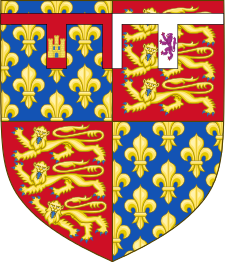
John IV and the Struggle for Brittany

jan5bretan
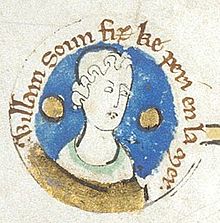
John IV de Montfort, Duke of Brittany

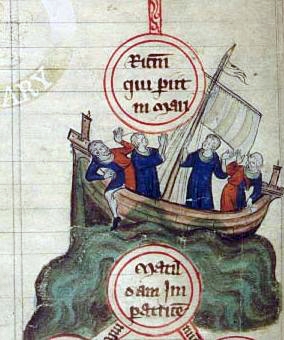
After writing about Yolande de Dreux a few weeks back, I became intrigued with the story of her grandson, John de Montfort.

John was the only son of John, count of Montfort, and Joan of Flanders. He was probably born in November or December of 1339. His great-grandmother was Beatrice of England, a daughter of Henry III, who was the mother of his grandfather, Arthur, duke of Brittany. John is first mention in 1341 when his childless uncle, John III, duke of Brittany, provided him with 20,000 livres from his patrimony. However, when the duke died on 30 April 1341, the duchy was thrown into turmoil. Civil war erupted when John’s father and uncle-by-marriage, Charles de Blois, both laid claim to the duchy.

John de Montfort the elder was the son of Arthur, duke of Brittany, by his 2nd wife, Yolande. Charles de Blois was married to Jeanne de Penthièvre, daughter of Arthur’s second son by his first wife; Guy of Brittany. The bitter conflict was to be absorbed into the much greater struggle, between France and England, that became known as the Hundred Years’ War. Edward III of England supported young John’s father, while Philip VI of France backed Charles de Blois.

In November 1341 John’s father was captured and it was up to his mother to assume the de Montfort cause. Edward III sent troops to secure various strongholds, but by late 1342, after an unproductive campaign, he had minimised his military involvement, leaving a lieutenant in charge as he headed back to England, accompanied by John, who was about 3 years old at the time, his mother and his sister, Joan.

John’s mother was imprisoned in Tickhill Castle, Yorkshire, supposedly after succumbing to a mental illness, though more likely for political reasons. As a result, John was raised in the household of the queen, Philippa of Hainault. Their fortunes revived briefly when John’s father arrived in England 1345, paying homage to Edward III at Easter, having broken his parole and escaped the duchy. He led a small force back to Brittany, but died suddenly in September of the same year, leaving 6-year-old John in the guardianship of Edward III.
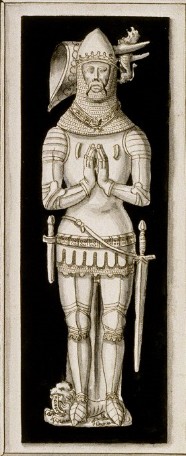
mary_plantagenet_of_brittany
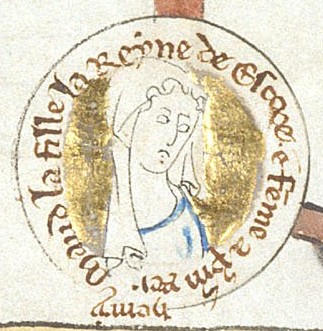
Mary of England, John’s first wife

Sir Thomas Dagworth captured Charles de Blois at Le Roche Derrien in June 1347, giving the English the opportunity to discuss the succession issue. It looked for a time, that Edward would sacrifice; in 1353 a treaty was actually drafted that was heavily in de Blois’ favour, depriving John of most of his rights. Luckily, for John, it was never implemented and de Blois was eventually released, in return for a huge ransom, in 1356.

Edward resolved now to back young John’s claims. Around 17-years-old, John experienced his first military campaign when he fought alongside Henry, duke of Lancaster, in the siege of Rennes, from October 1356 to July 1357, and later taking part in the Rheims campaign of 1359-60. In March, 1361, John married Edward III’s daughter, Mary, at Woodstock. The marriage would end in tragedy as Mary, still only 17, died of plague in September of the same year. Discussions throughout the early 1360s offered no lasting political solution and, now having attained his majority, John returned to Brittany in the summer of 1362.

Further discussions hosted by the Black Prince, including plans to partition the duchy, failed. However, when Charles de Blois was eventually defeated killed in battle at Auray on 29th September 1364 Jeanne de Penthièvre was forced to come to terms with John de Montfort and the Treaty of Guérande was signed on 12th April 1365. John was recognised as John IV duke of Brittany  by Charles V of France, to whom he performed homage for his duchy in December 1366.

Initially, as duke of Brittany, John’s ties to England continued to be strong, his financial debts and other obligations ensuring this. In 1366 he married Joan Holland, step-daughter of Edward, the Black Prince. However, when a lull in the fighting ended in 1369 and France and England were at loggerheads once again, John was caught in a dilemma. As his overlord Charles V was expecting John to fight for France, while Edward III was his old ally and mentor and obviously felt deserving of his loyalty. His prevarications meant his Breton subjects grew restive and when John sided with Edward III, after receiving the earldom of Richmond in 1372 as a sweetener, they openly rebelled.
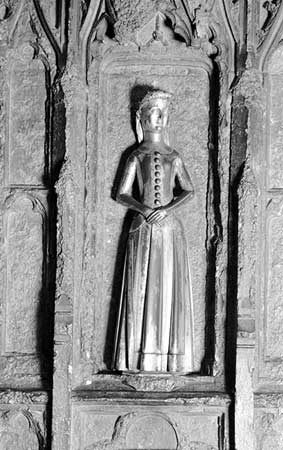
joana_canterbury
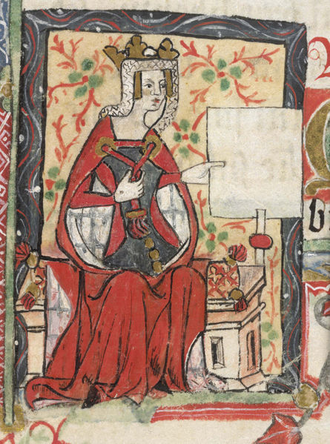
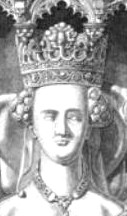
Joan of Navarre, John’s 3rd wife

By April 1373 John had lost everything; he fled to England as his duchy was overrun by French troops. And yet, worse was to follow. After participating in John of Gaunt’s chevauchée from Calais to Bordeaux, John was tried for treason in the Paris parlement in December 1378. In total, John spent 6 years in exile, living on his English estates and attending court and parliament; he was the 1st foreign prince to be made a Knight of the Garter, in 1374.

John was invited to Brittany in 1379 by his Breton subjects, who were beginning to become suspicious of Charles V’s intentions; realising that his attempts to bring Brittany into the French royal demesne would threaten her traditional privileges and independence. The Breton constable of France, Bertrand de Guesclin, deliberately failed to oppose the duke’s landing. After Charles V died in September 1380 a peace was negotiated with the aid of the count of Flanders and Louis, duke of Anjou, which was ratified in the 2nd Treaty of Guérande in April 1381.

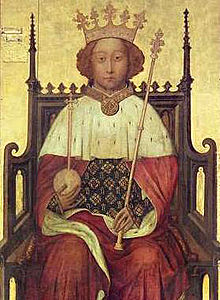
A consequence of the treaty was that John de Montfort now opposed his former allies in England and Navarre. With Edward III dying in 1377, his young grandson was now King Richard II. The English still occupied Brest, and John was having difficulties in collecting revenues from his English estates. John’s wife, Duchess Joan, had been staying in England during the troubles but, after much wrangling, was finally returned to her husband in 1382, only to die in November 1384. Her death removed an important connection to the English court and Richard II, her half-brother.

The 1380s saw John consolidating his position in Brittany, making alliances with other French princes, such as the dukes of Berry and Burgundy and the king of Navarre. He developed the duchy’s institutions, encouraged trade, devised new taxes and exploited minting rights. On a cultural level,  John expanded his court and encouraged the arts by extensive patronage. He also encouraged loyalty to his family and dynasty, which was helped greatly by his marriage to Joan of Navarre in 1386 and the birth of his long-awaited heir in 1389.

330px-sceau_de_jean_v_-_duc_de_bretagne
John V, duke of Brittany

As Anglo-French diplomatic relations thawed in the 1390s, John was able to make a marriage alliance with John of Gaunt, whereby one of his daughters would marry a son of Gaunt’s heir, the earl of Derby. John de Montfort attended the wedding of Richard II and Isabella of France in 1396 and Brest was returned to him in 1397.

Joan and John had an affectionate relationship, producing 8 children, 7 of whom survived to adulthood. John and a second son, Arthur, each became duke of Brittany; Arthur was also constable of France and succeeded his nephew, John’s son Peter, as duke. He died in 1458 and was succeeded by his nephew, Francis, son of his younger brother, Richard, count of Étampes, who had died in 1439. A fourth son, Gilles, died in 1412. Joan and John also had 3 daughters: Marie, countess of Alençon; Blanche, countess of Armagnac and Marguerite, vicomtess de Rohan.

John de Montfort paid one last visit to England in 1398, when he took formal possession of Richmond, attended a Garter ceremony at Windsor and spent some time on progress with Richard II before returning home. He died at Nantes on 1st November 1399, where he was buried. In 1402 his widow, now the wife of Henry IV of England, erected an English-made alabaster tomb over his grave; it was destroyed during the French Revolution. Joan acted as regent for her 10-year-old son, John, until her marriage to Henry; when she entrusted the regency and custody of her Breton children, to the Duke of Burgundy.

Brittany remained an independent duchy within France for another 100 years.

*

Pictures courtesy of Wikipedia.

*

Sources: Ian Mortimer The Perfect King; Marc Morris Edward I: A Great and Terrible King by Marc Morris;  Brewer’s British Royalty by David Williamson; The Mammoth Book of British kings & Queens by Mike Ashley; Britain’s Royal Families by Alison Weir; The Oxford Companion to British History edited by John Cannon; The History Today Companion to British History Edited by Juliet Gardiner and Neil Wenborn; The Story of Scotland by Nigel Tranter; Scotland, History of a Nation by David Ross; oxforddnb.com; britannica.com; W.M. Ormrod The Reign of Edward III.

*

My books

Signed, dedicated copies of all my books are available through my online bookshop.

Out now: Scotland’s Medieval Queens

Scotland’s history is dramatic, violent and bloody. Being England’s northern neighbour has never been easy. Scotland’s queens have had to deal with war, murder, imprisonment, political rivalries and open betrayal. They have loved and lost, raised kings and queens, ruled and died for Scotland. From St Margaret, who became one of the patron saints of Scotland, to Elizabeth de Burgh and the dramatic story of the Scottish Wars of Independence, to the love story and tragedy of Joan Beaufort, to Margaret of Denmark and the dawn of the Renaissance, Scotland’s Medieval Queens have seen it all. This is the story of Scotland through their eyes.

Available now from Amazon and Pen and Sword Books

Also by Sharon Bennett Connolly:
Heroines of the Tudor World tells the stories of the most remarkable women from European history in the time of the Tudor dynasty, 1485-1603. These are the women who ruled, the women who founded dynasties, the women who fought for religious freedom, their families and love. Heroines of the Tudor World is now available for pre-order from Amberley Publishing and Amazon UK. Women of the Anarchy demonstrates how Empress Matilda and Matilda of Boulogne, unable to wield a sword themselves, were prime movers in this time of conflict and lawlessness. It shows how their strengths, weaknesses, and personal ambitions swung the fortunes of war one way – and then the other. Available from Bookshop.orgAmberley Publishing and Amazon UKKing John’s Right-Hand Lady: The Story of Nicholaa de la Haye is the story of a truly remarkable lady, the hereditary constable of Lincoln Castle and the first woman in England to be appointed sheriff in her own right. Available from all good bookshops Pen & Sword Booksbookshop.org and Amazon

Defenders of the Norman Crown: The Rise and Fall of the Warenne Earls of Surrey tells the fascinating story of the Warenne dynasty, from its origins in Normandy, through the Conquest, Magna Carta, the wars and marriages that led to its ultimate demise in the reign of Edward III. Available from Pen & Sword BooksAmazon in the UK and US, and Bookshop.orgLadies of Magna Carta: Women of Influence in Thirteenth Century England looks into the relationships of the various noble families of the 13th century, and how they were affected by the Barons’ Wars, Magna Carta and its aftermath; the bonds that were formed and those that were broken. It is now available in paperback and hardback from Pen & SwordAmazon, and Bookshop.orgHeroines of the Medieval World tells the stories of some of the most remarkable women from Medieval history, from Eleanor of Aquitaine to Julian of Norwich. Available now from Amberley Publishing and Amazon, and Bookshop.orgSilk and the Sword: The Women of the Norman Conquest traces the fortunes of the women who had a significant role to play in the momentous events of 1066. Available now from Amazon,  Amberley Publishing, and Bookshop.org.

Alternate Endings: An anthology of historical fiction short stories including Long Live the King… which is my take what might have happened had King John not died in October 1216. Available in paperback and kindle from Amazon.

Podcast:

Have a listen to the A Slice of Medieval podcast, which I co-host with Historical fiction novelist Derek Birks. Derek and I welcome guests, such as Bernard Cornwell and Michael Jecks, and discuss a wide range of topics in medieval history, from significant events to the personalities involved. Every episode is also now available on YouTube.

*

Don’t forget! Signed and dedicated copies of all my books are available through my online bookshop.

For forthcoming online and in-person talks, please check out my Events Page.

You can be the first to read new articles by clicking the ‘Follow’ button, liking our Facebook page or joining me on Twitter, Bluesky, Threads and Instagram.

©2016 Sharon Bennett Connolly FRHistS

Yolande and the Hope for the Scottish Succession

330px-sceau_de_yolande_decosse_-_duchesse_de_bretagne
Yolande de Dreux

Yolande de Dreux was Scotland’s Queen Consort for only  4 months and 14 days. In that short time, she carried the hope of a nation – and its king – to secure the Scottish succession.

Yolande was born into a cadet branch of the French royal family, probably sometime in the mid-1260s. Her father was Robert IV, Count of Dreux, who died in 1282 and her mother was Beatrice de Montfort, who died  in 1311. Beatrice was the daughter of Count Jean I de Montfort l’Amoury and his wife Jeanne de Chateaudun, Beatrice was therefore a great-granddaughter of Simon de Montfort, earl of Leicester, and heiress to the impressive de Montfort estates. One of 6 children, Yolande had 2 brothers and 3 sisters. Little is known of Yolande’s childhood but we can imagine that as a junior member of the Capetian dynasty, she grew up amidst some privilege and splendour.

Whilst Yolande was growing into adulthood Scotland was experiencing a “golden age”, a period of relative peace and prosperity. Her king, Alexander III was married to Margaret, daughter of Henry III of England and the couple had 3 children survive childhood. Their daughter, Margaret, born at Windsor on 28th February, 1261,  was married to Erik II, king of Norway, in August 1281. Their eldest son, Alexander, was born on 21st January 1264, at Jedburgh. On 15th November 1282 Alexander married Margaret, the daughter of Guy de Dampierre, Count of Flanders. A younger son, David was born on 20th March 1273.

Queen Margaret died in 1275 and within 8 years all 3 of her children were dead; 8-year-old David died at Stirling Castle at the end of June 1281, Margaret died in childbirth on 9th April 1283 and Alexander died at Lindores Abbey in January 1284, sometime around his 20th birthday. Alexander’s heir was now his infant granddaughter by Margaret and Erik, little Margaret, the Maid of Norway, born shortly before her mother’s death.

dscn4964
Jedburgh Abbey

With his entire dynasty resting on the life of his toddler granddaughter, Alexander started the search for a new wife. In February 1285 he sent a Scottish embassy to France for this sole purpose. Their successful search saw Yolande arrive in Scotland that same summer, accompanied by her brother John. Alexander and Yolande were married at Jedburgh Abbey, Roxburghshire, on 14th October 1285, the feast of St Calixtus, in front of a large congregation made up of Scottish and French nobles. Yolande was probably no more than 22 years of age, while Alexander was in his 44th year.

The marriage was one of the shortest in British royal history – and the shortest of any English or Scottish king, lasting less than 5 months. Tragedy struck on 19 March 1286.

Alexander had spent the day attending a council meeting in Edinburgh. When the meeting broke up he set off on horseback to join his wife at Kinghorn Castle in Fife. It was said he wanted to be there to celebrate her birthday and he may also have recently discovered that she was pregnant with the much-desired heir. For whatever the reason, he was eager to get to her and took only a small escort of 3 men and 2 local guides. It seems that, with bad weather closing in and daylight fading, several people counselled against continuing the journey, including the ferryman at the River Forth and the bailie at Inverkeithing, who argued that Alexander should stay the night and continue his journey in the morning as a heavy storm was brewing.

330px-alexander_iii_and_ollamh_righ
Alexander III

Only 8 miles from his destination, Alexander would hear none of it and insisted on continuing his journey. He somehow lost his escort in the dark and worsening weather, but continued alone. It was the next morning when his body was found on the foreshore of Pettycur, just a mile from his destination. The most likely explanation was that his horse had stumbled, throwing the king whose neck was broken in the fall, although at least one historical fiction writer has suggested foul play while others have suggested the king was drunk.

There followed months of uncertainty in Scotland. She had lost one of her most successful kings and the succession was in turmoil. Little Margaret, the Maid of Norway, had been recognised by the council as Alexander’s heir, but his queen was pregnant; and if she gave birth to a boy he would be king from his first breath. A regency council was established to rule until the queen gave birth.

In the event, Yolande either suffered a miscarriage, or the child was stillborn. Some sources, the Lanercost Chronicle in particular, have questioned whether Yolande was pregnant at all, suggesting that she was intending to pass off another woman’s baby as her own. The plan thwarted, the chronicle recorded that ‘women’s cunning always turns toward a wretched outcome‘.¹ However, there are major discrepancies in the chronicle’s apparently malicious account and tradition has the baby buried at Cambuskenneth.

artur_bretan
Arthur of Brittany

The throne passed to little Margaret and arrangements began to have her brought to England, with marriage negotiations being opened with Edward I for the little queen to marry his son and heir; the future Edward II. Yolande continued to reside in Scotland for some time, possibly at Stirling Castle, and was confirmed in her dower properties, which included an annual income of £200 from Berwick; she also had estates in the sheriffdom of Stirling and a horse stud at Jedworth.

Margaret’s death at sea in 1290, while on her journey to her new kingdom, threw Scotland into years of turmoil, with 13 nobles advancing their competing claims to the crown and Edward I of England claiming the right to choose Alexander III’s successor, and recognition as Scotland’s overlord. The English king’s imperialist ambitions had thrown Scotland into crisis by 1296.

Luckily for Yolande, she was already far away from Scotland and the brewing wars. In May 1294 Yolande had married for a second time; Arthur of Brittany was a similar age to Yolande and was the son and heir of Jean II, duke of Brittany and earl of Richmond. Yolande was the second wife of Arthur, who already had 3 sons, Jean, Guy and Peter, by his first wife, Marie, Vicomtesse de Limoges.

It is possible that Arthur chose Yolande as a bride due to the impressive de Montfort territories that she stood to inherit from her mother, although there were legal wranglings between Yolande and her younger sister, Jeanne, who also claimed the lands.

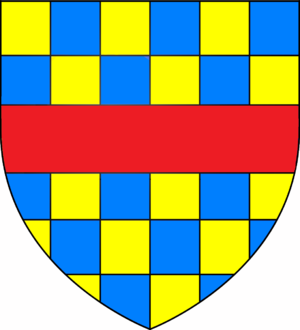
120px-blason_comtes_dreux
Arms of the counts of Dreux

Yolande and Arthur had 6 children together. Their eldest daughter, Joan was born a year after their marriage and married Robert, Lord of Cassel; she died in 1363. Beatrice was born c.1295 and married Guy, Lord of Laval; she lived until 1384. Their only son, John, was probably born 1295/6 and married Joan of Flanders. Of the 3 youngest daughters: Alice was born in the late 1290s married Bouchard VI, Count of Vendôme and died in 1377; Blanche was born in 1300 and died young; Mary was born in 1302 and became a nun, she died in 1377.

Arthur succeeded his father as Duke of Brittany in 1305 and ruled until his death in 1312. He was succeeded by John III, his eldest son by his first marriage. However, John’s death in 1341 sparked the War of the Breton Succession when Yolande’s son, John de Montfort, claimed the duchy in place of Joan of Penthièvre, daughter of Guy (Arthur’s 2nd son by his 1st wife), who was married to Charles of Blois, nephew of King Philip VI of France. Joan and Charles were therefore backed by the French crown, and Edward III of England supported the claims of John de Montfort; the war eventually became part of the greater conflict, the Hundred Years War. When John fell ill and died in 1345, the war continued in the name of his 6-year-old son and Yolande’s grandson, another John (John IV, duke of Brittany) and finally ended in John’s favour with the treaty of Guérande in April 1365.

jan5bretan
John IV Duke of Brittany

After being widowed for a second time Yolande did not remarry.

During her time in Brittany Yolande continued to administer to her Scottish estates; in October 1323 safe-conduct to Scotland was granted to a French knight  ‘for the dower of the Duchess of Brittany while she was Queen of Scotland‘.² It seems uncertain when Yolande died. Sources vary between 1324 and 1330, although she was still alive on 1st February 1324 when she made provision for the support of her daughter, Marie, who had become a nun.

These arrangements for her daughter are the last mention of Yolande in the historical record, the date of her death as uncertain as that of her birth.

*

Footnotes: ¹ Chronique de Lanercost, 118,  quoted by Jessica Nelson in Oxforddnb.com. ²CSP Scot.. 3. no. 829 quoted by Jessica Nelson in Oxforddnb.com.

*

Pictures courtesy of Wikipedia, except Jedburgh Abbey, which is ©2016 Sharon Bennett Connolly.

*

Sources: Marc Morris Edward I: A Great and Terrible King by Marc Morris;  Brewer’s British Royalty by David Williamson; The Mammoth Book of British kings & Queens by Mike Ashley; Britain’s Royal Families by Alison Weir; The Oxford Companion to British History edited by John Cannon; The History Today Companion to British History Edited by Juliet Gardiner and Neil Wenborn; The Story of Scotland by Nigel Tranter; Scotland, History of a Nation by David Ross; oxforddnb.com; undiscoveredscotland.co.uk; freelancehistorywriter.com.

*

My books

Signed, dedicated copies of all my books are available through my online store.

Out now: Scotland’s Medieval Queens

Scotland’s history is dramatic, violent and bloody. Being England’s northern neighbour has never been easy. Scotland’s queens have had to deal with war, murder, imprisonment, political rivalries and open betrayal. They have loved and lost, raised kings and queens, ruled and died for Scotland. From St Margaret, who became one of the patron saints of Scotland, to Elizabeth de Burgh and the dramatic story of the Scottish Wars of Independence, to the love story and tragedy of Joan Beaufort, to Margaret of Denmark and the dawn of the Renaissance, Scotland’s Medieval Queens have seen it all. This is the story of Scotland through their eyes.

Available now from Amazon and Pen and Sword Books

Also by Sharon Bennett Connolly:

Heroines of the Tudor World tells the stories of the most remarkable women from European history in the time of the Tudor dynasty, 1485-1603. These are the women who ruled, the women who founded dynasties, the women who fought for religious freedom, their families and love. Heroines of the Tudor World is now available for pre-order from Amberley Publishing and Amazon UK. Women of the Anarchy demonstrates how Empress Matilda and Matilda of Boulogne, unable to wield a sword themselves, were prime movers in this time of conflict and lawlessness. It shows how their strengths, weaknesses, and personal ambitions swung the fortunes of war one way – and then the other. Available from Bookshop.orgAmberley Publishing and Amazon UKKing John’s Right-Hand Lady: The Story of Nicholaa de la Haye is the story of a truly remarkable lady, the hereditary constable of Lincoln Castle and the first woman in England to be appointed sheriff in her own right. Available from all good bookshops Pen & Sword Booksbookshop.org and Amazon

Defenders of the Norman Crown: The Rise and Fall of the Warenne Earls of Surrey tells the fascinating story of the Warenne dynasty, from its origins in Normandy, through the Conquest, Magna Carta, the wars and marriages that led to its ultimate demise in the reign of Edward III. Available from Pen & Sword BooksAmazon in the UK and US, and Bookshop.orgLadies of Magna Carta: Women of Influence in Thirteenth Century England looks into the relationships of the various noble families of the 13th century, and how they were affected by the Barons’ Wars, Magna Carta and its aftermath; the bonds that were formed and those that were broken. It is now available in paperback and hardback from Pen & SwordAmazon, and Bookshop.orgHeroines of the Medieval World tells the stories of some of the most remarkable women from Medieval history, from Eleanor of Aquitaine to Julian of Norwich. Available now from Amberley Publishing and Amazon, and Bookshop.orgSilk and the Sword: The Women of the Norman Conquest traces the fortunes of the women who had a significant role to play in the momentous events of 1066. Available now from Amazon,  Amberley Publishing, and Bookshop.org.

Alternate Endings: An anthology of historical fiction short stories including Long Live the King… which is my take what might have happened had King John not died in October 1216. Available in paperback and kindle from Amazon.

Podcast:

Have a listen to the A Slice of Medieval podcast, which I co-host with Historical fiction novelist Derek Birks. Derek and I welcome guests, such as Bernard Cornwell and Michael Jecks, and discuss a wide range of topics in medieval history, from significant events to the personalities involved. Every episode is also now available on YouTube.

*

Don’t forget! Signed and dedicated copies of all my books are available through my online store.

For forthcoming online and in-person talks, please check out my Events Page.

You can be the first to read new articles by clicking the ‘Follow’ button, liking our Facebook page or joining me on TwitterThreadsBluesky and Instagram.

*

©2016 Sharon Bennett Connolly, FRHistS

William de Warenne, the Conqueror’s Man

History...the Interesting Bits
William de Warenne, 1st earl of Surrey

William de Warenne, first earl of Surrey, was a younger son of Rodulf de Warenne and his wife Beatrix. It is possible that Beatrix was a niece of Duchess Gunnor of Normandy, making young William a cousin of William the Bastard, duke of Normandy. The family name is probably derived from the hamlet of Varenne, part of the Warenne lands in the department of Seine-Inférieure, Normandy. William’s older brother, Rodulf or Ralph, would inherit the greater part of the Warenne family estates in Normandy.

His birth, as you might expect, is shrouded in the fog of time; a younger son of the minor nobility does not tend to get a mention until he does something remarkable or becomes someone notable. Although still young William was considered a capable and experienced enough soldier to be given joint command of a Norman army, by the mid-1050s. His first recorded military action is in the campaign against his own kinsman, Roger (I) de Mortemer of 1054, as one of the commanders of an army which defeated the French.

De Warenne was rewarded with some of the Mortemer lands; some of which he managed to retain even after Mortemer’s restoration to favour, including the castles of Mortemer and Bellencombre. Bellencrombe would become the capital of the de Warenne estates in Normandy. De Warenne received more rewards from the confiscated lands of William, count of Arques in 1053. Duke William’s confidence in de Warenne is demonstrated in the fact he was one of the barons consulted during the planning of the invasion of England in 1066.

In fact, William de Warenne is one of only a handful of Norman barons known to have fought at the Battle of Hastings on 14th October, 1066 as King William recalled his presence at the battle on his deathbed. De Warenne was rewarded with vast swathes of land throughout the country. According to the Domesday survey his lands extended over 13 counties; stretching from Conisbrough in Yorkshire to Lewes in Sussex. His territories were acquired over the course of the reign of William I and elevated him the highest rank of magnates. By 1086 his riches were only surpassed by the king’s half-brothers and his own kinsman, Roger de Montgomery. He is still in the Top 20 list of the richest people in History.

330px-bayeuxtapestryscene52
Battle of Hastings, 1066

Throughout his career, William de Warenne acquired lands in numerous counties, sometimes by nefarious means. Much of the property, such as Conisbrough, had formerly belonged to the late king, Harold. In Norfolk he is said to have asserted lordship over freemen not necessarily assigned to him. He had disputes with neighbouring landowners in Conisbrough, over which properties were sokelands and he is said to have stolen lands from the bishop of Durham and the abbot of Ely. Some acquisitions were obtained peacefully, such as the manor of Whitchurch in Shropshire, which was left to him by his kinsman Roger de Montgomery. William was an energetic and attentive landowner, and improved the economy of most of his estates; more than tripling his sheep flock at Castle Acre and doubling the value of his Yorkshire estates in just 20 years (at a time when the county was devastated by the Harrying of the North.

In 1067 William de Warenne was one of 4 prominent Normans appointed to govern England during William the Conqueror’s absence in Normandy. Following the Conquest, he continued to support the king and – subsequently – his son, William II Rufus – as a military commander for over 20 years. In 1074 he was with is father at  the abbey of Holy Trinity in Rouen and in 1083-85 he fought with the king on campaign in Maine, being wounded at the siege of the castle of Sainte-Suzanne.

In 1075, along with Richard de Clare, his fellow justiciar, he was sent to deal with the rebellion of Earl Ralph de Gael of East Anglia. De Gael had failed to respond to their summons to answer for an act of defiance and so the 2 lords faced and defeated the rebels at Fawdon in Cambridgeshire, mutilating their prisoners afterwards. Ralph withdrew to Norwich Castle; besieged for 3 months he managed to escape his attackers by boat, while the castle surrendered and was occupied by de Warenne.

History...the Interesting Bits
Gundrada de Warenne

William de Warenne was married to a Flemish noblewoman, Gundrada; her brother Gerbod was sometime earl of Chester and another brother, Frederic, held lands in Norfolk which eventually passed to Gundrada. He was murdered by Enlgish freedom fighter, Hereward the Wake; his murder giving rise to a personal feud between Hereward and William de Warenne:

Among his other crimes, by trickery [Hereward] killed Frederick, brother of Earl William of Warenne, a man distinguished by lineage and possessions, who one night was surrounded in his own house. On account of his murder, such discord arose between Hereward and the aforesaid William that it could not be settled by any reparation nor in any court.1

There has been considerable debate among historians over the theory that Gundrada may have been the daughter of William the Conqueror, but the confusion appears to have come from an unreliable charter belonging to Lewes Priory and Gundrada being part of the household of King William’s wife, Matilda; though it does seem likely that Matilda and Gundrada were related in some way, perhaps distant cousins. Gundrada and William were married sometime around the time of the Conquest, either before or after the expedition to conquer England.

They had 3 children together. Their eldest son, William, would succeed his father as Earl of Surrey and de Warenne. He married Isabel de Vermandois, widow of Robert de Beaumont, earl of Leicester; with whom he had, apparently, been having an affair even before the earl’s death. Young William had a chequered career, he supported the claims of Robert Curthose, duke of Normandy, to the English throne against the duke’s younger brother, Henry I. However, duke Robert lost and was captured and imprisoned by Henry. Henry eventually forgave William, who fought for the king at the Battle of Bremule and was with Henry he died in 1135.

A second son, Rainald de Warenne, led the assault on Rouen in 1090, for William II Rufus, in the conflict between the English king and his older brother, Duke Robert. However, by 1105 Rainald was now fighting for the duke against the youngest of the Conqueror’s sons, Henry I, defending the castle of Saint-Pierre-sur-Dives for the duke. He was captured by Henry the following year, but had been freed by September 1106. It is possible he died shortly after, but was certainly dead by 1118 when his brother issued a charter, in which he gave 6 churches to Lewes Priory, for the soul of deceased family members, including Rainald.

Gundrada and William also had a daughter, Edith, who married Gerard de Gournay, son of the lord of Gournay-en-Bray. Gerard also supported William II Rufus against Duke Robert and took part in the Crusade of 1096. Edith later accompanied him on pilgrimage back to Jerusalem, sometime after 1104, where he died. Gerard was succeeded by their son, Hugh de Gournay, whose daughter Gundreda would be the mother of Roger de Mowbray. Edith then married Drew de Monchy, with whom she had a son, Drew the Younger.

Castle_Acre_Castle
Castle Acre Castle, Norfolk

Gundrada died in childbirth at Castle Acre in Norfolk on 27th May 1085. She was buried in the chapter-house of the couple’s own of foundation Lewes Priory.

William’s second wife was a sister of Richard Guet, who was described as ‘frater comitissae Warennae’ when he gave the manor of Cowyck to Bermondsey Abbey in 1098.2 Guet was a landowner in Perche, Normandy, but his sister’s name has not survived the passage of time. All we know of her is that, a few days after her husband’s death, she attempted to gift 100 shillings to Ely Abbey in restitution for damage caused by William de Warenne. The monks refused the donation, hoping that Warenne’s departing soul had been claimed by demons.3

Despite this reputation at Ely, William de Warenne and his wife, Gundrada, had a reputation for piety. At some point in their marriage, either in 1077 or between 1081 and 1083, they went on pilgrimage to Rome. Due of war in Italy they only got as far as the great abbey of Cluny in Burgundy, where they were received into the fellowship of monks. On their return to England they founded a priory at Lewes, following the Cluniac rule and a prior and 3 monks were sent from Cluny to establish the foundation. It was the first Cluniac foundation in England.

pevensey_castle_aerial_alt
Pevensey Castle

Following the Conqueror’s death, William fought in support of the late king’s second son, William II Rufus against his older brother, Robert Curthose, who had inherited the dukedom of Normandy. He was rewarded in early 1088 with the earldom of Surrey. The new earl fought for William II Rufus during an invasion by Robert’s supporters and was badly wounded in the leg at the siege of Pevensey Castle, East Sussex, in the spring of 1088. He was taken to Lewes, where he died of his wounds on 24th June of the same year. Earl Warenne was buried beside his first wife, Gundrada, in the chapter-house of Lewes Priory.

Following the dissolution of Lewes Priory in the 16th century, Gundrada’s tombstone was 1st moved to Isfield Church; it was moved again in 1775 to the parish church of St John the Baptist at Southover in Lewes. The remains of Gundrada and William, themselves, were discovered in 2 leaden chests in 1845, when the railway line was excavated through the priory grounds. They were laid to rest, for a final time, at the Southover church, in 1847.

*

The story of William and Gundrada de Warenne appears in my book, Silk and the Sword: the Women of the Norman Conquest. It is told in much greater detail in Defenders of the Norman Crown: The Rise and Fall of the Warenne Earls of Surrey

*

Footnotes: ¹The Warenne (Hyde) Chronicle edited and translated by Elisabeth M.C. van Houts and Rosalind C. Love; 2Early Yorkshire Charters Volume 8: The Honour of Warenne, Edited by William Farrer and Charles Travis Clay; 3ibid

Images: Gundrada church window ©lewespriory.org.uk; William de Warenne church window ©Sharon Bennett Connolly; Bayeux Tapestry, Castle Acre and Pevensey Castle courtesy of Wikipedia.

SourcesEarly Yorkshire Charters Volume 8: The Honour of Warenne, Edited by William Farrer and Charles Travis Clay; England Under the Norman and Angevin Kings by Robert BatlettBrewer’s British Royalty by David WilliamsonBritain’s Royal Families, the Complete Genealogy by Alison Weir; british-history.ac.uk; kristiedean.com; English Heritage Guidebook for Conisbrough Castle by Steven Brindle and Agnieszka Sadrei; The Warenne (Hyde) Chronicle edited and translated by Elisabeth M.C. van Houts and Rosalind C. Love; oxforddnb.com.

*

My Books

Signed, dedicated copies of all my books are available through my online bookshop.

OUT NOW! Scotland’s Medieval Queens

Books by Sharon Bennett Connolly

Scotland’s history is dramatic, violent and bloody. Being England’s northern neighbour has never been easy. Scotland’s queens have had to deal with war, murder, imprisonment, political rivalries and open betrayal. They have loved and lost, raised kings and queens, ruled and died for Scotland. From St Margaret, who became one of the patron saints of Scotland, to Elizabeth de Burgh and the dramatic story of the Scottish Wars of Independence, to the love story and tragedy of Joan Beaufort, to Margaret of Denmark and the dawn of the Renaissance, Scotland’s Medieval Queens have seen it all. This is the story of Scotland through their eyes.

Scotland’s Medieval Queens gives a thorough grounding in the history of the women who ruled Scotland at the side of its kings, often in the shadows, but just as interesting in their lives beyond the spotlight. It’s not a subject that has been widely covered, and Sharon is a pioneer in bringing that information into accessible history.’ Elizabeth Chadwick (New York Times bestselling author)

Available now from Amazon and Pen and Sword Books

Also by Sharon Bennett Connolly:

Books by Sharon Bennett Connolly

Heroines of the Tudor World tells the stories of the most remarkable women from European history in the time of the Tudor dynasty, 1485-1603. These are the women who ruled, the women who founded dynasties, the women who fought for religious freedom, their families and love. Heroines of the Tudor World is now available for pre-order from Amberley Publishing and Amazon UK. Women of the Anarchy demonstrates how Empress Matilda and Matilda of Boulogne, unable to wield a sword themselves, were prime movers in this time of conflict and lawlessness. It shows how their strengths, weaknesses, and personal ambitions swung the fortunes of war one way – and then the other. Available from Bookshop.orgAmberley Publishing and Amazon UKKing John’s Right-Hand Lady: The Story of Nicholaa de la Haye is the story of a truly remarkable lady, the hereditary constable of Lincoln Castle and the first woman in England to be appointed sheriff in her own right. Available from all good bookshops Pen & Sword Booksbookshop.org and Amazon

Royal Historical Society

Defenders of the Norman Crown: The Rise and Fall of the Warenne Earls of Surrey tells the fascinating story of the Warenne dynasty, from its origins in Normandy, through the Conquest, Magna Carta, the wars and marriages that led to its ultimate demise in the reign of Edward III. Available from Pen & Sword BooksAmazon in the UK and US, and Bookshop.orgLadies of Magna Carta: Women of Influence in Thirteenth Century England looks into the relationships of the various noble families of the 13th century, and how they were affected by the Barons’ Wars, Magna Carta and its aftermath; the bonds that were formed and those that were broken. It is now available in paperback and hardback from Pen & SwordAmazon, and Bookshop.orgHeroines of the Medieval World tells the stories of some of the most remarkable women from Medieval history, from Eleanor of Aquitaine to Julian of Norwich. Available now from Amberley Publishing and Amazon, and Bookshop.orgSilk and the Sword: The Women of the Norman Conquest traces the fortunes of the women who had a significant role to play in the momentous events of 1066. Available now from Amazon,  Amberley Publishing, and Bookshop.org.

Alternate Endings: An anthology of historical fiction short stories including Long Live the King… which is my take what might have happened had King John not died in October 1216. Available in paperback and kindle from Amazon.

Podcast:

A Slice of Medieval

Have a listen to the A Slice of Medieval podcast, which I co-host with Historical fiction novelist Derek Birks. Derek and I welcome guests, such as Bernard Cornwell and Elizabeth Chadwick, and discuss a wide range of topics in medieval history, from significant events to the personalities involved.

Every episode is also now available on YouTube.

*

Don’t forget! Signed and dedicated copies of all my books are available through my online bookshop.

For forthcoming online and in-person talks, please check out my Events Page.

You can be the first to read new articles by clicking the ‘Follow’ button, liking our Facebook page or joining me on TwitterThreadsBluesky and Instagram.

*

©2016 Sharon Bennett Connolly, FRHistS

The Man who Won the Hand of the Fair Maid of Kent

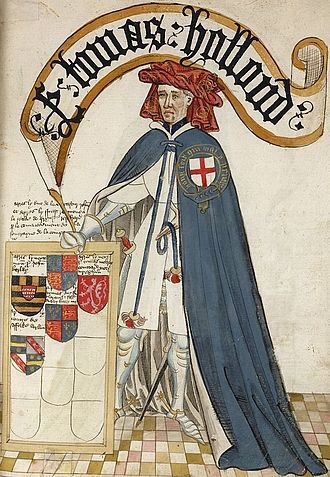
330px-Thomas_Holland_1430
Sir Thomas Holland, Earl of Kent

Having recently written about William Montagu, 2nd Earl of Salisbury and husband of Joan of Kent, I thought it only fair to write an article on William’s love rival, Thomas Holland.

The second son of Robert Holland, Lord Holland of Upholland, Lancashire, Thomas was born around 1315 and grew up to be quite a renowned soldier. His mother was Maud, daughter and co-heiress of Alan Zouche, Lord Zouche of Ashby. Thomas grew up with 3 brothers and 3 sisters. His older brother, Robert, succeeded to the Holland estates and  resided at Thorpe Waterville in Northamptonshire. Thomas’s 2 younger brothers, Alan and Otto, followed their brother into military service, and are often noted as having accompanied him on campaign.

The number of sisters seems to be confused; some sources put it at 5, while others mention only 3. Of the 3 known sisters the eldest, Isabella, became the mistress of John de Warenne, 7th Earl of Surrey who had married to Edward II’s cousin, Joan of Bar.  Another sister, Margaret, died in 1349 and had been married to John de la Warr, while the last, Matilda or Maud, had been the wife of John (II) Mowbray, Lord Mowbray.

Thomas Holland’s father had been a chief supporter of Thomas, Earl of Lancaster, who had attempted to curb the malevolent influence of Hugh le Despenser the Younger on King Edward II and, by extension, the country. Holland, however, turned his coat at the last-minute and joined the king’s faction just months before Lancaster was defeated at the Battle of Boroughbridge in 1322.

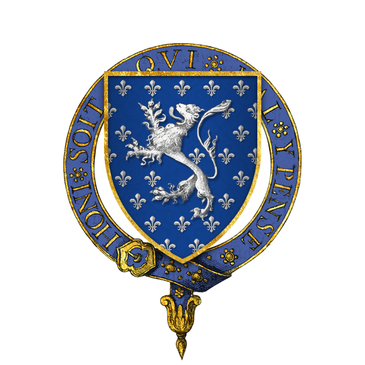
Coat_of_Arms_of_Sir_Thomas_Holland,_KG
Coat of arms of Sir Thomas Holland, Knight of the Garter

Lancaster was executed but Robert Holland did not get the reward he was probably expecting; he was imprisoned, with his lands confiscated. It was only in 1327, after Edward II’s deposition and the accession of Edward III, that Holland’s lands were restored. However, in October 1328 Robert Holland was murdered in Borehamwood, Hertfordshire, probably by supporters of the new Earl of Lancaster, Thomas’s brother Henry.

A landless young knight, and the son of a disgraced lord, Thomas Holland had very little going for him when he started his soldiering career, probably in Scotland in the early 1330s. However, as the 1330s progressed he was making a reputation as an able soldier. In 1337 he was fighting in Bordeaux with Robert d’Artois, but by 1338 he was a knight of the royal household; serving in Flanders the following year and at Sluys in 1340.

In 1339 Thomas managed to pull off the marriage coup of the century – but no one was to know about it for 10 years. At the age of 24 Thomas married Joan Plantagenet, daughter of Edmund, earl of Kent, granddaughter of Edward I and cousin of King Edward III, who is reported as being as young as 11 years of age at the time. Despite her family links, at the time of the marriage Joan was no great heiress; her brother was earl of Kent and it was only his death in 1352 and the earlier death-without-heirs of her maternal uncle, Thomas Lord Wake, in 1349, that made her a wealthy woman in her own right.

Joan_of_Kent
Joan of Kent

Modern sensibilities will make us cringe at Joan’s tender age, but, although it was young even for the period an 11-year-old bride was not unheard of. We know, from Joan’s later testimony, that the marriage was consummated almost immediately; however, the couple did not settle down to marital bliss and Holland was soon on his travels.

In 1341, while Holland was away crusading in Prussia, Joan’s mother, Margaret Wake, arranged an advantageous marriage for her daughter to William Montagu, 2nd earl of Salisbury. Whether Margaret knew about the extent of Joan’s relationship with Holland is uncertain – maybe she believed Joan was infatuated with the landless knight and hoped that marrying her to Montagu would cure the pre-teen of this puppy love?

By February 1341 Joan and Montagu were married.

Thomas Holland, however, didn’t appear to be in a rush to return to claim his wife, though this was probably due to the fact he was in no financial position to fight a costly court case. He spent the next few years campaigning in Europe. In 1342-3 he fought in Brittany with the king and was probably in Granada with the earl of Derby by 1343. In 1345 he was back in Brittany and was at the Siege of Caen in 1346; a battle in which Joan’s other husband, Montagu, may also have taken part – awkward!

Holland played a prominent part in the Siege of Caen, capturing the Count of Eu, constable of France, who surrendered himself to Holland based on the knight’s chivalrous reputation. The count was then sold to Edward III for 80,000 florins, possibly making Holland very wealthy indeed (if he ever received the full balance owed). Thomas Holland’s eminence rose further during the 1346 Crecy campaign, seeing action at Amiens and Rouen; he was wounded at a castle on the Seine and commanded the rearguard on the march from Caen.

300px-Holland_1430 Otto
Otto Holland – Thomas’s brother and lieutenant

Recognition of his exploits came from the King in 1348, when Holland was made one of the Founder Knights of the Order of the Garter. His brother and lieutenant, Otto, was also awarded with the same honour – as was William Montagu, earl of Salisbury and the ‘other’ husband of the fair Joan. Montagu was also, at this  time, employing Thomas Holland as his steward – I wonder if Joan had had a hand in the appointment?

Holland now found himself in a position to petition the papal court to confirm the validity of his marriage and have Joan returned to him. The inaugural Garter tournament on St George’s Day, 1349 must have caused great interest, seeing Joan’s current husband, the Earl of Salisbury, fighting on the king’s team, while Sir Thomas Holland was on the side of Prince Edward, the Black Prince (Joan’s future husband, just to make things more confusing). It is not hard to imagine the highly charged atmosphere, with Joan’s two husbands facing each other across the tournament field, with the object of their affection watching from the stands.

If you’re wondering who Joan cheered for, my guess is Thomas Holland as, when called to testify to her marriage with Holland, Joan confirmed that, not only had she married Holland but the marriage had also been consummated. After lengthy court proceedings, in which Holland had travelled to the papal court at Avignon on more than one occasion, and with Joan being under house arrest and denied access to lawyers by the Montagu family, in November 1349 the papal court finally publicised the verdict; Joan’s marriage to Montagu was declared null and void and she was ordered to return to Holland.

Despite the testimony of both Joan and Thomas Holland, there will always be a question mark over their claims to have married in 1339. The more cynical of observers may think that their relationship started much later, when Joan was already married to William Montagu, and that they employed the concept of an earlier marriage in order to free Joan from her unwanted husband and allow her to marry her lover. However, it must be remembered that Joan swore in front of a church court that she had married Thomas when she was 11, and lying to the church would bring the hefty penalty of eternal damnation. I doubt we will ever truly know the truth, but I personally lean towards the argument for the earlier marriage rather than a subsequent adulterous affair.

Holland’s fortunes were certainly on the rise,  his wife restored to him, and with her brother’s death in 1352, Joan inherited estates in 16 counties, making Holland (by right of his wife) a lord of vast estates. His military career blossomed, he was given independent commands and in August  1352 was made Captain of Calais Castle; from 1354 he was summoned to parliament as Lord Holland.

Joan and Sir Thomas Holland had 5 children together; 3 sons and 2 daughters. Their first son, Thomas, Earl of Kent, was born in 1350 and married Alice, the daughter of Richard FitzAlan, 10th Earl of Arundel; he died in 1397.  Edmund was born in 1352 and died young. Their third son, John, was created Duke of Exeter in 1397 by his younger half-brother, King Richard II. He married Elizabeth of Lancaster, daughter of John of Gaunt and Blanche of Lancaster, but was executed in 1400 for his involvement in a plot to assassinate Henry IV and return his brother to the throne.

330px-Arms_of_Edmund_of_Woodstock,_1st_Earl_of_Kent.svg
Arms of Thomas Holland, 2nd Earl of Kent

Of their daughters, Joan married John V, Duke of Brittany (who would marry Joanna of Navarre as his second wife, the future queen-consort of Henry IV), but died in 1384. Their youngest child, Matilda, was born in 1359 and married twice; Sir Hugh de Courtenay, who died in 1377, and then Waleran of Luxembourg, Count of St Pol and Ligny. Matilda died in 1391.

Thomas Holland’s military prestige continued to rise throughout the 1350s, with his appointment as the King’s lieutenant in Brittany in 1353-4, receiving funding from the local revenues. Thomas also had custody of the young heir to the duchy, John V, who was later married to the Holland’s daughter, Joan.

In June 1356 Holland was appointed Keeper of the Channel Islands and tasked with the recovery of the Islands’ Castle Cornet, then in French hands; Holland’s brother, Otto, soon recaptured it for the English. In the subsequent years, Holland was placed in charge of various castles in Normandy; until October 1359 when he was appointed joint lieutenant of Normandy with Philip of Navarre.

The apotheosis of Holland’s military career came in September 1360 when he was appointed the king’s captain and lieutenant in France and Normandy. It was at this time, also, that he was finally given the title earl of Kent – to bolster his authority and prestige among friends and enemies alike, in order to  aid in his task of carrying out the provisions of the Treaty of Bretigny of October 1360.

330px-Hospital_gatehouse_-_geograph.org.uk_-_487443
Gatehouse of the Greyfriars at Stamford, Lincolnshire

However, before this duty could be fulfilled, and at the height of his fame and prestige, Thomas Holland, earl of Kent, contracted an illness and died at Rouen on the 26th or 28th December 13601, depending on the source. He was buried in the church of the Friars Minor at Rouen, but was later moved to the Church of the Greyfriars at Stamford in Lincolnshire.

His widow, Joan, would marry Prince Edward, the Black Prince and heir of Edward III, in the following year and their son, Richard, would be crowned in 1377 as King Richard II. Holland’s children by Joan would be half-siblings to the King of England.

When Joan herself died in 1385 she chose to be buried beside her first husband in Lincolnshire, rather than with her prince in Canterbury Cathedral.

*

Footnote: 1 Stansfield, Oxforddnb.com

Pictures taken from Wikipedia.

*

Sources: The Perfect King, the Life of Edward III by Ian Mortimer; The Life and Time of Edward III by Paul Johnson; The Reign of Edward III  by WM Ormrod; The Mammoth Book of British kings & Queens by Mike Ashley; Britain’s’ Royal Families, the Complete Genealogy by Alison Weir; Brewer’s British Royalty by David Williamson; The Plantagenets, the Kings Who Made Britain by Dan Jones; englishmonarchs.co.uk; The Oxford Companion to British History edited by John Cannon; Chronicles of the Age of Chivalry Edited by Elizabeth Hallam; oxforddnb.com; britannia.com; themcs.org; Oxforddnb.com.

*

My books:

Signed, dedicated copies of all my books are available through my online bookshop.

Coming 30 January 2025: Scotland’s Medieval Queens

Scotland’s history is dramatic, violent and bloody. Being England’s northern neighbour has never been easy. Scotland’s queens have had to deal with war, murder, imprisonment, political rivalries and open betrayal. They have loved and lost, raised kings and queens, ruled and died for Scotland. From St Margaret, who became one of the patron saints of Scotland, to Elizabeth de Burgh and the dramatic story of the Scottish Wars of Independence, to the love story and tragedy of Joan Beaufort, to Margaret of Denmark and the dawn of the Renaissance, Scotland’s Medieval Queens have seen it all. This is the story of Scotland through their eyes.

Available for pre-order now.

Also by Sharon Bennett Connolly:

Heroines of the Tudor World tells the stories of the most remarkable women from European history in the time of the Tudor dynasty, 1485-1603. These are the women who ruled, the women who founded dynasties, the women who fought for religious freedom, their families and love. Heroines of the Tudor World is now available for pre-order from Amberley Publishing and Amazon UK. Women of the Anarchy demonstrates how Empress Matilda and Matilda of Boulogne, unable to wield a sword themselves, were prime movers in this time of conflict and lawlessness. It shows how their strengths, weaknesses, and personal ambitions swung the fortunes of war one way – and then the other. Available from Bookshop.orgAmberley Publishing and Amazon UKKing John’s Right-Hand Lady: The Story of Nicholaa de la Haye is the story of a truly remarkable lady, the hereditary constable of Lincoln Castle and the first woman in England to be appointed sheriff in her own right. Available from all good bookshops Pen & Sword Booksbookshop.org and Amazon

Defenders of the Norman Crown: The Rise and Fall of the Warenne Earls of Surrey tells the fascinating story of the Warenne dynasty, from its origins in Normandy, through the Conquest, Magna Carta, the wars and marriages that led to its ultimate demise in the reign of Edward III. Available from Pen & Sword BooksAmazon in the UK and US, and Bookshop.orgLadies of Magna Carta: Women of Influence in Thirteenth Century England looks into the relationships of the various noble families of the 13th century, and how they were affected by the Barons’ Wars, Magna Carta and its aftermath; the bonds that were formed and those that were broken. It is now available in paperback and hardback from Pen & SwordAmazon, and Bookshop.orgHeroines of the Medieval World tells the stories of some of the most remarkable women from Medieval history, from Eleanor of Aquitaine to Julian of Norwich. Available now from Amberley Publishing and Amazon, and Bookshop.orgSilk and the Sword: The Women of the Norman Conquest traces the fortunes of the women who had a significant role to play in the momentous events of 1066. Available now from Amazon,  Amberley Publishing, and Bookshop.org.

Alternate Endings: An anthology of historical fiction short stories including Long Live the King… which is my take what might have happened had King John not died in October 1216. Available in paperback and kindle from Amazon.

Podcast:

Have a listen to the A Slice of Medieval podcast, which I co-host with Historical fiction novelist Derek Birks. Derek and I welcome guests, such as Bernard Cornwell and Ian Mortimer, and discuss a wide range of topics in medieval history, from significant events to the personalities involved. 

*

Don’t forget! Signed and dedicated copies of all my books are available through my online bookshop.

For forthcoming online and in-person talks, please check out my Events Page.

You can be the first to read new articles by clicking the ‘Follow’ button, liking our Facebook page or joining me on TwitterThreadsBluesky and Instagram.

©2015 Sharon Bennett Connolly FRHistS

The Sad Story of Little St Hugh of Lincoln

046
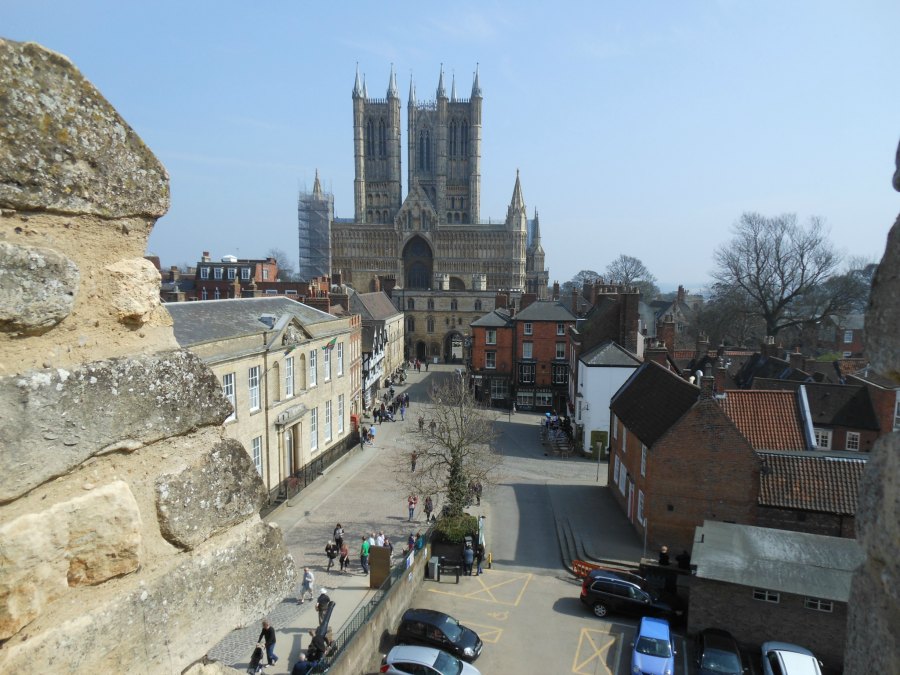
Lincoln Cathedral viewed from Lincoln Castle

While researching the history of Lincoln a few years ago I came across the unhappy story of Little St Hugh, a young boy whose death caused a lethal backlash of blame and recrimination which attracted the attention of the king, Henry III, himself.

The story revolves around a young boy called Hugh. Born around 1246 he was probably 9 years old when he disappeared on 31st July 1255. No one seems to know who Hugh’s father was, or even if he had one – some sources suggest he was illegitimate – but his mother is identified as a Lincoln woman named Beatrice.

According to reports young Hugh had been doing what all boys do at that age – he’d been out playing with friends. But when it got late the lad could not be found. One can imagine how desperate his mother became. She spent days looking for him and apparently was eventually told by some neighbours that he had last been seen ‘playing with some Jewish boys of his own age, and going into the house of a Jew.’¹

According to Matthew Paris it was Beatrice, herself, who had discovered Hugh’s body sometime around 27th August 1255, after marching into the house Hugh had been seen going into. Little Hugh’s body was supposedly found in a well at the property of a Lincoln Jew, named Copin (or Jopin, Joscefin or Koppin).

Poor Copin was immediately seized by those present when the body was found; Beatrice and her neighbours and the city’s bailiffs all appear to have been in attendance. In no time at all a dreadful tale of ritual murder and the ‘blood libel’ (where it was believed Christian children were tortured and killed in Jewish rituals, supposedly mimicking the crucifixion of Christ) was woven around the tragedy of the little boy’s death.

330px-Hugh_of_Lincoln_body
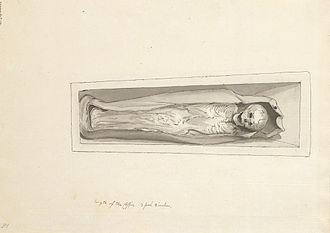
Body of Hugh of Lincoln

According to Paris:

… having shut him up in a room quite out of the way, where they fed him on milk and other childish nourishment, they sent to almost all the cities of England where the Jews lived, and summoned some of their sect from each city to be present at a sacrifice to take place at Lincoln; for they had, as they stated, a boy hidden for the purpose of being crucified. In accordance with the summons, a great many of them came to Lincoln, and on assembling, they at once appointed a Jew of Lincoln as judge to take the place of Pilate, by whose sentence, and with the concurrence of all, the boy was subjected to divers tortures. They beat him till blood flowed and he was quite livid, they crowned him with thorns, derided him and spat upon him. Moreover, he was pierced by each of them with a wood knife, was made to drink gall, was overwhelmed with approaches and blasphemies, and was repeatedly called Jesus the false prophet by his tormentors, who surrounded him, grinding and gnashing their teeth. After tormenting him in divers ways, they crucified him, and pierced him to the heart with a lance.²

It is still unclear whether or not Little Hugh was murdered; some sources suggest that it could have been a terrible accident or the boy lost his footing and fell down the well (although the well in question was apparently only dug in 1910)3. And even if the boy was murdered, it is far from clear that Copin was the culprit. However, one man took the initiative and played on the prejudices of the people, not only, create a scapegoat but use the anti-Semitism prevalent at the time in order to blame the Jewish population of England as a whole.

120
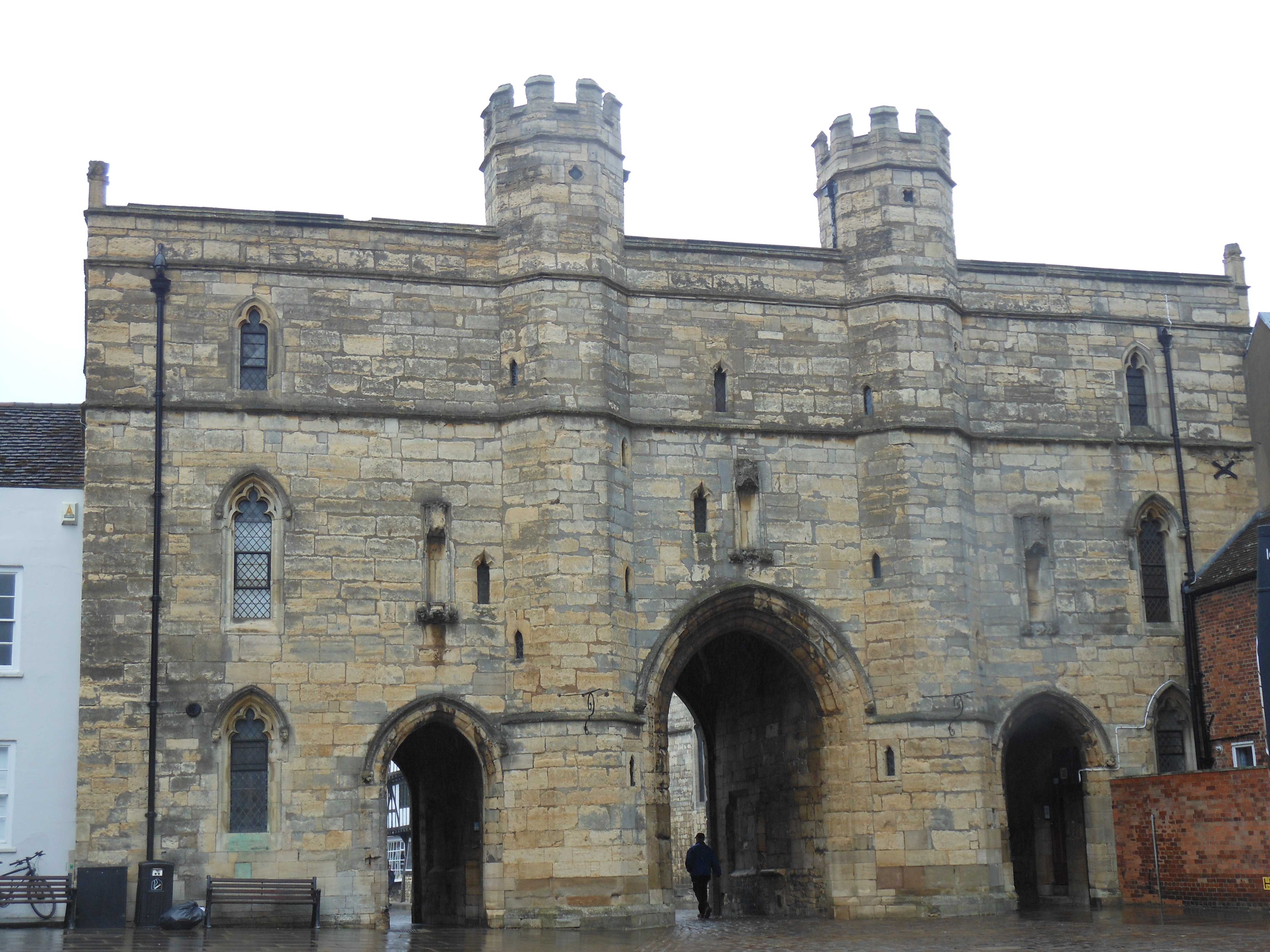
Gateway to Lincoln Cathedral precincts

John of Lexington was one of the witnesses at the discovery of the body and appears to have been the one to investigate the accusation of ritual murder levelled at Copin, probably by the distraught Beatrice. He may have been familiar with the case, just over a century earlier, of William of Norwich, who died in 1144 and whose death was said to involve a mock execution at the hands of a converted Jew named Theobald.

Lexington, described as ‘a man of learning, prudent and discreet‘² by Matthew Paris, managed to persuade Copin to confess and describe the murder in return for a promise of protection from torture and execution. Copin is said to have confessed to his involvement, and described the scourging, disembowelling, crowning with thorns and crucifixion of the young boy. He went on, it seems, to implicate the rest of his people, saying ‘nearly all the Jews of England agreed to the death of this boy.’4

At the time of the death many prominent Jewish families had congregated in Lincoln; not to  commit murder, but to celebrate the marriage of Bellaset, the daughter of Berechiah de Nicole. The wedding guests were suddenly caught up in the tragedy and more than 90 of them were arrested and charged with practicing ritual murder. They were sent to London and imprisoned in the Tower to await trial.

082
Sign in Lincoln Cathedral explaining Hugh’s story

In the mean time rumours of miracles started circulating  and being attributed to Little Hugh. It was said his body had been thrown down the well because when Copin had tried to bury him the earth had thrown the corpse back out. In another miracle attributed to him a blind woman regained her sight by bathing her eyes in water from the well in which Hugh’s remains had been found. Having heard of the miracles associated with Little Hugh, the canons of Lincoln Cathedral requested the body and Little Hugh ‘was honourably buried in the church of Lincoln as if it had been the corpse of a precious martyr,’² with the Cathedral even raising a shrine to the memory of Little Saint Hugh.

As for Copin; the story of a boy’s murder by England’s Jews had attracted the attention of England’s king, Henry III. According to Paris the king himself reproached John of Lexington for having promised life to such a ‘wicked being’ and the poor man was condemned to death. He was tied to the tail of a horse and dragged through the streets to the gallows, and hung.

Just 6 months before Hugh’s death the king had sold his rights to tax the Jews to his younger brother Richard, earl of Cornwall. However, he retained the right to receive the goods and property of any Jew implicated in a crime. This made the 90 Jews arrested alongside Copin extremely valuable to the king if they were guilty – and to his brother if they were innocent. Of these 90 or so Jews caught up in the aftermath of the tragedy, 18 ‘of the richer and higher order of Jews of the city of Lincoln’5 were condemned to death and dragged to gibbets erected especially and hung; their property confiscated by the king.

The remaining prisoners were eventually released, following payment of their ransom by the Earl of Cornwall, the king’s brother; his personal Jew had probably been caught up in the arrests and so it was in Cornwall’s interests to get the Jews released. Among those freed was Berechiah de Nicole, the father of the bride for whose wedding the Jews had been gathered in Lincoln.

083
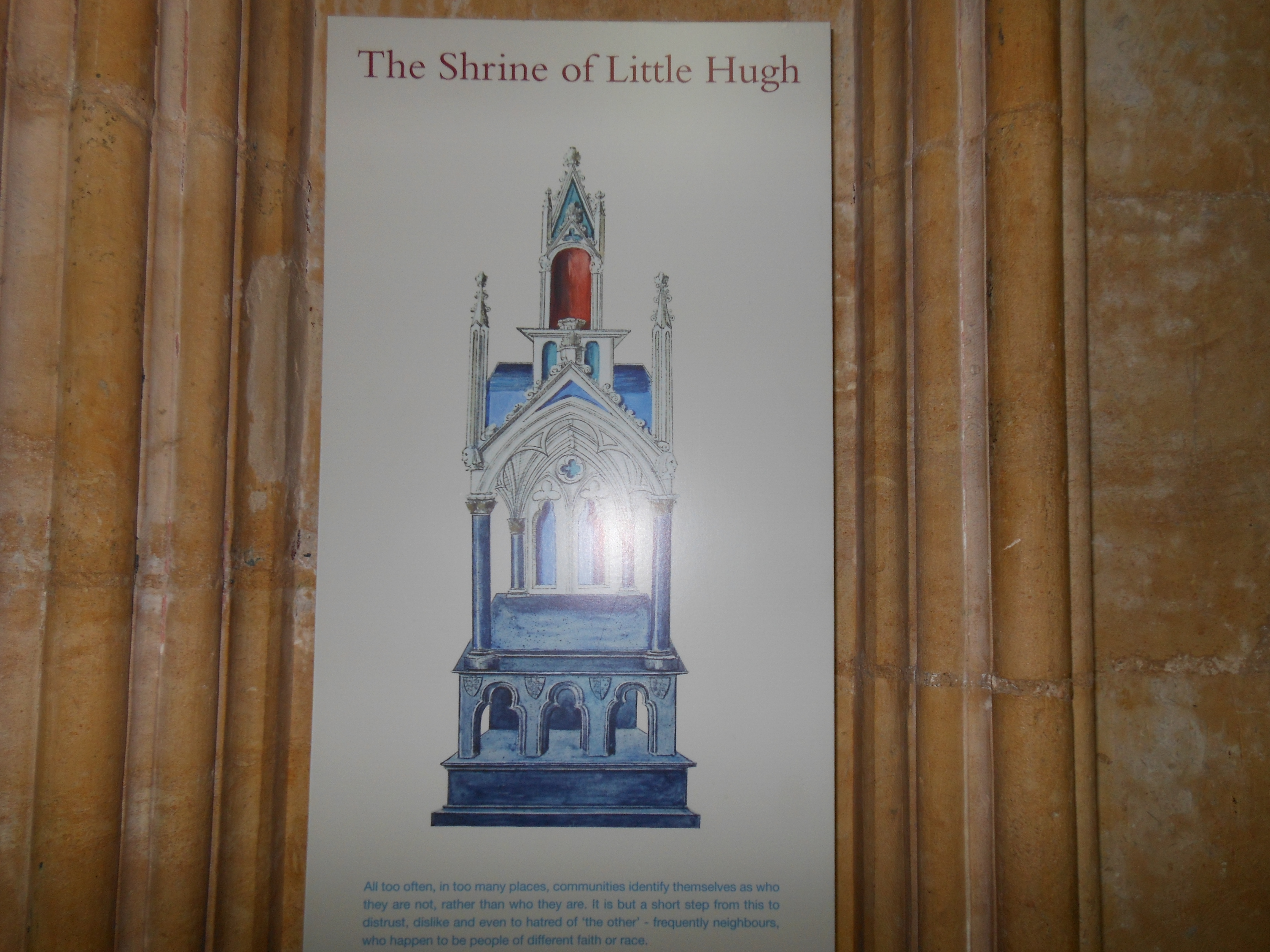
The shrine of Little Hugh in Lincoln Cathedral

The tragedy of Little Hugh’s death was only worsened by the judicial murders of so many innocent Jews in revenge. Little St Hugh is the best known of the ‘blood libel’ saints and although a shrine was erected in Lincoln Cathedral, with a feast day of 27th August, Little Hugh was never canonised by the Vatican and has never been included in the official roll of Catholic martyrs. The shrine inside the cathedral, although still there, has lost its canopy and now has a sign at the side, explaining the legend and telling the sad tale of the boy’s death and its dreadful aftermath.

Little Hugh’s story would continue to be told in the succeeding centuries. It has been the subject of ballads in both English, Scottish and French poetry and is referred to by Chaucer in The Prioress’s Tale and by Marlowe in the Jew of Malta.

*

Footnotes:

1.Matthew Paris, quoted by Haidee J Lorrey from oxforddnb.com; 2. Matthew Paris, Of the cruel treatment of the Jews for having crucified a boy from arts.cornell.edu; 3. It’s About Lincolnshire via Twitter; 4. Matthew Paris, quoted by Haidee J Lorrey from oxforddnb.com; 5. Matthew Paris, Of the cruel treatment of the Jews for having crucified a boy from arts.cornell.edu

With thanks to Dr Dean Irwin for clarifying some points for me.

*

Article and photos of Lincoln Cathedral and precincts ©2015 Sharon Bennett Connolly; Picture of the Body of Little Hugh courtesy of Wikipedia.

Sources:

arts.cornell.edu; oxforddnb.com; pillingswritingcorner.blogspot.co.uk; britannica.com; Who’s Buried Where in England by Douglas Greenwood;  Chronicles of the Age of Chivalry Edited by Elizabeth Hallam; The Plantagenets, the Kings that made Britain by Derek Wilson; England Under the Norman and Angevin Kings 1075-1225 by Robert Bartlett; jewishencyclopedia.com.

*

My books

Signed, dedicated copies of all my books are available through my online bookshop.

OUT NOW! Heroines of the Tudor World

Heroines of the Tudor World tells the stories of the most remarkable women from European history in the time of the Tudor dynasty, 1485-1603. These are the women who ruled, the women who founded dynasties, the women who fought for religious freedom, their families and love. These are the women who made a difference, who influenced countries, kings and the Reformation. In the era dominated by the Renaissance and Reformation, Heroines of the Tudor World examines the threats and challenges faced by the women of the era, and how they overcame them. From writers to regents, from nuns to queens, Heroines of the Tudor World shines the spotlight on the women helped to shape Early Modern Europe.

Heroines of the Tudor World is now available for pre-order from Amberley Publishing and Amazon UK.

Also by Sharon Bennett Connolly:

Women of the Anarchy demonstrates how Empress Matilda and Matilda of Boulogne, unable to wield a sword themselves, were prime movers in this time of conflict and lawlessness. It shows how their strengths, weaknesses, and personal ambitions swung the fortunes of war one way – and then the other. Available from Bookshop.orgAmberley Publishing and Amazon UKKing John’s Right-Hand Lady: The Story of Nicholaa de la Haye is the story of a truly remarkable lady, the hereditary constable of Lincoln Castle and the first woman in England to be appointed sheriff in her own right. Available from all good bookshops Pen & Sword Booksbookshop.org and AmazonDefenders of the Norman Crown: The Rise and Fall of the Warenne Earls of Surrey tells the fascinating story of the Warenne dynasty, from its origins in Normandy, through the Conquest, Magna Carta, the wars and marriages that led to its ultimate demise in the reign of Edward III. Available from Pen & Sword BooksAmazon in the UK and US, and Bookshop.org

Ladies of Magna Carta: Women of Influence in Thirteenth Century England looks into the relationships of the various noble families of the 13th century, and how they were affected by the Barons’ Wars, Magna Carta and its aftermath; the bonds that were formed and those that were broken. It is now available in paperback and hardback from Pen & Sword,  Amazon, and Bookshop.orgHeroines of the Medieval World tells the stories of some of the most remarkable women from Medieval history, from Eleanor of Aquitaine to Julian of Norwich. Available now from Amberley Publishing and Amazon, and Bookshop.orgSilk and the Sword: The Women of the Norman Conquest traces the fortunes of the women who had a significant role to play in the momentous events of 1066. Available now from Amazon,  Amberley Publishing, and Bookshop.org.

Alternate Endings: An anthology of historical fiction short stories including Long Live the King… which is my take what might have happened had King John not died in October 1216. Available in paperback and kindle from Amazon.

Podcast:

Have a listen to the A Slice of Medieval podcast, which I co-host with Historical fiction novelist Derek Birks. Derek and I welcome guests, such as Bernard Cornwell and discuss a wide range of topics in medieval history, from significant events to the personalities involved. There are now over 40 episodes to listen to!

*

Don’t forget! Signed and dedicated copies of all my books are available through my online bookshop.

For forthcoming online and in-person talks, please check out my Events Page.

You can be the first to read new articles by clicking the ‘Follow’ button, liking our Facebook page or joining me on Twitter and Instagram.

©2016 Sharon Bennett Connolly FRHistS

Countess Maud

CliffordArms
The Clifford coat of arms

There are many women in history of whom we only have snippets of information. However, those snippets prove to be fascinating and demonstrate how closely the lives of noble houses were tied together – and how they were torn apart. Maud Clifford is one such lady.

Born about 1389 at Brough Castle in Westmoreland, Maud (or Matilda) was the daughter of Thomas Clifford, 6th Baron Clifford, and his wife Elizabeth de Ros. Maud’s brother, John, has also been given 1389 as his possible year of birth. It may be that John or Maud were twins, or that they were born within a year of each other.

Their early childhood cannot have been very pleasant. Their paternal grandfather, Roger Clifford, died in July of 1389, probably of a stroke. In October 1391, their father, Thomas, died. Whilst in Königsberg Thomas had had a disagreement with Sir William Douglas, illegitimate son of the earl of Douglas; Douglas was killed in the ensuing brawl and Clifford, overcome with guilt, went on pilgrimage to Jerusalem in penance. He died on an unidentified Mediterranean island whilst on the way to the Holy City.

Nothing else seems to be known of Maud’s childhood. Sometime before 1406 she was married to John Neville, Lord Latimer. For some unknown reason the marriage was never consummated and Maud successfully sued for an annulment. The marriage was dissolved with very favourable terms for Maud; some of the Neville lands had been put in trust for Maud and, even though the marriage had been declared invalid, she was allowed to keep them.

300px-Skipton_Castle_main_gate,_2007
Skipton Castle, family seat of the Cliffords

Maud was, therefore, a very attractive bride for a landless earl. Richard of Conisbrough, earl of Cambridge, was the poorest – and the only landless – earl in England. He lived at Conisbrough Castle in Yorkshire as the tenant of his older brother, Edward, Duke of York. Richard was a widower with 2 small children; his wife, Anne Mortimer, had died sometime after 1411, when she had given birth to their 2nd child, Richard (future Duke of York), probably at Conisbrough Castle. It is not known when Anne died, but it was before 1414, which is the probable date of Maud’s marriage to the earl of Cambridge.

Unfortunately the marriage proved to be short-lived, with Richard of Conisbrough becoming involved in the Southampton Plot, a plan to overthrow King Henry V and replace him with  Richard’s brother-in-law, Edmund Mortimer, Earl of March. However, March revealed the plot to the King and Richard and his accomplices were arrested, with Richard beheaded for treason on  5th August 1415.

008 (2)
Conisbrough Castle

Richard of Conisbrough was not attainted, so his lands, such as they were, were not forfeit to the crown. Maud was allowed to remain at Conisbrough Castle, and her step-son, Richard, would be allowed to inherit the Dukedom of York from his uncle, Edward, following his death at Agincourt in October 1415.

It is not clear how much contact Maud had with her step-children. The eldest child, Isabel, had been born around 1409; she had been betrothed in 1412 to Sir Thomas Grey and it is possible that she was raised in the household of the Grey family. As Duke of York, Richard’s wardship and marriage was a great prize, and would eventually go to Ralph Neville, earl of Westmoreland; with York marrying Neville’s daughter, Cecily. The Yorks’ eldest and youngest sons would become the Yorkist kings of England; Edward IV and Richard III, respectively.

Maud would continue to use Conisbrough Castle as her principal residence throughout her life; she received an annuity of £100 from the Earl of March, perhaps to assuage his guilt in the part he played in her husband’s downfall. She seems to have led a full and active life, and remained very close to her Clifford family; they  stayed with her often and she was a regular visitor to the Clifford home of Skipton Castle. Her nephew, Thomas and his family, lived with her at Conisbrough for a year in 1437, while his castle at Skipton was undergoing extensive works.

036
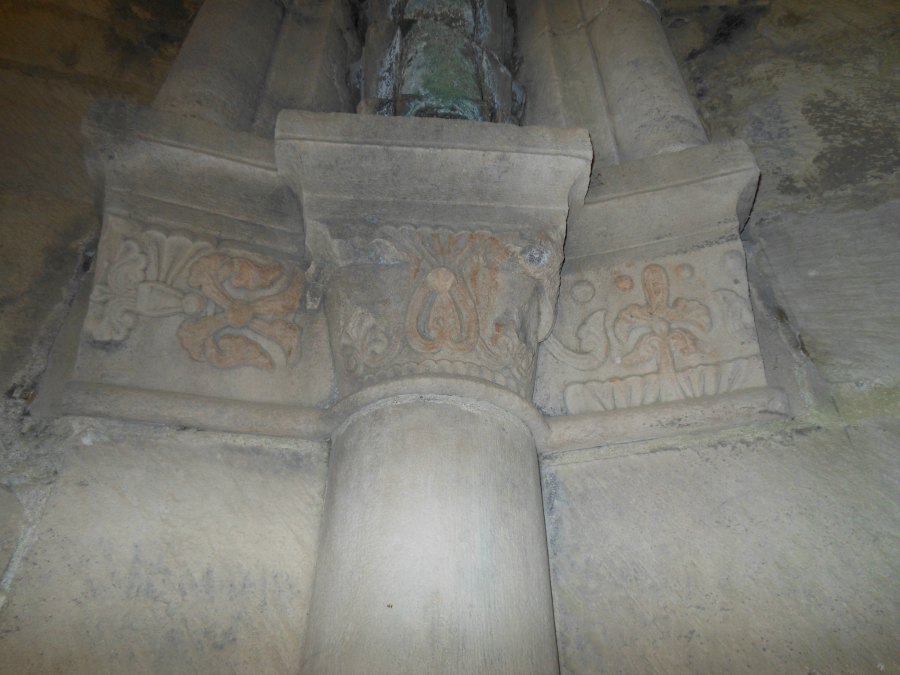
Carvings in the chapel at Conisbrough Castle

On 8th April 1435 Maud’s great-nephew, John Clifford – the future 9th Baron Clifford – was born at Conisbrough Castle. He was the grandson of Maud’s brother, John, and son of her nephew, Thomas, and his wife, Joan Dacre. Baby John would have been born either in the solar of the keep itself, or in the family apartments above the great hall of the inner bailey.

Either way its most likely he was baptised in the small private chapel within the keep; with Maud as his godmother. The chapel is built into one of the keep’s 6 buttresses and, despite the years and water damage, it is a wonder to behold, with exquisite designs carved into the stone columns, and the vaulted ceiling.

300px-'The_Murder_of_Rutland_by_Lord_Clifford'_by_Charles_Robert_Leslie,_1815
‘The Murder of Rutland by Lord Clifford’ by Charles Robert Leslie

Maud’s brother, John, was killed at the siege of Meaux in 1422 and her nephew, Thomas, would be killed at the First Battle of St Albans in 1455, supposedly by Richard, Duke of York, himself. And so it was, that on the 30th december 1460, at the Battle of Wakefield, John Clifford is said to have taken his revenge by killing York’s son Edmund, the 17-year-old earl of Rutland. Whether or not Clifford uttered the words ‘as your father slew mine, so I shall slay thee’ as he killed young Edmund, is entirely debatable, but the event serves to highlight how closely the noble families of the Wars of the Roses were related.

There is some suggestion that Maud remarried in 1429. The supposed groom was John Wentworth of North Elmsall, Yorkshire. However, this seems to be more of a family legend among the Wentworth family and only arose over 100 years after Maud’s death.

Maud’s will demonstrates her closeness to her family, and serves as an insight into her comfortable life and the sumptuous furnishings of the castle.

View from the nave of the church to the high altar, Roche Abbey

To Thomas, Lord Clifford, my relation: a ‘hall’ of arras [a fine woven wall-hanging from Arras] bought from Sir Robert Babthorpe; my bed of Arras with three curtains; four cushions of red silk; two long cushions of cloth.

To John Clifford, my godson: 12 silver dishes, 6 salt-cellars signed with the ‘trayfulles’ [trefoils] and a shell.

To Beatrice Waterton, my relation: a gold cross, which belonged to my mother; my green Primary [a book of readings from the Bible]; a diamond; my best furred robe with ‘martes’ [marten fur].

To Katherine Fitzwilliam: the brooch that I wear everyday; a small black Primary; a jewel called Agnus Dei covered with silver and written around with pearls; my best robe furred with miniver [white stoat fur].

To Maud Clifford, my god-daughter: my best gold belt.¹

Maud died, of an unknown illness, at Conisbrough Castle on 26th August 1446 and was  buried at Roche Abbey, of which she was a benefactor. Her tomb is now lost to history, but may have been in the nave of the church, where many secular patrons are known to have been buried.2 Though some tombs still remaining, their markings are faded after centuries of exposure to the elements, and none can be definitively identified.

*

Footnote: ¹English Heritage Guidebook for Conisbrough Castle by Steven Brindle and Agnieszka Sadrei; English Heritage Guidebook for Roche Abbey by Peter Ferguson and Stuart Harrison.

*

Pictures courtesy of Wikipedia, except Roche Abbey and Conisbrough Castle and chapel ©2016 Sharon Bennett Connolly

*

Sources: Sources: The History Today Companion to British History, edited by Juliet Gardiner & Neil Wenborn; Brewer’s British Royalty by David Williamson; Britain’s Royal Families, the Complete Genealogy by Alison Weir; The Wars of the Roses by John Gillingham; The Wordsworth Dictionary of British History by J.P. Kenyon; The Oxford Companion to British History, edited by John Cannon; The Reign of Edward III by WM Ormrod; The Wars of the Roses by Martin J Dougherty; englishmonarchs.co.uk; womenshistory.about.com; findagrave.com; conisbroughcastle.org.uk; hrionline.ac.uk; English Heritage Guidebook for Conisbrough Castle by Steven Brindle and Agnieszka Sadrei; English Heritage Guidebook for Roche Abbey by Peter Ferguson and Stuart Harrison; oxforddnb.com.

*

My Books

Signed, dedicated copies of all my books are available through my online store.

OUT NOW! Heroines of the Tudor World

Heroines of the Tudor World tells the stories of the most remarkable women from European history in the time of the Tudor dynasty, 1485-1603. These are the women who ruled, the women who founded dynasties, the women who fought for religious freedom, their families and love. These are the women who made a difference, who influenced countries, kings and the Reformation. In the era dominated by the Renaissance and Reformation, Heroines of the Tudor World examines the threats and challenges faced by the women of the era, and how they overcame them. From writers to regents, from nuns to queens, Heroines of the Tudor World shines the spotlight on the women helped to shape Early Modern Europe.

Heroines of the Tudor World is now available for pre-order from Amberley Publishing and Amazon UK.

Also by Sharon Bennett Connolly:

Women of the Anarchy demonstrates how Empress Matilda and Matilda of Boulogne, unable to wield a sword themselves, were prime movers in this time of conflict and lawlessness. It shows how their strengths, weaknesses, and personal ambitions swung the fortunes of war one way – and then the other. Available from Bookshop.orgAmberley Publishing and Amazon UKKing John’s Right-Hand Lady: The Story of Nicholaa de la Haye is the story of a truly remarkable lady, the hereditary constable of Lincoln Castle and the first woman in England to be appointed sheriff in her own right. Available from all good bookshops Pen & Sword Booksbookshop.org and AmazonDefenders of the Norman Crown: The Rise and Fall of the Warenne Earls of Surrey tells the fascinating story of the Warenne dynasty, from its origins in Normandy, through the Conquest, Magna Carta, the wars and marriages that led to its ultimate demise in the reign of Edward III. Available from Pen & Sword BooksAmazon in the UK and US, and Bookshop.org

Ladies of Magna Carta: Women of Influence in Thirteenth Century England looks into the relationships of the various noble families of the 13th century, and how they were affected by the Barons’ Wars, Magna Carta and its aftermath; the bonds that were formed and those that were broken. It is now available in paperback and hardback from Pen & Sword,  Amazon, and Bookshop.orgHeroines of the Medieval World tells the stories of some of the most remarkable women from Medieval history, from Eleanor of Aquitaine to Julian of Norwich. Available now from Amberley Publishing and Amazon, and Bookshop.orgSilk and the Sword: The Women of the Norman Conquest traces the fortunes of the women who had a significant role to play in the momentous events of 1066. Available now from Amazon,  Amberley Publishing, and Bookshop.org.

Alternate Endings: An anthology of historical fiction short stories including Long Live the King… which is my take what might have happened had King John not died in October 1216. Available in paperback and kindle from Amazon.

Podcast:

Have a listen to the A Slice of Medieval podcast, which I co-host with Historical fiction novelist Derek Birks. Derek and I welcome guests, such as Bernard Cornwell, and discuss a wide range of topics in medieval history, from significant events to the personalities involved.

*

Don’t forget! Signed and dedicated copies of all my books are available through my online store.

For forthcoming online and in-person talks, please check out my Events Page.

You can be the first to read new articles by clicking the ‘Follow’ button, liking our Facebook page or joining me on Twitter and Instagram.

*

©2016 Sharon Bennett Connolly FRHistS

Katherine Willoughby, the Puritan Duchess

Catherine,_Duchess_of_Suffolk_by_Hans_Holbein_the_Younger
Katherine Willoughby, Duchess of Suffolk

Maria de Salinas was a lady-in-waiting and close friend to Katherine of Aragon; indeed, she probably came to England with the Spanish princess in 1501 for the marriage to Henry’s older brother, Arthur, Prince of Wales. Katherine and Maria were very close and the Spanish ambassador complained of Maria’s influence over the queen, especially after she tried to persuade Katherine not to cooperate with the ambassador and encouraged the Queen to favour her English subjects.

In June 1516 Maria married the largest landowner in Lincolnshire, William Willoughby, 11th Baron Willoughby de Eresby. The wedding was a lavish affair – attended and paid for by the King and Queen. It took place at Greenwich Palace and the couple were given Grimsthorpe Castle, in Lincolnshire, as a wedding present. The Queen even provided Maria with a generous dowry of 1100 marks.

Maria remained at court for some years after her wedding, and attended Queen Katherine at the Field of Cloth of Gold in 1520. Henry VIII was godfather to Maria and William’s oldest son, Henry who died in infancy. Another son, Francis, also died young and their daughter Katherine, born on 22nd March 1519 and named after the queen, would be the only surviving child of the marriage. With her father holding over 30 manors in Lincolnshire alone, and an annual income of over £900 a year, Katherine was one of the great heiresses of her generation.

360px-Charles_Brandon_Duke_of_Suffolk
Charles Brandon, Duke of Suffolk

Little Katherine was only 6 or 7 when her father, Lord Willoughby, died in 1526. For several years afterwards Maria was embroiled in a legal dispute with her brother-in-law, Sir Christopher Willoughby, over the inheritance of the Willoughby lands. It seems William had settled some lands on Maria which were entailed to Sir Christopher. The dispute went to the Star Chamber and caused Sir Thomas More, the king’s chancellor and a prominent lawyer, to make an initial redistribution of some of the disputed lands.

This must have been a hard fight for the newly widowed Maria, and the dispute threatened the stability of Lincolnshire itself, given the extensive lands involved. However, Maria attracted a powerful ally in Charles Brandon, Duke of Suffolk and brother-in-law of the King, who called on the assistance of Cardinal Thomas Wolsey, Henry’s first minister at the time, in the hope of resolving the situation.

Suffolk had managed to obtain the wardship of Katherine Willoughby in 1529, intending her to marry his eldest son and heir Henry, who had been made Earl of Lincoln in 1525, and so had a vested interest in a favourable settlement for Maria. Suffolk’s acquisition of the de la Pole estates had given him a prominent position in East Anglia; with these properties added to young Katherine’s lands in Lincolnshire, he would create an impressive power base.

Hans_Holbein_the_Younger_-_Henry_Brandon,_2nd_Duke_of_Suffolk_(1535-51)_-_Google_Art_Project
Henry Brandon, 2nd Duke of Suffolk

Whether or not the young earl of Lincoln was a sickly child (as he died in 1534) is uncertain; however the marriage was not to be – it has been a habit to say that anyone who died young was sickly, but this was not necessarily the case as fatal childhood illnesses were common. Suffolk had been married to king Henry VIII’s little sister, Mary Tudor, Dowager Queen of France, but she died in September 1533. The 50-year-old Duke of Suffolk caused a great scandal when, only 3 months later, he married 14-year-old Katherine himself. She was Suffolk’s fourth wife.

Despite the age difference, it does appear to have been a successful marriage. Katherine and Charles were to have 2 sons. The first, Henry, was born in 1535 and the youngest, Charles, was born in 1537.

Although Suffolk pursued the legal case with more vigour after the wedding, a final settlement was not reached until the reign of Elizabeth I. The combined properties of Charles Brandon, Duke of Suffolk, and Katherine made Suffolk the greatest magnate in Lincolnshire. He added to their properties by purchasing monastic land and built a fine house at Grimsthorpe Castle. His prominence in the county meant Suffolk was instrumental in suppressing the Lincolnshire rebellion in 1536 (part of the Pilgrimage of Grace), a consequence of the Dissolution of the Monasteries.

Hans_Holbein_the_Younger_-_Charles_Brandon_(Royal_Collection)
Charles Brandon, 3rd Duke of Suffolk

Along with her mother, Katherine was an official mourner at the funeral of Katherine of Aragon in 1536. Sadly, it was only 3 years later, in 1539, that Queen Katherine’s former lady-in-waiting, Maria de Salinas, Lady Willoughby, passed away.

Katherine served at court, in the household of Henry VIII’s sixth and last queen, Katherine Parr. A stalwart of the Protestant learning, Duchess Katherine used her position to introduce Protestant clergy to Lincolnshire, even inviting Hugh Latimer to preach and Grimsthorpe Castle. It was she and Sir William Cecil who persuaded Katherine Parr to publish her book, The Lamentacion of a Sinner in 1547. Katherine Willoughby was also drawn into the tragedy of Anne Askew, whose brother-in-law, George St Poll, was a lawyer in Katherine’s service. During her torture in the Tower of London, Anne was questioned as to whether or not Katherine and aided her, but she refused to implicate the duchess or Queen Katherine.

In the early 1540s Suffolk played a big part in Henry’s wars with France and Scotland; in 1544 he successfully prosecuted the siege of Boulogne and was rewarded in February 1545 with the lands of Tattershall College, which he was allowed to purchase for less than half price.

Amid preparations for another expedition to France, Suffolk died at Guildford in August 1545; the cause of death is not known. He would have been in his early 60s. Suffolk’s son and heir, Henry, was just 10 years old. Katherine was granted his wardship in May 1546, for the sum of £1500 and he was sent to the household of Prince Edward to continue his studies. It must have been a cause of great pride for Katherine when Henry and Charles were both knighted at Edward VI’s coronation, with Henry, as duke of Suffolk, having the honour of carrying the orb during the ceremony.

In 1549 Henry and Charles were enrolled at St John’s College, Cambridge, in order to finish their education.

330px-Catherine_Willoughby,_portrait_miniature_3
Katherine Willoughby

It was in the summer of 1551 that an outbreak of sweating sickness struck Cambridge. Henry and Charles moved to the Bishop of Lincoln’s Palace at Buckden in Huntingdonshire, in a futile attempt to escape the disease. For it was at Buckden, on July 14th 1551, that the boys both passed away within minutes of each other. Charles, surviving his brother by about half an hour, became the 3rd Duke of Suffolk before his death. The boys, who had shown great promise at Cambridge, were buried together at Buckden. To lose both her sons in such a short space of time must have been devastating for Katherine to take.

Following the deaths of her sons by Suffolk, Katherine no longer had a financial interest in the Suffolk estates, which went to the heirs of Mary Tudor, Henry VIII’s sister. However, Katherine still had her own Willoughby estates to look after and in order to safeguard these, Katherine married her gentleman usher, Richard Bertie, in 1552. This marriage appears to have been made for love and with mutual religious beliefs; unfortunately for the couple, Katherine was unsuccessful in her attempts to gain the title of Lord Willoughby for her second husband.

The couple had a difficult time navigating the religious tensions of the age and, during the reign of the Catholic Queen Mary I, in early 1555, even went into exile on the Continent, travelling through Wesel, Strasbourg and Frankfurt. And at the time of Mary’s death, in 1558, they were staying at the court of the king of Poland. They returned to England the following year. During the reign of Elizabeth I, Katherine resumed her position in Tudor society; however, her relations with the court were strained by her tendency towards Puritanism.

Susan_Bertie,_Countess_of_Kent
Susan Bertie, Countess of Kent

Katherine used her position in Lincolnshire and extensive patronage to help disseminate the Puritan teachings. The records of Katherine’s Lincolnshire household show that she employed Miles Coverdale – a prominent critic of the Elizabethan church – as tutor to her two children by Bertie. The couple’s 1st child, a daughter, Susan, was born in 1554 and was still a baby when she went into exile on the continent, with her parents. A son, Peregrine, was born in Wesel in Cleves in 1555, whilst the family was still exiled from England.

Susan went on to marry Reginald Gray of Wrest in 1570. Reginald would be restored to the family title of Earl of Kent in 1572, but died in March 1573. The couple had no children and the Dowager Countess of Kent would marry again in 1581, to Sir John Wingfield, a nephew of the redoubtable Bess of Hardwick. they had 2 sons.

Peregrine Bertie spent his teenage years in the household of Sir William Cecil, a good friend of his mother and Queen Elizabeth’s principal secretary. It was there that he met and fell in love with Mary de Vere, orphaned daughter of John de Vere, 16th Earl of Oxford. Despite opposition from Katherine and the bride’s brother Edward de Vere, 17th Earl of Oxford, the couple married sometime in late 1577, or early 1578. The marriage appears to have been happy and loving, and produced 5 sons and a daughter.

330px-Peregrine_Bertie,_13th_Baron_Willoughby_de_Eresby,_oil_painting
Peregrine Bertie, 13th Baron Willoughby de Eresby

Peregrine succeeded as the 13th Baron Willoughby of Willoughby, Beck and Eresby on the death of his mother and would serve Queen Elizabeth, both as a soldier and administrator, until his own death in 1601.

Katherine had been a strong supporter of the Protestant faith; numerous books carried her coat of arms, or were dedicated to her, including works by Erasmus and William Tyndale. The family’s adventures on the continent were retold in John Foxe’s Acts and Monuments, and even in popular Elizabethan ballads.

Katherine Willoughby, Dowager Duchess of Suffolk and 12th Baroness Willoughby de Eresby, died after a long illness, on 19th September 1580, at Grimsthorpe Castle. She was interred with a fine, alabaster tomb in Spilsby Church, in her native Lincolnshire. Her husband, Richard, died 2 years later and was buried beside her.

450px-Grimsthorpe_Castle_-_South_Facade
Grimsthorpe Castle

*

Pictures courtesy of Wikipedia

*

Sources: Susan Wabuda, Oxforddnb.com; Sarah Morris and Natalie Grueninger, In the Footsteps of the Six Wives of Henry VIII; Retha M. Warnicke, Oxforddnb.com; England Under the Tudors by Arthur D Innes; In Bed with the Tudors by Amy Licence; Ladies-in-Waiting: Women who Served at the Tudor Court by Victoria Sylvia Evans; The Earlier Tudors 1485-1558 by JD Mackie; The Six Wives and Many Mistresses of Henry VIII: The Women’s Stories by Amy Licence; Sarah Bryson; Elizabeth’s Women by Tracy Borman.

*

My Books

Signed, dedicated copies of all my books are available through my online bookshop.

Out now: Scotland’s Medieval Queens

Books by Sharon Bennett Connolly

Scotland’s history is dramatic, violent and bloody. Being England’s northern neighbour has never been easy. Scotland’s queens have had to deal with war, murder, imprisonment, political rivalries and open betrayal. They have loved and lost, raised kings and queens, ruled and died for Scotland. From St Margaret, who became one of the patron saints of Scotland, to Elizabeth de Burgh and the dramatic story of the Scottish Wars of Independence, to the love story and tragedy of Joan Beaufort, to Margaret of Denmark and the dawn of the Renaissance, Scotland’s Medieval Queens have seen it all. This is the story of Scotland through their eyes.

Scotland’s Medieval Queens gives a thorough grounding in the history of the women who ruled Scotland at the side of its kings, often in the shadows, but just as interesting in their lives beyond the spotlight. It’s not a subject that has been widely covered, and Sharon is a pioneer in bringing that information into accessible history.’ Elizabeth Chadwick (New York Times bestselling author)

Available now from Amazon and Pen and Sword Books

Also by Sharon Bennett Connolly:

Books by Sharon Bennett Connolly

Heroines of the Tudor World tells the stories of the most remarkable women from European history in the time of the Tudor dynasty, 1485-1603. These are the women who ruled, the women who founded dynasties, the women who fought for religious freedom, their families and love. Heroines of the Tudor World is now available from Amberley Publishing and Amazon UK. Women of the Anarchy demonstrates how Empress Matilda and Matilda of Boulogne, unable to wield a sword themselves, were prime movers in this time of conflict and lawlessness. It shows how their strengths, weaknesses, and personal ambitions swung the fortunes of war one way – and then the other. Available from Bookshop.orgAmberley Publishing and Amazon UKKing John’s Right-Hand Lady: The Story of Nicholaa de la Haye is the story of a truly remarkable lady, the hereditary constable of Lincoln Castle and the first woman in England to be appointed sheriff in her own right. Available from all good bookshops Pen & Sword Booksbookshop.org and Amazon

Royal Historical Society

Defenders of the Norman Crown: The Rise and Fall of the Warenne Earls of Surrey tells the fascinating story of the Warenne dynasty, from its origins in Normandy, through the Conquest, Magna Carta, the wars and marriages that led to its ultimate demise in the reign of Edward III. Available from Pen & Sword BooksAmazon in the UK and US, and Bookshop.orgLadies of Magna Carta: Women of Influence in Thirteenth Century England looks into the relationships of the various noble families of the 13th century, and how they were affected by the Barons’ Wars, Magna Carta and its aftermath; the bonds that were formed and those that were broken. It is now available in paperback and hardback from Pen & SwordAmazon, and Bookshop.orgHeroines of the Medieval World tells the stories of some of the most remarkable women from Medieval history, from Eleanor of Aquitaine to Julian of Norwich. Available now from Amberley Publishing and Amazon, and Bookshop.orgSilk and the Sword: The Women of the Norman Conquest traces the fortunes of the women who had a significant role to play in the momentous events of 1066. Available now from Amazon,  Amberley Publishing, and Bookshop.org.

Alternate Endings: An anthology of historical fiction short stories including Long Live the King… which is my take what might have happened had King John not died in October 1216. Available in paperback and kindle from Amazon.

Podcast:

A Slice of Medieval

Have a listen to the A Slice of Medieval podcast, which I co-host with Historical fiction novelist Derek Birks. Derek and I welcome guests, such as Bernard Cornwell and Michael Jecks, and discuss a wide range of topics in medieval history, from significant events to the personalities involved. 

Every episode is also now available on YouTube.

*

Don’t forget! Signed and dedicated copies of all my books are available through my online bookshop.

For forthcoming online and in-person talks, please check out my Events Page.

You can be the first to read new articles by clicking the ‘Follow’ button, liking our Facebook page or joining me on TwitterThreadsBluesky and Instagram.

©2016 Sharon Bennett Connolly FRHistS
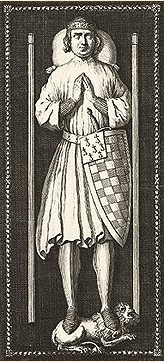
The Ætheling and the Tragedy of the White Ship

220px-Vilém_syn
William the Atheling

In the late summer of 1103 England’s queen, Matilda of Scotland, gave birth to a son. Named after his grandfather, William the Conqueror, the young prince would be known to history as William the Ætheling. He is one of those historical figures who resides in the shadows, more famous for his death than his all-too-short life as the heir to England’s throne.

William’s father, Henry, was a younger son of William the Conqueror and Matilda of Flanders. When his father had died in 1087, the patrimony of England and Normandy was divided between Henry’s older brothers; the eldest, Robert Curthose, inherited Normandy while William II Rufus became King of England. Henry was given money and lands. It has been said that Henry was intended for a life in the church; however, when his father died, Henry was already 18 and would have joined the church as a child if that was the career set out for him. Instead, the little brother seems to have set his sights on greater things and, as a result, was distrusted by William II, who kept him close, so he could not cause any mischief.

On 2 August, 1100, while out hunting in the New Forest, William was struck by a stray arrow and killed. Some say it was planned, others that it was an accident; I guess we’ll never know for sure…

Henry, however, did not waste the opportunity. With his older brother Robert still on his way back from Crusading in the Holy Land, Henry seized the initiative, the treasury and the kingdom; he was crowned at Westminster Abbey just 3 days after his brother’s death. Within months Henry had found himself a bride with impeccable parentage. Matilda had been born Edith of Scotland and was the daughter of Malcolm III, King of Scots. Through her mother, St Margaret, she was the great-granddaughter of Edmund II Ironside, the Anglo-Saxon king of England who died in 1016. She changed her name on marrying Henry, as Edith was considered ‘too Saxon’ for Norman tastes.

Matylda_zena
Matilda of Scotland

Henry and Matilda were married in November 1100 and within 3 years were the proud parents of 2 children. Their daughter, Adelaide, was born in 1102; she would adopt the name Matilda on her marriage to the Holy Roman Emperor, Henry V, and would be known to history as the Empress Matilda (or Maud, though this appears to have been a later nickname). Although some historians suggest they were twins, it is most likely that Matilda’s younger brother, William, was born in 1103; a message of congratulations was sent to Henry I by Pope Paschal II on 23 November of that year.

The soubriquet of Ætheling is attributed to chronicler Orderic Vitalis and harks back to Anglo-Saxon times as a title given to the king’s designated heir. According to William of Malmesbury, William, with an Anglo-Saxon mother and Norman father, represented the hope of reconciliation between the conquered and conquerors of England.

Although the king and queen had only 2 children – a possible third child is thought to have died young – the king had numerous illegitimate offspring by various women, several of whom were raised alongside his legitimate children. William and a number of his illegitimate brothers, including Robert, Earl of Gloucester, were tutored by Otuel (or Othuer) fitzEarl, natural son of Hugh, Earl of Chester. fitzEarl had been made castellan of the Tower of London and so it is likely that the prince and his brothers were frequently in residence there, in order to pursue their education.

330px-Empress_Mathilda
William’s sister, Empress Matilda

According to William of Malmesbury, William was trained for his future role ‘with fond hope and immense care’. In 1108, while their father was away in Normandy, William and his sister were entrusted to the spiritual care of Anselm, the revered Archbishop of Canterbury.

In 1110 William’s sister, Matilda, left for Germany; she was to continue her education at the court of her future husband, but would not be married until January 1114, just before her 12th birthday. William was still only 6 years old when his sister left; Matilda was 8. It’s sad to think the young siblings would never meet again.

Following his sister’s departure, William’s education continued apace. By 1113, aged just 10, William began to attest royal documents. While still only 9, in February of that year, William was betrothed, at Alençon, to Alice (who changed her name to Matilda on her marriage), the daughter of Fulk V, count of Anjou and Maine. The betrothal formed part of his father’s wider diplomacy, which had also included his sister’s marriage to the Holy Roman Emperor.

Henry I spent the early part of his reign fighting against his brother, Robert Curthose, and, later, Robert’s son, William Clito, trying to secure a smooth succession for William. Robert had been decisively defeated at Tinchebrai in 1106 and spent his remaining years – until his death in 1134 – a prisoner of his brother. Henry subsequently claimed Normandy for the English crown, but William Clito was still a thorn in his side. Clito was supported by the French king, Louis VI; who used him as a counter to Henry’s attempts to conquer Maine.

345px-Henry1
Henry I

In 1115, according to the Anglo-Saxon Chronicle, Henry arranged for the Norman barons to do homage and swear fealty to William, in an attempt to counter the claims of William Clito. A similar ceremony was arranged in England in 1116, for all the great men and barons of England to swear fealty to William as the king’s heir. The Warenne (Hyde) Chronicle referred to William as ‘rex Norman-Angllorum, ut putabatur futurus’ (assumed to be the future king of the Norman-English).

On 1st May 1118 William’s mother, Queen Matilda, died at Westminster and was laid to rest in Westminster Abbey. We do not know how the young prince felt at the loss of his mother – he was 15 at the time. However, it is from this point that William took on more responsibility, acting as regent whenever the king was away in Normandy.

In December 1118 Henry’s troops defeated the Angevins, under Fulk of Anjou, at Alençon. To counteract the defeat, William and Alice/Matilda of Anjou were married, with the Count settling Maine on them as their marriage gift, thus deserting the cause of the French king. Inevitably, war with Louis VI followed.

On 20 August 1119, 16-year-old William was with his father at the Battle of Brémule. Henry won the fight against the forces of Louis VI of France and William Clito. During the battle, William had captured the palfrey of his cousin, William Clito, which he chivalrously returned at the end of the battle.

In the same year William witnessed a charter at Rouen, in which he was described as ‘dei gratia, rex designatus’ (by the grace of God, king designate). And continuing his education in diplomacy, in November 1119, William accompanied his father to a meeting with Pope Calixtus II, (William’s second cousin once removed).

330px-Sceau_de_Louis_VI
Louis VI of France

At the turn of the year, it must have seemed to Henry that his dynasty – and the future of England – was secure in the hands of his son; at the age of 16 he was experienced in warfare and diplomacy and married to Matilda, though she was probably still under 10 years of age, who brought with her the county of Maine as her marriage portion (and the promise of Anjou should her father die whilst on Crusade).

In 1120 peace was finally achieved with France, with William being created Duke of Normandy by his father, and paying homage for the duchy to King Louis; a precedent that would be used  by future English kings, in order to avoid a king paying homage to a fellow king for part of his holdings. William, in turn, then received the homage of the Norman barons. Accompanied by his father, wife and several of his half brothers and sisters, it must have been a time of great rejoicing and festivities.

The final entry of the Warenne (Hyde) Chronicle set the scene:

At last King Henry restored peace with his diligence and money and decided to come to England with much triumph and joy, but God omnipotent, who, just as the blessed Job says, ‘loosens the belt of kings, and girds their kidneys with a rope’, out of his just judgment turned the king’s joy into grief and victory into sorrow. Having descended with his two sons, William and Richard, and with Theobald count of Blois, his nephew, and with many relatives and a crowd of nobles, to the seaport, called Barfleur, on the designated day he began to board his ship with favourable winds and a prosperous sea…

The Warenne (Hyde) Chronicle, edited by Elisabeth m.C. Van Houts and Rosalind C. Love

Indeed, when the large party prepared to cross the Channel, to return to England, it seems several of them were still celebrating. While Henry made the crossing in his own ship, taking with him several nobles and his daughter-in-law, the prince took the offer of a newly built ship, the Blanche Nef – or White Ship – which its owner, Thomas fitzStephen, claimed would guarantee a swift, safe passage. William the Ætheling was accompanied by many of the young nobles of the great families of England, including his half-sister, Matilda, and half-brother, Richard of Lincoln.

WhiteShipSinking
The Sinking of the White Ship

Most of the passengers and crew were still drunk from celebrating when the ship finally left the harbour of Barfleur, in the dark, on the evening of 25 November, 1120. Oderic Vitalis described the scene:

At length he gave the signal to put to sea. Then the rowers made haste to take up their oars and, in high spirits because they knew nothing of what lay ahead, put the rest of the equipment ready and made the ship lean forward and race through the sea. As the drunken oarsmen were rowing with all their might, and the luckless helmsman paid scant attention to steering the ship though he sea, the port side of the White Ship struck violently against a huge rock, which was uncovered each day as the tide ebbed and covered once more at high tide. Two planks were shattered and, terrible to relate, the ship capsized without warning. Everyone cried out at once in their great peril, but the water pouring into the boat soon drowned their cries and all alike perished.

William was ushered into a small boat and was being rowed to safety when he is said to have heard the cries of his half-sister, Matilda. The prince insisted on rowing to her aid, but the little boat was overwhelmed by those trying to make it to safety, and capsized, taking everyone with it.

Vitalis, Oderic, The Ecclesiastical History of Oderic Vitalis.

William the Ætheling was 17-years-old.

With only one survivor, a butcher from Rouen, over 300 souls were lost – drowned – and only a handful of bodies were ever recovered. With the sinking of the White Ship Henry I lost his son; England and Normandy lost their next ruler.

Young Matilda had lost her husband. Still only a child, Matilda had made the crossing of the Channel with the King, rather than her husband, and sometime after the disaster she returned to her father’s court. In 1121 Matilda became a nun, eventually becoming abbess of the convent at Fontevrault. She died in 1158.

With the uncertainty that followed, Louis VI renewed his support of William Clito, who continued to be a thorn in Henry I’s side until his death fighting in Flanders in 1128. Henry himself, in the hope of producing another son, married  again in 1121; to Adeliza of Louvain. Unfortunately, the marriage proved childless and Henry spent the final years of his reign trying to secure the throne for his daughter, Matilda. Empress Matilda had returned to Henry’s court in England following the death of her husband in 1125 and was married again,  in 1128, to Geoffrey, Count of Anjou – the brother of Matilda of Anjou – in the hope that the union would strengthen her claim to the throne.

In the end, however, despite the fact Henry had made the barons of England swear fealty to Matilda as his successor Henry’s nephew, Stephen, claimed the throne on the old king’s death in 1135; thus ushering in 19 years of warfare, an era which became known as The Anarchy.

Reading_Abbey_03
Chapter house of Reading Abbey

William’s death was a tragedy, not only on a national scale, but also a personal one, for Henry I. According to the Anglo-Saxon Chronicle the disaster was ‘a double grief: first that they lost their lives so swiftly; second that few of their bodies were found afterwards’. The young prince’s body was never recovered, leaving no monument to his life, save for Reading Abbey, established as a priory – and later an abbey – in 1121 by Henry I,

‘for the salvation of my soul and that of king William my father and king William my brother and William my son and queen Matilda my mother and queen Matilda my wife and all of my predecessors and successors.’

*

Sources: oxforddnb.com; Oderic Vitalis, The Ecclesiastical History of Orderic Vitalis; Donald Matthew, King Stephen; Robert Bartlett, England Under the Norman and Angevin Kings; David Williamson, Brewer’s British Royalty; the History Today Companion to British History; Dan Jones, the Plantagenets; englishmonarchs.co.uk; The Oxford Companion to British History Edited by John Cannon; Mike Ashley, The Mammoth Book of British kings & Queens; Alison Weir, Britain’s Royal Families, the Complete Genealogy; medievalilsts.net; The Plantagenet Chronicles Edited by Elizabeth Hallam; The Warenne (Hyde) Chronicle, edited by Elisabeth Van Houts and Rosalind C. Love .

*

Pictures courtesy of Wikipedia

*

My Books

Signed, dedicated copies of all my books are available through my online bookshop.

Out now! Scotland’s Medieval Queens

Books by Sharon Bennett Connolly

Scotland’s history is dramatic, violent and bloody. Being England’s northern neighbour has never been easy. Scotland’s queens have had to deal with war, murder, imprisonment, political rivalries and open betrayal. They have loved and lost, raised kings and queens, ruled and died for Scotland. From St Margaret, who became one of the patron saints of Scotland, to Elizabeth de Burgh and the dramatic story of the Scottish Wars of Independence, to the love story and tragedy of Joan Beaufort, to Margaret of Denmark and the dawn of the Renaissance, Scotland’s Medieval Queens have seen it all. This is the story of Scotland through their eyes.

Scotland’s Medieval Queens gives a thorough grounding in the history of the women who ruled Scotland at the side of its kings, often in the shadows, but just as interesting in their lives beyond the spotlight. It’s not a subject that has been widely covered, and Sharon is a pioneer in bringing that information into accessible history.’ Elizabeth Chadwick (New York Times bestselling author)

Available now from Amazon and Pen and Sword Books

Also by Sharon Bennett Connolly:

Books by Sharon Bennett Connolly

Heroines of the Tudor World tells the stories of the most remarkable women from European history in the time of the Tudor dynasty, 1485-1603. These are the women who ruled, the women who founded dynasties, the women who fought for religious freedom, their families and love. Heroines of the Tudor World is now available for pre-order from Amberley Publishing and Amazon UK. Women of the Anarchy demonstrates how Empress Matilda and Matilda of Boulogne, unable to wield a sword themselves, were prime movers in this time of conflict and lawlessness. It shows how their strengths, weaknesses, and personal ambitions swung the fortunes of war one way – and then the other. Available from Bookshop.orgAmberley Publishing and Amazon UKKing John’s Right-Hand Lady: The Story of Nicholaa de la Haye is the story of a truly remarkable lady, the hereditary constable of Lincoln Castle and the first woman in England to be appointed sheriff in her own right. Available from all good bookshops Pen & Sword Booksbookshop.org and Amazon

Royal Historical Society

Defenders of the Norman Crown: The Rise and Fall of the Warenne Earls of Surrey tells the fascinating story of the Warenne dynasty, from its origins in Normandy, through the Conquest, Magna Carta, the wars and marriages that led to its ultimate demise in the reign of Edward III. Available from Pen & Sword BooksAmazon in the UK and US, and Bookshop.orgLadies of Magna Carta: Women of Influence in Thirteenth Century England looks into the relationships of the various noble families of the 13th century, and how they were affected by the Barons’ Wars, Magna Carta and its aftermath; the bonds that were formed and those that were broken. It is now available in paperback and hardback from Pen & SwordAmazon, and Bookshop.orgHeroines of the Medieval World tells the stories of some of the most remarkable women from Medieval history, from Eleanor of Aquitaine to Julian of Norwich. Available now from Amberley Publishing and Amazon, and Bookshop.orgSilk and the Sword: The Women of the Norman Conquest traces the fortunes of the women who had a significant role to play in the momentous events of 1066. Available now from Amazon,  Amberley Publishing, and Bookshop.org.

Alternate Endings: An anthology of historical fiction short stories including Long Live the King… which is my take what might have happened had King John not died in October 1216. Available in paperback and kindle from Amazon.

Podcast:

A Slice of Medieval

Have a listen to the A Slice of Medieval podcast, which I co-host with Historical fiction novelist Derek Birks. Our very first episode was on The Anarchy. Derek and I welcome guests, such as Bernard Cornwell, and discuss a wide range of topics in medieval history, from significant events to the personalities involved.

There are now over 75 episodes to listen to!

Every episode is also now available on YouTube.

*

Don’t forget! Signed and dedicated copies of all my books are available through my online bookshop.

For forthcoming online and in-person talks, please check out my Events Page.

You can be the first to read new articles by clicking the ‘Follow’ button, liking our Facebook page or joining me on TwitterThreadsBluesky and Instagram.

*

©2016 Sharon Bennett Connolly FRHistS
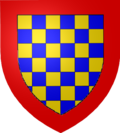
Bessie, Mother of the King’s Son

Effigy of Elizabeth Blount

Elizabeth Blount was born around 1500 in Kinlet in Shropshire, to John Blount of Kinlet and his wife Katherine, daughter of Sir Hugh Pershall of Knightley. There is some confusion as to whether she was her parent’s first child, but it is likely that she was their eldest daughter. Elizabeth (Bessie) was born at Kinlet Hall, but probably grew up at Bewdley, Worcestershire, where the family had moved to shortly after her birth.

Her family lived close to Ludlow and several relatives were employed in the household of Henry VII’s eldest son, Arthur, Prince of Wales. It may well be through her family’s connection to the Prince of Wales’ household that Elizabeth achieved her position at court. It is also likely that her distant cousin, Lord Mountjoy affected the introduction.

However it was achieved, it is possible that Elizabeth was at court by the time she was 12 years old, as a Maid of Honour to the queen, Katherine of Aragon. She was definitely at court by Christmas 1514, when Elizabeth partnered the King, Henry VIII, in the entertainments as Queen Katherine was recovering from childbirth and the loss of the child.

Elizabeth was described as golden-haired, blue-eyed, lively and merry. She was an accomplished dancer and able to play and compose music. She is believed to have composed the following lines during her relationship with Henry:

While life and breath is in my brest, My sovereign lord I shall love best.¹

Workshop_of_Hans_Holbein_the_Younger_-_Portrait_of_Henry_VIII_-_Google_Art_Project
Henry VIII

Most historians agree that Bessie’s relationship with the king was most likely of a short duration, probably lasting just a few months in the summer of 1518. In those days, Henry was still hopeful of he and Katherine having a son and heir and so its possible he only strayed from the queen’s bed when she was pregnant, and therefore unavailable.

In October 1518, Elizabeth Blount took part in the festivities to celebrate the betrothal of 2-year-old Princess Mary to the French Dauphin; Elizabeth danced in the ‘mummery’ with the king’s sister, Mary. Possibly already pregnant with Henry’s child, it was to be her last appearance at court.

As soon as Elizabeth’s condition was known, it seems, she was sent away from court and settled at the Augustinian Priory of St Laurence, in Blackmore, near Chelmsford, Essex. Bessie was far enough away to be protected from prying eyes, but close to the king’s manor of Newhall that he would have been able to pay private visits to his mistress. Henry had given his right-hand man, Cardinal Thomas Wolsey, charge of the arrangements. Wolsey took care of everything, even standing as godfather when the baby arrived, and ensuring he was baptised Henry, after his father.

Horenbout_HenryFitzRoy
Henry Fitzroy

Elizabeth’s little boy, Henry Fitzroy, was born in the summer of 1519. He would be raised in his own establishment, being educated as a prince – albeit an illegitimate one. Elizabeth had little involvement in his day-to-day care, although she seems to have been consulted by his tutors, and 2 of her brothers, George and Henry Blount, were given positions in the child’s household. Elizabeth did send her son gifts from time-to-time; in 1531 she sent him a white satin doublet and 2 horses. Her younger sons would also be given young Henry’s cast-off clothes, once he’d grown out of them.

Elizabeth didn’t return to court after the birth; within a few months she was married to one of Wolsey’s wards. Cardinal Wolsey had taken over the wardship Gilbert Tailboys of Kyme when his father’s mental health went into decline. Sir George Tailboys had been declared a lunatic in 1517 and his lands were being administered for him. The Cardinal arranged the marriage with Gilbert, who was only 2 or 3 years older than Elizabeth; they were married sometime in late 1519 or early 1520.

The marriage was a great prize for Elizabeth. The Tailboys were a wealthy family, related to the earls of Northumberland through Gilbert’s mother, Elizabeth Gascoigne, and with lands spread as far away as Northumberland and Somerset – and various places between. The couple settled on the Tailboys family estates in Lincolnshire. King Henry ensured that property from the Tailboys estates, worth £200 per annum, was settled on Elizabeth for her lifetime. The king’s favour continued throughout Elizabeth’s lifetime, by way of gifts and land grants.

330px-Tailboys_of_Kyme
The Tailboys family crest

By the end of 1520 Gilbert and Elizabeth had their first child, a daughter, Elizabeth. There is some speculation that young Elizabeth could also be the king’s child; however, the fact that Henry never claimed her as his own, when he so readily did with young Henry, seems to suggest that Gilbert was the father. Two more children, George and Robert, were born before 1525.

In 1525 Elizabeth’s son, Henry Fitzroy, now a blond, robust 6-year-old, was created Duke of Richmond and Somerset by his father, the king. It’s not known whether Elizabeth attended the accompanying celebrations, however, but her husband, Gilbert, was knighted at about the same time.

The king was now despairing of having a legitimate son by his queen, and so was looking at strengthening young Fitzroy’s position as his son, if not his heir. Fitzroy was proof that the king could provide male children, even if the queen could not. There was talk of making the young duke King of Ireland and Henry had even sent ambassadors into Europe in hope of finding a foreign princess as a bride for the child.

On 15 April 1530 Gilbert Tailboys died; according to sources, he was buried at South Kyme. Elizabeth was left a widow with 3 small children, although her lifetime interest in the Tailboys estates meant she was financially secure. Her young son, George, inherited his father’s title, becoming Baron Tailboys of Kyme. Young George would go on to marry Margaret Skipwith in 1539, but he died the following year, aged about 18. He was succeeded by his younger brother, Robert, as the 3rd Baron, but he died in 1541, still only in his mid-teens.

4555190447_b0021642e2
Funeral brass of Elizabeth Blount

The boys’ older sister, Elizabeth, would then become the 4th Baroness Tailboys. She married, firstly, Thomas Wymbish of Nocton. Not only was the marriage childless but it appears to have been an unhappy union and Thomas left his wife little in his will. In 1553 Elizabeth made a more exalted second marriage with Ambrose Dudley, Earl of Warwick and son of John Dudley, Duke of Northumberland. However, this union was also childless and the Barony of Tailboys of Kyme became extinct on Elizabeth’s death in 1563.

Following Gilbert’s death Elizabeth Blount was courted by Lord Leonard Grey, son of the Marquess of Dorset and cousin to the king. Grey visited Elizabeth in Lincolnshire and, following the visited, wrote to the king’s minister, Thomas Cromwell, asking for him to approach Elizabeth on Grey’s behalf. In 1532 Lord Grey told Cromwell that he would “rather obtain that matter than to be made lord of as much goods and lands as any noble man within this realm”². Despite Cromwell’s backing, however, and the acquiescence of the king,  Elizabeth turned him down.

Elizabeth married again on 12 February 1535. Her second husband was Edward Fiennes de Clinton, 9th Baron Clinton and Saye; he was about 12 years younger than Elizabeth and although his family had lands in Kent, he settled on Elizabeth’s Lincolnshire estates.

Hans_Holbein_the_Younger_-_Edward_Fiennes_de_Clinton,_9th_Lord_Clinton,_1st_Earl_of_Lincoln_RL_12198
Edward Fiennes de Clinton, 9th Baron Clinton and Saye

Only a year after the marriage Elizabeth’s eldest son, Henry Fitzroy, Duke of Richmond, died. Richmond had been married in 1533, to Mary Howard, a younger daughter of the Duke of Norfolk, though the marriage was never consummated due to the young couple’s tender ages. Young Henry passed away on 23 July 1536 after a 2-week illness, aged only 17. The cause of death was a pulmonary infection, possibly tuberculosis. He was buried, with little ceremony, in Thetford Priory; the king did not want to draw attention to the loss of  his only son, legitimate or not.

Elizabeth was to have 3 more children with Edward Fiennes de Clinton; all girls. The eldest, Bridget, was born around 1536 and would marry Sir Robert Dymoke of Scrivelsby, Lincolnshire, a nephew of Gilbert Tailboys through his mother, Anne Tailboys. A second daughter, Katherine, was born around 1538 and married William, 2nd Lord de Burgh of Gainsborough, Lincolnshire, former brother-in-law of Henry VIII’s last queen, Katherine Parr. Their last daughter, Margaret, was born around 1539 and would go on to marry Charles Willoughby, 2nd Baron Willoughby of Parham.

Elizabeth continued to receive the king’s favour even into her second marriage; although her husband did not share in the privilege. Land grants were made jointly to Elizabeth and her son George, but excluded Edward. Elizabeth returned to court, briefly in 1540, as lady-in-waiting to Henry’s 4th queen, Anne of Cleves, but seems to have withdrawn to her estates due to illness.

330px-South_Kyme_Church_-_geograph.org.uk_-_418304

The date of Elizabeth’s death, and the cause of her final illness, remains unknown. Given that her eldest son, George, died in 1540, she may have had to suffer one last bereavement before her own death, sometime in 1540 or early 1541; leaving her teenage children and 3 very young daughters, the youngest possibly still in the cradle. By June 1541 Edward Clinton had remarried. He would go on to marry a third time and gain rewards and titles under Elizabeth I, becoming Earl of Lincoln in 1572.

Elizabeth Blount’s final resting place has been lost to history. Although there was a brass plaque – now in a private collection – commemorating her and her husband, Gilbert Tailboys, in St Mary and All Saints Church, South Kyme, it seems that only Gilbert is buried there.³

*

Footnotes: ¹Amy Licence, In Bed with the Tudors: ²Beverley A Murphy, Bastard Prince: Henry VIII’s Lost Son; ³Thanks to Georgina Faye Carter

*

Pictures courtesy of Wikipedia, except Effigy of Elizabeth Blount ©BNPS,co,uk and funeral brass courtesy of flickriver.

*

Sources: In Bed with the Tudors by Amy Licence; Bastard Prince: Henry VIII’s Lost Son by Beverley A Murphy; oxforddnb.com; The Life and Times of Henry VIII by Robert Lacey; England Under the Tudors by Arthur D Innes; The Earlier Tudors 185-1558 by JD Mackie.

*

My books

Signed, dedicated copies of all my books are available through my online store.

Out now: Scotland’s Medieval Queens

Books by Sharon Bennett Connolly

Scotland’s history is dramatic, violent and bloody. Being England’s northern neighbour has never been easy. Scotland’s queens have had to deal with war, murder, imprisonment, political rivalries and open betrayal. They have loved and lost, raised kings and queens, ruled and died for Scotland. From St Margaret, who became one of the patron saints of Scotland, to Elizabeth de Burgh and the dramatic story of the Scottish Wars of Independence, to the love story and tragedy of Joan Beaufort, to Margaret of Denmark and the dawn of the Renaissance, Scotland’s Medieval Queens have seen it all. This is the story of Scotland through their eyes.

Scotland’s Medieval Queens gives a thorough grounding in the history of the women who ruled Scotland at the side of its kings, often in the shadows, but just as interesting in their lives beyond the spotlight. It’s not a subject that has been widely covered, and Sharon is a pioneer in bringing that information into accessible history.’ Elizabeth Chadwick (New York Times bestselling author)

Available now from Amazon and Pen and Sword Books

Also by Sharon Bennett Connolly:

Books by Sharon Bennett Connolly

Heroines of the Tudor World tells the stories of the most remarkable women from European history in the time of the Tudor dynasty, 1485-1603. These are the women who ruled, the women who founded dynasties, the women who fought for religious freedom, their families and love. Heroines of the Tudor World is now available from Amberley Publishing and Amazon UK. Women of the Anarchy demonstrates how Empress Matilda and Matilda of Boulogne, unable to wield a sword themselves, were prime movers in this time of conflict and lawlessness. It shows how their strengths, weaknesses, and personal ambitions swung the fortunes of war one way – and then the other. Available from Bookshop.orgAmberley Publishing and Amazon UKKing John’s Right-Hand Lady: The Story of Nicholaa de la Haye is the story of a truly remarkable lady, the hereditary constable of Lincoln Castle and the first woman in England to be appointed sheriff in her own right. Available from all good bookshops Pen & Sword Booksbookshop.org and Amazon

Defenders of the Norman Crown: The Rise and Fall of the Warenne Earls of Surrey tells the fascinating story of the Warenne dynasty, from its origins in Normandy, through the Conquest, Magna Carta, the wars and marriages that led to its ultimate demise in the reign of Edward III. Available from Pen & Sword BooksAmazon in the UK and US, and Bookshop.orgLadies of Magna Carta: Women of Influence in Thirteenth Century England looks into the relationships of the various noble families of the 13th century, and how they were affected by the Barons’ Wars, Magna Carta and its aftermath; the bonds that were formed and those that were broken. It is now available in paperback and hardback from Pen & SwordAmazon, and Bookshop.orgHeroines of the Medieval World tells the stories of some of the most remarkable women from Medieval history, from Eleanor of Aquitaine to Julian of Norwich. Available now from Amberley Publishing and Amazon, and Bookshop.orgSilk and the Sword: The Women of the Norman Conquest traces the fortunes of the women who had a significant role to play in the momentous events of 1066. Available now from Amazon,  Amberley Publishing, and Bookshop.org.

Alternate Endings: An anthology of historical fiction short stories including Long Live the King… which is my take what might have happened had King John not died in October 1216. Available in paperback and kindle from Amazon.

Podcast:

Have a listen to the A Slice of Medieval podcast, which I co-host with Historical fiction novelist Derek Birks. Derek and I welcome guests, such as Bernard Cornwell and Michael Jecks, and discuss a wide range of topics in medieval history, from significant events to the personalities involved. 

Every episode is also now available on YouTube.

*

Don’t forget! Signed and dedicated copies of all my books are available through my online store.

For forthcoming online and in-person talks, please check out my Events Page.

You can be the first to read new articles by clicking the ‘Follow’ button, liking our Facebook page or joining me on TwitterThreadsBluesky and Instagram.

©2016 Sharon Bennett Connolly FRHistS
The Colourful Career of Edward, 2nd Duke of York

Edward_of_Norwich_Duke_of_York
Edward, 2nd Duke of York

Edward of Norwich, 2nd Duke of York, was born into wealth and privilege. Grandson of 2 kings and 1st cousin to 2 kings, his life story is full of ambition, glory and war, duty and service – and a hint of treason. All the ingredients needed for a rollicking good novel; with also the possibility of a strange love story.

Edward was born, probably at King’s Langley, in about 1373. A birthday of 1375 has also been suggested, but 1373 seems most likely. The fact he has Norwich after his name has suggested he could have been born there, but there is a theory that it is a derivation of “d’Everwick”, meaning “of York”.

Edward’s father was Edmund of Langley, 1st Duke of York and 5th son of Edward III and Philippa of Hainault. His mother was Isabella of Castile, daughter of Pedro the Cruel, king of Castile, and his mistress – and later, wife – Maria de Padilla. Although the couple had 3 children, their marriage doesn’t appear to have been a happy one and there were rumours of scandal surrounding Isabella, with a question mark raised over the paternity of her youngest son, Richard of Conisbrough. Edward also had a sister, Constance, who was close in age to him and born around 1374.

220px-Edward_III_of_England_(Order_of_the_Garter)
Edward III

Edward was born into a time of great change in the English monarchy. His grandmother, Philippa, had died in 1369 and his grandfather, Edward III, king since 1327, was slipping into senility, allowing his mistress, Alice Perrers, and her cohorts too much control of his affairs. In 1376 Edward’s eldest son and heir – and England’s hero of the time – Edward, the Black Prince, died after years of debilitating illness. The prince’s death broke the old king,  who died the following year, leaving his 10-year-old grandson Richard of Bordeaux, son of the Black Prince, as king.

The government – and the country – was largely in the hands of Edward and Richard’s uncle, John of Gaunt, Duke of Lancaster. John was the 4th son of Edward III and married to Edward of Norwich’s aunt, Constance of Castile. It was a time of uncertainty; many feared John would usurp the crown for  himself, but he stayed loyal to his nephew and Richard was crowned as King Richard II.

At only 4 years old Edward of Norwich attended the coronation, receiving his knighthood as part of the celebrations. Edward would be a loyal supporter of Richard II and received numerous royal grants, including the title of Earl of Rutland in February 1390. He was also given the title Earl of Cork when he accompanied Richard on his Irish campaign in 1394/5, leading several successful missions.

In the 1390s Edward emerged as a leading member of Richard’s circle of intimates. A man of considerable ability, Richard named him “the most able,wise and powerful man that he could think of”¹ and is even said to have considered leaving his crown to Edward. After the death of Richard’s queen, Anne of Bohemia, in 1394, Edward was one of the 3 feoffees of her estate, allowing him control of considerable patronage.

Arms_of_Edward_of_Norwich.svg
Arms of Edward of Norwich

Richard practically showered Edward with lucrative positions, including: admiral of the North & West (1391), Constable of Dover and Warden of the Cinque Ports (1396), Constable of the Tower of London (1397) and Constable of England (1398). He was also involved in the king’s diplomacy in France and the Holy Roman Empire, undertaking diplomatic missions to both.

Richard even took personal interest in Edward’s marriage prospects. In 1381 Edward had been betrothed to Beatriz of Portugal as part of the Anglo-Portuguese alliance against Castile. However, when the Portuguese made peace with Castile, Beatriz was married to Juan I of Castile instead.

Richard II suggested the sister-in-law of Giangaleazzo Visconti of Milan and also considered 3 relatives of Charles VI of France before suggesting Jeanne de Valois, younger sister of Richard’s proposed bride, Isabelle de Valois. Edward was addressed as ‘the king’s brother’ in recognition of their proposed marriages to sisters, even long after Edward’s planned marriage had fallen through.

By October 1398 Edward was married. His bride was a very curious choice for England’s most eligible bachelor. At 25 and likely to inherit his father’s dukedom in the not-too-distant future, Edward must surely have had the choice of every heiress in the kingdom of marriageable age. And yet his bride was twice widowed, 20 years his senior and with no dowry or inheritance to speak of.

PhilippaMohun_Died1431_WestminsterAbbey_ByStothard
Effigy of Philippa Mohun, Duchess of York, from her tomb in Westminster Abbey

Philippa was the 3rd daughter of John Mohun, 2nd Baron Mohun and a founding member of the Order of the Garter, and his wife Joan Burghersh. She had first been married to Walter Fitzwalter, 3rd Baron Fitzwalter, who died in 1386 and secondly to Sir john Golafre who died in 1396. Having no male heirs, Philippa’s mother had sold the reversion of the Mohun estates to Lady Elizabeth Luttrell, leaving her daughters with no landed inheritance.

The fact this was hardly a glittering match for such an illustrious magnate greatly suggests that it was a love match. And, as with Philippa’s previous 2 marriages, the union was to remain childless; Edward would eventually name his young nephew as his heir.

While Edward was finalising the domestic arrangements for his new bride, England was falling into turmoil. Richard II had imprisoned one uncle Thomas of Woodstock, Duke of Gloucester, in Calais and was distrustful of another uncle, John of Gaunt.

In the 2nd half of the 1380s Gloucester and the Lords Appellants had been the focus of opposition against Richard’s personal rule and had attempted to curb the king’s excesses, forcing restrictions to his rule. John of Gaunt had restored order following his return from campaigning in Spain, but in 1397 Gloucester was murdered whilst imprisoned in Calais, most likely on  Richard’s orders. It was said Edward had played a leading role in the arrest of Gloucester and the earls of Arundel and Warwick and he certainly benefited from the aftermath, receiving a significant share of the forfeitures that followed.

In September 1397 he was made Duke of Aumale and given the post of Constable of England – formerly held by Gloucester. As Constable, Edward would preside over Richard’s legal reforms, extending the court of chivalry to include treason and other offences which touched the king’s dignity.

220px-Richard_II_King_of_England
Richard II

Of the other 2 ringleaders of the Lords Appellant, Richard Fitzalan, earl of Arundel was beheaded and Thomas de Beauchamp, earl of Warwick was stripped of his titles and imprisoned on the Isle of Man. Two of the younger members of the Lords Appellants, Thomas of Mowbray, earl of Nottingham and Henry Bolingbroke earl of Derby, had initially escaped any severe retribution. However, in  1398 Richard found a pretext to exile them both from the country.

Bolingbroke was the son of the most powerful man in the kingdom – John of Gaunt – he was also cousin to both Richard II and Edward of Norwich. On Gaunt’s death in 1399, instead of passing his inheritance onto Bolingbroke, Richard appropriated it for the crown, putting some of the lands into Edward’s care – and extending his cousin’s exile to life.

Later that year Richard set off on campaign to Ireland, taking with him his cousin Edward and Bolingbroke’s 13-year-old son, Henry of Monmouth. We don’t know how Edward had reacted to his cousin Henry’s disinheritance, but it can’t have been an easy time for him, caught in the middle of his warring cousins, and he may have felt uneasy with the sudden change in Henry’s circumstances at the hands of the king. He later claimed that he had not drawn any of the revenues from the Lancastrian lands which had been put in his custody.

Whilst Richard was in Ireland Henry of Bolingbroke landed at Ravenspur in Yorkshire, announcing that he had returned only to claim his inheritance. While Richard headed back to England to face him, Henry was progressing through the country, gaining support. Edward advised Richard to send John Montague, Earl of Salisbury, into north Wales while Richard gathered his forces. Montague raised 4,000 men, but his force had disintegrated by the time the king arrived. On arriving in south Wales, Richard had immediately pressed northwards, leaving Edward and his main force behind him.

170px-King_Henry_IV_from_NPG_(2)
Henry IV

There seems to be some confusion as to Edward’s actions. He was reputedly attacked as he made his way through Wales, but by which side is unclear. He was said to be part of the delegation sent – by Bolingbroke – to Richard at Flint, wearing Bolingbroke’s livery.

Jean Creton, in his Histoire du Roy d’Angleterre Richard II, says Edward ‘said nothing to the king, but kept at as great a distance as he could from him’². Creton stated there was no man alive that Richard had loved better and depicted Edward as a Judas deliberately betraying his king in 1399.

However, the transition of power from Richard II to Henry IV was far from plain sailing for Edward. Henry and Edward were 1st cousins, but Edward was one of the key personalities of Richard’s tyrannical reign, and a focus for revenge. According to the chronicler, Thomas Walsingham, Edward came close to being lynched as tempers ran hot during Henry’s 1st parliament. Edward was accused of urging Gloucester’s murder, a claim he was forced to vehemently deny. Henry resisted calls for the death penalty for Richard’s adherents, and settled instead for punishment by the confiscation of all titles and rewards granted since 1397.

Edward was one of the greatest losers; he lost the constableships of England and the Tower of London and his manor of Burstwick was granted to the earl of Northumberland. He was no longer Duke of Aumale and back to being, simply, earl of Rutland. However, when parliament finished, Henry confirmed Edward’s custody of the Channel Islands and his lordship of the Isle of Wight, suggesting the new king had confidence in his cousin’s loyalty, even if parliament didn’t.

180px-Edmund_of_Langley_2C_Duke_of_York
Edmund of Langley, 1st Duke of York

By the end of 1399 Edward had become embroiled in the Epiphany Rising, the plot to murder Henry IV and his sons during a tournament at Windsor on Twelfth Night. Edward is said to have been a conspirator, but it was he who betrayed the plot to the king, and he was rewarded with the restoration of the lordship of Oakham in Rutland. The plot’s failure meant death for Richard II; Richard had been held at Pontefract Castle since his deposition, but the uncovering of the plot meant he was too dangerous to keep alive. He died around 14th February 1400, probably from starvation.

Edward served the Lancastrian dynasty in much the same way he had Richard II. In October 1400 he was appointed Keeper of North Wales and July 1401 he was dispatched to France as Henry’s lieutenant in Aquitaine, in response to an appeal from the archbishop of Bordeaux who described Edward as ‘the man closest to the king after the king’s sons’.

Whilst in Bordeaux Edward succeeded as the Duke of York, following his father’s death on 1st August 1402. In May of the following year Edward gave up his office to return to England and by the autumn he was campaigning in Wales. In October he was appointed the king’s lieutenant in south Wales for 1 year, but by November the appointment had been extended to 3 years.

Still owed money from his time in Aquitaine, and with Henry unable to meet the costs of the war in Wales, Edward was left in serious financial straits. His men were on the verge of mutiny. However, Edward was one of those rare commanders, who knew how to inspire men and command loyalty. Forced to mortgage his properties to release funds, he made a promise to his troops that, on his honour, he would receive none of his own revenues until they were paid.

The Duke of York’s duty in Wales stood  him in good stead in February 1405 after his sister, Constance, implicated him in a plot against the crown. York was imprisoned in Pevensey Castle for 17 weeks. But it was the Prince of Wales who came to his defence in parliament. Henry of Monmouth described Edward as “a loyal and valiant knight”.  Speaking of clashes against Owen Glendower, in  1407 Prince Henry said “If it had not been for the duke’s good advice and counsel he and others would have been in great peril and desolation.”

The_Master_of_Game_-_Buck_Hunting_With_Running_Hounds
1904 edition of Edward Duke of York’s “The Master of Game”

As far as the Prince of Wales was concerned, York “had laboured and served in such a way as to support and embolden all the other members of the company, as if he had been the poorest gentleman in the realm wishing to serve him in order to win honour and renown”.³

The Duke of York was an authority on hunting, translating the work Gaston Phebus, Count of Foix, Livre du Chasse” into English and adding several chapters himself. He dedicated the work, Master of Game to the Prince of Wales, the future Henry V. The book gives us a glimpse of the Duke of York’s personality and shows us why his men and peers thought so much of him:

“I ask of every person who reads this little treatise, or comes to hear of it, whatever their estate or condition, that in plain and simple language they will add to it anything they find useful and remove all that seems superfluous … so that this work may always grow through the advice and counsel of all hunters, and with this in mind, I tried to set out, as simply and clearly as I knew, what I understood of this craft, for the use and remembrance of all.”³

Edward and Prince Henry were particularly close. Edward was something of a mentor to the young Prince of Wales, as well as being his hunting master.

However, when Henry IV and the Prince of Wales quarreled over foreign policy, Edward sided with the king. In 1412 he accompanied the king’s 2nd son, Thomas, on campaign in France, to aid the Armagnacs against the Burgundians. Following the king’s death in 1413 he was preparing to defend Aquitaine in the June, and by August he was in Paris, negotiating a possible marriage between the new king, Henry V and Catherine of Valois.

220px-King_Henry_V_from_NPG
Henry V

Edward was back in England by October 1413, but was constantly involved in the diplomacy between England and France that led to Henry’s invasion of the country in 1415. In August 1415 Edward’s brother, Richard of Conisbrough, earl of Cambridge was executed for his involvement in the Southampton Plot to replace Henry V with his Mortimer cousin. For once, the Duke of York was above suspicion.

Shortly after the executions the fleet set sail for France and landed there on 13th August 1415. Almost immediately the army besieged Harfleur, finally taking the small town on 22nd September, but at great cost. During the siege dysentery had spread through the army, decimating Henry’s forces and leaving him with barely 6,000 men to continue the campaign.

As a result, Henry decided to make a run for Calais and safety, hoping to find a crossing of the River Somme whilst avoiding the French army amassing near Rouen. Edward, Duke of York, led the vanguard, taking part in several skirmishes from the harassing French troops and marching his men at an incredible pace. His men were starving and desperately ill – with more succumbing to dysentery every day.

Until they reached Agincourt.

According to historian Michael Jones, the Duke of York used his extensive hunting expertise to formulate the battle plan that would give Henry V the great victory that is still remembered today.

300px-Schlacht_von_Azincourt
Battle of Agincourt

His battle plan depended on a contingent of English archers being able to provoke the French into attacking down an enclosed valley, channelling them into the path of massed volley fire from a 2nd contingent of archers. The knights and men-at-arms would then enclose the survivors and destroy the remainder of the French army.

York was in the thick of the fighting, 90 men were killed defending his banner – the majority of the English casualties on the day. York fought valiantly but was killed as his helmet was smashed into his skull. His men protected their fallen leader’s body, preventing the French from breaking through the thin English line.

The London Chronicler wrote:

The Duke of York was slain,For his king he would not retreat, even by a foot, til his bascinet into his brain was brent [impaled].³

Edward Duke of York had led an illustrious and often controversial career. He had served 3 kings. He had written the first book on hunting in the English language. He could quote Chaucer, was a generous lord and a great military leader. The Chronicler of Godstow regarded him as a “second Solomon”. However, his reputation suffered damage during the Tudor era, when he was accused of being fat and dissolute – it was said he’d died at Agincourt after being suffocated in his armour because he was too heavy to rise after a fall.

330px-Fotheringhay_memorial_Edward_2nd_Duke_of_York
Elizabethan memorial to Edward, 2nd Duke of York

The reverence with which Henry treated Edward after his death proves the lie of the later propaganda. Edward’s will was honoured; his nephew Richard inherited his lands and title, gifts to his men were fulfilled, such as Sir John Popham who received armour, a horse and a life rent from one of the Duke’s manors.

Edward asked to be buried in the church at Fotheringhay, where he had recently founded a college of priests. He was laid to rest beneath the choir steps, the grave marked by a marble slab with his figure upon it, engraved in brass. A larger memorial was added in Elizabethan times.

Edward’s wife Philippa survived him by 16 years, spending her widowhood at Carisbrooke Castle as the Lady of the Isle of Wight. She died 17th July 1431 and was buried in Westminster Abbey.

Edward’s nephew Richard, 3rd Duke of York, would go on to challenge Henry VI for the throne, dying at the Battle of Wakefield in December 1460. His son Edward would take up the mantle and succeed as Edward IV in March 1461, just 3 months after his father’s death.

*

Footnotes: ¹ Given-Wilson quoted in Oxford Database of National Biography; ² Jean Creton Histoire du Roy d’Angleterre Richard II quoted in Oxford Database of National Biography; ³ 24 Hours at Agincourt by Michael Jones.

*

Pictures courtesy of Wikipedia

*

Sources: The Oxford Companion to British History Edited by John Cannon; The Plantagenets, the Kings who Made England by Dan Jones; History Today Companion to British History Edited by Juliet Gardiner and Neil Wenborn;  Brewer’s British Royalty by David Williamson; 24 Hours at Agincourt by Michael Jones; Agincourt: My Family, the Battle and the Fight for France by Ranulph Fiennes Britain’s Royal Families, the Complete Genealogy by Alison Weir; The Mammoth Book of British Kings and Queens by Mike Ashley; The Plantagenets, the Kings that made Britain by Derek Wilson;  englishmonarchs.co.uk; oxforddnb.com; britannica.com; upenn.edu.

*

My Books:

Signed, dedicated copies of all my books are available through my online store.

OUT NOW! Heroines of the Tudor World

Heroines of the Tudor World tells the stories of the most remarkable women from European history in the time of the Tudor dynasty, 1485-1603. These are the women who ruled, the women who founded dynasties, the women who fought for religious freedom, their families and love. These are the women who made a difference, who influenced countries, kings and the Reformation. In the era dominated by the Renaissance and Reformation, Heroines of the Tudor World examines the threats and challenges faced by the women of the era, and how they overcame them. From writers to regents, from nuns to queens, Heroines of the Tudor World shines the spotlight on the women helped to shape Early Modern Europe.

Heroines of the Tudor World is now available for pre-order from Amberley Publishing and Amazon UK.

Coming 30 January 2025: Scotland’s Medieval Queens

Scotland’s history is dramatic, violent and bloody. Being England’s northern neighbour has never been easy. Scotland’s queens have had to deal with war, murder, imprisonment, political rivalries and open betrayal. They have loved and lost, raised kings and queens, ruled and died for Scotland. From St Margaret, who became one of the patron saints of Scotland, to Elizabeth de Burgh and the dramatic story of the Scottish Wars of Independence, to the love story and tragedy of Joan Beaufort, to Margaret of Denmark and the dawn of the Renaissance, Scotland’s Medieval Queens have seen it all. This is the story of Scotland through their eyes.

Available for pre-order now.

Also by Sharon Bennett Connolly:

Women of the Anarchy demonstrates how Empress Matilda and Matilda of Boulogne, unable to wield a sword themselves, were prime movers in this time of conflict and lawlessness. It shows how their strengths, weaknesses, and personal ambitions swung the fortunes of war one way – and then the other. Available from Bookshop.orgAmberley Publishing and Amazon UKKing John’s Right-Hand Lady: The Story of Nicholaa de la Haye is the story of a truly remarkable lady, the hereditary constable of Lincoln Castle and the first woman in England to be appointed sheriff in her own right. Available from all good bookshops Pen & Sword Booksbookshop.org and AmazonDefenders of the Norman Crown: The Rise and Fall of the Warenne Earls of Surrey tells the fascinating story of the Warenne dynasty, from its origins in Normandy, through the Conquest, Magna Carta, the wars and marriages that led to its ultimate demise in the reign of Edward III. Available from Pen & Sword BooksAmazon in the UK and US, and Bookshop.org

Ladies of Magna Carta: Women of Influence in Thirteenth Century England looks into the relationships of the various noble families of the 13th century, and how they were affected by the Barons’ Wars, Magna Carta and its aftermath; the bonds that were formed and those that were broken. It is now available in paperback and hardback from Pen & SwordAmazon, and Bookshop.orgHeroines of the Medieval World tells the stories of some of the most remarkable women from Medieval history, from Eleanor of Aquitaine to Julian of Norwich. Available now from Amberley Publishing and Amazon, and Bookshop.orgSilk and the Sword: The Women of the Norman Conquest traces the fortunes of the women who had a significant role to play in the momentous events of 1066. Available now from Amazon,  Amberley Publishing, and Bookshop.org.

Alternate Endings: An anthology of historical fiction short stories including Long Live the King… which is my take what might have happened had King John not died in October 1216. Available in paperback and kindle from Amazon.

Podcast:

Have a listen to the A Slice of Medieval podcast, which I co-host with Historical fiction novelist Derek Birks. Derek and I welcome guests, such as Bernard Cornwell, and discuss a wide range of topics in medieval history, from significant events to the personalities involved.

*

Don’t forget! Signed and dedicated copies of all my books are available through my online store.

For forthcoming online and in-person talks, please check out my Events Page.

You can be the first to read new articles by clicking the ‘Follow’ button, liking our Facebook page or joining me on TwitterThreads and Instagram.

*

©2015 Sharon Bennett Connolly, FRHistS