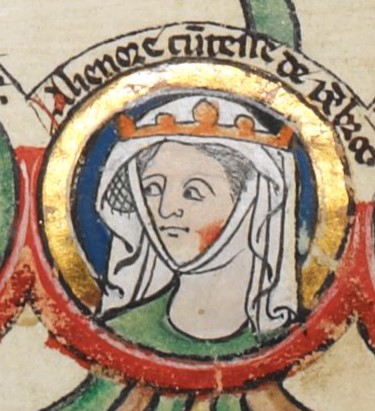
Ermengarde de Beaumont, Queen of Scots

History... the Interesting Bits
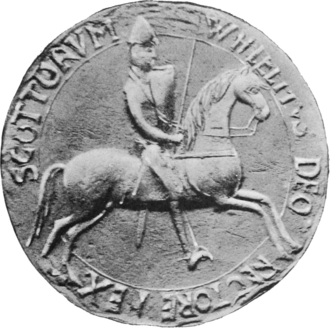
William I the Lion, King of Scots

Unusually for a king in medieval times, by 1185 William the Lion, King of Scots had been on the throne for 20 years, was past 40 and was still unmarried, despite having several illegitimate children. Until he married, William’s heir was his younger brother, David. Ironically, William’s mother, Ada de Warenne, who had been so keen to find a bride for her oldest son Malcolm IV that she was not above putting suitable girls in his bed, does not seem to have had the same sense of urgency with William. There’s no evidence that she pressured him to marry as she had his older brother. Though, I suppose, at least William had shown an interest in women and had the bastards to prove it.

And William was looking for a bride. Henry II, always happy to remind William that he was the Scots king’s overlord, exercised his right to choose William’s wife.

In May 1186, during a council at Woodstock, King Henry suggested Ermengarde de Beaumont as a bride for William. Ermengarde was the daughter of Richard, Vicomte de Beaumont-sur- Sarthe, who was himself the son of Constance, one of the many illegitimate daughters of King Henry I of England. With such diluted royal blood, she was hardly a prestigious match for the king of Scots. William felt slighted but he reluctantly accepted the marriage after consulting his advisers, the offer sweetened by a generous payment for the wedding celebrations and the return of two forfeited Scottish castles, as a wedding present.

History... the Interesting Bits
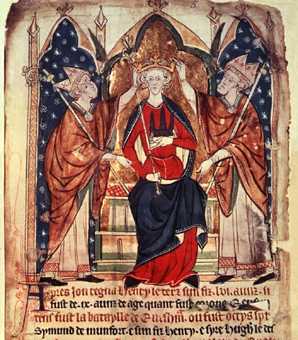
Henry II, King of England, Lincoln Cathedral

We have, of course, no record of Ermengarde’s thoughts on the marriage, nor of whether she was aware of the fact it was seen as an insult to the Scots king. The wedding was celebrated at Woodstock, conducted by the Archbishop of Canterbury, on 5 September 1186,

‘with great magnificence, on the nones of September [5th Sept.] (being the sixth day of the week [Friday], the moon being in her eighteenth day), in the royal chapel in the park at Woodstock, in the presence of the king himself.’1

Following the ceremony, King Henry hosted 4 days of festivities. Although we do not know Ermengarde’s birth date, at the time of the marriage, she was described as ‘a girl’, suggesting that she may have only just reached the age of 12, the minimum legal age girls could marry. It has been suggested that Ermengarde’s tender age may also have been the reason for William’s reluctance to marry her.

We do not know the year of birth of Ermengarde’s first child, a daughter named Margaret, but it was sometime between 1187 and 1195. Another daughter, Isabella, was born a year or two later. If Ermengarde gave birth to Margaret the year after her marriage, it seems highly likely that she was at least fourteen or fifteen years old at the time of her wedding. However, a later birthdate, in the 1190s would suggest that Ermengarde was younger at the time of her marriage and was given time to mature before bearing children. The king’s growing need for an heir would, perhaps, indicate that Ermengarde was old enough to bear children at the time of their marriage, and that describing the bride as ‘a girl’ was alluding to her youth, but not her actual age. Unfortunately, the vagaries of chroniclers means that we cannot say for certain

In the spring of 1195 King William fell gravely ill at Clackmannan, causing a succession crisis, the sum of his legitimate children being one, possibly two, daughters at this time – and no son. The Scottish barons deliberated a number of options, such as recognising William’s oldest legitimate daughter, Margaret, as his heir. They also considered marrying Margaret to Otto, Duke of Saxony, grandson of Henry II, and allowing Otto to succeed to the throne. The earl of Dunbar led a faction who claimed that both solutions were contrary to the custom of the land, so long as the king had a brother who could succeed him. Traditionally, the Scots throne had passed to the oldest, legitimate, male member of the royal family, rather than by primogeniture.

This must have been a worrying time for Ermengarde, not only for the health of her husband, but for her own status in Scotland, should her daughter be disinherited. Not to mention the concern that Margaret, then aged only 8 at the most, might be married at such a young age to secure the succession. In the event, the discussion was moot as the king recovered from his illness and three years later the queen gave birth to Alexander, the much-desired son and heir.

History... the Interesting Bits
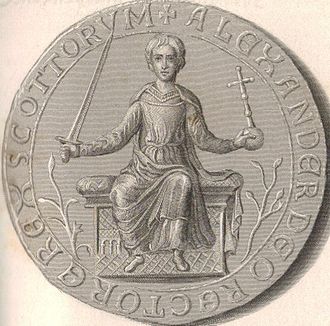
Alexander II, King of Scots

Chronicler John of Fordun described the relief and celebration felt throughout the country at the birth of the heir to the Scots throne:

‘Now this most fortunate king of Scotland, William, had, nearly twelve years ago, with great splendour and rejoicings, taken to wife Ermyngarde, daughter of the Viscount of Beaumont… By her he had a son, named Alexander, — to the great gladness of his people, and the refreshment of the whole kingdom of the Scots, as the after course of these annals will show forth. He was born at Haddington, on Saint Bartholomew’s Day, in the year 1198. In every place in the whole country, the common folk used to forsake their menial work on this day, wherein they first heard tidings of his birth, and spend it in joy; while priests and churchmen donned the alb, and walked in procession, with loud voice glorifying God in hymns and canticles, and humbly praising Him.’

Although she does not act as a witness on any of King William’s extant charters, Queen Ermengarde appears to have played an active role in Scotland, with William allowing her an increasingly influential part in public affairs. One disgruntled canon, in 1207, complained that Walter, a royal chaplain, had obtained the bishopric of Glasgow by not only bribing the king’s chamberlain, but also Queen Ermengarde. The queen may also have offered patronage to relatives, including one Richard de Beaumont, perhaps a brother or cousin, who received substantial lands in Crail. As the king’s health declined in old age – he was already 46 when he married Ermengarde – the queen took on more responsibilities, especially where her children were concerned.

Relations with England had changed in 1199, with the accession of King John, the youngest son of Henry II. During the reign of King Richard, William had agreed with the justiciar, William Longchamp, and supported Arthur of Brittany as the king’s heir. However, it was John who succeeded Richard and he may well have remembered William’s stance. Soon after John’s accession, King William asked for the return of Northumberland. The two kings met at Lincoln in 1200, with William doing homage for his English lands but getting no satisfaction in his claim to Northumberland. In subsequent meetings, John continued to prevaricate, leaving the dispute unresolved.

In the meantime, the death of the bishop of Durham meant John took over the vacant see and set about building a castle at Tweedmouth. The Scots, saw this as a direct threat to Berwick and destroyed the building works. Matters reached a crisis point in 1209.
History... the Interesting Bits
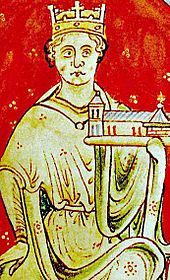
King John of England

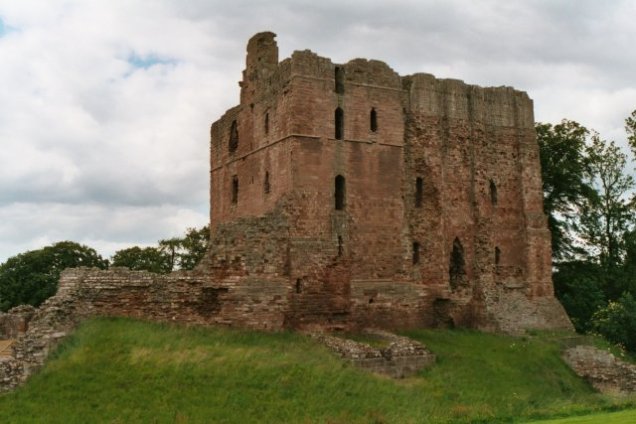
After many threats, and with both sides building up their armies, the two kings met at Norham, Northumberland, in the last week of July and first week of August 1209. The Scots were in a desperate position, with an ailing and ageing king, and a 10-year-old boy as heir, whilst the English, with their Welsh allies and foreign mercenaries, had an army big enough to force a Scottish submission. Queen Ermengarde appears to have acted as a mediator between the two kings, although the subsequent treaty, agreed at Norham on 7 August, was humiliating for the Scots it did, at least, prevent a war. The Scots agreed to pay 15,000 marks for peace and to surrender hostages, including the king’s two oldest legitimate daughters, Margaret and Isabella. As a sweetener, John promised to marry the Margaret to one of his sons; although Henry was only 2 years old at the time and Richard was just 8 months, whilst the girls were already in their mid teens, at least. It was agreed that Isabella would be married to an English noble of suitable rank, an earl at least.

The king’s daughters and the other Scottish hostages were handed into the custody of England’s justiciar, at Carlisle on 16 August.

How the girls, or their parents, thought about this turn of events, we know not. Given John’s proven record of prevarication and perfidy, King William may have hoped that the promised marriages would occur in good time but may also have expected that John would find a way out of the pledges he had made. William and John met again at Durham in February 1212, a meeting in which ‘The queen of Scotland was present and acted as mediator, an extraordinary woman, gifted with a charming and witty eloquence.’3 The queen’s efforts bore fruit and peace between the two countries was renewed, as ‘There in the presence of the nobles of both kingdoms and the revered lady the queen of the Scots a formula for achieving peace and love, to be observed between the kingdoms and their kings for ever, was worked out anew and confirmed by charters given by both parties.’4

It was also agreed that the Scottish prince, Alexander, should be given an English wife. With at least one of the prince’s older sisters already intended for a son of King John, marrying Alexander to one of John’s daughters would further bind the Scots to the Plantagenet cause. Prince Alexander, now aged 14, would be knighted by King John, the ceremony taking place at Clerkenwell on 4 March 1212.

Ermengarde may have taken a more prominent role in the negotiations of 1212 as King William’s health began to fail. Their son, Alexander, was still only a teenager and so it would have fallen to the queen to take the lead in the talks. William was a physically active king almost to the very last moment. In January and February 1213, when both the Scots and English kings were close to the border, a meeting was proposed, but William resisted and could not be persuaded to meet with John. In his 70th year, he was probably already very ill.
History...the Interesting Bits
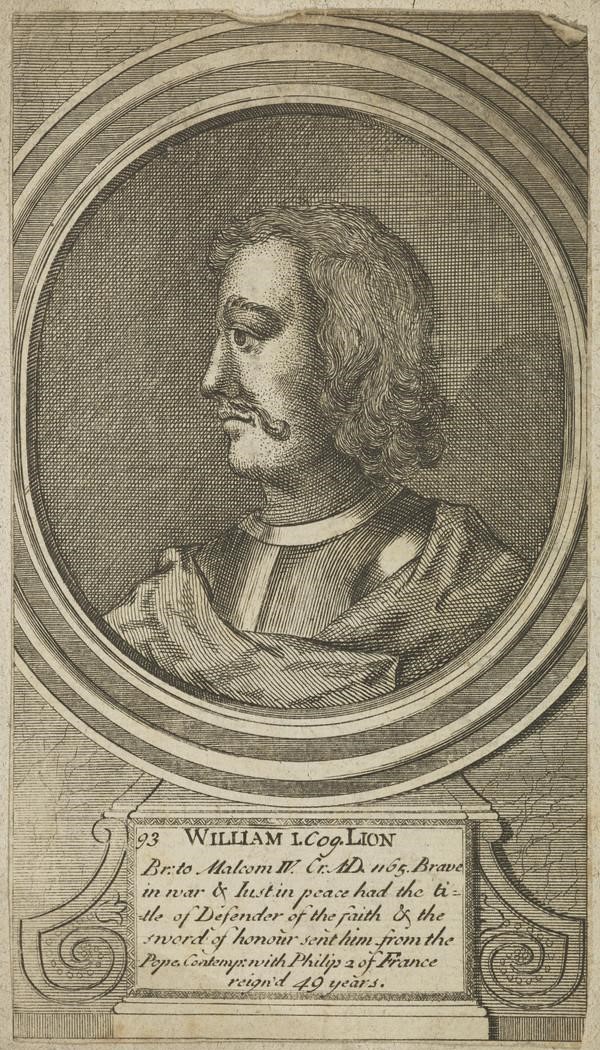
18th century image of William I the Lion

As William’s health failed, Queen Ermengarde appears to have taken on more responsibilities and exerted her influence on the court. The king rallied in 1214, so that he was well enough to travel to Elgin in the summer, where he came to an accord with John, the new earl of Caithness, and received the earl’s unnamed daughter as a hostage. The journey took its toll on the king, and he suffered some sort of collapse. He was taken, in easy stages, to the royal castle at Stirling, where he saw his lords for the last time. With the queen in attendance, William urged his barons and bishops to accept Alexander, now 16 years old, as king. King William I, later known as William the Lion, died on 4 December 1214, aged about seventy-one, having reigned for a total of forty-nine years, almost to the day.

On the morning after her husband’s death, Queen Ermengarde was ‘in a state of extreme mourning and worn out with grief.’5 The prelates and nobles attempted to rouse the queen from her melancholy by asking that she arrange the late king’s funeral, but the queen would not be moved. They left Ermengarde with her grief and took the young king to Scone, where he was crowned as King Alexander II on 6 December. King William was then buried at Arbroath on 10 December. The new king and his mother then presided over the royal Christmas feast at Forfar but returned to Stirling in January 1215, before visiting Arbroath, to see the tomb of King William.

Queen Ermengarde had been much younger than her husband, possibly by as much as thirty years. She would, therefore, continue to live for many years into her son’s reign.

History ... the Interesting Bits
Magna Carta

King Alexander II sided with the English barons in their struggle against the tyranny of King John, making an alliance with the northern barons, who agreed to press for a decision on the future of Alexander’s sisters, and a resolution of the lordship of the northern counties. He raided the northern English earldoms, exploiting the unrest in England to renew Scottish claims to these counties, besieging Norham in October 1215 and receiving the homage of the leading men of Northumberland. And when a French force joined the fight on the side of the rebels, the papal legate pronounced a sentence of excommunication on the rebels and their French and Scottish allies; it even extended to Queen Ermengarde. Scotland put under interdict. Following John’s death in October 1216 and the defeat of the French rebel army at Lincoln in May 1217, Alexander’s position in England became precarious.

The Scots king surrendered Carlisle Castle at Berwick on 1 December 1217 and submitted to England’s boy-king Henry III at Northampton later in the same month. Alexander’s sentence of excommunication was lifted by the archbishop of York, while the bishop of Durham absolved his mother, Queen Ermengarde.

With King Alexander’s submission, there followed an unprecedented almost 80 years of unbroken peace between England and Scotland, sealed by his marriage – in York – with Joan, Henry III’s sister in June 1221. Another marriage soon followed, when, in London on 30 October, Alexander’s oldest sister, Margaret, was married to Hubert de Burgh.

History ... the Interesting Bits
Joan of England, Queen of Scots

Queen Ermengarde must have felt relief that her son had found a bride, and hoped that an heir would soon follow. She may also have been satisfied that her eldest daughter, Margaret, once thought of as the heir to the Scots throne, was also finally settled in matrimony. Though there was complaint from some sides that Margaret had been pressed into a disparaging marriage when she had been promised a prince as a bridegroom. Hubert de Burgh was King Henry III’s justiciar, but was of minor nobility. He only receive his earldom of Kent after his marriage to Margaret. As for Margaret’s sister Isabella, she returned to Scotland, still unmarried. She eventually married Roger Bigod, the young Earl of Norfolk, in 1225. The wedding took place at Alnwick, in Northumberland, which may mean that Queen Ermengarde was able to attend.

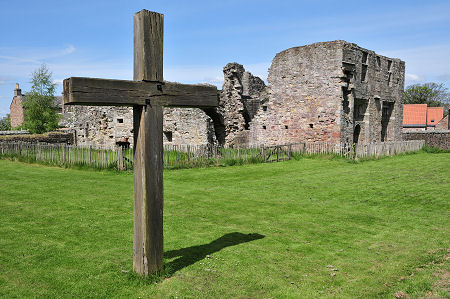
Queen Ermengarde devoted her later years to founding an abbey at Balmerino, with the help of Alexander. A parish in the district of Cupar in county of Fife, it was an area she regularly visited for the benefit of her health. The dowager queen raised the money to found the Cistercian abbey, paying 1,000 merks to purchase the land and acting as overseer to the building project. The abbey was built in red stone, quarried locally. Dedicated to Saint Edward the Confessor, Balmerino was populated by monks from Melrose Abbey. Queen Ermengarde appears to have had a particular veneration for the sainted English king as the only other religious gift we can attribute to her was to the hospital of St Edward at Berwick.

The queen had lived long enough to see three of her four children settled in marriage, and may have met her first grandchild, a daughter born to Princess Margaret in 1227, also named Margaret. In the same year, Henry III’s brother Richard, Earl of Cornwall, arrived in Scotland to speak with Queen Ermengarde. The object of the discussions was his possible marriage to the queen’s youngest daughter, Marjory. The earl’s proposals were attractive to neither the Scots nor his brother and negotiations came to naught, but the fact that it was Ermengarde that Richard approached, rather than the king, clearly demonstrates the queen’s continuing influence on her family. Her youngest daughter was not married until August 1235, when she married Gilbert Marshal, Earl of Pembroke, at Berwick.
History... the Interesting Bits
Balmerino Abbey with Queen Ermengarde’s Cross in the foreground

The queen did not live to see the wedding as in February 1233 Ermengarde de Beaumont died. She was buried before the high altar of the abbey to which she had dedicated her years of widowhood, Balmerino. Although the surviving records hint at the queen enjoying substantial authority in Scotland, especially where her family were concerned, we have few specifics. That she was entrusted with negotiating with the English emissaries, in 1209 and again in 1212, suggests that she possessed impressive diplomatic skills, and that King William had considerable confidence in his wife’s abilities. Furthermore, the queen’s evident grief at her husband’s death attests to a deep affection within the union, an affection that not only defined the marriage, but also the whole family, with the queen continuing to exert her influence on the relationships of her children in the years after her husband’s death.

Having served Scotland as queen for 28 years and as its dowager queen for a further 19 years, Ermengarde de Beaumont defined the role of Queen of Scots for subsequent royal consorts. Her memory cast a long shadow.

*

Images:

Courtesy of Wikipedia except Henry II, which is ©2025 Sharon Bennett Connolly FRHistS, and Balmerino Abbey which is courtesy of Undiscovered Scotland

Notes:

1. Mediaeval chronicles of Scotland, translated by Joseph Stephenson; 2. John of Fordun’s Chronicle of the Scottish Nation; 3. Walter Bower, Scotichronicon, V 4; 4. ibid; 5. Rosalind K. Marshall, Scottish Queens 1034–1714

Bibliography:

Walter Bower, Scotichronicon, V 4; Chronicles of the Picts, chronicles of the Scots, and other early memorials of Scottish history, edited by W. F. Skene; fmg.ac/Projects/MedLands/SCOTLAND; John of Fordun’s Chronicle of the Scottish Nation, edited by W. F. Skene, Edinburgh, Edmonston and Douglas; Rosalind K. Marshall, Scottish Queens 1034–1714; Mediaeval chronicles of Scotland: the chronicles of Melrose and Holyrood, translated by Joseph Stephenson; Richard Oram, editor, The Kings and Queens of Scotland; The annals of Roger de Hoveden. Comprising the history of England and of other countries of Europe from A.D. 732 to A.D. 1201, edited by Henry T. Riley; David Ross, Scotland, History of a Nation; W.W. Scott, Ermengarde [Ermengarde de Beaumont], oxforddnb.com; W.W. Scott, William I [known as William the Lion] (c. 1142–1214), oxforddnb.com

*

My Books:

Signed, dedicated copies of all my books are available through my online bookshop.

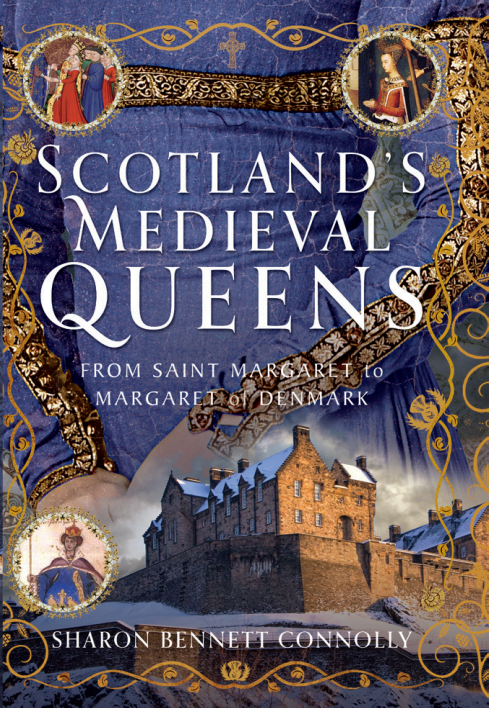
Out now: Scotland’s Medieval Queens

Books by Sharon Bennett Connolly

Scotland’s history is dramatic, violent and bloody. Being England’s northern neighbour has never been easy. Scotland’s queens have had to deal with war, murder, imprisonment, political rivalries and open betrayal. They have loved and lost, raised kings and queens, ruled and died for Scotland. From St Margaret, who became one of the patron saints of Scotland, to Elizabeth de Burgh and the dramatic story of the Scottish Wars of Independence, to the love story and tragedy of Joan Beaufort, to Margaret of Denmark and the dawn of the Renaissance, Scotland’s Medieval Queens have seen it all. This is the story of Scotland through their eyes.

Scotland’s Medieval Queens gives a thorough grounding in the history of the women who ruled Scotland at the side of its kings, often in the shadows, but just as interesting in their lives beyond the spotlight. It’s not a subject that has been widely covered, and Sharon is a pioneer in bringing that information into accessible history.’ Elizabeth Chadwick (New York Times bestselling author)

Available now from Amazon and Pen and Sword Books

Also by Sharon Bennett Connolly:

Books by Sharon Bennett Connolly

Heroines of the Tudor World tells the stories of the most remarkable women from European history in the time of the Tudor dynasty, 1485-1603. These are the women who ruled, the women who founded dynasties, the women who fought for religious freedom, their families and love. Heroines of the Tudor World is now available for pre-order from Amberley Publishing and Amazon UK. Women of the Anarchy demonstrates how Empress Matilda and Matilda of Boulogne, unable to wield a sword themselves, were prime movers in this time of conflict and lawlessness. It shows how their strengths, weaknesses, and personal ambitions swung the fortunes of war one way – and then the other. Available from Bookshop.orgAmberley Publishing and Amazon UKKing John’s Right-Hand Lady: The Story of Nicholaa de la Haye is the story of a truly remarkable lady, the hereditary constable of Lincoln Castle and the first woman in England to be appointed sheriff in her own right. Available from all good bookshops Pen & Sword Booksbookshop.org and Amazon

Royal Historical Society

Defenders of the Norman Crown: The Rise and Fall of the Warenne Earls of Surrey tells the fascinating story of the Warenne dynasty, from its origins in Normandy, through the Conquest, Magna Carta, the wars and marriages that led to its ultimate demise in the reign of Edward III. Available from Pen & Sword BooksAmazon in the UK and US, and Bookshop.orgLadies of Magna Carta: Women of Influence in Thirteenth Century England looks into the relationships of the various noble families of the 13th century, and how they were affected by the Barons’ Wars, Magna Carta and its aftermath; the bonds that were formed and those that were broken. It is now available in paperback and hardback from Pen & SwordAmazon, and Bookshop.orgHeroines of the Medieval World tells the stories of some of the most remarkable women from Medieval history, from Eleanor of Aquitaine to Julian of Norwich. Available now from Amberley Publishing and Amazon, and Bookshop.orgSilk and the Sword: The Women of the Norman Conquest traces the fortunes of the women who had a significant role to play in the momentous events of 1066. Available now from Amazon,  Amberley Publishing, and Bookshop.org.

Alternate Endings: An anthology of historical fiction short stories including Long Live the King… which is my take what might have happened had King John not died in October 1216. Available in paperback and kindle from Amazon.

Podcast:

A Slice of Medieval

Have a listen to the A Slice of Medieval podcast, which I co-host with Historical fiction novelist Derek Birks. Derek and I welcome guests, such as Bernard Cornwell and Elizabeth Chadwick, and discuss a wide range of topics in medieval history, from significant events to the personalities involved.

Every episode is also now available on YouTube.

*

Don’t forget! Signed and dedicated copies of all my books are available through my online bookshop.

For forthcoming online and in-person talks, please check out my Events Page.

You can be the first to read new articles by clicking the ‘Follow’ button, liking our Facebook page or joining me on TwitterThreadsBluesky and Instagram.

*

©2025 Sharon Bennett Connolly FRHistS.

Guest Post: Philip Lovell, a career in royal service by Monika E Simon

Today it is a pleasure to welcome author Monika E Simon back to the blog, with an article looking at one particular member of the Lovell family. Monika’s book, From Robber Barons to Courtiers: The Changing World of the Lovells of Titchmarsh, has just been released in the UK. Over to Monika:

Philip Lovell, a career in royal service

Parish church of St James the Great, Hanslope, Buckinghamshire

Philip Lovell was the younger son of William Lovell II and his wife Isabel (family unknown). He was the only member of the Lovell family who entered the church and had a successful if chequered career as a clerk and administrator in royal service, culminating in his appointment as Treasurer of England in 1252. He is also the first Lovell who left a significant trail in the royal records.Nonetheless, little is known about Philip Lovell’s early life. When his father William Lovell II died in 1212/13, Philip’s elder brother John Lovell I was still underage and King John granted his wardship to his supporter Alan Basset. As younger brother, Philip must have been underage as well. Unlike others who made their career in the church, Philip Lovell did not set his feet on this path as a young man. He married at an unknown time the widow of Alexander de Arsic whose name unfortunately is also unknown. They had three children, two sons, Philip Lovell the younger and Henry Lovell, and one daughter Amicia who married Richard de Curzon of Derbyshire. It is also not known when Philip Lovell’s wife died.

After his wife’s death Philip Lovell entered the church and in 1231/32 was ordained subdeacon and given the living in Lutterworth (Leicestershire) by Nicholas de Verdun. It may have also been Nicholas de Verdun who introduced Philip to Roger de Quincy, Earl of Winchester and Constable of Scotland, whose service Philip entered. Again the information is vague but Philip was witnessing the earl’s charters before 1240 and eventually became the earl’s steward for his English estates. During this period, Philip Lovell frequently travelled to Scotland where he earned the friendship of King Alexander II and second his wife Marie de Coucy, as Mathew Paris reports.

Philip Lovell must have worked efficiently and without causing trouble as otherwise Roger de Quincy would not have employed him as a steward or at least retained him in that position.

Over time Philip Lovell gained several positions in the church. He was as rector of Stanground (Huntingdonshire), Rock (Worcestershire), canon of London, and holding the living of Hanslope.

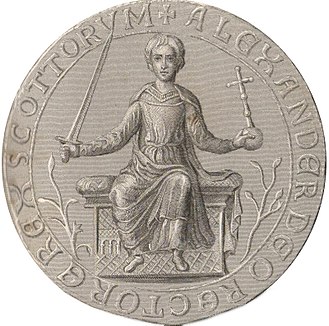
Seal of Alexander II

After about ten years in the service of Roger de Quincy and, no doubt using the contacts he had made for example with William Mauduit, Chamberlain of the Exchequer, entered the service of Henry III. In 1249 Philip Lovell was appointed a justiciary of the Jews through the influence of another influential man, John Mansel. Mansel was an ambitious and highly successful administrator whom Mathew Paris described as Henry III chief or special councillor. Perhaps he felt responsible for the man, he had introduced to royal service but he remained a firm supporter of Philip Lovell throughout his time in royal service.

At first everything went well for Philip Lovell and in 1250 he was styled a clerk and counsellor of the king. But a year later, Philip was disgraced for allegedly taking bribes from wealthy Jews in return for reducing the amount of tallage they had to pay. It is possible that the charges were trumped up by his rival and colleague, Robert de la Ho, as chronicles imply.

John Mansel and Alexander III of Scotland put in a good word with Henry III and Philip was restored to favour. John Mansel arranged for Alexander III to petition Henry III to restore Philip to favour, which he did remembering his parents friendship with Philip. Philip Lovell must have made a very good and lasting impression on Alexander II and his queen for his son to petition Henry III. John Mansel himself paid the fine of 10 marks of gold (a substantial sum) that Philip had offered. Even if Mansel felt responsible for the man he had been instrumental to gain the position as justiciar of the Jews it seems unlikely to me he would have gone to such length if he had thought that Philip was completely hopeless.

Philip Lovell’s restoration to favour was complete and swift. Not even a year after his dismissal from office, on 27 August 1252, he was appointed Treasurer of England. As a key figure in the administration of the country, his name appears constantly in the government records. The Patent Rolls, Close Rolls, and the Liberate Rolls of this period contain a multitude of references to his work which was incredibly varied.

Eleanor of England, Countess of Leicester

The Liberate Rolls are the records of the writs ordering money to be paid out of the treasury. The work of the treasurer was varied and often hands-on. Most often, Philip Lovell was the person to authorise the payment. For example when the sheriffs of London were to be repaid for the lead they had purchased for building works in Windsor and on another occasion for the transport of the gear of the king’s pavilion in Westminster to Portsmouth. On other occasions the sheriff of Surrey and Sussex had transported the king’s treasure from London to Portsmouth. The sheriff of Kent was paid back the money he had spent on the reception of the Barsias Martini, the elect of Toledo and his household in Dover and on their travels to the New Temple in London.

Money was also paid out to Eleanor of England, Countess of Leicester for her dower. In 1256, Philip Lovell received 1,600 marks from Margaret de Lascy, Countess of Lincoln, a part payment of the arrears of the money she owned as her share of the dower payments to Eleanor of England.

Philip himself was often purchasing items for the royal court. For example, he bought 30 gold-wrought cloths for Queen Eleanor or wax for the king’s children in Windsor.

The purchases also shed a light on the sheer size of the royal household. In 1253, Philip Lovell and two colleagues purchased 82 gold buckles, 277 precious rings of gold, 15 girdles, 89 ‘massive’ rings of gold, and 14 ‘massive’ buckles of gold to the tune of £250 17s. 5d. In 1254, 600 ells of linen were bought to make napkins for the feast of St Edward. Another large purchase, in 1255, was of various spices: 385 pounds of pepper, 386 pounds of ginger, 4 pounds of mace, 12 pounds of setwall (valerian), and 16 pound of sugar ‘of Alexandria’. Sheep, boars and fowl were sent from the sheriff of Buckinghamshire to Westminster for the Feast of St Edward in 1255. Wine was also bought for the king. On several occasions Philip Lovell himself bought the wine and transported it to where the royal household was at the time.

Another frequent expense was for gift of the king to a church or cleric. In 1255, for example, five gold-wrought cloths, a piece of red sandal (a light silk material), and another piece of green sandal were bought for a cloth for St Peter’s in Westminster. In 1256, Philip Lovell bought an embroidered cope to give to the church of St Edmund. A year later he bought another embroidered cope that was a gift by the king to Westminster in honour of St Edward. It was not only vestments and cloth that was given to churches, in 1257 Philip bought a gold buckle for 10 marks to give to the feretory of St Edmund of Pontigny.

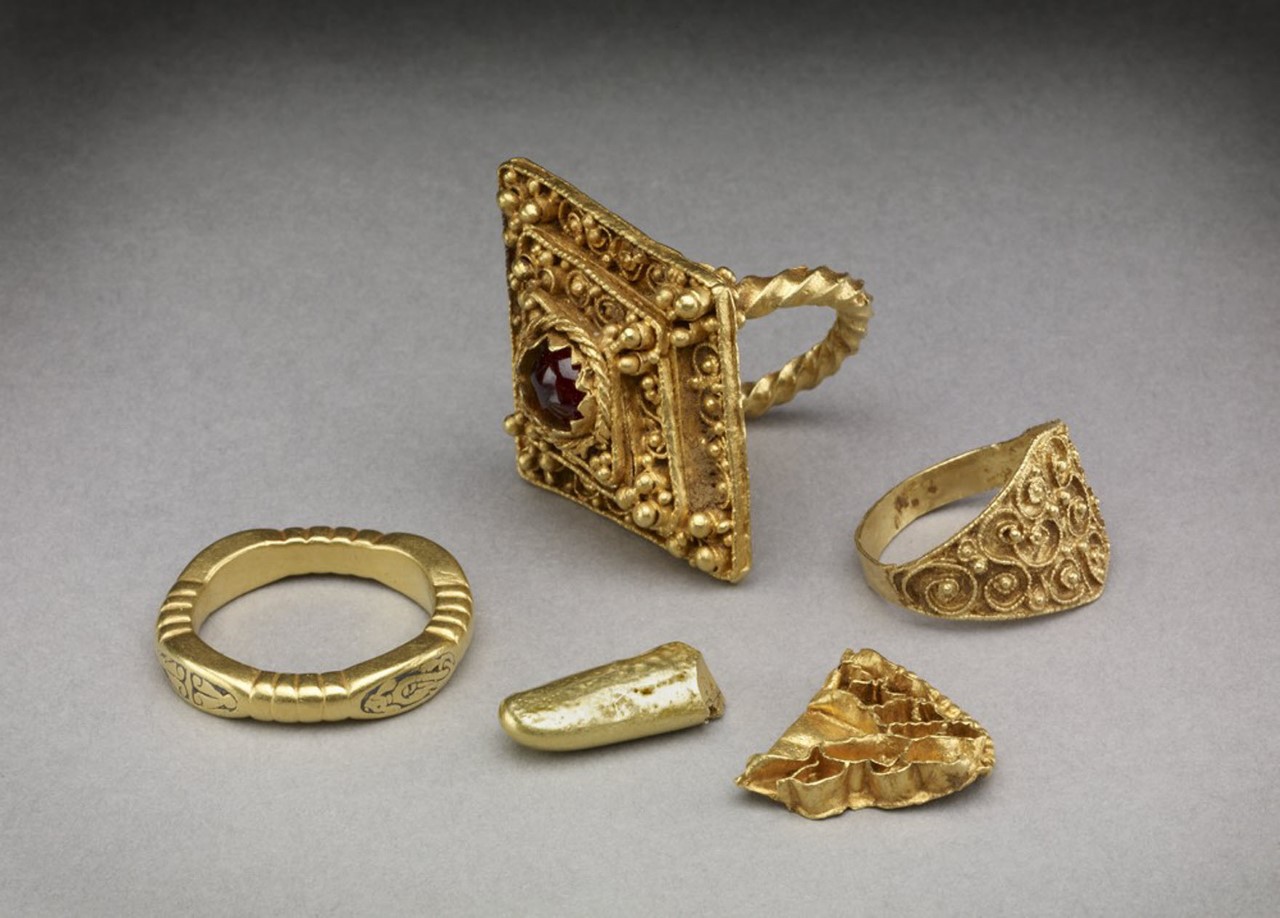
Hoard of Anglo-Saxon rings found at Leeds, West Yorkshire

For his service to the king, Philip Lovell was to be given ecclesiastical benefices, dignities or prebends to the amount of 200 marks per year. He was granted free pasture in the forest of Whittlewood and received gifts of trees on several occasions. He also often received grants of deer from the royal forests. In 1250, he simply took a hind and a doe in Sherwood Forest without asking prior permission. His pardon by the king for this offence must be regarded as a further sign of the good favour he stood in. Philip Lovell was also granted the wardship and marriage of the heirs of Vivian de Staundon.

Not all of Henry III attempts to promote his treasurer were successful. In 1257 he tried to persuade the monks of Coventry to make Philip Lovell bishop of Lichfield and Coventry but without success.

In the late 1250s, the dissatisfaction of the barons of England increased and with the charismatic leadership of Simon de Montfort, Earl of Leicester the demands for changes in the government grew louder. Philip Lovell was one of the men they wanted to remove from office. He had been too harsh in his attempts to find revenue for the treasury, as in 1255 when he was making an inquiry into the king’s revenues and rights in eight midland counties. Simon de Montfort had his private complaints against the king and his treasurer as the payments of his wife’s dower were a constant problem. The critics were eventually successful. Philip Lovell was accused of plundering the forest of Whittlewood, charges that were trumped up according to Nicholas Vincent in his biography of Philip Lovell in the ODNB. Nonetheless, Philip was dismissed from service and replaced by John de Crachale, archdeacon of Bedford.

Philip Lovell retired to Hanslope where he died on 29 December 1258 of grief that the king, whom he had served so faithfully, would not forgive him. His estates, which included lands in Little Brickhill (Buckinghamshire), Littlebury (Essex), and Snotescombe (Northamptonshire), were at first confiscated but later divided between his three children and his nephew John Lovell II.

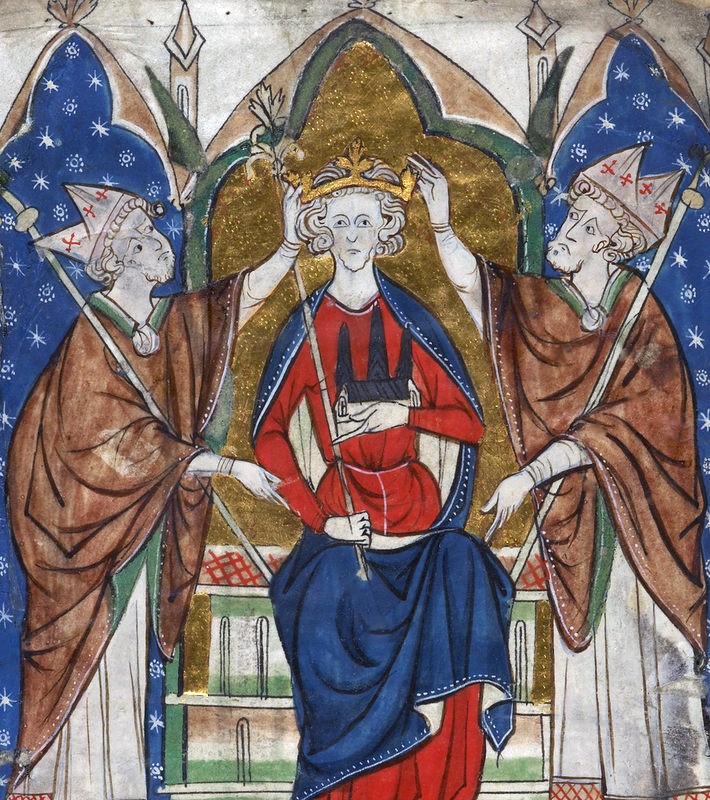
Coronation of King Henry III

Philip Lovell was a controversial figure. He lost his position as he was thoroughly disliked by many barons. Being responsible for collecting taxes and guarding the king’s financial rights and income is, if done thoroughly, not a job that is likely to make a person popular with those whose money he took. Modern historians are also critical. J.R. Maddicot describes him as ‘a man with a bad reputation for corrupt and oppressive behaviour’. Matthew Paris by contrast calls him a prudent, eloquent and magnanimous man.

Philip Lovell’s nephew, John Lovell II also entered royal service though he choose the more traditional route for a noblemen: service in war. It is possible that his uncle’s position at court helped him in this respect. However, John Lovell II’s maternal uncles, the Bassets, were a stronger influence that his paternal uncle Philip. Several brothers of John Lovell II’s mother Katherine were high-ranking members of the royal administration. The fact that John Lovell II decided to adapt the Basset coat of arms to become that used by the Lovell family speaks for a close link between the two families.

Images:

Church of England parish church of St James the Great, Hanslope, Buckinghamshire, seen from the southwest
(John Salmon / St James the Great, Hanslope, Bucks via Wikimedia Commons) https://commons.wikimedia.org/wiki/File:St_James_the_Great,_Hanslope,_Bucks_-_geograph.org.uk_-_333065.jpg

Steel engraving and enhancement of the Great Seal of Alexander II, King of Alba (Scotland) (Unknown author, Public domain, via Wikimedia Commons) https://commons.wikimedia.org/wiki/File:Alexander_II_(Alba)_i.JPG

Eleanor of England, Countess of Leicester (Unknown author, Public domain, via Wikimedia Commons)
https://commons.wikimedia.org/wiki/File:Alienor_Pembroke.jpg

Hoard of Anglo-Saxon rings found at Leeds, West Yorkshire (portableantiquities, CC BY 2.0 <https://creativecommons.org/licenses/by/2.0&gt;, via Wikimedia Commons)

Coronation of King Henry III (Unknown author, Public domain, via Wikimedia Commons) https://commons.wikimedia.org/wiki/File:HenryIII.jpg

About the Author:

Monika E. Simon studied Medieval History, Ancient History, and English Linguistics and Middle English Literature at the Ludwig-Maximilians-Universität, Munich, from which she received an MA. She wrote her DPhil thesis about the Lovells of Titchmarsh at the University of York. She lives and works in Munich.

Links:
https://www.pen-and-sword.co.uk/From-Robber-Barons-to-Courtiers-Hardback/p/19045
https://www.facebook.com/MoniESim
http://www.monikasimon.eu/lovell.html

*

My Books

Defenders of the Norman Crown: The Rise and Fall of the Warenne Earls of Surrey tells the fascinating story of the Warenne dynasty, of the successes and failures of one of the most powerful families in England, from its origins in Normandy, through the Conquest, Magna Carta, the wars and marriages that led to its ultimate demise in the reign of Edward III.

1 family. 8 earls. 300 years of English history!

Defenders of the Norman Crown: Rise and Fall of the Warenne Earls of Surrey is now available from Pen & Sword BooksAmazon in the UK and US and Book Depository.

Also by Sharon Bennett Connolly:

Ladies of Magna Carta: Women of Influence in Thirteenth Century England looks into the relationships of the various noble families of the 13th century, and how they were affected by the Barons’ Wars, Magna Carta and its aftermath; the bonds that were formed and those that were broken. It is now available from Pen & Sword,  Amazon and from Book Depository worldwide.

Heroines of the Medieval World tells the stories of some of the most remarkable women from Medieval history, from Eleanor of Aquitaine to Julian of Norwich. Available now from Amberley Publishing and Amazon and Book Depository.

Silk and the Sword: The Women of the Norman Conquest traces the fortunes of the women who had a significant role to play in the momentous events of 1066.  Available now from Amazon,  Amberley Publishing, Book Depository.

*

You can be the first to read new articles by clicking the ‘Follow’ button, liking our Facebook page or joining me on Twitter and Instagram.

©2021 Sharon Bennett Connolly

Magna Carta and the Princesses of Scotland

12215 Magna Carta, British Library

Other than the Queen of England, Isabelle d’Angoulême, only two women who can be clearly identified in Magna Carta itself. Though they are not mentioned by name, they are two Scottish princesses. The older sisters of King Alexander II had been held hostage in England since 1209, when John forced the humiliating Treaty of Norham on their ailing father, King William the Lion. Clause 59 of Magna Carta promised:

‘We will treat Alexander, king of Scots, concerning the return of his sisters and hostages and his liberties and rights in the same manner in which we will act towards our other barons of England, unless it ought to be otherwise because of the charters which we have from William his father, formerly king of Scots; and this shall be determined by the judgement of his peers in our court.

Taken from Marc Morris, King John

The king of Scots’ two sisters referred to in the clause were Margaret and Isabella, the oldest daughters of William I (the Lion), King of Scots, and his wife, Ermengarde de Beaumont. The two girls had been caught up in the power struggle between their father and the Plantagenet kings. William I had been the second of three sons of Henry, Earl of Northumberland, and his wife, Ada de Warenne. He was, therefore, a grandson of David I and great-grandson of Malcolm III Canmor and St Margaret, the Anglo-Saxon princess. William had succeeded to his father’s earldom of Northumberland in June 1153, when his older brother, Malcolm IV, succeeded their grandfather as King of Scots. William himself became King of Scots on Malcolm’s death on 9 December 1165, aged about 23.

When William was looking for a wife, in 1186, King Henry II suggested Ermengarde de Beaumont, daughter of Richard, Vicomte de Beaumont-sur-Sarthe, and great-granddaughter of Henry I of England through one of the king’s many illegitimate offspring. With such diluted royal blood, she was hardly a prestigious match for the king of Scots, but he reluctantly accepted the marriage after consulting his advisers. The wedding took place at Woodstock on 5 September 1186, with King Henry hosting four days of festivities and Edinburgh Castle was returned to the Scots as part of Ermengarde’s dowry.

William the Lion, King of Scots

After the wedding, King William accompanied King Henry to Marlborough whilst the new Scottish queen was escorted to her new home by Jocelin, Bishop of Glasgow, and other Scottish nobles. Before 1195 Queen Ermengarde gave birth to two daughters, Margaret and Isabella. A son, the future Alexander II, was finally born at Haddington on 24 August 1198, the first legitimate son born to a reigning Scottish king in seventy years; a contemporary remarked that ‘many rejoiced at his birth.’1 A third daughter, Marjorie, was born sometime later.

Margaret, the eldest daughter of William I and Ermengarde de Beaumont, had been born sometime between her parents’ marriage in 1186 and 1195, unfortunately we cannot be more specific. Given the apparent youth of Ermengarde on her wedding day, Margaret’s date of birth is more likely to have been 1190 or later. We do know that she was born by 1195, as she was mooted as a possible heir to King William I in the succession crisis of that year, when the king fell gravely ill. Primogeniture was not yet the established order of succession, nor was the idea of a female ruler a welcome one; the period known to history as the Anarchy, which followed King Stephen’s usurpation of the throne from Empress Matilda, would have still been fresh in people’s memories, even in Scotland. King David had, after all, supported his niece’s claims against those of her cousin. The lesson of 20 years of civil war, albeit over the border, would have given William’s counsellors pause for thought in their own succession issue.

King John

Several options were proposed at the time, including marrying young Margaret to Otto of Saxony, son of Henry II’s eldest daughter Matilda and nephew of King Richard I. However, it was also proposed that Margaret should not even be considered as heir, that the kingdom should pass to her father’s younger brother, David. In the event, King William recovered and none of the options were pursued, but at least it means that we know Margaret was born before 1195. And when her brother, Alexander, was born in 1198, Margaret’s position as a possible heir was diminished further.

Margaret’s younger sister, Isabella’s date and year of birth is unknown; she was older than her brother, Alexander, who was born in 1198, but may have been born any time in the ten years before. She is not mentioned in the succession crisis of 1195, but that does not mean that she was born after, just that, being the younger daughter, she was not a subject of discussions. Jessica Nelson, in her article for the Oxford Dictionary of National Biography, suggests that Isabella was born in 1195 or 1196.

The two young princesses became the unwitting pawns in political relations between England and Scotland when the two kings, John and William the Lion, met at Norham, Northumberland, in the last week of July and first week of August 1209. The Scots were in a desperate position, with an ailing and ageing king, and a 10-year-old boy as heir, whilst the English, with their Welsh allies and foreign mercenaries, had an army big enough to force a Scottish submission. The subsequent treaty, agreed at Norham on 7 August, was humiliating for the Scots. John would have the castle at Tweedmouth dismantled, but the Scots would pay an extra £4,000 compensation for the damage they had caused to it. The Scots also agreed to pay 15,000 marks for peace and to surrender hostages, including the king’s two oldest legitimate daughters, Margaret and Isabella.

Norham Castle

As a sweetener, John promised to marry the princesses to his sons; although Henry was only 2 years old at the time and Richard was just 8 months, whilst the girls were probably in their early-to-mid teens. The king’s daughters and the other Scottish hostages were handed into the custody of England’s justiciar, at Carlisle on 16 August. How the girls, or their parents, thought about this turn of events, we know not. Given John’s proven record of prevarication and perfidy, King William may have hoped that the promised marriages would occur in good time, but may also have expected that John would find a way out of the promises made.

John’s demand of Margaret and Isabella as hostages, with the sweetener that they would be brides for his own sons, may well have been to prevent Margaret marrying elsewhere. King Philip II of France had expressed interest in a marriage between himself and Margaret, a union John would be keen to thwart. Thus, John’s control of the marriages of Margaret and Isabella would mean that they could not marry against the king of England’s own interests. It also meant that King William had lost two useful diplomatic bargaining chips; marriage alliances could be used to cement political ones, and these had been passed to John, weakening William’s position on the international stage. According to the chronicler Bower, the agreement specified that Margaret would marry John’s son, Henry, while Isabella would be married to an English nobleman of rank.

When the sisters were brought south, they were housed comfortably, as evidence demonstrates. While hostages in England, Margaret and Isabella were kept together, and lived comfortably, although John’s promise of arranging marriages for the girls remained unfulfilled. Payments for their upkeep were recorded by sheriffs and the king’s own wardrobe, which suggests the two princesses spent some time at court. In 1213 Isabella was residing at Corfe Castle in the household of John’s queen, Isabelle d’Angoulême; John’s niece, Eleanor of Brittany, held captive since the failed rebellion of her brother, Arthur of Brittany in 1202, was also there.

Alexander II, King of Scots

One can imagine the frustration of the Scots, to see their princesses languishing in the custody of the English; their inclusion in clause 59 of Magna Carta evidence of this. Unfortunately, King John tore up Magna Carta almost before the wax seals had dried, writing to the pope to have the charter declared void, leaving Alexander to join the baronial rebellion.

When Alexander came to terms with the government of Henry III in December 1217, he pressed for a resolution to the marriages of himself and his sisters, Margaret and Isabella, still languishing in English custody. In June 1220, at a meeting of King Henry III’s minority council, it was agreed that Margaret and Isabella would be married by October 1221 or allowed to return to Scotland.

King John had promised that Alexander would marry one of his daughters and Henry III, or rather his ministers, finally fulfilled this promise in June 1221, when his sister, Joan, was married to the Scots king at York. And it was probably at this event, when the Scottish and English royal families came together in celebration, that Margaret’s own future was finally resolved.

It was decided that she would marry Hubert de Burgh, the king’s justiciar and one of the leading figures of Henry III’s minority government. They were married in London on 3 October 1221, with King Henry himself giving the bride away. It was a major coup for Hubert de Burgh, who came from a gentry family rather than the higher echelons of the nobility; though it was a less prestigious match for Margaret, the daughter of a king. The couple had one child, a girl named Margaret but known as Megotta, who was probably born in the early 1220s.

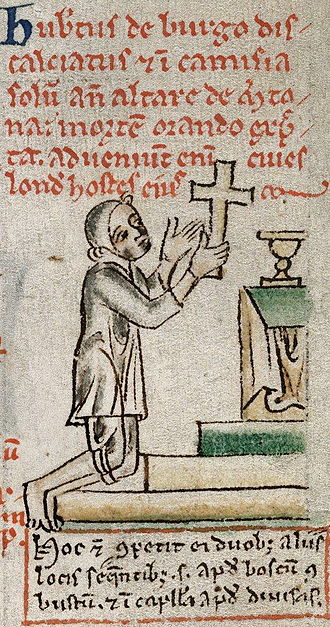
Hubert de Burgh from Matthew Paris

Isabella, however, remained unmarried and returned to Scotland in November 1222. Isabella’s own marriage prospects may have been damaged by the relatively lowly marriage of her older sister. Nevertheless, Alexander II was keen to look after his sister’s interests and continued to search for a suitable husband. A letter from Henry III alludes to a possible match between Isabella and William (II) Marshal, Earl of Pembroke but the earl was, instead, married to the king’s own younger sister, Eleanor

Isabella’s future was finally settled in June 1225, when she married Roger Bigod, fourth Earl of Norfolk, at Alnwick in Northumberland. On 20 May, the archbishop of York was given respite from his debts in order to attend the wedding of the King of Scots’ sister:

Order to the barons of the Exchequer to place in respite, until 15 days from Michaelmas in the ninth year, the demand for debts they make by summons of the Exchequer from W. archbishop of York, because the archbishop has set out for Alnwick where he is to be present to celebrate the marriage between Roger, son and heir of Earl H. Bigod, and Isabella, sister of the King of Scots.

finerollshenry3.org.uk /content/calendar/roll_022.html#it204_001, 20 May
1225.

Roger was the young son of Hugh Bigod, Earl of Norfolk, who had died earlier in the year, and Matilda Marshal, eldest daughter of William Marshal, Earl of Pembroke. Roger was still a minor, aged about 13, and possibly as much as seventeen years his wife’s junior. In 1224 King Alexander II had levied an aid of 10,000 marks towards the costs of his sisters’ marriages, as well as contributing £1,000 towards Henry III’s 1225 expedition to Gascony, suggesting the Scots king was eager to see both his sisters comfortably settled.

At the time of the marriage, Roger’s wardship was in the hands of Henry III’s uncle, William Longespée, Earl of Salisbury, but it was transferred to King Alexander II in 1226, after Longespée’s death. Now in the custody of the king of Scots, Roger and Isabella moved to Scotland, living at the Scottish court until Roger attained his majority in 1233 and entered into his inheritance.

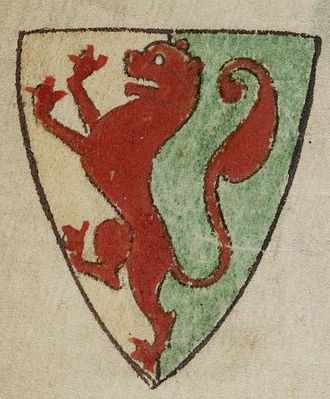
The Marshal coat of arms

Ten years after the sealing of Magna Carta, and 16 years after they had been taken hostage, the two Scottish princesses were both finally settled into marriage, though less exalted marriages than their father had wished and hoped for, with English barons, rather than princes or kings. Their younger sister, Marjorie, would also marry into the English nobility in 1235, becoming the wife of Gilbert Marshal, 3rd son of the famed William Marshal who had become Earl of Pembroke the previous year.

Marjorie died in 1244, Isabella in 1253 and Margaret, the eldest, in 1259. Rather unusually for princesses, who would often be married off in foreign lands and separated from family, the 3 sisters would share their final resting place and be buried at the Church of the Black Friars in London.

*

Footnote:

1W.W. Scott, ‘Ermengarde de Beaumont (1233)’, Oxforddnb.com.

Images:

All images courtesy of Wikipedia except Magna Carta, which is ©2015 Sharon Bennett Connolly

Sources:

finerollshenry3.org.uk; W.W. Scott, ‘Ermengarde de Beaumont (1233)’, Oxforddnb.com; Marc Morris, King John; Jessica Nelson, ‘Isabella [Isabella Bigod], countess of Norfolk (b. 1195/1196, 1270)’, Oxforddnb.com; Nelson, Jessica A., ‘Isabella, Countess of Norfolk’, magnacarta800th.com; Louise J. Wilkinson, ‘Margaret, Princess of Scotland’, magnacarta800th.com; W.W. Scott, ‘Margaret, countess of Kent (b. 1187×1195, d. 1259)’, Oxforddnb.com; Keith Stringer, ‘Alexander II (1198–1249)’, Oxforddnb.com; Mackay, A.J.G. (ed.), The Historie and Chronicles of Scotland … by Robert Lindesay of Pitscottie; Ross, David, Scotland: History of a Nation; Church, Stephen, King John: England, Magna Carta and the Making of a Tyrant; Danziger, Danny and John Gillingham, 1215: The Year of Magna Carta; Crouch, David, William Marshal; The Story of Scotland by Nigel Tranter; Matthew Paris, Robert de Reading and others, Flores Historiarum, volume III.

*

My Books

Signed, dedicated copies of all my books are available through my online bookshop.

Out now! Scotland’s Medieval Queens

Scotland’s history is dramatic, violent and bloody. Being England’s northern neighbour has never been easy. Scotland’s queens have had to deal with war, murder, imprisonment, political rivalries and open betrayal. They have loved and lost, raised kings and queens, ruled and died for Scotland. From St Margaret, who became one of the patron saints of Scotland, to Elizabeth de Burgh and the dramatic story of the Scottish Wars of Independence, to the love story and tragedy of Joan Beaufort, to Margaret of Denmark and the dawn of the Renaissance, Scotland’s Medieval Queens have seen it all. This is the story of Scotland through their eyes.

Available now from Amazon and Pen and Sword Books

Also by Sharon Bennett Connolly:

Heroines of the Tudor World tells the stories of the most remarkable women from European history in the time of the Tudor dynasty, 1485-1603. These are the women who ruled, the women who founded dynasties, the women who fought for religious freedom, their families and love. Heroines of the Tudor World is now available for pre-order from Amberley Publishing and Amazon UK. Women of the Anarchy demonstrates how Empress Matilda and Matilda of Boulogne, unable to wield a sword themselves, were prime movers in this time of conflict and lawlessness. It shows how their strengths, weaknesses, and personal ambitions swung the fortunes of war one way – and then the other. Available from Bookshop.orgAmberley Publishing and Amazon UKKing John’s Right-Hand Lady: The Story of Nicholaa de la Haye is the story of a truly remarkable lady, the hereditary constable of Lincoln Castle and the first woman in England to be appointed sheriff in her own right. Available from all good bookshops Pen & Sword Booksbookshop.org and Amazon

Defenders of the Norman Crown: The Rise and Fall of the Warenne Earls of Surrey tells the fascinating story of the Warenne dynasty, from its origins in Normandy, through the Conquest, Magna Carta, the wars and marriages that led to its ultimate demise in the reign of Edward III. Available from Pen & Sword BooksAmazon in the UK and US, and Bookshop.orgLadies of Magna Carta: Women of Influence in Thirteenth Century England looks into the relationships of the various noble families of the 13th century, and how they were affected by the Barons’ Wars, Magna Carta and its aftermath; the bonds that were formed and those that were broken. It is now available in paperback and hardback from Pen & SwordAmazon, and Bookshop.orgHeroines of the Medieval World tells the stories of some of the most remarkable women from Medieval history, from Eleanor of Aquitaine to Julian of Norwich. Available now from Amberley Publishing and Amazon, and Bookshop.orgSilk and the Sword: The Women of the Norman Conquest traces the fortunes of the women who had a significant role to play in the momentous events of 1066. Available now from Amazon,  Amberley Publishing, and Bookshop.org.

Alternate Endings: An anthology of historical fiction short stories including Long Live the King… which is my take what might have happened had King John not died in October 1216. Available in paperback and kindle from Amazon.

Podcast:

Have a listen to the A Slice of Medieval podcast, which I co-host with Historical fiction novelist Derek Birks. Derek and I welcome guests, such as Bernard Cornwell and Elizabeth Chadwick, and discuss a wide range of topics in medieval history, from significant events to the personalities involved. Every episode is also now available on YouTube.

*

Don’t forget! Signed and dedicated copies of all my books are available through my online bookshop.

For forthcoming online and in-person talks, please check out my Events Page.

You can be the first to read new articles by clicking the ‘Follow’ button, liking our Facebook page or joining me on Twitter and Instagram.

©2020 Sharon Bennett Connolly FRHistS

The Jilted Princess

JoanEngland
Joan of England, Queen of Scotland

Joan of England was the oldest of daughter of King John and his 2nd wife, Isabella of Angoulême. Born on 22 July 1210 she was the 3rd of 5 children; she had 2 older brothers and 2 younger sisters would join the family by 1215.

Even before her birth, she was mooted as a possible bride for Alexander of Scotland, son of King William I of Scotland. A verbal agreement between the two kings, after the Treaty of Norham, in 1209 provided for John to arrange the marriages of William’s two daughters, with one marrying a son of John’s, and Alexander marrying one of John’s daughters.

Following the death of William I a further treaty in 1212 agreed to the marriage of 14-year-old Alexander II to 2-year-old Joan. However, the agreement seems to have been made as a way of preventing Alexander from looking to the continent – and especially France – for a potential bride, and by extension allies.

It did not stop John from looking further afield, nevertheless, for a more favourable marriage alliance. Nor did it stop Alexander from siding with the Barons against King John; Alexander was one of the Magna Carta signatories. John refused a proposal from King Philip II of France, for his son John, and settled in 1214 for a marriage with his old enemies the de Lusignan’s.

In 1214 Joan was betrothed to Hugh X de Lusignan. Hugh was the son of John’s rival for the hand of Isabella in 1200; Isabella’s engagement to Hugh IX was broken off  in order for her to marry John. Following the betrothal Hugh, Lord of Lusignan and Count of La Marche, was given custody of Joan and of Saintes, Saintonge and the Isle of Oléron as pledges for her dowry. Joan was just 4 years old when she travelled to the south of France to live with her future husband’s family. She was away from England at the height of the Baron’s War, and at her father’s death in October 1216.

It’s possible she was reunited with her mother in 1217 when Isabella of Angoulême left England, abandoning her four other children, in order to govern her own lands in Angoulême.

In 1220 in a scandalous about-face Hugh repudiated Joan and married her mother, his father’s former betrothed. And poor 9-year-old Joan’s erstwhile future husband was now her step-father!

330px-Hugues_le_Brun
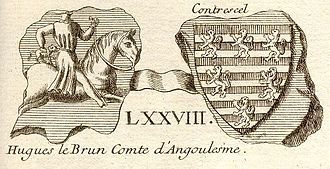
Hugh X de Lusignan, Joan’s betrothed and step-father

And worse was to come…

Instead of being sent back to England, as you would expect, Joan went from being Hugh’s betrothed – to being his prisoner. She was held hostage to ensure Hugh’s continued control of her dower lands, and to guarantee the transfer of his new wife’s dower, while England was withholding Queen Isabella’s dower against the return of Joan’s dower lands.

Negotiations to resolve the situation were ongoing. In the mean time, Henry III was already looking to arrange a new marriage for Joan. On 15th June 1220, in York, a conference between Alexander II and Henry III saw the Scots king agree to marry Joan, with a provision that he would marry Joan’s younger sister, Isabella, if Joan was not returned to England in time.

Negotiations for Joan’s return were long and difficult and not helped by the fact Hugh was threatening war in Poitou. Eventually, after Papal intervention, agreement was reached in October 1220 and Joan was surrendered to the English.

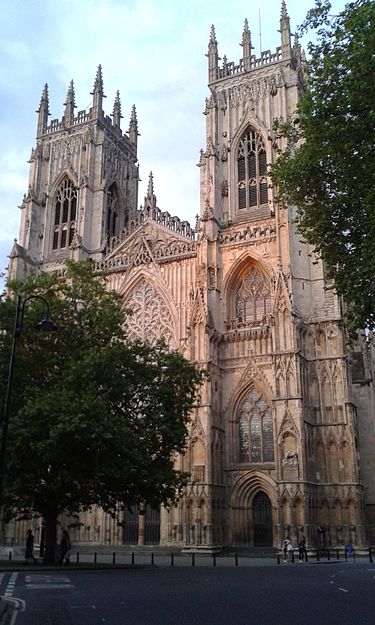
Joan and Alexander II were married on the 19th June 1221, at York Minster. Joan was just a month from her 11th birthday, while Alexander was 22. The archbishop of York performed the ceremony, which was witnessed Henry III and the great magnates of both realms. Henry III’s Pipe Rolls suggest the wedding was followed by 3 days of celebrations, costing £100. According to the Chronicle of Melrose ‘having celebrated the nuptials most splendidly, as was befitting, with all the natives of either realm rejoicing, [Alexander] conducted [Joan] to Scotland.’

York.mstr.
York Minster

The day before the wedding Alexander had assigned dower estates to Joan, worth an annual income of £1,000, including Jedburgh, Crail and Kinghorn. However, part of the dower was still held by Alexander’s mother, the dowager Queen Ermengarde, and Joan was not entitled to the income until after her mother-in-law’s death. This left Joan financially dependent on Alexander from the beginning.

There is a suggestion that Joan was not enamoured with Scotland and its society. She was hampered by her youth, her domineering mother-in-law and, eventually, by the fact she failed  to produce the desired heir. Her position was further hindered by tensions between her husband and brother from time to time.

In this, though, she seems to have found her purpose. Joan regularly acted as intermediary between the 2 kings. Alexander often used Joan’s personal letters to her brother as a way of communicating with Henry, while bypassing the formality of official correspondence between kings.

One such letter is a warning, possibly on behalf of Alexander’s constable, Alan of Galloway, of intelligence that Haakon IV of Norway was intending to aid Hugh de Lacy in Ireland. In the same letter she assured Henry that no one from Scotland would be going to Ireland to fight against Henry’s interests. Another letter, this time from Henry, was of a more personal nature, written in February 1235 it informed Joan of the marriage of their “beloved sister” Isabella to the holy Roman Emperor Frederick II, news at which he knew Joan “would greatly rejoice”.

In December 1235 Alexander and Joan were summoned to London, possibly for the coronation of Henry’s new queen, Eleanor of Provence. This would have been a long and arduous journey for the Scots monarchs, especially in the deepest part of winter.

Henry’s use of Joan as an intermediary suggests she did have some influence over her husband, this theory is supported by the fact that Joan accompanied Alexander to negotiations with the English king, at Newcastle in September 1236 and again at York in September 1237.

In 1234 Henry had granted Joan the manor of Fenstanton in Huntingdonshire and during the 1236 negotiations she was granted Driffield in Yorkshire, giving Joan an income independent of Scotland. Many have seen this as an indication that Joan was intending to spend more time in England, especially seeing as the chronicler Matthew Paris hints at an estrangement, although we cannot be certain.

330px-Alexander_II_(Alba)_i
Alexander II

The 1236 and 1237 councils were attempts at resolving the ongoing claims of Alexander that King John had agreed to gift Northumberland to Alexander as part of the marriage contract between Alexander and Joan. Henry, of course, denied this. With the mediation of a papal legate, agreement was eventually reached in York at the 1237 council, with both queens present, when Alexander gave up the claim to Northumberland in return for lands in the northern counties with an annual income of £200.

Following the 1237 council Joan and her sister-in-law Eleanor of Provence departed on pilgrimage to the shrine of Thomas Becket at Canterbury. Given that Joan was now 27 and Eleanor already married for two years, it is possible both women were praying for children, and an heir.

Joan stayed in England for the rest of the year; much of the stay seems to have been informal and pleasurable. She spent Christmas at Henry’s court and was given new robes for herself, her clerks and servants, in addition to gifts of does and wine. Her widowed sister Eleanor, Countess of Pembroke, was present, along with the Countess of Chester and Joan’s cousin, the captive Eleanor of Brittany.

In late January arrangements were being made for Joan’s return to Scotland, but she fell ill before she could travel north. Still only 27 years of age Joan died on 4th March 1238 at Havering-atte-Bower in Essex, her brothers, King Henry III and Richard, Earl of Cornwall, were at her side.

HenryIII
Henry III

According to Matthew Paris ‘her death was grievous, however she merited less mourning, because she refused to return [to Scotland] although often summoned back by her husband’. And even in death Joan elected to stay in England. her will requested that she be buried at the Cistercian nunnery of Tarrant in Dorset.

The convent benefited greatly from Henry III’s almsgiving for the soul of his sister; in 1252, over 13 years after her death, the king ordered a marble effigy to be made for her tomb (which unfortunately has not survived).

Talking of her wedding day, the Chronicle of Lanercost had described Joan as ‘a girl still of a young age, but when she was an adult of comely beauty.’

Alexander II married again just over a year after Joan’s death, to Marie de Coucy and their son, Alexander III, the longed-for heir, was born in 1241. Alexander II died of a fever in 1249.

*

Images courtesy of Wikipedia

*

Sources: The Oxford Companion to British History Edited by John Cannon; The Plantagenets, the Kings who Made England by Dan Jones; History Today Companion to British History Edited by Juliet Gardiner and Neil Wenborn;  Brewer’s British Royalty by David Williamson; Britain’s Royal Families, the Complete Genealogy by Alison Weir; The Plantagenet Chronicles Edited by Elizabeth Hallam; The Mammoth Book of British Kings and Queens by Mike Ashley; The Plantagenets, the Kings that made Britain by Derek Wilson; England Under the Norman and Angevin Kings  by Robert Bartlett; http://www.britannica.com; oxforddnb.com; finerollshenry3.org.uk.

*

My Books

Signed, dedicated copies of all my books are available through my online bookshop.

Coming 30 January 2025: Scotland’s Medieval Queens

Scotland’s history is dramatic, violent and bloody. Being England’s northern neighbour has never been easy. Scotland’s queens have had to deal with war, murder, imprisonment, political rivalries and open betrayal. They have loved and lost, raised kings and queens, ruled and died for Scotland. From St Margaret, who became one of the patron saints of Scotland, to Elizabeth de Burgh and the dramatic story of the Scottish Wars of Independence, to the love story and tragedy of Joan Beaufort, to Margaret of Denmark and the dawn of the Renaissance, Scotland’s Medieval Queens have seen it all. This is the story of Scotland through their eyes.

Available for pre-order now.

Also by Sharon Bennett Connolly:

Heroines of the Tudor World tells the stories of the most remarkable women from European history in the time of the Tudor dynasty, 1485-1603. These are the women who ruled, the women who founded dynasties, the women who fought for religious freedom, their families and love. Heroines of the Tudor World is now available for pre-order from Amberley Publishing and Amazon UK. Women of the Anarchy demonstrates how Empress Matilda and Matilda of Boulogne, unable to wield a sword themselves, were prime movers in this time of conflict and lawlessness. It shows how their strengths, weaknesses, and personal ambitions swung the fortunes of war one way – and then the other. Available from Bookshop.orgAmberley Publishing and Amazon UKKing John’s Right-Hand Lady: The Story of Nicholaa de la Haye is the story of a truly remarkable lady, the hereditary constable of Lincoln Castle and the first woman in England to be appointed sheriff in her own right. Available from all good bookshops Pen & Sword Booksbookshop.org and Amazon

Defenders of the Norman Crown: The Rise and Fall of the Warenne Earls of Surrey tells the fascinating story of the Warenne dynasty, from its origins in Normandy, through the Conquest, Magna Carta, the wars and marriages that led to its ultimate demise in the reign of Edward III. Available from Pen & Sword BooksAmazon in the UK and US, and Bookshop.orgLadies of Magna Carta: Women of Influence in Thirteenth Century England looks into the relationships of the various noble families of the 13th century, and how they were affected by the Barons’ Wars, Magna Carta and its aftermath; the bonds that were formed and those that were broken. It is now available in paperback and hardback from Pen & SwordAmazon, and Bookshop.orgHeroines of the Medieval World tells the stories of some of the most remarkable women from Medieval history, from Eleanor of Aquitaine to Julian of Norwich. Available now from Amberley Publishing and Amazon, and Bookshop.orgSilk and the Sword: The Women of the Norman Conquest traces the fortunes of the women who had a significant role to play in the momentous events of 1066. Available now from Amazon,  Amberley Publishing, and Bookshop.org.

Alternate Endings: An anthology of historical fiction short stories including Long Live the King… which is my take what might have happened had King John not died in October 1216. Available in paperback and kindle from Amazon.

Podcast:

Have a listen to the A Slice of Medieval podcast, which I co-host with Historical fiction novelist Derek Birks. Derek and I welcome guests, such as Bernard Cornwell and Michael Jecks, and discuss a wide range of topics in medieval history, from significant events to the personalities involved. Every episode is also now available on YouTube.

*

Don’t forget! Signed and dedicated copies of all my books are available through my online bookshop.

For forthcoming online and in-person talks, please check out my Events Page.

You can be the first to read new articles by clicking the ‘Follow’ button, liking our Facebook page or joining me on TwitterThreadsBluesky and Instagram.

*

©2015 Sharon Bennett Connolly FRHistS