1141: The War of the Two Matildas

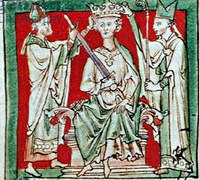
The coronation of King Stephen

Few periods in history have brought women to the fore, to the centre of events, as the Anarchy did in England. From 1135 to 1154, conflict raged when Stephen of Blois usurped the throne that rightfully belonged to his cousin Empress Matilda. During the lifetime of Henry I – Matilda’s father and Stephen’s uncle – Stephen had twice sworn oaths to guarantee the succession for Matilda. But when the time came, when Henry died on 1 December 1135, Stephen broke those oaths, and had himself crowned king in Westminster Abbey just 3 weeks after his uncle’s death.

If he thought Matilda would just accept losing her crown and stay at home with the children, Stephen was sorely mistaken. Pregnant with her third child at the time of her father’s death, Matilda had to bide her time, for a little while. And, as her husband Geoffrey of Anjou campaigned on her behalf in Normandy, Matilda landed in England on 30 September 1139 and her own campaign to claim the crown began.

And she nearly won.

The First Battle of Lincoln

Lincoln Castle

Early in 1141, news reached King Stephen that Ranulf de Gernons, the disgruntled Earl of Chester, had captured Lincoln Castle. Disappointed in his aspirations to Carlisle and Cumberland after they were given to Prince Henry of Scotland, Ranulf had turned his sights on Lincoln Castle, which had once been held by his mother, Lucy of Bolingbroke, Countess of Chester. Countess Lucy had died around 1138, leaving her Lincolnshire lands to her son by her second marriage, William de Roumare, Ranulf’s half-brother. Her lands elsewhere had been left to Ranulf de Gernons, who was the son of her third marriage, to Ranulf le Meschin, Earl of Chester.

It seems that in late 1140 Ranulf and his brother had contrived to gain possession of Lincoln Castle by subterfuge. As the story goes, the two brothers waited until the castle garrison had gone hunting before sending their wives to visit the castellan’s wife.  A short while after, Earl Ranulf appeared at the castle gates, wearing no armour and with only three attendants, supposedly to collect his wife and sister-in-law. Once allowed inside, he and his men overpowered the small number of men-at-arms left to guard the castle and opened the gates to his brother. The half-brothers took control of the castle and, with it, the city of Lincoln.

The citizens of Lincoln appealed to the king, who had promptly arrived outside the castle walls by 6 January 1141 and began his siege. Earl Ranulf somehow escaped from the castle and returned to his lands in Chester in order to raise more troops. He also took the opportunity to appeal to his father-in-law for aid. Ranulf’s father-in-law was, Robert, Earl of Gloucester, the illegitimate son of Henry I and brother of Empress Matilda. A very capable soldier, Earl Robert commanded Matilda’s military forces and his daughter, Maud of Gloucester – Ranulf’s wife – was still trapped inside Lincoln Castle. If the need to rescue his daughter was not enough motivation to persuade Robert to intercede at Lincoln, Ranulf also promised to switch his allegiance, and his considerable resources, to Empress Matilda. Robert marched to Lincoln, meeting up with his son-in-law along the way. The earls’ forces arrived on the outskirts of Lincoln on 1 February, crossed the Fossdyke and the River Witham and arrayed for battle.  Their rapid approach caught Stephen unawares. Outnumbered, Stephen was advised to withdraw his forces, until he could muster enough men to make an even fight of it.

Stephen, perhaps remembering the destruction of his father’s reputation after his flight from Antioch, refused to withdraw. He would stand and fight. The next morning, 2 February 1141, before battle was joined, King Stephen attended a solemn mass in the cathedral; according to Henry of Huntingdon, who claimed Bishop Alexander of Lincoln as his patron and may well have been present, the service was replete with ill omens:

‘But when, following custom, he offered a candle fit for a king and was putting it into Bishop Alexander’s hands, it broke into pieces. This was a warning to the king that he would be crushed. In the bishop’s presence, too, the pyx above the altar, which contained the Lord’s Body, fell, its chain having snapped off. This was a sign of the king’s downfall.’

Henry of Huntingdon, The History of the English People 1000-1154

After mass, the king led his forces through Lincoln’s West Gate, deploying them either on the slope leading down to the Fossdyke or possibly at the bottom of the slope, on Carrholme. King Stephen formed his army into three divisions, with mounted troops on each flank and the infantry in the centre. On the right flank were the forces of Waleran de Meulan, William de Warenne, Simon de Senlis, Gilbert of Hertford, Alan of Richmond and Hugh Bigod, Earl of Norfolk. The left was commanded by William of Aumale and William of Ypres, Stephen’s trusted mercenary captain, who led a force of Flemish and Breton troops. The centre comprised the shire levy, which included citizens of Lincoln, and Stephen’s own men-at-arms, fighting on foot around the royal standard.
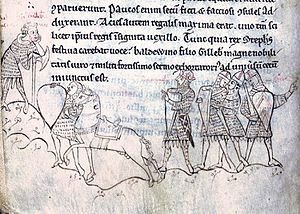
1141 Battle of Lincoln from Historia Anglorum

The opposing army also deployed in three divisions, with ‘the disinherited’, those deprived of their lands by King Stephen, on the left. The infantry, comprising of Earl Ranulf’s Cheshire tenants and other levies, and dismounted knights were in the centre under Earl Ranulf himself. The cavalry, under the command of Earl Robert of Gloucester formed the right flank. The Welsh mercenaries, ‘ill armed but full of spirits’ were arrayed on the wings of the army. Before the battle, Henry of Huntingdon reports, speeches  were heard from both sides, exhorting the men to battle and insulting the opposing commanders.

Baldwin fitz Gilbert spoke for King Stephen, whose voice did not carry well. According to Henry of Huntingdon, the armies were mobilising before his speech ended. The rebels were the first to advance, ‘the shouts of the advancing enemy were heard, mingled with the blasts of their trumpets, and the trampling of the horses, making the ground to quake.’ The ranks of the ‘disinherited’ moved forward with swords drawn, rather than lowered lances, intent on close quarter combat. This left flank of the rebel army fell upon Stephen’s right flank, ‘in which were Earl Alan, the Earl of Mellent [Meulan], with Hugh, the Earl of East Anglia [Norfolk], and Earl Symon, and the Earl of Warenne, with so much impetuosity that it was routed in the twinkling of an eye, one part being slain, another taken prisoner and the third put to flight.’ Faced with the ferocity of the assault and the very real prospect of death, rather than being taken prisoner and held for ransom, the earls fled the field with the remnants of their men. It was every man for himself as Stephen’s right wing disintegrated in panic.2

The left wing of the royal army appeared to have greater success, at least initially. The men of William of Aumale, Earl of York and Stephen’s mercenary captain, William of Ypres, rode down the Earl of Chester’s Welsh mercenaries and sent them running, but ‘the followers of the Earl of Chester attacked this body of horse, and it was scattered in a moment like the rest.’3 Other sources suggest that William of Ypres and William of Aumale fled before coming to close quarters with the enemy.4 Either way, William of Ypres’ men were routed and he was in no position to support the king and so fled the field, no doubt aware that he would not be well-treated were he to be captured.

Stephen’s centre, the infantry, including the Lincolnshire levies and the king’s own men-at-arms, were left isolated and surrounded, but continued to fight. Stephen himself was prominent in the vicious hand-to-hand fighting that followed. Henry of Huntingdon vividly describes the desperate scene as ‘the battle raged terribly round this circle; helmets and swords gleamed as they clashed, and the fearful screams and shouts re-echoed from the neighbouring hill and city walls.’5 The rebel cavalry charged into the royal forces killing many, trampling others and capturing some. King Stephen was deep in the midst of the fighting:

‘No respite, no breathing time was allowed, except in the quarter in which the king himself had taken his stand, where the assailants recoiled from the unmatched force of his terrible arm. The Earl of Chester seeing this, and envious of the glory the king was gaining, threw himself upon him with the whole weight of his men-at-arms. Even then the king’s courage did not fail, but his heavy battle-axe gleamed like lightning, striking down some, bearing back others. At length it was shattered by repeated blows, then he drew his well-tried sword, with which he wrought wonders until that, too, was broken.’

Henry of Huntingdon, The History of the English People 1000-1154;

According to Orderic Vitalis and the Gesta Stephani, it was the king’s sword that broke first, before he was passed a battle-axe by one of the fighting citizens of Lincoln, in order to continue the fight. Whatever the order, the king’s weapons were now useless and the king ‘fell to the ground by a blow from a stone.’6 Stephen was stunned and a soldier named William de Cahaignes then rushed at him, seized him by his helmet and shouted, ‘Here! Here! I have taken the king!’

The king’s forces being completely surrounded, flight was impossible. All were killed or taken prisoner, including Baldwin fitz Gilbert, the man who had given the rousing pre-battle speech to the men. In the immediate aftermath of the fighting, Lincoln was sacked, buildings set alight, valuables pillaged, and its citizens slaughtered by the victorious rebels.

Lady of the English

Empress Matilda depicted in an image from the Gospels of Henry the Lion.

Defeated, Stephen was first taken to Empress Matilda and then to imprisonment at Bristol Castle. A victorious Matilda was recognised as sovereign by the English people.

As for Matilda, ‘the lady empress-queen, Henry’s daughter, who was staying at Gloucester, was overjoyed at this event, having now, as it appeared to her, got possession of the kingdom for which fealty had been sworn to her’. As the Gesta Stephani, always insistent on naming Matilda countess rather than empress,relates, ‘the greater part of the kingdom at once submitted to the countess and her adherents and some of the king’s men, involved in sudden disasters, were being either captured or forcibly expelled from their possessions; others, very quickly foreswearing the faith they owed to the king, were voluntarily surrendering themselves and what was theirs to the countess’.

A victorious Matilda was recognised as sovereign by the English people, being named Lady of the English as Winchester in March.

Queen Matilda

Matilda of Boulogne, Queen of England

And Stephen’s greatest asset now showed her mettle.

In April, Stephen’s wife, Queen Matilda, sent a letter that was read out at the Legatine Council in Winchester, presided over by Henry of Blois, papal legate and Bishop of Winchester – and brother of King Stephen. The queen pleaded with the clergy to release the king from his imprisonment and restore him to the throne. As may have been expected, Bishop Henry refused to give in to the queen’s request, but her pleas may have affected a delegation of Londoners, also present, who were still openly loyal to Stephen and would see Queen Matilda’s letter as encouragement for them to maintain their position in the face of the bishop’s persuasion. Clearly the empress had a long way to go before the Londoners would admit her into the capital for her coronation at Westminster Abbey.

However, by mid-June, the empress was at Westminster, outside the city walls of London.

Empress Matilda was now at the height of her success. Her rival was in her custody, the church was on her side, she had the keys to the royal treasury and was about to make a ceremonial entry into London, her capital: ‘The empress, as we have already said, having treated with the Londoners, lost no time in entering the city with a great attendance of bishops and nobles: and being received at Westminster with a magnificent procession, took up her abode there for some days to set in order the affairs of the kingdom.’ Her uncle David, King of Scots and her half-brothers Robert of Gloucester and Reginald de Dunstanville, now Earl of Cornwall, were by her side.

Empress versus Queen
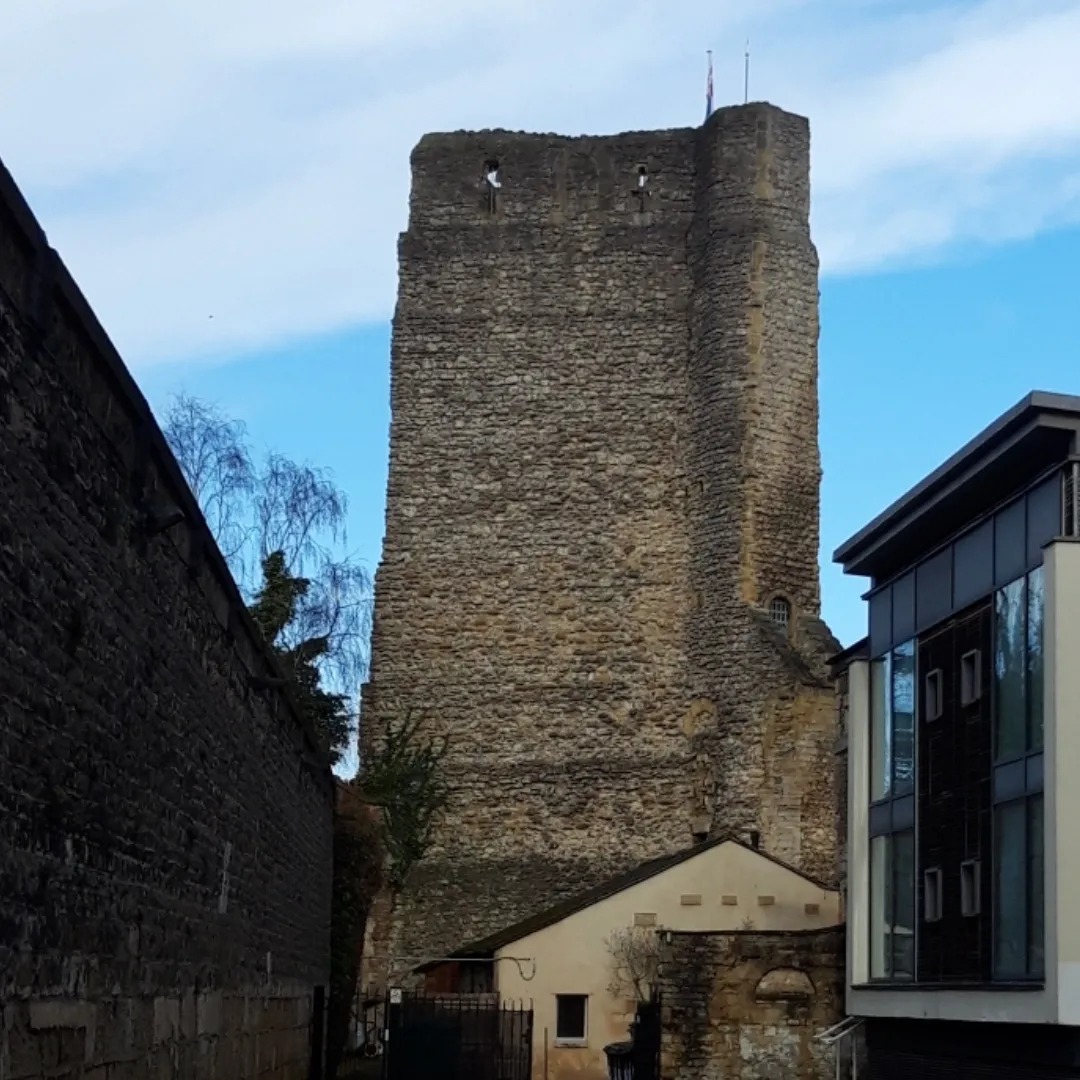
Oxford Castle

With her husband held in chains in Bristol castle, Matilda of Boulogne, Queen of England, wife of King Stephen and cousin of Empress Matilda, stepped into the fight. She first tried to negotiate, offering to take Stephen into exile if Matilda would at least guarantee their son’s inheritance of their ancestral lands. The empress refused, perhaps remembering that no such guarantee was ever made to her son, Henry, dispossessed of his inheritance by Stephen’s usurpation of the crown. Undeterred, Queen Matilda established a secure base in Kent, from where she raised an army to march on London, burning and ravaging the countryside surrounding the capital. It was becoming apparent that the struggle was far from over. A final masterstroke was when she moved up William of Ypres and his Flemish mercenaries, to threaten London, thus inducing the Londoners to turn against the empress.

Henry, Bishop of Winchester, deserted the empress and joined the queen, promising to expend his efforts on obtaining the release of the king, his brother.

The empress’s success was turning sour.

On the eve of the empress’s ceremonial entrance into the capital, the city’s church bells rang out, a prearranged signal for the citizens to rise against the empress and open the gates to the queen’s approaching army. Empress Matilda was still at Westminster, ‘reclining at a well-cooked feast’. Westminster was an unfortified palace that was not easily defensible and ‘being, however, forewarned by some of them, she fled shamefully with her retinue, leaving all her own and their apparel behind’.

The empress had no choice. She and her supporters rode for Oxford. Although things appeared precarious, all was not lost. Queen Matilda now held London, but the empress still had Stephen in her custody and room for manoeuvre. By the end of July, the empress and her army were riding south. As she approached Winchester, the empress sent a request to Bishop Henry to meet her outside the city, at which point he promptly fled to join Queen Matilda at Guildford.

The Rout of Winchester

Robert of Gloucester and his wife, Mabel

Winchester had two castles: the royal castle, which held for the empress, and Wolvesey, a palatial castle in the south-eastern corner of the city that was the residence of Bishop Henry of Winchester, though he was not at home at the time. Empress Matilda arrived at the royal castle of Winchester on 31 July and began the siege of Wolvesey on 1 August 1141.

In defiance, the garrison of the bishop’s castle threw burning material from the ramparts which, in the summer heat, quickly set the whole city ablaze. The stone cathedral survived, but much of the town, built in wood with thatched roofs, was lost. The devastation meant the city’s population had lost their homes and livelihoods, and the empress’s army were deprived of shelter and provisions. Worse, Queen Matilda was now approaching with an army of her own and, in turn, besieged the empress.

The empress’s army was trapped.

Surrounded, with the city in flames and supplies running short, the empress was forced to flee for her life. In the retreat, her half-brother and leading general, Robert, Earl of Gloucester, was captured.

Queen Matilda now had her own bargaining chip. As much as she needed her husband returned to her, the empress needed her brother.

Prisoner Exchange

Henry II

The practical arrangements for the exchange were rather complicated, with neither side trusting the other to hold to the bargain. On 1 November 1141, Queen Matilda surrendered at Bristol Castle, with one of her sons and two unidentified magnates, so that Stephen could be set at liberty. The king then rode to Winchester, where Earl Robert had been taken under guard, and on his arrival on 3 November the earl was freed, leaving his eldest son and heir, William of Gloucester, as surety. When the earl reached Bristol, the queen, her son and the two unnamed magnates were set at liberty and returned to Winchester. At that point, William of Gloucester was freed as well. After nine months of harsh imprisonment, Stephen was free at last.

By Christmas 1141, having endured nine months of incarceration, Stephen was back on his throne and celebrating the festive season at Canterbury, where he was symbolically re-crowned by the archbishop  of Canterbury, with his queen by his side.

The empress was faced with the realisation of how close she had come to winning it all.

But lost.

At least she had her brother back and the fight was far from over.

The war would drag on until Stephen’s death in 1154, but the empress never came as close again to winning the crown. She eventually passed the baton to her son, Henry FitzEmpress, who would reign as Henry II. It was a kind of victory: it was her son who succeeded King Stephen rather than his own. Empress Matilda could ultimately claim victory as the crown returned to her line and that of her father, Henry I.

*

Images:

Courtesy of Wikipedia except Lincoln Castle and Oxford Castle which are ©SharonBennettConnolly FRHistS 

Selected bibliography:

Gesta Stephani, translated by K. R. Potter; Henry of Huntingdon, The History of the English People 1000-1154; Marjorie Chibnall, The Empress Matilda: Queen Consort, Queen Mother and Lady of the English; Teresa Cole, The Anarchy: The Darkest Days of Medieval England; Catherine Hanley, Matilda: Empress, Queen, Warrior; Helen Castor, She-Wolves: The Women who Ruled England before Elizabeth; Robert Bartlett, England Under the Norman and Angevin Kings; J. Sharpe (trans.), The History of the Kings of England and of his Own Times by William Malmesbury; Orderici Vitalis, Historiae ecclesiasticae libri tredecem, translated by Auguste Le Prévost; Chronicles of the Reigns of Stephen, Henry II and Richard I; Edmund King, King Stephen; Donald Matthew, King Stephen; Matthew Lewis, Stephen and Matilda’s Civil War: Cousins of Anarchy.

*

My Books:

Signed, dedicated copies of all my books are available through my online bookshop.

Out Now! Women of the Anarchy
Two cousins. On the one side is Empress Matilda, or Maud. The sole surviving legitimate child of Henry I, she is fighting for her birthright and that of her children. On the other side is her cousin, Queen Matilda, supporting her husband, King Stephen, and fighting to see her own son inherit the English crown. Women of the Anarchy demonstrates how these women, unable to wield a sword, were prime movers in this time of conflict and lawlessness. It show how their strengths, weaknesses, and personal ambitions swung the fortunes of war one way – and then the other.

Available from Bookshop.orgAmberley Publishing and Amazon UK.

Coming on 15 June 2024: Heroines of the Tudor World
Heroines of the Tudor World tells the stories of the most remarkable women from European history in the time of the Tudor dynasty, 1485-1603. These are the women who ruled, the women who founded dynasties, the women who fought for religious freedom, their families and love. These are the women who made a difference, who influenced countries, kings and the Reformation. In the era dominated by the Renaissance and Reformation, Heroines of the Tudor World examines the threats and challenges faced by the women of the era, and how they overcame them. From writers to regents, from nuns to queens, Heroines of the Tudor World shines the spotlight on the women helped to shape Early Modern Europe.

Heroines of the Tudor World is now available for pre-order from Amberley Publishing and Amazon UK.

Also by Sharon Bennett Connolly:

King John’s Right-Hand Lady: The Story of Nicholaa de la Haye is the story of a truly remarkable lady, the hereditary constable of Lincoln Castle and the first woman in England to be appointed sheriff in her own right. Available from all good bookshops or direct from Pen & Sword Booksbookshop.org and AmazonDefenders of the Norman Crown: The Rise and Fall of the Warenne Earls of Surrey tells the fascinating story of the Warenne dynasty, from its origins in Normandy, through the Conquest, Magna Carta, the wars and marriages that led to its ultimate demise in the reign of Edward III. Available from Pen & Sword BooksAmazon in the UK and US, and Bookshop.org

Ladies of Magna Carta: Women of Influence in Thirteenth Century England looks into the relationships of the various noble families of the 13th century, and how they were affected by the Barons’ Wars, Magna Carta and its aftermath; the bonds that were formed and those that were broken. It is now available in paperback and hardback from Pen & Sword,  Amazon, and Bookshop.orgHeroines of the Medieval World tells the stories of some of the most remarkable women from Medieval history, from Eleanor of Aquitaine to Julian of Norwich. Available now from Amberley Publishing and Amazon, and Bookshop.orgSilk and the Sword: The Women of the Norman Conquest traces the fortunes of the women who had a significant role to play in the momentous events of 1066. Available now from Amazon,  Amberley Publishing, and Bookshop.org.

Alternate Endings: An anthology of historical fiction short stories including Long Live the King… which is my take what might have happened had King John not died in October 1216. Available in paperback and kindle from Amazon.

Podcast:

Have a listen to the A Slice of Medieval podcast, which I co-host with Historical fiction novelist Derek Birks. Derek and I welcome guests, such as Bernard Cornwell and Elizabeth Chadwick, and discuss a wide range of topics in medieval history, from significant events to the personalities involved.

*

Don’t forget! Signed and dedicated copies of all my books are available through my online bookshop.

For forthcoming online and in-person talks, please check out my Events Page.

You can be the first to read new articles by clicking the ‘Follow’ button, liking our Facebook page or joining me on Twitter and Instagram.

*

©2024 Sharon Bennett Connolly FRHistS 

Guest Post: Margaret of Austria by Rozsa Gaston

For Women’s History Month it is my pleasure to welcome Rozsa Gaston to History…the Interesting Bits, with an article on Margaret of Austria. Rozsa is here to share with you why Margaret is important to history as a founding figure of European coalition politics.  

Over to Rozsa….

Margaret knew, or was related to, most of early 16th century Europe’s rulers. 

Her action-packed childhood prepared her for a lifetime of leadership as ruler of the Burgundian-Habsburg Netherlands, and as one of the most important treaty negotiators of her era. 

Let’s look at the players in Margaret of Austria’s life:  

Maximilian I, archduke of Austria and the future Holy Roman Emperor – was Margaret’s father.  

Charles V –future King of Spain and Holy Roman Emperor, is her nephew and ward.  Margaret was Charles V’s legal guardian until he was 15 years old. 

Henry VIII of England –Margaret’s trade partner. English sheep provided the wool for Flanders’ cloth industry. Flanders, in the Low Countries, was world renown from the 12th century on for its fine cloth textiles and its tapestries, which were sought after the world over as a display of wealth and power.  

Catherine of Aragon, Henry VIII’s queen – was Margaret’s former sister-in-law.  

Anne Boleyn, Henry VIII’s 2nd queen  -maid-of-honor at Margaret’s Court of Savoy in Mechelen (Malines) in the Burgundian-Habsburg Low Countries (now Belgium).  

Philip the Handsome, Duke of Burgundywas Margaret’s brother.  

Juana the Mad – the daughter of Isabella and Ferdinand of Spain was Philip’s wife and Margaret’s sister-in-law.  

Isabella and Ferdinand of Spain – Margaret’s former in-laws. 

Louise of Savoy – former sister-in-law & the mother of Francis the First, King of France, Louise was the power behind the throne during her son’s reign. 

Margaret of Austria was born in 1480 in Brussels, the only daughter of the heads of two of Europe’s top dynastic houses: the House of Burgundy and the House of Habsburg. Her mother, Mary of Burgundy, was ruler of Burgundy, the only child of Burgundy’s last duke. She was known throughout Europe as Mary the Rich.   

Margaret’s father was Maximilian the First of Austria, head of the House of Habsburg and later to become Holy Roman Emperor. Mary and Maximilian’s dramatic love story is told in the 2017 Starz Mini Series Maximilian. Well worth viewing.  

Margaret lost her mother in a riding accident at age two. One year later her father contracted with the French king, Louis the Eleventh, known as the Spider King, to marry Margaret to Louis’ son and heir, the future Charles VIII of France. Margaret was sent to France at age 3 to be raised at the French court to prepare her to become Queen of France one day. 

Margaret’s statue towers over the main market square of Mechelen  (pronounced “Meh ku luhn”) Belgium, 18 miles, or 29 kilometers, north of Brussels. Erected in 1849, it was made by sculptor Joseph Tuerlinckx. 

Her palace in Mechelen is called the Court of Savoy. It was the first Renaissance palace built in the Low Countries and is a main tourist destination. The Low Countries are now known as the Benelux countries: Belgium, the Netherlands and Luxembourg. 

Margaret held one of Europe’s most important Renaissance courts at her Court of Savoy for the duration of her career from 1507-1530 as ruler of the Burgundian-Habsburg Netherlands. 

Here is Margaret’s palace, the Court of Savoy, in Mechelen, Belgium. Despite her title, Margaret of Austria hailed from what is now called Belgium, a country that was created in 1830, 300 years after she died.  

In the 16th century the northern part of Belgium was known as Flanders, a Low Countries province within the realm of Burgundy. Everything in orange on this map is Burgundy. Burgundy now no longer exists, but it was the wealthiest realm in Europe in the 14th to late 15th centuries.

Margaret’s native tongue was French. She ruled the Burgundian-Habsburg Netherlands for 23 years, with the exception of two years, from 1515-1517. During those two years, her nephew and ward, Charles the Fifth, came of age, and typical of a teenage boy, he wanted to take control of his realm for himself.  

But after two years of seeing how difficult it was to manage the Netherlands’ 17 different provinces all with conflicting economic interests, he handed back control to his aunt Margaret, who was a master at negotiating trade agreements and at putting together coalitions for the greater good of the Netherlands’ economic prosperity.  

Margaret was confident, self-possessed, well-organized, and enjoyed being in charge. She did not show her hand. An excellent bluffer at both diplomatic negotiations and the gaming table, she played cards and gambled with heads of state and diplomats to the Low Countries who were sent to her Court of Savoy in Mechelen. 

Margaret’s travels by the age of twenty-seven made her one of Europe’s most cosmopolitan princesses. 

Jan. 10, 1480 – Margaret of Austria is born in Brussels. 
 
Age 3 – She’s sent to France to be raised under Anne of France or Anne de Beaujeu to become its queen one day. 
 
Age 11 –Margaret is jilted by Charles VIII of France, who marries Anne of Brittany instead. 

Age 13- Margaret returns to Flanders in the Low Countries and waits for her father to make another match for her. 
 
Age 17 – Margaret goes to Spain to marry Isabella and Ferdinand’s son Juan, heir to the Spanish throne.  But – he dies six months after they marry.    

Ages 19-21 – Back in Flanders in the Low Countries, Margaret awaits her father’s next marriage choice for her. 

Age 21 – Margaret moves to Savoy when luck arrives with her marriage to Philibert, Duke of Savoy, a childhood friend who becomes the love of her life.  

Age 24 – Luck departs when Philibert dies. 
 
Age 26 – Margaret’s life changes completely when her brother, Philip the Handsome, Duke of Burgundy, dies in Spain, possibly of poisoning, and Margaret takes over rulership of the Burgundian-Habsburg Netherlands. She also takes over guardianship of Philip’s children, the future Charles the Fifth and his three sisters, all Habsburg royals who live in Brussels, and are now functionally orphaned, as their father has died and their mother, Juana of Castile, has gone insane and remains in Spain. 

Ages 27-50 – Margaret lives in Mechelen where she rules the Netherlands and conducts her government from her palace, the Court of Savoy. 

Age 50 – Margaret dies. Two years later her body is transported to Brou, France, where she is buried next to her beloved 2nd husband Philibert of Savoy. Savoy was a region between France, Switzerland and the duchy of Milan, which was very strategic in the 16th century because it controlled the pass through the Alps for French soldiers to march to Milan. At that time in history all the great European powers were interested in gaining a piece of Italy. 

Margaret lived just at the moment that the feudal age gave way to the Renaissance.  

Stuck at the French court for two years after being jilted by the French king, an unexpected friendship formed between Margaret and Anne of Brittany, who was three years older and who took her place as Queen of France.  

Instead of hating each other, Margaret and Anne were both politically astute enough to recognize that they were pawns in the hands of the French. They became lifelong friends and wrote to each other until Anne of Brittany’s death. They sent scholars to serve at each other’s courts and were both instrumental in bringing Renaissance art and humanist learning to their respective courts of Burgundy and France. 

After returning to the Low Countries from France at age 13, Margaret’s father Maximilian arranges a match for her with Isabella and Ferdinand of Spain’s son and heir, Juan. Maximilian also arranges for Margaret’s older brother Philip, Duke of Burgundy, to marry Juan’s sister, Juana, known to history as Juana the Mad. At age 17 Margaret is on track to become Queen of Spain. But after only 6 months of marriage her 19-year-old husband dies. 6 months later Margaret gives birth to their child, a stillborn daughter. She never has another child.  

Margaret spends the year after Juan’s death at Isabella and Ferdinand’s Alhambra Palace in Granada, teaching French to their youngest daughter Catherine of Aragon, future  Queen of England. 

Queen Isabella of Spain is a huge influence on Margaret, who spends two years observing her ruling her kingdom as well as managing her husband Ferdinand, whose kingdom of Aragon is much smaller than Isabella’s kingdom of Castile. 

Margaret and Catherine of Aragon remained lifelong friends. 

At age 19 Margaret leaves Spain and returns to the Low Countries to await her father’s next marriage choice for her. Margaret’s 2nd husband, Philibert, Duke of Savoy, was a childhood friend from Amboise, where he also grew up at the French court with his sister Louise of Savoy. The same age as Margaret, he and she fell madly in love.  

But Philibert was not interested in ruling Savoy and had left it to his illegitimate half brother to manage. Soon after Margaret arrived, she ousted his half brother and took over ruling Savoy herself. Philibert was not a natural-born leader, but an excellent athlete and hunter, very good-looking with a faithful heart. He was happy for Margaret to take the reins and he supported her leadership.  

But at age 24, Philibert went out hunting on a hot day and developed a lung inflammation after drinking ice cold water from a mountain stream. He died 9 days later. Margaret remained in Savoy as Duchess and ruler for two more years, devoting herself to building a church to honor Philibert, and where she intended to be buried with him.  

Margaret’s church at Brou is a masterpiece of flamboyant Gothic architecture. It’s a must-see for visitors to the Geneva-Lyon area. Commissioned by her in 1506 it took 26 years to build. Margaret is buried there with her husband Philibert and his mother, Margaret of Bourbon, who was from the same Bourbon or Bourbon dynasty that rules Spain today with King Felipe of Spain at its head. 

The Church and Royal Monastery at Brou is 69 miles west of Geneva and 50 miles north of Lyon. Author of the foreword to my book on Margaret of Austria, Austrian archduke Géza von Habsburg has visited and says that the restaurant in its town square serves the best coq au vin (or chicken in wine sauce) in all of France.

These are the tomb effigies of Philibert and Margaret. Someone has placed a rose on Philibert’s chest, undoubtedly because he was so handsome. 

Margaret designed the placement of Philibert’s effigy so that he appears to be looking at her. 

The standard Renaissance style of the day was to place the lying-in-state effigy on top and the deathbed effigy on the bottom. Their actual tombs are in the crypt below the church nave. Unusually, they were not desecrated during the French Revolution because Brou was so obscurely located that the revolutionaries couldn’t find it. When Margaret’s tomb was opened in the 19th century, her long dark blonde hair was still intact. 

Margaret of Austria and her father Maximilian I both hated the French. Why?  

They had both been jilted by the French, due to the land grab of Charles the Eighth’s powerful older sister, Anne of France, who ruled France as regent while Charles was still a child. 

In 1490 when Anne of Brittany was 13 and ruling Brittany, she was married by proxy to Margaret’s father Maximilian I. But he failed to come to her rescue when France invaded Brittany the next year. Anne never actually met Maximilian. 

Charles, the 21-year-old king of France, was betrothed to Margaret, who was only 11 at that time. But in Dec. of 1491 Charles wed Anne of Brittany in order to acquire Brittany for France.  

Margaret spent the next two years from ages 11-13 in limbo in France, while Charles VIII of France and Maximilian I argued over the return of her dowry.  

Anne of France was one of Europe’s most politically powerful women of the late 15th century. She escorted Margaret of Austria at age 3 from the Low Countries border to the French court in Amboise where Margaret lived for the next 10 years under her guardianship. 

Plans to marry Margaret to the French king changed when Anne of France decided Brittany was a bigger plum for France to acquire than Margaret’s dowry lands on the French/Low Countries border. After eight years of overseeing Margaret’s education Anne of France cast Margaret aside overnight and replaced her with Anne of Brittany as Charles’ wife.  

Margaret never forgave Anne of France or her younger brother Charles for their betrayal. But — the lessons Margaret learned from Anne of France in self-control and political maneuvering honed Margaret’s political skills as governor of the Netherlands and as an important treaty negotiator years later. 

Game of Queens by well-known British historian and author Sarah Gristwood opens with a chapter on Margaret of Austria. I highly recommend Game of Queens to those interested in women who held political power in 16th century Europe.  

Margaret not only ruled the Netherlands but negotiated pan-European treaties on behalf of her father Maximilian, the Holy Roman Emperor, her father-in-law Ferdinand of Aragon, and her nephew, Charles V, King of Spain and Holy Roman Emperor.  

Treaty of Cambrai by Francisco Jover y Casanova, 1871 

Margaret’s most important treaty was the 1529 Treaty of Cambrai that she negotiated with her sister-in-law Louise of Savoy. Louise of Savoy was the power behind the throne of her son Francis, King of France. The 1529 Treaty of Cambrai took 2 and a half weeks to negotiate and ended the war between the Holy Roman Empire and France. It is known to history as The Ladies’ Peace. 

Margaret on the left signs on behalf of her nephew, Charles the Fifth, King of Spain and Holy Roman Emperor. 

Louise of Savoy on the right signs on behalf of her son, Francis I, King of France.  

In 1529 Charles V and Francis I were Europe’s two most powerful rulers. A close third was Henry VIII of England, but he was still up-and-coming in those days, and England was still a bit of a backwater compared to continental Europe.  

All three of these men were young and ambitious, all ruled by powers behind the throne: Francis by his mother Louise, Henry by his chancellor Cardinal Wolsey, and Charles V by his aunt Margaret.  

Charles V’s title of Holy Roman Emperor was an elected position. He ran against Francis I and Henry VIII for that office and won in 1519, due to Margaret’s gifts, visits, trade incentives, and bribes to the seven German Prince-Electors who voted him into office. 

What was the secret of Margaret’s success? She had strong female mentors. She was mentored by Europe’s most powerful female political leaders of her times, Anne of France, and Isabella of Spain.  

Secondly, Margaret had a devoted support team. She was supported in her political leadership by both her father, Maximilian of Austria, and her 2nd husband, Philibert of Savoy. She brought a team of six counselors with her to the Low Countries in 1507 from Savoy, including her legal counsel and two private secretaries. These men were devoted to her and served at her court for their entire lives. 

The Card Players by Lucas van Leyden, c. 1525, Thyssen-Bornemisza Museum, Madrid 

Another secret to Margaret’s success was that Margaret was a master bluffer both at cards and at the diplomatic negotiating table. She never showed her hand. 

Henry VIII’s chancellor Cardinal Thomas Wolsey is thought to be on the right. You can see how worried he looks, up against master card shark Margaret.  Margaret got a lot of deals done over the gaming table at her evening parties at the Court of Savoy. She was sociable, vivacious, charming, and careful not to let anyone know what she was really thinking. Her evening entertainments functioned in the same way as present-day CEO’s golf outings do where important decisions are made on the golf course.  

This is a painting of Margaret of Austria’s nephew Charles V’s palace in Brussels, to give you an idea of the scope of Burgundian splendor. Coudenberg Palace burned down in 1731. You can tour its ruins today on Coudenberg Hill in the Royal Quarter neighborhood of Brussels in Belgium. 

Without a doubt, I would say that Margaret of Austria was one of the most powerful and influential historical figures of the northern European Renaissance.  

She set the precedent for successful female rule in the Netherlands, a tradition that continues to this day with unbroken female rulership from 1890 to 2013 thru Queens Wilhelmina, Juliana, and Beatrix.  

Discover more of Margaret’s story in my 2023 book on her life, Margaret of Austria, with a foreword by noted historian Susan Abernethy of The Freelance Writer’s blog and European Women in History.  

*

About the author: 

Rozsa Gaston is a historical fiction author who writes books on women who reach for what they want out of life.  

She is the author of Margaret of Austria, 2023 Chaucer Book Awards finalist for Pre-1750s Historical Fiction, the Anne of Brittany Series: Anne and Charles; Anne and Louis, General Fiction Winner of the 2018 Publishers Weekly Booklife Prize; Anne and Louis: Rulers and Lovers; and Anne and Louis Forever Bound, First Place Winner of the 2022 Chaucer Book Award for Pre-1750s Historical Fiction. 

Other works include Sense of Touch, Marguerite and Gaston, and The Least Foolish Woman in France. 

Gaston studied European history at Yale and received her master’s degree in international affairs from Columbia. She worked at Institutional Investor magazine, then as a columnist for The Westchester Guardian.  

She is currently working on a book on Anne Boleyn at Margaret of Austria’s court. She lives in Bronxville, New York with her family. 

Gaston can be found online on Facebook, or at her website.

Her motto? History matters. 

My Books:

Signed, dedicated copies of all my books are available through my online bookshop.

Out Now! Women of the Anarchy

Two cousins. On the one side is Empress Matilda, or Maud. The sole surviving legitimate child of Henry I, she is fighting for her birthright and that of her children. On the other side is her cousin, Queen Matilda, supporting her husband, King Stephen, and fighting to see her own son inherit the English crown. Women of the Anarchy demonstrates how these women, unable to wield a sword, were prime movers in this time of conflict and lawlessness. It show how their strengths, weaknesses, and personal ambitions swung the fortunes of war one way – and then the other.

Available from Bookshop.orgAmberley Publishing and Amazon UK.

Coming on 15 June 2024: Heroines of the Tudor World

Heroines of the Tudor World tells the stories of the most remarkable women from European history in the time of the Tudor dynasty, 1485-1603. These are the women who ruled, the women who founded dynasties, the women who fought for religious freedom, their families and love. These are the women who made a difference, who influenced countries, kings and the Reformation. In the era dominated by the Renaissance and Reformation, Heroines of the Tudor World examines the threats and challenges faced by the women of the era, and how they overcame them. From writers to regents, from nuns to queens, Heroines of the Tudor World shines the spotlight on the women helped to shape Early Modern Europe.

Heroines of the Tudor World is now available for pre-order from Amberley Publishing and Amazon UK.

Also by Sharon Bennett Connolly:

King John’s Right-Hand Lady: The Story of Nicholaa de la Haye is the story of a truly remarkable lady, the hereditary constable of Lincoln Castle and the first woman in England to be appointed sheriff in her own right. Available from all good bookshops or direct from Pen & Sword Booksbookshop.org and AmazonDefenders of the Norman Crown: The Rise and Fall of the Warenne Earls of Surrey tells the fascinating story of the Warenne dynasty, from its origins in Normandy, through the Conquest, Magna Carta, the wars and marriages that led to its ultimate demise in the reign of Edward III. Available from Pen & Sword BooksAmazon in the UK and US, and Bookshop.org

Ladies of Magna Carta: Women of Influence in Thirteenth Century England looks into the relationships of the various noble families of the 13th century, and how they were affected by the Barons’ Wars, Magna Carta and its aftermath; the bonds that were formed and those that were broken. It is now available in paperback and hardback from Pen & Sword,  Amazon, and Bookshop.orgHeroines of the Medieval World tells the stories of some of the most remarkable women from Medieval history, from Eleanor of Aquitaine to Julian of Norwich. Available now from Amberley Publishing and Amazon, and Bookshop.orgSilk and the Sword: The Women of the Norman Conquest traces the fortunes of the women who had a significant role to play in the momentous events of 1066. Available now from Amazon,  Amberley Publishing, and Bookshop.org.

Alternate Endings: An anthology of historical fiction short stories including Long Live the King… which is my take what might have happened had King John not died in October 1216. Available in paperback and kindle from Amazon.

Podcast:

Have a listen to the A Slice of Medieval podcast, which I co-host with Historical fiction novelist Derek Birks. Derek and I welcome guests, such as Bernard Cornwell and Elizabeth Chadwick, and discuss a wide range of topics in medieval history, from significant events to the personalities involved.

*

Don’t forget! Signed and dedicated copies of all my books are available through my online bookshop.

For forthcoming online and in-person talks, please check out my Events Page.

You can be the first to read new articles by clicking the ‘Follow’ button, liking our Facebook page or joining me on Twitter and Instagram.

*

©2024 Sharon Bennett Connolly FRHistS and Rozsa Gaston.

Matilda of Boulogne: From Countess to Queen

Matilda of Boulogne, Queen of England

King Stephen’s wife, Matilda of Boulogne, was a stalwart supporter of her husband. She was arguably more capable than Stephen and often took the initiative in diplomatic negotiations. Acting as Stephen’s wife, she offered a stark contrast to the independence and authority of Empress Matilda that so infuriated the barons. Matilda of Boulogne was a little more subtle than her imperious counterpart, only ever acting in her husband’s name, not her own. Even later, when she held the command of Stephen’s forces during his captivity in 1141, she claimed to act only on behalf of her husband and sons.

Matilda of Boulogne was an example of how a woman was expected to act and comport herself: strong and confident, but subject to her husband’s will. On this last, Empress Matilda failed in the eyes of the barons; she was acting for herself. In the event, the barons of England and Normandy despised her second husband, Geoffrey of Anjou, so they would have been even less receptive to Matilda had her husband tried to assert his authority. It was a conundrum that Matilda was never able to resolve, though she would not give up trying.

According to the Gesta Stephani (The Deeds of Stephen), Stephen of Blois was ‘by far the dearest of all his nephews to King Henry the peacemaker, not only because of the close family relationship, but also because he was peculiarly eminent for many conspicuous virtues’. Born at Blois in or around 1096, Stephen was the third son of Adela and her husband, Stephen, Count of Blois and Chartres. His father was one of the leaders of the First Crusade and may well have departed for the Holy Land before – or shortly after – the younger Stephen’s birth. It is likely that young Stephen had little contact with his father; the count returned from crusade in 1198, only to depart again in 1201.

In 1125, it was King Henry who arranged for Stephen’s marriage to the daughter and sole heiress of the Count of Boulogne, Matilda. Matilda’s mother was Mary of Scotland, sister of Henry I’s first wife, Matilda of Scotland; the younger Matilda was therefore first cousin to Henry I’s daughter, Empress Matilda. The daughter of King Malcolm III Canmore and his queen Margaret of Wessex, Mary of Scotland could trace her illustrious heritage all the way back to Alfred the Great; she had been educated in England alongside her sister. Mary was married to Eustace III, Count of Boulogne, and their only child, Matilda, was probably born the following year, in 1105. The baby’s maternal aunt, Matilda of Scotland, stood as godmother. It is possible that, like her mother and aunt, young Matilda was educated at the convents of Wilton and Romsey. She was certainly a well-educated and capable woman. As we shall see, as an adult, she seems as erudite and well versed in politics as her husband, perhaps with an even better capacity for diplomacy.

Henry I, King of England

Mary of Scotland died when her daughter was around ten or eleven years old, on 31 May 1116. She was buried in the wealthy Cluniac house of Bermondsey Abbey in England.

The county of Boulogne lay within the greater county of Flanders. Nominally owing fealty to France, it was largely autonomous and held extensive interests in England, particularly in Essex and the south-east. The county also controlled one of the most important Channel crossings to England at Wissant. Keeping the county onside by marrying a reliable magnate to the heir to Boulogne was of great interest to Henry. As its heiress, Matilda of Boulogne was a figure of major political significance, her marriage deserving of careful consideration. Given that she was still unmarried at the age of twenty, with such a rich inheritance, it is possible that previous but unrecorded marital arrangements had fallen through, or that her father and uncle had taken extra care in ensuring that Matilda’s hand in marriage went to the right person.

By 1125, King Henry had been married to Adeliza of Louvain for four years, but no children had been born of the union. Likewise, Henry’s daughter, Empress Matilda, had yet to produce a living child and was at this stage more likely to be envisioning a future within the empire rather than as her father’s successor. King Henry may have been looking elsewhere for an heir to his throne; his Blois nephews, Theobald and Stephen, were the obvious candidates. As a bride to Stephen, Matilda of Boulogne would strengthen his claim to the throne, both by her Saxon royal blood and by the financial backing of the county of Boulogne.

Matilda of Boulogne and Stephen were married early in 1125, though the exact date is not recorded. Shortly after the marriage, Matilda’s father, Eustace, a former crusader, abdicated in favour of his son-in-law. Eustace retired to the Cluniac priory at Romilly, taking leave of his daughter and son-in-law in a public ceremony, probably followed by a private farewell, at the priory where he died a short time later, aged about seventy-five. As Count of Boulogne and Mortain, Stephen was now a man to be reckoned with, with considerable resources on both sides of the English Channel; he was the greatest landowner in Suffolk, Essex and the north-west of England.

Rule over the strategically important county of Boulogne would be a suitable training ground for Stephen to get used to exercising significant power in his own right. Through certain charters in the latter half of the 1120s, we can see Stephen administering his cross-Channel lordship. In 1127 he founded Furness Abbey in his lordship of Lancaster. The abbey’s mother house was located at Savigny, in Stephen’s county of Mortain. In the same year, Stephen granted the monks of Canterbury Cathedral priory an exemption from tolls at Wissant, the port through which they shipped their wine.

Empress Matilda depicted at the coronation of her granddaughter, Matilda of England, as Duchess of Saxony, in an image from the Gospels of Henry the Lion.

In marrying into the county of Boulogne, Stephen had joined a family well versed in commerce. He was heavily involved in the county’s business proceedings, usually mentioned alongside his wife, Matilda of Boulogne, who appears to have been the one in charge of the day-to-day management of the county. The Essex town of Colchester was the centre of administration for Boulogne’s interests in England. In the early years of Henry I’s reign the lands in Colchester had been identified as ‘the lands of Count Eustace,’ and were built up with the addition of lands that had belonged to Eudo Dapifer, also known as Iwun al Capel, brother-in-law of William the Conqueror and a member of the de la Haye family, until his death in 1120.

Stephen and Matilda were at Canterbury in person to confirm a charter to the monks of Christ Church, which gave the monks freedom from customs duties for the port of Wissant, granted by Count Eustace. The count and countess placed their sealed charter on the high altar of the abbey church; it is still held in the abbey archives. The ceremony was presided over by the Archbishop of Canterbury himself, William Corbeil. In 1131, the couple wrote to the archbishop and the Bishop of Ely to notify them that they had transferred the secular rights of the church at Gamlingay in Cambridgeshire to the Augustinian canons of Colchester, ‘for the remission of our sins and those of our ancestors and for the safe preservation of our son, Eustace, and our other offspring and for our temporal well-being.’ This is the first mention of Eustace and dates his birth to no later than August 1131, when Hervey, Bishop of Ely, died.

The fact these charters were jointly granted by both Stephen and Matilda serve to demonstrate how closely involved Matilda was in the management of the county, and how closely Stephen and Matilda worked together as a couple. The trust they developed in each other would stand them in good stead in the years to come.

In the early 1130s Matilda of Boulogne, like her counterpart Empress Matilda in Anjou, would have been occupied with a number of pregnancies. The couple’s first child, a son named Eustace, was born no later than 1131 and at least two further children, Baldwin and Matilda, were born before Stephen became king in 1135. Little Baldwin died before his father even came to the throne; he was buried beside the altar at Holy Trinity, Aldgate, the abbey founded by the countess’s aunt Matilda of Scotland, Henry I’s first queen. That Baldwin was buried in London suggests that Matilda spent time in England as well as Boulogne during this period. Two more children, William and Mary (or Marie), were probably born after Stephen seized the crown. The three older children were given names that called to mind the county of Boulogne, with both Eustace and Baldwin being the names of several former counts. William, on the other hand, was a reference to Stephen’s grandfather, William the Conqueror, King of England.

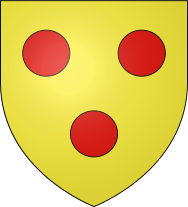
Arms of the county of Boulogne

Despite henry I having his barons swear – twice – to uphold the claims of his daughter to the throne of England, Henry I left no written instruction as to the disposition of his throne and lands, which led to the chroniclers disputing exactly what the king had intended. What is certain is that in his final days, Henry did not name his heir. Unfortunately, the lack of this definitive designation at the last meant that there was enough ambiguity for Stephen to seize the initiative.

What the chronicles do agree on is that Henry’s death caused a great deal of unrest on both sides of the Channel. According to Orderic Vitalis, ‘on the very same day that the Normans heard that their firm ruler had died in the first week of Advent they rushed out hungrily like ravening wolves to plunder and ravage mercilessly’. On the other side of the Channel, the Anglo-Saxon Chronicle made a similar report: ‘Then his land immediately grew dark because every man who could immediately robbed another.’

At Henry I’s death in December 1135, the major players in the drama that was about to unfold were scattered throughout the Anglo-Norman realm. Robert, Earl of Gloucester was at his father’s side; Queen Adeliza was in England; Empress Matilda was in Anjou with her husband, Geoffrey, and in the early stages of her third pregnancy; and Stephen of Blois was in Boulogne with his wife, Matilda. In the days after the king’s death, the lack of a designated heir was evident, and the barons moved to maintain peace in Normandy.

Stephen, King of England

Stephen had decided his own priorities, possibly well in advance of the king’s death and perhaps in collusion with his brother, Theobald. Whether Empress Matilda had an inkling of what Stephen was planning we do not know, though it seems unlikely given her own move into Normandy and no further. Stephen was not with the king when he died. Although he had been with Henry at Rouen earlier in the year, by late November 1135 he was in his county of Boulogne and it was there that the news of the king’s demise reached him, probably two or three days later. The speed of Stephen’s response, and its organisation, shows that he had been contemplating his plan of action for some time.

It is not hard to imagine him sitting in Boulogne, surrounded by his wife and family, watching and waiting for the arrival of the news that would set his plans in motion. According to the Gesta Stephani, ‘as soon as he heard by report that King Henry had breathed his last, forming a mighty design like the famous Saul, [Stephen] made for the coast, since he was the other side of the Channel, and happening to gain a favourable wind turned his mind and his ship towards England’.

Leaving his wife and children in the relative safety of Boulogne, Stephen took what must have been the biggest gamble of his life.

*

Further reading:

Donald Matthew, King Stephen; Robert Bartlett, England Under the Norman and Angevin Kings; David Williamson, Brewer’s British Royalty; the History Today Companion to British History; Dan Jones, the Plantagenets; englishmonarchs.co.uk; The Oxford Companion to British History; Mike Ashley, The Mammoth Book of British kings & Queens; Alison Weir, Britain’s Royal Families, the Complete Genealogy; Farrer, William and Charles Travis Clay, editors, Early Yorkshire Charters, Volume 8: The Honour of WarenneGesta Stephani; Henry of Huntingdon, The History of the English People 1000-1154; J. Sharpe (trans.), The History of the Kings of England and of his Own Times by William Malmesbury; Catherine Hanley, Matilda: Empress, Queen, Warrior; Orderici Vitalis, Historiae ecclesiasticae libri tredecem, translated by Auguste Le Prévost; Chronicles of the Reigns of Stephen, Henry II and Richard I; Edmund King, King Stephen; Donald Matthew, King Stephen; Teresa Cole, the Anarchy: The Darkest Days of Medieval England;  Matthew Lewis, Stephen and Matilda’s Civil War: Cousins of Anarchy.

*

My Books:

Signed, dedicated copies of all my books are available through my online bookshop.

Out Now! Women of the Anarchy

Two cousins. On the one side is Empress Matilda, or Maud. The sole surviving legitimate child of Henry I, she is fighting for her birthright and that of her children. On the other side is her cousin, Queen Matilda, supporting her husband, King Stephen, and fighting to see her own son inherit the English crown. Women of the Anarchy demonstrates how these women, unable to wield a sword, were prime movers in this time of conflict and lawlessness. It show how their strengths, weaknesses, and personal ambitions swung the fortunes of war one way – and then the other.

Available from Bookshop.orgAmberley Publishing and Amazon UK.

Coming on 15 June 2024: Heroines of the Tudor World

Heroines of the Tudor World tells the stories of the most remarkable women from European history in the time of the Tudor dynasty, 1485-1603. These are the women who ruled, the women who founded dynasties, the women who fought for religious freedom, their families and love. These are the women who made a difference, who influenced countries, kings and the Reformation. In the era dominated by the Renaissance and Reformation, Heroines of the Tudor World examines the threats and challenges faced by the women of the era, and how they overcame them. From writers to regents, from nuns to queens, Heroines of the Tudor World shines the spotlight on the women helped to shape Early Modern Europe.

Heroines of the Tudor World is now available for pre-order from Amberley Publishing and Amazon UK.

Also by Sharon Bennett Connolly:

King John’s Right-Hand Lady: The Story of Nicholaa de la Haye is the story of a truly remarkable lady, the hereditary constable of Lincoln Castle and the first woman in England to be appointed sheriff in her own right. Available from all good bookshops or direct from Pen & Sword Booksbookshop.org and AmazonDefenders of the Norman Crown: The Rise and Fall of the Warenne Earls of Surrey tells the fascinating story of the Warenne dynasty, from its origins in Normandy, through the Conquest, Magna Carta, the wars and marriages that led to its ultimate demise in the reign of Edward III. Available from Pen & Sword BooksAmazon in the UK and US, and Bookshop.org

Ladies of Magna Carta: Women of Influence in Thirteenth Century England looks into the relationships of the various noble families of the 13th century, and how they were affected by the Barons’ Wars, Magna Carta and its aftermath; the bonds that were formed and those that were broken. It is now available in paperback and hardback from Pen & Sword,  Amazon, and Bookshop.orgHeroines of the Medieval World tells the stories of some of the most remarkable women from Medieval history, from Eleanor of Aquitaine to Julian of Norwich. Available now from Amberley Publishing and Amazon, and Bookshop.orgSilk and the Sword: The Women of the Norman Conquest traces the fortunes of the women who had a significant role to play in the momentous events of 1066. Available now from Amazon,  Amberley Publishing, and Bookshop.org.

Alternate Endings: An anthology of historical fiction short stories including Long Live the King… which is my take what might have happened had King John not died in October 1216. Available in paperback and kindle from Amazon.

Podcast:

Have a listen to the A Slice of Medieval podcast, which I co-host with Historical fiction novelist Derek Birks. Derek and I welcome guests, such as Bernard Cornwell and Elizabeth Chadwick, and discuss a wide range of topics in medieval history, from significant events to the personalities involved.

*

Don’t forget! Signed and dedicated copies of all my books are available through my online bookshop.

For forthcoming online and in-person talks, please check out my Events Page.

You can be the first to read new articles by clicking the ‘Follow’ button, liking our Facebook page or joining me on Twitter and Instagram.

*

©2024 Sharon Bennett Connolly FRHistS.

Hildegard of Bingen

History ... the Interesting Bits
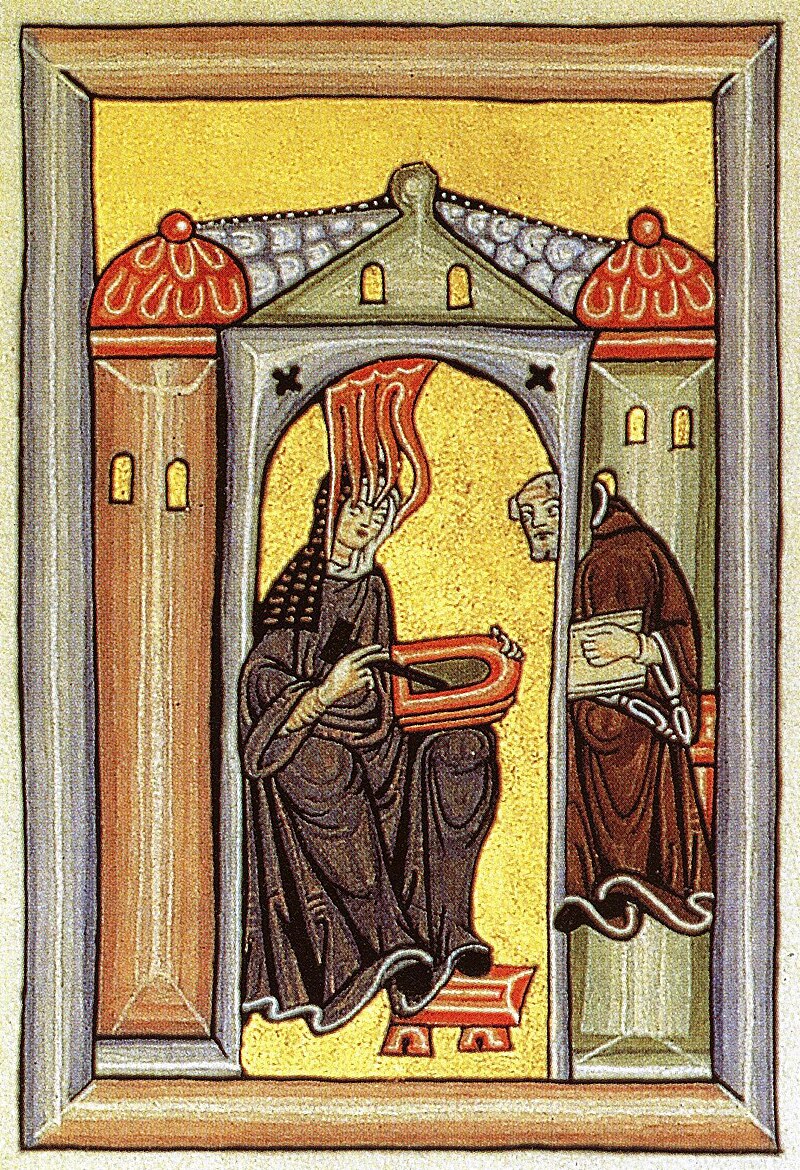
Illumination from Hildegard’s Scivias (1151) showing her receiving a vision and dictating to teacher Volmar

Hildegard of Bingen was rather brilliant. Born in around 1098 in Bremersheim in the Rhineland, into a noble family, Hildegard was the tenth child of Hildebert and Mechtild and was destined for life in a convent from an early age. She was around eight years old when she was placed with Jutta of Sponheim, a reclusive (possibly an anchorite), religious noblewoman who supervised the education of young girls from noble families. In 1112, at the age of fourteen, Hildegard, along with other girls in Jutta’s charge, took her vows at the monastery at Disibodenberg. Under Jutta, who became prioress at Disibodenberg, Hildegard was taught to read, and Latin, although she was not proficient in the latter, and in later life she relied on her secretaries to correct her Latin grammar.

Hildegard was a woman of many talents, she was a visionary, a musician, philosopher, theologian and an expert in medicine. She lived at the monastery of Disibodenberg for more than thirty years. It was in her early years there that she first experienced visions, which would make her famous even in her own lifetime. Initially, she only revealed her prophetic visions to her mentor, Jutta, and it was only when God commanded to her record them, that she revealed them to her friend and secretary, Volmar. With the permission of the Abbot of Disibodenberg, Kuno, and with the encouragement of Volmar and a fellow nun, Richardis of Stade, Hildegard started writing down her visions when she was in her forties. It was only after much encouragement from her Archbishop, Henry of Mainz, that her first work, Scivias, was published. The beautifully illustrated work was given approval from a commission set up by Pope Eugene III and was also supported by the saintly Bernard of Clairvaux.

Abbot Bernard of Clairvaux was one of a number of theologians with whom Hildegard maintained a correspondence. She regularly asked the venerable abbot for advice and guidance, and help in interpreting her visions. In one letter, she would tell him,

‘I have from earliest childhood seen great marvels which my tongue has no power to express but which the Spirit of God has taught me that I may believe … Indeed, I have no formal training at all, for I know how to read only on the most elementary level, certainly with no deep analysis. But please give me your opinion in this matter, because I am untaught and untrained in exterior material, but am only taught inwardly, in my spirit.’


Hildegard corresponded with the great personalities of her time, with emperors, popes and even queens. Sometime between 1154 and 1171, she responded to a letter from Eleanor of Aquitaine, asking for advice, with the words ‘Your mind is like a wall which is covered with clouds, and you look everywhere but have no rest. Flee this and attain stability with God and men, and God will help you in all your tribulations. May God give you his blessing and help in all your works’.

History ... the Interesting Bits
Hildegard of Bingen

In 1148 Hildegard had a vision in which God commanded her to take her nuns and establish her own nunnery. Although Abbot Kuno was reluctant to see Hildegard leave Disibodenberg – her reputation had brought the monastery pilgrims and prestige – she eventually prevailed and established a new convent at Rupertsberg. Hildegard’s convent admitted only noblewomen, she did not believe in mixing the classes within a convent, writing that different ‘classes of people should not be mixed, or they will fall out through deceit or arrogance, and the shame occasioned by their differences. The greatest danger of all is a breakdown in peaceful manners through mutual backbiting and hatred when the upper-class pounce on the lower or when the lower is promoted above the higher.’

It was at Rupertsberg that Hildegard wrote two medical works, Causes and Cures and Physica, after studying the illnesses of the sick who she cared for. Her writings suggested remedies for different ailments, using a wide variety of plants; for example, Hildegard explains how cloves could be used to remedy against gout, swollen intestines and hiccups. She also extolled the virtues of the rose as a cure for many ills, saying:

‘Rose is cold, and this coldness contains moderation which is useful. In the morning, or at daybreak, pluck a rose petal and place it on your eyes. It draws out the humour and makes them clear. One with small ulcers on his body should place rose petals over them. This pulls the mucus from them. One who is inclined to wrath should take rose and less sage and pulverise them. The sage lessens the wrath, and the rose makes him happy. Rose, and half as much sage, may be cooked with fresh, melted lard, in water, and an ointment made from this. The place where a person is troubled by a cramp or paralysis should be rubbed with it, and he will be better. Rose is also good to add to potions, unguents, and all medications. If even a little rose is added, they are so much better, because of the good virtues of the rose.’

Hildegard’s prolific writing career continued in her new surroundings. She produced religious poems, music and even a play, Ordo Virtutum. She also wrote two further books of her visions, Liber vitae meritorum (Book of Life’s Merits) and Liber divinonim operum (Book of Divine Works), and a life of the abbey’s patron saint, St Rupert. Ricardis of Stade and her friend and secretary, Volmar, had accompanied Hildegard from Disibodenberg to Rupertsberg and continued to help her as secretaries and assistants. A succession of secretaries came after Volmar and Richardis, including Hildegard’s nephew, Wesclein, her brother, Hugo of Tholey, and her last secretary, Guibert of Gembloux. Guibert and an earlier secretary, Godfrey of Disibodenbrg, both wrote biographies of Hildegard. The main purpose of the secretaries was to edit Hildegard’s works as her Latin grammar was far from proficient; however, they were under strict instructions not to change any of her words as they came from God, exhorting

‘Let no man be so audacious as to add anything to this writing lest he be blotted out from the book of life’.

History ... the Interesting Bits
Coin commemorating the 900th anniversary of the birth of Hildegard of Bingen

Hildegard was a prolific letter writer and, more than 800 years after her death, there are around 400 of her letters still extant today. Many wrote to her asking for advice and prophecies. Indeed, John of Salisbury said Pope Eugene III had consulted Hildegard for predictions about his reign, which had been accurate. In her letters, Hildegard acts as a mediator within the monastic world, soothing arguments within convents, between abbesses and their nuns, and abbots and their monks. She was respected by men and women alike, noble and poor. Hildegard gave advice and support and remonstrated against injustice and corruption. She travelled widely and undertook four preaching tours, between 1158 and 1170, a practice ordinarily forbidden to women, who were expected not to teach or speak in church.

Hildegard of Bingen died in her eighty-second year, at Rupertsberg, on 17 September 1179, and was canonised as Saint Hildegard on 10 May 2012 by Pope Benedict XVI, who declared her a doctor of the Church, in the same year. She was a woman of extraordinary talents, an exceptional writer, a poet and composer, a visionary, a mystic and a scientist. She was trusted and respected by the great men of her age and is considered to be the most influential woman in medieval Church history, a well-deserved accolade.

Sources:

The Letters of Hildegard of Bingen, translated by Joseph L. Baird and Radd K. Ehrman; Hildegardis Bingensis, Epistolarium, edited by Lieven Van Acker and Monika Klaes-Hachmoller; Medieval Europe 400–1500 by H.G. Koenigsberger; Medievalists.net, The Herbal Cures of Hildegard von Bingen – was she right?; Hildegard von Bingen’s Physica: The Complete English Translation of Her Classic Work on Health and Healing by Priscilla Throop; Six Trailblazing Medieval Women article by Susan Signe Morrison; The Letters of John of Salisbury, edited by W.J. Miller, S.J. Butler, H.E. Butler and revised by C.N.L. Brooke

*

My Books:

Signed, dedicated copies of all my books are available through my online bookshop.

Out now: Scotland’s Medieval Queens

Books by Sharon Bennett Connolly

Scotland’s history is dramatic, violent and bloody. Being England’s northern neighbour has never been easy. Scotland’s queens have had to deal with war, murder, imprisonment, political rivalries and open betrayal. They have loved and lost, raised kings and queens, ruled and died for Scotland. From St Margaret, who became one of the patron saints of Scotland, to Elizabeth de Burgh and the dramatic story of the Scottish Wars of Independence, to the love story and tragedy of Joan Beaufort, to Margaret of Denmark and the dawn of the Renaissance, Scotland’s Medieval Queens have seen it all. This is the story of Scotland through their eyes.

Scotland’s Medieval Queens gives a thorough grounding in the history of the women who ruled Scotland at the side of its kings, often in the shadows, but just as interesting in their lives beyond the spotlight. It’s not a subject that has been widely covered, and Sharon is a pioneer in bringing that information into accessible history.’ Elizabeth Chadwick (New York Times bestselling author)

Available now from Amazon and Pen and Sword Books

Also by Sharon Bennett Connolly:

Books by Sharon Bennett Connolly

Heroines of the Tudor World tells the stories of the most remarkable women from European history in the time of the Tudor dynasty, 1485-1603. These are the women who ruled, the women who founded dynasties, the women who fought for religious freedom, their families and love. Heroines of the Tudor World is now available for pre-order from Amberley Publishing and Amazon UK. Women of the Anarchy demonstrates how Empress Matilda and Matilda of Boulogne, unable to wield a sword themselves, were prime movers in this time of conflict and lawlessness. It shows how their strengths, weaknesses, and personal ambitions swung the fortunes of war one way – and then the other. Available from Bookshop.orgAmberley Publishing and Amazon UKKing John’s Right-Hand Lady: The Story of Nicholaa de la Haye is the story of a truly remarkable lady, the hereditary constable of Lincoln Castle and the first woman in England to be appointed sheriff in her own right. Available from all good bookshops Pen & Sword Booksbookshop.org and Amazon

Defenders of the Norman Crown: The Rise and Fall of the Warenne Earls of Surrey tells the fascinating story of the Warenne dynasty, from its origins in Normandy, through the Conquest, Magna Carta, the wars and marriages that led to its ultimate demise in the reign of Edward III. Available from Pen & Sword BooksAmazon in the UK and US, and Bookshop.orgLadies of Magna Carta: Women of Influence in Thirteenth Century England looks into the relationships of the various noble families of the 13th century, and how they were affected by the Barons’ Wars, Magna Carta and its aftermath; the bonds that were formed and those that were broken. It is now available in paperback and hardback from Pen & SwordAmazon, and Bookshop.orgHeroines of the Medieval World tells the stories of some of the most remarkable women from Medieval history, from Eleanor of Aquitaine to Julian of Norwich. Available now from Amberley Publishing and Amazon, and Bookshop.orgSilk and the Sword: The Women of the Norman Conquest traces the fortunes of the women who had a significant role to play in the momentous events of 1066. Available now from Amazon,  Amberley Publishing, and Bookshop.org.

Alternate Endings: An anthology of historical fiction short stories including Long Live the King… which is my take what might have happened had King John not died in October 1216. Available in paperback and kindle from Amazon.

Podcast:

Have a listen to the A Slice of Medieval podcast, which I co-host with Historical fiction novelist Derek Birks. Derek and I welcome guests, such as Bernard Cornwell and Elizabeth Chadwick, and discuss a wide range of topics in medieval history, from significant events to the personalities involved.

Every episode is also now available on YouTube.

*

Don’t forget! Signed and dedicated copies of all my books are available through my online bookshop.

For forthcoming online and in-person talks, please check out my Events Page.

You can be the first to read new articles by clicking the ‘Follow’ button, liking our Facebook page or joining me on TwitterThreadsBluesky and Instagram.

*

©2024 Sharon Bennett Connolly FRHistS.

Guest Post: Catherine Carey by Wendy J. Dunn

Today it is an absolute pleasure to welcome author Wendy J. Dunn to History…the Interesting Bits, to talk about her latest book, Henry VIII’s True Daughter: Catherine Carey, A Tudor Life. Wendy is an award-winning historical novelist but Henry VIII’s True Daughter: Catherine Carey, A Tudor Life is her first foray into historical non-fiction. It is a fascinating investigation into the life and paternity of Catherine Carey, daughter of Mary Boleyn and … well, that’s the question!

Over to Wendy…

Catherine Carey

There’s a question I am answering a lot since the publication of Henry VIII’s True Daughter: Catherine Carey, A Tudor Life.

Why did I decide to write a nonfiction book about Catherine Carey?

Well, the answer is a story in itself, and it all began when a commissioning editor for Pen & Sword Books approached me on twitter and asked me if I would be interested in writing a book for them. After spending some time googling her and establishing she was, in fact, who she claimed to be, I asked her to tell me more, and she offered me three projects to select from. One project was about the life and times of Catherine Carey. The teenage Catherine was my point of view character in The Light in the Labyrinth, my second Anne Boleyn novel —so I was well and truly already fascinated by Catherine’s story that pointed to her being the unrecognised daughter of Henry VIII. The opportunity to discover more about her and life was too tempting and too good an opportunity to pass up.

What makes her fascinating?

For me, it is because she is yet another important Tudor woman whose life story should be better known. The fact we know so little about her – even the year of her birth is a mystery —intrigued me.

 Catherine was the daughter of Mary Boleyn, the sister of Anne Boleyn, Henry VIII’s second queen. She was born during Mary Boleyn’s marriage to William Carey — a man of good birth but not high in the Tudor hierarchy who closely served Henry VIII in his private chambers. The years put forward for Catherine’s birth are also years when Mary was sexually involved with Henry VIII. 

Henry Carey, Catherine’s brother

We don’t know when or where Catherine was born. A strong possibility is for her birthplace is Chilton Folist, Wiltshire, the place where William Carey was born. Hever Castle is also a possibility, when you consider it was usual for Tudor women to give birth to their children supported by their close women kin, and Mary’s mother and grandmother lived at Hever Castle. As for her birthyear, what little information history provides for us seems to point to early 1524.

William Carey died early in Catherine’s life. Mary Boleyn returned to Hever Castle at this time — and I believe she returned with both her children. Henry, her son, soon left her care as six-year-old and her sister Anne Boleyn took over as his guardian.

As a well born Tudor girl, Catherine would have received her first training from the adult women in her family. Catherine belonged to the Boleyn family — a family that believed in educating their daughters – and that points to Catherine receiving a good education. We also have Elizabeth’s heartfelt ‘Cor Rotto’ letter to her cousin Catherine (and, I believe, also her half-sister) in 1553 that supports this. Elizabeth is writing to someone with intelligence, someone who understood Latin and also mythology.

When Catherine was eight or perhaps ten, Mary married William Stafford for love and ended up in her family’s bad books and cut off financially. A big question lingers over where Mary and William lived after their marriage, but Catherine had reached the age to be ‘put out’ to another household by this stage. I suspect the Boleyn family placed her either in the household of Anne Boleyn, or her Uncle George Boleyn. Anne was already looking after Mary’s son, Henry, so why not her daughter too? That there are many gaps in the household records of this time could explain the non-mention of Catherine’s name as part of either her aunt or uncle’s household.

 There’s no doubt in my mind that Henry VIII sired Catherine. Writing True Daughter has now made me believe the king also was the father of Henry Carey. What evidence do I have to support this? I will share some of what other historians have put forward — as for the evidence I have put forward in True Daughter— well, I am hoping people will buy my book to find out.

First and most powerful bit of evidence is that Mary Boleyn was in a sexual relationship with Henry VIII – something that Henry admitted and also used to annul his marriage with Anne Boleyn just days before her execution. Henry VIII’s involvement with Mary lasted for years – and throughout the years put forward as possible birth years for Catherine Carey.

Even before Catherine’s birth, we are provided with smoke about the possibility of Mary’s pregnancy when the king named one of his ships in Mary’s honour. After Catherine’s birth, William Carey received several grants from Henry VIII – and the money provided from at least one of these grants continued to go to Mary Boleyn after his death.

While Henry VIII lived, it appears he was more than simply an interested bystander in Catherine’s life. Before her marriage, Catherine gained a very sought for position as one of Anne of Cleves’ ‘Maid of honours, despite the fact she was the niece of Anne Boleyn. The Boleyns, by this time, were a family no longer favoured by Henry VIII. When Catherine Carey married Francis Knollys, the king granted them ownership of property in both their names.

What to know more about Catherine’s story?

For that, you need to read ‘Henry VIII’s True Daughter: Catherine Carey, A Tudor Life’.

About the author:

Wendy J. Dunn is an award-winning Australian writer fascinated by Tudor history – so much so she was not surprised to discover a family connection to the Tudors, not long after the publication of her first Anne Boleyn novel, which narrated the Anne Boleyn story through the eyes of Sir Thomas Wyatt, the elder. Her family tree reveals the intriguing fact that one of her ancestral families – possibly over three generations – had purchased land from both the Boleyn and Wyatt families to build up their own holdings. It seems very likely Wendy’s ancestors knew the Wyatts and Boleyns personally. Wendy is married, the mother of three sons and one daughter—named after a certain Tudor queen, surprisingly, not Anne. She is also the grandmother of two amazing small boys. She gained her PhD in 2014 and loves walking in the footsteps of the historical people she gives voice to in her novels. Wendy also tutors at Swinburne University of Technology, Australia.

*

My Books:

Signed, dedicated copies of all my books are available through my online bookshop.

Out Now! Women of the Anarchy

Two cousins. On the one side is Empress Matilda, or Maud. The sole surviving legitimate child of Henry I, she is fighting for her birthright and that of her children. On the other side is her cousin, Queen Matilda, supporting her husband, King Stephen, and fighting to see her own son inherit the English crown. Women of the Anarchy demonstrates how these women, unable to wield a sword, were prime movers in this time of conflict and lawlessness. It show how their strengths, weaknesses, and personal ambitions swung the fortunes of war one way – and then the other.

Available from Bookshop.orgAmberley Publishing and Amazon UK.

Coming on 15 June 2024: Heroines of the Tudor World

Heroines of the Tudor World tells the stories of the most remarkable women from European history in the time of the Tudor dynasty, 1485-1603. These are the women who ruled, the women who founded dynasties, the women who fought for religious freedom, their families and love. These are the women who made a difference, who influenced countries, kings and the Reformation. In the era dominated by the Renaissance and Reformation, Heroines of the Tudor World examines the threats and challenges faced by the women of the era, and how they overcame them. From writers to regents, from nuns to queens, Heroines of the Tudor World shines the spotlight on the women helped to shape Early Modern Europe.

Heroines of the Tudor World is now available for pre-order from Amberley Publishing and Amazon UK.

Also by Sharon Bennett Connolly:

King John’s Right-Hand Lady: The Story of Nicholaa de la Haye is the story of a truly remarkable lady, the hereditary constable of Lincoln Castle and the first woman in England to be appointed sheriff in her own right. Available from all good bookshops or direct from Pen & Sword Booksbookshop.org and AmazonDefenders of the Norman Crown: The Rise and Fall of the Warenne Earls of Surrey tells the fascinating story of the Warenne dynasty, from its origins in Normandy, through the Conquest, Magna Carta, the wars and marriages that led to its ultimate demise in the reign of Edward III. Available from Pen & Sword BooksAmazon in the UK and US, and Bookshop.org

Ladies of Magna Carta: Women of Influence in Thirteenth Century England looks into the relationships of the various noble families of the 13th century, and how they were affected by the Barons’ Wars, Magna Carta and its aftermath; the bonds that were formed and those that were broken. It is now available in paperback and hardback from Pen & Sword,  Amazon, and Bookshop.orgHeroines of the Medieval World tells the stories of some of the most remarkable women from Medieval history, from Eleanor of Aquitaine to Julian of Norwich. Available now from Amberley Publishing and Amazon, and Bookshop.orgSilk and the Sword: The Women of the Norman Conquest traces the fortunes of the women who had a significant role to play in the momentous events of 1066. Available now from Amazon,  Amberley Publishing, and Bookshop.org.

Alternate Endings: An anthology of historical fiction short stories including Long Live the King… which is my take what might have happened had King John not died in October 1216. Available in paperback and kindle from Amazon.

Podcast:

Have a listen to the A Slice of Medieval podcast, which I co-host with Historical fiction novelist Derek Birks. Derek and I welcome guests, such as Bernard Cornwell and Elizabeth Chadwick, and discuss a wide range of topics in medieval history, from significant events to the personalities involved.

*

Don’t forget! Signed and dedicated copies of all my books are available through my online bookshop.

For forthcoming online and in-person talks, please check out my Events Page.

You can be the first to read new articles by clicking the ‘Follow’ button, liking our Facebook page or joining me on Twitter and Instagram.

*

©2024 Wendy J. Dunn and Sharon Bennett Connolly FRHistS.

Le Charte aux Lacs d’Amour

When writing medieval non-fiction, you don’t get to tell many love stories. Most marriages were arranged between families for mutual gain or assistance. As a consequence, you don’t really expect to come across many tales of love – and actual love tokens are rare indeed. But in researching the story of Nicholaa de la Haye, I came across just that: a rather unique love token. 

Unfortunately, the love token did not belong to Nicholaa, the defender of Lincoln Castle and first ever female sheriff in England, it belonged to one of her sisters. Nicholaa was the eldest of three sisters and while she inherited Lincoln Castle and her family’s English lands, her sisters, Julia (or Gila) and Isabel, married and settled in Normandy. The story of the love token is Julia’s.

Julia, whose name appears as Gille in French but appears on charters in the Latin, Gila, was married to Richard du Hommet, who died around 1199/1200. Richard was the eldest son and heir of William du Hommet (or Hummez), constable of Normandy, who died around 1204 and his wife, Lucy. According to a charter dated 1232, recording donations to the monks of Saint-Sauveur-le-Vicomte, Lucy was the granddaughter and heir of Adam de Bruys. As constable, William du Hommet appeared as a witness to a charter of 1 March 1190 in which King Richard I ‘confirms to the archbishop and church of Rouen and all the bishops and mother churches of Normandy, concerning those who break the trêve de Dieu (a truce organised by the church).’ 

As with most medieval women, we know very little of Julia’s actual dates, so we have to generalise or make educated guesses. Julia was probably born sometime in the late 1150s, and would have grown up on her family’s lands in Lincolnshire. She will have probably married Richard du Hommet some time in the 1170s, when she was in her mid-to-late teens. She died in the 1190s and her husband remarried before his own death at the turn of the century. Julia and Richard had at least three sons and two or more daughters; two of these sons were the last two constables of Normandy from the Hommet family, succeeding their grandfather in the role. Richard du Hommet had certainly married Julia by the mid-1170s at the latest, when his grandfather, another Richard du Hommet, was still constable of Normandy, and while the younger Richard was still underage. The couple’s first child was born around 1180. 

Richard du Hommet predeceased his father by four or five years, so never became constable of Normandy in his own right, though he does appear to have assisted his father in his duties. In June 1190, Richard appears as a witness, alongside his father, to a charter of Richard I in which he ‘confirms to St Martin’s, Troarn and the monks there serving God the vill and island of Reimberhome etc., with the right of presentation to the church of St Mary there, as given, with his assent, by John son of William count of Ponthieu, etc.’ Father and son are recorded as ‘Willelmo de Humeto constabulario; Richardo de Humeto’ in the witness list. 

Richard and Julia are also the subjects of a unique charter, issued by King Richard I in June 1190. The charter was preserved by the Abbey of Aunai, which had been founded by the du Hommet family. It conferred the manors of Varreville and Pouppeville upon the couple, naming both ‘Ricardo de Humetis’ and ‘Gila, uxor sue’ (his wife) in the grant.  

And it has very famous laces by which the seal was attached. 

These laces are made of silk and each one is 50cm in length; one of the laces is green, now turning yellow, and the other is blue, speckled with brown. An Old French poem was embroidered on the laces: 

 “Jo sui druerie. Ne me dunez mie ; ki nostre amur deseivre la mort pu”,

(In French, ‘Je suis gage d’amour. Ne me donnez pas. Que celui qui sépare notre amour puisse recevoir la mort’  and in English, ‘I am a pledge of love. Do not give me away. May death come to whoever separates our love’).  

For this reason, the charter is known as the charte aux lacs d’amour (the charter with the laces of love). And while the idea of a love poem being attached to a charter issued in relation to a royal land grant is charming, the reasons behind it remain elusive. At first glance, the grant appears to have no special significance that would justify such a declaration of love, nor such careful detail and precision work being undertaken on its creation.  

I can’t help thinking that Richard I – the Lionheart – who was a fan of the troubadour tradition and courtly love, would have heartily approved of turning the charter into a token of enduring love.

Unfortunately, while the laces are still attached to the document, the words, which were still visible in the nineteenth century, have now faded away. At least someone thought to record them before they faded from existence. 

Under Henry I, the lands of Varreville and Pouppeville had been in the hands of Roger, Bishop of Salisbury, and had returned to the crown on his death. King Henry II had granted the same lands to Richard de la Haye, but they had reverted to the crown on his death in 1169, and were accounted for in the Exchequer accounts of 1180. So, it seems that in granting Varreville and Pouppeville to Julia and Richard du Hommet, Richard I was returning them to their former, rightful owners. This may explain why Julia is specifically mentioned in the charter and the grant stipulates that the lands pass to Richard’s children by Julia, rather than Richard’s children by any wife.  

According to Léopold De Lisle, in his study of the charter, the two manors formed Julia’s dowry, though she and her husband were unable to take possession of the lands immediately after the marriage. In the charter King Richard ‘gives, renderes and confirms to Richard du Hommet, and to Gila [Julia] his wife, and to their heirs, Pouppeville and Varreville with all their dependencies, for them to hold from the king with their barony, by right of the said Gila [Julia].’ De Lisle goes on to suggest that the laces used, with the accompanying love poem, were once a love token, perhaps given by Julia to Richard on their wedding day, and that Richard du Hommet persuaded the king to attach them to the charter that gave him possession of Julia’s lands, as a symbol of their union.  

If so, the fact that they have survived the centuries is particularly poignant. 

When Julia died in the 1190s, she was buried in Blanchelande Abbey, a religious community of the Premonstratensian order, known as the White Canons, in Neufmesnil. The abbey had been founded by Julia’s parents, and it was where her father, Richard de la Haye, had been interred after his death in 1169. On her death, Julia’s mother, Matilda de Vernon, with the approval of her son-in-law, Richard du Hommet, made a donation to the abbey in her daughter’s name. After a short period as a widower, Richard du Hommet married for a second time, to Alienor, widow of Robert de la Haie, who may well have been a distant cousin of Julia (I did not have time to delve into  the familial relationship, unfortunately). 

The enduring love of Richard and Julia is forever entwined in the laces attached to the land charter. Even if we can no longer see the words, we know they were there and survived seven centuries before they faded away… 

*

This article first appeared on ElizabethChadwick.com

Images:

Les archives du Calvados

Sources:

Les archives du Calvados; Leopold Deslisle, “Notice sur les attaches d’un sceau de Richard Coeur-de-Lion”; Richard of Devizes, The Chronicle of Richard of Devizes; Roger of Howden (Hoveden), The Annals of Roger of HowdenThe Plantagenet Chronicles edited by Elizabeth Hallam; Brassey’s Battles by John Laffin; 1215 The Year of Magna Carta by Danny Danziger & John Gillingham; The Life and times of King John by Maurice Ashley; The Plantagenets, the Kings Who Made England by Dan Jones; England Under the Norman and Angevin Kings  by Robert Bartlett; lincolnshirelife.co.uk; catherinehanley.co.uk; magnacarta800th.com; lothene.org; lincolncastle.com; The Sheriff: The Man and His Office by Irene Gladwin; Louise Wilkinson, Women in Thirteenth Century Lincolnshire; Richard Huscraft, Tales from the Long Twelfth Century; J.W.F. Hill, Medieval Lincoln; swaton.org.uk; oxforddnb.com; Ingulph, Ingulph’ Chronicle of the Abbey of Croyland; Stephen Church, King John: England, Magna Carta and the Making of a Tyrant; Marc Morris, King John; Pipe Rolls; Red Book of the Exchequer

*

My Books

Christmas is coming!

Signed, dedicated copies of all my books are available through my online bookshop.

Out now! Scotland’s Medieval Queens

Scotland’s history is dramatic, violent and bloody. Being England’s northern neighbour has never been easy. Scotland’s queens have had to deal with war, murder, imprisonment, political rivalries and open betrayal. They have loved and lost, raised kings and queens, ruled and died for Scotland. From St Margaret, who became one of the patron saints of Scotland, to Elizabeth de Burgh and the dramatic story of the Scottish Wars of Independence, to the love story and tragedy of Joan Beaufort, to Margaret of Denmark and the dawn of the Renaissance, Scotland’s Medieval Queens have seen it all. This is the story of Scotland through their eyes.

Available now from Amazon and Pen and Sword Books

Also by Sharon Bennett Connolly:

Heroines of the Tudor World tells the stories of the most remarkable women from European history in the time of the Tudor dynasty, 1485-1603. These are the women who ruled, the women who founded dynasties, the women who fought for religious freedom, their families and love. Heroines of the Tudor World is now available for pre-order from Amberley Publishing and Amazon UK. Women of the Anarchy demonstrates how Empress Matilda and Matilda of Boulogne, unable to wield a sword themselves, were prime movers in this time of conflict and lawlessness. It shows how their strengths, weaknesses, and personal ambitions swung the fortunes of war one way – and then the other. Available from Bookshop.orgAmberley Publishing and Amazon UKKing John’s Right-Hand Lady: The Story of Nicholaa de la Haye is the story of a truly remarkable lady, the hereditary constable of Lincoln Castle and the first woman in England to be appointed sheriff in her own right. Available from all good bookshops Pen & Sword Booksbookshop.org and Amazon

Defenders of the Norman Crown: The Rise and Fall of the Warenne Earls of Surrey tells the fascinating story of the Warenne dynasty, from its origins in Normandy, through the Conquest, Magna Carta, the wars and marriages that led to its ultimate demise in the reign of Edward III. Available from Pen & Sword BooksAmazon in the UK and US, and Bookshop.orgLadies of Magna Carta: Women of Influence in Thirteenth Century England looks into the relationships of the various noble families of the 13th century, and how they were affected by the Barons’ Wars, Magna Carta and its aftermath; the bonds that were formed and those that were broken. It is now available in paperback and hardback from Pen & SwordAmazon, and Bookshop.orgHeroines of the Medieval World tells the stories of some of the most remarkable women from Medieval history, from Eleanor of Aquitaine to Julian of Norwich. Available now from Amberley Publishing and Amazon, and Bookshop.orgSilk and the Sword: The Women of the Norman Conquest traces the fortunes of the women who had a significant role to play in the momentous events of 1066. Available now from Amazon,  Amberley Publishing, and Bookshop.org.

Alternate Endings: An anthology of historical fiction short stories including Long Live the King… which is my take what might have happened had King John not died in October 1216. Available in paperback and kindle from Amazon.

Podcast:

Have a listen to the A Slice of Medieval podcast, which I co-host with Historical fiction novelist Derek Birks. Derek and I welcome guests, such as Bernard Cornwell and discuss a wide range of topics in medieval history, from significant events to the personalities involved. Every episode is also now available on YouTube.

*

Don’t forget! Signed and dedicated copies of all my books are available through my online bookshop.

For forthcoming online and in-person talks, please check out my Events Page.

You can be the first to read new articles by clicking the ‘Follow’ button, liking our Facebook page or joining me on Twitter and Instagram.

©2023 Sharon Bennett Connolly FRHistS

Cover Reveal: Heroines of the Tudor World

I am so excited!

It’s finally here!

Heroines of the Tudor World – the long-awaited (well, by me, if no one else) sequel to Heroines of the Medieval World – is now available for pre-order on Amazon in the UK (I will hopefully have a US release date shortly). It will be released in the UK on 15 June 2024.

So, here is the stunning cover, designed by the fabulous cover design team at Amberley Publishing.

And what a cover!

About the book:

Heroines of the Tudor World tells the stories of the most remarkable women from European history in the time of the Tudor dynasty, 1485-1603. These are the women who ruled, the women who founded dynasties, the women who fought for religious freedom, their families and love.

These are the women who made a difference, who influenced countries, kings and the Reformation. In the era dominated by the Renaissance and Reformation, Heroines of the Tudor World examines the threats and challenges faced by the women of the era, and how they overcame them. Some famous, some infamous, some less well known, including Anne Boleyn, Elizabeth Barton, Catherine de Medici, Bess of Hardwick and Elizabeth I.

From writers to regents, from nuns to queens, Heroines of the Tudor World shines the spotlight on the women helped to shape Early Modern Europe.

To buy the book:

Heroines of the Tudor World is now available for pre-order from Amberley Publishing and Amazon UK.

About me:

Sharon Bennett Connolly is the best-selling author of several non-fiction history books. A Fellow of the Royal Historical Society, Sharon has studied history academically and just for fun – and has even worked as a tour guide at a castle. She also writes the popular history blog, http://www.historytheinterestingbits.com and co-hosts the podcast A Slice of Medieval, alongside historical novelist Derek Birks. Sharon regularly gives talks on women’s history. Sharon is a feature writer for All About History and Living Medieval magazines and her TV work includes Australian Television’s ‘Who Do You Think You Are?

Her previous books include: Heroines of the Medieval World; Silk and the Sword: The Women of the Norman Conquest; Ladies of Magna Carta: Women of Influence in Thirteenth Century England; Defenders of the Norman Crown: Rise and Fall of the Warenne Earls of Surrey; King John’s Right-Hand Lady: The Story of Nicholaa de la Haye; Women of the Anarchy

*

My Books

Christmas is coming!

Signed, dedicated copies of all my books are available through my online bookshop.

Coming 15 January 2024: Women of the Anarchy

On the one side is Empress Matilda, or Maud. The sole surviving legitimate child of Henry I, she is fighting for her birthright and that of her children. On the other side is her cousin, Queen Matilda, supporting her husband, King Stephen, and fighting to see her own son inherit the English crown. Both women are granddaughters of St Margaret, Queen of Scotland and descendants of Alfred the Great of Wessex. Women of the Anarchy demonstrates how these women, unable to wield a sword, were prime movers in this time of conflict and lawlessness. It show how their strengths, weaknesses, and personal ambitions swung the fortunes of war one way – and then the other.

Available for pre-order from Amberley Publishing and Amazon UK.

Also by Sharon Bennett Connolly:

Out nowKing John’s Right-Hand Lady: The Story of Nicholaa de la Haye is the story of a truly remarkable lady. Nicholaa de la Haye was the hereditary constable of Lincoln Castle and the first woman in England to be appointed sheriff in her own right. Her strength and tenacity saved England at one of the lowest points in its history. Nicholaa de la Haye is one woman in English history whose story needs to be told…

King John’s Right-Hand Lady: The Story of Nicholaa de la Haye is now available from Pen & Sword Booksbookshop.org and Amazon.

Defenders of the Norman Crown: The Rise and Fall of the Warenne Earls of Surrey tells the fascinating story of the Warenne dynasty, of the successes and failures of one of the most powerful families in England, from its origins in Normandy, through the Conquest, Magna Carta, the wars and marriages that led to its ultimate demise in the reign of Edward III. Defenders of the Norman Crown: Rise and Fall of the Warenne Earls of Surrey is now available from Pen & Sword BooksAmazon in the UK and US, and Bookshop.org.
Ladies of Magna Carta: Women of Influence in Thirteenth Century England looks into the relationships of the various noble families of the 13th century, and how they were affected by the Barons’ Wars, Magna Carta and its aftermath; the bonds that were formed and those that were broken. It is now available in paperback and hardback from Pen & Sword,  Amazon, and Bookshop.org.

Heroines of the Medieval World tells the stories of some of the most remarkable women from Medieval history, from Eleanor of Aquitaine to Julian of Norwich. Available now from Amberley Publishing and Amazon, and Bookshop.org.

Silk and the Sword: The Women of the Norman Conquest traces the fortunes of the women who had a significant role to play in the momentous events of 1066. Available now from Amazon,  Amberley Publishing, and Bookshop.org.

Alternate Endings: An anthology of historical fiction short stories including Long Live the King… which is my take what might have happened had King John not died in October 1216. Available in paperback and kindle from Amazon.

Podcast:

Have a listen to the A Slice of Medieval podcast, which I co-host with Historical fiction novelist Derek Birks. Derek and I welcome guests, such as Bernard Cornwell, and discuss a wide range of topics in medieval history, from significant events to the personalities involved.

*

Don’t forget! Signed and dedicated copies of all my books are available through my online bookshop.

For forthcoming online and in-person talks, please check out my Events Page.

You can be the first to read new articles by clicking the ‘Follow’ button, liking our Facebook page or joining me on Twitter and Instagram.

*

©2023 Sharon Bennett Connolly FRHistS

Guest Post: The Ambassadress by Ronan Beckman

The Historical Writers Forum have released a new Anthology of short stories. You may remember that last year’s Anthology, Alternate Endings, included a short story about the final days of King John, by me! This year’s Anthology, Masterworks: Historical Fiction Inspired by Works of Art, will make you look at some famous artworks a little differently…

Today, I am joined by one of the contributors, Ronan Beckman, whose story is inspired by Emma Hamilton. Over to Ronan…

Do you remember what got you hooked onto a specific time period or aspect of history? I had just finished reading Amanda Foreman’s excellent biography Georgiana, The Duchess of Devonshire , which resulted in my addiction to everything about the Georgian-era but especially to women’s history in that time. Often relegated to the sidelines of history, Georgian times allowed women to begin to step into the spotlight – albeit in very slow, tiny steps. I began to voraciously read biographies of prominent ladies of that time. And one story that truly stood out for me was the life of a blacksmith’s daughter from Cheshire born as Amy Lyon. But the world knows her better as Emma, Lady Hamilton; lover of Admiral Nelson. Flora Fraser’s Beloved Emma laid out the incredible story of the amazing transformation of this pretty young woman into one of the most talked about celebrities of her age.

Portrait of Emma Hamilton by George Romney

Several years later, The National Maritime Museum in London put together a fabulous exhibition entitled Seduction & Celebrity that explored Emma Hamilton’s rise and fall, from beginning to end. One of the most noticeable aspects of the show was that there was ample material to display, primarily from one particular artist. George Romney was one of the most prominent society portrait painters of the late Georgian period. Although his talent was comparable to his well-respected contemporaries, such as Joshua Reynolds, Thomas Gainsborough and John Hoppner; he refused to participate in the antics associated with the Royal Academy of Arts and their annual exhibitions. Artists would become fiercely competitive as they all vied for the most prominent places within the show, hoping that their works would stand out from the rest. Romney wanted no part of this circus, and relied on his talent and reputation to gain custom amongst his wealthy clients. This worked out well for him, and he had no shortage of sitters. However, the tedium of producing staid portraiture of the elite classes began to prove tiresome.

How fortunate for Romney then that a customer, Sir Charles Greville, brought in a secret mistress that he had ensconced away in a humble, rural cottage in nearby Edgeware. The 16 year-old Amy Lyon had already experienced several tragedies in her young life; having found herself pregnant by another aristocratic man, Sir Henry Fetherstonhaugh, who promptly abandoned her. Greville came to the rescue, but on the proviso that she gave her baby away, living a life of thrift and economy whilst being at his beck and call. She had no room to negotiate and was grateful for this second chance. Greville sought to have her beauty be captured and admired on canvas, for him to be able to display to his friends. In effect, he wanted to boast “This heavenly goddess is mine, and you cannot even see her in the flesh. Don’t you envy me?”

Emma Hart by Romney

Romney was immediately enchanted by the charisma and stunning beauty of the newly renamed Emma Hart. Her presence reinvigorated his artwork. They embarked on a creative partnership that resulted in Romney’s finest and most creative output. In return, Emma was portrayed in various guises for posterity. She had to reinvent herself for each sitting, becoming a mythological creature or some historic character from long ago. Emma sat for dozens of paintings by Romney. She was his muse, allowing him to explore his craft beyond the confines of standard portraiture. Greville was happy to loan her modelling services to Romney, for it was increasing the value of his ‘ward’ that he had saved from a certain life of penury. Engravings had been made of some of Romney’s paintings, affording a glimpse of her allure to a wider audience. As her image was circulated, there was an increasing curiosity aroused throughout the capital city. Who was this charming being?

The drip-feed of artistic content provided opportunities for both Romney and Emma. Romney’s reputation and name was further advanced as well as inspiring his art to reach new levels of creativity. Emma became what may well be the very first Supermodel – a celebrity whose fame and notoriety was constantly on an upward trajectory. It seems apparent that Romney became infatuated with Emma. And perhaps Emma appreciated the advice and friendship of a man outside of the realm of the Ton, but who knew of the inner workings and mindset of the Upper Class who made up his clientele.

But this fame and notoriety was not appealing to Sir Charles Greville, who was seeking a wealthy heiress to supplement his dwindling finances. Being saddled with an infamous beauty as a mistress would not make him very appealing as a suitor to the respectable ladies that he wanted to pursue. Therefore, he duped Emma into travelling to Naples, to visit his uncle who was the serving British ambassador there. He had offered her to his uncle as a mistress, without her consent or knowledge. This separation severed the symbiotic artistic relationship between Emma and Romney for several years. Romney, who was prone to depression, was affected by her absence deeply. Although furious with Greville for abandoning her, Emma did make the best of her situation – enjoying her time in the royal court of Naples and eventually becoming quite fond of her ambassador.

In the summer of 1791, Emma returned to England to marry Sir William Hamilton and return to Naples as a respectable wife of the ambassador. During these brief few weeks, Emma reunited with her favourite artist, kick-starting a frenetic pace of artistic output as the painter and his muse were working together again. This brief slice in time intrigued me and I wanted to explore it further. I am fortunate enough to have seen many examples of Romney’s work with Emma as the model. You can feel the creative frisson embedded in these artworks. Romney’s paintings of Emma are seared with an energy that simply does not exist in his other portraits. There was something electric between these two individuals. Was it romantic? There is a feeling of magnetic attraction when one looks through Romney’s gaze in his portraits of Emma. I must say that even though Emma modelled for other great artists (Joshua Reynolds, Thomas Lawrence, Élisabeth Louise Vigée Le Brun, among many others), that spark of something special and extraordinary is just not there.

Romney self-portrait

The last painting that Romney painted of Emma was actually painted on her wedding day. Entitled The Ambassadress, the viewer is a witness to the complete transformation of Emma Hart into Lady Hamilton. As Vesuvius erupts in the dark background, one can imagine the well of emotions bursting forth from Romney’s paintbrush – being well aware that this was the last time that he would lay eyes upon the divine Emma he so cherished. Emma looks back at him, slightly pensive but very refined as she knows she is about to embark on a life of newfound respectability. There is so much wistful emotion silently conveyed in this moving portrait. What were those last moments like in Romney’s studio, as they parted ways for the final time?

The Ambassadress was the inspiration for my short story of the same name. It is one of eleven short stories in the Historical Writer Forum’s anthology entitled Masterworks. Eleven authors have written stories that have been influenced by a particular work of art. The result is a series of stories that takes the reader through time and place, from ancient Sumerian kingdoms to present day London. Available now through Amazon.

About the author:

Ronan Beckman is an American educator who has lived in the UK for over 30 years. His interest in history and genealogy helped to spark an interest in further developing the stories of some of the family he researched – resulting in his debut novel ‘An Actress of Repute’. Subsequently, he has become a bit obsessed with all things Georgian and Regency related. Further adventures are in the works for the character of Elizabeth Searle and her fellow actor friends. His latest project has been editing a transcript of a rare, out-of-print book by a Lancashire coal miner who became secretary of the TUC and a Member of Parliament. The new annotated version of Samuel Woods’ ‘Visions of the Mine’ contains biographical notes and historical images. Visit his blog at http://www.ronanbeckman.com.

*

My Books

Christmas is coming!

Signed, dedicated copies of all my books are available through my online bookshop.

Coming 15 January 2024: Women of the Anarchy

On the one side is Empress Matilda, or Maud. The sole surviving legitimate child of Henry I, she is fighting for her birthright and that of her children. On the other side is her cousin, Queen Matilda, supporting her husband, King Stephen, and fighting to see her own son inherit the English crown. Both women are granddaughters of St Margaret, Queen of Scotland and descendants of Alfred the Great of Wessex. Women of the Anarchy demonstrates how these women, unable to wield a sword, were prime movers in this time of conflict and lawlessness. It show how their strengths, weaknesses, and personal ambitions swung the fortunes of war one way – and then the other.

Available for pre-order from Amberley Publishing and Amazon UK.

Also by Sharon Bennett Connolly:

Out nowKing John’s Right-Hand Lady: The Story of Nicholaa de la Haye is the story of a truly remarkable lady. Nicholaa de la Haye was the hereditary constable of Lincoln Castle and the first woman in England to be appointed sheriff in her own right. Her strength and tenacity saved England at one of the lowest points in its history. Nicholaa de la Haye is one woman in English history whose story needs to be told…

King John’s Right-Hand Lady: The Story of Nicholaa de la Haye is now available from Pen & Sword Booksbookshop.org and Amazon.

Defenders of the Norman Crown: The Rise and Fall of the Warenne Earls of Surrey tells the fascinating story of the Warenne dynasty, of the successes and failures of one of the most powerful families in England, from its origins in Normandy, through the Conquest, Magna Carta, the wars and marriages that led to its ultimate demise in the reign of Edward III. Defenders of the Norman Crown: Rise and Fall of the Warenne Earls of Surrey is now available from Pen & Sword BooksAmazon in the UK and US, and Bookshop.org.

Ladies of Magna Carta: Women of Influence in Thirteenth Century England looks into the relationships of the various noble families of the 13th century, and how they were affected by the Barons’ Wars, Magna Carta and its aftermath; the bonds that were formed and those that were broken. It is now available in paperback and hardback from Pen & Sword,  Amazon, and Bookshop.org.

Heroines of the Medieval World tells the stories of some of the most remarkable women from Medieval history, from Eleanor of Aquitaine to Julian of Norwich. Available now from Amberley Publishing and Amazon, and Bookshop.org.

Silk and the Sword: The Women of the Norman Conquest traces the fortunes of the women who had a significant role to play in the momentous events of 1066. Available now from Amazon,  Amberley Publishing, and Bookshop.org.

Alternate Endings: An anthology of historical fiction short stories including Long Live the King… which is my take what might have happened had King John not died in October 1216. Available in paperback and kindle from Amazon.

Podcast:

Have a listen to the A Slice of Medieval podcast, which I co-host with Historical fiction novelist Derek Birks. Derek and I welcome guests, such as Bernard Cornwell, and discuss a wide range of topics in medieval history, from significant events to the personalities involved.

*

Don’t forget! Signed and dedicated copies of all my books are available through my online bookshop.

For forthcoming online and in-person talks, please check out my Events Page.

You can be the first to read new articles by clicking the ‘Follow’ button, liking our Facebook page or joining me on Twitter and Instagram.

*

©2023 Ronan Beckman and Sharon Bennett Connolly FRHistS

Guest Post: creating Books in the Sixteenth Century by Toni Mount

As always, it is a pleasure to welcome my dear friend Toni Mount to History… the Interesting Bits. Toni has just written an informative and highly entertaining book, How to Survive in Tudor England, and she is here today to tell us about what went in to publishing a book in Tudor times.

Over to Toni…

Creating Books in the Sixteenth Century

A Printing Press in the sixteenth century

I’ve been really busy this year, working on three books, all at the same time, each one at a different stage of production. I’m just completing the final proofs: text and images, and compiling the index for a popular history book – a fun guide to living in the Dark Ages – my next Sebastian Foxley medieval murder mystery is with the publisher and a third book is being researched. With so much scribing and checking going on, I thought this would be an opportunity to think about how my experiences of writing, printing and publishing might compare to those of a sixteenth-century author. What sort of books would they write? How would they write them? What were the new requirements of the printing press as opposed to books written by hand?

What sort of books would they write?

Some of the answers may surprise you. Religious subjects were to the fore around the time of the Reformation and would continue to be but self-help instruction books were extremely popular. Tales with a moral were reckoned most educational. History books tended to retell Classical events, such as the Siege of Troy, the founding of Rome and the Punic Wars fought between Romans and Carthaginians, as well as stories of the Roman emperors. The heroic exploits of Alexander the Great were retold as were those of King Arthur and his Knights of the Round Table in various guises. Science books were appearing too. With the advent of the printing press, scholarly treatises were no longer limited to a few hand-written copies but could be widely disseminated as printed editions. Since they were usually written in Latin as the universal language of academia and the Roman Catholic Church, they could be read – if not always understood – across Europe and the Americas. Novels, as such, were not yet recognised but obviously romantic stories of heroes and heroines, along with collections such as Chaucer’s Canterbury Tales and Boccaccio’s Decameron remained popular as ever. Poetry was also published.  

One of the most popular religious books of the second half of the sixteenth century was Foxe’s Book of Martyrs. Originally published in London by John Day in 1563 under the title Actes and Monuments, it was written by John Foxe, a Protestant, giving an account of those who had suffered martyrdom at the hands of the Roman Catholic Church, particularly in England and Scotland, giving maximum coverage to those burnt at the stake during Mary Tudor’s reign. Now that Elizabeth was on the throne, the book became so popular it went through four editions and numerous reprints, including an abridged version known as the Book of Martyrs, before Foxe died in 1587. Long after his death, the book continued to influence anti-Catholic sentiments and was virtually compulsory reading for those of the Protestant faith in England.

A first edition of Foxe’s Book of Martyrs, 1563

Thomas Tusser [1524-80] was a farmer who fancied himself a poet. He wrote an instruction book for his fellow farmers – husbandmen – and their wives, all in rhyme. First published in 1557, A Hundreth Good Pointes of Husbandrie was enlarged and republished in 1573 as Five Hundred Points of Good Husbandry, being reprinted numerous times. It’s a fascinating book about country life and customs in the Tudor era and the source of information for some of my articles for this magazine. My favourite Tusser couplet is:

A respite to husbands the weather may send,

But housewife’s affairs have never an end.  

How true.

Moral tales were regarded as educational and could also be fun to read. Aesop’s Fables were a perennial favourite, as were the adventures of Reynard the Fox, author unknown, but they date back to the eleventh century in France. The year 1481 saw the first printed edition of The History of Reynard the Fox to come from the Westminster press, just five years after William Caxton had set up the first ever printing business in England. Subsequent reprints appeared in 1489 and, after Caxton’s death, more were produced by Richard Pynson in 1494, 1500, 1506 and 1525. In fact, there were twenty-three editions of Reynard published in England in the sixteenth and seventeenth centuries, so Caxton had found a runaway bestseller.

Reynard, the anti-hero, relies on brains rather than brawn to get the better of his enemies, often having others do his dirty work. For example, in taking Tybert the Cat to the farmer’s barn where he can feast on mice, Reynard is well aware of the trap set by the farmer to catch him, after he stole some hens recently. Of course, it’s Tybert who gets trapped. But the Fox’s cleverness extends to the subtleness of a lawyer and the honeyed tongue of a courtier, saying all the right things, not only arguing his way out of trouble but to promoting his own cause at the king’s court – lessons to be learned for the would-be courtier perhaps.

One of the first scientific books was written by Robert Recorde, a Welsh mathematician living in England. Recorde was the first ‘popular science’ writer and, although he knew Greek and Latin, he taught and wrote in English so anyone who was literate could understand his work. In 1542, his text book on arithmetic, The Grounde of Artes, first introduced the plus, minus and equals signs [+, -, =] that make the writing of equations so much quicker. He read Nicolaus Copernicus’ ground-breaking book De Revolutionibus, published in 1543, that put the Sun, not the Earth, at the centre of the universe for the first time. Recorde gave the theories a lot of thought, noting his favourable conclusions in The Castle of Knowledge, published in 1551, agreeing that the new ‘heliocentric’ universe fitted the calculations more nearly and made more sense. In 1551, he published The Pathway to Knowledge, the first geometry book in English.

Robert Recorde’s The Ground of Arts [1542]

Towards the end of the Tudor period, William Gilbert, a physician in London for many years who served as Queen Elizabeth’s doctor, spent much of his time studying rocks as England’s first geologist. He was particularly fascinated by ‘lodestones’ that occur naturally as permanent magnets. Gilbert published his discoveries in his book De Magnete [About Magnets] in 1600. The book, written in Latin, soon became the standard text on magnetic phenomena throughout Europe. In it, Gilbert discussed and disproved the folktales about lodestones – that their effect was reduced if diamonds or garlic were nearby and that they could cure headaches. He replaced such odd ideas with proper physical laws of magnetism: that the north and south poles of a magnet attract each other but like poles repel.

Poetry, often of epic lengths, was far more popular in Tudor times than with today’s audience. Whereas Thomas Tusser wrote his practical instruction book in rhyming couplets, Edmund Spenser’s epic in six books, The Faerie Queene, was very different, composed in ‘Spenserian stanzas’, a form the poet invented specially. The Faerie Queene is a romance, taking elements from Arthurian legend, including a female knight, The Roman de la Rose and other medieval sources. Yet Spenser explains that his epic poem is full of ‘allegorical devices’ and intended ‘to fashion a gentleman or noble person in virtuous and gentle discipline’, so this too is an instruction book of sorts. The author presented the first three books to Queen Elizabeth in 1589 and was rewarded by her majesty with the very decent pension of £50 a year for life, so it was well worth the effort. Whether the queen ever read it – or perhaps Spenser read excerpts aloud to the court – we don’t know but it’s quite widely read today, often being a ‘set book’ in schools.

How would they write them?

Throughout the Tudor period, as well as for centuries before and since, the original work would have to be written out in long hand with pen and ink, occasionally on parchment but increasingly on paper. It is actually easier to make corrections on parchment because the ink can be scraped off the surface layer but it’s far more difficult with paper because the ink soaks right in. All corrections, re-writes and edits had to be copied out again which makes me ever grateful for my computer. Love poems were often exquisitely written in the final version and given as gifts to the beloved. Surprisingly, the idea of the typewriter was thought up in the mid-seventeenth century when an anonymous Englishman applied for a patent for just such a machine, supplying a full description, drawings and diagrams of his invention. Nothing ever came of it at the time, as far as we know, but more recently, the device was constructed from the diagrams and it worked! What a boon that would have been to authors and poets.

Tudor scribes copying from exemplars

With medieval manuscripts, all the text, any artwork, images or decoration would be done by hand on the page but, of course, the process had to be repeated for every subsequent copy. This meant each book was unique and expensive to produce so the spreading of ideas and knowledge was slow. The printing press, first invented in c.1440 by the German goldsmith, Johannes Gutenburg, and brought to England in 1476 by William Caxton [see above], made the mass production of books a possibility. Gutenburg also came up with the idea of making hundreds or even thousands of individual letters out of little squares of lead alloy – all reversed mirror images – and punctuation.

What were the new requirements of the printing press as opposed to books written by hand?

Just as today, the publisher/printer would require a perfect copy of the final manuscript of the book to work from. I simply attach my – hopefully – faultless final document to an email to the publisher and click ‘send’. The Tudor author would have taken his completed hand-written manuscript to the publisher, having kept at least one other perfect copy for himself, if he was wise. This was a good idea because a few manuscripts that were used as printers’ copies have survived to the present and they are scribbled with annotations and notes for the setting of the type and other parts of the process. The author’s pristine manuscript is gone forever if he didn’t have a second copy.

If illustrations are to be included in my books, I simple email a set of high resolution images, including photographs or downloaded pictures and diagrams. One thing I have to consider that a Tudor author wouldn’t need to bother about is the minefield of copyright on downloads. Early printed books – sometimes referred to as incunabulae – most often used woodcuts as a means of illustrating the text and the printer would have no qualms about using the same woodcut in a completely different work, if it served the purpose.

Movable type

A Tudor printing press was a hefty machine, often taller than a man. Gutenburg had copied the idea from the grape presses used in wine-making. The tiny individual metal letters or ‘type’ were set up by a compositor, in reverse order, right to left, into the required lines of text. Several lines were arranged at once in a wooden frame known as a galley. Once the galleys were composed, they would be laid face up in a large frame [a forme] and this was placed onto a flat stone [the bed or coffin]. The text was then inked using two ball-shaped pads with handles. The balls were made of dog skin leather – because it has no pores – and stuffed with sheep’s wool. The ink was applied to the text evenly. A damp sheet of paper was held in one frame [the tympan] by small pins: damp so the type ‘bit’ into the paper better. The sheet was then sandwiched between the tympan and another paper- or parchment-covered frame [the frisket] to fix it so it could not move, curl up or wrinkle.

The two frames with their paper sandwiched were then lowered so the paper lay on the surface of the inked type. The whole bed was rolled under the platen using a handle to wind it into place. Then came the part of the process that required the most muscle power: screwing down the platen, using a bar called the ‘devil’s tail’, so the inked type and woodcuts pressed against the paper, making a perfect impression. The bar was supposed to spring back, lifting the platen, the bed rolled out, the frames lifted and the printed paper released, all text and images now appearing the right way round.

That would complete the process for a poster but, to make a book, this sheet of pages had to be turned over and printed again, this time with the text for the alternate pages. The sheets would then be cut up and assembled in the correct order. I have printed little eight-page booklets and the logistics of getting the double-sided pages printed correctly required a bit of thinking. For an A5 booklet, pages 8 and 1 have to be printed side by side, in that order, on an A4 sheet which is then turned over and pages 2 and 7 printed on the other side. Pages 6 and 3 are then printed with 4 and 5 on the reverse. I’m sure there must be computer algorithm for this these days but imagine trying to work that out with eight or sixteen pages on a sheet to produce the 1,500 pages of Foxe’s Book of Martyrs.

Foxe’s book had the additional complication of being illustrated with over sixty woodcut impressions and was, at the time, the most ambitious publishing project undertaken in England. Earlier, I mentioned that previous woodcuts were often reused but Foxe’s subject matter was entirely new so every woodcut was made especially. Like the type, woodcuts also had to be made as reverse images, carved from a single block of fine-grained wood. The image also had to be ‘negative’ in that the parts cut away would appear white on the page, the ink only adhering to the raised wood remaining to give the dark lines of the picture. When Foxe’s book was finished, compiled and bound, ready for sale, it was said to weigh as much as a small infant. Well, I always think of my books as my ‘babies’ and, even with modern technology, they take at least as long to produce, from conception until I hold the final product in my hands.

If you wish to read about many interesting characters, places, clothing, food and pastimes of the sixteenth century, my new book How to Survive in Tudor England is published on 30th October 2023. 

About the book:

Imagine you were transported back in time to Tudor England and had to start a new life there, without smart phones, internet or social media. When transport means walking or, if you’re lucky, horse-back, how will you know where you are or where to go? Where will you live and where will you work? What will you eat and what shall you wear? And who can you turn to if you fall ill or are mugged in the street, or God-forbid if you upset the king? In a period when execution by be-heading was the fate of thousands how can you keep your head in Tudor England?

All these questions and many more are answered in this new guide book for time-travellers: How to Survive in Tudor England. A handy self-help guide with tips and suggestions to make your visit to the 16th century much more fun, this lively and engaging book will help the reader deal with the new experiences they may encounter and the problems that might occur.

Enjoy interviews with the celebrities of the day, and learn some new words to set the mood for your time-travelling adventure. Have an exciting visit but be sure to keep this book to hand.

About the author:

Toni Mount researches, teaches and writes about history. She is the author of several popular historical non-fiction books and writes regularly for various history magazines. As well as her weekly classes, Toni has created online courses for http://www.MedievalCourses.com and is the author of the popular Sebastian Foxley series of medieval murder mysteries. She’s a member of the Richard III Society’s Research Committee, a costumed interpreter and speaks often to groups and societies on a range of historical subjects. Toni has a Masters Degree in Medieval Medicine, Diplomas in Literature, Creative Writing, European Humanities and a PGCE. She lives in Kent, England with her husband.

*

My Books

Signed, dedicated copies of all my books are available through my online bookshop.

Out nowKing John’s Right-Hand Lady: The Story of Nicholaa de la Haye

In a time when men fought and women stayed home, Nicholaa de la Haye held Lincoln Castle against all-comers, gaining prominence in the First Baron’s War, the civil war that followed the sealing of Magna Carta in 1215. A truly remarkable lady, Nicholaa was the first woman to be appointed sheriff in her own right. Her strength and tenacity saved England at one of the lowest points in its history. Nicholaa de la Haye is one woman in English history whose story needs to be told…

King John’s Right-Hand Lady: The Story of Nicholaa de la Haye is now available from Pen & Sword Booksbookshop.org and Amazon.

Coming 15 January 2024: Women of the Anarchy

On the one side is Empress Matilda, or Maud. The sole surviving legitimate child of Henry I, she is fighting for her birthright and that of her children. On the other side is her cousin, Queen Matilda, supporting her husband, King Stephen, and fighting to see her own son inherit the English crown. Both women are granddaughters of St Margaret, Queen of Scotland and descendants of Alfred the Great of Wessex. Women of the Anarchy demonstrates how these women, unable to wield a sword, were prime movers in this time of conflict and lawlessness. It show how their strengths, weaknesses, and personal ambitions swung the fortunes of war one way – and then the other.

Available for pre-order from Amberley Publishing and Amazon UK.

Also by Sharon Bennett Connolly:

Defenders of the Norman Crown: The Rise and Fall of the Warenne Earls of Surrey tells the fascinating story of the Warenne dynasty, of the successes and failures of one of the most powerful families in England, from its origins in Normandy, through the Conquest, Magna Carta, the wars and marriages that led to its ultimate demise in the reign of Edward III. Defenders of the Norman Crown: Rise and Fall of the Warenne Earls of Surrey is now available from Pen & Sword BooksAmazon in the UK and US, and Bookshop.org.

Ladies of Magna Carta: Women of Influence in Thirteenth Century England looks into the relationships of the various noble families of the 13th century, and how they were affected by the Barons’ Wars, Magna Carta and its aftermath; the bonds that were formed and those that were broken. It is now available in paperback and hardback from Pen & Sword,  Amazon, and Bookshop.org.

Heroines of the Medieval World tells the stories of some of the most remarkable women from Medieval history, from Eleanor of Aquitaine to Julian of Norwich. Available now from Amberley Publishing and Amazon, and Bookshop.org.

Silk and the Sword: The Women of the Norman Conquest traces the fortunes of the women who had a significant role to play in the momentous events of 1066. Available now from Amazon,  Amberley Publishing, and Bookshop.org.

Alternate Endings: An anthology of historical fiction short stories including Long Live the King… which is my take what might have happened had King John not died in October 1216. Available in paperback and kindle from Amazon.

Podcast:

Have a listen to the A Slice of Medieval podcast, which I co-host with Historical fiction novelist Derek Birks. Derek and I welcome guests, such as Bernard Cornwell, and discuss a wide range of topics in medieval history, from significant events to the personalities involved.

*

Don’t forget! Signed and dedicated copies of all my books are available through my online bookshop.

For forthcoming online and in-person talks, please check out my Events Page.

You can be the first to read new articles by clicking the ‘Follow’ button, liking our Facebook page or joining me on Twitter and Instagram.

©2023 Toni Mount and Sharon Bennett Connolly FRHistS 

Matilda and Edith, Women of Different Fates

History...the Interesting Bits
The Battle of Hastings, from the Bayeux Tapestry

Although the Battle of Hastings was fought by men, the women of the two opponents, Harold and William, had as much invested in the outcome as their husbands. The two women, however, have very different reputations. Whereas Matilda appears as the epitome of the medieval ideal woman, Edith has come down through history as ‘the other woman’. However, for both these women, their futures, and the futures of their children, were inextricably linked with the fates of the men fighting on Senlac Hill on that October morning in 1066.

Harold had met Edith Swan-neck at about the same time as he became earl of East Anglia, in 1044. Which makes it possible that Edith Swan-neck and the East Anglian magnate, Eadgifu the Fair, are one and the same. Eadgifu the Fair held over 270 hides of land and was one of the richest magnates in England. The majority of her estates lay in Cambridgeshire, but she also held land in Buckinghamshire, Hertfordshire, Essex and Suffolk; in the Domesday Book Eadgifu held the manor at Harkstead in Suffolk, which was attached to Harold’s manor of Brightlingsea in Essex and some of her Suffolk lands were tributary to Harold’s manor of East Bergholt. While it is by no means certain that Eadgifu is Edith Swan-neck several historians – including Ann Williams in the Oxford Dictionary of National Biography – make convincing arguments that they were. Even their names, Eadgifu and Eadgyth, are so similar that the difference could be merely a matter of spelling or mistranslation; indeed, the abbey of St Benet of Hulme, Norfolk, remembers an Eadgifu Swanneshals among its patrons.

By 1065 Harold had been living with the wonderfully-named Eadgyth Swanneshals (Edith the Swan-neck) for twenty years. History books label her as Harold’s concubine, but Edith was, obviously, no weak and powerless peasant, so it’s highly likely they went through a hand-fasting ceremony – or ‘Danish marriage’ – a marriage, but not one recognized by the church, thus allowing Harold to take a second ‘wife’ should he need to. Harold and Edith had at least 6 children together; including four sons, Godwin, Edmund, Magnus and Ulf and two daughters, Gytha, who married Vladimir Monomakh, Great Prince of Kiev, and Gunnhild, was to become a nun at Wilton Abbey in Wiltshire, but never took her vows.

History...the Interesting Bits
King Harold at the Battle of Hastings, from the Bayeux Tapestry

However, despite their twenty years and many children together, with the health of the king, Edward the Confessor, deteriorating, it became politically expedient for Harold to marry in order to strengthen his position as England’s premier earl and, possibly, next king. Ealdgyth was the daughter of Alfgar, earl of Mercia, and, according to William of Jumieges, very beautiful. She was the widow of Gruffudd ap Llywelyn, King of Gwynedd from 1039 and ruler of all Wales after 1055, with whom she had had at least one child, a daughter, Nest. Gruffudd had been murdered in 1063, following an expedition into Wales, some sources suggest it was by Harold himself, however Gruffudd’s own men are the chief suspects. Harold’s subsequent marriage to Ealdgyth not only secured the support of the earls of Northumbria and Mercia, but also weakened the political ties of the same earls with the new rulers of north Wales.

Rather than his loyal and loving ‘wife’, Edith, it was Ealdgyth, therefore, who was for a short time, queen of England. However, with Harold having to defend his realm, first against Harold Hardrada and his own brother, Tostig, at Stamford Bridge in September of 1066 and, subsequently, against William of Normandy at Hastings, it is unlikely Ealdgyth had time to enjoy her exalted status. At the time of the Battle of Hastings, 14th October 1066, Ealdgyth was in London, but her brothers took her north to Chester soon after. Although sources are confused it seems possible that Ealdgyth was heavily pregnant and gave birth to a son, Harold Haroldson, within months of the battle. Unfortunately, that is the last we hear of Ealdgyth; her fate remains unknown. Young Harold is said to have grown up in exile on the Continent and died in 1098.

Despite his marriage to Ealdgyth it seems Edith Swan-neck remained close to Harold and it was she who was waiting close by when the king faced William of Normandy at Senlac Hill near Hastings on 14th October 1066. She awaited the outcome alongside Harold’s mother, Gytha. Having lost a son, Tostig, just two weeks before, fighting against his brother and with the Norwegians at the Battle of Stamford Bridge, Gytha lost three more sons – Harold, Gyrth and Leofwine – and her grandson, Haakon, in the battle at Hastings.

And it was Edith and the elderly Gytha, who wandered the blood-soaked field in the aftermath of the battle, in search of the fallen king. Sources say that Gytha was unable to identify her sons amidst the mangled and mutilated bodies. It fell to Edith to find Harold, by undoing the chain mail of the victims, in order to recognize certain identifying marks on the king’s body – probably tattoos. 

History...the Interesting Bits
Edith finding Harold’s body on the battlefield

The monks of Waltham Abbey had a tradition of Edith bringing Harold’s body to them for burial, soon after the battle. Although other sources suggest Harold was buried close to the battlefield, and without ceremony, it is hard not to hope that Edith was able to perform this last service for the king. However, any trace of Harold’s remains was swept away by Henry VIII’s Dissolution of the Monasteries, so the grave of England’s last Anglo-Saxon king is lost to history.

Harold’s mother, Gytha, eventually fled into exile on the Continent, taking Harold and Edith’s daughter, another Gytha, with her, possibly arranging her marriage to the prince of Smolensk and – later – Kiev. The sons of Edith and Harold fled to Ireland with all but one, living into the 1080s, though the dates of their eventual deaths remain uncertain. Gunnhild remained in her nunnery at Wilton until sometime before 1093, when she became the wife or concubine of Alan the Red, a Norman magnate. Whether or not she was kidnapped seems to be in question but when Alan died in 1093, instead of returning to the convent, Gunnhild became the mistress of Alan’s brother and heir, Alan Niger. Alan Rufus held vast lands in East Anglia – lands that had once belonged to Eadgifu the Fair and, if Eadgifu was Edith Swan-neck, it’s possible that Alan married Gunnhild to strengthen his claims to her mother’s lands.  

Of Edith Swan-neck, there is no trace after Harold is interred at Waltham Abbey, she simply disappears from the pages of history…

For Matilda, on the other hand, the Battle of Hastings marked the start of another stage of her life and career as the wife of William, duke of Normandy and, now, King of England. Matilda of Flanders was probably born around 1032, the daughter of Baldwin V, count of Flanders, and his wife, Adela, a daughter of King Robert the Pious of France. The young duke, William of Normandy, was probably pushing his luck when he proposed a marriage between himself and young Matilda. Although he was a duke and Baldwin a mere count, there was the question of his illegitimacy and Normandy was hardly the most stable of regions; William had spent all of his adult life fighting to keep hold of it. 

History...the Interesting Bits
Matilda of Flanders

A later story tells of how Matilda refused to marry William, stating that, being granddaughter of a king, she was too high born to marry a bastard. William was said to be so incensed with this response that he straightaway rode to Flanders, accosted young Matilda in the street, pulling her from her horse by her braids, before hitting her and cutting her with his spurs; whereupon Matilda changed her mind and agreed to marry William. While amusing, it is highly likely that the story is an invention, and highly unlikely that Matilda was asked her opinion on the marriage. Getting to the altar was not an easy task, however, as the pope refused to allow the marriage, without giving his reasons. It is possible that the refusal was on the grounds of consanguinity, although it seems the only familial link is that William’s aunt married Matilda’s grandfather as his second wife (Matilda’s father, however, was the son of the count’s first wife, so there was no blood relationship). It seems more likely that the refusal was politically motivated, due to Count Baldwin’s support of the Lotharingian’s rebellion against Pope Leo IX’s sponsor, the Holy Roman Emperor. 

William was not to be thwarted, however, and before 1053 he married, Matilda despite the papal interdict; they were eventually ordered to establish a monastery each in penance for the marrying without papal dispensation, but the marriage was allowed to stand. In penance Matilda established the Abbaye-aux-Dames, consecrated in 1066, while William founded the Abbay-aux-Hommes, both in Caen.

The marriage between Matilda and William proved to be a strong and trusting relationship; William is one of very few medieval kings believed to have been completely faithful to his wife, no rumours of extra-marital affairs have ever been uncovered. He trusted Matilda to act as regent in Normandy during his many absences on campaign or in England. Matilda supported her husband’s proposed invasion of England, promised a great ship for William’s personal used, it was called the Mora; the ship had a figurehead of a small boy, whose right hand pointed to England and left hand held a horn to his lips.

History...the Interesting Bits
William the Conqueror from the Bayeux Tapestry

Matilda and William had a rather large family, with 4 boys and at least 4 daughters. Their eldest son, Robert Curthose, who inherited Normandy, was followed by Richard, who was killed during a hunting accident as a youth, William, known as Rufus who became King William II, and the future Henry I. Of the 4 or 5 daughters Adelida became a nun following a series of failed marriage plans, Cecilia was given to the convent of Ste Trinite as a child, Constance married Alain Fergant, duke of Brittany and Adela married Stephen of Blois; their son, another Stephen would succeed Henry I as King of England. There are suggestions of 2 further daughters, Matilda and Agatha, though evidence for their existence is highly limited.

Matilda was very close to her family, especially her eldest son, Robert, whose later antics were to cause  problems between his parents. William and Robert, father and son, were often at loggerheads, with Robert in open rebellion against his father as a young adult. Matilda was constantly trying to play the peacemaker and was so upset by one quarrel that she was ‘choked by tears and could not speak’. Even during a period of exile imposed on Robert, Matilda still supported her son as best she can; she would send him vast amounts of silver and gold through a Breton messenger, Samson. On discovering Samson’s complicity William threatened to blind the messenger and it was only through Matilda’s intervention that the Breton escaped.

Where poor Edith Swan-neck lost almost everything at Hastings, Matilda’s star was in the ascendant, but the Conquest was not without problems and it was not until 1068 that William felt secure enough to bring his wife over to England. Matilda was crowned Queen of England in Winchester Cathedral at Pentecost in that year, although further unrest soon saw her returned to the relative safety of Normandy, where she was acting as regent for her absent husband. Matilda was one of the most active of medieval queens, standing in as an able administrator during her husband’s absences; hearing land pleas and corresponding with such as the pope, who is known to have asked her to use her influence over her husband, on occasion. She was also the driving force in holding together her family, keeping relations as cordial as possible, even with the rebellious Robert. And it may well be her own strength of character, as the centre of the family, that meant none of her sons would marry until after her death.

Matilda’s piety is renowned. Although founding the Abbaye-aux-Dames in Caen was a penance for her irregular marriage to William, her constant and repeated donations to religious houses demonstrate her dedication to her faith. Among her many donations; she gave the monks of Marmoutier a new refectory and a cope and to the monks of St Evroult she gave £100 for a refectory, a mark of gold, a chasuble decorated with gold and pearls, and a cope for the chanter. The nuns of her abbey at Ste Trinite, Caen, received a substantial bequest from Matilda’s will; as well as her regalia, they were given a chalice, a chasuble, a mantle of brocade, 2 golden chains with a cross, a chain decorated with emblems for hanging a lamp in front of the altar, several large candelabras, the draperies for her horse and all the vases ‘which she had not yet handed out during her life’.

History...the Interesting Bits
Matilda and William’s Xs on a charter

Matilda and William’s relationship is one of the most successful of the medieval period. Said to be a happy and loving marriage, their trust in each other was demonstrable and it was remarked up on when William fell seriously ill during a stay at Cherbourg between 1063 and 1066, Matilda prayed for his recovery at the altar; the monks remarking on her informal appearance as the sign of her distress her husband illness was causing her. Matilda fell ill in the late summer of 1083 and died on 2nd November of the same year. She was buried at Ste Trinite, Caen, where the original tombstone, with the inscription carved round the edge, still survives. Following her death William cut a sad and lonely figure; becoming increasingly isolated he followed his wife to the grave 4 years later in 1087.

Select bibliography:

Oxforddnb.com; The Norman Conquest: William the Conquerors’ Subjugation of England by Teresa Cole; William the Conqueror: The Bastard of Normandy by Peter Rex; Kings, Queens, Bones and Bastards by David Hilliam; Britains’ Royal Families: The Complete Genealogy by Alison Weir; The Oxford Companion to British History edited by John Cannon; epistolae.ccnmtl.columbia.edu.

My Books

Signed, dedicated copies of all my books are available through my online bookshop.

Out now: Scotland’s Medieval Queens

Books by Sharon Bennett Connolly

Scotland’s history is dramatic, violent and bloody. Being England’s northern neighbour has never been easy. Scotland’s queens have had to deal with war, murder, imprisonment, political rivalries and open betrayal. They have loved and lost, raised kings and queens, ruled and died for Scotland. From St Margaret, who became one of the patron saints of Scotland, to Elizabeth de Burgh and the dramatic story of the Scottish Wars of Independence, to the love story and tragedy of Joan Beaufort, to Margaret of Denmark and the dawn of the Renaissance, Scotland’s Medieval Queens have seen it all. This is the story of Scotland through their eyes.

Scotland’s Medieval Queens gives a thorough grounding in the history of the women who ruled Scotland at the side of its kings, often in the shadows, but just as interesting in their lives beyond the spotlight. It’s not a subject that has been widely covered, and Sharon is a pioneer in bringing that information into accessible history.’ Elizabeth Chadwick (New York Times bestselling author)

Available now from Amazon and Pen and Sword Books

Also by Sharon Bennett Connolly:

Books by Sharon Bennett Connolly

Heroines of the Tudor World tells the stories of the most remarkable women from European history in the time of the Tudor dynasty, 1485-1603. These are the women who ruled, the women who founded dynasties, the women who fought for religious freedom, their families and love. Heroines of the Tudor World is now available for pre-order from Amberley Publishing and Amazon UK. Women of the Anarchy demonstrates how Empress Matilda and Matilda of Boulogne, unable to wield a sword themselves, were prime movers in this time of conflict and lawlessness. It shows how their strengths, weaknesses, and personal ambitions swung the fortunes of war one way – and then the other. Available from Bookshop.orgAmberley Publishing and Amazon UKKing John’s Right-Hand Lady: The Story of Nicholaa de la Haye is the story of a truly remarkable lady, the hereditary constable of Lincoln Castle and the first woman in England to be appointed sheriff in her own right. Available from all good bookshops Pen & Sword Booksbookshop.org and Amazon

History...the Interesting Bits

Defenders of the Norman Crown: The Rise and Fall of the Warenne Earls of Surrey tells the fascinating story of the Warenne dynasty, from its origins in Normandy, through the Conquest, Magna Carta, the wars and marriages that led to its ultimate demise in the reign of Edward III. Available from Pen & Sword BooksAmazon in the UK and US, and Bookshop.orgLadies of Magna Carta: Women of Influence in Thirteenth Century England looks into the relationships of the various noble families of the 13th century, and how they were affected by the Barons’ Wars, Magna Carta and its aftermath; the bonds that were formed and those that were broken. It is now available in paperback and hardback from Pen & SwordAmazon, and Bookshop.orgHeroines of the Medieval World tells the stories of some of the most remarkable women from Medieval history, from Eleanor of Aquitaine to Julian of Norwich. Available now from Amberley Publishing and Amazon, and Bookshop.orgSilk and the Sword: The Women of the Norman Conquest traces the fortunes of the women who had a significant role to play in the momentous events of 1066. Available now from Amazon,  Amberley Publishing, and Bookshop.org.

Alternate Endings: An anthology of historical fiction short stories including Long Live the King… which is my take what might have happened had King John not died in October 1216. Available in paperback and kindle from Amazon.

Podcast:

History...the Interesting Bits

Have a listen to the A Slice of Medieval podcast, which I co-host with Historical fiction novelist Derek Birks. Derek and I welcome guests, such as Bernard Cornwell and Elizabeth Chadwick, and discuss a wide range of topics in medieval history, from significant events to the personalities involved.

Every episode is also now available on YouTube.

*

Don’t forget! Signed and dedicated copies of all my books are available through my online bookshop.

For forthcoming online and in-person talks, please check out my Events Page.

You can be the first to read new articles by clicking the ‘Follow’ button, liking our Facebook page or joining me on TwitterThreadsBluesky and Instagram.

©2023 Sharon Bennett Connolly FRHistS