Will Bowman, now fully entangled in Richard Lionheart’s crusade, has reached the Holy Land. However, just as he and his crew are about to touch down in Acre, they are drawn into an intense battle at sea, where they are faced with the dreaded Byzantine weapon: Greek Fire.
Barely escaping with his life, Will gains the trust of Richard Lionheart, moving into his service. But as the siege of Acre continues, and Richard’s campaign grows ever more brutal and barbaric, Will begins to wonder just how safe his new position is.
And when the King sends him on a seemingly doomed mission, Will must ask himself: who exactly is he fighting for?
Well, Scott Mariani has taken to historical fiction like a duck to water. He has a flare for it. But then, he did draw me in with his Ben Hope novels, all of which had a historical mystery at the heart of the the story. With his second full, historical fiction, The Knight’s Pledge, he draws the reader into the action from the very first pages as his hero, Will Bowman, arrives at Acre to take part in the Third Crusade.
And an added bonus is that a quote from my review of the first book,The Pilgrim’s Revenge, is among the endorsements on the first pages!
And what an adventure we are treated to. Scott Mariani expertly blends fact with fiction and tells a story that will keep you hooked.
The story is gripping and full of suspense – you are never quite sure whether the heroes are going to succeed – or even make it out alive!
Will had personally come face to face with King Richard only once, and then for only a few brief moments. But he had seen his monarch flying fearlessly into the thick of battle enough times to know how he would respond.
Sure enough, almost within a heartbeat the flagship had diverted course and was steering straight at the enemy vessel, all oars manned and powering as hard as they could go. The captain of Will’s ship instantly followed suit, with a clamour of shouted orders and the frenzied activity of the sailors all around them. Every crewman aboard knew his duty as well as he knew his own name, and they needed little encouragement as they rushed to their stations and flung themselves behind the oars. Amid the rapid pounding of the drum and hoarse cries of ‘Heave ho, boys,’ and ‘We’ll have at those bastards,’ the ship picked up pace and curved sharply around. As they leaned hard into the turn, the deck sloped like a pitched roof and the bows threw up a white wave that smothered the nearside rail with foam.
One by one, every other ship of the fleet was veering off their course to engage this new enemy. Will sprinted back across the sloping deck to where he and his companions had been sitting earlier and snatched up the weapons that he kept stowed next to his habitual sleeping place. With hands trembling in anticipation of the fight that would very soon be on them he buckled up his sword belt, then quickly tensioned and strung his bow stave, an action that was second nature to him. He had been an expert with the bow for such a large part of his life that it had become the name he was known by. His leather quiver contained a sheaf of arrows carefully fashioned by his own hand, made to fly straight and true and each fitted with an iron-pointed bodkin head capable of piercing a coat of chain mail like the one he was wearing under his leather jerkin.
Gabriel came running hot on his heels, and disregarding his precious chessmen that were strewn and rolling all about the deck he grabbed the curved falchion sword he favoured over the more conventional straight-bladed variety. Samson’s preference was for his short-handled war axe, a gift to him from Will, which had hammered and split the heads of many a foe in the battles they had fought en route.
But this new enemy was like no other they had faced before. As the deck levelled itself after their steep turn, Will glanced forward and saw the Saracen ship suddenly much closer, partly wreathed behind the curtain of roiling black smoke that was pouring from the burning galley. ‘Godspeed,’ he yelled at Gabriel and Samson, then ran for the laddered companionway that led up to the elevated section of the forecastle. It was already teeming with his fellow archers, mostly equipped with crossbows and only a minority who used the more old-fashioned but further-shooting and more accurate – when properly handled – longbow.
Scott Mariani’s meticulous research and attention to detail helps to recreate the Holy Land of 1191. The sights, the smells, the spiders! Oh, and the insults! I have a new favourite insult; ‘scobberlotcher’.
Will Bowman proves how fearless and brave he can be. Though he is still young and has a naivety about him which I think will be increasingly challenged as his war goes on. It is fascinating to watch the evolution of this young man, from grieving farmer to warrior. And expert archer, he’s strong, courageous and loyal. He is quick-witted, intelligent, even, a natural leader of men, but still in possession of a sense of chivalry that will get him into trouble.
In the first half of the story, we follow the experiences of the army during the Siege of Acre, and its aftermath. Ever a writer with a sense of adventure, Scott Mariani then sends our hero on a near-suicidal mission in search of lost treasure. While it may not be in the historical record, the quest is certainly plausible – as is the outcome! (but no spoilers!)
All in all, The Knight’s Pledge is an absolute joy to read – or, rather, devour. Scott Mariani has lost none of his legendary storytelling skills in his transition from the thriller genre to historical fiction. And I like to think I can see a little of Ben Hope in this new hero, Will Bowman. I think Ben would certainly have approved of Will.
At least I know what I’m getting my dad for Christmas – he’s gonna love The Knight’s Pledge!
Scott Mariani is the No.1 Sunday Times bestselling author of the multi-million-selling Ben Hope thrillers. From 2025 he is launching into a new historical adventure series featuring medieval English hero Will Bowman, who is forced from his home to join King Richard ‘the Lionheart’ on the Third Crusade and rises up to become a knight. Book 1,THE PILGRIM’S REVENGE, is available from April 2025 and is published by Hodder & Stoughton.
Scott lives and writes in west Wales, UK. You can find out more about his work by visiting his official website.
*
My Books:
Signed, dedicated copies of all my books are available, please get in touch by completing the contact me form or through my online bookshop.
Out now: Scotland’s Medieval Queens
Scotland’s history is dramatic, violent and bloody. Being England’s northern neighbour has never been easy. Scotland’s queens have had to deal with war, murder, imprisonment, political rivalries and open betrayal. They have loved and lost, raised kings and queens, ruled and died for Scotland. From St Margaret, who became one of the patron saints of Scotland, to Elizabeth de Burgh and the dramatic story of the Scottish Wars of Independence, to the love story and tragedy of Joan Beaufort, to Margaret of Denmark and the dawn of the Renaissance, Scotland’s Medieval Queens have seen it all. This is the story of Scotland through their eyes.
‘Scotland’s Medieval Queens gives a thorough grounding in the history of the women who ruled Scotland at the side of its kings, often in the shadows, but just as interesting in their lives beyond the spotlight. It’s not a subject that has been widely covered, and Sharon is a pioneer in bringing that information into accessible history.’ Elizabeth Chadwick (New York Times bestselling author)
Daughters of kings were often used to seal treaty alliances and forge peace with England’s enemies. Princesses of the Early Middle Ages: Royal Daughters from the Conquest and Princesses of the Later Middle Ages: Royal Daughters of the Plantagenets will explore the lives of these young women, demonstrating how they followed the stereotype, and how they sometimes managed to escape it. It will look at the world they lived in, and how their lives and marriages were affected by political necessity and the events of the time.
Were they political pawns? Or, were they able to control their own lives and fates? What impact did they have on the world in which they lived?
Their stories are touching, inspiring and, at times, heartbreaking.
Princesses of the Early Middle Ages: Royal Daughters from the Conquest is now available for pre-order from Amazon and bookshop.org.
Also by me:
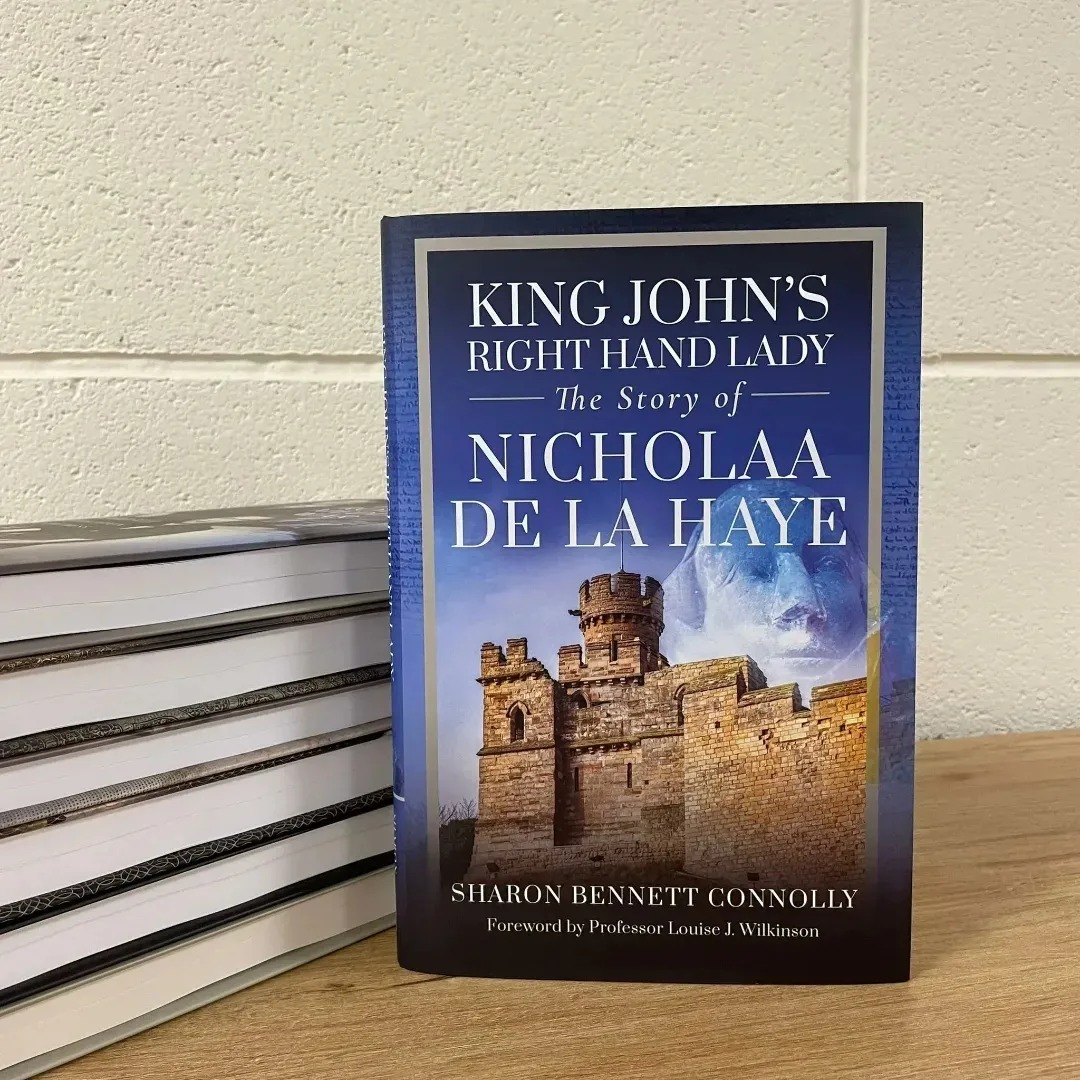
Heroines of the Tudor World tells the stories of the most remarkable women from European history in the time of the Tudor dynasty, 1485-1603. These are the women who ruled, the women who founded dynasties, the women who fought for religious freedom, their families and love. Heroines of the Tudor World is now available for pre-order from Amberley Publishing and Amazon UK.Women of the Anarchy demonstrates how Empress Matilda and Matilda of Boulogne, unable to wield a sword themselves, were prime movers in this time of conflict and lawlessness. It shows how their strengths, weaknesses, and personal ambitions swung the fortunes of war one way – and then the other. Available from Bookshop.org, Amberley Publishing and Amazon UK. King John’s Right-Hand Lady: The Story of Nicholaa de la Haye is the story of a truly remarkable lady, the hereditary constable of Lincoln Castle and the first woman in England to be appointed sheriff in her own right. Available from all good bookshops Pen & Sword Books, bookshop.org and Amazon.
Alternate Endings: An anthology of historical fiction short stories including Long Live the King… which is my take what might have happened had King John not died in October 1216. Available in paperback and kindle from Amazon.
*
Podcast:
Have a listen to theA Slice of Medieval podcast, which I co-host with Historical fiction novelist Derek Birks. Derek and I welcome guests, such as Bernard Cornwell and Elizabeth Chadwick, and discuss a wide range of topics in medieval history, from significant events to the personalities involved.
“Do not lie to me, Templar, or it will be the last thing you do.”
July 1241. Western Europe cowers in terror before the threat of a Mongol invasion. The swift cavalry columns of Genghis Khan have smashed the steel-clad warriors of Russia, Poland and Hungary – and now Austria lies directly in their path.
At a skirmish outside the walls of Vienna, German knights capture a squad of Mongol scouts and are astonished to discover one of their number is an Englishman – a former Templar – who has been riding with these Devil’s horsemen for more than twenty years.
Interrogator Father Ivo of Narbonne is summoned to draw the truth from the prisoner before his impending trial, to find out why he abandoned his faith, his Brethren and his homeland to become… a traitor to Christendom.
Based on a true story, this is the first novel in a new blockbuster trilogy from ‘master of the genre’ Angus Donald.
My first thought when I heard about Templar Traitor by Angus Donald was “ooh, Templars – love anything Templar related. And by Angus Donald, too! Must read.” My second was “a Templar fighting with the Mongols? Yeah, right!” And with those conflicting thoughts in mind, I decided to give it a go. Angus Donald is a great writer, so even if it is more fantasy than reality, he may be able to pull it off. How surprised was I to discover, from the very first pages, that this wasn’t a fantasy, nor a King & Conqueror-esque rewriting of History. (Forgive me for mentioning King & Conqueror, but when someone butchers History like that, the pain is real!)
This was a true story!
A clever, original plot is the more remarkable for the fact it derives from the true story of a Templar knight fighting with the Mongol horde, in the army of Genghis Khan, no less!
Templar Traitor gives a unique angle on the Templars, the Crusades and the Mongols. It also gives an insight into events we rarely hear about and rebuffs the Euro-centric view of the Middle Ages. In Templar Traitor Angus Donald expertly portrays the contrast and melding of the different civilisations of the European Christian and the Mongol. The clash of cultures adds an intensity top the story, beyond the warmongering and empire-building. The human toll of ambition and deceit is evident.
It seemed to Robert a desperate last throw of the dice for the Latin kingdoms. If this attempt on Damietta failed, the Christians would likely be swept into the Mediiterranean.
Yet, despite the importance of this expedition, Robert was concerned for his brother, who, he knew, would soon be hurled into the fury of battle. Gilly was not a weakling, but there was an air of fragility about him that inspired protectiveness in Robert. It had been like this since childhood.
‘I have just written to Father,’ continued Gilbert, ‘and told him about your predicament. And that I am to be dispatched to Egypt with the first of our knights. I only pray that the old man lives long enough to receive the letter. You knew that Henry had taken to his bed before I left England? I do not think he will ever walk or ride again.’
‘You told me, Gilly. Our earthly father will soon be with our Heavenly one.’
‘What will they do with you, Rob? said Gilbert. ‘Will they show mercy?’
‘God chose me as his servant, Gilly – He will not abandon me. And I have served the Order faithfully these past ten years. That must count for something.’
‘I shall pray for you,’ said Gilbert. ‘I shall pray for you every night, Rob.’
‘And I you. I want you to promise me something, Gilly. You are not to court danger unnecessarily in Damietta. They will call for volunteers, they will ask you to risk your life for the cause. Do not do this again. If you love me, brother, remain silent when the call goes out for brave knights to undertake some fresh perilous mission.’
‘Would you do that, brother?’ asked Gilbert. ‘The Robert of Hadlow I know prizes risk and danger more highly than anything else. Would he duck a challenge? No. The knight who won the First Lance badge for skill at arms three years in a row? A feat no other Templar has ever achieved. Would he shirk his duty? I think not.’
‘It is not shirking. You already serve God by serving the Order. And to serve God is to serve mankind. There is no need to risk your life further. Others also seek glory. Let them step forward.
‘There is a whiff of hypocrisy in your words, brother. I know that you would never dodge a chance to strike a blow for Christ. How can you ask that of me?’
‘This is not about me. This is about you, your life. Father will soon be gone to his reward and I … Well, look at me, in this cell, awaiting trial for my foolishness. Learn from my example. Do not seek out unnecessary risk in Egypt – that is all I ask.’
‘I shall do as I think fit. As you would do. But I shall pray for God’s guidance.’
I cannot imagine the amount of research that must have gone into recreating the lands the Mongols conquered. Legendary cities such as Samarkand are rebuilt and brought to life. The Nomadic lifestyle of the Mongols means the marauding army takes its own sheep, goats and herds of horses campaigning with it. The women accompany the army, making a home in the encampment wherever they stop.
Angus Donald sheds light on the knight’s story, fleshing out the gaps in the known history to create a remarkable adventure that will leave the reader eager for more. The Templar knight, Robert of Hadlow, has his own secrets, motives and family concerns. Add to this a private feud with a priest, the need to rescue his baby brother and forbidden love, and Robert’s story has all the ingredients for a magnificent adventure.
Robert of Hadlow is a likeable character, even if the reader feels they cannot wholly trust him. The author implants that niggling doubt in the reader’s subconscious and I’m not quite sure how and when he did it!
All in all, Templar Traitor is definitely in my Top 10 of Books of 2025. The originality of the story is refreshing. The attention to detail and the layers of plot make it a gripping, fascinating read. Oh, and there’s enough single combat and vivid battle scenes to satisfy anyone who likes a jolly good battle! From the first page, the story is intriguing. I enjoyed the fact that I didn’t know what the endgame was. This is far from formulaic historical fiction where the hero knight saves the day. There is mystery and deceit throughout – on both sides – with ulterior motives and hidden agendas.
Templar Traitor is probably the best book Angus Donald has written, possibly even better than his Holcroft Blood series – and that was excellent! I cannot recommend it highly enough.
Look out for Angus chatting with Derek and I about Templar Traitor and the Mongols on A Slice of Medieval soon.
Angus Donald is the author of the bestselling Outlaw Chronicles, a series of ten novels set in the 12th/13th centuries and featuring a gangster-ish Robin Hood. Angus has also published the Holcroft Blood trilogy about a mildly autistic 17th-century English artillery officer, son of notorious Crown Jewels thief Colonel Thomas Blood. Before becoming an author, Angus worked as a fruit-picker in Greece, a waiter in New York City and as an anthropologist studying magic and witchcraft in Indonesia. For fifteen years he was a journalist working in Hong Kong, India, Afghanistan and London. He now writes full time from a medieval farmhouse in Kent. http://www.angusdonaldbooks.com.
*
My Books
Signed, dedicated copies of all my books are available through my online bookshop.
Out now: Scotland’s Medieval Queens
Scotland’s history is dramatic, violent and bloody. Being England’s northern neighbour has never been easy. Scotland’s queens have had to deal with war, murder, imprisonment, political rivalries and open betrayal. They have loved and lost, raised kings and queens, ruled and died for Scotland. From St Margaret, who became one of the patron saints of Scotland, to Elizabeth de Burgh and the dramatic story of the Scottish Wars of Independence, to the love story and tragedy of Joan Beaufort, to Margaret of Denmark and the dawn of the Renaissance, Scotland’s Medieval Queens have seen it all. This is the story of Scotland through their eyes.
‘Scotland’s Medieval Queens gives a thorough grounding in the history of the women who ruled Scotland at the side of its kings, often in the shadows, but just as interesting in their lives beyond the spotlight. It’s not a subject that has been widely covered, and Sharon is a pioneer in bringing that information into accessible history.’ Elizabeth Chadwick (New York Times bestselling author)
Heroines of the Tudor World tells the stories of the most remarkable women from European history in the time of the Tudor dynasty, 1485-1603. These are the women who ruled, the women who founded dynasties, the women who fought for religious freedom, their families and love. Heroines of the Tudor World is now available for pre-order from Amberley Publishing and Amazon UK.Women of the Anarchy demonstrates how Empress Matilda and Matilda of Boulogne, unable to wield a sword themselves, were prime movers in this time of conflict and lawlessness. It shows how their strengths, weaknesses, and personal ambitions swung the fortunes of war one way – and then the other. Available from Bookshop.org, Amberley Publishing and Amazon UK. King John’s Right-Hand Lady: The Story of Nicholaa de la Haye is the story of a truly remarkable lady, the hereditary constable of Lincoln Castle and the first woman in England to be appointed sheriff in her own right. Available from all good bookshops Pen & Sword Books, bookshop.org and Amazon.
Alternate Endings: An anthology of historical fiction short stories including Long Live the King… which is my take what might have happened had King John not died in October 1216. Available in paperback and kindle from Amazon.
Podcast:
Have a listen to theA Slice of Medieval podcast, which I co-host with Historical fiction novelist Derek Birks. Derek and I welcome guests, such as Elizabeth Chadwick, Helen Castor, Ian Mortimer, Scott Mariani and Bernard Cornwell and discuss a wide range of topics in medieval history, from significant events to the personalities involved. Look out for Angus chatting with Derek and I about Templar Traitor and the Mongols on A Slice of Medieval soon.
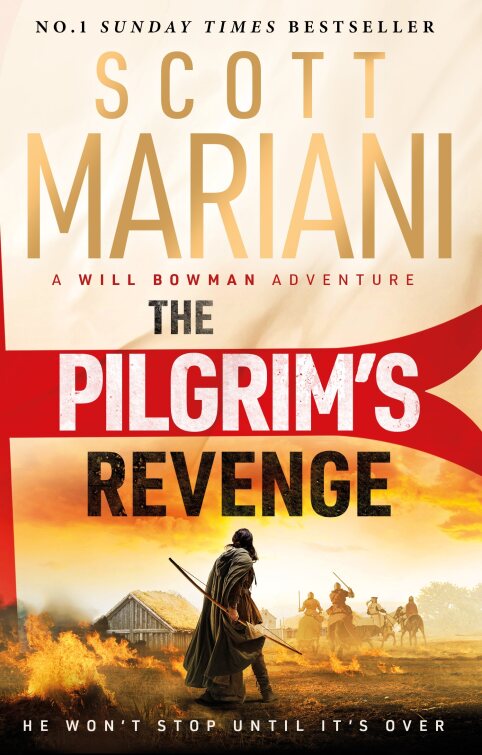
1190 – Humble layman Will Bowman lives in the countryside with his pregnant wife, when soldiers from Richard Lionheart’s army tear through his home. Will is beaten unconscious, and awakes to find his wife murdered, his farm burnt down, and his life forever changed.
In vengeance, Will infiltrates Richard’s army to find the marauding gang, and finds himself swept along in the march of the Crusades. With the help of new allies and fuelled by his loss, Will crosses Europe with the King’s army.
Can Will avenge his wife? Or will he be swept away by the unstoppable force of Richard’s Crusade?
I have been a Scott Mariani fan for a while now and was disappointed that Ben Hope has finally retired, though relieved for Ben that he survived 30 books of people trying to kill him. When one brilliant series ends, you begin to worry that what comes next will be a disappointment, or not as addictive, that you will not feel so invested in the new characters. Especially when the author moves genre. It is a big risk that author and reader take together.
So, when Scott Mariani moved from thriller with a historical twist to full-blown historical fiction, I was a tad concerned. Fans of historical fiction can be pedants. If there is a grey squirrel out of place, ie, in medieval England, someone will notice. If a character lives longer than he actually did (I am looking at Sweyn Forkbeard in Vikings Valhalla) someone will notice. There is a knack to historical fiction, to weaving the story within the known facts, to introducing fictional characters and creating their interactions with historical figures. The story has to have that essence of authenticity.
I needn’t have worried!
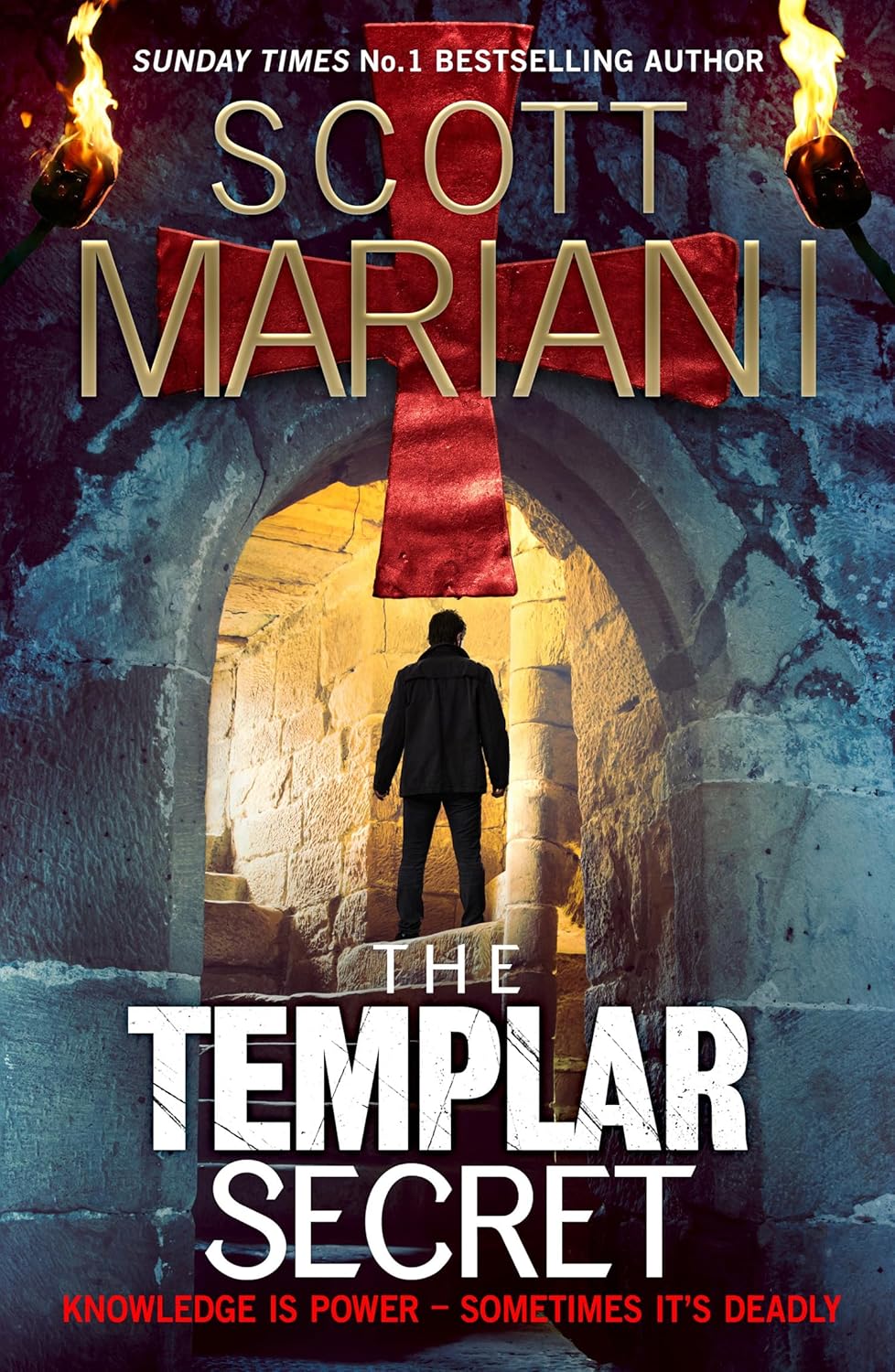
In fact, I probably should have trusted that Scott Mariani knew what he was doing. Though I may not have agreed with some of his theories in The Tudor Deception, the actual history was spot on. Having read the last Ben Hope book, The Templar Secret, after Christmas, I should have known a historical fiction book was around the corner. It is obvious the author loves his history. And, given the topic of that last Hope book, it should come as no surprise that Mariani’s first foray into historical fiction involved the crusades – the Third Crusade, to be precise.
Not that we get more than a glimpse of the Holy Land in this first book – all that is still to come.
By now Will had almost reached the nearest of the horsemen on his side of the yard. Up close, the rider was an intimidating figure looming far above him in the saddle with the blade of his drawn arming sword glinting in the sunlight. Before Will reached him the horseman saw his approach and wheeled his mount around to face him, dust flying from its hooves. With an angry shout the rider spurred the horse towards Will, swinging his sword down at him. Will ducked, and the double-edged blade hissed through the air above him.
It had been a blow meant to separate his head from his shoulders, and it had only narrowly missed its mark. The horse thundered past, shaking the ground. The rider reined it brutally around and charged at Will again.
Nothing like this had ever happened or even been heard of in Will’s experience. He had never been in a real fight, except a minor scuffle once when he was a lad, settled quickly with a couple of punches. This was deadly serious combat, and he was unprepared for it. But the terrible shocking sight of Beatrice in the soldiers’ clutches and the sound of her screams was enough to dispel his confusion and fear, filling him with rage and determination to do anything he could to drive these raiders away and make this stop. And the obvious realisation suddenly occurred to him, for the first time, that he was holding the very means of doing that in his hands. His bow was still unstrung, no more than a long wooden shaft with its hemp cord loosely attached to the bottom end. But practice had made him very adept at readying the weapon in moments; as the horseman bore down on him with the sword raised high, he bent the stave against his foot and looped the string into place.
The rider was almost on him. Will snatched an arrow from his quiver, nocked it to the string and simultaneously raised his bow and pulled it to full draw. He had never before pointed any weapon in anger at another human being, but there was little time to reflect on that fact, or even to take aim, as his enemy closed in. Will stood his ground until the last moment, released his arrow and saw it fly and hit the rider full in the chest.
The soldier flinched violently at the arrow strike. A normal opponent would have been a dead man, his heart split in two by the power of the longbow at such close range. But instead of piercing deep into his flesh the iron point glanced off his heavy chain mail and the broken pieces of the arrow shaft spun away through the air. Then Will had to leap out of the way of the charging horse, and he threw himself to the ground.
The Pilgrims’ Revenge starts in England and follows the journey of a crusader fleet to Outremer, with adventures that are often overlooked by historical fiction authors eager to get to the nitty gritty of the crusade. But what a story they miss out! Scott Mariani includes the little-known excursion of part of the fleet, into Portugal to help with the crusades there. Then, of course, we arrive in Sicily, where Richard the Lionheart frees his sister, Joanna, meets his bride Berengaria and antagonises his ‘ally’ Philip II of France. And then we get a wonderful, vivid depiction of the conquest of Cyprus.
All is seen through the eyes of our hero, Will Bowman, a men seeking revenge for the murder of his wife and unborn child. He only joins the crusade to chase the murderers but finds a purpose, a talent for soldiering, comradeship and a bent to command along the way. Scott Mariani seamlessly blends together the wider story of Richard the Lionheart’s crusading enterprise with Will’s personal story and experiences.
The Pilgrims’ Revenge is the first of what promises to be a fast-paced, exhilarating – and, hopefully, long – series. Punctuated by bloody battles, exquisite swordplay and a thrilling storyline, the action is relentless and Scott Mariani fans will not be disappointed. The research is exemplary, especially with regard to the conflict in Portugal, which is usually ignored. The historical figures are wonderfully written and the locations evocative, dusty, hot and exotic.
Will Bowman is a character I look forward to hearing much more about.
The Pilgrim’s Revenge will be available from 24 April 2025
Scott Mariani is the No.1 Sunday Times bestselling author of the multi-million-selling Ben Hope thrillers. From 2025 he is launching into a new historical adventure series featuring medieval English hero Will Bowman, who is forced from his home to join King Richard ‘the Lionheart’ on the Third Crusade and rises up to become a knight. Book 1,THE PILGRIM’S REVENGE, is available from April 2025 and is published by Hodder & Stoughton.
Scott lives and writes in west Wales, UK. You can find out more about his work by visiting his official website.
*
My books
Signed, dedicated copies of all my books are available through my online store.
Out now: Scotland’s Medieval Queens
Scotland’s history is dramatic, violent and bloody. Being England’s northern neighbour has never been easy. Scotland’s queens have had to deal with war, murder, imprisonment, political rivalries and open betrayal. They have loved and lost, raised kings and queens, ruled and died for Scotland. From St Margaret, who became one of the patron saints of Scotland, to Elizabeth de Burgh and the dramatic story of the Scottish Wars of Independence, to the love story and tragedy of Joan Beaufort, to Margaret of Denmark and the dawn of the Renaissance, Scotland’s Medieval Queens have seen it all. This is the story of Scotland through their eyes.
‘Scotland’s Medieval Queens gives a thorough grounding in the history of the women who ruled Scotland at the side of its kings, often in the shadows, but just as interesting in their lives beyond the spotlight. It’s not a subject that has been widely covered, and Sharon is a pioneer in bringing that information into accessible history.’ Elizabeth Chadwick (New York Times bestselling author)
Heroines of the Tudor World tells the stories of the most remarkable women from European history in the time of the Tudor dynasty, 1485-1603. These are the women who ruled, the women who founded dynasties, the women who fought for religious freedom, their families and love. Heroines of the Tudor World is now available for pre-order from Amberley Publishing and Amazon UK.Women of the Anarchy demonstrates how Empress Matilda and Matilda of Boulogne, unable to wield a sword themselves, were prime movers in this time of conflict and lawlessness. It shows how their strengths, weaknesses, and personal ambitions swung the fortunes of war one way – and then the other. Available from Bookshop.org, Amberley Publishing and Amazon UK. King John’s Right-Hand Lady: The Story of Nicholaa de la Haye is the story of a truly remarkable lady, the hereditary constable of Lincoln Castle and the first woman in England to be appointed sheriff in her own right. Available from all good bookshops Pen & Sword Books, bookshop.org and Amazon.
Alternate Endings: An anthology of historical fiction short stories including Long Live the King… which is my take what might have happened had King John not died in October 1216. Available in paperback and kindle from Amazon.
Podcast:
Have a listen to theA Slice of Medieval podcast, which I co-host with Historical fiction novelist Derek Birks. Derek and I welcome guests, such as Bernard Cornwell and Michael Jecks, and discuss a wide range of topics in medieval history, from significant events to the personalities involved. Every episode is also now available on YouTube.
*
Don’t forget!Signed and dedicated copies of all my books are available through my online store.
For forthcoming online and in-person talks, please check out my Events Page.
Do excuse me if a get a little giddy and fan girly with this one! One of my favourite thriller writers is about to release the first book in a new series – in historical fiction!
I absolutely love Scott’s Ben Hope books and got the last in the series, The Templar Secret, for Christmas. They are modern day thrillers with a historical twist – and are great fun to read.
And Scott agreed to do an interview with me!
I also have an advance copy of the new novel, The Pilgrim’s Revenge, so expect a review shortly. And Scott will be joining Derek and I for a chat in an upcoming episode of A Slice of Medieval. But, in the meantime, Scott and I had a chat….
Hi Scott, thank you for joining me, how did you start your writing career?
It came about both gradually, and suddenly. I’d always been interested in stories – as a kid I used to mess around with drawing and writing, and sometimes combining the two to create my own stupid little cartoon strips which were usually pretty unoriginal rehashes of things like King Kong or Jaws or Tintin, as well as historical themes based on Ivanhoe or Chevalier Ardent – I was into all sorts of things at that young age! Aged about eight, I think, I wrote a sci-fi horror story in which the entire male population of the human race was wiped out in a war against giant robot dinosaur creatures; but we won in the end because ‘the women bred’ (that’s a quote) and repopulated the army so that humans could defeat the monsters. It was not a promising start to my career. Later, in my early twenties, I dabbled with various ideas and projects, one or two of which were completed but have never seen the light of day – for which the world can be thankful, as they weren’t very good either.
Then one day after moving to Wales – this is in about 2006 – while out walking the dogs in the fields the idea for a character called Ben Hope popped into my head more or less fully-formed. What emerged from that was a novel called The Fulcanelli Manuscript, which ended up in the hands of the world’s worst London literary agent and being published by a hardback-only library publisher who printed 400 copies and had no intention of ever doing more. That could have been, and nearly was, the end for me. The book lay dead and buried for a year until I (not the literary agent) managed to gain interest from Avon, then a new imprint of HarperCollins UK, for the paperback rights which, thank God, the library publisher hadn’t been interested in grabbing. Suddenly – overnight really – the Ben Hope series was rebooted with Avon offering a deal for four books. The Fulcanelli Manuscript became retitled The Alchemist’s Secret . . . and that’s how it all began. I still can’t believe the series ended up thirty books long!
What is the best thing about being a writer?
Assuming that you’re able to drag your way up to a reasonable level in the industry: working from home, setting your own hours, not having to commute anywhere, seldom needing to travel unless you’re into doing a lot of physical research, being about as free and independent as it’s possible to get whilst still remaining gainfully employed . . . and getting paid for indulging the interests and passions that you would be preoccupied with even if they were just a hobby. It suits me perfectly.
What is the worst thing about being a writer?
When you’re starting out, the competition is crushing – especially if you had a bad start as I did. Unless you’re fortunate to have strong backing from a good agent, you may feel you’re embarking on an impossible quest that will only end in heartbreak or madness: I know, I suffered from both at various times! It can also be a horribly cruel and unjust industry. So many talented writers get crushed under the wheels of the machine and never get anywhere, while success very often doesn’t depend on the quality of the work. While most editors are lovely folks, you may be unlucky enough to have to work with people who have great control and leverage over what you do, and don’t necessarily have your best interests at heart. I could talk a lot about the high number of truly decent writers I’ve known who have fallen by the wayside, some very sad stories among them. It is a tough world.
You have been writing modern thrillers with a historical twist for years, what made you take the leap into full-on historical fiction?
I’ve always loved history. I wish I had had the sense when I was seventeen to want to study it at university! And it was a fascinating, highly educational and satisfying experience to write all those Ben Hope novels, each featuring its own historical backstory or mystery to a greater or lesser degree. The downside was that, because I’ve always produced two books a year, every six months I would have to uproot myself from whatever fascinating historical world I’d been so immersed in, clear it all from my head and plunge straight into the next. One minute you’re delving into ancient Babylon or Egypt, the next you’re off to the Chinese Cultural Revolution or the American Civil War. All wonderful stuff, of course, but it’s like being a perpetual globetrotter, always on the move, and never being able to stay in one location for long even though you might have fallen in love with the place and wanted to live there forever. Then one day while I was working on Ben Hope 28, The Tudor Deception, and deep into all the intrigues of medieval England, I thought: ‘You know what, I really love being here reading and writing about all this medieval stuff. What if I could just keep on doing that, and remain in one setting rather than having to jump about all the time?’ So, to cut a long story short, that’s what I’ve done. It wasn’t as simple or easy a decision as I’m perhaps making it sound – and of course the end of the Ben Hope series has upset a lot of fans – but nonetheless I’m really happy that I took the plunge.
I’m going to miss Ben Hope…
What were your main challenges when you switched from thrillers (Ben Hope was excellent, by the way) to historical fiction?
Because you’re going much deeper into just one time setting, it becomes all the more important to get the details as correct and authentic as possible: hence the research process is that bit more intensive. The good news for me is that I love research! I’ve accrued such a library of books on my favourite areas of history that when I get stuck in, they pile up so high around me on the desk that it’s like being inside a canyon. Because I’ve picked a medieval time / place setting that’s so well chronicled (the events of the Third Crusade), and because I want to stay as faithful to the true facts and timelines as possible, my plotline is already laid out for me to some extent by the historical sources. That’s been an unusual experience for someone who’s used to having to make it all up themselves! But although it might make life easier in some regards, it also creates the new challenge having to insert, or you might say superimpose, a fictitious main protagonist into the mix, through whose eyes we experience those well-known events in a fresh and dramatic way. Having to blending the worlds of fiction and non-fiction together like that, so that the (non-historian) reader hopefully can’t see the joins, is a whole new kind of fun. I’ve enjoyed being able to create scenes where my fictitious character is in dialogue with famous real-life figures like King Richard I and Eleanor of Aquitaine.
Tell us about The Pilgrim’s Revenge. What attracted you to writing about the Crusades?
The Pilgrim’s Revenge is the first book in my new series introducing the character of Will the Bowman, or just Will Bowman. The story begins in the year 1190, when Will, a young Englishman, has his happy married life torn apart by marauding soldiers who raid his home, and he’s forced to join up with King Richard’s expedition to the Holy Land as a means of catching up with the villains who did it. Actually we don’t quite reach the Holy Land in Book 1 – that’s for the next. But I hope there’s plenty there to excite and interest the reader. I adore the medieval period – grew up in a historic town, wept as a child when taken to the spot in Rouen where they burned poor Jeanne d’Arc, later read medieval French at University, learned to play with great big swords and shoot a bow – but the whole crusades period has a particular fascination for me. And what could be more cool than the most iconic crusade of them all, the conquest that pitted Richard the Lionheart against the great Saladin? Will Bowman and his comrades get embroiled right in the thick of the drama, and it’s a ride! At any rate it has been for me. I hope readers will love it too . . .
How are you going to cope with the lack of guns? Will the body count be lower?
Are you kidding? We don’t need guns. We have bows and arrows that can pierce chain mail armour from a long way off; we have double-edged swords and scimitars that’ll whip off arms, legs and heads; we have great big siege catapults that can take down massive stone ramparts from two hundred paces; we have thundering great charges of heavy cavalry bearing down on the enemy with lances; we have crossbows and axes and flails and daggers and all sorts of goodies to play with! And did I mention Greek Fire? It’s like The Iliad out there . . . No question, the body count and general level of mayhem and destruction are considerably higher than anything in the Ben Hope books . . . not that that makes it better, of course!
Phew! That’s a relief!
What comes first, the story or the research?
When I was constantly hunting around for fresh material for the Ben Hope books, it was more a question of finding the basic idea first. That could come, and did come, from all kinds of possible places as I was (and am) constantly reading. The basic idea for The Mozart Conspiracy came about from an old book I’d had for years about Mozart’s last year and just happened to revisit one day. The Babylon Idol popped into my head while driving and listening to a Louis Armstrong gospel number about King Nebuchadnezzar’s golden idol. The Forgotten Holocaust, dealing with the Irish famine of 1847, was a subject I’d wanted to do for years and nearly did as a historical stand-alone because I’d no idea at first how to make it work as a Ben Hope book. But in general, that initial concept could come from anywhere. Then you’d have to delve a little deeper to see if your idea had any legs or not – sometimes it did, sometimes it didn’t and you’d need to go and find something else. From there, the story and the research would generally develop in parallel. There was no particular system, but I’m pleased to say it worked pretty well. Now with the Will Bowman series, the case is slightly altered: the historical backdrop dictates a lot about the trajectory of the storyline, and the depth of research required fleshes out what’s going on while also providing inspiration for new story and character angles. If you can get all those stars lined up for you, then it all happens in an organic kind of way that feels very natural.
Have you got the historical fiction bug now? What comes next?
This is going to be the shortest answer. Yes, for sure! What comes next? More Will Bowman books. I’ve got four to do to begin with, but I would like to do more. A lot more. Mustn’t jinx it by saying too much, though.
Are there any other eras – or writing genres – you would like to write about?
As I think anyone who’s read much of my backlist knows already, my historical interests are pretty wide-ranging. Who can say if something else would come up in the future? Never say never: and that goes for genres too. Right now, however, I’m very content to stay exactly where I am. I no longer have to worry about where I’m going next: I’m free to trace the story arc of Will Bowman for as long as I’m able to. What better way to create a truly immersive experience for readers interested in our rich and exciting past?
The Pilgrim’s Revenge will be available from 24 April 2025
Scott Mariani is the No.1 Sunday Times bestselling author of the multi-million-selling Ben Hope thrillers. From 2025 he is launching into a new historical adventure series featuring medieval English hero Will Bowman, who is forced from his home to join King Richard ‘the Lionheart’ on the Third Crusade and rises up to become a knight. Book 1,THE PILGRIM’S REVENGE, is available from April 2025 and is published by Hodder & Stoughton.
Scott lives and writes in west Wales, UK. You can find out more about his work by visiting his official website.
*
My books
Signed, dedicated copies of all my books are available through my online store.
Out now: Scotland’s Medieval Queens
Scotland’s history is dramatic, violent and bloody. Being England’s northern neighbour has never been easy. Scotland’s queens have had to deal with war, murder, imprisonment, political rivalries and open betrayal. They have loved and lost, raised kings and queens, ruled and died for Scotland. From St Margaret, who became one of the patron saints of Scotland, to Elizabeth de Burgh and the dramatic story of the Scottish Wars of Independence, to the love story and tragedy of Joan Beaufort, to Margaret of Denmark and the dawn of the Renaissance, Scotland’s Medieval Queens have seen it all. This is the story of Scotland through their eyes.
Heroines of the Tudor World tells the stories of the most remarkable women from European history in the time of the Tudor dynasty, 1485-1603. These are the women who ruled, the women who founded dynasties, the women who fought for religious freedom, their families and love. Heroines of the Tudor World is now available for pre-order from Amberley Publishing and Amazon UK.Women of the Anarchy demonstrates how Empress Matilda and Matilda of Boulogne, unable to wield a sword themselves, were prime movers in this time of conflict and lawlessness. It shows how their strengths, weaknesses, and personal ambitions swung the fortunes of war one way – and then the other. Available from Bookshop.org, Amberley Publishing and Amazon UK. King John’s Right-Hand Lady: The Story of Nicholaa de la Haye is the story of a truly remarkable lady, the hereditary constable of Lincoln Castle and the first woman in England to be appointed sheriff in her own right. Available from all good bookshops Pen & Sword Books, bookshop.org and Amazon.
Alternate Endings: An anthology of historical fiction short stories including Long Live the King… which is my take what might have happened had King John not died in October 1216. Available in paperback and kindle from Amazon.
Podcast:
Have a listen to theA Slice of Medieval podcast, which I co-host with Historical fiction novelist Derek Birks. Derek and I welcome guests, such as Bernard Cornwell and Michael Jecks, and discuss a wide range of topics in medieval history, from significant events to the personalities involved. Every episode is also now available on YouTube.
*
Don’t forget!Signed and dedicated copies of all my books are available through my online store.
For forthcoming online and in-person talks, please check out my Events Page.
Throughout my research into medieval women, two ladies in particular have popped up a number of times: Nicholaa de la Haye and Matilda de Braose. Their unique stories drew me into their world, and the turbulent times of King John. They were the spark that led me to look into the story of Magna Carta; how its clauses were influenced by women and how women used it to protect their own rights. Magna Carta was, perhaps, the first step on the long road to democracy in England, and many women played key roles in its creation and development.
The Magna Carta of 1215 reflects the needs and events of the time in which it was issued; an England on the brink of civil war, disaffected barons demanding redress, the Church and cities such as London looking for protection. It was drawn up by barons looking for redress and legal protection from a king whose word could no longer be trusted, who meted out arbitrary punishments and heavy taxes. It was not a charter that was intended to form the protection and legal rights of every man, woman and child in the land; though it has come to be seen as just that in subsequent centuries. Indeed, the common man does not get a mention, and of the sixty-three clauses, only eight of them mention women as a gender.
The significance of women in the Magna Carta story is not just their limited inclusion in the charter itself, but also in their experiences of the unsettled times in which they lived, in their influence on the charter itself and in their use of its clauses to exact redress for injustices they had experienced. The political crisis which saw the issuing of Magna Carta, and the civil war which followed, was not just significant to the barons involved, but to their wives and families, tenants and retainers. The conflict tore families apart as they took sides in the struggle and saw more than one baron change sides mid-crisis. Wives and daughters were caught in the middle, often torn by divided loyalties; between their birth family and the family into which they had married; between their fathers and their husbands. For instance, Matilda Marshal was the eldest daughter of William Marshal, a man known for his staunch loyalty to the crown, but she was married to Hugh Bigod, son of Roger, second Earl of Norfolk, one of the leaders of baronial opposition.
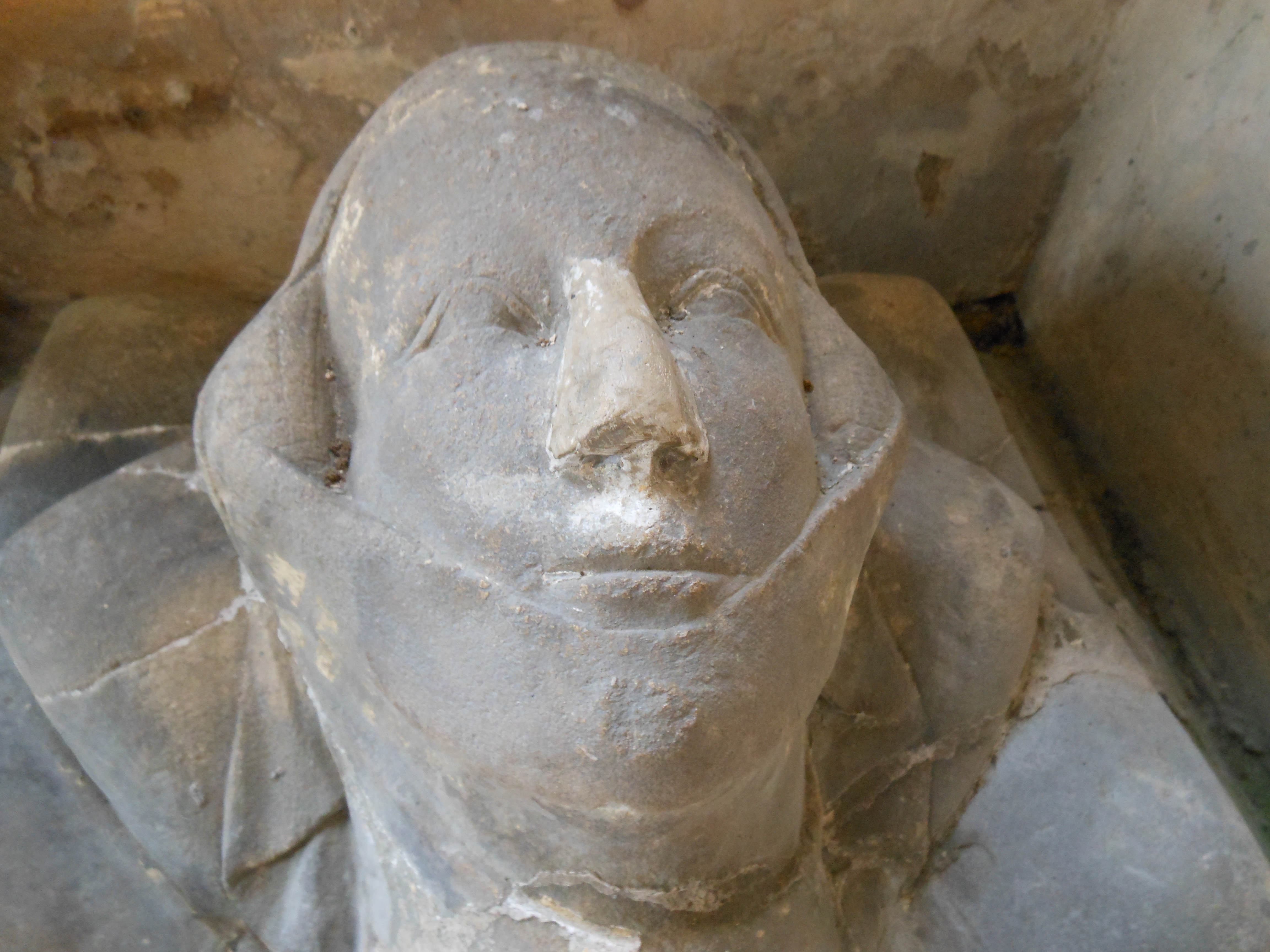
Tomb of Nicholaa de la Haye, St Michael’s Church, Swaton
Although they had very different experiences, they shared a number of similarities. Probably born within a few years of each other, they were contemporaries and both were key figures in the reign of King John, though for very different reasons. While Nicholaa de la Haye was a staunch supporter of the man who is, arguably, England’s most despised king in history, Matilda de Braose was one of his most female victims. Matilda’s family were harassed to Ireland and back by John, before she and her eldest son were left in a prison cell to starve to death; they were found after 11 days, Matilda’s head resting on her son’s chest, her son’s cheeks bearing the bite marks as evidence of lengths Matilda went to in her desperation to stay alive. It was Matilda’s experiences at the hands of King John that inspired clause 39 of Magna Carta, that clause that is still the cornerstone of British justice to this day:
‘No man shall be taken, imprisoned, outlawed, banished or in any way destroyed, nor will we proceed against or prosecute him, except by the lawful judgement of his peers or by the law of the land’
Nicholaa de la Haye, on the other hand, had been a long-time supporter of King John. She first successfully defended Lincoln Castle, in support of John, in the siege of 1191; the siege lasted 40 days before William Longchamp, the hated justiciar, gave up and went home. In 1216, Nicholaa successfully defended it again, this time paying off the rebel barons so that they would lift the siege. In the aftermath, John came north and ravaged the Isle of Axholme, where the barons had retreated to, with ‘fire and sword’. It was after this even that Nicholaa, now in her 60s and recently widowed, offered to relinquish custody of the castle. John refused to accept her resignation and in October, hours before his death, appointed Nicholaa Sheriff of Lincolnshire: she was the first ever female sheriff in England.
King John
Although Nicholaa de la Haye and Matilda de Braose were the major influences behind my book, Ladies of Magna Carta, they were not the only women to make an impression on the Magna Carta story. The deeper I dug, the more stories I uncovered that deserved to be told. Matilda’s own daughter, Loretta de Braose, was one such. Recently widowed following the death of her husband, Robert de Breteuil, Earl of Leicester, Loretta had been forced by John to relinquish her dower rights; Magna Carta clauses 7 and 8 of Magna Carta, protecting widows’ rights:
Clause 7:
After her husband’s death, a widow shall have her marriage portion and her inheritance at once and without any hindrance; nor shall she pay anything for her dower, her marriage portion, or her inheritance which she and her husband held on the day of her husband’s death; and she may stay in her husband’s house for 40 days after his death, within which period her dower shall be assigned to her.
Clause 8:
No widow shall be compelled to marry so long as she wishes to live without a husband, provided that she gives security that she will not marry without our consent if she holds of us, or without the consent of the lord of whom she holds, if she holds of another.
Furthermore, there are two women who can be clearly identified in Magna Carta itself, though they are not named, they are two Scottish princesses. The sisters of King Alexander II had been held hostage in England since 1209, when John forced the humiliating Treaty of Norham on their ailing father, King William the Lion. Clause 59 promised:
‘We will treat Alexander, king of Scots, concerning the return of his sisters and hostages and his liberties and rights in the same manner in which we will act towards our other barons of England, unless it ought to be otherwise because of the charters which we have from William his father, formerly king of Scots; and this shall be determined by the judgement of his peers in our court.’
Women not only influenced the clauses of Magna Carta, however, they also used Magna Carta to assert and protect their own rights. Women such as Ela of Salisbury, who used the promises of Magna Carta to avoid an unwelcome marriage proposal when her husband, William Longspée was missing and feared dead. Or Isabel d’Aubigny, Countess of Arundel, who proclaimed ‘Where are the liberties of England, so often recorded, so often granted and so often ransomed’, when King Henry III foolishly attempted to steal land that was rightfully hers. She must have been a fearsome opponent, as Henry responded to one of her petitions, saying that he would grant her leniency ‘so long as she says nothing opprobrious to us as she did when we were at Westminster!’
Eleanor de Montfort
And then there were the women for whom Magna Carta offered no protection or respite. Women such as Eleanor of Brittany, for whom even clause 39 could be of no help. Their royal blood and ability to be a focus for opposition to the crown meant that successive kings would keep them imprisoned, either in castles, as with Eleanor, or in a rural convent, as with Gwenllian of Wales, orphan daughter of Llywelyn, Prince of Wales and his wife, Eleanor de Montfort, who was herself a granddaughter of King John.
It was Eleanor’s mother, also Eleanor, the youngest daughter of King John and not a year old at her father’s death, who, as the wife of Simon de Montfort, Earl of Leicester, would continue the struggle to curb the powers of the crown in the Second Barons’ War. She herself was defending Dover Castle when her husband was killed at the Battle of Evesham. She spent her final years in French exile. Her struggles to obtain her dower lands from the powerful Marshal family, guaranteed in Magna Carta, were a major component of Eleanor’s own dissatisfaction with her brother, Henry III.
It is through the stories of these remarkable women and the relationships of the various noble families of the 13th century, that I wanted to examine how they were affected by the First Barons’ Wars, Magna Carta and its aftermath. It is a study of the bonds that were formed and those that were broken among the women of the great families of 13th century England, including the royal families of England and Scotland, the Marshals, the Bigods, the Salisburys, Braoses and Warennes.
Their stories are inspirational, if heartbreaking at times.
Richard of Devizes, The Chronicle of Richard of Devizes; Roger of Howden (Hoveden), The Annals of Roger of Howden; The Plantagenet Chronicles edited by Elizabeth Hallam; Brassey’s Battles by John Laffin; 1215 The Year of Magna Carta by Danny Danziger & John Gillingham; The Life and times of King John by Maurice Ashley; The Plantagenets, the Kings Who Made England by Dan Jones; England Under the Norman and Angevin Kings by Robert Bartlett; lincolnshirelife.co.uk; catherinehanley.co.uk; magnacarta800th.com; lothene.org; lincolncastle.com; The Sheriff: The Man and His Office by Irene Gladwin; Louise Wilkinson, Women in Thirteenth Century Lincolnshire; Richard Huscraft, Tales from the Long Twelfth Century; J.W.F. Hill, Medieval Lincoln; swaton.org.uk; oxforddnb.com; Stephen Church, King John: England, Magna Carta and the Making of a Tyrant; Marc Morris, King John; Pipe Rolls; Red Book of the Exchequer
My Books
Signed, dedicated copies of all my books are available through my online store.
Out now: King John’s Right-Hand Lady: The Story of Nicholaa de la Haye
In a time when men fought and women stayed home, Nicholaa de la Haye held Lincoln Castle against all-comers, gaining prominence in the First Baron’s War, the civil war that followed the sealing of Magna Carta in 1215. A truly remarkable lady, Nicholaa was the first woman to be appointed sheriff in her own right. Her strength and tenacity saved England at one of the lowest points in its history. Nicholaa de la Haye is one woman in English history whose story needs to be told…
On the one side is Empress Matilda, or Maud. The sole surviving legitimate child of Henry I, she is fighting for her birthright and that of her children. On the other side is her cousin, Queen Matilda, supporting her husband, King Stephen, and fighting to see her own son inherit the English crown. Both women are granddaughters of St Margaret, Queen of Scotland and descendants of Alfred the Great of Wessex. Women of the Anarchy demonstrates how these women, unable to wield a sword, were prime movers in this time of conflict and lawlessness. It show how their strengths, weaknesses, and personal ambitions swung the fortunes of war one way – and then the other.
Alternate Endings: An anthology of historical fiction short stories including Long Live the King… which is my take what might have happened had King John not died in October 1216. Available in paperback and kindle from Amazon.
Podcast:
Have a listen to theA Slice of Medieval podcast, which I co-host with Historical fiction novelist Derek Birks. Derek and I welcome guests, such as Bernard Cornwell, and discuss a wide range of topics in medieval history, from significant events to the personalities involved.
*
Signed and dedicated copies of all my books are available through my online store.
For forthcoming online and in-person talks, please check out my Events Page.
You can be the first to read new articles by clicking the ‘Follow’ button, liking our Facebook page or joining me on Twitterand Instagram.
Tomb effigy of Nicholaa de la Haye, St Michael’s Church, Swaton
As you may have noticed, Nicholaa de la Haye is a favourite of mine. She is the subject of my 5th book, King John’s Right Hand Lady: The Story of Nicholaa de la Haye. She was one of King John’s most stalwart supporters. She held Lincoln Castle against all-comers during the First Barons’ War which followed the sealing of Magna Carta in 1215. Her career is the more remarkable because Nicholaa was a woman in command of a castle in her own right. And she masterminded its defence against the might of the rebel barons and their French allies, even though the city of Lincoln was also against her.
So, who was she?
10 Things about Nicholaa de la Haye that you may not know…
1. Nicholaa had both English and Norman ancestry. Unlike many Normans, Nicholaa could trace her Lincolnshire roots, through her paternal grandmother, Muriel, to before the Norman Conquest; her grandmother’s grandfather was Colswein of Lincoln, an Englishman who had found favour with William the Conqueror in the years after the Conquest. Nicholaa’s father was Richard de la Haye, whose family originated from La Haye-du-Puits in Normandy, and was distantly related, through marriage, to William the Conqueror. Nicholaa’s mother was Matilda de Vernon, a niece of Baldwin de Redvers, Earl of Devon, the first magnate to rebel against King Stephen when he stole the throne from Empress Matilda.
2. Nicholaa was hereditary constable of Lincoln Castle. Just like her father and grandfather before her, Nicholaa held Lincoln Castle for the king. A charter dated between 1155 and 1158, issued by Henry II, confirmed the succession of Richard de la Haye to his father in all of his father’s lands in Lincolnshire, including the constableship of Lincoln Castle.
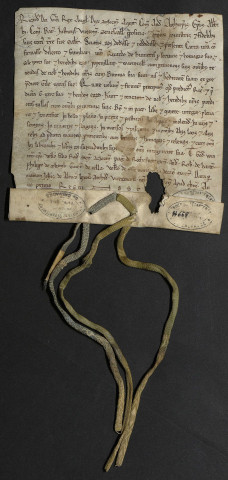
The Charte aux lacs d’Amour
3. Nicholaa was the oldest of three sisters. Her sister Gila (or Julia) married Richard du Hommet, the grandson and son of successive constables of Normandy. In 1191 a charter was issued to Gila and Richard, known as the charte aux lacs d’amour (the charter of the laces of love), which had laces attached to the seal on which was written a love poem: ‘I am a pledge of love. Do not give me away. May whoever separates our love receive death’. Nicholaa’s other sister, Isabel de la Haye married William de Rollos, who was probably from Bourne, in Lincolnshire. The Rollos family returned to Normandy during the reign of King John.
4. Nicholaa’s first husband was William Fitz Erneis, who may have been a younger son of Robert Fitz Erneis, a minor Lincolnshire lord. Nicholaa and William had one surviving child, a daughter named Matilda, before William died in 1178. Nicholaa would later pay a fine of 300 marks to King Richard I so that she could marry her daughter to whomever she wished except, of course, to an enemy of the king. Nicholaa was still accounting for this debt until 1212. In 1201, she still owed 40 marks and a palfrey (a horse).
5. Before 1185, Nicholaa had remarried, this time to Gerard de Camville, son of Richard de Camville, lord of Middleton Stoney in Oxfordshire. A family with an impressive record of royal service, Richard had died in Italy in 1176 while escorting the king’s daughter, Joanna, to her wedding with King William of Sicily. Gerard’s half-brother, also called Richard, accompanied Richard the Lionheart on Crusade; this Richard de Camville was made governor of Cyprus before dying at Acre in 1191. Gerard himself served the kings Henry II, Richard the Lionheart and John. He was Constable of Lincoln Castle by right of his wife and sheriff of Lincolnshire on two occasions.
6. Nicholaa first comes to the attention of the chroniclers in 1191, when Prince John led the opposition to, William Longchamp, the man left in charge of England during Richard the Lionheart’s absence on crusade. Longchamp wanted Lincoln Castle for one of his friends and determined to take it. Gerard sought the help of Prince John swearing fealty to him at Nottingham, leaving to Nicholaa to hold the castle. William Longchamp hired a force of mercenaries and laid siege to the castle in Gerard’s absence. The formidable Nicholaa refused to yield, holding out for 40 days before Longchamp gave up and went home. Amusingly, Richard of Devizes said of this defence of Lincoln Castle, that she did it ‘without thinking of anything womanly’.
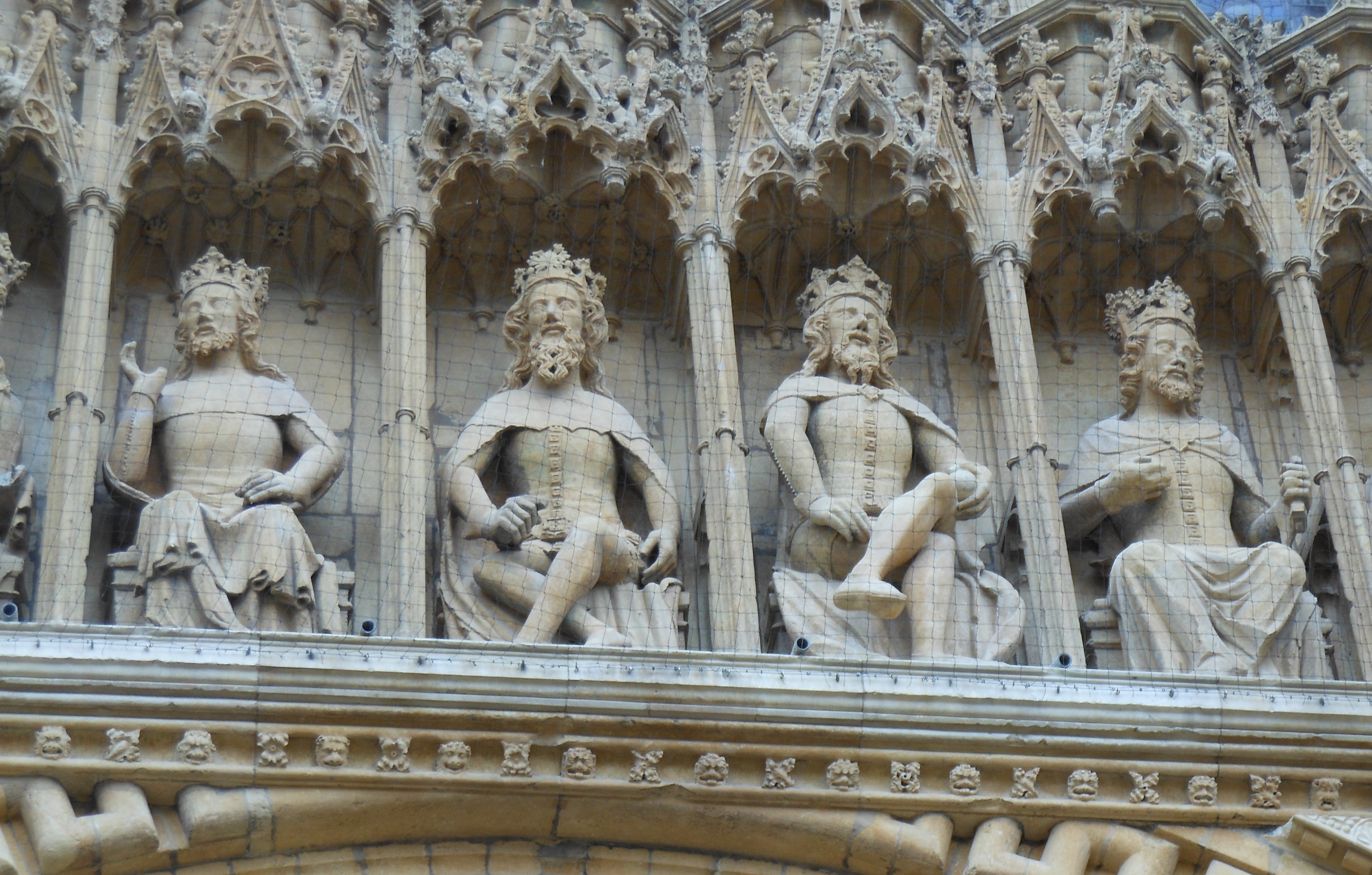
The kings Nicholaa served: Henry II, Richard I King John and Henry III, Lincoln Cathedral
7. By the time the king arrived home in 1194, John had fled to France, leaving his supporters to face the music. On 31 March 1194, on the first day of his council at Nottingham, King Richard dispossessed Gerard de Camville of the castle and shrievalty of Lincoln. And on 2 April, Gerard was charged with harbouring outlaws (wonder if they mean Robin Hood?), treason for failing to answer the king’s justices’ summons over the harbouring of the said outlaws, and for taking up arms and aiding John in taking the castles of Tickhill and Nottingham. The outcome of the proceedings is not recorded, but given that Gerard was fined 2,000 marks to recover the king’s good will and his lands, we can assume that the judges did not find in his favour.
8. When Richard the Lionheart died on 6 April 1199 and was succeeded by his brother, John, Nicholaa and Gerard de Camville were restored to favour and to Lincoln Castle. Gerard was also appointed sheriff of Lincolnshire and served in that office for the next six years, becoming ‘a greater man than ever.’ In November 1200, Nicholaa and Gerard welcomed the kings of England and Scotland to Lincoln, where King William the Lion paid homage to King John outside the city walls.
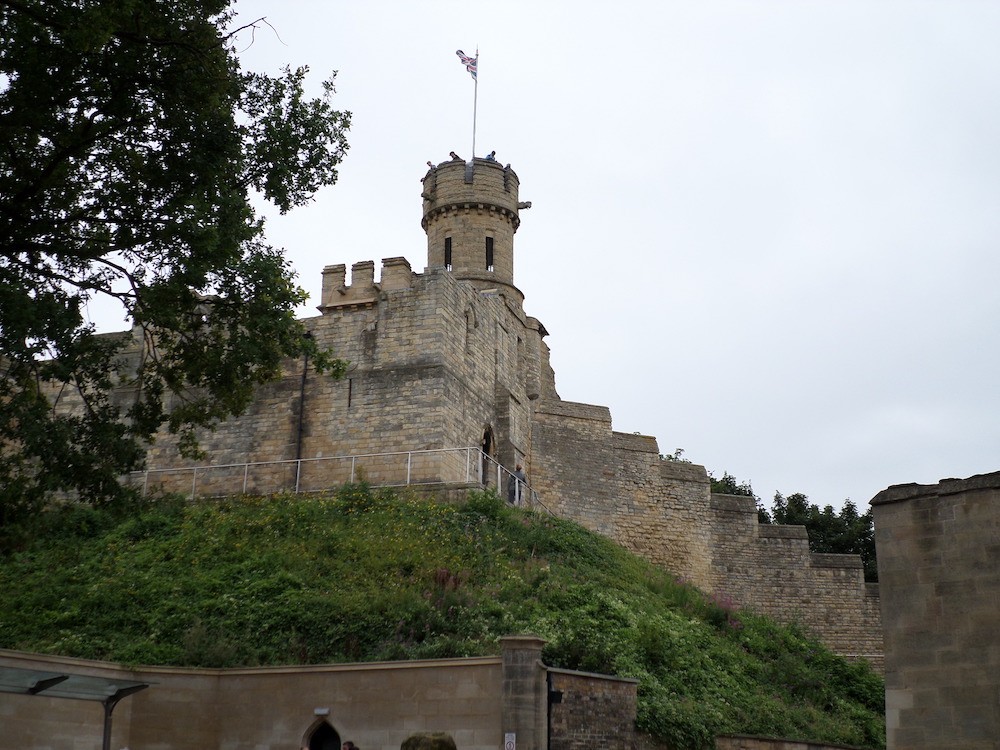
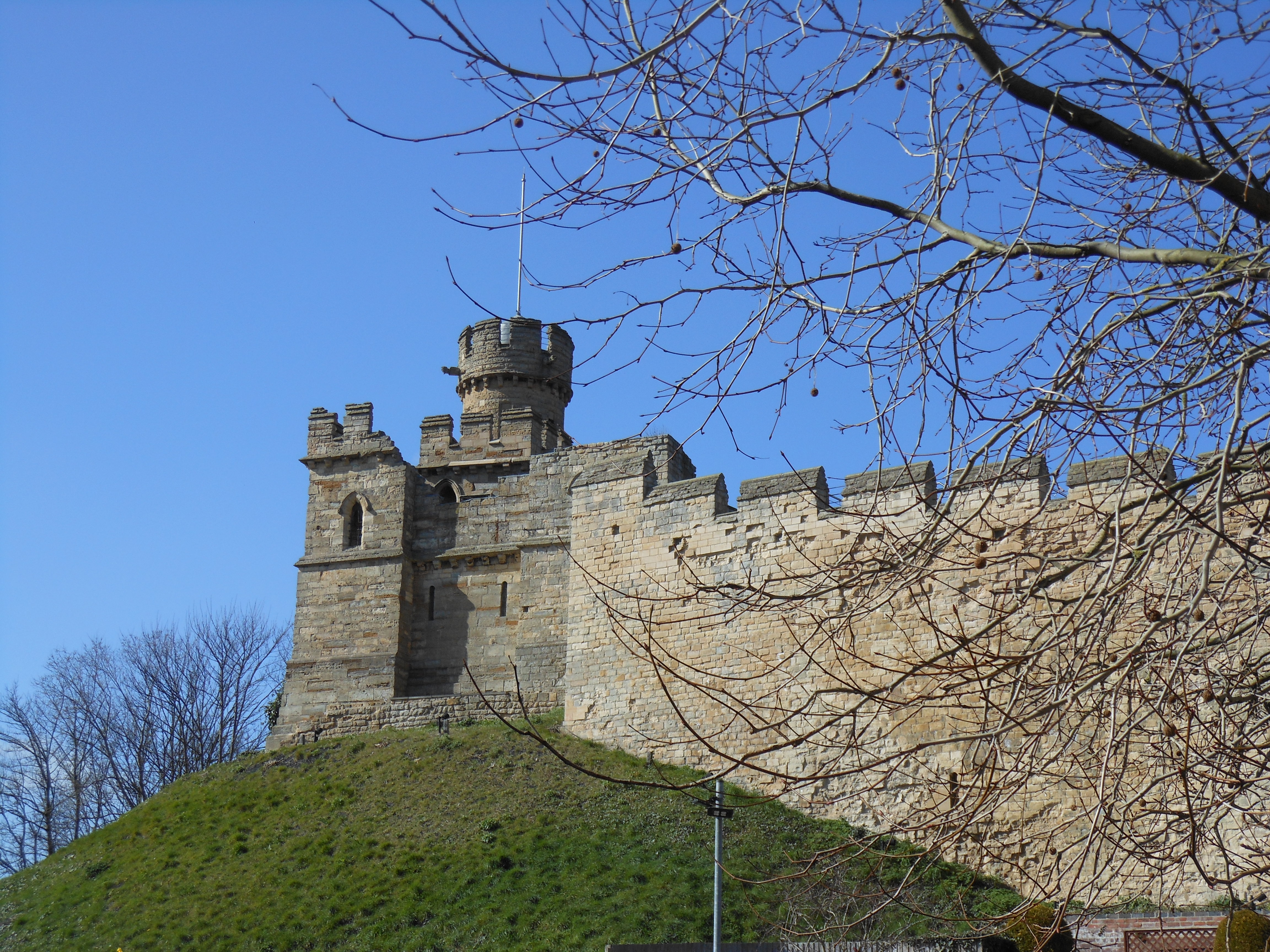
The Observatory Tower, Lincoln Castle
9. Gerard died in December 1214, leaving Nicholaa in command of Lincoln Castle. In 1216, she was besieged by a force of rebel barons who had taken up arms against King John in the aftermath of the issuing of Magna Carta. Nicholaa paid them off – they stopped attacking the castle but remained in the city. In the same year, Nicholaa met King John at the East Gate of Lincoln Castle, with the castle’s keys in her hand, offering to resign her position as constable, citing her weariness and great age (she was in her 60s). John refused, telling her to remain in post until he ordered otherwise.
10. On 18 October 1216, at Newark Castle, in one of his final acts and just hours before his death, King John appointed Nicholaa de la Haye as sheriff of Lincolnshire. She was the first woman in English history to be appointed to the office of sheriff in her own right – but she would not be the last.
Depiction of the 1217 Battle of Lincoln from Matthew Paris
11. (Oops!) For 7 months, from October 1216 to May 1217, Lincoln Castle was once again under siege by a force of English rebel barons and their French allies under the command of the Comte de Perche. Nicholaa directed the castle’s defence until royalist forces could come to her aid. On 20 May 1217, William Marshal and the royalist army came to her relief, fighting the Battle of Lincoln through the city’s streets.
12. (double oops!) There was a rise in the number of baby girls named Nicholaa, in Lincolnshire, in the 13th century.
13. Have a listen to the A Slice of Medieval episode dedicated to Nicholaa de la Haye, where Derek Birks and I discuss the ins and outs – and highs and lows – of Nicholaa’s career.
Sources:
Richard of Devizes, The Chronicle of Richard of Devizes; Roger of Howden (Hoveden), The Annals of Roger of Howden; The Plantagenet Chronicles edited by Elizabeth Hallam; Brassey’s Battles by John Laffin; 1215 The Year of Magna Carta by Danny Danziger & John Gillingham; The Life and times of King John by Maurice Ashley; The Plantagenets, the Kings Who Made England by Dan Jones; England Under the Norman and Angevin Kings by Robert Bartlett; lincolnshirelife.co.uk; catherinehanley.co.uk; magnacarta800th.com; lothene.org; lincolncastle.com; The Sheriff: The Man and His Office by Irene Gladwin; Louise Wilkinson, Women in Thirteenth Century Lincolnshire; Richard Huscraft, Tales from the Long Twelfth Century; J.W.F. Hill, Medieval Lincoln; swaton.org.uk; oxforddnb.com; Ingulph, Ingulph’ Chronicle of the Abbey of Croyland; Stephen Church, King John: England, Magna Carta and the Making of a Tyrant; Marc Morris, King John; Pipe Rolls; Red Book of the Exchequer
*
My Books
Signed, dedicated copies of all my books are available through my online store.
Out now: Scotland’s Medieval Queens
Scotland’s history is dramatic, violent and bloody. Being England’s northern neighbour has never been easy. Scotland’s queens have had to deal with war, murder, imprisonment, political rivalries and open betrayal. They have loved and lost, raised kings and queens, ruled and died for Scotland. From St Margaret, who became one of the patron saints of Scotland, to Elizabeth de Burgh and the dramatic story of the Scottish Wars of Independence, to the love story and tragedy of Joan Beaufort, to Margaret of Denmark and the dawn of the Renaissance, Scotland’s Medieval Queens have seen it all. This is the story of Scotland through their eyes.
‘Scotland’s Medieval Queens gives a thorough grounding in the history of the women who ruled Scotland at the side of its kings, often in the shadows, but just as interesting in their lives beyond the spotlight. It’s not a subject that has been widely covered, and Sharon is a pioneer in bringing that information into accessible history.’ Elizabeth Chadwick (New York Times bestselling author)
Heroines of the Tudor World tells the stories of the most remarkable women from European history in the time of the Tudor dynasty, 1485-1603. These are the women who ruled, the women who founded dynasties, the women who fought for religious freedom, their families and love. Heroines of the Tudor World is now available for pre-order from Amberley Publishing and Amazon UK.Women of the Anarchy demonstrates how Empress Matilda and Matilda of Boulogne, unable to wield a sword themselves, were prime movers in this time of conflict and lawlessness. It shows how their strengths, weaknesses, and personal ambitions swung the fortunes of war one way – and then the other. Available from Bookshop.org, Amberley Publishing and Amazon UK. King John’s Right-Hand Lady: The Story of Nicholaa de la Haye is the story of a truly remarkable lady, the hereditary constable of Lincoln Castle and the first woman in England to be appointed sheriff in her own right. Available from all good bookshops Pen & Sword Books, bookshop.org and Amazon.
Alternate Endings: An anthology of historical fiction short stories including Long Live the King… which is my take what might have happened had King John not died in October 1216. Available in paperback and kindle from Amazon.
Podcast:
Have a listen to theA Slice of Medieval podcast, which I co-host with Historical fiction novelist Derek Birks. Derek and I welcome guests, such as Bernard Cornwell and Elizabeth Chadwick, and discuss a wide range of topics in medieval history, from significant events to the personalities involved.
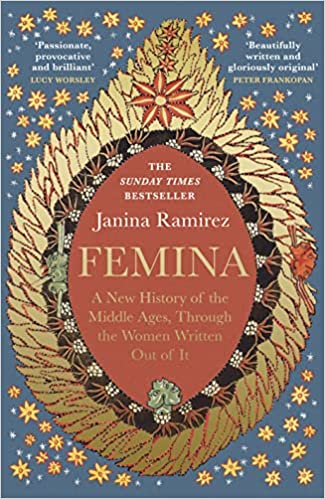
The middle ages are seen as a bloodthirsty time of Vikings, saints and kings: a patriarchal society which oppressed and excluded women. But when we dig a little deeper into the truth, we can see that the ‘dark’ ages were anything but.
Oxford and BBC historian Janina Ramirez has uncovered countless influential women’s names struck out of historical records, with the word FEMINA annotated beside them. As gatekeepers of the past ordered books to be burnt, artworks to be destroyed, and new versions of myths, legends and historical documents to be produced, our view of history has been manipulated.
Only now, through a careful examination of the artefacts, writings and possessions they left behind, are the influential and multifaceted lives of women emerging. Femina goes beyond the official records to uncover the true impact of women like Jadwiga, the only female King in Europe, Margery Kempe, who exploited her image and story to ensure her notoriety, and the Loftus Princess, whose existence gives us clues about the beginnings of Christianity in England. See the medieval world with fresh eyes and discover why these remarkable women were removed from our collective memories.
When I wrote Heroines of the Medieval World five years ago, I said at the time that it was a book that needed to be written – I just wasn’t sure if I was the person to write it. If I had been asked who should write it, one of the top names on my list would have been Janina Ramirez. So I was not surprised when I discovered that Janina had written a book on medieval women, Femina: A New History of the Middle Ages, Through the Women Written Out of It.
I admit I was a little worried thatFemina would make my Heroines obsolete or redundant, but I probably shouldn’t have been. After all, every writer has their own style and approach and every book – even if on the same topic – is written differently. And while the two books do overlap in places, we do not always reach the same conclusion and they really would complement each other on a book shelf (hint, hint!).
Femina: A New History of the Middle Ages, Through the Women Written Out of It looks at some of the most remarkable women of the medieval period, including two women you will be familiar with if you have read Heroines of the Medieval World, Æthelflæd, Lady of the Mercians and Jadwiga, ‘King’ of Poland. And the chapter on Jadwiga is particularly illuminating as Dr Ramirez applies her background in Art History to the symbolism and significance of Jadwiga’s reign, both on a political and spiritual level.
Janina Ramirez also provides great insight in to Emma of Normandy, who I looked at in detail for my own book, Silk and the Sword: the Women of the Norman Conquest. Study is even made of Ӕlfgyva, the mysterious woman in the Bayeux Tapestry, though Janina and I come to very different conclusions – and I would dearly love to have a face-to-face conversation with her to thrash out our theories. That would be fun!
Hild moved from Hartlepool to the site known then as Strenaeshalch and now as Whitby, in AD 657. Here she was granted land to build a double monastery where both men and women could learn the scriptures and dedicate themselves to a monastic life. And engraved stone slab commemorates her successor as abbess, Ælfflæd, and the use of the Latin script and alphabet supports Bede’s suggestion that Whitby was a centre of learning and literacy. But like at Hartlepool, finds from Hild’s abbacy include many luxuries such as decorative hairpins, golden book covers and even a comb with a runic inscription. Runes were the alphabet of the pre-Christian English, but the inscription is clearly Christian: My God. May God Almighty help Cy …’ Again, we find an object which links the Germanic warrior world to the new Christina one. Like Hild herself it straddles ideologies and a time of transition.
Hild was at the top of the tree in terms of influence in seventh-century Northumbria. Bede states that ‘even kings and princes sought and received her counsel’, and she acted as mentor to the daughter of Oswui, King of the Northumbrians from 642-670. What’s more, it was under her rule, in the monastery she founded herself, that the leaders of the English church gathered for the famous Synod of Whitby in AD 664. With Hild in charge of proceedings, the good and the great, representatives of Rome and Ireland, argued which traditions the Northumbrian church should follow. The result went the way of Rome. The variety and uniqueness of Celtic monasteries was lost to the rigour and routine of the Benedictine Rule, and monasticism in the north was transformed forever. For a woman to be involved in such high-level synodal processes is something extraordinary even today. It is also significant that five men who trained under Hild were all made bishops; if there were king-makers in the medieval world, then she was the bishop-maker. Whitby was the training ground for a new, Roman Christian, learned and respected English church. From Hild’s northern headland, educated men and women would stretch out the length and breadth of the country, assuming the very highest positions within churches and monasteries, including the archbishop of York. Hild’s influence would permeate the fabric of Christianity in this part of the world and its effects were felt down the centuries.
Femina: A New History of the Middle Ages, Through the Women Written Out of It is a fabulous study of a number of medieval women – and medieval woman in general. Dr Ramirez manages to combine what it was like to be a woman in medieval times, including their rights and the dangers they faced, such as childbirth, with the histories of particular women – and not always women you would expect to see in history book. The most fascinating chapter is that which is devoted to the Cathars, a religious sect much misunderstood and persecuted to extinction by the church. Janina Ramirez highlights not only their suffering and personal testimonies, but also the strength and respect that women held within the community. It truly is illuminating.
From warrior Viking women, to the successes of Æthelflæd and the excessive crying of Margery Kempe, Janina Ramirez shines a light on the lives and experiences of a huge variety of medieval women. Archaeological discoveries, religious artefacts and medieval artwork are used to describe and illuminate the world in which these women lived and died.
Femina: A New History of the Middle Ages, Through the Women Written Out of It is an engaging, entertaining read, with Janina Ramirez’s unique and wonderful take on medieval history. Introducing her vast knowledge of Art History into the mix adds vibrancy to the individual stories and brings these incredible women to life. Dr Ramirez is fabulous writer and communicator and takes the reader on an incredible journey of discovery through the medieval world. Her enthusiasm and fascination for the topic shines through on every page.
Femina: A New History of the Middle Ages, Through the Women Written Out of It by Janina Ramirez is truly a pleasure to read.
About the author:
Dr Janina Ramirez is a Sunday Times bestselling author, an Oxford lecturer, BBC broadcaster and researcher. She has presented and written over 30 hours of BBC history documentaries and series on TV and radio, and written five books for children and adults.
My books
Signed, dedicated copies of all my books are available, please get in touch by completing the contact me form.
Defenders of the Norman Crown: The Rise and Fall of the Warenne Earls of Surrey tells the fascinating story of the Warenne dynasty, of the successes and failures of one of the most powerful families in England, from its origins in Normandy, through the Conquest, Magna Carta, the wars and marriages that led to its ultimate demise in the reign of Edward III. Defenders of the Norman Crown: Rise and Fall of the Warenne Earls of Surrey is now available from Pen & Sword Books, Amazon in the UK and US,Bookshop.org and Book Depository.
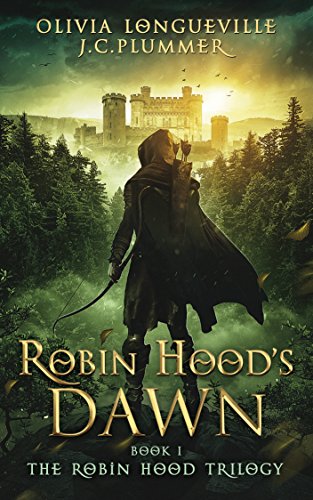
Falsely convicted of a shocking crime, Robin Fitzooth, the Earl of Huntingdon, finds refuge in Sherwood Forest and becomes Robin Hood.
Leading a band of men against the injustices of a malevolent sheriff and his henchmen, Robin begins to unravel a web of treachery threatening the English royal family.
As shadowy forces gather to destroy the future of a nation, Robin faces deceit, betrayal, and the ravages of war as he defends his king, his country, his people, and the woman he loves from a conspiracy so diabolical, so unexpected, that the course of history hangs in the balance.
From the mists of an ancient woodland, to lavish royal courts teeming with intrigue, to the exotic shores of the Holy Land – Robin Hood leads the fight in a battle between good and evil, justice and tyranny, the future and the past.
Part one of an exciting three-part retelling of the Robin Hood legend! Also Available: Book 2, Robin Hood’s Widow Book 3, Robin Hood’s Return
I have to admit that I am a sucker for a good Robin Hood story. However, having grown up close to Sherwood Forest and played around the Major Oak as a child, I have to admit that I can be quite picky when it comes to Robin Hood. It has to be a good story, or I will not read it. I have had The Robin Hood Trilogy on my kindle for a while, but only actually picked up the first book 3 weeks ago. I was suffering from a heavy cold and wanted some comfort reading. And what a choice for comfort reading. I read all 3 books, one after the other, in a week. I couldn’t get enough of them!
The story opens in 1154 with the death of King Stephen and a betrayal by certain nobles who had promised to put Stephen’s son, William of Blois, Earl of Warenne and Surrey, on the throne. As a regular reader of this blog will understand, my interest was most certainly piqued. So, now we have a novel series with 2 of my favourite topics; Robin Hood and the Warennes. And I got worried. What if I don’t like the way this book goes with the Warennes? I do have quite a soft spot for them, after all.
I need not have been concerned. This Robin Hood trilogy is a fabulous adventure, with well developed characters, a story thread that will keep you gripped to the very end – and some marvellous twists in the tale.
They had left Sherwood Forest and were now traversing rolling hills and pastures, but Marian could not appreciate the lovely scenery. The closer they were to Conisbrough, the more nervous she felt.
She was riding next to Constance, and they were protected by an escort of twenty of Earl de Warenne’s mounted men-at-arms. At the front, Robin rode with Lionel and the earl’s son, Guillaume. All three were the same age, and Marian observed them as they enjoyed a friendly, animated conversation.
Robbie, as usual, was riding with his father.
Although Marian was apprehensive about staying at Conisbrough, Constance was elated. She was enthusiastically telling Marian what she knew about the de Warenne family.
Once again, Marian was lamenting her lack of interest in politics during her youth. She had never paid much attention to stories about the royal family or the elaborate familial web of royals, near royals, and distant relations to the king’s family.
In contrast, Constance was very knowledgeable. Marian knew her friend had traveled to London with her father and brother every year to attend court and celebrate Midsummer.
Marian’s father had never taken her to court, or even to London. Perhaps it was his own aversion to politics and big cities. And it’s likely that he considered it unnecessary, since it was always understood that Marian would wed Robin, so there had been no need to search for a suitable husband among the nobility of England.
“Constance, I’m confused,” she reluctantly confessed.
“About what?”
“Didn’t you say that Earl Hamelin was illegitimate? How did he inherit his title/”
Constance smiled indulgently. “Every time I’ve tried to explain this, I can see your mind wandering. Please concentrate on what I’m saying.”
“My mind is wandering because so much of this seems like pointless court intrigue. I just want to go back home and stay there.”
“You’re the wife of an earl. I think you can learn a lot by spending time with Countess de Warenne. You can’t hide at Locksley and Lenton. You have duties to perform at Huntingdon.”
Marian released a noisy sigh of defeat. “Tell me again.”
“Hamelin is the illegitimate son of Geoffrey, Count of Anjou. He’s the older half-brother of the late King Henry, God-rest-his-soul, and he’s King Richard’s uncle. Of course, he’s Prince John’s uncle, too.”
“But instead of Count of Anjou, he’s the Earl of Surrey?”
“Now I’m certain that you weren’t listening,” Constance chided. “He married Isabel de Warenne, the Countess of Surrey, who was the only child of her father. So, she inherited the earldom. When Hamelin married her, he took her family name and became earl by right of his wife.”
Robin Hood’s Dawn sets the scene beautifully, charting a youthful Robin’s journey into becoming an outlaw in Sherwood Forest, and his realisation that not everyone is honourable. His arrogance and connections get him into more trouble than he realises, almost losing the woman he loves – Marian. In Robin Hood’s Widow, we discover that Marian herself is more than capable of holding her own under the canopy of Sherwood Forest. Which makes for a fantastic finale in Robin Hood’s Return, where Robin and Marian, united in their common goals, must unite to fight their enemies and find a way to accept each other’s abilities and weaknesses.
My personal favourite of the 3 books is Robin Hood’s Return, but that may be because both Hamelin and Isabel de Warenne both play prominent roles – as does my ‘local’, Conisbrough Castle. Olivia Longueville and J.C. Plummer did their research and have done an amazing job of recreating the castle and the Warenne family dynamic. Their depictions, I believe, are spot on! And it was so nice to see the people I have spent so long researching brought to life on the page.
As to the other characters, Robin Hood, Little John, the sheriff of Nottingham, Guy of Gisborne are all there – though some not as you would ordinarily recognise them. I love the way the authors of the Robin Hood trilogy have taken the legend and made it their own, weaving an incredible story of betrayal and king-making into the existing legend, so that you are at once familiar with the characters, and yet discovering new dimensions along the way.
The Robin Hood Trilogy is a fabulous, engrossing read that you will never want to end – and yet can’t wait for it to finish.
What a fabulous adventure! I cannot recommend the series highly enough.
Robin Hood’s Dawn, Robin Hood’s Widow and Robin Hood’s Return are available from Amazon.
About the authors:
Olivia Longueville is a European author whose first book was Between Two Kings, a story set in Tudor England. J.C. Plummer is an American author and historian living in Texas. They are long distance friends who share a passion for writing and history, and this is their first collaboration. Learn more at their website: http://www.AngevinWorld.com
My Books
Signed, dedicated copies of all my books are available, please get in touch by completing the contact me form.
Defenders of the Norman Crown: The Rise and Fall of the Warenne Earls of Surrey tells the fascinating story of the Warenne dynasty, of the successes and failures of one of the most powerful families in England, from its origins in Normandy, through the Conquest, Magna Carta, the wars and marriages that led to its ultimate demise in the reign of Edward III. Defenders of the Norman Crown: Rise and Fall of the Warenne Earls of Surrey is now available from Pen & Sword Books, Amazon in the UK and US,Bookshop.org and Book Depository.
Eleanor of Aquitaine is the only woman to have ever worn the crowns of both England and France. Eleanor was the ultimate survivor and, despite many setbacks, lived to a great age, revered and respected to the very end. Her life story has filled many a volume over the years; she has even been promoted as the first feminist. However, Eleanor lived within the bounds of medieval society, even if she did break the mould in many ways. Eleanor was born in the early 1120s, probably around 1122–4. Her father was Guillaume, 8th Count of Poitou and 10th Duke of Aquitaine. Her mother was Alienor, or Aenor, daughter of Aimery I, Vicomte of Châtellerault. Eleanor was one of three children; she had a sister called Petronilla and a brother, Guillaume. Little Guillaume died during childhood, shortly before the death of the children’s mother. After the death of her brother, Eleanor became her father’s heir, at least until he remarried.
Duke William died unexpectedly during Easter week 1137, while on pilgrimage to Santiago de Compostela. Eleanor was somewhere in her mid-teens at the time of her father’s death, and was not expected to be able to rule the valuable inheritance of Aquitaine alone. Just months after her father’s death, in July 1137, she was married to Louis VII of France. It is entirely possible the marriage had been planned during her father’s lifetime and brought forward due to the Duke’s untimely death. At the time of the wedding, Louis was heir to the French throne. Although he had been crowned as junior king in 1131, during his father’s lifetime, a tradition in the French royal house, a way of securing or at least signalling the succession. Shortly after the wedding on 1 August 1137, he succeeded as sole King of France, when his father, Louis VI, died of dysentery. During the years of the marriage the significance of Eleanor’s lands was highlighted by the fact Louis went by the combined title of ‘King of the French and Duke of Aquitaine’.
A 14th-century representation of, at left, the wedding of Louis and Eleanor; at right, Louis leaving on Crusade.
There seems to have been some issue concerning Eleanor’s fertility, with her first child not arriving until eight years into the marriage. There is a story that the revered abbot, Bernard of Clairvaux, had a meeting with Eleanor sometime around 1144, at St Denis, and promised to intercede with God for a son and heir to the French throne. Although Eleanor’s first surviving child was born soon after, in 1145, it was a daughter, Marie, rather than the much-desired son. The year 1144, however, also saw the fall of Edessa, far away in the Holy Land, prompting the pope to call for a new Crusade. A Crusade appealed to Louis, who was seeking atonement for an atrocity committed in his name during the invasion of Champagne, in support of Eleanor’s sister, Petronilla. Petronilla had caused scandal at the French court, by running away with Raoul of Vermandois and marrying him, despite the fact he already had a wife, the niece of the Count of Champagne. As a consequence, the two lovers were both excommunicated. However, conflict with Champagne soon followed. When Louis’ men took the town of Vitry, some 1,300 men, women and children sought sanctuary in the town’s church. Every single one of them perished when the church was burned to the ground by Louis’ marauding soldiers.
It may well be that Eleanor joined the Second Crusade in the hope that God looked favourably on her, enough to give her a son. Maybe she wanted to help her uncle, Raymond of Toulouse, who was Prince of Antioch, who had sent presents accompanied by appeals for help, to his niece and her husband. Or maybe it was Eleanor’s own desire for adventure. Whatever her reason, it was both Eleanor and Louis who took the cross at Vézelay on Easter Day, 31 March 1146, following an inspiring call to arms by Bernard of Clairvaux.
Louis VII
The Second Crusade proved to be the defining point of Eleanor’s marriage to Louis. Led jointly by Louis and the German emperor, Conrad III, it was an unmitigated disaster. Louis lost his personal bodyguard in the heavy defeat by the Seljuk Turks, at Laodicea, in January 1148, while still en route to Outremer. The French forces finally reached the Holy Land, arriving at Antioch, the home of Eleanor’s uncle, Raymond, just a few months later. The warm welcome and lavish attention to his niece soon brought about rumours that Raymond and Eleanor were more than niece and uncle. The persistent rumours of Eleanor’s infidelity, and incest with her uncle, led Louis to put her under close guard, despite a lack of any firm evidence of wrongdoing. She remained under such supervision – although discreetly, so as not to offend her vassals from Aquitaine, who made up a considerable part of Louis’ army. Looking at the evidence today, it is impossible to know whether the rumours, which included not just infidelity but also the birth of a child, had any foundation in truth or were merely fanciful accusations.
Louis fulfilled his pilgrimage by entering Jerusalem in 1148, making the final leg of the journey to the Holy Sepulchre, on foot and fasting, just like countless pilgrims before him. In a council at Acre, Louis and his allies then decided that the best course of action was to take Damascus, with the original aim of the Crusade – to retake Edessa – being forgotten or sidelined. However, attempts to retake the city ended in failure and Louis returned, first to Antioch and then to Jerusalem. The Second Crusade was at an end and, owing to the rumours of infidelity, Louis and Eleanor’s marriage had been dealt a fatal blow.
In 1149, Louis celebrated Easter in the Holy City of Jerusalem, before embarking at Acre for the return journey to France. Eleanor and her ladies travelled separately in another ship. They were reunited in September 1149 and were given a magnificent reception at Potenza, by King Roger of Sicily. From Sicily, they visited the pope, Eugenius III, at Tusculum. Eugenius attempted mediation in the royal marriage, going so far as to insist that they sleep together in a bed which he had personally blessed. Some temporary reconciliation must have been achieved, as their second daughter, Alix, was born within a year. However, with the failure to produce the desired male heir, a permanent reconciliation escaped them and a divorce, on the grounds of consanguinity, was finally proclaimed during Lent of 1152.
Henry II
Louis attempted to retain control of Aquitaine by insisting that he approve of any prospective husband of Eleanor’s; but the duchess rode away from the French court, and her daughters, returning to her own lands in Aquitaine in the spring of 1152. Eleanor’s marriage – and Aquitaine – was a coveted prize and her journey home was not without its perils. She is said to have narrowly escaped ambushes by the Count of Blois and Geoffrey of Anjou, second son of Empress Matilda and Geoffrey, Count of Anjou. Nevertheless, it seems likely that Eleanor had already decided her future even before her divorce was proclaimed by the clerics at Beaugency. A year earlier, Henry of Anjou and his father, Count Geoffrey, husband of Empress Matilda, had been in attendance at the French court for Henry to swear fealty for the Duchy of Normandy, and to settle disputes over the northwestern county, the Vexin. Although the Vexin issue was far from settled, Henry rode away, confirmed as Duke of Normandy and, possibly, with a promise of marriage from the soon-to-be divorced queen.
Although the marriage of Henry and Eleanor is often presented as a love-match, it was a marriage of hardheaded practicality with mutual benefits. Eleanor needed a husband who was strong enough to stand up to Louis. As Duke of Normandy and Count of Anjou, and with the possibility of the crown of England tantalisingly close, Henry was the ideal choice as Eleanor’s new husband. They were married in Poitiers Cathedral in May 1152; Eleanor was around thirty years old and Henry was nineteen. Louis was furious and called Henry to court to explain himself for having married without the permission of his liege lord. When Henry failed to appear, Louis formed a coalition against him, persuading King Stephen to attack Normandy from England, while he attacked from the south. Stephen was keen to oblige, hoping to secure the English succession for his son, Eustace, and neutralise the threat posed by Henry. Louis’ other allies included Thibault of Blois, recently betrothed to Alix, the two-year-old daughter of Louis and Eleanor; and Henry of Champagne, who was now married to seven-year-old Marie, Louis and Eleanor’s eldest daughter, and Eleanor’s heir to Aquitaine, at least until Eleanor and Henry had a son.
Louis had thought Henry was preoccupied with plans for invading England. Instead, he quickly reacted to the French king’s aggression, conducting a lightning campaign, which caught Louis off guard. The French king was completely outmanoeuvred and was quick to acquiesce when the Church called for peace. Henry could then turn his attention to England, which he invaded in However, the death of Stephen’s oldest son and heir, Eustace, in August of that year ultimately led to the Treaty of Winchester, with Stephen bypassing his youngest son, William, in order to settle the succession on Henry and bring to a close the twenty years of warfare, known as the Anarchy. When Stephen died the following year, Henry’s accession followed peacefully. Henry and Eleanor were crowned, together, in a magnificent ceremony in Westminster Abbey, on 19 December 1154. They now ruled an empire that stretched from the borders of Scotland in the north, to the borders of Spain in the south.
Tomb effigies of Henry II and Eleanor of Aquitaine, Fontevrault
By the time of her marriage to Henry, Eleanor had already survived the birthing chamber on at least two occasions, with the births of her daughters, Marie and Alix, by Louis VII. Although she had only produced two children in fifteen years of marriage to Louis, by the time of her coronation Eleanor had already provided Henry with a son and heir, William, born in August 1153. William died in England in 1156, aged just three, with his mother by his side, and his father away in the family’s Continental domains. However, he had already been joined in the nursery by another son, Henry, born in February 1155, and a daughter, Matilda, who was two months old when little William died. Childbirth was a dangerous time for women, with no guarantee that having survived once, twice or three times, you would survive a fourth or fifth confinement. Nevertheless, after William’s death, Eleanor safely delivered another five children into the world. Her favourite son, Richard, who was her choice as heir to Aquitaine, was born in September 1157 and another son, Geoffrey, who became Duke of Brittany when he married the duchy’s heiress, Constance, arrived twelve months later. Eleanor, who would become Queen of Castile, was born in October 1162, and Joanna, who would initially marry the King of Sicily and then Raymond VI of Toulouse, arrived in October 1165. Eleanor’s fifth son, and tenth and last child, John, was born at Christmas, 1167. Having given birth to ten children over the course of twenty-two years, Eleanor had survived the most perilous aspect of any medieval woman’s life. She would have been well aware of the risk she was taking every time she entered the birthing chamber, knowing that either she or the baby, or both, may not survive.
During their married life together Henry was constantly on the move, travelling between his vast domains, dealing with restless barons, dispensing justice and holding court. Eleanor joined him when she could, depending on her state of pregnancy or recent childbirths. In 1156, for example, still grieving for her three-year-old son William, Eleanor crossed the English Channel with her surviving son, eighteen-month-old Henry, and daughter Matilda, when Matilda was just two months old, journeying to join Henry in Anjou, before moving on to Aquitaine in October. Travel had its own dangers; the English Channel is not the calmest of sea roads and Henry’s own uncle, William, son and heir of Henry I, had been killed in the White Ship tragedy in 1120, when his ship had foundered leaving harbour, killing all but one of the people on board.
Tomb effigy thought to be William Marshal, the Temple Church, London
Land journeys could be equally hazardous. Indeed, Eleanor was almost kidnapped or killed in April 1168, when travelling through the hills of Poitou, escorted by Patrick, Earl of Salisbury, and his men. The party were ambushed by Eleanor’s rebellious vassals, Geoffrey and Guy de Lusignan. Salisbury and his men were travelling, unarmoured, when the de Lusignans fell upon them. The earl ‘sent the Queen on to the castle’ at Poitiers while he and the remainder of his men held off the attackers, giving the queen time to make it to safety. The earl was killed by a lance during the vicious skirmish; his nephew, William Marshal, was wounded in the thigh and captured after having his horse killed under him. William spent several months in captivity, his wounds healing despite the harsh treatment meted out by the de Lusignans. William was a young, penniless knight and was finally released when Queen Eleanor agreed to pay his ransom. William then joined the queen’s household, before joining that of her son, Henry. William Marshal would faithfully serve five English kings – Henry II, Henry, the Young King, crowned during his father’s lifetime, Richard I the Lionheart, King John and, finally, Henry III, for whom the aged Marshal was regent.
The years 1169 to 1173 were spent, almost exclusively for Eleanor, in her duchy of Aquitaine with her son, Richard, who she was training as her eventual successor. Richard was invested as Count of Poitou and, in 1169, paid homage to Eleanor’s first husband, King Louis, for the Duchy of Aquitaine. In 1173, however, news reached Henry II that his sons were plotting against him. The boys – now men – were tired of frequently having the possibility of power and responsibility dangled before them, only for their father to withdraw it at the last minute. Henry’s eldest son, Henry, the Young King, fled to the court of Louis VII, his father-in-law since his marriage to Louis’ daughter, Marguerite, in 1160. For unknown reasons, Eleanor sided with her sons against their father. It was later suggested that Eleanor had been incensed at Henry’s relationship with Rosamund Clifford – the Fair Rosamund – and that, wounded by this betrayal, had joined or incited her sons’ rebellion.
Eleanor prepares to poison Rosamund by Evelyn De Morgan
There is, in fact, no contemporary evidence that the affair caused Eleanor’s rebellion and her reasons remain obscure. She may have resented the restrictions of power placed on her, or the fact Henry would not allow their sons any exercise of power. Whatever the reason, Eleanor joined the rebellion, and lost. Her sons were outmanoeuvred and defeated by Henry. Far from humiliating them, however, Henry came to terms with his sons and an uneasy peace ensued. On the other hand, Henry was not so forgiving of Eleanor, who was captured while trying to escape Poitou; she had tried to reach the safety of the French court, dressed in men’s clothing. In 1174, Henry sent his queen to imprisonment in England, possibly at Salisbury, under heavy guard.
Eleanor was kept securely at first, but her imprisonment was relaxed as the years passed, especially after the death of her son, Henry, the Young King, who had pleaded with his father from his deathbed in 1183, that his mother be treated less harshly. In subsequent years, Eleanor was allowed at court for some ceremonial occasions, and was allowed visits by her daughter, Matilda, who had been exiled with her husband, Henry of Saxony, from their German lands. Matilda was instrumental in getting the restrictions eased even further and, although she was still in the custody of guards, Eleanor was allowed to reside with Matilda at various locations in England, including Windsor and Berkhamsted. However, fifteen years of imprisonment in England, far away from her homeland and court in Aquitaine, cannot have been easy for a queen used to riding freely across the vast domains she and her husband possessed.
The queen was only released after Henry’s death in 1189; indeed, ordering his mother’s release was one of the first acts of her son, Richard I. And the queen was there to welcome him for his ceremonial entry into Winchester in August 1189. Now in her mid-sixties, Eleanor was given a new lease of life, and lived it with the same energy and vigour she had in the years before her imprisonment. Almost immediately, Eleanor was trusted with the oversight of the government of England. In 1190 she travelled to Navarre, to collect Richard’s bride, Berengaria, and deliver the princess to her son, then en route to the Holy Land on the Third Crusade. After a winter journey over the Alps, the queen, now almost seventy, escorted Berenagria to a rendezvous with Richard at Messina in Sicily in March 1191. Having fulfilled her mission, Eleanor set off home, almost immediately; although not before what must have been an emotional reunion with her youngest daughter, Joanna, who was Queen of Sicily and had been widowed in November 1189, but held prisoner by her husband’s successor, Tancred. Richard affected her release and his sister was now to be a companion for his bride; Joanna accompanied Richard and Berenagria to the Holy Land.
Richard I
Eleanor was later instrumental in securing her son’s release from captivity in Germany. Richard had been captured by Leopold V, Duke of Austria, on his return journey from the Holy Land, in December 1192. He was handed over to the Holy Roman Emperor, Heinrich VI, in March 1193. During Richard’s captivity, Eleanor was inexhaustible in her attempts to raise the ransom, some 150,000 marks and to keep her son, John, in check. John took the opportunity created by Richard’s absence to make a play for power; he and Philip II Augustus, King of France, went so far as to offer Heinrich 80,000 marks to keep Richard incarcerated. John was still in open opposition to his brother when Eleanor finally secured Richard’s release, on 4 February 1194. Eleanor travelled to Germany to personally hand over the ransom payment and escort Richard home. As news of Richard’s release reached England, John fled to France.
Richard’s death in April 1199, must have come as a horrific blow for Eleanor; the loss of her favourite son, at just forty-one years of age, caused immense grief. Richard’s death was soon followed by that of Joanna, Eleanor’s youngest daughter, who, heavily pregnant and hurt, had sought refuge with her mother at Rouen. Eleanor was by her daughter’s side as she gave birth to a son, Richard, who lived only long enough to be baptised. Joanna died within moments of her son, in September 1199, and mother and baby were buried together at the Abbey of Fontevrault.
Having lost four of her children in quick succession – her two daughters with Louis, Alix and Marie, also died in 1197 and 1198, respectively – and with her youngest son, John, now on the English throne, Eleanor undertook one final, diplomatic mission. Nearing her eightieth year, Queen Eleanor journeyed across the Pyrenees to Castile, in search of a bride for Louis, the dauphin of France and grandson of her first husband, Louis VII. England’s Dowager Queen was received at the court of Alfonso VIII and her own daughter, Eleanor, Queen of Castile, with all the pomp and pageantry the Castilians could muster. She stayed there for more than two months, taking the opportunity to spend some time with her daughter and getting to know her granddaughters. Eleanor of Aquitaine seems to have decided that twelve-year-old Blanca would make a more suitable bride for Louis than her sister, Uracca. Eleanor then brought Blanca back to France and delivered her to her bridegroom, Louis; the couple were married in Normandy, as France was under papal interdict at the time, owing to the marital indiscretions of Louis’ father, King Philip II Augustus.
King John
Following her delivery of Blanca to her new husband, Eleanor retired to the Abbey at Fontevrault. She did not take the veil as a nun, but lived in her own house within the abbey’s precincts. However, the eighty-year-old queen had one final adventure in 1202, when she was besieged by her fifteen-year-old grandson, Arthur, Duke of Brittany, at Mirebeau. Arthur had rebelled against his uncle, King John, and made an attempt on the English throne. In a remarkable forced march, John quickly came to his mother’s rescue, capturing Arthur and his sister, Eleanor, and raising the siege. Arthur disappeared into King John’s dungeons at Rouen and probably died there during Easter, 1203. His sister, Eleanor, was sent to England, to a perpetual, if comfortable, imprisonment.
The event was Eleanor’s last major adventure; increasingly frail, she retreated to Fontevrault, where she died on 31 March 1204, aged around eighty-two. She had outlived all but two of her children, with only Eleanor in Castile, and John in England, still living. She was buried in the abbey church alongside her second husband, Henry II, and her son, Richard, and daughter, Joanna. Eleanor of Aquitaine had survived the Second Crusade, several kidnap attempts, fifteen years of imprisonment and giving birth to ten children. She was the most remarkable woman of the medieval age, the ultimate survivor and a heroine to the core.
*
Images:
Courtesy of Wikipedia
Sources:
.Jane Martindale, Eleanor, suo jure Duchess of Aquitaine (c.1122–1204) (article), Oxforddnb.com; Douglas Boyd, Eleanor, April Queen of Aquitaine; The Plantagenet Chronicles, edited by Elizabeth Hallam; Mike Ashley, The Mammoth Book of British Kings & Queens; Thomas Abridge, The greatest Knight; Mary Anne Everett Green, Lives of the Princesses of England from the Norman Conquest; Alison Weir Britain’s Royal Families, the Complete Genealogy; Robert Bartlett England Under the Norman and Angevin Kings; Alison Weir Eleanor of Aquitaine, by the Wrath of God, Queen of England; britannica.com; geni.com; royalwomenblogspot.co.uk; medievalqueens.com; Brewer’s Royalty by David Williamson
*
My Books:
Signed, dedicated copies of all my books are available through my online bookshop.
Out Now:Women of the Anarchy
On the one side is Empress Matilda, or Maud. The sole surviving legitimate child of Henry I, she is fighting for her birthright and that of her children. On the other side is her cousin, Queen Matilda, supporting her husband, King Stephen, and fighting to see her own son inherit the English crown. Both women are granddaughters of St Margaret, Queen of Scotland and descendants of Alfred the Great of Wessex. Women of the Anarchy demonstrates how these women, unable to wield a sword, were prime movers in this time of conflict and lawlessness. It show how their strengths, weaknesses, and personal ambitions swung the fortunes of war one way – and then the other.
Coming on 15 June 2024: Heroines of the Tudor World
Heroines of the Tudor World tells the stories of the most remarkable women from European history in the time of the Tudor dynasty, 1485-1603. These are the women who ruled, the women who founded dynasties, the women who fought for religious freedom, their families and love. These are the women who made a difference, who influenced countries, kings and the Reformation. In the era dominated by the Renaissance and Reformation, Heroines of the Tudor World examines the threats and challenges faced by the women of the era, and how they overcame them. Some famous, some infamous, some less well known, including Anne Boleyn, Elizabeth Barton, Catherine de Medici, Bess of Hardwick and Elizabeth I. From writers to regents, from nuns to queens, Heroines of the Tudor World shines the spotlight on the women helped to shape Early Modern Europe.
King John’s Right-Hand Lady: The Story of Nicholaa de la Haye is the story of a truly remarkable lady, the hereditary constable of Lincoln Castle and the first woman in England to be appointed sheriff in her own right. It is is available from Pen & Sword Books, bookshop.org and Amazon. Defenders of the Norman Crown: The Rise and Fall of the Warenne Earls of Surrey tells the fascinating story of the Warenne dynasty, from its origins in Normandy, through the Conquest, Magna Carta, the wars and marriages that led to its ultimate demise in the reign of Edward III. Available from Pen & Sword Books, Amazon in the UK and US, and Bookshop.org.
Alternate Endings: An anthology of historical fiction short stories including Long Live the King… which is my take what might have happened had King John not died in October 1216. Available in paperback and kindle from Amazon.
Podcast:
Have a listen to theA Slice of Medieval podcast, which I co-host with Historical fiction novelist Derek Birks. Derek and I welcome guests, such as Bernard Cornwell and Elizabeth Chadwick, and discuss a wide range of topics in medieval history, from significant events to the personalities involved.
*
Don’t forget!Signed and dedicated copies of all my books are available through my online bookshop.
For forthcoming online and in-person talks, please check out my Events Page.
You can be the first to read new articles by clicking the ‘Follow’ button, liking our Facebook page or joining me on Twitterand Instagram.
A 14th-century representation of Henry and Eleanor
In history we tend to focus on the actions of the men in a family. Well, let’s face it, the life of Henry II and his sons is fascinating, full of love, honour, death and betrayal. Who wouldn’t be drawn into that world? But did you know that the women of the family had no less exciting and eventful lives?
With a mother like Eleanor of Aquitaine, you would not expect her daughters to be shrinking violets. And, indeed, they were not. And neither were the girls sent off into the world, never to see their parents again. In what may be a unique occurrence for royal princesses, each of the three daughters of Eleanor and Henry II would get to spend time with their mother later in their lives.
Matilda of England, the eldest daughter and third child of Henry and Eleanor, was born in London in June 1156. As her parents ruled an empire that stretched from the Scottish borders to the Pyrenees, travel was a constant part of Matilda’s childhood. She took her first sea-voyage across the English Channel at just 2 months old, accompanied her big brother, Henry, later to be known as The Young King. Throughout her childhood, Matilda is often seen accompanying her mother and siblings traveling through the vast Angevin domains. By the time she was 8-years-old, negotiations had begun for her marriage to Henry the Lion; her father planning an alliance with the German Emperor, Frederick Barbarossa. The marriage was part of her father’s policy to build up opposition to Louis VII of France and the Pope, Alexander III. And in July 1166 her mother accompanied 10-year-old Matilda to Dover, where she embarked on a German ship that would take her to her new life and future husband. Her wedding to Henry V ‘the Lion’, Duke of Saxony and Bavaria, finally took place in the cathedral at Minden, Germany, on 1 February 1168.
Matilda’s dowry and send-off from England cost around £4,500 (about a quarter of England’s annual revenue). The young princess was given a trousseau worth £63, including saddles with gilt fittings, ‘two large silken cloths, and two tapestries and one cloth of samite and twelve sable skins’. Despite the fact Henry the Lion was 27 years Matilda’s senior, the marriage appears to have been a success and produced 10 children, including their eldest daughter, Richenza (her name was later changed to Matilda), born around 1172, and sons Henry, Otto and William. Otto was briefly considered as heir to the English throne by his uncle Richard I, before King John claimed the crown. He would briefly become Holy Roman Emperor as Otto IV in 1209 until his death in 1218.
13th-century depiction of Henry II and his legitimate children
Matilda’s fortunes changed dramatically in 1180 when, following a quarrel with Frederick Barbarossa, who held Henry responsible for the failure of a campaign in Italy, Henry the Lion was deprived of his fiefs and exiled from his lands for 7 years. Henry, Matilda and their children sought refuge with Matilda’s father and, in the Autumn of 1181, Henry II welcomed his daughter, giving her the palace of Argentin as a home for her family. Matilda and her family spent the next two years in the Angevin lands on the Continent; but in 1184 a pregnant Matilda accompanied her father to England, where she gave birth to her son, William, at Winchester. While at her father’s court Matilda petitioned the king to ease the restrictions on her mother’s imprisonment; following her involvement in the failed rebellion of her sons in 1173-4, Eleanor of Aquitaine had spent the last ten years incarcerated in England, at Old Sarum. Although still a prisoner, Eleanor was permitted to stay with Matilda while she was staying in England and when Eleanor was allowed to cross the Channel to take possession of the Vexin Castles, Matilda accompanied her.
Coronation of Henry the Lion and Matilda, from the Gospels of Henry the Lion, c.1188
Matilda and Henry were finally allowed to return to Germany in October 1185, although their children, Otto, William and Matilda remained at Henry’s court, to be raised by their grandfather. Matilda died at Brunswick on 28th June 1189 and was buried there, in the Cathedral of St Blasius, of which she was co-foundress. Her father Henry II died just 8 days later, probably before the news of his daughter’s death could reach him. Matilda’s husband would be buried alongside her, following his death on 6th August 1195.
Matilda’s next youngest sister, Eleanor, was born in October 1162 (1161 has also been suggested, but most sources agree on 1162) at Domfront Castle in Normandy. As with Matilda, Eleanor’s early childhood was quite nomadic. She travelled often with her parents, in her mother’s entourage. In February 1165 3-year-old Eleanor was betrothed to the infant son of Frederick Barbarossa, Frederick, as part of the same negotiations which saw Matilda married to Henry the Lion. However, Eleanor’s proposed marriage would eventually fall by the wayside. By 1170 Henry II was seeking to extend his influence across the Pyrenees and in order to prevent a French alliance with Castile, he betrothed Eleanor to 14-year-old Alfonso VIII, who had been king of Castile since he was just 2 years old. By September 1170, a month short of her 8th birthday, Eleanor was on her way to Castile, with an impressive escort to see her safely to her wedding at Burgos Cathedral.
The betrothal of Alfonso VIII of Castile and Eleanor of England
Eleanor and Alfonso appear to have had a very successful marriage, and a close, trusting relationship. Described as modest, elegant and gracious, Eleanor is renowned for introducing her mother’s Poitevin culture into the Castilian court, blending it with the luxuries offered by neighbouring Moorish cultures. Eleanor also acted as a diplomatic conduit between her husband and brothers, Richard and John, in order to aid each other and keep the peace, although not always successfully.Seven of Eleanor and Alfonso’s children survived infancy. Their eldest daughter Berengaria would eventually act as regent in Castile for her younger brother, Henry I, before succeeding him as queen regnant. One daughter, Eleanor, married James I, king of Aragon, but they divorced in 1229. While another, Constance, was dedicated as a nun and eventually became abbess of the abbey of Las Huelgas, founded by her parents in 1187.
Alfonso and Eleanor also had 2 sons who would survive childhood. The eldest, Ferdinand, died of a fever in 1209 or 1211 while his younger brother, Henry, would succeed his father, but died in a freak accident when a loose roof tile fell on his head. He was 13 years old.
Of their two other daughters, 14-year-old Urraca was initially suggested as the bride of the future Louis VIII of France, son of Philip II Augustus. The girls’ grandmother, Eleanor of Aquitaine, was instrumental in arranging the marriage and the 77-year-old queen travelled to Castile, in 1200, in person and in the depths of winter, to collect the granddaughter who would be Louis’ bride. The reunion of mother and daughter would surely have been highly emotional, having not seen each other in 23 years. The elder Eleanor spent two months with her daughter and her family and in getting to know her granddaughters, Eleanor of Aquitaine seems to have decided that the younger Blanca – rather than Urraca – would make a more suitable bride for Louis. The 12-year-old princess travelled back to Normandy with her grandmother where Blanca – or Blanche – and Louis were married.
Eleanor of England, Queen of Castile
The happy marriage of Eleanor and Alfonso came to an end when Alfonso died in Burgos on 6th October 1214. He was buried in the Abbey of Las Huelgas, where their daughter, Constance, was now Abbess, leaving Eleanor as regent for their 10-year-old son, Henry I. Broken-hearted Eleanor, however, only survived her husband by a little over 3 weeks. Overcome with grief she died in Burgos on 31st October 1214, and was laid to rest beside her beloved husband; leaving their daughter Berengaria to take up the regency for Henry. Eleanor was the last surviving daughter of the Henry II and Eleanor of Aquitaine. Only her younger brother, King John, remained of the Plantagenet siblings.
The youngest of the trio of Plantagenet sisters, Joanna, was born in October 1165. Ten years younger than her oldest brother, Henry the Young King, she was born at Angers Castle in Anjou, at a time when their parents’ relationship was breaking down; 1165 was the first ever Christmas Henry and Eleanor spent apart. With Henry still in England dealing with a Welsh revolt, he would not meet his new daughter for several months. Although Joanna spent much of her childhood at her mother’s court in Poitiers, she and her younger brother, John, were also educated at the magnificent Abbey of Fontevraud, where she learned the skills needed to run a large, aristocratic household.
Although Eleanor was imprisoned following the failed rebellion of 1173, three years later, she was allowed to travel to Winchester to say ‘goodbye’ to her youngest daughter, who had been betrothed to King William II of Sicily. Provided with an impressive trousseau, Joanna set out from Winchester at the end of August 1176, accompanied by her uncle Hamelin de Warenne Earl of Surrey. Once on the Continent, she was escorted from Barfleur by her brother Henry, the Young King to Poitiers, and from Poitiers, by another brother, Richard, who then escorted his little sister to Toulouse in a leisurely and elegant progress.
Joanna of England
Having finally reached Sicily 12-year-old Joanna was married to 24-year-old William on 13th February 1177, in Palermo Cathedral. The marriage ceremony was followed by her coronation as Queen of Sicily. Joanna must have looked magnificent, her bejewelled dress cost £114 – not a small sum at the time. Joanna and William had no surviving children and when William died without an heir in November 1189, Joanna became a pawn in the race for the succession. William’s sister, Constance was the rightful heir, but she was married to Henry VI, Holy Roman Emperor and many feared being absorbed into his empire. William II’s illegitimate nephew, Tancred of Lecce, seized the initiative. He claimed the throne and, in need of money, imprisoned Joanna and stole her dowry and the treasures left to her by her husband.
Luckily for Joanna her brother Richard I – the Lionheart – having gained the English throne in 1189, had wasted no time in organising the Third Crusade and arrived at Messina in Sicily in September 1190. Richard demanded Joanna’s release; and fearing the Crusader king’s anger Tancred capitulated and freed Joanna, also paying 40,000 ounces of gold towards the Crusade.
The beautiful and spirited Joanna was briefly reunited with her mother in Lent of 1191 when she arrived in Sicily with Richard’s bride, Berengaria of Navarre. Joanna and Berengaria were to become firm friends and travelled together to the Holy Land, ahead of Richard’s main force. However, during a storm, their ship was onto the shores of Cyprus by a storm and the two women were at risk of becoming hostages of the ruler of Cyprus, Isaac Comnenus. Again, Richard came to the rescue, reduced Cyprus in three weeks and clamped Comnenus in chains (silver ones apparently). Lent being over, Richard and Berengaria were married, with great pomp and celebration, before the whole party continued their journey to the Holy Land, arriving at Acre in June 1191.
Seal of Joanna of England
Joanna’s time in the Holy Land was mainly spent in Acre and Jaffa, accompanying her sister-in-law and following – at a safe distance – behind the Crusading army. In attempts to reach a political settlement with the Muslim leader, Saladin, Richard even offered Joanna as a bride for Saladin’s brother. His plans were scuppered, however, when Joanna refused outright to even consider marrying a Muslim. When a three-year truce was eventually agreed with Saladin, Joanna and Berengaria left the Holy Land ahead of the army, to await Richard in Rome. Richard, however, never made it; falling into the hands of Duke Leopold of Austria, he was handed over to his enemy, the Holy Roman Emperor. He was eventually freed in 1194, following payment of a huge ransom.
Joanna spent the next few years at the courts of her mother and brother. But at the age of 31 she was proposed as a bride for Raymond VI, Count of Toulouse, with the aim of bringing the County of Toulouse into the Plantagenet fold, a long-time dream of Eleanor’s. Raymond had a colourful marital history. He had been excommunicated for marrying his third wife whilst still married to his second; and he now repudiated his third wife in order to marry Joanna, which he did in Rouen in October 1196, with Queen Berengaria in attendance. Although not a happy marriage the couple had two children; with a son Raymond born around 1197 and a daughter, possibly called Mary, in 1198.
Raymond VI, however, was not a popular Count and faced rebellion. Joanna herself had to confront some of her husband’s enemies. She laid siege to a rebel stronghold at Cassee; however, her own traitorous troops set fire to her camp and Joanna barely managed to escape. Injured and pregnant, Joanna was then trying to make her way to her brother Richard when she heard of his death; changing direction, she eventually reached her mother at Niort. With no allowance from her Joanna’s husband, Queen Eleanor managed to persuade John to give his sister an annual pension of 100 marks. Knowing she was dying, Joanna became desperate to be veiled as a nun at Fontevraud; a request normally denied to married women – especially when they were in the late stages of pregnancy. However, seeing how desperate her daughter was, Eleanor asked Hubert Walter, the Archbishop of Canterbury, to intervene.
Tombs of Henry II and Eleanor of Aquitaine at Fontevraud Abbey
The Archbishop tried to dissuade Joanna, but was impressed by her fervour and convened a committee of nuns and clergy; who agreed that Joanna must be ‘inspired by heaven’. In Eleanor’s presence, the Archbishop admitted Joanna to the Order of Fontevraud. Joanna was too weak to stand and died shortly after the ceremony; her son, Richard, was born a few minutes later and lived only long enough to be baptised. She died in September 1199, a month short of her 34th birthday. Joanna and her baby son were interred together at Fontevraud, the funeral cortege having been escorted there by Eleanor of Aquitaine and King John.
There is no record that Matilda, Eleanor and Joanna ever met as adults, and the last time they were together as sisters was most likely shortly before Matilda’s marriage, when Joanna was only 2-years-old. However, although they led very different and adventurous lives, all three daughters of Eleanor of Aquitaine had the unique opportunity, in the medieval era, of spending time with their mother as adults. Given the dangers of travel and the great distances involved, as well as the fickleness of life in general, they may have hoped for a reunion but surely would never have expected it to become a reality.
The Oxford Companion to British History Edited by John Cannon; The Plantagenets, the Kings who Made England by Dan Jones; History Today Companion to British History Edited by Juliet Gardiner and Neil Wenborn; Brewer’s British Royalty by David Williamson; Britain’s Royal Families, the Complete Genealogy by Alison Weir; The Plantagenet Chronicles Edited by Elizabeth Hallam; The Mammoth Book of British Kings and Queens by Mike Ashley; The Plantagenets, the Kings that made Britain by Derek Wilson; England Under the Norman and Angevin Kings by Robert Bartlett; finerollshenry3.org.uk; Eleanor, April Queen of Aquitaine by Douglas Boyd;Eleanor of Aquitaine, by the Wrath of God, Queen of England by Alison Weir; oxforddnb.com; bestofsicily.com; britannica.com; geni.com; royalwomenblogspot.co.uk; medievalqueens.com.
*
My Books:
Signed, dedicated copies of all my books are available through my online bookshop.
Coming 15 January 2024:Women of the Anarchy
On the one side is Empress Matilda, or Maud. The sole surviving legitimate child of Henry I, she is fighting for her birthright and that of her children. On the other side is her cousin, Queen Matilda, supporting her husband, King Stephen, and fighting to see her own son inherit the English crown. Both women are granddaughters of St Margaret, Queen of Scotland and descendants of Alfred the Great of Wessex. Women of the Anarchy demonstrates how these women, unable to wield a sword, were prime movers in this time of conflict and lawlessness. It show how their strengths, weaknesses, and personal ambitions swung the fortunes of war one way – and then the other.
Coming on 15 June 2024: Heroines of the Tudor World
Heroines of the Tudor World tells the stories of the most remarkable women from European history in the time of the Tudor dynasty, 1485-1603. These are the women who ruled, the women who founded dynasties, the women who fought for religious freedom, their families and love. These are the women who made a difference, who influenced countries, kings and the Reformation. In the era dominated by the Renaissance and Reformation, Heroines of the Tudor World examines the threats and challenges faced by the women of the era, and how they overcame them. Some famous, some infamous, some less well known, including Anne Boleyn, Elizabeth Barton, Catherine de Medici, Bess of Hardwick and Elizabeth I. From writers to regents, from nuns to queens, Heroines of the Tudor World shines the spotlight on the women helped to shape Early Modern Europe.
King John’s Right-Hand Lady: The Story of Nicholaa de la Haye is the story of a truly remarkable lady. Nicholaa de la Haye was the hereditary constable of Lincoln Castle and the first woman in England to be appointed sheriff in her own right. Her strength and tenacity saved England at one of the lowest points in its history. Nicholaa de la Haye is one woman in English history whose story needs to be told… King John’s Right-Hand Lady: The Story of Nicholaa de la Haye is now available from Pen & Sword Books, bookshop.org and Amazon.
Defenders of the Norman Crown: The Rise and Fall of the Warenne Earls of Surrey tells the fascinating story of the Warenne dynasty, of the successes and failures of one of the most powerful families in England, from its origins in Normandy, through the Conquest, Magna Carta, the wars and marriages that led to its ultimate demise in the reign of Edward III. Defenders of the Norman Crown: Rise and Fall of the Warenne Earls of Surrey is now available from Pen & Sword Books, Amazon in the UK and US, and Bookshop.org.
Alternate Endings: An anthology of historical fiction short stories including Long Live the King… which is my take what might have happened had King John not died in October 1216. Available in paperback and kindle from Amazon.
Podcast:
Have a listen to theA Slice of Medieval podcast, which I co-host with Historical fiction novelist Derek Birks. Derek and I welcome guests, such as Bernard Cornwell and Elizabeth Chadwick, and discuss a wide range of topics in medieval history, from significant events to the personalities involved.
*
Don’t forget!Signed and dedicated copies of all my books are available through my online bookshop.
For forthcoming online and in-person talks, please check out my Events Page.
You can be the first to read new articles by clicking the ‘Follow’ button, liking our Facebook page or joining me on Twitterand Instagram.