Guest Post: The Elusive Life of Francis, Viscount Lovell by Monika E. Simon

Today it is a pleasure to welcome back Monika E. Simon to the blog, with a second guest blog post. This time we are looking at Francis Lovell, close friend of Richard III who seems to have disappeared after the 1487 Battle of Stoke and the defeat of the forces of pretender Lambert Simnel. Monika’s debut book, From Robber Barons to Courtiers: The Changing World of the Lovells of Titchmarsh, is out at the end of the month. 

The elusive life of Francis, Viscount Lovell

On 24 May 1487 a young boy was crowned Edward VI in Christchurch Cathedral in Dublin by William FitzSimon, Archbishop of Dublin. A large number of Irish bishops, abbots, and priors attended the ceremony, as well as many Anglo-Irish nobles, including by Garret Mor FitzGerald, Earl of Kildare, and a contingent of English noblemen who had never accepted the Henry VII as king or who had abandoned him later. Most notable among these group were John de la Pole, Earl of Lincoln and Francis, Viscount Lovell, the nephew and best friend of the previous king Richard III, respectively.

Francis Lovell had been chamberlain of Richard III and was lampooned in William Collingbourne’s often-quoted doggerel, alongside William Catesby and Richard Ratcliffe:

“The catte, the ratte, and Louell our dogge,

Rulyth all Englande vnder the hogge”

Slanderous as the rhyme is, it is also quite memorable and probably one of the most famous quotes of this period.

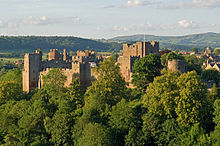
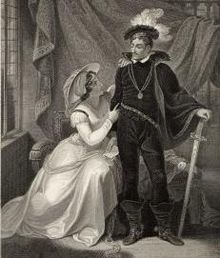
Bosworth
(Daveleicuk, CC BY-SA 4.0 <https://creativecommons.org/licenses/by-sa/4.0>, via Wikimedia Commons)

Francis Lovell is without doubt the most famous member, not to say the only famous member of his family. However, despite his fame he is a ‘shadowy presence’ to us, to use my favourite description coined by J.M. Williams. The information that can be gathered from the existing records leaves us with huge gaps in our knowledge of his life and not only where one would expect them. While it usual that there are no records of his birth, it is surprising that for three years after coming of age and gaining full possession of his estates in 1477 Francis Lovell is not mention in governmental records. Nobleman like Francis Lovell were normally involved in the administration of the country and individual counties, where their estates were situated. It was not until 1480 that his name appears in the Patent Rolls, when he was appointed to a commission of array in the North Riding of Yorkshire.

Thanks to the fortunate survival of the Paston Letters we know Francis Lovell was married in 1466, at the age of about ten, to Anne FitzHugh, daughter of Henry FitzHugh and Alice Neville, the sister of Richard Neville, Earl of Warwick, ‘the Kingmaker’. Interestingly, it was only a year later, on 19 November 1467 that his wardship and marriage was granted to the Earl of Warwick. Francis Lovell’s father had died more than two years earlier, on 9 January 1465 and his mother a year later and a half later, on 5 August 1466. It is possible that in the period between his father’s death and the grant of his wardship to the earl of Warwick, Francis Lovell had remained a ward of the king, but the fact that he was already married to the earl’s niece when the grant was recorded could mean that his warship had already been given informally to the earl.

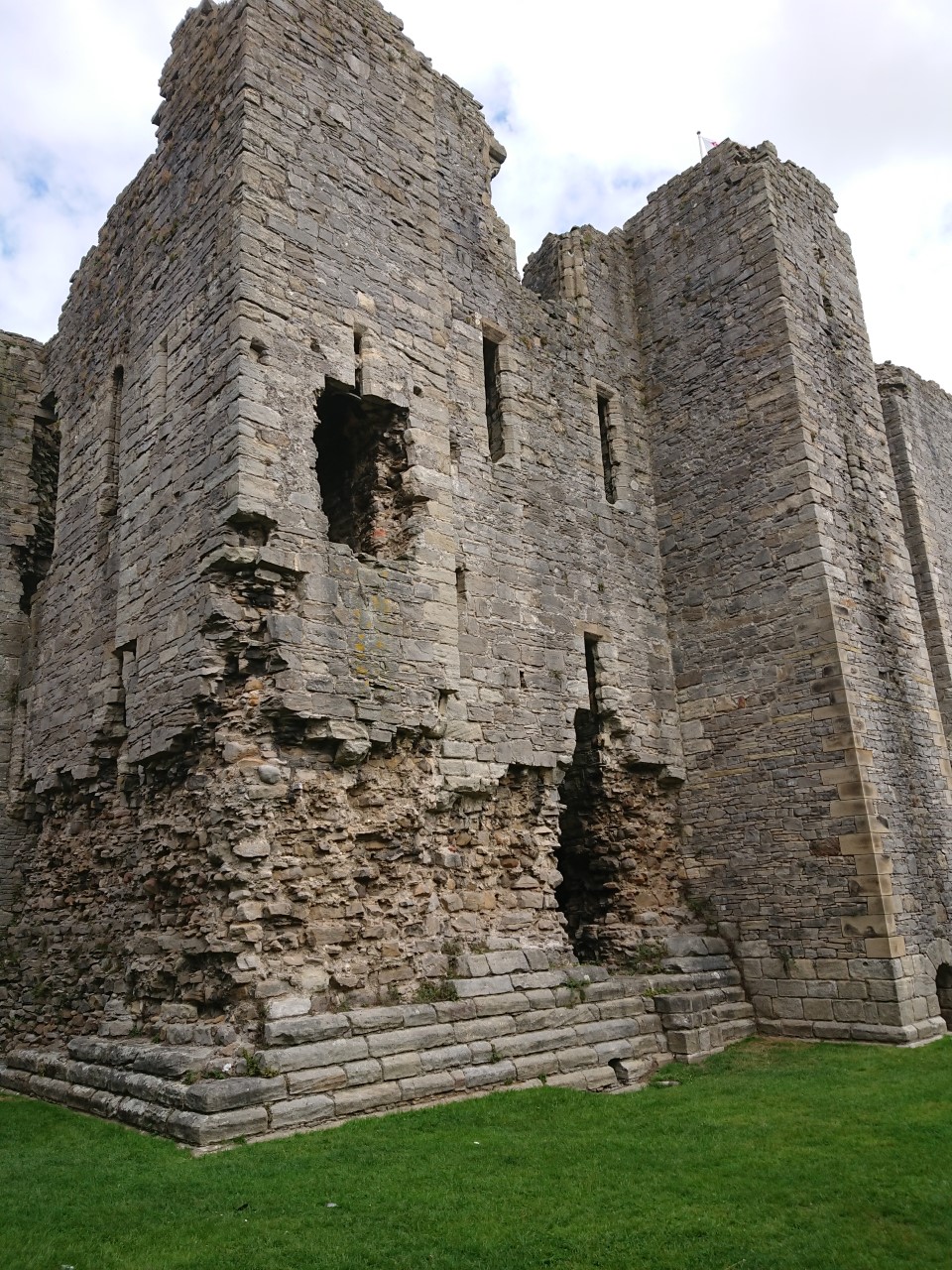
Francis Lovell joined the household of the earl of Warwick at Middleham and it is often assumed that it was in this period he became a close friend of Richard, Duke of Gloucester, who was staying with the earl in the same time. However, it is not known when Francis reached the Yorkshire castle nor how long Richard stayed there. It is possible that the two boys spent several years together but also that were both at Middleham only for a short period of time.

Occasionally, when Francis Lovell found himself caught up in the big events of the time, the government’s records shed some light on his life. In 1470 his father-in-law Henry FitzHugh rebelled against Edward IV in support of the earl of Warwick attempt to overthrow the king. The uprising was suppressed and the pardon for Henry FitzHugh included his son-in-law Francis Lovell and Francis’s two sisters Joan and Frideswide as all three of them seemed to have lived in with the FitzHughs at the time.

When the Earl of Warwick was killed in the Battle of Barnett, Francis Lovell was still under age and his wardship was granted to Edward IV’s sister Elizabeth and her husband John de la Pole, Duke of Suffolk. Where he lived at this time is – naturally – unknown. He may have continued to live with his wife’s family, as he joined the Corpus Christi Guild at York alongside his wife Anne, her sister Elizabeth, and her mother Alice Neville in 1473.

Francis Lovell came of age and was given control of his large inheritance in 1477. He was then a very rich and powerful nobleman. How much income he had is difficult to determine but his estates spread over the length and breadth of England from Wiltshire to Yorkshire and from Kent to Chester. Altogether he had held five baronies, four of them had come to his family through fortunate marriages of previous Lords Lovell to heiresses. His grandfather William Lovell had already been assessed with an income of £1,000 in 1436, which made him one of the richest peers below the rank of earl.

Again little is know about Francis Lovell’s life for the next six years. It seems that he spent most of his time in the north far away from the centre of his family’s estates that were largely in the south and the midlands. The few commission he was appointed to where for Yorkshire. In 1480 he accompanied Richard, Duke of Gloucester on campaign in Scotland and was knighted there by the duke. On occasion he must have ventured to the south to look after his estates there, as in 1482, when he wrote to William Stonor that he could not come south as he had planned and asked William Stonor to make sure his deer are looked after in Rotherfield Greys (an estate Francis Lovell had inherited from his grandmother). He would have also attended court and parliament. He was present at least in two parliaments as he was appointed as one of the triers of petitions for England, Ireland, Wales and Scotland.

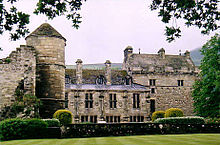
Middleham Castle
(leestuartsherriff, CC BY-SA 4.0 <https://creativecommons.org/licenses/by-sa/4.0>, via Wikimedia Commons)

Even though much of his life largely remains hidden from us, Francis Lovell must have made an impression at least on Richard, Duke of Gloucester and also Edward IV. On 4 January 1483 Francis Lovell was created Viscount by the king. Interestingly, a near contemporary description of the ceremony wrongly identified the king as Richard III and on occasion this misidentification can be found in modern historiography as well.

After the death of Edward IV, the succession crisis, and Richard III becoming king in the spring and early summer of 1483, Francis Lovell became more prominent. He was appointed chief butler first for Edward V then for Richard III. More importantly, he was also appointed chamberlain by Richard III. The chamberlain was one of the most influential man at the royal court as he controlled access, both written and in person, to the king. For this reason and because the chamberlain had to be in constant contact with the king, the position was always given to a close friend, someone whom the king trusted absolutely. Next to the queen, the chamberlain was perhaps the most influential man at court. However, how much influence the chamberlain (or the queen) had, cannot be ascertained as it left no trace in the records. Due to their powerful positions chamberlains were often attacked for abusing their

position, as for example William Latimer, chamberlain of Edward III. However, the doggerel mentioned at the start is the only record of Francis Lovell being criticised in person.

How important Francis Lovell had become also was visible to all at the coronation of Richard III as he played an important role in the ceremony. Many of his duties as chamberlain and chief butler were unspecified, but Francis Lovell also purchased the queen’s ring, carried the third sword of state at the coronation, and had to stand before the king during the coronation banquet. Next to him several other members of his family participated in the coronation: his wife, Anne FitzHugh, her mother, Alice Neville, and her sister-in-law Elizabeth Borough were among the twelve noblewomen of the queen Anne Neville. Francis Lovell’s cousin Henry Lovell was the highest ranking of the king’s henchmen.

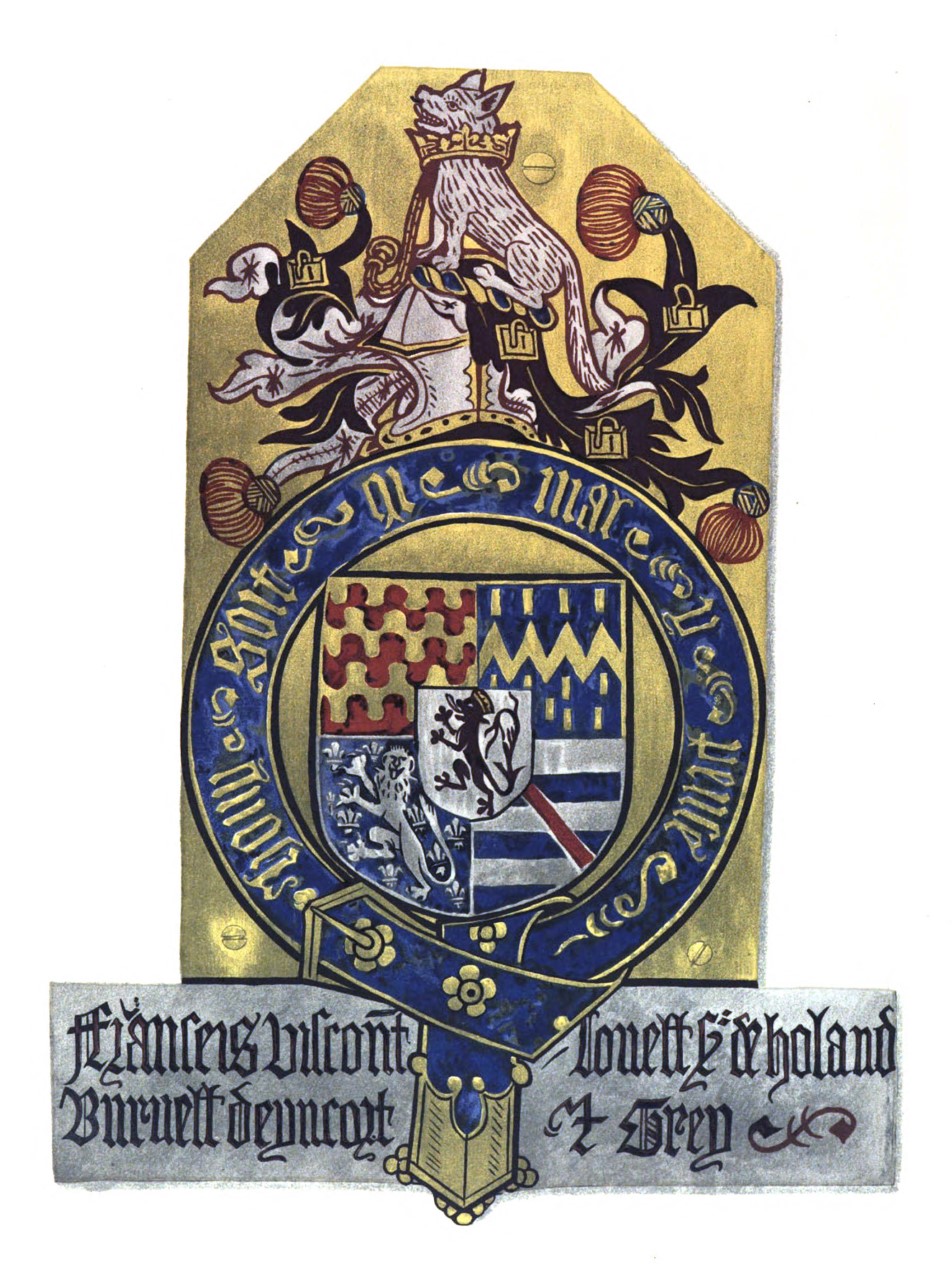
During the brief reign of Richard III, Francis Lovell was granted considerable estates, including the honour of Wallingford St Valery and the lordships of Cookham and Bray, and was appointed to a number of offices including constable of Wallingford Castle. A particular honour was given to him when he was made a Knight of the Garter, probably in 1483. His garter stall plate can still be seen today in St George’s Chapel, Windsor. On it he lists his full range of titles: ‘Francis Viscount Lovell & de holand Burnett deynccort & Grey.’

Since the Croyland Chronicle reports that Francis Lovell was sent to the Southampton to prepare the defence against the threatening invasion of Henry Tudor, it has been questioned whether he was at the Battle of Bosworth. While it is impossible to be certain, I think it is more likely that he was at the battle, as the Croyland Chronicle does not specify when he was sent south. As chamberlain Francis Lovell also had to be in constant attendance to the king, his absence from court was therefore probably brief. Additionally, two independent sources report that Francis Lovell was at the battle. The proclamation of Henry VII after the battle included Francis Lovell among the fallen as does a memorandum from York from the 23 August 1485.

Francis Lovell’s Garter Stall Plate, St George’s Chapel, Windsor
(Public Domain, digitized by Google).

After the battle of Bosworth Francis Lovell was one of the few men who refused to make peace with Henry VII. Most others, including his cousin Henry Lovell and John de la Pole, Earl of Lincoln accepted Henry as king. Again there are only a few occasions when the whereabouts of Francis Lovell are known. He was in Yorkshire where he attempted to kidnap Henry VII, without success. It was later reported that he had fled to Furness Fells and on 19 May 1486 he was said to be in sanctuary in Ely. Shortly thereafter he made his way to Burgundy where he resurfaces at the court of Maria, Duchess of Burgundy and her stepmother Margaret of York.

Another guest there was a boy who claimed to be Edward, Earl of Warwick, the son of George, Duke of Clarence. Sometime later, John de la Pole, Earl of Lincoln also arrived in Burgundy to support the boy. It is generally believed that the boy was an impostor whose name was Lambert Simnel, though whether this was his real name has been questioned. However, John Ashdown-Hill offers the hypothesis that he was who he claimed to be. George, Duke of Clarence had certainly attempted to smuggle his infant son to Ireland. Ashdown-Hill speculates that he had succeeded and the boy who lived as his son in England was the substitute. If that were the case, and that is a big ‘if’, it would explain why John de la Pole and Francis Lovell supported him.

In 1487, the boy, accompanied by Francis Lovell, John de la Pole, and a company of mercenaries under the command of Martin Schwartz travelled to Ireland where the boy was crowned Edward VI. From Ireland they invaded England only to meet defeat at the Battle of Stoke on 16 June. John de la Pole was killed, the boy king was captured, but the fate of Francis Lovell is unknown.

One theory, possibly first written down by Francis Bacon, was that Francis Lovell lived in a cave or vault according to rumour. Bacon also writes that another report says he drowned in the river Trent when he tried to swim across it after the Battle of Stoke.

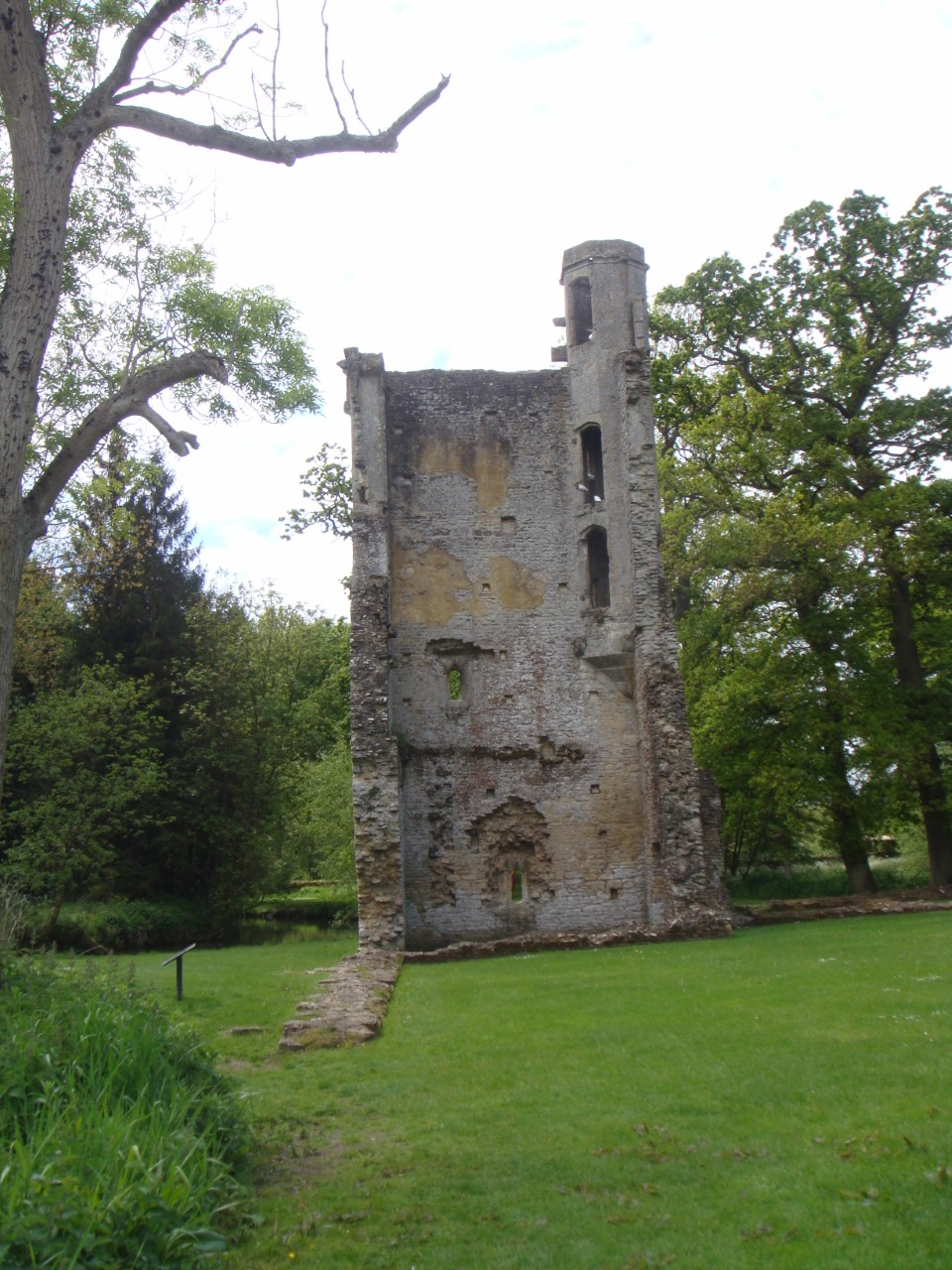
The best known theory about what happened to Francis Lovell is that he returned to Minster Lovell to live there in a hidden chamber underneath Minster Lovell Hall, being provided with all he needed by a faithful servant. However, for some reason the servant was prevented from doing so and Francis Lovell died of starvation. According to a report from the early eighteenth century, a skeleton was discovered in a hidden chamber underneath Minster Lovell Hall during construction work. The report claims that the skeleton sat at a table, there was writing material nearby, and a ‘much mouldered cap’. Unfortunately, the skeleton immediately turned to dust after exposure to fresh air. However, no secret chamber, cellar or vault was ever discovered underneath Minster Lovell Hall, which makes this story highly unlikely. Moreover, skeletons do not turn to dust, even if they had been in tightly sealed rooms and are exposed to fresh air. Skeletons or mummified bodies start to decompose quickly if not kept in a carefully controlled environment, but don’t turn to dust.

An intriguing snippet of information is that James IV of Scotland granted a safe conduct to Francis Lovell in 1488. However this trail also disappears and no other reports of Francis Lovell in Scotland exist. Shortly before this date, Francis Lovell’s mother-in-law had made an attempt to find out what happened to him. She had sent Edward Franke to the north to enquire about Francis, but Franke returned without having found out what had happened to Francis. We know of this search, as Alice Neville wrote to John Paston III to cancel a meeting as she said she wanted to stay with her daughter Anne who was very distressed about the lack of news.

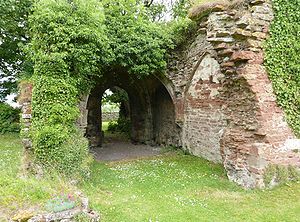
Minster Lovell
(Monika E Simon)

Despite his prominent role during the reign of Richard III Francis Lovell also remains almost invisible in contemporary sources. Neither Mancini’s Usurpation of Richard III nor Thomas More’s History of Richard III mention him at all. – Shakespeare gave him only a couple of lines and as a consequence his part is usually cut out of the production and his lines given to somebody else. – Chronicles do mention Francis Lovell only after the battle of Bosworth, generally in connection with his participation in the events surrounding ‘Lambert Simnel’, are recorded.

Francis Lovell’s elusive life and unknown end is just is another mystery of this time that is not short of such. Some are highly controversial like the fate of the ‘Princes in the Tower’ or the credibility of the claim that Edward IV’s marriage to Elizabeth Woodville was bigamous, some less often debated like true identity of ‘Lambert Simnel’ or ‘Edward IV’.

About the author:

Monika E. Simon studied Medieval History, Ancient History, and English Linguistics and Middle English Literature at the Ludwig-Maximilians-Universität, Munich, from which she received an MA. She wrote her DPhil thesis about the Lovells of Titchmarsh at the University of York. She lives and works in Munich.

Links:
https://www.pen-and-sword.co.uk/From-Robber-Barons-to-Courtiers-Hardback/p/19045
https://www.facebook.com/MoniESim
http://www.monikasimon.eu/lovell.html

*

My Books:

Coming 31 May 2021:

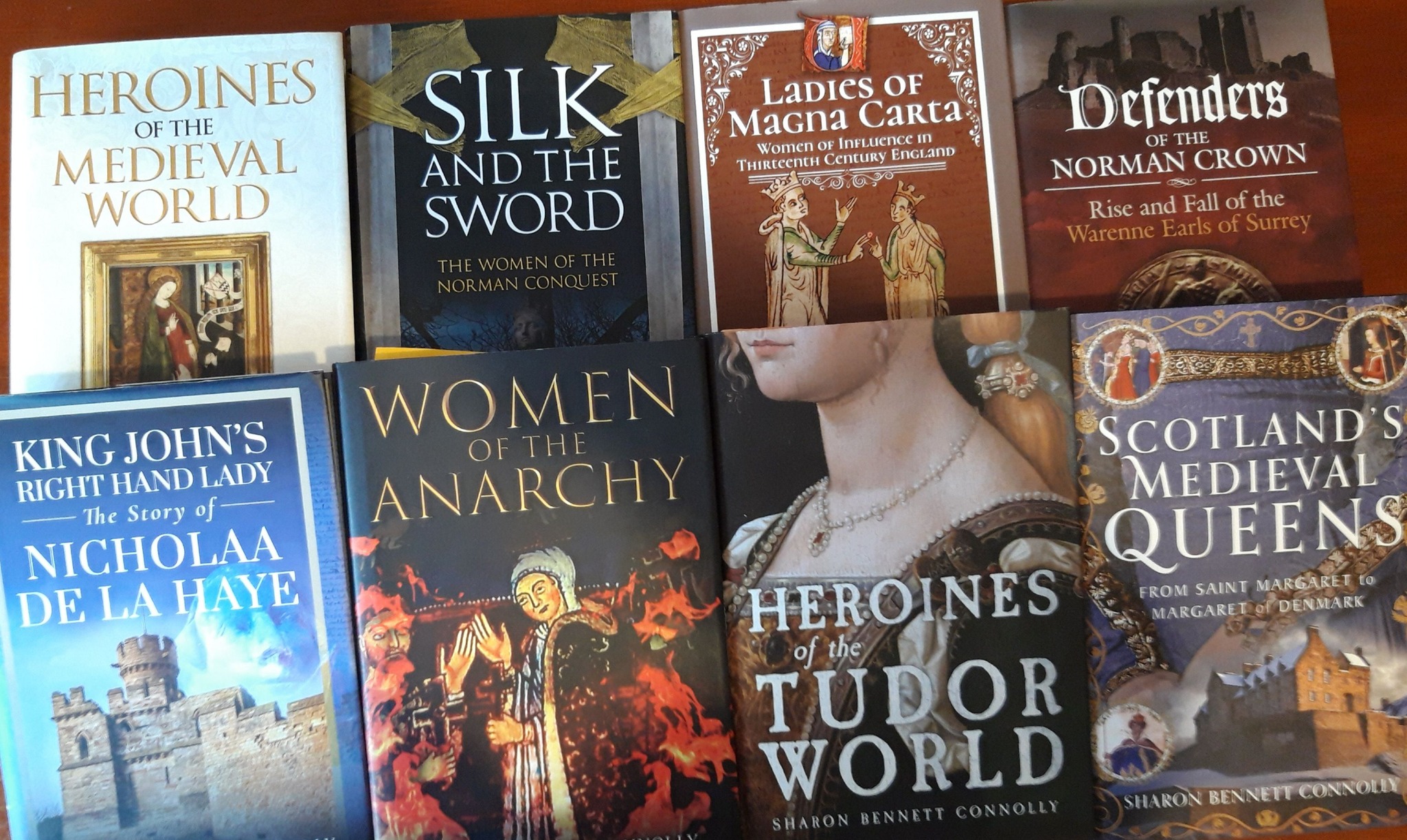
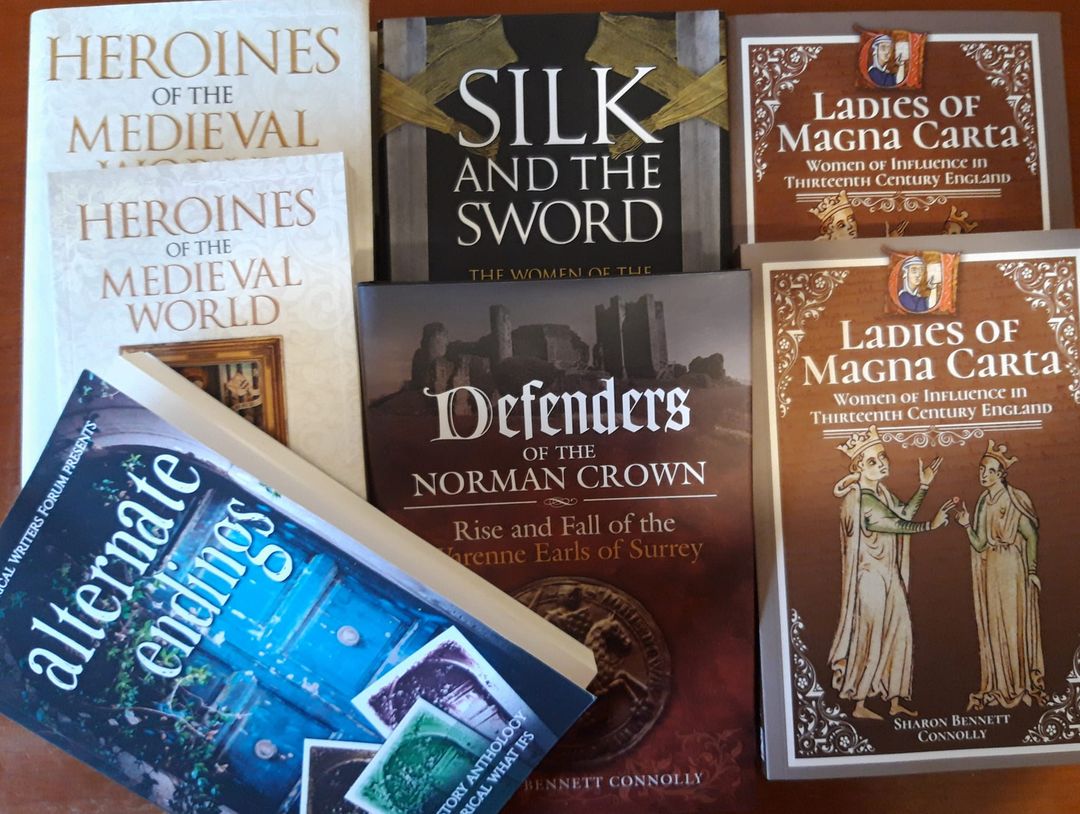
Defenders of the Norman Crown: The Rise and Fall of the Warenne Earls of Surrey tells the fascinating story of the Warenne dynasty, of the successes and failures of one of the most powerful families in England, from its origins in Normandy, through the Conquest, Magna Carta, the wars and marriages that led to its ultimate demise in the reign of Edward III.

1 family. 8 earls. 300 years of English history!

Defenders of the Norman Crown: Rise and Fall of the Warenne Earls of Surrey will be released in the UK on 31 May and in the US on 6 August. And it is now available for pre-order from Pen & Sword BooksAmazon in the UK and US and Book Depository.

Also by Sharon Bennett Connolly:

Ladies of Magna Carta: Women of Influence in Thirteenth Century England looks into the relationships of the various noble families of the 13th century, and how they were affected by the Barons’ Wars, Magna Carta and its aftermath; the bonds that were formed and those that were broken. It is now available from Pen & Sword,  Amazon and from Book Depository worldwide.

Heroines of the Medieval World tells the stories of some of the most remarkable women from Medieval history, from Eleanor of Aquitaine to Julian of Norwich. Available now from Amberley Publishing and Amazon and Book Depository.

Silk and the Sword: The Women of the Norman Conquest traces the fortunes of the women who had a significant role to play in the momentous events of 1066.  Available now from Amazon,  Amberley Publishing, Book Depository.

You can be the first to read new articles by clicking the ‘Follow’ button, liking our Facebook page or joining me on Twitter and Instagram.

©2021 Sharon Bennett Connolly  and Monika Simon

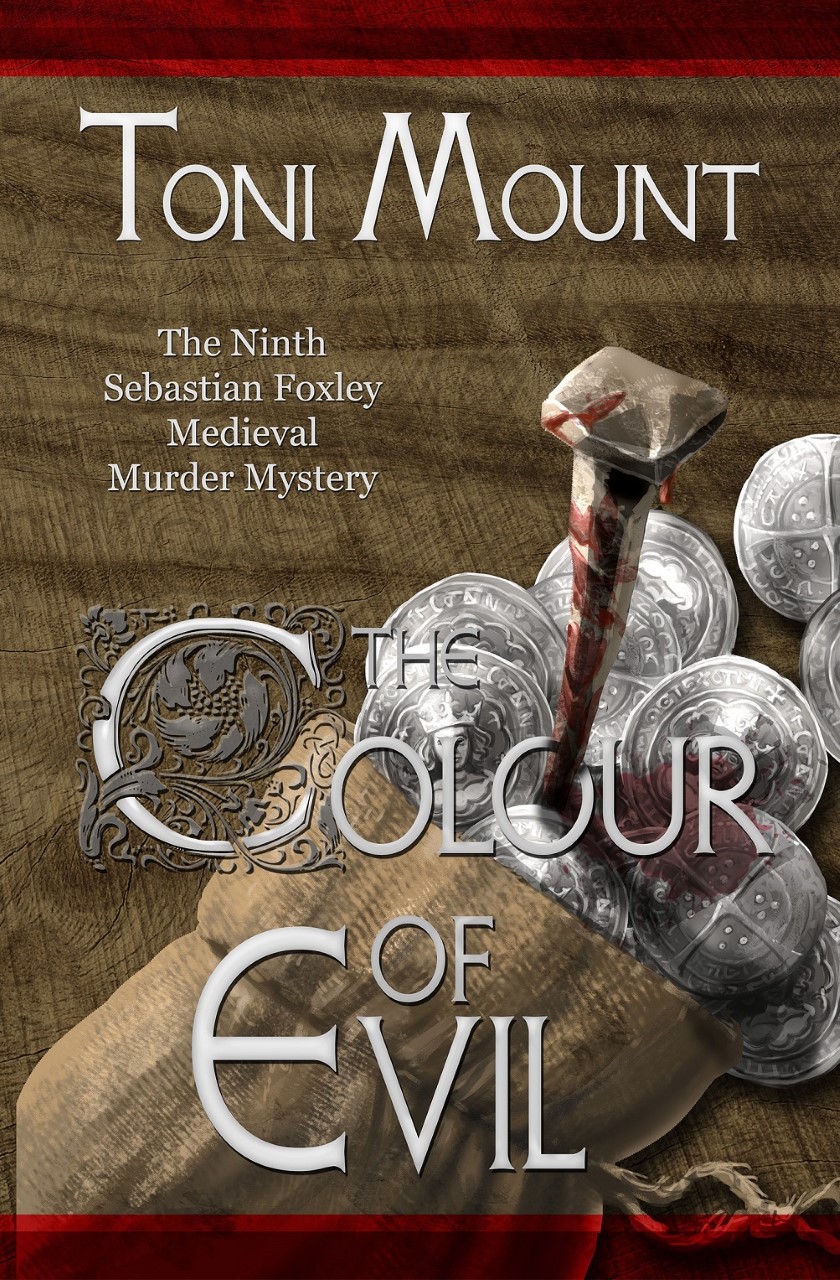
Book Corner: The Colour of Evil by Toni Mount

Every Londoner has money worries. Talented artist and some-time sleuth, Seb Foxley, is no exception.

When fellow craftsmen with debts to pay are found dead in the most horrid circumstances, fears escalate. Only Seb can solve the puzzles that baffle the authorities.

Seb’s wayward elder brother, Jude, returns unannounced from Italy with a child-bride upon his arm. Shock turns to dismay when life becomes more complicated and troubles multiply.

From counterfeit coins to deadly darkness in London’s worst corners; mysterious thefts to attacks of murderous intent, Seb finds himself embroiled at every turn. With a royal commission to fulfil and heartache to resolve, can our hero win through against the odds?

Share Seb Foxley’s latest adventures in the filthy streets of medieval London, join in the Midsummer festivities and meet his fellow citizens, both the respectable and the villainous.

The Colour of Evil by Toni Mount is the 9th book in Toni’s marvellous Sebastian Foxley Medieval Mystery series. If you haven’t read any of these books yet, you are really missing a treat!

Toni Mount has a unique, engaging writing style. Her beautiful prose and clever use of language instantly transports you back to 15th century England. The story revolves around a series of murders linked to counterfeit coins, into which Seb Foxley is brought as a consultant by the local bailiff.

The eponymous hero of the story, Seb Foxley, is a wonderful, intelligent character, who is, perhaps, a little too straitlaced and naive for his own good. His brother is a little too worldly-wise and entitled, but much less self-aware than is good for a grown man – I wanted to punch him on a number of occasions (and I’m not a violent person). The Colour of Evil places these brothers at the heart of the story, highlighting their conflicts and rivalries as London is in the grip of a series of gruesome murders.

As the mystery deepens, the reader is absorbed into the sights, smells and story of London; the excitement, fear and mystery is palpable. The Colour of Evil is an absorbing thriller.

Over ale, Thaddeus told me of the man – the thief we had taken in possession of his ill-gotten gains.

‘His name is Philip Hartnell, a most respectable citizen and a cutler by craft. He said he was walking along Bladder Street, passed the house with its window wide to the pleasant evening air when he saw the candlesticks by the open casement. At a glance, he was quite certain they were the same ones he had bought his wife as a wedding gift ten years since. His wife has much fondness for the sticks, so he took them, thinking to please her.’

‘Had they been stolen away from him previously, then? Is that the way of it?’ I sipped my ale. Thaddeus did likewise afore continuing.

‘That was my first thought. I tell you, Seb, it took a deal of cajoling and probing to get the truth out of Philip Hartnell. The candlesticks weren’t stolen from him but he apparently gave his goodwife to think they had been taken. The truth is that Hartnell has fallen into debt. He took the candlesticks to a goldsmith and sold them to pay off a sizeable loan. When his wife found them gone, she was much upset – more so than Hartnell ever expected. Thus, he told her they had been stolen, rather than admit his actions and the fact that he was over the ears in debt to a moneylender.’

‘An unfortunate situation but how does that excuse his actions of yestereve?’

‘It doesn’t. Besides, the candlesticks he stole from the house in Bladder Street were never his. Similar in shape but not the same ones.’

‘He has no right to them, even had they been the same. He sold them and has had the profit from the sale. Hartnell is a thief and we caught hm. He deserves just punishment, does he not? I do not see any reason for your difficulties in this matter, Thaddeus.’

‘He had never had any dealings with the law before, Seb. He’s a respected member of the Cutlers’ Company and a churchwarden. He loves his wife and family, works hard and earns a good living.’

‘Not good enough, so it would seem, else why would he be in debt?’

‘A foolish mistake, he said though he withheld further details. I had the feeling another woman was involved. In every other respect, Hartnell is a decent citizen. I think he deserves a second chance.’

‘What of the house in Bladder Street? The folk he robbed? Not to mention all the neighbourhood having to rally to the hue-and-cry.’
‘The candlesticks were returned – dented, it’s true but Hartnell says he will pay for their repair. The householder is agreeable. Besides…’

Thaddeus drained his ale.

‘Besides?’

‘Philip Hartnell is not alone, Seb. He is the fourth… no, the fifth respectable citizen that has come to my notice, by one means or another, who has found himself in debt and unable to repay. There’s something going on in London, concerning underhanded financial dealings, and I don’t like the smell of it.
‘Watch your purse, my friend. Every one of them is of middling status like you. Outwardly decent and honest yet they find themselves in dire need, monetarily. I wouldn’t want that to happen to you.’

‘Fear not, I owe no man so much as a ha’penny. So you will let Hartnell go?’

‘Aye, I think so. Both Newgate and the Counter are overfull of vile inmates. Hartnell is not of their kind. They’d make a hearty supper of him on his first day inside.’

The Colour of Evil by Toni Mount paints a wonderful, full-colour image of London in the time of Edward IV. The streets, taverns, work places and dark alleys are brought to vivid, vibrant life by Toni Mount’s beautiful prose and fantastic imagination. The author’s research is impeccable, her knowledge of 15th century medieval England allowing the reader to sit back and be transported back in time. Toni Mount clearly demonstrates how the guilds, the law and money, works and how it was all an integral part of life in medieval London. She recreates the world of 500 years ago to give the reader not only a great story, but the experience of being amongst the people and places of the time.

The characters are wonderfully individuals, each with their own strengths and flaws – though some have mostly flaws and very few strengths. I always think the sign of a good book is when you find yourself frustrated with the actions of a favourite character – or wanting to punch one who seems thoughtless or heartless; or when you find yourself egging a character on – or wanting to shout ‘no, don’t go down there’. The Colour of Evil certainly takes you through all these emotions and more.

The Colour of Evil by Toni Mount is a beautifully crafted mystery that brings the dark, dangerous streets of medieval London to life. Toni Mount is a magician with words, weaving a captivating story in wonderful prose. The Colour of Evil is, to put it simply, a pleasure to read.

If you haven’t read a Seb Foxley book before, don’t worry, each book works as a standalone. Though I have to warn you – after reading one, you will want to read the rest!

To buy the Book: http://getbook.at/colour_of_evilhttp://mybook.to/Colour_Evil

*

About the Author

Toni Mount earned her Master’s Degree by completing original research into a unique 15th-century medical manuscript. She is the author of several successful non-fiction books including the number one bestseller, Everyday Life in Medieval England, which reflects her detailed knowledge in the lives of ordinary people in the Middle Ages. Toni’s enthusiastic understanding of the period allows her to create accurate, atmospheric settings and realistic characters for her Sebastian Foxley medieval murder mysteries. Toni’s first career was as a scientist and this brings an extra dimension to her novels. It also led to her new biography of Sir Isaac Newton. She writes regularly for both The Richard III Society and The Tudor Society and is a major contributor of online courses to MedievalCourses.com. As well as writing, Toni teaches history to adults, coordinates a creative writing group and is a member of the Crime Writers’ Association.

You can find Toni at: Her website; Seb Foxley’s website; Seb Foxley’s Facebook page; Toni’s ‘Medieval England’ Facebook page; Toni Mount’s Facebook page; Toni Mount online courses.

*

My books

Coming 31st May:

Defenders of the Norman Crown: The Rise and Fall of the Warenne Earls of Surrey tells the fascinating story of the Warenne dynasty, of the successes and failures of one of the most powerful families in England, from its origins in Normandy, through the Conquest, Magna Carta, the wars and marriages that led to its ultimate demise in the reign of Edward III.

Defenders of the Norman Crown: Rise and Fall of the Warenne Earls of Surrey will be released in the UK on 31 May and in the US on 6 August. And it is now available for pre-order from Pen & Sword BooksAmazon in the UK and US and Book Depository.

Also by Sharon Bennett Connolly:

Ladies of Magna Carta: Women of Influence in Thirteenth Century England looks into the relationships of the various noble families of the 13th century, and how they were affected by the Barons’ Wars, Magna Carta and its aftermath; the bonds that were formed and those that were broken. It is now available from Pen & Sword,  Amazon and from Book Depository worldwide.

Heroines of the Medieval World tells the stories of some of the most remarkable women from Medieval history, from Eleanor of Aquitaine to Julian of Norwich. Available now from Amberley Publishing and Amazon and Book Depository.

Silk and the Sword: The Women of the Norman Conquest traces the fortunes of the women who had a significant role to play in the momentous events of 1066.  Available now from Amazon,  Amberley Publishing, Book Depository.

You can be the first to read new articles by clicking the ‘Follow’ button, liking our Facebook page or joining me on Twitter and Instagram.

©2021 Sharon Bennett Connolly 

Guest Post: 7 things you may not know about the Battle of Towton by Dan Moorhouse

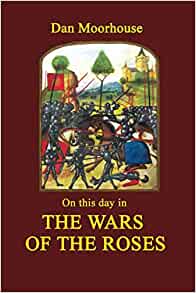
Today it is a pleasure to welcome author and historian Dan Moorhouse to the blog with an article on the Battle of Towton, which was fought during the Wars of the Roses, on this day in 1461. Dan’s latest book, On this Day in the Wars of the Roses, is a fabulous read, looking into the Wars of the Roses in a whole new way. Over to Dan…

7 things you may not know about the Battle of Towton

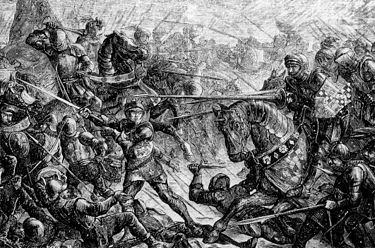
The Battle of Towton is often described as being the biggest, bloodiest battle of English history. Heralds at the time suggested 28,000 dead. Towton established Edward IV as king. His coronation was shortly afterwards. Yet much of what is known about the Battle of Towton is not well known. Dan Moorhouse outlines 7 areas that help to put the battle into perspective.

  • Battlefield Executions
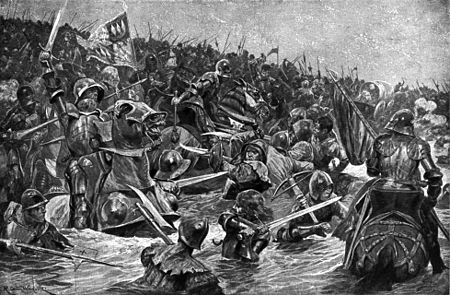
The Battle of Towton by Richard Caton Woodville Jr

In the aftermath of the battle, several of the defeated Lancastrians were rounded up and summarily executed. Evidence for this comes in the form of human remains excavated near Towton Hall. The bodies bore wounds to the head, neck, shoulders. But none to the arms, indicating that these men had been unable to defend themselves. 42 such executions are known to have taken place on the battlefield. This is not the only example of summary justice being meted out following Towton. In York, the victorious Yorkists discovered more Lancastrians. In the days that followed, other men were executed on Edward IVs orders, including the Earl of Devon. A grave pit has been excavated on the Knavesmire, where public executions took place outside York, which contained the remains of bodies that had been beheaded. These have been carbon dated to the period.

  • Survivors

Whilst there is much speculation about the number of Lancastrian dead, there is less said about those who survived. The Royal family had been in the relative safety of York. Most leading nobles escaped the battlefield. With so many dead, many fleeing and wintery conditions, the survivor’s stories varied greatly. Robert Bolling (Bradford, Yorks.) was believed to have died. This remained the case in November when he was posthumously attained. However, he had survived and spent the next 14 years trying to overturn the attainder. Thomas Denys wrote that ‘There I lost £20 worth, bone, harness and money and was hurt in divers places.’ In other words, he was injured, without transport and had lost or spent all his money.

  • Hiding

It is well known that Henry VI went into hiding and was eventually captured near Clitheroe several years later. That other non-combatants did the same is less well known. Henry Clifford was the son of John 9th Baron Clifford. Following his father’s death (at Dintingdale), he too went into hiding. Legend has it that he hid with Shepherd’s in the Yorkshire Dales until after the Battle of Bosworth! This stems from an account written by Lady Anne Clifford in the 17th century. The story seems more myth than factual, though. Though still a child, he is known to have signed charters just a few years later. During the readeption, Lord Montagu was granted the wardship of Henry Clifford.  Edward IV pardoned him in 1472, and he was permitted to access his inheritance from his maternal grandfather at that point. However, he did not receive his Clifford inheritance until 1493.

  • Death toll
Engraving of the Battle of Towton, showing King Edward IV in the thick of the fighting

The Battle of Towton was big, of that there is no doubt. What there is doubt over is how big. Figures for medieval battles vary significantly in their accuracy. For campaigns in the Hundred Years War, there are centrally held records, many of which survive. These make numbers reasonable accurate. For battles in the first phase of the Wars of the Roses, this is not the case. Sources include Heralds, various chronicles, letters, muster rolls and ambassadorial dispatches. Archaeological analysis provides further evidence, as does an examination of logistics. The problem is, none are definitive, and they vary greatly. Chroniclers were prone to exaggeration, as seen by numbers that run from 9000 to 120000 Lancastrian dead. Heralds suggested 28000 dead. Letters and dispatches also disagree. Modern analysis suggests an upper figure of 10000, based on the battlefield’s size, number of nobles and knights known to have fought and the logistics involved in the campaigns. An analysis by The History of Parliament shows that of the peerage and members of Parliament known to have fought, as little as 20%, mainly Lancastrian, perished. With estimates suggesting around 55000 participants, this would be consistent with a death toll of around the 10000 mark. 

  • Finds

It may seem strange that there is no extensive collection of finds from such a significant battle. This is because most substantial items would have been scavenged in the hours, days and weeks following the clash. Battlefield Metal Detector Simon Richardson worked on the Towton battlefield for 32 years. His collection of finds does amass to over one thousand items. Primarily these are small items such as buckles and straps. However, he also discovered fragments of the ‘Towton gun’, the oldest handgun to have been excavated in the British Isles. Sections of a brass cannon were found. Evidence suggests that it exploded on being fired with the probable loss of life of those around it. Richardson also aided in the excavation of a memorial chantry built in the reign of Richard III.

  • Pursuit

The rout at the Battle of Towton is well recorded. Cock Beck was awash with blood. Bodies were used as a bridge by men fleeing the hail of arrows. Those fleeing in a different direction were prone to being run down by Cavalry. As the Lancastrian lines broke, the Yorkists could simply pick off those in flight. Whilst there is ample evidence of slaughter at these places, it is often forgotten that the rout went on for some distance and time. George Neville, in his letter to Francesco Coppini, placed more emphasis on slaughters away from the battlefield than in the immediate rout:

“At the town of Tadcaster, eight miles from York, very many of the fugitives were drowned in the river, the enemy having themselves broken the bridge in their rear beforehand. Of the remainder who escaped for the moment a great part were killed in that town, and in the city [of York]; and quite lately one might have still seen the bodies of these unfortunate men lying unburied, over a space nearly six miles in length and three or four furlongs broad”. [British History Online: Calendar of state papers relating to English affairs in the Archives of Venice, vol 1: 1202-1509]

  • Memorials
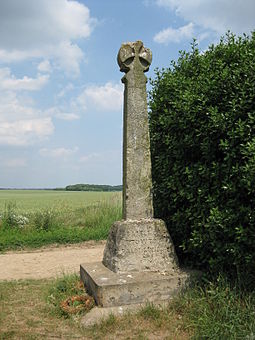
Dacre Cross, memorial at the Towton battlefield

Many of the men who died were local and on the losing side. Despite the new regime, there is evidence that their loss was memorialised at the time, under the victors’ watchful gaze and in rather lavish or unusual fashion. The unusual is the Tomb of Lord Dacre. The tomb itself looks unremarkable. It is close to the battlefield and in keeping with tombs of the period. What is odd is the story that he was buried on his horse. Perhaps a legend, it has not been disproven. Lionel, Lord Welles, was one of the most senior Lancastrians to die in the battle and married to Margaret Beauchamp, mother by her first marriage to Margaret Beaufort. Despite his links to the Lancastrian line, his body was interred at Methley, Yorkshire, with an ornate alabaster effigy. Other memorials were added during the Wars of the Roses and in later centuries.

My thanks to Dan for an interesting and entertaining article, and my congratulations of the release of On this Day in the Wars of the Roses. The book is out now and available from Amazon UK and Amazon US.

*

About the author

Dan Moorhouse’s interest in history initially led him into teaching, and writing about the history of Medicine for Hodder Murray, an imprint of Harcourt. His work includes contributions to numerous print and online publications, including for the BBC, Guardian, Times, and a range of national and local museums. As a member of the Historical Association, Dan served on the Education Committee for a decade and helped to re-establish the society in West Yorkshire. Dan is also a keen member of the Battlefields Trust and Richard III Societies. Dan’s interest in the Wars of the Roses was sparked at an early age. He grew up close to the seat of the notorious Clifford family and several major battlefields. He has studied the Wars of the Roses to Masters Degree Level and writes regularly about the subject for a general audience via his website and social media channels.

Links:

Website – https://schoolshistory.org.uk/

The Battle of Towton – https://schoolshistory.org.uk/topics/british-history/wars-of-the-roses/battle-of-towton/

*

My books

Coming 31st May:

Defenders of the Norman Crown: The Rise and Fall of the Warenne Earls of Surrey tells the fascinating story of the Warenne dynasty, of the successes and failures of one of the most powerful families in England, from its origins in Normandy, through the Conquest, Magna Carta, the wars and marriages that led to its ultimate demise in the reign of Edward III.

Defenders of the Norman Crown: Rise and Fall of the Warenne Earls of Surrey will be released in the UK on 31 May and in the US on 6 August. And it is now available for pre-order from Pen & Sword BooksAmazon in the UK and US and Book Depository.

Also by Sharon Bennett Connolly:

Ladies of Magna Carta: Women of Influence in Thirteenth Century England looks into the relationships of the various noble families of the 13th century, and how they were affected by the Barons’ Wars, Magna Carta and its aftermath; the bonds that were formed and those that were broken. It is now available from Pen & Sword,  Amazon and from Book Depository worldwide.

Heroines of the Medieval World tells the stories of some of the most remarkable women from Medieval history, from Eleanor of Aquitaine to Julian of Norwich. Available now from Amberley Publishing and Amazon and Book Depository.

Silk and the Sword: The Women of the Norman Conquest traces the fortunes of the women who had a significant role to play in the momentous events of 1066.  Available now from Amazon,  Amberley Publishing, Book Depository.

You can be the first to read new articles by clicking the ‘Follow’ button, liking our Facebook page or joining me on Twitter and Instagram.

©2021 Sharon Bennett Connolly and Dan Moorhouse

Julian of Norwich: ‘All Shall Be Well’

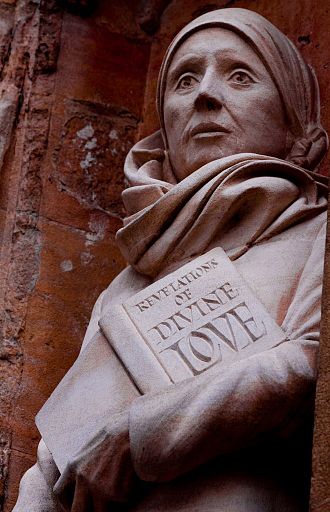
Statue of Julian of Norwich, Norwich Cathedral by sculptor David Holgate.

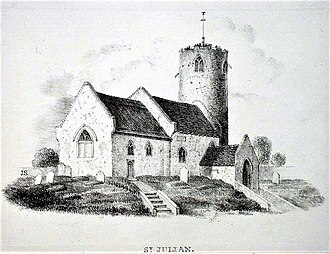
The medieval religious life provided a refuge for widows and elderly women in search of calm and peace at the end of their lives. It was an alternative to marriage, and childbearing, for women and girls from diverse backgrounds. Moreover, the cloistered life was not the only path for a woman who wanted to devote her life to God. One such devotee was Saint Julian of Norwich, an anchorite and mystic who lived in a cell at the parish church of St Julian at Conisford in Norwich.

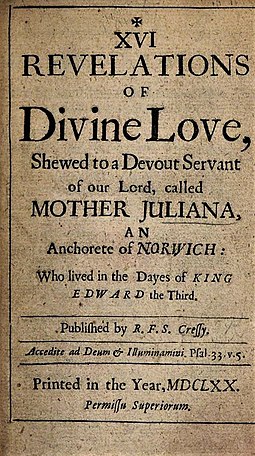
Julian’s life was remarkable in its simplicity, devotion and spirituality, and because of her writing. Having survived 600 years, her book, Revelations of Divine Love, is the earliest surviving of its kind – a book written in English, by a woman. She is renowned for her words

‘all shall be well, all shall be well, and all manner of things shall be well,’

Julian of Norwich, Revelations of Divine Love

These simple words still offer hope and encourage positivity today, especially in the atmosphere in which we are all currently living.

Julian’s true identity and origins remain obscured. It is possible that Julian took her name from the church in which she lived, St Julian’s, however, it may have been hers from birth. Although Julian was not a common name for a woman at the time, it was not unknown. It may even be a derivative of Juliana, a more familiar woman’s name. However, there was a contemporary of the same name, Julian of Erpingham, who was from one of the foremost noble families of Norwich in the 14th century.

Julian of Erpingham has been suggested by Father John Julian as a possible candidate for the identity of Julian of Norwich. She was the sister of Sir Thomas of Erpingham, who had been a friend of Edward III and later fought at Agincourt in 1415. Julian of Erpingham was married twice; her first husband died in 1373, and her second was dead by 1393. She had at least three children, with a daughter already married and the youngest possibly fostered out by the time Julian entered the Church. If Julian of Erpingham and Julian of Norwich are one and the same person – and this is far from certain – the legacies from her two husbands would have helped to pay for Julian’s upkeep once she had dedicated herself to God.

‘Revelations of Divine Love’ title page

It is also possible that Julian had been a nun at the Benedictine priory of Carrow, which was close by and had an affinity with St Julian’s Church. She was probably from a well-to-do, if not noble, family as she seems to have had some level of education; given that she could, at least, read before she became an anchorite. However, we simply do not know enough about Julian’s early life to positively identify her origins. Although Revelations of Divine Love is considered autobiographical, it concentrates on her spiritual journey, as opposed to her physical life. We can glean some insight, if not a great deal, from the information she gives at various points in her text. For example, we know that Julian was born in the second half of the year 1342, as she mentions in her writing that she received her visions in May 1373, when she was aged thirty-and-a-half.

In that month Julian suffered an illness so serious that her life was despaired of. Whether it was the Black Death, prevalent in England since its first major outbreak in 1348–9, or some other disease, as her illness progressed she was paralysed to the extent that she could barely even move her eyelids. She was given the last rites and she wrote of how the priest

‘…set the cross before my face and said, “I have brought you the image of your maker and saviour. Look at it and take comfort from it.”’

Julian of Norwich, Revelations of Divine Love

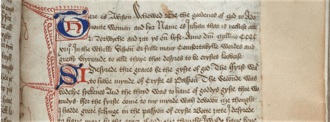
Julian wrote in Revelations of Divine Love that she had wanted to have a life-threatening illness, which would bring her close to death, but from which she would be saved. Maybe she believed it would bring her closer to God? Whatever the reason, her illness brought on a series of visions in which she encountered Jesus Christ and his mother the Virgin Mary. The sixteen visions were to form the basis for the direction of her spiritual life and for her book, charting her struggle to understand the divine. Julian wrote two versions of Revelations of Divine Love; the Short Text is believed to have been written soon after experiencing her visions, though it took several years to complete. The Long Text – which is six times as long – is more contemplative and appears to have been a constant work-in progress in her later years.

The beginning of the 15th century Short Text of Revelations of Divine Love

Although her near-death experience directed her later life, it was only many years after her illness that Julian entered her cell as an anchorite. The exact date is uncertain, but it is believed to have been in the 1390s that her enclosure may have come, possibly after the death of her husband or family members. The life of an anchorite was a strange, solitary existence in which the person was physically cut off from the world, while still being a part of it. It was a life that could be followed by a man or woman, but was one which could not be lightly taken on by the anchorite themselves, or by the Church at large.

Not all were suited to the life and a person wanting to profess themselves as an anchorite had to go through a rigorous process to assess that suitability. This even included an interview with the bishop. In Julian’s case, it was probably Henry Despenser, Bishop of Norwich, in the late 14th century. Of particular concern was the anchorite’s mental capacity to deal with the solitude and limitation on human contact. Once the Church had endorsed a person’s suitability to become an anchorite, there was a specific ceremony to signify the end of the life they had previously known.

An anchorite was, effectively, dead to the world. They would live in a small cell, attached to the church. As they were led to this cell, a requiem Mass would be sung for them and they would receive extreme unction, normally reserved for the dying. They would be sprinkled with dust, to signify their burial, and then the door to the cell bolted from the outside. In some cases, the cell was walled up. The only access to the outside world was a small, curtained window.

St Julians’s Church, by James Sillett, 1828

Once they had taken their vows, anchorites were forbidden to leave their cell, on pain of excommunication from the Church. As an anchoress, Julian had to adhere to vows of poverty and chastity and to remain in her cell for the rest of her life. She was not allowed to teach young girls, or possess valuables. Conversations with men in private were strictly forbidden and communication with the outside world was done from behind a black curtain, through which she could also hear the daily church offices, even if she couldn’t interact with them.

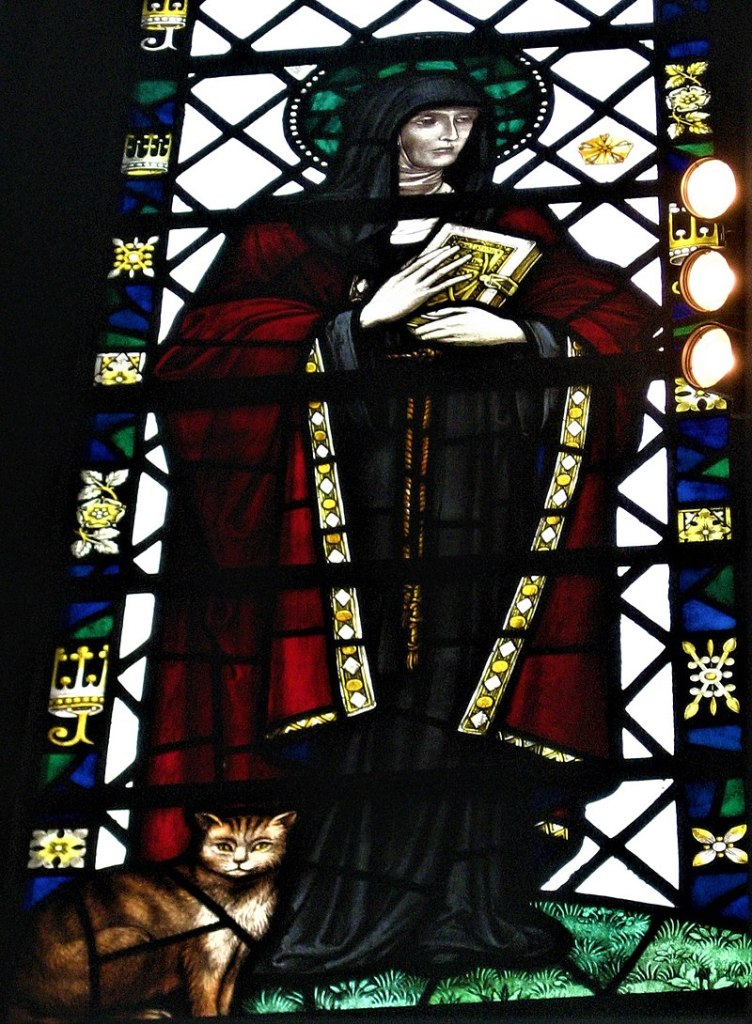
Julian would been permitted a servant to see to her daily needs, such as food, laundry, and clearing away waste. However, her daily interactions with her servant would have been restricted to dealing with her physical needs, rather than friendship and companionship. She was also allowed to keep a cat, to control the mice and rats; many images of Julian show her dressed in the habit of a nun, with a cat sat at her feet as she studies her books.

Anchorites were expected to devote their lives to prayers and contemplation, to be a benefit to their community and to work for it by praying for their souls. They were an integral part of the Church, and the parish in which they lived;

True anchoresses are indeed birds of heaven which fly up high and sit singing merrily on the green boughs – that is, direct their thoughts upwards at the bliss of heaven.’

Hugh White, translator, Ancrene Wisse

Once Julian entered her cell, her time was her own. She could manage her own daily routine, although she probably followed the canonical hours and prayed seven times daily. Julian probably read a great deal, she would have had access to books brought by well-wishers and the large selection available at the library of the cathedral priory in Norwich; a collection that was added to in 1407 by a substantial bequest of more than 200 books from Cardinal Adam Easton, a supporter of Bridget of Sweden, who was later canonised.

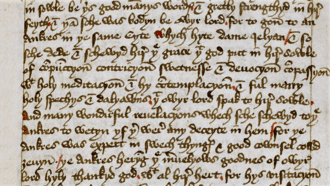
Margery Kempe’s manuscript, where she mentions ‘dame jelyan’ (British Library)

Julian spent many hours in contemplation, reading and writing. Revelations of Divine Love was written in the English vernacular, in beautiful, poetic prose; remarkably, it was written by Julian herself, rather than dictated to a scribe. The text’s near-miraculous survival, through 600 years and the Reformation, is due to three Long Text manuscripts, which were copied in the 17th century by English nuns at Cambrai and Paris. The book describes the sixteen visions of Christ that she had received during her illness, and her subsequent reflections on their meaning.

Not only does Julian describe her visions in the book, but she also describes the physical experience of the visions, saying,

‘All this was shown in three ways: that is to say, by bodily sight, and by words formed in my understanding, and by spiritual visions. But I neither can nor know how to disclose the spiritual vision as openly or as fully as I would wish’.

Julian of Norwich, Revelations of Divine Love

Revelations of Divine Love is a spiritual autobiography, contemplating the relationship between love, sin, suffering and God. It is heavily imbued with mysticism, where the author attempts to move beyond normal human thought, exploring sensations and feelings and the relationship with God. Its message of love and peace still gives it relevance today, and her thoughts are possibly more widely respected now than at any time in the past.

Stained glass of Julian of Norwich, Norwich Cathedral

Though Julian was appreciated in her own time. People visited to talk with her. A few years before Julian’s death, she was visited by fellow mystic Margery Kempe. Margery’s approach to her religion was a direct contrast to the path followed by Julian, but the meeting between the two women strikes me as extraordinary. Margery Kempe was about thirty years younger than Julian of Norwich, born around 1373, possibly even in the same year that Julian experienced her visions.

Julian was the recipient of several legacies, which helped to pay for her keep. In his will, Richard Reed left 2s to ‘Julian anchorite’, while Thomas Edmund, in 1404, bequeathed a legacy of 12d to Julian and 8d to Sara, her maid.

Julian died in, or shortly after, 1416; she was around seventy-three years old. She is commemorated in the Anglican calendar on 8 May. Julian had pursued her calling with quiet dignity and spirituality, ensuring her place in history as a heroine to women on many levels, not only for her piety but also as a writer, a mystic and a visionary, whose approach to God is arguably more relevant today than it was in her own day.

*

Sources:

Julian of Norwich, Revelations of Divine Love; Janina Ramirez, Julian of Norwich, a Very Brief History; Father John Julian, The Complete Julian of Norwich; Hugh White, translator, Ancrene Wisse: Guide for Anchoresses; Henrietta Leyser, Medieval Women, A Social History of Women in England 450-1500; Toni Mount, A Year in the Life of Medieval England; Felicity Riddy, Oxforddnb.com, Kempe, Margery (9b.c. 1373, d. in or after 1438); Margery Kempe, The Book of Margery Kempe; Santha Bhattacharji, Oxfroddnb, Julian of Norwich (1342-c.1416)

Images courtesy of Wikipedia

The story of St Julian of Norwich appears in my first book, Heroines of the Medieval World.

My Books

Signed, dedicated copies of all my books are available through my online bookshop.

OUT NOW! Heroines of the Tudor World

Heroines of the Tudor World tells the stories of the most remarkable women from European history in the time of the Tudor dynasty, 1485-1603. These are the women who ruled, the women who founded dynasties, the women who fought for religious freedom, their families and love. These are the women who made a difference, who influenced countries, kings and the Reformation. In the era dominated by the Renaissance and Reformation, Heroines of the Tudor World examines the threats and challenges faced by the women of the era, and how they overcame them. From writers to regents, from nuns to queens, Heroines of the Tudor World shines the spotlight on the women helped to shape Early Modern Europe.

Heroines of the Tudor World is now available for pre-order from Amberley Publishing and Amazon UK.

Also by Sharon Bennett Connolly:

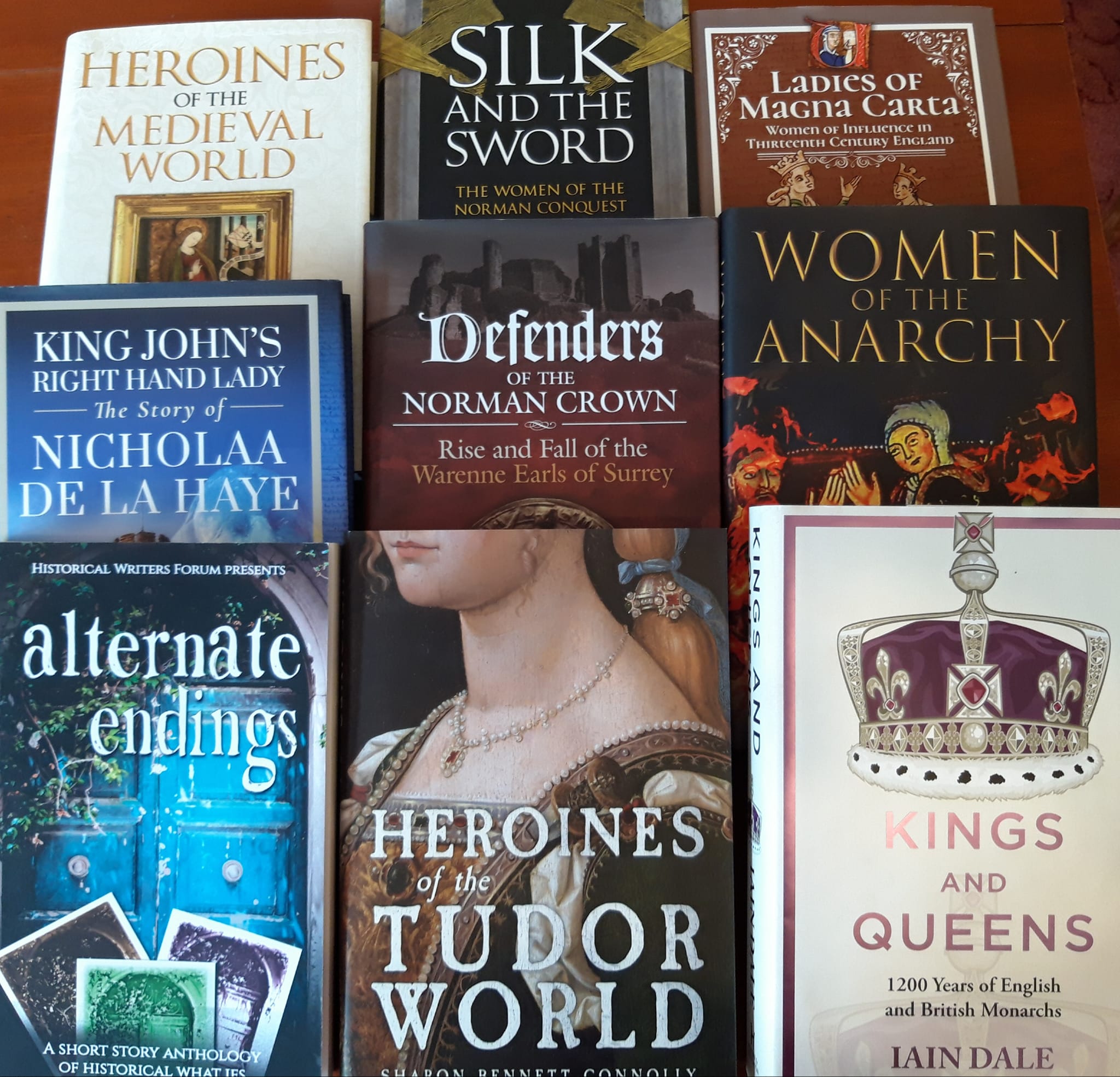
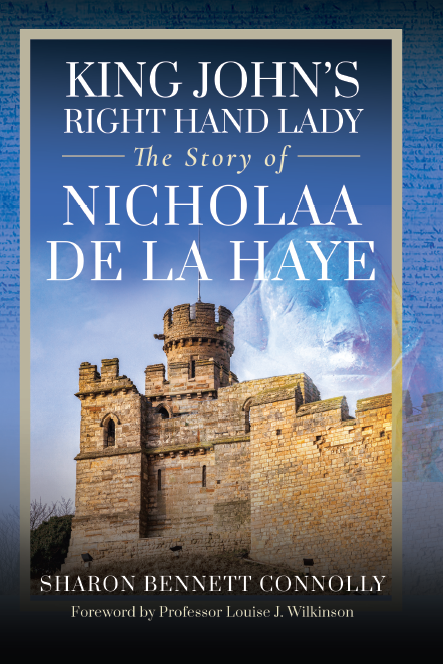
Women of the Anarchy demonstrates how Empress Matilda and Matilda of Boulogne, unable to wield a sword themselves, were prime movers in this time of conflict and lawlessness. It shows how their strengths, weaknesses, and personal ambitions swung the fortunes of war one way – and then the other. Available from Bookshop.orgAmberley Publishing and Amazon UKKing John’s Right-Hand Lady: The Story of Nicholaa de la Haye is the story of a truly remarkable lady, the hereditary constable of Lincoln Castle and the first woman in England to be appointed sheriff in her own right. Available from all good bookshops Pen & Sword Booksbookshop.org and AmazonDefenders of the Norman Crown: The Rise and Fall of the Warenne Earls of Surrey tells the fascinating story of the Warenne dynasty, from its origins in Normandy, through the Conquest, Magna Carta, the wars and marriages that led to its ultimate demise in the reign of Edward III. Available from Pen & Sword BooksAmazon in the UK and US, and Bookshop.org

Ladies of Magna Carta: Women of Influence in Thirteenth Century England looks into the relationships of the various noble families of the 13th century, and how they were affected by the Barons’ Wars, Magna Carta and its aftermath; the bonds that were formed and those that were broken. It is now available in paperback and hardback from Pen & Sword,  Amazon, and Bookshop.orgHeroines of the Medieval World tells the stories of some of the most remarkable women from Medieval history, from Eleanor of Aquitaine to Julian of Norwich. Available now from Amberley Publishing and Amazon, and Bookshop.orgSilk and the Sword: The Women of the Norman Conquest traces the fortunes of the women who had a significant role to play in the momentous events of 1066. Available now from Amazon,  Amberley Publishing, and Bookshop.org.

Alternate Endings: An anthology of historical fiction short stories including Long Live the King… which is my take what might have happened had King John not died in October 1216. Available in paperback and kindle from Amazon.

Podcast:

Have a listen to the A Slice of Medieval podcast, which I co-host with Historical fiction novelist Derek Birks. Derek and I welcome guests, such as Bernard Cornwell and discuss a wide range of topics in medieval history, from significant events to the personalities involved. There’s even an episode on Robin Hood from Steven A. McKay. There are now over 40 episodes to listen to!

*

Don’t forget! Signed and dedicated copies of all my books are available through my online bookshop.

For forthcoming online and in-person talks, please check out my Events Page.

You can be the first to read new articles by clicking the ‘Follow’ button, liking our Facebook page or joining me on Twitter and Instagram.

©2020 Sharon Bennett Connolly FRHistS

John IV and the Struggle for Brittany

jan5bretan
John IV de Montfort, Duke of Brittany

After writing about Yolande de Dreux a few weeks back, I became intrigued with the story of her grandson, John de Montfort.

John was the only son of John, count of Montfort, and Joan of Flanders. He was probably born in November or December of 1339. His great-grandmother was Beatrice of England, a daughter of Henry III, who was the mother of his grandfather, Arthur, duke of Brittany. John is first mention in 1341 when his childless uncle, John III, duke of Brittany, provided him with 20,000 livres from his patrimony. However, when the duke died on 30 April 1341, the duchy was thrown into turmoil. Civil war erupted when John’s father and uncle-by-marriage, Charles de Blois, both laid claim to the duchy.

John de Montfort the elder was the son of Arthur, duke of Brittany, by his 2nd wife, Yolande. Charles de Blois was married to Jeanne de Penthièvre, daughter of Arthur’s second son by his first wife; Guy of Brittany. The bitter conflict was to be absorbed into the much greater struggle, between France and England, that became known as the Hundred Years’ War. Edward III of England supported young John’s father, while Philip VI of France backed Charles de Blois.

In November 1341 John’s father was captured and it was up to his mother to assume the de Montfort cause. Edward III sent troops to secure various strongholds, but by late 1342, after an unproductive campaign, he had minimised his military involvement, leaving a lieutenant in charge as he headed back to England, accompanied by John, who was about 3 years old at the time, his mother and his sister, Joan.

John’s mother was imprisoned in Tickhill Castle, Yorkshire, supposedly after succumbing to a mental illness, though more likely for political reasons. As a result, John was raised in the household of the queen, Philippa of Hainault. Their fortunes revived briefly when John’s father arrived in England 1345, paying homage to Edward III at Easter, having broken his parole and escaped the duchy. He led a small force back to Brittany, but died suddenly in September of the same year, leaving 6-year-old John in the guardianship of Edward III.

mary_plantagenet_of_brittany
Mary of England, John’s first wife

Sir Thomas Dagworth captured Charles de Blois at Le Roche Derrien in June 1347, giving the English the opportunity to discuss the succession issue. It looked for a time, that Edward would sacrifice; in 1353 a treaty was actually drafted that was heavily in de Blois’ favour, depriving John of most of his rights. Luckily, for John, it was never implemented and de Blois was eventually released, in return for a huge ransom, in 1356.

Edward resolved now to back young John’s claims. Around 17-years-old, John experienced his first military campaign when he fought alongside Henry, duke of Lancaster, in the siege of Rennes, from October 1356 to July 1357, and later taking part in the Rheims campaign of 1359-60. In March, 1361, John married Edward III’s daughter, Mary, at Woodstock. The marriage would end in tragedy as Mary, still only 17, died of plague in September of the same year. Discussions throughout the early 1360s offered no lasting political solution and, now having attained his majority, John returned to Brittany in the summer of 1362.

Further discussions hosted by the Black Prince, including plans to partition the duchy, failed. However, when Charles de Blois was eventually defeated killed in battle at Auray on 29th September 1364 Jeanne de Penthièvre was forced to come to terms with John de Montfort and the Treaty of Guérande was signed on 12th April 1365. John was recognised as John IV duke of Brittany  by Charles V of France, to whom he performed homage for his duchy in December 1366.

Initially, as duke of Brittany, John’s ties to England continued to be strong, his financial debts and other obligations ensuring this. In 1366 he married Joan Holland, step-daughter of Edward, the Black Prince. However, when a lull in the fighting ended in 1369 and France and England were at loggerheads once again, John was caught in a dilemma. As his overlord Charles V was expecting John to fight for France, while Edward III was his old ally and mentor and obviously felt deserving of his loyalty. His prevarications meant his Breton subjects grew restive and when John sided with Edward III, after receiving the earldom of Richmond in 1372 as a sweetener, they openly rebelled.

joana_canterbury
Joan of Navarre, John’s 3rd wife

By April 1373 John had lost everything; he fled to England as his duchy was overrun by French troops. And yet, worse was to follow. After participating in John of Gaunt’s chevauchée from Calais to Bordeaux, John was tried for treason in the Paris parlement in December 1378. In total, John spent 6 years in exile, living on his English estates and attending court and parliament; he was the 1st foreign prince to be made a Knight of the Garter, in 1374.

John was invited to Brittany in 1379 by his Breton subjects, who were beginning to become suspicious of Charles V’s intentions; realising that his attempts to bring Brittany into the French royal demesne would threaten her traditional privileges and independence. The Breton constable of France, Bertrand de Guesclin, deliberately failed to oppose the duke’s landing. After Charles V died in September 1380 a peace was negotiated with the aid of the count of Flanders and Louis, duke of Anjou, which was ratified in the 2nd Treaty of Guérande in April 1381.

A consequence of the treaty was that John de Montfort now opposed his former allies in England and Navarre. With Edward III dying in 1377, his young grandson was now King Richard II. The English still occupied Brest, and John was having difficulties in collecting revenues from his English estates. John’s wife, Duchess Joan, had been staying in England during the troubles but, after much wrangling, was finally returned to her husband in 1382, only to die in November 1384. Her death removed an important connection to the English court and Richard II, her half-brother.

The 1380s saw John consolidating his position in Brittany, making alliances with other French princes, such as the dukes of Berry and Burgundy and the king of Navarre. He developed the duchy’s institutions, encouraged trade, devised new taxes and exploited minting rights. On a cultural level,  John expanded his court and encouraged the arts by extensive patronage. He also encouraged loyalty to his family and dynasty, which was helped greatly by his marriage to Joan of Navarre in 1386 and the birth of his long-awaited heir in 1389.

330px-sceau_de_jean_v_-_duc_de_bretagne
John V, duke of Brittany

As Anglo-French diplomatic relations thawed in the 1390s, John was able to make a marriage alliance with John of Gaunt, whereby one of his daughters would marry a son of Gaunt’s heir, the earl of Derby. John de Montfort attended the wedding of Richard II and Isabella of France in 1396 and Brest was returned to him in 1397.

Joan and John had an affectionate relationship, producing 8 children, 7 of whom survived to adulthood. John and a second son, Arthur, each became duke of Brittany; Arthur was also constable of France and succeeded his nephew, John’s son Peter, as duke. He died in 1458 and was succeeded by his nephew, Francis, son of his younger brother, Richard, count of Étampes, who had died in 1439. A fourth son, Gilles, died in 1412. Joan and John also had 3 daughters: Marie, countess of Alençon; Blanche, countess of Armagnac and Marguerite, vicomtess de Rohan.

John de Montfort paid one last visit to England in 1398, when he took formal possession of Richmond, attended a Garter ceremony at Windsor and spent some time on progress with Richard II before returning home. He died at Nantes on 1st November 1399, where he was buried. In 1402 his widow, now the wife of Henry IV of England, erected an English-made alabaster tomb over his grave; it was destroyed during the French Revolution. Joan acted as regent for her 10-year-old son, John, until her marriage to Henry; when she entrusted the regency and custody of her Breton children, to the Duke of Burgundy.

Brittany remained an independent duchy within France for another 100 years.

*

Pictures courtesy of Wikipedia.

*

Sources: Ian Mortimer The Perfect King; Marc Morris Edward I: A Great and Terrible King by Marc Morris;  Brewer’s British Royalty by David Williamson; The Mammoth Book of British kings & Queens by Mike Ashley; Britain’s Royal Families by Alison Weir; The Oxford Companion to British History edited by John Cannon; The History Today Companion to British History Edited by Juliet Gardiner and Neil Wenborn; The Story of Scotland by Nigel Tranter; Scotland, History of a Nation by David Ross; oxforddnb.com; britannica.com; W.M. Ormrod The Reign of Edward III.

*

My books

Signed, dedicated copies of all my books are available through my online bookshop.

Out now: Scotland’s Medieval Queens

Scotland’s history is dramatic, violent and bloody. Being England’s northern neighbour has never been easy. Scotland’s queens have had to deal with war, murder, imprisonment, political rivalries and open betrayal. They have loved and lost, raised kings and queens, ruled and died for Scotland. From St Margaret, who became one of the patron saints of Scotland, to Elizabeth de Burgh and the dramatic story of the Scottish Wars of Independence, to the love story and tragedy of Joan Beaufort, to Margaret of Denmark and the dawn of the Renaissance, Scotland’s Medieval Queens have seen it all. This is the story of Scotland through their eyes.

Available now from Amazon and Pen and Sword Books

Also by Sharon Bennett Connolly:

Heroines of the Tudor World tells the stories of the most remarkable women from European history in the time of the Tudor dynasty, 1485-1603. These are the women who ruled, the women who founded dynasties, the women who fought for religious freedom, their families and love. Heroines of the Tudor World is now available for pre-order from Amberley Publishing and Amazon UK. Women of the Anarchy demonstrates how Empress Matilda and Matilda of Boulogne, unable to wield a sword themselves, were prime movers in this time of conflict and lawlessness. It shows how their strengths, weaknesses, and personal ambitions swung the fortunes of war one way – and then the other. Available from Bookshop.orgAmberley Publishing and Amazon UKKing John’s Right-Hand Lady: The Story of Nicholaa de la Haye is the story of a truly remarkable lady, the hereditary constable of Lincoln Castle and the first woman in England to be appointed sheriff in her own right. Available from all good bookshops Pen & Sword Booksbookshop.org and Amazon

Defenders of the Norman Crown: The Rise and Fall of the Warenne Earls of Surrey tells the fascinating story of the Warenne dynasty, from its origins in Normandy, through the Conquest, Magna Carta, the wars and marriages that led to its ultimate demise in the reign of Edward III. Available from Pen & Sword BooksAmazon in the UK and US, and Bookshop.orgLadies of Magna Carta: Women of Influence in Thirteenth Century England looks into the relationships of the various noble families of the 13th century, and how they were affected by the Barons’ Wars, Magna Carta and its aftermath; the bonds that were formed and those that were broken. It is now available in paperback and hardback from Pen & SwordAmazon, and Bookshop.orgHeroines of the Medieval World tells the stories of some of the most remarkable women from Medieval history, from Eleanor of Aquitaine to Julian of Norwich. Available now from Amberley Publishing and Amazon, and Bookshop.orgSilk and the Sword: The Women of the Norman Conquest traces the fortunes of the women who had a significant role to play in the momentous events of 1066. Available now from Amazon,  Amberley Publishing, and Bookshop.org.

Alternate Endings: An anthology of historical fiction short stories including Long Live the King… which is my take what might have happened had King John not died in October 1216. Available in paperback and kindle from Amazon.

Podcast:

Have a listen to the A Slice of Medieval podcast, which I co-host with Historical fiction novelist Derek Birks. Derek and I welcome guests, such as Bernard Cornwell and Michael Jecks, and discuss a wide range of topics in medieval history, from significant events to the personalities involved. Every episode is also now available on YouTube.

*

Don’t forget! Signed and dedicated copies of all my books are available through my online bookshop.

For forthcoming online and in-person talks, please check out my Events Page.

You can be the first to read new articles by clicking the ‘Follow’ button, liking our Facebook page or joining me on Twitter, Bluesky, Threads and Instagram.

©2016 Sharon Bennett Connolly FRHistS

The Mother of the House of York

200px-Arms_of_Philippa_of_Clarence,_5th_Countess_of_Ulster.svg
Arms of Philippa of Clarence

Princess Philippa of Clarence was born at Eltham Palace in Kent on the 16th August 1355.  She was named after her grandmother, Philippa of Hainault, queen of Edward III, who was one of her Godparents.

The first grandchild of Edward III she was the only child of Lionel of Antwerp, Duke of Clarence, and his 1st wife, Elizabeth de Burgh. Lionel was the 1st of Edward and Philippa’s children to marry.

Lionel was the 3rd son of Edward and Philippa, but the 2nd to survive childhood. Born in 1338, he was married to Elizabeth de Burgh in the Tower of London on the 9th September 1342. Lionel was almost 4 years old and his bride was 6 years older, born in 1332. Elizabeth was the daughter and heiress of William de Burgh, 3rd Earl of Ulster, who had died the year after her birth. It seems the couple lived together as husband and wife from 1352, when Lionel was 14 and Elizabeth 20. Lionel became Earl of Ulster by right of his wife and took possession of vast estates in Ireland and the Honour of Clare, in Suffolk; from which he was created Duke of Clarence by Parliament on 13th November 1362.

220px-LionelDukeOfClarenceAtWestminster
Lionel Duke of Clarence

Philippa lost her mother when she was just 8 years old. Elizabeth died in Dublin in December 1363, she was buried  at Clare Priory in Suffolk. Lionel was married again in May 1368, in Milan, to Violante Visconti, daughter of the Lord of Milan. He died at Alba just 5 months after the wedding, in October 1368, and was buried at Pavia; his body was later reinterred to lie beside Elizabeth at Clare Priory in Suffolk.

The dukedom of Clarence became extinct on Lionel’s death, but the earldom of Ulster and Honour of Clare passed to Philippa, his only daughter and heiress.

Although an orphan at the tender age of 13, Philippa’s future had been settled even by the time of her mother’s death in 1363. When only in her 4th year she was married, at the Queen’s Chapel in Reading, in February 1359, to 7-year-old Edmund Mortimer. Edmund was the great-grandson of Roger Mortimer, 1st Earl of March and lover of Edward II’s queen, and Edward III’s mother, Isabella of France.

Mortimer had been executed on Edward III’s orders in 1330 and the marriage was viewed as a reconciliation with the Mortimer family, powerful lords on the Welsh Marches. The children’s wedding was also the 1st in a string of royal marriages. Philippa was married before any of her aunts and uncles; but weddings for her uncle John of Gaunt to Blanche of Lancaster  and her aunt Margaret to John Hastings, 2nd Earl of Pembroke followed in May the same year.

250px-Arms_of_the_House_of_Mortimer.svg
Arms of the House of Mortimer

The marriage alliances were all part of Edward III’s policy to provide for his large brood of children and tie the great baronial families of the kingdom to the crown, by bringing them into the Royal family.

Edmund Mortimer succeeded to his father’s earldom as the 3rd Earl of March in the year after the marriage and the couple spent their time between properties in England, Wales and Ireland.

Their 1st child was born when Philippa was 15; she gave birth to a daughter, Elizabeth, at Usk in Monmouthshire, on 12th February 1371. 3 more children followed; Roger born at Usk on 11th April 1374, Philippa, born at Ludlow in Shropshire on 21st November 1375 and finally Edmund, who was born at Ludlow on 9th November 1377.

Marriage to Philippa had brought her husband power and influence. Through his steward, Peter de la Mare, he was instrumental in the Good Parliament of 1376, which argued against the influence of Edward III’s lover, Alice Perrers, and her friends, on the government of the kingdom. He spoke up for royal legitimacy and, using similar language to that used against his grandfather, Roger Mortimer, decried the influence an adulterous affair was having  on the dignity of the crown.

220px-Ludlow_Castle_from_Whitcliffe,_2011
Ludlow Castle, Shropshire

Following Edward III’s death in 1377, until her own death 6 months later, Philippa was, technically, heiress presumptive to the crown of her cousin, Richard II. However, in a supplementary document to his will, Edward III had practically disinherited his eldest granddaughter. He settled the inheritance of the throne on his grandson, Richard, son of his eldest son, the Black Prince and then, in turn, starting with John of Gaunt, on his surviving sons and their sons.

Edward had thus attempted to destroy any claim Philippa might have had to the throne whilst at the same time, revoking the royal status of the Mortimer earls of March.

Although there appear to be several death dates for Philippa, the most likely is that she died as a result of complications following Edmund’s birth, as she had made a will in November 1377, suggesting she was preparing for death. She passed away on, or shortly before, 7th January 1378 and was buried at Wigmore, Herefordshire, the burial-place of the Mortimers.

Edmund’s star, however, continued to rise and he was appointed Lieutenant of Ireland by Richard II on 22nd October 1380.  He died at Cork on 26th or 27th December 1381 and his body was brought back to Wigmore for burial. He was succeeded as 4th Earl of March by his eldest son, Roger; who had succeeded Philippa as Earl of Ulster on her death.

220px-Harry_Hotspur_Percy
Sir Henry “Hotspur” Percy and Elizabeth Mortimer

Roger spent many years in wardship following his father’s death. He was courageous, but had a reputation for religious and moral laxity. He was killed in Ireland in 1398, while acting as the king’s Lieutenant. It is possible that, at some point, he was named heir to the throne by Richard II, although there is considerable doubt in this.

Of Philippa and Edmund’s other children Elizabeth married Sir Henry “Hotspur” Percy sometime before May 1380. They had 2 children, but he was killed at the Battle of Shrewsbury in 1403. Elizabeth then married Thomas, 1st Baron Camoys, with whom she had a son who died young. Elizabeth died on 20th April 1417 and was buried at Trotton in Sussex, with her 2nd husband.

Philippa’s daughter and namesake, Philippa, married John Hastings, 3rd Earl of Pembroke, son of the Earl of Pembroke who had married Edward III’s daughter, Margaret. Following his death in 1389, she married Richard FitzAlan, 11th Earl of Arundel, who was executed in 1397. Her 3rd marriage was to Thomas Poynings, 5th Baron St John of Basing, around November 1399. She died in 1400 or 1401 and was buried at Boxgrove Priory in Sussex.

220px-Richard_Plantagenet,_3rd_Duke_of_York
Richard, Duke of York

Edmund’s namesake, Philippa and Edmund’s youngest son was married in about 1402 to Katherine, the daughter of Owen Glendower. They had several children, but all died young. Edmund himself died sometime between 1409 and 1411.

Philippa’s grandson, Roger’s son, Edmund, succeeded his father as Earl of March and Ulster; he became the king’s ward following his father’s death and, following the usurpation he was kept in Henry IV’s family circle.

Edmund seems to have suffered from a lack of ambition and when some barons tried to place him on the throne in 1415, it was Edmund himself who revealed the Southampton Plot to Henry V.

Edmund died of plague in Ireland in January 1425, but it is his sister, Anne Mortimer, who had been married to Richard of Conisbrough, that Philippa’s claim to the throne was passed to Anne and Richard’s son, Richard, Duke of York; thus laying the foundations for the Wars of the Roses and the accession of Edward IV and, later, his brother, Richard III.

*

Pictures taken from Wikipedia.

*

Sources: The Perfect King, the Life of Edward III by Ian Mortimer; The Life and Time of Edward III by Paul Johnson; The Reign of Edward III  by WM Ormrod; The Mammoth Book of British kings & Queens by Mike Ashley; Britain’s’ Royal Families, the Complete Genealogy by Alison Weir; Brewer’s British Royalty by David Williamson; The Plantagenets, the Kings Who Made Britain by Dan Jones; mortimerhistorysociety.org.uk.

*

My books:

Signed, dedicated copies of all my books are available through my online store.

Out now: Scotland’s Medieval Queens

Books by Sharon Bennett Connolly

Scotland’s history is dramatic, violent and bloody. Being England’s northern neighbour has never been easy. Scotland’s queens have had to deal with war, murder, imprisonment, political rivalries and open betrayal. They have loved and lost, raised kings and queens, ruled and died for Scotland. From St Margaret, who became one of the patron saints of Scotland, to Elizabeth de Burgh and the dramatic story of the Scottish Wars of Independence, to the love story and tragedy of Joan Beaufort, to Margaret of Denmark and the dawn of the Renaissance, Scotland’s Medieval Queens have seen it all. This is the story of Scotland through their eyes.

Scotland’s Medieval Queens gives a thorough grounding in the history of the women who ruled Scotland at the side of its kings, often in the shadows, but just as interesting in their lives beyond the spotlight. It’s not a subject that has been widely covered, and Sharon is a pioneer in bringing that information into accessible history.’ Elizabeth Chadwick (New York Times bestselling author)

Available now from Amazon and Pen and Sword Books

Also by Sharon Bennett Connolly:

Books by Sharon Bennett Connolly

Heroines of the Tudor World tells the stories of the most remarkable women from European history in the time of the Tudor dynasty, 1485-1603. These are the women who ruled, the women who founded dynasties, the women who fought for religious freedom, their families and love. Heroines of the Tudor World is now available from Amberley Publishing and Amazon UK. Women of the Anarchy demonstrates how Empress Matilda and Matilda of Boulogne, unable to wield a sword themselves, were prime movers in this time of conflict and lawlessness. It shows how their strengths, weaknesses, and personal ambitions swung the fortunes of war one way – and then the other. Available from Bookshop.orgAmberley Publishing and Amazon UKKing John’s Right-Hand Lady: The Story of Nicholaa de la Haye is the story of a truly remarkable lady, the hereditary constable of Lincoln Castle and the first woman in England to be appointed sheriff in her own right. Available from all good bookshops Pen & Sword Booksbookshop.org and Amazon

Royal Historical Society

Defenders of the Norman Crown: The Rise and Fall of the Warenne Earls of Surrey tells the fascinating story of the Warenne dynasty, from its origins in Normandy, through the Conquest, Magna Carta, the wars and marriages that led to its ultimate demise in the reign of Edward III. Available from Pen & Sword BooksAmazon in the UK and US, and Bookshop.orgLadies of Magna Carta: Women of Influence in Thirteenth Century England looks into the relationships of the various noble families of the 13th century, and how they were affected by the Barons’ Wars, Magna Carta and its aftermath; the bonds that were formed and those that were broken. It is now available in paperback and hardback from Pen & SwordAmazon, and Bookshop.orgHeroines of the Medieval World tells the stories of some of the most remarkable women from Medieval history, from Eleanor of Aquitaine to Julian of Norwich. Available now from Amberley Publishing and Amazon, and Bookshop.orgSilk and the Sword: The Women of the Norman Conquest traces the fortunes of the women who had a significant role to play in the momentous events of 1066. Available now from Amazon,  Amberley Publishing, and Bookshop.org.

Alternate Endings: An anthology of historical fiction short stories including Long Live the King… which is my take what might have happened had King John not died in October 1216. Available in paperback and kindle from Amazon.

Podcast:

A Slice of Medieval

Have a listen to the A Slice of Medieval podcast, which I co-host with Historical fiction novelist Derek Birks. Derek and I welcome guests, such as Bernard Cornwell and Michael Jecks, and discuss a wide range of topics in medieval history, from significant events to the personalities involved. 

Every episode is also now available on YouTube.

*

Don’t forget! Signed and dedicated copies of all my books are available through my online store.

For forthcoming online and in-person talks, please check out my Events Page.

You can be the first to read new articles by clicking the ‘Follow’ button, liking our Facebook page or joining me on TwitterThreadsBluesky and Instagram.

*

©2015 Sharon Bennett Connolly FRHistS

The Tragic Story of the 1st Duke of Rothesay

220px-Duke_of_Rothesay_Standard.svg
Standard of the Duke of Rothesay

David Stewart was born on 24th October, 1378, the son of John, Earl of Carrick and heir to the throne, and Annabella Drummond. His grandfather was King Robert II, who was himself the grandson of Robert I the Bruce, being the son of Robert’s unfortunate daughter, Marjorie Bruce, who died in childbirth, aged only 19.

His father succeeded to the throne in 1390, taking the name King Robert III (John being considered an unlucky name for kings). AS heir to the throne, David was created Earl of Carrick in the same year. Robert III, however, was an invalid – he had been kicked by a horse 2 years before his accession. Never having fully recovered from his injuries, he was also prone to depression. This severely limited his ability to govern and his younger brother, also called Robert, took over much of the administration of the realm.

As a highly ambitious younger brother, Robert Stewart, was a ruthless politician with designs on the throne for himself. Towards the end of his father’s reign – following his brother’s injury – he had been protector of the realm; and it seems he intended to keep the position for the duration of his brother’s reign.

220px-Robert_III_and_Annabella_Drummond
Robert III and his queen, Annabella Drummond

From 1393 Robert III tried to impose his own authority and rule for himself, but caused more division between the Highlands of the north and the Lowlands of the south; bribery and corruption were rife.

In 1395 young David was married to Elizabeth Dunbar, daughter of the Earl of March. However, they were close blood relations and had married before the required papal dispensation had arrived. The couple were censured by the church and forced to live apart for two years – after which they would be allowed to remarry. They separated in 1397.

In April 1398 Robert III’s wife, Annabella, called a special council at which David, still only 19, was made Duke of Rothesay. It was the first ever creation of a duke in Scotland, and the title would, from that moment on, be borne by all heirs to the Scottish throne. He would also receive the title Earl of Atholl later in the same year.

Annabella also had David named “Lieutenant of the Realm”, as a means of ensuring that David would succeed his increasingly frail father. This appointment essentially gave him the rule of Scotland, in his father’s place; although he was to consult with the full council, with his Uncle Robert as his primary advisor.

In the same council Robert Stewart was made Duke of Albany.

A power struggle developed between Albany and David. As their rivalry grew more intense the country was effectively divided into 2 factions.

David, it seems, was of a ‘dissolute and licentious’ nature (Ashley) and almost as inept as his father. According to Nigel Tranter he was “high-spirited” and “not always noted for good judgement”.

220px-Robert_of_Albany
Robert Stewart, Duke of Albany

In 1400, instead of remarrying Elizabeth Dunbar, David married Marjorie Douglas, daughter of Archibald the 3rd Earl of Douglas and his wife Joan, at Bothwell Church. She and David would have no children.

The marriage itself caused the Earl of March – father of David’s 1st wife – to renounce his allegiance and swear fealty to Henry IV of England, thus prompting an English invasion. Henry managed to reach Edinburgh without much opposition. Once there he summoned the dukes of Rothesay and Albany to pay homage to him, but neither did.

David held Edinburgh Castle against Henry, whilst Albany had mustered an army 15 miles away at Calder Muir; but he failed to march to Rothesay’s aid. Henry IV was eventually forced to retire for lack of supplies, with the Scots powerless to take the advantage.

David was blamed for provoking the English invasion. Following his mother’s death in 1401, his popularity was further damaged when he failed to consult his council, as was required, before taking a number of steps which threatened the positions of his nobles, especially his uncle.

220px-Falkland_Palace
Falkland Palace

With Queen Annabella’s death went David’s chief supporter and last protector. Albany, in alliance with David’s brother-in-law, the 4th Earl of Douglas, took action and had David waylaid on the road to St Andrews, arrested and held captive in St Andrews Castle, before being moved to Falkland Palace, supposedly hooded and mounted backwards on a mule.

According to Tranter, David was flung into a cellar, with no food and water. There were stories of nursing mothers giving him their breast milk for sustenance, through a crack in the cellar’s masonry. He survived for at least 18 days, supposedly dying of starvation between 25th and 27th March 1402, aged 23.

Some historians now think David died of dysentery; but whether he died of starvation or disease the result was the same; from April 1402 Robert, Duke of Albany, was in control of Scotland.

A few weeks after his death a public inquiry, under the control of Albany, exonerated Albany and Douglas of any complicity in the death, ordering that no one should “murmur against” them. The inquiry concluded that David Stewart, Duke of Rothesay, had died “by divine providence and not otherwise”.

300px-Lindores_abbey_04
Lindores Abbey, burial-place of David, Duke of Rothesay

David was buried in Lindores Abbey, Fife. The king founded a chaplaincy at the parish church of Dundee to pray for David’s soul, and ordered daily masses to be said in the prince’s memory at Deer Abbey and Culross.

Following David’s death his widow, Marjorie, went on to marry Sir Walter Haliburton in 1403; she died sometime before 11th May 1421.

The king, Robert III, took some time to realise that his second son, James, may also be in danger. In 1406, the king arranged for him to be sent to France for his own safety. Aged just 12, James was smuggled out of Scotland by ship, but was captured by pirates off Flamborough Head, and handed over to the English to begin 18 years of imprisonment.

King Robert III died of grief shortly after.

Albany was, thereafter, the effective ruler of Scotland until his death in 1420.

*

Pictures courtesy of Wikipedia.

Sources: The Story of Scotland by Nigel Tranter; Brewer’s British Royalty by David Williamson; Kings & Queens of Britain by Joyce Marlow; Mammoth Book of British Kings & Queens and British Kings & Queens by Mike Ashley; Oxford Companion to British History Edited by John Cannon; History Today Companion to British History Edited by juliet Gardiner & Neil Wenborn; Britain’s Royal Families by Alison Weir; undiscoveredscotland.co.uk; englishmonarchs.co.uk

*

My Books

Signed, dedicated copies of all my books are available, please get in touch by completing the contact me form.

Coming 30 May 2023!

King John’s Right-Hand Lady: The Story of Nicholaa de la Haye is now available for pre-order from Pen & Sword Booksbookshop.org and Amazon UK. (I will hopefully have a US release date shortly)

In a time when men fought and women stayed home, Nicholaa de la Haye held Lincoln Castle against all-comers. Not once, but three times, earning herself the ironic praise that she acted ‘manfully’. Nicholaa gained prominence in the First Baron’s War, the civil war that followed the sealing of Magna Carta in 1215.

A truly remarkable lady, Nicholaa was the first woman to be appointed sheriff in her own right. Her strength and tenacity saved England at one of the lowest points in its history. Nicholaa de la Haye is one woman in English history whose story needs to be told…

 Also by Sharon Bennett Connolly:

Defenders of the Norman Crown: The Rise and Fall of the Warenne Earls of Surrey tells the fascinating story of the Warenne dynasty, of the successes and failures of one of the most powerful families in England, from its origins in Normandy, through the Conquest, Magna Carta, the wars and marriages that led to its ultimate demise in the reign of Edward III. Defenders of the Norman Crown: Rise and Fall of the Warenne Earls of Surrey is now available from Pen & Sword BooksAmazon in the UK and US, Bookshop.org and Book Depository.

Ladies of Magna Carta: Women of Influence in Thirteenth Century England looks into the relationships of the various noble families of the 13th century, and how they were affected by the Barons’ Wars, Magna Carta and its aftermath; the bonds that were formed and those that were broken. It is now available in paperback and hardback from Pen & Sword,  AmazonBookshop.org and from Book Depository worldwide.

Heroines of the Medieval World tells the stories of some of the most remarkable women from Medieval history, from Eleanor of Aquitaine to Julian of Norwich. Available now from Amberley Publishing and Amazon, Bookshop.org and from Book Depository worldwide.

Silk and the Sword: The Women of the Norman Conquest traces the fortunes of the women who had a significant role to play in the momentous events of 1066. Available now from Amazon,  Amberley Publishing, Bookshop.org and Book Depository.

Alternate Endings: An anthology of historical fiction short stories including Long Live the King… which is my take what might have happened had King John not died in October 1216. Available in paperback and kindle from Amazon.

*

For forthcoming online and in-person talks, please check out my Events Page.

*

You can be the first to read new articles by clicking the ‘Follow’ button, liking our Facebook page or joining me on Twitter and Instagram.

*

2015 Sharon Bennett Connolly FRHistS