Queen of Scots

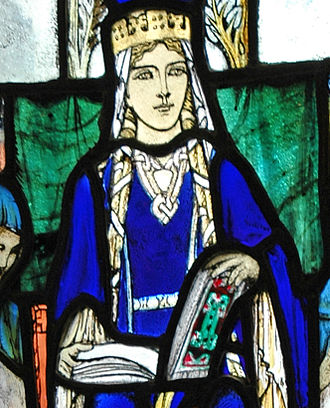
St Margaret, Queen of Scots

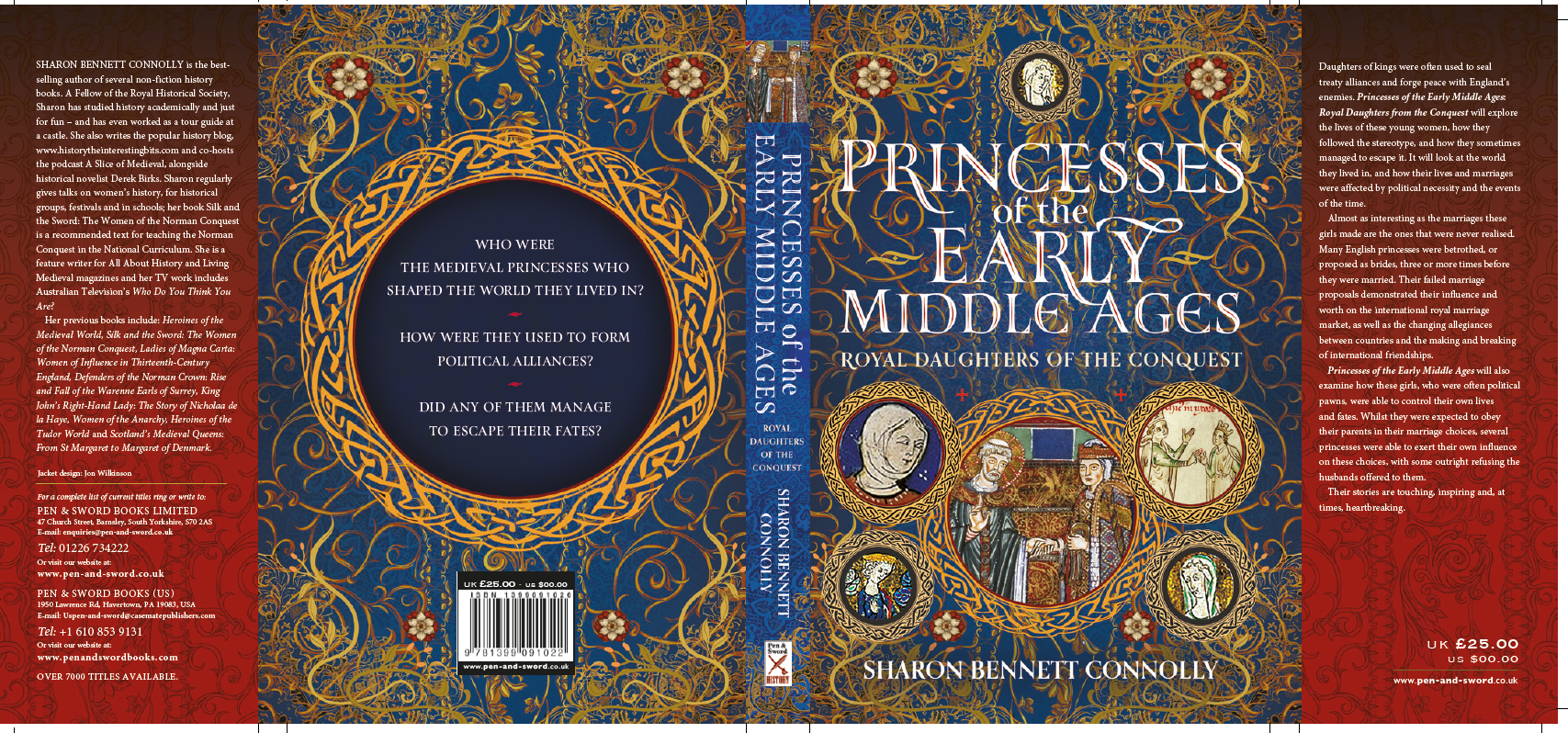
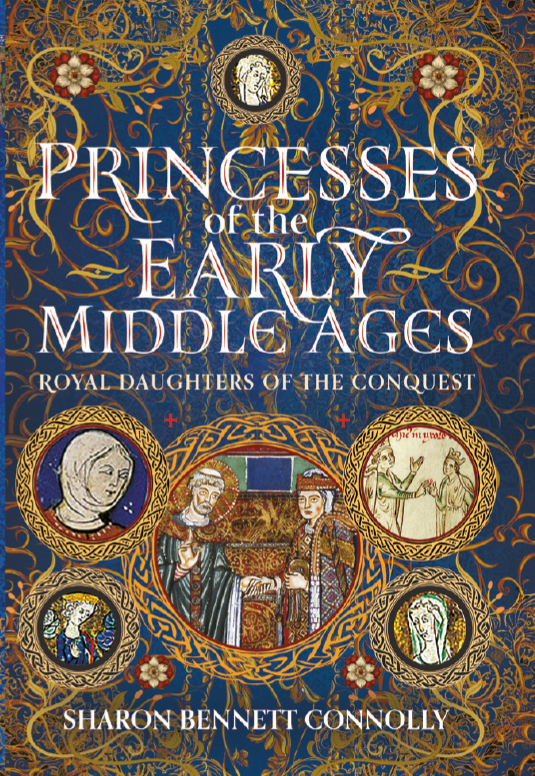
The Queens of Scots of the medieval era are a fascinating variety of women and I can only hope that I have done them justice in my latest book, Scotland’s Medieval Queens: From St Margaret to Margaret of Denmark.

Scottish history is fascinating! It is violent, politically charged and passionate. Being inconveniently situated on England’s northern border was never easy for Scotland, but it has made for some great stories over the centuries. Scotland’s story is often that of brother against brother, ambition and family rivalries causing feuds that threatened the stability of the crown itself. Such fissures, of course, grew and ruptured with the aid of English interference and encouragement. The King of England was always happy to play one side off against the other if it weakened Scotland’s position.

And Scotland’s medieval queens, be they Scottish, English, Danish or French, formed a big part of that story.

More often than not, these disputes north and south of the border were resolved in peace treaties, sealed by wedding bells. A number of English princesses and noblewomen found themselves married to Scotland’s kings as a consequence.

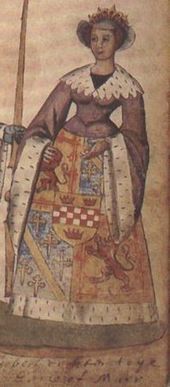
Queen Elizabeth de Burgh

For over 400 years, Shakespeare’s version of Lady Macbeth has been the woman most people are familiar with. In the bard’s famous drama, also known as ‘The Scottish Play’, Lady Macbeth is not even given her name. Presented as a scheming, manipulative woman, Shakespeare did as good a hatchet job on Gruoch, a royal princess in her own right, as he had on Richard III. Unfortunately, there is no society established to repair Gruoch’s reputation.

The scheming, ambitious woman who will stop at nothing to put her husband on the Scottish throne – and commit murder to keep him there. But is that the real Lady Macbeth? The story of Queen Gruoch, Lady Macbeth, is one shrouded in mystery, tantalisingly obscure. If only we could know more. The lack of information on Gruoch makes it easy for Shakespeare’s interpretation to be accepted as fact, but it is more than likely an injustice to a woman who survived her first husband’s gruesome death, protected her son and came to an agreement with Macbeth to become his wife, securing her son’s future in the process, and later becoming queen as a consequence.

Queen Gruoch is the first queen of Scots for whom we have a name.

From the highly educated and pious Margaret of Wessex to the glamorous Margaret of Denmark, their lives and experiences tell the story of their nation. Some, such as Matilda de Senlis and Ermengarde de Beaumont, barely make an impression on history, though merely by producing a son, they each guaranteed that Scotland would persevere. And Isabella de Warenne, wife of John Balliol, who is a ghost on the pages of Scotland’s history. And it is not that these made no impression. Their influence was in the domestic sphere, raising children and supporting their husbands, rather than on the political or the international stage. Although Isabella’s story is even more obscure by the fact all mention of the Balliol dynasty was forbidden by the Bruce regime.

Marrying an English princess, for example, did not always guarantee the peace with England that was intended. As the wife of Alexander II, Joan of England did her best to maintain cordial relations with her brother Henry III, often using private letters to broker diplomatic solutions. And Henry III’s own daughter Margaret, in marrying Alexander III, brought Scotland more years of peace with England. As a consequence, Scotland and England enjoyed over 70 years of peaceful relations. These years were shattered dramatically by the deaths of Alexander III, his three children and his little granddaughter, Margaret, the Maid of Norway. Little Margaret’s death left the Scots throne vacant, with thirteen Competitors vying for the crown, staking their claims as Edward I of England acted as adjudicator.

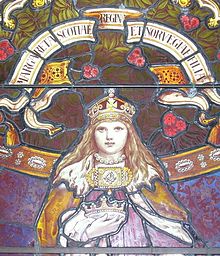
Margaret, Maid of Norway

Edward I took advantage of this to try to assert his overlordship of Scotland, but William Wallace, Robert the Bruce and countless others pushed back, ushering in decades of war with England, the Scottish Wars of Independence.

Edward III’s sister Joan of the Tower was to have no such legacy of peace as the earlier Joan and Queen Margaret could boast. Her brother’s ambition would blight her marriage for years. Edward leant his support to the rival claimant to the Scottish throne, Edward Balliol. If he had not been so keen to exploit Scotland’s dynastic divisions, maybe Joan and David II would have had a happier marriage. We will never know.

One cannot help but feel sympathy for Elizabeth de Burgh, seeing her fortunes rise and fall at the whim of England’s king, Edward I, held captive for eight years when she should have been sitting in splendour on Scotland’s throne.

Or poor Marjorie Bruce, whose childhood was torn from her by that same English king, held far away from everyone she loved, only to be married as she tasted freedom, and dead in childbirth by the age of 19. Passed over for the throne because she was a woman, she still managed to give birth to a dynasty, the Stewarts.

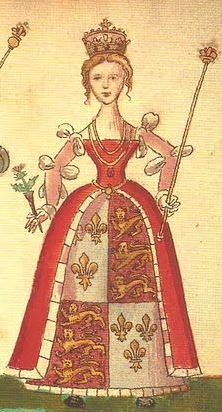
Joan Beaufort, Queen of Scots

Scotland was the first nation in the British Isles to accept a queen regnant when Margaret, Maid of Norway, was recognised as its queen in 1290. How her queenship would have developed, we have no way of knowing. The poor girl died before she even landed in mainland Scotland. Her significance is in that she was proclaimed queen and the possibilities that heralded, even if it got no further. We can only speculate as to how a successful rule by a queen regnant in the thirteenth century may have changed the lives and experiences of women in subsequent centuries. Her death was a tragedy, not just to her family, but to women’s rights to rule.

But then again, as her father-in-law, it may well be that Edward I would have taken Scotland under his wing … and never let go.

Although we have charters and chronicles, and evidence of religious and charitable donations, most of these women remain elusive. They are enigmas.

We do not – and cannot – know them intimately as the one thing that is missing is their own voice. Their thoughts and personalities are lost to us. Even letters to family members are often formulaic and rarely speak of their true feelings, of their happiness – or not – and their cares and concerns for themselves. We know what they endured for the sake of Scotland, the risk of death in childbirth, the grief of lost children, or the grief of no children. Every woman in medieval Europe was exposed to similar experiences. Scottish queens, however, had to endure imprisonment, scheming noblemen and the early deaths of their husbands more times than they should have had to.

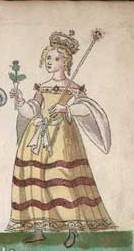
Anabella Drummond, Queen of Scots

But, once in a while, we come across a marriage that is a true partnership. A love story, even. And we discover moments of affection, of amusement, of unity and mutual support. Little moments that remind us that these people are not just stories. They are lives that were lived to the full, however short or long a time they had.

Scotland’s story is often violent and suffered greatly from the machinations if its powerful southern neighbour. However, Scotland did emerge from the Middle Ages as, still, an independent, sovereign nation. And Scotland’s medieval queens had each made their own contribution to the country’s continuing survival and independence. From Saint Margaret – even from Gruoch – to Margaret of Denmark, each queen, to varying degrees of success, made their own indelible imprint on Scotland’s remarkable story.

Images:

Courtesy of Wikipedia

Selected Bibliography:

John of Fordun’s Chronicle of the Scottish Nation; Walter Bower, Scotichronicon; Andrew Wyntoun, The orygynale cronykil of Scotland; Calendar of documents relating to Scotland preserved in Her Majesty’s Public Record Office; Richard Oram, editor, The Kings and Queens of Scotland; Rosalind K. Marshall, Scottish Queens 1034–1714; Nigel Tranter, The Story of Scotland; David Ross Scotland, History of a Nation; Liber pluscardensis, edited by Felix James Henry Skene; Mediaeval chronicles of Scotland: the chronicles of Melrose and Holyrood, translated by Joseph Stephenson; The Chronicle of Lanercost, edited by Sir Herbert Maxwell; The Ecclesiastical History of England and Normandy by Ordericus Vitalis; The historie and cronicles of Scotland … by Robert Lindesay of Pitscottie, 3 volumes, A.J.G. Mackay, editor.

*

My books

Signed, dedicated copies of all my books are available through my online store.

Out now: Scotland’s Medieval Queens

Scotland’s history is dramatic, violent and bloody. Being England’s northern neighbour has never been easy. Scotland’s queens have had to deal with war, murder, imprisonment, political rivalries and open betrayal. They have loved and lost, raised kings and queens, ruled and died for Scotland. From St Margaret, who became one of the patron saints of Scotland, to Elizabeth de Burgh and the dramatic story of the Scottish Wars of Independence, to the love story and tragedy of Joan Beaufort, to Margaret of Denmark and the dawn of the Renaissance, Scotland’s Medieval Queens have seen it all. This is the story of Scotland through their eyes.

Scotland’s Medieval Queens gives a thorough grounding in the history of the women who ruled Scotland at the side of its kings, often in the shadows, but just as interesting in their lives beyond the spotlight. It’s not a subject that has been widely covered, and Sharon is a pioneer in bringing that information into accessible history.’ Elizabeth Chadwick (New York Times bestselling author)

Available now from Amazon and Pen and Sword Books

Also by Sharon Bennett Connolly:

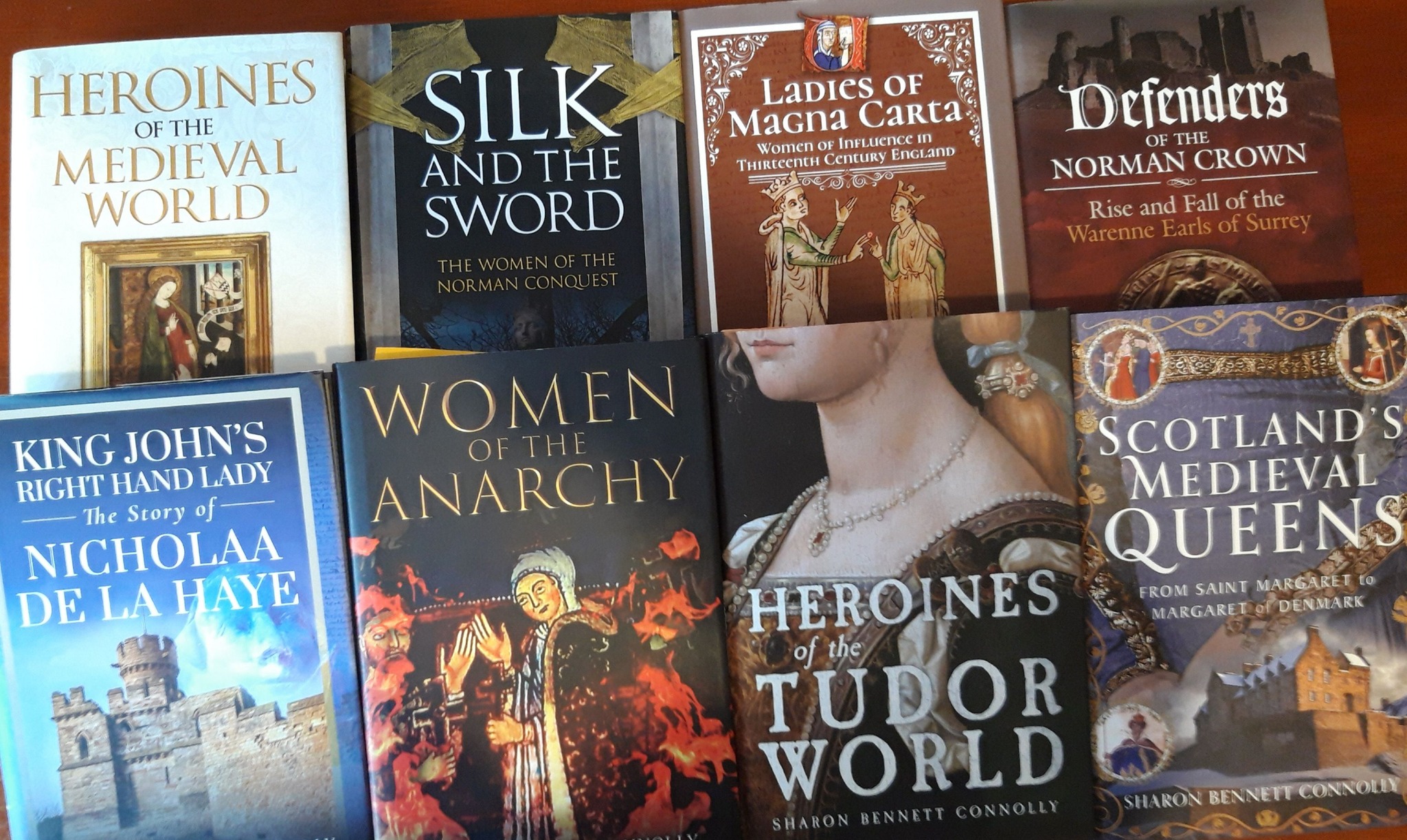
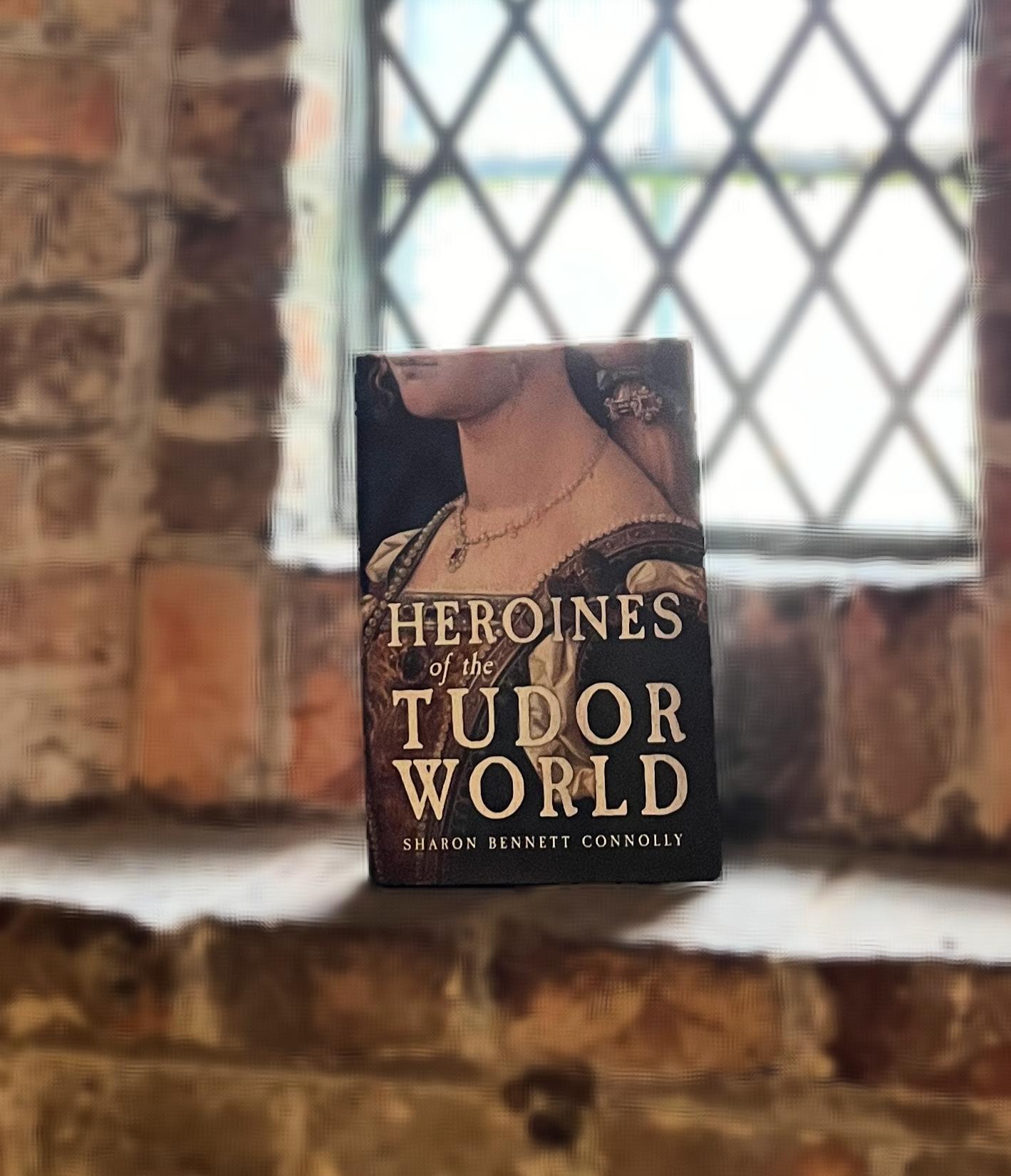
Heroines of the Tudor World tells the stories of the most remarkable women from European history in the time of the Tudor dynasty, 1485-1603. These are the women who ruled, the women who founded dynasties, the women who fought for religious freedom, their families and love. Heroines of the Tudor World is now available for pre-order from Amberley Publishing and Amazon UK. Women of the Anarchy demonstrates how Empress Matilda and Matilda of Boulogne, unable to wield a sword themselves, were prime movers in this time of conflict and lawlessness. It shows how their strengths, weaknesses, and personal ambitions swung the fortunes of war one way – and then the other. Available from Bookshop.orgAmberley Publishing and Amazon UKKing John’s Right-Hand Lady: The Story of Nicholaa de la Haye is the story of a truly remarkable lady, the hereditary constable of Lincoln Castle and the first woman in England to be appointed sheriff in her own right. Available from all good bookshops Pen & Sword Booksbookshop.org and Amazon

Defenders of the Norman Crown: The Rise and Fall of the Warenne Earls of Surrey tells the fascinating story of the Warenne dynasty, from its origins in Normandy, through the Conquest, Magna Carta, the wars and marriages that led to its ultimate demise in the reign of Edward III. Available from Pen & Sword BooksAmazon in the UK and US, and Bookshop.orgLadies of Magna Carta: Women of Influence in Thirteenth Century England looks into the relationships of the various noble families of the 13th century, and how they were affected by the Barons’ Wars, Magna Carta and its aftermath; the bonds that were formed and those that were broken. It is now available in paperback and hardback from Pen & SwordAmazon, and Bookshop.orgHeroines of the Medieval World tells the stories of some of the most remarkable women from Medieval history, from Eleanor of Aquitaine to Julian of Norwich. Available now from Amberley Publishing and Amazon, and Bookshop.orgSilk and the Sword: The Women of the Norman Conquest traces the fortunes of the women who had a significant role to play in the momentous events of 1066. Available now from Amazon,  Amberley Publishing, and Bookshop.org.

Alternate Endings: An anthology of historical fiction short stories including Long Live the King… which is my take what might have happened had King John not died in October 1216. Available in paperback and kindle from Amazon.

Podcast:

Have a listen to the A Slice of Medieval podcast, which I co-host with Historical fiction novelist Derek Birks. Derek and I welcome guests, such as Bernard Cornwell and Michael Jecks, and discuss a wide range of topics in medieval history, from significant events to the personalities involved. Every episode is also now available on YouTube.

*

Don’t forget! Signed and dedicated copies of all my books are available through my online store.

For forthcoming online and in-person talks, please check out my Events Page.

You can be the first to read new articles by clicking the ‘Follow’ button, liking our Facebook page or joining me on TwitterThreadsBluesky and Instagram.

*

©2025 Sharon Bennett Connolly, FRHistS

Author Spotlight: Scott Mariani

Do excuse me if a get a little giddy and fan girly with this one! One of my favourite thriller writers is about to release the first book in a new series – in historical fiction!

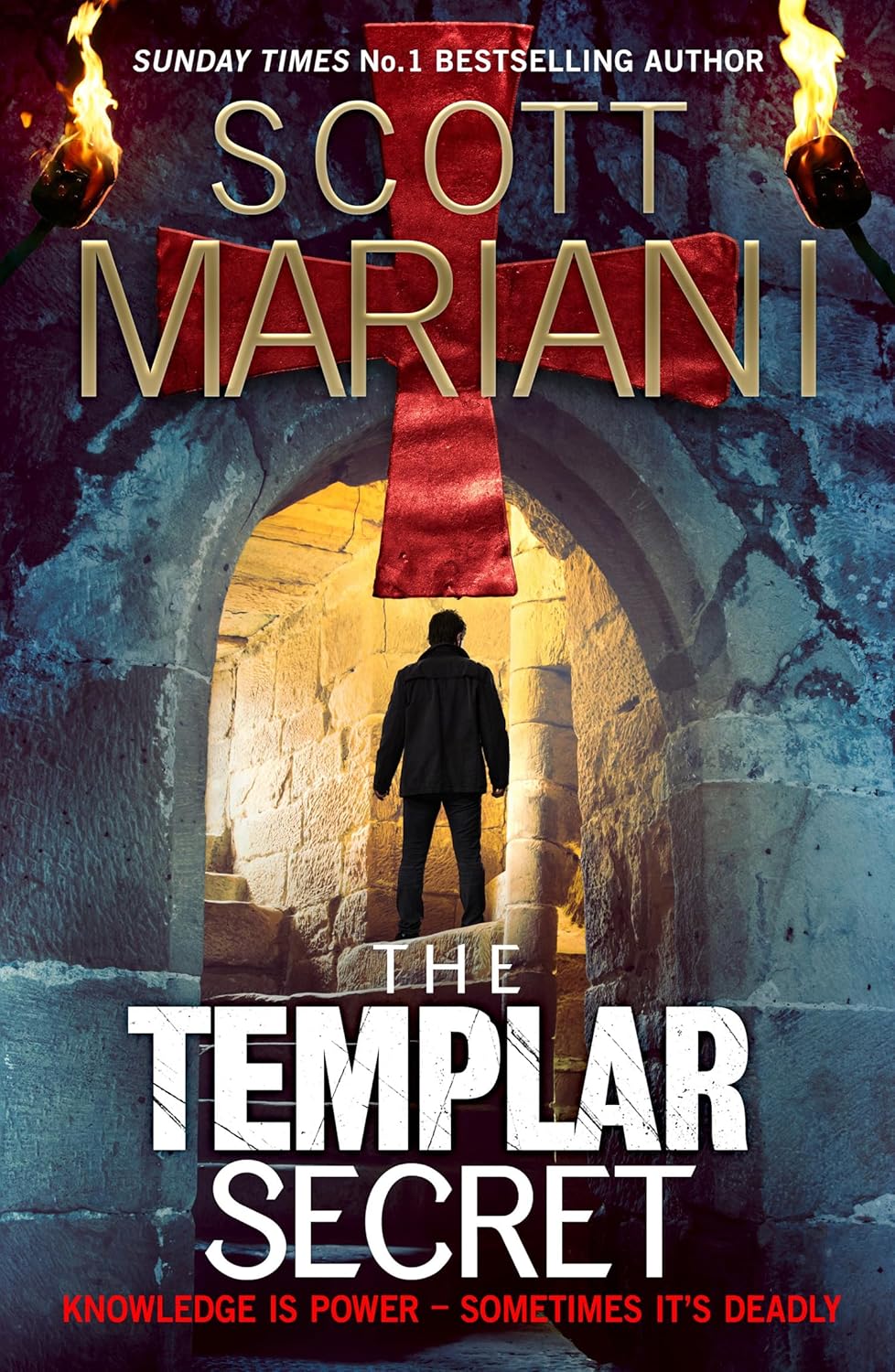
I absolutely love Scott’s Ben Hope books and got the last in the series, The Templar Secret, for Christmas. They are modern day thrillers with a historical twist – and are great fun to read.

And Scott agreed to do an interview with me!

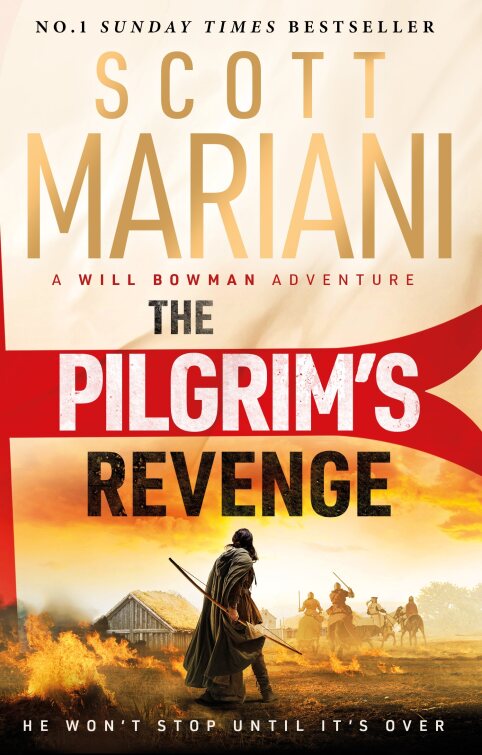
I also have an advance copy of the new novel, The Pilgrim’s Revenge, so expect a review shortly. And Scott will be joining Derek and I for a chat in an upcoming episode of A Slice of Medieval. But, in the meantime, Scott and I had a chat….

Hi Scott, thank you for joining me, how did you start your writing career?

It came about both gradually, and suddenly. I’d always been interested in stories – as a kid I used to mess around with drawing and writing, and sometimes combining the two to create my own stupid little cartoon strips which were usually pretty unoriginal rehashes of things like King Kong or Jaws or Tintin, as well as historical themes based on Ivanhoe or Chevalier Ardent – I was into all sorts of things at that young age! Aged about eight, I think, I wrote a sci-fi horror story in which the entire male population of the human race was wiped out in a war against giant robot dinosaur creatures; but we won in the end because ‘the women bred’ (that’s a quote) and repopulated the army so that humans could defeat the monsters. It was not a promising start to my career. Later, in my early twenties, I dabbled with various ideas and projects, one or two of which were completed but have never seen the light of day – for which the world can be thankful, as they weren’t very good either.

Then one day after moving to Wales – this is in about 2006 – while out walking the dogs in the fields the idea for a character called Ben Hope popped into my head more or less fully-formed. What emerged from that was a novel called The Fulcanelli Manuscript, which ended up in the hands of the world’s worst London literary agent and being published by a hardback-only library publisher who printed 400 copies and had no intention of ever doing more. That could have been, and nearly was, the end for me. The book lay dead and buried for a year until I (not the literary agent) managed to gain interest from Avon, then a new imprint of HarperCollins UK, for the paperback rights which, thank God, the library publisher hadn’t been interested in grabbing. Suddenly – overnight really – the Ben Hope series was rebooted with Avon offering a deal for four books. The Fulcanelli Manuscript became retitled The Alchemist’s Secret . . . and that’s how it all began. I still can’t believe the series ended up thirty books long!

What is the best thing about being a writer?

Assuming that you’re able to drag your way up to a reasonable level in the industry: working from home, setting your own hours, not having to commute anywhere, seldom needing to travel unless you’re into doing a lot of physical research, being about as free and independent as it’s possible to get whilst still remaining gainfully employed . . . and getting paid for indulging the interests and passions that you would be preoccupied with even if they were just a hobby. It suits me perfectly.

What is the worst thing about being a writer?
When you’re starting out, the competition is crushing – especially if you had a bad start as I did. Unless you’re fortunate to have strong backing from a good agent, you may feel you’re embarking on an impossible quest that will only end in heartbreak or madness: I know, I suffered from both at various times! It can also be a horribly cruel and unjust industry. So many talented writers get crushed under the wheels of the machine and never get anywhere, while success very often doesn’t depend on the quality of the work. While most editors are lovely folks, you may be unlucky enough to have to work with people who have great control and leverage over what you do, and don’t necessarily have your best interests at heart. I could talk a lot about the high number of truly decent writers I’ve known who have fallen by the wayside, some very sad stories among them. It is a tough world.

You have been writing modern thrillers with a historical twist for years, what made you take the leap into full-on historical fiction?

I’ve always loved history. I wish I had had the sense when I was seventeen to want to study it at university! And it was a fascinating, highly educational and satisfying experience to write all those Ben Hope novels, each featuring its own historical backstory or mystery to a greater or lesser degree. The downside was that, because I’ve always produced two books a year, every six months I would have to uproot myself from whatever fascinating historical world I’d been so immersed in, clear it all from my head and plunge straight into the next. One minute you’re delving into ancient Babylon or Egypt, the next you’re off to the Chinese Cultural Revolution or the American Civil War. All wonderful stuff, of course, but it’s like being a perpetual globetrotter, always on the move, and never being able to stay in one location for long even though you might have fallen in love with the place and wanted to live there forever. Then one day while I was working on Ben Hope 28, The Tudor Deception, and deep into all the intrigues of medieval England, I thought: ‘You know what, I really love being here reading and writing about all this medieval stuff. What if I could just keep on doing that, and remain in one setting rather than having to jump about all the time?’ So, to cut a long story short, that’s what I’ve done. It wasn’t as simple or easy a decision as I’m perhaps making it sound – and of course the end of the Ben Hope series has upset a lot of fans – but nonetheless I’m really happy that I took the plunge.

I’m going to miss Ben Hope…

What were your main challenges when you switched from thrillers (Ben Hope was excellent, by the way) to historical fiction?

Because you’re going much deeper into just one time setting, it becomes all the more important to get the details as correct and authentic as possible: hence the research process is that bit more intensive. The good news for me is that I love research! I’ve accrued such a library of books on my favourite areas of history that when I get stuck in, they pile up so high around me on the desk that it’s like being inside a canyon. Because I’ve picked a medieval time / place setting that’s so well chronicled (the events of the Third Crusade), and because I want to stay as faithful to the true facts and timelines as possible, my plotline is already laid out for me to some extent by the historical sources. That’s been an unusual experience for someone who’s used to having to make it all up themselves! But although it might make life easier in some regards, it also creates the new challenge having to insert, or you might say superimpose, a fictitious main protagonist into the mix, through whose eyes we experience those well-known events in a fresh and dramatic way. Having to blending the worlds of fiction and non-fiction together like that, so that the (non-historian) reader hopefully can’t see the joins, is a whole new kind of fun. I’ve enjoyed being able to create scenes where my fictitious character is in dialogue with famous real-life figures like King Richard I and Eleanor of Aquitaine.

Tell us about The Pilgrim’s Revenge. What attracted you to writing about the Crusades?

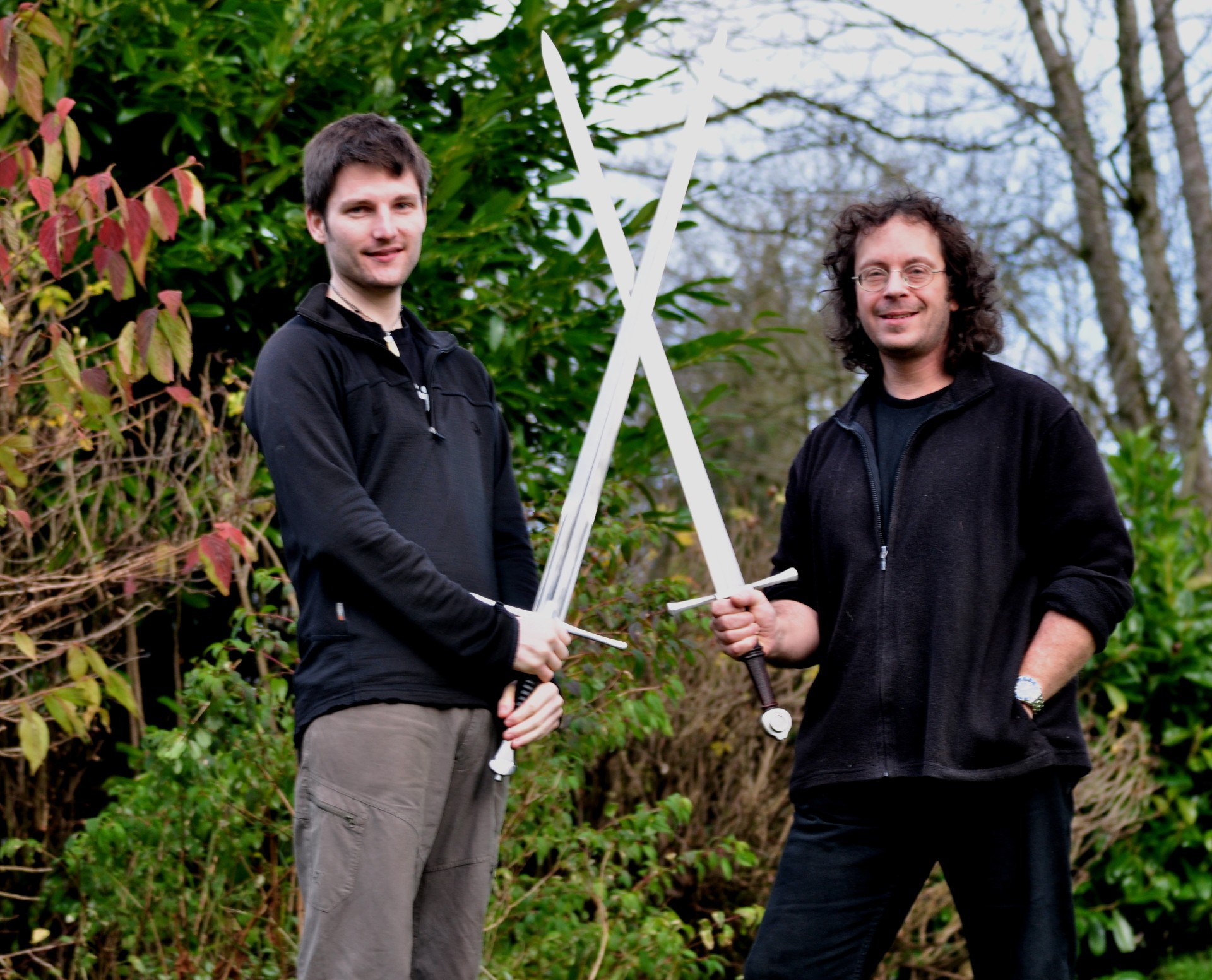
The Pilgrim’s Revenge is the first book in my new series introducing the character of Will the Bowman, or just Will Bowman. The story begins in the year 1190, when Will, a young Englishman, has his happy married life torn apart by marauding soldiers who raid his home, and he’s forced to join up with King Richard’s expedition to the Holy Land as a means of catching up with the villains who did it. Actually we don’t quite reach the Holy Land in Book 1 – that’s for the next. But I hope there’s plenty there to excite and interest the reader. I adore the medieval period – grew up in a historic town, wept as a child when taken to the spot in Rouen where they burned poor Jeanne d’Arc, later read medieval French at University, learned to play with great big swords and shoot a bow – but the whole crusades period has a particular fascination for me. And what could be more cool than the most iconic crusade of them all, the conquest that pitted Richard the Lionheart against the great Saladin? Will Bowman and his comrades get embroiled right in the thick of the drama, and it’s a ride! At any rate it has been for me. I hope readers will love it too . . .

How are you going to cope with the lack of guns? Will the body count be lower?

Are you kidding? We don’t need guns. We have bows and arrows that can pierce chain mail armour from a long way off; we have double-edged swords and scimitars that’ll whip off arms, legs and heads; we have great big siege catapults that can take down massive stone ramparts from two hundred paces; we have thundering great charges of heavy cavalry bearing down on the enemy with lances; we have crossbows and axes and flails and daggers and all sorts of goodies to play with! And did I mention Greek Fire? It’s like The Iliad out there . . . No question, the body count and general level of mayhem and destruction are considerably higher than anything in the Ben Hope books . . . not that that makes it better, of course!

Phew! That’s a relief!

What comes first, the story or the research?

When I was constantly hunting around for fresh material for the Ben Hope books, it was more a question of finding the basic idea first. That could come, and did come, from all kinds of possible places as I was (and am) constantly reading. The basic idea for The Mozart Conspiracy came about from an old book I’d had for years about Mozart’s last year and just happened to revisit one day. The Babylon Idol popped into my head while driving and listening to a Louis Armstrong gospel number about King Nebuchadnezzar’s golden idol. The Forgotten Holocaust, dealing with the Irish famine of 1847, was a subject I’d wanted to do for years and nearly did as a historical stand-alone because I’d no idea at first how to make it work as a Ben Hope book. But in general, that initial concept could come from anywhere. Then you’d have to delve a little deeper to see if your idea had any legs or not – sometimes it did, sometimes it didn’t and you’d need to go and find something else. From there, the story and the research would generally develop in parallel. There was no particular system, but I’m pleased to say it worked pretty well. Now with the Will Bowman series, the case is slightly altered: the historical backdrop dictates a lot about the trajectory of the storyline, and the depth of research required fleshes out what’s going on while also providing inspiration for new story and character angles. If you can get all those stars lined up for you, then it all happens in an organic kind of way that feels very natural.

Have you got the historical fiction bug now? What comes next?

This is going to be the shortest answer. Yes, for sure! What comes next? More Will Bowman books. I’ve got four to do to begin with, but I would like to do more. A lot more. Mustn’t jinx it by saying too much, though.

Are there any other eras – or writing genres – you would like to write about?

As I think anyone who’s read much of my backlist knows already, my historical interests are pretty wide-ranging. Who can say if something else would come up in the future? Never say never: and that goes for genres too. Right now, however, I’m very content to stay exactly where I am. I no longer have to worry about where I’m going next: I’m free to trace the story arc of Will Bowman for as long as I’m able to. What better way to create a truly immersive experience for readers interested in our rich and exciting past?

The Pilgrim’s Revenge will be available from 24 April 2025

Pre-order The Pilgrim’s Revenge.

About Scott Mariani:

Scott Mariani is the No.1 Sunday Times bestselling author of the multi-million-selling Ben Hope thrillers. From 2025 he is launching into a new historical adventure series featuring medieval English hero Will Bowman, who is forced from his home to join King Richard ‘the Lionheart’ on the Third Crusade and rises up to become a knight. Book 1,THE PILGRIM’S REVENGE, is available from April 2025 and is published by Hodder & Stoughton.

Scott lives and writes in west Wales, UK. You can find out more about his work by visiting his official website.

*

My books

Signed, dedicated copies of all my books are available through my online store.

Out now: Scotland’s Medieval Queens

Scotland’s history is dramatic, violent and bloody. Being England’s northern neighbour has never been easy. Scotland’s queens have had to deal with war, murder, imprisonment, political rivalries and open betrayal. They have loved and lost, raised kings and queens, ruled and died for Scotland. From St Margaret, who became one of the patron saints of Scotland, to Elizabeth de Burgh and the dramatic story of the Scottish Wars of Independence, to the love story and tragedy of Joan Beaufort, to Margaret of Denmark and the dawn of the Renaissance, Scotland’s Medieval Queens have seen it all. This is the story of Scotland through their eyes.

Available now from Amazon and Pen and Sword Books

Also by Sharon Bennett Connolly:

Heroines of the Tudor World tells the stories of the most remarkable women from European history in the time of the Tudor dynasty, 1485-1603. These are the women who ruled, the women who founded dynasties, the women who fought for religious freedom, their families and love. Heroines of the Tudor World is now available for pre-order from Amberley Publishing and Amazon UK. Women of the Anarchy demonstrates how Empress Matilda and Matilda of Boulogne, unable to wield a sword themselves, were prime movers in this time of conflict and lawlessness. It shows how their strengths, weaknesses, and personal ambitions swung the fortunes of war one way – and then the other. Available from Bookshop.orgAmberley Publishing and Amazon UKKing John’s Right-Hand Lady: The Story of Nicholaa de la Haye is the story of a truly remarkable lady, the hereditary constable of Lincoln Castle and the first woman in England to be appointed sheriff in her own right. Available from all good bookshops Pen & Sword Booksbookshop.org and Amazon

Defenders of the Norman Crown: The Rise and Fall of the Warenne Earls of Surrey tells the fascinating story of the Warenne dynasty, from its origins in Normandy, through the Conquest, Magna Carta, the wars and marriages that led to its ultimate demise in the reign of Edward III. Available from Pen & Sword BooksAmazon in the UK and US, and Bookshop.orgLadies of Magna Carta: Women of Influence in Thirteenth Century England looks into the relationships of the various noble families of the 13th century, and how they were affected by the Barons’ Wars, Magna Carta and its aftermath; the bonds that were formed and those that were broken. It is now available in paperback and hardback from Pen & SwordAmazon, and Bookshop.orgHeroines of the Medieval World tells the stories of some of the most remarkable women from Medieval history, from Eleanor of Aquitaine to Julian of Norwich. Available now from Amberley Publishing and Amazon, and Bookshop.orgSilk and the Sword: The Women of the Norman Conquest traces the fortunes of the women who had a significant role to play in the momentous events of 1066. Available now from Amazon,  Amberley Publishing, and Bookshop.org.

Alternate Endings: An anthology of historical fiction short stories including Long Live the King… which is my take what might have happened had King John not died in October 1216. Available in paperback and kindle from Amazon.

Podcast:

Have a listen to the A Slice of Medieval podcast, which I co-host with Historical fiction novelist Derek Birks. Derek and I welcome guests, such as Bernard Cornwell and Michael Jecks, and discuss a wide range of topics in medieval history, from significant events to the personalities involved. Every episode is also now available on YouTube.

*

Don’t forget! Signed and dedicated copies of all my books are available through my online store.

For forthcoming online and in-person talks, please check out my Events Page.

You can be the first to read new articles by clicking the ‘Follow’ button, liking our Facebook page or joining me on TwitterThreadsBluesky and Instagram.

*

©2025 Sharon Bennett Connolly, FRHistS and Scott Mariani

Guest Post: The Book and the Duchess by Katarzyna Ogrodnik-Fujcik

Last month, we lost one of the great historians of medieval history, Martin Aurell. A few years ago, I had the honour of translating one of Martin’s essays on Eleanor of Aquitaine for a compilation on England’s medieval queens. He had a wonderful insight into Eleanor and I would have loved to meet him. So, when my dear friend Kasia asked if I would publish her tribute to Martin, I jumped at the chance.

The Book and the Duchess: Eleanor of Aquitaine and her Artistic Legacy….

In memory of Professor Martin Aurell

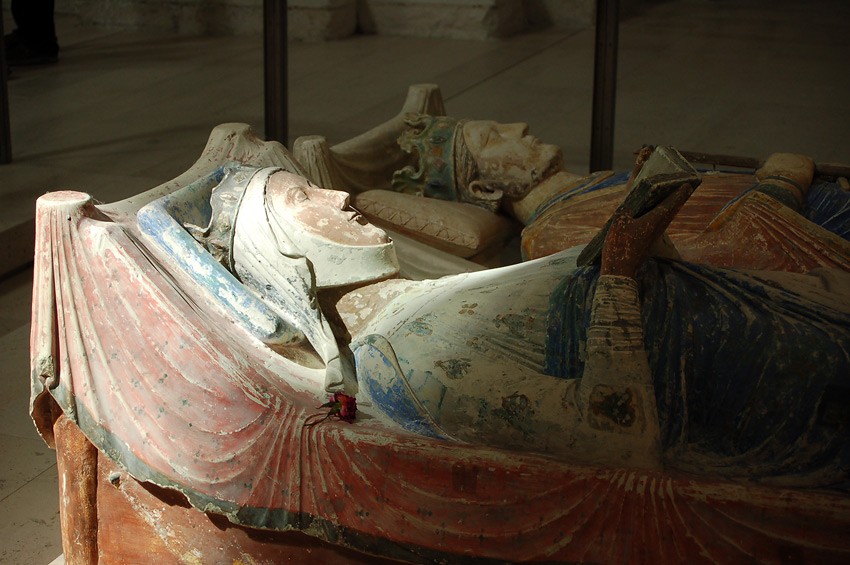
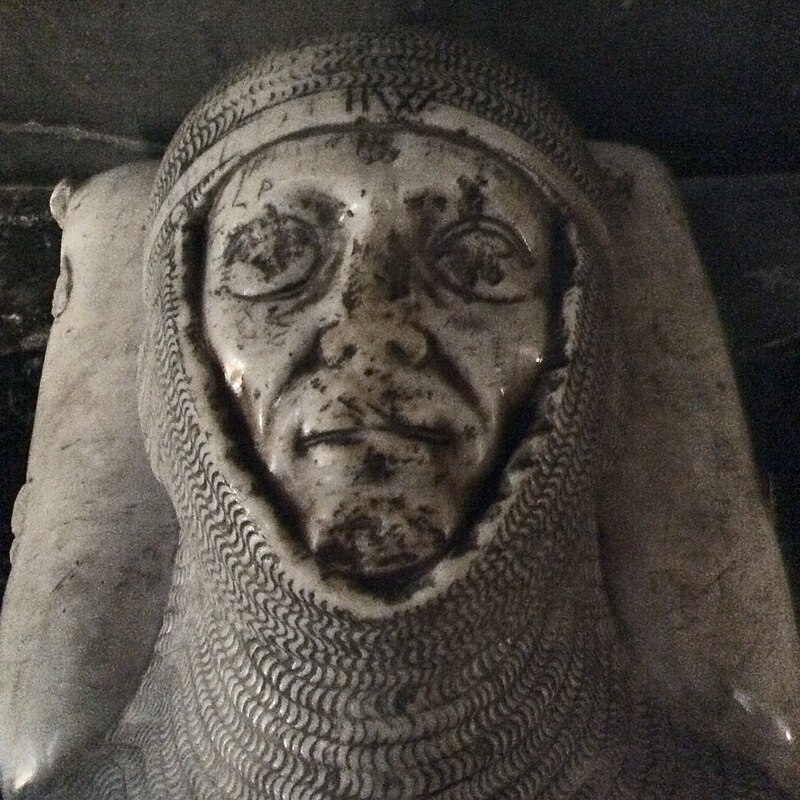
Eleanor of Aquitaine’s tomb effigy, Fontevraud Abbey

Richard of Devizes called her femina incomparabilis “a woman without compare” and in many respects she was. Queen of both France and England respectively, duchess of a great duchy in her own right, rebel wife who openly went to war against her husband, Eleanor of Aquitaine needs no introduction. And yet very little is actually known about one of the most famous women in history. Thus we should not find it surprising that all the myths and misconceptions about her got so firmly established in the popular consciousness. One of them is Eleanor as a very active artistic patron. However, if we raise the question, her artistic legacy is rather modest. There are only few surviving objects that can be safely associated with her.

First and foremost, there is her tomb effigy at Fontevraud Abbey, which is the earliest funerary monument that we know of to depict a woman with a book. Also, as it seems, it is the only one to depict a man or a woman in the act of reading. The book Eleanor is holding is a restoration. The original had been destroyed during the Revolution. It is probably devotional work…. book of prayers, psalter or gospel book.

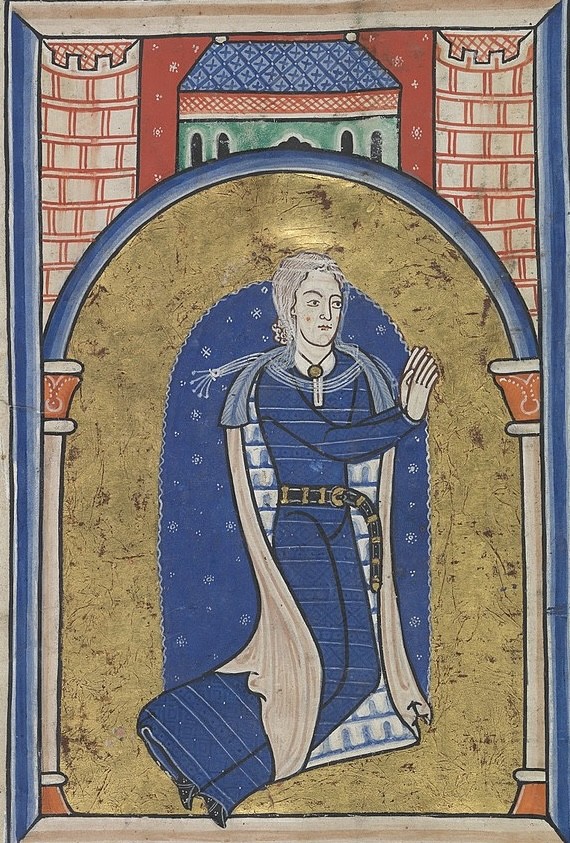
A noble lady kneeling in a psalter of Eleanor of Aquitaine

The effigy is one of the few instances when Eleanor can be safely identified as an artistic patron. She most probably commissioned it herself. Also the effigies of Henry II and Richard I the Lionheart (the one of Isabelle of Angouleme was commissioned more than forty years later) which were created at the same time (as stylistic similarities indicate). Made from tuffeau limestone from the Loire valley they successfully stood the test of time. despite different vagaries of history. What makes us believe Eleanor was a commissioner? First and foremost, Eleanor’s presence at Fontevraud Abbey at the time. After Richard’s death in 1199 she left the walls of the abbey, but stayed in Anjou, defending it for John. Later she retreated to the abbey again and spent her last years there. The effigies must have been created between the death of Richard and her own death in 1204 (also the year Anjou fell to the Capetians).

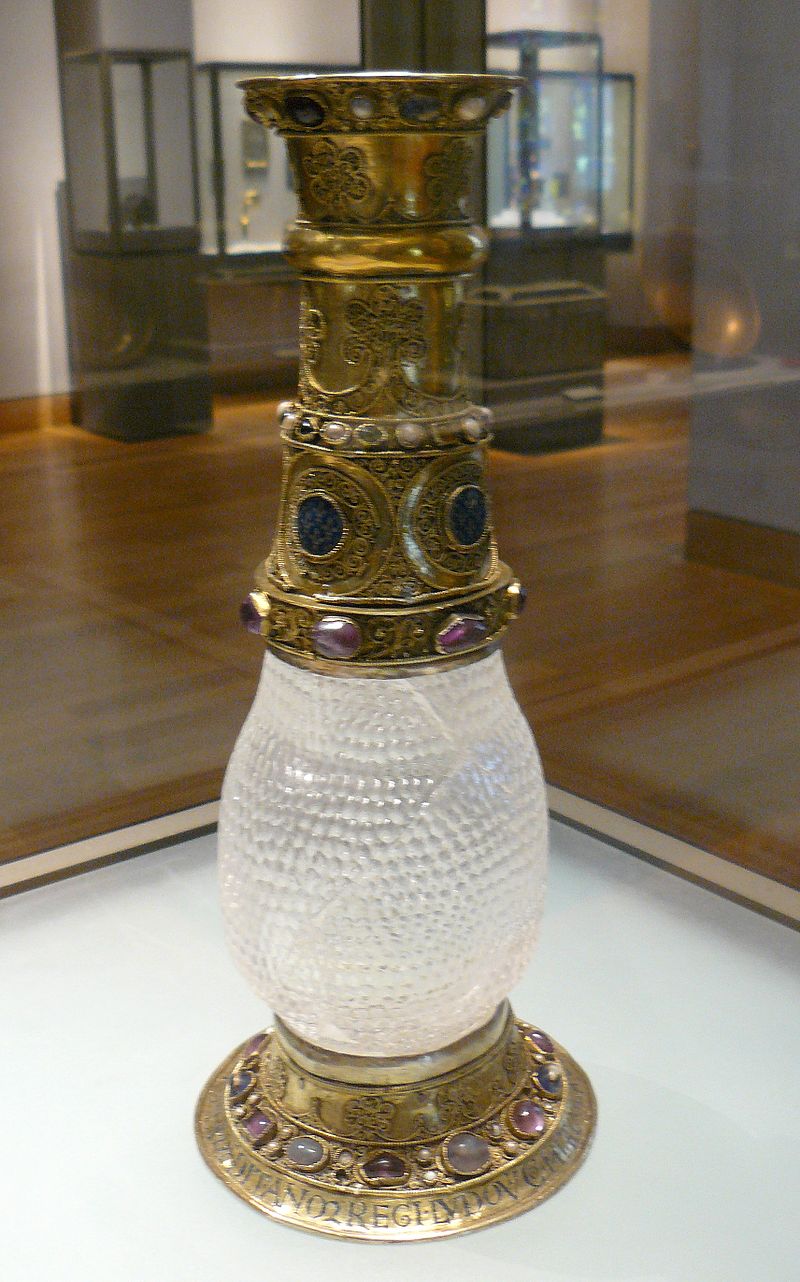
Another object connected with Eleanor is the afore-mentioned Eleanor’s vase, which was a wedding gift she presented to her first husband Louis VII of France. It had stayed in her family since the reign of her famous/infamous grandfather, William IX the Troubadour, who had brought it with him from Spain. Louis gave it to Abbot Suger as a gift for St Denis. Suger added all the ornamentation. It was a classic crystal rock vessel when Eleanor presented it to Louis.

Another work of art associated with Eleanor is the so-called Fecamp Psalter (or Psalter of Eleanor of Aquitaine), one of the oldest manuscripts preserved at the Dutch Royal Library at the Hague. With 27 full-page miniatures, 36 calendar miniatures depicting the Labours of the Months, and 11 historiated initials illustrating the major divisions of the psalter it is exquisitely beautiful. By the end of the 11th century Fécamp was a leading centre for manuscript copying in Normandy and in the late 12th century (c. 1180) this beautifully illuminated psalter was probably commissioned by Eleanor herself. In 2016 student Jesus Rodriguez Veijo identified the figure on the Beatus page of the psalter with Eleanor, relying in part on the scholarship relating to the Radegonde mural. You can view the manuscript on the official site of Koninklijke Bibliotheek, Hague.

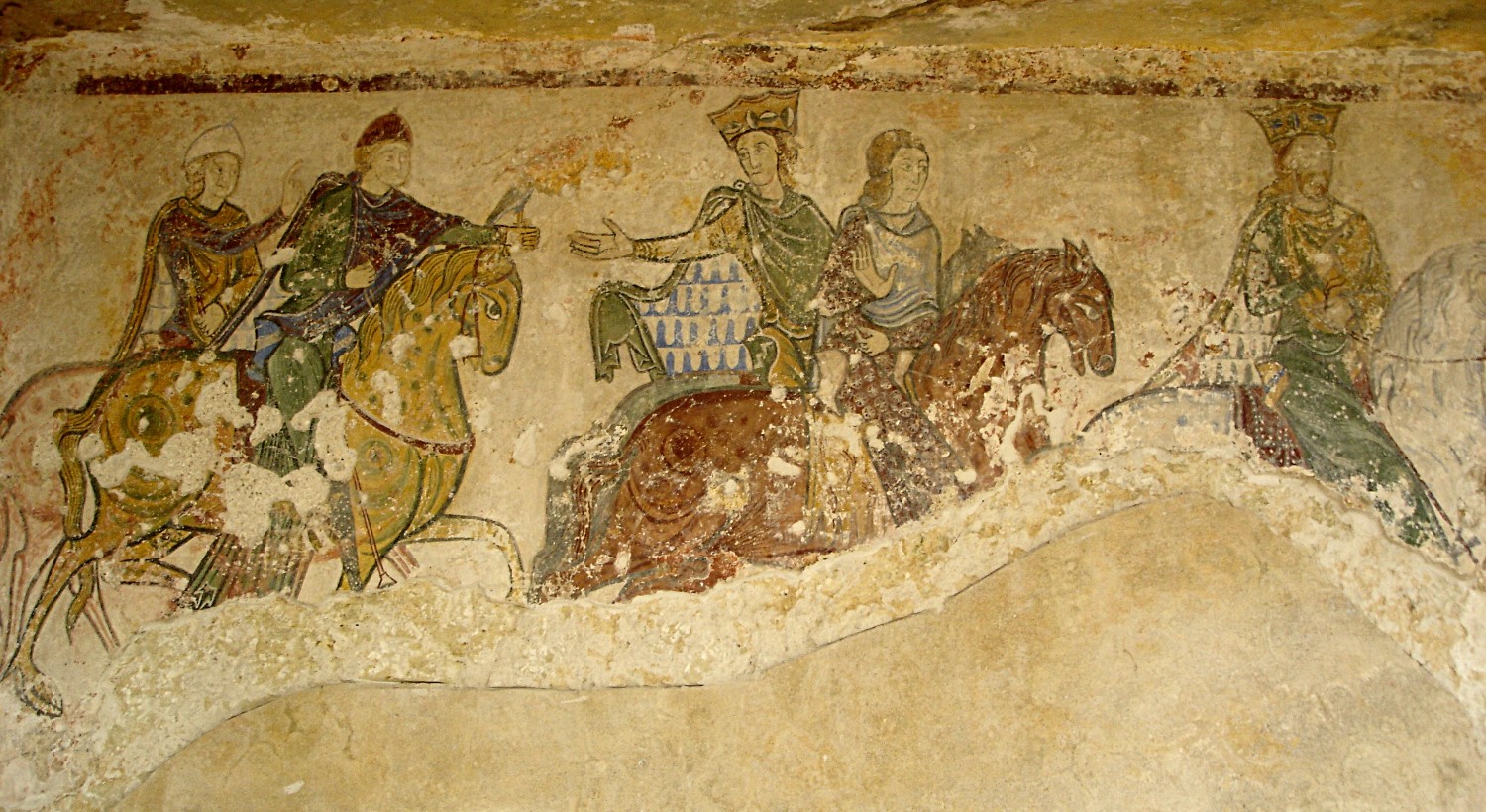
An image of the chase in a fresco in the chapel of St Radegonde

The so-called Poitiers Window is one of the few contemporary depictions of Eleanor. She, Henry and their four sons are shown in a small scene, being a part of a larger depiction of Crucifixion, in the area reserved for patrons. Eleanor and Henry hold an image that represents the window itself. This image is not a part of the original, but a result of 19th-century restoration by Adolphe Steiheil. The window must have been commissioned between 1166 and 1173, the birth of John and the outbreak of the Great Revolt, when the royal family was still undivided.

The famous Radegonde Mural preserved in the chapel of Sainte Radegonde, Chinon has been a subject of heated debates since its discovery in 1964 by Albert Heron. This representation has been widely accepted as a depiction of the Plantagenet family, identifying the central ”crowned” figure as Eleanor. Later research, however, helped to determine that all the figures were actually male. This led the historians to believe that the central crowned figure was in fact Eleanor’s eldest surviving son, Henry the Young King.

The Eleanor Vase

In her article entitled Two reputed representations of Eleanor of Aquitaine from her lifetime – a re-evaluation Sara Cockerill, the author of the latest Eleanor biography, revisits the evidence for both these representations and formulates yet one more theory that the scene is in fact a representation of the characters from St Radegonde’s legend. This led her to the following conclusion: while the same person may well have commissioned both depictions, only one, the Psalter, should be regarded as attempting to portray Eleanor herself.

By Katarzyna Ogrodnik-Fujcik

About the author:

Katarzyna Ogrodnik-Fujcik specializes in British literature and history, her area of expertise being the first Plantagenets (the Angevins). She lives in Poland. She writes for different magazines and websites on Polish and European Middle Ages. She runs a blog dedicated to Henry the Young King. She consulted a BBC documentary on William Marshal.

*

My books

Signed, dedicated copies of all my books are available through my online store.

Out now: Scotland’s Medieval Queens

Scotland’s history is dramatic, violent and bloody. Being England’s northern neighbour has never been easy. Scotland’s queens have had to deal with war, murder, imprisonment, political rivalries and open betrayal. They have loved and lost, raised kings and queens, ruled and died for Scotland. From St Margaret, who became one of the patron saints of Scotland, to Elizabeth de Burgh and the dramatic story of the Scottish Wars of Independence, to the love story and tragedy of Joan Beaufort, to Margaret of Denmark and the dawn of the Renaissance, Scotland’s Medieval Queens have seen it all. This is the story of Scotland through their eyes.

Available now from Amazon and Pen and Sword Books

Also by Sharon Bennett Connolly:

Heroines of the Tudor World tells the stories of the most remarkable women from European history in the time of the Tudor dynasty, 1485-1603. These are the women who ruled, the women who founded dynasties, the women who fought for religious freedom, their families and love. Heroines of the Tudor World is now available for pre-order from Amberley Publishing and Amazon UK. Women of the Anarchy demonstrates how Empress Matilda and Matilda of Boulogne, unable to wield a sword themselves, were prime movers in this time of conflict and lawlessness. It shows how their strengths, weaknesses, and personal ambitions swung the fortunes of war one way – and then the other. Available from Bookshop.orgAmberley Publishing and Amazon UKKing John’s Right-Hand Lady: The Story of Nicholaa de la Haye is the story of a truly remarkable lady, the hereditary constable of Lincoln Castle and the first woman in England to be appointed sheriff in her own right. Available from all good bookshops Pen & Sword Booksbookshop.org and Amazon

Defenders of the Norman Crown: The Rise and Fall of the Warenne Earls of Surrey tells the fascinating story of the Warenne dynasty, from its origins in Normandy, through the Conquest, Magna Carta, the wars and marriages that led to its ultimate demise in the reign of Edward III. Available from Pen & Sword BooksAmazon in the UK and US, and Bookshop.orgLadies of Magna Carta: Women of Influence in Thirteenth Century England looks into the relationships of the various noble families of the 13th century, and how they were affected by the Barons’ Wars, Magna Carta and its aftermath; the bonds that were formed and those that were broken. It is now available in paperback and hardback from Pen & SwordAmazon, and Bookshop.orgHeroines of the Medieval World tells the stories of some of the most remarkable women from Medieval history, from Eleanor of Aquitaine to Julian of Norwich. Available now from Amberley Publishing and Amazon, and Bookshop.orgSilk and the Sword: The Women of the Norman Conquest traces the fortunes of the women who had a significant role to play in the momentous events of 1066. Available now from Amazon,  Amberley Publishing, and Bookshop.org.

Alternate Endings: An anthology of historical fiction short stories including Long Live the King… which is my take what might have happened had King John not died in October 1216. Available in paperback and kindle from Amazon.

Podcast:

Have a listen to the A Slice of Medieval podcast, which I co-host with Historical fiction novelist Derek Birks. Derek and I welcome guests, such as Bernard Cornwell and Michael Jecks, and discuss a wide range of topics in medieval history, from significant events to the personalities involved. Every episode is also now available on YouTube.

*

Don’t forget! Signed and dedicated copies of all my books are available through my online store.

For forthcoming online and in-person talks, please check out my Events Page.

You can be the first to read new articles by clicking the ‘Follow’ button, liking our Facebook page or joining me on TwitterThreadsBluesky and Instagram.

*

©2025 Sharon Bennett Connolly, FRHistS and Katarzyna Ogrodnik-Fujcik

The Works of Marie de France

Marie de France from an illuminated manuscript

If you have visited the British Library’s latest exhibition, Medieval Women: In Their Own Words, you may have spotted the work of Marie de France. Marie was a poet in the late 12th century, who wrote three major works that can be definitively attributed to her, even though we don’t know who she was. All that is left of Marie is her work, and the vague notion that she comes from France, because she wrote in her Fables ‘Marie ai num, si sui de France’.1 The traditional view is that Marie was a Frenchwoman writing at the court of Henry II of England based on the fact that if she was writing in France, she wouldn’t have to say that she was from that country. However, France in the 12th century was far from one unified, indivisible country. In fact, it was a series of counties and duchies with their own rulers, who paid homage to the King of France; the French king’s own domains at the time were the Île-de- France, which incorporated Paris and its environs.

Another argument for Marie writing in England, is that her lais, her poetic verses, were dedicated to a ‘noble reis’, or ‘noble king’, and this is thought to be Henry II of England. However, it could just as easily been intended for Louis VII of France, or his son Philip II Augustus. In turn the Fables, an adaptation of Aesop’s Fables, were dedicated to a nobleman she identifies as ‘Count William’. There were several earls in England at the time who were named William, including William Marshal, Earl of Pembroke; William Longspée, Earl of Salisbury; and William Mandeville, Earl of Essex; or even the son of King Stephen, William of Blois, Earl of Warenne and Surrey. However, William was a common name at the time, even on the Continent, where you could find many a Guillaume.

Everything we think we know about who Marie was is pure conjecture. It has even been suggested that she was the illegitimate daughter of Geoffrey of Anjou, father of Henry II, and therefore a half-sister of Henry. She has also been variously identified as a nun at Reading Abbey, the abbess of Shaftesbury between 1181 and 1216, and Marie de Meulan, wife of Hugh Talbot of Cleuville.2 We do know that Marie had a knowledge of Latin and English, and a familiarity with the works of Ovid and Wace’s Brut, and wrote in an Anglo-Norman French.

“Marie de France presents her book of poems to Henry II of England” by Charles Abraham Chasselat

Her works have been dated to the second half of the 12th century, with her poetry, the lais, dating between 1160 and 1199, the Fables between 1160 and 1190, and her last work, the Espurgatoire, has been dated to after 1189 and possibly as late as 1215.3 L’Espurgatoire Seint Patriz (The Purgatory of St Patrick) is believed to have been written after 1189 as it appears to have been heavily reliant on the Latin text of Henry of Saltrey as her source, which was published around 1185. L’Espurgatoire is dedicated to ‘H. abbot of Sartis’, who may have been Hugh, Abbot of Wardon Abbey, in Bedfordshire, between 1173 and 1185 or 1186; the abbey was originally named St Mary de Sartis.4 The only surviving manuscript of this treatise is now stored in the Bibliothèque Nationale in Paris.

The lais were a series of twelve poems, many of which were drawn from Celtic legends. Only one is based on Arthurian legends, specifically the story of the lovers, Tristan and Iseult. Many of the lais were translated into Old Norse in the 13th century, while two, Lanval and Le Fresne were translated and adapted into Middle English in the 14th century. The lais were narratives, written in verse and intended to be set to music. One such included the lines; ‘when a good thing is well known, it flowers for the first time, and when it is praised by many, its flowers have blossomed.’5

Marie’s stories included fairy mistresses, twins separated at birth, and one relating the troubles of the wife of a werewolf. Her lais explored love and conflicting loyalties; they dealt with the issues of courtly behaviour and documented the struggles to fulfil the conflicting aims of individual needs and cultural expectations. They varied in length, with the shortest, Chevrefoil, having 118 lines and the longest, Eliduc, comprising 1,184 lines; this last was the story of a wife having to adapt when her husband brings home a second wife.

The Woman and the Wolf in Marie de France’s “Bisclavret”

Marie’s collection of Fables, known as Ysopets in French and written for the mysterious ‘Count William’, are based on the older Aesop’s Fables, from antiquity, but she also adapted and added to the original stories. The Fables, a rhyming collection of works, demonstrate Marie’s concern for the well-being of the lower classes and the poor, criticising the political and social conditions of the time. Her work was widely read and influential; the fable Del cok e del gupil (The Cock and the Fox) is one of the inspirations for Geoffrey Chaucer’s The Nun’s Priest’s Tale, written in the 15th century. Marie ends The Fables with an epilogue, in which she includes a plea to be remembered,

To end these tales I’ve here narrated
And into Romance tongue translate,
I’ll give my name for memory:
I am from France, my name’s Marie.
And it may hap that many a clerk
Will claim as his what is my work.
But such pronouncements I want not!
It’s folly to become forgot!6

Wherever she came from, geographically and socially, Marie de France was a keen observer of the social undercurrents of the time, incorporating them into her Lais and Fables. And we cannot say for certain that her work was produced in England, at the English court. With the Anglo-Norman empire stretching from the borders of Scotland to the borders of Spain she may have travelled within Henry II’s domains, but not necessarily with the court. Although we have few clues to her identity and origins, at least we have her works – her poetry through which she has lived on for more than eight centuries.

Notes:

1. ‘My name is Marie and I am from France’, quoted in Rethinking Marie by Dinah Hazell; 2. Marie (fl. c.1180–c.1189) (article) by Tony Hunt; 3. Rethinking Marie by Dinah Hazell 4. Marie (fl. c.1180–c.1189) (article) by Tony Hunt; 5. The Plantagenet Chronicles edited by Elizabeth Hallam; 6. Translated from; ‘Al finement de cest escrit, Que en romanz ai treité e dit, Me numerai pur remembrance: Marie ai num, si sui de France. Put cel ester que clerc plusur Prendreient sur eus mun labur. No voil que nul sur li le die! E il fet que fol ki sei ublie!’ Taken from Marie de France: Fables, edited and translated by Harriet Spiegel.

Images: Courtesy of Wikipedia

    Sources:

    Marie de France: Fables, edited and translated by Harriet Spiegel; Dinah Hazell, Rethinking Marie, (article) sfsu.edu; Tony Hunt, Marie (fl. c.1180–c.1189) (article), ODNB; Elizabeth Hallam, editor, The Plantagenet Chronicles;  The Plantagenets, the Kings who Made England by Dan Jones; History Today Companion to British History Edited by Juliet Gardiner and Neil Wenborn; he Plantagenets, the Kings that made Britain by Derek Wilson; England Under the Norman and Angevin Kings  by Robert Bartlett; Roy Strong The Story of Britain.

    *

    My Books:

    Signed, dedicated copies of all my books are available through my online bookshop.

    Coming 30 January 2025: Scotland’s Medieval Queens

    Scotland’s history is dramatic, violent and bloody. Being England’s northern neighbour has never been easy. Scotland’s queens have had to deal with war, murder, imprisonment, political rivalries and open betrayal. They have loved and lost, raised kings and queens, ruled and died for Scotland. From St Margaret, who became one of the patron saints of Scotland, to Elizabeth de Burgh and the dramatic story of the Scottish Wars of Independence, to the love story and tragedy of Joan Beaufort, to Margaret of Denmark and the dawn of the Renaissance, Scotland’s Medieval Queens have seen it all. This is the story of Scotland through their eyes.

    Available for pre-order now.

    Also by Sharon Bennett Connolly:

    Heroines of the Tudor World tells the stories of the most remarkable women from European history in the time of the Tudor dynasty, 1485-1603. These are the women who ruled, the women who founded dynasties, the women who fought for religious freedom, their families and love. Heroines of the Tudor World is now available for pre-order from Amberley Publishing and Amazon UK. Women of the Anarchy demonstrates how Empress Matilda and Matilda of Boulogne, unable to wield a sword themselves, were prime movers in this time of conflict and lawlessness. It shows how their strengths, weaknesses, and personal ambitions swung the fortunes of war one way – and then the other. Available from Bookshop.orgAmberley Publishing and Amazon UKKing John’s Right-Hand Lady: The Story of Nicholaa de la Haye is the story of a truly remarkable lady, the hereditary constable of Lincoln Castle and the first woman in England to be appointed sheriff in her own right. Available from all good bookshops Pen & Sword Booksbookshop.org and Amazon

    Defenders of the Norman Crown: The Rise and Fall of the Warenne Earls of Surrey tells the fascinating story of the Warenne dynasty, from its origins in Normandy, through the Conquest, Magna Carta, the wars and marriages that led to its ultimate demise in the reign of Edward III. Available from Pen & Sword BooksAmazon in the UK and US, and Bookshop.orgLadies of Magna Carta: Women of Influence in Thirteenth Century England looks into the relationships of the various noble families of the 13th century, and how they were affected by the Barons’ Wars, Magna Carta and its aftermath; the bonds that were formed and those that were broken. It is now available in paperback and hardback from Pen & SwordAmazon, and Bookshop.orgHeroines of the Medieval World tells the stories of some of the most remarkable women from Medieval history, from Eleanor of Aquitaine to Julian of Norwich. Available now from Amberley Publishing and Amazon, and Bookshop.orgSilk and the Sword: The Women of the Norman Conquest traces the fortunes of the women who had a significant role to play in the momentous events of 1066. Available now from Amazon,  Amberley Publishing, and Bookshop.org.

    Alternate Endings: An anthology of historical fiction short stories including Long Live the King… which is my take what might have happened had King John not died in October 1216. Available in paperback and kindle from Amazon.

    Podcast:

    Have a listen to the A Slice of Medieval podcast, which I co-host with Historical fiction novelist Derek Birks. Derek and I welcome guests, such as Bernard Cornwell, and discuss a wide range of topics in medieval history, from significant events to the personalities involved.

    *

    Don’t forget! Signed and dedicated copies of all my books are available through my online bookshop.

    For forthcoming online and in-person talks, please check out my Events Page.

    You can be the first to read new articles by clicking the ‘Follow’ button, liking our Facebook page or joining me on TwitterThreadsBluesky and Instagram.

    ©2024 Sharon Bennett Connolly FRHistS

    Guest Post: In the Footsteps of Royalty: Exploring the Plantagenets on Our First Historic Adventure by Maxine Sommer

    Today, it is a pleasure to welcome my friend Maxine Sommer back to History…the Interesting Bits. This summer, Maxine led a tour group of History fans through France in search of the Plantagenets, stopping at some iconic landmarks associated with Henry II, Eleanor of Aquitaine and the rest of the most famous – and at times, infamous – medieval royal family.

    Over to Maxine….

    In the Footsteps of Royalty: Exploring the Plantagenets on Our First Historic Adventure

    “Journeying Through Medieval Masterpieces and Iconic Landmarks”

    Château Gaillard: A Castle of Triumph and Tragedy

    Château Gaillard

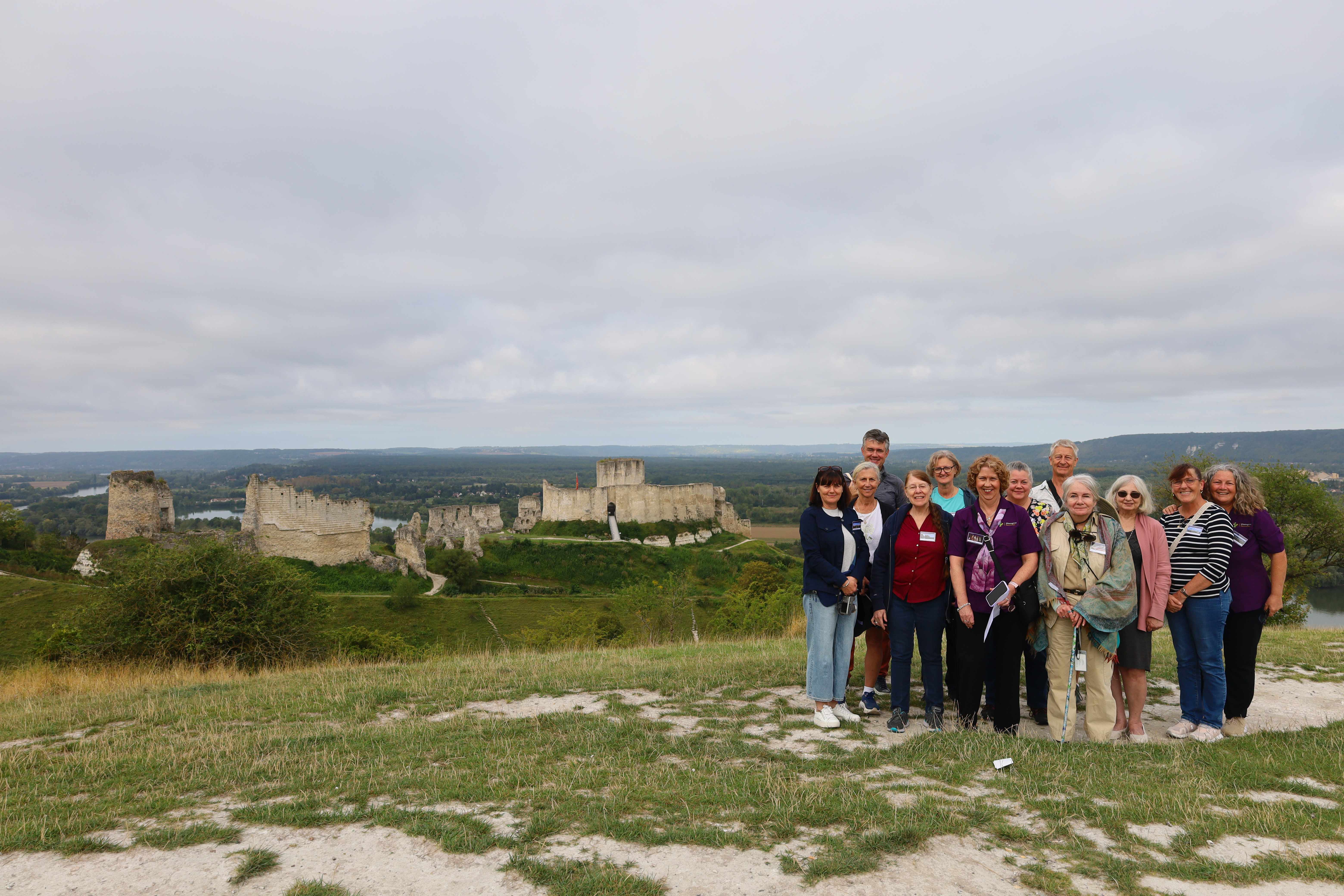
    From day one, we dove into history headfirst with a visit to the imposing ruins of Château Gaillard. Though often hailed as Richard the Lionheart’s crowning achievement, this fortress holds layers of much more history than that. In 1314, it became the prison of two daughters-in-law of King Philip IV, key figures in the infamous Tour de Nesle Affair, a scandal that rocked the French court. A couple of decades later, the castle played host to Scotland’s child king, David II, and his bride, offering a royal respite before his return to reclaim his kingdom.

    With the help of our brilliant guide Ange, we traced the rise and fall of Chateau Gaillard, from its hasty construction under Richard I to its swift capture by King Philip Augustus of France after John’s ill-fated reign. Standing among the weathered stone walls, it was easy to imagine its days of glory and power, but also to understand how quickly a once-unstoppable fortress could be toppled under weaker leadership. Chateau Gaillard’s story is not just one of medieval might but also a reminder of the delicate balance of power that shaped the Plantagenet era.

    The Magnificent Bayeux Tapestry: A Stitch in Time

    Though the Bayeux Tapestry predates the Plantagenets by nearly a century, it remains an essential highlight for anyone captivated by the medieval period. No amount of reading can prepare you for the sheer grandeur of this stunning masterpiece, meticulously crafted by hand to narrate the dramatic lead-up to the Norman invasion of England. The vibrant details leap to life, showcasing a vivid display that is nothing short of extraordinary.

    One moment that particularly struck me was a scene depicting King Harold’s hasty departure for Normandy—his men, so rushed, they left without their shoes, splashing barefoot through the water as they headed to their ships. It’s these small yet poignant details that bring the narrative to life, showcasing the dedication of the women who painstakingly wove this epic tale.

    Beyond the tapestry itself, the adjoining museum is a treasure trove of information, shedding light not just on this remarkable artifact but also on the broader historical context of the era. Visiting the Bayeux Tapestry is an unforgettable experience that will truly immerse you in the rich history of Normandy.

    Mont Saint-Michel: A Dreamlike Retreat

    Mont St Michel

    This tidal island certainly lives up to its UNESCO World Heritage status, sadly though, as with most sites like this, the allure of their fame can bring overwhelming crowds, making it challenging to fully appreciate their beauty. To create an unforgettable experience for my group, I arranged for us to stay overnight on the island—a decision that transformed our visit into something truly magical. As the day’s tourists departed, we found ourselves wandering the winding paths of Mont Saint-Michel in peaceful solitude. The island’s enchanting atmosphere became even more pronounced as twilight descended, allowing us to immerse ourselves in its rich history without the jostle of crowds.

    The journey across the causeway to Mont Saint-Michel feels like a step back in time, as the abbey loomed larger, the closer we got to the gate. Approaching the island in this way adds to the otherworldly feeling, transporting you to a different realm entirely.

    One of my guests, Dianne, perfectly captured the essence of our experience in her review: “The highlight for me was staying overnight on the island of Mont Saint-Michel. I will never forget watching the sun come up and the light making the abbey glow.” Her words echo the indescribable wonder we all felt, creating memories that will last a lifetime.

    Fontevraud Abbey: Where History, Serenity, and Culinary Splendour Meet

    Queen Eleanor at the Abbey

    For anyone captivated by the Plantagenets, a visit to Fontevraud Abbey—final resting place of the indomitable Eleanor of Aquitaine—is often a dream come true. Several of my group members had long wished to stand before her effigy, so it was clear that this site would be a highlight of our tour. Yet, what awaited us at Fontevraud far exceeded expectations.

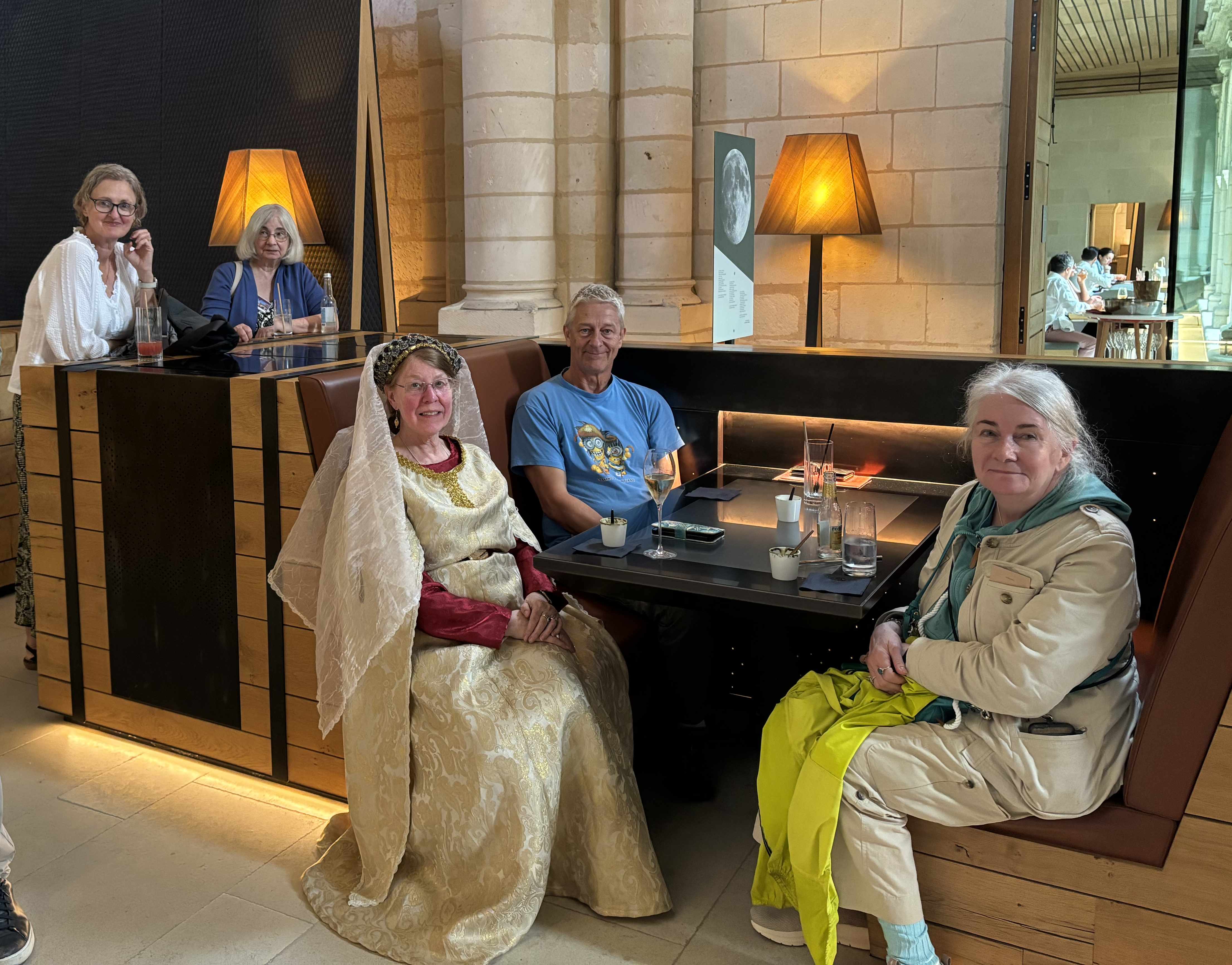
    Our stay at Fontevraud l’Hôtel, situated within the abbey grounds, offered the unique luxury of exploring the abbey well into the night, with its tranquil beauty only deepening as the moonlight bathed its ancient stones. But what truly made this visit unforgettable was the dining experience. I selected the abbey’s famed “lunar menu,” a modern interpretation of the simple yet refined meals once enjoyed by the monks and nuns who lived here centuries ago. What followed was a culinary journey that transcended time—an extraordinary feast of countless, artfully prepared courses that delighted the senses.

    To top it all off, we were treated to a special visit from “Queen Eleanor” herself, brought to life by our talented group member Donna in costume, creating an enchanting atmosphere that perfectly rounded out our unforgettable night at the Abbey.

    Guédelon: A Medieval Masterpiece in the Making

    Guedelon Medieval Site

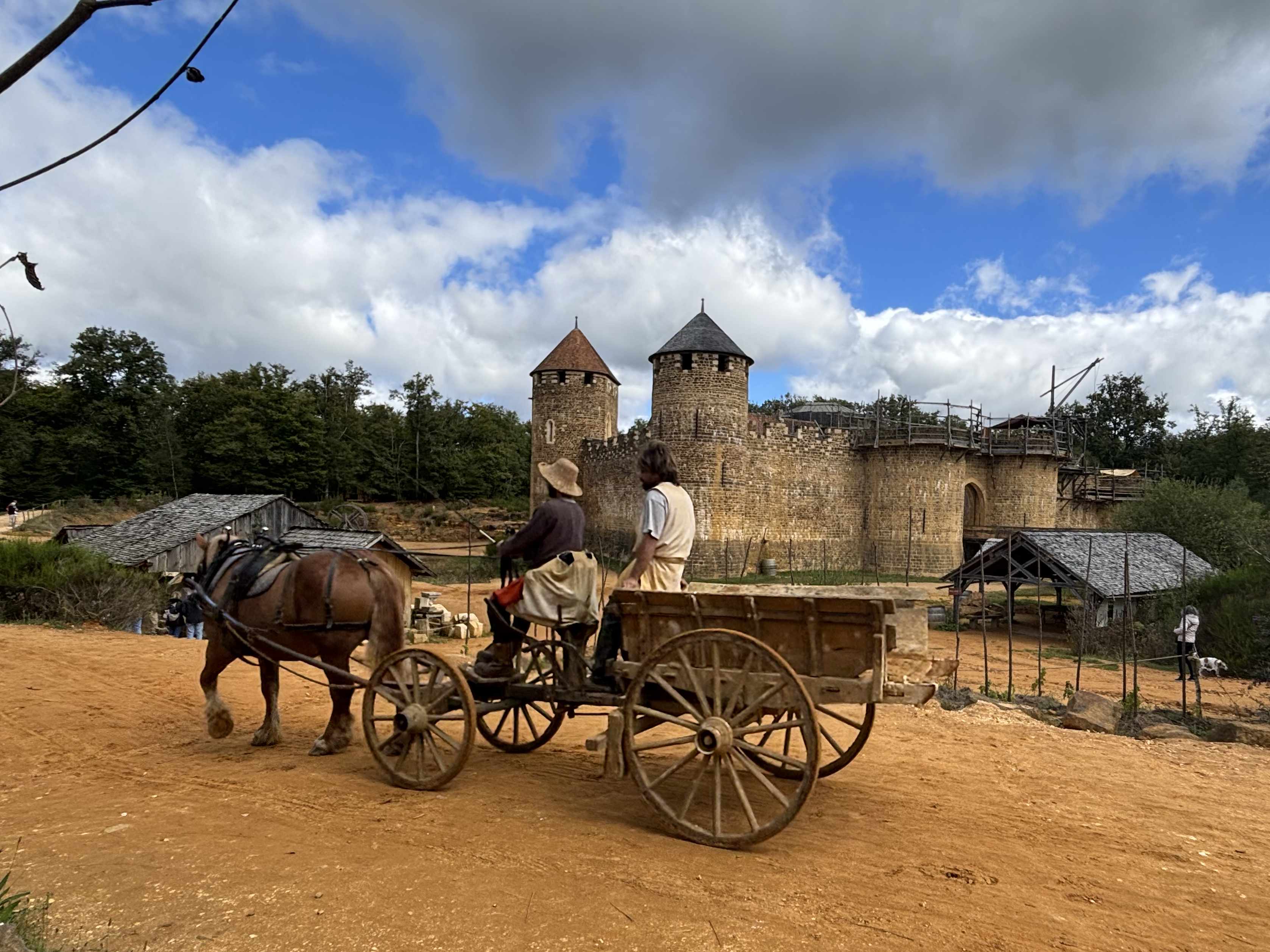
    Though its connection to the Plantagenets lies only in the era, Guédelon captivated us with its sheer ambition and authenticity. This extraordinary project, set within an unused quarry, is an ongoing attempt to build a 13th-century castle using only the materials and techniques of the medieval period. It was like stepping back in time—without the school excursion chaos! We had the chance to speak with the craftsmen, each dedicated to recreating history one stone at a time. It’s mind-boggling to witness the painstaking effort that goes into building each section of the castle by hand, giving us a new appreciation for the scale of historical construction.

    As we walked through Guédelon, I couldn’t help but reflect on Château Gaillard, which we visited earlier in the tour—a fortress that Richard the Lionheart had built in just two years. While Richard’s team had far more manpower in 1196, the ongoing construction of Guédelon, which began in 1997, has taken 27 years and is still far from complete.

    Adding to the authenticity, the village that houses the volunteers lives strictly by 13th-century standards. They grow their own food, dress in period-appropriate clothing, and cook using medieval techniques. It’s a living glimpse into the past and an absolute must-visit for history enthusiasts.

    “Unraveling the Tales of an Intriguing Plantagenet Legacy”

    Richard I, the Lionheart

    Château Châlus-Chabrol

    A Plantagenet-themed tour through France wouldn’t be complete without constant references to the Angevins. Unsurprisingly, Richard the Lionheart was a recurring figure throughout our journey, from the stunning ruins of Château Gaillard—Richard’s pride and joy—to his embalmed heart at Rouen Cathedral, and finally to Château Châlus-Chabrol, where he met his end after receiving a fatal crossbow wound. Along the way, there were lively debates about his merits as a king and husband, discussions that seemed to spill over into several coach rides and castle visits!

    But the most amusing conversation of all came after our visit to Château Châlus-Chabrol. According to local legend, Richard’s entrails were buried in the chapel of the castle where he died, the very castle he had been besieging when he was fatally wounded. As we travelled on, our group began to ponder this curious story—if Richard was the enemy, how likely was it that the castle’s defenders would have invited him into their chapel to die comfortably by the fire? Surely, the reality was less cozy than that! This debate sparked plenty of laughs and camaraderie, as we cheerfully unraveled the mystery of Richard’s final days. It was moments like this that truly made the tour so memorable, blending history with humour and shared insights.

    Henry II

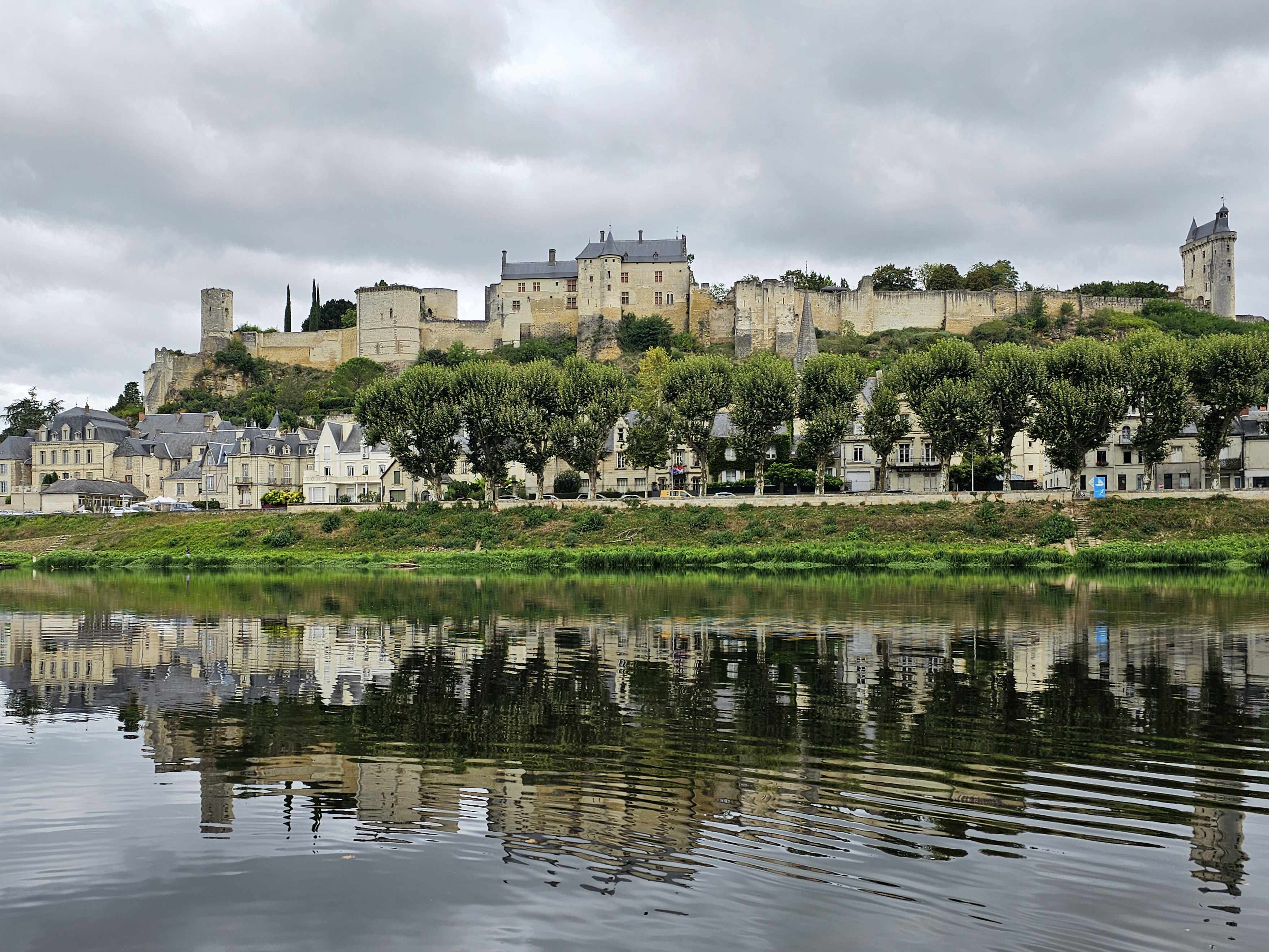
    Chinon Castle

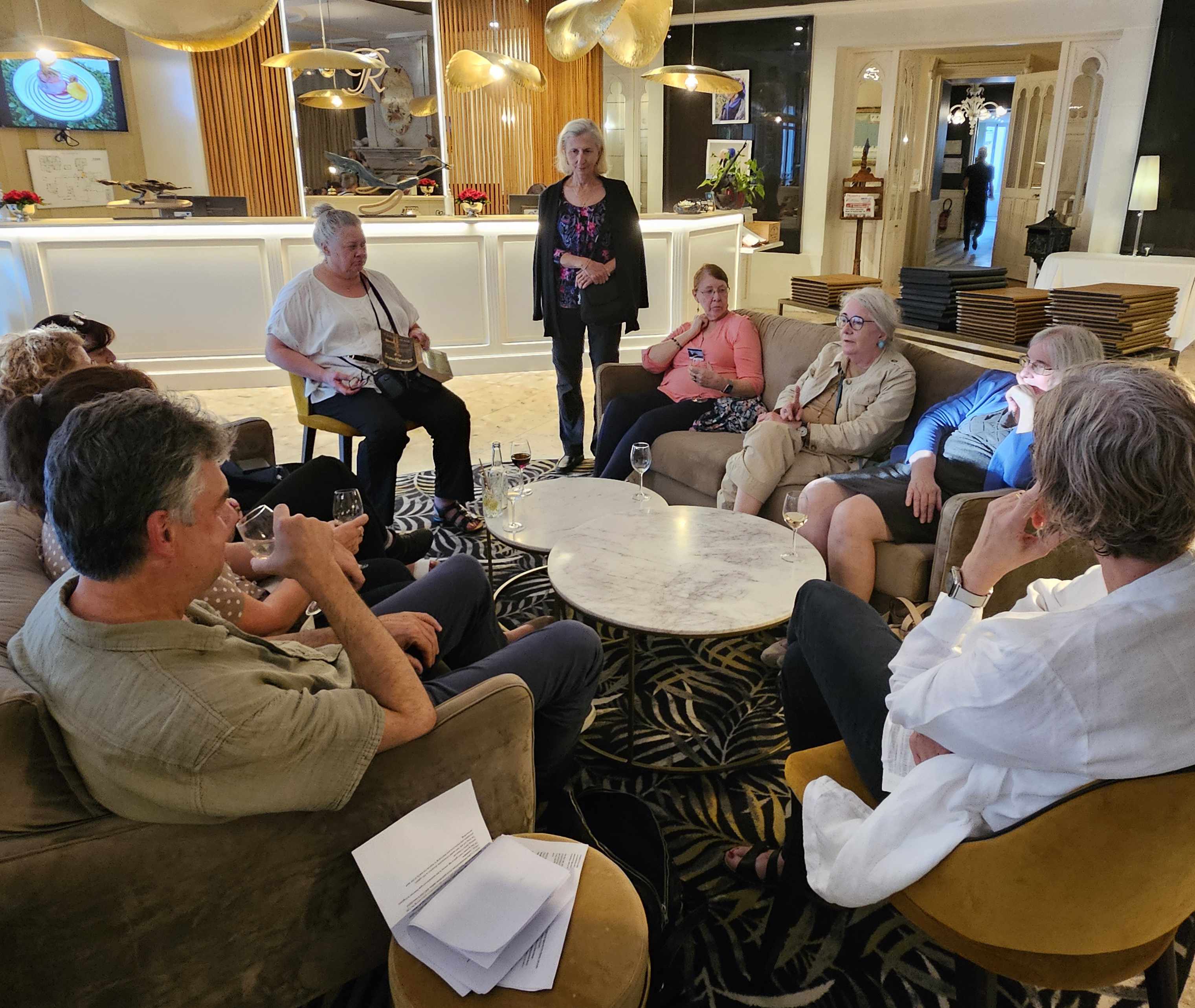
    On the evening of Day 4, just outside Poitiers, I arranged a lively group discussion before dinner, with the spotlight on none other than Henry II. The topic was particularly fitting after our earlier visit to the impressive Chinon Castle, a stronghold that played a key role in his reign. Over a glass or two of wine, our conversation quickly sparked debates about the enigmatic first Plantagenet king.

    For many, Henry II is synonymous with the infamous murder of Thomas Becket in December 1170—a crime that shocked Europe, with Becket killed on the very floor of Canterbury Cathedral. Henry’s tumultuous relationships with his sons, often called the ‘Devil’s Brood,’ and the long imprisonment of his formidable wife, Eleanor of Aquitaine, have painted a rather dark image of him in the pages of history. And yet, I have a dear friend who defends Henry passionately, believing history has judged him too harshly. This made me eager to hear the views of my group.

    I was not disappointed. What followed was a fascinating and animated discussion about Henry’s complexity, revealing both his flaws and strengths. Like many moments on our journey, everyone felt welcome to share their opinions, creating a warm and open exchange that deepened our collective understanding of this remarkable, yet often misunderstood, king.

    The Hundred Years’ War

    Group discussion: Hundred Years’ War

    Beyond the Angevins, one of the most pivotal topics of our journey through France was the prolonged struggle for the French crown between the Plantagenet kings of England and the Valois kings of France, famously known as The Hundred Years’ War. This conflict defined a significant part of Plantagenet history in France, so I was especially excited to organize another pre-dinner group discussion on Day 8.

    I am sure most of the group had read accounts of this struggle from an English perspective, however I was curious to explore its impact on the French people. Now, what better way to do that, than by hearing the insights of our

    exceptional guide, Ange, a native Frenchman, who provided a fresh and compelling view of the war from the French side. His perspective gave us a different and not unbalanced understanding of this conflict.

    It’s not often us history ‘nerds’ can engage in such thoughtful debates over a glass of wine, and this particular evening felt like another one of those perfect moments of camaraderie and learning that made our journey so incredible.

    Eleanor of Aquitaine

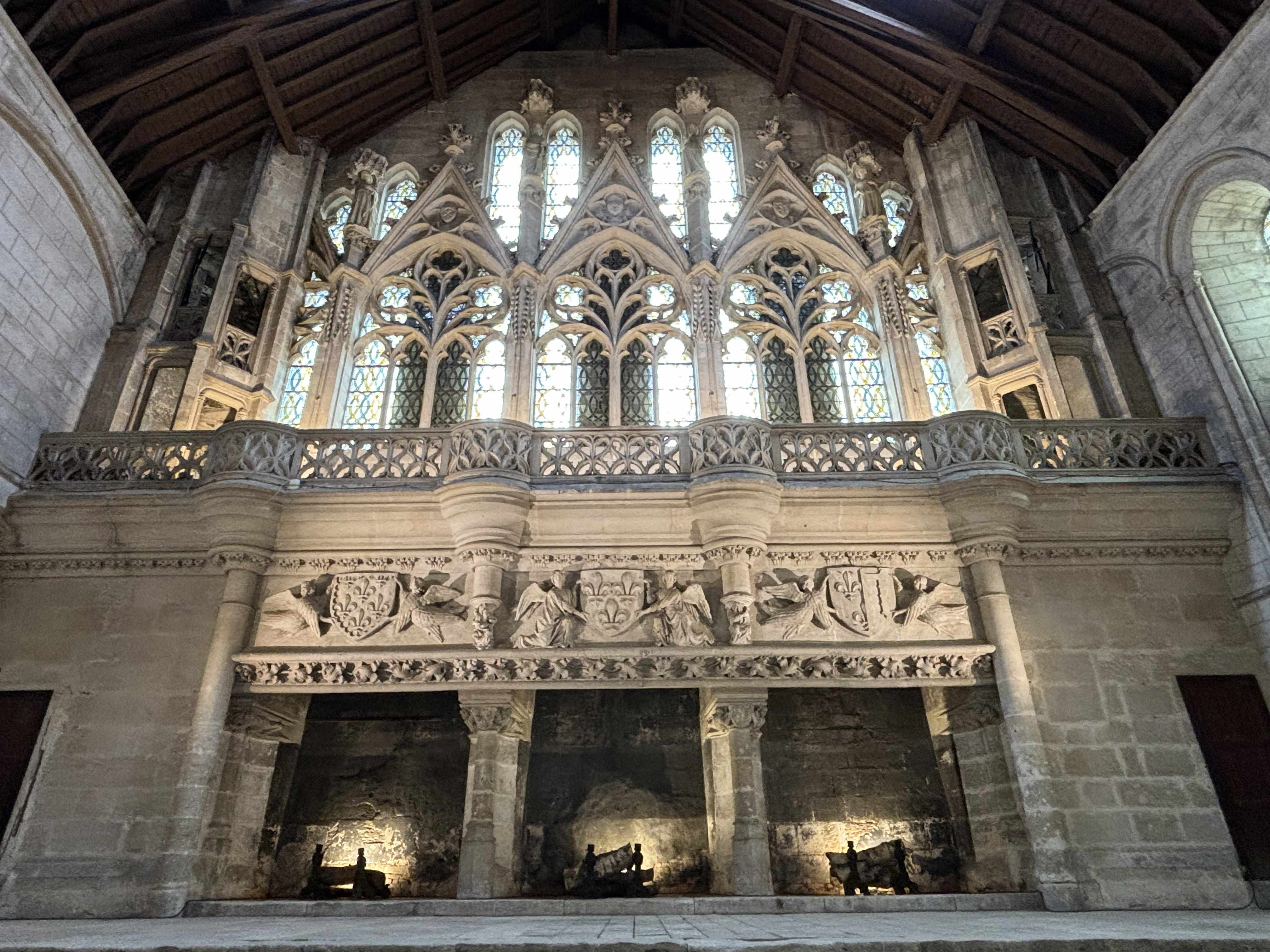
    Great Hall at Poitiers

    No 10-night Plantagenet-themed tour through France would be complete without a deep dive into the life of the most remarkable queen of them all, Eleanor of Aquitaine. Our journey took us to some of the most significant places in her life, from the serene beauty of Fontevraud Abbey, where we had the privilege of visiting her effigy and reflecting on her final days, to the lively city of Poitiers, where she held court with unmatched influence for so many years.

    We also ventured to Bordeaux, a region now synonymous with world-class wine, a commodity that owes much of its early prominence to Eleanor’s marriage to Henry, Duke of Normandy—later Henry II of England. Despite the challenges and turbulence of their union, the marriage of these two dynamic figures laid the foundation for a dynasty that ruled for 331 years.

    Our discussions about Eleanor were as vibrant as her extraordinary life. From her imprisonment at the hands of her own husband to her daring voyages to the Holy Land—one of which took place when she was nearly 70 years old—we marveled at her resilience and power. And finally, we reflected on the peace she found at Fontevraud, where she spent her final days in quiet reflection at the abbey she so loved.

    I hope you’ve enjoyed this glimpse into our amazing journey. For more stories and discoveries from my first tour, visit my blog and uncover all the memorable experiences we shared beyond just mere history: plantagenetdiscoveries.com.

    We’re gearing up for the next adventure in July, and you won’t want to miss it! Mention this article when you reach out http://www.plantagenetdiscoveries.com/contact for an exclusive discount—I’d love to welcome you on board for our next historical journey.

    *

    My Books:

    Signed, dedicated copies of all my books are available through my online store.

    OUT NOW! Heroines of the Tudor World

    Heroines of the Tudor World tells the stories of the most remarkable women from European history in the time of the Tudor dynasty, 1485-1603. These are the women who ruled, the women who founded dynasties, the women who fought for religious freedom, their families and love. These are the women who made a difference, who influenced countries, kings and the Reformation. In the era dominated by the Renaissance and Reformation, Heroines of the Tudor World examines the threats and challenges faced by the women of the era, and how they overcame them. From writers to regents, from nuns to queens, Heroines of the Tudor World shines the spotlight on the women helped to shape Early Modern Europe.

    Heroines of the Tudor World is now available for pre-order from Amberley Publishing and Amazon UK.

    Coming 30 January 2025: Scotland’s Medieval Queens

    Scotland’s history is dramatic, violent and bloody. Being England’s northern neighbour has never been easy. Scotland’s queens have had to deal with war, murder, imprisonment, political rivalries and open betrayal. They have loved and lost, raised kings and queens, ruled and died for Scotland. From St Margaret, who became one of the patron saints of Scotland, to Elizabeth de Burgh and the dramatic story of the Scottish Wars of Independence, to the love story and tragedy of Joan Beaufort, to Margaret of Denmark and the dawn of the Renaissance, Scotland’s Medieval Queens have seen it all. This is the story of Scotland through their eyes.

    Available for pre-order now.

    Also by Sharon Bennett Connolly:

    Women of the Anarchy demonstrates how Empress Matilda and Matilda of Boulogne, unable to wield a sword themselves, were prime movers in this time of conflict and lawlessness. It shows how their strengths, weaknesses, and personal ambitions swung the fortunes of war one way – and then the other. Available from Bookshop.orgAmberley Publishing and Amazon UKKing John’s Right-Hand Lady: The Story of Nicholaa de la Haye is the story of a truly remarkable lady, the hereditary constable of Lincoln Castle and the first woman in England to be appointed sheriff in her own right. Available from all good bookshops Pen & Sword Booksbookshop.org and AmazonDefenders of the Norman Crown: The Rise and Fall of the Warenne Earls of Surrey tells the fascinating story of the Warenne dynasty, from its origins in Normandy, through the Conquest, Magna Carta, the wars and marriages that led to its ultimate demise in the reign of Edward III. Available from Pen & Sword BooksAmazon in the UK and US, and Bookshop.org

    Ladies of Magna Carta: Women of Influence in Thirteenth Century England looks into the relationships of the various noble families of the 13th century, and how they were affected by the Barons’ Wars, Magna Carta and its aftermath; the bonds that were formed and those that were broken. It is now available in paperback and hardback from Pen & SwordAmazon, and Bookshop.orgHeroines of the Medieval World tells the stories of some of the most remarkable women from Medieval history, from Eleanor of Aquitaine to Julian of Norwich. Available now from Amberley Publishing and Amazon, and Bookshop.orgSilk and the Sword: The Women of the Norman Conquest traces the fortunes of the women who had a significant role to play in the momentous events of 1066. Available now from Amazon,  Amberley Publishing, and Bookshop.org.

    Alternate Endings: An anthology of historical fiction short stories including Long Live the King… which is my take what might have happened had King John not died in October 1216. Available in paperback and kindle from Amazon.

    Podcast:

    Have a listen to the A Slice of Medieval podcast, which I co-host with Historical fiction novelist Derek Birks. Derek and I welcome guests, such as Bernard Cornwell, and discuss a wide range of topics in medieval history, from significant events to the personalities involved.

    *

    Don’t forget! Signed and dedicated copies of all my books are available through my online store.

    For forthcoming online and in-person talks, please check out my Events Page.

    You can be the first to read new articles by clicking the ‘Follow’ button, liking our Facebook page or joining me on TwitterThreads and Instagram.

    *

    ©2024 Sharon Bennett Connolly FRHistS and Maxine Sommer

    Guest Post: Empresses, Saints and Female-Kings: The Four Great-Granddaughters of King Ladislaus the Elbow-High by Katarzyna Ogrodnik-Fujcik

    Today it is a pleasure to welcome my good friend, Kasia Ogrodnik to History…the Interesting Bits with a little bit of Polish history for us. I have been wanting to tell the story of King Jadwiga since writing about her in Heroines of the Medieval World. But Kasia is far better qualified to write about her compatriot, Poland’s famous female king and saint, and Jadwiga’s influential female relatives.

    So, over to Kasia…

    Empresses, Saints and Female-Kings: The Four Great-Granddaughters of King Ladislaus the Elbow-High

    Charles IV, King of Bohemia and Holy Roman Emperor and Anna of Schweidnitz [Anna Świdnicka], c. 1357, Chapel of St. Katherine, Karlstejn

    The night of 19 May 1365 saw a young girl leaving Pisa on horseback. With her hair loose, clad only in her nightgown she was galloping to safety after fire broke out in Palazzo degli Anziani. Judging by her looks no one would have guessed this girl was in fact Holy Roman Empress and Queen of Bohemia. 

    Anna of Schweidnitz, Silesia (today Poland), was the only child of Duke Henry II, the grandson of King Ladislaus the Elbow-High of Cracow (Poland). Upon her father’s death she was placed under the care of his elder brother, her uncle, Bolko II the Small. The ruler of the small, but politically important duchy, Bolko was the last independent Silesian Piast. Since Charles IV of Luxembourg intended to annex the entirety of Silesia to the Kingdom of Bohemia, Bolko’s duchy, being the only missing part, was crucial to his plans. To secure the Schweidnitz inheritance Charles married Anna and this is how her journey began. Of course, she was not the only great-granddaughter of King Ladislaus to make an illustrious career. His three other great-granddaughters were to leave their marks on the world, too, and indelible ones. Two of them were to be crowned ”kings” and one proclaimed  saint. 

    Anna of Schweidnitz [Anna Świdnicka], bust in St Vitus Cathedral, Prague, c. 1370

    Anna of Schweidnitz (b.1339), Queen of Bohemia and Holy Roman Empress, was Charles IV of Luxembourg’s third wife. Initially she was betrothed to his son, Wenceslaus, but the boy died while still very young. His mother, Charles’s second wife died too shortly afterwards. To secure the Schweidnitz succession Charles decided to marry his late son’s fiancee himself. Anna was raised and educated at the splendid court of Queen Elizabeth of Poland (her late father’s aunt) at Buda, where she was sent by her uncle and official guardian, Duke Bolko II the Small. It was there where she and Charles were married in the closing days of  May 1353. Shortly afterwards the newlyweds returned to Prague and paid a visit to Schweidnitz, where the succession treaty was signed according to which the duchy was to be inherited by Anna and her children by Charles upon the death of her uncle Bolko and his wife Agnes of Habsburg. On 28 July 1353, Anna was crowned Queen of Bohemia and the following year, on 9 February 1354, Queen of Germany. The year 1355 saw the royal couple in Italy, where on Easter Sunday (5 April 1355) they were crowned Holy Roman Emperor and Holy Roman Empress in a splendid ceremony in the Basilica of Saint Peter, Rome.

    Anna and Charles’s first child, a daughter, Elizabeth, was born in 1358. Charles was overjoyed, but Anna felt she failed her husband (which we know thanks to her surviving correspondence with Petrarch). A much awaited son and heir arrived three years later, named Wenceslaus, traditional name of the rulers of Bohemia. He was to become Charles’ beloved and favoured child. Anna died on 11 July 1362, in childbirth, aged 23. The child did not survive, either, and they were buried together in St Vitus Cathedral, Prague. Anna was remembered for her personal charm and sweet nature. Not only did she receive a bluestocking education, but she was also considered one of the style icons of her time, her reputation as a great beauty resting on the surviving images created during her lifetime and shortly after her untimely death. Tradition has it that of Charles’ four wives it was Anna he loved most. Stricken with grief upon her passing, he did not remarry until a political situation forced him to. His fourth wife was Anna’s kin, Elizabeth of Pomerania, also great-granddaughter of King Ladislaus the Elbow-High. 

    Elizabeth of Pomerania (Eliška Pomořanská, Elżbieta Pomorska)

     
    Reliquary Shrine of Elizabeth of Poland, Queen of Hungary, Maria and Jadwiga’s paternal grandmother, attributed to Jean de Touyl, ca. 1350 . Metropolitan Museum of Art, New York

    Elizabeth was a daughter of Duke Bogusław the Great of Pomerania and Princess Elżbieta of Poland. In 1362 her maternal grandfather, King Casimir the Great of Poland together with his nephew, Louis the Great of Hungary, dukes of Austria and Bavaria formed a coalition against Charles IV of Luxembourg. The opposing parties found themselves on the verge of war, which did not break out, however, perhaps due to Anne of Schweidnitz’s untimely death. The rulers came to terms instead and a marriage was forged to consolidate their agreement. Charles was to marry Elizabeth. He was thrice her age, shorter than her and not very attractive. She was described as beautiful, full of life, and as fit as a fiddle. Stories had it that she could break horseshoes with her own hands. She was an avid horse rider and hunter. 

    The wedding ceremony was celebrated in Kraków on 21 May 1363. Afterwards the couple travelled together to Prague where Elizabeth was crowned Queen of Bohemia. Five years later her imperial coronation at Rome followed. Despite the age difference she and Charles got along well, being married for fifteen years. Their union produced six children, four of whom were to reach adulthood. Charles and Elizabeth’s eldest child, a daughter Anne, was to marry Richard II and become Queen Consort of England. Their son, Sigismund was to be crowned King of Bohemia, Hungary and Holy Roman Emperor. Charles IV died in 1378. Elizabeth herself was to outlive her husband for fifteen years. She died in 1393 and like his three wives before her, she was buried in St Vitus Cathedral, Prague.

    Mária [Mary] of Anjou, King of Hungary

    The coats of arms of Hungary and Poland, c. 1340. Treasury of Aachen Cathedral, Germany

    Mary was one of the three daughters of Louis the Great of Hungary and his second wife, Elizabeth of Bosnia. In 1379, Mary’s elder sister Catherine died, leaving her and her sister Jadwiga Louis’s sole surviving children. The matter of Polish succession had been on the agenda long before Mary was born. Upon King Casimir the Great’s death in 1370 his nephew, Mary’s father, Louis was crowned king of Poland. Initially it was Mary, who was to succeed him as the king of Poland, but the events took a different turn, and in the end she was replaced by her younger sister, Jadwiga [Hedwig]. 

    Mary was crowned “king” of Hungary on 17 September 1382, seven days after her father’s death. However, the idea of a female monarch was not popular among the Hungarian nobility. Many nobles considered Charles III of Naples, Mary’s distant cousin, the lawful heir. 

    Charles landed in Dalmatia in September 1385. In October Mary was married to Sigismund of Luxembourg, however, this  could not prevent Charles from entering the capital.  Mary was forced to renounce the throne and Charles’s coronation took place on 31 December 1385. He did not rule for long. Two months later, in February 1386, he was murdered, most probably at the instigation of Mary’s mother. Mary was restored, but in July she and her mother were captured by the dead king’s supporters. Famed for her beauty, but not for her political decisions, Mary’s mother met a violent end. After imprisonment by her opponents in Novigrad castle, she was found guilty of the murder of Charles III of Naples and strangled to death before her daughter’s own eyes, her body put on display, hanging on a rope from the castle walls. Mary survived and was rescued by her husband, Sigismund, who was crowned king of Hungary afterwards. Mary officially remained his co-ruler, but had no real influence on the government. She died on 17 May 1395 after falling from a horse during a hunting accident. She was pregnant at the time. Her prematurely born son did not survive either. 

    Jadwiga [Hedwig] of Anjou, king and patron saint of Poland

    Jadwiga and Maria, their mother and their sister Catherine as depicted on the St Simeon’s casket, Zadar, Croatia

    Mary’s younger sister, Hedwig was born on 18 February 1374, being the youngest of the three daughters of Louis the Great of Hungary and Elizabeth of Bosnia. 

    Both Mary and Jadwiga received a bluestocking education, Jadwiga both at the cultivated court of Hungary and in Vienna, at the court of her future father-in-law. Not only could Jadwiga read and write, but she also spoke fluent Latin and German. As the king of Poland she owned a big library and always  showed an active and generous support of scholars and learning institutions.

    Since Polish nobles did not like the idea of Mary’s consort, Sigismund of Bohemia, becoming de facto their king, they appealed to Elizabeth of Bosnia, the dowager queen, who had assumed regency, asking to send the younger of her two surviving daughters to Kraków. Elizabeth agreed and absolved the Polish nobles from the oath of loyalty they had pledged to Mary. 

    Jadwiga’s coronation took place on 16 October 1384 in Wawel Cathedral, Kraków, where she was crowned ”king” of Poland. On 18 January 1385 the Lithuanian delegation came to the capital and a meeting was held with the representatives of the Polish nobility. Jadwiga was to marry the ruler of pagan Lithuania, Jogaila. In the opening days of 1386, Jadwiga publicly called off her engagement to Wilhelm Habsburg and married newly baptised Jogaila, who was to come down in history under his new name, Władysław Jagiełło [Ladislaus Jagiellon]. At the time of their wedding she was twelve, he was thirty-five. Władyslaw was crowned king on 4 March 1386. 

    Despite her young age Jadwiga continued to play an active role in the administration and politics of her realm. She conducted the negotiations with the knights of the Teutonic Order, but also on the Hungarian front. Jadwiga conferred with her sister Mary on numerous occasions. Their meetings were held both in Hungary and in Lesser Poland. She also intervened in Lithuania, where she peacefully resolved dynastic disputes between the ruling fractions.

    Jadwiga’s tomb effigy from 1902 by Antoni Madeyski, Wawel Cathedral, Kraków, Poland. The queen’s earthly remains were transferred here from her original resting place at the high altar in 1949 and stayed here till 1987. Then they were transferred to the altar with the Black Crucifix

    She was famed for her charity and showing great care to the poor and the ill. Her active and generous support of scholars and learning institutions did not waver over the years. In her last will she donated all her jewelry, her rich dresses and other valuable objects to the Kraków Academy (the first Polish university founded by Kazimierz Wielki), now the Jagiellonian University. Additionally, she founded a dormitory for Polish students at the University of Prague. 

    Jadwiga died from complications in childbirth on 17 July 1399. She was twenty-five at the time. Her daughter did not survive, either. Almost immediately after her death, Jadwiga’s tomb became the focus of miracles and the destination of pilgrimages. Her cult flourished, with her canonization first mentioned during the funeral ceremony. However, it was to take seven centuries before she was actually canonised by Pope John Paul II. Ever since she has been recognised as patron saint of Poland and considered Polish national hero. 

    About the author:

    Katarzyna Ogrodnik-Fujcik specializes in British literature and history, her area of expertise being the first Plantagenets (the Angevins). She lives in Poland. She writes for different magazines and websites on Polish and European Middle Ages. She runs a blog dedicated to Henry the Young King. She consulted a BBC documentary on William Marshal.

    *

    My Books:

    Signed, dedicated copies of all my books are available through my online store.

    OUT NOW! Heroines of the Tudor World

    Heroines of the Tudor World tells the stories of the most remarkable women from European history in the time of the Tudor dynasty, 1485-1603. These are the women who ruled, the women who founded dynasties, the women who fought for religious freedom, their families and love. These are the women who made a difference, who influenced countries, kings and the Reformation. In the era dominated by the Renaissance and Reformation, Heroines of the Tudor World examines the threats and challenges faced by the women of the era, and how they overcame them. From writers to regents, from nuns to queens, Heroines of the Tudor World shines the spotlight on the women helped to shape Early Modern Europe.

    Heroines of the Tudor World is now available for pre-order from Amberley Publishing and Amazon UK.

    Coming 30 January 2025: Scotland’s Medieval Queens

    Scotland’s history is dramatic, violent and bloody. Being England’s northern neighbour has never been easy. Scotland’s queens have had to deal with war, murder, imprisonment, political rivalries and open betrayal. They have loved and lost, raised kings and queens, ruled and died for Scotland. From St Margaret, who became one of the patron saints of Scotland, to Elizabeth de Burgh and the dramatic story of the Scottish Wars of Independence, to the love story and tragedy of Joan Beaufort, to Margaret of Denmark and the dawn of the Renaissance, Scotland’s Medieval Queens have seen it all. This is the story of Scotland through their eyes.

    Available for pre-order now.

    Also by Sharon Bennett Connolly:

    Women of the Anarchy demonstrates how Empress Matilda and Matilda of Boulogne, unable to wield a sword themselves, were prime movers in this time of conflict and lawlessness. It shows how their strengths, weaknesses, and personal ambitions swung the fortunes of war one way – and then the other. Available from Bookshop.orgAmberley Publishing and Amazon UKKing John’s Right-Hand Lady: The Story of Nicholaa de la Haye is the story of a truly remarkable lady, the hereditary constable of Lincoln Castle and the first woman in England to be appointed sheriff in her own right. Available from all good bookshops Pen & Sword Booksbookshop.org and AmazonDefenders of the Norman Crown: The Rise and Fall of the Warenne Earls of Surrey tells the fascinating story of the Warenne dynasty, from its origins in Normandy, through the Conquest, Magna Carta, the wars and marriages that led to its ultimate demise in the reign of Edward III. Available from Pen & Sword BooksAmazon in the UK and US, and Bookshop.org

    Ladies of Magna Carta: Women of Influence in Thirteenth Century England looks into the relationships of the various noble families of the 13th century, and how they were affected by the Barons’ Wars, Magna Carta and its aftermath; the bonds that were formed and those that were broken. It is now available in paperback and hardback from Pen & SwordAmazon, and Bookshop.orgHeroines of the Medieval World tells the stories of some of the most remarkable women from Medieval history, from Eleanor of Aquitaine to Julian of Norwich. Available now from Amberley Publishing and Amazon, and Bookshop.orgSilk and the Sword: The Women of the Norman Conquest traces the fortunes of the women who had a significant role to play in the momentous events of 1066. Available now from Amazon,  Amberley Publishing, and Bookshop.org.

    Alternate Endings: An anthology of historical fiction short stories including Long Live the King… which is my take what might have happened had King John not died in October 1216. Available in paperback and kindle from Amazon.

    Podcast:

    Have a listen to the A Slice of Medieval podcast, which I co-host with Historical fiction novelist Derek Birks. Derek and I welcome guests, such as Bernard Cornwell, and discuss a wide range of topics in medieval history, from significant events to the personalities involved.

    *

    Don’t forget! Signed and dedicated copies of all my books are available through my online store.

    For forthcoming online and in-person talks, please check out my Events Page.

    You can be the first to read new articles by clicking the ‘Follow’ button, liking our Facebook page or joining me on TwitterThreads and Instagram.

    *

    ©2024 Sharon Bennett Connolly FRHistS and Katarzyna Ogrodnik-Fujcik

    My Latest News

    Well, it is September and we are already into the last third of the year. Wow! 2024 has gone quickly and I would like to thank all my readers for your continuing support. It has been an amazing and hectic year, so far.

    I even made the national papers in the UK! I was interviewed for an article on the new Amazon Prime tv show, My Lady Jane for The Mirror, separating the facts from the fiction. You can still read the article here.

    Book News

    I don’t think I would ever choose to put 2 books out within 6 months of each other. That was my publisher’s choice and I did manage to roll with it, thankfully. I had a fabulous book launch for Women of the Anarchy at Oxford Castle in February and another amazing launch for Heroines of the Tudor World in Lincoln in June. Both books have been incredibly well received and had some amazing reviews.

    And for those of you in the USA, Canada and Australia, the wait is almost over, Heroines of the Tudor World will be released on 10 September.

    Praise for Heroines of the Tudor World:

    “Bennett Connolly has an easy, conversation style of writing which welcomes you from the opening pages and draws you into her story. This is her seventh book and her craft is polished and professional.”

    “Bennett Connolly’s way with words shows us a picture of that world, colourful, vibrant, and violent.”

    “This book should be a staple for those who wish to understand the changing roles of women in society.”

    “Sharon Bennett Connolly writes engaging history and is obviously passionate about exploring the lives of women from all backgrounds and different periods of history. Her knowledge and expertise in women’s history really shines through, making this book an absolute joy to read.”

    To order Heroines of the Tudor World, click here.

    And I have new book news too!

    Scotland’s Medieval Queens will by my 8th book and will be released in the UK on 30 January 2025. It is now available for pre-order. Here’s what it’s about:

    Scotland’s history is dramatic, violent and bloody. Being England’s northern neighbour has never been easy. Scotland’s queens have had to deal with war, murder, imprisonment, political rivalries and open betrayal. They have loved and lost, raised kings and queens, ruled and died for Scotland. From St Margaret, who became one of the patron saints of Scotland, to Elizabeth de Burgh and the dramatic story of the Scottish Wars of Independence, to the love story and tragedy of Joan Beaufort, to Margaret of Denmark and the dawn of the Renaissance, Scotland’s Medieval Queens have seen it all.

    This is the story of Scotland through their eyes.

    I love Scottish History and am so proud of this book and cannot wait for you all to read it!

    To pre-order Scotland’s Medieval Queens, click here!

    Event News

    September is rather a busy month for me, with 3 events in one week at the end of the month! So, here’s what’s coming up:

    Saturday 7 September:

    I shall be co-hosting a panel with Derek Birks at the Historical Novel Society Conference 2024. Held at Dartington Hall in Devon, a whole host of authors a book lovers will be gathering to talk about books. Derek and I have the pleasure of hosting 3 giants of Historical Fiction, Elizabeth Chadwick, David Gilman and Matthew Harffy, to discuss the highs and lows of Writing Medieval.
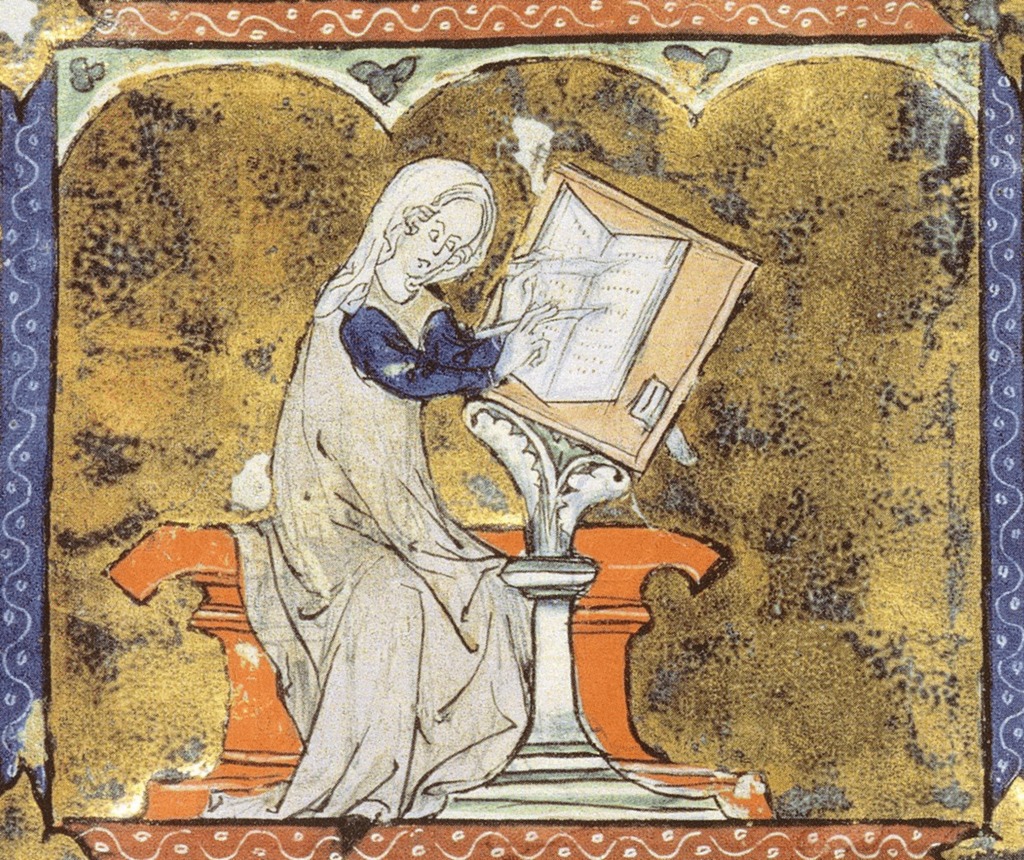
    The in-person event is sold out, but there are still online tickets available here.

    Saturday 14 September:

    As part of Heritage Open Days in the UK, I shall be putting my tour guide hat back on and giving guided tours around my local – Conisbrough Castlehome of the Warennes and one of the most stunning medieval keeps in England. The ‘Storming Normans’ event will also include children’s’ activities and a medieval re-enactment from the fabulous team at Sudjorvik. And, as its a Heritage Open Day weekend, entry to the castle and access to the events and guided tours is FREE!
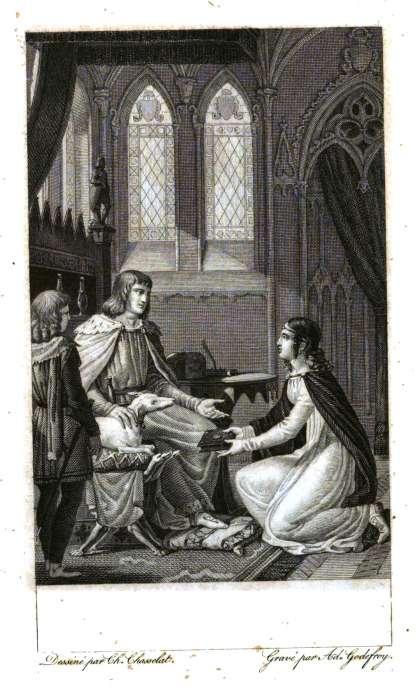
    Doors open at 10am, with my Castle Tours taking place at 11am and 2pm.

    So, do come along if you are in the area.

    Saturday 21 September:

    I will be in Manchester at a conference for History teachers, presenting a talk entitled ‘Where Were the Women,’ focusing on putting the women back into History.

    It is billed as ‘A great day of free History CPD and geekery.’

    Hosted by Teachers Talk History, it takes place at the Friends’ Meeting House, 6 Mount Street Manchester M2 5NS

    If you are a History teacher in the UK, the event is free – you just need to book your place.

    Thursday 26 September:

    I will be in Leicester, presenting the annual Scarborough Lecture for the Leicestershire Archaeological and Historical Society.

    Women and Magna Carta will look at those women who influenced Magna Carta, or lived through it – and those who used it to assert their rights. They include Matilda de Braose, Nicholaa de la Haye, Ela of Salisbury and Isabel d’Aubigny. 

    The LAHS Scarborough Lecture is named after the late John Scarborough, Local Leicester man, who after joining LAHS at the age of 21 became a life-long member and supporter of the Society for over 45 years. He was particularly interested in the High Medieval Period.

    No booking necessary. Entry to the talk is free of charge.

    Doors open from 7.00pm, with tea and coffee available. The lecture will take place at 7.30pm, at the Rattray Lecture Theatre, University of Leicester, University Road, Leicester (LE1 7RH).

    For more information, click here.

    Sunday 29 September:

    I will be back in Lincoln for the 2024 Lincoln Book Festival!

    Presenting a talk, Lincolnshire Women in History, I will be looking at notable women from Lincoln – and Lincolnshire – in the Medieval and Tudor periods. Highlighting women including the formidable Nicholaa de la Haye, castellan of Lincoln Castle and Sheriff of Lincolnshire, Katherine Swynford, grandmother of the Tudor dynasty, Katherine Willoughby a Tudor duchess who encouraged the spread of Puritanism in Lincolnshire and Protestant martyr Anne Askew, one of only two women to be tortured in the Tower of London.

    The talk is at 12 noon and will take place at the Lincoln Arts Centre: University of Lincoln, Brayford Pool Lincoln, LN6 7TS.

    Tickets are £7 or £5 for those with a Live Pass, and can be booked online through the Lincoln Book Festival.

    7 October:

    Looking forward to returning the the Towton Battlefield Society for a talk on my hero, Nicholaa de la Haye. The Society meet at 7pm in Saxton Village Hall. They are very welcoming and only charge a small fee if you are not a member. So, if you want to come along, please do. I thoroughly enjoyed my visit there last year!
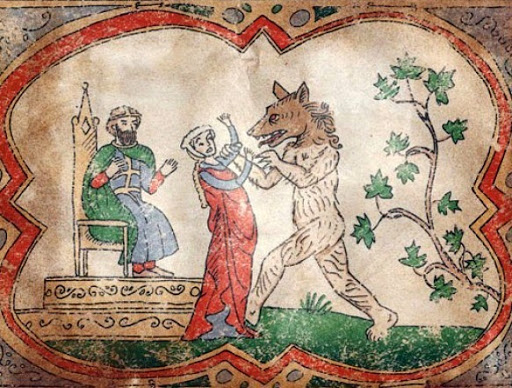
    28 November:

    I will be returning to Northampton, for the first time since my graduation there in 1992 and talking about the Women of the Anarchy, focusing on Empress Matilda and her rival, Queen Matilda of Boulogne and highlighting how these two women, unable to wield swords, were still highly influential in the battle for the crown between the Empress and King Stephen.
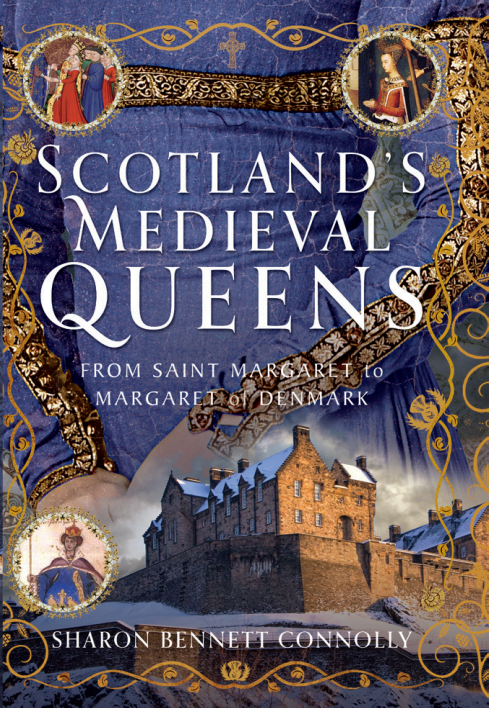
    Tickets will be available from 1 November 2024 and can be booked online here.

    Starting at7.30pm, the talk will be held at  Delapre Abbey Preservation Trust, Northampton, NN4 8AW.

    And that will be all for my programme of talks in 2024. There will be more to come in 2025, with talks already booked at Wallingford, Dorking and Gainsborough Old Hall, among others. But more of that later!

    Podcast News

    The A Slice of Medieval podcast that I co-host with my friend and fellow author, Derek Birks, is now 2 years old and has gone from strength to strength. We recently recorded our 50th – yes, 50th – episode, which will be out at the end of the month, and just happens to be on one of my favourite topics. If you haven’t tuned in yet, do give us a listen. Derek and I welcome guests, such as Bernard Cornwell and Elizabeth Chadwick or take a deep dive into a wide range of topics in medieval history, from significant events to the personalities involved.

    *

    Have a great September! My very best wishes, Sharon xx

    *

    My Books

    Signed, dedicated copies of all my books are available through my online bookshop.

    OUT NOW! Heroines of the Tudor World

    Heroines of the Tudor World tells the stories of the most remarkable women from European history in the time of the Tudor dynasty, 1485-1603. These are the women who ruled, the women who founded dynasties, the women who fought for religious freedom, their families and love. These are the women who made a difference, who influenced countries, kings and the Reformation. In the era dominated by the Renaissance and Reformation, Heroines of the Tudor World examines the threats and challenges faced by the women of the era, and how they overcame them. From writers to regents, from nuns to queens, Heroines of the Tudor World shines the spotlight on the women helped to shape Early Modern Europe.

    Heroines of the Tudor World is now available for pre-order from Amberley Publishing and Amazon UK.

    Also by Sharon Bennett Connolly:

    Women of the Anarchy demonstrates how Empress Matilda and Matilda of Boulogne, unable to wield a sword themselves, were prime movers in this time of conflict and lawlessness. It shows how their strengths, weaknesses, and personal ambitions swung the fortunes of war one way – and then the other. Available from Bookshop.orgAmberley Publishing and Amazon UKKing John’s Right-Hand Lady: The Story of Nicholaa de la Haye is the story of a truly remarkable lady, the hereditary constable of Lincoln Castle and the first woman in England to be appointed sheriff in her own right. Available from all good bookshops Pen & Sword Booksbookshop.org and AmazonDefenders of the Norman Crown: The Rise and Fall of the Warenne Earls of Surrey tells the fascinating story of the Warenne dynasty, from its origins in Normandy, through the Conquest, Magna Carta, the wars and marriages that led to its ultimate demise in the reign of Edward III. Available from Pen & Sword BooksAmazon in the UK and US, and Bookshop.org

    Ladies of Magna Carta: Women of Influence in Thirteenth Century England looks into the relationships of the various noble families of the 13th century, and how they were affected by the Barons’ Wars, Magna Carta and its aftermath; the bonds that were formed and those that were broken. It is now available in paperback and hardback from Pen & Sword,  Amazon, and Bookshop.orgHeroines of the Medieval World tells the stories of some of the most remarkable women from Medieval history, from Eleanor of Aquitaine to Julian of Norwich. Available now from Amberley Publishing and Amazon, and Bookshop.orgSilk and the Sword: The Women of the Norman Conquest traces the fortunes of the women who had a significant role to play in the momentous events of 1066. Available now from Amazon,  Amberley Publishing, and Bookshop.org.

    Alternate Endings: An anthology of historical fiction short stories including Long Live the King… which is my take what might have happened had King John not died in October 1216. Available in paperback and kindle from Amazon.

    *

    Don’t forget! Signed and dedicated copies of all my books are available through my online bookshop.

    For forthcoming online and in-person talks, please check out my Events Page.

    You can be the first to read new articles by clicking the ‘Follow’ button, liking our Facebook page or joining me on Twitter and Instagram.

    ©2024 Sharon Bennett Connolly FRHistS

    Book Corner: The Lost Queen by Carol McGrath

    1191 and the Third Crusade is underway . . .

    It is 1191 and King Richard the Lionheart is on crusade to pitch battle against Saladin and liberate the city of Jerusalem and her lands. His mother, the formidable Eleanor of Aquitaine and his promised bride, Princess Berengaria of Navarre, make a perilous journey over the Alps in midwinter. They are to rendezvous with Richard in the Sicilian port of Messina.

    There are hazards along the way – vicious assassins, marauding pirates, violent storms and a shipwreck. Berengaria is as feisty as her foes and, surviving it all, she and Richard marry in Cyprus and continue to the Holy Land. England needs an heir. But first, Richard and his Queen must return home . . .

    The Lost Queen is a thrilling medieval story of high adventure, survival, friendship and the enduring love of a Queen for her King.

    At last! Attention is being paid to Berengaria of Navarre, wife and queen of King Richard I (the Lionheart. There is an excellent new biography out, by my good friend Dr Gabrielle Story, entitled Berengaria of Navarre: Queen of England and Lord of Le Mans. And now there is a wonderful novel, The Lost Queen by Carol McGrath.

    Carol expertly weaves fact and fiction together to bring us am engaging, entertaining and informative story on the life of the one queen of England who is said to have never set foot in the country (actually, it seems that she did, but only after Richard’s death).

    The Lost Queen follows Berengaria from the moment she is collected by her future mother-in-law, Eleanor of Aquitaine, on her journey through the Alps and Italy, to her first meeting with her husband Richard I. She is then drawn into the grand enterprise that was the Third Crusade, with the conquest of Cyprus along the way.

    Food tasters sampled every dish before offering Queen Eleanor the best of everything, placing small morsels on her plate when she inclined her head in assent. Don Sancho never took any chances in case a dish was spoiled – or worse, might contain poison. Only once the Dowager and Don Sancho were served was Berengaria able to make selections for her own plate. As she ate, carefully making sure not to appear greedy, she noticed that Queen Eleanor had a hearty appetite, sampling everything and complimenting Don Sancho on his well-presented feast. Lifting a goblet to her mouth and sipping daintily, she praised the Gascon wine served in her honour.

    Over custard tarts, a speciality of the palace pastry cooks, the Dowager broached plans for their journey. She tapped the table with an impatient gesture. ‘Don Sancho, may I assume Berengaria will be ready by this week’s end with her baggage mules packed? She will need suitable clothing for travel to Sicily, along with her confessor and her ladies.’

    ‘Indeed. We shall provide a well-armed guard under Sancho’s command for the first part of the journey,’ Don Sancho said. ‘Berengaria and her ladies will ride. They are all of them fine horsewomen.’

    ‘We will need stout covered wagons and apothecaries in case of illness, though I expect none,’ the Dowager responded. Berengaria wondered if Queen Eleanor had ever been in need of apothecaries in her whole life, other than for childbirth. Suddenly she grew nervous at the thought that the arrangements thay had made for her wedding in Sicily might not be good enough.

    Don Sancho nodded in assent, then added, ‘All is ready, including priests and two bishops who will travel with your train as far as Rome.’ He gave Eleanor a broad smile.

    Berengaria looked at her father with a confidence she did not feel. ‘So my brother and his knights will escort us through French territories?’ she asked.

    ‘Not France, but the county of Toulouse. And indeed, my daughter, Sancho will ride with you as far as Les Baux. Arrangements have been made. travel passes have been granted.’

    Her brother nodded. ‘My dear sister, I have business in Aragon, but I intend guarding you to the very borders of the German Empire.’

    Berengaria loved her bear-like brother. ‘I am glad of your escort, dear Sancho.’

    She looked over to see Eleanor’s reaction, but the Dowager simply thanked Sancho for his care of them. Her expression remained composed as she added, ‘We hope to have Philip of Flanders as our escort through the Alps and on to Sicily. The Count is intent on joining the Crusade.’

    Carol McGrath recreates the world of the late 12th century, from medieval England to the Holy Land – you can almost feel that sand between your toes and the burning sun on your face. Neither does the author shy away from the more unpleasant episodes of the Crusades. Richard I’s execution of 3,000 prisoners is depicted through Berengaria’s eyes, and with the understanding of the constraints and political wranglings of the time. I love the depiction of Richard I’s relationship with his mother, Eleanor of Aquitaine, and Carol McGrath’s exploration of how this may have affected Richard and Berengaria’s marriage.

    My favourite part of the book is Berengaria’s relationship with her sister-in-law, Joanna, dowager queen of Sicily and sister of Richard the Lionheart. Joanna is, as any regular reader will know, one of my favourite medieval women. And I love how Carol McGrath portrays the developing friendship between the two women, thrown together by necessity, but appreciating each other’s strengths and character.

    Whilst the attention of the book is very firmly on Berengaria of Navarre, a more intimate, fictional story, of a young lady named Avelina, travelling to the Holy Land in search of her husband, offers the reader a more intimate experience of the non-royal crusaders and the lives of them and their families. As well as the dangers inherent in women travelling to far-off places. Carol McGrath uses Avelina’s story, and the stories of those around her, to demonstrate the different people and events – and personal tragedies – associated with the Crusades. It also serves to remind the modern-day reader that news travelled slowly in medieval times and that letters that were lost or waylaid could have a huge impact on people’s lives.

    The characters portrayed in The Lost Queen by Carol McGrath are rich and vivid. They come to life on the page.

    This is a must-read book for anyone interested in the Plantagenets!

    To Buy The Lost Queen

    About the Author:

    Following a first degree in English and History, Carol McGrath completed an MA in Creative Writing from The Seamus Heaney Centre, Queens University Belfast, followed by an MPhil in English from University of London.The Handfasted Wife, first in a trilogy about the royal women of1066 was shortlisted for the RoNAS in 2014.The Swan-Daughter and The Betrothed Sister complete this highly acclaimed trilogy.Mistress Cromwell, a best-selling historical novel about Elizabeth Cromwell, wife of Henry VIII’s statesman, Thomas Cromwell, was republished by Headline in 2020.The Silken Rose,first in a medieval She-Wolf Queens Trilogy, featuring Ailenor of Provence, saw publication in April 2020. This was followed by The Damask Rose.The Stone Rose was published April2022. Carol is writing Historical non-fiction as well as fiction.Sex and Sexuality in Tudor England waspublished in February 2022.The Stolen Crown2023 and The Lost Queen will be published 18thJuly2024. Carol lives in Oxfordshire, England and in Greece.Find Carol on her website:www.carolcmcgrath.co.uk.

    Follow Carol on:

    Amazon: @CarolMcGrath, Facebook: https://www.facebook.com/CarolMcGrathAuthor1, Pinterest: http://www.pinterest.co.uk/carol0275/the-handfasted-wife/ Twitter: twitter.com/carolmcgrath, website: scribbling-inthemargins.blogspot.com/ LinkedIn: https://www.linkedin.com/in/carol-mcgrath-906723a

    *

    My Books

    Signed, dedicated copies of all my books are available through my online bookshop.

    OUT NOW! Heroines of the Tudor World

    Heroines of the Tudor World tells the stories of the most remarkable women from European history in the time of the Tudor dynasty, 1485-1603. These are the women who ruled, the women who founded dynasties, the women who fought for religious freedom, their families and love. These are the women who made a difference, who influenced countries, kings and the Reformation. In the era dominated by the Renaissance and Reformation, Heroines of the Tudor World examines the threats and challenges faced by the women of the era, and how they overcame them. From writers to regents, from nuns to queens, Heroines of the Tudor World shines the spotlight on the women helped to shape Early Modern Europe.

    Heroines of the Tudor World is now available for pre-order from Amberley Publishing and Amazon UK.

    Also by Sharon Bennett Connolly:

    Women of the Anarchy demonstrates how Empress Matilda and Matilda of Boulogne, unable to wield a sword themselves, were prime movers in this time of conflict and lawlessness. It shows how their strengths, weaknesses, and personal ambitions swung the fortunes of war one way – and then the other. Available from Bookshop.orgAmberley Publishing and Amazon UKKing John’s Right-Hand Lady: The Story of Nicholaa de la Haye is the story of a truly remarkable lady, the hereditary constable of Lincoln Castle and the first woman in England to be appointed sheriff in her own right. Available from all good bookshops Pen & Sword Booksbookshop.org and AmazonDefenders of the Norman Crown: The Rise and Fall of the Warenne Earls of Surrey tells the fascinating story of the Warenne dynasty, from its origins in Normandy, through the Conquest, Magna Carta, the wars and marriages that led to its ultimate demise in the reign of Edward III. Available from Pen & Sword BooksAmazon in the UK and US, and Bookshop.org

    Ladies of Magna Carta: Women of Influence in Thirteenth Century England looks into the relationships of the various noble families of the 13th century, and how they were affected by the Barons’ Wars, Magna Carta and its aftermath; the bonds that were formed and those that were broken. It is now available in paperback and hardback from Pen & Sword,  Amazon, and Bookshop.orgHeroines of the Medieval World tells the stories of some of the most remarkable women from Medieval history, from Eleanor of Aquitaine to Julian of Norwich. Available now from Amberley Publishing and Amazon, and Bookshop.orgSilk and the Sword: The Women of the Norman Conquest traces the fortunes of the women who had a significant role to play in the momentous events of 1066. Available now from Amazon,  Amberley Publishing, and Bookshop.org.

    Alternate Endings: An anthology of historical fiction short stories including Long Live the King… which is my take what might have happened had King John not died in October 1216. Available in paperback and kindle from Amazon.

    Podcast:

    Have a listen the A Slice of Medieval podcast, which I co-host with Historical fiction novelist Derek Birks. Derek and I welcome guests, such as Bernard Cornwell and discuss a wide range of topics in medieval history, from significant events to the personalities involved. In episode #43, Derek and I chat with Carol about Berengaria of Navarre and The Lost Queen.

    *

    Don’t forget! Signed and dedicated copies of all my books are available through my online bookshop.

    For forthcoming online and in-person talks, please check out my Events Page.

    You can be the first to read new articles by clicking the ‘Follow’ button, liking our Facebook page or joining me on Twitter and Instagram.

    ©2024 Sharon Bennett Connolly FRHistS

    Book Corner: Their Castilian Orphan by Anna Belfrage

    It is 1294 and Eustace de Lamont is back in England after five years in exile. He will stop at nothing to ruin Robert FitzStephan and his wife, Noor d’Outremer.

    Robert’s half brother, Eustace de Lamont, has not mellowed during his absence. He is more ruthless than ever, and this time he targets Robert’s and Noor’s foster son, Lionel.

    Lionel is serving King Edward as a page when Eustace appears at court. Not only does Lionel become the horrified witness to Eustace’s violent streak, Eustace also starts voicing his suspicions about Lionel’s parentage. The truth about Lionel’s heritage is explosive—should King Edward find out, all would be lost for Robert and Noor.

    In October of 1294, Wales rises in rebellion. Robert must leave his family unprotected to fight the Welsh rebels on the king’s behalf, comforted only by the fact that Eustace too is called to fight.

    Except that Eustace has no intention of allowing his duty to his king—or a mere rebellion—come between him and his desire to destroy Robert FitzStephan . . .

    Bring tissues!

    Whenever I hear there is a new Anna Belfrage novel coming, I know I am in for an emotional ride.

    Anna Belfrage is back with the fourth and final instalment of her The Castilian Saga series, Their Castilian Orphan, and it is another tearjerker. Action-packed, Their Castilian Orphan has a riveting storyline set in England in the 1290s and Edward I’s campaign into Wales.

    The two heroes, Robert FitzStephan and his wife, Noor d’Outremer, great-niece of Queen Eleanor of Castile, are faced with the dangers inherent in serving the king on campaign whilst having to fend off the nefarious machinations of Robert’s hate-filled half-brother Eustace de Lamont. And the spite of Eustace’s impressionable young wife. But Robert is not Eustace’s only target and he misses no opportunity to make life uncomfortable for their foster son, Lionel, who is beginning to suspect that his past is not the one he has been told…

    Robert and Noor have certainly had their ups and downs. It has not been easy, serving Edward I and his formidable queen, Eleanor of Castile. They have their scars, both mental and physical. Robert has also had to deal with the stigma of illegitimacy and the malice of his jealous brother. Eustace might be legitimate, and a baron, but Robert is the better soldier who has earned the respect of his peers because of his abilities. That irks Eustace – especially when everyone is keen to compare the brothers and find Eustace wanting.

    Intrigue, sibling rivalry and war, combined with Anna Belfrage’s engaging writing style means that Their Castilian Orphan has all the ingredients for an absolutely fabulous reading adventure.

    He was halfway down the long flight of stairs leading to the hall when he heard someone call his name.

    “Lionel!”

    Mama came flying towards him, and moments later he was enveloped in her arms, his face squished against her bosom. She released him and clasped him by the shoulders. “Look at you – you’ve grown! You’re so tall!”

    Nay, he wasn’t, but Mama was short. If he stood on his toes, the top of his head reached her brow.

    “Lionel, lad.” Papa greeted him as effusively as Mama had done.

    “How is your back?” Mama asked.

    Lionel groaned. “It was nothing.” Of course, Roger Mortimer had to tell them!

    “You did not send us word,” Mama said, her mouth wobbling for an instant. “We didn’t know, were not offered the opportunity to care for you.”

    Lionel shuffled on his feet. “I…” A movement on the far side of the bailey offered an opportunity to change the subject. “Eustace de Lamont id back!” he blurted, pointing at the man in question.

    “Aye, we know,” Papa said, sounding grim.

    “I saw him -“

    “Hush,” Papa said firmly. “We talk of such matters when we are alone.”

    “He has wed,” Lionel said, pulling a face. “Soaking Sally says she may be comely but has the personality of an aggravated viper.”

    “Well, they should suit, then,” Mama said. “Hopefully they bite each other to death.”

    Lionel blinked. Never had he heard Mama sound so vicious. And then he saw how Papa settled his arm round her, whispering something in her ear, and her stance softened.

    Lionel moved closer to her. Of course. Mama was afraid. With Eustace de Lamont back, she feared for her husband. Last time had left Papa with a nasty scar to his thigh and a slight limp. Next time… No, there could not be a next time because Mama was right: Eustace de Lamont was a serpent in human disguise.

    Five years of exile and dire warnings from the king to stay away from Robert and his family fall on deaf ears when Eustace returns from his exile. With Robert drawn into Edward I’s wars, this time in Wales, and their foster son, Lionel, in service to the king as a page, the family are once again at the heart of events. And a focus for Eustace’s murderous intentions. He is determined to destroy Robert and take all that he has. And he knows how to strike at their heart, by targeting Lionel and the young man’s Welsh lineage, making Lionel question his place in is family.

    Their Castilian Orphan interweaves the fictional story with the historical fact, transporting the reader to the last decade of the 13th century, to an aging king, duped by the French, with peace at home threatened by the Welsh, who are chafing against the harsh English yoke.

    I love the way Anna Belfrage melds the domestic lives and worries of Robert and Noor with the concerns of England as a nation. Life and duty are inseparable. Anna makes you love her characters, draws you into their lives, makes you a part or their family.

    Engaging, absorbing, fascinating, exciting. And emotional. Anna Belfrage will take the reader through the full range of emotions before they get to the end of the book.

    To buy the book:

    Their Castilian Orphan is now available from Amazon

    About the author:

    Had Anna been allowed to choose, she’d have become a professional time-traveller. No luck there, so instead she became a financial professional with two absorbing interests; history and writing. These days, Anna combines an exciting day-job with a large family and her writing endeavours. Plus she always finds the time to try out new recipes, chase down obscure rose bushes and initiate a home renovation scheme or two.

    Anna has authored the acclaimed time travelling series The Graham Saga , set in 17th century Scotland and Maryland, as well as the equally acclaimed medieval series The King’s Greatest Enemy.

    Anna has also published The Wanderer, a fast-paced contemporary romantic suspense trilogy with paranormal and time-slip ingredients. Her September 2020 release, His Castilian Hawk is a story of loyalty and love set against the complications of Edward I’s invasion of Wales in the late 13th century.

    Her most recent release, The Whirlpools of Time , is a time travel romance set against the backdrop of brewing rebellion in the Scottish highlands.

    All of Anna’s books have been awarded the IndieBRAG Medallion, she has several Historical Novel Society Editor’s Choices, and one of her books won the HNS Indie Award in 2015. She is also the proud recipient of several Reader’s Favorite medals as well as having won various Gold, Silver and Bronze Coffee Pot Book Club awards.

    If you want to know more about Anna, why not visit her website, https://www.annabelfrage.com

    *

    My Books:

    Signed, dedicated copies of all my books are available through my online bookshop.

    Out Now! Women of the Anarchy

    Two cousins. On the one side is Empress Matilda, or Maud. The sole surviving legitimate child of Henry I, she is fighting for her birthright and that of her children. On the other side is her cousin, Queen Matilda, supporting her husband, King Stephen, and fighting to see her own son inherit the English crown. Women of the Anarchy demonstrates how these women, unable to wield a sword, were prime movers in this time of conflict and lawlessness. It show how their strengths, weaknesses, and personal ambitions swung the fortunes of war one way – and then the other.

    Available from Bookshop.orgAmberley Publishing and Amazon UK.

    Coming on 15 June 2024: Heroines of the Tudor World

    Heroines of the Tudor World tells the stories of the most remarkable women from European history in the time of the Tudor dynasty, 1485-1603. These are the women who ruled, the women who founded dynasties, the women who fought for religious freedom, their families and love. These are the women who made a difference, who influenced countries, kings and the Reformation. In the era dominated by the Renaissance and Reformation, Heroines of the Tudor World examines the threats and challenges faced by the women of the era, and how they overcame them. From writers to regents, from nuns to queens, Heroines of the Tudor World shines the spotlight on the women helped to shape Early Modern Europe.

    Heroines of the Tudor World is now available for pre-order from Amberley Publishing and Amazon UK.

    Also by Sharon Bennett Connolly:

    King John’s Right-Hand Lady: The Story of Nicholaa de la Haye is the story of a truly remarkable lady, the hereditary constable of Lincoln Castle and the first woman in England to be appointed sheriff in her own right. Available from all good bookshops or direct from Pen & Sword Booksbookshop.org and AmazonDefenders of the Norman Crown: The Rise and Fall of the Warenne Earls of Surrey tells the fascinating story of the Warenne dynasty, from its origins in Normandy, through the Conquest, Magna Carta, the wars and marriages that led to its ultimate demise in the reign of Edward III. Available from Pen & Sword BooksAmazon in the UK and US, and Bookshop.org

    King John’s Right-Hand Lady: The Story of Nicholaa de la Haye is the story of a truly remarkable lady, the hereditary constable of Lincoln Castle and the first woman in England to be appointed sheriff in her own right. It is is available from King John’s Right-Hand Lady: The Story of Nicholaa de la Haye is the story of a truly remarkable lady, the hereditary constable of Lincoln Castle and the first woman in England to be appointed sheriff in her own right. Available from all good bookshops or direct from Pen & Sword Booksbookshop.org and AmazonDefenders of the Norman Crown: The Rise and Fall of the Warenne Earls of Surrey tells the fascinating story of the Warenne dynasty, from its origins in Normandy, through the Conquest, Magna Carta, the wars and marriages that led to its ultimate demise in the reign of Edward III. Available from Pen & Sword BooksAmazon in the UK and US, and Bookshop.org

    Alternate Endings: An anthology of historical fiction short stories including Long Live the King… which is my take what might have happened had King John not died in October 1216. Available in paperback and kindle from Amazon.

    Podcast:

    Have a listen to the A Slice of Medieval podcast, which I co-host with Historical fiction novelist Derek Birks. Derek and I welcome guests, such as Bernard Cornwell and Elizabeth Chadwick, and discuss a wide range of topics in medieval history, from significant events to the personalities involved.

    *

    Don’t forget! Signed and dedicated copies of all my books are available through my online bookshop.

    For forthcoming online and in-person talks, please check out my Events Page.

    You can be the first to read new articles by clicking the ‘Follow’ button, liking our Facebook page or joining me on Twitter and Instagram.

    *

    ©2024 Sharon Bennett Connolly FRHistS

    Le Charte aux Lacs d’Amour

    When writing medieval non-fiction, you don’t get to tell many love stories. Most marriages were arranged between families for mutual gain or assistance. As a consequence, you don’t really expect to come across many tales of love – and actual love tokens are rare indeed. But in researching the story of Nicholaa de la Haye, I came across just that: a rather unique love token. 

    Unfortunately, the love token did not belong to Nicholaa, the defender of Lincoln Castle and first ever female sheriff in England, it belonged to one of her sisters. Nicholaa was the eldest of three sisters and while she inherited Lincoln Castle and her family’s English lands, her sisters, Julia (or Gila) and Isabel, married and settled in Normandy. The story of the love token is Julia’s.

    Julia, whose name appears as Gille in French but appears on charters in the Latin, Gila, was married to Richard du Hommet, who died around 1199/1200. Richard was the eldest son and heir of William du Hommet (or Hummez), constable of Normandy, who died around 1204 and his wife, Lucy. According to a charter dated 1232, recording donations to the monks of Saint-Sauveur-le-Vicomte, Lucy was the granddaughter and heir of Adam de Bruys. As constable, William du Hommet appeared as a witness to a charter of 1 March 1190 in which King Richard I ‘confirms to the archbishop and church of Rouen and all the bishops and mother churches of Normandy, concerning those who break the trêve de Dieu (a truce organised by the church).’ 

    As with most medieval women, we know very little of Julia’s actual dates, so we have to generalise or make educated guesses. Julia was probably born sometime in the late 1150s, and would have grown up on her family’s lands in Lincolnshire. She will have probably married Richard du Hommet some time in the 1170s, when she was in her mid-to-late teens. She died in the 1190s and her husband remarried before his own death at the turn of the century. Julia and Richard had at least three sons and two or more daughters; two of these sons were the last two constables of Normandy from the Hommet family, succeeding their grandfather in the role. Richard du Hommet had certainly married Julia by the mid-1170s at the latest, when his grandfather, another Richard du Hommet, was still constable of Normandy, and while the younger Richard was still underage. The couple’s first child was born around 1180. 

    Richard du Hommet predeceased his father by four or five years, so never became constable of Normandy in his own right, though he does appear to have assisted his father in his duties. In June 1190, Richard appears as a witness, alongside his father, to a charter of Richard I in which he ‘confirms to St Martin’s, Troarn and the monks there serving God the vill and island of Reimberhome etc., with the right of presentation to the church of St Mary there, as given, with his assent, by John son of William count of Ponthieu, etc.’ Father and son are recorded as ‘Willelmo de Humeto constabulario; Richardo de Humeto’ in the witness list. 

    Richard and Julia are also the subjects of a unique charter, issued by King Richard I in June 1190. The charter was preserved by the Abbey of Aunai, which had been founded by the du Hommet family. It conferred the manors of Varreville and Pouppeville upon the couple, naming both ‘Ricardo de Humetis’ and ‘Gila, uxor sue’ (his wife) in the grant.  

    And it has very famous laces by which the seal was attached. 

    These laces are made of silk and each one is 50cm in length; one of the laces is green, now turning yellow, and the other is blue, speckled with brown. An Old French poem was embroidered on the laces: 

     “Jo sui druerie. Ne me dunez mie ; ki nostre amur deseivre la mort pu”,

    (In French, ‘Je suis gage d’amour. Ne me donnez pas. Que celui qui sépare notre amour puisse recevoir la mort’  and in English, ‘I am a pledge of love. Do not give me away. May death come to whoever separates our love’).  

    For this reason, the charter is known as the charte aux lacs d’amour (the charter with the laces of love). And while the idea of a love poem being attached to a charter issued in relation to a royal land grant is charming, the reasons behind it remain elusive. At first glance, the grant appears to have no special significance that would justify such a declaration of love, nor such careful detail and precision work being undertaken on its creation.  

    I can’t help thinking that Richard I – the Lionheart – who was a fan of the troubadour tradition and courtly love, would have heartily approved of turning the charter into a token of enduring love.

    Unfortunately, while the laces are still attached to the document, the words, which were still visible in the nineteenth century, have now faded away. At least someone thought to record them before they faded from existence. 

    Under Henry I, the lands of Varreville and Pouppeville had been in the hands of Roger, Bishop of Salisbury, and had returned to the crown on his death. King Henry II had granted the same lands to Richard de la Haye, but they had reverted to the crown on his death in 1169, and were accounted for in the Exchequer accounts of 1180. So, it seems that in granting Varreville and Pouppeville to Julia and Richard du Hommet, Richard I was returning them to their former, rightful owners. This may explain why Julia is specifically mentioned in the charter and the grant stipulates that the lands pass to Richard’s children by Julia, rather than Richard’s children by any wife.  

    According to Léopold De Lisle, in his study of the charter, the two manors formed Julia’s dowry, though she and her husband were unable to take possession of the lands immediately after the marriage. In the charter King Richard ‘gives, renderes and confirms to Richard du Hommet, and to Gila [Julia] his wife, and to their heirs, Pouppeville and Varreville with all their dependencies, for them to hold from the king with their barony, by right of the said Gila [Julia].’ De Lisle goes on to suggest that the laces used, with the accompanying love poem, were once a love token, perhaps given by Julia to Richard on their wedding day, and that Richard du Hommet persuaded the king to attach them to the charter that gave him possession of Julia’s lands, as a symbol of their union.  

    If so, the fact that they have survived the centuries is particularly poignant. 

    When Julia died in the 1190s, she was buried in Blanchelande Abbey, a religious community of the Premonstratensian order, known as the White Canons, in Neufmesnil. The abbey had been founded by Julia’s parents, and it was where her father, Richard de la Haye, had been interred after his death in 1169. On her death, Julia’s mother, Matilda de Vernon, with the approval of her son-in-law, Richard du Hommet, made a donation to the abbey in her daughter’s name. After a short period as a widower, Richard du Hommet married for a second time, to Alienor, widow of Robert de la Haie, who may well have been a distant cousin of Julia (I did not have time to delve into  the familial relationship, unfortunately). 

    The enduring love of Richard and Julia is forever entwined in the laces attached to the land charter. Even if we can no longer see the words, we know they were there and survived seven centuries before they faded away… 

    *

    This article first appeared on ElizabethChadwick.com

    Images:

    Les archives du Calvados

    Sources:

    Les archives du Calvados; Leopold Deslisle, “Notice sur les attaches d’un sceau de Richard Coeur-de-Lion”; Richard of Devizes, The Chronicle of Richard of Devizes; Roger of Howden (Hoveden), The Annals of Roger of HowdenThe Plantagenet Chronicles edited by Elizabeth Hallam; Brassey’s Battles by John Laffin; 1215 The Year of Magna Carta by Danny Danziger & John Gillingham; The Life and times of King John by Maurice Ashley; The Plantagenets, the Kings Who Made England by Dan Jones; England Under the Norman and Angevin Kings  by Robert Bartlett; lincolnshirelife.co.uk; catherinehanley.co.uk; magnacarta800th.com; lothene.org; lincolncastle.com; The Sheriff: The Man and His Office by Irene Gladwin; Louise Wilkinson, Women in Thirteenth Century Lincolnshire; Richard Huscraft, Tales from the Long Twelfth Century; J.W.F. Hill, Medieval Lincoln; swaton.org.uk; oxforddnb.com; Ingulph, Ingulph’ Chronicle of the Abbey of Croyland; Stephen Church, King John: England, Magna Carta and the Making of a Tyrant; Marc Morris, King John; Pipe Rolls; Red Book of the Exchequer

    *

    My Books

    Christmas is coming!

    Signed, dedicated copies of all my books are available through my online bookshop.

    Out now! Scotland’s Medieval Queens

    Scotland’s history is dramatic, violent and bloody. Being England’s northern neighbour has never been easy. Scotland’s queens have had to deal with war, murder, imprisonment, political rivalries and open betrayal. They have loved and lost, raised kings and queens, ruled and died for Scotland. From St Margaret, who became one of the patron saints of Scotland, to Elizabeth de Burgh and the dramatic story of the Scottish Wars of Independence, to the love story and tragedy of Joan Beaufort, to Margaret of Denmark and the dawn of the Renaissance, Scotland’s Medieval Queens have seen it all. This is the story of Scotland through their eyes.

    Available now from Amazon and Pen and Sword Books

    Also by Sharon Bennett Connolly:

    Heroines of the Tudor World tells the stories of the most remarkable women from European history in the time of the Tudor dynasty, 1485-1603. These are the women who ruled, the women who founded dynasties, the women who fought for religious freedom, their families and love. Heroines of the Tudor World is now available for pre-order from Amberley Publishing and Amazon UK. Women of the Anarchy demonstrates how Empress Matilda and Matilda of Boulogne, unable to wield a sword themselves, were prime movers in this time of conflict and lawlessness. It shows how their strengths, weaknesses, and personal ambitions swung the fortunes of war one way – and then the other. Available from Bookshop.orgAmberley Publishing and Amazon UKKing John’s Right-Hand Lady: The Story of Nicholaa de la Haye is the story of a truly remarkable lady, the hereditary constable of Lincoln Castle and the first woman in England to be appointed sheriff in her own right. Available from all good bookshops Pen & Sword Booksbookshop.org and Amazon

    Defenders of the Norman Crown: The Rise and Fall of the Warenne Earls of Surrey tells the fascinating story of the Warenne dynasty, from its origins in Normandy, through the Conquest, Magna Carta, the wars and marriages that led to its ultimate demise in the reign of Edward III. Available from Pen & Sword BooksAmazon in the UK and US, and Bookshop.orgLadies of Magna Carta: Women of Influence in Thirteenth Century England looks into the relationships of the various noble families of the 13th century, and how they were affected by the Barons’ Wars, Magna Carta and its aftermath; the bonds that were formed and those that were broken. It is now available in paperback and hardback from Pen & SwordAmazon, and Bookshop.orgHeroines of the Medieval World tells the stories of some of the most remarkable women from Medieval history, from Eleanor of Aquitaine to Julian of Norwich. Available now from Amberley Publishing and Amazon, and Bookshop.orgSilk and the Sword: The Women of the Norman Conquest traces the fortunes of the women who had a significant role to play in the momentous events of 1066. Available now from Amazon,  Amberley Publishing, and Bookshop.org.

    Alternate Endings: An anthology of historical fiction short stories including Long Live the King… which is my take what might have happened had King John not died in October 1216. Available in paperback and kindle from Amazon.

    Podcast:

    Have a listen to the A Slice of Medieval podcast, which I co-host with Historical fiction novelist Derek Birks. Derek and I welcome guests, such as Bernard Cornwell and discuss a wide range of topics in medieval history, from significant events to the personalities involved. Every episode is also now available on YouTube.

    *

    Don’t forget! Signed and dedicated copies of all my books are available through my online bookshop.

    For forthcoming online and in-person talks, please check out my Events Page.

    You can be the first to read new articles by clicking the ‘Follow’ button, liking our Facebook page or joining me on Twitter and Instagram.

    ©2023 Sharon Bennett Connolly FRHistS