Black Agnes

History ... the Interesting Bits
Agnes of Dunbar (from a children’s book)

You may have noticed that I love the stories of women from medieval times who do the remarkable, who will defy a tyrant or hold a castle while under siege. Women like Nicholaa de la Haye. And yet, Nicholaa was not the only medieval woman to hold tenaciously to a castle under siege. It was more common than one might think. Matilda de Braose (or Briouze), the Lady of Hay, was another such, who held her castle against the besieging Welsh; as was Agnes of Dunbar, known to history as Black Agnes and a woman who was a blight on English forces in Scotland. Agnes was a bold lady whose acts of defiance against the English would surely have impressed Nicholaa, nationalities aside, of course.

Agnes was the eldest daughter of Thomas Randolph, 1st Earl of Moray, and his wife Isabel, a daughter of Sir John Stewart of Bunkle. Thomas Randolph was a favoured nephew of Robert the Bruce, King of Scots, and one of his most stalwart supporters. Randolph was rewarded with the earldom of Moray and the appointment as guardian during the minority of King Robert’s son and successor, David II, in 1329.

There is very little known of the early life of Agnes, until about 1320, when she was married to Patrick, Earl of Dunbar. We can imagine that Agnes envisioned a life as a typical laird’s lady, raising children, looking after the land and tenants while her husband was away fighting. Unfortunately, Agnes and Patrick would remain childless, so the countess was not preoccupied with raising children. Agnes’s younger sister, Isabel, was married to Sir Patrick Dunbar, Earl Patrick’s cousin, and it would be their son, George, who would be made heir to Earl Patrick and Agnes.

From the timing of the marriage, we can surmise that Agnes was probably born just after the turn of the century, into a country struggling to gain independence from its aggressive neighbour, England. It would, therefore, not be unreasonable to assume that she saw little of her father during her early years as he was frequently away fighting; even after the Scottish victory at Bannockburn in 1314, Randolph continued in active service for the Scottish crown, fighting with Robert the Bruce in Ireland in 1317, and in the borders with England in 1318 and 1319.

Scotland’s troubles continued long into the reign of David II, with the English backing David’s rival, Edward Balliol, son of Scotland’s former king, John Balliol. This despite David II being married to Edward III’s sister, Joan of the Tower. The throne would pass back and forth between the two claimants for several years. When Agnes’s father died in 1332, he was succeeded by her brother Thomas, who was killed just weeks later, at the Battle of Dupplin Moor, fighting those who had been disinherited during the Wars of Independence. Thomas, in turn, was succeeded by another brother, John, who was killed fighting the English at the Battle of Neville’s Cross in 1346.

History ... the Interesting Bits
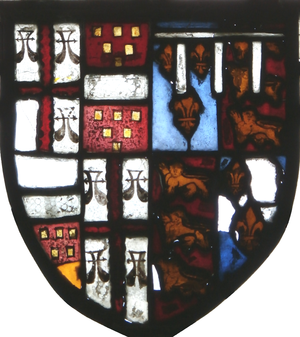
Arms of Patrick, Earl of March

On John’s death, the earldom of Moray would pass to Agnes’s husband in right of his wife. Agnes and Patrick were cousins within the prohibited degree of consanguinity and a dispensation had been needed for them to marry. According to the chronicler, Pitscottie, she gained her name of Black Agnes ‘be ressone she was blak skynnit’, suggesting Agnes had a dark complexion; her black hair, dark eyes and olive skin more common among Mediterranean countries than the northern fastness of Scotland.1 The English attributed a different reason to her name, to them, Black Agnes was the most evil Scotswoman who ever lived. Pitscottie went on to say of Agnes that she was ‘of greater spirit than it became a woman to be’, which, given her actions in the face of the enemy, is a fair appraisal of an incredible woman.2

Agnes was not the only woman to become heavily involved in the Scottish Wars of Independence, which had been a different kind of war from the very beginning. Robert the Bruce’s wife, daughter and sisters had been imprisoned for eight years by Edward I; his sister Christian would herself become involved in the fighting during her nephew David’s reign, defending the castle of Kildrummy against the supporters of Edward Balliol, in 1335.

Most of Agnes Randolph’s life is shrouded in mystery; there is very little mention of her existence until the English army appeared before her castle of Dunbar in January 1338. With the resumption of hostilities between England and Scotland in the 1330s, the castle of Dunbar became strategically important for both sides.

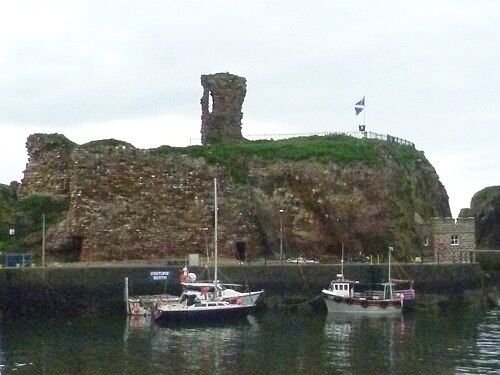
The stronghold had been rebuilt, at the expense of Edward III, in 1333, but by 1337 it was standing against England’s king. English affairs in the north lay in the hands of Richard (II) FitzAlan, Earl of Arundel, and William Montague, Earl of Salisbury, and it was these two experienced military leaders who decided to launch an English offensive by attacking Dunbar. An impressive stronghold, the castle was all but impregnable; it was built at the mouth of the Dunbar harbour, on separate rocks, with interlinking bridges and corridors.
History ... the Interesting Bits
The castle of Dunbar

Strategically, the castle’s position made it impossible for the English to march past it and leave it behind them, intact, able to harry the invaders and cut their lines of communication with England. Earl Patrick was away from home at the time, however, Scottish writer Nigel Tranter suggests that Agnes deliberately allowed herself to be besieged to give the Scottish forces time to rally and organise a resistance to the English invasion. Even so, it must have been a terrifying sight for the countess to look out from the battlements and see an army approaching; and the English earls must surely have been confident that they could beat the countess and her reduced garrison.

In January 1338, the English laid siege to Dunbar, surrounding it as best they could. The army had brought a legion of engineers with it, thus ensuring that a vast number of siege engines could be constructed and the castle’s inhabitants would face an almost constant barrage from missiles. When Salisbury demanded that Agnes surrender, she is said to have responded,

Of Scotland’s King I haud my House,
He pays me meat and fee,
And I will keep my gude and house,
While my house will keep me.3

The siege didn’t go exactly as the English planned. Agnes mocked them at every opportunity, appearing on the battlements even during bombardments. She is said to have had her maids dusting the battlements where they had been struck by missiles. When a siege engine known as a sow (a battering ram) was brought to face the castle, Agnes is said to have taunted the English by shouting ‘Beware, Montagow, for fallow shall they sow.’ The Scots would use the displaced rocks, caused by the barrages, and the missiles that had been fired at them, and rain them back down on their enemies. As the sow was destroyed and the English took cover, Agnes is said to have shouted ‘Behold the litter of English pigs.’4 Attack after attack was repulsed by Agnes and her men; a ballad, said to have been written by Salisbury himself, demonstrates Agnes’ steadfast attitude:
History ... the Interesting Bits
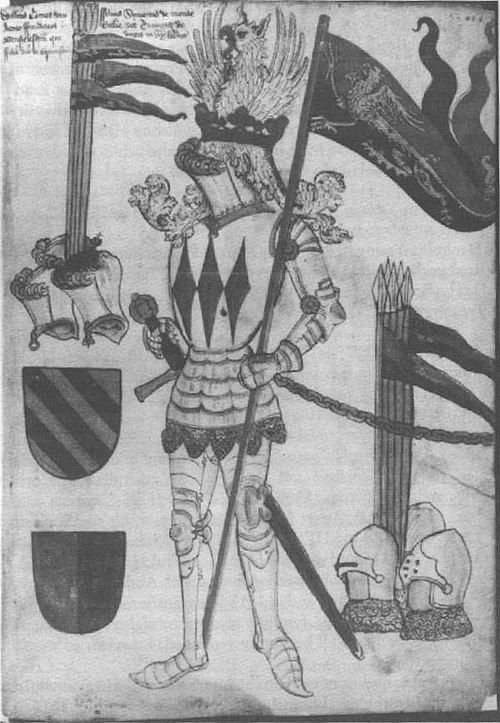
William Montague, from the Salisbury Roll

She makes a stir in tower and trench,
That brawling, boisterous, Scottish wench;
Came I early, came I late,
I found Agnes at the gate!5

The English even tried subterfuge to win the castle, bribing one of the castle’s guards to raise the gate and allow entry to the English attackers. However, the guard, having taken the money, went straight to Agnes:

Believing that they were going to be entering the castle, the Earl and his soldiers arrived at the gate. The guards, thinking Salisbury would be first to enter, dropped the gate after the first soldier stepped into the castle. Fortunately for Salisbury, one of his men had passed him on the approach. The thwarted earl retreated back to his camp with Agnes yelling at him from the castle walls: ‘Fare thee well Montague, I meant that you should have supped with us and support us in upholding the castle from the English!’5

At one point, the English used Agnes’s brother John Randolph in an attempt to persuade her to submit. One of the regents of Scotland during David II’s minority, John had been ambushed and captured in 1335. He was brought before Dunbar Castle, where Salisbury threatened to hang him in full view of his sister. Unperturbed, Agnes responded that John’s death could only be to her own benefit; although she could not inherit John’s titles, she was, alongside her sister, co-heir to his lands. John was given a reprieve and sent to imprisonment in England. Ironically, he would be freed in 1341 as part of a prisoner exchange; for the earl of Salisbury, of all people!

The problem for the English lay in the fact that they could not entirely surround the castle. Although they could besiege it from the land, the castle was still accessible by sea. An English fleet was guarding the harbour, but Sir Alexander Ramsay of Dalhousie managed to replenish the castle’s dwindling supplies by using a fleet of fishing boats, approaching in the early dawn from the cover of the Bass Rock. He managed to sneak through the enemy lines, making a dash for the harbour before the larger English vessels could get underway. Ramsay managed to land vital supplies and reinforcements for the garrison through a partially submerged entrance.

Agnes even sent the Earl of Salisbury some fresh-baked food when she knew the English supplies were running low, taunting the poor earl. Eventually, Agnes’s resistance proved too much for the English army, and, after nineteen weeks, on 10 June 1338, they lifted the siege, claiming their men and resources were needed for the king’s campaigns overseas. It had cost over £6,000, prompting one English chronicler to record that the siege had been ‘wasteful, and neither honourable nor secure, but useful and advantageous to the Scots’.6
History ... the Interesting Bits
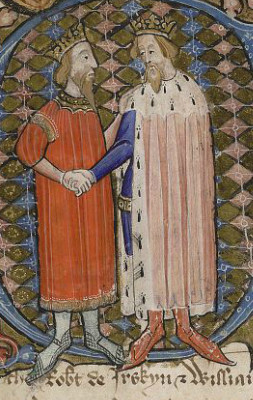
David II, King of Scots, and Edward III, King of England

The struggle against the English continued for several more years, but David II and his queen, Joan of the Tower, the daughter of Edward II and sister of Edward III, returned to Scotland amid great rejoicing in 1341; only for David to become a captive of Edward III following the Battle of Neville’s Cross in 1346. Scotland’s king spent eleven years in English captivity, while Scotland was ruled by his nephew and heir, Robert the Steward.

David returned in 1357, the same year that Patrick, Earl of Dunbar, participated in the raid that saw Berwick returned to Scottish sovereignty, for a short time at least. Earl Patrick continued to witness royal charters until July 1368 and remained active in Scottish affairs until his death in 1369. When Agnes also died in 1369, aged about 57, her father’s earldom and that of her husband passed to her nephew, George Dunbar.

Agnes of Dunbar was a women of status, raised to command households, if not men, who stepped up to the mark when the occasion demanded it. Although she was not educated in military techniques and tactics, she had lived within a world that was constantly on a war footing and when faced with a fight, she rose to the challenge. With her death, Black Agnes passed into legend, her tenacity and stalwart defence of Dunbar Castle a shining example of what a mere woman can be capable of achieving.

Images:

Courtesy of Wikipedia

Notes:

1. The historie and cronicles of Scotland … by Robert Lindesay of Pitscottie, ed. A. J. G. Mackay, 3 vols, Scottish Text Society, 42–3, 60 (1899–1911); 2. ibid; 3. Kyra Cornelius Kramer, Black Agnes and Psychological Warfare, kyrackramer.com; 4. Nigel Tranter, The Story of Scotland; 5. Kramer, Black Agnes and Psychological Warfare; 6. Historia Anglicana

Sources:

The historie and cronicles of Scotland … by Robert Lindesay of Pitscottie, ed. A. J. G. Mackay, 3 vols, Scottish Text Society, 42–3, 60 (1899–1911); Kyra Cornelius Kramer, Black Agnes and Psychological Warfare, kyrackramer.com; Nigel Tranter, The Story of Scotland; oxforddnb.com; Brewer’s British Royalty by David Williamson; Kings & Queens of Britain by Joyce Marlow; Mammoth Book of British Kings & Queens by Mike Ashley; Oxford Companion to British History Edited by John Cannon; Britain’s Royal Families by Alison Weir; educationscotland.gov.uk/scotlandhistory; englishmonarchs.co.uk; The Perfect King by Ian Mortimer; Scotland, History of a Nation by David Ross; The Life & Times of Edward III by Paul Johnson; The Reign of Edward III by W.M. Ormrod

*

My Books

Signed, dedicated copies of all my books are available through my online bookshop.

Out now: Scotland’s Medieval Queens

Books by Sharon Bennett Connolly

Scotland’s history is dramatic, violent and bloody. Being England’s northern neighbour has never been easy. Scotland’s queens have had to deal with war, murder, imprisonment, political rivalries and open betrayal. They have loved and lost, raised kings and queens, ruled and died for Scotland. From St Margaret, who became one of the patron saints of Scotland, to Elizabeth de Burgh and the dramatic story of the Scottish Wars of Independence, to the love story and tragedy of Joan Beaufort, to Margaret of Denmark and the dawn of the Renaissance, Scotland’s Medieval Queens have seen it all. This is the story of Scotland through their eyes.

Scotland’s Medieval Queens gives a thorough grounding in the history of the women who ruled Scotland at the side of its kings, often in the shadows, but just as interesting in their lives beyond the spotlight. It’s not a subject that has been widely covered, and Sharon is a pioneer in bringing that information into accessible history.’ Elizabeth Chadwick (New York Times bestselling author)

Available now from Amazon and Pen and Sword Books

Coming 30 March 2026: Princesses of the Early Middle Ages
Books by Sharon Bennett Connolly

Daughters of kings were often used to seal treaty alliances and forge peace with England’s enemies. Princesses of the Early Middle Ages: Royal Daughters of the Conquest explores the lives of these young women, how they followed the stereotype, and how they sometimes managed to escape it. It will look at the world they lived in, and how their lives and marriages were affected by political necessity and the events of the time. Princesses of the Early Middle Ages will also examine how these girls, who were often political pawns, were able to control their own lives and fates. Whilst they were expected to obey their parents in their marriage choices, several princesses were able to exert their own influence on these choices, with some outright refusing the husbands offered to them.

Their stories are touching, inspiring and, at times, heartbreaking.

Princesses of the Early Middle Ages: Royal Daughters of the Conquest is now available for pre-order.

Also by Sharon Bennett Connolly:

Books by Sharon Bennett Connolly

Heroines of the Tudor World tells the stories of the most remarkable women from European history in the time of the Tudor dynasty, 1485-1603. These are the women who ruled, the women who founded dynasties, the women who fought for religious freedom, their families and love. Heroines of the Tudor World is now available from Amberley Publishing and Amazon UK. Women of the Anarchy demonstrates how Empress Matilda and Matilda of Boulogne, unable to wield a sword themselves, were prime movers in this time of conflict and lawlessness. It shows how their strengths, weaknesses, and personal ambitions swung the fortunes of war one way – and then the other. Available from Bookshop.orgAmberley Publishing and Amazon UKKing John’s Right-Hand Lady: The Story of Nicholaa de la Haye is the story of a truly remarkable lady, the hereditary constable of Lincoln Castle and the first woman in England to be appointed sheriff in her own right. Available from all good bookshops Pen & Sword Booksbookshop.org and Amazon

Royal Historical Society

Defenders of the Norman Crown: The Rise and Fall of the Warenne Earls of Surrey tells the fascinating story of the Warenne dynasty, from its origins in Normandy, through the Conquest, Magna Carta, the wars and marriages that led to its ultimate demise in the reign of Edward III. Available from Pen & Sword BooksAmazon in the UK and US, and Bookshop.orgLadies of Magna Carta: Women of Influence in Thirteenth Century England looks into the relationships of the various noble families of the 13th century, and how they were affected by the Barons’ Wars, Magna Carta and its aftermath; the bonds that were formed and those that were broken. It is now available in paperback and hardback from Pen & SwordAmazon, and Bookshop.orgHeroines of the Medieval World tells the stories of some of the most remarkable women from Medieval history, from Eleanor of Aquitaine to Julian of Norwich. Available now from Amberley Publishing and Amazon, and Bookshop.orgSilk and the Sword: The Women of the Norman Conquest traces the fortunes of the women who had a significant role to play in the momentous events of 1066. Available now from Amazon,  Amberley Publishing, and Bookshop.org.

Alternate Endings: An anthology of historical fiction short stories including Long Live the King… which is my take what might have happened had King John not died in October 1216. Available in paperback and kindle from Amazon.

Podcast:
A Slice of Medieval

Have a listen to the A Slice of Medieval podcast, which I co-host with Historical fiction novelist Derek Birks. Derek and I welcome guests, such as Bernard Cornwell, Elizabeth Chadwick and Scott Mariani, and discuss a wide range of topics in medieval history, from significant events to the personalities involved. 

There are now over 80 episodes to listen to!

Every episode is also now available on YouTube.

*

Don’t forget! Signed and dedicated copies of all my books are available through my online bookshop.

For forthcoming online and in-person talks, please check out my Events Page.

You can be the first to read new articles by clicking the ‘Follow’ button, liking our Facebook page or joining me on TwitterThreadsBluesky and Instagram.

*

©2025 Sharon Bennett Connolly FRHistS
Women in Love: Katherine Swynford and Joan Beaufort, Queen of Scots

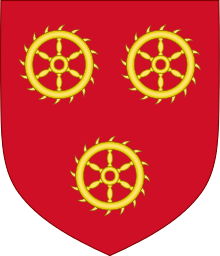
The coat of arms of Katherine Swynford

Sometimes the similarities in the stories of medieval women are intriguing. Especially among families. Katherine Swynford’s story is one of the endurance of love and is unique in that she eventually married her prince. Katherine’s granddaughter, Joan Beaufort, is one half of, arguably, the greatest love story of the middle ages. I say arguably, of course, because many would say that Katherine’s was the greatest.

You may not consider a mistress as a heroine, seeing her as ‘the other woman’ and not worthy of consideration. However, women in the medieval era had little control over their own lives; if a lord wanted them, who were they to refuse? And even if they were in love, differences in social position could mean marriage was impossible – at least for a time.

Katherine was born around 1350; she was the younger daughter of Sir Payn Roelt, a Hainault knight in the service of Edward III’s queen, Philippa of Hainault, who eventually rose to be Guyenne King of Arms. Her mother’s identity is unknown, but Katherine and her older sister, Philippa, appear to have been spent their early years in Queen Philippa’s household. By 1365 Katherine was serving Blanche, Duchess of Lancaster, the first wife of John of Gaunt and Katherine was married to Sir Hugh Swynford of Coleby and Kettlethorpe, Lincolnshire, shortly after. The couple had three children, Thomas, Margaret, who became a nun, and Blanche, who was named after the duchess. John of Gaunt stood as little Blanche’s godfather and she was raised alongside his own daughters by Duchess Blanche.

Following Blanche’s death in 1368, Katherine was appointed governess to the duchess’s daughters. In September 1371 John of Gaunt was remarried, to Constance of Castile; Constance had a claim to the throne of Castile and John was soon being addressed as King of Castile. In the same year, Katherine’s husband, Sir Hugh Swynford, died whilst serving overseas and it seems that within months of his death, probably in the winter of 1371/72 Katherine became John’s mistress. Their first child, John Beaufort, was born towards the end of 1372. Over the next few years, three further children – two sons and a daughter – followed. John’s wife Constance also had children during this time – she gave birth to a daughter, Catherine, (Catalina) in 1373 and a short-lived son, John, in 1374.

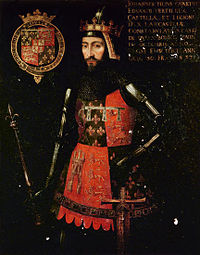
John of Gaunt, Duke of Lancaster

We can only guess at what the two women thought of each other, but it can’t have been an easy time for either. In 1381, following the unrest of the Peasants’ Revolt and the hefty criticism aimed particularly at John and his relationship with Katherine, John renounced Katherine. Giving up her position as governess, Katherine left court and returned to Lincoln. Her relationship with John of Gaunt and, indeed, his family, remained cordial and the duke still visited her, although discreetly. In 1388 Katherine was made a Lady of the Garter – a high honour indeed. And in 1394 Constance died.

In January 1396, John and Katherine were finally married in Lincoln Cathedral; they had to obtain a dispensation from the church as John was godfather to Katherine’s daughter. With the marriage, Katherine had gone from being a vilified mistress to Duchess of Lancaster. Her children by John were legitimised by the pope in September 1396 and by Richard II’s royal patent in the following February, although they were later excluded from the succession by Henry IV.

Sadly, Katherine’s marital happiness with John of Gaunt was short-lived; John of Gaunt died in February 1399 and Katherine retired to live in Lincoln, close to the cathedral of which her second son by John, Henry, was bishop. Katherine herself died at Lincoln on 10 May 1403 and was buried in the cathedral in which she had married her prince. Her tomb can still be seen today and lies close to the high altar, beside that of her youngest child Joan Beaufort, countess of Westmorland, who died in 1440.

Although it seems easy to criticise Katherine’s position as ‘the other woman’, her life cannot have been an easy one. The insecurity and uncertainty of her position, due to the lack of a wedding ring, must have caused her much unease. However, that she eventually married her prince, where so many other medieval mistresses simply fell by the wayside and were forgotten, makes her story unique. What makes her even more unique is that Katherine’s own granddaughter was part of one of the greatest love stories of the middle ages.

Joan Beaufort was the only daughter of Katherine’s eldest son by John of Gaunt, also named John. The story of King James I of Scotland and his queen, Joan Beaufort, is probably the greatest love story of the medieval era. He was a king in captivity and she a beautiful young lady of the court of her Lancastrian cousin, Henry V. The son of Robert III of Scotland, James had been on his way to France, sent there for safety and to continue his education, when his ship was captured by pirates in April 1406. Aged only eleven, he had been handed over to the English king, Henry IV, and imprisoned in the Tower of London. Within a couple of months of his capture, James’s father had died, and he was proclaimed King of Scots, but the English would not release their valuable prisoner. James was closely guarded and regularly moved around, but he was also well-educated while in the custody of the English king and became an accomplished musician and poet.

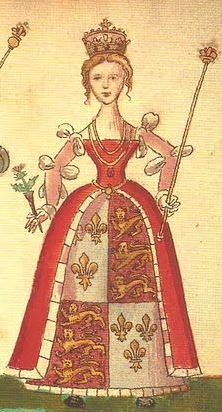
Joan Beaufort, Queen of Scots

Probably born in the early 1400s, Lady Joan was the daughter of John Beaufort, 1st Earl of Somerset. She was at court by the early 1420s, when James first set eyes on her. The Scottish king wrote of his love for Joan in his famous poem, The Kingis Quair. According to Nigel Tranter, James was with the court at Windsor, when he saw Joan for the first time; she was walking her little lapdog in the garden, below his window. The narrow window afforded him only a limited view, but the Lady Joan walked the same route every morning and James wrote of her;

Beauty, fair enough to make the world to dote,

Are ye a worldy creature?

Or heavenly thing in likeness of nature?

Or are ye Cupid’s own priestess, come here,

To loose me out of bonds

One morning James is said to have dropped a plucked rose down to Lady Joan, which he saw her wearing the following evening at dinner. Nigel Tranter suggests Lady Joan grieved over James’s imprisonment and even pleaded for his release. Written in the winter of 1423/24, the autobiographical poem, The Kingis Quair, gives expression to James’ feelings for Joan;

I declare the kind of my loving

Truly and good, without variance

I love that flower above all other things

James’s imprisonment lasted for eighteen years. His uncle Robert Stewart, Duke of Albany and Guardian of Scotland in James’s absence, refused to ransom him, in the hope of gaining the throne himself. He never quite garnered enough support, but managed to keep the Scottish nobles in check. However, when he died in 1420, control passed to his son Murdoch, and Scotland fell into a state of virtual anarchy. With Henry V’s death in 1422, it fell to his brother John, Duke of Bedford, as regent for the infant Henry VI, to arrange James’ release. The Scots king was charged 60,000 marks in ransom – ironically, it was claimed that it was to cover the costs for his upkeep and education for eighteen years. The agreement included a promise for the Scots to keep out of England’s wars with France, and for James to marry an English noble woman – not an onerous clause, given his love for Lady Joan Beaufort.

James and Joan were married at the Church of St Mary Overie in Southwark (now Southwark Cathedral) on 2 February 1424, with the wedding feast taking place in the adjoining hall, the official residence of Joan’s uncle Henry Beaufort, Bishop of Winchester. Finally united – and free – the young couple made their way north soon afterwards and were crowned together at Scone Abbey on 21 May 1424. James and Joan had eight children, seven of whom survived childhood. Their six daughters helped to strengthen alliances across Europe. The royal couple finally had twin sons on 16 October 1430; and although Alexander died within a year of his birth, his younger twin, James, thrived and was created Duke of Rothesay and heir to the throne. He would eventually succeed his father as James II.

On his return to Scotland, James immediately set about getting his revenge on the Duke of Albany’s family and adherents; executing some, including Murdoch, Albany’s son and heir. Two other claimants to James’s throne were sent to England, as hostages for the payment of his ransom. James and Joan ruled Scotland for thirteen years; James even allowed Joan to take some part in the business of government. Although the Scots were wary of her being English, Queen Joan became a figurehead for patronage and pageantry. The English hope that Joan’s marriage to James would also steer the Scots away from their Auld Alliance with France, was short-lived, however, and the 1436 marriage of their eldest daughter, Margaret, to the French dauphin formed part of the renewal of the Auld Alliance.

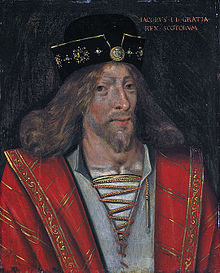
James I, King of Scots

James’ political reforms, combined with his desire for a firm but just government, made enemies of some nobles, including his own chamberlain Sir Robert Stewart, grandson of Walter, Earl of Atholl, who had been James’s heir until the birth of his sons. Sir Robert and his grandfather hatched a plot to kill the king and queen. In February 1437, the royal couple was staying at the Blackfriars in Perth when the king’s chamberlain dismissed the guard and the assassins were let into the priory. The king is said to have hidden in an underground vault as the plotters were heard approaching. There is a legend that the vault had originally been an underground passage, however, the king had ordered the far end to be sealed, when his tennis balls kept getting lost down there. Unfortunately, that also meant James had blocked off his own escape route. The assassins dragged the king from his hiding place and stabbed him to death; Joan herself was wounded in the scuffle.

And one of the greatest love affairs of the era ended in violence and death. The plotters, far from seizing control of the country, were arrested and executed as the Scottish nobles rallied around the new king, six-year-old James II. Joan’s life would continue to be filled with political intrigue, but her love story had been viciously cut short, without the happy ending her grandmother had achieved. Joan would marry again, to Sir James Stewart, the Black Knight of Lorne. They would go on to have 3 sons together before Joan died during a siege at Dunbar Castle on 15 July, 1445; although whether her death was caused by illness or the violence of the siege has not been determined. She was buried in the Carthusian priory in Perth alongside her first husband, King James I.

Katherine and Joan led very different lives, although the similarities are there if you look for them; they both lived their lives around the glittering court and married for love. Joan’s happy marriage only achieved because her grandmother finally got her prince; if Katherine had not married John of Gaunt, the Beauforts would have remained illegitimate and their future prospects seriously restricted by the taint of bastardy.

*

Images courtesy of Wikipedia.

Sources:

katherineswynfordsociety.org.uk; Red Roses: Blanche of Gaunt to Margaret Beaufort by Amy Licence; The Nevills of Middleham by K.L. Clark; The House of Beaufort: the Bastard Line that Captured the Crown by Nathen Amin; Brewer’s British Royalty by David Williamson; History Today Companion to British History Edited by Juliet Gardiner & Neil Wenborn; The mammoth Book of British kings & Queen by Mike Ashley; Britain’s Royal Families, the Complete Genealogy by Alison Weir; The Life and Times of Edward III by Paul Johnson; The Perfect King, the Life of Edward III by Ian Mortimer; The Reign of Edward III by WM Ormrod; Chronicles of the Age of Chivalry Edited by Elizabeth Hallam; Oxforddnb.com; womenshistory.about.com/od/medrenqueens/a/Katherine-Swynford.

An earlier version of this article first appeared on The Henry Tudor Society blog in November 2017.

*

My Books

Signed, dedicated copies of all my books are available through my online store.

Out now: Scotland’s Medieval Queens

Scotland’s history is dramatic, violent and bloody. Being England’s northern neighbour has never been easy. Scotland’s queens have had to deal with war, murder, imprisonment, political rivalries and open betrayal. They have loved and lost, raised kings and queens, ruled and died for Scotland. From St Margaret, who became one of the patron saints of Scotland, to Elizabeth de Burgh and the dramatic story of the Scottish Wars of Independence, to the love story and tragedy of Joan Beaufort, to Margaret of Denmark and the dawn of the Renaissance, Scotland’s Medieval Queens have seen it all. This is the story of Scotland through their eyes.

Available now from Amazon and Pen and Sword Books

Also by Sharon Bennett Connolly:

Heroines of the Tudor World tells the stories of the most remarkable women from European history in the time of the Tudor dynasty, 1485-1603. These are the women who ruled, the women who founded dynasties, the women who fought for religious freedom, their families and love. Heroines of the Tudor World is now available for pre-order from Amberley Publishing and Amazon UK. Women of the Anarchy demonstrates how Empress Matilda and Matilda of Boulogne, unable to wield a sword themselves, were prime movers in this time of conflict and lawlessness. It shows how their strengths, weaknesses, and personal ambitions swung the fortunes of war one way – and then the other. Available from Bookshop.orgAmberley Publishing and Amazon UKKing John’s Right-Hand Lady: The Story of Nicholaa de la Haye is the story of a truly remarkable lady, the hereditary constable of Lincoln Castle and the first woman in England to be appointed sheriff in her own right. Available from all good bookshops Pen & Sword Booksbookshop.org and Amazon

Defenders of the Norman Crown: The Rise and Fall of the Warenne Earls of Surrey tells the fascinating story of the Warenne dynasty, from its origins in Normandy, through the Conquest, Magna Carta, the wars and marriages that led to its ultimate demise in the reign of Edward III. Available from Pen & Sword BooksAmazon in the UK and US, and Bookshop.orgLadies of Magna Carta: Women of Influence in Thirteenth Century England looks into the relationships of the various noble families of the 13th century, and how they were affected by the Barons’ Wars, Magna Carta and its aftermath; the bonds that were formed and those that were broken. It is now available in paperback and hardback from Pen & SwordAmazon, and Bookshop.orgHeroines of the Medieval World tells the stories of some of the most remarkable women from Medieval history, from Eleanor of Aquitaine to Julian of Norwich. Available now from Amberley Publishing and Amazon, and Bookshop.orgSilk and the Sword: The Women of the Norman Conquest traces the fortunes of the women who had a significant role to play in the momentous events of 1066. Available now from Amazon,  Amberley Publishing, and Bookshop.org.

Alternate Endings: An anthology of historical fiction short stories including Long Live the King… which is my take what might have happened had King John not died in October 1216. Available in paperback and kindle from Amazon.

Podcast:

Have a listen to the A Slice of Medieval podcast, which I co-host with Historical fiction novelist Derek Birks. Derek and I welcome guests, such as Bernard Cornwell and discuss a wide range of topics in medieval history, from significant events to the personalities involved.

*

Don’t forget! Signed and dedicated copies of all my books are available through my online store.

For forthcoming online and in-person talks, please check out my Events Page.

You can be the first to read new articles by clicking the ‘Follow’ button, liking our Facebook page or joining me on TwitterThreadsBluesky and Instagram.

*

©2021 Sharon Bennett Connolly FRHistS
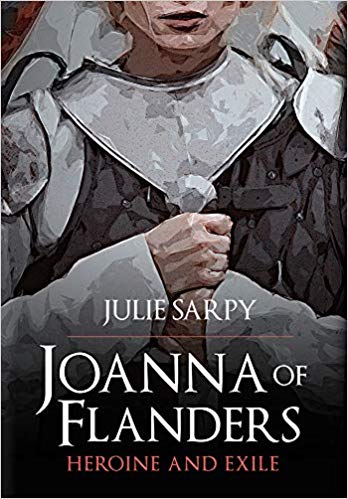
Book Corner: Joanna of Flanders, Heroine and Exile by Julie Sarpy

The new research in this biography solves the riddle of the disappearance of Joanna of Flanders early in the Hundred Years’ War, a leader described by David Hume as ‘the most extraordinary woman of the age’.

Joanna of Flanders, Countess de Montfort and Duchess of Brittany, vanished from public life after 1343 amid the Breton Wars of Succession during the Hundred Years’ War. As wife of the late Duke John de Montfort, Joanna’s rightful place was in Brittany as regent of the duchy for their five-year-old son and heir, John of Brittany. Famed for the defence of Hennebont in 1342 during her husband’s imprisonment, she, along with her children, had accompanied Edward III to England in February 1343 and never departed. She resided in comfortable obscurity at Tickhill Castle, Yorkshire, until her death around 1374.

What happened to her and why? Her extended absence should have provoked more suspicion, but it did not. Edward III certainly orchestrated her relocation from London to Yorkshire and sanctioned her indefinite detention.

Delving deeper into her story the answers to those two questions explore the complexities of medieval social structures, notably in the care of the vulnerable and the custody of women. The 19th-century Breton historian de la Borderie asked if Joanna’s ‘many tests had reversed her intelligence and thrown her into the abyss of madness’, a position accepted by many modern historians – but not by Julie Sarpy.

When my publishers, Amberley, asked if I would like to review Julie Sarpy’s Joanna of Flanders: Heroine and Exile I jumped at the chance. I first came across Joanna of Flanders when writing an article about her son, John V, Duke of Brittany; and I remember thinking, ‘I must look into this woman’. I have not yet had the opportunity (though I will write a blog post if I ever get the time). So, although I was aware of Joanna, I know only the bare bones of her story. Which is why this book intrigued me so much!

Julie Sarpy has done an incredible job of researching the story of Joanna of Flanders. Her investigation has uncovered some remarkable facts about Joanna’s life, the times she lived through and the treatment she received at the hands of her supposed ally, Edward III. This is a balanced, in-depth study of a woman who deserves her time in the limelight. Joanna of Flanders is, in short, an amazing woman, whose story deserves to be known by a much wider audience.

I have to admit to a personal interest in the tale, in grew up not far from Tickhill Castle, South Yorkshire, the site of Joanna’s imprisonment. And though everyone in the area knows about the castle’s connections to King John, to the de Warennes and to the dukes of Lancaster (it is now owned by the duchy of Lancaster), no one seems to know of its role as the prison of poor Joanna.

Joanna of Flanders’ life has not been given its full measure. One wonders how such a remarkable woman has been lost to the ages and ostensibly marginalised. For Joanna of Flanders, Countess of Montfort and Richmond, Duchess of Brittany, was, in her time, the heroine of Hennebont, the pivotal siege during the first half of the Breton Civil War (1341-1365) that prevented the French from taking over Brittany and routing the English early in the Hundred Years’ War (1337-1453). That was no small feat for anyone, especially a fourteenth-century woman. In fact, she seems to have been exceptional in many ways. Medieval French chronicler and contemporary Jean Froissart professed Joanna of Flanders ‘to possess the courage of a man and the heart of a lion.’ Breton historian Dom Lobineau said of the Countess of Montfort, ‘no adversity could crush her. her consistency in the most desperate circumstances always reassured those who attached [themselves] to her.’ She marshalled men and resources, unlike her rival the Breton-French Jeanne de Penthievre’s husband. Joanna of Flanders rallied her husband’s supporters, the pro-English Montfortist faction, in his absence during the Siege of Hennebont and then secured the safety of his heirs in England, with the aid of Edward III.

Julie Sarpy’s investigation into the life and imprisonment of Joann of Flanders is a fascinating study. The author follows the evidence from the records and chronicles of the time and reconstructs Joanna’s story, dispelling the false stories of her madness and clearly presenting Joanna of Flanders as a political prisoner; a remarkable woman whose imprisonment was essential to furthering the ambitions of her ally, Edward III.

Well written, entertaining and informative, this is an engaging and enjoyable book that should attract any history fan who wants to learn more about Joanna’s life and the wider story of the the Breton Civil War. From the first page, the author draws you in with the mystery of Joanna’ imprisonment and the teaser of who may benefit from having her out of the way. Julie Sarpy then takes you through the complexities of the Breton ducal family, the background and prosecution of the war before concentrating on Joanna’s imprisonment, the reasons behind it and the legal implications.

This is a thorough and absorbing study of a woman who has been largely neglected by history. It’s a story that deserves to be heard and that has been told, in Joanna of Flanders: Heroine and Exile, with remarkable skill and judgement – and a little sympathy for the heroine. I cannot recommend it highly enough.

About the author:

Originally from Louisiana, Julia Sarpy is a subject specialist librarian and adjunct faculty at Nova Southeastern University. She received her doctorate in European History from the University of Houston. A UCLA alum, she also hold master’s degrees from University of North Texas and Southern Methodist University.

Joanna of Flanders: Heroine and Exile is now available from Amberley Publishing and Amazon in the UK and will be released on 1 October 2019 in the US; it is available for pre-order on Amazon US.

*

My books

Silk and the Sword: The Women of the Norman Conquest

From Emma of Normandy, wife of both King Cnut and Æthelred II to Saint Margaret, a descendant of Alfred the Great himself, Silk and the Sword: the Women of the Norman Conquest traces the fortunes of the women who had a significant role to play in the momentous events of 1066.  Available now from Amazon UK,  Amberley Publishing, Book Depository and Amazon US.

Heroines of the Medieval World

Telling the stories of some of the most remarkable women from Medieval history, from Eleanor of Aquitaine to Julian of Norwich, Heroines of the Medieval World,  is available now on kindle and in paperback in the UK from from both Amberley Publishing and Amazon, in the US from Amazon and worldwide from Book Depository.

*

You can be the first to read new articles by clicking the ‘Follow’ button, liking our Facebook page or joining me on Twitter and Instagram.

*

©2019 Sharon Bennett Connolly

Anne of Gloucester, Daughter of a Traitor

Arms of Anne of Gloucester, Countess of Stafford_of_stafford-svg
Arms of Anne of Gloucester, Countess of Stafford

Born sometime around 1382 Anne of Gloucester was the daughter of Thomas of Woodstock, 1st Duke of Gloucester, and Eleanor de Bohun.

Anne’s parentage was impeccable. Her father was the youngest son of the late king Edward III and his queen Philippa of Hainault, making Anne first cousins with the 2 subsequent kings, Richard II and Henry IV. Along with Henry IV’s wife, Mary de Bohun, Anne’s mother was co-heiress of the earls of Hereford.

Anne’s childhood would have been marred by the political conflicts of Richard II’s reign. By the late 1380s her father had set himself up in opposition to the king’s tyrannical rule and his reliance on personal favourites. As a leader of the Lords Appellant he was responsible for the arrest of Richard’s favourites and the curbing of the king’s powers.

Anne was probably born at Pleshey Castle and it was also the scene of her first wedding. In June 1391, aged only 8 or 9, Anne was married to Thomas Stafford, 3rd Earl of Stafford, who was about 15 years her senior. Thomas died in 1392, before the marriage could be consummated. Even before Thomas Stafford’s death, it seems, provision had already been made for Anne to marry one of his younger brothers. The brothers, William and Edmund, were wards of Anne’s father. The year after the elder boy William, died in 1395 (aged about 19), Anne was married to Edmund, now 5th Earl of Stafford.

300px-ThomasWoodstock
Thomas of Woodstock, Duke of Gloucester

In the year following her marriage, Anne was to suffer further tragedy when her father was personally arrested by the king, whilst recovering from illness at the family’s home of Pleshey Castle, Essex. Thomas was transported to imprisonment in Calais to await trial, under the care of the earl of Nottingham, from where his death was reported in September of the same year. A later inquiry established that Thomas Duke of Gloucester had been murdered, most likely on the night of 8th September, smothered under a mattress.

The Duke was declared a traitor and his lands and property were forfeited to the crown. Anne’s only brother, Humphrey, was made a ward of King Richard II and was with the king in Ireland 2 years later, when Henry Bolingbroke invaded England and claimed the crown as Henry IV. The new king ordered Humphrey’s return to England, but he died on the voyage home in August 1399, aged just 18.

Anne’s life was hit by 2 further losses in close succession. Her mother, Eleanor de Bohun died on 3rd October 1399. The Chronicler, Walsingham, said she died of a broken heart following the deaths of her husband and only son. Anne’s unmarried sister, Joan, died in August 1400. With her only remaining sibling, Isabel, taking the veil at the Minoresses in London on her 16th birthday in April 1402, Anne became one of the greatest heiresses in the kingdom. From 1399 she was recognised as Countess of Buckingham, Hereford and Northampton and was made a Lady of the Garter in 1405.

Humphrey_Stafford,_Duke_of_Buckingham_by_William_Bond,_after_Joseph_Allen
Humphrey Stafford, Duke of Buckingham

In these same years Anne gave birth to 2 daughters and a son. Of her daughters Philippa died young and Anne would marry consecutively her cousins Edmund Mortimer, earl of March and John Holland, 2nd Duke of Exeter. Anne’s only son by Edmund Stafford, Humphrey, was born in 1402 and would go on to become the Duke of Buckingham. Loyal to King Henry VI at the outbreak of the Wars of the Roses, he would be killed at the Battle of Northampton in 1460. Humphrey’s son, Henry, would be husband to Henry VII’s mother, Margaret Beaufort.

On 21st July 1403 Anne was made a widow for the second time, when Edmund was killed fighting for the king at the Battle of Shrewsbury. Still only in her early 20s Anne was left with 2 young children and a dower income of £1500 a year. However, with her dower properties stretched across the strategically important Welsh Marches Anne’s remarriage was of great interest to Henry IV.

Of immediate concern was the security of those dower properties, giving Henry IV’s ongoing conflict with Owain Glyn Dwr and the Welsh. Sir William Bourchier, Count of Eu, was dispatched to help protect Anne and her properties from any Welsh incursions. And it was with this same knight that Anne, taking her future into her own hands, contracted a secret marriage some time before 20th November 1405.

The king was displeased with the clandestine marriage and the couple were fined ‘great sums’. However, Bourchier it seems was highly charismatic, a capable soldier and valued administrator, all factors which, when added to his proven loyalty to the Lancastrian king,  helped to ensure that the couple was soon forgiven.

BourchierImpaling_ThomasOfWoodstock_TawstockChurch
The Bourchier arms quartered with those of Thomas of Woodstock, Anne’s father

Sir William Bourchier would continue his impressive career under Henry V; fighting at Agincourt in 1415, after which he was appointed Constable of the Tower of London and took responsibility of the high-profile French prisoners captured in the battle. In letters Anne described with pride ‘the valiant prowess, wisdom and good governance’ her husband .

The couple seems to have been genuinely in love and soon had a nursery full of children, with 4 sons and a daughter all born before 1415. Anne promoted the careers of all her children and arranged marriages for them.

William and Anne’s eldest son, Henry 1st Earl of Essex was married to Isabel of Cambridge, daughter of Richard of Conisbrough. A Yorkist supporter, he fought at the Second battle of St Albans and at Towton, dying in April 1483.

Thomas Bourchier, most likely Anne and William’s second son, went to Oxford and then joined the Church. He rose to become Archbishop of Canterbury in 1454 and was made a cardinal in 1467. Although he was Chancellor for a short time, in the reign of Henry VI, Thomas was a loyal supporter of the Yorkist cause and it was Edward IV himself who wrote to the pope urging for Thomas’s promotion to cardinal. In his position as Archbishop of Canterbury, Thomas crowned both Richard III and Henry VII. He died in 1486 and was buried next to the high altar in Canterbury Cathedral.

Cardinal_Thomas_Bourchier
Cardinal Thomas Bourchier, Archbishop of Canterbury

Of their other sons; William Bourchier became Baron Fitzwarin in right of his wife and Sir John Bourchier was created Baron Berners following his marriage to Margery Berners. He was Constable of Windsor Castle in the 1460s. Anne and William’s only daughter, Eleanor Bourchier, married John de Mowbray, 3rd Duke of Norfolk, and was the mother of another John, the 4th Duke.

Although they seem to have been on opposing sides of the political spectrum, Humphrey Stafford remained close to his mother and his Bourchier half-siblings.

Anne was widowed for a third and final time when William died at Troyes in 1420. His body was sent back to England for burial at Llanthony Priory in Gloucestershire. Anne had an enduring friendship with the Prior, John Wyche, and corresponded with him in both French and English.

Although not yet 40 Anne never remarried. Throughout her marriages – and after – she was personally involved in estate management and her letters demonstrate a sound business acumen. Anne had loyal and talented administrators who helped her fight for her interests.  As earl of Buckingham, Anne’s father had revenues of £1,000 a year from the lordships of Oakham (Rutland) and Holderness (Yorkshire). While Oakham was returned to Anne in 1414 she only recovered Holderness in 1437, the year before she died.

While Anne was cousin to the king, Henry V, both he and his father had resented the unequal division of the Bohun inheritance in her favour. Henry V was to eventually force a new settlement on the recently widowed countess in 1421, this time heavily weighted  for the king’s benefit, leaving Anne just £1200 a year from her mother’s inheritance; and even this often fell into arrears.

330px-Remains_of_Llanthony_Priory_-_geograph.org.uk_-_1118627
Llanthony Secunda Priory, Anne’s burial place

Anne had shared a love of the church with her mother and was known for her piety and love of learning. She died in October 1438, aged around 55. Her will, written “in the Englyshe tonge for my most profit redyng and vnderstandyng”, remembered her “most trewe and diligent” reatiners (Register of Henry Chichele.

Anne of Gloucester, mother to combatants on both sides of the Wars of the Roses and granddaughter of Edward III, was buried beside William at Llanthony Priory where, in 1453, her children set up a perpetual chantry for the welfare of their souls.

*

Pictures courtesy of Wikipedia

*

Sources: The Oxford Companion to British History Edited by John Cannon.;  Brewer’s British Royalty by David Williamson; Britain’s Royal Families, the Complete Genealogy by Alison Weir; Chronicles of the Age of Chivalry Edited by Elizabeth Hallam; The Mammoth Book of British Kings and Queens by Mike Ashley; oxforddnb.com; geni.com;  thepeerage.com.

*

My Books:

Signed, dedicated copies of all my books are available through my online bookshop.

Out Now! Women of the Anarchy

On the one side is Empress Matilda, or Maud. The sole surviving legitimate child of Henry I, she is fighting for her birthright and that of her children. On the other side is her cousin, Queen Matilda, supporting her husband, King Stephen, and fighting to see her own son inherit the English crown. Both women are granddaughters of St Margaret, Queen of Scotland and descendants of Alfred the Great of Wessex. Women of the Anarchy demonstrates how these women, unable to wield a sword, were prime movers in this time of conflict and lawlessness. It show how their strengths, weaknesses, and personal ambitions swung the fortunes of war one way – and then the other.

Available for pre-order from Amberley Publishing and Amazon UK.

Coming on 15 June 2024: Heroines of the Tudor World

Heroines of the Tudor World tells the stories of the most remarkable women from European history in the time of the Tudor dynasty, 1485-1603. These are the women who ruled, the women who founded dynasties, the women who fought for religious freedom, their families and love. These are the women who made a difference, who influenced countries, kings and the Reformation. In the era dominated by the Renaissance and Reformation, Heroines of the Tudor World examines the threats and challenges faced by the women of the era, and how they overcame them. Some famous, some infamous, some less well known, including Anne Boleyn, Elizabeth Barton, Catherine de Medici, Bess of Hardwick and Elizabeth I. From writers to regents, from nuns to queens, Heroines of the Tudor World shines the spotlight on the women helped to shape Early Modern Europe.

Heroines of the Tudor World is now available for pre-order from Amberley Publishing and Amazon UK.

Also by Sharon Bennett Connolly:

King John’s Right-Hand Lady: The Story of Nicholaa de la Haye is the story of a truly remarkable lady, the hereditary constable of Lincoln Castle and the first woman in England to be appointed sheriff in her own right. It is is available from King John’s Right-Hand Lady: The Story of Nicholaa de la Haye is the story of a truly remarkable lady, the hereditary constable of Lincoln Castle and the first woman in England to be appointed sheriff in her own right. Available from all good bookshops or direct from Pen & Sword Booksbookshop.org and AmazonDefenders of the Norman Crown: The Rise and Fall of the Warenne Earls of Surrey tells the fascinating story of the Warenne dynasty, from its origins in Normandy, through the Conquest, Magna Carta, the wars and marriages that led to its ultimate demise in the reign of Edward III. Available from Pen & Sword BooksAmazon in the UK and US, and Bookshop.org

Ladies of Magna Carta: Women of Influence in Thirteenth Century England looks into the relationships of the various noble families of the 13th century, and how they were affected by the Barons’ Wars, Magna Carta and its aftermath; the bonds that were formed and those that were broken. It is now available in paperback and hardback from Pen & Sword,  Amazon, and Bookshop.orgHeroines of the Medieval World tells the stories of some of the most remarkable women from Medieval history, from Eleanor of Aquitaine to Julian of Norwich. Available now from Amberley Publishing and Amazon, and Bookshop.orgSilk and the Sword: The Women of the Norman Conquest traces the fortunes of the women who had a significant role to play in the momentous events of 1066. Available now from Amazon,  Amberley Publishing, and Bookshop.org.

Alternate Endings: An anthology of historical fiction short stories including Long Live the King… which is my take what might have happened had King John not died in October 1216. Available in paperback and kindle from Amazon.

Podcast:

Have a listen to the A Slice of Medieval podcast, which I co-host with Historical fiction novelist Derek Birks. Derek and I welcome guests, such as Bernard Cornwell and Elizabeth Chadwick, and discuss a wide range of topics in medieval history, from significant events to the personalities involved.

*

Don’t forget! Signed and dedicated copies of all my books are available through my online bookshop.

For forthcoming online and in-person talks, please check out my Events Page.

You can be the first to read new articles by clicking the ‘Follow’ button, liking our Facebook page or joining me on Twitter and Instagram.

©2015 Sharon Bennett Connolly, FRHistS

Book Corner: Fields of Glory by Michael Jecks

81Lj4afwfALThe year is 1346 and King Edward III is restless. Despite earlier victories his army has still not achieved a major breakthrough and the French crown remains intact. Determined to bring France under English rule and the French army to its knees he has regrouped and planned a new route of attack.

And on the beaches of Normandy his men now mass, ready to march through France to victory. But the French are nowhere to be seen. Edward knows that the worst thing he could do would be to take the battle to the French, where they will have the advantage and so he sets up camp near a small hill at Crécy and waits.

The Battle of Crécy will be a decisive turning point in the Hundred Years’ Wars. This is the story of that battle and the men who won it.”

A masterpiece!

Fields of Glory follows the English army from their landing on the beaches of Normandy, through the devastating destruction of the chevauchée through Northern France and to the gates of Paris itself, before the retreat ever north in search of a crossing of the River Somme, and the final confrontation with  the French army.

We experience the sieges, the skirmishes, the looting and death through the eyes of one of Edward I’s captains and his vintaine (company) of 20 men; hardened soldiers who all have their own secrets,  fears and superstitions.

We are also given snippets behind the decision-making of the great King Edward III and his 16-year-old son Edward, the future Black Prince. The army’s leaders are vivid, but distant, characters as the story concentrates on the experiences of the fighting men

The Vintaine’s captain, Berenger, leads his men through the armies skirmishes and their own personal battles and conflicts. Rescuing a French girl from the Welsh contingent brings its own problems, dividing the opinions and conflicts of the men while showing  the humanity that still existed among the devastation.

Berenger is a seasoned soldier and experienced captain, who needs his men as much as – if not more than – they need him. His men are real characters; Clip, with his prophecies of doom becomes a sort mascot of the company – only if he predicts their deaths are they confident of survival; and Geoff, who projects his own demons onto others in order to avoid their reality. And then there’s young Ed, just a boy wanting revenge on the french for all the ills of the world, and learning the realities of war through this small band of soldiers.

And then there is Archibald, the King’s gynour, a strange loner of a man who incites fear and loathing even from his own side. He is in charge of the king’s gonnes, the cannon which are slowly becoming part of the modern battlefield, but which are still distrusted by the common soldier.

One scene in particular leaves the reader cold and thoughtful. I don’t want to give too much away, but the king’s justice, meted out to his own men following the plundering of a monastery, left me with a sleepless night, so vivid was the imagery invoked by the scene:

Ed listened to the king’s words with breathless disbelief.

When the men had all been marched back to the army he had thought that there would be a court, an opportunity to explain – and yet here he was, with the sentence of death on him!”

How the scene plays out – well, I’ll leave that for you to discover, but it is thought-provoking, indeed.

Micheal Jecks’ treatment of the book’s climax – the Battle of Crécy itself – is gripping and masterful in its telling. While getting glimpses of the battle’s bigger picture, you are treated to the personal battles of Berenger’s men, the vicious hand-to-hand combat, the losses and victories. The devastation and risks wrought by the new battlefield science – gunpowder – are wonderfully described in great detail.

This is story-telling at its best.

The research is, as always, impeccable and the story of the Crécy campaign is told in all its devastation and glory. The interaction of the characters leaves the reader eager to know them better, to read on. The fight scenes are well though out and  realistic, the narrative of the Battle of Crecy itself being the highlight of the book.

Michael Jecks‘s Knights Templar Mysteries have been entertaining readers for many years. I have been reading and enjoying his books since The Last Templar started it all. The knowledge and detail of the early 14th century judicial system has fascinated many.

Fields of Glory takes Michael Jecks in a whole new direction and I can’t say I’m disappointed. The story-telling is masterful – and has taken on a frenetic energy of its own. It is hard to believe he could write anything better, but Book 2 of this Hundred Years’ War series, Blood on the Sand, is already in the bookshops and promises to be just as exciting and action-filled as the first.

*

My book, Heroines of the Medieval World,  is now available in hardback in the UK from both Amberley Publishing and Amazon UK and worldwide from Book Depository. It is also available on Kindle in both the UK and USA and will be available in Hardback from Amazon US from 1 May 2018.

 Be the first to read new articles by clicking the ‘Follow’ button, liking our Facebook page or joining me on Twitter.

©Sharon Bennett Connolly 2015