Book Corner: Venus in Winter by Gillian Bagwell

History...the Interesting Bits

The author of The King’s Mistress (U.S. title The September Queen) explores Tudor England with the tale of Bess of Hardwick—the formidable four-time widowed Tudor dynast who became one of the most powerful women in the history of England.

On her twelfth birthday, Bess of Hardwick receives the news that she is to be a waiting gentlewoman in the household of Lady Zouche. Armed with nothing but her razor-sharp wit and fetching looks, Bess is terrified of leaving home. But as her family has neither the money nor the connections to find her a good husband, she must go to facilitate her rise in society.

When Bess arrives at the glamorous court of King Henry VIII, she is thrust into a treacherous world of politics and intrigue, a world she must quickly learn to navigate. The gruesome fates of Henry’s wives convince Bess that marrying is a dangerous business. Even so, she finds the courage to wed not once, but four times. Bess outlives one husband, then another, securing her status as a woman of property. But it is when she is widowed a third time that she is left with a large fortune and even larger decisions—discovering that, for a woman of substance, the power and the possibilities are endless . . .

Venus in Winter by Gillian Bagwell transports you to Tudor England.

In her novel, Venus in Winter, Gillian Bagwell tells the story of the early years of one of my favourite Tudor heroines, Bess of Hardwick. Gillian follows Bess’s life from her teenage years through her first 3 marriages. The first, to Robert Barlow, which was over all-too-soon. Her second husband, William Cavendish, helped her claim her dower rights from Barlow’s estate and, through Cavendish leaving his estate to her, rather than their children, gave Bess the financial independence that few Tudor women knew and enjoyed. The third husband, Sir William St Loe, was trusted by Queen Elizabeth I herself. Each successive marriage gave Bess greater influence, position and financial independence.

Bess of Hardwick is a woman determined never to be poor again. Clever, beautiful and wise beyond her years, she makes the rules of Tudor society work for her.

But it is not all about money. Gillian Bagwell’s Bess is a fine young woman, learning to find her way in the world, to trust her own instincts to help her children and her wider family. She suffers loss, hardship and uncertainty and is the stronger for it. But this is Tudor England! She also finds herself in the Tower of London, facing questions from the queen’s inquisitors. This is the portrayal of a remarkable young woman who became the matriarch of a powerful family.

On New Years’ Day, as the Zouches and their attendants made their way to the presence chamber of Hampton Court, Bess was very excited. For on this day the king would be presented with his gift – the splendid table and chess pieces, which had been completed in time and had traveled from London swaddled in layers of wool.

The mood at court was lighter and happier than at any time Bess could recall. Anne of Cleves was present, companionably chatting with King Henry, and the shadow of Catherine Howard was almost dispelled by the warmth and light from the hundreds of candles, which made the air redolent of honey. A band of musicians played jaunty dance tunes, and the walls were hung with garlands of holly and ivy. Near the king, a table was stacked with gifts of such magnificence that it staggered Bess. Golden goblets, engraved silver coffers, books in richly ornaments bindings, jeweled collars and belts, furs of deep and gleaming pile, which she longed to touch. But nothing like the chess table the Zouches had brought.

Rich pastries and savory morsels were piled on platters, and great bowls of punch perfumed the air with steam. The room rang with laughter and chatter. Bess, Lizzie, and Doll took up a position near the door where they could watch each new arrival while Audrey trailed Lady Zouche as she made her way around the room greeting friends.

“There’s Anne Basset,” Doll said. “I like her. She always makes me laugh.”

“Lady Latimer is looking very pretty, don’t you think?” Bess asked, eyeing the lady’s emerald silk gown with envy. She didn’t recognize the handsome dark-haired man next to her, but knew it was not Lord Latimer. “Her husband must be too ill to be here.”

“Small wonder, as old as he is,” Doll whispered. “That’s Sir Thomas Seymour with her.”

In Venus in Winter, Gillian Bagwell has skillfully recreated the Tudor world, from the wilds of Derbyshire, to the splendour of the Tudor court. From the last, fearful years of the reign of Henry VIII to the glory and pageantry of Elizabeth I. Her attention to detail and considerable research means that, while the story is fiction it is woven around the historical facts. From her descriptions of the Derbyshire countryside and the detail of the Tudor palaces, you know that Gillian took her research seriously and visited everything she could, adding a note of authenticity to the story.

The characters in Bess of Hardwick are deep and diverse. Bess of Hardwick is a complex young woman, spurred on by a childhood threatened by poverty. She is ambitious, not so much for success as for security. Some of the great names of the Tudor world also put in an appearance. From Elizabeth I to Robert Dudley to Katherine Grey, Bess’s world is occupied by the great and the good of the 16th century. Bess once served in the household of Frances Grey, daughter of Henry VIII’s sister and mother of Jane Grey and Gillian Bagwell draws their story into Bess’s, showing how deep Bess’s affection for the family went. And telling the story of the Nine Days’ Queen through her eyes.

Venus in Winter is not only a wonderful retelling of Bess of Hardwick’s story but also a fascinating exercise in observing the goings-on of the Tudor court through Bess’s eyes. The attention to detail is exquisite.

I would love to see Gillian write a sequel to this, tackling Bess’s last marriage to George Talbot, Earl of Shrewsbury. It would be great to read her take on Bess and Shrewsbury’s deteriorating relationship as they act as gaolers for Mary Queens of Scots. And to see how Bess became friends with the captive queen, their scheming to marry Bess’s daughter to Mary’s cousin, that could have put Bess’s granddaughter, Arbella, on the throne, had it not all gone so terribly wrong. What a tale that would be! Especially with Gillian’s genius at storytelling.

To Buy the book: Venus in Winter is available from Amazon

About the author:

History...the Interesting Bits

Gillian Bagwell’s historical novels have been praised for their vivid and lifelike characters and richly textured, compelling evocation of time and place. Her first career was in theatre, as an actress and later as a director and producer, and she founded the Pasadena Shakespeare Company and produced thirty-seven shows over ten years. Gillian has found her acting experience helpful to her writing, and many of the workshops and classes she’s taught at the annual Historical Novel Society Conferences in the US and the UK relate to her life in theatre, including writing effective historical dialogue, using acting tools to bring characters to life on the page, and giving effective public readings. She’s also a professional editor and provides writing coaching and manuscript evaluations. Gillian lives in Berkeley, California in the house where she grew up, her life enlivened by her five rescue cats.

*

My Books

Signed, dedicated copies of all my books are available through my online bookshop.

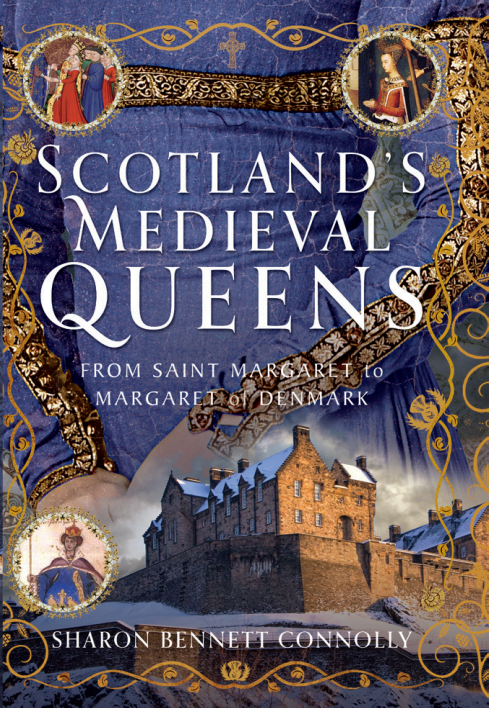
Out now: Scotland’s Medieval Queens

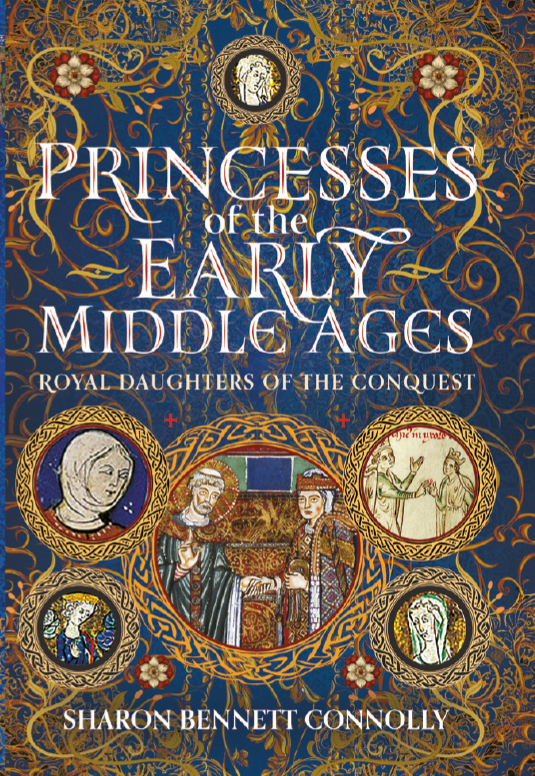
Books by Sharon Bennett Connolly

Scotland’s history is dramatic, violent and bloody. Being England’s northern neighbour has never been easy. Scotland’s queens have had to deal with war, murder, imprisonment, political rivalries and open betrayal. They have loved and lost, raised kings and queens, ruled and died for Scotland. From St Margaret, who became one of the patron saints of Scotland, to Elizabeth de Burgh and the dramatic story of the Scottish Wars of Independence, to the love story and tragedy of Joan Beaufort, to Margaret of Denmark and the dawn of the Renaissance, Scotland’s Medieval Queens have seen it all. This is the story of Scotland through their eyes.

Scotland’s Medieval Queens gives a thorough grounding in the history of the women who ruled Scotland at the side of its kings, often in the shadows, but just as interesting in their lives beyond the spotlight. It’s not a subject that has been widely covered, and Sharon is a pioneer in bringing that information into accessible history.’ Elizabeth Chadwick (New York Times bestselling author)

Available now from Amazon and Pen and Sword Books

Also by Sharon Bennett Connolly:

Books by Sharon Bennett Connolly

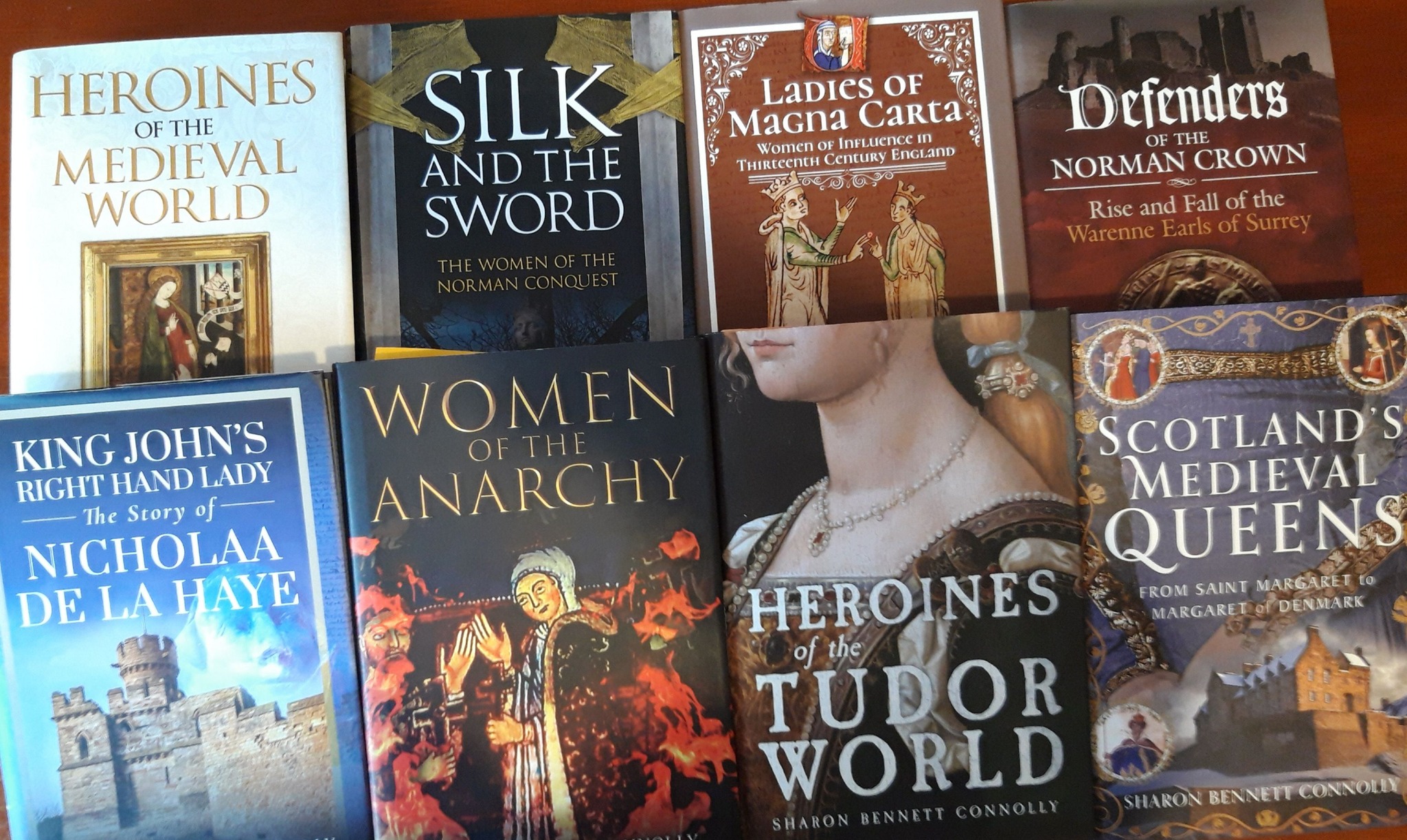
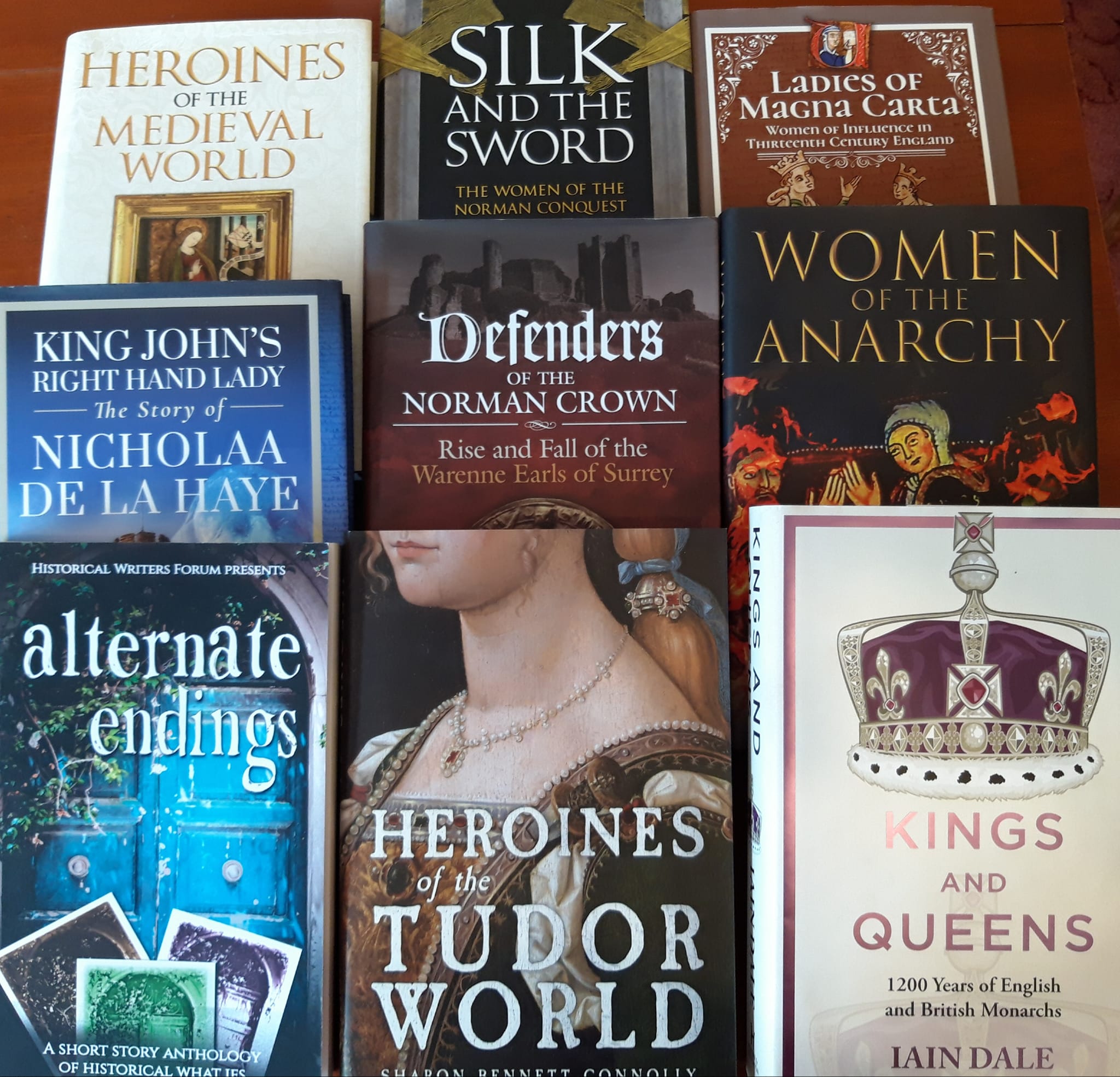
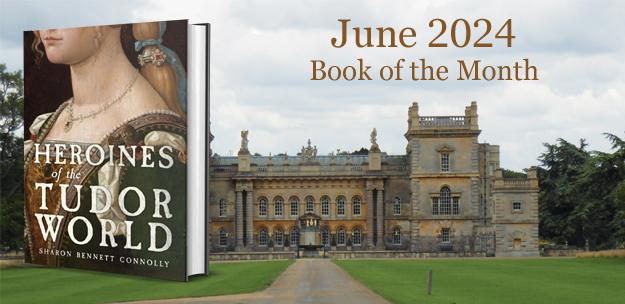
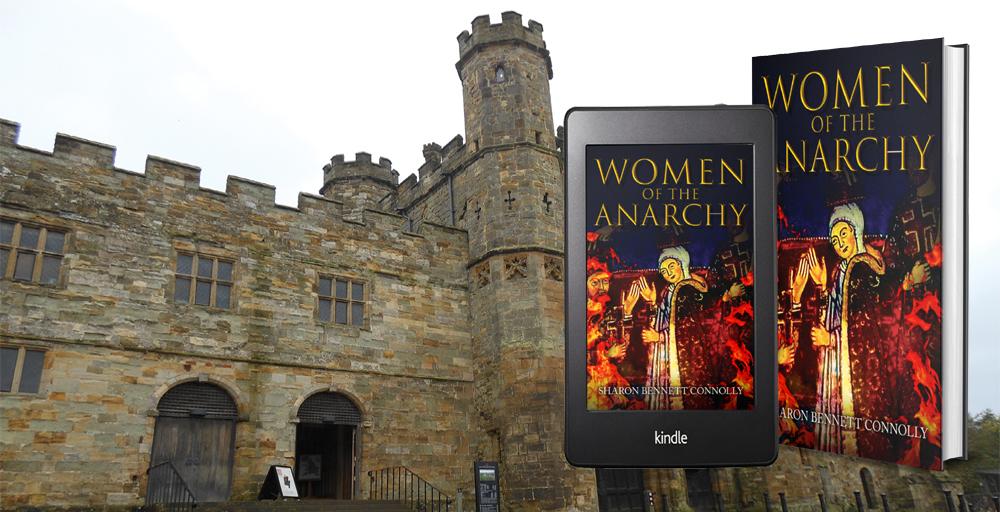
Heroines of the Tudor World tells the stories of the most remarkable women from European history in the time of the Tudor dynasty, 1485-1603. These are the women who ruled, the women who founded dynasties, the women who fought for religious freedom, their families and love. Heroines of the Tudor World is now available for pre-order from Amberley Publishing and Amazon UK. Women of the Anarchy demonstrates how Empress Matilda and Matilda of Boulogne, unable to wield a sword themselves, were prime movers in this time of conflict and lawlessness. It shows how their strengths, weaknesses, and personal ambitions swung the fortunes of war one way – and then the other. Available from Bookshop.orgAmberley Publishing and Amazon UKKing John’s Right-Hand Lady: The Story of Nicholaa de la Haye is the story of a truly remarkable lady, the hereditary constable of Lincoln Castle and the first woman in England to be appointed sheriff in her own right. Available from all good bookshops Pen & Sword Booksbookshop.org and Amazon

Royal Historical Society

Defenders of the Norman Crown: The Rise and Fall of the Warenne Earls of Surrey tells the fascinating story of the Warenne dynasty, from its origins in Normandy, through the Conquest, Magna Carta, the wars and marriages that led to its ultimate demise in the reign of Edward III. Available from Pen & Sword BooksAmazon in the UK and US, and Bookshop.orgLadies of Magna Carta: Women of Influence in Thirteenth Century England looks into the relationships of the various noble families of the 13th century, and how they were affected by the Barons’ Wars, Magna Carta and its aftermath; the bonds that were formed and those that were broken. It is now available in paperback and hardback from Pen & SwordAmazon, and Bookshop.orgHeroines of the Medieval World tells the stories of some of the most remarkable women from Medieval history, from Eleanor of Aquitaine to Julian of Norwich. Available now from Amberley Publishing and Amazon, and Bookshop.orgSilk and the Sword: The Women of the Norman Conquest traces the fortunes of the women who had a significant role to play in the momentous events of 1066. Available now from Amazon,  Amberley Publishing, and Bookshop.org.

Alternate Endings: An anthology of historical fiction short stories including Long Live the King… which is my take what might have happened had King John not died in October 1216. Available in paperback and kindle from Amazon.

Podcast:
A Slice of Medieval

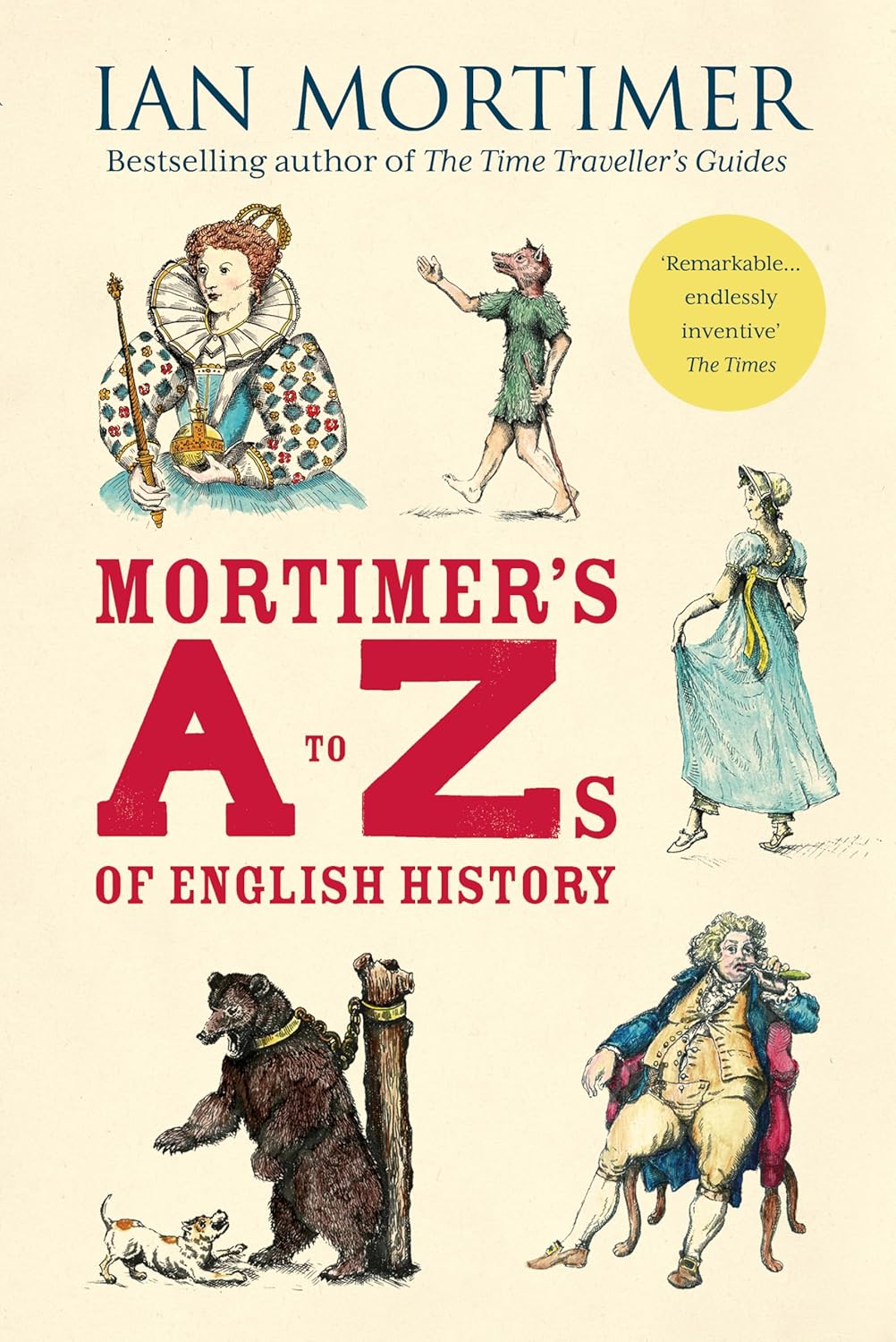
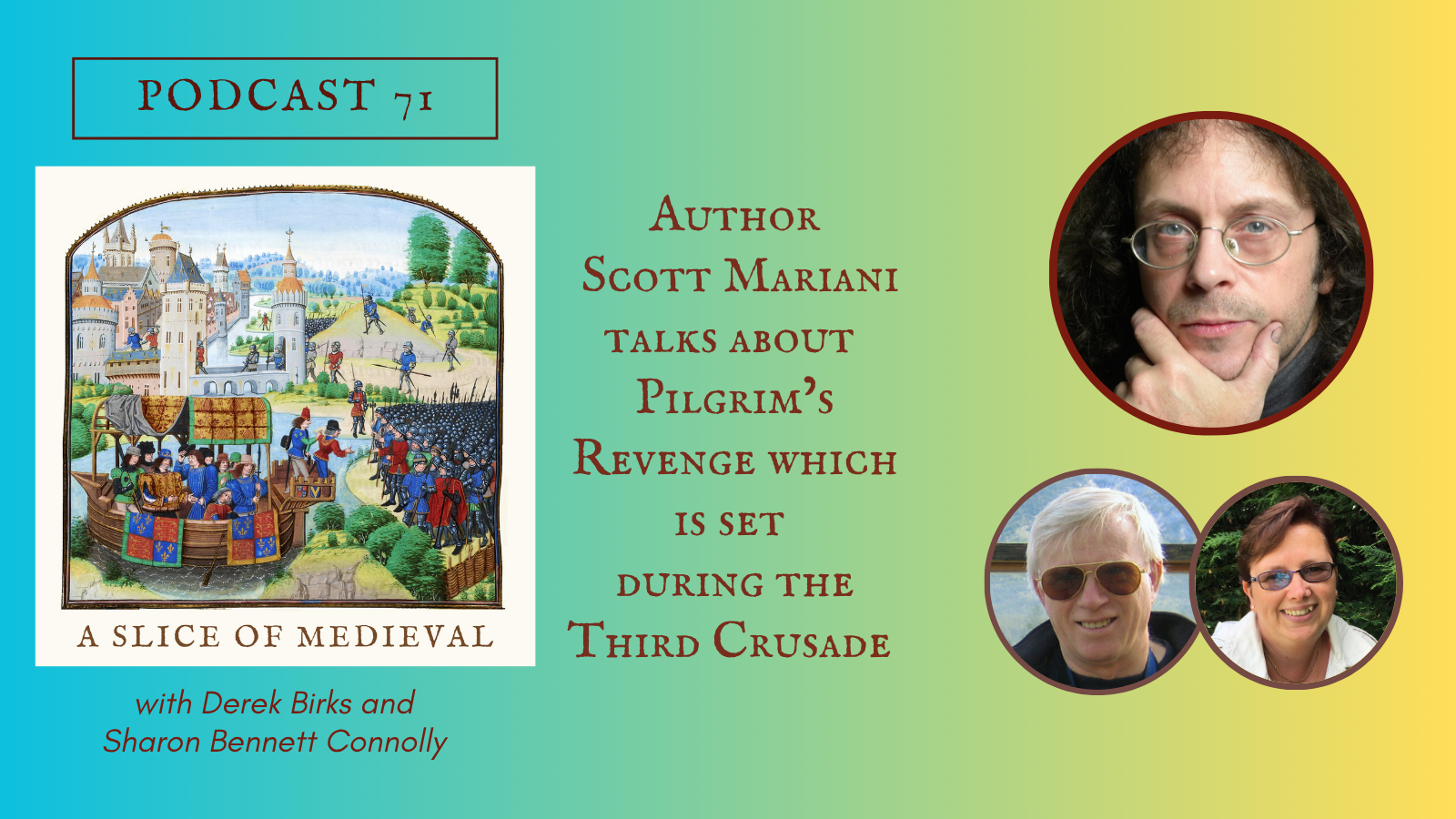
Have a listen to the A Slice of Medieval podcast, which I co-host with Historical fiction novelist Derek Birks. Derek and I welcome guests, such as Elizabeth Chadwick, Helen Castor, Ian Mortimer, Scott Mariani and Bernard Cornwell and discuss a wide range of topics in medieval history, from significant events to the personalities involved.

Every episode is also now available on YouTube.

*

Don’t forget! Signed and dedicated copies of all my books are available through my online bookshop.

For forthcoming online and in-person talks, please check out my Events Page.

You can be the first to read new articles by clicking the ‘Follow’ button, liking our Facebook page or joining me on TwitterThreadsBluesky and Instagram.

*

©2025 Sharon Bennett Connolly FRHistS
Wordly Women: Gillian Bagwell

History ... the Interesting Bits: Wordly Women
Near Dunvegan Castle, Isle of Skye

Time for another edition of Wordly Women! I am blown away by how receptive people have been to this little series and I am thoroughly enjoying having the chance to highlight the careers and writing experiences of the best of women writers in both history and and historical fiction. Today is another ‘fan girl’ edition as I get to chat with one of my favourite writers, Gillian Bagwell, who has written a wonderful novel about one of my Tudor Heroines, Bess of Hardwick.

Sharon: Firstly, welcome Gillian, what got you into writing?

Gillian: Both of my parents were writers, among other talents and accomplishments, interests, and they both read to my sisters and me a lot when we were kids, so I guess it seemed natural to write. I think I took my first writing class in junior high school. I’d had the idea for one of my novels (not yet published) long ago, and I recently discovered a story that I’d written based on that idea for that class when I was about thirteen. I’d forgotten about it.

Sharon: Tell us about your books.

Gillian: The three books that I have published are all based on the lives of real English women, two in the seventeenth century and one in the sixteenth century. My first novel, The Darling Strumpet, is based on the life of Nell Gwynn, one of the first English actresses and a longtime mistress of Charles II. She was a poor urchin who got her big break in life when Charles reopened the theatres soon after he was restored to the throne, and she got a job selling oranges. She caught the eye of Charles Hart, one of the leading actors, and he became her lover and mentor, teaching her to act, and they became an enormously popular duo onstage, with many “gay couple” (not as we use that phrase today!) comedies written specifically for them. Her career took place during one of the most amazing and important periods in the history of English theatre, when over the space of about fifteen years, performance practices went from Elizabethan/Jacobean to what remained essentially unchanged until the end of the nineteenth century.

History ... the Interesting Bits: Wordly Women
Experiencing the battlefield of Worcester

I learned about Jane Lane, the heroine of my second novel, when I was researching Nell Gwynn. Her story isn’t much remembered now, but she played a big part in helping Charles escape after the disastrous Battle of Worcester in 1651, saving not only his life but likely the future of the monarchy. She had a pass to travel with a manservant, so he disguised himself and travelled hundreds of miles with her. There were notices all along their way offering a reward of £1000 pounds for information leading to his capture—an enormous amount of money then—and they so narrowly escaped discovery so many times that his six-week odyssey became known as the Royal Miracle. The US title of the book is The September Queen. The UK published it as The King’s Mistress.

My third novel tells the story of Bess of Hardwick, who rose from genteel poverty to become probably the wealthiest and most powerful woman in England after Queen Elizabeth. She’s probably best known for building Hardwick Hall and the original Chatsworth, and for surviving four husbands. I didn’t think I could do justice to her very long and remarkable life in one novel, so Venus in Winter really only covers the first half of it, which included acting as keeper to Mary Queen of Scots for several years, and her granddaughter Arbella nearly succeeding Queen Elizabeth.

My fourth novel, The Tower on the Sea, not yet published, is a Gothic thriller with a heavy dose of romance set mostly on a tiny and remote Scottish island in 1901-1902. I’ve been working on a novel based on the life of Dame Flora MacLeod, who was chief of the Clan MacLeod from 1935 to her death in 1976, but as biographical fiction seems to be hard to sell these days, I’ve set it aside temporarily and am working on something completely different, which I’ll discuss below.

Sharon: What attracts you to the periods in which you write?

History ... the Interesting Bits: Wordly Women
William Shakespeare

Gillian: I became enamoured of Shakespeare very early on, and so was interested in sixteenth-century England. Around the time I turned fourteen, my father was hired as the director of education for the non-profit educational branch of the company that invented and produced the original Renaissance Pleasure Faires, a re-creation of a country fair in Elizabethan England with food, crafts, music, dancing, shows on stage and peformers improvising in the street with each other and the patrons. I know the concept of a Renaissance fair may be unfamiliar to many British people, but that original event inspired hundreds of copycats, mostly in the US but also in other countries. I wrote an article for Smithsonian Magazine about how the first Faire came about: The Surprisingly Radical Roots of the Renaissance Fair.

My whole family became involved and I performed at the Faires from when I was fourteen to when I was twenty—six weekends each at the Renaissance Faires in Southern and Northern California, and six weekends at the Great Dickens Christmas Fair, an indoor recreation of Victorian London at Christmastime. So I spent a lot of time in the sixteenth century and the nineteenth centuries!

Sharon: Who is your favourite Tudor and why?

Gillian: I think that would have to be Elizabeth. She survived an incredibly difficult childhood and youth, with her mother dead and vilified and her own future uncertain, and also managed to come through perilous times as a young woman, especially under the reign of her sister Mary. When she finally became queen, she ushered in a time of great change, mostly in good ways, and I think in general was a great leader—not an easy thing to be, especially for a woman, in those days.

Sharon: Who is your least favourite Tudor and why?

    Gillian: Henry VIII. It may be that he became the erratic tyrant he was especially later in life as the result of the injury to his leg and other medical problems, but it doesn’t erase the harm he caused to the six women who had the misfortune to marry him, his dissolution of the church and destruction not only of so many beautiful buildings but of the lives of so many people, both those who were of the church and those they helped, and much, much more.

    Sharon: How do you approach researching your books?
    Gillian: I read whatever I can find about my heroines, of course, as well as the period they lived in and the events that my books cover. But sometimes there isn’t much information available. The story of Jane Lane, for instance was very well known when Charles II was restored to the throne, but no one’s written a biography of her. There are several biographies of Bess of Hardwick, but they focus on her later life. One of them dispenses with her life up until her second marriage in the first twenty pages. So I have to piece together information, surmise what seems likely, and fill in the gaps with invention—of course mentioning in my author’s notes what historical facts I’ve taken liberty with. I’ve almost always gone to the UK on research trips, too, to find the places my main characters lived and where the action of their stories took place.

    History ... the Interesting Bits: Wordly Women
    Jane Lane

    There’s nothing like it not only for learning new things but getting inspiration. When I was researching The September Queen/The King’s Mistress, a good friend from London joined me on a trip following in the footsteps of Charles II from Worcester to Staffordshire and Shropshire, and then the route that he and Jane Lane took together. I didn’t know it at the time, but the Monarch’s Way is a marked footpath, which the Monarch’s Way Association maintains and has published maps of. When we went to Boscobel, it was near the end of the day and almost no one else was there. I found myself alone in a closet peering down into the priest hole where Charles hid. And at Trent, the lady at Trent Manor showed us around the house, including her bedroom, with the priest hole where Charles hid there. I also visit libraries and archives to use primary sources. I’ve done research at the British Library, the Theatre Museum in Covent Garden, the National Library and the National Records of Scotland, and the office of the Lord Lyon in Edinburgh. For my current work in progress, I recently I spent eight days at the Bodleian Library doing research and spent the rest of my time exploring Oxford, visiting places where the main characters lived and knew well. I even got a private tour of St. Hugh’s College, where each was principal, from the archivist.

    Sharon: Tell us your ‘favourite’ Stuart story you have come across in your research.

    History ... the Interesting Bits: Wordly Women
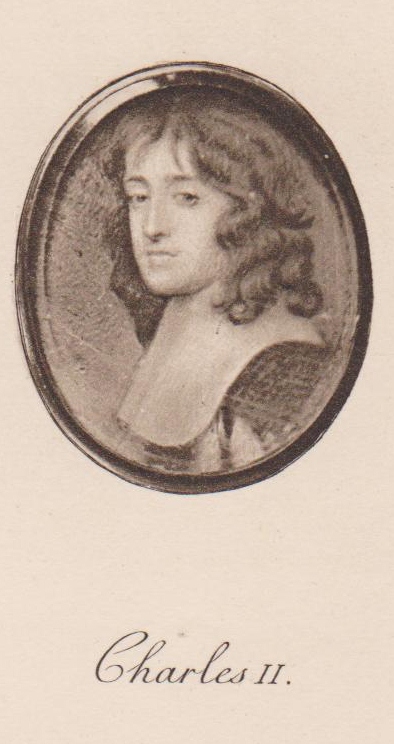
    A young Charles II

    Gillian: I’d say that’s the story of Charles II’s six-week odyssey trying to get out of England after the Battle of Worcester. Many, many common people risked their lives to help him, and it was a formative period in his life. He was only twenty-one at the time. He told the stories of his adventures for the rest of his life. Fortunately, the diarist Samuel Pepys sat him down decades later and over the course of a couple of days, took down the story in his famous shorthand. He then gathered all the accounts people had published of their parts in the story and bound them together. It’s an amazing resource, giving us a day-by-day and sometimes hour-by-hour account of what Charles did, said, wore, and ate. In the run-up to the publication of my book about Jane Lane, I blogged the daily events of those weeks. Here’s a link to the story, beginning with the Battle of Worcester: http://theroyalmiracle.blogspot.com/2011/09/september-3-1651-battle-of-worcester.html.

    Sharon: And do you have a favourite Tudor story?

    Gillian: There are many great stories about the Tudors, of course, but I became fascinated with this nugget mentioned in Robert Hutchinson’s The Last Days of Henry VIII, and have thought of writing a story or play about it. In the bitter cold of early February 1547, the body of Henry VIII lay at Windsor Castle, and amid clouds of incense, requiem masses were being held night and day to waft the soul of the dead tyrant to heaven. Fierce struggles for power raged at court, as the new king, Edward VI, was a child, and who controlled him would effectively rule. Against this backdrop of intrigue, John de Vere, the sixteenth Earl of Oxford, planned a dramatic event of his own: the presentation of a play he had written on the death of the king, to be performed by his own company of players. But as the actors rehearsed for their day in the winter sun, Bishop Gardiner, though recently banned from the Palace of Westminster, intended to claw his way back to power, and he would do whatever he must to prevent Oxford’s play from coming to the stage.

    I find a lot intriguing about this story, not least the fact that John de Vere was the father of Edward DeVere, the seventeenth Earl of Oxford, whom many serious people believe could have been the author of the plays attributed to William Shakespeare. He was almost seven years old at the time of this cancelled performance, and it’s interesting to think that he might have witnessed the drama offstage as well as on. The evidence for the argument for Oxford as the author includes a wealth of similarities in his life and experience and the plays; the fact that he was familiar with theatre from an early age, as his father kept a company of players; and that he was regarded as an accomplished and playwright, though none of his plays survive. Charlton Ogburn’s 600-page tome The Mysterious William Shakespeare is an exhaustive study of the evidence in favor of Oxford.

    Notable authorship skeptics include included Mark Rylance, Derek Jacobi, John Gielgud, Tyrone Guthrie, David McCullough, and Supreme Court Justices Sandra Day O’Connor, John Paul Stevens, Harry A. Blackmun, and Lewis F. Powell (Declaration of Reasonable Doubt, Shakespeare Oxford Fellowship – Famous Authorship Skeptics).

      Sharon: Tell us your least ‘favourite’ Tudor story you have come across in your research.

      Gillian: Many of the Tudors were responsible for a lot of bloodshed and cruelty, of course. I think Henry VIII’s persecution and elimination of the Pole family, who he considered a threat to his keeping the throne, ranks high, especially the murder of Lady Margaret Pole, the Countess of Salisbury, who was sixty-seven and had spent her life serving the Tudors. The executioner botched the job terribly, and it was a gruesome death. Here’s Tracy Borman’s post on the Historic Royal Palaces’ website: The Extraordinary Life and Death of Lady Margaret Pole, Countess of Salisbury.

      History ... the Interesting Bits: Wordly Women

      Sharon: Are there any other eras you would like to write about?

      Gillian: Well, I’ve moved into the early twentieth century with The Tower on the Sea, and both Flora MacLeod’s story and my current work in progress take me further into the 1900s and has a contemporary timeline too. There are other stories I’d love to write about, including from the eighteenth and nineteenth centuries.

      Sharon: What are you working on now?

      Gillian: I’m working on a novel with dual timelines inspired by the true story of Eleanor Jourdain and Charlotte Anne Moberly, two Oxford academics who visited Versailles in 1901, had a very strange experience, encountering people in eighteenth-century dress who behaved oddly, and came to believe they’d walked into the eighteenth century. I learned about this story from Miss Morison’s Ghosts, a British movie made in 1981, and I’ve wanted to write about it ever since. Having gone through the seventeen boxes of their notes, correspondence, drawings, photos, maps, and other documentation of their eight or so years of research about their experience at Versailles, I can say that something extraordinary happened to them, though I don’t know exactly what and neither did they.

      Sharon: And finally, what is the best thing about being a writer?

      Gillian: Exploring the worlds of my characters is endlessly fascinating. I get chills when I experience or discover something that connects me viscerally with the people I’m writing about, for instance holding letters they wrote, or being in the rooms where important things took place. And much as I like adventure and travel, all my life, I’ve been something of a homebody, too, so I love being able to work at home, especially on days when I don’t have to do anything but write.

        About Gillian Bagwell:

        History ... the Interesting Bits: Wordly Women
        Gillian Bagwell

        Gillian Bagwell’s historical novels have been praised for their vivid and lifelike characters and richly textured, compelling evocation of time and place. Her first career was in theatre, as an actress and later as a director and producer, and she founded the Pasadena Shakespeare Company and produced thirty-seven shows over ten years. Gillian has found her acting experience helpful to her writing, and many of the workshops and classes she’s taught at the annual Historical Novel Society Conferences in the US and the UK relate to her life in theatre, including writing effective historical dialogue, using acting tools to bring characters to life on the page, and giving effective public readings. She’s also a professional editor and provides writing coaching and manuscript evaluations. Gillian lives in Berkeley, California in the house where she grew up, her life enlivened by her five rescue cats.

        *

        My Books

        Signed, dedicated copies of all my books are available through my online bookshop.

        Out now: Scotland’s Medieval Queens

        Books by Sharon Bennett Connolly

        Scotland’s history is dramatic, violent and bloody. Being England’s northern neighbour has never been easy. Scotland’s queens have had to deal with war, murder, imprisonment, political rivalries and open betrayal. They have loved and lost, raised kings and queens, ruled and died for Scotland. From St Margaret, who became one of the patron saints of Scotland, to Elizabeth de Burgh and the dramatic story of the Scottish Wars of Independence, to the love story and tragedy of Joan Beaufort, to Margaret of Denmark and the dawn of the Renaissance, Scotland’s Medieval Queens have seen it all. This is the story of Scotland through their eyes.

        Scotland’s Medieval Queens gives a thorough grounding in the history of the women who ruled Scotland at the side of its kings, often in the shadows, but just as interesting in their lives beyond the spotlight. It’s not a subject that has been widely covered, and Sharon is a pioneer in bringing that information into accessible history.’ Elizabeth Chadwick (New York Times bestselling author)

        Available now from Amazon and Pen and Sword Books

        Also by Sharon Bennett Connolly:

        Books by Sharon Bennett Connolly

        Heroines of the Tudor World tells the stories of the most remarkable women from European history in the time of the Tudor dynasty, 1485-1603. These are the women who ruled, the women who founded dynasties, the women who fought for religious freedom, their families and love. Heroines of the Tudor World is now available for pre-order from Amberley Publishing and Amazon UK. Women of the Anarchy demonstrates how Empress Matilda and Matilda of Boulogne, unable to wield a sword themselves, were prime movers in this time of conflict and lawlessness. It shows how their strengths, weaknesses, and personal ambitions swung the fortunes of war one way – and then the other. Available from Bookshop.orgAmberley Publishing and Amazon UKKing John’s Right-Hand Lady: The Story of Nicholaa de la Haye is the story of a truly remarkable lady, the hereditary constable of Lincoln Castle and the first woman in England to be appointed sheriff in her own right. Available from all good bookshops Pen & Sword Booksbookshop.org and Amazon

        Royal Historical Society

        Defenders of the Norman Crown: The Rise and Fall of the Warenne Earls of Surrey tells the fascinating story of the Warenne dynasty, from its origins in Normandy, through the Conquest, Magna Carta, the wars and marriages that led to its ultimate demise in the reign of Edward III. Available from Pen & Sword BooksAmazon in the UK and US, and Bookshop.orgLadies of Magna Carta: Women of Influence in Thirteenth Century England looks into the relationships of the various noble families of the 13th century, and how they were affected by the Barons’ Wars, Magna Carta and its aftermath; the bonds that were formed and those that were broken. It is now available in paperback and hardback from Pen & SwordAmazon, and Bookshop.orgHeroines of the Medieval World tells the stories of some of the most remarkable women from Medieval history, from Eleanor of Aquitaine to Julian of Norwich. Available now from Amberley Publishing and Amazon, and Bookshop.orgSilk and the Sword: The Women of the Norman Conquest traces the fortunes of the women who had a significant role to play in the momentous events of 1066. Available now from Amazon,  Amberley Publishing, and Bookshop.org.

        Alternate Endings: An anthology of historical fiction short stories including Long Live the King… which is my take what might have happened had King John not died in October 1216. Available in paperback and kindle from Amazon.

        Podcast:

        A Slice of Medieval

        Have a listen to the A Slice of Medieval podcast, which I co-host with Historical fiction novelist Derek Birks. Derek and I welcome guests, such as Elizabeth Chadwick, Helen Castor, Ian Mortimer, Scott Mariani and Bernard Cornwell and discuss a wide range of topics in medieval history, from significant events to the personalities involved.

        Every episode is also now available on YouTube.

        *

        Don’t forget! Signed and dedicated copies of all my books are available through my online bookshop.

        For forthcoming online and in-person talks, please check out my Events Page.

        You can be the first to read new articles by clicking the ‘Follow’ button, liking our Facebook page or joining me on TwitterThreadsBluesky and Instagram.

        *

        ©2025 Sharon Bennett Connolly FRHistS
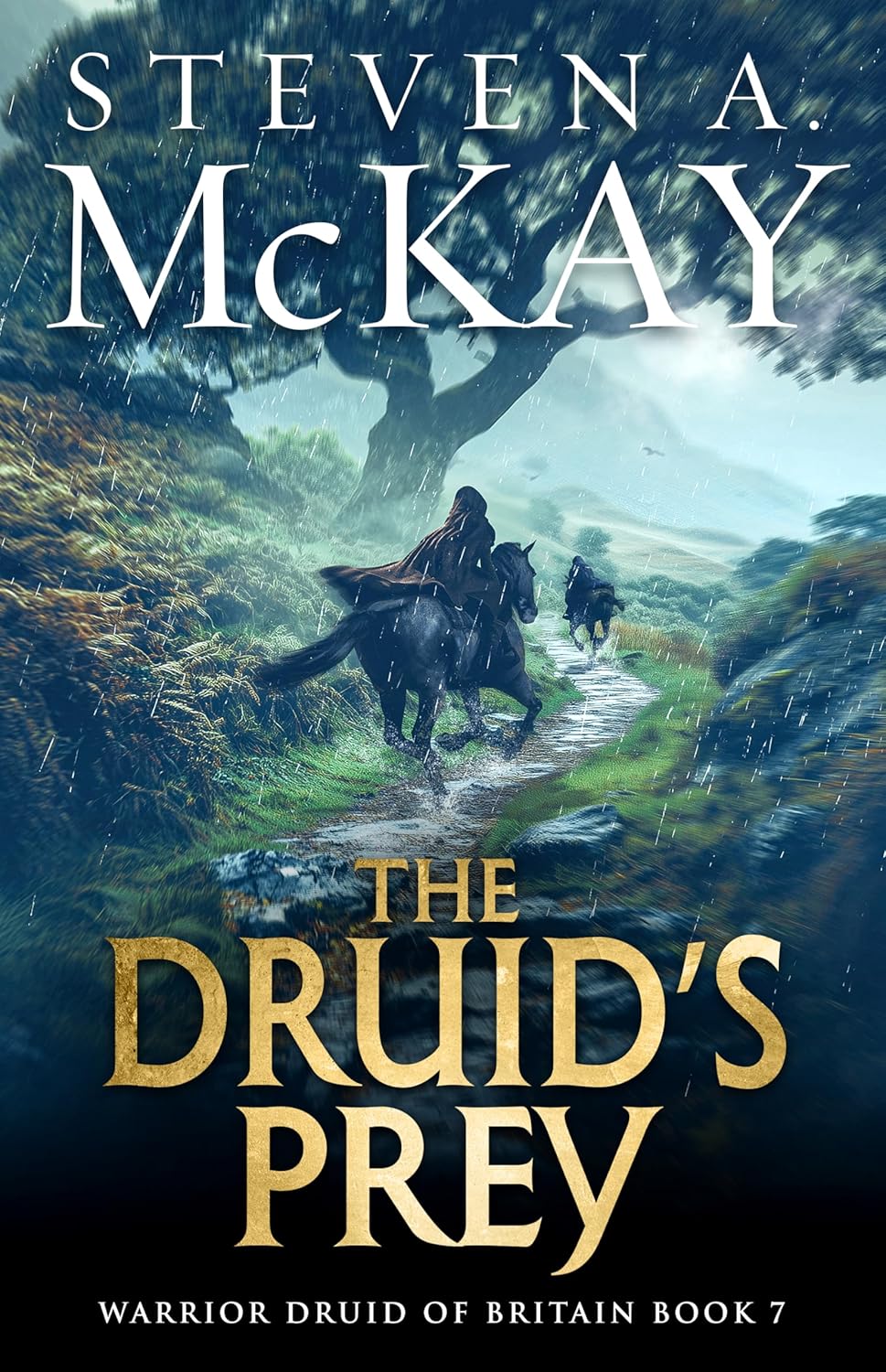
        Book Corner: The Druid’s Prey by Steven A. McKay

        History...the Interesting Bits

        A vicious attack. An enraged warrior-druid. A relentless hunt for vengeance!

        Following a cowardly raid on Dun Breatann the Saxon attacker, Saksnot, rides back to rejoin his bretwalda, Hengist, in far-off Garrianum. Bellicus, outraged by the savage attack on his people and his closest friend, follows the perpetrator with just one thing on his mind: bloody justice!
        As the towering druid hunts his prey across the summer fields and streams, Arthur, Bear of Britain, seeks to make a lasting peace with the new immigrants from across the sea. Hengist has no such plans however, instead working alongside his terrifying volva, Thorbjorg, to bring only blood, fire, and death to the embattled Britons.

        As the brutal struggle for supremacy rages between the two warlords and their armies, Bellicus will find himself drawn into an adventure he could never have foreseen. An adventure that may seal the fate of Britain for generations to come.

        Yes! Bellicus is back!

        And better than ever! The Druid’s Prey by Steven A. McKay is the seventh book in Steven’s excellent Warrior Druid of Britain Chronicles. As regular readers will know, I have been reading this series since the first book, The Druid. The books follow the adventures of Bellicus the druid, his family and his Roman friend, Duro, as the defend their home, Dun Breatann, and the rest of Britain from the invading Saxons, led by Hengist and Horsa. Well, its just Hengist now, thanks to The Vengeance of Merlin. A sucker for anything Arthurian, Steven A. McKay also draws in the legendary Arthur, Lancelot and his loyal knights. And I love how Arthur is drawn into Bellicus’ story, but never fully takes over.

        It’s a perfect combination and partnership.

        In The Druid’s Prey, Bellicus is set on revenge, traveling the length of Britain to find the man who had tried to kill him and hurt his friend. Further south, Arthur is trying to take the war to Hengist, to strike a blow that will hurt the Saxon leader’s forces, and to find a friend of his own who has been captured by the enemy. Oh, and while Bellicus is away, his wife and daughter, Narina and Catia, work to strengthen Dun Breatann’s position and stave off the influence of the hated Hengist. Three missions that the reader can’t help but hope they collide…

        The bear stopped moving, taking in the sight of the boar which was peering at it in return. And then the bear looked up at Bellicus and their eyes met. The druid swallowed, knowing for certain that he had come across this very animal before – it had attacked them some years prior, not far from where they were now, badly injuring King Coroticus and Gavo and killing one warrior and three dogs. It had eventually decided to give up the fight but only once it had a spear stuck in its back and a number of arrows from the Damnonii hunters’ bows. Bellicus examined its hairy pelt for evidence of those earlier wounds but it seemed to have healed well in the intervening years.

        As if it recalled the battle the bear suddenly stood up on its hind legs and let out an enormous roar. Bellicus gazed at it in awe – the animal was not just enormous, it was majestic, and the thought of trying to kill it again was truly terrifying.

        It seemed the boar had similar thoughts, for instead of charging at the bear, it turned and hurried off into the trees, the spear that Duro had planted in its side clattering noisily against tree trunks until, at last, it must have snapped off for there was a last, distant squeal and then only the low growling of the bear was left to fill the clearing.

        “Mithras protect us, we’re in for it now,” Duro said, doing his best to draw his spatha while still gripping the trunk of his tree for dear life. “At least the boar couldn’t get up here.”

        “Don’t do anything,”Bellicus ordered in a low voice. “Do you not recognise it?”

        “Aye,” the centurion nodded. “It’s the same bear that almost killed us all before. You told us to let it go back then for some mad reason.”

        “The Bear of Britain,” Bellicus said, so softly Duro could not hear him. “That’s what the Merlin had called Arthur.” Memories of the previous encounter with the bear were filling his mind and he remembered being in a shocked stupor as he’d stared at the bear bristling with missiles like a hedgehog. The animal had lost the will to fight that day and Bellicus had commanded those with him to let it go, a decision he’d never really understood himself. For some reason he’d seen the beast as connected to Arthur, or perhaps he just didn’t want any more people – or Cai, for the mastiff had been involved in the fighting too – getting injured or killed.

        Whatever his motives had been, the bear stared up at him now, its round, dark eyes fixing on his own. There seemed an intelligence behind that gaze that Bellicus had not expected. Did it recognise him? Did it understand that he’d been the one that called off the attack on it and most likely saved its life after their previous encounter? Maybe. The druid knew that bears had an even more developed sense of smell than dogs, so it was possible the beast, which had dropped back to all fours now, recognised his scent if not his face.

        The bear made a strange, ululating, guttural grunting sound and then simply wandered off into the trees, quickly disappearing from sight.

        “Is… Is it over?” Duro gasped, sword still glinting in the last of the sunshine as he lowered himself down, hanging from a branch by one arm as he tried to see through the foliage and make sure the bear had really gone.

        Hengist is on the road to revenge, taking any opportunity he can to punish his brother’s killers, whilst at the same time increasing his hold on Britain, extending his influence and grabbing more land. He sends an assassin north to Dun Breatann, captures one of Arthur’s leading men and seeks allies among the enemies of Bellicus and Queen Narina. The Druid’s Prey by Steven A. McKay has more than one story within its pages – and more than one hero!

        It is a rollercoaster journey through post-Roman Britain as the lead characters fight to hold onto their lands, their friends and their family. Their are more than a few heart-in-the-mouth moments along the way. And, if you are reading at night, beware! “Just one more chapter…” will lead to 3 or 4 more!

        As we are at book no. 7 in the Warrior Druid of Britain series, Steven A. McKay’s characters are well developed and very familiar to us. We know how Bellicus will react to his family and friends being attacked. We know that his daughter, Catia, now 12 years old, is not a little girl to whom things happen-she is a pre-teen, trained in warfare, experienced beyond her years but still needing the guidance of parents to keep her out of the worst trouble. And Arthur, everyone’s hero and Bellicus’ friend. Well, his adventures never fail to inspire and entertain. And each of these characters have to make choices and decisions that affect, not only themselves but also their people. Agonising decisions will lead to more danger, adventure and not a little swordplay.

        I won’t tell you any more – I do not want to ruin it for anyone.

        All I will say is, The Druid’s Prey by Steven A. McKay is the 7th book in a series and yet is as fresh and original as the first. If you have not yet read this excellent series, you are missing a treat – but I envy the fact you have 7 books to read, one after the other. What a treat you have instore.

        To Buy the Book: The Druid’s Prey

        About the author:

        History...the Interesting Bits

        Steven A. McKay was born in Scotland in 1977 and always enjoyed studying history. He decided to write his Forest Lord novels after seeing a house called “Sherwood” when he was out at work one day. Since then he’s started a new series, the Warrior Druid of Britain Chronicles, and just completed a trilogy about Alfred the Great.

        In 2021 the Xbox game HOOD: Outlaws and Legends was released, featuring Steven’s writing.

        He used to be in a heavy metal band although he tends to just play guitar in his study these days. He did use those guitars to write the theme song for the podcast he co-hosted, Rock, Paper, Swords! with Matthew Harffy, though. Give it a listen, they’ve interviewed great guests like Diana Gabaldon, Simon Scarrow, Bernard Cornwell, Dan Jones and more!

        *

        My books

        Signed, dedicated copies of all my books are available through my online store.

        Out now: Scotland’s Medieval Queens

        Books by Sharon Bennett Connolly

        Scotland’s history is dramatic, violent and bloody. Being England’s northern neighbour has never been easy. Scotland’s queens have had to deal with war, murder, imprisonment, political rivalries and open betrayal. They have loved and lost, raised kings and queens, ruled and died for Scotland. From St Margaret, who became one of the patron saints of Scotland, to Elizabeth de Burgh and the dramatic story of the Scottish Wars of Independence, to the love story and tragedy of Joan Beaufort, to Margaret of Denmark and the dawn of the Renaissance, Scotland’s Medieval Queens have seen it all. This is the story of Scotland through their eyes.

        Scotland’s Medieval Queens gives a thorough grounding in the history of the women who ruled Scotland at the side of its kings, often in the shadows, but just as interesting in their lives beyond the spotlight. It’s not a subject that has been widely covered, and Sharon is a pioneer in bringing that information into accessible history.’ Elizabeth Chadwick (New York Times bestselling author)

        Available now from Amazon and Pen and Sword Books

        Also by Sharon Bennett Connolly:

        Books by Sharon Bennett Connolly

        Heroines of the Tudor World tells the stories of the most remarkable women from European history in the time of the Tudor dynasty, 1485-1603. These are the women who ruled, the women who founded dynasties, the women who fought for religious freedom, their families and love. Heroines of the Tudor World is now available from Amberley Publishing and Amazon UK. Women of the Anarchy demonstrates how Empress Matilda and Matilda of Boulogne, unable to wield a sword themselves, were prime movers in this time of conflict and lawlessness. It shows how their strengths, weaknesses, and personal ambitions swung the fortunes of war one way – and then the other. Available from Bookshop.orgAmberley Publishing and Amazon UKKing John’s Right-Hand Lady: The Story of Nicholaa de la Haye is the story of a truly remarkable lady, the hereditary constable of Lincoln Castle and the first woman in England to be appointed sheriff in her own right. Available from all good bookshops Pen & Sword Booksbookshop.org and Amazon

        Royal Historical Society

        Defenders of the Norman Crown: The Rise and Fall of the Warenne Earls of Surrey tells the fascinating story of the Warenne dynasty, from its origins in Normandy, through the Conquest, Magna Carta, the wars and marriages that led to its ultimate demise in the reign of Edward III. Available from Pen & Sword BooksAmazon in the UK and US, and Bookshop.orgLadies of Magna Carta: Women of Influence in Thirteenth Century England looks into the relationships of the various noble families of the 13th century, and how they were affected by the Barons’ Wars, Magna Carta and its aftermath; the bonds that were formed and those that were broken. It is now available in paperback and hardback from Pen & SwordAmazon, and Bookshop.orgHeroines of the Medieval World tells the stories of some of the most remarkable women from Medieval history, from Eleanor of Aquitaine to Julian of Norwich. Available now from Amberley Publishing and Amazon, and Bookshop.orgSilk and the Sword: The Women of the Norman Conquest traces the fortunes of the women who had a significant role to play in the momentous events of 1066. Available now from Amazon,  Amberley Publishing, and Bookshop.org.

        Alternate Endings: An anthology of historical fiction short stories including Long Live the King… which is my take what might have happened had King John not died in October 1216. Available in paperback and kindle from Amazon.

        Podcast:

        A Slice of Medieval

        Have a listen to the A Slice of Medieval podcast, which I co-host with Historical fiction novelist Derek Birks. Derek and I welcome guests, such as Bernard Cornwell and Michael Jecks, and discuss a wide range of topics in medieval history, from significant events to the personalities involved. 

        Every episode is also now available on YouTube.

        *

        Don’t forget! Signed and dedicated copies of all my books are available through my online store.

        For forthcoming online and in-person talks, please check out my Events Page.

        You can be the first to read new articles by clicking the ‘Follow’ button, liking our Facebook page or joining me on TwitterThreadsBluesky and Instagram.

        *

        ©2025 Sharon Bennett Connolly

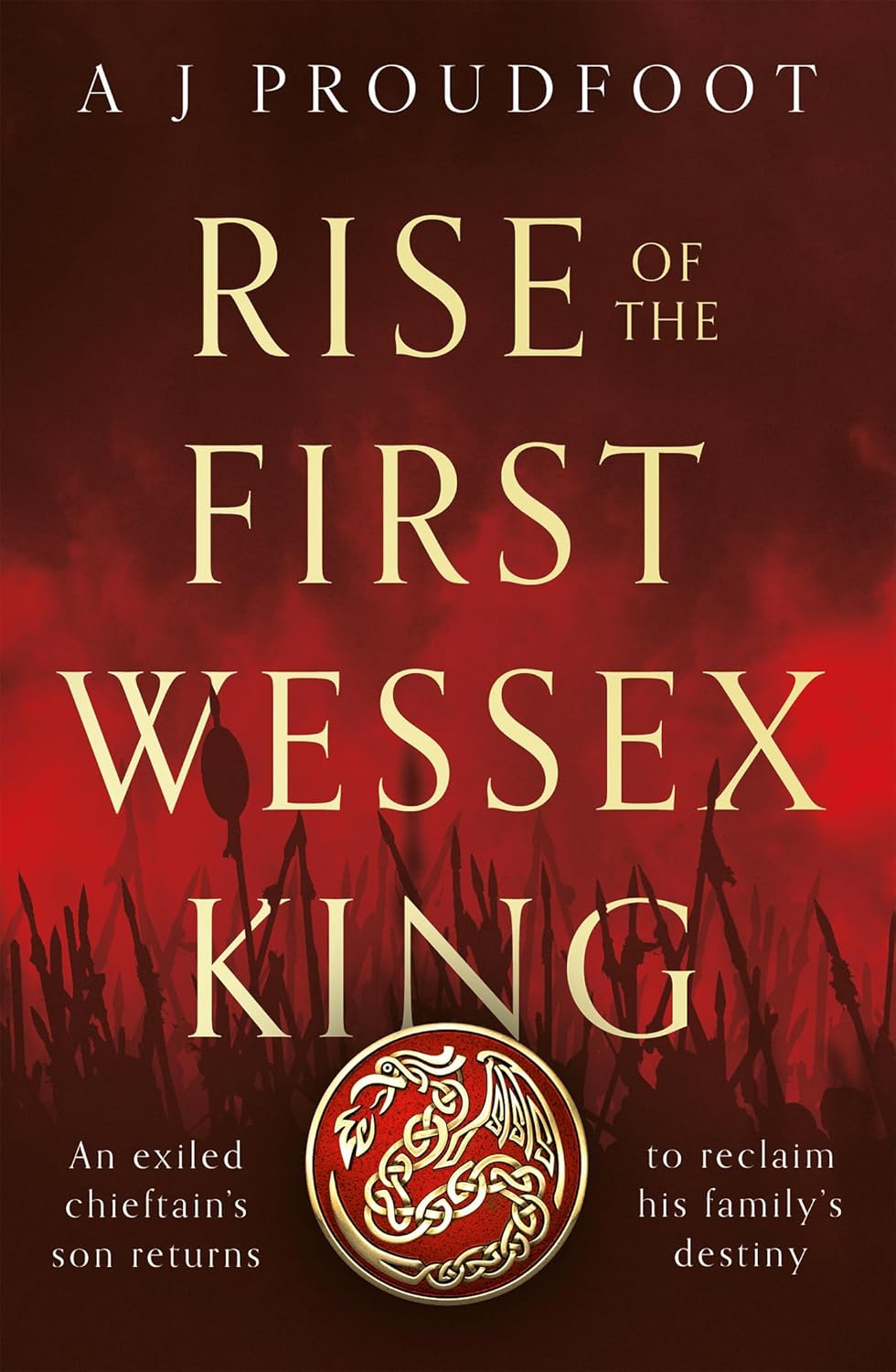
        Book Corner: Rise of the First Wessex King by A.J. Proudfoot

        A.J. Proudfoot

        When the Saxons, invited to settle in Britannia by King Wyrtgeorn, brutally murder the father and brother of Ceredig, the second son of a fifth century Romano-British chieftain, he flees the land of his birth.

        While the Saxons expand their control over Britannia, Ceredig grows up in Armorica, learning the ways of the Gewisse, and ultimately taking command of this elite force of warriors, who had remained loyal to his father, Elisedd.

        Despite ruling as a chieftain in Armorica, Ceredig remains determined to return to his homeland, avenge his father and brother’s murder, and finally reclaim the lands his father had once ruled in southern Britannia.

        After over forty years in exile, Ceredig, his son and a force of Gewisse warriors return to Britannia, joining a large army of Britons who are preparing to take on the Saxons in battle at Badonbyrg.

        What happens next will go down in history…

        As a debut novel, Rise of the First Wessex King by A.J. Proudfoot is a winner. And as a special treat, alongside my review, I have an interview with the author, who is currently working on book no. 2 in what promises to be a fascinating series. Cerdic, or Ceredig, is the founder of the kingdom of Wessex and a royal house that would reach its zenith under Ceredig’s descendants, King Alfred the Great, Æthelflæd, Lady of the Mercians, her brother Edward the Elder and Edward’s son Athelstan, first king of England.

        And it all started with Ceredig.

        In Rise of the First Wessex King, A.J. Proudfoot recreates Ceredig’s world, post-Roman Britain, breathing life into this 1,500-year-old story. And what a fascinating story it is. Though our knowledge is limited, Proudfoot fills in the gaps to create a lively and energetic retelling of the foundation of the royal house of Wessex. This is the story of the fight of the native Britons against the invading Saxons, of a war that must have felt never-ending, at times. It is a story of conflict and betrayal, but also of family and comradeship, and of a young man who had to patiently wait for the time to be right to achieve his dream of pushing back the Saxons and going home.

        The characters, particularly our hero, are wonderfully vivid. And I love how Proudfoot weaves the legends of Arthur and Hengist and Horsa in to the story, bringing a little-known period of history back to life. Who doesn’t like to see a little bit of King Arthur thrown into the mix? The inclusion of Artorius and Ambrosius made me smile – and want to read more!

        This is a debut novel, so Proudfoot sometimes fall into the trap of giving summaries, telling, rather than showing the action and debate, but this does not detract from the pace of the book. Overall, it is a fabulous read, imbued with a sense of adventure. It is a great start to what promises to be an impressive series.

        Overall, it is a great story, told well!

        If you’re looking for a new author to sink your teeth into, I don’t hesitate to recommend A.J. Proudfoot’s Rise of the First Wessex King.

        To Buy the Book:

        Books2Read; The Book GuildBookshop.org (UK)

        Interview with A.J. Proudfoot

        A.J. Proudfoot

        Sharon: So, Alex, what got you into writing historical fiction?

        Alex: This may come as a surprise, but I didn’t originally set out to become an author and write historical fiction novels. I was simply trying to trace the origins of my unusual Proudfoot surname, and was continuing the research into our Proudfoot family history that my parents and aunt had begun many years before.

        After several years’ research, I was amazed to find that I had traced my family ancestry back 1500 years to a mysterious chieftain called Cerdic, at the end of the fifth century, who founded the Anglo-Saxon kingdom of Wessex. There are many interesting ancestors in the Proudfoot family tree, whose lives would make an excellent novel, but when I discovered more about Cerdic’s life, I realised that there was an Arthurian story that was worth writing.

        Sharon: What made you want to tell Cerdic’s story?

        Alex: I was intrigued why this important figure in early English history has been largely ignored by historical writers, so I undertook my own research into the life of Cerdic, finding crucial inconsistencies in what is written about Cerdic’s Saxon heritage, which I put down to a desire, by early Saxon chroniclers, to establish King Alfred’s Saxon ancestry.

        Instead, I found evidence that Cerdic was more likely to be descended from a Romano-British family, who originally hailed from an ancient Welsh kingdom, and was more than likely called Ceredig, given his Brythonic heritage, and to the phonetic similarities. As a result, I felt compelled to use what I had learned to tell the story about my earliest known ancestor and his crucial role in history, based on recorded events in the early Anglo-Saxon era. To paraphrase John Wade, the rest is historical fiction!

        Sharon: How do you go about researching a historical character from 1500 years ago?

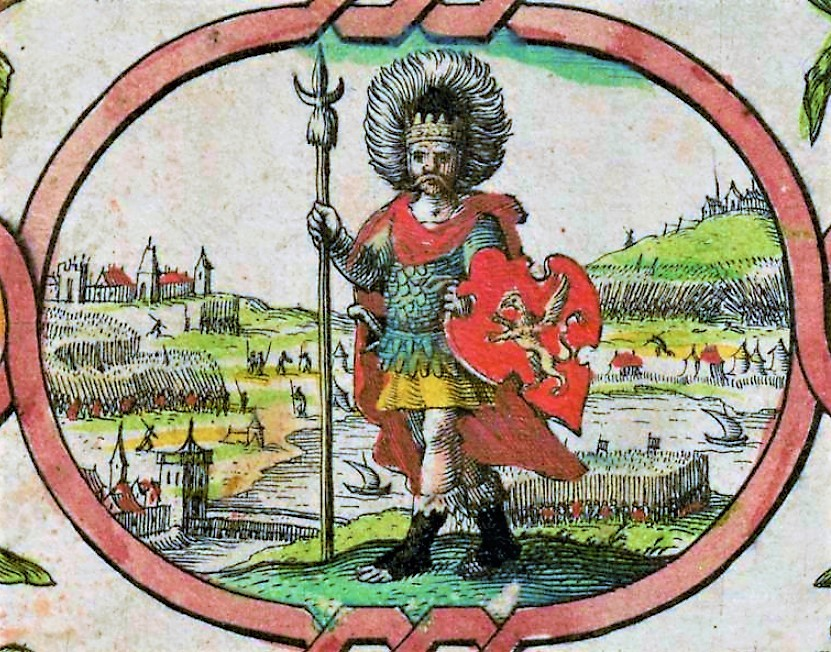
        Imaginary depiction from John Speed’s 1611 “Saxon Heptarchy”

        Alex: The great difficulty in researching a historical figure from so far back is the lack of contemporary records. My starting point was, naturally, the Anglo-Saxon Chronicle, but it only mentions six events relating to Cerdic’s life, and is written from a Saxon perspective. I read all I could about Cerdic in research papers by modern Anglo-Saxon historians, including JNL Myers and Richard Coates, which is where I found clues to Cerdic’s Romano-British connections. There was also a story about 5th century Bishop Germanus meeting a regional chieftain in southern Britain, called Elasius, whose name is remarkably similar to Elesa, the recorded name of Cerdic’s father in the Anglo-Saxon Chronicle.

        Eventually, I had built a picture of the young son of a Romano-British chieftain, ruling and defending the southern coastline of Britain against Saxon invaders, who suddenly disappeared from Britain, returning nearly fifty years later to take control over a region in the Upper Thames Valley, before expanding his lands south before becoming king and ruling a kingdom of the Gewisse that would eventually become known as Wessex, named after the West Saxons.

        My research raised more questions than answers, so I used what I had learned about events during that period to write a dramatic reconstruction of Cerdic’s life, and the formation of the Anglo-Saxon kingdom of Wessex. Based on fact, but mostly fiction.

        Sharon: What are you working on now?

        Alex:I am currently working on a sequel to Rise of the First Wessex King, which will follow the lives of Cunorix and his son, Ceawlin, as they try to build on Ceredig’s legacy in ruling the kingdom of the Gewisse, whilst facing threats from the Saxons in the east, and Britons in the west, as well as challenges they could not anticipate.

        Sharon: What is the best – and worse – thing about being a writer?

        Alex: Personally, the hardest part about writing my historical fiction novels is that the stories are based in the south of England and I live just outside Edinburgh, in Scotland. This meant that I have had to make several research trips down south, visiting locations featured in my novels. Whilst there is very little evidence to reveal what it would be like when the books are set, I have found this a useful exercise in understanding the topography, as well as encouraging the creative writing juices.

        The best part of being a writer is that I love history and solving puzzles. This has been useful in writing about a period in history where facts are limited, so deciphering my characters’ motives behind their decisions has been crucial in building the story of their lives.

        About the Author

        A J (Alex) Proudfoot lives in Musselburgh, near Edinburgh. He started his career as an accountant, working in the brewing, publishing and financial sectors, before qualifying as a chartered marketer, working at the University of Edinburgh for over twenty years. After retiring early in 2018, he has spent his free time researching his Proudfoot family history, back 1500 years to his earliest known ancestor, which led to the publication of his debut historical fiction novel, Rise of the First Wessex King.

        Social media links

        Facebook – https://www.facebook.com/ajproudfootwriter

        YouTube – https://www.youtube.com/@ajproudfoot

        Book trailer – https://www.youtube.com/watch?v=4gpZMOMzwZs&t

        *

        My books

        Signed, dedicated copies of all my books are available through my online store.

        Out now: Scotland’s Medieval Queens

        Books by Sharon Bennett Connolly

        Scotland’s history is dramatic, violent and bloody. Being England’s northern neighbour has never been easy. Scotland’s queens have had to deal with war, murder, imprisonment, political rivalries and open betrayal. They have loved and lost, raised kings and queens, ruled and died for Scotland. From St Margaret, who became one of the patron saints of Scotland, to Elizabeth de Burgh and the dramatic story of the Scottish Wars of Independence, to the love story and tragedy of Joan Beaufort, to Margaret of Denmark and the dawn of the Renaissance, Scotland’s Medieval Queens have seen it all. This is the story of Scotland through their eyes.

        Scotland’s Medieval Queens gives a thorough grounding in the history of the women who ruled Scotland at the side of its kings, often in the shadows, but just as interesting in their lives beyond the spotlight. It’s not a subject that has been widely covered, and Sharon is a pioneer in bringing that information into accessible history.’ Elizabeth Chadwick (New York Times bestselling author)

        Available now from Amazon and Pen and Sword Books

        Also by Sharon Bennett Connolly:

        Books by Sharon Bennett Connolly

        Heroines of the Tudor World tells the stories of the most remarkable women from European history in the time of the Tudor dynasty, 1485-1603. These are the women who ruled, the women who founded dynasties, the women who fought for religious freedom, their families and love. Heroines of the Tudor World is now available from Amberley Publishing and Amazon UK. Women of the Anarchy demonstrates how Empress Matilda and Matilda of Boulogne, unable to wield a sword themselves, were prime movers in this time of conflict and lawlessness. It shows how their strengths, weaknesses, and personal ambitions swung the fortunes of war one way – and then the other. Available from Bookshop.orgAmberley Publishing and Amazon UKKing John’s Right-Hand Lady: The Story of Nicholaa de la Haye is the story of a truly remarkable lady, the hereditary constable of Lincoln Castle and the first woman in England to be appointed sheriff in her own right. Available from all good bookshops Pen & Sword Booksbookshop.org and Amazon

        Royal Historical Society

        Defenders of the Norman Crown: The Rise and Fall of the Warenne Earls of Surrey tells the fascinating story of the Warenne dynasty, from its origins in Normandy, through the Conquest, Magna Carta, the wars and marriages that led to its ultimate demise in the reign of Edward III. Available from Pen & Sword BooksAmazon in the UK and US, and Bookshop.orgLadies of Magna Carta: Women of Influence in Thirteenth Century England looks into the relationships of the various noble families of the 13th century, and how they were affected by the Barons’ Wars, Magna Carta and its aftermath; the bonds that were formed and those that were broken. It is now available in paperback and hardback from Pen & SwordAmazon, and Bookshop.orgHeroines of the Medieval World tells the stories of some of the most remarkable women from Medieval history, from Eleanor of Aquitaine to Julian of Norwich. Available now from Amberley Publishing and Amazon, and Bookshop.orgSilk and the Sword: The Women of the Norman Conquest traces the fortunes of the women who had a significant role to play in the momentous events of 1066. Available now from Amazon,  Amberley Publishing, and Bookshop.org.

        Alternate Endings: An anthology of historical fiction short stories including Long Live the King… which is my take what might have happened had King John not died in October 1216. Available in paperback and kindle from Amazon.

        Podcast:

        A Slice of Medieval

        Have a listen to the A Slice of Medieval podcast, which I co-host with Historical fiction novelist Derek Birks. Derek and I welcome guests, such as Bernard Cornwell and Michael Jecks, and discuss a wide range of topics in medieval history, from significant events to the personalities involved. 

        Every episode is also now available on YouTube.

        *

        Don’t forget! Signed and dedicated copies of all my books are available through my online store.

        For forthcoming online and in-person talks, please check out my Events Page.

        You can be the first to read new articles by clicking the ‘Follow’ button, liking our Facebook page or joining me on TwitterThreadsBluesky and Instagram.

        *

        ©2025 Sharon Bennett Connolly, FRHistS

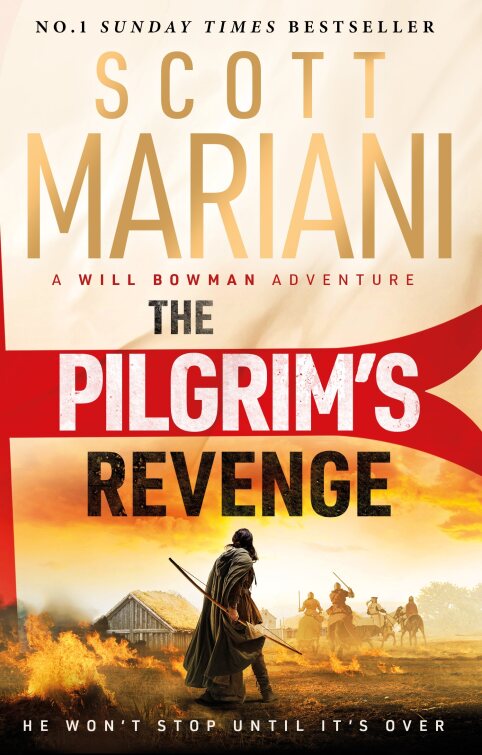
        Book Corner: The Pilgrim’s Revenge by Scott Mariani

        1190 – Humble layman Will Bowman lives in the countryside with his pregnant wife, when soldiers from Richard Lionheart’s army tear through his home. Will is beaten unconscious, and awakes to find his wife murdered, his farm burnt down, and his life forever changed.

        In vengeance, Will infiltrates Richard’s army to find the marauding gang, and finds himself swept along in the march of the Crusades. With the help of new allies and fuelled by his loss, Will crosses Europe with the King’s army.

        Can Will avenge his wife? Or will he be swept away by the unstoppable force of Richard’s Crusade?

        I have been a Scott Mariani fan for a while now and was disappointed that Ben Hope has finally retired, though relieved for Ben that he survived 30 books of people trying to kill him. When one brilliant series ends, you begin to worry that what comes next will be a disappointment, or not as addictive, that you will not feel so invested in the new characters. Especially when the author moves genre. It is a big risk that author and reader take together.

        So, when Scott Mariani moved from thriller with a historical twist to full-blown historical fiction, I was a tad concerned. Fans of historical fiction can be pedants. If there is a grey squirrel out of place, ie, in medieval England, someone will notice. If a character lives longer than he actually did (I am looking at Sweyn Forkbeard in Vikings Valhalla) someone will notice. There is a knack to historical fiction, to weaving the story within the known facts, to introducing fictional characters and creating their interactions with historical figures. The story has to have that essence of authenticity.

        I needn’t have worried!

        In fact, I probably should have trusted that Scott Mariani knew what he was doing. Though I may not have agreed with some of his theories in The Tudor Deception, the actual history was spot on. Having read the last Ben Hope book, The Templar Secret, after Christmas, I should have known a historical fiction book was around the corner. It is obvious the author loves his history. And, given the topic of that last Hope book, it should come as no surprise that Mariani’s first foray into historical fiction involved the crusades – the Third Crusade, to be precise.

        Not that we get more than a glimpse of the Holy Land in this first book – all that is still to come.

        By now Will had almost reached the nearest of the horsemen on his side of the yard. Up close, the rider was an intimidating figure looming far above him in the saddle with the blade of his drawn arming sword glinting in the sunlight. Before Will reached him the horseman saw his approach and wheeled his mount around to face him, dust flying from its hooves. With an angry shout the rider spurred the horse towards Will, swinging his sword down at him. Will ducked, and the double-edged blade hissed through the air above him.

        It had been a blow meant to separate his head from his shoulders, and it had only narrowly missed its mark. The horse thundered past, shaking the ground. The rider reined it brutally around and charged at Will again.

        Nothing like this had ever happened or even been heard of in Will’s experience. He had never been in a real fight, except a minor scuffle once when he was a lad, settled quickly with a couple of punches. This was deadly serious combat, and he was unprepared for it. But the terrible shocking sight of Beatrice in the soldiers’ clutches and the sound of her screams was enough to dispel his confusion and fear, filling him with rage and determination to do anything he could to drive these raiders away and make this stop. And the obvious realisation suddenly occurred to him, for the first time, that he was holding the very means of doing that in his hands. His bow was still unstrung, no more than a long wooden shaft with its hemp cord loosely attached to the bottom end. But practice had made him very adept at readying the weapon in moments; as the horseman bore down on him with the sword raised high, he bent the stave against his foot and looped the string into place.

        The rider was almost on him. Will snatched an arrow from his quiver, nocked it to the string and simultaneously raised his bow and pulled it to full draw. He had never before pointed any weapon in anger at another human being, but there was little time to reflect on that fact, or even to take aim, as his enemy closed in. Will stood his ground until the last moment, released his arrow and saw it fly and hit the rider full in the chest.

        The soldier flinched violently at the arrow strike. A normal opponent would have been a dead man, his heart split in two by the power of the longbow at such close range. But instead of piercing deep into his flesh the iron point glanced off his heavy chain mail and the broken pieces of the arrow shaft spun away through the air. Then Will had to leap out of the way of the charging horse, and he threw himself to the ground.

        The Pilgrims’ Revenge starts in England and follows the journey of a crusader fleet to Outremer, with adventures that are often overlooked by historical fiction authors eager to get to the nitty gritty of the crusade. But what a story they miss out! Scott Mariani includes the little-known excursion of part of the fleet, into Portugal to help with the crusades there. Then, of course, we arrive in Sicily, where Richard the Lionheart frees his sister, Joanna, meets his bride Berengaria and antagonises his ‘ally’ Philip II of France. And then we get a wonderful, vivid depiction of the conquest of Cyprus.

        All is seen through the eyes of our hero, Will Bowman, a men seeking revenge for the murder of his wife and unborn child. He only joins the crusade to chase the murderers but finds a purpose, a talent for soldiering, comradeship and a bent to command along the way. Scott Mariani seamlessly blends together the wider story of Richard the Lionheart’s crusading enterprise with Will’s personal story and experiences.

        The Pilgrims’ Revenge is the first of what promises to be a fast-paced, exhilarating – and, hopefully, long – series. Punctuated by bloody battles, exquisite swordplay and a thrilling storyline, the action is relentless and Scott Mariani fans will not be disappointed. The research is exemplary, especially with regard to the conflict in Portugal, which is usually ignored. The historical figures are wonderfully written and the locations evocative, dusty, hot and exotic.

        Will Bowman is a character I look forward to hearing much more about.

        The Pilgrim’s Revenge will be available from 24 April 2025

        Order The Pilgrim’s Revenge.

        About the author:

        Scott Mariani is the No.1 Sunday Times bestselling author of the multi-million-selling Ben Hope thrillers. From 2025 he is launching into a new historical adventure series featuring medieval English hero Will Bowman, who is forced from his home to join King Richard ‘the Lionheart’ on the Third Crusade and rises up to become a knight. Book 1,THE PILGRIM’S REVENGE, is available from April 2025 and is published by Hodder & Stoughton.

        Scott lives and writes in west Wales, UK. You can find out more about his work by visiting his official website.

        *

        My books

        Signed, dedicated copies of all my books are available through my online store.

        Out now: Scotland’s Medieval Queens

        Scotland’s history is dramatic, violent and bloody. Being England’s northern neighbour has never been easy. Scotland’s queens have had to deal with war, murder, imprisonment, political rivalries and open betrayal. They have loved and lost, raised kings and queens, ruled and died for Scotland. From St Margaret, who became one of the patron saints of Scotland, to Elizabeth de Burgh and the dramatic story of the Scottish Wars of Independence, to the love story and tragedy of Joan Beaufort, to Margaret of Denmark and the dawn of the Renaissance, Scotland’s Medieval Queens have seen it all. This is the story of Scotland through their eyes.

        Scotland’s Medieval Queens gives a thorough grounding in the history of the women who ruled Scotland at the side of its kings, often in the shadows, but just as interesting in their lives beyond the spotlight. It’s not a subject that has been widely covered, and Sharon is a pioneer in bringing that information into accessible history.’ Elizabeth Chadwick (New York Times bestselling author)

        Available now from Amazon and Pen and Sword Books

        Also by Sharon Bennett Connolly:

        Heroines of the Tudor World tells the stories of the most remarkable women from European history in the time of the Tudor dynasty, 1485-1603. These are the women who ruled, the women who founded dynasties, the women who fought for religious freedom, their families and love. Heroines of the Tudor World is now available for pre-order from Amberley Publishing and Amazon UK. Women of the Anarchy demonstrates how Empress Matilda and Matilda of Boulogne, unable to wield a sword themselves, were prime movers in this time of conflict and lawlessness. It shows how their strengths, weaknesses, and personal ambitions swung the fortunes of war one way – and then the other. Available from Bookshop.orgAmberley Publishing and Amazon UKKing John’s Right-Hand Lady: The Story of Nicholaa de la Haye is the story of a truly remarkable lady, the hereditary constable of Lincoln Castle and the first woman in England to be appointed sheriff in her own right. Available from all good bookshops Pen & Sword Booksbookshop.org and Amazon

        Defenders of the Norman Crown: The Rise and Fall of the Warenne Earls of Surrey tells the fascinating story of the Warenne dynasty, from its origins in Normandy, through the Conquest, Magna Carta, the wars and marriages that led to its ultimate demise in the reign of Edward III. Available from Pen & Sword BooksAmazon in the UK and US, and Bookshop.orgLadies of Magna Carta: Women of Influence in Thirteenth Century England looks into the relationships of the various noble families of the 13th century, and how they were affected by the Barons’ Wars, Magna Carta and its aftermath; the bonds that were formed and those that were broken. It is now available in paperback and hardback from Pen & SwordAmazon, and Bookshop.orgHeroines of the Medieval World tells the stories of some of the most remarkable women from Medieval history, from Eleanor of Aquitaine to Julian of Norwich. Available now from Amberley Publishing and Amazon, and Bookshop.orgSilk and the Sword: The Women of the Norman Conquest traces the fortunes of the women who had a significant role to play in the momentous events of 1066. Available now from Amazon,  Amberley Publishing, and Bookshop.org.

        Alternate Endings: An anthology of historical fiction short stories including Long Live the King… which is my take what might have happened had King John not died in October 1216. Available in paperback and kindle from Amazon.

        Podcast:

        Have a listen to the A Slice of Medieval podcast, which I co-host with Historical fiction novelist Derek Birks. Derek and I welcome guests, such as Bernard Cornwell and Michael Jecks, and discuss a wide range of topics in medieval history, from significant events to the personalities involved. Every episode is also now available on YouTube.

        *

        Don’t forget! Signed and dedicated copies of all my books are available through my online store.

        For forthcoming online and in-person talks, please check out my Events Page.

        You can be the first to read new articles by clicking the ‘Follow’ button, liking our Facebook page or joining me on TwitterThreadsBluesky and Instagram.

        *

        ©2025 Sharon Bennett Connolly, FRHistS

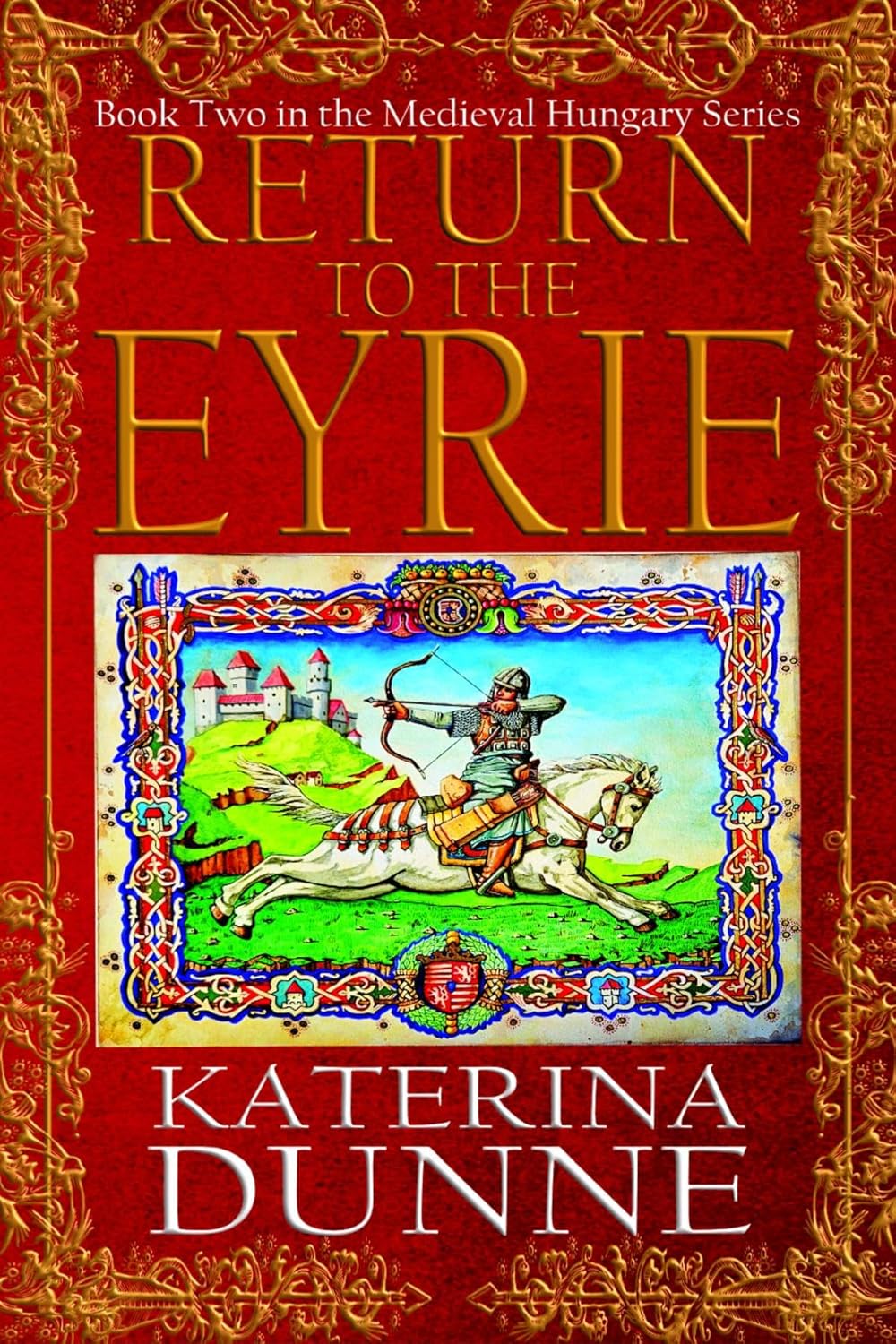
        Book Corner: Return to the Eyrie by Katerina Dunne

        Honour, revenge, and the quest for justice.

        Belgrade, Kingdom of Hungary, 1470

        Raised in exile, adolescent noblewoman Margit Szilágyi dreams of returning to her homeland of Transylvania to avenge her father’s murder and reclaim her stolen legacy. To achieve this, she must break the constraints of her gender and social status and secretly train in combat. When the king offers her a chance at justice, she seizes it – even if it means disguising herself as a man to infiltrate the vultures’ nest that now occupies her ancestral ‘eyrie’. Plagued by childhood trauma and torn between two passionate loves, Margit faces brutal battles, her murderous kin’s traps and inner demons on her quest for vengeance. Only by confronting the past can she reclaim her honour – if she can survive long enough to see it through. Return to the Eyrie is an epic coming-of-age tale of a young woman’s unwavering pursuit of justice and destiny in 15th century Hungary.

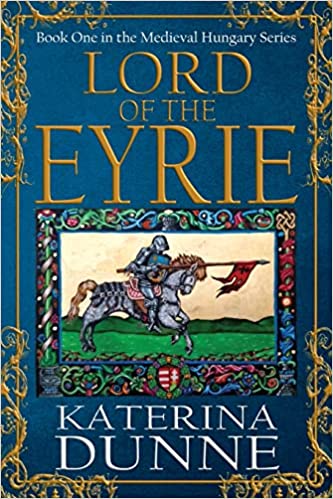
        A couple of years ago, I had the pleasure of reading and reviewing Lord of the Eyrie by Katerina Dunne, a novel set in late medieval Hungary. It was a fascinating introduction to a country whose History I know very little about. And the story was incredible, a family drama, with vivid battle scenes and intricately woven plotlines. It certainly left me wanting more. It was an absolute pleasure to read. So, when Katerina told me she had written a sequel, I jumped at the chance to read it. I was intrigued as to how the story would continue.

        And it is a stunning sequel to Lord of the Eyrie, following the daughter of Sandor, the hero in the first book, who is trying to find out exactly what happened to her father. She also wants to clear his name. unscrupulous enemies branded Sandor a traitor. Margit aims to prove he wasn’t.

        Margit grew up without family, protected by her nurse and her father’s best friend, and knowing that she had been deprived of her inheritance and position in the world. The search for the truth drives her. But she is not the traditional Hungarian girl. A born leader, she learns to fight – against her father’s enemies and against the life that is planned out for her.

        In the lambent glow of the oil lamp, Ahmed traced a thumb down the flat of Margit’s blade, carefully like touching a precious gem. “Beautiful,” he murmured.

        “Will you show me how to use it?”

        Fixed on the etching, Ahmed’s eyes narrowed, and his forehead wrinkled as though his mind was caughter by a distant recollection. “Where did you find this?”

        Margit swallowed back her sudden apprehension. “Why do you ask?”

        “You didn’t steal it, did you?”

        “No!” She snatched the dagger from Ahmed’s hand, placed it back in its box and slammed the lid shut. “It’s mine.” She wrapped her arms about her precious possession.

        “Why are you so angry?” Adnan ventured but shrank back at once, cowering under her fierce gaze.

        “Forgive me,” Ahmed said. “I don’t know the family, but I remember the coat of arms.”

        Margit’s stomach tightened. “You do?”

        “An old story. Some other time. You don’t keep Erzsi waiting outside.”

        He waved Margit away, but she let the canvas bag with her other gifts drop from her shoulder. “Erzsi will not mind waiting. Please, tell me.”

        Ahmed cleared his throat. His eyes wandered away to times long past. “When Sultan Mehmed besieged Belgrade fifteen years ago, I fought beside Janissaries against Hunyadi’s army -“

        “General Janos Hunyadi? The king’s late father?” Margit interrupted him, eyes wide open with excitement.

        The general was her own father’s overlord. Hungary’s bravest protector as Imre always referred to him, tearing every time he uttered his name.

        Ahmed nodded. “Yes. His defenders trapped us in the town. I killed many but then saw this tall and skilled knight. No Shield; just a sword in one hand and axe in the other, slaying Janissaries like untrained peasants.” He pointed at Margit’s box. “He wore this coat of arms. I thought I must stop him. I attacked. But I never fought anyone like him. By Allah, he had no fear; didn’t care if he lives or dies.”

        Margit is a wonderful heroine, determined to seek out the truth, and to forge her own path. Not always aware of, or concerned for, the feelings of others, the teenager searches out her own destiny and confronts her enemies, putting herself and those who love her in danger.

        Margit is not always a likeable heroine. She is sometimes selfish. But, she is a teenage girl who has lost practically everything – family, home, identity. In trying to recover what is lost, she becomes a more sympathetic character, learning to compromise and reach an understanding with those around her. The reader will become invested in her journey.

        Return to the Eyrie by Katerina Dunne is set in medieval Hungary, a land which Katerina Dunne recreates in astonishing detail. The landscape, the settlements, castles and people help to draw the reader into the story. Hungary is a land rich in resources but beset by enemies, both within and without, and the heroine, Margit, must navigate not only national politics, international enemies but also her own identity as a young woman and the daughter of an accused traitor.

        It is a wonderful, rich and absorbing story. I highly recommend it!

        To Buy the Book:

        Return to the Eyrie is available in paperback and on Kindle from Amazon – and is currently only 49p, so snap it up!

        About the author:

        Katerina Dunne is the pen-name of Katerina Vavoulidou. Originally from Athens, Greece, Katerina has been living in Ireland since 1999. She has a degree in English Language and Literature from the University of Athens, an MA in Film Studies from University College Dublin and an MPhil in Medieval History from Trinity College Dublin. While she used to write short stories for family and friends in her teenage years, she only took up writing seriously in 2016-17, when she started work on her first novel.

        Katerina’s day job is in financial services, but in her free time she enjoys reading historical fiction and watching historically-themed movies and TV series. She is passionate about history, especially medieval history, and her main area of interest is 13th to 15th century Hungary. Although the main characters of her stories are fictional, Katerina uses real events and personalities as part of her narrative in order to bring to life the fascinating history of the medieval Kingdom of Hungary, a location and time period not so well-known to English-speaking readers.

        *

        My Books:

        Signed, dedicated copies of all my books are available through my online bookshop.

        Coming 30 January 2025: Scotland’s Medieval Queens

        Scotland’s history is dramatic, violent and bloody. Being England’s northern neighbour has never been easy. Scotland’s queens have had to deal with war, murder, imprisonment, political rivalries and open betrayal. They have loved and lost, raised kings and queens, ruled and died for Scotland. From St Margaret, who became one of the patron saints of Scotland, to Elizabeth de Burgh and the dramatic story of the Scottish Wars of Independence, to the love story and tragedy of Joan Beaufort, to Margaret of Denmark and the dawn of the Renaissance, Scotland’s Medieval Queens have seen it all. This is the story of Scotland through their eyes.

        Available for pre-order now.

        Also by Sharon Bennett Connolly:

        Heroines of the Tudor World tells the stories of the most remarkable women from European history in the time of the Tudor dynasty, 1485-1603. These are the women who ruled, the women who founded dynasties, the women who fought for religious freedom, their families and love. Heroines of the Tudor World is now available for pre-order from Amberley Publishing and Amazon UK. Women of the Anarchy demonstrates how Empress Matilda and Matilda of Boulogne, unable to wield a sword themselves, were prime movers in this time of conflict and lawlessness. It shows how their strengths, weaknesses, and personal ambitions swung the fortunes of war one way – and then the other. Available from Bookshop.orgAmberley Publishing and Amazon UKKing John’s Right-Hand Lady: The Story of Nicholaa de la Haye is the story of a truly remarkable lady, the hereditary constable of Lincoln Castle and the first woman in England to be appointed sheriff in her own right. Available from all good bookshops Pen & Sword Booksbookshop.org and Amazon

        Defenders of the Norman Crown: The Rise and Fall of the Warenne Earls of Surrey tells the fascinating story of the Warenne dynasty, from its origins in Normandy, through the Conquest, Magna Carta, the wars and marriages that led to its ultimate demise in the reign of Edward III. Available from Pen & Sword BooksAmazon in the UK and US, and Bookshop.orgLadies of Magna Carta: Women of Influence in Thirteenth Century England looks into the relationships of the various noble families of the 13th century, and how they were affected by the Barons’ Wars, Magna Carta and its aftermath; the bonds that were formed and those that were broken. It is now available in paperback and hardback from Pen & SwordAmazon, and Bookshop.orgHeroines of the Medieval World tells the stories of some of the most remarkable women from Medieval history, from Eleanor of Aquitaine to Julian of Norwich. Available now from Amberley Publishing and Amazon, and Bookshop.orgSilk and the Sword: The Women of the Norman Conquest traces the fortunes of the women who had a significant role to play in the momentous events of 1066. Available now from Amazon,  Amberley Publishing, and Bookshop.org.

        Alternate Endings: An anthology of historical fiction short stories including Long Live the King… which is my take what might have happened had King John not died in October 1216. Available in paperback and kindle from Amazon.

        Podcast:

        Have a listen to the A Slice of Medieval podcast, which I co-host with Historical fiction novelist Derek Birks. Derek and I welcome guests, such as Bernard Cornwell, and discuss a wide range of topics in medieval history, from significant events to the personalities involved.

        *

        Don’t forget! Signed and dedicated copies of all my books are available through my online bookshop.

        For forthcoming online and in-person talks, please check out my Events Page.

        You can be the first to read new articles by clicking the ‘Follow’ button, liking our Facebook page or joining me on TwitterThreadsBluesky and Instagram.

        ©2024 Sharon Bennett Connolly FRHistS
        Guest Post: Frances – Tudor Countess: The History Behind the Book, by Tony Riches

        Today, it is a pleasure to welcome Tony Riches back to History…the Interesting Bits, with an article about the story behind his new novel, Frances: Tudor Countess. Frances Walsingham was the daughter of Queen Elizabeth’s spymaster, Francis Walsingham who married three times, including the soldier-poet, Sir Philip Sidney and, later, Robert Devereux, Earl of Essex

        So, over to Tony…

        Frances – Tudor Countess: The History Behind the Book

        The origins of my latest book can be traced to my birth in Pembroke, Wales, close to the medieval castle where Henry Tudor was born. I couldn’t find any books which brought his story to life, and was inspired to write the Tudor Trilogy, where Henry is born in the first book, comes of age in the second, and becomes King of England in the third.

        The success of the Tudor Trilogy led to the idea of following the dynasty in a continuous thread to the end, with the death of Queen Elizabeth I. I enjoy studying the real history to understand the social, political and economic context, and like to offer readers an historically authentic ‘immersive’ experience.

        Over the past ten years I’ve built an extensive reference collection of books on everything Tudor and Elizabethan, from medicine to recipes, childbirth to government, as well as numerous biographies of key players in the story of the Tudors. All this research provides the backdrop within which the real lives and relationships of my chosen subjects develop and evolve.

        For my second trilogy I decided to write about the reign of Henry VIII as the ‘Brandon Trilogy’, from the perspective of his youngest sister, Mary, his best friend, Charles Brandon, and the woman who some say could have become his seventh wife, Katherine Willoughby.

        This took me to the Elizabethan era, and the decision to explore the enigmatic queen through three of her favourite men, Drake, Essex and Raleigh. Each saw her very differently, as Drake was in awe of her, Essex was like the son she never had, and Raleigh became captain of her guard.

        I found that most of what I thought I knew about these men was wrong or missing vital details. I discovered Drake strived to understand and help liberate enslaved people. The heroic failure of the Essex rebellion was more about his lack of emotional intelligence than political ambition, and Raleigh’s colonisation of the New World was conducted from the comfort of his home through the courageous sacrifices of others.

        I also realised I would need to make the Elizabethan books a series of six, rather than a trilogy, and explore the complexity of Queen Elizabeth through the eyes of three of her ladies. I had plenty to choose from, but found the most interesting were Penelope, eldest daughter of the queen’s nemesis, Lady Lettice Knollys, Frances, the only surviving child of the queen’s spymaster, Walsingham, and one of her ‘Gentlewomen’, Bess Raleigh.

        One of my favourite historical sources for the Elizabethan series is “The Elizabethan Court Day by Day” by Marion E. Colthorpe. A rich and varied collection of research, this is where I discovered such details as the queen’s chambers being infested with fleas, which accumulated at the windows, the lists of participants in Accession Day jousts, and actual menus for royal banquets. Most importantly, this resource enabled me to cross-check events on any day at the Elizabethan court with other sources to ensure historical accuracy.

        Of the many biographies I’ve studied, an unexpected source I found useful was Daphne du Maurier’s work on Francis and Anthony Bacon, who became important advisors to Frances in her struggle to understand and influence events at court. I also collected the works of the late Professor David Loades, particularly on the lives of William and Robert Cecil, who provide a connection between the books of the Elizabethan series.

        To anyone looking for a deeper understanding of the Elizabethan world, I also recommend Liza Picard’s Elizabeth’s London: Everyday Life in Elizabethan London and The Time Traveller’s Guide to Elizabethan England by Ian Mortimer. There are plenty of well-researched books about the great events of the period, such as the Spanish Armada, but I was keen to develop a sense of how my subjects lived from day to day, what they wore, what they ate, and most importantly, how they thought about their world.

        When I set out on this ‘journey’ to tell the story of the Tudors I had no idea how much I would learn about fascinating women such as Frances Walsingham, who witnessed the key events of the Elizabethan era first-hand, yet is so little known – until now.

        To Buy the book:

        Frances – Tudor Countess is new from Amazon in the United Kingdom and United States in eBook and Paperback, and an audiobook edition will be produced this year:

        About the Author:

        Tony Riches is a full-time UK author of best-selling Tudor historical fiction. He lives in Pembrokeshire, West Wales and is a specialist in the history of the Wars of the Roses and the lives of the Tudors. For more information about Tony’s books please visit his website tonyriches.com and his blog, The Writing Desk and find him on Facebook, Twitter @tonyriches and Bluesky: https://bsky.app/profile/tonyriches.bsky.social. You can find out more about his research on his popular podcast series, ‘Stories of the Tudors’

        Media Links:

        Website: https://www.tonyriches.com/ Twitter: https://twitter.com/tonyriches Bluesky: https://bsky.app/profile/tonyriches.bsky.social Facebook: https://www.facebook.com/tonyriches.author/ LinkedIn: https://www.linkedin.com/in/tonyriches/ Instagram: https://www.instagram.com/tonyriches.author/ Amazon Author Page: https://www.amazon.com/Tony-Riches/e/B006UZWOXA Goodreads: https://www.goodreads.com/author/show/5604088.Tony_Riches

        *

        My Books

        Signed, dedicated copies of all my books are available through my online bookshop.

        Coming on 15 June 2024: Heroines of the Tudor World

        Heroines of the Tudor World tells the stories of the most remarkable women from European history in the time of the Tudor dynasty, 1485-1603. These are the women who ruled, the women who founded dynasties, the women who fought for religious freedom, their families and love. These are the women who made a difference, who influenced countries, kings and the Reformation. In the era dominated by the Renaissance and Reformation, Heroines of the Tudor World examines the threats and challenges faced by the women of the era, and how they overcame them. From writers to regents, from nuns to queens, Heroines of the Tudor World shines the spotlight on the women helped to shape Early Modern Europe.

        Heroines of the Tudor World is now available for pre-order from Amberley Publishing and Amazon UK.

        Out Now! Women of the Anarchy

        Two cousins. On the one side is Empress Matilda, or Maud. The sole surviving legitimate child of Henry I, she is fighting for her birthright and that of her children. On the other side is her cousin, Queen Matilda, supporting her husband, King Stephen, and fighting to see her own son inherit the English crown. Women of the Anarchy demonstrates how these women, unable to wield a sword, were prime movers in this time of conflict and lawlessness. It show how their strengths, weaknesses, and personal ambitions swung the fortunes of war one way – and then the other.

        Available from Bookshop.orgAmberley Publishing and Amazon UK.

        Also by Sharon Bennett Connolly:

        King John’s Right-Hand Lady: The Story of Nicholaa de la Haye is the story of a truly remarkable lady, the hereditary constable of Lincoln Castle and the first woman in England to be appointed sheriff in her own right. Available from all good bookshops or direct from Pen & Sword Booksbookshop.org and AmazonDefenders of the Norman Crown: The Rise and Fall of the Warenne Earls of Surrey tells the fascinating story of the Warenne dynasty, from its origins in Normandy, through the Conquest, Magna Carta, the wars and marriages that led to its ultimate demise in the reign of Edward III. Available from Pen & Sword BooksAmazon in the UK and US, and Bookshop.org

        Ladies of Magna Carta: Women of Influence in Thirteenth Century England looks into the relationships of the various noble families of the 13th century, and how they were affected by the Barons’ Wars, Magna Carta and its aftermath; the bonds that were formed and those that were broken. It is now available in paperback and hardback from Pen & Sword,  Amazon, and Bookshop.orgHeroines of the Medieval World tells the stories of some of the most remarkable women from Medieval history, from Eleanor of Aquitaine to Julian of Norwich. Available now from Amberley Publishing and Amazon, and Bookshop.orgSilk and the Sword: The Women of the Norman Conquest traces the fortunes of the women who had a significant role to play in the momentous events of 1066. Available now from Amazon,  Amberley Publishing, and Bookshop.org.

        Alternate Endings: An anthology of historical fiction short stories including Long Live the King… which is my take what might have happened had King John not died in October 1216. Available in paperback and kindle from Amazon.

        Podcast:

        Have a listen to the A Slice of Medieval podcast, which I co-host with Historical fiction novelist Derek Birks. Derek and I welcome guests, such as Bernard Cornwell – and Tony Riches. We discuss a wide range of topics in medieval history, from significant events to the personalities involved.

        *

        Don’t forget! Signed and dedicated copies of all my books are available through my online bookshop.

        For forthcoming online and in-person talks, please check out my Events Page.

        You can be the first to read new articles by clicking the ‘Follow’ button, liking our Facebook page or joining me on Twitter and Instagram.

        *

        ©2024 Sharon Bennett Connolly FRHistS and Tony Riches
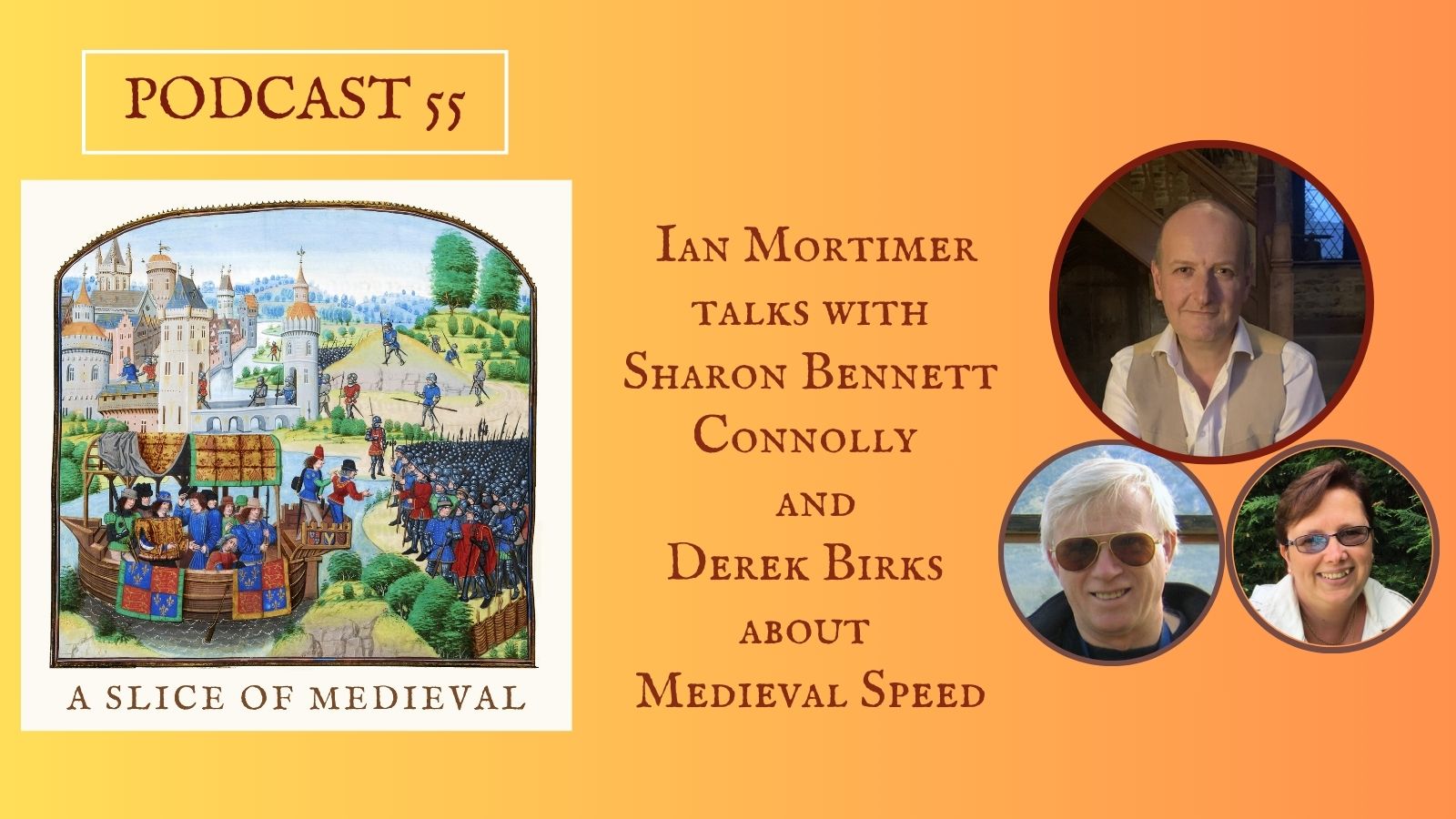
        Book Corner: Arthur by Giles Kristian

        Years have passed since the clash of shieldwalls echoed across the land. The Saxons are now the lords of Britain. And yet the bards still sing of Arthur – ‘In our darkest time, when we need him most, shall he come again.’

        Yet old Beran has no love of bards’ songs. Nor of people, unless they are paying him to steal or kill. He is a mercenary, in the employ of the cutthroat Nabor ap Nabor, and he has been ordered to murder a boy fleeing a burning city. No ordinary boy either. No, this boy is the son of King Constantine and the grandson of High King Ambrosius. And he could be the hope of Britain…if he lives.

        Betraying his companions and returning to a world he thought he had left forever, Beran gives his word that he will take the boy to the one place that still holds out against the Saxons: Camelot.

        Crossing a hostile land, they will meet the runaway lovers, Tristan and Isolde. They will seek the help of Guivret, called the Little King, and the Saracen, Palamedes, who once rode beneath Arthur’s banner.

        Hunted by Saxons, Nabor ap Nabor, and Queen Morgana, this unlikely band must fight for their lives and for each other. For if there’s to be any hope for Britain, Beran must deliver the boy to Camelot. But to do that, he must also face his own past…

        Wow!

        Every now and then, a book comes along that stands head and shoulders above the rest. It draws you in. You cannot wait to finish it.

        And yet…

        Finishing it leaves you bereft.

        That is Giles Kristian’s Arthur.

        It is the third book in a series that was only meant to be a duology. After Lancelot and Camelot came out, I asked Giles if there would be an Arthur and he said, probably not – that he had covered Arthur’s story in the other two. He wasn’t sure there was anything more to add. And how could he do it? He would have to go back a rewrite Lancelot, but with Arthur as the focus. I understood his dilemma but it was disappointing that there would be no book dedicated to Arthur.

        But then, he must have found inspiration from somewhere, because we now have Arthur. Lancelot was fabulous. Camelot was gripping. Arthur is on a whole other level. The premise of the novel is inspired. Continuing the story into the next generation, with flashbacks to Arthur’s early life and career. The new story is cleverly woven into the old legends. Morgana is a villain trying to get her hands on the heir to the throne. The tragic love story of Tristan and Isolde is woven into the narrative, as are other parts of the Arthurian legend. And Beran, the old soldier, is the reluctant hero, who reluctantly finds himself in the role of Prince Erbin’s protector.

        ‘I’m hungry,’ the boy said.

        ‘I told you, I don’t have any food,’ Beran replied, looking for the stars to make sure they were still walking west. Two bats tumbled and flitted above, across a patch of dark sky.

        ‘But I’m hungry,’ the boy insisted.

        ‘What do you expect me to do about it?’ Beran growled.

        The boy’s face clenched in thought. ‘You must be good at setting traps,’ he said. ‘You outlaws live here in the forest, don’t you?’

        ‘I can feed myself. Didn’t ask for another mouth to feed.’

        ‘I’m a prince.’

        ‘A mouth’s a mouth.’

        Beran could almost feel the boy frowning in the dark from two feet away. ‘We could set a snare like my father’s hunters do. They catch hares and polecats and pine martens that way.’

        ‘Not any more they don’t,’ Beran said. ‘Look, boy, if we stop to set traps, we’re more likely to catch one of the bastards who’s after us. Or a Saxon. Or one of Queen Morgana’s spearmen. We’ve got to keep moving.’

        ‘So, we’re going to Camelot?’ the boy asked.

        The name struck Beran like a blow to the chest. He stopped and the boy stopped with him. ‘Why in Ban’s name would we go to Camelot?’ he asked.

        ‘Because that’s where Mother was taking me,’ the boy said, looking up at him, and Beran realized he had not even considered where the fugitives from Caer Colun had been bound with their treasures and this heir to the kingdom. It made sense, of course, for where else was safe in Britain for the son of Constantine the Battle King? The man who had modelled himself on the Roman generals who once ruled in the Dark Isles, and who had waged war against the Saxons for the last sixty years.

        ‘Lady Iselle wrote to my mother many times since my fatehr died, begging her to go to Camelot where we would be safe.’

        Another name, another blow. ‘So why didn’t you?’ Beran asked. Your mother must’ve known Caer Colun could not hold out for ever. Even if the great Constantine had still been alive.’

        ‘Mother said we would never abandon the people. Lady Iselle could not take all of them to live within Camelot’s walls.’

        ‘Well, your mother’s people are slaves now, or dead. Or living beneath the sky like us,’ Beran said.

        ‘How long will it take to get to Camelot?’ the boy asked.

        ‘We’re not going to Camelot.’

        Giles Kristian’s Arthur is a beautifully crafted story from start to finish, with twists and turns that will keep the reader on the edge of their seat and reading late into the night. And so you should. With enemies old and new, Beran has to avoid his former gang, stay clear of marauding Saxons and protect his charge from Queen Morgana’s men, who are hunting them relentlessly,

        I do not want to ruin the reading experience with spoilers, I promise, but I will say endings are often not as good as you want them to be. They fail to live up to the promise.

        That is not the case with Arthur.

        The ending is spectacular.

        They are everything you would expect of the legendary Arthur.

        You ride with him.

        You fight with him.

        You are screaming his name as you charge the enemy.

        It is perfection.

        If there is only one book you read this year, make sure it is Arthur by Giles Kristian.

        To buy Arthur on Amazon, click here.

        About the author:

        Family history (he is half Norwegian) and a passion for the fiction of Bernard Cornwell inspired GILES KRISTIAN to write. Set in the Viking world, his bestselling ‘Raven’ and ‘The Rise of Sigurd’ trilogies have been acclaimed by his peers, reviewers and readers alike. In The Bleeding Land and Brothers’ Fury, he tells the story of a family torn apart by the English Civil War. He also co-wrote Wilbur Smith’s No.1 bestseller, Golden Lion. His contemporary survival thriller, Where Blood Runs Cold, won the Wilbur Smith Adventure Writing Prize. With his SundaTimes bestseller Lancelot, Giles plunged into the rich waters of the Arthurian legend. His epic reimagining of our greatest island ‘history’ continued in Camelot and draws to a breath-taking close with Arthur.
        Giles Kristian lives in Leicestershire.
        To find out more, visit http://www.glieskristian.com. You can follow him on X @GilesKristian and Facebook/Giles Kristian

        *

        My Books

        Signed, dedicated copies of all my books are available through my online bookshop.

        Coming on 15 June 2024: Heroines of the Tudor World

        Heroines of the Tudor World tells the stories of the most remarkable women from European history in the time of the Tudor dynasty, 1485-1603. These are the women who ruled, the women who founded dynasties, the women who fought for religious freedom, their families and love. These are the women who made a difference, who influenced countries, kings and the Reformation. In the era dominated by the Renaissance and Reformation, Heroines of the Tudor World examines the threats and challenges faced by the women of the era, and how they overcame them. From writers to regents, from nuns to queens, Heroines of the Tudor World shines the spotlight on the women helped to shape Early Modern Europe.

        Heroines of the Tudor World is now available for pre-order from Amberley Publishing and Amazon UK.

        Out Now! Women of the Anarchy

        Two cousins. On the one side is Empress Matilda, or Maud. The sole surviving legitimate child of Henry I, she is fighting for her birthright and that of her children. On the other side is her cousin, Queen Matilda, supporting her husband, King Stephen, and fighting to see her own son inherit the English crown. Women of the Anarchy demonstrates how these women, unable to wield a sword, were prime movers in this time of conflict and lawlessness. It show how their strengths, weaknesses, and personal ambitions swung the fortunes of war one way – and then the other.

        Available from Bookshop.orgAmberley Publishing and Amazon UK.

        Also by Sharon Bennett Connolly:

        King John’s Right-Hand Lady: The Story of Nicholaa de la Haye is the story of a truly remarkable lady, the hereditary constable of Lincoln Castle and the first woman in England to be appointed sheriff in her own right. Available from all good bookshops or direct from Pen & Sword Booksbookshop.org and AmazonDefenders of the Norman Crown: The Rise and Fall of the Warenne Earls of Surrey tells the fascinating story of the Warenne dynasty, from its origins in Normandy, through the Conquest, Magna Carta, the wars and marriages that led to its ultimate demise in the reign of Edward III. Available from Pen & Sword BooksAmazon in the UK and US, and Bookshop.org

        Ladies of Magna Carta: Women of Influence in Thirteenth Century England looks into the relationships of the various noble families of the 13th century, and how they were affected by the Barons’ Wars, Magna Carta and its aftermath; the bonds that were formed and those that were broken. It is now available in paperback and hardback from Pen & Sword,  Amazon, and Bookshop.orgHeroines of the Medieval World tells the stories of some of the most remarkable women from Medieval history, from Eleanor of Aquitaine to Julian of Norwich. Available now from Amberley Publishing and Amazon, and Bookshop.orgSilk and the Sword: The Women of the Norman Conquest traces the fortunes of the women who had a significant role to play in the momentous events of 1066. Available now from Amazon,  Amberley Publishing, and Bookshop.org.

        Alternate Endings: An anthology of historical fiction short stories including Long Live the King… which is my take what might have happened had King John not died in October 1216. Available in paperback and kindle from Amazon.

        Podcast:

        Have a listen to the A Slice of Medieval podcast, which I co-host with Historical fiction novelist Derek Birks. Derek and I welcome guests, such as Bernard Cornwell and discuss a wide range of topics in medieval history, from significant events to the personalities involved.

        *

        Don’t forget! Signed and dedicated copies of all my books are available through my online bookshop.

        For forthcoming online and in-person talks, please check out my Events Page.

        You can be the first to read new articles by clicking the ‘Follow’ button, liking our Facebook page or joining me on Twitter and Instagram.

        *

        ©2024 Sharon Bennett Connolly FRHistS.

        Guest Post: Middleham Castle – Home to Kings and Kingmakers by Wendy Johnson

        Today, it is a pleasure to welcome debut author, Wendy Johnson, to History…the Interesting Bits as part of her blog tour to celebrate the launch of Wendy’s first novel, The Traitor’s Son.

        Middleham Castle – Home to Kings and Kingmakers

        Middleham Castle, North Yorkshire, bastion of the illustrious Neville family and home to both Richard Neville, earl of Warwick and his cousin, the future Richard III, is an evocative and fascinating place.

        Eleven miles from the market town of Richmond, and a stone’s throw from Leyburn, the castle stands at the heart of Middleham, amid Wensleydale’s rolling hills. The visitor’s first impression, on approaching its cavernous gatehouse, is that these ruins have witnessed the very essence of history, and if only walls could talk, they would have a treasure trove of secrets to reveal.

        An earlier castle once stood on nearby William’s Hill, but the present edifice began to rise in the 1170s. The fortress came into the possession of the Neville family when Mary FitzRanulph married Robert Neville in the thirteenth century. However, Middleham appears to have been considered less important than Robert’s other castles at Raby and Sheriff Hutton.1 Later Nevilles made a number of improvements – heightening the towers and creating a new and larger gatehouse – but it was in the later fifteenth century that the castle became the home of some of the most influential figures of the Wars of the Roses: the three Richards.

        Richard Neville, earl of Salisbury; Richard Neville, earl of Warwick; and Richard Plantagenet, duke of Gloucester were each caught up in one of the most dramatic periods of English history, when the crown changed hands from Lancaster to York, York to Lancaster, and back again in the course of only ten years.

        Following the fateful Battle of Wakefield in 1460, Salisbury was captured and executed. His son, the enigmatic and forceful Earl of Warwick, was largely responsible for helping Edward IV, the first Yorkist king, to win the throne in 1461.

        Richard duke of Gloucester, Edward’s youngest brother, who ascended the throne as Richard III, spent much of his life at Middleham. Installed in his cousin, Warwick’s, household at the age of twelve, Richard embarked on his knightly training under the earl’s tutelage, learning the military and social graces required of a chivalric warrior. At the age of twenty, following his marriage to Warwick’s daughter, Anne, Middleham became Richard’s favourite residence.

        My debut novel, The Traitor’s Son, re-imagines these early years. As a grieving and fatherless boy, Richard finds solace in the company of his cousin, the Earl of Warwick, whose paternal influence repairs the boy’s shattered life. The castle of Middleham plays an important role in the novel – representing a new and, at first, unnerving, part in Richard’s journey, as he wonders whether he is able to live up to the earl’s expectations. I have chosen to illustrate Richard’s early feelings for Middleham and for his formidable cousin in the following scene, when the boy has been summoned into Warwick’s presence.

        ‘Belly lurching, he follows the earl’s man down the tight spiral and out into the bailey. Kitchen boys are throwing out slops, bandying jests, sniggering. As he approaches, they fall silent, snatching caps and bobbing knees. The air is cool, pungent with the scent of verdure and horse dung, birds chirruping in the violet dusk. A solitary crow swoops from the keep, hops across the earth in the clumsy, jerking manner of his breed, then takes off again in the direction of the practice yard.

        He should have fetched a cloak. It’s so much colder here in the land of the Nevilles, plagued as it is with a perpetual wind sweeping from the moors and striking like a whiplash. He shivers, wondering why Warwick has hauled him from what little comfort there is to be had on such a dismal evening. To draw conclusions on the day’s events? To tell him he has failed?

        Torchlight bobs on towering stone as they mount the steps to the keep. Challenged twice in the ascent, he could be at Westminster, and Warwick a king at the heart of the labyrinth. Surely, he thinks, it’s the dread of the moment that gives this impression, the creeping suffocation of growing darkness, the brilliance of the wind-torn flames. Warwick is my cousin and my tutor; he is not my sovereign.

        The Middleham known to both Richard and Warwick was larger than the ruined fabric we see today. In addition to the keep, towers and surrounding ranges, there would have been stables, an armoury, a blacksmith’s forge and many more domestic buildings all integral to the daily life of the castle, as well as to the role of its lord as upholder of his estates and a foremost figure in society. How magnificent that life was, can be gleaned by the splendour of the Middleham Jewel: a fifteenth century gold and sapphire pendent found in the vicinity of the castle in 1986. Current thinking is that the jewel belonged to a woman – the most likely candidate being Anne Beauchamp, Warwick’s countess, or possibly Anne Neville, Warwick’s daughter, and wife of Richard III. Although the original pendent is on display in the Yorkshire Museum, York, a replica has pride of place in the castle’s English Heritage shop.

        I find that visualising the past can help stir the imagination, as one explores Middleham’s evocative and dramatic ruins. If you’ve never experienced Middleham’s magic for yourself, then try following in the footsteps of kings and kingmakers, you’ll not regret it.

        About the book:

        Click here to buy: The Traitor’s Son

        Review quotes:

        “Exquisitely written. An evocative and thoughtful retelling of the early life of Richard III.” Philippa Langley, MBE

        Synopsis:

        Caught between a king and a kingmaker, young Richard Plantagenet knows he’ll have to choose…

        1461: Richard Duke of York, King by Right, has been branded a traitor and slain by his Lancastrian foes. For his eight-year-old son—Richard Plantagenet—England has become a dangerous place.

        As the boy grapples with grief and uncertainty, his elder brother, Edward, defeats the enemy and claims the throne. Dazzled by his glorious sibling, young Richard soon discovers that imperfections lurk beneath his brother’s majestic façade. Enter Richard Neville, Earl of Warwick—cousin, tutor, luminary—whose life has given him everything but that which he truly craves: a son. A filial bond forms between man and boy as they fill the void in each other’s lives. Yet, when treachery tears their world asunder, Richard faces an agonizing dilemma: pledge allegiance to Edward—his blood brother and king—or to Warwick, the father figure who has shaped his life and affections.

        Painfully trapped between duty and devotion, Richard faces a grim reality: whatever he decides will mean a fight to the death.

        In “The Traitor’s Son”, Wendy Johnson masterfully weaves a tapestry of loyalty, love, and sacrifice against the backdrop of England’s turbulent history. Through the eyes of a young Richard III, readers are transported into a world where every choice is fraught with peril, and the bonds of kinship are tested to their limits. As Richard Plantagenet navigates the explosive tensions within his own family, readers are swept along on a journey of intrigue and passion that will leave them spellbound until the final page.

        Note: 1. https://www.english-heritage.org.uk/visit/places/middleham-castle/history/

        Images:

        1) Middleham Castle from the Gatehouse (Wendy Johnson); 2) Middleham Castle: North Range (Wendy Johnson); 3) Middleham Castle: Towards the Gatehouse (Wendy Johnson).

        About the author:

        Wendy has a lifelong passion for medieval history, its people, and for bringing their incredible stories to life. Her specific areas of interest are the fifteenth century, the Wars of the Roses, and Richard III in particular. She enjoys narratives which immerse the reader in the past, and tries faithfully to recreate the later Middle Ages within in her own writing. She has contributed to a number of historical anthologies and was a runner up in the Woman and Home Short Story Competition 2008.

        A member of the Richard III Society since 1986, Wendy is also a founder member of Philippa Langley’s Looking for Richard Project, which located the king’s lost grave in 2012. She co-authored Finding Richard III: the Official Account of Research by the Retrieval and Reburial Project in 2014, and in 2019 received the Richard III Society’s Robert Hamblin Award.

        THE TRAITOR’S SON, volume one in a Richard III trilogy, is Wendy’s debut novel and she is currently working on the sequel.

        *

        My Books:

        Signed, dedicated copies of all my books are available through my online bookshop.

        Out Now! Women of the Anarchy

        Two cousins. On the one side is Empress Matilda, or Maud. The sole surviving legitimate child of Henry I, she is fighting for her birthright and that of her children. On the other side is her cousin, Queen Matilda, supporting her husband, King Stephen, and fighting to see her own son inherit the English crown. Women of the Anarchy demonstrates how these women, unable to wield a sword, were prime movers in this time of conflict and lawlessness. It show how their strengths, weaknesses, and personal ambitions swung the fortunes of war one way – and then the other.

        Available from Bookshop.orgAmberley Publishing and Amazon UK.

        Coming on 15 June 2024: Heroines of the Tudor World

        Heroines of the Tudor World tells the stories of the most remarkable women from European history in the time of the Tudor dynasty, 1485-1603. These are the women who ruled, the women who founded dynasties, the women who fought for religious freedom, their families and love. These are the women who made a difference, who influenced countries, kings and the Reformation. In the era dominated by the Renaissance and Reformation, Heroines of the Tudor World examines the threats and challenges faced by the women of the era, and how they overcame them. From writers to regents, from nuns to queens, Heroines of the Tudor World shines the spotlight on the women helped to shape Early Modern Europe.

        Heroines of the Tudor World is now available for pre-order from Amberley Publishing and Amazon UK.

        Also by Sharon Bennett Connolly:

        King John’s Right-Hand Lady: The Story of Nicholaa de la Haye is the story of a truly remarkable lady, the hereditary constable of Lincoln Castle and the first woman in England to be appointed sheriff in her own right. Available from all good bookshops or direct from Pen & Sword Booksbookshop.org and AmazonDefenders of the Norman Crown: The Rise and Fall of the Warenne Earls of Surrey tells the fascinating story of the Warenne dynasty, from its origins in Normandy, through the Conquest, Magna Carta, the wars and marriages that led to its ultimate demise in the reign of Edward III. Available from Pen & Sword BooksAmazon in the UK and US, and Bookshop.org

        Ladies of Magna Carta: Women of Influence in Thirteenth Century England looks into the relationships of the various noble families of the 13th century, and how they were affected by the Barons’ Wars, Magna Carta and its aftermath; the bonds that were formed and those that were broken. It is now available in paperback and hardback from Pen & Sword,  Amazon, and Bookshop.orgHeroines of the Medieval World tells the stories of some of the most remarkable women from Medieval history, from Eleanor of Aquitaine to Julian of Norwich. Available now from Amberley Publishing and Amazon, and Bookshop.orgSilk and the Sword: The Women of the Norman Conquest traces the fortunes of the women who had a significant role to play in the momentous events of 1066. Available now from Amazon,  Amberley Publishing, and Bookshop.org.

        Alternate Endings: An anthology of historical fiction short stories including Long Live the King… which is my take what might have happened had King John not died in October 1216. Available in paperback and kindle from Amazon.

        Podcast:

        Have a listen to the A Slice of Medieval podcast, which I co-host with Historical fiction novelist Derek Birks. Derek and I welcome guests, such as Bernard Cornwell and Elizabeth Chadwick, and discuss a wide range of topics in medieval history, from significant events to the personalities involved.

        *

        Don’t forget! Signed and dedicated copies of all my books are available through my online bookshop.

        For forthcoming online and in-person talks, please check out my Events Page.

        You can be the first to read new articles by clicking the ‘Follow’ button, liking our Facebook page or joining me on Twitter and Instagram.

        *

        ©2024 Sharon Bennett Connolly FRHistS 

        Guest Post: A Pilgrim’s Visit to Canterbury Cathedral by Toni Mount

        It is always a pleasure to welcome historian and author, Toni Mount, to History… the Interesting Bits. Toni enjoys really getting a deep understanding of her characters, the lives they lived and the places they visited. For “The Colour of Sin”, her main characters were off on pilgrimage and that meant a lot of interesting places to research. Here, Toni talks about Canterbury Cathedral and how pilgrimage actually worked. Over to Toni Mount…

        A Pilgrim’s Visit to Canterbury Cathedral

        Christ Church Gate, Canterbury Cathedral

        In order to research my new novel, The Colour of Sin, we visited Canterbury Cathedral. The story would involve our hero, Sebastian Foxley, taking his family on a pilgrimage to visit the shrine of St Thomas Becket in the cathedral, leaving behind his usual haunts in the City of London so a change of venue for him – and for me. I particularly wanted to get a feeling of what it would be like for a fifteenth-century pilgrim, to attempt to see things and experience them as he would have done. Fortunately, we had a wonderfully knowledgeable and helpful guide in Geoff Webb who was a mine of intriguing information.

        Firstly, we had to remember that the cathedral was attached to a Benedictine monastery in those days so it was a far bigger larger complex of buildings, including the monks’ dormitory, rere-dorter or latrines, refectory, chapter house, infirmary, kitchen and other areas all of which would have been out-of-bounds to the pilgrims. Today, visitors can wander through the cloisters and view the garden with its water tower but for a pilgrim in 1480 this wouldn’t have been allowed. The magnificent chancel and choir were where the monks continued to hold their services throughout the day even as other areas of the cathedral were thronged with pilgrims. The same is the case today – most ordinary daily services are held in the choir but tourists may pass through whenever a service isn’t in progress, seeing some architectural wonders the medieval pilgrim would not have seen.

        Secondly, how were the pilgrims ‘managed’ by the monks? Did they get a guided tour? Were they kept to a set route through the cathedral or could they wander off to admire the art works or the stained glass, or even the tomb or chantry chapel of someone important to them, personally? Geoff pointed out little windows high up, overlooking the place where Becket’s jewel-encrusted shrine would have stood. From here, the monks kept watch on the pilgrims gathered at the tomb, to make sure they behaved reverently and didn’t attempt to prise any gemstones from their settings as souvenirs. Elsewhere, stone seats were placed strategically for the similar purposes, where the monks could keep the crowds in order, if necessary.

        The Nave, Canterbury Cathedral

        Rather than a guided tour, there was a continuous line of pilgrims circling the cathedral, each following the one in front. On entering, the vast nave with its soaring fluted columns would have dragged every eye heavenwards. There would’ve been no seating but more than likely market stalls selling refreshments, pilgrim badges, phials of holy water and other saleable merchandise, the locals wouldn’t want to miss such a lucrative opportunity. The tour seems to have progressed along the side aisles, the north aisle having a specially constructed covered passage to take the pilgrims to the actual site of Becket’s martyrdom without disturbing the monks. Today, there is a plain stone table with a single candle burning upon it and a sculpture above representing the swords which slew Becket, forming an alarming jagged cross. This dates only to the 1990s but there would have been an altar here until the Reformation of 1538 destroyed it. Also, imprints on the floor show where memorial brasses were laid here, indicating important burials beneath. To the left is the chapel of Our Lady of the Martyrdom and St Blaise, newly constructed by the gifted mason and architect Richard Beke just thirty years before our hero, Seb Foxley’s pilgrimage.

        In the area of the Martyrdom a flight of steps leads down to the crypt. For fifty years after he was slain, Becket’s tomb was down here among the Norman semi-circular arches of the 11th-century cathedral with its short, substantial round pillars, each with unique pattern and decoration, awaiting the completion of the ‘modern’ Trinity Chapel overhead. In 1220, the archbishop’s remains were ‘translated’ upstairs to the purpose-built and fabulous shrine. A later Chapel of Our Lady Undercroft was constructed down here in the mid-14th century by the royal architect, Henry Yevele, for Edward, the Black Prince. The prince wished to be buried here but, when he predeceased his father, Edward III, the king insisted that his eldest son, hero of Crecy and Poitiers, wouldn’t be hidden away in the undercroft but should share the prestigious Trinity Chapel with Becket, where every pilgrim would pass by the prince’s tomb and, hopefully, pray for his soul.

        View in the Trinity Chapel, of the candle identifying the site of the shrine to St Thomas a Becket.

        Beyond the Chapel of Our Lady Undercroft, towards the east, is the original site of Becket’s tomb between 1170 and 1220, still revered today with a candle burning on the floor and, beyond that, the circular Jesus Chapel, dedicated to Christ and his mother, the Virgin Mary. Pilgrims would have visited the undercroft as part of their ‘tour’. Graffiti adorn some of the walls beside the site of the tomb, among them a most artistic rendering of St John with his emblem of a majestic eagle. It’s thought that the graffiti were scratched in the stone by bored monks, spending hours here, watching the earlier pilgrims and making sure they didn’t do anything untoward in God’s house.

        Also in the undercroft we saw a real jewel: St Gabriel’s Chapel. Its medieval wall paintings were encased in stone back in the 12th century because the wall was thought to be about to collapse – so Seb would have missed seeing them. Incidentally, this action kept them safe from the destruction of the Reformation and preserved them from the Puritan zealots of the Civil War, too. Now these once-forgotten paintings are revealed. To us, they are a marvel but to our medieval pilgrims they wouldn’t be unusual because the cathedral – and most parish churches – would have been painted with vivid murals, telling stories from the Bible for those who couldn’t read. St Gabriel’s other highlight is the glorious carvings on its central column, sharp, pristine and amusing, animals playing musical instruments, weird beasts and monsters conjured from the mason’s imagination.

        Next door is the Black Prince’s Chantry Chapel where he planned prayers would be said forever for him and his beloved wife, Joan of Kent. Sadly for him, nine years after the prince’s death, in her will Joan requested burial beside her first husband and first love, Thomas Holland, Earl of Kent, at the Greyfriars, Stamford, Lincolnshire, and this was granted. The prince’s chantry is now used for services held in French. The Black Prince would have spoken courtly French so perhaps this is appropriate.

        The magnificent stained glass of Canterbury Cathedral

        Back up to the north aisle, we passed tombs of this archbishop and that, including that of Archbishop Chichele with its cadaver or memento mori beneath it, reminding all that no one escapes death. Next along is the tomb of Archbishop Thomas Bourchier, incumbent at the time of Seb’s visit. Bourchier was getting on in years so it’s quite possible that his tomb could have been under construction in 1480. Along the way, Geoff pointed out the glorious medieval stained glass windows. The Yorkist Royal window is famous, showing Edward IV kneeling with his two legitimate sons (the Princes in the Tower) behind him and facing his wife, Elizabeth Woodville, and their five daughters opposite. It was commissioned by Edward and glazed c.1480 so I don’t know whether Seb could have stood and admired this brand new window.

        We climbed the steep stone stairs, dished and worn by the feet of countless pilgrims – I believe the pilgrim circuit ran anticlockwise, so they would have walked down these steps on the north side – up to the Trinity Chapel, now lacking the sumptuous shrine with its colonnaded openings through which pilgrims could reach in and touch the martyr’s coffin within for that moment of extra closeness to sainthood, to beseech Becket to put in a good word to God on their behalf. All around us were the vivid gemstone colours of the Miracle Windows, recording Becket’s known miraculous healings required as testimony to qualify for canonisation by the pope. Geoff told us to look for the green box shown at the end of each miracle story – the cash box in which the healed individual would put his donation to the cathedral in thanks for his recovery and a reminder to the pilgrims to do the same. I imagine these green boxes were all along the pilgrims’ route, maybe chained and the lids locked so nobody could help themselves to the offerings.

        Ceiling of the Chapter House

        Beyond the Trinity Chapel is the small, circular Corona Chapel, perhaps an even holier point of contact with St Thomas than the shrine. Corona means crown and it was here that the martyr’s severed crown of his head was kept in a jewelled reliquary, the remnant of his mortal remains most closely associated with the moment of his death since this injury killed him. Gory but holy. We were now on the south side of the cathedral.

        Here we passed the Black Prince’s tomb, directly opposite that of his nephew, Henry IV and his queen, Joan of Navarre. Henry IV was the first Lancastrian king and had ousted the Black Prince’s son, Richard II, from the throne in 1399 and done away with him. So Henry was greatly in need of prayers for his soul and turned the Chapel of St Edward the Confessor, the saintly king, into a chantry for himself. The Black Prince’s likeness lies in full armour, hands together in prayer, gazing up forever at the tester above him, just as in a medieval bed. The tester is painted with the image of the Trinity for which the prince had special reverence, even clinging to life in his last illness long enough to die on Trinity Sunday. Above the tester are modern but authentic replicas of his helmet, surcoat-of-arms (embroidered by the Royal School of Needlework), gauntlets and shield.

        Walking back towards the Choir, Cardinal Archbishop John Morton, nemesis of King Richard III, has a finely painted tomb. Seb would have been spared the sight of his patron’s future enemy. Instead, knowing Seb, he would probably have spent ages gazing at the stained glass and the mural paintings, causing a bottle-neck in the orderly progress of pilgrims around the cathedral, being told to move along by an impatient Benedictine, back down another long flight of worn stone steps – the pilgrims would have climbed these on their knees up towards the shrine – to return to the south aisle of the nave.

        Tomb of Edward, the Black Prince

        Another intriguing piece of masonry is on the wall of the south aisle. It consists of three little blind arched arcades: two Norman round arches and a pointed one of the earliest style. Geoff suggested this was the mason’s demonstration piece to the dubious monks showing them how a pointed arch would work and look, being a thing never seen before in England. Maybe it’s true, maybe not, but it’s a good story.

        A detour up more steps gave us a great view down the nave on one hand and the fantastic 14th-century Choir Screen on the other with its carved Lancastrian kings, constructed to give the monks more privacy as they worshipped while the pilgrims streamed by on either side. Here there’s a massive stone armchair – doesn’t look very comfortable – the seat of the Ostiarius or gate-keeper monk who guarded the entrance to the monks-only choir, making sure no pilgrim wandered in where they didn’t belong.

        Outside in the Precinct, we saw the colonnade of huge Norman arches that were once the Infirmary and I have to mention a modern installation – an enormous but charming warhorse, made of off-cuts of fencing.

        My thanks go to our marvellous guide, Geoff Webb, and to Melodie Robson for organising this brilliant tour around Canterbury Cathedral and inspiring me with ideas for the novel, The Colour of Sin.

        To buy The Colour of Sin click here

        Catch up on the ‘Colour of…’ series

        Toni Mount’s Website

        The Colour of Sin

        Come with Seb Foxley, Rose and their enigmatic friend Kit, a priest with a shadowy past, as they join a diverse group of pilgrims on what should be an uplifting spiritual journey to Canterbury Cathedral.

        Beset by natural disasters and unexplained deaths, the dangers become apparent. Encountering outlaws and a fearsome black cat, every step is fraught with peril.

        Amidst the chaos, Seb finds himself grappling with the mysteries surrounding him, as well as his own demons, while Rose’s reunion with her family sets off a chain of events with unforeseen consequences.

        But the greatest threat lies in the shadows, where sinister forces unleash evil upon the unsuspecting pilgrims. In a world where trust is a scarce commodity and even allies may harbour dark intentions, Seb must uncover the truth and protect his fellow travellers.

        Prepare to be enthralled by a tale of betrayal, intrigue and redemption as Seb Foxley races against time to unravel the malevolent secrets hidden within the heart of the pilgrimage. Who can you trust when even friends prove false?

        Praise for Toni Mount’s Sebastian Foxley Medieval Murder Mystery Series

        “An evocative masterclass in storytelling.” – Tony Riches, author of The Tudor Trilogy

        “It’s superb. What a plot. What characters” – Carol McGrath, author of the She-wolves trilogy

        “Toni mount gives you a real sense of actually being there”

        “an excellent mystery, with multi-layers of plot”

        “Much better than the average period detective story.”

        “Toni Mount brings characters leaping off the page… plots that twist and turn, I am in heaven when reading her books”

        Competition: Poster Giveaway

        Want the chance to win a unique poster of The Colour of Sin by Toni Mount, the twelfth book in her Sebastian Foxley Medieval Murder Mystery series? You’ll be the only person in the world to have this full colour poster! Enter here!

        About the Author:

        Toni Mount earned her Master’s Degree as a mature student at the University of Kent by completing original research into a unique 15th-century medical manuscript.

        She is the author of several successful non-fiction books including the number one bestsellers, Everyday Life in Medieval London and How to Survive in Medieval England, which reflects her detailed knowledge of the lives of ordinary people in the Middle Ages.

        Toni’s enthusiastic understanding of the period allows her to create accurate, atmospheric settings and realistic characters for her Sebastian Foxley medieval murder mysteries.

        Toni’s first career was as a scientist and this brings an extra dimension to her novels. She writes regularly for The Richard III Society’s Ricardian Bulletin and a variety of history blogs and is a major contributor to MedievalCourses.com.

        As well as writing, Toni teaches history to adults, is an enthusiastic member of two creative writing groups and is a popular speaker to groups and societies.

        The twelfth novel in Toni’s popular “Sebastian Foxley” murder mystery series, The Colour of Sin, is set in the ancient cathedral city of Canterbury, Kent.

        *

        My Books:

        Signed, dedicated copies of all my books are available through my online bookshop.

        Out Now! Women of the Anarchy

        Two cousins. On the one side is Empress Matilda, or Maud. The sole surviving legitimate child of Henry I, she is fighting for her birthright and that of her children. On the other side is her cousin, Queen Matilda, supporting her husband, King Stephen, and fighting to see her own son inherit the English crown. Women of the Anarchy demonstrates how these women, unable to wield a sword, were prime movers in this time of conflict and lawlessness. It show how their strengths, weaknesses, and personal ambitions swung the fortunes of war one way – and then the other.

        Available from Bookshop.orgAmberley Publishing and Amazon UK.

        Coming on 15 June 2024: Heroines of the Tudor World

        Heroines of the Tudor World tells the stories of the most remarkable women from European history in the time of the Tudor dynasty, 1485-1603. These are the women who ruled, the women who founded dynasties, the women who fought for religious freedom, their families and love. These are the women who made a difference, who influenced countries, kings and the Reformation. In the era dominated by the Renaissance and Reformation, Heroines of the Tudor World examines the threats and challenges faced by the women of the era, and how they overcame them. From writers to regents, from nuns to queens, Heroines of the Tudor World shines the spotlight on the women helped to shape Early Modern Europe.

        Heroines of the Tudor World is now available for pre-order from Amberley Publishing and Amazon UK.

        Also by Sharon Bennett Connolly:

        King John’s Right-Hand Lady: The Story of Nicholaa de la Haye is the story of a truly remarkable lady, the hereditary constable of Lincoln Castle and the first woman in England to be appointed sheriff in her own right. Available from all good bookshops or direct from Pen & Sword Booksbookshop.org and AmazonDefenders of the Norman Crown: The Rise and Fall of the Warenne Earls of Surrey tells the fascinating story of the Warenne dynasty, from its origins in Normandy, through the Conquest, Magna Carta, the wars and marriages that led to its ultimate demise in the reign of Edward III. Available from Pen & Sword BooksAmazon in the UK and US, and Bookshop.org

        Ladies of Magna Carta: Women of Influence in Thirteenth Century England looks into the relationships of the various noble families of the 13th century, and how they were affected by the Barons’ Wars, Magna Carta and its aftermath; the bonds that were formed and those that were broken. It is now available in paperback and hardback from Pen & Sword,  Amazon, and Bookshop.orgHeroines of the Medieval World tells the stories of some of the most remarkable women from Medieval history, from Eleanor of Aquitaine to Julian of Norwich. Available now from Amberley Publishing and Amazon, and Bookshop.orgSilk and the Sword: The Women of the Norman Conquest traces the fortunes of the women who had a significant role to play in the momentous events of 1066. Available now from Amazon,  Amberley Publishing, and Bookshop.org.

        Alternate Endings: An anthology of historical fiction short stories including Long Live the King… which is my take what might have happened had King John not died in October 1216. Available in paperback and kindle from Amazon.

        Podcast:

        Have a listen to the A Slice of Medieval podcast, which I co-host with Historical fiction novelist Derek Birks. Derek and I welcome guests, such as Bernard Cornwell and Elizabeth Chadwick, and discuss a wide range of topics in medieval history, from significant events to the personalities involved.

        *

        Don’t forget! Signed and dedicated copies of all my books are available through my online bookshop.

        For forthcoming online and in-person talks, please check out my Events Page.

        You can be the first to read new articles by clicking the ‘Follow’ button, liking our Facebook page or joining me on Twitter and Instagram.

        *

        ©2024 Sharon Bennett Connolly FRHistS and Toni Mount.