Book Corner: Venus in Winter by Gillian Bagwell

History...the Interesting Bits

The author of The King’s Mistress (U.S. title The September Queen) explores Tudor England with the tale of Bess of Hardwick—the formidable four-time widowed Tudor dynast who became one of the most powerful women in the history of England.

On her twelfth birthday, Bess of Hardwick receives the news that she is to be a waiting gentlewoman in the household of Lady Zouche. Armed with nothing but her razor-sharp wit and fetching looks, Bess is terrified of leaving home. But as her family has neither the money nor the connections to find her a good husband, she must go to facilitate her rise in society.

When Bess arrives at the glamorous court of King Henry VIII, she is thrust into a treacherous world of politics and intrigue, a world she must quickly learn to navigate. The gruesome fates of Henry’s wives convince Bess that marrying is a dangerous business. Even so, she finds the courage to wed not once, but four times. Bess outlives one husband, then another, securing her status as a woman of property. But it is when she is widowed a third time that she is left with a large fortune and even larger decisions—discovering that, for a woman of substance, the power and the possibilities are endless . . .

Venus in Winter by Gillian Bagwell transports you to Tudor England.

In her novel, Venus in Winter, Gillian Bagwell tells the story of the early years of one of my favourite Tudor heroines, Bess of Hardwick. Gillian follows Bess’s life from her teenage years through her first 3 marriages. The first, to Robert Barlow, which was over all-too-soon. Her second husband, William Cavendish, helped her claim her dower rights from Barlow’s estate and, through Cavendish leaving his estate to her, rather than their children, gave Bess the financial independence that few Tudor women knew and enjoyed. The third husband, Sir William St Loe, was trusted by Queen Elizabeth I herself. Each successive marriage gave Bess greater influence, position and financial independence.

Bess of Hardwick is a woman determined never to be poor again. Clever, beautiful and wise beyond her years, she makes the rules of Tudor society work for her.

But it is not all about money. Gillian Bagwell’s Bess is a fine young woman, learning to find her way in the world, to trust her own instincts to help her children and her wider family. She suffers loss, hardship and uncertainty and is the stronger for it. But this is Tudor England! She also finds herself in the Tower of London, facing questions from the queen’s inquisitors. This is the portrayal of a remarkable young woman who became the matriarch of a powerful family.

On New Years’ Day, as the Zouches and their attendants made their way to the presence chamber of Hampton Court, Bess was very excited. For on this day the king would be presented with his gift – the splendid table and chess pieces, which had been completed in time and had traveled from London swaddled in layers of wool.

The mood at court was lighter and happier than at any time Bess could recall. Anne of Cleves was present, companionably chatting with King Henry, and the shadow of Catherine Howard was almost dispelled by the warmth and light from the hundreds of candles, which made the air redolent of honey. A band of musicians played jaunty dance tunes, and the walls were hung with garlands of holly and ivy. Near the king, a table was stacked with gifts of such magnificence that it staggered Bess. Golden goblets, engraved silver coffers, books in richly ornaments bindings, jeweled collars and belts, furs of deep and gleaming pile, which she longed to touch. But nothing like the chess table the Zouches had brought.

Rich pastries and savory morsels were piled on platters, and great bowls of punch perfumed the air with steam. The room rang with laughter and chatter. Bess, Lizzie, and Doll took up a position near the door where they could watch each new arrival while Audrey trailed Lady Zouche as she made her way around the room greeting friends.

“There’s Anne Basset,” Doll said. “I like her. She always makes me laugh.”

“Lady Latimer is looking very pretty, don’t you think?” Bess asked, eyeing the lady’s emerald silk gown with envy. She didn’t recognize the handsome dark-haired man next to her, but knew it was not Lord Latimer. “Her husband must be too ill to be here.”

“Small wonder, as old as he is,” Doll whispered. “That’s Sir Thomas Seymour with her.”

In Venus in Winter, Gillian Bagwell has skillfully recreated the Tudor world, from the wilds of Derbyshire, to the splendour of the Tudor court. From the last, fearful years of the reign of Henry VIII to the glory and pageantry of Elizabeth I. Her attention to detail and considerable research means that, while the story is fiction it is woven around the historical facts. From her descriptions of the Derbyshire countryside and the detail of the Tudor palaces, you know that Gillian took her research seriously and visited everything she could, adding a note of authenticity to the story.

The characters in Bess of Hardwick are deep and diverse. Bess of Hardwick is a complex young woman, spurred on by a childhood threatened by poverty. She is ambitious, not so much for success as for security. Some of the great names of the Tudor world also put in an appearance. From Elizabeth I to Robert Dudley to Katherine Grey, Bess’s world is occupied by the great and the good of the 16th century. Bess once served in the household of Frances Grey, daughter of Henry VIII’s sister and mother of Jane Grey and Gillian Bagwell draws their story into Bess’s, showing how deep Bess’s affection for the family went. And telling the story of the Nine Days’ Queen through her eyes.

Venus in Winter is not only a wonderful retelling of Bess of Hardwick’s story but also a fascinating exercise in observing the goings-on of the Tudor court through Bess’s eyes. The attention to detail is exquisite.

I would love to see Gillian write a sequel to this, tackling Bess’s last marriage to George Talbot, Earl of Shrewsbury. It would be great to read her take on Bess and Shrewsbury’s deteriorating relationship as they act as gaolers for Mary Queens of Scots. And to see how Bess became friends with the captive queen, their scheming to marry Bess’s daughter to Mary’s cousin, that could have put Bess’s granddaughter, Arbella, on the throne, had it not all gone so terribly wrong. What a tale that would be! Especially with Gillian’s genius at storytelling.

To Buy the book: Venus in Winter is available from Amazon

About the author:

History...the Interesting Bits

Gillian Bagwell’s historical novels have been praised for their vivid and lifelike characters and richly textured, compelling evocation of time and place. Her first career was in theatre, as an actress and later as a director and producer, and she founded the Pasadena Shakespeare Company and produced thirty-seven shows over ten years. Gillian has found her acting experience helpful to her writing, and many of the workshops and classes she’s taught at the annual Historical Novel Society Conferences in the US and the UK relate to her life in theatre, including writing effective historical dialogue, using acting tools to bring characters to life on the page, and giving effective public readings. She’s also a professional editor and provides writing coaching and manuscript evaluations. Gillian lives in Berkeley, California in the house where she grew up, her life enlivened by her five rescue cats.

*

My Books

Signed, dedicated copies of all my books are available through my online bookshop.

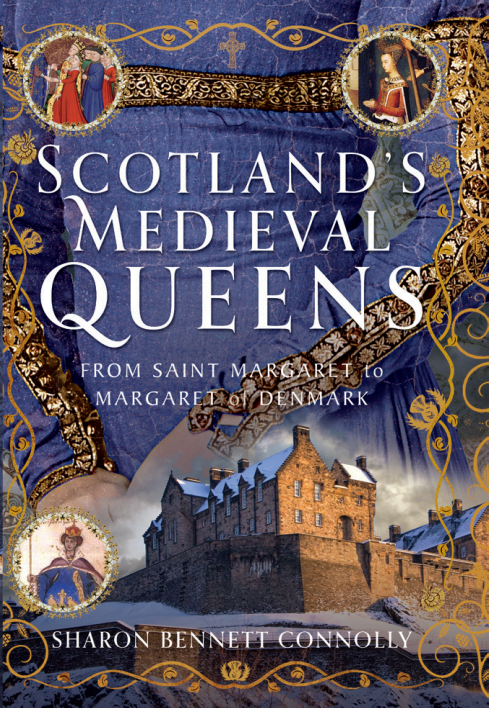
Out now: Scotland’s Medieval Queens

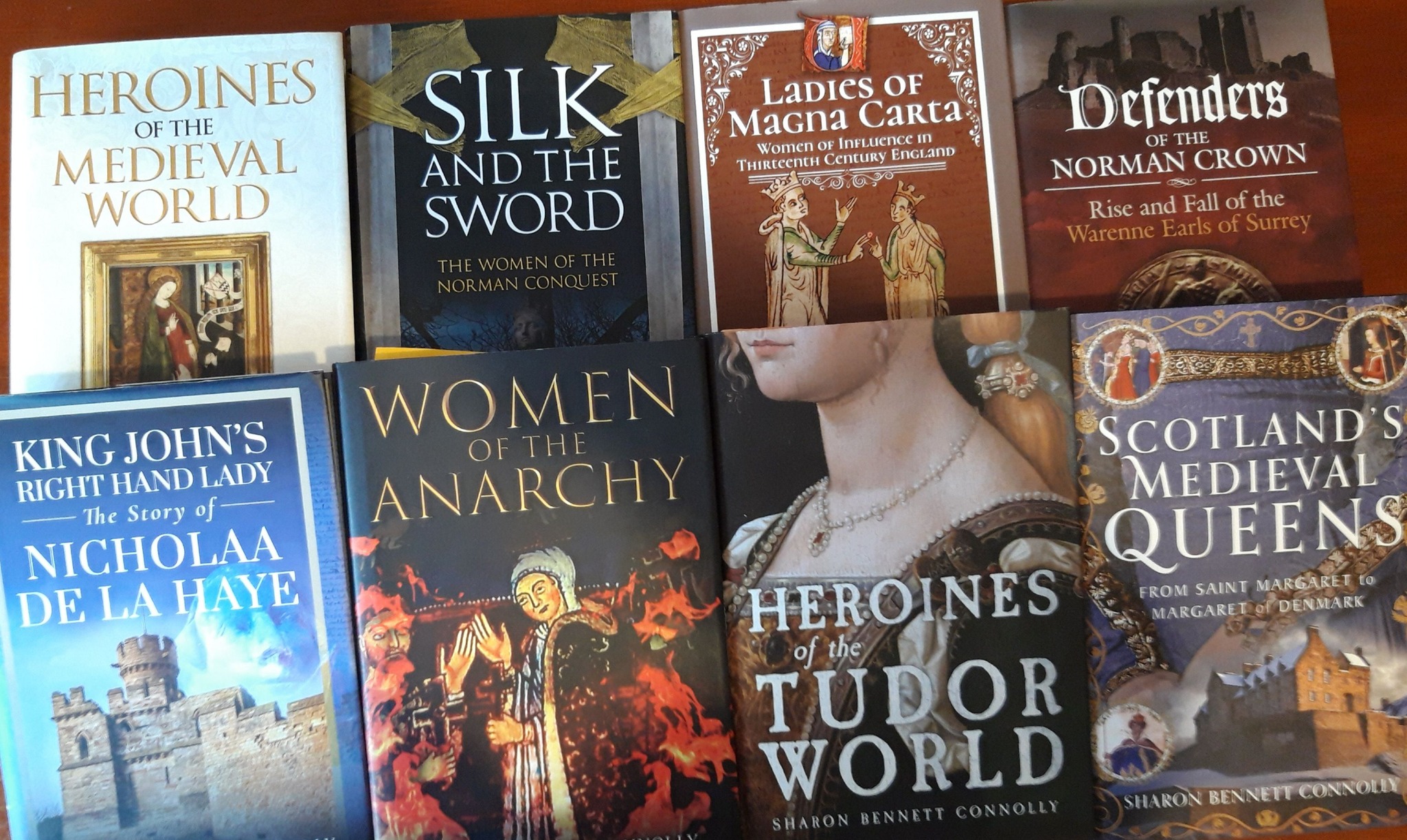
Books by Sharon Bennett Connolly

Scotland’s history is dramatic, violent and bloody. Being England’s northern neighbour has never been easy. Scotland’s queens have had to deal with war, murder, imprisonment, political rivalries and open betrayal. They have loved and lost, raised kings and queens, ruled and died for Scotland. From St Margaret, who became one of the patron saints of Scotland, to Elizabeth de Burgh and the dramatic story of the Scottish Wars of Independence, to the love story and tragedy of Joan Beaufort, to Margaret of Denmark and the dawn of the Renaissance, Scotland’s Medieval Queens have seen it all. This is the story of Scotland through their eyes.

Scotland’s Medieval Queens gives a thorough grounding in the history of the women who ruled Scotland at the side of its kings, often in the shadows, but just as interesting in their lives beyond the spotlight. It’s not a subject that has been widely covered, and Sharon is a pioneer in bringing that information into accessible history.’ Elizabeth Chadwick (New York Times bestselling author)

Available now from Amazon and Pen and Sword Books

Also by Sharon Bennett Connolly:

Books by Sharon Bennett Connolly

Heroines of the Tudor World tells the stories of the most remarkable women from European history in the time of the Tudor dynasty, 1485-1603. These are the women who ruled, the women who founded dynasties, the women who fought for religious freedom, their families and love. Heroines of the Tudor World is now available for pre-order from Amberley Publishing and Amazon UK. Women of the Anarchy demonstrates how Empress Matilda and Matilda of Boulogne, unable to wield a sword themselves, were prime movers in this time of conflict and lawlessness. It shows how their strengths, weaknesses, and personal ambitions swung the fortunes of war one way – and then the other. Available from Bookshop.orgAmberley Publishing and Amazon UKKing John’s Right-Hand Lady: The Story of Nicholaa de la Haye is the story of a truly remarkable lady, the hereditary constable of Lincoln Castle and the first woman in England to be appointed sheriff in her own right. Available from all good bookshops Pen & Sword Booksbookshop.org and Amazon

Royal Historical Society

Defenders of the Norman Crown: The Rise and Fall of the Warenne Earls of Surrey tells the fascinating story of the Warenne dynasty, from its origins in Normandy, through the Conquest, Magna Carta, the wars and marriages that led to its ultimate demise in the reign of Edward III. Available from Pen & Sword BooksAmazon in the UK and US, and Bookshop.orgLadies of Magna Carta: Women of Influence in Thirteenth Century England looks into the relationships of the various noble families of the 13th century, and how they were affected by the Barons’ Wars, Magna Carta and its aftermath; the bonds that were formed and those that were broken. It is now available in paperback and hardback from Pen & SwordAmazon, and Bookshop.orgHeroines of the Medieval World tells the stories of some of the most remarkable women from Medieval history, from Eleanor of Aquitaine to Julian of Norwich. Available now from Amberley Publishing and Amazon, and Bookshop.orgSilk and the Sword: The Women of the Norman Conquest traces the fortunes of the women who had a significant role to play in the momentous events of 1066. Available now from Amazon,  Amberley Publishing, and Bookshop.org.

Alternate Endings: An anthology of historical fiction short stories including Long Live the King… which is my take what might have happened had King John not died in October 1216. Available in paperback and kindle from Amazon.

Podcast:
A Slice of Medieval

Have a listen to the A Slice of Medieval podcast, which I co-host with Historical fiction novelist Derek Birks. Derek and I welcome guests, such as Elizabeth Chadwick, Helen Castor, Ian Mortimer, Scott Mariani and Bernard Cornwell and discuss a wide range of topics in medieval history, from significant events to the personalities involved.

Every episode is also now available on YouTube.

*

Don’t forget! Signed and dedicated copies of all my books are available through my online bookshop.

For forthcoming online and in-person talks, please check out my Events Page.

You can be the first to read new articles by clicking the ‘Follow’ button, liking our Facebook page or joining me on TwitterThreadsBluesky and Instagram.

*

©2025 Sharon Bennett Connolly FRHistS

Helena Snakenborg: A Swedish Woman Living in Tudor England

History ... the Interesting Bits
Helena Snakenborg, Marchioness of Northampton, in coronation robes, 1603

An Elizabethan whose story I became aware of through a novel is Helena Snakenborg, who features in Tracy Borman’s novel, The King’s Witch. I had to know more about this Swedish lady living in Tudor England, and include her in my own Heroines of the Tudor World. Even more so after I learned that Helena was the only foreigner amongst Queen Elizabeth’s ladies. Helena was born in 1548, into an ancient Swedish baronial family. Her father, Ulf Henriksson, had been a trusted supporter of King Gustav I Vasa of Sweden. Her mother, Agneta Knuttson, was a descendant of the earls of Orkney and it is from her mother’s family that Helena took her name, Snakenborg.

In 1564, at the age of fifteen, Helena was appointed a maid of honour to Gustav Vasa’s daughter, and the sister of the new King Eric XIV, Princess Cecilia. Later that same year, Princess Cecilia embarked on a voyage to England, taking Helena with her. Cecilia claimed that as a committed Anglophile, she wanted to meet the queen of England. She may also have been hoping to revive her brother’s suit for Queen Elizabeth’s hand in marriage. Their overland journey to England was long and arduous.

They travelled through Poland and Germany in order to avoid hostile countries and were hampered by bad weather. The princess was accompanied by her husband and fell pregnant during the journey, necessitating further delays. Almost a year had passed by the time they arrived in London in September 1565, with the Spanish ambassador reporting to Philip II,

‘On the 11th instant [of September] the king of Sweden’s sister entered London at 2 o’clock in the afternoon. She is very far advanced in pregnancy, and was dressed in a black velvet robe with a mantle of black cloth of silver, and wore on her head a golden crown… She had with her six Ladies dressed in crimson taffety with mantles of the same.’1

The arrival of the Swedish princess caused a great deal of excitement at court and the queen gave them a lavish reception. Among Cecilia’s six ladies was Helena Snakenborg and in a letter to her mother, Helena wrote of their reception in England: ‘There came so many to visit us that there was no end to it. All wished us a hearty welcome to England.’2 After the official ceremonies were completed, Princess Cecilia was taken at once to the place designated for her confinement, where she gave birth to a son on 14 September. The princess was given the use of Bedford House as her London residence. She did not remain long in seclusion after the birth and she and her entourage soon became regular visitors at court, treated to receptions and entertainments.

History ... the Interesting Bits
William Parr, Marquess of Northampton

Helena was by all accounts a beautiful young woman, with large brown eyes, red hair and a pink and white complexion. She attracted the attention of William Parr, Marquess of Northampton, a man thirty-five years her senior whose sister, Kateryn Parr, had been Henry VIII’s sixth and final wife. In a letter to her mother, Helena told her about the marquess’s attention:

‘Amongst the gentlemen was a courtier who always came with the earliest arrivals and left amongst the last. When my gracious Lady had been “churched” after the baby was born, the Marquess of Northampton (for that was the courtier’s name) talked to my gracious lady about me.’3

The marquess of Northampton wasted no time in pressing his suit with Helena, sending her lavish gifts of clothes and jewels, and ‘being an impressionable and romantic young girl, Helena was swept off her feet by the experienced older man.’4 Helena was beguiled by Northampton, who wanted to marry her but felt prevented from doing so because, although divorced in 1551, his first wife Lady Anne Bourchier was still alive and there were some doubts as to the validity of the divorce.

In the meantime, Princess Cecilia had run up some rather large debts due to her lavish lifestyle in England. Her debts, in excess of £3,000, had been amassed as a result of the purchase of poultry, articles of plate and jewellery, a kirtle wrought with gold, a Venice lute – the list goes on. The princess left England in order to escape her creditors, though she had been obliged by the queen to sell whatever she could in order to raise as much money as she could to pay off at least some of the debt, leaving England in April 1566. The princess had wanted to take Helena with her, but the young woman was enjoying life in England, and the attentions of the marquess of Northampton, and wanted to stay.

History ... the Interesting Bits
Queen Elizabeth I

Queen Elizabeth came to Helena’s rescue by offering her a place in her household, appointing her a maid of honour in 1567 and later promoting her to Gentlewoman of the Privy Chamber. Although unpaid, the queen awarded her new maid of honour additional privileges, including lodgings at court, servants and a horse. It seems Queen Elizabeth had grown fond of Helena and was keen to help the budding romance of Helena and Northampton. Helena, in her turn, was in the queen’s thrall, emulating her dress and manners and even her signature, underlining the ‘H’ with the same flourish Elizabeth did with her ‘E’. Helena was diligent and conscientious in her duties and became an indispensable member of the queen’s household.

Helena’s relationship with Northampton was still hindered by Northampton’s ambiguous marital status, but the marquess was still generous with Helena, assigning ten of his own servants to care for her and giving her everything she needed or wanted. Helena told her mother: ‘I cannot imagine I shall ever want for anything however beautiful or expensive that his Lordship can buy without his getting it at once for his Elin.’5 The couple’s patience was eventually rewarded, so to speak, with the death of Anne Bourchier in January 1571. William Parr was finally free to marry.

History ... the Interesting Bits
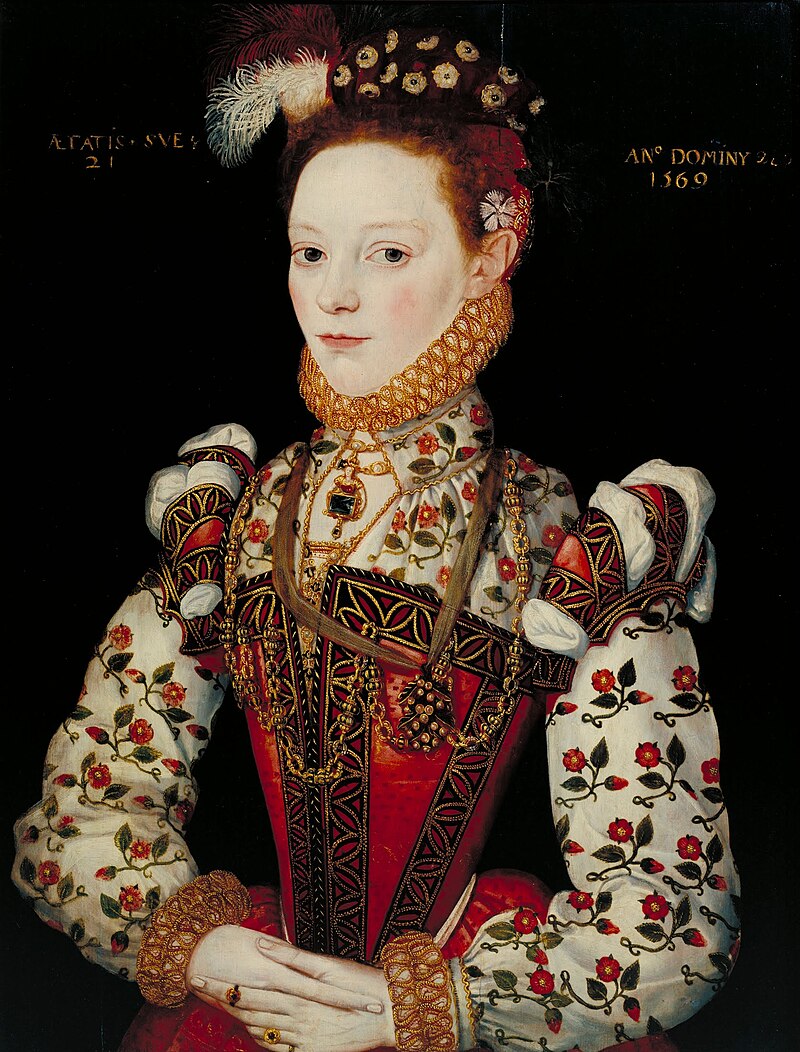
A Young Lady Aged 21 in 1569, tentatively identified as a portrait of Helena Snakenborg

The wedding took place in May in the presence of Queen Elizabeth, who had offered her own closet in Whitehall Palace for the ceremony. The bride was twenty-two and the groom fifty-seven. The newlyweds divided their time between their houses in Guildford, Surrey, and Stanstead Hall, Essex, close enough to London that Helena could attend court regularly. The happy marriage came to a sudden end within just a few months, when the marquess fell ill at Warwick in September 1571. He had been suffering from gout for some time and it now took a turn for the worse. Helena nursed her ailing husband through the ensuing weeks, but the earl succumbed to his illness on 28 October. They had been married just five months. The queen bore the costs of the funeral and even provided material from her own wardrobe for the mourning outfits.

Helena was left a young widow with a substantial dower of £368 per annum from her husband’s estates in Cumberland. She could have retired from court and lived in comfort for the rest of her life, but Helena chose to return to the queen’s service just as soon as her husband’s affairs were settled. It was not long, however, before she attracted a new admirer in Thomas Gorges. Although the queen was initially in favour of the match, she refused to consent to a marriage, either out of jealousy or concern for the disparity in their statuses. Helena was a marchioness, whereas Thomas was merely a gentleman, serving as a Groom of the Privy Chamber. In spite of the queen’s objections, the couple married in secret in 1576, earning themselves Elizabeth’s wrath.

Dismissed from court, Helena wrote to the queen to beg forgiveness, describing herself as ‘a poure, desolate, and banished creature’.6

History ... the Interesting Bits
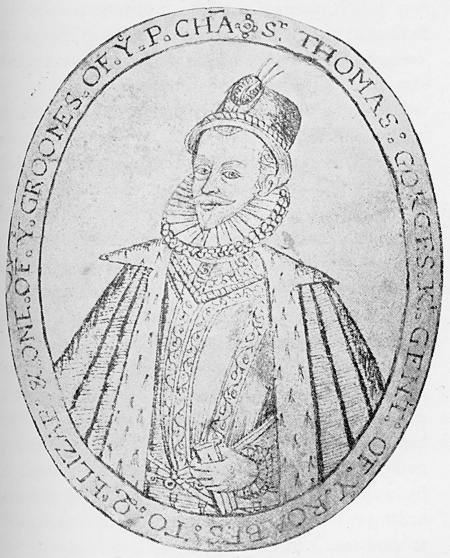
Thomas Gorges

Helena was soon forgiven and welcomed back to court, with the queen granting Helena manors in Huntingdonshire and Wiltshire. Her second marriage appears to have been as happy as the first, if not happier. Two years later, Helena left court to give birth to her first child, a daughter named after Elizabeth for whom the queen acted as godmother, presenting Helena with a silver-gilt bowl at the christening. A son, Francis, was probably born the following year, with at least six more children after that, two more daughters and four more sons, the last being born in 1589.

Despite her growing brood Helena still served the queen, acting as her deputy at the baptisms of children of distinguished noblemen, especially towards the end of the reign as the queen’s health was deteriorating. Helena was with Elizabeth during her final illness at Richmond and remained with the queen’s body after her death on 24 March 1603, watching over the corpse as it was laid in a lead coffin and then accompanied it as it was taken by barge from Richmond to Whitehall Palace in a sombre torchlit procession. As senior peeress, Helena was chief mourner at Elizabeth’s funeral at Westminster Abbey on 28 April.

History ... the Interesting Bits
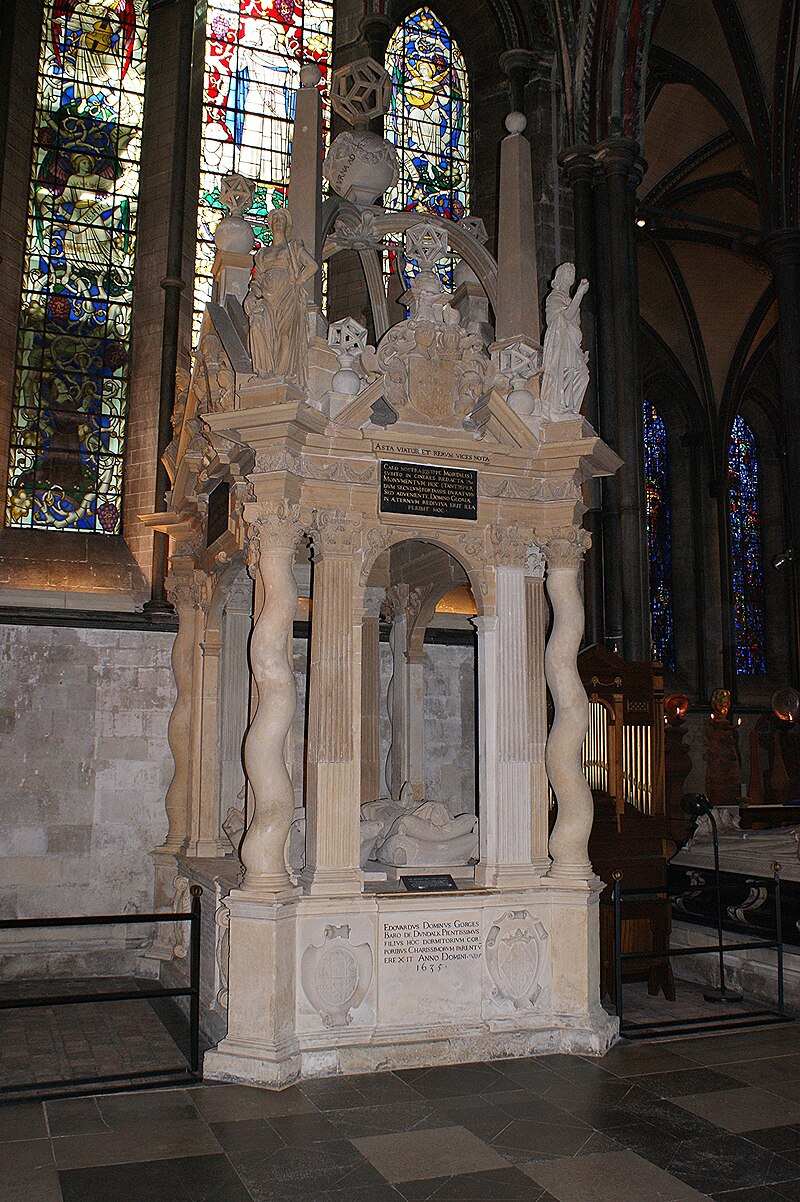
Joint tomb of Helena and Sir Thomas Gorges, Salisbury Cathedral

The reign of King James I (VI of Scots) inevitably meant changes at court and Thomas Gorges was demoted. Helena, too, lost some of her privileges. And with the death of Thomas on 30 March 1610, she increasingly retreated from public life. A devoted member of the Church of England, she died on 10 April 1635, having lived in England for almost exactly seventy years. She granted over £1,700 in annuities and bequests in her will. At the time of her death, Helena had ninety-two living, direct descendants.

Helen Snakenborg, Marchioness of Northampton, was buried in Salisbury Cathedral, beside her second husband Thomas Gorges who had been laid to rest there in 1610.

In her long life, Helena Snakenborg had been lucky enough to enjoy two happy marriages, both made for love, and to have enjoyed the love and patronage of Queen Elizabeth. Even when she had faced the wrath of the queen, Helena had managed to win back her favour.

*

Images:

Courtesy of Wikipedia

Notes:

1. CSPS, Elizabeth 1558-67, I, 475 quoted in Tracy Borman, Elizabeth’s Women, p. 278; 2. ibid; 3. ibid; 4. Paul Harrington, ‘Gorges [née Snakenborg], Helena, Lady Gorges [other married name Helena Parr, marchioness of Northampton],’ Oxforddnb.com; 5. Tracy Borman, Elizabeth’s Women, p. 281; 6. BM Cotton MS Titus B II, f. 346 quoted in Tracy Borman, Elizabeth’s Women, p. 357

Sources:

Tracy Borman, Elizabeth’s Women; Paul Harrington, ‘Gorges [née Snakenborg], Helena, Lady Gorges [other
married name Helena Parr, marchioness of Northampton],’ Oxforddnb.com; Calendar of State Papers Domestic: Edward VI, Mary and Elizabeth, 1547-80, ed. Robert Lemon; Elizabeth Norton, The Lives of Tudor Women; Amy Licence, Tudor Roses: From Margaret Beaufort to Elizabeth I; Paul Kendall, Queen Elizabeth I: Life & Legacy of the Virgin Queen; Lisa Hilton, Elizabeth I: Renaissance Prince, A Biography; John Guy, Elizabeth: The Forgotten Years; Laura Brennan, Elizabeth I: The Making of a Queen; R.E. Pritchard, Sex, Love & Marriage in the Elizabethan Age; Alison Weir, Elizabeth the Queen; Neville Williams, The Life and Times of Elizabeth I; Sarah Gristwood, The Tudors in Love: The Courtly Code Behind the Last Medieval Dynasty

*

My Books:

Signed, dedicated copies of all my books are available through my online bookshop.

Out now: Scotland’s Medieval Queens

Books by Sharon Bennett Connolly

Scotland’s history is dramatic, violent and bloody. Being England’s northern neighbour has never been easy. Scotland’s queens have had to deal with war, murder, imprisonment, political rivalries and open betrayal. They have loved and lost, raised kings and queens, ruled and died for Scotland. From St Margaret, who became one of the patron saints of Scotland, to Elizabeth de Burgh and the dramatic story of the Scottish Wars of Independence, to the love story and tragedy of Joan Beaufort, to Margaret of Denmark and the dawn of the Renaissance, Scotland’s Medieval Queens have seen it all. This is the story of Scotland through their eyes.

Scotland’s Medieval Queens gives a thorough grounding in the history of the women who ruled Scotland at the side of its kings, often in the shadows, but just as interesting in their lives beyond the spotlight. It’s not a subject that has been widely covered, and Sharon is a pioneer in bringing that information into accessible history.’ Elizabeth Chadwick (New York Times bestselling author)

Available now from Amazon and Pen and Sword Books

Also by Sharon Bennett Connolly:

Books by Sharon Bennett Connolly

Heroines of the Tudor World tells the stories of the most remarkable women from European history in the time of the Tudor dynasty, 1485-1603. These are the women who ruled, the women who founded dynasties, the women who fought for religious freedom, their families and love. Heroines of the Tudor World is now available for pre-order from Amberley Publishing and Amazon UK. Women of the Anarchy demonstrates how Empress Matilda and Matilda of Boulogne, unable to wield a sword themselves, were prime movers in this time of conflict and lawlessness. It shows how their strengths, weaknesses, and personal ambitions swung the fortunes of war one way – and then the other. Available from Bookshop.orgAmberley Publishing and Amazon UKKing John’s Right-Hand Lady: The Story of Nicholaa de la Haye is the story of a truly remarkable lady, the hereditary constable of Lincoln Castle and the first woman in England to be appointed sheriff in her own right. Available from all good bookshops Pen & Sword Booksbookshop.org and Amazon

Royal Historical Society

Defenders of the Norman Crown: The Rise and Fall of the Warenne Earls of Surrey tells the fascinating story of the Warenne dynasty, from its origins in Normandy, through the Conquest, Magna Carta, the wars and marriages that led to its ultimate demise in the reign of Edward III. Available from Pen & Sword BooksAmazon in the UK and US, and Bookshop.orgLadies of Magna Carta: Women of Influence in Thirteenth Century England looks into the relationships of the various noble families of the 13th century, and how they were affected by the Barons’ Wars, Magna Carta and its aftermath; the bonds that were formed and those that were broken. It is now available in paperback and hardback from Pen & SwordAmazon, and Bookshop.orgHeroines of the Medieval World tells the stories of some of the most remarkable women from Medieval history, from Eleanor of Aquitaine to Julian of Norwich. Available now from Amberley Publishing and Amazon, and Bookshop.orgSilk and the Sword: The Women of the Norman Conquest traces the fortunes of the women who had a significant role to play in the momentous events of 1066. Available now from Amazon,  Amberley Publishing, and Bookshop.org.

Alternate Endings: An anthology of historical fiction short stories including Long Live the King… which is my take what might have happened had King John not died in October 1216. Available in paperback and kindle from Amazon.

Podcast:

A Slice of Medieval

Have a listen to the A Slice of Medieval podcast, which I co-host with Historical fiction novelist Derek Birks. Derek and I welcome guests, such as Bernard Cornwell and Elizabeth Chadwick, and discuss a wide range of topics in medieval history, from significant events to the personalities involved.

Every episode is also now available on YouTube.

*

Don’t forget! Signed and dedicated copies of all my books are available through my online bookshop.

For forthcoming online and in-person talks, please check out my Events Page.

You can be the first to read new articles by clicking the ‘Follow’ button, liking our Facebook page or joining me on TwitterThreadsBluesky and Instagram.

*

©2025 Sharon Bennett Connolly FRHistS.

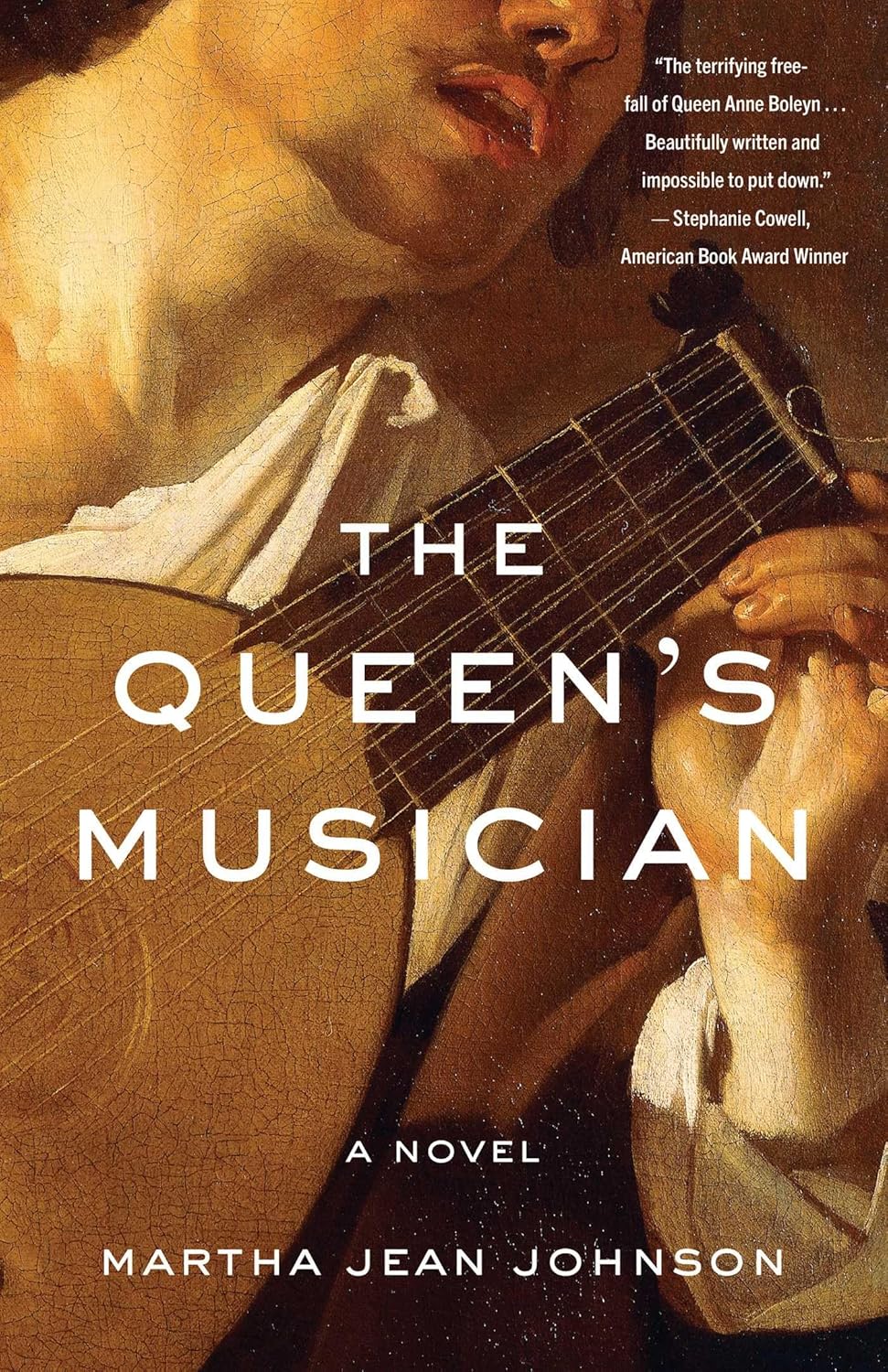
Book Corner: The Queen’s Musician by Martha Jean Johnson

History ... the Interesting Bits

For fans of Philippa Gregor, Alison Weir and Elizabeth Fremantle, an untold story about how the plot against Anne Boleyn entrapped a gifted young musician. A glamorous queen, a volatile king, a gifted musician concealing a forbidden romance.

Everyone knows Anne Boleyn’s story. No one knows Mark Smeaton’s. On May 17, 1536, a young court musician was executed, accused of adultery and treason with the queen. Most historians believe both he and Anne Boleyn were innocent – victims of Henry VIII’s rage.

Mark Smeaton was a talented performer who rose from poverty to become a royal favourite. He played for the king in private and entertained at sumptuous feasts. He witnessed Anne Boleyn’s astonishing rise and fall – her reign of a thousand days. History tells us little about him, other than noting his confession and execution. The Queen’s Musician imagines his story, as seen from his perspective and that of the young woman who loves him. It all takes place amid the spectacle and danger of the Tudor court.

What an interesting take on a well known story!

The Queen’s Musician by Martha Jean Johnson looks at the story of Anne Boleyn’s downfall through the eyes of her musician, Mark Smeaton. Smeaton was the lowliest, in terms of social standing, of the men accused of sleeping with Henry VIII’s second queen. You cannot fail to feel sympathy for the poor musician, drawn into a scandal created by his social superiors.

Young Mark Smeaton establishes himself in the reader’s affections from the very beginning. You find yourself invested in his life, enjoying his journey, his music and his success. But then, once in a while, you remember where the book is going, inexorably, to its tragic, dramatic end. The tension is palpable the closer you get to the dramatic events of 1536.

All to bring down a queen.

Poor Mark!

Even if he hadn’t been king, His Majesty would have been a commanding figure. He was vigorous, with masculine features, draped in white and gold. The rotund, graying cardinal hovered near him like a honeybee buzzing a flower. Recalling the scene later, I could see the rupture between them. More than once, the cardinal leaned close to His Majesty to begin a conversation, but the king turned his head away.

The room was still noisy, the diners talking among themselves. I waited for someone to call for quiet so the concert could begin. Several minutes passed, and I stood beside the stool uncertain what to do. I bowed to His Majesty and the others, but they took no notice. I began to worry that my great opportunity would turn out to be a humiliating disappointment. Then the king brought his goblet to his lips, drank slowly, paused, and raised his hand for silence. He said nothing, but his command was clear: I am ready now. You may begin.

Dressed like a prince and given this chance to entertain the king, I was pleased with my performance that night. I played six pieces, mostly English, before ending with the French love song. The king stood at his place and applauded. “Excellent, my boy, wonderful. Your songs bring me back to my younger days.”

I stood and bowed deeply. “Thank you, Your Majesty.” I glanced at the cardinal who looked only at the king.

“What is your name?”

“I am Mark Smeaton, Your Majesty.” I bowed again, elated by even this brief attention.

“The French song – it was perfection. I might want to sing it. Send me the music and the words.”

“With great pleasure, Your Majesty. I would be most honored to prepare a copy.”

“Be sure to get it from him.” The king motioned to one of his grooms who, like me, kept bowing his head.

The cardinal edged closer to the king and said, “It will be done before you leave, Your Majesty.” The king acted like he didn’t hear.

After my performance, I joined several other musicians playing light music to enhance what seemed like a festive mood. The cardinal approached and said, “Thank you, Mark – your songs have lifted His Majesty’s spirits. Please prepare the manuscript tomorrow morning.”

“You will have it before ten o’clock, Your Eminence.” In this moment, my excitement at playing for the king blended with my concern for the cardinal’s enterprise. “I hope I have helped you, sir,” I added. The old man’s nod of the head signaled his gratitude.

The next day after breakfast, I ran to the chapel to make the copy and tell Master Peter that the king had complimented my playing.

“The king has already left,” he said…

Although you know Anne Boleyn’s story, The Queen’s Musician by Martha Jean Johnson will catch you out and draw you in. The author does a wonderful job of depicting the Tudor court; its decadence, the political intrigues, the social strata and the dangerous undercurrents. The latent fear. In Tudor times, ability and intelligence could rise to the top – but it could also lead to one’s downfall.

The Queen’s Musician has all of this … with a little bit of forbidden love thrown into the mix!

Historically accurate, it gets you thinking, too. That you may have heard Smeaton’s music without even knowing it. That his music was attributed to others, or marked as anonymous in order to guarantee its survival following Smeaton’s downfall and execution. It makes you wonder…

Martha Jean Johnson has found a unique angle for telling a familiar story. But this is not Anne Boleyn’s tale. It’s the story of a man who fell victim to those determined to bring down a queen, at all costs. No matter the collateral damage it would take to do it. The tragedy is the poor boy was a pawn, drawn into the intrigues of the great and good, who stepped on him, destroyed him to gain for themselves more power, more influence…

I admit it, I cried.

I always think it is the sign of a good book if it can bring me to tears. The Queen’s Musician is a good book!

The Queen’s Musician by Martha Jean Johnson is beautifully written, thoughtful and deep.

To Buy the Book: The Queen’s Musician

About the author:

History ... the Interesting Bits

Martha Jean Johnson is a writer of fiction and non-fiction and the author of a series of books and articles on public opinion and public policy. The Queen’s Musician is her debut novel. She also reviews trends in historical fiction and discusses her own love of reading and writing in her biweekly blog, Historical Magic. She currently divides her time between writing and her work with the National Issues Forums Institute, an organization that encourages civil discourse and nonpartisan deliberation on national and local issues. During a long public policy career, she analyzed and reported on American public thinking, working with noted social analyst and public opinion pioneer, Daniel Yankelovich. She has published articles in USA Today and The Huffington Post and appeared on CNN, MSNBC, and PBS. She is the author of a series of nonfiction paperbacks on major political issues, co-authored with Scott Bittle and published by HarperCollins. She holds degrees from Mount Holyoke College, Brown University, and Simmons College. She lives in Jersey City, New Jersey.

*

My books

Signed, dedicated copies of all my books are available through my online store.

Out now: Scotland’s Medieval Queens

Books by Sharon Bennett Connolly

Scotland’s history is dramatic, violent and bloody. Being England’s northern neighbour has never been easy. Scotland’s queens have had to deal with war, murder, imprisonment, political rivalries and open betrayal. They have loved and lost, raised kings and queens, ruled and died for Scotland. From St Margaret, who became one of the patron saints of Scotland, to Elizabeth de Burgh and the dramatic story of the Scottish Wars of Independence, to the love story and tragedy of Joan Beaufort, to Margaret of Denmark and the dawn of the Renaissance, Scotland’s Medieval Queens have seen it all. This is the story of Scotland through their eyes.

Scotland’s Medieval Queens gives a thorough grounding in the history of the women who ruled Scotland at the side of its kings, often in the shadows, but just as interesting in their lives beyond the spotlight. It’s not a subject that has been widely covered, and Sharon is a pioneer in bringing that information into accessible history.’ Elizabeth Chadwick (New York Times bestselling author)

Available now from Amazon and Pen and Sword Books

Also by Sharon Bennett Connolly:

Books by Sharon Bennett Connolly

Heroines of the Tudor World tells the stories of the most remarkable women from European history in the time of the Tudor dynasty, 1485-1603. These are the women who ruled, the women who founded dynasties, the women who fought for religious freedom, their families and love. Heroines of the Tudor World is now available from Amberley Publishing and Amazon UK. Women of the Anarchy demonstrates how Empress Matilda and Matilda of Boulogne, unable to wield a sword themselves, were prime movers in this time of conflict and lawlessness. It shows how their strengths, weaknesses, and personal ambitions swung the fortunes of war one way – and then the other. Available from Bookshop.orgAmberley Publishing and Amazon UKKing John’s Right-Hand Lady: The Story of Nicholaa de la Haye is the story of a truly remarkable lady, the hereditary constable of Lincoln Castle and the first woman in England to be appointed sheriff in her own right. Available from all good bookshops Pen & Sword Booksbookshop.org and Amazon

Royal Historical Society

Defenders of the Norman Crown: The Rise and Fall of the Warenne Earls of Surrey tells the fascinating story of the Warenne dynasty, from its origins in Normandy, through the Conquest, Magna Carta, the wars and marriages that led to its ultimate demise in the reign of Edward III. Available from Pen & Sword BooksAmazon in the UK and US, and Bookshop.orgLadies of Magna Carta: Women of Influence in Thirteenth Century England looks into the relationships of the various noble families of the 13th century, and how they were affected by the Barons’ Wars, Magna Carta and its aftermath; the bonds that were formed and those that were broken. It is now available in paperback and hardback from Pen & SwordAmazon, and Bookshop.orgHeroines of the Medieval World tells the stories of some of the most remarkable women from Medieval history, from Eleanor of Aquitaine to Julian of Norwich. Available now from Amberley Publishing and Amazon, and Bookshop.orgSilk and the Sword: The Women of the Norman Conquest traces the fortunes of the women who had a significant role to play in the momentous events of 1066. Available now from Amazon,  Amberley Publishing, and Bookshop.org.

Alternate Endings: An anthology of historical fiction short stories including Long Live the King… which is my take what might have happened had King John not died in October 1216. Available in paperback and kindle from Amazon.

Podcast:

A Slice of Medieval

Have a listen to the A Slice of Medieval podcast, which I co-host with Historical fiction novelist Derek Birks. Derek and I welcome guests, such as Bernard Cornwell and Michael Jecks, and discuss a wide range of topics in medieval history, from significant events to the personalities involved. 

Every episode is also now available on YouTube.

*

Don’t forget! Signed and dedicated copies of all my books are available through my online store.

For forthcoming online and in-person talks, please check out my Events Page.

You can be the first to read new articles by clicking the ‘Follow’ button, liking our Facebook page or joining me on TwitterThreadsBluesky and Instagram.

*

©2025 Sharon Bennett Connolly


Guest Post: Tudor Princes and Princesses by Aimee Fleming

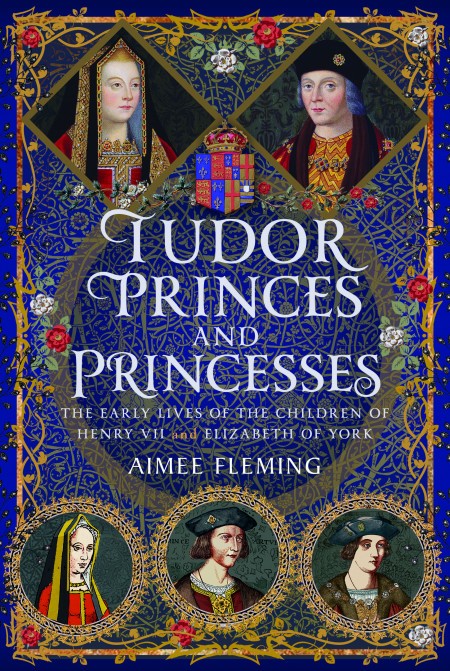
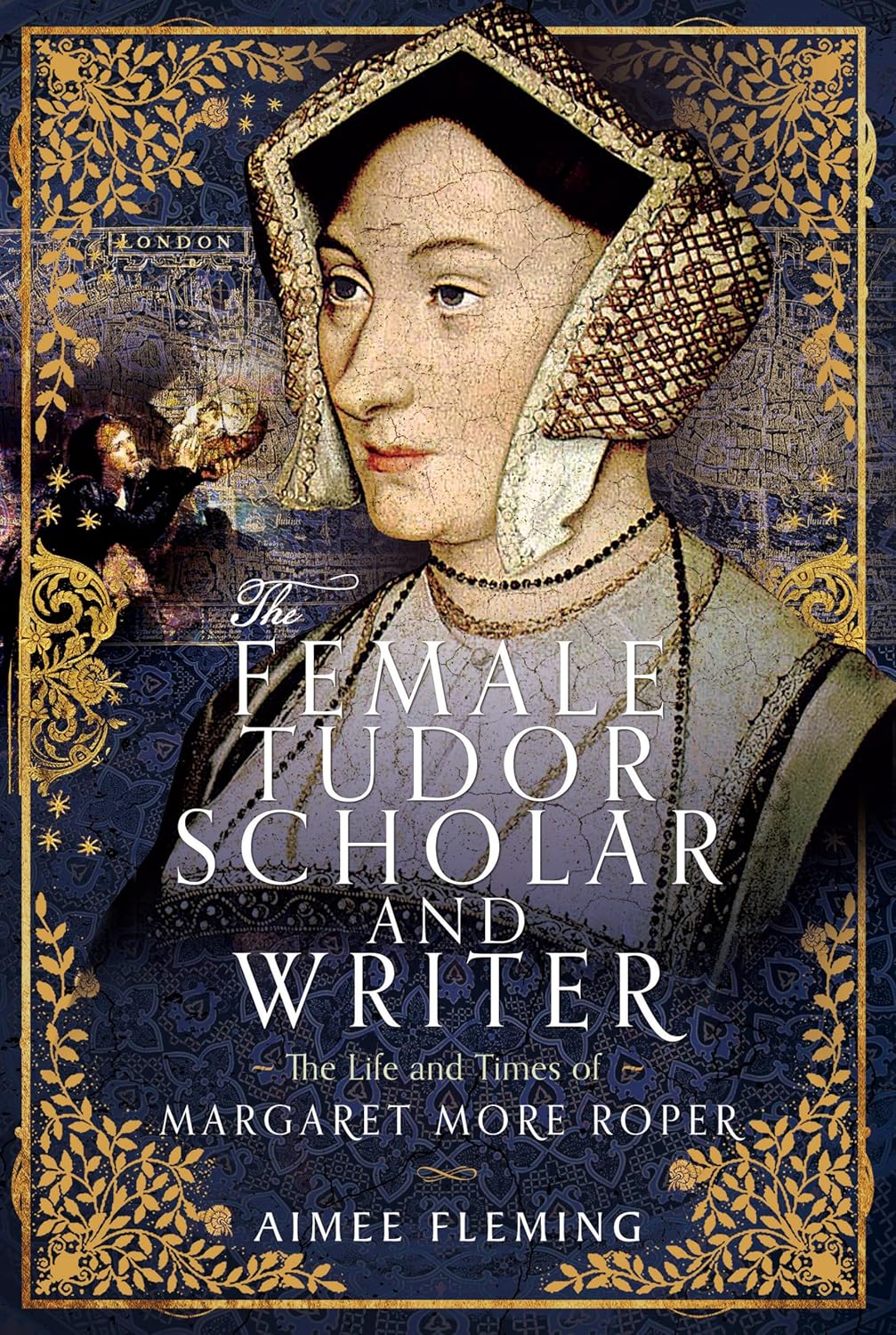
Today, it is a pleasure to welcome Aimee Fleming to History…the Interesting Bits. Aimee’s first book, The Female Tudor Scholar and Writer: The Life and Times of Margaret More Roper was a wonderful biography of Thomas More’s famous scholarly daughter. Aimee is now back with a second book, looking into the lives of the first royal Tudor children, Tudor Princes and Princesses: The Early Lives of the Children of Henry VII and Elizabeth of York. And she has written a little piece as a taster of the treat that is this wonderful book. Over to Aimee…

When Henry VII and Elizabeth of York married in January 1486, it was clear to them that their most important task ahead was to stabilise England, and the best, perhaps easiest way available to them was to produce an heir, and quickly.

However, bearing a child in the fifteenth century was not an easy feat, even for a Queen. Science and medicine were far from helpful, and the practices of the time meant that pregnancy and childbirth were dangerous to everyone involved. Elizabeth had her family around her, her mother who had had twelve children would have been invaluable to her, but the risks to herself, her child, and to her husband’s reign would have been very clear indeed.

In this extract we see how the couple prepared for their new arrival, and what Elizabeth herself was required to do, even before the rigours of birth.

Extract from Chapter 2 of Tudor Princes and Princesses

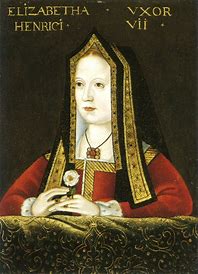
Elizabeth of York

Following the wedding ceremony in January 1486, the royal couple remained in London and held court over celebrations in their honour, with spectacular banquets and dances. The celebrations were held all over London and further afield. As Bernard André describes:

‘…the most wished day of marriage was celebrated by them

with all religious and glorious magnificence at court, and

by their people, to show their gladness with bonfires,

dancing, songs and banquets throughout all London,

both men and women, rich and poor, beseeching God to

bless the King and Queen and grant them a numerous

progeny.’

This outpouring of support for the marriage of the king and queen was welcomed by all, especially by Henry and Elizabeth themselves, who knew just how important it was that their union, and rule, be accepted. It became apparent that their marriage represented the potential for peace in the form of an heir who would have their claims combined within him. Hall’s Chronicle shows what was expected.

‘By reason of whiche manage peace was thought to discende out of heaue into England, consideryng that the lynes of Lancastre & Yorke, being both noble families equiualet in ryches, fame and honour, were now brought into one knot and connexed together, of whose two bodyes one heyre might succede, which after their lyme should peaceably rule and enioye the whole monarchy and realme of England.’

Confident in their position early on, the king and queen worked to secure the future that so many hoped for and very soon after their wedding took place it was announced that the queen was with child. Whether that be out of duty, mutual respect, or genuine affection and love between them, the conception of a child was joyous news for all involved. Calculating from the date of their wedding, and Arthur’s birth, it is reasonable to assume that they conceived quickly, if not on their wedding night itself. When Henry departed for a progress around Yorkshire and Lincolnshire in the early spring of 1486, he did not take Elizabeth with him, most likely because she was suffering from morning sickness, or other symptoms associated with the early stages of pregnancy. As a first-time mother, it would have been new to Elizabeth, but luckily, she had her experienced mother and mother-in-law both around to support her. While Henry was travelling, he sent regular letters to his new wife, and would send gifts to her while she stayed at the Palace of Placentia.

Elizabeth would have been familiar with the palace, having spent a lot of time there as a young girl. It would become one of the most favoured for the king and queen and would be renamed by Henry as Greenwich Palace. Both names emphasise how the palace was surrounded by green parks and fields, isolated from the hustle and bustle and potential diseases of London itself.

As soon as it could be confirmed that Elizabeth was with child, the wheels began turning to arrange yet more elaborate ceremony, intended to cement Elizabeth as queen, the Tudor dynasty as the ruling family, and rightfully on the throne. This started with Elizabeth’s care while pregnant.

While it was not common for pregnant women to receive medical or ante-natal care in this period, Elizabeth’s health would have been monitored and her diet checked, and healthy habits encouraged by her ladies and physicians. Pregnant women were discouraged from heavy activities or stressful situations, and sometimes forbidden to eat certain foods; for example, if a woman complained of morning sickness, she may be told to limit her intake of fish or milk, both of which modern doctors would recommend she eat.

Pregnancy was dangerous, as was childbirth, for both the mother and the child, so royal women were given the best possible conditions in which to give birth, according to the science of the time.

Elizabeth of York

As a woman’s due date got closer, she would be expected to enter confinement. This was a time where the pregnant woman and her household would isolate themselves in the woman’s bedroom. Windows would be barred and draped, and air flow would be completely stifled as it was believed that illnesses were carried on the air. For a queen, preparations for confinement would be made by the king according to traditions laid out during the reign of Edward IV, Elizabeth’s father. She would have been very familiar with the work that needed to be done, and the fact that the arrangements would be made for her by her husband.

Henry took his role in arranging Elizabeth’s confinement very seriously indeed. He purchased clothes and bedding for the chambers, all made of furs and velvet, and the most luxurious cotton sheets. He arranged for new furniture for her rooms and cushions stuffed with feathers, and even, bewilderingly, two velvet-covered saddles.

However, by far the most important decision that Henry made regarding his wife’s confinement and birth experience was to choose the location, and for Henry there was only one place that it could happen and that was the city of Winchester.

About the Author:

Aimee Fleming is a historian and author from North Yorkshire. She is happily married, with three growing boys and a whole host of pets. She studied history at the University of Wales, Bangor and then later completed a masters in Early Modern History at the University of York as a mature student. She has a passion for history, particularly the Tudors, and worked for over a decade in the heritage industry in a wide variety of roles and historic places.

Books by Aimee Fleming:

The Female Tudor Scholar and Writer: The Life and Times of Margaret More Roper

Tudor Princes and Princesses: The Early Lives of the Children of Henry VII and Elizabeth of York

Where to find Aimee:

Website; Facebook; Threads and Instagram: @historyaimee; Substack.

*

My books

Signed, dedicated copies of all my books are available through my online store.

Out now: Scotland’s Medieval Queens

Books by Sharon Bennett Connolly

Scotland’s history is dramatic, violent and bloody. Being England’s northern neighbour has never been easy. Scotland’s queens have had to deal with war, murder, imprisonment, political rivalries and open betrayal. They have loved and lost, raised kings and queens, ruled and died for Scotland. From St Margaret, who became one of the patron saints of Scotland, to Elizabeth de Burgh and the dramatic story of the Scottish Wars of Independence, to the love story and tragedy of Joan Beaufort, to Margaret of Denmark and the dawn of the Renaissance, Scotland’s Medieval Queens have seen it all. This is the story of Scotland through their eyes.

Scotland’s Medieval Queens gives a thorough grounding in the history of the women who ruled Scotland at the side of its kings, often in the shadows, but just as interesting in their lives beyond the spotlight. It’s not a subject that has been widely covered, and Sharon is a pioneer in bringing that information into accessible history.’ Elizabeth Chadwick (New York Times bestselling author)

Available now from Amazon and Pen and Sword Books

Also by Sharon Bennett Connolly:

Books by Sharon Bennett Connolly

Heroines of the Tudor World tells the stories of the most remarkable women from European history in the time of the Tudor dynasty, 1485-1603. These are the women who ruled, the women who founded dynasties, the women who fought for religious freedom, their families and love. Heroines of the Tudor World is now available from Amberley Publishing and Amazon UK. Women of the Anarchy demonstrates how Empress Matilda and Matilda of Boulogne, unable to wield a sword themselves, were prime movers in this time of conflict and lawlessness. It shows how their strengths, weaknesses, and personal ambitions swung the fortunes of war one way – and then the other. Available from Bookshop.orgAmberley Publishing and Amazon UKKing John’s Right-Hand Lady: The Story of Nicholaa de la Haye is the story of a truly remarkable lady, the hereditary constable of Lincoln Castle and the first woman in England to be appointed sheriff in her own right. Available from all good bookshops Pen & Sword Booksbookshop.org and Amazon

Royal Historical Society

Defenders of the Norman Crown: The Rise and Fall of the Warenne Earls of Surrey tells the fascinating story of the Warenne dynasty, from its origins in Normandy, through the Conquest, Magna Carta, the wars and marriages that led to its ultimate demise in the reign of Edward III. Available from Pen & Sword BooksAmazon in the UK and US, and Bookshop.orgLadies of Magna Carta: Women of Influence in Thirteenth Century England looks into the relationships of the various noble families of the 13th century, and how they were affected by the Barons’ Wars, Magna Carta and its aftermath; the bonds that were formed and those that were broken. It is now available in paperback and hardback from Pen & SwordAmazon, and Bookshop.orgHeroines of the Medieval World tells the stories of some of the most remarkable women from Medieval history, from Eleanor of Aquitaine to Julian of Norwich. Available now from Amberley Publishing and Amazon, and Bookshop.orgSilk and the Sword: The Women of the Norman Conquest traces the fortunes of the women who had a significant role to play in the momentous events of 1066. Available now from Amazon,  Amberley Publishing, and Bookshop.org.

Alternate Endings: An anthology of historical fiction short stories including Long Live the King… which is my take what might have happened had King John not died in October 1216. Available in paperback and kindle from Amazon.

Podcast:

A Slice of Medieval

Have a listen to the A Slice of Medieval podcast, which I co-host with Historical fiction novelist Derek Birks. Derek and I welcome guests, such as Bernard Cornwell and Michael Jecks, and discuss a wide range of topics in medieval history, from significant events to the personalities involved. 

Every episode is also now available on YouTube.

*

Don’t forget! Signed and dedicated copies of all my books are available through my online store.

For forthcoming online and in-person talks, please check out my Events Page.

You can be the first to read new articles by clicking the ‘Follow’ button, liking our Facebook page or joining me on TwitterThreadsBluesky and Instagram.

*

©2025 Sharon Bennett Connolly, FRHistS and Aimee Fleming

Wordly Women: Heather R. Darsie

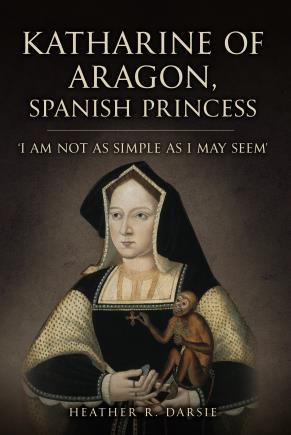
In a special episode of my Wordly Women interview series, Heather R. Darsie drops by on her blog tour celebrating the publication of her new book, Katharine of Aragon, Spanish Princess: ‘I am Not as Simple as I May Seem’. Do have a look at the other stops on the tour to geta taste of this wonderful new biography.

So, Heather, What got you into writing?

Heather: As silly as this sounds, I can’t remember originally. My dad had an electric typewriter that he let me use to write stories beginning when I was probably eight years old. I continued writing stories and poems through high school (14 to 18 years old in the USA), which culminated in a play based off Edgar Allen Poe’s “Annabel Lee” when I was in my final year of high school. My play was called Annalise, wherein the wife was dying of amyotrophic lateral sclerosis of which my paternal grandfather passed away. The husband slowly went mad, to the point where the wife’s had to intervene. The theme of the play was tragedy. My high school put on the play, I was in the local newspaper, and invited to host a workshop at the statewide high school theatre festival.

After graduating from high school, I went to university and majored in German Languages and Literature, then pursued my Juris Doctorate in American Jurisprudence. Along the way, I studied abroad in Costa Rica and France, learning Spanish and French, too. I have had numerous opportunities to travel to France, Spain, Germany, and various countries in Central America, which have all contributed to keeping my language skills sharp.

I became heavily interested in Tudor history in around 2010. By early 2015, I grew tired of reading the same-old, same-old about Anna of Cleves, a German woman. I asked Claire Ridgeway of the Anne Boleyn Files if I could contribute a post on Anna to her website, to which Claire kindly agreed. Thereafter encouraged and emboldened, I sent a letter in my very best German to the mayor of the current City of Cleves, and my research took off from there. The combination of a life-long interest in writing, linguistic education, research and analytical skills from my juris doctorate, combined with the history community’s encouragement is how I arrived here, ten years on.

Sharon: Tell us about your books.

Heather: I view myself as a Tudor-adjacent historian. The persons and events I choose to focus on should be recognizable am most interested in the Holy Roman Empire of the German Nation, which began recognizing itself that way in the early 16th century. Specifically, anyone or anything connected to the von der Marks, which is Anna of Cleves’ family (she was “of Cleves” much like Princess Mary Tudor would be “Mary of England” in another country) or the Habsburgs. My first two nonfiction books, Anna, Duchess of Cleves: The King’s Beloved Sister and Children of the House of Cleves: Anna and Her Siblings are effectively German history books. My third nonfiction book, Stuart Spouses: A Compendium of Consorts from James I of Scotland to Queen Anne of Great Britain looks at just that, the husbands and wives of the Scottish-to-English Stuart dynasty. The dynastic intermingling with continental European families is fascinating. I wrote a novella during the pandemic, Diary of a Plague Doctor’s Wife, set during the last outbreak of the Black Death in 1720s Marseille. The parallels to our own experiences 300 years later with Covid-19 were eerie to me at the time of writing.

Sharon: What attracts you to the Catherine of Aragon?

Heather: Like Anna of Cleves, I felt there was more to her than the end of her marriage with Henry VIII. Specifically, I wanted to know more about Katharine’s family dynasty and Katharine’s early time in England, and share that with readers.

Sharon: Who is your favourite Tudor and why?

Heather: For queens, I am drawn to Catherine Parr. She seemed the most savvy when it came to navigating Henry VIII and the dangerous politics of the Tudor court. I am very intrigued by Thomas Cromwell in his position as a lawyer. He was very clever; I hope to write about him someday.

Sharon: Who is your least favourite Tudor and why?

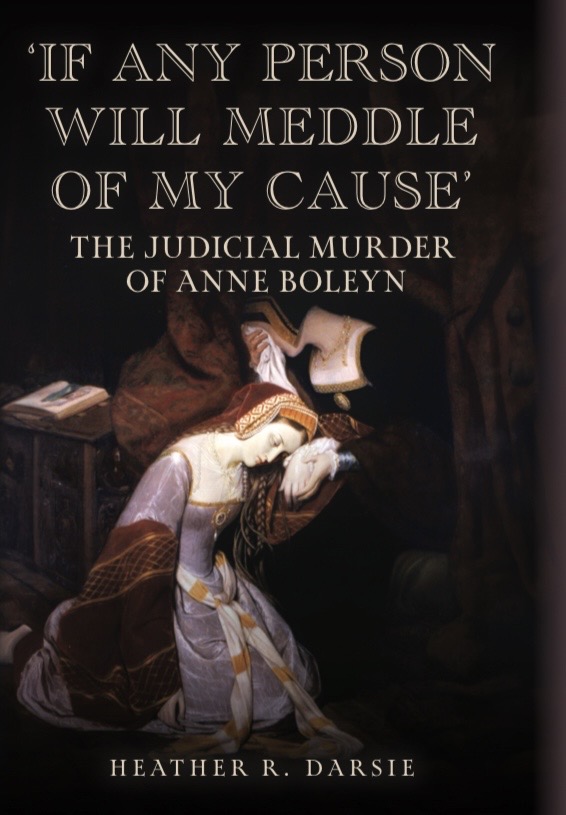
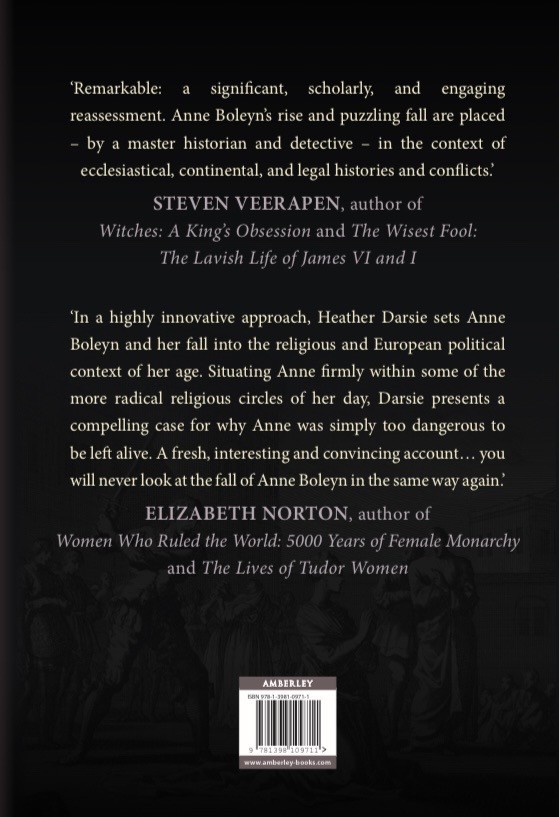
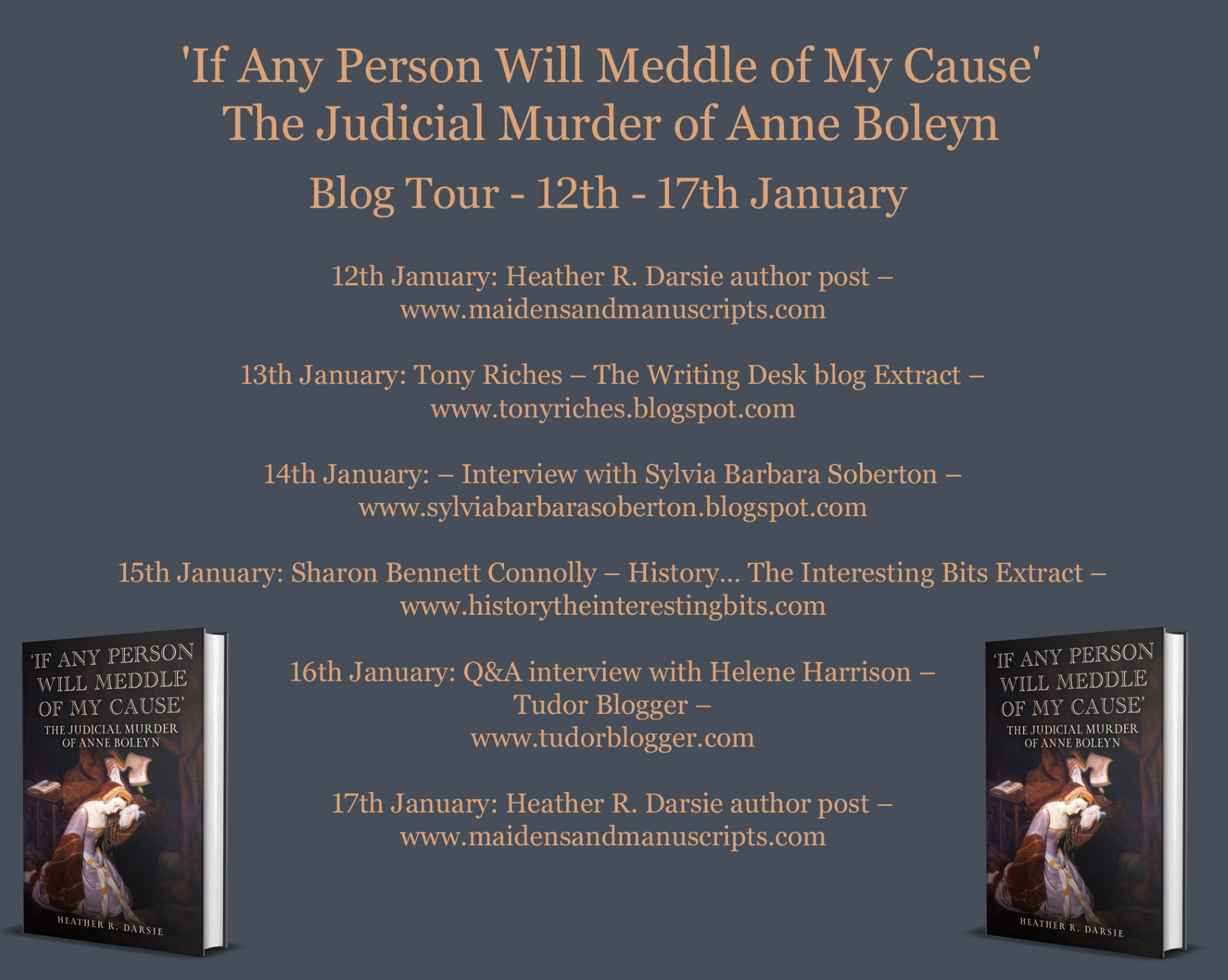
Heather: I do not have a least favorite, but I do think the most tragic was Anne Boleyn, who was foisted by her own petard. I am finding that more and more as I work on my next book, If any Person will Meddle with My Cause: The Judicial Murder of Anne Boleyn.

Sharon: How do you approach researching your topic, especially when most of the sources are Spanish?

Heather: I start with finding articles on JSTOR, then checking the footnotes for sources. From there, I go to Google Play, Archive.org, the Spanish library websites, etc. for old manuscripts. Like many English books, several of the old, out-of-copyright ones are available for free. The Spanish language is not a barrier for me, since I hear or read it most days a week at work.

Sharon: Tell us your ‘favourite’ Catherine of Aragon story you have come across in your research.

Heather: I really enjoyed reading about all of the pageants she viewed during her formal entry into London. It must have been quite the time for her.

Sharon: Tell us your least ‘favourite’ Catherine of Aragon story you have come across in your research.

Heather: Katharine was having a difficult time with Spanish grammar in her letters toward the very late 1520s and early 1530s. This could be indicative of the extreme stress that she was under during that time, or the isolation she was experiencing and being unable to speak Spanish with anyone, or both. I found it tragic and poignant. I don’t believe I remarked on that in my book.

Sharon: Are there any other eras you would like to write about?

Heather: I am interested in doing a little more on the late 16th to early 17th century. Otherwise, I am fairly happy with the time frame that I work in now, but exploring more individuals and courts.

Sharon: What are you working on now?

Heather: I am finishing up the aforementioned book, If any Person will Meddle with My Cause: The Judicial Murder of Anne Boleyn. I am completing an epic as well, which I will self publish likely later this year, that has heavy Greek mythology themes. Our heroes go on a quest to bring back the Olympians and restore justice to the human world. The epic is clocking in at about 3, 600 lines right now. I suppose it makes me a poet along with an author.

Sharon: And finally, what is the best thing about being a writer?

Heather: Sharing knowledge.

About the book:

Katharine of Aragon is more in the public consciousness now due to the TV show ‘Spanish Princess’. Katharine has of course been an interesting historical figure for quite some time because she is the first wife of the infamous Henry VIII. This book provides a new perspective on Katharine because it includes far more background on her Spanish upbringing, Spanish culture, and how that continued to define her in England during her first fifteen years in the country. Additionally, Heather uses rich primary sources, such as ‘The Receyt of Ladie Kateryne’, which have either not been sourced or infrequently referred to in other biographies about Katharine. In this, Heather’s multilingual abilities – especially her fluent Spanish – are put to good use. No one, for example, has considered he rippling impact of terminating Katharine’s marriage on the Trastamara and Habsburg dynasties in Europe. Katherine was as important abroad as she was in England.

Buy Katharine of Aragon, Spanish Princess: ‘I am Not as Simple as I May Seem’

About the author:

Heather R. Darsie, J. D. is an independent researcher specializing in early modern history. She describes herself as a “Tudor-adjacent” historian, focusing on the Holy Roman Empire and England in the early 16th century. She is the author of four nonfiction books: Anna, Duchess of Cleves: The King’s Beloved Sister, Children of the House of Cleves: Anna and Her Siblings, Stuart Spouses: A Compendium of Consorts from James I of Scotland to Queen Anne of Great Britain, and Katharine of Aragon, Spanish Princess: I am not as Simple as I May Seem. She self-published the novella Diary of a Plague Doctor’s Wife. Her primary career is as an attorney. Heather lives in Illinois with her loving husband, wonderful stepchildren, and three raucous parrots.

Where to find Heather:

Website: MaidensAndManuscripts.com; Instagram: @hdarsiehistory; X: @hrdarsiehistory; Threads: hdarsiehistory; Facebook: Heather R. Darsie, Historian; BlueSky: @hrdarsiehistory.bsky.social

*

My books

Signed, dedicated copies of all my books are available through my online store.

Out now: Scotland’s Medieval Queens

Scotland’s history is dramatic, violent and bloody. Being England’s northern neighbour has never been easy. Scotland’s queens have had to deal with war, murder, imprisonment, political rivalries and open betrayal. They have loved and lost, raised kings and queens, ruled and died for Scotland. From St Margaret, who became one of the patron saints of Scotland, to Elizabeth de Burgh and the dramatic story of the Scottish Wars of Independence, to the love story and tragedy of Joan Beaufort, to Margaret of Denmark and the dawn of the Renaissance, Scotland’s Medieval Queens have seen it all. This is the story of Scotland through their eyes.

Scotland’s Medieval Queens gives a thorough grounding in the history of the women who ruled Scotland at the side of its kings, often in the shadows, but just as interesting in their lives beyond the spotlight. It’s not a subject that has been widely covered, and Sharon is a pioneer in bringing that information into accessible history.’ Elizabeth Chadwick (New York Times bestselling author)

Available now from Amazon and Pen and Sword Books

Also by Sharon Bennett Connolly:

Heroines of the Tudor World tells the stories of the most remarkable women from European history in the time of the Tudor dynasty, 1485-1603. These are the women who ruled, the women who founded dynasties, the women who fought for religious freedom, their families and love. Heroines of the Tudor World is now available from Amberley Publishing and Amazon UK. Women of the Anarchy demonstrates how Empress Matilda and Matilda of Boulogne, unable to wield a sword themselves, were prime movers in this time of conflict and lawlessness. It shows how their strengths, weaknesses, and personal ambitions swung the fortunes of war one way – and then the other. Available from Bookshop.orgAmberley Publishing and Amazon UKKing John’s Right-Hand Lady: The Story of Nicholaa de la Haye is the story of a truly remarkable lady, the hereditary constable of Lincoln Castle and the first woman in England to be appointed sheriff in her own right. Available from all good bookshops Pen & Sword Booksbookshop.org and Amazon

Defenders of the Norman Crown: The Rise and Fall of the Warenne Earls of Surrey tells the fascinating story of the Warenne dynasty, from its origins in Normandy, through the Conquest, Magna Carta, the wars and marriages that led to its ultimate demise in the reign of Edward III. Available from Pen & Sword BooksAmazon in the UK and US, and Bookshop.orgLadies of Magna Carta: Women of Influence in Thirteenth Century England looks into the relationships of the various noble families of the 13th century, and how they were affected by the Barons’ Wars, Magna Carta and its aftermath; the bonds that were formed and those that were broken. It is now available in paperback and hardback from Pen & SwordAmazon, and Bookshop.orgHeroines of the Medieval World tells the stories of some of the most remarkable women from Medieval history, from Eleanor of Aquitaine to Julian of Norwich. Available now from Amberley Publishing and Amazon, and Bookshop.orgSilk and the Sword: The Women of the Norman Conquest traces the fortunes of the women who had a significant role to play in the momentous events of 1066. Available now from Amazon,  Amberley Publishing, and Bookshop.org.

Alternate Endings: An anthology of historical fiction short stories including Long Live the King… which is my take what might have happened had King John not died in October 1216. Available in paperback and kindle from Amazon.

Podcast:

Have a listen to the A Slice of Medieval podcast, which I co-host with Historical fiction novelist Derek Birks. Derek and I welcome guests, such as Bernard Cornwell and Michael Jecks, and discuss a wide range of topics in medieval history, from significant events to the personalities involved. Every episode is also now available on YouTube.

*

Don’t forget! Signed and dedicated copies of all my books are available through my online store.

For forthcoming online and in-person talks, please check out my Events Page.

You can be the first to read new articles by clicking the ‘Follow’ button, liking our Facebook page or joining me on TwitterThreadsBluesky and Instagram.

*

©2025 Sharon Bennett Connolly, FRHistS and Heather R. Darsie

Guest Post: Margaret More Roper by Aimee Fleming

Today, it is a pleasure to welcome Aimee Fleming to History…the Interesting Bits. Aimee’s first book, The Female Tudor Scholar and Writer: The Life and Times of Margaret More Roper came out earlier this year. Now, Margaret Roper, the daughter of Sir Thomas More, did appear in my own Heroines of the Tudor World, as a true Literary Heroine, but Aimee covers her in much greater detail. She is a fascinating character and it is about time that this remarkable woman gets her own biography.

So, I will leave it to Aimee to give you an introduction….

Margaret More Roper

Margaret More Roper is mostly known simply for being the eldest daughter of the stateman Sir Thomas More, and his influence on her is undeniable. However, she, alongside the rest of her extensive family, was important as an individual and for an array of different reasons.  

    Her Education

    Margaret Roper

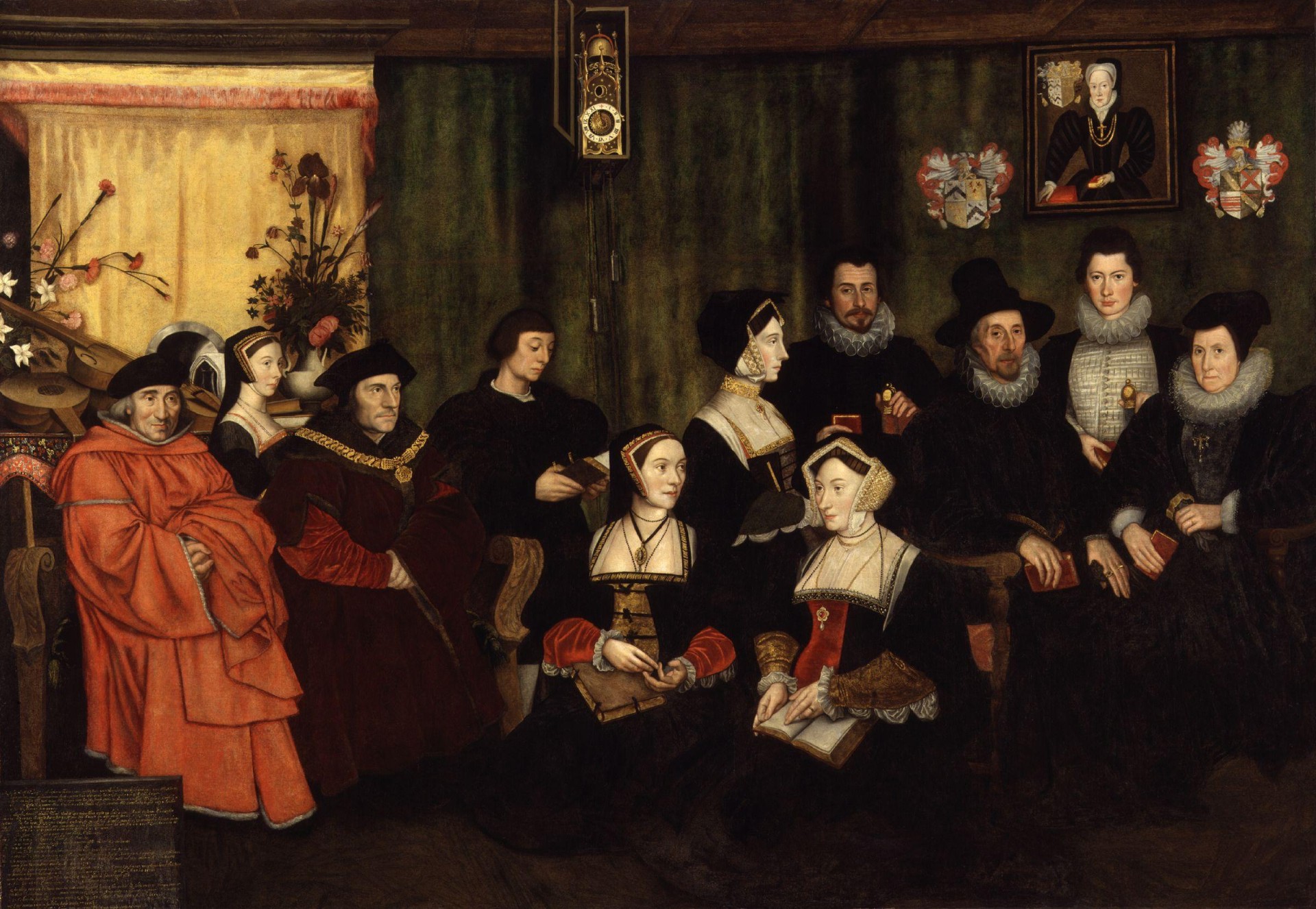
    Thomas More, unusually for the time, insisted that his whole family received an education in a wide range of subjects. The range was far wider that traditionally given, and saw all of the children, including the girls, learn about classics, languages, and other subjects, in what came to be known as ‘The More School’. From the age of six or seven, when it was normal for the children to start their education, Margaret and her siblings were taught by tutors and others who came into the house and it was all overseen and coordinated by Thomas himself.

    Margaret was the eldest, and from an early age she showed an aptitude for learning; for languages and for writing generally. However, all the girls all learned mathematics and there are references to Margaret Giggs, the ward of the More family who grew up alongside Margaret and her sisters, having a ‘algorism stone’ for use in mathematical calculations. Astronomy was a particularly popular subject for the girls and in a letter home, Thomas writes about how they,

    ‘…are so far advances in that science that you can point out the pole-star or the dog star or any of the constellations.’

    The example set by the More school would go on to influence several other families who would loom large in Tudor history. The Grey sisters (one of whom was Queen Jane) and the Cooke sisters, and also Katherine Parr, Henry VIII’s sixth Queen, would all receive a broader education that women had traditionally done beforehand. Even Henry VIII himself was convinced by his friend’s activities and gave Princesses Mary and Elizabeth and education in the same fashion. All of this was influenced by what was seen of the More sisters, particularly Margaret.

    Her Writing

    Sir Thomas More his father his household and his descendants by Rowland Lockey after Hans Holbein the Younger

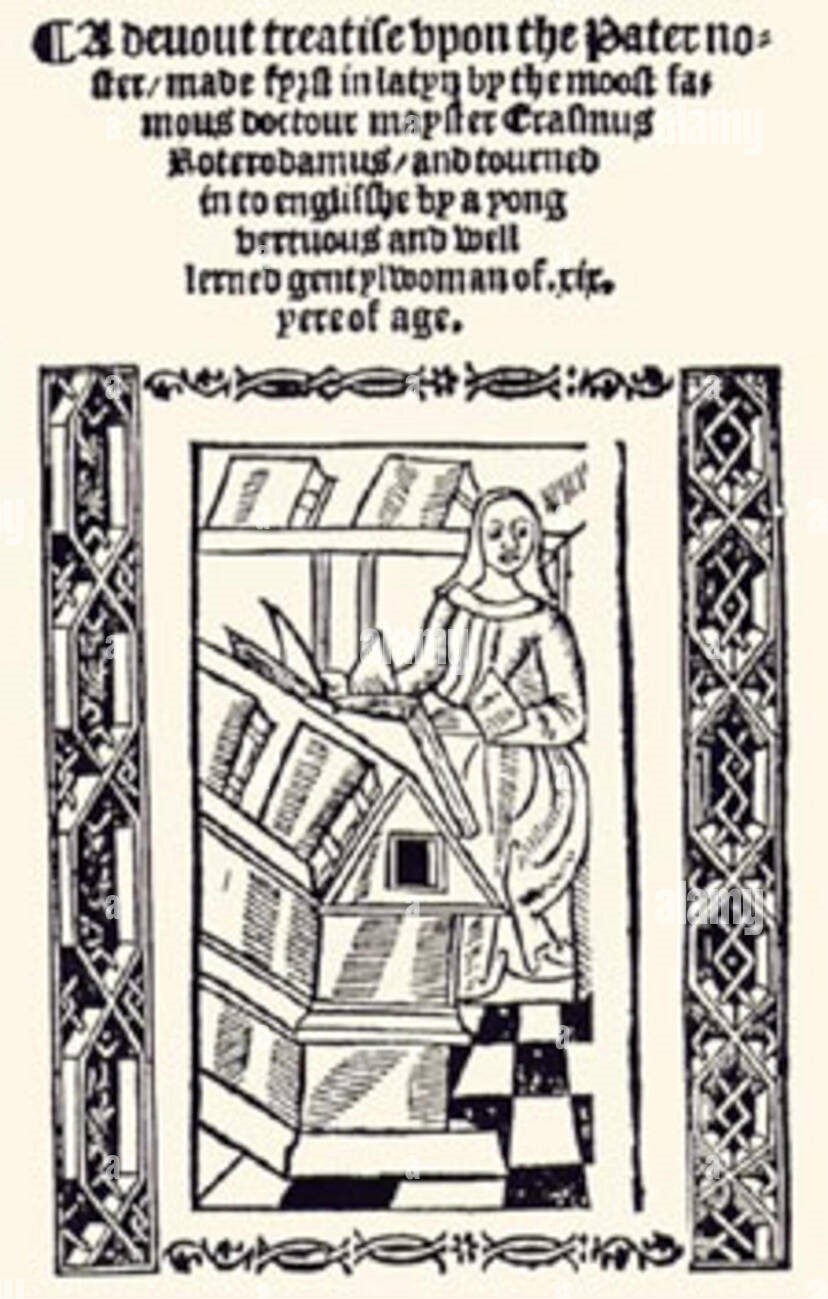
    Margaret’s example particularly came to the fore as she got older and began to build a reputation through her scholarly work. In 1524 she translated and then published her ‘Devout Treatise on the Paternoster’, a translation of Erasmus’s Precatio Domenica, a study of the Lord’s Prayer.

    While Margaret’s name does not appear overtly on the cover her identity was simple to figure out for those who were familiar with Sir Thomas and his family. The cover reads,

    A devout treatise upon the Paternoster made fyrst in latyn by the moost famous doctour mayster Erasmus Roterodamus and tourned into englisshe by a young vertuous and well lerned gentylwoman of nineteen yere of age.’

    The inclusion of details such as her age and other references to her perceived virtuousness, give us an insight into how Margaret was viewed, or wanted to be viewed, for her work. As much as Margaret may have tried to keep her identity away from the work, the Devout Treatise was the first work of this kind published by any woman, and this alone means that Margaret had broken new ground for Tudor women once again.

    Her Loyalty

    Sir Thomas More and his Daughter by Herbert John Rogers

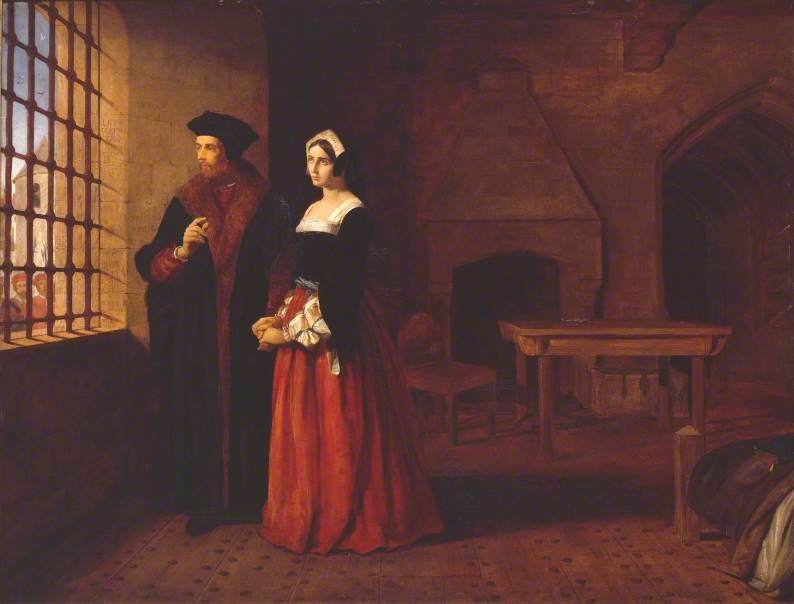
    Perhaps though Margaret is best known for her devotion to her father, and his to her. He referred to her as his ‘Meg’ in their letters to one another, and he wrote constantly while he travelled around Europe while working for King Henry VIII, and also while he was imprisoned in the tower.

    While her was in the tower she wrote often to him, but also acted as his advocate, negotiating to make his conditions more comfortable, ensuring he had his books and writing things, as well as better food and access to doctors when he was ill. During his imprisonment it was Margaret who visited him often and helped him to write down his version of events.

    After his death her dedication to him continued when she retrieved his head from it’s spike on London Bridge. This was at great personal risk and when it was discovered that she had done this, she was brought to appear before the king’s council. According to Thomas Stapleton she defended herself by saying that she,

    ‘had saved her father’s head from being devoured by the fishes and with the intention of burying it.’

    When Margaret died the head was to be buried with her, and she eventually was laid to rest, next to her husband William, in the Roper family crypt in St Dunstan’s Church in Canterbury. In this crypt there is also a head, encased in lead, that is believed to be the head of Sir Thomas More.

    Her Legacy

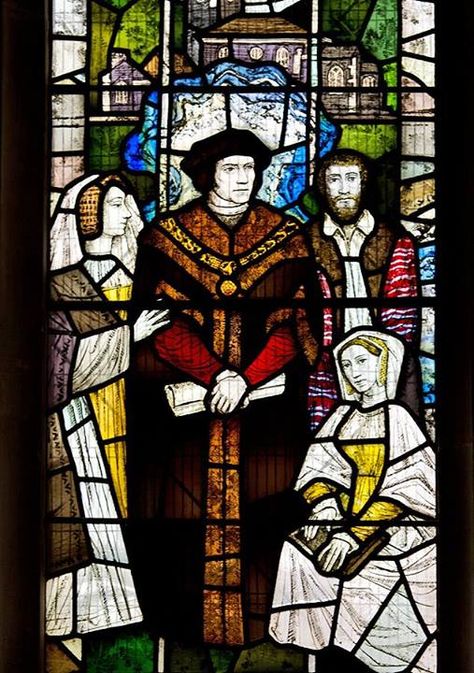
    Sir Thomas More

    Sir Thomas’s head was not the only thing that Margaret preserved, as after his death she worked to collect and save her father’s work, letters and even some of his belongings. After Margaret’s death in 1544, the collections she had managed to bring together was broken up in an attempt to protect her family from persecution, or even prosecution, for having artefacts belonging to Sir Thomas, a traitor.

    However, this collection of work was then used, first by William Roper to write his biography of Sir Thomas More titled ‘A Man of Singular Virtue’. This was the first time Sir Thomas’s life story was written down and in order to write it he referred to the letters, books and documents that his wife had so meticulously curated.

    Historians and writers that have followed since have also relied on the same letters and books in order to write and learn about Sir Thomas and the wider world of the Tudor court. None of this research would have been possible had Margaret not worked so hard to preserve her father’s legacy for the generations to come. Without Margaret’s devotion our knowledge of the Tudor world would be severely diminished.

    While Margaret can often be overshadowed by her father, or portrayed merely as his loyal, devoted daughter, I believe she deserves a great deal more credit and attention. Her abilities, natural intellect, loyalty and bravery should not be underestimated in their important, and certainly not forgotten.

    About the author:

    Aimee Fleming is a historian and author from North Yorkshire. She is happily married, with three growing boys and a whole host of pets. She studied history at the University of Wales, Bangor and then later completed a masters in Early Modern History at the University of York as a mature student. She has a passion for history, particularly the Tudors, and worked for over a decade in the heritage industry in a wide variety of roles and historic places.

    Website: https://historyaimee.wordpress.com/; Social Media – On Threads, Blue Sky and Instagram: @historyaimee.

    Book link: https://mybook.to/FemaleTudorScholar

    *

    My Books:

    Signed, dedicated copies of all my books are available through my online bookshop.

    Coming 30 January 2025: Scotland’s Medieval Queens

    Scotland’s history is dramatic, violent and bloody. Being England’s northern neighbour has never been easy. Scotland’s queens have had to deal with war, murder, imprisonment, political rivalries and open betrayal. They have loved and lost, raised kings and queens, ruled and died for Scotland. From St Margaret, who became one of the patron saints of Scotland, to Elizabeth de Burgh and the dramatic story of the Scottish Wars of Independence, to the love story and tragedy of Joan Beaufort, to Margaret of Denmark and the dawn of the Renaissance, Scotland’s Medieval Queens have seen it all. This is the story of Scotland through their eyes.

    Available for pre-order now.

    Also by Sharon Bennett Connolly:

    Heroines of the Tudor World tells the stories of the most remarkable women from European history in the time of the Tudor dynasty, 1485-1603. These are the women who ruled, the women who founded dynasties, the women who fought for religious freedom, their families and love. Heroines of the Tudor World is now available for pre-order from Amberley Publishing and Amazon UK. Women of the Anarchy demonstrates how Empress Matilda and Matilda of Boulogne, unable to wield a sword themselves, were prime movers in this time of conflict and lawlessness. It shows how their strengths, weaknesses, and personal ambitions swung the fortunes of war one way – and then the other. Available from Bookshop.orgAmberley Publishing and Amazon UKKing John’s Right-Hand Lady: The Story of Nicholaa de la Haye is the story of a truly remarkable lady, the hereditary constable of Lincoln Castle and the first woman in England to be appointed sheriff in her own right. Available from all good bookshops Pen & Sword Booksbookshop.org and Amazon

    Defenders of the Norman Crown: The Rise and Fall of the Warenne Earls of Surrey tells the fascinating story of the Warenne dynasty, from its origins in Normandy, through the Conquest, Magna Carta, the wars and marriages that led to its ultimate demise in the reign of Edward III. Available from Pen & Sword BooksAmazon in the UK and US, and Bookshop.orgLadies of Magna Carta: Women of Influence in Thirteenth Century England looks into the relationships of the various noble families of the 13th century, and how they were affected by the Barons’ Wars, Magna Carta and its aftermath; the bonds that were formed and those that were broken. It is now available in paperback and hardback from Pen & SwordAmazon, and Bookshop.orgHeroines of the Medieval World tells the stories of some of the most remarkable women from Medieval history, from Eleanor of Aquitaine to Julian of Norwich. Available now from Amberley Publishing and Amazon, and Bookshop.orgSilk and the Sword: The Women of the Norman Conquest traces the fortunes of the women who had a significant role to play in the momentous events of 1066. Available now from Amazon,  Amberley Publishing, and Bookshop.org.

    Alternate Endings: An anthology of historical fiction short stories including Long Live the King… which is my take what might have happened had King John not died in October 1216. Available in paperback and kindle from Amazon.

    Podcast:

    Have a listen to the A Slice of Medieval podcast, which I co-host with Historical fiction novelist Derek Birks. Derek and I welcome guests, such as Bernard Cornwell, and discuss a wide range of topics in medieval history, from significant events to the personalities involved. Our latest episode is a fascinating discussion with Dr Ian Mortimer about the speed of travel and communications in medieval times. Definitely worth a listen!

    *

    Don’t forget! Signed and dedicated copies of all my books are available through my online bookshop.

    For forthcoming online and in-person talks, please check out my Events Page.

    You can be the first to read new articles by clicking the ‘Follow’ button, liking our Facebook page or joining me on TwitterThreadsBluesky and Instagram.

    ©2024 Sharon Bennett Connolly FRHistS
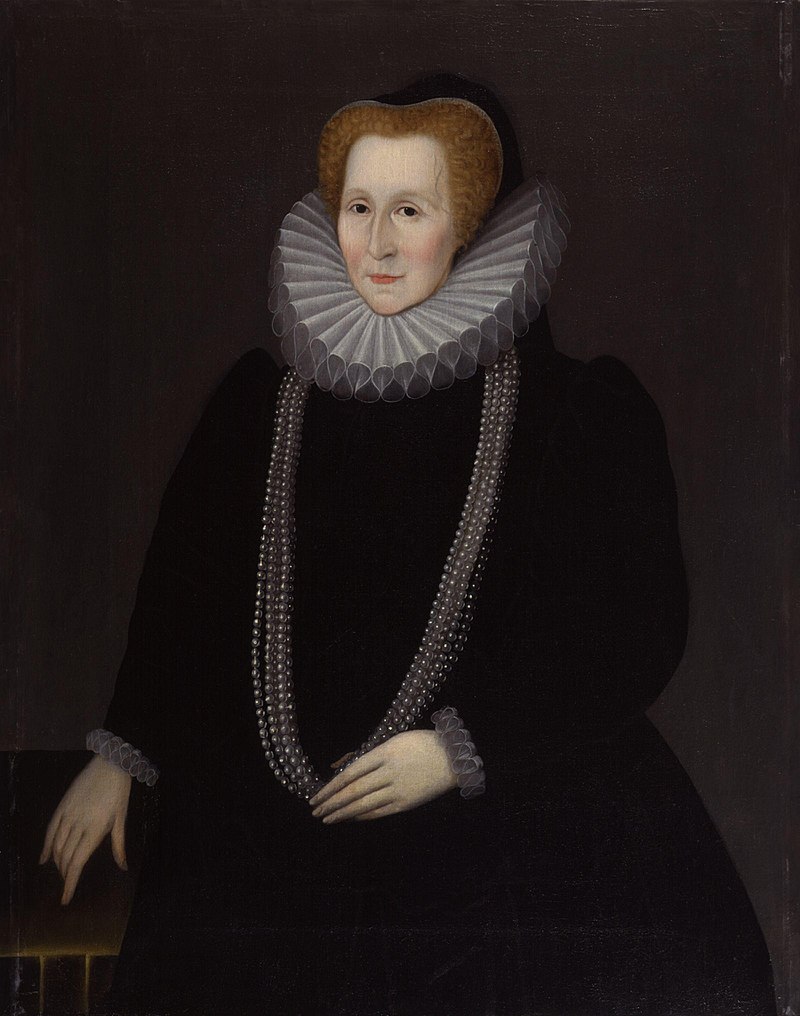
    Book Corner: 2 Books About Tudor Heirs

    It is time for me to get back to some serious book reviewing. So, in order to catch up, I thought I’d do two reviews in one post. Both books are from the Tudor period and look into the heirs to the Tudor throne, and the impact of Henry VIII’s actions on those children. Each books provide a fascinating insight into the lives of prominent Tudors and shows a side of Henry VIII that is often overlooked.

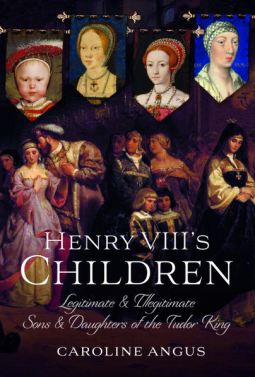
    Henry VIII’s Children by Caroline Angus

    Of the five Tudor monarchs, only one was ever born to rule. While much of King Henry VIII’s reign is centred on his reckless marriage choices, it was the foundations laid by Henry and Queen Katherine of Aragon that shaped the future of the crown. Among the suffering of five lost heirs, the royal couple placed all their hopes in the surviving Princess Mary. Her early life weaves a tale of promise, diplomacy, and pageantry never again seen in King Henry’s life, but a deep-rooted desire for a son, a legacy of his own scattered childhood, pushed Henry VIII to smother Mary’s chance to rule. An affair soon produced an unlikely heir in Henry Fitzroy, and while one child was pure royalty, the other illegitimate, the comparison of their childhoods would show a race to throne closer than many wished to admit.

    King Henry’s cruelty saw his heirs’ fates pivot as wives came and went, and the birth Princess Elizabeth, saw long-term plans upended for short-term desires. With the death of one heir hidden from view, the birth of Prince Edward finally gave the realm an heir born to rule, but King Henry’s personal desires and paranoia left his heirs facing constant uncertainty for another decade until his death. Behind the narrative of Henry VIII’s wives, wars, reformation and ruthlessness, there were children, living lives of education among people who cared for them, surrounded by items in generous locations which symbolised their place in their father’s heart. They faced excitement, struggles, and isolation which would shape their own reigns. From the heights of a surviving princess destined and decreed to influence Europe, to illegitimate children scattered to the winds of fortune, the childhoods of Henry VIII’s heirs is one of ambition, destiny, heartache, and triumph.

    Henry VIII left a long shadow, especially for his children. Caroline Angus looks into the lives and experiences of Henry’s 3 legitimate children, Edward VI, Mary I and Elizabeth I, alongside his only recognised illegitimate child, Henry Fitzroy, Duke of Richmond. And the other possible candidates to be Henry’s offspring, including Catherine Carey.

    Henry VIII’s Children is a very easy and enjoyable read. You get absorbed into Caroline Angus’s love of her subject. Her research is thorough and all her arguments are supported by evidence. Where there is conjecture, the author presents both sides and lets the reader find their own conclusion, while presenting what she thinks most likely. I did not agree with all her conclusions, particularly when it comes to Catherine Carey – I am not convinced she was Henry VIII’s daughter, not that Henry’s relationship with Mary Boleyn lasted as long as some historians suggest. I just don’t think we have enough information. But it was interesting to read Caroline’s thoughts on the subject and see how she came to her conclusions.
    It certainly gave me food for thought!

    The Tudors are always a fascinating subject and Caroline Angus does a wonderful job of igniting the reader’s passion in her subject.

    The strength of Henry VIII’s Children lies in its fascinating investigation into the lives of Henry’s 3 ‘legitimate’ children and how their fates were manipulated and directed by Henry’s obsession for a male heir, and his multiple marriages. Poor Mary I had 5 stepmothers! just imagine how she must have felt, watching her mother shunned and sidelined by the father she adored, not being allowed to visit her on her deathbed, nor being allowed to receive her mother’s comfort when she was ill and scared. The mind games Henry VIII played with his eldest child, in order to get her acquiescence, are something to behold.

    And then there’s poor Elizabeth, her mother executed before her 3rd birthday, and yet she is the one who surpassed all Henry’s dreams for his children. Elizabeth is the one who had a golden age named after her. She is also the one who always lived in the shadow of her mother’s fate. Caroline Angus looks into all aspects of Elizabeth’s life, especially the childhood and adolescence that shaped her future.

    And Edward! the golden boy. The heir who was so desired that his father broke with Rome to get. A boy who was the hope of a nation but died so tragically young.

    Caroline Angus looks at them all with such enthusiasm and animation that they jump off the page.

    An eminently readable nook that I have no hesitation in recommending.

    To Buy Henry VIII’s Children

    About the Author:

    Caroline Angus is a New Zealand-based author raising four sons. Caroline studied history at Universitat de València, Spain, spending ten years dedicated to the Spanish Civil War and the resulting dictatorship. Caroline went on to study with King’s College London, specialising in Shakespeare and British royal history. After a decade of writing fiction, including the Secrets of Spain series, focusing on the lives of Valencian interviewees between 1939 and 1975, and the more recent Queenmaker Trilogy, eleven years of Thomas Cromwell and his fictional attendant Nicòla Frescobaldi, Caroline is now creating non-fiction works on the surviving papers of Thomas Cromwell.

    Henry VIII’s True Daughter by Wendy J Dunn

    The lives of Tudor women often offer faint but fascinating footnotes on the pages of history. The life of Catherine – or Katryn as her husband would one day pen her name – Carey, the daughter of Mary Boleyn and, as the weight of evidence suggests, Henry VIII, is one of those footnotes.

    As the possible daughter of Henry VIII, the niece of Anne Boleyn and the favourite of Elizabeth I, Catherine’s life offers us a unique perspective on the reigns of Henry and his children. In this book, Wendy J. Dunn takes these brief details of Catherine’s life and turns them into a rich account of a woman who deserves her story told. Following the faint trail provided of her life from her earliest years to her death in service to Queen Elizabeth, Dunn examines the evidence of Catherine’s parentage and views her world through the lens of her relationship with the royal family she served.

    This book presents an important story of a woman who saw and experienced much tragedy and political turmoil during the reigns of Henry VIII, Edward VI, and Mary I – all of which prepared her to take on the vital role of one of Elizabeth I closest and most trusted women. It also prepared her to become the wife of one of Elizabeth’s privy councillors – a man also trusted and relied on by the queen. Catherine served Elizabeth during the uncertain and challenging first years of her reign, a time when there was a question mark over whether she would succeed as queen regnant after the failures of England’s first crowned regnant, her sister Mary.

    Through immense research and placing her in the context of her period, HENRY VIII’S TRUE DAUGHTER: CATHERINE CAREY, A TUDOR LIFE draws Catherine out of the shadows of history to take her true place as the daughter of Henry VIII and shows how vital women like Catherine were to Elizabeth and the ultimate victory of her reign.

    Henry VIII’s True Daughter: Catherine Carey, A Tudor Life by Wendy J. Dunn is a perfect accompaniment to Henry VIII’s Children. Focusing on the eldest child of Mary Boleyn and William Carey, Wendy J. Dunn investigates Catherine’s origins and the stories around her conception and birth – in particular, her mother’s relationship with Henry VIII. It has long been thought possible that Catherine was Henry’s daughter and that Mary Boleyn’s marriage to William Carey was arranged to conceal the king’s affair. Henry himself admitted he had slept with Mary Boleyn when he was once accused of sleeping with Anne Boleyn’s mother, replying along the lines of ‘the sister but never the mother.’

    So, we know they had a relationship, but how long it lasted and whether Catherine was the result of that relationship is still uncertain. Wendy attempts to lift away that uncertainty and presents all the evidence and conjecture that has been gather over the years to give us her own conclusions.

    But this book is so much more! Henry VIII’s True Daughter gives us insights into the life of a prominent Tudor woman. Whether or not she was the daughter of Henry VIII, she was still at the heart of the Tudor court, especially in the reign of her sister/cousin, Elizabeth I. Catherine was one of Elizabeth’s favourites and was loyal to the queen to the very end of her life. Wendy gives stunning insight into Catherine’s life and career, as well as her marriage and family.

    Even if I don’t necessarily agree with all its conclusion, Henry VIII’s True Daughter by Wendy J Dunn is a wonderful, engaging book, giving the reader ample food for thought in her theories and explanations of the life and origins of Catherine Carey. It is a must-read for any fan of Tudor history.

    To Buy Henry VIII’s True Daughter

    About the Author:

    Wendy J. Dunn is an award-winning Australian writer fascinated by Tudor history – so much so she was not surprised to discover a family connection to the Tudors, not long after the publication of her first Anne Boleyn novel, which narrated the Anne Boleyn story through the eyes of Sir Thomas Wyatt, the elder. Her family tree reveals the intriguing fact that one of her ancestral families – possibly over three generations – had purchased land from both the Boleyn and Wyatt families to build up their holdings. It seems very likely Wendy’s ancestors knew the Wyatts and Boleyns personally. Wendy is married, the mother of four adult children and the grandmother of two amazing small boys. She gained her PhD in 2014 and loves walking in the footsteps of the historical people she gives voice to in her books. Wendy also tutors writing at Swinburne University of Technology, Australia. HENRY VIII’S TRUE DAUGHTER: CATHERINE CAREY, A TUDOR LIFE is her first full-length nonfiction work.

    *

    My Books:

    Signed, dedicated copies of all my books are available through my online store.

    OUT NOW! Heroines of the Tudor World

    Heroines of the Tudor World tells the stories of the most remarkable women from European history in the time of the Tudor dynasty, 1485-1603. These are the women who ruled, the women who founded dynasties, the women who fought for religious freedom, their families and love. These are the women who made a difference, who influenced countries, kings and the Reformation. In the era dominated by the Renaissance and Reformation, Heroines of the Tudor World examines the threats and challenges faced by the women of the era, and how they overcame them. From writers to regents, from nuns to queens, Heroines of the Tudor World shines the spotlight on the women helped to shape Early Modern Europe.

    Heroines of the Tudor World is now available for pre-order from Amberley Publishing and Amazon UK.

    Coming 30 January 2025: Scotland’s Medieval Queens

    Scotland’s history is dramatic, violent and bloody. Being England’s northern neighbour has never been easy. Scotland’s queens have had to deal with war, murder, imprisonment, political rivalries and open betrayal. They have loved and lost, raised kings and queens, ruled and died for Scotland. From St Margaret, who became one of the patron saints of Scotland, to Elizabeth de Burgh and the dramatic story of the Scottish Wars of Independence, to the love story and tragedy of Joan Beaufort, to Margaret of Denmark and the dawn of the Renaissance, Scotland’s Medieval Queens have seen it all. This is the story of Scotland through their eyes.

    Available for pre-order now.

    Also by Sharon Bennett Connolly:

    Women of the Anarchy demonstrates how Empress Matilda and Matilda of Boulogne, unable to wield a sword themselves, were prime movers in this time of conflict and lawlessness. It shows how their strengths, weaknesses, and personal ambitions swung the fortunes of war one way – and then the other. Available from Bookshop.orgAmberley Publishing and Amazon UKKing John’s Right-Hand Lady: The Story of Nicholaa de la Haye is the story of a truly remarkable lady, the hereditary constable of Lincoln Castle and the first woman in England to be appointed sheriff in her own right. Available from all good bookshops Pen & Sword Booksbookshop.org and AmazonDefenders of the Norman Crown: The Rise and Fall of the Warenne Earls of Surrey tells the fascinating story of the Warenne dynasty, from its origins in Normandy, through the Conquest, Magna Carta, the wars and marriages that led to its ultimate demise in the reign of Edward III. Available from Pen & Sword BooksAmazon in the UK and US, and Bookshop.org

    Ladies of Magna Carta: Women of Influence in Thirteenth Century England looks into the relationships of the various noble families of the 13th century, and how they were affected by the Barons’ Wars, Magna Carta and its aftermath; the bonds that were formed and those that were broken. It is now available in paperback and hardback from Pen & Sword, Amazon, and Bookshop.orgHeroines of the Medieval World tells the stories of some of the most remarkable women from Medieval history, from Eleanor of Aquitaine to Julian of Norwich. Available now from Amberley Publishing and Amazon, and Bookshop.orgSilk and the Sword: The Women of the Norman Conquest traces the fortunes of the women who had a significant role to play in the momentous events of 1066. Available now from Amazon,  Amberley Publishing, and Bookshop.org.

    Alternate Endings: An anthology of historical fiction short stories including Long Live the King… which is my take what might have happened had King John not died in October 1216. Available in paperback and kindle from Amazon.

    Podcast:

    Have a listen to the A Slice of Medieval podcast, which I co-host with Historical fiction novelist Derek Birks. Derek and I welcome guests, such as Bernard Cornwell, and discuss a wide range of topics in medieval history, from significant events to the personalities involved.

    *

    Don’t forget! Signed and dedicated copies of all my books are available through my online store.

    For forthcoming online and in-person talks, please check out my Events Page.

    You can be the first to read new articles by clicking the ‘Follow’ button, liking our Facebook page or joining me on TwitterThreads and Instagram.

    *

    ©2024 Sharon Bennett Connolly FRHistS.

    Lady Mary Seymour, the Queen’s Orphan Daughter

    Katherine Parr by an unknown artist, NPG

    Little Lady Mary Seymour was the daughter of dowager Queen Kateryn Parr and her fourth, and final, husband, Thomas Seymour, Baron Seymour of Sudeley. Kateryn Parr was widowed for a third time with the death of Henry VIII in January 1547. By May of the same year, Queen Kateryn was married to the new king Edward VI’s uncle, Thomas Seymour, Lord High Admiral of England and Baron Seymour of Sudeley. This was said to be a love match and within months Kateryn found herself pregnant for what may have been the first time in her life. In the months before the birth, the queen had fitted out a nursery for her baby, decorated in Kateryn’s favourite colours of crimson and gold: the nursery had views of the gardens and the castle’s chapel. The queen’s joy was tempered by the scandal that had arisen from her husband’s attentions towards Kateryn’s stepdaughter, Elizabeth.

    She wrote to Thomas Seymour of how active the unborn child was:

    I gave your little knave your blessing, who like an honest man stirred apace after and before. For Mary Odell [one of her ladies] being abed with me had laid her hand upon my belly to feel it stir. It hath stirred these three days every morning and evening so that I trust when you come it will make you some pastime. And thus I end bidding my sweetheart and loving husband better to fare than myself.1

    Kateryn gave birth to her only child, Mary, named after the dowager queen’s stepdaughter, Princess Mary, on 30 August 1548. At the age of 37, Kateryn was old to be having her first child, but both she and the baby had come through the labour safely and there doesn’t appear to have been any disappointment that the child was a girl rather than a boy.

    Thomas Seymour painted by Nicolas Denisot

    Within just a few days of the birth, Kateryn was showing signs of puerperal fever, a bacterial complication of childbirth that was very dangerous in the centuries before antibiotics. As her condition worsened, Kateryn suffered bouts of delirium and moments of calm, when she appeared to rally. In her delirium, Kateryn railed against her husband, saying

    ‘I am not well handled, for those that be about me careth not for me but standith laughing at my grief and the more good I will to them, the less good they will to me.’2

    Strongly denying her accusations, Seymour replied

    ‘Why, sweetheart, I would you no hurt.’3

    Whether Kateryn truly believed Seymour wanted her dead, or was still smarting from how close he had got to the Princess Elizabeth, or the words, reported by Lady Tyrwitt, who was not a friend of Seymour’s, were misinterpreted, we will never know. Her pain, delirium and suspicion of her husband made Kateryn’s last days even more wretched.

    Kateryn Parr died 6 days after little Mary’s birth, on 5 September 1548, at Sudeley Castle. She was laid to rest beneath the floor of St Mary’s Chapel in the castle grounds, with Lady Jane Grey acting as her chief mourner. Despite her fears that her husband had poisoned her, in her will, dictated as she was close to death, she left everything to Seymour, making him a very wealthy man.

    Thomas Seymour was stunned by Kateryn’s death and grieved deeply. He abandoned Sudeley Castle and returned to London, seeking refuge at Syon House, the home of his brother, Edward Seymour, Duke of Somerset and his wife. Little Lady Mary was placed in the care of his mother, Margery Seymour.

    St Mary’s Chapel, Sudeley Castle

    Mary was eventually taken into the care of Edward Seymour and his wife, Duchess Anne. Anne had herself given birth to a little boy shortly before Mary’s birth and had a house full of children, little Mary’s cousins. However, when her father was arrested for treason, having plotted to marry the Princess Elizabeth, and was being held in the Tower awaiting execution, he asked that his daughter should be given into the care of Katherine Willoughby (now Brandon), Duchess of Suffolk. Katherine had been a good friend of Kateryn Parr. She had herself been widowed in 1545 and was the mother of 2 teenage boys, Henry and Charles Brandon.

    Mary could have been given into the care of Kateryn Parr’s brother, William Parr, Marquess of Northampton, but he had recently found himself out of favour with Edward Seymour, the Lord Protector, as he had tried to divorce his wife, Anne Bourchier, in order to marry Elisabeth Brooks, who had served Seymour’s sister Jane when she was queen. This remarriage was considered illegal and outrageous and so, with such a scandal attached to him, Parr was not a suitable guardian to his niece; not that he appears to have paid any attention to Mary, nor expressed any desire to play a part in her life. Neither did Kateryn’s sister, Anne Herbert, Countess of Pembroke, show any interest in taking care of her niece, despite her own children being close in age to Mary.

    With Thomas Seymour’s execution on 20 March 1549, Lady Mary Seymour, at just short of 7 months old, was a dispossessed orphan. Three days before her father’s death, whilst she was still in the custody of her uncle at Syon House, Mary had been granted £500 a year by the Privy Council. The money was for ‘dyettes, wages and lyvereyes of the household of Mistres Mary Seymour for a yere and a half ended at the Feast of the annunciation of Our Lady next cummyng [25 March].’4 However, that income was not transferred to Katherine Willoughby when the baby was moved to her residence at Grimsthorpe Castle in Lincolnshire. This left the duchess short of funds. The daughter of a queen, though not royal, was expected to be maintained to a certain standard. The little orphan arrived at Grimsthorpe Castle with her own household; her full complement of staff included her governess, a nurse and two maids. And it was left to Katherine, Duchess of Suffolk, to pay their wages.

    Katherine Willoughby, Duchess of Suffolk, Mary Seymour’s guardian

    By 24 July 1549, Katherine was writing to William Cecil, a secretary in Edward Seymour’s household at the time, in the hope that he may assist her in recovering payment for her expenses. She wrote:

    ‘It is said that the best means of remedy to the sick is first plainly to confess and disclose the disease, wherefore, both for remedy and again for that my disease is so strong that it will not be hidden. … All the world knoweth … what a very beggar I am.’5

    Katherine said that her finances were worsening for numerous reasons but,

    ‘amongst others … if you will understand, not least the queen’s child hath layen, and still doth lie at my house, with her company about her, wholly at my charges. I have written to my lady of Somerset at large, that there be some pension allotted unto her according to my lord grace’s promise. Now, good Cecil, help at a pinch all that you may help.’6

    The duchess included a list of items that Duchess Anne had promised to send on, including the plate and other items that had been intended for Mary’s nursery at Sudeley Castle. The duchess also complained that the baby’s governess, ‘with the maid’s nurse and others, daily call for their wages, whose voices my ears can hardly bear, but my coffers much worse.’7

    It is saddening to read how little affection is given to this child who was so wanted by her parents. That she went from being the centre of Kateryn Parr’s world to being an unwanted burden on the late queen’s good friend. It seems that Katherine Willoughby’s pleas did eventually have an effect. In January 1550, application was made to the House of Commons for the restitution of Lady Mary Seymour, ‘daughter of Thomas Seymour, knight, late Lord Seymour of Sudeley and late High Admiral of England, begotten of the body of Queen Katherine, late queen of England’.8

    Grimsthorpe Castle, Lincolnshire

    By this act, the little girl, now 16 months old, was permitted to inherit any remaining property that had not been returned to the crown by her father’s attainder. This did not particularly improve Mary’s situation, as most of the property she would be allowed to inherit had already passed into the hands of others. This Act of Parliament is the last mention we have of Lady Mary Seymour in the historical record. The grant was not renewed when it became due in September 1550 and Lady Mary never claimed any of the remaining portion of her father’s estate.

    It seems likely that the little orphan had died at Grimsthorpe Castle before her second birthday, her burial place now unknown. There are traditions that she survived. One such has her raised by her governess, eventually marrying Sir Edward Bushell, while a family in Sussex also claims to be descended from her. While neither of these scenarios are impossible, there is no historical record to substantiate the claims.

    That we cannot say for certain is one more sad note in the life of a little girl whose birth was met with such joy by both her parents, but whose short life was replete with tragedy. She was a little pawn in the machinations of her elders.

    Images:

    Courtesy of Wikipedia except Grimsthorpe Castle which is ©2024 Sharon Bennett Connolly FRHistS
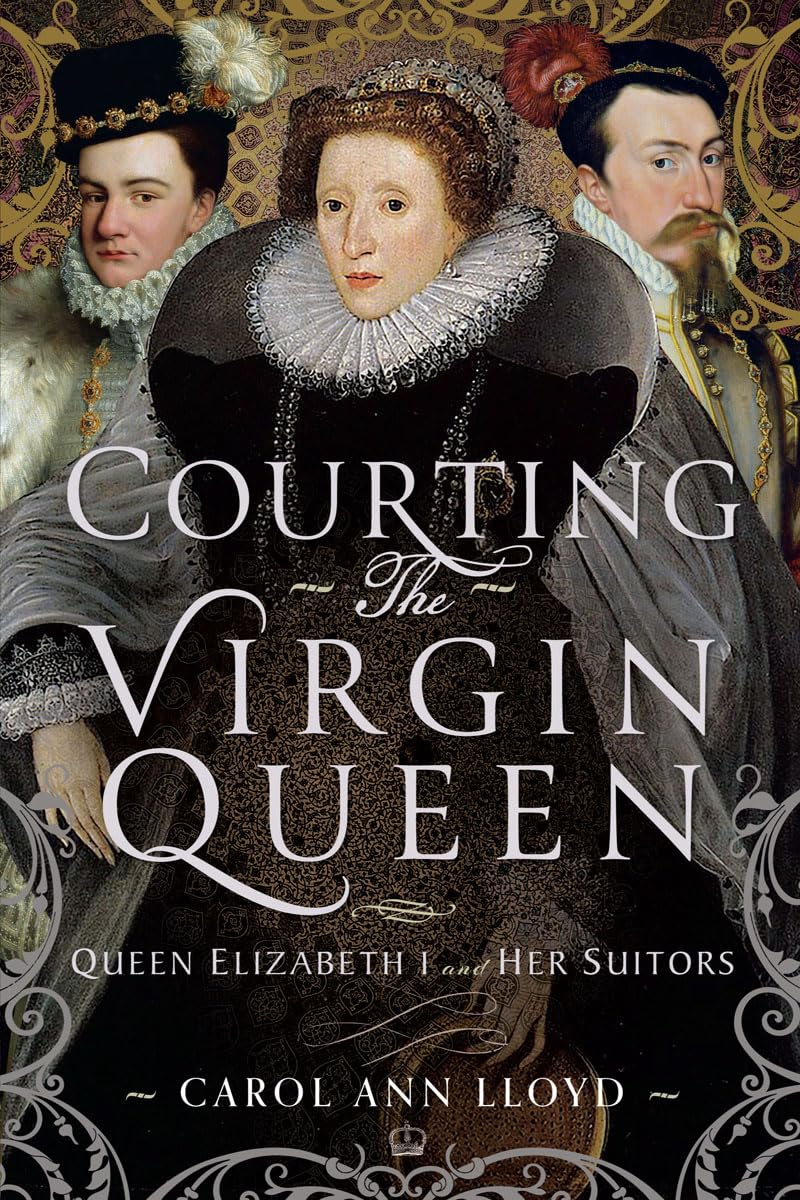
    Notes:

    1. Linda Porter, Katherine the Queen: The Remarkable Life of Katherine Parr, the Last Wife of Henry VIII, p. 318; 2. ibid, p. 322; 3. ibid, p. 323; 4. Rebecca Larson, ‘The Disappearance of Lady Mary Seymour’, tudorsdynasty.com; 5. Linda Porter, Katherine the Queen, p. 341; 6. ibid, pp. 341-342; 7. ibid, p. 342; 8. ibid

    Sources:

    Linda Porter, Katherine the Queen: The Remarkable Life of Katherine Parr, the Last Wife of Henry VIII; Rebecca Larson, ‘The Disappearance of Lady Mary Seymour’, tudorsdynasty.com; Don Matzat, Katherine Parr: Opportunist, Queen, Reformer; Amy Licence, The Sixteenth Century in 100 Women; Anne Crawford, editor, Letters of the Queens of England; Oxforddnb.com; Elizabeth Norton, Catherine Parr; Elizabeth Norton, The Lives of Tudor Women; Sarah Morris and Natalie Grueninger, In the Footsteps of the Six Wives of Henry VIII.

    *

    My Books:

    Signed, dedicated copies of all my books are available through my online store.

    OUT NOW! Heroines of the Tudor World

    Heroines of the Tudor World tells the stories of the most remarkable women from European history in the time of the Tudor dynasty, 1485-1603. These are the women who ruled, the women who founded dynasties, the women who fought for religious freedom, their families and love. These are the women who made a difference, who influenced countries, kings and the Reformation. In the era dominated by the Renaissance and Reformation, Heroines of the Tudor World examines the threats and challenges faced by the women of the era, and how they overcame them. From writers to regents, from nuns to queens, Heroines of the Tudor World shines the spotlight on the women helped to shape Early Modern Europe.

    Heroines of the Tudor World is now available for pre-order from Amberley Publishing and Amazon UK.

    Coming 30 January 2025: Scotland’s Medieval Queens

    Scotland’s history is dramatic, violent and bloody. Being England’s northern neighbour has never been easy. Scotland’s queens have had to deal with war, murder, imprisonment, political rivalries and open betrayal. They have loved and lost, raised kings and queens, ruled and died for Scotland. From St Margaret, who became one of the patron saints of Scotland, to Elizabeth de Burgh and the dramatic story of the Scottish Wars of Independence, to the love story and tragedy of Joan Beaufort, to Margaret of Denmark and the dawn of the Renaissance, Scotland’s Medieval Queens have seen it all. This is the story of Scotland through their eyes.

    Available for pre-order now.

    Also by Sharon Bennett Connolly:

    Women of the Anarchy demonstrates how Empress Matilda and Matilda of Boulogne, unable to wield a sword themselves, were prime movers in this time of conflict and lawlessness. It shows how their strengths, weaknesses, and personal ambitions swung the fortunes of war one way – and then the other. Available from Bookshop.orgAmberley Publishing and Amazon UKKing John’s Right-Hand Lady: The Story of Nicholaa de la Haye is the story of a truly remarkable lady, the hereditary constable of Lincoln Castle and the first woman in England to be appointed sheriff in her own right. Available from all good bookshops Pen & Sword Booksbookshop.org and AmazonDefenders of the Norman Crown: The Rise and Fall of the Warenne Earls of Surrey tells the fascinating story of the Warenne dynasty, from its origins in Normandy, through the Conquest, Magna Carta, the wars and marriages that led to its ultimate demise in the reign of Edward III. Available from Pen & Sword BooksAmazon in the UK and US, and Bookshop.org

    Ladies of Magna Carta: Women of Influence in Thirteenth Century England looks into the relationships of the various noble families of the 13th century, and how they were affected by the Barons’ Wars, Magna Carta and its aftermath; the bonds that were formed and those that were broken. It is now available in paperback and hardback from Pen & Sword,  Amazon, and Bookshop.orgHeroines of the Medieval World tells the stories of some of the most remarkable women from Medieval history, from Eleanor of Aquitaine to Julian of Norwich. Available now from Amberley Publishing and Amazon, and Bookshop.orgSilk and the Sword: The Women of the Norman Conquest traces the fortunes of the women who had a significant role to play in the momentous events of 1066. Available now from Amazon,  Amberley Publishing, and Bookshop.org.

    Alternate Endings: An anthology of historical fiction short stories including Long Live the King… which is my take what might have happened had King John not died in October 1216. Available in paperback and kindle from Amazon.

    Podcast:

    Have a listen to the A Slice of Medieval podcast, which I co-host with Historical fiction novelist Derek Birks. Derek and I welcome guests, such as Bernard Cornwell, and discuss a wide range of topics in medieval history, from significant events to the personalities involved.

    *

    Don’t forget! Signed and dedicated copies of all my books are available through my online store.

    For forthcoming online and in-person talks, please check out my Events Page.

    You can be the first to read new articles by clicking the ‘Follow’ button, liking our Facebook page or joining me on TwitterThreads and Instagram.

    *

    ©2024 Sharon Bennett Connolly FRHistS.

    The Remarkable Courage of Anne Askew

    Portrait of Henry VIII after Hans Holbein the Younger

    When Henry VIII decided to break with Rome, he was making that decision not just for himself but for his entire nation. But Henry was still a conservative Catholic and while others embraced the Reformation and the tenets of Calvinism or Lutheranism, Henry remained Catholic to his dying day, just not Roman Catholic. His break with Rome led to the Dissolution of the Monasteries, where monastic institutions and communities were broken up and sold off.

    This, in turn led to the Pilgrimage of Grace, a popular revolt in Yorkshire in October 1536, led by Robert Aske, which spread to other parts of northern England. The rebellion was inspired by the failed Lincolnshire Rising, which had started on 1 October 1536 and it was said 22,000 people followed a monk and shoemaker, the vicar of Louth and Nicholas Melton (known as Captain Cobbler) to protest against the closing of the monasteries and the seizure of church land and plate. The figure was probably much smaller, perhaps some 3,000 rebels. However, by the time they marched on Lincoln and occupied Lincoln Cathedral, some 40,000 rebels were demanding the right to worship as Roman Catholics and protection for the treasures of Lincolnshire’s churches. The Rising was all but over by 4 October, when Henry sent word that the protesters should disperse or face retribution at the hands of Charles Brandon, Duke of Suffolk, who had mobilised his troops to put down the revolt.

    By 14 October, most of the host had returned home. The two ringleaders were hanged at Tyburn, while other leading rebels were executed in the following days. It was against this background and the fear that the Rising must have invoked throughout Lincolnshire, that Anne Askew came to the fore. Anne Askew, also spelt Ayscough or Ainscough, was born around 1521, probably at the family home at Stallingborough, near Grimsby in Lincolnshire. She was the daughter of Sir William Askew and his first wife, Elizabeth Wrottesley.

    Portrait of Anne Askew by Hans Eworth

    Anne was the second oldest of five children, with an older sister Martha, a younger sister Jane, and two younger brothers, Francis and Edward. Her father, a landowner in Lincolnshire and Nottinghamshire, was knighted in 1513. He attended the king at the Field of the Cloth of Gold in France in 1520 and in 1521 he was appointed High Sheriff of Lincolnshire. From 1529, he was a member of Parliament for Grimsby. After the death of Anne’s mother, he married twice more. He married the daughter of a Struxley or Streichley of Nottinghamshire, whose name is sadly now lost to history and married again in 1522 to Elizabeth, the daughter of John Hutton of Tudhoe, Co. Durham and the widow of Sir William Hansard of South Kelsey, Lincolnshire, with whom he had two more sons, Christopher and Thomas.

    By about 1523, the family had moved to South Kelsey, just 20 miles from Lincoln. Anne was well educated, possibly by tutors, though we do not know the specifics of her education. Anne’s writings were published posthumously by reformist scholar John Bale, and it is from these that we get most of her story.

    Anne’s future was decided following the tragic early death of her older sister, Martha. Sir William had arranged for Martha to marry Thomas Kyme of Friskney, the son and heir of a neighbouring landowner. Sadly, Martha died before the wedding could take place. Rather than suffer a financial loss with the failure of the arrangement, Sir William offered 15-year-old Anne as a replacement bride, ‘so that in the ende she was compelled against her will or fre consent to marrye with hym,’ and, as John Bale put it, Anne ‘demeaned her selfe lyke a Christen wife’.1 Anne and Thomas had two children together.

    It was about the time that Anne was preparing for her wedding, in 1536, that the Lincolnshire Rising erupted, starting in Louth and making its way towards Lincoln. Her father Sir William was one of the commissioners for the king’s tax subsidy who were due to sit in Caistor as the rebels arrived in the town. Sir William attempted to ride for home, ahead of the rebellious host. He was soon captured, aware that his own servants who were accompanying him supported the rebels. Anne’s brothers were also arrested by the rebels and their house watched. Sir William was then forced to write to the king to inform him of what had happened, with the complaint that ‘the common voice and fame was that all jewels and goods of the churches of the country should be taken from them and brought to Your Grace’s Council, and also that your said loving and faithful subjects should be put off new enhancements and other importunate charges.’2

    With the failure of the rebellion, Sir William and his sons returned home. One wonders if the treatment of her menfolk, at the hands of those who were defending Roman Catholicism, was not a factor in Anne turning to the reformed faith. However the transformation came about, and in spite of her husband’s devout Catholicism, Anne did become a committed Protestant. She acquired a copy of an English Bible and began reading aloud from it, though her husband and brother had both forbidden her to do so. Anne explained that ‘in processe of tyme by oft reading of the sacred Bible, she fell clerelye from all olde superstycyons of papystrye, to a perfyght believe in Jhesus Christ.’3

    Lincoln Cathedral

    In May 1543, the Act for the Advancement of True Religion was passed, forbidding any woman below the rank of noblewoman or gentlewoman from reading the Bible; and forbidding any woman, of any rank, from reading the Bible aloud. Anne was a gentlewoman and therefore still permitted to read the Bible, but only in private. She wanted to travel to Lincoln to see the cathedral’s Bible, but Kyme forbade it. Anne had been apprised of the hostility this would engender: ‘For my fryndes told me, if I ded come to Lyncolne, the prestes wolde assault me and put me to great trouble, as thereof they had made their boast.’4 Anne did travel to Lincoln and stayed there for about six days, reading her Bible in the cathedral. She said that one man confronted her, but he had said so little of significance that she could not recall his words.

    This incident, and the fact that Anne continued to read aloud to whoever would listen, to such an extent that the local priest complained to her husband, infuriated Thomas Kyme. Angry and embarrassed at his wife’s actions, Kyme drove her from the house, with some violence. Driven from hearth and home – and from her children, Anne resumed her maiden name and sought a divorce. In late 1544 she travelled to London, accompanied by only a maid, in order to obtain a legal separation in the court of chancery. Two of her brothers were already in London. Edward, who had previously been in the service of Archbishop Thomas Cranmer, was cup-bearer to Henry VIII and her half-brother, Christopher, who died around this time, was a Gentleman of the Privy Chamber.

    Her cousin, Christopher Brittayn, was a lawyer at the Temple and Anne’s sister Jane was married to George St Poll, a lawyer in the service of the duke and duchess of Suffolk. Anne lodged in a house close to the Temple, London’s legal centre, and soon met others with like-minded religious views, many with connections. Several gentlewomen gave Anne money, including the countess of Hertford and the wife of Sir Anthony Denny. They both sent messengers to Anne with money.

    Queen Kateryn Parr

    Anne found herself moving in exalted circles, these ladies were close friends of Henry VIII’s new queen, Kateryn Parr, though whether the queen and Anne ever met is uncertain. Anne made other connections in the city, including her religious advisor John Lascels and the chronicler Edward Hall. She was also close to the Kentish Anabaptist Joan Bocher, who would be executed in 1550.

    After preaching publicly in the streets of the capital, Anne came to the attention of the authorities. According to Anne’s nephew, writing after her death, she was arrested following the interception of a letter she was trying to send, while attempting to communicate with the queen. She was detained on 10 March 1545, under the Six Articles Act, which made deviation from the official tenets of the English church a civil offence. Anne was brought before Sir Martin Bowes, Lord Mayor of London, and the bishop of London’s chancellor, and interrogated as to her beliefs. She was told that St Paul forbade women from talking of the word of God, but Anne countered that St Paul only barred women from instructing a congregation.

    Still only 24 years of age, Anne was confident, fearless and bold in dealing with the great men of the city of London. Women were not meant to behave in such a way, they were supposed to be contrite and accept the superior intellect and authority of the men in charge. As a consequence, the Lord Mayor ordered her imprisonment. She spent 12 days in prison, visited daily by a priest sent by Edmund Bonner, Bishop of London. Her cousin, Brittayn, failed in his petition to have her released on bail, but succeeded in having her examined before the bishop himself, on 25 March. She was accused of subscribing to reformist beliefs concerning transubstantiation and the other sacraments and the dominion of the priesthood and asked to sign a declaration of orthodox faith.

    Anne took the paper and wrote ‘I, Anne Askewe do beleve all maner thynges contayned in the faythe of the Catholyck churche.’5 Bishop Bonner flew into a fury, but her cousin, Brittayn, persuaded him that she acted from her ‘weak woman’s wit’ and with the added voices of her friends, Hall, Hugh Weston and Francis Spilman, Anne was returned to prison for one more night before being freed on bail the next day. Whether or not Anne abjured is open to interpretation; the authorities say she did, Anne denied it.

    The torture of Anne Askew

    Once freed, Anne continued to pursue her divorce from Thomas Kyme. The Privy Council became involved and ordered both Anne and Thomas to appear before them within ten days. Anne and Kyme were brought before the Council at Greenwich and were questioned about their relationship. The questioning, under the direction of Stephen Gardiner, Bishop of Winchester, turned to the matter of Anne’s views in the sacrament and after an exchange of words whereby Anne evaded Gardiner’s questions, she was again committed to prison for the night, this time to Newgate, a harrowing place. Kyme returned home. Anne was brought before the Council the next day and questioned further by Bishop Gardiner, who declared that she should be burnt.

    According to Anne herself, they charged her ‘upon my obedience to show them if I knew any man or woman of my sect. Answered that I knew none. Then they asked me of my lady of Suffolk, my lady of Sussex, my lady of Hertford, my lady Denny and my lady Fitzwilliam.’6 These women were close associates of the queen, Kateryn Parr. The queen’s chambers were searched for heretical texts, though none were found.

    On 28 June 1546, Anne Askew was arraigned for heresy at the Guildhall in London, alongside Nicholas Shaxton, former Bishop of Salisbury, and two other men. Shaxton abjured but Anne was condemned ‘without any triall of a jurie’.7

    The next day, Anne was sent to the Tower and subjected to further questioning. It was hoped that this would force Anne to reveal her associates at court and, by extension, their husbands. When she refused to name anyone, her interrogators, Thomas Wriothesley and Richard Rich, took the exceptional step of having her undress to her shift and fastened to the rack. In Anne’s own words:

    Woodcut of the burning of Anne Askew

    Then they put me on the rack because I confessed no ladies or gentlewomen to be of my opinion; and there they kept me a long time, and because I lay still and did not cry, my lord chancellor and Master Rich took pains to rack me with their own hands till I was nigh dead. Then the lieutenant (of the Tower) caused me to be loosed from the rack. Immediately, I swooned away, and then they recovered me again. After that I sat two long hours reasoning with my lord chancellor upon the bare floor.8

    As a woman, gently born and already condemned, Anne should have been exempt from such treatment. Anne was so severely tortured that by the end of it her body was broken, all four limbs were dislocated and she was unable to stand. She was eventually returned to Newgate from where, on 16 July 1546, Anne was carried to the site of her execution at Smithfield, sat on a chair in a cart, every movement causing her more pain. She was tied to another chair at the stake, where she was given one more chance to recant and receive a pardon.

    She refused.

    She died alongside three other Protestants, John Lascels, John Hadlam, who was a tailor, and John Hemley, formerly an Observant friar.

    The Martyrdom of Anne Askew

    Anne Askew holds the terrible distinction of being one of only two women to have ever been tortured in the Tower of London, the other being Margaret Cheyne, who had been involved in the Pilgrimage of Grace and was also burnt for heresy. Anne died bravely, never revealing her connections at court, thus, perhaps, saving a queen of England from the same fate. She was 25 years old.

    On a national level, her death was a consequence of the growing fear that accompanied Henry’s failing health. On a personal level, although Anne’s journey to London had arisen from her marriage troubles, these troubles were always entwined within her own spiritual journey. Anne’s supreme confidence in her faith and her courage under torture deservedly earned her a place in the Protestant martyrology. Her own, first-hand account of her story was edited and published by John Bale and reprinted in John Foxe’s Book of Martyrs, ensuring her legacy would pass down through the generations.

    *

    Notes:

    1. The examinations of Anne Askew, edited by E. V. Beilin, quoted in Diane Watt, ‘Askew [married name Kyme], Anne’, Oxforddnb.com; 2. & P, Vol XI, p. 534, quoted in Elizabeth Norton, The Lives of Tudor Women; 3. The examinations of Anne Askew, edited by E. V. Beilin, quoted in Diane Watt, ‘Askew [married name Kyme], Anne’; 4. ibid; 5. ibid; 6. The examinations of Anne Askew, quoted in Amy Licence, The Sixteenth Century in 100 Women; 7. Thomas Wriothesley quoted in Diane Watt, ‘Askew [married name Kyme], Anne’; 8. Mickey Mayhew, House of Tudor: A Grisly History

    Sources:

    Diane Watt, ‘Askew [married name Kyme], Anne’, Oxforddnb.com; Amy Licence, The Sixteenth Century in 100 Women; The examinations of Anne Askew, edited by E. V. Beilin; Elizabeth Norton, The Lives of Tudor Women; Don Matzat, Katherine Parr: Opportunist, Queen, Reformer; Mickey Mayhew, House of Tudor: A Grisly History; J.D. Mackie, The Earlier Tudors 1485-1558; Arthur D. Innes, A History of England Under the Tudors; Sarah Bryson, The Brandon Men: In the Shadow of Kings; Steven Gunn, Charles Brandon: Henry VIII’s Closest Friend; Sarah Bryson, La Reine Blanche: Mary Tudor, A Life in Letters; John Paul Davis, A Hidden History of the Tower of London: England’s Most; Robert Lacey, The Life and Times of Henry VIII; David Loades, editor, Chronicles of the Tudor Kings: The Tudor Dynasty from 1485 to 1553: Henry VII, Henry VIII and Edward VI in the Words of their Contemporaries.

    Images:

    Courtesy of Wikipedia except Lincoln Cathedral which is ©2024 Sharon Bennett Connolly FRHistS
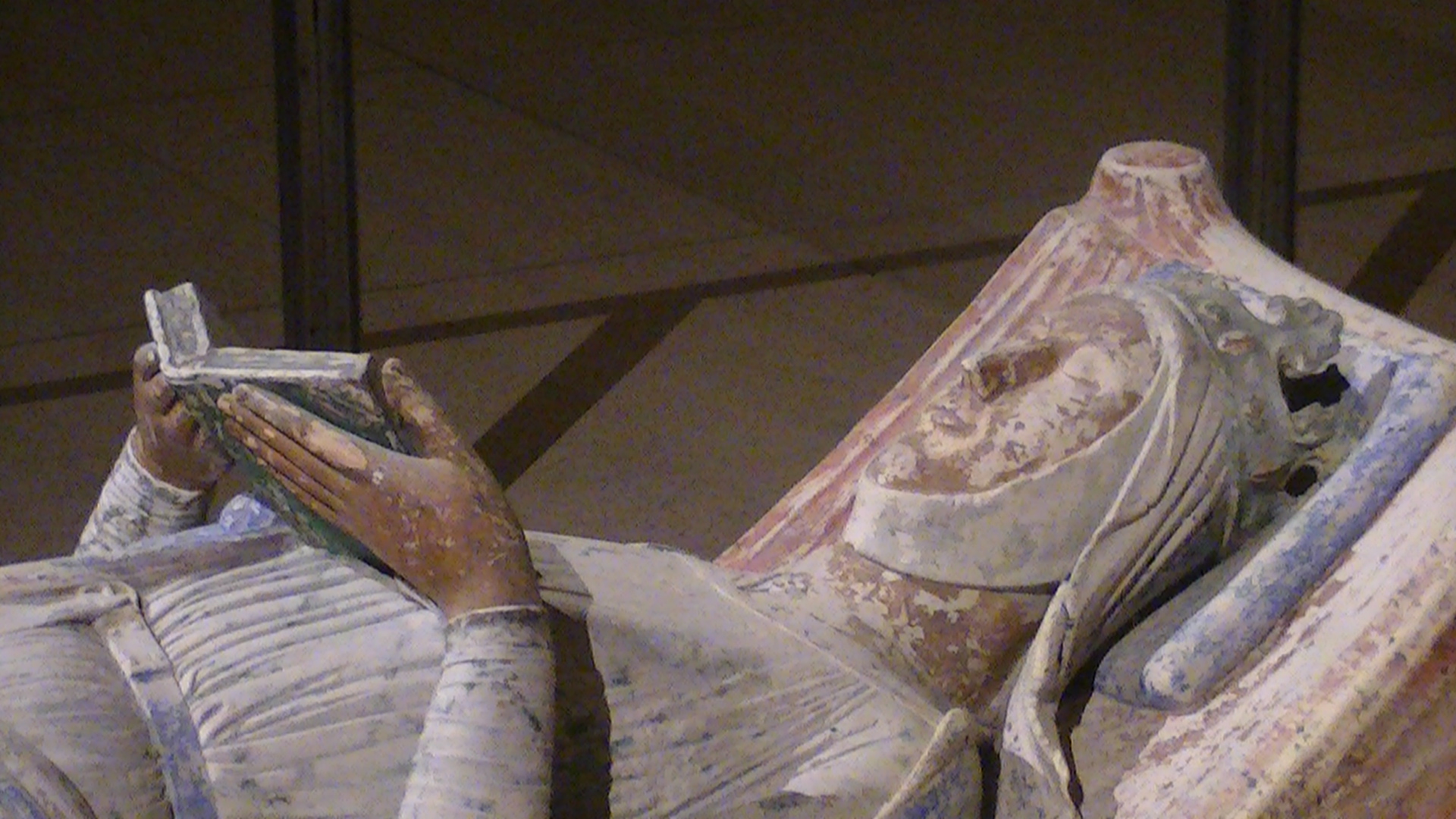
    *

    My Books

    Signed, dedicated copies of all my books are available through my online bookshop.

    Out now: Scotland’s Medieval Queens

    Books by Sharon Bennett Connolly

    Scotland’s history is dramatic, violent and bloody. Being England’s northern neighbour has never been easy. Scotland’s queens have had to deal with war, murder, imprisonment, political rivalries and open betrayal. They have loved and lost, raised kings and queens, ruled and died for Scotland. From St Margaret, who became one of the patron saints of Scotland, to Elizabeth de Burgh and the dramatic story of the Scottish Wars of Independence, to the love story and tragedy of Joan Beaufort, to Margaret of Denmark and the dawn of the Renaissance, Scotland’s Medieval Queens have seen it all. This is the story of Scotland through their eyes.

    Scotland’s Medieval Queens gives a thorough grounding in the history of the women who ruled Scotland at the side of its kings, often in the shadows, but just as interesting in their lives beyond the spotlight. It’s not a subject that has been widely covered, and Sharon is a pioneer in bringing that information into accessible history.’ Elizabeth Chadwick (New York Times bestselling author)

    Available now from Amazon and Pen and Sword Books

    Also by Sharon Bennett Connolly:

    Books by Sharon Bennett Connolly

    Heroines of the Tudor World tells the stories of the most remarkable women from European history in the time of the Tudor dynasty, 1485-1603. These are the women who ruled, the women who founded dynasties, the women who fought for religious freedom, their families and love. Heroines of the Tudor World is now available for pre-order from Amberley Publishing and Amazon UK. Women of the Anarchy demonstrates how Empress Matilda and Matilda of Boulogne, unable to wield a sword themselves, were prime movers in this time of conflict and lawlessness. It shows how their strengths, weaknesses, and personal ambitions swung the fortunes of war one way – and then the other. Available from Bookshop.orgAmberley Publishing and Amazon UKKing John’s Right-Hand Lady: The Story of Nicholaa de la Haye is the story of a truly remarkable lady, the hereditary constable of Lincoln Castle and the first woman in England to be appointed sheriff in her own right. Available from all good bookshops Pen & Sword Booksbookshop.org and Amazon

    Defenders of the Norman Crown: The Rise and Fall of the Warenne Earls of Surrey tells the fascinating story of the Warenne dynasty, from its origins in Normandy, through the Conquest, Magna Carta, the wars and marriages that led to its ultimate demise in the reign of Edward III. Available from Pen & Sword BooksAmazon in the UK and US, and Bookshop.orgLadies of Magna Carta: Women of Influence in Thirteenth Century England looks into the relationships of the various noble families of the 13th century, and how they were affected by the Barons’ Wars, Magna Carta and its aftermath; the bonds that were formed and those that were broken. It is now available in paperback and hardback from Pen & SwordAmazon, and Bookshop.orgHeroines of the Medieval World tells the stories of some of the most remarkable women from Medieval history, from Eleanor of Aquitaine to Julian of Norwich. Available now from Amberley Publishing and Amazon, and Bookshop.orgSilk and the Sword: The Women of the Norman Conquest traces the fortunes of the women who had a significant role to play in the momentous events of 1066. Available now from Amazon,  Amberley Publishing, and Bookshop.org.

    Alternate Endings: An anthology of historical fiction short stories including Long Live the King… which is my take what might have happened had King John not died in October 1216. Available in paperback and kindle from Amazon.

    Podcast:

    Have a listen to the A Slice of Medieval podcast, which I co-host with Historical fiction novelist Derek Birks. Derek and I welcome guests, such as Bernard Cornwell and Elizabeth Chadwick, and discuss a wide range of topics in medieval history, from significant events to the personalities involved.

    There are now over 70 episodes to listen to!

    Every episode is also now available on YouTube.

    *

    Don’t forget! Signed and dedicated copies of all my books are available through my online bookshop.

    For forthcoming online and in-person talks, please check out my Events Page.

    You can be the first to read new articles by clicking the ‘Follow’ button, liking our Facebook page or joining me on TwitterThreadsBluesky and Instagram.

    ©2024 Sharon Bennett Connolly FRHistS

    Guest post: All the Queen’s Men by Carol Ann Lloyd

    Today, it is a pleasure to welcome my dear friend, Carol Ann Lloyd, to History… the Interesting Bits, with an article on the love life of Queen Elizabeth I. Carol Ann’s new book Courting the Virgin Queen: Queen Elizabeth I and Her Suitors is due to be released on 30 July by Pen and Sword. If it is anything like her first book, The Tudors By Numbers: The Stories and Statistics Behind England’s Most Infamous Royal Dynasty, it will be a fabulous read!

    “All the Queen’s Men: The Courtships of the Virgin Queen”

    Carol Ann Lloyd

    Elizabeth I, aged 14

    It’s ironic that the child of the most-married English monarch ever is the only English monarch to rule as an adult and never marry! Elizabeth I, daughter of the famous (infamous?) Henry VIII never married. But it was not for lack of options.

    The big question is “Why?” Did Elizabeth really want to marry anyone? What kept her from marrying? Did she ever intend to marry, or was she just keeping all her options open as she navigated the perilous landscape of European politics on her own?

    I think there are many ways on answering this question. Let’s start at the beginning of her reign. Elizabeth was the least likely of Henry VIII’s children to come to the throne, and when she did everyone had the same question on their mind. As the Spanish Ambassador, the Count of Feria, reflected in the early days of the reign, “The more I think over this business the more certain I am that everything depends upon the husband this woman may take.” Elizabeth was questioned about her choice of husband by her council, ambassadors, and parliament. It was considered a public not a private matter, and the queen was repeatedly encouraged and counseled to get married and produce an heir for the good of the kingdom.

    So, if everything depended on the husband her would take, what realistically were her options?

    Some people might be surprised to learn that one of her first suitors was the husband of her recently deceased sister. Philip of Spain had been married to Mary I until her death, and the couple had no children. Still committed to bringing England back into the Catholic fold, Philip believed he could marry and control Elizabeth. I was surprised as I read his correspondence how convinced Philip was that Elizabeth was desperate for a husband and eager for his offer. Many Catholics never accepted the validity of the marriage between Henry VIII and Anne Boleyn, so Elizabeth’s hold on the throne was possibly tenuous. Philip believed he was the answer to Elizabeth’s problem. He thought she would jump at the chance.

    Robert Dudley, Earl of Leicester

    Philip could not have been more wrong. Elizabeth knew very well that Philip would seek to involve England in Spain’s wars, as he had during Mary I’s reign. Using her skills in language, Elizabeth dallied with Feria and postponed giving a firm answer until it suited her. That answer was a definite “no.”

    The offer from Philip was only the beginning. I discovered in my research that Elizabeth used the many marriage possibilities as a way of strengthening her position with the international community. She managed to keep several foreign leaders eager for an alliance with England and a marriage with her. Over the years, the king of Sweden, European dukes and archdukes, and even all three of Catherine de Medici’s sons in France were offered as possible husband. And that doesn’t take into account the Scottish and English nobles who wanted to marry the queen.

    Speaking of men in England, was it really Robert Dudley who kept Elizabeth from marrying? He most likely was the love of her life, perhaps the only man she might have married if she had not been the queen. He was at the center of her life, from the day she learned Mary I had died, and she was queen. He became Elizabeth’s Master of the Horse, which meant he was always with her when she went riding, one of her favorite activities. And he was the only man in the kingdom with permission to touch the queen as he helped her onto and off horse.

    Queen Elizabeth I

    Even with Dudley’s favored position, there were a few problems in the way. For one thing, he was married. And then his wife died in very suspicious circumstances, making a future marriage potentially devastating for Elizabeth’s reputation. Dudley was unpopular among the council. And ultimately, I believe Elizabeth meant what she is reported to have shouted at him in anger: “I will have but one mistress here and no master.”

    So, did everything depend upon the husband Elizabeth took? Yes, it turns out it did. I realized through the research that the one suitor that Elizabeth courted throughout her reign was the husband she had declared herself wed to when she became queen: her country and her people. Early in her reign, Elizabeth had responded to parliament’s request that she marry by responding that she was “already bound unto a husband which is the kingdom of England.” From the time she became queen, Elizabeth wooed her nation and her people, seeking their approval, favor, and love. That was the husband she took, and it meant everything to her.

    About the book:

    The many courtships of the woman who became Elizabeth I began when she was an infant, displayed before foreign ambassadors who considered her as a possible clause of a contract between England and France. From such an unromantic beginning, Elizabeth grew to see her father marry multiple times and experienced frequent changes in stepmothers and status in the family. Eventually, she became the most eligible woman in Europe. From start to finish, her marriage prospects were as much political as they were personal.

    When she came to the throne in 1558, the primary question facing everyone from foreign monarchs to English nobles and ministers was which of her many suitors would finally win her hand. Through the longest Tudor reign, Elizabeth used courtship as a tool to consider foreign alliances, hold ambitious English courtiers in check, and navigate her role as a woman ruler in a world that considered her unnatural without a man at her side.

    Elizabeth was, in fact, always the ‘Virgin Queen’, from the early days as a twenty-five-year-old presenting herself as a potential royal bride to her final years as an ageing and unmarried woman who was destined to end the Tudor dynasty. Ultimately, she became the only monarch in England to rule as an adult and never marry. Through it all, as friends and potential lovers faded away, she clung to the one true love of her life: England.

    Courting the Virgin Queen: Queen Elizabeth I and Her Suitors is available from Pen and Sword and Amazon.

    About the author:

    Carol Ann Lloyd turned an obsession with the Tudors into a speaking and writing career. She shares her love of history with Smithsonian Associates, Royal Oak Foundation, Agecroft Hall, Folger Shakespeare Library and other organizations. She holds degrees in Literature and Education and hosts a popular podcast, _British History: Royals, Rebels, and Romantics_. She also offers workshops about using Shakespeare strategies to improve communication skills and is a member of National Speakers Association.

    *

    My Books

    Signed, dedicated copies of all my books are available through my online bookshop.

    OUT NOW! Heroines of the Tudor World

    Heroines of the Tudor World tells the stories of the most remarkable women from European history in the time of the Tudor dynasty, 1485-1603. These are the women who ruled, the women who founded dynasties, the women who fought for religious freedom, their families and love. These are the women who made a difference, who influenced countries, kings and the Reformation. In the era dominated by the Renaissance and Reformation, Heroines of the Tudor World examines the threats and challenges faced by the women of the era, and how they overcame them. From writers to regents, from nuns to queens, Heroines of the Tudor World shines the spotlight on the women helped to shape Early Modern Europe.

    Heroines of the Tudor World is now available for pre-order from Amberley Publishing and Amazon UK.

    Also by Sharon Bennett Connolly:

    Women of the Anarchy demonstrates how Empress Matilda and Matilda of Boulogne, unable to wield a sword themselves, were prime movers in this time of conflict and lawlessness. It shows how their strengths, weaknesses, and personal ambitions swung the fortunes of war one way – and then the other. Available from Bookshop.orgAmberley Publishing and Amazon UKKing John’s Right-Hand Lady: The Story of Nicholaa de la Haye is the story of a truly remarkable lady, the hereditary constable of Lincoln Castle and the first woman in England to be appointed sheriff in her own right. Available from all good bookshops Pen & Sword Booksbookshop.org and AmazonDefenders of the Norman Crown: The Rise and Fall of the Warenne Earls of Surrey tells the fascinating story of the Warenne dynasty, from its origins in Normandy, through the Conquest, Magna Carta, the wars and marriages that led to its ultimate demise in the reign of Edward III. Available from Pen & Sword BooksAmazon in the UK and US, and Bookshop.org

    Ladies of Magna Carta: Women of Influence in Thirteenth Century England looks into the relationships of the various noble families of the 13th century, and how they were affected by the Barons’ Wars, Magna Carta and its aftermath; the bonds that were formed and those that were broken. It is now available in paperback and hardback from Pen & Sword,  Amazon, and Bookshop.orgHeroines of the Medieval World tells the stories of some of the most remarkable women from Medieval history, from Eleanor of Aquitaine to Julian of Norwich. Available now from Amberley Publishing and Amazon, and Bookshop.orgSilk and the Sword: The Women of the Norman Conquest traces the fortunes of the women who had a significant role to play in the momentous events of 1066. Available now from Amazon,  Amberley Publishing, and Bookshop.org.

    Alternate Endings: An anthology of historical fiction short stories including Long Live the King… which is my take what might have happened had King John not died in October 1216. Available in paperback and kindle from Amazon.

    Podcast:

    Have a listen to the A Slice of Medieval podcast, which I co-host with Historical fiction novelist Derek Birks. Derek and I welcome guests, such as Bernard Cornwell and discuss a wide range of topics in medieval history, from significant events to the personalities involved. There are now over 40 episodes to listen to!

    *

    Don’t forget! Signed and dedicated copies of all my books are available through my online bookshop.

    For forthcoming online and in-person talks, please check out my Events Page.

    You can be the first to read new articles by clicking the ‘Follow’ button, liking our Facebook page or joining me on Twitter and Instagram.

    ©2024 Sharon Bennett Connolly FRHistS