Guest Post: Was Harold of Royal Lineage? by Paula Lofting

What do you do when 3 friends have books coming out all on the same day? You arrange a mini blog tour, of course. Myself, Paula Lofting and Samantha Wilcoxson all have new non-fiction books published this week, with Pen & Sword Books, so the 3 of us are hosting each other across our blogs, with an article and an interview from each. And I’m kicking us off today.

It is a pleasure to welcome Paula Lofting to History…the Interesting Bits with an article on Harold Godwinson – King Harold II. Paula’s first foray into the realm of non-fiction, Searching for the Last Anglo-Saxon King, is now available.

Was Harold Godwinson of Royal Lineage
Some enthusiasts of the period have been quite taken with the idea that Harold Godwinson was able to trace his ancestry back to Æthelwulf, King of the West Saxons. The original idea came from historian, Alfred Anscombe, and later, genealogist, Lundie W. Barlow. It was taken up as authentic by author Frank Barlow, who has written many works on the period. From his book The House of Godwin, we can read his take on this. Through the will of Prince Æthelstan, son and heir of Æthelred the Unready, we are able pinpoint the man referred to as ‘Godwin, son of Wulfnoth’ being the father of Godwin. According to Frank Barlow, Lundie Barlow (no relation) studied the descent of some of the estates that Wulfnoth held. By treating Wulfnoth, as the son of Æthelmӕr Cild, ealdorman of the western provinces, Anscombe and Lundie believed that the Sussex thegn inherited Compton from his mother, suggesting that the royal blood was passed on through her.

But there is an issue with this theory. To make sense of the concept that Harold was descended from the royal House of Wessex, it was pertinent to explore theories that concern two males named Æthelmær. Both could be said to be candidates for Harold’s great-grandfather. The first Æthelmӕr listed in Anscombe and Lundie’s family tree we shall refer to as Cild. This chap was the son of Æthelweard the historian shown on the modified Anscombe/Barlow family tree.
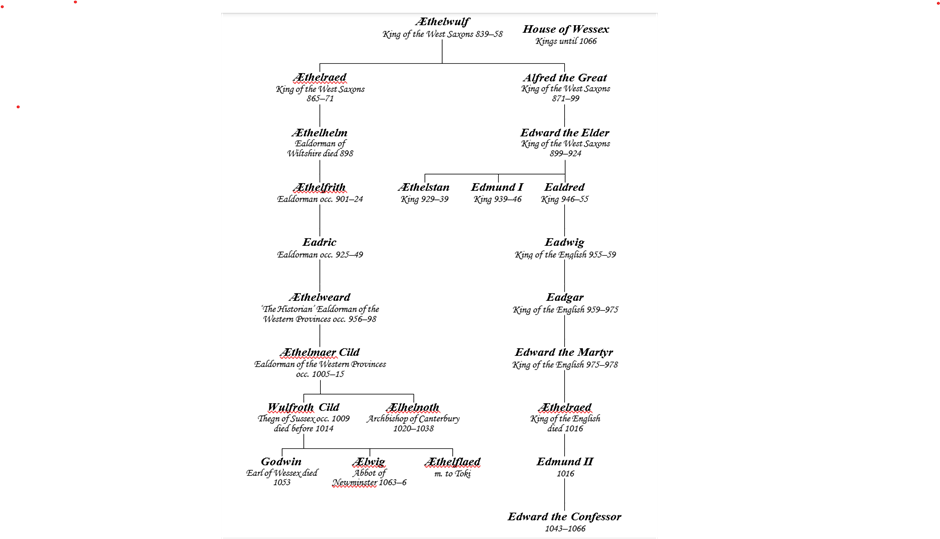
This theory can be easily dispelled, for Æthelmær Cild was alive and active in the same generation as Wulfnoth himself, making him too young to have fathered Wulfnoth. Secondly, the interests of Æthelweard and Æthelmӕr Cild were concentrated in the areas west of Wessex, whilst Wulfnoth is specifically noted in the Anglo-Saxon Chronicle as a ‘Sussex thegn’.

The other Æthelmær, whom we shall refer to as Æthelmær Two, was one of several brothers of the infamous ealdorman, Eadric Sreona. Now their father was a man called Æthelric. The theory that this particular Æthelmær was the father of Wulfnoth Cild, originated with John of Worcester, which seems to have caused the confusion that led to Anscombe, then Lundie, being convinced that he was the father of Wulfnoth.

There is also a problem with this Æthelmær, as we shall see. Eadric and his brothers were the sons of a man called Æthelric and not Æthelweard the Historian, said to be the patriarch of the previous Æthelmær Cild, whose pedigree can be traced back to former kings of Wessex. Confused? Yes, so was I. But there is more.
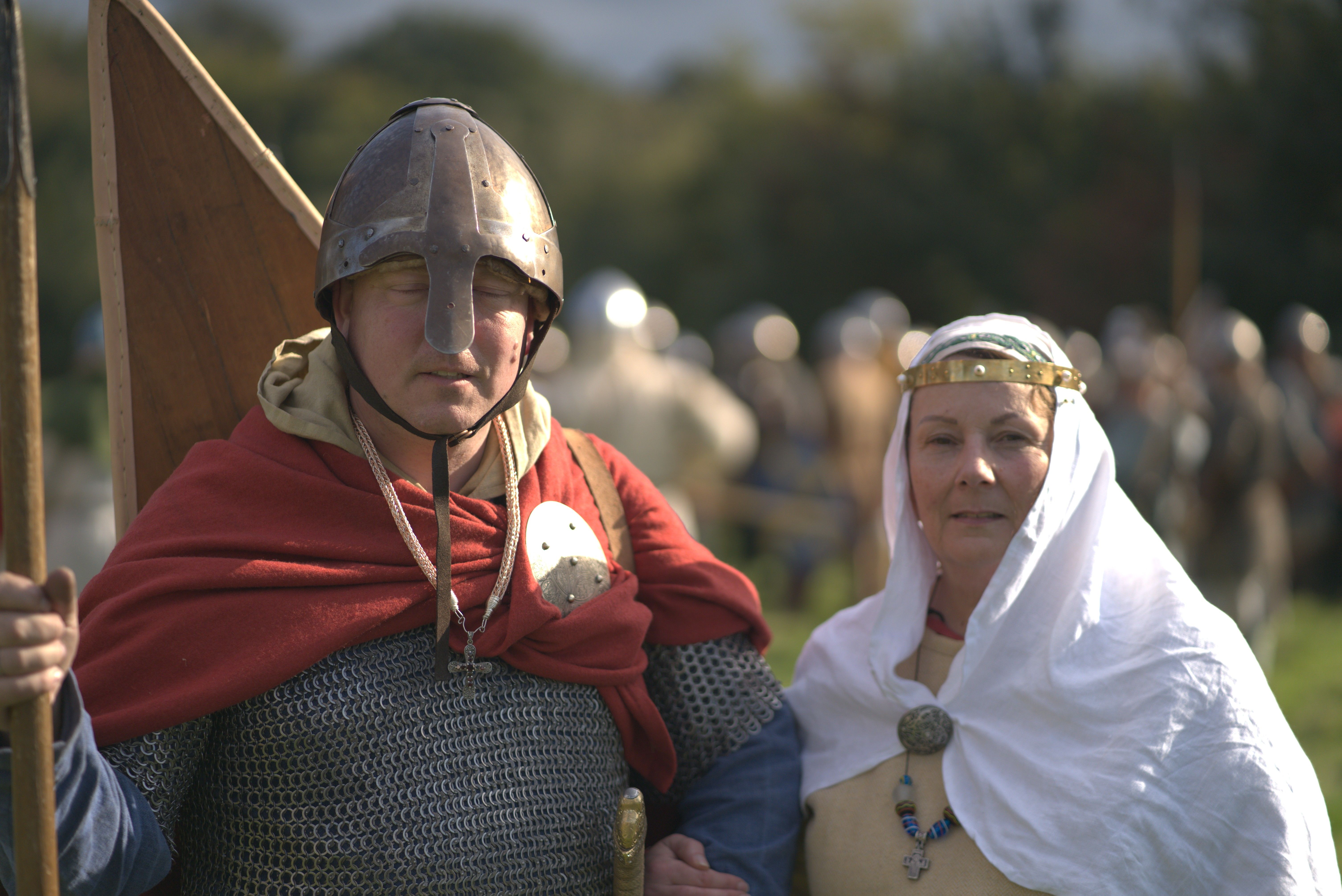
‘Gytha and Godwin’ portrayed by me and Jeppe Christensen

Through the will left by Æthelstan, we have identified that Earl Godwin, (d. 1053) was the son of Wulfnoth Cild and Harold Godwinson’s father. Nothing is known of Godwin’s mother, but he has been cautiously accredited with possible siblings. One such sibling being the lady Æthelflӕd, named in the family tree that Barlow cites in his book. This woman was the owner of land in Buckinghamshire and was married to a man called Toki. The estate was gifted to his wife by her father, a man called Wulfnoth, who was connected to Godwin’s son, Leofwin, who held the estate thirty years later. This does not confirm, however, that this particular Wulfnoth was the chap who fathered Godwin. According to the Prosopography of Anglo-Saxon England data base, there were sixty-nine individuals with the name Wulfnoth. Most of them were in the money minting business, so it is somewhat difficult to identify the right man however the link to Godwin’s son owning the lands of Toki and Æthelflӕd is intriguing.

It has been mentioned that Godwin had a brother, Ælfwig, abbot of New Minster in Winchester. He is said to have died at Hastings and is referred to as an uncle of King Harold’s. If true, he would have been an old man to have fought in the battle, so it is unlikely he was the brother of Godwin.

As it stands it is difficult to find any solid ground for believing that the Godwinsons were of royal pedigree despite the evidence produced by A. Anscombe/L. Barlow, and Frank Barlow, and it is unrealistic to assume that the family would not have known and used it to their advantage, especially against King William the Conqueror (r. 1066‒1087). We could say it is not impossible that Harold did, and it was suppressed by the Normans, but there is no supporting evidence, which makes it doubtful. It also seems unlikely that either of the two Æthelmӕrs had fathered Wulfnoth. As Ann Williams confirms, Æthelmӕr Cild, who appears in the royal family’s tree, was of the same generation as Wulfnoth. Furthermore, he was from Devonshire. Wulfnoth was referred to as a Sussex thegn by the E version of the Anglo- Saxon Chronicle (ASC).
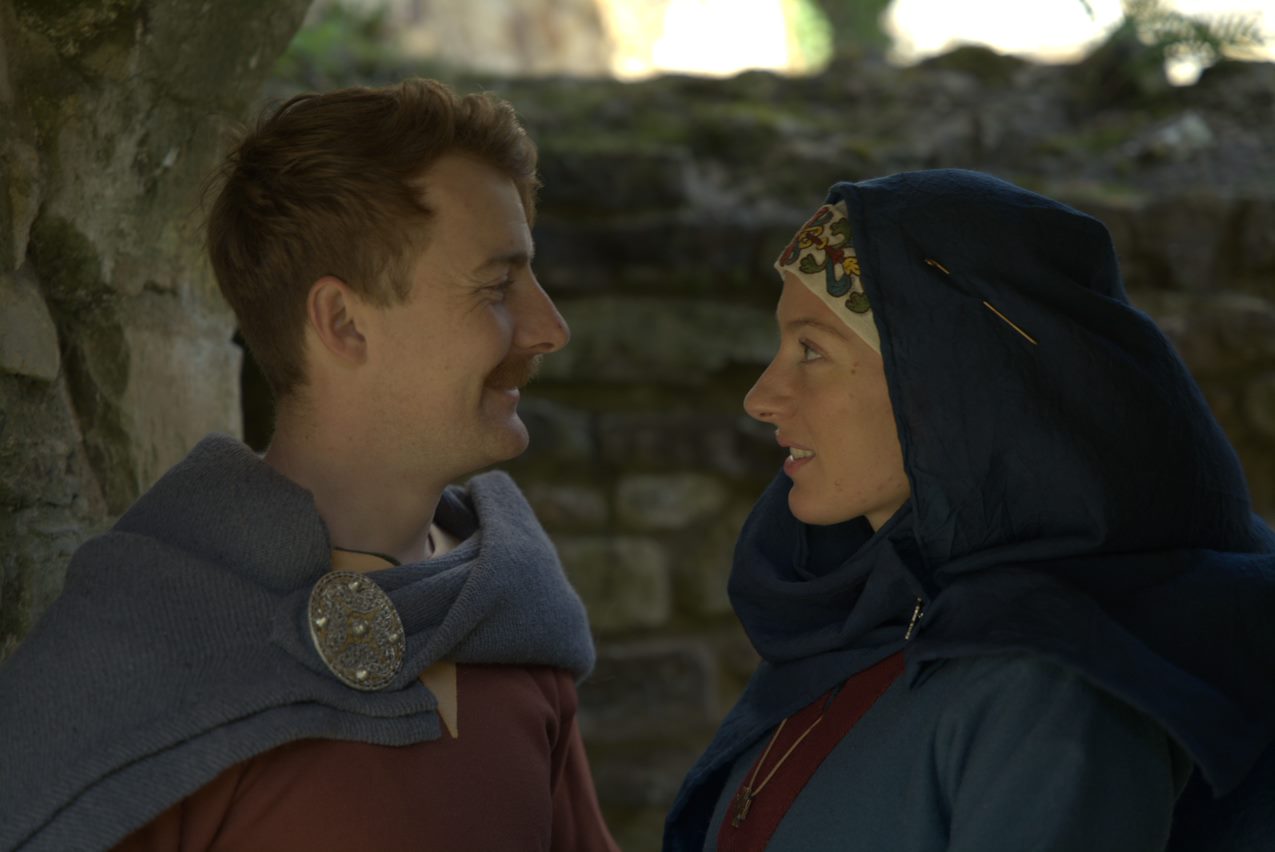
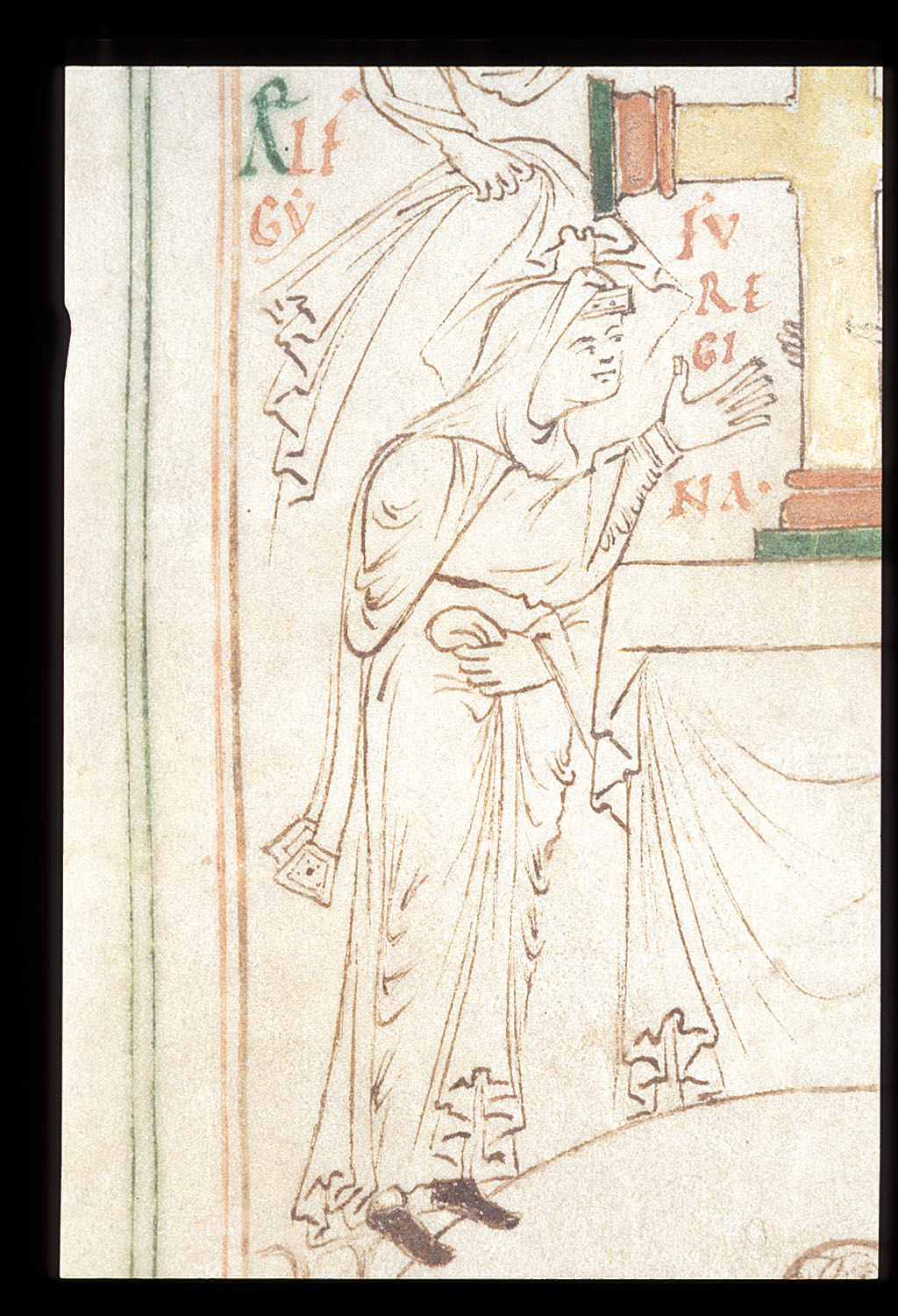
Harold and Eadith

Æthelmӕr number two, can also be discounted because the father of this Æthelmӕr was called Æthelric and Æthelmӕr Cild’s father was known as Æthelweard. Also, number two does not appear in the royal family tree of Wessex, suggesting that he had no royal heritage at all. He was also of the same generation as Wulfnoth. As we see, there is nothing to connect either Æthelmӕr with Wulfnoth, apart from an error made by John of Worcester, which many historians confuse as the same Æthelmӕr.

In contrast to efforts made to prove Anscombe’s and (Lundie) Barlow’s theory correct, Peter Rex, in his book on Harold’s life, refers to the Hyde Chronicle which describes Godwin as a man of low birth. This is not a contemporary source and was written in the thirteenth century for the de Warennes, whose dislike of Godwin is evident. Alternative stories of a ‘lowly’ Godwin’s rise to fame speak of him as a farmer’s boy, who, whilst cow–herding, came across a Dane called Ulf, lost and detached from his men after the Battle of Sherston. Godwin offered to help him, and a grateful Ulf took him into his service. These tales have more to do with myth than anything based in reality and do not account for Godwin being left land in Æthelstan’s will which is a whole other story for another time.
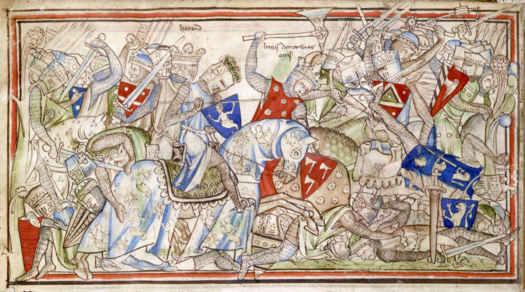
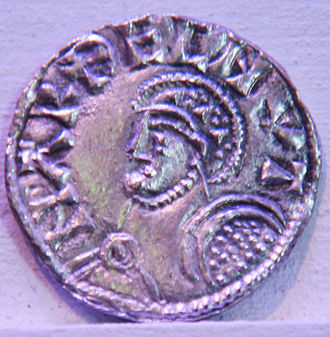
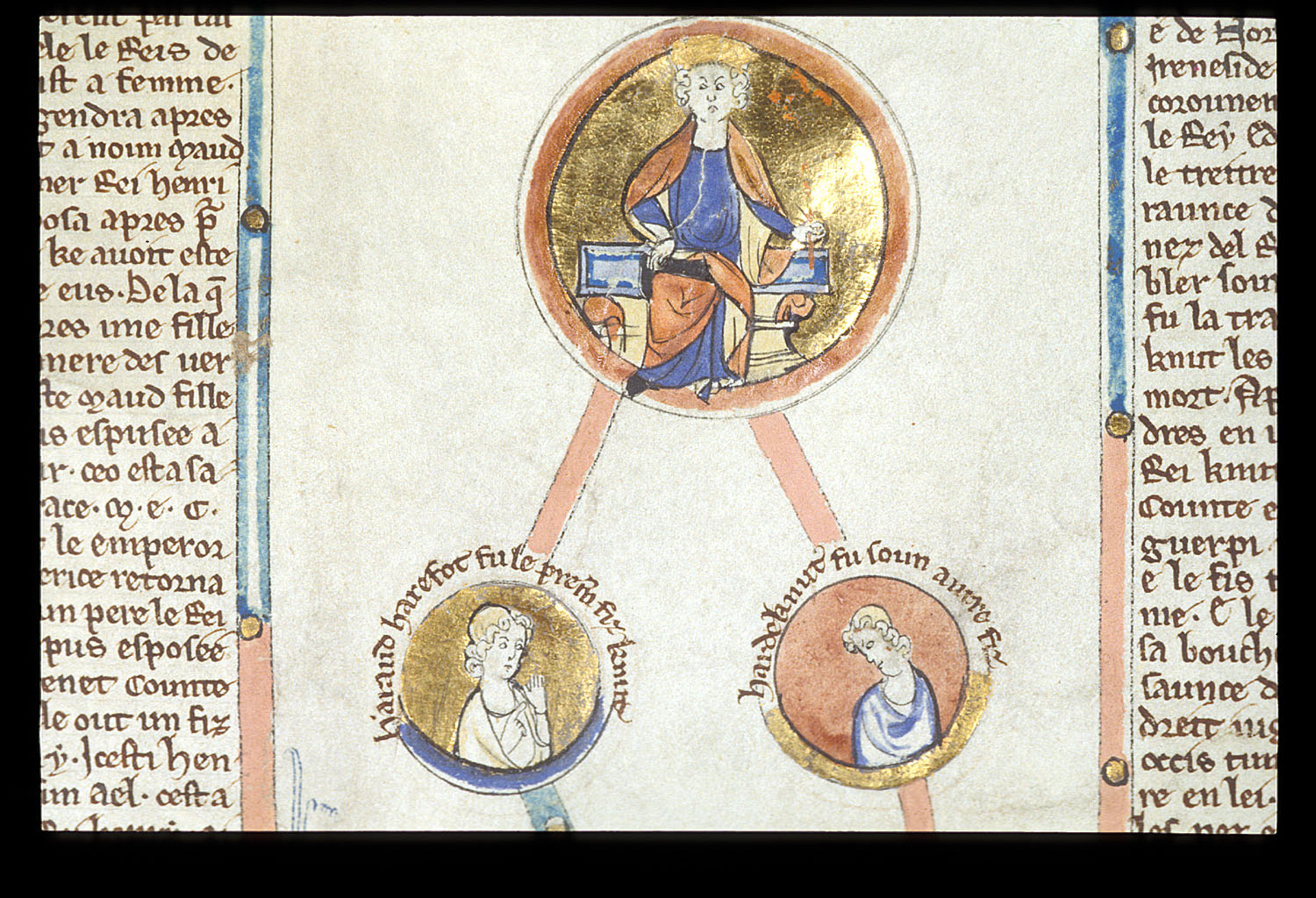
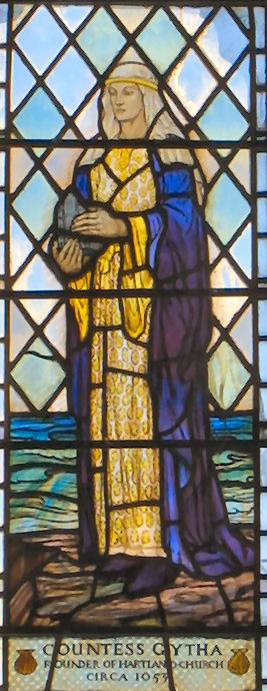
You might say that not having English royal pedigree should have dismissed Harold from any right the throne. He was not the son of a king, and therefore this lack of royal blood would have discounted him. In fact, Harold was descended from royal stock. It was just not the right one. His mother, Gytha, was the daughter of the fascinatingly named Thorgils Sprakaleggr (strut leg) who was the grandson of Harold Bluetooth making Gytha the great granddaughter of a King of Denmark and Norway and a second cousin of King Cnut the Great. So, although Harold was of royal lineage, it wasn’t the right one. Therefore, we could give the same consideration to Duke William of Normandy, who fought against King Harold and claimed victory over him on the 14 October 1066. But William had no connection to England, or the lands or the language. The boy Edgar Ætheling, who had been proclaimed as Edward’s heir was too young to face the invasions threatening Anglo-Saxon England. A strong leader was what was needed at the time, and royal blood or not, Harold was that man.

Do look out for the continuation of the blog tour tomorrow on Threads to the Past

*

About the book:
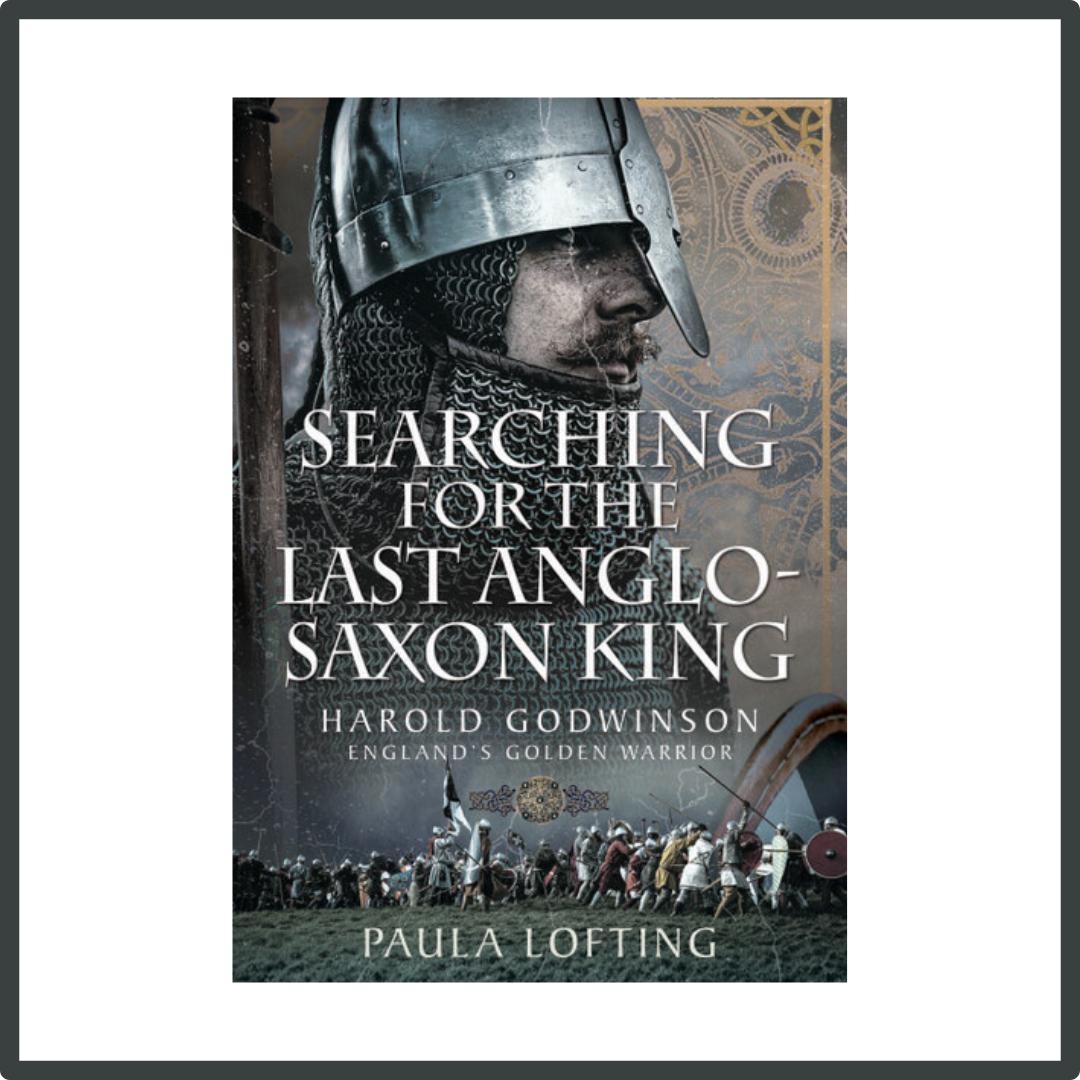
Harold Godwinson occupied his place in the chronicles for more than twenty years after bursting onto the political sphere when he was barely out of his teens. His role in English history has always been overshadowed by his failure to defend his crown and country against the might of William the Conqueror and his invaders. His demise at the hands of a Franco-Norman hit squad wrought the death knell of Anglo-Saxon rule. Reigning for just ten months, Harold’s accomplishments as dux Anglorum, and later king of England, were undermined by the Norman propaganda that was waged against his memory, long after his grisly end in 1066.

But just who was this man, who some historians recall as one of England’s greatest rulers? What were his origins? Is there any truth that he could trace his ancestry to the House of Wessex, and did he really usurp the throne from Duke William, the Bastard of Normandy? In this re-examining of this great historical figure of the eleventh century, we glean new theories and ideas not only about Harold’s life, but also questions historians have pondered upon for years. Did Edward really offer the throne to William? And how much of William’s claim was truth or fiction?

Paula Lofting presents a thoughtful and careful critique of the previous research. Examining his life through a telescopic view of the primary sources, she offers the reader a more accurate evaluation of who he was, how he died, and what happened to his remains after his death on a field near Hastings on October 1066.

About the author:

Paula Lofting is the author of an eleventh-century saga, Sons of the Wolf, and is working on book three in the series. She has also written articles for magazines like Historical Times and contributed to Iain Dale’s recent Kings and Queens with an essay on Edmund Ironside. Lofting’s love for Anglo-Saxon/Viking/Norman re-enactment with Regia Anglorum is a great tool for her writing. She is also a psychiatric nurse with nineteen years’ experience and enjoys spending time with her family, three grown-up children and two grandchildren. This is Lofting’s first foray into the realms of historical non-fiction, and she hopes it will not be her last. She also has been commissioned to write a biography on Edmund Ironside with Pen & Sword which is currently in progress.

Website : www.threadstothepast.com, Fb: https://www.facebook.com/Wulfsuna?locale=en_GB, Instagram: https://www.instagram.com/paulaloftingwilcox/, x: https://x.com/longshippub, mybook.to/Haroldpreorder

*

My Books

Signed, dedicated copies of all my books are available through my online store.

Out now: Scotland’s Medieval Queens
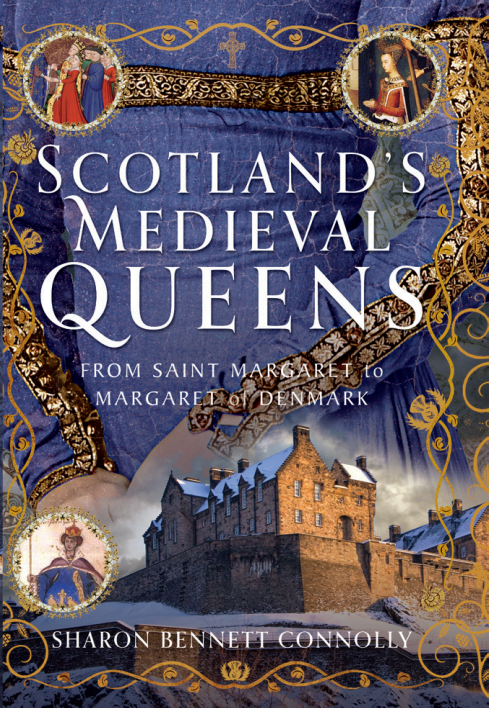
Scotland’s history is dramatic, violent and bloody. Being England’s northern neighbour has never been easy. Scotland’s queens have had to deal with war, murder, imprisonment, political rivalries and open betrayal. They have loved and lost, raised kings and queens, ruled and died for Scotland. From St Margaret, who became one of the patron saints of Scotland, to Elizabeth de Burgh and the dramatic story of the Scottish Wars of Independence, to the love story and tragedy of Joan Beaufort, to Margaret of Denmark and the dawn of the Renaissance, Scotland’s Medieval Queens have seen it all. This is the story of Scotland through their eyes.

Available now from Amazon and Pen and Sword Books

Also by Sharon Bennett Connolly:
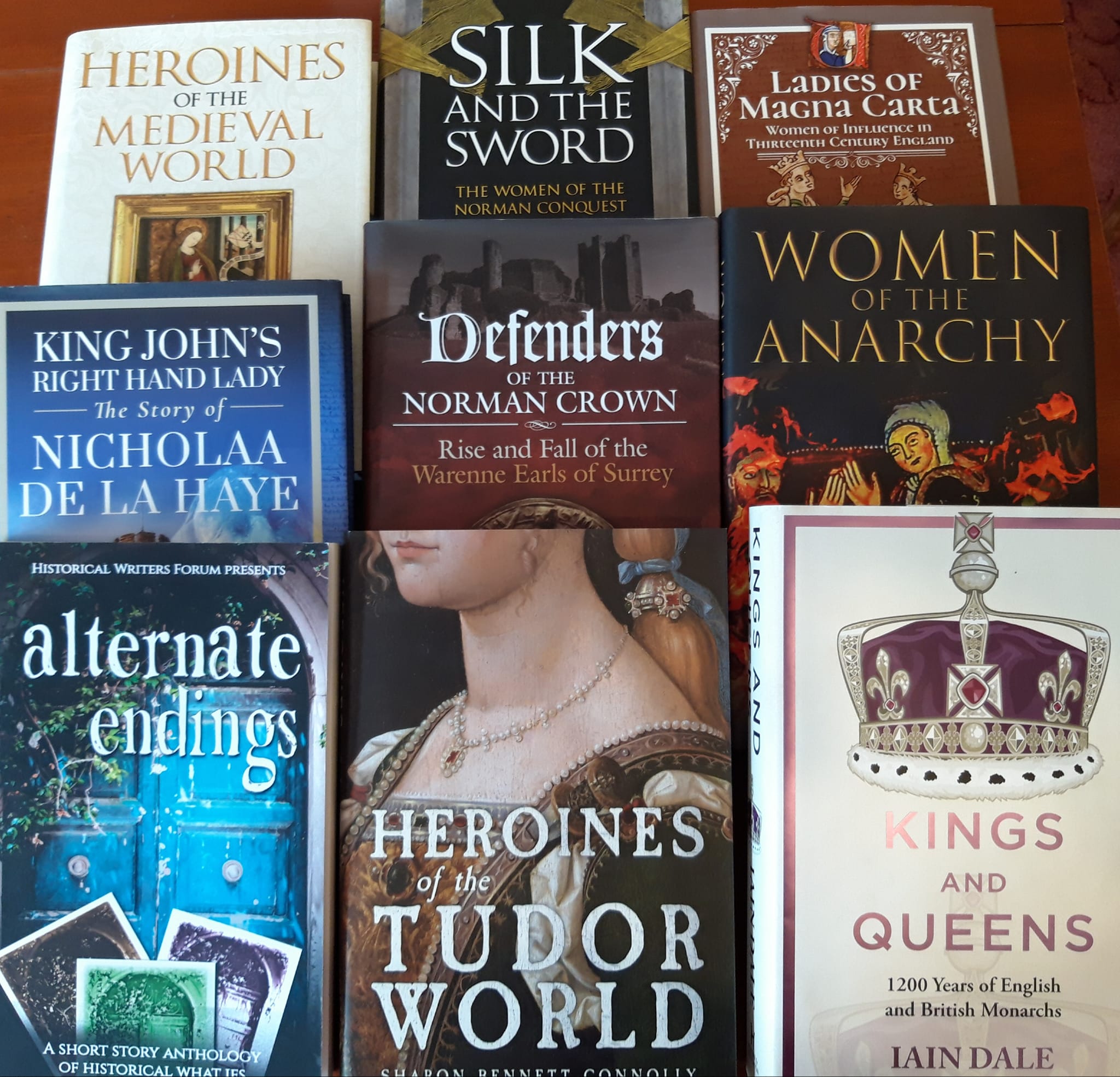
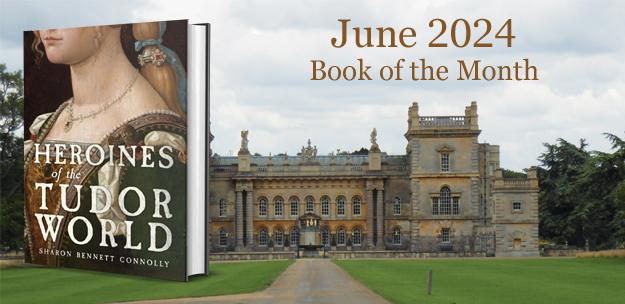
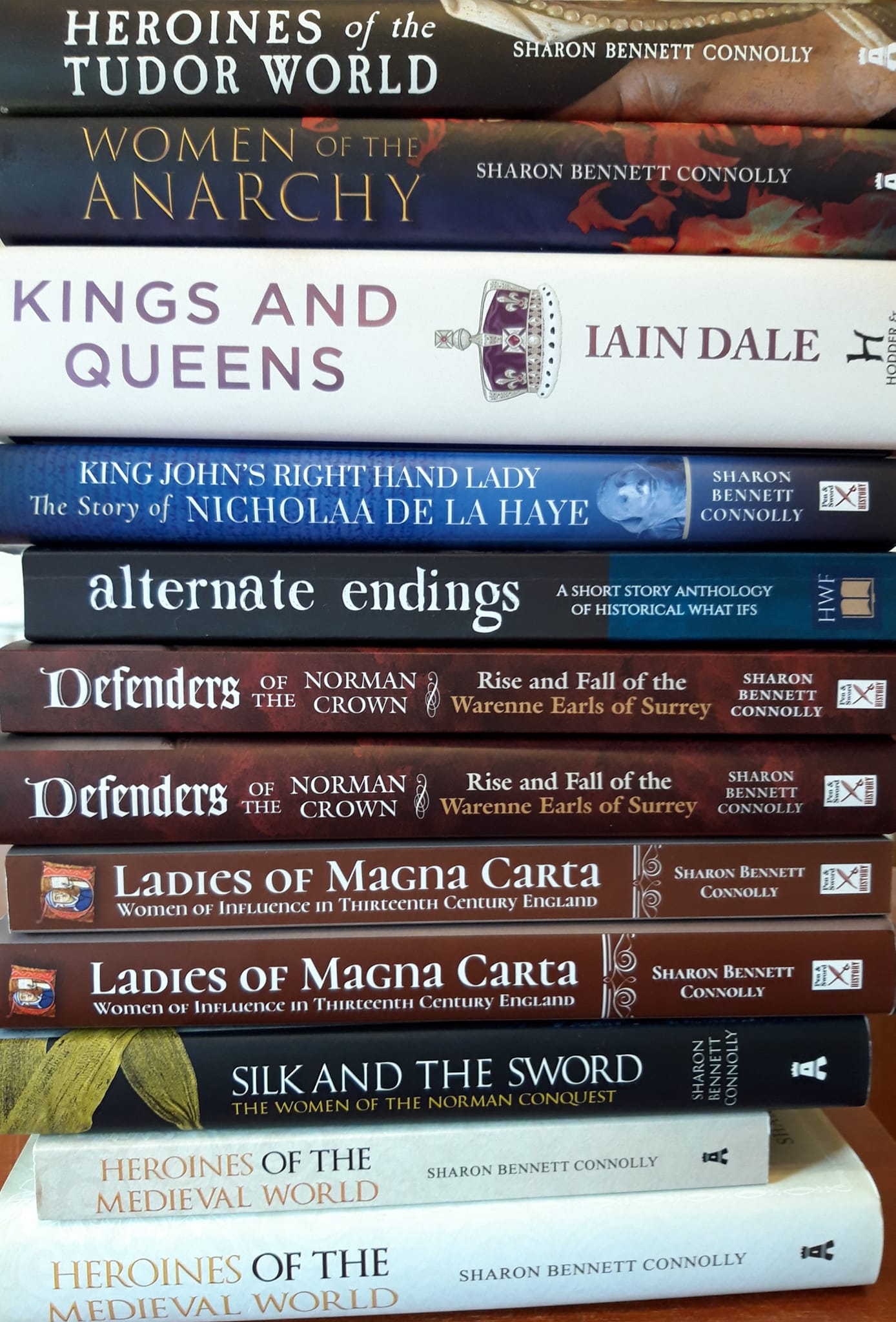
Heroines of the Tudor World tells the stories of the most remarkable women from European history in the time of the Tudor dynasty, 1485-1603. These are the women who ruled, the women who founded dynasties, the women who fought for religious freedom, their families and love. Heroines of the Tudor World is now available for pre-order from Amberley Publishing and Amazon UK. Women of the Anarchy demonstrates how Empress Matilda and Matilda of Boulogne, unable to wield a sword themselves, were prime movers in this time of conflict and lawlessness. It shows how their strengths, weaknesses, and personal ambitions swung the fortunes of war one way – and then the other. Available from Bookshop.orgAmberley Publishing and Amazon UKKing John’s Right-Hand Lady: The Story of Nicholaa de la Haye is the story of a truly remarkable lady, the hereditary constable of Lincoln Castle and the first woman in England to be appointed sheriff in her own right. Available from all good bookshops Pen & Sword Booksbookshop.org and Amazon

Defenders of the Norman Crown: The Rise and Fall of the Warenne Earls of Surrey tells the fascinating story of the Warenne dynasty, from its origins in Normandy, through the Conquest, Magna Carta, the wars and marriages that led to its ultimate demise in the reign of Edward III. Available from Pen & Sword BooksAmazon in the UK and US, and Bookshop.orgLadies of Magna Carta: Women of Influence in Thirteenth Century England looks into the relationships of the various noble families of the 13th century, and how they were affected by the Barons’ Wars, Magna Carta and its aftermath; the bonds that were formed and those that were broken. It is now available in paperback and hardback from Pen & SwordAmazon, and Bookshop.orgHeroines of the Medieval World tells the stories of some of the most remarkable women from Medieval history, from Eleanor of Aquitaine to Julian of Norwich. Available now from Amberley Publishing and Amazon, and Bookshop.orgSilk and the Sword: The Women of the Norman Conquest traces the fortunes of the women who had a significant role to play in the momentous events of 1066. Available now from Amazon,  Amberley Publishing, and Bookshop.org.

Alternate Endings: An anthology of historical fiction short stories including Long Live the King… which is my take what might have happened had King John not died in October 1216. Available in paperback and kindle from Amazon.

Podcast:
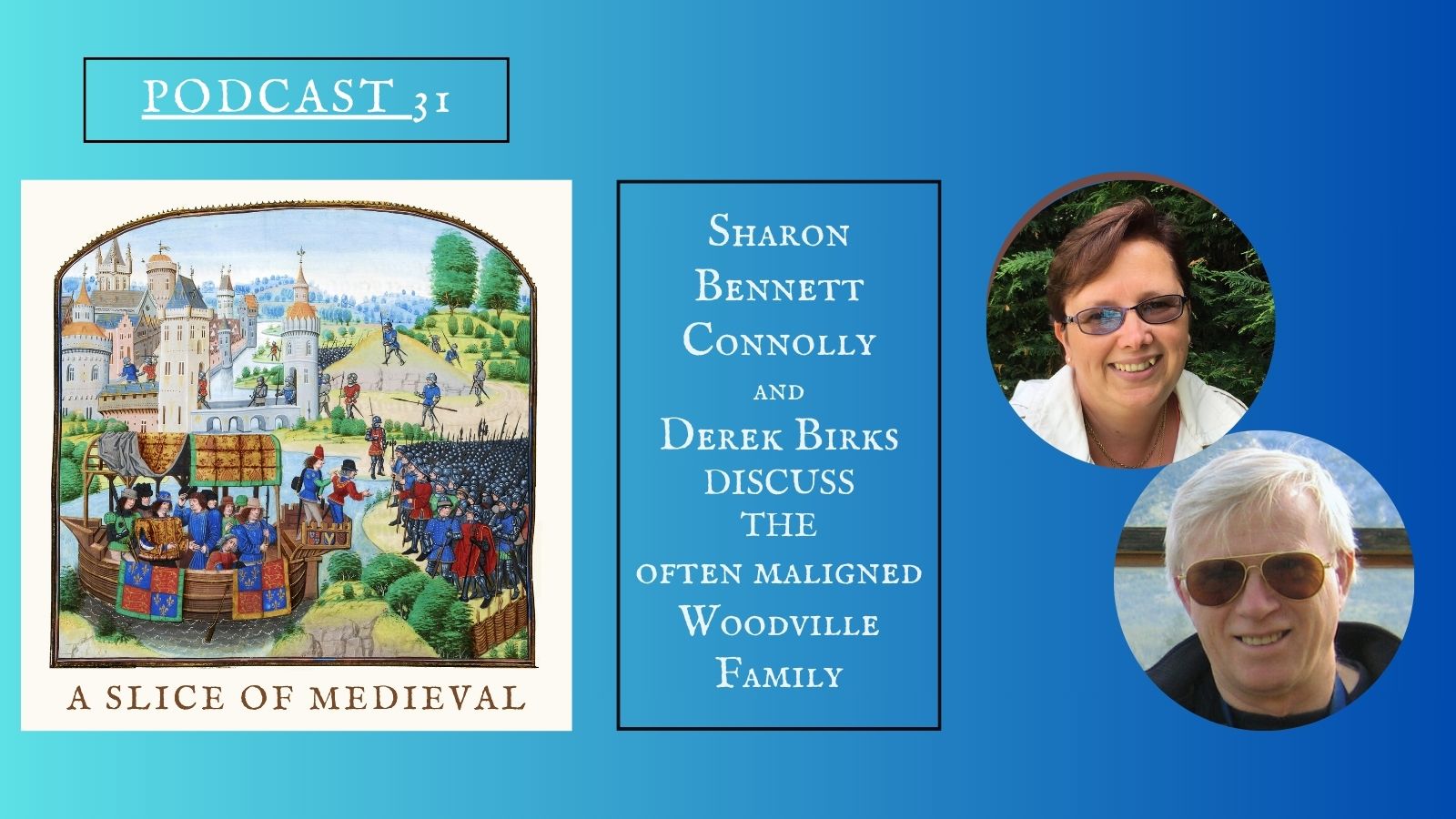
Have a listen to the A Slice of Medieval podcast, which I co-host with Historical fiction novelist Derek Birks. Derek and I welcome guests, such as Bernard Cornwell, and discuss a wide range of topics in medieval history, from significant events to the personalities involved. Every episode is also now available on YouTube.

*

Don’t forget! Signed and dedicated copies of all my books are available through my online store.

For forthcoming online and in-person talks, please check out my Events Page.

You can be the first to read new articles by clicking the ‘Follow’ button, liking our Facebook page or joining me on TwitterThreadsBluesky and Instagram.

*

©2025 Sharon Bennett Connolly FRHistS and Paula Lofting
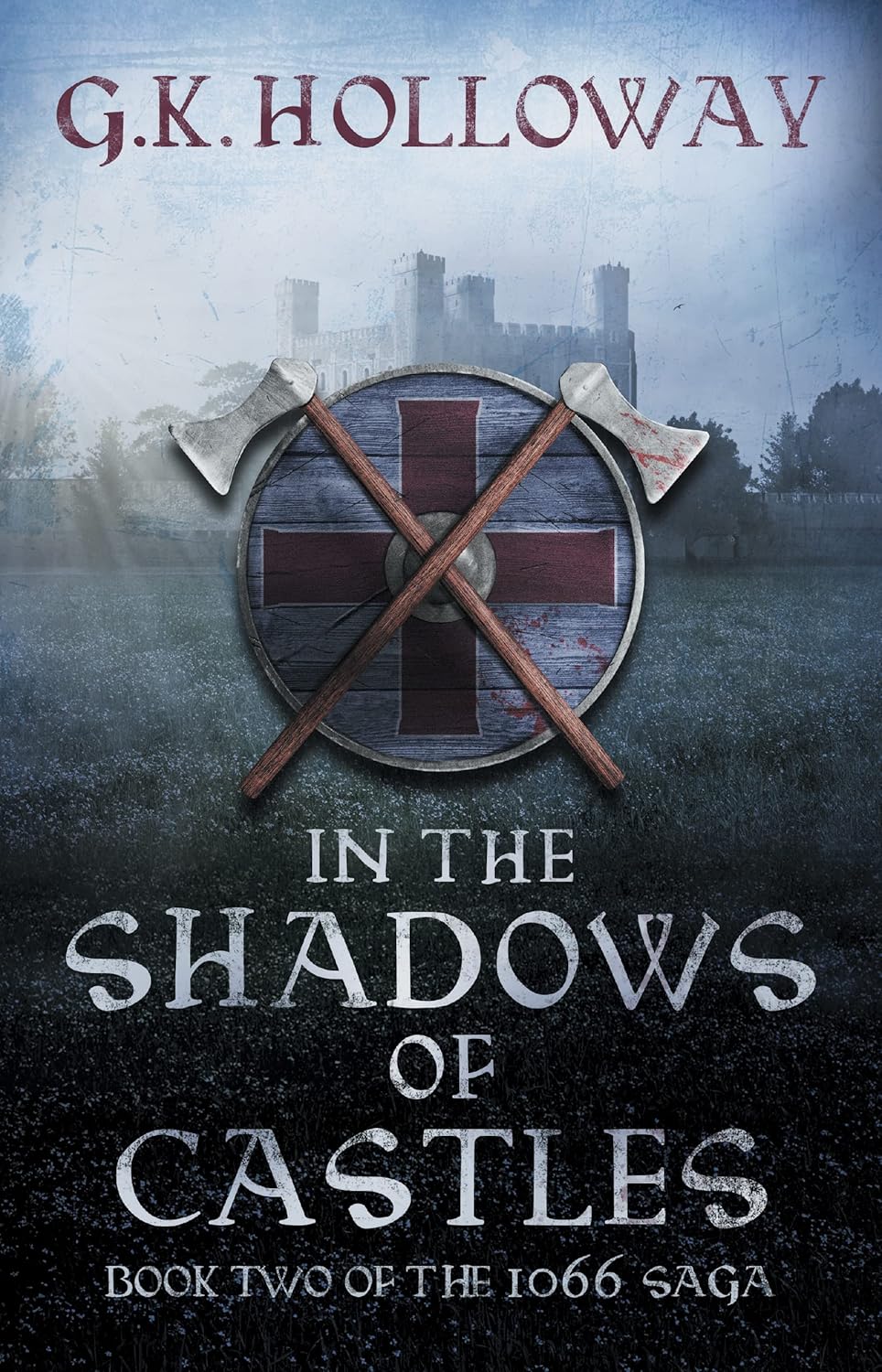
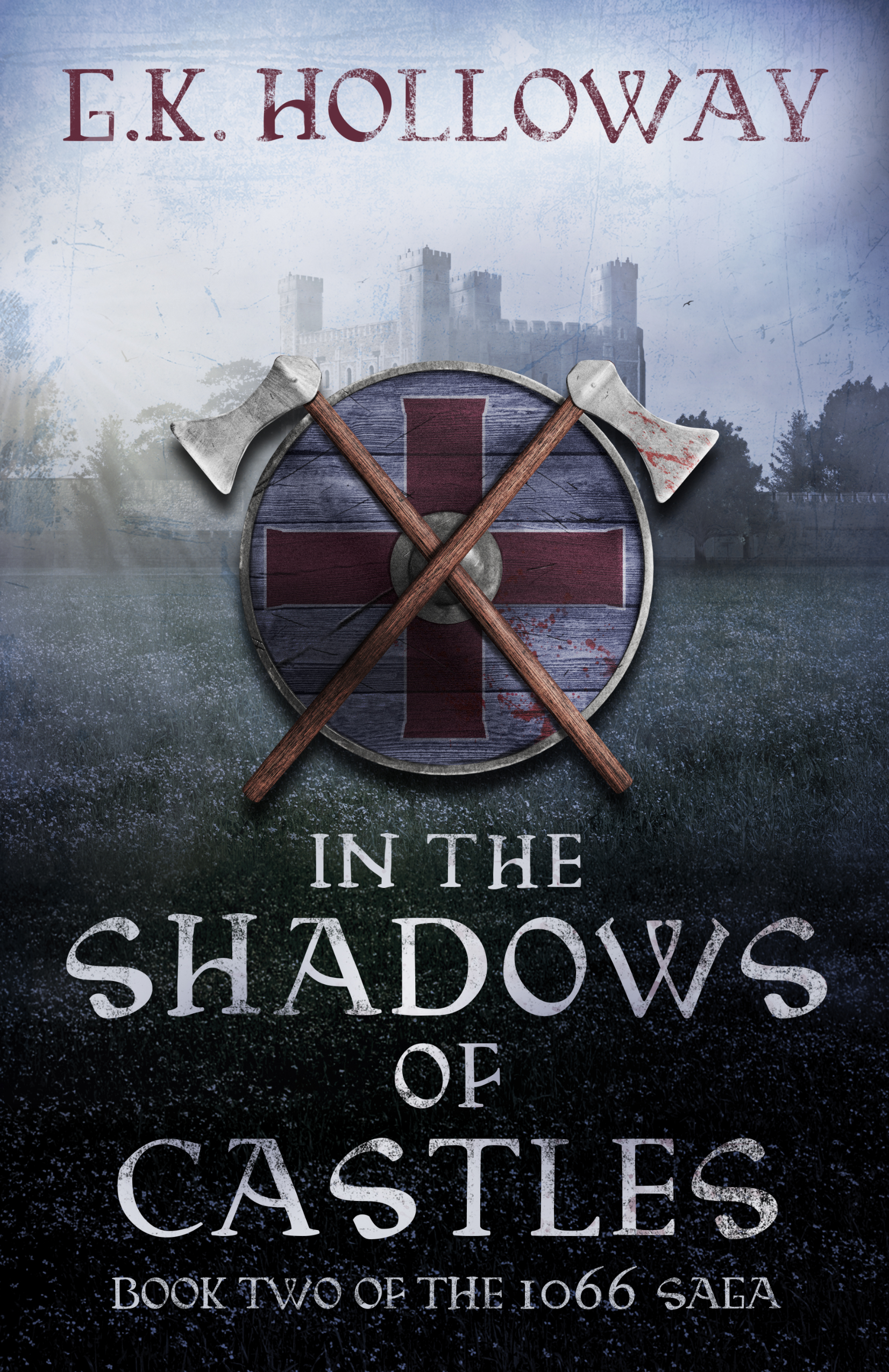
Book Corner: In the Shadows of Castles by G.K. Holloway

It’s the 1060s, and William of Normandy is establishing a new and brutal regime in England, but there are those who would defy him. As Norman soldiers spread like a plague across the land, resistance builds, but will it be enough to topple William and restore the rightful king to his throne? The English have the courage to fight, but the Normans, already victorious at Hastings, now build castles seeking to secure their tenuous foothold in these lands.

And what of the people caught up in these catastrophic events? Dispossessed but not defeated, their lives ripped apart, the English struggle for freedom from tyranny; amongst them, caught up in the turmoil, are a soldier, a thane and two sisters. As events unfold, their destinies become intertwined, bringing drastic changes that alter their lives forever.

Firmly embedded in the history of the Conquest, ‘In the Shadows of Castles’ is ultimately a story of love, hope and survival in a time of war.

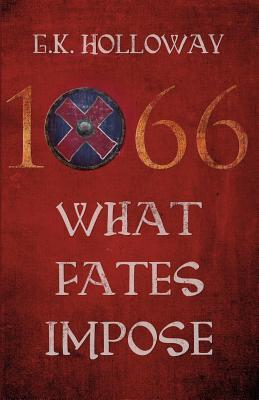
A few years ago I read and reviewed G.K. Holloway’s fabulous novel 1066: What Fates Impose. It was the story of the most fateful year in English history, of Harold II, William the Conqueror and the Norman Conquest of England. The story revolved around the relationship between William and Harold and their ultimate, fatal confrontation at the Battle of Hastings. In the Shadows of Castles opens where 1066: What Fates Impose ended, with the English defeated and William the Conqueror receiving the submission of England’s earls and the atheling Edgar, who had hoped to take the crown himself.

In the Shadows of Castles feels more personal than did 1066: What Fates Impose. It is less concerned with the great events in history and concentrates more on the life and experience of Bondi, a housecarl who had been in the service of King Harold and was now a part of the English ‘resistance’. Bondi’s experiences in trying to halt the wholesale takeover of England contrast with King William’s systematic replacement of English lords with Norman ones and of handing out the lands, of those English killed at Hastings, to hie faithful followers.

In the Shadows of Castles follows the experiences of the English resistance, which culminates in the Harrying of the North over the winter of 1069-1070. The English fight back wherever and whenever they can against the relentless onslaught of the Norman army. Helped – and hindered – by the Danes, Bondi and his friends are forced to become fugitives after being separated from their forces. But there are lighter moments, where Bondi finds friendship and love in those surrounding him. And support from locals who risk everything to help the cause.

By mid-afternoon, everyone in London knew of the housecarls’ fate. People wondered if the future held the same in store for them. One of those unaware of the slaughter was Bondi Wynstanton. At the Blue Anchor, a small group talked animatedly at the bar.

‘The Normans set fire to Berkamsted barracks,’ one man said.

‘What?’

‘They burned down the barracks, and no one’s left alive,’ the man said.

‘Nobody? Are you sure?’

‘I am. I’d make myself scarce,’ the man said, looking at the dragon tattoos on Bondi’s arms. ‘Go to the great hall. Somebody might help you.’

Bondi was still coming to terms with the news as he slinked across London’s back streets. The town seemed divided. One half contained the English, sullen and resentful behind their walls. The other was a Norman city, composed of two motte-and-bailey fortifications. It was as if each part of the city held the other under siege. In this atmosphere, Merleswein called the thanes together in London’s great hall. Bondi arrived just as the meeting started. It was a heated affair, acrimonious and loud.

Merleswein stood up. ‘Thank you all for coming,’ he said. Gradually, the noise abated.

‘You’re all aware of what happened the other night,’ Merleswein said. ‘We need to decide what we are to do next. I, for one, will leave London at the earliest opportunity. If you want to come with me or join me in Lincoln, you’re welcome. If you meet any housecarls, bring them with you.’

‘What of Edgar and the earls? Why aren’t they here?’ an old thane said.

‘William is keeping them close, but don’t concern yourself. They will have word of what’s happening and know they can join us if they escape.’

‘So, they are prisoners, then?’ the old thane said. ‘What are we going to do?’

‘Those who are able should go to Lincoln. William won’t bother us there. He would have to send his entire army to bring us back, and he won’t do that. When we’ve formed up there, we’ll make plans.’

‘What if we can’t get away? Some of us have families and work here,’ someone yelled.

‘All I can do for now is offer hospitality in Lincoln. Everyone is welcome,’ Merleswein said.

There was a general stir as people discussed what to do.

Merleswein took his seat and turned to Waltheof. ‘Do you think many of them will accept my invitation?’ he said.

‘No. Not unless they’ve lost everything. Those who still have a home or a business will stay here, hoping it won’t happen again. It will be those who have nothing to lose who follow you.’

While they were talking, Bondi made his way over to them.

‘Excuse me, my lord.’

Merleswein looked down at him from the dais. ‘Bondi, isn’t it?’

‘That’s right, my lord.’

‘If I were you, I’d get as far away from London as possible.’

‘I’ve considered that, so I’m going to Ireland.’

‘Why Ireland?’ Merleswein said.

‘I was there with King Harold when I was a boy. I heard his mother, Lady Gytha and Edyth, his wife, were going there to join his sons. My guess is they’ll be coming back with an atmy, so I thought I’d join them.’

‘And avenge your fallen comrades?’

G.K. Holloway brilliantly captures the confusion among the English as the implications of their defeat at Hastings dawns upon them. He expertly captures the hope, despair and confusion that must have been rife among the conquered English. He does not shy away from the hard facts and more unpleasant aspects of war, nor of conquest, especially for the women. His knowledge of the history of the period has been used to recreate the world of 1066 and the years following.

Although the Normans are the bad guys in In the Shadows of Castles it was good to see William de Warenne, one of the subjects of my own research, given a prominent role among William the Conqueror‘s retinue. Indeed, G.K. Holloway has ensured that he used historical personages wherever possible and staying true to their story, which adds a sense of authenticity to the novel.

G.K Holloway takes us on a sweeping trek through England and even into Scotland and Denmark, following the story of the conquered English and triumphant Normans. The post-Conquest years were years of struggle and betrayal on both sides and In the Shadows of Castles draws the reader into this amazing story. The characters are authentic, deep and beautifully written. You can almost imagine yourself in the Yorkshire of a thousand years ago!

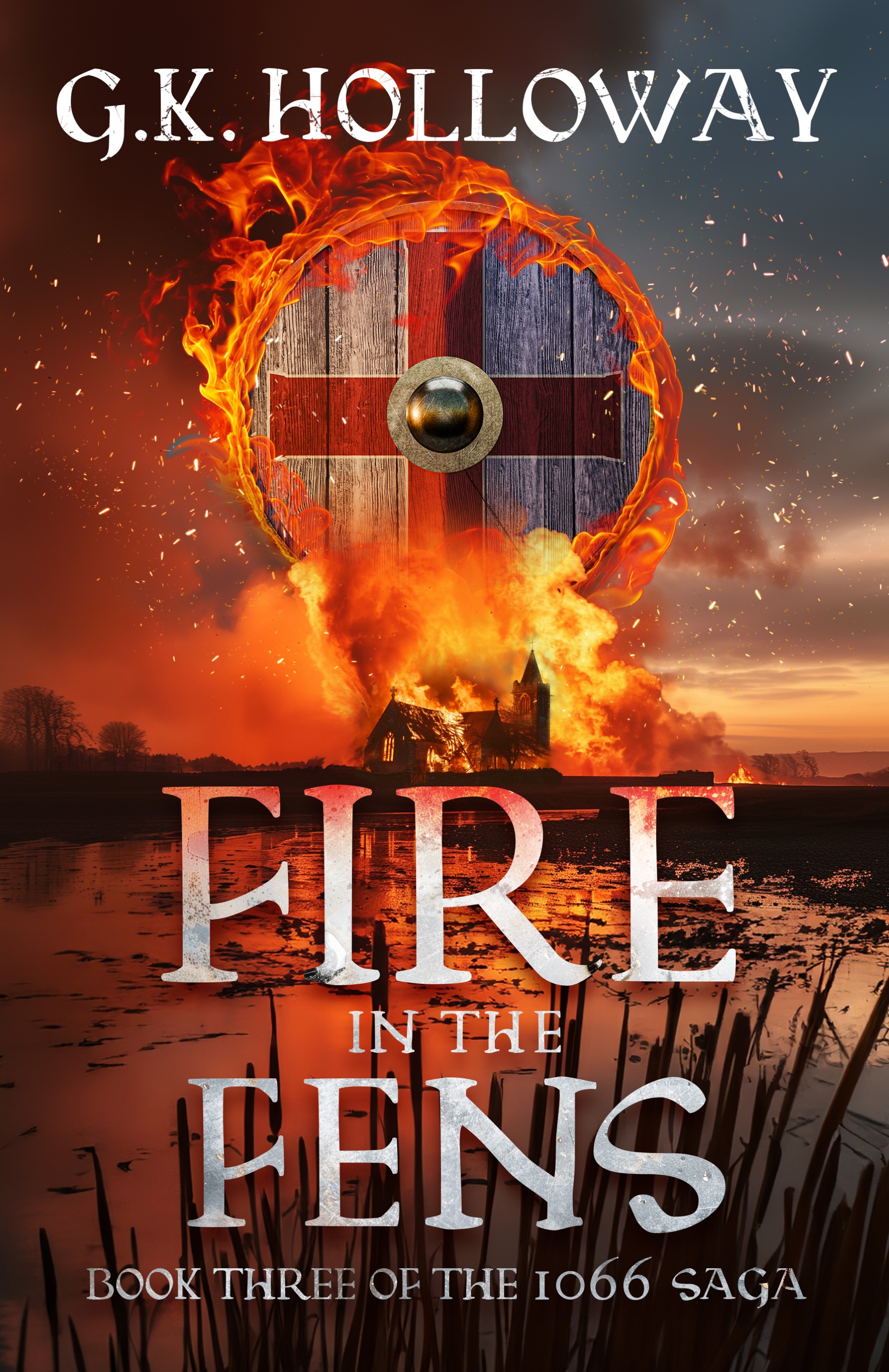
And entertaining and engaging novel, In the Shadows of Castles is an excellent read and I cannot wait to read the next instalment in the story, Fire in the Fens.

About the Author:

G. K. Holloway did several jobs after leaving school before taking A Levels at his local college and later a degree in History and Politics at Coventry University. Once he had graduated, he spent the next twenty years working in education in and around Bristol. After reading a biography about Harold Godwinson, he studied the late Anglo-Saxon era in detail and discovered a time of papal plots, court intrigues, family feuds, loyalties, betrayals, assassinations and a few battles. When he had enough material to weave together fact and fiction, he produced his award-winning novel, ‘1066: What Fates Impose’, the first in a series about the Norman Conquest. G. K. Holloway lives in Bristol with his wife and two children.

Visit G K Holloway’s website http://www.gkholloway.co.uk

GK Holloway’s books on Amazon

*

My Books

Signed, dedicated copies of all my books are available through my online bookshop.

OUT NOW! Heroines of the Tudor World

Heroines of the Tudor World tells the stories of the most remarkable women from European history in the time of the Tudor dynasty, 1485-1603. These are the women who ruled, the women who founded dynasties, the women who fought for religious freedom, their families and love. These are the women who made a difference, who influenced countries, kings and the Reformation. In the era dominated by the Renaissance and Reformation, Heroines of the Tudor World examines the threats and challenges faced by the women of the era, and how they overcame them. From writers to regents, from nuns to queens, Heroines of the Tudor World shines the spotlight on the women helped to shape Early Modern Europe.

Heroines of the Tudor World is now available for pre-order from Amberley Publishing and Amazon UK.

Also by Sharon Bennett Connolly:

Women of the Anarchy demonstrates how Empress Matilda and Matilda of Boulogne, unable to wield a sword themselves, were prime movers in this time of conflict and lawlessness. It shows how their strengths, weaknesses, and personal ambitions swung the fortunes of war one way – and then the other. Available from Bookshop.orgAmberley Publishing and Amazon UKKing John’s Right-Hand Lady: The Story of Nicholaa de la Haye is the story of a truly remarkable lady, the hereditary constable of Lincoln Castle and the first woman in England to be appointed sheriff in her own right. Available from all good bookshops Pen & Sword Booksbookshop.org and AmazonDefenders of the Norman Crown: The Rise and Fall of the Warenne Earls of Surrey tells the fascinating story of the Warenne dynasty, from its origins in Normandy, through the Conquest, Magna Carta, the wars and marriages that led to its ultimate demise in the reign of Edward III. Available from Pen & Sword BooksAmazon in the UK and US, and Bookshop.org

Ladies of Magna Carta: Women of Influence in Thirteenth Century England looks into the relationships of the various noble families of the 13th century, and how they were affected by the Barons’ Wars, Magna Carta and its aftermath; the bonds that were formed and those that were broken. It is now available in paperback and hardback from Pen & Sword,  Amazon, and Bookshop.orgHeroines of the Medieval World tells the stories of some of the most remarkable women from Medieval history, from Eleanor of Aquitaine to Julian of Norwich. Available now from Amberley Publishing and Amazon, and Bookshop.orgSilk and the Sword: The Women of the Norman Conquest traces the fortunes of the women who had a significant role to play in the momentous events of 1066. Available now from Amazon,  Amberley Publishing, and Bookshop.org.

Alternate Endings: An anthology of historical fiction short stories including Long Live the King… which is my take what might have happened had King John not died in October 1216. Available in paperback and kindle from Amazon.

Podcast:

Have a listen to the A Slice of Medieval podcast, which I co-host with Historical fiction novelist Derek Birks. Derek and I welcome guests, such as Bernard Cornwell and discuss a wide range of topics in medieval history, from significant events to the personalities involved. There’s even an episode on Robin Hood from Steven A. McKay. There are now over 40 episodes to listen to!

*

Don’t forget! Signed and dedicated copies of all my books are available through my online bookshop.

For forthcoming online and in-person talks, please check out my Events Page.

You can be the first to read new articles by clicking the ‘Follow’ button, liking our Facebook page or joining me on Twitter and Instagram.

©2024 Sharon Bennett Connolly FRHistS

Guest Post: Researching the 11th Century by G.K. Holloway

It is a pleasure to welcome novelist G.K. Holloway to History…the Interesting Bits today, to talk about the research behind his wonderful series The 1066 Saga.

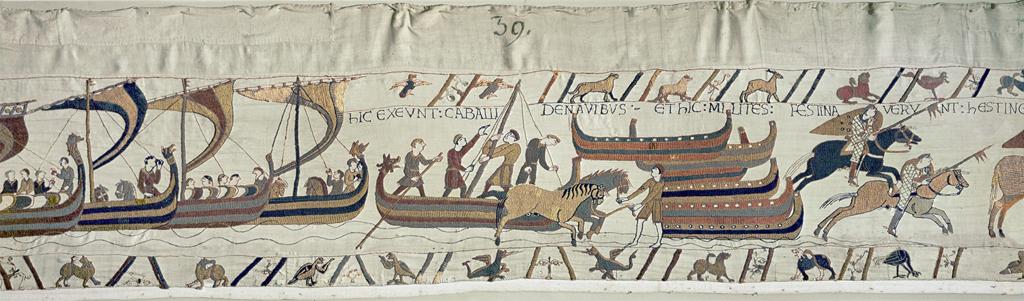
Norman invasion fleet, Bayeux Tapestry

Research for my books consists of mainly reading – books, magazines, academic papers, and blogs. It’s also good to get out a bit and visit and talking with experts, in my case locations of mainly locations of battles where I can talk with resident historians, reenactors and history fans, especially those with local knowledge.

Some of my reading consists of trawling around on the internet. It’s surprising what you can find, other than Wikipedia, as a source of material. And of course there are all sorts of groups on social media that specialise in my period in history. There are podcasts and blogs rich with information for recycling.

Books too, are an obvious place to look; the Doomsday Book is the first to spring to mind, the Anglo-Saxon Chronicle, and the Ecclesiastical History of Orderic Vitalis are useful too. But reader beware, it’s often the case with original material that objectivity wasn’t a strong point of the authors. Academic papers are nowadays can be easily accessed, although the cost of some of them is prohibitive. I’ve had read papers that have shone light into the dark recesses of history I hadn’t dreamed about. This means I’ll able to surprise readers with fascinating snippets that can give a glimpse of life a millennium ago.

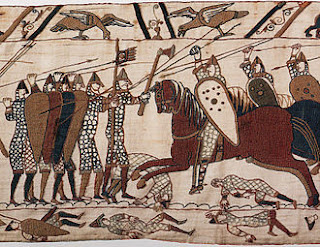
Norman cavalry at the Battle of Hastings

Thank heavens for You Tube. There is a wealth of information to be found here, and a lot of it from top quality presenters and historians.

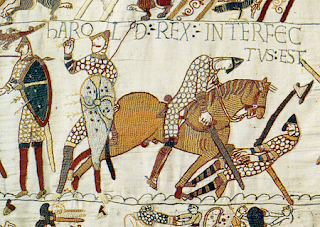
It’s not just what you see but what you don’t see that can be important. A prime example of this is the Bayeux Tapestry. It’s the closet you’ll get to newsreel footage of events covering the Norman Invasion. The full horror of war is not shied away from, burning houses, screaming women, decapitated soldiers and a horse running amok amongst dead bodies, all in glorious colour. But just as in modern times, news can be censored and people and events can be ’air brushed’ out of history, so too, it was the case way back then.

What remains of the well preserved embroidery, that’s correct, it is not a tapestry, is a sight to behold and worth a visit to Normandy to see. It’s surprising how colourful it is even after almost a thousand years. The imagery is clear and easy to follow but some scenes are missing. The story is told accurately enough and details like the appearance of Halley’s Comet are included. However, the Battle of Stamford Bridge is nowhere to be seen. Could it be that King William didn’t want it know that the army he fought at Senlac was exhausted from several hundred miles of marching and a huge battle against the biggest Norse army ever to have set foot in England. There is no depiction of the Battle of London Bridge, or the violence committed by his rampaging troops during his coronation. History has been, ‘cleaned up a bit,’ to the advantage of the victors. Nothing new there then.

Death of King Harold in the Bayeux Tapestry

It’s always a good idea to visit key locations. It’s one thing to look at maps and photographs but when you find yourself looking across the lagoons at Bosham, wandering around the castle at Falaise, starring up at Clifford’s Tower in York, or watching a reenactment at Battle Abbey, a much more realistic picture forms in your mind about what it must have been like to live all that time ago. To boost one’s knowledge it’s always a good idea to talk to reenactors; most of them have an encyclopaedic knowledge of the time period and especially their character’s part in it. Whether it be as a soldier, arrowsmith or seamstress.

Doing all the above is a great way of researching the history, but if like me, you write historical fiction rather than non-fiction, you would do well to read a good book. One I could recommend if, Story by Robert McKee. He deals with scriptwriting but it’s quite easy to apply his ideas to novels. You could also spend a lot of money and quite a bit of time on a creative writing course, but you might be better off getting a good editor.

So there you have it. Use as many sources as you can, and you’ll find many a nugget amongst the raw material.

1066: What Fates Impose

England is in crisis. King Edward has no heir and promises never to produce one. There are no obvious successors available to replace him, but quite a few claimants are eager to take the crown. While power struggles break out between the various factions at court, enemies abroad plot to make England their own. There are raids across the borders with Wales and Scotland.

Harold Godwinson, Earl of Wessex, is seen by many as the one man who can bring stability to the kingdom. He has powerful friends and two women who love him, but he has enemies will stop at nothing to gain power. As 1066 begins, England heads for an uncertain future. It seems even the heavens are against Harold.

In the Shadows of Castles

It’s the 1060s, and William of Normandy is establishing a new and brutal regime in England, but there are those who would defy him. As Norman soldiers spread like a plague across the land, resistance builds, but will it be enough to topple William and restore the rightful king to his throne? The English have the courage to fight, but the Normans, already victorious at Hastings, now build castles seeking to secure their tenuous foothold in these lands.

And what of the people caught up in these catastrophic events? Dispossessed but not defeated, their lives ripped apart, the English struggle for freedom from tyranny; amongst them, caught up in the turmoil, are a soldier, a thane and two sisters. As events unfold, their destinies become intertwined, bringing drastic changes that alter their lives forever.

Firmly embedded in the history of the Conquest, ‘In the Shadows of Castles’ is ultimately a story of love, hope and survival in a time of war.

About the Author:

1066 What Fates Impose, won the Gold Medal in the 2014 Wishing Shelf Independent Book Awards – Adult Fiction.

G K Holloway left university in 1980 with a degree in history and politics. After spending a year in Canada, he relocated to England’s West Country and began working in Secondary Education. Later he worked in Adult Education and then Further Education before finally working in Higher Education.

After reading a biography about Harold Godwinson, he became fascinated by the fall of Anglo Saxon England and spent several years researching events leading up to and beyond the Battle of Hastings. Eventually he decided he had enough material to make an engrossing novel. Using characters from the Bayeux Tapestry, the Norse Sagas, the Domesday Book and many other sources. He feels that he has brought the period and its characters to life in his own particular way. Following the major protagonists, as well as political, religious and personal themes, the downfall of Anglo-Saxon England is portrayed by a strong cast.

Nowadays he lives in Bristol with his wife and two children. When he’s not writing he works with his wife in their company.

1066 is his debut novel was originally published as an ebook. It has received very positive reviews and this has encouraged him to publish it in paperback. Currently he is working on a sequel. One day he hopes to write full time.

Visit G K Holloway’s website http://www.gkholloway.co.uk

GK Holloway’s books on Amazon

*

My Books:

Signed, dedicated copies of all my books are available through my online bookshop.

Out Now! Women of the Anarchy

Two cousins. On the one side is Empress Matilda, or Maud. The sole surviving legitimate child of Henry I, she is fighting for her birthright and that of her children. On the other side is her cousin, Queen Matilda, supporting her husband, King Stephen, and fighting to see her own son inherit the English crown. Women of the Anarchy demonstrates how these women, unable to wield a sword, were prime movers in this time of conflict and lawlessness. It show how their strengths, weaknesses, and personal ambitions swung the fortunes of war one way – and then the other.

Available from Bookshop.orgAmberley Publishing and Amazon UK.

Coming on 15 June 2024: Heroines of the Tudor World

Heroines of the Tudor World tells the stories of the most remarkable women from European history in the time of the Tudor dynasty, 1485-1603. These are the women who ruled, the women who founded dynasties, the women who fought for religious freedom, their families and love. These are the women who made a difference, who influenced countries, kings and the Reformation. In the era dominated by the Renaissance and Reformation, Heroines of the Tudor World examines the threats and challenges faced by the women of the era, and how they overcame them. From writers to regents, from nuns to queens, Heroines of the Tudor World shines the spotlight on the women helped to shape Early Modern Europe.

Heroines of the Tudor World is now available for pre-order from Amberley Publishing and Amazon UK.

Also by Sharon Bennett Connolly:

King John’s Right-Hand Lady: The Story of Nicholaa de la Haye is the story of a truly remarkable lady, the hereditary constable of Lincoln Castle and the first woman in England to be appointed sheriff in her own right. Available from all good bookshops or direct from Pen & Sword Booksbookshop.org and AmazonDefenders of the Norman Crown: The Rise and Fall of the Warenne Earls of Surrey tells the fascinating story of the Warenne dynasty, from its origins in Normandy, through the Conquest, Magna Carta, the wars and marriages that led to its ultimate demise in the reign of Edward III. Available from Pen & Sword BooksAmazon in the UK and US, and Bookshop.org

Ladies of Magna Carta: Women of Influence in Thirteenth Century England looks into the relationships of the various noble families of the 13th century, and how they were affected by the Barons’ Wars, Magna Carta and its aftermath; the bonds that were formed and those that were broken. It is now available in paperback and hardback from Pen & Sword,  Amazon, and Bookshop.orgHeroines of the Medieval World tells the stories of some of the most remarkable women from Medieval history, from Eleanor of Aquitaine to Julian of Norwich. Available now from Amberley Publishing and Amazon, and Bookshop.orgSilk and the Sword: The Women of the Norman Conquest traces the fortunes of the women who had a significant role to play in the momentous events of 1066. Available now from Amazon,  Amberley Publishing, and Bookshop.org.

Alternate Endings: An anthology of historical fiction short stories including Long Live the King… which is my take what might have happened had King John not died in October 1216. Available in paperback and kindle from Amazon.

Podcast:

Have a listen to the A Slice of Medieval podcast, which I co-host with Historical fiction novelist Derek Birks. Derek and I welcome guests, such as Bernard Cornwell and Elizabeth Chadwick, and discuss a wide range of topics in medieval history, from significant events to the personalities involved.

*

Don’t forget! Signed and dedicated copies of all my books are available through my online bookshop.

For forthcoming online and in-person talks, please check out my Events Page.

You can be the first to read new articles by clicking the ‘Follow’ button, liking our Facebook page or joining me on Twitter and Instagram.

*

©2024 GK Holloway and Sharon Bennett Connolly FRHistS.

Matilda and Edith, Women of Different Fates

History...the Interesting Bits
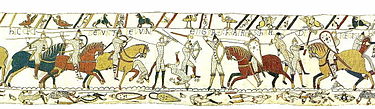
The Battle of Hastings, from the Bayeux Tapestry

Although the Battle of Hastings was fought by men, the women of the two opponents, Harold and William, had as much invested in the outcome as their husbands. The two women, however, have very different reputations. Whereas Matilda appears as the epitome of the medieval ideal woman, Edith has come down through history as ‘the other woman’. However, for both these women, their futures, and the futures of their children, were inextricably linked with the fates of the men fighting on Senlac Hill on that October morning in 1066.

Harold had met Edith Swan-neck at about the same time as he became earl of East Anglia, in 1044. Which makes it possible that Edith Swan-neck and the East Anglian magnate, Eadgifu the Fair, are one and the same. Eadgifu the Fair held over 270 hides of land and was one of the richest magnates in England. The majority of her estates lay in Cambridgeshire, but she also held land in Buckinghamshire, Hertfordshire, Essex and Suffolk; in the Domesday Book Eadgifu held the manor at Harkstead in Suffolk, which was attached to Harold’s manor of Brightlingsea in Essex and some of her Suffolk lands were tributary to Harold’s manor of East Bergholt. While it is by no means certain that Eadgifu is Edith Swan-neck several historians – including Ann Williams in the Oxford Dictionary of National Biography – make convincing arguments that they were. Even their names, Eadgifu and Eadgyth, are so similar that the difference could be merely a matter of spelling or mistranslation; indeed, the abbey of St Benet of Hulme, Norfolk, remembers an Eadgifu Swanneshals among its patrons.

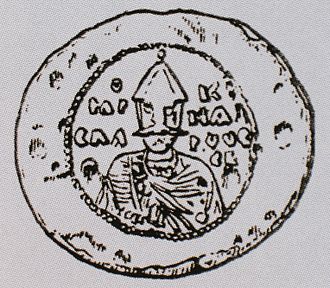
By 1065 Harold had been living with the wonderfully-named Eadgyth Swanneshals (Edith the Swan-neck) for twenty years. History books label her as Harold’s concubine, but Edith was, obviously, no weak and powerless peasant, so it’s highly likely they went through a hand-fasting ceremony – or ‘Danish marriage’ – a marriage, but not one recognized by the church, thus allowing Harold to take a second ‘wife’ should he need to. Harold and Edith had at least 6 children together; including four sons, Godwin, Edmund, Magnus and Ulf and two daughters, Gytha, who married Vladimir Monomakh, Great Prince of Kiev, and Gunnhild, was to become a nun at Wilton Abbey in Wiltshire, but never took her vows.

History...the Interesting Bits
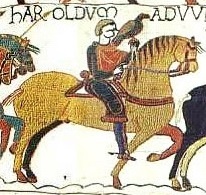
King Harold at the Battle of Hastings, from the Bayeux Tapestry

However, despite their twenty years and many children together, with the health of the king, Edward the Confessor, deteriorating, it became politically expedient for Harold to marry in order to strengthen his position as England’s premier earl and, possibly, next king. Ealdgyth was the daughter of Alfgar, earl of Mercia, and, according to William of Jumieges, very beautiful. She was the widow of Gruffudd ap Llywelyn, King of Gwynedd from 1039 and ruler of all Wales after 1055, with whom she had had at least one child, a daughter, Nest. Gruffudd had been murdered in 1063, following an expedition into Wales, some sources suggest it was by Harold himself, however Gruffudd’s own men are the chief suspects. Harold’s subsequent marriage to Ealdgyth not only secured the support of the earls of Northumbria and Mercia, but also weakened the political ties of the same earls with the new rulers of north Wales.

Rather than his loyal and loving ‘wife’, Edith, it was Ealdgyth, therefore, who was for a short time, queen of England. However, with Harold having to defend his realm, first against Harold Hardrada and his own brother, Tostig, at Stamford Bridge in September of 1066 and, subsequently, against William of Normandy at Hastings, it is unlikely Ealdgyth had time to enjoy her exalted status. At the time of the Battle of Hastings, 14th October 1066, Ealdgyth was in London, but her brothers took her north to Chester soon after. Although sources are confused it seems possible that Ealdgyth was heavily pregnant and gave birth to a son, Harold Haroldson, within months of the battle. Unfortunately, that is the last we hear of Ealdgyth; her fate remains unknown. Young Harold is said to have grown up in exile on the Continent and died in 1098.

Despite his marriage to Ealdgyth it seems Edith Swan-neck remained close to Harold and it was she who was waiting close by when the king faced William of Normandy at Senlac Hill near Hastings on 14th October 1066. She awaited the outcome alongside Harold’s mother, Gytha. Having lost a son, Tostig, just two weeks before, fighting against his brother and with the Norwegians at the Battle of Stamford Bridge, Gytha lost three more sons – Harold, Gyrth and Leofwine – and her grandson, Haakon, in the battle at Hastings.

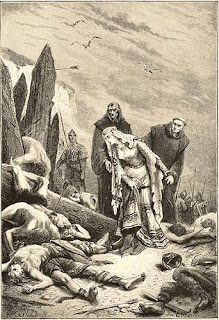
And it was Edith and the elderly Gytha, who wandered the blood-soaked field in the aftermath of the battle, in search of the fallen king. Sources say that Gytha was unable to identify her sons amidst the mangled and mutilated bodies. It fell to Edith to find Harold, by undoing the chain mail of the victims, in order to recognize certain identifying marks on the king’s body – probably tattoos. 

History...the Interesting Bits
Edith finding Harold’s body on the battlefield

The monks of Waltham Abbey had a tradition of Edith bringing Harold’s body to them for burial, soon after the battle. Although other sources suggest Harold was buried close to the battlefield, and without ceremony, it is hard not to hope that Edith was able to perform this last service for the king. However, any trace of Harold’s remains was swept away by Henry VIII’s Dissolution of the Monasteries, so the grave of England’s last Anglo-Saxon king is lost to history.

Harold’s mother, Gytha, eventually fled into exile on the Continent, taking Harold and Edith’s daughter, another Gytha, with her, possibly arranging her marriage to the prince of Smolensk and – later – Kiev. The sons of Edith and Harold fled to Ireland with all but one, living into the 1080s, though the dates of their eventual deaths remain uncertain. Gunnhild remained in her nunnery at Wilton until sometime before 1093, when she became the wife or concubine of Alan the Red, a Norman magnate. Whether or not she was kidnapped seems to be in question but when Alan died in 1093, instead of returning to the convent, Gunnhild became the mistress of Alan’s brother and heir, Alan Niger. Alan Rufus held vast lands in East Anglia – lands that had once belonged to Eadgifu the Fair and, if Eadgifu was Edith Swan-neck, it’s possible that Alan married Gunnhild to strengthen his claims to her mother’s lands.  

Of Edith Swan-neck, there is no trace after Harold is interred at Waltham Abbey, she simply disappears from the pages of history…

For Matilda, on the other hand, the Battle of Hastings marked the start of another stage of her life and career as the wife of William, duke of Normandy and, now, King of England. Matilda of Flanders was probably born around 1032, the daughter of Baldwin V, count of Flanders, and his wife, Adela, a daughter of King Robert the Pious of France. The young duke, William of Normandy, was probably pushing his luck when he proposed a marriage between himself and young Matilda. Although he was a duke and Baldwin a mere count, there was the question of his illegitimacy and Normandy was hardly the most stable of regions; William had spent all of his adult life fighting to keep hold of it. 

History...the Interesting Bits
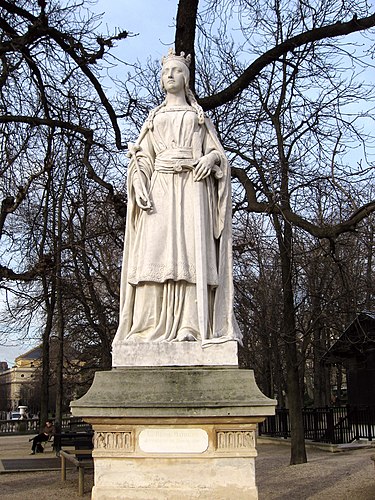
Matilda of Flanders

A later story tells of how Matilda refused to marry William, stating that, being granddaughter of a king, she was too high born to marry a bastard. William was said to be so incensed with this response that he straightaway rode to Flanders, accosted young Matilda in the street, pulling her from her horse by her braids, before hitting her and cutting her with his spurs; whereupon Matilda changed her mind and agreed to marry William. While amusing, it is highly likely that the story is an invention, and highly unlikely that Matilda was asked her opinion on the marriage. Getting to the altar was not an easy task, however, as the pope refused to allow the marriage, without giving his reasons. It is possible that the refusal was on the grounds of consanguinity, although it seems the only familial link is that William’s aunt married Matilda’s grandfather as his second wife (Matilda’s father, however, was the son of the count’s first wife, so there was no blood relationship). It seems more likely that the refusal was politically motivated, due to Count Baldwin’s support of the Lotharingian’s rebellion against Pope Leo IX’s sponsor, the Holy Roman Emperor. 

William was not to be thwarted, however, and before 1053 he married, Matilda despite the papal interdict; they were eventually ordered to establish a monastery each in penance for the marrying without papal dispensation, but the marriage was allowed to stand. In penance Matilda established the Abbaye-aux-Dames, consecrated in 1066, while William founded the Abbay-aux-Hommes, both in Caen.

The marriage between Matilda and William proved to be a strong and trusting relationship; William is one of very few medieval kings believed to have been completely faithful to his wife, no rumours of extra-marital affairs have ever been uncovered. He trusted Matilda to act as regent in Normandy during his many absences on campaign or in England. Matilda supported her husband’s proposed invasion of England, promised a great ship for William’s personal used, it was called the Mora; the ship had a figurehead of a small boy, whose right hand pointed to England and left hand held a horn to his lips.

History...the Interesting Bits
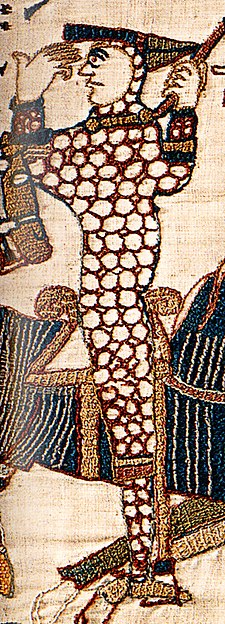
William the Conqueror from the Bayeux Tapestry

Matilda and William had a rather large family, with 4 boys and at least 4 daughters. Their eldest son, Robert Curthose, who inherited Normandy, was followed by Richard, who was killed during a hunting accident as a youth, William, known as Rufus who became King William II, and the future Henry I. Of the 4 or 5 daughters Adelida became a nun following a series of failed marriage plans, Cecilia was given to the convent of Ste Trinite as a child, Constance married Alain Fergant, duke of Brittany and Adela married Stephen of Blois; their son, another Stephen would succeed Henry I as King of England. There are suggestions of 2 further daughters, Matilda and Agatha, though evidence for their existence is highly limited.

Matilda was very close to her family, especially her eldest son, Robert, whose later antics were to cause  problems between his parents. William and Robert, father and son, were often at loggerheads, with Robert in open rebellion against his father as a young adult. Matilda was constantly trying to play the peacemaker and was so upset by one quarrel that she was ‘choked by tears and could not speak’. Even during a period of exile imposed on Robert, Matilda still supported her son as best she can; she would send him vast amounts of silver and gold through a Breton messenger, Samson. On discovering Samson’s complicity William threatened to blind the messenger and it was only through Matilda’s intervention that the Breton escaped.

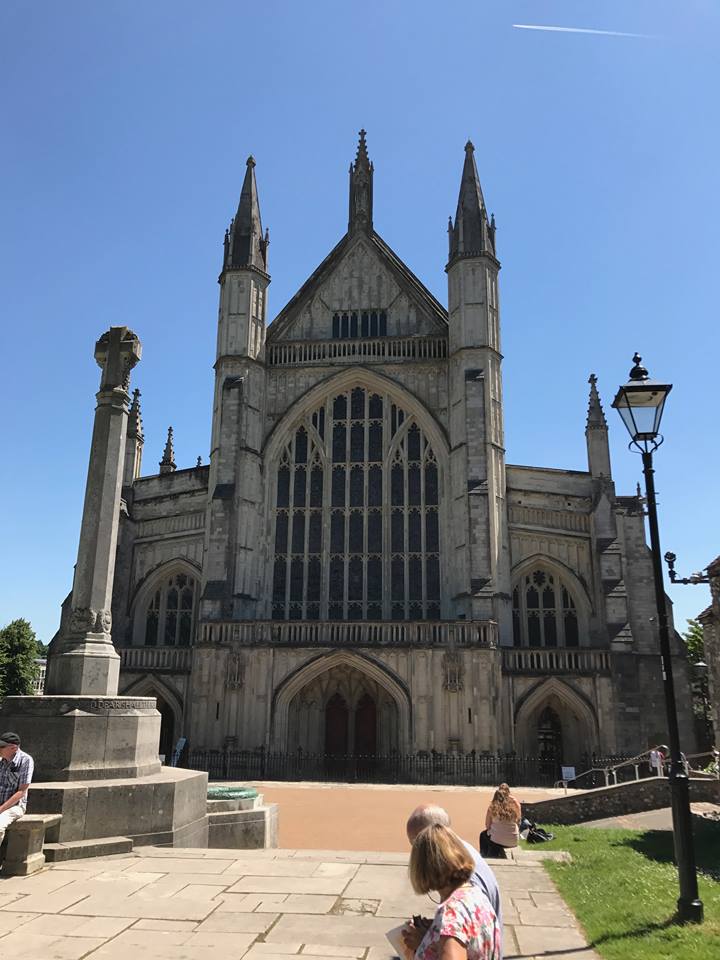
Where poor Edith Swan-neck lost almost everything at Hastings, Matilda’s star was in the ascendant, but the Conquest was not without problems and it was not until 1068 that William felt secure enough to bring his wife over to England. Matilda was crowned Queen of England in Winchester Cathedral at Pentecost in that year, although further unrest soon saw her returned to the relative safety of Normandy, where she was acting as regent for her absent husband. Matilda was one of the most active of medieval queens, standing in as an able administrator during her husband’s absences; hearing land pleas and corresponding with such as the pope, who is known to have asked her to use her influence over her husband, on occasion. She was also the driving force in holding together her family, keeping relations as cordial as possible, even with the rebellious Robert. And it may well be her own strength of character, as the centre of the family, that meant none of her sons would marry until after her death.

Matilda’s piety is renowned. Although founding the Abbaye-aux-Dames in Caen was a penance for her irregular marriage to William, her constant and repeated donations to religious houses demonstrate her dedication to her faith. Among her many donations; she gave the monks of Marmoutier a new refectory and a cope and to the monks of St Evroult she gave £100 for a refectory, a mark of gold, a chasuble decorated with gold and pearls, and a cope for the chanter. The nuns of her abbey at Ste Trinite, Caen, received a substantial bequest from Matilda’s will; as well as her regalia, they were given a chalice, a chasuble, a mantle of brocade, 2 golden chains with a cross, a chain decorated with emblems for hanging a lamp in front of the altar, several large candelabras, the draperies for her horse and all the vases ‘which she had not yet handed out during her life’.

History...the Interesting Bits
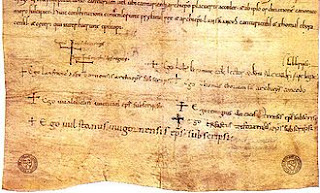
Matilda and William’s Xs on a charter

Matilda and William’s relationship is one of the most successful of the medieval period. Said to be a happy and loving marriage, their trust in each other was demonstrable and it was remarked up on when William fell seriously ill during a stay at Cherbourg between 1063 and 1066, Matilda prayed for his recovery at the altar; the monks remarking on her informal appearance as the sign of her distress her husband illness was causing her. Matilda fell ill in the late summer of 1083 and died on 2nd November of the same year. She was buried at Ste Trinite, Caen, where the original tombstone, with the inscription carved round the edge, still survives. Following her death William cut a sad and lonely figure; becoming increasingly isolated he followed his wife to the grave 4 years later in 1087.

Select bibliography:

Oxforddnb.com; The Norman Conquest: William the Conquerors’ Subjugation of England by Teresa Cole; William the Conqueror: The Bastard of Normandy by Peter Rex; Kings, Queens, Bones and Bastards by David Hilliam; Britains’ Royal Families: The Complete Genealogy by Alison Weir; The Oxford Companion to British History edited by John Cannon; epistolae.ccnmtl.columbia.edu.

My Books

Signed, dedicated copies of all my books are available through my online bookshop.

Out now: Scotland’s Medieval Queens

Books by Sharon Bennett Connolly

Scotland’s history is dramatic, violent and bloody. Being England’s northern neighbour has never been easy. Scotland’s queens have had to deal with war, murder, imprisonment, political rivalries and open betrayal. They have loved and lost, raised kings and queens, ruled and died for Scotland. From St Margaret, who became one of the patron saints of Scotland, to Elizabeth de Burgh and the dramatic story of the Scottish Wars of Independence, to the love story and tragedy of Joan Beaufort, to Margaret of Denmark and the dawn of the Renaissance, Scotland’s Medieval Queens have seen it all. This is the story of Scotland through their eyes.

Scotland’s Medieval Queens gives a thorough grounding in the history of the women who ruled Scotland at the side of its kings, often in the shadows, but just as interesting in their lives beyond the spotlight. It’s not a subject that has been widely covered, and Sharon is a pioneer in bringing that information into accessible history.’ Elizabeth Chadwick (New York Times bestselling author)

Available now from Amazon and Pen and Sword Books

Also by Sharon Bennett Connolly:

Books by Sharon Bennett Connolly

Heroines of the Tudor World tells the stories of the most remarkable women from European history in the time of the Tudor dynasty, 1485-1603. These are the women who ruled, the women who founded dynasties, the women who fought for religious freedom, their families and love. Heroines of the Tudor World is now available for pre-order from Amberley Publishing and Amazon UK. Women of the Anarchy demonstrates how Empress Matilda and Matilda of Boulogne, unable to wield a sword themselves, were prime movers in this time of conflict and lawlessness. It shows how their strengths, weaknesses, and personal ambitions swung the fortunes of war one way – and then the other. Available from Bookshop.orgAmberley Publishing and Amazon UKKing John’s Right-Hand Lady: The Story of Nicholaa de la Haye is the story of a truly remarkable lady, the hereditary constable of Lincoln Castle and the first woman in England to be appointed sheriff in her own right. Available from all good bookshops Pen & Sword Booksbookshop.org and Amazon

History...the Interesting Bits

Defenders of the Norman Crown: The Rise and Fall of the Warenne Earls of Surrey tells the fascinating story of the Warenne dynasty, from its origins in Normandy, through the Conquest, Magna Carta, the wars and marriages that led to its ultimate demise in the reign of Edward III. Available from Pen & Sword BooksAmazon in the UK and US, and Bookshop.orgLadies of Magna Carta: Women of Influence in Thirteenth Century England looks into the relationships of the various noble families of the 13th century, and how they were affected by the Barons’ Wars, Magna Carta and its aftermath; the bonds that were formed and those that were broken. It is now available in paperback and hardback from Pen & SwordAmazon, and Bookshop.orgHeroines of the Medieval World tells the stories of some of the most remarkable women from Medieval history, from Eleanor of Aquitaine to Julian of Norwich. Available now from Amberley Publishing and Amazon, and Bookshop.orgSilk and the Sword: The Women of the Norman Conquest traces the fortunes of the women who had a significant role to play in the momentous events of 1066. Available now from Amazon,  Amberley Publishing, and Bookshop.org.

Alternate Endings: An anthology of historical fiction short stories including Long Live the King… which is my take what might have happened had King John not died in October 1216. Available in paperback and kindle from Amazon.

Podcast:

History...the Interesting Bits

Have a listen to the A Slice of Medieval podcast, which I co-host with Historical fiction novelist Derek Birks. Derek and I welcome guests, such as Bernard Cornwell and Elizabeth Chadwick, and discuss a wide range of topics in medieval history, from significant events to the personalities involved.

Every episode is also now available on YouTube.

*

Don’t forget! Signed and dedicated copies of all my books are available through my online bookshop.

For forthcoming online and in-person talks, please check out my Events Page.

You can be the first to read new articles by clicking the ‘Follow’ button, liking our Facebook page or joining me on TwitterThreadsBluesky and Instagram.

©2023 Sharon Bennett Connolly FRHistS 


Eight Interesting Discoveries on writing 11th century non-fiction

Following on from my 10 Facts About Women and Magna Carta, I thought I would revisit the Norman Conquest and started thinking about I found most interesting when writing about 1066 and the years either side. And here’s what I discovered:

1. Not all primary sources are contemporary.

Emma of Normandy

Let me explain. Of course, all sources written in the 11th century are primary sources, but you do find people quoting sources as primary sources – only to discover that they were written 100 or even 200 years after the events.

One such legend, appearing two centuries after the events, suggested that Emma of Normandy’s relationship with her good friend, Bishop Stigand, was far more than that of her advisor and that he was, in fact, her lover – although the legend did get its bishops mixed up and named Ælfwine, rather than Stigand, as Emma’s lover. The story continues that Emma chose to prove her innocence in a trial by ordeal, and that she walked barefoot over white-hot ploughshares. Even though the tale varies depending on the source, the result is the same; when she completed the ordeal unharmed, and thus proven guiltless, she was reconciled with her contrite son, Edward.

However, there is no 11th century source for this event and it seems to have been created to explain Emma’s estrangement from her son, Edward the Confessor.

2. The Anglo-Saxon Chronicle is the most famous source of 11th century news. 

The Anglo-Saxon Chronicle gives wonderful snippets of information about life in Anglo-Saxon England – and the weather! If you have ever wondered where the English get their obsession with the weather, read the Anglo-Saxon Chronicle. It is also very dramatic.

For example, the year 1005 starts with; ‘Here in this year there was the great famine throughout the English race, such as no-one ever remembered on so grim before…’

1032 relates; ‘Here in this year appeared that wild-fire such as no man remembered before, and also it did damage everywhere in many places.’

And 1039 opens with ‘Here came the great gale…’

In 1053 we read, ‘Here [1052] was the great wind on the eve of the Feast of St Thomas, and the great wind was also all midwinter…’

And, of course, in 1066 we read about the appearance of Halley’s Comet; ‘Then throughout all England, a sign such as man ever saw before was seen in the heavens. Some me declared that it was the star comet, which some men called the ‘haired’ star; and it appeared first on the eve of the Great Litany, 24 April, and shone thus all the week….’

3. The Anglo-Saxon Chronicle is a fabulous source of news about church leaders.

Don’t get me wrong, the Anglo-Saxon Chronicle is invaluable to anyone studying the history of Anglo-Saxon Britain, but you can tell it was written by monks. There are some years where you learn little more than which church leader died, and who replaced him.

For example, the entry for 1023 from the E chronicle; ‘Here Bishop Wulfstan passed away, and Ælfric succeeded…’

And in 1032; ‘In the same year Ælfsige, bishop in Winchester, passed away, and Ælfwine, the king’s priest, succeeded to it.’

The only entry in the E Chronicle in 1033 was; ‘Here in this year Merehwit, bishop in Somerset, passed away, and he is buried in Glastonbury.’

And again in 1034; ‘Here Bishop Æthelric passed away.’

4. Not all inheritance was based on primogeniture.

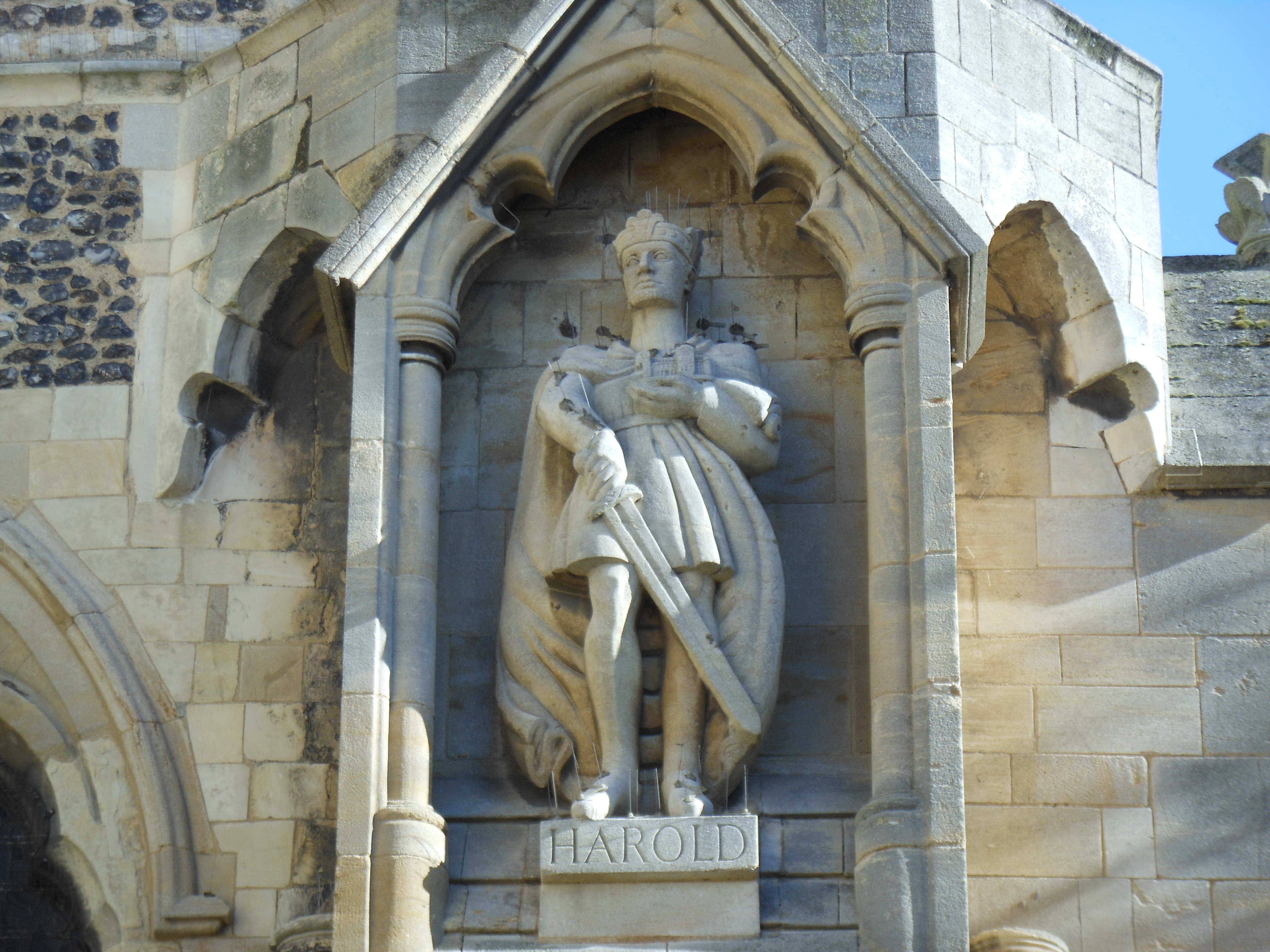
King Harold II, Waltham Abbey

Primogeniture, where the eldest son inherited from his father, was not unusual in 11th century England; when Earl Godwin of Wessex died, his eldest surviving son, Harold, succeeded him. However, it was not yet established as the definitive rule of inheritance of later centuries. When Siward, Earl of Northumbria, died in 1055 his heir, Waltheof, was still a child and too young to hold such a formidable position on the borders of Scotland. The earldom was given to Tostig Godwinson, the favourite brother of Edward the Confessor’s queen, Edith. Though he didn’t do a great job with it…

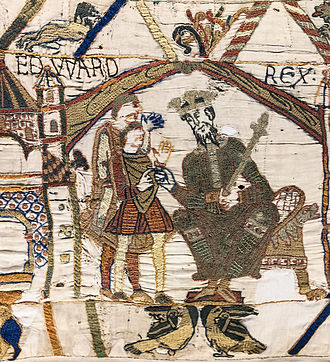
And in the opening days of 1066, when Edward the Confessor died, the ætheling, Edgar was only a teenager, and so was passed over as king for the more mature and militarily experienced Harold Godwinson, Earl of Wessex, who became King Harold II.

5. Travel to distant places was not uncommon for the nobility.

At different times in the 11th century, both King Cnut and Tostig Godwinson are known to have travelled to Rome; indeed, during his trip to Rome in 1027, Cnut was present at the coronation of Holy Roman Emperor, Conrad II and arranged for the marriage of his daughter by Emma of Normandy, Gunhilda, to Conrad’s son, the future King Henry III of Germany.

As for Tostig, travelling to Rome was not without its dangers, and shortly after leaving the city, his travelling party was caught up in a local dispute between the papacy and the Tuscan nobility; they were attacked. Tostig was able to escape by the ruse of one of his own thegns, a man named Gospatric, who pretended to be the earl.

Tostig and Harold’s brother, Swegn Godwinson, who had murdered his own cousin, even went on pilgrimage to Jerusalem – barefoot – he died on the journey home.

And when I started writing Silk and the Sword: The Women of the Norman Conquest I discovered that there are several links to the story of 1066 with the Russian principality of Kyiv. The baby sons of England’s short-lived king, Edmund II Ironside, who reigned and died in 1016, were given sanctuary and protection in Kyiv, saving them from the clutches of Edmund’s successor, King Cnut. The first wife of Harald Hardrada, the third contender for the English throne in 1066, Elisiv, was a Kyivan princess. And after the Conquest, Harold II Godwinson’s own daughter by Edith Swanneck, Gytha, would make her life in Kyiv as the wife of Vladimir II Monomakh and as the mother of Mstislav the Great, the last ruler of a united Kyivan Rus. Vladimir was the nephew of Harald Hardrada’s first wife, the Kyivan princess, Elisiv.

6. Having 2 wives at the same time was not THAT unusual.

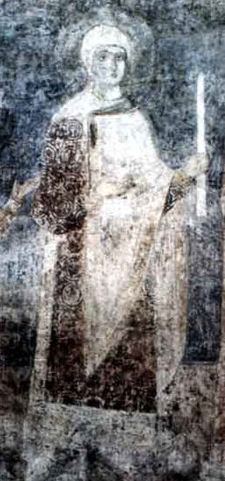
Elisiv of Kyiv

In the story of 1066 there were not one BUT three men who had two wives simultaneously.

Harold Godwinson is known for having been in a relationship with the famous Edith Swanneck for 20 years before becoming King, and then marrying Ealdgyth of Mercia without divorcing Edith. Edith is often referred to as Harold’s concubine, but most historians agree that she was his ‘hand-fast’ wife and had undergone a Danish – rather than Christian – style of wedding with Harold. Edith was no ignorant peasant, she was a wealthy woman in her own right and it is highly doubtful she would have accepted being Harold’s mistress, and raising his children, without some kind of marital protection.

Harald Hardrada also married a second ‘wife’, whilst still being married to Elisiv. Elisiv had given the Norwegian king two daughters, but his second wife, Thora, gave him two sons, Magnus and Olaf, who each, in turn, succeeded their father as King of Norway.

King Cnut was the first to take two wives; he had two sons by Ælfgifu of Northampton before marrying Emma of Normandy and producing a second family. The chronicles, however, claim that Ælfgifu’s sons were not the children of Cnut, with John (also known as Florence) of Worcester saying, ‘Ælfgiva desired to have a son by the king, but as she could not, she caused the new-born child of a certain priest to be brought to her, and made the king fully believe that she had just borne him a son’. And the Anglo-Saxon Chronicle claimed ‘[King] Harold [I Harefoot] also said that he was the son of king Canute and Ælfgiva of Northampton, although that is far from certain; for some say that he was the son of a cobbler, and that Ælfgiva had acted with regard to him as she had done in the case of Swein: for our part, as there are doubts on the subject, we cannot settle with any certainty the parentage of either.’

7. There were some incredible, strong women in the 11th century.

Lady Godiva

The story of the Norman Conquest invariably revolves around the men involved, Edward the Confessor, Harold II, William the Conqueror, Harald Hardrada, and so on. However, there were some amazing women whose strength and perseverance helped to steer and shape the events of the era.

There were, of course, the queens, Emma of Normandy, Edith of Wessex and Matilda of Flanders, who supported their husbands and helped to shape and – even – preserve history, with Emma and Edith both commissioning books to tell the stories of their times and Matilda being the image of queenship that all future queens of England modelled themselves on.

There was also the notorious Lady Godiva, who was probably a lot less scandalous than the legend, of her riding naked through Coventry, leads us to believe. And the incredible Gytha of Wessex, a woman whose story is entwined with every aspect of the period. From the reign of Cnut to that of William the Conqueror, Gytha and her family were involved in so many aspects of the 11th century, from the rise of her sons, through the Battle of Hastings itself, to the English resistance in the years immediately following the Conquest. Gytha was not one to give up easily, despite the horrendous losses her family suffered (three of her sons died in one single day at Hastings), she encouraged her grandsons to lead the opposition against the Conqueror in the west, but her eventual failure saw her seek shelter in Flanders, where she disappears from the pages of history.

8. There is still so much we don’t know!

Ӕlfgyva, the mysterious woman in the Bayeux Tapestry

What you discover when researching the 11th century and the Norman Conquest is that there are gaps in our knowledge. For instance, we do not know why Harold was travelling to Europe in 1064, when he was shipwrecked and became a guest at the court of William, Duke of Normandy (the future William the Conqueror). The Bayeux Tapestry depicts Harold swearing an oath during his stay there. Was Harold promising to support William’s claim to England when Edward the Confessor died?

The Bayeux Tapestry has another tantalising mystery. That of Ӕlfgyva. Ӕlfgyva is depicted in a doorway with a priest touching her cheek. Whether the touch is in admonishment or blessing is open to interpretation. Above her head, written in Latin, is the incomplete phrase  ‘Here a certain cleric and Ӕlfgyva’. But who was the mysterious Ӕlfgyva? Will we ever know?

Historical Writers Forum hosted a fabulous debate on ‘Ӕlfgyva’: The Mysterious Woman in the Bayeux Tapestry, which is available on YouTube. Hosted by Samantha Wilcoxson, it features myself, Pat Bracewell, Carol McGrath and Paula Lofting discussing the possible cadidates of Ӕlfgyva’s identity.

*

A version of this article was first published on Carol McGrath’s website in December 2018

Images:

Courtesy of Wikipedia, except King Harold II, which is ©2022 Sharon Bennett Connolly FRHistS.

Sources:

A Historical Document Pierre Bouet and François Neveux, bayeuxmuseum.com/en/un_document_historique_enThe Mystery Lady of the Bayeux Tapestry (article) by Paula Lofting, annabelfrage.qordpress.com; Ӕlfgyva: The Mysterious lady of the Bayeux Tapestry (article) by M.W. Campbell, Annales de NormandieThe Bayeux Tapestry, the Life Story of a Masterpiece by Carola HicksÆthelred II [Ethelred; known as Ethelred the Unready] (c. 966×8-1016) (article) by Simon Keynes, Oxford Dictionary of National Biography, oxforddnb.com; Britain’s Royal Families; the Complete Genealogy by Alison Weir; Queen Emma and the Vikings: The Woman Who Shaped the Events of 1066 by Harriet O’BrienThe Anglo-Saxon Chronicle translated by James IngramOn the Spindle Side: the Kinswomen of Earl Godwin of Wessex by Ann Williams; Swein [Sweyn], earl by Ann Williams, Oxford Dictionary of National Biography, oxforddnb.com, 23 September 2004; Ӕlfgifu [Ӕlfgifu of Northampton (fl. 1006-1036) (article) by Pauline Stafford, Oxford Dictionary of National Biography, oxforddnb.com; The Chronicle of John of Worcester, translated and edited by Thomas Forester, A.M; The Anglo-Saxon Chronicles edited and translated by Michael Swanton.

*

My Books:

Signed, dedicated copies of all my books are available through my online store.

OUT NOW! Heroines of the Tudor World

Heroines of the Tudor World tells the stories of the most remarkable women from European history in the time of the Tudor dynasty, 1485-1603. These are the women who ruled, the women who founded dynasties, the women who fought for religious freedom, their families and love. These are the women who made a difference, who influenced countries, kings and the Reformation. In the era dominated by the Renaissance and Reformation, Heroines of the Tudor World examines the threats and challenges faced by the women of the era, and how they overcame them. From writers to regents, from nuns to queens, Heroines of the Tudor World shines the spotlight on the women helped to shape Early Modern Europe.

Heroines of the Tudor World is now available for pre-order from Amberley Publishing and Amazon UK.

Coming 30 January 2025: Scotland’s Medieval Queens

Scotland’s history is dramatic, violent and bloody. Being England’s northern neighbour has never been easy. Scotland’s queens have had to deal with war, murder, imprisonment, political rivalries and open betrayal. They have loved and lost, raised kings and queens, ruled and died for Scotland. From St Margaret, who became one of the patron saints of Scotland, to Elizabeth de Burgh and the dramatic story of the Scottish Wars of Independence, to the love story and tragedy of Joan Beaufort, to Margaret of Denmark and the dawn of the Renaissance, Scotland’s Medieval Queens have seen it all. This is the story of Scotland through their eyes.

Available for pre-order now.

Also by Sharon Bennett Connolly:

Women of the Anarchy demonstrates how Empress Matilda and Matilda of Boulogne, unable to wield a sword themselves, were prime movers in this time of conflict and lawlessness. It shows how their strengths, weaknesses, and personal ambitions swung the fortunes of war one way – and then the other. Available from Bookshop.orgAmberley Publishing and Amazon UKKing John’s Right-Hand Lady: The Story of Nicholaa de la Haye is the story of a truly remarkable lady, the hereditary constable of Lincoln Castle and the first woman in England to be appointed sheriff in her own right. Available from all good bookshops Pen & Sword Booksbookshop.org and AmazonDefenders of the Norman Crown: The Rise and Fall of the Warenne Earls of Surrey tells the fascinating story of the Warenne dynasty, from its origins in Normandy, through the Conquest, Magna Carta, the wars and marriages that led to its ultimate demise in the reign of Edward III. Available from Pen & Sword BooksAmazon in the UK and US, and Bookshop.org

Ladies of Magna Carta: Women of Influence in Thirteenth Century England looks into the relationships of the various noble families of the 13th century, and how they were affected by the Barons’ Wars, Magna Carta and its aftermath; the bonds that were formed and those that were broken. It is now available in paperback and hardback from Pen & Sword,  Amazon, and Bookshop.orgHeroines of the Medieval World tells the stories of some of the most remarkable women from Medieval history, from Eleanor of Aquitaine to Julian of Norwich. Available now from Amberley Publishing and Amazon, and Bookshop.orgSilk and the Sword: The Women of the Norman Conquest traces the fortunes of the women who had a significant role to play in the momentous events of 1066. Available now from Amazon,  Amberley Publishing, and Bookshop.org.

Alternate Endings: An anthology of historical fiction short stories including Long Live the King… which is my take what might have happened had King John not died in October 1216. Available in paperback and kindle from Amazon.

Podcast:

Have a listen to the A Slice of Medieval podcast, which I co-host with Historical fiction novelist Derek Birks. Derek and I welcome guests, such as Bernard Cornwell, and discuss a wide range of topics in medieval history, from significant events to the personalities involved.

*

Don’t forget! Signed and dedicated copies of all my books are available through my online store.

For forthcoming online and in-person talks, please check out my Events Page.

You can be the first to read new articles by clicking the ‘Follow’ button, liking our Facebook page or joining me on TwitterThreads and Instagram.

*

©2022 Sharon Bennett Connolly FRHistS.

William and Gundrada de Warenne and the Foundation of a Dynasty

Books by Sharon Bennett Connolly
William de Warenne, Holy Trinity Church, Southover

William de Warenne, first earl of Surrey, was a younger son of Rodulf de Warenne and his wife Beatrix. It is possible that Beatrix was a niece of Duchess Gunnor of Normandy, making young William a cousin of William the Bastard, Duke of Normandy. The family name is probably derived from the hamlet of Varenne, part of the Warenne lands in the modern French department of Seine-Inférieure, Normandy. William’s older brother, Rodulf or Ralph, would inherit the greater part of the Warenne family estates in Normandy.

William’s date of birth is unrecorded; a younger son of the minor nobility does not tend to get a mention until he does something remarkable or becomes someone notable. Although still young William was considered a capable and experienced enough soldier to be given joint command of a Norman army, by the mid-1050s. His first recorded military action is in the 1054 campaign against the French. He was one of the commanders who fought against the King of France’s brother, Count Odo, at the Battle of Mortemer.  

De Warenne was rewarded with some of the lands of his kinsman, Roger (I) de Mortemer, who had fought for the French. William managed to retain some of these lands even after Mortemer was restored to favour, including the castles of Mortemer and Bellencombre. Bellencrombe would become the capital of the de Warenne estates in Normandy. De Warenne had also received some of  the confiscated lands of William, count of Arques in 1053. Duke William’s confidence in de Warenne is demonstrated in the fact he was one of the barons consulted during the planning of the invasion of England in 1066.

In fact, William de Warenne is one of only a handful of Norman barons who can be positively identified as having fought at the Battle of Hastings on 14th October, 1066. De Warenne was rewarded with vast swathes of land throughout the country. According to the Domesday survey his lands extended over 13 counties: stretching from Conisbrough in Yorkshire to Lewes in Sussex. His territories were acquired over the course of the reign of William I and elevated him the highest rank of magnates. By 1086 his riches were only surpassed by the king’s half-brothers and his own kinsman, Roger de Montgomery. He still ranks in the Top 20 of the richest people in the world – ever!

Books by Sharon Bennett Connolly
Lewes Castle

Throughout his career, William de Warenne acquired lands in numerous counties, sometimes by nefarious means. Much of the property, such as Conisbrough, had formerly belonged to the late king, Harold. In Norfolk he is said to have asserted lordship over freemen not necessarily assigned to him. He had disputes with neighbouring landowners in Conisbrough, over which properties were sokelands and he is said to have stolen lands from the bishop of Durham and the abbot of Ely. Some acquisitions were obtained peacefully, such as the manor of Whitchurch in Shropshire, which was left to him by his kinsman Roger de Montgomery. William was an energetic and attentive landowner and improved the economy of most of his estates; more than tripling his sheep flock at Castle Acre and doubling the value of his Yorkshire estates in just 20 years (at a time when the county was devastated by the Harrying of the North).

In 1067 William de Warenne was one of 4 prominent Normans appointed to govern England during William the Conqueror’s absence in Normandy. Following the Conquest, he continued to support the king and – subsequently – his son, William II Rufus – as a military commander for over 20 years. In 1074 he was with his father at the abbey of Holy Trinity in Rouen, where he was a witness to his father’s last known charter, and in 1083-85 he fought with the king on campaign in Maine, being wounded at the siege of the castle of Sainte-Suzanne.

In 1075, along with Richard de Clare, his fellow justiciar, he was sent to deal with the rebellion of Earl Ralph de Gael of East Anglia. De Gael had failed to respond to their summons to answer for an act of defiance and so the 2 lords faced and defeated the rebels at Fawdon in Cambridgeshire, mutilating their prisoners afterwards. Ralph withdrew to Norwich Castle; besieged for 3 months he managed to escape his attackers by boat, while the castle surrendered and was occupied by de Warenne.

William de Warenne was married to a Flemish noblewoman, Gundrada; her brother Gerbod was sometime earl of Chester and another brother, Frederic, held lands in Norfolk which eventually passed to Gundrada. Frederic, appears to have jointly, with Gundrada, held lands in England even before the Conquest, when two people named Frederic and Gundrada are mentioned as holding four manors in Kent and Sussex. It would indeed be a coincidence if there were two other related people, named Frederic and Gundrada, very distinctive foreign names, in England at that time. Gundrada’s brothers, it seems, were deeply involved in the border politics between Flanders and Normandy; indeed, it is thought that Gerbod resigned his responsibilities in Chester in order to return to the Continent to oversee the family’s lands and duties there, following the death of an older brother, Arnulf II of Oosterzele-Scheldewindeke.

Books by Sharon Bennett Connolly
Gundrada de Warenne, Holy Trinity Church, Southover

Frederic was murdered by English freedom fighter, Hereward the Wake; his murder giving rise to a personal feud between Hereward and William de Warenne:

‘Among his other crimes, by trickery [Hereward] killed Frederick, brother of Earl William of Warenne, a man distinguished by lineage and possessions, who one night was surrounded in his own house. On account of his murder, such discord arose between Hereward and the aforesaid William that it could not be settled by any reparation nor in any court.’1

There has been considerable debate among historians over the theory that Gundrada may have been the daughter of William the Conqueror, but the confusion appears to have come from an unreliable charter belonging to Lewes Priory and Gundrada being part of the household of King William’s wife, Matilda. The confirmation charter of the foundation of the priory has King William naming ‘William de Warenne and his wife Gundrada, my daughter.’2 In the same charter, William de Warenne pleads ‘for the health of my mistress Queen Matilda, mother of my wife.’3  However, this is a confirmation of an earlier charter and in the original, while the king and William de Warenne, both, mention Gundrada, neither refer to her as being related to the king or queen.

Historian Elisabeth van Houts argues that Gundrada was most likely a distant relative of Queen Matilda and the counts of Flanders, as asserted in her epitaph as ‘offspring of dukes’ and a ‘noble shoot’. Indeed, had her father been William the Conqueror, her epitaph would surely have referred to her as the offspring of kings. Even if she had been the daughter of Matilda by an earlier marriage, off-spring of kings would have still been appropriate, given that Queen Matilda was the granddaughter of King Robert II of France. Though it does seem likely that Matilda and Gundrada were related in some way, perhaps distant cousins.

The ‘dukes’ referred to in Gundrada’s epitaph, although naturally assumed to be of Normandy, could well refer to a kinship with the house of Luxembourg, to which Queen Matilda’s paternal grandmother, Orgive, belonged. Moreover, Frederic was a familial name within the house of Luxembourg. This kinship via the House of Luxembourg with Queen Matilda would also explain the queen’s gift to Gundrada, of the manor of Carlton, which is usually given as evidence that Gundrada belonged to the queen’s household; an association which would be entirely consistent with kinship.

Books by Sharon Bennett Connolly
De Warenne coat of arms, Holy Trinity Church, Southover

Gundrada and William were married sometime around the time of the Conquest, either before or after the expedition to conquer England. They had 3 children together. Their eldest son, William, would succeed his father as Earl of Surrey and Warenne. He married Isabel de Vermandois, widow of Robert de Beaumont, earl of Leicester; with whom he had, according to one chronicler, been having an affair even before the earl’s death. Young William had a chequered career, he supported the claims of Robert Curthose, Duke of Normandy, to the English throne against the duke’s younger brother, Henry I, but changed sides and fought for Henry at the Battle of Tinchebrai in 1106. Duke Robert lost and was captured and imprisoned by Henry. William remained in the king’s favour for the rest of the reign, fighting alongside Henry at the Battle of Bremule in 1119. William, his son and stepsons were at Henry’s deathbed at Lyons-la-Foret when he died in 1135.

William and Gundrada’s second son, Rainald de Warenne, led the assault on Rouen in 1090, for William II Rufus, in the conflict between the English king and his older brother, Duke Robert. However, by 1105 Rainald was fighting for the duke against the youngest of the Conqueror’s sons, Henry I, defending the castle of Saint-Pierre-sur-Dives for the duke. He was captured by Henry the following year but had been freed by September 1106. It is possible he died shortly after but was certainly dead by 1118 when his brother issued a charter, in which he gave 6 churches to Lewes Priory, for the soul of deceased family members, including Rainald.

Gundrada and William also had a daughter, Edith, who married Gerard de Gournay, son of the lord of Gournay-en-Bray. Gerard also supported William II Rufus against Duke Robert and took part in the Crusade of 1096. Edith later accompanied him on pilgrimage back to Jerusalem, sometime after 1104, where he died. Gerard was succeeded by their son, Hugh de Gournay, whose daughter Gundreda would be the mother of Roger de Mowbray. Edith then married Drew de Monchy, with whom she had a son, Drew the Younger.

Books by Sharon Bennett Connolly
Castle Acre, Norfollk, where Gundrada died

Sadly, Gundrada died in childbirth at Castle Acre in Norfolk on 27th May 1085. She was buried in the chapter house of the couple’s own of foundation Lewes Priory.

William’s second wife was a sister of Richard Guet, who was described as ‘frater comitissae Warennae’ when he gave the manor of Cowyck to Bermondsey Abbey in 1098.3 Guet was a landowner in Perche, Normandy, but his sister’s name has not survived the passage of time. All we know of her is that, a few days after her husband’s death, she attempted to gift 100 shillings to Ely Abbey in restitution for damage caused by William de Warenne. The monks refused the donation, hoping that Warenne’s departing soul had been claimed by demons.4

Despite this feud with Ely, William de Warenne and his wife, Gundrada, had a reputation for piety. At some point in their marriage, probably 1081-3, they went on pilgrimage to Rome. Due of war in Italy they only got as far as the great abbey of Cluny in Burgundy, where they were received into the fellowship of monks. On their return to England, they founded a priory at Lewes, following the Cluniac rule and a prior and 3 monks were sent from Cluny to establish the foundation. It was the first Cluniac foundation in England.

Books by Sharon Bennett Connolly
St Pancras priory, Lewes, founded by William and Gundrada

Following the Conqueror’s death, William fought in support of the late king’s second son, William II Rufus against his older brother, Robert Curthose, who had inherited the dukedom of Normandy. He was rewarded in early 1088 with the earldom of Surrey. The new earl fought for William II Rufus during an invasion by Robert’s supporters and was badly wounded at the siege of Pevensey Castle, East Sussex, in the spring of 1088. He was taken to Lewes, where he died of his wounds on 24th June of the same year. Earl Warenne was buried beside his first wife, Gundrada, in the chapter house of Lewes Priory.

Following the dissolution of Lewes Priory in the 16th century, Gundrada’s tombstone was first moved to Isfield Church; it was moved again in 1775 to the parish church of St John the Baptist at Southover in Lewes. The remains of Gundrada and William, themselves, were discovered in 2 leaden chests in 1845, when the railway line was excavated through the priory grounds. They were laid to rest, for a final time, at the Southover church, in 1847, in a chapel dedicated to Gundrada de Warenne.

William and Gundrada de Warenne had founded a dynasty that would survive for almost 300 years, dying out in the reign of Edward III following the disastrous marriage of John de Warenne, 7th and last Earl of Warenne and Surrey

*

Footnotes:

¹ The Warenne (Hyde) Chronicle edited and translated by Elisabeth M.C. van Houts and Rosalind C. Love; 2 My translation from quote in George Floyd Duckett, Observations on the Parentage of Gundreda, the Daughter of William Duke of Normandy, and Wife of William de Warenne; 3 ibid; 4 Early Yorkshire Charters Volume 8: The Honour of Warenne, Edited by William Farrer and Charles Travis Clay; 5 ibid

Images:

All images ©2022 Sharon Bennett Connolly FRHistS

Sources:

Early Yorkshire Charters Volume 8: The Honour of Warenne, Edited by William Farrer and Charles Travis Clay; England Under the Norman and Angevin Kings by Robert BartlettBrewer’s British Royalty by David WilliamsonBritain’s Royal Families, the Complete Genealogy by Alison Weir; british-history.ac.uk; kristiedean.com; English Heritage Guidebook for Conisbrough Castle by Steven Brindle and Agnieszka Sadrei; oxforddnb.com; George Floyd Duckett, Observations on the Parentage of Gundreda, the Daughter of William Duke of Normandy, and Wife of William de Warenne; Elisabeth M.C. Van Houts and Rosalind C. Love (eds and trans), The Warenne (Hyde) Chronicle; C.P. Lewis, ‘Warenne, Gundrada de (d.1085)’, ODNB; Elisabeth Van Houts, ‘The Warenne View of the Past’, in Proceedings of the Battle Conference 2003, edited by John Gillingham

*

My Books:

Signed, dedicated copies of all my books are available through my online store.

Out now: Scotland’s Medieval Queens

Books by Sharon Bennett Connolly

Scotland’s history is dramatic, violent and bloody. Being England’s northern neighbour has never been easy. Scotland’s queens have had to deal with war, murder, imprisonment, political rivalries and open betrayal. They have loved and lost, raised kings and queens, ruled and died for Scotland. From St Margaret, who became one of the patron saints of Scotland, to Elizabeth de Burgh and the dramatic story of the Scottish Wars of Independence, to the love story and tragedy of Joan Beaufort, to Margaret of Denmark and the dawn of the Renaissance, Scotland’s Medieval Queens have seen it all. This is the story of Scotland through their eyes.

Scotland’s Medieval Queens gives a thorough grounding in the history of the women who ruled Scotland at the side of its kings, often in the shadows, but just as interesting in their lives beyond the spotlight. It’s not a subject that has been widely covered, and Sharon is a pioneer in bringing that information into accessible history.’ Elizabeth Chadwick (New York Times bestselling author)

Available now from Amazon and Pen and Sword Books

Also by Sharon Bennett Connolly:

Books by Sharon Bennett Connolly

Heroines of the Tudor World tells the stories of the most remarkable women from European history in the time of the Tudor dynasty, 1485-1603. These are the women who ruled, the women who founded dynasties, the women who fought for religious freedom, their families and love. Heroines of the Tudor World is now available for pre-order from Amberley Publishing and Amazon UK. Women of the Anarchy demonstrates how Empress Matilda and Matilda of Boulogne, unable to wield a sword themselves, were prime movers in this time of conflict and lawlessness. It shows how their strengths, weaknesses, and personal ambitions swung the fortunes of war one way – and then the other. Available from Bookshop.orgAmberley Publishing and Amazon UKKing John’s Right-Hand Lady: The Story of Nicholaa de la Haye is the story of a truly remarkable lady, the hereditary constable of Lincoln Castle and the first woman in England to be appointed sheriff in her own right. Available from all good bookshops Pen & Sword Booksbookshop.org and Amazon

Books by Sharon Bennett Connolly

Defenders of the Norman Crown: The Rise and Fall of the Warenne Earls of Surrey tells the fascinating story of the Warenne dynasty, from its origins in Normandy, through the Conquest, Magna Carta, the wars and marriages that led to its ultimate demise in the reign of Edward III. Available from Pen & Sword BooksAmazon in the UK and US, and Bookshop.orgLadies of Magna Carta: Women of Influence in Thirteenth Century England looks into the relationships of the various noble families of the 13th century, and how they were affected by the Barons’ Wars, Magna Carta and its aftermath; the bonds that were formed and those that were broken. It is now available in paperback and hardback from Pen & SwordAmazon, and Bookshop.orgHeroines of the Medieval World tells the stories of some of the most remarkable women from Medieval history, from Eleanor of Aquitaine to Julian of Norwich. Available now from Amberley Publishing and Amazon, and Bookshop.orgSilk and the Sword: The Women of the Norman Conquest traces the fortunes of the women who had a significant role to play in the momentous events of 1066. Available now from Amazon,  Amberley Publishing, and Bookshop.org.

Alternate Endings: An anthology of historical fiction short stories including Long Live the King… which is my take what might have happened had King John not died in October 1216. Available in paperback and kindle from Amazon.

Podcast:

Have a listen to the A Slice of Medieval podcast, which I co-host with Historical fiction novelist Derek Birks. Derek and I welcome guests, such as Bernard Cornwell and Elizabeth Chadwick, and discuss a wide range of topics in medieval history, from significant events to the personalities involved.

Every episode is also now available on YouTube.

*

Don’t forget! Signed and dedicated copies of all my books are available through my online store.

For forthcoming online and in-person talks, please check out my Events Page.

You can be the first to read new articles by clicking the ‘Follow’ button, liking our Facebook page or joining me on TwitterThreads and Instagram.

*

©2022 Sharon Bennett Connolly FRHistS.

Thora, Harald Hardrada’s Other Wife

Books by Sharon Bennett Connolly
Coin of Harald Hardrada

The legend of Harald Hardrada, King Harald III of Norway, is one of my favourite stories of the 11th century. It is the tale of a warrior king, probably the best fighter of his generation, a poet and a lover. Harald’s marriage to his first wife, Elisiv of Kyiv, is the stuff legends are made of; a landless prince making his fortune in Byzantium before returning to claim his bride and winning a crown. And they lived happily ever after …. or not!

Elisiv gave Harald 2 daughters, Ingegerd and Maria, but no sons. It may, therefore, have been a desire for sons that led Harald to take a second wife, although without setting aside his first. According to Snorri Sturluson, in the ‘winter after King Magnus the Good died, King Harald took Thora, daughter of Thorberg Arnason, and they had two sons; the oldest called Magnus, and the other Olaf.’ [1]

Thora (or Tora) was the daughter of Thorberg Arnason and Ragnhild Erlingsdottir and was born around 1025; her kinsman, Fin Arnason, was a good friend of Harald’s and was married to Bergliot, the daughter of Halfdan, a brother of Harald Hardrada and Saint Olaf.  The marriage also provided the desired son and heir, which his first marriage had failed to do; both of Thora’s sons would later become kings of Norway. Magnus succeeded his father in 1066, and was in 1069 succeeded by his brother, Olaf III, who had ruled alongside Magnus since 1067.

Books by Sharon Bennett Connolly
Gerhard Munthe: illustration for Olav Kyrres saga in Heimskringla (1899)

Harald probably went through some form of marriage ceremony, more likely a handfasting than a Christian marriage, with Thora in 1048. The marriage appears to have been a political arrangement, in order to garner the support of the powerful Giskeӕtten family, the chiefs of which played a significant role in power politics.

Of Harald’s two sons, Magnus, who succeeded his father in 1066, appears to have been as warlike as Harald. In 1058, aged no more than ten or eleven, he led a fleet to England in support of Earl Ӕlfgar of Mercia, after the earl had been outlawed only a year after he had succeeded to his father’s earldom. Magnus was probably little more than a figurehead for the expedition and unlikely to have been expected to make crucial military decisions, but it would have been good experience for the young prince, and a taste of what the future held for him. By the time he was sixteen, Magnus was a successful warrior and is said to have clashed with his father; the two almost coming to blows until the king was restrained by friends.

Books by Sharon Bennett Connolly
Coin dating to the reign of King Olaf Kyrre

It has been suggested that the marriage may have come following the death of Elisiv, or that Elisiv never even left Kyiv, but given that her daughters were born once Harald was back in Scandinavia, this seems improbable. Harald’s daughters are not likely to have been the daughters of Thora, as Maria was engaged to Thora’s brother, Eystein Orre; who would have been Maria’s uncle, had she been Thora’s daughter. Harald having two wives, simultaneously, seems the most likely explanation. As demonstrated by King Cnut and King Harold II of England, two wives and, therefore, two families, were not uncommon in Scandinavian culture; although in these two other cases an earlier wife was put aside for the sake of a more prestigious marriage, whereas Harald Hardrada’s first marriage was by far the more prestigious, while the second was politically expedient.

Thora was the kinswoman of Harald’s one-time friend, Fin Arnason, who was captured fighting for the Danes against Harald. When Fin refused Harald’s offer of quarter (life), Harald made a further offer:

‘“Wilt thou accept thy life, then, from thy she-relation Thorer [Thora]?”

The earl: “Is she here?”

“She is here, ” said the king.

Then Earl Fin broke out with the ugly expressions which since have been preserved, as a proof that he was so mad with rage that he could not govern his tongue: —

“No wonder thou hast bit so strongly, if the mare was with thee.”

Earl Fin got life and quarter and the king kept him a while about him…’

Heimskringla. The Chronicle of the Kings of Norway, by Snorre Sturluson.
Books by Sharon Bennett Connolly
Harald landing near York, 1066 (Matthew Paris)

At the beginning of September, 1066, Harald sailed his fleet of over 200 ships to Shetland and then to Orkney, where he gathered reinforcements and left his wife and daughters to await news of events. There is some confusion as to which wife was left on Orkney, some sources say Elisiv, who, as Harald’s wife and queen would have expected to become queen of England, had he been successful. Some historians argue that as Thora was a relative of the Earl of Orkney she would have been more likely to travel with Harald than Elisiv.

We know from Thora’s joining one of Harald’s expeditions to Denmark, that he was not averse to taking his wives with him to war. However, given that young Magnus was left behind to rule Norway, aged only sixteen, it seems likely that his mother was also left behind, to advise him. According to Snorri;

‘Thora, the daughter of Thorberg, also remained behind; but he took with him Queen Ellisif [Elisiv] and her two daughters, Maria and Ingegerd. Olaf, King Harald’s son, also accompanied his father abroad.’

Heimskringla. The Chronicle of the Kings of Norway, by Snorre Sturluson.

Harald fought two battles outside York. The first, the Battle of Fulford, on 20 September, against the brothers, Edwin, Earl of Mercia, and Morcar, Earl of Northumberland, ended in victory for Harald Hardrada and his ally, Tostig, the former earl of Northumberland and brother of the new King of England, Harold II. However, a second battle at Stamford Bridge, five days later, saw victory go to the English. Harold II had marched his men the 200 miles from the south coast to York, in less than 4 days, and confronted his brother and the Norwegian king on 25 September. At the end of the day, Harald Hardrada and Tostig both lay dead on the field.

Books by Sharon Bennett Connolly
Battle of Stamford Bridge, 1066 (Matthew Paris)

Harald and Elisiv’s daughter, Maria, is said to have died suddenly on 25 September 1066, the same day as the Battle of Stamford Bridge, on hearing of her father’s death. She had been betrothed to Eystein Orre, the brother of Harald’s second wife, Thora; Eystein was also among the dead at Stamford Bridge. Maria’s sister, Ingegerd, returned to Norway with her mother and half-brother. Olaf had traveled with the Norwegian army, but had not taken part in the battle, having been left to guard the ships at Riccal, near York. After the English victory, he was allowed to claim his father’s body and take the survivors home.

After Harald’s death, Norway was ruled successively by Harald’s sons Magnus II and Olaf III. Olaf III ruled until his death in 1093 and was succeeded by Magnus III, his acknowledged but illegitimate son.

Of Thora’s fate, little is certain. She may have remarried, although there is some confusion. According to Adam of Bremen, she married either King Swein of Denmark or an unknown Swedish king. [2] As with much of her life, the year of Thora’s death remains unknown.

Footnotes:

[1] Heimskringla. The Chronicle of the Kings of Norway, by Snorre Sturluson; [2] Fulford: The Forgotten Battle of 1066 by Charles Jones.

Pictures:

Courtesy of Wikipedia

Sources:

The English and the Norman Conquest by Dr Ann Williams; Brewer’s British Royalty by David Williamson; Britain’s Royal Families, the Complete Genealogy by Alison Weir; The Wordsworth Dictionary of British History by JP Kenyon; The Norman Conquestby Marc Morris; Harold, the King Who Fell at Hastings by Peter Rex; The Anglo-Saxons in 100 Facts by Martin Wall; The Anglo-Saxon Age by Martin Wall; Kings, Queens, Bones and Bastards by David Hilliam; The Mammoth Book of British kings & Queens by Mike Ashley; The Oxford Companion to British History Edited by John Cannon; The Anglo-Saxon Chronicles translated and edited by Michael Swaton; The Anglo-Saxon Chronicle translated by James Ingram; Queen Emma and the Vikings by Harriett O’Brien; The Bayeux Tapestry by Carola Hicks; On the Spindle Side: the Kinswomen of Earl Godwin of Wessex by Ann Williams; oxforddnb.com.

*

My Books

Signed, dedicated copies of all my books are available through my online bookshop.

Out now: Scotland’s Medieval Queens

Books by Sharon Bennett Connolly

Scotland’s history is dramatic, violent and bloody. Being England’s northern neighbour has never been easy. Scotland’s queens have had to deal with war, murder, imprisonment, political rivalries and open betrayal. They have loved and lost, raised kings and queens, ruled and died for Scotland. From St Margaret, who became one of the patron saints of Scotland, to Elizabeth de Burgh and the dramatic story of the Scottish Wars of Independence, to the love story and tragedy of Joan Beaufort, to Margaret of Denmark and the dawn of the Renaissance, Scotland’s Medieval Queens have seen it all. This is the story of Scotland through their eyes.

Scotland’s Medieval Queens gives a thorough grounding in the history of the women who ruled Scotland at the side of its kings, often in the shadows, but just as interesting in their lives beyond the spotlight. It’s not a subject that has been widely covered, and Sharon is a pioneer in bringing that information into accessible history.’ Elizabeth Chadwick (New York Times bestselling author)

Available now from Amazon and Pen and Sword Books

Also by Sharon Bennett Connolly:

Books by Sharon Bennett Connolly

Heroines of the Tudor World tells the stories of the most remarkable women from European history in the time of the Tudor dynasty, 1485-1603. These are the women who ruled, the women who founded dynasties, the women who fought for religious freedom, their families and love. Heroines of the Tudor World is now available for pre-order from Amberley Publishing and Amazon UK. Women of the Anarchy demonstrates how Empress Matilda and Matilda of Boulogne, unable to wield a sword themselves, were prime movers in this time of conflict and lawlessness. It shows how their strengths, weaknesses, and personal ambitions swung the fortunes of war one way – and then the other. Available from Bookshop.orgAmberley Publishing and Amazon UKKing John’s Right-Hand Lady: The Story of Nicholaa de la Haye is the story of a truly remarkable lady, the hereditary constable of Lincoln Castle and the first woman in England to be appointed sheriff in her own right. Available from all good bookshops Pen & Sword Booksbookshop.org and Amazon

Defenders of the Norman Crown: The Rise and Fall of the Warenne Earls of Surrey tells the fascinating story of the Warenne dynasty, from its origins in Normandy, through the Conquest, Magna Carta, the wars and marriages that led to its ultimate demise in the reign of Edward III. Available from Pen & Sword BooksAmazon in the UK and US, and Bookshop.orgLadies of Magna Carta: Women of Influence in Thirteenth Century England looks into the relationships of the various noble families of the 13th century, and how they were affected by the Barons’ Wars, Magna Carta and its aftermath; the bonds that were formed and those that were broken. It is now available in paperback and hardback from Pen & SwordAmazon, and Bookshop.orgHeroines of the Medieval World tells the stories of some of the most remarkable women from Medieval history, from Eleanor of Aquitaine to Julian of Norwich. Available now from Amberley Publishing and Amazon, and Bookshop.orgSilk and the Sword: The Women of the Norman Conquest traces the fortunes of the women who had a significant role to play in the momentous events of 1066. Available now from Amazon,  Amberley Publishing, and Bookshop.org.

Alternate Endings: An anthology of historical fiction short stories including Long Live the King… which is my take what might have happened had King John not died in October 1216. Available in paperback and kindle from Amazon.

Podcast:

Have a listen to the A Slice of Medieval podcast, which I co-host with Historical fiction novelist Derek Birks. Derek and I welcome guests, such as Bernard Cornwell and Elizabeth Chadwick, and discuss a wide range of topics in medieval history, from significant events to the personalities involved.

Every episode is also now available on YouTube.

*

Don’t forget! Signed and dedicated copies of all my books are available through my online bookshop.

For forthcoming online and in-person talks, please check out my Events Page.

You can be the first to read new articles by clicking the ‘Follow’ button, liking our Facebook page or joining me on TwitterThreadsBluesky and Instagram.

©2020 Sharon Bennett Connolly FRHistS

Harald Hardrada and Elisiv of Kyiv

Books by Sharon Bennett Connolly
Elisiv of Kyiv

One of my favourite characters of the 1066 story is the Norwegian king Harald Hardrada. Harald led a fascinating life, even before his ill-fated attempt on the English throne; exiled in Kyiv at 15, while seeking his fortune in the east he became captain of the famous Varangian Guard before returning to his native Norway to become king.

When I started writing Silk and the Sword: The Women of the Norman Conquest I discovered that there were several Kyivan links to the story of 1066. The baby sons of England’s short-lived king, Edmund II Ironside, who reigned and died in 1016, were given sanctuary and protection in Kyiv, saving them from the clutches of Edmund’s successor, King Cnut. And after the Conquest, Harold II Godwinson’s own daughter, Gytha, would make her life in Kyiv as the wife of Vladimir II Monomakh; she was the mother of Mstislav the Great, the last ruler of a united Kyivan Rus. Vladimir was the nephew of Harald Hardrada’s first wife, the Russian princess, Elisiv.

Harald Hardrada’s story had been one of almost-constant conflict since he was a teenager. At the age of 15 he had fought alongside his half-brother, King Óláf, at the Battle of Stiklestad, in an unsuccessful attempt by Óláf to regain the throne. The Anglo-Saxon Chronicle recorded: ‘This year returned King Óláf into Norway; but the people gathered together against him, and fought against him; and he was there slain, in Norway, by his own people, and was afterwards canonized.’ [1]

Following Olaf’s death, Harald Hardrada first fled to Sweden before moving on to Kyivan Rus. Harald spent 3 or 4 years at the court of Yaroslav I (the Wise), Prince of Kyiv. Yaroslav was the husband of Óláf’s sister-in-law, Ingergerd (sister of Óláf’s wife, Queen Astrid). At only 15, Harald’s military skills were already impressive and Yaroslav made him a captain in his army; the young Norwegian fought alongside the Kyivan prince on his campaigns against the Poles in 1031.

Books by Sharon Bennett Connolly
Coin of Harald

Having gained a reputation that spread throughout eastern Europe, in 1034 or 1035, Harald and his force of 500 men moved on to Constantinople, where he joined the ranks of the Varangian Guard, in the service of the Byzantine emperor, Michael IV (reigned 1034–1041). A formidable warrior and commander, Harald eventually became leader of the whole Varangian guard, seeing action against Arab pirates, and the towns of Asia Minor that supported them. Throughout his adventures in Byzantium, Harald sent his plunder back to Prince Yaroslav in Kyiv; treasure which, given the number of towns he had taken, must have been quite considerable.

On the death of Michael IV Constantinople proved a less friendly place for the Scandinavian and after a brief imprisonment and daring escape from his cell, Hardrada decided that it was time to return home. It is said that the new empress, Zoe, refused him permission to leave, but the Norwegian managed to escape Constantinople with two ships and his most loyal supporters. One of the ships was destroyed by the iron chains which blocked the seagoing entrance and exit to Constantinople, but the other made it through by shifting the weight in the ship so acted like a seesaw and it effectively jumped over the chain.
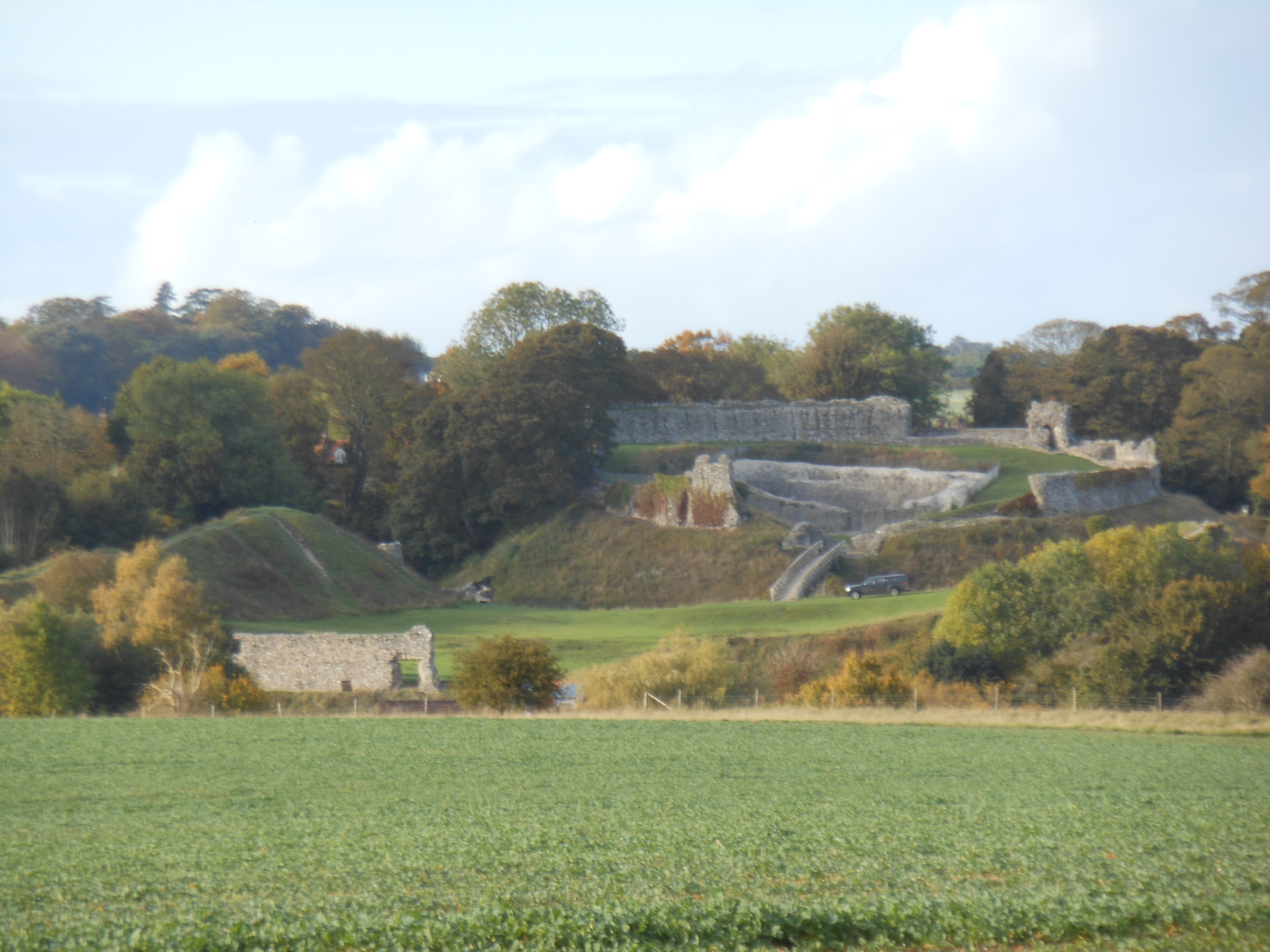
Harald returned to his friend Yaroslav I in Kyiv, to whom he had sent his vast amounts of plunder. In 1044, whilst still at Yaroslav’s court, Harald married the Kyivan prince’s daughter, Elisiv (also known as Elisiff, Elizabeth or Elizaveta). Elisiv was born around 1025 and would probably have met Harald when he first appeared at her father’s court, in 1034-5; when she was 9 or 10 years old and he a 15-year-old fugitive from Cnut’s conquest of Norway. Elisiv was probably the oldest daughter of Yaroslav’s eleven children with his wife, Ingegerd. Through her mother, Elisiv was the granddaughter of Sweden’s king, Olof Skötkonung. Her father, Grand Prince Yaroslav, was responsible for the rise in power and influence of Kyiv in the 11th century; his court was considered modern and cultured.

Yaroslav’s children were well-educated and able to read and write, including the girls; Elisiv’s sister, Anna, who married King Henry I of France, demonstrated her superior level of education when she signed her marriage contract with her full name, in her own hand; King Henry, her new husband, could only manage to write a cross. Although we have no description of Elisiv, we know that Anna was renowned for her ‘exquisite beauty, literacy and wisdom’ and we can assume that Elisiv, having shared in her sister’s upbringing, was no less accomplished. [2]

It is possible that marriage between Harald and Elisiv had been discussed during the Norwegian’s first visit to Kyiv in 1035. However, given that she would have only been nine or ten years of age when Harald left for Constantinople, it seems hard to believe the claims that Elisiv had refused him on the grounds that he was not wealthy enough to marry her; her father, on the other hand, may well have done so. This may also explain Harald sending his plunder back to Kyiv for safekeeping, as proof of his increasing wealth and eligibility as a husband for Elisiv, even if he still held no princely title and was exiled from his homeland. In 1044, therefore, there was no financial objection to Harald and Elisiv marrying and there is evidence that Harald was genuinely in love with his Kyivan bride. Harald wrote poetry to his princess:

Past Sicily’s wide plains we flew,
A dauntless, never-wearied crew;
Our Viking steed rushed through the sea,
As Viking-like fast, fast sailed we.
Never, I think, along this shore
Did Norsemen ever sail before;
Yet to the Kyivan queen, I fear,
My gold-adorned, I am not dear. [3]

Books by Sharon Bennett Connolly
Contemporary image of Yaroslav the Wise, from his seal

With the treasure Harald amassed during his sojourn in Constantinople and Elisiv’s dowry, Harald now had the means to return home. He initially made for Sweden, arriving there in 1046. By the end of the year, he was co-king in Norway, under Magnus the Good, who left Harald to rule Norway while he concentrated on Denmark; the two kings had kept separate courts. Harald’s court in Norway was presided over by his queen, Elisiv. Within a few of years of arriving in Norway, the couple had two daughters, Ingegerd and Maria Haraldsdóttir. Ingergerd was probably born in 1046, with Maria arriving a year of two after.

Married life, however, was about to get more complicated, when Harald took a second wife, without setting aside Elisiv. According to Snorri Sturluson, in the ‘winter after King Magnus the Good died, King Harald took Thora, daughter of Thorberg Arnason, and they had two sons; the oldest called Magnus, and the other Olaf.’ [4] 

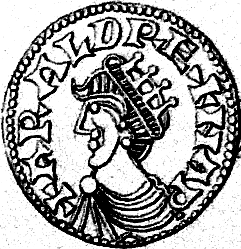
It has been suggested that the marriage may have come following the death of Elisiv, or that Elisiv never even left Kyiv, but given that her daughters are believed to have been born once Harald was back in Scandinavia, this seems improbable. Harald’s daughters are not likely to have been the daughters of Thora, as Maria was engaged to Eystein Orre, who would have been her uncle had she been Thora’s daughter. Harald having two wives, simultaneously, seems the most likely explanation. As demonstrated by King Cnut and King Harold II of England, two wives and, therefore, two families, were not uncommon in Scandinavian culture; although in these two other cases an earlier wife was put aside for the sake of a more prestigious marriage, whereas Harald Hardrada’s first marriage was the most prestigious, while the second was politically expedient. And it was this second marriage which gave Harald his sons; Magnus and Olaf, both later kings of Norway.

Books by Sharon Bennett Connolly
Battle of Fulford, 1066, taken from ‘The Life of Edward the Confessor’

At the beginning of September, 1066, Harald sailed his fleet of over 200 ships to Shetland and then to Orkney, where he gathered reinforcements and left his wife and daughters to await news of events. There is some confusion as to which wife was left on Orkney, some sources say it was Elisiv, who, as Harald’s wife and queen would have expected to become queen of England, had he been successful. Some historians argue that as Thora was a relative of the Earl of Orkney she would have been more likely to travel with Harald than Elisiv.

We know from Thora’s joining one of Harald’s expeditions to Denmark, that he was not averse to taking his wives with him to war. However, given that young Magnus was left behind to rule Norway, aged only sixteen, it seems likely that his mother was also left behind, to advise him. According to Snorri; ‘Thora, the daughter of Thorberg, also remained behind; but he took with him Queen Ellisif [Elisiv] and her two daughters, Maria and Ingegerd. Olaf, King Harald’s son, also accompanied his father abroad.’ [5]

Books by Sharon Bennett Connolly
Battle of Stamford Bridge, 1066, taken from ‘The Life of Edward the Confessor’

Harald and Elisiv’s daughter, Maria, is said to have died suddenly on 25 September 1066, the same day as the Battle of Stamford Bridge, on hearing of her father’s death. Though this does not make sense, unless Maria had travelled to Riccal, where Harald moored his ships before marching to York, with the army and awaited the outcome of the battle with the ships; or the timing of her death has been altered for dramatic effect. Maria had been betrothed to Eystein Orre, the brother of Harald’s second wife, Thora; Eystein was also among the dead at Stamford Bridge. Maria’s sister, Ingegerd, returned to Norway with her mother and half-brother. She was first married to Olaf I, King of Denmark who died in 1095, with whom she had a daughter, Ulvhild. Following Olaf’s death, Ingegerd married Philip, King of Sweden. She was widowed again in 1118 and died around 1120, having been consecutively queen of Denmark and Sweden.

Of Harald’s queen, Elisiv, little is known after King Harald’s death, not even the year of her own death. This Kyivan princess, who captured the heart of one of the greatest Viking warriors of all time, just disappears into the mists of history.

Footnotes:

[1] The Anglo-Saxon Chronicle translated by James Ingram; [2] Prominent Russians: Anna Yaroslavna (article), russiapedia.rt.com; [3] Quoted in Fulford: The Forgotten Battle of 1066 by Charles Jones; [4] Heimskringla. The Chronicle of the Kings of Norway, by Snorre Sturluson; [5] ibid.

Pictures:

Courtesy of Wikipedia

Sources:

The English and the Norman Conquest by Dr Ann Williams; Brewer’s British Royalty by David Williamson; Britain’s Royal Families, the Complete Genealogy by Alison Weir; The Wordsworth Dictionary of British History by JP Kenyon; The Norman Conquest by Marc Morris; Harold, the King Who Fell at Hastings by Peter Rex; The Anglo-Saxons in 100 Facts by Martin Wall; The Anglo-Saxon Age by Martin Wall; Kings, Queens, Bones and Bastards by David Hilliam; The Mammoth Book of British kings & Queens by Mike Ashley; The Oxford Companion to British History Edited by John Cannon; The Anglo-Saxon Chronicles translated and edited by Michael Swanton; The Anglo-Saxon Chronicle translated by James Ingram; Queen Emma and the Vikings by Harriett O’Brien; The Bayeux Tapestry by Carola Hicks; On the Spindle Side: the Kinswomen of Earl Godwin of Wessex by Ann Williams; oxforddnb.com.

*

My Books

Signed, dedicated copies of all my books are available through my online bookshop.

Out now: Scotland’s Medieval Queens

Books by Sharon Bennett Connolly

Scotland’s history is dramatic, violent and bloody. Being England’s northern neighbour has never been easy. Scotland’s queens have had to deal with war, murder, imprisonment, political rivalries and open betrayal. They have loved and lost, raised kings and queens, ruled and died for Scotland. From St Margaret, who became one of the patron saints of Scotland, to Elizabeth de Burgh and the dramatic story of the Scottish Wars of Independence, to the love story and tragedy of Joan Beaufort, to Margaret of Denmark and the dawn of the Renaissance, Scotland’s Medieval Queens have seen it all. This is the story of Scotland through their eyes.

Scotland’s Medieval Queens gives a thorough grounding in the history of the women who ruled Scotland at the side of its kings, often in the shadows, but just as interesting in their lives beyond the spotlight. It’s not a subject that has been widely covered, and Sharon is a pioneer in bringing that information into accessible history.’ Elizabeth Chadwick (New York Times bestselling author)

Available now from Amazon and Pen and Sword Books

Also by Sharon Bennett Connolly:

Books by Sharon Bennett Connolly

Heroines of the Tudor World tells the stories of the most remarkable women from European history in the time of the Tudor dynasty, 1485-1603. These are the women who ruled, the women who founded dynasties, the women who fought for religious freedom, their families and love. Heroines of the Tudor World is now available for pre-order from Amberley Publishing and Amazon UK. Women of the Anarchy demonstrates how Empress Matilda and Matilda of Boulogne, unable to wield a sword themselves, were prime movers in this time of conflict and lawlessness. It shows how their strengths, weaknesses, and personal ambitions swung the fortunes of war one way – and then the other. Available from Bookshop.orgAmberley Publishing and Amazon UKKing John’s Right-Hand Lady: The Story of Nicholaa de la Haye is the story of a truly remarkable lady, the hereditary constable of Lincoln Castle and the first woman in England to be appointed sheriff in her own right. Available from all good bookshops Pen & Sword Booksbookshop.org and Amazon

Royal Historical Society

Defenders of the Norman Crown: The Rise and Fall of the Warenne Earls of Surrey tells the fascinating story of the Warenne dynasty, from its origins in Normandy, through the Conquest, Magna Carta, the wars and marriages that led to its ultimate demise in the reign of Edward III. Available from Pen & Sword BooksAmazon in the UK and US, and Bookshop.orgLadies of Magna Carta: Women of Influence in Thirteenth Century England looks into the relationships of the various noble families of the 13th century, and how they were affected by the Barons’ Wars, Magna Carta and its aftermath; the bonds that were formed and those that were broken. It is now available in paperback and hardback from Pen & SwordAmazon, and Bookshop.orgHeroines of the Medieval World tells the stories of some of the most remarkable women from Medieval history, from Eleanor of Aquitaine to Julian of Norwich. Available now from Amberley Publishing and Amazon, and Bookshop.orgSilk and the Sword: The Women of the Norman Conquest traces the fortunes of the women who had a significant role to play in the momentous events of 1066. Available now from Amazon,  Amberley Publishing, and Bookshop.org.

Alternate Endings: An anthology of historical fiction short stories including Long Live the King… which is my take what might have happened had King John not died in October 1216. Available in paperback and kindle from Amazon.

Podcast:

A Slice of Medieval

Have a listen to the A Slice of Medieval podcast, which I co-host with Historical fiction novelist Derek Birks. Derek and I welcome guests, such as Elizabeth Chadwick, Helen Castor, Ian Mortimer, Scott Mariani and Bernard Cornwell and discuss a wide range of topics in medieval history, from significant events to the personalities involved.

Every episode is also now available on YouTube.

*

Don’t forget! Signed and dedicated copies of all my books are available through my online bookshop.

For forthcoming online and in-person talks, please check out my Events Page.

You can be the first to read new articles by clicking the ‘Follow’ button, liking our Facebook page or joining me on TwitterThreadsBluesky and Instagram.

©2020 Sharon Bennett Connolly FRHistS

Emma of Normandy, Queen of England

Detail of Emma of Normandy before an altar

In the years leading up to the Norman Conquest of 1066 one woman, in particular, stands out as the matriarch of the period: Emma of Normandy.

As wife of both Æthelred II and King Cnut, Emma of Normandy was the lynchpin of the story of the 11th century. As a Norman, and the mother of both a Danish king of England and a Saxon King of England, it was Emma who bound all three sides together in the conflict of 1066. Her story is suitably dramatic; with exile, tragedy and scandal all playing their part, starkly contrasting with the wealth and privilege of her role as the only twice-crowned Queen of England.

Emma was the daughter of Richard I, Duke of Normandy, and his wife, Gunnora. Born in around 985/987, she was married to Æthelred at Winchester on 5 April 1002, at which time she was given the English name Ælfgifu, although in the Anglo-Saxon Chronicle she is often referred to, simply, as ‘The Lady’. Her marriage with Æthelred was an attempt to seal a peace between England and Normandy, and to persuade the Normans not to allow the Viking raiders, who tormented England’s shores, to winter in their lands between raids into England. Despite the fact the Vikings continued to shelter in Normandy every winter, and raiding into England continued throughout the early years of the 11th century, the marriage was a success in that it produced two more sons and a daughter for Æthelred; a second family considering he was the father of as many as thirteen children by his first wife, Ælfgifu of York, including at least six sons.

Edward the Confessor

Of Emma and Æthelred’s two sons the eldest, Edward, would eventually succeed his half-brother, Harthacnut, to the English throne in 1042, ruling until his death on 5 January 1066. Edward’s younger brother, Alfred, was cruelly murdered during the reign of his step-brother, Harold I Harefoot. Harold was the son of Cnut by his first, handfast wife, Ælfgifu of Northampton. Alfred had arrived in England in 1036, ostensibly to visit his mother, though there are also theories that he intended to mount a challenge for the throne, and was welcomed by Earl Godwin of Wessex. However, his party were ambushed whilst being entertained by Godwin and Alfred was seized and taken to the abbey at Ely in Cambridgeshire, where he was later blinded and either murdered, or succumbed to his wounds. Either way, he died on 5 February 1037 and was buried in Ely Cathedral. Edward and Alfred’s sister, Goda (or Godgifu), was married firstly to Drogo, Count of Mantes and, secondly to Eustace II, Count of Boulogne. One of her sons by Drogo, Ralph, was made Earl of Hereford by his uncle, Edward, but earned himself the insulting nickname Ralph the Timid after fleeing the Welsh in battle.

As the Viking raids increased from 1010 onwards, Æthelred’s position on the throne proved precarious and he sent his wife and her young sons to Normandy for safety, before being forced into exile there himself in 1013, when Sweyn Forkbeard seized the throne. Sweyn’s death early in 1014 offered Æthelred a way back and he sent Edward to England to negotiate his return with the English Witan, who invited Æthelred to resume the throne ‘if he would govern them better than he did before’.1 Despite his promises, Æthelred proved just as inept as previously, failing to defeat the Danish invaders, led by Cnut. Æthelred died just two years later, on 23 April 1016 (ironically, St George’s Day), and was succeeded by his oldest surviving son by his first wife, Edmund II Ironside. Although Edmund put up a valiant fight against the Danish invaders, led by Cnut, a summer of fighting took its toll and he died on 30 November 1016.

Coin from the reign of Harthacnut

Cnut took control of the whole of England and one of his first actions was to send for Emma, who he married on 2 July 1017. Although Emma appears to have had little influence during the reign of her first husband, her marriage with Cnut appears to have been a partnership. She was a more visible figure in public, enjoying considerable influence at court and offering substantial patronage to the church. She gave Cnut three children including a son, Harthacnut, and two daughters, one who’s name is lost, died aged 8 and is buried in Bosham, Sussex. A second daughter, Gunhilda, married Henry III, Emperor of Germany.

When Cnut died in 1035 Emma was in England and retired to her manor in Winchester, taking the royal treasury with her in the hope she could pass it to her son, Harthacnut. However, Harthacnut was in Denmark and it was Harold Harefoot, one of Cnut’s sons by Ælfgifu of Northampton, who seized the initiative. An agreement was reached whereby the half-brothers ruled as co-kings with Emma acting for Harthacnut and ruling in Wessex. However, two years later Harthacnut had still not returned to England and Harold took the crown for himself, driving Emma into exile with Count Baldwin in Flanders.

Genealogical table of Cnut, Harold I and Harthacnut

Harthacnut appears to have been, by far, Emma’s favourite child. It was for his accession to the English throne that she schemed, rather than for her eldest son, Edward. In the early months of 1040 she and Harthacnut were preparing to invade England when they heard of Harold’s death. Harthacnut succeeded to the English throne without a fight and a year later invited his half-brother Edward, who had spent almost 25 years in Norman exile, to join him in England as his successor.

Harthacnut reigned for just ten days short of two years, he died after collapsing during a wedding celebration at Lambeth. He was buried alongside his father in the old minster at Winchester and Emma gave the head of St Valentine to the new minster for her son’s soul. Emma’s relationship with Edward, however, was more strained than that she experienced with Harthacnut. Years of separation and a strong sense of abandonment on Edward’s part cannot have helped the situation. Following his coronation in 1043, one of Edward’s first actions was to ride to Winchester and take charge of the Treasury, which had been left in his mother’s hands by Harthacnut. Accompanied by the three greatest earls of his realm – Siward, Godwin and Leofric – ‘they deprived her of all the treasure that she had; which were immense; because she was formerly very hard upon the king her son, and did less for him than he wished before he was king…’2

Emma’s friend and close adviser, Bishop Stigand, was deprived of his bishopric, although he was later reinstated and created Bishop of Winchester. He eventually rose to be Archbishop of Canterbury but was removed from office by William the Conqueror. However, at the time of her disgrace, Emma and Stigand’s close relationship gave rise to a later legend that they were more than friends and that Emma was accused of adultery with Stigand (although the 13th century story claimed the bishop’s name was Ælfwine). There is no contemporary evidence of the story, however, and it first appears more than 100 years after the Conquest. As the story went, Emma was accused of adultery and required to walk across red-hot ploughshares in order to prove her innocence. Being neither cut nor burned by the instruments she was declared innocent. As a consequence, Emma was welcomed back into the royal circle by a contrite Edward.

Winchester Cathedral

Although the story is almost certainly a fabrication, Emma was eventually reconciled with Edward, although she enjoyed a much less exalted position as the king’s mother than she had when Harthacnut reigned. She eventually retired to her own estates, living away from the limelight until her death on 6 March 1052. She was buried in the old minster at Winchester, alongside her second husband, Cnut and her favourite son, Harthacnut. Emma’s story forms the basis for the book Encomium Emmae Reginae, possibly commissioned by Emma herself, which provides a significant insight into English politics for the first half of the 11th century.

Emma had played a pivotal role in English politics in the first half of the 11th century, the effects of which would lead to the fateful events of 1066. She helped to shape the events from which the unique situation of the Norman Conquest would arise.  A prominent figure, particularly in the reigns of Cnut and Harthacnut, she was the most distinguished woman of her time. More than any other single person, Emma’s story provides the background to the Norman Conquest through the political and personal relationships formed in the first half of the 11th century.

*

Footnotes: 1The Anglo-Saxon Chronicle translated by James Ingram; 2ibid.

Picture credits: Detail of Emma of Normandy before an altar courtesy of the British Library; Edward the confessor courtesy of Wikipedia; coin from the reign of Harthacnut, courtesy of Hedning, taken from Wikipedia; Genealogical table of Cnut, Harold I and Harthacnut from the Genealogical Chronicle of the English Kings, British Library; Winchester Cathedral courtesy of Anne Marie Bouchard.

Sources: The English and the Norman Conquest by Dr Ann Williams; Brewer’s British Royalty by David Williamson; Britain’s Royal Families, the Complete Genealogy by Alison Weir; The Wordsworth Dictionary of British History by JP Kenyon; The Norman Conquest by Marc Morris; Harold, the King Who Fell at Hastings by Peter Rex; The Anglo-Saxons in 100 Facts by Martin Wall; The Anglo-Saxon Age by Martin Wall; Kings, Queens, Bones and Bastards by David Hilliam; The Mammoth Book of British kings & Queens by Mike Ashley; The Oxford Companion to British History Edited by John Cannon; The Anglo-Saxon Chronicles translated and edited by Michael Swanton; The Anglo-Saxon Chronicle translated by James Ingram; Queen Emma and the Vikings by Harriett O’Brien; The Bayeux Tapestry by Carola Hicks; On the Spindle Side: the Kinswomen of Earl Godwin of Wessex by Ann Williams; oxforddnb.com.

*

My books

Signed, dedicated copies of all my books are available through my online bookshop.

Out now: Scotland’s Medieval Queens

Scotland’s history is dramatic, violent and bloody. Being England’s northern neighbour has never been easy. Scotland’s queens have had to deal with war, murder, imprisonment, political rivalries and open betrayal. They have loved and lost, raised kings and queens, ruled and died for Scotland. From St Margaret, who became one of the patron saints of Scotland, to Elizabeth de Burgh and the dramatic story of the Scottish Wars of Independence, to the love story and tragedy of Joan Beaufort, to Margaret of Denmark and the dawn of the Renaissance, Scotland’s Medieval Queens have seen it all. This is the story of Scotland through their eyes.

Available now from Amazon and Pen and Sword Books

Also by Sharon Bennett Connolly:

Heroines of the Tudor World tells the stories of the most remarkable women from European history in the time of the Tudor dynasty, 1485-1603. These are the women who ruled, the women who founded dynasties, the women who fought for religious freedom, their families and love. Heroines of the Tudor World is now available for pre-order from Amberley Publishing and Amazon UK. Women of the Anarchy demonstrates how Empress Matilda and Matilda of Boulogne, unable to wield a sword themselves, were prime movers in this time of conflict and lawlessness. It shows how their strengths, weaknesses, and personal ambitions swung the fortunes of war one way – and then the other. Available from Bookshop.orgAmberley Publishing and Amazon UKKing John’s Right-Hand Lady: The Story of Nicholaa de la Haye is the story of a truly remarkable lady, the hereditary constable of Lincoln Castle and the first woman in England to be appointed sheriff in her own right. Available from all good bookshops Pen & Sword Booksbookshop.org and Amazon

Defenders of the Norman Crown: The Rise and Fall of the Warenne Earls of Surrey tells the fascinating story of the Warenne dynasty, from its origins in Normandy, through the Conquest, Magna Carta, the wars and marriages that led to its ultimate demise in the reign of Edward III. Available from Pen & Sword BooksAmazon in the UK and US, and Bookshop.orgLadies of Magna Carta: Women of Influence in Thirteenth Century England looks into the relationships of the various noble families of the 13th century, and how they were affected by the Barons’ Wars, Magna Carta and its aftermath; the bonds that were formed and those that were broken. It is now available in paperback and hardback from Pen & SwordAmazon, and Bookshop.orgHeroines of the Medieval World tells the stories of some of the most remarkable women from Medieval history, from Eleanor of Aquitaine to Julian of Norwich. Available now from Amberley Publishing and Amazon, and Bookshop.orgSilk and the Sword: The Women of the Norman Conquest traces the fortunes of the women who had a significant role to play in the momentous events of 1066. Available now from Amazon,  Amberley Publishing, and Bookshop.org.

Alternate Endings: An anthology of historical fiction short stories including Long Live the King… which is my take what might have happened had King John not died in October 1216. Available in paperback and kindle from Amazon.

Podcast:

Have a listen to the A Slice of Medieval podcast, which I co-host with Historical fiction novelist Derek Birks. Derek and I welcome guests, such as Bernard Cornwell and Elizabeth Chadwick, and discuss a wide range of topics in medieval history, from significant events to the personalities involved. Every episode is also now available on YouTube.

*

Don’t forget! Signed and dedicated copies of all my books are available through my online bookshop.

For forthcoming online and in-person talks, please check out my Events Page.

You can be the first to read new articles by clicking the ‘Follow’ button, liking our Facebook page or joining me on Twitter and Instagram.

©2019 Sharon Bennett Connolly FRHistS

Gytha of Wessex and the Rise of the House of Godwin

Countess Gytha

I have to admit, I expected Emma of Normandy to be the woman who stole the show with my second book, Silk and the Sword: the Women of the Norman Conquest, but I was pleasantly surprised to discover it was Gytha of Wessex! Gytha completes the triumvirate of remarkable women who presided over the first half of the eleventh century in England; the others being Emma of Normandy and the legendary Lady Godiva. However, unlike Emma and Godiva, Gytha was at the centre of events before, during and after the fateful year of 1066. Her story is far too long to be told in one blog post, so I will concentrate on the lesser known part of the story; the early years of the marriage of Godwin and Gytha.

A woman of impeccable pedigree, Gytha was the mother of a large brood of children that included several earls, the queen of Edward the Confessor and the last Anglo-Saxon king of England. Raised in Denmark, Gytha was the daughter of Thorgils Sprakaleg, a Danish magnate who himself was said to have been the grandson of a bear and a Swedish maiden. Although obviously not true, such a legend serves to weave a sense of mystery and legacy into a family. Little is known of her mother; a later story suggested she was Tyra, daughter of Harold Bluetooth, king of Norway and Denmark, but this has been discounted by historians.

Gytha was probably either born in the last decade of the tenth century or the first decade of the eleventh, and she had at least two brothers. Eilaf who was Earl of Gloucestershire under King Cnut while her second brother, Earl Ulf, was married to King Cnut’s sister, Estrith, and was the father of Swein Estrithson, King of Denmark from 1047 to 1076. Earl Ulf had two other children, Beorn Estrithson and Asbjørn; Beorn spent time with his aunt’s family and was murdered by his cousin, Gytha’s oldest son, Swein Godwinson, in 1049. Ulf acted as Regent of Denmark for King Cnut before he was killed, apparently on the orders of Cnut himself, on Christmas Day 1026.

It was in about 1022 that Gytha was married to Godwin. According to The Life of King Edward, commissioned by Gytha’s daughter, Queen Edith, it was early in his reign that King Cnut took Godwin with him to Denmark, where the king ‘tested more closely his wisdom’, and ‘admitted [him] to his council and gave him his sister [sic] as wife.’¹ Although Gytha was not, in fact, Cnut’s sister, she was still a part of the extended Danish royal family; giving her to Godwin as a wife was a substantial reward and a sign of Cnut’s trust in him. What Gytha thought of being given in marriage to a man below her station, no matter how much a favourite of Cnut’s he was, we can only surmise. We can assume that she probably had little say in the matter; once Cnut had decided on the marriage, who could refuse such a powerful king?

King Cnut with Gytha’s brother, Earl Ulf

Godwin’s background is obscured by time, but it is likely that he was the son of Wulfnoth Cild, a Sussex thegn who fell afoul of the politics and political machinations of the reign of Æthelred II the Unready. The appellation ‘Cild’ denotes a young man or warrior and is usually applied to those of rank in Anglo-Saxon England. In 1009  Wulfnoth had been accused of treason by Brihtric, the brother of the powerful and wily Eadric Streona. What treason he had committed is unclear, and it is likely that the charges were unfounded. The accusations came during the muster of the magnificent new fleet, built on the orders of Æthelred II to counter the incursions of the Scandinavians. Wulfnoth fled to sea, taking twenty of the new ships with him. According to the Anglo-Saxon Chronicle, Brihtric went in pursuit of him, with eighty ships, but his force was run aground in a heavy storm and then attacked by Wulfnoth, who set fire to Brihtric’s ships. The destruction of the greater part of the fleet was to put an end to any hope of campaigning off the English coast and Æthelred gave up on the project and went home.

It is possible that Godwin was married to a lady called Thyra, before he married Gytha.  According to William of Malmesbury, Thyra was Cnut’s sister, and a quite unpleasant lady. She is said to have had a son who, while out riding a horse ‘was carried into the Thames, and perished in the stream: his mother, too, paid the penalty of her cruelty; being killed by a stroke of lightning. For it is reported, that she was in the habit of purchasing companies of slaves in England, and sending them into Denmark; more especially girls, whose beauty and age rendered them more valuable, that she might accumulate money by this horrid traffic.’²

Godwin appears to have accumulated considerable lands during the reign of Cnut. Although only one charter survives from the period, in which Cnut granted him Polhampton in Hampshire, Godwin also possessed manors in Kent, Sussex and Hampshire, some of which had previously belonged to the royal estates in the reign of Æthelred II. Although we don’t hear of Gytha at this time – the chronicles rarely mention the women – we can assume that she enjoyed and benefitted from the favour her husband received from King Cnut. It is likely that she spent the majority of her time in the 1020s and 1030s giving birth to, and raising, her large brood of children. Gytha and Godwin had a large family of at least ten – possibly eleven – children.

Their daughter Edith was probably born within a year of the marriage and would become Queen of England as the wife of King Edward the Confessor. Although we cannot be certain of the order of birth, the eldest son seems likely to have been Swein, who was born in about 1023, with Harold – the future King Harold II – probably arriving the year after. Five more sons may have followed; Tostig, Gyrth, Leofwine, Wulfnoth and possibly Alfgar.

Death of Leofwine at the Battle of Hastings, depicted in the Bayeux Tapestry

Tostig, Gyrth and Leofwine all became earls under Edward the Confessor and were deeply involved in the events of 1066, although not all on the same side. While still only a child, Wulfnoth was taken to Normandy as a hostage in about 1052, with his nephew, Hakon (the son of Wulfnoth’s older brother, Swein). Wulfnoth died sometime after 1087, but whether in England or Normandy is unclear. It is possible that young Hakon died whilst still a hostage in Normandy; however, there is some suggestion that he was released following Harold’s visit to Normandy in 1064 and fought – and died – alongside his uncles at the Battle of Hastings on 14 October 1066. Little is known of Alfgar; if he existed, he may have been a monk at Reims in France.

As well as Edith, Gytha and Godwin are thought to have had two or three more daughters. Little is known of Eadgiva (or Eadgifu), but for her name and that she held the comital estate of Crewkerne in Somerset; she is also on a list of women in confraternity with the New Minster at Winchester but may have been dead by 1066. A younger daughter, Gunhilda, is believed to have been a vowess from an early age and became a nun after the Conquest, either at St Omer in France or Bruges in Flanders. Gunhilda died at Bruges on 24 August 1087 and is buried in Bruges Cathedral.

When Edward the Confessor came to the throne in 1042 the support of the powerful Earl Godwin was essential to the success of his accession. Among the lands acquired by Godwin during the 1040s was Woodchester in Gloucestershire, which he bought for Gytha. The manor was intended to support her when she stayed at Berekely, for ‘she was unwilling to use up anything from that manor because of the destruction of the abbey.’¹

As Godwin’s star continued to rise; so too did that of his family. In 1043 an earldom, centred on Hereford, had been created for his eldest son, Swein, and in 1044 Harold, the next oldest, was made Earl of East Anglia. Gytha must have been proud to see her husband and sons rise so high, and surely was overjoyed as she became the mother of a queen when her eldest daughter, Edith, married King Edward on 23  January 1045. The family must have appeared unassailable to their fellow and rival nobles.

For Gytha, it was mostly a time for pride in her children, although one of her sons would disappoint and humiliate her. Swein Godwinson was, by most accounts, a rather unpleasant character. Although a notable fighter, he was ruthless and determined. One source suggests that  Swein had, at some point, impugned his mother’s reputation, claiming that he was not the son of Godwin, but of the former king, Cnut. The claim was indignantly refuted by Gytha, who gathered together the noble ladies of Wessex to witness her oath that Godwin was Swein’s father. It is impossible to imagine what must have gone through Gytha’s mind when Swein made this claim. To be so blatantly accused of infidelity by her eldest son, someone who should have had a care for his mother’s reputation, must have been heartbreaking. Whether it was a political move – to pursue a claim to the throne as Cnut’s heir – or not, Swein effectively rejected Godwin as his father and called his mother an unfaithful wife.

Harold Godwinson, King of England

In the national theater, moreover, the year 1051 brought a crisis that threatened the family’s very position in English society. Edward the Confessor, unhappy at the apparently unassailable position of the Godwin family, sought to curb the Earl of Wessex’s strength and influence. Both sides raised their retainers, intending to defend their positions with force, if necessary. Civil war loomed.

The two sides came back from the brink, with Godwin called before the king to answer for his actions. The king, however, offered to take the earl back into his peace ‘when he gave him back his brother alive.’ Earl Godwin’s involvement in the death of Edward’s brother, Alfred, had come back to haunt him. Godwin would have known, at that moment, that there was no chance of reconciliation. The earl rode away from London, returning to Bosham. John of Worcester takes up the story:

… but his army gradually dwindling away and deserting him, he did not venture to abide the judgment of the king’s court, but fled, under cover of night. When, therefore, the morning came, the king, in his witan, with the unanimous consent of the whole army, made a decree that Godwin and his five sons should be banished. Thereupon he and his wife Gytha, and Tostig and his wife Judith, the daughter of Baldwin, count of Flanders, and two of his other sons, namely, Sweyn and Gyrth, went, without loss of time, to Thorney, where a ship had been got ready for them. They quickly laded her with as much gold, silver, and other valuable articles as she could hold, and, embarking in great haste, directed her course towards Flanders and Baldwin the count.³

Godwin and Gytha’s two other sons, Harold and Leofwine, headed west; arriving at Bristol, they took Swein’s ship, which had already been prepared and provisioned for him, and sailed to exile in Ireland. The couple’s youngest son, Wulfstan, and Swein’s son, Hakon, may already have been in the custody of King Edward as hostages. Queen Edith, therefore, was the only Godwin who remained at liberty in England, although not for long. She was banished to the nunnery at Wherwell, where Edward’s half-sister was abbess; her land, jewels and possessions were taken from her and Edward may have started divorce proceedings, though they were never completed.

Godwin and Gytha, along with Swein, Tostig and the family’s retainers, spent the winter in Bruges from where Swein, looking to the salvation of his soul, set out on pilgrimage to Jerusalem. According to John of Worcester, Swein walked the whole way, barefoot, but caught a cold on the way home and died. In the spring of 1052, the family set about orchestrating their return to England. After some initial setbacks,  Godwin attacked the Isle of Wight and was reunited with his sons, Harold and Leofwine, newly arrived from Ireland. They proceeded, along the Sussex and Kent coasts, to London, unopposed, and anchored on the south bank of the Thames, opposite the forces of the king and his earls who were waiting on the north bank with fifty ships.

Queen Edith of Wessex

Godwin sent to the king, requesting the restoration of his lands and the lands of his sons, but Edward flatly refused. However, public opinion had turned against the king; his strong support for his Norman advisers and the visit of William of Normandy soon after the Godwin’s exile, had soured public opinion which turned to favour Godwin and his family. The Norman contingent of Edward’s administration, seeing events were turning against them, and that Godwin would be welcomed back into the fold, mounted their horses and fled London, some going north, some west; presumably with Godwin and Gytha’s son, Wulfstan, and their grandson, Hakon, as hostages.

The following morning Godwin met the king in a council outside London. The Earl begged forgiveness of the king, declaring that he and his sons were innocent of the charges laid against them. Despite his underlying fury, Edward had no choice but to grant Godwin a pardon and restore the lands and titles of the whole family. According to the Anglo-Saxon Chronicle, Gytha is even mentioned in the agreement, whereby the council ‘gave Godwin fairly his earldom, so full and so free as he at first possessed it, and his sons also all that they formerly had; and his wife and his daughter so full and so free as they formerly had.’ Soon after, their daughter, Edith, was fetched from her incarceration in the nunnery and reinstated as queen.

The Anglo-Saxon Chronicle also mentions that Godwin fell sick shortly after the conclusion of negotiations with Edward. Given that the earl died at Easter 1053, we can imagine that Gytha spent the winter nursing her ailing husband. On Easter Monday (12 April), Godwin was dining with his sons, Harold and Tostig, and King Edward, at Winchester, when ‘he suddenly sank towards the foot-stool, deprived of speech and of all his strength; he was carried to the king’s chamber, and it was thought it would pass over, but it was not so; but he continued like this unspeaking and helpless, through until the Thursday and then gave up his life. And he lies there in the Old Minster; and his son Harold succeeded to his earldom.’ [ASC]

Writing later, with a flair for the dramatic, William of Malmesbury had Godwin’s last words to Edward before he collapsed as; ‘May God not permit me to swallow if I have done anything to endanger Alfred or to hurt you.’² Contemporary chronicles do not mention such a declaration, so while it makes Godwin’s death appear as divine justice, it is more than likely untrue.

King Harold’s coronation in the Bayeux Tapestry

Following his death on 15 April 1053, the House of Godwin continued its inexorable rise. Harold had succeeded to his father’s earldom of Wessex and in 1055 Tostig was given the earldom of Northumbria; Earl Siward had died at York, leaving only a young son, Waltheof, to succeed him. It was thought too dangerous to leave a county which bordered Scotland in the hands of a child, and so the earldom was awarded to Tostig. When Ælfgar succeeded to his father Leofric’s earldom of Mercia in 1057, he had to relinquish the earldom of East Anglia, which was given to Gyrth, one of Gytha’s younger sons. Another son, Leofwine, appears to have succeeded to part of the earldom of Ralph, Earl of Hereford, on his death in 1057, gaining lands in the south Midlands.

Gytha’s movements in the years immediately after Godwin’s death have gone unrecorded. The widow of the great earl probably spent most of her time in retirement on her estates, possibly visiting her family on occasion and spending time at King Edward’s court, with her daughter, Queen Edith. One can imagine she would watch the success of her son’s with pride, unaware of the looming storm clouds that would see 4 of her sons lying dead on battlefields at Stamford Bridge and Hastings within the short space of 3 weeks in the autumn of 1066.

*

Footnotes: ¹Godwine, earl of Wessex (d. 1053) by Ann Williams, oxforddnb.com; ²The History of the Kings of England and of his Own Times by William Malmesbury; ³The Chronicle of John of Worcester, translated and edited by Thomas Forester; [ASC] The Anglo-Saxon Chronicle translated by James Ingram

*

Sources: The English and the Norman Conquest by Dr Ann Williams; Brewer’s British Royalty by David Williamson; Britain’s Royal Families, the Complete Genealogy by Alison Weir; The Wordsworth Dictionary of British History by JP Kenyon; The Norman Conquestby Marc Morris; Harold, the King Who Fell at Hastings by Peter Rex; The Anglo-Saxons in 100 Facts by Martin Wall; The Anglo-Saxon Age by Martin Wall; Kings, Queens, Bones and Bastards by David Hilliam; The Mammoth Book of British kings & Queens by Mike Ashley; The Oxford Companion to British History Edited by John Cannon; The Anglo-Saxon Chronicles translated and edited by Michael Swaton; The Anglo-Saxon Chronicle translated by James Ingram; Queen Emma and the Vikings by Harriett O’Brien; The Bayeux Tapestry by Carola Hicks; oxforddnb.com.

*

My Books

Signed, dedicated copies of all my books are available through my online bookshop.

Out now: Scotland’s Medieval Queens

Scotland’s history is dramatic, violent and bloody. Being England’s northern neighbour has never been easy. Scotland’s queens have had to deal with war, murder, imprisonment, political rivalries and open betrayal. They have loved and lost, raised kings and queens, ruled and died for Scotland. From St Margaret, who became one of the patron saints of Scotland, to Elizabeth de Burgh and the dramatic story of the Scottish Wars of Independence, to the love story and tragedy of Joan Beaufort, to Margaret of Denmark and the dawn of the Renaissance, Scotland’s Medieval Queens have seen it all. This is the story of Scotland through their eyes.

Available now from Amazon and Pen and Sword Books

Also by Sharon Bennett Connolly:

Heroines of the Tudor World tells the stories of the most remarkable women from European history in the time of the Tudor dynasty, 1485-1603. These are the women who ruled, the women who founded dynasties, the women who fought for religious freedom, their families and love. Heroines of the Tudor World is now available for pre-order from Amberley Publishing and Amazon UK. Women of the Anarchy demonstrates how Empress Matilda and Matilda of Boulogne, unable to wield a sword themselves, were prime movers in this time of conflict and lawlessness. It shows how their strengths, weaknesses, and personal ambitions swung the fortunes of war one way – and then the other. Available from Bookshop.orgAmberley Publishing and Amazon UKKing John’s Right-Hand Lady: The Story of Nicholaa de la Haye is the story of a truly remarkable lady, the hereditary constable of Lincoln Castle and the first woman in England to be appointed sheriff in her own right. Available from all good bookshops Pen & Sword Booksbookshop.org and Amazon

Defenders of the Norman Crown: The Rise and Fall of the Warenne Earls of Surrey tells the fascinating story of the Warenne dynasty, from its origins in Normandy, through the Conquest, Magna Carta, the wars and marriages that led to its ultimate demise in the reign of Edward III. Available from Pen & Sword BooksAmazon in the UK and US, and Bookshop.orgLadies of Magna Carta: Women of Influence in Thirteenth Century England looks into the relationships of the various noble families of the 13th century, and how they were affected by the Barons’ Wars, Magna Carta and its aftermath; the bonds that were formed and those that were broken. It is now available in paperback and hardback from Pen & SwordAmazon, and Bookshop.orgHeroines of the Medieval World tells the stories of some of the most remarkable women from Medieval history, from Eleanor of Aquitaine to Julian of Norwich. Available now from Amberley Publishing and Amazon, and Bookshop.orgSilk and the Sword: The Women of the Norman Conquest traces the fortunes of the women who had a significant role to play in the momentous events of 1066. Available now from Amazon,  Amberley Publishing, and Bookshop.org.

Alternate Endings: An anthology of historical fiction short stories including Long Live the King… which is my take what might have happened had King John not died in October 1216. Available in paperback and kindle from Amazon.

Podcast

Have a listen to the A Slice of Medieval podcast, which I co-host with Historical fiction novelist Derek Birks. Derek and I welcome guests, such as Bernard Cornwell, Elizabeth Chadwick and Michael Jecks, and discuss a wide range of topics in medieval history, from significant events to the personalities involved. Every episode is also now available on YouTube.

*

Don’t forget! Signed and dedicated copies of all my books are available through my online bookshop.

For forthcoming online and in-person talks, please check out my Events Page.

You can be the first to read new articles by clicking the ‘Follow’ button, liking our Facebook page or joining me on TwitterThreadsBluesky and Instagram.

*

©2018 Sharon Bennett Connolly FRHistS