Hildegard of Bingen

History ... the Interesting Bits
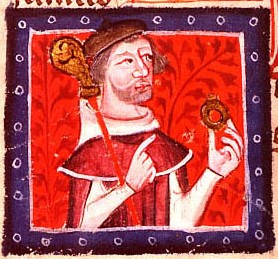
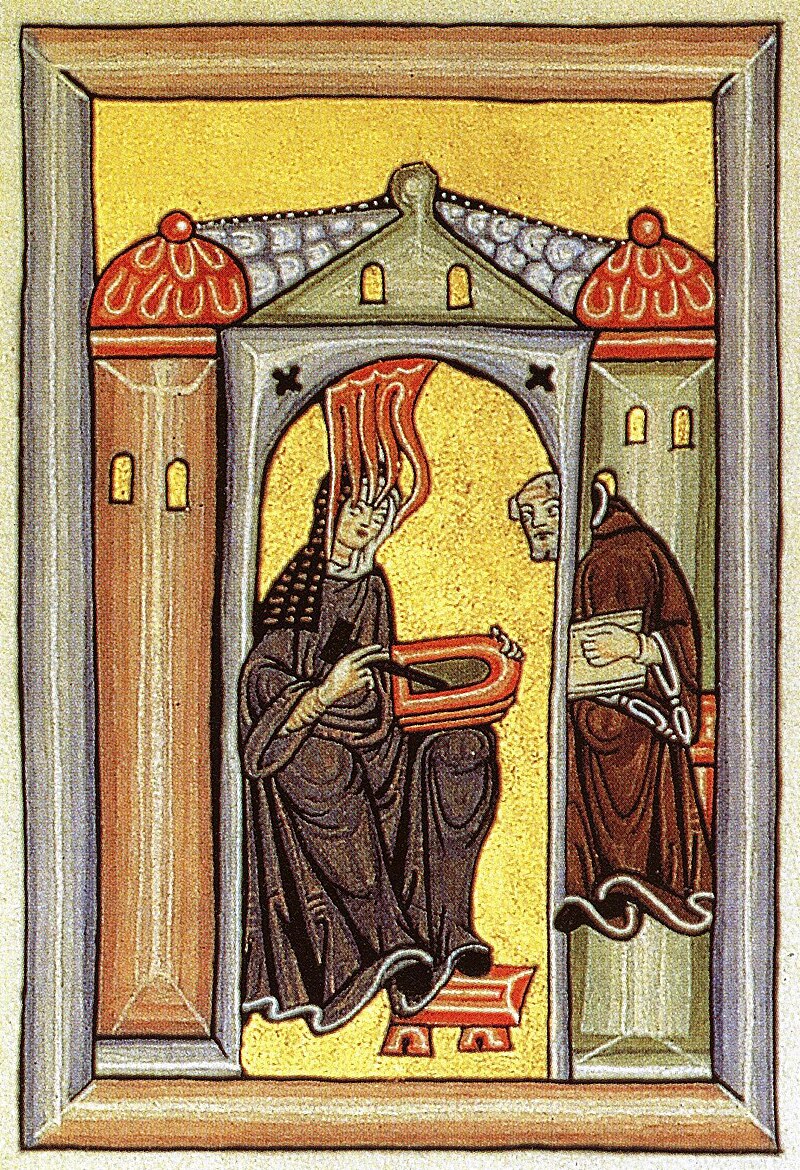
Illumination from Hildegard’s Scivias (1151) showing her receiving a vision and dictating to teacher Volmar

Hildegard of Bingen was rather brilliant. Born in around 1098 in Bremersheim in the Rhineland, into a noble family, Hildegard was the tenth child of Hildebert and Mechtild and was destined for life in a convent from an early age. She was around eight years old when she was placed with Jutta of Sponheim, a reclusive (possibly an anchorite), religious noblewoman who supervised the education of young girls from noble families. In 1112, at the age of fourteen, Hildegard, along with other girls in Jutta’s charge, took her vows at the monastery at Disibodenberg. Under Jutta, who became prioress at Disibodenberg, Hildegard was taught to read, and Latin, although she was not proficient in the latter, and in later life she relied on her secretaries to correct her Latin grammar.

Hildegard was a woman of many talents, she was a visionary, a musician, philosopher, theologian and an expert in medicine. She lived at the monastery of Disibodenberg for more than thirty years. It was in her early years there that she first experienced visions, which would make her famous even in her own lifetime. Initially, she only revealed her prophetic visions to her mentor, Jutta, and it was only when God commanded to her record them, that she revealed them to her friend and secretary, Volmar. With the permission of the Abbot of Disibodenberg, Kuno, and with the encouragement of Volmar and a fellow nun, Richardis of Stade, Hildegard started writing down her visions when she was in her forties. It was only after much encouragement from her Archbishop, Henry of Mainz, that her first work, Scivias, was published. The beautifully illustrated work was given approval from a commission set up by Pope Eugene III and was also supported by the saintly Bernard of Clairvaux.

Abbot Bernard of Clairvaux was one of a number of theologians with whom Hildegard maintained a correspondence. She regularly asked the venerable abbot for advice and guidance, and help in interpreting her visions. In one letter, she would tell him,

‘I have from earliest childhood seen great marvels which my tongue has no power to express but which the Spirit of God has taught me that I may believe … Indeed, I have no formal training at all, for I know how to read only on the most elementary level, certainly with no deep analysis. But please give me your opinion in this matter, because I am untaught and untrained in exterior material, but am only taught inwardly, in my spirit.’


Hildegard corresponded with the great personalities of her time, with emperors, popes and even queens. Sometime between 1154 and 1171, she responded to a letter from Eleanor of Aquitaine, asking for advice, with the words ‘Your mind is like a wall which is covered with clouds, and you look everywhere but have no rest. Flee this and attain stability with God and men, and God will help you in all your tribulations. May God give you his blessing and help in all your works’.

History ... the Interesting Bits
Hildegard of Bingen

In 1148 Hildegard had a vision in which God commanded her to take her nuns and establish her own nunnery. Although Abbot Kuno was reluctant to see Hildegard leave Disibodenberg – her reputation had brought the monastery pilgrims and prestige – she eventually prevailed and established a new convent at Rupertsberg. Hildegard’s convent admitted only noblewomen, she did not believe in mixing the classes within a convent, writing that different ‘classes of people should not be mixed, or they will fall out through deceit or arrogance, and the shame occasioned by their differences. The greatest danger of all is a breakdown in peaceful manners through mutual backbiting and hatred when the upper-class pounce on the lower or when the lower is promoted above the higher.’

It was at Rupertsberg that Hildegard wrote two medical works, Causes and Cures and Physica, after studying the illnesses of the sick who she cared for. Her writings suggested remedies for different ailments, using a wide variety of plants; for example, Hildegard explains how cloves could be used to remedy against gout, swollen intestines and hiccups. She also extolled the virtues of the rose as a cure for many ills, saying:

‘Rose is cold, and this coldness contains moderation which is useful. In the morning, or at daybreak, pluck a rose petal and place it on your eyes. It draws out the humour and makes them clear. One with small ulcers on his body should place rose petals over them. This pulls the mucus from them. One who is inclined to wrath should take rose and less sage and pulverise them. The sage lessens the wrath, and the rose makes him happy. Rose, and half as much sage, may be cooked with fresh, melted lard, in water, and an ointment made from this. The place where a person is troubled by a cramp or paralysis should be rubbed with it, and he will be better. Rose is also good to add to potions, unguents, and all medications. If even a little rose is added, they are so much better, because of the good virtues of the rose.’
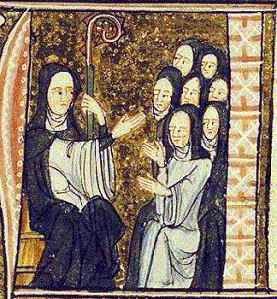
Hildegard’s prolific writing career continued in her new surroundings. She produced religious poems, music and even a play, Ordo Virtutum. She also wrote two further books of her visions, Liber vitae meritorum (Book of Life’s Merits) and Liber divinonim operum (Book of Divine Works), and a life of the abbey’s patron saint, St Rupert. Ricardis of Stade and her friend and secretary, Volmar, had accompanied Hildegard from Disibodenberg to Rupertsberg and continued to help her as secretaries and assistants. A succession of secretaries came after Volmar and Richardis, including Hildegard’s nephew, Wesclein, her brother, Hugo of Tholey, and her last secretary, Guibert of Gembloux. Guibert and an earlier secretary, Godfrey of Disibodenbrg, both wrote biographies of Hildegard. The main purpose of the secretaries was to edit Hildegard’s works as her Latin grammar was far from proficient; however, they were under strict instructions not to change any of her words as they came from God, exhorting

‘Let no man be so audacious as to add anything to this writing lest he be blotted out from the book of life’.

History ... the Interesting Bits
Coin commemorating the 900th anniversary of the birth of Hildegard of Bingen

Hildegard was a prolific letter writer and, more than 800 years after her death, there are around 400 of her letters still extant today. Many wrote to her asking for advice and prophecies. Indeed, John of Salisbury said Pope Eugene III had consulted Hildegard for predictions about his reign, which had been accurate. In her letters, Hildegard acts as a mediator within the monastic world, soothing arguments within convents, between abbesses and their nuns, and abbots and their monks. She was respected by men and women alike, noble and poor. Hildegard gave advice and support and remonstrated against injustice and corruption. She travelled widely and undertook four preaching tours, between 1158 and 1170, a practice ordinarily forbidden to women, who were expected not to teach or speak in church.

Hildegard of Bingen died in her eighty-second year, at Rupertsberg, on 17 September 1179, and was canonised as Saint Hildegard on 10 May 2012 by Pope Benedict XVI, who declared her a doctor of the Church, in the same year. She was a woman of extraordinary talents, an exceptional writer, a poet and composer, a visionary, a mystic and a scientist. She was trusted and respected by the great men of her age and is considered to be the most influential woman in medieval Church history, a well-deserved accolade.

Sources:

The Letters of Hildegard of Bingen, translated by Joseph L. Baird and Radd K. Ehrman; Hildegardis Bingensis, Epistolarium, edited by Lieven Van Acker and Monika Klaes-Hachmoller; Medieval Europe 400–1500 by H.G. Koenigsberger; Medievalists.net, The Herbal Cures of Hildegard von Bingen – was she right?; Hildegard von Bingen’s Physica: The Complete English Translation of Her Classic Work on Health and Healing by Priscilla Throop; Six Trailblazing Medieval Women article by Susan Signe Morrison; The Letters of John of Salisbury, edited by W.J. Miller, S.J. Butler, H.E. Butler and revised by C.N.L. Brooke

*

My Books:

Signed, dedicated copies of all my books are available through my online bookshop.

Out now: Scotland’s Medieval Queens

Books by Sharon Bennett Connolly

Scotland’s history is dramatic, violent and bloody. Being England’s northern neighbour has never been easy. Scotland’s queens have had to deal with war, murder, imprisonment, political rivalries and open betrayal. They have loved and lost, raised kings and queens, ruled and died for Scotland. From St Margaret, who became one of the patron saints of Scotland, to Elizabeth de Burgh and the dramatic story of the Scottish Wars of Independence, to the love story and tragedy of Joan Beaufort, to Margaret of Denmark and the dawn of the Renaissance, Scotland’s Medieval Queens have seen it all. This is the story of Scotland through their eyes.

Scotland’s Medieval Queens gives a thorough grounding in the history of the women who ruled Scotland at the side of its kings, often in the shadows, but just as interesting in their lives beyond the spotlight. It’s not a subject that has been widely covered, and Sharon is a pioneer in bringing that information into accessible history.’ Elizabeth Chadwick (New York Times bestselling author)

Available now from Amazon and Pen and Sword Books

Also by Sharon Bennett Connolly:

Books by Sharon Bennett Connolly

Heroines of the Tudor World tells the stories of the most remarkable women from European history in the time of the Tudor dynasty, 1485-1603. These are the women who ruled, the women who founded dynasties, the women who fought for religious freedom, their families and love. Heroines of the Tudor World is now available for pre-order from Amberley Publishing and Amazon UK. Women of the Anarchy demonstrates how Empress Matilda and Matilda of Boulogne, unable to wield a sword themselves, were prime movers in this time of conflict and lawlessness. It shows how their strengths, weaknesses, and personal ambitions swung the fortunes of war one way – and then the other. Available from Bookshop.orgAmberley Publishing and Amazon UKKing John’s Right-Hand Lady: The Story of Nicholaa de la Haye is the story of a truly remarkable lady, the hereditary constable of Lincoln Castle and the first woman in England to be appointed sheriff in her own right. Available from all good bookshops Pen & Sword Booksbookshop.org and Amazon

Defenders of the Norman Crown: The Rise and Fall of the Warenne Earls of Surrey tells the fascinating story of the Warenne dynasty, from its origins in Normandy, through the Conquest, Magna Carta, the wars and marriages that led to its ultimate demise in the reign of Edward III. Available from Pen & Sword BooksAmazon in the UK and US, and Bookshop.orgLadies of Magna Carta: Women of Influence in Thirteenth Century England looks into the relationships of the various noble families of the 13th century, and how they were affected by the Barons’ Wars, Magna Carta and its aftermath; the bonds that were formed and those that were broken. It is now available in paperback and hardback from Pen & SwordAmazon, and Bookshop.orgHeroines of the Medieval World tells the stories of some of the most remarkable women from Medieval history, from Eleanor of Aquitaine to Julian of Norwich. Available now from Amberley Publishing and Amazon, and Bookshop.orgSilk and the Sword: The Women of the Norman Conquest traces the fortunes of the women who had a significant role to play in the momentous events of 1066. Available now from Amazon,  Amberley Publishing, and Bookshop.org.

Alternate Endings: An anthology of historical fiction short stories including Long Live the King… which is my take what might have happened had King John not died in October 1216. Available in paperback and kindle from Amazon.

Podcast:

Have a listen to the A Slice of Medieval podcast, which I co-host with Historical fiction novelist Derek Birks. Derek and I welcome guests, such as Bernard Cornwell and Elizabeth Chadwick, and discuss a wide range of topics in medieval history, from significant events to the personalities involved.

Every episode is also now available on YouTube.

*

Don’t forget! Signed and dedicated copies of all my books are available through my online bookshop.

For forthcoming online and in-person talks, please check out my Events Page.

You can be the first to read new articles by clicking the ‘Follow’ button, liking our Facebook page or joining me on TwitterThreadsBluesky and Instagram.

*

©2024 Sharon Bennett Connolly FRHistS.

Guest Post: Catherine Carey by Wendy J. Dunn

Today it is an absolute pleasure to welcome author Wendy J. Dunn to History…the Interesting Bits, to talk about her latest book, Henry VIII’s True Daughter: Catherine Carey, A Tudor Life. Wendy is an award-winning historical novelist but Henry VIII’s True Daughter: Catherine Carey, A Tudor Life is her first foray into historical non-fiction. It is a fascinating investigation into the life and paternity of Catherine Carey, daughter of Mary Boleyn and … well, that’s the question!

Over to Wendy…

Catherine Carey

There’s a question I am answering a lot since the publication of Henry VIII’s True Daughter: Catherine Carey, A Tudor Life.

Why did I decide to write a nonfiction book about Catherine Carey?

Well, the answer is a story in itself, and it all began when a commissioning editor for Pen & Sword Books approached me on twitter and asked me if I would be interested in writing a book for them. After spending some time googling her and establishing she was, in fact, who she claimed to be, I asked her to tell me more, and she offered me three projects to select from. One project was about the life and times of Catherine Carey. The teenage Catherine was my point of view character in The Light in the Labyrinth, my second Anne Boleyn novel —so I was well and truly already fascinated by Catherine’s story that pointed to her being the unrecognised daughter of Henry VIII. The opportunity to discover more about her and life was too tempting and too good an opportunity to pass up.

What makes her fascinating?

For me, it is because she is yet another important Tudor woman whose life story should be better known. The fact we know so little about her – even the year of her birth is a mystery —intrigued me.

 Catherine was the daughter of Mary Boleyn, the sister of Anne Boleyn, Henry VIII’s second queen. She was born during Mary Boleyn’s marriage to William Carey — a man of good birth but not high in the Tudor hierarchy who closely served Henry VIII in his private chambers. The years put forward for Catherine’s birth are also years when Mary was sexually involved with Henry VIII. 

Henry Carey, Catherine’s brother

We don’t know when or where Catherine was born. A strong possibility is for her birthplace is Chilton Folist, Wiltshire, the place where William Carey was born. Hever Castle is also a possibility, when you consider it was usual for Tudor women to give birth to their children supported by their close women kin, and Mary’s mother and grandmother lived at Hever Castle. As for her birthyear, what little information history provides for us seems to point to early 1524.

William Carey died early in Catherine’s life. Mary Boleyn returned to Hever Castle at this time — and I believe she returned with both her children. Henry, her son, soon left her care as six-year-old and her sister Anne Boleyn took over as his guardian.

As a well born Tudor girl, Catherine would have received her first training from the adult women in her family. Catherine belonged to the Boleyn family — a family that believed in educating their daughters – and that points to Catherine receiving a good education. We also have Elizabeth’s heartfelt ‘Cor Rotto’ letter to her cousin Catherine (and, I believe, also her half-sister) in 1553 that supports this. Elizabeth is writing to someone with intelligence, someone who understood Latin and also mythology.

When Catherine was eight or perhaps ten, Mary married William Stafford for love and ended up in her family’s bad books and cut off financially. A big question lingers over where Mary and William lived after their marriage, but Catherine had reached the age to be ‘put out’ to another household by this stage. I suspect the Boleyn family placed her either in the household of Anne Boleyn, or her Uncle George Boleyn. Anne was already looking after Mary’s son, Henry, so why not her daughter too? That there are many gaps in the household records of this time could explain the non-mention of Catherine’s name as part of either her aunt or uncle’s household.

 There’s no doubt in my mind that Henry VIII sired Catherine. Writing True Daughter has now made me believe the king also was the father of Henry Carey. What evidence do I have to support this? I will share some of what other historians have put forward — as for the evidence I have put forward in True Daughter— well, I am hoping people will buy my book to find out.

First and most powerful bit of evidence is that Mary Boleyn was in a sexual relationship with Henry VIII – something that Henry admitted and also used to annul his marriage with Anne Boleyn just days before her execution. Henry VIII’s involvement with Mary lasted for years – and throughout the years put forward as possible birth years for Catherine Carey.

Even before Catherine’s birth, we are provided with smoke about the possibility of Mary’s pregnancy when the king named one of his ships in Mary’s honour. After Catherine’s birth, William Carey received several grants from Henry VIII – and the money provided from at least one of these grants continued to go to Mary Boleyn after his death.

While Henry VIII lived, it appears he was more than simply an interested bystander in Catherine’s life. Before her marriage, Catherine gained a very sought for position as one of Anne of Cleves’ ‘Maid of honours, despite the fact she was the niece of Anne Boleyn. The Boleyns, by this time, were a family no longer favoured by Henry VIII. When Catherine Carey married Francis Knollys, the king granted them ownership of property in both their names.

What to know more about Catherine’s story?

For that, you need to read ‘Henry VIII’s True Daughter: Catherine Carey, A Tudor Life’.

About the author:

Wendy J. Dunn is an award-winning Australian writer fascinated by Tudor history – so much so she was not surprised to discover a family connection to the Tudors, not long after the publication of her first Anne Boleyn novel, which narrated the Anne Boleyn story through the eyes of Sir Thomas Wyatt, the elder. Her family tree reveals the intriguing fact that one of her ancestral families – possibly over three generations – had purchased land from both the Boleyn and Wyatt families to build up their own holdings. It seems very likely Wendy’s ancestors knew the Wyatts and Boleyns personally. Wendy is married, the mother of three sons and one daughter—named after a certain Tudor queen, surprisingly, not Anne. She is also the grandmother of two amazing small boys. She gained her PhD in 2014 and loves walking in the footsteps of the historical people she gives voice to in her novels. Wendy also tutors at Swinburne University of Technology, Australia.

*

My Books:

Signed, dedicated copies of all my books are available through my online bookshop.

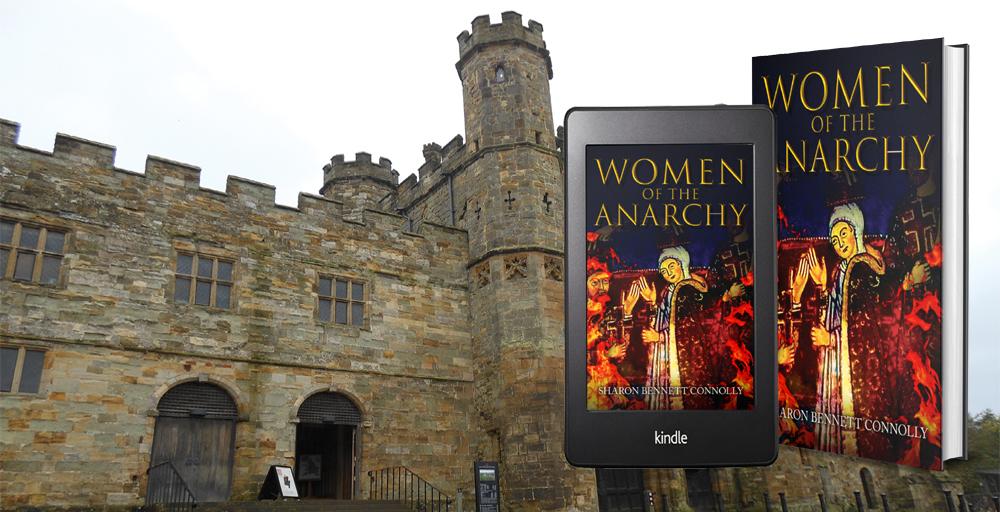
Out Now! Women of the Anarchy

Two cousins. On the one side is Empress Matilda, or Maud. The sole surviving legitimate child of Henry I, she is fighting for her birthright and that of her children. On the other side is her cousin, Queen Matilda, supporting her husband, King Stephen, and fighting to see her own son inherit the English crown. Women of the Anarchy demonstrates how these women, unable to wield a sword, were prime movers in this time of conflict and lawlessness. It show how their strengths, weaknesses, and personal ambitions swung the fortunes of war one way – and then the other.

Available from Bookshop.orgAmberley Publishing and Amazon UK.

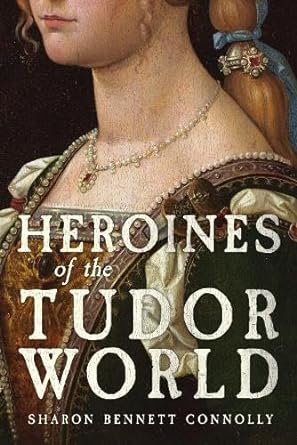
Coming on 15 June 2024: Heroines of the Tudor World

Heroines of the Tudor World tells the stories of the most remarkable women from European history in the time of the Tudor dynasty, 1485-1603. These are the women who ruled, the women who founded dynasties, the women who fought for religious freedom, their families and love. These are the women who made a difference, who influenced countries, kings and the Reformation. In the era dominated by the Renaissance and Reformation, Heroines of the Tudor World examines the threats and challenges faced by the women of the era, and how they overcame them. From writers to regents, from nuns to queens, Heroines of the Tudor World shines the spotlight on the women helped to shape Early Modern Europe.

Heroines of the Tudor World is now available for pre-order from Amberley Publishing and Amazon UK.

Also by Sharon Bennett Connolly:

King John’s Right-Hand Lady: The Story of Nicholaa de la Haye is the story of a truly remarkable lady, the hereditary constable of Lincoln Castle and the first woman in England to be appointed sheriff in her own right. Available from all good bookshops or direct from Pen & Sword Booksbookshop.org and AmazonDefenders of the Norman Crown: The Rise and Fall of the Warenne Earls of Surrey tells the fascinating story of the Warenne dynasty, from its origins in Normandy, through the Conquest, Magna Carta, the wars and marriages that led to its ultimate demise in the reign of Edward III. Available from Pen & Sword BooksAmazon in the UK and US, and Bookshop.org

Ladies of Magna Carta: Women of Influence in Thirteenth Century England looks into the relationships of the various noble families of the 13th century, and how they were affected by the Barons’ Wars, Magna Carta and its aftermath; the bonds that were formed and those that were broken. It is now available in paperback and hardback from Pen & Sword,  Amazon, and Bookshop.orgHeroines of the Medieval World tells the stories of some of the most remarkable women from Medieval history, from Eleanor of Aquitaine to Julian of Norwich. Available now from Amberley Publishing and Amazon, and Bookshop.orgSilk and the Sword: The Women of the Norman Conquest traces the fortunes of the women who had a significant role to play in the momentous events of 1066. Available now from Amazon,  Amberley Publishing, and Bookshop.org.

Alternate Endings: An anthology of historical fiction short stories including Long Live the King… which is my take what might have happened had King John not died in October 1216. Available in paperback and kindle from Amazon.

Podcast:

Have a listen to the A Slice of Medieval podcast, which I co-host with Historical fiction novelist Derek Birks. Derek and I welcome guests, such as Bernard Cornwell and Elizabeth Chadwick, and discuss a wide range of topics in medieval history, from significant events to the personalities involved.

*

Don’t forget! Signed and dedicated copies of all my books are available through my online bookshop.

For forthcoming online and in-person talks, please check out my Events Page.

You can be the first to read new articles by clicking the ‘Follow’ button, liking our Facebook page or joining me on Twitter and Instagram.

*

©2024 Wendy J. Dunn and Sharon Bennett Connolly FRHistS.

Publication Day: Women of the Anarchy

I am so happy and proud to announce that Women of the Anarchy is finally out in the world – well, in the UK, anyway. It will be released in the US, Canada and Australia in April. It has been quite a journey. Thanks to the pandemic and a backlog at the publishers, Women of the Anarchy has taken a little longer to see daylight than my other books.

I hope it was worth the wait.

About Women of the Anarchy:

In 1135, Stephen of Blois usurped the throne, stealing it from his cousin Empress Matilda and sparking a nineteen-year civil war that would become known as the Anarchy, one of the bloodiest periods in English history.

On the one side is Empress Matilda. The sole surviving legitimate child of Henry I, she is fighting for her birthright and that of her children.

On the other side is her cousin, Queen Matilda, supporting her husband, Stephen, and fighting to see her own son inherit the English crown.

Both women are granddaughters of St Margaret, Queen of Scotland, and descendants of Alfred the Great of Wessex. Empress Matilda was the first woman to claim the throne of England in her own right, but did not gain the support of the barons. When Queen Matilda’s husband King Stephen was captured by the Empress’s forces, it was down to her to keep the fight going, and to negotiate for her husband’s release.

Women of the Anarchy demonstrates how these women, unable to wield a sword, were prime movers in this time of conflict and lawlessness. It shows how their strengths, weaknesses and personal ambitions swung the fortunes of war one way – and then the other.

Reviews:

Early reviews have been amazing:

In Women of the Anarchy, Sharon Bennett Connolly tells the parallel stories of two cousins named Matilda, The first, Empress Matilda, saw her throne usurped by Stephen of Blois in 1135, an act that launched a bloody 19-year civil war known the history as the Anarchy. As she fought for the crown that was her birthright, she found herself pitted against another Matilda: this one the wife of King Stephen.

As granddaughters of a queen and descendants of Alfred the Great, the two women at the centre of this story both believed that it was the right of their own blood to rule, and both were determined to prevail. With Stephen of Blois captured by the forces of Empress Matilda, it was up to his queen to carry on the war and, she hoped, secure his eventual release. Neither of the women would ever see battle, but they made their mark in other ways. From strategy to negotiation to making the sorts of decisions that the powerful barons believed were the province of men alone, the two women altered the course of the war and also the path of history itself.

Women of the Anarchy is particularly notable for the story of Matilda of Boulogne, the queen who has often been a supporting player in her husband’s story. It’s also a reminder of the challenges unique to royal women, both at home and in the wider world. This is a fascinating story that will appeal to anyone with an interest in the power plays of the medieval world.

All About History magazine issue 138

And from Annie Whitehead, a fellow historian of medieval women:

Well now there’s a lovely new nonfiction book which covers this period, but does do by focusing on the women who played pivotal roles. And there’s none better to write such a book than Sharon Bennett Connolly, who has made it a bit of a stock-in-trade to bring medieval women out of the shadows and plonk them firmly in the limelight….

I thoroughly enjoyed this book. It gives an in depth account of The Anarchy…

all in all this is a rounded study of the period, but always the emphasis is on the women and the parts they played. Couple this with the author’s readable style, and it’s a book which informs and entertains.

Annie Whitehead

Read the full review here

And one more amazing review, from the Lincolnshire Family History Society:

The author examines this period in minute detail, whilst she leads the reader through this fascinating, but convoluted series of events, through the experiences of relatively unknown women. She describes fully each participant. Her pen pictures make them more than mere names, giving them character and life, illuminated by quotations and extracts from chronicles of the time.

Like an exciting detective story, each chapter leads the reader further into the turmoil, explaining the situation from a different viewpoint. The anticipation builds as the reader follows the chapters. The deeper I got into the book, the less I wanted to put it down as it moved towards the final chapters.

Historical Books can be difficult reading by their very intensity. However, once again, Sharon Bennett Connolly excels in her presentation, choosing carefully from a maelstrom of sources, to give her reader an unusual and illuminating path through those times

Lincolnshire Family History Society

More reviews:

Women of the Anarchy is therefore a compelling read that sheds light on the overlooked yet influential women of 12th century England. It provides a fresh and gripping perspective on the part these women played in dictating the course of the Anarchy and is highly recommended.

https://www.livingmedieval.com/features/women-of-the-anarchy

Sharon Bennett Connolly avoids portraying these women as pawns or victims, but reveals complex characters, driven by ambition, love, faith, and an inspiring determination to take control of their own destinies. We see their vulnerabilities and triumphs, their moments of weakness and resilience, creating a deeply human and relatable portrait of these women’s lives.

https://tonyriches.blogspot.com/2024/02/book-review-women-of-anarchy-by-sharon.html?spref=tw

What makes Women of the Anarchy stand out is its focus on the broader spectrum of royal women impacted by the conflict. Connolly weaves a rich tapestry of characters, including grandmothers and mothers such as Matilda of Flanders, Saint Margaret of Scotland, Matilda of Scotland, and Adeliza of Louvain. These influential women served as role models, imparting invaluable lessons to the two Matildas on how to balance their roles as queens while preserving their individual identities.

https://www.medievallatin.com/post/matildas-and-matriarchs-in-england-s-epic-strife-women-of-the-anarchy-book-review

Podcast:

Have a listen to the Anarchy episode of A Slice of Medieval podcast, which I co-host with Historical fiction novelist Derek Birks, in which we discuss the empress, the queen and the wider war.

To buy Women of the Anarchy

You can order signed, dedicated copies of Women of the Anarchy through my online bookshop. Women of the Anarchy is also available in bookshops or online from Amberley Publishingbookshop.org, and Amazon UK. 

Also by Sharon Bennett Connolly:

King John’s Right-Hand Lady: The Story of Nicholaa de la Haye is the story of a truly remarkable lady, the hereditary constable of Lincoln Castle and the first woman in England to be appointed sheriff in her own right. It is is available from Pen & Sword Booksbookshop.org and AmazonDefenders of the Norman Crown: The Rise and Fall of the Warenne Earls of Surrey tells the fascinating story of the Warenne dynasty, from its origins in Normandy, through the Conquest, Magna Carta, the wars and marriages that led to its ultimate demise in the reign of Edward III. Available from Pen & Sword BooksAmazon in the UK and US, and Bookshop.org.

Ladies of Magna Carta: Women of Influence in Thirteenth Century England looks into the relationships of the various noble families of the 13th century, and how they were affected by the Barons’ Wars, Magna Carta and its aftermath; the bonds that were formed and those that were broken. It is now available in paperback and hardback from Pen & Sword,  Amazon, and Bookshop.orgHeroines of the Medieval World tells the stories of some of the most remarkable women from Medieval history, from Eleanor of Aquitaine to Julian of Norwich. Available now from Amberley Publishing and Amazon, and Bookshop.orgSilk and the Sword: The Women of the Norman Conquest traces the fortunes of the women who had a significant role to play in the momentous events of 1066. Available now from Amazon,  Amberley Publishing, and Bookshop.org.

Alternate Endings: An anthology of historical fiction short stories including Long Live the King… which is my take what might have happened had King John not died in October 1216. Available in paperback and kindle from Amazon.

*

Don’t forget! Signed and dedicated copies of all my books are available through my online bookshop.

For forthcoming online and in-person talks, please check out my Events Page.

*You can be the first to read new articles by clicking the ‘Follow’ button, liking our Facebook page or joining me on Twitter and Instagram.

Article: 2024 © Sharon Bennett Connolly FRHistS

Empress Matilda’s Escape in a Snow Storm

History...the Interesting Bits
Empress Matilda depicted at the coronation of her granddaughter, Matilda of England, as Duchess of Saxony, in an image from the Gospels of Henry the Lion.

In the mid-12th century, England was riven by civil war as King Stephen and Empress Matilda fought for a crown that was rightfully hers. In 1141, the empress came close to realising her ambition: Stephen had been captured and she was proclaimed ‘Lady of the English’, but the crown itself eluded her. Stephen’s wife, Queen Matilda, had fought back, captured the empress’s illegitimate half-brother, Earl Robert of Gloucester and negotiated a prisoner swap.

By January 1142, everyone was back where they started, with Stephen on the throne and Empress Matilda still fighting to wrest it from his grasp. In the early months of the year, both sides spent time consolidating their resources and manoeuvring for position rather than forcing a confrontation.

Except, things were a little more desperate. Her stocks were severely depleted and only her staunchest supporters remained with her; worse still, Stephen was now free to act on his own behalf. With the defection of Henry of Blois, Bishop of Winchester, back to his brother’s side, the church was against her as well.

The empress needed reinforcements. Her husband, Geoffrey of Anjou, implied that he would help, but only if her brother, Earl Robert, would come to him and ask in person. The empress was against the idea and Earl Robert was reluctant to leave his sister, not that Stephen was free again. But the king was lying ill at Nottingham, with rumours circulating that he was close to death. Robert decided it would be safe enough to leave for Normandy, though not without reservations.

Empress Matilda moved to Oxford to await her brother’s return. Although Oxford was not the most secure residence. It may have strong, high walls, but it was close to enemy territory. It was close to London. Her presence there would mean that the empress could act quickly, were Stephen to die.

But then, the king unexpectedly recovered.

History...the Interesting Bits
King Stephen

And went on the offensive, taking Wareham, held by Earl Robert’s eldest son, William of Gloucester. It was the castle guarding that would have been the earl’s landing place on his return from Normandy. Stephen then marched to Cirencester, the castle was abandoned by the garrison on his approach. He burned it to the ground before moving on to Bampton and Radcot, both garrisoned by the empress’s forces; one was taken by storm while the other surrendered.

By taking the nearby castles, Stephen was isolating the empress at Oxford, cutting off any possible aid. And it was only when this was done that Stephen turned his sights on the empress.

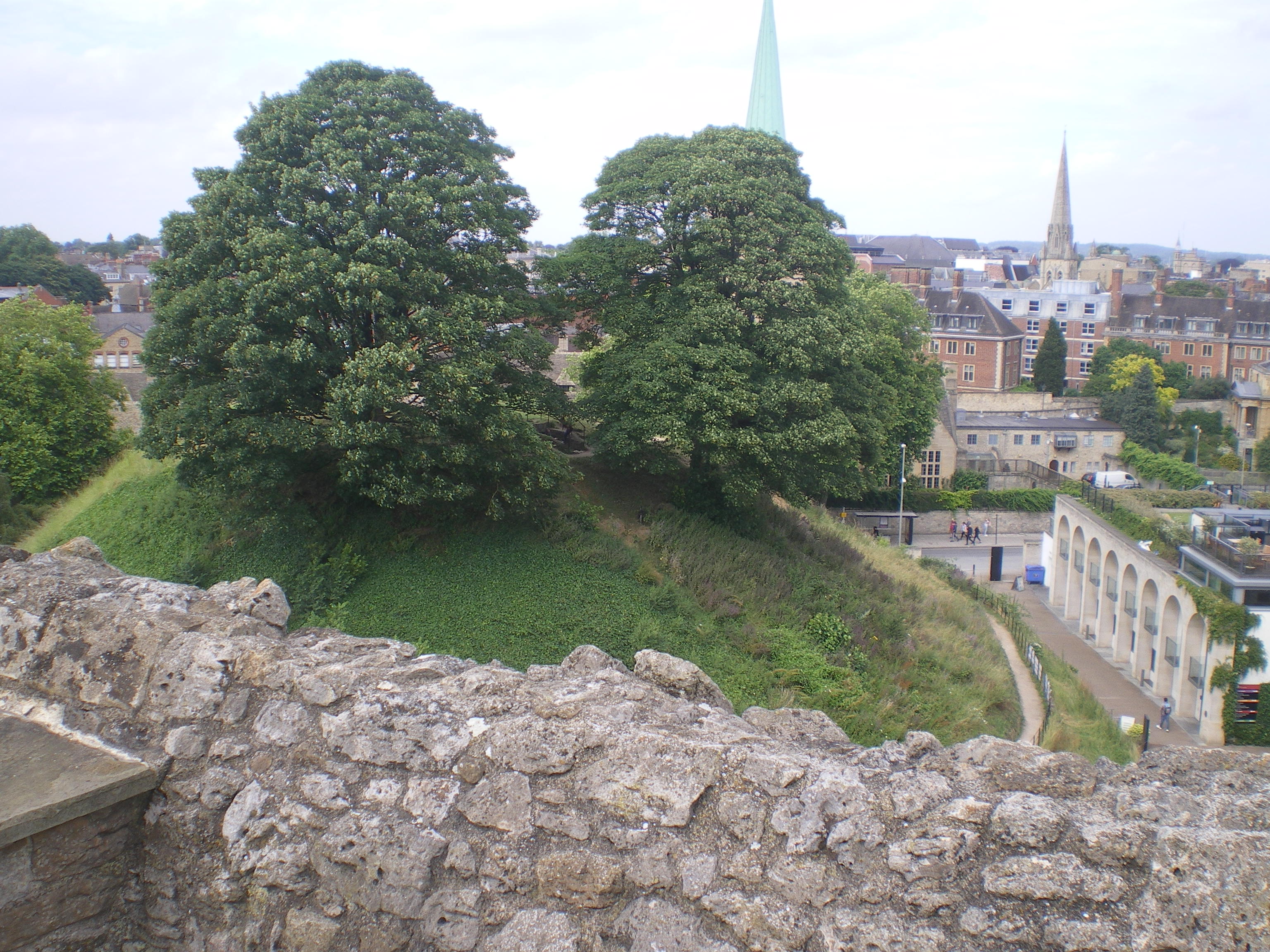
Oxford was a city protected by the surrounding Thames, guarded by a palisade on one side while the formidable castle, with its high donjon, stood sentinel on the other side. According to the Gesta Stephani, the king managed to find a deep ford by which he led his men across the river, ‘swimming rather than wading’, and launched an attack on the city’s defenders. When the defenders pulled back into the city, hoping to close the gates, the king’s forces mingled with them and made their way inside, burning buildings, killing those who resisted and capturing those who could offer a ransom. Others were ejected from the town, left to their own devices in the neighbouring countryside. While others were forced to seek shelter in the castle, with the empress.

The king encircled the castle, ordering that it be closely watched, day and night. The empress was not going to escape him again. There was slim chance of reinforcements coming to her aid. Her uncle David, King of Scots was back in Scotland, her loyal servant Miles of Gloucester, now Earl of Hereford, did not have enough men, and Brian FitzCount had to look to the defence of his own castle at Wallingford. And Earl Robert was still far away in Normandy, campaigning with Count Geoffrey while the latter made up his mind about sending reinforcements to aid his wife: over the summer and autumn of 1142, the two of them captured ten Norman castles.

On hearing of the empress’s predicament, Robert abandoned his quest for more troops and returned to England, forcing a landing at Wareham. With fifty-two ships and a force of between 300 and 400 knights in addition to foot soldiers, the earl managed to force Wareham’s surrender after a three-week siege. He then ordered a full muster of the empress’s forces at Cirencester before marching on Oxford to rescue his sister.

History...the Interesting Bits
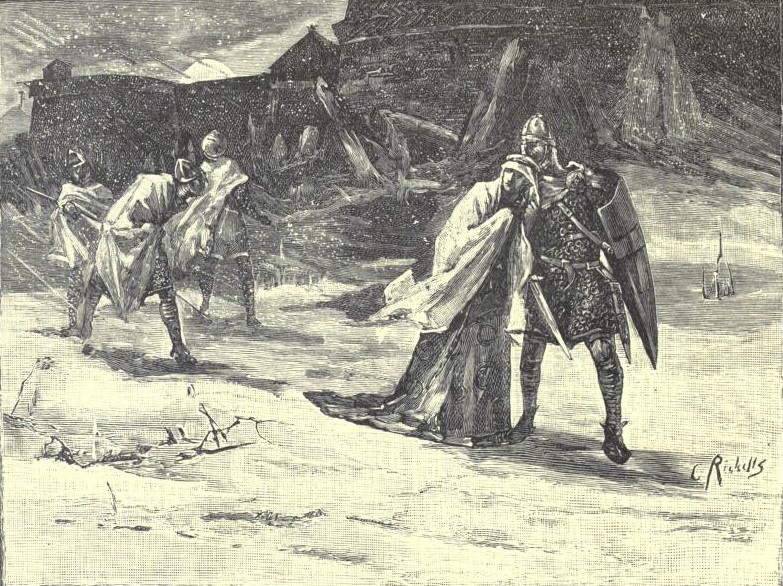
Charles Ricketts, ‘The Flight of Matilda from Oxford’

Shut up in the castle, with winter upon them, the empress and her forces were cold, hungry and desperate. Entirely cut off from the outside world, neither supplies nor news had been able to get past the king’s blockade since September. In the middle of December, with the ground white with snow and the river frozen, the empress made a desperate gamble.

‘Very hard pressed as she was and altogether hopeless that help would come she left the castle by night with three knights of ripe judgement to accompany her.’

Gesta Stephani

In the dark of the night, presumably dressed in white to camouflage against the blanket of snow, accompanied by just 3 men, she slipped out of a postern gate, and ‘in wondrous fashion she escaped unharmed through so many enemies, so many watchers in the silence of the night, whom the king had heedfully posted on every side of the castle.’ The empress walked 6 miles, crossing the frozen river and traversing the enemy’s pickets, to reach Wallingford Castle. The Gesta Stephani remarked that never had he ‘read of another woman so luckily rescued from so many mortal foes and from the threat of dangers so great’.

History...the Interesting Bits
Oxford Castle

The Anglo-Saxon Chronicle tells the story slightly differently, saying that ‘in the night she was let down from the tower with ropes and stole out, and she fled and went on foot to Wallingford’.

Henry of Huntingdon added the detail that the empress was dressed in white, as camouflage: ‘Not long before Christmas, the empress fled across the frozen Thames, clothed in white garments, which reflected and resembled the snow, deceiving the eyes of the besiegers.’

Though they all tell the story slightly differently, every chronicler eagerly tells of the empress’s daring escape from Oxford Castle.

With the empress safely ensconced at Wallingford with Brian FitzCount, the garrison at Oxford could surrender. The king, deprived of his quarry, agreed easy terms with the remaining defenders.

Earl Robert, on hearing of his sister’s escape, stopped his advance on Oxford and instead made for Devizes, where brother and sister were reunited. The earl had brought a surprise for his sister. After 3 years apart, she was reunited with her eldest son, Henry of Anjou. Henry’s presence served to show England that Henry I’s heir was Empress Matilda’s nine-year-old son, Henry, rather than Stephen’s twelve-year-old son, Eustace.

History...the Interesting Bits
Henry II

Henry was placed in the household of his uncle, Earl Robert, and sent to Bristol to continue his education, alongside his cousin Roger, the earl’s younger son, who would later become Bishop of Worcester. Henry remained at Bristol until March 1144 and soon began to receive homage from his English vassals in person.

The war changed shaped at this time, with empress and earl consolidating their position in their own lands but biding their time, waiting for Henry to grow old enough to take over the reins of the struggle.

Henry’s presence changed the focus of Matilda’s campaign. She now realised that she would never sit on her father’s throne. But there was a new generation to fight for. The empress’s purpose was now to secure the throne for Henry in the next reign rather than to displace Stephen in this one.

*

An earlier version of this article appeared in the 4th edition of Living Medieval Magazine.

Sources:

The Anglo-Saxon Chronicles, edited and translated by Michael Swanton; Gesta Stephani, translated by K. R. Potter; Henry of Huntingdon, The History of the English People 1000-1154, translated by Diana Greenway; Henry of Huntingdon, The Chronicle of Henry of Huntingdon; Ordericus Vitalis, The Ecclesiastical History of England and Normandy; Matthew Lewis, Stephen and Matilda’s Civil War: Cousins of Anarchy; Catherine Hanely, Matilda: Empress, Queen, Warrior; Edmund King, King Stephen.

Images:

Courtesy of Wikipedia, except Oxford Castle which is used with the kind permission of Jayne Smith

*

My Books

Signed, dedicated copies of all my books are available through my online bookshop.

Out now: Scotland’s Medieval Queens

Books by Sharon Bennett Connolly

Scotland’s history is dramatic, violent and bloody. Being England’s northern neighbour has never been easy. Scotland’s queens have had to deal with war, murder, imprisonment, political rivalries and open betrayal. They have loved and lost, raised kings and queens, ruled and died for Scotland. From St Margaret, who became one of the patron saints of Scotland, to Elizabeth de Burgh and the dramatic story of the Scottish Wars of Independence, to the love story and tragedy of Joan Beaufort, to Margaret of Denmark and the dawn of the Renaissance, Scotland’s Medieval Queens have seen it all. This is the story of Scotland through their eyes.

Scotland’s Medieval Queens gives a thorough grounding in the history of the women who ruled Scotland at the side of its kings, often in the shadows, but just as interesting in their lives beyond the spotlight. It’s not a subject that has been widely covered, and Sharon is a pioneer in bringing that information into accessible history.’ Elizabeth Chadwick (New York Times bestselling author)

Available now from Amazon and Pen and Sword Books

Also by Sharon Bennett Connolly:

Books by Sharon Bennett Connolly

Heroines of the Tudor World tells the stories of the most remarkable women from European history in the time of the Tudor dynasty, 1485-1603. These are the women who ruled, the women who founded dynasties, the women who fought for religious freedom, their families and love. Heroines of the Tudor World is now available for pre-order from Amberley Publishing and Amazon UK. Women of the Anarchy demonstrates how Empress Matilda and Matilda of Boulogne, unable to wield a sword themselves, were prime movers in this time of conflict and lawlessness. It shows how their strengths, weaknesses, and personal ambitions swung the fortunes of war one way – and then the other. Available from Bookshop.orgAmberley Publishing and Amazon UKKing John’s Right-Hand Lady: The Story of Nicholaa de la Haye is the story of a truly remarkable lady, the hereditary constable of Lincoln Castle and the first woman in England to be appointed sheriff in her own right. Available from all good bookshops Pen & Sword Booksbookshop.org and Amazon

Defenders of the Norman Crown: The Rise and Fall of the Warenne Earls of Surrey tells the fascinating story of the Warenne dynasty, from its origins in Normandy, through the Conquest, Magna Carta, the wars and marriages that led to its ultimate demise in the reign of Edward III. Available from Pen & Sword BooksAmazon in the UK and US, and Bookshop.orgLadies of Magna Carta: Women of Influence in Thirteenth Century England looks into the relationships of the various noble families of the 13th century, and how they were affected by the Barons’ Wars, Magna Carta and its aftermath; the bonds that were formed and those that were broken. It is now available in paperback and hardback from Pen & SwordAmazon, and Bookshop.orgHeroines of the Medieval World tells the stories of some of the most remarkable women from Medieval history, from Eleanor of Aquitaine to Julian of Norwich. Available now from Amberley Publishing and Amazon, and Bookshop.orgSilk and the Sword: The Women of the Norman Conquest traces the fortunes of the women who had a significant role to play in the momentous events of 1066. Available now from Amazon,  Amberley Publishing, and Bookshop.org.

Alternate Endings: An anthology of historical fiction short stories including Long Live the King… which is my take what might have happened had King John not died in October 1216. Available in paperback and kindle from Amazon.

Podcast:

Have a listen to the A Slice of Medieval podcast, which I co-host with Historical fiction novelist Derek Birks. Derek and I welcome guests, such as Bernard Cornwell and Elizabeth Chadwick, and discuss a wide range of topics in medieval history, from significant events to the personalities involved. Our first ever episode was on The Anarchy!

Every episode is also now available on YouTube.

*

Don’t forget! Signed and dedicated copies of all my books are available through my online bookshop.

For forthcoming online and in-person talks, please check out my Events Page.

You can be the first to read new articles by clicking the ‘Follow’ button, liking our Facebook page or joining me on TwitterThreadsBluesky and Instagram.

Article: 2024 © Sharon Bennett Connolly FRHistS

The Coronation of King Stephen

History...the Interesting Bits
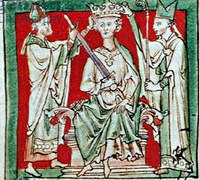
King Stephen

In December 1135, leaving his wife and children in the relative safety of Boulogne, Stephen of Blois took what must have been the biggest gamble of his life. After landing in England, he made his way to the capital, where he was met ‘with acclamation’ as London, though ‘mourning the grievous loss of its protector Henry, it revelled in exultant joy as though it had recovered him in Stephen’. According to the Gesta Stephani, a counsel was summoned to choose Henry’s successor and ‘on their own initiative, they agreed unanimously to choose a king’. The Anglo-Saxon Chronicle concurs, stating that ‘Stephen of Blois had come to England, and came to London, and the London people received him and sent for the archbishop William Corbeil and consecrated him as king on midwinter’s day’.

Henry of Huntingdon was far more critical of the accession of Stephen than the Gesta Stephani, for, although Stephen was ‘a man of great valour and boldness’, as he had ‘sworn the English realm’s oath of fealty to the daughter of King Henry, he tried God’s patience by seizing the crown of the kingdom’. Huntingdon was highly disapproving of the ease with which the leaders of the English church broke their oaths to Matilda in order to crown Stephen:

‘Roger, the great Bishop of Salisbury, who had been the second to take the oath, and had urged everyone else to do so, brought the royal crown to Stephen, as well as the strength of his support. For this reason, by the just judgement of God, he was later arrested and tormented by the very man he had made king, and pitiful ruin became his lot. In short, all those who had sworn the oath – whether bishops, earls or magnates – gave their approval to Stephen and paid homage to him. It was a bad sign that all England was subjected to him so speedily, without hindrance or difficulty, as ‘in the twinkling of an eye’.

Henry of Huntingdon: The History of the English People 1000-1154

It is, of course, the Anglo-Saxon Chronicle that made the most famous assessment of the years following Stephen’s seizure of the throne:

‘Wherever men tilled, the earth bore no corn because the land was all done for by such doings; and they said openly that Christ and His saints slept. Such things, and more than we know how to tell, we suffered nineteen years for our sins.’

The destruction was perhaps not as widespread as has been thought previously, however, and there is currently a reappraisal of the devastation wrought during the Anarchy. Even so, the chronicles of the time show that it was horrendous for the people living through it. The Anglo-Saxon Chronicle goes into great detail, denouncing the period as ‘this evil time’ and lamenting,

‘They did not spare the land of bishops nor of abbots nor of priests, but robbed monks and clerks; and every man who was stronger [robbed] another. If two or three men came riding to a village, all the villagers fled because of them – imagined that they were robbers. The bishops and the clergy always cursed them but that was nothing to them, because they were all accursed and forsworn and lost.’

History...the Interesting Bits
Henry of Blois, Bishop of Winchester

Such desolation was in the future. In December 1135, Stephen, with the backing of so many, may have thought the future was bright with possibilities. After receiving the support and acclamation of the Londoners, he hastened to Winchester to secure the royal treasury where he was reunited with his younger brother Henry, Bishop of Winchester, ‘on whom his enterprise entirely depended’. Bishop Henry, ‘overjoyed at his brother’s success, came to meet him with the Winchester citizens’. William de Pont de l’Arche, the royal treasurer, ‘on learning that the king had arrived, whether influenced by fear of him or affection for him, he came to meet him cordially, and delivered over to his disposal, together with the castle, King Henry’s very rich treasury, which the whole of England had abundantly filled from the time of the most ancient kings’.

It was the support of Pont de l’Arche that ensured Stephen’s success, along with the help of Roger, Bishop of Salisbury, Henry I’s Lord Chancellor and, after the king, the most powerful man in the kingdom. The role of Stephen’s brother, Bishop Henry of Winchester, was also seen as critical, especially by the Gesta Stephani. Stephen was then crowned at Westminster Abbey by Archbishop William Corbeil on 22 December 1135, according to the same rites used in the coronation of Henry I, providing a sense of continuity in the monarchy. Before the coronation, Stephen made promises to ensure that he would be accepted by the lay and clerical magnates alike. To the church, he agreed to follow what it defined as best practice in church–state relations, including the guarantee of canonical election to senior church offices. The compromises made to the lay barons were not as significant, but Stephen did make a limited concession on the extent of the royal forest (lands over which the king held exclusive hunting rights), and was reported to have promised wider reforms, including the abolition of geld.

The coronation was a religious ceremony, giving the king power and sacramental authority for the rest of his life. During the proceedings, Stephen promised to maintain ‘all the liberties and good laws of King Henry’. Following this, those present, standing for the community of the realm, accepted Stephen as their king. There then came the ceremonial anointing and investing with the symbols of royal power. He was then crowned by the Archbishop of Canterbury, followed by High mass and the kiss of peace. News of Stephen’s coronation spread throughout the kingdom and, according to the Gesta Stephani,

‘When at last these things were known and spread over England freely by word of mouth almost all the chief men of the kingdom accepted him gladly and respectfully, and having received very many gifts from him and likewise enlargement of their lands they devoted themselves wholly to his service by a voluntary oath, after paying homage.’

Gesta Stephani
History...the Interesting Bits
The coronation of King Stephen, as depicted by Matthew Paris, 13th century

After the coronation, the king had to get down to the actual business of ruling and establishing his authority over his dominions. The first document issued by the chancery was a charter in which Stephen granted ‘to all his barons and men of England’ all the liberties and good laws of his uncle, King Henry, along with ‘the laws of Edward the Confessor’. The Liber Eliensis at Ely recorded a version of Stephen’s accession in which he was supported by King Henry I. Though the provenance of the information within it has been lost, it seems entirely possible that it is copied from an official narrative sent out by Stephen’s administration:

‘While King Henry sickened unto death, a great number of powerful and noble men gathered about him, sorrowfully contemplating the last hours of their lord, and increasingly concerned about what dispositions he would make about himself and the kingdom. To them at the last he indicated what ought to happen. ‘To you,’ he said, ‘great and wise men, I give as king the worthy knight Stephen, my count, my most dear kinsman, a virtuous nobleman, yet firm in his faith in the Lord, for you to receive from me by right of inheritance, and you are all to be witness of this.’ Immediately thereafter the king breathed his last. The count took up his commission, and having gathered a large body of knights, he hastened to England and came before the Londoners. Since he was a renowned count and valiant knight, of proven integrity and greatly loved, and was descended from the stock of kings, and with the great men and the citizens won over by rewards and promises and the clergy fearing great disorder should he be turned away, he was received by the English as king of England. It greatly aided him in achieving this outcome that, just as the king his uncle had ordered, Hugh Bigod swore on the holy gospels before the clergy and people that he had been present at the king’s deathbed, and had heard him conceding the kingdom to Stephen his nephew, and had been sent by him to witness this within England.’

Liber Eliensis

Hugh Bigod’s claim that Henry had changed his mind at the last, and left the throne to Stephen, was enough to satisfy those who had sworn the oath to Matilda but were afraid of a future ruled by a woman. No one seems to have looked deeply into the suggestion that, after all Henry had done to secure his daughter’s accession, the wars he had fought and oaths he had extracted, he would just pass her – and his grandson, little Henry of Anjou – over at the last moment and leave everything to his favourite nephew. It seems more likely that it was not that Bigod’s statement was believed to be true but that it was hoped that it was – that was all the barons needed to turn their backs on their oaths to Matilda.

History...the Interesting Bits
Henry II and his mother, Empress Matilda, from a 12th century manuscript

Stephen’s coronation was immediately followed by his Christmas court, which was held in London. One of his first acts in the New Year was to attend the funeral of his predecessor, Henry I, who was laid to rest at his own foundation of Reading Abbey on 5 January 1136. According to Henry of Huntingdon,

‘King Stephen came there from his court, which he had held in London at Christmas itself, to meet his uncle’s body, together with William, Archbishop of Canterbury, and many bishops and nobles, and they buried King Henry with the respect due to so great a man.’

It was the beginning of a period of great instability for England. Richard of Hexham gives a clear impression of the unrest and uncertainty that Stephen’s accession caused, and the challenges it presented:

‘The beginning and course of his reign was overwhelmed by so many and such violent commotions, that how to describe them, or how they may be concluded, no one yet knows.’

Stephen had stolen the march on his cousin, Empress Matilda, but she was not going to simply accept that he had won…

*

Sources:

Donald Matthew, King Stephen; Robert Bartlett, England Under the Norman and Angevin Kings; David Williamson, Brewer’s British Royalty; the History Today Companion to British History; Dan Jones, the Plantagenets; englishmonarchs.co.uk; The Oxford Companion to British History; Mike Ashley, The Mammoth Book of British Kings & Queens; Alison Weir, Britain’s Royal Families, the Complete Genealogy; S.P. Thompson, Oxforddnb.com, Mary [Mary of Blois], suo jure countess of Boulogne (d. 1182), princess and abbess of Romsey; Anglo_Saxon Chronicles, edited by Michael Swanton; Gesta Stephani; Liber Eliensis; Henry of Huntingdon: The History of the English People 1000-1154; William of Malmesbury, Chronicles of the Kings of England, From the Earliest Period to the Reign of King Stephen c. 1090-1143; The Ecclesiastical History of England and Normandy by Ordericus Vitalis.

Images:

Courtesy of Wikipedia

*

My Books

Signed, dedicated copies of all my books are available, just click on contact me.

Out now: Scotland’s Medieval Queens

Books by Sharon Bennett Connolly

Scotland’s history is dramatic, violent and bloody. Being England’s northern neighbour has never been easy. Scotland’s queens have had to deal with war, murder, imprisonment, political rivalries and open betrayal. They have loved and lost, raised kings and queens, ruled and died for Scotland. From St Margaret, who became one of the patron saints of Scotland, to Elizabeth de Burgh and the dramatic story of the Scottish Wars of Independence, to the love story and tragedy of Joan Beaufort, to Margaret of Denmark and the dawn of the Renaissance, Scotland’s Medieval Queens have seen it all. This is the story of Scotland through their eyes.

Scotland’s Medieval Queens gives a thorough grounding in the history of the women who ruled Scotland at the side of its kings, often in the shadows, but just as interesting in their lives beyond the spotlight. It’s not a subject that has been widely covered, and Sharon is a pioneer in bringing that information into accessible history.’ Elizabeth Chadwick (New York Times bestselling author)

Available now from Amazon and Pen and Sword Books

Coming 30 March 2026: Princesses of the Early Middle Ages

Books by Sharon Bennett Connolly

Daughters of kings were often used to seal treaty alliances and forge peace with England’s enemies. Princesses of the Early Middle Ages: Royal Daughters of the Conquest explores the lives of these young women, how they followed the stereotype, and how they sometimes managed to escape it. It will look at the world they lived in, and how their lives and marriages were affected by political necessity and the events of the time. Princesses of the Early Middle Ages will also examine how these girls, who were often political pawns, were able to control their own lives and fates. Whilst they were expected to obey their parents in their marriage choices, several princesses were able to exert their own influence on these choices, with some outright refusing the husbands offered to them.

Their stories are touching, inspiring and, at times, heartbreaking.

Princesses of the Early Middle Ages: Royal Daughters of the Conquest is now available for pre-order.

Also by Sharon Bennett Connolly:

Books by Sharon Bennett Connolly

Heroines of the Tudor World tells the stories of the most remarkable women from European history in the time of the Tudor dynasty, 1485-1603. These are the women who ruled, the women who founded dynasties, the women who fought for religious freedom, their families and love. Heroines of the Tudor World is now available from Amberley Publishing and Amazon UK. Women of the Anarchy demonstrates how Empress Matilda and Matilda of Boulogne, unable to wield a sword themselves, were prime movers in this time of conflict and lawlessness. It shows how their strengths, weaknesses, and personal ambitions swung the fortunes of war one way – and then the other. Available from Bookshop.orgAmberley Publishing and Amazon UKKing John’s Right-Hand Lady: The Story of Nicholaa de la Haye is the story of a truly remarkable lady, the hereditary constable of Lincoln Castle and the first woman in England to be appointed sheriff in her own right. Available from all good bookshops Pen & Sword Booksbookshop.org and Amazon

History...the Interesting Bits

Defenders of the Norman Crown: The Rise and Fall of the Warenne Earls of Surrey tells the fascinating story of the Warenne dynasty, from its origins in Normandy, through the Conquest, Magna Carta, the wars and marriages that led to its ultimate demise in the reign of Edward III. Available from Pen & Sword BooksAmazon in the UK and US, and Bookshop.orgLadies of Magna Carta: Women of Influence in Thirteenth Century England looks into the relationships of the various noble families of the 13th century, and how they were affected by the Barons’ Wars, Magna Carta and its aftermath; the bonds that were formed and those that were broken. It is now available in paperback and hardback from Pen & SwordAmazon, and Bookshop.orgHeroines of the Medieval World tells the stories of some of the most remarkable women from Medieval history, from Eleanor of Aquitaine to Julian of Norwich. Available now from Amberley Publishing and Amazon, and Bookshop.orgSilk and the Sword: The Women of the Norman Conquest traces the fortunes of the women who had a significant role to play in the momentous events of 1066. Available now from Amazon,  Amberley Publishing, and Bookshop.org.

Alternate Endings: An anthology of historical fiction short stories including Long Live the King… which is my take what might have happened had King John not died in October 1216. Available in paperback and kindle from Amazon.

Podcast:

History...the Interesting Bits

Have a listen to the A Slice of Medieval podcast, which I co-host with Historical fiction novelist Derek Birks. Derek and I welcome guests, such as Ian Mortimer, Bernard Cornwell, Elizabeth Chadwick and Scott Mariani, and discuss a wide range of topics in medieval history, from significant events to the personalities involved. Episode 1 looked into the characters involved in The Anarchy.

Do have a listen to our 2025 Christmas episode in which Derek and I look bag at some of our favourite discussions with guests.

Every episode is also now available on YouTube.

*

Don’t forget! Signed and dedicated copies of all my books are available through my online bookshop.

For forthcoming online and in-person talks, please check out my Events Page.

You can be the first to read new articles by clicking the ‘Follow’ button, liking our Facebook page or joining me on TwitterThreadsBluesky and Instagram.

©2023 Sharon Bennett Connolly FRHistS

Le Charte aux Lacs d’Amour

When writing medieval non-fiction, you don’t get to tell many love stories. Most marriages were arranged between families for mutual gain or assistance. As a consequence, you don’t really expect to come across many tales of love – and actual love tokens are rare indeed. But in researching the story of Nicholaa de la Haye, I came across just that: a rather unique love token. 

Unfortunately, the love token did not belong to Nicholaa, the defender of Lincoln Castle and first ever female sheriff in England, it belonged to one of her sisters. Nicholaa was the eldest of three sisters and while she inherited Lincoln Castle and her family’s English lands, her sisters, Julia (or Gila) and Isabel, married and settled in Normandy. The story of the love token is Julia’s.

Julia, whose name appears as Gille in French but appears on charters in the Latin, Gila, was married to Richard du Hommet, who died around 1199/1200. Richard was the eldest son and heir of William du Hommet (or Hummez), constable of Normandy, who died around 1204 and his wife, Lucy. According to a charter dated 1232, recording donations to the monks of Saint-Sauveur-le-Vicomte, Lucy was the granddaughter and heir of Adam de Bruys. As constable, William du Hommet appeared as a witness to a charter of 1 March 1190 in which King Richard I ‘confirms to the archbishop and church of Rouen and all the bishops and mother churches of Normandy, concerning those who break the trêve de Dieu (a truce organised by the church).’ 

As with most medieval women, we know very little of Julia’s actual dates, so we have to generalise or make educated guesses. Julia was probably born sometime in the late 1150s, and would have grown up on her family’s lands in Lincolnshire. She will have probably married Richard du Hommet some time in the 1170s, when she was in her mid-to-late teens. She died in the 1190s and her husband remarried before his own death at the turn of the century. Julia and Richard had at least three sons and two or more daughters; two of these sons were the last two constables of Normandy from the Hommet family, succeeding their grandfather in the role. Richard du Hommet had certainly married Julia by the mid-1170s at the latest, when his grandfather, another Richard du Hommet, was still constable of Normandy, and while the younger Richard was still underage. The couple’s first child was born around 1180. 

Richard du Hommet predeceased his father by four or five years, so never became constable of Normandy in his own right, though he does appear to have assisted his father in his duties. In June 1190, Richard appears as a witness, alongside his father, to a charter of Richard I in which he ‘confirms to St Martin’s, Troarn and the monks there serving God the vill and island of Reimberhome etc., with the right of presentation to the church of St Mary there, as given, with his assent, by John son of William count of Ponthieu, etc.’ Father and son are recorded as ‘Willelmo de Humeto constabulario; Richardo de Humeto’ in the witness list. 

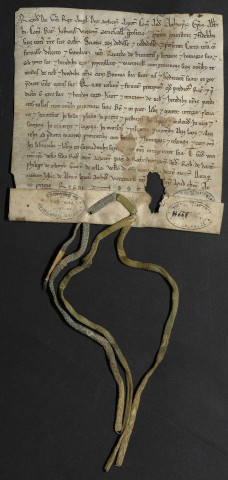
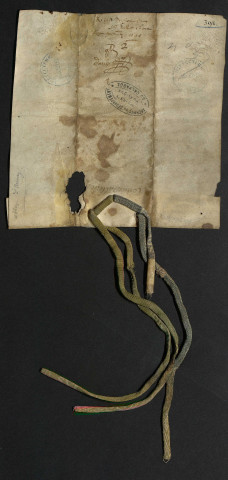
Richard and Julia are also the subjects of a unique charter, issued by King Richard I in June 1190. The charter was preserved by the Abbey of Aunai, which had been founded by the du Hommet family. It conferred the manors of Varreville and Pouppeville upon the couple, naming both ‘Ricardo de Humetis’ and ‘Gila, uxor sue’ (his wife) in the grant.  

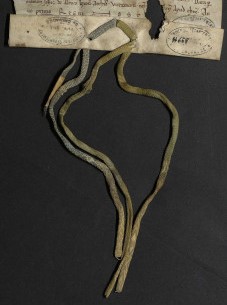
And it has very famous laces by which the seal was attached. 

These laces are made of silk and each one is 50cm in length; one of the laces is green, now turning yellow, and the other is blue, speckled with brown. An Old French poem was embroidered on the laces: 

 “Jo sui druerie. Ne me dunez mie ; ki nostre amur deseivre la mort pu”,

(In French, ‘Je suis gage d’amour. Ne me donnez pas. Que celui qui sépare notre amour puisse recevoir la mort’  and in English, ‘I am a pledge of love. Do not give me away. May death come to whoever separates our love’).  

For this reason, the charter is known as the charte aux lacs d’amour (the charter with the laces of love). And while the idea of a love poem being attached to a charter issued in relation to a royal land grant is charming, the reasons behind it remain elusive. At first glance, the grant appears to have no special significance that would justify such a declaration of love, nor such careful detail and precision work being undertaken on its creation.  

I can’t help thinking that Richard I – the Lionheart – who was a fan of the troubadour tradition and courtly love, would have heartily approved of turning the charter into a token of enduring love.

Unfortunately, while the laces are still attached to the document, the words, which were still visible in the nineteenth century, have now faded away. At least someone thought to record them before they faded from existence. 

Under Henry I, the lands of Varreville and Pouppeville had been in the hands of Roger, Bishop of Salisbury, and had returned to the crown on his death. King Henry II had granted the same lands to Richard de la Haye, but they had reverted to the crown on his death in 1169, and were accounted for in the Exchequer accounts of 1180. So, it seems that in granting Varreville and Pouppeville to Julia and Richard du Hommet, Richard I was returning them to their former, rightful owners. This may explain why Julia is specifically mentioned in the charter and the grant stipulates that the lands pass to Richard’s children by Julia, rather than Richard’s children by any wife.  

According to Léopold De Lisle, in his study of the charter, the two manors formed Julia’s dowry, though she and her husband were unable to take possession of the lands immediately after the marriage. In the charter King Richard ‘gives, renderes and confirms to Richard du Hommet, and to Gila [Julia] his wife, and to their heirs, Pouppeville and Varreville with all their dependencies, for them to hold from the king with their barony, by right of the said Gila [Julia].’ De Lisle goes on to suggest that the laces used, with the accompanying love poem, were once a love token, perhaps given by Julia to Richard on their wedding day, and that Richard du Hommet persuaded the king to attach them to the charter that gave him possession of Julia’s lands, as a symbol of their union.  

If so, the fact that they have survived the centuries is particularly poignant. 

When Julia died in the 1190s, she was buried in Blanchelande Abbey, a religious community of the Premonstratensian order, known as the White Canons, in Neufmesnil. The abbey had been founded by Julia’s parents, and it was where her father, Richard de la Haye, had been interred after his death in 1169. On her death, Julia’s mother, Matilda de Vernon, with the approval of her son-in-law, Richard du Hommet, made a donation to the abbey in her daughter’s name. After a short period as a widower, Richard du Hommet married for a second time, to Alienor, widow of Robert de la Haie, who may well have been a distant cousin of Julia (I did not have time to delve into  the familial relationship, unfortunately). 

The enduring love of Richard and Julia is forever entwined in the laces attached to the land charter. Even if we can no longer see the words, we know they were there and survived seven centuries before they faded away… 

*

This article first appeared on ElizabethChadwick.com

Images:

Les archives du Calvados

Sources:

Les archives du Calvados; Leopold Deslisle, “Notice sur les attaches d’un sceau de Richard Coeur-de-Lion”; Richard of Devizes, The Chronicle of Richard of Devizes; Roger of Howden (Hoveden), The Annals of Roger of HowdenThe Plantagenet Chronicles edited by Elizabeth Hallam; Brassey’s Battles by John Laffin; 1215 The Year of Magna Carta by Danny Danziger & John Gillingham; The Life and times of King John by Maurice Ashley; The Plantagenets, the Kings Who Made England by Dan Jones; England Under the Norman and Angevin Kings  by Robert Bartlett; lincolnshirelife.co.uk; catherinehanley.co.uk; magnacarta800th.com; lothene.org; lincolncastle.com; The Sheriff: The Man and His Office by Irene Gladwin; Louise Wilkinson, Women in Thirteenth Century Lincolnshire; Richard Huscraft, Tales from the Long Twelfth Century; J.W.F. Hill, Medieval Lincoln; swaton.org.uk; oxforddnb.com; Ingulph, Ingulph’ Chronicle of the Abbey of Croyland; Stephen Church, King John: England, Magna Carta and the Making of a Tyrant; Marc Morris, King John; Pipe Rolls; Red Book of the Exchequer

*

My Books

Christmas is coming!

Signed, dedicated copies of all my books are available through my online bookshop.

Out now! Scotland’s Medieval Queens

Scotland’s history is dramatic, violent and bloody. Being England’s northern neighbour has never been easy. Scotland’s queens have had to deal with war, murder, imprisonment, political rivalries and open betrayal. They have loved and lost, raised kings and queens, ruled and died for Scotland. From St Margaret, who became one of the patron saints of Scotland, to Elizabeth de Burgh and the dramatic story of the Scottish Wars of Independence, to the love story and tragedy of Joan Beaufort, to Margaret of Denmark and the dawn of the Renaissance, Scotland’s Medieval Queens have seen it all. This is the story of Scotland through their eyes.

Available now from Amazon and Pen and Sword Books

Also by Sharon Bennett Connolly:

Heroines of the Tudor World tells the stories of the most remarkable women from European history in the time of the Tudor dynasty, 1485-1603. These are the women who ruled, the women who founded dynasties, the women who fought for religious freedom, their families and love. Heroines of the Tudor World is now available for pre-order from Amberley Publishing and Amazon UK. Women of the Anarchy demonstrates how Empress Matilda and Matilda of Boulogne, unable to wield a sword themselves, were prime movers in this time of conflict and lawlessness. It shows how their strengths, weaknesses, and personal ambitions swung the fortunes of war one way – and then the other. Available from Bookshop.orgAmberley Publishing and Amazon UKKing John’s Right-Hand Lady: The Story of Nicholaa de la Haye is the story of a truly remarkable lady, the hereditary constable of Lincoln Castle and the first woman in England to be appointed sheriff in her own right. Available from all good bookshops Pen & Sword Booksbookshop.org and Amazon

Defenders of the Norman Crown: The Rise and Fall of the Warenne Earls of Surrey tells the fascinating story of the Warenne dynasty, from its origins in Normandy, through the Conquest, Magna Carta, the wars and marriages that led to its ultimate demise in the reign of Edward III. Available from Pen & Sword BooksAmazon in the UK and US, and Bookshop.orgLadies of Magna Carta: Women of Influence in Thirteenth Century England looks into the relationships of the various noble families of the 13th century, and how they were affected by the Barons’ Wars, Magna Carta and its aftermath; the bonds that were formed and those that were broken. It is now available in paperback and hardback from Pen & SwordAmazon, and Bookshop.orgHeroines of the Medieval World tells the stories of some of the most remarkable women from Medieval history, from Eleanor of Aquitaine to Julian of Norwich. Available now from Amberley Publishing and Amazon, and Bookshop.orgSilk and the Sword: The Women of the Norman Conquest traces the fortunes of the women who had a significant role to play in the momentous events of 1066. Available now from Amazon,  Amberley Publishing, and Bookshop.org.

Alternate Endings: An anthology of historical fiction short stories including Long Live the King… which is my take what might have happened had King John not died in October 1216. Available in paperback and kindle from Amazon.

Podcast:

Have a listen to the A Slice of Medieval podcast, which I co-host with Historical fiction novelist Derek Birks. Derek and I welcome guests, such as Bernard Cornwell and discuss a wide range of topics in medieval history, from significant events to the personalities involved. Every episode is also now available on YouTube.

*

Don’t forget! Signed and dedicated copies of all my books are available through my online bookshop.

For forthcoming online and in-person talks, please check out my Events Page.

You can be the first to read new articles by clicking the ‘Follow’ button, liking our Facebook page or joining me on Twitter and Instagram.

©2023 Sharon Bennett Connolly FRHistS

Warenne Family Ties

Seal of John de Warenne, 6th earl of Warenne and Surrey

In the reign of Edward I, when asked Quo Warranto – by what warrant he held his lands – John de Warenne, the 6th earl of Surrey, is said to have drawn a rusty sword, claiming “My ancestors came with William the Bastard, and conquered their lands with the sword, and I will defend them with the sword against anyone wishing to seize them”

When I started writing Defenders of the Norman Crown: Rise and Fall of the Warenne Earls of Surrey, I expected to find a healthy – or, rather, unhealthy – level of sibling rivalry. After all, this family was related to both the Norman and Plantagenet royal families, neither of whom are renowned for any sort of brotherly love.

You only have to look at the warring antics of Robert Curthose, William II and Henry I, to imagine the level of sibling rivalry involved in Norman times. The three brothers fought over who should have Normandy and England after their father’s death, to the extent that Robert Curthose ended up the prisoner of his little brother, Henry I, for the last 30 years of his life. The Plantagenets were little better, with Prince – later King – John trying to steal his brother’s throne while Richard I was imprisoned in Germany.

William de Warenne, 1st Earl Warenne, Trinity Church, Southover.

With these examples in mind, I was surprised to discover that the Warennes were a rather functional bunch as far as family goes. They went out of their way to help and support each other, even to the extent of half-siblings and in-laws. William de Warenne, the first earl of Warenne and Surrey (often referred to, simply, as Earl Warenne), pursued a private feud with English freedom fighter, Hereward the Wake, after he murdered William’s brother-in-law, Frederic. 

The Warenne (Hyde) Chronicle claims that Hereward, ‘Among his other crimes, by trickery he killed Frederick, brother[-in-law] of Earl William of Warenne, a man distinguished by lineage and possessions, who one night was surrounded in his own house.’ Following Frederic’s murder, according to the Chronicle, ‘such discord arose between Hereward and William that it could not be settled by any reparation nor in any court.’ According to the Gesta Herewardi, Frederic was planning to capture or kill Hereward, who struck first by killing Frederic.

William de Warenne was determined to get his revenge; he attempted to ambush Hereward at a place called Earith. One of William’s men tried unsuccessfully to bribe Hereward’s men to betray him. William was unhorsed when Hereward fired an arrow at him; it rebounded from William’s mailcoat, but the force of the shot saw William fall from his horse and rendered unconscious as he hit the ground. The ambush having failed, William de Warenne then appears in the Gesta Herewardi with an angry outburst against the Norman knight Deda, who had given a eulogistic account of the rebels on the Isle of Ely. According to the Liber Eliensis, William ‘flared up with weighty indignation, and alleged that he [Deda] had been inveigled by a bribe and was lying.’

St Pancras Priory, Lewes, the Warenne family mausoleum

William de Warenne, the second Earl Warenne, continued the tradition of looking out for family, when his younger brother, Rainald, was captured by King Henry I. In 1105 Rainald de Warenne was among the supporters of Robert Curthose, Duke of Normandy and Henry I’s oldest brother, who captured and imprisoned Robert fitz Hamon, a friend of King Henry, intending to ransom him. Henry saw fitz Hamon’s capture as an opportunity to deal decisively with Normandy, though he claimed he was invading not out of ambition, but to protect the church and the poor people of Normandy. 

Henry invaded in the spring of 1106. Rainald de Warenne was captured by Henry’s forces during a skirmish at the fortified Abbey of Saint-Pierre-sur-Dive. The abbot there had been plotting with Duke Robert to trap Henry, offering to hand over the castle to the English king, while sequestering Rainald de Warenne, Robert de Stuteville and their men within, ready to seize Henry as soon as he entered. Suspecting treachery, Henry arrived at daybreak with a force of 700 men-at-arms and took the garrison completely by surprise, capturing the duke’s men and burning the castle to the ground.

The sources vary, but Rainald was released either shortly before or shortly after the battle of Tinchebrai – the final, decisive battle between the royal Norman brother. Orderic Vitalis claims that William de Warenne served as one of King Henry’s chief commanders at Tinchebrai and that Rainald was released shortly before the battle. Grateful for his brother’s release, Earl William urged his men to fight the king’s cause with the utmost determination. 

According to the Warenne (Hyde) Chronicle, however, Rainald was not released until after the battle, when he was ‘reluctantly handed back to his brother, who pleaded for him to Henry.’ Whichever is correct, the result was the same, Rainald was now free, thanks to the insistence and loyalty of his older brother.

Warenne shield of blue and gold check, Trinity Church, Southover.

In the next generation, the children and stepchildren of William de Warenne, the 2nd Earl Warenne, got on remarkably well together. William had married Isabel de Vermandois, the widow of the recently deceased Robert de Beaumont, Earl of Leicester. Isabel was already the mother of 9 children, including the famous twins Robert and Waleran de Beaumont, when she married William, with whom the chronicler Henry of Huntingdon claims she was having an affair, even before her husband died. 

With William, Isabel had a further 5 children, 3 boys and 2 girls. Earl Warenne was at King Henry I’s deathbed, alongside his son, also named William de Warenne (the future 3rd Earl Warenne), and stepsons, Waleran and Robert de Beaumont. When the 2nd Earl Warenne died, it was Waleran de Beaumont who became the head of the combined, and rather large, Beaumont/Warenne family. Indeed, Waleran and William de Warenne, 3rd Earl Warenne, having grown tired of the Anarchy – the war between King Stephen and Empress Matilda which lasted from 1135 to 1154 – departed on Crusade together in 1147. Unfortunately, William de Warenne was killed at the Battle of Mount Cadmus in January 1148, and Waleran returned home alone.

A touching story from just before his departure on crusade relates to the 3rd Earl Warenne and his two younger brothers, Reginald and Ralph de Warenne. The earl held a dedication ceremony for the new church at St Pancras Priory, Lewes, the mausoleum of the Warenne family, founded by the 1st earl and his wife, Gundrada. In the accompanying charter, the earl endowed the priory, in which his father and grandparents were buried, and where his mother would soon be laid to rest, with the tenth penny of his rents and ‘giving it seisin thereof by hair from his own head and that of Ralph de Warenne his brother, cut with a knife by Henry, bishop of Winchester, before the altar.’ 

It is not hard to imagine how moving a ceremony this must have been, two brothers kneeling before the altar to have their hair cut by the bishop of Winchester, Henry of Blois, the brother of King Stephen. The scene is made all the more poignant in hindsight, knowing that the third earl never returned from the crusade on which he was about to embark.

Conisbrough Castle

And when the 3rd Earl Warenne failed to return from the Holy Land, it was down to his younger brother, Reginald, to look after the family interests and those of his brother’s sole surviving heir, William’s daughter, Isabel de Warenne, the 4th Countess of Warenne and Surrey. Isabel, though still only a child, had been married to King Stephen’s youngest son, William of Blois, probably before her father’s departure to the Holy Land. Isabel’s second husband, Hamelin, the illegitimate half-brother of Henry II, built the great keep at Conisbrough Castle.

Hamelin and Isabel’s son, William de Warenne, the 5th earl, looked out for the interests of his niece, Alice de Lusignan, in her struggles with the crown, both under King John and Henry III, to secure her inheritance of Tickhill Castle in Yorkshire.

Such examples of the earls taking care of their family, and working in alliance with their in-laws, was to be a feature of every generation down to the 7th and last earl, John II de Warenne, who was given the custody and care of his cousin, Edward Balliol, the son of John Balliol, the deposed King of Scots, around 1307. The Warenne earls, to a man, looked after their relations, both near and far. In the story of a family, it is quite fitting – and highly unusual – that the Warenne earls appear to have always put family first.

*

Images:

Are ©2023 Sharon Bennett Connolly FRHistS except the seal of John de Warenne, which is courtesy of Wikimedia Commons

Sources:

Robert Bartlett, England Under the Norman and Angevin Kings; Dan Jones, The Plantagenets; Donald Matthew, King Stephen; Medieval Lands Project on the Earls of Surrey, Conisbrough Castle; Farrer, William and Charles Travis Clay, editors, Early Yorkshire Charters, Volume 8: The Honour of Warenne; Morris, Marc King John: Treachery, Tyranny and the Road to Magna Carta; Church, Stephen, King John: England, Magna Carta and the Making of a Tyrant; doncasterhistory.co.uk; A History of the County of Sussex: Volume 2 edited by William Page; W.H. Blaauw, On the Early History of Lewes Priory, and its Seals, with extracts from a MS. Chronicle, Sussex Archaeological Collections; Rev. John Watson, Memoirs of the Ancient Earls of Warren and Surrey, and Their Descendants to the Present Time, Volume I;  Odo of Deuil, De Profectione Ludovici VII in Orientem; magnacharta.com; Cokayne, G.E., The Complete Peerage, Vol. XII; Henry of Huntingdon, The Chronicle of Henry of Huntingdon; Elisabeth van Houts and Rosalind C. Love, The Warenne (Hyde) Chronicle.

*

My Books

Christmas is coming!

Signed, dedicated copies of all my books are available through my online bookshop.

Coming 15 January 2024: Women of the Anarchy

On the one side is Empress Matilda, or Maud. The sole surviving legitimate child of Henry I, she is fighting for her birthright and that of her children. On the other side is her cousin, Queen Matilda, supporting her husband, King Stephen, and fighting to see her own son inherit the English crown. Both women are granddaughters of St Margaret, Queen of Scotland and descendants of Alfred the Great of Wessex. Women of the Anarchy demonstrates how these women, unable to wield a sword, were prime movers in this time of conflict and lawlessness. It show how their strengths, weaknesses, and personal ambitions swung the fortunes of war one way – and then the other.

Available for pre-order from Amberley Publishing and Amazon UK.

Coming on 15 June 2024: Heroines of the Tudor World

Heroines of the Tudor World tells the stories of the most remarkable women from European history in the time of the Tudor dynasty, 1485-1603. These are the women who ruled, the women who founded dynasties, the women who fought for religious freedom, their families and love. These are the women who made a difference, who influenced countries, kings and the Reformation. In the era dominated by the Renaissance and Reformation, Heroines of the Tudor World examines the threats and challenges faced by the women of the era, and how they overcame them. Some famous, some infamous, some less well known, including Anne Boleyn, Elizabeth Barton, Catherine de Medici, Bess of Hardwick and Elizabeth I. From writers to regents, from nuns to queens, Heroines of the Tudor World shines the spotlight on the women helped to shape Early Modern Europe.

Heroines of the Tudor World is now available for pre-order from Amberley Publishing and Amazon UK.

Also by Sharon Bennett Connolly:

King John’s Right-Hand Lady: The Story of Nicholaa de la Haye is the story of a truly remarkable lady. Nicholaa de la Haye was the hereditary constable of Lincoln Castle and the first woman in England to be appointed sheriff in her own right. Her strength and tenacity saved England at one of the lowest points in its history. Nicholaa de la Haye is one woman in English history whose story needs to be told… King John’s Right-Hand Lady: The Story of Nicholaa de la Haye is now available from Pen & Sword Booksbookshop.org and Amazon.

Defenders of the Norman Crown: The Rise and Fall of the Warenne Earls of Surrey tells the fascinating story of the Warenne dynasty, of the successes and failures of one of the most powerful families in England, from its origins in Normandy, through the Conquest, Magna Carta, the wars and marriages that led to its ultimate demise in the reign of Edward III. Defenders of the Norman Crown: Rise and Fall of the Warenne Earls of Surrey is now available from Pen & Sword BooksAmazon in the UK and US, and Bookshop.org.

Ladies of Magna Carta: Women of Influence in Thirteenth Century England looks into the relationships of the various noble families of the 13th century, and how they were affected by the Barons’ Wars, Magna Carta and its aftermath; the bonds that were formed and those that were broken. It is now available in paperback and hardback from Pen & Sword,  Amazon, and Bookshop.org.

Heroines of the Medieval World tells the stories of some of the most remarkable women from Medieval history, from Eleanor of Aquitaine to Julian of Norwich. Available now from Amberley Publishing and Amazon, and Bookshop.org.

Silk and the Sword: The Women of the Norman Conquest traces the fortunes of the women who had a significant role to play in the momentous events of 1066. Available now from Amazon,  Amberley Publishing, and Bookshop.org.

Alternate Endings: An anthology of historical fiction short stories including Long Live the King… which is my take what might have happened had King John not died in October 1216. Available in paperback and kindle from Amazon.

Podcast:

Have a listen to the A Slice of Medieval podcast, which I co-host with Historical fiction novelist Derek Birks. Derek and I welcome guests, such as Bernard Cornwell, and discuss a wide range of topics in medieval history, from significant events to the personalities involved.

*

Don’t forget! Signed and dedicated copies of all my books are available through my online bookshop.

For forthcoming online and in-person talks, please check out my Events Page.

You can be the first to read new articles by clicking the ‘Follow’ button, liking our Facebook page or joining me on Twitter and Instagram.

*

©2023 Sharon Bennett Connolly FRHistS

Cover Reveal: Heroines of the Tudor World

I am so excited!

It’s finally here!

Heroines of the Tudor World – the long-awaited (well, by me, if no one else) sequel to Heroines of the Medieval World – is now available for pre-order on Amazon in the UK (I will hopefully have a US release date shortly). It will be released in the UK on 15 June 2024.

So, here is the stunning cover, designed by the fabulous cover design team at Amberley Publishing.

And what a cover!

About the book:

Heroines of the Tudor World tells the stories of the most remarkable women from European history in the time of the Tudor dynasty, 1485-1603. These are the women who ruled, the women who founded dynasties, the women who fought for religious freedom, their families and love.

These are the women who made a difference, who influenced countries, kings and the Reformation. In the era dominated by the Renaissance and Reformation, Heroines of the Tudor World examines the threats and challenges faced by the women of the era, and how they overcame them. Some famous, some infamous, some less well known, including Anne Boleyn, Elizabeth Barton, Catherine de Medici, Bess of Hardwick and Elizabeth I.

From writers to regents, from nuns to queens, Heroines of the Tudor World shines the spotlight on the women helped to shape Early Modern Europe.

To buy the book:

Heroines of the Tudor World is now available for pre-order from Amberley Publishing and Amazon UK.

About me:

Sharon Bennett Connolly is the best-selling author of several non-fiction history books. A Fellow of the Royal Historical Society, Sharon has studied history academically and just for fun – and has even worked as a tour guide at a castle. She also writes the popular history blog, http://www.historytheinterestingbits.com and co-hosts the podcast A Slice of Medieval, alongside historical novelist Derek Birks. Sharon regularly gives talks on women’s history. Sharon is a feature writer for All About History and Living Medieval magazines and her TV work includes Australian Television’s ‘Who Do You Think You Are?

Her previous books include: Heroines of the Medieval World; Silk and the Sword: The Women of the Norman Conquest; Ladies of Magna Carta: Women of Influence in Thirteenth Century England; Defenders of the Norman Crown: Rise and Fall of the Warenne Earls of Surrey; King John’s Right-Hand Lady: The Story of Nicholaa de la Haye; Women of the Anarchy

*

My Books

Christmas is coming!

Signed, dedicated copies of all my books are available through my online bookshop.

Coming 15 January 2024: Women of the Anarchy

On the one side is Empress Matilda, or Maud. The sole surviving legitimate child of Henry I, she is fighting for her birthright and that of her children. On the other side is her cousin, Queen Matilda, supporting her husband, King Stephen, and fighting to see her own son inherit the English crown. Both women are granddaughters of St Margaret, Queen of Scotland and descendants of Alfred the Great of Wessex. Women of the Anarchy demonstrates how these women, unable to wield a sword, were prime movers in this time of conflict and lawlessness. It show how their strengths, weaknesses, and personal ambitions swung the fortunes of war one way – and then the other.

Available for pre-order from Amberley Publishing and Amazon UK.

Also by Sharon Bennett Connolly:

Out nowKing John’s Right-Hand Lady: The Story of Nicholaa de la Haye is the story of a truly remarkable lady. Nicholaa de la Haye was the hereditary constable of Lincoln Castle and the first woman in England to be appointed sheriff in her own right. Her strength and tenacity saved England at one of the lowest points in its history. Nicholaa de la Haye is one woman in English history whose story needs to be told…

King John’s Right-Hand Lady: The Story of Nicholaa de la Haye is now available from Pen & Sword Booksbookshop.org and Amazon.

Defenders of the Norman Crown: The Rise and Fall of the Warenne Earls of Surrey tells the fascinating story of the Warenne dynasty, of the successes and failures of one of the most powerful families in England, from its origins in Normandy, through the Conquest, Magna Carta, the wars and marriages that led to its ultimate demise in the reign of Edward III. Defenders of the Norman Crown: Rise and Fall of the Warenne Earls of Surrey is now available from Pen & Sword BooksAmazon in the UK and US, and Bookshop.org.

Ladies of Magna Carta: Women of Influence in Thirteenth Century England looks into the relationships of the various noble families of the 13th century, and how they were affected by the Barons’ Wars, Magna Carta and its aftermath; the bonds that were formed and those that were broken. It is now available in paperback and hardback from Pen & Sword,  Amazon, and Bookshop.org.

Heroines of the Medieval World tells the stories of some of the most remarkable women from Medieval history, from Eleanor of Aquitaine to Julian of Norwich. Available now from Amberley Publishing and Amazon, and Bookshop.org.

Silk and the Sword: The Women of the Norman Conquest traces the fortunes of the women who had a significant role to play in the momentous events of 1066. Available now from Amazon,  Amberley Publishing, and Bookshop.org.

Alternate Endings: An anthology of historical fiction short stories including Long Live the King… which is my take what might have happened had King John not died in October 1216. Available in paperback and kindle from Amazon.

Podcast:

Have a listen to the A Slice of Medieval podcast, which I co-host with Historical fiction novelist Derek Birks. Derek and I welcome guests, such as Bernard Cornwell, and discuss a wide range of topics in medieval history, from significant events to the personalities involved.

*

Don’t forget! Signed and dedicated copies of all my books are available through my online bookshop.

For forthcoming online and in-person talks, please check out my Events Page.

You can be the first to read new articles by clicking the ‘Follow’ button, liking our Facebook page or joining me on Twitter and Instagram.

*

©2023 Sharon Bennett Connolly FRHistS

Guest Post: the Historical Rabbit Hole by Maxine Sommer

Today I have the pleasure of welcoming Maxine Sommer to History…the Interesting Bits, a lover of Medieval History, if ever there was one. Next year, Maxine will run her first History tours through England and France, following the trail of the Plantagenets.

I fell down a rabbit hole…

And emerged into a historical realm alive with chivalry, intrigue and power struggles.

You may ask what on earth would impel an unassuming middle-aged woman who only braved her first flight outside Australia at the age of 41, to decide to create a tour company specializing in historical-themed tours of France and the UK. The answer my friends resides within the above-mentioned rabbit hole.

I simply picked up a book.

That’s right, imagine if you will, a moment some two decades past when destiny beckoned me towards an unexpected treasure. I have always been an avid reader, but in recent years my enthusiasm for this pastime had been stifled by adulthood’s demands, not least the nurturing of five children. Now it was time… full of excitement at the thought of once again becoming engrossed in a magnificent tale, I explored my sister’s book-laden shelves. I finally opted for one from her collection – as it turns out, a choice guided by the inexplicable precision of fate’s hand. And so dear readers, I found myself totally absorbed within the pages of “The Sunne in Splendour”, penned by the astounding Sharon Kay Penman. The chronicle of Richard III, a monarch enshrouded in a tapestry of infamy, though totally unfamiliar to me at the time, seized my imagination with a tenacious grip. Unbelievably, history, a subject I had spurned in my school days, suddenly beckoned irresistibly. It is a huge book, definitely not for the faint-hearted, and I read it in record time… staying up until the wee hours of the morning because I simply could not put it down. After finishing this, and guided by an unyielding curiosity, I became a well-known visitor to my local library, searching for more of Sharon’s books. The next one I read was “When Christ and his Saints Slept” and with it came the realization that each page was opening another facet of history’s dramatic picture.

Alfred the Great coin

I quickly became totally hooked on this genre, my fascination knew no borders, enjoying tales that ranged from the illustrious King Alfred the Great and the Vikings, to the turmoil of the 18th century. Like a mosaic artist, I pieced together a chronology that unfolded across centuries, each novel augmenting my list of captivating historical figures. Yet in the labyrinth of historical sagas, one dynasty held me spellbound – the indomitable Plantagenets, sovereigns who reigned for more than three centuries, and totally transformed England’s destiny.

The following decade saw me immerse myself in an array of historical fiction, discovering all I could about this powerful dynasty. I even ventured into the uncharted territory of non-fiction, a realm I had never before explored for mere enjoyment. During this time, an unexpected, and slightly off-track obsession took root: the enthralling “Outlander” series by Diana Gabaldon, a time-travelling tale of the final 1745 Jacobite rebellion in Scotland. I was ecstatic when this saga leapt from page to screen in 2014. With recent images of the series in my mind and fueled with a life-long desire to see Scotland, a travel adventure beckoned. Plans were made, the saving began and with much excitement, my sister and I finally embarked on the gruelling 24hr flight to Glasgow in June 2017, to begin an Outlander adventure. We had a ball, and I found that I thoroughly enjoyed the small group atmosphere, which was both friendly and welcoming. Having the services of a Tour Manager as well as a local Tour Guide made our adventure not only personal but truly unique. Little did I realise then that this tour would kindle the spark for my future endeavours.

While the Scottish adventure might not have directly concerned the Plantagenets, my love for this era showed no sign of dimming. My interest was captivated by so many of the historical figures of the time, names like Eleanor of Aquitaine, Edward the Black Prince, and William Marshal, the greatest knight of the Middle Ages, and the power behind five of the Plantagenet kings. Reminiscing on the amazing time I had in Scotland, I began to search for a themed tour in France based on the Plantagenets, surely there had to be one. Unfortunately, and to my absolute disappointment, my search yielded no results whatsoever. The seeds planted in my mind by my tour in Scotland began to take root, a vision took form, and I dared to dream. It would be the words of one of my dearest friends that eventually gave me that final push… she simply said “Max, what is stopping you”? And thus, the idea of Plantagenet Discoveries was born, and I began to read and research the people, history and places I planned to visit.

The Gallery of Kings, Lincoln Cathedral

I worked on convincing my best friend of 30 years to come with me on this epic journey as she too was fascinated with medieval history, and after much deliberation, she decided to join me on this life-changing adventure. Together we embarked on a rollercoaster of meticulous planning, fervent study of tourism and business, and ceaseless research, we even began French lessons. For almost two years we navigated the crazy path between ordinary life, family obligations, our full-time jobs, and all that was necessary to get a new tour business off the ground. Remarkably, the onset of Covid-19 was a blessing in disguise as it allowed us ample planning time. Financial contributions were huge, our optimism continued to grow, and we remained positive this dream would become a reality. That dream was a tour company where we could share our passion for this incredible part of history. It would be a unique small group experience for our guests that would be fun, friendly, and informative, while providing them with the utmost in personal service. With the help of my wonderful son Chris (who happens to be a Digital Marketing Head for an advertising agency), we finally unveiled our website and social media presence in August 2022, it is very handy having our own personal social media guru.

Our flight bookings were confirmed, and the countdown began to September 2nd when we would fly to France and England for our reconnaissance mission. Chris and his partner Martin, who live in Sweden, met us and we enjoyed a short stay in the beautiful city of Paris before we headed off to explore. Serving as chauffeurs for a month, the boys skillfully navigated us across the landscapes of both France and England. While laughter and fun were in abundance, our schedule proved relentless, every moment earmarked for visits to hotels and historic sites, as well as the perpetual task of tending to our social media presence, which is almost a part-time job in itself. The return journey home on September 30th found us both weary to the bone, but looking at the task ahead of us with a mixture of excitement and enthusiasm.

I feel the need to divert off track here for a bit and talk about an extraordinary event that happened during our travels. It was the 8th of September 2022 – a date etched in history as Queen Elizabeth II passed away. For an Australian like me, the surrealism of being present during such a pivotal moment defies description. I will always remember the news reaching us as we ate dinner at a lovely little outdoor café in the historic city of Le Mans, France. For me, the sadness I felt was only surpassed by the profound local response to her death. The French people echoed the lament, and as we travelled around France our shared grief forged connections with all those we encountered. Our foresight in procuring Eurostar tickets months prior to our travels provided us with easy passage across the channel, despite the masses attempting to reach London for the funeral which was scheduled for the 19th of September. As it happened, this was the very day we planned to depart the city, casting us into the logistics of travel amidst large crowds and road closures. Bad timing you would say – well at first that is exactly what I thought. Gradually however, the irony of this situation dawned on me like an epiphany, fate actually has magnificent timing. On a reconnaissance adventure, where we were tracing the footsteps of bygone royalty, we found ourselves in London during the most momentous historic event that most of us will ever see in our lifetime. Up until now we could only read about or imagine the impact that the death of a monarch would have on its people, and yet here we were, given the opportunity of witnessing it firsthand. An entire nation, and a significant part of the world, ground to a halt, queue’s stretched for days as the people sought a final glimpse of their queen. There was an extraordinary sense of ‘something’ that is impossible to verbalise. The myriad of emotions were tangible, sadness, fear, apprehension, but above all an overwhelming sense of loss. We stood there, participants in a sombre yet pivotal chapter of history, another thread woven into the tapestry of the past.

Effigy of Eleanor of Aquitaine, Fontevrault Abbey

But let us return to our narrative, in the spirit of determination, Deb and I set to work. One of the main challenges we faced was the time difference, Australia’s vast isolation meant that all correspondence depended on email. This works fine if you receive responses, but all too often, this does not happen. If it came to having to make phone calls, which it often did, navigating time zones together with full-time working hours certainly is not an easy task. It involves a well-managed calendar I can tell you.

Then there was the language barrier, a real hurdle in communication. It is simple to translate a digital document or email, but when it comes to phone calls, it can be more challenging. I found in France, that many people speak English, occasionally however, challenges arise due to a lack of fluency. I remember the night we stayed at Chateau Castel Novel (a stunning 12th-century castle in central France), we were served the most beautiful and enticing appetizer. The room abounded with laughter as we tried to find out exactly what this dish was made from. The path to success lay in the beacon of humour, for those willing to chuckle at their own linguistic escapades. The mood lightened, communication flowed, and we discovered that the dish was in fact made from potato. With the spirit of laughter as our guide, we began to sow the seeds of rapport, nurturing relationships that we hope will stand the test of time.

Earlier this year, life, often the master of unforeseen twists, dealt us our biggest blow. Due to personal reasons, Deb found herself at a crossroads, her only choice to step away from the venture entirely. The fallout was profound – for us both, it felt like the world had momentarily lost its rhythm. Amid our devastation, a realization emerged that life weaves its own threads of trial and triumph, and God’s plan does not always align with ours, compelling us to soldier on, adapting and accepting.

I am now navigating these waters unaccompanied, and while the quiet absence of another’s counsel is sorely missed, I’ve discovered a reservoir of resilience and unwavering optimism. I have come to terms with my solo voyage, and each wave of uncertainty is met with an anchor of positivity. Numbers were slow initially, but now a silver lining peeks through the clouds in the form of bookings and deposits, heralding the success of my long-anticipated adventure in September 2024.

For me, this has been more than just a business endeavour, it has been a story of remarkable personal growth and transformation. My life has echoed with the mantra “Every day is a school day”, a truth etched into the fabric of my experience. A habit of burying my head in the sand has given way to a newfound tenacity, a willingness to face challenges head-on.

Edward I and Eleanor of Castile, Lincoln Cathedral

As I reach the closing chapter of this article, I can’t help but radiate my enthusiasm. My passion and my vision are no longer confined within the chambers of my imagination, this dream has now become a reality. And you know what is even more fantastic – along the journey, I have found my tribe, and I couldn’t be happier about that!!

So, if this story has resonated with you, I invite you to delve deeper by visiting http://www.plantagenetdiscoveries.com. There, amidst the pages, you will unearth not only the itineraries of our tours, but the musings of heart, encapsulated in my blog posts. You can also follow me on both Facebook and Instagram @plantagenetdiscoveries and I have a friendly Facebook group community where we share photos and stories of medieval history and travel. http://www.facebook.com/groups/loversofmedievalhistorytravel

And for all those among Sharon’s incredible community, a special treat awaits – a 10% discount on each tour, with an additional 5% for the adventurous souls embracing the Back-to-Back option.

Join me on this extraordinary time-travel adventure as we let the echoes of history guide our steps, but more importantly, as we make incredible friendships and memories that will be sure to last a lifetime.

Max

*

My Books

Christmas is coming!

Signed, dedicated copies of all my books are available through my online bookshop.

Coming 15 January 2024: Women of the Anarchy

On the one side is Empress Matilda, or Maud. The sole surviving legitimate child of Henry I, she is fighting for her birthright and that of her children. On the other side is her cousin, Queen Matilda, supporting her husband, King Stephen, and fighting to see her own son inherit the English crown. Both women are granddaughters of St Margaret, Queen of Scotland and descendants of Alfred the Great of Wessex. Women of the Anarchy demonstrates how these women, unable to wield a sword, were prime movers in this time of conflict and lawlessness. It show how their strengths, weaknesses, and personal ambitions swung the fortunes of war one way – and then the other.

Available for pre-order from Amberley Publishing and Amazon UK.

Also by Sharon Bennett Connolly:

Out nowKing John’s Right-Hand Lady: The Story of Nicholaa de la Haye is the story of a truly remarkable lady. Nicholaa de la Haye was the hereditary constable of Lincoln Castle and the first woman in England to be appointed sheriff in her own right. Her strength and tenacity saved England at one of the lowest points in its history. Nicholaa de la Haye is one woman in English history whose story needs to be told…

King John’s Right-Hand Lady: The Story of Nicholaa de la Haye is now available from Pen & Sword Booksbookshop.org and Amazon.

Defenders of the Norman Crown: The Rise and Fall of the Warenne Earls of Surrey tells the fascinating story of the Warenne dynasty, of the successes and failures of one of the most powerful families in England, from its origins in Normandy, through the Conquest, Magna Carta, the wars and marriages that led to its ultimate demise in the reign of Edward III. Defenders of the Norman Crown: Rise and Fall of the Warenne Earls of Surrey is now available from Pen & Sword BooksAmazon in the UK and US, and Bookshop.org.

Ladies of Magna Carta: Women of Influence in Thirteenth Century England looks into the relationships of the various noble families of the 13th century, and how they were affected by the Barons’ Wars, Magna Carta and its aftermath; the bonds that were formed and those that were broken. It is now available in paperback and hardback from Pen & Sword,  Amazon, and Bookshop.org.

Heroines of the Medieval World tells the stories of some of the most remarkable women from Medieval history, from Eleanor of Aquitaine to Julian of Norwich. Available now from Amberley Publishing and Amazon, and Bookshop.org.

Silk and the Sword: The Women of the Norman Conquest traces the fortunes of the women who had a significant role to play in the momentous events of 1066. Available now from Amazon,  Amberley Publishing, and Bookshop.org.

Alternate Endings: An anthology of historical fiction short stories including Long Live the King… which is my take what might have happened had King John not died in October 1216. Available in paperback and kindle from Amazon.

Podcast:

Have a listen to the A Slice of Medieval podcast, which I co-host with Historical fiction novelist Derek Birks. Derek and I welcome guests, such as Bernard Cornwell, and discuss a wide range of topics in medieval history, from significant events to the personalities involved.

*

Don’t forget! Signed and dedicated copies of all my books are available through my online bookshop.

For forthcoming online and in-person talks, please check out my Events Page.

You can be the first to read new articles by clicking the ‘Follow’ button, liking our Facebook page or joining me on Twitter and Instagram.

*

©2023 Maxine Sommer and Sharon Bennett Connolly FRHistS

Guest Post: The Ambassadress by Ronan Beckman

The Historical Writers Forum have released a new Anthology of short stories. You may remember that last year’s Anthology, Alternate Endings, included a short story about the final days of King John, by me! This year’s Anthology, Masterworks: Historical Fiction Inspired by Works of Art, will make you look at some famous artworks a little differently…

Today, I am joined by one of the contributors, Ronan Beckman, whose story is inspired by Emma Hamilton. Over to Ronan…

Do you remember what got you hooked onto a specific time period or aspect of history? I had just finished reading Amanda Foreman’s excellent biography Georgiana, The Duchess of Devonshire , which resulted in my addiction to everything about the Georgian-era but especially to women’s history in that time. Often relegated to the sidelines of history, Georgian times allowed women to begin to step into the spotlight – albeit in very slow, tiny steps. I began to voraciously read biographies of prominent ladies of that time. And one story that truly stood out for me was the life of a blacksmith’s daughter from Cheshire born as Amy Lyon. But the world knows her better as Emma, Lady Hamilton; lover of Admiral Nelson. Flora Fraser’s Beloved Emma laid out the incredible story of the amazing transformation of this pretty young woman into one of the most talked about celebrities of her age.

Portrait of Emma Hamilton by George Romney

Several years later, The National Maritime Museum in London put together a fabulous exhibition entitled Seduction & Celebrity that explored Emma Hamilton’s rise and fall, from beginning to end. One of the most noticeable aspects of the show was that there was ample material to display, primarily from one particular artist. George Romney was one of the most prominent society portrait painters of the late Georgian period. Although his talent was comparable to his well-respected contemporaries, such as Joshua Reynolds, Thomas Gainsborough and John Hoppner; he refused to participate in the antics associated with the Royal Academy of Arts and their annual exhibitions. Artists would become fiercely competitive as they all vied for the most prominent places within the show, hoping that their works would stand out from the rest. Romney wanted no part of this circus, and relied on his talent and reputation to gain custom amongst his wealthy clients. This worked out well for him, and he had no shortage of sitters. However, the tedium of producing staid portraiture of the elite classes began to prove tiresome.

How fortunate for Romney then that a customer, Sir Charles Greville, brought in a secret mistress that he had ensconced away in a humble, rural cottage in nearby Edgeware. The 16 year-old Amy Lyon had already experienced several tragedies in her young life; having found herself pregnant by another aristocratic man, Sir Henry Fetherstonhaugh, who promptly abandoned her. Greville came to the rescue, but on the proviso that she gave her baby away, living a life of thrift and economy whilst being at his beck and call. She had no room to negotiate and was grateful for this second chance. Greville sought to have her beauty be captured and admired on canvas, for him to be able to display to his friends. In effect, he wanted to boast “This heavenly goddess is mine, and you cannot even see her in the flesh. Don’t you envy me?”

Emma Hart by Romney

Romney was immediately enchanted by the charisma and stunning beauty of the newly renamed Emma Hart. Her presence reinvigorated his artwork. They embarked on a creative partnership that resulted in Romney’s finest and most creative output. In return, Emma was portrayed in various guises for posterity. She had to reinvent herself for each sitting, becoming a mythological creature or some historic character from long ago. Emma sat for dozens of paintings by Romney. She was his muse, allowing him to explore his craft beyond the confines of standard portraiture. Greville was happy to loan her modelling services to Romney, for it was increasing the value of his ‘ward’ that he had saved from a certain life of penury. Engravings had been made of some of Romney’s paintings, affording a glimpse of her allure to a wider audience. As her image was circulated, there was an increasing curiosity aroused throughout the capital city. Who was this charming being?

The drip-feed of artistic content provided opportunities for both Romney and Emma. Romney’s reputation and name was further advanced as well as inspiring his art to reach new levels of creativity. Emma became what may well be the very first Supermodel – a celebrity whose fame and notoriety was constantly on an upward trajectory. It seems apparent that Romney became infatuated with Emma. And perhaps Emma appreciated the advice and friendship of a man outside of the realm of the Ton, but who knew of the inner workings and mindset of the Upper Class who made up his clientele.

But this fame and notoriety was not appealing to Sir Charles Greville, who was seeking a wealthy heiress to supplement his dwindling finances. Being saddled with an infamous beauty as a mistress would not make him very appealing as a suitor to the respectable ladies that he wanted to pursue. Therefore, he duped Emma into travelling to Naples, to visit his uncle who was the serving British ambassador there. He had offered her to his uncle as a mistress, without her consent or knowledge. This separation severed the symbiotic artistic relationship between Emma and Romney for several years. Romney, who was prone to depression, was affected by her absence deeply. Although furious with Greville for abandoning her, Emma did make the best of her situation – enjoying her time in the royal court of Naples and eventually becoming quite fond of her ambassador.

In the summer of 1791, Emma returned to England to marry Sir William Hamilton and return to Naples as a respectable wife of the ambassador. During these brief few weeks, Emma reunited with her favourite artist, kick-starting a frenetic pace of artistic output as the painter and his muse were working together again. This brief slice in time intrigued me and I wanted to explore it further. I am fortunate enough to have seen many examples of Romney’s work with Emma as the model. You can feel the creative frisson embedded in these artworks. Romney’s paintings of Emma are seared with an energy that simply does not exist in his other portraits. There was something electric between these two individuals. Was it romantic? There is a feeling of magnetic attraction when one looks through Romney’s gaze in his portraits of Emma. I must say that even though Emma modelled for other great artists (Joshua Reynolds, Thomas Lawrence, Élisabeth Louise Vigée Le Brun, among many others), that spark of something special and extraordinary is just not there.

Romney self-portrait

The last painting that Romney painted of Emma was actually painted on her wedding day. Entitled The Ambassadress, the viewer is a witness to the complete transformation of Emma Hart into Lady Hamilton. As Vesuvius erupts in the dark background, one can imagine the well of emotions bursting forth from Romney’s paintbrush – being well aware that this was the last time that he would lay eyes upon the divine Emma he so cherished. Emma looks back at him, slightly pensive but very refined as she knows she is about to embark on a life of newfound respectability. There is so much wistful emotion silently conveyed in this moving portrait. What were those last moments like in Romney’s studio, as they parted ways for the final time?

The Ambassadress was the inspiration for my short story of the same name. It is one of eleven short stories in the Historical Writer Forum’s anthology entitled Masterworks. Eleven authors have written stories that have been influenced by a particular work of art. The result is a series of stories that takes the reader through time and place, from ancient Sumerian kingdoms to present day London. Available now through Amazon.

About the author:

Ronan Beckman is an American educator who has lived in the UK for over 30 years. His interest in history and genealogy helped to spark an interest in further developing the stories of some of the family he researched – resulting in his debut novel ‘An Actress of Repute’. Subsequently, he has become a bit obsessed with all things Georgian and Regency related. Further adventures are in the works for the character of Elizabeth Searle and her fellow actor friends. His latest project has been editing a transcript of a rare, out-of-print book by a Lancashire coal miner who became secretary of the TUC and a Member of Parliament. The new annotated version of Samuel Woods’ ‘Visions of the Mine’ contains biographical notes and historical images. Visit his blog at http://www.ronanbeckman.com.

*

My Books

Christmas is coming!

Signed, dedicated copies of all my books are available through my online bookshop.

Coming 15 January 2024: Women of the Anarchy

On the one side is Empress Matilda, or Maud. The sole surviving legitimate child of Henry I, she is fighting for her birthright and that of her children. On the other side is her cousin, Queen Matilda, supporting her husband, King Stephen, and fighting to see her own son inherit the English crown. Both women are granddaughters of St Margaret, Queen of Scotland and descendants of Alfred the Great of Wessex. Women of the Anarchy demonstrates how these women, unable to wield a sword, were prime movers in this time of conflict and lawlessness. It show how their strengths, weaknesses, and personal ambitions swung the fortunes of war one way – and then the other.

Available for pre-order from Amberley Publishing and Amazon UK.

Also by Sharon Bennett Connolly:

Out nowKing John’s Right-Hand Lady: The Story of Nicholaa de la Haye is the story of a truly remarkable lady. Nicholaa de la Haye was the hereditary constable of Lincoln Castle and the first woman in England to be appointed sheriff in her own right. Her strength and tenacity saved England at one of the lowest points in its history. Nicholaa de la Haye is one woman in English history whose story needs to be told…

King John’s Right-Hand Lady: The Story of Nicholaa de la Haye is now available from Pen & Sword Booksbookshop.org and Amazon.

Defenders of the Norman Crown: The Rise and Fall of the Warenne Earls of Surrey tells the fascinating story of the Warenne dynasty, of the successes and failures of one of the most powerful families in England, from its origins in Normandy, through the Conquest, Magna Carta, the wars and marriages that led to its ultimate demise in the reign of Edward III. Defenders of the Norman Crown: Rise and Fall of the Warenne Earls of Surrey is now available from Pen & Sword BooksAmazon in the UK and US, and Bookshop.org.

Ladies of Magna Carta: Women of Influence in Thirteenth Century England looks into the relationships of the various noble families of the 13th century, and how they were affected by the Barons’ Wars, Magna Carta and its aftermath; the bonds that were formed and those that were broken. It is now available in paperback and hardback from Pen & Sword,  Amazon, and Bookshop.org.

Heroines of the Medieval World tells the stories of some of the most remarkable women from Medieval history, from Eleanor of Aquitaine to Julian of Norwich. Available now from Amberley Publishing and Amazon, and Bookshop.org.

Silk and the Sword: The Women of the Norman Conquest traces the fortunes of the women who had a significant role to play in the momentous events of 1066. Available now from Amazon,  Amberley Publishing, and Bookshop.org.

Alternate Endings: An anthology of historical fiction short stories including Long Live the King… which is my take what might have happened had King John not died in October 1216. Available in paperback and kindle from Amazon.

Podcast:

Have a listen to the A Slice of Medieval podcast, which I co-host with Historical fiction novelist Derek Birks. Derek and I welcome guests, such as Bernard Cornwell, and discuss a wide range of topics in medieval history, from significant events to the personalities involved.

*

Don’t forget! Signed and dedicated copies of all my books are available through my online bookshop.

For forthcoming online and in-person talks, please check out my Events Page.

You can be the first to read new articles by clicking the ‘Follow’ button, liking our Facebook page or joining me on Twitter and Instagram.

*

©2023 Ronan Beckman and Sharon Bennett Connolly FRHistS