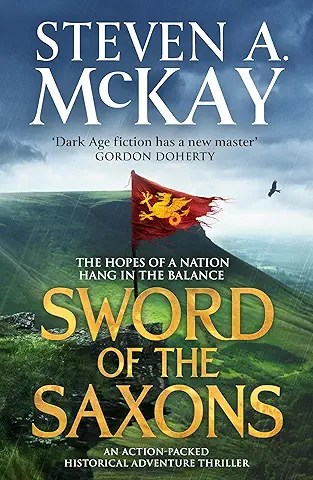
Book Corner: Sword of the Saxons by Steven A. McKay

A war to shape the future of a nation.

Betrayed by his kinsmen, his forces overrun by Danes, King Alfred of Wessex has retreated deep into the marshes of his homeland, lying in wait for his chance at redemption.

The scourge of the heathen horde that has ravaged the kingdom for decades is at its peak. Led by the fearsome Viking warlord Guthrum, the fate of the men, women, and children at their mercy appears all but sealed. But underestimate the great king at your peril…

Gathering allies and bannermen to his cause, and building a strategy that will hopefully ensure victory, Alfred sets out to undermine the strength of the complacent invaders, and establish Wessex as the greatest territory in the British Isles.

A final showdown awaits. Not only with Guthrum and his savage warriors, but with destiny. As the battle lines are drawn, the destiny of not just Wessex, but of every Anglo-Saxon in Britain, rests firmly on Alfred’s shoulders.

An utterly ferocious and gripping adventure, covering the fascinating middle years of Alfred the Great’s reign, one of Britain’s most influential monarchs.

War is coming!

At last! the second book in Steven A McKay’s new Alfred the Great series has arrived. To be fair to Steven, we haven’t had long to wait, even though it felt like an age. The problem was, we left King Alfred at the end of The Heathen Horde, rather down on his luck and looking like things could only get even worse. So it has been agony, waiting for Sword of the Saxons, to see how Steven would get Alfred out of it. We all know the history, Alfred is defeated and seeks shelter in the marshes of Athelney, burns some cakes in order to learn patience and then comes back with a vengeance. So we did know that Alfred’s defeat was not the end of the matter. However, when you get caught up in the story, you need more!

And leaving Alfred, defeated and a fugitive, was a difficult pill to swallow.

King Alfred is the hero who fought to defeat the Danish and Norse invaders – collectively known as the Vikings by many – and unite the disparate kingdoms of England under one king. The kingdom of England would not come to pass in his lifetime, but he started the fight that would be continued by his son and daughter – Edward the Elder and Æthelflæd, Lady of the Mercians – and completed by his grandson, Athelstan, the first King of England.

Sword of the Saxons picks up where The Heathen Horde left off and takes us on Alfred’s journey to not only survive in the marshes, but rebuild his army, renew alliances and begin the fight back. In Sword of the Saxons, King Alfred becomes the leader that England needed, and demonstrates the abilities, both martial and political, that justify his epithet of ‘the Great’.

‘I can almost – almost! – understand Ealdorman Wealdmar giving in to the Danes without a fight,’ Wulfric said to Alfred as they rode towards the little coastal village of Bryn on the outskirts of the Somerset marshes. ‘But his son, Diuma? Refusing to let us into the town when he knew the Danes were hunting us? Gods, I was starting to like the an, and I believed he was a fiercely loyal thane to you, my lord.’

Alfred cleared his throat and spat into the bushes on the side of the road, disgust twisting his features at the memory of the night Wulfric was referring to. ‘So did I,’ he growled. ‘But it seems Diuma was only ever loyal to himself.’ He shook his head and made a cutting motion with his hand. ‘I might possibly be able to forgive some of the men who’ve betrayed me, like Ealdorman Wulfhere. Perhaps they felt like they had no choice. But Diuma? I treated him like a friend. And Brycgstow? That was far enough away from any of Guthrum’s forces to be a target for them! No, Diuma has no excuse for what he’s done. I hope the sea-wolves bleed him and his father dry, and then, eventually, I’ll come face to face with them and hear their excuses before…’ He trailed off, jaw clenched, knuckles white as he gripped his horse’s reins.

There were only two other men with them that morning, for they were merely riding to collect a few supplies but, more importantly, to make sure the good people of Bryn knew that Alfred was still very much alive and hadn’t abandoned his kingdom despite Guthrum’s invasion. The king believed it did the people good to see him in person, rather than his hearth-warriors simply carrying word of his survival to the towns and villages located around Athelney’s marshes. He was a man, after all, not a myth.

‘When are we going to send out word to gather the fyrd, lord?’ The question came from one of the other riders who’d accompanied them, a small but sturdily built warrior called Dunstan. He’d been thane of a village in the north of Wessex which had been utterly destroyed six years earlier, by a party of Northmen led by Jarl Ubba. After that, Dunstan pledged himself to Alfred and now served as one of his fiercest hearth-warriors.

The fourth man in the small group was the sentry from the previous night, Aedan, and he too looked with interest at Alfred, wondering what his reply would be to Dunstan’s question.

The king shook his head slowly. ‘In truth, I don’t know,’ he admitted. ‘I’d like to make sure we have the support of as many people as possible in these nearby settlements. We need to know we can call upon a decent sized fyrd from the lands around Athelney before we look at enlisting people in towns further away.’ He noticed Dunstan and Aedan sharing uncertain glances. ‘I know you two are desperate to take the fight to Guthrum, but we can’t afford to act rashly. First, we build our foundation here in Sumosaete, and then we move on from there.’

With The Heathen Horde, it took me a few chapters to get into the story, to stop comparing Steven A. McKay’s version of King Alfred with the Alfred of Bernard Cornwell – and it took me a while to stop expected Uhtred of Bebbanburg to turn up and save the day, but in Sword of the Saxons Steven has made King Alfred his own. He portrays the great battles his way, has created a hero in Alfred that the reader can get behind wholeheartedly. He is much more likeable than Bernard Cornwell’s King Alfred! Less judgmental…

Alongside Alfred the Great and his family, Steven A. McKay has created a wealth of characters with varying degrees of loyalty to the king. All must be moulded together to fight Guthrum and his men. I have to admit, I love the portrayal of Æthelflæd, Alfred’s oldest daughter and soon to be the Lady of the Mercians. She is a young woman who knows her duty – but also knows her worth and her abilities. She is very much the Æthelflæd I imagine.

Sword of the Saxons is the beginning of the fight back against the invaders. It shows King Alfred coming into his own, becoming the great leader who we know today. He has setbacks, he has doubts, and he has to overcome illness. But this is the Alfred who will lead the reconquest of England that will be completed by his grandson. Steven A. Mckay achieves a wonderful balance, between telling the personal stories of his characters and presenting the great history that they are living through.

It is a gripping read. The fast-paced story leaves the reader breathless – and reading into the early hours! I have no hesitation in recommending Sword of the Saxons to anyone and everyone. Read it! you will not be disappointed.

Buy Sword of the Saxons

About the author:

Steven A. McKay was born in Scotland in 1977 and always enjoyed studying history. He decided to write his Forest Lord novels after seeing a house called “Sherwood” when he was out at work one day. Since then he’s started a new series, the Warrior Druid of Britain Chronicles. In 2021 the Xbox game HOOD: Outlaws and Legends was released, featuring his writing, which Steven says was just a fantastic experience. Steven used to be in a heavy metal band although he tends to just play guitar in his study these days. He did use those guitars to write the theme song for the podcast he co-host, Rock, Paper, Swords! with Matthew Harffy, though.

*

My Books

Signed, dedicated copies of all my books are available through my online bookshop.

OUT NOW! Heroines of the Tudor World
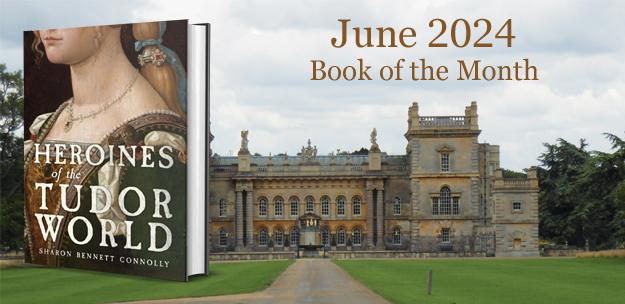
Heroines of the Tudor World tells the stories of the most remarkable women from European history in the time of the Tudor dynasty, 1485-1603. These are the women who ruled, the women who founded dynasties, the women who fought for religious freedom, their families and love. These are the women who made a difference, who influenced countries, kings and the Reformation. In the era dominated by the Renaissance and Reformation, Heroines of the Tudor World examines the threats and challenges faced by the women of the era, and how they overcame them. From writers to regents, from nuns to queens, Heroines of the Tudor World shines the spotlight on the women helped to shape Early Modern Europe.

Heroines of the Tudor World is now available for pre-order from Amberley Publishing and Amazon UK.

Also by Sharon Bennett Connolly:

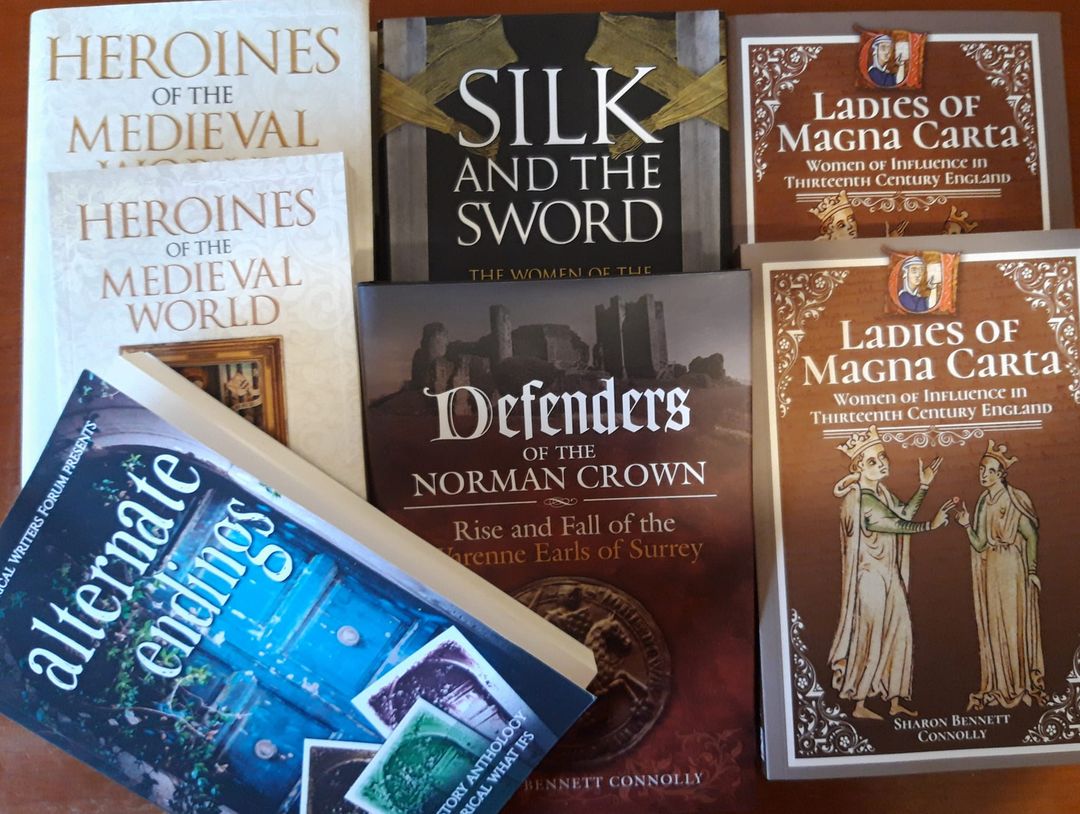
Women of the Anarchy demonstrates how Empress Matilda and Matilda of Boulogne, unable to wield a sword themselves, were prime movers in this time of conflict and lawlessness. It shows how their strengths, weaknesses, and personal ambitions swung the fortunes of war one way – and then the other. Available from Bookshop.orgAmberley Publishing and Amazon UKKing John’s Right-Hand Lady: The Story of Nicholaa de la Haye is the story of a truly remarkable lady, the hereditary constable of Lincoln Castle and the first woman in England to be appointed sheriff in her own right. Available from all good bookshops Pen & Sword Booksbookshop.org and AmazonDefenders of the Norman Crown: The Rise and Fall of the Warenne Earls of Surrey tells the fascinating story of the Warenne dynasty, from its origins in Normandy, through the Conquest, Magna Carta, the wars and marriages that led to its ultimate demise in the reign of Edward III. Available from Pen & Sword BooksAmazon in the UK and US, and Bookshop.org

Ladies of Magna Carta: Women of Influence in Thirteenth Century England looks into the relationships of the various noble families of the 13th century, and how they were affected by the Barons’ Wars, Magna Carta and its aftermath; the bonds that were formed and those that were broken. It is now available in paperback and hardback from Pen & Sword,  Amazon, and Bookshop.orgHeroines of the Medieval World tells the stories of some of the most remarkable women from Medieval history, from Eleanor of Aquitaine to Julian of Norwich. Available now from Amberley Publishing and Amazon, and Bookshop.orgSilk and the Sword: The Women of the Norman Conquest traces the fortunes of the women who had a significant role to play in the momentous events of 1066. Available now from Amazon,  Amberley Publishing, and Bookshop.org.

Alternate Endings: An anthology of historical fiction short stories including Long Live the King… which is my take what might have happened had King John not died in October 1216. Available in paperback and kindle from Amazon.

Podcast:

Have a listen to the A Slice of Medieval podcast, which I co-host with Historical fiction novelist Derek Birks. Derek and I welcome guests, such as Bernard Cornwell and discuss a wide range of topics in medieval history, from significant events to the personalities involved. There’s even an episode on Robin Hood from Steven A. McKay. There are now over 40 episodes to listen to!

*

Don’t forget! Signed and dedicated copies of all my books are available through my online bookshop.

For forthcoming online and in-person talks, please check out my Events Page.

You can be the first to read new articles by clicking the ‘Follow’ button, liking our Facebook page or joining me on Twitter and Instagram.

©2024 Sharon Bennett Connolly FRHistS

Guest Post: Researching the 11th Century by G.K. Holloway

It is a pleasure to welcome novelist G.K. Holloway to History…the Interesting Bits today, to talk about the research behind his wonderful series The 1066 Saga.

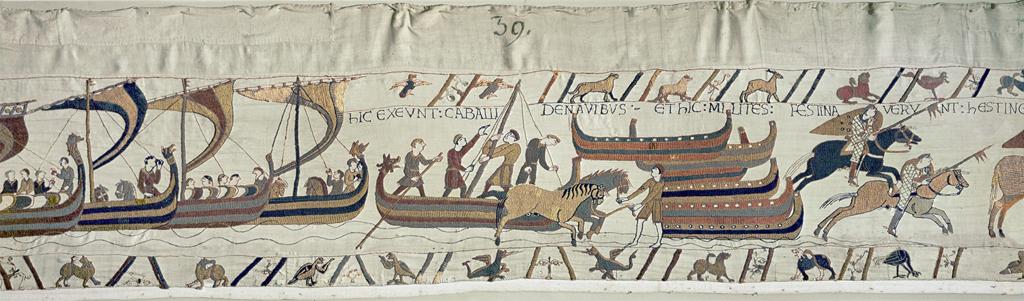
Norman invasion fleet, Bayeux Tapestry

Research for my books consists of mainly reading – books, magazines, academic papers, and blogs. It’s also good to get out a bit and visit and talking with experts, in my case locations of mainly locations of battles where I can talk with resident historians, reenactors and history fans, especially those with local knowledge.

Some of my reading consists of trawling around on the internet. It’s surprising what you can find, other than Wikipedia, as a source of material. And of course there are all sorts of groups on social media that specialise in my period in history. There are podcasts and blogs rich with information for recycling.

Books too, are an obvious place to look; the Doomsday Book is the first to spring to mind, the Anglo-Saxon Chronicle, and the Ecclesiastical History of Orderic Vitalis are useful too. But reader beware, it’s often the case with original material that objectivity wasn’t a strong point of the authors. Academic papers are nowadays can be easily accessed, although the cost of some of them is prohibitive. I’ve had read papers that have shone light into the dark recesses of history I hadn’t dreamed about. This means I’ll able to surprise readers with fascinating snippets that can give a glimpse of life a millennium ago.

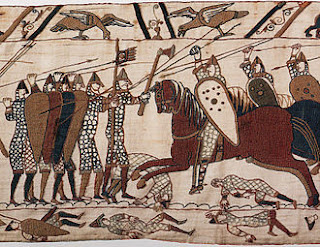
Norman cavalry at the Battle of Hastings

Thank heavens for You Tube. There is a wealth of information to be found here, and a lot of it from top quality presenters and historians.

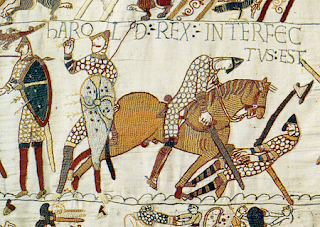
It’s not just what you see but what you don’t see that can be important. A prime example of this is the Bayeux Tapestry. It’s the closet you’ll get to newsreel footage of events covering the Norman Invasion. The full horror of war is not shied away from, burning houses, screaming women, decapitated soldiers and a horse running amok amongst dead bodies, all in glorious colour. But just as in modern times, news can be censored and people and events can be ’air brushed’ out of history, so too, it was the case way back then.

What remains of the well preserved embroidery, that’s correct, it is not a tapestry, is a sight to behold and worth a visit to Normandy to see. It’s surprising how colourful it is even after almost a thousand years. The imagery is clear and easy to follow but some scenes are missing. The story is told accurately enough and details like the appearance of Halley’s Comet are included. However, the Battle of Stamford Bridge is nowhere to be seen. Could it be that King William didn’t want it know that the army he fought at Senlac was exhausted from several hundred miles of marching and a huge battle against the biggest Norse army ever to have set foot in England. There is no depiction of the Battle of London Bridge, or the violence committed by his rampaging troops during his coronation. History has been, ‘cleaned up a bit,’ to the advantage of the victors. Nothing new there then.

Death of King Harold in the Bayeux Tapestry

It’s always a good idea to visit key locations. It’s one thing to look at maps and photographs but when you find yourself looking across the lagoons at Bosham, wandering around the castle at Falaise, starring up at Clifford’s Tower in York, or watching a reenactment at Battle Abbey, a much more realistic picture forms in your mind about what it must have been like to live all that time ago. To boost one’s knowledge it’s always a good idea to talk to reenactors; most of them have an encyclopaedic knowledge of the time period and especially their character’s part in it. Whether it be as a soldier, arrowsmith or seamstress.

Doing all the above is a great way of researching the history, but if like me, you write historical fiction rather than non-fiction, you would do well to read a good book. One I could recommend if, Story by Robert McKee. He deals with scriptwriting but it’s quite easy to apply his ideas to novels. You could also spend a lot of money and quite a bit of time on a creative writing course, but you might be better off getting a good editor.

So there you have it. Use as many sources as you can, and you’ll find many a nugget amongst the raw material.

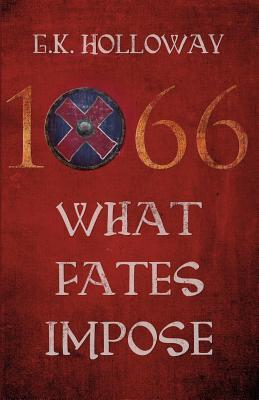
1066: What Fates Impose

England is in crisis. King Edward has no heir and promises never to produce one. There are no obvious successors available to replace him, but quite a few claimants are eager to take the crown. While power struggles break out between the various factions at court, enemies abroad plot to make England their own. There are raids across the borders with Wales and Scotland.

Harold Godwinson, Earl of Wessex, is seen by many as the one man who can bring stability to the kingdom. He has powerful friends and two women who love him, but he has enemies will stop at nothing to gain power. As 1066 begins, England heads for an uncertain future. It seems even the heavens are against Harold.

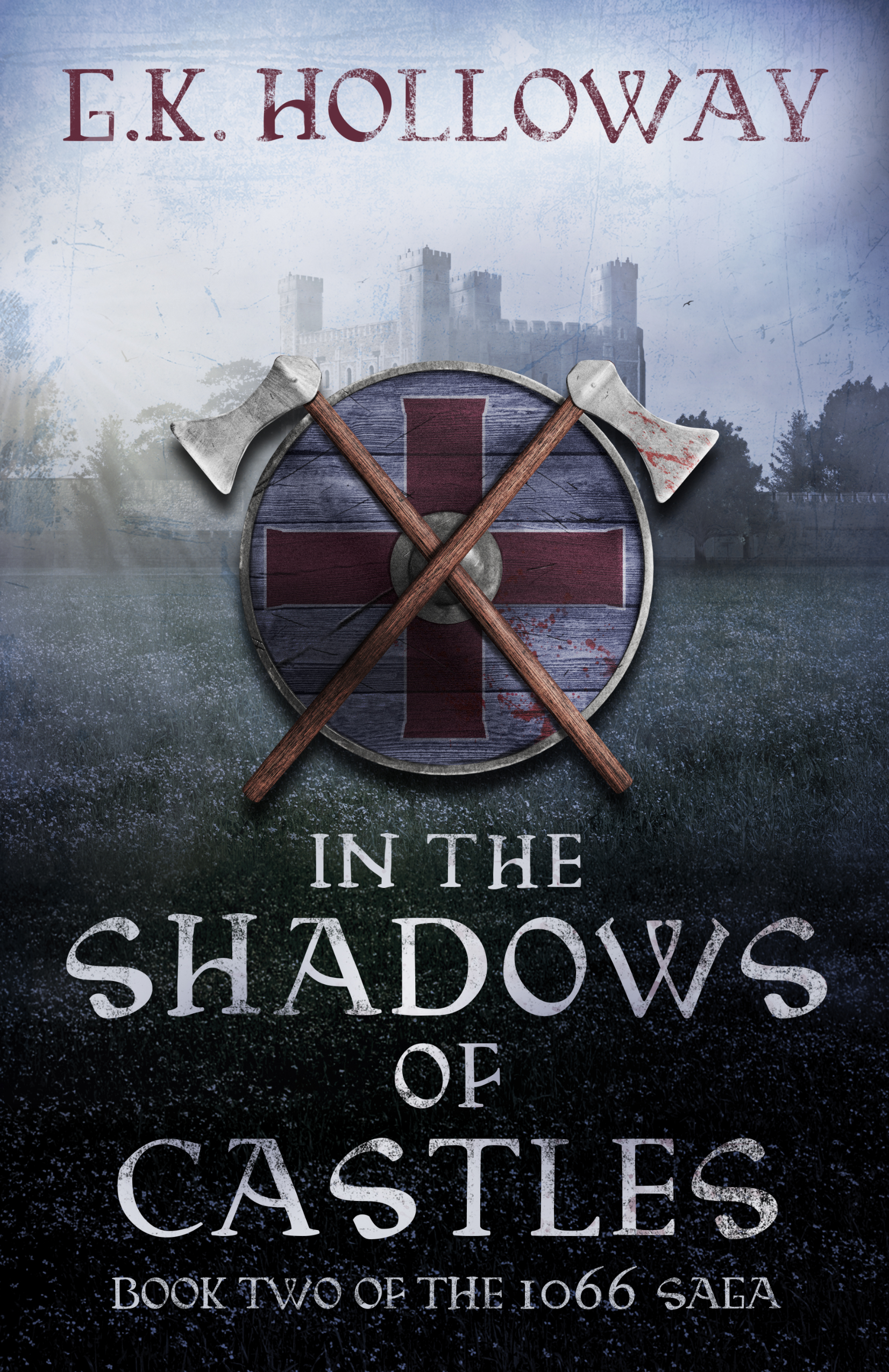
In the Shadows of Castles

It’s the 1060s, and William of Normandy is establishing a new and brutal regime in England, but there are those who would defy him. As Norman soldiers spread like a plague across the land, resistance builds, but will it be enough to topple William and restore the rightful king to his throne? The English have the courage to fight, but the Normans, already victorious at Hastings, now build castles seeking to secure their tenuous foothold in these lands.

And what of the people caught up in these catastrophic events? Dispossessed but not defeated, their lives ripped apart, the English struggle for freedom from tyranny; amongst them, caught up in the turmoil, are a soldier, a thane and two sisters. As events unfold, their destinies become intertwined, bringing drastic changes that alter their lives forever.

Firmly embedded in the history of the Conquest, ‘In the Shadows of Castles’ is ultimately a story of love, hope and survival in a time of war.

About the Author:

1066 What Fates Impose, won the Gold Medal in the 2014 Wishing Shelf Independent Book Awards – Adult Fiction.

G K Holloway left university in 1980 with a degree in history and politics. After spending a year in Canada, he relocated to England’s West Country and began working in Secondary Education. Later he worked in Adult Education and then Further Education before finally working in Higher Education.

After reading a biography about Harold Godwinson, he became fascinated by the fall of Anglo Saxon England and spent several years researching events leading up to and beyond the Battle of Hastings. Eventually he decided he had enough material to make an engrossing novel. Using characters from the Bayeux Tapestry, the Norse Sagas, the Domesday Book and many other sources. He feels that he has brought the period and its characters to life in his own particular way. Following the major protagonists, as well as political, religious and personal themes, the downfall of Anglo-Saxon England is portrayed by a strong cast.

Nowadays he lives in Bristol with his wife and two children. When he’s not writing he works with his wife in their company.

1066 is his debut novel was originally published as an ebook. It has received very positive reviews and this has encouraged him to publish it in paperback. Currently he is working on a sequel. One day he hopes to write full time.

Visit G K Holloway’s website http://www.gkholloway.co.uk

GK Holloway’s books on Amazon

*

My Books:

Signed, dedicated copies of all my books are available through my online bookshop.

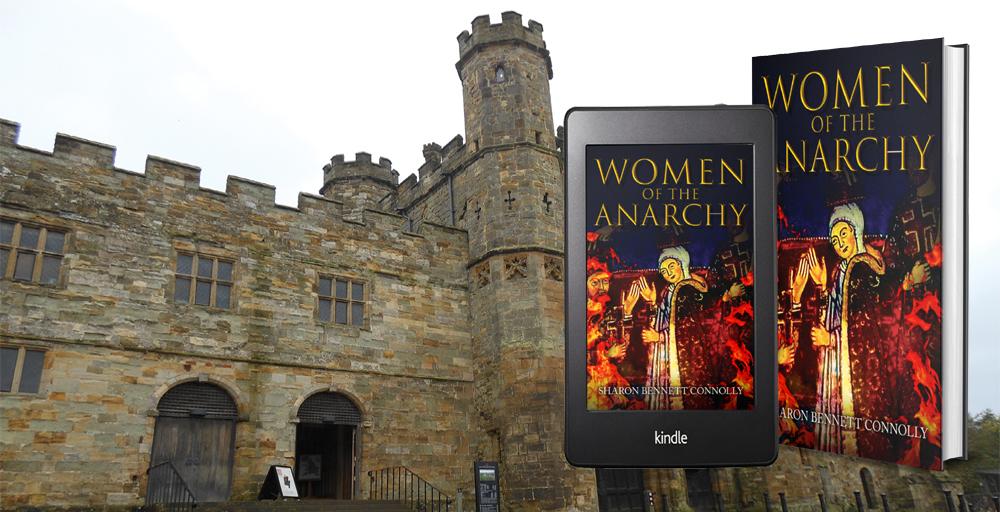
Out Now! Women of the Anarchy

Two cousins. On the one side is Empress Matilda, or Maud. The sole surviving legitimate child of Henry I, she is fighting for her birthright and that of her children. On the other side is her cousin, Queen Matilda, supporting her husband, King Stephen, and fighting to see her own son inherit the English crown. Women of the Anarchy demonstrates how these women, unable to wield a sword, were prime movers in this time of conflict and lawlessness. It show how their strengths, weaknesses, and personal ambitions swung the fortunes of war one way – and then the other.

Available from Bookshop.orgAmberley Publishing and Amazon UK.

Coming on 15 June 2024: Heroines of the Tudor World

Heroines of the Tudor World tells the stories of the most remarkable women from European history in the time of the Tudor dynasty, 1485-1603. These are the women who ruled, the women who founded dynasties, the women who fought for religious freedom, their families and love. These are the women who made a difference, who influenced countries, kings and the Reformation. In the era dominated by the Renaissance and Reformation, Heroines of the Tudor World examines the threats and challenges faced by the women of the era, and how they overcame them. From writers to regents, from nuns to queens, Heroines of the Tudor World shines the spotlight on the women helped to shape Early Modern Europe.

Heroines of the Tudor World is now available for pre-order from Amberley Publishing and Amazon UK.

Also by Sharon Bennett Connolly:

King John’s Right-Hand Lady: The Story of Nicholaa de la Haye is the story of a truly remarkable lady, the hereditary constable of Lincoln Castle and the first woman in England to be appointed sheriff in her own right. Available from all good bookshops or direct from Pen & Sword Booksbookshop.org and AmazonDefenders of the Norman Crown: The Rise and Fall of the Warenne Earls of Surrey tells the fascinating story of the Warenne dynasty, from its origins in Normandy, through the Conquest, Magna Carta, the wars and marriages that led to its ultimate demise in the reign of Edward III. Available from Pen & Sword BooksAmazon in the UK and US, and Bookshop.org

Ladies of Magna Carta: Women of Influence in Thirteenth Century England looks into the relationships of the various noble families of the 13th century, and how they were affected by the Barons’ Wars, Magna Carta and its aftermath; the bonds that were formed and those that were broken. It is now available in paperback and hardback from Pen & Sword,  Amazon, and Bookshop.orgHeroines of the Medieval World tells the stories of some of the most remarkable women from Medieval history, from Eleanor of Aquitaine to Julian of Norwich. Available now from Amberley Publishing and Amazon, and Bookshop.orgSilk and the Sword: The Women of the Norman Conquest traces the fortunes of the women who had a significant role to play in the momentous events of 1066. Available now from Amazon,  Amberley Publishing, and Bookshop.org.

Alternate Endings: An anthology of historical fiction short stories including Long Live the King… which is my take what might have happened had King John not died in October 1216. Available in paperback and kindle from Amazon.

Podcast:

Have a listen to the A Slice of Medieval podcast, which I co-host with Historical fiction novelist Derek Birks. Derek and I welcome guests, such as Bernard Cornwell and Elizabeth Chadwick, and discuss a wide range of topics in medieval history, from significant events to the personalities involved.

*

Don’t forget! Signed and dedicated copies of all my books are available through my online bookshop.

For forthcoming online and in-person talks, please check out my Events Page.

You can be the first to read new articles by clicking the ‘Follow’ button, liking our Facebook page or joining me on Twitter and Instagram.

*

©2024 GK Holloway and Sharon Bennett Connolly FRHistS.

Guest Post: Through Their Stories: The Women of 1066 by L.P. O’Bryan

As my long-time readers will know, I have always had an interest in the Norman Conquest and the women involved in the struggle for England, on all three sides of the fight. My book, Silk and the Sword: The Women of the Norman Conquest, is now recommended by the Historical Association for teaching the Norman Conquest in schools and I love to give talks to classes of Year 7 students who are studying the Conquest from this unique angle. So when author L.P. O’Bryan offered to write an article on his research into the women of the era, I could not resist.

So, over to L.P. O’Bryan

Through Their Stories: The Women of 1066

Edith of Wessex, Queen of England, grieving for Edward the Confessor, Bayeux Tapestry. 

The year 1066 stands as a watershed moment for England and Europe. The Battle of Hastings and the subsequent Norman Conquest altered the course of England’s history, reshaping its culture, language, and legal system.

While much has been written about the warriors and kings, the stories of the women who lived through these tumultuous times are often left untold. This article aims to explore the experiences of women amidst the upheaval of their society and the personal losses they endured.

The Prelude to Conquest

The year 1066 began with the death of Edward the Confessor, leaving a power vacuum that would draw Harold Godwinson, Harald Hardrada, and William of Normandy into a struggle for the English throne. Amidst this political turmoil, women of all stations managed their households and lands, often overseeing the welfare of their communities. Edith of Wessex, widow of Edward, and Gytha Thorkelsdóttir, mother of Harold Godwinson, were two examples of women who played significant roles in the fabric of English society at that time. Their lives, filled with the duties of governance and care, were about to be irrevocably changed.

The Battle of Hastings: A Turning Point

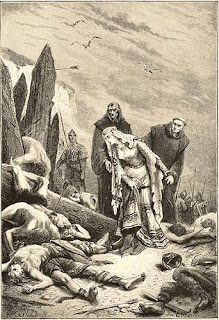
Edith Swan-Neck after Hastings looking for King Harold’s body. School of Lawrence Alma-Tadema.  

On October 14, 1066, the fate of England was decided on the battlefield near Hastings. For the women awaiting news, the battle represented a moment of profound anxiety and fear. The loss of life from the battle was staggering, with many women losing husbands, sons, brothers, and fathers. The immediate aftermath of the battle saw a shift in the social landscape too, as Norman forces began to assert control over the conquered lands.

Imagine the heartache of a woman like Edith Swan-Neck, Harold’s common-law wife, identifying his body on the battlefield. Her grief mirrored by thousands of others, whose lives were transformed overnight, their futures uncertain in a country now ruled by foreign invaders.

Adapting to Norman Rule

The Norman Conquest introduced significant changes to English society, including the imposition of Norman customs, laws, and, more slowly, language. For English women, this meant navigating a new order that often placed them at a disadvantage. Land rights, inheritance laws, and social statuses were all subject to the whims of the new Norman elite.

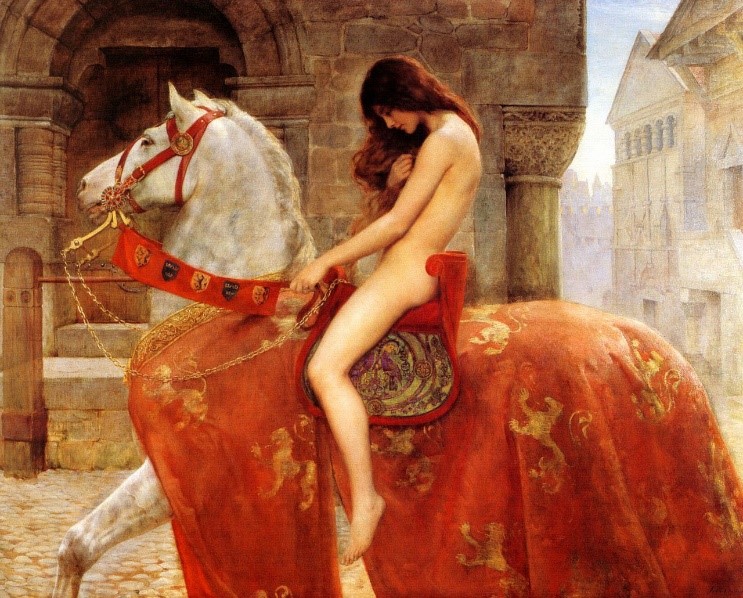
Despite these challenges, many English women found ways to adapt and survive. Some, like the legendary Lady Godiva, who is said to have protested against oppressive taxation under Norman rule, became symbols of resistance. The concept of a Peeping Tom, came from her ride, as a man named Tom was the only one believed to have opened his window to look at her. Such stories, whether more myth than real, highlight the resilience of women during this period of transition.

The Legacy of 1066 for Women

Lady Godiva by John Collier

The long-term effects of the Norman Conquest on English women were profound. The introduction of Norman customs and laws reshaped England, influencing women’s roles and rights for generations to come. The Domesday Book, a comprehensive survey ordered by William the Conqueror, provides insight into the changes in land ownership and societal structures that affected women’s lives.

Women who inherited family land because their husbands or fathers had been killed at Hastings in 1066, were allowed to keep their land if they married a Norman or Frenchman. Such marriages were intended to further the post-conquest social order and peace in England.

William the Conqueror betrothed his daughter Adeliza to the English Earl Edwin, though he was killed in 1070 before the marriage could take place.

Most intermarriages took place at the highest aristocratic level, intended to bring peace, though there were instances of intermarriage at other levels. One example is Wigot of Wallingford, the English guardian of an important crossing of the Thames near Oxford, agreed to have his daughter Ealdgyth marry Robert d’Ouilly, one of King William’s henchmen and later Castellan of Oxford.

The Domesday Book, completed in 1086, reveals that Judith was the most important woman landholder on the date when the Domesday survey was made. Omitting nunneries, she is one of about twenty women tenants-in-chief in 1086. Her extensive lands stretched throughout northern and eastern England, from Middlesex and Buckinghamshire to Yorkshire, with a concentration in the east Midlands. Judith was the widow of Earl Waltheof. She was also the niece of William the Conqueror. She was a northern French woman whose marriage was part of William’s attempts to come to terms with the English nobility after his conquest in 1066. By 1086 Judith’s husband was dead, executed for his part in rebellion. Judith was now a wealthy widow.

Many of the relatively small number of women mentioned in Domesday are relatives of William the Conqueror, illustrating how he had transferred most of the largest landholdings in England to his extended family. See this PDF article for more on the women in Domesday.

Other women, Godgifu and Allfgifu for example, the wives of two English earls, Edwin and Morcar, debated over their attitudes to the Conqueror, but still survived. These widows got to keep their dower and died in possession of at least some of it. They were part of a noble group whose power had arisen during the tenth and early eleventh centuries, and even within that group fortunes differed greatly.

The lack of information about lower born eleventh-century women does not justify sweeping generalization about them, however Domesday does provide some data. The statistics of Domesday suggest at first sight a deterioration in status. In Essex, for example, there were 25 women holding land in 1066, 9 in 1086; in Yorkshire, 19 in 1066, 4 in 1086; in Suffolk over 50 in 1066, 7 in 1066. Yet other shires show no decline, even a slight increase, as in Dorset where there were 9 women in 1066 and 10 in 1086 or in Warwickshire, with 8 in 1066 and 9 in 1086.

The women of 1066 experienced the Norman Conquest not just as a historical event, but as a deeply personal trauma that reshaped their lives and the lives of their descendants. Their stories, often overshadowed by the tales of kings and warriors, offer a poignant perspective on one of England’s most significant historical moments.

In remembering their stories, we honor their legacy, recognizing the vital role women have played in shaping our world. The women of 1066, through their resilience and adaptability, have left an indelible mark on history, reminding us of the power of the human spirit to endure, adapt, and overcome.

About the author:

L.P. O’Bryan is the author of a series of novels set in the aftermath of the Battle of Hastings, starting with, The Rise of Synne, more detail here. The series is about an orphan healer in the aftermath of Hastings.

*

My Books:

Signed, dedicated copies of all my books are available through my online bookshop.

Out Now! Women of the Anarchy

Two cousins. On the one side is Empress Matilda, or Maud. The sole surviving legitimate child of Henry I, she is fighting for her birthright and that of her children. On the other side is her cousin, Queen Matilda, supporting her husband, King Stephen, and fighting to see her own son inherit the English crown. Women of the Anarchy demonstrates how these women, unable to wield a sword, were prime movers in this time of conflict and lawlessness. It show how their strengths, weaknesses, and personal ambitions swung the fortunes of war one way – and then the other.

Available from Bookshop.orgAmberley Publishing and Amazon UK.

Coming on 15 June 2024: Heroines of the Tudor World

Heroines of the Tudor World tells the stories of the most remarkable women from European history in the time of the Tudor dynasty, 1485-1603. These are the women who ruled, the women who founded dynasties, the women who fought for religious freedom, their families and love. These are the women who made a difference, who influenced countries, kings and the Reformation. In the era dominated by the Renaissance and Reformation, Heroines of the Tudor World examines the threats and challenges faced by the women of the era, and how they overcame them. From writers to regents, from nuns to queens, Heroines of the Tudor World shines the spotlight on the women helped to shape Early Modern Europe.

Heroines of the Tudor World is now available for pre-order from Amberley Publishing and Amazon UK.

Also by Sharon Bennett Connolly:

King John’s Right-Hand Lady: The Story of Nicholaa de la Haye is the story of a truly remarkable lady, the hereditary constable of Lincoln Castle and the first woman in England to be appointed sheriff in her own right. Available from all good bookshops or direct from Pen & Sword Booksbookshop.org and AmazonDefenders of the Norman Crown: The Rise and Fall of the Warenne Earls of Surrey tells the fascinating story of the Warenne dynasty, from its origins in Normandy, through the Conquest, Magna Carta, the wars and marriages that led to its ultimate demise in the reign of Edward III. Available from Pen & Sword BooksAmazon in the UK and US, and Bookshop.org

Ladies of Magna Carta: Women of Influence in Thirteenth Century England looks into the relationships of the various noble families of the 13th century, and how they were affected by the Barons’ Wars, Magna Carta and its aftermath; the bonds that were formed and those that were broken. It is now available in paperback and hardback from Pen & Sword,  Amazon, and Bookshop.orgHeroines of the Medieval World tells the stories of some of the most remarkable women from Medieval history, from Eleanor of Aquitaine to Julian of Norwich. Available now from Amberley Publishing and Amazon, and Bookshop.orgSilk and the Sword: The Women of the Norman Conquest traces the fortunes of the women who had a significant role to play in the momentous events of 1066. Available now from Amazon,  Amberley Publishing, and Bookshop.org.

Alternate Endings: An anthology of historical fiction short stories including Long Live the King… which is my take what might have happened had King John not died in October 1216. Available in paperback and kindle from Amazon.

Podcast:

Have a listen to the A Slice of Medieval podcast, which I co-host with Historical fiction novelist Derek Birks. Derek and I welcome guests, such as Bernard Cornwell and Elizabeth Chadwick, and discuss a wide range of topics in medieval history, from significant events to the personalities involved.

*

Don’t forget! Signed and dedicated copies of all my books are available through my online bookshop.

For forthcoming online and in-person talks, please check out my Events Page.

You can be the first to read new articles by clicking the ‘Follow’ button, liking our Facebook page or joining me on Twitter and Instagram.

*

©2024 Sharon Bennett Connolly FRHistS and L.P. O’Bryan

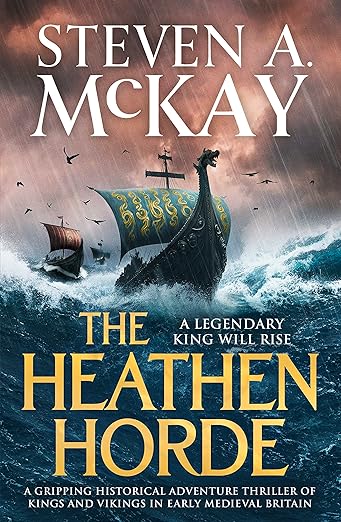
Book Corner: The Heathen Horde by Steven A. McKay

Heavy is the head that wears the crown.

Northumbria, AD 864. Viking warlord Ragnar Lothbrok is captured and killed in brutal fashion, an event that will shape the future of the nation for decades to come.

Mercia, AD 868Alfred, son of Wessex and heir to the throne, draws his first blood on the battlefield. It will not be his last.

A devastating scourge from the north is coming to Britain, one that will bring armies and entire kingdoms to their knees. Travelling along the whale road in their feared longships, the Great Heathen Army move fast, striking with a savagery unmatched, in a seemingly unstoppable tide of blood and iron.

One inexperienced warrior will prove the difference, a young man who will lead from the front and, in time, aspire to become the saviour of the Saxons… Alfred the Great.

A totally enrapturing historical adventure following the life of one of Britain’s most important ever kings.

Wow! Riveting start to what promises to be an excellent series. The Heathen Horde is a fabulous, gritty and entertaining story of how Alfred the Great became ‘Great.’

However…

I have to admit to a little trepidation when I started reading The Heathen Horde. Bernard Cornwell did such a fantastic job of recreating the period in his Last Kingdom series that I was not sure I was ready for another writer’s perspective. I was worried I would not warm to Steven A McKay’s version of the story.

How wrong I was!

And I am so happy that I gave it a go.

‘Look out, Alfred!’

The rider heard his brother’s warning just in time to raise his shield and the linden boards took the brunt of the axe which had been heading for his head, splinters flying as the wood shuddered, pain lancing through his arm. Baring his teeth in rage, Alfred swung his sword down, catching his attacker’s hand just as the axe had been about to strike again. There was a scream of pain as fingers were shorn through to the bone and then Alfred’s horse was past and cantering away from the battle.

‘Back,’ he grunted, tugging on the reins and bringing the horse around quickly. His heart was thudding in his chest and he felt light-headed but it was almost a joyful sensation. He was afraid, aye, but he was also excited, and eager to get back to the fight. He could see the axeman who’d tried to kill him, grimacing and eyeing his mangled hand as if he feared he might never hold a weapon properly again.

Alfred was charging back into the fight before he knew it, battle fever overtaking him at the realisation that he’d almost had his skull caved in. He headed straight for the axeman. The man had transferred his weapon to his left hand but could only wield it awkwardly and his wide eyes told of his fear at being forced to fight in such a manner. Alfred’s horse came alongside the Dane’s and, screaming an incoherent battle-cry, the young warrior smashed the edge of his blade into the enemy’s neck. The sheer force of the blow was enough to throw the man off his horse’s back despite the Dane’s long, mail neck guard. He lay on the ground, unmoving, as his mount bolted and the pounding hooves of the other combatants’ animals swirled around him.

Alfred grinned savagely, knowing that, if the Dane had somehow survived the attack and the fall, he wouldn’t last long before the weight of a horse crushed the life from him.

God be praised, one less sea-wolf to ravage Anglo-Saxon lands!

Admittedly, for the first 20 pages or so, I regularly found myself comparing Steven’s version of King Alfred to Bernard’s version. But I soon left The Last Kingdom behind and found myself enjoying The Heathen Horde for the fascinating story it is in its own right. Soon, I didn’t even notice Uhtred’s absence.

I love this version of King Alfred. His piety is evident, but not as all-consuming as Bernard Cornwell’s Alfred. His military and political prowess both play a greater role in the story. I even liked Alfred’s wife, Ælswith. The Heathen Horde starts when Alfred is merely a younger brother, not expecting to ever take the throne himself, serving his brother loyally and learning the art of war and politics. We see him grown into the role of military leader and develop his concept of a united kingdom – of England.

The story is rich in detail and brings the characters to life. I can’t wait for the next book in the series!

It ends tooooo soon! I need to know what happens next – now! 

The Heathen Horde is one of those books that you can’t wait to need to finish but want it never to end. It is unputdownable! I highly recommend you give it a go.

About the Author:

Steven A. McKay was born in Scotland in 1977. He is the author of two previous series of historical fiction, following Robin Hood and the warrior-druid Bellicus in post-Roman Britain. He plays the guitar, is the co-host of historical adventure podcast Rock, Paper, Swords! along with author Matthew Harffy, and lives just outside Glasgow with his wife and children.

To Buy the book: The Heathen Horde by Steven A. McKay is now available form Amazon.

*

My Books

Signed, dedicated copies of all my books are available through my online bookshop.

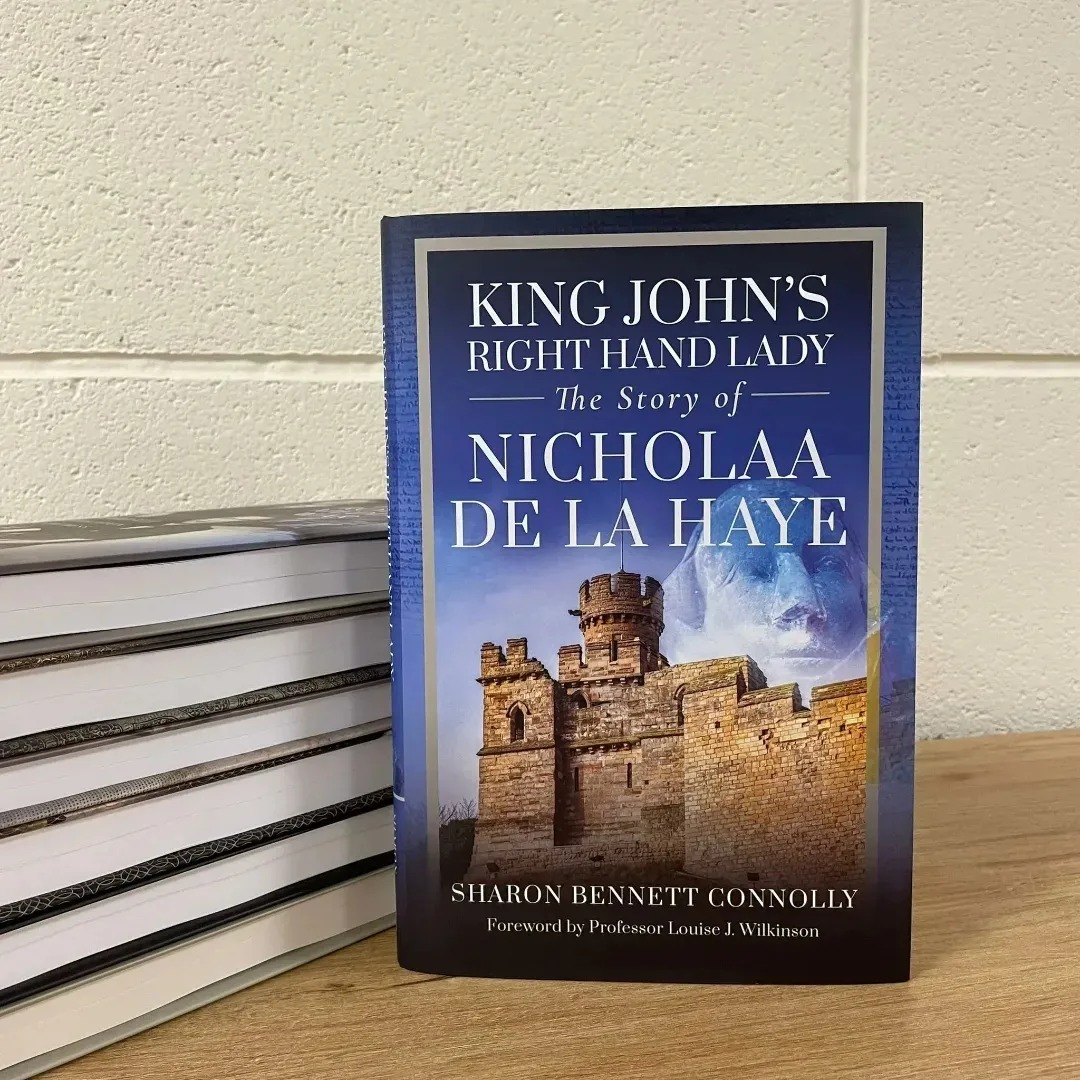
Out nowKing John’s Right-Hand Lady: The Story of Nicholaa de la Haye

In a time when men fought and women stayed home, Nicholaa de la Haye held Lincoln Castle against all-comers, gaining prominence in the First Baron’s War, the civil war that followed the sealing of Magna Carta in 1215. A truly remarkable lady, Nicholaa was the first woman to be appointed sheriff in her own right. Her strength and tenacity saved England at one of the lowest points in its history. Nicholaa de la Haye is one woman in English history whose story needs to be told…

King John’s Right-Hand Lady: The Story of Nicholaa de la Haye is now available from Pen & Sword Booksbookshop.org and Amazon.

Coming 15 January 2024: Women of the Anarchy

On the one side is Empress Matilda, or Maud. The sole surviving legitimate child of Henry I, she is fighting for her birthright and that of her children. On the other side is her cousin, Queen Matilda, supporting her husband, King Stephen, and fighting to see her own son inherit the English crown. Both women are granddaughters of St Margaret, Queen of Scotland and descendants of Alfred the Great of Wessex. Women of the Anarchy demonstrates how these women, unable to wield a sword, were prime movers in this time of conflict and lawlessness. It show how their strengths, weaknesses, and personal ambitions swung the fortunes of war one way – and then the other.

Available for pre-order from Amberley Publishing and Amazon UK.

Also by Sharon Bennett Connolly:

Defenders of the Norman Crown: The Rise and Fall of the Warenne Earls of Surrey tells the fascinating story of the Warenne dynasty, of the successes and failures of one of the most powerful families in England, from its origins in Normandy, through the Conquest, Magna Carta, the wars and marriages that led to its ultimate demise in the reign of Edward III. Defenders of the Norman Crown: Rise and Fall of the Warenne Earls of Surrey is now available from Pen & Sword BooksAmazon in the UK and US, and Bookshop.org.

Ladies of Magna Carta: Women of Influence in Thirteenth Century England looks into the relationships of the various noble families of the 13th century, and how they were affected by the Barons’ Wars, Magna Carta and its aftermath; the bonds that were formed and those that were broken. It is now available in paperback and hardback from Pen & Sword,  Amazon, and Bookshop.org.

Heroines of the Medieval World tells the stories of some of the most remarkable women from Medieval history, from Eleanor of Aquitaine to Julian of Norwich. Available now from Amberley Publishing and Amazon, and Bookshop.org.

Silk and the Sword: The Women of the Norman Conquest traces the fortunes of the women who had a significant role to play in the momentous events of 1066. Available now from Amazon,  Amberley Publishing, and Bookshop.org.

Alternate Endings: An anthology of historical fiction short stories including Long Live the King… which is my take what might have happened had King John not died in October 1216. Available in paperback and kindle from Amazon.

Podcast:

Have a listen to the A Slice of Medieval podcast, which I co-host with Historical fiction novelist Derek Birks. Derek and I welcome guests, such as Bernard Cornwell, and discuss a wide range of topics in medieval history, from significant events to the personalities involved.

*

Don’t forget! Signed and dedicated copies of all my books are available through my online bookshop.

For forthcoming online and in-person talks, please check out my Events Page.

You can be the first to read new articles by clicking the ‘Follow’ button, liking our Facebook page or joining me on Twitter and Instagram.

©2023 Sharon Bennett Connolly FRHistS 
Matilda and Edith, Women of Different Fates

History...the Interesting Bits
The Battle of Hastings, from the Bayeux Tapestry

Although the Battle of Hastings was fought by men, the women of the two opponents, Harold and William, had as much invested in the outcome as their husbands. The two women, however, have very different reputations. Whereas Matilda appears as the epitome of the medieval ideal woman, Edith has come down through history as ‘the other woman’. However, for both these women, their futures, and the futures of their children, were inextricably linked with the fates of the men fighting on Senlac Hill on that October morning in 1066.

Harold had met Edith Swan-neck at about the same time as he became earl of East Anglia, in 1044. Which makes it possible that Edith Swan-neck and the East Anglian magnate, Eadgifu the Fair, are one and the same. Eadgifu the Fair held over 270 hides of land and was one of the richest magnates in England. The majority of her estates lay in Cambridgeshire, but she also held land in Buckinghamshire, Hertfordshire, Essex and Suffolk; in the Domesday Book Eadgifu held the manor at Harkstead in Suffolk, which was attached to Harold’s manor of Brightlingsea in Essex and some of her Suffolk lands were tributary to Harold’s manor of East Bergholt. While it is by no means certain that Eadgifu is Edith Swan-neck several historians – including Ann Williams in the Oxford Dictionary of National Biography – make convincing arguments that they were. Even their names, Eadgifu and Eadgyth, are so similar that the difference could be merely a matter of spelling or mistranslation; indeed, the abbey of St Benet of Hulme, Norfolk, remembers an Eadgifu Swanneshals among its patrons.

By 1065 Harold had been living with the wonderfully-named Eadgyth Swanneshals (Edith the Swan-neck) for twenty years. History books label her as Harold’s concubine, but Edith was, obviously, no weak and powerless peasant, so it’s highly likely they went through a hand-fasting ceremony – or ‘Danish marriage’ – a marriage, but not one recognized by the church, thus allowing Harold to take a second ‘wife’ should he need to. Harold and Edith had at least 6 children together; including four sons, Godwin, Edmund, Magnus and Ulf and two daughters, Gytha, who married Vladimir Monomakh, Great Prince of Kiev, and Gunnhild, was to become a nun at Wilton Abbey in Wiltshire, but never took her vows.

History...the Interesting Bits
King Harold at the Battle of Hastings, from the Bayeux Tapestry

However, despite their twenty years and many children together, with the health of the king, Edward the Confessor, deteriorating, it became politically expedient for Harold to marry in order to strengthen his position as England’s premier earl and, possibly, next king. Ealdgyth was the daughter of Alfgar, earl of Mercia, and, according to William of Jumieges, very beautiful. She was the widow of Gruffudd ap Llywelyn, King of Gwynedd from 1039 and ruler of all Wales after 1055, with whom she had had at least one child, a daughter, Nest. Gruffudd had been murdered in 1063, following an expedition into Wales, some sources suggest it was by Harold himself, however Gruffudd’s own men are the chief suspects. Harold’s subsequent marriage to Ealdgyth not only secured the support of the earls of Northumbria and Mercia, but also weakened the political ties of the same earls with the new rulers of north Wales.

Rather than his loyal and loving ‘wife’, Edith, it was Ealdgyth, therefore, who was for a short time, queen of England. However, with Harold having to defend his realm, first against Harold Hardrada and his own brother, Tostig, at Stamford Bridge in September of 1066 and, subsequently, against William of Normandy at Hastings, it is unlikely Ealdgyth had time to enjoy her exalted status. At the time of the Battle of Hastings, 14th October 1066, Ealdgyth was in London, but her brothers took her north to Chester soon after. Although sources are confused it seems possible that Ealdgyth was heavily pregnant and gave birth to a son, Harold Haroldson, within months of the battle. Unfortunately, that is the last we hear of Ealdgyth; her fate remains unknown. Young Harold is said to have grown up in exile on the Continent and died in 1098.

Despite his marriage to Ealdgyth it seems Edith Swan-neck remained close to Harold and it was she who was waiting close by when the king faced William of Normandy at Senlac Hill near Hastings on 14th October 1066. She awaited the outcome alongside Harold’s mother, Gytha. Having lost a son, Tostig, just two weeks before, fighting against his brother and with the Norwegians at the Battle of Stamford Bridge, Gytha lost three more sons – Harold, Gyrth and Leofwine – and her grandson, Haakon, in the battle at Hastings.

And it was Edith and the elderly Gytha, who wandered the blood-soaked field in the aftermath of the battle, in search of the fallen king. Sources say that Gytha was unable to identify her sons amidst the mangled and mutilated bodies. It fell to Edith to find Harold, by undoing the chain mail of the victims, in order to recognize certain identifying marks on the king’s body – probably tattoos. 

History...the Interesting Bits
Edith finding Harold’s body on the battlefield

The monks of Waltham Abbey had a tradition of Edith bringing Harold’s body to them for burial, soon after the battle. Although other sources suggest Harold was buried close to the battlefield, and without ceremony, it is hard not to hope that Edith was able to perform this last service for the king. However, any trace of Harold’s remains was swept away by Henry VIII’s Dissolution of the Monasteries, so the grave of England’s last Anglo-Saxon king is lost to history.

Harold’s mother, Gytha, eventually fled into exile on the Continent, taking Harold and Edith’s daughter, another Gytha, with her, possibly arranging her marriage to the prince of Smolensk and – later – Kiev. The sons of Edith and Harold fled to Ireland with all but one, living into the 1080s, though the dates of their eventual deaths remain uncertain. Gunnhild remained in her nunnery at Wilton until sometime before 1093, when she became the wife or concubine of Alan the Red, a Norman magnate. Whether or not she was kidnapped seems to be in question but when Alan died in 1093, instead of returning to the convent, Gunnhild became the mistress of Alan’s brother and heir, Alan Niger. Alan Rufus held vast lands in East Anglia – lands that had once belonged to Eadgifu the Fair and, if Eadgifu was Edith Swan-neck, it’s possible that Alan married Gunnhild to strengthen his claims to her mother’s lands.  

Of Edith Swan-neck, there is no trace after Harold is interred at Waltham Abbey, she simply disappears from the pages of history…

For Matilda, on the other hand, the Battle of Hastings marked the start of another stage of her life and career as the wife of William, duke of Normandy and, now, King of England. Matilda of Flanders was probably born around 1032, the daughter of Baldwin V, count of Flanders, and his wife, Adela, a daughter of King Robert the Pious of France. The young duke, William of Normandy, was probably pushing his luck when he proposed a marriage between himself and young Matilda. Although he was a duke and Baldwin a mere count, there was the question of his illegitimacy and Normandy was hardly the most stable of regions; William had spent all of his adult life fighting to keep hold of it. 

History...the Interesting Bits
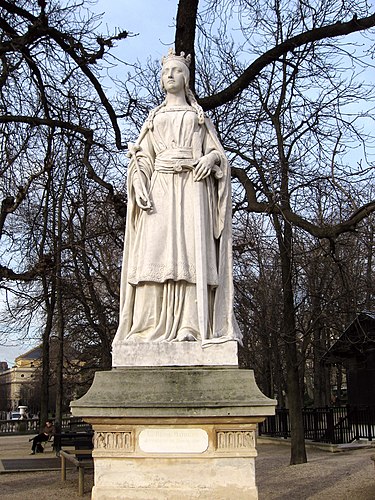
Matilda of Flanders

A later story tells of how Matilda refused to marry William, stating that, being granddaughter of a king, she was too high born to marry a bastard. William was said to be so incensed with this response that he straightaway rode to Flanders, accosted young Matilda in the street, pulling her from her horse by her braids, before hitting her and cutting her with his spurs; whereupon Matilda changed her mind and agreed to marry William. While amusing, it is highly likely that the story is an invention, and highly unlikely that Matilda was asked her opinion on the marriage. Getting to the altar was not an easy task, however, as the pope refused to allow the marriage, without giving his reasons. It is possible that the refusal was on the grounds of consanguinity, although it seems the only familial link is that William’s aunt married Matilda’s grandfather as his second wife (Matilda’s father, however, was the son of the count’s first wife, so there was no blood relationship). It seems more likely that the refusal was politically motivated, due to Count Baldwin’s support of the Lotharingian’s rebellion against Pope Leo IX’s sponsor, the Holy Roman Emperor. 

William was not to be thwarted, however, and before 1053 he married, Matilda despite the papal interdict; they were eventually ordered to establish a monastery each in penance for the marrying without papal dispensation, but the marriage was allowed to stand. In penance Matilda established the Abbaye-aux-Dames, consecrated in 1066, while William founded the Abbay-aux-Hommes, both in Caen.

The marriage between Matilda and William proved to be a strong and trusting relationship; William is one of very few medieval kings believed to have been completely faithful to his wife, no rumours of extra-marital affairs have ever been uncovered. He trusted Matilda to act as regent in Normandy during his many absences on campaign or in England. Matilda supported her husband’s proposed invasion of England, promised a great ship for William’s personal used, it was called the Mora; the ship had a figurehead of a small boy, whose right hand pointed to England and left hand held a horn to his lips.

History...the Interesting Bits
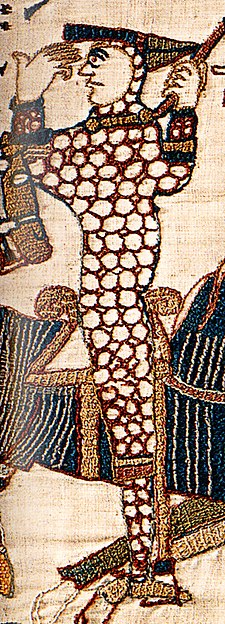
William the Conqueror from the Bayeux Tapestry

Matilda and William had a rather large family, with 4 boys and at least 4 daughters. Their eldest son, Robert Curthose, who inherited Normandy, was followed by Richard, who was killed during a hunting accident as a youth, William, known as Rufus who became King William II, and the future Henry I. Of the 4 or 5 daughters Adelida became a nun following a series of failed marriage plans, Cecilia was given to the convent of Ste Trinite as a child, Constance married Alain Fergant, duke of Brittany and Adela married Stephen of Blois; their son, another Stephen would succeed Henry I as King of England. There are suggestions of 2 further daughters, Matilda and Agatha, though evidence for their existence is highly limited.

Matilda was very close to her family, especially her eldest son, Robert, whose later antics were to cause  problems between his parents. William and Robert, father and son, were often at loggerheads, with Robert in open rebellion against his father as a young adult. Matilda was constantly trying to play the peacemaker and was so upset by one quarrel that she was ‘choked by tears and could not speak’. Even during a period of exile imposed on Robert, Matilda still supported her son as best she can; she would send him vast amounts of silver and gold through a Breton messenger, Samson. On discovering Samson’s complicity William threatened to blind the messenger and it was only through Matilda’s intervention that the Breton escaped.

Where poor Edith Swan-neck lost almost everything at Hastings, Matilda’s star was in the ascendant, but the Conquest was not without problems and it was not until 1068 that William felt secure enough to bring his wife over to England. Matilda was crowned Queen of England in Winchester Cathedral at Pentecost in that year, although further unrest soon saw her returned to the relative safety of Normandy, where she was acting as regent for her absent husband. Matilda was one of the most active of medieval queens, standing in as an able administrator during her husband’s absences; hearing land pleas and corresponding with such as the pope, who is known to have asked her to use her influence over her husband, on occasion. She was also the driving force in holding together her family, keeping relations as cordial as possible, even with the rebellious Robert. And it may well be her own strength of character, as the centre of the family, that meant none of her sons would marry until after her death.

Matilda’s piety is renowned. Although founding the Abbaye-aux-Dames in Caen was a penance for her irregular marriage to William, her constant and repeated donations to religious houses demonstrate her dedication to her faith. Among her many donations; she gave the monks of Marmoutier a new refectory and a cope and to the monks of St Evroult she gave £100 for a refectory, a mark of gold, a chasuble decorated with gold and pearls, and a cope for the chanter. The nuns of her abbey at Ste Trinite, Caen, received a substantial bequest from Matilda’s will; as well as her regalia, they were given a chalice, a chasuble, a mantle of brocade, 2 golden chains with a cross, a chain decorated with emblems for hanging a lamp in front of the altar, several large candelabras, the draperies for her horse and all the vases ‘which she had not yet handed out during her life’.

History...the Interesting Bits
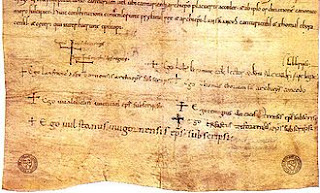
Matilda and William’s Xs on a charter

Matilda and William’s relationship is one of the most successful of the medieval period. Said to be a happy and loving marriage, their trust in each other was demonstrable and it was remarked up on when William fell seriously ill during a stay at Cherbourg between 1063 and 1066, Matilda prayed for his recovery at the altar; the monks remarking on her informal appearance as the sign of her distress her husband illness was causing her. Matilda fell ill in the late summer of 1083 and died on 2nd November of the same year. She was buried at Ste Trinite, Caen, where the original tombstone, with the inscription carved round the edge, still survives. Following her death William cut a sad and lonely figure; becoming increasingly isolated he followed his wife to the grave 4 years later in 1087.

Select bibliography:

Oxforddnb.com; The Norman Conquest: William the Conquerors’ Subjugation of England by Teresa Cole; William the Conqueror: The Bastard of Normandy by Peter Rex; Kings, Queens, Bones and Bastards by David Hilliam; Britains’ Royal Families: The Complete Genealogy by Alison Weir; The Oxford Companion to British History edited by John Cannon; epistolae.ccnmtl.columbia.edu.

My Books

Signed, dedicated copies of all my books are available through my online bookshop.

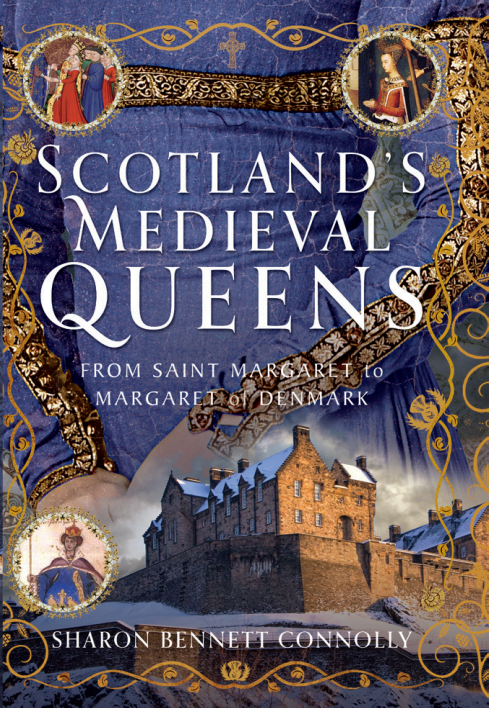
Out now: Scotland’s Medieval Queens

Books by Sharon Bennett Connolly

Scotland’s history is dramatic, violent and bloody. Being England’s northern neighbour has never been easy. Scotland’s queens have had to deal with war, murder, imprisonment, political rivalries and open betrayal. They have loved and lost, raised kings and queens, ruled and died for Scotland. From St Margaret, who became one of the patron saints of Scotland, to Elizabeth de Burgh and the dramatic story of the Scottish Wars of Independence, to the love story and tragedy of Joan Beaufort, to Margaret of Denmark and the dawn of the Renaissance, Scotland’s Medieval Queens have seen it all. This is the story of Scotland through their eyes.

Scotland’s Medieval Queens gives a thorough grounding in the history of the women who ruled Scotland at the side of its kings, often in the shadows, but just as interesting in their lives beyond the spotlight. It’s not a subject that has been widely covered, and Sharon is a pioneer in bringing that information into accessible history.’ Elizabeth Chadwick (New York Times bestselling author)

Available now from Amazon and Pen and Sword Books

Also by Sharon Bennett Connolly:

Books by Sharon Bennett Connolly

Heroines of the Tudor World tells the stories of the most remarkable women from European history in the time of the Tudor dynasty, 1485-1603. These are the women who ruled, the women who founded dynasties, the women who fought for religious freedom, their families and love. Heroines of the Tudor World is now available for pre-order from Amberley Publishing and Amazon UK. Women of the Anarchy demonstrates how Empress Matilda and Matilda of Boulogne, unable to wield a sword themselves, were prime movers in this time of conflict and lawlessness. It shows how their strengths, weaknesses, and personal ambitions swung the fortunes of war one way – and then the other. Available from Bookshop.orgAmberley Publishing and Amazon UKKing John’s Right-Hand Lady: The Story of Nicholaa de la Haye is the story of a truly remarkable lady, the hereditary constable of Lincoln Castle and the first woman in England to be appointed sheriff in her own right. Available from all good bookshops Pen & Sword Booksbookshop.org and Amazon

History...the Interesting Bits

Defenders of the Norman Crown: The Rise and Fall of the Warenne Earls of Surrey tells the fascinating story of the Warenne dynasty, from its origins in Normandy, through the Conquest, Magna Carta, the wars and marriages that led to its ultimate demise in the reign of Edward III. Available from Pen & Sword BooksAmazon in the UK and US, and Bookshop.orgLadies of Magna Carta: Women of Influence in Thirteenth Century England looks into the relationships of the various noble families of the 13th century, and how they were affected by the Barons’ Wars, Magna Carta and its aftermath; the bonds that were formed and those that were broken. It is now available in paperback and hardback from Pen & SwordAmazon, and Bookshop.orgHeroines of the Medieval World tells the stories of some of the most remarkable women from Medieval history, from Eleanor of Aquitaine to Julian of Norwich. Available now from Amberley Publishing and Amazon, and Bookshop.orgSilk and the Sword: The Women of the Norman Conquest traces the fortunes of the women who had a significant role to play in the momentous events of 1066. Available now from Amazon,  Amberley Publishing, and Bookshop.org.

Alternate Endings: An anthology of historical fiction short stories including Long Live the King… which is my take what might have happened had King John not died in October 1216. Available in paperback and kindle from Amazon.

Podcast:

History...the Interesting Bits

Have a listen to the A Slice of Medieval podcast, which I co-host with Historical fiction novelist Derek Birks. Derek and I welcome guests, such as Bernard Cornwell and Elizabeth Chadwick, and discuss a wide range of topics in medieval history, from significant events to the personalities involved.

Every episode is also now available on YouTube.

*

Don’t forget! Signed and dedicated copies of all my books are available through my online bookshop.

For forthcoming online and in-person talks, please check out my Events Page.

You can be the first to read new articles by clicking the ‘Follow’ button, liking our Facebook page or joining me on TwitterThreadsBluesky and Instagram.

©2023 Sharon Bennett Connolly FRHistS 

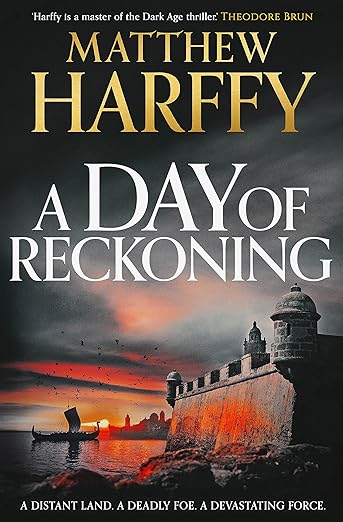
Book Corner: A Day of Reckoning by Matthew Harffy

Hunlaf battles peril and intrigue on a dangerous voyage to Muslim Spain.

AD 796
. Sailing in search of an object of great power, Hunlaf and his comrades are far from home when they are caught up in a violent skirmish against pirates.

After the bloody onslaught, an encounter with ships from Islamic Spain soon sees them escorted under guard to the city of Qadis, one of the jewels of the Emirate of Al-Andalus and the true destination of their voyage.

Hunlaf believes the Emir’s lands hold the key to his search, but there are dangerous games at play. To achieve his goal, Hunlaf and his allies must walk a difficult path where friends and enemies alike are not always what they seem – and where a weapon deadlier than any yet seen could change the future of all the kingdoms in Europe.

What a read! A Day of Reckoning by Matthew Harffy is another riveting story following the adventures of Hunlaf and his quest for the mystical book, The Treasure of Life, stolen from the island monastery of Lindisfarne. And, as usual, Hunlaf’s quest lands the monk-turned-warrior and his friends – the crew of the Brymsteda – in deep water, on sea and land!

Matthew Harffy takes us on a voyage to medieval, Islamic Spain in pursuit of the lost book, and on a secret mission for Charlemagne – a mission so secret that no one is exactly sure of its purpose, beyond escorting the emissary, Giso. Hunlaf must use his wits as well as his sword-arm to extricate himself and his friends from Spain in one piece.

Nothing goes to plan. But then, if it did, it would not be a Matthew Harffy novel, would it? Spiced up with a will-they-won’t-they love story, the betrayal of friend and foe alike and a storyline that will keep you engrossed to the very end, A Day of Reckoning is another Matthew Harffy triumph.

We all stared at the small man. I wondered who he was. He wore a nondescript robe and none of the trappings that would mark him out as a man of noble birth. No gold glimmered on his fingers or at his neck. But he met our gaze with assurance, and the way he had hidden within the room, utterly still and undetected until he chose to reveal himself, was unnerving.

“We are to take him back to Northumbria?” I said. ” Giso is to carry your response to Æthelred King?”

Alhwin flashed his teeth at me in a wide grin. His smile made me almost as nervous as Giso’s stealthy apparition.

“Giso will carry my response, but not to Northumbria.”

“But we are to return northward.”

“Is that so?” he asked, taking on the tone of a tutor speaking to a slow pupil. “What was it that you were commanded to do, Hunlaf?”

I thought back to the orders we had received from Lord Mancas. My eyes narrowed at the memory, again wondering at the depth of knowledge Alhwin possessed. Could he be so cunning?

“We were commanded to bring the message to you and then to wait for your response, that we might carry it aboard Brymsteda.”

“Ah, yes, the fabled ship that Runolf constructed. I would like to see it before you leave.” His smile broadened. “But I digress. You have fulfilled the first part of your king’s orders. I have received his message and other letters from Northumbria. And Giso here will bear my response. But my response is not for Æthelred or indeed anyone from my homeland. You must carry it southward. To al-Andalus.”

In A Day of Reckoning we learn more about the character and lives of Hunlaf’s crewmates. Friendships develop and are stretched to the limit. Hunlaf himself, a natural leader, is learning of the highs and lows of command. His character and beliefs are challenged by the exotic people of Muslim Spain.

Harffy recreates the sights, sounds and tensions of 8th century Spain to the extent that you can imagine yourself in the heart of the city of Qadiz (Cadiz), sensing the mix of languages, cultures and customs, smelling the spices amidst the fumes of Greek fire and burning flesh (it is a Matthew Harffy book, after all). Impeccably researched for the history, culture and politics of the 8th century Iberian peninsula, Matthew Harffy immerses the reader in this strange, exotic world, full of hidden dangers.

Whether or not all our heroes survive is down to a mixture of skill and luck and – well, you’ll have to read it to find out!

Matthew Harffy has honed and perfected his skills as a storyteller over the years, to such an extent that a fabulous week of reading is anticipated and expected when a new book is released. And A Day of Reckoning does not disappoint.

To Buy the Book:

A Day of Reckoning by Matthew Harffy is now available on Amazon.

About the author:

Matthew Harffy lived in Northumberland as a child and the area had a great impact on him. The rugged terrain, ruined castles and rocky coastline made it easy to imagine the past. Decades later, a documentary about Northumbria’s Golden Age sowed the kernel of an idea for a series of historical fiction novels. The first of them is the action-packed tale of vengeance and coming of age, THE SERPENT SWORD.

Matthew has worked in the IT industry, where he spent all day writing and editing, just not the words that most interested him. Prior to that he worked in Spain as an English teacher and translator. Matthew lives in Wiltshire, England, with his wife and their two daughters.

For all the latest news and exclusive competitions, join Matthew online: http://www.matthewharffy.com, twitter.com/@MatthewHarffy, http://www.facebook.com/MatthewHarffyAuthor.

*

My Books

Signed, dedicated copies of all my books are available through my online bookshop.

Out nowKing John’s Right-Hand Lady: The Story of Nicholaa de la Haye

In a time when men fought and women stayed home, Nicholaa de la Haye held Lincoln Castle against all-comers, gaining prominence in the First Baron’s War, the civil war that followed the sealing of Magna Carta in 1215. A truly remarkable lady, Nicholaa was the first woman to be appointed sheriff in her own right. Her strength and tenacity saved England at one of the lowest points in its history. Nicholaa de la Haye is one woman in English history whose story needs to be told…

King John’s Right-Hand Lady: The Story of Nicholaa de la Haye is now available from Pen & Sword Booksbookshop.org and Amazon.

Coming 15 January 2024: Women of the Anarchy

On the one side is Empress Matilda, or Maud. The sole surviving legitimate child of Henry I, she is fighting for her birthright and that of her children. On the other side is her cousin, Queen Matilda, supporting her husband, King Stephen, and fighting to see her own son inherit the English crown. Both women are granddaughters of St Margaret, Queen of Scotland and descendants of Alfred the Great of Wessex. Women of the Anarchy demonstrates how these women, unable to wield a sword, were prime movers in this time of conflict and lawlessness. It show how their strengths, weaknesses, and personal ambitions swung the fortunes of war one way – and then the other.

Available for pre-order from Amberley Publishing and Amazon UK.

Also by Sharon Bennett Connolly:

Defenders of the Norman Crown: The Rise and Fall of the Warenne Earls of Surrey tells the fascinating story of the Warenne dynasty, of the successes and failures of one of the most powerful families in England, from its origins in Normandy, through the Conquest, Magna Carta, the wars and marriages that led to its ultimate demise in the reign of Edward III. Defenders of the Norman Crown: Rise and Fall of the Warenne Earls of Surrey is now available from Pen & Sword BooksAmazon in the UK and US, and  Bookshop.org.

Ladies of Magna Carta: Women of Influence in Thirteenth Century England looks into the relationships of the various noble families of the 13th century, and how they were affected by the Barons’ Wars, Magna Carta and its aftermath; the bonds that were formed and those that were broken. It is now available in paperback and hardback from Pen & Sword,  Amazon, and Bookshop.org.

Heroines of the Medieval World tells the stories of some of the most remarkable women from Medieval history, from Eleanor of Aquitaine to Julian of Norwich. Available now from Amberley Publishing and Amazon, and Bookshop.org.

Silk and the Sword: The Women of the Norman Conquest traces the fortunes of the women who had a significant role to play in the momentous events of 1066. Available now from Amazon,  Amberley Publishing, and Bookshop.org.

Alternate Endings: An anthology of historical fiction short stories including Long Live the King… which is my take what might have happened had King John not died in October 1216. Available in paperback and kindle from Amazon.

Podcast:

Have a listen to the A Slice of Medieval podcast, which I co-host with Historical fiction novelist Derek Birks. Derek and I welcome guests, such as Bernard Cornwell, and discuss a wide range of topics in medieval history, from significant events to the personalities involved.

*

Don’t forget! Signed and dedicated copies of all my books are available through my online bookshop.

For forthcoming online and in-person talks, please check out my Events Page.

You can be the first to read new articles by clicking the ‘Follow’ button, liking our Facebook page or joining me on Twitter and Instagram.

©2023 Sharon Bennett Connolly FRHistS

Eight Interesting Discoveries on writing 11th century non-fiction

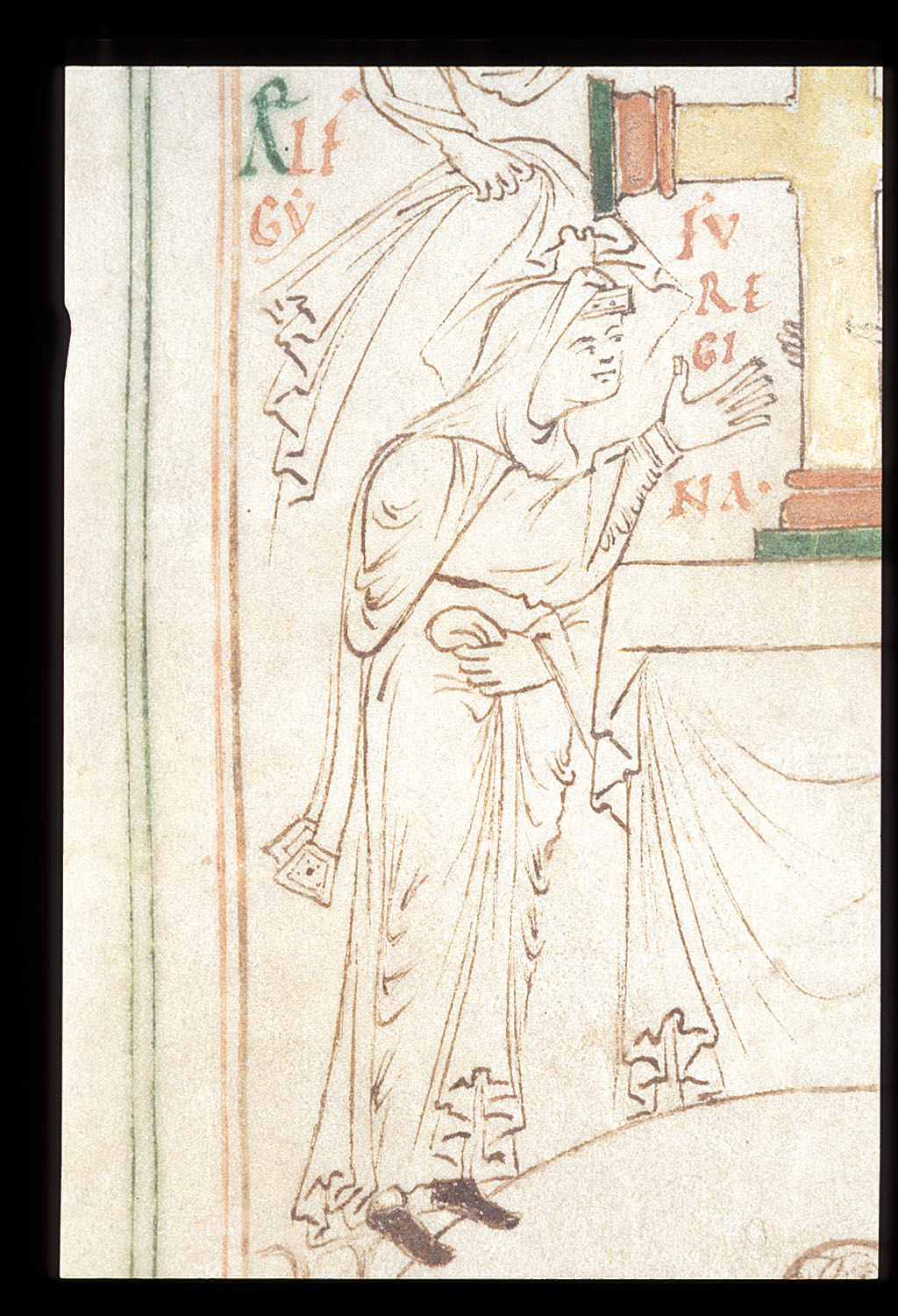
Following on from my 10 Facts About Women and Magna Carta, I thought I would revisit the Norman Conquest and started thinking about I found most interesting when writing about 1066 and the years either side. And here’s what I discovered:

1. Not all primary sources are contemporary.

Emma of Normandy

Let me explain. Of course, all sources written in the 11th century are primary sources, but you do find people quoting sources as primary sources – only to discover that they were written 100 or even 200 years after the events.

One such legend, appearing two centuries after the events, suggested that Emma of Normandy’s relationship with her good friend, Bishop Stigand, was far more than that of her advisor and that he was, in fact, her lover – although the legend did get its bishops mixed up and named Ælfwine, rather than Stigand, as Emma’s lover. The story continues that Emma chose to prove her innocence in a trial by ordeal, and that she walked barefoot over white-hot ploughshares. Even though the tale varies depending on the source, the result is the same; when she completed the ordeal unharmed, and thus proven guiltless, she was reconciled with her contrite son, Edward.

However, there is no 11th century source for this event and it seems to have been created to explain Emma’s estrangement from her son, Edward the Confessor.

2. The Anglo-Saxon Chronicle is the most famous source of 11th century news. 

The Anglo-Saxon Chronicle gives wonderful snippets of information about life in Anglo-Saxon England – and the weather! If you have ever wondered where the English get their obsession with the weather, read the Anglo-Saxon Chronicle. It is also very dramatic.

For example, the year 1005 starts with; ‘Here in this year there was the great famine throughout the English race, such as no-one ever remembered on so grim before…’

1032 relates; ‘Here in this year appeared that wild-fire such as no man remembered before, and also it did damage everywhere in many places.’

And 1039 opens with ‘Here came the great gale…’

In 1053 we read, ‘Here [1052] was the great wind on the eve of the Feast of St Thomas, and the great wind was also all midwinter…’

And, of course, in 1066 we read about the appearance of Halley’s Comet; ‘Then throughout all England, a sign such as man ever saw before was seen in the heavens. Some me declared that it was the star comet, which some men called the ‘haired’ star; and it appeared first on the eve of the Great Litany, 24 April, and shone thus all the week….’

3. The Anglo-Saxon Chronicle is a fabulous source of news about church leaders.

Don’t get me wrong, the Anglo-Saxon Chronicle is invaluable to anyone studying the history of Anglo-Saxon Britain, but you can tell it was written by monks. There are some years where you learn little more than which church leader died, and who replaced him.

For example, the entry for 1023 from the E chronicle; ‘Here Bishop Wulfstan passed away, and Ælfric succeeded…’

And in 1032; ‘In the same year Ælfsige, bishop in Winchester, passed away, and Ælfwine, the king’s priest, succeeded to it.’

The only entry in the E Chronicle in 1033 was; ‘Here in this year Merehwit, bishop in Somerset, passed away, and he is buried in Glastonbury.’

And again in 1034; ‘Here Bishop Æthelric passed away.’

4. Not all inheritance was based on primogeniture.

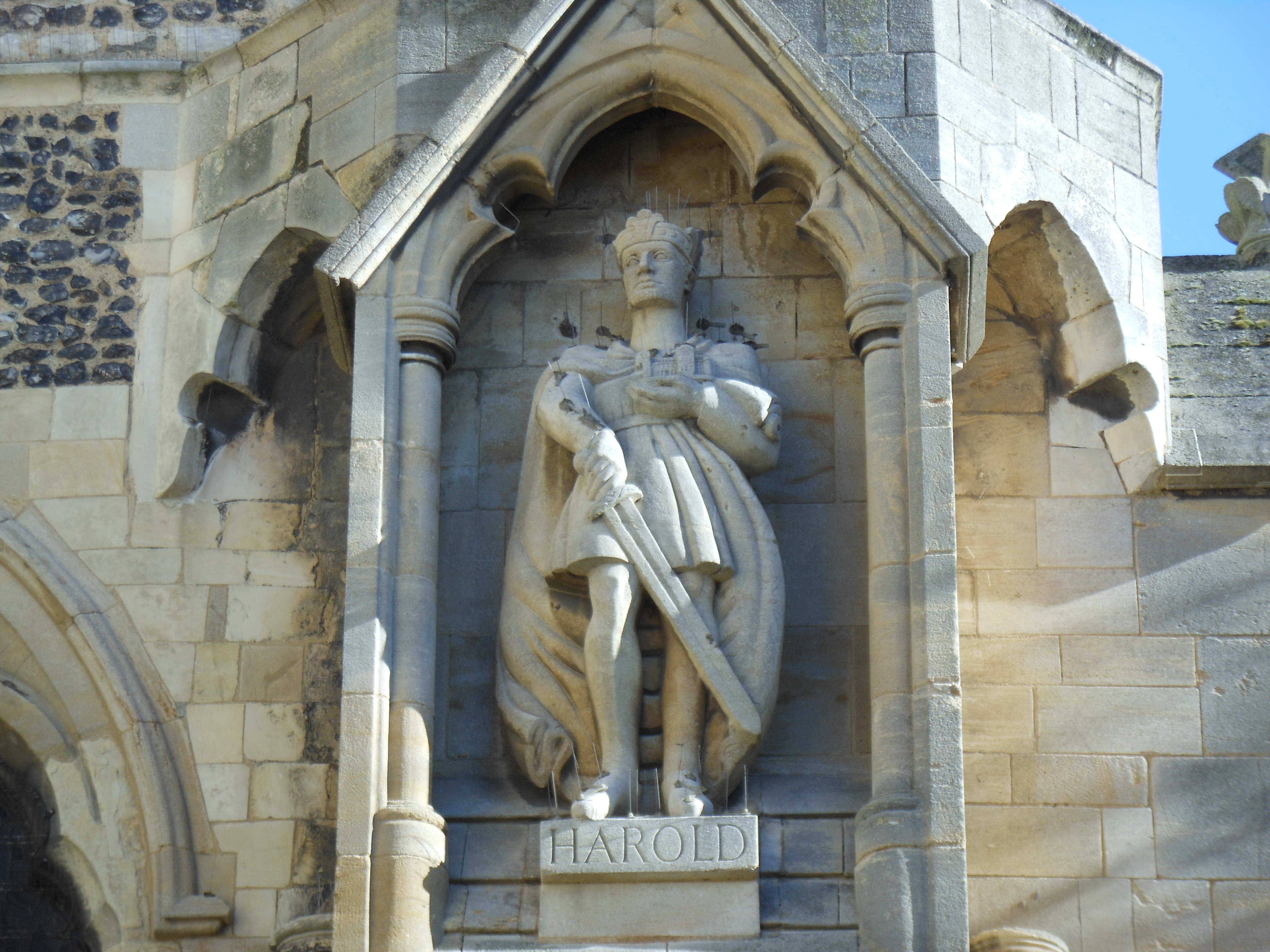
King Harold II, Waltham Abbey

Primogeniture, where the eldest son inherited from his father, was not unusual in 11th century England; when Earl Godwin of Wessex died, his eldest surviving son, Harold, succeeded him. However, it was not yet established as the definitive rule of inheritance of later centuries. When Siward, Earl of Northumbria, died in 1055 his heir, Waltheof, was still a child and too young to hold such a formidable position on the borders of Scotland. The earldom was given to Tostig Godwinson, the favourite brother of Edward the Confessor’s queen, Edith. Though he didn’t do a great job with it…

And in the opening days of 1066, when Edward the Confessor died, the ætheling, Edgar was only a teenager, and so was passed over as king for the more mature and militarily experienced Harold Godwinson, Earl of Wessex, who became King Harold II.

5. Travel to distant places was not uncommon for the nobility.

At different times in the 11th century, both King Cnut and Tostig Godwinson are known to have travelled to Rome; indeed, during his trip to Rome in 1027, Cnut was present at the coronation of Holy Roman Emperor, Conrad II and arranged for the marriage of his daughter by Emma of Normandy, Gunhilda, to Conrad’s son, the future King Henry III of Germany.

As for Tostig, travelling to Rome was not without its dangers, and shortly after leaving the city, his travelling party was caught up in a local dispute between the papacy and the Tuscan nobility; they were attacked. Tostig was able to escape by the ruse of one of his own thegns, a man named Gospatric, who pretended to be the earl.

Tostig and Harold’s brother, Swegn Godwinson, who had murdered his own cousin, even went on pilgrimage to Jerusalem – barefoot – he died on the journey home.

And when I started writing Silk and the Sword: The Women of the Norman Conquest I discovered that there are several links to the story of 1066 with the Russian principality of Kyiv. The baby sons of England’s short-lived king, Edmund II Ironside, who reigned and died in 1016, were given sanctuary and protection in Kyiv, saving them from the clutches of Edmund’s successor, King Cnut. The first wife of Harald Hardrada, the third contender for the English throne in 1066, Elisiv, was a Kyivan princess. And after the Conquest, Harold II Godwinson’s own daughter by Edith Swanneck, Gytha, would make her life in Kyiv as the wife of Vladimir II Monomakh and as the mother of Mstislav the Great, the last ruler of a united Kyivan Rus. Vladimir was the nephew of Harald Hardrada’s first wife, the Kyivan princess, Elisiv.

6. Having 2 wives at the same time was not THAT unusual.

Elisiv of Kyiv

In the story of 1066 there were not one BUT three men who had two wives simultaneously.

Harold Godwinson is known for having been in a relationship with the famous Edith Swanneck for 20 years before becoming King, and then marrying Ealdgyth of Mercia without divorcing Edith. Edith is often referred to as Harold’s concubine, but most historians agree that she was his ‘hand-fast’ wife and had undergone a Danish – rather than Christian – style of wedding with Harold. Edith was no ignorant peasant, she was a wealthy woman in her own right and it is highly doubtful she would have accepted being Harold’s mistress, and raising his children, without some kind of marital protection.

Harald Hardrada also married a second ‘wife’, whilst still being married to Elisiv. Elisiv had given the Norwegian king two daughters, but his second wife, Thora, gave him two sons, Magnus and Olaf, who each, in turn, succeeded their father as King of Norway.

King Cnut was the first to take two wives; he had two sons by Ælfgifu of Northampton before marrying Emma of Normandy and producing a second family. The chronicles, however, claim that Ælfgifu’s sons were not the children of Cnut, with John (also known as Florence) of Worcester saying, ‘Ælfgiva desired to have a son by the king, but as she could not, she caused the new-born child of a certain priest to be brought to her, and made the king fully believe that she had just borne him a son’. And the Anglo-Saxon Chronicle claimed ‘[King] Harold [I Harefoot] also said that he was the son of king Canute and Ælfgiva of Northampton, although that is far from certain; for some say that he was the son of a cobbler, and that Ælfgiva had acted with regard to him as she had done in the case of Swein: for our part, as there are doubts on the subject, we cannot settle with any certainty the parentage of either.’

7. There were some incredible, strong women in the 11th century.

Lady Godiva

The story of the Norman Conquest invariably revolves around the men involved, Edward the Confessor, Harold II, William the Conqueror, Harald Hardrada, and so on. However, there were some amazing women whose strength and perseverance helped to steer and shape the events of the era.

There were, of course, the queens, Emma of Normandy, Edith of Wessex and Matilda of Flanders, who supported their husbands and helped to shape and – even – preserve history, with Emma and Edith both commissioning books to tell the stories of their times and Matilda being the image of queenship that all future queens of England modelled themselves on.

There was also the notorious Lady Godiva, who was probably a lot less scandalous than the legend, of her riding naked through Coventry, leads us to believe. And the incredible Gytha of Wessex, a woman whose story is entwined with every aspect of the period. From the reign of Cnut to that of William the Conqueror, Gytha and her family were involved in so many aspects of the 11th century, from the rise of her sons, through the Battle of Hastings itself, to the English resistance in the years immediately following the Conquest. Gytha was not one to give up easily, despite the horrendous losses her family suffered (three of her sons died in one single day at Hastings), she encouraged her grandsons to lead the opposition against the Conqueror in the west, but her eventual failure saw her seek shelter in Flanders, where she disappears from the pages of history.

8. There is still so much we don’t know!

Ӕlfgyva, the mysterious woman in the Bayeux Tapestry

What you discover when researching the 11th century and the Norman Conquest is that there are gaps in our knowledge. For instance, we do not know why Harold was travelling to Europe in 1064, when he was shipwrecked and became a guest at the court of William, Duke of Normandy (the future William the Conqueror). The Bayeux Tapestry depicts Harold swearing an oath during his stay there. Was Harold promising to support William’s claim to England when Edward the Confessor died?

The Bayeux Tapestry has another tantalising mystery. That of Ӕlfgyva. Ӕlfgyva is depicted in a doorway with a priest touching her cheek. Whether the touch is in admonishment or blessing is open to interpretation. Above her head, written in Latin, is the incomplete phrase  ‘Here a certain cleric and Ӕlfgyva’. But who was the mysterious Ӕlfgyva? Will we ever know?

Historical Writers Forum hosted a fabulous debate on ‘Ӕlfgyva’: The Mysterious Woman in the Bayeux Tapestry, which is available on YouTube. Hosted by Samantha Wilcoxson, it features myself, Pat Bracewell, Carol McGrath and Paula Lofting discussing the possible cadidates of Ӕlfgyva’s identity.

*

A version of this article was first published on Carol McGrath’s website in December 2018

Images:

Courtesy of Wikipedia, except King Harold II, which is ©2022 Sharon Bennett Connolly FRHistS.

Sources:

A Historical Document Pierre Bouet and François Neveux, bayeuxmuseum.com/en/un_document_historique_enThe Mystery Lady of the Bayeux Tapestry (article) by Paula Lofting, annabelfrage.qordpress.com; Ӕlfgyva: The Mysterious lady of the Bayeux Tapestry (article) by M.W. Campbell, Annales de NormandieThe Bayeux Tapestry, the Life Story of a Masterpiece by Carola HicksÆthelred II [Ethelred; known as Ethelred the Unready] (c. 966×8-1016) (article) by Simon Keynes, Oxford Dictionary of National Biography, oxforddnb.com; Britain’s Royal Families; the Complete Genealogy by Alison Weir; Queen Emma and the Vikings: The Woman Who Shaped the Events of 1066 by Harriet O’BrienThe Anglo-Saxon Chronicle translated by James IngramOn the Spindle Side: the Kinswomen of Earl Godwin of Wessex by Ann Williams; Swein [Sweyn], earl by Ann Williams, Oxford Dictionary of National Biography, oxforddnb.com, 23 September 2004; Ӕlfgifu [Ӕlfgifu of Northampton (fl. 1006-1036) (article) by Pauline Stafford, Oxford Dictionary of National Biography, oxforddnb.com; The Chronicle of John of Worcester, translated and edited by Thomas Forester, A.M; The Anglo-Saxon Chronicles edited and translated by Michael Swanton.

*

My Books:

Signed, dedicated copies of all my books are available through my online store.

OUT NOW! Heroines of the Tudor World

Heroines of the Tudor World tells the stories of the most remarkable women from European history in the time of the Tudor dynasty, 1485-1603. These are the women who ruled, the women who founded dynasties, the women who fought for religious freedom, their families and love. These are the women who made a difference, who influenced countries, kings and the Reformation. In the era dominated by the Renaissance and Reformation, Heroines of the Tudor World examines the threats and challenges faced by the women of the era, and how they overcame them. From writers to regents, from nuns to queens, Heroines of the Tudor World shines the spotlight on the women helped to shape Early Modern Europe.

Heroines of the Tudor World is now available for pre-order from Amberley Publishing and Amazon UK.

Coming 30 January 2025: Scotland’s Medieval Queens

Scotland’s history is dramatic, violent and bloody. Being England’s northern neighbour has never been easy. Scotland’s queens have had to deal with war, murder, imprisonment, political rivalries and open betrayal. They have loved and lost, raised kings and queens, ruled and died for Scotland. From St Margaret, who became one of the patron saints of Scotland, to Elizabeth de Burgh and the dramatic story of the Scottish Wars of Independence, to the love story and tragedy of Joan Beaufort, to Margaret of Denmark and the dawn of the Renaissance, Scotland’s Medieval Queens have seen it all. This is the story of Scotland through their eyes.

Available for pre-order now.

Also by Sharon Bennett Connolly:

Women of the Anarchy demonstrates how Empress Matilda and Matilda of Boulogne, unable to wield a sword themselves, were prime movers in this time of conflict and lawlessness. It shows how their strengths, weaknesses, and personal ambitions swung the fortunes of war one way – and then the other. Available from Bookshop.orgAmberley Publishing and Amazon UKKing John’s Right-Hand Lady: The Story of Nicholaa de la Haye is the story of a truly remarkable lady, the hereditary constable of Lincoln Castle and the first woman in England to be appointed sheriff in her own right. Available from all good bookshops Pen & Sword Booksbookshop.org and AmazonDefenders of the Norman Crown: The Rise and Fall of the Warenne Earls of Surrey tells the fascinating story of the Warenne dynasty, from its origins in Normandy, through the Conquest, Magna Carta, the wars and marriages that led to its ultimate demise in the reign of Edward III. Available from Pen & Sword BooksAmazon in the UK and US, and Bookshop.org

Ladies of Magna Carta: Women of Influence in Thirteenth Century England looks into the relationships of the various noble families of the 13th century, and how they were affected by the Barons’ Wars, Magna Carta and its aftermath; the bonds that were formed and those that were broken. It is now available in paperback and hardback from Pen & Sword,  Amazon, and Bookshop.orgHeroines of the Medieval World tells the stories of some of the most remarkable women from Medieval history, from Eleanor of Aquitaine to Julian of Norwich. Available now from Amberley Publishing and Amazon, and Bookshop.orgSilk and the Sword: The Women of the Norman Conquest traces the fortunes of the women who had a significant role to play in the momentous events of 1066. Available now from Amazon,  Amberley Publishing, and Bookshop.org.

Alternate Endings: An anthology of historical fiction short stories including Long Live the King… which is my take what might have happened had King John not died in October 1216. Available in paperback and kindle from Amazon.

Podcast:

Have a listen to the A Slice of Medieval podcast, which I co-host with Historical fiction novelist Derek Birks. Derek and I welcome guests, such as Bernard Cornwell, and discuss a wide range of topics in medieval history, from significant events to the personalities involved.

*

Don’t forget! Signed and dedicated copies of all my books are available through my online store.

For forthcoming online and in-person talks, please check out my Events Page.

You can be the first to read new articles by clicking the ‘Follow’ button, liking our Facebook page or joining me on TwitterThreads and Instagram.

*

©2022 Sharon Bennett Connolly FRHistS.

Book Corner: Forest of Foes by Matthew Harffy

AD 652. Beobrand has been ordered to lead a group of pilgrims to the holy city of Rome. Chief among them is Wilfrid, a novice of the church with some surprisingly important connections. Taking only Cynan and some of his best men, Beobrand hopes to make the journey through Frankia quickly and return to Northumbria without delay, though the road is long and perilous.

But where Beobrand treads, menace is never far behind. The lands of the Merovingian kings are rife with intrigue. The queen of Frankia is unpopular and her ambitious schemes, though benevolent, have made her powerful enemies. Soon Wilfrid, and Beobrand, are caught up in sinister plots against the royal house.

After interrupting a brutal ambush in a forest, Beobrand and his trusted gesithas find their lives on the line. Dark forces will stop at nothing to seize control of the Frankish throne, and Beobrand is thrown into a deadly race for survival through foreign lands where he cannot be sure who is friend and who is foe.

The only certainty is that if he is to save his men, thwart the plots, and unmask his enemies, blood will flow.

He’s done it again!

Magnificent adventure!

Forest of Foes by Matthew Harffy is the author’s 12th book and the 9th instalment of his magnificent Bernicia Chronicles. Beobrand is once again journeying over the Narrow Sea into Frankia. This time he is on his way to Rome, escorting a novice monk on his pilgrimage. Unfortunately, as with all Beobrand’s adventures, things don’t quite go to plan…

Beobrand and his loyal gesiths first save the wife of Clovis II, Queen Balthild, from an ambush in the woods and is then drawn into the world of the Frankish court and the conspiracies and controversies that surround it.

“What is he saying?” Beobrand asked Halinard in a quiet voice. The woman’s eyes flicked to him as he spoke, her expression questioning, no doubt surprised by his use of the Anglisc tongue. Beobrand marvelled at her apparent lack of fear.

“He says he will kill her, if let him go we do not,” said Halinard, his words clumsy yet clear.

“I hardly need you to tell me that,” replied Beobrand.

“I tell you what he says,” said Halinard, shaking his head. “He says nothing interesting.”

Brocard spoke to the man in the same calming tone he had used before. The brigand shouted more loudly, his voice cracking with his anger and fear. Behind him the maidservant looked ready to swoon.

Beobrand stepped closer to Brocard, beckoning for Halinard to follow him.

“Ask him his name,” he said in a low voice. Halinard translated. Brocard looked askance at Beobrand, then, with a shrug, he spoke to the brigand.

“Omer,” replied the brigand, narrowing his eyes as though he expected a trick.

Beobrand nodded.

“Offer him a horse,” Beobrand said. Halinard whispered his words in Frankish.

Brocard hesitated. One of his men, the one with the great bleeding wound on his face, growled something. Brocard held up his hand for patience and offered Omer a steed.

Omer replied and Beobrand understood enough to know that he wanted two mounts, one for him and one for his hostage.

“No,” Beobrand said in Frankish. He held up a single finger. “One horse.”

Omer shook his head and began to shout. Beobrand could not make out all the words, but it was clear Omer was not happy with the answer. Beobrand watched the knife blade waver at the woman’s lovely throat. Omer must know that if he killed her, he would surely follow the woman to the afterlife in moments. And yet men under such pressure do not always act reasonably and Beobrand became increasingly worried that the brigand might yet cut her throat by accident.

“Tell him he can have two horses,” he said. Halinard translated for him. Omer again looked as though he suspected he was being lured into a trap. He spoke quickly, urgently, but Beobrand could barely make sense of any of it. He was pleased though, to see that some of the tension had left Omer’s shoulders. The knife had lowered slightly from the lady’s neck. Brocard spoke up in anger at Beobrand’s offer. But before Beobrand could respond, the lady being held hostage moved with the speed of a striking serpent and Omer’s speech came to a sudden, choked halt. For a couple of heart beats he stood there, unmoving and silent, mouth opening and closing without sound. Then his hand fell, the knife tumbling from lifeless fingers.

Matthew Harffy has written yet another cracking Beobrand adventure. Changing the location to France has opened up a world of opportunities, which includes integrating the remarkable story of Balthild, the slave girl who became queen of the Franks as the wife of Clovis II. It also see Beobrand facing new challenges, including that of language. Matthew Harffy could have made life so much easier for himself by having Beobrand pick up the language of the Franks easily, but it makes for a better story, and a more credible one, that he struggles like the rest of us. No one is perfect.

As has come to be expected from Matthew Harffy’s writing, the character development is paramount and it is interesting to see how Cynan continues to grow into the role of war leader and confidant. There is tragedy along the way and, as with any great story, a few surprises that will leave the reader reeling. But it all makes for a fabulous story.

Do not expect your emotions to escape unscathed.

Forest of Foes by Matthew Harffy is an adventure not to be missed!

About the author:

Matthew Harffy lived in Northumberland as a child and the area had a great impact on him. The rugged terrain, ruined castles and rocky coastline made it easy to imagine the past. Decades later, a documentary about Northumbria’s Golden Age sowed the kernel of an idea for a series of historical fiction novels. The first of them is the action-packed tale of vengeance and coming of age, THE SERPENT SWORD.

Matthew has worked in the IT industry, where he spent all day writing and editing, just not the words that most interested him. Prior to that he worked in Spain as an English teacher and translator. Matthew lives in Wiltshire, England, with his wife and their two daughters.

Pre-order link

Amazon: https://amzn.to/3U5eD43

Follow Matthew Harffy

Twitter: @MatthewHarffy

Instagram: @beobrand

Website: matthewharffy.com

Follow Aries

Twitter: @AriesFiction

Facebook: Aries Fiction

Website: http://www.headofzeus.com

*

My Books:

Signed, dedicated copies of all my books are available, please get in touch by completing the contact me form.

Defenders of the Norman Crown: The Rise and Fall of the Warenne Earls of Surrey tells the fascinating story of the Warenne dynasty, of the successes and failures of one of the most powerful families in England, from its origins in Normandy, through the Conquest, Magna Carta, the wars and marriages that led to its ultimate demise in the reign of Edward III. Defenders of the Norman Crown: Rise and Fall of the Warenne Earls of Surrey is now available from Pen & Sword BooksAmazon in the UK and US, Bookshop.org and Book Depository.

1 family. 8 earls. 300 years of English history!

Also by Sharon Bennett Connolly:

Ladies of Magna Carta: Women of Influence in Thirteenth Century England looks into the relationships of the various noble families of the 13th century, and how they were affected by the Barons’ Wars, Magna Carta and its aftermath; the bonds that were formed and those that were broken. It is now available in paperback and hardback from Pen & SwordAmazonBookshop.org and from Book Depository worldwide.

Heroines of the Medieval World tells the stories of some of the most remarkable women from Medieval history, from Eleanor of Aquitaine to Julian of Norwich. Available now from Amberley Publishing and Amazon, Bookshop.org and Book Depository.

Silk and the Sword: The Women of the Norman Conquest traces the fortunes of the women who had a significant role to play in the momentous events of 1066.  Available now from Amazon,  Amberley Publishing, Bookshop.org and Book Depository.

Alternate Endings: An anthology of historical fiction short stories including Long Live the King… which is my take what might have happened had King John not died in October 1216. Available in paperback and kindle from Amazon.

*

You can be the first to read new articles by clicking the ‘Follow’ button, liking our Facebook page or joining me on Twitter and Instagram.

©2020 Sharon Bennett Connolly FRHistS

Book Corner: Wrath of the Picts by Steven A McKay

Princess Catia has gone missing and once again it falls to the legendary druid, Bellicus, to find her. Was the child taken by force, or did she go willingly with the Pictish warrior-woman, Aife?

Their trail leads far north to the windswept fortress of Dunnottar, so the druid must journey there with his companions, Duro, Eburus, and the fearsome wardog, Cai. Leaving Dun Breatann in the hands of Queen Narina and her enigmatic new husband, Ysfael, the friends ride out, but things are never as straightforward as they seem…
Violence and death follow Bellicus as he seeks to discover the fate of the princess. In doing so, he also finds himself on the trail of the swordsman, Lancelot, who disappeared months before when his warband was slaughtered by Saxons. Will the druid be in time to save them both? Or will their enemies, old and new,earn the bloody vengeance and glory they so desperately desire?
Ambition, lust, grief, and the power of the old gods combine in Wrath of the Picts as the druid and his companions are thrust towards a shocking finale that will leave Dun Breatann in turmoil and Northern Britain ravaged again by war.

Bellicus is back!

Wrath of the Picts is book no. 5 in Steven A. McKay’s magnificent series, Warrior Druid of Britain. Having spent some time campaigning with Arthur against the Saxons, Bellicus is called back north after Princess Catia goes missing, supposedly kidnapped by the warrior princess, Aife. But all is not as it seems…

Steven A. McKay once again draws his reader into a story chock full of adventure, treachery and a good few battles as Bellicus tries to make sense of events. It also a story of trust, friendship and loyalty that sees Bellicus and his good friends, Duro and Eburus, risking their lives in order to save the princess and discover the truth behind the uneasy atmosphere of his fortress home, Dun Breatann.

This is a story not to be missed.

“Where are all the Damnonii warriors?” Duro asked in a low voice. It was evening and Bellicus had joined them at last in the great hall. The cooking fires kept the chill of approaching autumn at bay and the homely orange glow would have made for a much more pleasant atmosphere if they weren’t surrounded by Ysfael’s men.

“Some of them are guarding the walls – you just haven’t seen them yet,” Bellicus replied, happily digging into the thick stew a serving girl had placed before him: beef, carrot, cabbage, onion and parsley had all gone into it and the druid couldn’t remember ever tasting, or smelling, much better. “The rest went out to deal with some Dalriadan raiders a few days ago. I expect they’ll return soon enough.”

Duro shook his head almost imperceptibly, glancing around as if spies were eavesdropping although, in truth, the Votadini warriors eating and carousing around them were making more than enough noise to mask what the centurion was saying. None of Ysfael’s men were paying them much attention other than to throw them the occasional curious glance. “It’s not right,” Duro opined. “Narina shouldn’t have let Gavo take her men off, leaving her alone with these … outsiders.”

Bellicus shrugged. He agreed completely, but Narina was her own woman and did things her way. She clearly trusted Ysfael.

Just then the door opened and Bellicus smiled, jerking his head for Duro to look over his shoulder for he was sitting with his back to the entrance. “What were you saying about Gavo?”

The centurion glanced back, mouth open as he chewed a piece of meat, and broke into a smile as he saw the Damnonii guard captain coming towards them. A bear of a man, Gavo had long hair and a grizzled beard which were both turning from brown to grey now that he was in his fortieth year. He wore reed checked trousers, a loose fitting blue tunic, and a bronze torc around his neck which marked his high rank, although it was obvious from his bearing he was a man used to command.

“Are you still here?” Gavo said, taking a seat beside Eburus and eyeing him with clear surprise. “I thought you’d have joined your kinsmen at the other benches.”
The Votadini shrugged, and said in his heavily accented tones, “These are my friends. I’m used to their company now. Ysfael will no doubt order me to join his ranks again soon enough, but until then I’lll sit with who I choose.”

“See?” Duro hissed. “Even he doesn’t trust the Votadini, and he’s one of them!”

The Warrior Druid of Britain series is set in the time after the Romans have left and the Saxon tribes are beginning to settle in England, causing conflict with the native Britons. The great warlord, Arthur, is attempting to hold them back. In the north, in Scotland, Bellicus is druid to the Damnoni tribe, but has been spending time fighting alongside Arthur. With Catia’s disappearance, he has been called home to lead the search for the lost princess. Set in the twilight of the Roman Empire and before the creation of the kingdoms of England and Scotland, Steve A. McKay has recreated the time that is often called the Dark Ages. His vivid imagination and impeccable research brings the period to life for the reader. The ancient landscapes, authentic weapons and tactics, all the way down to the textiles, halls and food, help to draw the reader into the story and allow them to suspend belief and travel back to a simpler, but more vicious time.

Steven A. McKay’s great skill is in the characters he creates. He makes the reader care about their stories and about their fate. Bellicus is a tall, likeable druid with an intelligent mind and a great aptitude for fighting and tactics. He has his weaknesses though, and a soft spot for the princess Catia and her mother, Narina. This gives the character a vulnerability that in turn leaves the reader wondering if he can see the big picture, and if he will succeed in his mission. Alongside his great friend, Duro, the heroes are tasked with saving the day, but not without great personal cost. And I love that Lancelot gets to play a part in Wrath of the Picts, away from teh Arthurian legend and forging his own path.

Wrath of the Picts draws thew reader in from the first page and keeps you hooked until the very last. Steven A McKay is such a skillful storyteller that you cannot wait for the book to finish – and yet, dread getting to the end. Whether it is the first book in the series, or the fifth, the stories are always fresh, new and engaging.

And Wrath of the Picts is just a fabulous adventure!

*

To buy the book:

Wrath of the Picts by Steven A. McKay is now available from Amazon

About the Author:

I was born in Scotland in 1977 and always enjoyed studying history – well, the interesting bits, not so much what they taught us in school. I decided to write my Forest Lord series after seeing a house called “Sherwood” when I was out at work one day. I’d been thinking about maybe writing a novel but couldn’t come up with a subject or a hero so, to see that house, well…It felt like a message from the gods and my rebooted Robin Hood was born.

My current Warrior Druid of Britain series was similarly inspired, although this time it was the 80’s TV show “Knightmare”, and their version of Merlin that got my ideas flowing. Of course, the bearded old wizard had been done to death in fiction, so I decided to make my hero a giant young warrior-druid living in post-Roman Britain and he’s been a great character to write.

In 2021 the Xbox/Playstation/PC game HOOD: Outlaws and Legends was released, featuring my writing. I did the character backstories and the lore for the maps and collectables and it was such a fantastic experience!

I was once in a heavy metal band although I tend to just play guitar in my study these days. I’m sure the neighbours absolutely love me.

Check out my website at stevenamckay.com and sign up for the email list – in return I’ll send you a FREE short story, as well as offering chances to win signed books, free audiobooks and other quite good things!

*

My Books:

Signed, dedicated copies of all my books are available, please get in touch by completing the contact me form.

Defenders of the Norman Crown: The Rise and Fall of the Warenne Earls of Surrey tells the fascinating story of the Warenne dynasty, of the successes and failures of one of the most powerful families in England, from its origins in Normandy, through the Conquest, Magna Carta, the wars and marriages that led to its ultimate demise in the reign of Edward III. Defenders of the Norman Crown: Rise and Fall of the Warenne Earls of Surrey is now available from Pen & Sword BooksAmazon in the UK and US, Bookshop.org and Book Depository.

1 family. 8 earls. 300 years of English history!

Also by Sharon Bennett Connolly:

Ladies of Magna Carta: Women of Influence in Thirteenth Century England looks into the relationships of the various noble families of the 13th century, and how they were affected by the Barons’ Wars, Magna Carta and its aftermath; the bonds that were formed and those that were broken. It is now available in paperback and hardback from Pen & Sword,  AmazonBookshop.org and from Book Depository worldwide.

Heroines of the Medieval World tells the stories of some of the most remarkable women from Medieval history, from Eleanor of Aquitaine to Julian of Norwich. Available now from Amberley Publishing and Amazon, Bookshop.org and Book Depository.

Silk and the Sword: The Women of the Norman Conquest traces the fortunes of the women who had a significant role to play in the momentous events of 1066.  Available now from Amazon,  Amberley Publishing, Bookshop.org and Book Depository.

Alternate Endings: An anthology of historical fiction short stories including Long Live the King… which is my take what might have happened had King John not died in October 1216. Available in paperback and kindle from Amazon.

*

You can be the first to read new articles by clicking the ‘Follow’ button, liking our Facebook page or joining me on Twitter and Instagram.

©2022 Sharon Bennett Connolly FRHistS

Book Corner: Femina by Janina Ramirez

The middle ages are seen as a bloodthirsty time of Vikings, saints and kings: a patriarchal society which oppressed and excluded women. But when we dig a little deeper into the truth, we can see that the ‘dark’ ages were anything but.

Oxford and BBC historian Janina Ramirez has uncovered countless influential women’s names struck out of historical records, with the word FEMINA annotated beside them. As gatekeepers of the past ordered books to be burnt, artworks to be destroyed, and new versions of myths, legends and historical documents to be produced, our view of history has been manipulated.

Only now, through a careful examination of the artefacts, writings and possessions they left behind, are the influential and multifaceted lives of women emerging. Femina goes beyond the official records to uncover the true impact of women like Jadwiga, the only female King in Europe, Margery Kempe, who exploited her image and story to ensure her notoriety, and the Loftus Princess, whose existence gives us clues about the beginnings of Christianity in England. See the medieval world with fresh eyes and discover why these remarkable women were removed from our collective memories.

When I wrote Heroines of the Medieval World five years ago, I said at the time that it was a book that needed to be written – I just wasn’t sure if I was the person to write it. If I had been asked who should write it, one of the top names on my list would have been Janina Ramirez. So I was not surprised when I discovered that Janina had written a book on medieval women, Femina: A New History of the Middle Ages, Through the Women Written Out of It.

I admit I was a little worried that Femina would make my Heroines obsolete or redundant, but I probably shouldn’t have been. After all, every writer has their own style and approach and every book – even if on the same topic – is written differently. And while the two books do overlap in places, we do not always reach the same conclusion and they really would complement each other on a book shelf (hint, hint!).

Femina: A New History of the Middle Ages, Through the Women Written Out of It looks at some of the most remarkable women of the medieval period, including two women you will be familiar with if you have read Heroines of the Medieval World, Æthelflæd, Lady of the Mercians and Jadwiga, ‘King’ of Poland. And the chapter on Jadwiga is particularly illuminating as Dr Ramirez applies her background in Art History to the symbolism and significance of Jadwiga’s reign, both on a political and spiritual level.

Janina Ramirez also provides great insight in to Emma of Normandy, who I looked at in detail for my own book, Silk and the Sword: the Women of the Norman Conquest. Study is even made of Ӕlfgyva, the mysterious woman in the Bayeux Tapestry, though Janina and I come to very different conclusions – and I would dearly love to have a face-to-face conversation with her to thrash out our theories. That would be fun!

Hild moved from Hartlepool to the site known then as Strenaeshalch and now as Whitby, in AD 657. Here she was granted land to build a double monastery where both men and women could learn the scriptures and dedicate themselves to a monastic life. And engraved stone slab commemorates her successor as abbess, Ælfflæd, and the use of the Latin script and alphabet supports Bede’s suggestion that Whitby was a centre of learning and literacy. But like at Hartlepool, finds from Hild’s abbacy include many luxuries such as decorative hairpins, golden book covers and even a comb with a runic inscription. Runes were the alphabet of the pre-Christian English, but the inscription is clearly Christian: My God. May God Almighty help Cy …’ Again, we find an object which links the Germanic warrior world to the new Christina one. Like Hild herself it straddles ideologies and a time of transition.

Hild was at the top of the tree in terms of influence in seventh-century Northumbria. Bede states that ‘even kings and princes sought and received her counsel’, and she acted as mentor to the daughter of Oswui, King of the Northumbrians from 642-670. What’s more, it was under her rule, in the monastery she founded herself, that the leaders of the English church gathered for the famous Synod of Whitby in AD 664. With Hild in charge of proceedings, the good and the great, representatives of Rome and Ireland, argued which traditions the Northumbrian church should follow. The result went the way of Rome. The variety and uniqueness of Celtic monasteries was lost to the rigour and routine of the Benedictine Rule, and monasticism in the north was transformed forever. For a woman to be involved in such high-level synodal processes is something extraordinary even today. It is also significant that five men who trained under Hild were all made bishops; if there were king-makers in the medieval world, then she was the bishop-maker. Whitby was the training ground for a new, Roman Christian, learned and respected English church. From Hild’s northern headland, educated men and women would stretch out the length and breadth of the country, assuming the very highest positions within churches and monasteries, including the archbishop of York. Hild’s influence would permeate the fabric of Christianity in this part of the world and its effects were felt down the centuries.

Femina: A New History of the Middle Ages, Through the Women Written Out of It is a fabulous study of a number of medieval women – and medieval woman in general. Dr Ramirez manages to combine what it was like to be a woman in medieval times, including their rights and the dangers they faced, such as childbirth, with the histories of particular women – and not always women you would expect to see in history book. The most fascinating chapter is that which is devoted to the Cathars, a religious sect much misunderstood and persecuted to extinction by the church. Janina Ramirez highlights not only their suffering and personal testimonies, but also the strength and respect that women held within the community. It truly is illuminating.

From warrior Viking women, to the successes of Æthelflæd and the excessive crying of Margery Kempe, Janina Ramirez shines a light on the lives and experiences of a huge variety of medieval women. Archaeological discoveries, religious artefacts and medieval artwork are used to describe and illuminate the world in which these women lived and died.

Femina: A New History of the Middle Ages, Through the Women Written Out of It is an engaging, entertaining read, with Janina Ramirez’s unique and wonderful take on medieval history. Introducing her vast knowledge of Art History into the mix adds vibrancy to the individual stories and brings these incredible women to life. Dr Ramirez is fabulous writer and communicator and takes the reader on an incredible journey of discovery through the medieval world. Her enthusiasm and fascination for the topic shines through on every page.

Femina: A New History of the Middle Ages, Through the Women Written Out of It by Janina Ramirez is truly a pleasure to read.

About the author:

Dr Janina Ramirez is a Sunday Times bestselling author, an Oxford lecturer, BBC broadcaster and researcher. She has presented and written over 30 hours of BBC history documentaries and series on TV and radio, and written five books for children and adults.

My books

Signed, dedicated copies of all my books are available, please get in touch by completing the contact me form.

Defenders of the Norman Crown: The Rise and Fall of the Warenne Earls of Surrey tells the fascinating story of the Warenne dynasty, of the successes and failures of one of the most powerful families in England, from its origins in Normandy, through the Conquest, Magna Carta, the wars and marriages that led to its ultimate demise in the reign of Edward III. Defenders of the Norman Crown: Rise and Fall of the Warenne Earls of Surrey is now available from Pen & Sword BooksAmazon in the UK and US, Bookshop.org and Book Depository.

1 family. 8 earls. 300 years of English history!

Also by Sharon Bennett Connolly:

Ladies of Magna Carta: Women of Influence in Thirteenth Century England looks into the relationships of the various noble families of the 13th century, and how they were affected by the Barons’ Wars, Magna Carta and its aftermath; the bonds that were formed and those that were broken. It is now available in paperback and hardback from Pen & Sword,  AmazonBookshop.org and from Book Depository worldwide.

Heroines of the Medieval World tells the stories of some of the most remarkable women from Medieval history, from Eleanor of Aquitaine to Julian of Norwich. Available now from Amberley Publishing and Amazon, Bookshop.org and Book Depository.

Silk and the Sword: The Women of the Norman Conquest traces the fortunes of the women who had a significant role to play in the momentous events of 1066.  Available now from Amazon,  Amberley Publishing, Bookshop.org and Book Depository.

*

You can be the first to read new articles by clicking the ‘Follow’ button, liking our Facebook page or joining me on Twitter and Instagram.

©2022 Sharon Bennett Connolly