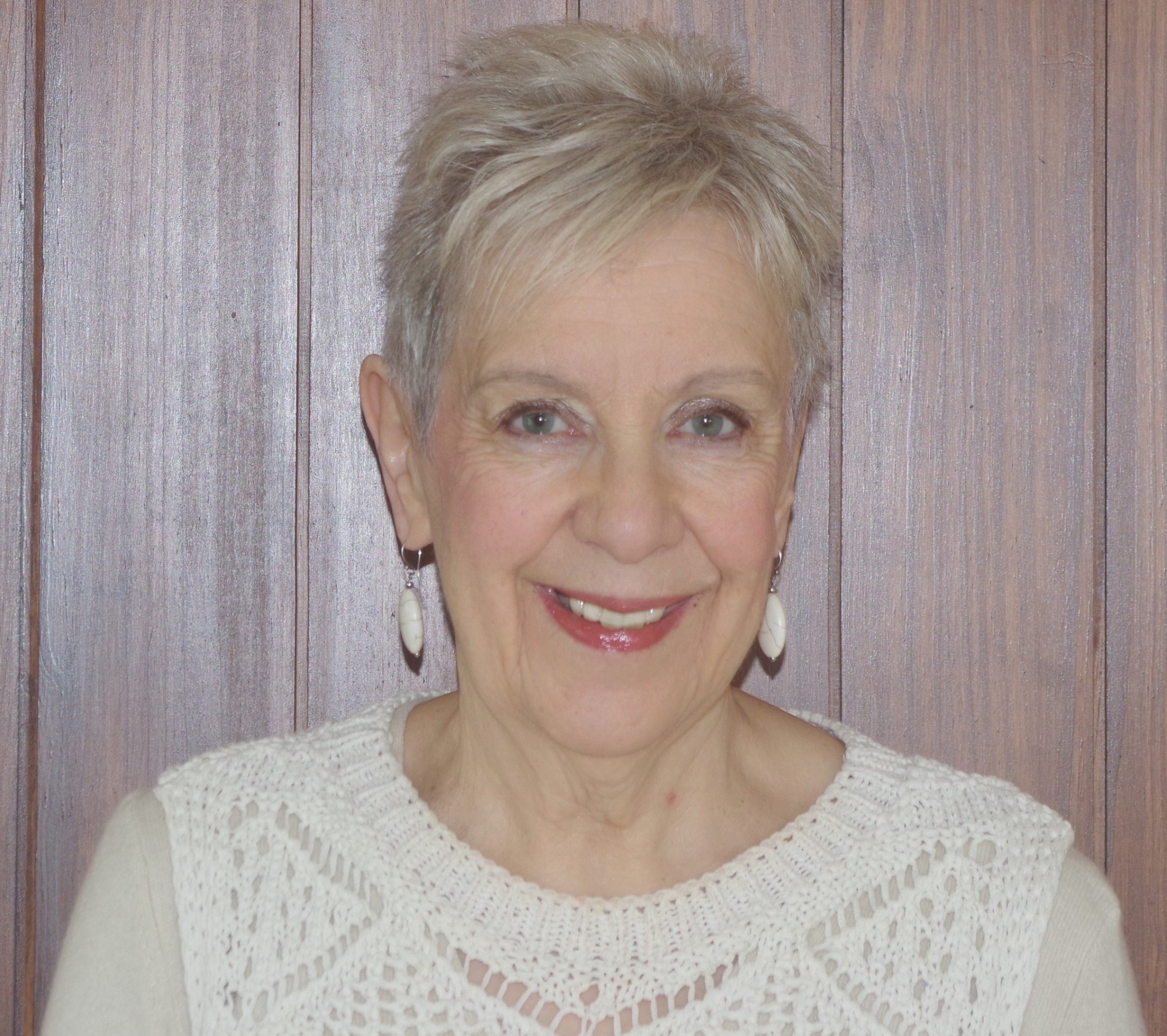
Wordly Women: Anna Belfrage

For my latest edition of Wordly Women, it is an absolute pleasure to welcome my dear friend, Anna Belfrage. Anna writes both historical fiction and time slip and is a magician with the written word. Her Castilian Saga books are something special and I loved the King’s Greatest Enemy books!

So, welcome Anna!

Sharon: What got you into writing?

Anna: I think many writers start like readers—that is how it was for me. I was like eight and felt the world needed a book about a girl who dressed up as a boy and accompanied Richard Lionheart as a page. My take on history was vague, my take on Richard was way too heroic, and my vocabulary was horribly tedious—and full of attempted medieval “speak” Agh! Many years later, I decided to really give writing a go, and once again I wrote a book that resonated with what I wanted to read. Seeing as I have always wanted to time travel—well, for short visits, deffo not to stay—my protagonist ended up being thrown back into the seventeenth century, because at the time, I was so fascinated by this period.

Sharon: Tell us about your books.

History...the Interesting Bits

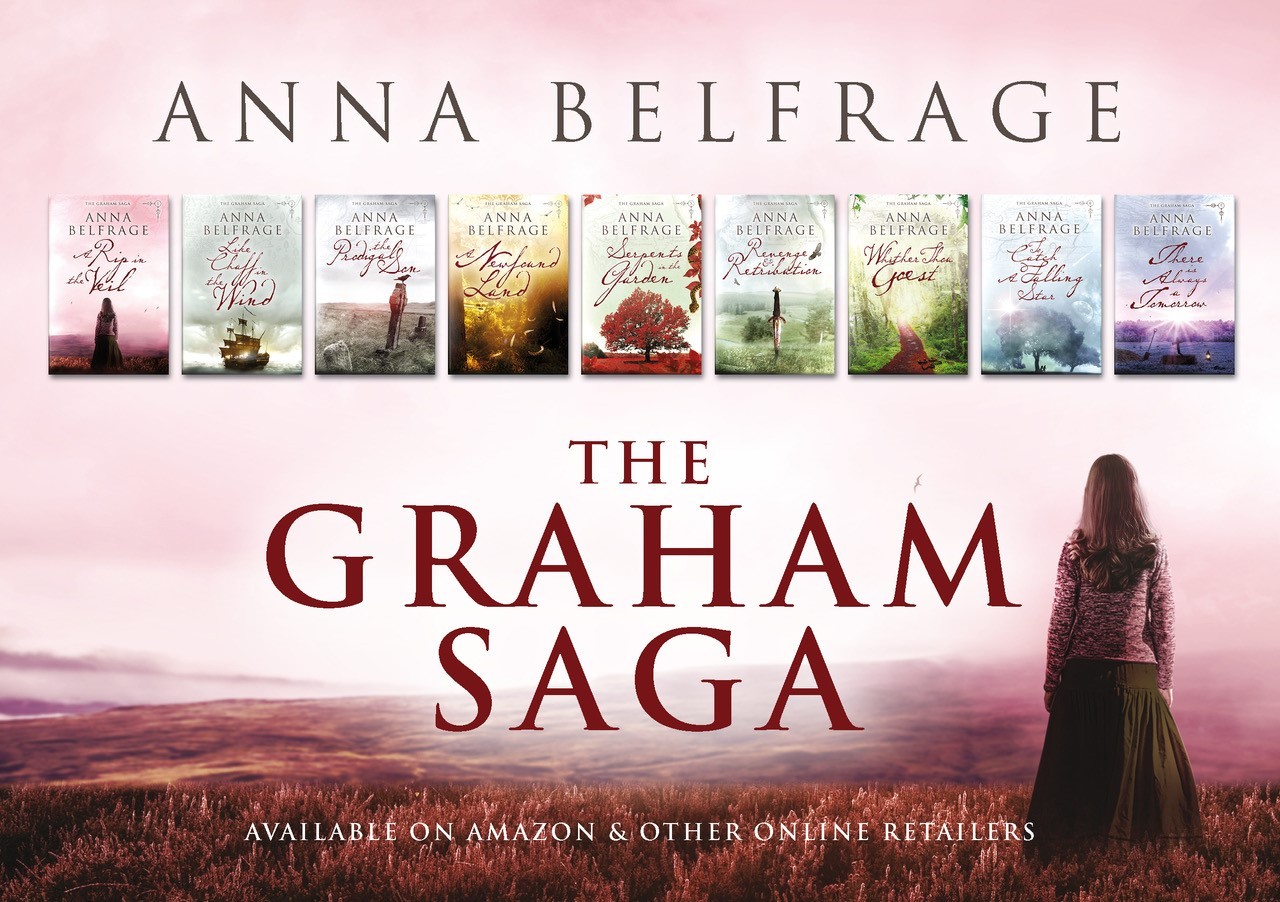
Anna: Well, I have just—today!—finished my 24th novel, supposedly a stand-alone, but according to my editor, I must write the rest of the story. So I probably will. Insert Graham Saga pic here! This is what always happens, you see. I start off writing ONE book and end up with one series after the other. My first series is The Graham Saga and is the story of Alex, my alter-ego time traveller who ends up in the 17th century where she meets Matthew Graham. Life will never be the same—not for Alex, not for Matthew, who has his doubts about this strange, borderline heathen woman who has landed at his feet. All in all, The Graham Saga is a ten (!!!!) book series, following Alex, Matthew and their expanding family through the latter half of the 17th century. Things happen to the Grahams—a lot of things, actually. Alex sometimes complains that it is too much, but between the two of us, she loves the adrenaline rushes I put her through! (“No, I don’t!” Alex growls. I just smirk) My second series is The King’s Greatest Enemy. I give you Adam de Guirande, an honourable knight who ends up torn between his love for his first lord, Roger Mortimer , and his loyalty to the young Edward III. Fortunately, he has a strong helpmeet in his wife, Kit. One book turned into four in this instance…

History...the Interesting Bits

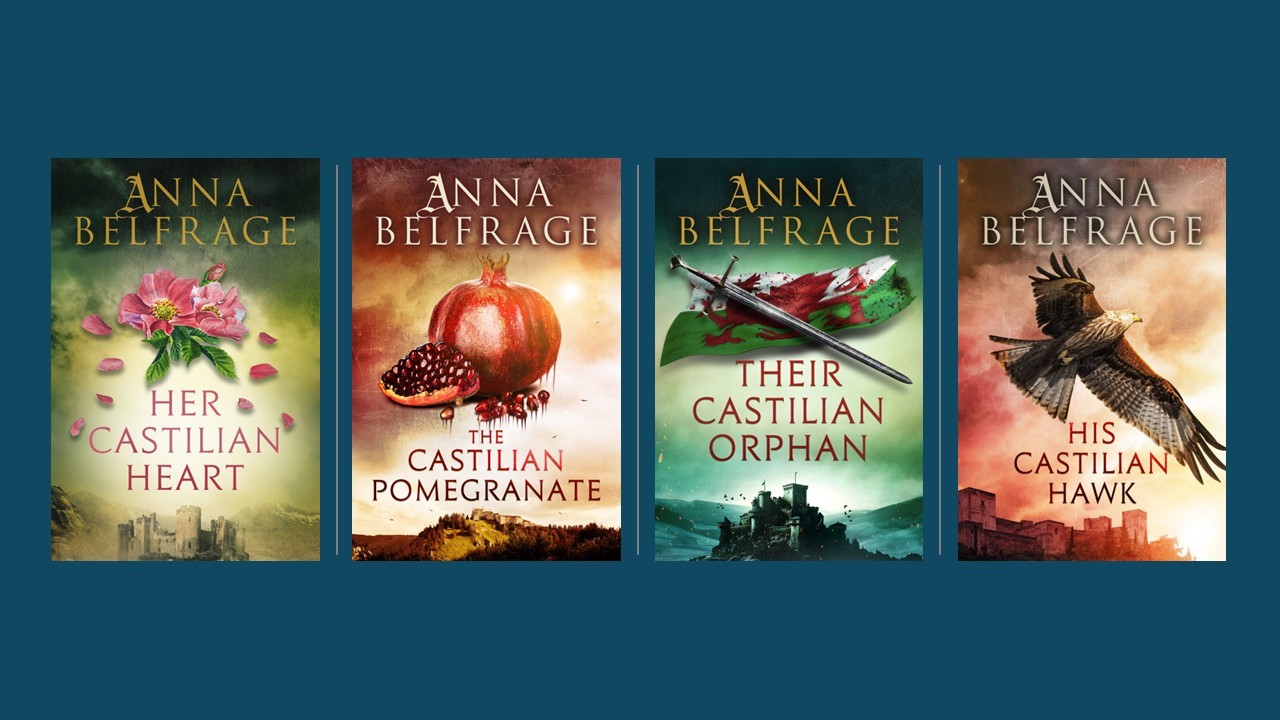
My third series is called The Castilian Saga and is set in the late 13th century. The lives and adventures of Robert FitzStephan, loyal captain to Edward I, and his wife, Eleanor d’Outremer, play out against the background of the conquest of Wales and the general upheaval in Castile and Aragon at the time. Yet another four book series…

I have also authored a three-book series called The Wanderer, which tells the story of Jason and Helle, brutally torn apart 3 000 years ago. After endless lives searching for his Helle, Jason finally finds her again and there is a HEA hovering on the horizon—had it not been for their nemesis last time round who has just gate-crashed the party. I loved writing this borderline fantasy/romantic suspense/ steamy series – but historical fiction is my first love and always will be.

History...the Interesting Bits

I have an ongoing series called The Time Locket—and yes, it has a time travelling protagonist. Erin is of mixed race and find it very hard to navigate the early 18th century in the American Colonies—well, she finds it hard to navigate life in the 18th century, full stop. Fortunately, she has Duncan at her side. I’ve written two books in this series and have started on number three –but for some odd reason we seem to be going to St Petersburg—well, the building site that will become St Petersburg—and I am dragging my feet, despite Erin and Duncan constantly sending me evil looks.

And then, finally, we have my just finished Queen of Shadows. (The one that I now need to write a sequel to according to my editor) We are in 14th century Castile where King Alfonso XI is married to one woman, but loves another. Quite the soap opera—except it is a true story. Along the way, our stalwart king must vanquish Marinid invaders, rebellious nobles and handle a most incensed father-in-law. I don’t think I’ve ever spent as much time researching a novel as I have done with this one—I started toying with the idea already back in 2016.

I have also contributed to various short-story collections: Betrayal: Historical stories, Historical Stories of Exile and Fate: Tales of History, Mystery and Magic.

Phew! Quite a list, isn’t it? (Anna looks quite, quite pleased)

Sharon: What attracts you to the periods you write in?

Anna: The history. An event or a personage catches my attention, and off I go. During my recent visit to Dresden, I discovered just how complicated and delicious the history of Saxony is, but I hesitate re writing a book set there, because I don’t speak German, and I have learned the hard way that it helps if you know the language of the country you are writing about. Writing about Castile in the 14th century has required reading my way through bits and pieces of medieval Castilian chronicles—but as I am fluent in Spanish, I managed. I also had the opportunity to revisit all my old text books about the development of the Spanish language)

Sharon: Who is your favourite medieval person and why?

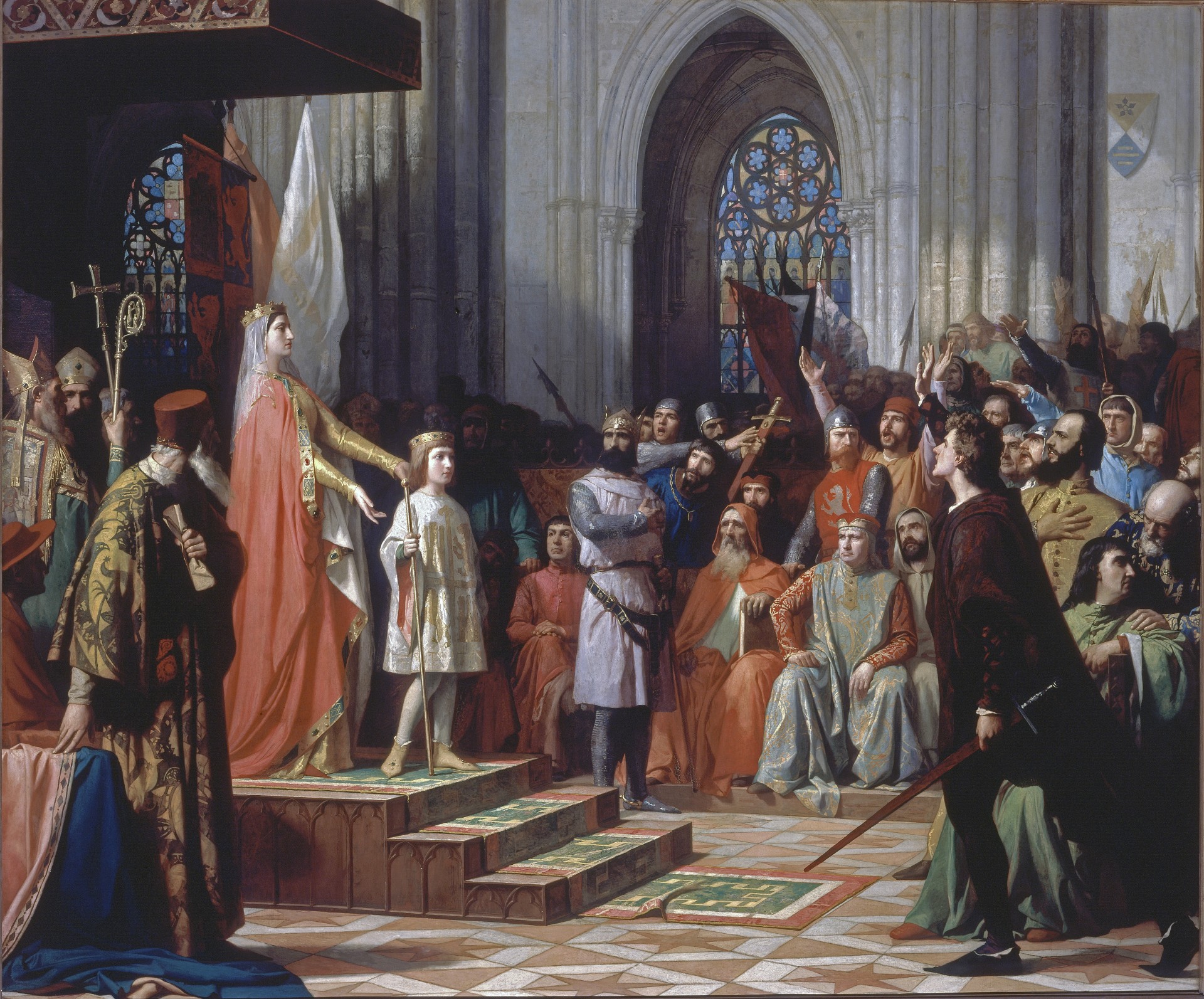
Anna: Seriously, ONE person? No, no, Sharon, how am I supposed to choose?? *Scratches head* Okay: in Castile, it would have to be Maria de Molina, I think. Wife of Sancho IV, she was firt regent to her son, Fernando IV, and when he was “summoned” (Yup, he’s known as Fernando the Summoned, given the odd circumstances of his death) she once again had to act as regent, now for her grandson, Alfonso XI. An extremely competent and wise woman, who suffered so much loss, so much heartbreak, but never gave up.

History...the Interesting Bits

In England, I am going to say Edward I. Yes, yes, I can hear people going WHAT? THAT RAT BASTARD? – and yes, he deffo had rat bastard qualities, especially vis-à-vis Scotland and Wales, but he was also a competent, hard-working ruler who never quite got over the loss of his wife, Eleanor. When she died, his soft side more or less disappeared (although his second wife seems to have brought it out in him on occasion). Also, we must remember that Edward is a product of his time and of the events that shook his kingdom when he was still a young man—namely the rebellions that more or less stripped Edward’s father of all his kingly power.

Sharon: Who is your least favourite medieval person and why?

History...the Interesting Bits

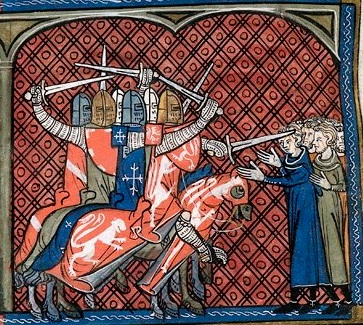
Anna: I’m not a big fan of The Black Prince, but my least favourite? Ah, yes: Simon Montfort the Elder, the man who led the Albigensian Crusade—or maybe Arnaud Amalric, the Cistercian abbot who purportedly ordered his men to kill all the people of Beziers during said crusade, stating that God would recognise his own (after death). Okay, so this is probably not true, but just the fact that an abbot actively participated in the massacre of the Cathars is rather icky, IMO. Sharon: I have to admit, I’m not a fan of either Simon de Montfort!

Sharon: How do you approach researching your topic?
History...the Interesting Bits
Sevilla

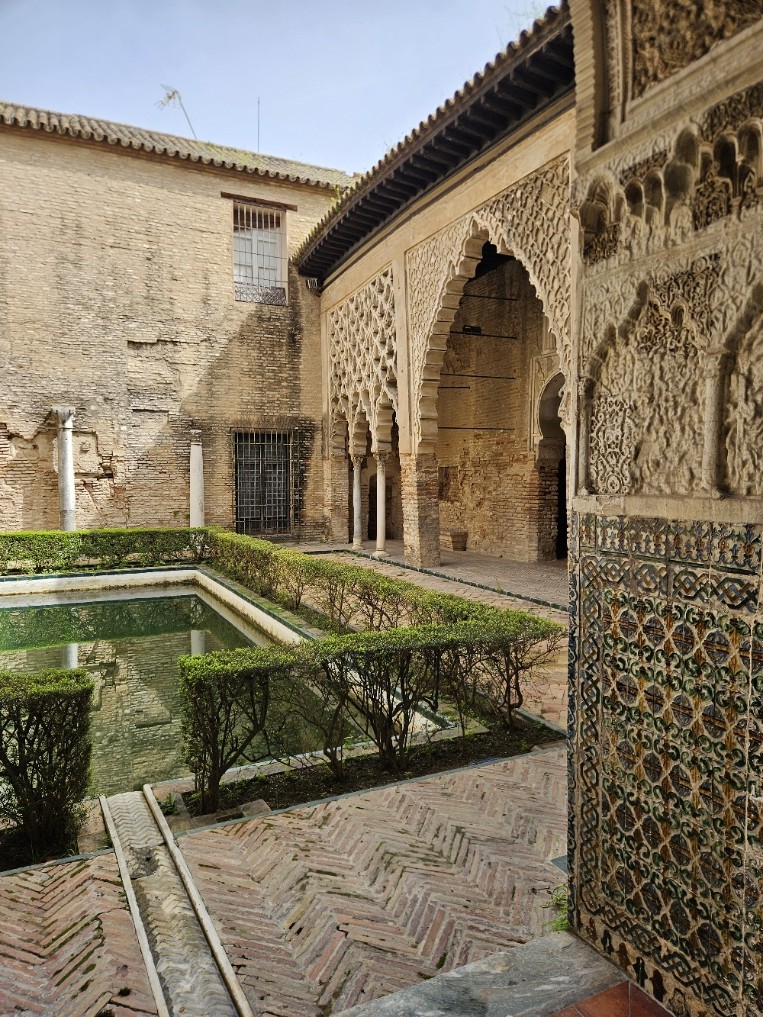
Anna: I start with one person, map out persons Person A interacted with and so on and so on. Plus, I always read an overview of the period first, highlighting things I will need to dig into. In my latest, it’s been a lot about sheep, about the Black Death, about coinage, about food—the Moors left a delicious legacy—about architecture. I also try to visit, to get a feel for the land as such. Good thing I did re my latest WIP, as it made me realise I was off by some kilometres from the sea in one of the more crucial scenes! insert pic of Sevilla

Sharon: Tell us your ‘favourite’ true historical story you have come across in your research.
Anna: Hmm. I am rather fond of the Edward-Eleanor love story. There he was, the future Edward I, all of fifteen when he married thirteen-year-old Eleanor. From that moment on, where he went, there went she.

Sharon: Tell us your least ‘favourite’ true historical story you have come across in your research.

Anna: Well, that is easy. In 1575, a seven-year-old little boy, Gustav Eriksson, was brutally exiled by his uncle, king Johan III of Sweden. Gustav was carried across the Baltic sea to Poland and there more or less abandoned, totally alone. No mother, no sister, no money. I have written about this sad little boy in Historical Stories of Exile (Sharon: How sad!)

Sharon: Are there any other eras you would like to write about?

Anna: I am rather fascinated by the period of the Second Great Awakening, i.e. the decades after the Napoleonic Wars. (Sharon: oooooooooh, yes please!)

Sharon: What are you working on now?

Anna: Well . . . I am dithering: should I start on that unplanned sequel by describing a wedding in 1353 at which an unwilling royal groom weds a French princess? Or should I dig into the mystery of the dead man in the barrel, come all the way from Russia before it ends up in Arabella Sterling’s warehouse? Or maybe I should work on both in parallel! (Sharon: Decisions! Decisions!)

Sharon: And finally, what is the best thing about being a writer?

Anna: I step into a world where I am totally in control (Muffled laughter from all my characters) OK, I escape into a world where I have some control—assuming my pesky characters cooperate. Somewhat more seriously, I love recreating life in the past, building that distant world brick by brick. Is the end creation an entirely correct representation? Of course not: there is so much we don’t know about that distant life—but I hope it gives a flavour!

Books by Anna Belfrage:

The Graham Saga Amazon US; Amazon UK; The King’s Greatest Enemy Amazon US; Amazon UK; The Castilian Saga Amazon US; Amazon UK; The Time Locket Amazon US; Amazon UK; The Wanderer Amazon US Amazon UK

About the Author:

Had Anna been allowed to choose, she’d have become a time-traveller. As this was impossible, she became a financial professional with three absorbing interests: history, romance and writing. Anna has authored the acclaimed time travelling series The Graham Saga, set in 17th century Scotland and Maryland, as well as the equally acclaimed medieval series The King’s Greatest Enemy which is set in 14th century England, and The Castilian Saga ,which is set against the medieval conquest of Wales. She has also published a time travel romance, The Whirlpools of Time, and its sequel Times of Turmoil, and is now considering just how to wiggle out of setting the next book in that series in Peter the Great’s Russia, as her characters are demanding. . .

All of Anna’s books have been awarded the IndieBRAG Medallion, she has several Historical Novel Society Editor’s Choices, and one of her books won the HNS Indie Award in 2015. She is also the proud recipient of various Reader’s Favorite medals as well as having won various Gold, Silver and Bronze Coffee Pot Book Club awards.

“A master storyteller” “This is what all historical fiction should be like. Superb.”

Find out more about Anna, her books and enjoy her eclectic historical blog on her website, http://www.annabelfrage.com

Social Media Links:

Bluesky: Facebook: Amazon Author Page

*

My books

Signed, dedicated copies of all my books are available through my online store.

Out now: Scotland’s Medieval Queens

Books by Sharon Bennett Connolly

Scotland’s history is dramatic, violent and bloody. Being England’s northern neighbour has never been easy. Scotland’s queens have had to deal with war, murder, imprisonment, political rivalries and open betrayal. They have loved and lost, raised kings and queens, ruled and died for Scotland. From St Margaret, who became one of the patron saints of Scotland, to Elizabeth de Burgh and the dramatic story of the Scottish Wars of Independence, to the love story and tragedy of Joan Beaufort, to Margaret of Denmark and the dawn of the Renaissance, Scotland’s Medieval Queens have seen it all. This is the story of Scotland through their eyes.

Scotland’s Medieval Queens gives a thorough grounding in the history of the women who ruled Scotland at the side of its kings, often in the shadows, but just as interesting in their lives beyond the spotlight. It’s not a subject that has been widely covered, and Sharon is a pioneer in bringing that information into accessible history.’ Elizabeth Chadwick (New York Times bestselling author)

Available now from Amazon and Pen and Sword Books

Also by Sharon Bennett Connolly:

Books by Sharon Bennett Connolly

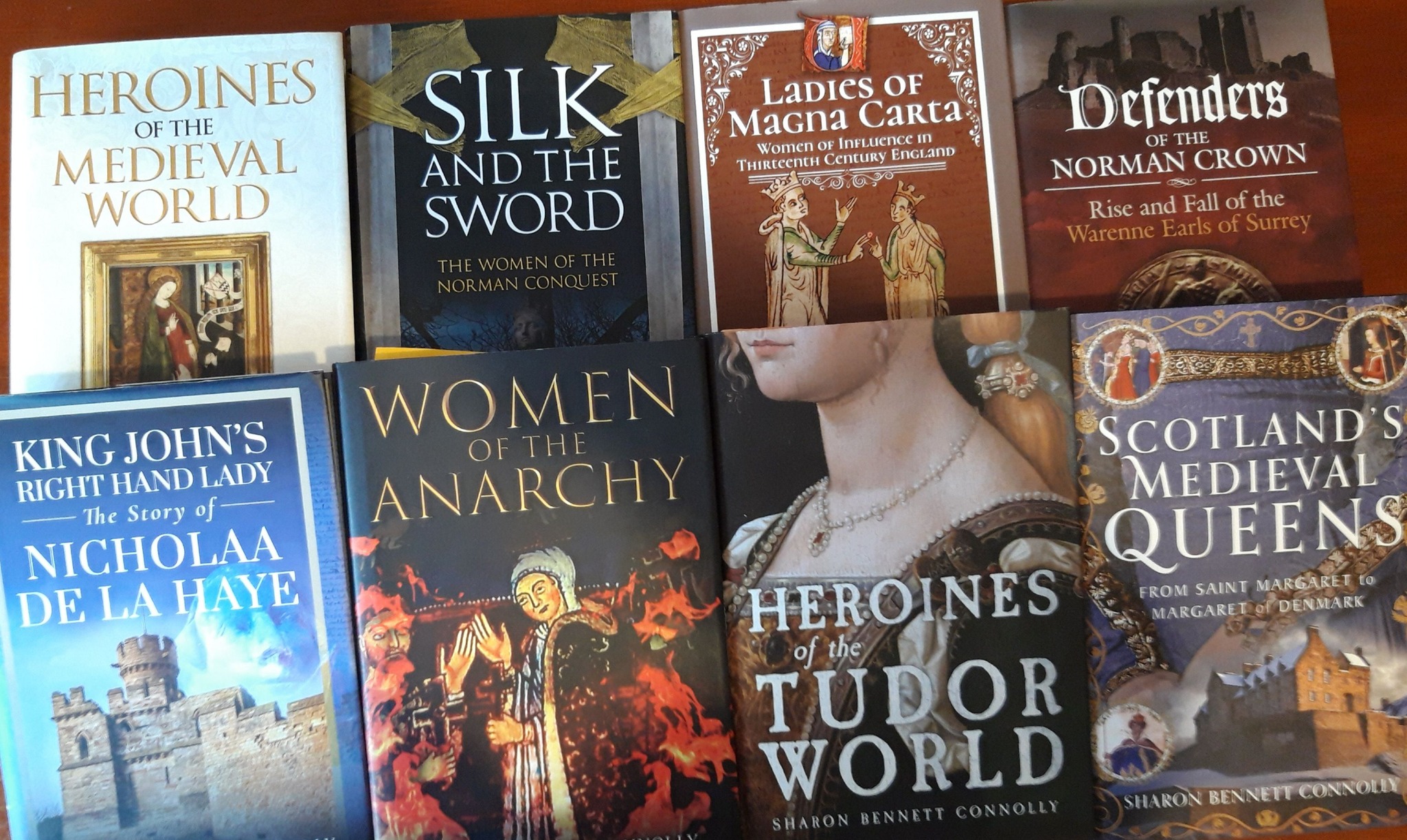
Heroines of the Tudor World tells the stories of the most remarkable women from European history in the time of the Tudor dynasty, 1485-1603. These are the women who ruled, the women who founded dynasties, the women who fought for religious freedom, their families and love. Heroines of the Tudor World is now available from Amberley Publishing and Amazon UK. Women of the Anarchy demonstrates how Empress Matilda and Matilda of Boulogne, unable to wield a sword themselves, were prime movers in this time of conflict and lawlessness. It shows how their strengths, weaknesses, and personal ambitions swung the fortunes of war one way – and then the other. Available from Bookshop.orgAmberley Publishing and Amazon UKKing John’s Right-Hand Lady: The Story of Nicholaa de la Haye is the story of a truly remarkable lady, the hereditary constable of Lincoln Castle and the first woman in England to be appointed sheriff in her own right. Available from all good bookshops Pen & Sword Booksbookshop.org and Amazon

Royal Historical Society

Defenders of the Norman Crown: The Rise and Fall of the Warenne Earls of Surrey tells the fascinating story of the Warenne dynasty, from its origins in Normandy, through the Conquest, Magna Carta, the wars and marriages that led to its ultimate demise in the reign of Edward III. Available from Pen & Sword BooksAmazon in the UK and US, and Bookshop.orgLadies of Magna Carta: Women of Influence in Thirteenth Century England looks into the relationships of the various noble families of the 13th century, and how they were affected by the Barons’ Wars, Magna Carta and its aftermath; the bonds that were formed and those that were broken. It is now available in paperback and hardback from Pen & SwordAmazon, and Bookshop.orgHeroines of the Medieval World tells the stories of some of the most remarkable women from Medieval history, from Eleanor of Aquitaine to Julian of Norwich. Available now from Amberley Publishing and Amazon, and Bookshop.orgSilk and the Sword: The Women of the Norman Conquest traces the fortunes of the women who had a significant role to play in the momentous events of 1066. Available now from Amazon,  Amberley Publishing, and Bookshop.org.

Alternate Endings: An anthology of historical fiction short stories including Long Live the King… which is my take what might have happened had King John not died in October 1216. Available in paperback and kindle from Amazon.

Podcast:

A Slice of Medieval

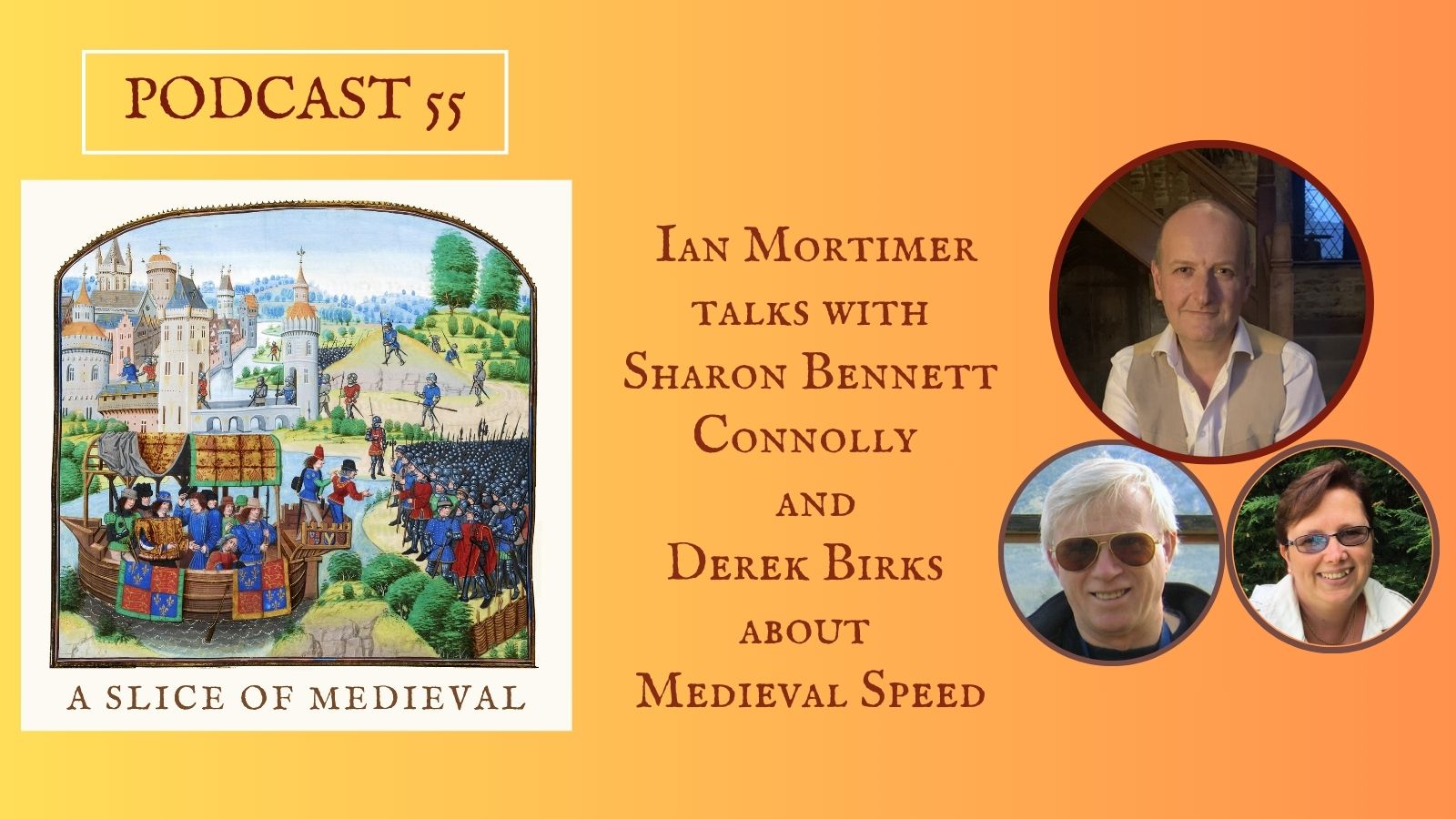
Have a listen to the A Slice of Medieval podcast, which I co-host with Historical fiction novelist Derek Birks. Derek and I welcome guests, such as Bernard Cornwell and Michael Jecks, and discuss a wide range of topics in medieval history, from significant events to the personalities involved. There’s even an episode where we chat with Anna Belfrage about Edward I and Eleanor of Castile.

There are now over 75 episodes to listen to!

Every episode is also now available on YouTube.

*

Don’t forget! Signed and dedicated copies of all my books are available through my online store.

For forthcoming online and in-person talks, please check out my Events Page.

You can be the first to read new articles by clicking the ‘Follow’ button, liking our Facebook page or joining me on TwitterThreadsBluesky and Instagram.

*

©2025 Sharon Bennett Connolly and Anna Belfrage

Wordly Women: MJ Porter

History... the Interesting Bits

It’s Wordly Women time again!

And today I am joined by an author who I could chat with all day, and never run out of things to talk about, M.J. Porter. MJ writes both fiction and non-fiction and can write a jolly good battle. Last year, MJ joined Derek Birks and I on A Slice of Medieval to chat about Athelstan and the Battle of Brunanburh. And what a fascinating discussion it was.

So, I was really excited to invite MJ Porter to take part in my Wordly Women series.

Sharon: Hi MJ! Firstly, can I ask what got you into writing?

MJ: My big dream was to write historical fantasy based on the Viking Age in Iceland. I know it’s both random and very specific. I only turned to historical fiction when I discovered a character during the research for my Master’s, I realised deserved to have his story told. Ealdorman Leofwine of the Hwicce, alive at the end of the tenth century ( a part of the Saxon Mercian kingdom), and his family were, in my view, far more influential and important than the Godwine family, who everyone knows about. I decided to write the story of the last 100 years of Saxon England through their eyes in the Earls of Mercia series. Not a small endeavour, and one which I’m continuing to pursue (I’ve made it to about AD1050 so everything is about to get quite serious), but since then (back in 2013), I’ve moved backwards through the Saxon era, picking for my subjects and stories those lesser-known characters (men or women) and events to share with my readers. I’m a little bit obsessed with the Saxon kingdom of Mercia.

Sharon: You write both fiction and non-fiction – is one harder than the other?

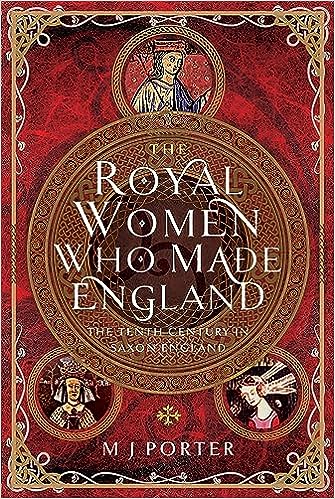
MJ: I’ve written one non-fiction title, The Royal Women of the Tenth Century, and the rest are fiction. What I would say is that non-fiction uses a very different part of my brain from writing fiction. With non-fiction, I struggled to stop each day. I could work on the title for upwards of 12 hours a day without feeling any fatigue. When writing fiction (and I mean writing, not editing), there’s a greater strain as I create as I go. So, my brain gets tired more quickly with fiction writing than non-fiction writing. I imagine that, as I know what’s going to happen with non-fiction, I don’t have that constant pressure when I’m writing. I’m a pantser, so my stories unfold as I write them.

Sharon: Tell us about your books.

History... the Interesting Bits

MJ: I write mostly in the Saxon era, c.540 to 1066. (I do still dabble in fantasy using a pen-name, and I also write quirky 20th-century mysteries). My stories often revolve around either the kingdom of Mercia or the emerging kingdom of England from the tenth century onwards.

I’m attracted to characters and events people don’t know about, or for which evidence is now painting a different picture. However, my stories can range from a blood-and-guts battle fest (with lots of very strong language) to stories about politics. My most recent completed trilogy has been an attempt to recreate events in the true ‘Dark Ages’ in about AD540. It was fascinating but really hard. It was a passion project. I’ve been fascinated by the era for a very long time. My next trilogy will be about the Mercian Civil War of 757, with the future King Offa as the main character. And in the background, I’m continuing my two series set in the ninth century in Mercia, the one following a young Icel as he struggles to become a warrior, not a healer, and the later one, about Mercia’s ‘last king’ King Coelwulf II. The scope for the imagination is immense, and sometimes even I don’t know what form the next story is going to take.

Sharon: What attracts you to the period?

MJ: So, I’m lazy and also, I like to reassess current interpretations, so there are far fewer ‘named’ individuals for me to worry about getting correct in the era, and the scope for reassessing events is immense. We don’t know far more than we know for this period of early English (and wider British) history.

Sharon: Who is your favourite medieval person and why?

MJ: I don’t think I have a favourite. There are too many to pick and choose only one. I do have a very soft spot for William the Marshall, although he’s not in my preferred era.

Sharon: Who is your least favourite medieval person and why?

MJ: Again, I don’t think I have one, but one of my characters, King Coelwulf II of Mercia, really doesn’t like his contemporary, King Alfred of Wessex, and I think he’s probably correct to be suspicious. As historians have commented (to paraphrase), we only know King Alfred was ‘great’ because he made sure to tell us he was (through his Life, written by Asser). That smacks of self-aggrandisement in my books.

Sharon: How do you approach researching your topic?

History... the Interesting Bits

MJ: My process has changed significantly over the years. I began my first historical fiction story by seeing what the Anglo-Saxon Chronicles had to say about events, as well as the surviving charter evidence, but now I tend to start with more general information and then dive deeper. The Anglo-Saxon Chronicle, in all its many forms, is a great place to hunt out stories, but I now consult many more sources, including archaeological finds and the more ‘lived’ experiences. I’ve been studying Saxon England on and off for thirty years, and I suspect I’ve forgotten more than I remember, but I have a general feeling, and I weave the narrative through it, being mindful of what comes before, and what comes after (and also, what I might have written before – which has sometimes caused me more heartache than the alleged historical ‘facts’). I do like to add Easter Eggs through my later stories.

I have a huge collection of reference books these days, and I know where to find information. Additionally, I’m wise enough to realise that sometimes there will be gaps.

I often find that when characters and events are given flesh, they make more sense than in stark non-fiction titles, and this also adds to my confidence in writing stories that counter the current narratives. Some elements simply don’t ‘make sense’ when you add people to them. And others of them suddenly do. The ‘hook’ for my Dark Age trilogy was that after the ‘end’ of Roman Britain, the ability to forge iron from ironstone was lost (although many items were recycled). Abruptly, I realised that when the lost skills were rediscovered, this would have allowed those with sharper blades to dominate those who lacked the ability. I don’t know if that’s true, but it’s a fascinating hypothesis.

Sharon: Tell us your ‘favourite’ true historical story you have come across in your research.

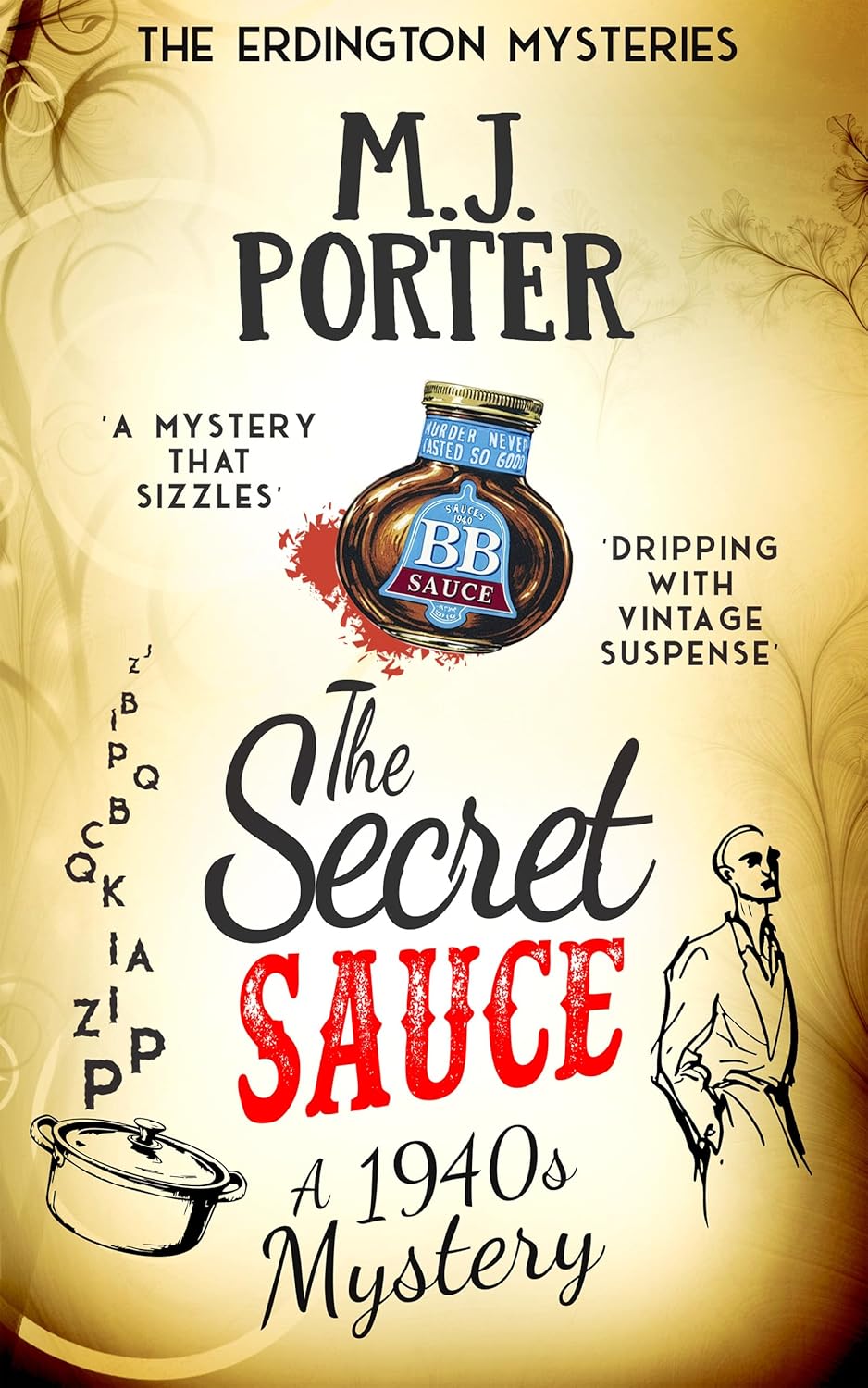
MJ: I don’t know if I have a favourite, but for my last mystery, I discovered something very tragic, regarding a munitions explosion close to RAF Fauld near Burton upon Trent in November 1944. I grew up not far from there, and I’d never heard of it, so I resolved to include it in The Secret Sauce, and now more and more readers are informing me they didn’t know either. I love being able to share these neglected stories with my readers and giving these forgotten individuals some recognition.

Sharon: Tell us your least ‘favourite’ true historical story you have come across in your research.

MJ: I don’t know if I have a least favourite either, but I was devastated when I had to ‘kill off’ my first historical fiction creation, Ealdorman Leofwine, because he disappeared from the historical record. It was so tough. History can be cruel sometimes.

Sharon: Are there any other eras you would like to write about?

MJ: I’ve also written a few 20th-century mysteries, and I’ve dabbled with the Tudors as part of a fantasy trilogy. I might one day be tempted by a little bit of the Roman era as well, but I’m somewhat terrified by how much is known about military units and the way the Romans fought, as my characters are often as disorganised as I am, and I fear I’d offend readers.

Sharon: What are you working on now?

History... the Interesting Bits

MJ: I’m currently writing the first book in The House of Mercia, which will focus on the Civil War in Mercia in 757, with the future King Offa as a main character, while King Æthelbald, his predecessor, is also a character. I’m also in the throes of solving my latest 20th-century mystery, called The Barrage Body. I love the variety, and the convenience of being able to drive and use a telephone as opposed to having a horse and relying on messengers and messages.

Sharon: And finally, what is the best thing about being a writer?

MJ: There’s a lot of freedom to being a writer, once you’ve acknowledged it’s also hard work. I have my processes and routine, but provided I stick to that, I can spend much of my time doing the things I love – writing and researching. I’m very lucky to be able to (just about) earn a living from doing that. I also get to spend my time with characters I either love (or hate), and that is also very freeing.

Books by MJ Porter:

The Secret Sauce; Men of Iron; The House of Mercia; The Earls of Mercia; The Royal Women Who Made England

About the Author:

History... the Interesting Bits

MJ Porter writes: I’m an author of historical fiction (Early English/Saxon, Vikings and the British Isles as a whole before the Norman Conquest, as well as five 20th-century historical mysteries) and fantasy (now published under a different name).

I was born in the old Mercian kingdom at some point since 1066. Raised in the shadow of a strange little building, told from a very young age that it housed the bones of long-dead kings of Mercia and that our garden was littered with old pieces of pottery from a long-ago battle, it’s little wonder that my curiosity in Early England ran riot. I can only blame my parents! I like to write. You’ve been warned!

linktr.ee/MJPorterauthor

*

My books

Signed, dedicated copies of all my books are available through my online store.

Out now: Scotland’s Medieval Queens

Books by Sharon Bennett Connolly

Scotland’s history is dramatic, violent and bloody. Being England’s northern neighbour has never been easy. Scotland’s queens have had to deal with war, murder, imprisonment, political rivalries and open betrayal. They have loved and lost, raised kings and queens, ruled and died for Scotland. From St Margaret, who became one of the patron saints of Scotland, to Elizabeth de Burgh and the dramatic story of the Scottish Wars of Independence, to the love story and tragedy of Joan Beaufort, to Margaret of Denmark and the dawn of the Renaissance, Scotland’s Medieval Queens have seen it all. This is the story of Scotland through their eyes.

Scotland’s Medieval Queens gives a thorough grounding in the history of the women who ruled Scotland at the side of its kings, often in the shadows, but just as interesting in their lives beyond the spotlight. It’s not a subject that has been widely covered, and Sharon is a pioneer in bringing that information into accessible history.’ Elizabeth Chadwick (New York Times bestselling author)

Available now from Amazon and Pen and Sword Books

Also by Sharon Bennett Connolly:

Books by Sharon Bennett Connolly

Heroines of the Tudor World tells the stories of the most remarkable women from European history in the time of the Tudor dynasty, 1485-1603. These are the women who ruled, the women who founded dynasties, the women who fought for religious freedom, their families and love. Heroines of the Tudor World is now available from Amberley Publishing and Amazon UK. Women of the Anarchy demonstrates how Empress Matilda and Matilda of Boulogne, unable to wield a sword themselves, were prime movers in this time of conflict and lawlessness. It shows how their strengths, weaknesses, and personal ambitions swung the fortunes of war one way – and then the other. Available from Bookshop.orgAmberley Publishing and Amazon UKKing John’s Right-Hand Lady: The Story of Nicholaa de la Haye is the story of a truly remarkable lady, the hereditary constable of Lincoln Castle and the first woman in England to be appointed sheriff in her own right. Available from all good bookshops Pen & Sword Booksbookshop.org and Amazon

Royal Historical Society

Defenders of the Norman Crown: The Rise and Fall of the Warenne Earls of Surrey tells the fascinating story of the Warenne dynasty, from its origins in Normandy, through the Conquest, Magna Carta, the wars and marriages that led to its ultimate demise in the reign of Edward III. Available from Pen & Sword BooksAmazon in the UK and US, and Bookshop.orgLadies of Magna Carta: Women of Influence in Thirteenth Century England looks into the relationships of the various noble families of the 13th century, and how they were affected by the Barons’ Wars, Magna Carta and its aftermath; the bonds that were formed and those that were broken. It is now available in paperback and hardback from Pen & SwordAmazon, and Bookshop.orgHeroines of the Medieval World tells the stories of some of the most remarkable women from Medieval history, from Eleanor of Aquitaine to Julian of Norwich. Available now from Amberley Publishing and Amazon, and Bookshop.orgSilk and the Sword: The Women of the Norman Conquest traces the fortunes of the women who had a significant role to play in the momentous events of 1066. Available now from Amazon,  Amberley Publishing, and Bookshop.org.

Alternate Endings: An anthology of historical fiction short stories including Long Live the King… which is my take what might have happened had King John not died in October 1216. Available in paperback and kindle from Amazon.

Podcast:

A Slice of Medieval

Have a listen to the A Slice of Medieval podcast, which I co-host with Historical fiction novelist Derek Birks. Derek and I welcome guests, such as Bernard Cornwell and Michael Jecks, and discuss a wide range of topics in medieval history, from significant events to the personalities involved. 

There are now over 75 episodes to listen to!

Every episode is also now available on YouTube.

*

Don’t forget! Signed and dedicated copies of all my books are available through my online store.

For forthcoming online and in-person talks, please check out my Events Page.

You can be the first to read new articles by clicking the ‘Follow’ button, liking our Facebook page or joining me on TwitterThreadsBluesky and Instagram.

*

©2025 Sharon Bennett Connolly and M.J. Porter

Wordly Women: Rosemary Griggs

History... the Interesting BIts

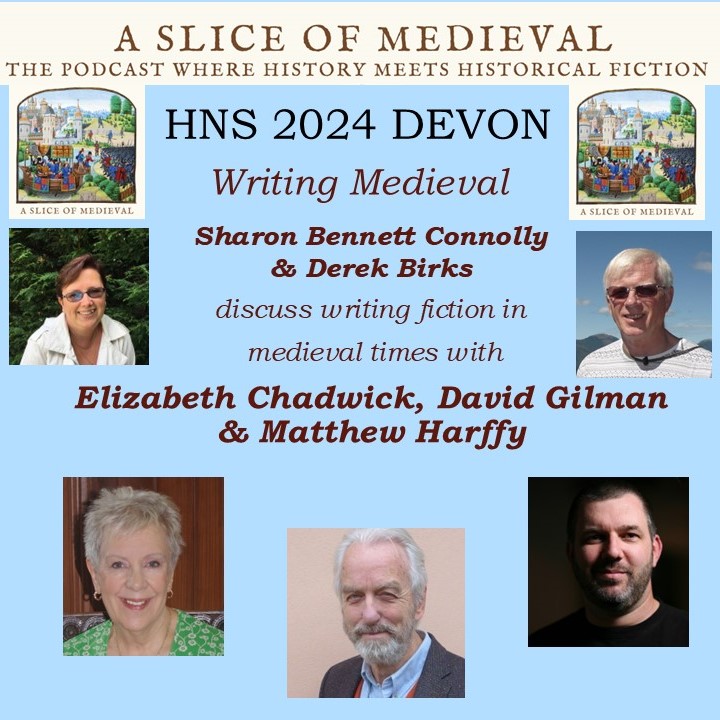
Just over a year ago I spent a fabulous weekend at the Historical Novel Society Conference at Dartington Hall in Devon. Derek and I hosted a panel under our A Slice of Medieval podcast banner, featuring Elizabeth Chadwick, David Gilman and Matthew Harffy. Bernard Cornwell was on before us and Ian Mortimer followed us onto the stage. I got to meet some of my heroes. Ian Mortimer was lovely to chat to. Michael Jecks told some great stories, one featuring a late-night hotel fire alarm. Steven A. McKay and I talked like old friends, even though it was the first time we had actually met. I got to discuss Emma of Normandy with Patricia Bracewell and medieval Yorkshire with Claire Dunn (C.F. Dunn).

It was a fabulous weekend! And amidst it all I had a chat with Rosemary Griggs. It was cut short because Rosemary knows the area well and was on her way to give a tour of the gardens. So, I was over the moon when Rosemary agreed to participate in my Wordly Women series, so we could have a proper natter!

And Rosemary is another champion of highlighting those women who should be better known to history!

Sharon: Hi Rosemary, welcome to the blog. First and foremost, what got you into writing?

Rosemary: I’ve always wanted to write; ever since a truly inspirational teacher at primary school encouraged me and also sparked my lifelong interest in history. Over the years, I’ve done a lot of writing of one sort or another. I even once won a prize in a travel writing competition. However, during my Civil Service career, I had to write speeches for government ministers and create carefully crafted policy advice; all rather dry! It’s wonderfully freeing that I can now tell the stories of some truly amazing women who lived in sixteenth century Devon.

Sharon: Tell us about your books

Rosemary: Having spent years delving into Devon’s past, I’ve become particularly fascinated by the Champernowne family. They rose to prominence in the sixteenth century as part of a closely connected network of powerful figures whose influence extended far beyond the county. Within their circle were the likes of Raleigh, Drake, Hawkins, and Grenville—names that still resonate today. Yet, the women are so often forgotten. In my “Daughters of Devon” novels, I bring into the spotlight women often overshadowed by their famous menfolk.

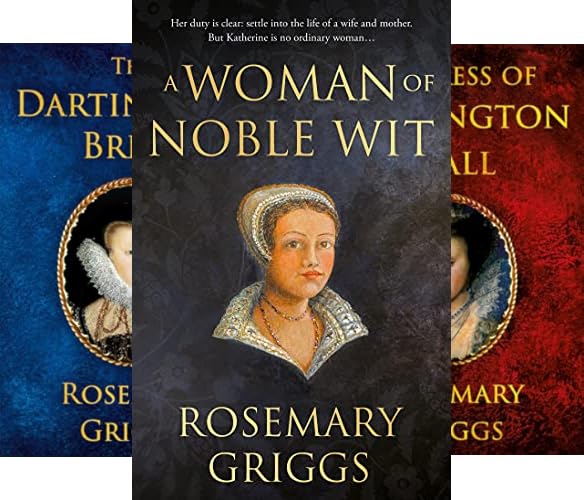
My first novel, A Woman of Noble Wit, is the story of Katherine Champernowne, Sir Walter Raleigh’s mother.

History... the Interesting Bits

Next to catch my eye was a young French Huguenot woman, daughter of the man who killed King Henri II of France in a jousting accident. Although born in France, Lady Gabrielle Roberda Montgomery married into the Champernowne family and spent most of her adult life at Dartington Hall in Devon. I became so fascinated by the challenges she faced as an incomer to Elizabethan England that her story has spilled into two volumes, The Dartington Bride and recently published Mistress of Dartington Hall.

A lot of other Daughters of Devon are waiting to have their stories told.

Sharon: What attracts you to the Tudor period?

Rosemary: My fascination with the Tudor era began with the larger-than-life characters of the royal court. I’m as enthralled by the tales of Henry VIII and his queens as anyone. However, during that tumultuous period, immense social, political, and religious changes affected everyone, regardless of their wealth. The late fifteenth century saw the printing press’s arrival, which opened up learning and information to a wider audience, including many women. It was an ‘information revolution’, not unlike the transformative changes I’ve witnessed in my own life, especially since the internet was born. It’s working out how ordinary people, especially women, managed in such a rapidly changing world that keeps me rooted in those turbulent Tudor years.

Sharon: Who is your favourite Tudor and why?

Rosemary: Elizabeth I is the one who most fascinates me. Her 45-year reign brought stability after years of turmoil. People remember her as an intelligent, politically astute and powerful ruler. She had a formidable education, becoming fluent in multiple languages. Like many people, I admire Elizabeth for her wit and for her determination. I had always seen the defeat of the Spanish Armada as her greatest victory. However, as I was researching for my latest book, I discovered another side to her character. The queen’s reluctance to pay the soldiers and sailors needed to repel the Spanish invasion, or to provide enough arms and munitions was extremely frustrating for her commanders. Without that change in the wind, the outcome could have been very different.

My current research has also brought home to me how perilous Elizabeth’s life was in the years before she came to the throne. Having survived against the odds; she defied expectations by never marrying. Elizabeth was incredibly clever as she played off her various suitors to maintain or forge political alliances. She gave up a lot to rule alone. I would dearly love to be able to ask her what really happened with Thomas Seymour and whether she ever regretted not marrying Dudley.

Sharon: Who is your least favourite Tudor and why?

Rosemary: It would be easy to plump for Henry VIII as the ruthless tyrant he became in his later years. But I have a soft spot for the charismatic, intelligent young man who became king in1509. Instead, I’d go for his father, Henry VII, who has always seemed to me to be a rather cold, calculating type. Perhaps he had to be to return from exile to wrest the throne from Richard III on the battlefield. Yet I can’t forgive him for executing poor Edward of Warwick, or for his treatment of Catherine of Aragon after Prince Arthur died. Somehow, I cannot warm to Henry VII.

Sharon: How do you approach researching your topic?

Rosemary: I always start with original source documents relating to my character. Then I widen the net to consider what surviving documents reveal about those around them. I’m never happier than when I’m poring over a difficult text in the archives.

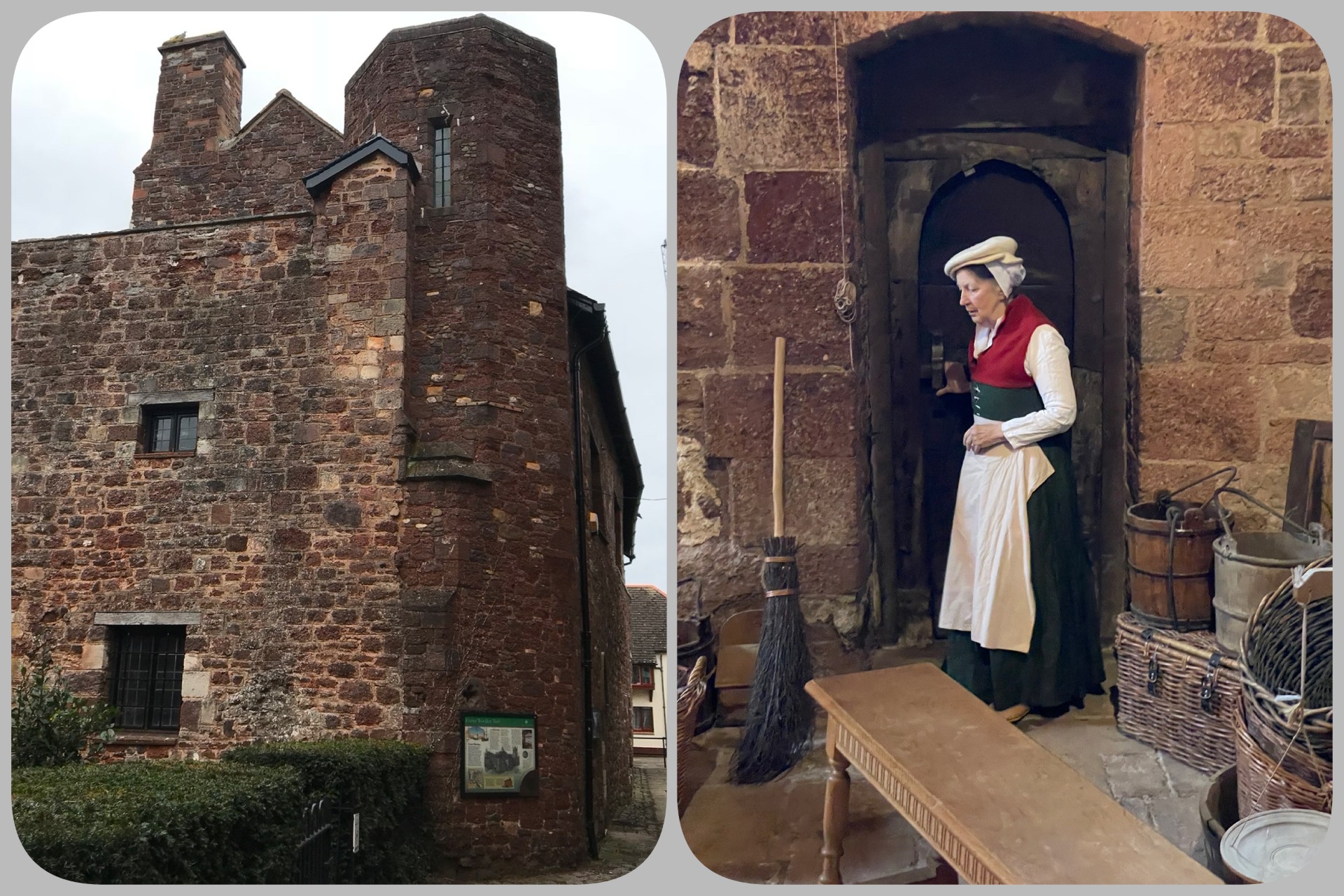
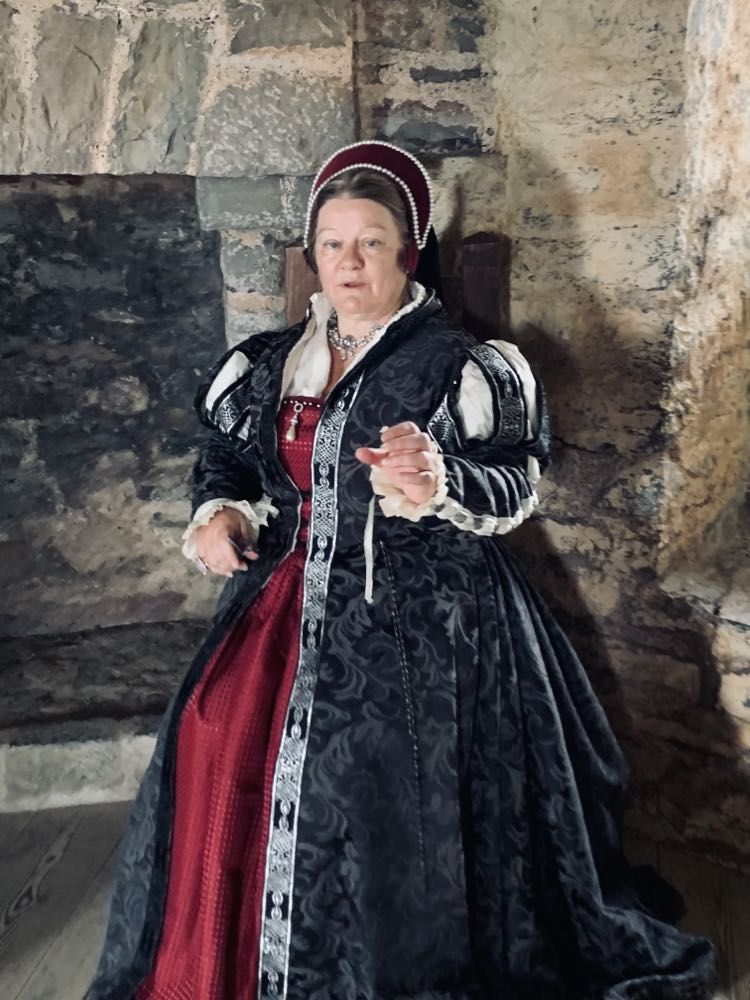
I’ve chosen a hard path, as I’m researching women whose imprint on the record is light. I can usually discover much more about the men in their lives, but eventually I’m armed with some key events taken from the record. These form the milestones on my subjects ’journeys through life, and I respect them absolutely. However, the beauty of writing fiction is that I can fill the gaps with creative imagination to weave a plausible narrative around those key events. To do that, I study every detail of Tudor life. I read widely about national events; I sift through accounts of local happenings. I question everything. I also visit the places they knew; I dress as they did. I all brings me closer to their world.

Sharon: Tell us your ‘favourite ’Devon story you have come across in your research.

History... the Interesting Bits

Rosemary: My favourite Devon story doesn’t concern one of the ‘elite ’women I write about. Rather, it is an incident that brings one of the ordinary women of history briefly to our attention. In the mid-1530s, when Thomas Cromwell’s commissioners instructed a man to tear down St Nicholas Priory’s Church in Exeter, Elizabeth Glanfield gathered her friends and neighbours. They would allow no one to desecrate their beloved priory church without a fight. Grabbing brooms, shovels and staves, the pack of women descended on the worker who was dismantling the rood screen. The terrified man climbed high, but the women pursued him until he fell, breaking his arm. Eventually, the mayor of Exeter restored order. When the great and good sat in judgement on Elizabeth and her friends, they expressed the view that men disguised as women perpetrated the attack. Mere women, they suggested, could not be capable of such an act. Fortunately, Elizabeth and her friends escaped serious punishment. However, they did not save their church. Eventually, workers returned to demolish the church. They used some of the stone to repair the Exe bridge into the city. Parts of the priory buildings survived to be converted into an Elizabethan townhouse. Elizabeth Glanfield and the rioting women of Exeter are a rare example of local people resisting the dissolution of the monasteries. There is a longer version of this story on my website.

Sharon: Tell us your least ‘favourite’ Devon story you have come across in your research.

Rosemary: My least favourite is also about another ordinary woman and her appalling fate, although it has also been a tremendous source of inspiration for me. During the reign of Edward VI, Agnes Prest, a poor, uneducated Cornish woman, had heard the scriptures in a language she could understand. Queen Mary insisted she return to the old ways of worship under the Church of Rome. Agnes could not accept what she was being told to believe. The worst part of her story is that her own family, including her husband, ‘shopped ’Agnes to the church authorities. The Bishop of Exeter and all the high-ups of the church summoned Agnes and questioned her. She refused to yield. Eventually, they took Agnes to the prison cells beneath Exeter’s Rougemont Caste. In the second edition of his ‘Book of Martyrs’, Foxe mentions that a gentlewoman, Katherine Raleigh, visited Agnes. In August 1557, that poor Cornish woman walked the short distance from her prison cell to the area of Exeter we now call Southernhay, where she was burned at the stake. She was Exeter’s only Protestant martyr during the reign of Queen Mary.

Sharon: Are there any other eras you would like to write about?

Rosemary: I’ve often thought I could find some strong Devon women who played their part during the English Civil War. However, while recovering from Covid recently, I watched a lot of TV adaptations of Jane Austen novels. I’m now quite drawn to that time too.

Sharon: What are you working on now?

History... the Interesting Bits

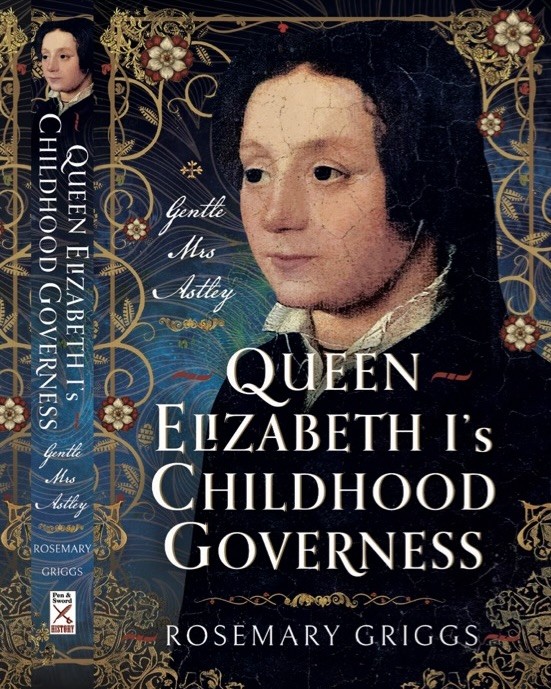
Rosemary: I’m very excited about my current project, my first work of nonfiction. A woman connected to the Champernownes has elbowed her way to the front of the queue of women whose stories I want to tell. Fans of Tudor history know her as Kat Ashley, Queen Elizabeth’s childhood governess. When I began mapping out a fictional account of her life, I found the character emerging from my detailed research was a little different from the woman familiar to us. Going back to the original sources made me question the accepted narrative. I had also discovered some interesting details historians seem to have overlooked. So, I am thrilled that Pen and Sword Books are giving me the opportunity to set out all of my research into this fascinating woman who had so much influence on Elizabeth I. Here is the fantastic jacket design. We are targeting publication summer of 2026.

Sharon: I’m looking forward to getting my hands on a copy – and don’t Pen & Sword do the most gorgeous covers?

Sharon: And finally, what is the best thing about being a writer?

Rosemary: Opening that box, holding your book for the first time is very special. But above all, it is when people tell me my story transported them back in time and they’ve enjoyed reading it, or even that it’s made them think. That’s what makes it all worthwhile.

About the Author:

History... the Interesting Bits

Rosemary Griggs is an author, researcher, seamstress and popular West Country speaker. She has a particular interest in Devon’s sixteenth-century history and the Champernowne family.

She loves telling the stories of the forgotten women of history; wives, sisters, daughters and mothers who played their part during the tumultuous Tudor years: the Daughters of Devon. Rosemary also researches, creates and wears sixteenth-century clothing. She brings the past to life through a unique blend of theatre, history and re-enactment at appearances and talks for museums and community groups all over the West Country. Out of costume, Rosemary leads heritage tours of the gardens at Dartington Hall, a fourteenth-century manor house in rolling south Devon parkland near Totnes.

You can find out more on Rosemary’s website.

Where to find Rosemary:

Facebook: Instagram: Threads: BlueSky.

To Buy Rosemary’s books

All three books are available as paperbacks from UK bookshops, and as Ebook worldwide. The first two are also available as audible: Rosemary’s bookshop; Amazon UK; Amazon US.

*

My Books

Signed, dedicated copies of all my books are available through my online bookshop.

Out now: Scotland’s Medieval Queens

Books by Sharon Bennett Connolly

Scotland’s history is dramatic, violent and bloody. Being England’s northern neighbour has never been easy. Scotland’s queens have had to deal with war, murder, imprisonment, political rivalries and open betrayal. They have loved and lost, raised kings and queens, ruled and died for Scotland. From St Margaret, who became one of the patron saints of Scotland, to Elizabeth de Burgh and the dramatic story of the Scottish Wars of Independence, to the love story and tragedy of Joan Beaufort, to Margaret of Denmark and the dawn of the Renaissance, Scotland’s Medieval Queens have seen it all. This is the story of Scotland through their eyes.

Scotland’s Medieval Queens gives a thorough grounding in the history of the women who ruled Scotland at the side of its kings, often in the shadows, but just as interesting in their lives beyond the spotlight. It’s not a subject that has been widely covered, and Sharon is a pioneer in bringing that information into accessible history.’ Elizabeth Chadwick (New York Times bestselling author)

Available now from Amazon and Pen and Sword Books

Also by Sharon Bennett Connolly:

Books by Sharon Bennett Connolly

Heroines of the Tudor World tells the stories of the most remarkable women from European history in the time of the Tudor dynasty, 1485-1603. These are the women who ruled, the women who founded dynasties, the women who fought for religious freedom, their families and love. Heroines of the Tudor World is now available for pre-order from Amberley Publishing and Amazon UK. Women of the Anarchy demonstrates how Empress Matilda and Matilda of Boulogne, unable to wield a sword themselves, were prime movers in this time of conflict and lawlessness. It shows how their strengths, weaknesses, and personal ambitions swung the fortunes of war one way – and then the other. Available from Bookshop.orgAmberley Publishing and Amazon UKKing John’s Right-Hand Lady: The Story of Nicholaa de la Haye is the story of a truly remarkable lady, the hereditary constable of Lincoln Castle and the first woman in England to be appointed sheriff in her own right. Available from all good bookshops Pen & Sword Booksbookshop.org and Amazon

Royal Historical Society

Defenders of the Norman Crown: The Rise and Fall of the Warenne Earls of Surrey tells the fascinating story of the Warenne dynasty, from its origins in Normandy, through the Conquest, Magna Carta, the wars and marriages that led to its ultimate demise in the reign of Edward III. Available from Pen & Sword BooksAmazon in the UK and US, and Bookshop.orgLadies of Magna Carta: Women of Influence in Thirteenth Century England looks into the relationships of the various noble families of the 13th century, and how they were affected by the Barons’ Wars, Magna Carta and its aftermath; the bonds that were formed and those that were broken. It is now available in paperback and hardback from Pen & SwordAmazon, and Bookshop.orgHeroines of the Medieval World tells the stories of some of the most remarkable women from Medieval history, from Eleanor of Aquitaine to Julian of Norwich. Available now from Amberley Publishing and Amazon, and Bookshop.orgSilk and the Sword: The Women of the Norman Conquest traces the fortunes of the women who had a significant role to play in the momentous events of 1066. Available now from Amazon,  Amberley Publishing, and Bookshop.org.

Alternate Endings: An anthology of historical fiction short stories including Long Live the King… which is my take what might have happened had King John not died in October 1216. Available in paperback and kindle from Amazon.

Podcast:

Have a listen to the A Slice of Medieval podcast, which I co-host with Historical fiction novelist Derek Birks. Derek and I welcome guests, such as Bernard Cornwell and Elizabeth Chadwick, and discuss a wide range of topics in medieval history, from significant events to the personalities involved.

There are now 80 episodes to listen to!

Every episode is also available on YouTube.

*

Don’t forget! Signed and dedicated copies of all my books are available through my online bookshop.

For forthcoming online and in-person talks, please check out my Events Page.

You can be the first to read new articles by clicking the ‘Follow’ button, liking our Facebook page or joining me on TwitterThreadsBluesky and Instagram.

©2024 Sharon Bennett Connolly FRHistS and Rosemary Griggs

Wordly Women: Judith Arnopp

Wordly Women

It is time for another edition of Wordly Women! And today I am chatting with an author who, like me, likes to bring historical female characters to the fore, from the early medieval to the Tudors. She has also written a fabulous trilogy on Henry VIII himself. Judith Arnopp writes both historical fiction and non-fiction and has a wonderful back catalogue for you to explore, if you have not discovered her yet. Judith is also one of those authors who is happy to share her experiences with readers and writers alike.

Hello Judith! Welcome!

Sharon: What got you into writing?

    Judith: It was so long ago now I barely remember. I have always written stories, as a child I wrote things to read to my dolls who were always very appreciative. When I was about fourteen I wrote a torrid romance featuring a heroine called Rosalind and a hero named Tybalt – I bet you can’t guess where the inspiration for those names came from – lol. My best friend used to come round every evening to hear the next chapter and there’d be hell to pay if it wasn’t ready. I’d love to get my hands on it now. I bet it was dreadful!

    When marriage and children came along I still managed to write stories but now they featured my kids who loved listening to themselves having adventures. It wasn’t until my daughter and three sons had grown old enough not to need me 24/7 that I enrolled at the University of Wales and did a degree in English literature and Creative Writing. I loved it so much I stayed on to do a masters in Medieval History. I would have liked to remain at uni forever but one has to leave eventually and find a proper job.

    At that time, we lived on a rural smallholding, far from town and suitable jobs were few so it made sense to concentrate on what I loved and what I was reasonably good at. Historical fiction was the obvious choice and luckily the internet, which was relatively new then, made easing myself into the book world achievable, even from the wilds of Wales. There were great online groups then, like You Write On where I encountered other authors, most of whom I am still in touch with today.

    Sharon: Tell us about your books.

    Judith: My first published novel was Peaceweaver; the story of Eadgyth, who was consort to both Gruffydd ap Llewellyn of Wales and Harold II of England. In the recent TV debacle, King and Conqueror, they renamed her Margaret for some reason and she played a much larger role in Harold’s story. My book is set in the years leading up to the Norman Conquest, culminating just after the Battle of Hastings.

    A further two novels followed, The Forest Dwellers, set in the New forest after the invasion and another, The Song of Heledd, set in 7th century Powys. My early books barely made a ripple and sales were slow but people constantly asked me if I had written anything ‘Tudor’ – in the end, I caved in and wrote The Winchester Goose. That was the jumping off point really and I spent the next few years writing about Henry VIII’s queens, The Kiss of the Concubine, the story of Anne Boleyn, Intractable Heart, the story of Katheryn Parr, and was about Henry’s daughter, Mary. Once I’d written them I  began to wonder if I was ready to tackle Henry himself.

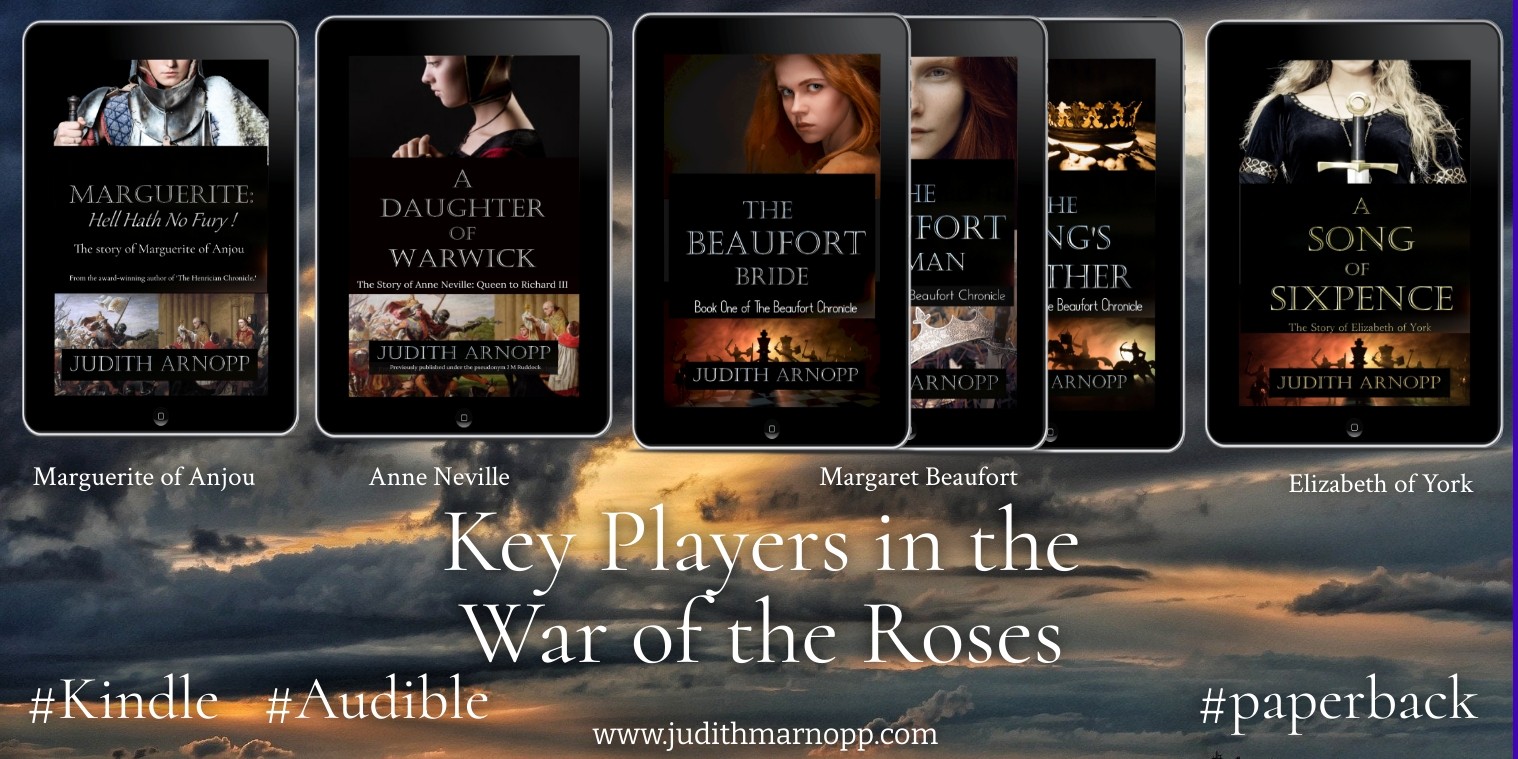
    Henry VIII is a huge undertaking. He had already cropped up in most of my books, The Beaufort Chronicle which is about his grandmother Margaret Beaufort, and A Song of Sixpence which is about his mother, Elizabeth of York. During the course of skirting around the king, I realised how few books there are that look at the events from his perspective. I knew it was time to stop being afraid, and just do it.

    The four years it took me to write the trilogy were hard. I know it sounds silly but Henry figured so largely in my head that he became real and as I neared his later years, it became really difficult to live in such close proximity.

    The trilogy is written in Henry’s voice. I imagined him sitting with me in my office as he related his story. Sometimes he would grow so indignant, so angry, so defensive that I forgot it was simply fiction.

    Henry always had the perfect excuse and if he began to feel uncomfortable while making a confession he either grew angry and stormed out or just lied. He was a very unreliable narrator, which is something I love in other people’s books and it was fun to use the device in my own work. It is up to the reader to decide how much of his revelation is truth, and how much is gloss.

    But somehow, particularly as I neared the end, I was able to empathise with him. I acknowledged his many sins but I had also come to a better understanding of what drove him. I wouldn’t say I pitied him exactly but I came to regret how his life unfolded. He could have been a great king.

    Sharon: What attracts you to the Tudor period?

    Judith: I think it is the intrigue, the uncertainty, the politics, the unacknowledged fear that everyone walked in. And then, of course, there are the fabulous clothes. When the reenactment group was still running I used to make heaps of Tudor gowns for when I played Mary I, and doublets and gowns for my husband who played Norfolk. Ill health has forced us to stop that for a while but I’d like to do it again. With a gown like that hanging in the wardrobe, it’s a shame not to.

    We know so much about the reign of Henry VIII yet there are still so many questions that will never be answered. Nobody seemed to learn from past mistakes. After the plight of Anne Boleyn, why oh why did Katherine Howard play fast and loose with the king; and what was Jane Rochford thinking to encourage the queen in such a dangerous game? 

    I’d like to travel back in time to visit the Tudor court to find the answers, but not as a person, I value my head too much. Perhaps I could be a bird in the rafters of the great hall, or a fly on the bedchamber wall. Or maybe one of Henry’s beloved spaniels so I could listen in while he fondled my ears – that would be safer!

    Sharon: Who is your favourite Tudor and why?

    Judith: It is close between Margaret Beaufort or Henry VIII. I seem to be drawn to the historical figures who are regarded as ‘baddies’ but I am always puzzled by Margaret’s bad reputation. She was strong, brave, determined and loyal yet many people are convinced she was involved in the disappearance of the princes. Online arguments can be quite heated but I don’t join in. There is little point growing hot and bothered over a supposed crime with no evidence or even the certainty that foul play even took place. It would be totally out of character for Margaret, a pious woman of unblemished reputation to resort to infanticide. I disregard the theory yet remain totally fascinated. I do have my own ideas but like everyone else’s there is no evidence.

    Wordly Women

    As to why Henry is one of my favourite Tudors, I guess I already answered that in the last question but I will try to sum it up.

    If you put aside the fact of his crimes and focus on his motives, he becomes rather more understandable. I often wonder what I would have done were I in his shoes. To understand him we must put aside all modern opinion and look at it entirely from the perspective of a 16th century king.

    He was unexpectedly thrust into kingship. He was raised to believe that as king his will was akin to God’s. It was drummed into him that a king’s first and only duty was to produce an heir, and protect the dynasty. He knew from the experience of losing his elder brother that one son was not enough for a king. In his youth, Henry excelled at everything, from wrestling and jousting to poetry and music. To fail was unthinkable and when he began to recognise he was not fulfilling expectations, it was unbearable. Time was running out, Katherine of Aragon was no longer fertile so he kicked out like an angry toddler and in doing so destroyed his wives, his oldest friends, his mentors, and he ultimately destroyed himself and his shining, unspotted image.
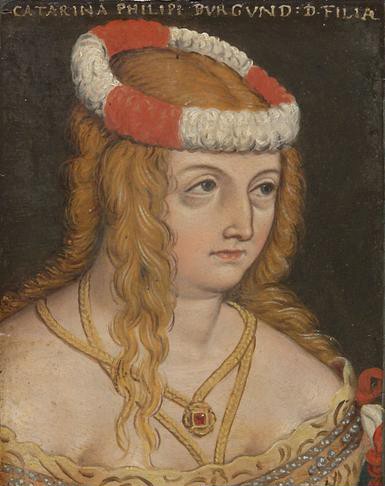
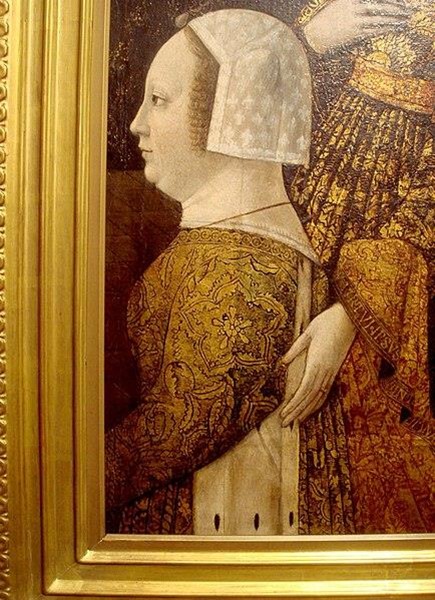
    Many people hate Henry and I do not in any way admire him but he is nonetheless fascinating.
    Sharon: Who is your least favourite Tudor and why?

    Judith: I hate to say it but I think it is Jane Seymour. Not because of modern day perceptions of her as a home wrecker but simply because unlike the other queens, she does not emerge from the historical record as a fully rounded character. Even though she is often regarded as Henry’s greatest love, it is quite likely he would have moved on if he’d had time to grow tired of her. She is a  bit yawny. The only extant historic item to provide a glimmer of her inner self is her splendid portrait. (which incidentally is on the cover of my non-fiction book about Tudor clothing, How to Dress Like A Tudor.)

    Jane seems quite plain to our eyes, chubby face, cheesy-green skin tone which probably has more to do with the age of the painting than Jane herself. I suppose, after Anne, anyone would seem dull and we shouldn’t really compare them. If she’d had longer to make a personal dent in history I am sure I would feel differently but the only time I have felt a spark of interest in her is Hilary Mantel’s portrayal in Bring Out the Bodies. But that is fiction and Hilary was a genius.

    Sharon: How do you approach researching your topic?

    Judith: I’ve been researching in one way or another for donkey’s years but it wasn’t until I went to uni that I learned how to do it properly. I’ve been writing in roughly the same era for so long that I no longer need to research as deeply I used to. When I first began I had to know everything about Tudor life, customs, clothing, diet, housing, social niceties but now it is more a case of refreshing my knowledge. I usually write in the first person and I make a point of reading several different biographies of my subject, both contemporary and modern accounts to get a rounded picture.

    As I said previously, I usually opt for ‘difficult’ characters so I read both sides of the matter, question everything and make a timeline of their lives, marking where they were and when so I can follow as close as possible in their footsteps.

    But I always bear in mind that both primary and secondary accounts will be biased one way or another. There are very few first-person historical accounts (Oh how I’d love a secret diary of Margaret Beaufort to be discovered) so I can only surmise their inner thoughts by careful study of recorded reactions to events.

    For instance, the death of Katherine and Henry’s children. We always hear how dreadful it must have been for her to watch her offspring die, and indeed it must have been. But they were Henry’s children too. His devastation must have been equal to Katherine’s. His grief would have matched his anger at God for depriving him of an heir. Of course, he hid it, he was very proud but I can imagine the death of each child increased his already burgeoning terror that he might fail to beget a son.

    But sorry, I digress. Once I have sketched the outline of the story, I put aside the huge pile of research books I’ve accumulated and let my imagination take over. During the revision process I frequently return to my research to see where or if I have diverted – sometimes I correct it, but if it adds to the drama I don’t delete the scene but I make a note of the diversion in the authors’ note.

    Sharon: Tell us your ‘favourite’ Wars of the Roses story you have come across in your research.

    Wordly Women

    Judith: I’ve read historical fiction since I was a girl. I always sided with York (don’t shoot me!) and enjoyed books that portrayed women like Maguerite of Anjou and Margaret Beaufort as evil intentioned. Until relatively recently, any woman that stepped from her prescribed role was viewed negatively. As a young girl I never even questioned it but these days I am more neutral. I am old enough to realise that evil is in the eye of the beholder and things just aren’t black and white.

    I still enjoy books set in the era but I no longer take up arms. As in any conflict there is good and bad on both sides.

    It wasn’t until I began to read in this unbiased way that I even considered questioning Marguerite of Anjou’s portrayal in both fiction and non-fiction. She really wasn’t liked then and neither is she now. Shakespeare didn’t help by naming her as the ‘she-wolf’. But when you consider the whole York/Lancaster war from her point of view, the story changes.

    She is an anointed queen, her incompetent husband goes a bit crazy, York comes strutting into court demanding to be regent when she has proven herself perfectly capable in the role but, of course, she is a woman, and a French woman at that! York then names her child illegitimate and somehow has him ousted from succession.

    It is no wonder she was miffed!

    Marguerite fought valiantly and tirelessly for her son’s rights until his death at Tewkesbury and there was nothing left to fight for. I rather admire that. Ok, some atrocities were carried out in her name, her ungoverned armies won her few friends but York and his contemporaries also carried out atrocious acts. The murder of Henry VI by Edward IV, the drowning of Clarence in the Tower. I could provide more examples.

    Atrocities happen in war.

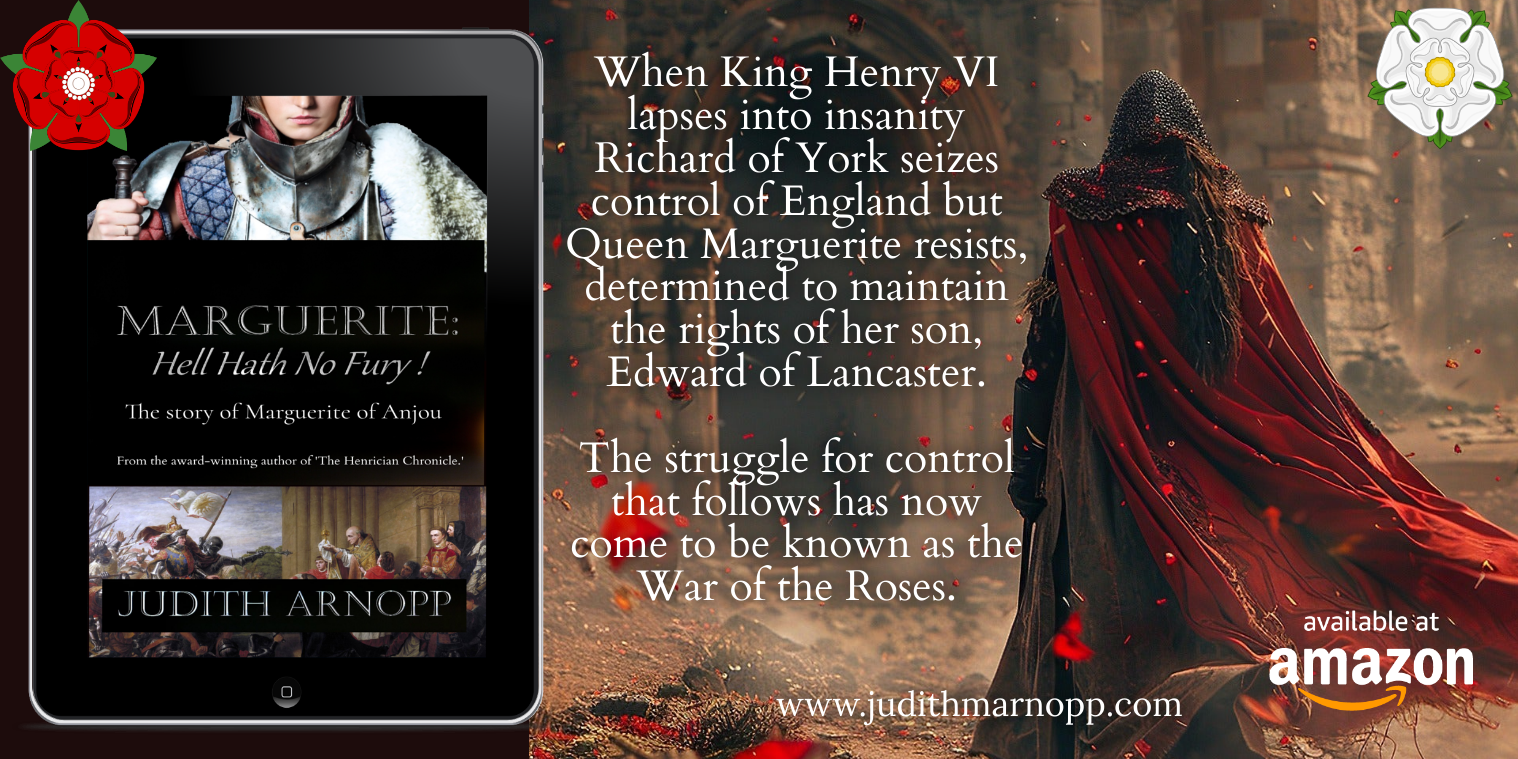
    The injustices heaped upon Marguerite, coupled with the slurs that are still being spoken against her today inspired me to write her story but do not worry, I have not turned her into a saint. In my book, Marguerite: Hell Hath No Fury! you will encounter a young French girl who arrives in England to marry the king as part of the peace process at the end of the hundred years war. She is hated and reviled as a ‘foreigner’ from the start, saddled with an incompetent king, expected to produce an heir yet when she does, they name her an adulteress and her son a bastard.

    As the long fight for justice continues, she is often rash, ungoverned, unwise. She grows angrier, and toward the end perhaps a little mad, but she fights tirelessly until she has nothing left worth fighting for. In judging Marguerite we should use the same rules as when judging her male counterparts.

    Sharon: Tell us your least ‘favourite’ Wars of the Roses story you have come across in your research.

    Wordly Women

    Judith: I don’t really have a ‘least favourite’. As a historian I try to remain objective so I am not squeamish when it comes to the murders and betrayal. If anything, the worse the story is, the more fascinating I find it.

    It is important, imperative even, to view events from the perspective of the era. I am always impatient to hear Edmund Tudor derided as a child molester because of Margaret’s age when Henry VII was conceived. It may have raised a few eyebrows at the time but there is nothing in the record to suggest she was unwilling. Margaret was not alone, it was not unheard of and other women of the era also married and gave birth at a young age. Margaret always looked kindly on Edmund and in her will, requested to be buried with him rather than any of her other spouses. Her request was ignored and she lies in splendour at Westminster Abbey but her wish to be with Edmund suggests to me that she thought well of him and held no grudge, so why should we?

    I try to keep a neutral opinion until the times comes to start writing and assume the persona of my chosen subject. As far as I am concerned, the more shocking the event, the better.

    I am often so consumed by the subject of my novel that it prevents me from sleeping. The characters linger in my head for long after I’ve published and Henry has been the worst one for that. It is getting on for three years since the final volume of The Henrician Chronicle was published and he is still lurking but then, I guess it is to be expected as he always was an attention seeker.

    Sharon: Are there any other eras you would like to write about?

    Judith: Most of my books are set in transitional periods. I began my career writing about the Norman invasion, focusing on the problems regime changes bring. I covered the dissolution of the monasteries and the Reformation in Sisters of Arden, an era that was also life changing to the people of England. The war of the roses is similarly ‘transitional’ and there are still historical figures I’ve not yet covered. I quite fancy the glorious revolution and I’ve read a lot of novels set in and around WWI and WWII but I am too old now to carry out the research required to write in that era. It will be better to stick where I am, safe in the very dangerous world that I know.

    Sharon: What are you working on now?

      Judith: Marguerite: Hell Hath No Fury! was only published a short time ago and I am supposed to taking a few months off to rest. However, I have begun to play with something else. I have written a few chapters but am still finding my feet. Rather like The Book of Thornhold that jumps through several eras of history, it is about a place, rather than any particular period. The focus is on the history of the building, the people who lived there and the events that left a mark. Layers of history that build a transparency of events that shaped the building into what it is today. This of course, makes for a lot of research and the resulting book will be very hard to market but I’ve always been a glutton for punishment.

      Sharon: And finally, what is the best thing about being a writer?

        Judith: Oh, now there’s a question. It is very hard being a writer just now. It is all very fine when sitting in my own home, losing myself in time while tapping out fabulous stories but in recent years, marketing has become a living nightmare!

        When I first began, around 2004, it was fun but now my mailbox in overflowing with faux promoters, faux publishers, tic-tockers, all demanding money for promises they either cannot fulfil or have no intention of delivering. It is no longer possible to know who to trust. There is also AI to deal with – a constant battle … AI stole our intellectual property for training purposes and is now putting the authors it stole from, and illustrators out of work …  but I will leave it there, you asked what the best thing is…

        For me it is the camaraderie with fellow authors, the mutual support, the back slapping, the advice, the encouragement. We may never meet face to face but authors understand things that non-writers can’t. I couldn’t do without them and neither could I continue to work without my readers. I appreciate every reader who takes the time to email to say how much they enjoy my work, the ones who go the extra mile of leaving a wonderful review or recommend my books to others. Like most authors, I need constant reassurance that I am doing ok. When the praise stops, the words falter and I am in danger of wandering away from my desk.

        I am solitary by nature and writing is a lonely place but it pleases me to look up from my work and rediscover the wonderful view from my house that looks over Cardigan Bay. I save the few thousand words I have added to my wip, close my laptop and spend the rest of the day either gardening or walking on the beach or restoring my antique doll’s houses. Sometimes it is hard to believe that this is my job – I’ve no lengthy commute, no office clique to deal with, no rules. I may not be a big-name author but I love writing and I love my readers, and judging from their emails, they love me in return. I am grateful that they buy my books and keep me from penury. I am the author of my own life and that is just perfect.

        About the Author:

        Wordly Women

        Judith Arnopp’s novels are set during the War of the Roses and the Tudor era. They focus on women like Margaret Beaufort, Anne Neville, Elizabeth of York, Anne Boleyn, and Mary Tudor.

        She has a Master’s degree in medieval studies and a BA in English and creative writing from the University of Wales, making Historical Fiction the obvious career choice. She lives on the coast of West Wales with her husband, John, and now her family have flown the nest she writes full time from her home overlooking Cardigan Bay. Her early books were set in the Anglo-Saxon period but since switching to the Wars of the roses and Tudor era her career has flourished and she now has a substantial collection of titles in her catalogue. All books are available on Kindle and in paperback, some are on Audible.

        Judith also writes non-fiction, her most recent published by Pen and Sword is a study of Tudor clothing and fashion, How to Dress Like a Tudor. Her work features in several anthologies and magazines.

        You can find more information on http://www.judithmarnopp.com and follow her blog on http://www.juditharnoppnovelist.blogspot.co.uk and most social media platforms.

        She runs a small seaside holiday let in Aberporth and when she has time for fun, likes to garden and restore antique doll’s houses. You can find her on most social media platforms.

        Her novels include:

        A Daughter of Warwick: the story of Anne Neville, Queen of Richard III; Marguerite: Hell Hath No Fury! the story of Marguerite of Anjou; A Song of Sixpence: the story of Elizabeth of York; The Beaufort Chronicle: the life of Lady Margaret Beaufort (three book series); A Matter of Conscience: Henry VIII, the Aragon Years (Book One of The Henrician Chronicle); A Matter of Faith: Henry VIII, the Days of the Phoenix (Book Two of The Henrician Chronicle); A Matter of Time: Henry VIII, the Dying of the Light (Book Three of The Henrician Chronicle); The Kiss of the Concubine: a story of Anne Boleyn; Sisters of Arden: on the Pilgrimage of Grace; The Winchester Goose: at the court of Henry VIII; Intractable Heart: the story of Katheryn Parr; The Heretic Wind: the life of Mary Tudor, Queen of England; Peaceweaver; The Forest Dwellers; The Song of Heledd; The Book of Thornhold

        Non-Fiction

        How to Dress Like a Tudor (Pen & Sword Books)

        Where to find Judith: Webpage; Amazon Author Page; Blog; Facebook; Twitter; Threads; Blue sky

        *

        My Books:

        Signed, dedicated copies of all my books are available through my online bookshop.

        Out now: Scotland’s Medieval Queens

        Books by Sharon Bennett Connolly

        Scotland’s history is dramatic, violent and bloody. Being England’s northern neighbour has never been easy. Scotland’s queens have had to deal with war, murder, imprisonment, political rivalries and open betrayal. They have loved and lost, raised kings and queens, ruled and died for Scotland. From St Margaret, who became one of the patron saints of Scotland, to Elizabeth de Burgh and the dramatic story of the Scottish Wars of Independence, to the love story and tragedy of Joan Beaufort, to Margaret of Denmark and the dawn of the Renaissance, Scotland’s Medieval Queens have seen it all. This is the story of Scotland through their eyes.

        Scotland’s Medieval Queens gives a thorough grounding in the history of the women who ruled Scotland at the side of its kings, often in the shadows, but just as interesting in their lives beyond the spotlight. It’s not a subject that has been widely covered, and Sharon is a pioneer in bringing that information into accessible history.’ Elizabeth Chadwick (New York Times bestselling author)

        Available now from Amazon and Pen and Sword Books

        Also by Sharon Bennett Connolly:

        Books by Sharon Bennett Connolly

        Heroines of the Tudor World tells the stories of the most remarkable women from European history in the time of the Tudor dynasty, 1485-1603. These are the women who ruled, the women who founded dynasties, the women who fought for religious freedom, their families and love. Heroines of the Tudor World is now available for pre-order from Amberley Publishing and Amazon UK. Women of the Anarchy demonstrates how Empress Matilda and Matilda of Boulogne, unable to wield a sword themselves, were prime movers in this time of conflict and lawlessness. It shows how their strengths, weaknesses, and personal ambitions swung the fortunes of war one way – and then the other. Available from Bookshop.orgAmberley Publishing and Amazon UKKing John’s Right-Hand Lady: The Story of Nicholaa de la Haye is the story of a truly remarkable lady, the hereditary constable of Lincoln Castle and the first woman in England to be appointed sheriff in her own right. Available from all good bookshops Pen & Sword Booksbookshop.org and Amazon

        Royal Historical Society

        Defenders of the Norman Crown: The Rise and Fall of the Warenne Earls of Surrey tells the fascinating story of the Warenne dynasty, from its origins in Normandy, through the Conquest, Magna Carta, the wars and marriages that led to its ultimate demise in the reign of Edward III. Available from Pen & Sword BooksAmazon in the UK and US, and Bookshop.orgLadies of Magna Carta: Women of Influence in Thirteenth Century England looks into the relationships of the various noble families of the 13th century, and how they were affected by the Barons’ Wars, Magna Carta and its aftermath; the bonds that were formed and those that were broken. It is now available in paperback and hardback from Pen & SwordAmazon, and Bookshop.orgHeroines of the Medieval World tells the stories of some of the most remarkable women from Medieval history, from Eleanor of Aquitaine to Julian of Norwich. Available now from Amberley Publishing and Amazon, and Bookshop.orgSilk and the Sword: The Women of the Norman Conquest traces the fortunes of the women who had a significant role to play in the momentous events of 1066. Available now from Amazon,  Amberley Publishing, and Bookshop.org.

        Alternate Endings: An anthology of historical fiction short stories including Long Live the King… which is my take what might have happened had King John not died in October 1216. Available in paperback and kindle from Amazon.

        Podcast:

        A Slice of Medieval

        Have a listen to the A Slice of Medieval podcast, which I co-host with Historical fiction novelist Derek Birks. Derek and I welcome guests, such as Bernard Cornwell and Elizabeth Chadwick, and discuss a wide range of topics in medieval history, from significant events to the personalities involved.

        Every episode is also now available on YouTube.

        *

        Don’t forget! Signed and dedicated copies of all my books are available through my online bookshop.

        For forthcoming online and in-person talks, please check out my Events Page.

        You can be the first to read new articles by clicking the ‘Follow’ button, liking our Facebook page or joining me on TwitterThreadsBluesky and Instagram.

        *

        ©2025 Sharon Bennett Connolly FRHistS and Judith Arnopp

        Wordly Women: Cathie Dunn

        History...the Interesting Bits

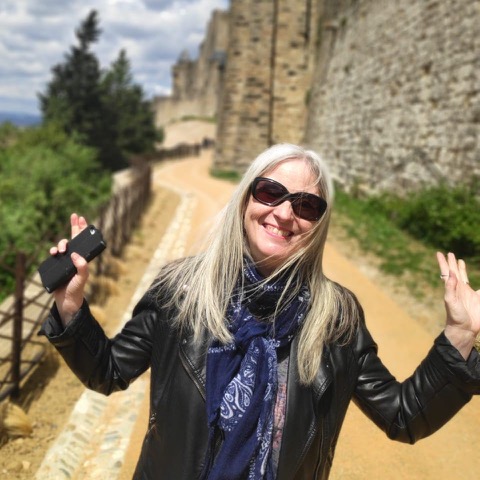
        Time for another edition of Wordly Women! It has been great fun, meeting all these amazing authors. I do hope everyone is enjoying it as much as I am. Today, I want to introduce you to a very dear friend, historical novelist Cathie Dunn. Cathie and I have known each other a good few years on Facebook, so much so that the first time we met in real life, there was no awkwardness. I love that about social media!

        So, let me introduce you to Cathie!

        Sharon: Hi, Cathie, first things first, what got you into writing?

        Cathie: Ooh, that takes me back decades! It was the romantic historical novels by the likes of M.M. Kaye, Victoria Holt / Philippa Carr (Eleanor Burford’s pseudonyms), in my late teens that got me hooked. I loved Ms Holt’s gothic romance novels in particular, at the time. They were so atmospheric, and – growing up in Germany – I loved the vision of historic and haunted English manors. During the late 1990s and 2000s, after my move to the UK, I learnt a lot about how to create a compelling plot, within a realistic historical setting, by devouring novels by Helen Hollick, Elizabeth Chadwick, and Barbara Wood, amongst others. It was enough to make me embark on HE Certificate in Creative Writing (online) at Lancaster University (though at the time, I was the only one on the course who wrote historical fiction). But at least, it provided me with deeper insights into the writing craft.

        Sharon: Tell us about your books.

        Cathie: I started off with a project which went from romance to murder mystery to spy novel to (supposedly) a series of events set during the Anarchy – one of my favourite eras. To date, Dark Deceit is an undefined mix, which I’ll need to untangle at some point in time.

        Sharon: Yes please! I want to read it!

        Cathie: In 2009, I took part in NaNoWriMo, working on a Scottish romance set after the 1715 Jacobite rebellion. I used real locations and studied the background history in depth – too much for traditional romance publishers, who duly rejected it. Fortunately, Highland Arms was picked up by a fabulous US indie press, and my path was clear! I later wrote a second Scottish romance, A Highland Captive, set during the Wars of Independence.

        After my move from Scotland to France, my focus changed to medieval French history, with a dual-timeline mystery inspired by my surroundings. Love Lost in Time delves into the distant past of the county of Carcassonne. And the novel immortalised a young cat I lost too soon, Shadow.

        Next, I wrote a novel set at the court of Louis XIV. The Shadows of Versailles deals with a dark side of the otherwise glittering court: the Affair of the Poisons. It may be too dark for some readers, as it contains disturbing scenes of child abductions and black masses. Tragically, it’s all based on real, credible accounts of the time. Researching history can be revolting, at times.

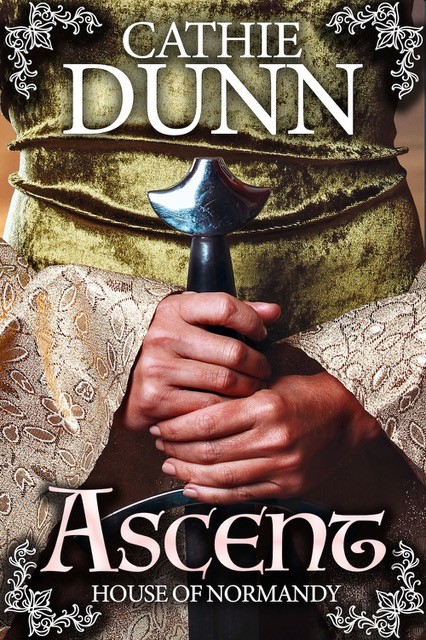
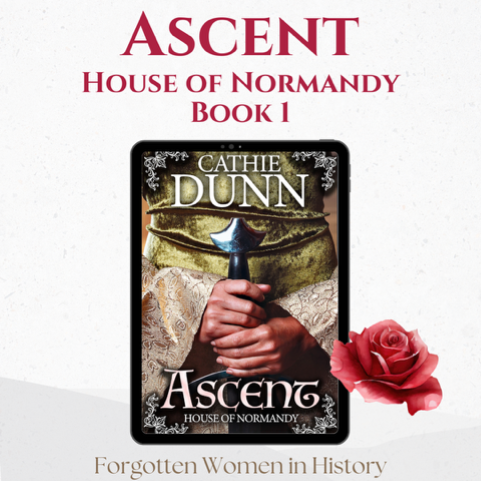
        After that serious topic, I needed a more positive distraction, and I promptly delved into the foundation years of Normandy, a county I love. Ascent tells the forgotten story of Poppa of Bayeux. Everyone with a TV now knows her more danico husband – Rollo – but who was the mother of his children? Sadly, she was overlooked in the recent series, Vikings. Ascent tells her (fictionalised) story.

        Sharon: What attracts you to the early medieval period?

        Cathie: It was an era of great change, all across the British Isles and the European continent. The old ways and beliefs had been discarded, to make way for a Church growing in political influence, and it all makes for fascinating research. New hierarchies were formed amidst a continuing power struggle between different families. As the appointments of ‘nobility’ grew into fashion, so did the influence of favourites and allies on rulers. It was a fascinating time.

        Sharon: Who is your favourite early medieval character and why?

        History...the Interesting Bits
        Image of the statue of Poppa of Bayeux, Bayeux – Photochrom Print Collection

        Cathie: Ooh, that’s a tricky one. There are so many real people we know little about, especially women.

        (So, a big *Thank You* to you for shining a light on them with your brilliant books!)

        I do think Poppa of Bayeux deserves a lot more credit. She had to deal with so many challenges – married to a marauding stranger who was likely a decade or two older, and a Pagan; bearing his children; fleeing with him to Anglia; returning to see his power increase, while she is quietly forgotten. I quite like her to be my favourite early medieval character.

        Charles Martel is another. He was a fascinating man, paving the way for a greater Frankish kingdom with his conquests across what is now France. Whilst most people know his grandson, Charlemagne, without Charles, Charlemagne’s ascent in the political sphere of central Europe would not have been possible. Was Charles likeable? Hm, I’m not sure. We know he was ruthless, efficient, and a capable leader of men. Did he have time to be nice? Perhaps that’s a question for another writing project…

        Sharon: Who is your least favourite early medieval character and why?

        Cathie: That would probably be Charles the Fat, Carolingian King of the Franks and Holy Roman Emperor for a few years in the 880s. He was ineffective, and hopeless at controlling different sections of his empire. He was deposed and died in early 888, and the crown went to Odo of Paris. The Carolingian dynasty was restored after Odo’s reign, though the crown of Frankia went back and forth for a while. This is the era Ascent is set in, and it made for intriguing research.

        The real Rollo surely had his work cut out, having to deal with all these changing rulers and their agendas.

        Sharon: How do you approach researching your topic?

        Cathie: I love history books. I think by now I own more history books than novels! Usually, I start with checking online resources. Jstor is a useful site, where you can read a number of articles for free each month; Medievalists.net is another helpful resource.

        But most online sites just give you only an overview, so you need to check books that focus on the relevant era. I have an array of history books on early, high & late medieval England, Tudor England, and medieval & Jacobite Scotland on my shelves. For my France-based novels, I consult non-fiction books in French, many of which I find (handily!) in second-hand bookshops. I also use German resources, where needed.

        I find that having a range of resources from different countries to consult is the best way to get a fair overview of historic events. We know that original sources were often (though not always) based on what rulers wanted the rest of the world to know – that being not necessarily the full truth. The winner records history in his favour. So, drawing from sources in different languages adds to the experience in discovering the past.

        Sharon: That is so true!

        Sharon: Tell us your ‘favourite’ medieval story you have come across in your research.

        History... the Interesting Bits
        Image of Albrecht Dürer’s painting of Charlemagne

        Cathie: Unfortunately, it is difficult to find credible stories about early medieval characters, unless they were major players like Charlemagne, due to the loss (or deliberate omission) of references for lesser-known individuals.

        Therefore, I’ve chosen Charlemagne’s wives and concubines as a story I find entertaining, and enlightening! I mean – how on earth did the man have the time to marry four times, have several concubines after the death of his last wife (and possibly before) – and father an estimated twenty (20!) children? His court was always travelling across his ever-expanding realm (and later, his empire), though it is said that his main seat at Aachen (Aix-la-Chapelle) became his favourite.

        He insisted his illegitimate children were raised alongside his legitimate offspring, ensuring they all received an education deserving of their Royal bloodline. After his son Pepin’s untimely death, he even took his grandchildren in to be educated with the others.

        This is a fact I recently discovered, and now I’m curious to find out more! With daughters, and especially illegitimate ones, usually being swept off into marriage or convents, his insistence that they are all educated is telling. Clearly, here was a man who valued learning – be that in practical skills or reading and writing.

        For a man who ruthlessly expanded his territories, responsible for subjugation of peoples and a great number of deaths ranging from Germanic Saxony to the Iberian Peninsula, this shows an entirely different side of the ‘great Charles’.

        Sharon: Tell us your least ‘favourite’ medieval story you have come across in your research.

        Cathie: That has to be Charlemagne’s darkest episode – the subjugation of Germanic Pagan tribes in Saxony. The wars lasted – on and off – for three decades, and they were brutal. The Saxons did not give in easily, much to Charlemagne’s frustration, and their conversion to Christianity was slow. Their skirmishes into his territory vexed him immensely.

        Eventually, according to the Royal Frankish Annals, the infamous ‘Blood Court’ massacre at Verden, in October 882, saw the execution of approx. 4,500 Saxon ‘rebels’ captured after recent battles. Their leader, Widukind, had managed to flee north.

        Although later historians disputed the figure quoted in the annals, with several trying to make ridiculous excuses for Charlemagne’s actions, there seems to have been a great slaughter of thousands of prisoners, regardless. Charlemagne wanted to set an example, an effective deterrent.

        Warfare continued for three more years, then it was all over for the Saxons, especially after Widukind converted to Christianity. But it was the massacre at Verden that remained like a blood stain on his otherwise pristine reputation.

        Sharon: Are there any other eras you would like to write about?

        Cathie: I do love different eras, as you know. The Anarchy is definitely high on my list, and I’ll have to revisit Dark Deceit to see where it takes me. (Sharon: Do it! Please!)

        But I also love the court of Louis XIV of France, with all its superficial splendour and dark secret plots. The Affair of the Poisons is such an intriguing event, with many prolific nobles implicated in trying to influence the king’s opinion through nefarious deeds. Deeply disturbing, and utterly fascinating.

        And then, of course, is the time of the Scottish Wars of Independence. It wasn’t easy to mess with a remarkable, power-hungry king like Edward I! (Sharon: Ooh, yes!)

        But, ultimately, it’s the late Dark Ages (do we still call it that, as they weren’t really that dark?) and early Middle Ages that keep me hooked. Oh, to travel to Frankia for one day only…

        Sharon: What are you working on now?

        Cathie: My current WIP is called Treachery, and it’s the story of Sprota the Breton, handfasted wife of William Longsword – Poppa’s and Rollo’s son. Like his father and his two wives, William married Sprota in more danico (in the Danish custom), and Luitgarde of Vermandois in a proper Church blessing, for political reasons.

        Even less is known of Sprota than of Poppa; mainly that she was mother to William’s only son, Richard, likely the first Duke of Normandy. (Rollo and William never were dukes.) I introduced her towards the end of Ascent, when she had to flee to Bayeux as William’s enemies closed in on him at his fortress in Fécamp. Following William’s assassination by Count Arnulf of Flanders in 842, Sprota had to remarry to keep her young son’s inheritance secure. And to ensure his safety!

        Her responsibility as the mother of William’s heir, and her struggles for them to survive, make for an intriguing story. So many powerful men had set their sights on Normandy, wanting Richard out of the way. I hope to do Sprota justice, as, again, she has been forgotten in time.

        The third and final instalment of my House of Normandy trilogy about the early ladies of Normandy will conclude in Reign, about Richard’s second wife (and previous lover), Gunnora.

        Then there’s Poppa’s daughter Adela, married to the Count of Poitou. Perhaps a companion novel? 😉 Sigh…

        Sharon: And finally, what is the best thing about being a writer?

        Cathie: Exploring past histories is utterly fascinating, and I can only recommend it. That goes for the good and the bad we discover in our research.

        Reliving the distant past is fun, but also a great responsibility, as we should stay as close to the few known facts as possible. An ogre can’t just turn into a Prince Charming, although looking at Charlemagne, he definitely had two sides to his character – the caring father interested in learning and culture, and ruthless ruler chopping off heads of his prisoners. A man of his times. But what about his women? (Cathie, behave! One novel at a time…)

        And though my earlier works focused more on events and fictional characters, I now find it far more rewarding to bring forgotten women from the distant past back to life, even ‘just’ in fictionalised format. Their stories must be told.

        Thank you again for letting me ramble on about my research and writing. It’s been fabulous revisiting my stories, and the real characters involved in them, and I hope your readers enjoy my interview.

        Sharon: Cathie, thank you so much! It has been a pleasure! No wonder you and I get on so well!

        About the Author:

        Cathie Dunn is an Amazon-bestselling author of historical fiction, dual-timeline, mystery, and romance. She loves to infuse her stories with a strong sense of place and time, combined with a dark secret or mystery – and a touch of romance. Often, you can find her deep down the rabbit hole of historical research…

        In addition, she is also a historical fiction book promoter with The Coffee Pot Book Club, a novel-writing tutor, and a keen book reviewer on her blog, Ruins & Reading.

        After having lived in Scotland for almost two decades, Cathie is now enjoying the sunshine in the south of France with her husband, and her rescued pets, Ellie Dog & Charlie Cat.

        She is a member of the Historical Novel Society, the Richard III Society, the Alliance of Independent Authors, and the Romantic Novelists’ Association.

        Where to find Cathie:

        Website: Amazon; Facebook Author Page; Twitter / X; Bluesky.

        To Buy Cathie’s books: Ascent: Love Lost in Time

        *

        My Books:

        Signed, dedicated copies of all my books are available through my online bookshop.

        Out now: Scotland’s Medieval Queens

        Books by Sharon Bennett Connolly

        Scotland’s history is dramatic, violent and bloody. Being England’s northern neighbour has never been easy. Scotland’s queens have had to deal with war, murder, imprisonment, political rivalries and open betrayal. They have loved and lost, raised kings and queens, ruled and died for Scotland. From St Margaret, who became one of the patron saints of Scotland, to Elizabeth de Burgh and the dramatic story of the Scottish Wars of Independence, to the love story and tragedy of Joan Beaufort, to Margaret of Denmark and the dawn of the Renaissance, Scotland’s Medieval Queens have seen it all. This is the story of Scotland through their eyes.

        Scotland’s Medieval Queens gives a thorough grounding in the history of the women who ruled Scotland at the side of its kings, often in the shadows, but just as interesting in their lives beyond the spotlight. It’s not a subject that has been widely covered, and Sharon is a pioneer in bringing that information into accessible history.’ Elizabeth Chadwick (New York Times bestselling author)

        Available now from Amazon and Pen and Sword Books

        Also by Sharon Bennett Connolly:

        Books by Sharon Bennett Connolly

        Heroines of the Tudor World tells the stories of the most remarkable women from European history in the time of the Tudor dynasty, 1485-1603. These are the women who ruled, the women who founded dynasties, the women who fought for religious freedom, their families and love. Heroines of the Tudor World is now available for pre-order from Amberley Publishing and Amazon UK. Women of the Anarchy demonstrates how Empress Matilda and Matilda of Boulogne, unable to wield a sword themselves, were prime movers in this time of conflict and lawlessness. It shows how their strengths, weaknesses, and personal ambitions swung the fortunes of war one way – and then the other. Available from Bookshop.orgAmberley Publishing and Amazon UKKing John’s Right-Hand Lady: The Story of Nicholaa de la Haye is the story of a truly remarkable lady, the hereditary constable of Lincoln Castle and the first woman in England to be appointed sheriff in her own right. Available from all good bookshops Pen & Sword Booksbookshop.org and Amazon

        Royal Historical Society

        Defenders of the Norman Crown: The Rise and Fall of the Warenne Earls of Surrey tells the fascinating story of the Warenne dynasty, from its origins in Normandy, through the Conquest, Magna Carta, the wars and marriages that led to its ultimate demise in the reign of Edward III. Available from Pen & Sword BooksAmazon in the UK and US, and Bookshop.orgLadies of Magna Carta: Women of Influence in Thirteenth Century England looks into the relationships of the various noble families of the 13th century, and how they were affected by the Barons’ Wars, Magna Carta and its aftermath; the bonds that were formed and those that were broken. It is now available in paperback and hardback from Pen & SwordAmazon, and Bookshop.orgHeroines of the Medieval World tells the stories of some of the most remarkable women from Medieval history, from Eleanor of Aquitaine to Julian of Norwich. Available now from Amberley Publishing and Amazon, and Bookshop.orgSilk and the Sword: The Women of the Norman Conquest traces the fortunes of the women who had a significant role to play in the momentous events of 1066. Available now from Amazon,  Amberley Publishing, and Bookshop.org.

        Alternate Endings: An anthology of historical fiction short stories including Long Live the King… which is my take what might have happened had King John not died in October 1216. Available in paperback and kindle from Amazon.

        Podcast:

        A Slice of Medieval

        Have a listen to the A Slice of Medieval podcast, which I co-host with Historical fiction novelist Derek Birks. Derek and I welcome guests, such as Bernard Cornwell and Elizabeth Chadwick, and discuss a wide range of topics in medieval history, from significant events to the personalities involved.

        Every episode is also now available on YouTube.

        *

        Don’t forget! Signed and dedicated copies of all my books are available through my online bookshop.

        For forthcoming online and in-person talks, please check out my Events Page.

        You can be the first to read new articles by clicking the ‘Follow’ button, liking our Facebook page or joining me on TwitterThreadsBluesky and Instagram.

        *

        ©2025 Sharon Bennett Connolly FRHistS and Cathie Dunn

        Wordly Women: Susan Abernethy

        When I started writing my blog way back in 2015, Susan Abernethy already had a successful website telling the stories from History. Despite that, she never saw me as competition. Susan offered me advice and encouragement. And I will never forget that. So, today, it is so nice to be able to pay a little of that back by welcoming Susan to my author spotlight series, Wordly Women, to tell us a little of her writing journey – and about her two books, the second of which, The Formidable Women who Shaped Medieval Europe: Power and Patronage at the Burgundian Court, hits the shops at the end of October.

        Welcome Susan!

        Sharon: So, What got you into writing?

        Susan: A friend of mine from high school started a women’s history blog in 2012 and put out a call for someone to join her in writing articles. I didn’t even know if I could write but I answered and wrote an article on Queen Emma of Normandy. It got a really good reception, and the writing took off from there. Later, I decided it would be good to write not only about women, but other topics in history and so The Freelance History Writer blog began.

        Sharon: Tell us about your books.

        History ... the Interesting Bits

        Susan: Many years ago, I found the books of Jean Plaidy in the library and read every one I could get my hands on. This included The Merry Monarch’s Wife, about Catherine of Braganza, wife of King Charles II. When I started the blog in 2012, one of my plans was to write an article about every Queen of England. While doing some research on Catherine of Braganza, it seemed like there wasn’t a great deal of information about her available, especially in English. It turned out most of the biographies were old, published in 1915 and in the 1930’s and 40’s.

        Also, people, including myself, believed Catherine was miserable and nearly forgotten because of her unfaithful husband and his glamourous mistresses. I wondered if this was true. Having very little knowledge of Portuguese history, I ended up reading dozens of history books about the country and their seaborne empire, which is pretty fascinating stuff. This research was necessary to put Catherine in historical context and to explain why the ports of Tangier and Bombay were included in her dowry.

        So the adventure began. Charles II’s Portuguese Queen: The Legacy of Catherine of Braganza is my debut book which was published in April 2025 in the UK and June 2025 in the US.

        The second book is called The Formidable Women Who Shaped Medieval Europe: Power and Patronage in the Burgundian Court. This is the result of a mountain of research beginning with an article about Isabel of Portugal. She was the daughter of King John I of Portugal and his wife, Philippa of Lancaster, the daughter of John of Gaunt and Blanche of Lancaster and the only English queen of Portugal.

        Isabel, at the age of thirty, married Philip the Good, the third Valois Duke of Burgundy and was the mother of the fourth duke, Charles the Bold. After reading biographies of Isabel and Charles, they seemed to me to be captivating characters, both strong and powerful. Charles also appeared to be a real character and possibly suffering from some kind of mental illness. After writing articles about both of them, I decided to delve further into Burgundian history, which covers the Low Countries, northern France and part of the Holy Roman Empire. Richard Vaughan wrote excellent biographies of all four of the Valois Dukes so that is where the research started.

        Philip the Bold, one of the greatest diplomats in his era, began a program of amassing an empire which included the marriages of his daughters, granddaughters, nieces and many others into various houses of Europe. This book is a collection of 31 women related to the Valois dukes by blood and marriage. It includes the wives of kings, dauphins, dukes, counts, and others along with a few queens and a queen regnant, even a saint. In telling their stories, you discover a great variety of history of many principalities of western Europe.

        Sharon: Is there a book you’ve read recently that influenced your research?

        Susan: A year or so ago, I read Sharon L Jansen’s book The Monstrous Regiment of Women: Female Rulers in Early Modern Europe. Her main point is that historical family trees basically only show the descendants of men. If the women are mentioned at all, it is as the wife or maybe the daughter if she married an important man. She says we need to look at the women and their connections, not just their husbands and children. How did they interact with other women? A total eye-opener for me, now I cannot look at history in any other way. It really guided me in the research and writing of my second book on the Valois royal and aristocratic women. Some of these women lived in luxurious comfort while others had to scrape and fight to keep their patrimonies from being wrested from them by powerful men.

        Sharon: This is soooooo true!

        Sharon: Who is your favorite historical person and why?

        History ... the Interesting Bits

        Susan: I have many favorites so it’s hard to choose one. Margaret of Austria, Regent of the Netherlands and Anne de Beaujeu, Duchess of  Bourbon and Regent of France, come to mind, both of whom are in the second book. But while I was researching the formidable women, I came across Catherine of Burgundy, Duchess of Austria and Countess of Ferrette, the daughter of Philp the Bold. Her life really captivated me for several reasons. When her father didn’t pay the balance of her dowry, she convinced her husband to give her the county of Ferrette, not just for the income but to rule on her own.

        Catherine took full advantage of this opportunity. She acted as diplomat for her brother, John the Fearless and her nephew Philip the Good. She engaged in feuds and even started a small conflict with the city of Basel. She must have had remarkable charisma and a forceful personality. But the best part is she made a marriage without the permission of her brother. I haven’t come across many women who did such a thing. She may have done it to have an ally for her feuds and to maintain her position as countess. But she also may have been in love with the man. When her nephew Philip forced her to back out of the marriage, she seems to have lost her will to live which is pretty sad. But she’s my current favorite medieval historical person.

        Sharon: Who is your least favorite historical person and why?

        History ... the Interesting Bits

        Susan: At the moment, I’m going to say Ferdinand of Aragon for several reasons. One the one hand, I have to admire his political acumen and diplomatic panache. In the era of Isabella of Castile, King Henry VIII, King Francis I and Holy Roman Emperor Charles V, he held his own. But his treatment of women is abominable.

        He appears to have navigated his relationship with Isabella really well. They were on equal footing and managed to share their responsibilities. But once Isabella was gone, he engaged in antics like marrying again to try to have another child to displace his daughter Juana as queen of Aragon, as well as not supporting his younger daughter Katherine of Aragon once her husband Arthur Tudor died. He also is responsible, along with her husband Philip as well as her son HRE Charles V, for spreading terrible rumors about Juana of Castile’s mental health and for her eventual captivity which lasted for 45 years. It’s not a pretty story.

        Sharon: How do you approach researching your topic?

        Susan: The process of research starts with reading. Lots of reading. After finding as many books as I can on my topic, I start reading and find more resources. This process also involves searches on the internet for sources. Then, I make notes from my reading. I treat each chapter of the book as if it were an extended post for my blog. The notes are combined into a narrative which then becomes a chapter, and the chapters are assimilated into the book.  

        Sharon: Tell us your ‘favourite’ story you have come across in your research.

        Susan: This is a good one! Many years ago, I read a turn of the century biography of Philippa of Hainault, queen of King Edward III of England. The king and queen arranged a marriage for their eldest daughter Isabella to Louis II, Count of Flanders, also known as Louis of Male. The author relates the story of how Louis jilted Isabella at the altar, fleeing to France to avoid the wedding ceremony. Louis had promised his ally, King Philip VI of France that he would marry Margaret, the middle daughter of the Duke of Brabant and he eventually did.

        Now Louis was not a faithful husband to Margaret and had something along the lines of 18 illegitimate children. Margaret was 7 years older than Louis. She gave birth to her daughter Margaret of Male in 1350 who eventually married the first Duke of Burgundy, Philip the Bold in 1369. Two years later, Countess Margaret deserted the court of Flanders to live in the country.

        The author of the biography of Philippa of Hainault casually mentions that Margaret, Countess of Flanders, ordered the nose of Louis’ mistress cut off after the mistress gave birth to twins. As a result of her injuries, the mistress died. She insinuates this was the reason for Margaret abandoning the court. This sensational story really piqued my curiosity, and I searched for the truth for a long time.

        Why did Margaret desert the Flemish court, something Belgian historians have debated for years? Did Louis abandon her? Did she abandon him? Was she mentally ill? Is there a history of mental illness in the House of Reginar of Brabant?

        It seems an unknown chronicler from Bruges, in 1430, is the instigator of the report of Margaret cutting off the nose of Louis’ lover. He wrote this sixty years after the alleged event. It is entirely possible he spoke with someone who knew the truth of the matter from oral tradition. It is also possible he made up the entire scenario. Since then, a chronicler restated the story in 1531, and popular historians have repeated it down through the ages. While there is still the possibility the story is true, it is highly unlikely, and these chroniclers may have had their own agenda in spreading the rumors.

        The stories of the jilting of Isabella, the marriage of Margaret of Brabant to Louis, Count of Flanders and her daughter Margaret of Male, wife of Philip the Bold, Duke of Burgundy, are all in the Formidable Women book.

        Sharon: Tell us your least ‘favourite’ story you have come across in your research.

        Susan: That has to be the story of Blanche II, Titular Queen of Navarre. Her father was King Juan II of Aragon, and her mother was Blanche I, Queen of Navarre. King Juan was crafty and sly and ruled Navarre by right of his wife. But once Blanche I died, a family feud ensued and King Juan did everything in his power to retain the governance of Navarre, even going so far as to ignore the rights of Blanche II and her brother Charles who had both gained the approval of the Cortes of Navarre as the legal heirs of Blanche I.

        This state of affairs lasted for years. Blanche II had been married to Enrique IV of Castile, but the marriage was not a happy one and eventually, the union was annulled and Blanche II returned to Aragon. Her father locked her up in prison to prevent her from gaining the throne of Navarre to which she was legally entitled. Blanche remained in prison from 1453 until her death under suspicious circumstances in December 1464.

        What makes this story even sadder is the fact that King Juan II of Aragon married again and had a son, Ferdinand of Aragon, who married Isabella of Castile and was the father of Queen Juana of Castile. In an eerie twist of fate, similar to Blanche II of Navarre, Ferdinand managed to declare his daughter Juana mentally unstable and locked her up for 45 years in Tordesillas. History repeats itself.

        Sharon: Are there any other eras you would like to write about?

        History ... the Interesting Bits

        Susan: My interest in the medieval, early modern and Renaissance eras is pretty passionate and I’ve been out of my element by writing about the Stuart era. But the Stuart’s need an update and more scrutiny. If I did look at a different era, it might be Italian medieval and Renaissance history, a subject I’ve tried to avoid for many years because I found it to be meandering and complicated. But recently, I’ve delved into the stories of women such as Bona of Savoy, who features in my second book, as well as Bianca Maria Visconti, mother of Bona’s husband, Galeazzo Maria Sforza, Duke of Milan, and Valentina Visconti, wife of Louis I, Duke of Orleans who was assassinated by John the Fearless, Duke of Burgundy. These are tremendous women’s stories and pique my interest for more.

        Sharon: What are you working on now?

        Susan: I’m currently in the research stage of writing a biography of Mary Beatrice d’Este, second wife of King James II of England. She was the sister-in-law of Catherine of Braganza and the only Italian Queen of England. This book will be along the same lines as the biography of Catherine.

        The research into Mary Beatrice brought up another intriguing subject. Her mother was Laura Martinozzi, Duchess of Modena, one of the many nieces of Cardinal Mazarin, the prime minister of Kings Louis XIII and XIV of France. Seems like another intriguing topic to look into.

        Sharon: What is the best thing about being writer?

        Susan: Having been an avid reader all my life, being a writer allows me to keep reading and to read about any topic that interests me. I love learning! I probably should have been a history teacher but never pursued it. By writing books and for the blog it allows me to educate people who are interested in the fascinating stories of history. My main goal is to get someone to read a book and hopefully enjoy the history as much as I do.

        About the Author:

        History ... the Interesting Bits

        Susan Abernethy’s passion for history dates back fifty years and led her to study for a Bachelor of Arts degree in history at the University of North Carolina at Charlotte. She is currently a member of the Rocky Mountain Medieval and Renaissance Association, the Society for Renaissance Studies and the Historical Association. Her work has appeared on several historical websites and in magazines and includes guest appearances on historical podcasts. Her blog, The Freelance History Writer, has continuously published over five hundred historical articles since 2012, with an emphasis on European, Tudor, Medieval, Renaissance, Early Modern and women’s history. She is currently working on her third non-fiction book.

        Buy the books:

        Charles II’s Portuguese Queen: The Legacy of Catherine of Braganza; The Formidable Women Who Shaped Medieval Europe: Power and Patronage in the Burgundian Court

        *

        My Books:

        Signed, dedicated copies of all my books are available through my online bookshop.

        Out now: Scotland’s Medieval Queens

        Books by Sharon Bennett Connolly

        Scotland’s history is dramatic, violent and bloody. Being England’s northern neighbour has never been easy. Scotland’s queens have had to deal with war, murder, imprisonment, political rivalries and open betrayal. They have loved and lost, raised kings and queens, ruled and died for Scotland. From St Margaret, who became one of the patron saints of Scotland, to Elizabeth de Burgh and the dramatic story of the Scottish Wars of Independence, to the love story and tragedy of Joan Beaufort, to Margaret of Denmark and the dawn of the Renaissance, Scotland’s Medieval Queens have seen it all. This is the story of Scotland through their eyes.

        Scotland’s Medieval Queens gives a thorough grounding in the history of the women who ruled Scotland at the side of its kings, often in the shadows, but just as interesting in their lives beyond the spotlight. It’s not a subject that has been widely covered, and Sharon is a pioneer in bringing that information into accessible history.’ Elizabeth Chadwick (New York Times bestselling author)

        Available now from Amazon and Pen and Sword Books

        Also by Sharon Bennett Connolly:

        Books by Sharon Bennett Connolly

        Heroines of the Tudor World tells the stories of the most remarkable women from European history in the time of the Tudor dynasty, 1485-1603. These are the women who ruled, the women who founded dynasties, the women who fought for religious freedom, their families and love. Heroines of the Tudor World is now available for pre-order from Amberley Publishing and Amazon UK. Women of the Anarchy demonstrates how Empress Matilda and Matilda of Boulogne, unable to wield a sword themselves, were prime movers in this time of conflict and lawlessness. It shows how their strengths, weaknesses, and personal ambitions swung the fortunes of war one way – and then the other. Available from Bookshop.orgAmberley Publishing and Amazon UKKing John’s Right-Hand Lady: The Story of Nicholaa de la Haye is the story of a truly remarkable lady, the hereditary constable of Lincoln Castle and the first woman in England to be appointed sheriff in her own right. Available from all good bookshops Pen & Sword Booksbookshop.org and Amazon

        Royal Historical Society

        Defenders of the Norman Crown: The Rise and Fall of the Warenne Earls of Surrey tells the fascinating story of the Warenne dynasty, from its origins in Normandy, through the Conquest, Magna Carta, the wars and marriages that led to its ultimate demise in the reign of Edward III. Available from Pen & Sword BooksAmazon in the UK and US, and Bookshop.orgLadies of Magna Carta: Women of Influence in Thirteenth Century England looks into the relationships of the various noble families of the 13th century, and how they were affected by the Barons’ Wars, Magna Carta and its aftermath; the bonds that were formed and those that were broken. It is now available in paperback and hardback from Pen & SwordAmazon, and Bookshop.orgHeroines of the Medieval World tells the stories of some of the most remarkable women from Medieval history, from Eleanor of Aquitaine to Julian of Norwich. Available now from Amberley Publishing and Amazon, and Bookshop.orgSilk and the Sword: The Women of the Norman Conquest traces the fortunes of the women who had a significant role to play in the momentous events of 1066. Available now from Amazon,  Amberley Publishing, and Bookshop.org.

        Alternate Endings: An anthology of historical fiction short stories including Long Live the King… which is my take what might have happened had King John not died in October 1216. Available in paperback and kindle from Amazon.

        Podcast:

        A Slice of Medieval

        Have a listen to the A Slice of Medieval podcast, which I co-host with Historical fiction novelist Derek Birks. Derek and I welcome guests, such as Bernard Cornwell and Elizabeth Chadwick, and discuss a wide range of topics in medieval history, from significant events to the personalities involved.

        Every episode is also now available on YouTube.

        *

        Don’t forget! Signed and dedicated copies of all my books are available through my online bookshop.

        For forthcoming online and in-person talks, please check out my Events Page.

        You can be the first to read new articles by clicking the ‘Follow’ button, liking our Facebook page or joining me on TwitterThreadsBluesky and Instagram.

        *

        ©2025 Susan Abernethy and Sharon Bennett Connolly FRHistS.

        Wordly Women: Gillian Bagwell

        History ... the Interesting Bits: Wordly Women
        Near Dunvegan Castle, Isle of Skye

        Time for another edition of Wordly Women! I am blown away by how receptive people have been to this little series and I am thoroughly enjoying having the chance to highlight the careers and writing experiences of the best of women writers in both history and and historical fiction. Today is another ‘fan girl’ edition as I get to chat with one of my favourite writers, Gillian Bagwell, who has written a wonderful novel about one of my Tudor Heroines, Bess of Hardwick.

        Sharon: Firstly, welcome Gillian, what got you into writing?

        Gillian: Both of my parents were writers, among other talents and accomplishments, interests, and they both read to my sisters and me a lot when we were kids, so I guess it seemed natural to write. I think I took my first writing class in junior high school. I’d had the idea for one of my novels (not yet published) long ago, and I recently discovered a story that I’d written based on that idea for that class when I was about thirteen. I’d forgotten about it.

        Sharon: Tell us about your books.

        Gillian: The three books that I have published are all based on the lives of real English women, two in the seventeenth century and one in the sixteenth century. My first novel, The Darling Strumpet, is based on the life of Nell Gwynn, one of the first English actresses and a longtime mistress of Charles II. She was a poor urchin who got her big break in life when Charles reopened the theatres soon after he was restored to the throne, and she got a job selling oranges. She caught the eye of Charles Hart, one of the leading actors, and he became her lover and mentor, teaching her to act, and they became an enormously popular duo onstage, with many “gay couple” (not as we use that phrase today!) comedies written specifically for them. Her career took place during one of the most amazing and important periods in the history of English theatre, when over the space of about fifteen years, performance practices went from Elizabethan/Jacobean to what remained essentially unchanged until the end of the nineteenth century.

        History ... the Interesting Bits: Wordly Women
        Experiencing the battlefield of Worcester

        I learned about Jane Lane, the heroine of my second novel, when I was researching Nell Gwynn. Her story isn’t much remembered now, but she played a big part in helping Charles escape after the disastrous Battle of Worcester in 1651, saving not only his life but likely the future of the monarchy. She had a pass to travel with a manservant, so he disguised himself and travelled hundreds of miles with her. There were notices all along their way offering a reward of £1000 pounds for information leading to his capture—an enormous amount of money then—and they so narrowly escaped discovery so many times that his six-week odyssey became known as the Royal Miracle. The US title of the book is The September Queen. The UK published it as The King’s Mistress.

        My third novel tells the story of Bess of Hardwick, who rose from genteel poverty to become probably the wealthiest and most powerful woman in England after Queen Elizabeth. She’s probably best known for building Hardwick Hall and the original Chatsworth, and for surviving four husbands. I didn’t think I could do justice to her very long and remarkable life in one novel, so Venus in Winter really only covers the first half of it, which included acting as keeper to Mary Queen of Scots for several years, and her granddaughter Arbella nearly succeeding Queen Elizabeth.

        My fourth novel, The Tower on the Sea, not yet published, is a Gothic thriller with a heavy dose of romance set mostly on a tiny and remote Scottish island in 1901-1902. I’ve been working on a novel based on the life of Dame Flora MacLeod, who was chief of the Clan MacLeod from 1935 to her death in 1976, but as biographical fiction seems to be hard to sell these days, I’ve set it aside temporarily and am working on something completely different, which I’ll discuss below.

        Sharon: What attracts you to the periods in which you write?

        History ... the Interesting Bits: Wordly Women
        William Shakespeare

        Gillian: I became enamoured of Shakespeare very early on, and so was interested in sixteenth-century England. Around the time I turned fourteen, my father was hired as the director of education for the non-profit educational branch of the company that invented and produced the original Renaissance Pleasure Faires, a re-creation of a country fair in Elizabethan England with food, crafts, music, dancing, shows on stage and peformers improvising in the street with each other and the patrons. I know the concept of a Renaissance fair may be unfamiliar to many British people, but that original event inspired hundreds of copycats, mostly in the US but also in other countries. I wrote an article for Smithsonian Magazine about how the first Faire came about: The Surprisingly Radical Roots of the Renaissance Fair.

        My whole family became involved and I performed at the Faires from when I was fourteen to when I was twenty—six weekends each at the Renaissance Faires in Southern and Northern California, and six weekends at the Great Dickens Christmas Fair, an indoor recreation of Victorian London at Christmastime. So I spent a lot of time in the sixteenth century and the nineteenth centuries!

        Sharon: Who is your favourite Tudor and why?

        Gillian: I think that would have to be Elizabeth. She survived an incredibly difficult childhood and youth, with her mother dead and vilified and her own future uncertain, and also managed to come through perilous times as a young woman, especially under the reign of her sister Mary. When she finally became queen, she ushered in a time of great change, mostly in good ways, and I think in general was a great leader—not an easy thing to be, especially for a woman, in those days.

        Sharon: Who is your least favourite Tudor and why?

          Gillian: Henry VIII. It may be that he became the erratic tyrant he was especially later in life as the result of the injury to his leg and other medical problems, but it doesn’t erase the harm he caused to the six women who had the misfortune to marry him, his dissolution of the church and destruction not only of so many beautiful buildings but of the lives of so many people, both those who were of the church and those they helped, and much, much more.

          Sharon: How do you approach researching your books?
          Gillian: I read whatever I can find about my heroines, of course, as well as the period they lived in and the events that my books cover. But sometimes there isn’t much information available. The story of Jane Lane, for instance was very well known when Charles II was restored to the throne, but no one’s written a biography of her. There are several biographies of Bess of Hardwick, but they focus on her later life. One of them dispenses with her life up until her second marriage in the first twenty pages. So I have to piece together information, surmise what seems likely, and fill in the gaps with invention—of course mentioning in my author’s notes what historical facts I’ve taken liberty with. I’ve almost always gone to the UK on research trips, too, to find the places my main characters lived and where the action of their stories took place.

          History ... the Interesting Bits: Wordly Women
          Jane Lane

          There’s nothing like it not only for learning new things but getting inspiration. When I was researching The September Queen/The King’s Mistress, a good friend from London joined me on a trip following in the footsteps of Charles II from Worcester to Staffordshire and Shropshire, and then the route that he and Jane Lane took together. I didn’t know it at the time, but the Monarch’s Way is a marked footpath, which the Monarch’s Way Association maintains and has published maps of. When we went to Boscobel, it was near the end of the day and almost no one else was there. I found myself alone in a closet peering down into the priest hole where Charles hid. And at Trent, the lady at Trent Manor showed us around the house, including her bedroom, with the priest hole where Charles hid there. I also visit libraries and archives to use primary sources. I’ve done research at the British Library, the Theatre Museum in Covent Garden, the National Library and the National Records of Scotland, and the office of the Lord Lyon in Edinburgh. For my current work in progress, I recently I spent eight days at the Bodleian Library doing research and spent the rest of my time exploring Oxford, visiting places where the main characters lived and knew well. I even got a private tour of St. Hugh’s College, where each was principal, from the archivist.

          Sharon: Tell us your ‘favourite’ Stuart story you have come across in your research.

          History ... the Interesting Bits: Wordly Women
          A young Charles II

          Gillian: I’d say that’s the story of Charles II’s six-week odyssey trying to get out of England after the Battle of Worcester. Many, many common people risked their lives to help him, and it was a formative period in his life. He was only twenty-one at the time. He told the stories of his adventures for the rest of his life. Fortunately, the diarist Samuel Pepys sat him down decades later and over the course of a couple of days, took down the story in his famous shorthand. He then gathered all the accounts people had published of their parts in the story and bound them together. It’s an amazing resource, giving us a day-by-day and sometimes hour-by-hour account of what Charles did, said, wore, and ate. In the run-up to the publication of my book about Jane Lane, I blogged the daily events of those weeks. Here’s a link to the story, beginning with the Battle of Worcester: http://theroyalmiracle.blogspot.com/2011/09/september-3-1651-battle-of-worcester.html.

          Sharon: And do you have a favourite Tudor story?

          Gillian: There are many great stories about the Tudors, of course, but I became fascinated with this nugget mentioned in Robert Hutchinson’s The Last Days of Henry VIII, and have thought of writing a story or play about it. In the bitter cold of early February 1547, the body of Henry VIII lay at Windsor Castle, and amid clouds of incense, requiem masses were being held night and day to waft the soul of the dead tyrant to heaven. Fierce struggles for power raged at court, as the new king, Edward VI, was a child, and who controlled him would effectively rule. Against this backdrop of intrigue, John de Vere, the sixteenth Earl of Oxford, planned a dramatic event of his own: the presentation of a play he had written on the death of the king, to be performed by his own company of players. But as the actors rehearsed for their day in the winter sun, Bishop Gardiner, though recently banned from the Palace of Westminster, intended to claw his way back to power, and he would do whatever he must to prevent Oxford’s play from coming to the stage.

          I find a lot intriguing about this story, not least the fact that John de Vere was the father of Edward DeVere, the seventeenth Earl of Oxford, whom many serious people believe could have been the author of the plays attributed to William Shakespeare. He was almost seven years old at the time of this cancelled performance, and it’s interesting to think that he might have witnessed the drama offstage as well as on. The evidence for the argument for Oxford as the author includes a wealth of similarities in his life and experience and the plays; the fact that he was familiar with theatre from an early age, as his father kept a company of players; and that he was regarded as an accomplished and playwright, though none of his plays survive. Charlton Ogburn’s 600-page tome The Mysterious William Shakespeare is an exhaustive study of the evidence in favor of Oxford.

          Notable authorship skeptics include included Mark Rylance, Derek Jacobi, John Gielgud, Tyrone Guthrie, David McCullough, and Supreme Court Justices Sandra Day O’Connor, John Paul Stevens, Harry A. Blackmun, and Lewis F. Powell (Declaration of Reasonable Doubt, Shakespeare Oxford Fellowship – Famous Authorship Skeptics).

            Sharon: Tell us your least ‘favourite’ Tudor story you have come across in your research.

            Gillian: Many of the Tudors were responsible for a lot of bloodshed and cruelty, of course. I think Henry VIII’s persecution and elimination of the Pole family, who he considered a threat to his keeping the throne, ranks high, especially the murder of Lady Margaret Pole, the Countess of Salisbury, who was sixty-seven and had spent her life serving the Tudors. The executioner botched the job terribly, and it was a gruesome death. Here’s Tracy Borman’s post on the Historic Royal Palaces’ website: The Extraordinary Life and Death of Lady Margaret Pole, Countess of Salisbury.

            History ... the Interesting Bits: Wordly Women

            Sharon: Are there any other eras you would like to write about?

            Gillian: Well, I’ve moved into the early twentieth century with The Tower on the Sea, and both Flora MacLeod’s story and my current work in progress take me further into the 1900s and has a contemporary timeline too. There are other stories I’d love to write about, including from the eighteenth and nineteenth centuries.

            Sharon: What are you working on now?

            Gillian: I’m working on a novel with dual timelines inspired by the true story of Eleanor Jourdain and Charlotte Anne Moberly, two Oxford academics who visited Versailles in 1901, had a very strange experience, encountering people in eighteenth-century dress who behaved oddly, and came to believe they’d walked into the eighteenth century. I learned about this story from Miss Morison’s Ghosts, a British movie made in 1981, and I’ve wanted to write about it ever since. Having gone through the seventeen boxes of their notes, correspondence, drawings, photos, maps, and other documentation of their eight or so years of research about their experience at Versailles, I can say that something extraordinary happened to them, though I don’t know exactly what and neither did they.

            Sharon: And finally, what is the best thing about being a writer?

            Gillian: Exploring the worlds of my characters is endlessly fascinating. I get chills when I experience or discover something that connects me viscerally with the people I’m writing about, for instance holding letters they wrote, or being in the rooms where important things took place. And much as I like adventure and travel, all my life, I’ve been something of a homebody, too, so I love being able to work at home, especially on days when I don’t have to do anything but write.

              About Gillian Bagwell:

              History ... the Interesting Bits: Wordly Women
              Gillian Bagwell

              Gillian Bagwell’s historical novels have been praised for their vivid and lifelike characters and richly textured, compelling evocation of time and place. Her first career was in theatre, as an actress and later as a director and producer, and she founded the Pasadena Shakespeare Company and produced thirty-seven shows over ten years. Gillian has found her acting experience helpful to her writing, and many of the workshops and classes she’s taught at the annual Historical Novel Society Conferences in the US and the UK relate to her life in theatre, including writing effective historical dialogue, using acting tools to bring characters to life on the page, and giving effective public readings. She’s also a professional editor and provides writing coaching and manuscript evaluations. Gillian lives in Berkeley, California in the house where she grew up, her life enlivened by her five rescue cats.

              *

              My Books

              Signed, dedicated copies of all my books are available through my online bookshop.

              Out now: Scotland’s Medieval Queens

              Books by Sharon Bennett Connolly

              Scotland’s history is dramatic, violent and bloody. Being England’s northern neighbour has never been easy. Scotland’s queens have had to deal with war, murder, imprisonment, political rivalries and open betrayal. They have loved and lost, raised kings and queens, ruled and died for Scotland. From St Margaret, who became one of the patron saints of Scotland, to Elizabeth de Burgh and the dramatic story of the Scottish Wars of Independence, to the love story and tragedy of Joan Beaufort, to Margaret of Denmark and the dawn of the Renaissance, Scotland’s Medieval Queens have seen it all. This is the story of Scotland through their eyes.

              Scotland’s Medieval Queens gives a thorough grounding in the history of the women who ruled Scotland at the side of its kings, often in the shadows, but just as interesting in their lives beyond the spotlight. It’s not a subject that has been widely covered, and Sharon is a pioneer in bringing that information into accessible history.’ Elizabeth Chadwick (New York Times bestselling author)

              Available now from Amazon and Pen and Sword Books

              Also by Sharon Bennett Connolly:

              Books by Sharon Bennett Connolly

              Heroines of the Tudor World tells the stories of the most remarkable women from European history in the time of the Tudor dynasty, 1485-1603. These are the women who ruled, the women who founded dynasties, the women who fought for religious freedom, their families and love. Heroines of the Tudor World is now available for pre-order from Amberley Publishing and Amazon UK. Women of the Anarchy demonstrates how Empress Matilda and Matilda of Boulogne, unable to wield a sword themselves, were prime movers in this time of conflict and lawlessness. It shows how their strengths, weaknesses, and personal ambitions swung the fortunes of war one way – and then the other. Available from Bookshop.orgAmberley Publishing and Amazon UKKing John’s Right-Hand Lady: The Story of Nicholaa de la Haye is the story of a truly remarkable lady, the hereditary constable of Lincoln Castle and the first woman in England to be appointed sheriff in her own right. Available from all good bookshops Pen & Sword Booksbookshop.org and Amazon

              Royal Historical Society

              Defenders of the Norman Crown: The Rise and Fall of the Warenne Earls of Surrey tells the fascinating story of the Warenne dynasty, from its origins in Normandy, through the Conquest, Magna Carta, the wars and marriages that led to its ultimate demise in the reign of Edward III. Available from Pen & Sword BooksAmazon in the UK and US, and Bookshop.orgLadies of Magna Carta: Women of Influence in Thirteenth Century England looks into the relationships of the various noble families of the 13th century, and how they were affected by the Barons’ Wars, Magna Carta and its aftermath; the bonds that were formed and those that were broken. It is now available in paperback and hardback from Pen & SwordAmazon, and Bookshop.orgHeroines of the Medieval World tells the stories of some of the most remarkable women from Medieval history, from Eleanor of Aquitaine to Julian of Norwich. Available now from Amberley Publishing and Amazon, and Bookshop.orgSilk and the Sword: The Women of the Norman Conquest traces the fortunes of the women who had a significant role to play in the momentous events of 1066. Available now from Amazon,  Amberley Publishing, and Bookshop.org.

              Alternate Endings: An anthology of historical fiction short stories including Long Live the King… which is my take what might have happened had King John not died in October 1216. Available in paperback and kindle from Amazon.

              Podcast:

              A Slice of Medieval

              Have a listen to the A Slice of Medieval podcast, which I co-host with Historical fiction novelist Derek Birks. Derek and I welcome guests, such as Elizabeth Chadwick, Helen Castor, Ian Mortimer, Scott Mariani and Bernard Cornwell and discuss a wide range of topics in medieval history, from significant events to the personalities involved.

              Every episode is also now available on YouTube.

              *

              Don’t forget! Signed and dedicated copies of all my books are available through my online bookshop.

              For forthcoming online and in-person talks, please check out my Events Page.

              You can be the first to read new articles by clicking the ‘Follow’ button, liking our Facebook page or joining me on TwitterThreadsBluesky and Instagram.

              *

              ©2025 Sharon Bennett Connolly FRHistS

              Wordly Women: Elizabeth Chadwick

              History ... the Interesting Bits
              Elizabeth Chadwick and I at Newark Book Festival, 2018

              Throughout my writing career, I have been very lucky to have enjoyed the friendship of Elizabeth Chadwick. A truly generous person, Elizabeth and I shared a stage at the Newark Book Festival in July 2018. I had only published my first book, Heroines of the Medieval World the previous September, and I was a nervous wreck. Elizabeth was the star of the show, I was the newcomer, and she could have easily dominated the conversation – no one would have blamed her. Everyone was there to see her, not me. But Elizabeth was calm, encouraging and made sure I had my say. I will never forget that.

              So, it is an honour and a pleasure to welcome Elizabeth to History … the Interesting Bits as part of my Wordly Women series, to discuss her writing career and her love of history – and William Marshal, of course!

              Sharon: Hi, Elizabeth. So, what got you into writing?

              History ... the Interesting Bits

              Elizabeth: I came into the world as a storyteller. I can remember very clearly telling myself stories with beginnings, middles and ends at the age of three. Throughout my childhood I made up stories, inspired from illustrations I liked in books. I’d invent whole tales around pieces of artwork, say from the wonderful pages of Ladybird books. Even at a young age I was asking myself ‘What if this happened?’ Who, where, what why? I learned the art of story telling just by having fun – and reading a lot obviously. I didn’t write anything down until my mid-teens by which time I decided that I wanted to bring some posterity to my verbal stories and so began writing them down. I was fifteen when I wrote my first historical novel, purely for fun, and enjoyed the experience so much that I decided that I wanted to do this for my career. Eight unpublished novels later I finally got there.

              Sharon: Tell us about your books.

              Elizabeth: I write historical fiction set in the Middle Ages, mostly covering England and France with a bit of the Middle East thrown in. I began writing my stories with imaginary protagonists but then moved on to biographical fiction. They are character-driven stories of the life and times of the people, focussing on their family lives interwoven with political and emotional drama. I research the period meticulously and blend fact and fiction with an emphasis on telling an engrossing story without depriving the facts of their integrity. I have award winning novels and New York Times bestsellers among my published novels to date.

              Sharon: What attracts you to the medieval period?

              History ... the Interesting Bits

              Elizabeth: It was actually chance that brought me to the Middle Ages. As I’ve mentioned above, I told myself stories throughout my childhood. I enjoyed historical TV dramas and became quite hooked on The Six Wives of Henry VIII starring Keith Michell. That led me to write down my first ever story over the summer holidays when I was fourteen. I enjoyed the exercise, but ran out of steam, however, I’d laid the groundwork. I became very enamoured of a knight in a children’s TV program put out by the BBC and dubbed from the French. It was called Desert Crusader, In French it was Thibaud ou les Croisades. My weekly doses of Desert Crusader led me to take up my pen again, and this time I didn’t run out of steam. This time I wrote a whole novel. It started out as a piece of fan fiction I guess, but within two chapters had taken on a life of its own – rather like me making up brand new stories to the Ladybird books of my childhood. Once I had the basic visual inspiration I was off. Since I knew nothing about the Holy Land and very little about the Middle Ages I had to begin researching because I wanted my story to have veracity and feel real. However if I hadn’t fallen for actor Andre Lawrence as Thibaud, ‘Le Chevalier Blanc’ I might never have taken to the Medieval period the way I did. Such are moments of chance in our lives.

              Sharon: Who is your favourite medieval character and why?

              History ... the Interesting Bits
              William Marshal

              Elizabeth: It would have to be the great William Marshal. You don’t get many of his kind to the pound. He had an amazing life and great integrity. He rose from the ranks of the ordinary jobbing nobility and a life in the military, and by using his charisma, intelligence, physical abilities and sheer personality, came to the attention of the Angevin royal family. Having saved the life of Eleanor of Aquitaine, he was taken into royal service. He was a champion of the tourneys, a far-travelled pilgrim, a counsellor of kings. He had his ups and downs and he wasn’t perfect by any manner of means, but the Angevins trusted him enough to give him a fantastic marriage to a great heiress (and they appear to have been very compatible despite a more than 20 year age gap). He became earl of Pembroke under King John and involved in the development of Magna Carta. When King John died, William took over the rule of England on behalf of John’s 9 year old son Henry III. He dealt with the volatile political situation in a way that showed he had a firm grasp of the politics and a practical knowledge of what to do. And at the battle of Lincoln in 1217, aged approx. 71, he saw off the French and got the country back on an even keel.

              Sharon: Who is your least favourite medieval character and why?

              Elizabeth: I don’t have a least favourite. Even the villains are interesting. I have some very least favourite modern politicians, but that’s because they’re in my face and I am having to deal with emotions engendered as consequences of their actions rather than being more objective. I do find it fascinating how people almost come to blows over Richard III and Henry VII and hold such passionate loyalties over a pair of men who are now bones. The War of the Roses is fought over and over and over again all day online! Having said that, I do admit I have a huge fondness for William Marshal which is certainly not dispassionate. I don’t however, get in a lather about King John!

              Sharon: How do you approach researching your topic?

              History ... the Interesting Bits
              Just some of Elizabeth’s research books

              Elizabeth: I’ve been studying the Middle Ages since I was fifteen years old and I am a few decades older now, so I have a good grounding in the general research of the period. I don’t have to start from scratch. I research using academic and specialist books of which I have a wide-ranging library – in several rooms of my house! I research online these days – when I began my career that wasn’t an option, but now it is, and it’s more a case of limiting the information and knowing which are the bona fide sites. While there’s a great deal of marvellous research resources out there, it has to be said that sadly copious amounts of rubbish exist too and one has to become an expert at sifting. I might do bits of experimental living history. I used to re-enact before I ran out of time and I still have all the kit and friends in the business toward whom I can direct questions. I also have friends in the academic community who are very helpful.

              Sharon: Tell us your ‘favourite’ medieval story you have come across in your research.

              Elizabeth: I think that would have to be the great William Marshal who attended a tournament with his lord the Young King, eldest son of Henry II. During the tournament they captured another knight for ransom and brought him back to their own camp sitting on his horse with a lead rein. However, on the way there they had to pass some buildings and the captured knight lifted himself off his horse and shimmied up a gutter pipe and clambered onto a house gallery (upstairs veranda sort of thing). Meanwhile, William Marshal was riding along, holding the reins of a riderless horse and not realising his captive had absconded until the Young King, doubled up with laughter, let him know – he’d been in on the joke for a while!

              Sharon: Tell us your least ‘favourite’ medieval story you have come across in your research.

              History ... the Interesting Bits
              The Gallery of Kings, Lincoln Cathedral

              Elizabeth: There are quite a few, but here’s a typical one. It would be in a work I was reading on criminal cases in Medieval Coventry. Someone stole a horse and was put in the stocks for it by the bailiff. But it was a very, very cold night and the criminal got frost bite which resulted in his lower legs perishing and then dropping off! He died, and the bailiff was arrested for murder – pretty gruesome!

              Sharon: Are there any other eras you would like to write about?

              Elizabeth: Arthurian might be interesting, although I’d need to do a lot of reading up because history has changed a lot since I became a fan of that era via various novels. When I first began writing as a teen, I almost wrote a Regency novel, but Medieval pipped Regency at the post. It might still be interesting to do, but again, I’d need to get stuck into the research so probably not.

              Sharon: What are you working on now?

              History ... the Interesting Bits
              Joan of Kent

              Elizabeth: I’ve just completed The Uncrowned Queen, the second part of Joan of Kent’s amazing story and I am now working on an untitled novel about Katherine Swynford and her two husbands – Hugh Swynford and John of Gaunt. I am finding it fascinating, especially the way research has moved on and changed datelines, nuances and our understanding of the period and the protagonists. It goes to show that so much of the time what we think we know is actually what we don’t know. Actually, if we are prepared to swallow long-cherished beliefs and re-learn, it’s immensely exciting and rewarding!

              Sharon: And finally, what is the best thing about being a writer?

              Elizabeth: Being your own boss to an extent. As long as I put in the word count, I can get up as I please and go to bed as I please. Equal with that are the many good friends I have made over my career, both the readers and the historians – and I’ve learned a lot of cool things too!

              About the Author:

              History ... the Interesting Bits

              Elizabeth Chadwick is a UK million selling historical novelist whose works are based in the medieval period. She won a Betty Trask award for her first published novel The Wild Hunt and the RNA prize for Historical fiction in 2011 with To Defy A King. Her novel The Greatest Knight is a New York Times bestseller and has been optioned for film and TV together with several others in the same series. Specialising in the Middle Ages, with a particular interest in the life and times of William Marshal and the Angevin court, she occasionally lectures on the academic circuit and gives talks on historical tours. Elizabeth is also a member of The Royal Historical Society. When not writing, Elizabeth enjoys chatting to readers on all sorts of subjects but with a strong emphasis on reading and medieval history.

              *

              My books

              Signed, dedicated copies of all my books are available through my online store.

              Out now: Scotland’s Medieval Queens

              Books by Sharon Bennett Connolly

              Scotland’s history is dramatic, violent and bloody. Being England’s northern neighbour has never been easy. Scotland’s queens have had to deal with war, murder, imprisonment, political rivalries and open betrayal. They have loved and lost, raised kings and queens, ruled and died for Scotland. From St Margaret, who became one of the patron saints of Scotland, to Elizabeth de Burgh and the dramatic story of the Scottish Wars of Independence, to the love story and tragedy of Joan Beaufort, to Margaret of Denmark and the dawn of the Renaissance, Scotland’s Medieval Queens have seen it all. This is the story of Scotland through their eyes.

              Scotland’s Medieval Queens gives a thorough grounding in the history of the women who ruled Scotland at the side of its kings, often in the shadows, but just as interesting in their lives beyond the spotlight. It’s not a subject that has been widely covered, and Sharon is a pioneer in bringing that information into accessible history.’ Elizabeth Chadwick (New York Times bestselling author)

              Available now from Amazon and Pen and Sword Books

              Also by Sharon Bennett Connolly:

              Books by Sharon Bennett Connolly

              Heroines of the Tudor World tells the stories of the most remarkable women from European history in the time of the Tudor dynasty, 1485-1603. These are the women who ruled, the women who founded dynasties, the women who fought for religious freedom, their families and love. Heroines of the Tudor World is now available for pre-order from Amberley Publishing and Amazon UK. Women of the Anarchy demonstrates how Empress Matilda and Matilda of Boulogne, unable to wield a sword themselves, were prime movers in this time of conflict and lawlessness. It shows how their strengths, weaknesses, and personal ambitions swung the fortunes of war one way – and then the other. Available from Bookshop.orgAmberley Publishing and Amazon UKKing John’s Right-Hand Lady: The Story of Nicholaa de la Haye is the story of a truly remarkable lady, the hereditary constable of Lincoln Castle and the first woman in England to be appointed sheriff in her own right. Available from all good bookshops Pen & Sword Booksbookshop.org and Amazon

              Royal Historical Society

              Defenders of the Norman Crown: The Rise and Fall of the Warenne Earls of Surrey tells the fascinating story of the Warenne dynasty, from its origins in Normandy, through the Conquest, Magna Carta, the wars and marriages that led to its ultimate demise in the reign of Edward III. Available from Pen & Sword BooksAmazon in the UK and US, and Bookshop.orgLadies of Magna Carta: Women of Influence in Thirteenth Century England looks into the relationships of the various noble families of the 13th century, and how they were affected by the Barons’ Wars, Magna Carta and its aftermath; the bonds that were formed and those that were broken. It is now available in paperback and hardback from Pen & SwordAmazon, and Bookshop.orgHeroines of the Medieval World tells the stories of some of the most remarkable women from Medieval history, from Eleanor of Aquitaine to Julian of Norwich. Available now from Amberley Publishing and Amazon, and Bookshop.orgSilk and the Sword: The Women of the Norman Conquest traces the fortunes of the women who had a significant role to play in the momentous events of 1066. Available now from Amazon,  Amberley Publishing, and Bookshop.org.

              Alternate Endings: An anthology of historical fiction short stories including Long Live the King… which is my take what might have happened had King John not died in October 1216. Available in paperback and kindle from Amazon.

              Podcast:

              Have a listen to the A Slice of Medieval podcast, which I co-host with Historical fiction novelist Derek Birks. Derek and I welcome guests, such as Elizabeth Chadwick and Bernard Cornwell and discuss a wide range of topics in medieval history, from significant events to the personalities involved.

              Every episode is also now available on YouTube.

              *

              Don’t forget! Signed and dedicated copies of all my books are available through my online bookshop.

              For forthcoming online and in-person talks, please check out my Events Page.

              You can be the first to read new articles by clicking the ‘Follow’ button, liking our Facebook page or joining me on TwitterThreadsBluesky and Instagram.

              *

              ©2025 Sharon Bennett Connolly, FRHistS and Elizabeth Chadwick

              Wordly Women: Kathryn Warner

              A Slice of Medieval

              I am very happy today to welcome historian Kathryn Warner to History…the Interesting Bits in a new instalment of my Author Spotlight series, Wordly Women. Kathryn is the ‘go to’ person for all-things Edward II. She has also written about John of Gaunt, the Beaumont kings of Jerusalem, the Clare sisters and her latest book is The Black Death in England: Journal of the Plague Years in the Fourteenth Century. Her books are always well research and enjoyable reads. And when we get together to chat on A Slice of Medieval, it is always a fabulous discussion and a pleasure.

              So, over to Kathryn…

              Sharon: Hi Kathryn, I would love to know what got you into writing?

              Kathryn: In a nutshell, my passion for Edward II and his era! It was strange, because during my time at university studying medieval history, I’d never been that interested in him, but my fascination developed some years after I graduated. I started writing stories about him, then started a blog about him and his reign as well, because my passion was so overwhelming that I just had to get it down on paper or on a screen and share it with people. Some years later, I wrote some academic articles about him, then went on to write a full-length biography of Edward and his life and reign, which became my first published book.

              Sharon: Tell us about your books.

              Kathryn Warner

              Kathryn: I’ve written at least twenty non-fiction books now. My earlier ones are biographies and joint biographies, including Edward II’s queen Isabella of France, their daughter-in-law Philippa of Hainault, their grandson John of Gaunt, Edward II’s last and most powerful favourite Hugh Despenser the Younger, Edward’s nieces the de Clare sisters, and Edward III’s granddaughters. These days, I’m massively getting into social history too, and have written a book about aspects of life in London between 1300 and 1350, one about the victims and survivors of the fourteenth-century pandemics of the Black Death, and one called Life in a Medieval Town.

              Sharon: What attracts you to the 14th century?

              Kathryn: It was such an astonishingly dramatic and turbulent era. As well as the chaos of Edward II’s reign early in the century – battles, rebellions, executions, betrayals, changes of fortune, hatreds and passions, Edward’s forced abdication, and much else – there were natural disasters too. The pandemics of the Black Death are well known, especially the first one in 1348/49, but there was also a massive famine in England in the 1310s. Edward III began what we know as the Hundred Years War against France in the 1330s, his grandson Richard II witnessed the Peasants’ Revolt in 1381, and so on. I really don’t think I’d have liked to live in the fourteenth century, haha, but it’s an endlessly fascinating era to research and write about.

              Sharon: Who is your favourite 14th century person and why?

              Kathryn Warner

              Kathryn: To the surprise of absolutely no one who knows me, Edward II! Without question, he’s one of England’s most unsuccessful kings in history, and was the first one who suffered the fate of deposition or forced abdication in 1327. His reign of just under 20 years is dramatic almost beyond the telling of it, as Edward lurched constantly from one crisis to the next, crises almost entirely of his own making. He was completely unsuited to the position he’d been born into, and was a deeply unconventional man by the standards of his era. I feel that he makes much more sense to us than he did to his contemporaries: he openly loved men, he enjoyed the company of his common subjects and even went on holiday with them, he enjoyed being outdoors and doing hard physical labour. Edward II, born in 1284, is exactly 700 years older than Prince Harry the Duke of Sussex, born in 1984, and I often think that Edward would have been much happier and more successful if he’d been born into the royal family of the late twentieth century than he was in his own lifetime.

              Sharon: Who is your least favourite 14th century person and why?

              Kathryn: That’s a tricky question to answer, really, as even the people I instinctively don’t tend to like all that much intrigue me and led fascinating lives that I want to delve into. Someone like Roger Mortimer, the first earl of March, for example. He played a massive role in Edward II’s downfall in 1326/27, and as such is someone I feel I should dislike, but I really don’t, because he’s such a complex fascinating person. It’s not Roger that I dislike, it’s the way he’s often been written in modern times, in this absurdly over-romanticised way as the adored lover and saviour of Edward II’s queen, Isabella of France. It flattens his character and turns him into a caricature that has very little to do with the person he actually was. So I can’t say that I have a least favourite fourteenth-century person, but I do often profoundly dislike the simplistic, one-dimensional ways in which many fourteenth-century people are depicted nowadays.

              Sharon: How do you approach researching your topic?

              Kathryn Warner
              Edward II

              Kathryn: I think a lot of people might be surprised at just at how many sources we have from the fourteenth century, and how much information there actually is once you start delving into them. In the period I write about, pretty well all the sources are written in Latin or French, and though many have been transcribed and translated, many have not. Looking at original documents in the National Archives is such a joy! I’ve found lots of wonderful details about Edward II and his life and household from his extant accounts, for example. I often fall down a rabbit-hole of research and emerge blinking hours later, and oddly enough, some of my best finds are things I stumbled upon by accident while researching something else.

              Sharon: Tell us your ‘favourite’ 14th century story you have come across in your research.

              Kathryn: While I was researching a book about London between 1300 and 1350, I came across this fab story. The rector of the church of St Margaret Lothbury in London around the year 1300, whose name was William (his last name was not recorded), had an insatiable curiosity about a disease he called Le Lou. This means ‘The Wolf’ in medieval French, and probably referred to the condition we now call lupus, which means ‘wolf’ in Latin. Believing that wolf flesh could cure the disease, William ordered a cask of four dead wolves from abroad (where exactly was not specified) to be sent to his church. By the time the dead animals arrived in London, however, their corpses had become ‘putrid’, and William was hauled before the court of the mayor of London, Elias Russel, on 5 January 1300, and ordered to explain himself. To me, this situation reveals several things that are worth knowing about the early fourteenth century. Firstly, that a man in England somehow managed to contact a person on the Continent who was willing and able to send him dead wolves; secondly, that officials around the year 1300 were aware that the welfare of the general public in a crowded city might be worsened by the presence of decaying animal corpses; and thirdly, that a person was deeply interested in a particular disease and cared about its victims, and attempted, albeit in a comically misguided way, to find a cure for it.

              Sharon: Tell us your least ‘favourite’ 14th century story you have come across in your research.

              Kathryn Warner

              Kathryn: It’s one that breaks my heart. At the start of the year 1349, Agnes Stokwell was living on Whitecross Street in London with her family, who consisted of her father Walter, a painter; her mother Joan; her older brother Laurence; and her three older sisters, Christine, Imania, and Alice. She also had an aunt named Isabel and an uncle named William, her father’s siblings, and her father’s apprentice Thomas Bournham lived in the household as well. The Stokwell family were pretty well-off and thriving, but by the end of 1349, all of them were dead in the first massive pandemic of the Black Death, except only Agnes. She was just seven years old, and within a few months had lost her entire family, every living relative; her parents, her four older siblings, and her aunt and uncle. Thankfully, her late father’s apprentice Thomas Bournham also lived through the plague, the only other survivor of the household, and was given custody of Agnes at the end of 1349. They both disappear from written record after that, or at least I’ve never been able to find them again, but I hope they lived long and thrived.

              Sharon: Are there any other eras you would like to write about?

              Kathryn: My second favourite era after the fourteenth century is the eleventh century. I did a few courses on Old English language, literature, history and culture at university, and loved it. I’m particularly interested in the first few decades of the 1000s – the end of Aethelred’s reign, the brief reign of his son Edmund Ironside, King Cnut and his son, and Emma of Normandy, who married both Aethelred and Cnut.

              Sharon: What are you working on now?

              Kathryn: My current project is provisionally titled Murder and Mayhem, and is about some of the violence, homicide, gangs and feuds in fourteenth-century England. There’s a wealth of material, almost too much, in fact! The book after that is about the royal English household in the late Middle Ages, which is a subject I’ve been wanting to write about for ages.

              Sharon: Now that, I want to read!

              Sharon: And finally, what is the best thing about being a writer?

              Kathryn: For me, it’s the chance to immerse myself in the fourteenth century, to discover fascinating stories and to share them with readers. I also love that my time is unstructured, and I can write whenever I like and take breaks whenever I like, which suits me very well. And finally, it’s simply amazing that I’ve been able to turn my passion for fourteenth-century history into a job!

              About the Author:

              Kathryn Warner

              Kathryn Warner holds two degrees in medieval history from the University of Manchester. She is considered a foremost expert on Edward II and an article from her on the subject was published in the English Historical Review. She has run a website about him since 2005 and a Facebook page about him since 2010 and has carved out a strong online presence as an expert on Edward II and the fourteenth century in general. Kathryn teaches Business English as a foreign language and lives between Dusseldorf and Cumbria.

              To buy: Kathryn’s books

              *

              My books

              Signed, dedicated copies of all my books are available through my online store.

              Out now: Scotland’s Medieval Queens

              Books by Sharon Bennett Connolly

              Scotland’s history is dramatic, violent and bloody. Being England’s northern neighbour has never been easy. Scotland’s queens have had to deal with war, murder, imprisonment, political rivalries and open betrayal. They have loved and lost, raised kings and queens, ruled and died for Scotland. From St Margaret, who became one of the patron saints of Scotland, to Elizabeth de Burgh and the dramatic story of the Scottish Wars of Independence, to the love story and tragedy of Joan Beaufort, to Margaret of Denmark and the dawn of the Renaissance, Scotland’s Medieval Queens have seen it all. This is the story of Scotland through their eyes.

              Scotland’s Medieval Queens gives a thorough grounding in the history of the women who ruled Scotland at the side of its kings, often in the shadows, but just as interesting in their lives beyond the spotlight. It’s not a subject that has been widely covered, and Sharon is a pioneer in bringing that information into accessible history.’ Elizabeth Chadwick (New York Times bestselling author)

              Available now from Amazon and Pen and Sword Books

              Also by Sharon Bennett Connolly:

              Books by Sharon Bennett Connolly

              Heroines of the Tudor World tells the stories of the most remarkable women from European history in the time of the Tudor dynasty, 1485-1603. These are the women who ruled, the women who founded dynasties, the women who fought for religious freedom, their families and love. Heroines of the Tudor World is now available from Amberley Publishing and Amazon UK. Women of the Anarchy demonstrates how Empress Matilda and Matilda of Boulogne, unable to wield a sword themselves, were prime movers in this time of conflict and lawlessness. It shows how their strengths, weaknesses, and personal ambitions swung the fortunes of war one way – and then the other. Available from Bookshop.orgAmberley Publishing and Amazon UKKing John’s Right-Hand Lady: The Story of Nicholaa de la Haye is the story of a truly remarkable lady, the hereditary constable of Lincoln Castle and the first woman in England to be appointed sheriff in her own right. Available from all good bookshops Pen & Sword Booksbookshop.org and Amazon

              Royal Historical Society

              Defenders of the Norman Crown: The Rise and Fall of the Warenne Earls of Surrey tells the fascinating story of the Warenne dynasty, from its origins in Normandy, through the Conquest, Magna Carta, the wars and marriages that led to its ultimate demise in the reign of Edward III. Available from Pen & Sword BooksAmazon in the UK and US, and Bookshop.orgLadies of Magna Carta: Women of Influence in Thirteenth Century England looks into the relationships of the various noble families of the 13th century, and how they were affected by the Barons’ Wars, Magna Carta and its aftermath; the bonds that were formed and those that were broken. It is now available in paperback and hardback from Pen & SwordAmazon, and Bookshop.orgHeroines of the Medieval World tells the stories of some of the most remarkable women from Medieval history, from Eleanor of Aquitaine to Julian of Norwich. Available now from Amberley Publishing and Amazon, and Bookshop.orgSilk and the Sword: The Women of the Norman Conquest traces the fortunes of the women who had a significant role to play in the momentous events of 1066. Available now from Amazon,  Amberley Publishing, and Bookshop.org.

              Alternate Endings: An anthology of historical fiction short stories including Long Live the King… which is my take what might have happened had King John not died in October 1216. Available in paperback and kindle from Amazon.

              Podcast:

              A Slice of Medieval

              Have a listen to the A Slice of Medieval podcast, which I co-host with Historical fiction novelist Derek Birks. Derek and I welcome guests, such as Bernard Cornwell and Michael Jecks, and discuss a wide range of topics in medieval history, from significant events to the personalities involved. 

              Every episode is also now available on YouTube.

              *

              Don’t forget! Signed and dedicated copies of all my books are available through my online store.

              For forthcoming online and in-person talks, please check out my Events Page.

              You can be the first to read new articles by clicking the ‘Follow’ button, liking our Facebook page or joining me on TwitterThreadsBluesky and Instagram.

              *

              ©2025 Sharon Bennett Connolly, FRHistS and Kathryn Warner


              Wordly Women: Aimee Fleming

              Aimee Fleming

              In today’s episode of my Wordly Women, author spotlight series, I have a chat with Tudor historian Aimee Fleming. I have followed Aimee’s career from the very beginning. Her first book, The Female Tudor Scholar and Writer: The Life and Times of Margaret More Roper came out last year and just last month Aimee published her second book, Tudor Princes and Princesses: The Early Lives of the Children of Henry VII and Elizabeth of York

              So, it was wonderful to get the chance to talk with Aimee about her writing…

              Sharon: Hi Aimee. First question, what got you into writing?

              Aimee: I have always enjoyed writing as a process, but it was really during secondary school I was encouraged to write poetry by my English teacher. I did English Literature A Level and loved studying the classics, but it was History that really sparked my interest. After I finished my BA I remember I wanted to keep going and write more, but I didn’t begin properly until after my MA when I decided to really put pen to paper properly. I loved to read work by Alison Weir and Tracey Borman (amongst lots of others) and think that I could perhaps do something like that!

              Sharon: Tell us about your books.

              Aimee: My books are all non-fiction books about the Tudor period. My first book came out in summer 2024 and was a biography of Margaret More Roper, the eldest daughter of Sir Thomas More, called ‘The Female Tudor Scholar and Writer’. I also have a study of the early lives of the children of Henry VII coming out soon, called ‘Tudor Princes and Princesses.’ It is available for pre-order now and is due to be released at the end of June.

              Sharon: What attracts you to the Tudor period?

              Aimee: I think the Tudor and Early Modern period generally is fascinating. There are such larger-than-life characters, the artwork and portraits bring those characters into such clear detail, dramatic events just keep on coming, and the clothing is so flamboyant and over the top. I do love other periods too, the medieval period and the later periods of the Stuarts and Georgians are also very interesting, but I am always drawn back to the tempestuous Tudors.

              Sharon: Who is your favourite Tudor and why?

              Aimee Fleming

              Aimee: Do I have to pick just one? I obviously have a soft spot for Margaret More Roper. She is such an inspirational woman, and I genuinely believe that we all owe her a debt; if it wasn’t for her taking that first step of getting her work published, we may not even be doing what we do today!

              Sharon: Who is your least favourite Tudor and why?

              Before I wrote my most recent book, I probably would have said Henry VIII. I was always a bit of a critic of his, but my writing and research has actually made me a lot more sympathetic. I think now my hatred properly ends up at Thomas Howard, the Duke of Norfolk’s door – an all-round unpleasant creature if ever there was one.

              Sharon: Howard was horrible, but I will have to read your book to see if I can find any sympathy for Henry VIII!

              Sharon: How do you approach researching your topic?

              Aimee: I start quite broad and work my way in. I think we all have out go-to textbooks on subjects and for me it’s always my old copy of John Guy’s ‘Tudor England’. I start by looking up whatever I’m researching up in that, and then other books that may be on my shelf. I’m lucky enough to live close to York and I do try to make full use of the University library and their archives too for those all-important primary sources. If it’s possible I also like to try to take a trip to see some places and experience the surroundings that my subjects would have known.

              Sharon: Tell us your ‘favourite’ Tudor story you have come across in your research.

              Wolfeton Hall near Dorchester

              Aimee: I have a few favourites, but I think the one that I particularly love is the ‘shipwreck’ of Archduke Phillip, heir to the Holy Roman Emperor, and his wife Queen Joanna of Castile. The Archduke had led his fleet from Flanders intent on taking the throne of Spain for himself, but the weather turned against him, and he, Queen Joanna, and the rest of the fleet had to take refuge in the harbour at Weymouth. They came ashore at Melcombe Regis in Dorset – about as far from London and civilisation as you can get, and in November too! Henry VII of course welcomed them and invited them to London, even sending carriages for them and their luggage, but the Queen was too shaken and took refuge at Wolfeton Hall near Dorchester. A welcoming party was sent to greet them, led by fourteen-year-old Henry, the royals did eventually meet up and they held all sorts of talks, agreeing marriages seemingly for everyone…but none of them came to fruition.

              I have spent many a family holiday in Dorset, especially Weymouth, and it makes me smile that Queen Joanna may have walked up that beach on a cold November afternoon.

              Sharon: Tell us your least ‘favourite’ Tudor story you have come across in your research.

              Elizabeth of York
              Elizabeth of York

              Aimee: The worst bit of writing history is the sad stories that you have to read and write about. In Tudor Princes and Princesses, I had to research about Elizabeth of York’s pregnancies and the deaths of the Tudor children who did not survive until adulthood. The arrangements made for the funerals, particularly of little Elizabeth really brought home just how much these children were loved in their short lives.

              On the other side, writing about the death of Thomas More’s first wife, Joanna, was particularly heart-rending. She died when Margaret was only 5 years old, but Margaret would have been expected to play a full role in her mother’s funeral, reading a prayer in front of the whole congregation. That in itself was bad enough, but reading further it was commonplace for people who weren’t connected to the family to still attend the funeral. I was in bits writing about Margaret standing up and reading the prayers, imagining her fear as she looked out on all those strangers’ faces.

              Sharon: Are there any other eras you would like to write about?

              Aimee: I am doing a lot of research into Stuart Scotland at the moment, and it has made me want to go deeper into Stuart England and the English Civil War. I would love to learn more about the people as well as the politics of the period, but it’s not something I’ve ever really looked at in depth.

              Sharon: What are you working on now?

              Aimee: My current project is a period study of Tudor England and Stuart Scotland, looking at the relationship between the two countries while the Tudors were on the throne in England and what brought us to 1603 and the succession of James VI and I. It’s a lot of work but I am thoroughly enjoying it, and I’m loving looking at Scottish history in more detail. That manuscript is due for submission in the Autumn, and then after that I have another book lined up to write, about Elizabeth Barton, the Holy Maid of Kent.

              Sharon: And finally, what is the best thing about being a writer?

              Aimee: I enjoy the freedom it gives me to explore things I find interesting. No two days are the same, and it’s never boring. Losing myself in documents at the library really is a dream come true.

              About Aimee:

              Aimee Fleming

              Aimee Fleming is a historian and author from North Yorkshire. She is happily married, with three growing boys and a whole host of pets. She studied history at the University of Wales, Bangor and then later completed a masters in Early Modern History at the University of York as a mature student. She has a passion for history, particularly the Tudors, and worked for over a decade in the heritage industry in a wide variety of roles and historic places.

              Books by Aimee Fleming:

              The Female Tudor Scholar and Writer: The Life and Times of Margaret More Roper

              Tudor Princes and Princesses: The Early Lives of the Children of Henry VII and Elizabeth of York

              Where to find Aimee:

              Website; Facebook; Threads and Instagram: @historyaimee; Substack.

              *

              My books

              Signed, dedicated copies of all my books are available through my online store.

              Out now: Scotland’s Medieval Queens

              Books by Sharon Bennett Connolly

              Scotland’s history is dramatic, violent and bloody. Being England’s northern neighbour has never been easy. Scotland’s queens have had to deal with war, murder, imprisonment, political rivalries and open betrayal. They have loved and lost, raised kings and queens, ruled and died for Scotland. From St Margaret, who became one of the patron saints of Scotland, to Elizabeth de Burgh and the dramatic story of the Scottish Wars of Independence, to the love story and tragedy of Joan Beaufort, to Margaret of Denmark and the dawn of the Renaissance, Scotland’s Medieval Queens have seen it all. This is the story of Scotland through their eyes.

              Scotland’s Medieval Queens gives a thorough grounding in the history of the women who ruled Scotland at the side of its kings, often in the shadows, but just as interesting in their lives beyond the spotlight. It’s not a subject that has been widely covered, and Sharon is a pioneer in bringing that information into accessible history.’ Elizabeth Chadwick (New York Times bestselling author)

              Available now from Amazon and Pen and Sword Books

              Also by Sharon Bennett Connolly:

              Books by Sharon Bennett Connolly

              Heroines of the Tudor World tells the stories of the most remarkable women from European history in the time of the Tudor dynasty, 1485-1603. These are the women who ruled, the women who founded dynasties, the women who fought for religious freedom, their families and love. Heroines of the Tudor World is now available from Amberley Publishing and Amazon UK. Women of the Anarchy demonstrates how Empress Matilda and Matilda of Boulogne, unable to wield a sword themselves, were prime movers in this time of conflict and lawlessness. It shows how their strengths, weaknesses, and personal ambitions swung the fortunes of war one way – and then the other. Available from Bookshop.orgAmberley Publishing and Amazon UKKing John’s Right-Hand Lady: The Story of Nicholaa de la Haye is the story of a truly remarkable lady, the hereditary constable of Lincoln Castle and the first woman in England to be appointed sheriff in her own right. Available from all good bookshops Pen & Sword Booksbookshop.org and Amazon

              Royal Historical Society

              Defenders of the Norman Crown: The Rise and Fall of the Warenne Earls of Surrey tells the fascinating story of the Warenne dynasty, from its origins in Normandy, through the Conquest, Magna Carta, the wars and marriages that led to its ultimate demise in the reign of Edward III. Available from Pen & Sword BooksAmazon in the UK and US, and Bookshop.orgLadies of Magna Carta: Women of Influence in Thirteenth Century England looks into the relationships of the various noble families of the 13th century, and how they were affected by the Barons’ Wars, Magna Carta and its aftermath; the bonds that were formed and those that were broken. It is now available in paperback and hardback from Pen & SwordAmazon, and Bookshop.orgHeroines of the Medieval World tells the stories of some of the most remarkable women from Medieval history, from Eleanor of Aquitaine to Julian of Norwich. Available now from Amberley Publishing and Amazon, and Bookshop.orgSilk and the Sword: The Women of the Norman Conquest traces the fortunes of the women who had a significant role to play in the momentous events of 1066. Available now from Amazon,  Amberley Publishing, and Bookshop.org.

              Alternate Endings: An anthology of historical fiction short stories including Long Live the King… which is my take what might have happened had King John not died in October 1216. Available in paperback and kindle from Amazon.

              Podcast:

              A Slice of Medieval

              Have a listen to the A Slice of Medieval podcast, which I co-host with Historical fiction novelist Derek Birks. Derek and I welcome guests, such as Bernard Cornwell and Michael Jecks, and discuss a wide range of topics in medieval history, from significant events to the personalities involved. 

              Every episode is also now available on YouTube.

              *

              Don’t forget! Signed and dedicated copies of all my books are available through my online store.

              For forthcoming online and in-person talks, please check out my Events Page.

              You can be the first to read new articles by clicking the ‘Follow’ button, liking our Facebook page or joining me on TwitterThreadsBluesky and Instagram.

              *

              ©2025 Sharon Bennett Connolly, FRHistS and Aimee Fleming