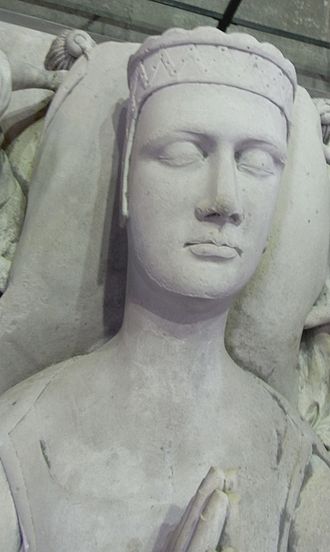
Eleanor of England, Queen Leonor of Castile

EleonoraAngl
Eleanor of England, Queen of Castile

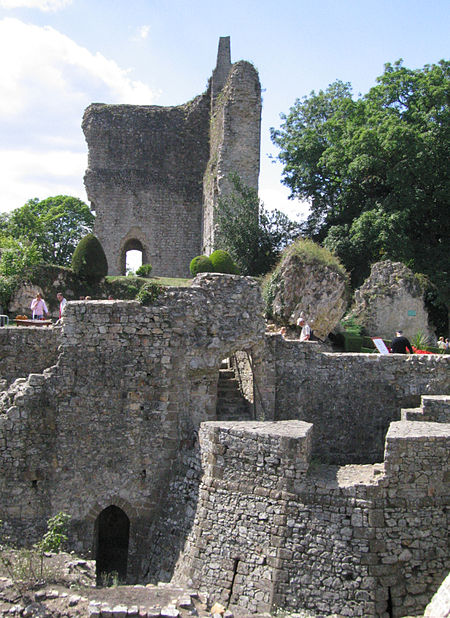
On 13th October 1162 (1161 has also been suggested, but most sources agree on 1162) the Queen of England gave birth to a 2nd daughter at Domfront Castle in Normandy, Eleanor. She was the 6th child of Europe’s most glamorous and controversial couple; Henry II and Eleanor of Aquitaine. Named after her mother Eleanor was baptised by Cardinal Henry of Pisa, with the chronicler Robert de Torigny standing as her godfather.

Of Eleanor’s 4 older brothers 3 had survived infancy; Henry, the Young King, Richard the Lionheart and Geoffrey – later Duke of Brittany. Geoffrey was nearest to Eleanor in age, but already 4 years old when she was born. Eleanor’s older sister, Matilda, had been born in 1156 and would be married to Henry V ‘the Lion’, Duke of Saxony and Bavaria, when Eleanor was just 6 years old. At the age of 3 Eleanor would be joined by a baby sister, Joanna, in the Plantagenet nursery and by a last brother, John, in 1166.

Eleanor’s birth coincided with an awkward period in her parents’ marriage. Eleanor of Aquitaine’s vassals, unhappy with Henry’s rule, were attempting to get her marriage to Henry annulled on the grounds of consanguinity. Although the plot was unsuccessful and the Cardinals were unimpressed with the argument, it cannot have been an easy time for the King and Queen.
450px-DonjonDomfront61
Domfront, Eleanor’s birthplace

Eleanor’s early childhood was quite nomadic. She travelled often with her parents, in her mother’s entourage. Henry had been absent from the country for 5 years when Eleanor first came to England with her parents in 1163. The Royal family would spend the Christmas of 1164/5 at Marlborough, while in the midst of the crisis of Henry’s disagreements with his archbishop of Canterbury, Thomas a Becket. Eleanor of Aquitaine would then take her children to Winchester, from where they visited Sherborne Castle in Dorset and the Isle of Wight before moving to Westminster.

In February 1165 3-year-old Eleanor was betrothed to the infant son of Frederick Barbarossa, Frederick, in order to cement a treaty with the Emperor. And following the conclusion of the treaty the Archbishop of Cologne was introduced to Eleanor and Matilda (who was to marry Henry the Lion). However, where Matilda departed for her new life in Germany in 1168, Eleanor’s proposed marriage was still in the distant future.
Alfons8Kastilie
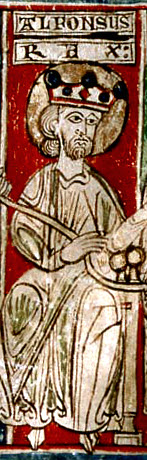
Alfonso VIII of Castile

Some historians have speculated that Eleanor was educated for some time at Fontevrault Abbey, along with her younger sister Joanna and her baby brother, John, who spent 5 years there after initially being intended for the church. However, by 1168 she was with her mother, who had decided to settle in Aquitaine and was allowed, by Henry II, to have her children with her.

By 1170 Eleanor’s marriage to the Emperor’s son was no longer a part of Henry II’s plans, and he decided to look elsewhere for an alliance. Seeking to extend his influence across the Pyrenees and to prevent a French alliance with Castile, Henry betrothed Eleanor to 7-year-old Alfonso VIII, king of Castile since he was just 2 years old. Raoul de Faye, Seneschal of Poitou for Eleanor of Aquitaine, was influential in negotiating the marriage; arranging for Eleanor to receive Gascony as her dowry, but only after the death of her mother.

September 1170 saw Eleanor on her way to Castile. A month short of her 8th birthday, some historians suggest she was escorted as far as Bordeaux by her mother, but this is not supported by the contemporary chronicles. However, she would have been given a suitable escort – as the daughter of a king and as a future queen herself – to see her safely to her new country. The wedding took place at Burgos Cathedral in 1174, when the bride was twelve-years-old.
Enrique_I_de_Castilla
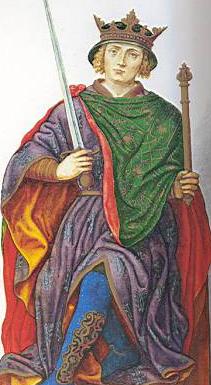
Henry I, King of Castile

Eleanor and Alfonso appear to have had a very successful marriage, and a close, trusting relationship. Eleanor is renowned for introducing her mother’s Poitevin culture into the Castilian court. The court encouraged the culture and architecture of Eleanor’s youth, whilst blending it with the luxuries offered by the neighbouring Moorish culture. Castilian poet Ramon Vidal described Eleanor as “Queen Leonore modestly clad in a mantle of rich stuff, red, with a silver border wrought with golden lions.” While the troubadour Pierre Vidal described to Eleanor as elegant and gracious.

Eleanor and Alfonso would have 7 children that survived infancy. Their eldest daughter Berengaria would marry Alfonso IX, King of Leon, and would act as regent in Castile for her younger brother, Henry I, before succeeding him as queen regnant. Berengaria and Alfonso’s marriage was dissolved by the papacy, on the grounds of consanguinity; but their children were declared legitimate. Shortly after succeeding to the throne of Castile, Berengaria abdicated in favour of her son, Ferdinand III, but continued to act as his closest adviser.
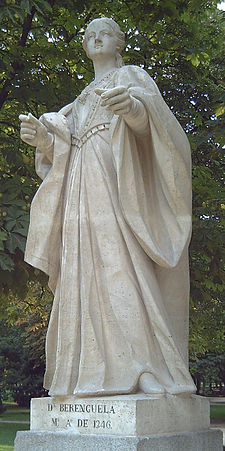
225px-Doña_Berenguela_01
Berengaria, Queen of Castile

One daughter, Eleanor, married James I, king of Aragon, but they divorced in 1229. While another, Constance, was dedicated as a nun and eventually became abbess of the abbey of Las Huelgas, founded by her parents in 1187. The abbey’s nuns were drawn from the highest ranks of the Spanish nobility, they belonged to the  Cistercian Order, a closed community mainly cut off from the world.

Alfonso and Eleanor had 2 sons who would survive childhood. The eldest, Ferdinand, predeceased his parents, dying of a fever in 1209 or 1211. Henry I would succeed his father, but died in 1217 when a loose roof tile fell on his head. He was 13 years old.

Two other daughters survived childhood. Eleanor’s 2nd eldest daughter, 14-year-old Urraca, was initially suggested as the bride of the future Louis VIII of France, son of Philip II Augustus. In 1200 the girls’ grandmother, Eleanor of Aquitaine, was instrumental in arranging the marriage; her dowry was to be provided from the territories Richard I had won from France at the end of the 12th century.

D._Urraca_de_Castela,_Rainha_de_Portugal_-_The_Portuguese_Genealogy_(Genealogia_dos_Reis_de_Portugal)
Urraca, Queen of Portugal

Eleanor of Aquitaine outlived all but 2 of her children. With the deaths of Richard I and his sister Joanna in 1199, only Eleanor in Castile and her baby brother John, now King of England, remained of the once large brood of 4 boys and 3 girls who had survived infancy.

Such recent losses may have helped to persuade the 77-year-old Eleanor of Aquitaine to travel to Castile, in person and in the depths of winter, to collect the granddaughter who would be Louis’ bride. The reunion of the 2 Eleanors would surely have been highly emotional.

She was received at Alfonso’s court with all the pageantry and courtesies appropriate for most remarkable woman of her time. The Dowager Queen of England stayed with her daughter for over 2 months, taking the opportunity to spend some time with her daughter and grandchildren, as the marriage would not be able to take place until after Lent.

In getting to know her granddaughters, Eleanor of Aquitaine seems to have decided that 12-year-old Blanca would make a more suitable bride for Louis. Whether it was because of the girls’ temperaments or simply a matter of names, as some historians have suggested. Urraca was not a name easily translated into French, whereas Blanca, as Blanche, was easily  recognisable.
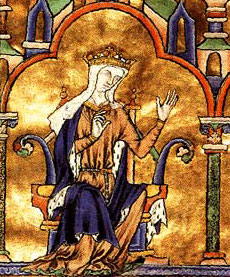
Blancheofcastile
Blanche of Castile, Queen of France

It was, therefore, 12-year-old Blanche who travelled back to France with her grandmother to marry the Dauphin, Louis – the same Louis who would be invited to become England’s king by the rebel barons and laid siege to Lincoln Castle in 1216. Blanche and Louis were married in Normandy, as France was under papal interdict at the time; Blanche would be the mother, and lifelong adviser, of Louis IX (St Louis).

In 1206 Urraca married the heir to the throne of Portugal – the future King Alfonso II.

Eleanor of England and Alfonso VIII appear to have had a happy, successful marriage, producing a family of 4 sons and 8 daughters over a 16 year period. Eleanor enhanced the culture of the Castilian court and acted as a diplomatic conduit between her husband and brothers, Richard and John, in order to aid each other and keep the peace – most of the time. However, in 1204, following the death of Eleanor of Aquitaine, Alfonso had to resort to a show of military force in order to successfully claim his wife’s dower rights over Gascony from John.
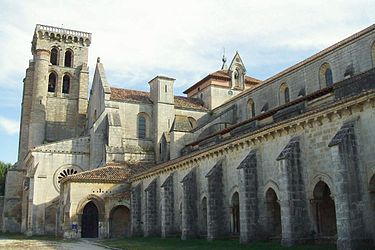
Burgos_-_Las_Huelgas_10
Abbey of Las Huelgas

Their happy marriage came to an end when Alfonso died in Burgos on 6th October 1214. He was buried in the Abbey of Las Huelgas, where their daughter, Constance, was now Abbess, leaving Eleanor as regent for their 10-year-old son, Henry I. Broken-hearted Eleanor, however, only survived her husband by a little over 3 weeks. Overcome with grief she died in Burgos on 31st October 1214, and was laid to rest beside her beloved husband; leaving their daughter Berengaria to take up the regency for Henry.

Of Eleanor’s grandchildren 2 were to become saints, Louis IX of France and Berengaria’s son Ferdinand III, king of Castile; her great-granddaughter and namesake, Eleanor of Castile (Ferdinand’s daughter), would become Queen of England as the wife of Edward I.

*

Pictures courtesy of Wikipedia

*

Sources: Brewer’s Royalty by David Williamson; The Mammoth Book of British Kings & Queens by Mike Ashley; Britain’s Royal Families, the Complete Genealogy by Alison Weir; The Plantagenet Chronicles Edited by Elizabeth Hallam; England Under the Norman and Angevin Kings by Robert Bartlett; Eleanor of Aquitaine, by the Wrath of God, Queen of England by Alison Weir; Eleanor, April Queen of Aquitaine by Douglas Boyd; oxforddnb.com.

*

My Books

Christmas is coming!

Signed, dedicated copies of all my books are available through my online bookshop.

Coming 15 January 2024: Women of the Anarchy

On the one side is Empress Matilda, or Maud. The sole surviving legitimate child of Henry I, she is fighting for her birthright and that of her children. On the other side is her cousin, Queen Matilda, supporting her husband, King Stephen, and fighting to see her own son inherit the English crown. Both women are granddaughters of St Margaret, Queen of Scotland and descendants of Alfred the Great of Wessex. Women of the Anarchy demonstrates how these women, unable to wield a sword, were prime movers in this time of conflict and lawlessness. It show how their strengths, weaknesses, and personal ambitions swung the fortunes of war one way – and then the other.

Available for pre-order from Amberley Publishing and Amazon UK.

Also by Sharon Bennett Connolly:

Out nowKing John’s Right-Hand Lady: The Story of Nicholaa de la Haye is the story of a truly remarkable lady. Nicholaa de la Haye was the hereditary constable of Lincoln Castle and the first woman in England to be appointed sheriff in her own right. Her strength and tenacity saved England at one of the lowest points in its history. Nicholaa de la Haye is one woman in English history whose story needs to be told…

King John’s Right-Hand Lady: The Story of Nicholaa de la Haye is now available from Pen & Sword Booksbookshop.org and Amazon.

Defenders of the Norman Crown: The Rise and Fall of the Warenne Earls of Surrey tells the fascinating story of the Warenne dynasty, of the successes and failures of one of the most powerful families in England, from its origins in Normandy, through the Conquest, Magna Carta, the wars and marriages that led to its ultimate demise in the reign of Edward III. Defenders of the Norman Crown: Rise and Fall of the Warenne Earls of Surrey is now available from Pen & Sword BooksAmazon in the UK and US, and Bookshop.org.

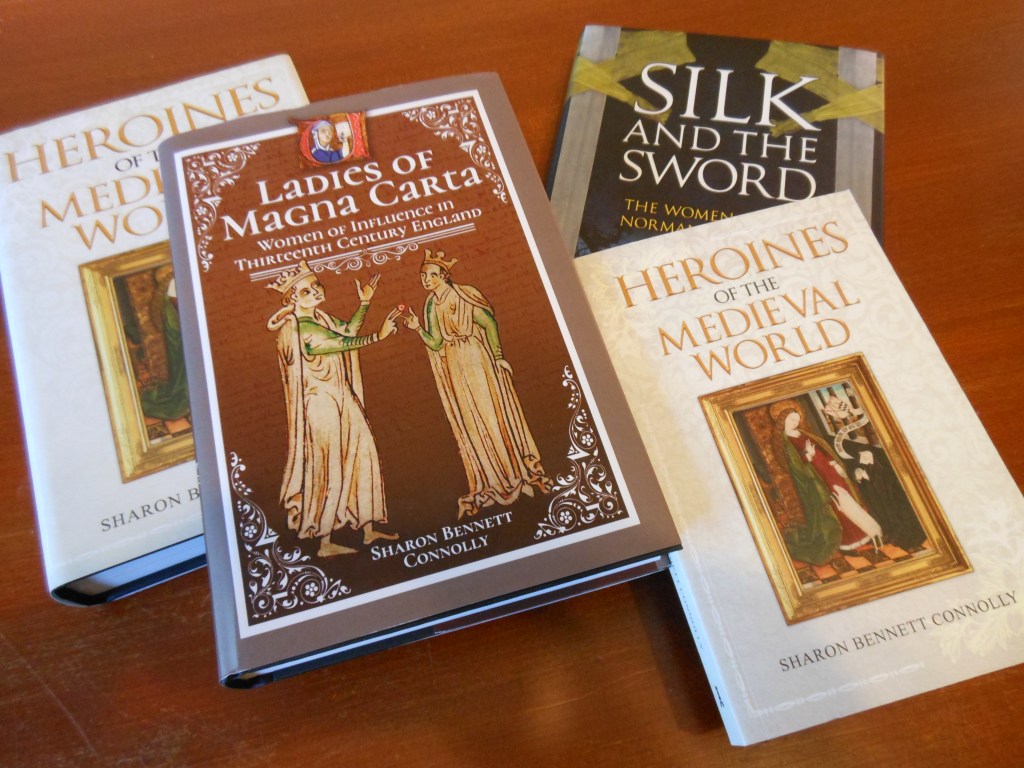
Ladies of Magna Carta: Women of Influence in Thirteenth Century England looks into the relationships of the various noble families of the 13th century, and how they were affected by the Barons’ Wars, Magna Carta and its aftermath; the bonds that were formed and those that were broken. It is now available in paperback and hardback from Pen & Sword,  Amazon, and Bookshop.org.
Heroines of the Medieval World tells the stories of some of the most remarkable women from Medieval history, from Eleanor of Aquitaine to Julian of Norwich. Available now from Amberley Publishing and Amazon, and Bookshop.org.

Silk and the Sword: The Women of the Norman Conquest traces the fortunes of the women who had a significant role to play in the momentous events of 1066. Available now from Amazon,  Amberley Publishing, and Bookshop.org.

Alternate Endings: An anthology of historical fiction short stories including Long Live the King… which is my take what might have happened had King John not died in October 1216. Available in paperback and kindle from Amazon.

Podcast:

Have a listen to the A Slice of Medieval podcast, which I co-host with Historical fiction novelist Derek Birks. Derek and I welcome guests, such as Bernard Cornwell, and discuss a wide range of topics in medieval history, from significant events to the personalities involved.

*

Don’t forget! Signed and dedicated copies of all my books are available through my online bookshop.

For forthcoming online and in-person talks, please check out my Events Page.

You can be the first to read new articles by clicking the ‘Follow’ button, liking our Facebook page or joining me on Twitter and Instagram.

*

©2016 Sharon Bennett Connolly FRHistS
Elizabeth of Rhuddlan, Daddy’s Girl

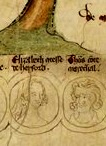
Membrane with genealogy of the kings of England.
Elizabeth of Rhuddlan

In July 1282 King Edward I was in the middle of subduing Wales when his wife, Eleanor of Castile, was reaching her final month of pregnancy. Unlike most royal wives, who would have stayed at home in one of their sumptuous, cosy palaces, Eleanor was in Wales with her husband. After all, Eleanor had been on Crusade with her husband and had even given birth to her daughter, Joan of Acre, in the Holy Land. Wales was no more of a difficulty.

Rhuddlan Castle had been ‘civilised’ for the queen’s use; with the addition of gardens, decorative seating and a fish pond to aid Eleanor’s comfort. However, it was still Edward’s headquarters, where troops were mustering and messengers were coming and going at all hours – hardly the most comfortable and peaceful place for a queen to give birth.

Elizabeth of Rhuddlan was born around the 7th August 1282. She was the youngest surviving daughter of the king and queen’s 15 children – a 16th and final child, Edward (the future Edward II) would be born in 1284. Although the castle must have been hectic during Elizabeth’s birth, one can imagine the rooms surrounding the birthing chamber were kept as serene as possible. Indeed, it seems that Eleanor was allowed the ‘laying-in’ of a whole month following Elizabeth’s birth with her churching at the end of it – a luxury that did not arise all that often for Edward’s queen.

Eleanor’s wardrobe accounts show that the queen purchased several small items for her baby daughter’s use; a basin, some tankards, a storage chest and a bucket. And, unlike her siblings, Eleanor kept Elizabeth with her during the 1st few years of her life. It’s possible she was with her full-time until the age of 2, or was at least visited regularly by Eleanor. Elizabeth was still with her mother when her baby brother and the king’s heir, Edward, was born at Caernarfon in 1284.

360px-Rhuddlan_Castle,_May_2012
Rhuddlan Castle, Flintshire, Elizabeth’s birthplace

When Edward was established in his own household, Elizabeth went with him. She spent most of her childhood in her brother’s company; her education supervised by her mother, often from a distance.

In 1285 Elizabeth and Edward spent the summer with their parents and older sisters. They visited Thomas a Becket’s shrine at Canterbury and spent a week at Leeds Castle in Kent before traveling to Amesbury in Wiltshire. Amesbury Priory was the retirement home of the dowager queen, Eleanor of Provence; and it was during the visit that Elizabeth’s 6-year-old sister, Mary, was veiled as a  nun.

Edward I and Eleanor of Castile are famous for having had a close, loving relationship. They appear to have travelled everywhere together. Their children, however, were often left behind, usually in the care of their grandmother, Eleanor of Provence, Henry III’s queen and Edward I’s mother. In 1286, when Elizabeth was still only 3, they left England for the continent to broker peace between France and Aragon, in the hope of another Crusade. Although the Crusade never materialised, Edward and Eleanor were absorbed in their continental possessions until 1289.

However, the children were not forgotten. While in Paris Eleanor bought little items of jewellery for her daughters and sent them other pieces that had been given to her as gifts. She was also known to make offerings for her children’s health at any major shrines she visited.

Edward_II_-_British_Library_Royal_20_A_ii_f10_(detail)
Edward II, Elizabeth’s childhood companion

Arriving at Dover after a 3 year absence, Edward and Eleanor were met by their children; 6-year-old Elizabeth and 4-year-old Edward probably had little or no memory of their parents. Following celebrations for their return in Canterbury, the royal family would spent the next 2 weeks at Leeds Castle, getting to know  each other again.

Elizabeth and Eleanor were not especially close. Eleanor had spent half of her daughter’s life away on the Continent and Eleanor’s health began to fail shortly after her return. Elizabeth spent the summer of 1290 touring the countryside with her brother, only attending the court for the weddings of their sisters; Joan in April and Margaret in July.

In October 1290 Elizabeth was summoned to her ailing mother’s bedside at the royal hunting lodge of Clipstone in Nottinghamshire. Eleanor died at Harby in Lincolnshire on the 28th November 1290, the king accompanied her body back for burial at Westminster Abbey, ordering stone crosses to be erected at the places they stopped along the route.

We have no record of how Elizabeth reacted to her mother’s death, she was just 8 years old and had seen her mother rarely over the last 5 years. We can assume that she was saddened, but that life carried on pretty much as normal otherwise, with her day-to-day life remaining constant. In 1297 she and her sister Mary paid to have a special Mass held in honour of their mother, demonstrating their affection, and that she hadn’t been forgotten.

330px-Jean_Ier_de_Hollande
John Count of Holland

In 1297 Elizabeth’s marriage was celebrated; to John, Count of Holland. John had been educated at Edward’s court following his betrothal to Elizabeth in 1285. He had been one of the competitors for the Scots throne, though with only an outside chance. Elizabeth is said to have thrown a tantrum before the wedding, when not all her jewels were ready in time.

However, the royal wedding went ahead, at Ipswich Priory on 8th January 1297, with her father, her brother Edward and sister Margaret in attendance. Elizabeth was just 14 years old and John was about 13. It seems Elizabeth was very fond of her father – there is some suggestion, too, that she was his favourite – and she was loath to leave him, and England. The king himself threw Elizabeth’s coronet into the fire during an argument over Elizabeth’s refusal to leave England with her husband. It took several letters from Count John, and cajoling from the king, to persuade Elizabeth to accompany her husband to her new country.

In the event, however, the arguing proved unnecessary as Count John died at Haarlem  on 10th November 1299. Elizabeth, a childless widow at 17, returned home to her father’s court.

Almost exactly 3 years after the death of her 1st husband, on 14th November 1302, Elizabeth married again. This time there would be no arguments about leaving England as her husband was Humphrey de Bohun, 4th Earl of Hereford and Essex. Before the wedding Humphrey had relinquished all his lands and titles to the crown; after the wedding they were re-granted, jointly, to Humphrey and his new wife.

Humphrey_de_Bohun,_4th_Earl_of_Hereford
Humphrey de Bohun, 4th earl of Hereford and Essex

Elizabeth’s second marriage appears to have been highly successful. Humphrey and Elizabeth weathered the storms of change together. Humphrey had been a stalwart of Edward I’s Scottish campaigns and in 1306 had been rewarded with the forfeited estates of Robert the Bruce. When Elizabeth’s father died in 1307, Humphrey was initially a supporter of the new king, Elizabeth’s brother and childhood companion, Edward II. He is witness to the document that created Piers Gaveston, Edward’s controversial favourite, Earl of Cornwall.

However, in 1310 he was named one of the lords ordainers, set up to reform the king’s household and government. He was stripped of his position as Constable of England for refusing to accompany the king on his Scottish campaign of 1310/11, but was reinstated the following year.

In 1314 Humphrey was one of the commanders of the English forces facing Robert the Bruce at Bannockburn. It is believed his arguments with Gilbert de Clare, Earl of Gloucester, over who should have precedence, was a major factor contributing to England’s defeat. Gloucester was killed in the fighting, but Humphrey was captured by the Scots; he was exchanged for Robert the Bruce’s queen, Elizabeth de Burgh, who had been held captive by the English since 1306.

Between 1303 and 1316, Elizabeth and Humphrey were to have 11 children, including twin boys, 8 of whom survived childhood; 6 boys and 2 girls. Their eldest daughter, Eleanor, married James Butler, 1st Earl of Ormonde and, following his death, Sir Thomas Dagworth, who was murdered in 1350. While their youngest surviving daughter, Margaret, married Hugh de Courtenay, Earl of Devon and lived until 1391.

330px-MargaretDeBohunExeterCathedral
Margaret de Bohun, Countess of Devon

Two of their sons would succeed, consecutively to the earldoms of Hereford and Essex; John and Humphrey. While William de Bohun, twin brother of Edward (who drowned in 1334), would be granted the title of Earl of Northampton by his cousin and close friend Edward III. The twin brothers had both been involved in Edward III’s escape from Nottingham Castle and the control of his mother’s lover, Roger Mortimer. Of the 2 remaining sons; Eneas died before 1343 and Edmund married Matilda, the daughter of Nicholas de Segrave, Baron Stowe.

Elizabeth died in childbirth on 5th May 1316; their last daughter, Isabella, died with her.  They were buried together at Walden Priory in Essex on 23rd May.

Humphrey survived his wife by 6 years, being killed at the Battle of Boroughbridge in March 1322, fighting with the forces of Thomas of Lancaster against the king. Despite his will requesting he be buried beside his wife at Walden Priory, he was laid to rest at the Church of the Friars Preachers in York.

Elizabeth and Humphrey’s great-granddaughter, Mary de Bohun, married Henry Bolingbroke (the future Henry IV) and was the mother of 5 children, including Henry V.

*

Pictures courtesy of Wikipedia

*

Sources: The Oxford Companion to British History Edited by John Cannon; The Plantagenets, the Kings who Made England by Dan Jones; History Today Companion to British History Edited by Juliet Gardiner and Neil Wenborn;  Brewer’s British Royalty by David Williamson; Britain’s Royal Families, the Complete Genealogy by Alison Weir; The Mammoth Book of British Kings and Queens by Mike Ashley; The Plantagenets, the Kings that made Britain by Derek Wilson;  oxforddnb.com; Edward I; A Great and Terrible King by Marc Morris; Chronicles of the Age of Chivalry Edited by Elizabeth Hallam; Eleanor of Castile; the Shadow Queen by Sara Cockerill.

*

My Books:

Signed, dedicated copies of all my books are available through my online bookshop.

Out Now! Women of the Anarchy

Two cousins. On the one side is Empress Matilda, or Maud. The sole surviving legitimate child of Henry I, she is fighting for her birthright and that of her children. On the other side is her cousin, Queen Matilda, supporting her husband, King Stephen, and fighting to see her own son inherit the English crown. Women of the Anarchy demonstrates how these women, unable to wield a sword, were prime movers in this time of conflict and lawlessness. It show how their strengths, weaknesses, and personal ambitions swung the fortunes of war one way – and then the other.

Available from Bookshop.orgAmberley Publishing and Amazon UK.

Coming on 15 June 2024: Heroines of the Tudor World

Heroines of the Tudor World tells the stories of the most remarkable women from European history in the time of the Tudor dynasty, 1485-1603. These are the women who ruled, the women who founded dynasties, the women who fought for religious freedom, their families and love. These are the women who made a difference, who influenced countries, kings and the Reformation. In the era dominated by the Renaissance and Reformation, Heroines of the Tudor World examines the threats and challenges faced by the women of the era, and how they overcame them. From writers to regents, from nuns to queens, Heroines of the Tudor World shines the spotlight on the women helped to shape Early Modern Europe.

Heroines of the Tudor World is now available for pre-order from Amberley Publishing and Amazon UK.

Also by Sharon Bennett Connolly:

King John’s Right-Hand Lady: The Story of Nicholaa de la Haye is the story of a truly remarkable lady, the hereditary constable of Lincoln Castle and the first woman in England to be appointed sheriff in her own right. It is is available from King John’s Right-Hand Lady: The Story of Nicholaa de la Haye is the story of a truly remarkable lady, the hereditary constable of Lincoln Castle and the first woman in England to be appointed sheriff in her own right. Available from all good bookshops or direct from Pen & Sword Booksbookshop.org and AmazonDefenders of the Norman Crown: The Rise and Fall of the Warenne Earls of Surrey tells the fascinating story of the Warenne dynasty, from its origins in Normandy, through the Conquest, Magna Carta, the wars and marriages that led to its ultimate demise in the reign of Edward III. Available from Pen & Sword BooksAmazon in the UK and US, and Bookshop.org

Ladies of Magna Carta: Women of Influence in Thirteenth Century England looks into the relationships of the various noble families of the 13th century, and how they were affected by the Barons’ Wars, Magna Carta and its aftermath; the bonds that were formed and those that were broken. It is now available in paperback and hardback from Pen & Sword, Amazon, and Bookshop.orgHeroines of the Medieval World tells the stories of some of the most remarkable women from Medieval history, from Eleanor of Aquitaine to Julian of Norwich. Available now from Amberley Publishing and Amazon, and Bookshop.orgSilk and the Sword: The Women of the Norman Conquest traces the fortunes of the women who had a significant role to play in the momentous events of 1066. Available now from Amazon,  Amberley Publishing, and Bookshop.org.

Alternate Endings: An anthology of historical fiction short stories including Long Live the King… which is my take what might have happened had King John not died in October 1216. Available in paperback and kindle from Amazon.

Podcast:

Have a listen to the A Slice of Medieval podcast, which I co-host with Historical fiction novelist Derek Birks. Derek and I welcome guests, such as Bernard Cornwell and Elizabeth Chadwick, and discuss a wide range of topics in medieval history, from significant events to the personalities involved.

*

Don’t forget! Signed and dedicated copies of all my books are available through my online bookshop.

For forthcoming online and in-person talks, please check out my Events Page.

You can be the first to read new articles by clicking the ‘Follow’ button, liking our Facebook page or joining me on Twitter and Instagram.

*

©2016 Sharon Bennett Connolly FRHistS

Agincourt 600th Anniversary

220px-King_Henry_V_from_NPGThis Sunday, 25th of October 2015, marks the 600th anniversary of the Battle of Agincourt. One of the greatest battles in English history, it epitomises the pinnacle of English successes against their traditional enemy, France, during the epic struggle of the Hundred Years War. But what started it all?

The origins of the Hundred Years War go back 200 years before its outbreak, to Henry II. His marriage to Eleanor of Aquitaine meant he was not only Duke of Normandy in the north of France, but Duke of Aquitaine in the south. And his accession to the English throne in 1154 brought all these French possessions to the crown of England. This made for the awkward position that the sovereign of England was technically a vassal of the King of France, causing no end of squabbles and friction for years to come.

Wars broke out frequently and the French gradually ate away at England’s French possessions.

It all came to a head with a crisis in the French monarchy. When Philip IV, the Fair, of France, died in 1314, he was successively succeeded by each of his 3 sons; Louis X, Philip V and Charles IV. Only one of these kings produced a son, King John the Posthumous was born 5 months after the death of Louis X, his father, and lived – and ruled – for only 5 days. Following the death of the baby king Philip V seized the crown, effectively disinheriting Louis X’s daughter, Jeanne.

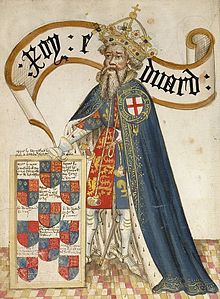
220px-Edward_III_of_England_(Order_of_the_Garter)Although Salic Law was known in France, it generally related to property and had never actually been used to decide the succession to the crown. However, Philip V made certain that it would be from now on, by having the Estates General declare that women were not eligible to succeed to the throne of France.

Unfortunately for the French royal family, both Philip V and his successor, his brother, Charles IV, only had daughters. Charles IV died in 1328, leaving his wife, Jeanne d’Evreux, pregnant; a regency council was set up to rule the country, until the child’s birth. However, Jeanne gave birth to a daughter, Blanche, and France had to find a new king.

One candidate was Edward III of England. Edward was the oldest grandson of Philip IV through his daughter Isabella of France, Queen of Edward II of England. However, Edward III was only 15 years old and England – and Edward – were controlled by Edward’s mother, Isabella of France, and her lover, Roger Mortimer, who had deposed and possibly murdered Edward’s father, Edward II. Edward’s claim came through his mother – and he was English.

The assembly of French notables, convened to decide who should be king, declared: “It had never been seen or known that the kingdom of France should be subject to the government of the King of England.

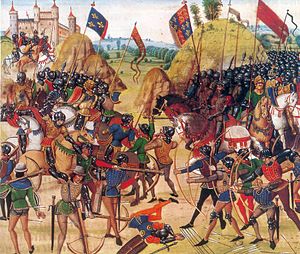
Battle_of_crecy_froissart
As a result, they chose another as their king; the nephew of Philip IV, Philip of Valois, Count of Anjou and Maine. Philip was in his thirties, with a 9-year-old son, and had been Regent during Jeanne’s pregnancy.

Edward III initially agreed to pay homage to Philip VI, who was crowned in 1329, for his French possessions. However, he was still a minor and under the tutelage of his mother and Mortimer. When Edward took control of his kingdom, in 1330, he had a change of heart. Irked by Philip’s support for the Scots, and encouraged by local conflicts in Guyenne, Edward questioned the validity of his oath to Philip, made while he was still a minor. And in 1337 Edward III declared war.

Initial English successes devastated France: the  French fleet was destroyed at Sluys in 1340, and Edward III ravaged the French countryside, in a great chevauchee. In an attempt to bring the French to battle Edward’s ‘scorched-earth’ policy saw towns besieged, convents and monasteries ransacked and the people displaced. The French were eventually brought to battle at Crecy in 1346, where their cavalry was destroyed. The fall of Calais followed in 1347.

In 1356, at the Battle of Poitiers, the English, under the Black Prince (Edward, Prince of Wales) captured France’s king, John II the Good. John was sent to England – where he died in 1364, still awaiting the payment of his vast ransom.

The 1360 Treaty of Bretigny was the crowning success of England’s war, with Edward III taking possession of almost a third of France.

Although technically at peace, the two countries kept picking at each other – each supporting opposing factions in places of mutual interest, such as Brittany. In then end, with the failing health of the Black Prince, and and aging Edward III, a resurgent France emerged under Charles V; which saw English possessions reduced to a few ports and their environs by 1380.

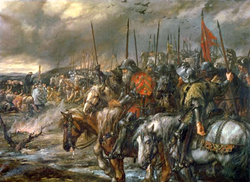
250px-Morning_of_the_Battle_of_Agincourt,_25th_October_1415
After 1389 truces between France and England were almost continuous. Richard II married Isabella of Valois, daughter of Charles VI, in 1396, as part of a 28 year truce.

Charles VI had suffered from madness since 1392 and France had started to implode. The king was surrounded by bad councillors and factions, such as the Armagnacs and Burgundians, had riven the country apart with their in-fighting. Many parts of France were ruled almost totally independent of central government.

However, with the turn of the century, the English had problems of their own and were unable to take advantage of France’s woes. Richard II was imprisoned and, later, murdered by the usurping Henry IV, who spent his reign preoccupied by troubles and rebellions in England.

Henry IV and his son, the future Henry V were divided as to which French factions they should support; Henry IV preferred the Armagnacs, while the Prince of Wales supported the Burgundians.

With the death of Henry IV, and the accession of Henry V, English ambitions turned to France yet again. Almost immediately, Henry laid claim to his inheritance in France. he made a pretense of negotiating for peace, while preparing for war. He would accept nothing less than the total reinstatement of the Plantagenet possessions in France.

There is an, almost certainly, apocryphal story  of Henry V taking up arms against the French after they jokingly sent him a set of tennis balls, suggesting that he stick to such ‘childish’ occupations, for which he had established a reputation during his father’s reign.

300px-Schlacht_von_Azincourt
Henry saw war with France as a way of diverting the interests of the great nobles away from internal conflicts, thus restoring and maintaining order at home. With peace negotiations faltering, and having dealt with several plots to displace him from his throne – the last of which, the Southampton Plot was foiled in the first week of August 1415 – Henry V and his army  arrived in Normandy on 13th August 1415 and laid siege to Harfleur.

Harfleur held until 23rd September, by which time Henry’s army of about 10,000 was greatly depleted by dysentery. He was making for Calais – and England – when, on 25th October, he came face-to-face with the French.

At Agincourt.

*

My Books

Ladies of Magna Carta: Women of Influence in Thirteenth Century England  looks into the relationships of the various noble families of the 13th century, and how they were affected by the Barons’ Wars, Magna Carta and its aftermath; the bonds that were formed and those that were broken. It is now available from Pen & SwordAmazon and from Book Depository worldwide.

1500x500

Also by Sharon Bennett Connolly:

Silk and the Sword: The Women of the Norman Conquest traces the fortunes of the women who had a significant role to play in the momentous events of 1066.  Available now from Amazon,  Amberley Publishing, Book Depository.

Heroines of the Medieval World tells the stories of some of the most remarkable women from Medieval history, from Eleanor of Aquitaine to Julian of Norwich. Available now from Amberley Publishing and Amazon and Book Depository.

*

You can be the first to read new articles by clicking the ‘Follow’ button, liking our Facebook page or joining me on Twitter and Instagram.

*

Article originally published on The Review in October 2015.

©2015 Sharon Bennett Connolly

Walking Bosworth’s Battlefield

“Two Kings – One Battle”

062
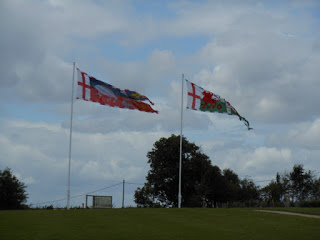
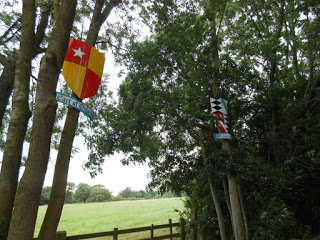
The standards of Richard III and Henry VII

Last year I took my 9-year-old son and 40-something husband to visit their first battlefield. We were holidaying in Derbyshire and decided to drive down to Leicestershire and visit Bosworth. With all the hype around the discovery and re-burial of Richard III, it seemed a great way to show a 9-year-old the story of a battle.

He, of course, knows a little of the Richard III story. He can identify the king’s portrait and knows he was involved in the Wars of the Roses, but we don’t linger on the Princes in the Tower too much. I don’t think he is as familiar with Henry VII, but he can tell you all of Henry VIII’s queens, in order, and tell you their fate. So taking my son to the battlefield was a way of giving him a place and time where he could visualise the events and the people.

It worked.

However, what I found surprising was the effect it had on my husband. Hubby is a bit of a computer geek and into all the mod cons. He never had an interest in history before he met me, and even now I can see his eyes glossing over if I talk too much about the past – 15 minutes a day is usually all he can take!

065
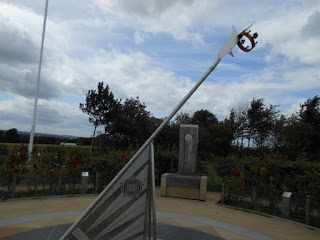
The Sundial on Ambion Hill

I have visited battlefields before; Waterloo, Stamford Bridge, Hastings and a few others. The calm serenity always amazes me. I expect to hear the echoes of battle, the cries of the wounded, clashes of arms and the shouted orders of the battle’s commanders – and the thunder of the horses hooves during the cavalry charge. At Bosworth, if you close your eyes tight, and listen intently, you can almost hear it…..

071
The Battle of Bosworth Trail

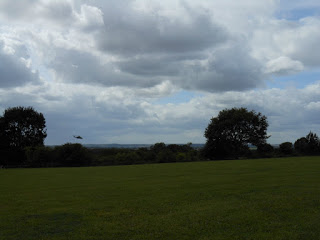
The Battlefield trail is a wonderful leisurely walk. It’s not the actual battlefield; they found that a short distance away a few years ago, but it is Ambion Hill. And standing at the memorial you have a panoramic view of the area; you can  imagine the 2 sides facing each other, troops in the thick of it and those waiting to engage. My son listened in awe as I described the death of Norfolk and the final, desperate charge of Richard III; and Percy’s men standing, watching and waiting – possibly very close to where we were stood at that moment.

064
View from Ambion Hill

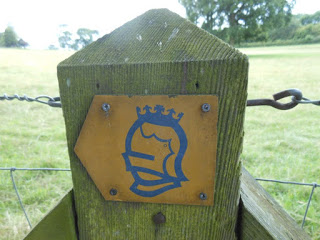
As you walk round the hill and through the woods, there are markers, pointing the way; and viewpoints and information posts telling the story of the battle and explaining the technology and tactics used. One marker explains the use of the longbow, how it dealt death from afar. The marker explained where the archers were positioned during the fighting; you almost expected to look to your right and see them raising their bows to the air.

My son was fascinated by the idea that children as young as he was had already started their knightly training, that there were only about 1,000 knights in the whole of England. And I was amazed to discover that many who could be knights chose not to, in order to avoid the duty and responsibility that came with knighthood; these men were simply called esquires or gentlemen.

081
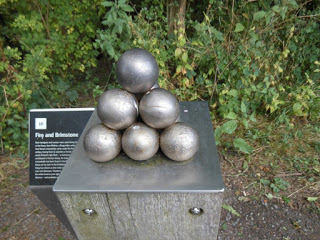
Information post explaining the use of cannons in the battle

It amazed my husband to discover that cannon and handguns were in use in the battle. 1485 seems to be too long ago for men to have used gunpowder. The handguns were large and cumbersome weapons, too large for one hand to use; guns were still very much in their infancy. However, it was a scattering of cannon balls and other small metal objects (such heraldic badges, spur rowels and coins), found by metal detectors, which finally meant the location of the battlefield could be confidently identified.

091
Battle standards in Ambion Wood

Although the general battlefield has now been identified, we still don’t know where individual parts of the action took place. We can’t say for certain where the action between Norfolk and Oxford took place, nor where Norfolk fell. We can’t tell where Stanley and his men were standing, watching for that turn in the battle that made him decide to join Henry Tudor’s forces.

But the specifics don’t matter as much as I expected they would. The battlefield provides its own story. And the fact you can’t say exactly where each part of the action happened serves to highlight the confusion of a battle. When you’re on the ground, in the thick of it, fighting for your life and your king, you wouldn’t be looking round to see where on the field you were. You would be looking to your own survival, fighting the man in front of you while watching your back.

095
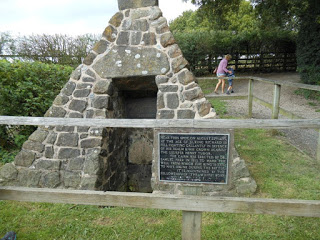
King Richard’s Well, cairn built close to where it is thought the king fell

So the locations of events are vague, but that they are remembered and commemorated is what matters. Whether the marker is where Richard fell matters less than that there is a marker to the fallen king.

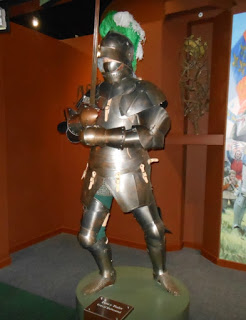
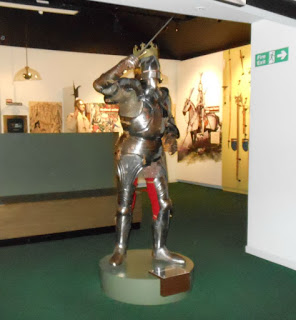
And once you have walked the Battlefield Trail, there is the Heritage Centre to visit. The Centre offers wonderful background to the battle, told through the voices of those involved: a serving girl at a local inn, a mercenary’s wife, an archer. The 2 armoured kings stand watch over you as you view artefacts found on the field of battle and study maps and videos explaining the battle and the troop movements.

057
Henry VII

The Heritage Centre is very hands-on; children can try on the armour and test out the helmets. You can test your ability to draw a longbow; it’s not as easy as you think. By far the most dramatic display is the little corner dedicated to the Barber-Surgeons. The tools of his trade are displayed and a skeleton depicting the wounds of one soldier from the battlefield. Given the recent discovery of Richard III, and the detailed descriptions of his wounds, this seemed a particularly poignant display.

060
Richard III

Walking the battlefield is a humbling experience. So little is known about the men who fought and died in these fields on 22nd August 1485. And, yet, the date marks so much change in English history: the end of one the Plantagenet dynasty and the start of Tudor rule; the end of the Middle Ages and the beginnings of the Renaissance. Just around the corner were the marital problems of Henry VIII and the English Reformation and the subsequent, glorious reign of Elizabeth I. But the men who fought that day would know nothing of the significance of the battle beyond that moment.

*

My Books

Ladies of Magna Carta: Women of Influence in Thirteenth Century England  looks into the relationships of the various noble families of the 13th century, and how they were affected by the Barons’ Wars, Magna Carta and its aftermath; the bonds that were formed and those that were broken. It is now available from Pen & SwordAmazon and from Book Depository worldwide.

Also by Sharon Bennett Connolly:

Silk and the Sword: The Women of the Norman Conquest traces the fortunes of the women who had a significant role to play in the momentous events of 1066.  Available now from Amazon,  Amberley Publishing, Book Depository.

Heroines of the Medieval World tells the stories of some of the most remarkable women from Medieval history, from Eleanor of Aquitaine to Julian of Norwich. Available now from Amberley Publishing and Amazon and Book Depository.

*

You can be the first to read new articles by clicking the ‘Follow’ button, liking our Facebook page or joining me on Twitter and Instagram.

*

Article and all photos © Sharon Bennett Connolly 2015

*

Article originally published on The Review on 19th August 2015.