Wordly Women: Rosemary Griggs

History... the Interesting BIts

Just over a year ago I spent a fabulous weekend at the Historical Novel Society Conference at Dartington Hall in Devon. Derek and I hosted a panel under our A Slice of Medieval podcast banner, featuring Elizabeth Chadwick, David Gilman and Matthew Harffy. Bernard Cornwell was on before us and Ian Mortimer followed us onto the stage. I got to meet some of my heroes. Ian Mortimer was lovely to chat to. Michael Jecks told some great stories, one featuring a late-night hotel fire alarm. Steven A. McKay and I talked like old friends, even though it was the first time we had actually met. I got to discuss Emma of Normandy with Patricia Bracewell and medieval Yorkshire with Claire Dunn (C.F. Dunn).

It was a fabulous weekend! And amidst it all I had a chat with Rosemary Griggs. It was cut short because Rosemary knows the area well and was on her way to give a tour of the gardens. So, I was over the moon when Rosemary agreed to participate in my Wordly Women series, so we could have a proper natter!

And Rosemary is another champion of highlighting those women who should be better known to history!

Sharon: Hi Rosemary, welcome to the blog. First and foremost, what got you into writing?

Rosemary: I’ve always wanted to write; ever since a truly inspirational teacher at primary school encouraged me and also sparked my lifelong interest in history. Over the years, I’ve done a lot of writing of one sort or another. I even once won a prize in a travel writing competition. However, during my Civil Service career, I had to write speeches for government ministers and create carefully crafted policy advice; all rather dry! It’s wonderfully freeing that I can now tell the stories of some truly amazing women who lived in sixteenth century Devon.

Sharon: Tell us about your books

Rosemary: Having spent years delving into Devon’s past, I’ve become particularly fascinated by the Champernowne family. They rose to prominence in the sixteenth century as part of a closely connected network of powerful figures whose influence extended far beyond the county. Within their circle were the likes of Raleigh, Drake, Hawkins, and Grenville—names that still resonate today. Yet, the women are so often forgotten. In my “Daughters of Devon” novels, I bring into the spotlight women often overshadowed by their famous menfolk.

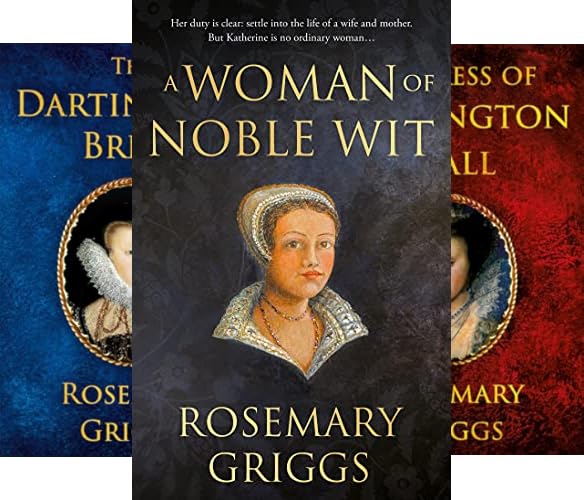
My first novel, A Woman of Noble Wit, is the story of Katherine Champernowne, Sir Walter Raleigh’s mother.

History... the Interesting Bits

Next to catch my eye was a young French Huguenot woman, daughter of the man who killed King Henri II of France in a jousting accident. Although born in France, Lady Gabrielle Roberda Montgomery married into the Champernowne family and spent most of her adult life at Dartington Hall in Devon. I became so fascinated by the challenges she faced as an incomer to Elizabethan England that her story has spilled into two volumes, The Dartington Bride and recently published Mistress of Dartington Hall.

A lot of other Daughters of Devon are waiting to have their stories told.

Sharon: What attracts you to the Tudor period?
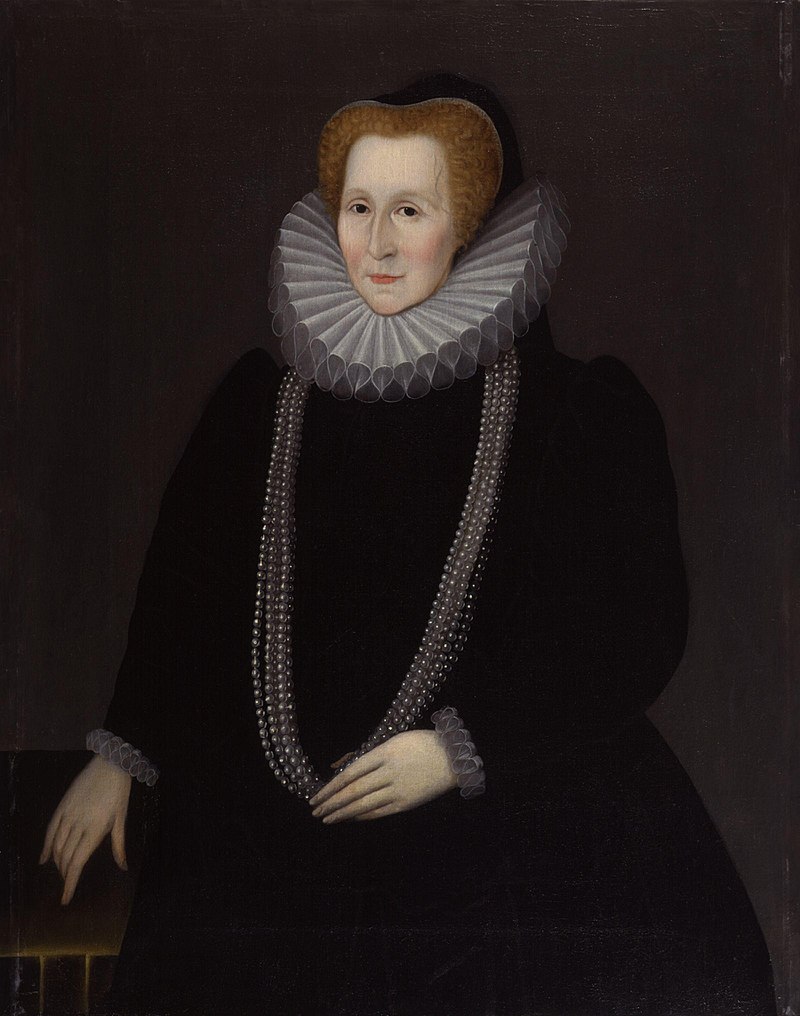
Rosemary: My fascination with the Tudor era began with the larger-than-life characters of the royal court. I’m as enthralled by the tales of Henry VIII and his queens as anyone. However, during that tumultuous period, immense social, political, and religious changes affected everyone, regardless of their wealth. The late fifteenth century saw the printing press’s arrival, which opened up learning and information to a wider audience, including many women. It was an ‘information revolution’, not unlike the transformative changes I’ve witnessed in my own life, especially since the internet was born. It’s working out how ordinary people, especially women, managed in such a rapidly changing world that keeps me rooted in those turbulent Tudor years.

Sharon: Who is your favourite Tudor and why?

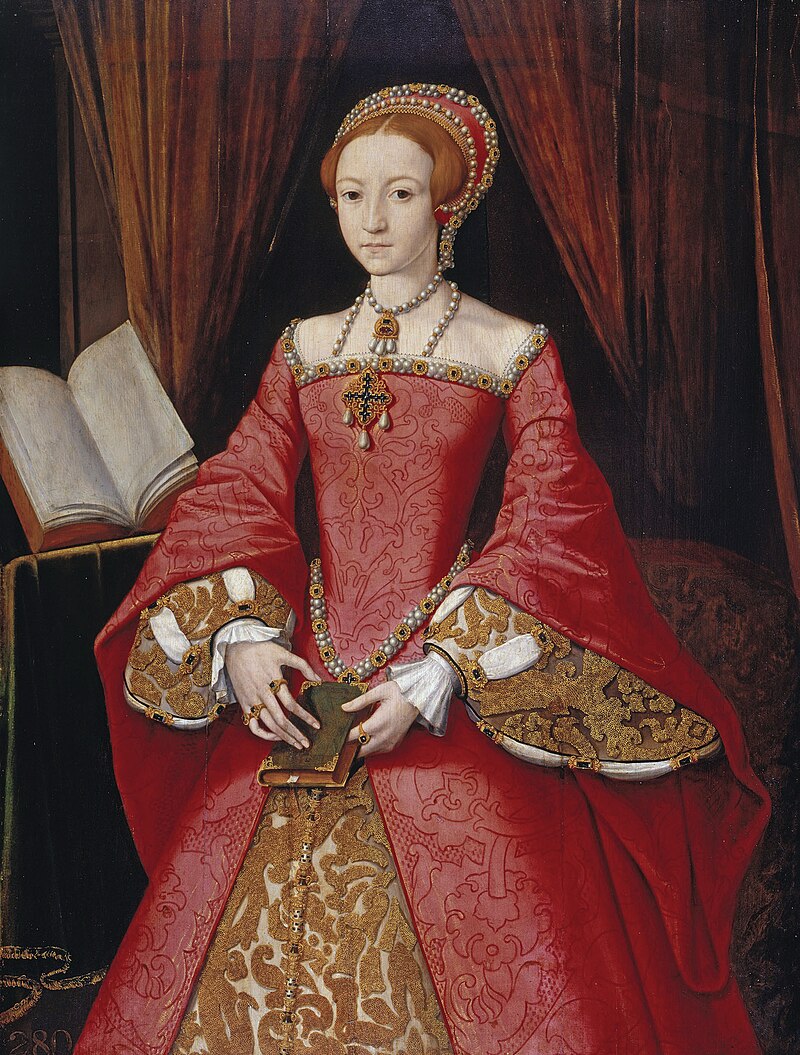
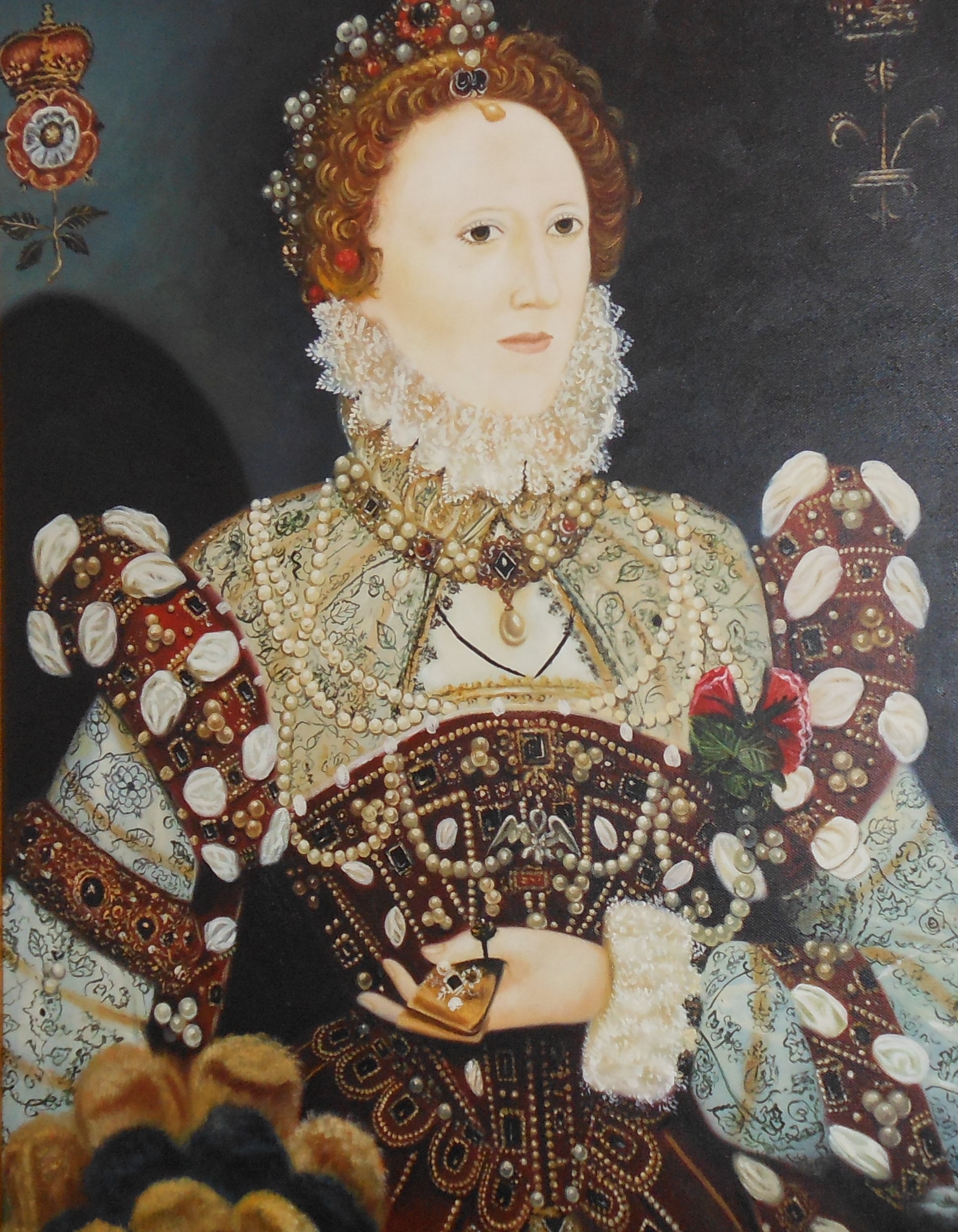
Rosemary: Elizabeth I is the one who most fascinates me. Her 45-year reign brought stability after years of turmoil. People remember her as an intelligent, politically astute and powerful ruler. She had a formidable education, becoming fluent in multiple languages. Like many people, I admire Elizabeth for her wit and for her determination. I had always seen the defeat of the Spanish Armada as her greatest victory. However, as I was researching for my latest book, I discovered another side to her character. The queen’s reluctance to pay the soldiers and sailors needed to repel the Spanish invasion, or to provide enough arms and munitions was extremely frustrating for her commanders. Without that change in the wind, the outcome could have been very different.

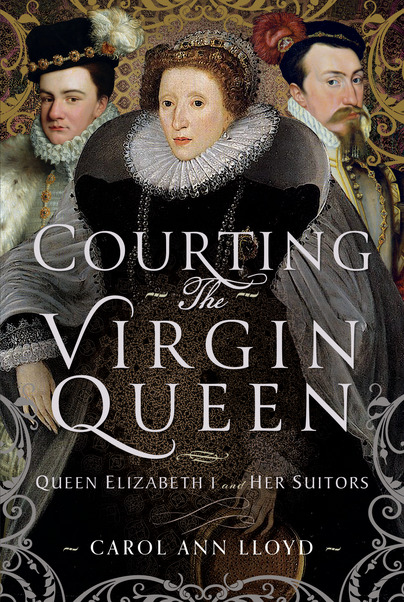
My current research has also brought home to me how perilous Elizabeth’s life was in the years before she came to the throne. Having survived against the odds; she defied expectations by never marrying. Elizabeth was incredibly clever as she played off her various suitors to maintain or forge political alliances. She gave up a lot to rule alone. I would dearly love to be able to ask her what really happened with Thomas Seymour and whether she ever regretted not marrying Dudley.

Sharon: Who is your least favourite Tudor and why?

Rosemary: It would be easy to plump for Henry VIII as the ruthless tyrant he became in his later years. But I have a soft spot for the charismatic, intelligent young man who became king in1509. Instead, I’d go for his father, Henry VII, who has always seemed to me to be a rather cold, calculating type. Perhaps he had to be to return from exile to wrest the throne from Richard III on the battlefield. Yet I can’t forgive him for executing poor Edward of Warwick, or for his treatment of Catherine of Aragon after Prince Arthur died. Somehow, I cannot warm to Henry VII.

Sharon: How do you approach researching your topic?
Rosemary: I always start with original source documents relating to my character. Then I widen the net to consider what surviving documents reveal about those around them. I’m never happier than when I’m poring over a difficult text in the archives.

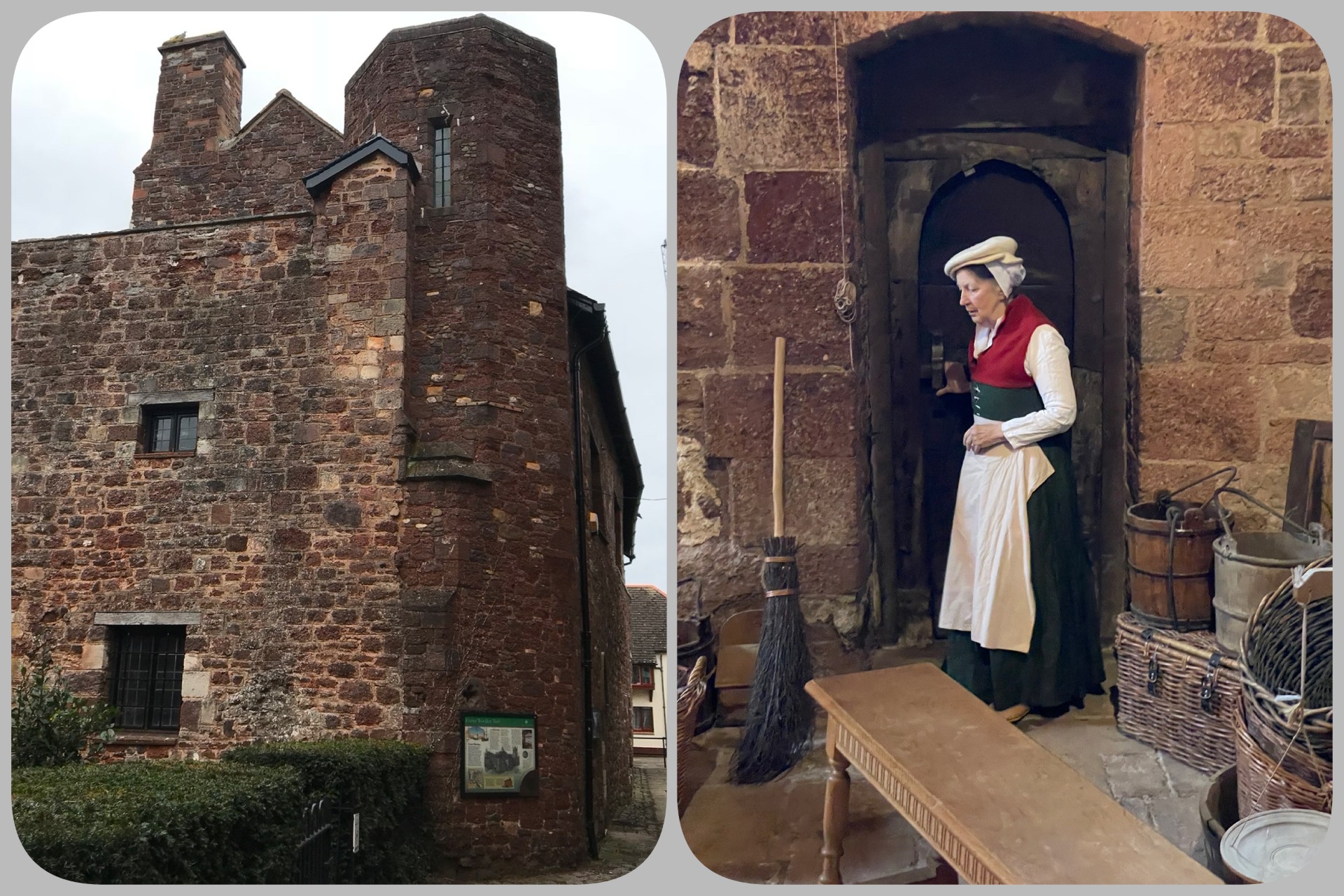
I’ve chosen a hard path, as I’m researching women whose imprint on the record is light. I can usually discover much more about the men in their lives, but eventually I’m armed with some key events taken from the record. These form the milestones on my subjects ’journeys through life, and I respect them absolutely. However, the beauty of writing fiction is that I can fill the gaps with creative imagination to weave a plausible narrative around those key events. To do that, I study every detail of Tudor life. I read widely about national events; I sift through accounts of local happenings. I question everything. I also visit the places they knew; I dress as they did. I all brings me closer to their world.

Sharon: Tell us your ‘favourite ’Devon story you have come across in your research.

History... the Interesting Bits

Rosemary: My favourite Devon story doesn’t concern one of the ‘elite ’women I write about. Rather, it is an incident that brings one of the ordinary women of history briefly to our attention. In the mid-1530s, when Thomas Cromwell’s commissioners instructed a man to tear down St Nicholas Priory’s Church in Exeter, Elizabeth Glanfield gathered her friends and neighbours. They would allow no one to desecrate their beloved priory church without a fight. Grabbing brooms, shovels and staves, the pack of women descended on the worker who was dismantling the rood screen. The terrified man climbed high, but the women pursued him until he fell, breaking his arm. Eventually, the mayor of Exeter restored order. When the great and good sat in judgement on Elizabeth and her friends, they expressed the view that men disguised as women perpetrated the attack. Mere women, they suggested, could not be capable of such an act. Fortunately, Elizabeth and her friends escaped serious punishment. However, they did not save their church. Eventually, workers returned to demolish the church. They used some of the stone to repair the Exe bridge into the city. Parts of the priory buildings survived to be converted into an Elizabethan townhouse. Elizabeth Glanfield and the rioting women of Exeter are a rare example of local people resisting the dissolution of the monasteries. There is a longer version of this story on my website.

Sharon: Tell us your least ‘favourite’ Devon story you have come across in your research.

Rosemary: My least favourite is also about another ordinary woman and her appalling fate, although it has also been a tremendous source of inspiration for me. During the reign of Edward VI, Agnes Prest, a poor, uneducated Cornish woman, had heard the scriptures in a language she could understand. Queen Mary insisted she return to the old ways of worship under the Church of Rome. Agnes could not accept what she was being told to believe. The worst part of her story is that her own family, including her husband, ‘shopped ’Agnes to the church authorities. The Bishop of Exeter and all the high-ups of the church summoned Agnes and questioned her. She refused to yield. Eventually, they took Agnes to the prison cells beneath Exeter’s Rougemont Caste. In the second edition of his ‘Book of Martyrs’, Foxe mentions that a gentlewoman, Katherine Raleigh, visited Agnes. In August 1557, that poor Cornish woman walked the short distance from her prison cell to the area of Exeter we now call Southernhay, where she was burned at the stake. She was Exeter’s only Protestant martyr during the reign of Queen Mary.

Sharon: Are there any other eras you would like to write about?
Rosemary: I’ve often thought I could find some strong Devon women who played their part during the English Civil War. However, while recovering from Covid recently, I watched a lot of TV adaptations of Jane Austen novels. I’m now quite drawn to that time too.

Sharon: What are you working on now?

History... the Interesting Bits

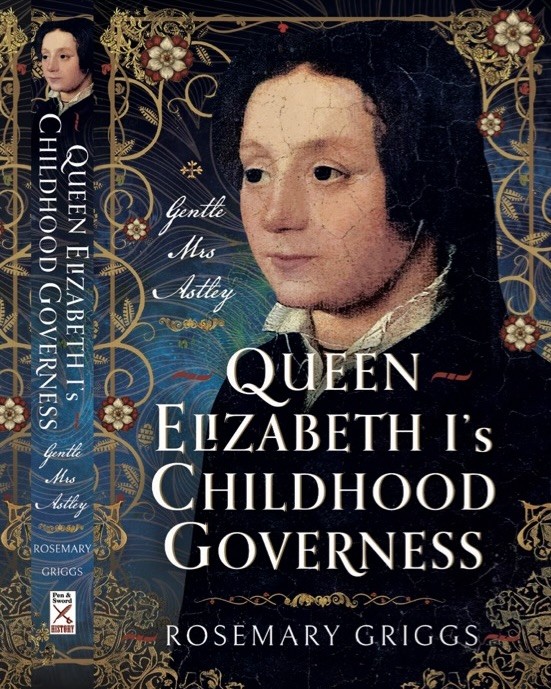
Rosemary: I’m very excited about my current project, my first work of nonfiction. A woman connected to the Champernownes has elbowed her way to the front of the queue of women whose stories I want to tell. Fans of Tudor history know her as Kat Ashley, Queen Elizabeth’s childhood governess. When I began mapping out a fictional account of her life, I found the character emerging from my detailed research was a little different from the woman familiar to us. Going back to the original sources made me question the accepted narrative. I had also discovered some interesting details historians seem to have overlooked. So, I am thrilled that Pen and Sword Books are giving me the opportunity to set out all of my research into this fascinating woman who had so much influence on Elizabeth I. Here is the fantastic jacket design. We are targeting publication summer of 2026.

Sharon: I’m looking forward to getting my hands on a copy – and don’t Pen & Sword do the most gorgeous covers?

Sharon: And finally, what is the best thing about being a writer?

Rosemary: Opening that box, holding your book for the first time is very special. But above all, it is when people tell me my story transported them back in time and they’ve enjoyed reading it, or even that it’s made them think. That’s what makes it all worthwhile.

About the Author:

History... the Interesting Bits

Rosemary Griggs is an author, researcher, seamstress and popular West Country speaker. She has a particular interest in Devon’s sixteenth-century history and the Champernowne family.

She loves telling the stories of the forgotten women of history; wives, sisters, daughters and mothers who played their part during the tumultuous Tudor years: the Daughters of Devon. Rosemary also researches, creates and wears sixteenth-century clothing. She brings the past to life through a unique blend of theatre, history and re-enactment at appearances and talks for museums and community groups all over the West Country. Out of costume, Rosemary leads heritage tours of the gardens at Dartington Hall, a fourteenth-century manor house in rolling south Devon parkland near Totnes.

You can find out more on Rosemary’s website.

Where to find Rosemary:

Facebook: Instagram: Threads: BlueSky.

To Buy Rosemary’s books

All three books are available as paperbacks from UK bookshops, and as Ebook worldwide. The first two are also available as audible: Rosemary’s bookshop; Amazon UK; Amazon US.

*

My Books

Signed, dedicated copies of all my books are available through my online bookshop.

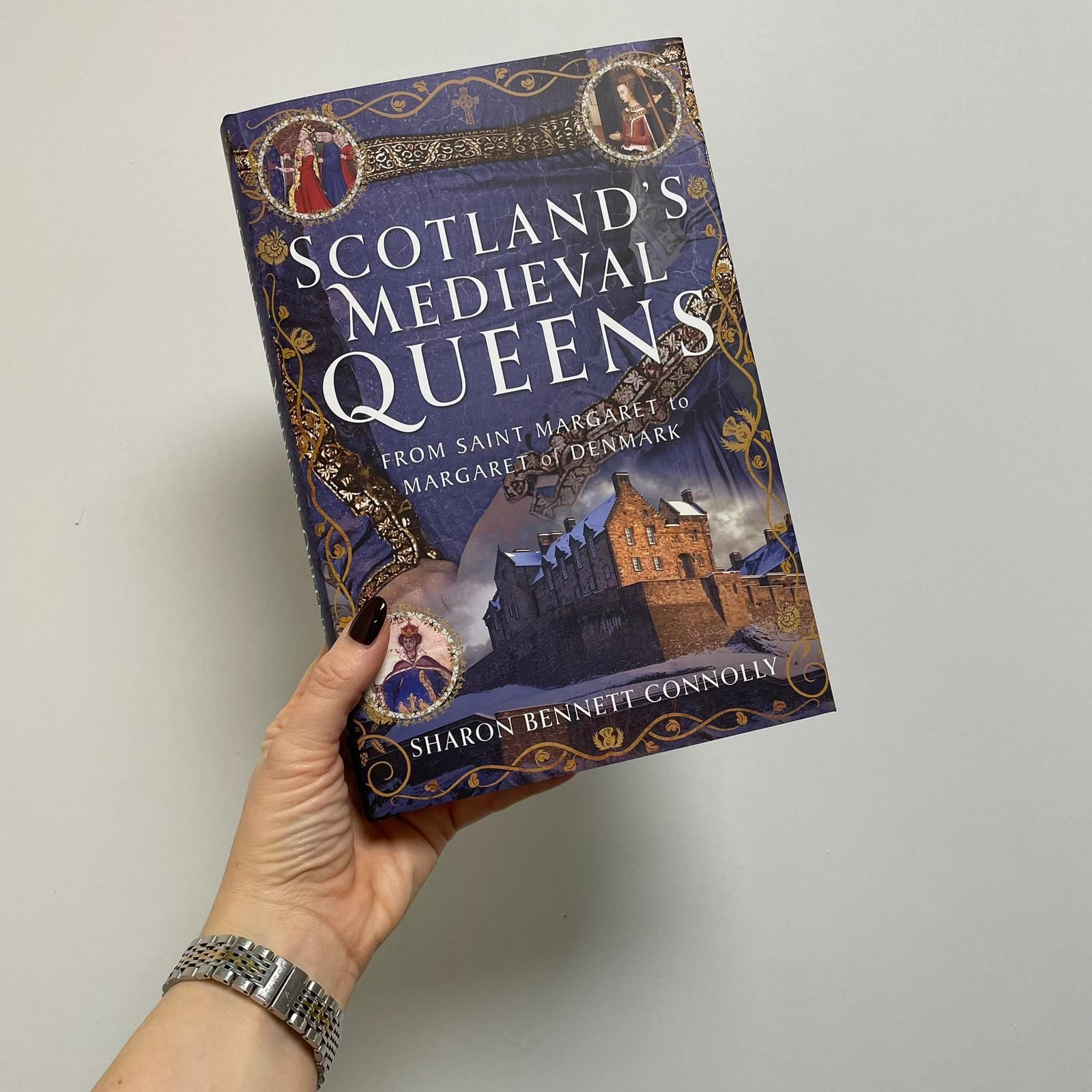
Out now: Scotland’s Medieval Queens

Books by Sharon Bennett Connolly

Scotland’s history is dramatic, violent and bloody. Being England’s northern neighbour has never been easy. Scotland’s queens have had to deal with war, murder, imprisonment, political rivalries and open betrayal. They have loved and lost, raised kings and queens, ruled and died for Scotland. From St Margaret, who became one of the patron saints of Scotland, to Elizabeth de Burgh and the dramatic story of the Scottish Wars of Independence, to the love story and tragedy of Joan Beaufort, to Margaret of Denmark and the dawn of the Renaissance, Scotland’s Medieval Queens have seen it all. This is the story of Scotland through their eyes.

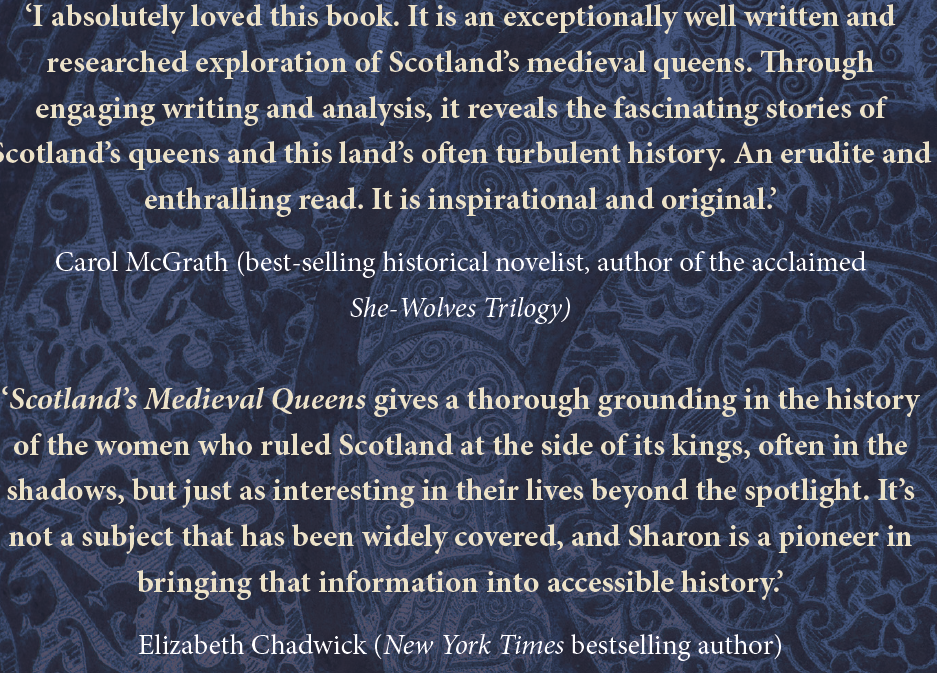
Scotland’s Medieval Queens gives a thorough grounding in the history of the women who ruled Scotland at the side of its kings, often in the shadows, but just as interesting in their lives beyond the spotlight. It’s not a subject that has been widely covered, and Sharon is a pioneer in bringing that information into accessible history.’ Elizabeth Chadwick (New York Times bestselling author)

Available now from Amazon and Pen and Sword Books

Also by Sharon Bennett Connolly:

Books by Sharon Bennett Connolly

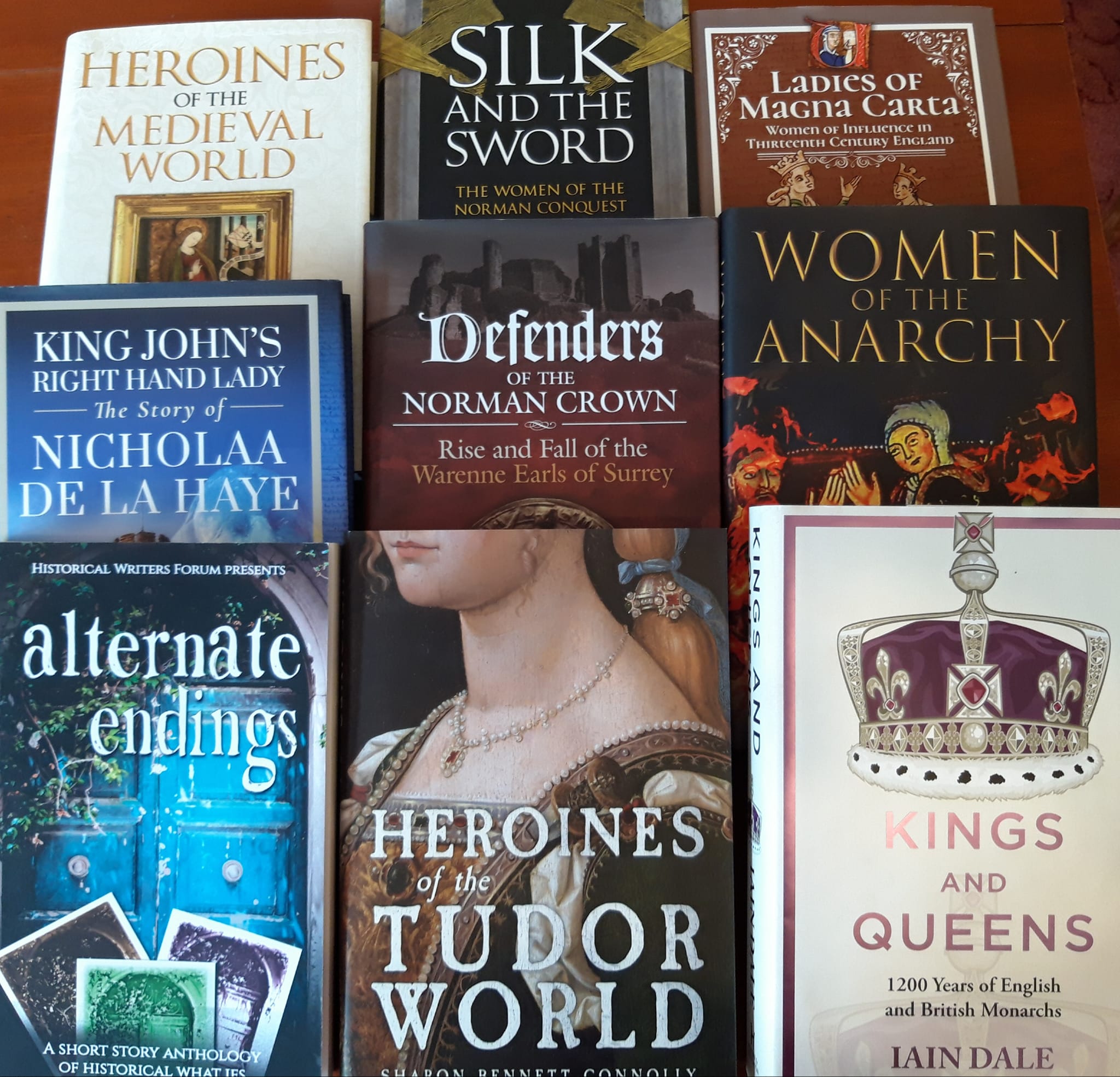
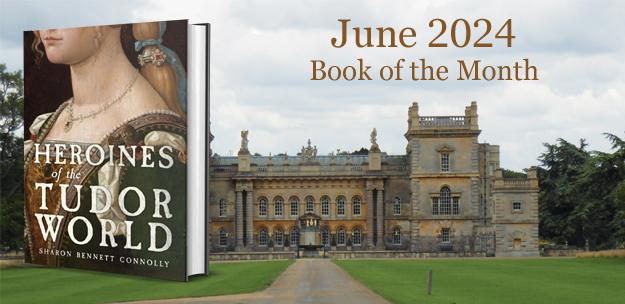
Heroines of the Tudor World tells the stories of the most remarkable women from European history in the time of the Tudor dynasty, 1485-1603. These are the women who ruled, the women who founded dynasties, the women who fought for religious freedom, their families and love. Heroines of the Tudor World is now available for pre-order from Amberley Publishing and Amazon UK. Women of the Anarchy demonstrates how Empress Matilda and Matilda of Boulogne, unable to wield a sword themselves, were prime movers in this time of conflict and lawlessness. It shows how their strengths, weaknesses, and personal ambitions swung the fortunes of war one way – and then the other. Available from Bookshop.orgAmberley Publishing and Amazon UKKing John’s Right-Hand Lady: The Story of Nicholaa de la Haye is the story of a truly remarkable lady, the hereditary constable of Lincoln Castle and the first woman in England to be appointed sheriff in her own right. Available from all good bookshops Pen & Sword Booksbookshop.org and Amazon

Royal Historical Society

Defenders of the Norman Crown: The Rise and Fall of the Warenne Earls of Surrey tells the fascinating story of the Warenne dynasty, from its origins in Normandy, through the Conquest, Magna Carta, the wars and marriages that led to its ultimate demise in the reign of Edward III. Available from Pen & Sword BooksAmazon in the UK and US, and Bookshop.orgLadies of Magna Carta: Women of Influence in Thirteenth Century England looks into the relationships of the various noble families of the 13th century, and how they were affected by the Barons’ Wars, Magna Carta and its aftermath; the bonds that were formed and those that were broken. It is now available in paperback and hardback from Pen & SwordAmazon, and Bookshop.orgHeroines of the Medieval World tells the stories of some of the most remarkable women from Medieval history, from Eleanor of Aquitaine to Julian of Norwich. Available now from Amberley Publishing and Amazon, and Bookshop.orgSilk and the Sword: The Women of the Norman Conquest traces the fortunes of the women who had a significant role to play in the momentous events of 1066. Available now from Amazon,  Amberley Publishing, and Bookshop.org.

Alternate Endings: An anthology of historical fiction short stories including Long Live the King… which is my take what might have happened had King John not died in October 1216. Available in paperback and kindle from Amazon.

Podcast:

Have a listen to the A Slice of Medieval podcast, which I co-host with Historical fiction novelist Derek Birks. Derek and I welcome guests, such as Bernard Cornwell and Elizabeth Chadwick, and discuss a wide range of topics in medieval history, from significant events to the personalities involved.

There are now 80 episodes to listen to!

Every episode is also available on YouTube.

*

Don’t forget! Signed and dedicated copies of all my books are available through my online bookshop.

For forthcoming online and in-person talks, please check out my Events Page.

You can be the first to read new articles by clicking the ‘Follow’ button, liking our Facebook page or joining me on TwitterThreadsBluesky and Instagram.

©2024 Sharon Bennett Connolly FRHistS and Rosemary Griggs

Guest Post: Othon and the Templars by John Marshall

Today, it is a pleasure to welcome John Marshall to History…the Interesting Bits with an article about a very intriguing chap, Othon de Grandson. Othon was a very good friend of Edward I and one who could arguably challenge William Marshal for the title, Greatest Knight. John’s new book is a biography of this remarkable man.

So, over to John…

Othon and the Templars

History  the Interesting Bits
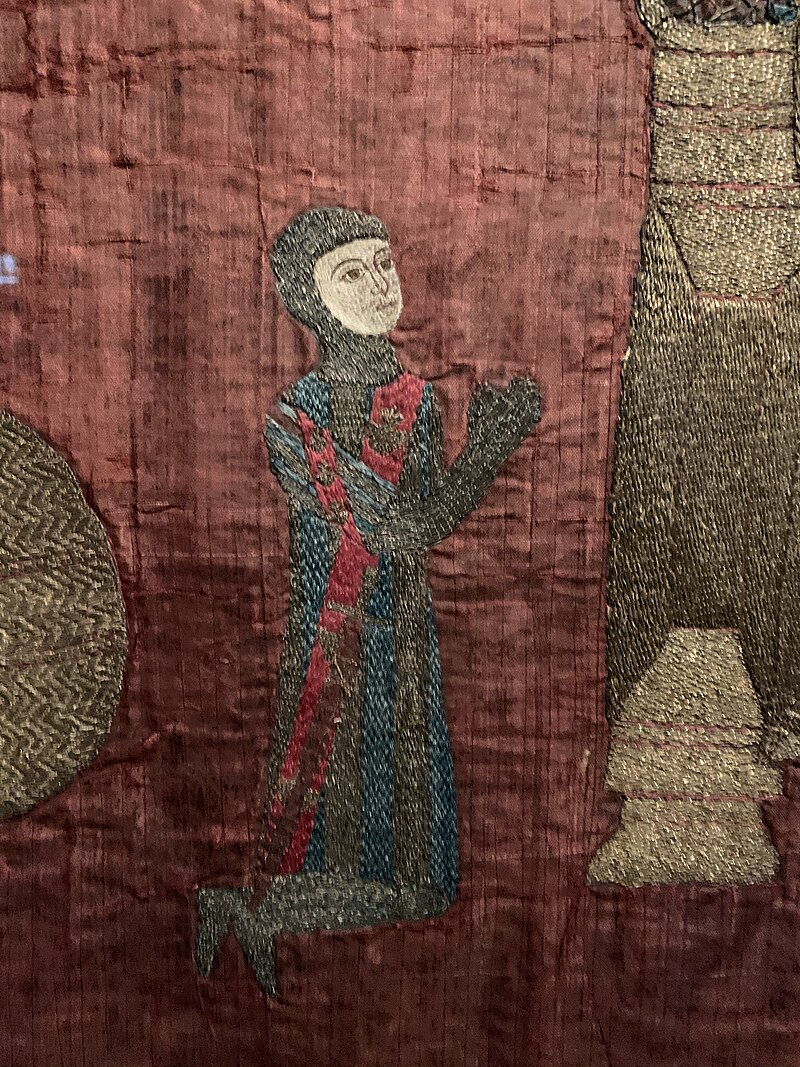
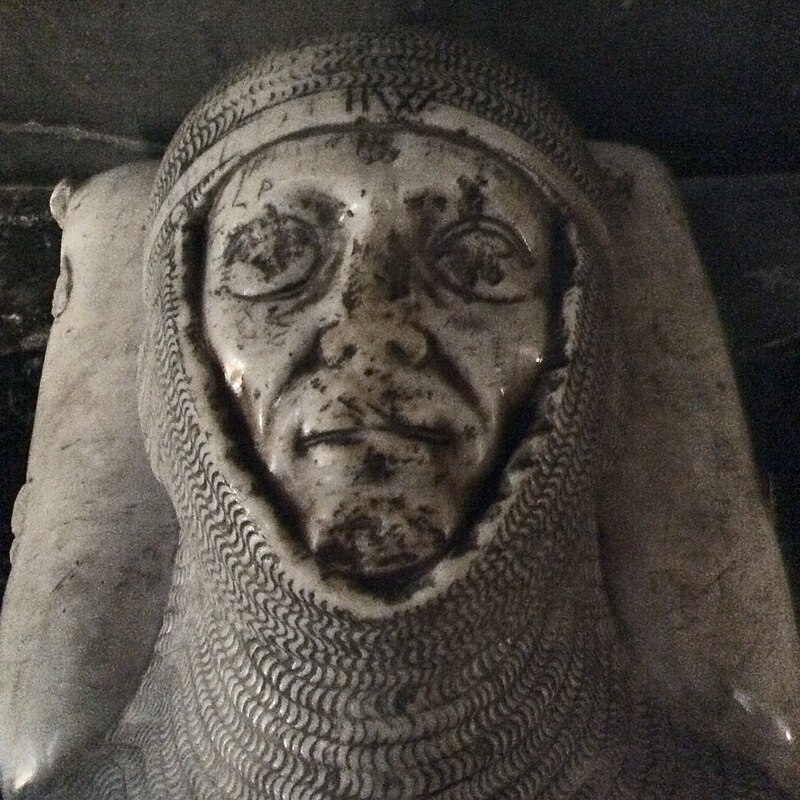
Othon de Grandson from an altar screen from the Cathedral in Lausanne now displayed in the Bern Historic Museum.

A question I asked myself in writing Othon de Grandson: Edward I’s Loyal Knight of Renown was exactly what was the Savoyard knight’s relationship with the Knights Templar? The relationship of Edward’s friend and envoy with the Poor Fellow Soldiers of Christ and of the Temple of Solomon is a long one and indeed began over a century before he was born.

Othon’s ancestor Barthélémy de Jura, treasurer of Reims, then Bishop of Laon in Picardy, was there at the very beginning of the crusader order. Barthélémy was at the 1128 Council of Troyes, chaired by Bernard of Clairvaulx which ratified the rule of the the Templars. He was a kinsman, through his mother, of Bernard of Clairvaulx, and would later retire as a monk to the Cistercian abbey he helped found at Foigny. Another ancestor was another Barthélémy who took up the cross and joined the Second Crusade. He is reported to have departed this life in Jerusalem in 1158.

So, when Othon de Grandson accompanied his liege the Lord Edward on the ninth crusade in 1271 his family was no stranger to crusading.

But the story of Othon de Grandson’s close association with the Templars begins in earnest with his flight from Acre accompanying Templar knight Jacques de Molay in 1291. Grandson had likely been sent to Acre in 1290 as preparation for a crusade by King Edward I that never came to pass. They were all overtaken by Al Ashraf Khalil, the sultan of Egypt who successfully led a Mamluk assault on the last crusader outpost in Outremer. King Henry II of Cyprus, the gravely wounded Master of the Hospitallers Jean de Villiers, the soon-to-be Master of the Templars, Jacques de Molay and Othon de Grandson washed up on the shore of Cyprus as refugees from Acre. The Templars were in need of a new Grand Master, and it is said that Othon de Grandson was “involved” in the election of Jacques de Molay.

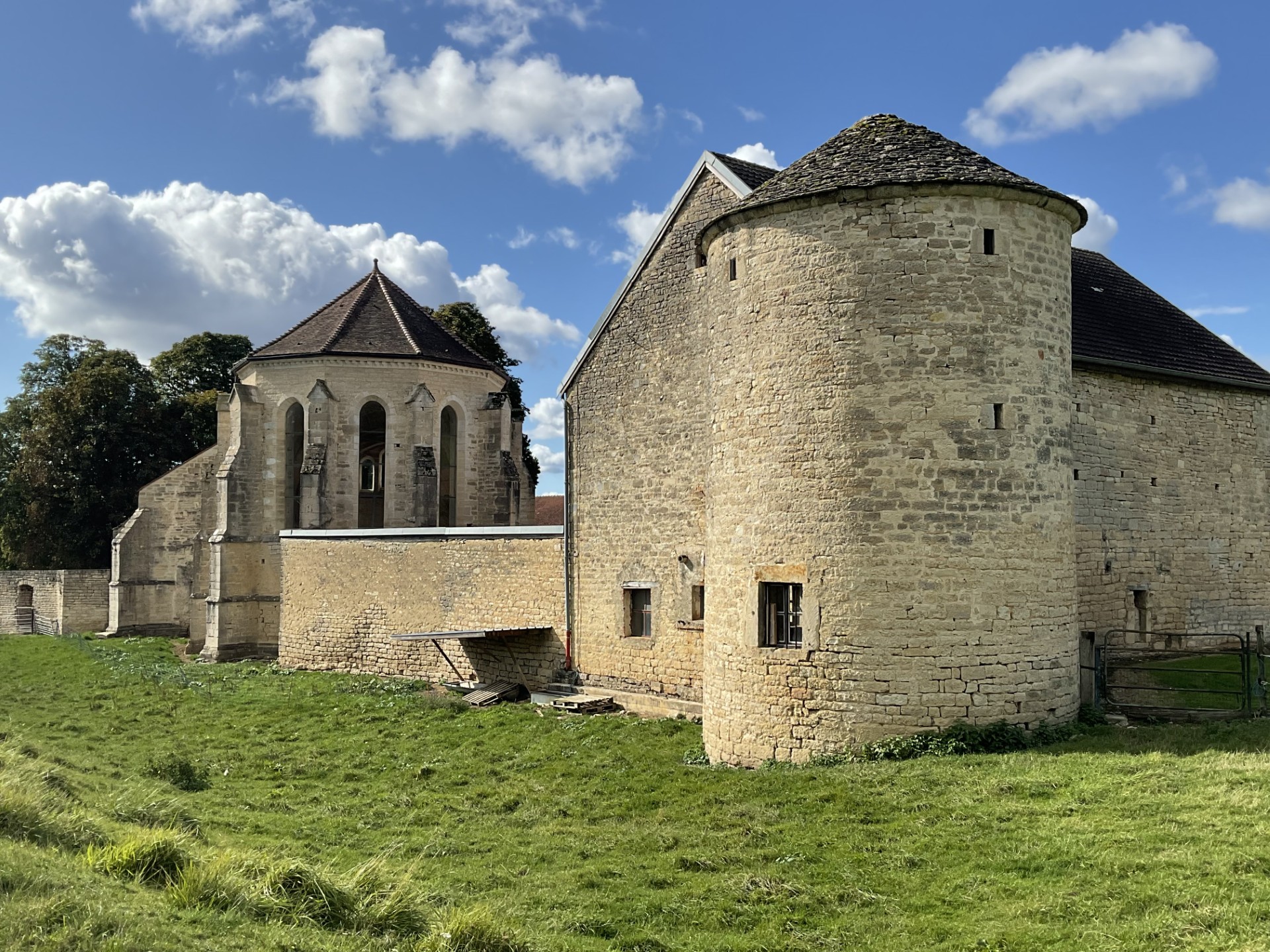
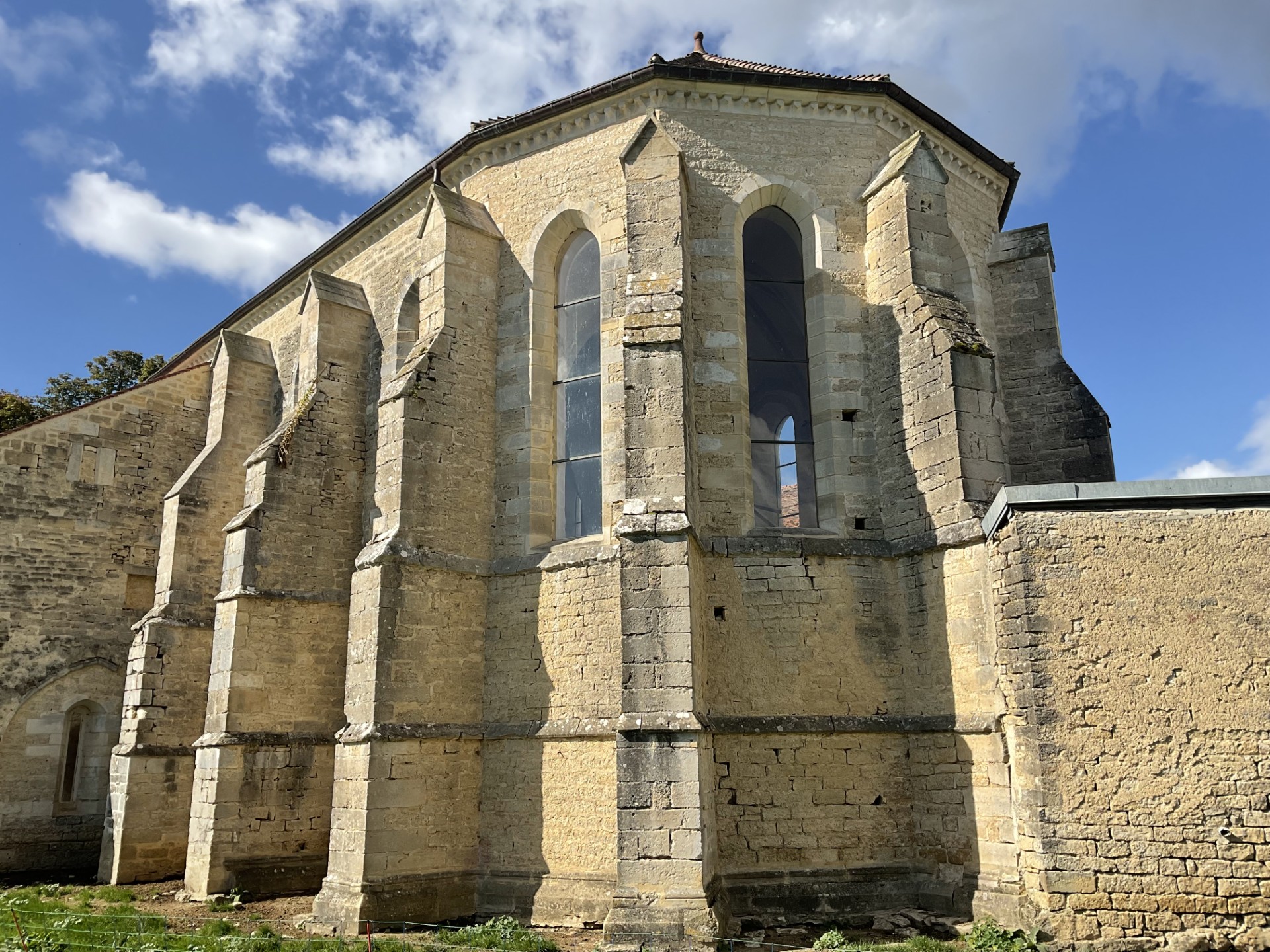
The former Templar Commanderie at Épailly in Burgundy which passed to Othon on the Templars suppression.

The idea of being ‘involved’ came from a declaration given later during the suppression of the order; a Templar, Hugh de Fauro, gave testimony that Jacques de Molay had sworn before the Master of the Hospital and ‘coram domino Odone de Grandisono milite’ that is ‘before the knight Sir Othon de Grandson.’ We then hear from Hethum of Corycus that Grandson and Jacques de Molay, had had a hand in affairs and the better reordering of the kingdom of Cillician Armenia to meet the Mamluk threat and preserve it as a base for ongoing crusading ventures. Grandson’s relationship with Molay and the Templars does seem to stem from this time at Acre, on Cyprus and in Armenian Cilicia between 1291 and 1294.

We then meet the financial entanglement of grandson with the Templars. Evidence of this comes not only from payments from the Templars to Grandson but also grants in the other direction. When both Molay and Grandson were back in the west, on 14 July 1296, Othon would grant the Templars 200 Livres from his salt revenues at Salins-les-Bains in the Franche Comté, a source of revenue he had used to similarly grant the monks of Saint-Jean Baptiste in Grandson before he had left for the

Holy Land. The first grant was in essence for prayers of safe return; the second grant looks like thanks for a safe return. The great salt works of Salins belonged to the Count of Burgundy; they were also known as the Seigneurs de Salins, and the works and its grander enlightenment era equivalent today enjoy UNESCO-listed status. The grant to the Templars was in consideration of the great help Othon had received from ‘mes chiers amis en dieu freres Jaques de Molai’, that is, ‘my dear friend in God brother Jacques de Molay’ and he referred to the help which ‘li freres du celle meismes Relegion ont fait a mes accessors, e a moi deca mer et de la mer en la sainte terre e ne cesse encore de faire’ or ‘the brethren of that same order have given to my ancestors and to myself in the West and in the East in the Holy Land, and still continue to give’. His reference to his anccessurs is likely to mean Barthélémy de Grandson who had, as we saw, died in 1158 in Jerusalem.

History the Interesting Bits
Templar Commanderie at Épailly in Burgundy

The reverse Templar ongoing and enormous financial commitment to Grandson is confirmed to us in a papal confirmation of 17 August 1308 by Pope Clement V. Upon suppression of the order Grandson was keen, obviously, that Templar payments continue, since they were the tremendous annual sum of 2,000 Livres Tournois, equating to £500 at the time, and over £350,000 in today’s money. The pension arrangement was made by a Grand Master, named as Jacques de Molay, and variously dated to 1277, 1287 or 1296–97. French Templar historian Alain Demurger wrote: ‘Fault lay with the editor of Clement V’s records … The editor put the date 1277, while M. L. Bulst-Thiele transcribed it as 1297, whereas the original, very clearly and without abbreviations or deletions says 1287.’ In his notes to this assertion, he cites the Vatican Archives date as ‘Anno millesimo duecentesimo octuagesimo septimo’ or ‘In the year one thousand two hundred and eighty-seven.’

Now of course Molay did not succeed Beaujeu until 1292, which renders the dating of the award problematic. Demurger suggested that it was not Molay who made the award despite specific reference to him ‘Jacobus de Mollay’, but his predecessor Beaujeu – in short, that the date was correct but the master’s name incorrect. Alan Forey argued the contrary, writing that it was: ‘more likely that the grant was made by James of Molay and that the date was wrongly copied’. Given, Molay’s 1292 election as Grand Master this would suggest 1296–97 – in short, the date was incorrect, but the master’s name correct. Demurger acknowledged in his notes that ‘a new problem arose … Grandson and the Temple were already connected in 1287: where, how and for what reason?’ Indeed, Demurger’s dating would create such questions, while Forey’s dating would place them squarely in the context of the Fall of Acre and his time in the east with Molay. This ‘compensare’ was given by the The Templars for ‘operibus virtuosis’ or ‘virtuous actions’ rendered by Othon in support of the order, but surely more likely post-Fall of Acre than before.

Templar Commanderie at Épailly in Burgundy

In confirmation of the pension, Clement V granted Othon three former Templar houses in France as a part of the continuing settlement, those at Thors, Épailly and Coulours, an act unlikely to have been undertaken at the time in favour of a knight of the order. And so, the ‘virtuous works’ referred to by Pope Clement would appear to date from Grandson’s time in Acre in 1291. So, the date of 1277 attached to the payments by the transcription of them is certainly mistaken, and for the 1287 dating of the original 1308 manuscript we should read 1296–97. Demurger gives 1296 clearly as the date for Molay meeting with Grandson in Paris and the Salins grant. Othon de Grandson’s intimate links with the Templars continue to intrigue, but in Cyprus and Armenia 1292-4, as at Acre in 1291, and here with his pension payments they point to a significant and close ally in matters Outremer rather than a member of the order itself, of which there is no mention.

Grandson, was a close friend of the Templars, having fought alongside them at Acre in 1291, been there in Cyprus as a part of Molay’s election as Grand Master, and in receipt of a handsome annual pension from the order. So, at Philippe ke Bel’s suppression of the order and Molay’s arrest and the rumours swirling around France, the scandal would have touched directly upon him. But at no point can we find Grandson implicated in events, other than petitioning Pope Clement for the maintenance of his pension. But nowhere too can we find him leaping to the defence of Molay, his former friend and ally, at least not in a way that has left any trace. As Demurger said in conversation with the author of this book, Grandson did not try to defend Molay. A character flaw? Demurger went to affirm that one cannot speculate about possible motives, Grandson was by now seventy years of age, had discretion become the greater part of valour?

History the Interesting Bits
Templar Commanderie at Épailly in Burgundy

It is because of his avoidance of implication in the suppression of the Templars, that despite his Templar connections, we can be as certain as certain can be that Othon de Grandson was a friend, ally, indeed fellow traveller of the Templars, but not actually a member of the doomed order, As Alain Demurger said unequivocally to the question, was Grandson a Templar? – Non. What were the enormous payments from the Templars to Othon de Grandson for? What were the “operibus virtuosis”? It’s only speculation but what did Grandson have that might be valuable to the Order? – access better than anyone to Edward I’s ear and access to the English court.

*

About the Book:

History  the Interesting Bits

There were once two little boys – they met when they were both quite young; one was born in what’s now Switzerland, by Lake de Neuchâtel, his name Othon de Grandson, and the other was born in London, his name Prince Edward, son of King Henry the third of that name. Othon was probably born in 1238, and Edward, we know, in June 1239. These two little boys grew up and had adventures together. They took the cross together, the ninth crusade in 1271 and 1272. Othon reputedly sucking poison from Edward when the latter was attacked by an assassin. In 1277 and 1278, they fought the First Welsh War against the House of Gwynedd, Othon doing much to negotiate the Treaty of Aberconwy in 1278, which ended hostilities. When war broke out again in 1282 they fought the Second Welsh War together. Othon led Edward’s army across the Bridge of Boats from Anglesey and was the first to sight the future sites of castles at Caernarfon and Harlech. Edward made his friend the first Justiciar (Viceroy) of North Wales. When Edward and Othon went to Gascony in 1287, Othon stayed in Zaragoza as a hostage for Edward’s good intentions between Gascony and Castille.  Later, in 1291, when Acre was threatened by the Mamluks, Edward sent Othon as head of the English delegation of knights. When Acre finally fell to the Mamluks bringing the Crusades to a close, who was the last knight onto the boats? Othon de Grandson, helping his old friend, the wounded Jean de Grailly onto the boat. When Othon returned from the East, he found England at war with Scotland and France; he would spend his last years in Edward’s service building alliances and negotiating peace before retiring to his home in what is now Switzerland after the king’s death in 1307. Grandson lived in the time of Marco Polo, Giotto, Dante, Robert the Bruce, and the last Templars. He was right there at the centre of the action in two crusades: war with Wales, Scotland, and France, the Sicilian Vespers, and suppression of the Templars; he walked with a succession of kings and popes, a knight of great renown. This is his story.

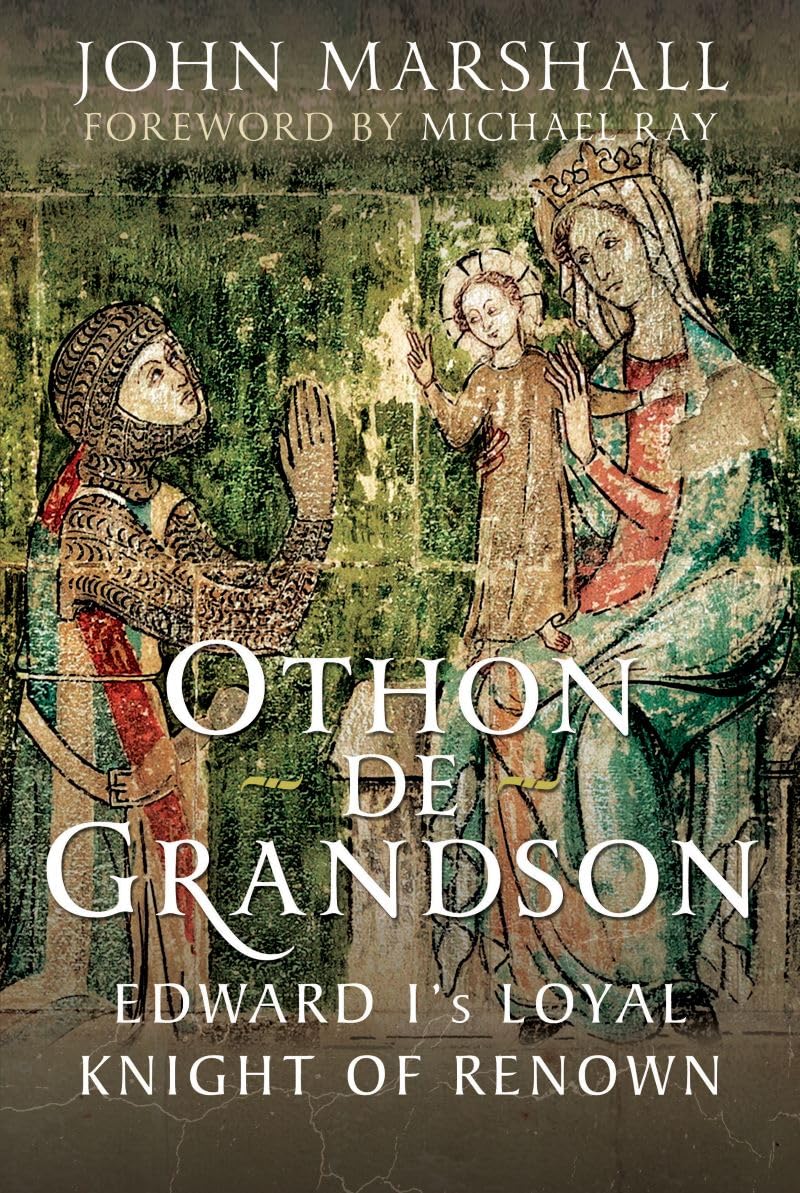
Othon de Grandson: Edward I’s Loyal Knight of Renown is available now from Amazon.

About the Author:

History  the Interesting Bits

Having moved to Switzerland, and qualified as a historian (Masters, Northumbria University, 2016), the author came across the story of the Savoyards in England and engaged in this important history research project. He founded the Association pour l’histoire médiévale Anglo Savoyards. Writer of Welsh Castle Builders: The Savoyard Style and Peter of Savoy: The Little Charlemagne both available from Pen and Sword Books Ltd. Member of the Henry III Roundtable with Darren Baker, Huw Ridgeway and Michael Ray.

*

My Books

Signed, dedicated copies of all my books are available through my online bookshop.

Out now: Scotland’s Medieval Queens

Books by Sharon Bennett Connolly

Scotland’s history is dramatic, violent and bloody. Being England’s northern neighbour has never been easy. Scotland’s queens have had to deal with war, murder, imprisonment, political rivalries and open betrayal. They have loved and lost, raised kings and queens, ruled and died for Scotland. From St Margaret, who became one of the patron saints of Scotland, to Elizabeth de Burgh and the dramatic story of the Scottish Wars of Independence, to the love story and tragedy of Joan Beaufort, to Margaret of Denmark and the dawn of the Renaissance, Scotland’s Medieval Queens have seen it all. This is the story of Scotland through their eyes.

Scotland’s Medieval Queens gives a thorough grounding in the history of the women who ruled Scotland at the side of its kings, often in the shadows, but just as interesting in their lives beyond the spotlight. It’s not a subject that has been widely covered, and Sharon is a pioneer in bringing that information into accessible history.’ Elizabeth Chadwick (New York Times bestselling author)

Available now from Amazon and Pen and Sword Books

Also by Sharon Bennett Connolly:

Books by Sharon Bennett Connolly

Heroines of the Tudor World tells the stories of the most remarkable women from European history in the time of the Tudor dynasty, 1485-1603. These are the women who ruled, the women who founded dynasties, the women who fought for religious freedom, their families and love. Heroines of the Tudor World is now available for pre-order from Amberley Publishing and Amazon UK. Women of the Anarchy demonstrates how Empress Matilda and Matilda of Boulogne, unable to wield a sword themselves, were prime movers in this time of conflict and lawlessness. It shows how their strengths, weaknesses, and personal ambitions swung the fortunes of war one way – and then the other. Available from Bookshop.orgAmberley Publishing and Amazon UKKing John’s Right-Hand Lady: The Story of Nicholaa de la Haye is the story of a truly remarkable lady, the hereditary constable of Lincoln Castle and the first woman in England to be appointed sheriff in her own right. Available from all good bookshops Pen & Sword Booksbookshop.org and Amazon

Royal Historical Society

Defenders of the Norman Crown: The Rise and Fall of the Warenne Earls of Surrey tells the fascinating story of the Warenne dynasty, from its origins in Normandy, through the Conquest, Magna Carta, the wars and marriages that led to its ultimate demise in the reign of Edward III. Available from Pen & Sword BooksAmazon in the UK and US, and Bookshop.orgLadies of Magna Carta: Women of Influence in Thirteenth Century England looks into the relationships of the various noble families of the 13th century, and how they were affected by the Barons’ Wars, Magna Carta and its aftermath; the bonds that were formed and those that were broken. It is now available in paperback and hardback from Pen & SwordAmazon, and Bookshop.orgHeroines of the Medieval World tells the stories of some of the most remarkable women from Medieval history, from Eleanor of Aquitaine to Julian of Norwich. Available now from Amberley Publishing and Amazon, and Bookshop.orgSilk and the Sword: The Women of the Norman Conquest traces the fortunes of the women who had a significant role to play in the momentous events of 1066. Available now from Amazon,  Amberley Publishing, and Bookshop.org.

Alternate Endings: An anthology of historical fiction short stories including Long Live the King… which is my take what might have happened had King John not died in October 1216. Available in paperback and kindle from Amazon.

Podcast:

A Slice of Medieval

Have a listen to the A Slice of Medieval podcast, which I co-host with Historical fiction novelist Derek Birks. Derek and I welcome guests, such as Bernard Cornwell and discuss a wide range of topics in medieval history, from significant events to the personalities involved.

Every episode is also now available on YouTube.

*

Don’t forget! Signed and dedicated copies of all my books are available through my online bookshop.

For forthcoming online and in-person talks, please check out my Events Page.

You can be the first to read new articles by clicking the ‘Follow’ button, liking our Facebook page or joining me on TwitterThreadsBluesky and Instagram.

*

©2025 Sharon Bennett Connolly, FRHistS and John Marshall

Author Spotlight: John Marshall

History...the Interesting Bits
Othon de Grandson

Today, it is a pleasure to welcome historian John Marshall to History…the Interesting Bits to chat about his writing and what attracts him to History. John’s third book, Othon de Grandson: Edward I’s Loyal Knight of Renown, has just hit the shops. A close rival to William Marshal for the Greatest Knight accolade, I’m looking forward to reading Othon’s story. But first, a chat with John about what inspires his writing…

Sharon: How did you start your writing career?

John: A midlife career change, some would say a midlife crisis, but an increasing dissatisfaction and boredom surrounding my career of thirty years within the corporate travel business. In short it was not fun anymore, nor was it in anyway stimulating intellectually. I had had a lifelong interest in history, so the first step was a master’s in history. More than anything, this taught me how to organise my thoughts and conduct research professionally, especially that in reading the most interesting stuff was usually in the footnotes. A relocation for personal reasons brought a move from England to Switzerland. There, I kind of fell down the rabbit hole of the relations between Savoy and England in the thirteenth century, I was looking for a writing project as a historian and within a week of arriving in Switzerland my partner and I visited the castle at Yverdon in the Canton of Vaud. Hidden away in the small print of a panel was the throw away line that the castle had been built by Maître Jacques de Saint George. I had recently visited Conwy castle before leaving the UK and for some reason the name immediately registered as the man who had built Conwy. “Do you know who this is?” I asked my partner, receiving a puzzled look. I then emailed the castle to be given an erroneous answer. I then discovered the works of the late Arnold Taylor, and the more recent criticism which I thought unfair. So, the research for my first book, Welsh Castle Builders began.

Sharon: What is the best thing about being a writer?

John: We all write to understand something better, we all read for the same reason. We also, as was the case with me, write a book we would have wanted to read ourselves. In beginning the research for Welsh Castle Builders I was frustrated that the available evidence, the story, did not seem to be in one place. I also felt that the people I wanted to write about in the distant past had not had their story told well enough. So, the best thing about being a writer is being able to write books you would want to read yourself and to tell the stories of forgotten people.

Sharon: What is the worst thing about being a writer?

History...the Interesting Bits

John: For a history writer the worst thing is the sheer volume of detail, and the ease with which you can make mistakes by saying castle x is in county y when it’s now in county z. My previous career had involved a whole lot of data analysis, so this helped, but the sheer volume of detail can be daunting. I would also add that the hours involved in research can also be daunting.

Sharon: What got you into history?

John: My dad was the one who got me into history, it was very much a father and son thing. He had a real passion for history; we covered many miles visiting castles and battlefields. Indeed, my earliest childhood memory is a vague one of walking by an enormous castle by a river and wondering who built that. As a five-year-old boy a medieval castle had a “wow” response that never left me. We were on holiday in Rhyl, I now know the castle has a name, Rhuddlan Castle.

Sharon: What drew you to Othon de Grandson’s story?

John: Days after visiting the castle at Yverdon my partner and I visited the cathedral at Lausanne. My partner is from Lausanne, and she was and is very proud of the cathedral. Just by the altar is the tomb of a knight, with no reference to who the knight is. Asking my partner she replied, “Oh that’s Othon de Grandson” But she was not able to add much more. Reading Arnold Taylor, in connection to the Yverdon visit the name Othon de Grandson kept coming up time and time again. So, I began to learn Othon’s story and realised quickly that without Othon there would have been no Maître Jacques de Saint George in Britain. More research told the story of a boy who came to England, a crusading knight, a top-level diplomat, someone at the very heart of European affairs. Perhaps it was the little boy in me, but this had all the hallmarks of a Boy’s Own adventure story. So, once I had done with Maître Jacques and Pierre de Savoie, Othon’s story had to be told. There was an excellent book written in the sixties, but this story needed to be told again, maybe one day the Swiss will even put a marker on the tomb to say who it is.

Sharon: How influential was Othon to Edward I’s reign?

History...the Interesting Bits
Othon de Grandson from an altar screen from the Cathedral in Lausanne now displayed in the Bern Historic Museum.

John: I think it comes down to one word – loyalty. The book is called Othon de Grandson: Edward I’s Loyal Knight of Renown. Edward I could inspire incredible lifelong loyalty in those around him. It is remarkable to see how loyal these band of brothers; Edward, Edmund, Othon de Grandson, Henry de Lacy, Jean de Vesci et al were to one another. The epithet that seems to come up time after time in their regard is loyalty. Edward in March 1278 described Othon as someone who could ‘do his will … better and more advantageously’ than ‘others about him’, as well as ‘if he himself were to attend to the matters in person’. Delegation, even in our own day is an art, and Edward chose wisely those around him. Being a monarch in the Middle Ages was no easy task, and having people you could trust to do something exactly as you would do it yourself was like gold dust. Loyalty was foundational to medieval ideas of knighthood. It was not just important it was central to their identity, purpose, and honour. What stands out about these band of brothers is that their bonds were formed through shared hardships: crusades, rebellion, foreign war, and dynastic tension. Loyalty was more than service—it was a mark of faith, honour, brotherhood, and identity. French historian Charles-Victor Langlois wrote of Edward:

“We cannot admire the activity of the English king too much; he was both in the breach on the side of the Rhône valley and of Wales; the threads of all European intrigues, in Castile, in Aragon, in Italy, were connected in his hands; and he still found the leisure to watch over his interests on the continent as Duke of Aquitaine.”

How could Edward do this? He had an Othon.

Sharon: How do you conduct your research?

History...the Interesting Bits
The former Templar Commanderie at Épailly in Burgundy which passed to Othon on the Templars suppression.

John: The answer is reading, reading, and reading. But more than that paying especial attention to primary sources and more that that especial attention to sources in other countries. The subjects of these histories, especially Othon de Grandson, lived their lives across the whole of the European theatre, and so their story is to be found everywhere. But I would sound a note of caution, to be careful in handling medieval chroniclers, like writers today they usually politically span stories, omitted things they didn’t like, only including things they liked. We should use medieval chronicles very carefully. A good case in point is the conduct of Othon de Grandson’s conduct in the Fall of Acre in 1292. Some chroniclers praise him, others are very critical, some even accuse him of cowardice. But by giving greater weight to eyewitness accounts and especially those like the Templar of Tyre who seems to have been with the English knights at the end, we can arrive at the truest picture. Spoiler alert, he was not a coward.

I would also add that it is vital to get out from a book and walk in the steps of those you are writing about. To this end my partner and son have spent many hours under a hot sun in the deep undergrowth of the French countryside looking for castles that are today nothing more than a few stones on top of a steep hill. But it is crucial in understanding the people of the past to visualise the landscape in which they moved.

Sharon: What attracts you to the thirteenth century?

John: The thirteenth century is foundational in many ways to the world we know today. In Othon’s time we see the beginnings of the clashes between church and state. We also see knights like Othon who were of their day, the feudal system, that is loyalty to a suzerain not a nation state. Whereas we see at the French court of Philippe le Bel the likes of Nogaret who are outlining nascent ideas of nation as primary identity. It is the century where we begin to move from the Middle Ages to the modern. In Britain, the relationships between England, Scotland, and Wales are beginning to be set. Indeed, why Wales employs the English legal system and Scotland does not are founded in the thirteenth-century. We also saw in my previous book to this, Pierre de Savoie, the beginnings of our parliamentary system and sadly xenophobia too.

Sharon: The 13th century is just the best! But,are there any other eras you would like to write about?

John: I became a medieval historian on my arrival in Switzerland, but prior to that my university concentration and dissertation was the American colonial period. I might return to that at some point, but I may by typecast.

Sharon: What comes next? Are you working on a new book?

History...the Interesting Bits

John: My fourth book, the story of Edmund, 1st Earl of Lancaster has just been written, the task of editing, especially on the part of my long-suffering partner, now begins. There has been a journal article written of Edmund, but it was written a century ago. During 2026 we plan to return from Switzerland to England, and in particular my hometown of Lancaster, so the subject of Edmund appeared like a bridge back to Lancaster – although he seems to almost never to have been there. The story of Edmund in many ways parallels that of Othon de Grandson. But Edmund’s story is one that fits into a brief period when it was not considered unusual for a Plantagenet prince to marry a Capetian queen and to rule French counties ((Champagne and Brie) that were so close to Paris. Edmund is the ancestor of our royalty today, both through his stepdaughter Jeanne I de Navarre but also in bloodline through his second son Henry. Edmund of Lancaster emerges as a very Anglo-French character, one that could only have existed in the rapprochement between the 1259 Treaty of Paris and the 1294 Gascon War. He is in many ways a model of a future that was not to be, where Plantagenets and Capetians happily coexisted, the road not traveled.

Sharon: Ooh, I like the idea of a book on Edmund. Good luck with that John and thank you so much for speaking with me today.

About the book:

History...the Interesting Bits

There were once two little boys – they met when they were both quite young; one was born in what’s now Switzerland, by Lake de Neuchâtel, his name Othon de Grandson, and the other was born in London, his name Prince Edward, son of King Henry the third of that name. Othon was probably born in 1238, and Edward, we know, in June 1239. These two little boys grew up and had adventures together. They took the cross together, the ninth crusade in 1271 and 1272. Othon reputedly sucking poison from Edward when the latter was attacked by an assassin. In 1277 and 1278, they fought the First Welsh War against the House of Gwynedd, Othon doing much to negotiate the Treaty of Aberconwy in 1278, which ended hostilities. When war broke out again in 1282 they fought the Second Welsh War together. Othon led Edward’s army across the Bridge of Boats from Anglesey and was the first to sight the future sites of castles at Caernarfon and Harlech. Edward made his friend the first Justiciar (Viceroy) of North Wales. When Edward and Othon went to Gascony in 1287, Othon stayed in Zaragoza as a hostage for Edward’s good intentions between Gascony and Castille.  Later, in 1291, when Acre was threatened by the Mamluks, Edward sent Othon as head of the English delegation of knights. When Acre finally fell to the Mamluks bringing the Crusades to a close, who was the last knight onto the boats? Othon de Grandson, helping his old friend, the wounded Jean de Grailly onto the boat. When Othon returned from the East, he found England at war with Scotland and France; he would spend his last years in Edward’s service building alliances and negotiating peace before retiring to his home in what is now Switzerland after the king’s death in 1307. Grandson lived in the time of Marco Polo, Giotto, Dante, Robert the Bruce, and the last Templars. He was right there at the centre of the action in two crusades: war with Wales, Scotland, and France, the Sicilian Vespers, and suppression of the Templars; he walked with a succession of kings and popes, a knight of great renown. This is his story.

Othon de Grandson: Edward I’s Loyal Knight of Renown is available now from Amazon.

About the Author:

History...the Interesting Bits

Having moved to Switzerland, and qualified as a historian (Masters, Northumbria University, 2016), the author came across the story of the Savoyards in England and engaged in this important history research project. He founded the Association pour l’histoire médiévale Anglo Savoyards. Writer of Welsh Castle Builders: The Savoyard Style and Peter of Savoy: The Little Charlemagne both available from Pen and Sword Books Ltd. Member of the Henry III Roundtable with Darren Baker, Huw Ridgeway and Michael Ray.

*

My Books

Signed, dedicated copies of all my books are available through my online bookshop.

Out now: Scotland’s Medieval Queens

Books by Sharon Bennett Connolly

Scotland’s history is dramatic, violent and bloody. Being England’s northern neighbour has never been easy. Scotland’s queens have had to deal with war, murder, imprisonment, political rivalries and open betrayal. They have loved and lost, raised kings and queens, ruled and died for Scotland. From St Margaret, who became one of the patron saints of Scotland, to Elizabeth de Burgh and the dramatic story of the Scottish Wars of Independence, to the love story and tragedy of Joan Beaufort, to Margaret of Denmark and the dawn of the Renaissance, Scotland’s Medieval Queens have seen it all. This is the story of Scotland through their eyes.

Scotland’s Medieval Queens gives a thorough grounding in the history of the women who ruled Scotland at the side of its kings, often in the shadows, but just as interesting in their lives beyond the spotlight. It’s not a subject that has been widely covered, and Sharon is a pioneer in bringing that information into accessible history.’ Elizabeth Chadwick (New York Times bestselling author)

Available now from Amazon and Pen and Sword Books

Also by Sharon Bennett Connolly:

Books by Sharon Bennett Connolly

Heroines of the Tudor World tells the stories of the most remarkable women from European history in the time of the Tudor dynasty, 1485-1603. These are the women who ruled, the women who founded dynasties, the women who fought for religious freedom, their families and love. Heroines of the Tudor World is now available for pre-order from Amberley Publishing and Amazon UK. Women of the Anarchy demonstrates how Empress Matilda and Matilda of Boulogne, unable to wield a sword themselves, were prime movers in this time of conflict and lawlessness. It shows how their strengths, weaknesses, and personal ambitions swung the fortunes of war one way – and then the other. Available from Bookshop.orgAmberley Publishing and Amazon UKKing John’s Right-Hand Lady: The Story of Nicholaa de la Haye is the story of a truly remarkable lady, the hereditary constable of Lincoln Castle and the first woman in England to be appointed sheriff in her own right. Available from all good bookshops Pen & Sword Booksbookshop.org and Amazon

Royal Historical Society

Defenders of the Norman Crown: The Rise and Fall of the Warenne Earls of Surrey tells the fascinating story of the Warenne dynasty, from its origins in Normandy, through the Conquest, Magna Carta, the wars and marriages that led to its ultimate demise in the reign of Edward III. Available from Pen & Sword BooksAmazon in the UK and US, and Bookshop.orgLadies of Magna Carta: Women of Influence in Thirteenth Century England looks into the relationships of the various noble families of the 13th century, and how they were affected by the Barons’ Wars, Magna Carta and its aftermath; the bonds that were formed and those that were broken. It is now available in paperback and hardback from Pen & SwordAmazon, and Bookshop.orgHeroines of the Medieval World tells the stories of some of the most remarkable women from Medieval history, from Eleanor of Aquitaine to Julian of Norwich. Available now from Amberley Publishing and Amazon, and Bookshop.orgSilk and the Sword: The Women of the Norman Conquest traces the fortunes of the women who had a significant role to play in the momentous events of 1066. Available now from Amazon,  Amberley Publishing, and Bookshop.org.

Alternate Endings: An anthology of historical fiction short stories including Long Live the King… which is my take what might have happened had King John not died in October 1216. Available in paperback and kindle from Amazon.

Podcast:

A Slice of Medieval

Have a listen to the A Slice of Medieval podcast, which I co-host with Historical fiction novelist Derek Birks. Derek and I welcome guests, such as Bernard Cornwell and discuss a wide range of topics in medieval history, from significant events to the personalities involved. Our first ever episode was a discussion on The Anarchy Every episode is also now available on YouTube.

*

Don’t forget! Signed and dedicated copies of all my books are available through my online bookshop.

For forthcoming online and in-person talks, please check out my Events Page.

You can be the first to read new articles by clicking the ‘Follow’ button, liking our Facebook page or joining me on TwitterThreadsBluesky and Instagram.

*

©2025 Sharon Bennett Connolly, FRHistS and John Marshall

Wordly Women: Samantha Wilcoxson

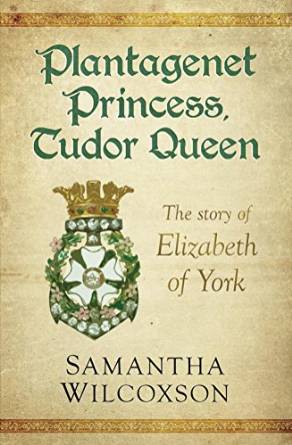
Today we are hopping across the pond for the next chat in my Wordly Women series. Joining me is Samantha Wilcoxson. Author of fiction novels mainly based in the late medieval and Tudor eras and and non-fiction books on the American Revolution, Samantha’s books – literally – span the Atlantic divide. Samantha has a knack for getting into the heads of the people she is writing about. Her book, Plantagenet Princess, Tudor Queen, about Elizabeth of York, is still one of the most insightful novels I have ever read.

Sharon: What got you into writing?

Samantha: What got you into writing? I have always loved reading and used to write dozens of book reviews every year. Many of those books were historical fiction and nonfiction. When I was considering ways to earn money while a stay-at-home mom, my husband suggested I write a book. I had never considered taking this step, so the first obstacle was deciding what I would want to write about. It didn’t take me long to settle on Elizabeth of York, and I quickly became passionate about the project. That novel turned into a series, and I’ve ventured into other historical eras since then.

Sharon: Tell us about your books.

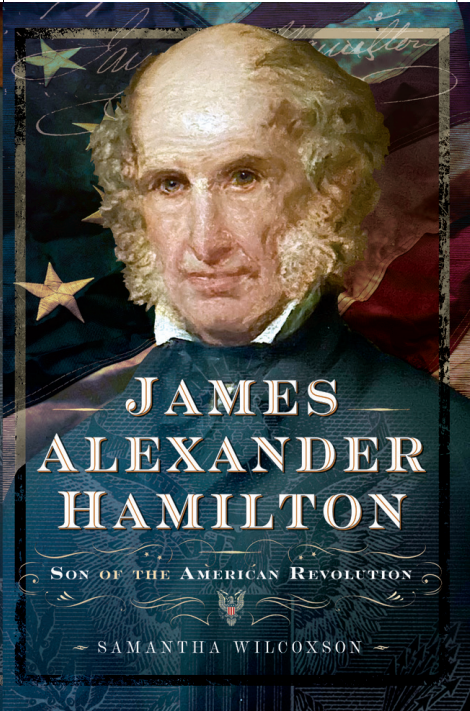
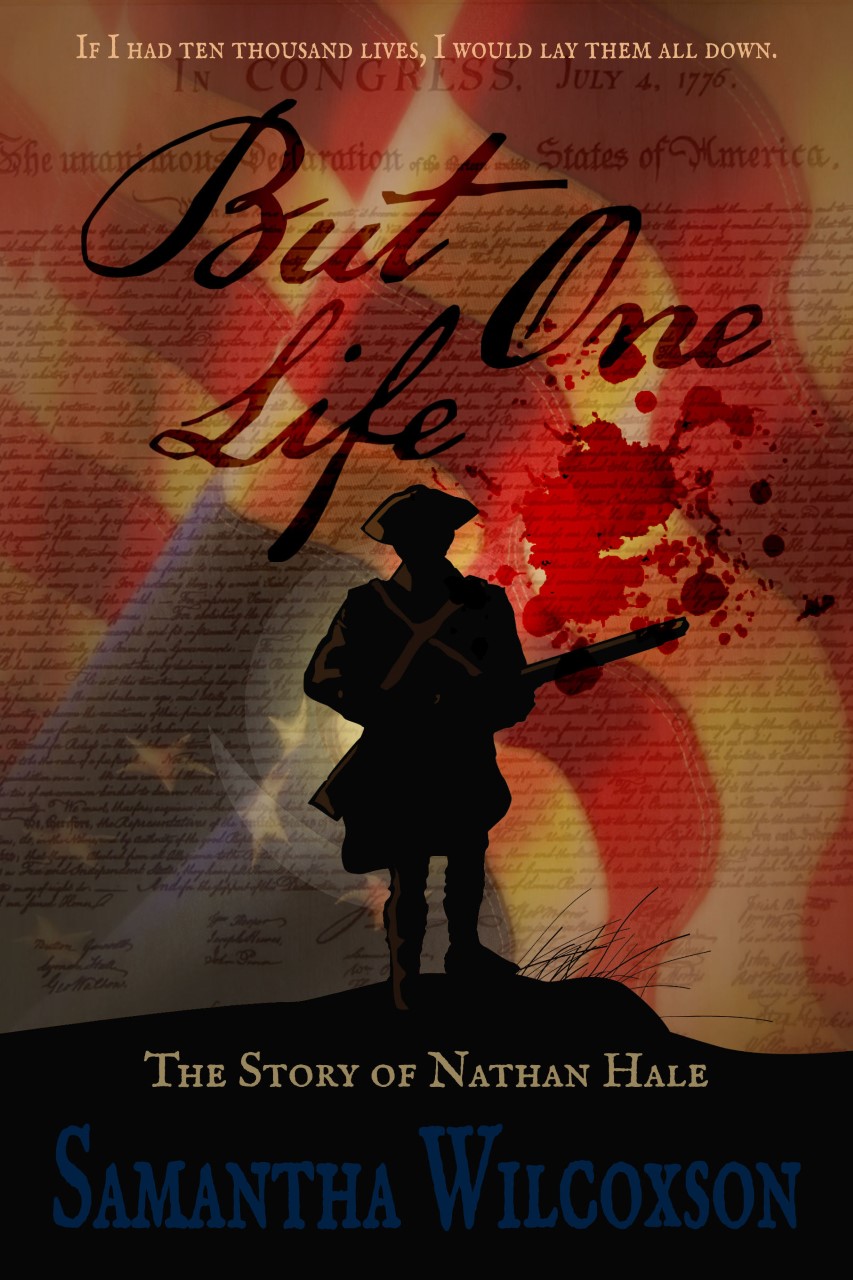
Samantha: Each of my novels explores the life of a real historical figure in a way that helps readers connect with them on a personal level. My Plantagenet Embers series includes three novels featuring Elizabeth of York, Margaret Pole, and Mary I. It also has three novellas that offer new points of view of the same events by focusing on Margaret Beaufort, Elizabeth Woodville, and Reginald Pole. Then I moved into US history with my next two novels. Luminous is biographical fiction of real life radium girl Catherine Wolfe Donohue, and But One Life explores the life of American Revolution soldier Nathan Hale. My nonfiction books are Women of the American Revolution and a newly released biography of James Alexander Hamilton.

Sharon: What attracted you to the Tudors?

Samantha: When I started writing the series that ended up covering the early Tudor era, I was actually obsessed with the Wars of the Roses. I thought Elizabeth of York was an unsung heroine, so I started with her with no real intention of writing about the Tudors! This is actually a great insight into my writing. I never know what is coming next.

Sharon: So, what is coming next?

Samantha: I am currently writing a trilogy set during the Wars of the Roses for Sapere Books. It includes multiple women’s points of view. For example, book one has chapters featuring Marguerite of Anjou, Cecily Neville, and Anne Beauchamp. That one is in editing, and I’m working on book two, which will add the perspective of Elizabeth Woodville and others.

Sharon: How do you approach researching your topic?

Samantha: This depends a lot on whether I’m writing fiction or nonfiction. For novels, I largely depend on biographies already written, but for nonfiction I look for more primary resources like personal letters and diaries. For either, I like to visit locations important to the people I’m writing about so that I can include details about the places they experienced.

Sharon: You also write US history non-fiction.

Samantha: Tell us your ‘favourite’ story you have come across in your research? My research into James Alexander Hamilton uncovered loads of interesting discoveries, partly because nobody else has really written about him. I held letters written between James and Andrew Jackson, Martin Van Buren, John Quincy Adams, and so many others. (Gotta admit, it was tempting to try sneak that JQA letter into my bag!) I think the most fun story I came across, besides John Quincy writing about being too old to stay up all night at a lively Hamilton party, was learning that James was part of the crew of the schooner America for which the America’s Cup is named.

Sharon: Tell us your least ‘favourite’ US history story you have come across in your research?

Samantha: I don’t know if I would call it a least favorite, but I decided to write a novel about Nathan Hale because I often came across quotes attributed to him such as, “I only regret that I have but one life to give for my country” but very little else about who Hale was. What happened in this young man’s life to create such bravery and patriotism? Few references to him offered much, so I decided to dig in and reveal the story of Nathan Hale before his famous execution during the American Revolution.

Sharon: Are there any other eras you would like to write about?

Samantha: I always have a few ideas brewing but am committed to the next couple of books on the Wars of the Roses right now. I have started a bit of research into a historical event that occurred near my home in Michigan in 1847 that I would like to consider for a future project. I’m not one of those writers who has the next five years planned out and I tend to impetuously strike out in new directions, so we’ll see what happens.

Sharon: And finally, what is the best thing about being a writer?

Samantha: Besides spending my day reading, writing, and learning about history, I love the flexibility of being a writer. I began as a stay-at-home mom, and I still appreciate the ability to easily set my work aside for a few days if one of my adult children needs anything. I’ve also made many friends in the writing community who make me feel less alone as a history nerd and have provided amazing support and encouragement for each of my book projects.

About the Author:

Samantha Wilcoxson is an author of emotive biographical fiction and nonfiction featuring history’s unsung heroes. Her novel Luminous has been named Book of the Year by Ruins & Reading and Yarde Book Reviews. Samantha’s most recent work is the first biography of James Alexander Hamilton, published by Pen & Sword History. She is currently writing a Wars of the Roses trilogy for Sapere Books. When not reading or writing, Samantha loves sharing trips to historic places with her family and spending time by the lake with a glass of wine.

Where to find Samantha Wilcoxson:

Website; Instagram; Amazon Author Page; Newsletter Signup; Goodreads; Pinterest; Twitter; Shop Direct; Audible

*

My books

Signed, dedicated copies of all my books are available through my online store.

Out now: Scotland’s Medieval Queens

Scotland’s history is dramatic, violent and bloody. Being England’s northern neighbour has never been easy. Scotland’s queens have had to deal with war, murder, imprisonment, political rivalries and open betrayal. They have loved and lost, raised kings and queens, ruled and died for Scotland. From St Margaret, who became one of the patron saints of Scotland, to Elizabeth de Burgh and the dramatic story of the Scottish Wars of Independence, to the love story and tragedy of Joan Beaufort, to Margaret of Denmark and the dawn of the Renaissance, Scotland’s Medieval Queens have seen it all. This is the story of Scotland through their eyes.

Scotland’s Medieval Queens gives a thorough grounding in the history of the women who ruled Scotland at the side of its kings, often in the shadows, but just as interesting in their lives beyond the spotlight. It’s not a subject that has been widely covered, and Sharon is a pioneer in bringing that information into accessible history.’ Elizabeth Chadwick (New York Times bestselling author)

Available now from Amazon and Pen and Sword Books

Also by Sharon Bennett Connolly:

Heroines of the Tudor World tells the stories of the most remarkable women from European history in the time of the Tudor dynasty, 1485-1603. These are the women who ruled, the women who founded dynasties, the women who fought for religious freedom, their families and love. Heroines of the Tudor World is now available from Amberley Publishing and Amazon UK. Women of the Anarchy demonstrates how Empress Matilda and Matilda of Boulogne, unable to wield a sword themselves, were prime movers in this time of conflict and lawlessness. It shows how their strengths, weaknesses, and personal ambitions swung the fortunes of war one way – and then the other. Available from Bookshop.orgAmberley Publishing and Amazon UKKing John’s Right-Hand Lady: The Story of Nicholaa de la Haye is the story of a truly remarkable lady, the hereditary constable of Lincoln Castle and the first woman in England to be appointed sheriff in her own right. Available from all good bookshops Pen & Sword Booksbookshop.org and Amazon

Defenders of the Norman Crown: The Rise and Fall of the Warenne Earls of Surrey tells the fascinating story of the Warenne dynasty, from its origins in Normandy, through the Conquest, Magna Carta, the wars and marriages that led to its ultimate demise in the reign of Edward III. Available from Pen & Sword BooksAmazon in the UK and US, and Bookshop.orgLadies of Magna Carta: Women of Influence in Thirteenth Century England looks into the relationships of the various noble families of the 13th century, and how they were affected by the Barons’ Wars, Magna Carta and its aftermath; the bonds that were formed and those that were broken. It is now available in paperback and hardback from Pen & SwordAmazon, and Bookshop.orgHeroines of the Medieval World tells the stories of some of the most remarkable women from Medieval history, from Eleanor of Aquitaine to Julian of Norwich. Available now from Amberley Publishing and Amazon, and Bookshop.orgSilk and the Sword: The Women of the Norman Conquest traces the fortunes of the women who had a significant role to play in the momentous events of 1066. Available now from Amazon,  Amberley Publishing, and Bookshop.org.

Alternate Endings: An anthology of historical fiction short stories including Long Live the King… which is my take what might have happened had King John not died in October 1216. Available in paperback and kindle from Amazon.

Podcast:

Have a listen to the A Slice of Medieval podcast, which I co-host with Historical fiction novelist Derek Birks. Derek and I welcome guests, such as Bernard Cornwell and Michael Jecks, and discuss a wide range of topics in medieval history, from significant events to the personalities involved. Every episode is also now available on YouTube.

*

Don’t forget! Signed and dedicated copies of all my books are available through my online store.

For forthcoming online and in-person talks, please check out my Events Page.

You can be the first to read new articles by clicking the ‘Follow’ button, liking our Facebook page or joining me on TwitterThreadsBluesky and Instagram.

*

©2025 Sharon Bennett Connolly, FRHistS and Samantha Wilcoxson

Book Launch: Scotland’s Medieval Queens

It is hard to believe – for me, anyway – that I have now published 8 books. 8! I am still waiting for my author copies of Scotland’s Medieval Queens: From Saint Margaret to Margaret of Denmark, to arrive. But she is out in the world. And I am so proud of this book, not least because it was inspired by my wonderful, history-loving son, Lewis, who instructed me to ‘set the record straight’ for Lady Macbeth. With a prologue dedicated to this maligned woman, labeled a murderer and a madwoman by William Shakespeare, I hope I have done just that. And then there are all the other incredible queens that have sat on Scotland’s throne. Women who have defended the realm, acted as peace weavers, governed for their sons and stood as stalwart supporters of their husbands.

I hope I have done their stories justice.

Zoom Book Launch Party

This is your personal invite to join the celebrations!

So, why not join me to celebrate the release of Scotland’s Medieval Queens by coming to the Zoom Book Launch Party, held alongside my friends Samantha Wilcoxson and Paula Lofting, who also have books out this week. Hosted by Cathie Dunn, we will each tell you a little about our books, answer questions and generally party!

This Sunday – 9 February 2025 at 7pm UK time.

It is free, you just need to reserve a spot.

Follow the Blog Tour:

Paula, Samantha and I are also taking part in a joint mini blog tour, with 6 days of articles and interviews. I kicked us off on Saturday with an article from Paula Lofting looking into King Harold’s Royal Lineage. Samantha was then interviewed on Paula Lofting’s Threads to the Past. And today, I am talking about one of the less well known queens of Scotland, Sybilla of Normandy with Samantha.

There are 3 more stops on the tour, with Samantha visiting History…the Interesting Bits on 5 February, Paula interviewing me on 6 February and Samantha interviewing Paula on 7 February.

Then party time on 9 February!

Podcast:

Have a listen to the latest episode of A Slice of Medieval podcast. In our Book Launch Special my co-host Derek Birks and I celebrate the launch of both our books. Scotland’s Medieval Queens meets A Guide to the Wars of the Roses. Every episode is also now available on YouTube.

About Scotland’s Medieval Queens: From Saint Margaret to Margaret of Denmark:

Scotland’s history is dramatic, violent and bloody. Being England’s northern neighbour has never been easy. Scotland’s queens have had to deal with war, murder, imprisonment, political rivalries and open betrayal. They have loved and lost, raised kings and queens, ruled and died for Scotland. From St Margaret, who became one of the patron saints of Scotland, to Elizabeth de Burgh and the dramatic story of the Scottish Wars of Independence, to the love story and tragedy of Joan Beaufort, to Margaret of Denmark and the dawn of the Renaissance, Scotland’s Medieval Queens have seen it all. This is the story of Scotland through their eyes.

Available now from Amazon and Pen and Sword Books

©2025 Sharon Bennett Connolly FRHistS 

Happy 10th Birthday to Me!

Well no, not me, I’m slightly older than that. But History…the Interesting Bits is 10 years old! It was 10 years ago today, on 8th January 2015, that I published my very first article, Isabella of Castile, the Controversial First Duchess of York, c.1355-1392. Since then, I have published 542 more posts, including articles, book reviews, interviews, news updates and giveaways; this article will be post no. 544.

First and foremost, I would like to thank each and every one of my readers for sticking with me for a whole decade!

Secondly…

We need to celebrate!

How to celebrate?

Well, many of you will know (hopefully) that may latest book, Scotland’s Medieval Queens: From St Margaret to Margaret of Denmark is being published by Pen & Sword Books in 3 weeks’ time – on Thursday 30 January.

So, how about a competition?

A giveaway?

About Scotland’s Medieval Queens:

Scotland’s history is dramatic, violent and bloody.

Being England’s northern neighbour has never been easy.

Scotland’s queens have had to deal with war, murder, imprisonment, political rivalries and open betrayal. They have loved and lost, raised kings and queens, ruled and died for Scotland.

From St Margaret, who became one of the patron saints of Scotland, to Elizabeth de Burgh and the dramatic story of the Scottish Wars of Independence, to the love story and tragedy of Joan Beaufort, to Margaret of Denmark and the dawn of the Renaissance, Scotland’s Medieval Queens have seen it all.

This is the story of Scotland through their eyes.

Early feedback has been fantastic, with Elizabeth Chadwick and Carol McGrath both giving Scotland’s Medieval Queens a rather glowing – a humbling – endorsement. I received a wonderful review from Heidi Malagisi over at Adventures of a Tudor Nerd, who says “If you want a fantastic introduction to the turbulent world of medieval Scotland and the women who helped shape the monarchy, I strongly recommend you read, ‘Scotland’s Medieval Queens….'”

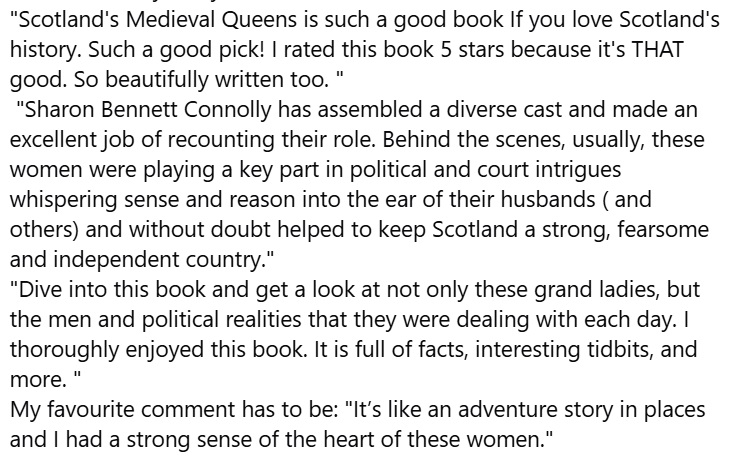
And NetGalley readers have unanimously (so far!) given it rave reviews:

Scotland’s Medieval Queens: From St Margaret to Margaret of Denmark is available for pre-order now.

I cannot wait for you to read – and hopefully enjoy – Scotland’s Medieval Queens: From St Margaret to Margaret of Denmark. So, as a joint celebration – publication day and History … the Interesting Bits’ 10th birthday, here’s the competition…

A Giveaway!

One signed copy of the brand spanking new hardback of Scotland’s Medieval Queens will go to the lucky competition winner.

It’s easy to enter!

The competition is open to everyone, wherever you are in the world. To win a signed and dedicated copy of Scotland’s Medieval Queens, simply leave a comment below or on social media via my Facebook pageTwitterThreads, or Bluesky and I will include you in the prize draw.

The draw will be made on Saturday 18 January.

GOOD LUCK!

About me:

Sharon Bennett Connolly, has been fascinated by history her whole life. She has studied history academically and just for fun – and even worked as a tour guide at historical sites, including Conisbrough Castle. For Christmas 2014, her husband gave her a blog as a gift – http://www.historytheinterestingbits.com – and Sharon started researching and writing about the stories that have always fascinated. Sharon also co-hosts the podcast A Slice of Medieval, alongside historical novelist Derek Birks. She regularly gives talks on women’s history, for historical groups, festivals and in schools; her book Silk and the Sword: The Women of the Norman Conquest is a recommended text for teaching the events of 1066 in the National Curriculum. She is a feature writer for All About History, Tudor Places, and Living Medieval magazines and her TV work includes Australian Television’s ‘Who Do You Think You Are?

Also by Sharon Bennett Connolly:

Heroines of the Tudor World tells the stories of the most remarkable women from European history in the time of the Tudor dynasty, 1485-1603. These are the women who ruled, the women who founded dynasties, the women who fought for religious freedom, their families and love. Heroines of the Tudor World is now available for pre-order from Amberley Publishing and Amazon UK. Women of the Anarchy demonstrates how Empress Matilda and Matilda of Boulogne, unable to wield a sword themselves, were prime movers in this time of conflict and lawlessness. It shows how their strengths, weaknesses, and personal ambitions swung the fortunes of war one way – and then the other. Available from Bookshop.orgAmberley Publishing and Amazon UKKing John’s Right-Hand Lady: The Story of Nicholaa de la Haye is the story of a truly remarkable lady, the hereditary constable of Lincoln Castle and the first woman in England to be appointed sheriff in her own right. Available from all good bookshops Pen & Sword Booksbookshop.org and Amazon

Defenders of the Norman Crown: The Rise and Fall of the Warenne Earls of Surrey tells the fascinating story of the Warenne dynasty, from its origins in Normandy, through the Conquest, Magna Carta, the wars and marriages that led to its ultimate demise in the reign of Edward III. Available from Pen & Sword BooksAmazon in the UK and US, and Bookshop.orgLadies of Magna Carta: Women of Influence in Thirteenth Century England looks into the relationships of the various noble families of the 13th century, and how they were affected by the Barons’ Wars, Magna Carta and its aftermath; the bonds that were formed and those that were broken. It is now available in paperback and hardback from Pen & SwordAmazon, and Bookshop.orgHeroines of the Medieval World tells the stories of some of the most remarkable women from Medieval history, from Eleanor of Aquitaine to Julian of Norwich. Available now from Amberley Publishing and Amazon, and Bookshop.orgSilk and the Sword: The Women of the Norman Conquest traces the fortunes of the women who had a significant role to play in the momentous events of 1066. Available now from Amazon,  Amberley Publishing, and Bookshop.org.

Alternate Endings: An anthology of historical fiction short stories including Long Live the King… which is my take what might have happened had King John not died in October 1216. Available in paperback and kindle from Amazon.

Podcast:

Have a listen to the A Slice of Medieval podcast, which I co-host with Historical fiction novelist Derek Birks. Derek and I welcome guests, such as Bernard Cornwell and DrIan Mortimer, and discuss a wide range of topics in medieval history, from significant events to the personalities involved. 

*

Don’t forget! Signed and dedicated copies of all my books are available through my online bookshop.

For forthcoming online and in-person talks, please check out my Events Page.

You can be the first to read new articles by clicking the ‘Follow’ button, liking our Facebook page or joining me on TwitterThreadsBluesky and Instagram.

©2025 Sharon Bennett Connolly FRHistS

Book Corner: 2 Books About Tudor Heirs

It is time for me to get back to some serious book reviewing. So, in order to catch up, I thought I’d do two reviews in one post. Both books are from the Tudor period and look into the heirs to the Tudor throne, and the impact of Henry VIII’s actions on those children. Each books provide a fascinating insight into the lives of prominent Tudors and shows a side of Henry VIII that is often overlooked.

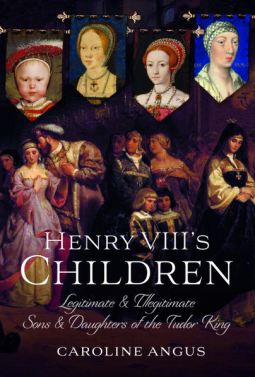
Henry VIII’s Children by Caroline Angus

Of the five Tudor monarchs, only one was ever born to rule. While much of King Henry VIII’s reign is centred on his reckless marriage choices, it was the foundations laid by Henry and Queen Katherine of Aragon that shaped the future of the crown. Among the suffering of five lost heirs, the royal couple placed all their hopes in the surviving Princess Mary. Her early life weaves a tale of promise, diplomacy, and pageantry never again seen in King Henry’s life, but a deep-rooted desire for a son, a legacy of his own scattered childhood, pushed Henry VIII to smother Mary’s chance to rule. An affair soon produced an unlikely heir in Henry Fitzroy, and while one child was pure royalty, the other illegitimate, the comparison of their childhoods would show a race to throne closer than many wished to admit.

King Henry’s cruelty saw his heirs’ fates pivot as wives came and went, and the birth Princess Elizabeth, saw long-term plans upended for short-term desires. With the death of one heir hidden from view, the birth of Prince Edward finally gave the realm an heir born to rule, but King Henry’s personal desires and paranoia left his heirs facing constant uncertainty for another decade until his death. Behind the narrative of Henry VIII’s wives, wars, reformation and ruthlessness, there were children, living lives of education among people who cared for them, surrounded by items in generous locations which symbolised their place in their father’s heart. They faced excitement, struggles, and isolation which would shape their own reigns. From the heights of a surviving princess destined and decreed to influence Europe, to illegitimate children scattered to the winds of fortune, the childhoods of Henry VIII’s heirs is one of ambition, destiny, heartache, and triumph.

Henry VIII left a long shadow, especially for his children. Caroline Angus looks into the lives and experiences of Henry’s 3 legitimate children, Edward VI, Mary I and Elizabeth I, alongside his only recognised illegitimate child, Henry Fitzroy, Duke of Richmond. And the other possible candidates to be Henry’s offspring, including Catherine Carey.

Henry VIII’s Children is a very easy and enjoyable read. You get absorbed into Caroline Angus’s love of her subject. Her research is thorough and all her arguments are supported by evidence. Where there is conjecture, the author presents both sides and lets the reader find their own conclusion, while presenting what she thinks most likely. I did not agree with all her conclusions, particularly when it comes to Catherine Carey – I am not convinced she was Henry VIII’s daughter, not that Henry’s relationship with Mary Boleyn lasted as long as some historians suggest. I just don’t think we have enough information. But it was interesting to read Caroline’s thoughts on the subject and see how she came to her conclusions.
It certainly gave me food for thought!

The Tudors are always a fascinating subject and Caroline Angus does a wonderful job of igniting the reader’s passion in her subject.

The strength of Henry VIII’s Children lies in its fascinating investigation into the lives of Henry’s 3 ‘legitimate’ children and how their fates were manipulated and directed by Henry’s obsession for a male heir, and his multiple marriages. Poor Mary I had 5 stepmothers! just imagine how she must have felt, watching her mother shunned and sidelined by the father she adored, not being allowed to visit her on her deathbed, nor being allowed to receive her mother’s comfort when she was ill and scared. The mind games Henry VIII played with his eldest child, in order to get her acquiescence, are something to behold.

And then there’s poor Elizabeth, her mother executed before her 3rd birthday, and yet she is the one who surpassed all Henry’s dreams for his children. Elizabeth is the one who had a golden age named after her. She is also the one who always lived in the shadow of her mother’s fate. Caroline Angus looks into all aspects of Elizabeth’s life, especially the childhood and adolescence that shaped her future.

And Edward! the golden boy. The heir who was so desired that his father broke with Rome to get. A boy who was the hope of a nation but died so tragically young.

Caroline Angus looks at them all with such enthusiasm and animation that they jump off the page.

An eminently readable nook that I have no hesitation in recommending.

To Buy Henry VIII’s Children

About the Author:

Caroline Angus is a New Zealand-based author raising four sons. Caroline studied history at Universitat de València, Spain, spending ten years dedicated to the Spanish Civil War and the resulting dictatorship. Caroline went on to study with King’s College London, specialising in Shakespeare and British royal history. After a decade of writing fiction, including the Secrets of Spain series, focusing on the lives of Valencian interviewees between 1939 and 1975, and the more recent Queenmaker Trilogy, eleven years of Thomas Cromwell and his fictional attendant Nicòla Frescobaldi, Caroline is now creating non-fiction works on the surviving papers of Thomas Cromwell.

Henry VIII’s True Daughter by Wendy J Dunn

The lives of Tudor women often offer faint but fascinating footnotes on the pages of history. The life of Catherine – or Katryn as her husband would one day pen her name – Carey, the daughter of Mary Boleyn and, as the weight of evidence suggests, Henry VIII, is one of those footnotes.

As the possible daughter of Henry VIII, the niece of Anne Boleyn and the favourite of Elizabeth I, Catherine’s life offers us a unique perspective on the reigns of Henry and his children. In this book, Wendy J. Dunn takes these brief details of Catherine’s life and turns them into a rich account of a woman who deserves her story told. Following the faint trail provided of her life from her earliest years to her death in service to Queen Elizabeth, Dunn examines the evidence of Catherine’s parentage and views her world through the lens of her relationship with the royal family she served.

This book presents an important story of a woman who saw and experienced much tragedy and political turmoil during the reigns of Henry VIII, Edward VI, and Mary I – all of which prepared her to take on the vital role of one of Elizabeth I closest and most trusted women. It also prepared her to become the wife of one of Elizabeth’s privy councillors – a man also trusted and relied on by the queen. Catherine served Elizabeth during the uncertain and challenging first years of her reign, a time when there was a question mark over whether she would succeed as queen regnant after the failures of England’s first crowned regnant, her sister Mary.

Through immense research and placing her in the context of her period, HENRY VIII’S TRUE DAUGHTER: CATHERINE CAREY, A TUDOR LIFE draws Catherine out of the shadows of history to take her true place as the daughter of Henry VIII and shows how vital women like Catherine were to Elizabeth and the ultimate victory of her reign.

Henry VIII’s True Daughter: Catherine Carey, A Tudor Life by Wendy J. Dunn is a perfect accompaniment to Henry VIII’s Children. Focusing on the eldest child of Mary Boleyn and William Carey, Wendy J. Dunn investigates Catherine’s origins and the stories around her conception and birth – in particular, her mother’s relationship with Henry VIII. It has long been thought possible that Catherine was Henry’s daughter and that Mary Boleyn’s marriage to William Carey was arranged to conceal the king’s affair. Henry himself admitted he had slept with Mary Boleyn when he was once accused of sleeping with Anne Boleyn’s mother, replying along the lines of ‘the sister but never the mother.’

So, we know they had a relationship, but how long it lasted and whether Catherine was the result of that relationship is still uncertain. Wendy attempts to lift away that uncertainty and presents all the evidence and conjecture that has been gather over the years to give us her own conclusions.

But this book is so much more! Henry VIII’s True Daughter gives us insights into the life of a prominent Tudor woman. Whether or not she was the daughter of Henry VIII, she was still at the heart of the Tudor court, especially in the reign of her sister/cousin, Elizabeth I. Catherine was one of Elizabeth’s favourites and was loyal to the queen to the very end of her life. Wendy gives stunning insight into Catherine’s life and career, as well as her marriage and family.

Even if I don’t necessarily agree with all its conclusion, Henry VIII’s True Daughter by Wendy J Dunn is a wonderful, engaging book, giving the reader ample food for thought in her theories and explanations of the life and origins of Catherine Carey. It is a must-read for any fan of Tudor history.

To Buy Henry VIII’s True Daughter

About the Author:

Wendy J. Dunn is an award-winning Australian writer fascinated by Tudor history – so much so she was not surprised to discover a family connection to the Tudors, not long after the publication of her first Anne Boleyn novel, which narrated the Anne Boleyn story through the eyes of Sir Thomas Wyatt, the elder. Her family tree reveals the intriguing fact that one of her ancestral families – possibly over three generations – had purchased land from both the Boleyn and Wyatt families to build up their holdings. It seems very likely Wendy’s ancestors knew the Wyatts and Boleyns personally. Wendy is married, the mother of four adult children and the grandmother of two amazing small boys. She gained her PhD in 2014 and loves walking in the footsteps of the historical people she gives voice to in her books. Wendy also tutors writing at Swinburne University of Technology, Australia. HENRY VIII’S TRUE DAUGHTER: CATHERINE CAREY, A TUDOR LIFE is her first full-length nonfiction work.

*

My Books:

Signed, dedicated copies of all my books are available through my online store.

OUT NOW! Heroines of the Tudor World

Heroines of the Tudor World tells the stories of the most remarkable women from European history in the time of the Tudor dynasty, 1485-1603. These are the women who ruled, the women who founded dynasties, the women who fought for religious freedom, their families and love. These are the women who made a difference, who influenced countries, kings and the Reformation. In the era dominated by the Renaissance and Reformation, Heroines of the Tudor World examines the threats and challenges faced by the women of the era, and how they overcame them. From writers to regents, from nuns to queens, Heroines of the Tudor World shines the spotlight on the women helped to shape Early Modern Europe.

Heroines of the Tudor World is now available for pre-order from Amberley Publishing and Amazon UK.

Coming 30 January 2025: Scotland’s Medieval Queens

Scotland’s history is dramatic, violent and bloody. Being England’s northern neighbour has never been easy. Scotland’s queens have had to deal with war, murder, imprisonment, political rivalries and open betrayal. They have loved and lost, raised kings and queens, ruled and died for Scotland. From St Margaret, who became one of the patron saints of Scotland, to Elizabeth de Burgh and the dramatic story of the Scottish Wars of Independence, to the love story and tragedy of Joan Beaufort, to Margaret of Denmark and the dawn of the Renaissance, Scotland’s Medieval Queens have seen it all. This is the story of Scotland through their eyes.

Available for pre-order now.

Also by Sharon Bennett Connolly:

Women of the Anarchy demonstrates how Empress Matilda and Matilda of Boulogne, unable to wield a sword themselves, were prime movers in this time of conflict and lawlessness. It shows how their strengths, weaknesses, and personal ambitions swung the fortunes of war one way – and then the other. Available from Bookshop.orgAmberley Publishing and Amazon UKKing John’s Right-Hand Lady: The Story of Nicholaa de la Haye is the story of a truly remarkable lady, the hereditary constable of Lincoln Castle and the first woman in England to be appointed sheriff in her own right. Available from all good bookshops Pen & Sword Booksbookshop.org and AmazonDefenders of the Norman Crown: The Rise and Fall of the Warenne Earls of Surrey tells the fascinating story of the Warenne dynasty, from its origins in Normandy, through the Conquest, Magna Carta, the wars and marriages that led to its ultimate demise in the reign of Edward III. Available from Pen & Sword BooksAmazon in the UK and US, and Bookshop.org

Ladies of Magna Carta: Women of Influence in Thirteenth Century England looks into the relationships of the various noble families of the 13th century, and how they were affected by the Barons’ Wars, Magna Carta and its aftermath; the bonds that were formed and those that were broken. It is now available in paperback and hardback from Pen & Sword, Amazon, and Bookshop.orgHeroines of the Medieval World tells the stories of some of the most remarkable women from Medieval history, from Eleanor of Aquitaine to Julian of Norwich. Available now from Amberley Publishing and Amazon, and Bookshop.orgSilk and the Sword: The Women of the Norman Conquest traces the fortunes of the women who had a significant role to play in the momentous events of 1066. Available now from Amazon,  Amberley Publishing, and Bookshop.org.

Alternate Endings: An anthology of historical fiction short stories including Long Live the King… which is my take what might have happened had King John not died in October 1216. Available in paperback and kindle from Amazon.

Podcast:

Have a listen to the A Slice of Medieval podcast, which I co-host with Historical fiction novelist Derek Birks. Derek and I welcome guests, such as Bernard Cornwell, and discuss a wide range of topics in medieval history, from significant events to the personalities involved.

*

Don’t forget! Signed and dedicated copies of all my books are available through my online store.

For forthcoming online and in-person talks, please check out my Events Page.

You can be the first to read new articles by clicking the ‘Follow’ button, liking our Facebook page or joining me on TwitterThreads and Instagram.

*

©2024 Sharon Bennett Connolly FRHistS.

Guest post: All the Queen’s Men by Carol Ann Lloyd
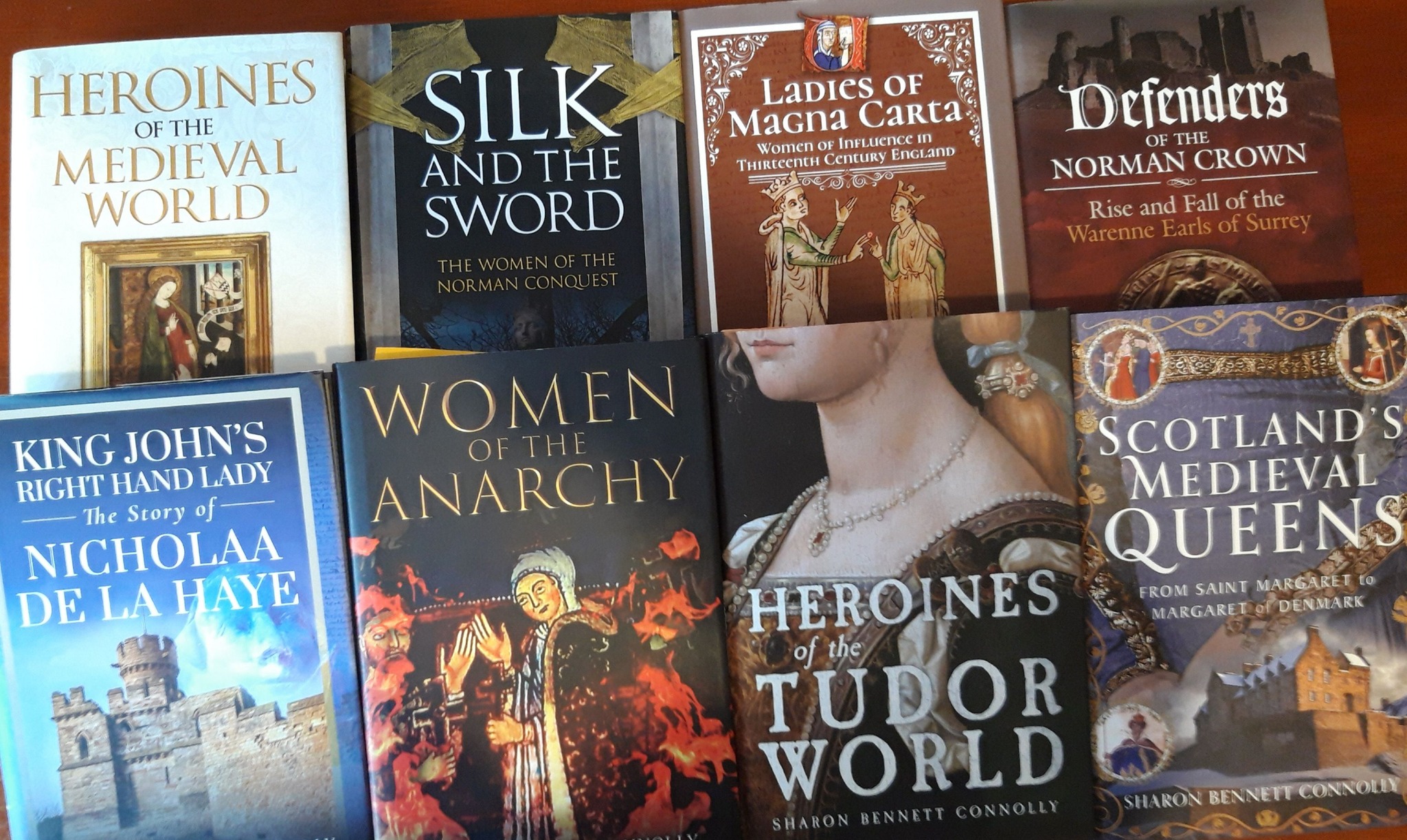
Today, it is a pleasure to welcome my dear friend, Carol Ann Lloyd, to History… the Interesting Bits, with an article on the love life of Queen Elizabeth I. Carol Ann’s new book Courting the Virgin Queen: Queen Elizabeth I and Her Suitors is due to be released on 30 July by Pen and Sword. If it is anything like her first book, The Tudors By Numbers: The Stories and Statistics Behind England’s Most Infamous Royal Dynasty, it will be a fabulous read!

“All the Queen’s Men: The Courtships of the Virgin Queen”

Carol Ann Lloyd
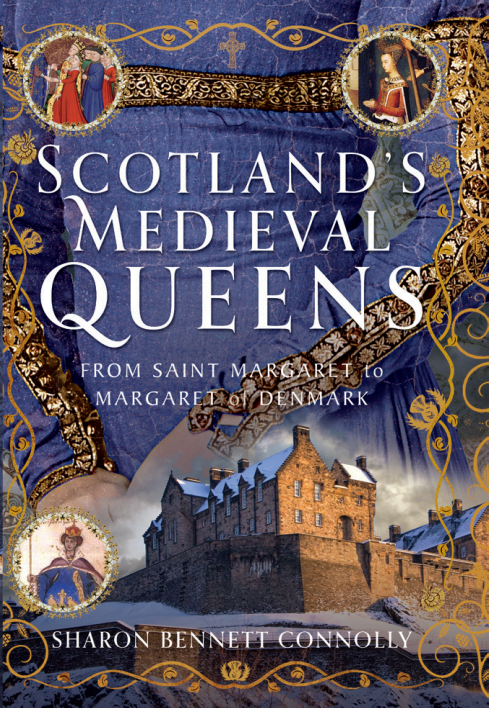
Elizabeth I, aged 14

It’s ironic that the child of the most-married English monarch ever is the only English monarch to rule as an adult and never marry! Elizabeth I, daughter of the famous (infamous?) Henry VIII never married. But it was not for lack of options.

The big question is “Why?” Did Elizabeth really want to marry anyone? What kept her from marrying? Did she ever intend to marry, or was she just keeping all her options open as she navigated the perilous landscape of European politics on her own?

I think there are many ways on answering this question. Let’s start at the beginning of her reign. Elizabeth was the least likely of Henry VIII’s children to come to the throne, and when she did everyone had the same question on their mind. As the Spanish Ambassador, the Count of Feria, reflected in the early days of the reign, “The more I think over this business the more certain I am that everything depends upon the husband this woman may take.” Elizabeth was questioned about her choice of husband by her council, ambassadors, and parliament. It was considered a public not a private matter, and the queen was repeatedly encouraged and counseled to get married and produce an heir for the good of the kingdom.

So, if everything depended on the husband her would take, what realistically were her options?

Some people might be surprised to learn that one of her first suitors was the husband of her recently deceased sister. Philip of Spain had been married to Mary I until her death, and the couple had no children. Still committed to bringing England back into the Catholic fold, Philip believed he could marry and control Elizabeth. I was surprised as I read his correspondence how convinced Philip was that Elizabeth was desperate for a husband and eager for his offer. Many Catholics never accepted the validity of the marriage between Henry VIII and Anne Boleyn, so Elizabeth’s hold on the throne was possibly tenuous. Philip believed he was the answer to Elizabeth’s problem. He thought she would jump at the chance.

Robert Dudley, Earl of Leicester

Philip could not have been more wrong. Elizabeth knew very well that Philip would seek to involve England in Spain’s wars, as he had during Mary I’s reign. Using her skills in language, Elizabeth dallied with Feria and postponed giving a firm answer until it suited her. That answer was a definite “no.”

The offer from Philip was only the beginning. I discovered in my research that Elizabeth used the many marriage possibilities as a way of strengthening her position with the international community. She managed to keep several foreign leaders eager for an alliance with England and a marriage with her. Over the years, the king of Sweden, European dukes and archdukes, and even all three of Catherine de Medici’s sons in France were offered as possible husband. And that doesn’t take into account the Scottish and English nobles who wanted to marry the queen.

Speaking of men in England, was it really Robert Dudley who kept Elizabeth from marrying? He most likely was the love of her life, perhaps the only man she might have married if she had not been the queen. He was at the center of her life, from the day she learned Mary I had died, and she was queen. He became Elizabeth’s Master of the Horse, which meant he was always with her when she went riding, one of her favorite activities. And he was the only man in the kingdom with permission to touch the queen as he helped her onto and off horse.

Queen Elizabeth I

Even with Dudley’s favored position, there were a few problems in the way. For one thing, he was married. And then his wife died in very suspicious circumstances, making a future marriage potentially devastating for Elizabeth’s reputation. Dudley was unpopular among the council. And ultimately, I believe Elizabeth meant what she is reported to have shouted at him in anger: “I will have but one mistress here and no master.”

So, did everything depend upon the husband Elizabeth took? Yes, it turns out it did. I realized through the research that the one suitor that Elizabeth courted throughout her reign was the husband she had declared herself wed to when she became queen: her country and her people. Early in her reign, Elizabeth had responded to parliament’s request that she marry by responding that she was “already bound unto a husband which is the kingdom of England.” From the time she became queen, Elizabeth wooed her nation and her people, seeking their approval, favor, and love. That was the husband she took, and it meant everything to her.

About the book:

The many courtships of the woman who became Elizabeth I began when she was an infant, displayed before foreign ambassadors who considered her as a possible clause of a contract between England and France. From such an unromantic beginning, Elizabeth grew to see her father marry multiple times and experienced frequent changes in stepmothers and status in the family. Eventually, she became the most eligible woman in Europe. From start to finish, her marriage prospects were as much political as they were personal.

When she came to the throne in 1558, the primary question facing everyone from foreign monarchs to English nobles and ministers was which of her many suitors would finally win her hand. Through the longest Tudor reign, Elizabeth used courtship as a tool to consider foreign alliances, hold ambitious English courtiers in check, and navigate her role as a woman ruler in a world that considered her unnatural without a man at her side.

Elizabeth was, in fact, always the ‘Virgin Queen’, from the early days as a twenty-five-year-old presenting herself as a potential royal bride to her final years as an ageing and unmarried woman who was destined to end the Tudor dynasty. Ultimately, she became the only monarch in England to rule as an adult and never marry. Through it all, as friends and potential lovers faded away, she clung to the one true love of her life: England.

Courting the Virgin Queen: Queen Elizabeth I and Her Suitors is available from Pen and Sword and Amazon.

About the author:

Carol Ann Lloyd turned an obsession with the Tudors into a speaking and writing career. She shares her love of history with Smithsonian Associates, Royal Oak Foundation, Agecroft Hall, Folger Shakespeare Library and other organizations. She holds degrees in Literature and Education and hosts a popular podcast, _British History: Royals, Rebels, and Romantics_. She also offers workshops about using Shakespeare strategies to improve communication skills and is a member of National Speakers Association.
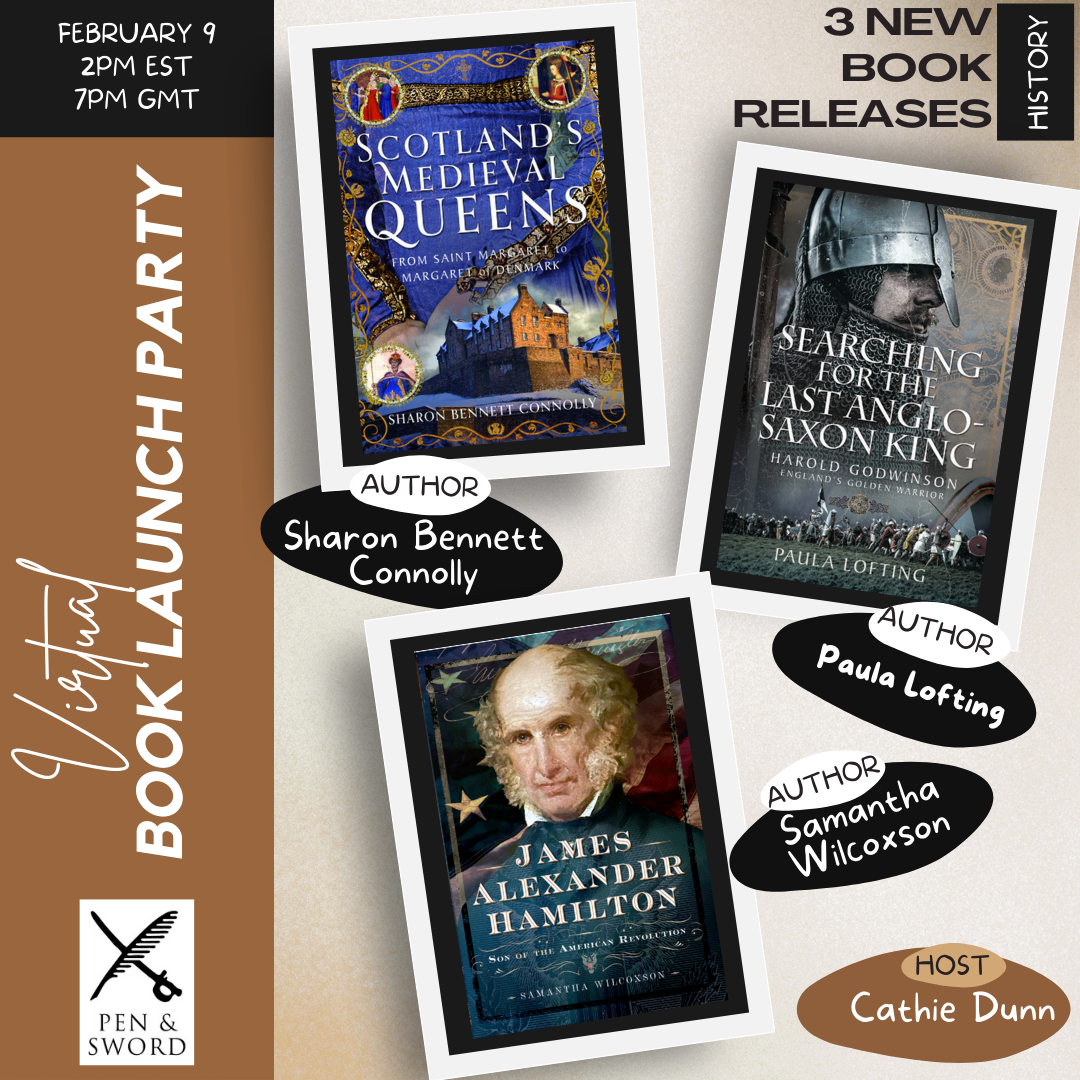
*

My Books

Signed, dedicated copies of all my books are available through my online bookshop.

OUT NOW! Heroines of the Tudor World

Heroines of the Tudor World tells the stories of the most remarkable women from European history in the time of the Tudor dynasty, 1485-1603. These are the women who ruled, the women who founded dynasties, the women who fought for religious freedom, their families and love. These are the women who made a difference, who influenced countries, kings and the Reformation. In the era dominated by the Renaissance and Reformation, Heroines of the Tudor World examines the threats and challenges faced by the women of the era, and how they overcame them. From writers to regents, from nuns to queens, Heroines of the Tudor World shines the spotlight on the women helped to shape Early Modern Europe.

Heroines of the Tudor World is now available for pre-order from Amberley Publishing and Amazon UK.

Also by Sharon Bennett Connolly:

Women of the Anarchy demonstrates how Empress Matilda and Matilda of Boulogne, unable to wield a sword themselves, were prime movers in this time of conflict and lawlessness. It shows how their strengths, weaknesses, and personal ambitions swung the fortunes of war one way – and then the other. Available from Bookshop.orgAmberley Publishing and Amazon UKKing John’s Right-Hand Lady: The Story of Nicholaa de la Haye is the story of a truly remarkable lady, the hereditary constable of Lincoln Castle and the first woman in England to be appointed sheriff in her own right. Available from all good bookshops Pen & Sword Booksbookshop.org and AmazonDefenders of the Norman Crown: The Rise and Fall of the Warenne Earls of Surrey tells the fascinating story of the Warenne dynasty, from its origins in Normandy, through the Conquest, Magna Carta, the wars and marriages that led to its ultimate demise in the reign of Edward III. Available from Pen & Sword BooksAmazon in the UK and US, and Bookshop.org

Ladies of Magna Carta: Women of Influence in Thirteenth Century England looks into the relationships of the various noble families of the 13th century, and how they were affected by the Barons’ Wars, Magna Carta and its aftermath; the bonds that were formed and those that were broken. It is now available in paperback and hardback from Pen & Sword,  Amazon, and Bookshop.orgHeroines of the Medieval World tells the stories of some of the most remarkable women from Medieval history, from Eleanor of Aquitaine to Julian of Norwich. Available now from Amberley Publishing and Amazon, and Bookshop.orgSilk and the Sword: The Women of the Norman Conquest traces the fortunes of the women who had a significant role to play in the momentous events of 1066. Available now from Amazon,  Amberley Publishing, and Bookshop.org.

Alternate Endings: An anthology of historical fiction short stories including Long Live the King… which is my take what might have happened had King John not died in October 1216. Available in paperback and kindle from Amazon.

Podcast:

Have a listen to the A Slice of Medieval podcast, which I co-host with Historical fiction novelist Derek Birks. Derek and I welcome guests, such as Bernard Cornwell and discuss a wide range of topics in medieval history, from significant events to the personalities involved. There are now over 40 episodes to listen to!

*

Don’t forget! Signed and dedicated copies of all my books are available through my online bookshop.

For forthcoming online and in-person talks, please check out my Events Page.

You can be the first to read new articles by clicking the ‘Follow’ button, liking our Facebook page or joining me on Twitter and Instagram.

©2024 Sharon Bennett Connolly FRHistS

Guest Post: Fabric as Power by Judith Arnopp

It is an absolute pleasure to welcome novelist and historian Judith Arnopp to History…the Interesting Bits today. Judith’s new book, How to Dress Like a Tudor, is one I have been excited to get my hands on ever since I heard she was writing it. The Tudors had a special talent for sumptuous gowns and bright, vibrant colours. They knew how to steal the show!

So, here’s Judith to give you a little taster of her research.

The Evolving Tudor Image: fabric as power

We have all become so familiar with royal Tudor images that we no longer really see them. One glance tells us who they are. We think we know them. They exude power, majesty and the iron fist of mastery.

Earlier portraits of the Plantagenet kings, and even the early portraits of Henry VII are very different to that of his son and grandchildren. But it was Henry VII, the first ‘Tudor’ king who began to develop the ‘Tudor’ brand.

The Tudors were the new kids on the block; nobody could foresee what sort of King Henry would make and his popularity depended very much on that of his wife, Elizabeth of York. Yorkist propaganda demeaned his claim to the throne, declaring that his mother’s line was illegitimate; that Lancaster had stolen the crown in 1399.

Henry, realising he needed to reinforce his hold on the country, embellished his family history to create an impressive Tudor dynasty. He stressed the royal connection of his mother, Margaret Beaufort, and her descent from John of Gaunt and, to strengthen his claim further, he legally removed the stigma of bastardy from the family. He reiterated the royal descent of his grandmother, Katherine of Valois and, more surprisingly, claimed descent from the ancient Welsh King Cadwaladr, and King Arthur. To further cement his link to Arthur he named his first-born son in his honour and embellished the round table at Winchester with the Tudor rose.

With the blood of both York and Lancaster flowing in the veins of his two sons and several daughters, the Tudor line looked set to continue but Arthur’s sudden death in 1502 taught Henry that a king can never have too many sons. He lost no time in teaching his remaining son, later to become Henry VIII, the finer points of kingship. He stressed the importance of his role, the unreliability of the fickle populace, and the crucial need for strong male heirs to perpetuate the dynasty. The importance of heirs was a lesson young Henry never forgot, and one he fought hard to achieve for the rest of his life.

The blooming of the Renaissance and the introduction of men like Holbein to the royal court helped to reinforce this new Tudor image and during Henry VIII’s reign new style of royal portraiture began.

I think of them as ‘power portraits’ that were loud declarations of Tudor permanence and dominance.

The one with which we are most familiar was painted by Holbein the younger after 1537, at a time when Henry was at the height of his power. He had freed himself from Anne Boleyn, and the Pope, and Jane Seymour had finally provided the son and heir he’d been craving.

Everything in this portrait is designed to impress and I certainly succeeds; we cannot take our eyes from the breadth of shoulder, the sumptuous quality of his clothes, his immovable stance, the potent codpiece, and the unflinching expression in his eye. The portrait exudes wealth, power and uncompromising control. It is an unspoken challenge.

Edward VI, and Mary I also used art to illustrate their power but it was Elizabeth, arguably the greatest Tudor of them all, who exploited royal portraiture to the full. The queen was very aware of the power of image and iconography. Encouraged by her adviser, John Dee, her portraits became more and more extreme. In every image she is majestic and fabulously dressed, her tiny frame all but

obliterated by satin, velvet, lace and jewels. In looks, Elizabeth resembled her great grandmother, Margaret Beaufort and her grandfather, Henry VII but by nature she was very much like her father.

Elizabeth’s portraits are perfect examples of Renaissance iconography. Every item represents a characteristic, not of the woman within but of the nature of her reign. It is all there; virginity, wisdom, power, world domination, military genius, and the all-seeing eye of queenship.

In The Armada Portrait c.1588 Elizabeth’s femininity is eclipsed by her magnificent clothing. She has so much padding, she appears every bit as broad and powerful as her father.

If Elizabeth’s grandfather and father had coveted England and parts of France, Elizabeth cast her ambitious eye farther – to the New World. Her hand rests on a globe and just in case the viewer should forget who wears it, the crown of England is just above. If you look closely her famously long white fingers are covering the Americas and, behind her are commemorations of the Spanish fleet being driven onto a rocky shore by a storm that became known as the ‘Protestant wind,’ inferring God’s approval in England’s victory over Spain. Elizabeth is proclaiming herself as the saviour of her people; the mother of her expanding empire; a victorious, virgin queen, blessed by God.

These are the things she wanted the world to see and believe. Her private, inner feelings were none of our concern and so they turned their faces into masks – a blank page, devoid of personality yet replete with majesty.

The portraits of the Tudors reveal so much about that far off world. Holbein in particular is invaluable to anyone studying the period. It is solely due to Holbein’s sketches taken at the court that we know exactly what was going on behind the gabled hoods of Catherine of Aragon and Jane Seymour. A particular favourite sketch of mine is of a woman on a settle which shows her sons dressed in replica garments of adult men. His sketches provide a behind the scenes glimpse of life at court, something the formality of the finished portraits don’t convey.

One of the best parts of writing How to dress like a Tudor for Pen and Sword books was the chance to closely examine the court portraits, and the informal sketches of the royal painters and trace the evolving fashions, styles, fabrics of the era. The Tudors were the new icons, monarchs to be worshipped, feared and respected and their portraits a shield, concealing every vestige of human frailty from common view.

How to Dress like a Tudor doesn’t just examine the clothing of royalty but of courtiers, commoners, children, monks and fools.

About the Author:

Judith Arnopp writes historical fiction set during the late medieval and Tudor period. Her usual focus is on the women who lived close to the monarch, women like Margaret Beaufort, Elizabeth of York and Mary Tudor but more recently has been writing from the perspective of Henry VIII himself. Her books are on Kindle, Audible and Paperback. You can find her fiction books here: http://author.to/juditharnoppbooks

She also writes non-fiction, her work featuring in many anthologies and online magazines. Her latest non-fiction, How to Dress like a Tudor published by Pen & Sword Books is available now. http://mybook.to/howtodress

Judith is a founder member of a reenactment group The Fyne Company of Cambria, and began making Tudor costumes for herself, her husband, John, and other members of the group. It was this that inspired How to Dress like a Tudor and she hopes to write more non-fiction Tudor history in the future. You can find Judith on Facebook, Twitter, Linked-in, Goodreads, Bluesky, Instagram, webpage

Illustrations

Eliz I The Armada Portrait Wikimedia commons [[File:Elizabeth I (Armada Portrait).jpg|Elizabeth I (Armada Portrait)]]

Henry VIII After Hans Holbein the Younger, Public domain, via Wikimedia Commons

Edward VI Attributed to William Scrots (active 1537-1553) [1], Public domain, via Wikimedia Commons

*

My Books

Christmas is coming!

Signed, dedicated copies of all my books are available through my online bookshop.

Coming 15 January 2024: Women of the Anarchy

On the one side is Empress Matilda, or Maud. The sole surviving legitimate child of Henry I, she is fighting for her birthright and that of her children. On the other side is her cousin, Queen Matilda, supporting her husband, King Stephen, and fighting to see her own son inherit the English crown. Both women are granddaughters of St Margaret, Queen of Scotland and descendants of Alfred the Great of Wessex. Women of the Anarchy demonstrates how these women, unable to wield a sword, were prime movers in this time of conflict and lawlessness. It show how their strengths, weaknesses, and personal ambitions swung the fortunes of war one way – and then the other.

Available for pre-order from Amberley Publishing and Amazon UK.

Also by Sharon Bennett Connolly:

Out nowKing John’s Right-Hand Lady: The Story of Nicholaa de la Haye is the story of a truly remarkable lady. Nicholaa de la Haye was the hereditary constable of Lincoln Castle and the first woman in England to be appointed sheriff in her own right. Her strength and tenacity saved England at one of the lowest points in its history. Nicholaa de la Haye is one woman in English history whose story needs to be told…

King John’s Right-Hand Lady: The Story of Nicholaa de la Haye is now available from Pen & Sword Booksbookshop.org and Amazon.

Defenders of the Norman Crown: The Rise and Fall of the Warenne Earls of Surrey tells the fascinating story of the Warenne dynasty, of the successes and failures of one of the most powerful families in England, from its origins in Normandy, through the Conquest, Magna Carta, the wars and marriages that led to its ultimate demise in the reign of Edward III. Defenders of the Norman Crown: Rise and Fall of the Warenne Earls of Surrey is now available from Pen & Sword BooksAmazon in the UK and US, and Bookshop.org.

Ladies of Magna Carta: Women of Influence in Thirteenth Century England looks into the relationships of the various noble families of the 13th century, and how they were affected by the Barons’ Wars, Magna Carta and its aftermath; the bonds that were formed and those that were broken. It is now available in paperback and hardback from Pen & Sword,  Amazon, and Bookshop.org.

Heroines of the Medieval World tells the stories of some of the most remarkable women from Medieval history, from Eleanor of Aquitaine to Julian of Norwich. Available now from Amberley Publishing and Amazon, and Bookshop.org.

Silk and the Sword: The Women of the Norman Conquest traces the fortunes of the women who had a significant role to play in the momentous events of 1066. Available now from Amazon,  Amberley Publishing, and Bookshop.org.

Alternate Endings: An anthology of historical fiction short stories including Long Live the King… which is my take what might have happened had King John not died in October 1216. Available in paperback and kindle from Amazon.

Podcast:

Have a listen to the A Slice of Medieval podcast, which I co-host with Historical fiction novelist Derek Birks. Derek and I welcome guests, such as Bernard Cornwell, and discuss a wide range of topics in medieval history, from significant events to the personalities involved.

*

Don’t forget! Signed and dedicated copies of all my books are available through my online bookshop.

For forthcoming online and in-person talks, please check out my Events Page.

You can be the first to read new articles by clicking the ‘Follow’ button, liking our Facebook page or joining me on Twitter and Instagram.

*

©2023 Judith Arnopp and Sharon Bennett Connolly FRHistS

Guest Post: creating Books in the Sixteenth Century by Toni Mount

As always, it is a pleasure to welcome my dear friend Toni Mount to History… the Interesting Bits. Toni has just written an informative and highly entertaining book, How to Survive in Tudor England, and she is here today to tell us about what went in to publishing a book in Tudor times.

Over to Toni…

Creating Books in the Sixteenth Century

A Printing Press in the sixteenth century

I’ve been really busy this year, working on three books, all at the same time, each one at a different stage of production. I’m just completing the final proofs: text and images, and compiling the index for a popular history book – a fun guide to living in the Dark Ages – my next Sebastian Foxley medieval murder mystery is with the publisher and a third book is being researched. With so much scribing and checking going on, I thought this would be an opportunity to think about how my experiences of writing, printing and publishing might compare to those of a sixteenth-century author. What sort of books would they write? How would they write them? What were the new requirements of the printing press as opposed to books written by hand?

What sort of books would they write?

Some of the answers may surprise you. Religious subjects were to the fore around the time of the Reformation and would continue to be but self-help instruction books were extremely popular. Tales with a moral were reckoned most educational. History books tended to retell Classical events, such as the Siege of Troy, the founding of Rome and the Punic Wars fought between Romans and Carthaginians, as well as stories of the Roman emperors. The heroic exploits of Alexander the Great were retold as were those of King Arthur and his Knights of the Round Table in various guises. Science books were appearing too. With the advent of the printing press, scholarly treatises were no longer limited to a few hand-written copies but could be widely disseminated as printed editions. Since they were usually written in Latin as the universal language of academia and the Roman Catholic Church, they could be read – if not always understood – across Europe and the Americas. Novels, as such, were not yet recognised but obviously romantic stories of heroes and heroines, along with collections such as Chaucer’s Canterbury Tales and Boccaccio’s Decameron remained popular as ever. Poetry was also published.  

One of the most popular religious books of the second half of the sixteenth century was Foxe’s Book of Martyrs. Originally published in London by John Day in 1563 under the title Actes and Monuments, it was written by John Foxe, a Protestant, giving an account of those who had suffered martyrdom at the hands of the Roman Catholic Church, particularly in England and Scotland, giving maximum coverage to those burnt at the stake during Mary Tudor’s reign. Now that Elizabeth was on the throne, the book became so popular it went through four editions and numerous reprints, including an abridged version known as the Book of Martyrs, before Foxe died in 1587. Long after his death, the book continued to influence anti-Catholic sentiments and was virtually compulsory reading for those of the Protestant faith in England.

A first edition of Foxe’s Book of Martyrs, 1563

Thomas Tusser [1524-80] was a farmer who fancied himself a poet. He wrote an instruction book for his fellow farmers – husbandmen – and their wives, all in rhyme. First published in 1557, A Hundreth Good Pointes of Husbandrie was enlarged and republished in 1573 as Five Hundred Points of Good Husbandry, being reprinted numerous times. It’s a fascinating book about country life and customs in the Tudor era and the source of information for some of my articles for this magazine. My favourite Tusser couplet is:

A respite to husbands the weather may send,

But housewife’s affairs have never an end.  

How true.

Moral tales were regarded as educational and could also be fun to read. Aesop’s Fables were a perennial favourite, as were the adventures of Reynard the Fox, author unknown, but they date back to the eleventh century in France. The year 1481 saw the first printed edition of The History of Reynard the Fox to come from the Westminster press, just five years after William Caxton had set up the first ever printing business in England. Subsequent reprints appeared in 1489 and, after Caxton’s death, more were produced by Richard Pynson in 1494, 1500, 1506 and 1525. In fact, there were twenty-three editions of Reynard published in England in the sixteenth and seventeenth centuries, so Caxton had found a runaway bestseller.

Reynard, the anti-hero, relies on brains rather than brawn to get the better of his enemies, often having others do his dirty work. For example, in taking Tybert the Cat to the farmer’s barn where he can feast on mice, Reynard is well aware of the trap set by the farmer to catch him, after he stole some hens recently. Of course, it’s Tybert who gets trapped. But the Fox’s cleverness extends to the subtleness of a lawyer and the honeyed tongue of a courtier, saying all the right things, not only arguing his way out of trouble but to promoting his own cause at the king’s court – lessons to be learned for the would-be courtier perhaps.

One of the first scientific books was written by Robert Recorde, a Welsh mathematician living in England. Recorde was the first ‘popular science’ writer and, although he knew Greek and Latin, he taught and wrote in English so anyone who was literate could understand his work. In 1542, his text book on arithmetic, The Grounde of Artes, first introduced the plus, minus and equals signs [+, -, =] that make the writing of equations so much quicker. He read Nicolaus Copernicus’ ground-breaking book De Revolutionibus, published in 1543, that put the Sun, not the Earth, at the centre of the universe for the first time. Recorde gave the theories a lot of thought, noting his favourable conclusions in The Castle of Knowledge, published in 1551, agreeing that the new ‘heliocentric’ universe fitted the calculations more nearly and made more sense. In 1551, he published The Pathway to Knowledge, the first geometry book in English.

Robert Recorde’s The Ground of Arts [1542]

Towards the end of the Tudor period, William Gilbert, a physician in London for many years who served as Queen Elizabeth’s doctor, spent much of his time studying rocks as England’s first geologist. He was particularly fascinated by ‘lodestones’ that occur naturally as permanent magnets. Gilbert published his discoveries in his book De Magnete [About Magnets] in 1600. The book, written in Latin, soon became the standard text on magnetic phenomena throughout Europe. In it, Gilbert discussed and disproved the folktales about lodestones – that their effect was reduced if diamonds or garlic were nearby and that they could cure headaches. He replaced such odd ideas with proper physical laws of magnetism: that the north and south poles of a magnet attract each other but like poles repel.

Poetry, often of epic lengths, was far more popular in Tudor times than with today’s audience. Whereas Thomas Tusser wrote his practical instruction book in rhyming couplets, Edmund Spenser’s epic in six books, The Faerie Queene, was very different, composed in ‘Spenserian stanzas’, a form the poet invented specially. The Faerie Queene is a romance, taking elements from Arthurian legend, including a female knight, The Roman de la Rose and other medieval sources. Yet Spenser explains that his epic poem is full of ‘allegorical devices’ and intended ‘to fashion a gentleman or noble person in virtuous and gentle discipline’, so this too is an instruction book of sorts. The author presented the first three books to Queen Elizabeth in 1589 and was rewarded by her majesty with the very decent pension of £50 a year for life, so it was well worth the effort. Whether the queen ever read it – or perhaps Spenser read excerpts aloud to the court – we don’t know but it’s quite widely read today, often being a ‘set book’ in schools.

How would they write them?

Throughout the Tudor period, as well as for centuries before and since, the original work would have to be written out in long hand with pen and ink, occasionally on parchment but increasingly on paper. It is actually easier to make corrections on parchment because the ink can be scraped off the surface layer but it’s far more difficult with paper because the ink soaks right in. All corrections, re-writes and edits had to be copied out again which makes me ever grateful for my computer. Love poems were often exquisitely written in the final version and given as gifts to the beloved. Surprisingly, the idea of the typewriter was thought up in the mid-seventeenth century when an anonymous Englishman applied for a patent for just such a machine, supplying a full description, drawings and diagrams of his invention. Nothing ever came of it at the time, as far as we know, but more recently, the device was constructed from the diagrams and it worked! What a boon that would have been to authors and poets.

Tudor scribes copying from exemplars

With medieval manuscripts, all the text, any artwork, images or decoration would be done by hand on the page but, of course, the process had to be repeated for every subsequent copy. This meant each book was unique and expensive to produce so the spreading of ideas and knowledge was slow. The printing press, first invented in c.1440 by the German goldsmith, Johannes Gutenburg, and brought to England in 1476 by William Caxton [see above], made the mass production of books a possibility. Gutenburg also came up with the idea of making hundreds or even thousands of individual letters out of little squares of lead alloy – all reversed mirror images – and punctuation.

What were the new requirements of the printing press as opposed to books written by hand?

Just as today, the publisher/printer would require a perfect copy of the final manuscript of the book to work from. I simply attach my – hopefully – faultless final document to an email to the publisher and click ‘send’. The Tudor author would have taken his completed hand-written manuscript to the publisher, having kept at least one other perfect copy for himself, if he was wise. This was a good idea because a few manuscripts that were used as printers’ copies have survived to the present and they are scribbled with annotations and notes for the setting of the type and other parts of the process. The author’s pristine manuscript is gone forever if he didn’t have a second copy.

If illustrations are to be included in my books, I simple email a set of high resolution images, including photographs or downloaded pictures and diagrams. One thing I have to consider that a Tudor author wouldn’t need to bother about is the minefield of copyright on downloads. Early printed books – sometimes referred to as incunabulae – most often used woodcuts as a means of illustrating the text and the printer would have no qualms about using the same woodcut in a completely different work, if it served the purpose.

Movable type

A Tudor printing press was a hefty machine, often taller than a man. Gutenburg had copied the idea from the grape presses used in wine-making. The tiny individual metal letters or ‘type’ were set up by a compositor, in reverse order, right to left, into the required lines of text. Several lines were arranged at once in a wooden frame known as a galley. Once the galleys were composed, they would be laid face up in a large frame [a forme] and this was placed onto a flat stone [the bed or coffin]. The text was then inked using two ball-shaped pads with handles. The balls were made of dog skin leather – because it has no pores – and stuffed with sheep’s wool. The ink was applied to the text evenly. A damp sheet of paper was held in one frame [the tympan] by small pins: damp so the type ‘bit’ into the paper better. The sheet was then sandwiched between the tympan and another paper- or parchment-covered frame [the frisket] to fix it so it could not move, curl up or wrinkle.

The two frames with their paper sandwiched were then lowered so the paper lay on the surface of the inked type. The whole bed was rolled under the platen using a handle to wind it into place. Then came the part of the process that required the most muscle power: screwing down the platen, using a bar called the ‘devil’s tail’, so the inked type and woodcuts pressed against the paper, making a perfect impression. The bar was supposed to spring back, lifting the platen, the bed rolled out, the frames lifted and the printed paper released, all text and images now appearing the right way round.

That would complete the process for a poster but, to make a book, this sheet of pages had to be turned over and printed again, this time with the text for the alternate pages. The sheets would then be cut up and assembled in the correct order. I have printed little eight-page booklets and the logistics of getting the double-sided pages printed correctly required a bit of thinking. For an A5 booklet, pages 8 and 1 have to be printed side by side, in that order, on an A4 sheet which is then turned over and pages 2 and 7 printed on the other side. Pages 6 and 3 are then printed with 4 and 5 on the reverse. I’m sure there must be computer algorithm for this these days but imagine trying to work that out with eight or sixteen pages on a sheet to produce the 1,500 pages of Foxe’s Book of Martyrs.

Foxe’s book had the additional complication of being illustrated with over sixty woodcut impressions and was, at the time, the most ambitious publishing project undertaken in England. Earlier, I mentioned that previous woodcuts were often reused but Foxe’s subject matter was entirely new so every woodcut was made especially. Like the type, woodcuts also had to be made as reverse images, carved from a single block of fine-grained wood. The image also had to be ‘negative’ in that the parts cut away would appear white on the page, the ink only adhering to the raised wood remaining to give the dark lines of the picture. When Foxe’s book was finished, compiled and bound, ready for sale, it was said to weigh as much as a small infant. Well, I always think of my books as my ‘babies’ and, even with modern technology, they take at least as long to produce, from conception until I hold the final product in my hands.

If you wish to read about many interesting characters, places, clothing, food and pastimes of the sixteenth century, my new book How to Survive in Tudor England is published on 30th October 2023. 

About the book:

Imagine you were transported back in time to Tudor England and had to start a new life there, without smart phones, internet or social media. When transport means walking or, if you’re lucky, horse-back, how will you know where you are or where to go? Where will you live and where will you work? What will you eat and what shall you wear? And who can you turn to if you fall ill or are mugged in the street, or God-forbid if you upset the king? In a period when execution by be-heading was the fate of thousands how can you keep your head in Tudor England?

All these questions and many more are answered in this new guide book for time-travellers: How to Survive in Tudor England. A handy self-help guide with tips and suggestions to make your visit to the 16th century much more fun, this lively and engaging book will help the reader deal with the new experiences they may encounter and the problems that might occur.

Enjoy interviews with the celebrities of the day, and learn some new words to set the mood for your time-travelling adventure. Have an exciting visit but be sure to keep this book to hand.

About the author:

Toni Mount researches, teaches and writes about history. She is the author of several popular historical non-fiction books and writes regularly for various history magazines. As well as her weekly classes, Toni has created online courses for http://www.MedievalCourses.com and is the author of the popular Sebastian Foxley series of medieval murder mysteries. She’s a member of the Richard III Society’s Research Committee, a costumed interpreter and speaks often to groups and societies on a range of historical subjects. Toni has a Masters Degree in Medieval Medicine, Diplomas in Literature, Creative Writing, European Humanities and a PGCE. She lives in Kent, England with her husband.

*

My Books

Signed, dedicated copies of all my books are available through my online bookshop.

Out nowKing John’s Right-Hand Lady: The Story of Nicholaa de la Haye

In a time when men fought and women stayed home, Nicholaa de la Haye held Lincoln Castle against all-comers, gaining prominence in the First Baron’s War, the civil war that followed the sealing of Magna Carta in 1215. A truly remarkable lady, Nicholaa was the first woman to be appointed sheriff in her own right. Her strength and tenacity saved England at one of the lowest points in its history. Nicholaa de la Haye is one woman in English history whose story needs to be told…

King John’s Right-Hand Lady: The Story of Nicholaa de la Haye is now available from Pen & Sword Booksbookshop.org and Amazon.

Coming 15 January 2024: Women of the Anarchy

On the one side is Empress Matilda, or Maud. The sole surviving legitimate child of Henry I, she is fighting for her birthright and that of her children. On the other side is her cousin, Queen Matilda, supporting her husband, King Stephen, and fighting to see her own son inherit the English crown. Both women are granddaughters of St Margaret, Queen of Scotland and descendants of Alfred the Great of Wessex. Women of the Anarchy demonstrates how these women, unable to wield a sword, were prime movers in this time of conflict and lawlessness. It show how their strengths, weaknesses, and personal ambitions swung the fortunes of war one way – and then the other.

Available for pre-order from Amberley Publishing and Amazon UK.

Also by Sharon Bennett Connolly:

Defenders of the Norman Crown: The Rise and Fall of the Warenne Earls of Surrey tells the fascinating story of the Warenne dynasty, of the successes and failures of one of the most powerful families in England, from its origins in Normandy, through the Conquest, Magna Carta, the wars and marriages that led to its ultimate demise in the reign of Edward III. Defenders of the Norman Crown: Rise and Fall of the Warenne Earls of Surrey is now available from Pen & Sword BooksAmazon in the UK and US, and Bookshop.org.

Ladies of Magna Carta: Women of Influence in Thirteenth Century England looks into the relationships of the various noble families of the 13th century, and how they were affected by the Barons’ Wars, Magna Carta and its aftermath; the bonds that were formed and those that were broken. It is now available in paperback and hardback from Pen & Sword,  Amazon, and Bookshop.org.

Heroines of the Medieval World tells the stories of some of the most remarkable women from Medieval history, from Eleanor of Aquitaine to Julian of Norwich. Available now from Amberley Publishing and Amazon, and Bookshop.org.

Silk and the Sword: The Women of the Norman Conquest traces the fortunes of the women who had a significant role to play in the momentous events of 1066. Available now from Amazon,  Amberley Publishing, and Bookshop.org.

Alternate Endings: An anthology of historical fiction short stories including Long Live the King… which is my take what might have happened had King John not died in October 1216. Available in paperback and kindle from Amazon.

Podcast:

Have a listen to the A Slice of Medieval podcast, which I co-host with Historical fiction novelist Derek Birks. Derek and I welcome guests, such as Bernard Cornwell, and discuss a wide range of topics in medieval history, from significant events to the personalities involved.

*

Don’t forget! Signed and dedicated copies of all my books are available through my online bookshop.

For forthcoming online and in-person talks, please check out my Events Page.

You can be the first to read new articles by clicking the ‘Follow’ button, liking our Facebook page or joining me on Twitter and Instagram.

©2023 Toni Mount and Sharon Bennett Connolly FRHistS