The Lost Prince – John of Eltham

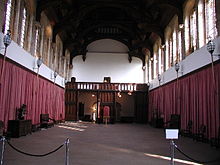
220px-Eltham_Palace_-_geograph.org.uk_-_19354
The Great Hall of Eltham Palace

John of Eltham was the second child and youngest son of Edward II of England and Isabella of France. He was born on 15th August 1316 at Eltham palace in Kent. Edward II had given Eltham to his queen, as a gift and she stayed there often.

John’s birth was a reassurance of the continuation of his father’s dynasty; his elder brother Edward of Windsor – the future Edward III – had been born in 1312. Although he had lost Scotland after the Battle of Bannockburn two years earlier, Edward’s throne was relatively secure when John was born. Edward II himself was not personally under pressure; as he had been when his eldest son was born.

The St Albans Chronicler reported how happy the king was, with the birth of his new son. Eubolo de Montibus was rewarded £100 for bringing the news of the birth to the king in York on 24th August. On the same day Edward II himself wrote to the Dominican friars, asking them to pray for the king, the queen, Edward of Windsor and John of Eltham, ‘especially on account of John’ who was not yet 10 days old.

Although miles away in York, Edward arranged for coverings of cloth-of-gold to be delivered for the font in Eltham’s chapel, to be used during John’s baptism. He also ordered a robe of white velvet to be made for Isabella’s churching ceremony.

Edward II also saw to the practicalities of his new son’s finances, ordering Edward of Windsor’s Justiciar in Chester, Sir Hugh Audley the Elder, to pay the rents, from the manor of Macclesfield, to the queen to cover John’s expenses. When a daughter, Eleanor of Woodstock, was  born in 1318, all three children were housed together at Wallingford Castle, near Oxford.
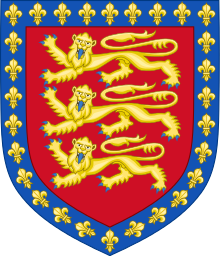
220px-Arms_of_John_of_Eltham,_Earl_of_Cornwall.svg
Coat of arms of John of Eltham, Earl of Cornwall

In 1320, however, their household was rearranged again and John and Eleanor went to live with their mother, Queen Isabella, while 8-year-old Edward joined the king’s household. At the age of 6, in August 1322, John was given the Lancastrian castle of Tutbury.

Edward and Isabella’s relationship seems to have been cordial, at least, until after the birth of their last daughter, Joan of the Tower, in 1321.

Edward’s defeat of his cousin, Thomas of Lancaster, and rebel barons at the Battle of Boroughbridge in 1322 seems to have precipitated the final breakdown of the marriage. With the defeat of the rebels, Edward was able to lavish power on his favourite Hugh le Despenser the Younger.

As Despenser’s authority and influence over the king grew, Isabella’s waned. She had to turn to Hugh’s wife Eleanor, the king’s niece, as intermediary to get the king’s approval of her requests.

In 1323 and 1324 Isabella spent a lot of time in London, seeing a great deal of her children, including John. In September 1324 John and his sister, Eleanor, were placed in the care of Eleanor Despenser.
Prince John of Eltham

In 1325 Queen Isabella was sent to France to negotiate peace with her brother, King Charles IV. John and his sisters remained in England, but Isabella managed to persuade Edward II to send his son Edward of Windsor, newly created Duke of Gascony, to France to do homage for his French lands. With the heir in her custody Isabella and her ally, Roger Mortimer, planned their return to England.

On Mortimer’s invasion in 1326 there was anarchy in London. The mob broke into the Tower of London, intending to set up 9-year-old John of Eltham as ruler of the city. However, Edward II was soon captured and in January 1327 he was forced to abdicate in favour of his eldest son, 14-year-old Edward III.

Edward II was probably murdered at Berkeley castle in September 1327, although some historians now argue he escaped and lived on the Continent as a hermit, under papal protection.

Although Edward was now king, Roger Mortimer was de facto ruler of England. John was a natural ally to his brother against the growing oppression of Mortimer. When Mortimer demanded he receive the Earldom of March at the forthcoming Salisbury Parliament, Edward countered by insisting his brother be given a rich earldom. And in October 1328, on the last day of parliament, John was created Earl of Cornwall.

From May to June of 1329 John was appointed Guardian of the Realm while Edward III travelled to France to pay homage for his French possessions; he was briefly appointed Guardian again in April 1331 when Edward went on pilgrimage to northern France.

300px-Halidon_Hill
Halidon Hill memorial

Married to Philippa of Hainault, with a son, Edward, in the cradle; in October 1330 Edward III had managed to overthrow the hated Mortimer and began his personal rule. In the lead up to the coup John must have been with his brother almost constantly; he witnessed 66 charters between January and October 1330, 10 more than Mortimer himself.

Edward was very fond of his brother. They had shared the terror of Mortimer’s dictatorship. John had benefited from the flood of estates and rewards following Mortimer’s downfall; Edward had been too cautious to distribute such largesse to his non-royal friends.

While their sisters married – Joan to David of Scotland and Eleanor to the Count of Guelders – John remained very much a stalwart of Edward’s lavish court. A writ in March 1334, for clothing for the court, has John sharing the costs of pearls used to decorate seven hoods; while Edward footed the bill for two of the hoods, John financed five of them.

Several brides were proposed for him; Jeanne, a daughter of the Count of Eu, Mary of Blois and Mary of Coucy among them. In October 1334 John received a papal dispensation to marry Maria, a daughter of Fernando IV, king of Castile and Leon. However, the marriage never took place.

When Edward turned his attentions to Scotland, John was with him. Edward III supported the claims of Edward Balliol, against David II Bruce, his sister’s husband, for the Scots crown. David’s forces were defeated at the Battle of Halidon Hill. While Edward III commanded the central division the king’s uncle, the Earl of Norfolk, led the right with Prince john by his side. Hand-to-hand combat followed a terrifying onslaught of arrows, and the Scots were routed.
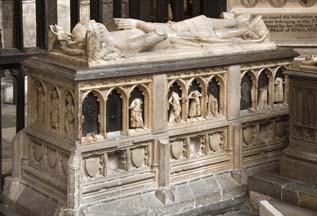
Tomb of John of Eltham, Westminster Abbey.
Tomb of John of Eltham, Westminster Abbey

John was also by his brother’s side during the 1335 and 1336 campaigns in Scotland. In June 1335 John joined the muster at Newcastle. The 1335 war was without compromise: the army undertook a campaign of looting, raping, killing and burning.

John appears to have been a competent and ruthless commander. Trusted by his brother he commanded a force in southern Scotland, putting down opposition to Edward Balliol. It is said that Joh burned down Lesmahagow Abbey when it was filled with people who had sought sanctuary from the English troops.

In 1336 John led a great council in Northampton while his brother was still in Scotland. The council decided to send an embassy to France to seek a compromise over the developing hostilities (France were promising to aid the Scots). John was soon back with Edward III in Perth where he died on 13th September 1336, just a month after his 20th birthday.
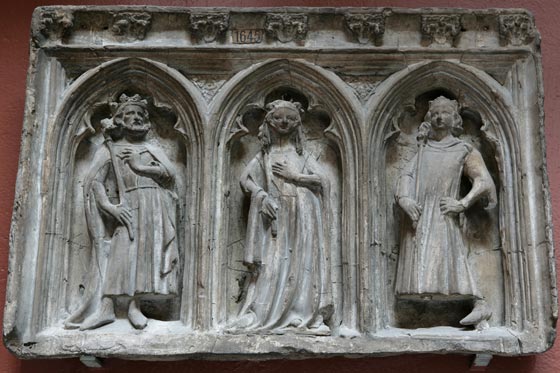
A.1916-307
Weepers on the tomb of John of Eltham

Thomas Gray, writing in 1355, said John died a ‘good death’, it is thought he died of a fever, brought on by his military exertions. There were, however, rumours of foul play and the Scots even suggested John was stabbed by an enraged Edward at the altar of the Church of St John, angry at his brother’s ruthlessness against the Scots.

Edward III was very upset by John’s death. He ordered 900 masses to be said for his brother’s soul, and even a year later his accountant noted extra alms-giving by the king in john’s memory.

John was buried in Westminster Abbey on 13th January 1337 and Edward III had an alabaster monument erected in St Edmund’s Chapel. The effigy has a moustache and is wearing a mixture of mail and plate armour, with John’s coat of arms on the shield. The Weepers surround the base of the tomb and could be representative of John’s family members.

*

Photographs: The Weepers © the V&A Museum, London; Tomb of Prince John of Eltham © Westminster Abbey; all other pictures courtesy of Wikipedia

*

Sources: The Perfect King, the Life of Edward III by Ian Mortimer; The Life and Time of Edward III by Paul Johnson; The Reign of Edward III  by WM Ormrod; The Mammoth Book of British kings & Queens by Mike Ashley; Britain’s’ Royal Families, the Complete Genealogy by Alison Weir; Brewer’s British Royalty by David Williamson; The Plantagenets, the Kings Who Made Britain by Dan Jones; edwardthesecond.blogspot.co.uk; westminster-abbey.org.

*

My books

Signed, dedicated copies of all my books are available through my online store.

Out nowKing John’s Right-Hand Lady: The Story of Nicholaa de la Haye
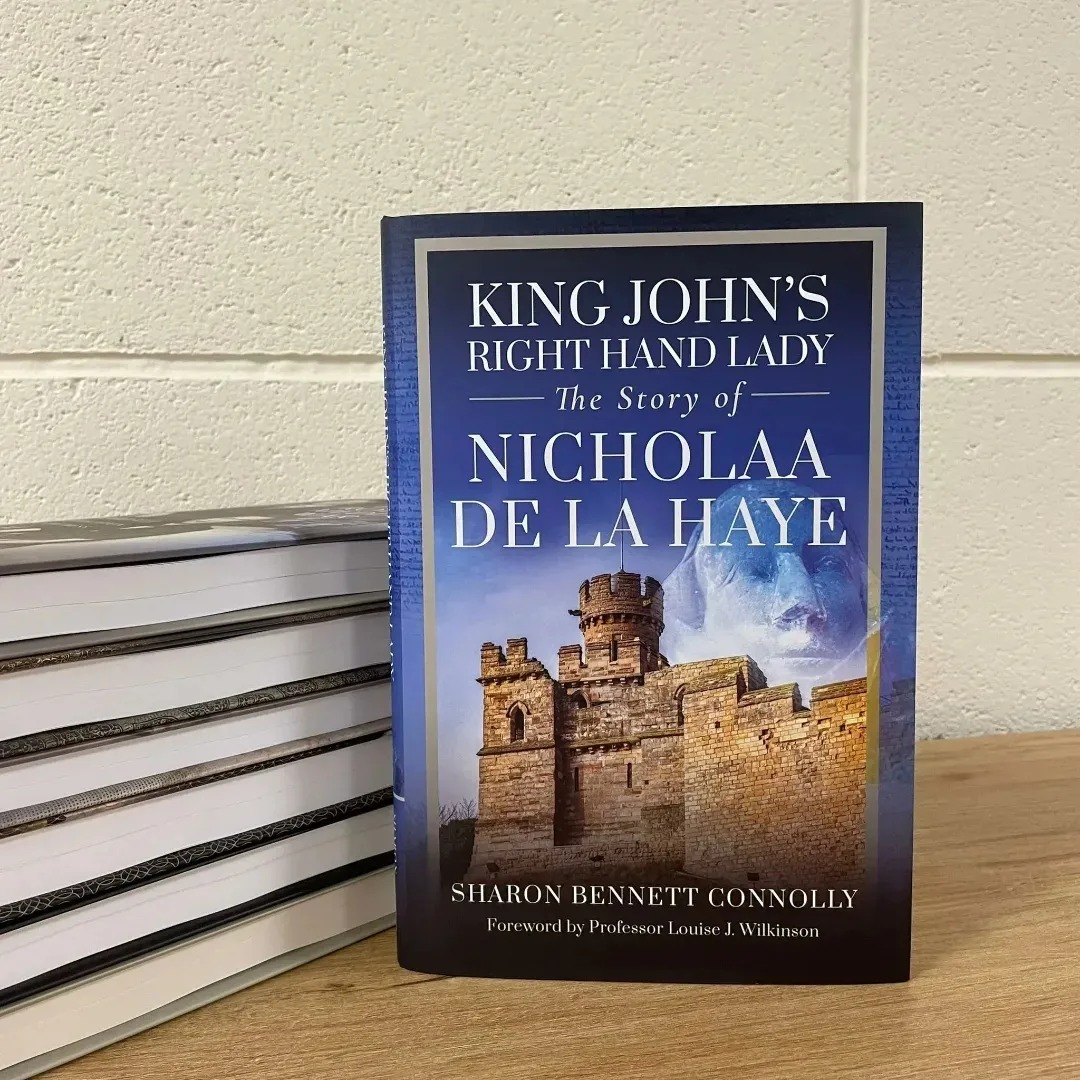
In a time when men fought and women stayed home, Nicholaa de la Haye held Lincoln Castle against all-comers, gaining prominence in the First Baron’s War, the civil war that followed the sealing of Magna Carta in 1215. A truly remarkable lady, Nicholaa was the first woman to be appointed sheriff in her own right. Her strength and tenacity saved England at one of the lowest points in its history. Nicholaa de la Haye is one woman in English history whose story needs to be told…

King John’s Right-Hand Lady: The Story of Nicholaa de la Haye is now available from Pen & Sword Booksbookshop.org and Amazon.

Coming 15 January 2024: Women of the Anarchy

On the one side is Empress Matilda, or Maud. The sole surviving legitimate child of Henry I, she is fighting for her birthright and that of her children. On the other side is her cousin, Queen Matilda, supporting her husband, King Stephen, and fighting to see her own son inherit the English crown. Both women are granddaughters of St Margaret, Queen of Scotland and descendants of Alfred the Great of Wessex. Women of the Anarchy demonstrates how these women, unable to wield a sword, were prime movers in this time of conflict and lawlessness. It show how their strengths, weaknesses, and personal ambitions swung the fortunes of war one way – and then the other.

Available for pre-order from Amberley Publishing and Amazon UK.

Also by Sharon Bennett Connolly:

Defenders of the Norman Crown: The Rise and Fall of the Warenne Earls of Surrey tells the fascinating story of the Warenne dynasty, of the successes and failures of one of the most powerful families in England, from its origins in Normandy, through the Conquest, Magna Carta, the wars and marriages that led to its ultimate demise in the reign of Edward III. Defenders of the Norman Crown: Rise and Fall of the Warenne Earls of Surrey is now available from Pen & Sword BooksAmazon in the UK and US, and  Bookshop.org.

Ladies of Magna Carta: Women of Influence in Thirteenth Century England looks into the relationships of the various noble families of the 13th century, and how they were affected by the Barons’ Wars, Magna Carta and its aftermath; the bonds that were formed and those that were broken. It is now available in paperback and hardback from Pen & Sword,  Amazon, and Bookshop.org.
Heroines of the Medieval World tells the stories of some of the most remarkable women from Medieval history, from Eleanor of Aquitaine to Julian of Norwich. Available now from Amberley Publishing and Amazon, and Bookshop.org.

Silk and the Sword: The Women of the Norman Conquest traces the fortunes of the women who had a significant role to play in the momentous events of 1066. Available now from Amazon,  Amberley Publishing, and Bookshop.org.

Alternate Endings: An anthology of historical fiction short stories including Long Live the King… which is my take what might have happened had King John not died in October 1216. Available in paperback and kindle from Amazon.

Podcast:

Have a listen to the A Slice of Medieval podcast, which I co-host with Historical fiction novelist Derek Birks. Derek and I welcome guests, such as Bernard Cornwell, and discuss a wide range of topics in medieval history, from significant events to the personalities involved.

*

Signed and dedicated copies of all my books are available through my online store.

For forthcoming online and in-person talks, please check out my Events Page.

You can be the first to read new articles by clicking the ‘Follow’ button, liking our Facebook page or joining me on Twitter and Instagram.

*

©2015 Sharon Bennett Connolly FRHistS
Silk Purses and Royal Scandal

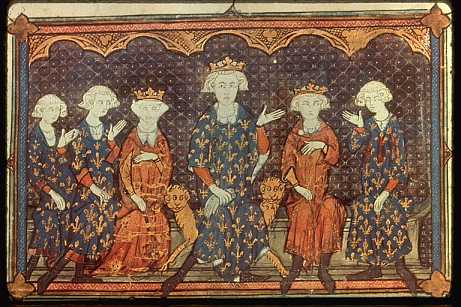
heritiers
Philip IV with sons Charles and Philip and daughter Isabella on his right and his heir, Louis and brother, Charles of Valois, on his left

In the early years of the 14th Century, scandal rocked the French monarchy to its core and inadvertently contributed to the end of the Capetian dynasty.

1314 was a tumultuous year for France; the final act in the destruction of the Knights Templars was played out when Grand Master, Jacques de Molay and the Preceptor of Normandy, Geoffrey de Charney, were burned to death on the Ile de la Cite.

De Molay is said to have cursed Philip IV, King of France, and his descendants from the flames. Philip IV would be dead within a year and his dynasty’s rule over France would end with the death of his youngest son, Charles IV, in 1328.

220px-Margaret_of_Burgundy
Marguerite of Burgundy

Philip’s eldest son and heir, Louis, was married to Marguerite de Burgundy. Louis seems to have been a hard person to live with – his nickname was Louis the Quarreler – and the marriage was said to be very unhappy. A daughter, Jeanne, would survive childhood to eventually become Queen of Navarre.

The second son, Philip, was married to Marguerite’s cousin, Jeanne d’Artois and Charles, the youngest, was married to Jeanne’s sister, Blanche d’Artois.

The royal scandal of 1314 was supposedly uncovered due to 2 rather innocuous items; silk purses.

Isabella_of_France
Isabella of France, Queen of England

On an earlier visit to France Isabella of France, wife of Edward II of England, had given silk purses to her sisters-in-law, as souvenirs of the knighting of her 3 brothers, Louis, Philip and Charles, the sons of Philip IV.

When she visited again in 1314, Isabella saw these same silk purses on the belts of 2 knights of the French court; brothers Gautier and Philippe d’Aunay. When Isabella brought this to her father’s attention, the matter was investigated and the brothers were put under surveillance.

The 2 knights, it seems, were meeting with the princesses in secret. The whole scandal became known as the Tour de Nesle Affair, as the clandestine meetings were supposed to have taken place in this small palace on the outskirts of Paris (although some sources suggest that events happened at Philip IV’s country retreat of Maubuisson Abbey).

Blanka2
Blanche of Artois

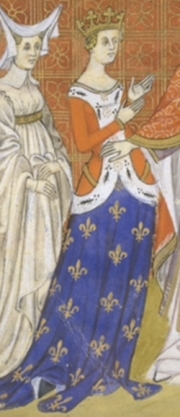
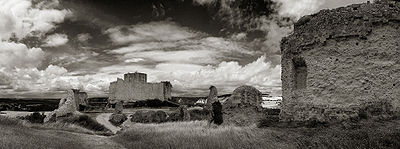
Whatever the location, the affair was discovered; all 3 princesses were arrested and questioned. When confronted in a secret court, Marguerite and Blanche confessed to adultery with the d’Aunay brothers. Their heads were shaved and they were sent to life imprisonment in Chateau Gaillard.

Blanche’s sister, Jeanne, fared better; she was also arrested, and placed under guard at the Chateau Dourdan. Her marriage with Philip was a very happy one, and it seems she was only guilty of knowing of the affairs. Philip defended his wife before the Paris Parlement and, with Philip’s support, Jeanne pleaded her innocence to the king, and was allowed to return to her husband and the court.

The 2 knights were arrested and, after being questioned and tortured, they confessed to the adultery and were condemned to death for the crime of ‘lese majeste’. The unfortunate brothers were castrated and ‘broken on the wheel’ – they were strapped to large wheels, which were spun while their limbs were shattered with iron bars. And finally, they were decapitated.

Of the princesses, Marguerite’s imprisonment was the most severe. She was badly treated and some sources suggest she was held in a cell at the top of the donjon, open to the elements.

400px-Château-Gaillard_in_black_and_white
Chateau Gaillard

On his accession to the throne in November 1314, Louis X applied to the Pope for an annulment of the marriage. However, Pope Clement V died before he could grant the divorce and no new Pope would be elected until 1316. Shortly after Clement’s death, however, Marguerite conveniently died – probably strangled on the orders of Louis.

Joan_II_of_Burgundy
Jeanne d’Artois, Countess of Burgundy

Louis married Clemence of Hungary, but died in June 1316, whilst Clemence was pregnant with their son. Jean I the Posthumous, was born and died in November of the same year and the crown passed to Louis’ brother, Philip V – with Jeanne d’Artois (by then Countess of Burgundy) at his side.

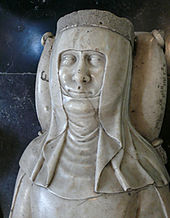
Philip died in 1322, leaving only daughters and the crown passed to his brother. On his accession, Charles divorced Blanche – still in an underground cell in Chateau Gaillard –  and transferred her to a monastery at Gavray, in Normandy, where she became a nun, dying there the following year.

Charles IV died in February 1328, leaving his 3rd wife, Jeanne d’Evreux, pregnant. In April 1328, she gave birth to a daughter, Blanche. The birth of a daughter led to the succession crisis, with arguments arising that a woman could not inherit the French throne. Although Salic Law had only previously been relevant to landed inheritance, and never before applied to the crown, it was now used to invoke to remove the surviving daughters of the 3 Valois kings from the succession. The crown now passed to Charles’ closest relative through the male line; his cousin, Philip of Valois, grandson of Philip III.

Edward III of England, however, as the only grandson of Philip IV, through his mother, pursued his own claim to the French throne and used it as a motive to launch the Hundred Years’ War.

170px-Jana2Navarra_SaintDenis
Jeanne II of Navarre

Salic Law, however, was not in force in Navarre, a kingdom which had come to the French crown when Jeanne I of Navarre had married Philip IV. Louis’ daughter, Jeanne, therefore inherited Navarre as Jeanne II, despite the questions that the scandal raised over her parentage.

It has been suggested that the Tour de Nesle Affair was all an elaborate plot to destabilise the French monarchy, but most historians believe the adultery took place. The harsh punishments reflected the need for queens and princesses to be above reproach, and the parentage of their children to be beyond question. The scandal cast a long shadow on the last years of the Capetian dynasty, with neither of the 3 brothers producing a son to carry on their line.

*

Sources: Pierre Goubert The Course of French History; Paul Doherty Isabella and the Strange Death of Edward II; J Huizinga The Waning of the Middle Ages; H.G. Koenigsberger Medieval Europe 400-1500; maison-hantee.com; herodote.net; histoirefrance.net.

Pictures taken from Wikipedia.

*

My Books:

Signed, dedicated copies of all my books are available through my online store.

Out now: Scotland’s Medieval Queens

Scotland’s history is dramatic, violent and bloody. Being England’s northern neighbour has never been easy. Scotland’s queens have had to deal with war, murder, imprisonment, political rivalries and open betrayal. They have loved and lost, raised kings and queens, ruled and died for Scotland. From St Margaret, who became one of the patron saints of Scotland, to Elizabeth de Burgh and the dramatic story of the Scottish Wars of Independence, to the love story and tragedy of Joan Beaufort, to Margaret of Denmark and the dawn of the Renaissance, Scotland’s Medieval Queens have seen it all. This is the story of Scotland through their eyes.

Available now from Amazon and Pen and Sword Books

Also by Sharon Bennett Connolly:

Heroines of the Tudor World tells the stories of the most remarkable women from European history in the time of the Tudor dynasty, 1485-1603. These are the women who ruled, the women who founded dynasties, the women who fought for religious freedom, their families and love. Heroines of the Tudor World is now available for pre-order from Amberley Publishing and Amazon UK. Women of the Anarchy demonstrates how Empress Matilda and Matilda of Boulogne, unable to wield a sword themselves, were prime movers in this time of conflict and lawlessness. It shows how their strengths, weaknesses, and personal ambitions swung the fortunes of war one way – and then the other. Available from Bookshop.orgAmberley Publishing and Amazon UKKing John’s Right-Hand Lady: The Story of Nicholaa de la Haye is the story of a truly remarkable lady, the hereditary constable of Lincoln Castle and the first woman in England to be appointed sheriff in her own right. Available from all good bookshops Pen & Sword Booksbookshop.org and Amazon

Defenders of the Norman Crown: The Rise and Fall of the Warenne Earls of Surrey tells the fascinating story of the Warenne dynasty, from its origins in Normandy, through the Conquest, Magna Carta, the wars and marriages that led to its ultimate demise in the reign of Edward III. Available from Pen & Sword BooksAmazon in the UK and US, and Bookshop.orgLadies of Magna Carta: Women of Influence in Thirteenth Century England looks into the relationships of the various noble families of the 13th century, and how they were affected by the Barons’ Wars, Magna Carta and its aftermath; the bonds that were formed and those that were broken. It is now available in paperback and hardback from Pen & SwordAmazon, and Bookshop.orgHeroines of the Medieval World tells the stories of some of the most remarkable women from Medieval history, from Eleanor of Aquitaine to Julian of Norwich. Available now from Amberley Publishing and Amazon, and Bookshop.orgSilk and the Sword: The Women of the Norman Conquest traces the fortunes of the women who had a significant role to play in the momentous events of 1066. Available now from Amazon,  Amberley Publishing, and Bookshop.org.

Alternate Endings: An anthology of historical fiction short stories including Long Live the King… which is my take what might have happened had King John not died in October 1216. Available in paperback and kindle from Amazon.

Podcast:

Have a listen to the A Slice of Medieval podcast, which I co-host with Historical fiction novelist Derek Birks. Derek and I welcome guests, such as Bernard Cornwell and Michael Jecks, and discuss a wide range of topics in medieval history, from significant events to the personalities involved. Every episode is also now available on YouTube.

*

Don’t forget! Signed and dedicated copies of all my books are available through my online store.

For forthcoming online and in-person talks, please check out my Events Page.

You can be the first to read new articles by clicking the ‘Follow’ button, liking our Facebook page or joining me on TwitterThreadsBluesky and Instagram.

*

©2015 Sharon Bennett Connolly, FRHistS

Isabella de Warenne, Queen of Scotland?

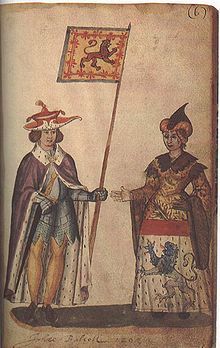
John Balliol and Isabella de Warenne

Whilst researching for my article on Ada de Warenne I discovered that a hundred years later, a kinswoman of hers also, briefly, made an appearance on the stage of Scottish history. I looked at both women, again in my latest book, Scotland’s Medieval Queens, a project I am immensely excited about. I love Scottish history!

Isabella de Warenne was the daughter of John de Warenne, 6th Earl of Surrey, and Alice de Lusignan. As such, Isabella had connections, both to royalty and the highest ranks of the English nobility. Her mother, Alice, was the daughter of King John of England’s widow, Isabella of Angouleme, and Hugh X de Lusignan and half-sister to Henry III of England. Isabella was, therefore, Henry’s niece and a 1st cousin of King Edward I. Through her paternal grandmother, Matilda Marshal, Isabella was also a great-granddaughter of the ‘Greatest Knight’ William Marshal, Earl of Pembroke and Regent of England in the early years of Henry III’s reign.

Isabella was one of three children; her elder sister, Eleanor, married Henry Percy and was the mother of Henry de Percy, 1st Baron Percy. Isabella’s younger brother, William de Warenne, married Joan de Vere, daughter of the 5th Earl of Oxford, and was father to two children, a son and a daughter; John and Alice. Isabella’s nephew, John de Warenne, was the last Earl of Warenne and Surrey, whose marital and extra-marital situation led to the extinction of the senior Warenne line. It was through John’s sister, Alice de Warenne, that the title earl of Surrey would eventually pass to her son Richard Fitzalan, 10th Earl of Arundel.

John Balliol, King of Scots

Alice de Lusignan died in 1256, shortly after giving birth to her youngest child, William, leaving the 25-year-old Earl Warenne to raise three young children alone. Alice de Lusignan was buried at Lewes Priory, the Warenne family mausoleum, she was ‘placed in the earth before the great altar in the presence of her brother Adelmar [Aymer de Valence], [bishop] elect of Winchester.’1 Isabella was probably born around 1253, although some genealogical sources claim she was younger and the daughter of a second, unknown wife of John de Warenne.

Isabella was married to John Balliol, Lord of Bywell, sometime before 7 February 1281. The confusion over her age is probably based on the writings of chronicler Thomas Wykes, who, in trying to explain why John Balliol did not succeed to the Balliol lands until a year after his brother’s death, suggested that the lands were in wardship to Edward I due to John Balliol’s youth. According to Wykes, Balliol needed Edward’s consent for his proposed marriage to Isabella, describing John as a youth, adolescens, and Isabella, a young girl, adolescentula. In fact, at the date of their marriage, John was about thirty years of age and Isabel was at least in her mid-twenties. Clearly, Edward could not have been exercising rights of wardship in a minority but the true reasons for his heavy-handed intervention are not clear.

Furthermore, there is no evidence that John ever remarried after Alice’s death, so this theory seems unlikely. It is just as likely – or more likely, in fact – that Isabella married late because previous marriage proposals or arrangements had failed, either due to failed negotiations or the death of the proposed groom. Such instances often went unrecorded, and are much more feasible than the suggestion that the earl had remarried but not one of the chroniclers of the time had mentioned it.

In the early 1290s, John Balliol was one of the 13 Competitors for the Scottish throne. He was the great-grandson of Ada de Warenne’s youngest son, David, Earl of Huntingdon, by David’s daughter, Margaret. John and Isabella were, therefore, 4th cousins, both being descended from William de Warenne, 2nd Earl of Surrey, and his wife, Isabel de Vermandois.

Balliol’s claim lay through seniority, he was grandson of Margaret, the eldest daughter of David of Huntingdon. The other leading Competitor was Robert de Brus, grandfather of the future King Robert (I) the Bruce. Robert de Brus’s claim lay in the fact he was closer in degree to the same David, being the son of David’s youngest daughter, Isobel. John Balliol was therefore David’s great-grandson, whereas Robert de Brus was his grandson, though by a younger daughter.

With 13 claimants to the Scottish throne it was Edward I of England who was given the duty of selecting Scotland’s next king. Isabella’s close family links to the English crown may have helped Edward decide in John’s favour and he was installed as King of Scotland in November 1292.

John and Isabella may have had at least three, but possibly four, children together.

A daughter, Margaret, died unmarried. There is mention of another daughter, Anne; but there is  doubt as to whether she ever existed.

Their eldest son, Edward, was born around 1283. Following the deposition of his father, in November 1299 Isabella and John’s oldest son, Edward, was entrusted to the custody of his Earl Warenne, who was then approaching his 70th year. After his grandfather’s death in 1304, Edward was transferred to the custody of his cousin John, the 7th Earl Warenne, until he was delivered into royal custody in 1310.

By the 1330s Edward’s prospects had improved. He was seen as a useful political tool, a rival claimant to the Scottish crown. With English support, Edward made his own bid for the throne, and was crowned king following his defeat of 8-year-old David II‘s forces at the Battle of Dupplin Moor in 1332. David’s supporters and Edward struggled against each other, until they eventually triumphed over Edward and he was deposed in 1336.

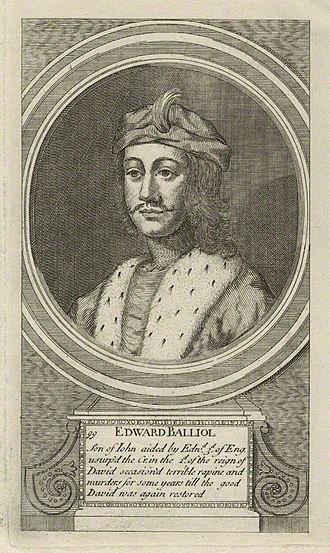
Isabella’s son, Edward Balliol, King of Scots

Edward finally surrendered his claim to the Scottish throne in 1356 whilst living in English exile; he died in Wheatley, Doncaster, probably in 1363 or 1364. Although his final resting place has recently been claimed to be under Doncaster Post Office, the former site of Doncaster Priory, it remains elusive.

John and Isabella’s possible younger son, Henry, was killed on 16th December 1332 at the Battle of Annan, a resounding victory for supporters of David II against Henry’s brother, Edward.

Although Edward was briefly married to Margaret of Taranto, the marriage was annulled. Neither Edward nor Henry had any children.

Very little is known of John and Isabella’s life together. Her death date and final resting place are both unknown. It is by no means certain that Isabella was still alive when John became king, so may have died before 1292, when John succeeded to the Scottish throne. She was no longer living, however, when her own father defeated John and the Scottish army at the Battle of Dunbar in April 1296; John abdicated in July of the same year and died in French exile in 1314.

John’s claim to the Scottish throne was supported by the Comyns, which led to the murder of John Comyn, in the church at Dumfries in 1306, by Robert the Bruce, who had succeeded his grandfather as the other leading Competitor to the throne. Shortly after the murder, he was crowned King Robert I at Scone but was only able to consolidate his rule after winning a resounding victory over the English at Bannockburn in 1314.

*

Footnotes:

1‘Annals written by a certain monk of Lewes, from the birth of Christ to the year 1312’ quoted in W.H. Blaauw, On the Early History of Lewes Priory, and its Seals, with extracts from a MS. Chronicle

Picture:

John Balliol and Isabella de Warenne from britroyals.com; Edward Balliol courtesy of Wikipedia

Further reading:

W.H. Blaauw, On the Early History of Lewes Priory, and its Seals, with extracts from a MS. Chronicle; William Farrer and Charles Travis Clay, editors, Early Yorkshire Charters, Volume 8: The Honour of Warenne; Nigel Tranter, The Story of Scotland; britroyals.com; Rev. John Watson, Memoirs of the Ancient Earls of Warren and Surrey, and Their Descendants to the Present Time, Volume I; G.P. Stell, John [John de Balliol] (c. 1248×50-1314) (article), Oxforddnb.com; Susan M. Johns, ‘Alice de Lusignan, suo jure countess of Eu’, Oxforddnb.com; Scott L. Waugh, Warenne, John de, sixth earl of Surrey [earl of Surrey and Sussex, Earl Warenne] (1231-1304) Oxforddnb.com; royal.gov.uk/HistoryoftheMonarchy/ScottishMonarchs; Alison Weir, Britain’s Royal Families; David Williamson, Brewer’s British Royalty; Mike Ashley, The Mammoth Book of British Kings and Queens; englishmonarchs.co.uk.

*

My Books

Signed, dedicated copies of all my books are available through my online bookshop.

Coming 30 January 2025: Scotland’s Medieval Queens

Scotland’s history is dramatic, violent and bloody. Being England’s northern neighbour has never been easy. Scotland’s queens have had to deal with war, murder, imprisonment, political rivalries and open betrayal. They have loved and lost, raised kings and queens, ruled and died for Scotland. From St Margaret, who became one of the patron saints of Scotland, to Elizabeth de Burgh and the dramatic story of the Scottish Wars of Independence, to the love story and tragedy of Joan Beaufort, to Margaret of Denmark and the dawn of the Renaissance, Scotland’s Medieval Queens have seen it all. This is the story of Scotland through their eyes.

Available for pre-order now.

Also by Sharon Bennett Connolly:

Defenders of the Norman Crown: The Rise and Fall of the Heroines of the Tudor World tells the stories of the most remarkable women from European history in the time of the Tudor dynasty, 1485-1603. These are the women who ruled, the women who founded dynasties, the women who fought for religious freedom, their families and love. Heroines of the Tudor World is now available for pre-order from Amberley Publishing and Amazon UK. Women of the Anarchy demonstrates how Empress Matilda and Matilda of Boulogne, unable to wield a sword themselves, were prime movers in this time of conflict and lawlessness. It shows how their strengths, weaknesses, and personal ambitions swung the fortunes of war one way – and then the other. Available from Bookshop.orgAmberley Publishing and Amazon UKKing John’s Right-Hand Lady: The Story of Nicholaa de la Haye is the story of a truly remarkable lady, the hereditary constable of Lincoln Castle and the first woman in England to be appointed sheriff in her own right. Available from all good bookshops Pen & Sword Booksbookshop.org and Amazon

Defenders of the Norman Crown: The Rise and Fall of the Warenne Earls of Surrey tells the fascinating story of the Warenne dynasty, from its origins in Normandy, through the Conquest, Magna Carta, the wars and marriages that led to its ultimate demise in the reign of Edward III. Available from Pen & Sword BooksAmazon in the UK and US, and Bookshop.orgLadies of Magna Carta: Women of Influence in Thirteenth Century England looks into the relationships of the various noble families of the 13th century, and how they were affected by the Barons’ Wars, Magna Carta and its aftermath; the bonds that were formed and those that were broken. It is now available in paperback and hardback from Pen & SwordAmazon, and Bookshop.orgHeroines of the Medieval World tells the stories of some of the most remarkable women from Medieval history, from Eleanor of Aquitaine to Julian of Norwich. Available now from Amberley Publishing and Amazon, and Bookshop.orgSilk and the Sword: The Women of the Norman Conquest traces the fortunes of the women who had a significant role to play in the momentous events of 1066. Available now from Amazon,  Amberley Publishing, and Bookshop.org.

Alternate Endings: An anthology of historical fiction short stories including Long Live the King… which is my take what might have happened had King John not died in October 1216. Available in paperback and kindle from Amazon.

Podcast:

Have a listen to the A Slice of Medieval podcast, which I co-host with Historical fiction novelist Derek Birks. Derek and I welcome guests, such as Bernard Cornwell, and discuss a wide range of topics in medieval history, from significant events to the personalities involved.

*

Don’t forget! Signed and dedicated copies of all my books are available through my online bookshop.

For forthcoming online and in-person talks, please check out my Events Page.

You can be the first to read new articles by clicking the ‘Follow’ button, liking our Facebook page or joining me on TwitterThreadsBluesky and Instagram.

*

©2015 Sharon Bennett Connolly FRHistS
Isabella of Castile, the Controversial First Duchess of York, c.1355-1392

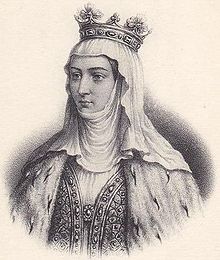
Isabella_of_Castile-Langley
Isabella of Castile

As the third daughter of Peter (or Pedro) the Cruel of Castile and his long-term mistress (and sometime wife) Maria of Padilla, Isabella of Castile‘s childhood was marred by her father’s battles to hold on to his throne and almost constant warfare with Aragon.

Peter was known in some areas as Peter the Cruel and in others as Peter the Just, depending which side of the conflict people were on. He received support from Edward III of England’s eldest son and heir Edward, the Black Prince, but Peter’s failure to pay the costs of the prince’s campaign,  his faithlessness, and the failing health of the Black Prince, meant the king of Castile was left to his own devices by 1367. Adding to Peter’s woes, his own nobles backed the king’s illegitimate brother, Henry of Tastamara, as an alternative candidate. Henry eventually defeated and killed Peter in March 1369.

Peter had been married, in June 1353, to the unfortunate French princess, Blanche de Bourbon, though some historians believe he had already married Maria de Padilla sometime before this. Whatever the case, Peter abandoned Blanche for Maria just 3 days after the wedding. Blanche was imprisoned in various castles, far away from the French border to prevent her rescue. Repeated calls from the French, for her to be released, went unheeded and the pope refused to excommunicate Peter for his actions. Blanche died at Medina Sidonia in 1361, though whether her death was by natural causes or assassination on Peter’s orders is disputed. One source claims Peter’s crossbowman was sent to kill Blanche. Another claims she was poisoned. While another suggests natural causes. With Peter and his brother Henry vying for the crown, misinformation his hard to filter.

Isabella was born sometime around 1355. Her mother died in 1361 and her 3-year-old brother, Alfonso, in 1362. In 1362, Peter had persuaded the Cortes to recognise his relationship with Maria as a legitimate marriage, and thus legitimise his 3 daughters, Beatrix, Constance and Isabella, making Beatrix his heir. However, Beatrix died in 1367 and son, on Peter’s death in 1369, it was Constance who inherited their father’s claim to the crown of Castile. The situation in Castile was precarious, to say the least and Constance was unable to pursue her claim. Her father had taken Constance and her sister to the English territory of Guyenne in 1366, where they had remained whilst Peter had tried to reclaim his crown from Henry. They remained in Bayonne as hostages against the repayment of the financial costs of the expedition. Following Peter’s death, the English took the princesses in and soon after, in September 1371, Constance was married to John of Gaunt, the third surviving son of Edward III, at Roquefort. John of Gaunt had become duke of Lancaster on marrying his first wife, Blanche of Lancaster, who had died in 1368; he saw this second marriage as an opportunity to gain a kingdom of his own. When the newly married couple returned to London, they brought Constance’s younger sister, Isabella, with them.

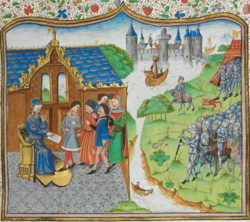
Edmund_of_Langley_remonstrating_with_the_King_of_Portugal_-_Chronique_d'_Angleterre_(Volume_III)_(late_15th_C),_f.186r_-_BL_Royal_MS_14_E_IV

Following Constance’s official entry into London, 16-year-old Isabella probably stayed with her sister and new brother-in-law at Gaunt’s house on the Thames, the Savoy. A year later, Edward III arranged for Isabella to marry Gaunt’s younger brother, Edmund of Langley. Edmund was the fifth son, fourth surviving of Edward III and Philippa of Hainault. Born in 1341, Edmund was 14 years older than his bride. They were married on 4 July 1372, at Wallingford. John of Gaunt gave the bride a wedding gift of plate bought from leading London goldsmiths. The marriage was a continuation of the of the English policy of the time, to reinforce the dynastic link between England and Castile and thus ensuring that both heirs of Peter of Castile were married into the English royal line. Should Constance die without an heir, Isabella would inherit her claim to the Castilian throne.

On her marriage to Edmund, Isabella became Countess of Cambridge, and would become the first ever Duchess of York when Edmund was created Duke of York by his nephew, King Richard II, on 6 August 1385. She was appointed a Lady of the Garter in 1379. In 1381, Isabella accompanied her husband, taking along their 8-year-old son Edward to Lisbon, on John of Gaunt’s ill-fated expedition to claim the Castilian throne for his wife. The Portuguese chronicler, Ferñao Lopes, noted how the Portuguese king, Ferdinand, supported the countess on his arm on the walk up the steep slope from the Tagus to the cathedral, and led her mount by the rein to the monastery where they were lodged. Little Edward was briefly betrothed to King Ferdinand’s only legitimate child, Beatriz, who would go on to marry John I of Castle, the son of Henry of Trastamara.

The couple’s first son, Edward was born in 1373 – he would become the second Duke of York, and be killed at Agincourt in 1415. A daughter, Constance, was born in 1374. A second son, Richard of Conisbrough, grandfather of both Edward IV and Richard III, was born at Conisbrough Castle in Yorkshire, sometime between 1375 and 1386. He was executed for his involvement in the Southampton Plot, against Henry V, in 1415.

It is hard to discern the truth of the relationship between Isabella and Edmund. Froissart remarked on Edmund’s indolent character and together they were described as an ill-matched pair. Thomas of Walsingham, in particular, commented on Isabella’s ‘loose morals.’ And 40 years after her death, John Shirley, spicing up poems he was transcribing with gossip, referred to a love affair ‘my lady of York doughter to the king of Spaygne and my lord of Huntyngdone.’ The affair was said to have started as early as 1374 and has cast doubt on the legitimacy of Edmund and Isabella’s third and youngest child, Richard of Conisbrough. Recent studies, however, have cast doubt on the affair, their argument supported by Duke Edmund’s will, giving the lie to a rocky relationship by requesting to be buried ‘near his beloved Isabel, formerly his companion.’ 

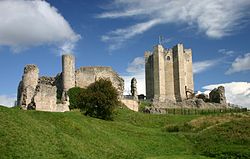
conisbroughcastle
Conisbrough Castle, Yorkshire

Isabella died on 23 December 1392, aged about 37, and was buried at the church of the Dominicans, in King’s Langley, on 14 January 1393. In her will, drawn up a week before her death, and with her husband’s consent, she made Richard II her heir and asked that he provide a pension for her youngest son and Richard II’s godson, Richard of Conisbrough. Richard was given an allowance of £500 by the king, but this was only paid sporadically following Richard II’s deposition by Henry IV. Richard was not even mentioned in the wills of his father and brother and G.L. Harriss, of the Oxford Dictionary of National Biography, has speculated this could be proof that Richard was not the son of the Duke of York. Although it could simply be because his mother had already made provision for their youngest son. At the time of Isabella’s death, Duke Edmund was still in debt due to the failed Castilian expedition, and so Isabella’s will gave provision for her younger son whilst protecting the incomes of her husband and older son.

Jenny Stratford’s recent essay on Isabella of Castile from the Oxford Dictionary of National Biography has an extensive study of Isabella’s will and argues against the supposed affair with John Holland, rooting out the sources of the rumours and and demonstrating how they took flight. Isabella’s will demonstrates her pride in her heritage and affection for her husband and children, as well as a conventional piety. She left personal bequests to Richard II and his queen, Anne of Bohemia, in addition to books, jewels, plate, horses and robes to her husband, children and friends, with monetary bequests for various other members of the York household, including servants and the musicians of the household chapel. Isabella also left a bequest of robes, furs and jewels, to the first lady of her household, Marie St Hilaire, who was the mother of Gaunt’s illegitimate daughter, Blanche, born about 1359.

Edmund married again, to his cousin Joan Holland, niece of his first wife’s supposed lover, John Holland. In another bizarre family twist, it was Joan’s brother, Edmund Holland, 4th Earl of Kent, who had an affair – and an illegitimate daughter – with Constance of York, the daughter of Edmund and Isabella.

*

Sources: Ian Mortimer, Edward III The Perfect King; englishmonarchs.co.uk; womenshistory.about.com; WM Ormrod, The Reign of Edward III; Conisbrough Castle, South Yorkshire; Oxforddnb.com; The History Today Companion to British History, edited by Juliet Gardiner & Neil Wenborn; Brewer’s British Royalty by David Williamson; Britain’s Royal Families, the Complete Genealogy by Alison Weir; The Wars of the Roses by John Gillingham; The Wordsworth Dictionary of British History by J.P. Kenyon; The Oxford Companion to British History, edited by John Cannon; The Reign of Edward III by WM Ormrod; The Wars of the Roses by Martin J Dougherty; englishmonarchs.co.uk; womenshistory.about.com; findagrave.com; conisbroughcastle.org.uk; hrionline.ac.uk.

Photos from Wikipedia, except Conisbrough Castle which is © Sharon Bennett Connolly.

*

My Books

Signed, dedicated copies of all my books are available through my online bookshop.

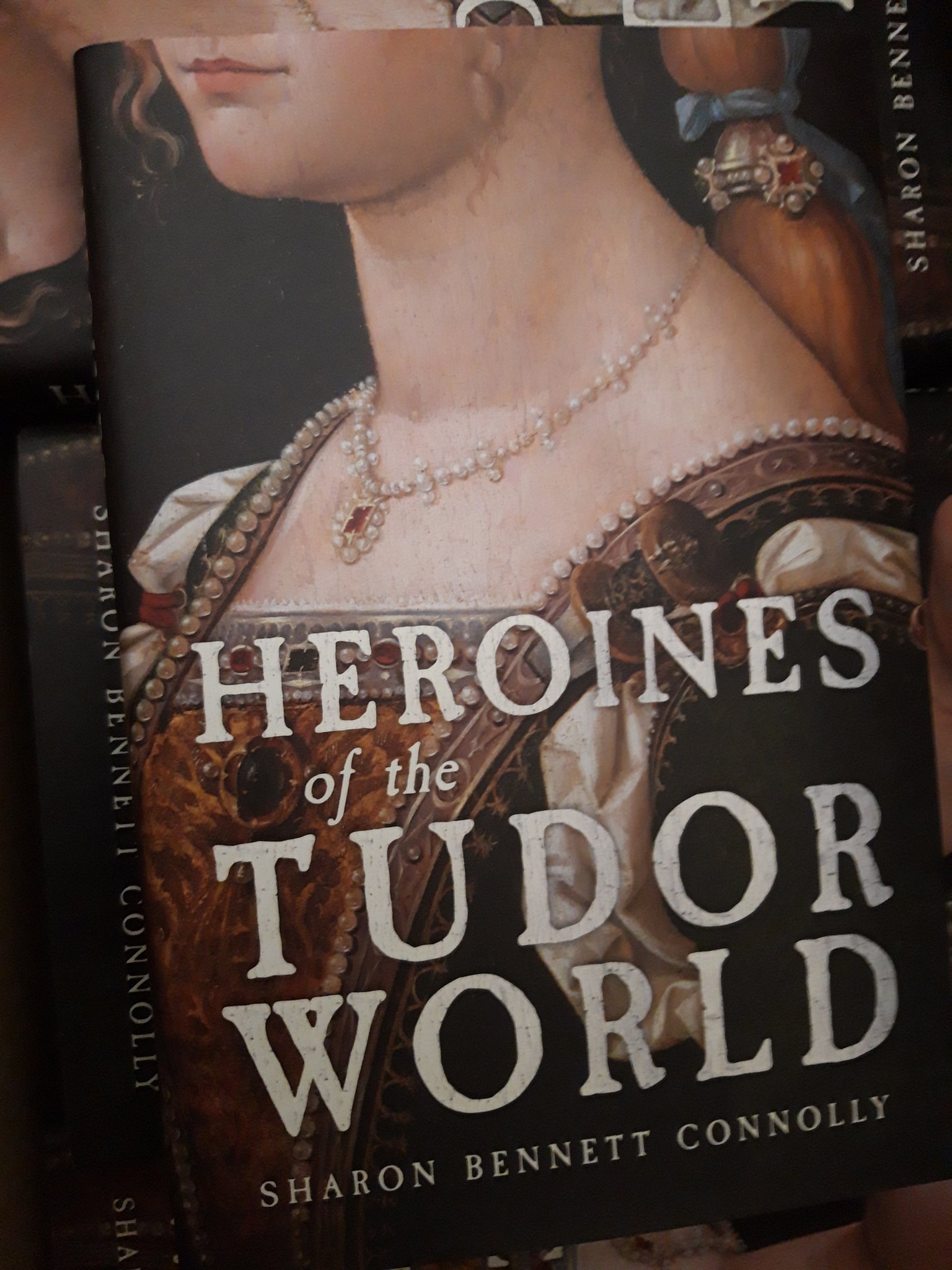
Coming on 15 June 2024: Heroines of the Tudor World

Heroines of the Tudor World tells the stories of the most remarkable women from European history in the time of the Tudor dynasty, 1485-1603. These are the women who ruled, the women who founded dynasties, the women who fought for religious freedom, their families and love. These are the women who made a difference, who influenced countries, kings and the Reformation. In the era dominated by the Renaissance and Reformation, Heroines of the Tudor World examines the threats and challenges faced by the women of the era, and how they overcame them. From writers to regents, from nuns to queens, Heroines of the Tudor World shines the spotlight on the women helped to shape Early Modern Europe.

Heroines of the Tudor World is now available for pre-order from Amberley Publishing and Amazon UK.

Out Now! Women of the Anarchy

Two cousins. On the one side is Empress Matilda, or Maud. The sole surviving legitimate child of Henry I, she is fighting for her birthright and that of her children. On the other side is her cousin, Queen Matilda, supporting her husband, King Stephen, and fighting to see her own son inherit the English crown. Women of the Anarchy demonstrates how these women, unable to wield a sword, were prime movers in this time of conflict and lawlessness. It show how their strengths, weaknesses, and personal ambitions swung the fortunes of war one way – and then the other.

Available from Bookshop.orgAmberley Publishing and Amazon UK.

Also by Sharon Bennett Connolly:

King John’s Right-Hand Lady: The Story of Nicholaa de la Haye is the story of a truly remarkable lady, the hereditary constable of Lincoln Castle and the first woman in England to be appointed sheriff in her own right. It is is available from King John’s Right-Hand Lady: The Story of Nicholaa de la Haye is the story of a truly remarkable lady, the hereditary constable of Lincoln Castle and the first woman in England to be appointed sheriff in her own right. Available from all good bookshops or direct from Pen & Sword Booksbookshop.org and AmazonDefenders of the Norman Crown: The Rise and Fall of the Warenne Earls of Surrey tells the fascinating story of the Warenne dynasty, from its origins in Normandy, through the Conquest, Magna Carta, the wars and marriages that led to its ultimate demise in the reign of Edward III. Available from Pen & Sword BooksAmazon in the UK and US, and Bookshop.org

Ladies of Magna Carta: Women of Influence in Thirteenth Century England looks into the relationships of the various noble families of the 13th century, and how they were affected by the Barons’ Wars, Magna Carta and its aftermath; the bonds that were formed and those that were broken. It is now available in paperback and hardback from Pen & Sword,  Amazon, and Bookshop.orgHeroines of the Medieval World tells the stories of some of the most remarkable women from Medieval history, from Eleanor of Aquitaine to Julian of Norwich. Available now from Amberley Publishing and Amazon, and Bookshop.orgSilk and the Sword: The Women of the Norman Conquest traces the fortunes of the women who had a significant role to play in the momentous events of 1066. Available now from Amazon,  Amberley Publishing, and Bookshop.org.

Alternate Endings: An anthology of historical fiction short stories including Long Live the King… which is my take what might have happened had King John not died in October 1216. Available in paperback and kindle from Amazon.

Podcast:

Have a listen to the A Slice of Medieval podcast, which I co-host with Historical fiction novelist Derek Birks. Derek and I welcome guests, such as Bernard Cornwell and discuss a wide range of topics in medieval history, from significant events to the personalities involved.

*

Don’t forget! Signed and dedicated copies of all my books are available through my online bookshop.

For forthcoming online and in-person talks, please check out my Events Page.

You can be the first to read new articles by clicking the ‘Follow’ button, liking our Facebook page or joining me on Twitter and Instagram.

*

©2015 Updated ©2024 Sharon Bennett Connolly FRHistS