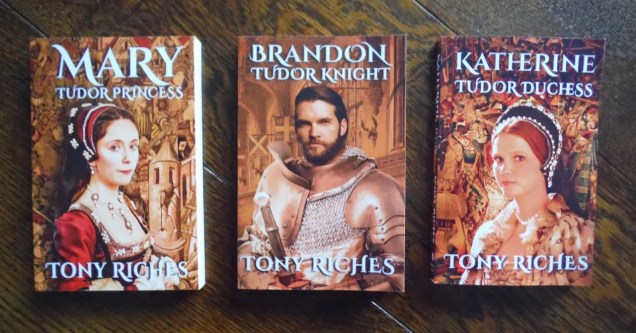
It is a pleasure to welcome author Tony Riches to History … the Interesting Bits today. Tony has written a fabulous trilogy based on the story of Charles Brandon and two of his wives, Mary Tudor, Queen of France, and Katherine Willoughby.
Mary – Tudor Princess
From the author of the best-selling Tudor Trilogy, the true stories of the Tudor dynasty continue with Mary Tudor, daughter of King Henry VII and sister of King Henry VIII.
Born into great privilege, Mary has beauty and intelligence beyond her years and is the most marriageable princess in Europe. Henry plans to use her marriage to build a powerful alliance against his enemies. Will she dare risk his anger by marrying for love?
Meticulously researched and based on actual events, this ‘sequel’ follows Mary’s story from book three of the Tudor Trilogy and is set during the reign of King Henry VIII.
Brandon – Tudor Knight
Handsome, charismatic and a champion jouster, Sir Charles Brandon has a secret. He has fallen in love with Henry VIII’s sister, Mary Tudor, the beautiful widowed Queen of France, and risks everything to marry her without King Henry’s consent.
Brandon becomes Duke of Suffolk, but his loyalty is tested fighting Henry’s wars in France. Mary’s public support for Queen Catherine of Aragon brings Brandon into dangerous conflict with the ambitious Boleyn family and the king’s new right-hand man, Thomas Cromwell.
Torn between duty to his family and loyalty to the king, Brandon faces an impossible decision: can he accept Anne Boleyn as his new queen?
Katherine – Tudor Duchess
Attractive, wealthy and influential, Katherine Willoughby is one of the most unusual ladies of the Tudor court. A favourite of King Henry VIII, Katherine knows all his six wives, his daughters Mary and Elizabeth, and his son Edward.
She marries Tudor knight, Sir Charles Brandon, and becomes Duchess of Suffolk at the age of fourteen. Her Spanish mother, Maria de Salinas, is Queen Catherine of Aragon’s lady in waiting, so it is a challenging time for them all when King Henry marries Anne Boleyn.
Following Anne’s dramatic downfall, the tragic death of Jane Seymour, and the short reign of Catherine Howard, Katherine’s young sons are tutored with the future king, Prince Edward, and become his friends.
Katherine and Charles Brandon are chosen to welcome Anna of Cleves as she arrives in England. When the royal marriage is annulled, Katherine’s friend, Catherine Parr becomes the king’s sixth wife, and they work to promote religious reform. When King Edward dies, his Catholic sister Mary is crowned queen, and Katherine’s Protestant faith puts her family in great danger – from which there seems no escape.
About the Author
Tony Riches was born in Pembrokeshire, West Wales, UK, and spent part of his childhood in Kenya. He gained a BA degree in Psychology and an MBA from Cardiff University. After writing several successful non-fiction books, Tony decided his real interest is in the history of the fifteenth and sixteenth centuries, and now his focus is on writing historical fiction about the lives of key figures of medieval history. His Tudor Trilogy has become an international best-seller and he is in regular demand as a guest speaker about the lives of the early Tudors. Find out more at his website https://www.tonyriches.com/ and find him on Facebook and Twitter @tonyriches.
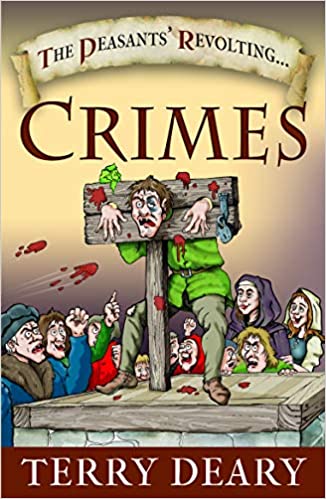
Popular history writer Terry Deary takes us on a light-hearted and often humorous romp through the centuries with Mr & Mrs Peasant, recounting foul and dastardly deeds committed by the underclasses, as well as the punishments meted out by those on the right side’ of the law.
Discover tales of arsonists and axe-wielders, grave robbers and garroters, poisoners and prostitutes. Delve into the dark histories of beggars, swindlers, forgers, sheep rustlers and a whole host of other felons from the lower ranks of society who have veered off the straight and narrow. There are stories of highwaymen and hooligans, violent gangs, clashing clans and the witch trials that shocked a nation. Learn too about the impoverished workers who raised a riot opposing crippling taxes and draconian laws, as well as the strikers and machine-smashers who thumped out their grievances against new technologies that threatened their livelihoods.
Britain has never been short of those who have been prepared to flout the law of the land for the common good, or for their own despicable purposes. The upper classes have lorded and hoarded their wealth for centuries of British history, often to the disadvantage of the impoverished. Frustration in the face of this has resulted in revolt. Read all about it here!
This entertaining book is packed full of revolting acts and acts of revolt, revealing how ordinary folk – from nasty Normans to present-day lawbreakers – have left an extraordinary trail of criminality behind them. The often gruesome penalties exacted in retribution reveal a great deal about some of the most fascinating eras of British history.
It has been a strange week for us all, I’m sure. And on Tuesday evening we got a message from my son’s school saying it was closed until further notice, so Wednesday morning was my first day of home schooling. School have been amazing and set tons of work to keep the child occupied. However, on Wednesday, there was no English so I had to set some myself; which was basically for said child to write a review of Terry Deary’s The Peasants’ Revolting CRIMES. I received this book as a review copy from the publishers, Pen & Sword, but the child got to read it first, and loved it. He’s a die-hard fan of Horrible Histories, so this book was right up his street.
So, it’s over to Lewis:
I liked, no I LOVED Terry Deary’s The Peasants’ Revolting CRIMES. I would recommend it for people who are age 13+ (due to minor swearing content) and you will not need to know your history because this book educates you in the revolting and hard life of the peasant.
Opening with ‘Norman Nastiness’, the book gives you a vivid taste of peasant crimes right up until the ‘Georgian Jokers and Victorian Villains’ and beyond.
The last witch
After seeing a smiling ‘medium’ at a psychic fair, a friend of mine punched her. When I asked him why he would do such a thing, he replied, ‘My father always taught me to strike a happy medium’,
In 1944, Helen Duncan was a Scottish spiritual medium, working in Portsmouth. She began broadcasting information from the port’s gullible sailors wjhho came ot consult her. D-Day was approaching and she was a security risk. She had to be stopped.
Duncan was originally charged under the Vagrancy Act 1824, relating to fortune telling, astrology and spiritualism. Then there was a change of plan. The paranoid government’s legal experts sent her to be tried by jury at the Old Bailey for contravening section 4 of the Witchcraft Act 1735, which carried the heavier penalty of a prison sentence.
Winston Churchill even described the whole episode as ‘obsolete tomfoolery’ but Helen went to prison for nine months.
The 1753 Act was later repealed and replaced with the Fraudulent Mediums Act of 1951.
So, no more witch trials.
You could call it hex-it
In this book, you will explore various ages of history, from the Middle Ages to the Stuarts, to the vicious, unforgiving Victorian era and the modern era. You will hear various quotes from all sorts of people, from William Shakespeare, to Martin Luther King and many, many others as you explore the book.
I particularly like the funny jokes like “Bring a man a fire and he will be warm for a day. Give a man a fire and he will be warm for the rest of his life” and “Will Shakespeare. Great writer, dodgy historian”. There are various other jokes, which are scattered throughout the book.
There was nothing to dislike about this book, despite its gory and bloody moments. It will tickle your funny bone for hours on end, so much so you will never put it down!
In conclusion, this is a great book for children and adults alike. It is not only comedy but it also used 100% historically accurate. You should order it now. What are you waiting for?
Huge thanks to Lewis for a fabulous, entertaining review!
The Peasants’ Revolting CRIMES by Terry Deary is available from Pen & Sword and Amazon.
About the author:
Terry Deary is the esteemed author of the immensely popular Horrible Histories series. This is his first title for Pen and Sword Books, to be followed next year by The Peasants’ Revolting Lives.
Today it is a pleasure to welcome Francis Lovell’s biographer Michele Schindler to the blog, with an article about Lovell’s wife, Anne FitzHugh Lovelle. Michele’s new book, Lovell Our Dogge, is out now. Over to Michele:
The discovery of Richard III`s remains in a car park in Leicester, seven years ago, has caused a surge of interest not only in the life of this controversial monarch, but also in his contemporaries. A particularly positive trend during these last years has been the interest showed in the women in Richard`s life, in the Wars of the Roses period in general. Whereas most of them have been typecast, if not outright ignored, over the last few centuries, many talented authors have focused on their lives, their influence, their politicial opinions, showing the fully rounded personalities they have been denied for so long.
Minster Lovell
Sadly, however, one influential woman has been strangely excempt from this trend. While her contemporaries have finally been allowed to emerge from the mists of history, Anne Lovell has not been given any attention. Ignored in history books, maligned in fiction, Anne`s importance in life has been all but forgotten.
Her life did not begin in a way that
promised anything but rich and comfortable obscurity. Born as the third
daughter and fourth child of Henry FitzHugh, 5th Baron FitzHugh, and his wife
Alice Neville in 1460, Anne`s future probably seemed predictable, comprising of
marriage to a member of the gentry or lower-ranking nobility and motherhood.
At least, this appears to have been what
her parents were planning for her. In February 1465, when Anne was not more
than barely five years old at the most, they married her to the then
eight-year-old Francis Lovell, who had become Baron Lovell only around five
weeks earlier after his father`s sudden death. It was a marriage made possible
by Anne`s uncle Richard, Earl of Warwick, and would doubtlessly have been seen
as a good match for the little girl.
It cannot be said how much Anne and Francis saw of each other in the first years of their marriage. It is known, however, that it was in the summer of 1466 that Anne`s mother-in-law, Joan Beaumont died, leaving Francis and his sisters Joan and Frideswide full orphans. After their mother`s death, it seems the girls were raised together with Anne and her siblings in her parents` household.
It is probable that during this time, Anne knew her sisters-in-law far better than her husband, who did not live in the same household she did. It was only some years later that he seems to have started living in her parents` household, but it is known that by 10th September 1470, he was definitely there, for he is included, together with Anne, her siblings and his sisters, in a pardon granted to Henry FitzHugh for his rebellion that year. It is one oft her very few early mentions of Anne in the sources, though it does not say anything about her personally. Only ten years old when the pardon was issued, her inclusion being a nominal one, not indicative of any of her actions.
The next mention of Anne found in contemporary sources is from 1473, by which time quite a lot in her life had changed. Now thirteen, she had lost her father the year before and seen her brother Richard become Baron FitzHugh. Though her father`s death meant that she and her siblings were the king`s wards, it seems that their mother Alice, had been allowed to keep custody of them, and in the summer of 1473, she and her children, Anne among them, joined the prestigious Corpus Christi Guild in York.
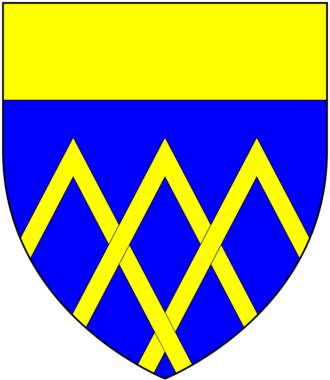
FitzHugh Arms
An interesting fact about this is that Anne`s husband, Francis, was present then as well and joined the guild with Anne and her family. This suggests Francis stayed with the FitzHughs regularly until Anne was old enough to be his wife in more than name, perhaps to give Anne the chance to get to know him, but there is no way to be certain. Nor do we know exactly when Anne was considered old enough, though some guesswork can be made. Francis made sure his sisters were not married before they were sixteen. It seems likely that he and Anne therefore also delayed cohabition and consummation until she had reached that age.
There evidence that this was also the age that Anne began living together with Francis, such as a letter written by Elizabeth Stonor in early March 1477. This letter refers to her and Francis, clearly as the Stonors` Oxfordshire neighbours. The context makes it clear that their relationship, while friendly, was still comparatively new and uncertain, which would fit perfectly with the Lovells, aged 20 and 16, first moving into Francis`s ancestral home of Minster Lovell Hall together around half a year before the letter was written.
The letter also contains an interesting minor mention of Anne, as the recipient of a present, like her husband, to win their good will. This indicates that the Stonors knew, or at least assumed, that Anne held some sway over her husband or meant something to him, as well as that she held some influence of her own, and that her friendship as well as his was worth cultivating.
Sadly, as so much of
Anne`s life, evidence about her in the following years is scarce. She often
visited her mother, usually together with her husband. Quite possibly, she also
often saw her sisters, both of whom named their first daughter after Anne, and
her brothers as well.
Even if she did not, she
definitely saw her older brother Richard at court on 4th January 1483, as he
acted as one of Anne`s husbands sponsors when he was created a viscount and
Anne became a viscountess, and event that must have been splendid for her.
It was the beginning of a
steep career for her husband and following events would catapult Anne, too,
more into the limelight than she had been until that point. Only four months
later, King Edward IV died and six months later, Edward`s brother Richard had
become king, in a way that remains controversial to this day. Since the new
king was her husband`s closest friend, he was favoured a lot, which was to
reflect on Anne as well.
It is known that when Richard became king, Anne was present for
his coronation. She was in the new queen`s train, like her mother Alice and
older sister Elizabeth, and like them and several other ladies of high
standing, she was given “a long gown of blue velvet with crimson
satin” and “one gown of crimson velvet and white damask” for the
festivities.
Unlike her mother and Elizabeth, Anne was not made a
lady-in-waiting to Queen Anne, who was her first cousin, and unlike them, she
does not seem to have been favoured in any other way by the new queen. In fact,
it seems that after the coronation, she was not ever present in her household,
which means that her presence at the coronation had been an exception made for
the special occasion.
As to why Anne did not join her mother and sister in becoming a
favour lady of the queen, we can once more only speculate. It is possible, of
course, that the two women simply did not like each other. However, had Anne
wished to be a lady-in-waiting, it is almost impossible Queen Anne could have
denied her this, as she was the wife of one of the most important men in the
government. It is therefore most likely Anne herself decided that she was not
interested in the position, though the reasons for this must remain lost to
history.
Lovell Our Dogge by Michele Schindler
Anne appears to have
chosen to remain close to her husband whenever possible, which would mean she
was at court often, and witnessed a lot of the events that remain so
controversial to this day. Her opinions on them can never be known, but it
seems that at the very least, she did not dislike Richard III.
Richard`s reign, famously, was not to last long, and within only two years of his accession, he was faced with an invasion, by an exiled Lancastrian earl named Henry Tudor. He employed Anne`s husband, among many others, to help him ward off this invasion. Perhaps with the danger of this task in mind, on 10th June 1485 Francis Lovell created an indenture in which he arranged for Anne to receive several manors in the event of his death, not just to keep for the rest of her life, but to own and be able to pass on to her descendants after her death. This was an unusual arrangement, and not at all one he would have needed to make, indicating that Anne was priced by her husband.
The fact that this arrangement would have enabled her to pass these manors on to her descandants also shows up an oddity. It is certain that Anne never had a child by Francis, yet even after what were likely nine years of living as man and wife, he does not seem to have at all blamed her for it, or, as can be seen from the indenture, even doubted she could have children. Since this arrangement could have disadvantaged any children Anne had by him, giving their half-siblings she potentially could have had by another man after Francis`s death a claim to these manors, it seems he thought or knew that their childlessness was his fault, though there is no telling why.
What Anne thought of this is, as always, up for speculation, but it does seem that she did not hold it against her husband. Nor does she seem to have held it against her husband that when Richard III was killed in battle, he chose not to accept the newly made Henry VII`s pardon. It is of course possible that she would have wished for him to do the same her brother Richard FitzHugh did, accept Henry VII, but once Francis`s decision decision was made, she supported it.
In march 1486, less than
a year after Henry`s accession, Francis started a rebellion with two
supporters, the brothers Humphrey and Thomas Stafford. It was a dangerous but
not well thought-out undertaking, probably born more of desperation than any
political thought, and not surprisingly, it failed. The brothers Stafford were
captured and faced the consequences of their actions, but Francis was never
caught, which seems to have been at least partly because Anne helped him. After
the failure of the rebellion, the Countess of Oxford relayed information where
Francis was hiding, which turned out to be inaccurate. Shortly afterwards,
Anne`s brother Richard was stripped of several offices and the whole FitzHugh
family, Anne included, watched with suspicion by the new government. Since
Countess Margaret was Anne`s aunt and quite close to her mother, it is
certainly far from impossible that the faulty intelligence where Francis was
hiding came from Anne.
Anne remained under
suspicion, and perfectly uncaring of the fact, for at least the next year.
Famously, in 1487, with the support of Margaret of York, Dowager Duchess of
Burgundy and John de la Pole, Earl of Lincoln, Francis started another
rebellion in 1487, which would go down in history as the Lambert Simnel
uprising. It was far better planned than the rebellion of 1486 had been,
and once more, Anne appears to have been in contact with her husband and to
have supported him.
In a letter to John
Paston written on 16th May 1487, Sir Edmund Bedingfeld warned him that there
were rumours he had met with “Lady Lovell”, and cautions him that he
should act wisely about this rumour. Bedingfield does not spell out why he
considers that such a meeting would be unthinkable, apparently certain Paston
would know. Since only three
months earlier, Paston had been chided by the Earl of Oxford, one of Henry`s
closest men, for accidentally passing on wrong information regarding Francis`s
whereabouts, it might very well be that Anne was suspected, or even known, to
have once more deliberately spread bad intelligence. It can naturally not be
proved today, but it certainly is remarkable that two people connected with
Anne were provided with wrong information about Francis`s whereabouts at moments
crucial for his escape.
It is obvious that the
rebels, while in Ireland and Burgundy, must have had a contact in England, as
they when they were landed on Piel Island in June 1487, they were already
awaited by supporters. There is some evidence that this supporter in England
was in fact Anne, and it seems that after Henry VII`s men had won the battle,
she was surreptiously investigated. But whatever she did, it was apparently
never proved, for Henry VII`s government enacted no punitive measures against her.
Interestingly, Anne does
not seem to have been afraid of being punished, or else her concern for Francis
overrode her fear, for in 1488, she was looking for her husband. We know this
from another letter to John Paston, this one from Anne`s mother, in which Alice
FitzHugh mentions
that Anne was looking for Francis, supported by unnamed “benevolers“. For this
purpose, she had send one of Francis`s men and fellow rebels, Edward Franke, to
look for him, but he had been unsuccessful.
What is especially intriguing about this is that that Edward Franke was himself a traitor at that point, and knowing of his whereabouts without reporting them was treason in itself. It speaks volumes about Anne`s feelings for her husband that she did not care for the danger to herself when trying to find out what had happened to him. It is also an indication that she was courageous, and determined to find the truth.
The mention of the “benevolers”, whom she seems to have trusted and who seem to have supported her in this risky undertaking, appear to show that she was a well-liked woman who had several close, trusted friends.
We do not know if Anne ever found out what happened to her husband. It seems that sometime before December 1489, she gave up looking, as we do know that by then, she had taken a religious vow, for when Henry VII`s government granted her an annuity of 20 pounds then, she was called “our sister in God”. It means that at the age of 29 years at the most, Anne was certain she did not want to marry another time. Though of course her marriage prospects were diminished significantly due to her being a traitor`s widow, she could have found someone interested in her family connections, or even married for affection, but chose not to. Again, it can be taken as an indicator of feelings of affection for Francis.
We do not know what sort of vow she took, nor do we know what happened to her after that. The last mention of her in any source is in a second attainder passed against Francis in 1495, at which time she was spoken of as still alive. She might have died in 1498, but was definitely dead by January 1513.
Huge thanks to Michele for such a fabulous post!
About the author:
Michele Schindler is a language teacher, teaching German and English as second languages. Before that, she studied at Johann Wolfgang Goethe-Universität in Frankfurt am Main, Germany, reading history with a focus on mediaeval studies, and English Studies. In addition to English and German, she speaks French, and read Latin.
From Emma of Normandy, wife of both King Cnut and Æthelred II to Saint Margaret, a descendant of Alfred the Great himself, Silk and the Sword: the Women of the Norman Conquest traces the fortunes of the women who had a significant role to play in the momentous events of 1066. Available now from Amazon UK, Amberley Publishing,Book Depository and Amazon US.
Telling the stories of some of the most remarkable women from Medieval history, from Eleanor of Aquitaine to Julian of Norwich, Heroines of the Medieval World, is available now on kindle and in paperback in the UK from from both Amberley Publishing and Amazon, in the US from Amazon and worldwide from Book Depository.
*
You can be the first to read new articles by clicking the ‘Follow’ button, liking our Facebook page or joining me on Twitterand Instagram.
Jack Blackjack stands accused of killing a priest in the wickedly entertaining new Bloody Mary Tudor mystery.
April, 1555. A priest has been stabbed to death in the village of St Botolph, to the east of the City of London, his body left to rot by the roadside – and Jack Blackjack stands accused of his murder.
As well as clearing his name, Jack has his own reasons for wanting to find out who really killed the priest – but this is an investigation where nothing is as it seems. Was it a random attack by a desperate outlaw, or do the answers lie in the murdered priest’s past? As he questions those who knew the dead man, Jack is faced with a number of conflicting accounts – and it’s clear that not everyone can be telling him the whole truth.
But Jack is about to be sidetracked from the investigation … with disastrous consequences.
I have been a fan of Michael Jecks‘ books ever since the first, The Last Templar, came out many, many years ago. And The Dead Don’t Wait clearly reminds me why I am such a fan of his writing. It is a wonderful murder mystery set in the time of Queen Mary I and a fine example of why Michael Jecks is considered one of the foremost authors of historical crime fiction.
The Dead Don’t Wait is the 4th title in Jecks’ Bloody Mary Mystery series.
The characters are wonderfully colourful and the various suspects suitably despicable or sympathetic, depending on their possible motives. The victim himself is not exactly the most innocent of men. And without the modern benefits of fingerprinting and DNA analysis, the book’s dubious hero, Jack Blackjack, must use his best detective skills to solve the crime. This fabulous combination serves to create a murder mystery that will have the reader gripped from the first page to the last.
What makes this book so perfect is its ‘hero’ – and I use the term as loosely as possible. Jack Blackjack is the most unremarkable hero you have probably come across. His drinking and womanising gets him into no end of trouble, and the fact he is officially an assassin – who has an aversion to blood – makes him the most unlikely of heroes and should make him an unsympathetic protagonist. However, it’s impossible not to like him!
Thus it was that a scant few minutes later I found myself bellowing for Raphe, who had finally found a decent wine, which he set about pouring into fresh cups. Sir Richard took up one and sipped it with a black glower fixed to his face, which was suddenly washed away and replaced by a beatific smile. ‘Hah! That’s more like it, boy! Next time I come, you will make sure that you find that barrel again, won’t ye? And next time we come here and find you’re serving dregs to your master, I will have you taken to the stocks personally. Understand me, boy?’
‘Y-yes,’ Raphe said, and I was delighted to hear him stammer. It was the first time in months that I had seen him lost for words or anxious, and it was a salve to my soul.
‘The dog,’ I said before he could scurry away. ‘You will have to put it out. I don’t want some mangy cur in my house. It could have rabies, for all you know.’
‘Yes, sir.’
That itself was a major success. He tended to avoid calling me ‘sir’, as if that was to concede that his own position was inferior. I watched him with narrowed eyes. I didn’t trust his sudden conversion to politeness.
He walked out carrying the two dirty cups and the empty flagon before I could comment further.
‘So you deny knowing this dead man?’ Sir Richard said.
‘Yes! I don’t even know the place you’re talking about. I’ve never been there. I spent all day today here in London.’
It is not only by the intricacies of the murder plot and the unravelling of the mystery, that the reader is entertained, but also by Jack’s own ability to get himself into the deepest water with the seediest members of the Tudor underworld.
The Dead Don’t Wait is a fast paced, enjoyable murder mystery with a balanced combination of diligent detective work and frenetic action. The characters drive this story, from Jack and his co-detective, Sir Richard, to Arch and Hamon, the London low-lifes who see Jack as an easy mark, to the various suspects who all have their own stories to unravel.
Michael Jecks weaves the various strands of the story together to create an engaging story that is impossible to put down and keeps the reader enthralled until long past their bedtime! It is thoroughly enjoyable!
For any fan of the detective novel, and any lover of Tudor history, this is a must read, and Jack Blackjack is a protagonist everyone should meet!
*
The Dead Don’t Wait is available from Amazon in the UK and US.
From Emma of Normandy, wife of both King Cnut and Æthelred II to Saint Margaret, a descendant of Alfred the Great himself, Silk and the Sword: the Women of the Norman Conquest traces the fortunes of the women who had a significant role to play in the momentous events of 1066. Available now from Amazon UK, Amberley Publishing,Book Depository and Amazon US.
Telling the stories of some of the most remarkable women from Medieval history, from Eleanor of Aquitaine to Julian of Norwich, Heroines of the Medieval World, is available now on kindle and in paperback in the UK from from both Amberley Publishing and Amazon, in the US from Amazon and worldwide from Book Depository.
*
You can be the first to read new articles by clicking the ‘Follow’ button, liking our Facebook page or joining me on Twitterand Instagram.
For the nobility and gentry in later medieval England, land was a source of wealth and status. Their marriages were arranged with this in mind, and it is not surprising that so many of them had mistresses and illegitimate children. John de Warenne, earl of Surrey, married at the age of twenty to a ten-year-old granddaughter of Edward I, had at least eight bastards and a complicated love life. In theory, bastards were at a considerable disadvantage. Regarded as filius nullius’ or the son of no one, they were unable to inherit real property and barred from the priesthood. In practice, illegitimacy could be less of a stigma in late medieval England than it became between the sixteenth and late twentieth centuries. There were ways of making provision for illegitimate offspring and some bastards did extremely well: in the church; through marriage; as soldiers; a few even succeeding to the family estates. _The Legitimacy of Bastards_ is the first book to consider the individuals who had illegitimate children, the ways in which they provided for them and attitudes towards both the parents and the bastard children. It also highlights important differences between the views of illegitimacy taken by the Church and by the English law.
I often come across non-fiction books about which I think ‘ooh, this could be handy for research’, but every once in a while I come across a book and I just think ‘wow! This is so useful! Every one needs a copy!’ The Legitimacy of Bastards; The Place of Illegitimate Children in Later Medieval England by Helen Matthews definitely falls in this latter category.
The Legitimacy of Bastards; The Place of Illegitimate Children in Later Medieval England examines the church and lay laws governing illegitimacy in later medieval England, and portrays the reality of bastard children. Based on the author’s own thesis, the book should be the ‘go to’ tool for anyone who needs to study the stigma, status and reality of illegitimacy in medieval England.
Divided into 6 chapters, The Legitimacy of Bastards; The Place of Illegitimate Children in Later Medieval England explores the legal status of illegitimate children and the various types – or categories – of illegitimacy within medieval society; whether they be children of unmarried parents, married parents or of members of the clergy dictated their prospects in life and career opportunities. The book also examines the methods used by parents in order to get around the various limitations placed on illegitimate children, such as legal devices, church careers and, of course, marriage.
One of the challenges of researching illegitimacy in later medieval England is that there is no single source of reliable records of the kind that is available, for example, for some of the Italian city states. It is no accident that the comprehensive study of bastardy in England begins with the sixteenth century and the introduction of parochial registration of births, marriages and deaths in 1538. Even then, the level of detail prior to 1850 is limited. Any attempt to establish the prevalence of illegitimacy in the period before parish registers are available is clearly even more problematic. Illegitimate children cannot be identified by their name alone. Bastards who were recognised by their fathers would very often take their father’s name, though some were known by their mother’s surname. It should be noted that a surname beginning with ‘Fitz-‘ simply means ‘son of’ and does not itself denote illegitimacy, although it became common for royal bastards to have names of this type, for example Henry Fitzroy, the son of Henry VIII (1509-47) and Elizabeth Blount, a lady-in-waiting to Katherine of Aragon.
However, some attempt has been made to do so at the level of peasant society by exploiting manorial records, mainly in the context of wider studies of a particular peasant community. As in the Italian city states, it is the existence of financial records that makes this possible. In this case the records concerned are payments of fines. These were either leyrwite, a fine for single women and widows of unfree status who committed fornication, or childwyte, a fine for giving birth to an illegitimate child.
The Legitimacy of Bastards; The Place of Illegitimate Children in Later Medieval England looks into illegitimacy throughout all levels of society, from the royal family to the lowly peasant. Incredibly useful to my own research, Helen Matthews presents the experiences of John de Warenne, 7th Earl of Surrey, as a case study of the practicalities of illegitimacy. This chapter helps the reader to understand the life and limitations of a child born outside of marriage, as well as the extraordinary lengths that parents were willing to go in order to advance the prospects of their children.
I had no idea how complex the laws surrounding illegitimacy in England, not just on inheritance, but also on marriage prospects, on the difference between church and state and on the difference between clerical and lay requirements for the legitimisation of a child.
An easy book to read, Helen Matthews has made good use of the materials and evidence available to build a picture of the realities of illegitimacy in later medieval England, not just for the child themselves, but for their families and the legitimate heirs. Impeccably researched and rich in detail The Legitimacy of Bastards; The Place of Illegitimate Children in Later Medieval England is a wonderful research tool and an engaging read, with none of the dryness that you often find in books developed from academic theses.
The only downside of The Legitimacy of Bastards; The Place of Illegitimate Children in Later Medieval England is that there are no footnotes, which makes it hard for the researcher to follow up some of the details; however, there is an exhaustive and impressive bibliography and an impressive list of the subjects used in the book for ease of cross-referencing.
The further I read into The Legitimacy of Bastards; The Place of Illegitimate Children in Later Medieval England the more I realised how useful this book will be to any researcher, student of history or casual reader around the subject. The impeccable research and engaging writing style make this a valuable addition to anyone’s medieval library.
I cannot recommend it highly enough!
To buy the book:
The Legitimacy of Bastards; The Place of Illegitimate Children in Later Medieval England is available from Pen & Sword and Amazon in the UK and US.
About the Author:
Helen Matthews studied medieval history at UCL and Royal Holloway. A chance remark in a footnote inspired her to embark on the thesis on medieval bastards, on which this book is based.
From Emma of Normandy, wife of both King Cnut and Æthelred II to Saint Margaret, a descendant of Alfred the Great himself, Silk and the Sword: the Women of the Norman Conquest traces the fortunes of the women who had a significant role to play in the momentous events of 1066. Available now from Amazon UK, Amberley Publishing,Book Depository and Amazon US.
Telling the stories of some of the most remarkable women from Medieval history, from Eleanor of Aquitaine to Julian of Norwich, Heroines of the Medieval World, is available now on kindle and in paperback in the UK from from both Amberley Publishing and Amazon, in the US from Amazon and worldwide from Book Depository.
*
You can be the first to read new articles by clicking the ‘Follow’ button, liking our Facebook page or joining me on Twitterand Instagram.
Joan Beaufort, Countess of Westmorland, from the Neville Book of Hours
Joan Beaufort was the youngest child and only daughter of John of Gaunt and his mistress, Katherine Swynford. Her father, Gaunt, was the third surviving son of Edward III and his queen, Philippa of Hainault. He had married Blanche of Lancaster in 1359 – a marriage which eventually brought him the title of Duke of Lancaster. With Blanche he had 3 surviving legitimate children: Elizabeth, Philippa and Henry – the future king, Henry IV.
Joan’s mother, Katherine Swynford, was a member of Blanche’s household and had been married to a Lincolnshire knight, Sir Hugh Swynford, in 1367. They had 3 children together; Blanche, Thomas and Margaret. Sir Hugh was a tenant of John of Gaunt and served on the continent with him in 1366 and 1370. John of Gaunt was widowed in 1368, when Blanche died in childbirth. Katherine had been governess to the Lancaster children for a number of years when Hugh died in November 1371, leaving her a young widow with 3 children to feed.
John and Katherine may have begun their relationship shortly after Hugh’s death, despite John having married again, to Constance of Castile, in September 1371. John and Katherine’s first child, John, was probably born in 1372, with 3 more children, Henry, Thomas and Joan, born before 1379. They would be given the surname of Beaufort, though no one seems to know quite where the name came from. Although the children were illegitimate, the boys enjoyed successful careers during the reign of their half-brother, Henry IV; with John in politics, Henry rising to the rank of cardinal in the church and Thomas pursuing a military career.
Joan was the youngest of the Beaufort children, born sometime between 1377 and 1379. She was close to her family. She joined the household of her sister-in-law, Mary de Bohun, wife of her half-brother, the future Henry IV, in 1386. It seems that she was accompanied by her mum, Katherine Swynford, possibly because Katherine and John of Gaunt had separated and John was reconciled with his second wife, Constance of Castile. Joan was about 7-years-old and was continuing her education and being prepared for her first marriage – she had just been betrothed to 10-year-old Robert Ferrers of Oversley, Warwickshire. Robert would become one of her father’s retainers and, through his mother, heir to the estates of the Botelers of Wem, Shropshire. They were married in 1392, when Joan was 13 or 14 and 2 daughters were born in quick succession; Elizabeth in 1393 and Mary the following year. The marriage was cut short, however, when Robert died in 1395 or 1396, leaving Joan – still only in her mid-teens – a widow with young children.
John of Gaunt, Joan’s father
As the granddaughter of a king, Joan was bound not to remain a widow for long. And her marriage prospects improved drastically in February 1396, when her parents were married in Lincoln Cathedral. Shortly after he married Katherine, John of Gaunt applied to the pope to have their children declared legitimate; the papal bull declaring the legitimacy of Joan and her brothers arrived in September of the same year. As the legitimate granddaughter of a king, Joan’s status was improved immensely and she was soon married to the recently widowed 6th baron of Raby and later earl of Westmorland, Ralph Neville.
Unlike many medieval women, we have some idea of what Joan may have looked like, thanks to a miniature by Pol de Limbourg. Taken from the Neville Book of Hours, it shows Joan dressed piously in black and white, though her cloak and cuffs are lined with ermine and she wears the Lancastrian S-collar around her neck. Her features are delicate. Her hands, with rings on the fingers, are clasped in prayer.
Joan was a learned woman, she was educated to the same standard as her legitimate half-sisters, Philippa and Elizabeth of Lancaster. She seems to have possessed a considerable library, the texts being largely devotional. She owned a copy of ‘Les Cronikels de Jerusalem et de Viage de Godfray de Boylion’ (Chronicles of Jerusalem and the Voyages of Godfrey de Bouillon) which she lent to her nephew, Henry V, but had to petition the Council for its return after Henry’s death. Her brother, Thomas, had left her a book, titled ‘Tristram’.
Thomas Hoccleve dedicated a volume of poems, ‘Hoccleve’s Works’ to her sending it to her around 1422, saying:
Go, smal book to the noble excellence
Of my lady of Westmerland and seye,
Her humble seruant with al reuerence
Him recommandith vn-to hir nobleye.
Also, an early copy of Hoccleve’s ‘Regiment of Princes’ was made for Joan’s son-in-law, John Mowbray.
Raby Castle, Count Durham
Known for her piety, Joan left many bequests to religious institutions in her will, especially monasteries in the north. Admitted to the sisterhood at St Albans, she was also licensed to appropriate for the support of the chantry the advowson of the church of Welton, in the Howden area; and it was Joan who saw the completion of the college at Staindrop, founded by her husband in 1408. According to antiquarian, John Leland, Joan ‘erectid the very house self of the college’ in the form of a medieval hospital. Her piety, however, was not always conventional. Her father had been a defender of the Lollards – he employed John Wycliffe, the first person to translate the Bible into English, as a tutor to his children. And Joan seems to have had a similar religious curiosity – hence her association with Margery Kempe.
Margery Kempe was a mystic from Lyn, Norfolk; she claimed to have visions of Christ and travelled throughout England and on the Continent. She wrote the Book of Margery Kempe which recounted the story of her life and her visions and considered to be the first ever autobiography in English. Joan invited Margery Kempe to visit her at Raby. She also wrote a letter to exonerate Margery from accusations of corruption. Margery’s own testimony says they knew each other for ‘this two years and more’. In 1417 Margery was brought before the Archbishop of York, accused of advising Joan’s daughter, Elizabeth Greystoke, to leave her husband. Margery was found ‘not guilty’ of the offence and under questioning, admitted she had told Countess Joan and her daughter a ‘good tale of a lady who was damned because she would not love her enemies’. Margery even suggested her questioners ask Joan for corroboration of her testimony, demonstrating her trust that the Countess would back her.
Joan enjoyed influence at court – as the sister of one king, Henry IV, and aunt to his successor, Henry V. She was named in royal grants as ‘the king’s sister’ and made a Lady of the Garter in the reign of her cousin, Richard II. She was compassionate and used her influence to petition the king to aid those less fortunate, such as Christopher and Margaret Standith, who had fallen on hard times after Christopher had been dismissed from his father’s service for marrying for love. Joan wrote the king, asking him to give Margaret a position in the household of his queen, Joan of Navarre.
It can be argued that Joan had a strong bond of affection and purpose with her husband. They both wanted to see their family’s prospects improved even further, arranging advantageous marriages for their large brood of children. Although, it is unclear how much influence Joan had when her husband, the Earl of Westmorland, manage to entail the bulk of his estates onto his children by Joan, rather than the children by his first marriage to Margaret Stafford. This seems to have been a sensible strategy, given that his children by Joan were closely related to the royal family – Joan being the half sister of King Henry IV. The strategy, however, caused Joan problems after her husband’s death and led to a family feud – which sometimes turned violent – which wasn’t resolved until after Joan died.
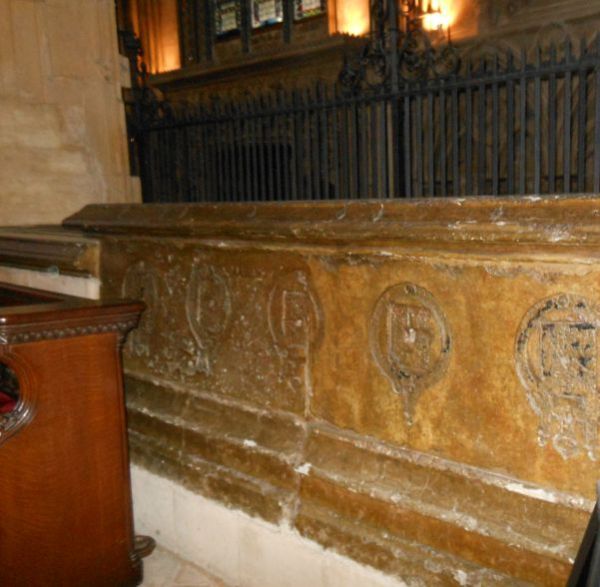
Tomb of Ralph Neville, St Mary’s Church, Staindrop
Joan was a strong influence on her daughters and daughters-in-law. She concerned herself with matters of family – such as her children’s marriages – rather than business. Ralph’s son, also Ralph, by his first marriage, was married to Mary, Joan’s younger daughter from her first marriage. Ralph and Joan’s children were married into many of the leading noble dynasties of the time and served to strengthen the position of the Beauforts as a whole. Such significant marriages saw their eldest daughter, Katherine, married to John Mowbray, 2nd Duke of Norfolk – it was Katherine who later married John Woodville, brother-in-law of her nephew Edward IV; Katherine was around 65 years old and John just 20. Of other daughters, Eleanor married Henry Percy, 2nd Earl of Northumberland, while Anne married Humphrey Stafford, a descendant of Edward III and 1st Duke of Buckingham. Of their sons, Richard Neville married Alice Montagu, heiress to the earldom of Salisbury, and became Earl of Salisbury by right of his wife; their son, Richard Neville, was the Earl of Warwick known as the Kingmaker. Robert Neville became Bishop of Durham and other sons married rich heiresses to claim titles and positions for themselves.
Ralph died in 1425 and was buried at Staindrop, close to Raby Castle. His tomb includes effigies of both Joan and his first wife, although neither woman is buried beside him. Joan was herself responsible for the negotiations after her husband’s death, which saw their youngest daughter, Cecily, married to Richard, Duke of York. Two of Cecily’s sons would become Kings of England; Edward IV and Richard III.
Having married young herself, and having become a mother before she was 15 years old, Joan was sensible to the dangers of girls marrying too young and ensured that none of her daughters or daughters-in-law, faced the dangers of childbirth before they were 17 or 18 years of age. She even kept married couples apart – such as Cecily and the Duke of York – when necessary, in order to protect the girls.
Joan’s tomb, beside that of her her mother, in Lincoln Cathedral
On 28 November 1437, Joan was granted licence for the foundation of a chantry with two chaplains at Lincoln Cathedral, to pray daily for the soul of her mother, Katherine Swynford, as well as for herself, her husband, brother (Cardinal Henry Beaufort) and father. On the same day, she secured a grant for daily prayers to be said at Staindrop Church – where her husband Ralph, Earl of Westmorland, was buried – for the souls of her husband, brother and father.
Joan died at Howden, a manor near Beverley in her son Robert’s possession as Bishop of Durham, on 13 November 1440. In her will, she requested to be buried with her mother, with whom she had a strong bond in life, but also for her mother’s burial site to be enlarged and enclosed. It seems likely that the now-lost wrought iron screens which surrounded her mother’s tomb, were added at this time, rather than when Katherine died in 1403. Joan’s epitaph claimed that the whole nation grieved at her death.
There is, however, no clear indication why Joan chose to be buried with her mother, rather than at Staindrop with her husband. It may be that as the granddaughter of a king (Edward III), she thought Lincoln Cathedral a more appropriate resting place, or that she wanted to be as close to her mother in death as she had been in life.
Sources: katherineswynfordsociety.org.uk; Red Roses: Blanche of Gaunt to Margaret Beaufort by Amy Licence; The Nevills of Middleham by K.L. Clark; The House of Beaufort: the Bastard Line that Captured the Crown by Nathen Amin; Brewer’s British Royalty by David Williamson; History Today Companion to British History Edited by Juliet Gardiner & Neil Wenborn; The mammoth Book of British kings & Queen by Mike Ashley; Britain’s Royal Families, the Complete Genealogy by Alison Weir; The Life and Times of Edward III by Paul Johnson; The Perfect King, the Life of Edward III by Ian Mortimer; The Reign of Edward III by WM Ormrod; Chronicles of the Age of Chivalry Edited by Elizabeth Hallam; Oxforddnb.com; womenshistory.about.com/od/medrenqueens/a/Katherine-Swynford.
*
My Books
Signed, dedicated copies of all my books are available through my online bookshop.
Out now: Scotland’s Medieval Queens
Scotland’s history is dramatic, violent and bloody. Being England’s northern neighbour has never been easy. Scotland’s queens have had to deal with war, murder, imprisonment, political rivalries and open betrayal. They have loved and lost, raised kings and queens, ruled and died for Scotland. From St Margaret, who became one of the patron saints of Scotland, to Elizabeth de Burgh and the dramatic story of the Scottish Wars of Independence, to the love story and tragedy of Joan Beaufort, to Margaret of Denmark and the dawn of the Renaissance, Scotland’s Medieval Queens have seen it all. This is the story of Scotland through their eyes.
‘Scotland’s Medieval Queens gives a thorough grounding in the history of the women who ruled Scotland at the side of its kings, often in the shadows, but just as interesting in their lives beyond the spotlight. It’s not a subject that has been widely covered, and Sharon is a pioneer in bringing that information into accessible history.’ Elizabeth Chadwick (New York Times bestselling author)
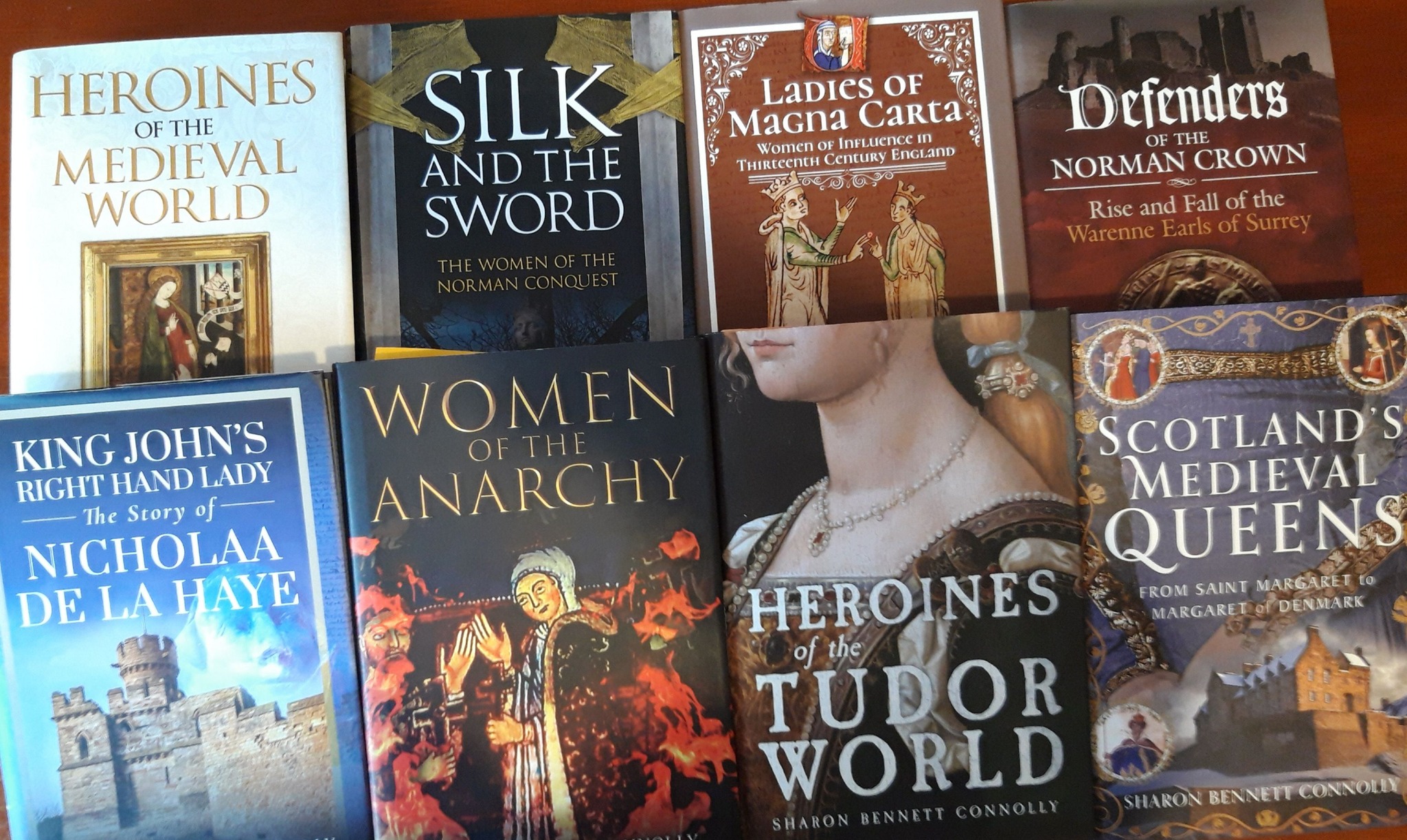
Heroines of the Tudor World tells the stories of the most remarkable women from European history in the time of the Tudor dynasty, 1485-1603. These are the women who ruled, the women who founded dynasties, the women who fought for religious freedom, their families and love. Heroines of the Tudor World is now available for pre-order from Amberley Publishing and Amazon UK.Women of the Anarchy demonstrates how Empress Matilda and Matilda of Boulogne, unable to wield a sword themselves, were prime movers in this time of conflict and lawlessness. It shows how their strengths, weaknesses, and personal ambitions swung the fortunes of war one way – and then the other. Available from Bookshop.org, Amberley Publishing and Amazon UK. King John’s Right-Hand Lady: The Story of Nicholaa de la Haye is the story of a truly remarkable lady, the hereditary constable of Lincoln Castle and the first woman in England to be appointed sheriff in her own right. Available from all good bookshops Pen & Sword Books, bookshop.org and Amazon.
Alternate Endings: An anthology of historical fiction short stories including Long Live the King… which is my take what might have happened had King John not died in October 1216. Available in paperback and kindle from Amazon.
Podcast:
Have a listen to theA Slice of Medieval podcast, which I co-host with Historical fiction novelist Derek Birks. Derek and I welcome guests, such as Bernard Cornwell and Elizabeth Chadwick, and discuss a wide range of topics in medieval history, from significant events to the personalities involved.
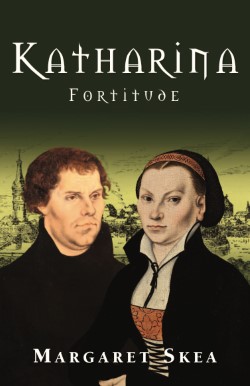
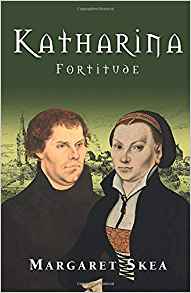
It is with great pleasure that I welcome author Margaret Skea to the blog today, talking about her latest book, Katharina: Fortitude, the history behind it and giving you a little teaser from the book itself.
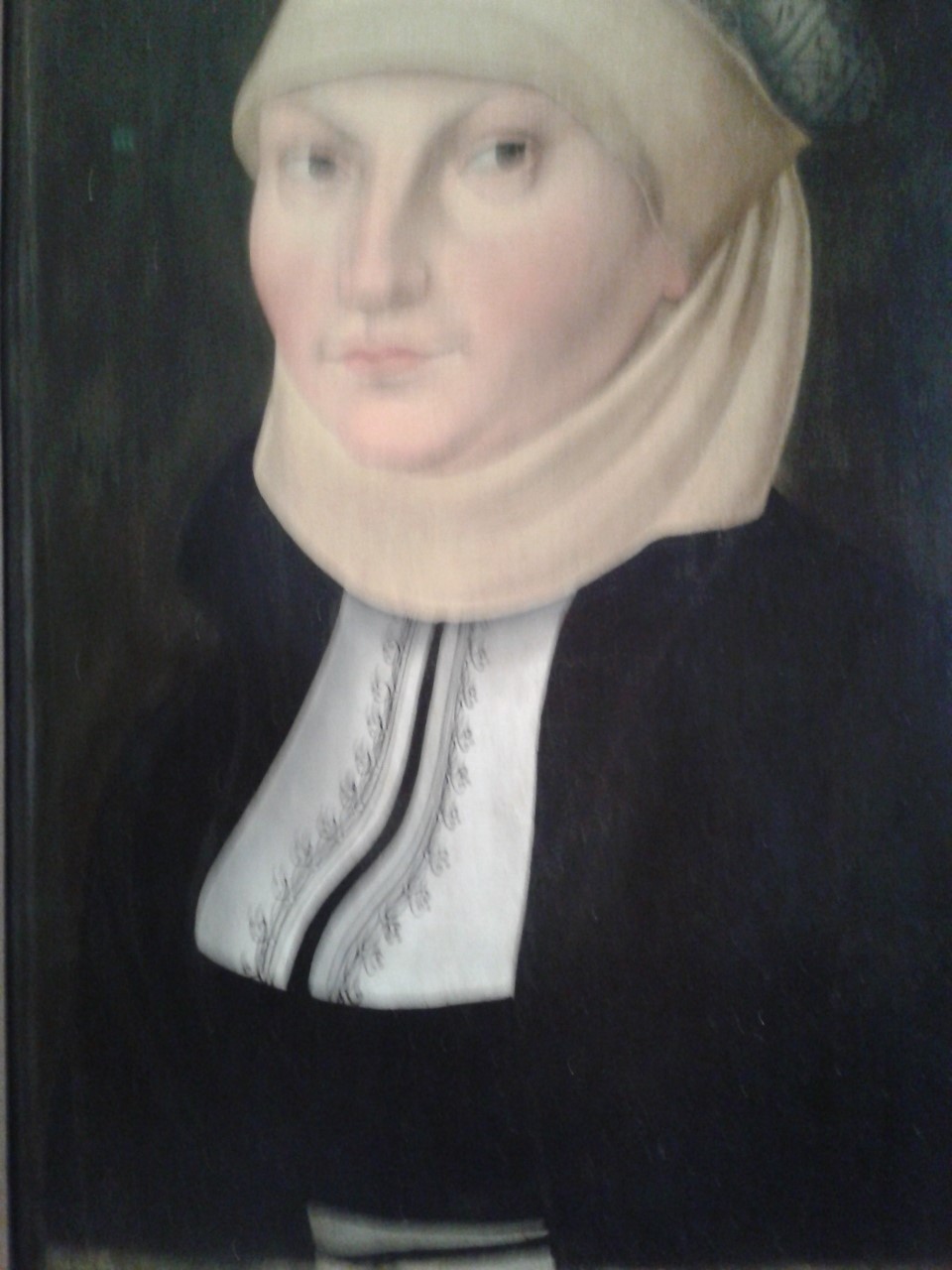
As crazy ideas go, thinking of writing what
could best be described as a fictionalized biography of Katharina von Bora, the
escaped nun who married the reformer Martin Luther, ranked highly. It had popped into my head, seemingly from
nowhere, but once there, as crazy ideas so often do, it burrowed its way in so
far no amount of rational thinking would dislodge it.
There were plenty of good reasons not to write her story.
Reason 1. I knew almost nothing about her, and
it seemed that nobody else knew much about her either.
I did find a slim volume, of some 89 pages,
written by a native German within the Luther Foundation, Martin Treu, well
placed to have found any information there was to find. But the opening words were
hardly encouraging.
‘It is impossible to write a biography of Katharina von Bora. The scanty and often enough fragmentary nature of the evidence allows for only a biographical sketch…’ Hmm.
Katharina
Reason 2. I didn’t speak or read German, so whatever
‘fragmentary evidence’ existed, I couldn’t even read it for myself. Not the
best start.
Reason 3. I was in the middle of writing my
third Scottish novel, and there was a publisher waiting for it to be delivered,
so the timing wasn’t exactly ideal. However, the Luther 500 anniversary was
only just over one year away, so I knew if I was going to write about her it
had to be immediately.
And there she was, hovering at my shoulder,
shadowy and insubstantial, but refusing to go away. So the Scottish book set
aside, I began to plan how I could make this crazy idea a reality. I read and
re-read the 89 pages of the little book until I knew them almost by heart and
scoured every other source I could find (in English) that made any reference to
her at all. Treu had also set me a
challenge – he wrote:
‘The lacunae in the sources have tempted authors and authoresses to fill in the gaps with their own imagination.’
Well, yes, that is, after all, what historical fiction writers do. But he
went on:
‘The
result is frequently a picture that says more about the writer and their time
than about the person and journey through life of Katharina von Bora.’
Ah, that was different – I didn’t want to write about my time, or me, I wanted to write about her time and about her.
The Lutherhaus portal commissioned by Luther as a gift for Katharina
But pessimistic as he was about anyone’s
chances, I did find some wee nuggets in his book, and in others, that gave me a
starting point, despite that there is dispute over her parentage, her
birthplace, the circumstances surrounding her admission to two different
convents, and little direct evidence of her character. Retracing her steps in Saxony, which involved driving over 1000
miles, gave me a real sense of her environment, including the terrain she
travelled, the architecture, and artefacts, and many aspects of her life and
times. There were some surprises, too, particularly
in relation to Martin Luther and his almost modern attitude towards her, as
well as the discovery of many myths that needed to be dispelled. But perhaps
the biggest challenge was finding a ‘voice’ for her and so I began to write
snippets in 1st person present tense. And what started as a
preliminary experiment continued throughout both books and the story truly
became Katharina’s.
I hope I have done her justice and that readers will get as much enjoyment in reading as I found in writing it.
Here is the opening section as a wee
taster:
Chapter One
Wittenberg June 1525.
Martin Luther
The music stops, the sound of the fiddle dying away, the piper trailing a fraction behind, as he has done all evening. I cannot help but smile as I curtsy to Justus Jonas, his answering twinkle suggesting he shares my amusement.
‘Thank you, Frau Luther,’ and then, his smile wider, so that even before he continues I suspicion it isn’t the piping amuses him, ‘For a renegade nun, you dance well.’
It is on the tip of my tongue to respond with ‘ For a cleric, so do you,’ but I stop myself, aware that should I be overheard it would likely be considered inappropriate for any woman, far less a newly married one, to speak so to an older man, however good a friend he has been. And on this day of all days, I do not wish to invite censure. Instead I say, ‘I have been well taught. Barbara saw to that. She did not wish me to disgrace myself or her, and there is a pair of slippers with the soles worn through to testify to the hours of practice she insisted upon.’
‘She succeeded admirably then.’
All around us there is the buzz of laughter and chatter, an air of goodwill evident in every flushed face. Martin is waiting at the foot of the dais, and as we turn towards him, his smile of thanks to Justus is evidence he too is grateful for the seal of approval, of me and of the marriage, our shared dance a tangible sign to the whole town that Justus Jonas at least has no reservations regarding our union. Over his shoulder I catch Barbara’s eye and she nods also. I nod back, but am unable to suppress altogether the inner voice, tonight there is drink taken, tomorrow some may feel differently.
As if he can read my mind, Justus says, a new seriousness in his tone, ‘You have not made a mistake, either of you.’ He waves his hand at the folk clustered in groups along the length of the room. ‘Look around. When the difficult times come, as no doubt they will, remember tonight and the number of those who came to wish you well.’
* * *
The first challenge is not long in coming. We stroll home in the moonlight, accompanied by those guests who will spend the night in the cloister with us, adding their acceptance to our union. Among them are Martin’s parents, and three councillors from Mansfeld, snatches of their conversation penetrating my thoughts.
Hans Luder’s tone, though gruff, cannot mask his satisfaction. ‘It is a good day’s work, and glad I am to see it, however long the wait.’
Martin’s mother’s voice is sweet and low, but bubbles with amusement, like a sparkling wine as it is poured into a glass. ‘Old you may be, but I trust your end is not yet nigh.’
There is an answering chuckle from one of the councillors, ‘Indeed,’ Frau Luder, ‘So do we all.’
Lutherhaus
Hearing him, I tuck my arm into Martin’s, the momentary disagreement regarding Cardinal Albert’s gift forgotten, and look up at the myriad stars: pin-pricks of light in an ink-flooded sky, and my heart swells. Frau Luther – the spelling may be different, but the status is the same and a title to be proud of, and though our marriage is already two weeks old, it is the first time I have felt it truly mine. The music still rings in my ears, memory of the dancing, the coin in the chest: all symbols of the regard in which the doctor is held and in which I now share, spreading a warmth through me from the top of my head to the tip of my toes. Jusuts is right. This is not a mistake, or not on my part at least. And, pray God, he is right about Martin also. We part from the company at the door of our chamber, and the light from the oil lamp flickers on the bedspread Barbara Cranach gifted to us. It is the last thing I see before sleep, the first when I wake, a talisman-harbinger of good things to come.
About the author
Margaret Skea is an award-winning novelist and short story writer. Short story credits include Neil Gunn, Fish, the Historical Novel Society and Mslexia.
Growing up during the ‘Troubles in Northern Ireland it is perhaps inevitable that her writing often focuses on the pressures of living within conflict. Her debut novel Turn of the Tide, was the Historical Fiction winner in an Harper Collins-sponsored competition. It also gained her the Beryl Bainbridge Award for ‘Best First-Time Novelist 2014’.
Katharina: Deliverance, a fictionalised biography based on the early life of the reformer Martin Luther’s wife, was placed 2nd in the Historical Novel Society New Novel Award 2018.
The newly released, Katharina: Fortitude, is the powerful conclusion to Katharina’s story, but both books can easily be read as a stand-alone.
I would like to say a HUGE thank you to Margaret for such a fabulous post and wish her every success with Kathariana: Fortitude .
Kathariana: Fortitude came out 2 weeks ago and has been entered into the Kindle Storyteller Award. The competition opened in May, and yet Katharina is already at #65 out of over 5,000 entries. To be in with a chance of winning it needs to get into top 10. The book is currently on sale at 99p, so why not give it a go? I have! Just follow the link: https://books2read.com/u/4j11BX
From Emma of Normandy, wife of both King Cnut and Æthelred II to Saint Margaret, a descendant of Alfred the Great himself, Silk and the Sword: the Women of the Norman Conquest traces the fortunes of the women who had a significant role to play in the momentous events of 1066. Available now from Amazon UK, Amberley Publishing,Book Depository and Amazon US.
Telling the stories of some of the most remarkable women from Medieval history, from Eleanor of Aquitaine to Julian of Norwich, Heroines of the Medieval World, is available now on kindle and in paperback in the UK from from both Amberley Publishing and Amazon, in the US from Amazon and worldwide from Book Depository.
*
You can be the first to read new articles by clicking the ‘Follow’ button, liking our Facebook page or joining me on Twitterand Instagram.
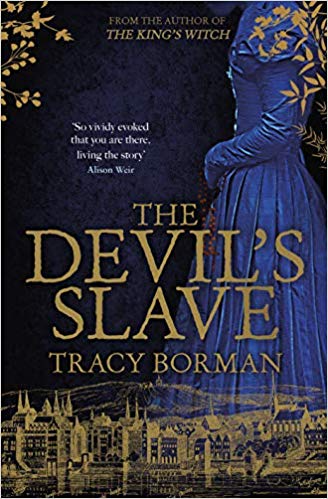
Frances Gorges has already survived the accusation of witchcraft.
But if her torturers at the court of King James knew of her love for Tom Wintour, one of the executed members of the gunpowder plot, it would mean certain death.
Pregnant with Tom’s child, hiding under the reluctant protection of her spiteful and ambitious brother, Frances lives in fear – until she is offered the chance to make a respectable – if loveless – marriage and return to court.
She will not be expected to sleep with her husband. The only price she must pay for safety is to give up the cause for which her lover died.
But old loyalties are hard to deny, and soon Frances is drawn back into the snake-pit scheming of the factions trying to take the throne.
Everywhere she turns, it seems that someone has the power to force her deeper into danger until, all too late, Frances hears the warnings of her own heart.
Compelling, sensual, suspenseful, The Devil’s Slave is a standalone sequel to The King’s Witch and further evidence that one of our finest historians is also a brilliant novelist.
Another stunning instalment of the Frances Gorges story from Tracy Borman. The young woman who barely escaped the fallout of the Gunpowder Plot with her life is once again drawn into the intrigues of the fledgling Stuart court. Skilled with herbs and a secret Catholic make her twice the target for the staunchly protestant witch-hunter King James and his minister, Robert Cecil. Frances’s return to court with her husband and son sees her trying to negotiate her way through the various Catholic plots that surround the crown and court.
Tracy Borman weaves a tale that is fraught with tension, with danger lurking around every corner, or behind every rose bush. At times, it seems that everyone is a chameleon – and no one is as they seem. And, just like the heroine, the reader is drawn into the plots and intrigues of the court. This engaging, entertaining story will keep the reader enthralled until the very last page.
The history and story are effortlessly woven together.
She looked down at her hands as she struggled to maintain her composure. Dorothy reached forward and took them in her own. ‘I understand your fears, Frances,’ she said softly. ‘These are dangerous times for those of us who share the true faith. I know that you wish to protect your son, as I do mine. But you cannot condemn him – and yourself – to life of falsehood, of heresy. To do so would be to damn him in the next life, as well as this one. You cannot think that is what Tom would have wished for his son.’
‘Tom would have wished him to stay alive!’ Frances cried, the tears now streaming down her cheeks. ‘What would you have me do? Parade him as the son of a condemned traitor? Forfeit his safety, his happiness, his life? And all for what? A cause that died with Tom and the rest?’
Dorothy fell silent, but her grip on Frances’s hands tightened. ‘It did not die, Fraces,’ she said. ‘It is stronger now than ever. The death of Tom and his companions has intensified people’s hatred of this heretic king and drawn thousands more to our cause. I don not speak out of blind faith,’ she continued, as if reading Frances’s thoughts. ‘We have learned from the lessons of the past. Cecil’s spies are now outnumbered by those of our cause. How do you suppose I was able to find out about my nephew? The time is almost ripe to act. We have powerful supporters at court, and the King of Spain stands in readiness with a huge army.’
Frances’s mind was reeling…
Tracy Borman’s vast knowledge of the Stuart court and the various royal palaces in which The Devil’s Slave is set, serve to add a level of authenticity into the story that is rarely seen in a novel, whilst the subtlety in delivering the facts avoids giving the reader a lecture in Stuart history. The blend of fact and fiction is indistinguishable, leaving the reader with many avenues of research to pursue later, if they are so inclined.
The locations of lavish palaces, manor houses and the Tower of London are recreated in great detail. Tracy Borman uses her extensive knowledge to rebuild the Stuart world for the modern reader. The prose is a pleasure to read and devour, while the plot delves deep into the dark corners of Stuart history.
However, her greatest creations in the book are the characters, whether real or imagined. The personalities of Sir Walter Raleigh and Arbella Stuart, alongside the various members of the royal family, are wonderfully deep, complex individuals who serve to add spice and colour to an already fabulous story. The heroine, Frances Gorges, is a woman with whom many can feel empathy. Drawn into the various intrigues much against her inclination, but with a desire to protect her family, she is forced to navigate her way through the various dangers, always with the knowledge of what faces her should she fail.
The Devil’s Slave, as with The King’s Witch, is a story that is not to be missed. For the reader, it provides a truly enjoyable sojourn in the realm of early Stuart England and must appeal to all with an interest in history, intrigue and adventure. I cannot recommend it highly enough!
The Devil’s Slave by Tracy Borman is available from Amazon.
About the Author:
Tracy Borman is joint Chief Curator of Historic Royal Palaces and Chief Executive of the Heritage Education Trust. She studied and taught history at the University of Hull and was awarded a PhD in 1997.
Tracy is the author of a number of highly acclaimed books, including Thomas Cromwell: The Untold Story of Henry VIII’s Most Faithful Servant, Matilda: Wife of the Conqueror, First Queen of England, Elizabeth’s Women: The Hidden Story of the Virgin Queen and Witches: A Tale of Sorcery, Scandal and Seduction. Tracy is also a regular broadcaster and public speaker, giving talks on her books across the UK and abroad. She lives in Surrey with her daughter.
From Emma of Normandy, wife of both King Cnut and Æthelred II to Saint Margaret, a descendant of Alfred the Great himself, Silk and the Sword: the Women of the Norman Conquest traces the fortunes of the women who had a significant role to play in the momentous events of 1066. Available now from Amazon UK, Amberley Publishing,Book Depository and Amazon US.
Telling the stories of some of the most remarkable women from Medieval history, Heroines of the Medieval World, is now available in hardback in the UK from Amazon UK, and in the US from Amazon US. It is available now in paperback in the UK from from both Amberley Publishing and Amazon and worldwide from Book Depository.
*
You can be the first to read new articles by clicking the ‘Follow’ button, liking our Facebook page or joining me on Twitter.
Today it is a pleasure to welcome historian Heather R. Darsie to History… the Interesting Bits with an article about Anne of Cleves, Henry VIII’s fourth wife. Heather’s new book, Anna Duchess of Cleves; the king’s Beloved Sister is out now.
The First Hint of Trouble: An Early Spat Between the Johann II of Cleves and Elector Frederick of Saxony
By Heather R. Darsie
Throughout the late 15th and early 16th century, various disputes over territory sprung up across the German-speaking portions of the Holy Roman Empire. In 1517, a new facet of rebellion against the Empire was introduced in Saxony when Martin Luther’s 95 Theses became known. Maximilian I was still the Holy Roman Emperor in 1517. He could not know what the changing attitudes toward the Catholic church would do to the fabric of the Empire. Maximilian passed away on 12 January 1519, making his grandson Charles the next Holy Roman Emperor. Charles’ first coronation, in Germany, took place in 1520.
Twenty-year-old Charles V was crowned in October 1520 as the King of the Romans-Germans at a grand ceremony in Aachen. By being crowned King of the Romans-Germans, Charles V was the Holy Roman Emperor Elect. Pope Leo X gave Charles V permission to style himself as the Holy Roman Emperor until Charles’ 1530 coronation at Bologna by Pope Clement VII.
In 1520 when Charles V’s massive train of at least two thousand horse. The various electors, including Elector Fredrick of Saxony, made up part of Charles V’s company. Though the details are unclear, it is recorded in an account of Charles V’s coronation printed circa 1520 that the Elector of Saxony and “Duke of Gülch” – an archaic spelling of “Jülich” – squabbled for a long time over who took which precedence during the procession to Aachen Cathedral.
Frederick of Saxony believed that Johann III of Cleves should have been included with the Saxon contingent rather than Johann being independent of Saxony. Saxony was ruled by an Elector, with only eleven electors in all of the Germanic areas. By comparison, Johann III was only a duke, and there were hundreds of duchies in all of the Germanic areas. In the end, Anna’s father Johann III entered the city before Elector Frederick of Saxony. Elector Frederick likely took exception to this snub.
Elector Frederick, famous for having sheltered Martin Luther from Charles V, passed away. Because Frederick was childless, his younger brother John became Elector of Saxony in 1525. Frederick was Catholic throughout his life. There is some debate over whether Frederick converted to Lutheranism on his deathbed. In February 1527, Elector John’s son Johann Friedrich married Johann III’s eldest daughter, Sybylla of Cleves. The debate over Lutheran reforms was in full swing, and Charles V tried his best to quell the rising tides of religious change.
The marital alliance between Anna of Cleves’ elder sister Sybylla and Johann Friedrich did not have the immediate benefits for which Elector John hoped. Elector John was a Lutheran even before he became the Elector of Saxony. Sybylla and Johann Friedrich welcomed their first son, also named Johann Friedrich, in January 1529. The next year, the first Diet of Augsburg took place. It was at this Diet that Emperor Charles V tried to soothe tensions over Protestantism, and also when he introduced his comprehensive criminal code. The Augsburg Confession was produced because of this Diet, too. After the Diet of Augsburg, the issue of religion and thus, allegiance to the Emperor became more divided.
Anna’s and Sybylla’s parents were Catholic, their mother Maria particularly so. Jülich-Cleves-Berg was understood to be predominantly Catholic under the reign of Johann III, but tolerant of Lutheranism. By the late 1520s, two political and religious ideas dominated Germany: pro-Imperial and pro-Catholic, or anti-Imperial and pro-Lutheran. This put Jülich-Cleves-Berg and Saxony on different ends of the political spectrum.
Sybylla herself converted to Lutheranism, as did Anna’s and Sybylla’s little sister Amalia. At the begin of his reign in 1539 as Duke Wilhelm V, Johann Friedrich sent Philipus Melanchthon to learn whether Wilhelm was pro-Lutheran or pro-Catholic. Johann Friedrich became Elector of Saxony in 1532 after the death of his father, and needed to know which way Wilhelm leaned.
If you’re curious to know more about religion in Cleves during Anna of Cleves’ lifetime, check out my new biography, “Anna, Duchess of Cleves: The King’s ‘Beloved Sister.’
Sources & Suggested Reading
Römischer Künigklicher Maiestat Krönung zü Ach Geschehen. Author unknown. Circa Held by the Newberry Library, Chicago, Illinois.
Rosenthal, Earl E. “The Invention of the Columnar Device of Emperor Charles V at the Court of Burgundy in Flanders in 1516.” Journal of the Warburg and Courtauld Institutes36 (1973): 198-230.
Darsie, Heather. Anna, Duchess of Cleves: The King’s ‘Beloved Sister.’ Stroud: Amberley (2019).
Anna Duchess of Cleves; the king’s Beloved Sister
Anna was the ‘last woman standing’ of Henry VIII’s wives – and the only one buried in Westminster Abbey. How did she manage it?
Anna, Duchess of Cleves: The King’s ‘Beloved Sister’ looks at Anna from a new perspective, as a woman from the Holy Roman Empire and not as a woman living almost by accident in England. Starting with what Anna’s life as a child and young woman was like, the author describes the climate of the Cleves court, and the achievements of Anna’s siblings. It looks at the political issues on the Continent that transformed Anna’s native land of Cleves – notably the court of Anna’s brother-in-law, and its influence on Lutheranism – and Anna’s blighted marriage. Finally, Heather Darsie explores ways in which Anna influenced her step-daughters Elizabeth and Mary, and the evidence of their good relationships with her.
Was the Duchess Anna in fact a political refugee, supported by Henry VIII? Was she a role model for Elizabeth I? Why was the marriage doomed from the outset? By returning to the primary sources and visiting archives and museums all over Europe (the author is fluent in German, and proficient in French and Spanish) a very different figure emerges to the ‘Flanders Mare’.
Heather Darsie works as an attorney in the US. Along with her Juris Doctorate she has a BA in German, which was of great value in her research in the archives of Germany, Switzerland and the Netherlands for this book. She is currently studying for her Master’s in Early Modern History through Northern Illinois University. She runs the website MaidensAndManuscripts.com and regularly contributes to QueenAnneBoleyn.com and TudorsDynasty.com. She has been researching this work for several years.
*
My books
Tracing the fortunes of the women who had a significant role to play in the momentous events of 1066, Silk and the Sword: the Women of the Norman Conquest is available from Amazon UK, Amberley Publishing,Book Depository and Amazon US.
Also by Sharon Bennett Connolly:
Telling the stories of some of the most incredible women from Medieval history, Heroines of the Medieval World, is now available in hardback in the UK from Amazon UK, and in the US from Amazon US. It is available now in paperback in the UK from from both Amberley Publishing and Amazon and worldwide from Book Depository.
*
You can be the first to read new articles by clicking the ‘Follow’ button, liking our Facebook page or joining me on Twitter.
Handsome, charismatic and a champion jouster, Sir Charles Brandon is the epitome of a Tudor Knight. A favourite of King Henry VIII, Brandon has a secret. He has fallen in love with Henry’s sister, Mary Tudor, the beautiful widowed Queen of France, and risks everything to marry her without the king’s consent.
Brandon becomes Duke of Suffolk, but his loyalty is tested fighting Henry’s wars in France. Mary’s public support for Queen Catherine of Aragon brings Brandon into dangerous conflict with the ambitious Boleyn family and the king’s new right-hand man, Thomas Cromwell.
Torn between duty to his family and loyalty to the king, Brandon faces an impossible decision: can he accept Anne Boleyn as his new queen?
I have had the privilege of reading several historical fiction biographies by Tony Riches and in each one the author manages to get ‘under the skin’ of his subject. With Brandon – A Tudor Knight he seems to have gone one step further. Tony Riches ‘gets’ Charles Brandon, Henry VIII’s best friend and brother-in-law. He makes no excuses for Brandon’s often-dubious marital choices, but portrays a man of his time, an ambitious Tudor knight, in need of money and position, but always aware of how far a man can fall, having seen Henry VIII’s most trusted advisers lose their heads.
The ‘sister’ book to Mary, Tudor Princess, Brandon – A Tudor Knight shows the other side to the story of the marriage between Henry VIII’s sister and his best friend. It is interesting to read about the two sides of the one marriage and seeing how events are perceived differently by the individual characters. That is not to say that Brandon – A Tudor Knight is merely an extension of Mary, Tudor Princess. By no means! This novel tells Brandon’s story, and portrays and ambitious man whose desire to gain financial independence has led him to the wrong marriage bed, at least once.
However, he is also a loyal and loving husband and a man who achieved something that was almost impossible – surviving the reign of Henry VIII as his constant friend and despite marrying the king’s sister behind his back. Brandon is the epitome of the Tudor knight, a man experienced more in diplomacy than in warfare, and always subject to the mercurial whims of his prince. Brandon – A Tudor Knight is a fascinating look into the heart of the Tudor court, life in Tudor England and the marriage of a knight and his princess.
“Thomas Wolsey, a round-faced cleric who’d become Henry’s trusted secretary, greeted Brandon warmly yet studied him with sharp eyes. ‘I believe I owe you thanks, Master Brandon. I hear you’ve defended my name.’
‘It was nothing, Master Wolsey. You must know there are those at court who resent your access to the king.’ Brandon returned the smile. ‘It bothers them that you come from humble stock.’
Wolsey raised his eyebrows. ‘My late father, may God rest his soul, was a respected landowner and innkeeper in Suffolk. He worked hard ta pay for me to be educated at Oxford, yet all they remember is that he once worked as a butcher.’
‘They call me a stable boy behind my back, because I serve Sir Henry Bourchier as his Master of the Horse.’ Brandon grinned. ‘I don’t let it trouble me.’
‘It seems we have much in common.’ Wolsey gave him a wry look. ‘We serve the same master and ambitions – and share a common adversary.’
‘Sir Thomas Howard?’ Brandon saw the scowl of distaste on Wolsey’s face and knew he’d guessed correctly. ‘I suspect he makes trouble for us both when he can.’
Wolsey’s tone became conspiratorial. ‘Thomas Howard defends the privileges of nobility. The king rewards him well, but his day of reckoning will come.’
Brandon understood the implied threat and made a mental note never to cross Thomas Wolsey. He needed the cleric to help him understand the politics of court and council, but intuitively knew Wolsey could bear a grudge and make a dangerous enemy.”
The story is fast-paced and wonderfully woven so that the fact and fiction meld into a perfect narrative. Tony Riches is the consummate storyteller. He explores all aspects of Brandon’s life, including his insecurities and relationships with other members of the Tudor court. Charles Brandon is a ‘new man’ and feels the animosity of the ‘old guard’, descended from the medieval aristocracy. The exploration of these relationships provide a wonderful diversion into court rivalries, especially given Brandon’s unique position as the king’s brother-in-law.
Tony Riches’ research is impeccable and impressive; and his books stick close to the historical narrative, enriching known events with the emotions and conversations of those involved. If you are a fan of Tudor history, you will love theses stories.
Brandon – A Tudor Knight is a pleasure to read.
About the author:
Tony Riches is a full-time author of best-selling historical fiction. He lives in Pembrokeshire, West Wales and is a specialist in the fifteenth century, with a particular interest in the Wars of the Roses and the lives of the early Tudors. For more information about Tony’s other books please visit his website tonyriches.comand his popular blog, The Writing Desk and find him on Facebook and Twitter @tonyriches.
You can find all of Tony’s books, including Brandon – A Tudor Knight and Mary Tudor Princess, on Amazon in the UK and US.
*
Out Now!
Tracing the fortunes of the women who had a significant role to play in the momentous events of 1066, Silk and the Sword: the Women of the Norman Conquest is available from Amazon UK, Amberley Publishing and Book Depository. It is scheduled for release in the US on 1 March 2019 and is available for pre-order from Amazon US.
Also by Sharon Bennett Connolly
Telling the stories of some of the most incredible women from Medieval history, Heroines of the Medieval World, is still available in hardback in the UK from both Amazon UK, in the US from Amazon US and worldwide from Book Depository. It will be released in paperback in the UK from 15 March 2019 and is available for pre-order from Amberley Publishing and Amazon.
*Be the first to read new articles by clicking the ‘Follow’ button, liking our Facebookpage or joining me on Twitter.